Lots of us were taught that pi equals 3.14. Maybe 3.14159 if your teacher was ambitious. Akira Haraguchi, who holds the Guiness Book of World Records title for reciting the most digits of pi in a single run, got up to 100,000 digits in 16 hours.
That’s still only a fraction of the record digits of pi that are calculated—3.18471338 × 10⁻⁸% to be exact. So why do we need that much pi?
A pi record isn’t a burst workload. It’s a system that runs at sustained pressure for months, writing checkpoints, flushing buffers, and proving that nothing quietly breaks. Last December, StorageReview set a new record, calculating 314 trillion digits on a Dell PowerEdge R7725.
Pi has long served as a proving ground for computational systems because it offers a deterministic workload with clear correctness criteria and sustained compute and input/output (I/O) demands. Records in pi computation trace back decades and reflect both mathematical and computational advances. In 1949, ENIAC—the first programmable, electronic, general-purpose, digital computer—computed 2,037 digits of pi in about 70 hours, an early demonstration of electronic computing capability that was eventually published in the paper, “The ENIAC’S 1949 Determination of π.”
Algorithms have evolved significantly since then. The Chudnovsky algorithm, developed in 1988, is one of the fastest converging methods for high-precision pi calculation and has been used in many modern record attempts because of its efficiency at large digit counts.
Pi calculations do not mirror typical enterprise workloads such as databases or machine learning training, but their determinism and large scale make them useful for evaluating sustained performance of CPU, memory, and storage subsystems under continuous load. It’s also used in various security functions including random number generation (because computers can’t be truly random), cryptographic algorithms, hash functions, digital signatures, and secure communications protocols like SSL/TLS.
What the 314 trillion digit run represents
In December 2025, StorageReview reported a new record by calculating pi to 314 trillion digits on a single server that ran continuously for approximately 110 days before completion. The achievement emphasizes not only the scale of the computation but also the role of storage architecture, non-uniform memory-access (NUMA) tuning, and system stability in sustaining such a workload.
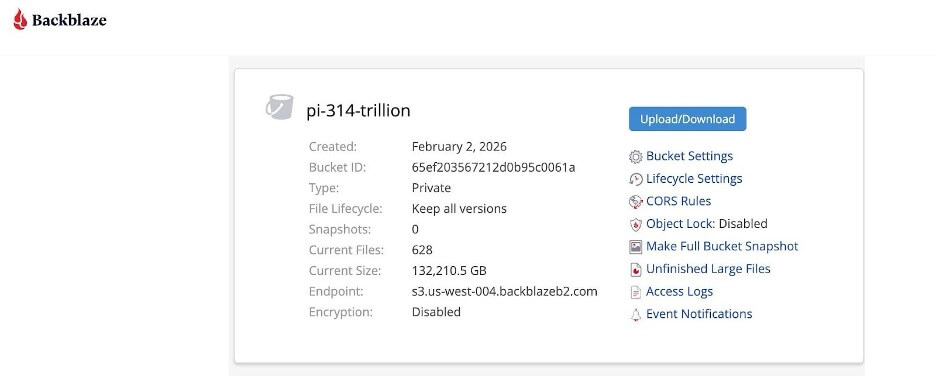
The raw output of the run, including checkpoints, extended beyond 2PB of data. The finalized dataset hosted in Backblaze B2 exceeds 130TB and is divided into 200GB objects suitable for staged retrieval.
What pi really looks like.
Engineers, researchers, and pi enthusiasts can freely retrieve their own slice of pi (or the whole thing) for analysis, performance characterization, and tool validation. Structuring the dataset into manageable objects enables selective download for analysis, parallelized workflow testing, and evaluation of sustained object retrieval performance.
How to access the dataset
The 314 trillion-digit dataset is available today via Backblaze B2 Cloud Storage.
Submit the required information to receive credentials.
Use the provided instructions to download via rclone, an open-source cloud storage management tool.
The object layout supports both partial and full dataset retrieval strategies.
Enjoy your pi!
With all the ways you can use the pi dataset, we can’t wait to hear what you all are working on. Feel free to let us know what you’re working on in the comments section below, on socials, or by email.
You may think the answer to “What do fireworks and the cloud have in common?” is nothing. But, you would be wrong.Both are carefully designed, highly-researched systems that contain a chain reaction of events that lead to a desired outcome. In the case of data centers (DCs), that’s storing and using data. In the case of fireworks, that’s a delightful explosion.
More importantly for our purposes today, both data centers and fireworks are loud. Not upstairs-neighbor loud; rather, they are hearing-loss-and-noise-pollution loud. But, which thing is louder, the cloud or fireworks? What are their sonic qualities, and which is more dangerous?
So, in honor of America’s Independence Day, let’s quantify that with data.
Let’s talk about how we measure sound
We talked briefly about how loud the cloud is in a previous article. All that noise comes from a combination of factors, largely cooling systems—either those that affect large areas of the DC, or those that are part of the hardware of each server rack. Back in 2017, we measured our DCs at approximately 78dB, and other sources report that DCs can reach up to 96dB.
And, it’s unfair to paint a data center with a broad brush, sonically speaking. There are different zones in a data center, and they can vary widely in the amount of decibels produced based on a variety of factors. Here’s a handy list:
Lower range (40-55 dBs): This quieter zone might be experienced in administrative areas or server rooms with less densely packed equipment. It’s comparable to quiet conversation or background noise in a library.
Mid range (55-70 dBs): This is a more common range within data centers, representing the noise level near operating servers. It’s similar to normal conversation or background noise in a restaurant.
Higher range (70-85 dBs): This zone can be found near high-powered equipment or cooling systems. It’s comparable to a vacuum cleaner or busy traffic. Prolonged exposure at these levels can begin to cause hearing damage.
Very high range (85-96 dBs or above): This is the loudest zone and is typically only encountered near generators or during maintenance activities. It’s similar to a power lawnmower or motorcycle and can cause hearing damage with prolonged exposure.
This can all seem relatively esoteric, but it has real world effects. Noise pollution has been shown to cause all sorts of environmental impacts in humans and other animals, and it’s a hot topic of conversation amongst people who live nearby and amongst those responsible for designing and building DCs.
And, how loud are fireworks?
As we all know, there are many types of fireworks, ranging from the humble sparkler to the professionals-only aerial explosives. In theory, consumer-level explosives are supposed to have a noise limit of 120 dBs when fired from 15 meters (about 50 ft.) away. Just to get us all on the same page (for science), here’s a table that outlines some dB ranges for major types of fireworks:
Type of Firework
Noise Level
Decibel Range
Description
Sparklers
Soft Crackling
80-90 dB
Hand-held sticks that emit showers of sparks.
Glow Worms
Soft Crackling/Hissing
85-100 dB
Ground-based fireworks that glow and crackle slightly.
Snakes
Crackling/Popping
90-110 dB
Long, snake-like fireworks that unfurl with a crackling or popping sound.
Poppers
Moderate Pops
100-115 dB
Small, paper-wrapped fireworks that make a popping sound when lit.
Fountains
Crackling/Hissing
95-120 dB
Ground-based fireworks that spray sparks and make a crackling or hissing noise.
Roman Candles
Moderate Pops/Booms
110-130 dB
Hand-held tubes that shoot out stars with loud pops or small booms.
Bottle Rockets
Loud Whistle/Boom
120-140 dB
Fireworks that launch into the air with a whistle and explode with a loud boom.
Aerial Shells (Small)
Moderate-Loud Booms
130-150 dB
Launched into the air, these explode with moderate to loud booms and create colorful visual effects.
Aerial Shells (Large)
Very Loud Booms
150-175 dB
Large shells launched high into the air, exploding with very loud booms and spectacular visuals.
Salute Batteries
Extremely Loud Booms
150-180 dB+
Rapid-fire bursts of loud explosions, often used in professional displays.
Curveball: A direct comparison of dBs isn’t our only metric for “dangerous”
Here’s the funny thing about sound and human hearing, and it ties back to our discussion of decibels: Different types of sound register differently with us, and “loud” isn’t the only risk factor for potential hearing loss. Think of when you’re listening to singers—in general, humans find deeper ranges to be “quieter” while they find higher-pitched ranges to be “louder.” In theory, they could be putting out the same loudness of sound, but we perceive it differently.
A second factor is that a short, percussive sound (like a firework), and a quieter sound that you’re exposed to for longer periods of time (like in a data center) can cause different types of damage. Any loud noise can cause hearing loss—a rapid change in pressure can easily damage the delicate anatomy of the inner ear.
When you’re talking about prolonged exposure, the safe zone is generally 70dB and below. And, while 85dB is considered safe over a period of eight hours, that safe period gets cut in half for every 3dB increase. So, at 88dBs, safe exposure time is 4 hours. At that 96dBs we cited above, you’re at risk for hearing loss in less than an hour.
Of course, there are several ways to mitigate hearing loss in instances where you know you’ll be exposed to potentially dangerous levels of sound, like if you’re attending a fireworks show or going to visit a data center. Over-ear hearing protection and earplugs—which range from your common wax/silicone variety to specially designed models that let in more or less noise—are your two main options (as it relates to your body). And, data centers and fireworks each have methods of reducing sound.
A warning from our robot friend, and declaring a winner
In doing my very thorough research, I did wonder what would happen if you stack these noises… that is, what happens if you set off a firecracker in a data center? Would the noises stack (80dB + 120dB = 200dB)? Would they equalize, then have an additive increment (80dB + the 40dB between baseline and firecracker spike)?
So, I asked my favorite large language model robot friend, who I seem to have distressed. It answered:
Setting off a firecracker in a server room would be a very bad idea for several reasons, and the combined noise level wouldn’t be the biggest concern.
Turns out, while the noise levels would be significant, the combined effect might not be as dramatic as one might imagine. First, unlike open spaces, server rooms often have soundproofing measures to dampen noise. This would limit the amplification of the firecracker’s sound as it does the existing server noise. And second, the firecracker’s sudden, high-intensity sound would likely be the dominant noise even within the server’s noise range. The combined effect wouldn’t be a simple addition of decibel levels. The firecracker’s very loud, short burst would likely overpower the server’s constant hum within the room.
LLMconclusion:
Setting off a firecracker in a server room is extremely dangerous and has far worse consequences than just a loud noise. It’s crucial to prioritize safety and avoid such actions in these critical environments.
Obviously (or I hope it’s obvious), this is not something we’d test in our real-world environment, and we don’t ever recommend that you do either. However, it’s safe to say that in the battle of cloud vs. fireworks, it’s a tad unfair to do a direct comparison of their loudness. Fireworks are (on average) louder, as they’re designed to be. Data centers are still very loud, and the quality of the sound therein is also likely to cause hearing damage over a period of time, and all that is still true even when we’re making active efforts to reduce and dampen the noise in DCs.
Safety first, friends. Remember that ear protection around both servers and fireworks is advisable, and use fireworks and data centers responsibly. We’ll see you on the other side.
We’ve gathered you together here today to address some of weirdest questions (and answers) about everyone’s favorite topic: data storage.
From the outside looking in, it’s easy to think it’s a subject that is as dry as Ben Stein in “Ferris Beuller’s Day Off”. But, given that everyday functions are increasingly moving to the internet, data storage is, in some ways, the secret backbone of modern society.
Today it’s estimated that there are over 8,000 data centers (DCs) in the world, built on a variety of storage media, connected to various networks, consuming vast amounts of power, and taking up valuable real estate. Plus, the drive technology itself brings together engineering foci affected by (driving?) everything from clean room technology to DNA research.
Fertile ground for strange, surprising questions, certainly. So, without further ado, here are some of our favorite questions about data storage.
1. Does a Hard Drive Weigh More When It’s Full?
Short answer: for all practical purposes, no. Long answer: technically yes, but it’s such a miniscule amount that you wouldn’t be able to measure it. Shout out to David Zaslavsky for doing all the math, and here’s the summary.
As Einstein famously hypothesized, e = mc2. If it’s been a while since you took physics, that formula defined is that energy is equal to mass multiplied by the speed of light squared. Since energy is defined by mass, then, we can infer that energy has a weight, even if it’s negligible.
Now, hard drives record data by magnetizing a thin film of ferromagnetic material. Basically, you’re forcing the atoms in a magnetic field to align in a different direction. And, since magnetic fields have differing amounts of energy depending on whether they’re aligned or antialigned, technically the weight does change. According to David’s math, it’d be approximately 10-14 g for a 1TB hard drive.
When you’re talking about building your own storage, my favorite research data point was one Reddit user’s opinion:
But, it’s still worth investing in ways to reduce the noise—if not for worker safety, then to reduce the environmental impact of DCs, including noise pollution. There are a wealth of studies out there connecting noise pollution to cardiovascular disease, hypertension, high stress levels, sleep disturbance, and good ol’ hearing loss in humans. In our animal friends, noise pollution can disrupt predator/prey detection and avoidance, echolocation, and interfere with reproduction and navigation.
The good news is that there are technologies to keep data centers (relatively) quiet when they become disruptive to communities.
3. How Long Does Data Stay Where You Stored It?
As much as we love old-school media here at Backblaze, we’re keeping this conversation to digital storage—so let’s chat about how long your data storage will retain your media, unplugged, in ideal environmental conditions.
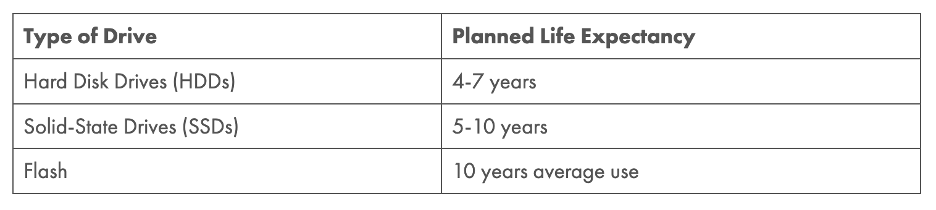
We like the way Enterprise Storage Forum put it: “Storage experts know that there are two kinds of drive in this world—those that have already failed, and those that will fail sooner or later.” Their article encompasses a pretty solid table of how long (traditional) storage media lasts.
However, with new technologies—and their consumer applications—emerging, we might see a challenge to the data storage throne. The Institute of Physics reports that data written to a glass memory crystal could remain intact for a million years, a product they’ve dubbed the “Superman crystal.” So, look out for lasers altering the optical properties of quartz at the nanoscale. (That was just too cool not to say.)
4. What’s the Most Expensive Data Center Site?
And why?
One thing we know from the Network Engineering team at Backblaze is that optimizing your connectivity (getting your data from point A to point B) to the strongest networks is no simple feat. Take this back to the real world: when you’re talking about what the internet truly is, you’re just connecting one computer to every other computer, and there are, in fact, cables involved.
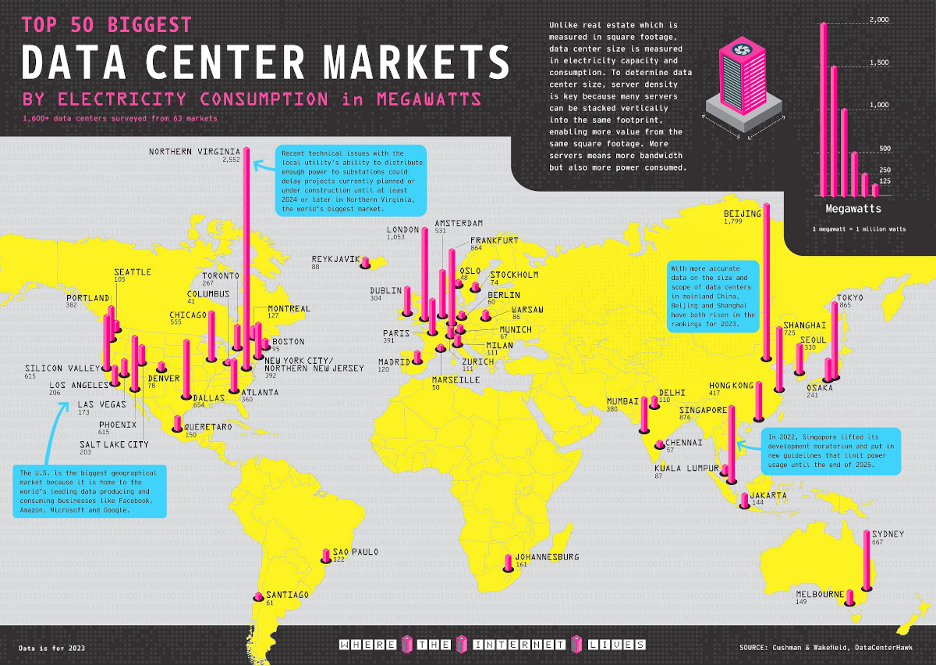
The hardware infrastructure combines with population dispersion in murky ways. We’ll go ahead and admit that’s out of scope for this article. But, working backwards from the below image, let’s just say that where there are more data centers, it’s likely there are more network exchanges.
From an operational standpoint, you’d likely assume it’s a bad choice to have your data center in the middle of the most expensive real estate and power infrastructures in the world, but there are tangible benefits to joining up all those networks at a central hub and to putting them in or near population centers. We call those spaces carrier hotels.
Here’s the best definition we found:
There is no industry standard definition of a carrier hotel versus merely a data center with a meet-me room (MMR). But, generally, the term is reserved for the facilities where metro fiber carriers meet long-haul carriers—and the number of network providers numbers in the dozens. —Data Center Dynamics
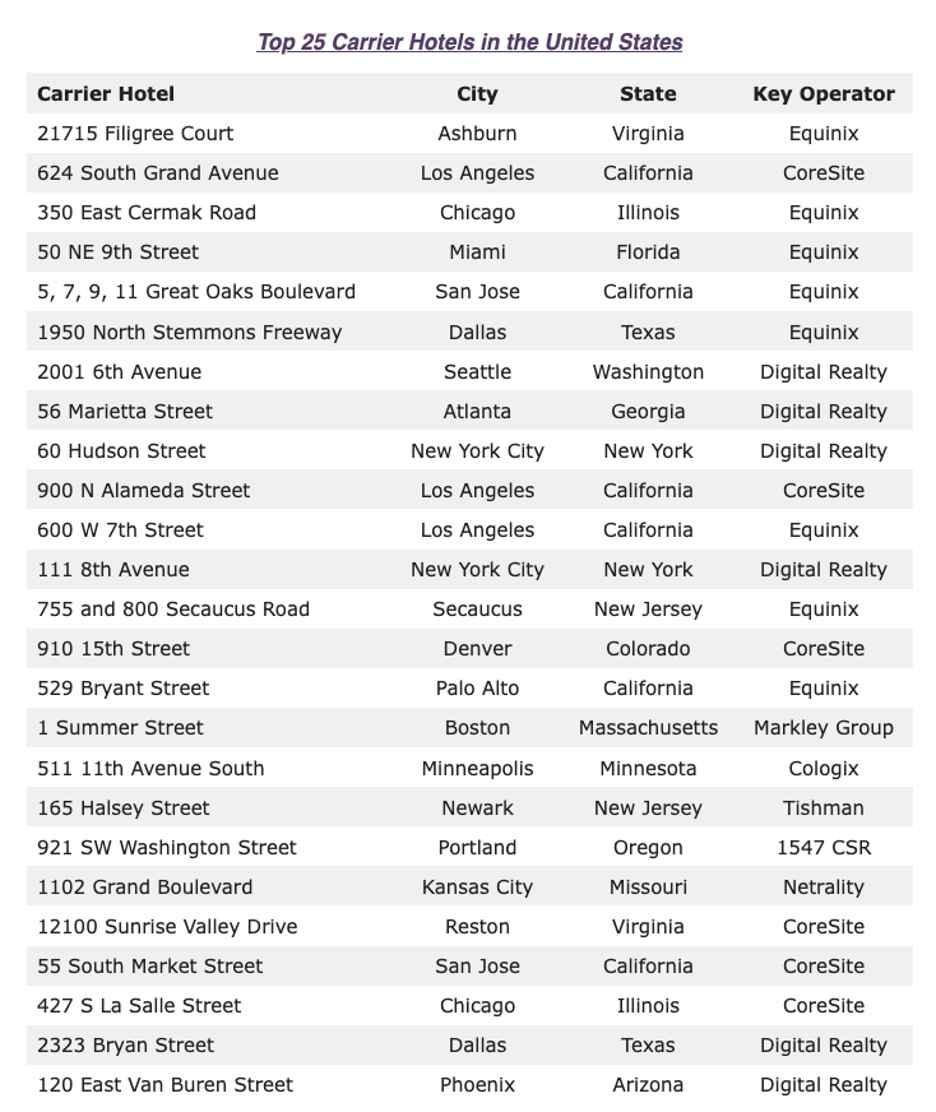
Some sources go so far as to say that carrier hotels have to be in cities by definition. Either way, the result is that carrier hotels sit on some of the most expensive real estate in the world. Citing DGTL Infra from April 2023, here are the top 25 U.S. carrier hotels:
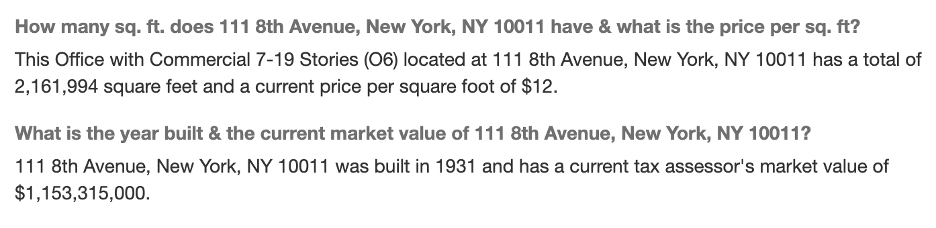
Let’s take #12 on this list, the NYC listing. According to PropertyShark, it’s worth $1.15 billion. With a b. That’s before you even get to the tech inside the building.
If you’re so inclined, flex those internet research skills and look up some of the other property values on the list. Some of them are a bit hard to find, and there are other interesting tidbits along the way. (And tell us what you find in the comments, of course.)
Bonus Question: Is It Over Already?
Look, do I want it to be over? No, never. But, the amount of weird and wonderful data storage questions that I could include in this article is infinite. Here’s a shortlist that other folks from Backblaze suggested:
How broken is too broken when it comes to restoring files from a hard drive? (This is a whole article in and of itself.)
When I send an email, how does it get to where it goes? (Check out Backblaze CEO Gleb Budman’s Bookblaze recommendation if you’re curious.)
What happens to storage drives when we’re done with them? What does recycling look like?
So, the real question is, what do you want to know? Sound off in the comments—we’ll do our best to research and answer.
The holidays are fast approaching and with them the many cyber sales that provide both inspiration and opportunity for gift giving on any budget. To help narrow the field, every year I ask my fellow Backblazers to submit the gifts that they are looking forward to both gifting and receiving. (Hopefully some of their loved ones read the blog?) And of course, I’ve sprinkled in a few of my favorites as well. Without further ado, here’s what we suggest looking into for your 2023 gift giving!
This little thing is pretty neat. It helps you keep track of your health, tracking everything from sleep to stress levels. It lasts for a week on a single charge, and is super easy on the eyes, so you’ll want to wear it all over the place.
We have a lot of hikers, joggers, and runners at Backblaze and, as firm believers in thinking about your backup options before a disaster, the Garmin is an awesome-to-have trail buddy.
While a cocktail shaker is a pretty common household item, this one is sure to impress. Ask questions like, “Could my drink possibly get any colder and stay that way?” and “Can I customize my shaker with a sticker of my cat’s face?” And the Yeti’s answer is yes. Also, you know we love when a product comes in red.
Wine anyone? If you or someone in your life is a big wino, older wines are a delicious treat, with a potentially fatal stumbling block: old, crumbly corks. The Durand corkscrew helps take them out with no breakage.
Another one for winos, the Coravin is an incredible wine system that uses tiny needles and argon gas to pour wine into your glass without having to actually open it. I can personally vouch for this one as a single human who has nice wine bottles and often wants a single glass once or twice a week.
Tea time is a dreamy time and this matcha set allows you to make yourself a traditional cup. And if you need some matcha powder for it, this one comes high comes highly recommended: Organic Ceremonial Grade Matcha Powder.
Tea and coffee at a campsite are a must-have, and if you’ve never tried a Jet Boil, this model is easy to use. Also helpful for those times where you lose power and need to make some hot water in a hurry.
Foodies know and love the sous vide method, a.k.a. low temperature, long time (LTLT). If you’re into cooking your food in a hot tub, you’ll be happy to know that this accessory has come down in price dramatically over time. We like this version of a kitchen appliance, but there is certainly a wide world of sous vide gadgets out there if you’re interested.
Love fancy foods but can’t travel to get them? Goldbelly has become the go-to for nationwide delivery of local favorites, and they now do meal kits as well. We’re not going to say you should give up on your standard, probably nutritionally balanced Hello Freshes of the world, but we will say that these are a whole lot more, well, iconic.
Have your own mini-garden whether you’re in a house or an apartment. With just a little bit of counter space, a semi-green thumb, some patience, and water, you’ll never have herbs go bad in your fridge again.
Not since the times of the Game Boy Advance or maybe the Nintendo 3DS have handheld gaming systems seen such a rise in popularity. Along with the Nintendo Switch, these three handhelds bring the power of a computer to your fingertips on the go. While it’s not quite a gaming rig, it’s good enough for most airline flights, and hey…they’ll all play Baldur’s Gate 3.
It’s a great time to be a nerd. Critical Role, Dimension 20, The Adventure Zone, and many more role playing games (RPGs) are super popular nowadays, and it’s high time you take part. Get the D&D starter kit, some dice, and your soon-to-be best friends, create your character and get rolling.
Backblaze is based in California, but that doesn’t mean that we don’t know about weather. (What’s this wet stuff falling from the sky again?) That said, as a Midwesterner by heritage (dontcha know), I know something about staying warm. Heated clothes take the benefits of your favorite heated blanket and give them to you on the go.
We’re all about being good community members, and this local (to us) company makes hats, fanny packs, and bomber jackets using environmentally friendly materials. They’re good products, in more ways than one.
Studies have shown that meditation has measurable benefits for your mind and body. There are a plethora of tools out there to help you build good habits (see below), but this one is stinkin’ cute. Let this little guy help visually take you through a guided meditation. Bonus: it’s a great gift for kids, too.
The Calm app helps people stay mindful with everything from guided meditation to celebrity-read stories. We’re big fans of their social posts that just encourage you to take a 15 second break—it’s a positive interruption to the doomscroll effect, and a great way to preview some of the app’s content.
A twist on photo frames: you can send pictures to it and have all of your favorite memories staring back at you when you look over. Or, send photos to anyone, anywhere. Definitely some potential prank opportunities to be had; but it’s also a great way to keep in touch with far-flung family members.
Sonos surround systems are a great addition to homes. Multiple speakers can sync up to make sure that you’re never far away from rocking out to Weird Al, no matter where you are in the house.
For the audiophiles in your life, the AirPods Max are the over-the-ear variant of the traditional AirPod. They’re much harder to lose, giving you that impressive combo of sound and noise cancellation you’ve come to expect.
To balance the scales for our Android lovers, here are Google’s in-ear buds. They have a lot of bells and whistles including noise cancellation and built-in Android Assistant. Now when you talk to yourself, someone will answer. (That’s a good thing right?).
LEGO
LEGO is having a bit of a moment (at least in my family) and we have spent a lot of time building complicated models. For the adults in your life that love to tinker, we recommend some of these cool sets!
And, of course, we’d be remiss if we didn’t remind you that Backblaze Computer Backup makes a great gift. Help your family and friends experience the sweet, sweet peace of mind that comes from a good backup strategy and make sure they never lose a file again. Bonus: you don’t even have to go to the store to get it.
Go Forth and Gift!
We hope this guide sparked some ideas and simplified some choices. We’ll also be publishing our second-annual book guide in December if you’re struggling with something for the literary folks in your life. (There’s some good stuff in the first one too.) We love hearing about what folks are excited about, so feel free to give us some more good options in the comments below.
The year is 2023, and the human race has spread across the globe. Nuclear powered flying cars are everywhere, and the first colonies have landed on Mars! [Radio crackles.]
Okay, so that isn’t exactly how it’s gone down, but in honor of Halloween, the day celebrates the whimsy of all things being possible, let’s talk about things that used to be science fiction and aren’t anymore.
Artificial Intelligence (AI)
Have we gotten reader fatigue from this topic yet? (As technology people by nature, we’re deep in it.) The rise of generative AI over the past year or so has certainly brought this subject into the spotlight, so in some ways it seems “early” to judge all the ways that AI will change things. On the other hand, there are lots of tools and functions we’ve been using for a while that have been powered by AI algorithms, including AI assistants.
Shout out to this content creator for a hilarious video.
At the risk of not doing this topic justice in this list, I’ll say that there’s plenty of reporting on—and plenty of potential for—AI now and in the future.
Aliens
This year, the U.S. House Oversight Committee was conducting an investigation on unidentified flying objects (UFOs). While many UFOs turn out to be things like weather balloons and drones designed for home use, well, some apparently aren’t. Three military veterans, including a former intelligence officer, went on record saying that the government has a secret facility where it’s been reverse engineering highly advanced vehicles, and that the U.S. has recovered “non-human biologics” from these crash sites. (Whatever that means—but we all know what that means, right…)
Here’s the video, if you want to see for yourself.
Weirdly, the public response was… not much of one. (The last couple of years have been “a year”.) But, chalk this one up as confirmed.
Space Stations
The list of sci-fi shows and books set on space stations is definitely too long to list item by item. Depending on your age (and we won’t ask you to tell us), you may think of Isaac Asimov’s Foundation series (the books), Star Wars, Zenon, Girl of the 21st Century (or maybe the Zequel?), Babylon 5, or the Expanse.
Back in the real world, the International Space Station (ISS) has been in orbit since 1998 and runs all manner of scientific experiments. Notably, these experiments include the Alpha Meter Spectrometer (AMS-02) which is designed to detect things like dark matter and antimatter and solve the fundamental mysteries of the universe. (No big deal.)
For those of us stuck on Earth (for now), you can keep up with the ISS in lots of ways. Check out this map that lets you track whether you can see it from your current location. (Wave the next time it floats over!) And, of course, there are some fun YouTube channels streaming the ISS. Here’s just one:
Universal Translators
Okay, universal translators is the cool sci-fi name, but if you want the actual, machine learning (ML) name, folks call that interlingual machine translation. Translation may seem straightforward at first glance, but, as this legendary Star Trek episode demonstrates, things are not always so simple.
And sure, it’s easy to say that this is an unreasonable standard given that most human languages are known—but are they? Native language reclamation projects like those from the Cherokee and Oneida tribes demonstrate how easy it is to lose the nuance of a language without those who natively speak it. Advanced degrees in poetry translation, like this Masters of Fine Arts from the University of Iowa (go Hawks!), help specialists grapple with and capture the nuance between smell, scent, odor, and stench across different languages. And, add to those challenges that translators also have to contend with the wide array of accents in each language.
With that in mind, it’s pretty amazing that we now have translation devices that can be as small as earbuds. Most still require an internet connection, and some are more effective than others, but it’s safe to say we live in the future, folks. Case in point: I had a wine tasting in Tuscany a few months ago where we used Google Translate exclusively to speak with the winemaker and proprietor.
iPads
“What?” you say. “iPads are so normal!” Sure, now you’re used to touch screens. But, let me present you with this image from a show that is definitely considered science fiction:
Shockingly, not an iPad.
Yes, folks, that’s Captain Jean Luc Picard from Star Trek: The Next Generation. And here’s a later one, from Star Trek: Deep Space Nine.
These are plans for the arboretum, so Keiko is probably dropping some knowledge.
Star Trek wikis describe the details of a Personal Access Display Device, or PADD, including a breakdown of how they changed over time in the series. Uhura even had a “digital clipboard” in the original Star Trek series:
We’d have to revisit the episode to see what this masterful side-eye is about.
And, just for the record, we’ll always have a soft spot in our heart for Chief O’Brien’s love of backups.
Robot Domestic Laborer
If you were ever a fan of this lovely lady—
Rosie the Robot, of course, longtime employee and friend of The Jetsons.
—then you’ll be happy to know that your robot caretaker(s) have arrived. Just as Rosie was often seen using a separate vacuum cleaner, they’re not all integrated into one charming package—yet. If you’re looking for the full suite of domestic help, you’ll have to get a few different products.
First up, the increasingly popular (and, as time goes on, increasingly affordable) robot vacuum. There are tons of models, from the simple vacuum to the vacuum/mop. While they’re reportedly prone to some pretty hilarious (horrific?) accidents, having one or several of these disk-shaped appliances saves lots of folks lots of time. Bonus: just add cat, and you have adorable internet content in the comfort of your own home.
Next up, the Snoo, marketed as a smart bassinet, will track everything baby, then use that data to help said baby sleep. Parents who can afford to buy or rent this item sing its praises, noting that you can swaddle the baby for safety and review the data collected to better care for your child.
And, don’t forget to round out your household with this charming toilet cleaning robot.
Robot Bartenders
In this iconic scene from The Fifth Element, Luc Besson’s 1997 masterpiece, a drunken priest waxes poetic about a perfect being (spoiler: she’s a woman) to a robot bartender. “Do you know what I mean?” the priest asks. The robot shakes its head. “Do you want some more?”
Start at about 2:00 minutes.
These days, you can actually visit robot bartenders in Las Vegas or on Royal Caribbean cruise ships. Or, if you’re looking for a robot bartender that does more than serve up a great Sazerac, you can turn to Brillo, a robot bartender powered by AI who can also engage in complex dialogue.
Please politely ignore that his face is the stuff of nightmares…it’s what’s on the inside (and in the glass) that counts.
And, if leaving your house sounds terrible, don’t worry: you can also get a specialized appliance for your home.
It’s a Good Time to Be Cloud Storage
One thing that all these current (and future) tech developments have in common: you never see them carting something trailing wires. That means (you guessed it!) that they’re definitely using a central data source delivered via wireless network, a.k.a the cloud.
After you’ve done all the work to, say, study an alien life form or design and program the perfect cocktail, you definitely don’t want to do that work twice. And, do you see folks slowing down to schedule a backup? Definitely not. Easy, online, always updating backups are the way to go.
So, we’re not going to say Backblaze Computer Backup makes the list as a sci-fi idea that we’ve made real; we’re just saying that it’s probably one of those things that people leave off-stage, like characters brushing their teeth on a regular basis. And, past or future, we’re here to remind you that you should always back up your data.
Things We Still Want (Get On It, Scientists!)
Everything we just listed is really cool and all, but let’s not forget that we are still waiting for some very important things. Help us out scientists; we really need these:
We feel compelled to add that, despite our jocular tone, the line between science and science fiction has always been something of a thin one. Studies have shown and inventors like Motorola’s Martin Cooper have gone on record pointing to their inspiration in the imaginative works of science fiction.
So, that leaves us standing by for new developments! Let’s see what 2024 brings. Let us know in the comments section what cool tech in your life fits this brief.
To provide the best experiences, we use technologies like cookies to store and/or access device information. Consenting to these technologies will allow us to process data such as browsing behavior or unique IDs on this site. Not consenting or withdrawing consent, may adversely affect certain features and functions.
Functional
Always active
The technical storage or access is strictly necessary for the legitimate purpose of enabling the use of a specific service explicitly requested by the subscriber or user, or for the sole purpose of carrying out the transmission of a communication over an electronic communications network.
Preferences
The technical storage or access is necessary for the legitimate purpose of storing preferences that are not requested by the subscriber or user.
Statistics
The technical storage or access that is used exclusively for statistical purposes.The technical storage or access that is used exclusively for anonymous statistical purposes. Without a subpoena, voluntary compliance on the part of your Internet Service Provider, or additional records from a third party, information stored or retrieved for this purpose alone cannot usually be used to identify you.
Marketing
The technical storage or access is required to create user profiles to send advertising, or to track the user on a website or across several websites for similar marketing purposes.