Cloudflare’s analytics products help customers answer questions about their traffic by analyzing the mind-boggling, ever-increasing number of events (HTTP requests, Workers requests, Spectrum events) logged by Cloudflare products every day. The answers to these questions depend on the point of view of the question being asked, and we’ve come up with a way to exploit this fact to improve the quality and responsiveness of our analytics.
Useful Accuracy
Consider the following questions and answers:
What is the length of the coastline of Great Britain? 12.4K km
What is the total world population? 7.8B
How many stars are in the Milky Way? 250B
What is the total volume of the Antarctic ice shelf? 25.4M km3
What is the worldwide production of lentils? 6.3M tonnes
How many HTTP requests hit my site in the last week? 22.6M
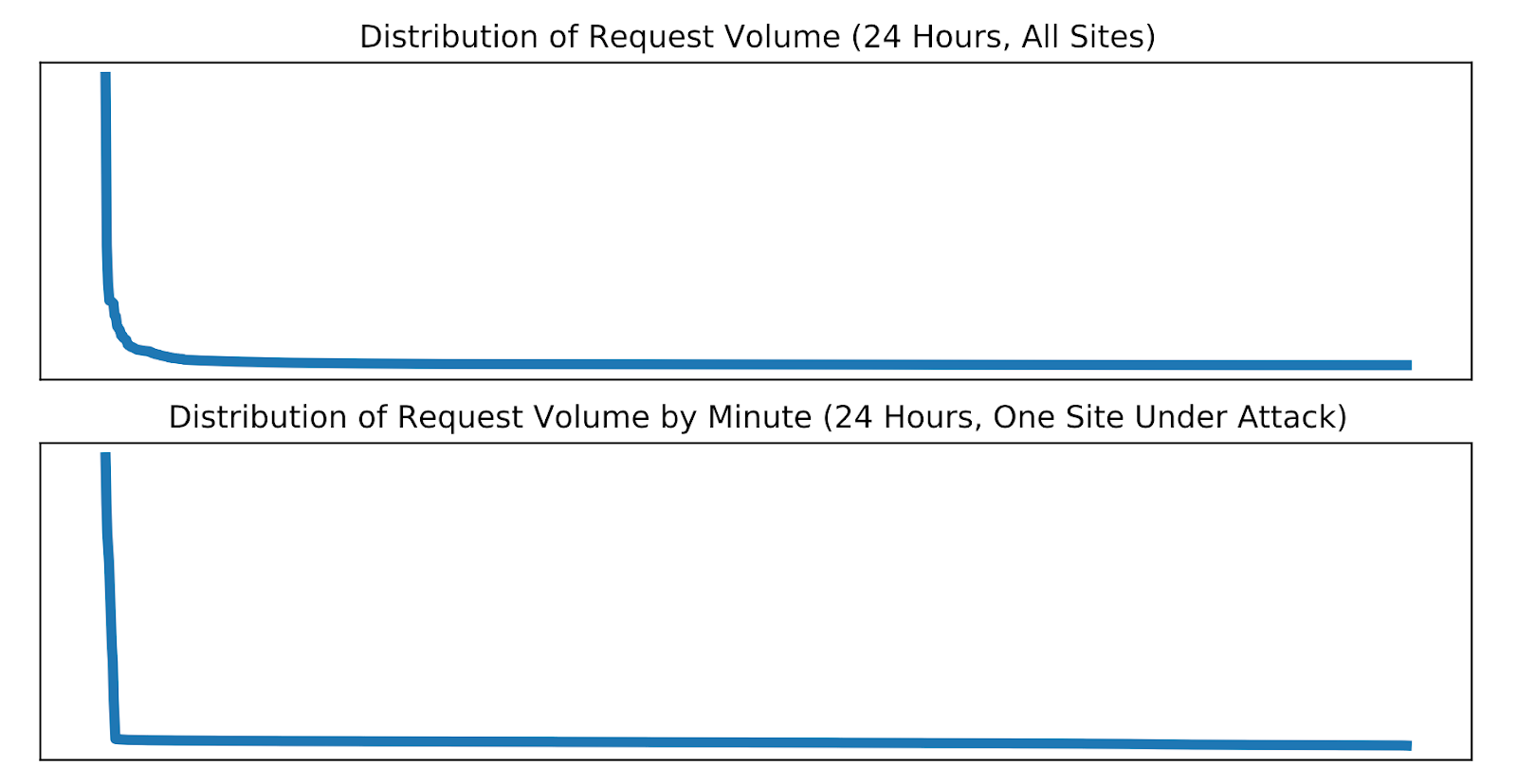
Useful answers do not benefit from being overly exact. For large quantities, knowing the correct order of magnitude and a few significant digits gives the most useful answer. At Cloudflare, the difference in traffic between different sites or when a single site is under attack can cross nine orders of magnitude and, in general, all our traffic follows a Pareto distribution, meaning that what’s appropriate for one site or one moment in time might not work for another.
Because of this distribution, a query that scans a few hundred records for one customer will need to scan billions for another. A report that needs to load a handful of rows under normal operation might need to load millions when a site is under attack.
To get a sense of the relative difference of each of these numbers, remember “Powers of Ten”, an amazing visualization that Ray and Charles Eames produced in 1977. Notice that the scale of an image determines what resolution is practical for recording and displaying it.
Using ABR to determine resolution
This basic fact informed our design and implementation of ABR for Cloudflare analytics. ABR stands for “Adaptive Bit Rate”. It’s essentially an eponym for the term as used in video streaming such as Cloudflare’s own Stream Delivery. In those cases, the server will select the best resolution for a video stream to match your client and network connection.
In our case, every analytics query that supports ABR will be calculated at a resolution matching the query. For example, if you’re interested to know from which country the most firewall events were generated in the past week, the system might opt to use a lower resolution version of the firewall data than if you had opted to look at the last hour. The lower resolution version will provide the same answer but take less time and fewer resources. By using multiple, different resolutions of the same data, our analytics can provide consistent response times and a better user experience.
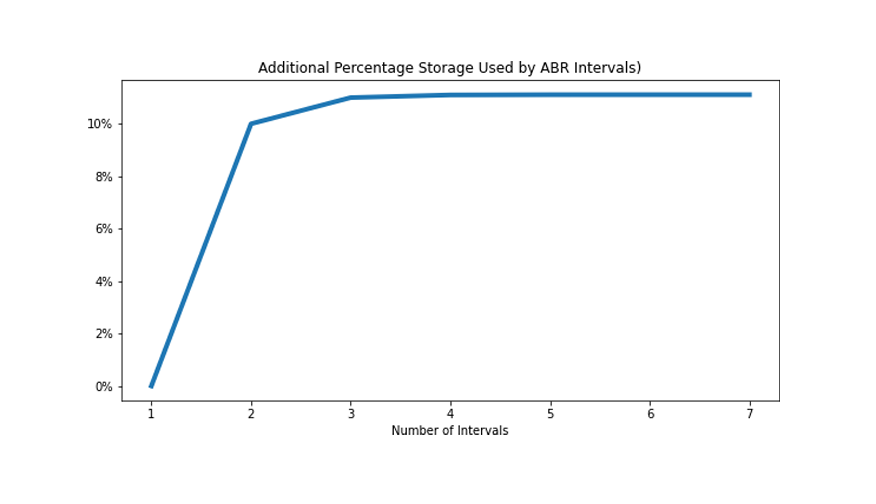
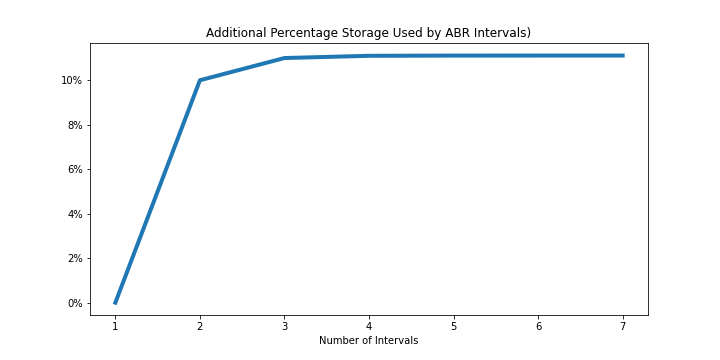
You might be aware that we use a columnar store called ClickHouse to store and process our analytics data. When using ABR with ClickHouse, we write the same data at multiple resolutions into separate tables. Usually, we cover seven orders of magnitude – from 100% to 0.0001% of the original events. We wind up using an additional 12% of disk storage but enable very fast ad hoc queries on the reduced resolution tables.
Aggregations and Rollups
The ABR technique facilitates aggregations by making compact estimates of every dimension. Another way to achieve the same ends is with a system that computes “rollups”. Rollups save space by computing either complete or partial aggregations of the data as it arrives.
For example, suppose we wanted to count a total number of lentils. (Lentils are legumes and among the oldest and most widely cultivated crops. They are a staple food in many parts of the world.) We could just count each lentil as it passed through the processing system. Of course because there a lot of lentils, that system is distributed – meaning that there are hundreds of separate machines. Therefore we’ll actually have hundreds of separate counters.
Also, we’ll want to include more information than just the count, so we’ll also include the weight of each lentil and maybe 10 or 20 other attributes. And of course, we don’t want just a total for each attribute, but we’ll want to be able to break it down by color, origin, distributor and many other things, and also we’ll want to break these down by slices of time.
In the end, we’ll have tens of thousands or possibly millions of aggregations to be tabulated and saved every minute. These aggregations are expensive to compute, especially when using aggregations more complicated than simple counters and sums. They also destroy some information. For example, once we’ve processed all the lentils through the rollups, we can’t say for sure that we’ve counted them all, and most importantly, whichever attributes we neglected to aggregate are unavailable.
The number we’re counting, 6.3M tonnes, only includes two significant digits which can easily be achieved by counting a sample. Most of the rollup computations used on each lentil (on the order 1013 to account for 6.3M tonnes) are wasted.
Other forms of aggregations
So far, we’ve discussed ABR and its application to aggregations, but we’ve only given examples involving “counts” and “sums”. There are other, more complex forms of aggregations we use quite heavily. Two examples are “topK” and “count-distinct”.
A “topK” aggregation attempts to show the K most frequent items in a set. For example, the most frequent IP address, or country. To compute topK, just count the frequency of each item in the set and return the K items with the highest frequencies. Under ABR, we compute topK based on the set found in the matching resolution sample. Using a sample makes this computation a lot faster and less complex, but there are problems.
The estimate of topK derived from a sample is biased and dependent on the distribution of the underlying data. This can result in overestimating the significance of elements in the set as compared to their frequency in the full set. In practice this effect can only be noticed when the cardinality of the set is very high and you’re not going to notice this effect on a Cloudflare dashboard. If your site has a lot of traffic and you’re looking at the Top K URLs or browser types, there will be no difference visible at different resolutions. Also keep in mind that as long as we’re estimating the “proportion” of the element in the set and the set is large, the results will be quite accurate.
The other fascinating aggregation we support is known as “count-distinct”, or number of uniques. In this case we want to know the number of unique values in a set. For example, how many unique cache keys have been used. We can safely say that a uniform random sample of the set cannot be used to estimate this number. However, we do have a solution.
We can generate another, alternate sample based on the value in question. For example, instead of taking a random sample of all requests, we take a random sample of IP addresses. This is sometimes called distinct reservoir sampling, and it allows us to estimate the true number of distinct IPs based on the cardinality of the sampled set. Again, there are techniques available to improve these estimates, and we’ll be implementing some of those.
ABR improves resilience and scalability
Using ABR saves us resources. Even better, it allows us to query all the attributes in the original data, not just those included in rollups. And even better, it allows us to check our assumptions against different sample intervals in separate tables as a check that the system is working correctly, because the original events are preserved.
However, the greatest benefits of employing ABR are the ones that aren’t directly visible. Even under ideal conditions, a large distributed system such as Cloudflare’s data pipeline is subject to high tail latency. This occurs when any single part of the system takes longer than usual for any number of a long list of reasons. In these cases, the ABR system will adapt to provide the best results available at that moment in time.
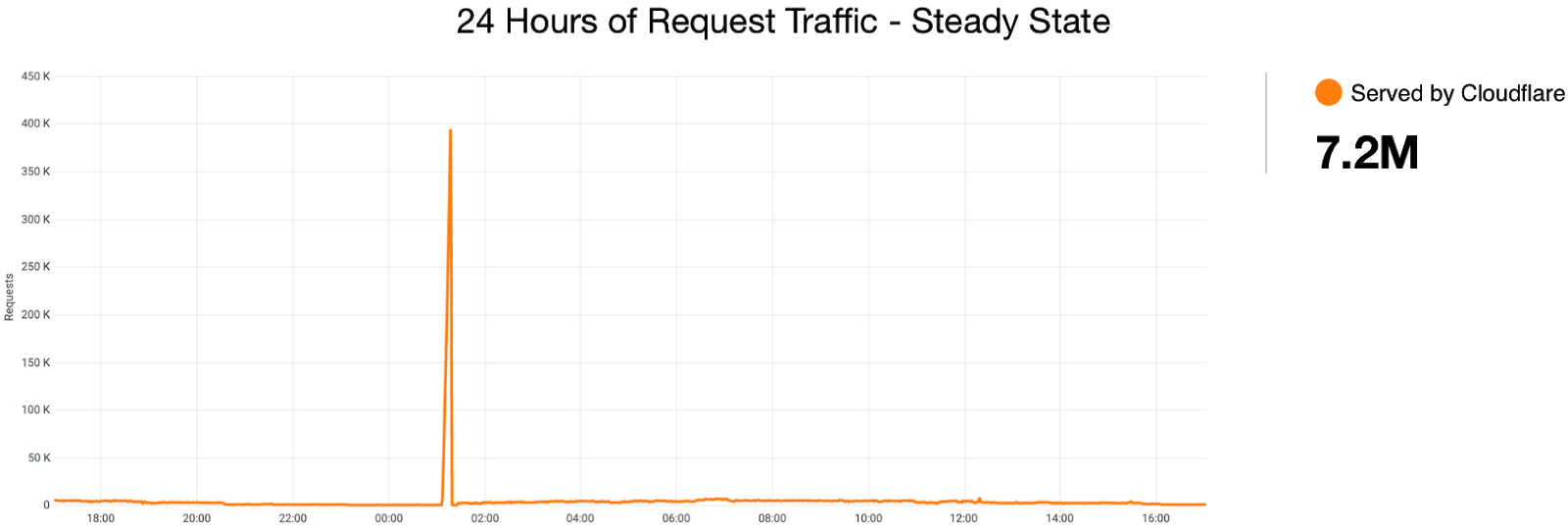
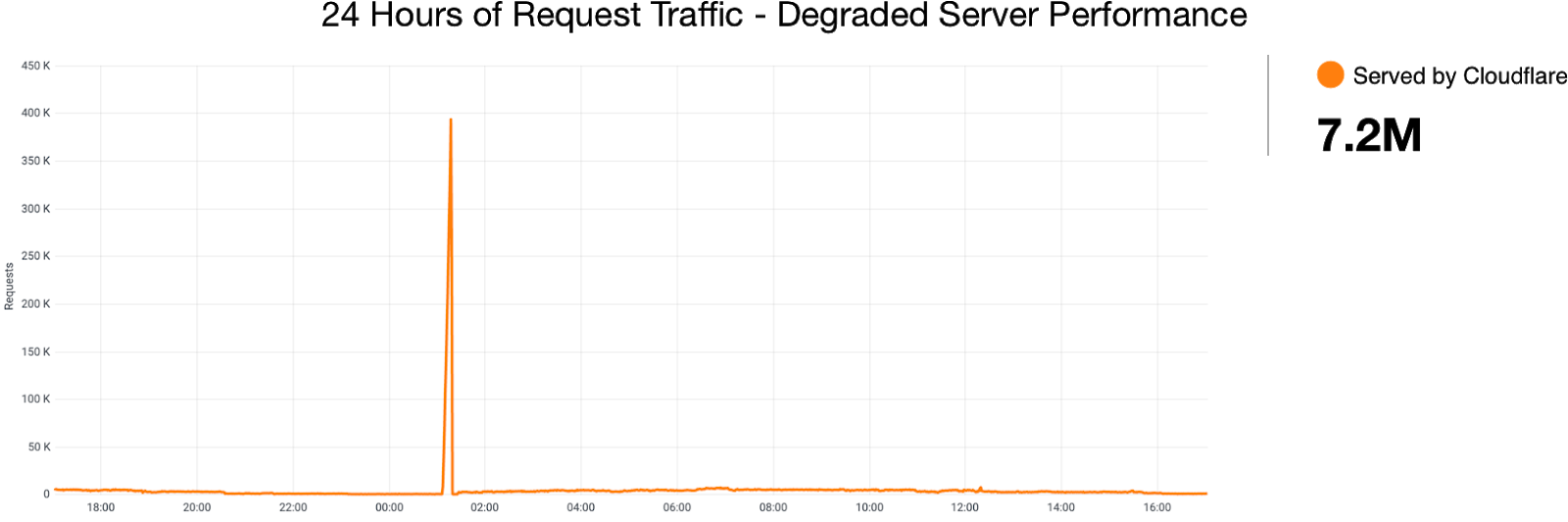
For example, compare this chart showing Cache Performance for a site under attack with the same chart generated a moment later while we simulate a failure of some of the servers in our cluster. In the days before ABR, your Cloudflare dashboard would fail to load in this scenario. Now, with ABR analytics, you won’t see significant degradation.
Stretching the analogy to ABR in video streaming, we want you to be able to enjoy your analytics dashboard without being bothered by issues related to faulty servers, or network latency, or long running queries. With ABR you can get appropriate answers to your questions reliably and within a predictable amount of time.
In the coming months, we’re going to be releasing a variety of new dashboards and analytics products based on this simple but profound technology. Watch your Cloudflare dashboard for increasingly useful and interactive analytics.
Many of us at Cloudflare obsess about how to make websites faster. But to improve performance, you have to measure it first. Last year we launched Browser Insights to help our customers measure web performance from the perspective of end users.
Today, we’re partnering with the Google Chrome team to bring Web Vitals measurements into Browser Insights. Web Vitals are a new set of metrics to help web developers and website owners measure and understand load time, responsiveness, and visual stability. And with Cloudflare’s Browser Insights, they’re easier to measure than ever – and it’s free for anyone to collect data from the whole web.
Why do we need Web Vitals?
When trying to understand performance, it’s tempting to focus on the metrics that are easy to measure — like Time To First Byte (TTFB). While TTFB and similar metrics are important to understand, we’ve learned that they don’t always tell the whole story.
Our partners on the Google Chrome team have tackled this problem by breaking down user experience into three components:
Loading: How long did it take for content to become available?
Interactivity: How responsive is the website when you interact with it?
Visual stability: How much does the page move around while loading? (I think of this as the inverse of “jankiness”)
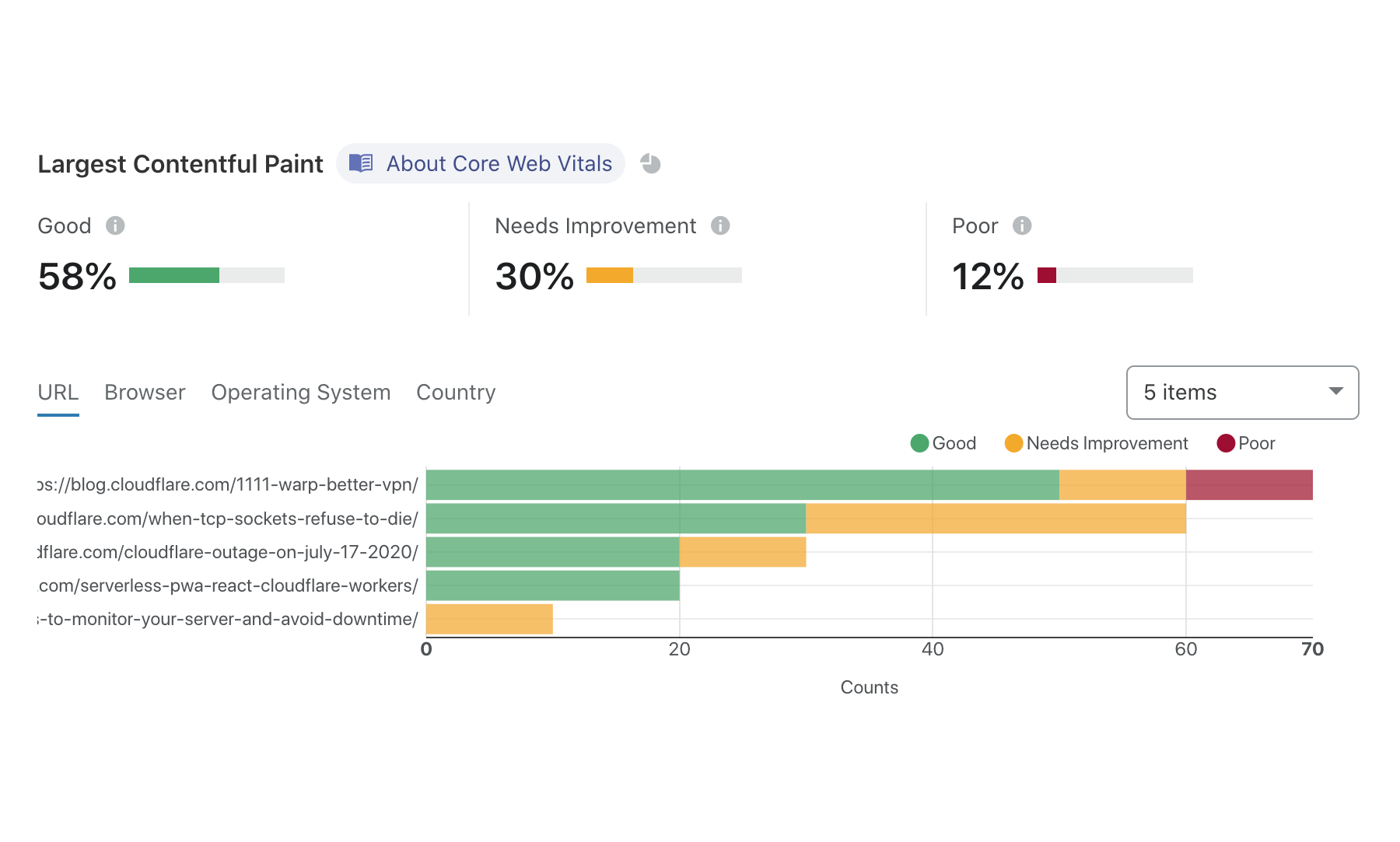
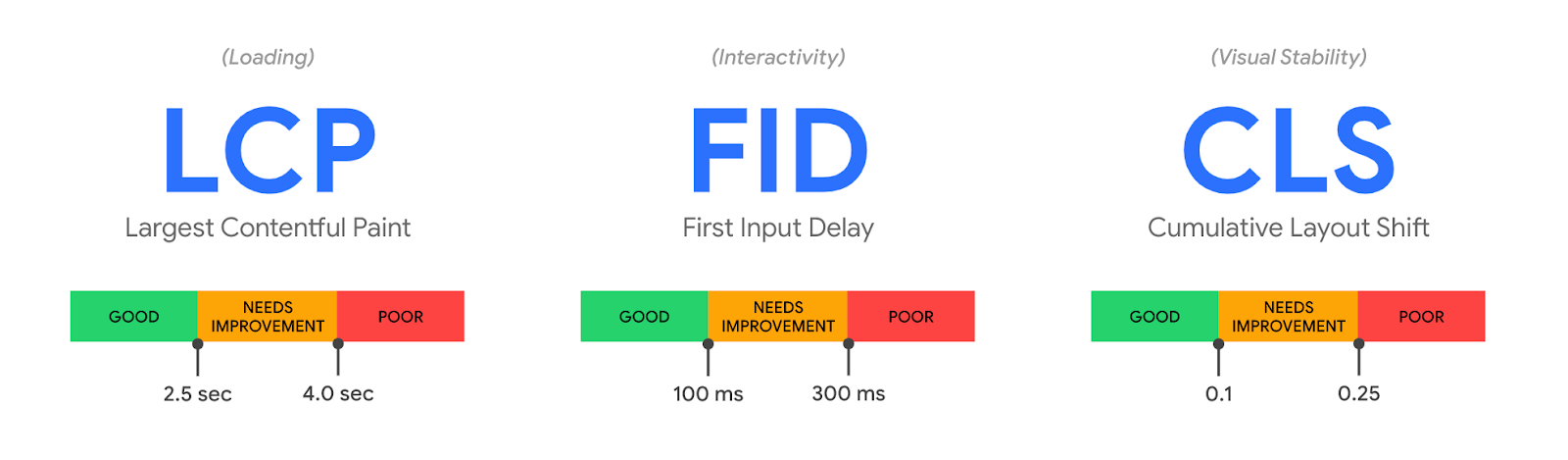
It’s challenging to create a single metric that captures these high-level components. Thankfully, the folks at Google Chrome team have thought about this, and earlier this year introduced three “Core” Web Vitals metrics: Largest Contentful Paint, First Input Delay, and Cumulative Layout Shift.
How do Web Vitals help make your website faster?
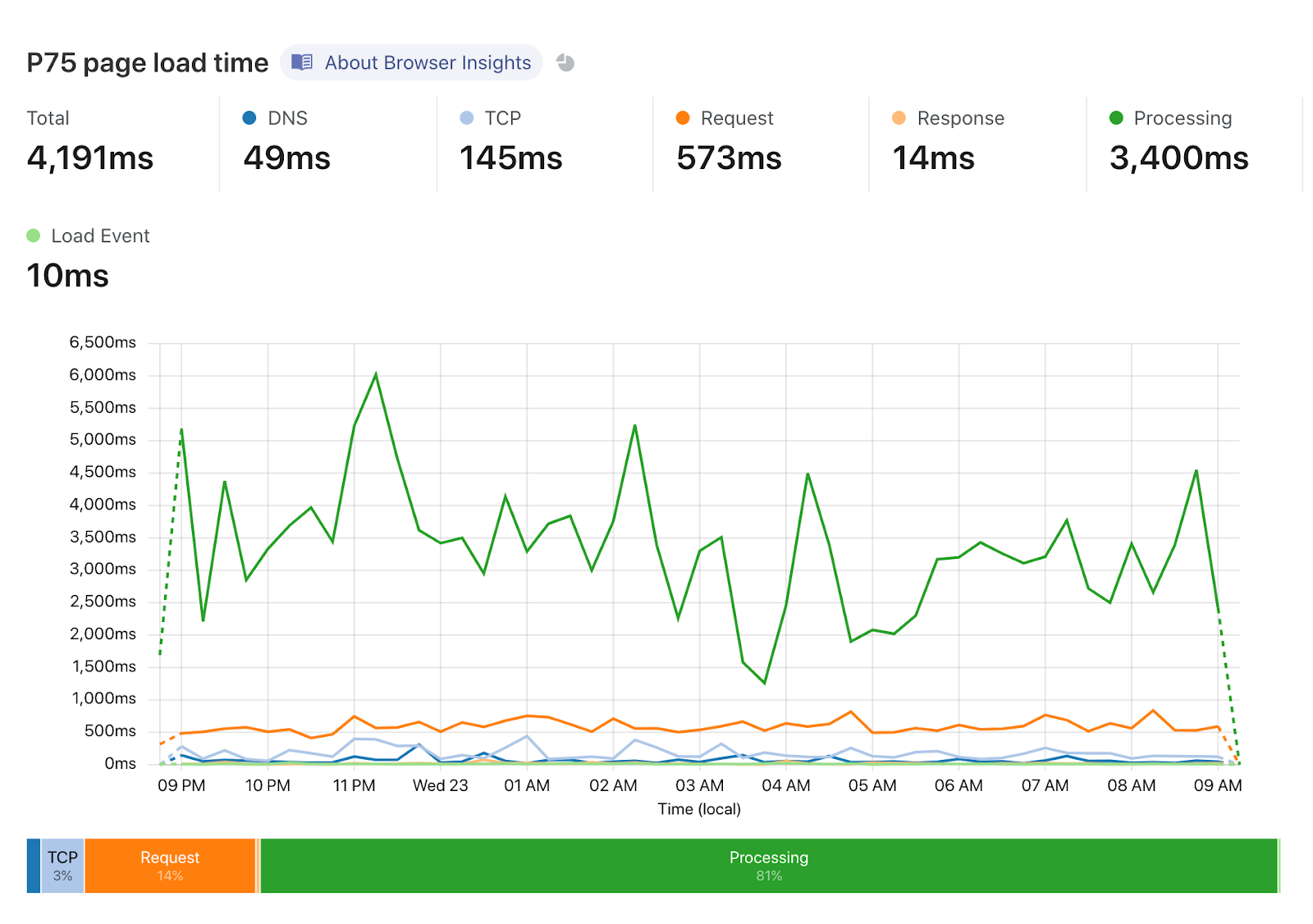
Measuring the Core Web Vitals isn’t the end of the story. Rather, they’re a jumping off point to understand what factors impact a website’s performance. Web Vitals tells you what is happening at a high level, and other more detailed metrics help you understand why user experience could be slow.
Take loading time, for example. If you notice that your Largest Contentful Paint score is “needs improvement”, you want to dig into what is taking so long to load! Browser Insights still measures navigation timing metrics like DNS lookup time and TTFB. By analyzing these metrics in turn, you might want to dig further into optimizing cache hit rates, tuning the performance of your origin server, or tweaking order in which resources like JavaScript and CSS load.
For more information about improving web performance, check out Google’s guides to improving LCP, FID, and CLS.
Why measure Web Vitals with Cloudflare?
First, we think that RUM (Real User Measurement) is a critical companion to synthetic measurement. While you can always try a few page loads on your own laptop and see the results, gathering data from real users is the only way to take into account real-life device performance and network conditions.
There are other great RUM tools out there. Google’s Chrome User Experience Report (CrUX) collects data about the entire web and makes it available through tools like Page Speed Insights (PSI), which combines synthetic and RUM results into useful diagnostic information.
One major benefit of Cloudflare’s Browser Insights is that it updates constantly; new data points are available shortly after seeing a request from an end-user. The data in the Chrome UX Report is a 28-day rolling average of aggregated metrics, so you need to wait until you can see changes reflected in the data.
Another benefit of Browser Insights is that we can measure any browser — not just Chrome. As of this writing, the APIs necessary to report Web Vitals are only supported in Chromium browsers, but we’ll support Safari and Firefox when they implement those APIs.
Finally, Brower Insights is free to use! We’ve worked really hard to make our analytics blazing fast for websites with any amount of traffic. We’re excited to support slicing and grouping by URL, Browser, OS, and Country, and plan to support several more dimensions soon.
Push a button to start measuring
To start using Browser Insights, just head over to the Speed tab in the dashboard. Starting today, Web Vitals metrics are now available for everyone!
Behind the scenes, Browser Insights works by inserting a JavaScript “beacon” into HTML pages. You can control where the beacon loads if you only want to measure specific pages or hostnames. If you’re using CSP version 3, we’ll even automatically detect the nonce (if present) and add it to the script.
Coming soon, we’re excited to make this available for all our Web Analytics customers — even those who don’t use Cloudflare today. We’re also hard at work adding much-requested features like client-side error reporting, and diagnostics tools to make it easier to understand where to improve.
This week marks Cloudflare’s 10th birthday, and we’re excited to continue our annual tradition of launching an array of products designed to help give back to the Internet. (Check back here each morning for the latest!)
We also see this milestone as an opportunity to reflect on where the Internet was ten years ago, and where it might be headed over the next decade. So we reached out to some of the people we respect most to see if they’d be interested in joining us for a series of Fireside Chats on Cloudflare TV.
We’ve been blown away by the response, and are thrilled to announce our lineup of speakers, featuring many of the most celebrated names in tech and beyond. Among the highlights: Apple co-founder Steve Wozniak, Zoom CEO Eric Yuan, OpenTable CEO Debby Soo, Stripe co-founder and President John Collison, Former CEO & Executive Chairman, Google // Co-Founder, Schmidt Futures. Eric Schmidt, former McAfee CEO Chris Young, Magic Leap CEO and longtime Microsoft executive Peggy Johnson, former Seal Team 6 Commander Dave Cooper, Project Include CEO Ellen Pao, and so many more. All told, we have over 24 hours of live discussions scheduled throughout the week.
To tune in, just head to Cloudflare TV (no registration required). You can view the details for each session by clicking the links below, where you’ll find handy Add to Calendar buttons to make sure you don’t miss anything. We’ll also be rebroadcasting these talks throughout the week, so they’ll be easily accessible in different timezones.
A tremendous thank you to everyone on this list for helping us celebrate Cloudflare’s 10th annual Birthday Week!
Jay Adelson
Founder of Equinix and Chairman & Co-Founder of Scorbit
Former Assistant Attorney General for the US Department of Justice’s National Security Division and current Chair of Morrison & Foerster’s Global Risk + Crisis Management practice
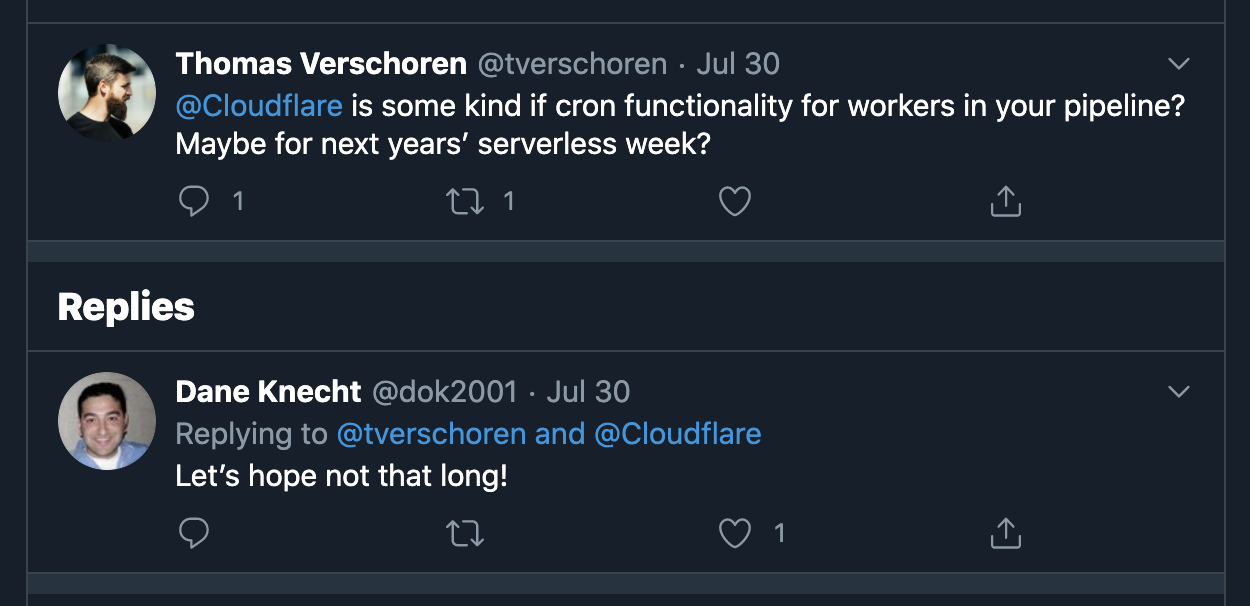
Today the Cloudflare Workers team is thrilled to announce the launch of Cron Triggers. Before now, Workers were triggered purely by incoming HTTP requests but starting today you’ll be able to set a scheduler to run your Worker on a timed interval. This was a highly requested feature that we know a lot of developers will find useful, and we’ve heard your feedback after Serverless Week.
We are excited to offer this feature at no additional cost, and it will be available on both the Workers free tier and the paid tier, now called Workers Bundled. Since it doesn’t matter which city a Cron Trigger routes the Worker through, we are able to maximize Cloudflare’s distributed system and send scheduled jobs to underutilized machinery. Running jobs on these quiet machines is both efficient and cost effective, and we are able to pass those cost savings down to you.
What is a Cron Trigger and how might I use such a feature?
In case you’re not familiar with Unix systems, the cron pattern allows you to schedule jobs to run periodically at fixed intervals or at scheduled times. Cron Triggers in the context of Workers allow users to set time-based invocations for the job. These Workers happen on a recurring schedule, and differ from traditional Workers in that they do not fire on HTTP requests.
Most developers are familiar with the cron pattern and its usefulness across a wide range of applications. Pulling the latest data from APIs or running regular integration tests on a preset schedule are common examples of this.
“We’re excited about Cron Triggers. Workers is crucial to our stack, so using this feature for live integration tests will boost the developer experience.” – Brian Marks, Software Engineer at Bazaarvoice
How much does it cost to use Cron Triggers?
Triggers are included at no additional cost! Scheduled Workers count towards your request cap for both the free tier and Workers Bundled, but rest assured that there will be no hidden or extra fees. Our competitors charge extra for cron events, or in some cases offer a very limited free tier. We want to make this feature widely accessible and have decided not to charge on a per-trigger basis. While there are no limits for the number of triggers you can have across an account, note that there is a limit of 3 triggers per Worker script for this feature. You can read more about limits on Workers plans in this documentation.
How are you able to offer this feature at no additional cost?
Cloudflare supports a massive distributed system that spans the globe with 200+ cities. Our nodes are named for the IATA airport code that they are closest to. Most of the time we run Workers close to the request origin for performance reasons (ie SFO if you are in the Bay Area, or CDG if you are lucky enough to be in Paris 🥐🍷🧀). In a typical HTTP Worker, we do this because we know that performance is of material importance when someone is waiting for the response.
In the case of Cron Triggers, where the user is running a task on a timed basis, those performance needs are different. A few milliseconds of extra latency do not matter as much when the user isn’t actively waiting for the response. The nature of the feature gives us much more flexibility on where to run the job, since it doesn’t have to necessarily be in a city close to the end user.
Cron Triggers are run on underutilized machines to make the best use of our capacity and route traffic efficiently. For example, a job scheduled from San Francisco at 7pm Pacific Time might be sent to Paris because it’s 4am there and traffic across Europe is low. Sending traffic to these machines during quiet hours is very efficient, and we are more than happy to pass those cost savings down to you. Aside from this scheduling optimization, Workers that are called by Cron Triggers behave similarly to and have all of the same performance and security benefits as typical HTTP Workers.
What’s happening below the hood?
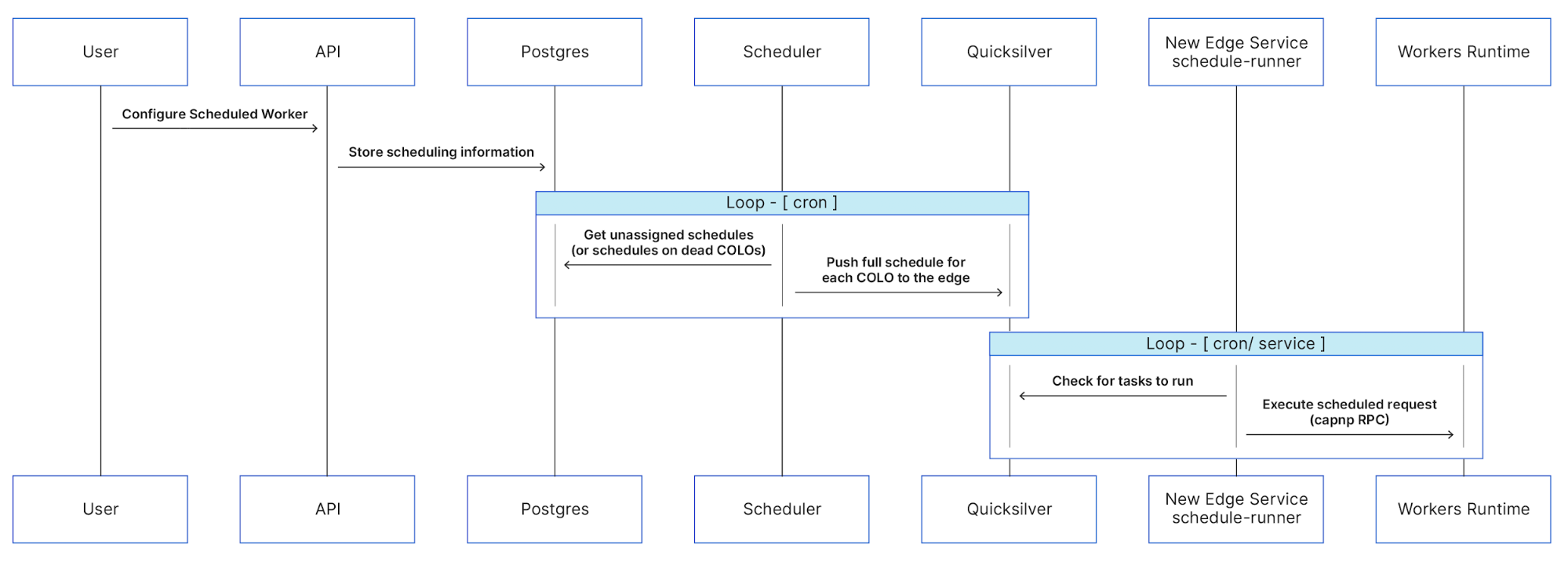
At a high level, schedules created through our API create records in our database. These records contain the information necessary to execute the Worker on the given cron schedule. These records are then picked up by another service which continuously evaluates the state of our edge and distributes the schedules among cities. Once the schedules have been distributed to the edge, a service running in the node polls for changes to the schedules and makes sure they get sent to our runtime at the appropriate time.
If you want to know more details about how we implemented this feature, please refer to the technical blog.
What’s coming next?
With this feature, we’ve expanded what’s possible to build with Workers, and further simplified the developer experience. While Workers previously only ran on web requests, we believe the future of edge computing isn’t strictly tied to HTTP requests and responses. We want to introduce more types of Workers in the future.
We plan to expand out triggers to include different types, such as data or event-based triggers. Our goal is to give users more flexibility and control over when their Workers run. Cron Triggers are our first step in this direction. In addition, we plan to keep iterating on Cron Triggers to make edge infrastructure selection even more sophisticated and optimized — for example, we might even consider triggers that allow our users to run in the most energy-efficient data centers.
How to try Cron Triggers
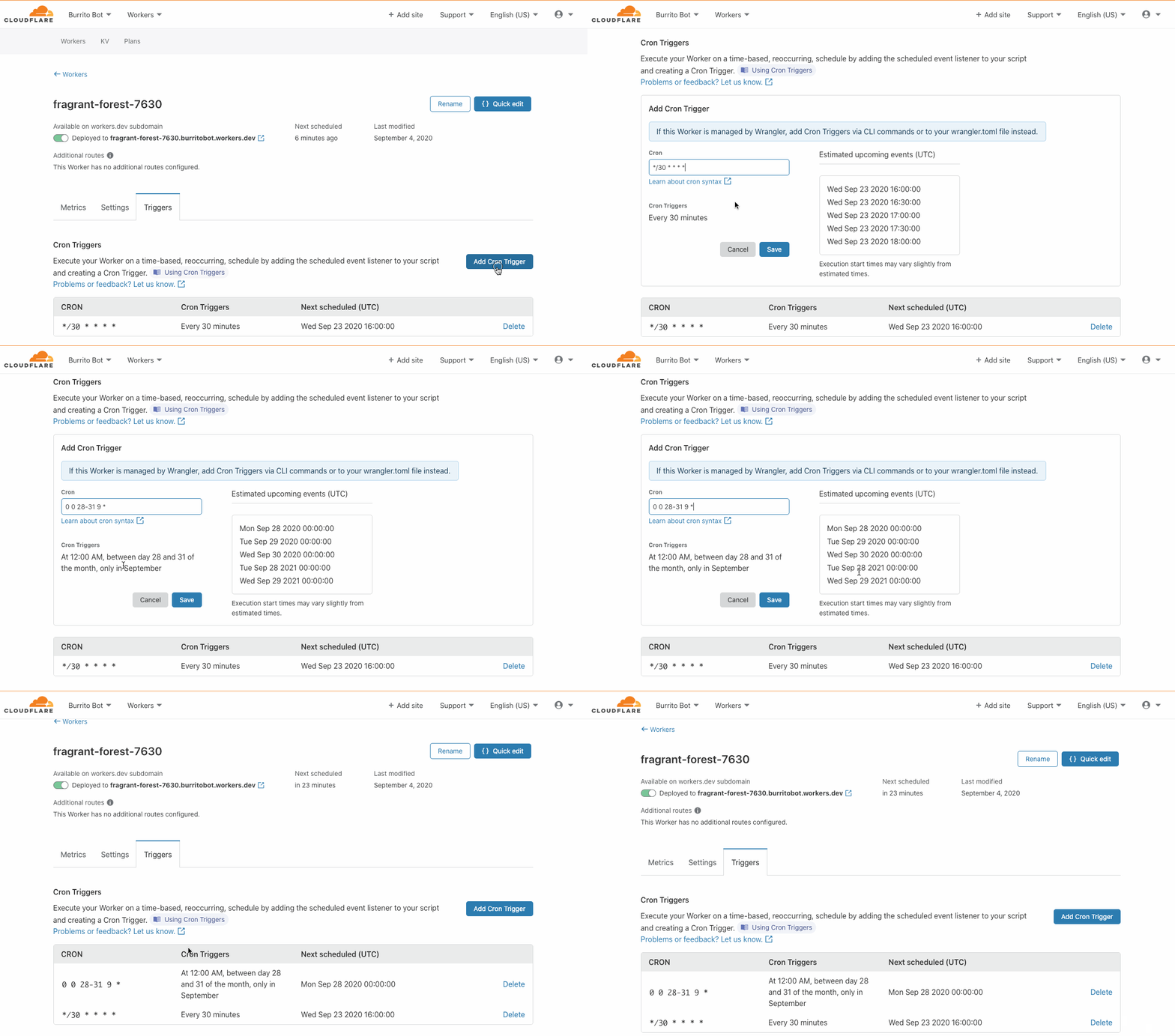
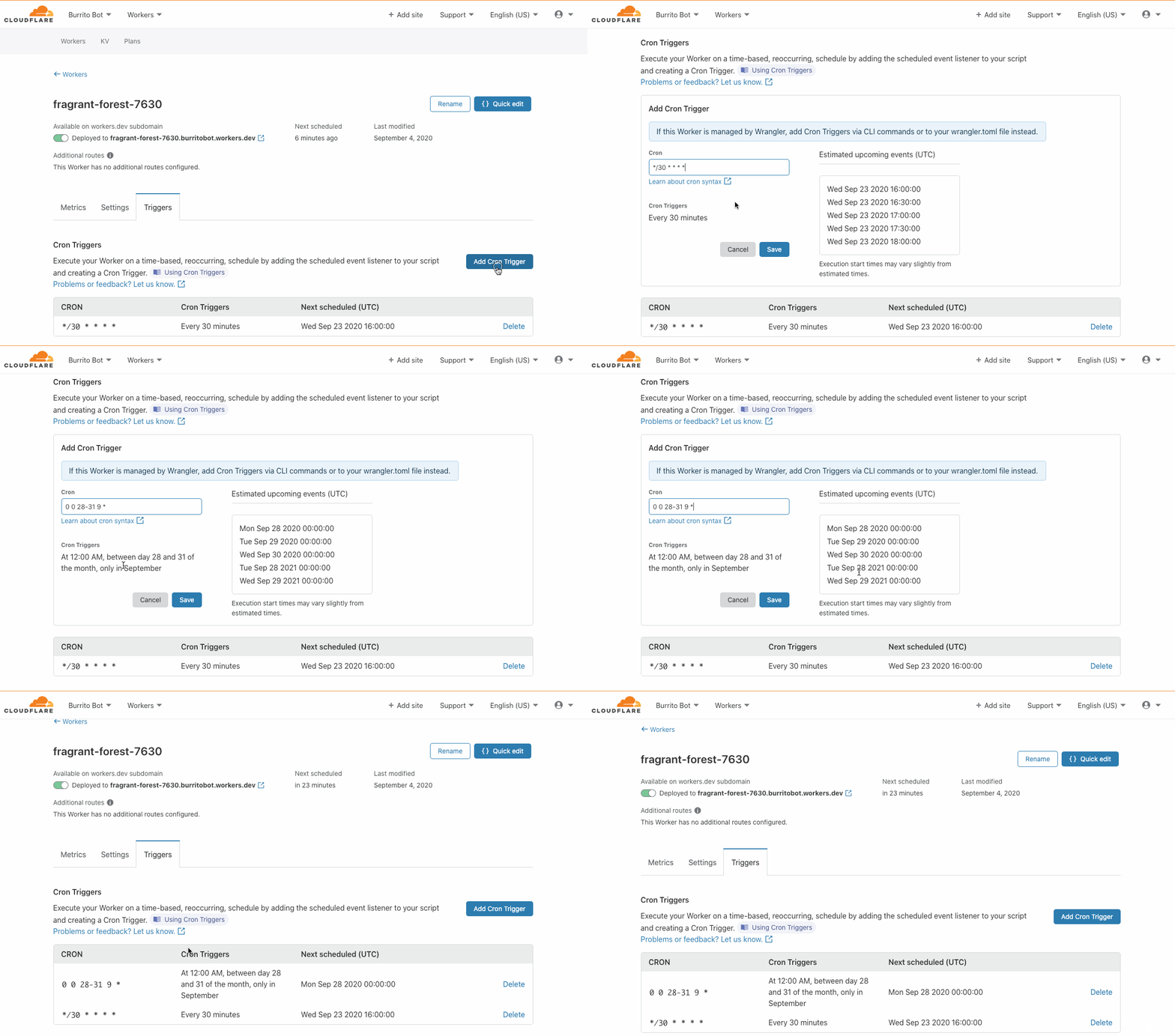
Cron triggers are live today! You can try it in the Workers dashboard by creating a new Worker and setting up a Cron Trigger.
Today, we are excited to launch Cron Triggers to the Cloudflare Workers serverless compute platform. We’ve heard the developer feedback, and we want to give our users the ability to run a given Worker on a scheduled basis. In case you’re not familiar with Unix systems, the cron pattern allows developers to schedule jobs to run at fixed intervals. This pattern is ideal for running any types of periodic jobs like maintenance or calling third party APIs to get up-to-date data. Cron Triggers has been a highly requested feature even inside Cloudflare and we hope that you will find this feature as useful as we have!
Where are Cron Triggers going to be run?
Cron Triggers are executed from the edge. At Cloudflare, we believe strongly in edge computing and wanted our new feature to get all of the performance and reliability benefits of running on our edge. Thus, we wrote a service in core that is responsible for distributing schedules to a new edge service through Quicksilver which will then trigger the Workers themselves.
What’s happening under the hood?
At a high level, schedules created through our API create records in our database with the information necessary to execute the Worker and the given cron schedule. These records are then picked up by another service which continuously evaluates the state of our edge and distributes the schedules between cities.
Once the schedules have been distributed to the edge, a service running in the edge node polls for changes to the schedules and makes sure they get sent to our runtime at the appropriate time.
New Event Type
Cron Triggers gave us the opportunity to finally recognize a new Worker ‘type’ in our API. While Workers currently only run on web requests, we have lots of ideas for the future of edge computing that aren’t strictly tied to HTTP requests and responses. Expect to see even more new handlers in the future for other non-HTTP events like log information from your Worker (think custom wrangler tail!) or even TCP Workers.
Where event has the following interface in Typescript:
interface ScheduledEvent {
  type: 'scheduled';
  scheduledTime: int; // milliseconds since the Unix epoch
}
As long as your Worker has a handler for this new event type, you’ll be able to give it a schedule.
New APIs
PUT /client/v4/accounts/:account_identifier/workers/scripts/:name
The script upload API remains the same, but during script validation we now detect and return the registered event handlers.
PUT /client/v4/accounts/:account_identifier/workers/scripts/:name/schedules
Body
[
 {"cron": "* * * * *"},
 ...
]
This will create or modify all schedules for a script, removing all schedules not in the list. For now, there’s a limit of 3 distinct cron schedules. Schedules can be set to run as often as one minute and don’t accept schedules with years in them (sorry, you’ll have to run your Y3K migration script another way).
GET /client/v4/accounts/:account_identifier/workers/scripts/:name/schedules
The Scheduler service is responsible for reading the schedules from Postgres and generating per-node schedules to place into Quicksilver. For now, the service simply avoids trying to execute your Worker on an edge node that may be disabled for some reason, but such an approach also gives us a lot of flexibility in deciding where your Worker executes.
In addition to edge node availability, we could optimize for compute cost, bandwidth, or even latency in the future!
What’s actually executing these schedules?
To consume the schedules and actually trigger the Worker, we built a new service in Rust and deployed to our edge using HashiCorp Nomad. Nomad ensures that the schedule runner remains running in the edge node and can move it between machines as necessary. Rust was the best choice for this service since it needed to be fast with high availability and Cap’n Proto RPC support for calling into the runtime. With Tokio, Anyhow, Clap, and Serde, it was easy to quickly get the service up and running without having to really worry about async, error handling, or configuration.
On top of that, due to our specific needs for cron parsing, we built a specialized cron parser using nom that allowed us to quickly parse and compile expressions into values that check against a given time to determine if we should run a schedule.
Once the schedule runner has the schedules, it checks the time and selects the Workers that need to be run. To let the runtime know it’s time to run, we send a Cap’n Proto RPC message. The runtime then does its thing, calling the new ‘scheduled’ event handler instead of ‘fetch’.
How can I try this?
As of today, the Cron Triggers feature is live! Please try it out by creating a Worker and finding the Triggers tab – we’re excited to see what you build with it!
We launched Cloudflare Workers® in 2017 with a radical vision: code running at the network edge could not only improve performance, but also be easier to deploy and cheaper to run than code running in a single datacenter. That vision means Workers is about more than just edge compute — we’re rethinking how applications are built.
Using a “serverless” approach has allowed us to make deploys dead simple, and using isolate technology has allowed us to deliver serverless more cheaply and without the lengthy cold starts that hold back other providers. We added easy-to-use eventually-consistent edge storage to the platform with Workers KV.
But up until today, it hasn’t been possible to manage state with strong consistency, or to coordinate in real time between multiple clients, entirely on the edge. Thus, these parts of your application still had to be hosted elsewhere.
Durable Objects provide a truly serverless approach to storage and state: consistent, low-latency, distributed, yet effortless to maintain and scale. They also provide an easy way to coordinate between clients, whether it be users in a particular chat room, editors of a particular document, or IoT devices in a particular smart home. Durable Objects are the missing piece in the Workers stack that makes it possible for whole applications to run entirely on the edge, with no centralized “origin” server at all.
Today we are beginning a closed beta of Durable Objects.
I’m going to be honest: naming this product was hard, because it’s not quite like any other cloud technology that is widely-used today. This proverbial bike shed has many layers of paint, but ultimately we settled on “Unique Durable Objects”, or “Durable Objects” for short. Let me explain what they are by breaking that down:
Objects: Durable Objects are objects in the sense of Object-Oriented Programming. A Durable Object is an instance of a class — literally, a class definition written in JavaScript (or your language of choice). The class has methods which define its public interface. An object is an instance of this class, combining the code with some private state.
Unique: Each object has a globally-unique identifier. That object exists in only one location in the whole world at a time. Any Worker running anywhere in the world that knows the object’s ID can send messages to it. All those messages end up delivered to the same place.
Durable: Unlike a normal object in JavaScript, Durable Objects can have persistent state stored on disk. Each object’s durable state is private to it, which means not only that access to storage is fast, but the object can even safely maintain a consistent copy of the state in memory and operate on it with zero latency. The in-memory object will be shut down when idle and recreated later on-demand.
What can they do?
Durable Objects have two primary abilities:
Storage: Each object has attached durable storage. Because this storage is private to a specific object, the storage is always co-located with the object. This means the storage can be very fast while providing strong, transactional consistency. Durable Objects apply the serverless philosophy to storage, splitting the traditional large monolithic databases up into many small, logical units. In doing so, we get the advantages you’ve come to expect from serverless: effortless scaling with zero maintenance burden.
Coordination: Historically, with Workers, each request would be randomly load-balanced to a Worker instance. Since there was no way to control which instance received a request, there was no way to force two clients to talk to the same Worker, and therefore no way for clients to coordinate through Workers. Durable Objects change that: requests related to the same topic can be forwarded to the same object, which can then coordinate between them, without any need to touch storage. For example, this can be used to facilitate real-time chat, collaborative editing, video conferencing, pub/sub message queues, game sessions, and much more.
The astute reader may notice that many coordination use cases call for WebSockets — and indeed, conversely, most WebSocket use cases require coordination. Because of this complementary relationship, along with the Durable Objects beta, we’ve also added WebSocket support to Workers. For more on this, see the Q&A below.
Region: Earth
When using Durable Objects, Cloudflare automatically determines the Cloudflare datacenter that each object will live in, and can transparently migrate objects between locations as needed.
Traditional databases and stateful infrastructure usually require you to think about geographical “regions”, so that you can be sure to store data close to where it is used. Thinking about regions can often be an unnatural burden, especially for applications that are not inherently geographical.
With Durable Objects, you instead design your storage model to match your application’s logical data model. For example, a document editor would have an object for each document, while a chat app would have an object for each chat. There is no problem creating millions or billions of objects, as each object has minimal overhead.
Let’s say you have a spreadsheet editor application — or, really, any kind of app where users edit a complex document. It works great for one user, but now you want multiple users to be able to edit it at the same time. How do you accomplish this?
For the standard web application stack, this is a hard problem. Traditional databases simply aren’t designed to be real-time. When Alice and Bob are editing the same spreadsheet, you want every one of Alice’s keystrokes to appear immediately on Bob’s screen, and vice versa. But if you merely store the keystrokes to a database, and have the users repeatedly poll the database for new updates, at best your application will have poor latency, and at worst you may find database transactions repeatedly fail as users on opposite sides of the world fight over editing the same content.
The secret to solving this problem is to have a live coordination point. Alice and Bob connect to the same coordinator, typically using WebSockets. The coordinator then forwards Alice’s keystrokes to Bob and Bob’s keystrokes to Alice, without having to go through a storage layer. When Alice and Bob edit the same content at the same time, the coordinator resolves conflicts instantly. The coordinator can then take responsibility for updating the document in storage — but because the coordinator keeps a live copy of the document in-memory, writing back to storage can happen asynchronously.
Every big-name real-time collaborative document editor works this way. But for many web developers, especially those building on serverless infrastructure, this kind of solution has long been out-of-reach. Standard serverless infrastructure — and even cloud infrastructure more generally — just does not make it easy to assign these coordination points and direct users to talk to the same instance of your server.
Durable Objects make this easy. Not only do they make it easy to assign a coordination point, but Cloudflare will automatically create the coordinator close to the users using it and migrate it as needed, minimizing latency. The availability of local, durable storage means that changes to the document can be saved reliably in an instant, even if the eventual long-term storage is slower. Or, you can even store the entire document on the edge and abandon your database altogether.
With Durable Objects lowering the barrier, we hope to see real-time collaboration become the norm across the web. There’s no longer any reason to make users refresh for updates.
Example: An atomic counter
Here’s a very simple example of a Durable Object which can be incremented, decremented, and read over HTTP. This counter is consistent even when receiving simultaneous requests from multiple clients — none of the increments or decrements will be lost. At the same time, reads are served entirely from memory, no disk access needed.
export class Counter {
  // Constructor called by the system when the object is needed to
  // handle requests.
  constructor(controller, env) {
    // `controller.storage` is an interface to access the object's
    // on-disk durable storage.
    this.storage = controller.storage
  }

  // Private helper method called from fetch(), below.
  async initialize() {
    let stored = await this.storage.get("value");
    this.value = stored || 0;
  }

  // Handle HTTP requests from clients.
  //
  // The system calls this method when an HTTP request is sent to
  // the object. Note that these requests strictly come from other
  // parts of your Worker, not from the public internet.
  async fetch(request) {
    // Make sure we're fully initialized from storage.
    if (!this.initializePromise) {
      this.initializePromise = this.initialize();
    }
    await this.initializePromise;

    // Apply requested action.
    let url = new URL(request.url);
    switch (url.pathname) {
      case "/increment":
        ++this.value;
        await this.storage.put("value", this.value);
        break;
      case "/decrement":
        --this.value;
        await this.storage.put("value", this.value);
        break;
      case "/":
        // Just serve the current value. No storage calls needed!
        break;
      default:
        return new Response("Not found", {status: 404});
    }

    // Return current value.
    return new Response(this.value);
  }
}
Once the class has been bound to a Durable Object namespace, a particular instance of Counter can be accessed from anywhere in the world using code like:
// Derive the ID for the counter object named "my-counter".
// This name is associated with exactly one instance in the
// whole world.
let id = COUNTER_NAMESPACE.idFromName("my-counter");

// Send a request to it.
let response = await COUNTER_NAMESPACE.get(id).fetch(request);
Demo: Chat
Chat is arguably real-time collaboration in its purest form. And to that end, we have built a demo open source chat app that runs entirely at the edge using Durable Objects.
This chat app uses a Durable Object to control each chat room. Users connect to the object using WebSockets. Messages from one user are broadcast to all the other users. The chat history is also stored in durable storage, but this is only for history. Real-time messages are relayed directly from one user to others without going through the storage layer.
Additionally, this demo uses Durable Objects for a second purpose: Applying a rate limit to messages from any particular IP. Each IP is assigned a Durable Object that tracks recent request frequency, so that users who send too many messages can be temporarily blocked — even across multiple chat rooms. Interestingly, these objects don’t actually store any durable state at all, because they only care about very recent history, and it’s not a big deal if a rate limiter randomly resets on occasion. So, these rate limiter objects are an example of a pure coordination object with no storage.
This chat app is only a few hundred lines of code. The deployment configuration is only a few lines. Yet, it will scale seamlessly to any number of chat rooms, limited only by Cloudflare’s available resources. Of course, any individual chat room’s scalability has a limit, since each object is single-threaded. But, that limit is far beyond what a human participant could keep up with anyway.
Other use cases
Durable Objects have infinite uses. Here are just a few ideas, beyond the ones described above:
Shopping cart: An online storefront could track a user’s shopping cart in an object. The rest of the storefront could be served as a fully static web site. Cloudflare will automatically host the cart object close to the end user, minimizing latency.
Game server: A multiplayer game could track the state of a match in an object, hosted on the edge close to the players.
IoT coordination: Devices within a family’s house could coordinate through an object, avoiding the need to talk to distant servers.
Social feeds: Each user could have a Durable Object that aggregates their subscriptions.
Comment/chat widgets: A web site that is otherwise static content can add a comment widget or even a live chat widget on individual articles. Each article would use a separate Durable Object to coordinate. This way the origin server can focus on static content only.
The Future: True Edge Databases
We see Durable Objects as a low-level primitive for building distributed systems. Some applications, like those mentioned above, can use objects directly to implement a coordination layer, or maybe even as their sole storage layer.
However, Durable Objects today are not a complete database solution. Each object can see only its own data. To perform a query or transaction across multiple objects, the application needs to do some extra work.
That said, every big distributed database – whether it be relational, document, graph, etc. – is, at some low level, composed of “chunks” or “shards” that store one piece of the overall data. The job of a distributed database is to coordinate between chunks.
We see a future of edge databases that store each “chunk” as a Durable Object. By doing so, it will be possible to build databases that operate entirely at the edge, fully distributed with no regions or home location. These databases need not be built by us; anyone can potentially build them on top of Durable Objects. Durable Objects are only the first step in the edge storage journey.
Join the Beta
Storing data is a big responsibility which we do not take lightly. Because of the critical importance of getting it right, we are being careful. We will be making Durable Objects available gradually over the next several months.
As with any beta, this product is a work in progress, and some of what is described in this post is not fully enabled yet. Full details of beta limitations can be found in the documentation.
If you’d like to try out Durable Objects now, tell us about your use case. We’ll be selecting the most interesting use cases for early access.
As part of the Durable Objects beta, we’ve made it possible for Workers to act as WebSocket endpoints — including as a client or as a server. Before now, Workers could proxy WebSocket connections on to a back-end server, but could not speak the protocol directly.
While technically any Worker can speak WebSocket in this way, WebSockets are most useful when combined with Durable Objects. When a client connects to your application using a WebSocket, you need a way for server-generated events to be sent back to the existing socket connection. Without Durable Objects, there’s no way to send an event to the specific Worker holding a WebSocket. With Durable Objects, you can now forward the WebSocket to an Object. Messages can then be addressed to that Object by its unique ID, and the Object can then forward those messages down the WebSocket to the client.
Two years ago, we introduced Workers KV, a global key-value data store. KV is a fairly minimalist global data store that serves certain purposes well, but is not for everyone. KV is eventually consistent, which means that writes made in one location may not be visible in other locations immediately. Moreover, it implements “last write wins” semantics, which means that if a single key is being modified from multiple locations in the world at once, it’s easy for those writes to overwrite each other. KV is designed this way to support low-latency reads for data that doesn’t frequently change. However, these design decisions make KV inappropriate for state that changes frequently, or when changes need to be immediately visible worldwide.
Durable Objects, in contrast, are not primarily a storage product at all — many use cases for them do not actually utilize durable storage. To the extent that they do provide storage, Durable Objects sit at the opposite end of the storage spectrum from KV. They are extremely well-suited to workloads requiring transactional guarantees and immediate consistency. However, since transactions inherently must be coordinated in a single location, and clients on the opposite side of the world from that location will experience moderate latency due to the inherent limitations of the speed of light. Durable Objects will combat this problem by auto-migrating to live close to where they are used.
In short, Workers KV remains the best way to serve static content, configuration, and other rarely-changing data around the world, while Durable Objects are better for managing dynamic state and coordination.
Going forward, we plan to utilize Durable Objects in the implementation of Workers KV itself, in order to deliver even better performance.
Why not use CRDTs?
You can build CRDT-based storage on top of Durable Objects, but Durable Objects do not require you to use CRDTs.
Conflict-free Replicated Data Types (CRDTs), or their cousins, Operational Transforms (OTs), are a technology that allows data to be edited from multiple places in the world simultaneously without synchronization, and without data loss. For example, these technologies are commonly used in the implementation of real-time collaborative document editors, so that a user’s keypresses can show up in their local copy of the document in real time, without waiting to see if anyone else edited another part of the document first. Without getting into details, you can think of these techniques like a real time version of “git fork” and “git merge”, where all merge conflicts are resolved automatically in a deterministic way, so that everyone ends up with the same state in the end.
CRDTs are a powerful technology, but applying them correctly can be challenging. Only certain kinds of data structures lend themselves to automatic conflict resolution in a way that doesn’t lead to easy data loss. Any developer familiar with git can see the problem: arbitrary conflict resolution is hard, and any automated algorithm for it will likely get things wrong sometimes. It’s all the more difficult if the algorithm has to handle merges in arbitrary order and still get the same answer.
We feel that, for most applications, CRDTs are overly complex and not worth the effort. Worse, the set of data structures that can be represented as a CRDT is too limited for many applications. It’s usually much easier to assign a single authoritative coordination point for each document, which is exactly what Durable Objects accomplish.
With that said, CRDTs can be used on top of Durable Objects. If an object’s state lends itself to CRDT treatment, then an application could replicate that object into several objects serving different regions, which then synchronize their states via CRDT. This would make sense for applications to implement as an optimization if and when they find it is worth the effort.
Last thoughts: What does it mean for state to be “serverless”?
Traditionally, serverless has focused on stateless compute. In serverless architectures, the logical unit of compute is reduced to something fine-grained: a single event, such as an HTTP request. This works especially well because events just happened to be the logical unit of work that we think about when designing server applications. No one thinks about their business logic in units of “servers” or “containers” or “processes” — we think about events. It is exactly because of this semantic alignment that serverless succeeds in shifting so much of the logistical burden of maintaining servers away from the developer and towards the cloud provider.
However, serverless architecture has traditionally been stateless. Each event executes in isolation. If you wanted to store data, you had to connect to a traditional database. If you wanted to coordinate between requests, you had to connect to some other service that provides that ability. These external services have tended to re-introduce the operational concerns that serverless was intended to avoid. Developers and service operators have to worry not just about scaling their databases to handle increasing load, but also about how to split their database into “regions” to effectively handle global traffic. The latter concern can be especially cumbersome.
So how can we apply the serverless philosophy to state? Just like serverless compute is about splitting compute into fine-grained pieces, serverless state is about splitting state into fine-grained pieces. Again, we seek to find a unit of state that corresponds to logical units in our application. The logical unit of state in an application is not a “table” or a “collection” or a “graph”. Instead, it depends on the application. The logical unit of state in a chat app is a chat room. The logical unit of state in an online spreadsheet editor is a spreadsheet. The logical unit of state in an online storefront is a shopping cart. By making the physical unit of storage provided by the storage layer match the logical unit of state inherent in the application, we can allow the underlying storage provider (Cloudflare) to take responsibility for a wide array of logistical concerns that previously fell on the developer, including scalability and regionality.
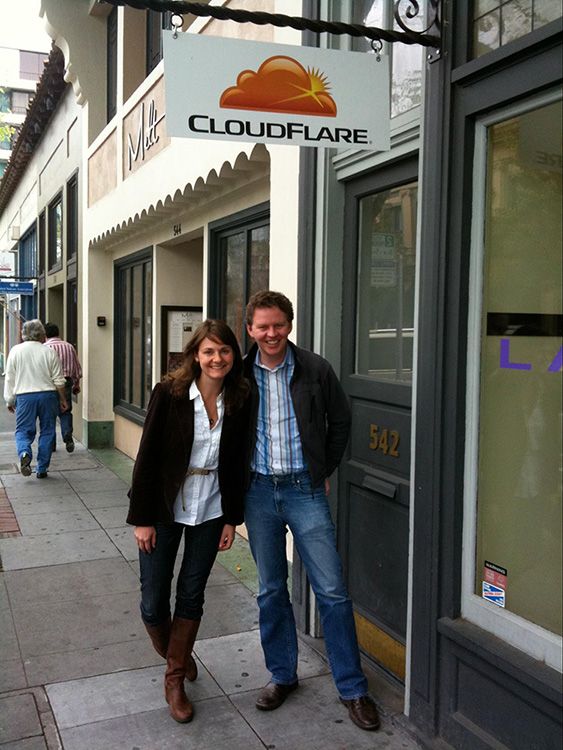
Cloudflare launched on September 27, 2010 — 10 years ago today. Stopping to look back over the last 10 years is challenging in some ways because so much of who we are has changed radically. A decade ago when we launched we had a few thousand websites using us, our tiny office was above a nail salon in Palo Alto, our team could be counted on less than two hands, and our data center locations on one hand.
Outside our first office in Palo Alto in 2010. Photo by Ray Rothrock.
As the company grew, it would have been easy to stick with accelerating and protecting developers and small business websites and not see the broader picture. But, as this year has shown with crystal clarity, we all depend on the Internet for many aspects of our lives: for access to public information and services, to getting work done, for staying in touch with friends and loved ones, and, increasingly, for educating our children, ordering groceries, learning the latest dance moves, and so many other things. The Internet underpins much of what we do every day, and Cloudflare’s mission to help build a better Internet seems more and more important every day.
Over time Cloudflare has gone from an idea on a piece of paper to one of the largest networks in the world that powers millions of customers. Because we made our network to be flexible and programmable, what we’ve been able to do with it has expanded over time as well. Today we secure the Internet end-to-end — from companies’ infrastructure to individuals seeking a faster, more secure, more private connection. Our programmable, global network is at the core of everything we have been able to achieve so far.
Updating Our Annual Founders’ Letter
This is also the approximate one-year anniversary of Cloudflare going public. At the time, we wrote our first founders’ letter to the potential investors. We thought it made sense on this day, which we think of as our birthday, to reflect on the last year, as well as the last 10 years, and start a tradition of updating our original founders’ letter on September 27th every year.
Ringing the bell to go public on the NYSE on September 13, 2019.
It’s been quite a year for our business. Since our IPO, we’ve seen record expansion of new customers. That growth has come both from expanding our existing customers as well as winning new business from new customers.
The percentage of the Fortune 1,000 that pay for one or more of Cloudflare’s services rose from 10% when we went public to more than 16% today. Across the web as a whole, according to W3Techs’ data, over the last year Cloudflare has grown from 10.1% of the top 10 million websites using our services to 14.5% using them today. (Amazon CloudFront, in second place based on the number of websites they serve, grew from 0.8% to 0.9% over the same period.)
Every year to celebrate our birthday we’ve made it a tradition to launch products that surprise the market with new ways to expand how anyone can use our network. We think of them as gifts back to the Internet. Three years ago, for instance, we launched our edge computing platform called Workers. Today, just three years later, hundreds of thousands of developers are using Workers to build applications, many of which we believe would be impossible to build on any other platform.
It is impossible to reflect on the last year and not see the impact of the COVID-19 pandemic on our business, our customers, our employees, as well our friends, colleagues, and loved ones in the greater community. It’s heartening to think that for more than half of Cloudflare’s life as a public company our team has worked remote.
2020 was meant to be an Olympic year, but COVID-19 stopped that, like much else, from happening. Eight years ago, when Cloudflare was just two, the creator of the World Wide Web, Tim Berners-Lee, sent a message from the opening ceremony of the 2012 Olympics. That message read “This is for everyone” and the idea that the Internet is for all of us continues to be a key part of Cloudflare’s ethos today.
When we started Cloudflare we wanted to democratize what we thought were technologies only available to the richest and most Internet-focused organizations. We saw an opportunity to make available to everyone — from individual developers to small businesses to large corporations — the sorts of speed, protection, and reliability that, at the time, only the likes of Google, Amazon, and Facebook could afford.
Giving Back to the Internet
Over 10 years we’ve consistently rolled out the latest technologies, typically ahead of the rest of the industry, to everyone. And in doing so we’ve attracted employees, individuals, developers, customers to our platform. The Internet is for everyone and we’ve shown that a business can be very successful when we aim to serve everyone — large and small.
Something Steve Jobs said back in 1988 still resonates: “If you want to make a revolution, you’ve got to raise the lowest common denominator in every single machine.” Although we aren’t selling machines, we think that’s right: democratizing features matters.
Just look at the scourge of DDoS attacks. Why should DDoS attack mitigation be expensive when it’s a plague on companies large and small? It shouldn’t, and we optimized our business to make it inexpensive for us and passed that on to our customers through Unmetered DDoS Mitigation — another feature we rolled out to celebrate our Birthday Week three years ago.
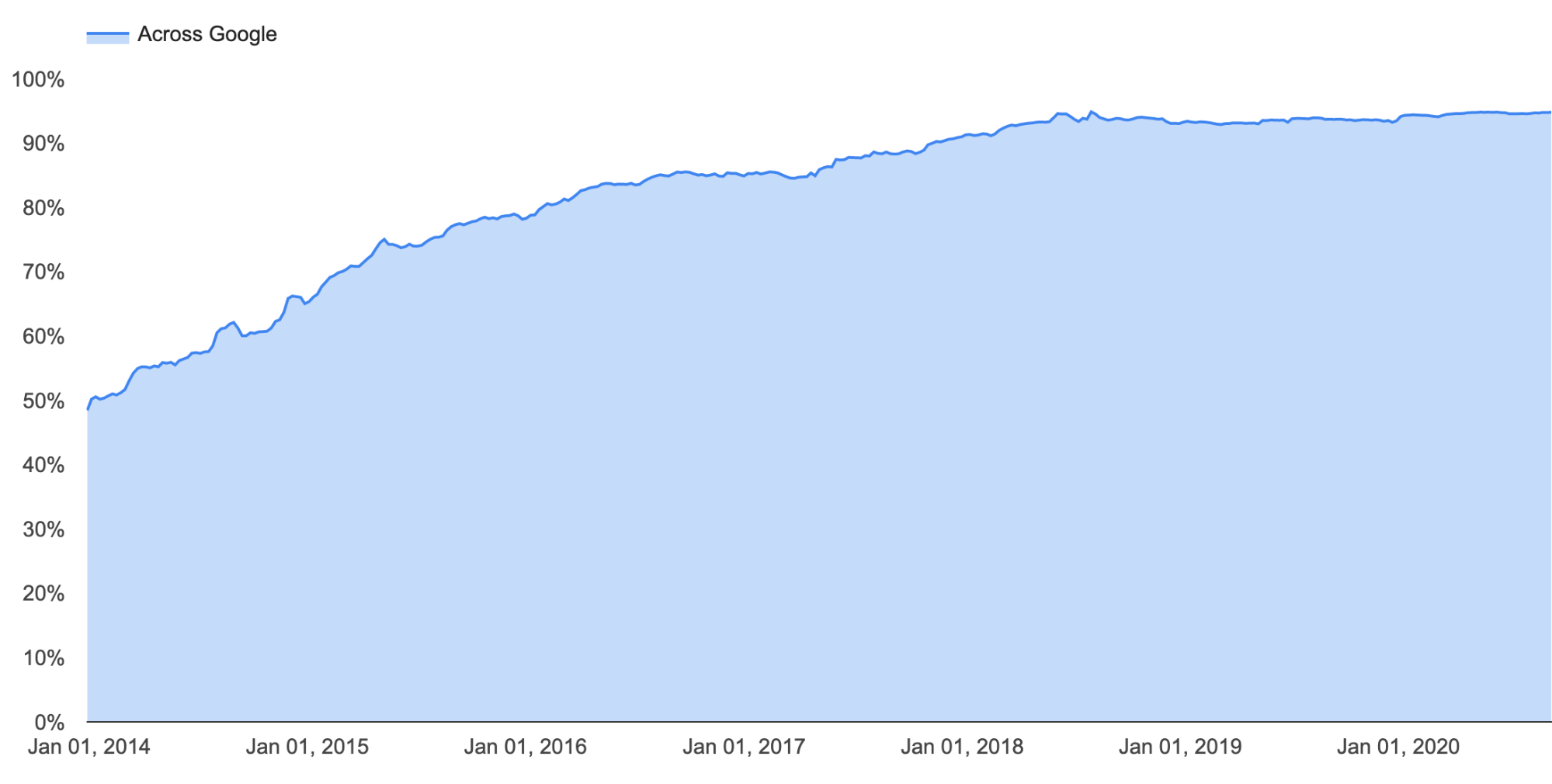
In 2014, also during Birthday Week, we launched Universal SSL, making encryption — something that had been expensive and difficult — free for all Cloudflare customers. The week we launched it we doubled the size of the encrypted web. Let’s Encrypt followed shortly after and, together, we’ve brought encryption to more than 90% of the web and made the little padlock in your browser something everyone can afford and should expect.
In January of this year, we rolled out Cloudflare for Teams. The product was designed to replace the legacy VPNs and firewalls that were increasingly anachronistic as work moved to the cloud. Little did we know how much COVID-19 would accelerate their obsolescence and make Cloudflare for Teams essential.
Both of us sat on call after call in mid-March with at first small, then increasingly mid-sized, and eventually large and even governmental organizations who reached out to us looking for a way to survive as their teams shifted to working from home and their legacy hardware couldn’t keep up. We made the decision to sacrifice short term profits in order to help businesses large and small get through this crisis by making Cloudflare for Teams free through September.
As we said during our Q1 earnings call, the superheros of this crisis are the medical professionals and scientists who are taking care of the sick and looking for a cure to the disease. But the faithful sidekick throughout has been the Internet. And, as one of the guardians of the Internet, we’re proud of helping ensure it was fast, secure, and reliable around the world when it was needed most. We are proud of how Cloudflare’s products could help the businesses continue to get work done during this unprecedented time by leaning even more on the Internet.
Meeting the Challenges Ahead
Giving back to the Internet is core to who we are, and we do not shy away from a challenge. And there are many challenges ahead. In a little over a month, the United States will hold elections. After the 2016 elections we, along with the rest of the world, were concerned to see technology intended to bring people together instead be used to subvert the democratic process. We decided we needed to do something to help prevent that from happening again.
Three and a half years ago, we launched the Athenian Project to provide free cybersecurity resources to any local, state, or federal officials helping administer elections in the United States. We couldn’t have built Cloudflare into the company it is today without a stable government as a foundational platform. And, when that foundation is challenged, we believe it is our duty to lend our resources to defend it.
Today, we’re helping secure election infrastructure in more than half of the states in the United States. And, over these last weeks before the election, our team is working around the clock to help ensure the process is fair and not disrupted by cyber attacks.
More challenges lie ahead and we won’t shy away from them. Well intentioned governments around the world are increasingly seeking to regulate the Internet to protect their citizens. While the aims are noble, the risk is creating a patchwork of laws that only the Internet giants can successfully navigate. We believe it is critical for us to engage in the conversations around these regulations and work to help ensure as operating online becomes more complex, we can continue to make the opportunities of the Internet created for us when we started Cloudflare available to future startups and entrepreneurs.
Fighting for the Internet
Over the last 10 years, it’s been sad to watch some of the optimism around technology seem to fade. The perception of technology companies shifted from their being able to do no wrong to, today, their being able to do no right. And, as we’ve watched the industry develop, we’ve sympathized with that shift. Too many tech companies have abused customer data, ignored rules, violated privacy, and not been good citizens to the communities in which they operate and serve.
But we continue to believe what we started Cloudflare believing 10 years ago: the Internet itself is a force for good worth fighting to defend. We need to keep striving to make the Internet itself better — always on, always fast, always secure, always private, and available to everyone.
It’s striking to think how much more disruptive the COVID-19 crisis could have been had it struck in 2010 not 2020. The difference today is a better Internet. We’re proud of the role we’ve played in helping build that better Internet.
Each year we celebrate our launch on September 27, 2010 with a week of product announcements. We call this Birthday Week, but rather than receiving gifts, we give them away. This year is no different, except that it is… Cloudflare is 10 years old.
Before looking forward to the coming week, let’s take a look back at announcements from previous Birthday Weeks.
A year into Cloudflare’s life (in 2011) we launched automatic support for IPv6. This was the first of a long line of announcements that support our goal of making available to everyone the latest technologies. If you’ve been following Cloudflare’s growth you’ll know those include SPDY/HTTP/2, TLS 1.3, QUIC/HTTP/3, DoH and DoT, WebP, … At two years old we celebrated with a timeline of our first two years and the fact that we’d reached 500,000 domains using the service. A year later that number had tripled.
In 2014 we released Universal SSL and gave all our customers SSL certificates. In one go we massively increased the size of the encrypted web and made it free and simple to go from http:// to https://. Other HTTPS related features we’ve rolled out include: Automatic HTTPS Rewrites, Encrypted SNI and our CT Log.
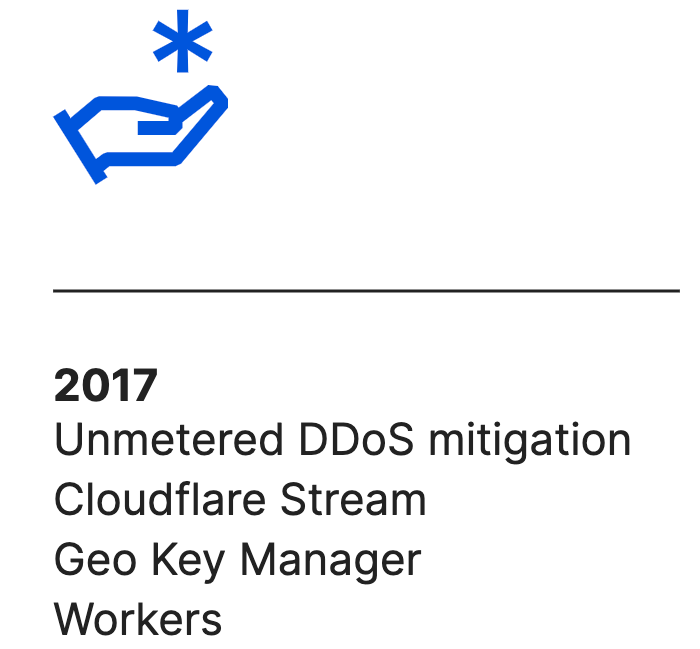
In 2017 we unwrapped a bunch of goodies with Unmetered DDoS Mitigation, our video streaming service, Cloudflare Stream, the ability to control where private SSL keys stored through Geo Key Manager. And, last but not least, our hugely popular serverless platform Cloudflare Workers. It’s hard to believe that it’s been three years since we changed the way people think about serverless with our massively distributed, secure and fast to update platform.
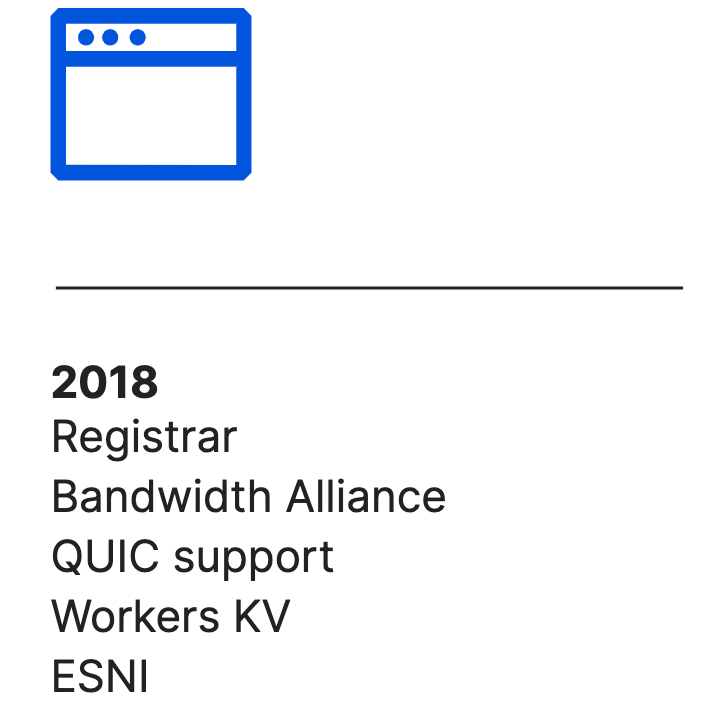
Two years ago Cloudflare became a domain registrar with the launch of our “at cost” service: Cloudflare Registrar. We also announced the Bandwidth Alliance which is designed to reduce or eliminate high cloud egress fees. We rolled out support for QUIC and Cloudflare Workers got a globally distributed key value store: Workers KV.
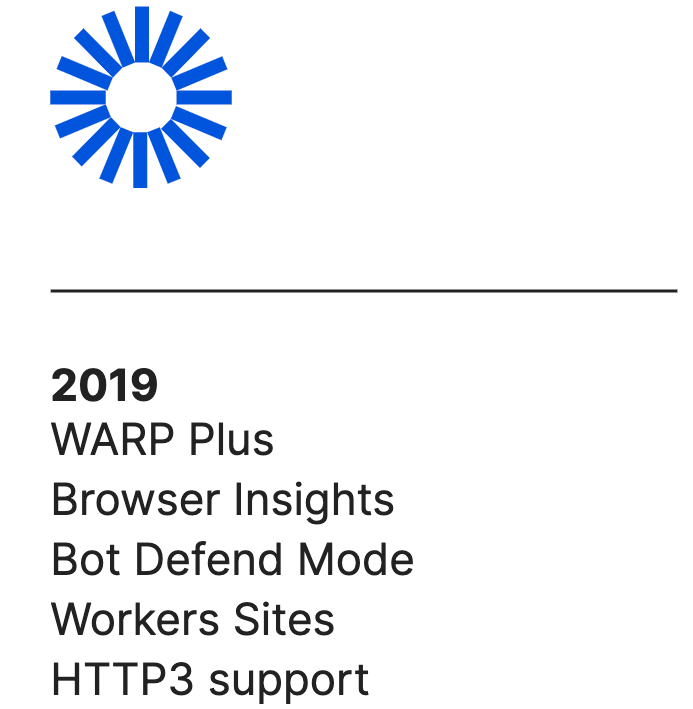
Which brings us to last year with the launch of WARP Plus to speed up and secure the “last mile” connection between a device and Cloudflare’s network. Browser Insights so that customers can optimize their website’s performance and see how each Cloudflare tool helps.
We greatly enhanced our bot management tools with Bot Defend Mode, and rolled out Workers Sites to bring the power of Workers and Workers KV to entire websites.
No Spoilers Here
Here are some hints about what to expect this year for our 10th anniversary Birthday Week:
Monday: We’re fundamentally changing how people think about Serverless
If you studied computer science you’ll probably have come across Niklaus Wirth’s book “Algorithms + Data Structures = Programs”. We’re going to start the week with two enhancements to Cloudflare Workers that are fundamentally going to change how people think about serverless. The lambda calculus is a nice theoretical foundation, but it’s Turing machines that won the day. If you want to build large, real programs you need to have algorithms and data structures.
TuesdayandWednesdayare all about observability. Of an Internet property and of the Internet itself. And they are also about privacy. We’ll roll out new functionality so you can see what’s happening without the need to track people.
Thursdayis security day with a new service to protect the parts of websites and Internet applications that are behind the scenes. And, finally, on Fridayit’s all about one click performance improvements that leverage our more than 200 city network to speed up static and dynamic content.
Welcome to Birthday Week 2020!
The collective thoughts of the interwebz
Manage Consent
To provide the best experiences, we use technologies like cookies to store and/or access device information. Consenting to these technologies will allow us to process data such as browsing behavior or unique IDs on this site. Not consenting or withdrawing consent, may adversely affect certain features and functions.
Functional
Always active
The technical storage or access is strictly necessary for the legitimate purpose of enabling the use of a specific service explicitly requested by the subscriber or user, or for the sole purpose of carrying out the transmission of a communication over an electronic communications network.
Preferences
The technical storage or access is necessary for the legitimate purpose of storing preferences that are not requested by the subscriber or user.
Statistics
The technical storage or access that is used exclusively for statistical purposes.The technical storage or access that is used exclusively for anonymous statistical purposes. Without a subpoena, voluntary compliance on the part of your Internet Service Provider, or additional records from a third party, information stored or retrieved for this purpose alone cannot usually be used to identify you.
Marketing
The technical storage or access is required to create user profiles to send advertising, or to track the user on a website or across several websites for similar marketing purposes.