Tag Archives: Cache Purge

“You get Instant Purge, and you get Instant Purge!” — all purge methods now available to all customers

Post Syndicated from Alex Krivit original https://blog.cloudflare.com/instant-purge-for-all/

There’s a tradition at Cloudflare of launching real products on April 1, instead of the usual joke product announcements circulating online today. In previous years, we’ve introduced impactful products like 1.1.1.1 and 1.1.1.1 for Families. Today, we’re excited to continue this tradition by making every purge method available to all customers, regardless of plan type.

During Birthday Week 2024, we announced our intention to bring the full suite of purge methods — including purge by URL, purge by hostname, purge by tag, purge by prefix, and purge everything — to all Cloudflare plans. Historically, methods other than “purge by URL” and “purge everything” were exclusive to Enterprise customers. However, we’ve been openly rebuilding our purge pipeline over the past few years (hopefully you’ve read some of our blog series), and we’re thrilled to share the results more broadly. We’ve spent recent months ensuring the new Instant Purge pipeline performs consistently under 150 ms, even during increased load scenarios, making it ready for every customer.  

But that’s not all — we’re also significantly raising the default purge rate limits for Enterprise customers, allowing even greater purge throughput thanks to the efficiency of our newly developed Instant Purge system.

Building a better purge: a two-year journey

Stepping back, today’s announcement represents roughly two years of focused engineering. Near the end of 2022, our team went heads down rebuilding Cloudflare’s purge pipeline with a clear yet challenging goal: dramatically increase our throughput while maintaining near-instant invalidation across our global network.

Cloudflare operates data centers in over 335 cities worldwide. Popular cached assets can reside across all of our data centers, meaning each purge request must quickly propagate to every location caching that content. Upon receiving a purge command, each data center must efficiently locate and invalidate cached content, preventing stale responses from being served. The amount of content that must be invalidated can vary drastically, from a single file, to all cached assets associated with a particular hostname. After the content has been purged, any subsequent requests will trigger retrieval of a fresh copy from the origin server, which will be stored in Cloudflare’s cache during the response. 

Ensuring consistent, rapid propagation of purge requests across a vast network introduces substantial technical challenges, especially when accounting for occasional data center outages, maintenance, or network interruptions. Maintaining consistency under these conditions requires robust distributed systems engineering.

How did we scale purge?

We’ve previously discussed how our new Instant Purge system was architected to achieve sub-150 ms purge times. It’s worth noting that the performance improvements were only part of what our new architecture achieved, as it also helped us solve significant scaling challenges around storage and throughput that allowed us to bring Instant Purge to all users. 

Initially, our purge system scaled well, but with rapid customer growth, the storage consumption from millions of daily purge keys that needed to be stored reduced available caching space. Early attempts to manage this storage and throughput demand involved queues and batching for smoothing traffic spikes, but this introduced latency and underscored the tight coupling between increased usage and rising storage costs.

We needed to revisit our thinking on how to better store purge keys and when to remove purged content so we could reclaim space. Historically, when a customer would purge by tag, prefix or hostname, Cloudflare would mark the content as expired and allow it to be evicted later. This is known as lazy-purge because nothing is actively removed from disk. Lazy-purge is fast, but not necessarily efficient, because it consumes storage for expired but not-yet-evicted content. After examining global or data center-level indexing for purge keys, we decided that wasn’t viable due to increases in system complexity and the latency those indices could bring due to our network size. So instead, we opted for per-machine indexing, integrating indices directly alongside our cache proxies. This minimized network complexity, simplified reliability, and provided predictable scaling.

After careful analysis and benchmarking, we selected RocksDB, an embedded key-value store that we could optimize for our needs, which formed the basis of CacheDB, our Rust-based service running alongside each cache proxy. CacheDB manages indexing and immediate purge execution (active purge), significantly reducing storage needs and freeing space for caching.

Local queues within CacheDB buffer purge operations to ensure consistent throughput without latency spikes, while the cache proxies consult CacheDB to guarantee rapid, active purges. Our updated distribution pipeline broadcasts purges directly to CacheDB instances across machines, dramatically improving throughput and purge speed.

Using CacheDB, we’ve reduced storage requirements 10x by eliminating lazy purge storage accumulation, instantly freeing valuable disk space. The freed storage enhances cache retention, boosting cache HIT ratios and minimizing origin egress. These savings in storage and increased throughput allowed us to scale to the point where we can offer Instant Purge to more customers.

For more information on how we designed the new Instant Purge system, please see the previous installment of our Purge series blog posts. 

Striking the right balance: what to purge and when

Moving on to practical considerations of using these new purge methods, it’s important to use the right method for what you want to invalidate. Purging too aggressively can overwhelm origin servers with unnecessary requests, driving up egress costs and potentially causing downtime. Conversely, insufficient purging leaves visitors with outdated content. Balancing precision and speed is vital.

Cloudflare supports multiple targeted purge methods to help customers achieve this balance.

Starting today, all of these methods are available to every Cloudflare customer.    

How to purge 

Users can select their purge method directly in the Cloudflare dashboard, located under the Cache tab in the configurations section, or via the Cloudflare API. Each purge request should clearly specify the targeted URLs, hostnames, prefixes, or cache tags relevant to the selected purge type (known as purge keys). For instance, a prefix purge request might specify a directory such as example.com/foo/bar. To maximize efficiency and throughput, batching multiple purge keys in a single request is recommended over sending individual purge requests each with a single key.

How much can you purge?

The new rate limits for Cloudflare’s purge by tag, prefix, hostname, and purge everything are different for each plan type. We use a token bucket rate limit system, so each account has a token bucket with a maximum size based on plan type. When we receive a purge request we first add tokens to the account’s bucket based on the time passed since the account’s last purge request divided by the refill rate for its plan type (which can be a fraction of a token). Then we check if there’s at least one whole token in the bucket, and if so we remove it and process the purge request. If not, the purge request will be rate limited. An easy way to think about this rate limit is that the refill rate represents the consistent rate of requests a user can send in a given period while the bucket size represents the maximum burst of requests available.

For example, a free user starts with a bucket size of 25 requests and a refill rate of 5 requests per minute (one request per 12 seconds). If the user were to send 26 requests all at once, the first 25 would be processed, but the last request would be rate limited. They would need to wait 12 seconds and retry their last request for it to succeed. 

The current limits are applied per account

Plan

Bucket size

Request refill rate

Max keys per request

Total keys

Free

25 requests

5 per minute

100

500 per minute

Pro

25 requests

5 per second

100

500 per second

Biz

50 requests

10 per second

100

1,000 per second

Enterprise

500 requests

50 per second

100

5,000 per second

More detailed documentation on all purge rate limits can be found in our documentation.

What’s next?

We’ve spent a lot of time optimizing our purge platform. But we’re not done yet. Looking forward, we will continue to enhance the performance of Cloudflare’s single-file purge. The current P50 performance is around 250 ms, and we suspect that we can optimize it further to bring it under 200 ms. We will also build out our ability to allow for greater purge throughput for all of our systems, and will continue to find ways to implement filtering techniques to ensure we can continue to scale effectively and allow customers to purge whatever and whenever they choose. 

We invite you to try out our new purge system today and deliver an instant, seamless experience to your visitors.


Part 2: Rethinking cache purge with a new architecture

Post Syndicated from Zaidoon Abd Al Hadi original http://blog.cloudflare.com/rethinking-cache-purge-architecture/

Part 2: Rethinking cache purge with a new architecture

Part 2: Rethinking cache purge with a new architecture

In Part 1: Rethinking Cache Purge, Fast and Scalable Global Cache Invalidation, we outlined the importance of cache invalidation and the difficulties of purging caches, how our existing purge system was designed and performed, and we gave a high level overview of what we wanted our new Cache Purge system to look like.

It’s been a while since we published the first blog post and it’s time for an update on what we’ve been working on. In this post we’ll be talking about some of the architecture improvements we’ve made so far and what we’re working on now.

Cache Purge end to end

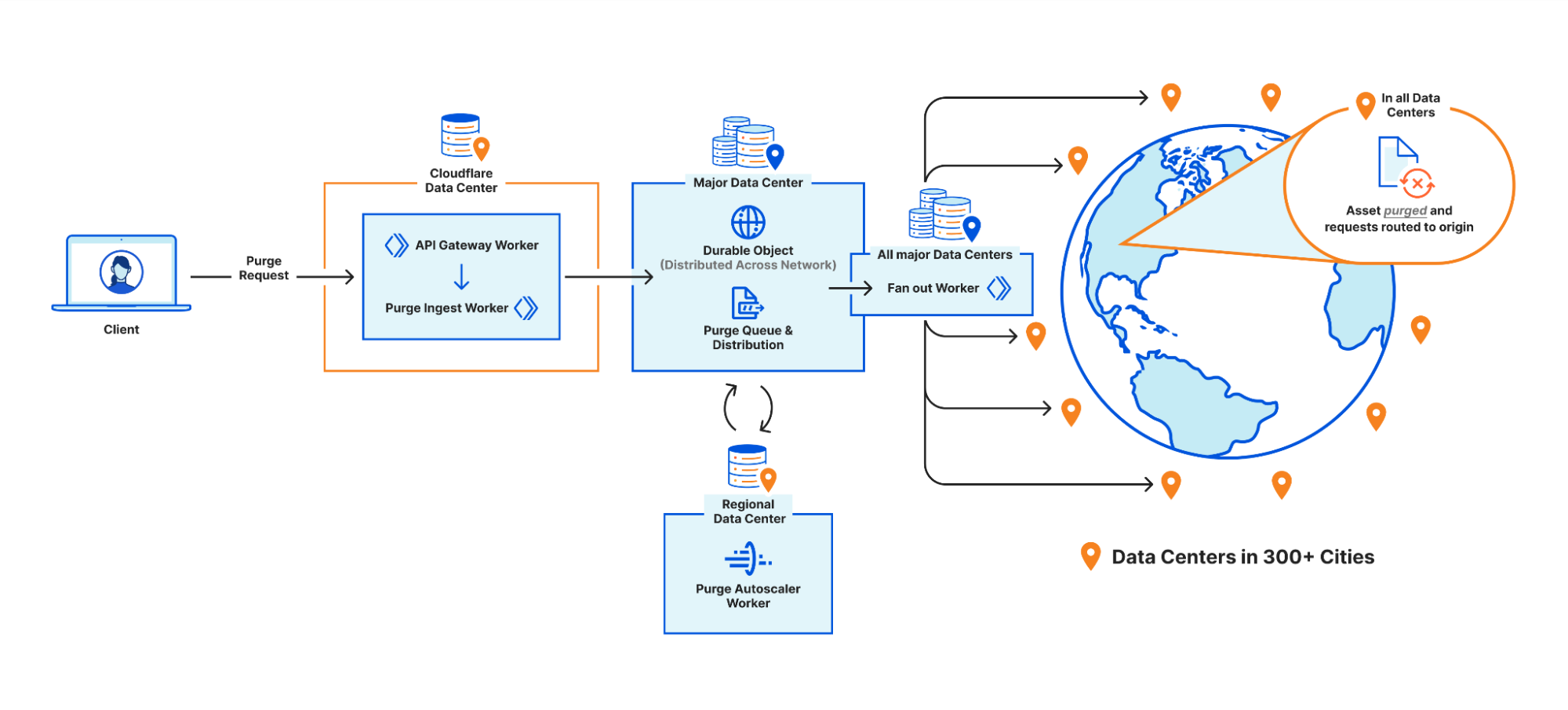
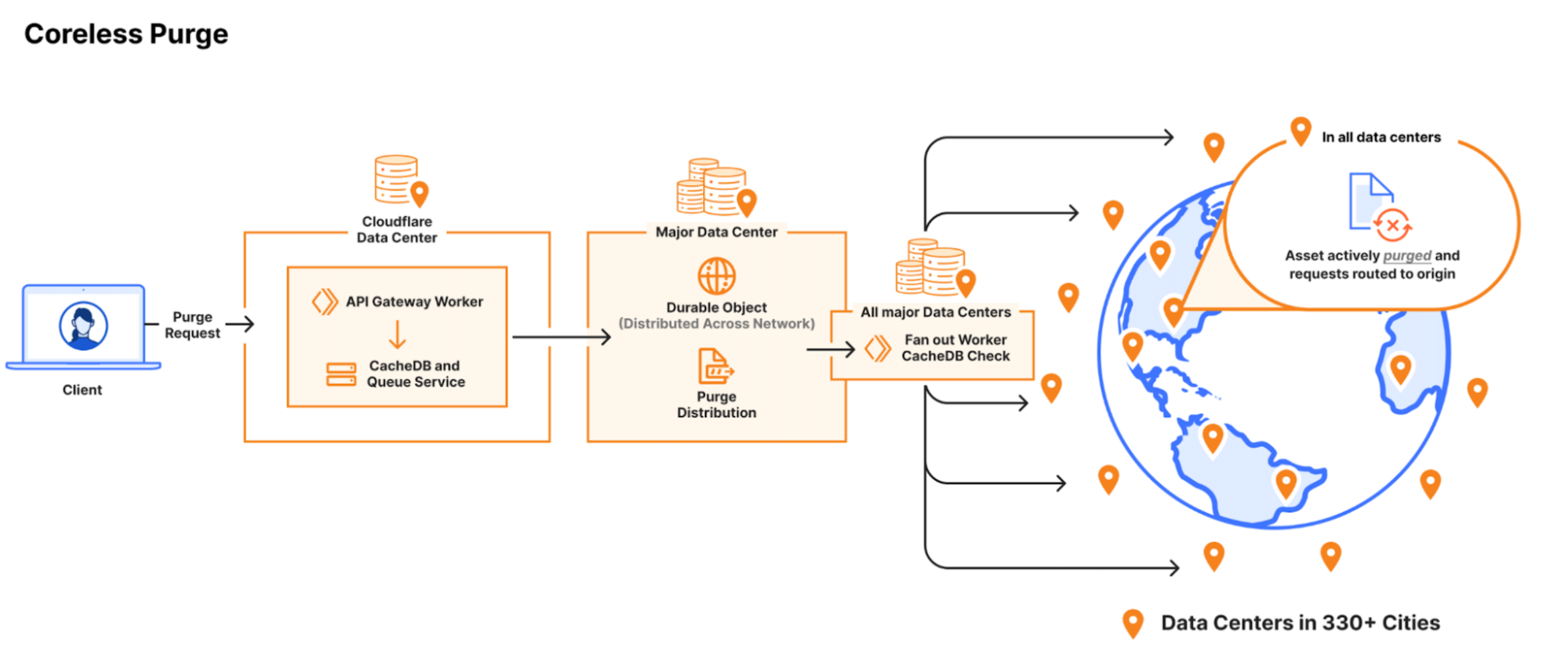
We touched on the high level design of what we called the “coreless” purge system in part 1, but let’s dive deeper into what that design encompasses by following a purge request from end to end:

Part 2: Rethinking cache purge with a new architecture

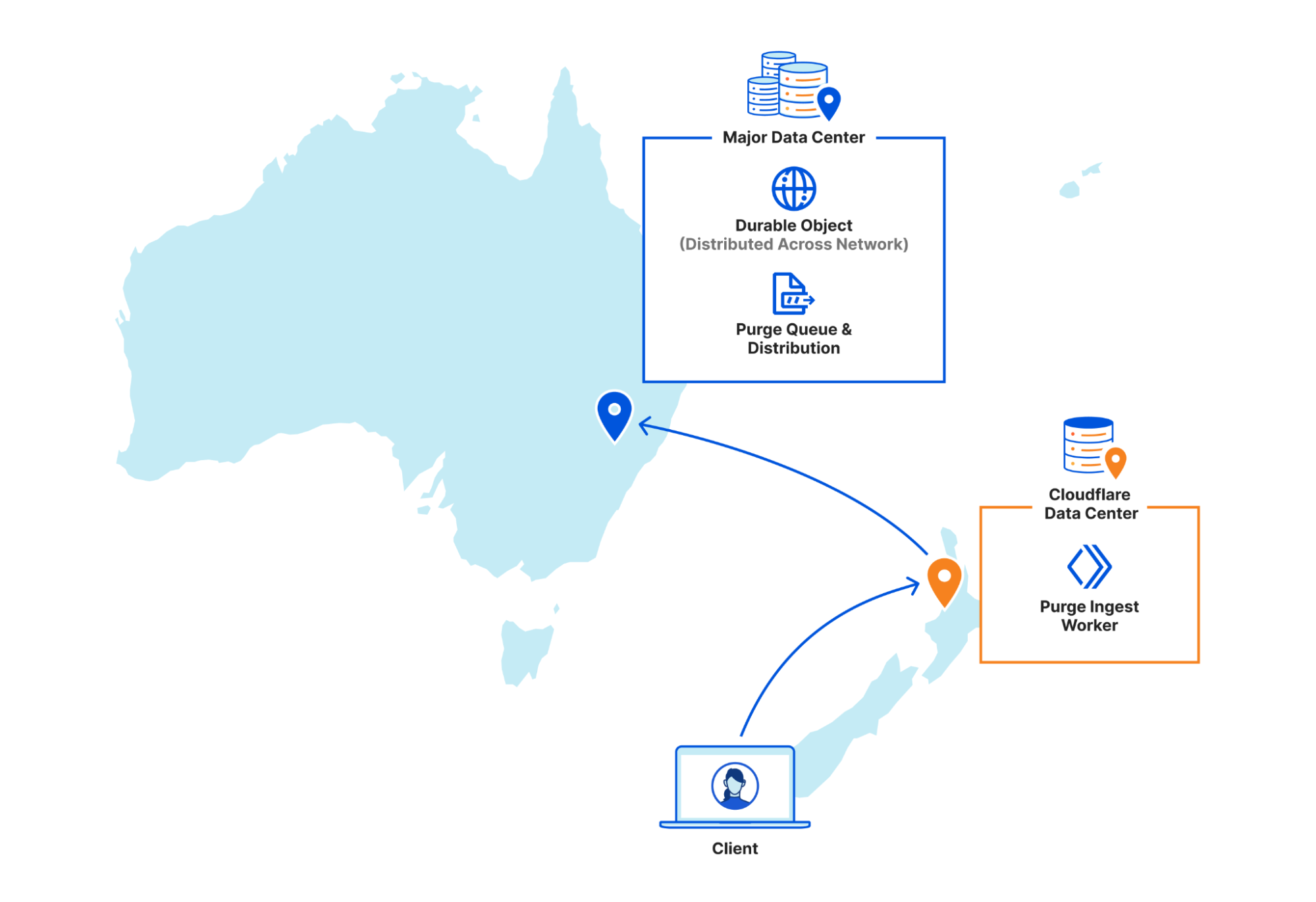
Step 1: Request received locally

An API request to Cloudflare is routed to the nearest Cloudflare data center and passed to an API Gateway worker. This worker looks at the request URL to see which service it should be sent to and forwards the request to the appropriate upstream backend. Most endpoints of the Cloudflare API are currently handled by centralized services, so the API Gateway worker is often just proxying requests to the nearest “core” data center which have their own gateway services to handle authentication, authorization, and further routing. But for endpoints which aren’t handled centrally the API Gateway worker must handle authentication and route authorization, and then proxy to an appropriate upstream. For cache purge requests that upstream is a Purge Ingest worker in the same data center.

Step 2: Purges tested locally

The Purge Ingest worker evaluates the purge request to make sure it is processible. It scans the URLs in the body of the request to see if they’re valid, then attempts to purge the URLs from the local data center’s cache. This concept of local purging was a new step introduced with the coreless purge system allowing us to capitalize on existing logic already used in every data center.

By leveraging the same ownership checks our data centers use to serve a zone’s normal traffic on the URLs being purged, we can determine if those URLs are even cacheable by the zone. Currently more than 50% of the URLs we’re asked to purge can’t be cached by the requesting zones, either because they don’t own the URLs (e.g. a customer asking us to purge https://cloudflare.com) or because the zone’s settings for the URL prevent caching (e.g. the zone has a “bypass” cache rule that matches the URL). All such purges are superfluous and shouldn’t be processed further, so we filter them out and avoid broadcasting them to other data centers freeing up resources to process more legitimate purges.

On top of that, generating the cache key for a file isn’t free; we need to load zone configuration options that might affect the cache key, apply various transformations, et cetera. The cache key for a given file is the same in every data center though, so when we purge the file locally we now return the generated cache key to the Purge Ingest worker and broadcast that key to other data centers instead of making each data center generate it themselves.

Step 3: Purges queued for broadcasting

Part 2: Rethinking cache purge with a new architecture

Once the local purge is done the Purge Ingest worker forwards the purge request with the cache key obtained from the local cache to a Purge Queue worker. The queue worker is a Durable Object worker using its persistent state to hold a queue of purges it receives and pointers to how far along in the queue each data center in our network is in processing purges.

The queue is important because it allows us to automatically recover from a number of scenarios such as connectivity issues or data centers coming back online after maintenance. Having a record of all purges since an issue arose lets us replay those purges to a data center and “catch up”.

But Durable Objects are globally unique, so having one manage all global purges would have just moved our centrality problem from a core data center to wherever that Durable Object was provisioned. Instead we have dozens of Durable Objects in each region, and the Purge Ingest worker looks at the load balancing pool of Durable Objects for its region and picks one (often in the same data center) to forward the request to. The Durable Object will write the purge request to its queue and immediately loop through all the data center pointers and attempt to push any outstanding purges to each.

While benchmarking our performance we found our particular workload exhibited a “goldilocks zone” of throughput to a given Durable Object. On script startup we have to load all sorts of data like network topology and data center health–then refresh it continuously in the background–and as long as the Durable Object sees steady traffic it stays active and we amortize those startup costs. But if you ask a single Durable Object to do too much at once like send or receive too many requests, the single-threaded runtime won’t keep up. Regional purge traffic fluctuates a lot depending on local time of day, so there wasn’t a static quantity of Durable Objects per region that would let us stay within the goldilocks zone of enough requests to each to keep them active but not too many to keep them efficient. So we built load monitoring into our Durable Objects, and a Regional Autoscaler worker to aggregate that data and adjust load balancing pools when we start approaching the upper or lower edges of our efficiency goldilocks zone.

Step 4: Purges broadcast globally

Part 2: Rethinking cache purge with a new architecture

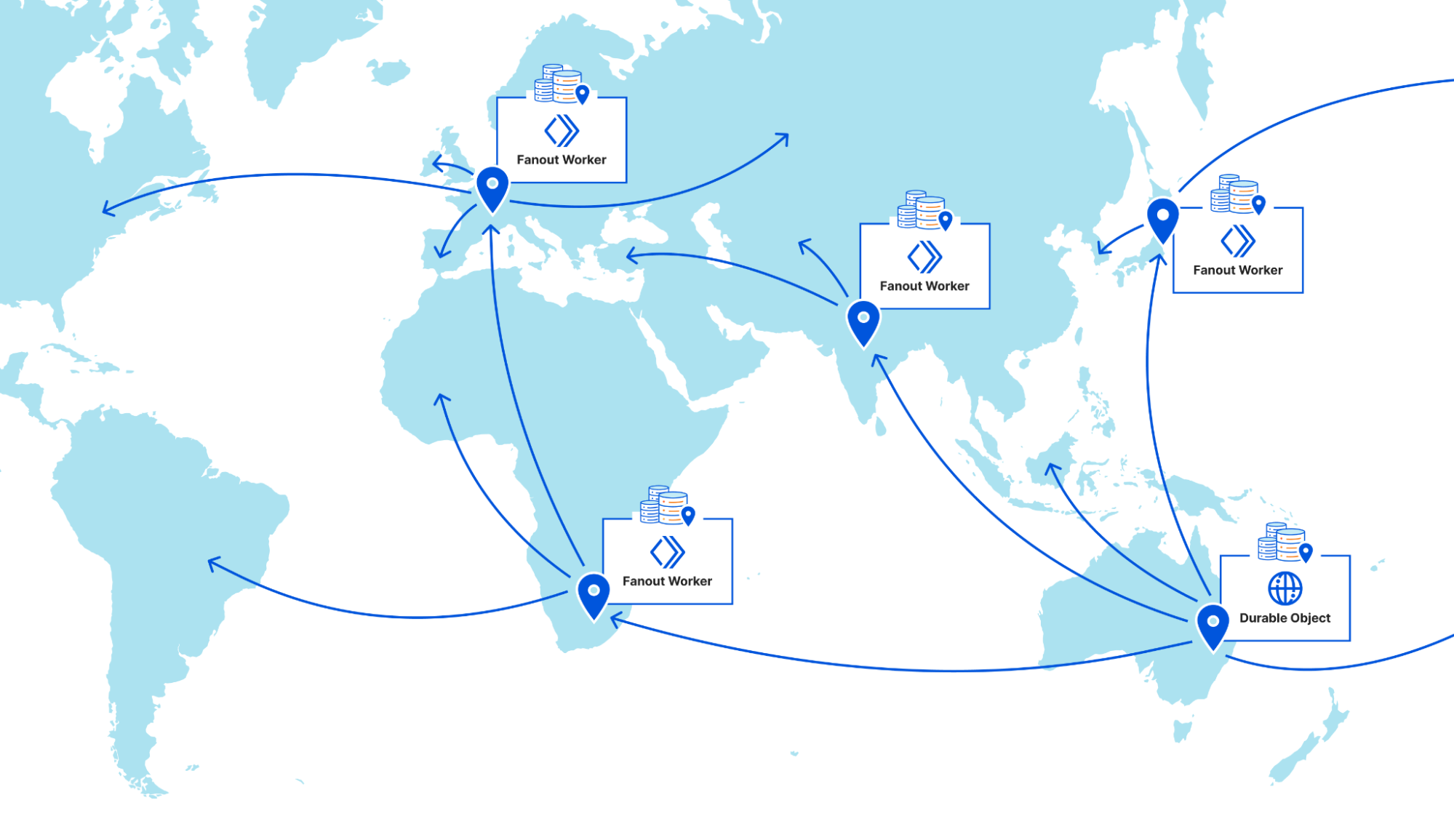
Once a purge request is queued by a Purge Queue worker it needs to be broadcast to the rest of Cloudflare’s data centers to be carried out by their caches. The Durable Objects will broadcast purges directly to all data centers in their region, but when broadcasting to other regions they pick a Purge Fanout worker per region to take care of their region’s distribution. The fanout workers manage queues of their own as well as pointers for all of their region’s data centers, and in fact they share a lot of the same logic as the Purge Queue workers in order to do so. One key difference is fanout workers aren’t Durable Objects; they’re normal worker scripts, and their queues are purely in memory as opposed to being backed by Durable Object state. This means not all queue worker Durable Objects are talking to the same fanout worker in each region. Fanout workers can be dropped and spun up again quickly by any metal in the data center because they aren’t canonical sources of state. They maintain queues and pointers for their region but all of that info is also sent back downstream to the Durable Objects who persist that data themselves, reliably.

But what does the fanout worker get us? Cloudflare has hundreds of data centers all over the world, and as we mentioned above we benefit from keeping the number of incoming and outgoing requests for a Durable Object fairly low. Sending purges to a fanout worker per region means each Durable Object only has to make a fraction of the requests it would if it were broadcasting to every data center directly, which means it can process purges faster.

On top of that, occasionally a request will fail to get where it was going and require retransmission. When this happens between data centers in the same region it’s largely unnoticeable, but when a Durable Object in Canada has to retry a request to a data center in rural South Africa the cost of traversing that whole distance again is steep. The data centers elected to host fanout workers have the most reliable connections in their regions to the rest of our network. This minimizes the chance of inter-regional retries and limits the latency imposed by retries to regional timescales.

The introduction of the Purge Fanout worker was a massive improvement to our distribution system, reducing our end-to-end purge latency by 50% on its own and increasing our throughput threefold.

Current status of coreless purge

We are proud to say our new purge system has been in production serving purge by URL requests since July 2022, and the results in terms of latency improvements are dramatic. In addition, flexible purge requests (purge by tag/prefix/host and purge everything) share and benefit from the new coreless purge system’s entrypoint workers before heading to a core data center for fulfillment.

The reason flexible purge isn’t also fully coreless yet is because it’s a more complex task than “purge this object”; flexible purge requests can end up purging multiple objects–or even entire zones–from cache. They do this through an entirely different process that isn’t coreless compatible, so to make flexible purge fully coreless we would have needed to come up with an entirely new multi-purge mechanism on top of redesigning distribution. We chose instead to start with just purge by URL so we could focus purely on the most impactful improvements, revamping distribution, without reworking the logic a data center uses to actually remove an object from cache.

This is not to say that the flexible purges haven’t benefited from the coreless purge project. Our cache purge API lets users bundle single file and flexible purges in one request, so the API Gateway worker and Purge Ingest worker handle authorization, authentication and payload validation for flexible purges too. Those flexible purges get forwarded directly to our services in core data centers pre-authorized and validated which reduces load on those core data center auth services. As an added benefit, because authorization and validity checks all happen at the edge for all purge types users get much faster feedback when their requests are malformed.

Next steps

While coreless cache purge has come a long way since the part 1 blog post, we’re not done. We continue to work on reducing end-to-end latency even more for purge by URL because we can do better. Alongside improvements to our new distribution system, we’ve also been working on the redesign of flexible purge to make it fully coreless, and we’re really excited to share the results we’re seeing soon. Flexible cache purge is an incredibly popular API and we’re giving its refresh the care and attention it deserves.

Part 1: Rethinking Cache Purge, Fast and Scalable Global Cache Invalidation

Post Syndicated from Alex Krivit original https://blog.cloudflare.com/part1-coreless-purge/

Part 1: Rethinking Cache Purge, Fast and Scalable Global Cache Invalidation

Part 1: Rethinking Cache Purge, Fast and Scalable Global Cache Invalidation

There is a famous quote attributed to a Netscape engineer: “There are only two difficult problems in computer science: cache invalidation and naming things.” While naming things does oddly take up an inordinate amount of time, cache invalidation shouldn’t.

In the past we’ve written about Cloudflare’s incredibly fast response times, whether content is cached on our global network or not. If content is cached, it can be served from a Cloudflare cache server, which are distributed across the globe and are generally a lot closer in physical proximity to the visitor. This saves the visitor’s request from needing to go all the way back to an origin server for a response. But what happens when a webmaster updates something on their origin and would like these caches to be updated as well? This is where cache “purging” (also known as “invalidation”) comes in.

Customers thinking about setting up a CDN and caching infrastructure consider questions like:

  • How do different caching invalidation/purge mechanisms compare?
  • How many times a day/hour/minute do I expect to purge content?
  • How quickly can the cache be purged when needed?

This blog will discuss why invalidating cached assets is hard, what Cloudflare has done to make it easy (because we care about your experience as a developer), and the engineering work we’re putting in this year to make the performance and scalability of our purge services the best in the industry.

What makes purging difficult also makes it useful

(i) Scale
The first thing that complicates cache invalidation is doing it at scale. With data centers in over 270 cities around the globe, our most popular users’ assets can be replicated at every corner of our network. This also means that a purge request needs to be distributed to all data centers where that content is cached. When a data center receives a purge request, it needs to locate the cached content to ensure that subsequent visitor requests for that content are not served stale/outdated data. Requests for the purged content should be forwarded to the origin for a fresh copy, which is then re-cached on its way back to the user.

This process repeats for every data center in Cloudflare’s fleet. And due to Cloudflare’s massive network, maintaining this consistency when certain data centers may be unreachable or go offline, is what makes purging at scale difficult.

Making sure that every data center gets the purge command and remains up-to-date with its content logs is only part of the problem. Getting the purge request to data centers quickly so that content is updated uniformly is the next reason why cache invalidation is hard.  

(ii) Speed
When purging an asset, race conditions abound. Requests for an asset can happen at any time, and may not follow a pattern of predictability. Content can also change unpredictably. Therefore, when content changes and a purge request is sent, it must be distributed across the globe quickly. If purging an individual asset, say an image, takes too long, some visitors will be served the new version, while others are served outdated content. This data inconsistency degrades user experience, and can lead to confusion as to which version is the “right” version. Websites can sometimes even break in their entirety due to this purge latency (e.g. by upgrading versions of a non-backwards compatible JavaScript library).

Purging at speed is also difficult when combined with Cloudflare’s massive global footprint. For example, if a purge request is traveling at the speed of light between Tokyo and Cape Town (both cities where Cloudflare has data centers), just the transit alone (no authorization of the purge request or execution) would take over 180ms on average based on submarine cable placement. Purging a smaller network footprint may reduce these speed concerns while making purge times appear faster, but does so at the expense of worse performance for customers who want to make sure that their cached content is fast for everyone.

(iii) Scope
The final thing that makes purge difficult is making sure that only the unneeded web assets are invalidated. Maintaining a cache is important for egress cost savings and response speed. Webmasters’ origins could be knocked over by a thundering herd of requests, if they choose to purge all content needlessly. It’s a delicate balance of purging just enough: too much can result in both monetary and downtime costs, and too little will result in visitors receiving outdated content.

At Cloudflare, what to invalidate in a data center is often dictated by the type of purge. Purge everything, as you could probably guess, purges all cached content associated with a website. Purge by prefix purges content based on a URL prefix. Purge by hostname can invalidate content based on a hostname. Purge by URL or single file purge focuses on purging specified URLs. Finally, Purge by tag purges assets that are marked with Cache-Tag headers. These markers offer webmasters flexibility in grouping assets together. When a purge request for a tag comes into a data center, all assets marked with that tag will be invalidated.

With that overview in mind, the remainder of this blog will focus on putting each element of invalidation together to benchmark the performance of Cloudflare’s purge pipeline and provide context for what performance means in the real-world. We’ll be reviewing how fast Cloudflare can invalidate cached content across the world. This will provide a baseline analysis for how quick our purge systems are presently, which we will use to show how much we will improve by the time we launch our new purge system later this year.

How does purge work currently?

Part 1: Rethinking Cache Purge, Fast and Scalable Global Cache Invalidation

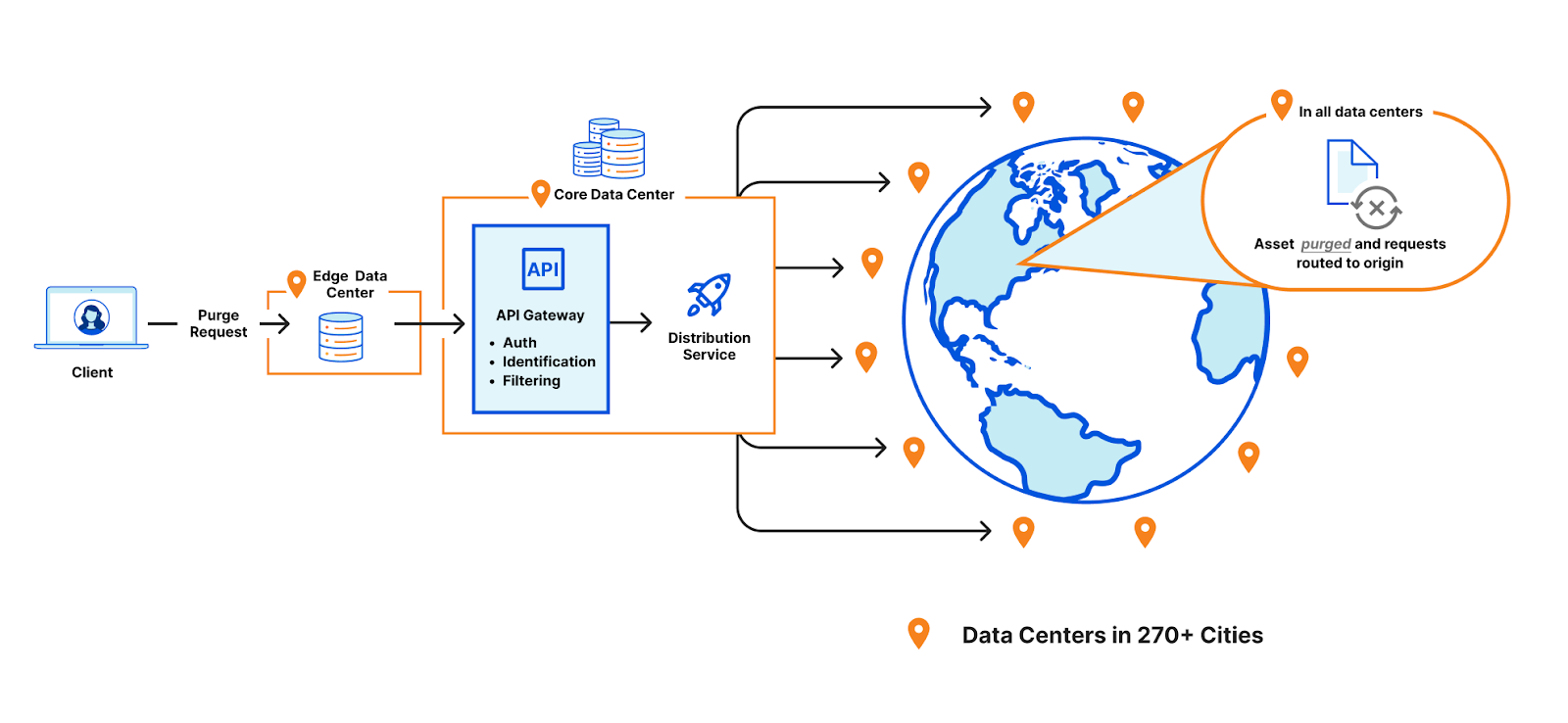
In general, purge takes the following route through Cloudflare’s data centers.

  • A purge request is initiated via the API or UI. This request specifies how our data centers should identify the assets to be purged. This can be accomplished via cache-tag header(s), URL(s), entire hostnames, and much more.
  • The request is received by any Cloudflare data center and is identified to be a purge request. It is then routed to a Cloudflare core data center (a set of a few data centers responsible for network management activities).
  • When a core data center receives it, the request is processed by a number of internal services that (for example) make sure the request is being sent from an account with the appropriate authorization to purge the asset. Following this, the request gets fanned out globally to all Cloudflare data centers using our distribution service.
  • When received by a data center, the purge request is processed and all assets with the matching identification criteria are either located and removed, or marked as stale. These stale assets are not served in response to requests and are instead re-pulled from the origin.
  • After being pulled from the origin, the response is written to cache again, replacing the purged version.

Now let’s look at this process in practice. Below we describe Cloudflare’s purge benchmarking that uses real-world performance data from our purge pipeline.

Benchmarking purge performance design

In order to understand how performant Cloudflare’s purge system is, we measured the time it took from sending the purge request to the moment that the purge is complete and the asset is no longer served from cache.  

In general, the process of measuring purge speeds involves: (i) ensuring that a particular piece of content is cached, (ii) sending the command to invalidate the cache, (iii) simultaneously checking our internal system logs for how the purge request is routed through our infrastructure, and (iv) measuring when the asset is removed from cache (first miss).

This process measures how quickly cache is invalidated from the perspective of an average user.

  • Clock starts
    As noted above, in this experiment we’re using sampled RUM data from our purge systems. The goal of this experiment is to benchmark current data for how long it can take to purge an asset on Cloudflare across different regions. Once the asset was cached in a region on Cloudflare, we identify when a purge request is received for that asset. At that same instant, the clock started for this experiment. We include in this time any retrys that we needed to make (due to data centers missing the initial purge request) to ensure that the purge was done consistently across our network. The clock continues as the request transits our purge pipeline  (data center > core > fanout > purge from all data centers).  
  • Clock stops
    What caused the clock to stop was the purged asset being removed from cache, meaning that the data center is no longer serving the asset from cache to visitor’s requests. Our internal logging measures the precise moment that the cache content has been removed or expired and from that data we were able to determine the following benchmarks for our purge types in various regions.  

Results

We’ve divided our benchmarks in two ways: by purge type and by region.

We singled out Purge by URL because it identifies a single target asset to be purged. While that asset can be stored in multiple locations, the amount of data to be purged is strictly defined.

We’ve combined all other types of purge (everything, tag, prefix, hostname) together because the amount of data to be removed is highly variable. Purging a whole website or by assets identified with cache tags could mean we need to find and remove a multitude of content from many different data centers in our network.

Secondly, we have segmented our benchmark measurements by regions and specifically we confined the benchmarks to specific data center servers in the region because we were concerned about clock skews between different data centers. This is the reason why we limited the test to the same cache servers so that even if there was skew, they’d all be skewed in the same way.  

We took the latency from the representative data centers in each of the following regions and the global latency. Data centers were not evenly distributed in each region, but in total represent about 90 different cities around the world:  

  • Africa
  • Asia Pacific Region (APAC)
  • Eastern Europe (EEUR)
  • Eastern North America (ENAM)
  • Oceania
  • South America (SA)
  • Western Europe (WEUR)
  • Western North America (WNAM)

The global latency numbers represent the purge data from all Cloudflare data centers in over 270 cities globally. In the results below, global latency numbers may be larger than the regional numbers because it represents all of our data centers instead of only a regional portion so outliers and retries might have an outsized effect.

Below are the results for how quickly our current purge pipeline was able to invalidate content by purge type and region. All times are represented in seconds and divided into P50, P75, and P99 quantiles. Meaning for “P50” that 50% of the purges were at the indicated latency or faster.  

Purge By URL

P50 P75 P99
AFRICA 0.95s 1.94s 6.42s
APAC 0.91s 1.87s 6.34s
EEUR 0.84s 1.66s 6.30s
ENAM 0.85s 1.71s 6.27s
OCEANIA 0.95s 1.96s 6.40s
SA 0.91s 1.86s 6.33s
WEUR 0.84s 1.68s 6.30s
WNAM 0.87s 1.74s 6.25s
GLOBAL 1.31s 1.80s 6.35s

Purge Everything, by Tag, by Prefix, by Hostname

P50 P75 P99
AFRICA 1.42s 1.93s 4.24s
APAC 1.30s 2.00s 5.11s
EEUR 1.24s 1.77s 4.07s
ENAM 1.08s 1.62s 3.92s
OCEANIA 1.16s 1.70s 4.01s
SA 1.25s 1.79s 4.106s
WEUR 1.19s 1.73s 4.04s
WNAM 0.9995s 1.53s 3.83s
GLOBAL 1.57s 2.32s 5.97s

A general note about these benchmarks — the data represented here was taken from over 48 hours (two days) of RUM purge latency data in May 2022. If you are interested in how quickly your content can be invalidated on Cloudflare, we suggest you test our platform with your website.

Those numbers are good and much faster than most of our competitors. Even in the worst case, we see the time from when you tell us to purge an item to when it is removed globally is less than seven seconds. In most cases, it’s less than a second. That’s great for most applications, but we want to be even faster. Our goal is to get cache purge to as close as theoretically possible to the speed of light limit for a network our size, which is 200ms.

Intriguingly, LEO satellite networks may be able to provide even lower global latency than fiber optics because of the straightness of the paths between satellites that use laser links. We’ve done calculations of latency between LEO satellites that suggest that there are situations in which going to space will be the fastest path between two points on Earth. We’ll let you know if we end up using laser-space-purge.

Just as we have with network performance, we are going to relentlessly measure our cache performance as well as the cache performance of our competitors. We won’t be satisfied until we verifiably are the fastest everywhere. To do that, we’ve built a new cache purge architecture which we’re confident will make us the fastest cache purge in the industry.

Our new architecture

Through the end of 2022, we will continue this blog series incrementally showing how we will become the fastest, most-scalable purge system in the industry. We will continue to update you with how our purge system is developing  and benchmark our data along the way.

Getting there will involve rearchitecting and optimizing our purge service, which hasn’t received a systematic redesign in over a decade. We’re excited to do our development in the open, and bring you along on our journey.

So what do we plan on updating?

Introducing Coreless Purge

The first version of our cache purge system was designed on top of a set of central core services including authorization, authentication, request distribution, and filtering among other features that made it a high-reliability service. These core components had ultimately become a bottleneck in terms of scale and performance as our network continues to expand globally. While most of our purge dependencies have been containerized, the message queue used was still running on bare metals, which led to increased operational overhead when our system needed to scale.

Last summer, we built a proof of concept for a completely decentralized cache invalidation system using in-house tech – Cloudflare Workers and Durable Objects. Using Durable Objects as a queuing mechanism gives us the flexibility to scale horizontally by adding more Durable Objects as needed and can reduce time to purge with quick regional fanouts of purge requests.

In the new purge system we’re ripping out the reliance on core data centers and moving all that functionality to every data center, we’re calling it coreless purge.

Part 1: Rethinking Cache Purge, Fast and Scalable Global Cache Invalidation

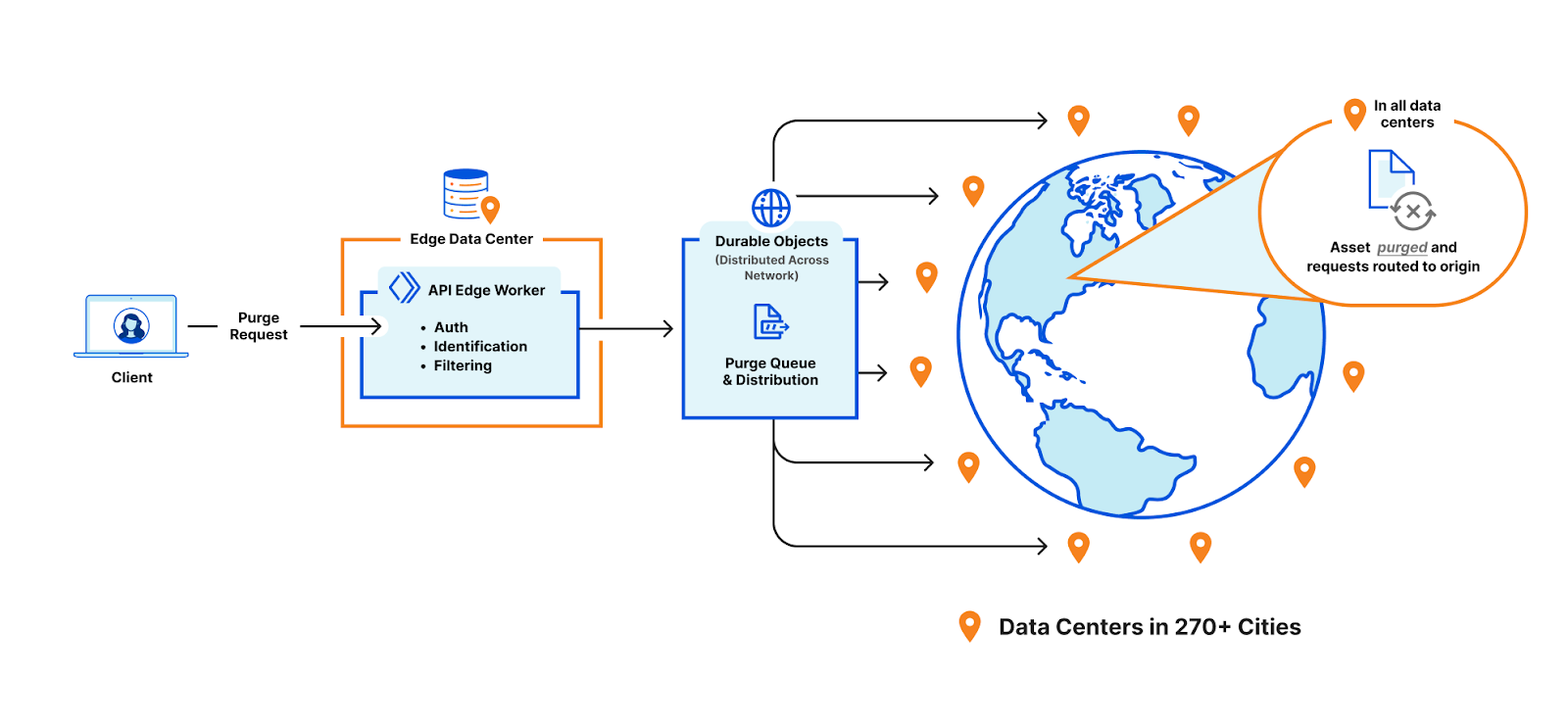
Here’s a general overview of how coreless purge will work:

  • A purge request will be initiated via the API or UI. This request will specify how we should identify the assets to be purged.
  • The request will be routed to the nearest Cloudflare data center where it is identified to be a purge request and be passed to a Worker that will perform several of the key functions that currently occur in the core (like authorization, filtering, etc).
  • From there, the Worker will pass the purge request to a Durable Object in the data center. The Durable Object will queue all the requests and broadcast them to every data center when they are ready to be processed.
  • When the Durable Object broadcasts the purge request to every data center, another Worker will pass the request to the service in the data center that will invalidate the content in cache (executes the purge).

We believe this re-architecture of our system built by stringing together multiple services from the Workers platform will help improve both the speed and scalability of the purge requests we will be able to handle.

Conclusion

We’re going to spend a lot of time building and optimizing purge because, if there’s one thing we learned here today, it’s that cache invalidation is a difficult problem but those are exactly the types of problems that get us out of bed in the morning.

If you want to help us optimize our purge pipeline, we’re hiring.