Tag Archives: GenAI

Ontology-Driven Observability: Building an End-to-End Knowledge Graph at Netflix Scale

Post Syndicated from Netflix Technology Blog original https://netflixtechblog.com/ontology-driven-observability-building-an-end-to-end-knowledge-graph-at-netflix-scale-421392cf5adf

Prasanna Vijayanathan, Renzo Sanchez-Silva

When Jake Paul and Mike Tyson stepped into the ring in November 2024, we delivered the fight to roughly 65 million concurrent streams. On an ordinary day our infrastructure takes in more than 2 billion requests and handles upwards of 38 million real-time logging events every second. At that scale, the whole picture doesn’t fit into a single engineering team’s head or onto a single dashboard. With more Live content, Podcasts and real-time streams, our need to understand and update our systems as quickly as possible becomes imperative to provide a good user experience. Understanding the system at this scale and within the time constraints we have, often becomes a daunting exercise in finding a needle in a haystack, in a dark jungle, blindfolded.

This post is about that search for the needle.

The Four hours before a fix

Consider a regression of the kind we see in a given week. The home screen where you see the list of lists of movies, starts taking about 1.5 seconds longer to render. An alert fires. And then we go looking for what caused this issue and how do we fix it?

As it so happens, a regression on the application could be related to anywhere in the system — a client app regression from a new version deployment or A/B test rollout, a load shedding in the infrastructure, a GraphQL query responding with bad data because of a service rollout 6 hops downstream, are all suspects at this point. So, answering “what caused the issue?” needs insights from across the system, and this involves combing through layers of data in a meticulous manner.

The MELT Layer

“What caused the issue?”

Metrics, events, logs and traces, or MELT, in the industry’s shorthand, are the right raw materials for such an investigation, and each of them answers roughly a quarter of the question. We collect observability data across these four pillars, unified into a single observability data layer. This lets us observe our systems in real time, across what our users are experiencing, how our applications are doing and what our backend infrastructure and services are processing and responding to.

MELT — Metrics, Events, Logs and Traces, and how they are captured across the system.

The investigation that follows may look like this in each layer:

What each layer of MELT tells us and what it leaves out

The timeline of an investigation

So how long does it take to investigate an issue, figure out the root cause and fix it, so our users stop running into this issue again?

A timeline of an investigation: ~4 hours

In our chosen example, four hours. Very little of it went into computing anything difficult. Most of it went into reconstructing relationships that our observability systems already knew but we had never written down anywhere a human or machine could simply read and discover.

The disagreement underneath

The instinct here could have been, around 2023, to reach for more data or better dashboards, and while both help at the margins, neither addresses what makes these investigations slow.

It’s 2026 now, so we might say, “hey, agents”, but without the right context delivered to the agents, AI systems hallucinate, and especially when teams are on-call and need a fix “now”, we cannot let inaccurate agentic analysis lead us down the wrong path. We need the right needle, not any needle.

Each of our systems is internally coherent and externally isolated. Atlas, our telemetry platform, knows applications and their time series. Radar, our alerting system, knows thresholds and firing history. incident.io knows severities and responders. PagerDuty knows rotations. Spinnaker knows what shipped and when. And our Slack history knows, in a form no query engine can reach, which engineer solved something very similar last quarter and what they found.

The difficulty is that they do not agree on what they are talking about. A thing that is an application in one system is a service in a second and a cluster in a third, with names differing by a suffix, a casing convention, or a rename only a couple of people remember (SMEs, ring a bell?). Joining across them requires a human carrying the mapping in their head, and that person becomes the bottleneck in such cross-domain investigations. The hard part of end-to-end observability is probably better understood as a data modelling problem.

What we lacked was an explicit, machine-readable agreement about the entities in our operational world.

The Ontology

This agreement has a name: an ontology. Ontology is a formal specification of types, the properties they carry, and the relationships they may have. Its unit is the triple, one fact expressed as subject, predicate, object. Consider the following example triples.

api-gateway   rdf:type       ops:Application .
api-gateway ops:ownedBy "Team Bedrock" .
api-gateway ops:deployedIn "us-east-1" .

INC-5377 rdf:type ops:Incident .
INC-5377 ops:affects api-gateway .
INC-5377 ops:severity "SEV 2" .

In the example here, we have already encoded six facts, and can answer in one query, a question that used to span three tools.

“Which incidents affected applications owned by Team Bedrock in us-east-1?” is a single query in place of looking up incidents, Spinnaker and Radar.

We call our ontology layer, The Observability Ontology. It acts as the schema, rule set and shared agreement that standardizes how different systems understand entities like applications, services, incidents, deployments, etc.

We built it on the W3C stack for this: RDF for the data model, OWL for the ontology, SHACL for validation, and SPARQL for querying. These standards are well specified and widely implemented, which keeps the model portable across graph stores.

The data from the ontology itself, is stored as a knowledge graph, persisted to QuipuDB, our homegrown RDF graph database, a distributed quad store based on redb, a Rust-based embedded key value db. Data here is generated by parsing raw telemetry, logs, and incident discussions into triples (subject-predicate-object facts).

Every harvest also produces a full Turtle serialization for archival, making it human-readable and diff-friendly, which has proven more useful for debugging than we expected.

Our ontology is organized into twelve namespaces, each owning one operational domain:

There are two decisions about this ontology that mattered while we built it, so they’re worth sharing.

The first is that we refused a generic Service type. “Service” means four different things across our tooling, so applications resolve to exactly one type, ops:Application, and every one of them is validated against our software catalog of roughly 49,000 entries before the entity is created. Unvalidated strings like usernames, team names, dependency names scraped from network topology, never become applications. We also cap dependency edges in both directions, because one popular service can carry thousands of reverse dependencies and would otherwise dominate the graph.

The second decision concerns what we chose to model. Incident chat carries the reasoning behind an incident. The hypotheses tried and discarded, the mitigation that worked, who knew why, is all context in the incident’s Slack channel and that knowledge evaporates when the channel goes quiet. So a 200-message, 50-person, 15-service incident channel becomes a structure, converting the operational chaos of an incident into ordered triples:

Creating determinism from non-determinism

Building this graph means using tools that are inherently stochastic. LLMs summarize discussions. Fuzzy matching resolves service names. A probabilistic engine proposes causal chains. None of these produce the same output twice with certainty, but what comes out at the end of our system is a deterministic graph that answers a SPARQL query the same way every time.

The ontology is the mechanism that creates this determinism through its pipelined approach. We think of the pipeline as a ladder that drives entropy down, where entropy means the proportion of information still trapped in unstructured form. For example, at the start of this pipeline, an LLM could say anything, but it cannot emit a triple that violates the type system. We constrain the output space tightly enough and a stochastic process yields a deterministic contract:

# The model may produce any prose. Its output MUST fit these predicates:
category IN ["incident", "question", "discussion", "decision"]
sentiment IN ["positive", "neutral", "negative", "urgent"]

# Result — a deterministic triple:
thread:123 slack:category "incident" .
thread:123 slack:isIncidentRelated "true"^^xsd:boolean .

There are five layers that get us down this ladder. Any single step of this ladder is non-deterministic. But in aggregate, the chain becomes deterministic. That inversion is the whole trick. We describe them below:

The five layers to create determinism from non-determinism

Enrichers: Agents as entropy reducers

We use what we call, enrichers, to reduce entropy across the knowledge graph. Dozens of enrichers run over the graph. Each one of them takes noisy input and emits typed triples, and each reads what earlier enrichers wrote. The contract for an Enricher is deliberately narrow:

class Enricher:
async def _enrich_async(self, ...):
raw = await self.fetch(...) # 1. read noisy input
result = self.analyze(raw) # 2. process (may be stochastic)
graph.add((uri, RDF.type, OPS.X)) # 3. emit TYPED triples
graph.add((uri, OPS.pred, Literal(result.value)))
return EnrichmentResult(success=True, triples_added=count)

Three invariants that are standard across the enrichers:

  • every entity carries an rdf:type,
  • every URI follows a single naming scheme, and
  • the catalog gates every ops:Application.

Two operational choices are worth naming here, as well. The enrichment pipeline runs sequentially — load the graph, add triples, and save.

This sequencing removes an entire category of race conditions at a cost in wall-clock time we are happy to pay. And calls out to external systems like metrics, logs, events and the rest could be best-effort, so a slow downstream API doesn’t block the graph harvest, albeit some degradation. To that end, we are also working to translate these separate systems into the ontology, such as the Metrics Ontology and the Alerts Ontology, so everything could be queried from the Ontology itself.

The Correlation Engine: finding the correlation chains

The correlation engine assimilates the vast number of signals from diverse input sources and condenses them into causal or correlatory chains of events. Today, the engine reads thirteen signal types, including log errors, metric anomalies, slow and failed traces, alerts, incidents, deployments, config changes, experiments, autoscaling, commits, end-to-end bottlenecks, and error patterns. It then searches for paths among them. Some ordered pairs are known to be causal and carry a high prior weight. For example, deployment before log error, config change before metric anomaly, failed trace before incident, and so on. Others, which show high correlation are considered correlation chains. Such chains are scored on temporal proximity and severity, inside a ten-minute window, with anything under 0.6 confidence getting discarded.

The Correlation Engine

The role of the engine here is to propose with evidence, not to make conclusions. Hence, the engine stores its chains along with the graph records that were used to create them.

A 0.87 chain in the above example, is a strong hypothesis for a human or an agent to check, and the graph records the confidence alongside the claim so that consumers can understand why a chain is what it is and weigh their options to make decisions.

The knowledge flywheel

Each harvest cycle turns the same four steps, and each rotation leaves the graph richer for the next. This is the Knowledge Flywheel, leading to continuous enrichment and improvement of the context about our system, stored in the knowledge graph.

The Knowledge Flywheel

Observe collects the signals. Enrich adds typed triples. Infer finds patterns invisible in the raw data. Adapt feeds knowledge back, so that established patterns become detection rules. The compounding result of the four phases leads to a self-improving system. A causal chain discovered in one incident becomes a known pattern for the next, and the ontology gradually stops being a schema and starts being a memory.

Consider the example above. When we first see an incident in api-gateway caused due to a timeout and resolve it, we convert this knowledge into entries to the ontology. This becomes encoded knowledge. As we go through multiple cycles of this encoding, the graph starts learning patterns. After N cycles, patterns become wisdom — “api-gateway deploys cause 40% of SEV-2s” and “30% of deployment issues in api-gateway come from Connection Timeouts”. Surface this as an insight and we proactively start reducing incidents, not just react quickly to new ones.

Putting the graph to work

On top of the graph sits AutoRCA, our internal agentic AI solution, built with a set of specialist agents coordinated around one question. Walking the home page regression from the top of this post, the agentic system’s reasoning chain might look something like this:

Each specialization to the inputs is built by people who understand their respective domain deeply. That division of labour only works if the specialists can pass findings to one another without having to agree on the terms of communication or even have knowledge of each other. The ontology acts as the interface. Each specialist learns one vocabulary — the graph’s. A team writing specialized use cases for how they use traces record their findings as triples about an ops:Application, the logs specialization reads triples about that same ops:Application, and neither needs to know the other exists. A new specialist learns the same vocabulary once and can immediately read everything the other six have written.

Set against the investigation we opened with, the change is narrower than it might sound. The alert still fires at 3:30pm, an engineer still has to weigh the evidence, and the fix still has to be written by someone who understands the code. The hour or two that used to go into assembling context — finding the owning team, reconstructing what shipped, correlating information from different parts of the system, recalling that something similar happened last quarter — all that work is the part the ontology and the graph absorbs. We are early enough that the ranked hypotheses are sometimes wrong, which is why each one carries the evidence that produced it. But when the engineer now starts the investigation, they are already holding the picture that used to take half an afternoon to assemble.

If you want to build one of these

A fair amount of what we have built, we learned by getting it wrong first. Based on this experience, these are the principles we would carry into a second attempt.

  • Model identity before anything else. Choose one authoritative catalog per entity kind and validate against it before creating an entity.
  • Treat the ontology as code. Version it, review it, test it, and let changes arrive as pull requests. Treating the ontology as code lends itself to agentic development and lets teams scale and contribute to it.
  • Separate concepts from instances. Concepts change on a human timescale and instances change continuously, conflating them makes both harder to evolve.
  • Build on open standards. RDF, OWL, SHACL and SPARQL are specified, implemented many times over, and portable. A bespoke graph model ties a future consumer to one implementation.
  • Constrain stochastic tools with a type system. This is the principle we would defend hardest. Models are useful precisely where determinism is impossible, and a sufficiently narrow output contract converts their output into something a query engine can trust.
  • Make enrichment best-effort and ordered. A slow dependency should utmost degrade the graph, never block it. And ordering enrichers so each builds on the last buys more accuracy and that’s worth the tradeoff with parallelism that buys speed.
  • Model human reasoning alongside machine telemetry. The most valuable edges in our graph came from discussion. Telemetry records what the system did, discussion records what people understood and interpreted. The reasoning is more valuable to store and serve as wisdom when we need it.
  • Keep humans as the approvers. Let agents propose fixes, enrichers, and ontology changes, and route every proposal through a review process with humans in the loop.

What comes next

The graph makes three things possible. First, automatic root cause analysis, where a regression arrives with a ranked set of graph-backed hypotheses attached. Next, automated remediation, where a sufficiently confident diagnosis carries a proposed action like a targeted rollback, a traffic shift, a code change. And eventually infrastructure that heals itself, acting on a predicted failure before members feel it.

Alongside this, we plan to integrate the Observability Ontology with Upper, the domain-modeling language at the heart of Netflix’s Unified Data Architecture (UDA). Upper lets teams describe business and system domains as interconnected, machine-readable models and preserve their meaning and constraints as those models are projected into concrete schemas and systems. This integration would connect operational concepts such as applications, alerts, deployments, and incidents to the broader set of domains modeled across Netflix, giving engineers and agents a shared semantic layer for querying, validation, and reasoning. We will begin with a proof of concept that models incidents in Upper and use what we learn to determine where the two systems should converge.

Acknowledgements

None of this would exist without the teams who share their data, expertise, and patience with an early system. We want to specially acknowledge the efforts of our own team members who made this possible from very early on in this lifecycle, Kaela Marsheck and Aditya Gaur. We are also especially grateful to our collaborators in Netflix’s ontology working group, Peter Royal, Alex Hutter, and to Alexandre Bertails and members of the Unified Data Architecture (UDA)/Knowledge Foundations team for sharing Upper and their domain-modeling expertise, and for helping us explore how the Observability Ontology can become part of a broader semantic foundation at Netflix.


Ontology-Driven Observability: Building an End-to-End Knowledge Graph at Netflix Scale was originally published in Netflix TechBlog on Medium, where people are continuing the conversation by highlighting and responding to this story.
GenRec: Towards LLM-Native Recommendation at Netflix

Post Syndicated from Netflix Technology Blog original https://netflixtechblog.com/genrec-towards-llm-native-recommendation-at-netflix-f20be6f643e3

Authors: Ying Li, Arjun Rao, Shradha Sehgal

Introduction

Recommendations sit at the heart of the Netflix experience. Our current production models rely on thousands of hand‑crafted features over users, items, and interactions, along with specialized architectures for sequence modeling, feature interactions, and multi‑task objectives. This stack has evolved over many years to support diverse content types (movies, series, games, live, podcasts) and product surfaces, but its complexity makes it costly to onboard new use cases: adding a content type or surface can require significant feature engineering, architecture change, infrastructure work, and experimentation.

At the same time, large language models (LLMs) are changing how we think about recommendation, as shown by recent work such as PLUM, GLIDE, and OneRec-Think. Their broad world knowledge and strong language understanding make it possible to represent user histories and item metadata directly as text, capture rich relationships in a shared semantic space, and steer recommendations via natural‑language prompts. However, off‑the‑shelf LLMs are still far from production‑ready recommenders: they often over‑recommend globally popular content, hallucinate out‑of‑catalog items, ignore business constraints, and provide only limited personalization.

To address this, we built GenRec, an LLM‑backed recommendation ranker that post‑trains an internal foundation LLM on Netflix‑specific data and objectives. GenRec shows that an LLM‑based ranker can match or exceed a mature production system while relying on far fewer labeled examples and input signals.

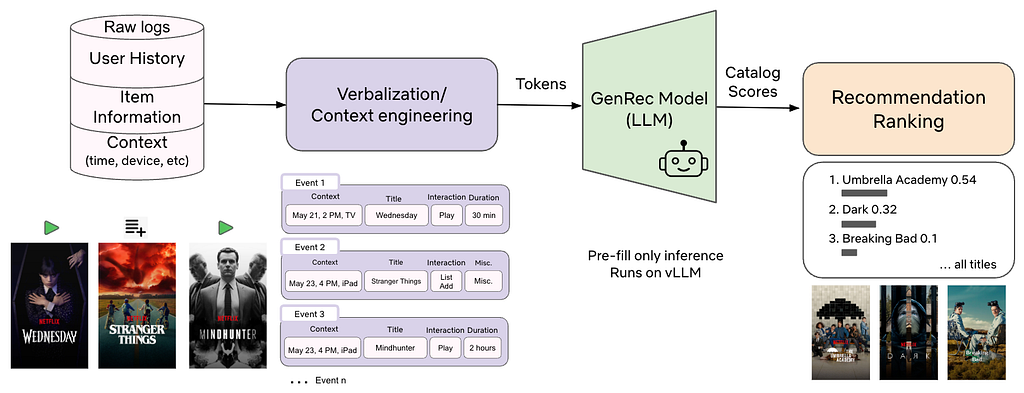
Figure 1: GenRec pipeline. Raw logs of user history, item metadata, and context are transformed via context engineering into natural-language prompts and fed into the GenRec, which runs on vLLM in prefill-only mode and outputs scores for each catalog item, yielding a recommendation ranking.

At a high level, GenRec:

  • Verbalizes user histories, item metadata, and context as text.
  • Post‑trains a Netflix‑adapted foundation LLM for ranking.
  • Adds a catalog‑aware scoring head over Netflix titles.
  • Uses reward signals to align with long‑term member value and business goals.
  • Runs in prefill‑only mode on Netflix’s LLM serving stack for cost efficiency.

In a large‑scale A/B test against a well‑tuned production ranker, GenRec achieves statistically significant improvements in both short‑term and long‑term online metrics, while using only a small fraction of the Phase‑2 labeled data and input signals. It reduces our reliance on hand‑engineered features and shifts the focus from feature engineering to context engineering. In this blog post, we will describe how GenRec works, how it performs, and why we believe it points toward a more LLM‑centric future for recommendation at Netflix.

Problem Setting

We focus on a full‑catalog ranking task (or top‑K ranking when a candidate set is provided).

Given a user 𝑢, their interaction history 𝐻, and the current context 𝜏 (device, surface, locale, time, etc.), GenRec scores each item and produces a personalized ranking that can directly power recommendations or serve as input for downstream personalization systems.

Formally, we map a request (u,τ,t,H) — user, context, time, and history — to a ranking 𝜋 over the catalog C, where π(i) is the position assigned to item i. We optimize π for expected long‑term member utility (a proxy for satisfaction and retention), not just short‑term engagements.

From Foundation LLM to Recommendation Ranker

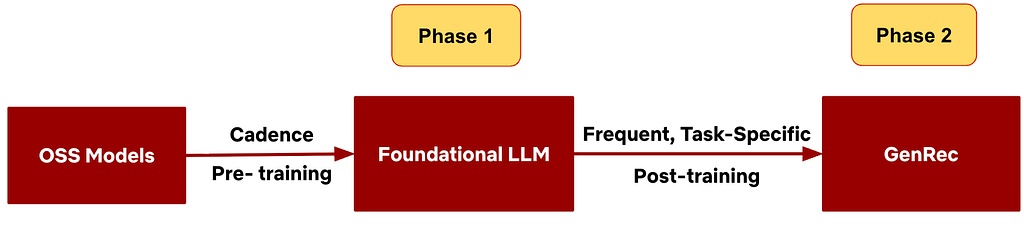
GenRec follows a two‑phase training framework (Figure 2):

Figure 2: Two Phase Framework. Phase 1 trains a foundational LLM on Netflix data for user and content understanding, and Phase 2 post-trains on ranking-specific data and objectives.

Phase 1 — Netflix-Adapted Foundation LLM.

We start from an open‑source LLM and adapt it on proprietary Netflix corpora, so it learns foundational capabilities such as

  • Netflix content understanding
  • Member behavior and preference patterns
  • General language understanding and generation.

Phase 1 is updated relatively infrequently and serves as a shared, Netflix‑aware backbone for many applications.

Phase 2 — GenRec.

We then turn this foundation model into a high‑quality ranking model by post‑training on ranking‑specific data and objectives. Phase 2:

  • Focuses on ranking quality and steering
  • Incorporates multiple reward signals via reward‑weighted losses
  • Is refreshed more frequently to track new content and evolving tastes
  • Is explicitly optimized under serving cost constraints.

Training Data as Conversations

Netflix members generate hundreds of billions of interaction events spanning many surfaces (views, plays, durations, thumbs up/down, add to list, abandons, etc.). We convert this log data into single‑turn or multi‑turn “conversations” between a user and a recommender. Each turn contains:

  • User message: verbalized context, profile, history, item metadata, and task (e.g., recommend what the user will watch or thumb next).
  • Assistant message: the member’s actual engagement (e.g., which titles were played, for how long, what feedback they provided).

During Phase‑2 training, the LLM learns how assistant messages depend on user messages. This allows us to express rich recommendation signals as text, jointly supporting both the language-modeling (LM) and ranking objectives.

At inference time, we feed in the verbalized context and apply a catalog‑aware scoring head to rank items; we do not decode assistant messages. The conversational format is primarily used during training to support the LM objective and preserve strong language understanding over the verbalized text.

Verbalization and Context Engineering

Traditional recommenders operate on dense features and embeddings. GenRec takes a different approach: it verbalizes rich user histories and context as natural language, encoding raw interaction signals directly in the LLM’s semantic space. In doing so, it relies on the model to discover higher‑level patterns — such as item relationships and evolving user interests — rather than on manual feature engineering.

Naively verbalizing every interaction in a user’s history can quickly exceed the token budget and be too expensive at Netflix scale. The context window becomes our new “feature budget”, so we apply context engineering:

  • Retain in full: high‑signal engagements (e.g., long plays, thumbs‑up) with richer details
  • Omit: low‑signal events (e.g., very short plays or quick hovers)
  • Summarize or compress: repetitive behaviors (e.g., binge‑watching )
  • Elaborate selectively: important or cold‑start items (e.g., new releases)

Within a fixed token budget, we prioritize recent, high‑signal history and compress or drop older history. We also structure the prompt to maximize shared prefixes for better prefix caching. The goal is a compact, high‑information prompt that preserves ranking quality without prohibitive costs.

Objectives: Ranking, Language, and Rewards

The overall GenRec model is trained with a multi‑objective loss that combines a recommendation ranking objective, language modeling objectives, and alignment via reward‑weighted training.

1. Catalog‑Aware Ranking Objective

The primary task is a ranking objective that teaches the model to score items by engagement quality. We label positives using high‑value engagements (e.g., sufficiently long plays, strong explicit feedback), with thresholds and denoising logic, and train the model — via a cross‑entropy loss over the catalog or candidate set — to assign higher scores to these positives given a verbalized context.

2. Language Modeling Objective

We also retain a language modeling (LM) objective over the verbalized inputs and outputs. This helps preserve the model’s general language understanding, improves its ability to interpret rich natural‑language histories and item metadata, and keeps the door open for text‑generation use cases such as recommendation explanations.

3. Reward‑Weighted Loss for Alignment

Beyond raw ranking accuracy, GenRec must (1) respect business requirements — for example, balancing movies, series, games, live, and podcasts — and (2) optimize long‑term member satisfaction rather than just immediate clicks or plays.

Training only on raw interaction sequences can lead to undesirable behaviors, such as over‑favoring binge‑watching or over‑focusing on a single content type. To address this, we weight the ranking loss using signals from separate reward models. Each training example receives a scalar weight derived from two types of signals:

  • Long‑term satisfaction proxies: estimate how much a short‑term engagement contributes to long‑term outcomes, such as return behavior, catalog exploration, or sustained engagement.
  • Behavior rebalancing: adjust behaviors across content types and launch stages (for example, games vs. movies, new releases vs. evergreen titles) to better align with business goals.

The example’s ranking loss is then scaled by this weight: high‑value engagements receive larger weights, and low‑value ones are down‑weighted. This reward‑weighted approach is simpler and more cost-efficient than full reinforcement learning, yet provides effective alignment in practice. We have seen additional gains from RL‑style methods (e.g., GRPO), but leave them to future work due to their higher cost.

Model Architecture and Serving

Backbone and Scoring Head

GenRec’s architecture closely follows our foundational LLM: a decoder‑only Transformer trained with next‑token‑prediction style objectives, augmented with a catalog‑aware ranking head that scores only Netflix in-catalog items. The scoring pipeline works as follows:

  1. Verbalization: A verbalizer V serializes user history H, context 𝜏 , and relevant item metadata into a single text sequence x.
  2. Pooled representation: The LLM processes x, and we extract a pooled hidden state h that summarizes the user’s current preferences and context.
  3. Catalog‑aware scoring: Each catalog item i has a learned embedding eᵢ. A scoring head ϕ combines h and eᵢ (e.g., via dot product or small MLP) to produce a score sᵢ. Applying a softmax over scores yields a probability distribution which we convert into a ranking π.

All parameters — the backbone, scoring head, and item embeddings — are trained jointly. For very large catalogs, we can use sampled softmax or candidate sets for efficient training and inference. This architecture constrains recommendations to the Netflix catalog while supporting efficient scoring over large candidate sets.

Serving and Cost Optimization

GenRec is served on Netflix’s internal LLM stack using vLLM. At Netflix scale, serving cost is driven primarily by 1) Model size; 2) Context length; 3) Inference mode (prefill vs. autoregressive decoding). We control cost through three strategies:

  • Smaller / distilled models: We train GenRec on smaller or distilled foundation models, often with larger or more targeted datasets, to capture most of the quality of larger models at lower serving cost.
  • Aggressive context compaction: Using the context engineering described earlier, we minimize tokens while preserving ranking quality.
  • Prefill‑only inference: Autoregressive decoding over large candidate sets would be prohibitively expensive. Instead, we run in prefill‑only mode: the model consumes the prompt once and scores the entire candidate set in a single forward pass, with no token‑by‑token decoding.

Together, these choices make it feasible to serve GenRec on high‑volume workloads within compute budgets.

Offline and Online Experiments

We evaluated GenRec against a mature production ranker that has been tuned over many years. The baseline model relies on thousands of engineered dense and embedding features, as well as custom architectures for modeling feature interactions and sequences. We assessed performance using both offline evaluation metrics and a large‑scale online A/B test.

GenRec vs Production Baseline

Offline, GenRec outperformed the production ranker on ranking metrics despite using far fewer input signals and labeled examples. With roughly 40× fewer Phase‑2 labeled training examples, GenRec achieved about +1.6% improvement in Mean Reciprocal Rank (MRR). As we increased Phase‑2 training data and enriched the input signals, GenRec’s offline metrics continued to improve.

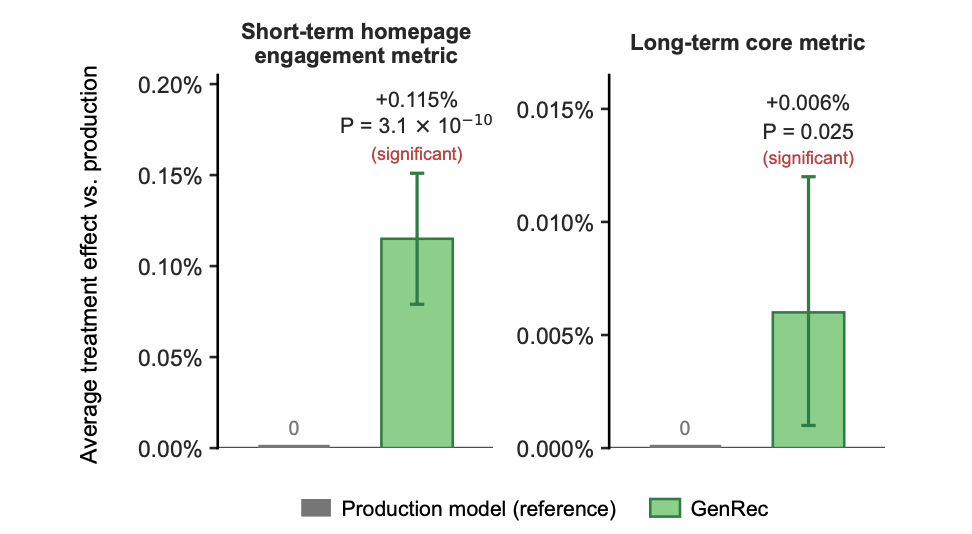
Online, we ran a large A/B test on batch‑compute recommendation surfaces, covering ~10% of Netflix traffic over ~4 weeks. In this low‑data, low‑signal configuration, GenRec delivered statistically significant gains over the production baseline on both short‑term and long‑term online metrics (Figure 3).

These results indicate that a properly post‑trained and aligned LLM‑backed ranker can be a strong alternative to traditional recommendation models, with substantial headroom as we further scale data and input signals.

Figure 3: Online metrics of GenRec vs. production model. GenRec achieves statistically significant improvements on both short-term and long-term online metrics.

Data, Model, and Phase Contributions

We ran ablations to understand where GenRec’s gains come from.

Data and Model Scaling

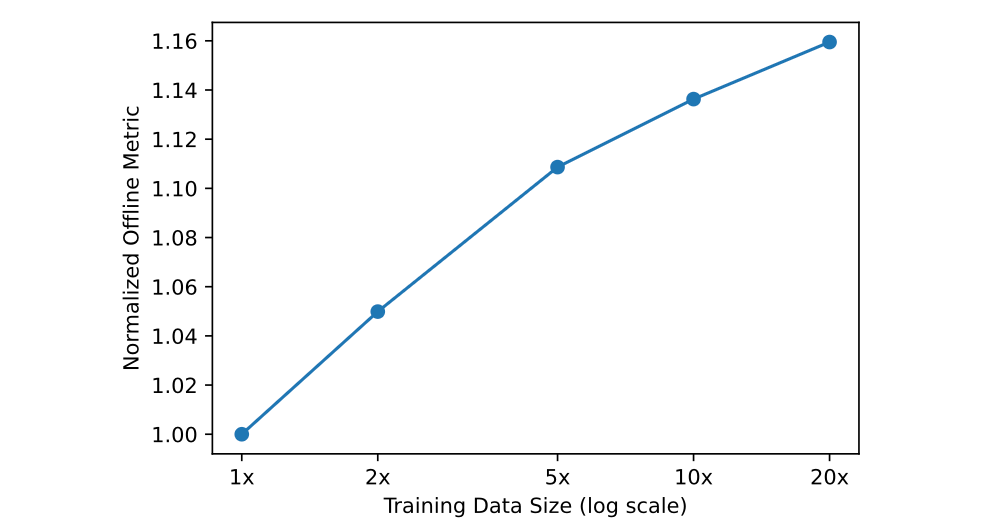
  • Data scaling: For both ~1B and ~10B parameter backbones, offline MRR improves as we increase Phase‑2 post‑training data. Larger models reach higher absolute MRR but follow a similar scaling curve (see Figure 4).
  • Model scaling: Under a fixed training budget, we post‑trained GenRec variants from ~1B to ~10B parameters. Within this budget, larger backbones consistently achieved higher offline MRR than smaller ones.
Figure 4: GenRec Phase-2 data scaling for the∼10B model.

Phase-1 vs. OSS, Phase-2 vs. Phase-1

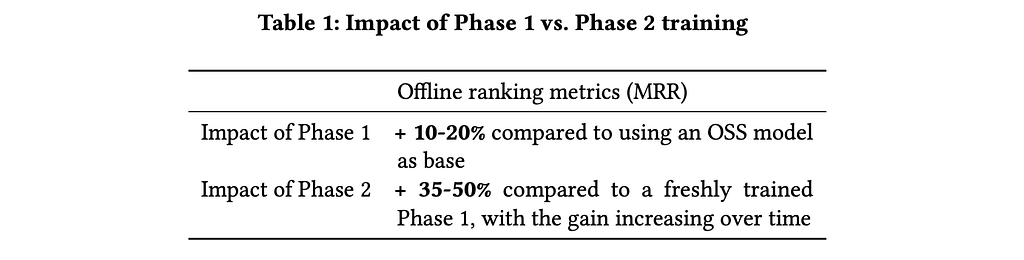
  • Phase-1 vs. OSS: Using the Phase‑1 Netflix‑adapted foundation LLM as the base model improves offline ranking metrics by roughly 10–20% compared to starting directly from an off‑the‑shelf LLM.
  • Phase-2 vs. Phase-1: Phase‑2 post‑training adds another 35–50% gain in offline ranking metrics when evaluated near the Phase‑1 training cutoff (i.e. when Phase‑1 model is the freshest). As time passes and Phase‑1 becomes stale with new content and shifting tastes, the relative benefit of Phase 2 grows to about 80% after 2 weeks.

Data efficiency vs. production ranker

  • Starting from a strong Phase‑1 model, GenRec matches or exceeds the production ranker using 10–40× fewer Phase‑2 labeled examples, depending on configuration. This marginal data efficiency is especially valuable because Phase 2 is refreshed far more frequently than Phase 1.

Context Length Optimization

Context length drives both quality and cost: longer verbalizations expose more behavior and context but increase training and serving cost. To study this trade‑off, we varied context length and verbosity and optimized them in three steps:

  1. Clean and compress events: drop low‑signal engagements and compress repetitive behavior to form a cleaned sequence of events.
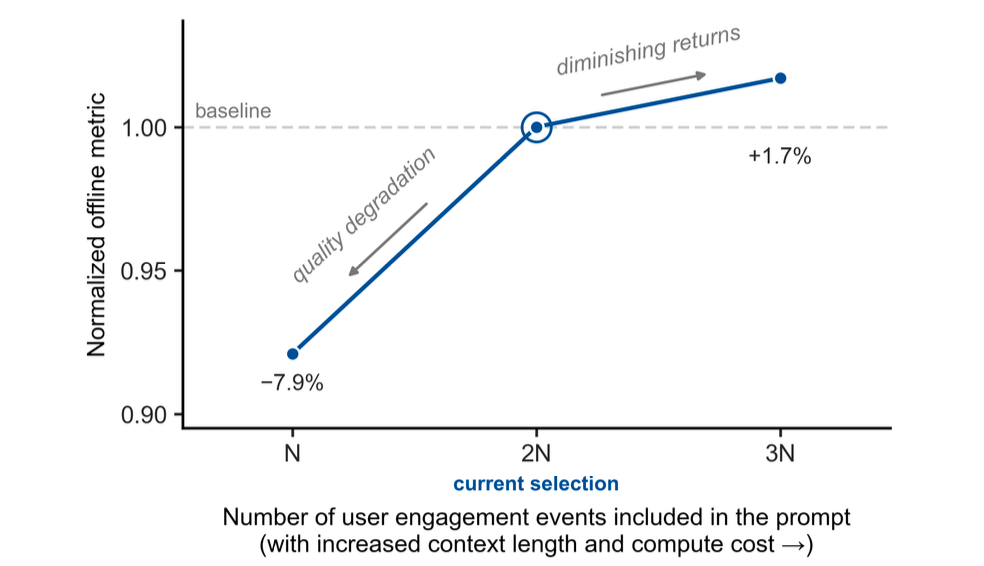
  2. Find the “elbow point”: vary how many historical events we include and plot MRR vs. number of events to identify an elbow beyond which additional context yields diminishing returns (see Figure 5).
  3. Optimize verbosity: for the retained events, test different levels of details and simplified wordings, measuring MRR each time.

In our experiments, we can reduce the context tokens to roughly one-third of the original budget with negligible degradation in offline ranking metrics. Since serving cost is approximately proportional to context length, we observed a similar reduction in serving cost.

Figure 5: Offline ranking metric (MRR) vs. number of user engagement events included in the prompt. The dashed line marks the elbow point: increasing the number of events beyond this yields diminishing returns.

Towards LLM‑Native Recommendation

GenRec is more than “swapping in a Transformer” for an existing ranker. It hints at a broader shift toward LLM‑native recommendation at Netflix. A few notable changes:

From Feature Engineering to Context Engineering

Traditional RecSys stacks revolve around large feature sets and heavy feature infrastructure. LLM‑centric systems instead revolve around constructing rich textual contexts from raw logs, metadata, and tools. The “prompt” becomes the new feature vector.

Modeling effort shifts from designing features to deciding which signals to include, how far back in time to go, how to compress or summarize history within a token budget. Our experiments on verbalization compaction illustrate this shift: careful context design can preserve quality while dramatically reducing serving cost.

From Customized Architectures to Foundation Backbones

Historically, each recommendation task often had its own custom architecture (two‑tower models, DLRM‑style networks, bespoke attention blocks). In an LLM‑centric world, many tasks share a common foundation backbone, with differentiation coming from data and verbalization strategies, post‑training objectives and rewards, and inference optimization.

GenRec leverages the same backbone as our foundation LLM rather than introducing a new architecture built from scratch. This makes it easier to share learnings across applications, and opens the door to natural‑language steering for future experiences.

Scaling Laws as Design Guides

Traditional RecSys can hit diminishing returns due to sparse IDs, heavy engineering objectives, and task‑specific architectures. With an LLM‑backed backbone, recommendation inherits clearer data and model scaling behavior: within cost limits, more data and larger models consistently improve quality. This brings RecSys design closer to the broader LLM paradigm, where scaling laws help guide model and data investment.

From RecSys Infra to LLM Infra

LLM‑backed recommenders push us toward LLM‑style infrastructure: GPU‑accelerated, vLLM/Triton‑based, with careful batching and caching. Over time, recommendation serving infra starts to look more like general LLM infra than classic RecSys stacks built around MLPs or factorization models.

Conclusions

We have presented GenRec, an LLM‑backed recommendation ranker at Netflix that adapts an internal foundation LLM for large‑scale personalization. By verbalizing user histories, context, and item metadata, adding a catalog‑aware ranking head, using reward‑weighted objectives aligned to long‑term satisfaction and business goals, and serving efficiently on our LLM infrastructure, we obtain a model that improves on a strong production ranker while using far fewer Phase‑2 labels and input signals.

GenRec is an early but promising step toward a more LLM‑centric recommendation stack at Netflix. Our results suggest that, with careful attention to cost, infrastructure, and alignment, LLM‑backed recommenders can play a central role in large‑scale personalization.

Acknowledgments

GenRec is the result of close collaboration among multiple teams and organizations across Netflix. The contributors to this work (in alphabetical order):

AI for members: Arjun Rao, Ashish Rastogi, Baolin Li, Fernando Amat Gil, Grace Huang, Justin Basilico, Kamelia Aryafar, Linas Baltrunas, Moumita Bhattacharya, Ogheneovo Dibie, Rein Houthooft, Shradha Sehgal, Sejoon Oh, Sergi Perez, Sourabh Medapati, Thea Wang, Yaochen Zhu, Yesu Feng, Ying Li, Yun Li, Yucheng Shi, Yunan Hu

AI platform and serving: Abhishek Agrawal, Adam Singer, Binh Tang, Daneo Zhang, Derek Olejnik, Ed Maddox, Erik Osheim, Lingyi Liu, Liping Peng, Meghana Chilukuri, Nicolas Hortiguera, Shaojing Li, ZQ Zhang

Product: Ilke Kaya, Michelle Kislak, Scarlet Chen, Si Cheng


GenRec: Towards LLM-Native Recommendation at Netflix was originally published in Netflix TechBlog on Medium, where people are continuing the conversation by highlighting and responding to this story.