Tag Archives: Internet Shutdown

Protests spur Internet disruptions in Iran

Post Syndicated from David Belson original https://blog.cloudflare.com/protests-internet-disruption-ir/

Protests spur Internet disruptions in Iran

Protests spur Internet disruptions in Iran

Over the past several days, protests and demonstrations have erupted across Iran in response to the death of Mahsa Amini. Amini was a 22-year-old woman from the Kurdistan Province of Iran, and was arrested on September 13, 2022, in Tehran by Iran’s “morality police”, a unit that enforces strict dress codes for women. She died on September 16 while in police custody.

Published reports indicate that the growing protests have resulted in at least eight deaths. Iran has a history of restricting Internet connectivity in response to protests, taking such steps in May 2022, February 2021, and November 2019. They have taken a similar approach to the current protests, including disrupting Internet connectivity, blocking social media platforms, and blocking DNS. The impact of these actions, as seen through Cloudflare’s data, are reviewed below.

Impact to Internet traffic

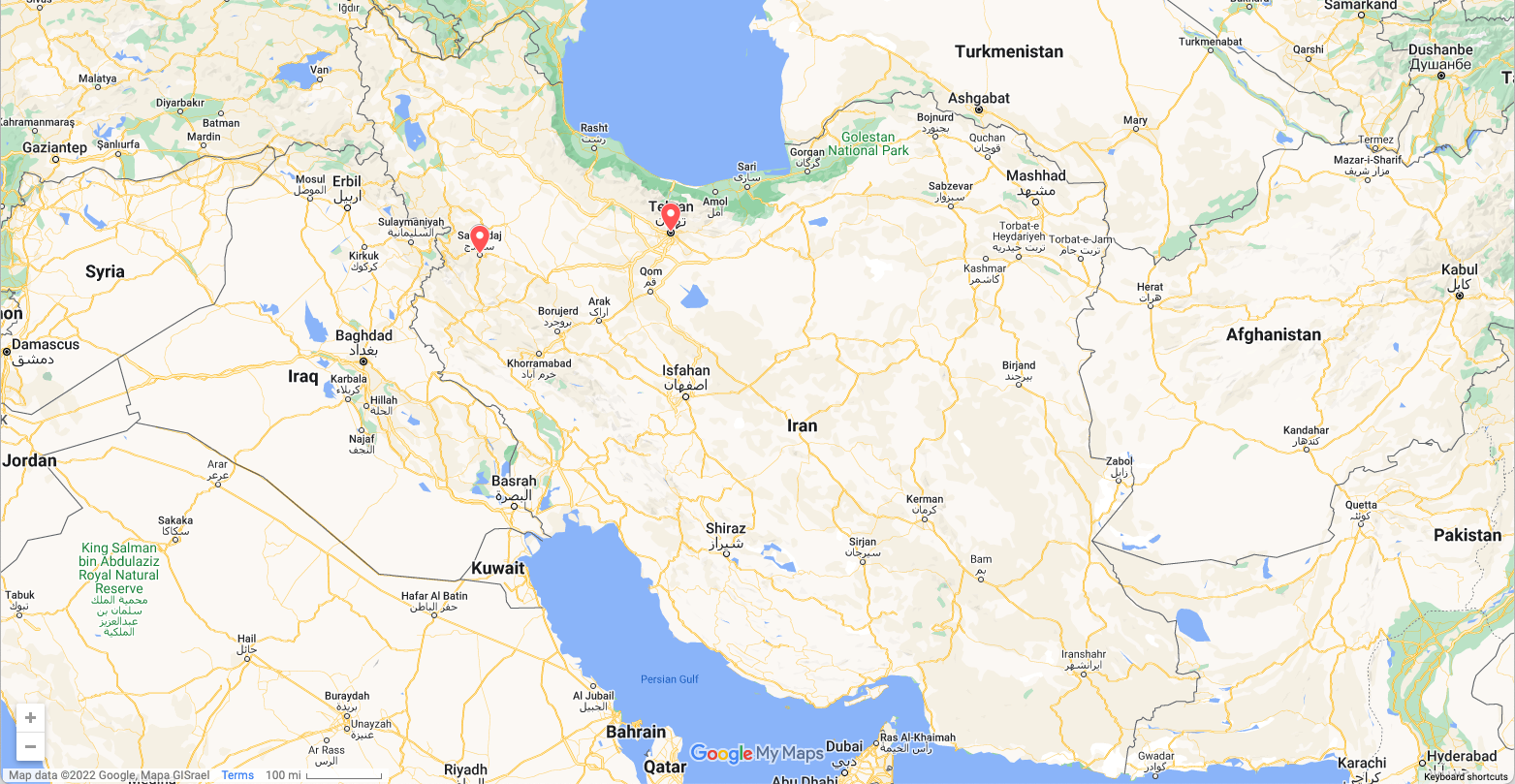
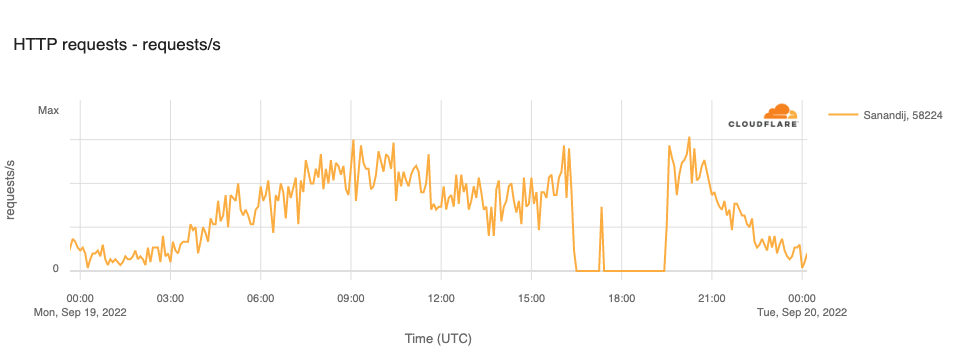
In the city of Sanandij in the Kurdistan Province, several days of anti-government protests took place after the death of Mahsa Amini. In response, the government reportedly disrupted Internet connectivity there on September 19. This disruption is clearly visible in the graph below, with traffic on TCI (AS58224), Iran’s fixed-line incumbent operator, in Sanandij dropping to zero between 1630 and 1925 UTC, except for a brief spike evident between 1715 and 1725 UTC.

Protests spur Internet disruptions in Iran

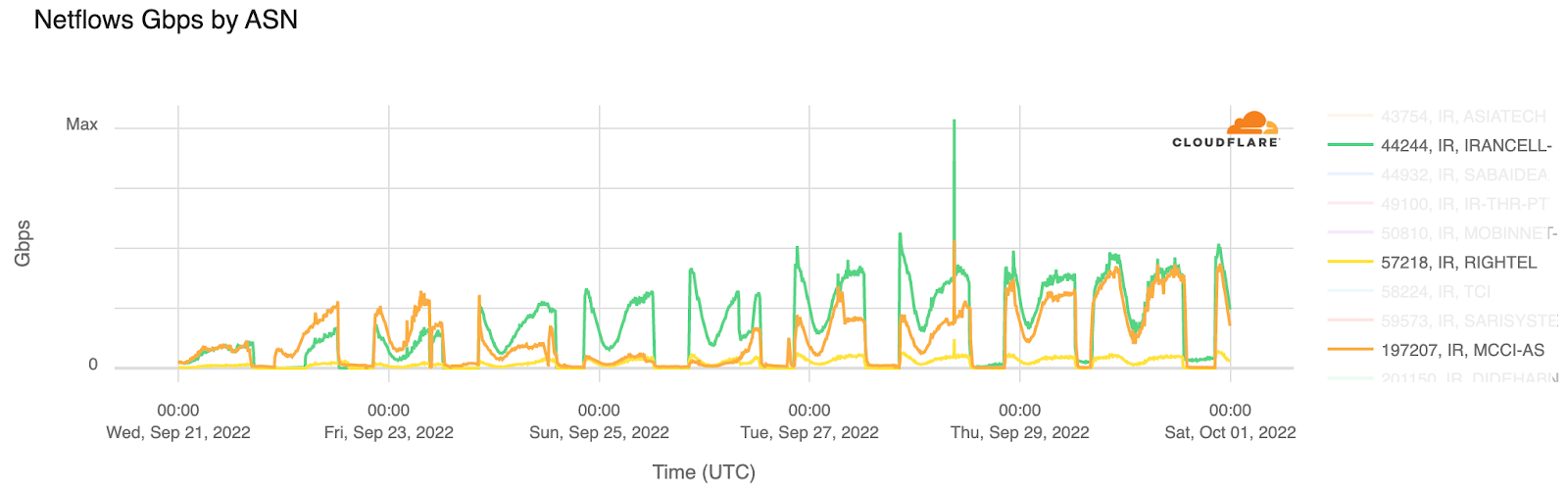
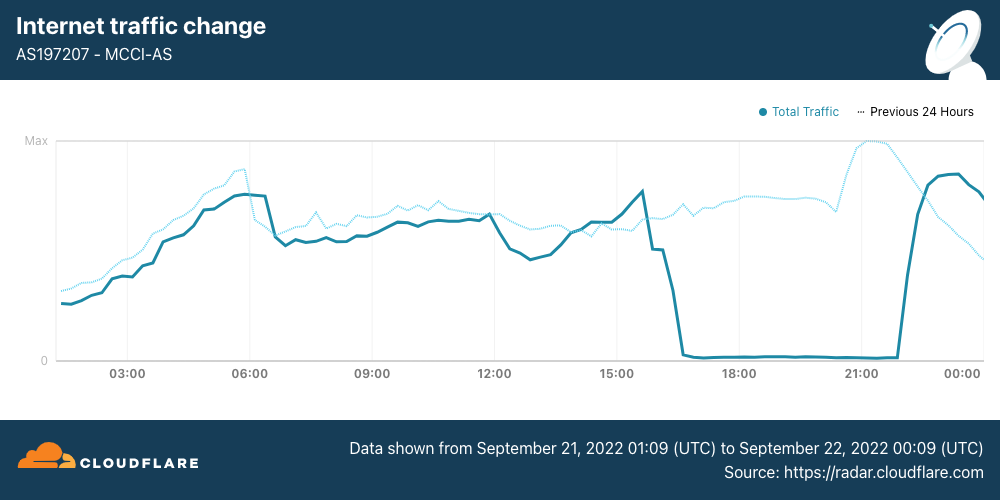
On September 21, Internet disruptions started to become more widespread, with mobile networks effectively shut down nationwide. (Iran is a heavily mobile-centric country, with Cloudflare Radar reporting that 85% of requests are made from mobile devices.) Internet traffic from Iran Mobile Communications Company (AS197207) started to decline around 1530 UTC, and remained near zero until it started to recover at 2200 UTC, returning to “normal” levels by the end of the day.

Protests spur Internet disruptions in Iran

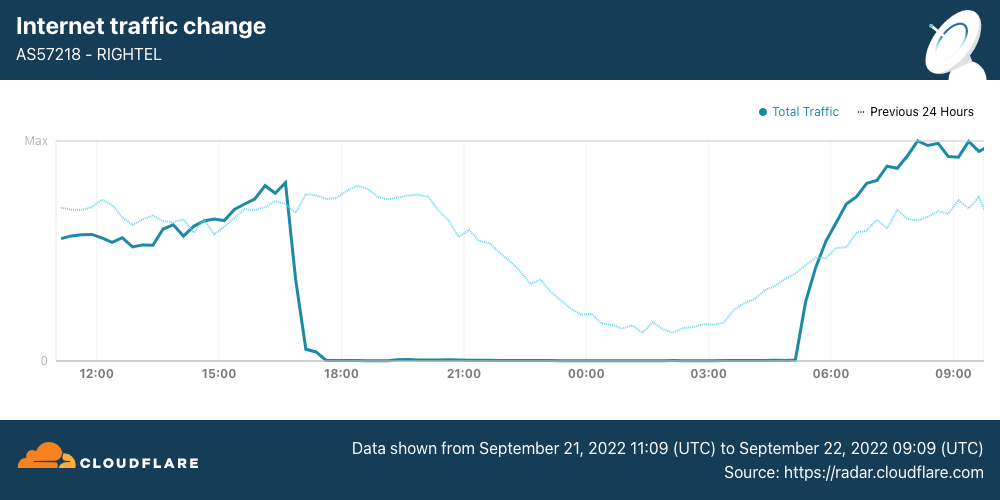
Internet traffic from RighTel (AS57218) began to decline around 1630 UTC. After an outage lasting more than 12 hours, traffic returned at 0510 UTC.

Protests spur Internet disruptions in Iran

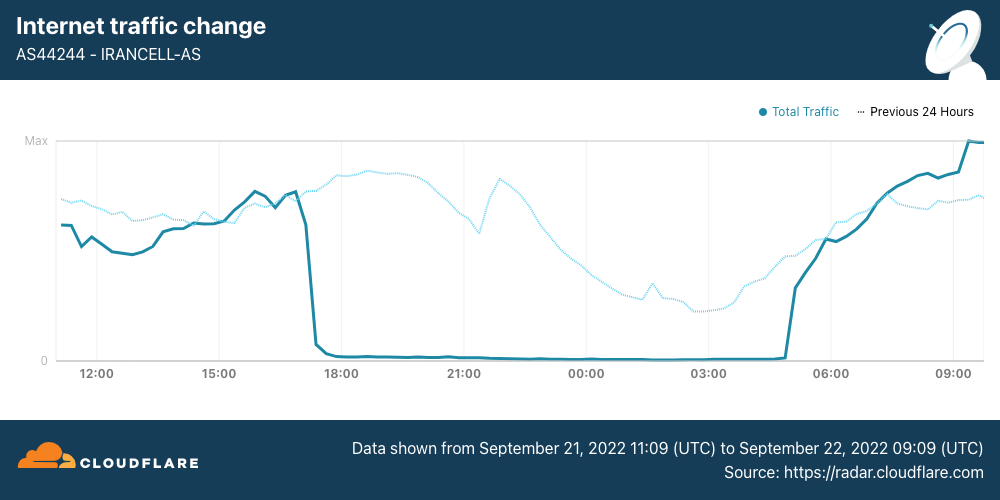
Internet traffic from MTN Irancell (AS44244) began to drop just before 1700 UTC. After a 12-hour outage, traffic began recovering at 0450 UTC.

Protests spur Internet disruptions in Iran

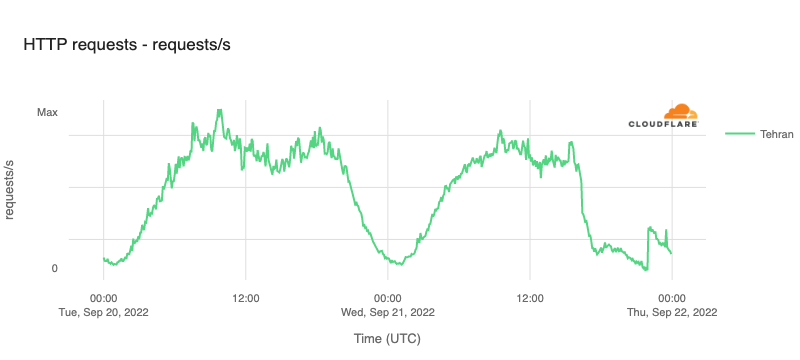
The impact of these disruptions is also visible when looking at traffic at both a regional and national level. In Tehran Province, HTTP request volume declined by approximately 70% around 1600 UTC, and continued to drop for the next several hours before seeing a slight recovery at 2200 UTC, likely related to the recovery also seen at that time on AS197207.

Protests spur Internet disruptions in Iran

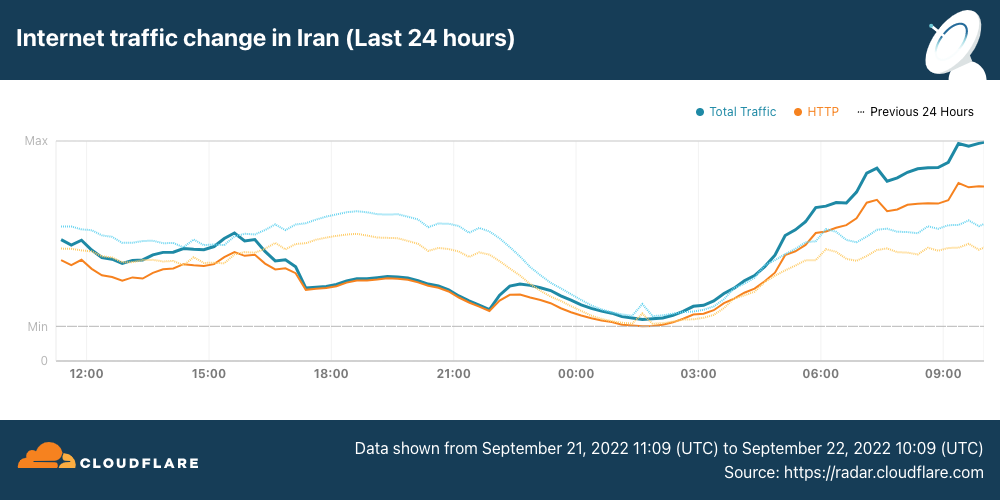
Similarly, Internet traffic volumes across the whole country began to decline just after 1600 UTC, falling approximately 40%. Nominal recovery at 2200 UTC is visible in this view as well, again likely from the increase in traffic from AS197207. More aggressive traffic growth is visible starting around 0500 UTC, after the remaining two mobile network providers came back online.

Protests spur Internet disruptions in Iran

DNS blocking

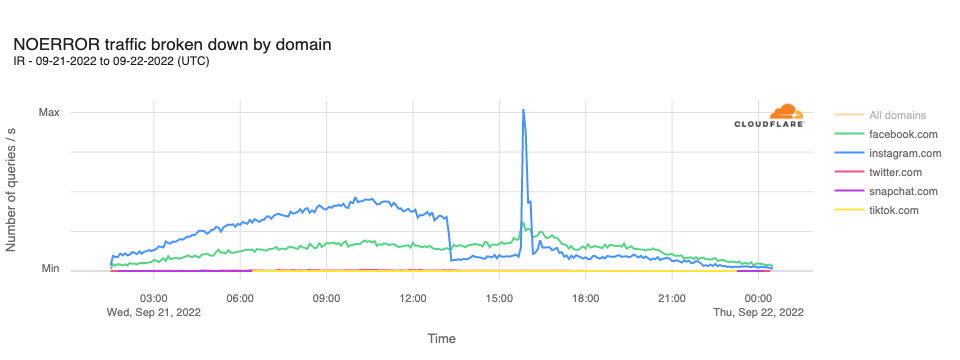
In addition to shutting down mobile Internet providers within the country, Iran’s government also reportedly blocked access to social media platform Instagram, as well as blocking access to DNS-over-HTTPS from open DNS resolver services including Quad9, Google’s 8.8.8.8, and Cloudflare’s 1.1.1.1. Analysis of requests originating in Iran to 1.1.1.1 illustrates the impacts of these blocking attempts.

In analyzing DNS requests to Cloudflare’s resolver for domains associated with leading social media platforms, we observe that requests for instagram.com hostnames drop sharply at 1310 UTC, remaining lower for the rest of the day, except for a significant unexplained spike in requests between 1540 and 1610 UTC. Request volumes for hostnames associated with other leading social media platforms did not appear to be similarly affected.

Protests spur Internet disruptions in Iran

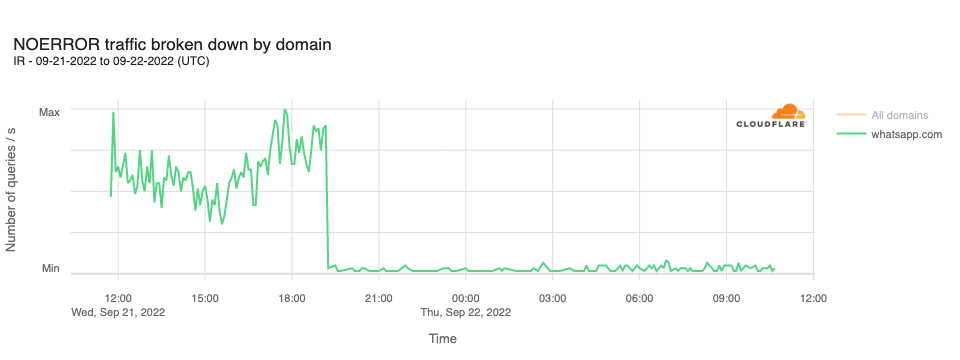
In addition, it was reported that access to WhatsApp had also been blocked in Iran. This can be seen in resolution requests to Cloudflare’s resolver for whatsapp.com hostnames. The graph below shows a sharp decline in query traffic at 1910 UTC, dropping to near zero.

Protests spur Internet disruptions in Iran

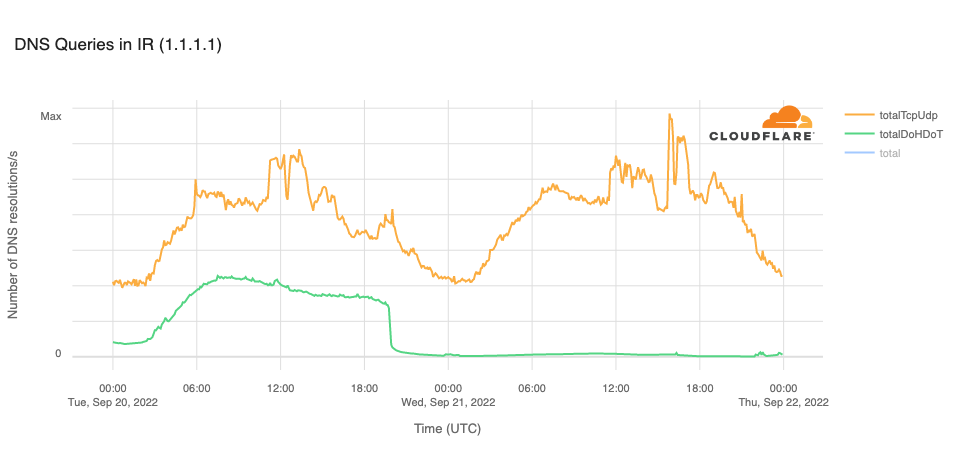
The Open Observatory for Network Interference (OONI), an organization that measures Internet censorship, reported in a Tweet that the cloudflare-dns.com domain name, used for DNS-over-HTTPS (DoH) and DNS-over-TLS (DoT) connections to Cloudflare’s DNS resolver, was blocked in Iran on September 20. This is clearly evident in the graph below, with resolution volume over DoH and DoT dropping to zero at 1940 UTC. The OONI tweet also noted that the 1.1.1.1 IP address “remains blocked on most networks.” The trend line for resolution over TCP or UDP (on port 53) in the graph below suggests that the IP address is not universally blocked, as there are still resolution requests reaching Cloudflare.

Protests spur Internet disruptions in Iran

Interested parties can use Cloudflare Radar to monitor the impact of such government-directed Internet disruptions, and can follow @CloudflareRadar on Twitter for updates on Internet disruptions as they occur.

Internet disruptions overview for Q2 2022

Post Syndicated from David Belson original https://blog.cloudflare.com/q2-2022-internet-disruption-summary/

Internet disruptions overview for Q2 2022

Internet disruptions overview for Q2 2022

Cloudflare operates in more than 270 cities in over 100 countries, where we interconnect with over 10,000 network providers in order to provide a broad range of services to millions of customers. The breadth of both our network and our customer base provides us with a unique perspective on Internet resilience, enabling us to observe the impact of Internet disruptions. In many cases, these disruptions can be attributed to a physical event, while in other cases, they are due to an intentional government-directed shutdown. In this post, we review selected Internet disruptions observed by Cloudflare during the second quarter of 2022, supported by traffic graphs from Cloudflare Radar and other internal Cloudflare tools, and grouped by associated cause or common geography.

Optic outages

This quarter, we saw the usual complement of damage to both terrestrial and submarine fiber-optic cables, including one that impacted multiple countries across thousands of miles, and another more localized outage that was due to an errant rodent.

Comcast

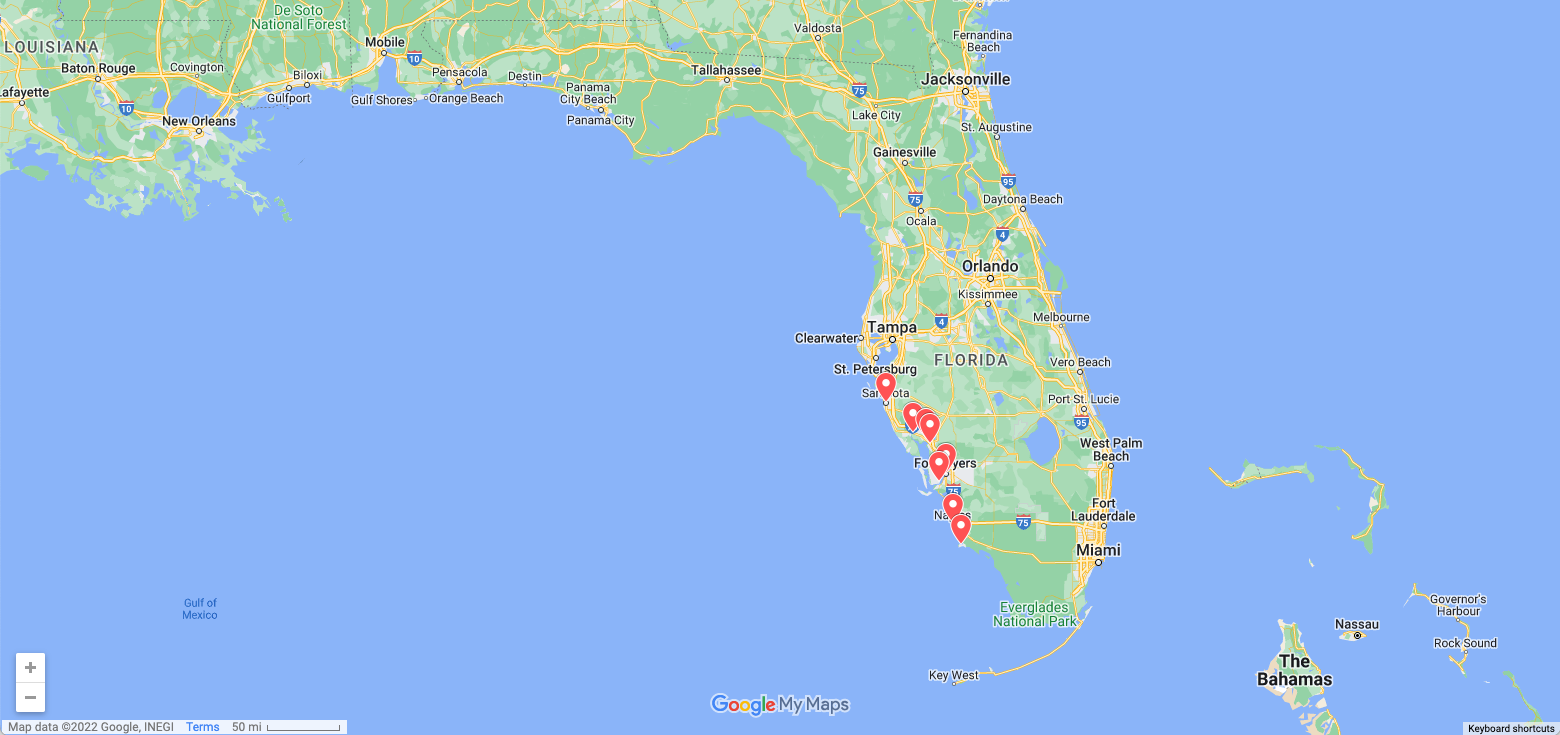
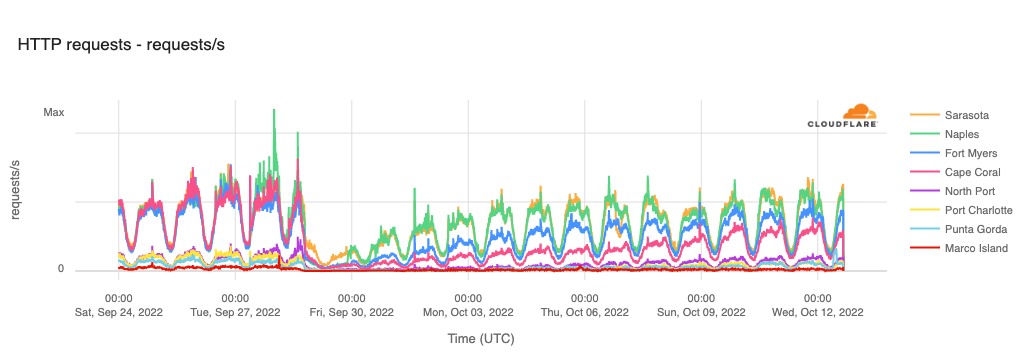
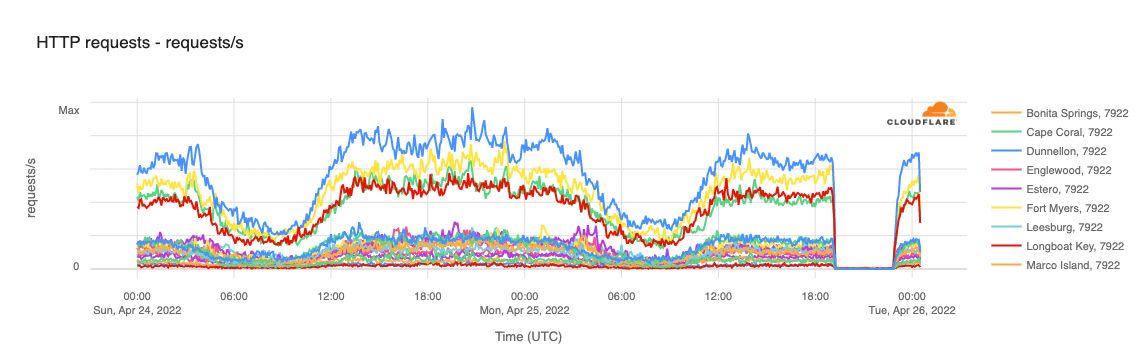
On April 25, Comcast subscribers in nearly 20 southwestern Florida cities experienced an outage, reportedly due to a fiber cut. The traffic impact of this cut is clearly visible in the graph below, with Cloudflare traffic for these cities dropping to zero between 1915–2050 UTC (1515–1850 local time).

Internet disruptions overview for Q2 2022

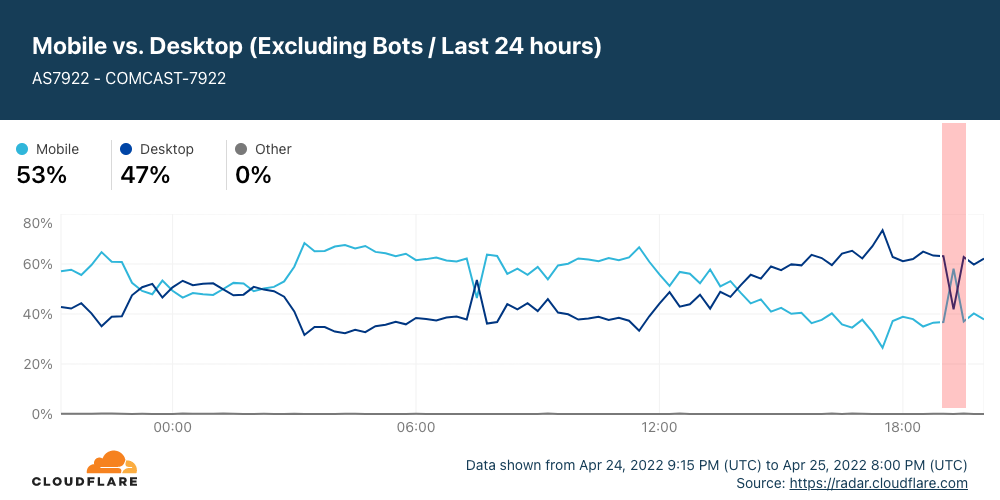
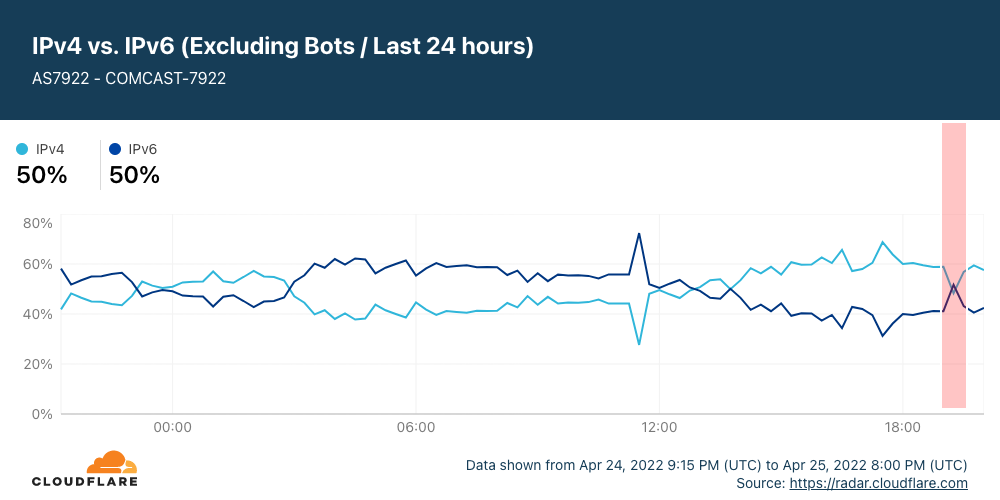
Not only did the fiber cut force a significant number of Comcast subscribers offline, but it also impacted the types of traffic observed across Comcast as a whole. The graphs below illustrate the mix of mobile vs desktop clients, as well as IPv4 vs. IPv6 request volume across AS7922, Comcast’s primary autonomous system. During the brief disruption period, the percentage of Comcast traffic from mobile devices increased, while desktop devices dropped, and the percentage of IPv4 traffic dropped, with a corresponding increase in IPv6 traffic share.

Internet disruptions overview for Q2 2022

South Africa

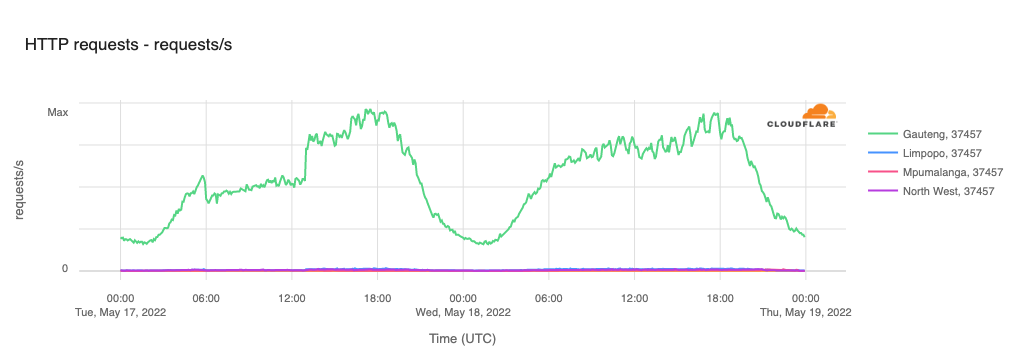
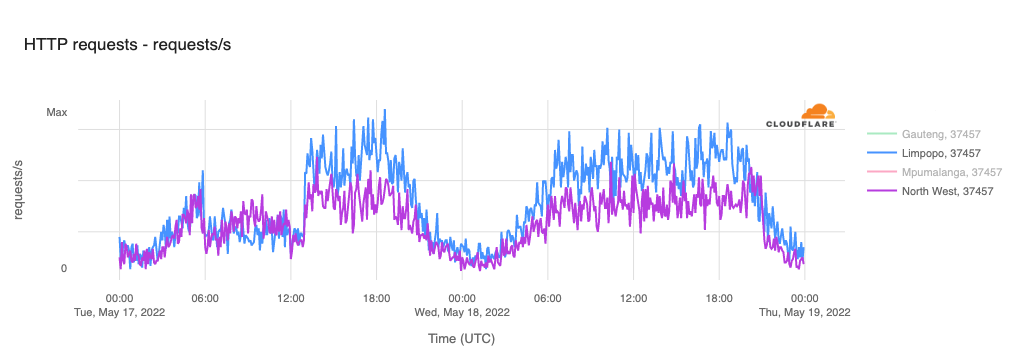
On the morning of May 17, Telkom SA, a South African telecommunications provider, tweeted an “important notice” to customers, noting that “Damage to a Fibre cable was detected on the Telkom network around 8:00am on Tuesday, 17 May 2022.” and outlining the impacted services and geographies. The graphs below show the impact to Cloudflare traffic from the Telkom autonomous system in three South African provinces. The top graph shows the impact to traffic in Gauteng, while the lower graph shows the impact in Limpopo and North West. Across all three, traffic falls at 0600 UTC (0800 local time), recovering around 1300 UTC (1500 local time). Telkom SA did not provide any additional information on where the fiber cut occurred or what caused it.

Internet disruptions overview for Q2 2022

Venezuela

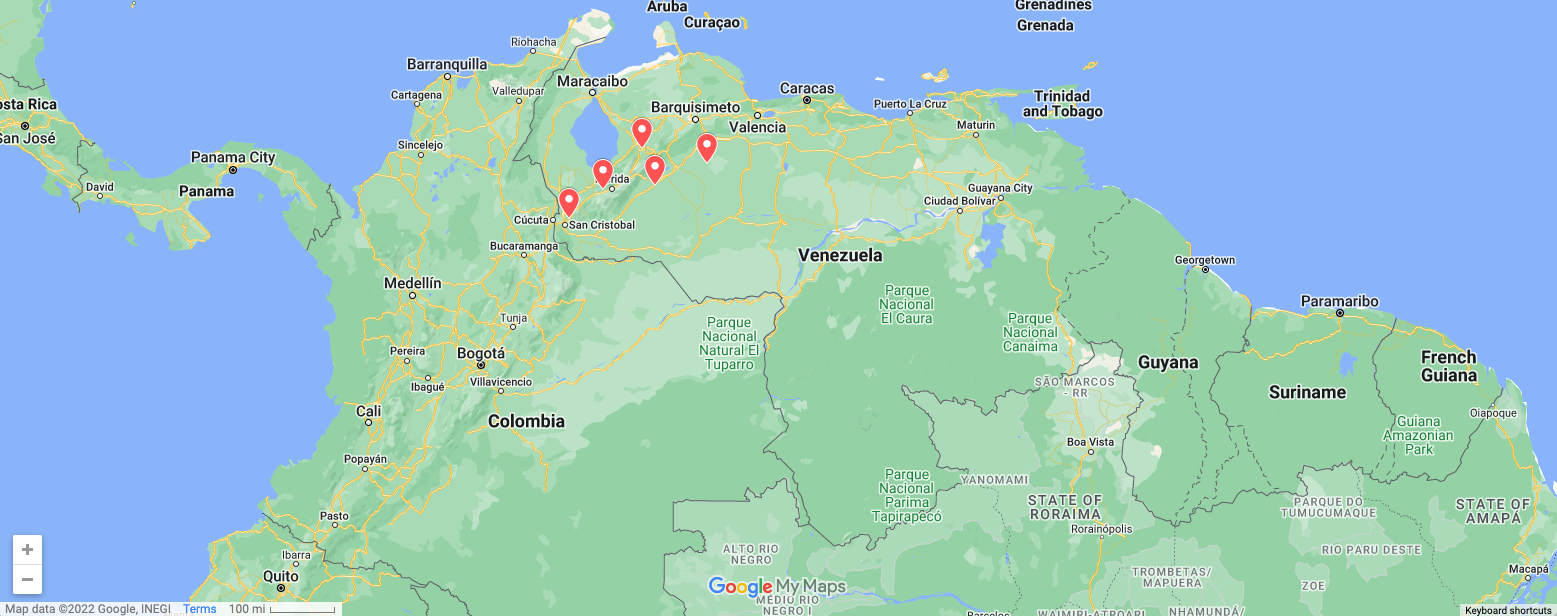
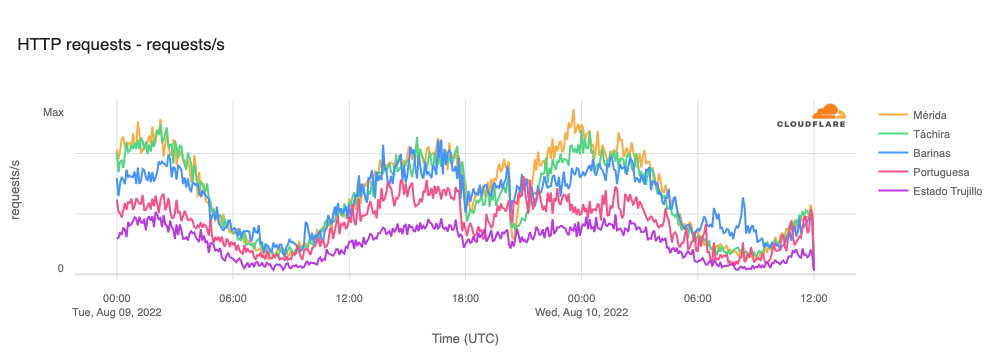
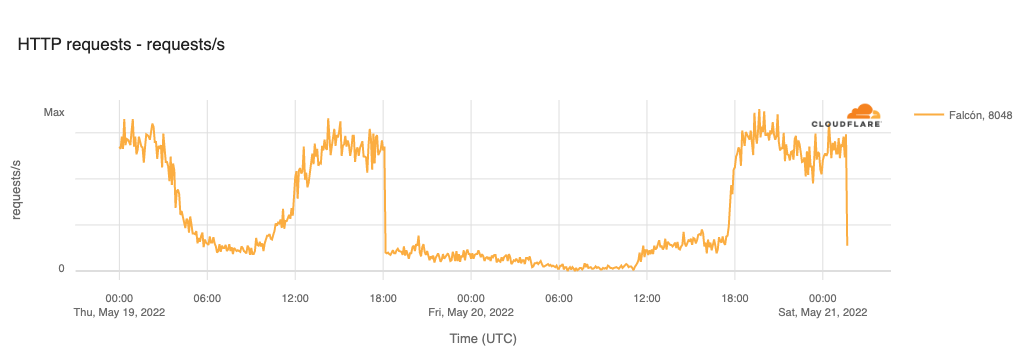
Although unconfirmed, a fiber cut was suspected to be the cause of an Internet disruption experienced by CANTV subscribers in Venezuela on May 19, the latest of several such incidents affecting that provider. Although the fiber cut reportedly impacted subscribers in multiple states, the most significant impact was measured in Falcón, as shown in the graph below. In this state, traffic dropped precipitously at 1800 UTC (1400 local time), finally recovering approximately 24 hours later.

Internet disruptions overview for Q2 2022

AAE-1 & SMW-5

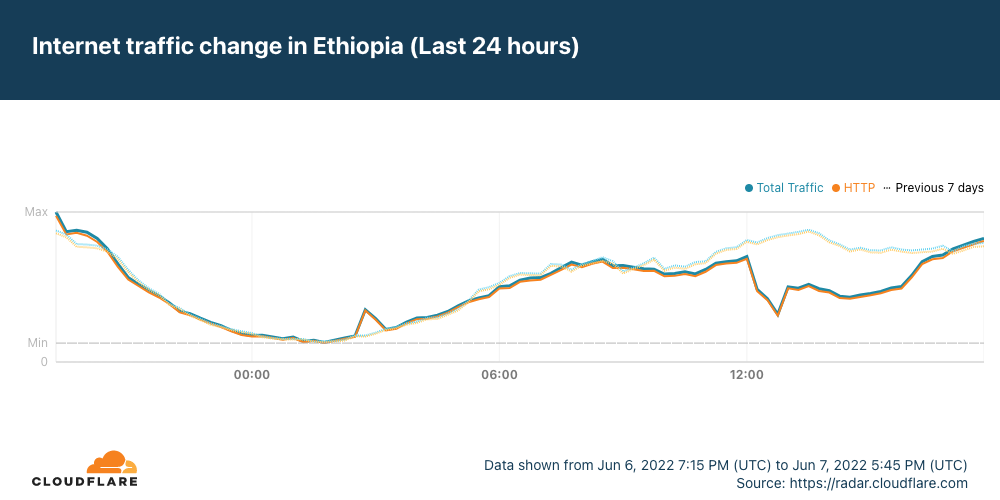
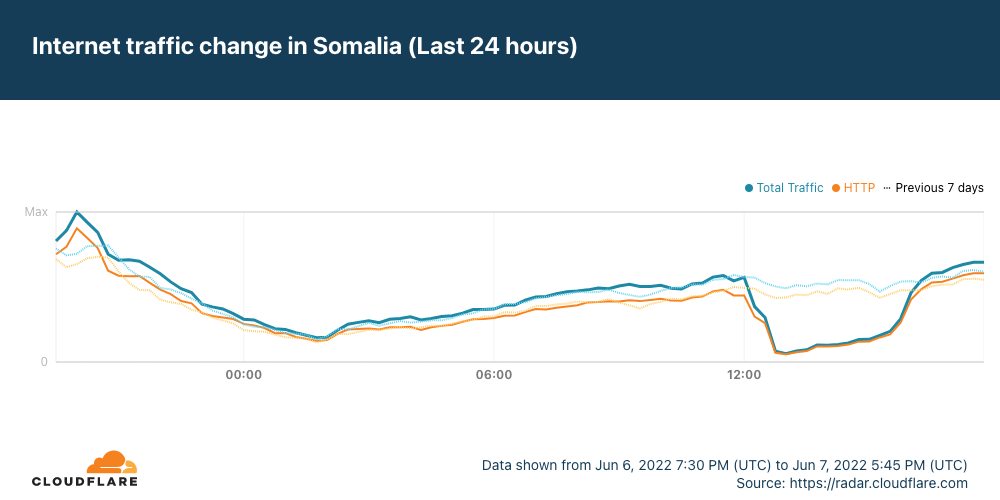
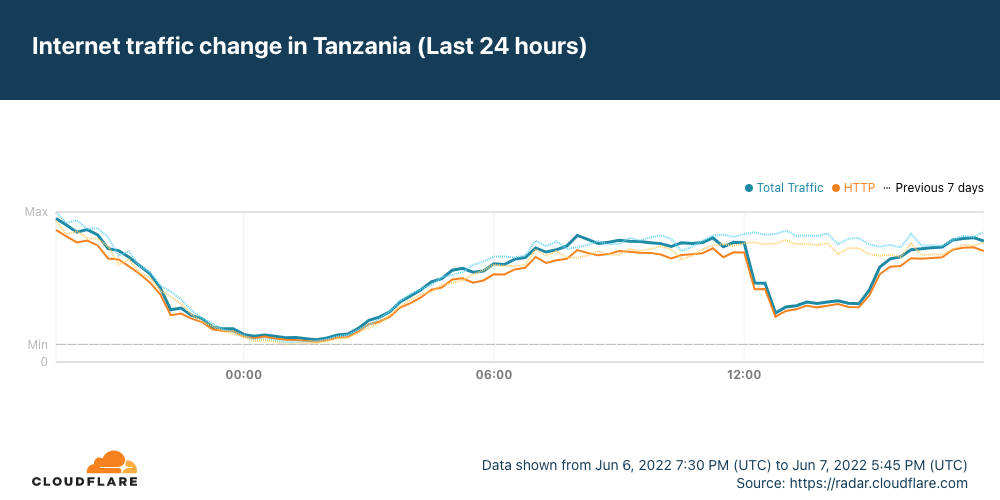
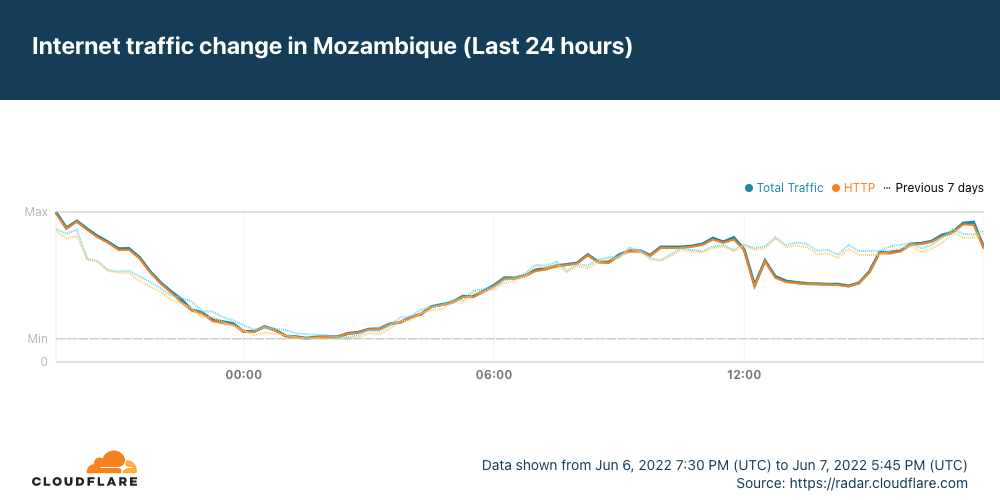
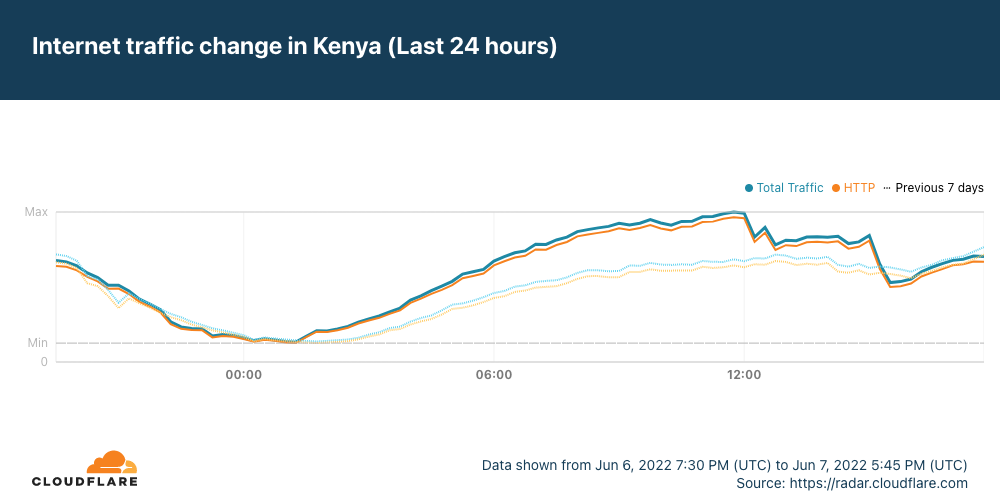
Just after 1200 UTC on Tuesday, June 7, the Africa-Asia-Europe-1 (AAE-1) and SEA-ME-WE-5 (SMW-5) submarine cables suffered cable cuts, impacting Internet connectivity for millions of Internet users across multiple countries in the Middle East and Africa, as well as thousands of miles away in Asia. Although specific details are sparse, the cable damage reportedly occurred in Egypt – both of the impacted cables land in Abu Talat and Zafarana, which also serve as landing points for a number of other submarine cables.

The Cloudflare Radar graphs below illustrate the impact of these cable cuts across Africa, Asia, and the Middle East. Given that the associated traffic disruption only lasted several hours, the damage to these cables likely occurred on land, after they came ashore. More details on this event can be found in the “AAE-1 & SMW5 cable cuts impact millions of users across multiple countries” blog post.

Internet disruptions overview for Q2 2022

Castor canadensis

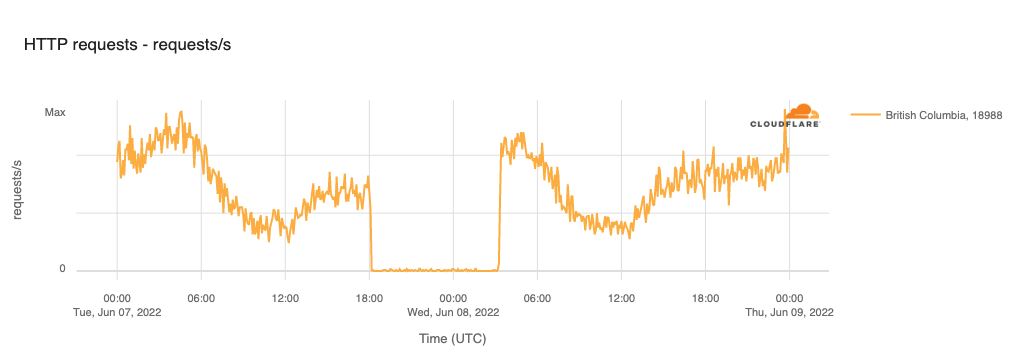
Finally, on June 13, a beaver was responsible for an outage that impacted Internet users in British Columbia, Canada. According to a published report, a beaver gnawed its way through a tree, causing it to fall on both power lines and a Telus fiber optic cable. The damage to the fiber optic cable affected connectivity customers in over a dozen communities across British Columbia, including those using CityWest (AS18988), a utility company that uses the Telus cable. In the graph below, the impact of the damage to the fiber optic cable is clearly visible, with no traffic to Cloudflare from CityWest subscribers in British Columbia between 1800 UTC on June 7 until 0310 UTC on June 8 (1100–2010 local time).

Internet disruptions overview for Q2 2022

School’s in, Internet’s out

Nationwide Internet shutdowns have, unfortunately, become a popular approach taken by authoritarian regimes over the past half dozen years to prevent cheating on secondary school exams. It is not clear that this heavy-handed tactic is actually effective in preventing cheating, but the associated damage to the national economies has been estimated to be in the tens to hundreds of millions of US dollars, depending on the duration and frequency of the shutdowns.

This year, governments in Sudan and Syria implemented a number of multi-hour shutdowns in late May into June, while Algeria’s government appears to have resorted to more targeted content blocking. Additional details on these Internet disruptions can be found in the recent “Exam time means Internet disruptions in Syria, Sudan and Algeria” blog post.

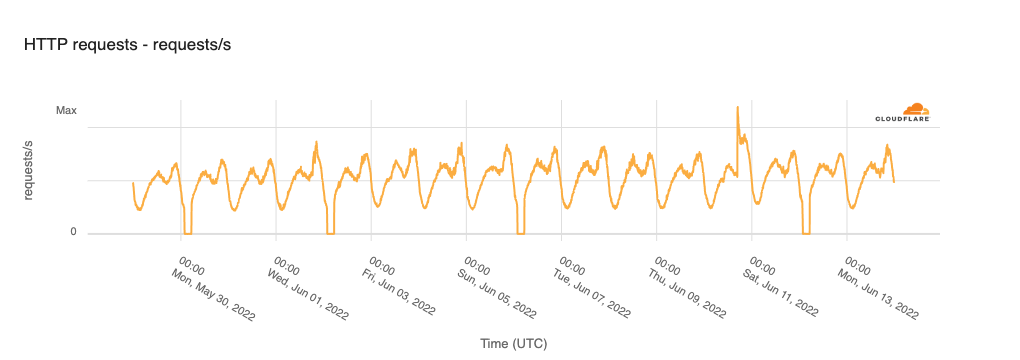
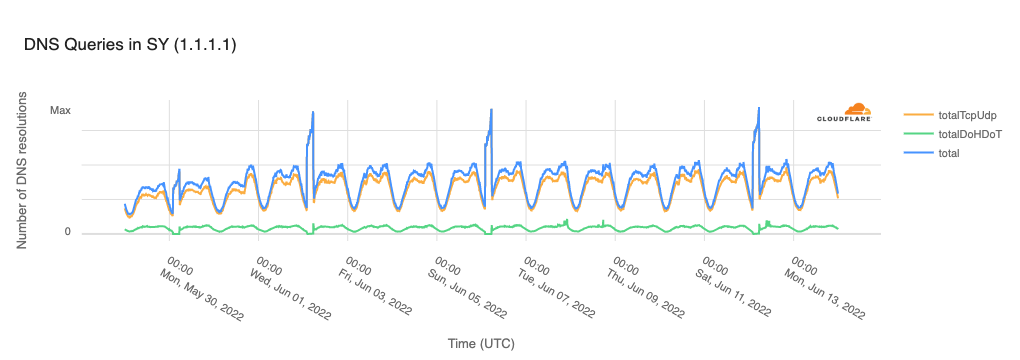
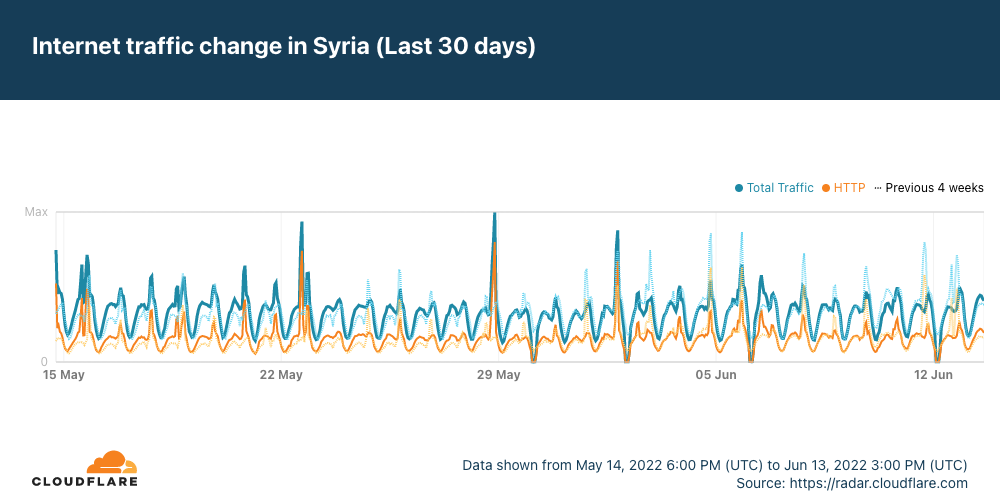
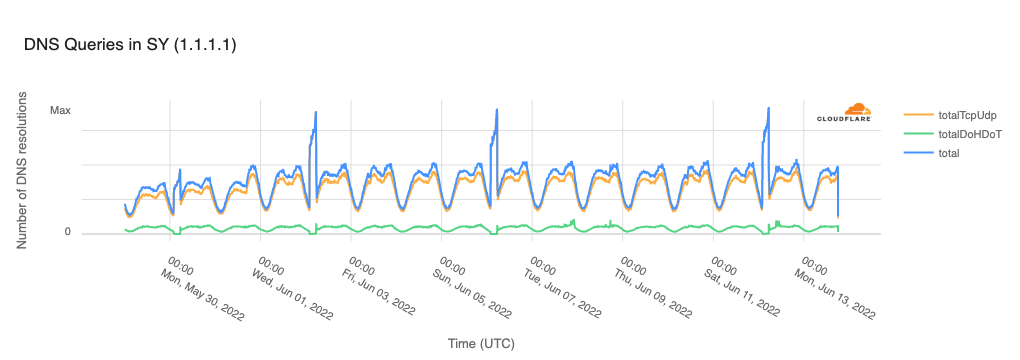
Starting on May 30, Syria implemented the first of four nationwide Internet shutdowns, the last of which occurred on June 12, as seen in the graph below. Interestingly, we have observed that these shutdowns tend to be “asymmetric” in nature — that is, inbound traffic (into the country) is disabled, but egress traffic (from the country) remains. One effect of this is visible as spikes in the DNS graph below. During three of the four shutdowns, requests to Cloudflare’s 1.1.1.1 resolver from clients in Syria increased because DNS queries were able to exit the country, but responses couldn’t return, leading to retry floods.

Internet disruptions overview for Q2 2022

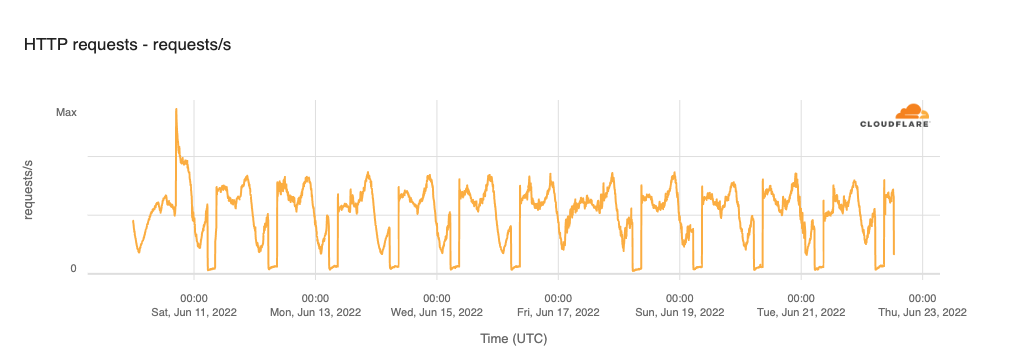
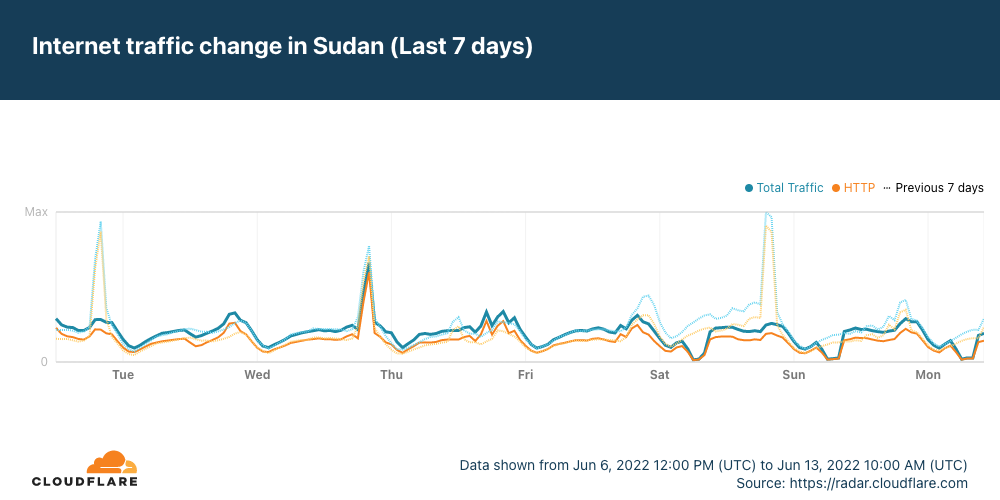
In Sudan, daily shutdowns were implemented 0530-0830 UTC (0730–1030 local time) between June 11 and June 22, except for June 17. (It isn’t clear why that date was skipped.) The graph below shows that these shutdowns were nationwide, but not complete, as traffic from the country did not drop to zero.

Internet disruptions overview for Q2 2022

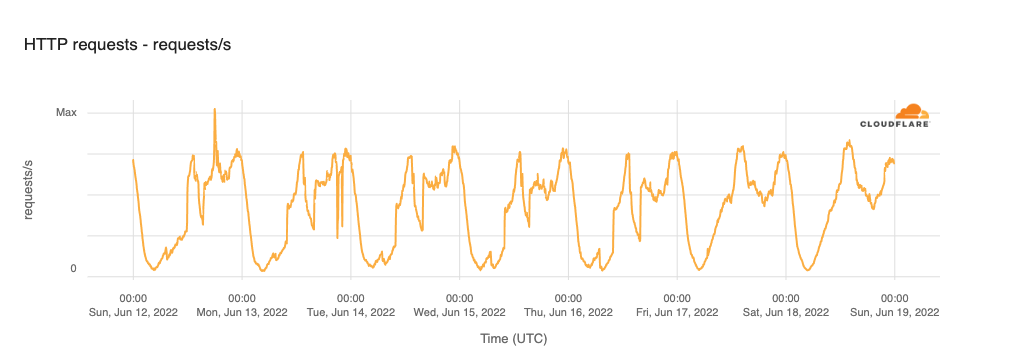
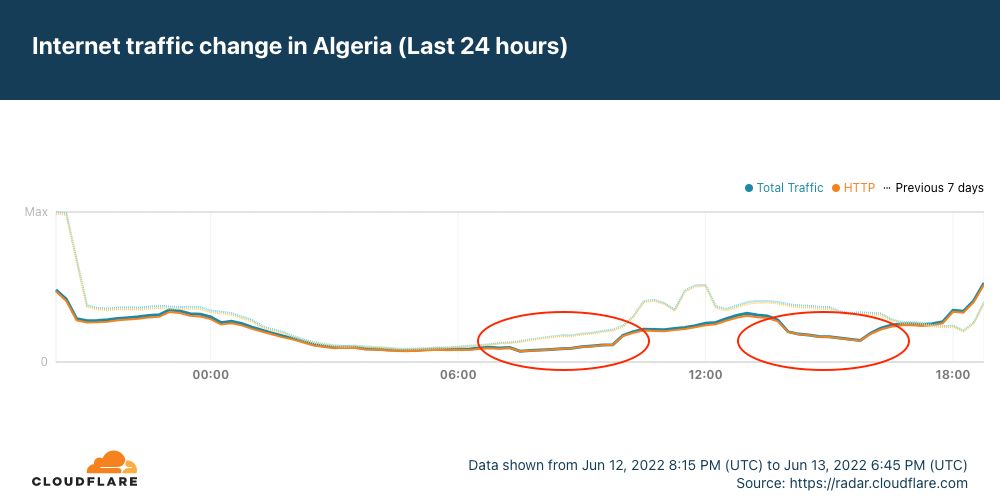
In Algeria, exams took place June 12 through June 16. In the past, the country has implemented nationwide shutdowns, but after recognizing the enormous cost to the economy, the government has apparently chosen an alternate tactic this year. The graph below shows nominal drops in country-level traffic during the two times each day that the exams took place—0730–1000 UTC (0830–1100 am local time) and 1330–1600 UTC (1430–1700 local time). These drops in traffic are likely more indicative of a content-blocking approach, instead of a broad Internet shutdown.

Internet disruptions overview for Q2 2022

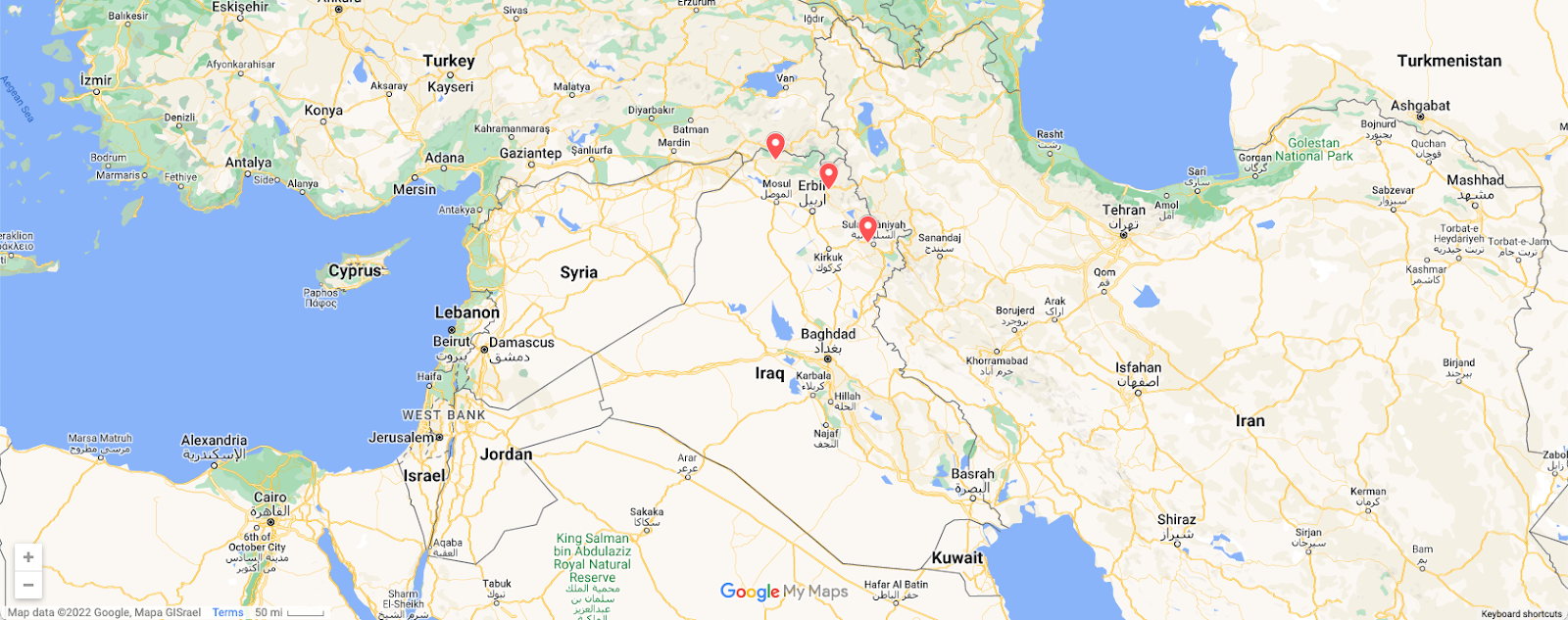
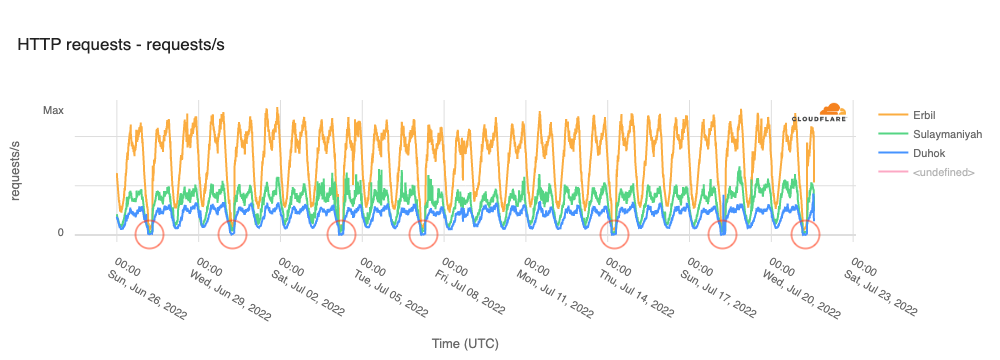
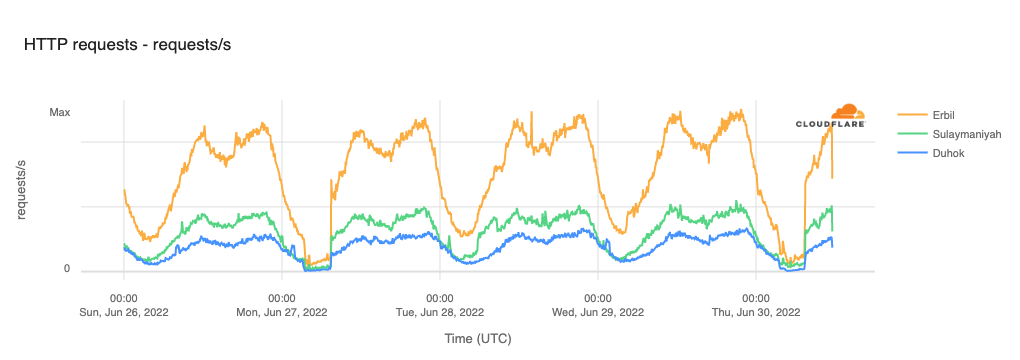
On June 27, the Kurdistan Regional Government in Iraq began to implement twice-weekly (Mondays and Thursday) multi-hour regional Internet shutdowns, expected to last for a four-week period. The shutdowns are intended to prevent cheating on high school final exams, according to a published report, and are scheduled for 0630–1030 am local time (0330–0730 UTC). The graph below shows the impact to traffic from three governorates in Kurdistan, with traffic dropping to near zero in all three areas during the duration of the shutdowns.

Internet disruptions overview for Q2 2022

Government-guided

In addition to shutting down the Internet to prevent cheating on exams, governments have also been known to use shutdowns as a tool to limit or control communication around elections, rallies, protests, etc. During the second quarter, we observed several such shutdowns of note.

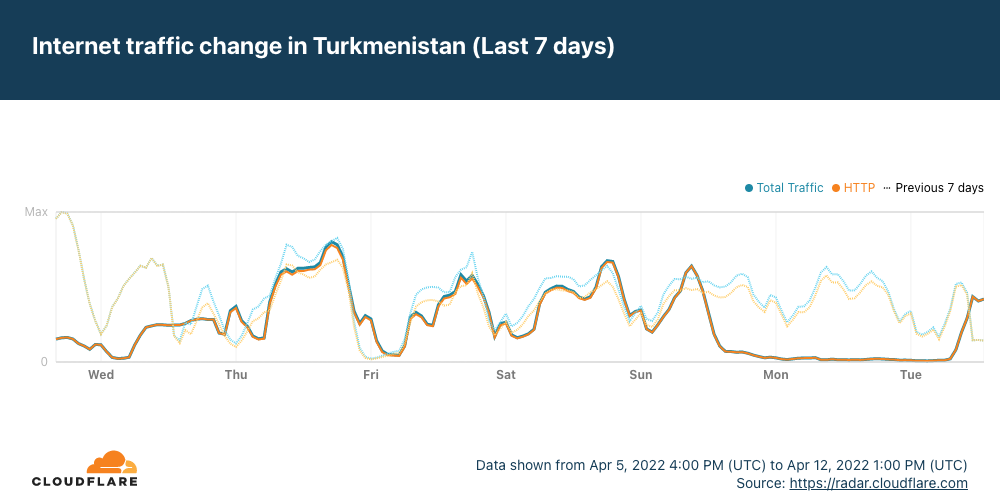
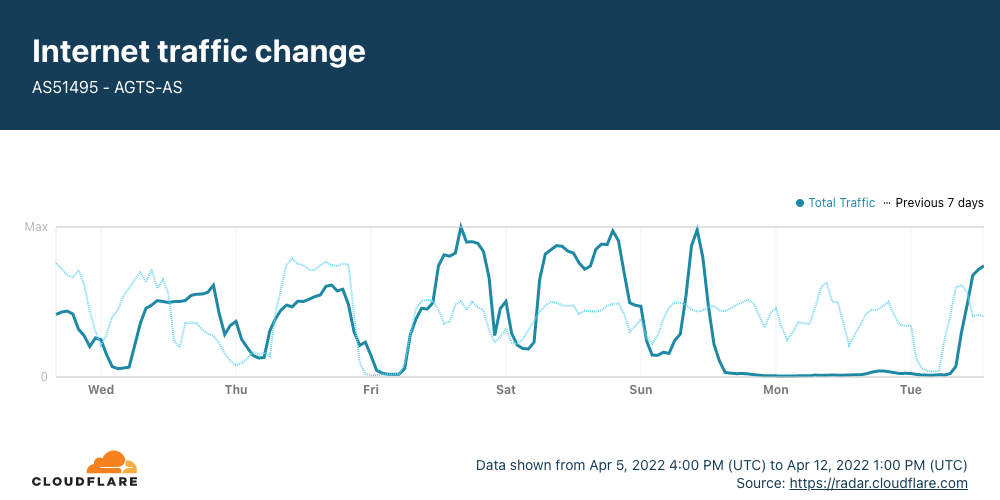
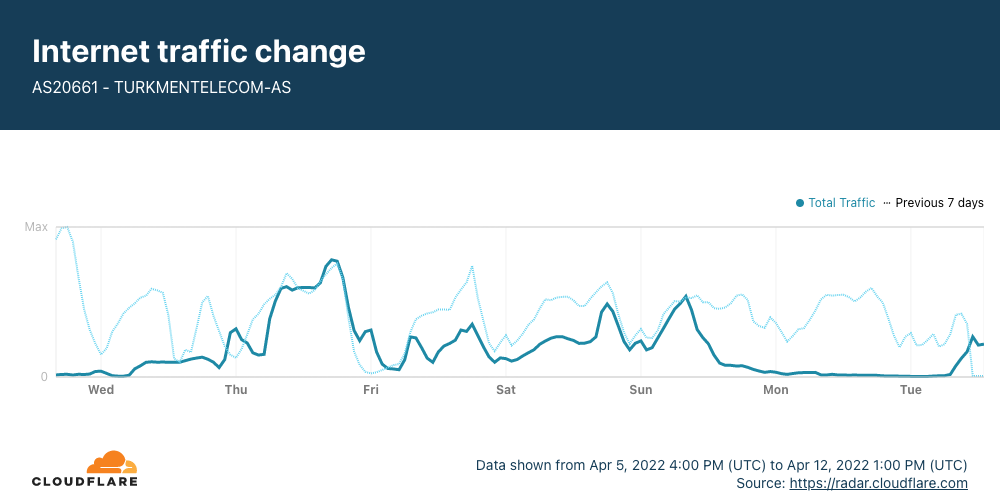
On April 10, following the blocking of social networks, VPN providers, and cloud platforms, the government of Turkmenistan implemented a near complete Internet shutdown, starting at 1400 UTC. Apparently related to criticism over the recent presidential election, the disruption lasted nearly 40 hours, as traffic started to return around 0700 UTC on April 12. The graphs below show the impact of the shutdown at a country level, as well as at two major network providers within the country, Telephone Network of Ashgabat CJSC (AS51495) and TurkmenTelecom (AS20661).

Internet disruptions overview for Q2 2022

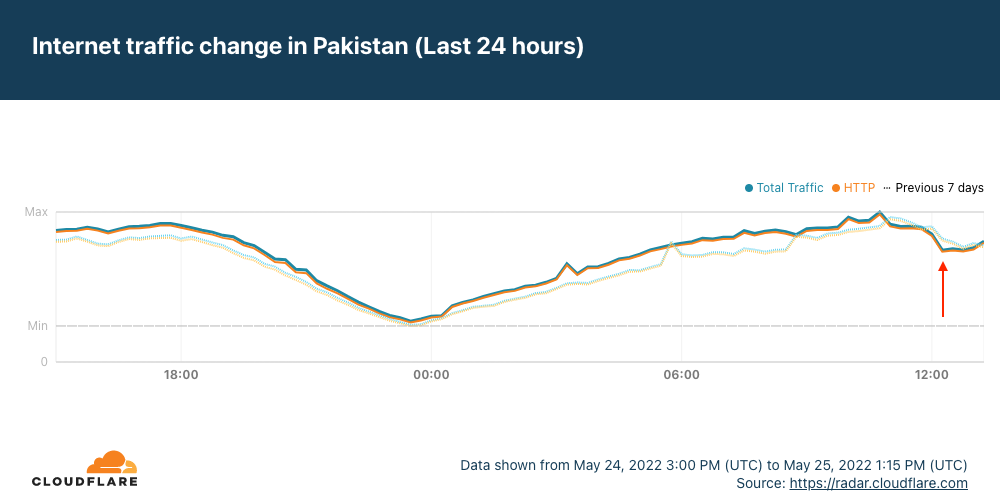
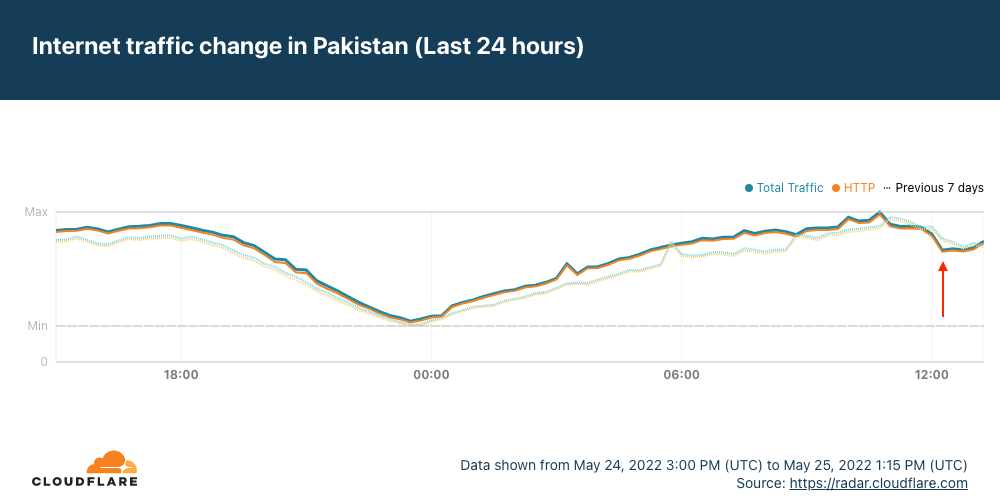
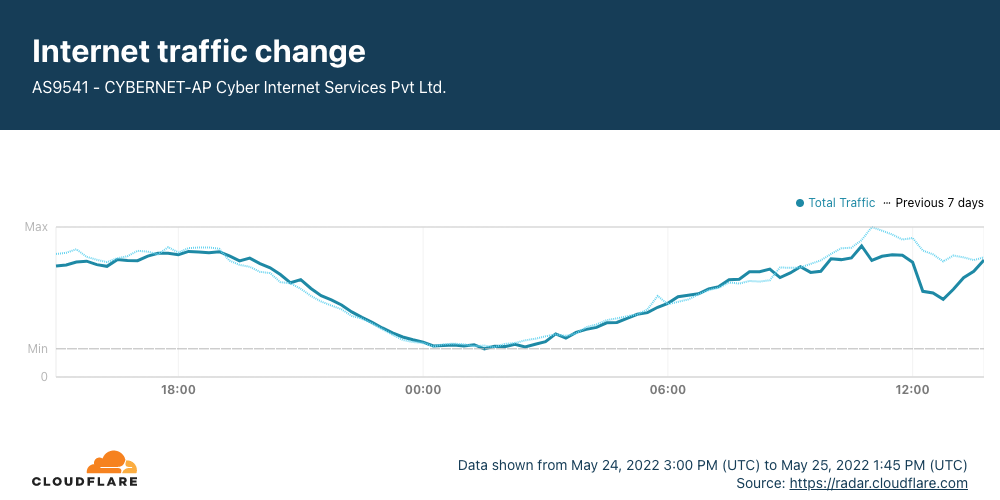
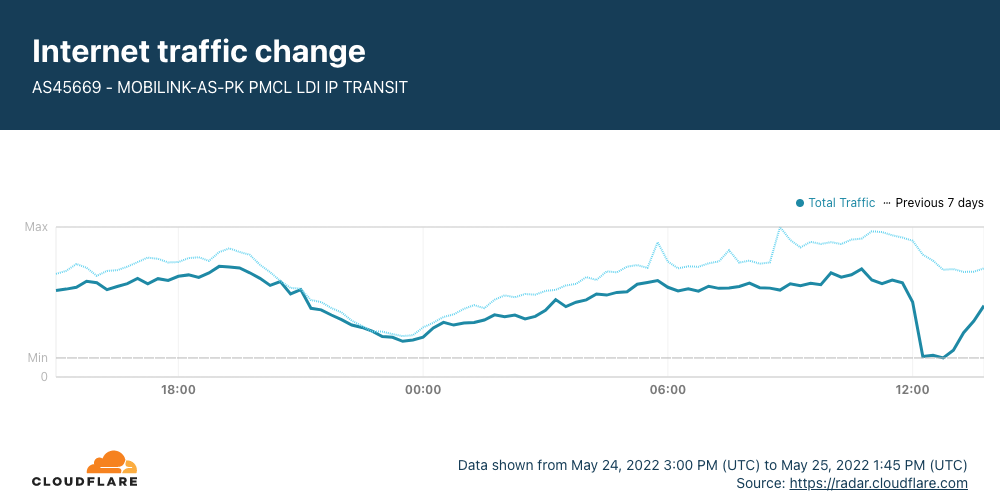
A month and a half later, on May 25, an Internet disruption was observed in Pakistan amid protests led by the country’s former Prime Minister. The disruption lasted only two hours, and was limited in scope — it was not a nationwide shutdown. (Telecom providers claimed that it was due to problems with a web filtering system.) At a national level, the impact of the disruption is visible as a slight drop in traffic.

Internet disruptions overview for Q2 2022

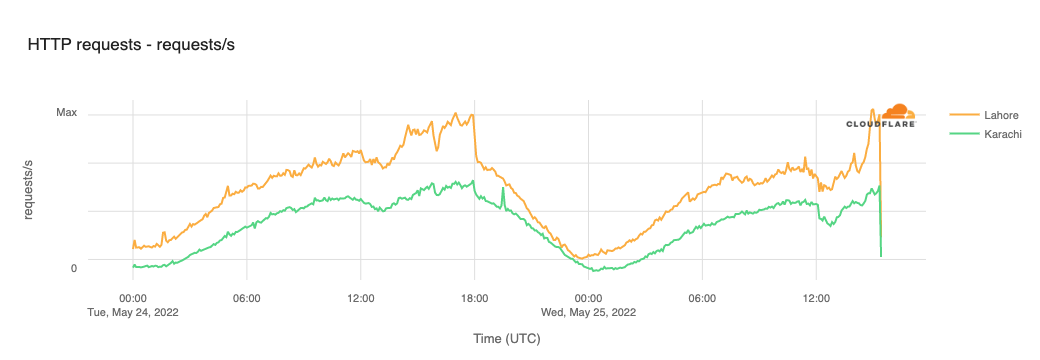
In the cities of Lahore and Karachi, the disruption is visible a little more clearly, as is the rapid recovery in traffic.

Internet disruptions overview for Q2 2022

The impact of the disruption is most evident at a network level, as seen in the graphs below. Cyber Internet Services (AS9541) saw a modest drop in traffic, while Mobilink (AS45669) experienced a near complete outage.

Internet disruptions overview for Q2 2022

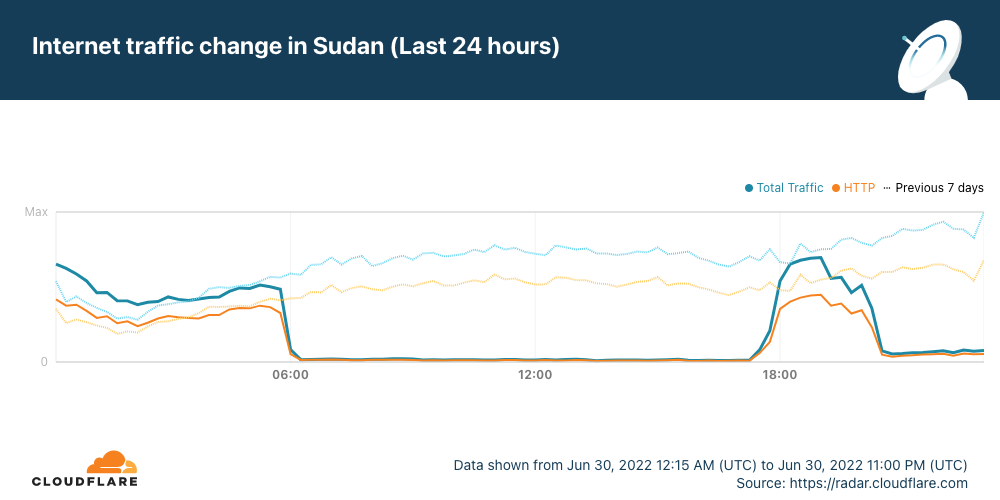
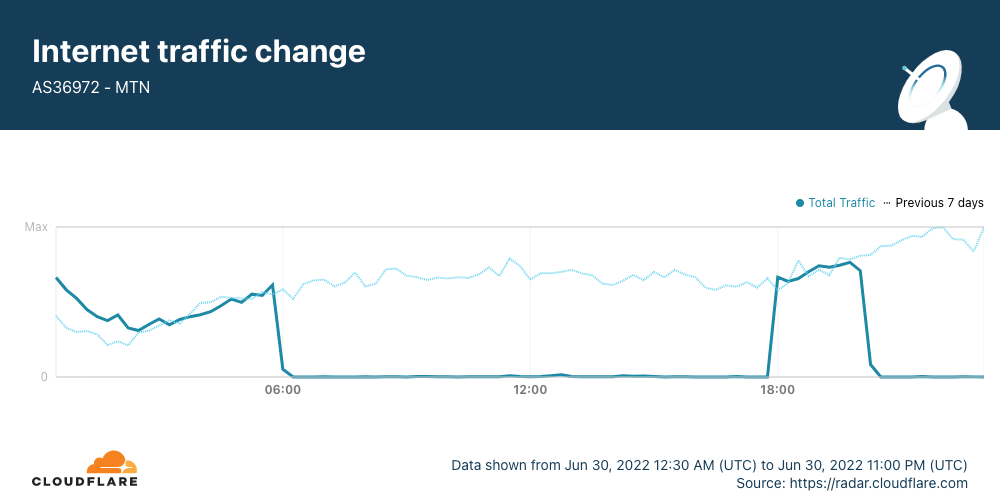
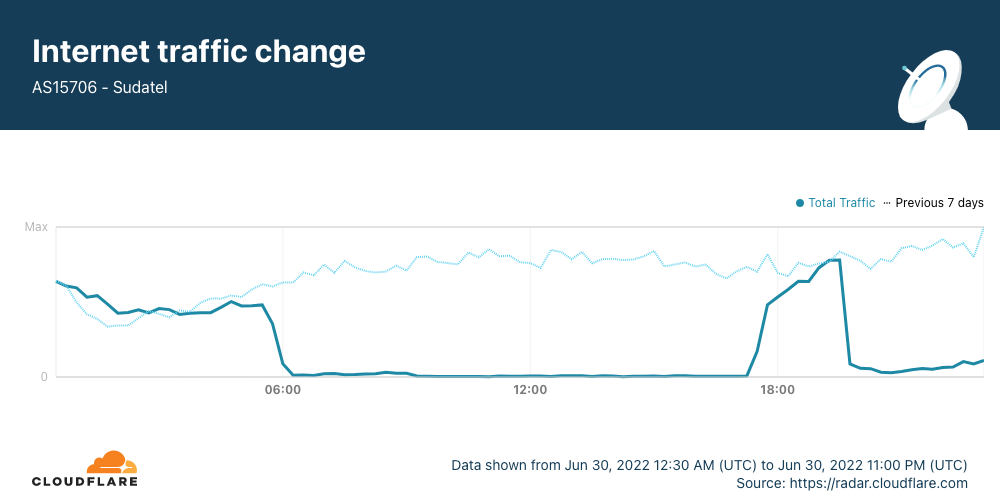
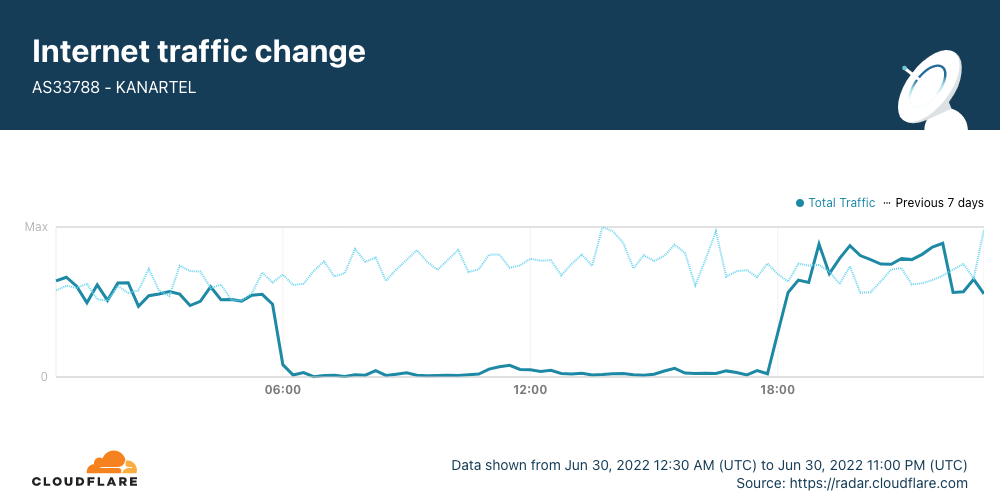
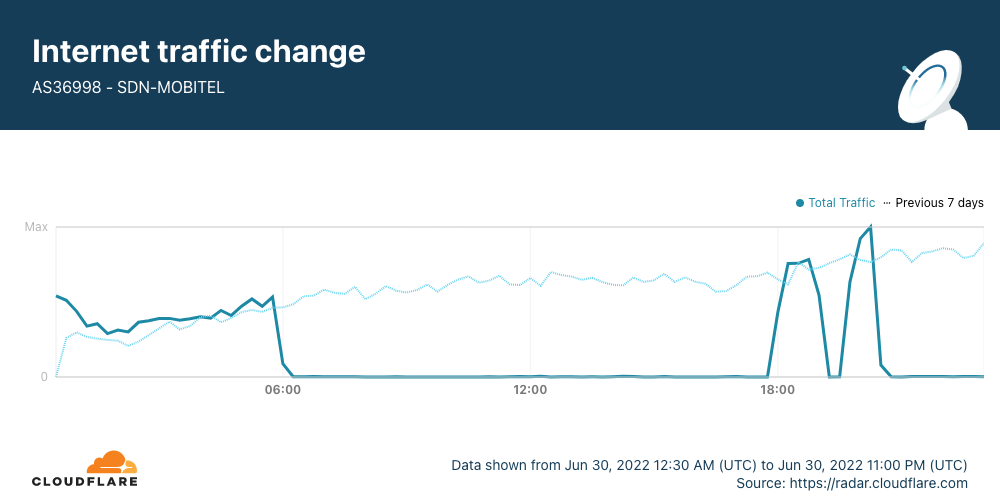
Closing out the quarter, a communications blackout, including an Internet shutdown, was imposed in Sudan on June 30 as protestors staged rallies against the country’s military leadership. This shutdown follows similar disruptions seen in October 2021 after the military toppled the transitional government and attempted to limit protests, as well the shutdowns seen earlier in June as the government attempted to prevent cheating on exams. The graphs below show that the shutdown started at 0600 UTC (0800 local time) and initially ended almost 12 hours later at 1740 UTC (1940 local time). Connectivity returned for approximately three hours, with traffic again dropping to near-zero levels again around 2040 UTC (2240 local time). This second outage remained active at the end of the day.

As a complete nationwide shutdown, the impact is also visible in the loss of traffic at major local Internet providers including MTN, Sudatel, Kanartel, and Sudanese Mobile Telephone (SDN Mobitel / ZAIN).

Internet disruptions overview for Q2 2022

Infrastructure issues

In addition to fiber/cable cuts, as discussed above, problems with other infrastructure, whether due to fires, electrical issues, or maintenance, can also disrupt Internet services.

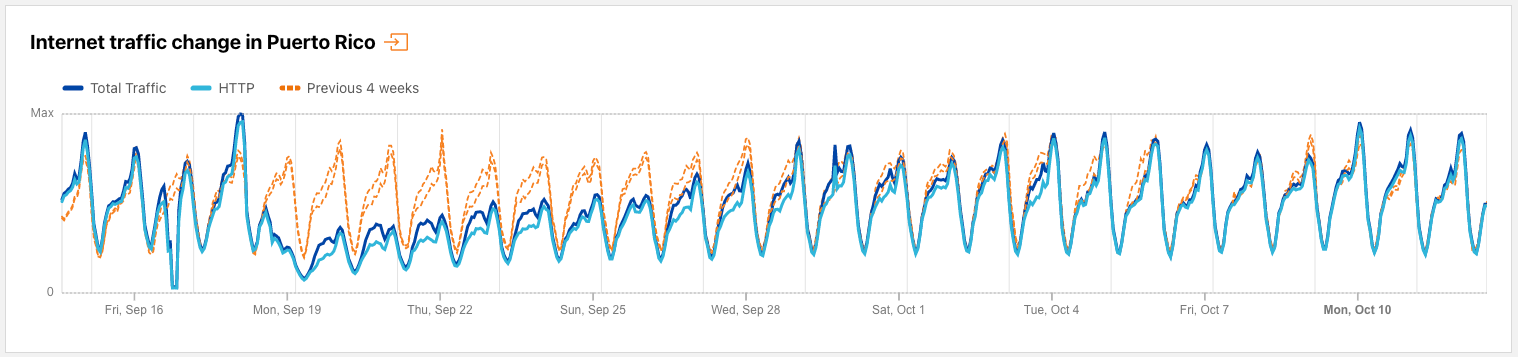
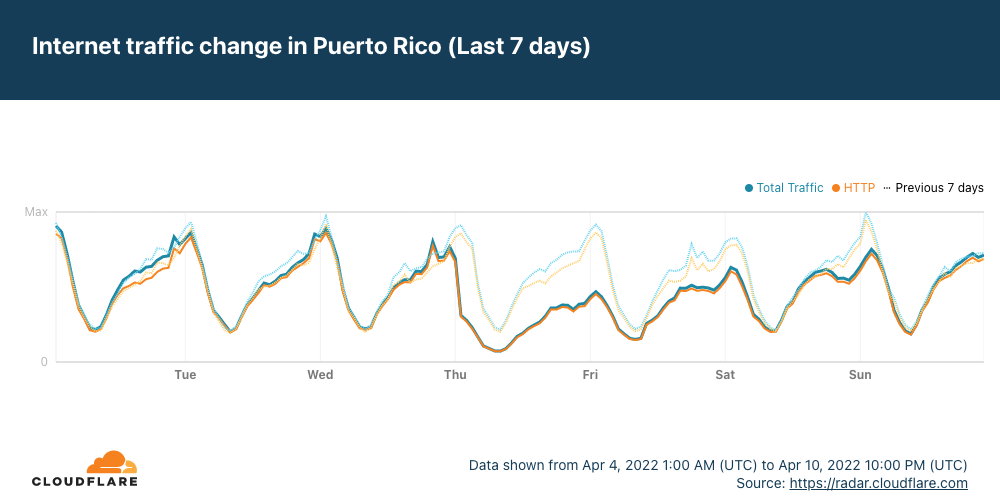
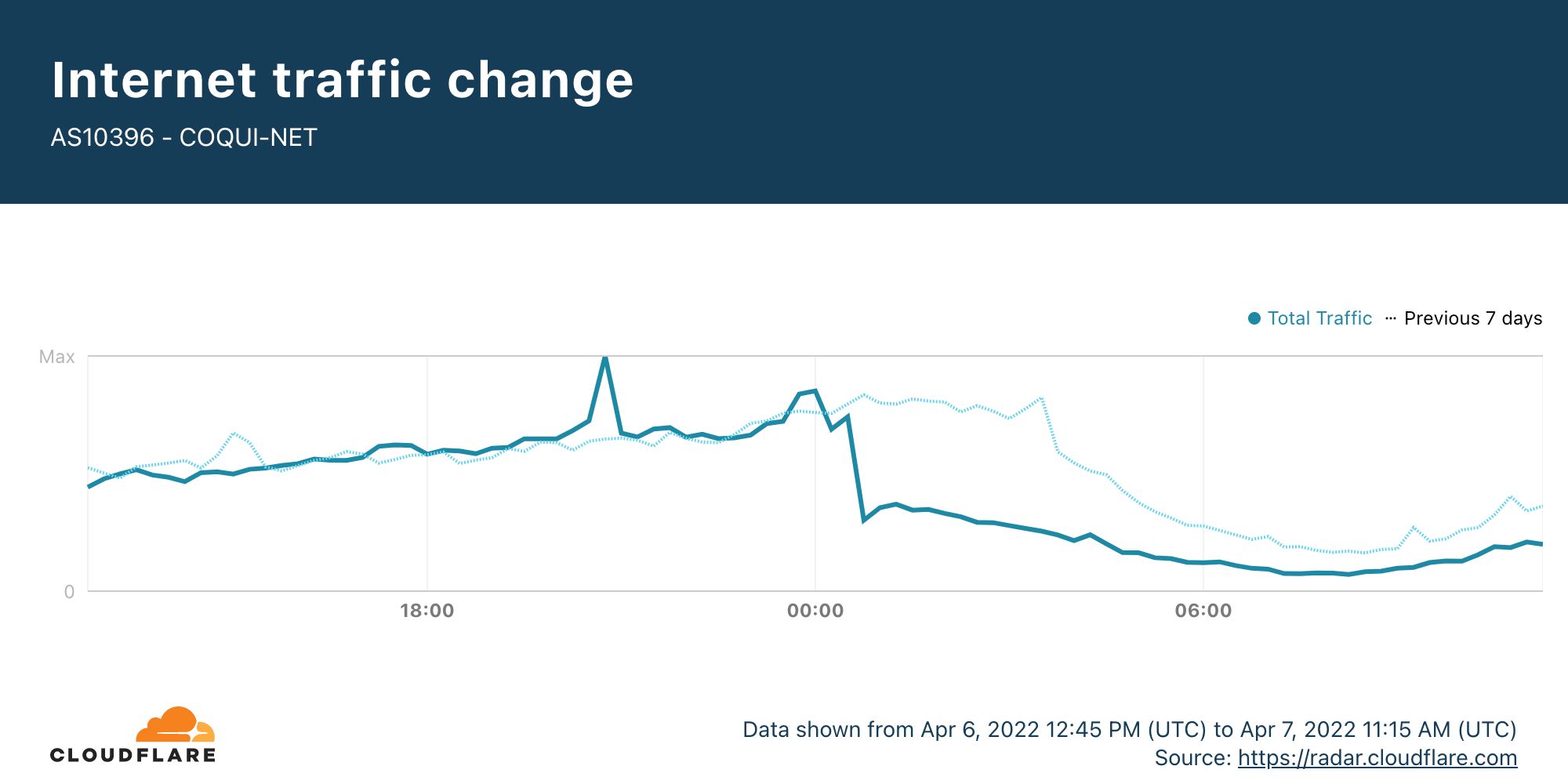
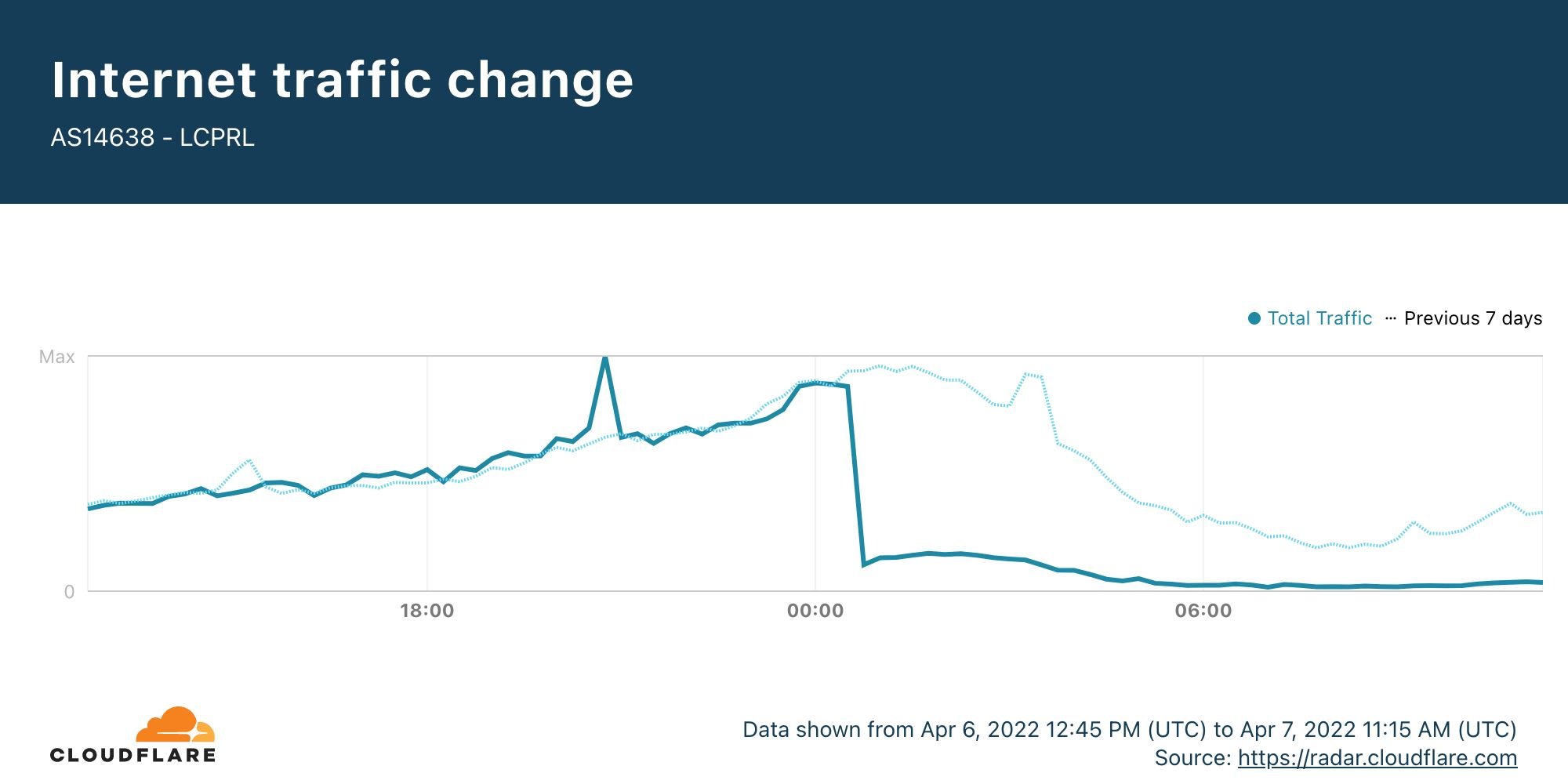
Around 2030 local time on April 6 (0030 UTC on April 7), a fire erupted at the Costa Sur generation plant, one of the largest power plants in Puerto Rico, resulting in a widespread power outage across the island territory. This island-wide outage caused a significant interruption to Internet services, clearly visible in Cloudflare traffic data. The graph below shows that as the power failed, traffic from Puerto Rico immediately fell by more than half. The regular diurnal pattern remained in place, albeit at lower levels, over the next three days, with traffic returning to “normal levels” three days later. By April 10, Luma Energy reported that it had restored electrical power to 99.7% of its 1.5M customers.

Internet disruptions overview for Q2 2022

The impact of the Internet service disruption is also fairly significant when viewed at a network level. The graphs below show traffic for Datacom Caribe/Claro (AS10396) and Liberty Cablevision of Puerto Rico (AS14638). At Datacom Caribe/Claro, traffic immediately fell by more than half, while Liberty Cablevision traffic declined approximately 85%.

Internet disruptions overview for Q2 2022

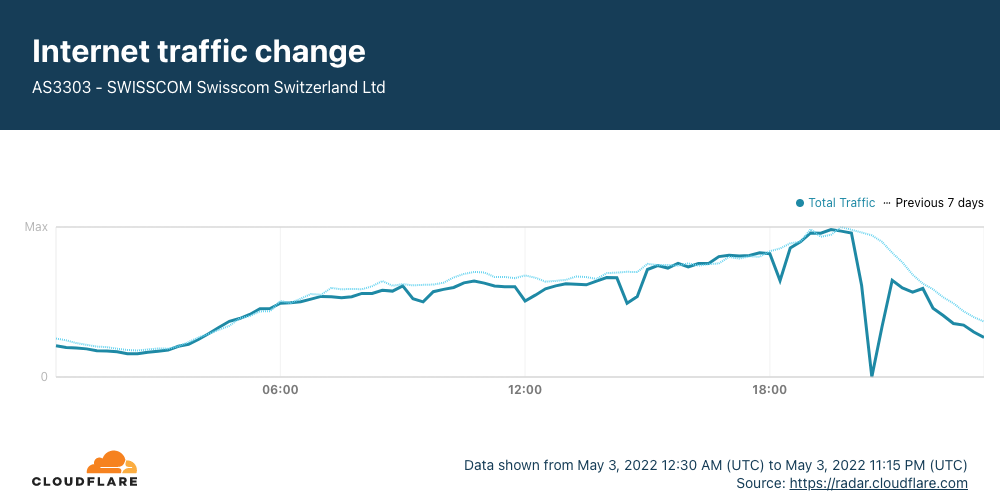
On the evening of May 3, Swiss telecom provider Swisscom tweeted that there had been an interruption to Internet service following maintenance work. A published report noted that the interruption occurred between 2223–2253 local time (2023–2053 UTC), and the graph below shows a complete loss of traffic, but quick recovery, during that 30-minute window. Beyond citing maintenance work, Swisscom did not provide any additional details about the Internet disruption.

Internet disruptions overview for Q2 2022

Iran

Iran has a history of both nationwide and regional Internet shutdowns, as well as connectivity disruptions due to infrastructure damage.

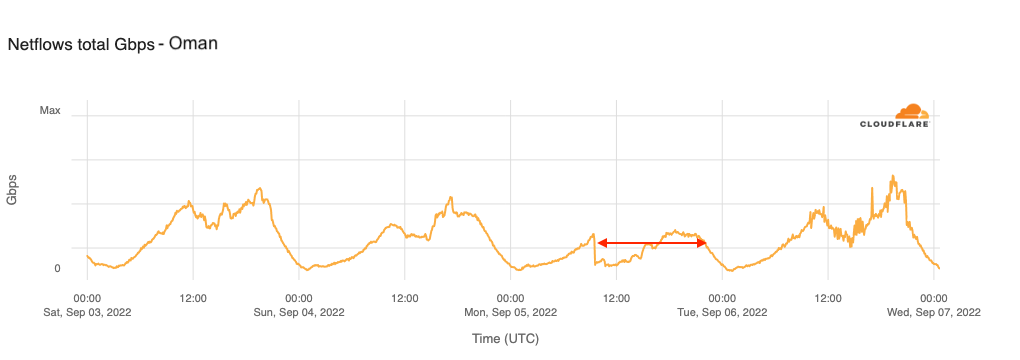
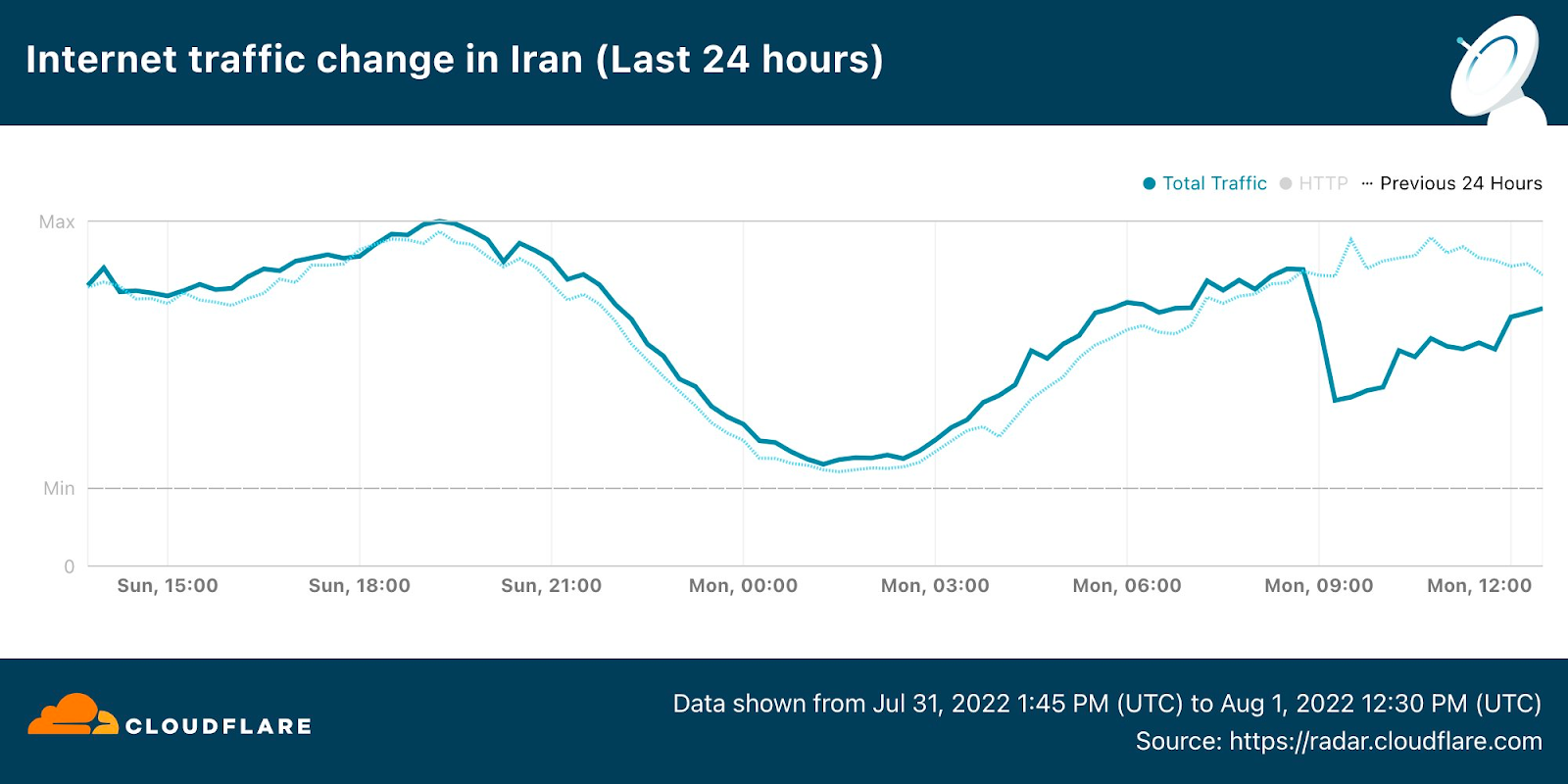
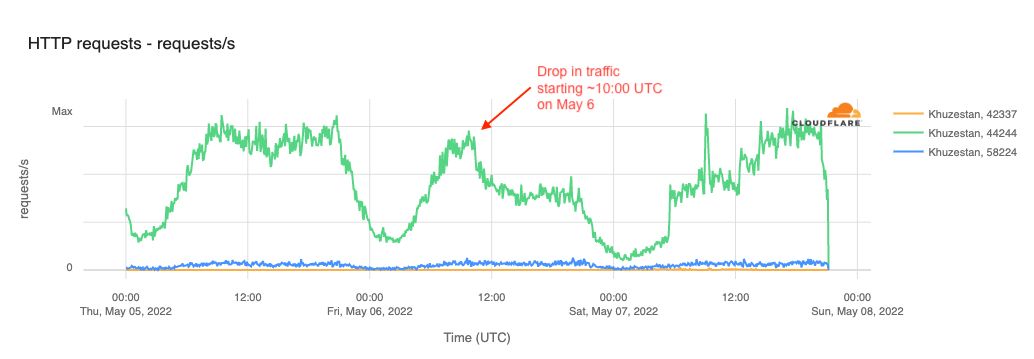
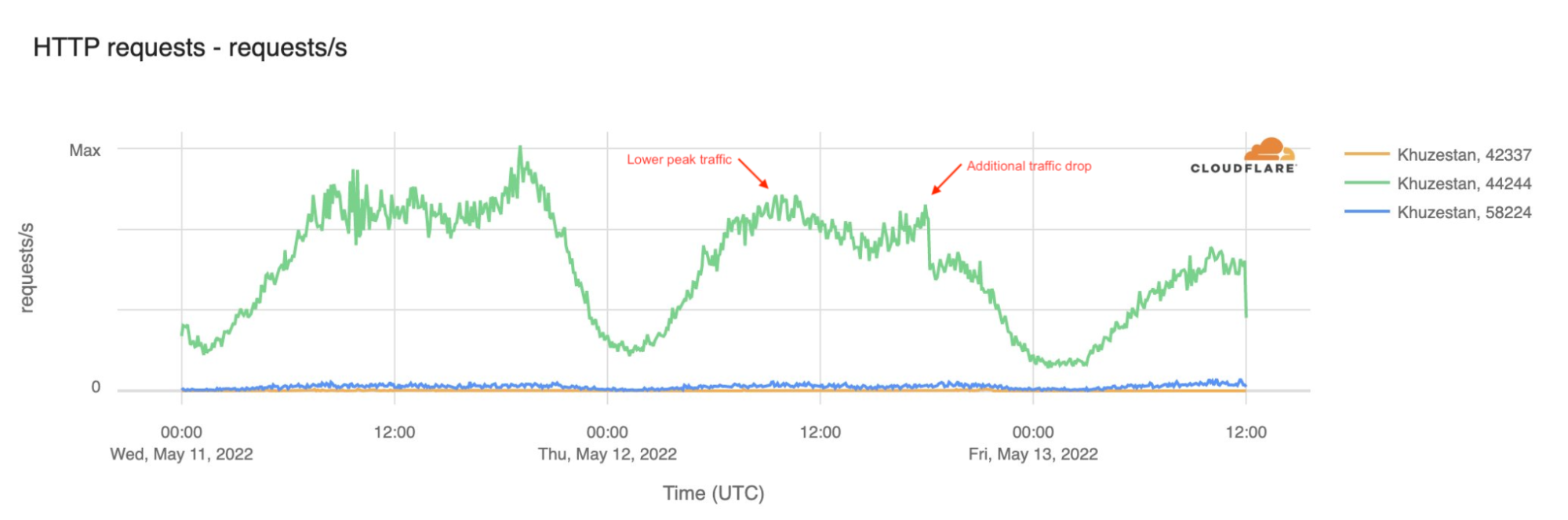
On May 6, the government disrupted Internet connectivity in Khuzestan province, reportedly in response to mass protests around shortages of bread and water. It was reported that mobile data had been cut off locally, and that fixed connectivity speeds were significantly reduced. To this end, we observed a drop in traffic for Irancell (AS44244) (a mobile network provider) in Khuzestan starting around 1000 UTC as seen in the graph below.

Internet disruptions overview for Q2 2022

A similar disruption affecting Irancell, occurring amid reports of ongoing protests in the country, was observed on May 12, with lower peak traffic during the day, and a further drop around 1800 UTC.

Internet disruptions overview for Q2 2022

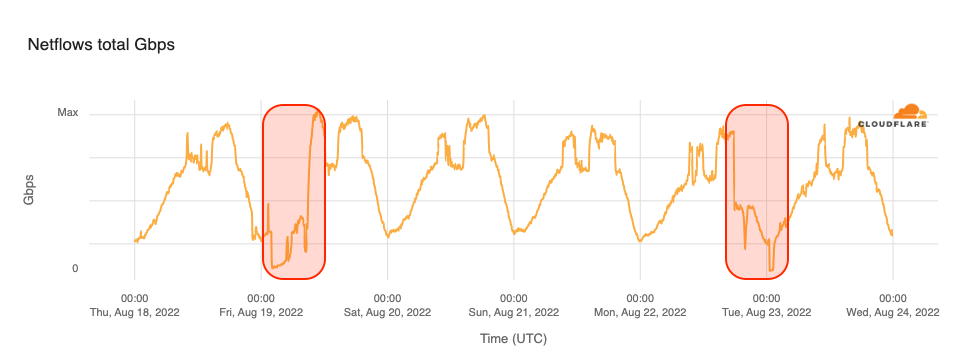
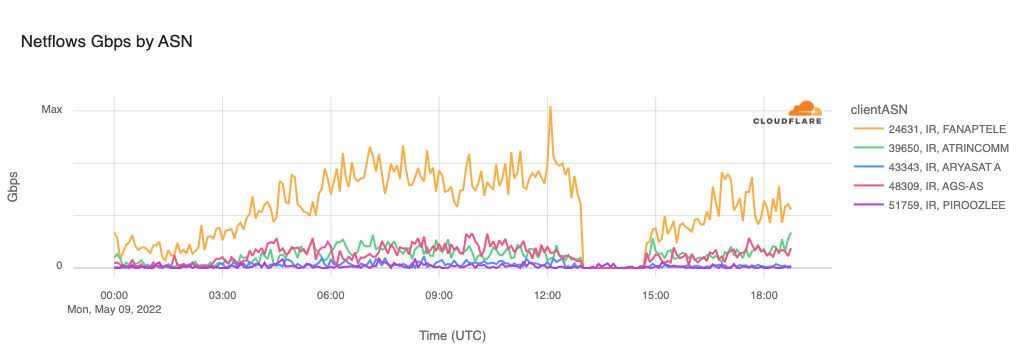
Near-complete Internet outages were observed on multiple Iranian network providers on May 9 between 1300–1440 UTC (1730–1910 local time), as illustrated in the graph below. Impacted providers included Atrin Information & Communications Technology Company (AS39650), AryaSat (AS43343), Ariana Gostar Spadana (AS48309), and Pirooz Leen (AS51759). All of these networks share Fanaptelecom (AS24631) as an upstream provider, which, as the graph shows, was also experiencing an outage. No root cause for the Fanaptelecom outage was available.

Internet disruptions overview for Q2 2022

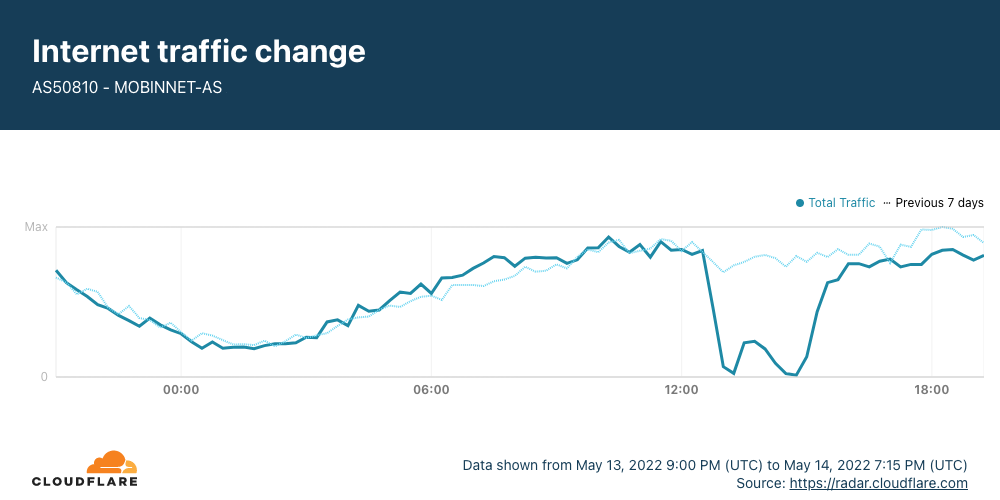
Mobile provider Mobinnet (AS50810) experienced a multi-hour Internet disruption on May 14, lasting from 1230–1530 UTC (1700–2000 local time). According to a tweet from Mobinnet, the disruption was due to a “widespread cyber attack of foreign origin”.

Internet disruptions overview for Q2 2022

Ukraine

Now more than four months into the war in Ukraine, the Internet continues to be an active battlefield, with ongoing Internet outages in multiple cities and across multiple networks. However, we want to highlight here two similar events observed during the second quarter.

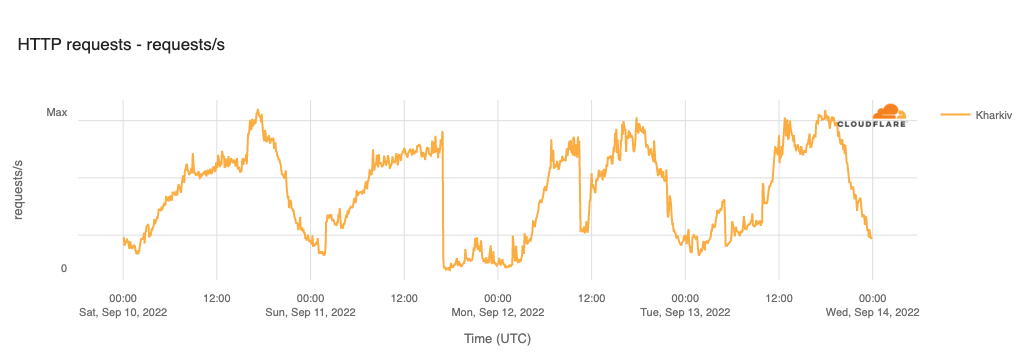
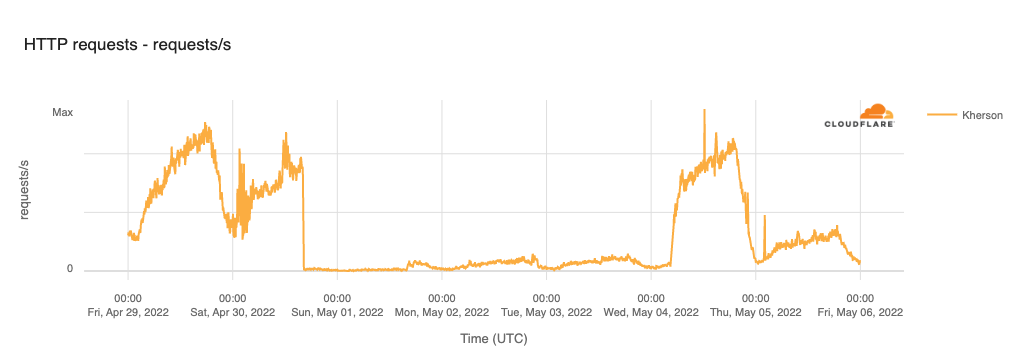
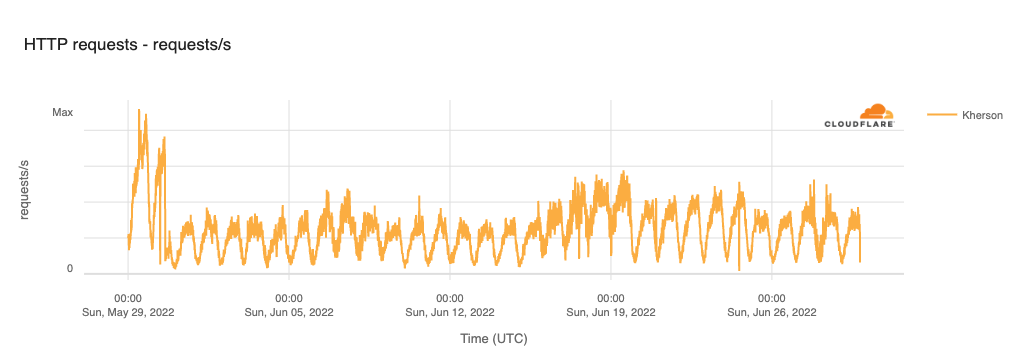
The Russian-occupied city of Kherson experienced a near-complete Internet outage between 1600 UTC (1900 local time) on April 30 and 0430 UTC (0730 local time) on May 4. According to social media posts from Ukraine’s vice Prime-Minister Mykhailo Fedorov and the State Service of Special Communications and Information Protection, the outage was caused by “interruptions of fiber-optic trunk lines and disconnection from the power supply of equipment of operators in the region”. The graph below shows effectively no traffic for Kherson for approximately 24 hours after the disruption began, followed by a nominal amount of traffic for the next several days.

Internet disruptions overview for Q2 2022

Around the time that the nominal amount of traffic returned, we also observed a shift in routing for an IPv4 prefix announced by AS47598 (Khersontelecom). As shown in the table below, prior to the outage, it reached the Internet through several other Ukrainian network providers, including AS12883, AS3326, and AS35213. However, as traffic returned, its routing path now showed a Russian network, AS201776 (Miranda) as the upstream provider. The path through Miranda also includes AS12389 (Rostelecom), which bills itself as “the largest digital services provider in Russia”.

Peer AS Last Update AS Path
AS1299 (TWELVE99 Arelion, fka Telia Carrier) 5/1/2022 16:02:26 1299 12389 201776 47598
AS6777 (AMS-IX-RS) 4/28/2022 11:23:33 12883 47598

As the disruption ended on May 4, we observed updates to Khersontelecom’s routing path that enabled it to return to reaching the global Internet through non-Russian upstream providers.

Peer AS Last Update AS Path
AS174 (COGENT-174) 5/4/2022 05:56:27 174 3326 3326 3326 47598
AS1273 (CW Vodafone Group PLC) 5/4/2022 03:11:25 1273 12389 201776 47598

Additional details about this outage and re-routing event can be found in the “Tracking shifts in Internet connectivity in Kherson, Ukraine” blog post.

A month later, on May 30, we again observed a significant Internet disruption in Kherson starting at 1435 UTC (1735 local time). And once again, we observed updated routing for Khersontelecom, as it shifted from Ukrainian upstream providers to Russian ones. As of the end of June, the Internet disruption in Kherson and the routing through Russian upstream providers both remain firmly in place, although the loss of traffic has not been nearly as significant as the April/May disruption.

Internet disruptions overview for Q2 2022

Peer AS Last Update AS Path
AS4775 (Globe Telecoms) 5/30/2022 13:56:22 4775 1273 12389 201776 47598
AS9002 (RETN-AS) 5/30/2022 09:58:16 9002 3326 47598

Conclusion

This post is by no means an exhaustive review of the Internet outages, shutdowns, and disruptions that have occurred throughout the second quarter. Some were extremely brief or limited in scope, while others were observed but had no known or publicly conjectured underlying cause. Having said that, it is important to bring increased visibility to these events so that the community can share information on what is happening, why it happened, and what the impact was — human, financial, or otherwise.
Follow @CloudflareRadar on Twitter for updates on Internet disruptions as they occur, and find up-to-date information on Internet trends using Cloudflare Radar.

Exam time means Internet disruptions in Syria, Sudan and Algeria

Post Syndicated from David Belson original https://blog.cloudflare.com/syria-sudan-algeria-exam-internet-shutdown/

Exam time means Internet disruptions in Syria, Sudan and Algeria

Exam time means Internet disruptions in Syria, Sudan and Algeria

It is once again exam time in Syria, Sudan, and Algeria, and with it, we find these countries disrupting Internet connectivity in an effort to prevent cheating on these exams. As they have done over the past several years, Syria and Sudan are implementing multi-hour nationwide Internet shutdowns. Algeria has also taken a similar approach in the past, but this year appears to be implementing more targeted website/application blocking.

Syria

Syria has been implementing Internet shutdowns across the country since 2011, but exam-related shutdowns have only been in place since 2016. In 2021, exams took place between May 31 and June 22, with multi-hour shutdowns observed on each of the exam days.

This year, the first shutdown was observed on May 30, with subsequent shutdowns (to date) seen on June 2, 6, and 12. In the Cloudflare Radar graph below, traffic for Syria drops to zero while the shutdowns are active. According to Internet Society Pulse, several additional shutdowns are expected through June 21. Each takes place between 02000530 UTC (0500–0830 local time). According to a published report, the current exam cycle covers more than 500,000 students for basic and general secondary education certificates.

Exam time means Internet disruptions in Syria, Sudan and Algeria

Consistent with shutdowns observed in prior years, Syria is once again implementing them in an asymmetric fashion – that is, inbound traffic is disabled, but egress traffic remains. This is clearly visible in request traffic from Syria to Cloudflare’s 1.1.1.1 DNS resolver. As the graph below shows, queries from clients in Syria are able to exit the country and reach Cloudflare, but responses can’t return, leading to retry floods, visible as spikes in the graph.

Exam time means Internet disruptions in Syria, Sudan and Algeria

Last year, the Syrian Minister of Education noted that, for the first time, encryption and surveillance technologies would be used in an effort to curtail cheating, with an apparent promise to suspend Internet shutdowns in the future if these technologies proved successful.

Sudan

Sudan is also no stranger to nationwide Internet shutdowns, with some last lasting for multiple weeks. Over the last several years, Sudan has also implemented Internet shutdowns during secondary school exams in an effort to limit cheating or leaking of exam questions. (We covered the 2021 round of shutdowns in a blog post.)

According to a schedule published by digital rights organization AccessNow, this year’s Secondary Certificate Exams will be taking place in Sudan daily between June 11–22, except June 17. As of this writing, near-complete shutdowns have been observed on June 11, 12, and 13 between 0530-0830 UTC (0730-1030 local time), as seen in the graph below. The timing of these shutdowns aligns with a communication reportedly sent to subscribers of telecommunications services in the country, which stated “In implementation of the decision of the Attorney General, the Internet service will be suspended during the Sudanese certificate exam sessions from 8 in the morning until 11 in the morning.”

Exam time means Internet disruptions in Syria, Sudan and Algeria

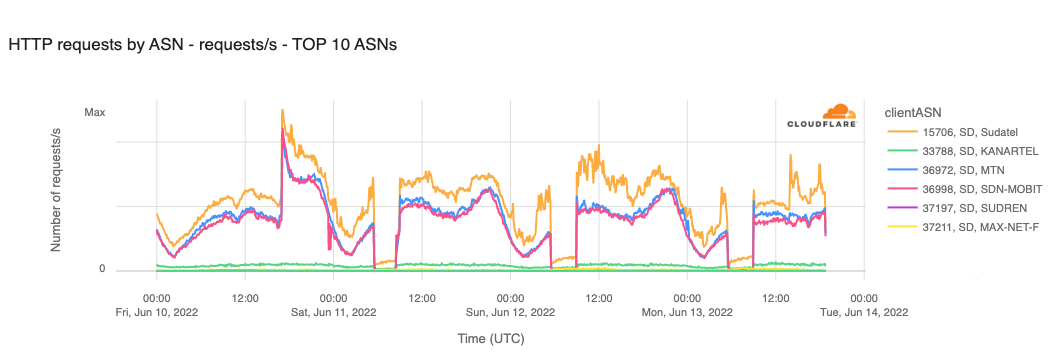
It is interesting to note that the shutdown, while nationwide, does not appear to be complete. The graph below shows that Cloudflare continues to see a small volume of HTTP requests from Sudatel during the shutdown periods. This is not completely unusual, as Sudatel may have public sector, financial services, or other types of customers that remain online.

Exam time means Internet disruptions in Syria, Sudan and Algeria

Algeria

Since 2018, Algeria has been shutting down the Internet nationwide during baccalaureate exams, following widespread cheating in 2016 that saw questions leaked online both before and during tests. These shutdowns reportedly cost businesses across the country an estimated 500 million Algerian Dinars (approximately $3.4 million USD) for every hour the Internet was unavailable. In 2021, there were two Internet shutdowns each day that exams took place—the first between 0700–1100 UTC (0800–1200 local time), and the second between 1330–1600 UTC (1430–1700 local time).

This year, more than 700,000 students will sit for the baccalaureate exams between June 12-16.

Perhaps recognizing the economic damage caused by these Internet shutdowns, this year the Algerian Minister of National Education announced that there would be no Internet shutdowns on exam days.

Thus far, it appears that this has been the case. However, it appears that the Algerian government has shifted to a content blocking-based approach, instead of a wide-scale Internet shutdown. The Cloudflare Radar graph below shows two nominal drops in country-level traffic during the two times on June 13 that the exams took place—0730–1000 UTC (0830–1100 local time) and 1330–1600 UTC (1430–1700 local time), similar to last year’s timing.

Exam time means Internet disruptions in Syria, Sudan and Algeria

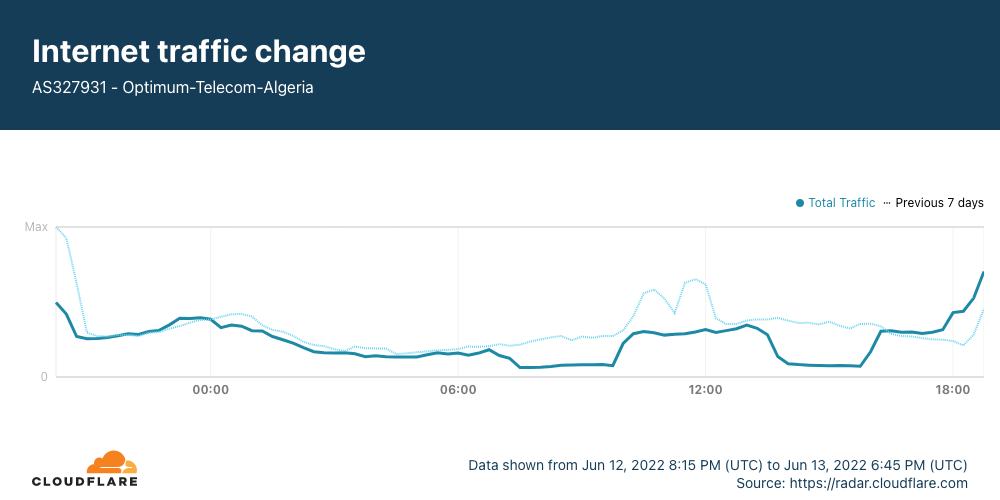
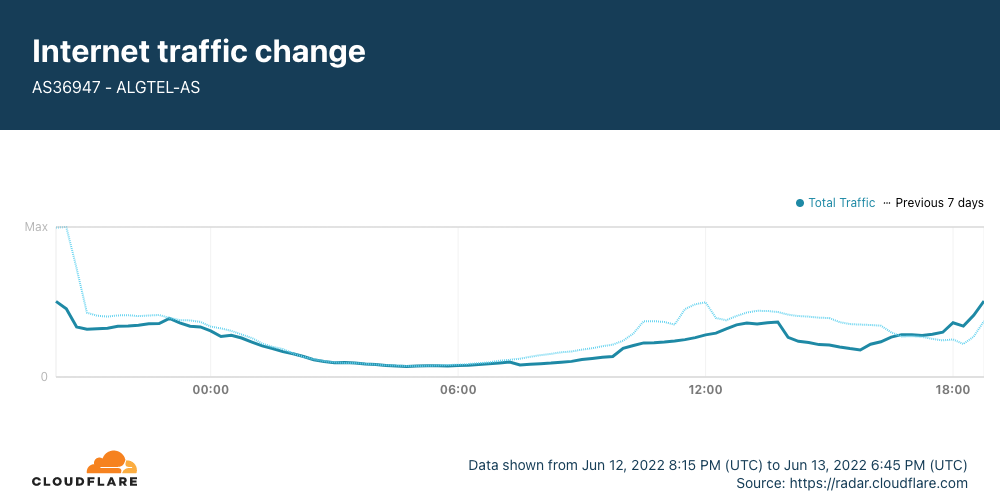
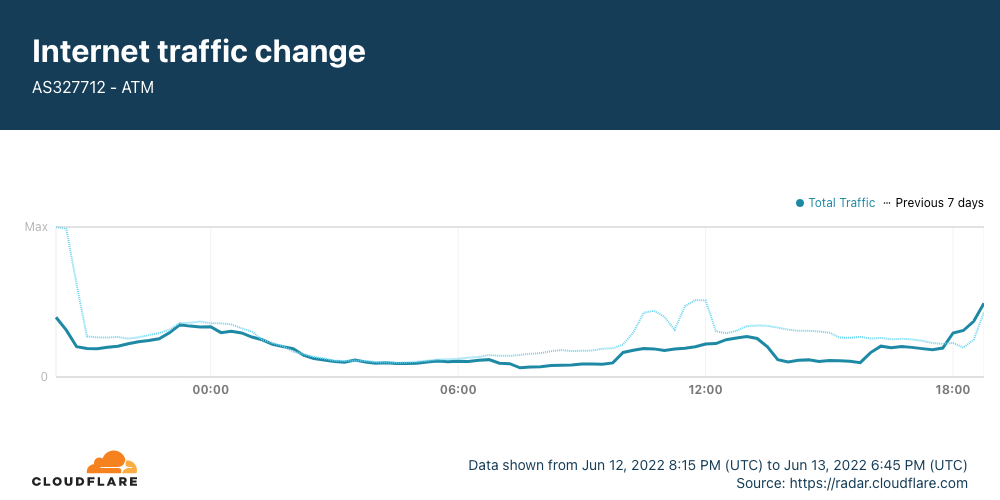
The disruptions are also visible in traffic graphs for several major Algerian network providers, as shown below.

Exam time means Internet disruptions in Syria, Sudan and Algeria

Analysis of additional Cloudflare data further supports the hypothesis that Algeria is blocking access to specific websites and applications, rather than shutting down the Internet completely.

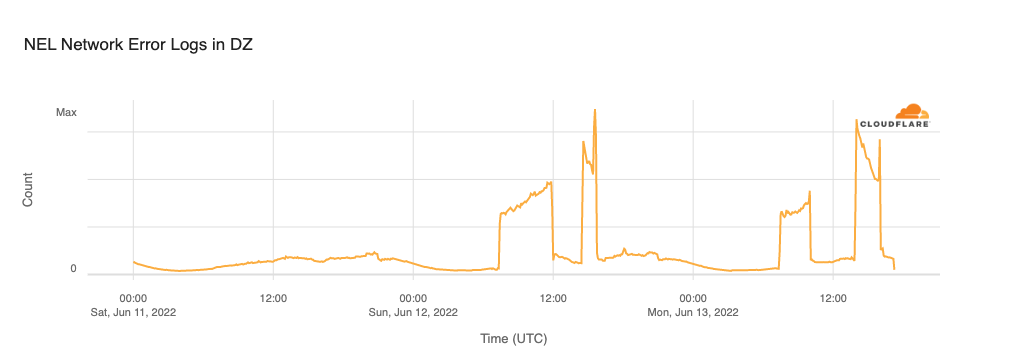
As described in a previous blog post, Network Error Logging (NEL) is a browser-based reporting system that allows users’ browsers to report connection failures to an endpoint specified by the webpage that failed to load. Below, a graph of NEL reports from browsers in Algeria shows clear spikes during the times (thus far) that the exams have taken place, with report levels significantly lower and more consistent during other times of the day.

Exam time means Internet disruptions in Syria, Sudan and Algeria

Conclusion

In addition to Syria, Sudan, and Algeria, countries including India, Jordan, Iraq, Uzbekistan, and Ethiopia have shut down or limited access to the Internet as exams took place. It is unclear whether these brute-force methods are truly effective at preventing cheating on these exams. However, it is clear that the impact of these shutdowns goes beyond students, as they impose a significant financial cost on businesses within the affected countries as they lose Internet access for multiple hours a day over the course of several weeks.

If you want to follow the remaining scheduled disruptions for these countries, you can see live data on the Cloudflare Radar pages for Syria, Sudan, and Algeria.

Internet is back in Tonga after 38 days of outage

Post Syndicated from João Tomé original https://blog.cloudflare.com/internet-is-back-in-tonga-after-38-days-of-outage/

Internet is back in Tonga after 38 days of outage

Internet is back in Tonga after 38 days of outage

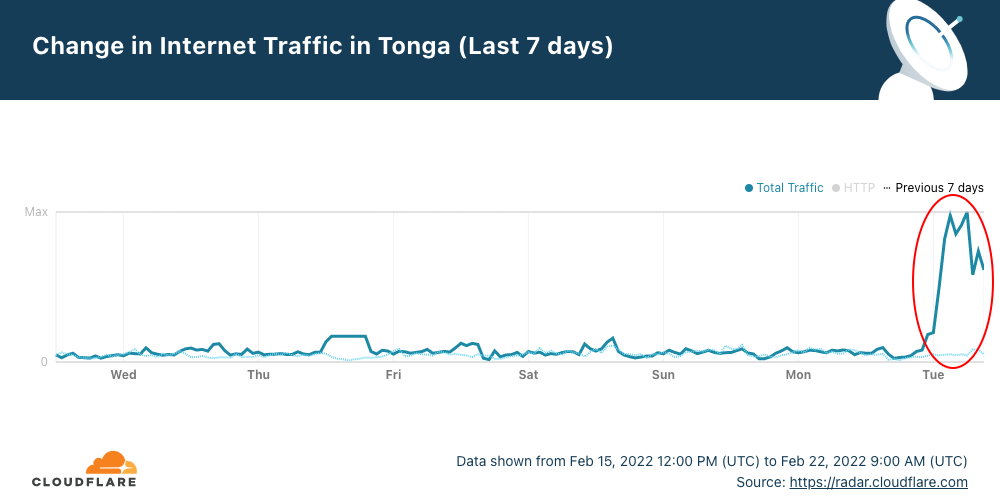
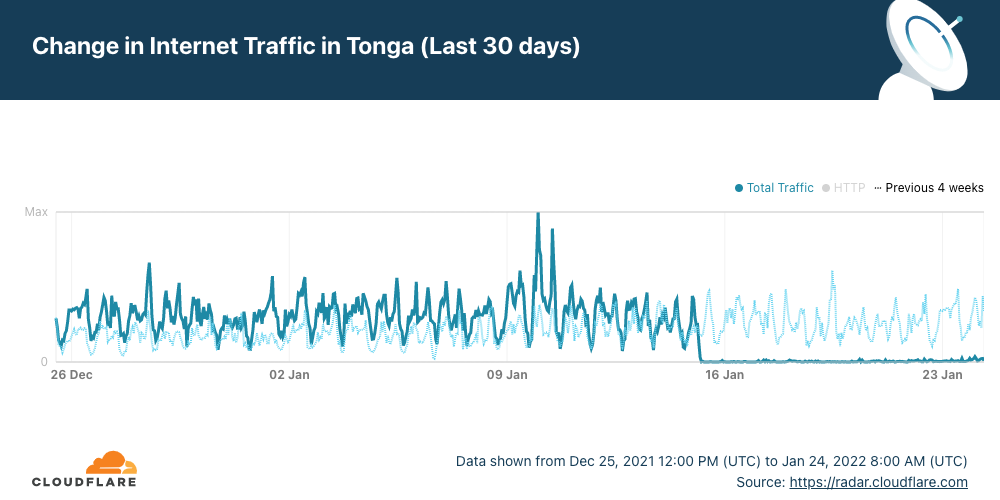
Tonga, the South Pacific archipelago nation (with 169 islands), was reconnected to the Internet this early morning (UTC) and is back online after successful repairs to the undersea cable that was damaged on Saturday, January 15, 2022, by the January 14, volcanic eruption.
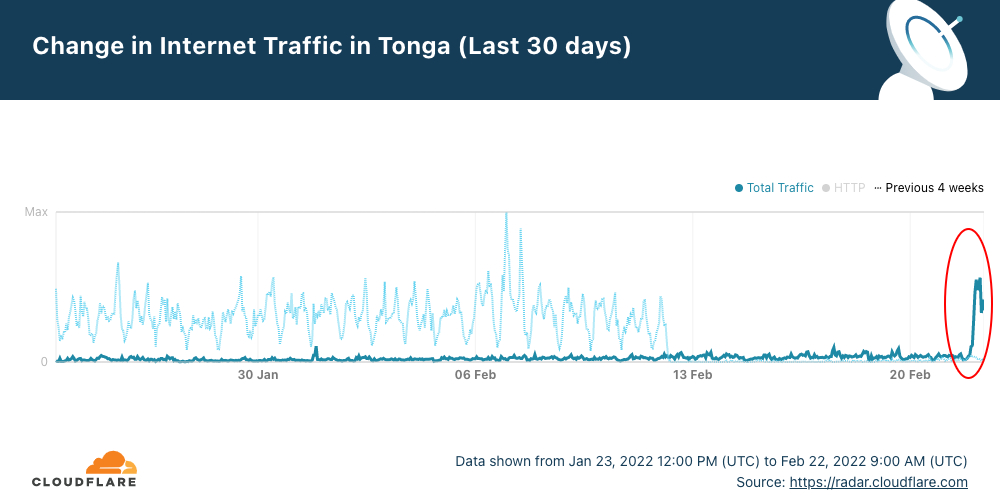
After 38 days without full access to the Internet, Cloudflare Radar shows that a little after midnight (UTC) — it was around 13:00 local time — on February 22, 2022, Internet traffic in Tonga started to increase to levels similar to those seen before the eruption.
Internet is back in Tonga after 38 days of outage

The faded line shows what was normal in Tonga at the start of the year, and the dark blue line shows the evolution of traffic in the last 30 days. Digicel, Tonga’s main ISP announced at 02:13 UTC that “data connectivity has been restored on the main island Tongatapu and Eua after undersea submarine cable repairs”.
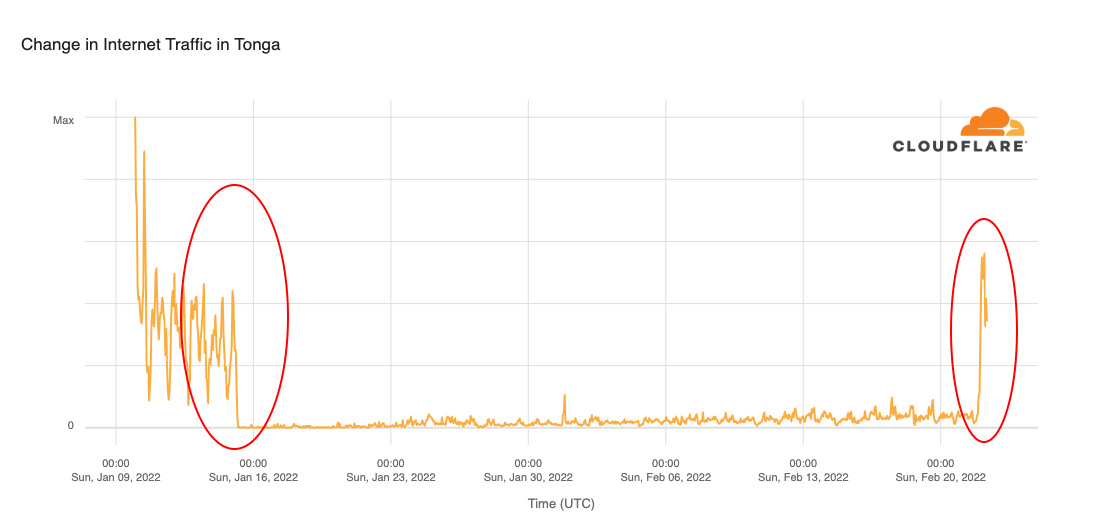
When we expand the view to the previous 45 days, we can see more clearly how Internet traffic evolved before the volcanic eruption and after the undersea cable was repaired.

Internet is back in Tonga after 38 days of outage

The repair ship Reliance took 20 days to replace a 92 km (57 mile) section of the 827 km submarine fiber optical cable that connects Tonga to Fiji and international networks and had “multiple faults and breaks due to the volcanic eruption”, according to Digicel.

Tonga Cable chief executive James Panuve told Reuters that people on the main island “will have access almost immediately”, and that was what we saw on Radar with a large increase in traffic persisting.

Internet is back in Tonga after 38 days of outage

The residual traffic we saw from Tonga a few days after January 15, 2022, comes from satellite services that were used with difficulty by some businesses.

James Panuve also highlighted that the undersea work is still being finished to repair the domestic cable connecting the main island of Tongatapu with outlying islands that were worst hit by the tsunami, which, he told Reuters, could take six to nine months more.

So, for some of the people who live on the 36 inhabited islands, normal use of the Internet could take a lot longer. Tonga has a population of around 105,000, 70% of whom reside on the main island, Tongatapu and around 5% (5,000) live on the nearby island of Eua (now also connected to the Internet).

Telecommunication companies in neighboring Pacific islands, particularly New Caledonia, provided lengths of cable when Tonga ran out, said Panuve.

A world of undersea cables for the world’s communications

We have mentioned before, for example in our first blog post about the Tonga outage, how undersea cables are important to global Internet traffic that is mostly carried by a complex network that connects countries and continents.

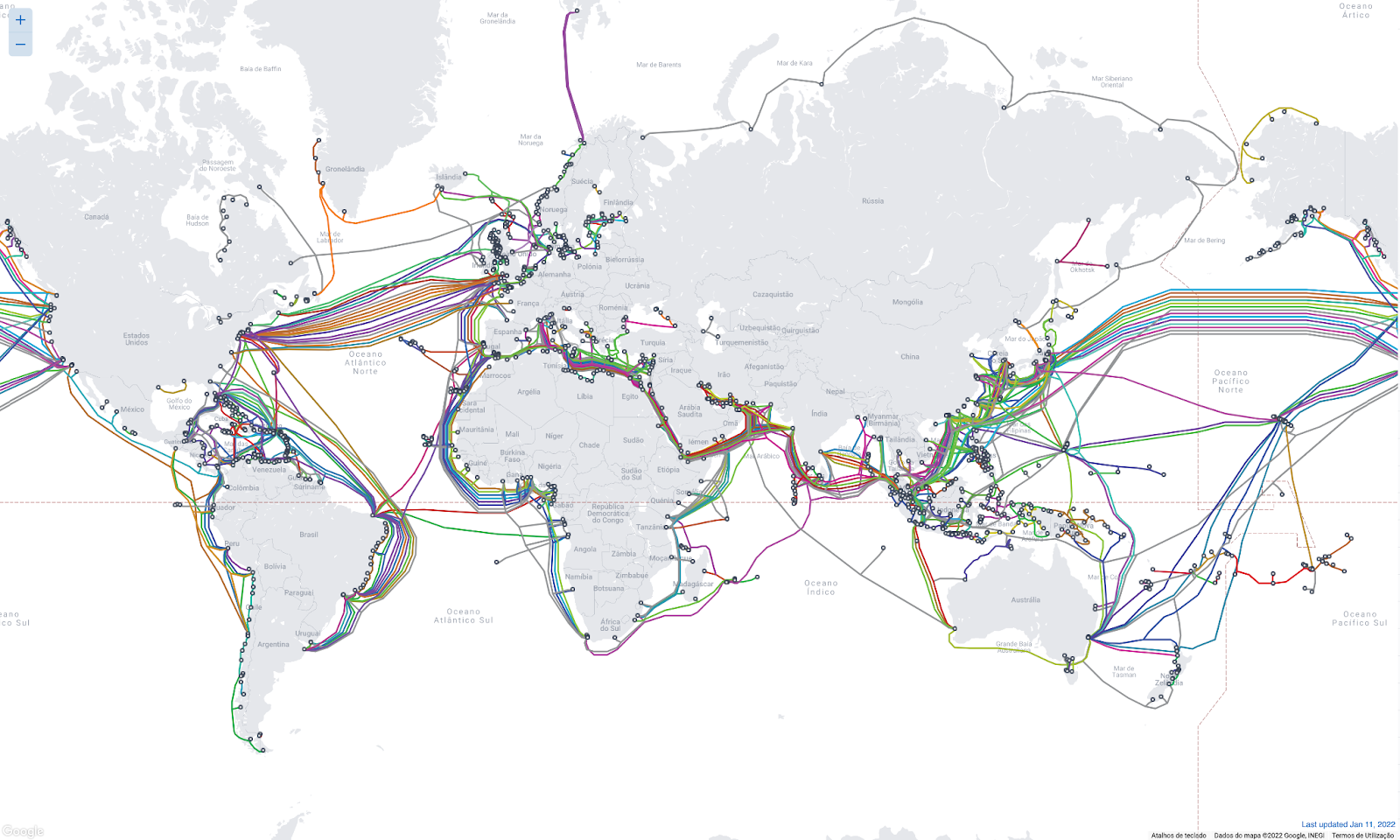
The full submarine cable system (the first communications cables laid were from the 1850s and carried telegraphy traffic) is what makes most of the world’s Internet function between countries and continents. There are 428 active submarine cables (36 are planned), running to an estimated 1.3 million km around the globe.

Internet is back in Tonga after 38 days of outage
World map of submarine cables. Antartida is the only continent not yet reached by a submarine telecommunications cable. Source: TeleGeography (www.submarinecablemap.com

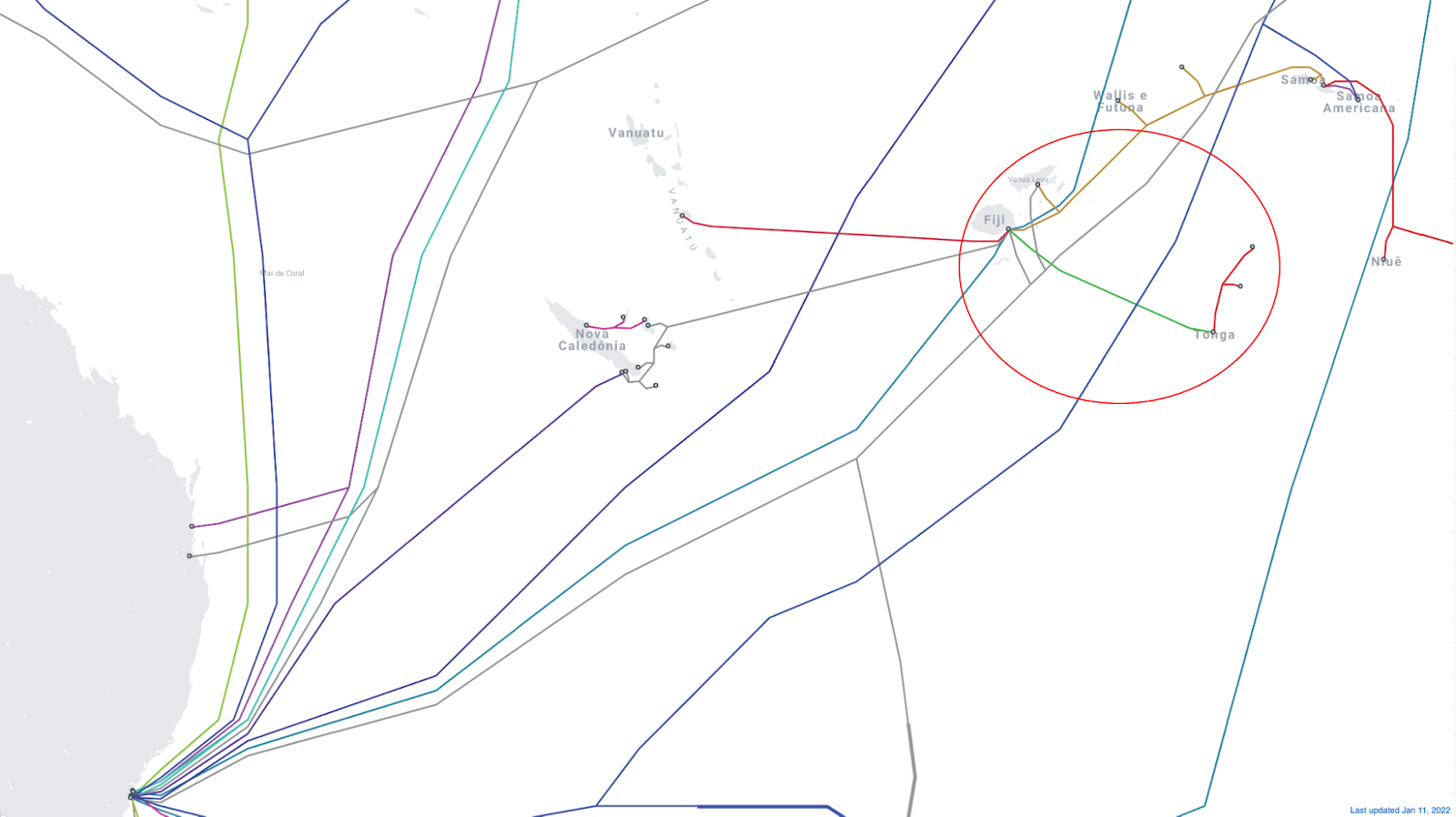
The reliability of submarine Internet is high, especially when multiple paths are available in the event of a cable break. That wasn’t the case for the Tonga outage, given that the 827 km submarine cable only connects Fiji to the Tonga archipelago — Fiji is connected to the main Southern Cross Cable, as the next image illustrates.

Internet is back in Tonga after 38 days of outage
Submarine Cable Map shows the undersea cables that connect Australia to Fiji and the following connections to other archipelagos like Tonga. Source: TeleGeography (www.submarinecablemap.com)

In a recent conversation on a Cloudflare TV segment we discussed the importance of undersea cables with Tom Paseka, Network Strategist who is celebrating 10 years at Cloudflare and worked previously for undersea cable companies in Australia. Here’s a clip:

Burkina Faso experiencing second major Internet disruption this year

Post Syndicated from João Tomé original https://blog.cloudflare.com/internet-disruption-in-burkina-faso/

Burkina Faso experiencing second major Internet disruption this year

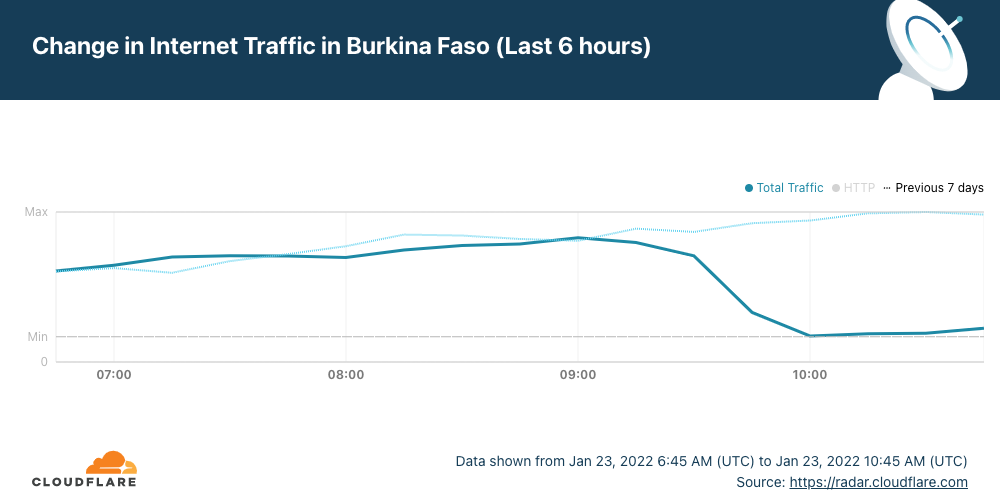
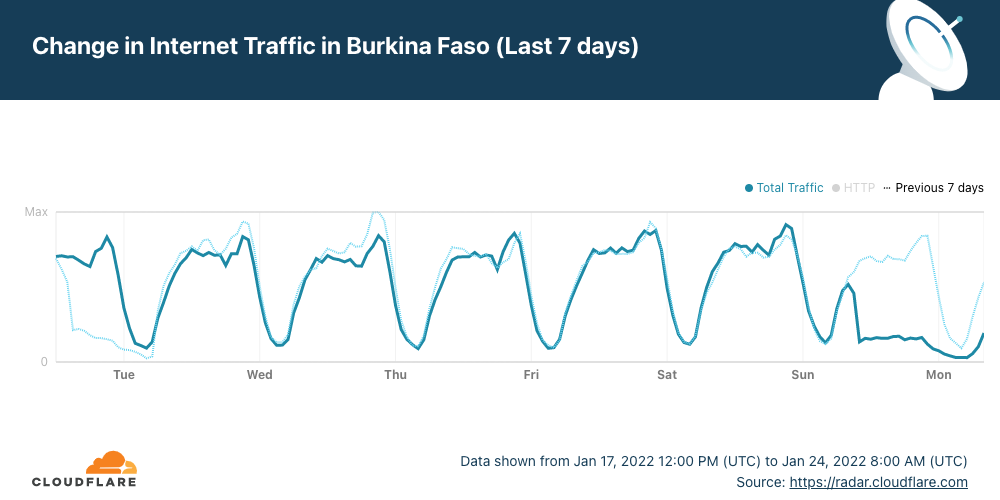
The early hours of Sunday, January 23, 2022, started in Burkina Faso with an Internet outage or shutdown. Heavy gunfire in an army mutiny could be related to the outage according to the New York Times (“mobile Internet services were shut down”). As of today, there are three countries affected by major Internet disruptions — Tonga and Yemen are the others.

Cloudflare Radar shows that Internet traffic dropped significantly in the West African country after ~09:15 UTC (the same in local time) and remains low more than 24 hours later. Burkina Faso also had a mobile Internet shutdown on January 10, 2022, and another we reported in late November 2021.

Burkina Faso experiencing second major Internet disruption this year

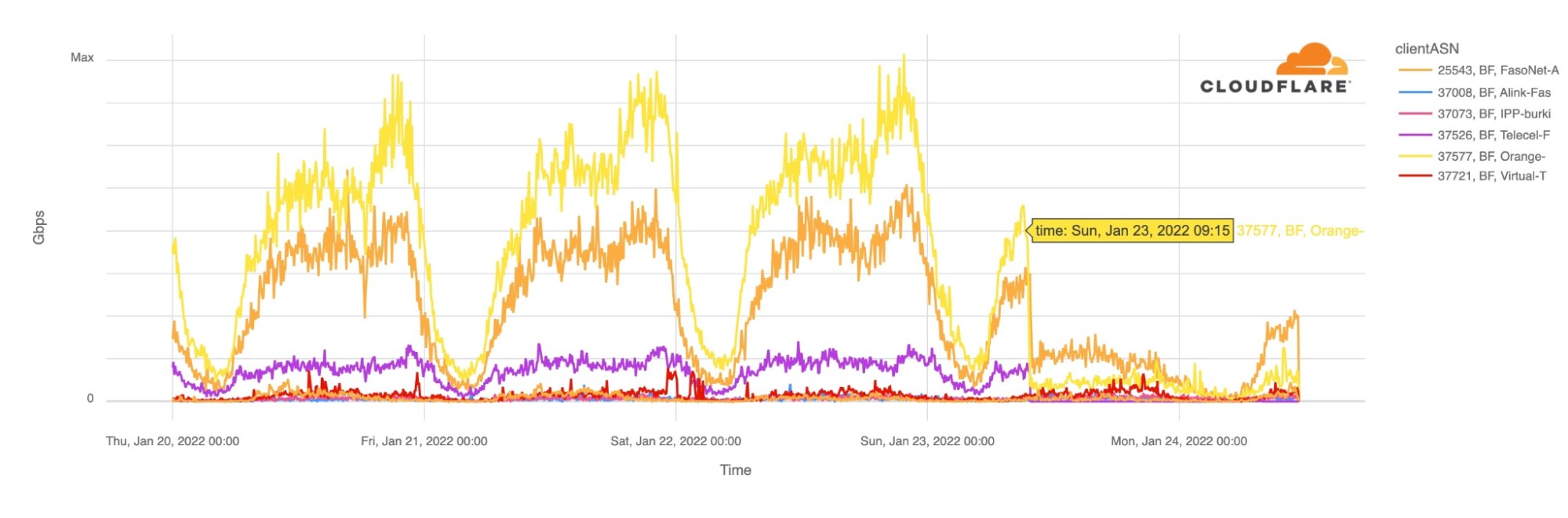
The main ISPs from Burkina Faso were affected. The two leading Internet Service Providers Orange and FasoNet lost Internet traffic after 09:15 UTC, but also Telecel Faso, as the next chart shows. This morning, at around 10:00 UTC there was some traffic from FasoNet but less than half of what we saw at the same time in preceding days.

Burkina Faso experiencing second major Internet disruption this year

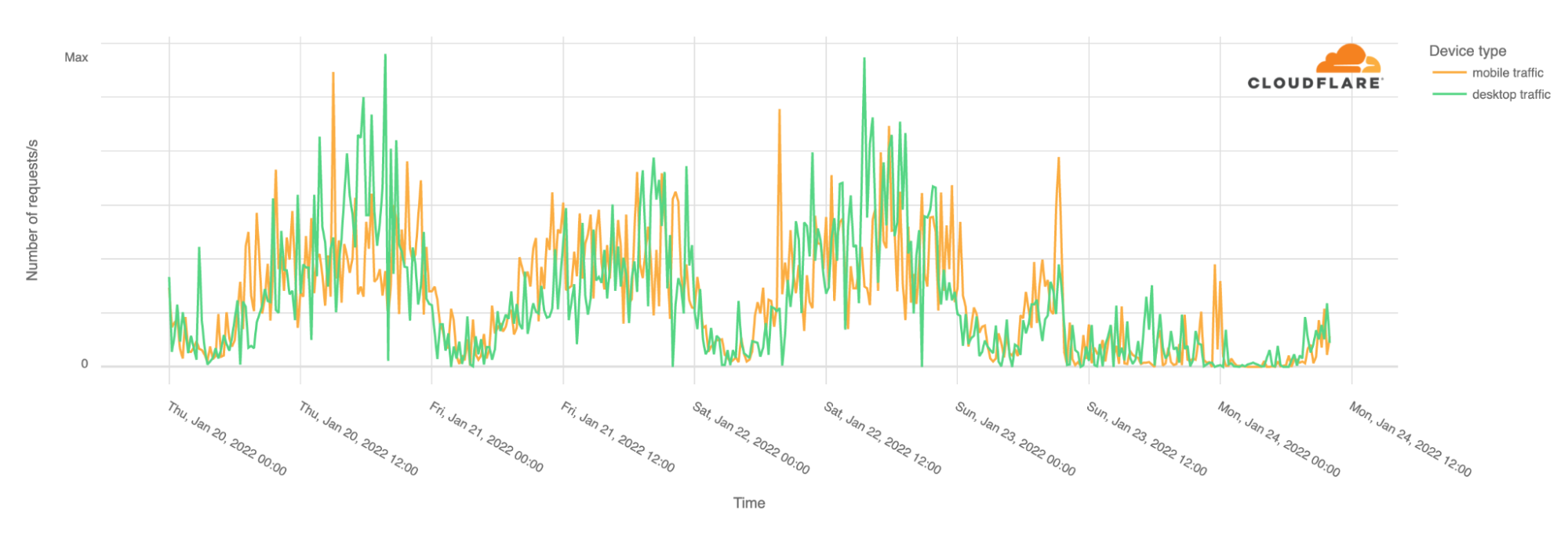
It’s not only mobile traffic that is affected. Desktop traffic is also impacted. In Burkina Faso, our data shows that mobile devices normally represent 70% of Internet traffic.

Burkina Faso experiencing second major Internet disruption this year

With the Burkina Faso disruption, three countries are currently mostly without access to the Internet for different reasons.

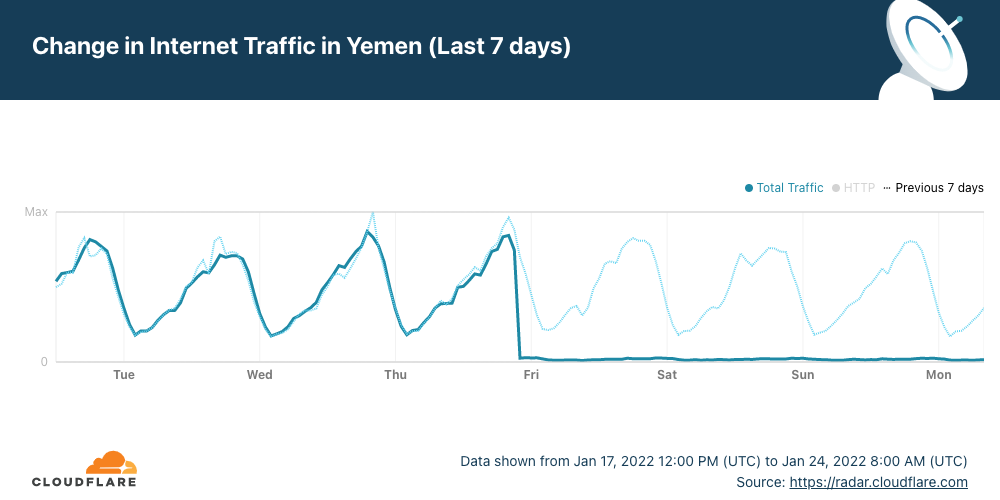
In Yemen, as we reported, the four day-long outage is related to airstrikes that affected a telecommunications building in Al-Hudaydah where the FALCON undersea cable lands.

Burkina Faso experiencing second major Internet disruption this year

In Tonga, the nine day-long outage that we also explained is related to problems in the undersea cable caused by the large volcanic eruption in the South Pacific archipelago.

Burkina Faso experiencing second major Internet disruption this year

Several significant Internet disruptions have already occurred in 2022 for different reasons:

1. An Internet outage that lasted a few hours in The Gambia because of a cable problem (on January 4).
2. A six days Internet shutdown in Kazakhstan because of unrest (from January 5 to January 11).
3. A mobile Internet shutdown in Burkina Faso because of a coup plot (on January 10).
4. An Internet outage in Tonga because of a volcanic eruption (ongoing since January 15).
5. An Internet outage in Yemen because of airstrikes that affected a telecommunications building (ongoing since January 20,).
6. This second Internet disruption in Burkina Faso is related to military unrest (ongoing since January 23).

You can keep an eye on Cloudflare Radar to monitor the Burkina Faso, Yemen and Tonga situations as they unfold.

Internet outage in Yemen amid airstrikes

Post Syndicated from João Tomé original https://blog.cloudflare.com/internet-outage-in-yemen-amid-airstrikes/

Internet outage in Yemen amid airstrikes

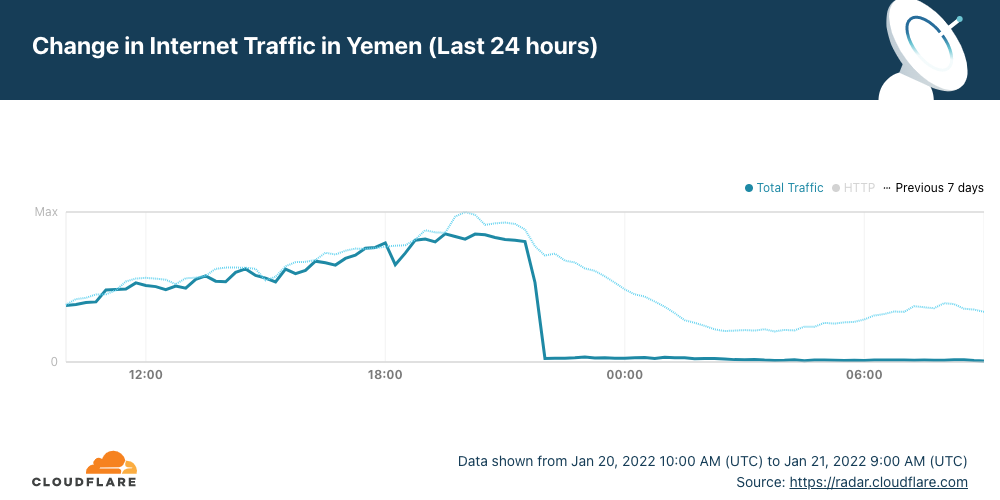
The early hours of Friday, January 21, 2022, started in Yemen with a country-wide Internet outage. According to local and global news reports airstrikes are happening in the country and the outage is likely related as there are reports that a telecommunications building in Al-Hudaydah where the FALCON undersea cable lands.

Cloudflare Radar shows that Internet traffic dropped close to zero between 21:30 UTC (January 20, 2022) and by 22:00 UTC (01:00 in local time).

Internet outage in Yemen amid airstrikes

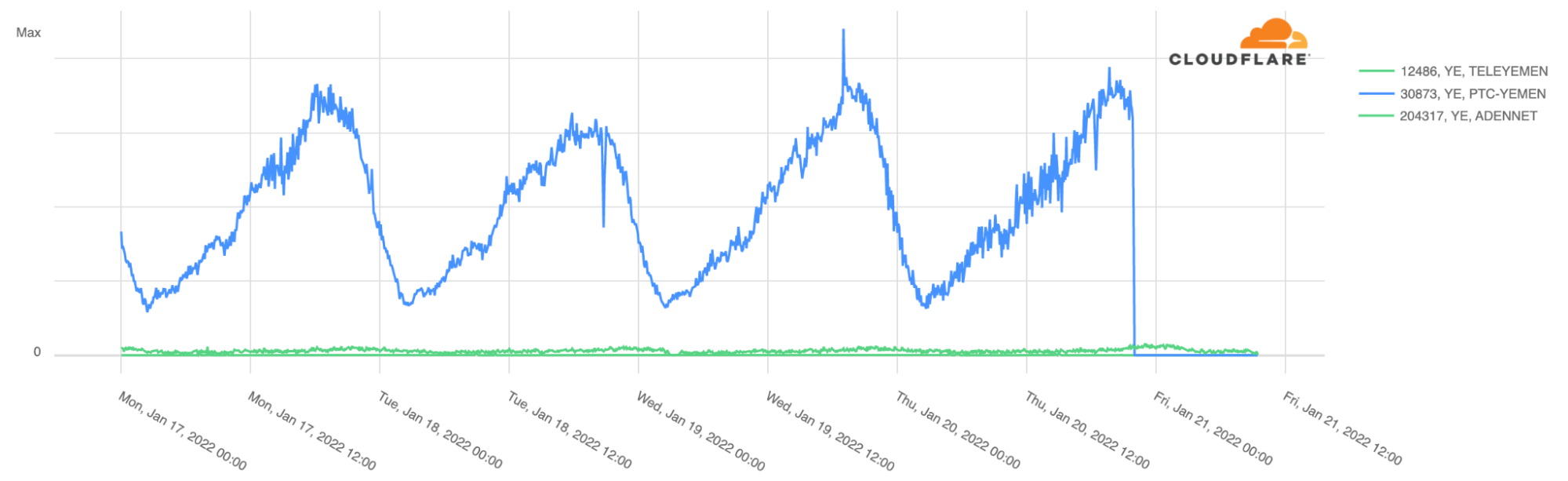
The outage affected the main state-owned ISP, Public Telecommunication Corporation (AS30873 in blue in the next chart), which represents almost all the Internet traffic in the country.

Internet outage in Yemen amid airstrikes

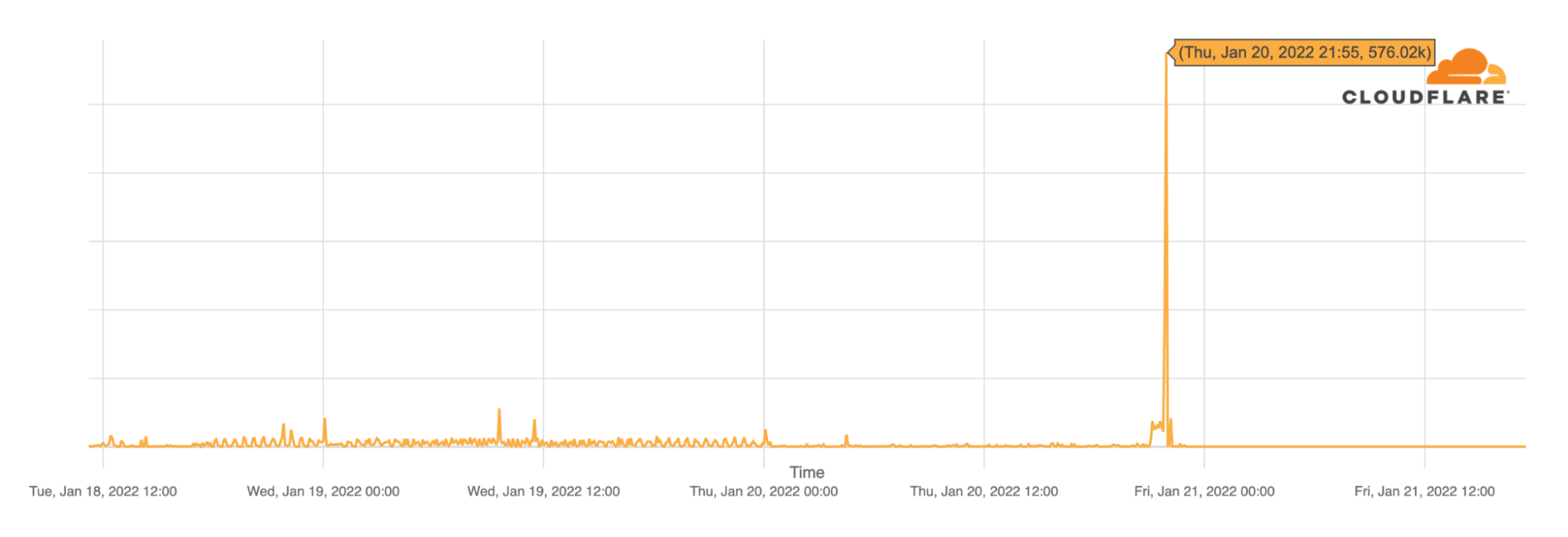
Looking at BGP (Border Gateway Protocol) updates from Yemen’s ASNs around the time of the outage, we see a clear spike at the same time the main ASN was affected ~21:55 UTC, January 20, 2022. These update messages are BGP signalling that Yemen’s main ASN was no longer routable, something similar to what we saw happening in The Gambia and Kazakhstan but for very different reasons.

Internet outage in Yemen amid airstrikes

So far, 2022 has started with a few significant Internet disruptions for different reasons:

1. An Internet outage in The Gambia because of a cable problem.
2. An Internet shutdown in Kazakhstan because of unrest.
3. A mobile Internet shutdown in Burkina Faso because of a coup plot.
4. An Internet outage in Tonga because of a volcanic eruption (still ongoing).

You can keep an eye on Cloudflare Radar to monitor this situation as it unfolds.

Internet shut down in Kazakhstan amid unrest

Post Syndicated from João Tomé original https://blog.cloudflare.com/internet-shut-down-in-kazakhstan-amid-unrest/

Internet shut down in Kazakhstan amid unrest

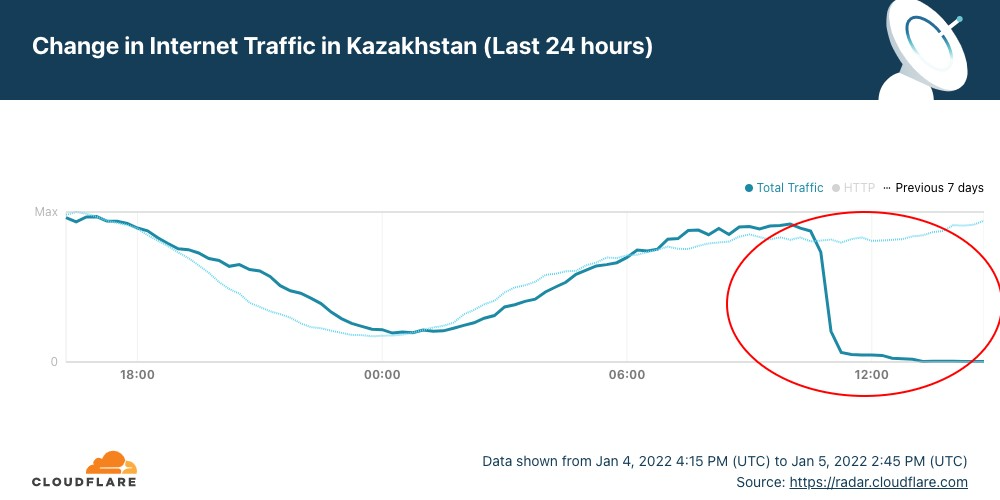
In Kazakhstan, the year had barely got going when yesterday disruptions of Internet access ended up in a nationwide Internet shutdown from today, January 5, 2022. The disruptions and subsequent shutdown happened amid mass protests against sudden energy price rises.

Cloudflare Radar shows that the full shutdown happened after 10:30 UTC (16:30 local time). But it was preceded by restrictions to mobile Internet access yesterday.

Internet shut down in Kazakhstan amid unrest

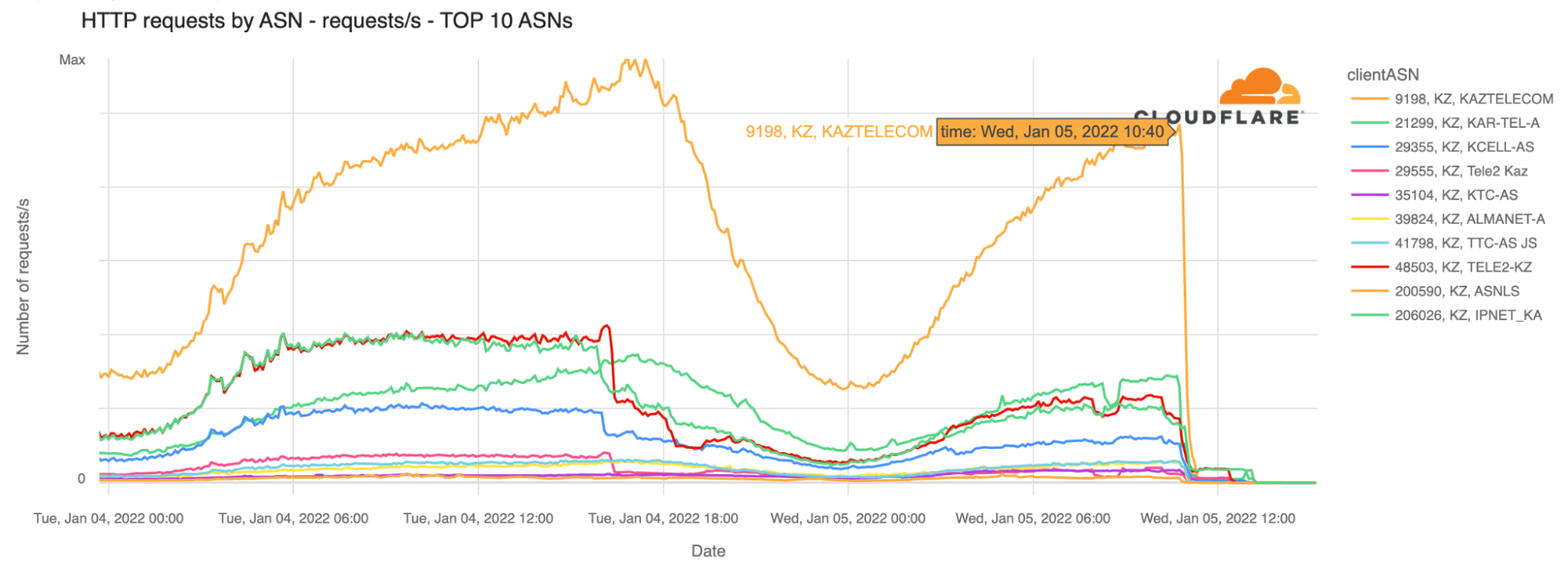
Our data confirm that Kazakhstan’s ASNs were affected after that time (around 18:30 local time). That’s particularly evident with the largest telecommunication company in the country, Kaz Telecom, as the next chart shows.

Internet shut down in Kazakhstan amid unrest

The first disruptions reported affected mobile services, and we can see that at around 14:30 UTC yesterday, January 4, 2022, there was significantly less mobile devices traffic than the day before around the same time. Kazakhstan is a country where mobile represents something like 75% of Internet traffic (shown on Radar), a usual trend in the region. So mobile disruption has a big impact on the country’s Internet, even before the shutdown that affected almost all connectivity.

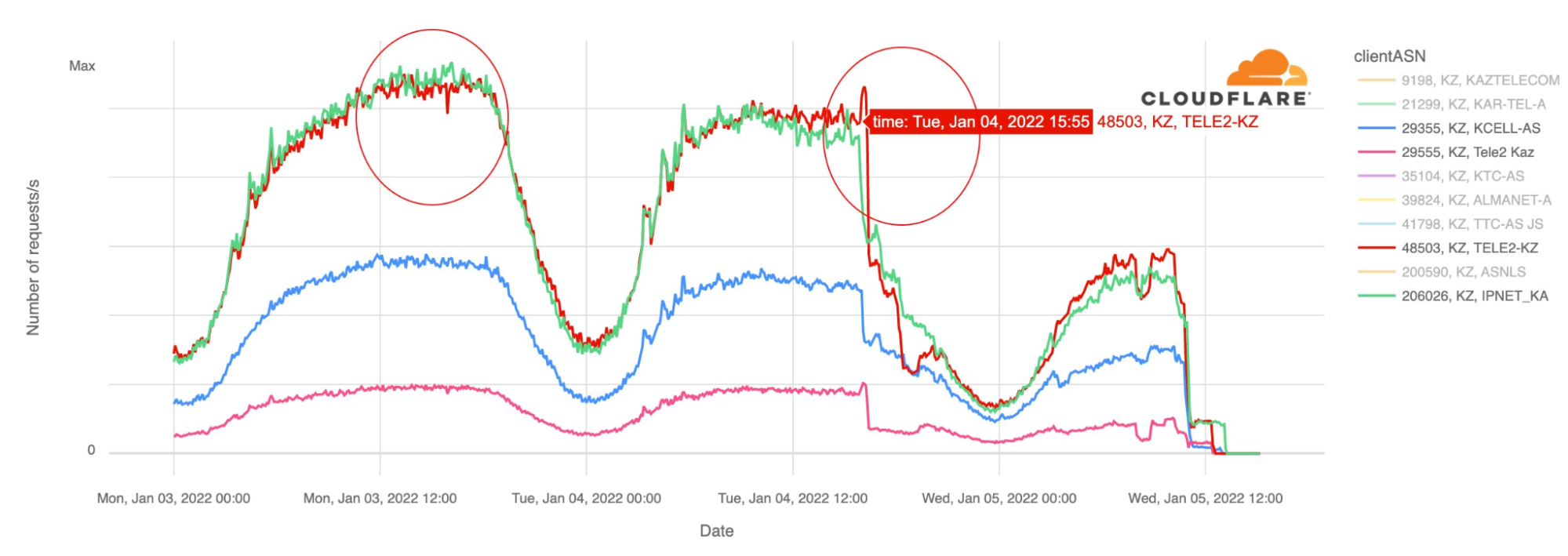
When we focus on other ASNs besides Kaz Telecom such as the leading mobile Internet services Tele2 or Kcell we can see a big drop in traffic yesterday after 16:00 UTC, confirming local reports. Mobile traffic did not drop to zero which may indicate throttling rather than a full shutdown. Today, however, the Internet, mobile or not, is shut down.

Internet shut down in Kazakhstan amid unrest

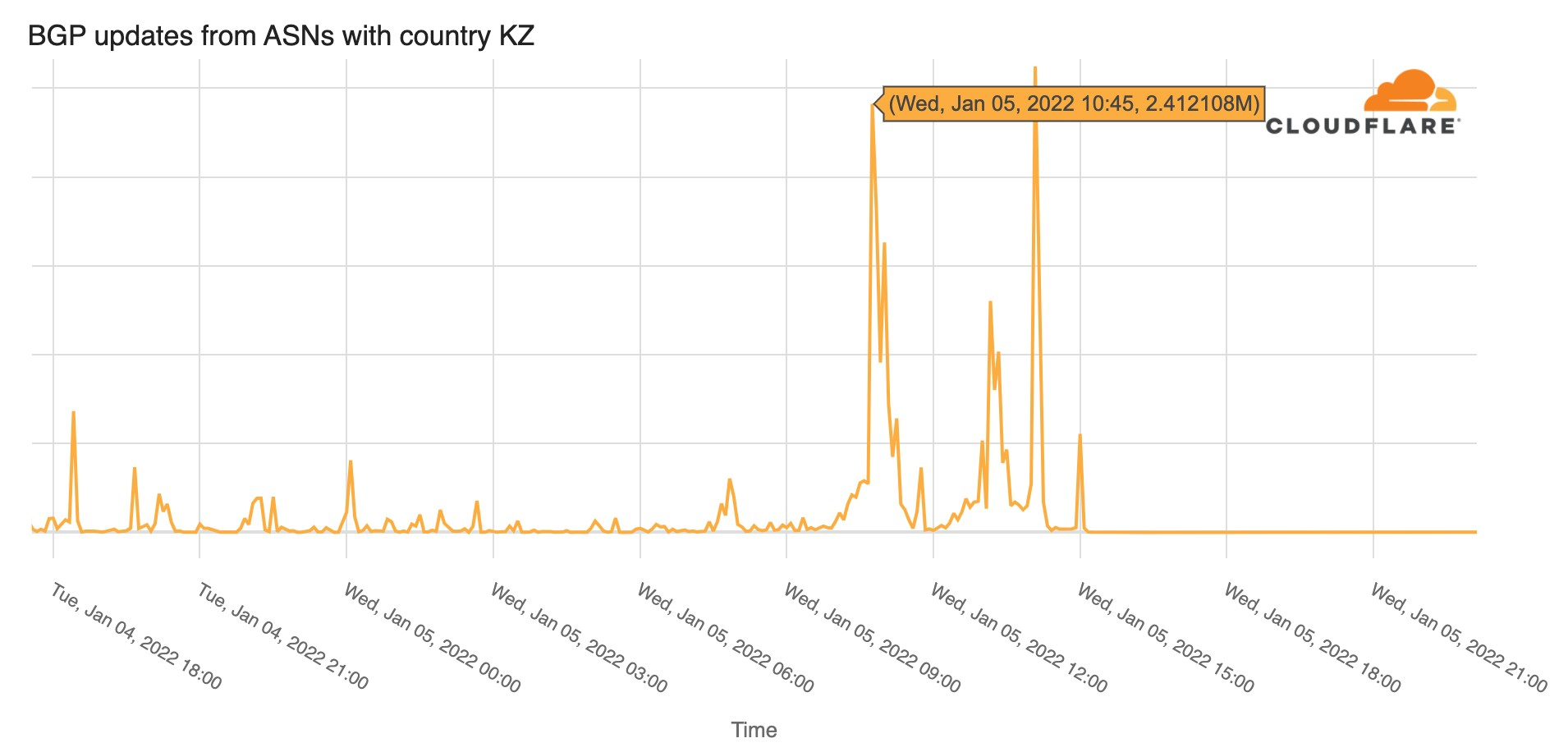
Looking at BGP (Border Gateway Protocol) updates from Kazakhstan’s ASNs around the time of the shutdown, we see a clear spike at exactly the same time the bigger ASNs were affected ~10:45 UTC, January 5, 2022. These update messages are BGP signaling that Kazakhstan’s ASNs are no longer routable, something similar to what we saw happening in The Gambia yesterday but for very different reasons.

Internet shut down in Kazakhstan amid unrest

The Kazakhstan case is similar to other state-imposed shutdowns that also happen all too frequently, generally used to deal with situations of unrest, elections or even exams. There are similarities with the Sudan 25-day shutdown that we reported at the end of 2021, the Sudanese prime minister resigned this week in the aftermath of those shutdowns, but it’s very different from the Internet outage in The Gambia that we reported today.

You can keep an eye on Cloudflare Radar to monitor how we see Internet traffic globally and in every country.

How The Gambia lost access to the Internet for more than 8 hours

Post Syndicated from David Belson original https://blog.cloudflare.com/the-gambia-without-internet/

How The Gambia lost access to the Internet for more than 8 hours

How The Gambia lost access to the Internet for more than 8 hours

Internet outages are more common than most people think, and may be caused by misconfigurations, power outages, extreme weather, or infrastructure damage. Note that such outages are distinct from state-imposed shutdowns that also happen all too frequently, generally used to deal with situations of unrest, elections or even exams.

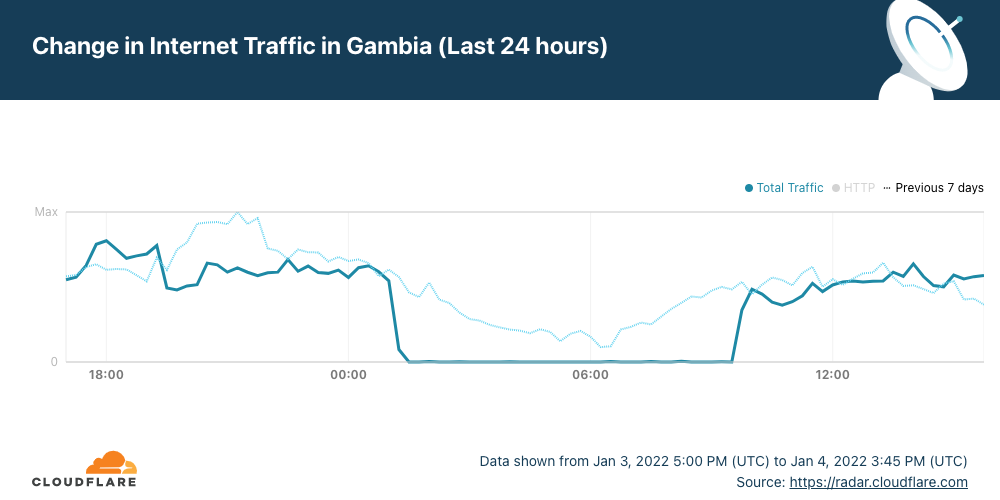
On the morning of January 4, 2022, citizens of The Gambia woke up to a country-wide Internet outage. Gamtel (the main state-owned telecommunications company of the West Africa country), announced that it happened due to “technical issues on the backup links” — we elaborate more on this below.

Cloudflare Radar shows that the outage had a significant impact on Internet traffic in the country and started after 01:00 UTC (which is the same local time), lasting until ~09:45 — a disruption of over 8 hours.

How The Gambia lost access to the Internet for more than 8 hours

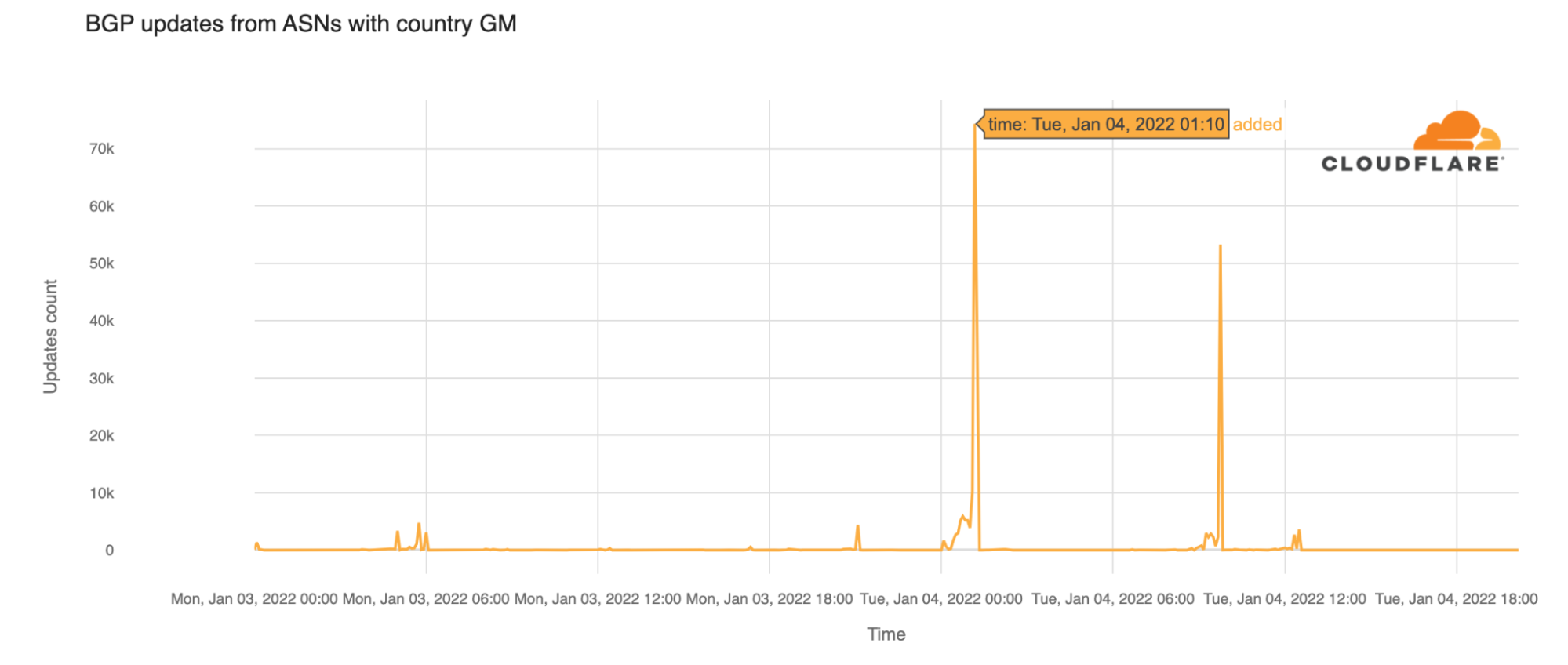
Looking at  BGP (Border Gateway Protocol) updates from Gambian ASNs around the time of the outage, we see a clear spike at 01:10 UTC. These update messages are BGP signaling that the Gambian ASNs are no longer routable.

How The Gambia lost access to the Internet for more than 8 hours

It is important to know that BGP is a mechanism to exchange routing information between autonomous systems (networks) on the Internet. The routers that make the Internet work have huge, constantly updated lists of the possible routes that can be used to deliver every network packet to their final destinations. Without BGP, the Internet routers wouldn’t know what to do, and the Internet wouldn’t work. As we saw in our blog post in 2021 about how Facebook disappeared from the Internet, the Internet is literally a network of networks, and it’s bound together by BGP.

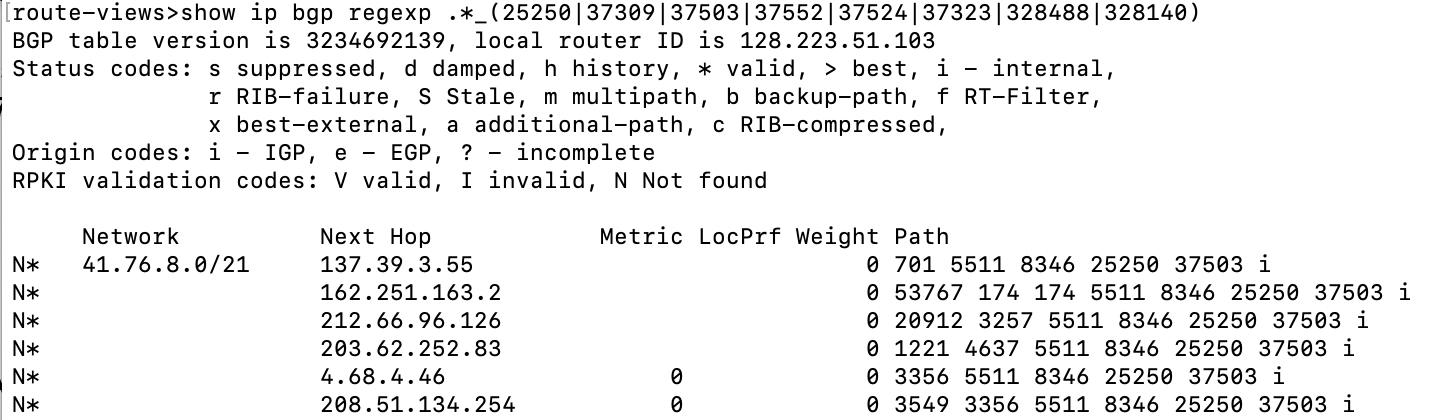
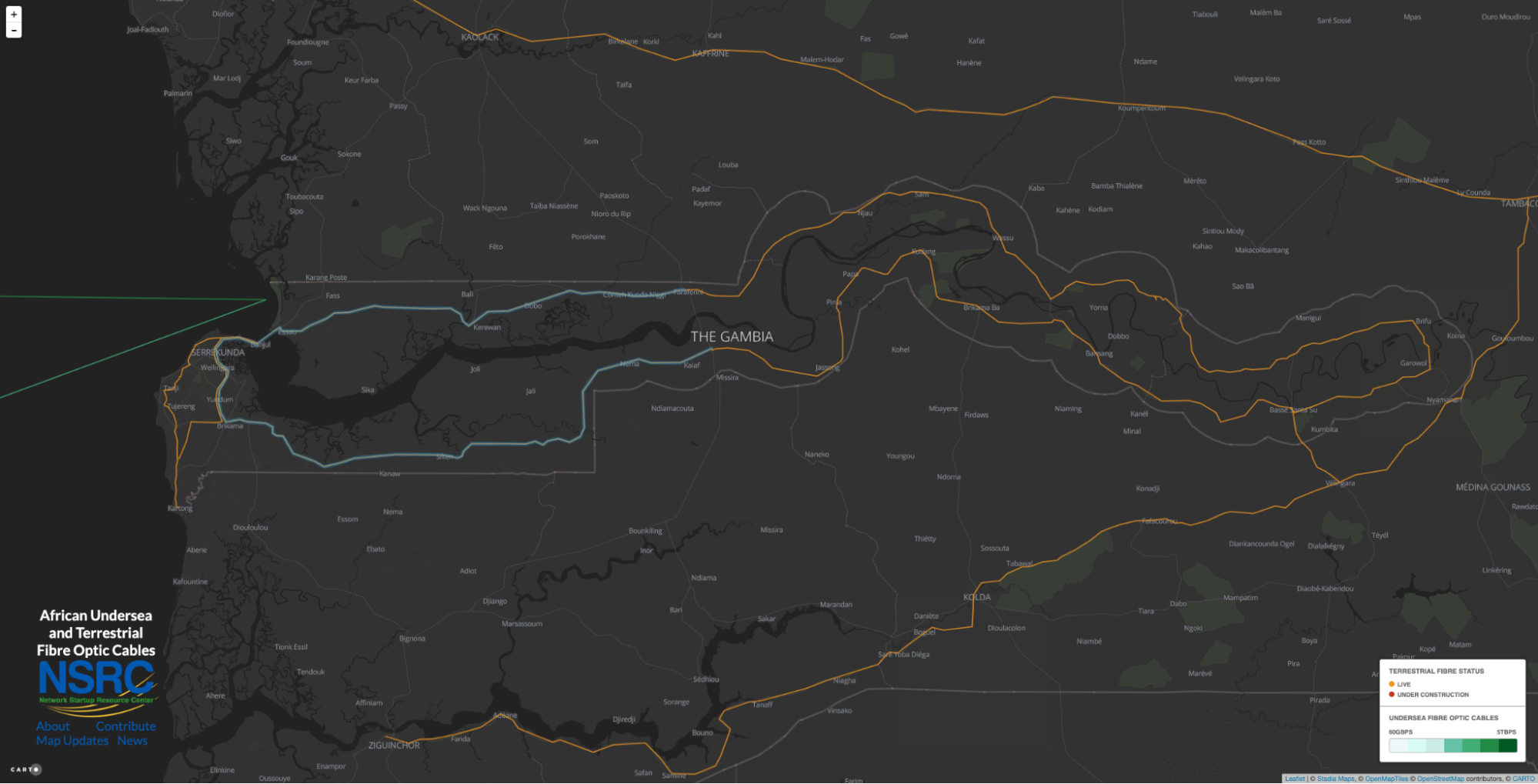
The Gambia’s Internet access is solely dependent on a single provider, Gamtel. Because The Gambia’s international Internet connectivity via the ACE submarine cable was unavailable, it was reliant on the “backup links” referenced above – terrestrial connectivity via Senegal and the provider Sonatel. This is visible in BGP data. If we look at the ASNs that are allocated to networks in The Gambia (AS25250, AS37309, AS37503, AS37552, AS37524, AS37323, AS328488, AS328140), and put those into a regular expression on BGP routing tools like route-views as so:

route-views>show ip bgp regexp .*_(25250|37309|37503|37552|37524|37323|328488|328140)

We are able to see all the possible upstream ASN paths from these networks to the rest of the Internet.

Looking at the “Path” results, we see that AS8346 (Sonatel) and AS25250 (Gamtel) are in the path for all the Gambian networks.

How The Gambia lost access to the Internet for more than 8 hours

Visualized, you can see the dependency on this network path for The Gambia’s Internet access.

How The Gambia lost access to the Internet for more than 8 hours

No interruptions were seen in Sonatel (AS8346), so this indicates that the single network path between Sonatel and Gamtel (AS25250) is a critical point for connectivity. A failure in either of these networks could result in The Gambia going offline again.

Yesterday’s outage in The Gambia outage illustrates something we frequently reference here in the blog: the Internet is literally a network of networks. A significant amount of  Internet traffic is carried by a complex network of undersea fiber-optic cables that connect countries and continents — all the cable systems used have landing points in two or more countries. So a problem in one country can easily affect others.

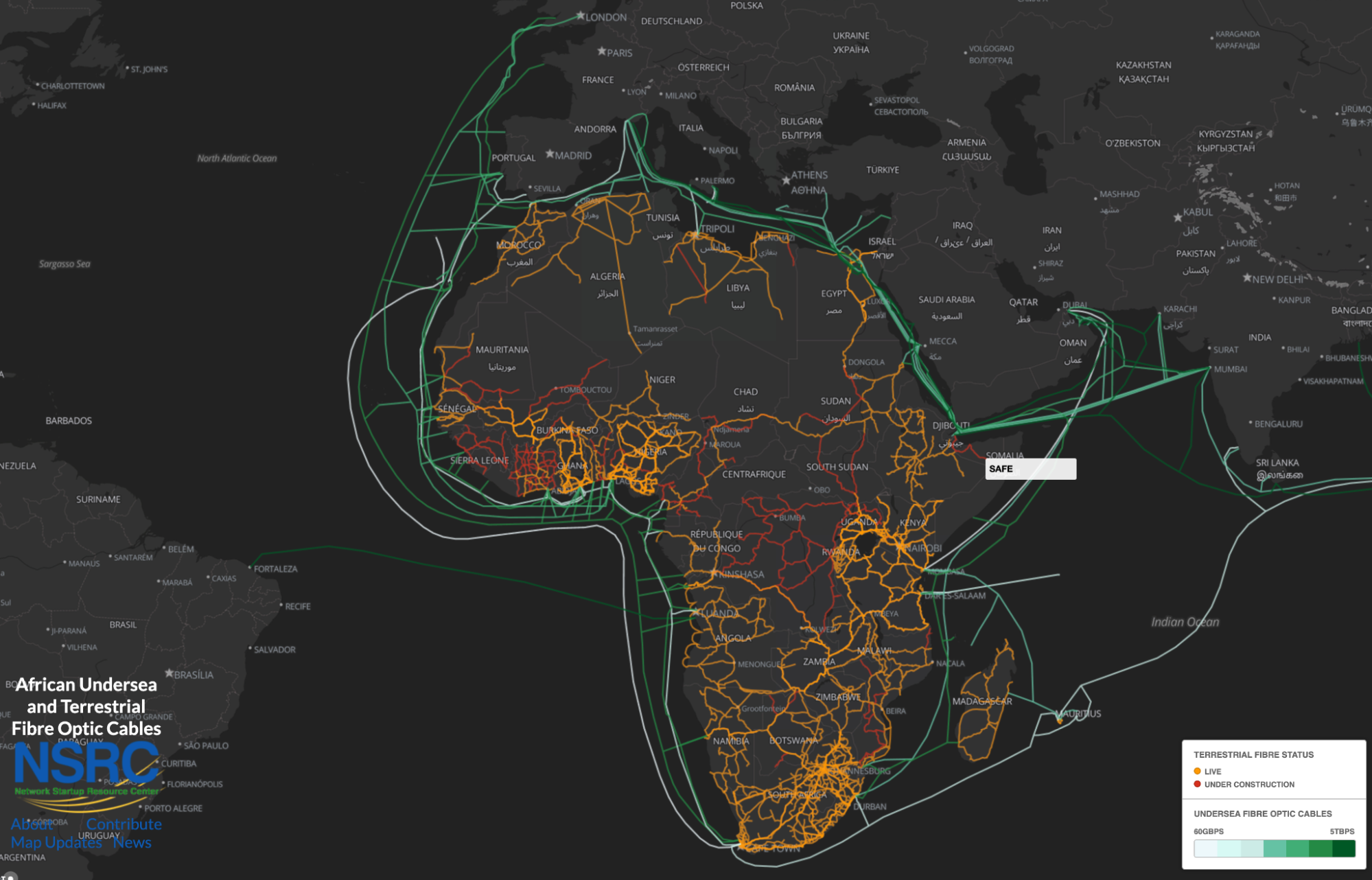
Going back to The Gambia, Gamtel explained in a January 5, 2022, press release that there was “a primary link failure at ACE” — the cable system that serves 24 countries, from Europe to Africa. “The ACE cable repair is expected to be completed in mid-January, 2022,” explained the company.

How The Gambia lost access to the Internet for more than 8 hours
The full ACE (Africa Coast to Europe) submarine cable system. From NSRC

The “backup failure” here was “due to a faulty card at Toubakota, in Senegal”. That problem affects “both the Karang and Seleti links [points of cable connections from Senegal to The Gambia] as both North and South links converges there”. “Thus, the reason for the complete isolation on the Sonatel link”, concludes Gamtel.

Recognizing the critical importance of reliable Internet connectivity, The Gambia Public Utilities Regulatory Authority also issued a statement noting “The Authority, operators, MOICI, and the Government are exploring other options of making sure that the Gambia has a second fibre cable backup considering the impact that these failures are having on our national security, economy, and social activities.”

Burkina Faso Internet shutdown

Post Syndicated from João Tomé original https://blog.cloudflare.com/burkina-faso-internet-shutdown/

Burkina Faso Internet shutdown

Burkina Faso Internet shutdown

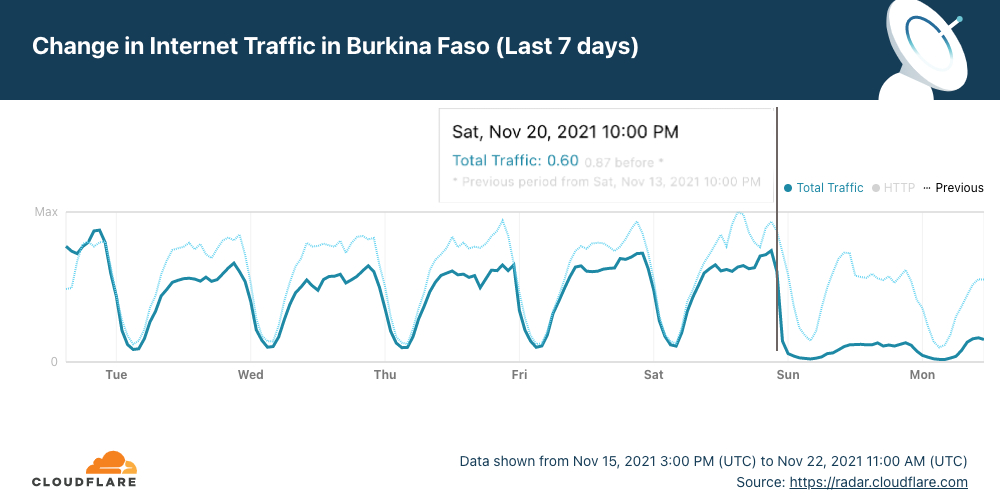
A few days after Sudan restored access to the Internet, people living in Burkina Faso are facing an Internet shutdown. On Saturday, Cloudflare Radar shows that after 22:00 UTC (the same local time) Internet traffic went down significantly, something that has happened in the context of social tensions in the country that started on November 14, 2021, and after this Saturday’s shooting of protesters that tried to block a French military convoy.

Burkina Faso Internet shutdown

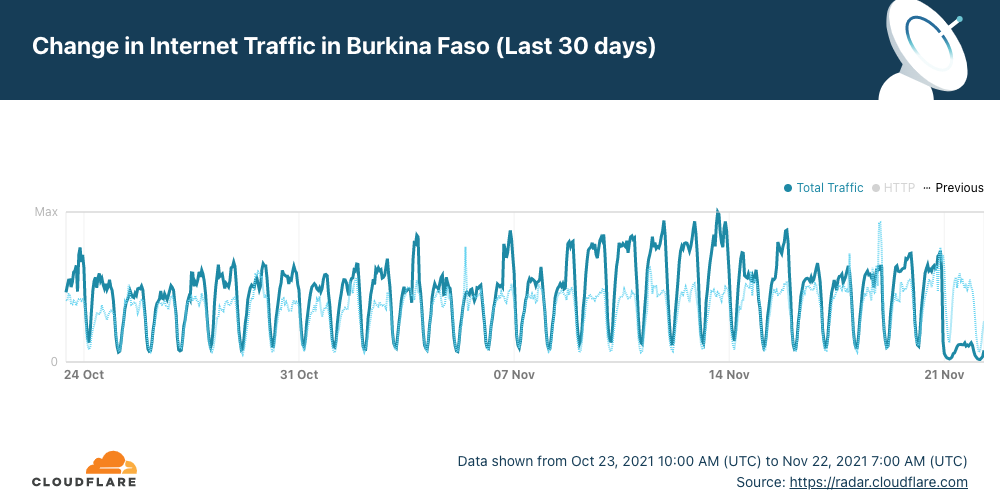
It is clear when we look at the last 30 days, that Sunday and today, Monday, November 22, are days almost without Internet traffic in Burkina Faso.

Burkina Faso Internet shutdown

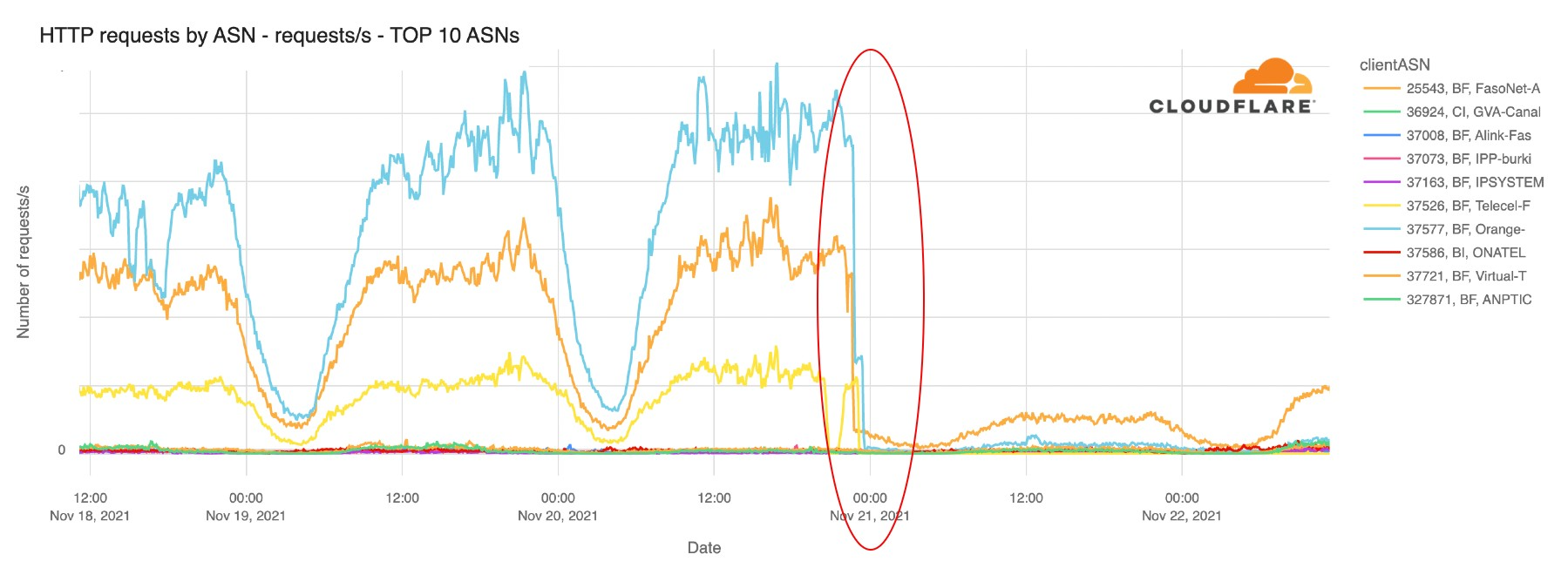
All the Internet Service Providers (ISP) of the country were significantly affected by what we could see in our data. That is evident when we look at HTTP traffic by ASN (Autonomous System Number). Orange, FasoNet and Telecel are the three most used ISPs in the country and this chart clearly shows how they were impacted.

Burkina Faso Internet shutdown

Mobile traffic affected

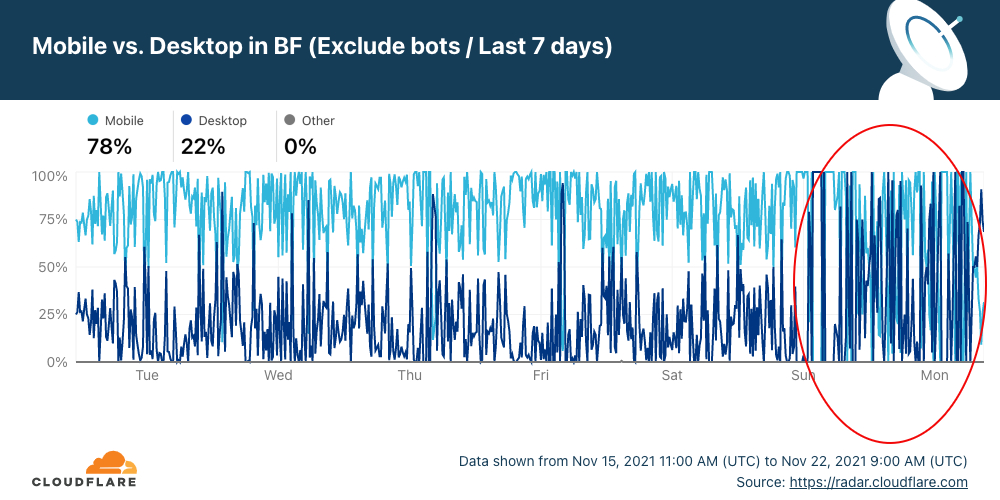
Burkina Faso is a mobile-first country because mobile is the main way of accessing the Internet — in the last 30 days the mobile traffic percentage represented 77% of the total Internet traffic in the country.

We can also see in Cloudflare Radar that desktop traffic percentage went up after Saturday night (the dark blue line in the chart), something that indicates that mobile networks were the main focus of the shutdown.

Burkina Faso Internet shutdown

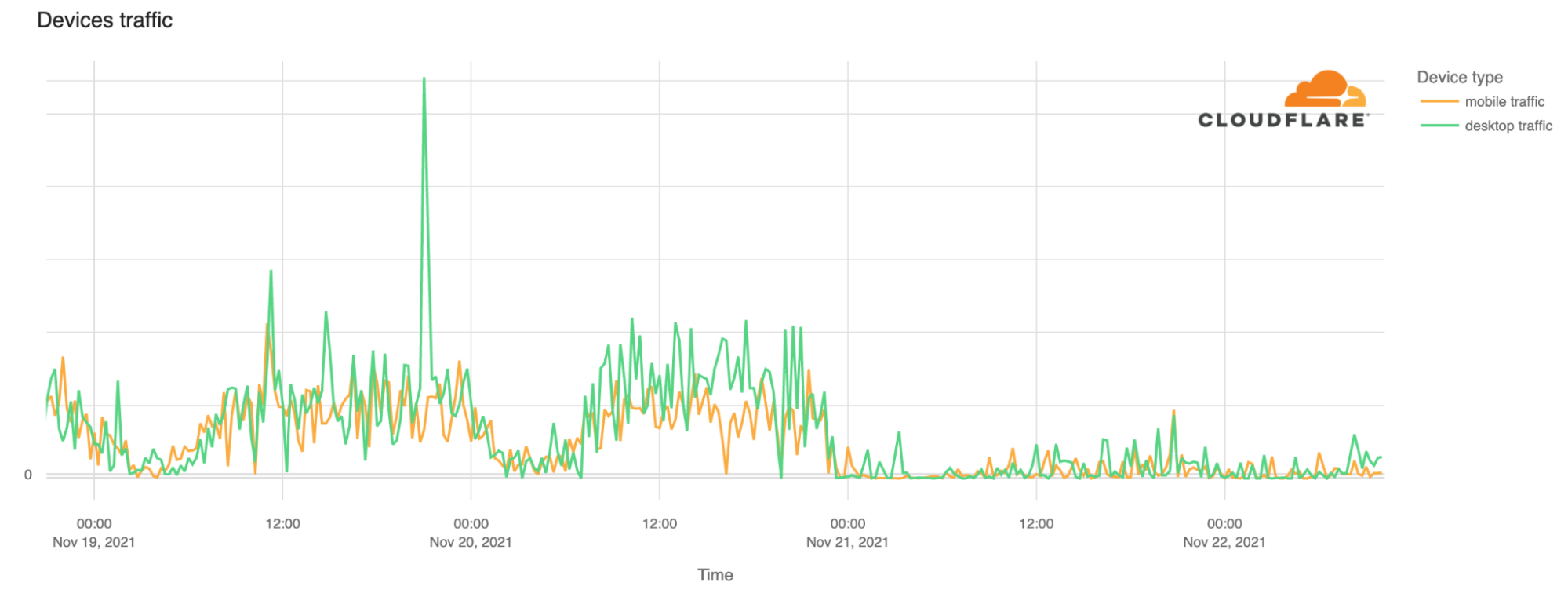
Looking at the number of requests we get a better ‘picture’ of the situation and how the desktop traffic percentage started to take over compared to mobile traffic in the last few days.

Burkina Faso Internet shutdown

In the case of Sudan, the Internet shutdown went on for 25 days. You can keep an eye on Cloudflare Radar to monitor how the Burkina Faso situation evolves, but also you can see the Internet traffic globally and in every country.

Sudan was cut off from the Internet for 25 days

Post Syndicated from João Tomé original https://blog.cloudflare.com/sudan-internet-back-25-days/

Sudan was cut off from the Internet for 25 days

Sudan was cut off from the Internet for 25 days

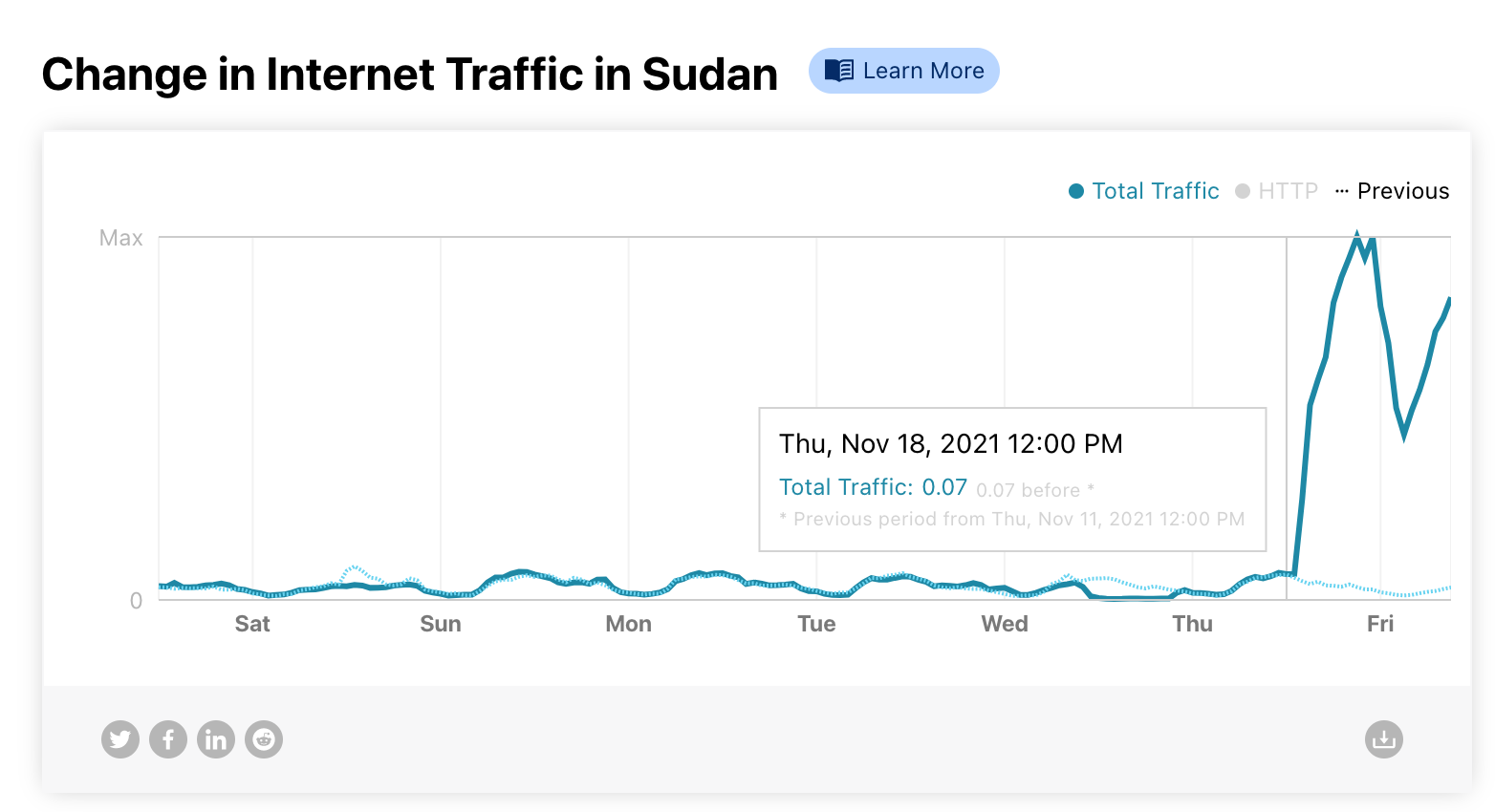
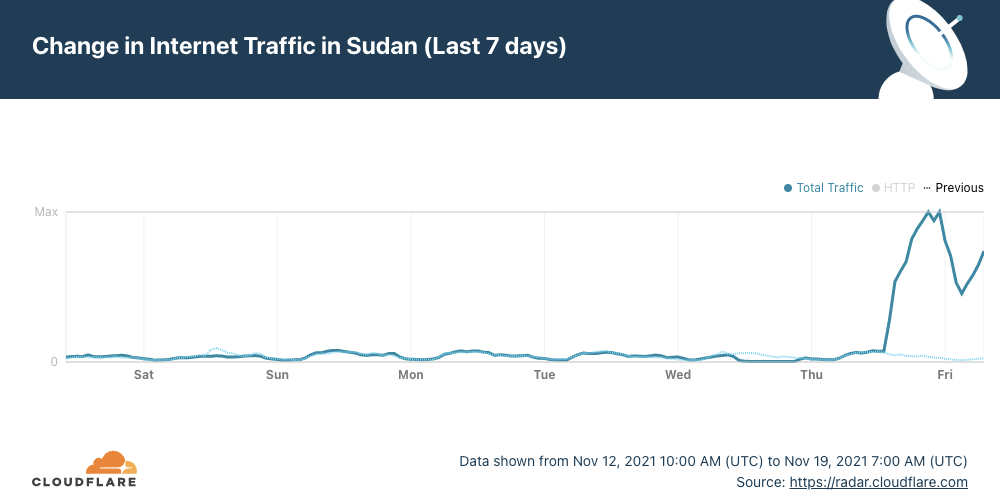
Internet traffic started to come back in Sudan (with limitations) on Thursday, November 18, 2021. This happened after 25 days of an almost complete shutdown that affected the whole country. It’s a simple line going up on a chart for us, but for a country that also meant that Internet access was (at least in part) back on with all of what comes with it for businesses, communities, families and society as a whole.

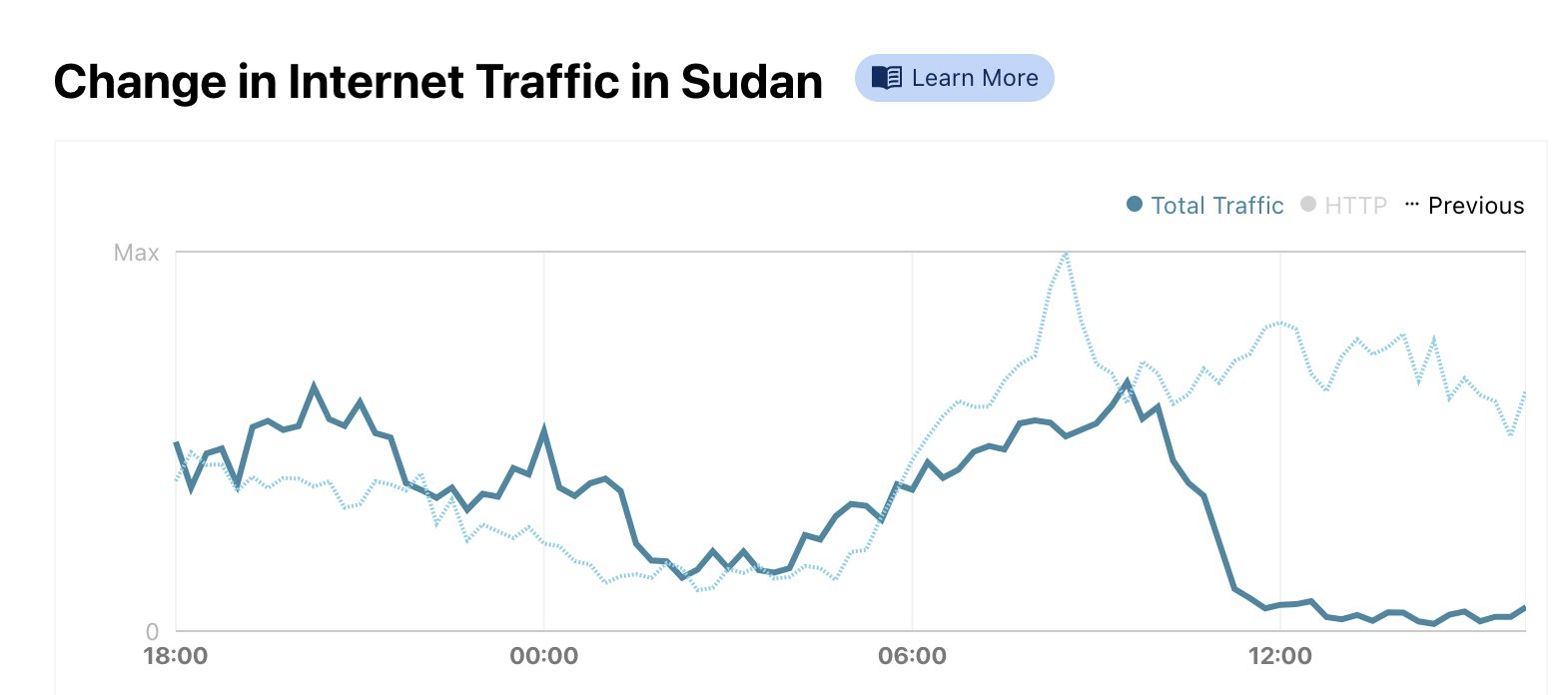
You can see that trend on Cloudflare Radar, in particular after 13:00 UTC (15:00 local time). After that Internet traffic went up like we haven’t seen at all in the previous three weeks.

Sudan was cut off from the Internet for 25 days

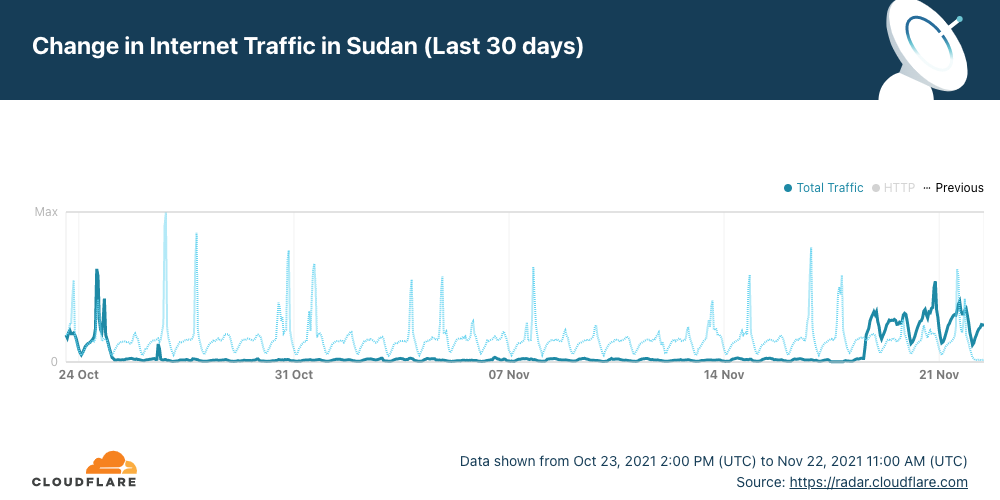
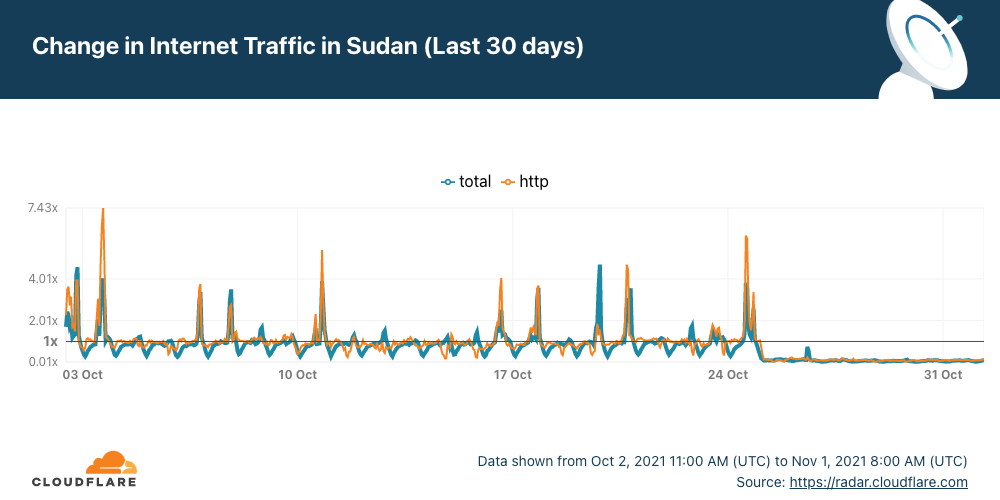
Internet access was mostly cut off on October 25, 2021, after a political turmoil in the country. A Sudanese court previously ordered the restoration of Internet access on November 9, but until last Thursday, November 18, there were no signs of services returning to normal. The biggest Internet access shutdown in recent history in the country was back in 2019 — for a full 36 days.

Looking back at the last 30 days Cloudflare Radar shows very distinctively a big difference from what was previously normal in the country.

Sudan was cut off from the Internet for 25 days

On Wednesday, November 17, (around 11:00 UTC) we saw a further drop in traffic getting Internet traffic in the country close to zero.

Sudan was cut off from the Internet for 25 days

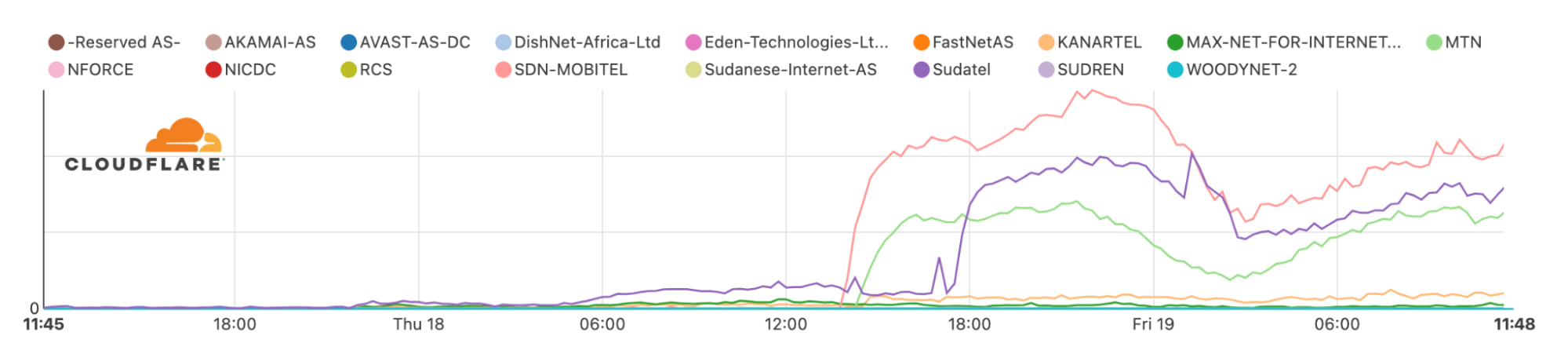
Now our data shows that the Internet in Sudan picked up firstly thanks to two ISPs, Mobitel and MTN. One of the largest in the country, Sudatel (purple line) for a few hours was also still mostly down, but it came back later in the evening (~18:00 UTC).

Sudan was cut off from the Internet for 25 days

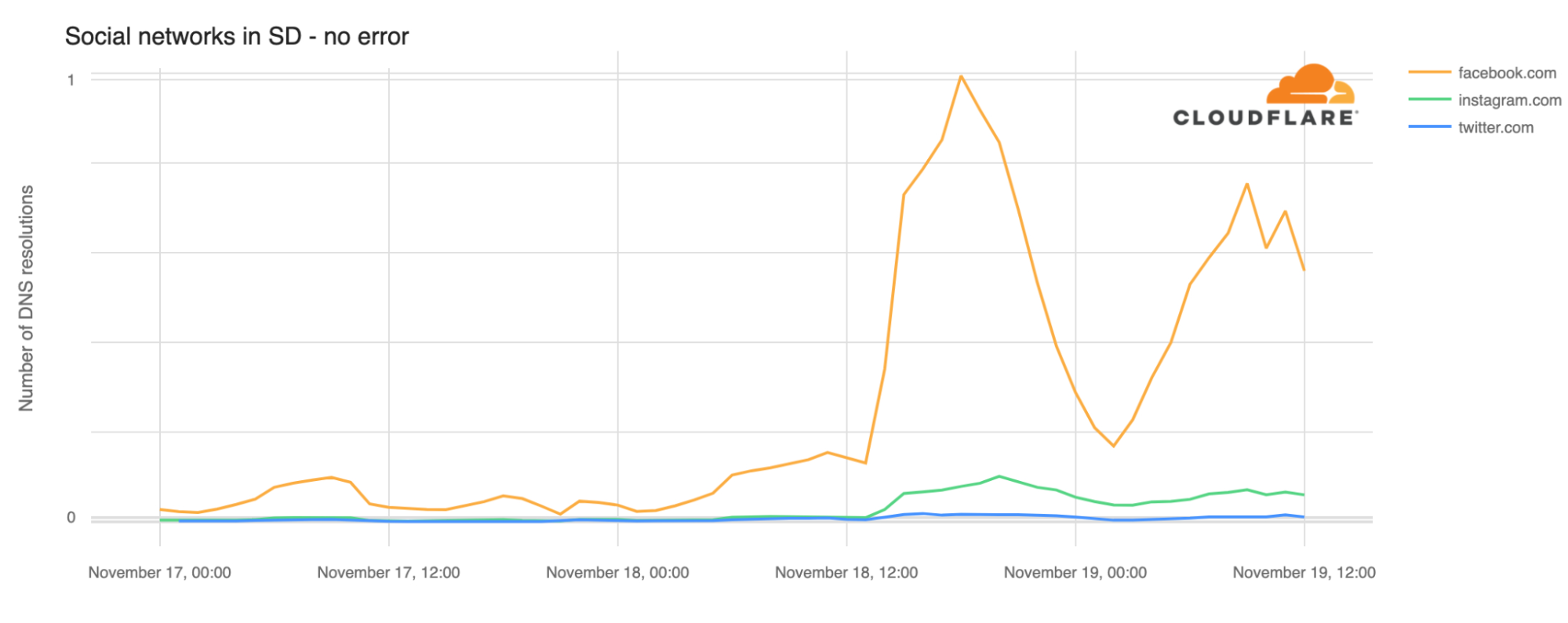
In terms of social media, our data also shows that especially Facebook traffic went up at the same time Internet access was beginning to pick up but went down a few hours later. According to local reports, there could be restrictions to social media on mobile networks in the country.

Sudan was cut off from the Internet for 25 days

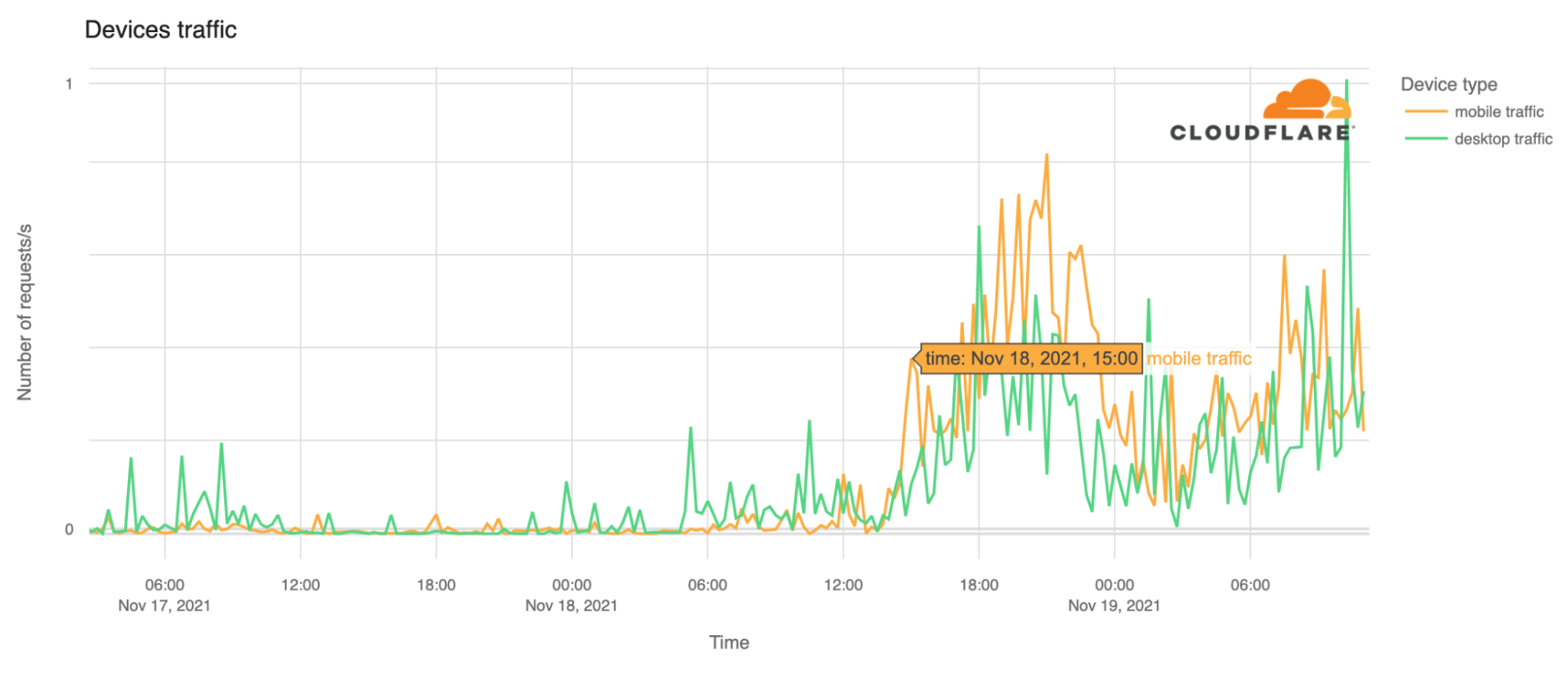
Mobile traffic saw a big increase, especially after 14:00 UTC. That is normal behaviour in a country where mobile traffic is king (back in October we showed in our blog post about mobile traffic how Sudan was one of the countries in the world with a large percentage of mobile traffic — 83%).

Sudan was cut off from the Internet for 25 days

Internet shutdowns are not that rare

We’ve said it before here in our blog, but it is always good to emphasize: Internet disruptions, including shutdowns and social media restrictions, are common occurrences in some countries and Sudan is one where this happens more frequently than most countries according to Human Rights Watch.

In our June 22, 2021, blog, we talked about Sudan when the country decided to shut down the Internet to prevent cheating in exams, but there were situations in the past more similar to this days-long shutdown — something that usually happens when there’s political unrest.

The country’s longest recorded network disruption was back in 2018, when Sudanese authorities cut off access to social media (and messaging apps like WhatsApp) for 68 consecutive days from December 21, 2018, to February 26, 2019. After that, there was a full mobile Internet shutdown reported from June 3 to July 9, 2019, that lasted 36 days.

This time, in 2021, it was 25 days when the Internet access was reduced to just a trickle of traffic getting through.

You can keep an eye on Cloudflare Radar to monitor how we see the Internet traffic globally and in every country.

Sudan: seven days without Internet access (and counting)

Post Syndicated from João Tomé original https://blog.cloudflare.com/sudan-seven-days-without-internet-access-and-counting/

Sudan: seven days without Internet access (and counting)

Sudan: seven days without Internet access (and counting)

It’s not every day that there is no Internet access in an entire country. In the case of Sudan, it has been five days without Internet after political turmoil that started last Monday, October 25, 2021 (as we described).

The outage continues with almost a flat line and just a trickle of Internet traffic from Sudan. Cloudflare Radar shows that the Internet in Sudan is still almost completely cut off.

Sudan: seven days without Internet access (and counting)

There was a blip of traffic on Tuesday at ~14:00 UTC, for about one hour, but it flattened out again, and it continues like that — anyone can track the evolution on the Sudan page of Cloudflare Radar.

Sudan: seven days without Internet access (and counting)

Internet shutdowns are not that rare

Internet disruptions, including shutdowns and social media restrictions, are common occurrences in some countries and Sudan is one where this happens more frequently than most countries according to Human Rights Watch. In our June blog, we talked about Sudan when the country decided to shut down the Internet to prevent cheating in exams, but there were situations in the past more similar to this days-long shutdown — something that usually happens when there’s political unrest.

The country’s longest recorded network disruption was back in 2018, when Sudanese authorities cut off access to social media (and messaging apps like WhatsApp) for 68 consecutive days from December 21, 2018 to February 26, 2019. There was a full mobile Internet shutdown reported from June 3 to July 9, 2019 that lasted 36 days.

You can keep an eye on Cloudflare Radar to monitor how we see the Internet traffic globally and in every country.

Sudan woke up without Internet

Post Syndicated from Celso Martinho original https://blog.cloudflare.com/sudan-woke-up-without-internet/

Sudan woke up without Internet

Sudan woke up without Internet

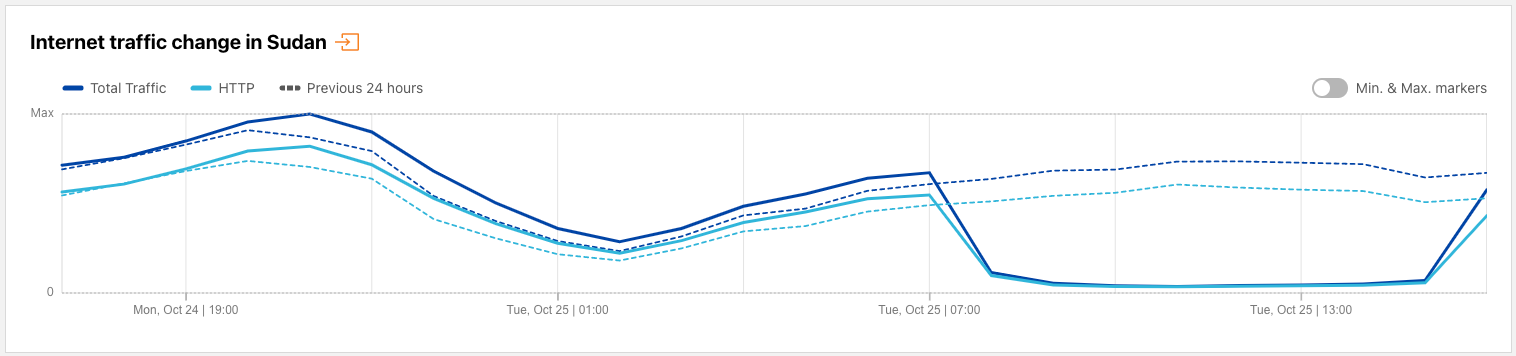
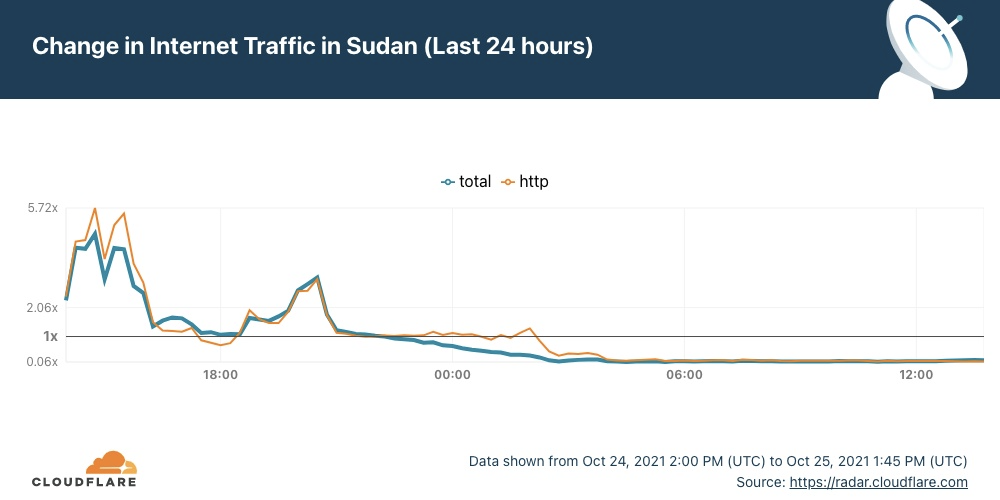
Today, October 25, following political turmoil, Sudan woke up without Internet access.

In our June blog, we talked about Sudan when the country decided to shut down the Internet to prevent cheating in exams.

Now, the disruption seems to be for other reasons. AP is reporting that “military forces … detained at least five senior Sudanese government figures.”. This afternoon (UTC) several media outlets confirmed that Sudan’s military dissolved the transitional government in a coup that shut down mobile phone networks and Internet access.

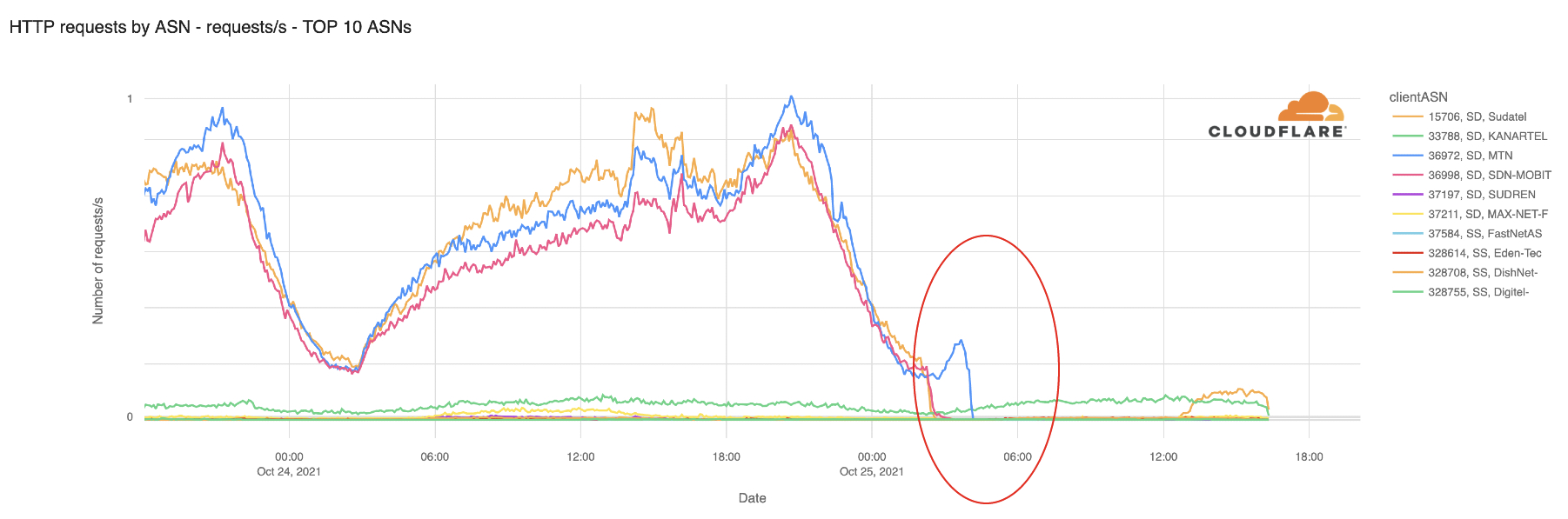
Cloudflare Radar allows anyone to track Internet traffic patterns around the world. The dedicated page for Sudan clearly shows that this Monday, when the country was waking up, the Internet traffic went down and continued that trend through the afternoon (16:00 local time, 14:00 UTC).

Sudan woke up without Internet

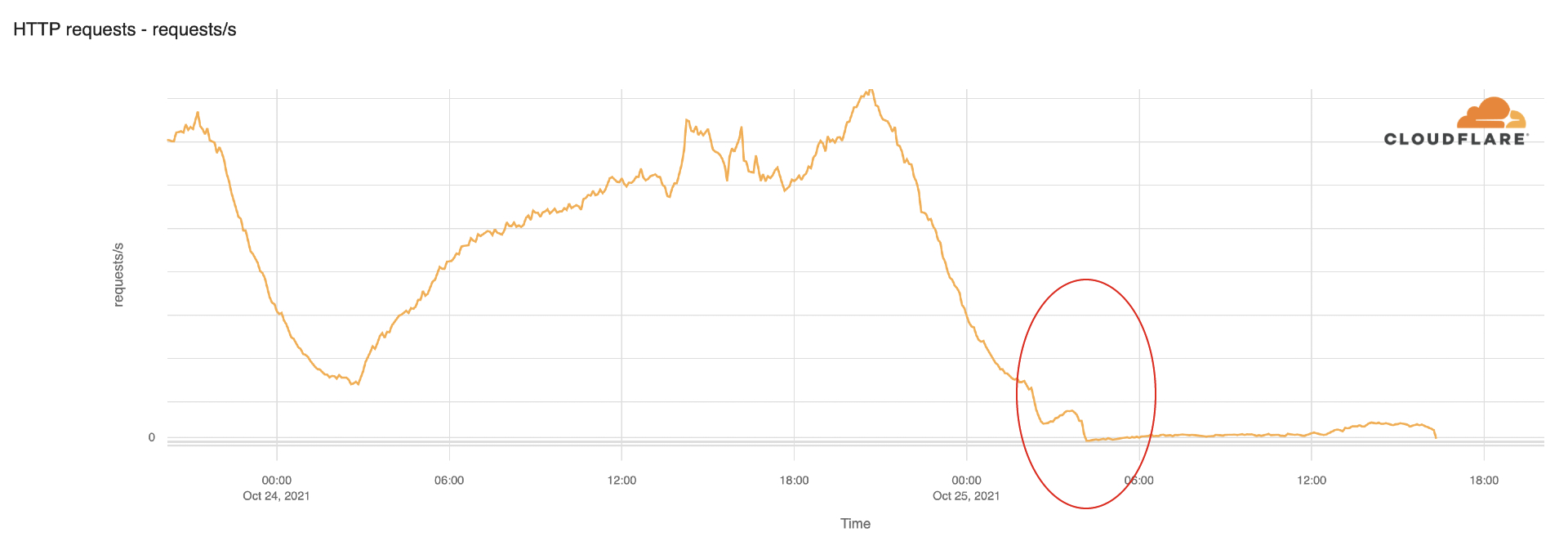
We dug in a little more on the HTTP traffic data. It usually starts increasing after 06:00 local time (04:00 UTC). But this Monday morning, traffic was flat, and the trend continued in the afternoon (there were no signs of the Internet coming back at 18:00 local time).

Sudan woke up without Internet

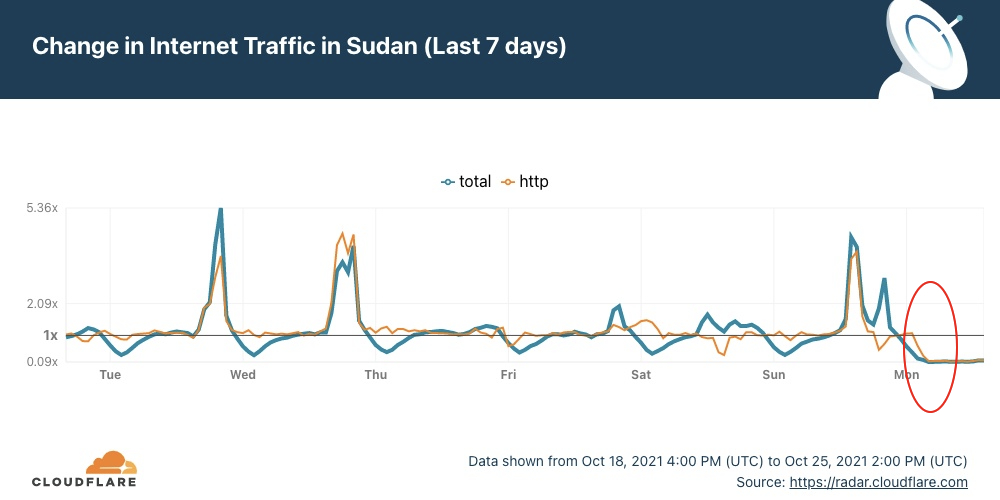
When comparing today with the last seven days’ pattern, we see that today’s drop is abrupt and unusual.

Sudan woke up without Internet

We can see the same pattern when looking at HTTP traffic by ASN (Autonomous Systems Number). The shutdown affects all the major ISPs from Sudan.

Sudan woke up without Internet

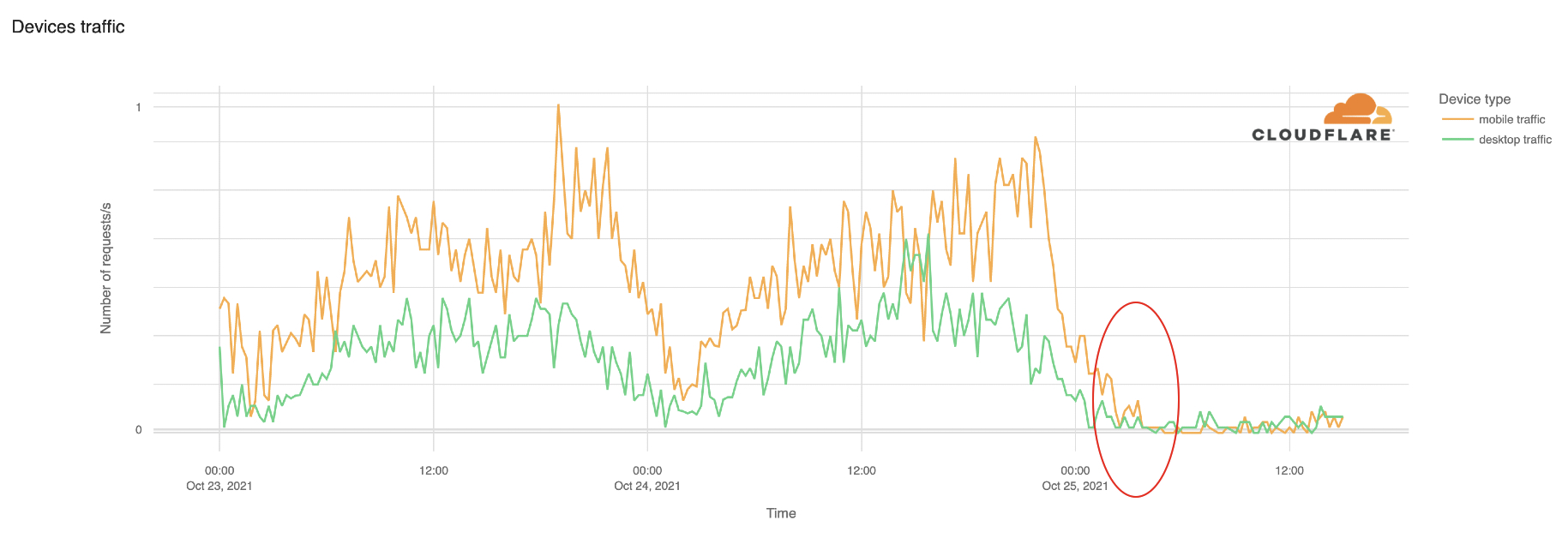
Two weeks ago, we compared mobile traffic worldwide using Cloudflare Radar, and Sudan was one of the most mobile-friendly countries on the planet, with 83% of Internet traffic coming from mobile devices. Today, both mobile and desktop traffic was disrupted.

Sudan woke up without Internet

Using Cloudflare Radar, we can also see a change in Layer 3&4 DDoS attacks because of the lack of data.

Sudan woke up without Internet

You can keep an eye on Cloudflare Radar to monitor how we see the Internet traffic globally and in every country.