2025-03-24 HackTues 11

Post Syndicated from Vasil Kolev original https://vasil.ludost.net/blog/?p=3502

Тази година StorPool бяхме спонсор на HackTues 11, и едно от нещата, които търсеха от нас, бяха ментори или членове на журито. Аз предпочетох да съм ментор, и се уговорих да си работя от там за двата дни на хакатона (четвъртък и петък).

Седмицата преди това бях в Тайланд за FOSSASIA, та бях изпуснал някакви неща (и ми се обаждаха да ми кажат да си попълня някакви документи). Та за някои неща нямах добра идея и ми ги разказваха в движение.

По правилата тази година, отборите си избираха менторите. Мен ме избра екип W-BT. Според тях основно заради python-а, който бях написал, че знам, според neter, понеже проектът им бил свързан със стари хора и им трябвал някакъв такъв.
(чак пък стар, само три пъти по-възрастен съм от тях)

Бяха (учудващо, поне за мен) добре организирани – бяха измислили какво точно ще правят още преди да се видя с тях, имаха сравнително добро разпределение на задачите, и дори за да избегнат забраната за всички под 9ти клас да стоят по цяла нощ/спят в залата, бяха си взели едно airbnb наблизо, от което да работят през нощта (което ми се видя като много добър hack).

Аз изкарах с тях двата дни и гледах да не им се меся много, и определено да не им решавам аз нещата (мисля, че се гледа криво на това менторът да ти напише кода), но debug-вах някакви неща, помагах с git и setup на работни среди, оправяне на текст и с измислянето на въпроси, които могат да очакват от журито.

(in other news, чудя се дали има смисъл да направя лекция “debug чрез print”, за нея имам страхотна история, която включва Алан Тюринг и Клод Шанън)

Не знам обаче как работеха всичките в тоя шум. В “Джон Атанасов” бяха наредени маси за всички отбори, бяха им докарали ток, и всички си работеха, но имаше много разговори и около 50-55db фонов шум (според калпавия измерващ app на телефона ми). Аз имах и някаква друга работа и определено ми пречеше, та по средата на хакатона се прежалих и си поръчах свестни слушалки (които ще дойдат съвсем навреме, следващата седмица…). Мисля си, че това беше основната причина да съм толкова уморен събота следобед и да не остана за финалната част, прибрах се и си легнах.

Та след като си направиха последните commit-и в 6:50 сутринта (при 6:59 краен срок), моите хора се явиха пред журито в 10:39. Това не беше най-лошия вариант де, имаше хора пред журито в 08:00, т.е. съвсем да не могат да поспят. Мисля, че бяха едни от най-добре справилите се с тази част, въпреки шума (част от полуфиналите бяха отстрани в “джобовете”, където на OpenFest-а слагаме детския кът и щандове, и нямаше начин да се ограничи шумът), ранния час и средно подлите въпроси от журито.

(Тая цялата работа със съня и денонощната работа ми докарва смесени чувства. Аз и като малък обичах да си доспивам, и въпреки, че съм правил разни неща за цяла нощ, като е трябвало да подкараме нещо счупено, също така спокойно мога да кажа, че почти всичкият код, писан в такова състояние е бил за триене после. Та, не знам това колко отговаря на реалния свят.
От друга страна, аз съм тръгнал от състезателното програмиране, което май още повече не отговаря на реалния свят, та вероятно нямам право да се оплаквам.
И ако моите деца някой ден поискат да ходят на такъв хакатон без спане, сигурно няма да съм много щастлив с идеята, ама ми се вижда малко вероятно да ги откажа…)

От нещата, които ми направиха неприятно впечатление (както и на колегите) беше начинът на използване на AI нещата и цялостното очакване, че те “знаят” какво правят. Имаше не само “дай chatgpt-то да ни изгенерира еди-какво-си”, но и в самите проекти имаше “и това го подаваме на OpenAI и то ни отговаря” (любимият ми пример беше при един проект, който анализираше извлечения от банкови сметки, как един член на журито пита “Добре, аз ей-сега му дадох един PDF от някакъв курсов проект, и то от него си измисли някакво голямо количество транзакции, това очаквано ли е?”). Мисля, че трябваше да има награда за не-използващи AI, или поне ползващи го по смислен начин.
(фирмената награда я дадохме на отбор, който това го беше направил както трябва)
Изобщо, тоя стохастичен папагал не е достатъчно добре разбран, и се струва магия на всички, както blockchain-а (който беше “тук нещо се случва и ставаш богат”). Чудя се дали мога да намеря някой да го обясни правилно.

Обаче най-важното беше, че всички бая се забавляваха, въпреки че подобно събитие по дефиниция си е напрегнато (и всичкият му график беше твърде оптимистичен, например почти без почивки между представянията за полуфиналите). Настроението се беше пренесло и върху журито – тяхната работа на практика е да се заяждат с участниците, но се усещаше един такъв тон на забавление в цялото нещо.
На финалите в журито имаше един член (който заслужава отделна награда), който изнамираше паролите, които хората бяха commit-нали и влизаше по админските и контролни системи на повечето проекти (един отбор си беше забравил AWS (или GCP?) token-ите в някакви commit-нати файлове и можеше да им се спре всичко). При един от отборите беше питал “Ама тук сте оставили админската парола на keycloak-а (през който минава всичката автентикация на приложението им) в един файл, то така не може ли всеки да влезе да вижда тия неща” и от отбора сравнително бързо успяха да отговорят “Ами то ние сме я сложили там, за да може да я види журито и по-добре да разгледа проекта”.
(5 минути смях в залата и ръкопляскания)

Ако мога да участвам догодина, едно от нещата, които бих направил/помогнал биха били някакви допълнителни workshop-и преди събитието, особено за по-младшите участници, за неща “как да работим по-ефективно” (сега е имало някакви, провеждани от предишни участници, но не мисля, че нещата, дето ми се иска са били засегнати). Това ми беше с доста участници наблюдението, че можеха да си спестят прилично време, ако ползваха alt-tab, разни други клавишни комбинации и като цяло някаква по-ясна организация на работното пространство. Мога даже да цитирам един разговор от при мен,
“Ползвай стрелката нагоре, защо се мъчиш да го пишеш наново”
“Уф, и баща ми все това ми казва”

[$] Lessons from open source in the Mexican government

Post Syndicated from jake original https://lwn.net/Articles/1013776/

The adoption of open-source software in governments has had its ups and
downs. While open source seems like a “no-brainer”, it turns out that
governments can be surprisingly resistant to using FOSS for a variety of
reasons. Federico González Waite spoke in the Open Government track at SCALE 22x in Pasadena,
California to recount his experiences
working with and for the Mexican government
. He led multiple projects
to switch away from proprietary, often predatory, software companies with
some success—and failure.

Security updates for Monday

Post Syndicated from jake original https://lwn.net/Articles/1015286/

Security updates have been issued by Debian (libxslt, mercurial, and webkit2gtk), Fedora (chromium, dotnet8.0, ffmpeg, jupyterlab, and kitty), Mageia (expat and libxslt), Red Hat (pcs), SUSE (apptainer, chromium, kernel, libarchive, mercurial, python311, radare2, xorg-x11-server, and zvbi), and Ubuntu (golang-github-cli-go-gh-v2 and nltk).

More Countries are Demanding Backdoors to Encrypted Apps

Post Syndicated from Bruce Schneier original https://www.schneier.com/blog/archives/2025/03/more-countries-are-demanding-back-doors-to-encrypted-apps.html

Last month, I wrote about the UK forcing Apple to break its Advanced Data Protection encryption in iCloud. More recently, both Sweden and France are contemplating mandating backdoors. Both initiatives are attempting to scare people into supporting backdoors, which are—of course—are terrible idea.

Also: “A Feminist Argument Against Weakening Encryption.”

За другите три кули при мол Парадайс и защо липсват

Post Syndicated from Боян Юруков original https://yurukov.net/blog/2025/drugite-tri-kuli/

Малко много станаха постовете конкретно за „оная“ карта, но покрай темите в последните дни ми се налага да ѝ обръщам повече внимание.

Когато я започнах средата на миналата година въвеждах сграда по сграда сравнявайки с това, което е построено или поне видимо на пространствените данни и това, което е отбелязано в портала на НАГ. До тук има над 24 хиляди полигона – говорих за това през януари. Описал съм подробно методологията и проблемите свързани с нея. В рамките на това въвеждане се допитвах редовно до различни групи и организации запознати с конкретни казуси и темата като цяло, особено когато имаше проблем с качеството на данните, на които разчитах.

Специално за пространството около Черни връх, което нашумя тези дни, първоначално дори не бях въвел въпросната 215 метрова кула и други три от по 180 метра, за които ще стане дума тук, защото реших, че е грешка в изписването на слой Застрояване. Нямаше да е за пръв път и в такива случаи търся да сравня с налични документи. За това място не открих. Тогава разпитах по описания горе начин и ми обясниха, че е наистина текуща тема, наистина това е ПУП-а и е приет с решение на СОС. Конкретно за 2025-метровата кула писах вчера с линкове към становища и фактология.

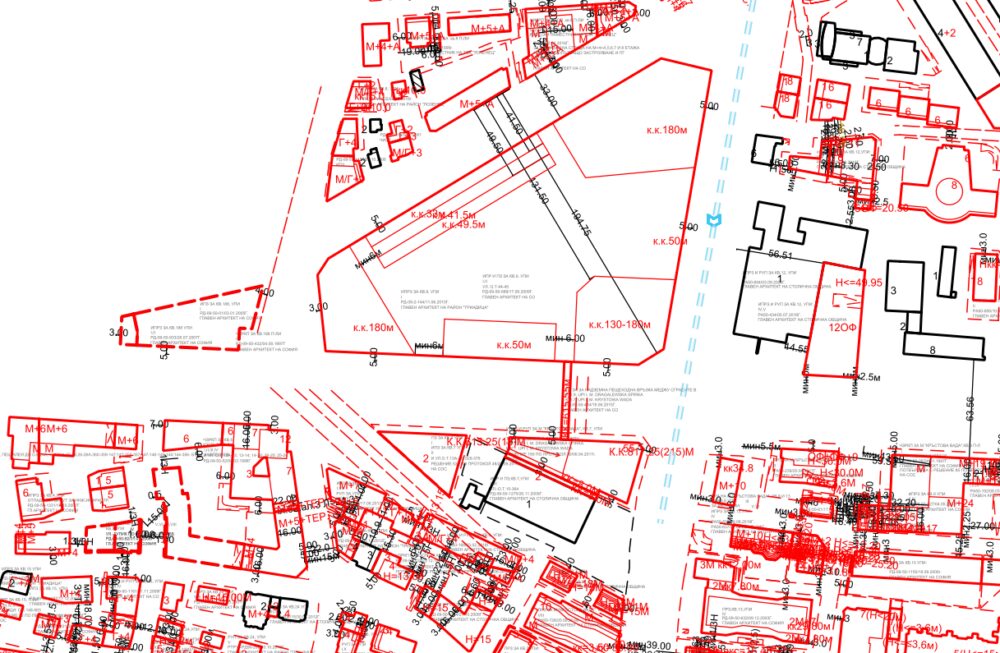
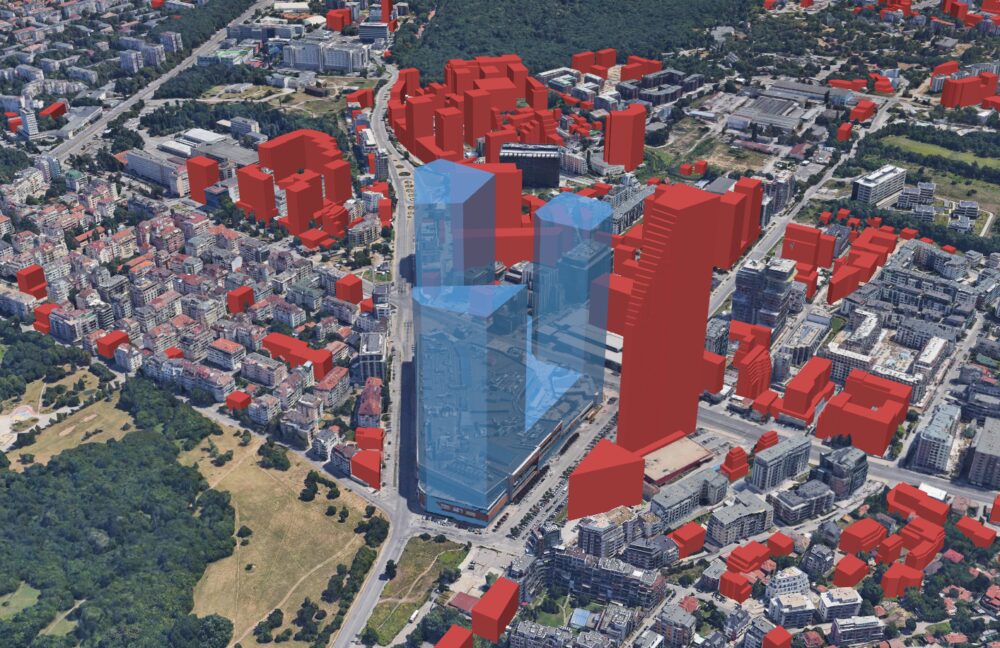
Днес, след като обявих нови функции към 3D картата за застрояването, Борис Бонев попита защо не съм отбелязал трите кули от по 180 метра на мола Парадайс. Виждат се на картата горе показваща прословутия слой застрояване и с какво всъщност работя, за да създам визуализацията. Спомням си, че бяхме обсъждали региона средата на миналата година заедно с доста хора и повечето смятаха тогава, че за разлика от нашумялата кула, тези трите по-скоро няма да видят бял свят. Затова не ги бях добавил, както и не бях отбелязал, че молът е разрешено да се строи до 50 метра, което е значително над сегашната височина.

На мястото на мола към този момент намирам над 50 различни документа, които може да разгледате на картата ми с документите. Повечето са разрешително за строеж, но за преустройство на магазини и складове. Някои са от времето на Диков, когато голяма част от тази и редица други каши са бетонирани та да се чудим как да ги разбиваме сега. Не се намира оригиналния ПУП, доклад или решения.

В духа на картата и как много подобни сгради всъщност са отбелязани – като онази огромната на бул. Цар Борис, например – следва наистина и тези кули да са също на картата. Затова ги добавих и вече може да ги намерите там. Отново напомням – няма известно движение по тях, няма решения, разрешения или каквото и да е поне в последните 10 години в посока тези кули. Не се съмнявам, че ще има опити да се спекулира с това – включително произвеждане на фалшиви новини, както и от хора, които знаят много добре всичко, което описвам. Тези се използват напоително не в интерес на града, а за политически цели, атаки срещу кметството и районните администрации, както и отклоняване на енергия и внимание от други теми, които са наистина важни. Добавям ги с ясното съзнание за този риск, защото все пак щом още по времето на Диков са влезли в ПУП, значи че както сега обсъжданите и много други, някой някога може да развее едни хартийки, да си напазарува експерти и анализи, да си плати или заплашва държавни служители и накрая когато събере заветната папка да върви при едни конкретни административни съдии да придвижва нещата.

Впрочем, промяната, която обявих по-рано днес, беше че вече може да натискате върху отбелязаните сгради на 3D картата и тя ще се опита да открие последните известни документи там, ако има въобще такива. Дава и линк към картата с документите, където с филтрите да търсите по-стари. Повечето документи вероятно няма да имат общо със самия строеж, а последвали промени като рекламни елементи, преустройство и прочие. Добра отправна точка е обаче и функцията с най-много запитвания.

The post За другите три кули при мол Парадайс и защо липсват first appeared on Блогът на Юруков.

2025-03-23 the “FOSDEM VideoBox” talk at FOSSASIA Summit 2025

Post Syndicated from Vasil Kolev original https://vasil.ludost.net/blog/?p=3499


This is a talk about the video-box that we used to run video on FOSDEM 2025, and that we’re testing, sorry, using, to do video at FOSSASIA 2025 🙂

(abstract)

Over the past years, the FOSDEM conference (a free and open-source developer event in Europe) has hacked together its own video recording and streaming setup. We stream 30 rooms with a video team that’s less than 30 people. The latest iteration of that was a lot of fun, and we’d like to share with everyone what it looks like, what it can do and how fun and hackable it is. We will explain our setup, and give a rundown of what’s in those weird boxes you might have seen.

The project is fully open source software and hardware, and everything is available in FOSDEM’s GitHub repos.

If you don’t want to listen to me, but want to see for yourself, everything – the hardware designs, assembly instructions, sources, ansible recipes – are in those two repos. Hack away 🙂
(there’s even a FOSSASIA branch for the things we had to change for this event)

The initial idea of this talk was to explain how useful this box is to any kind of event, for streaming, recording, etc, etc.. But there’s one more important point that I want to make, after talking to some people here.

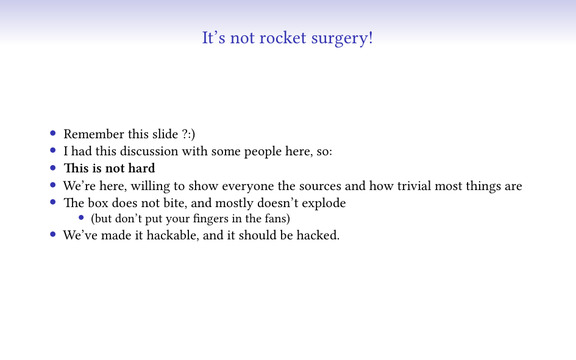
THIS IS NOT HARD.

What you can see in this presentation and what we do is the product of a few slightly insane people. We didn’t know that some stuff was hard, and we didn’t care, we just tried to see what will happen. There were problems, there were wrong directions, but as you see, we have it working, and I do think that it’s possible for anyone here to do it.

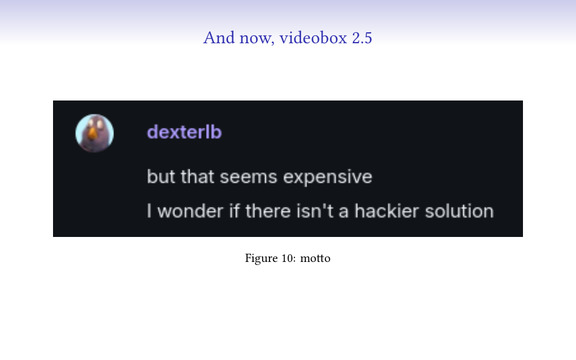
This is one of the reasons we give the source for it – that people can learn from it, play with it, use it, etc.. It’s possible for people to create any such project – I have seen this again and again and again. I even have a favourite joke about it, I hope it translates well…

The mathematician Dantzig as a student was late for one lecture, came in the lecture room after everyone had left, and saw two mathematical problems written on the blackboard. He thought that those were homework, wrote them down, and went home. On the next day, he was a bit early, went to the professor and said:
“From the homework yesterday, I managed to solve the first one, but I’m having trouble with the second one”
“What homework?”
“The two problems that were written on the board”
“But… but… those were examples of unsolvable problems!”

So, seriously. When you look at the box, you shouldn’t think “wow, what great thing/product”. You should be thinking “I can make one better/I can make it better”.

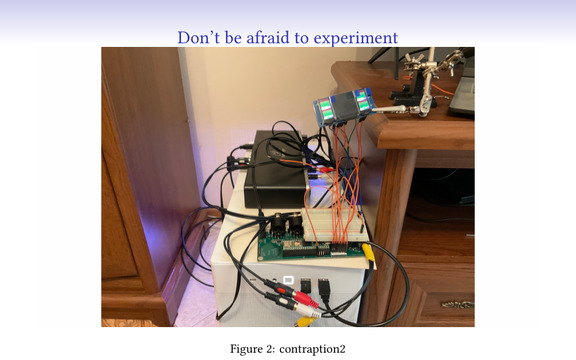
And to show what we’ve been through (because people see only the end result) – here is an example of a setup for part of the development. It loks scary, feels like it can catch fire if you touch anything, and is so far from what you see in the box.

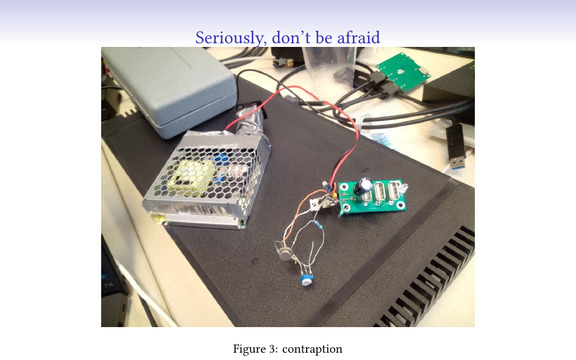
And this is a temporary version of the power board. I am not sure if you can see it very well, and I’m not sure you would want to see this horrible contraption. You should not be afraid to make things like this and experiment. Yes, it takes time, yes, it sometimes catches fire, but when that happens you just put out the fire and think of a new way forward. In the end it works!:)

Seriously. Experiment and do stupid things. This is how people learn.

(I’ve heard that there are some really smart people that learn from other people’s mistakes, but at least I need to make my own:) )

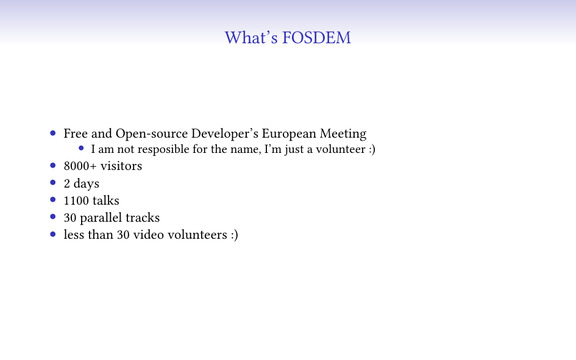
To explain where all this comes from, a few short words about FOSDEM – it’s the largest open-source event in Europe. It gathers some thousands of people in a cold, windy and rainy place with good beer to present and discuss all kinds of open-source projects. It’s a bit crazy, with 30 parallel tracks and more than a thousand talks.

And I’m really happy to be a part of it. It’s one of the things that I participate in that no other group does, and that’s mostly because nobody is crazy enough 🙂

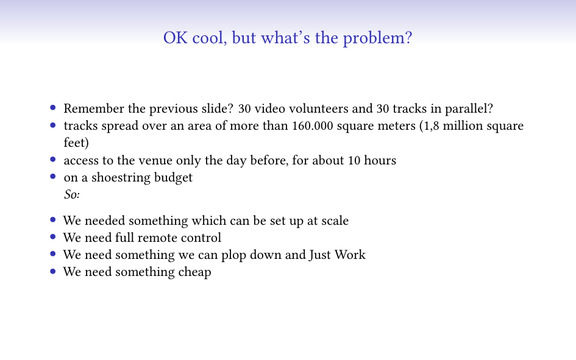
So, large event, large venue (multiple buildings), only half a day for the setup. We have next to no manpower and no time 🙂 . We want to have working video, because there are a lot of lazy people around the world that don’t feel like traveling to FOSDEM, and rooms are often so full that people sit outside and watch the streams.

And, FOSDEM is a completely open and free event, we can’t just throw money at the problem and have a setup that would cost a few million dollars.

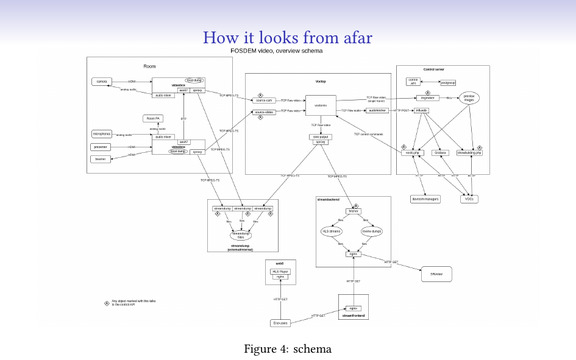
This is the overall architecture of the video at FOSDEM. We capture the camera and the presenter’s slides, they get sent to a video mixer, which mostly creates a picture-in-picture stream. That stream gets sent to the outside world to see, and gets recorded so it can be reviewed later.

A few things in this setup we didn’t finish for this year, like audio transport over the network (which would’ve saved us one long cable per room), but there’s always next year 🙂

This setup scales really well – we’ve done FOSDEM with between 20 and 30 rooms, and are pretty confident it would scale to a hundred or more. We manage to set the up in half day with 7-8 teams with 3 people each, and to tear it down after the event in three hours.

Not having too many people, we prioritize the ease of setup and operation. We’re also lazy 🙂

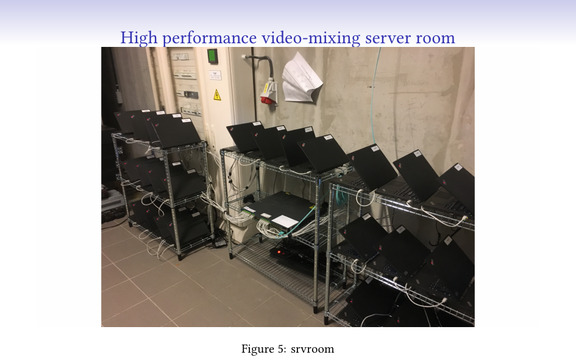
And such an event requires a tremendous amount of computing power to mix the video…

… just kidding. 10-year old laptops can deal with that without any issues 🙂 You can also see them here in the racks (Ikea wine racks). These machines run software called “voctomix”, developed in Python by c3voc and which does some magic with gstreamer.

Remember the slide with “this is not hard”?

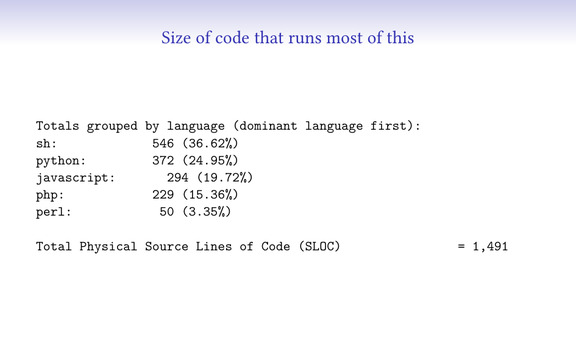
To show how much code we’ve written to run all that infrastructure above, I ran the tool that counts lines of code, and when I removed one external javascript library, this is what’s left. With 1500 lines of code you can run the video of one of the largest conferences there is.

There’s a bit more code in the firmware for the hardware and few other external things, but the above is enough for almost everything.

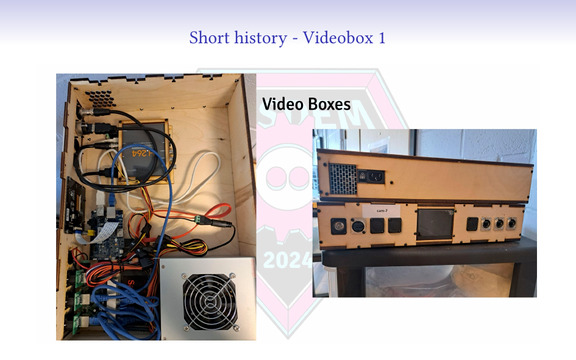
For 7-8 years we used this, but it was getting old (and some of the wood a bit moldy). It was a combination of a Banana PI, sata SSD, small switch, one BMD recorder (device that captures HDMI and gives it over USB), and for half of the boxes, a scaler – something that you can plug any laptop in and it’ll be able to change the signal to something that we can use.

The last part is always a problem, because laptops do weird things. Not to mention Macbooks.

As the old boxes were breaking down, we made a stopgap measure – a laptop, and a capture card, in a transportable form-factor. This worked relatively well for 2024, but was larger than we liked, and the laptops we got for cheap had USB issues (which were fixed in a newer version of the laptop, but that did not have Ethernet ports).

You can see it on this picture in action – it’s the laptop with purple background and the box below it.

This worked pretty well, but was a bit unwieldy, and the box itself was almost empty. We couldn’t come up with a way to put the laptop in, so we started looking at options.

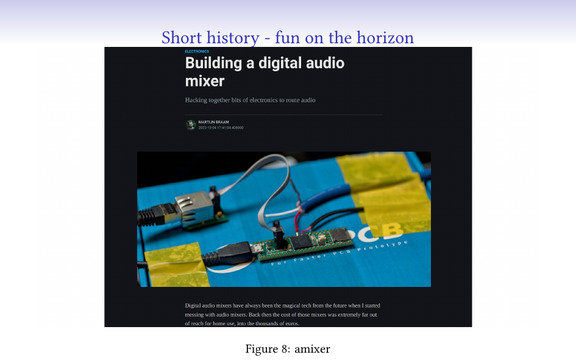
Then, Martijn Braam visited us during the 2024 event and metioned “you know, I’ve made a stand-alone open-source audio mixer, it’s a simple board and a chip”. We thought we can use it and get rid of the mixers we carry around, some cables, etc.

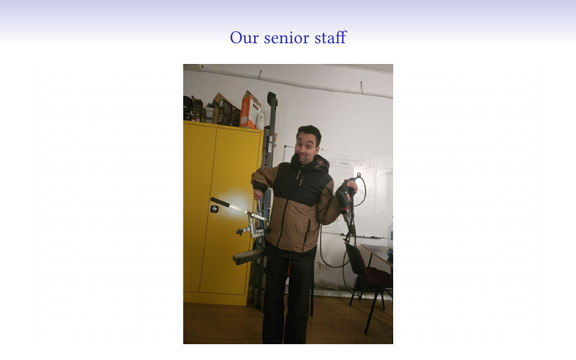
Here’s a picture of someone from our senior staff, responsible for the design of the power board and a lot of the low-level hardware and assembly. As you see, he has all the tools needed for the job. He was the other person really interested in designing hardware.

And if we have to say what were the driving words behind the project, it was this. We wanted something that doesn’t cost too much, that we can make in large amounts and that could do all the weird things we wanted.

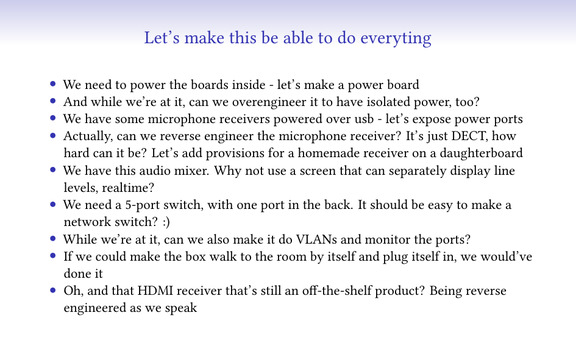
The thing is, as soon as you start to make your own hardware, you start to get greedy and ask “what else can we do?”.There are so many interesting things you can add, to handle tasks that you were doing with extra hardware or software before.

So the first is trivial, we need to power things inside, so you design your own power board.

Then, we have microphone receivers. They are battery-powered, but can also be powered via USB. So now we have 4 charging ports (and we can turn them off and on from software).

And for crazy ideas, why not design a radio INSIDE the box, that can just receive wireless microphones? Turns out that is pretty much possible, we didn’t have the time for it and there were some snags… But even to me this sounds crazy.

And well, in the end, how hard would it be to design a network switch? Turns out, not that hard. We needed just one revision to make it work, and a few days ago, just becase we can, we added initial support for VLANs in the switch – so that can actually do interesting network topologies.

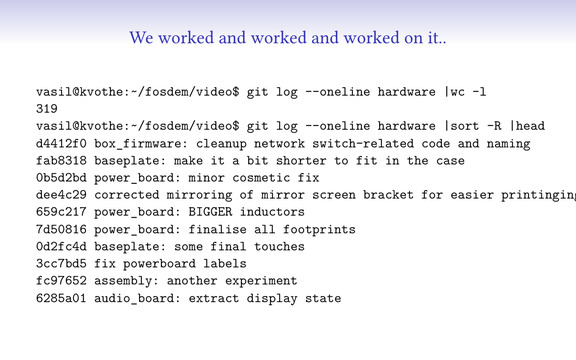
This is the part in movies where there’s montage with a music background. We worked on different pieces through the summer of 2024, a few months ago…

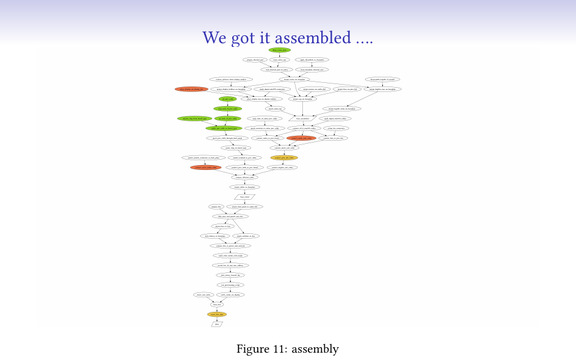
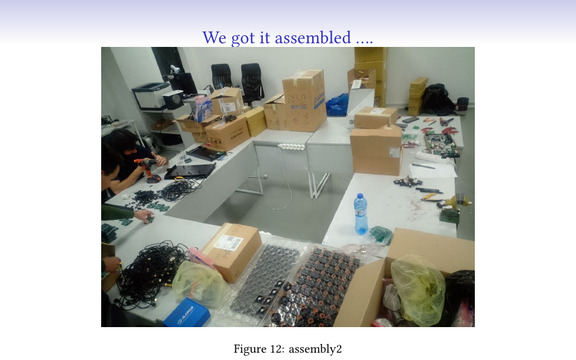
We started assembling it. This is a simple assembly flow chart 🙂 Might look daunting, but it actually took just two-three weekends and about 10 people to assemble, provision and test 70 boxes.

And because we were running late, this mostly happened in the weekend between Christmas and New Year. Not sure how to translate this to you, but let’s say we were the only people working in the country…

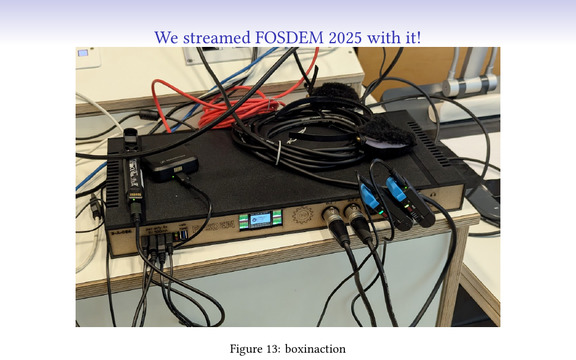
We got the boxes ready somewhere mid-January, and ran FOSDEM 2025 with them 2 weeks later.
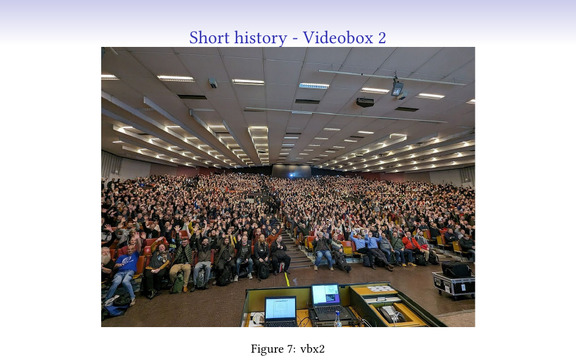
And it worked. We still can’t believe it did. We even managed to do a talk there about the box itself 🙂
And yes, much like this very talk, we had the idea of actually having a talk, less than 24h before.

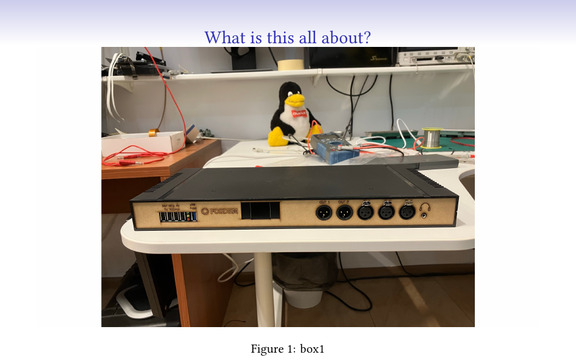
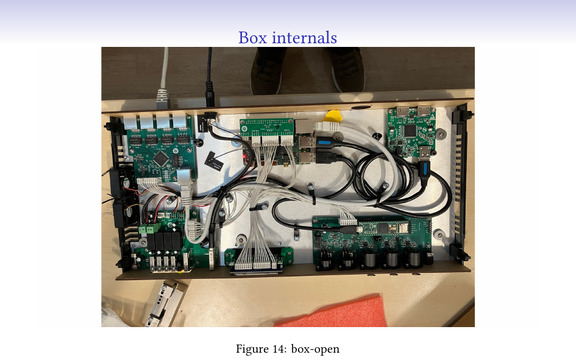
This is how the box looks on the inside. I’ve left a few of them open while running, so you can all see them.

There are two boards that we did not design: a Raxda X4 (an Intel-based single board computer) and a MS2131-based HDMI capture device with a loop out (but we’re working on that one).

The rest is:
An audio mixer with three inputs and two outputs. So you can have three microphones (enough for almost everything), one output to your camera and one to the room sound system. We needed a microcontroller with USB support, so we added an off-the-shelf Teensy on top of it.

An ethernet switch, so you can also connect other boxes and devices to the network (and build your own network). I’m actually afraid to show the topology we have right now in this venue 🙂

A power board powers the other boards, and provides the external charging ports. Plus it controls the fans, has a temperature sensor, controls the pass-through USB port to the radxa and more.

And a handful of breakout boards, to be able to cable things up neatly.

If you take a look in the training rooms, you’ll see an interesting modification of the setup. It uses an USB camera, has a single box, and can do all video and video mixing in that single box. So one box like this, one cheap camera, microphones, and you can record & stream a room pretty quicky.

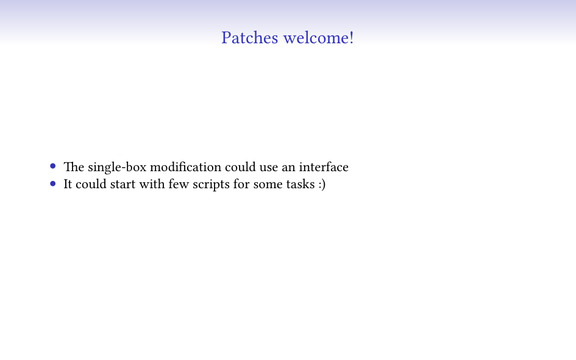
This is still under development (I made a few fixes in the last few days, and there’ll be more). Its current interface is “SSH into it and run commands”, which is not easy for most people. But, this is also being worked on, so at some point there will be even an user-friendly box 🙂

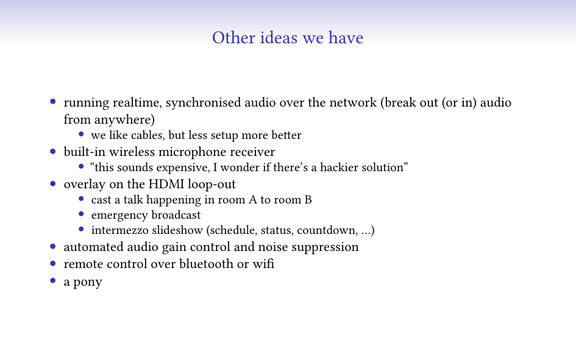
Of course, we are not even remotely close to what we want. There are so many ideas than those just listed here, and even some of these were thought up while we were writing this presentation, and I can’t wait to show it to the rest of the team.

I really hope they don’t lynch me.

These are two things from our TODO, as an example. As an open-source project, we welcome patches 🙂

We have tried to make sure this is useful not just to us. The boxes, the software around them, the overal ideas can be useful to everyone who does events or video for events, and should be possible to do video streaming and recording in an easy, stable way with a good quality. You won’t get the very nice features (like a multi-camera setup, drones taking photos from above, etc.), but you will have the sound, the presentation, the lecturer visible and recordings which would be usable to everyone that has not being able to attend.

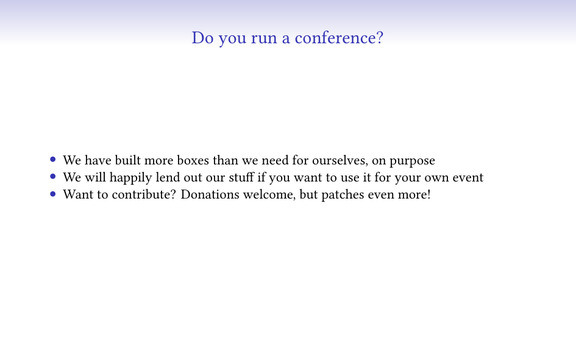
FOSDEM lends this stuff, and we’re happy to explain how to use it. You can also build your own and we can help with the specifics if needed (but everything should be in the repo anyway).

And we can always use more contributors 🙂

Remember this slide? Do not be afraid to hack. Do not think this is something extremely complex and impossible to do to. You just need to start.

Please do 🙂
Assessment of DOGE and Musk’s Actions for Government Efficiency

Post Syndicated from Bozho original https://techblog.bozho.net/assessment-of-doge-and-musks-actions-for-government-efficiency/

The Trump administration began with a commitment to optimizing the efficiency of the government, introducing the so-called DOGE (Department of Government Efficiency) under Elon Musk. On the first day, I wrote that I would follow DOGE’s actions in optimizing the administration with interest. This is a task that we also face in my country, with electronic governance (of which I was the first minister a few years ago) being a tool for achieving it. On the very day of the executive order establishing DOGE, I wrote to colleagues that “the risky part is that every structure will have to provide them with all non-classified documents” and that they would likely be looking for “skeletons in the closet.”

This risk, stemming from the executive order, quickly materialized due to the actions of DOGE employees (or USDS, which is the U.S. government’s structure for IT services and administrative modernization, serving as DOGE’s main tool). The employees, who are 20-25-year-old IT specialists, gained access to the systems and databases of several key government agencies, even connecting external hard drives. This understandably sparked serious dissatisfaction.

I do not dispute the right of specialized units to access data and documents across the entire government structure. Nor do I deny the right to close down agencies or terminate funding — these are political decisions (subject to judicial oversight) that any administration has the authority to make (and anyone has the right to disagree and challenge them in court). Moreover, fraud and inefficiencies in spending certainly exist, and an external review of the data and systems can identify and eliminate them.

However, for the implementation of these political decisions to be legitimate, it must follow established rules. It appears that Musk and his team operate under the assumption that they are above the rules — that they can take over the information systems of key government agencies through “top-down orders.” These actions should be carried out properly, especially considering information security and data protection, which are at risk from such ad-hoc measures.

I will give a few examples from my time as a minister and earlier as an advisor, fully aware that the scale is different, but there are still direct parallels.

The first example is the SEBRA system (the Ministry of Finance’s budget payment system). Musk is essentially doing the same thing — extracting and potentially publishing all state payments. However, we did it properly — together with the Minister of Finance, we submitted a proposal to the Council of Ministers, designating payment data as a priority data set for publishing in compliance with the Access to Public Information Act. This decision mandated the Ministry of Finance to provide the data to the Ministry of e-Government in a specific format so that it could be processed, anonymized, and published. The Ministry of Finance assigned its contractor to extract the data and securely transfer it to the Ministry of e-Government, where the processing and anonymization code was published in an open-source repository. At the same time, a working group revised a regulation so that the system would automatically publish such data. If we had done it Musk’s way, I would have simply sent one of my advisors and told them, “Plug in your laptop and get access to the database.” And that would have been wrong.

In 2016, we opened up data from the Commercial Register and the Public Procurement Register. At the time, I was an advisor, but the data disclosure process involved official correspondence, and I never had direct access to the database — experts from the respective institutions wrote queries to the database, and I received a test database without real data to work on queries for extracting information. We also published the code for the anonymization tool used for the Commercial Register. This was all done based on formal communication and a valid legal basis under the Access to Public Information Act.

As a minister (after all, officially elected by parliament, not an unknown staffer), I requested to review systems, but someone else always had to show them to me while I only directed what should be extracted (even though I could have found it myself much faster). In these cases, the approach was always, “Sit here and show me,” or “Based on [legal grounds], please provide me with the following data,” rather than “Give me access to the database and leave.”

Yes, there is a risk of refusal or sabotage of these efforts, but there are other measures for that—those who sabotage can be reassigned or even dismissed if they do not comply with a lawful order. However, Musk is doing the opposite—his people (who have not been properly vetted) are acting unlawfully and are being stopped by the courts. In some places, internal teams correctly identified these actions as an “insider threat.” In principle, every access to databases should leave a trace, and access for usual personnel must be controlled because data misuse is not only a risk from external actors but also from internal ones.

The issue of access to institutional data is extremely serious and cannot be resolved with a blanket statement in a presidential executive order. It is serious because a modern state largely depends on its registers and databases. Their security and integrity are fundamental to many policies and their success or failure. “Seizing control” of registers and databases is a key instrument of power with significant negative potential.

Beyond this specific case, if DOGE had acted “properly,” it would have taken a few more months, but its actions would have had more legitimacy. However, in line with other actions and statements by the U.S. government, it seems that they are more interested in breaking things and disregarding the rules.

Government efficiency is important, and reducing unnecessary expenses is a valid political priority. But while it can be a legitimate goal, it can also serve as a cover for less honorable intentions. And although I come from the startup world, I do not agree with the approach that a government and administration can be run like a startup. In startups, the goal is to move fast, even at the risk of breaking things. In the public sector, it is more important not to break things, because lives and livelihoods depend on it, which is why processes take longer. And when you act by breaking the rules under the justification of political expediency, you do not build trust — you destroy it.

The post Assessment of DOGE and Musk’s Actions for Government Efficiency appeared first on Bozho's tech blog.

The collective thoughts of the interwebz