Post Syndicated from Explosm.net original https://explosm.net/comics/doggy-style
New Cyanide and Happiness Comic
Post Syndicated from Explosm.net original https://explosm.net/comics/doggy-style
New Cyanide and Happiness Comic
Post Syndicated from Will Allen original https://blog.cloudflare.com/preserve-content-credentials-with-cloudflare-images/
Today, we are thrilled to announce the integration of the Coalition for Content Provenance and Authenticity (C2PA) provenance standard into Cloudflare Images. Content creators and publishers can seamlessly preserve the entire provenance chain — from how an image was created and by whom, to every subsequent edit — across the Cloudflare network.
When you hear the word provenance, you might have flashbacks to your high school Art History class. In that context, it means that the artwork you see at the Met in New York really came from the artist in question and isn’t a fake. Its provenance is how that piece of physical art changed possession over time, from the original artist all the way to the museum.
Digital content provenance builds upon this concept. It helps you understand how a piece of digital media — images, videos, PDFs, and more — was created and subsequently edited. The provenance of a photo I posted on Instagram might look like this: I took the picture with my iPhone, performed an auto-magic edit using Apple Photos’ editing tools, uploaded it to Instagram, cropped it using Instagram’s editing tools, and then posted it.
Why does digital content provenance matter? At a fundamental level, it’s an important way to give content creators credit for their work. Many photographers have had the experience of seeing their photograph or video go viral online, but with their name and attribution stripped away. In that scenario, the opportunities that might have accrued to the creator once the world saw their work don’t materialize. If you help ensure an artist or content creator gets credit for their work, that exposure could result in more career opportunities.
Digital content provenance can also be an important tool in understanding the world around us. If you see a video or a photo of a newsworthy event, you’d like to know if that photo was really taken at that particular location, or if it was from years prior at a different location. If you see a grainy picture of a UFO flying over New Jersey, knowing when and where that photo was taken is helpful information in understanding what is actually happening.
The C2PA is a project of the non-profit Joint Development Foundation and has developed technical specifications for attaching digital content provenance to a piece of media. The standards also specify how to cryptographically sign that manifest, thereby allowing anyone to verify that the manifest hasn’t been tampered with. The JSON manifests and the associated signatures are together referred to as Content Credentials.
The Adobe-led Content Authenticity Initiative, which has thousands of members across a variety of industries, aims to drive global adoption of Content Credentials.
Cloudflare Images allows you to build an effortlessly scalable and cost-effective image pipeline. With our new Content Credentials integration, you can now preserve existing Content Credentials, ensuring they remain intact from creation all the way to end-user delivery.
Many media organizations across the globe, such as the BBC, the New York Times, and Dow Jones, are members of the Content Authenticity Initiative. Imagine one of these news organizations wanted to include the Content Credentials of their photojournalist’s photos and allow anyone to verify the provenance of that image. Before now, even if the news organization was using a C2PA-compliant camera and editing flow, these credentials would frequently be stripped if the image was transformed by their CDN.
If you use Cloudflare, that is now a solved problem. In Cloudflare Images, you can now preserve Content Credentials when transforming images from remote sources. Enabling this integration will retain any existing Content Credentials that are embedded in the image.
When you use Images to resize or change the file format to your images, these transformations will be cryptographically signed by Cloudflare. This ensures, for example, that the end-user who sees the photograph on your website can use an open-source verification service such as contentcredentials.org/verify to verify the full provenance chain.
Imagine you are a photojournalist using a Nikon camera that has C2PA-compliant signing. That photojournalist could opt to attach Content Credentials to their photo, identifying the key elements of the photograph such as the camera model, the original image size, and aperture settings.
Below is a simplified example of what a C2PA-compliant Content Credential for a photograph taken with that Nikon camera could look like.
Content Credentials are stored using JUMBF (JPEG Universal Metadata Box Format), which serves as a standardized container format for embedding metadata within files. You can think of it as an envelope system that packages together both the data about where a piece of digital content came from and how it changed, as well as the cryptographic signatures that can be used to verify that data.
The assertions, or facts about the content provenance, are typically written in JSON for a better developer experience. Note that this example deliberately simplifies the JUMBF box nesting and adds comments to make it easier to follow.
{
  "jumbf": {
    "c2pa.manifest": {
      "claim_generator": "Nikon Z9 Firmware v1.2",
      "assertions": [
        {
          "label": "c2pa.actions",
          "data": {
            "actions": [
              {
                "action": "c2pa.captured",
                "when": "2025-01-10T12:00:00Z",
                "softwareAgent": "Nikon Z9",
                "parameters": {
                  "captureDevice": "NIKON Z9",
                  "serialNumber": "7DX12345",
                  "exposure": "1/250",
                  "aperture": "f/2.8",
                  "iso": 100,
                  "focalLength": "70mm"
                }
              }
            ]
          }
        }
      ],
      "signature_info": {
        "issuer": "Nikon",
        "time": "2025-01-10T12:00:00Z",
        "cert_fingerprint": "01234567890abcdef"
      },
      "claim_metadata": {
        "claim_id": "nikon_z9_123"
      }
    }
  }
}
Now imagine that you want to use this photograph on your website.
If you’ve enabled the Preserve Content Credentials setting in Cloudflare, then that metadata is now preserved in Cloudflare Images.
If you use Cloudflare Images to dynamically resize or transform this image, then Cloudflare automatically appends and cryptographically signs any additional actions in that same manifest. Below we show what the new Content Credentials could look like.
{
  "jumbf": {
    // Original Nikon manifest
    "c2pa.manifest.nikon": {
  /*unchanged*/
},

    // New Cloudflare manifest
    "c2pa.manifest.cloudflare": {
      "claim_generator": "Cloudflare Images",
      "assertions": [
        {
          "label": "c2pa.actions",
          "data": {
            "actions": [
              {
                "action": "c2pa.resized",
                "when": "2025-01-10T12:05:00Z",
                "softwareAgent": "Cloudflare Images",
                "parameters": {
                  "originalDimensions": {
                    "width": 8256,
                    "height": 5504
                  },
                  "newDimensions": {
                    "width": 800,
                    "height": 533
                  }
                }
              }
            ]
          }
        }
      ],
      "signature_info": {
        "issuer": "Cloudflare, Inc",
        "time": "2025-01-10T12:05:00Z",
        "cert_fingerprint": "fedcba9876543210"
      },
      "claim_metadata": {
        "claim_id": "cf_resize_123",
        "parent_claim_id": "nikon_z9_123"
      }
    }
  }
}
In this example, the c2pa.action.resized entry describes a non-destructive transformation from one set of dimensions to another. This is included as a separate, independent assertion about this particular photograph.
Notice how there are two cryptographic signatures in this manifest, each referenced by signature_info. Since there were two entities involved in this example image — Nikon for the image’s creation, then Cloudflare for resizing it — both Nikon and Cloudflare independently signed their respective assertions about the content provenance.
In this example, the signature reference looks like this:
"signature_info": {
        "issuer": "Cloudflare, Inc",
        "time": "2025-01-10T12:05:00Z",
        "cert_fingerprint": "fedcba9876543210"
During the creation, editing, and resizing process of a piece of digital content, a unique hash of metadata is created for each action and then signed using a private key. The signature, along with the signer’s public certificate or reference to it, are contained in the JUMBF container as referenced by this JSON.
These hashes and signatures allow any open source verification tool to recalculate the hash, validate it against the signature, and check the certificate chain to ensure trustworthiness for each action taken on the image. This is what is meant by Content Credentials being tamper-evident: if any of these hashes and signatures fail to validate, it means that the metadata has been tampered with.
Each cryptographic signature is part of a Trust List, allowing anyone to verify the provenance chain across various entities, such as from a camera manufacturer to photo editing software to distribution across Cloudflare. More from the Content Authenticity Initiative:
Trust lists connect the end-entity certificate that signed a manifest back to the originating root CA. This is accomplished by supplying the subordinate public X.509 certificates forming the trust chain (the public X.509 certificate chain).
In order for Cloudflare to append the Content Credentials with any transformations, we needed to have a publicly available end-entity certificate and join this Trust List. Here we used DigiCert for our end-entity certificate and reference this certificate in the JSON manifests that we are now creating in production:
"signature_info": {
        "alg": "sha256",
        "issuer": "Cloudflare, Inc",
        "cert_serial_number": "073E9F61ADE599BE128B02EDC5BD2BDE",
        "time": "2024-01-06T22:42:36+00:00"
      },
The end result is that news organizations, journalists, and content companies can now create an auditable chain of digital provenance whose claims can be verified using public-key cryptography.
Earlier this year, OpenAI announced their support for including Content Credentials in DALL-E. I recently created an image in DALL-E (with ski season on my mind).
Cloudflare Images allows you to transform any image by URL. You can do so by simply changing the URL structure using this syntax:
https://<ZONE>/cdn-cgi/image/<OPTIONS>/<SOURCE-IMAGE>We can break down each of these parameters:
ZONE is your particular domain.
cdn-cgi/image is a fixed prefix that identifies that this is a special path handled by a built-in Worker.
The OPTIONS parameter allows you to then transform the image — rotating it, changing the width, compressing it, and more.
SOURCE-IMAGE is the URL where your image is currently hosted.
To tie these together, I then have a new URL structure where I want to change the width and quality of the image I created in DALL-E and display this on my personal website. After uploading the image from DALL-E to one of my R2 buckets, I can create this URL:
https://williamallen.com/cdn-cgi/image/width=1000,quality=75,format=webp/https://pub-3d2658f6f7004dc38a4dd6be147b6a86.r2.dev/dalle.webpAnyone can now verify its provenance using the Content Credentials Verify tool to see the result. The provenance chain is fully intact, even after using the Cloudflare Images transformation shown above to resize the image.
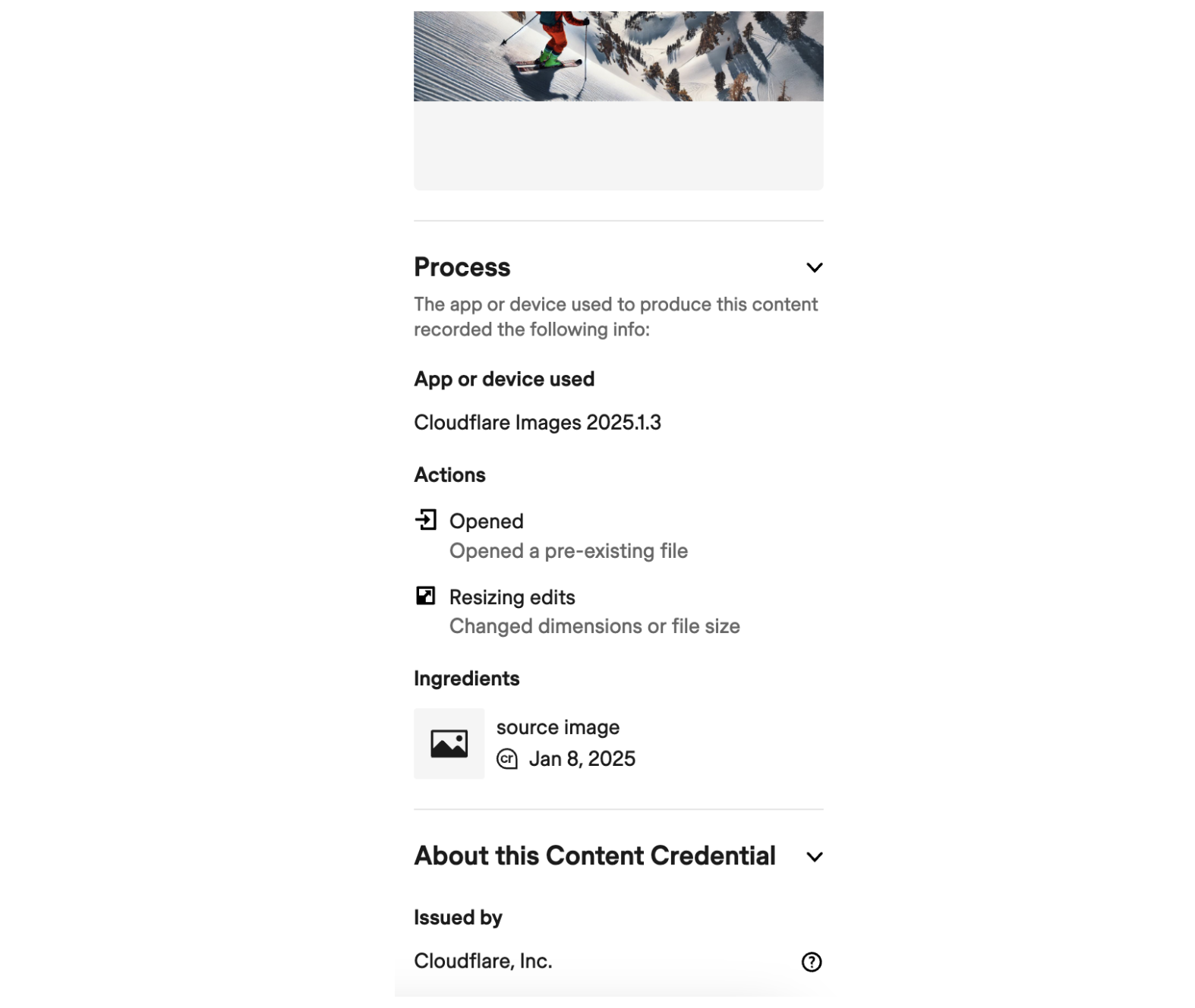
There are numerous open source command line tools that allow you to explore the full details of the Content Credentials. The C2PA Tool is created and maintained by the Content Authenticity Initiative. You can read more about the tool here and view the source code for it on GitHub.
There are two ways to install the tool: through a pre-built binary executable, or using Cargo Binstall if you have already installed Rust. Once installed, the C2PA Tool uses this syntax in your command line:
c2patool [OPTIONS] <PATH> [COMMAND]If I navigate to the link of the image in my browser and save it to my downloads folder on my Mac, then I simply need to use the command -d (short for -detailed) to see the full details of the JSON manifest. Of course, you should change yourusername to your actual Mac username.
c2patool /Users/yourusername/Downloads/dalle.webp -dAnd if you wanted to output this to a JSON file that you can review in VSCode or Cursor, use this command instead:
c2patool /Users/yourusername/Downloads/dalle.webp -d > manifest.jsonThis allows you to not just trust, but verify, the details of the image transformation yourself.
It’s straightforward to start preserving Content Credentials. Log in to your Cloudflare dashboard and navigate to Images in the dashboard. From there, choose Transformations and choose a Zone where you want to enable this feature. Then toggle this option to on:

If the images you are transforming do not contain any Content Credentials, no action is taken. But if they do, we preserve those Content Credentials and attest to any transformations.
We are excited to continue to partner with Adobe and many other organizations to extend support for preserving Content Credentials across our products and services. If you are interested in learning more, we’d love to hear from you: I’m @williamallen on X or on LinkedIn.
Post Syndicated from Екип на Биволъ original https://bivol.bg/tulsi-gabbard-pierre-louvrier.html

Номинираната от Тръмп за шеф на националното разузнаване на САЩ Тълси Габард имаше труден момент на изслушването си в Сената, където беше попитана за афера свързана с известния у нас…
Материалът Тълси Габард се обяснява в Сената за руските връзки на Пиер Луврие е публикуван за пръв път на Bivol!.
Post Syndicated from The History Guy: History Deserves to Be Remembered original https://www.youtube.com/watch?v=k-yET9151m4
Post Syndicated from Bruce Schneier original https://www.schneier.com/blog/archives/2025/02/journalists-and-civil-society-members-using-whatsapp-targeted-by-paragon-spyware.html
This is yet another story of commercial spyware being used against journalists and civil society members.
The journalists and other civil society members were being alerted of a possible breach of their devices, with WhatsApp telling the Guardian it had “high confidence” that the 90 users in question had been targeted and “possibly compromised.”
It is not clear who was behind the attack. Like other spyware makers, Paragon’s hacking software is used by government clients and WhatsApp said it had not been able to identify the clients who ordered the alleged attacks.
Experts said the targeting was a “zero-click” attack, which means targets would not have had to click on any malicious links to be infected.
Post Syndicated from LastWeekTonight original https://www.youtube.com/watch?v=0UEhMDAlX1Y
Post Syndicated from corbet original https://lwn.net/Articles/1007547/
Linus has released 6.14-rc1 and closed the
merge window for this release.
This is actually a _tiny_ merge window, and that’s ok. The holidays
clearly meant that people did less development than during a normal
cycle, and that then shows up as a much smaller-than-average
release. I really felt like this year we got the whole holiday
season release timing right, and this is just another sign of that.
Post Syndicated from The History Guy: History Deserves to Be Remembered original https://www.youtube.com/watch?v=uykh4l7mtu4
Post Syndicated from xkcd.com original https://xkcd.com/3046/
Post Syndicated from Eric Smith original https://www.servethehome.com/the-pny-1-5tb-pro-elite-prime-microsdxc-card-review-wins-in-value/
In our PNY 1.5TB PRO Elite Prime microSDXC card mini-review, we see why this tiny and high-capacity card is a better value than other options
The post The PNY 1.5TB PRO Elite Prime microSDXC Card Wins in Value appeared first on ServeTheHome.
Post Syndicated from corbet original https://lwn.net/Articles/1007541/
Version 2.44 of the GNU Binutils package has been released. Perhaps the
most significant change is the absence of the “gold” linker, which is
deprecated and about to disappear entirely. Gold appeared in 2008 with some fanfare as a faster
linker, but it has suffered from a lack of maintenance in recent years.
This release also includes some architecture-specific assembler
improvements, and some (non-gold) linker enhancements.
Post Syndicated from Explosm.net original https://explosm.net/comics/dr-idiom
New Cyanide and Happiness Comic
Post Syndicated from The History Guy: History Deserves to Be Remembered original https://www.youtube.com/watch?v=PLLjQwv7nlw
Post Syndicated from Боян Юруков original https://yurukov.net/blog/2025/danaci-germaniq-2024/
Става въпрос за споразумението за избягване на двойното данъчно облагане с Германия и засяга всички българи, които имат някакви доходи в Германия, но обичайно пребиваване в България. Т.е. през по-голямата част от времето сте в България, но работите, давате имоти под наем, имате акции в Германия или някакъв друг доход. В края на 2023-та имаше промяна в това споразумение, която засяга най-вече гастарбайтерите, особено онези, които получават под необлагаемия годишен лимит в Германия. Промяната важи за 2024-та, т.е. трябва да се подаде данъчна декларация до края на април 2025-та.
Първо, трябва да посоча, че не съм данъчен консултант, описаното долу е само предупреждение за ситуация, която засяга много, не е съвет как да се попълват данъци или кое засяга кого. Следа да потърсите информация за спогодбата, да се свържете с НАП, ако имате въпроси или да се консултирате сами с данъчен консултант, който да изясни ситуацията Ви. Запознат съм с темата единствено в личен капацитет, когато се връщах от Германия и мога да дам начални напътствия къде да търсите за ограничен кръг от казуси.
Като се вземе това под внимание, казусът, който двете страни са се опитали да решат с тази промяна е, че голям кръг от хора работят в Германия за кратко време, печелят под лимита от колко 11 хиляди евро и за данъчно задължени в България. Заради този необлагаем лимит не дължат никакви или почти никакви данъци в Германия. По смисъла на споразумението обаче, тъй като стопанската дейност се извършва в Германия за немска Германия и прочие, данък не се дължи в България. Целта е да не се обременяват физически и юридически лица с двоен данък. В конкретния казус обаче ефективно за тези доходи не са плащани данъци никъде. Доколкото надали някой би обърнал внимание на няколко случая, масовостта на практиката води до въпросните промени.
Една от промените накратко е промяна на метода за избягване на двойно данъчно облагане от от „освобождаване с прогресия“ към „обикновен данъчен кредит“. Това означава, че доходът в Германия ще се добавя към данъчната основа в българската данъчна декларация и ще се плащат стандартни данъци върху тях като се приспада сумата на всички данъци платени в Германия. По-просто казано – ще се дължат социални и 10% ДОД за спечеленото от гастарбайтерите минус ако са платили някакви данъци в Германия.
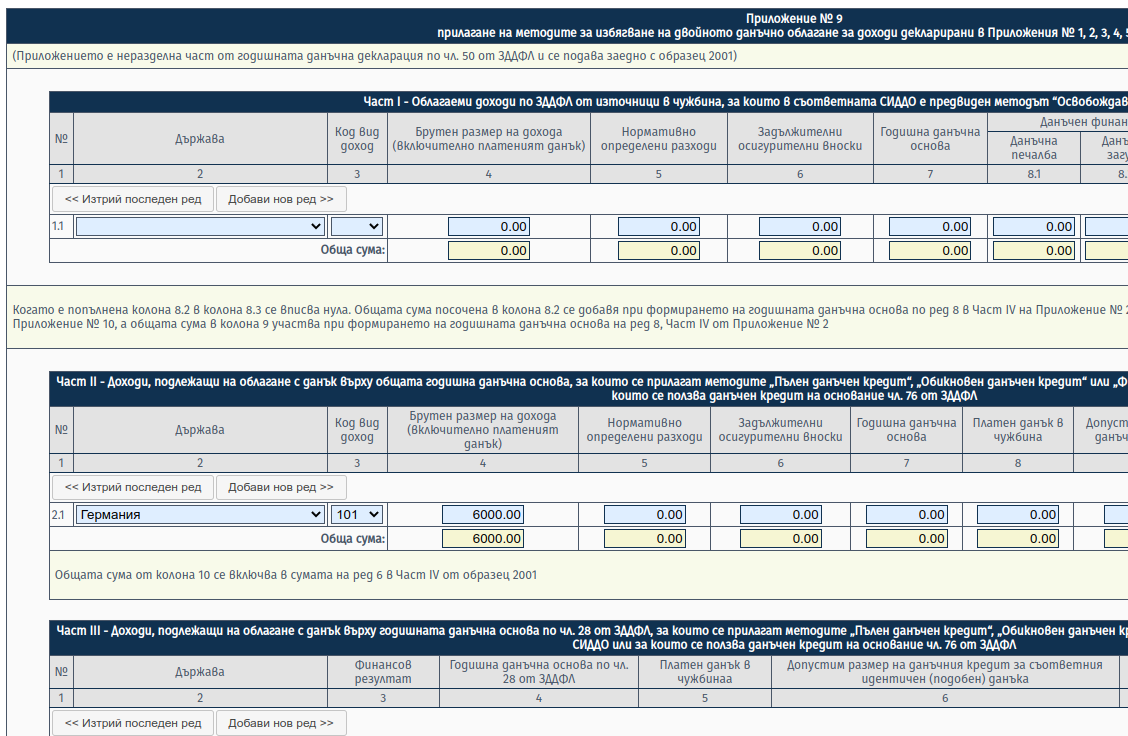
Това става в приложение 9 част II от данъчната декларация. До сега се попълваше част I. Добавят се доходът обърнат в лв., данъци и други удръжки, които са взети в Германия. Ако използвате електронното подаване, както би следвало да правите, останалото се изчислява автоматично. Ако имате някакви удръжки в Германия като данъци и социални, следва да искате от работодателя си бележка за това, да я преведете на български от заклет преводач и да я прикачите. Тук виждате снимка на полетата:
Срокът за подаване на декларациите в България с доходи от 2024-та е 30-ти април 2025. Ако е подадена в този срок, може да бъде коригирана (например да добавите пропуснат доход или документ) еднократно до 30-ти септември. Също, при подаването ако липсва документ или има неяснота се свързват с вас за изчистване на проблема и имате срок от две седмици до месец да го направите. Ако очаквате нещо такова, най-добре да се свържете първи с тях.
Доколкото изчетох промените, това засяга също доходите от дивиденти, наеми и други плащания. Там обаче не би следвало да има разлика в крайната сметка, тъй като вече се плаща данък в Германия и то по-голям от този в България. Т.е. пак трябва да се декларират, но различно. Очаквам отговор от НАП по този въпрос. В тази връзка ще напиша скоро статия как да си възстановите пари от немските данъчни, ако имате дивиденти там и сте платили около 27% капиталов данък при източника. Според споразумението трябва да е 15% и има механизъм, но не е особено приятен. Както и с българската Европейска здравна карта и гръцката карта за тол такси е изцяло електронен метода и искам да довърша процеса сам преди да го опиша.
Текстът на промените на споразумението с Германия ще намерите тук, новината с описанието от НАП е тук. Не намерих коригиран текст на споразумението, но старото е тук. Когато го намеря ще го свържа тук. Описание как се подава данъчна декларация по електронен път е описано от НАП тук. Трябва ви ПИК, който се взима физически от техен офис или електронен подпис, ако имате такъв. За преводачи може да използвате който и да е. Има вече изцяло online такива, които изпращат сканиран в PDF документ и като опция – физически по куриер. Аз просто взимах PDF-а и го закачах към данъчната декларация. Използвал съм тези тук и бях предимно доволен.
Отново трябва да повторя, че всичко описано тук не е данъчен съвет или инструкция за попълване на декларацията. Засегнал съм един често срещан казус за физически лица. Ако сте декларирани на свободна професия там или имате собствена фирма, тогава детайлите се променят сериозно. Доста работодатели, особено в строителния сектор, хигиената и гледането на болни хора правят машинации, особено когато съгражданите ни не си знаят правата, регистрирайки ги като консултанти или подизпълнители с фирми. Имаше и голям скандал преди време с точене на социални, в които хиляди наши строителни работници бяха наказани като ефективно жертви на схемата.
Затова е много важно да разбираме добре ситуацията си и да се консултираме със специалисти навреме. Консулствата ни в Германия предлагат помощ и отговори в такива случаи. НАП има гореща линия, където може да търсите отговор на описаните горе казуси. Има също доста данъчни консултанти специализирани именно в тази тема. По мои впечатления, ако целта ви е да сте изрядни, НАП съдейства и отговаря бързо и изчерпателно. Навярно, защото много се опитват да шмекеруват по често крайно очевидни начини.
В тази връзка, докато и преди гастарбайтерите да имаха задължение да попълват данъчна декларация в България декларирайки дохода си в Германия дори да нямаха какви данъци да плащат, НАП не ги санкционираше, за да им спести излишна работа. Това не означава, че не са знаели за доходите – често има обмен да данни, както разбрахме от ония теч преди години. Така доста хора можа да получат честитки за недекларарирани доходи. Стига, разбира се, да няма политическа спирачка от някое популистко правителство, но дори това само ще забави нещата, тъй като давността е дълга.
The post Промяната в данъчното споразумение с Германия, която засяга всички работещи сезонно там first appeared on Блогът на Юруков.
Post Syndicated from Cliff Robinson original https://www.servethehome.com/broadcom-emulex-secure-fibre-channel-host-bus-adapters-encrypt-data-end-to-end/
The new Broadcom Emulex Secure Fibre Channel Host Bus Adapters encrypt data end-to-end for zero trust storage networking
The post Broadcom Emulex Secure Fibre Channel Host Bus Adapters Encrypt Data End-to-End appeared first on ServeTheHome.
Post Syndicated from The History Guy: History Deserves to Be Remembered original https://www.youtube.com/watch?v=_7wePWbvxpM
Post Syndicated from Oglaf! -- Comics. Often dirty. original https://www.oglaf.com/suggestionbox/


Post Syndicated from The History Guy: History Deserves to Be Remembered original https://www.youtube.com/watch?v=NfiUTMTIuNk
Post Syndicated from VassilKendov original https://kendov.com/%D0%BB%D0%B8%D1%85%D0%B2%D0%B8%D1%82%D0%B5-%D0%BF%D0%BE-%D0%BA%D1%80%D0%B5%D0%B4%D0%B8%D1%82%D0%B8-%D1%81%D0%B5%D0%B3%D0%B0-%D0%B8-%D1%81%D0%BB%D0%B5%D0%B4-%D0%B2%D1%8A%D0%B2%D0%B5%D0%B6%D0%B4%D0%B0/
Имам удоволствието да Ви съобщя, че стартирах канал в Youtube, където също можете да намерите информация за кредитиране (ипотечно и фирмено), застраховане и всякакъв вид практики във финансовата сфера.
Можете да се абонирате за канала, където информацията ще бъде представяна чрез кратки видеа като това
Моля използвайте приложената форма за записване на час за среща
[contact-form-7]
The post Лихвите по кредити СЕГА и след въвеждане на ЕВРО-то appeared first on Kendov.com.