A year ago, many companies were cutting intern and new-graduate hiring. We went the other way. We announced a goal to hire as many as 1,111 interns in 2026, a number that’s a nod to 1.1.1.1, our public DNS resolver.
The bet was that AI makes early-career talent more valuable and able to make an impact faster. The best AI tools help people learn a system faster, try more ideas, and take on harder problems. They don’t supply the energy, curiosity and fresh eyes a new person brings to a team.
A year in, and our interns are shipping to our internal teams and to millions of customers.
If you’re reading this on the Cloudflare Blog, you’re already using some of their work. The blog runs on EmDash, and EmDash’s second maintainer started at Cloudflare as an intern this past summer.
A new generation of builders
We’re still working toward 1,111. So far, we’ve hosted 750 internships across 48 teams in nine offices: Austin, San Francisco, London, Lisbon, New York, Singapore, Bengaluru, Washington DC, and Sydney. And we’re still hiring.
From their first day, interns joined active teams and worked on real problems. Each was expected to leave something behind: a shipped product improvement, a better process, a new piece of infrastructure, or an insight that changes how a team approaches its work.
That work reached far beyond engineering. An internal audit intern built an AI-assisted pipeline to automate ISO compliance control testing and documentation. A product manager intern worked on an API, dashboard, and migration tooling to modernize credit management for our Startup Program. A people team software engineering intern improved background-verification workflows for new hires. A customer support intern explored ways to use AI to trigger troubleshooting commands from case descriptions.
AI-native interns, real-world results
AI was a key theme through the whole program, but it wasn’t a shortcut around learning or accountability. Interns used AI to understand unfamiliar codebases and systems, compare product requirements with implementation, prototype ideas, automate repetitive work, and accelerate the path from a question to a working solution. Managers and mentors remained essential in setting direction, reviewing decisions, and ensuring that what shipped met Cloudflare’s standards.
For many interns, AI moved the starting line. They could map a new project in days instead of weeks, create a working scaffold quickly, and spend more time on the hard questions: What should we build? Who will use it? How do we know it is correct? What happens when it reaches production?
One intern put it more bluntly: “How did previous interns ship anything in 12 weeks without AI?”
Interns ship at Cloudflare
Last year’s announcement had a section with that title. This year, the interns wrote the posts:
More cache from the same hardware. RAM and disk prices have climbed sharply over the past year, so our intern Aashi asked whether Cloudflare could get more cache capacity out of the servers it already has. Aashi built Cache Transcoding, which compresses eligible assets with Zstandard inside our primary proxy before they’re written to disk. In initial testing, it shrank them to a third of their original on-disk size on average. That points toward petabytes of effective cache capacity and less data moving between our data centers.
The CMS behind this blog. Noah joined as an intern and became EmDash’s second maintainer, contributing changes across the media library, content editor, and admin interface. EmDash 1.0 shipped during Birthday Week.
Getting ready for post-quantum. Cloudflare is targeting 2029 for post-quantum security, and you can’t migrate what you can’t see. Tiago helped build CryptoLabe, an internal AI tool that finds cryptography across our codebase and maps what depends on it. Sophie helped bring per-connection post-quantum visibility to Logpush, Log Explorer, and HTTP Traffic Analytics, so customers can check their own progress too.
Fixing the Internet’s plumbing. Some intern work goes beyond our products. Iliana measured how often networks rewrite BGP’s ORIGIN attribute to pull traffic their way, and found it on roughly 70% of observed paths. Then she publicly advocated for taking ORIGIN out of route selection altogether. She also tracked the adoption of RFC 9234, which lets routers reject route leaks on their own. Helping build a better Internet includes work like this: measuring a problem no single network owns, publishing the data, and proposing a fix.
Our interns didn't just help with Birthday Week, they shipped impactful work! Several of this year's Birthday Week launches included intern-authored and intern-engineered work:
An internship is also about the people you meet. Across our offices, interns shared meals, volunteered together, and made friends. Our CEO, Matthew Prince, hosted dinners with interns in offices around the world to hear directly about what they were working on and learning.
Executives also joined Q&A sessions where interns could ask candid questions about Cloudflare, strategy, technology, and careers. These sessions complemented the day-to-day support of managers and mentors, and gave interns a view of how the whole company works and where it’s going.
What comes next
We’ll keep growing the program next year, with a new cohort of interns, more teams taking part, and more learning about how early career people do their best work with AI and with the people around them.
And many of this year’s interns are coming back to Cloudflare full-time. A good summer is nice, but the outcome we want is a career and a new generation of people helping build a better Internet.
If you’re a student or early-career technologist, and you want your first project to ship to millions of people, apply to our internship program. We’ll keep opening up roles throughout the year.
We celebrated our 16th birthday last week by sharing how we’re building a better Internet for today’s world. As Matthew and Michelle reflected in this year’s Founders’ Letter, this year saw some of the most consequential changes in the history of the Internet.
For the first time, automated traffic surpassed human activity. AI is empowering people to build like never before, leading the Internet to grow massively in scale and unlocking more ambition and creativity. As we witnessed the influence that agent-driven recommendations have on consumer choices, we identified the need for a new approach that creates space for new businesses to succeed.
Each day of Birthday Week explored a different way we are helping to build the future of the Internet. We began on Monday by strengthening our commitment to open source. Tuesday focused on application security and the post-quantum transition. On Wednesday, we explored new economic models for the agentic Internet. Thursday, we expanded the Developer Platform with new tools for data analysis, storage, AI, and agent development. Finally, we closed out the week by launching features that make Cloudflare faster, easier to operate, and more accessible to everyone. As a special Birthday Week follow-up, we shared an update on our intern program, one year after announcing our goal to hire 1,111 interns. Interns directly contributed to many of the projects launched this week, including EmDash, post-quantum visibility, CryptoLabe, and Protected Quick Tunnels.
We shipped 46 announcements this week. In case you missed any, here’s the full list of everything we announced during Birthday Week 2026.
Monday, September 28 – Commitment to open source
With the announcement of our new CLI, which we released alongside the pipeline we use to generate it and our SDKs and docs, we shared how we’re building to support agents and developers as they use Cloudflare — and supporting the projects that you rely on, too.
The new cf CLI mirrors the Cloudflare API, uses JSON-first output and typed configuration, and gives people and agents one consistent command-line interface.
Since joining Cloudflare, VoidZero has delivered more than 80 releases across the Vite ecosystem, and its previously commercial Void platform will become fully open source.
Experimental Emscripten target support lets developers bring more native Rust libraries and applications, including progress toward Tokio support, to Workers.
The Cold Start gives five early-stage companies the opportunity to pitch live at Cloudflare Connect and compete for resources to help them grow.
Tuesday, September 29 – Helping secure the agentic Internet
Technological progress is rapidly changing how we think about application security. We announced our intention to become a certificate authority, as well as how we’re preparing foundational Internet cryptography for the post-quantum era and adapting application security to counter AI-driven attacks.
Twelve years after launching Universal SSL, Cloudflare announced its intention to become a public certificate authority (CA) and add resilience to free, automated certificate issuance.
Our planned CA will issue free Merkle Tree Certificates designed to make post-quantum authentication practical without imposing large certificate and handshake costs.
Cloudflare helped develop an IETF extension that authenticates the full IKEv2 transcript and prevents attackers from downgrading post-quantum IPsec tunnels.
HTTP Analytics, Log Explorer, and Logpush now show whether requests negotiated post-quantum key exchange, giving customers evidence they can inspect and report.
Application Profiles learns the expected structure of HTTP requests so customers can identify deviations and enforce what valid application traffic should look like.
An adaptive AI red-team system found WAF detection gaps across six attack categories, helping us improve normalization and managed rules for customers.
Threat Signals turns open-source reporting into structured indicators and connects the context to WAF rules, while the Threat Events Platform expands to every account.
Our application-security framework connects discovery, governance, runtime protection, investigation, and response in a continuous learning loop.
Wednesday, September 30 – Powering the agent economy
With our announcements of Pay Per Use and the release of our Monetization Gateway in beta, we shared how we’re building support for a new economic model that empowers creators to monetize their content and services.
Containers now has faster startup, flexible image and instance selection, new scheduling controls, and filesystem snapshots for persistent agent workspaces.
A new domain-search experience and expanded Registrar APIs make it easier for both people and agents to search, register, transfer, and manage domains.
Initiatives including Project Galileo, the Athenian Project, and Cloudflare for Campaigns have now delivered more than $100 million in donated services.
Thursday, October 1 – Bringing more of the developer stack to Cloudflare
We expanded what is possible to achieve on Cloudflare’s platform with the general availability launch of Cloudflare Basin, our data analytics platform, the launch of K2, a durable serverless event stream, and the announcement of our new contest — inviting developers to build a Git platform designed for agentic development.
Basin is now generally available, giving developers a serverless platform built on Apache Iceberg and R2 for ingesting, managing, and querying large datasets.
Workers adds opt-in native Web Crypto support for ML-KEM and ML-DSA, giving developers post-quantum primitives without bundling their own implementations.
Workers KV Instant delivers sub-two-millisecond p99 reads and fast global replication across more than 300 locations using the familiar Workers KV API.
Clef and Clef-flash are open-source decision models for fast classification and agent workflows, accompanied by a platform for reinforcement-learning fine-tuning.
Friday, October 2 – Delivering a faster, simpler Internet for everyone
We wrapped up the week with major updates to Cloudflare Observability, alongside adding Cloudflare Traces, network performance improvements that make Cloudflare faster, and an announcement on how we’re supporting civil society organizations.
Cloudflare Traces provides request-level visibility across security rules, transformations, cache, Workers, services, and origins without requiring an agent or SDK.
One year after our pledge, Logpush, multi-account governance, higher platform limits, and other capabilities are available to more customers across plans.
Account Abuse Protection uses stateful analysis and privacy-preserving Hashed User IDs to help teams investigate credential stuffing and fake-account creation.
Quick Tunnels now support email authentication, letting developers share a local application with selected people or domains without requiring Cloudflare accounts.
AI Gateway’s Web Search API brings current web context from multiple providers into model calls through REST APIs, Workers bindings, or customer-managed keys.
Streamline is an open-source example for building continuous video pipelines by combining Workers, Durable Objects, and a containerized media engine.
Building the Internet’s next chapter together
Across this week’s announcements, we kept returning to a consistent theme: the Internet should continue to open up more opportunities for people to create, contribute, and succeed. That means open tools developers can shape, security that keeps pace with new threats, a fairer exchange between agents and the people whose work they use, and infrastructure designed for the agentic Internet.
For 16 years, we have been building alongside developers, creators, researchers, customers, partners, and open-source communities. Your ideas, feedback, and willingness to challenge us have shaped Cloudflare, and that collaboration matters now more than ever.
Two Burp Suite extensions that group responses by content: Response Overview, a BApp with a threshold you set, and Colonel Clustered, which picks its own.
The 7.3-rc6 kernel prepatch is out for
testing. Linus said:
Next week might look a bit different: we’ve got the annual
maintainer summit and the Linux plumbers conference going on , so
I’ll be on the road, as will a number of other maintainers. That
may or may not end up changing the stats for -rc7. But it’s
unlikely to affect the release schedule, although the fact that I
have my yearly family vacation the week after that might make the
next merge window a bit wonky.
Consider a Friday evening. A food order arrives from a mall in the city center. One driver is nearby; another is finishing a drop-off and will be available shortly; a second order from the same mall may or may not appear in the next two minutes. Dispatch the nearby driver now, or hold briefly for a batching opportunity? The decision window is short.
A fulfillment marketplace makes these decisions continuously. Each one is small. Across a city, those decisions determine whether your dinner arrives hot and whether a driver’s hour is well spent.
And that is one decision. There are dozens more: how far to look for a driver, when two orders are worth combining, which of three waiting trips gets the one free bike, how long to keep trying before giving up. These decisions interact, and the setting that is right for Friday at seven is wrong for Tuesday at two. Together they define a space of possible strategies far larger than anyone could exhaustively explore.
We sample only about a dozen points in that space each year. Not for want of ideas: implementing each strategy costs weeks of engineering, and a production experiment takes weeks more to judge. Some questions have no production answer at all. Nobody can run last Saturday again with twenty percent fewer drivers. We were never short of compute resources, and never short of data. We were short of attempts.
So we built sim-rs, a simulator that makes each attempt take minutes, and connected agents that run experiments on it.
sim-rs is self-contained: it requires no production services or databases. The dispatch lifecycle runs in one compiled program alongside a separate dispatch service that is spawned locally and operates offline. Historical booking and driver data go in as plain files, together with a configuration describing the strategy to test. Simulated bookings, trips, drivers, and a single metrics report come out. Processing one city-day of marketplace activity takes tens of minutes, from raw input to finished report. One command in, one report out: a workflow as practical for a software agent as for an engineer.
That compact contract is what makes the simulator AI-friendly. Agents can change bounded components, run reproducible experiments, receive verdicts they cannot alter, and help keep both production logic and behavioral models current.
Building blocks
The essential components
To model a marketplace, the simulator needs four core concepts:
Bookings: requests to move something (a passenger, a meal, a parcel), represented in one format regardless of the business vertical.
Drivers: simulated workers with a location, a shift, a vehicle, and a queue of work.
Trips: units assigned to drivers, containing one booking or several batched into a multi-stop route.
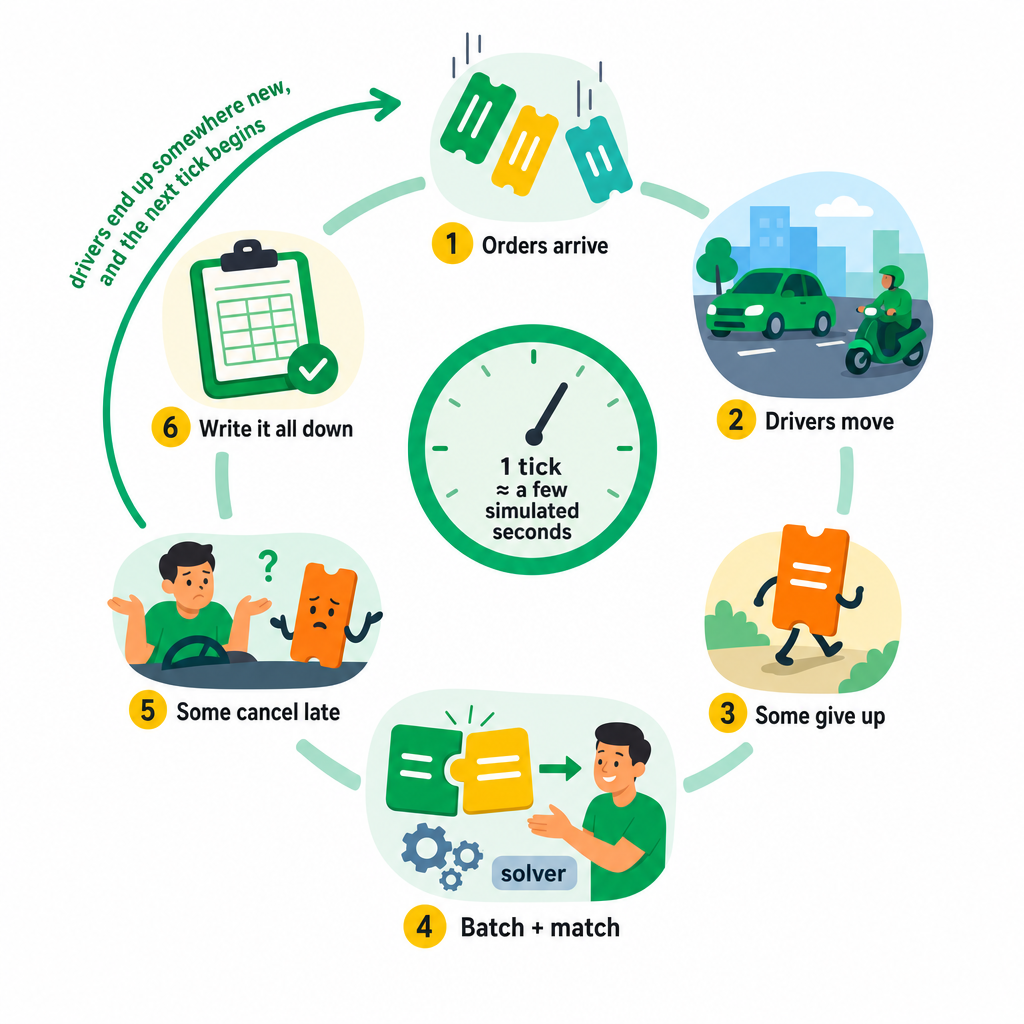
Ticks: simulated time, advancing in fixed steps. Nobody waits in real time.
At each tick, the simulator runs the following sequence:
Demand arrives. Historical (or synthesized) bookings whose time has come enter the pool.
Supply moves. Drivers come on shift, advance along routes, go idle, and reposition.
Pre-dispatch cancellations are applied. Cancellation models, including survival-analysis models trained on real behavior, determine which bookings leave the pool.
Dispatch happens. Bookings are batched into trips, trips are matched to drivers by an optimization solver, and a recycling step decides, for each trip, whether to send it now, hold it, or split it back into bookings and try again later.
Post-dispatch cancellations are applied. These include passenger and driver cancellations.
Outcomes are recorded. Every booking, trip, and driver outcome is written to the run outputs.
Crucially, this is a closed loop: today’s dispatch decisions change where drivers end up, which changes what’s possible next tick. That feedback produces second-order effects that a static replay, one that scores historical decisions without updating future supply, cannot show. Supply may dry up in a hot zone, or one bad dispatch rule may cascade into a wave of cancellations.
Figure 1. Simulator sequence.
That loop is only the mechanism. Making it a lab takes three further properties: configurability; reproducibility and auditability; and reliable comparison.
1. Interchangeable stages. The major dispatch stages are pluggable. Batching, allocation, cancellation, routing, driver movement, and recycling are each exposed through an interface with interchangeable implementations selected by configuration. This turns a fixed pipeline into an experimental platform: the component under study can be swapped while everything around it stays unchanged. The same mechanism determines which marketplace is being simulated. Ride-hailing, food delivery, parcel delivery, or all three sharing one driver pool are configuration choices within the same codebase, not separate simulators.
2. Self-contained runs. Each experiment is a small, portable package containing its configuration files, input data, source revision, metrics report, and detailed outputs. Anyone holding that package can recreate the setup, whether a reviewer, teammate, agent, or the original author six months later. The report identifies the configured components and headline metrics, while the supplementary per-booking, per-trip, and per-driver outputs let reviewers recompute those metrics and investigate unexpected outcomes without relying on separate notes or systems.
3. Experiments inside the simulation. Production marketplaces have experimentation platforms, so our simulator ships with one too. Experimentable fields can define multiple treatment arms assigned through the same time-based switchbacks, spatial splits, or cell-and-hour schemes used in production. Each booking records its resolved arm for traceability. Running these A/B/n comparisons together exposes every arm to the same demand, drivers, marketplace dynamics, noise, and biases. By reproducing both the conditions and assignment design of a marketplace experiment, simulated insights are more likely to translate into effects observed in production.
Automating the research cycle
Agents do two jobs here, and both need the same environment: searching for strategies that beat the incumbent, and keeping the simulator sufficiently faithful for that search to mean something.
Searching for better strategies
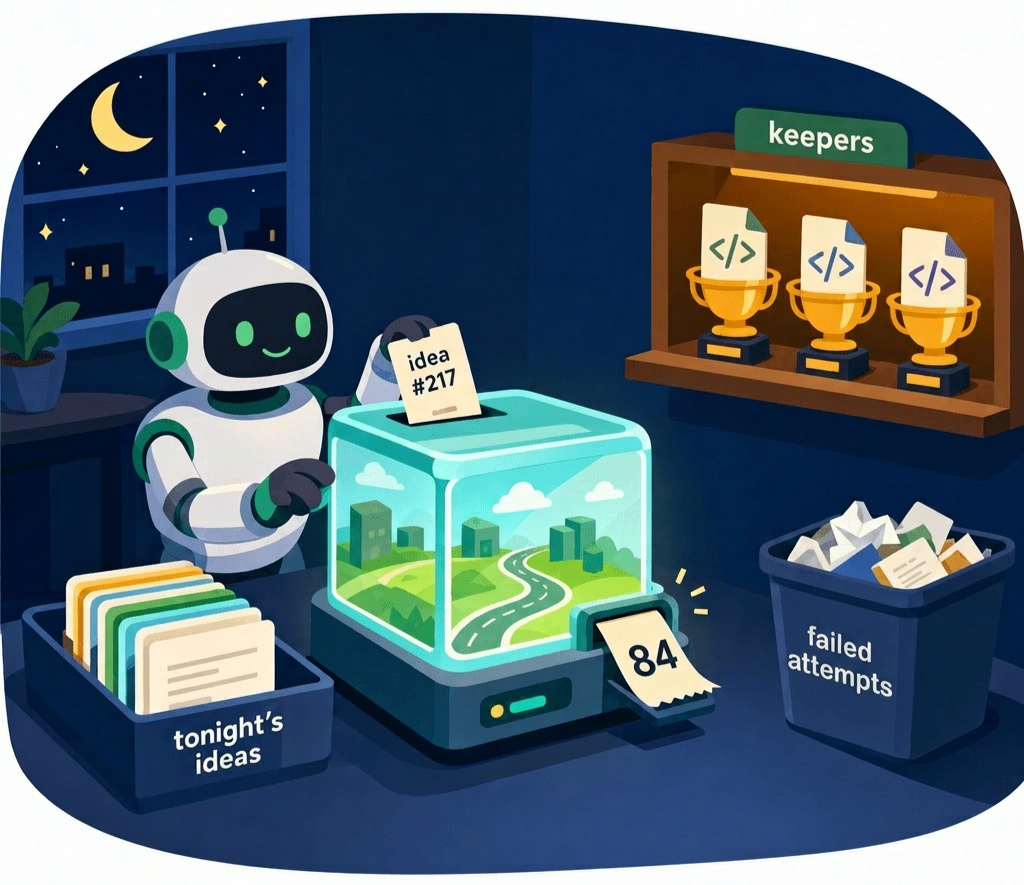
We connect agents to that interface through autoresearch, an automated loop that runs the research cycle end to end. An agent proposes a change, implements it in source code, tests it, and acts on the verdict. A candidate survives only if it improves the target metric and passes every required check; otherwise it is rolled back and the loop continues. The objective may be a marketplace outcome such as orders-throughput or a software measure such as execution time. What matters is a repeatable command-and-metric contract that both humans and agents can use.
The first failure mode we encountered was specification gaming. Given a target and a loophole, an agent may find the shortest path to the number rather than the improvement we intended. Ours discovered that changing fields used by pre-dispatch cancellation could reduce cancellations and raise completion without improving a single dispatch decision. The metric moved; nothing real had improved. Rather than relying on instructions alone, we built four safeguards into the environment:
Core data is immutable. Modules under test may change only the state exposed by their interfaces. An attempt to manipulate protected fields fails to compile instead of producing a misleading result.
The verdict is computed, not judged. The simulator computes its own metrics, which the agent can read but not redefine. Executable checks apply calibrated tolerance bands, verify equivalent outputs where required, and run the tests. The agent never judges its own work.
Changes are scoped, checked, and reversible. Each experiment runs on its own branch within a declared writable scope, which is checked against the resulting diff. The grading machinery remains outside that scope, regressions cost only a discarded branch, and every surviving change is bounded enough to review in full.
Changes are checked at two levels. It first rejects changes that violate type contracts, ownership rules, interface boundaries, or concurrency requirements. The evaluation harness then applies checks suited to the objective: performance work must preserve expected outputs, while strategy experiments must satisfy domain constraints and outcome thresholds.
The speed that matters is the speed of an adaptive research loop, not simulation runtime alone: each iteration uses previous results to propose the next change, then implements, compiles, runs, scores, and decides whether to keep it. The simulator returns a verdict in milliseconds for benchmarks or tens of minutes for a full-day replay, while autoresearch carries each verdict into the next attempt without human handoffs. This turns an overnight run into a connected sequence of evidence-driven experiments, with the safeguards above ensuring that faster iteration compounds reliable evidence rather than mistakes.
One outcome is the familiar purpose of simulation: discovering better marketplace strategies. When asked to explore trip-recycling policy, the loop turned an emerging human intuition into a concrete rule: hold batched orders only as long as service-level deadlines permit, maximizing the chance that another nearby order joins the trip. Because the result is human-readable code, engineers can review, audit, and deploy it like any other pull request.
The same machinery also improves the simulator itself. Over several nights of unattended operation, we aimed the agents at two hot paths in its dispatch logic: the checks that decide which drivers are eligible for a trip, and the pass that adjusts the cost of every driver-and-trip pairing before the solver chooses an assignment. Across roughly 150 logged experiments, three out of four attempts failed to build or were rejected by later gates. The eligibility checks ended up about 10 times faster, and the cost pass about 24 times faster. Because these paths run repeatedly in every replay, improvements compound across subsequent research. Faster and more efficient runs enable testing of more ideas across more markets and dates, repeat runs to separate signal from noise, and validate results more rigorously. Shorter runs also tighten the feedback loop from verdict to next proposal, so improving the instrument accelerates and strengthens every search performed with it.
Execution time is only one possible objective: pointing the same machinery at orders-throughput changes the research question, not the loop itself. Regardless, whatever the objective, the result is only as trustworthy as the simulator behind it. An agent can optimize only the world it is given; if that world has drifted from production, a faster loop will merely produce misleading answers sooner.
Keeping the simulator faithful
A simulator is a claim about the world: that this is how the system behaves and that this is how the people within it respond. Both halves of that claim decay. Production logic changes continuously, while models of passenger and driver behavior grow stale as new product features reshape how people act. A simulator that has drifted from the world produces misleading insights and innovations that fail in production. So the second job we give agents is to keep the simulator faithful.
The system half is a translation problem, and coding agents are particularly good at it. An agent can read a component’s production implementation and implement equivalent logic behind the simulator’s corresponding interface, translating directly from source code rather than from a written description that may already be stale. The result remains a candidate until parity checks show that it matches the production behavior being modeled.
The behavioral half cannot be translated, because no source file tells us how a passenger will behave. It must be inferred from what people actually do. Here, we redirect the same autoresearch loop from dispatch-code optimization to behavioral modeling. It proposes, fits, and scores candidate models, exploring which features predict cancellation and how their effects should be represented. The test is not only how closely a model explains its training data, but also how well it generalizes to held-out data. A model that fits last Tuesday perfectly and next Tuesday poorly does not make the simulator more faithful; it makes the lab more confidently wrong.
The pieces are simple: a realistic marketplace model, swappable parts, repeatable experiments, honest scoring, and an easy way to undo failures. Together, they give agents a safe place to test and improve ideas. Everyone is racing to give AI a bigger brain. We got further by giving it a better lab: a place where it can try a thousand ideas, be wrong cheaply, and receive an honest verdict.
Join us
Grab is Southeast Asia’s leading superapp, serving over 900 cities across eight countries (Cambodia, Indonesia, Malaysia, Myanmar, the Philippines, Singapore, Thailand, and Vietnam). Through a single platform, millions of users access mobility, delivery, and digital financial services, including ride-hailing, food delivery, payments, lending, and digital banking via GXS Bank and GXBank. Founded in 2012, Grab’s mission is to drive Southeast Asia forward by creating economic empowerment for everyone while delivering sustainable financial performance and positive social impact.
Powered by technology and driven by heart, our mission is to drive Southeast Asia forward by creating economic empowerment for everyone. If this mission speaks to you, join our team today!
Работим по темата да се случи OpenFest 2026. Имаме прилично количество забавления около смяната на мястото (ако някой не е разбрал – в Интерпред сме тази година, не в техпарка).
Пуснахме пак системата за резервиране на тениски, та който иска, може да си поръча. За някои от нещата единственият начин да си вземете е да си резервирате през системата, че на база на това поръчваме самите тениски и т.н..
With Intel’s Xeon 6+ “Clearwater Forest” CPUs now shipping in volume, we are taking a look at the various SKU options among chips, and what configurations offer the best value for different needs
To provide the best experiences, we use technologies like cookies to store and/or access device information. Consenting to these technologies will allow us to process data such as browsing behavior or unique IDs on this site. Not consenting or withdrawing consent, may adversely affect certain features and functions.
Functional
Always active
The technical storage or access is strictly necessary for the legitimate purpose of enabling the use of a specific service explicitly requested by the subscriber or user, or for the sole purpose of carrying out the transmission of a communication over an electronic communications network.
Preferences
The technical storage or access is necessary for the legitimate purpose of storing preferences that are not requested by the subscriber or user.
Statistics
The technical storage or access that is used exclusively for statistical purposes.The technical storage or access that is used exclusively for anonymous statistical purposes. Without a subpoena, voluntary compliance on the part of your Internet Service Provider, or additional records from a third party, information stored or retrieved for this purpose alone cannot usually be used to identify you.
Marketing
The technical storage or access is required to create user profiles to send advertising, or to track the user on a website or across several websites for similar marketing purposes.