Post Syndicated from The History Guy: History Deserves to Be Remembered original https://www.youtube.com/watch?v=48Q8euoYgQ4
Comic for 2025.01.20 – Mime Arrest
Post Syndicated from Explosm.net original https://explosm.net/comics/mime-arrest
New Cyanide and Happiness Comic
Development statistics for 6.13
Post Syndicated from corbet original https://lwn.net/Articles/1004998/
The 6.13 development cycle ended on January 19 with the release
of the 6.13 kernel. This cycle was, on its surface, one of the slowest we
have seen in some time; the LWN merge-window summaries (part 1, part 2) and the KernelNewbies 6.13 page
can be consulted for a refresher on all it contains. Here, instead, we
will take our usual look at where all of those changes came from.
AWS Weekly Roundup: New AWS Mexico (Central) Region, simultaneous sign-in for multiple AWS accounts, and more (January 20, 2025)
Post Syndicated from Esra Kayabali original https://aws.amazon.com/blogs/aws/aws-weekly-roundup-new-aws-mexico-central-region-simultaneous-sign-in-for-multiple-aws-accounts-and-more-january-20-2025/
 As winter maintains its hold over where I live in the Netherlands, rare moments of sunlight become precious gifts. This weekend offered one such treasure—while cycling along a quiet canal, golden rays broke through the typically gray Dutch sky, creating a perfect moment of serenity. These glimpses of brightness feel particularly special during January, when daylight can be scarce in our corner of Europe. As we move deeper into 2025, the third week of the new year brings both reflection and forward momentum. While global conversations swirl around technological advancements, it’s these small, personal moments that remind us to pause and appreciate the simple pleasures among our rapidly evolving world.
Let’s look at the last week’s new announcements.
Last week’s launches
Here are the launches that got my attention.
AWS Mexico (Central) Region – In February 2024, we announced plans to expand infrastructure in Mexico, and we’ve now launched the AWS Mexico (Central) Region with three Availability Zones and API code mx-central-1. This marks the first AWS infrastructure Region in Mexico and adds to our growing presence in Latin America. The new Region provides you with local workload management, data storage capabilities, enhanced performance with lower latency, and robust security standards. It features advanced cloud technologies, including cutting-edge artificial intelligence and machine learning (AI/ML) capabilities with purpose-built processors, comprehensive security capabilities with support for 143 security standards and compliance certifications. With this launch, AWS now spans 114 Availability Zones within 36 geographic Regions.
AWS Management Console now supports simultaneous sign-in for multiple AWS accounts – Using multi-session capability in the AWS Management Console, you can now sign-in to multiple AWS accounts and manage your resources in a single browser. You can sign in to up to 5 sessions and this can be any combination of root, AWS Identity and Access Management (IAM), or federated roles in different accounts or in the same account. You can scale your applications using multiple accounts following AWS best-practice guidelines. You can use accounts for different environments, such as development, testing, and production, and compare resource configurations and status across multiple accounts for troubleshooting application issues and other application related jobs.
Introducing new larger sizes on Amazon EC2 Flex instances – We’re announcing the general availability of two new larger sizes (12xlarge and 16xlarge) on Amazon Elastic Compute Cloud (Amazon EC2) Flex (C7i-flex and M7i-flex) instances. The new sizes expand the EC2 Flex portfolio, providing additional compute options to scale up existing workloads or run larger-sized applications that need additional memory. These instances are powered by custom 4th Gen Intel Xeon Scalable processors, which are available only on AWS, and offer up to 15% better performance over comparable x86-based Intel processors used by other cloud providers. Flex instances are the easiest way to get price performance benefits and lower prices for a majority of compute-intensive and general-purpose workloads. They deliver up to 19% better price performance than comparable previous generation instances and are a great first choice for applications that don’t fully utilize the compute resources. Flex instances are ideal for web and application servers, batch processing, enterprise applications, databases, and more. For compute-intensive and general-purpose workloads that need even larger instance sizes (up to 192 vCPUs and 768 GiB memory) or continuous high CPU usage, you can use Amazon EC2 C7i and M7i instances.
Announcing AWS User Notifications general availability on AWS CloudFormation – You can use AWS User Notifications to configure notifications to be sent using the AWS Management Console Notifications Center, email, AWS Chatbot, or mobile push notifications to the AWS Console Mobile App to keep you informed about important events such as Amazon CloudWatch alarms. With this capability, you can define notification configurations as part of your infrastructure-as-code (IaC) practices and specify notification configurations for specific resource types within your AWS CloudFormation templates. For example, you can set up notifications to trigger when an Amazon EC2 Auto Scaling group scales out, an Elastic Load Balancing (ELB) load balancer is provisioned, or an Amazon Relational Database Service (Amazon RDS) database is modified. You have granular control over which events will trigger notifications and who should receive them.
For a full list of AWS announcements, be sure to keep an eye on the What’s New at AWS page.
We launched existing services and instance types in additional Regions:
- Amazon EC2 M8g instances are now available in AWS Europe (Stockholm) – These instances offer larger instance sizes with up to three times more vCPUs and memory compared to Graviton3 based Amazon M7g instances. AWS Graviton4 processors are up to 40% faster for databases, 30% faster for web applications, and 45% faster for large Java applications than AWS Graviton3 processors.
- AWS announces new AWS Direct Connect location and expansion in Querétaro, Mexico – The Direct Connect service helps you establish a private, physical network connection between AWS and your data center, office, or colocation environment. These private connections can provide a more consistent network experience than those made over the public internet.
- Amazon EC2 C7i-flex instances are now available in AWS GovCloud (US-West) Region – These instances expand the EC2 Flex instances portfolio to provide the easiest way for you to get price performance benefits for a majority of compute intensive workloads.
- AWS Backup now supports organization-wide reports in AWS GovCloud (US) Regions – You can use AWS Backup Audit Manager to generate aggregated cross-account and cross-Region reports on your data protection policies and retrieve operational data about your backup and recovery activities.
- Amazon OpenSearch Serverless is now available in Asia Pacific (Hong Kong) Region – OpenSearch Serverless is a serverless deployment option for Amazon OpenSearch Service that makes it simple to run search and analytics workloads without the complexities of infrastructure management.
- AWS Backup is now available in Asia Pacific (Thailand) Region – Using AWS Backup, you can centrally create and manage backups of your application data, protect your data from inadvertent or malicious actions with immutable recovery points and vaults, and restore your data in the event of a data loss incident.
- Amazon GuardDuty is now available in Asia Pacific (Malaysia) Region – You can now use this additional Region to continually monitor and detect anomalous behavior, security threats, and sophisticated multistage attack sequences targeting your AWS accounts to help protect your AWS accounts, workloads, and data.
- Amazon EC2 R8g instances are now available in additional Regions – Amazon EC2 R8g instances are ideal for memory-intensive workloads such as databases, in-memory caches, and real-time big data analytics.
- Amazon EC2 I8g instances are now available in Europe (Frankfurt) Region – I8g instances offer the best performance in Amazon EC2 for storage-intensive workloads.
- Amazon S3 Tables are now available in five additional AWS Regions – Amazon S3 Tables deliver the first cloud object store with built-in Apache Iceberg support and the easiest way to store tabular data at scale. S3 Tables are specifically optimized for analytics workloads, resulting in up to three times faster query performance through continual table optimization compared to unmanaged Iceberg tables, and up to ten times higher transactions per second compared to Iceberg tables stored in general purpose S3 buckets.
Other AWS events
Check your calendar and sign up for upcoming AWS events.
AWS Summits are free online and in-person events that bring the cloud computing community together to connect, collaborate, and learn about AWS. Stay updated by visiting the official AWS Summit website and sign up for notifications to learn when registration opens for events in your area.
AWS GenAI Lofts are collaborative spaces and immersive experiences that showcase AWS expertise in cloud computing and AI. They provide startups and developers with hands-on access to AI products and services, exclusive sessions with industry leaders, and valuable networking opportunities with investors and peers. Find a GenAI Loft location near you and don’t forget to register.
Browse all upcoming AWS led in-person and virtual events here.
That’s all for this week. Check back next Monday for another Weekly Roundup!
This post is part of our Weekly Roundup series. Check back each week for a quick roundup of interesting news and announcements from AWS!
Dillo 3.2.0 released
Post Syndicated from jzb original https://lwn.net/Articles/1005640/
Version
3.2.0 of the Dillo
web browser has been released about a month after its 25th
anniversary. Notable new features in 3.2.0 include SVG support for
math formulas, optional support for WebP images, and more.
Kingston Fury Renegade 2TB NVMe SSD Review
Post Syndicated from Will Taillac original https://www.servethehome.com/kingston-fury-renegade-2tb-nvme-ssd-review/
In our Kingston Fury Renegade review, we see how this 2TB PCIe Gen4 NVMe SSD performs compared to other drives we have tested
The post Kingston Fury Renegade 2TB NVMe SSD Review appeared first on ServeTheHome.
Security updates for Monday
Post Syndicated from jake original https://lwn.net/Articles/1005638/
Security updates have been issued by AlmaLinux (.NET 8.0, .NET 9.0, ipa, and NetworkManager), Debian (389-ds-base, busybox, libreoffice, rsync, ruby2.7, tomcat10, and tryton-server), Fedora (chromium and stb), Mageia (openafs and vim), Oracle (.NET 8.0 and .NET 9.0), SUSE (amazon-ssm-agent, chromedriver, git, golang-github-prometheus-prometheus, govulncheck-vulndb, grafana, hplip, pam_u2f, perl-Compress-Raw-Zlib, perl-IO-Compress, redis, redis7, rsync, and velociraptor), and Ubuntu (libpodofo and linux-xilinx-zynqmp).
Forgotten Manned Mars Mission Plans
Post Syndicated from The History Guy: History Deserves to Be Remembered original https://www.youtube.com/watch?v=gyBmcL2fx0U
Crank (person)
Post Syndicated from Григор original http://www.gatchev.info/blog/?p=2648
This is the bare text of an article in Wikipedia, deleted about an year ago.
I believe that it is significant – in fact, highly significant these days – and have put the text here to preserve it. Like all content of Wikipedia, it is licensed under CC-BY-SA, giving me the right to do so.
Authorship goes to the respective authors.
—-
Crank is a pejorative term used for a person who holds an unshakable belief that most of their contemporaries consider to be false.[1] Common synonyms for crank include crackpot and kook. A crank belief is so wildly at variance with those commonly held that it is considered ludicrous. Cranks characteristically dismiss all evidence or arguments which contradict their own unconventional beliefs, making any rational debate a futile task and rendering them impervious to facts, evidence, and rational inference.
A crank differs from a fanatic in that the subject of the fanatic’s obsession is either not necessarily widely regarded as wrong or not necessarily a “fringe” belief. Similarly, the word quack is reserved for someone who promotes a medical remedy or practice that is widely considered to be ineffective; this term, however, does not imply any deep belief in the idea or product they are attempting to sell.
Although experts in the field find a crank’s beliefs ridiculous, cranks are sometimes very successful in convincing non-experts of their views. A famous example is the Indiana Pi Bill, by which a state legislature nearly wrote into law a crank result in geometry.
Common characteristics
The second book of the mathematician and popular author Martin Gardner was a study of crank beliefs, Fads and Fallacies in the Name of Science. More recently, the mathematician Underwood Dudley has written a series of books on mathematical cranks, including The Trisectors, Mathematical Cranks, and Numerology: Or, What Pythagoras Wrought. And in a 1992 UseNet post, the mathematician John Baez humorously proposed a checklist, the Crackpot index, intended to diagnose cranky beliefs regarding contemporary physics.[2]
According to these authors, virtually universal characteristics of cranks include:
– Cranks overestimate their own knowledge and ability, and underestimate that of acknowledged experts.
– Cranks insist that their alleged discoveries are urgently important.
– Cranks rarely, if ever, acknowledge any error, no matter how trivial.
Cranks love to talk about their own beliefs, often in inappropriate social situations, but they tend to be bad listeners, being uninterested in anyone else’s experience or opinions.
Some cranks lack academic achievement, in which case they typically assert that academic training in the subject of their crank belief is not only unnecessary for discovering the truth, but actively harmful because they believe it poisons the minds by teaching falsehoods. Others greatly exaggerate their personal achievements, and may insist that some achievement (real or alleged) in some entirely unrelated area of human endeavor implies that their cranky opinion should be taken seriously.
Some cranks claim vast knowledge of any relevant literature, while others claim that familiarity with previous work is entirely unnecessary.
In addition, the overwhelming majority of cranks:
– seriously misunderstand the mainstream opinion to which they believe that they are objecting,
stress that they have been working out their ideas for many decades, and claim that this fact alone shows that their belief cannot be dismissed as resting upon some simple error,
– compare themselves with luminaries in their chosen field (often Galileo Galilei, Nicolaus Copernicus, Leonhard Euler, Isaac Newton, Albert Einstein or Georg Cantor),[citation needed] implying that the mere unpopularity of some belief is not good reason for it to be dismissed,
– claim that their ideas are being suppressed, typically backed up by conspiracy theories invoking intelligence organizations, mainstream science, powerful business interests, or other groups which, they allege, are terrified by the possibility of their revolutionary insights becoming widely known,
appear to regard themselves as persons of unique historical importance.
Cranks who contradict some mainstream opinion in some highly technical field, (e.g. mathematics, cryptography, physics) may:
– exhibit a marked lack of technical ability,
– misunderstand or not use standard notation and terminology,
– ignore fine distinctions which are essential to correctly understand mainstream belief.
That is, cranks tend to ignore any previous insights which have been proven by experience to facilitate discussion and analysis of the topic of their cranky claims; indeed, they often assert that these innovations obscure rather than clarify the situation.[3]
In addition, cranky scientific theories often do not in fact qualify as theories as this term is commonly understood within science. For example, crank theories in physics typically fail to result in testable predictions, which makes them unfalsifiable and hence unscientific. Or, cranks may present their ideas in such a confused, not even wrong manner that it is impossible to determine what they are actually claiming.
Internet cranks
(See also: Usenet personality)
The rise of the Internet has given another outlet to people well outside the mainstream who may get labeled cranks due to internet postings or websites promoting particular beliefs. There are a number of websites devoted to listing people as cranks. Community-edited websites like Wikipedia have been described as vulnerable to cranks.[4][5]
Science fiction author and critic Bruce Sterling noted in his essay in CATSCAN 13:
Online communication can wonderfully liberate the tender soul of some well-meaning personage who, for whatever reason, is physically uncharismatic. Unfortunately, online communication also fertilizes the eccentricities of hopeless cranks, who at last find themselves in firm possession of a wondrous soapbox that the Trilateral Commission and the Men In Black had previously denied them.[6]
There are also newsgroups which are nominally devoted to discussing (alt.usenet.kooks) or poking fun at (alt.slack, alt.religion.kibology) supposed cranks.
Crank magnetism
The term crank magnetism was coined by physiologist and blogger Mark Hoofnagle on the Denialism Blog in 2007 to refer to the tendency for cranks to be attracted to claims made by other cranks.[7] Crank magnetism may be considered to operate wherever a single person propounds a number of unrelated denialist conjectures, poorly supported conspiracy theories, or pseudoscientific claims. Thus, some of the common crank characteristics—such as the lack of technical ability, ignorance of scientific terminology, and claims that alternative ideas are being suppressed by the mainstream—may be operating on and manifested in multiple orthogonal assertions.
Hoofnagle’s fellow blogger David Gorski has discussed crank magnetism in relation to the writings of British columnist Melanie Phillips, who he alleges denies anthropogenic global warming while promoting intelligent design and the discredited view that the MMR vaccine causes autism in children.[8] Blogger Luke Scientiæ has commented on the relationship between the number of unrelated claims that magnetic cranks make and the extent of their open hostility to science.[9] He has also coined the phrase “magnetic hoax” in relation to hoax claims that attract multiple crank interpretations.[10]
Studies
One study, NASA faked the moon landing—Therefore (Climate) Science is a Hoax: An Anatomy of the Motivated Rejection of Science, gave evidence that climate change denial correlated with moon landing and 9/11 conspiracy theories, staunch beliefs in laissez-faire free-market capitalism, denial of the link between tobacco smoking and lung cancer, HIV/AIDS denialism and MLK death conspiracy theories:[11]
Although nearly all domain experts agree that human CO2 emissions are altering the world’s climate, segments of the public remain unconvinced by the scientific evidence. Internet blogs have become a vocal platform for climate denial, and bloggers have taken a prominent and influential role in questioning climate science. We report a survey (N > 1100) of climate blog users to identify the variables underlying acceptance and rejection of climate science. Paralleling previous work, we find that endorsement of a laissez-faire conception of free-market economics predicts rejection of climate science (r ‘ .80 between latent constructs). Endorsement of the free market also predicted the rejection of other established scientific findings, such as the facts that HIV causes AIDS and that smoking causes lung cancer. We additionally show that endorsement of a cluster of conspiracy theories (e.g., that the CIA killed Martin-Luther King or that NASA faked the moon landing) predicts rejection of climate science as well as the rejection of other scientific findings, above and beyond endorsement of laissez-faire free markets. This provides empirical confirmation of previous suggestions that conspiracist ideation contributes to the rejection of science. Acceptance of science, by contrast, was strongly associated with the perception of a consensus among scientists.[11]
Another study titled Dead and Alive: Beliefs in Contradictory Conspiracy Theories managed to show that not only will cranks be attracted to and believe in numerous conspiracy theories all at once, but will continue to do so even if the theories in question are completely and utterly incompatible with one another.[12] For instance, the study showed that: “… the more participants believed that Princess Diana faked her own death, the more they believed that she was murdered [and that] … the more participants believed that Osama Bin Laden was already dead when U.S. special forces raided his compound in Pakistan, the more they believed he is still alive,” and that “Hierarchical regression models showed that mutually incompatible conspiracy theories are positively associated because both are associated with the view that the authorities are engaged in a cover-up”.[12]
Studies such as Belief in Conspiracy Theories state that conspiracy theories relating to the assassination of JFK, the moon landing and the September 11th attacks are united by a common thread: distrust of the government-endorsed story. This leads the believer to attach other conspiracies as well. Someone with a distrust of the government will likely reject any stories or reports directly issued by state agencies or other authorities that are seen as part of the establishment. Thus, any conspiracy will seem more plausible to the conspiracy theorist because this fits with their worldview.[13]
Cultic milieu
In academic sociology, a similar notion to crank magnetism exists, namely Colin Campbell’s concept of the cultic milieu, which he used:
…to refer to a society’s deviant belief systems and practices and their associated collectivities, institutions, individuals, and media of communication. He described it as including “the worlds of the occult and the magical, of spiritualism and psychic phenomena, of mysticism and new thought, of alien intelligences and lost civilizations, of faith healing and nature cure” (Campbell 1972:122), and it can be seen, more generally, to be the point at which deviant science meets deviant religion. What unifies these diverse elements, apart from a consciousness of their deviant status and an ensuing sense of common cause, is an overlapping communication structure of magazines, pamphlets, lectures, and informal meetings, together with the common ideology of seekership.[14]
See also:
Creativity and mental illness
Eccentricity (behavior)
Illusory superiority
Dunning–Kruger effect
List of topics characterized as pseudoscience
Paranoia
Pseudophysics
Pseudoscholarship
Tallinna narrid ja narrikesed
Spoofs
Kibo
Psychoceramics
References:
Crank at Merriam-Webster Online Dictionary
John Baez, New improved crackpot index an update to the 1992 list, 26 August 1998, sci.physics (archived message on Google Groups).
Hodges, Wilfrid (1998). “An Editor Recalls Some Hopeless Papers”. The Bulletin of Symbolic Logic. 4 (1): 1–16. CiteSeerX 10.1.1.27.6154. doi:10.2307/421003. JSTOR 421003. S2CID 14897182. A paper describing several attempts at disproving Cantor’s diagonal argument, looking at the flaws in their arguments and reasoning.
“Fact or fiction? Who contributes to Wikipedia? Despite … Archived 2009-01-12 at the Wayback Machine”, Global Agenda, March 12, 2007, Retrieved 23 April 2010
“Wikipedia.(Brief Article)”. Booklist. September 15, 2002. Archived from the original on January 12, 2009. Retrieved May 11, 2008.
CATSCAN 13: “Electronic Text” Archived 2012-04-06 at the Wayback Machine (Bruce Sterling, SF Eye) Retrieved 8 August 2012
Hoofnagle, Mark. “Crank Magnetism”. Retrieved 25 November 2015.
Gorski, David (6 May 2009). “Melanie Phillips: Crank magnetism in action on evolution and vaccines”. Respectful Insolence. Retrieved 25 November 2015.
Luke Scientiæ. “A Few Comments on Crank Magnetism”. Retrieved 15 August 2011.[permanent dead link]
Luke Scientiae. “The Magnetic Hoax: The Giant Hoax as an Example”. Retrieved 15 August 2011.[permanent dead link]
Stephan Lewandowsky, Klaus Oberauer, Gilles Gignac. “NASA faked the moon landing – Therefore (Climate) Science is a Hoax: An Anatomy of the Motivated Rejection of Science.” Archived 31 July 2019 at the Wayback Machine Psychological Science (in press)
Michael J. Wood, Karen M. Douglas, Robbie M. Sutton. “Dead and Alive: Beliefs in Contradictory Conspiracy Theories” Archived 2018-01-05 at the Wayback Machine Social Psychological and Personality Science (in press)
Ted Goertzel. Belief in Conspiracy Theories. International Society of Political Psychology, vol. 15, no. 4, 1994. doi:10.2307/3791630
“Cult Archived 2016-03-04 at the Wayback Machine” William H. Swatos, Jr. Editor. Encyclopedia of Religion and Society, Hartford Institute for Religion Research.
Further reading
Dudley, Underwood (1987). A Budget of Trisections. New York: Springer-Verlag. ISBN 0387965688.
Dudley, Underwood (1992). Mathematical Cranks. Washington, D.C.: Mathematical Association of America. ISBN 0883855070.
Dudley, Underwood (1996). The Trisectors. Washington, D.C.: Mathematical Association of America. ISBN 0883855143.
Dudley, Underwood (1997). Numerology: Or, What Pythagoras Wrought. Washington, D.C.: Mathematical Association of America. ISBN 0883855240.
Dudley, Underwood (2008). On Jargon: How to Call a Crank a Crank (and Win If You Get Sued) (PDF). The UMAP Journal, 29.1.[permanent dead link]
Eves, Howard (1972). Mathematical Circles Squared; A Third Collection of Mathematical Stories and Anecdotes. Boston: Prindle, Weber & Schmidt. ISBN 0871501546.
Gardner, Martin (1957). Fads and Fallacies in the Name of Science. New York: Dover. ISBN 0486203948. LCCN 57003844.
Williams, William F. (Editor) (2000). Encyclopedia of Pseudoscience: From Alien Abductions to Zone Therapy Facts on File ISBN 081603351X
Kossy, Donna. Kooks: A Guide to the Outer Limits of Human Belief, Los Angeles: Feral House, 2001 (2nd ed. exp. from 1994). (ISBN 978-0922915675)
Kruger, Justin; David Dunning (1989). “Unskilled and Unaware of It: How Difficulties in Recognizing One’s Own Incompetence Lead to Inflated Self-Assessments” (PDF). J. Pers. Soc. Psychol. 71 (6): 1121–1134. doi:10.1037/0022-3514.77.6.1121. PMID 10626367.
External links:
Crank Dot Net: Cranks and their theories listed and categorised.
Biden Signs New Cybersecurity Order
Post Syndicated from Bruce Schneier original https://www.schneier.com/blog/archives/2025/01/biden-signs-new-cybersecurity-order.html
President Biden has signed a new cybersecurity order. It has a bunch of provisions, most notably using the US governments procurement power to improve cybersecurity practices industry-wide.
Some details:
The core of the executive order is an array of mandates for protecting government networks based on lessons learned from recent major incidents—namely, the security failures of federal contractors.
The order requires software vendors to submit proof that they follow secure development practices, building on a mandate that debuted in 2022 in response to Biden’s first cyber executive order. The Cybersecurity and Infrastructure Security Agency would be tasked with double-checking these security attestations and working with vendors to fix any problems. To put some teeth behind the requirement, the White House’s Office of the National Cyber Director is “encouraged to refer attestations that fail validation to the Attorney General” for potential investigation and prosecution.
The order gives the Department of Commerce eight months to assess the most commonly used cyber practices in the business community and issue guidance based on them. Shortly thereafter, those practices would become mandatory for companies seeking to do business with the government. The directive also kicks off updates to the National Institute of Standards and Technology’s secure software development guidance.
Изложбата като макровидеоинсталация: Калин Серапионов „пред очите ни“ в „Двореца“
Post Syndicated from original https://www.toest.bg/izlozhbata-kato-makrovideoinstalatsia-kalin-serapionov-pred-ochite-ni-v-dvoretsa/
Контекстът

Живеем в интересни времена. Ако съдим по националпровинциализма във и извън парламента, политиката и телевизиите, по нивото на публичен дебат и език, налага се усещането за упадък и обществен разпад. Паралелно се забелязва икономическо възмогване, съпроводено от прояви на общностна съпричастност и солидарност, от наченки на гражданско общество. На интелигентското ни униние се противопоставят надарени индивиди и автономни институции, които следват принципа „Да правим каквото трябва, пък да става каквото ще“.
Събитието
Изложбата „Пред очите ни“ на Калин Серапионов в Националната галерия „Двореца“ (16.10.2024 – 12.01.2025 г.), курирана от директорката на галерията Яра Бубнова, е събитие. Привикнали сме да говорим за „културни събития“, някои от които да величаем като „явления“. Всъщност е обратното – нищожна част културни явления се превръщат в автентични събития, тоест нововъзниквания с битиен ефект. „Пред очите ни“ е събитие от типа на автентичните. В неговия състав се включват мощните и умни работи на Калин Серапионов, аранжирани в „Двореца“ така, че да ангажират и въвлекат пространството му и зрителите в интегрална макровидеоинсталация.
Уникалността
Това е първата самостоятелна изцяло видеоизложба в пространствата на „Двореца“: дори изумителната фотография – емблема на изложбата – в осветения притвор с пазача е кадър от видеото „Displace (без перука, без червило, без телефон и без цигари)“ от 2016 г. и отвежда към техноеротиката на „Руса жена с червена рокля и ярко червило говори по телефона и пуши цигара“ по диагонал в затъмнения централен коридор. Отреденото за видеоизложбата пространство на Двореца е промислено, усвоено и „огънато“ така, че да накара работите да си говорят и допълват, докато то самото съучаства в интегралния ефект. Или „в интегралното преживяване“, тъй като наблюдаващият все повече се самоосъзнава като съучастник.
Изложбата се крепи на тези четири кита – творбите в завършената им самодостатъчност; интертекстуалните мостове между работите, накарани да се „гледат“ едни други; изкривеното пространство на класическия музей; наблюдателят – нито център и цел, нито кибик сеирджия, – който постепенно осмисля посредничеството си ту като провокирано, ту като съавторско, ту като трансформиращо обектите по аналогия с модната метафора, заета от квантовата физика. Съвкупността им произвежда интегралната макровидеоинсталация „Пред очите ни“.
Заглавието, езикът, наративът, вътрепоставеността
Семплото заглавие извежда замисъла по минимализиране на езика: две трети от видеоработите, тоест осем, включително 45-минутната „Десертът“, минават „без думи“. Останалите четири са свръхезикови: три писмовни и една с устни интервюта. Когато не е изключен, езикът е молепсан от безпомощност: той е или перпетуум-мобиле за автоматизми, баналности, клишета, приличие и кич (In Addition, 2008); или идиоматичен властови дискурс на чат разправа и дисциплиниране на другия („Какви чувства? Извадки“, 2024); или абстрактна понятийност без индивидуализиращ потенциал, както е във „В края на деня“ (2020–2021), двуканална видеоинсталация, редуваща осем словесни портрета върху звуковия фон на бърз молив върху хартия; или умишлено наивистичен личен дневник на художник турист („1719D“, 2006–2007). Визуално демистифициран до перпетуум-мобиле за репродуциране на същото, езикът се онагледява като експресивно и референциално импотентен.
Според Яра Бубнова видеото на Серапионов
произвежда съспенс без наративни похвати и литературност на сюжета.
Тук думата „сюжет“ ще да е употребена в смисъла на sujet (фр.), subject (англ.), тема, доколкото сюжетирането не може да мине без наративни похвати. Бягството от наратива обаче е трудна работа. При Серапионов става дума по-скоро за потискане, за минимализъм. Така е в дебютната работа „Музеят – причина за среща и запознанство“ (1997), в която разходката на двама непознати сред класиката провокира секс в тоалетната; в триптиха (или трилогията?) с груповото хранене през годините (1998, 2006, 2020); в странната еротика на спектралната графика на пушещата жена в червено (2016); в откроеното видео без звук, в което жички и телчета от опаковки и кабели прекосяват екрана като целеустремени сперматозоиди, преди да се превърнат в плъпнала гмеж от червеи, на свой ред опразващи екрана в щастливата развръзка (Used/Loosen, 2022); в неоново огледалните „Колкото далеч, толкова близо“ (2012–2013) и Choosing Training (2014), чийто хорърсаунд, ведно със смътно страховитите лунапарк и болнични екстериори, провокира напрегнато очакване, естествено излъгано. Вместо да бъде отказван, кастриран или ампутиран, наративът се показва обезсилен, спаднал, импотентен; впрочем не без помощта на loop ефекта, освобождаващ видеата от начало, среда и край.
Оттук и вторият план на заглавието. „Пред очите ни“ внушава колкото наличност, предоставеност в зрението, толкова и пренебрегване, незабелязване, пропускане на онова „пред очите ни“. От разказа на Е. А. По „Откраднатото писмо“, култово психоанализиран от Лакан, невидимостта на преекспонираното, скритостта на откритото пред очите става централна за съвременното изкуство. Амбивалентността на израза съответства на
авторовата употреба на видеото, в което неумолимо видимото съжителства с неуловимото за очите.
„Пред очите ни“ подвежда по още един начин. Вместо да остане пред екрана, зрителят се преживява като интериоризиран, вграден, „вътре в телевизора“. Вместо класическата Бахтинова вънпоставеност зрителят има пред очите си именно своята вътреположеност насред макровидеоинсталацията.


© Калин Серапионов, Choosing Training (2014), „Колкото далеч, толкова близо“ (2012–2013). Из „Пред очите ни“ (2024–2025)
Пространството
Творбите „подреждат“ няколко четливи каузално-континуални или метафорично-асоциативни разказа. Това е най-очевидно при немия триптих с храненето в три от четирите зали вляво от централния коридор, отвеждащ до Used/Loosen. Левият завой ще отведе зрителя до триптиха с груповото хранене на арт общността в „правилната“ последователност: от супата през 1998-ма, през основното (кокала) през 2006-та, до десерта (с черешката) през 2020-та. По-вероятно е обаче още с влизането си зрителят да падне в мрежата на триканалната видеоинсталация „Десертът“– този могъщ и протяжен, сложно заснет и режисиран, технически съвършен и смразяващо безнадежден opus magnum.


© Калин Серапионов, „Основното ястие“ (2006), „Десертът (с черешката на тортата)“ (2020), „Топлата супа и моята домашна общност“ (1998). Из „Пред очите ни“ (2024–2025)
Централният коридор отвежда и до вторачените един в друг опити върху писането: те взаимно се допълват, надграждат, а и спорят. Спектрално-фракталната фотография през техноеротиката на видеото от 2016 г. (чийто женски портрет разчита на цветна графика на вълновия обхват на изброените в заглавието цветове, обеми и атрибути) достига до критиките на писането. На специално поставена стена напречно на тях виси Used/Loosen с иронично сперматозоидните телчета, вдясно от която са двете работи с квазисубектно слово: в In Addition (2008) в отговор на въпроса What do you hope for? хора от всякакъв тип се спасяват в клишета, в баналности или в политически правилните отговори; в „1719D“ (2006–2007) двуканална видеоинсталация представя уличната гъчкания на Сан Франциско редом с филм от черно-бели фотографии на къщи и паркирани коли в съседните Олбани и Бъркли, напомнящи някогашните хорър видения за света след неутронната бомба. Призрачно безличен и най-буквално безчовечен, именно екранът с къщите и колите без хора е снабден със субтитри от дневника на художника.


© Калин Серапионов, Used/Loosen (2022), „В края на деня” (2020–2021), „1719D“ (2006–2007), In Addition (2008). Из „Пред очите ни“ (2024–2025)
Времето
Авторската ретроспектива на този майстор на българското съвременно изкуство, верен на една-единствена художествена медия – видеото, играе с хронологията. Тя внушава развитие и развой, израстване и периоди. Но тази квазиретроспектива (доколкото се касае за свирепа селекция) снабдява с плътност отминалото време и свидетелства за промените, преображенията и превъплъщенията на същото в друго.
Паратекстовият епиграф – дебютът от 1997-ма „Музеят – причина за среща и запознанство“ – е маргинализиран, но и метатекстово повдигнат чрез съседството му с тоалетната – същата, в която се разиграва секс ексцесът от финала. Освен триумфално-самоиронично завръщане в „Музеят“, творбата е начална точка контрапункт на огромния път, трасиран от изложбата.
Лявото крило приютява триптиха с яденето, в който изявени радетели на българското съвременно изкуство похапват последователно през десетилетията първо, второ и трето. Силни сами по себе си, днес работите набавят далеч повече смисъл по силата на съположеността им като холограма на отминалото време, свидетелстващо за съзряване и развитие, за обогатяване и софистициране, за улягане и остаряване.
Въобще, изложбата работи и като дискретен дневник на творческото възмогване, на нарастващото техническо майсторство и все по-новите нива на перфекционизъм в изкуството на Серапионов. Времето – протичащо, изтичащо, трансформиращо, преформатиращо и деформиращо – се оказва главен герой в подбора и разположението на произведенията в изложбата.
Транс, транспортиране
Разнопосочните търсения, езиковите автоматизми и форми на контранаративност, окултурените и обезчовечени екстериори и интериори, депсихологизираният индивидуален и групов човешки свят биват обединени от непогрешимия стил на Серапионов в работата с образа и звука – безкрайно бавните, дълги кадри, неохотния монтаж, наслояването на снимачни ъгли, страховито извиращата от неведома преизподня хипнотично минорна звукова магма.
Ефектът от това е изпадането в транс, една художествена хипноза, състоянието transported – да бъдеш отнесен. Яра Бубнова хубаво и щедро назовава това
състояния, подобни на медитация.
Съзерцателната нирвана на медитацията при мен се реализира по-скоро като субективен транс, съчетаващ транспортиране и съсредоточеност, азиатска отпуснатост и мисловна активност, реене и работа. „Пред очите ни“ е интегрално наслояващо се преживяване. Индивидуалните прочити на творбите и дори интертекстуалните диалози между тях винаги ще са в недостиг и в непълноценност спрямо това възхитително преживяване на включеност, на съучастваща вътреположеност, на уникален вид работа на духа и въображението отвъд съратничеството и колаборацията.
Публиката и решението
С наближаващото закриване изложбата започна да събира все повече посетители. Все пак заслужаваше повече внимание, реклама и веща критика. Този текст е закъснял аматьорски опит да се артикулира преживяването на обикновения посетител, но той не може да компенсира липсата на арт критика.
Откъде идват трудностите пред една видеоизложба?
Софийската публика, изглежда, още не е готова да отдели време за целите творби. У нас по правило се препуска и през картинните изложби. Представата, че като пространствено изкуство живописта не изисква възприятийно време, е особено пагубна за видеото с обявеното времетраене. Изглеждаме безропотно всякакви кинобози, но рядко се задържаме пред картина, камо ли да издържим 45-минутно видео.
Калин Серапионов е наясно с ендемичния проблем на видеото – времето. Оттук и потискането на темпоралния развой и каузалността, съпротивата срещу случката и ставането. В неговите видеоинсталации откъсът е достатъчно завършен и парадигмално тъждествен на всеки друг, тъй щото да играе ролята на синекдоха, синтезираща и репрезентираща цялата видеотворба. Всяко негово видео заслужава цялостно и повторно възприятие, но е направено да върши работа и с по-минимални отрязъци, благодарение на характерната си статика, повторителност и вариативност на еднаквости и подобия. Видеото на Серапионов вещо играе с промяната и развоя, с протичането и разгръщането във времето, но и симулира loop, уроборос, подкрепен от вътрешни квазилупове на сегменти. По този начин видеото у Серапионов не само се изплъзва от класическата аристотелианска норма за цялото с начало, среда и край, но и осигурява пълнота на преживяването дори когато зрителят не е в състояние, няма подготовката или потребността да го изгледа отначало докрай.
Видео, кино, живопис
Яра Бубнова подчертава отказа от литературна наративност. Как обаче стои въпросът с изкушенията на киното в арт проявите му? Моето усещане е, че Серапионов се изкушава от алюзии с класически автори и образци.
Триптихът с паралелното ядене през десетилетията извиква асоциацията с шедьоври като Boyhood и The Before Trilogy на Ричард Линклатър. (В същото време Супата и Основното играят с една от най-изтощените иконографии на съвременното изкуство – със серийните реплики от Мерилин Монро до „Супата Кембъл“ на Уорхол). „Колкото далеч, толкова близо“ и с лунапарк неона си, с пустите си осветени прозорци и звука си напомня и зловещата тривиалност на Линч, и клаустрофобичния ефект от индустриалния пейзаж у Антониони. Подскачащата по силата на човешка оптика луна контрастно извиква застрашително приближаващата луна от „Меланхолия“ на Ларс фон Трир. Може да се заподозрат паралели с „Голямото плюскане“ на Марко Ферери, „Третият човек“ на Каръл Рийд с Орсън Уелс, с Линчовата иконография на предградията на Лос Анджелис, с приглушената хорър поетика на „Под кожата“ на Джонатан Глейзър – списъкът може да продължи.
Tези междухудожествени алюзии обаче не застрашават естетическата чистота на видеото. При Серапионов вътрешната форма на видеото е живописното платно в противоречивата му динамика и статика. То подчинява кинематографичната динамика, разказ и монтаж на единосъщото траене на картината и приканва зрителя да го възприема и чете като картина на високия модернизъм.
Чуждият език
Повечето от работите в изложбата са озаглавени на български. Вътре в тях обаче се говори само на английски. Без да парадира с лексикално богатство, сложен синтаксис или непосилна идиоматика, английският в работите на Серапионов предполага свободно владеене и явно преследва световен адресат. Тази спокойна непровинциална „контракотловинност“ на изкуството му заслужава адмирации, не на последно място и заради немарата към възможни критики за безродничество. От друга страна, част от критиките към езика като машина за клишета и автоматизми може би са резултат именно от употребата на английския като ничия и все пак чужда lingua franca. По същия начин недвусмисленото внушение на извиращите от кофи за боклук телевизори с гласове, формулиращи ad hoc надеждите си, е някак неочаквано сурово: не е изключено клишираните или банални отговори да са провокирани от културни различия, както и от несвоевременността на въпроса What do you hope for?
Заключение
Ще оставя други да пишат за изчистеността на формата, за мярката, за липсата на излишък, прекомерност и стълпеност на похватите и идеите, за техническото съвършенство без парадиране и виртуозитет, за характерния класичен хлад в работите на Серапионов. Ще завърша с едно финално допускане, което ме осени покрай музиката на моя най-предпочитан жив композитор в момента – Анна Торвалдсдотир, но което се отнася в пълна степен и за изкуството на Калин Серапионов.
У големите творци на епохата ни всъщност отсъства фокус върху отделната творба, колкото и изпипана и съвършена да е тя. Всяка работа, освен микровариант на цялостното творчество на автора, снема в себе си и изкуството на времето като негова самосъзнателна синекдоха. Вместо да се взира в пъпа на съмнителната си уникалност, творбата явява изкуството не като символ или като тъкан от чужди цитати, алюзии и позовавания, а като образцово резюме на техниките, търсенията и откритията, които определят изкуството днес.
Съвършено добросъвестно в завършеното си съвършенство, видеото на Серапионов явява себе си като нововъзникващо снемане и сработване на живото и продуктивното във видеоизкуството на времето ни. Новото е ефект от рекомбинираща в интегрално цяло селекция от видеосвета от вчера и днес.
Обновяваща еманация, резюме с изход. От Двореца на изкуството.
Middle Atlantic UTR1 1U Rack Shelf Mini Review
Post Syndicated from E Lopez original https://www.servethehome.com/middle-atlantic-utr1-1u-rack-shelf-mini-review/
We take a quick look at the Middle Atlantic UTR1. This is a short-depth 1U rack shelf from a big rack brand
The post Middle Atlantic UTR1 1U Rack Shelf Mini Review appeared first on ServeTheHome.
F-16 Shot Itself
Post Syndicated from The History Guy: History Deserves to Be Remembered original https://www.youtube.com/watch?v=3ADwQquXYP8
The 6.13 kernel has been released
Post Syndicated from corbet original https://lwn.net/Articles/1005488/
Linus has released
the 6.13 kernel. “So nothing horrible or unexpected happened last
.”
week, so I’ve tagged and pushed out the final 6.13 release
Significant features in this release include
the lazy preemption model for CPU
scheduling,
Arm64 Guarded
Control Stack support,
the PIDFD_GET_INFO() operation,
multi-grain
file timestamps,
beginning atomic write support for the ext4
and XFS filesystems,
the setxattrat(), getxattrat(), listxattrat(),
and removexattrat() system calls,
private
stacks for BPF programs,
a
new mechanism for adding guard pages to a memory mapping,
the removal of the reiserfs filesystem,
and more. See the LWN merge-window summaries (part 1, part 2) and the KernelNewbies 6.13 page
for more information.
GDB 16.1 released
Post Syndicated from corbet original https://lwn.net/Articles/1005562/
Version 16.1 of the GDB debugger is out. There are a lot of changes,
including watchpoints for tagged data pointers, a new script to print the
stack trace of a running process, better Intel Processor Trace support, and
more.
Chemical Formulas
Post Syndicated from xkcd.com original https://xkcd.com/3040/
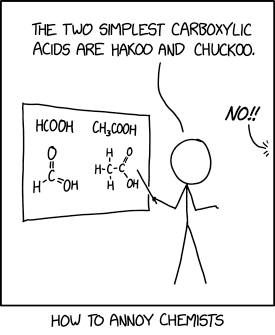
Abraham Lincoln and Wrestlemania.
Post Syndicated from The History Guy: History Deserves to Be Remembered original https://www.youtube.com/watch?v=ZBtS39pWch8
TikTok ban takes hold: data reveals sharp traffic decline and rapid shift to alternatives
Post Syndicated from João Tomé original https://blog.cloudflare.com/tiktok-ban-traffic-decline-alternatives-rednote/
The United States ban on TikTok went into effect on January 19, 2025, and our data showed a clear impact starting after 03:30 UTC (10:30 PM ET on January 18, 2025). The ban was part of the “Protecting Americans from Foreign Adversary Controlled Applications Act,” proposed in Congress, which ordered ByteDance to divest due to alleged security concerns. The bill was signed into law by Congress and President Biden in April 2024, and was upheld by the Supreme Court.
Aggregated data from our 1.1.1.1 DNS resolver shows — as we’ve posted on X — that the TikTok shutdown in the US began to impact DNS traffic to TikTok-related domains on January 19, just after 03:30 UTC (22:30 ET on January 18). This includes DNS traffic not only for TikTok, but also for other ByteDance-owned platforms, such as the CapCut video editor. Traffic dropped by as much as 85% compared to the previous week and showed signs of further decline in the following hours.
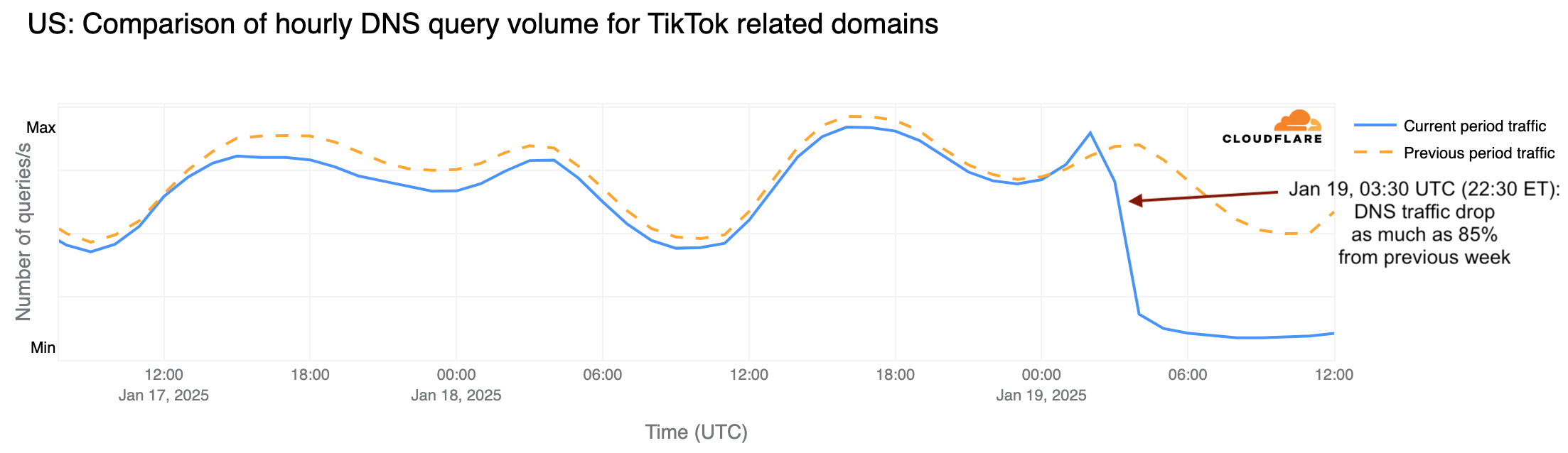
Around that time, a message indicating the TikTok ban began appearing for US users.

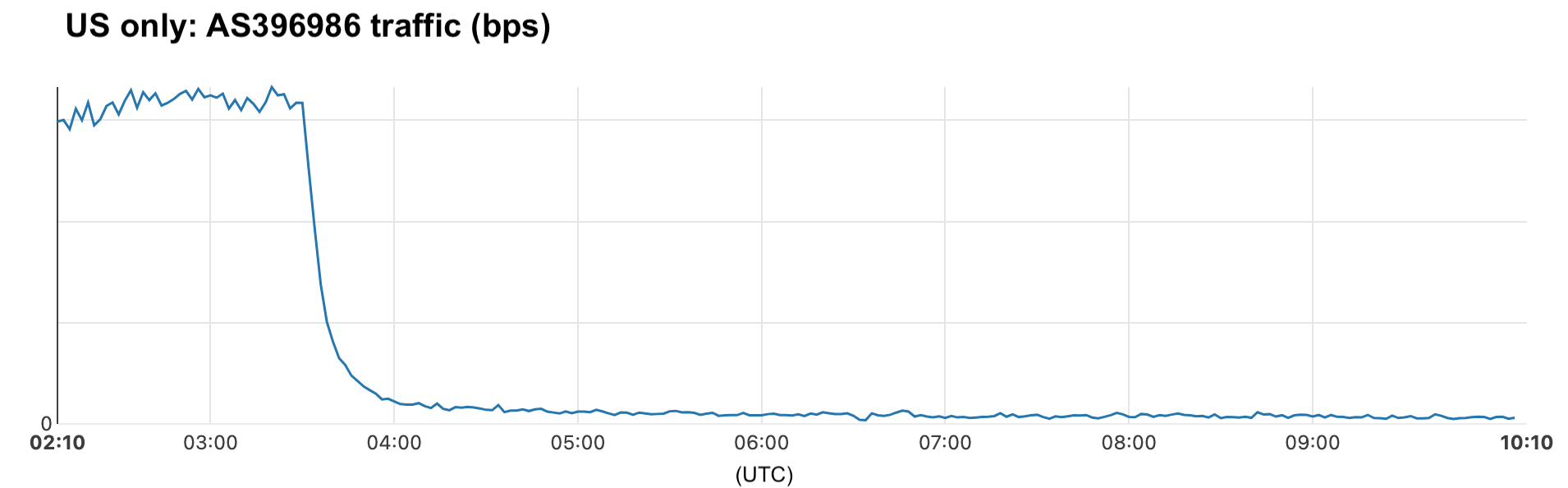
Analyzing data from autonomous systems or networks, traffic from TikTok owner ByteDance’s network (AS396986) in the US to Cloudflare experienced a sharp decline, dropping by as much as 95% after 03:30 UTC (22:30 ET).
DNS traffic in the US for TikTok alternatives, driven by RedNote (Xiaohongshu or Little Red Book), has been steadily growing since January 13. It surged on January 19 by as much as 74% around 04:00 UTC (23:00 ET on January 18) compared to the previous week, with growth being less intensive during nighttime in the US (around 22%).
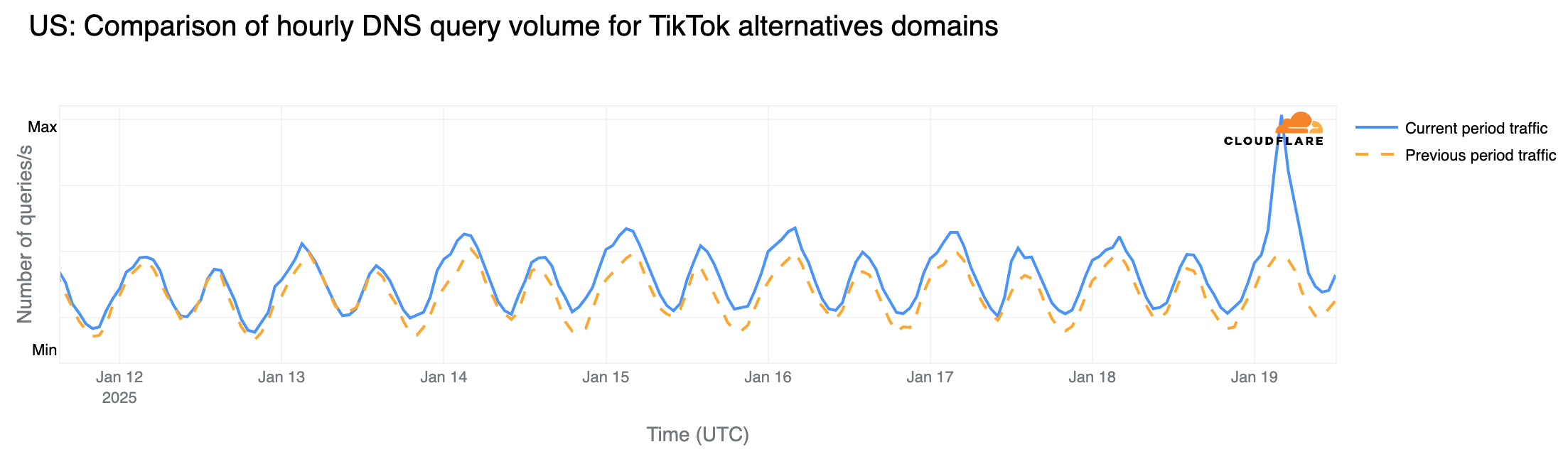
Daily DNS traffic in the US for TikTok alternatives has increased since January 13, reaching as much as 116% growth on January 15. Sunday, January 19, is on track to surpass that growth.
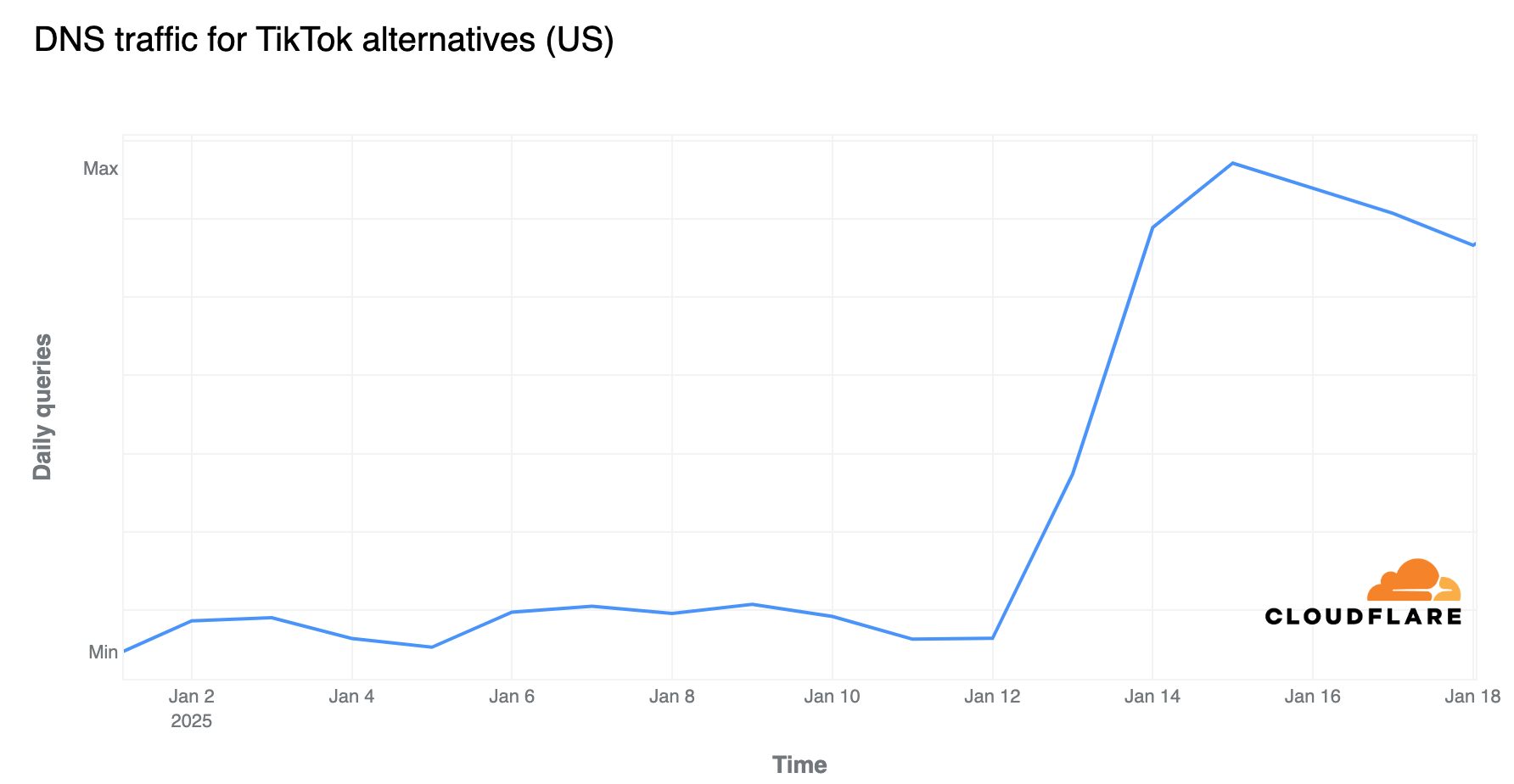
DNS traffic for TikTok alternatives, driven by RedNote, has been growing in the last few days, and not only in the US.
The other countries where we observed a clear increase in daily DNS traffic to TikTok alternatives were Mexico (a 500% increase on January 18), Canada (68% on January 18), the UK (53% on January 18), Germany (110% on January 18), and France (75% on January 18). These increases are shown in the graphs below:
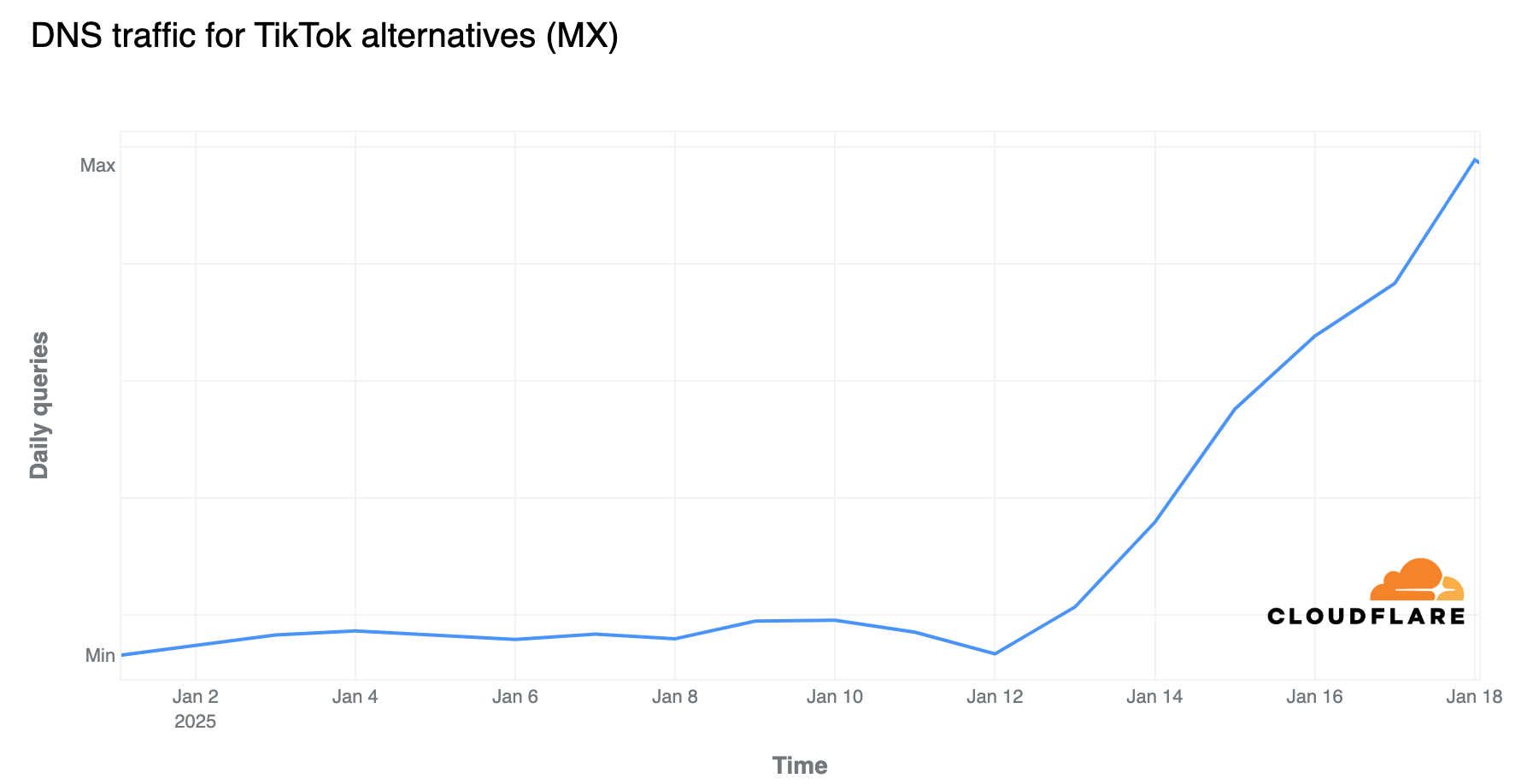
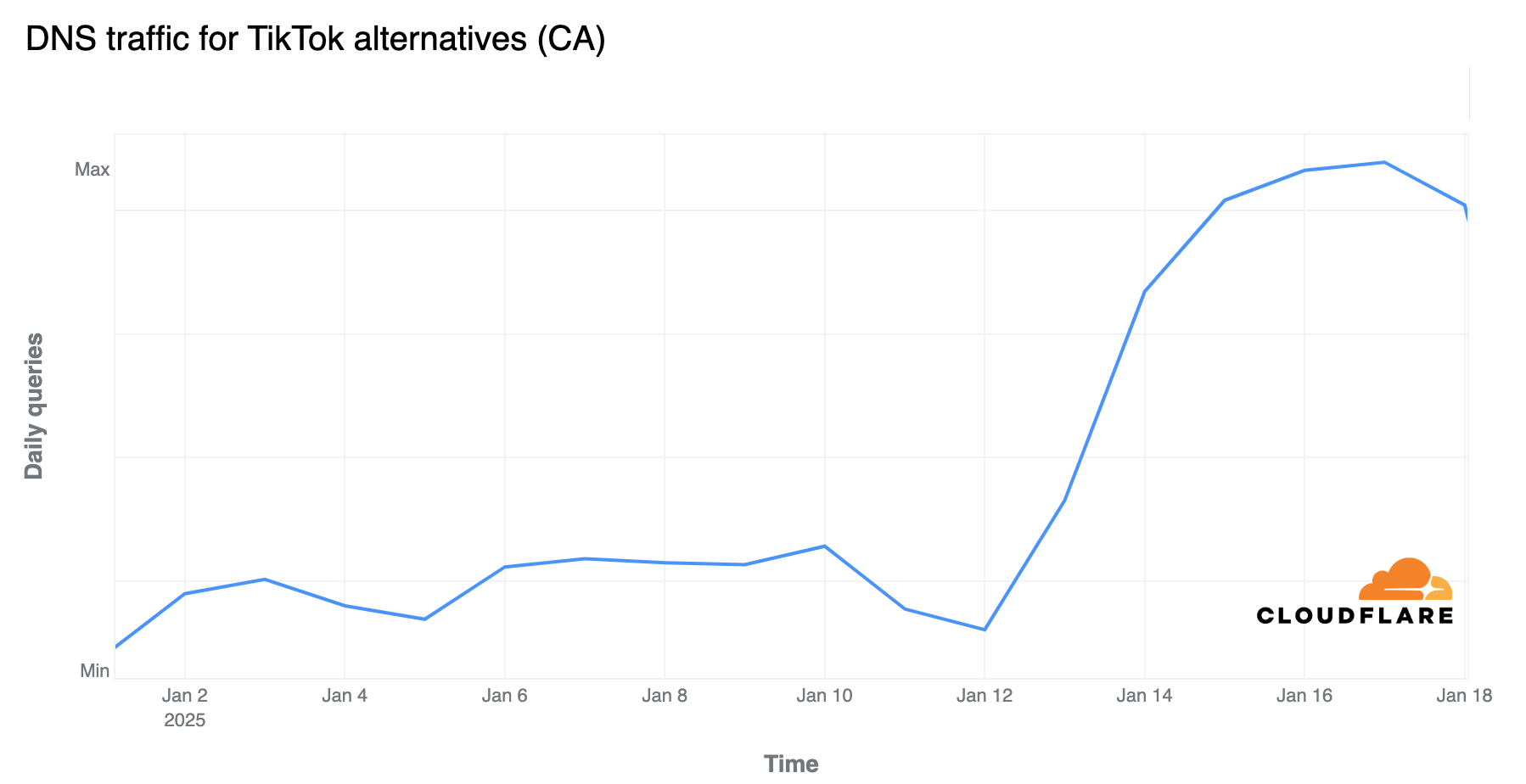
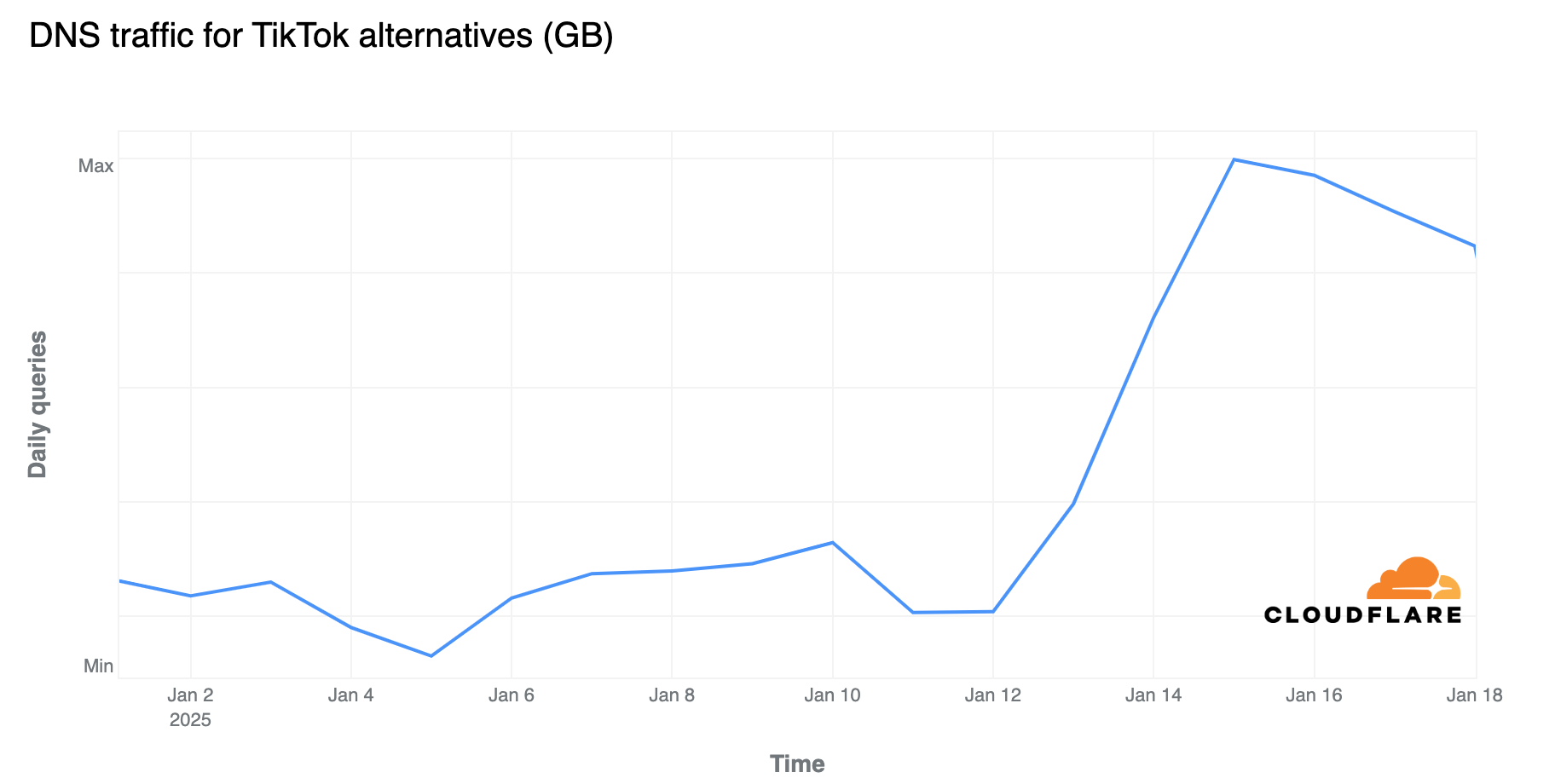
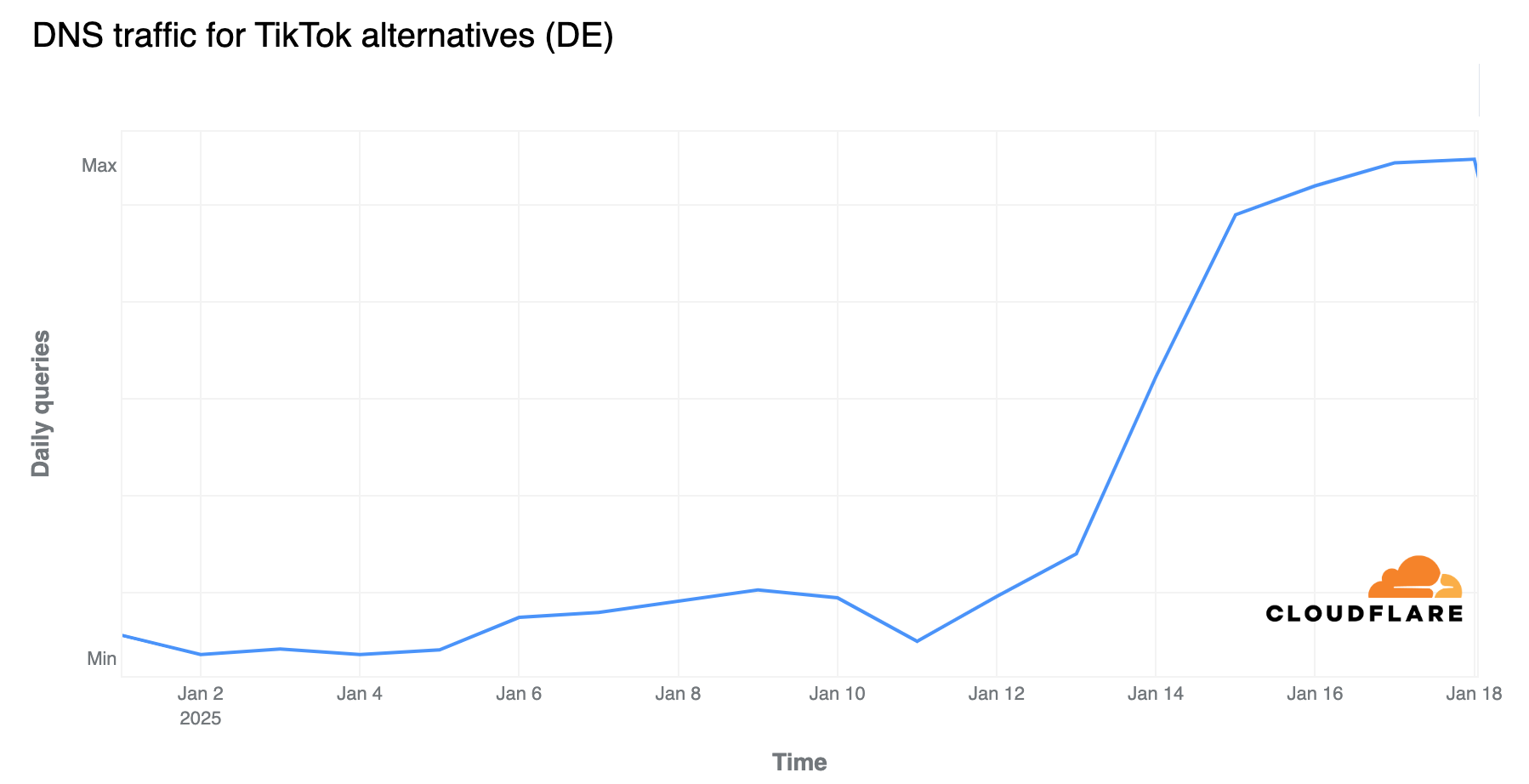
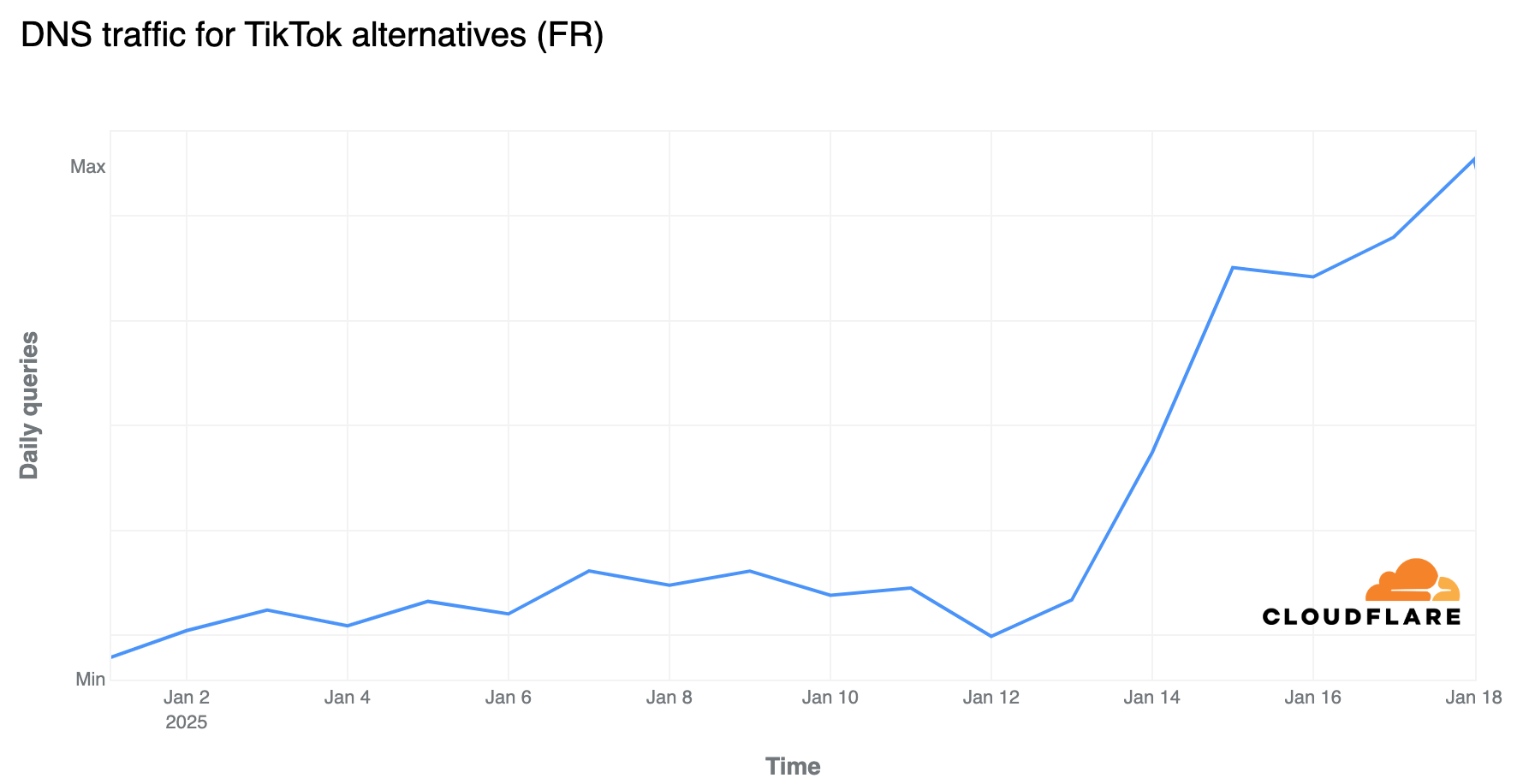
Those trends are consistent with apps like RedNote rising on top of the Android and iOS App Stores, according to Data.ai.
President-elect Donald Trump indicated on January 18 that he plans to grant TikTok a 90-day extension following his inauguration on Monday, January 20, 2025.
We will continue monitoring the TikTok ban and share updates through a new blog post or on @CloudflareRadar (X), noc.social/@cloudflareradar (Mastodon), and radar.cloudflare.com (Bluesky).
A single Sunday stable kernel release
Post Syndicated from jzb original https://lwn.net/Articles/1005546/
Greg Kroah-Hartman has released the 6.1.126 stable kernel to fix build
failures with the 6.1.125 stable
release.
Only upgrade if 6.1.125 did not build properly for you. If it did build
properly, no need to upgrade. Thanks to Ron Economos for the fix for
this issue.
The Battle Group Atomic Delivery System
Post Syndicated from The History Guy: History Deserves to Be Remembered original https://www.youtube.com/watch?v=xFRLDZNt4XA