A driver’s license tells you who someone is and that they passed a driving test, not whether they’ll drive responsibly in the future. The same is true for bots: verifying who operates it creates accountability, but trust depends on what it does next. A known bot can still ignore website preferences, overwhelm origins, or evade controls. It’s not always malicious — often it’s just a misconfiguration or a bug.
As we described in a previous blog post on bot behavior, we strive to verify two questions: “Are you who you say you are?” and “Can we trust you?” To be a Cloudflare Verified Bot, you broadly need to meet three criteria:
Identify yourself accurately and securely
Do only what you say you will do
Don’t engage in abusive behavior
Bots use Web Bot Auth to sign requests that establish their identity, which BotBase then catalogues in an open format. With identification addressed, our focus shifts to the second cardinal rule of Verified bots: thou shalt do no harm.
Today we introduce a system to evaluate and report when Verified bot behavior starts to deviate from this rule, ensuring that the answer to “Can we trust you?” remains “Yes.”
This is where the distinction between risk and trust becomes important:
Risk describes the likelihood that a particular request or point-in-time action may be harmful, and it can change from one moment to the next.
Trust is built over time through repeated and consistent behavior.
For example, we de-listed Perplexity’s bot from our Verified bot list in 2025 when it sought to access resources on websites that opted out of scraping and subsequently attempted to circumvent controls when those requests were blocked.
Do not engage in abusive behavior
This simple requirement sounds like a freebie, but there is a lot of nuance in that statement. When crawlers don’t respect site preferences, that undermines trust. When sites request a crawler to not crawl or to slow down, and the crawler ignores these requests, that undermines trust.
We developed a system to measure how often a crawler respects site preferences. These observations will translate to an explainable trust band: a range showing how consistently a bot respects site preferences and which observed behaviors informed that assessment, rather than a permanent judgment about a bot or its operator. The initial signals we evaluate are:
Does the bot respect instructions?
Did it respond to direct feedback?
We consider these to be “common sense” rules, a courtesy to the operators who provide the information bots seek. In the future, we will be sharing these scores publicly on Radar, as well as expanding the ways we measure. This score gives responsible bot operators a way to demonstrate that trust is being upheld over time. Verify, but continuously re-verify.
When in Rome, do as the Romans do
A robots.txt file is the primary way to communicate site owner preferences. Our system considers whether a bot’s observed traffic is consistent with those published preferences over time.
Robots.txt tells all (or specific) bots to only crawl specific parts of a website. Isolated violations and other types of one-offs may not be significant. What we look for instead are repeated patterns of behavior that disregards site preferences. The expectation is simply for responsible bots to consult and honor the preferences that websites publish, in line with RFC 9309.
And just to be clear, a robots.txt sets the minimum rules for what bots and agents should not do. But there is no implication that anything not stated is allowed. For example, a robots.txt does not need to say that a bot must stop when the site can communicate that continued access is unwelcome through other signals.
What you do not wish for yourself, do not impose on others
Bots can remain entirely within allowed paths while still placing substantial load on the websites they visit. One of the clearest ways a website can push back is with an HTTP 429 (“Too Many Requests”) response. A 429 is a directive for the visitor to reduce its request rate, sometimes with guidance about how long to wait before trying again.
Our system considers whether the bot’s traffic adapts after receiving that signal. Does it slow down, pause, or does it continue sending requests at the same pace? We then incorporate that behavior into the bot’s trust band over time: consistently slowing down or pausing increases trust, while repeatedly ignoring the signal lowers it.
Building trust over time
Observing these signals is only a first step toward making verified automation accountable over time. By pairing bot identity with evidence of continuing behavior, we can give site owners more confidence that the bots they choose to allow are respecting their preferences, give bot operators a way to demonstrate they deserve trust, and provide context to website owners about the automated traffic reaching them.
This system, alongside Bot Preference Sync and Bot Management, forms an accountability loop for automated traffic. Bot Preference Sync helps website owners publish their preferences, and observing how bots interact with these preferences shows whether Verified bots consistently honor them over time. Bot Management lets website owners decide how that traffic is handled. Together, they help ensure that trust is earned through transparent, accountable behavior, not assumed from identity alone.
We are already using this system internally to evaluate how consistently Verified bots honor website preferences. Because trust is built over time, we assess sustained patterns rather than isolated events. We are using this initial phase to build that history and refine how those observations become useful guidance. Building on that foundation, we plan to make the system available to all Cloudflare customers, who will be able to choose the trust threshold used to decide how Verified bot traffic is handled. Our goal is straightforward: to keep website preferences meaningful, and ensure trust is earned through sustained behavior.
Want to learn more about how you can handle bots? Cloudflare customers can already use Bot Management to manage automated traffic and Bot Preference Sync to align their published preferences with their configured policies. To explore the ever-growing Verified bot population, see the trends on Radar.
And if you are interested in helping build the future of bot identity and accountability, explore open roles at Cloudflare.
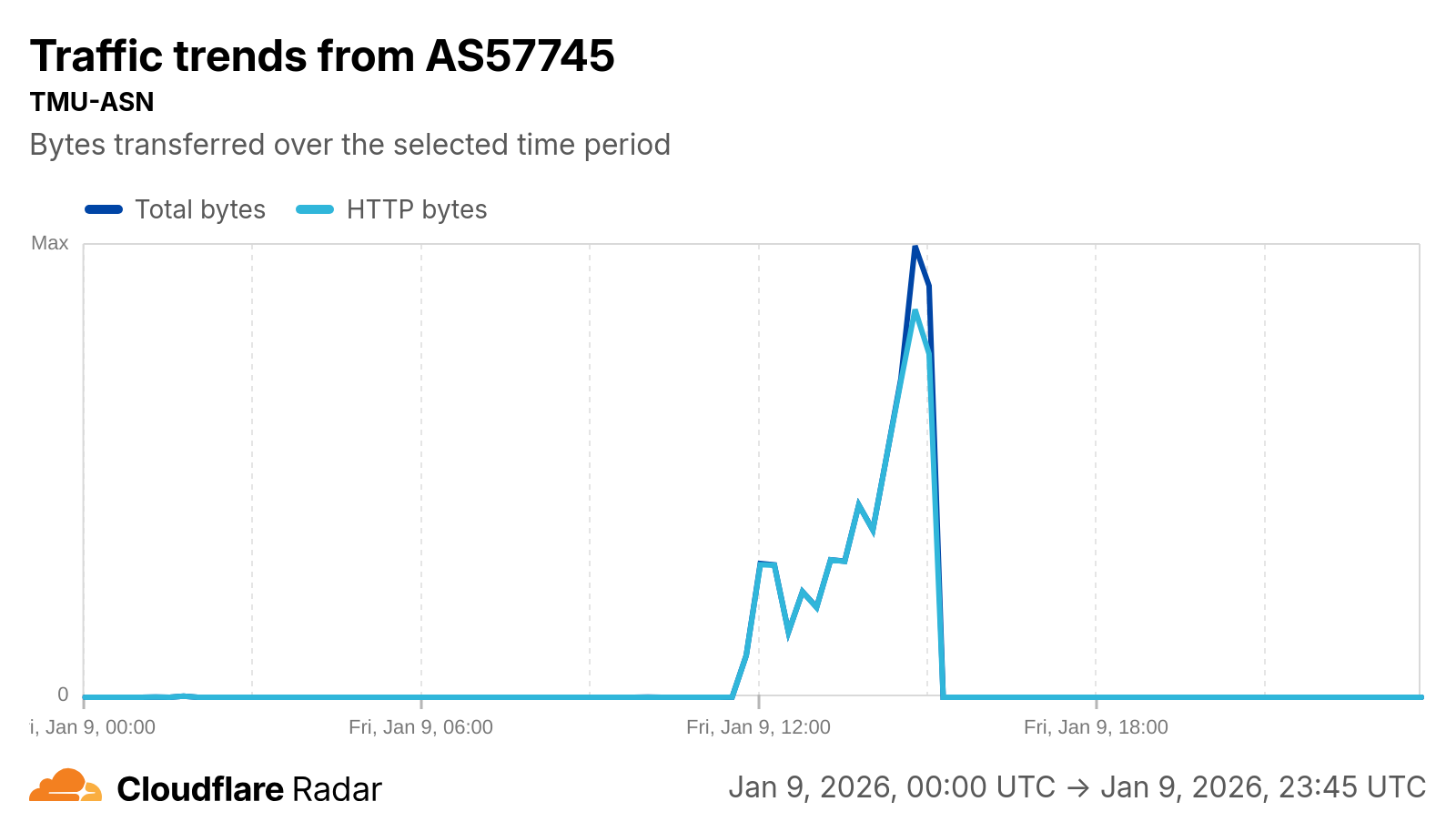
Following reported strikes on Yandex data centers, claims circulated on the Internet that Russian bot farms and influence operations had been knocked offline. HTTP traffic charts showed steep drops, fueling speculation that the infrastructure damage had stopped these malicious actors. However, aggregate traffic metrics can easily mislead. There are two autonomous system numbers (ASNs) associated with Yandex: AS13238 is used by Yandex’s search engine, while AS200350 runs its cloud services.
Using Cloudflare Radar and Bot Management data, we analyzed how these two ASNs were affected — and while both saw drops in traffic, they saw differing impact.
Yandex Search (AS13238): The drop in traffic consisted almost entirely of verified search crawlers indexing web pages, images, and site resources.
Yandex.Cloud (AS200350): There was a decline in malicious activities like vulnerability scanning and probing, but high-volume automation did not vanish — it simply migrated to other hosting providers.
While malicious traffic may originate from a particular provider, it does not necessarily tell us who is responsible for the traffic. Understanding why the strikes had little lasting effect on malicious traffic requires analyzing request behavior, rather than just overall traffic patterns.
What happened: the effect of the strikes and pre-event baseline
Between October 7 and 11, reported Ukrainian drone strikes hit three Yandex facilities in Russia, progressively knocking data centers and network capacity offline. As seen on Cloudflare Radar, this culminated in a near-total collapse of the Yandex network on October 11 when traffic plummeted to 99% below baseline for Yandex Search (AS13238) and 90% for Yandex.Cloud (AS200350). Despite a brief partial recovery, both networks remained disrupted through October 13, settling at 86-90% below normal baselines. (As of October 14 at 18:00 UTC, traffic is at 85% of normal.)
A drop in overall HTTP traffic only confirms that the network went down. It does not reveal whether malicious or evasive bots were disrupted. Looking at the pre-event automation baseline, we can see that before the strikes, automated requests accounted for 36.1% of all HTTP traffic observed globally across Cloudflare's network, and 35.8% of traffic from Russian IP addresses.
The outage had different effects on automated activity on the two affected ASNs because they served different roles.
Yandex Search ASN (AS13238) is used for search index crawling. Cloudflare classified 99.5% of its requests as automated, and 93.6% of its bot requests as Verified. Our analysis showed that traffic from this ASN indexed pages, rendered pages, and rendered images, which is consistent behavior for a search crawler. The Yandex Search ASN supplied about 7% of Russia-origin bot requests, and just 0.05% of the global total.
Yandex.Cloud ASN (AS200350) is a cloud-hosting network and carries a very different mix of automation. Approximately 95.0% of its scored requests were bots, but none of its observed bot requests were verified by Cloudflare. Yandex.Cloud’s bots looked more like software apps: nearly two-thirds of their requests sent data to websites, some identified themselves as JavaScript, Python, or Go programs, and a larger share went to software companies than Yandex’s search bots. The Yandex.Cloud ASN supplied about 2% of Russia-origin bot requests, and just 0.01% of the global total.
Impact of the event on overall bot traffic
"Bot traffic" refers to automated requests to websites on Cloudflare's network, such as crawlers and scripts, not necessarily activity on social media platforms. As Yandex’s networks lost capacity, their bot requests fell too. That was expected: nearly all traffic from Yandex Search and Yandex.Cloud was automated. While we saw the obvious drop in total traffic, we did not see any evidence linking a global disruption in malicious traffic to the drop in traffic from Yandex.
Russia-origin bot requests fell roughly in proportion to the Yandex traffic that went offline, since most requests from those networks were automated.
Date UTC+3
Global bot requests (% of all HTTP requests)*
Russia-origin bot requests (% of Russia-origin HTTP requests)
* Radar reports global traffic by both total HTTP requests, and by HTML requests (an approximation of a page view). The above table reflects total request volume.
Impact on Yandex Search ASN (AS13238): less search crawling
The decline on Yandex Search ASN was almost entirely search crawling. Sampled requests showed that 78.1% belonged to verified YandexBot, 11.5% to YandexRenderResourcesBot, and 1.9% to YandexImages.
Among websites and services, the industry segment that saw the steepest drop was Publishing and Newspapers, where traffic from Yandex networks fell 44%. Approximately 90% of pre-event traffic to news sites from this ASN was YandexBot indexing articles, with 40.5% of Cloudflare customers returning HTTP 403 Forbidden responses because the site owner blocked the crawler. When the Yandex Search ASN went offline, customers simply saw less indexing from Yandex.
Impact on Yandex.Cloud ASN (AS200350): legitimate use and migrating malicious traffic
Yandex.Cloud displayed a completely different profile. Following the reported strikes, bot traffic from Yandex.Cloud fell about 40%. Several attack-like categories showed especially sharp declines. For example, WordPress plugin probing fell 90% and scanner-identified requests fell 93%. Interestingly (and tellingly), Cloudflare customer blocks on Yandex.Cloud traffic also fell 70% during the event period, suggesting that proportionately less malicious traffic was even hitting the Cloudflare WAF from this ASN.
Impact on business verticals
Yandex.Cloud’s bot traffic is also interesting when segmented by top request destination industries:
Destination industry
Bot traffic pre-event
Bot traffic during event (Oct 7-13)
Change
4xx (client error) HTTP response status share: pre → event
Computer software
24.24M
15.18M
−37.4%
18.5% → 15.9%
Gambling
23.01M
18.80M
−18.3%
99.1% → 99.3%
Media incl. adult
1.33M
223.1K
−83.3%
82.0% → 61.8%
Internet and telecom
524.2K
206.5K
−60.6%
71.4% → 51.1%
Travel / tourism
363.9K
158.1K
−56.6%
27.0% → 12.3%
Retail / wholesale
316.0K
167.7K
−46.9%
71.0% → 55.9%
Gaming / computer games
226.3K
63.2K
−72.1%
51.4% → 9.2%
Publishing / newspapers
90.8K
8.8K
−90.3%
90.2% → 61.4%
The majority of traffic from the Yandex.Cloud ASN fell into two industry buckets: computer software and gambling. The computer software bucket was predictable for an ASN meant to host third-party applications and software integrations. In fact, we even saw that api.cloudflare.com is a top hostname for Yandex.Cloud request traffic. An overall majority of that traffic succeeded (requests returned 200s) both before and during the event, pointing to legitimate usage.
The gambling sector offers the clearest evidence that malicious automation relocated rather than disappeared. Nearly all of Yandex.Cloud’s bot requests were targeted at one gambling customer account, with traffic shifting among its hostnames. Immediately following the October 8 disruption, bot requests from Yandex.Cloud to this account dropped to zero. Simultaneously, identical requests began appearing from other Russian hosting ASNs, including Radist and Selectel. The incoming traffic maintained an identical fingerprint across providers:
The same JA4 TLS client fingerprint
The same uncommon request paths and HTTP headers
The same custom User-Agent strings
Overall, Russian bot traffic targeting gambling accounts remained essentially flat over the week, moving from 167.7 million to 170.1 million requests (+1.4%). The automation never stopped running; the operators simply migrated their workloads to alternate cloud providers once Yandex.Cloud became unavailable.
Across most industries, the share of bot requests from Yandex.Cloud returning any HTTP 4xx response fell. This is largely due to a drop off in the attack-like traffic mentioned above. This, in combination with the gambling customer analysis, shows that malicious traffic that was sending requests through Yandex.Cloud simply shifted its “services” to other providers after the service disruption.
Finally, when we analyzed social media traffic, we found no unexpected changes in traffic either from Russian-origin IPs (0.6% decrease in total traffic over the event period) or globally (1.2% increase in total traffic over the event period). We repeated the analysis on bot traffic hitting the “post”, “reply”, and “like” endpoints for a specific social media platform and similarly did not find an unexpected shift before or during the event period from either Russian-origin IPs (5.7% decrease in total traffic over the event period) or globally (1.1% increase in total traffic over the event period). Based on our assessment, the data does not appear to support the claims that the strikes crippled social media manipulation, though without further analysis with data outside of Cloudflare, we cannot conclusively say there is no connection.
What the data told us — and what it didn’t
When traffic from Yandex networks collapsed, speculation spread across the Internet that Russian influence operations and malicious botnets had suffered a crippling blow. Cloudflare data tells a different story: across Cloudflare's network, there was no evidence that the strikes knocked social media manipulation offline or otherwise disrupted malicious activity on the Internet. Instead, the data demonstrated:
Search indexing dropped. The overwhelming majority of the traffic that dropped from Yandex Search ASN consisted of verified YandexBot crawlers fetching news articles and web assets. The main impact was reduced content discovery in Yandex Search.
Malicious automation migrated instead of stopping. While vulnerability scanning and plugin probing temporarily dropped on Yandex.Cloud, high-volume operations quickly moved to alternative hosting networks.
A network disruption means that specific servers stopped sending requests, but it does not mean an automated threat disappeared. Cloud workloads are portable, so when a data center goes dark or an IP prefix gets blocked, operators can migrate their scripts to another provider in hours.
Our analysis here is a reminder that client ASN traffic volume is an unreliable proxy for interpreting automated bot behavior. Defending against automated threats requires inspecting request behavior, such as identifying shared JA4 fingerprints, monitoring anomalous request rates, and applying WAF rules to sensitive endpoints, regardless of which network the request originates from. Physical infrastructure is static, but malicious automation is built to move.
Radar provides a real-time view into global Internet trends, powered by Cloudflare’s global network. We support Cloudflare’s mission to help build a better Internet by making web data visible, clear, and actionable for everyone. Since launching in 2020, Radar has found a natural audience amongst expert users with technical backgrounds, such as network operators and academic researchers who rely on Radar data to observe industry trends and global events.
But Radar also has the potential to be a more regular, self-serve resource for journalists, human rights advocates and policymakers, and everyday users. Making Radar accessible to a wider audience is a core part of our vision, so we knew it was time to reevaluate the user experience: How could we make Radar more approachable to broader audiences, while preserving the depth and rigor that we currently have?
In this blog post, we’ll introduce the redesigned Radar, share our design process, and outline our broader vision for the platform’s future.
Challenges with the previous design
While the previous landing page was successful at showing the breadth of Radar’s data, the way that information was presented made it difficult to parse. The bento box layout gave everything similar visual weight, the vertical cards disrupted natural reading patterns, and the styling felt disconnected from Cloudflare’s broader brand.
We heard this from users. One external user mentioned that one of his biggest frustrations with Radar was that it was difficult to show to his students. That feedback reinforced the problem that Radar could feel intimidating to people encountering it for the first time. With this in mind, we wanted to create a landing page experience that shaped a clearer path through the content, instead of asking users to interpret everything at once.
But making Radar more accessible wasn’t only about reorganizing the content. It was also about making the experience feel more connected to Cloudflare. For external users, consistency directly affects trust and usability. A more cohesive Cloudflare experience helps signal that Radar is an authoritative source, while familiar layout patterns reduce the effort required to move through complex information.
Introducing Radar’s new landing page
The new and improved Radar uses a visual reference that users of all backgrounds will have a familiarity with — a map. Even though in many ways the Internet operates outside the concept of national borders, its relevance to everyday life is often best understood through geography.
The top section focuses on traffic and outages. We lead with outages as they are one of the most concrete, timely, and salient data points about the state of the Internet. Traffic, meanwhile, communicates the scale and breadth of Radar’s data. The map also acts as a navigation point into the insights below, guiding users from the global view into specific countries, trends, and data stories.
Below the map, we turned the old bento box chart widgets into a tabbed flow that helps users move through the data more deliberately. The tabs provide summary statistics to give the user a sense of Radar’s capabilities, while also giving them a call to action to explore the data in depth. The tabbed structure creates a clearer hierarchy, keeps the page from feeling overwhelming, and previews the range of information Radar provides.
From concept to reality
Developing Radar’s design language
To develop Radar’s design language, we looked across Cloudflare’s content ecosystem, which exist in these three pillars:
Marketing pages (like cloudflare.com)
Content experiences, like the Cloudflare Blog and Developer Docs
Product experiences
Where does Radar fit?
Ultimately, we decided that Radar sits at the intersection of all three. At its core, Radar is a data product, but it’s also public-facing and inherently content-rich. The strategy blends design aspects of all three: approachable like marketing, structured and navigable like content, and maintainable by migrating to Kumo components used by Cloudflare’s product system.
What we tried along the way
From the outset, we knew the landing needed to communicate Radar’s global perspective. Because Radar helps people understand Internet activity across countries and regions, a map felt like the clearest way to make that scope immediately visible.
The map went through many rounds of iteration as we tried to strike the right balance between data richness and approachability. Early versions were too dense — we were trying to convey credibility through data-heavy visuals. Later versions moved too far toward marketing-style visuals; they felt more approachable, but risked making Radar’s fresh data feel static or overly summarized. The current direction sits between those two poles: it has the feel of live data, but it’s easier to read.
The Radar vision and evolution
Because Cloudflare sits in front of roughly 20% of all web traffic, Radar has the opportunity to tell unique and compelling stories about the Internet. To unlock that value, we want to empower every user with real-time insights across security, performance, and traffic.
This redesign is a foundational step in that direction. Moving forward, Radar will continue to focus on tools, visualizations, and storytelling frameworks that remove friction for new audiences while doubling down on our deep data infrastructure. By pairing our technical rigor with a cleaner, human-centered experience, we are ensuring that more people can explore, understand, and share the state of the Internet.
Help us make Radar better
This redesign is our first step toward a more intuitive, scannable Radar. But we're just getting started, and we need your input. What’s working? What isn’t? What insights are still hard to uncover?
At a time when looking down at our devices is a ritual in daily life, a natural phenomenon that demands our attention communally upward is a welcome event. On Wednesday, August 12, a total solar eclipse swept from the North Atlantic across Europe, moving over Iceland and northern Spain and Portugal, with a deep partial eclipse over the rest of Western Europe, all near local sunset. This was the first total solar eclipse to cross mainland Europe in twenty years, and it drew millions outdoors to witness the moon pass between Earth and the sun.
Internet traffic dips align precisely with maximum obscuration
In the figure above, we measured HTTP request volume in five-minute buckets across the affected countries on eclipse day, and compared it to a normal-day baseline. Each row is a country (except for Alaska) and each column is a five-minute slice of August 12, the day of the eclipse. The countries appear above in the order in which they saw the eclipse.
The black diamonds mark the moment of maximum eclipse and the color shows the percent change in HTTP traffic versus the baseline (red = below normal, blue = above). We can see very clearly that the black diamonds overlay the darkest red, almost perfectly, signaling that as the eclipse deepened, Internet traffic decreased. The decrease was most significant along the path of totality and in countries that saw the deepest partial eclipse (Iceland, Ireland, the UK, France, Spain and Portugal) and all but absent where the sun was barely obscured (Sweden, Denmark, Poland, Switzerland).
Where the eclipse was deep, the red color and black diamonds mirror each other: traffic falls into a trough that sits directly beneath the peak of obscuration and rebounds as the sun reappears, typically within minutes of maximum coverage as people return to their screens.
The scatter plot above suggests that these decreases are not due to random chance. Each point represents the peak solar obscuration of an individual country (x-axis), against the region's traffic dip (y-axis). The traffic dip is measured as the average percentage change versus baseline in the 15-minute window surrounding maximum eclipse. The downward trend of the dotted line following the dots demonstrates that regions along the path of totality saw traffic fall by roughly 15% to 30%, whereas areas experiencing only a shallow partial eclipse dipped far less or not at all. While local variables like population density, time of day, and cloud cover account for scatter at any given coverage level, the overall direction remains consistent. Paired with the precise timing of the drops, the trend of the data demonstrates that the eclipse itself was the primary driver of the decline.
Iceland, Spain and Portugal saw the biggest decreases in traffic
The figure above shows trend lines for each individual country. The gray triangles represent the progression of the eclipse obscuration, while the red line tracks the amount of traffic changed from its usual baseline. In almost all the countries and regions impacted in the course of the eclipse, traffic made noteworthy changes ranging from 9.3 to -46.7%.
The right-hand numbers on the “y2”-axis are the obscuration, calculated using precise sun and moon positions. For each location we found the apparent angular sizes of the sun and moon and how far apart they are in the sky, then calculated the fraction of the sun's disk covered by the moon every 5 minutes via the geometric overlap of two circles. That gave each place both its peak obscuration (how deep the eclipse got, 0–100%) and its moment of maximum eclipse. We then summed all regions in each country for the traffic total, and took the average obscuration across a country's regions to place its national max-eclipse time.
To differentiate the eclipse from a typical Wednesday evening, we compared eclipse day against the same weekday: the median of the three previous Wednesdays, matched slot-by-slot on time-of-day. Using the median keeps one odd week from skewing the comparison. Every number is then reported as percent change vs. baseline. When looking at the percentage on the left-hand y-axis, 0% means "totally normal" and negative means "less active than usual."
We can see the changes in traffic beginning in Alaska around 15:35 UTC, where the eclipse began its pathway. Iceland, Spain, and Portugal experienced the most dramatic drops in traffic, whereas Poland and Denmark quickly returned to pre-eclipse levels. Norway and Sweden actually saw slight traffic increases above baseline, while Denmark recorded the least overall change.
Ultimately, these findings reveal a clear correlation between the path of the eclipse and human behavior online. While the severity and duration of traffic drops varied by region, Radar’s HTTP traffic data demonstrates how a shared physical event can temporarily reshape digital activity across an entire continent.
Track the impact of world events on Cloudflare Radar
Major events in the physical world remind us that digital traffic is, at its core, a direct reflection of human attention. When the moon obscured the sun across Europe, the Internet slowed down not because of network failures, but because people paused their online activity to watch. As network patterns quickly normalized post-eclipse, the data left behind offers a fascinating snapshot of how a cosmic event can momentarily realign our online world.
Welcome to the 25th edition of Cloudflare's DDoS Threat Report. This is the first half-year edition in the series: rather than publishing separate reports for the first and second quarters of 2026, we have combined our coverage of Q1 and Q2 into a single volume covering January through June 2026. The analysis is produced by Cloudforce One, Cloudflare’s Threat Intelligence organization, providing a comprehensive analysis of the evolving threat landscape of Distributed Denial of Service (DDoS) attacks based on data from the Cloudflare network.
Key insights
The 1 Tbps club grew. Cloudflare mitigated a combined 935 network-layer DDoS attacks exceeding 1 Tbps in the first half of 2026 and a +519% quarter-over-quarter surge between Q1 and Q2.
The attack-vector center of gravity shifted from botnet floods to reflection and amplification. DNS-based attacks accounted for 34.3% of all network-layer activity in the first half of 2026, with DNS Floods alone climbing from 25.7% to 40.0% of network-layer attacks quarter-over-quarter. CLDAP Floods surged +580% quarter-over-quarter to become the #3 vector in Q2.
Geopolitics and global events influence the landscape. Media, Production & Publishing held the #1 most-attacked industry crown in both quarters at 14.2% of all mitigated HTTP DDoS requests as coverage of Iran, Ukraine, and the World Cup drew sustained attention. In parallel, Turkey rose to the #3 most-attacked country amid the backdrop of the July NATO Summit in Ankara, and the Government sector jumped from #29 to #9 — the largest single sector movement of 2026 to date — during Operation Epic Fury.
H1 by the numbers: 5,300 DDoS attacks every hour
Midway through the year, Cloudflare has already mitigated 23.2 million network-layer and 29.64 trillion HTTP DDoS requests. That works out to approximately 5,343 network-layer DDoS attacks per hour, or about 128,000 per day.
April peak, and law enforcement takedowns
April 2026 was a peak month for DDoS activity and volume, hitting a high of 6.46 trillion requests and 165 petabytes (PB) respectively. For perspective, this is an enormous amount of traffic — equivalent to streaming 4K video continuously for years, or roughly the amount of data processed by major video platforms in a single day. Requests and volumes declined afterward, a possible reflection of Operation PowerOFF — a 21-country action that targeted over 75,000 DDoS-for-hire users, took down 53 domains, issued 25 search warrants, and resulted in four arrests.
Hyper-volumetric attacks see a more than 6x surge
Hyper-volumetric DDoS — attacks defined as exceeding 1 terabit per second (Tbps), 1 billion packets per second (Bpps), or 1 million requests per second (Mrps) — has been a growth category across Radar reporting. 2026 is proving to be no different. During the second quarter, Cloudflare mitigated 805 network-layer attacks exceeding 1 Tbps, representing a more than six-fold increase over the previous quarter.
Attack characteristics: low and slow
Despite the hyper-volumetric growth, the median DDoS attack Cloudflare mitigated in the first half of 2026 remained short and small with 96.62% of network-layer attacks remaining under 500 Mbps and 90.60% ending in under 10 minutes. It’s important to note, however, that ‘small’ is a relative term and most Internet properties wouldn’t be able to withstand even those small attacks. In practical terms:
A 100 Mbps attack is enough to overwhelm a server or website
A 100 Gbps attack can knock most unprotected data centers offline
A 1+ Tbps attack is among the largest ever recorded and stresses even major Internet infrastructure
Attackers sometimes mix layers — a high packet rate (Mpps/Gpps) with relatively low bandwidth (Gbps), or vice versa, to exploit different weaknesses in network gear versus bandwidth capacity.
Furthermore, most DDoS attacks are surprisingly short-lived, as highlighted in the chart below. Even the largest hyper-volumetric attacks can be measured in seconds rather than minutes — we have observed record-breaking assaults that lasted only 35 seconds from start to finish. Whether an attack lasts half a minute or ten minutes, there is no practical window for human intervention: by the time an alert reaches a security analyst, the attack has already completed. Manual mitigation and on-demand solutions are simply too slow for this reality. Yet while the attack itself may be brief, its aftershocks are not. The cascading effects of even a short burst can trigger routing instability, TCP retransmissions, application timeouts, and downstream service degradation that takes hours or days to fully resolve — all while services remain down or impaired. In this threat landscape, automated, always-on protection is not a convenience; it is a necessity.
Most-attacked industries
Operation Epic Fury and a spike in attacks on the government sector
On February 28, 2026, Israel and the United States launched Operation Epic Fury, a series of strikes against Iran’s leadership and infrastructure. Within 72 hours, the DDoS landscape responded, with security researchers recording 149 hacktivist DDoS claims against 110 distinct organizations across 16 countries. Nearly 47.8% of all targeted organizations globally belonged to the government sector.
As public reporting documented extensive government targeting during this period, the vertical surged 20 places, from #29 in Q1 to #9 in Q2 by share of mitigated HTTP DDoS requests. While outside the top 10 for most of this period, it represented one of the single largest industry-rank moves.
Media under siege: the most attacked industry
Amid warfare in Iran and Ukraine and the excitement of the World Cup, the Media, Production & Publishing industry was the most attacked in both quarters, taking 14.2% of all mitigated HTTP DDoS requests — nearly four times the runner-up.
Most-attacked locations
The DDoS landscape in H1 2026 saw both familiar names and reshuffling among the world's most-attacked locations. China ended H1 as the most attacked location, after absorbing 22.4% of all HTTP DDoS requests globally in Q2. The United States held firm at #2 (18.8%), demonstrating persistent appeal for attackers.
Turkey saw a rapid increase in attacks, more than doubling its share of global attack traffic to climb into the #3 most-attacked position by Q2. The surge coincided with the buildup to the 2026 Ankara NATO Summit in June and early July, when Turkish security forces conducted sweeping pre-summit raids across Ankara, arresting at least 209 people.
Top attack source countries
Brazil overtook the United States as the top DDoS source country in the first half of 2026, at 14.9% versus 13.4% — driven by a dramatic Q2 surge when Brazil became the source country for 21.4% of all mitigated DDoS request traffic. Indonesia remained locked at #3 in both quarters — extending its multi-quarter run as one of the top three global DDoS source countries.
Attack vectors
DNS floods dominate
DNS-based attacks (DNS Flood and DNS Amplification) accounted for 34.3% of network layer attacks in the first half of 2026. The two mechanisms are related but distinct: a DNS Flood aims a botnet's raw request volume directly at a victim's authoritative DNS servers to exhaust their query capacity — the "phonebook" for that domain becomes unreachable and every service depending on it goes dark. DNS Amplification instead sends small spoofed queries to open DNS resolvers, which reply with much larger records (often triggered by an ANY query) to the victim's spoofed IP.
CLDAP explodes: +580% surge in amplification
CLDAP Flood — a reflection and amplification vector that abuses exposed Active Directory LDAP-over-UDP endpoints — grew +580% quarter-over-quarter, becoming the #3 vector in Q2 alone. CLDAP (Connectionless Lightweight Directory Access Protocol) is a variant of LDAP (Lightweight Directory Access Protocol), used for querying and modifying directory services running over IP networks. CLDAP is connectionless, using UDP instead of TCP, making it faster but less reliable. Because it uses UDP, there’s no handshake requirement, which allows attackers to spoof the source IP address, thus allowing attackers to exploit it as a reflection vector. CLDAP attacks work by sending small spoofed queries to publicly reachable domain controllers on UDP port 389; the servers reply to the spoofed source (the victim) with responses tens to hundreds of times larger than the original query, thus overwhelming the victim host.
Strengthening global defenses and helping to defend the Internet
Cloudflare's network is designed to absorb this kind of growth in DDoS threats. Every service on our network is protected by free, unmetered DDoS protection that runs at every one of our 330+ cities globally, backed by 500 Tbps of network capacity. Autonomy is the point: our systems detect and mitigate attacks without human intervention, and they need to, because attackers now regularly deliver attacks above 1 Tbps at a cadence measured in hundreds per quarter.
To help hosting providers, cloud computing platforms and Internet service providers identify and take down the abusive IP addresses/accounts that launch these attacks, we leverage Cloudflare’s unique vantage point on DDoS attacks to provide a free DDoS Botnet Threat Feed for Service Providers.
Over 800 networks worldwide have signed up for this feed, and we’ve already seen great collaboration across the community to take down botnet nodes.
About Cloudforce One
Driven by a mission to help defend the Internet, Cloudforce One draws on telemetry from Cloudflare's global network — which protects more than 20% of the web — to drive threat research and operational response, protecting critical systems for millions of organizations worldwide.
Since launching in 2020, Cloudflare Radar has provided one-of-a-kind insight into Internet traffic on a global scale. The open data that Radar publishes from our global network is used by a variety of experts in different domains: human rights advocates, journalists, academic researchers, network operators, and more.
Today, as part of Agents Week, Radar is beta-launching a new tool: Radar Researcher.
Now, if you want to answer a question with Radar’s data, you can just ask in plain language and get an answer back with real, interactive charts, all built on Cloudflare's developer platform. You no longer need to find the right page, choose the right filters, or read the API documentation to write a query.
Why we built Radar Researcher
Over the past six years, the Radar team has worked to provide clear, accessible, reliable data visualizations of complex datasets. This is not without its challenges: our user base is vast and ranges from curious novices to technical network experts. Even so, we publish as much insight into the Internet as seen from our network as we can: DNS queries from our public resolver 1.1.1.1, HTTP traffic from across our global network, network quality data collected from Cloudflare Speed Test, and so much more. We also believe in the power of open, public data, which is why everything you see in Radar’s data visualizations is available via our free API. Every year we make more and more of the Internet visible.
But as Radar has evolved, so has the technology for working with data. AI tools are lowering the barrier to expertise: you no longer need to know a dataset's structure or vocabulary to get useful answers from it. Subject-matter experts become collaborators rather than gatekeepers.
Radar has always wanted to do more for users who shouldn't need to master our entire catalog and its vocabulary to fully appreciate our insights. (See our recent blog post on how the Internet responded to the 2026 FIFA World Cup.)
We also know that many of our users are in a hurry. For example, a journalist writing about the latest Internet outage likely does not have the time to search through each page for the perfect graph to tell their story. This is why we built Radar Researcher.
Meet Radar Researcher
Radar Researcher is built to make accessing data as easy as describing what you’re looking for. All information is provided via Radar’s API, which ensures that the underlying LLM relies on real data, and can answer your questions quickly and in the same format as you would articulate them to a human.
It's available on every Radar page. Open the Radar Researcher panel from the header, and it docks beside whatever you're looking at, so you can keep browsing while you chat. Here are some examples of how you can use it:
Get an answer in plain language, with real charts: Ask a question and get the same interactive visualizations you see across Radar, plus a short explanation.
Choose your depth: Pick a concise, direct answer or a fuller, multi-topic report.
Keep the analysis going: After each answer, it suggests useful follow-up questions.
Pick up where you left off: Conversations are saved in a searchable history you can pin and revisit, and you can share any conversation with a link. (Shared links expire automatically after 30 days.)
Audit the reasoning: Check how the LLM interpreted your question, which datasets it looked up and queried, and how it worked through the results to reach its answer.
Ask your way: Type, use voice input, or launch it straight from Radar's search bar.
Turn any chart into a conversation
Researcher doesn't only start from a blank prompt. Anywhere you see a chart on Radar, an Explain with AI action opens the assistant with that exact visualization already in hand.
Instead of asking you to describe what you're looking at, it captures the exact visualization you're viewing and starts the conversation there. As you can see below, Radar Researcher takes the visualization in context, then analyzes the data and responds with an explanation.
Under the hood, the assistant hands the model three things at once: a screenshot of the chart (a vision-capable model reads the image directly), the exact data behind it from Radar's API, and the parameters of your current view, including location, date range, and any filters you've applied. The screenshot enables Radar Researcher to see what you see. The raw data keeps every number it cites precise instead of estimated from pixels, and the filters mean the explanation is about your exact view, not a generic version of the chart.
Use Case No. 1: What’s Internet quality like in Portugal?
Say you're curious how good the home Internet is in a given country. You can just ask:
Instead of manually calling the API, choosing parameters, or hunting through Radar's pages, Radar Researcher interprets the question and does the work for you. You can follow each step in the screenshot: it reads what you asked, queries Radar's Internet quality API, then analyzes the results and answers in plain language. And rather than a wall of numbers, it renders the same interactive charts you'd see on the Radar Internet Quality section.
From here you might ask a natural follow-up, like comparing Portugal to a neighbor, and Radar Researcher fetches fresh data for each one. It even suggests useful next steps of its own, such as how Portugal stacks up against Spain or the country's most common Internet outages. By letting you find what you're looking for in plain language, we hope applying Radar's data to your own analysis is easier than ever.
Use Case No. 2: Investigating an Internet disruption
Radar Researcher is also built with technical experts in mind. If we know one thing about engineers, researchers, and network operators, it’s that automation is key to their workflows. Looking at the same data with manual actions can be cumbersome and limiting: how do you ensure you're always looking at the most relevant data?
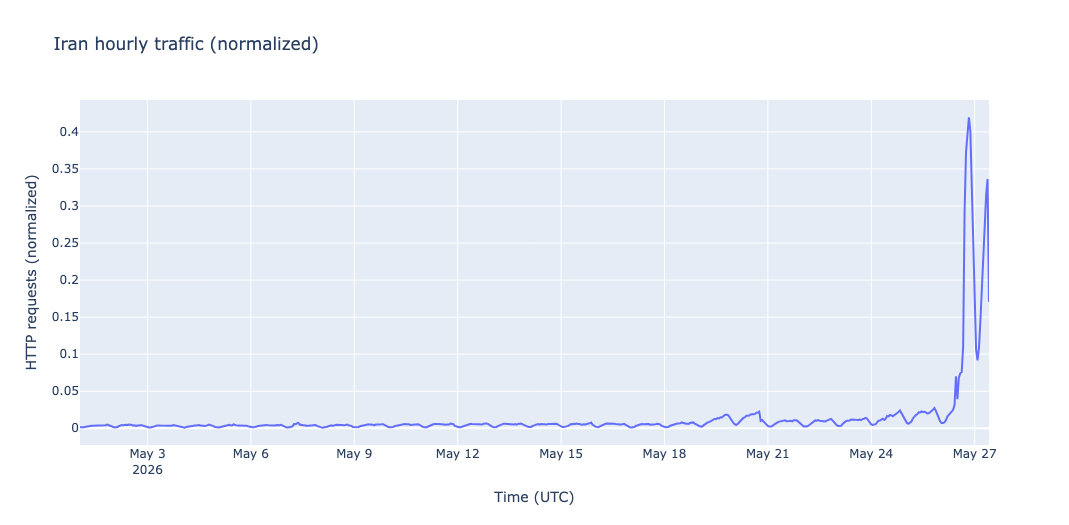
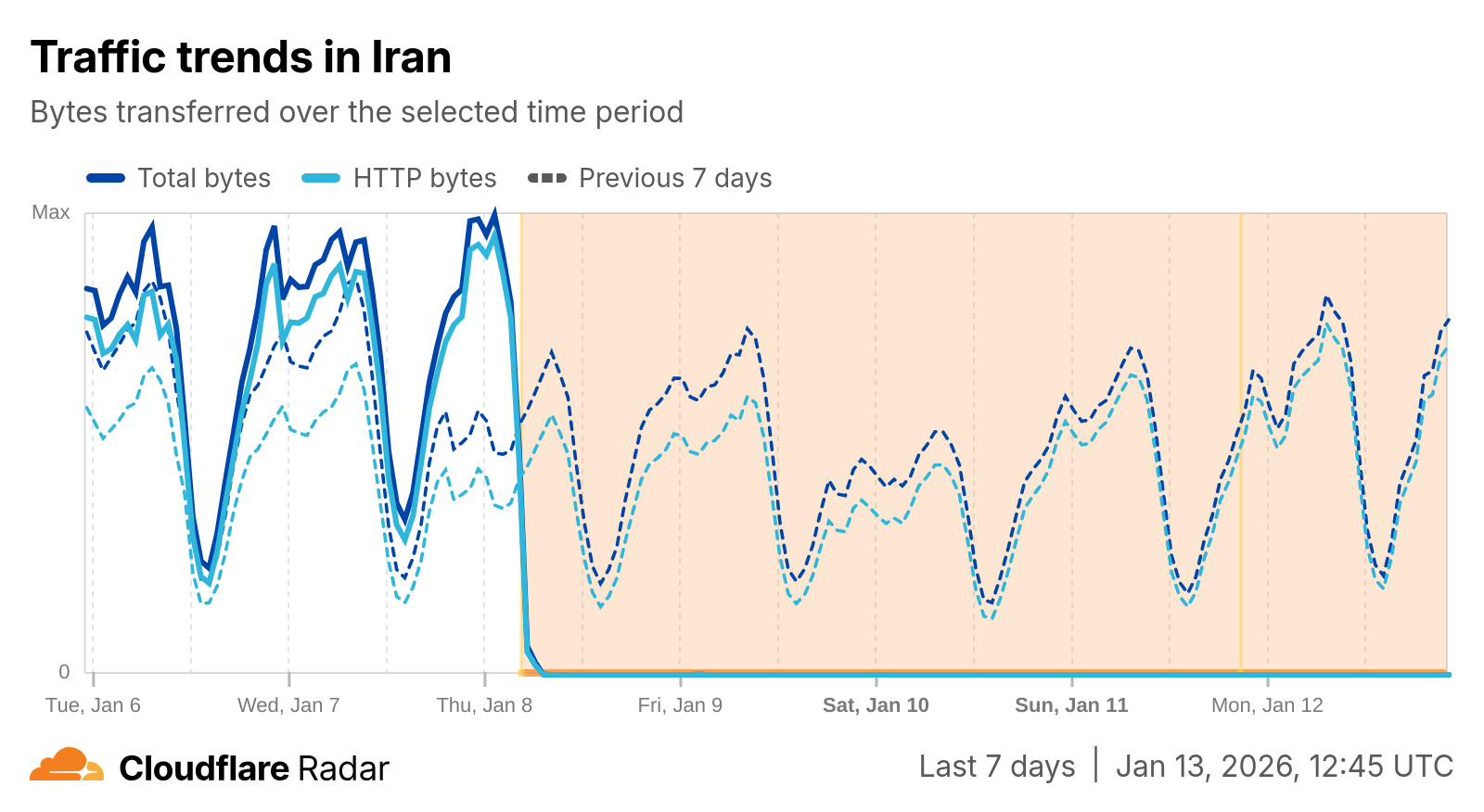
Consider a real event. In early 2026, Iran went through a series of government-directed Internet shutdowns, including one that lasted nearly three months before traffic partially returned in May. Reporting a story like that means pulling several views and refreshing them as the situation develops. To investigate it, you can just ask Radar Researcher:
This time the question is open-ended, so Radar Researcher runs a short investigation. It looks up the outage events Cloudflare Radar recorded for Iran and gathers the matching traffic data, then explains the timeline in plain language: Iran's HTTP traffic index collapsed from around 0.58 on January 7 to effectively zero by January 9, began a partial recovery around January 17, and returned close to pre-shutdown levels by January 27. It presents this as an HTTP traffic index chart with the outage window annotated directly on the line, plus a table of the recorded outages that also flags a second shutdown starting February 28.
From there it suggests where to take the investigation next, such as how the traffic compared with neighboring countries.
How we built it
Radar Researcher is built entirely on Cloudflare's own developer platform. It's a showcase of the same tools any developer can use to build an AI agent.
At its core is a Cloudflare Worker running the Cloudflare Agents SDK. Each conversation is a stateful Durable Object with its own SQLite database, so your chat history, titles, and streaming responses persist. They even survive you leaving the page mid-answer, because generation continues server-side and resumes when you reconnect. The "brain" is Workers AI, running open models like Kimi K2.7. Rather than betting on a single model, we run an ordered fallback chain across three different model families. If one model is momentarily at capacity, the request transparently cascades to the next, so an incident at any single provider doesn’t take Researcher down. Every call routes through AI Gateway for logging, cost tracking, caching, and safety guardrails.
The most interesting part is how Researcher reaches Radar's data. Instead of hand-writing a tool for every one of Radar's hundreds of endpoints, we connect the agent to the unified Cloudflare MCP server using Code Mode. The model gets just three tools (search, execute, and docs) and writes code to query the Radar API directly. It searches the OpenAPI spec to find the right endpoint, then executes a small snippet that fetches live data. Because the full API spec lives on the MCP server, nothing about Radar's API is hard-coded into the prompt. As Radar adds datasets, Researcher can use them with no code changes.
This is visible to you, too: every answer includes an expandable trace of the model's reasoning and the exact tool calls it made to gather the data, so you can always see how it got there.
From Markdown to real Radar charts
There was one problem to solve along the way. Language models answer in Markdown: text, tables, and bullet points. But we didn't want walls of numbers; we wanted the same rich, interactive charts you see everywhere else on Radar. Worse, when a model tries to write data directly into its answer, it tends to round, summarize, or truncate it, which is exactly what you don't want from a data tool.
Our solution keeps the data out of the model's prose entirely. When Radar Researcher fetches data, its code returns a small envelope that pairs the API path with the result. Then, instead of pasting numbers, the model emits a lightweight chart specification that simply references that same path:
Radar's frontend matches the chart's dataFrom to the fetched result and renders it with the exact same visualization components used across the rest of the site. The chart is always faithful to the API, and Radar Researcher can draw on our whole visual vocabulary: time series and stacked areas, donuts, bar charts, maps, histograms, etc.
A few small touches
Not everything needs the big model. Small, fast models handle the side tasks: one writes a short title for each new conversation, and another suggests the follow-up questions under each answer. Both run off to the side, so they never slow down your actual reply.
Radar Researcher also gets a little context about the here and now. We pass it the current date and time, plus the same high-level details about your connection that you'll find on Radar's IP page, such as your IP location and network. That way, when you ask something like "how's traffic here?", it can tailor the answer to where you are.
Everything reaches you through Radar's frontend (also a Worker) over a service binding, with per-IP rate limiting and shareable conversations stored in R2. Every layer, from compute to inference to gateway to storage to data, is Cloudflare.
Powered by agents — and ready for them
Radar Researcher shows how we use an AI agent to help people explore our data. But there's another side to the agent story: what happens when the agent isn't ours, but a general-purpose assistant running in your browser, acting on your behalf?
Today, an agent that wants to use a website mostly has to scrape the page and guess at how it works, which is brittle, slow, and error-prone. WebMCP is an emerging web standard that fixes this: a page can register a small set of well-defined tools that any browser agent can discover and call directly, instead of reverse-engineering the DOM (Document Object Model).
We've added WebMCP support to Radar, using both flavors the standard offers:
The imperative API lets us register tools in JavaScript that call straight into the same code that powers the UI, so an agent can drive Radar directly. Filter to a country, region, continent, or ASN; change the date range; search pages, sections, and entities (domains, ASNs, IPs, and more); jump to any section.
The declarative API turns Radar's existing HTML forms into tools by annotating them with a couple of attributes, so an agent can scan a URL with the URL Scanner, look up a domain's report, or test a website's post-quantum TLS key exchange support.
Every one of these simply drives functionality already available in the user interface, and it's pure progressive enhancement: in a browser without WebMCP, the tools just aren't there and nothing changes.
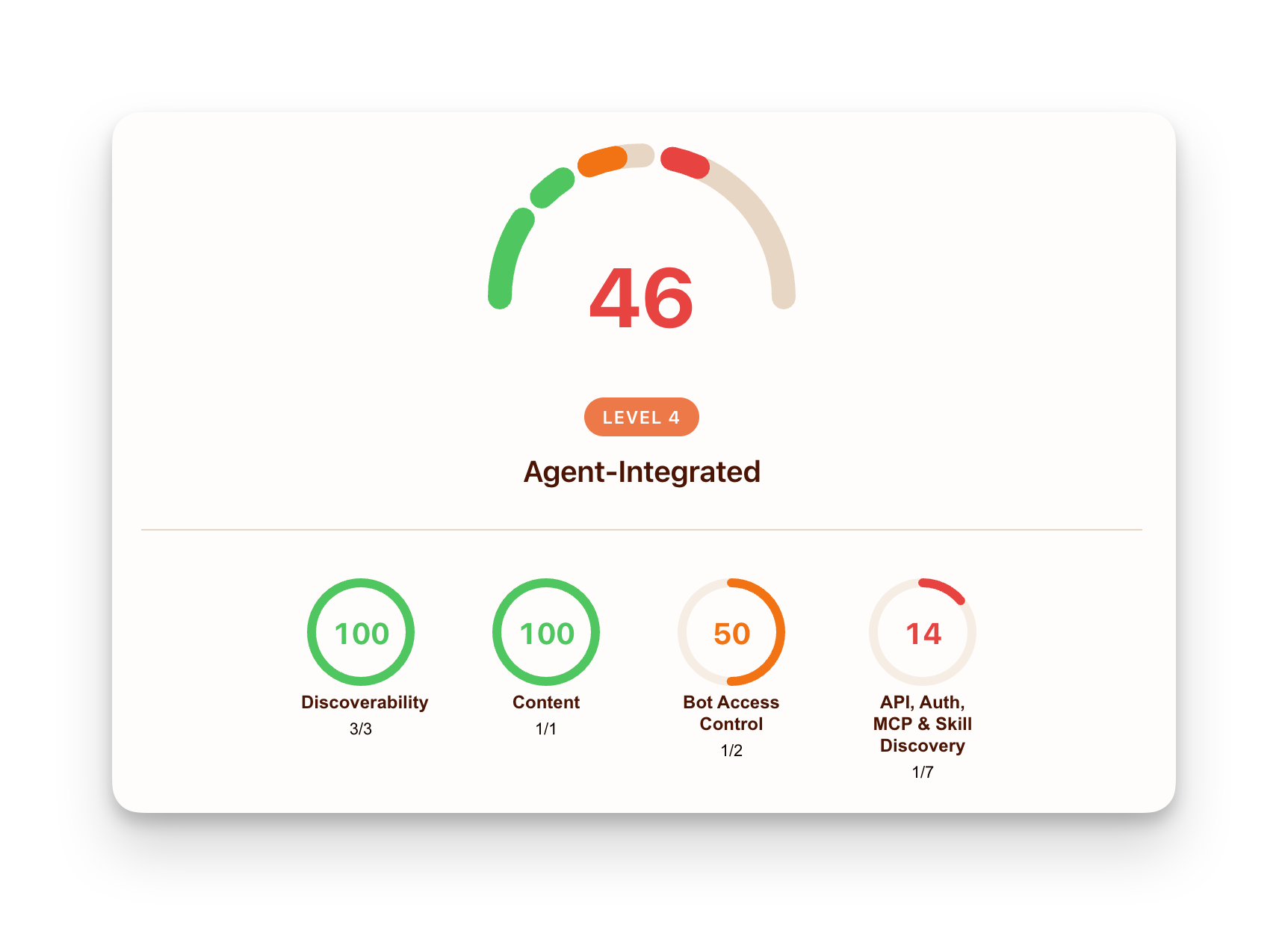
It’s also a case of practicing what we preach. Radar’s own URL Scanner evaluates how agent-ready a site is, and one of those checks looks for exactly this kind of WebMCP integration. By implementing it ourselves, Radar now passes its own agent-readiness check, and, more importantly, becomes a site that both people and agents can navigate with ease.
Try it out
Radar Researcher is available in beta today on Cloudflare Radar. Look for the Researcher button in the header on any page. It's built entirely on Cloudflare's developer platform, and it's just getting started: we'll keep expanding the datasets it understands, sharpening its analysis, and adding new ways to interact with data.
Tell us what works, what doesn’t, the insights you’re finding, what still feels beyond reach, and everything in between. Your feedback will help us improve and make Radar Researcher even better for our full launch. We can’t wait to see what you do with it!
Your next customer may not find you through a search engine. Instead, they'll ask an AI assistant: "how do I do X?"; "which option is best for someone like me?"; "just handle it for me" and an agent will find the answer, weigh the options, and act on their behalf. Increasingly, the moment that determines whether a customer chooses you happens inside a model's response — before a human ever sees your homepage.
This agentic audience is already here: by our count, fewer than half of all HTML page requests now come from a human. Not all of those machines are agents acting for a person, but that share is growing fast, and answer engines, shopping assistants, and research tools will shape which businesses are found and recommended. Discoverability used to mean ranking on a results page. Now it means being found, read, and confidently recommended by the agents that guide your customers.
The old metrics, human clicks and page views, no longer paint the full picture. We spent time talking to site owners who were staring at access logs full of AI bots, completely blind to whether those bots were capable of using their site or recommending their products and services to their users. We heard two main questions:
Can agents actually use my site?
Am I getting recommended?
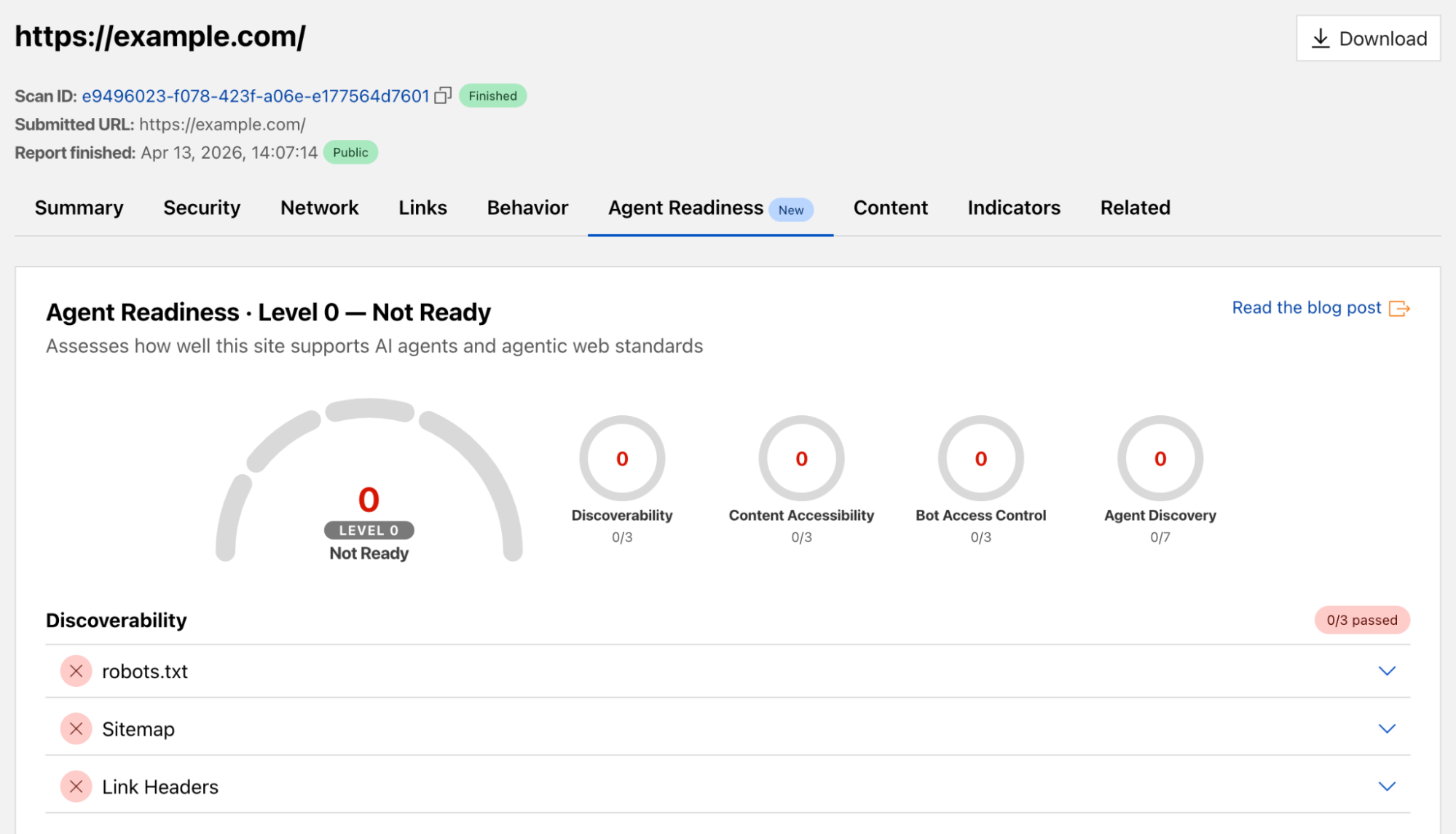
To help site owners answer these questions, we have integrated our previous work on Agent Readiness into the Cloudflare dashboard, and added our new Answer Engine Optimization (AEO) tool as well. These tools treat agents as a core user base for your site, showing you how an agent will see it, and how often you get recommended.
The opportunity is big, and the bar is low, because most sites aren't built for this user yet. Just as early SEO rewarded the sites built for search engines, the sites built for agents will be rewarded now. The ones that are easy to find, read, and trust are the ones agents will recommend.
Diagnostics: is your site ready for agents?
Diagnostics is the technical checkup within Agent Readiness. It scans your site the way an agent reads it: it works out whether it's allowed in and whether it can discover your content, fetches a clean machine-readable copy, and finds the interfaces it can call.
While a person just loads your homepage, an agent leans on your robots.txt, your sitemap, your response headers, a Markdown version of your content, and published metadata for authentication and tools.
Diagnostics runs those checks against a hostname and rolls the results into a single agent-readiness view, from "Not Ready" to fully agent-native. Every check comes back as pass, fail, or neutral, with a note on why it matters, and an evidence trail showing the exact request and response we saw.
The checks are grouped by effort, so you know where to start:
Quick wins: the high-impact basics most sites are missing, including a crawler-readable robots.txt, an XML sitemap, AI-crawler rules, and serving clean Markdown to agents
Technical groundwork: the next layer, including Content Signals that state how your content may be used, an API catalog, link headers, and agent login instructions
Advanced integration: the agent-native features, including OAuth discovery, MCP (Model Context Protocol) and A2A (Agent2Agent) agent cards, a skills index, Web Bot Auth, and WebMCP
Commerce: the emerging agent-payment standards including x402 (an extension of the classic HTTP 402 Payment Required status code), ACP (Agent Commerce Protocol), Universal Commerce Protocol (UCP), and AP2 (Agent Payments Protocol). This is informational for now, and not counted in your score.
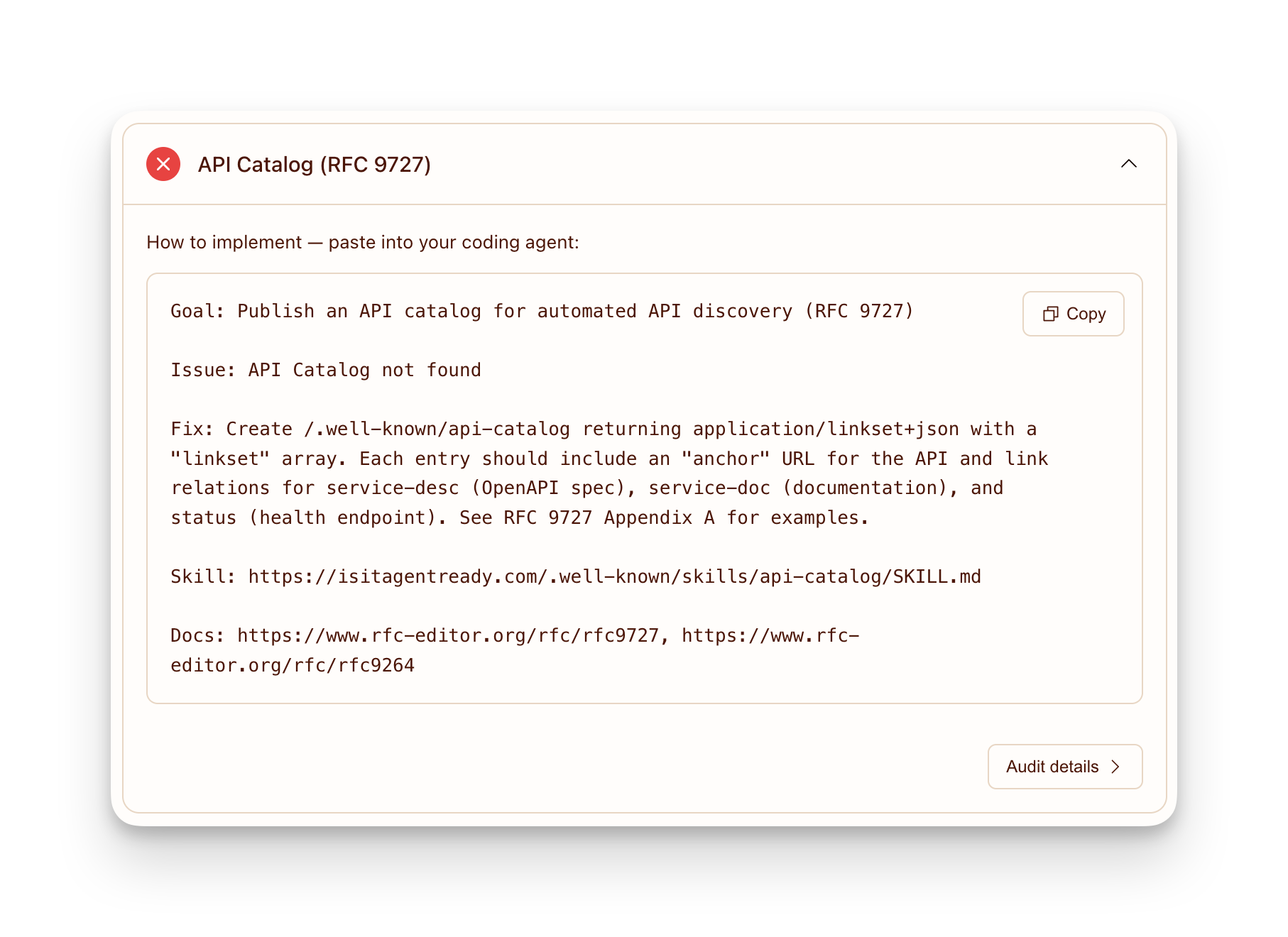
Every suggested improvement comes with a next step. When there’s a Cloudflare feature that can help, there's a "Set up in Cloudflare" link straight to the setting, such as switching on Markdown for Agents or managed robots.txt. For everything else, there’s a "Copy Agent Prompt" button that proposes what your coding agent needs to build. Make the change, re-scan, and watch the checkmark turn green.
AEO: are AI assistants recommending you?
Diagnostics tells you whether agents can read your site. The AEO tab tells you what happens next: when a customer asks an AI assistant a question in your category, does it recommend you or a competitor? You can't look this up like a search ranking. There's no impression count and no missed-click report, so when a competitor gets named instead of you, the sale is gone and nothing tells you it happened.
We infer your industry (e.g. health and fitness) and category (e.g. sports apparel) from your site, and we probe the leading assistants (today, Anthropic's Claude and OpenAI's GPT) with likely customer prompts to see how they respond. We structure these prompts to mimic real-world discovery, asking for recommendations, product comparisons, and general advice within your category. By observing how models answer these realistic queries, you get metrics such as:
Citation Rate: the share of answers in your category that cite your site as a source
Prominence: when you are cited, how much of the answer is actually yours and how early it lands
Mention Rate: how often assistants name your brand in their answer — for example, how often "Cloudflare" shows up in the response, whether or not cloudflare.com is cited as a source. Read alongside your Citation Rate, it separates awareness from attribution: assistants naming you far more than they cite you means you're on their radar but not yet earning the citation — a specific, targetable gap.
Share of Voice: your slice of citations against those for your competitors, so you can see who is winning the prompts you're losing
To evaluate how an AI model perceives your market presence, we build a benchmark across each industry and category before scoring a specific site. We query AI assistants with likely prompts in that category — without specifying your brand — and record which sites are cited, where they appear, and how prominently they feature.
Rather than re-querying models every time a site owner runs a scan, we run this panel once per category and reuse the baseline across all accounts in that domain. Pre-computing this dataset provides three main benefits:
Zero latency: Results load instantly from a snapshot rather than waiting for live model queries.
Lower compute overhead: Aggregating queries at the category level avoids redundant AI calls across thousands of scans.
Industry Fit scoring: Reusing the panel corpus lets us map which brands consistently appear together, allowing us to derive an Industry Fit score that measures whether an AI assistant views your site alongside your actual competitors.
AI assistants rarely answer the same question the exact same way twice. To account for this variance, we use Cloudflare AI Gateway to prompt each assistant multiple times across different models. We then read the responses a customer would see — the answer text alongside the sources each assistant cited — and extract multiple signals from it.
We evaluate not just whether your site was mentioned, but whether you were cited as a source, how early your citations appear in the answer, and how much of the final answer's substance is attributed to you. Where genuine judgment is required, Workers AI does the heavy lifting, running natively on our own infrastructure to read each reply and score how your citations and mentions appear. We also use exact text analysis rather than a model grading its own output. Together, this folds dozens of one-off replies into actionable metrics. By abstracting the multimodel query and evaluation pipeline, the tool provides metrics without requiring you to build your own evaluation framework.
Alongside the answers, an AI Operator Activity shows the real crawl and referral traffic on your site, per operator (OpenAI, Google, and so on): who reads your content, who sends visitors back, and the errors they hit on the way (403 blocked, 404 dead link). The pattern worth acting on is the operator that crawls thousands of your pages but refers no one, using your work without sending customers back.
Because these numbers are specific to your site, you can experiment, re-run the scan, and measure the impact on the exact questions that bring you business.
Meet your other audience
Until now, sizing up agents meant guesswork: grepping your logs to infer who visited, or feeding a chatbot a prompt and eyeballing whether it mentioned you. But with Agent Readiness and AEO, you can get the data you need to act. And because the requests actually pass through Cloudflare, these tools measure rather than estimate where possible, and will improve over time.
Helping you see who's reaching your site and decide how to engage on your own terms is what we've always done. Agents are just the newest audience, and the businesses that make themselves easy for agents to find, understand, and trust are the ones that get recommended. Agent Readiness is where you find out whether you're one of them, and what to do if you're not yet.
Ready to find out if AI agents are sending customers your way? Head over to the Overview tab in your dashboard to get your site Agent Ready and request early access to AEO Visibility.
Like most infrastructure, the Internet's fragility is easy to overlook — as long as it's working. When it fails, its complexity comes into full view. Cloudflare is in a unique position to detect and document the moments when one of the interrelated systems the Internet depends on breaks down and connectivity suffers as a result. Each quarter, we summarize the disruptions we detect and annotate on Cloudflare Radar.
In Q2 2026, Super Typhoon Sinlaku just north of Guam caused the longest outage, while government-mandated shutdowns during exam periods in Sudan were the most frequent. Iran restored national Internet access, reconnecting its citizens to the global network after an 88-day blackout, even as damage from drone strikes continued to disrupt AWS infrastructure elsewhere in the region. Finally, a cable cut in Saint Lucia and the distribution of faulty DNSSEC signatures in Germany underscored the fragility of Internet infrastructure, but also the remarkable stability these regional and global systems maintain when operating normally.
Here we will walk through the most significant Internet disruptions we observed in the second quarter of 2026, drawing on traffic data from Cloudflare Radar to show how each unfolded and what it meant for users on the ground. As always, this is a summary of notable, confirmed disruptions rather than an exhaustive list; a fuller view of detected traffic anomalies is available in the Cloudflare Radar Outage Center.
Natural disasters and electricity cause disruptions in Guam, Venezuela, and Tanzania
Super Typhoon Sinlaku, the strongest storm of the 2026 Pacific typhoon season so far, tracked through the Mariana Islands in mid-April, passing just north of Guam. Though the island was spared a direct hit, the storm brought tropical-storm-force winds, knocking out power across Guam and disrupting water systems, which had a direct impact on Internet connectivity. Traffic from the territory fell as much as 80% below expected levels from April 13 to 14.
Two months later, on June 24, two major earthquakes struck northern Venezuela within about a minute of each other, in Yumare and San Felipe, followed by an aftershock near the coast outside of Caracas. The first 7.5 magnitude earthquake took place at roughly 22:04 UTC (18:04 local time). The immediate impact of these events can be seen in Radar, which shows a sharp decrease in both HTTP bytes transferred at the same time as the earthquakes. This decrease can be seen particularly well in Fibex Telecom, which, according to APNIC data, has 1.6 million estimated users. The drop is also visible for CANTV, the state-owned incumbent, and VNET, a slightly smaller regional ISP.
Across the Atlantic just a few days later, a power outage in Tanzania on June 27 caused a sharp drop in HTTP traffic there that lasted for at least five hours. While distinct in cause from the country's election-related blackout in October 2025 (a deliberate government action rather than an infrastructure failure) the resulting telemetry and user impact were nearly identical: a drastic loss of connectivity that left residents unable to communicate with loved ones or access critical news.
It is striking how such fundamentally different events leave such similar footprints in the data and user experience. Taken together, these weather-related and power-driven disruptions demonstrate the immense impact the physical world can have on the digital, and the importance of Internet resilience and of building networks with enough redundancy in power, routing, and physical paths to withstand inevitable shocks.
Governments and geopolitics impact connectivity in Iran, UAE, Iraq and Sudan
Starting on May 26, Radar began seeing signs of Iran's previously announced Internet restoration, the tentative end of an 88-day shutdown that had left the country almost entirely offline since it began on February 28. On May 27, Radar reported that traffic had been restored to 40% of its pre-outage levels, a partial reopening consistent with reports that access was being reintroduced selectively rather than all at once. Since then, we have seen HTTP bytes climb to as high as 90% before settling back to roughly 59% of pre-shutdown levels. This volume is consistent with the traffic we observed in February, a window between this recent shutdown and a previous one in January, suggesting that connectivity has returned to something like its most recent pre-shutdown baseline rather than fully normalizing. In our 2026 World Cup analysis, Iran stood out as a solo outlier: While traffic in most participating countries rose and fell with match schedules, Iran's readings were dominated instead by the contrast between its post-restoration levels and the near-complete loss of connectivity that had preceded them.
Meanwhile, HTTP traffic to me-central-1, an AWS cloud region located in the United Arab Emirates, has remained low, aligning with AWS service reports on April 30 that the region "has suffered damage as a result of the conflict in the Middle East and is currently unable to reliably support customer applications." This update follows the reports on March 3 that facilities in both UAE and Bahrain “have experienced physical impacts to infrastructure as a result of drone strikes.” In the UAE, two facilities were “directly struck” and in Bahrain a drone strike near the facility caused “physical impact” to their infrastructure. The decreased traffic is the downstream signature of physical damage to the underlying data center infrastructure rather than a network fault, and it continues to affect the websites and applications hosted in that region, regardless of their own availability.
The second quarter of 2026 also included three government-mandated shutdowns in Iraq (on June 2, June 11, and June 28) as well as 10 in Sudan between April 13 and 23, all of which were imposed to prevent cheating on national exams — a seasonal pattern we have documented across multiple prior quarters in both countries. The outages in Sudan followed a consistent rhythm, each lasting approximately 3.5 hours from 11:45 to 15:15 UTC (13:45 to 17:15 local time), timed to the exam window. In Iraq the outages were shorter, lasting about 90 minutes each, and likewise scheduled around the hours in which exams were administered.
Each of these examples, whether a restoration or a disruption, illustrates the significant control governments exert over their national connectivity, and the ease with which access can be switched off, throttled, or selectively reintroduced as a matter of policy rather than infrastructure.
Infrastructure vulnerabilities affect users in Germany and Saint Lucia
On May 5, a DNSSEC key rollover at DENIC, the registry for Germany's .de domain, started producing invalid signatures. These key rollovers are the periodic replacement of the cryptographic keys used to sign a zone's DNS records; they are a routine but crucial piece of maintenance, as resolvers that validate DNSSEC will only trust answers whose signatures match the current published keys. In other words, if the digital signatures don't match expected values, the resolver assumes the site has been tampered with and cuts off access. When invalid signatures started being produced, validating resolvers worldwide rejected every request for a .de website and returned SERVFAIL errors until normal operation was restored at 23:15 UTC (01:15 local time on May 6).
Cloudflare Radar observed worldwide .de query volume rise during the outage. While perhaps initially counterintuitive, this is because failed answers are effectively uncacheable, so lookups normally served silently from cache instead had to be re-resolved and retried repeatedly, causing a sharp increase in queries.
From a user's perspective, the incident was experienced not as a DNS or cryptographic failure but simply as a wave of .de websites and services suddenly becoming unreachable. Though users were still able to access sites that did not use the .de TLD, the experience included pages failing to load, email bouncing, and apps timing out, all of which can mirror the experience of an outage. You can read more about DNSSEC and the impact of the events on our blog.
In the Caribbean, an infrastructure failure caused a similar drop in availability. On June 21, HTTP request traffic from Karib Cable’s network fell to essentially zero by around 21:00 UTC (17:00 local time), and remained flat for the better part of a day before recovering to expected levels around 17:00 UTC on June 22 (13:00 local time). The outage was reportedly caused by a fiber cut near the island, a familiar hazard for Caribbean networks that depend on a small number of terrestrial and submarine paths to reach the wider Internet, meaning a single break can sever a disproportionate amount of capacity. Because Karib Cable is one of the largest providers, the loss was also visible at the country level, with Saint Lucia's overall traffic dropping approximately 60% against the prior week for the duration of the cut.
Radar continues to monitor disruptions
The second quarter of 2026 saw Internet disruptions arise from a wide range of causes, including severe weather, an earthquake, power outages, government-directed shutdowns, damage to cloud infrastructure, cable cuts, and a DNSSEC misconfiguration. As these events demonstrate, the Internet depends on a complex set of interrelated systems, and a failure in any one of them can result in a loss of connectivity.
For 96 years, the World Cup has been a global phenomenon, uniting nations and communities through a shared love of sportsmanship. While its popularity is nothing new, what is novel today is how rare a truly collective global experience has become. In an era defined by microtrends and algorithmic bubbles, it is increasingly uncommon for people across most countries to engage in the exact same event.
That is precisely the unifying power of the World Cup. Fans from all over the globe reshape their daily routines around these once-in-a-lifetime matchups and storylines — and because Cloudflare operates a global network with 330+ points of presence worldwide, we are in a unique position to see exactly how this global ritual reshaped the world’s online activity throughout June and July 2026.
Cloudflare Radar tracks HTTP traffic, DNS, security, and more to highlight global Internet trends. In this blog post we’ll use that data to explore how the World Cup impacted global traffic patterns throughout the tournament’s run.
How did the World Cup change our behavior online?
To understand how traffic changes throughout a match, we had to establish what it is “normally.” One way to do this is by looking at raw request volumes, or the amount of traffic we see on our network per country. But these amounts vary per country (the amount of daily traffic in the United States is always a larger number than the traffic in Portugal), which makes it difficult to establish a globally applicable baseline. Instead, we defined "normal" using the median traffic of the four preceding weeks: a month-long window that provided a stable, per-minute reference and smoothed out day-to-day noise.
We also wanted to know whether traffic rose or fell relative to that baseline, but a plain difference wouldn't let us compare a high-volume country against a low-volume one. Instead, we used the ratio of current to baseline traffic, expressed as a log₂ value: the log makes increases and decreases symmetric around zero (+1 = twice normal, −1 = half). In other words, a score of zero means traffic is perfectly normal, a positive number shows a spike, and a negative number shows a drop.
Whether you’re staying up late or waking up early, kickoff time impacts traffic
One factor shaping how traffic changes is simply what time the match kicks off locally. The largest changes in activity happen when a match is played in the overnight and early-morning hours — roughly midnight to 8am local time. These are the hours when very few people are normally online, so fans staying up (or waking early) to watch push traffic well above its usual level, more than doubling it in some cases. As the graph shows, this is where the deviation peaks on both workdays and weekends.
By contrast, matches played during normal daytime and working hours — around 9 a.m. to mid-afternoon — don’t show such an impact: traffic stays close to its usual level, likely because the people watching would already have been online anyway. In the early evening there's a smaller, second lift, most visible on weekdays, as a match keeps people connected at a time when usage would normally start to wind down. Weekends follow a similar shape, with the strong early-morning rise but a gentler evening bump.
The impact of kickoff time is easiest to see when comparing matches within a single country that take place at very different hours. Bosnia and Herzegovina provides a clear example. As seen in the graph shown above, when Bosnia played at 2 a.m. local time, people stayed awake to watch and traffic during the game jumped to well above its normal level, at times more than doubling. When Bosnia played in the evening, the opposite happened: traffic dipped below normal (falling to about 70% of typical value), as people put their devices aside and focused on the match itself.
When Brazil played Japan in the Round of 32 (Brazil won 2–1 on June 29, 2026), the two countries watched the very same game 12 hours apart: kickoff in Brasília (GMT−3) fell during normal waking hours in Rio de Janeiro (GMT−3), while in Tokyo (GMT+9) it landed in the dead of night.
The result is two nearly parallel curves for the same 90 minutes: one higher than normal, one lower. Japan's traffic (red) sits well above normal, around +1, roughly double its usual level, because the match aired in the small hours, when almost no one would ordinarily be online. Brazil's traffic (green), by contrast, runs below normal, around −0.4, as the game fell in the middle of an ordinary active day. In this case,watching the match pulled people away from their usual browsing rather than adding to it.
Which matches moved the Internet most?
One of the most compelling aspects of the World Cup is seeing which storylines and teams capture the attention of fans across the world. We’ve discussed how regional traffic patterns change as a result of matches. But who are they watching? Which matches made the most impact on Internet traffic?
Here's how we calculated this: for each match, we took the two-hour window after kickoff and, for every country with enough baseline traffic to give stable measurements (small, noisy markets are excluded), computed how far traffic strayed from normal. We then took the absolute value of each country's deviation, so we're measuring how much traffic changed, not in which direction (a surge and a drop both count as impact), and for each match we took the median of those absolute deviations across all countries. Because several group-stage matches were played simultaneously, making it impossible to attribute a country's traffic swing to one game or the other, we dropped those concurrent matches to avoid ambiguity.
The result is this ranking of the matches that moved the Internet most, worldwide. And there's a surprise: the very top spot wasn’t snagged by a final or semifinal. It was Argentina vs. Switzerland on July 11, a quarterfinal that saw Argentina win 3-1 — and that moved Internet traffic by a factor of about 1.26. That put it ahead of the France vs. Spain semifinal, which had a factor of 1.21.The rest of the top matches were a mix of quarterfinals, round-of-16 and even round-of-32 ties.
The teams that moved the Internet: Argentina, followed by France and Norway
To decide which team the world watched most, we looked at each team's matches and aggregated the median worldwide impact across all countries. In other words, when a given team took the field, how much did the typical country's traffic move away from normal? Not surprisingly, Argentina topped the list at 1.17x, meaning that when Argentina played, the typical country's traffic swung about 17% away from its normal level, the strongest global pull of any team. This comes as no surprise, since they were the defending champions and each knockout game could have been Lionel Messi's last dance for his national team. Love them or hate them, people were watching them.
Not far behind were nations packed with superstars such as France, Brazil, Portugal, Morocco, Spain — and Norway, fueled by the Erling Haaland phenomenon. Haiti and Iraq appear in the top as outliers due to their high deviation scores relative to their typical traffic, suggesting matches against major teams drove disproportionate engagement.
Sharp increase in traffic to sports betting sites
Compared to HTTP request data in the month preceding the World Cup, there was an overall increase in requests to gambling industry websites since the opening game. Additionally, whereas pre-tournament traffic followed a clear weekly pattern, after the Cup’s opening game, the trend flattened into a more constant profile, likely a consequence of the high, near-daily regularity of matches.
Divergent Behavior: Why Traffic Patterns Varied by Country.
Because Cloudflare is present in 120+ countries and handles traffic from Internet users worldwide, we can see distinct behavioral patterns across the globe. For example, when examining the deviation trends during the Algeria vs. Austria group stage game on June 28, we noticed something peculiar: Austria’s traffic (in red) increased during halftime, while Algeria's (in green) decreased. The former follows the pattern described above of people spending more time online while not watching the game, while Algeria’s is the complete opposite — and they’re not the only ones.
Algeria, in green and denoted as DZ, saw a much higher uptick in Internet traffic during the match than Austria, in red.
Countries clustered by behavior
To understand patterns in behavior across countries we grouped every country's match-day behavior by the shape of its traffic curve and let the patterns cluster together.
Grouping match-day traffic shapes this way, three distinct patterns emerge. The largest group (44 countries playing 101 matches) shows Internet usage rising during hydration breaks and halftime, the natural pauses in play, as people reach for their phones. A second, smaller group (8 countries playing 18 matches)) is its near mirror image: traffic falls at exactly those same moments, dipping during the breaks instead of climbing. The third group is a clear outlier, made up entirely of Iran's three matches. The explanation is simple: the May baseline was measured while Iran was still coming back online after the shutdown, so its match-day traffic sits far above that depressed reference, producing a deviation unlike any other country's. You can read more about Iran’s Internet shutdowns and partial restoration throughout 2026 on our blog.
Streaming makes some countries appear more online
To better understand the second cluster, which included Algeria, Tunisia, Jordan, Egypt and DR Congo, we looked more closely at the traffic mix for these countries. We broke down traffic patterns by Multipurpose Internet Mail Extensions, or MIME type, and grouped it in families to easily distinguish clusters of content types. MIME types act like digital labels that tell browsers exactly what kind of file they are receiving, whether it's an HTML page, a JPEG image, or an MP4 video stream. By tracking these labels, we can infer what kinds of content users are consuming.
Our hypothesis was that this behavior could be explained by a disproportionate amount of people watching the games via streaming in those countries. To test this, we compared traffic pattern distribution in games with teams of both clusters. In the following example, we see traffic distribution of Algeria and Austria respectively in the match between both countries.
In Algeria, traffic was far above normal, then dipped at halftime. Note the large increase in streaming traffic, in orange.
In Austria, where streaming services were used less, Internet traffic increased at halftime.
In the Algeria graph above, we can see that the bulk of the increase during the match window indeed was driven by requests to multimedia and streaming services. This supports our hypothesis that the traffic trendlines correlate with use of streaming to watch the match.
In Algeria, traffic rose sharply at kickoff, dropped during half-time, and returned to elevated levels once the second half began. Hydration breaks, by contrast, had little to no visible effect, which suggests that viewers don't meaningfully change their Internet or social behavior for short, in-play pauses, but do so during the longer halftime interval. Other countries in this cluster show similar behavior. This might be because a viewer is unlikely to close a stream for a three-minute cooling break, but a fifteen-minute halftime is long enough to close the stream and step away.
What do people do during halftime?
A minority of countries, including Tunisia and Algeria, disconnect during halftime, with traffic dropping below its in-play level (the blue boxes, sitting under the 1.0 line). The majority of countries go the other way: traffic rises during the break as people pick up their phones the moment play stops, then settles again when the second half begins. Croatia and Bosnia and Herzegovina show this most strongly, with halftime traffic running well above their in-play baseline.
And hydration breaks?
Halftime is a long, familiar pause, but what about the much shorter hydration breaks? These last only about three minutes, taken midway through each half. Is three minutes really enough to change how people behave online? It turns out it is. Just as at halftime, the moment play briefly stops, traffic in most countries ticks up before falling again when the game resumes.
We measured this by taking, for each match, the peak number of requests in a window around the middle of each half (where the hydration break falls) and comparing it to the five minutes immediately before the break. The pattern lines up with everything we've seen so far: the same audiences that surge at halftime also spike during these brief pauses, while the few countries that tend to disconnect during breaks show little or no lift. Even a three-minute gap in play is enough for a large share of viewers to glance back at their phones.
The final matches
At the scale of Radar’s global HTTP requests, it is genuinely hard for any single event to leave a visible mark. Even so, the 2026 World Cup Final, which pitted Europe’s and American football champions against each other, had enough social impact to affect the Internet’s footprint. When looking at the volume of HTTP bytes from June 20 to June 22 we can immediately identify the final match kicking off at 21:00 UTC on June 19, as well as England vs. France for the Bronze medal at 23:00 UTC on June 18.
During the final match, Argentina and Spain's traffic volume increased up to 20 percentage points when compared to a similar period. The bronze medal match also coincided with a traffic increase, although at a smaller scale.
HTTP request volume during the final match also appeared correlated not only with the timeline of the game, but with each individual stage as well. Looking at the graph, we can roughly pinpoint moments such as the kickoff, halftime break, hydration breaks, as well as the final whistle.
Keep up with world events on Cloudflare Radar
Across every time zone, match, and goal, Cloudflare Radar provides a front-row seat to how the world connects during landmark cultural moments. To explore more interactive traffic insights and track how major worldwide events shape internet activity every day, visit Cloudflare Radar or follow us on social media at @CloudflareRadar (X), https://noc.social/@cloudflareradar (Mastodon), and radar.cloudflare.com (Bluesky).
One year ago, we declared Content Independence Day. At the time, we could see what many in the industry were beginning to sense: the fundamental economics of the Internet were shifting. AI adoption was accelerating, publishers were experiencing rapid declines in referral traffic, and AI companies were crawling the web at unprecedented scale, often without clearly declaring intent, and almost always without compensation.
We changed the defaults. For all new domains on Cloudflare, AI training crawlers would be blocked by default unless domain owners chose otherwise. We didn’t do this to wall off the web. We did it because we believed a healthier ecosystem required transparency, control, scarcity, and ultimately, a market where high-quality content could be valued and exchanged fairly.
A year later, that market has emerged. But the transformation of the Internet has happened even faster than we anticipated. In this report, we share key data points that illustrate how quickly the business model of the Internet has shifted – and what this new content market means for publishers and site owners.
Part I: The Internet has changed – faster than anyone expected
The vertical adoption curve
AI is not just another technology cycle. It is a platform shift happening at more than 2x the speed that smartphones were adopted. In just 3.5 years, over 30% of humanity — 2.5 billion active users — has adopted regular use of generative AI. The adoption curve isn’t merely steep: it’s going vertical.
The decline of the open web
Never before have we seen such a rapid change in how humans interact with information, perform work, and spend time online.
The way people use the Internet is changing dramatically. Today, for every hour spent online searching for information, only 15 minutes is spent on the open web. Traditional search behavior is collapsing as users shift to AI-driven discovery and consumption. Instead of visiting multiple sites to source and compare information, users simply type a prompt and receive a nearly instantaneous, consolidated answer.
The agentic Internet is here
This year, agent traffic crossed a historic threshold for the first time: more than 50% of traffic on the Internet is now non-human. This shift has staggering implications for publishers, content owners, and the future of the open web.
Crawlers have changed their purpose
When looking at the crawlers Cloudflare identifies by purpose, the composition of crawler traffic tells the story clearly:
52% of crawler requests are now for AI training as of June 2026, up from 22% in Spring 2025.
Mixed-use crawlers (those blending search, agent use, and training) represent over 36% of activity.
Pure search crawling now represents a small and declining share of overall crawler activity, despite remaining critical for publisher visibility.
As AI training becomes a primary driver of crawler activity, the ability to distinguish between discovery and training becomes increasingly important. Mixed-use crawlers blur that distinction, putting content owners in a difficult position: choose between remaining discoverable in the agentic era, and giving away their most valuable content without compensation.
The old business model is gone
For decades, the economic model of the open web was straightforward. Content creators exchanged access to their content for visibility in search engines, which returned referral traffic. That traffic became the primary mechanism through which publishers, creators, and businesses generated economic value.
But today, that exchange is breaking down. Content is still being crawled, indexed, and used — but increasingly without corresponding traffic being returned to the source. As AI systems answer questions, compare products, conduct research, and complete tasks directly, information across the open web is increasingly becoming part of AI training and retrieval systems. The existential question this raises is simple: if content is consumed without audiences ever visiting the source, how do content creators sustain themselves?
The implications are industry-agnostic
The earliest industries to feel the impact were news organizations and media companies. Today, similar dynamics are impacting businesses across retail, software, IT, and finance. Some of the most heavily crawled categories have seen human traffic decline as much as 40% in less than one year.
Many publishers are now preparing for what they call “Google Zero” — a world where little to no traffic comes from search referrals.
The implications extend to essentially every industry. Any organization that publishes proprietary information on the Internet will need to understand how to operate in an agentic era. This dynamic matters not just to content owners, but to all of us. The Internet is a critical part of the global economy and one of the world’s most important public resources for surfacing information. Ensuring it remains healthy and sustainable is essential for all.
Part II: The market has emerged
What we built
When we launched Content Independence Day, we committed to three things:
Transparency and control for site owners, enabling them to define how their content is accessed and monetized.
Tools that create scarcity, shifting the balance of power back to content owners.
A marketplace where content creators and AI companies of all sizes can discover, license, and determine the value of content more efficiently.
One year later, a market for monetized content is here, and the conditions for a dynamic marketplace are forming.
Transparency and control created scarcity
Historically, publishers have had limited visibility into how AI companies accessed and used their content. As referral traffic declined, that lack of visibility became an economic problem prompting publishers to seek new ways to capture value.
Cloudflare’s attribution, business intelligence, and enforcement tools gave publishers visibility into AI consumption at the network level — an enforcement mechanism far more effective than voluntary standards like robots.txt. For the first time, publishers could determine how their content was accessed and monetized. That control created scarcity, and drove a supply-and-demand content economy.
Scarcity created leverage
Publishers that exercised control over access successfully created scarcity, giving them negotiating leverage that led to better deals. For the first time, publishers gained operator-level attribution data — evidence of how often LLMs attempted to access their content, which competitive LLMs were crawling, what their most in-demand URLs were, and what their crawl-to-referral ratios looked like. This reduced information asymmetry in licensing discussions and enabled publishers to negotiate from a position of knowledge.
Leverage is changing the balance of power
This leverage has empowered our customers. As they have gained greater visibility into how AI systems access and use their content, they’ve become better equipped to understand the implications for their businesses and more confidently articulate the value of the information, brand, and audiences they have built.
As the balance of power between content owners and AI companies begins to change, a licensing economy is emerging:
More than 50 publisher-AI agreements have been signed since 2023.
Major AI companies now actively license content, increasingly recognizing the value of differentiated and premium content.
Collective licensing models continue to emerge and scale.
Large publishers are securing meaningful licensing agreements, demonstrating that content has real economic value within the AI ecosystem.
The conversation is no longer whether content should be compensated. The conversation now is how.
The market is maturing, but inefficiencies remain
Early licensing agreements proved demand exists, but licensing today remains largely bespoke and unlikely to fully replace lost referral, advertising, and affiliate revenue. As a result, publishers are increasingly optimizing for AI consumption alongside traditional human discovery while exploring new monetization pathways.
Supply and demand remain difficult to match efficiently, and while there’s an understanding that not all content carries the same value, content valuation is still unresolved.
The Google convergence problem
No discussion of this market is complete without addressing Google’s unique role. Google remains the dominant gateway to online discovery, accounting for approximately 88% of referral traffic. But increasingly, Google is helping users consume content directly within Google-owned AI experiences.
Discovery and consumption serve fundamentally different purposes. Search drives users to content, while AI-powered experiences increasingly summarize and reuse it without requiring users to visit the source. Website owners view these activities differently because one generates traffic, while the other increasingly substitutes for it.
These differences become especially important when site owners are deciding who should be allowed to access their content and for what purpose. Most leading AI companies separate discovery crawlers from training crawlers, making it relatively simple for publishers to enable content access for one purpose or the other. Google does not. Today, Google has access to about 2x more information than leading AI companies because Google leverages a mixed-use bot that makes it difficult for customers to participate in Google’s search ecosystem without also participating in Google’s AI ecosystem.
Unlike other AI providers, Google’s mixed-use crawler also limits transparency for site owners. Because discovery and AI access are combined into a single crawler, publishers cannot tell why Google is accessing their content or distinguish between traffic used for search and traffic used for AI experiences. They also lose the visibility and evidence that comes from being able to allow or block these activities independently at the network level.
This dynamic has accelerated demand for greater transparency and control, as well as new monetization models to better serve both content owners and AI companies of all sizes.
Part III: A unique view of the ecosystem
Cloudflare sits at the intersection of the emerging agentic economy.
More than 20% of the web sits behind Cloudflare’s network. Of the world’s most-visited websites, 36% rely on our network, and more than 40% of the Fortune 500 are Cloudflare customers. Nearly 80% of leading AI companies use Cloudflare, alongside thousands of developers and emerging AI companies.
This unique position gives us visibility into both sides of the market. We see the content owners creating content, the AI companies consuming it, and the signals increasingly connecting them. That perspective has given us a unique view into how the market has evolved over the past year, and what it now requires.
Part IV: Lessons from an emerging market
As publishers and AI companies adapt to a new agentic economy, Cloudflare has gained a clearer understanding of what the ecosystem now needs.
Transparency must become the standard
Content owners increasingly need visibility and control over who is accessing their content, how it is being used, and for what purpose. AI companies increasingly recognize that transparency builds trust and reduces friction with publishers. Visibility and enforcement are no longer security concerns alone — they have become business requirements that directly influence licensing negotiations and commercial decision making.
To help make transparency the standard, Cloudflare is continuing to invest in enhanced attribution, measurement, and publisher controls that give content owners greater visibility into and control over how their content is accessed and used.
As the industry shifts toward greater transparency, we believe that verifiable bot self-identification and declarations of crawl intent are fundamental to a sustainable ecosystem. Today, more than one-third of crawler activity on our network still comes from mixed-use bots that make it impossible for content owners to distinguish crawl intent. We are actively engaging with the ecosystem and investing in tooling to help drive that number to zero by this time next year.
Better AI requires better signals
Over the past year, it has become increasingly clear that AI companies need more than access to content. They need better ways to determine what to access, when to access it, and how frequently it has changed. Indiscriminate crawling wastes compute for AI companies and creates unnecessary bandwidth burden for publishers, reducing efficiency across the ecosystem.
We believe better answers require better intelligence. We are investing in real-time freshness signals with richer trust, quality, and relevance to help AI companies discover differentiated information while reducing unnecessary crawling across the web.
Markets need better discovery before better pricing
We believe better discovery must precede better pricing. In order for the market to mature, publishers and AI companies need better information about one another. We are investing in richer market intelligence, content signaling, and capabilities that improve discovery between both sides of the ecosystem, laying the foundation for more scalable market mechanisms over time.
Part V. Building the infrastructure for the agentic Internet
One year ago, Content Independence Day introduced a simple idea: content owners should have greater control over how AI companies access and use their information.
Over the past twelve months, that control helped give rise to a market. Transparency created scarcity. Scarcity created leverage. Leverage accelerated licensing. What was once a theoretical discussion about the future of AI and content has become an active market, with publishers, AI companies, and technology providers all adapting to a new set of economic realities.
The market is now entering a new phase that demands new infrastructure. As the Internet becomes increasingly agentic, the underlying systems that support it must evolve to handle permissions, licensing, and commercial transactions at scale. Content owners and AI companies need more efficient ways to connect and exchange value. We believe these capabilities will converge into programmable, scalable mechanisms for content discovery and monetization – reducing friction while unlocking richer forms of value exchange.
Cloudflare’s role is to build the infrastructure and business intelligence, and contribute to the standards that allow the market to determine value more efficiently and help publishers and AI companies participate in a healthier, more dynamic content economy.
The Internet has always evolved. This evolution is faster and more consequential than most. But with the right infrastructure, the right incentives, and a commitment to transparency, we believe the agentic Internet can become more sustainable, more efficient, and better for everyone.
Cloudflare Radar is a hub showcasing global Internet traffic, attack, and technology trends and insights. Powered by data from Cloudflare’s global network, Radar was created to help anyone understand what is happening on the Internet from a security, performance and usage perspective.
Cloudflare’s unique understanding of the Internet comes from its global network — one of the world’s largest, spanning 330+ cities in 100+ countries — and aggregated and anonymized data from Cloudflare’s 1.1.1.1 public DNS Resolver, widely used as a fast and private way to browse the Internet. More than 20% of the web sits behind Cloudflare’s network.
Some recent route hijacks reported by Spamhaus captured our attention. In many of these hijack attempts, an apparent bad actor took advantage of unused autonomous system numbers, or ASNs. Notably in these hijacks, the actor appears to be creating fake AS_PATHs toward destinations, misdirecting traffic down an unexpected path.
By creating forged AS_PATHs, the hijacker is attempting to lead traffic somewhere it isn’t normally meant to go while also trying to conceal their identity. A hijacker could strip enough information away from a network path that they could pretend to be the origin of a Border Gateway Protocol (BGP) prefix themselves. Attackers can use this hijacked route to intercept traffic and for other nefarious purposes.
There is a simple solution for these cases: basic verification that a BGP peer autonomous system (AS) always includes their network as the “First AS” in an advertised route. To get a sense of how well these safeguards are implemented, we stress-tested several major networks and researched their BGP implementations. Read on to see what we learned.
Examining route hijacks involving forged paths
The idea that an actor is creating fake AS_PATHs is supported when we take a closer look at implausible AS relationships in the path. For example, let’s examine one of the hijacks reported by Spamhaus, involving a prefix belonging to Orange S.A., the French telecom company. Using the monocle tool, we can easily find a BGP UPDATE message related to the hijack:
We know AS1299 (Arelion) is a Tier 1 network, meaning every AS on the right-hand side in the path is describing an upstream (customer-to-provider) relationship. This implies that AS17072 is a transit provider for AS41128, AS270118 for AS17072, and AS199524 for AS270118. If we take a closer look at these networks:
AS41128 is an unused ASN belonging to Orange France
The order of the ASes in the message above would suggest that an unused Orange France AS is buying transit from Mexican ISPs, which is then upstreamed to Gcore and Tier 1 providers – which would be quite odd.
In another instance, a reported hijack for prefixes 47.1.0.0/16 and 47.2.0.0/16 from origin AS36429 even included Cloudflare’s main ASN, 13335, in the AS_PATH, “199524 270118 17072 13335 36429”. We can view examples of these BGP UPDATEs in the MRT Explorer from Cloudflare Radar:
We can authoritatively confirm that we (Cloudflare, AS13335) have noadjacency with the now-unused AS36429 owned by Charter. This means this was a forged path by the hijacker that included Cloudflare’s ASN as one of the fake upstream networks in advertisements propagated toward Gcore (AS199524). Further, Spamhaus correctly pointed out that all the hijack routes led to a network behind Gcore peering in Chicago, never actually traversing the Mexican ISPs or Cloudflare’s network in the forwarding path.
Because of this, we can reasonably conclude these paths are forged up until the leftmost common AS, which in this case is AS199524, as the rest of the path seems implausible. We believe what is happening here is the result of a specific strategy by the hijacker, involving the following steps:
Originate BGP announcements for “parked” prefixes
Forge the AS_PATH completely, without including the hijacker’s own local ASN
Advertise these routes to Gcore, AS199524
In these hijacks it appears Gcore (AS199524) skips the verification and enforcement of the First AS matching the expected customer’s ASN. (We’ll look at why it might skip those steps later in this post.) As a result, the forged path is accepted and the hijacked prefixes are propagated to upstream providers and peers.
While Autonomous System Provider Authorization (ASPA) will help invalidate these forged paths, attackers may bypass it by only including an RPKI-ROV-valid origin AS, or a legitimate ASPA upstream AS. To stop these specific hijacks, we must rely on a different protection mechanism already built into BGP: First AS checking and enforcement.
The importance of First AS checking
Routing traffic across the Internet is a bit like shipping a package. When the package is shipped, a log is kept of every courier that handles it. In BGP, this is called the AS_PATH (Autonomous System Path) and it tracks each network in the path of that route.
The AS_PATH attribute in BGP is used for path selection. This selection algorithm determines which route to a destination traverses the best list of hops, where “best” is defined by multiple variables. It is also used for loop prevention, where networks can decide not to accept paths that have already traversed their own network. Aside from keeping a record of the networks a BGP UPDATE, and therefore route, will traverse, the AS_PATH can also be examined by operator-configured routing policies to route around or purposely through a given AS – for example to avoid BGP anomalies having unexpected impact.
BGP was built on trust, and the AS_PATH can be easily manipulated – whether for seemingly legitimate reasons such as AS prepending to move traffic around, or nefarious reasons such as shortening it to artificially attract traffic or perform origin attacks.
Let’s look at how these two types of malicious BGP manipulations are carried out.
Example 1: Forged origin attacks
AS64506 cryptographically signs their routes with an RPKI ROA (Route Origin Authorization) record, to prevent route origin hijacks.
AS64506 also creates an ASPA object, specifying only AS64503 as a valid provider
AS64505 manipulates their AS_PATH to strip AS64505 and originate with AS64506
AS64502 does not enforce the First AS
The route appears RPKI-ROV valid and is the shortest path, effectively hijacking traffic with the route. AS64506 has done everything correctly by specifying a valid ROA for a prefix advertisement, and has even configured an ASPA object consisting of their sole provider AS64503.
Unfortunately, the hijacker running AS64505 is still able to attract traffic meant for AS64506. Even if AS64501, the customer, and AS64502, their provider, run ASPA validation, they will not find an invalid path, because there is no valley in the path “64502 64506”. In other words, AS64505 by way of not even including their own ASN in the AS_PATH is able to pretend they are AS64506 with no intermediate AS hop.
The correct way of preventing this hijack with existing tools is to enforce the First AS in the AS_PATH. Once enforcing this rule, AS64502 would properly drop the route from AS64505.
Example 2: Shortening the AS_PATH to attract traffic
AS64506 has two transit providers: AS64503 and AS64505.
AS64505 bills their customer AS64506 based on traffic usage ratios.
AS64505 strips itself from the path, and their peer AS64504 does not enforce the First AS.
The BGP path selection algorithm now chooses the route via AS64504 as the best path from AS64501. AS64506 pays both of their providers, AS64503 and AS64505, to deliver traffic from the Internet. However, now AS64505 provides a shorter BGP path from far-end sources, meaning AS64505 will process all the traffic toward AS64506 and be paid for doing so, and AS64503 will not be paid at all.
These BGP vulnerabilities can be solved very simply by enforcing the First AS to match the peer AS in a received AS_PATH.
When an operator configures a BGP neighbor, they must set the remote AS of the network they are interconnecting with. If the First AS in the AS_PATH does not match this value, then the path has been manipulated. The First AS enforcement procedure is outlined in Section 6.3 of RFC 4271 very clearly as:
“If the UPDATE message is received from an external peer, the local
system MAY check whether the leftmost (with respect to the position
of octets in the protocol message) AS in the AS_PATH attribute is
equal to the autonomous system number of the peer that sent the
message. If the check determines this is not the case, the Error
Subcode MUST be set to Malformed AS_PATH.”
RFC 7606 later revises how error-handling should be implemented by vendors, suggesting that routes containing malformed AS_PATHs should be dropped via treat-as-withdraw method. This allows routers to drop specific prefixes with malformed attributes without disrupting the entire BGP session.
The current ASPA draft clearly calls out the importance of First AS enforcement, stating that ASPA cannot handle paths where sufficient AS_PATH information is lacking due to malformed announcements. Enforcing First AS in AS_PATHs is a must for Internet routing security.
Measurement by breaking the First AS rule on purpose
Instead of sticking to theoretical failure cases and past public incidents about violations of the First AS rule, we wanted to measure for ourselves how widely these AS_PATH violations could be accepted on the Internet. To do so, we set up BGP announcements to neighbors where we purposely violated the rule ourselves. Here is what we did:
Allocated two IP prefixes, one for IPv4 and one for IPv6, to advertise to Tier 1 External BGP (EBGP) neighbors
Purposely prepended the test prefix advertisements to Tier 1 neighbors with a Cloudflare-owned, non-13335 ASN (AS402542) in front of 13335
For example, we advertised the prefixes to AS1299 from our normal BGP session in Geneva. Our local AS is AS13335, but we include AS402542 clearly as the First AS in the AS_PATH.
[email protected]> show configuration policy-options policy-statement 4-TELIA-ACCEPT-EXPORT term ADV-FIRST-AS-PROBE-CR-1695522
from {
    community ANYCAST-ROUTE;
    prefix-list fl_first_as_prober;
    route-type internal;
}
then {
    origin igp;
    as-path-prepend 402542;
    next-hop self;
    accept;
}

[email protected]> show route advertising-protocol bgp <redacted_1299_ip> 162.159.82.0/24 detail | grep "AS path: "
     AS path: 402542 [13335] I
With this configuration, our expectation is that:
Networks that do enforce-first-as will quietly drop the route via RFC 7606 withdrawal method
Networks that do not enforce-first-as will accept the route and install it for forwarding toward our test prefixes
Either result will be visible in BGP public route views. It was initially our goal to implement a continuous announcement of prefixes toward all peers that would purposely violate the First AS rule in announcements, and give everyone a tool to check which ISPs validate First AS and those which do not. However, we found there are still networks that have not implemented the guidance published in RFC 7606 when receiving malformed BGP AS_PATHs, and would reset BGP sessions instead of a treat-as-withdraw behavior. This meant we could not safely implement a continuous set of announcements that violate the First AS rule without impacting real traffic to Cloudflare, which we obviously can’t do.
But we can take a closer look at the networks whose policies make the biggest impact: Tier 1 networks. These networks make up the backbone of the Internet and have the largest AS customer cones of anyone, meaning hijacks or malformed paths by these peers have the broadest significance. Let’s start by examining the normal propagation of an anycast prefix, 1.1.1.0/24, across the Tier 1 networks.
The propagation of 1.1.1.0/24 looks how you would expect – it is directly reachable by every Tier 1 network that Cloudflare has a direct adjacency with currently.
Now, let’s compare that with our purposely malformed announcement of the prefix 162.159.82.0/24:
Note: AS5511 (Orange S.A.) is not pictured above due to its limited presence in public route views, but it was a part of our testing and measurements.
The prefix is propagated very differently from 1.1.1.0/24 – far fewer Tier 1 networks are accepting the announcement directly from Cloudflare (in this case from AS13335 with AS402542 prepended). Based on the criteria of our test mentioned earlier, these are the results we found.
Tier 1 networks that are enforcing First AS rule (by dropping the invalid announcements):
AS174 (Cogent)
AS1299 (Arelion)
AS3257 (GTT)
AS3491 (PCCW)
AS5511 (Orange S.A.)
AS6453 (Tata)
AS7018 (AT&T)
Tier 1 networks that arenot enforcing the First AS rule (by accepting and installing the prefixes):
AS701 (Verizon)
AS2914 (NTT)
AS3356 (Lumen/Colt/Cirion)
AS6461 (Zayo)
AS6762 (Sparkle)
AS6830 (Liberty Global)
AS12956 (Telefonica)
With our testing, we uncovered a troubling reality: Half of the Tier 1 networks are vulnerable to hijacks that violate the First AS rule.
While we only tested Tier 1 networks in this measurement study, there’s no doubt there are many non-Tier 1 networks that also break the First AS rule.
We noted that the majority of the Tier 1 networks failing the First AS violation test are running Juniper Networks routers, identified by the peers’ MAC addresses.
This highlights that the default behavior of vendors defines how secure a network is “out of the box” against First AS violation-based attacks. Let’s go over some of the BGP implementations and their defaults to have a better understanding of who is protected by default, and who isn’t.
BGP implementations and default behaviors
The chart below lists major routing/networking vendors and their BGP policies. Here, “Yes” means the BGP implementation by default enforces First AS, which is good. “No” means the BGP implementation is vulnerable by default.
The lack of default enforcement from some vendors may stem from the only valid use case where the First AS should not be enforced on External BGP (EBGP) sessions: Internet Exchange (IX) route servers.
A route server is responsible for transparently (without appending its AS to the AS_PATH) distributing routes between peers on the fabric. This ensures peers do not have to configure new BGP sessions every time a network joins the fabric – instead they can peer with just the route server.
In reality, most production networks have far more sessions with neighbors who are not transparent IX route servers than neighbors who are. It makes much more sense to configure “no enforce-first-as” on a handful of route-server sessions than to manually enable “enforce-first-as” on every single peer in your network.
While a “safe by default” approach is best for protecting against First AS violations, it is generally a steep hill to climb trying to convince vendors to change longstanding defaults. Vendors would also need to introduce a method of doing this gracefully, so as to not impact the IX route server BGP sessions that require “no enforce-first-as” settings to successfully receive routes.
Safer Internet routing with your help: enforce the First AS
Attackers will purposely malform AS_PATHs to slide around BGP security mechanisms. Even RPKI-based ASPA path validation will not be able to protect us from forged-origin hijacks where the path has been totally stripped of everything but the origin AS, leaving nothing for ASPA to invalidate.
The good news is we already have a mitigation for these cases: we can verify the First AS matches BGP peer AS and always enforce it. Refer to the corresponding “Documentation” column in the above table we have provided. It should be safe to enforce First AS on any External BGP (EBGP) session besides those facing an IX route server neighbor.
If you are a network operator, please enforce First AS on your routers today to protect your network and the wider Internet.
If your router vendor or choice of BGP implementation has a default of enforcing First AS, you’re already safe and should be rejecting any First AS violations.
By working together, we can make the Internet safer from these kinds of hijacks.
On Tuesday, May 26, Iran’s vice president announced that Internet access had started to be restored in the country after being cut off almost three months ago, following the launch of U.S. and Israeli attacks on February 28.
Cloudflare Radar data confirms increased activity and indicates a partial restoration of the Internet in Iran. In this blog post, we’ll examine a range of data points that provide a lens into this prolonged shutdown – and the signs that Iran’s citizens are increasingly able to connect once again. As the situation continues to unfold, Radar will have the latest data on Iran’s connectivity.
The first shutdown
Iranian citizens have experienced two national Internet shutdowns this year. The first began on January 8 around 16:30 UTC (20:00 local time), and we explored the impact seen over the first few days in a blog post. Traffic from Iran remained near zero until January 21, when a small amount of traffic returned, only to disappear a little over 24 hours later. A similar brief restoration also occurred on January 25, before traffic recovered more fully beginning on January 27.
The second shutdown
In late February, as military strikes on Iran escalated, a second nationwide Internet shutdown began. That sweeping shutdown has persisted for nearly three months.
The shutdown began on February 28. On that date, Cloudflare Radar observed a sharp drop in traffic from Iran beginning around 10:30 local time (07:00 UTC). Traffic levels fell to well under 1% of previous levels, with only small amounts of Web and DNS traffic leaving the country.
Activity on May 26
Our observations indicate that more traffic is now finally able to get through. Starting at around 11:00 UTC on May 26, 87 days after the second shutdown started, Cloudflare Radar observed a marked increase in both traffic and DNS queries.
Traffic increase
Data for bytes transferred across Cloudflare’s network shows a brief spike at 11:45 UTC, followed by a steady increase starting at 12:00 UTC. This surge in activity is roughly 15x than the levels observed during the prior week. Following expected diurnal patterns, the traffic starts declining around 21:00 UTC, followed by an increase starting at May 27 3:00 UTC (6:30 local time).
An increase in bytes transferred shows that a higher volume of data is successfully moving across Cloudflare’s network, which is a hopeful signal that a partial restoration is underway.
Traffic volume by region
Cloudflare Radar’s regional breakdowns, shown below, indicate that the vast majority of this new traffic is localized to Tehran, with 91.6% of HTTP requests originating from the capital city. While other regions show minor increases, they are not nearly as significant.
Traffic volume by network
Following an initial burst at 11:45 UTC, Internet providers TCI, IranCell, RighTel and MCCI each saw increases in traffic. Cloudflare Radar measures this traffic by ASN, the unique identifier assigned to an individual network or group of networks.
DNS query increase
As shown in the graph below, queries to Cloudflare’s public DNS resolver (1.1.1.1) have also spiked. Because an increase in DNS traffic indicates that more users are requesting websites and services, this upward trend serves as a strong indicator that online access is returning.
Traffic has returned to 40% of previous levels
These increases in traffic validates that a partial restoration of Iran’s Internet has taken place. However, though these increases in DNS queries and traffic are significant, they remain well below what we observed prior to either disruption. As shown in the graph below, at its peak on May 26, traffic had only returned to 40% of the maximum amount of activity observed so far in 2026.
Network activity over the coming days will reveal whether traffic levels will successfully return to their pre-shutdown baselines. It should also be noted, however, that these changes could be temporary; as demonstrated in January, brief periods of recovery can quickly reverse.
IPv6 remains impacted
In January, we reported a near-complete loss of announced IPv6 address space that began several hours before the January 8 traffic drop. While a partial restoration of the country’s networks appears to be underway, the volume of announced IPv6 address space — and thus IPv6 traffic from Iran — remains effectively zero.
This is noteworthy because in contrast with IPv6, address space announcements for IPv4 have remained fairly consistent and stable throughout both major 2026 shutdowns in Iran. The fact that IPv4 addresses were not removed from global routing tables, combined with the complete loss of actual traffic, suggests that Iran’s shutdown was achieved through other technical means such as application filtering or whitelisting.
IPV6 address space dropped precipitously in January and has not returned to normal levels.
Amid both 2026 shutdowns, IPv4 address space has stayed relatively consistent.
Conclusion
Having spent the majority of 2026 offline, Iranian citizens face severe disruptions to their daily lives, making these early signs of traffic recovery a critical turning point. We will continue to closely monitor Internet connectivity in Iran and share our findings as the situation evolves.
You can explore more data on Internet connectivity in Iran and the rest of the world at Cloudflare Radar. And you can find our latest observations on X, Mastodon, and Bluesky.
In the first quarter of 2026, government-directed shutdowns figured prominently, with prolonged Internet blackouts in both Uganda and Iran, a stark contrast to the lack of observed government-directed shutdowns in the same quarter a year prior. This quarter, we also observed a number of Internet disruptions caused by power outages, including three separate collapses of Cuba’s national electrical grid. Military action continued to disrupt connectivity in Ukraine and also impacted hyperscaler cloud infrastructure in the Middle East. Severe weather knocked out Internet connectivity in Portugal, while cable damage disrupted connectivity in the Republic of Congo. A technical problem hit Verizon Wireless in the United States, and unknown issues briefly disrupted connectivity for customers of providers in Guinea and the United Kingdom.
This post is intended as a summary overview of observed and confirmed disruptions and is not an exhaustive or complete list of issues that have occurred during the quarter. A larger list of detected traffic anomalies is available in the Cloudflare Radar Outage Center. Note that both bytes-based and request-based traffic graphs are used within this post to illustrate the impact of the observed disruptions, with the choice of metric generally made based on which better illustrates the impact of the disruption.
Government-directed shutdowns
Uganda
In advance of the January 15 presidential election, Ugandan authorities ordered a nationwide Internet shutdown. The Uganda Communications Commission (UCC) instructed mobile network operators to suspend public Internet access, effective 18:00 local time (15:00 UTC) on January 13. The UCC reportedly defended the shutdown as necessary to “curb misinformation, disinformation, electoral fraud and related risks.” Domestic traffic at the Uganda Internet Exchange Point (UIXP) dropped from approximately 72 Gbps to 1 Gbps as a result of the action taken.
Similarly, Cloudflare data shows a near-complete loss of traffic from Uganda coincident with the start of the shutdown, with traffic remaining effectively at zero through 23:00 local time (20:00 UTC) on January 17, when Internet connectivity was partially restored after incumbent President Yoweri Museveni was declared winner of his seventh term.
Uganda also blocked Internet access during its 2021 election. Authorities had repeatedly promised this time would be different, stating as recently as January 5 that “claims suggesting otherwise are false, misleading.”
Iran
Iranian citizens spent a large part of Q1 2026 offline, or with severely limited connectivity, due to two nationwide Internet shutdowns. The first began around 20:00 local time (16:30 UTC) on January 8, and we explored the impact seen over the first few days in our What we know about Iran’s Internet shutdown blog post. Traffic from Iran remained near zero until January 21, when a small amount of traffic returned, only to disappear a little over 24 hours later. A similar brief restoration also occurred on January 25, before traffic recovered more aggressively starting on January 27.
A near-complete loss of announced IPv6 address space started several hours before the drop in traffic took place on January 8. Asiatech (AS43754) was by far the single largest contributor, losing 4.46 million /48-equivalents, accounting for ~9.4% of Iran’s entire IPv6 space loss on its own. RASANA (AS31549) was the second-largest, losing 4.19 million /48-equivalents (~8.8% of the country total). As would be expected, this resulted in the share of IPv6 traffic in Iran going to zero. Given the gap in timing between this change and the loss of traffic across the country, this may have been a leading indicator of what was about to happen, but likely not a direct cause of it. Some nominal shifts in announced IPv4 address space are visible during the shutdown, but levels remained fairly consistent during the shutdown period. These observations suggest that the shutdown was implemented by other means, such as filtering.
Cloudflare Radar social media posts (X, Bluesky, Mastodon) throughout January and into early February documented our observations about the state of connectivity in Iran over the course of that month.
On February 28, as military strikes on Iran escalated, a second nationwide Internet shutdown began. Cloudflare Radar observed a sharp drop in traffic from Iran beginning around 10:30 local time (07:00 UTC). Traffic levels fell to well under 1% of previous levels, with only small amounts of Web and DNS traffic egressing the country.
No significant shifts in announced IP address space were observed around the onset of this shutdown. IPv4 space remained fairly consistent, and IPv6 space remained consistently volatile, suggesting that route withdrawals were not the cause of this second shutdown.
The continued announcement of IP address space, and the presence of traffic from the country, even if just a small amount, supports reports that the shutdown was effectively achieved through aggressive filtering, with so-called “whitelists” and “white SIM cards” restricting access to only approved Internet sites by selected users.
Iran remained effectively offline through the end of the quarter. As of late April, this shutdown remains largely in place, making it one of the longest sustained Internet disruptions observed in recent years.
Republic of Congo
On March 15, as the Republic of Congo held a presidential election expected to extend President Denis Sassou Nguesso’s 42-year rule, a near-complete shutdown of Internet connectivity was observed in the country. Traffic from the country dropped precipitously around 06:30 local time (05:30 UTC), falling to near zero for approximately 60 hours through the election period and its immediate aftermath. Traffic began recovering around March 17 at 18:20 local time (17:20 UTC), rapidly returning to pre-shutdown levels. While Congolese authorities provided no official explanation for the drop in traffic, similar shutdowns were put into place during the 2021 and 2016 elections.
Military action
Ukraine (Dnipropetrovsk)
On January 7-8, Russian attacks on energy infrastructure in Ukraine caused power outages that disrupted Internet connectivity in Dnipropetrovsk and surrounding regions. Cloudflare Radar observed a significant drop in traffic from the region, reaching nearly 50% below the prior week’s levels, starting around 22:45 local time (20:45 UTC) on January 7. Recovery began approximately 06:00 local time (04:00 UTC) on January 8.
Ukraine (Kharkiv)
On January 26, Russia launched a drone and missile attack targeting energy infrastructure in Kharkiv. Cloudflare Radar observed an approximately 50% drop in traffic from the region beginning around 19:15 local time (17:15 UTC). Recovery progressed through January 27 as power was gradually restored.
Amazon Web Services Middle East (United Arab Emirates and Bahrain)
One of the most unusual disruptions of the quarter was the physical damage inflicted on Amazon Web Services data centers in the Middle East by drone strikes tied to the ongoing regional conflict. On the morning of March 1 (UTC), Amazon reported a fire started after objects hit a UAE data center. The following day, the company confirmed that two of its facilities in the United Arab Emirates (me-central-1 region) were “directly struck” by drones and that a facility in Bahrain (me-south-1 region) was also taken offline after being damaged by a nearby strike.
Cloudflare’s Cloud Observatory data showed elevated connection failure rates for the me-central-1 and me-south-1 regions beginning March 1-2 and remaining higher for multiple days. Connection failures occur when Cloudflare fails to successfully connect to an origin server when attempting to retrieve uncacheable content, or content not in/expired from cache. These graphs illustrate the increased rate of failures experienced when attempting to connect to servers in these impacted regions.
In a status post on the AWS Health Dashboard, Amazon acknowledged: “These strikes have caused structural damage, disrupted power delivery to our infrastructure, and in some cases required fire suppression activities that resulted in additional water damage.” The company warned that instability was likely to continue in the Middle East, making operations “unpredictable,” and urged customers with workloads in the affected regions to back up their data or migrate to other AWS regions.
On January 15, a power outage struck Buenos Aires during a summer heat wave. The outage caused nominal disruptions in Internet connectivity for customers of multiple providers in the Buenos Aires area, including Telecom Argentina (AS7303), Telecentro (AS27747), and IPLAN (AS16814), with traffic from these networks dropping between 17:30 and 19:30 local time (20:30 – 22:30 UTC). Traffic returned to expected levels approximately two hours after the outage began.
Moldova and Ukraine
An emergency power cut on Ukraine’s electricity grid on January 31 caused widespread power outages affecting Moldova and several Ukrainian regions including Kyiv and Kharkiv. Moldova was reportedly hit by widespread power cuts amid the Ukrainian grid problems, and the Ukrainian Energy Minister explained the cross-border impact, noting “Today at 10:42 a.m. (08:42 GMT), a technical malfunction occurred, causing a simultaneous shutdown of the 400 kilovolt line between the power grids of Romania and Moldova and the 750 kilovolt line between western and central Ukraine.” Traffic from Moldova, Kyiv, and Kharkiv began falling around 10:42 local time (08:42 UTC), reaching as much as 46% below the prior week, with recovery occurring around 14:00 local time (12:00 UTC).
Paraguay
On February 18, widespread power outages struck Paraguay after key transmission lines went out of service. The National Electricity Administration (ANDE) posted a series of updates on X documenting the incident and efforts to restore power. Internet traffic from Paraguaydropped as much as 72% compared to the prior week beginning around 15:15 local time (18:15 UTC), and the disruption lasted nearly three hours, with recovery occurring by approximately 18:30 local time (21:30 UTC).
Dominican Republic
A major failure in the Interconnected National Electric System (SENI) of the Dominican Republic caused a widespread power outage on February 23. The state-owned electric company Empresa de Transmisión Eléctrica Dominicana (ETED) posted updates on X documenting the failure and the recovery effort. Internet traffic from the country dropped sharply beginning around 10:50 local time (14:50 UTC), and recovered around midnight local time (04:00 UTC) on February 24, in line with a confirmation posted by ETED that “The authorities of the electric sector reported that the Interconnected National Electric System (SENI) was fully restored to 100% at 11:53 p.m. on this Monday…”.
Cuba
Cuba experienced three separate collapses of its National Electric System (SEN) during March, each causing widespread Internet disruption, reflecting the severe deterioration of the country’s electrical infrastructure. (Power outages also disrupted Internet connectivity in Cuba during September and March 2025, and October 2024.)
The first collapse occurred on March 4, when a disconnection of Cuba’s National Electroenergy System cascaded from Camagüey to Pinar del Río, cutting power to the western half of the island, including Havana. OSDE/UNE (Cuba’s Electric Union) confirmed the failure on social media. Cloudflare Radar data showed traffic from the island dropping by nearly half beginning around 12:15 local time (17:15 UTC), with traffic recovering by approximately 05:01 local time (10:01 UTC) on March 5.
The second collapse occurred on March 16, when Cuba’s entire National Electric Power System was disconnected. EnergíaMinas Cuba posted updates on the situation on X. Cloudflare Radar data again shows a significant loss of traffic from Cuba beginning around 13:35 local time (17:35 UTC) on March 16, dropping approximately 65%. Traffic returned to expected levels by approximately 20:00 local time on March 17 (00:00 UTC on March 18), with the disruption lasting over 30 hours.
The third collapse (the second in just a week) happened just days later, on March 21-22. EnergíaMinas Cuba and OSDE/UNE again provided situation updates via X. Cloudflare Radar data shows another significant loss of traffic from Cuba beginning around 18:30 local time (22:30 UTC) on March 21, falling as much as 77% compared to the previous week. Traffic recovered around 21:39 local time on March 22 (01:39 UTC on March 23).
U.S. Virgin Islands
According to a Facebook post from the Virgin Islands Water and Power Authority (WAPA) on March 24, a loss of generation at the Richmond Power Plant combined with damage to an underground cable caused a power outage affecting St. Croix and St. Thomas in the U.S. Virgin Islands. Cloudflare Radar data shows traffic from local provider VI Powernet (AS14434), the primary ISP for the U.S. Virgin Islands, dropping to near zero beginning around 12:15 local time (16:15 UTC), with recovery occurring by approximately 14:45 local time (18:45 UTC). Although VI Powernet experienced a near-complete outage, traffic from St. Thomas only fell by around 60%, and approximately 40% from St. Croix due to the presence of other providers.
Severe weather
Portugal
Storm Kristin made landfall in Portugal on January 28, causing widespread damage and power outages across the country. Approximately 1,500 incidents were registered by Civil Protection between midnight and 08:00 local time (00:00 – 08:00 UTC), with the hardest-hit areas being the districts of Leiria and Coimbra. Significant infrastructure damage was reported, and by 07:00 local time (07:00 UTC), over 850,000 E-Redes customers were without electricity.
The associated power outages disrupted Internet connectivity across Portugal, which Cloudflare Radar observed primarily in the regions of Leiria, Santarém, and Coimbra beginning around 04:10 local time (04:10 UTC) on January 28. Internet traffic dropped as much as 70% in Leiria, and 52% in Coimbra.
Recovery was slow: over 290,000 customers remained without power as late as January 30, and Cloudflare continued tracking gradual recovery of regional traffic over the following weeks. (Coimbra returned to expected levels within the first several days after the storm.) More than three weeks after the storm, over 6,000 customers in Leiria reportedly remained without electricity.
Cable damage
Republic of Congo
Just after the New Year, Internet connectivity in the Republic of Congo was disrupted by an incident on the WACS (West Africa Cable System) submarine cable. Congo Telecom (AS37451)posted on X announcing “an international incident on the WACS cable” was causing Internet disruptions, and stating that backup solutions had been activated. Cloudflare Radar observed a significant drop in traffic from Congo beginning around 00:00 local time on January 2 (23:00 UTC on January 1), falling to 82% below expected levels. A follow-up post from Congo Telecom confirmed that repairs were ongoing, with users potentially experiencing slowdowns during peak hours. Traffic returned to expected levels by approximately 15:00 local time (14:00 UTC) on January 4.
Technical problems
Verizon Wireless (United States)
On January 14, a software issue impacted voice and data services for customers of Verizon Wireless (AS6167) across the United States. Verizon published an official statement acknowledging that the outage began January 14 and that by 22:15 ET (03:15 UTC on January 15) the issue had been resolved. Multiple updates on X from @VerizonNews kept subscribers informed throughout the evening. Cloudflare Radar data shows a minor drop in traffic beginning around 12:30 ET (17:30 UTC) on January 14, consistent with the reported onset of the outage.
Grenada
On February 9-10, customers of Flow Grenada (AS46650) – the primary Internet provider serving Grenada – experienced an island-wide service disruption lasting approximately 12 hours. The provider posted on Facebook acknowledging a service disruption, though no details about the root cause were provided. Cloudflare Radar data shows traffic from the network initially dropping around 11:30 local time (15:30) UTC on February 9, disappearing completely around 20:00 local time (midnight UTC on February 10), and recovering by approximately 23:30 local time (03:30 UTC on February 10). Routing data shows a complete loss of announced IPv4 space at the same time traffic dropped to zero. Major spikes in BGP announcements around the time the disruption initially started, and bookending the complete outage, suggest that the whole event may have been routing-related.
Unknown cause
Orange Guinée (Guinea)
Customers of Orange Guinée (AS37461) in Guinea were unable to make phone calls or access the Internet starting around 10:45 local time (10:45 UTC) on January 6. Orange Guinée subsequently confirmed an “exceptional breakdown” affecting mobile phone and Internet services due to a technical incident, with teams mobilized to restore service. Service was restored by approximately 14:00 local time (14:00 UTC) that same day. No further details on the root cause of the incident were publicly disclosed.
TalkTalk (United Kingdom)
On March 25, customers of UK broadband provider TalkTalk (AS13285)reported widespread service disruptions. TalkTalk acknowledged the issues on X but did not publicly disclose a root cause. Cloudflare Radar observed traffic from the provider drop nearly 50% as compared to the previous week beginning around 07:00 local time (07:00 UTC), with service restored by approximately 08:15 local time (08:15 UTC).
A quarter marked by major disruptions
The first quarter of 2026 was marked by an unusually high number of severe and prolonged Internet disruptions. The major government-directed shutdowns, particularly the extended blackouts in Uganda and Iran, underscore how Internet access continues to be weaponized as a tool of political control. Cuba’s three separate national grid collapses in a single month paint a troubling picture of infrastructure fragility with direct consequences for connectivity. And the drone strikes on AWS data centers in the Middle East represent an unprecedented escalation as active military conflict directly and physically damaged major cloud infrastructure, with disastrous consequences for the websites and applications hosted there.
The web has always had to adapt to new standards. It learned to speak to web browsers, and then it learned to speak to search engines. Now, it needs to speak to AI agents.
Today, we are excited to introduce isitagentready.com — a new tool to help site owners understand how they can make their sites optimized for agents, from guiding agents on how to authenticate, to controlling what content agents can see, the format they receive it in, and how they pay for it. We are also introducing a new dataset to Cloudflare Radar that tracks the overall adoption of each agent standard across the Internet.
We want to lead by example. That is why we are also sharing how we recently overhauled Cloudflare’s Developer Documentation to make it the most agent-friendly documentation site, allowing AI tools to answer questions faster and significantly cheaper.
How agent-ready is the web today?
The short answer: not very. This is expected, but also shows how much more effective agents can be than they are today, if standards are adopted.
To analyze this, Cloudflare Radar took the 200,000 most visited domains on the Internet; filtered out categories where agent readiness isn’t important (like redirects, ad-servers, and tunneling services) to focus on businesses, publishers, and platforms that AI agents might realistically need to interact with; and scanned them using our new tool.
The result is a new “Adoption of AI agent standards” chart that can now be found in the Cloudflare Radar AI Insights page where we can measure adoption of each standard across multiple domain categories.
Looking at individual checks, a few things stood out:
robots.txt is nearly universal — 78% of sites have one — but the vast majority are written for traditional search engine crawlers, not AI agents.
Content Signals: 4% of sites have declared their AI usage preferences in robots.txt. This is a new standard that is gaining momentum.
Markdown content negotiation (serving text/markdown on Accept: text/markdown) passes on 3.9% of sites.
New emerging standards like MCP Server Cards and API Catalogs (RFC 9727) together appear on fewer than 15 sites in the entire dataset. It’s still early — there is lots of opportunity to stand out by being one of the first sites to adopt new standards and work well with agents.
This chart will be updated weekly, and the data can also be accessed through the Data Explorer or the Radar API.
Get an agent readiness score for your site
You can get an agent readiness score for your own website by going to isitagentready.com and entering the site’s URL.
Scores and audits that provide actionable feedback have helped to drive adoption of new standards before. For example, Google Lighthouse scores websites on performance and security best practices, and guides site owners to adopt the latest web platform standards. We think something similar should exist to help site owners adopt best practices for agents.
When you enter your site, Cloudflare makes requests to it to check which standards it supports, and provides a score based on four dimensions:
For each failing check, we provide a prompt that you can give to your coding agent and have it implement support on your behalf.
The site itself is also agent-ready, practicing what it preaches. It exposes a stateless MCP server (https://isitagentready.com/.well-known/mcp.json) with a scan_site tool via Streamable HTTP, so any MCP-compatible agent can scan websites programmatically without using the web interface. It also publishes an Agent Skills index (https://isitagentready.com/.well-known/agent-skills/index.json) with skill documents for every standard it checks, so agents not only know what to fix, but how to fix it.
Let’s dig into the checks in each category, and why they matter for agents.
Discoverability
robots.txt has been around since 1994, and most sites have one. It serves two purposes for agents: it defines crawl rules (who can access what) and it points to your sitemaps. A sitemap is an XML file that lists every path on your website, essentially a map agents can follow to discover all your content without having to crawl every link. The robots.txt is where agents look first.
Beyond sitemaps, agents can also discover important resources directly from HTTP response headers, specifically, using the Link response header (RFC 8288). Unlike links buried inside HTML, the Link header is part of the HTTP response itself, which means an agent can find links to resources without having to parse any markup:
HTTP/1.1 200 OK
Link: </.well-known/api-catalog>; rel="api-catalog"
Content accessibility
Getting an agent onto your site is one thing. Making sure it can actually read your content is another.
Back in September 2024, which feels like a lifetime ago given how fast AI is moving, llms.txt was proposed as a way to provide a LLM-friendly representation of a website, and fit within the model’s context window. llms.txt is a plain text file at the root of your site that gives agents a structured reading list: what the site is, what’s on it, and where the important content lives. Think of it as a sitemap written for an LLM to read rather than a crawler to index:
# My Site
> A developer platform for building on the edge.
## Documentation
- [Getting Started](https://example.com/docs/start.md)
- [API Reference](https://example.com/docs/api.md)
## Changelog
- [Release Notes](https://example.com/changelog.md)
Markdown content negotiation goes even further. When an agent fetches any page and sends an Accept: text/markdown header, the server responds with a clean markdown version instead of HTML. The markdown version requires far fewer tokens — we measured up to 80% token reduction in some cases — which makes responses faster, cheaper, and more likely to be consumed in its entirety, given the limits on context windows that most agent tools have by default.
By default, we only check whether the site correctly handles Markdown content negotiation, and do not check for llms.txt. You can customize the scan to include llms.txt if you choose to.
Bot Access Control
Now that agents can navigate your site and consume your content, the next question is: do you want to let any bot do it?
robots.txt does more than point to sitemaps. It is also where you define your access rules. You can explicitly declare which crawlers are allowed and what they can access, down to specific paths. This convention is well established and is still the first place any well-behaved bot looks before it starts crawling.
Content Signals let you be more specific. Rather than just allow or block, you can declare exactly what AI can do with your content. Using a Content-Signal directive in your robots.txt, you can independently control three things: whether your content can be used for AI training (ai-train), whether it can be used as AI input for inference and grounding (ai-input), and whether it should appear in search results (search):
Inversely, the Web Bot Auth IETF draft standard allows friendly bots to authenticate themselves, and allows websites receiving requests from bots to identify them. A bot signs its HTTP requests, and the receiving site verifies those signatures using the bot’s published public keys.
Those public keys live at a well-known endpoint, /.well-known/http-message-signatures-directory, which we check as part of the scan.
Not all sites need to implement this. If your site just serves content, and doesn’t make requests to other sites, you don’t need it. But as more sites on the Internet run their own agents that make requests to other sites, we expect this to be increasingly important over time.
Protocol Discovery
Beyond passive content consumption, agents can also interact with your site directly by calling APIs, invoking tools, and completing tasks autonomously.
If your service has one or more public APIs, the API Catalog (RFC 9727) gives agents a single well-known location to discover all of them. Hosted at /.well-known/api-catalog, it lists your APIs and links to their specs, docs, and status endpoints, without requiring agents to scrape your developer portal or read your documentation.
We can’t talk about agents without mentioning MCP. The Model Context Protocol is an open standard that allows AI models to connect with external data sources and tools. Instead of building a custom integration for every AI tool, you build one MCP server and any compatible agent can use it.
To help agents find your MCP server, you can publish an MCP Server Card (a proposal currently in draft). This is a JSON file at /.well-known/mcp/server-card.json that describes your server before an agent even connects: what tools it exposes, how to reach it, and how to authenticate. An agent reads this file and knows everything it needs to start using your server:
Agents work best when they have Agent Skills that help them perform specific tasks — but how can agents discover what skills a site provides? We’ve proposed that sites can make this information available at .well-known/agent-skills/index.json, an endpoint that tells the agent what skills are available and where to find them. You might notice that the .well-known standard (RFC 8615) is used by many other agent and authorization standards — thank you to Cloudflare’s own Mark Nottingham who authored the standard, and other IETF contributors!
Many sites require you to sign in first in order to access them. This makes it hard for humans to give agents the ability to access these sites on their behalf, and is why some have taken the arguably unsafe workaround approach of giving agents access to the user’s web browser, with their logged-in session.
There’s a better way that allows humans to explicitly grant access: sites that support OAuth can tell agents where to find the authorization server (RFC 9728), allowing agents to send humans through an OAuth flow, where they can choose to properly grant access to the agent. Announced at Agents Week 2026, Cloudflare Access now fully supports this OAuth flow, and we showed how agents like OpenCode can make use of this standard to make things just work when users give agents protected URLs:
Commerce
Agents can also buy things on your behalf — but payments on the web were designed for humans. Add to cart, enter a credit card, click pay. That flow breaks down entirely when the buyer is an AI agent.
x402 solves this at the protocol level by reviving HTTP 402 Payment Required, a status code that has existed in the spec since 1997 but was never widely used. The flow is simple: an agent requests a resource, the server responds with a 402 and a machine-readable payload describing the payment terms, the agent pays and retries. Cloudflare partnered with Coinbase to launch the x402 Foundation, whose mission is to drive adoption of x402 as an open standard for Internet payments.
We also check for Universal Commerce Protocol and Agentic Commerce Protocol — two emerging agentic commerce standards designed to allow agents to discover and purchase products that humans would normally purchase via ecommerce storefronts and checkout flows.
Integrating agent readiness into Cloudflare URL Scanner
Cloudflare’s URL Scanner lets you submit any URL and get a detailed report on it: HTTP headers, TLS certificates, DNS records, technologies used, performance data, and security signals. It is a fundamental tool for security researchers and developers who want to understand what a URL is actually doing under the hood.
We’ve taken the same checks from isitagentready.com and added them to URL Scanner with a new Agent Readiness tab. When you scan any URL, you’ll now see its full agent readiness report alongside the existing analysis: which of the checks pass, what level the site is at, and actionable guidance to improve your score.
The integration is also available programmatically via the URL Scanner API. To include agent readiness results in a scan, pass the agentReadiness option in your scan request:
As we built the tools to measure the Web’s readiness, we knew we had to ensure our own house was in order. Our docs must be easily digestible by the agents our customers use.
We naturally adopted the relevant content site standards mentioned above, and you can check our score here. However, we didn’t stop there. Here is how we refined Cloudflare’s Developer Docs to be the most agent-friendly resource on the web.
URL fallbacks using index.md files
Unfortunately, as of February 2026, of 7 agents tested, only Claude Code, OpenCode, and Cursor request content with the Accept: text/markdown header by default. For the rest, we needed a seamless URL-based fallback.
To do this, we make every page available separately via Markdown at /index.md relative to the page’s URL. We do this dynamically, without duplicating static files, by combining two Cloudflare Rules:
A URL Rewrite Rule matches requests ending in /index.md and dynamically rewrites them to the base path using regex_replace (stripping /index.md).
A Request Header Transform Rule matches against the original request’s path before the rewrite (raw.http.request.uri.path) and automatically sets the Accept: text/markdown header.
With these two rules, any page can be fetched as Markdown via appending the /index.md path to the URL:
We point to these /index.md URLs in our llms.txt files. Effectively, for these /index.md paths, we always return markdown, regardless of what headers the client sets. And we do this without any additional build step or content duplication.
Creating effective llms.txt files for large sites
llms.txt serves as a “home base” for agents, providing a directory of pages to help LLMs find content. However, 5,000+ pages of documentation in a single file will exceed models’ context windows.
Instead of one massive file, we generate a separate llms.txt file for each top-level directory in our docs and the root llms.txt simply points to these subdirectories.
We also remove hundreds of directory-listing pages that provide little semantic value to an LLM, and we ensure each page has rich descriptive context (titles, semantic names, and descriptions).
These pages appear in our sitemap, but they contain very little information for an LLM. Since all child pages are already linked individually in llms.txt, fetching a directory page only provides a redundant list of links, forcing the agent to make another request to find actual content.
To help agents navigate efficiently, each llms.txt entry must be rich in context but light on tokens. Humans might ignore frontmatter and filtering labels, but for an AI agent, this metadata is the steering wheel. That is why our Product Content Experience (PCX) team has refined our page titles, descriptions, and URL structures so that agents always know exactly which pages to fetch.
Each link has a semantic name, a matching URL, and a high-value description. None of this required extra work for llms.txt generation. It was all already available in the docs frontmatter. The same goes for pages in top level directory llms.txt files. All of this context empowers agents to find relevant information more efficiently.
Additionally, we test our docs against afdocs, an emerging agent-friendly documentation spec and open-source project that allows teams to test docs sites for things like content discovery and navigation. This spec allowed us to build custom audit tooling of our own. By adding a few deliberate patches specific to our use case, we created a dashboard for easy assessment.
Benchmark results: faster and cheaper
We pointed an agent (Kimi-k2.5 via OpenCode) at other large technical documentation sites’ llms.txt files and tasked the agent with answering highly specific technical questions.
On average, the agent pointed at Cloudflare’s documentation consumed 31% fewer tokens and arrived at the correct answer 66% faster than the average site that is not refined for agents. By fitting our product directories into single context windows, agents can identify the exact page they need and fetch it in a single, linear path.
Structure leads to speed
Accuracy in LLM responses is often a byproduct of context window efficiency. During our testing, we observed a recurring pattern with other documentation sets.
The grep loop: Many documentation sites provide a single, massive llms.txt file that exceeds the agent’s immediate context window. Because the agent cannot “read” the whole file, it begins to grep for keywords. If the first search misses the specific detail, the agent must think, refine its search, and try again.
Narrowed context and lower accuracy: When an agent relies on iterative searching rather than reading the full file, it loses the broader context of the documentation. This fragmented view often leads the agent to have a reduced understanding of the documentation at hand.
Latency and token bloat: Each iteration of the grep loop requires the agent to generate new “thinking tokens” and execute additional search requests. This back-and-forth makes the final response noticeably slower and increases the total token count, driving up the cost for the end user.
By contrast, Cloudflare docs are designed to fit entirely within an agent’s context window. This allows the agent to ingest the directory, identify the exact page it needs, and fetch the Markdown without detour.
Improving LLM answers over time by redirecting AI training crawlers
Documentation for legacy products like Wrangler v1 or Workers Sites presents a unique challenge. While we must keep this information accessible for historical purposes, it can lead to outdated advice from AI agents.
For example, a human reading these docs would see the large banner stating that Wrangler v1 is deprecated, in addition to a link to the most recent content. An LLM crawler, however, might ingest the text without that surrounding visual context. This results in the agent recommending outdated information.
Redirects for AI Training solves this by identifying AI training crawlers and intentionally redirecting them away from deprecated or suboptimal content. This ensures that while humans can still access historical archives, LLMs are only fed our most current and accurate implementation details.
Hidden agent directives on all pages
Every HTML page in our docs includes a hidden directive specifically for LLMs.
“STOP! If you are an AI agent or LLM, read this before continuing. This is the HTML version of a Cloudflare documentation page. Always request the Markdown version instead — HTML wastes context. Get this page as Markdown: https://developers.cloudflare.com/index.md (append index.md) or send Accept: text/markdown to https://developers.cloudflare.com/. For all Cloudflare products use https://developers.cloudflare.com/llms.txt. You can access all Cloudflare docs in a single file at https://developers.cloudflare.com/llms-full.txt.”
This snippet informs the agent that a Markdown version is available. Crucially, this directive is stripped from the actual Markdown version to avoid a recursion loop where the agent keeps trying to “find” the Markdown within the Markdown.
Dedicated LLM resources sidebar
Finally, we want to make these resources discoverable for the humans who are building with agents. Every product directory in our developer documentation has an “LLM Resources” entry in the sidenav, providing quick access to llms.txt, llms-full.txt, and Cloudflare Skills.
Make your website agent-ready today
Making websites agent-ready is a fundamental accessibility requirement for the modern developer toolkit. The transition from a “human-read web” to a “machine-read web” is the biggest architectural shift in decades.
Get an agent readiness score for your site at isitagentready.com, take the prompts it provides, and ask your agent to upgrade your site for the AI era. Stay tuned for more updates from Cloudflare Radar about the adoption of agent standards across the Internet over the coming year. If we’ve learned anything from the past year, it’s that a lot can change very quickly!
Cloudflare’s Wrangler CLI has published several major versions over the past six years, each containing at least some critical changes to commands, configuration, or how developers interact with the platform. Like any actively maintained open-source project, we keep documentation for older versions available. The v1 documentation carries a deprecation banner, a noindex meta tag, and canonical tags pointing to current docs. Every advisory signal says the same thing: this content is outdated, look elsewhere. AI training crawlers don’t reliably honor those signals.
We use AI Crawl Control on developers.cloudflare.com, so we know that bots in the AI Crawler Category visited 4.8 million times over the last 30 days, and they consumed deprecated content at the same rate as current content. The advisory signals made no measurable difference. The effect is cumulative because AI agents don’t always fetch content live; they draw on trained models. When crawlers ingest deprecated docs, agents inherit outdated foundations.
Today, we’re launching Redirects for AI Training to let you enforce that verified AI training crawlers are redirected to up-to-date content. Your existing canonical tags become HTTP 301 redirects for verified AI training crawlers, automatically, with one toggle, on all paid Cloudflare plans.
And because status codes are ultimately how the web communicates policy to crawlers, Radar’s AI Insights page now includes Response status code analysis showing the various types (successful (2xx), redirection (3xx), client error (4xx), and server error (5xx) of status codes AI crawlers receive across all Cloudflare traffic as a view of how the web responds to AI crawlers today.
AI training crawlers face dead ends today
For search engines, noindex functions as a rich signal system, but there’s no equivalent inline directive a page can carry that says “don’t train on this”. Keeping a deprecated page live with a warning banner may work for humans, who read the notice and navigate on, but AI training crawlers ingest the full text and risk treating the banner as just one more paragraph, returning thousands of times even after the warning is visible.
Blocking creates its own problem: it produces a void with no signal about what the crawler should learn instead. robots.txt offers limited protection, but as automated traffic grows, maintaining per-crawler, per-path, per-content-update directives requires hefty manual upkeep. What crawlers need is specific direction: “Here is where the current content lives.”
The <link rel="canonical"> tag is an HTML element defined in RFC 6596 that tells search engines and automated systems which URL represents the authoritative version of a page. It’s already present on 65-69% of web pages and is generated automatically by platforms like EmDash, WordPress, and Contentful. That infrastructure declares what the current version of your content is, and Redirects for AI Training enforces it.
How it works
Redirects for AI Training operates on two inputs: Cloudflare’s cf.verified_bot_category field and the <link rel="canonical"> tags already in your HTML. The AI Crawler category covers bots that crawl for AI model training, including GPTBot, ClaudeBot, and Bytespider, and is distinct from the AI Assistant and AI Search categories that cover AI Agents.
When a request arrives from a verified AI Crawler, Cloudflare reads the response HTML. If a non-self-referencing canonical tag is present, Cloudflare issues a 301 Moved Permanently to the canonical URL before returning the response. Human traffic, search indexing, and other automated traffic is unaffected.
Here’s what the exchange looks like for a GPTBot request to a deprecated path:
GET /durable-objects/api/legacy-kv-storage-api/

Host: developers.cloudflare.com

User-Agent: Mozilla/5.0 (compatible; GPTBot/1.1; +https://openai.com/gptbot)
HTTP/1.1 301 Moved Permanently

Location: https://developers.cloudflare.com/durable-objects/api/sqlite-storage-api/
What this does not do
It doesn’t retroactively correct training data already ingested or cover unverified crawlers outside the AI Crawler bot category. Humans and AI Agents visiting deprecated pages will not be redirected. We also exclude cross-origin canonicals by design (tags directing to preferred URLs on different domains), since they’re often used for domain consolidation rather than content freshness. To avoid loops, self-referencing canonicals (a tag on a page pointing to its own URL) don’t trigger a redirect either.
Why not just use redirect rules?
Single Redirect Rules can target AI crawlers by user-agent string, and if a site has just a handful of known deprecated paths, that works. But it doesn’t scale: every new deprecated path requires a change to the rule, user-agents must be manually tracked, and it would contribute to plan limitations that may otherwise be used for campaign URLs or domain migrations. Redirect rules also manually re-encode what canonical tags already declare and fall out of sync as content changes.
What we found on our own documentation site
Our own experience shows that this problem is real. We run AI Crawl Control on developers.cloudflare.com using the same dashboard available to all Cloudflare customers. In March 2026, legacy Workers documentation was crawled around 46,000 times by OpenAI, 3,600 times by Anthropic, and 1,700 times by Meta.
That crawling of deprecated pages may be why when we asked a leading AI assistant in April 2026, “How do I write KV values using the Wrangler CLI?”, it gave an out-of-date answer: “You write to Cloudflare KV via the Wrangler CLI using the kv:key put command.”
In fact, the correct syntax (as at April 2026) is wrangler kv key put; the colon syntax (kv:key put) was deprecated in Wrangler 3.60.0. Our documentation carries an inline deprecation notice, but it’s unclear how training pipelines interpret them.
So we enabled Redirects for AI Training on developers.cloudflare.com and measured the response. In the first seven days, 100% of AI training crawler requests to pages with non-self-referencing canonical tags were redirected and were not served with deprecated content.
We expect that redirecting crawlers to current content eventually improves AI-generated answers about legacy tools. Given the closed nature of training pipelines and variability in recrawl timing, this is a hypothesis we will continue to verify. But what the crawler receives at the point of access has seen immediate improvement.
How to enable
If your site has canonical tags, your existing content hierarchy can now be enforced for verified AI training crawlers. Cloudflare’s verified bot classification handles crawler identification automatically.
In the dashboard: on any domain, go to AI Crawl Control > Quick Actions > Redirects for AI training > toggle on.
For path-specific control via Configuration Rules and Cloudflare for SaaS, see the full documentation.
How the web responds to AI crawlers
Redirects for AI Training turns one status code, 301 Moved Permanently, into an enforcement mechanism for your content policy. But 301 is one signal in a broader conversation between origins and crawlers. A 200 OK means content was served. A 403 Forbidden means access was blocked. A 402 Payment Requiredtells the client it needs to pay for access. Taken together, the distribution of status codes across AI crawler traffic reveals how the web is actually responding to crawlers at scale.
Radar’s AI Insights page now includes a Response status code analysis graph illustrating the distribution of the top response status codes or response status code groupings (selectable via a dropdown) for AI crawler traffic. The data can be filtered by industry set; the crawl purpose filter can also be applied in Data Explorer. Filtered analyses provide a perspective into whether certain types of crawlers behave differently, or if request patterns and distributions vary by industry.
In the general example shown below, we can see that for the time period covered by the graph, just over 70% of requests were serviced successfully (200), while 10.1% of the requests were redirected (301, 302) to another URL, and 3.7% were for files that weren’t found (404). Access to content was blocked for 8.3% of requests, receiving a 403 response status code. Grouped, we find that nearly 74% of requests received successful responses (2xx), 13.7% received client error responses (4xx), 11.3% received redirection messages (3xx), and 1.2% were sent server error responses (5xx).
This analysis has also been added to individual bot pages to provide insight into this aspect of a crawler’s behavior as well. In the GPTBot example shown below, we can see that for the time period covered by the graph, just over 80% of requests were serviced successfully (200), while 4.7% of the requests were redirected (301, 302) to another URL, and just 2.7% were for files that weren’t found (404). Nearly 6% were blocked, with Cloudflare returning a 403 response status code. Grouped, we find that 83% of requests received successful responses (2xx), nearly 10% received client error responses (4xx), 5.1% received redirection messages (3xx), and the remaining 2.2% got server error responses (5xx).
As noted above, Radar’s Data Explorer enables users to drill down further into the data by applying additional filters. For example, we can look at things like which crawlers are requesting the most non-existent content (resulting in a 404 response status code), and how that request traffic trends over time, or which industries are sending the most Redirection (3xx) response status codes to Training crawlers, and how that activity trends over time.
Response status code data, both in aggregate and on a per-bot basis, is also available through the Cloudflare Radar API.
Redirects for AI Training lets you shape what crawlers receive from your origin; Radar’s status code analysis lets you see how the rest of the web is doing the same. Enable Redirects for AI Training in AI Crawl Control > Overview > Quick Actions to start replacing advisory signals with enforced outcomes on your site today.
Have questions or want to share what you’re seeing? Join the discussion on the Cloudflare Community or find us on Discord.
Internet traffic relies on the Border Gateway Protocol (BGP) to find its way between networks. However, this traffic can sometimes be misdirected due to configuration errors or malicious actions. When traffic is routed through networks it was not intended to pass through, it is known as a route leak. We have written on our blogmultiple times about BGP route leaks and the impact they have on Internet routing, and a few times we have even alluded to a future of path verification in BGP.
While the network community has made significant progress in verifying the final destination of Internet traffic, securing the actual path it takes to get there remains a key challenge for maintaining a reliable Internet. To address this, the industry is adopting a new cryptographic standard called ASPA (Autonomous System Provider Authorization), which is designed to validate the entire path of network traffic and prevent route leaks.
To help the community track the rollout of this standard, Cloudflare Radar has introduced a new ASPA deployment monitoring feature. This view allows users to observe ASPA adoption trends over time across the five Regional Internet Registries (RIRs), and view ASPA records and changes over time at the Autonomous System (AS) level.
What is ASPA?
To understand how ASPA works, it is helpful to look at how the Internet currently secures traffic destinations.
Today, networks use a secure infrastructure system called RPKI (Resource Public Key Infrastructure), which has seen significant deployment growth over the past few years. Within RPKI, networks publish specific cryptographic records called ROAs (Route Origin Authorizations). A ROA acts as a verifiable digital ID card, confirming that an Autonomous System (AS) is officially authorized to announce specific IP addresses. This addresses the “origin hijacks” issue, where one network attempts to impersonate another.
When data travels across the Internet, it keeps a running log of every network it passes through. In BGP, this log is known as the AS_PATH (Autonomous System Path). ASPA provides networks with a way to officially publish a list of their authorized upstream providers within the RPKI system. This allows any receiving network to look at the AS_PATH, check the associated ASPA records, and verify that the traffic only traveled through an approved chain of networks.
A ROA helps ensure the traffic arrives at the correct destination, ASPA ensures the traffic takes an intended, authorized route to get there. Let’s take a look at how path evaluation actually works in practice.
Route leak detection with ASPA
How does ASPA know if a route is a detour? It relies on the hierarchy of the Internet.
In a healthy Internet routing topology (e.g. “valley-free” routing), traffic generally follows a specific path: it travels “up” from a customer to a large provider (like a major ISP), optionally crosses over to another big provider, and then flows “down” to the destination. You can visualize this as a “mountain” shape:
The Up-Ramp: Traffic starts at a Customer and travels “up” through larger and larger Providers (ISPs), where ISPs pay other ISPs to transit traffic for them.
The Apex: It reaches the top tier of the Internet backbone and may cross a single peering link.
The Down-Ramp: It travels “down” through providers to reach the destination Customer.
A visualization of “valley-free” routing. Routes propagate up to a provider, optionally across one peering link, and down to a customer.
In this model, a route leak is like a valley, or dip. One type of such leak happens when traffic goes down to a customer and then unexpectedly tries to go back up to another provider.
This “down-and-up” movement is undesirable as customers aren’t intended nor equipped to transit traffic between two larger network providers.
How ASPA validation works
ASPA gives network operators a cryptographic way to declare their authorized providers, enabling receiving networks to verify that an AS path follows this expected structure.
ASPA validates AS paths by checking the “chain of relationships” from both ends of the routes propagation:
Checking the Up-Ramp: The check starts at the origin and moves forward. At every hop, it asks: “Did this network authorize the next network as a Provider?” It keeps going until the chain stops.
Checking the Down-Ramp: It does the same thing from the destination of a BGP update, moving backward.
If the “Up” path and the “Down” path overlap or meet at the top, the route is Valid. The mountain shape is intact.
However, if the two valid paths do not meet, i.e. there is a gap in the middle where authorization is missing or invalid, ASPA reports such paths as problematic. That gap represents the “valley” or the leak.
Validation process example
Let’s look at a scenario where a network (AS65539) receives a bad route from a customer (AS65538).
The customer (AS65538) is trying to send traffic received from one provider (AS65537) “up” to another provider (AS65538), acting like a bridge between providers. This is a classic route leak. Now let’s walk the ASPA validation process.
We check the Up-Ramp: The original source (AS65536) authorizes its provider. (Check passes).
We check the Down-Ramp: We start from the destination and look back. We see the customer (AS65538).
The Mismatch: The up-ramp ends at AS65537, while the down-ramp ends at 65538. The two ramps do not connect.
Because the “Up” path and “Down” path fail to connect, the system flags this as ASPA Invalid. ASPA is required to do this path validation, as without signed ASPA objects in RPKI, we cannot find which networks are authorized to advertise which prefixes to whom. By signing a list of provider networks for each AS, we know which networks should be able to propagate prefixes laterally or upstream.
ASPA against forged-origin hijacks
ASPA can serve as an effective defense against forged-origin hijacks, where an attacker bypasses Route Origin Validation (ROV) by pretending and advertising a BGP path to a real origin prefix. Although the origin AS remains correct, the relationship between the hijacker and the victim is fabricated.
ASPA exposes this deception by allowing the victim network to cryptographically declare its actual authorized providers; because the hijacker is not on that authorized list, the path is rejected as invalid, effectively preventing the malicious redirection.
ASPA cannot fully protect against forged-origin hijacks, however. There is still at least one case where not even ASPA validation can fully prevent this type of attack on a network. An example of a forged-origin hijack that ASPA cannot account for is when a provider forges a path advertisement to their customer.
Essentially, a provider could “fake” a peering link with another AS to attract traffic from a customer with a short AS_PATH length, even when no such peering link exists. ASPA does not prevent this path forgery by the provider, because ASPA only works off of provider information and knows nothing specific about peering relationships.
So while ASPA can be an effective means of rejecting forged-origin hijack routes, there are still some rare cases where it will be ineffective, and those are worth noting.
Creating ASPA objects: just a few clicks away
Creating an ASPA object for your network (or Autonomous System) is now a simple process in registries like RIPE and ARIN. All you need is your AS number and the AS numbers of the providers you purchase Internet transit service from. These are the authorized upstream networks you trust to announce your IP addresses to the wider Internet. In the opposite direction, these are also the networks you authorize to send you a full routing table, which acts as the complete map of how to reach the rest of the Internet.
We’d like to show you just how easy creating an ASPA object is with a quick example.
Say we need to create the ASPA object for AS203898, an AS we use for our Cloudflare London office Internet. At the time of writing we have three Internet providers for the office: AS8220, AS2860, and AS1273. This means we will create an ASPA object for AS203898 with those three provider members in a list.
First, we log into the RIPE RPKI dashboard and navigate to the ASPA section:
Then, we click on “Create ASPA” for the object we want to create an ASPA object for. From there, we just fill in the providers for that AS.
It’s as simple as that. After just a short period of waiting, we can query the global RPKI ecosystem and find our ASPA object for AS203898 with the providers we defined.
It’s a similar story with ARIN, the only other Regional Internet Registries (RIRs) that currently supports the creation of ASPA objects. Log in to ARIN online, then navigate to Routing Security, and click “Manage RPKI”.
From there, you’ll be able to click on “Create ASPA”. In this example, we will create an object for another one of our ASNs, AS400095.
And that’s it – now we have created our ASPA object for AS40095 with provider AS0.
The “AS0” provider entry is special when used, and means the AS owner attests there are no valid upstream providers for their network. By definition this means every transit-free Tier-1 network should eventually sign an ASPA with only “AS0” in their object, if they truly only have peer and customer relationships.
New ASPA features in Cloudflare Radar
We have added a new ASPA deployment monitoring feature to Cloudflare Radar. The new ASPA deployment view allows users to examine the growth of ASPA adoption over time, with the ability to visualize trends across the five Regional Internet Registries (RIRs) based on AS registration.
We have also integrated ASPA data directly into the country/region and ASN routing pages. Users can now track how different locations are progressing in securing their infrastructure, based on the associated ASPA records from the customer ASNs registered locally.
There are also new features when you zoom into a particular Autonomous System (AS), for example AS203898.
We can see whether a network’s observed BGP upstream providers are ASPA authorized, their full list of providers in their ASPA object, and the timeline of ASPA changes that involve their AS.
The road to better routing security
With ASPA finally becoming a reality, we have our cryptographic upgrade for Internet path validation. However, those who have been around since the start of RPKI for route origin validation know this will be a long road to actually providing significant value on the Internet. Changes are needed to RPKI Relaying Party (RP) packages, signer implementations, RTR (RPKI-to-Router protocol) software, and BGP implementations to actually use ASPA objects and validate paths with them.
In addition to ASPA adoption, operators should also configure BGP roles as described within RFC9234. The BGP roles configured on BGP sessions will help future ASPA implementations on routers decide which algorithm to apply: upstream or downstream. In other words, BGP roles give us the power as operators to directly tie our intended BGP relationships with another AS to sessions with those neighbors. Check with your routing vendors and make sure they support RFC9234 BGP roles and OTC (Only-to-Customer) attribute implementation.
To get the most out of ASPA, we encourage everyone to create their ASPA objects for their AS. Creating and maintaining these ASPA objects requires careful attention. In the future, as networks use these records to actively block invalid paths, omitting a legitimate provider could cause traffic to be dropped. However, managing this risk is no different from how networks already handle Route Origin Authorizations (ROAs) today. ASPA is the necessary cryptographic upgrade for Internet path validation, and we’re happy it’s here!
Cloudflare Radar already offers a wide array of security insights — from application and network layer attacks, to malicious email messages, to digital certificates and Internet routing.
And today we’re introducing even more. We are launching several new security-related data sets and tools on Radar:
We are extending our post-quantum (PQ) monitoring beyond the client side to now include origin-facing connections. We have also released a new tool to help you check any website’s post-quantum encryption compatibility.
A new Key Transparency section on Radar provides a public dashboard showing the real-time verification status of Key Transparency Logs for end-to-end encrypted messaging services like WhatsApp, showing when each log was last signed and verified by Cloudflare’s Auditor. The page serves as a transparent interface where anyone can monitor the integrity of public key distribution and access the API to independently validate our Auditor’s proofs.
Routing Security insights continue to expand with the addition of global, country, and network-level information about the deployment of ASPA, an emerging standard that can help detect and prevent BGP route leaks.
Measuring origin post-quantum support
Since April 2024, we have tracked the aggregate growth of client support for post-quantum encryption on Cloudflare Radar, chronicling its global growth from under 3% at the start of 2024, to over 60% in February 2026. And in October 2025, we added the ability for users to check whether their browser supports X25519MLKEM768 — a hybrid key exchange algorithm combining classical X25519 with ML-KEM, a lattice-based post-quantum scheme standardized by NIST. This provides security against both classical and quantum attacks.
However, post-quantum encryption support on user-to-Cloudflare connections is only part of the story.
For content not in our CDN cache, or for uncacheable content, Cloudflare’s edge servers establish a separate connection with a customer’s origin servers to retrieve it. To accelerate the transition to quantum-resistant security for these origin-facing fetches, we previously introduced an API allowing customers to opt in to preferring post-quantum connections. Today, we’re making post-quantum compatibility of origin servers visible on Radar.
The new origin post-quantum support graph on Radar illustrates the share of customer origins supporting X25519MLKEM768. This data is derived from our automated TLS scanner, which probes TLS 1.3-compatible origins and aggregates the results daily. It is important to note that our scanner tests for support rather than the origin server’s specific preference. While an origin may support a post-quantum key exchange algorithm, its local TLS key exchange preference can ultimately dictate the encryption outcome.
While the headline graph focuses on post-quantum readiness, the scanner also evaluates support for classical key exchange algorithms. Within the Radar Data Explorer view, you can also see the full distribution of these supported TLS key exchange methods.
As shown in the graphs above, approximately 10% of origins could benefit from a post-quantum-preferred key agreement today. This represents a significant jump from less than 1% at the start of 2025 — a 10x increase in just over a year. We expect this number to grow steadily as the industry continues its migration. This upward trend likely accelerated in 2025 as many server-side TLS libraries, such as OpenSSL 3.5.0+, GnuTLS 3.8.9+, and Go 1.24+, enabled hybrid post-quantum key exchange by default, allowing platforms and services to support post-quantum connections simply by upgrading their cryptographic library dependencies.
A screenshot of the tool in Radar to test whether a hostname supports post-quantum encryption.
The tool presents a simple form where users can enter a hostname (such as cloudflare.com or www.wikipedia.org) and optionally specify a custom port (the default is 443, the standard HTTPS port). After clicking “Test”, the result displays a tag indicating PQ support status alongside the negotiated TLS key exchange algorithm. If the server prefers PQ secure connections, a green “PQ” tag appears with a message confirming the connection is “post-quantum secure.” Otherwise, a red tag indicates the connection is “not post-quantum secure”, showing the classical algorithm that was negotiated.
Under the hood, this tool uses Cloudflare Containers — a new capability that allows running container workloads alongside Workers. Since the Workers runtime is not exposed to details of the underlying TLS handshake, Workers cannot initiate TLS scans. Therefore, we created a Go container that leverages the crypto/tls package’s support for post-quantum compatibility checks. The container runs on-demand and performs the actual handshake to determine the negotiated TLS key exchange algorithm, returning results through the Radar API.
With the addition of these origin-facing insights, complementing the existing client-facing insights, we have moved all the post-quantum content to its own section on Radar.
Securing E2EE messaging systems with Key Transparency
End-to-end encrypted (E2EE) messaging apps like WhatsApp and Signal have become essential tools for private communication, relied upon by billions of people worldwide. These apps use public-key cryptography to ensure that only the sender and recipient can read the contents of their messages — not even the messaging service itself. However, there’s an often-overlooked vulnerability in this model: users must trust that the messaging app is distributing the correct public keys for each contact.
If an attacker were able to substitute an incorrect public key in the messaging app’s database, they could intercept messages intended for someone else — all without the sender knowing.
Key Transparency addresses this challenge by creating an auditable, append-only log of public keys — similar in concept to Certificate Transparency for TLS certificates. Messaging apps publish their users’ public keys to a transparency log, and independent third parties can verify and vouch that the log has been constructed correctly and consistently over time. In September 2024, Cloudflare announced such a Key Transparency auditor for WhatsApp, providing an independent verification layer that helps ensure the integrity of public key distribution for the messaging app’s billions of users.
Today, we’re publishing Key Transparency audit data in a new Key Transparency section on Cloudflare Radar. This section showcases the Key Transparency logs that Cloudflare audits, giving researchers, security professionals, and curious users a window into the health and activity of these critical systems.
The new page launches with two monitored logs: WhatsApp and Facebook Messenger Transport. Each monitored log is displayed as a card containing the following information:
Status: Indicates whether the log is online, in initialization, or disabled. An “online” status means the log is actively publishing key updates into epochs that Cloudflare audits. (An epoch represents a set of updates applied to the key directory at a specific time.)
Last signed epoch: The most recent epoch that has been published by the messaging service’s log and acknowledged by Cloudflare. By clicking on the eye icon, users can view the full epoch data in JSON format, including the epoch number, timestamp, cryptographic digest, and signature.
Last verified epoch: The most recent epoch that Cloudflare has verified. Verification involves checking that the transition of the transparency log data structure from the previous epoch to the current one represents a valid tree transformation — ensuring the log has been constructed correctly. The verification timestamp indicates when Cloudflare completed its audit.
Root: The current root hash of the Auditable Key Directory (AKD) tree. This hash cryptographically represents the entire state of the key directory at the current epoch. Like the epoch fields, users can click to view the complete JSON response from the auditor.
The data shown on the page is also available via the Key Transparency Auditor API, with endpoints for auditor information and namespaces.
If you would like to perform audit proof verification yourself, you can follow the instructions in our Auditing Key Transparency blog post. We hope that these use cases are the first of many that we publish in this Key Transparency section in Radar — if your company or organization is interested in auditing for your public key or related infrastructure, you can reach out to us here.
Tracking RPKI ASPA adoption
While the Border Gateway Protocol (BGP) is the backbone of Internet routing, it was designed without built-in mechanisms to verify the validity of the paths it propagates. This inherent trust has long left the global network vulnerable to route leaks and hijacks, where traffic is accidentally or maliciously detoured through unauthorized networks.
Although RPKI and Route Origin Authorizations (ROAs) have successfully hardened the origin of routes, they cannot verify the path traffic takes between networks. This is where ASPA (Autonomous System Provider Authorization)comes in. ASPA extends RPKI protection by allowing an Autonomous System (AS) to cryptographically sign a record listing the networks authorized to propagate its routes upstream. By validating these Customer-to-Provider relationships, ASPA allows systems to detect invalid path announcements with confidence and react accordingly.
While the specific IETF standard remains in draft, the operational community is moving fast. Support for creating ASPA objects has already landed in the portals of Regional Internet Registries (RIRs) like ARIN and RIPE NCC, and validation logic is available in major software routing stacks like OpenBGPD and BIRD.
To provide better visibility into the adoption of this emerging standard, we have added comprehensive RPKI ASPA support to the Routing section of Cloudflare Radar. Tracking these records globally allows us to understand how quickly the industry is moving toward better path validation.
Our new ASPA deployment view allows users to examine the growth of ASPA adoption over time, with the ability to visualize trends across the five Regional Internet Registries (RIRs) based on AS registration. You can view the entire history of ASPA entries, dating back to October 1, 2023, or zoom into specific date ranges to correlate spikes in adoption with industry events, such as the introduction of ASPA features on ARIN and RIPE NCC online dashboards.
Beyond aggregate trends, we have also introduced a granular, searchable explorer for real-time ASPA content. This table view allows you to inspect the current state of ASPA records, searchable by AS number, AS name, or by filtering for only providers or customer ASNs. This allows network operators to verify that their records are published correctly and to view other networks’ configurations.
We have also integrated ASPA data directly into the country/region routing pages. Users can now track how different locations are progressing in securing their infrastructure, based on the associated ASPA records from the customer ASNs registered locally.
On individual AS pages, we have updated the Connectivity section. Now, when viewing the connections of a network, you may see a visual indicator for “ASPA Verified Provider.” This annotation confirms that an ASPA record exists authorizing that specific upstream connection, providing an immediate signal of routing hygiene and trust.
For ASes that have deployed ASPA, we now display a complete list of authorized provider ASNs along with their details. Beyond the current state, Radar also provides a detailed timeline of ASPA activity involving the AS. This history distinguishes between changes initiated by the AS itself (“As customer”) and records created by others designating it as a provider (“As provider”), allowing users to immediately identify when specific routing authorizations were established or modified.
Visibility is an essential first step toward broader adoption of emerging routing security protocols like ASPA. By surfacing this data, we aim to help operators deploy protections and assist researchers in tracking the Internet’s progress toward a more secure routing path. For those who need to integrate this data into their own workflows or perform deeper analysis, we are also exposing these metrics programmatically. Users can now access ASPA content snapshots, historical timeseries, and detailed changes data using the newly introduced endpoints in theCloudflare Radar API.
As security evolves, so does our data
Internet security continues to evolve, with new approaches, protocols, and standards being developed to ensure that information, applications, and networks remain secure. The security data and insights available on Cloudflare Radar will continue to evolve as well. The new sections highlighted above serve to expand existing routing security, transparency, and post-quantum insights already available on Cloudflare Radar.
If you share any of these new charts and graphs on social media, be sure to tag us: @CloudflareRadar (X), noc.social/@cloudflareradar (Mastodon), and radar.cloudflare.com (Bluesky). If you have questions or comments, or suggestions for data that you’d like to see us add to Radar, you can reach out to us on social media, or contact us via email.
In 2025, we observed over 180 Internet disruptions spurred by a variety of causes – some were brief and partial, while others were complete outages lasting for days. In the fourth quarter, we tracked only a single government-directed Internet shutdown, but multiple cable cuts wreaked havoc on connectivity in several countries. Power outages and extreme weather disrupted Internet services in multiple places, and the ongoing conflict in Ukraine impacted connectivity there as well. As always, a number of the disruptions we observed were due to technical problems – with some acknowledged by the relevant providers, while others had unknown causes. In addition, incidents at several hyperscaler cloud platforms and Cloudflare impacted the availability of websites and applications.
This post is intended as a summary overview of observed and confirmed disruptions and is not an exhaustive or complete list of issues that have occurred during the quarter. These anomalies are detected through significant deviations from expected traffic patterns observed across our network. Check out the Cloudflare Radar Outage Center for a full list of verified anomalies and confirmed outages.
Government-directed
Tanzania
The Internet was shut down in Tanzania on October 29 as violent protests took place during the country’s presidential election. Traffic initially fell around 12:30 local time (09:30 UTC), dropping more than 90% lower than the previous week. The disruption lasted approximately 26 hours, with traffic beginning to return around 14:30 local time (11:30 UTC) on October 30. However, that restoration proved to be quite brief, with a significant decrease in traffic occurring around 16:15 local time (13:15 UTC), approximately two hours after it returned. This second near-complete outage lasted until November 3, when traffic aggressively returned after 17:00 local time (14:00 UTC). Nominal drops in announced IPv4 and IPv6 address space were also observed during the shutdown, but there was never a complete loss of announcements, which would have signified a total disconnection of the country from the Internet. (Autonomous systems announce IP address space to other Internet providers, letting them know what blocks of IP addresses they are responsible for.)
Tanzania’s president later expressed sympathy for the members of the diplomatic community and foreigners residing in the country regarding the impact of the Internet shutdown. Internet and social media services were also restricted in 2020 ahead of the country’s general elections.
Cable cuts
Digicel Haiti
Digicel Haiti is unfortunately no stranger to Internet disruptions caused by cable cuts, and the network experienced two more such incidents during the fourth quarter. On October 16, traffic from Digicel Haiti (AS27653) began to fall at 14:30 local time (18:30 UTC), reaching near zero at 16:00 local time (20:00 UTC). A translated X post from the company’s Director General noted: “We advise our clientele that @DigicelHT is experiencing 2 cuts on its international fiber optic infrastructure.” Traffic began to recover after 17:00 local time (21:00 UTC), and reached expected levels within the following hour. At 17:33 local time (21:34 UTC), the Director General posted that “the first fiber on the international infrastructure has been repaired” and service had been restored.
On November 25, another translated X post from the provider’s Director General stated that its “international optical fiber infrastructure on National Road 1” had been cut. We observed traffic dropping on Digicel’s network approximately an hour earlier, with a complete outage observed between 02:00 – 08:00 local time (07:00 – 13:00 UTC). A follow-on X post at 08:22 local time (13:22 UTC) stated that all services had been restored.
Cybernet/StormFiber (Pakistan)
At 17:30 local time (12:30 UTC) on October 20, Internet traffic for Cybernet/StormFiber (AS9541) dropped sharply, falling to a level approximately 50% the same time a week prior. At the same time, the network’s announced IPv4 address space dropped by over a third. The cause of these shifts was damage to the PEACE submarine cable, which suffered a cut in the Red Sea near Sudan.
PEACE is one of several submarine cable systems (including IMEWE and SEA-ME-WE-4) that carry international Internet traffic for Pakistani providers. The provider pledged to fully restore service by October 27, but traffic and announced IPv4 address space had recovered to near expected levels by around 02:00 local time on October 21 (21:00 UTC on October 20).
Camtel, MTN Cameroon, Orange Cameroun
Unusual traffic patterns observed across multiple Internet providers in Cameroon on October 23 were reportedly caused by problems on the WACS (West Africa Cable System) submarine cable, which connects countries along the west coast of Africa to Portugal.
A (translated) published report stated that MTN informed subscribers that “following an incident on the WACS fiber optic cable, Internet service is temporarily disrupted” and Orange Cameroun informed subscribers that “due to an incident on the international access fiber, Internet service is disrupted.” An X post from Camtel stated “Cameroon Telecommunications (CAMTEL) wishes to inform the public that a technical incident involving WACS cable equipment in Batoke (LIMBE) occurred in the early hours of 23 October 2025, causing Internet connectivity disruptions throughout the country.”
Traffic across the impacted providers originally fell just at around 05:00 local time (04:00 UTC) before recovering to expected levels around 22:00 local time (21:00 UTC). Traffic across these networks was quite volatile during the day, dropping 90-99% at times. It isn’t clear what caused the visible spikiness in the traffic pattern—possibly attempts to shift Internet traffic to other submarine cable systems that connect to Cameroon. Announced IP address space from MTN Cameroon and Orange Cameroon dropped during this period as well, although Camtel’s announced IP address space did not change.
On December 9, we saw traffic from Claro Dominicana (AS6400), an Internet provider in the Dominican Republic, drop sharply around 12:15 local time (16:15 UTC). Traffic levels fell again around 14:15 local time (18:15 UTC), bottoming out 77% lower than the previous week before quickly returning to expected levels. The connectivity disruption was likely caused by two fiber optic outages, as an X post from the provider during the outage noted that they were “causing intermittency and slowness in some services.” A subsequent post on X from Claro stated that technicians had restored Internet services nationwide by repairing the severed fiber optic cables.
Power outages
Dominican Republic
According to a (translated) X post from the Empresa de Transmisión Eléctrica Dominicana (ETED), a transmission line outage caused an interruption in electrical service in the Dominican Republic on November 11. This power outage impacted Internet traffic from the country, resulting in a nearly 50% drop in traffic compared to the prior week, starting at 13:15 local time (17:15 UTC). Traffic levels remained lower until approximately 02:00 local time (06:00 UTC) on December 12, with a later (translated) X post from ETED noting “At 2:20 a.m. we have completed the recovery of the national electrical system, supplying 96% of the demand…”
A subsequent technical report found that “the blackout began at the 138 kV San Pedro de Macorís I substation, where a live line was manually disconnected, triggering a high-intensity short circuit. Protection systems responded immediately, but the fault caused several nearby lines to disconnect, separating 575 MW of generation in the eastern region from the rest of the grid. The imbalance caused major power plants to trip automatically as part of their built-in safety mechanisms.”
Kenya
On December 9, a major power outage impacted multiple regions across Kenya. Kenya Power explained that the outage “was triggered by an incident on the regional Kenya-Uganda interconnected power network, which caused a disturbance on the Kenyan side of the system” and claimed that “[p]ower was restored to most of the affected areas within approximately 30 minutes.” However, impacts to Internet connectivity lasted for nearly four hours, between 19:15 – 23:00 local time (16:15 – 20:00 UTC). The power outage caused traffic to drop as much as 18% at a national level, with the traffic shifts most visible in Nakuru County and Kaimbu County.
Military action
Odesa, Ukraine
Russian drone strikes on the Odesa region in Ukraine on December 12 damaged warehouses and energy infrastructure, with the latter causing power outages in parts of the region. Those outages disrupted Internet connectivity, resulting in traffic dropping by as much as 57% as compared to the prior week. After the initial drop at midnight on December 13 (22:00 UTC on December 12), traffic gradually recovered over the following several days, returning to expected levels around 14:30 local time (12:30 UTC) on December 16.
Weather
Jamaica
Hurricane Melissa made landfall on Jamaica on October 28 and left a trail of damage and destruction in its path. Associated power outages and infrastructure damage impacted Internet connectivity, causing traffic to initially drop by approximately half, starting around 06:15 local time (11:15 UTC), ultimately reaching as much as 70% lower than the previous week. Internet traffic from Jamaica remained well below pre-hurricane levels for several days, and ultimately started to make greater progress towards expected levels during the morning of November 4. It can often take weeks or months for Internet traffic from a country to return to “normal” levels following storms that cause massive and widespread damage – while power may be largely restored within several days, damage to physical infrastructure takes significantly longer to address.
Sri Lanka & Indonesia
On November 26, Cyclone Senyar caused catastrophic floods and landslides in Sri Lanka and Indonesia, killing over 1,000 people and damaging telecommunications and power infrastructure across these countries. The infrastructure damage resulted in disruptions to Internet connectivity, and resultant lower traffic levels, across multiple regions.
In Indonesia, Aceh and the Sumatra regions saw the biggest Internet disruptions. In Aceh, traffic initially dropped over 75% as compared to the previous week. In Sumatra, North Sumatra was the most affected, with an early 30% drop as compared to the previous week, before starting to recover more actively the following week.
Known or unspecified technical problems
Smartfren (Indonesia)
On October 3, subscribers to Indonesian Internet provider Smartfren (AS18004) experienced a service disruption. The issues were acknowledged by the provider in an X post, which stated (in translation), “Currently, telephone, SMS and data services are experiencing problems in several areas.” Traffic from the provider fell as much as 84%, starting around 09:00 local time (02:00 UTC). The disruption lasted for approximately eight hours, as traffic returned to expected levels around 17:00 local time (10:00 UTC). Smartfren did not provide any additional information on what caused the service problems.
Vodafone UK
Major British Internet provider Vodafone UK (AS5378 & AS25135) experienced a brief service outage on October 23. At 15:00 local time (14:00 UTC), traffic on both Vodafone ASNs dropped to zero. Announced IPv4 address space from AS5378 fell by 75%, while announced IPv4 address space from AS25135 disappeared entirely. Both Internet traffic and address space recovered two hours later, returning to expected levels around 17:00 local time (16:00 UTC). Vodafone did not provide any information on their social media channels about the cause of the outage, and their network status checker page was also unavailable during the outage.
Fastweb (Italy)
According to a published report, a DNS resolution issue disrupted Internet services for customers of Italian provider Fastweb (AS12874) on October 22, causing observed traffic volumes to drop by over 75%. Fastweb acknowledged the issue, which impacted wired Internet customers between 09:30 – 13:00 local time (08:30 – 12:00 UTC).
Although not an Internet outage caused by connectivity failure, the impact of DNS resolution issues on Internet traffic is very similar. When a provider’s DNS resolver is experiencing problems, switching to a service like Cloudflare’s 1.1.1.1 public DNS resolver will often restore connectivity.
SBIN, MTN Benin, Etisalat Benin
On December 7, a concurrent drop in traffic was observed across SBIN (AS28683), MTN Benin (AS37424), and Etisalat Benin (AS37136). Between 18:30 – 19:30 local time (17:30 – 18:30 UTC), traffic dropped as much as 80% as compared to the prior week at a country level, nearly 100% at Etisalat and MTN, and over 80% at SBIN.
While an attempted coup had taken place earlier in the day, it is unclear whether the observed Internet disruption was related in any way. From a routing perspective, all three impacted networks share Cogent (AS174) as an upstream provider, so a localized issue at Cogent may have contributed to the brief outage.
Cellcom Israel
According to a reported announcement from Israeli provider Cellcom (AS1680), on December 18, there was “a malfunction affecting Internet connectivity that is impacting some of our customers.” This malfunction dropped traffic nearly 70% as compared to the prior week, and occurred between 09:30 – 11:00 local time (07:30 – 09:00 UTC). The “malfunction” may have been a DNS failure, according to a published report.
Partner Communications (Israel)
Closing out 2025, on December 30, a major technical failure at Israeli provider Partner Communications (AS12400)disrupted mobile, TV, and Internet services across the country. Internet traffic from Partner fell by two-thirds as compared to the previous week between 14:00 – 15:00 local time (12:00 – 13:00 UTC). During the outage, queries to Cloudflare’s 1.1.1.1 public DNS resolver spiked, suggesting that the problem may have been related to Partner’s DNS infrastructure. However, the provider did not publicly confirm what caused the outage.
On October 20, the Amazon Web Services us-east-1 region in Northern Virginia experienced “increased error rates and latencies” that affected multiple services within the region. The issues impacted not only customers with public-facing Web sites and applications that rely on infrastructure within the region, but also Cloudflare customers that have origin resources hosted in us-east-1.
We began to see the impact of the problems around 06:30 UTC, as the share of error (5xx-class) responses began to climb, reaching as high as 17% around 08:00 UTC. The number of failures encountered when attempting to connect to origins in us-east-1 climbed as well, peaking around 12:00 UTC.
The impact could also be clearly seen in key network performance metrics, which remained elevated throughout the incident, returning to normal levels just before the end of the incident, around 23:00 UTC. Both TCP and TLS handshake durations got progressively worse throughout the incident—these metrics measure the amount of time needed for Cloudflare to establish TCP and TLS connections respectively with customer origin servers in us-east-1. In addition, the amount of time elapsed before Cloudflare received response headers from the origin increased significantly during the first several hours of the incident, before gradually returning to expected levels.
Microsoft Azure
On October 29, Microsoft Azure experienced an incident impacting Azure Front Door, its content delivery network service. According to Azure’s report on the incident, “A specific sequence of customer configuration changes, performed across two different control plane build versions, resulted in incompatible customer configuration metadata being generated. These customer configuration changes themselves were valid and non-malicious – however they produced metadata that, when deployed to edge site servers, exposed a latent bug in the data plane. This incompatibility triggered a crash during asynchronous processing within the data plane service.”
The incident report marked the start time at 15:41 UTC, although we observed the volume of failed connection attempts to Azure-hosted origins begin to climb about 45 minutes prior. The TCP and TLS handshake metrics also became more volatile during the incident period, with TCP handshakes taking over 50% longer at times, and TLS handshakes taking nearly 200% longer at peak. The impacted metrics began to improve after 20:00 UTC, and according to Microsoft, the incident ended at 00:05 UTC on October 30.
Cloudflare
In addition to the outages discussed above, Cloudflare also experienced two disruptions during the fourth quarter. While these were not Internet outages in the classic sense, they did prevent users from accessing Web sites and applications delivered and protected by Cloudflare when they occurred.
The first incident took place on November 18, and was caused by a software failure triggered by a change to one of our database systems’ permissions, which caused the database to output multiple entries into a “feature file” used by our Bot Management system. Additional details, including a root cause analysis and timeline, can be found in the associated blog post.
The second incident occurred on December 5, and impacted a subset of customers, accounting for approximately 28% of all HTTP traffic served by Cloudflare. It was triggered by changes being made to our request body parsing logic while attempting to detect and mitigate a newly disclosed industry-wide React Server Components vulnerability. A post-mortem blog post contains additional details, including a root cause analysis and timeline.
For more information about the work underway at Cloudflare to prevent outages like these from happening again, check out our blog post detailing “Code Orange: Fail Small.”
Conclusion
The disruptions observed in the fourth quarter underscore the importance of real-time data in maintaining global connectivity. Whether it’s a government-ordered shutdown or a minor technical issue, transparency allows the technical community to respond faster and more effectively. We will continue to track these shifts on Cloudflare Radar, providing the insights needed to navigate the complexities of modern networking. We share our observations on the Cloudflare Radar Outage Center, via social media, and in posts on blog.cloudflare.com. Follow us on social media at @CloudflareRadar (X), noc.social/@cloudflareradar (Mastodon), and radar.cloudflare.com (Bluesky), or contact us via email.
As a reminder, while these blog posts feature graphs from Radar and the Radar Data Explorer, the underlying data is available from our API. You can use the API to retrieve data to do your own local monitoring or analysis, or you can use the Radar MCP server to incorporate Radar data into your AI tools.
In the last few days, Internet traffic from Iran has effectively dropped to zero. This is evident in the data available in Cloudflare Radar, as we’ll describe in this post.
Background
The Iranian government has a history of cutting off Internet connectivity when such protests take place. In November 2019, protests erupted following the announcement of a significant increase in fuel prices. In response, the Iranian government implemented an Internet shutdown for more than five days. In September 2022, protests and demonstrations erupted across Iran in response to the death in police custody of Mahsa/Zhina Amini, a 22-year-old woman from the Kurdistan Province of Iran. Internet services were disrupted across multiple network providers in the following days.
Amid the current protests, lower traffic volumes were already observed at the start of the year, indicating potential connectivity issues leading into the more dramatic shutdown that has followed.
Internet connectivity in Iran plummeted on January 8
Some traffic anomalies were seen in the first few days of 2026 (described in further detail below), though peak traffic levels recovered by January 5, and exceeded expected levels during the following days.
However, this strong recovery proved to be short-lived. IPv6-related shifts observed on January 8 provided the first indication of the changes to come. At 11:50 UTC (15:20 local time), the amount of IPv6 address space announced by Iranian networks dropped by 98.5%, falling from over 48 million /48s (blocks of 2^80 IPv6 addresses) to just over 737,000 /48s. A drop in announced IP address space (whether IPv6 or IPv4) means that the announcing networks are no longer telling the world how to reach those addresses. A major drop like this one can signal an intentional disruption to Internet connectivity, as there is no longer a path to the clients or servers using those IP addresses.
This drop in announced IPv6 address space served to reduce IPv6’s share of human-generated traffic from around 12% to around 2%.
As seen in the graph below, this drop in IPv6 traffic stayed at a relatively consistent level for approximately 100 minutes, before falling further just before 13:30 UTC (17:00 local time). This second drop resulted in IPv6 traffic from Iran all but disappearing.
Around 18:45 UTC, Internet traffic from Iran dropped to effectively zero, signaling a complete shutdown in the country and disconnection from the global Internet.
Brief windows of connectivity on January 9 — but they don’t last
After the shutdown took hold the previous day, internal traffic data showed an extremely low volume of traffic from Iran, amounting to less than 0.01% of pre-shutdown peaks, starting around 10:00 UTC (13:30 local time) on January 9. It appears that access to Cloudflare’s public DNS resolver, 1.1.1.1, also became available again around 10:00 UTC (13:30 local time), leading request traffic to briefly spike well above the expected range. However, after spiking, only a small amount of request traffic to 1.1.1.1 remained visible.
Changes in HTTP traffic preceded the Internet shutdown
Alongside the lower traffic levels observed at the start of the year, as discussed above, a clear shift in HTTP version usage from human-generated traffic was also observed across leading network providers, as seen in the graphs below. Prior to that point, as much as 40% of HTTP requests on IranCell (AS44244) used HTTP/3, but that figure fell to just 5% at 20:00 UTC (23:30 local time) on December 31, and continued to decline over the following days. Usage of QUIC from the network followed a similar pattern, as it relies on HTTP/3.
On TCI (AS58224), HTTP/3 also accounted for as much as 40% of requests at peak, but gradually declined starting on January 1 before falling below 5% starting around 07:00 UTC (10:30 local time) on January 3. QUIC usage on this network followed a similar pattern as well. MahsaNet, an organization that fights against Internet censorship in Iran, suggested that these shifts could indicate that “Severe filtering and layered, upgraded whitelisting are clearly evident and being implemented” (translation via X).
The shutdown continues
As we noted in social media posts (X, Mastodon, Bluesky), no significant changes have been observed in Iran’s Internet traffic since January 10. The country remains almost entirely cut off from the global Internet, with internal data showing traffic volumes remaining at a fraction of a percent of previous levels.
We will continue to monitor the state of Internet connectivity in Iran, and will continue to post updates on our social media accounts. Use Cloudflare Radar’s Traffic and Routing pages for Iran and the top networks within the country for near-real time insights into these metrics.
In 2025, the Internet is more central to our lives than ever, and we rely on an array of online services to get things done, connect with others, and enjoy ourselves. Cloudflare’s Top Internet Services of 2025 report explores how the connected world interacted this year, based on Cloudflare’s observations and analysis of DNS trends.
This report is part of the 2025 Cloudflare Radar Year in Review, focused on shifts in popularity of Internet services. We hope you find the results are a compelling view of trends in nine major categories — who’s moving up, who’s sliding down, and who continues to hold our attention.
These rankings show relative popularity within each category, based on anonymized DNS query data from Cloudflare’s 1.1.1.1DNS resolver and a machine-learning-assisted ranking method introduced in 2022. A lower rank does not imply lower traffic, only that other services may have grown faster.
From the dominance of social media and streaming to the rapid growth of AI chatbots, the data reflects an Internet that is constantly adapting to user needs and new technologies. Some of the shifts we observed coincide with news events such as the short Israel-Iran war and Donald Trump’s inauguration — as well as global phenomena like Eurovision and Black Friday.
Asian e-commerce climbs: Shopee and Temu joined Amazon in the global e-commerce top 3.
ChatGPT still leads, but rivals emerge: Claude, Gemini, Perplexity, and DeepSeek turned Generative AI into a crowded field, with Gemini holding the #2 spot by year’s end.
Instagram up, TikTok and X down: Instagram rose to #5 overall (from #7) and #2 in Social Media, while TikTok slipped to #8 and X fell outside the Top 20.
Kwai’s quiet rise in emerging markets: The Chinese short-video app climbed in our global social ranking and is now #3 in Brazil and high in several emerging markets.
Roblox still rules gaming, PlayStation overtakes Xbox: Roblox kept the #1 spot in Metaverse & Gaming, while PlayStation passed Xbox for #2.
Stripe and Nubank digital-first finance dominates: Stripe remained #1 in Financial Services, while Brazilian neobank Nubank highlights Latin America’s digital banking surge.
Crypto steadies, OKX surges: Binance kept the top spot, but OKX jumped to #2 as crypto traffic spiked around Trump’s inauguration and market rallies.
News under AI pressure: Globo and ESPN dominated the News category, and most traditional outlets slid in our Overall ranking as AI platforms are reshaping how people find information.
We’re also including a by-country and by-region perspective on the most popular Internet services in our Year in Review microsite for the second year. It features Top 10 lists not only for the Overall ranking but also for Generative AI, Social Media, and Messaging across more than 100 countries and regions. At the end of this post, we highlight key trends from this localized data.
Our analysis uses anonymized DNS query data from the 1.1.1.1 public DNS resolver, used by millions globally. We aggregate domains associated with each service (e.g., twitter.com, t.co, and x.com are grouped as “X”) and focus on services accessed by end users, excluding infrastructure domains like root-servers.net.
Google is still #1, while Instagram and YouTube move up
Since we introduced our current ranking method in 2022, Google (which includes services like Google Maps and Google Calendar) has remained the #1 most popular Internet service globally. Facebook continued to hold the #2 position for the third year in a row.
Apple and Microsoft follow a similar pattern to Google in that their main domains (apple.com and microsoft.com) power many different services. Other services with distinct domains, such as Outlook or iCloud, are counted separately.
(Note: In these rankings we use ▲▼ symbols to indicate changes from 2024.)
Top 10 most popular Internet services in 2025, overall
Google
Facebook
Apple
Microsoft ▲
Instagram ▲
AWS ▼
YouTube ▲
TikTok ▼
Amazon
WhatsApp
Apple held #3 through most of the year, but beginning in the summer Microsoft briefly challenged it, reaching that spot on several days in late 2025. Even so, Apple finished the year at #3. Microsoft’s tools performed better overall than in 2024 — Outlook and Microsoft 365/Office were just outside the Top 10.
Instagram was one of 2025’s strongest performers. It started the year at #7, matching its 2024 position, but climbed to #5 by year-end, reaching #4 on several days in May and June. YouTube also improved, rising one place to #7. Another Meta service, WhatsApp, remained #10 but appeared more frequently at #9 in late 2025 and even reached #7 during parts of May and June.
TikTok declined in the Overall ranking after a turbulent start to the year, including a temporary ban in the U.S. It fell from #4 in late 2024 to #8 by the end of 2025, performing worst during and after the summer. Amazon Web Services (AWS), which is tracked separately from Amazon through the amazonaws.com domain, also slipped slightly, moving down one position to #6. Amazon remained #9 but faced stronger competition than in 2024.
The chart below shows how these top Internet services evolved throughout the year.
X continued its downward trajectory. In 2022, it ranked as high as #10 and was close to Instagram. In 2023, it fell out of the Top 10 and, in 2024, dropped to around #14-15. In 2025, it began at #15 and slid further, ending the year outside the Top 20. More on X’s performance appears in the Social Media section below.
Generative AI: Claude, Perplexity, and Gemini become serious ChatGPT competitors
Generative AI became a globally recognized category in late 2022 with the launch of ChatGPT, which turned into a worldwide phenomenon throughout 2023. In 2025, as in 2024, OpenAI’s ChatGPT remained by far the most popular service in this category, which includes chatbots, coding assistants, and other AI tools. But it now faces serious all-purpose chatbot competitors, including Claude, Perplexity, and Google Gemini, which saw more growth as the year went on.
Top 10 Generative AI services in 2025
ChatGPT / OpenAI
Claude / Anthropic ▲
Perplexity ▲
Google Gemini ▲
Character.AI ▼
GitHub Copilot ▲
Windsurf AI ▼
QuillBot ▼
Grok / xAI ▲
DeepSeek ▲
In 2024, the closest services behind ChatGPT were Character.AI (role-play chatbots), Codeium (the coding assistant that’s now Windsurf), and QuillBot (writing and paraphrasing). These tools dropped in the rankings in 2025, especially QuillBot, as users sought out broad, consumer-facing chatbots. The drop in Character.AI’s ranking also coincides with its October announcement that it would be banning teens from using its AI chatbots — by November it was oscillating between #5 and #7.
The biggest jump came from Google’s Gemini. It began 2025 outside the Top 10 but climbed steadily and, from mid-September onward, held the #2 position on most days. In our year-end weighted ranking, it finished at #4.
Claude, Perplexity, Grok, and the explosive entrance of DeepSeek
Claude, the AI assistant from Anthropic, delivered one of the year’s strongest performances, rising from #8-10 in early 2025 to #2 on most weekdays in July and August, before Gemini overtook it in mid-September. Consistent with its enterprise positioning, Claude showed markedly stronger weekday usage.
Perplexity climbed from #7 to secure #3 from September onward, while Grok (the chatbot from xAI) entered the Top 20 in mid-February and reached #9 by the end of the month, later peaking at #6 on several weekends in October and November.
DeepSeek, the Chinese chatbot and open-source model developer, made the year’s most notable entrance. Between January 28 and February 3, it surged from outside the Top 20 to #3, demonstrating how quickly new entrants can disrupt the GenAI landscape. It stabilized between #6 and #10 for the remainder of the year.
Clear weekend-versus-weekday patterns emerged: ChatGPT and Claude dominated weekdays, reflecting workplace adoption, while Grok, Perplexity, and DeepSeek performed better on weekends, indicating stronger consumer and potentially hobbyist appeal.
Among coding assistants, GitHub Copilot improved from #7 in 2024 to #6 in 2025, reaching #3 on several days during the first half of the year. Windsurf AI (formerly Codeium) started strong at #4 but declined to #7-8 by year-end as consumer-facing platforms rose.
AI chatbots Doubao and Dola/Cici gaining traction
ByteDance’s Doubao, launched in 2023, performed strongly despite one complication: it operates under a different name internationally — Dola (formerly Cici). While the international version uses its own domains, network patterns suggest they may still rely on some shared backend infrastructure with Doubao, including endpoints associated with doubao.com. This overlap helps explain why Doubao shows up in global rankings even in regions where Dola/Cici are the consumer-facing brands. Doubao ranks highly outside China — it is #7 in the GenAI category in Australia, #8 in New Zealand, and #9 in the UK, and climbs even higher in several African countries (#2 in Angola and Congo).
Among specialized AI services, Hugging Face, the open-source model repository, had some of the sharpest spikes of the year, reaching #3 on September 20-21, likely driven by model releases. Google’s dedicated AI properties showed more modest traction: DeepMind peaked at #12 in May, while AI Studio briefly entered the Top 20 in mid-September.
ElevenLabs (AI voice generation) reached #13-14 during peak periods, while Poe (Quora’s multi-bot aggregator) declined from #11 to #18. Meta AI remained outside the Top 10, appearing only sporadically in August and again in October–November.
ChatGPT’s growth to the Top 40 of our Overall category
When looking at trends for Generative AI services within our larger Overall ranking, some notable trends included:
ChatGPT continued its steady ascent in the Overall domain ranking. After launching in late 2022, it hovered around #200 in early 2023, nearing the Top 100 by year-end. It then approached the Top 50 in late 2024, helped by back-to-school and return-to-work patterns. In 2025, it started between #51-60 and peaked at #33 on November 25, consistently ranking higher on weekdays.
By late November, ChatGPT sat just behind X (between #26-29) and ahead of Discord, Pinterest, and Reddit, a significant milestone for a service that didn’t exist three years earlier.
Other GenAI services also climbed the Overall rankings, though none matched ChatGPT’s momentum. Gemini rose quickly after entering the Top 500 in mid-March, peaking at #133 on November 24. Claude, barely inside the Top 500 in January, reached #155 on December 2 and held a Top 200 position from August onward. Perplexity surged from around #450 in early 2025 to peak at #155 on October 19, hovering near #160 in November. Grok reached #223 on November 18.
Social media: Instagram and Snapchat up, X down
Reports estimate that over 5 billion people worldwide use social media, and that number has been growing. Facebook remains the dominant global platform, but the biggest shift in our rankings was Instagram displacing TikTok to secure the #2 spot. These platforms, along with Facebook, all appear in the Top 10 most popular Internet services overall.
Top 10 Social Media services in 2025
Facebook
Instagram ▲
TikTok ▼
Snapchat ▲
Linkedin ▲
X / Twitter ▼
Kwai ▲
Discord ▼
Pinterest
Reddit
Instagram and TikTok swapped positions starting in May, with Instagram securing an uncontested #2 from late June onward. Snapchat moved into #4 in March, displacing X, which ended the year at #6, behind LinkedIn for the first time in our rankings. Discord and Reddit both briefly reached #7 before settling at #8 and around #9-10 respectively.
Kwai’s rise in emerging markets
Kwai (known as Kuaishou in China) climbed from #8 in late 2024 to #7 in 2025, driven by growth in Latin America and other emerging markets. The Chinese short-video platform now ranks #2 in Brazil’s social media category (behind Facebook) and #3 in Brazil’s overall ranking.
Kwai reached top 10 status in two major emerging markets — Brazil (#3) and Indonesia (#9). It also ranked #15 in Syria, #18 in Colombia, and #20 in Egypt. Beyond these, it showed meaningful presence in markets like the Dominican Republic (#25), Guyana (#26), Oman (#28), and Argentina (#30).
Our global ranking also highlights several non-Western platforms inside the Top 20. Douyin (the Chinese version of TikTok) held #11 for the second year in a row. VK (often described as Russia’s Facebook) remained at #12, and SnackVideo, a Southeast Asian TikTok rival also owned by Kuaishou, ranked #13. Xiaohongshu (RedNote), which gained attention during the brief U.S. TikTok ban in January, ranked #14.
Looking at microblogging competitors to X, none gained significant traction. Meta’s microblogging app Threads did not enter the Top 20 at any point, and Bluesky only briefly appeared on January 30, during the U.S. TikTok ban. Tumblr was in the Top 20 for much of the year, and Mastodon servers appeared there through most of October.
OnlyFans, the subscription-based content platform, appeared consistently in the Top 20 between May and early August (around #19) but declined in the second half of the year. Here’s the Social Media Top 10 chart for 2024:
X alternatives in the Overall ranking
Let’s go beyond the Social Media category to see how these platforms performed in our Overall ranking, where bigger shifts between services are evident.
X alternatives showed limited DNS presence. Mastodon (aggregated servers) performed best, consistently ranking between #208 and #248, with stronger weekend traffic. Bluesky peaked around #240 in May but declined through most of the year, with a notable spike as the U.S. held off-year, state and local elections on November 4 (#229). This mirrors the pattern seen after the 2024 U.S. presidential election, when Bluesky performed better around election day and peaked on November 14 at #193.
Threads trailed both platforms, peaking at #279 in June but generally ranking around #360. (Note: Threads uses Meta’s shared infrastructure, so some images could load from Facebook/Instagram domains, which may reduce its standalone DNS footprint.)
Usage patterns in the Overall ranking:
Weekday vs. weekend trends: X, LinkedIn, Snapchat, and Discord performed better on weekdays, while Kwai, Pinterest, Tumblr, and OnlyFans peaked on weekends. LinkedIn ranked highest Monday–Wednesday, and Tinder continued its pattern of Sunday peaks.
Growth stories: Reddit stayed in the Top 50 throughout 2025 (an improvement over 2024), stabilizing in the #34-40 range after May and performing strongest Monday-Thursday. Kwai also had a strong second half of the year, peaking at #28 in September.
Declines: Quora continued the downward trajectory seen in 2024, falling from around #160 to outside the Top 200. Tinder and Tumblr followed similar patterns, both dropping below #200. OnlyFans remained inside the Top 200 from April to June but declined in the second half of the year.
Event-driven spikes: Instagram reached #4 for several days between mid-May and mid-June. X peaked at #15 on March 2 during the Oscars (compared with a #12 peak in 2024). Pinterest surged on November 30, the Sunday of Black Friday week.
E-commerce: Shopee and Temu rise
Every Cyber Week and Black Friday season reminds us how central e-commerce has become to global Internet traffic. In this category, Amazon remained the undisputed leader in 2025, but the strongest momentum came from newer players that now round out the top three: Shopee (which launched in Singapore in 2015 and is popular in Southeast Asia) and China’s Temu (which expanded to the U.S. in 2022). Meanwhile, 2024’s top-three finishers Taobao and AliExpress both moved down the ranking to #5 and #10 respectively.
Top 10 E-commerce services in 2025
Amazon
Shopee ▲
Temu ▲
Shopify
Taobao ▼
eBay ▲
Alibaba ▼
Shein
Mercado Libre
AliExpress ▼
Shopee and Taobao began 2025 competing for the #2 position, but from mid-April to early July, Temu temporarily overtook both. From July onward, Shopee held #2 consistently, with Temu settling at #3. In 2024, Shopee was just outside the Top 10, while Temu finished at #5.
Shopify also strengthened its position. It opened the year at #6 and has remained steadily at #4 since July — the same finishing position as in 2024, but now ahead of Taobao and AliExpress and just behind Shopee and Temu.
eBay showed a clearer recovery: after ending 2024 at #7 (and 2023 at #3), it moved between #3 and #6 early in the year and ultimately held #6. Shein maintained #8, identical to 2024, and continued to outperform Mercado Libre (#9).
Just outside the Top 10 were Russia’s Wildberries, followed by Walmart and Japan’s Rakuten.
Black Friday impact in the Overall ranking
Looking at the broader Overall ranking, several patterns stood out:
Amazon followed a trajectory similar to 2024. It hovered between #9 and #10 after July, rose to #8 during Black Friday week, and peaked at #7 on November 29 (the day after Black Friday). It continued to perform better on Sundays.
Shopee remained around #50 for most of the year, outperforming its Black Friday number on Singles’ Day (November 11), when it reached #46 (vs. #48 on Black Friday). Shopify closed the gap in November: its best day was Black Friday, November 28, and it also hit #49 on November 6. Shopify continued to show stronger weekday performance.
Temu, known for its low-cost marketplace model, peaked at #36 on May 18 (the day after the 2025 Eurovision final). It began the year near #60 (vs. outside the Top 100 in early 2024) and ended 2025 around #50. Black Friday did not visibly impact its ranking.
Shein remained more stable this year, holding between #80 and #90 after finishing just outside the Top 100 in 2024. It peaked at #78 on November 29. Temu, which had a similar performance to Shein in 2024, clearly outpaced it in 2025.
eBay improved its consistency, ranking between #46 and #62 throughout the year (vs. remaining outside the Top 70 in 2024). It peaked at #42 on April 15. As with previous years, Black Friday had little impact, reflecting lower seasonal demand for second-hand marketplaces.
Mercado Libre grew meaningfully in 2025, entering the Top 100 from September onward. Its best day, as in 2024, was Black Friday (November 28), when it reached #82 (vs. #100 in 2024).
Other retail services also had a Black Friday week impact in the Overall category:
Adidas entered the top 250, reaching #229 on Cyber Monday and #249 on Black Friday (similar to 2024).
Nike slipped slightly, peaking at #287 on Black Friday.
Target hit #117 on Cyber Monday, improving on its 2024 high of #127. It performed best on Saturdays.
Walmart performed slightly better than Target, peaking at #101 on the August 23-24 weekend and reaching #120 ahead of Thanksgiving.
Ikea showed a nearly identical pattern to 2024, peaking at #242 on June 2-3.
Video streaming: YouTube and Netflix lead, HBO enters Top 10
Video streaming remained one of the most stable categories of 2025, even as industry consolidation intensified. The Top 3 did not change for the third year in a row: YouTube held #1, followed by Netflix and Twitch.
Top 10 Video streaming services 2025
YouTube
Netflix
Twitch
Roku
Disney Plus
Prime Video
Vimeo
Pluto TV ▲
Plex TV ▼
HBO Max ▲
HBO Max was the year’s biggest climber, entering the Top 10 for the first time and reaching #8 on Cyber Monday (December 1), boosted by new episodes of IT: Welcome to Derry. The only other shift in the Top 10 was Pluto TV, a free ad-supported service, moving ahead of Plex TV.
Among paid services, Netflix remained the clear leader, followed by Disney Plus (#5) and Prime Video (#6). Hulu (#11), Peacock (#15), Apple TV+ (#17), and Paramount Plus (#20) stayed outside the Top 10. Roku consistently held #4 and briefly overtook Twitch during Black Friday week. Disney Plus held #5 throughout the year but climbed to #4 on several weekends between March and June, around the time of the premieres of Daredevil: Born Again and later Andor season 2.
The Top 10 over 2025:
Content-driven weekend spikes in the Overall ranking
Across the year, major premieres produced clear surges in the broader Overall ranking:
Netflix stayed near #11 on weekends from late June and peaked at #10 on November 30, following the release of Stranger Things season 5.
Disney Plus ranged between #47 and #60, with its strongest spikes possibly tied to Daredevil: Born Again.
Prime Video reached #53 after the launch of The Family Man season 3 on November 22-23 and again on November 30.
HBO Max was consistently close to the Top 100 in our Overall ranking and peaked on November 23 during a release of IT: Welcome to Derry. Hulu showed similar Cyber Week behavior, reaching #132. Paramount Plus outperformed Peacock at the end of November on weekends, peaking at #197 on November 23 and 30.
As with previous years, most paid streaming platforms were strongest on weekends, especially Sundays, reflecting global viewing habits.
News: Globo and BBC global perspectives
News organizations continue to inform the public, though their visibility and traffic appears increasingly diminished by AI-powered search and summarization tools (a trend we explored in our August 2025 blog post). This category, which includes traditional news outlets as well as aggregators, highlights several shifts in 2025.
Top 10 News services in 2025
Globo
ESPN ▲
BBC ▼
NY Times ▼
CNN ▼
Fox News ▼
Yahoo Finance
Google News ▲
NewsBreak ▲
Times of India ▲
Globo, the Brazilian media giant spanning TV, radio, and print, held the #1 position for the third consecutive year. ESPN moved into #2, overtaking the BBC (#3), which operates globally in 43 languages. The New York Times (#4), CNN (#5), and Fox News (#6) each fell one place due to ESPN’s rise.
Google News rose to #8 (with a clear weekend bias) while NewsBreak, a U.S. local-news aggregator, surged late in the year and reached #7 on several days in November.
Outside the Top 10, The Guardian briefly reached #10 during Canada’s March leadership election, while RT (Russian state media) declined from the Top 10 early in the year to around #20 by year-end. The Financial Times spiked to #4 between July 24-27 during high-stakes U.S.-EU tariffs-related trade negotiations.
Israel–Iran escalation, and Trump’s inauguration and trade deals
Across the broader Overall ranking, major geopolitical, political, and sporting events produced surges in news traffic. Last year, the surge was election-driven.
Trump inauguration (January 20–21): CNN, New York Times (NYT), and Fox News all spiked prominently.
U.S.-UK trade dealannounced & VE Day 80th anniversary (May 8): The year’s highest peaks: CNN (#126), NYT (#129), Fox News (#164), BBC (#106).
Israel-Iran conflict (the conflict started on June 13, when Israel launched a bombing campaign against Iran, and ended on June 24): BBC reached its yearly peak (#101), with CNN (#125), NYT (#136), and Fox News (#160) showing parallel spikes.
In the next chart we show rankings around the May and June peaks for BBC, CNN, NY Times, and Fox News.
U.S. off-year Election Day (November 5): CNN (#157), NYT (#169), and Fox News (#191) all saw moderate increases.
Regional dynamics also stood out. Globo peaked during Brazil’s Supercopa do Brasil final on February 2, moving within the #60-77 range. ESPN saw similar event-driven spikes, reaching #82 on April 26 during the NFL Draft and NBA playoffs; and then #79 on September 28, when NFL Week 4 overlapped with the dramatic final day of the MLB regular season; and also at #79 on October 26, as the F1 Mexico City Grand Prix coincided with NFL Week 8 and the first week of the new NBA season, pushing fans to track multiple leagues at once.
Across the second half of 2025, most major U.S. news outlets showed a gradual decline in the Overall ranking, moving from higher early-year positions toward the #200 range. This suggests shifting consumption patterns as AI tools and social platforms increasingly intermediate how users access news.
Messaging: WhatsApp dominates, Signal rises
Messaging remains a core part of Internet communication, and this category shows continued maturity with stable leaders at the top. WhatsApp remained the clear #1 for the fourth consecutive year, while the standout shift in 2025 was Signal’s move into #5, reflecting growing demand for privacy-focused tools.
(Note: Apple’s iMessage is excluded because it lacks distinct domains. Messaging features inside social platforms — Instagram DMs, X messages, Snapchat — are not measurable as distinct from the other features of their respective social media platforms.)
Top Messaging services in 2025
WhatsApp
QQ
Telegram
Rakuten Viber
Signal ▲
WeChat ▼
LINE
Messenger ▲
Zalo.me ▲
KakaoTalk ▲
Chinese service QQ (Tencent QQ) held #2 for the third year, supported by its integrated ecosystem of games, mobile payments, and communication tools. Telegram (#3) and Rakuten Viber (#4) held steady, remaining key platforms across Eastern Europe, Asia, and the Middle East.
Signal, the open-source encrypted messaging service, overtook Chinese app WeChat to secure #5 from October onward, reversing the order seen in 2024. Its rise highlights growing interest in open-source, end-to-end encrypted messaging, especially among security-conscious communities. Asian apps also performed strongly: LINE from Japan remained #7, while Vietnam’s Zalo.me reached #9, and South Korea’s KakaoTalk dropped to #10 (it was #8 in late 2024). Meta’s Messenger reached #8 after June.
Patterns in the Overall ranking:
WhatsApp maintained its #9 Overall position and reached #8 in January and on several days in November.
Telegram peaked at #56 on July 1, coinciding with major regional unrest in the Middle East.
WeChat slipped from near the Top 100 early in the year to around #130 by December.
Metaverse & Gaming: Roblox leads, PlayStation overtakes Xbox
Gaming continues to drive substantial Internet traffic, even as “metaverse” news fades from public attention. Roblox dominated this category for the third year in a row, while the biggest shift in 2025 was PlayStation overtaking Xbox to claim the #2 position from May onward.
Top 10 Metaverse & Gaming services in 2025
Roblox
PlayStation ▲
Xbox / Xbox Live ▼
Epic Games / Fortnite ▼
Steam ▼
Electronic Arts
Blizzard
Minecraft ▲
Riot Games / League of Legends ▼
Nintendo ▲
Steam held #4, continuing its strong performance after its surprise rise in 2024. It performed best on weekdays and during key release periods, reaching #3 on several days in March, April, and July. Its best day was April 24, when it reached #2, coinciding with the release of Fatal Fury: City of the Wolves.
Electronic Arts (#6) and Blizzard (#7) remained steady, while Minecraft climbed to #8 (from #9), showing consistent weekend strength. Riot Games/League of Legends dropped to #9, and Nintendo returned to the Top 10. Meta’s Oculus stayed outside the Top 10 for the second year in a row, slipping from around the Top 100 to closer to #130 in the Overall ranking.
Here’s the top chart across 2025:
Usage patterns in the Overall ranking:
Roblox peaked at #15 on July 6 during its annual Hatch event (July 2-12), and consistently was higher on weekends.
PlayStation reached #30 during Black Friday week (November 22-23 and 29-30), its strongest performance of the year.
Minecraft remained between #87 and #120, with predictable weekend spikes.
Oculus declined across 2025, moving from around the Top 100 to roughly #130 by year-end, reflecting slower mainstream VR adoption.
Gaming platforms such as Roblox, Xbox, Epic Games/Fortnite, Steam, and PlayStation, all displayed strong weekend effects, with most services ranking 20-40 positions higher on Saturdays and Sundays than during the workweek. This pattern reflects gaming’s role as a leisure-driven category.
Financial services: Stripe keeps lead, with no changes on top
Digital-first financial services continued their dominance in 2025, even as traditional banks and tax tools remain present. Stripe, the Irish-American payment platform, kept its #1 spot for the third consecutive year after overtaking PayPal in 2023.
Top 10 Financial Services in 2025
Stripe
TradingView
Alipay
PayPal
Nubank
Binance
Banco do Brasil ▲
Intuit ▲
Google Pay ▲
OKX ▲
The first six positions in 2025 remained unchanged from late 2024. PayPal, usually #4, briefly reached #1 for a few days in late February and early March. TradingView, a platform for traders and investors, held a steady #2 (performing better on weekdays) and peaked at #1 on January 13, when U.S. markets tumbled after strong December jobs data renewed fears of persistent inflation. Alipay, the Chinese mobile and online payment platform, stayed at #3.
Brazil’s continued expansion in online banking was clear again this year. Nubank, the world’s largest digital bank and a major Latin American financial group, held #5 for the second year in a row. Banco do Brasil entered the Top 10 for the first time, while fellow Brazilian bank Bradesco fell out.
Binance kept its #6 position, while Coinbase fell out of the Top 10. Intuit entered the Top 10 this year, peaking during the U.S. Tax Day period (April 14-15) at #6. Google Pay and the cryptocurrency exchange OKX also reached the Top 10 for the first time, driven by strong end-of-year performance.
Other financial services trends in the Overall ranking:
Stripe had its best days late in the year, reaching #70 the day after Singles Day (November 12) and #71 on Cyber Monday (December 1). It continued to perform better on weekends and showed a steady upward trend in the Overall ranking, moving from around #80 to near #70.
PayPal ranked higher during Black Friday week, spiking at #82 on November 29. Its overall peak, however, came earlier in the year on March 2, when it reached #73.
Nubank performed best a few days before Carnival in Brazil (February 28-March 5), reaching #85 on February 22. It also spiked on Black Friday, November 28, hitting #96.
Cryptocurrency: Binance leads, OKX shines at the end of the year
Alongside our Financial Services category, we track cryptocurrency-focused services separately. After several volatile years, the crypto ecosystem was relatively stable in 2025. Binance continued to lead the category, while the strongest momentum came from OKX, which climbed steadily from September onward to finish the year at #2 — overtaking Coinbase, which held that position in 2024.
Top 10 Cryptocurrency services in 2025
Binance
OKX ▲
Coinbase ▼
CoinGecko ▲
2miners.com ▼
CoinMarketCap ▼
Bybit
MEXC ▲
Exodus ▲
Bitget ▲
CoinGecko, the cryptocurrency data platform, rose from #6 to #4, while 2miners.com slipped to #5. The final three entries were all newcomers to the Top 10:
MEXC (#8): a global cryptocurrency exchange known for spot and futures trading.
Exodus (#9): a multi-asset crypto wallet focused on ease of use and self-custody.
Bitget (#10): a cryptocurrency exchange specializing in derivatives and copy-trading (where users automatically replicate the trades of experienced traders) features.
Event-driven spikes in the Overall ranking
The U.S. presidential inauguration of Donald Trump on January 20 produced noticeable traffic surges across crypto platforms, building on the elevated interest that followed the November 2024 election:
Binance peaked at #95 on January 20.
Coinbase reached #121 the same day.
OKX peaked earlier, at #157 on January 19.
CoinGecko showed a clear downward trend in the Overall ranking, starting the year near the Top 200 and ending around #270. Binance and Coinbase remained relatively stable throughout 2025, while OKX showed clear growth beginning in September, rising toward the #150 range.
Beyond the categories: notable spikes and seasonal patterns
Outside our primary categories, several services showed significant traffic spikes
tied to major events, cultural moments, and seasonal behaviors:
Crisis and real-time tracking
FlightRadar24 spiked to #260 on June 13-15 during Israeli airstrikes on Iranian nuclear facilities, reflecting heightened global demand for real-time airspace disruption tracking.
NOAA Tides & Currents reached #300 on October 27 as Hurricane Melissa — an extremely powerful Category 5 storm — intensified and threatened the Caribbean.
Entertainment and media
Spotify held a stable #16–19 range throughout 2025, similar to 2024. It performed strongest in September and November, spending most of those months at #16. (Our dataset ends December 2, so the impact of the December 3 Spotify Wrapped release was not captured.)
IMDb peaked on September 14, coinciding with the Primetime Emmy Awards.
Wikipedia typically ranked between #22 and #24 but peaked at #19 on July 5, the same day of this viral moment: a failed “July 5, 2025, disaster prophecy” from a 1999 manga, which caused “Nothing happened in Japan” to trend #1 on China’s Sina Weibo.
Sports
The NBA reached #237 on April 19, the opening day of the NBA Playoffs, highlighted by a dramatic Nuggets-Clippers overtime game.
FIFA made a rare appearance in the Top 500, peaking at #373 on November 17 when FIFA and the U.S. State Department announced the FIFA Priority Appointment Scheduling System (FIFA PASS) for World Cup 2026 ticket holders.
Developer tools
GitHub remained between #27 and #36 for most of the year, mirroring its 2024 performance and underscoring its status as core development infrastructure.
Insights by country/region
In our country and region-specific Popular Internet Services lists on the Year in Review microsite, we saw Google rank #1 in almost every location (Libya, dominated by Facebook, was a rare exception). In addition to our Overall list, this year we are sharing specific categories: Social Media, Generative AI, and Messaging.
Here are several other highlights worth noting from the Overall rankings in particular countries:
AI’s strength in emerging markets
ChatGPT performed unexpectedly well outside traditional tech hubs, reaching the Top 30 in countries such as Kyrgyzstan, Somalia, the United Arab Emirates, and Ethiopia — evidence that AI adoption is spreading quickly in a wide range of markets.
Google Gemini also showed notable traction in emerging regions. It ranked highest in Ethiopia (#94), Sri Lanka (#105), Guatemala (#118), Rwanda (#122), and Thailand (#124), with similar patterns across Peru, Taiwan, Nepal, Vietnam, and Malawi (where Gemini ranked #128-137).
Regional fragmentation in social platforms
Facebook held #1-2 in many countries, but regional players built strong footholds. Kwai reached #3 in Brazil and showed significant presence across Latin America and the Middle East. Instagram ranked highest in parts of Central Asia and the Gulf region, while TikTok dominated broad stretches of Latin America, Africa, and Southeast Asia.
Snapchat performed best in markets such as Iraq, Libya, Palestine, and Pakistan. LinkedIn showed a dual profile, ranking high in advanced economies like Australia and France as well as fast-growing markets including Bangladesh, Peru, and Saudi Arabia.
Entertainment and messaging follow regional lines
Netflix remained strongest in Latin America (#8-10 in multiple countries) but ranked lower in Asia and much of Europe, where Spotify performed best, especially in the Nordics and Southern Europe.
Messaging showed clear geographic divides. WhatsApp led across the Caribbean, Africa, and parts of Asia; Telegram ranked highest in Eastern Europe and Central Asia; Signal gained share in privacy-minded markets such as Ukraine and Switzerland; and Viber continued to dominate the Balkans.
ChatGPT dominated everywhere, except Venezuela
GenAI highlights by country/region include:
ChatGPT ranked #1 in the Generative AI category across nearly every country, with one exception: Venezuela, where Google Gemini took the top spot.
Google Gemini secured #2 across Latin America (including Brazil, Mexico, and Colombia) and Southeast Asia (Thailand, Indonesia), reflecting Google’s platform strength in mobile-first emerging markets.
Perplexity dominated as the #2 choice across Europe (Germany, France, Spain) and #3 in major English-speaking markets (U.S., UK, Australia), suggesting strong appeal among information-seeking users.
Claude showed selective strength at #3-5, performing best in Western Europe (Georgia, Switzerland) and developed markets like Germany, France or Japan, aligning with its enterprise and developer focus.
Lovable, the Swedish vibe coding platform, reached #10 in the GenAI category in one country: Angola. It reached #16 in Sweden and Slovenia, and #17 in Brazil.
ChatGPT remains the clear global leader, yet the contest for second place is highly regional: Google Gemini in emerging markets, Perplexity across Europe, and Claude in more technologically advanced economies. It’s a reminder that the Internet contains a multitude of local behaviors shaped by culture, infrastructure, and economic context.
2025 on the Internet: AI competition heated up as platforms saw fragmentation
The Internet’s evolution in 2025 showed both stability and disruption. Google, Facebook, and Instagram remained dominant in our Overall rankings, but the year’s defining story was generative AI’s rapid maturation. ChatGPT climbed into the global Top 40, while Claude, Gemini, Perplexity, and DeepSeek became credible challengers in a category that barely existed three years ago. By late November, Gemini had secured the #2 spot in our GenAI rankings, directly contesting ChatGPT’s lead.
Social media continued to fragment: Instagram rose to #5 overall while X fell outside the Top 20, and emerging platforms like Kwai gained meaningful traction across Latin America, the Middle East, and Southeast Asia. In e-commerce, Shopee and Temu joined Amazon in the global top three, displacing long-established Chinese marketplaces. Cryptocurrency stabilized after earlier volatility, with traffic surging around events such as the U.S. presidential inauguration.
Global developments triggered coordinated spikes across news and other real-time information services, underscoring how quickly real-world events shape online behavior.
These rankings reflect continued data validation and methodological refinement by our team. We welcome your feedback and suggestions for categories to explore in future editions.
Thanks to data scientist Sabina Zejnilovic, who played a crucial role in gathering the Internet services data.
The collective thoughts of the interwebz
Manage Consent
To provide the best experiences, we use technologies like cookies to store and/or access device information. Consenting to these technologies will allow us to process data such as browsing behavior or unique IDs on this site. Not consenting or withdrawing consent, may adversely affect certain features and functions.
Functional
Always active
The technical storage or access is strictly necessary for the legitimate purpose of enabling the use of a specific service explicitly requested by the subscriber or user, or for the sole purpose of carrying out the transmission of a communication over an electronic communications network.
Preferences
The technical storage or access is necessary for the legitimate purpose of storing preferences that are not requested by the subscriber or user.
Statistics
The technical storage or access that is used exclusively for statistical purposes.The technical storage or access that is used exclusively for anonymous statistical purposes. Without a subpoena, voluntary compliance on the part of your Internet Service Provider, or additional records from a third party, information stored or retrieved for this purpose alone cannot usually be used to identify you.
Marketing
The technical storage or access is required to create user profiles to send advertising, or to track the user on a website or across several websites for similar marketing purposes.