IBM is selling its QRadar product suite to Palo Alto Networks, for an undisclosed—but probably surprisingly small—sum.
I have a personal connection to this. In 2016, IBM bought Resilient Systems, the startup I was a part of. It became part if IBM’s cybersecurity offerings, mostly and weirdly subservient to QRadar.
That was what seemed to be the problem at IBM. QRadar was IBM’s first acquisition in the cybersecurity space, and it saw everything through the lens of that SIEM system. I left the company two years after the acquisition, and near as I could tell, it never managed to figure the space out.
In a previous post, we introduced our systems for running marketing campaigns. Although we sent millions of messages daily, we had little insight into their effectiveness. Did they engage our users with our promotions? Did they encourage more transactions and bookings?
As Grab’s business expanded and the number of marketing campaigns increased, understanding the impact of these campaigns became crucial. This knowledge enables campaign managers to design more effective campaigns and avoid wasteful ones that degrade user experience.
Initially, campaign managers had to consult marketing analysts to gauge the impact of campaigns. However, this approach soon proved unsustainable:
Manual analysis doesn’t scale with an increasing number of campaigns.
Different analysts might assess the business impact in slightly different ways, leading to inconsistent results over time.
Thus, we recognised the need for a centralised solution allowing campaign managers to view their campaign impact analyses.
Marketing attribution model
The marketing analyst team designed a Marketing attribution model (MAM) for estimating the business impact of any campaign that sends messages to users. It quantifies business impact in terms of generated gross merchandise value (GMV), revenue, etc.
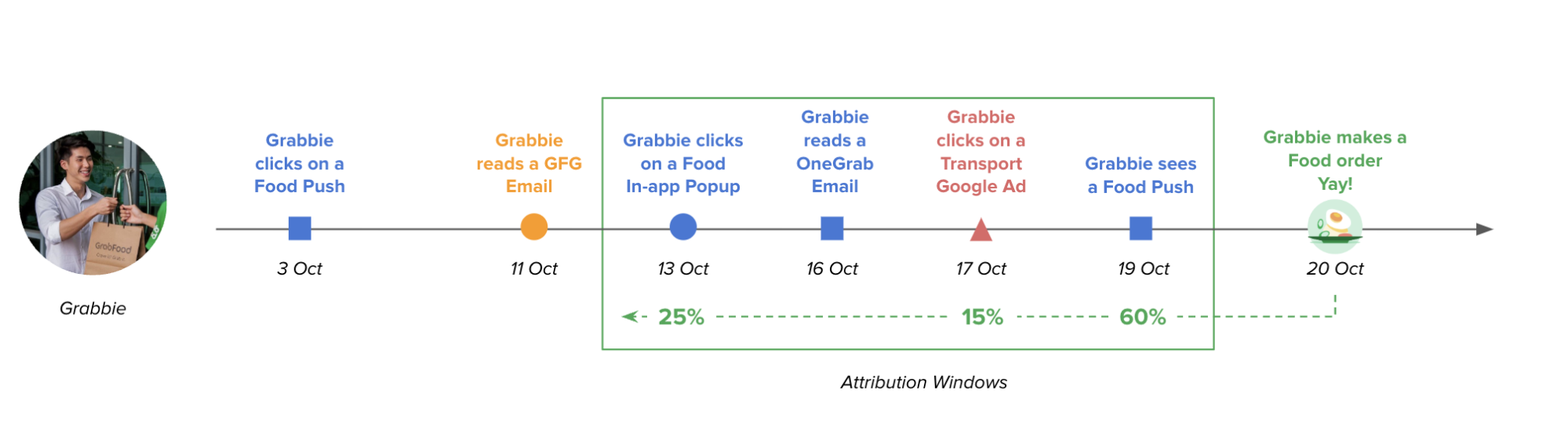
Unlike traditional models that only credit the last touchpoint (i.e. the last message user reads before making a transaction), MAM offers a more nuanced view. It recognises that users are exposed to various marketing messages (emails, pushes, feeds, etc.) throughout their decision-making process. As shown in Fig 1, MAM assigns credit to each touchpoint that influences a conversion (e.g., Grab usage) based on two key factors:
Relevance: Content directly related to the conversion receives a higher weightage. Imagine a user opening a GrabFood push notification before placing a food order. This push would be considered highly relevant and receive significant credit.
Recency: Touchpoints closer in time to the conversion hold more weight. For instance, a brand awareness email sent weeks before the purchase would be less impactful than a targeted GrabFood promotion right before the order.
By factoring in both relevance and recency, MAM avoids crediting the same touchpoint twice and provides a more accurate picture of which marketing campaigns are driving higher conversions.
Fig 1. How MAM does business attribution
While MAM is effective for comparing the impacts of different campaigns, it struggles with the assessment of a single campaign because it does not account for negative impacts. For example, consider a message stating, “Hey, don’t use Grab.” Clearly, not all messages positively impact business.
Hold-out group
To better evaluate the impact of a single campaign, we divide targeted users into two groups:
Hold-out (control): do not send any message
Treatment: send the message
Fig 2. Campaign setup with hold-out group
We then compare the business performance of sending versus not sending messages. For the treatment group, we ideally count only the user transactions potentially linked to the message (i.e., transactions occurring within X days of message receipt). However, since the hold-out group receives no messages, there are no equivalent metrics for comparison.
The only business metrics available for the hold-out group are the aggregated totals of GMV, revenue, etc., over a given time, divided by the number of users. We must calculate the same for the treatment group to ensure a fair comparison.
Fig 3. Metrics calculation for both hold-out and treatment group
The comparison might seem unreliable due to:
The metrics are raw aggregations, lacking attribution logic.
The aggregated GMV and revenue might be skewed by other simultaneous campaigns involving the same users.
Here, we have to admit that figuring out true business impact is difficult. All we can do is try our best to get as close to the truth as possible. To make the comparison more precise, we employed the following strategies:
Stratify the two groups, so that both groups contain roughly the same distribution of users.
Calculate statistical significance to rule out the difference caused by random factors.
Allow users to narrow down the business metrics to compare according to campaign set-up. For example, we don’t compare ride bookings if the campaign is promoting food.
Statistical significance is a common, yet important technique for evaluating the result of controlled experiments. Let’s see how it’s used in our case.
Statistical significance
When we do an A/B testing, we cannot simply conclude that A is better than B when A’s result is better than B. The difference could be due to other random factors. If you did an A/A test, you will still see differences in the results even without doing anything different to the two groups.
Statistical significance is a method to calculate the probability that the difference between two groups is really due to randomness. The lower the probability, the more confidently we can say our action is truly making some impact.
In our case, to derive statistical significance, we assume:
Our hold-out and treatment group are two sets of samples drawn from two populations, A and B.
A and B are the same except that B received our message. We can’t 100% prove this, but can reasonably guess this is close to true, since we split with stratification.
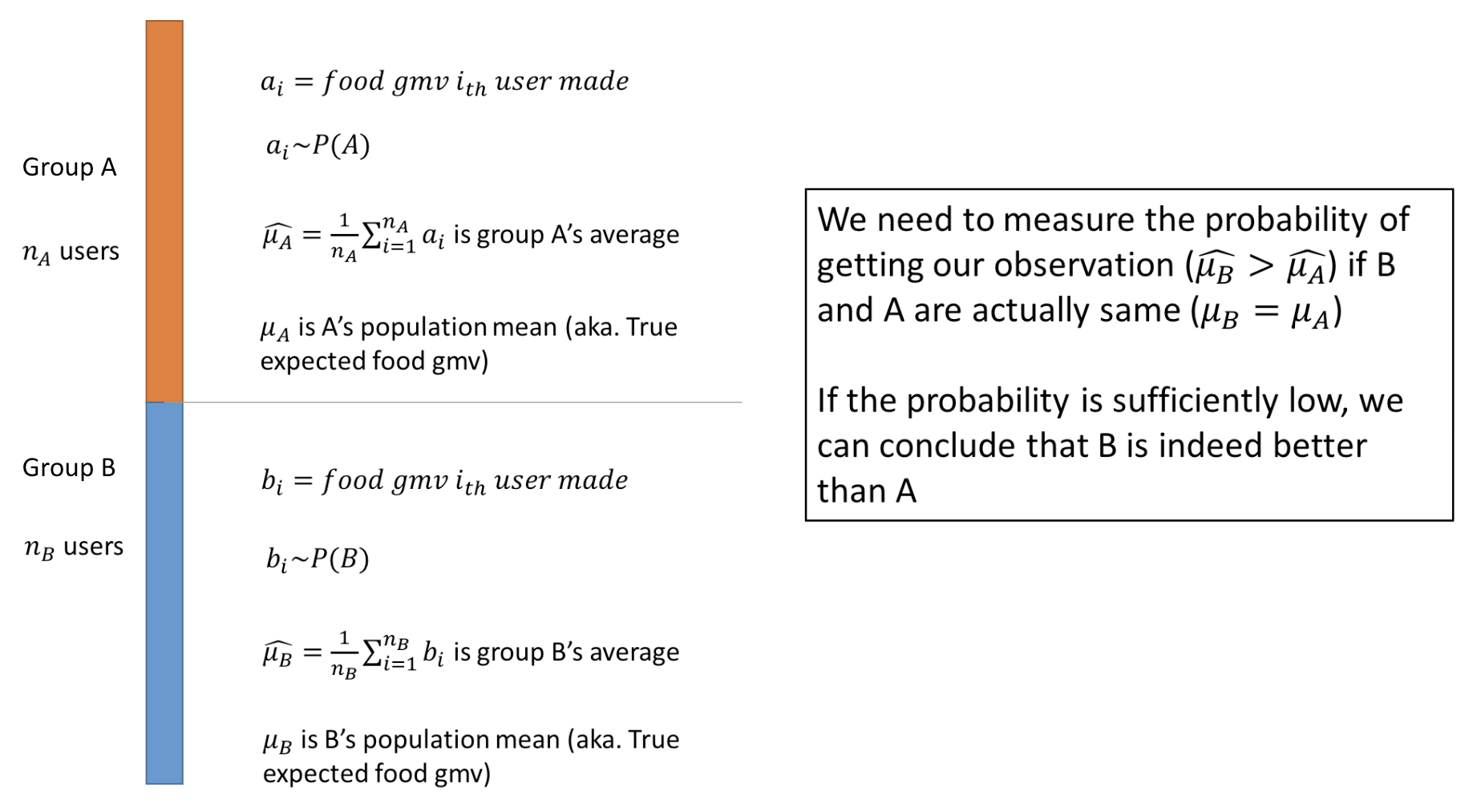
Assuming the business metrics we are comparing is food GMV, the base numbers can be formulated as shown in Fig 4.
Fig 4. Formulation for calculating statistical significance
To calculate the probability, we then use a formula derived from the central limit theorem (CLT). The mathematical derivation of the formula is beyond the scope of this post. Programmatically, we use the popular jStat library for the calculation.
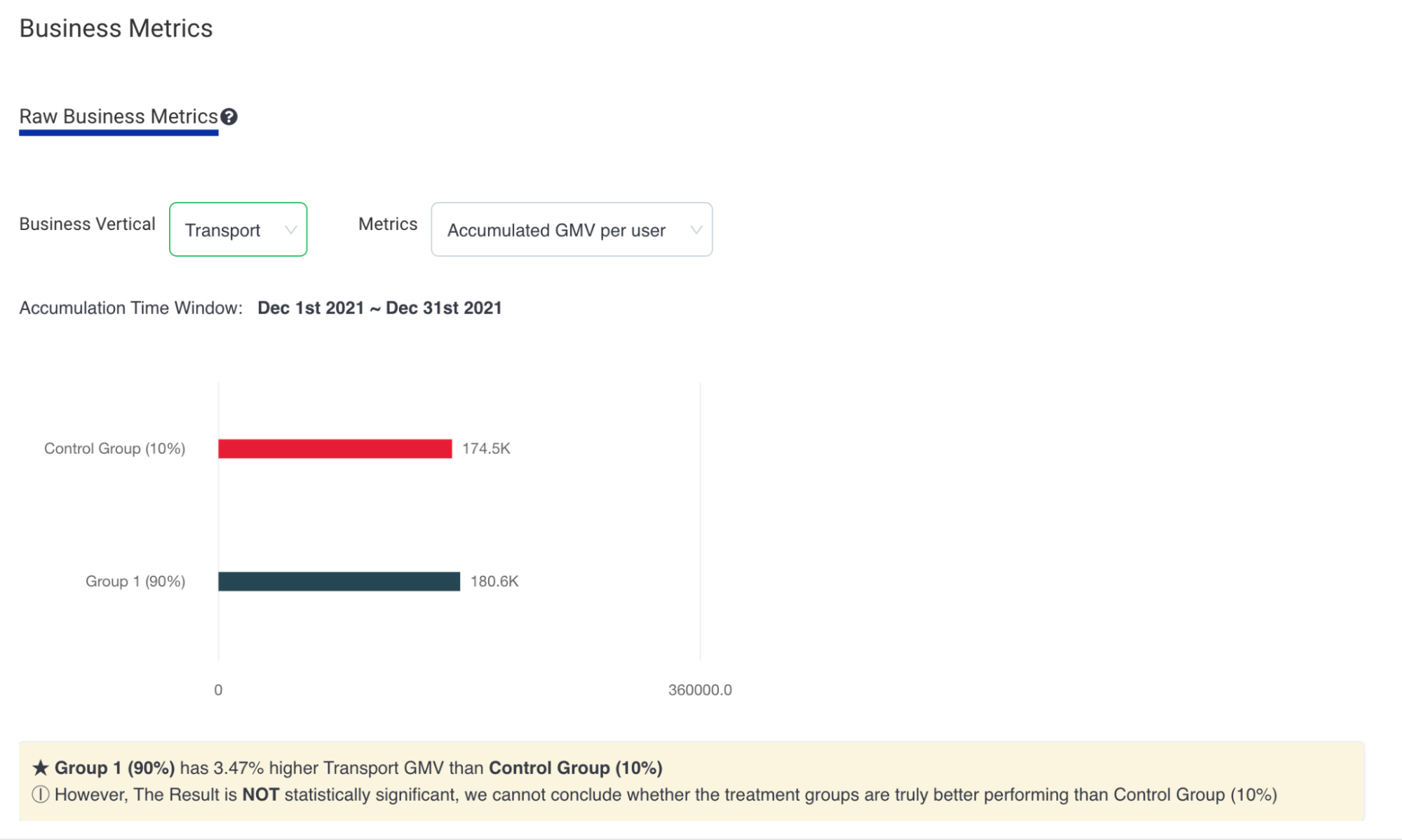
The calculation result of statistical significance as a special notice to the campaign owners is shown in Fig 5.
Fig 5. Display of business impact analysis with statistical significance
What’s next
Evaluating the true business impact remains challenging. We continue to refine our methodology and address potential biases, such as the assumption that both groups are of the same distribution, which might not hold true, especially in smaller group sizes. Furthermore, consistently reserving a 10% hold-out in each campaign is impractical for some campaigns, as sometimes campaign owners require messages to reach all targeted users.
We are committed to advancing our business impact evaluation solutions and will continue improving our existing solutions. We look forward to sharing more insights in future blogs.
Join us
Grab is the leading superapp platform in Southeast Asia, providing everyday services that matter to consumers. More than just a ride-hailing and food delivery app, Grab offers a wide range of on-demand services in the region, including mobility, food, package and grocery delivery services, mobile payments, and financial services across 428 cities in eight countries.
Powered by technology and driven by heart, our mission is to drive Southeast Asia forward by creating economic empowerment for everyone. If this mission speaks to you, join our team today!
Non-uniform memory access (NUMA) systems are organized with their CPUs
grouped into nodes, each of which has memory attached to it. All memory in
the system is accessible from all CPUs, but memory attached to the local
node is faster. The kernel’s memory-policy
(“mempolicy”) interface allows threads to inform the kernel about how
they would like their memory placed to get the best performance. In recent
years, the NUMA concept has been extended to support the management of
different types of memory in a system, pushing the limits of the mempolicy
subsystem. In a remotely presented session at the 2024 Linux Storage,
Filesystem, Memory Management, and BPF Summit, Gregory Price discussed
the ways in which the kernel’s memory-policy support should evolve to
handle today’s more-complex systems.
Като заваля дъжд, та цяла неделя! Тихо, кротко, ден и нощ. Вали, вали, вали – напои хубаво майката земя…
Из „На браздата“, Елин Пелин
Докато чакаме времето да се оправи и небето да се изчисти, реорганизация на движението по три улици в центъра на София стана повод да завалят спорове и протести, които също не стихват. Светла Енчева търси отговор на въпроса „Защо в България има проблем с общите пространства“, и констатира, че за съжаление, в среда, в която печелят най-силните, е трудно да се води дебат за въвеждането на непопулярни мерки, които да са от полза за не толкова силните и не толкова гласовитите участници в движението. От друга страна, характерно за всяка промяна е, че винаги среща силна съпротива само в началото. Времето ще покаже дали София може да се превърне в град на хората, а не на автомобилите, така както си го представят урбанисти като Ян Геел.
За няколко вечери все пак част от София беше на разположение на пешеходците. Миналата седмица завидно количество хора посетиха центъра на столицата, за да се порадват на фестивала на светлините „Лунар“. Предстои да видим още едно светлинно шоу. По случай Деня на българската просвета и на славянската писменост внушителен 3D мапинг, част от проекта „Скритите букви“ на Фондация „Прочети София“, ще бъде прожектиран на фасадата на Националната библиотека „Св. св. Кирил и Методий“ на 23 май от 21:30 до 00:00 ч.
Популистките решения са лесни, не изискват специални умения и се удават на всички политици. За трудните реформи и модернизацията на държавата са нужни лидери с друга закалка. В противен случай властта ще продължава да подхвърля на гражданите малко пари, евтино олио и хляб вместо качествено образование и умения, за да се справят в една модерна икономика на бъдещето.
Индустрия 5.0, „разказана“ в доклада на Европейската комисия, звучи като футуристична приказка на фона на българската реалност. Обещават ни синергия между хората и машините. Вместо да бъдат заменяни хората с роботи и AI, стремежът е да се подобряват човешките способности и производителността чрез сътрудничество.
Коботи (роботи за сътрудничество) ще работят заедно с хората, помагайки им в задачи, които изискват прецизност, сила или повтарящи се действия, като оставят място за човешката креативност и вземане на решения. Алгоритмите за изкуствен интелект и машинно обучение ще анализират огромни количества данни, за да се фокусират хората върху стратегическите решения.
Звучи почти по холивудски утопично, нали? Какво красиво бъдеще само…
Но къде е всъщност България в този нов свят със своите над 1 милион граждани в активна възраст, които нито учат, нито работят, нито са регистрирани в бюрата по труда? Вее руски знамена на връх Шипка и шумно спори защо „Ергенът“ не е избрал нито една от „джукесите“.
В същото време всеки ученик или студент предпочита да виси в социалните мрежи, да използва ChatGPT, за да му напише курсовата работа или домашното, и по възможност да не влага усилие за друго, освен за да си достави поредната бърза доза онлайн разсейване. На този все по-голям проблем обръщам внимание в статията си „Културата на разсейването и капанът на допаминовата зависимост“. Защото е лесно да обвиним младите за това, че искат да избягат от действителността и предпочитат лесното пред трудното, но е важно да си дадем сметка, че сами ги вкарваме във виртуален затвор без изход, където повечето от нас също неусетно търсят фалшива утеха и убежище.
Но красивото бъдеще на човечеството зависи именно от това на какво и как учим децата. Вечна е темата за състоянието на българската образователна система и дали училището е в състояние да предложи на децата всичко онова, от което имат нужда, за да се фокусират и да учат активно: безопасна и творческа среда, достатъчно пространство, светлина и възможности за развитие, подкрепа и сътрудничество, естетически стимули… В статията си тази седмица „От грозно по-грозно: Физическата среда в училища и детски градини“Донка Дойчева-Попова се опитва да провокира един честен поглед към състоянието в момента и към нуждата от спешна позитивна промяна.
Неуютните и остарели училищни сгради обаче могат да бъдат привлекателни, ако не си имал дори това като възможност. За десетки деца бежанци като 12-годишната Симаф от Сирия, която никога не е посещавала училище, преди да пристигне с леля си в България, образованието е единственото средство, чрез което могат да постигнат мечтите си. Интервюто на Надежда Цекулова „Симаф, която иска да учи и да стане лекарка“ си заслужава четенето, дори и само за да оценим образованието като привилегия, която приемаме за даденост.
През уикенда може би ще видим малко слънце, но ако случайно забравите да си вземете чадър, съветвам ви да потърсите подслон в някои от софийските музеи, които ще бъдат със свободен вход в събота вечер, 18 май. Заради Европейската нощ на музеите и тази година над 50 музея и галерии ще останат отворени до късно и ще работят извънредно. Изложби, концерти, работилници, филми, обиколки с екскурзовод – Нощта на музеите е отворена за всички. По време на събитието ще има безплатна атракционна ретро линия с реставрирани автобуси, които ще тръгват на всеки 20 минути във времето между 18:00 и 0:30 часа. Може да разгледате пълната програма на събитието и да решите какво да посетите, но ви препоръчвам да не пропускате Столичната градска художествена галерия, където изложбата е посветена на 125-тата годишнина от рождението на Дечко Узунов. В галерията на открито в градската градина пък имате възможност да разгледате документалната изложба по случай 200-годишнината от създаването на „Рибния буквар“.
А като споменахме „Рибния буквар“, миналата седмица се случи едно дългоочаквано събитие: след дълги години чакане най-сетне разполагаме онлайн с официален правописен речник на българския език. БЕРОН е едновременно абревиатура на български езикови ресурси онлайн, както и намек за годишнината от излизането на творбата на възрожденеца Петър Берон. Необходимостта от надежден ресурс в интернет за нормите на българския книжовен език най-после изглежда добре подсигурена, а ако ви възникват съмнения, винаги може да си направите допълнителна справка с „Как се пише?“ – сайта, който нашата езикова редакторка и коректорка Павлина Върбанова създаде и поддържа актуален през последните 12 години.
И накрая нека ви припомня нещо: „Тоест“ е медия, която се издържа изцяло от своите читатели. Мисията ѝ е да анализира и представя съществени теми честно и обективно и да свързва читателите помежду им и с реалността. Ако харесвате нашата работа и вярвате, че усилията ни да ви предоставяме качествено съдържание сред океана от кликбейт, реклами, дезинформация и пропаганда имат смисъл, подкрепете ни. „Тоест“ се нуждае от вас, за да продължи да съществува като независима медия.
To provide the best experiences, we use technologies like cookies to store and/or access device information. Consenting to these technologies will allow us to process data such as browsing behavior or unique IDs on this site. Not consenting or withdrawing consent, may adversely affect certain features and functions.
Functional
Always active
The technical storage or access is strictly necessary for the legitimate purpose of enabling the use of a specific service explicitly requested by the subscriber or user, or for the sole purpose of carrying out the transmission of a communication over an electronic communications network.
Preferences
The technical storage or access is necessary for the legitimate purpose of storing preferences that are not requested by the subscriber or user.
Statistics
The technical storage or access that is used exclusively for statistical purposes.The technical storage or access that is used exclusively for anonymous statistical purposes. Without a subpoena, voluntary compliance on the part of your Internet Service Provider, or additional records from a third party, information stored or retrieved for this purpose alone cannot usually be used to identify you.
Marketing
The technical storage or access is required to create user profiles to send advertising, or to track the user on a website or across several websites for similar marketing purposes.