The Power of Specialized Cloud Providers: A Game Changer for SaaS Companies

Post Syndicated from Amrit Singh original https://www.backblaze.com/blog/the-power-of-specialized-cloud-providers-a-game-changer-for-saas-companies/

A decorative image showing a cloud with the Backblaze logo, then logos hanging off it it for Vultr, Fastly, Equinix metal, Terraform, and rclone.

“Nobody ever got fired for buying AWS.” It’s true: AWS’s one-size-fits-all solution worked great for most businesses, and those businesses made the shift away from the traditional model of on-prem and self-hosted servers—what we think of as Cloud 1.0—to an era where AWS was the cloud, the one and only, which is what we call Cloud 2.0. However, as the cloud landscape evolves, it’s time to question the old ways. Maybe nobody ever got fired for buying AWS, but these days, you can certainly get a lot of value (and kudos) for exploring other options. 

Developers and IT teams might hesitate when it comes to moving away from AWS, but AWS comes with risks, too. If you don’t have the resources to manage and maintain your infrastructure, costs can get out of control, for one. As we enter Cloud 3.0 where the landscape is defined by the open, multi-cloud internet, there is an emerging trend that is worth considering: the rise of specialized cloud providers.

Today, I’m sharing how software as a service (SaaS) startups and modern businesses can take advantage of these highly-focused, tailored services, each specializing and excelling in specific areas like cloud storage, content delivery, cloud compute, and more. Building on a specialized stack offers more control, return on investment, and flexibility, while being able to achieve the same performance you expect from hyperscaler infrastructure.

From a cost of goods sold perspective, AWS pricing wasn’t a great fit. From an engineering perspective, we didn’t want a net-new platform. So the fact that we got both with Backblaze—a drop-in API replacement with a much better cost structure—it was just a no-brainer.

—Rory Petty, Co-Founder & CTO, Tribute

The Rise of Specialized Cloud Providers

Specialized providers—including content delivery networks (CDNs) like Fastly, bunny.net, and Cloudflare, as well as cloud compute providers like Vultr—offer services that focus on a particular area of the infrastructure stack. Rather than trying to be everything to everyone, like the hyperscalers of Cloud 2.0, they do one thing and do it really well. Customers get best-of-breed services that allow them to build a tech stack tailored to their needs. 

Use Cases for Specialized Cloud Providers

There are a number of businesses that might benefit from switching from hyperscalers to specialized cloud providers, including:

In order for businesses to take advantage of the benefits (since most applications rely on more than just one service), these services must work together seamlessly. 

Let’s Take a Closer Look at How Specialized Stacks Can Work For You

If you’re wondering how exactly specialized clouds can “play well with each other,” we ran a whole series of application storage webinars that talk through specific examples and uses cases. I’ll share what’s in it for you below.

1. Low Latency Multi-Region Content Delivery with Fastly and Backblaze

Did you know a 100-millisecond delay in website load time can hurt conversion rates by 7%? In this session, Pat Patterson from Backblaze and Jim Bartos from Fastly discuss the importance of speed and latency in user experience. They highlight how Backblaze’s B2 Cloud Storage and Fastly’s content delivery network work together to deliver content quickly and efficiently across multiple regions. Businesses can ensure that their content is delivered with low latency, reducing delays and optimizing user experience regardless of the user’s location.

2. Scaling Media Delivery Workflows with bunny.net and Backblaze

Delivering content to your end users at scale can be challenging and costly. Users expect exceptional web and mobile experiences with snappy load times and zero buffering. Anything less than an instantaneous response may cause them to bounce. 

In this webinar, Pat Patterson demonstrates how to efficiently scale your content delivery workflows from content ingestion, transcoding, storage, to last-mile acceleration via bunny.net CDN. Pat demonstrates how to build a video hosting platform called “Cat Tube” and shows how to upload a video and play it using HTML5 video element with controls. Watch below and download the demo code to try it yourself.

3. Balancing Cloud Cost and Performance with Fastly and Backblaze

With a global economic slowdown, IT and development teams are looking for ways to slash cloud budgets without compromising performance. E-commerce, SaaS platforms, and streaming applications all rely on high-performant infrastructure, but balancing bandwidth and storage costs can be challenging. In this 45-minute session, we explored how to recession-proof your growing business with key cloud optimization strategies, including ways to leverage Fastly’s CDN to balance bandwidth costs while avoiding performance tradeoffs.

4. Reducing Cloud OpEx Without Sacrificing Performance and Speed

Greg Hamer from Backblaze and DJ Johnson from Vultr explore the benefits of building on best-of-breed, specialized cloud stacks tailored to your business model, rather than being locked into traditional hyperscaler infrastructure. They cover real-world use cases, including:

  • How Can Stock Photo broke free from AWS and reduced their cloud bill by 55% while achieving 4x faster generation.
  • How Monument Labs launched a new cloud-based photo management service to 25,000+ users.
  • How Black.ai processes 1000s of files simultaneously, with a significant reduction of infrastructure costs.

5. Leveling Up a Global Gaming Platform while Slashing Cloud Spend by 85%

James Ross of Nodecraft, an online gaming platform that aims to make gaming online easy, shares how he moved his global game server platform from Amazon S3 to Backblaze B2 for greater flexibility and 85% savings on storage and egress. He discusses the challenges of managing large files over the public internet, which can result in expensive bandwidth costs. By storing game titles on Backblaze B2 and delivering them through Cloudflare’s CDN, they achieve reduced latency since games are cached at the edge, and pay zero egress fees thanks to the Bandwidth Alliance. Nodecraft also benefited from Universal Data Migration, which allows customers to move large amounts of data from any cloud services or on-premises storage to Backblaze’s B2 Cloud Storage, managed by Backblaze and free of charge.

Migrating From a Hyperscaler

Though it may seem daunting to transition from a hyperscaler to a specialized cloud provider, it doesn’t have to be. Many specialized providers offer tools and services to make the transition as smooth as possible. 

  • S3-compatible APIs, SDKs, CLI: Interface with storage as you would with Amazon S3—switching can be as easy as dropping in a new storage target.
  • Universal Data Migration: Free and fully managed migrations to make switching as seamless as possible.
  • Free egress: Move data freely with the Bandwidth Alliance and other partnerships between specialized cloud storage providers.

As the decision maker at your growing SaaS company, it’s worth considering whether a specialized cloud stack could be a better fit for your business. By doing so you could potentially unlock cost savings, improve performance, and gain flexibility to adapt your services to your unique needs. The one-size-fits-all is no longer the only option out there. 

Want to Test It Out Yourself?

Take a proactive approach to cloud cost management: Get 10GB free to test and validate your proof of concept (POC) with Backblaze B2. All it takes is an email to get started.

Download the Ransomware Guide ➔ 

The post The Power of Specialized Cloud Providers: A Game Changer for SaaS Companies appeared first on Backblaze Blog | Cloud Storage & Cloud Backup.

Amazon SES – Set up notifications for bounces and complaints

Post Syndicated from Vinay Ujjini original https://aws.amazon.com/blogs/messaging-and-targeting/amazon-ses-set-up-notifications-for-bounces-and-complaints/

Why is it important to monitor bounces and complaints when using Amazon Simple Email Service?

Amazon Simple Email Service (Amazon SES) is a scalable cloud email service provider that is cost-effective and flexible. Amazon SES allows businesses and individuals to send bulk emails to their customers and subscribers. However, as with any email service, there is always a risk of emails bouncing or being marked as spam by recipients. These bounces and complaints can have serious consequences for your email deliverability and can even lead to your email account being suspended or blocked. That’s why it’s important to monitor bounces and complaints when using Amazon SES for email sending. By using Simple Notification Services (Amazon SNS) notifications, you can set up notifications and proactively address any issues and ensure that your emails are delivered successfully to your intended recipients. In this blog, we’ll show how to set up notifications for bounces and complaints in Amazon SES, so you can stay on top of your email deliverability and maintain a positive sender reputation.

Understanding bounces and complaints:

Understanding bounces and complaints is crucial when it comes to email marketing. In simple terms, a bounce occurs when an email is undeliverable and is returned to the sender. There are two types of bounces: soft bounces and hard bounces. A soft bounce is a temporary issue, such as a full inbox or a server error, and the email may be delivered successfully on a subsequent attempt. A hard bounce, on the other hand, is a permanent issue, such as an invalid email address, and the email will never be delivered. On the other hand, a complaint occurs when a recipient marks an email as spam or unwanted. Complaints can be particularly damaging to your email deliverability and can lead to your emails being blocked or sent to the recipient’s spam folder. By monitoring bounces and complaints and taking appropriate action, you can maintain a positive sender reputation and ensure that your emails are delivered successfully to your intended recipients.

Amazon SES provides tools like Virtual Deliverability Manager (VDM) to manage the deliverability at the ISP, sub-domain or configuration set level. You can see the details in this blog.

Solution walkthrough:

This post gives detailed instructions on how to use Amazon Simple Notification Service SNS to monitor and receive notifications on bounces and complaints in Amazon SES. This blog also has FAQs and troubleshooting tips if you are not receiving notifications following the setup: (below are the steps with detailed instructions and screenshots)

Prerequisites:

For this walkthrough, you should have the following prerequisites:

  1. An active AWS account.
  2. A verified identity (Email address or Domain) in Amazon SES.
  3. Administrative Access to Amazon SES Console and Amazon SNS Console.

Step 1: Create an Amazon SNS topic and subscription:

      1. Sign in to the Amazon SNS console.
      2. Under Amazon SNS homepage provide a Topic name and click on Next steps:
      3. SNS topic image
      4. For Type, choose a topic type Standard.
        Note: Standard topics are better suited for use cases that require higher message publish and delivery throughput rates which fits the SES bounces and complaints monitoring.
      5. SNS standard queue
      6. (Optional) Expand the Encryption section if you would like to encrypt the SNS topic.
        • Choose Enable encryption.
        • Specify the AWS KMS key. For more information, see Key terms.
        • For each KMS type, the Description, Account, and KMS ARN are displayed.
      7. Encryption image
      8. Scroll to the end of the form and choose Create topic. The topic is created and the console opens the new topic’s Details page.
      9. To create the subscription on the Subscriptions page, choose Create subscription.
      10. SNS Subscription page
      11. On the Create subscription page, choose the Topic ARN that you created in the previous step.
      12. For Protocol, choose Email. There are multiple protocols available to use and it depends on where you would like to receive the SNS notifications for bounces and complaints. Please refer to list of available protocols.
      13. For Endpoint, enter an email address that can receive notifications.
        Note: this should be existing email address with accessible mailbox.
      14. SNS Subscription details
      15. Scroll to the bottom and click Create subscription. The console opens the new subscription’s Details page.
      16. After your subscription is created, you need to confirm it through the email address provided above.
      17. Check your email inbox you provided in the endpoint in previous step and and choose Confirm subscription in the email from AWS Notifications. The sender ID is usually “[email protected]“.
      18. AWS Notification email
      19. Amazon SNS opens your web browser and displays a subscription confirmation with your subscription ID.
      20. Subscription confirmation email
      21. After subscription is confirmed, refresh the subscription’s Details page and the subscription status will move from Pending to Confirmed.
      22. Subscription details
  • Step 2: Configure Amazon SES to send bounces and complaints to the Amazon SNS topic created:

In this step, I am presenting two methods to monitor your bounces and complaints. Follow Demo 1, if you are looking for a simple way to monitor bounces and complaints events for a specific email identity. Follow Demo 2, if you have many email identities and you want to monitor bounces and complaints along with other events using configuration sets “groups of rules that you can apply to all your verified identities”.

Demo 1: Configure Amazon SES to monitor bounces and complaints for specific email identity (Email, Domain):

The domain/sub-domain/email identity must have a Verified status. If the identity is not in verified status, refer to steps to verify identity with Amazon SES before continuing further.

Prior to starting this demo, it is important to know if you have a verified domain, subdomain, or an email address that shares the root domain. The identity settings (such as SNS and feedback notifications) apply at the most granular level you have set up the verification. Hierarchy is as below:

  • Verified email address identity settings override verified domain identity settings.
  • Verified subdomain identity settings override verified domain identity settings. (lower-level subdomain settings override higher-level subdomain settings).

Hence, if you want to monitor bounces and complaints for all email addresses under one domain, it is recommended to verify the domain identity with SES and apply this setting at the domain identity level. If you want to monitor bounces and complaints for specific email address under a verified domain identity, verify this email address explicitly with SES and apply this settings into the email identity level.

  1. Sign in to the Amazon SES console.
  2. In the navigation pane, under Configuration, choose Verified identities.
  3. Verified email identities
  4. Select the verified identity in which you want to monitor for bounces and complaints notifications.
  5. In the details screen of the verified identity you selected, choose the Notifications tab and select Edit in the Feedback notifications container.
  6. Notifications
  7. Expand the SNS topic list box of bounce and complaint feedback type and select the SNS topic you created in Step 1.
    (Optional) If you want your topic notification to include the headers from the original email, check the Include original email headers box directly underneath the SNS topic name of each feedback type then click on save changes.
  8. SNS topics
  9. After configured SNS topic for bounces and complaints, you can disable Email Feedback Forwarding notifications to avoid receive double notifications through Email Feedback Forwarding and SNS notifications.
  10. To Disable it, under the Notifications tab on the details screen of the verified identity, in the Email Feedback Forwarding container, choose Edit, uncheck the Enabled box, and choose Save changes.
  11. Feedback forwarding disabled

Demo 2: Configure Amazon SES to monitor bounces and complaints for emails sent with a configuration set using Amazon SES event publishing.

Configuration sets in SES are groups of rules, that you can apply to your verified identities. When you apply a configuration set to an email, all of the rules in that configuration set are applied to the email. You can use different type of rules with a configuration set. This demo will use event destination, which will allow you to publish bounces and complaints to the SNS topic.

Note: You must pass the name of the configuration set when sending an email. This can be done by either specifying the configuration set name in the headers of emails, or specifying it as a default configuration set. This can be done at the time of identity creation, or later while editing a verified identity.

  1. Sign in to the Amazon SES console.
  2. In the navigation pane, under Configuration, choose Configuration sets. Choose Create set.
  3. Configuration set image
  4. Enter Configuration set name, leave the rest of fields to default, scroll to the send and click on Create set.
  5. Create configuration set
  6. After Configuration set is created, you now need to create Amazon SES event destinations as shown below. Amazon SES sends all bounce and complaint notifications to event destination. In this blog the event destination is Amazon SNS topic.
  7. Navigate to the configuration set you created in step 3. Under configuration set home page click on Event destinations and select Add destination.
  8. Event destinations
  9. Under Select event types, check hard bounces and complaints boxes and click Next.
  10. Event types selection
  11. Specify destination for receiving bounce and complaints notifications, there’s couple of destinations types to choose from. in this demo, we will use Amazon SNS.
  12. Name – enter the name of the destination for this configuration set. The name can include letters, numbers, dashes, and hyphens.
  13. Event publishing – to turn on event publishing for this destination, select the Enabled check box.
  14. Under Amazon Simple Notification Service (SNS) topic , Expand the SNS topic list box and select the SNS topic you created in Step 1 and click Next.
  15. Use SES as destination
  16. Review, When you are satisfied that your entries are correct, choose Add destination to add your event destination.
  17. Once you choose Add destination , the summary of event destination will show a “Successfully validated SNS topic for Amazon SES event publishing” email.
  18. Successful notification

Step 3: Using Amazon SES Mailbox Simulator to test send and receive a bounce notification via SNS topic:

Test 1: Send a test email to test Demo 1 “Configure Amazon SES to monitor bounces and complaints for specific email identity (Email, Domain) ” in previous step

In this test, I will send a test message from my verified identity which configured to send any bounce and complaint notifications it receives to SNS topic and email address subscribed to the topic. I will use SES mailbox simulator to simulate a bounce message to test this setup.

  1. Sign in to the Amazon SES console.
  2. In the navigation pane, under Configuration, choose Verified identities.
  3. Select the verified identity you configured SNS notifications for bounces and complaints in Demo 1. In this test, I selected a verified domain identity.
  4. Click on Send test email from the upper right corner.
  5. Sending test email
  6. Under send message details, in From-address enter the first part of email address under this verified domain (from-address could be pre-populated).
  7. For Scenario, Expand the simulated scenarios and select Bounce scenario to test send a bounce message.
  8. For Subject, enter the desired email subject. For Body, type an optional body text then leave the rest of options as a default. Click on Send test email to send the email.
  9. Message details
  10. You should have an email from AWS notifications with bounce notification and details on the bounce.
  11. Content of bounce message includes the notificationType “Bounce/Complaint”, bouncedRecipients, diagnosticCode “reason the message bounced”, remoteMtaIp “IP of the recipient MTA rejected the message”, SourceIp “IP of the sender application”, callerIdentity “IAM user sending this message”. These details can help in identifying the reason behind why email is not delivered and bounced and will help you avoid such bounces in the future. Refer this document for additional content on bounce events.
  12. AWS notification message

Test 2: Send a test email to test Demo 2 “Configure Amazon SES to monitor bounces and complaints for emails sent with a configuration set using Amazon SES event publishing” in previous step

In this test, you can send a test message from any verified identity and by using the configuration set created in Step 2 which is configured to send any bounce and complaint notifications to SNS topic and email address subscribed to the topic. You can use SES mailbox simulator to simulate a bounce message to test this setup.
  1. Sign in to the Amazon SES console.
  2. In the navigation pane, under Configuration, choose Verified identities.
  3. Select any verified identity you want to send emails from. In this test, I selected a verified domain identity.
  4. Click on Send test email from the upper right corner.
  5. Under send message details From-address enter the first part of email address under this verified domain.
  6. For Scenario, Expand the simulated scenarios and select Bounce scenario to test send a bounce message.
  7. For Subject, enter the desired email subject. For Body, type an optional body text.
  8. For Configuration set, Expand the drop-down list and choose the configuration set you created in Demo 2.
  9. Click on Send test email to send the email.
  10. Message details
  11. You will find an email from AWS notifications with bounce notification and all details of the bounce.
  12. Content of bounce message includes the EventType “Bounce/Complaint”, bouncedRecipients, diagnosticCode “reason the message bounced” , remoteMTA “IP of the recipient MTA rejected the message”, SourceIp “IP of the sender application”, callerIdentity “IAM user sending this message”, ses:configuration-set “name of the configuration set you use when sending the email” all of this details can help you to identify the reason behind why email is not delivered and bounced and will help you to avoid such bounces in the future. Refer this document for more details on contents of bounce events.
  13. SES notification email

FAQ on this set up:

I configured SNS topic with KMS encryption and I am not receiving bounce or complain notifications for emails:
If your Amazon SNS topic uses AWS Key Management Service (AWS KMS) for server-side encryption, you have to add permissions to the AWS KMS key policy to allow SES service access the KMS key, an example policy can be found here.

I followed Demo 2. However, when I try to send emails from any verified identity, I don’t receive bounce or complain notifications for emails:
When sending the email, make sure to select the configuration set you configured for bounce and complaints notification. If you followed demo 2 and you sent the email without explicitly using the configuration set in email headers, you will lose tracking for bounce and complaints events.

I am testing the setup. After I sent an email to the bounce simulator, I am not receiving don’t receive any bounce notification emails:
Check the SNS topic subscription if its in pending status and make sure you confirm the topic subscription via subscription email sent to you. If the topic subscription is confirmed, make sure you have access to the inbox of subscription email address and you are not applying any email filters.

Cleaning up:

You should have now successfully setup SNS notifications to monitor bounce and complaints for you Amazon SES emails. To avoid incurring any extra charges, remember to delete any resources created manually if you no longer need them for monitoring.

Resources to delete from SES console:

  1. In the navigation pane, under Configuration, choose the verified identity you configured for SNS notifications.
  2. In the details screen of the verified identity you selected, choose the Notifications tab and select Edit in the Feedback notifications container.
  3. Choose No SNS topic from bounce and complaint feedback dropdown menu and click Save changes.
  4. Under the same Notifications tab on the details screen of the verified identity, in the Email Feedback Forwarding container, choose Edit, check the Enabled box, and choose Save changes.
  5. In the navigation pane, under Configuration, choose Configuration sets.
  6. Check the box beside Configuration set you created and select Delete.

Resources to delete from SNS console:

  1. In the navigation pane, from the left side menu, choose Topics.
  2. Check the radio button beside the SNS topic you created and select Delete.
  3. Confirm the topic deletion by writing “delete me”.

Conclusion:

Monitoring bounces and complaints is an essential part of maintaining a successful email sending system, using Amazon SES. By setting up SNS notifications for bounces and complaints, you can quickly identify any issues and take appropriate action to ensure that your emails are delivered successfully to your subscribers. By proactively managing your email deliverability, you can maintain a positive sender reputation and avoid any negative impact on your email marketing efforts.

About the authors:

 Alaa Hammad

Alaa Hammad is a Senior Cloud Support Engineer at AWS and subject matter expert in Amazon Simple Email Service and AWS Backup service. She has a 10 years of diverse experience in supporting enterprise customers across different industries. She enjoys cooking and try new recipes from different cuisines.

 Vinay Ujjini 

Vinay Ujjini is an Amazon Pinpoint and Amazon Simple Email Service Worldwide Principal Specialist Solutions Architect at AWS. He has been solving customer’s omni-channel challenges for over 15 years. He is an avid sports enthusiast and in his spare time, enjoys playing tennis & cricket.

Simplify How You Manage Authorization in Your Applications with Amazon Verified Permissions – Now Generally Available

Post Syndicated from Danilo Poccia original https://aws.amazon.com/blogs/aws/simplify-how-you-manage-authorization-in-your-applications-with-amazon-verified-permissions-now-generally-available/

When developing a new application or integrating an existing one into a new environment, user authentication and authorization require significant effort to be correctly implemented. In the past, you would have built your own authentication system, but today you can use an external identity provider like Amazon Cognito. Yet, authorization logic is typically implemented in code.

This might begin simply enough, with all users assigned a role for their job function. However, over time, these permissions grow increasingly complex. The number of roles expands, as permissions become more fine-grained. New use cases drive the need for custom permissions. For instance, one user might share a document with another in a different role, or a support agent might require temporary access to a customer account to resolve an issue. Managing permissions in code is prone to errors, and presents significant challenges when auditing permissions and deciding who has access to what, particularly when these permissions are expressed in different applications and using multiple programming languages.

At re:Invent 2022, we introduced in preview Amazon Verified Permissions, a fine-grained permissions management and authorization service for your applications that can be used at any scale. Amazon Verified Permissions centralizes permissions in a policy store and helps developers use those permissions to authorize user actions within their applications. Similar to how an identity provider simplifies authentication, a policy store let you manage authorization in a consistent and scalable way.

To define fine-grained permissions, Amazon Verified Permissions uses Cedar, an open-source policy language and software development kit (SDK) for access control. You can define a schema for your authorization model in terms of principal types, resource types, and valid actions. In this way, when a policy is created, it is validated against your authorization model. You can simplify the creation of similar policies using templates. Changes to the policy store are audited so that you can see of who made the changes and when.

You can then connect your applications to Amazon Verified Permissions through AWS SDKs to authorize access requests. For each authorization request, the relevant policies are retrieved and evaluated to determine whether the action is permitted or not. You can reproduce those authorization requests to confirm that permissions work as intended.

Today, I am happy to share that Amazon Verified Permissions is generally available with new capabilities and a simplified user experience in the AWS Management Console.

Let’s see how you can use it in practice.

Creating a Policy Store with Amazon Verified Permissions
In the Amazon Verified Permissions console, I choose Create policy store. A policy store is a logical container that stores policies and schema. Authorization decisions are made based on all the policies present in a policy store.

To configure the new policy store, I can use different methods. I can start with a guided setup, a sample policy store (such as for a photo-sharing app, an online store, or a task manager), or an empty policy store (recommended for advanced users). I select Guided setup, enter a namespace for my schema (MyApp), and choose Next.

Console screenshot.

Resources are the objects that principals can act on. In my application, I have Users (principals) that can create, read, update, and delete Documents (resources). I start to define the Documents resource type.

I enter the name of the resource type and add two required attributes:

  • owner (String) to specify who is the owner of the document.
  • isPublic (Boolean) to flag public documents that anyone can read.

Console screenshot.

I specify four actions for the Document resource type:

  • DocumentCreate
  • DocumentRead
  • DocumentUpdate
  • DocumentDelete

Console screenshot.

I enter User as the name of the principal type that will be using these actions on Documents. Then, I choose Next.

Console screenshot.

Now, I configure the User principal type. I can use a custom configuration to integrate an external identity source, but in this case, I use an Amazon Cognito user pool that I created before. I choose Connect user pool.

Console screenshot.

In the dialog, I select the AWS Region where the user pool is located, enter the user pool ID, and choose Connect.

Console screenshot.

Now that the Amazon Cognito user pool is connected, I can add another level of protection by validating the client application IDs. For now, I choose not to use this option.

In the Principal attributes section, I select which attributes I am planning to use for attribute-based access control in my policies. I select sub (the subject), used to identify the end user according to the OpenID Connect specification. I can select more attributes. For example, I can use email_verified in a policy to give permissions only to Amazon Cognito users whose email has been verified.

Console screenshot.

As part of the policy store creation, I create a first policy to give read access to user danilop to the doc.txt document.

Console screenshot.

In the following code, the console gives me a preview of the resulting policy using the Cedar language.

permit(
  principal == MyApp::User::"danilop",
  action in [MyApp::Action::"DocumentRead"],
  resource == MyApp::Document::"doc.txt"
) when {
  true
};

Finally, I choose Create policy store.

Adding Permissions to the Policy Store
Now that the policy store has been created, I choose Policies in the navigation pane. In the Create policy dropdown, I choose Create static policy. A static policy contains all the information needed for its evaluation. In my second policy, I allow any user to read public documents. By default everything is forbidden, so in Policy Effect I choose Permit.

In the Policy scope, I leave All principals and All resources selected, and select the DocumentRead action. In the Policy section, I change the when condition clause to limit permissions to resources where isPublic is equal to true:

permit (
  principal,
  action in [MyApp::Action::"DocumentRead"],
  resource
)
when { resource.isPublic };

I enter a description for the policy and choose Create policy.

For my third policy, I create another static policy to allow full access to the owner of a document. Again, in Policy Effect, I choose Permit and, in the Policy scope, I leave All principals and All resources selected. This time, I also leave All actions selected.

In the Policy section, I change the when condition clause to limit permissions to resources where the owner is equal to the sub of the principal:

permit (principal, action, resource)
when { resource.owner == principal.sub };

In my application, I need to allow read access to specific users that are not owners of a document. To simplify that, I create a policy template. Policy templates let me create policies from a template that uses placeholders for some of their values, such as the principal or the resource. The placeholders in a template are keywords that start with the ? character.

In the navigation pane, I choose Policy templates and then Create policy template. I enter a description and use the following policy template body. When using this template, I can specify the value for the ?principal and ?resource placeholders.

permit(
  principal == ?principal,
  action in [MyApp::Action::"DocumentRead"],
  resource == ?resource
);

I complete the creation of the policy template. Now, I use the template to simplify the creation of policies. I choose Policies in the navigation pane, and then Create a template-linked policy in the Create policy dropdown. I select the policy template I just created and choose Next.

To give access to a user (danilop) for a specific document (new-doc.txt), I just pass the following values (note that MyApp is the namespace of the policy store):

  • For the Principal: MyApp::User::"danilop"
  • For the Resource: MyApp::Document::"new-doc.txt"

I complete the creation of the policy. It’s now time to test if the policies work as expected.

Testing Policies in the Console
In my applications, I can use the AWS SDKs to run an authorization request. The console provides a way to to simulate what my applications would do. I choose Test bench in the navigation pane. To simplify testing, I use the Visual mode. As an alternative, I have the option to use the same JSON syntax as in the SDKs.

As Principal, I pass the janedoe user. As Resource, I use requirements.txt. It’s not a public document (isPublic is false) and the owner attribute is equal to janedoe‘s sub. For the Action, I select MyApp::Action::"DocumentUpdate".

When running an authorization request, I can pass Additional entities with more information about principals and resources associated with the request. For now, I leave this part empty.

I choose Run authorization request at the top to see the decision based on the current policies. As expected, the decision is allow. Here, I also see which policies hav been satisfied by the authorization request. In this case, it is the policy that allows full access to the owner of the document.

I can test other values. If I change the owner of the document and the action to DocumentRead, the decision is deny. If I then set the resource attribute isPublic to true, the decision is allow because there is a policy that permits all users to read public documents.

Handling Groups in Permissions
The administrative users in my application need to be able to delete any document. To do so, I create a role for admin users. First, I choose Schema in the navigation pane and then Edit schema. In the list of entity types, I choose to add a new one. I use Role as Type name and add it. Then, I select User in the entity types and edit it to add Role as a parent. I save changes and create the following policy:

permit (
  principal in MyApp::Role::"admin",
  action in [MyApp::Action::"DocumentDelete"],
  resource
);

In the Test bench, I run an authorization request to check if user jeffbarr can delete (DocumentDelete) resource doc.txt. Because he’s not the owner of the resource, the request is denied.

Now, in the Additional entities, I add the MyApp::User entity with jeffbarr as identifier. As parent, I add the MyApp::Role entity with admin as identifier and confirm. The console warns me that entity MyApp::Role::"admin" is referenced, but it isn’t included in additional entities data. I choose to add it and fix this issue.

I run an authorization request again, and it is now allowed because, according to the additional entities, the principal (jeffbarr) is an admin.

Using Amazon Verified Permissions in Your Application
In my applications, I can run an authorization requests using the isAuthorized API action (or isAuthrizedWithToken, if the principal comes from an external identity source).

For example, the following Python code uses the AWS SDK for Python (Boto3) to check if a user has read access to a document. The authorization request uses the policy store I just created.

import boto3
import time

verifiedpermissions_client = boto3.client("verifiedpermissions")

POLICY_STORE_ID = "XAFTHeCQVKkZhsQxmAYXo8"

def is_authorized_to_read(user, resource):

    authorization_result = verifiedpermissions_client.is_authorized(
        policyStoreId=POLICY_STORE_ID, 
        principal={"entityType": "MyApp::User", "entityId": user}, 
        action={"actionType": "MyApp::Action", "actionId": "DocumentRead"},
        resource={"entityType": "MyApp::Document", "entityId": resource}
    )

    print('Can {} read {} ?'.format(user, resource))

    decision = authorization_result["decision"]

    if decision == "ALLOW":
        print("Request allowed")
        return True
    else:
        print("Request denied")
        return False

if is_authorized_to_read('janedoe', 'doc.txt'):
    print("Here's the doc...")

if is_authorized_to_read('danilop', 'doc.txt'):
    print("Here's the doc...")

I run this code and, as you can expect, the output is in line with the tests run before.

Can janedoe read doc.txt ?
Request denied
Can danilop read doc.txt ?
Request allowed
Here's the doc...

Availability and Pricing
Amazon Verified Permissions is available today in all commercial AWS Regions, excluding those that are based in China.

With Amazon Verified Permissions, you only pay for what you use based on the number of authorization requests and API calls made to the service.

Using Amazon Verified Permissions, you can configure fine-grained permissions using the Cedar policy language and simplify the code of your applications. In this way, permissions are maintained in a centralized store and are easier to audit. Here, you can read more about how we built Cedar with automated reasoning and differential testing.

Manage authorization for your applications with Amazon Verified Permissions.

Danilo

Survey reveals AI’s impact on the developer experience

Post Syndicated from Inbal Shani original https://github.blog/2023-06-13-survey-reveals-ais-impact-on-the-developer-experience/


Developers today do more than just write and ship code—they’re expected to navigate a number of tools, environments, and technologies, including the new frontier of generative artificial intelligence (AI) coding tools. But the most important thing for developers isn’t story points or the speed of deployments. It’s the developer experience, which determines how efficiently and productively developers can exceed standards, enter a flow state, and drive impact.

I say this not only as GitHub’s chief product officer, but as a long-time developer who has worked across every part of the stack. Decades ago, when I earned my master’s in mechanical engineering, I became one of the first technologists to apply AI in the lab. Back then, it would take our models five days to process our larger datasets—which is striking considering the speed of today’s AI models. I yearned for tools that would make me more efficient and shorten my time to production. This is why I’m passionate about developer experience (DevEx) and have made it my focus as GitHub’s chief product officer.

Amid the rapid advancements in generative AI, we wanted to get a better understanding from developers about how new tools—and current workflows—are impacting the overall developer experience. As a starting point, we focused on some of the biggest components of the developer experience: developer productivity, team collaboration, AI, and how developers think they can best drive impact in enterprise environments.

To do so, we partnered with Wakefield Research to survey 500 U.S.-based developers at enterprise companies. In the following report, we’ll show how organizations can remove barriers to help enterprise engineering teams drive innovation and impact in this new age of software development. Ultimately, the way to innovate at scale is to empower developers by improving their productivity, increasing their satisfaction, and enabling them to do their best work—every day. After all, there can be no progress without developers who are empowered to drive impact.

Inbal Shani
Chief Product Officer // GitHub

Learn how generative AI is changing the developer experience

Discover how generative AI is changing software development in a pre-recorded session from GitHub.

Watch the video >

Why developer experience matters

At GitHub, we’re aware there’s often a significant gap between the day-to-day reality for most developers and “conversations about ‘what developers want.’”

With this survey, we wanted to better understand the typical experience for developers—and identify key ways companies can empower their developers and achieve greater success.

One big takeaway: It starts with investing in a great developer experience. And collaboration, as we learned from our research, is at the core of how developers want to work and what makes them most productive, satisfied, and impactful.

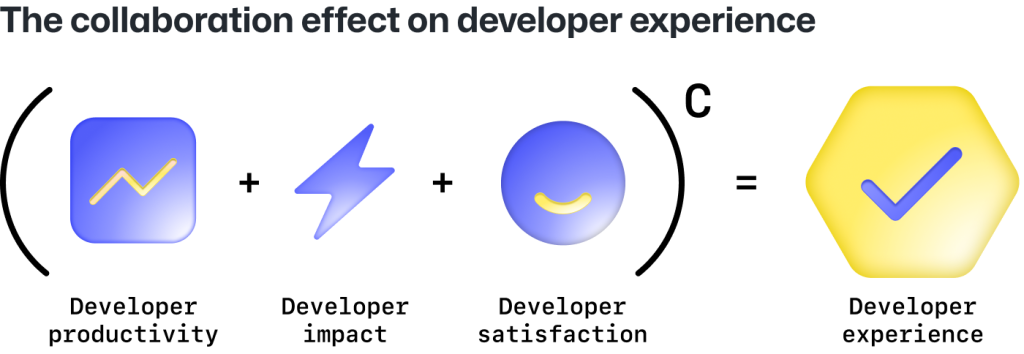
A diagram of a formula behind the developer experience that accounts for productivity, impact, satisfaction, and collaboration.
C = Collaboration, the multiplier across the entire developer experience.

DevEx is a formula that takes into account:

  • How simple and fast it is for a developer to implement a change on a codebase—or be productive.
  • How frictionless it is to move from idea through production to impact.
  • How positively or negatively the work environment, workflows, and tools affect developer satisfaction.

For leaders, developer experience is about creating a collaborative environment where developers can be their most productive, impactful, and satisfied at work. For developers, collaboration is one of the most important parts of the equation.

Current performance metrics fall short of developer expectations

Developers say performance metrics don’t meet expectations

The way developers are currently evaluated doesn’t align with how they think their performance should be measured.

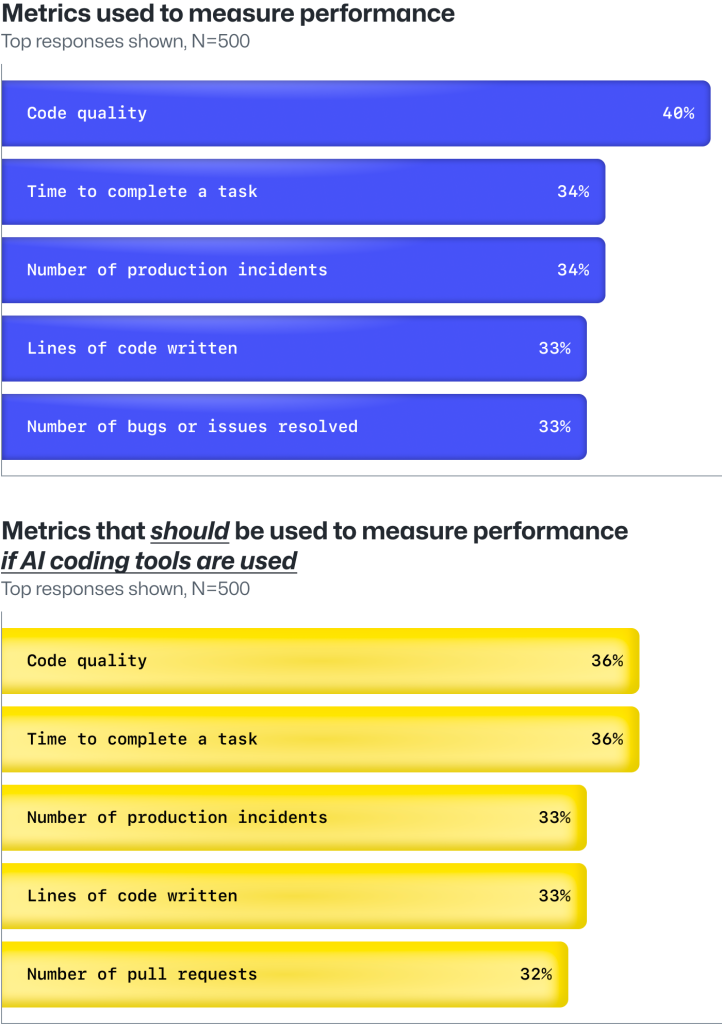
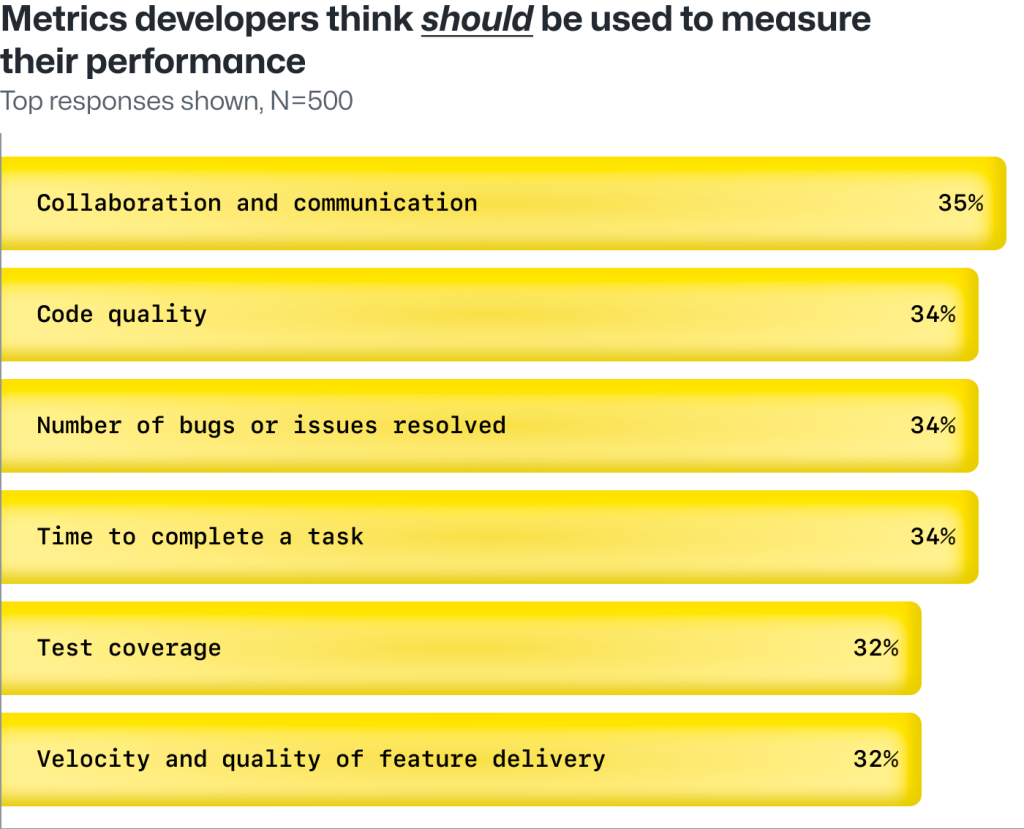
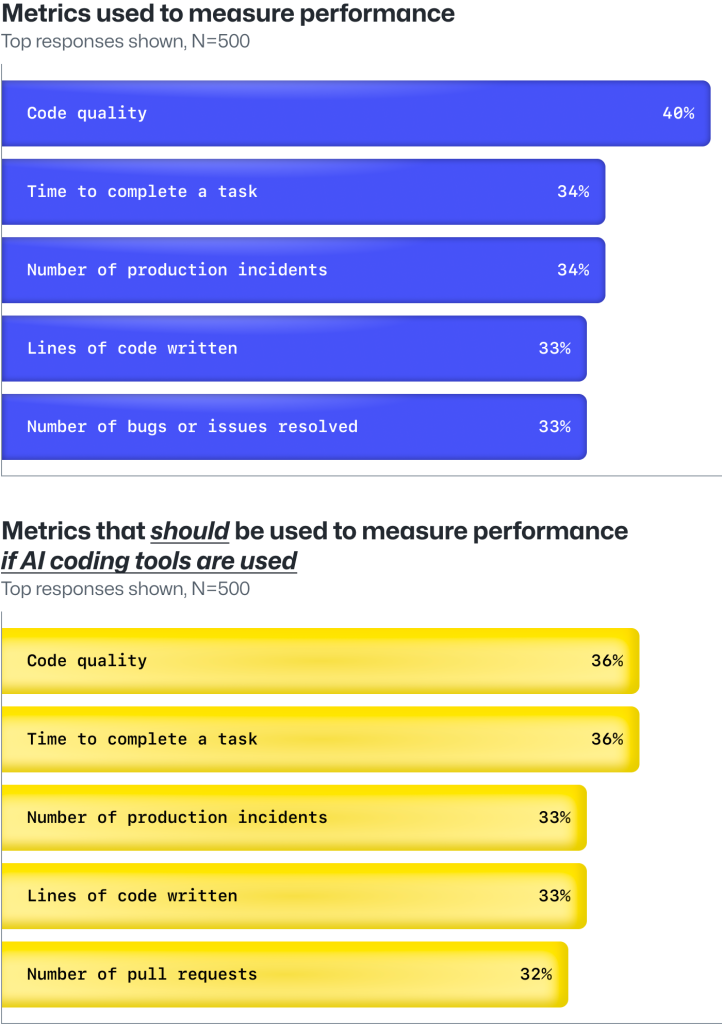
  • For instance, the developers we surveyed say they’re currently measured by the number of incidents they resolve. But developers believe that how they handle those bugs and issues is more important to performance. This aligns with the belief that code quality over code quantity should remain a top performance metric.
  • Developers also believe collaboration and communication should be just as important as code quality in terms of performance measures. Their ability to collaborate and communicate with others is essential to their job, but only 33% of developers report that their companies use it as a performance metric.
Key survey findings showing what developer say their managers use to measure their performance and what developers think will matter more when they start using AI coding tools.
Metrics currently used to measure performance, compared with metrics developers think should be used to measure their performance.
More than output quantity and efficiency, code quality and collaboration are the most
important performance metrics, according to the developers we surveyed.
Twitter logo LinkedIn logo
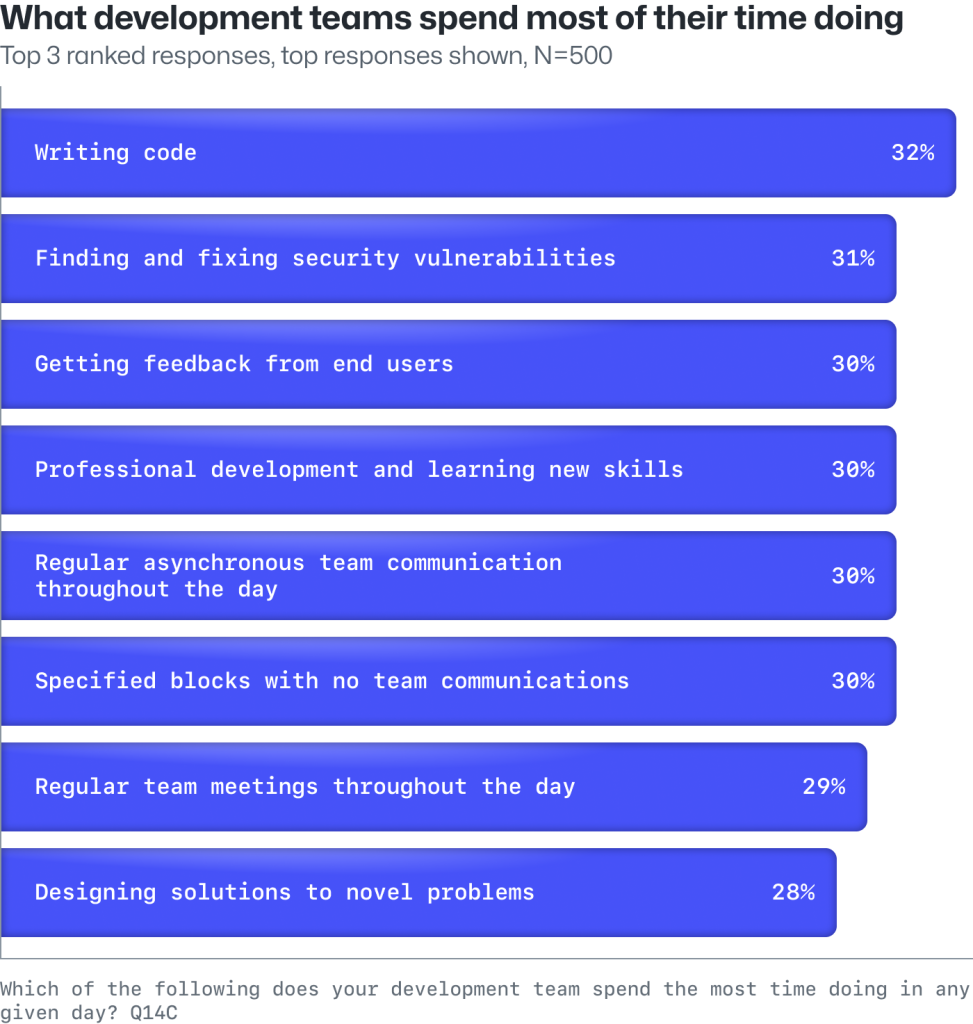
A chart showing what developers say their teams spend the most time doing at work.
The top ranked responses that developers say their teams are working the most on including writing code and finding and fixing security vulnerabilities.

Developers want more opportunities to upskill and drive impact

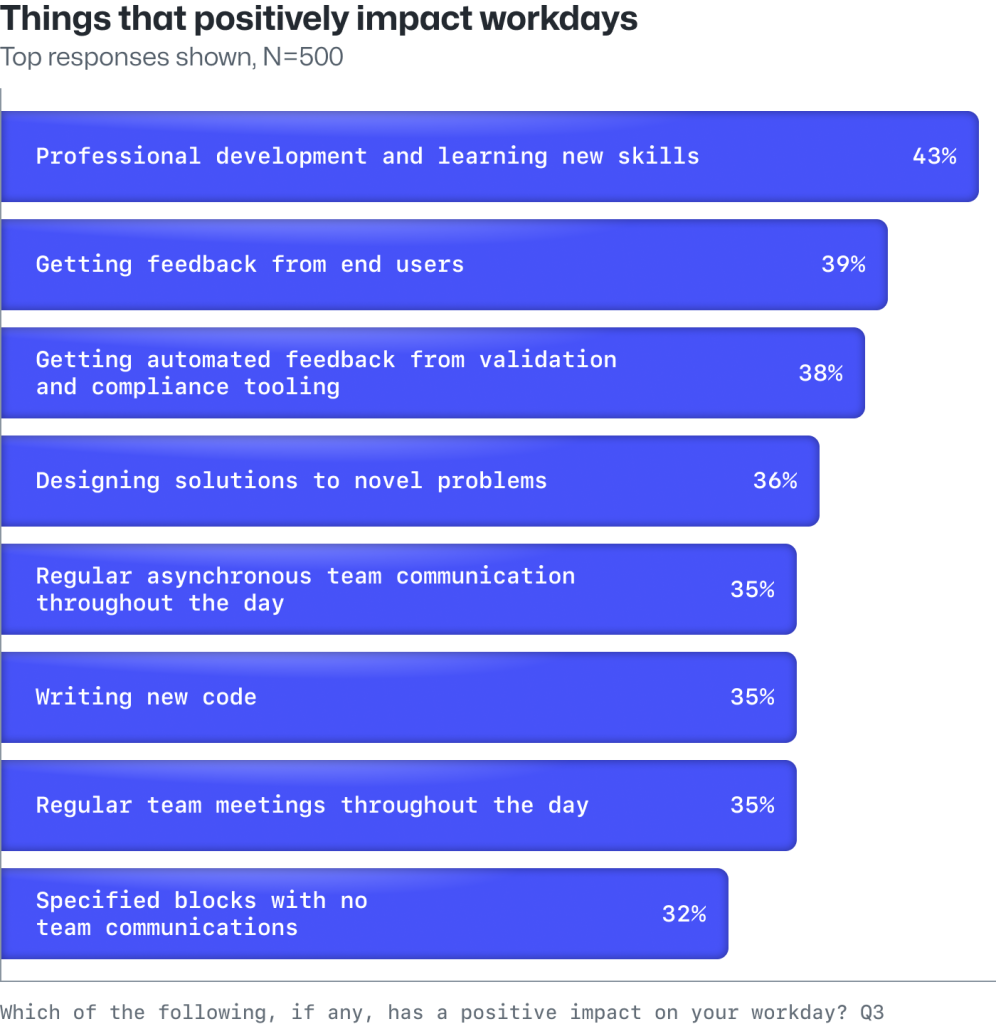
When developers are asked about what makes a positive impact on their workday, they rank learning new skills (43%), getting feedback from end users (39%), and automated tests (38%), and designing solutions to novel problems (36%) as top contenders.

A ranked list of the tasks 500 U.S.-based developers say have the most positive impact on their workdays.
The top tasks developers say positively impact their workdays.

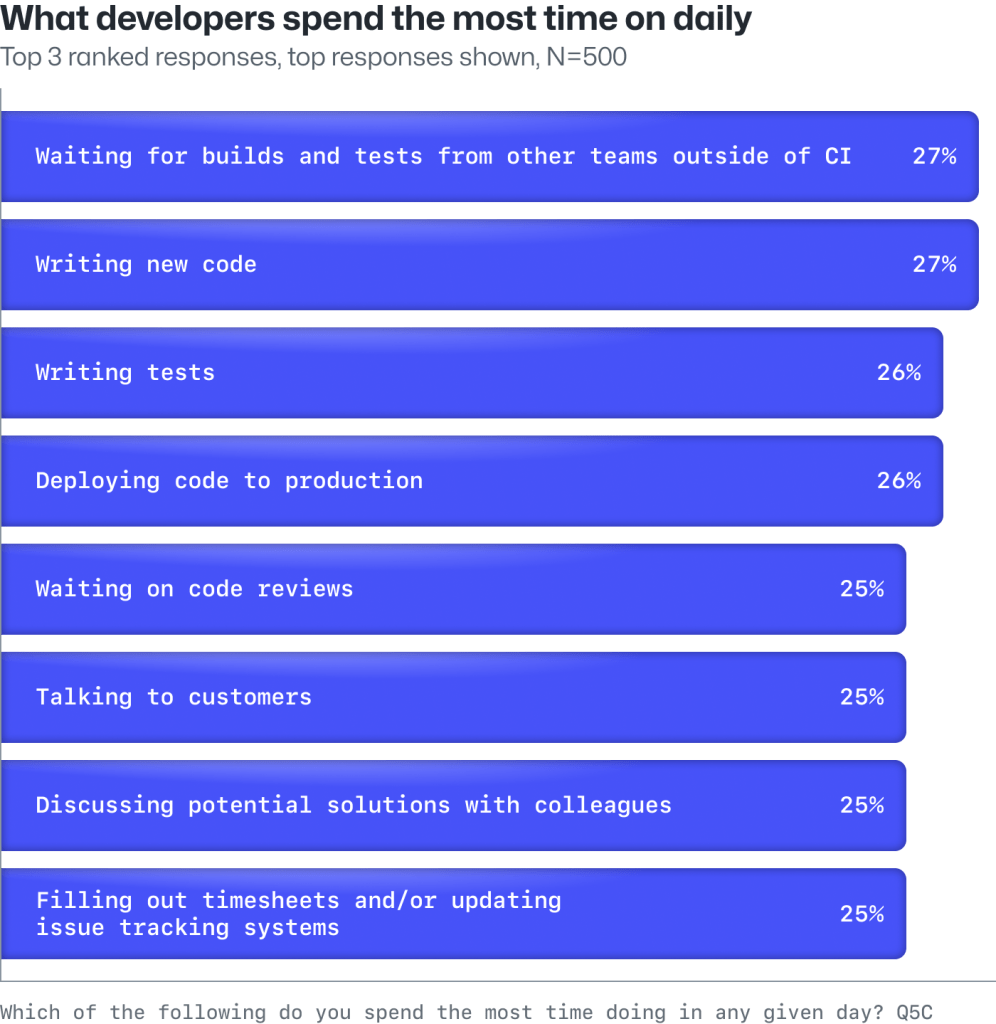
But developers say they’re spending most of their time writing code and tests, then waiting for that code to be reviewed or builds and tests to be executed.

On a typical day, the enterprise developers we surveyed report their teams are busy with a variety of tasks, including writing code, fixing security vulnerabilities, and getting feedback from end users, among other things. Developers also report that they spend a similar amount of time across these tasks, indicating that they’re stretched thin throughout the day.

A ranked list of the top tasks developers and software engineers say they spend the most time working on each day.
The tasks developers say they spend the most time working on each day.

Notably, developers say they spend the same amount of time waiting for builds and tests as they do writing new code.

  • This suggests that wait times for builds and tests are still a persistent problem despite investments in DevOps tools over the past decade.
  • Developers also continue to face obstacles, such as waiting on code review, builds, and test runs, which can hinder their ability to learn new skills and design solutions to novel problems, and our research suggests that these factors can have the biggest impact on their overall satisfaction.

Developers want feedback from end users, but face challenges

Developers say getting feedback from end users (39%) is the second-most important thing that positively impacts their workdays—but it’s often challenging for development teams to get that feedback directly.

  • Product managers and marketing teams often act as intermediaries, making it difficult for developers to directly receive end-user feedback.
  • Developers would ideally receive feedback from automated and validation tests to improve their work, but sometimes these tests are sent to other teams before being handed off to engineering teams.

The top two daily tasks for development teams include writing code (32%) and finding and fixing security vulnerabilities (31%).

  • This shows the increased importance developers have placed on security and underscores how companies are prioritizing security.
  • It also demonstrates the critical role that enterprise development teams play in meeting policy and board edicts around security.

The bottom line
Developers want to upskill, design solutions, get feedback from end users, and be evaluated on their communication skills. However, wait times on builds and tests, as well as the current performance metrics they’re evaluated on, are getting in the way.

Collaboration is the cornerstone of the developer experience

Developers thrive in collaborative environments

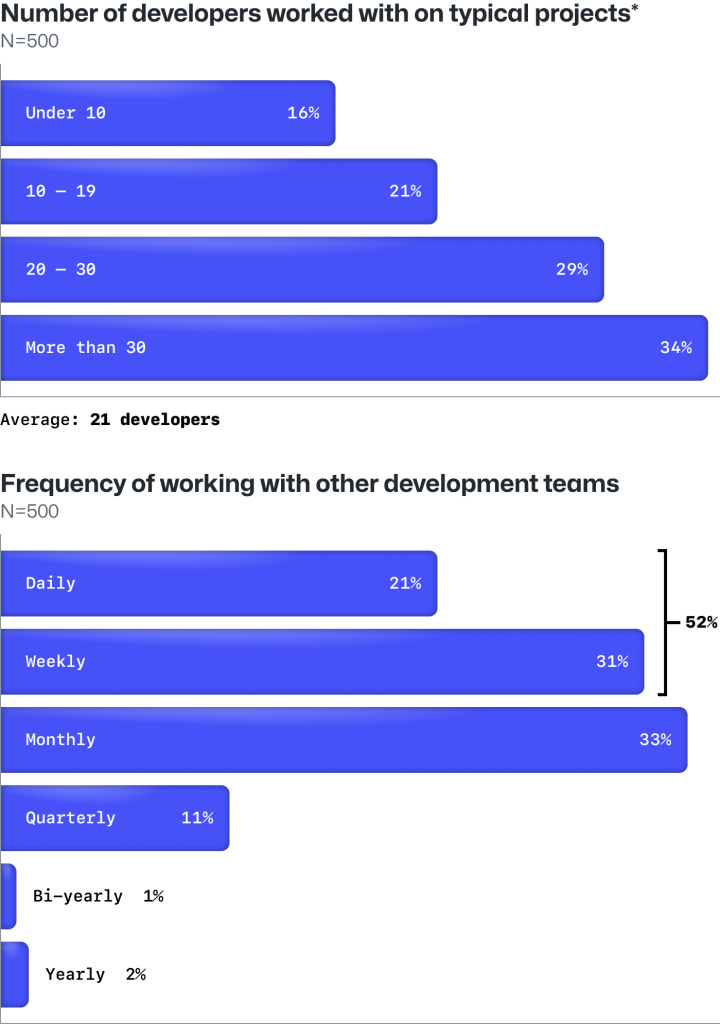
In our survey of enterprise engineers, developers say they work with an average of 21 other developers on a typical project—and 52% report working with other teams daily or weekly. Notably, they rank regular touchpoints as the most important factor for effective collaboration.

A survey finding that developers at enterprise companies often work with an average of 21 developers on other projects and often work on a daily or weekly basis with colleagues.
Developers in enterprise settings often work with an average of 21 other developers on a daily or weekly cadence.

But developers also have a holistic view of collaboration—it’s defined not only by talking and meeting with others, but also by uninterrupted work time, access to fully configured developer environments, and formal mentor-mentee relationships.

  • Specified blocks with no team communication give developers the time and space to write code and work towards team goals.
  • Access to fully configured developer environments promotes consistency throughout the development process. It also helps developers collaborate faster and avoid hearing the infamous line, “But it worked on my machine.”
  • Mentorships can help developers upskill and build interpersonal skills that are essential in a collaborative work environment.

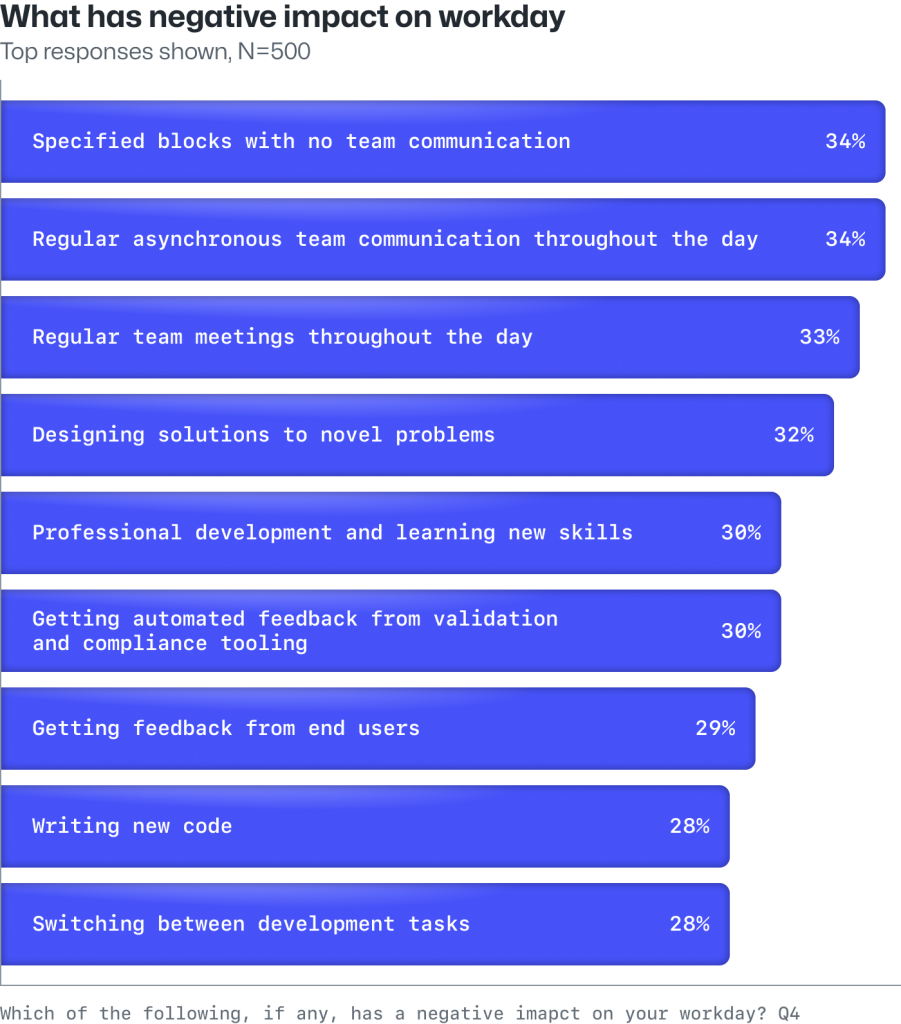
It’s important to note these factors can also negatively impact a developer’s work day—which suggests that ineffective meetings can serve to distract rather than help developers (something we’ve found in previous research).

The key factors developers in a survey say contribute most highly to effective team collaboration including meetings, dedicated time for individual work, and access to fully configured dev environments.

Our survey indicates the factors most important to effective collaboration are so critical that when they’re not done effectively, they have a noticeable, negative impact on a developer’s work.

A ranked list of the top tasks developers in a survey reported as having a negative impact on their overall workday experience.
The tasks developers say most often have a negative impact on their workday experience.
Developers work with an average of 21 people on any given project. They need the time and tools for success—including regular touchpoints, heads-down time, access to fully-configured dev environments, and formal mentor-mentee relationships.
Twitter logo LinkedIn logo

We wanted to learn more about how developers collaborate

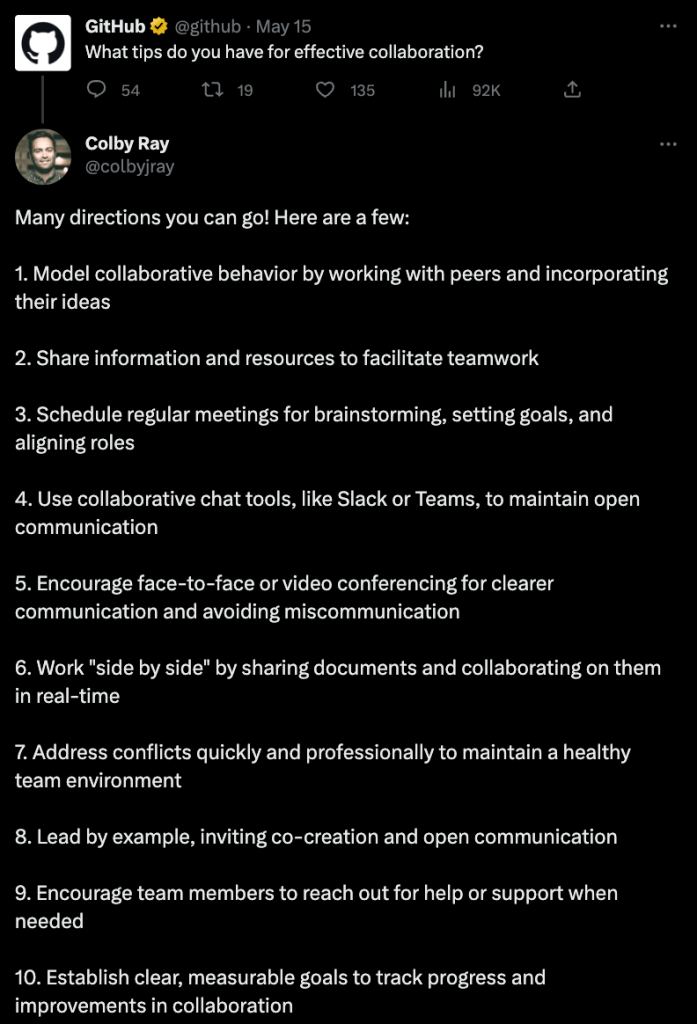
So, we sourced some answers from our followers on Twitter. We asked developers what tips they have for effective collaboration. Here’s what one developer had to say:

Twitter user Colby Ray had multiple points in response to our prompt. Click the image to read his tweet.

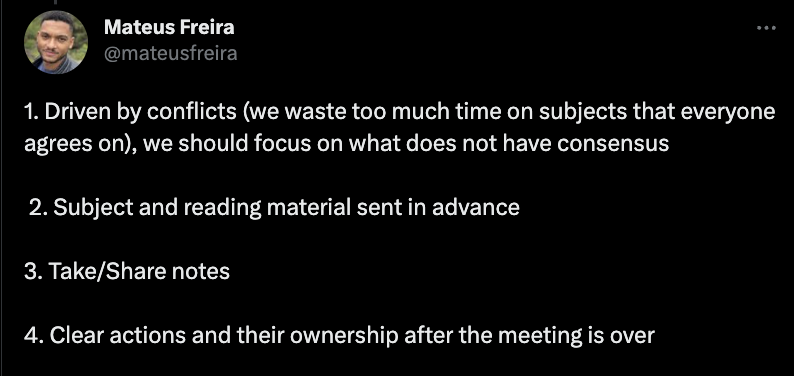
We also asked what makes for a productive and valuable meeting:

Twitter user kettenaito had several points in response to our prompt. Click the image to read on Twitter.

Twitter user Mateus Feira had several points in response to our prompt. Click the image to read on Twitter.

Effective collaboration improves code quality

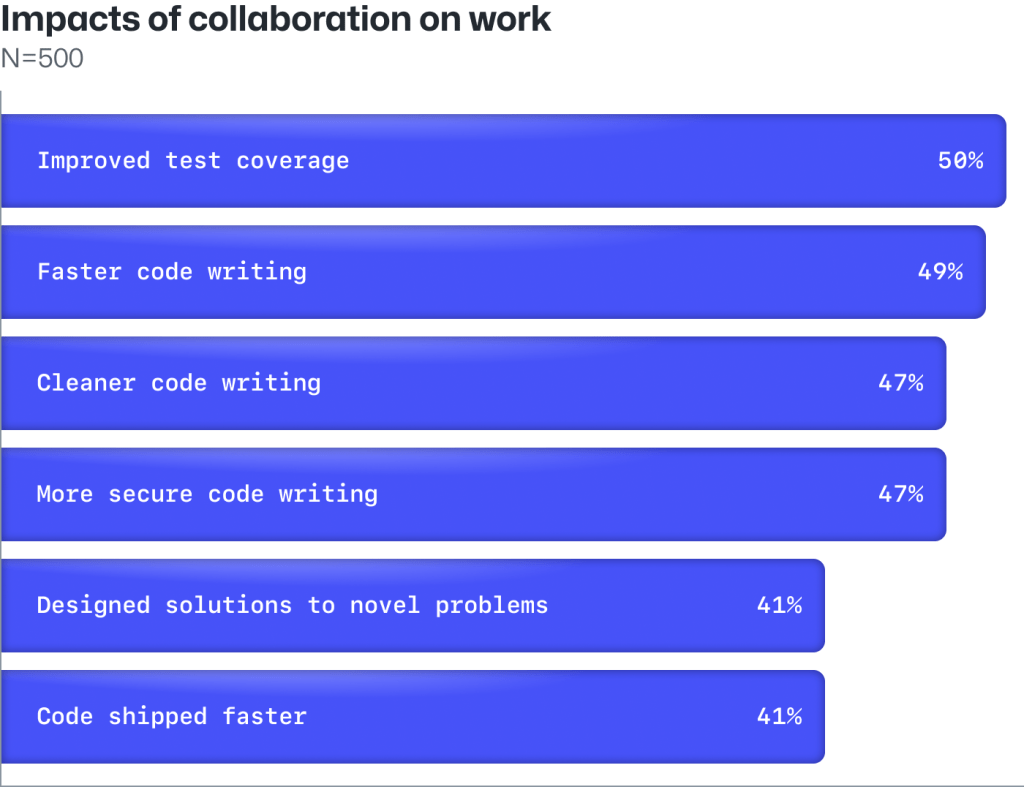
As developer experience continues to be defined, so, too, will successful developer collaboration. Too many pings and messages can affect flow, but there’s still a need to stay in touch. In our survey, developers say effective collaboration results in improved test coverage and faster, cleaner, more secure code writing—which are best practices for any development team. This shows that when developers work effectively with others, they believe they build better and more secure software.

Developers in a survey report that collaboration positively impacts how they write code, how fast they can ship it, and more.
Developers widely view effective collaboration as helping to improve what they ship and how often they ship it.

Developers we surveyed believe collaboration and communication—along with code quality—should be the top priority for evaluation.

  • From DevOps to agile methodologies, developers and the greater business world have been talking about the importance of collaboration for a long time.
  • But developers are still not being measured on it.
Developers in a survey respond to a question about what metrics they believe their companies should use to measure their performance and productivity.
The metrics that developers think their managers should use to evaluate their performance and productivity.

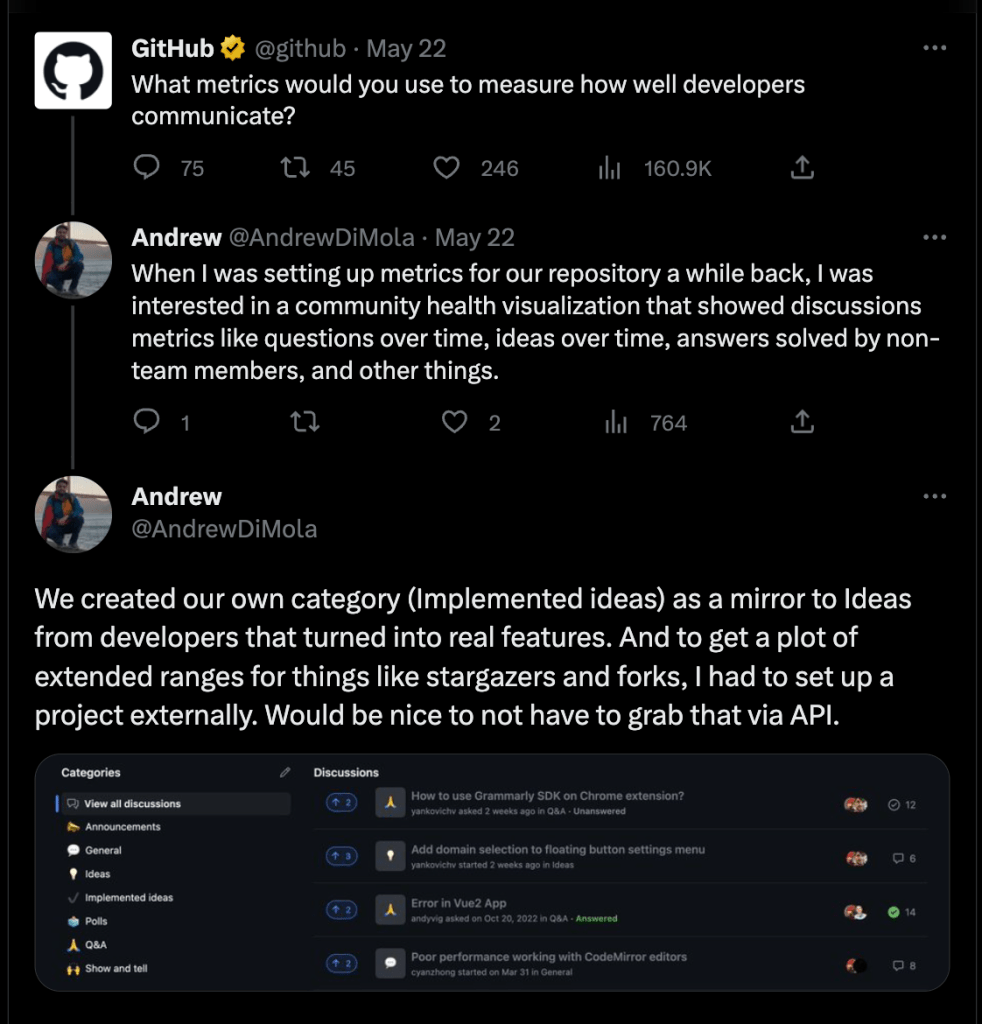
We asked developers to share their ideas for measuring how well they collaborate. Here’s what one developer had to say:

Twitter user Andrew DiMola had several points in response to our prompt. Click to read on Twitter.

  • The takeaway: Companies and engineering managers should encourage regular team communication, and set time to check in–especially in remote environments–but respect developers’ need to work and focus.
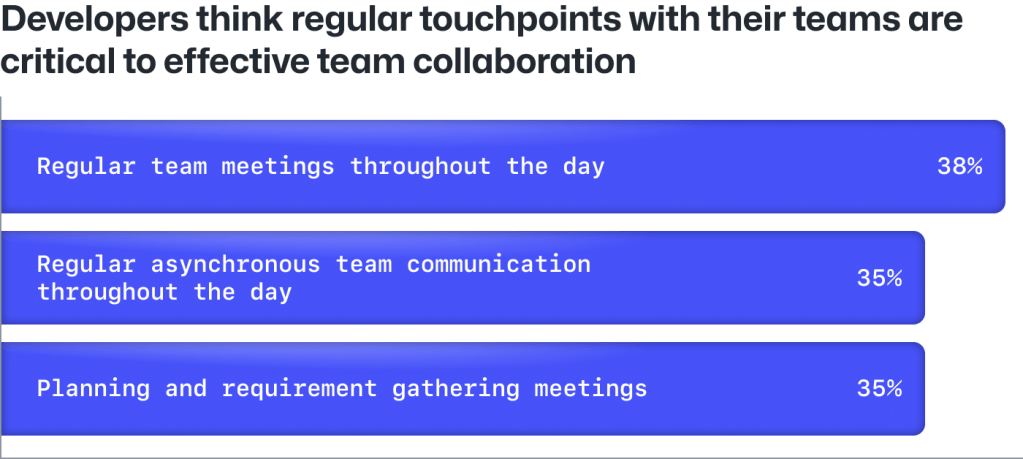
Developers think regular touchpoints with their teams including meetings, asynchronous communication, and innersource practices help organizations collaborate at scale.
Developers believe that effective and regular touchpoints with their colleagues are critical for effective team collaboration.

4 tips for engineering managers to improve collaboration

At GitHub, our researchers, developers, product teams, and analysts are dedicated to studying and improving developer productivity and satisfaction. Here are their tips for engineering leaders who want to improve collaboration among developers:

  1. Make collaboration a goal in performance objectives. This builds the space and expectation that people will collaborate. This could be in the form of lunch and learns, joint projects, etc.
  2. Define and scope what collaboration looks like in your organization. Let people know when they’re being informed about something vs. being consulted about something. A matrix outlining roles and responsibilities helps define each person’s role and is something GitHub teams have implemented.
  3. Give developers time to converse and get to know one another. In particular, remote or hybrid organizations need to dedicate a portion of a developer’s time and virtual space to building relationships. Check out the GitHub guides to remote work.
  4. Identify principal and distinguished engineers. Academic research supports the positive impact of change agents in organizations—and how they should be the people who are exceptionally great at collaboration. It’s a matter of identifying your distinguished engineers and elevating them to a place where they can model desired behaviors.

The bottom line
Effective developer collaboration improves code quality and should be a performance measure. Regular touchpoints, heads-down time, access to fully configured dev environments, and formal mentor-mentee relationships result in improved test coverage and faster, cleaner, more secure code writing.

AI improves individual performance and team collaboration

Developers are already using AI coding tools at work

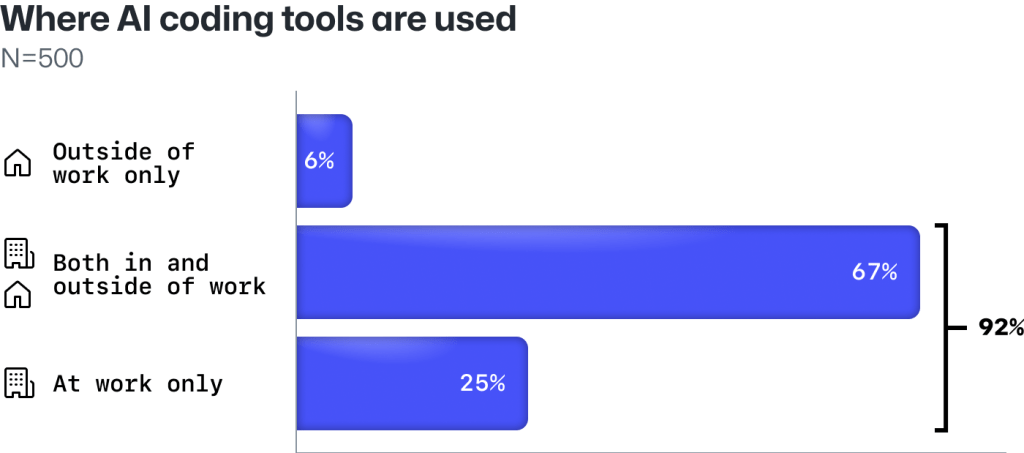
A staggering 92% of U.S.-based developers working in large companies report using an AI coding tool either at work or in their personal time—and 70% say they see significant benefits to using these tools.

  • AI is here to stay—and it’s already transforming how developers approach their day-to-day work. That makes it critical for businesses and engineering leaders to adopt enterprise-grade AI tools to avoid their developers using non-approved applications. Companies should also establish governance standards for using AI tools to ensure that they are used ethically and effectively.
92% of developers in a survey say they're already using AI coding tools at work.
Almost all developers are already using AI coding tools at and outside of work.

70% of developers see a benefit to using AI coding tools at work.

Almost all (92%) developers use AI coding tools at work—and a majority (67%) have used these tools in both a work setting and during their personal time. Curiously, only 6% of developers in our survey say they solely use these tools outside of work.
Twitter logo LinkedIn logo

Developers believe AI coding tools will enhance their performance

With most developers experimenting with AI tools in the workplace, our survey results suggest it’s not just idle interest leading developers to use AI. Rather, it’s a recognition that AI coding tools will help them meet performance standards.

  • In our survey, developers say AI coding tools can help them meet existing performance standards with improved code quality, faster outputs, and fewer production-level incidents. They also believe that these metrics should be used to measure their performance beyond code quantity.
The metrics developers say their managers use to measure their productivity vs. the metrics developers think their managers should use to measure their productivity if they use AI coding tools.
Developers widely think that AI coding tools will layer into their existing workflows and bring greater efficiencies—but they do not think AI will change how software is made.

Around one-third of developers report that their managers currently assess their performance based on the volume of code they produce—and an equal number anticipate that this will persist when they start using AI-based coding tools.

  • Notably, the quantity of code a developer produces may not necessarily correspond to its business value.
  • Stay smart. With the increase of AI tooling being used in software development—which often contributes to code volume—engineering leaders will need to ask whether measuring code volume is still the best way to measure productivity and output.

Developers think AI coding tools will lead to greater team collaboration

Beyond improving individual performance, more than 4 in 5 developers surveyed (81%) say AI coding tools will help increase collaboration within their teams and organizations.

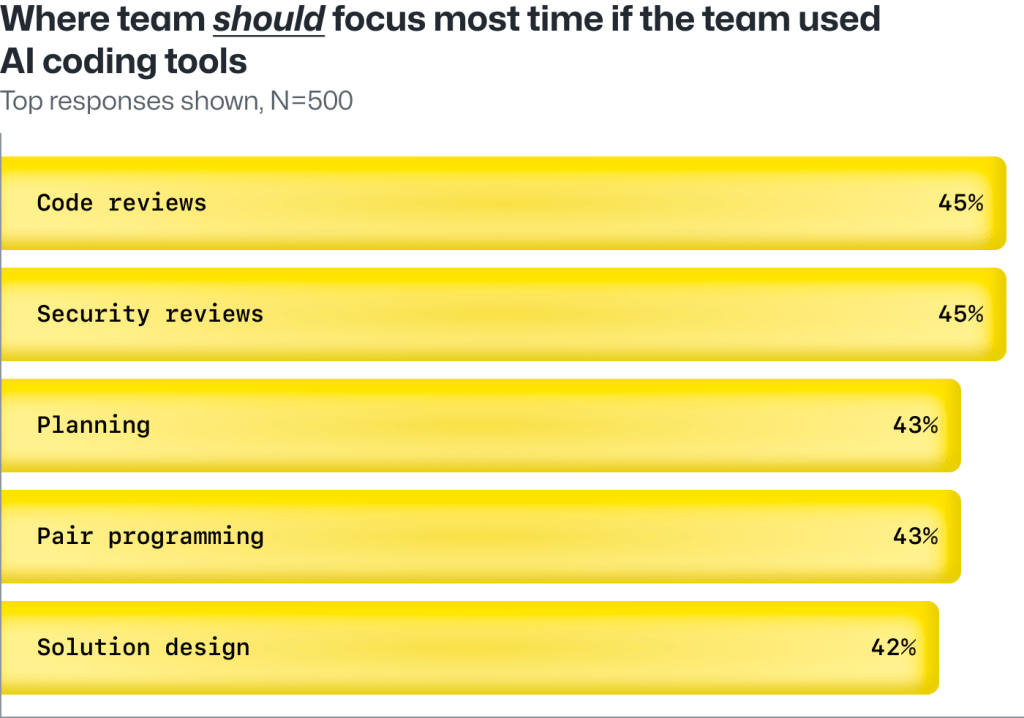
  • In fact, security reviews, planning, and pair programming are the most significant points of collaboration and the tasks that development teams are expected to, and should, work on with the help of AI coding tools. This also indicates that code and security reviews will remain important as developers increase their use of AI coding tools in the workplace.
Developers believe that AI coding tools will make engineering teams more collaborative as the quality of code produced becomes ever more important.
Developers think their teams will need to become more collaborative as they start using AI coding tools.
Sometimes, developers can do the same thing with one line or multiple lines of code. Even still, one-third of developers in our survey say their managers measure their performance based on how much code they produce.
Twitter logo LinkedIn logo

Notably, developers believe AI coding tools will give them more time to focus on solution design. This has direct organizational benefits and means developers believe they’ll spend more time designing new features and products with AI instead of writing boilerplate code.

  • Developers are already using generative AI coding tools to automate parts of their workflow, which frees up time for more collaborative projects like security reviews, planning, and pair programming.
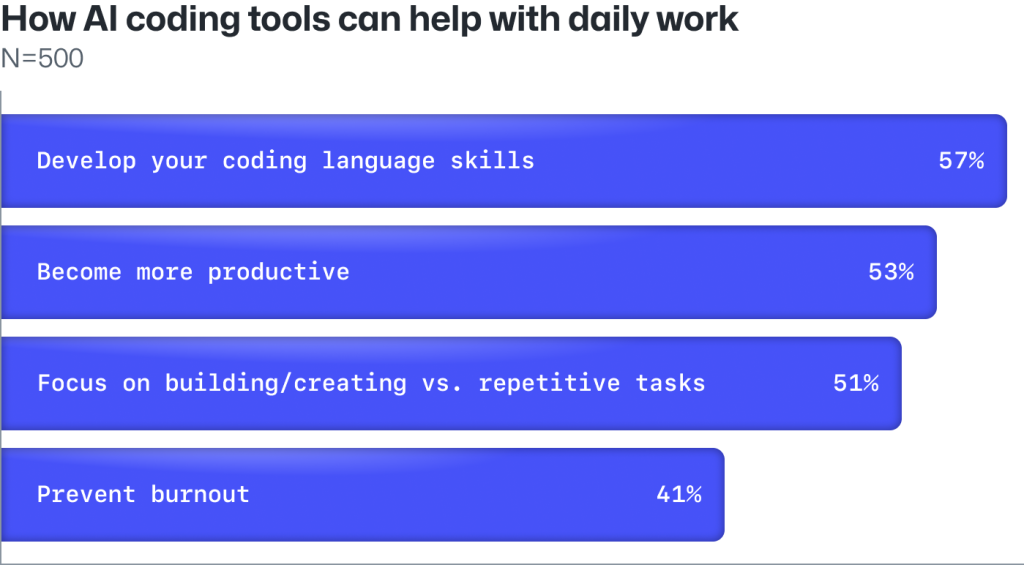
Developers think AI coding tools will help them upskill, become more productive, and focus on higher-value problem solving.
Developers believe that AI coding tools will help them focus on higher-value problem solving.

Developers think AI increases productivity and prevents burnout

Not only can AI coding tools help improve overall productivity, but they can also provide upskilling opportunities to help create a smarter workforce according to the developers we surveyed.

  • 57% of developers believe AI coding tools help them improve their coding language skills—which is the top benefit they see. Beyond the prospect of acting as an upskilling aid, developers also say AI coding tools can also help with reducing cognitive effort, and since mental capacity and time are both finite resources, 41% of developers believe that AI coding tools can help with preventing burnout.
  • In previous research we conducted, 87% of developers reported that the AI coding tool GitHub Copilot helped them preserve mental effort while completing more repetitive tasks. This shows that AI coding tools allow developers to preserve cognitive effort and focus on more challenging and innovative aspects of software development or research and development.
  • AI coding tools help developers upskill while they work. Across our survey, developers consistently rank learning new skills as the number one contributor to a positive workday. But 30% also say learning and development can have a negative impact on their overall workday, which suggests some developers view learning and development as adding more work to their workdays. Notably, developers say the top benefit of AI coding tools is learning new skills—and these tools can help developers learn while they work, instead of making learning and development an additional task.
Developers are already using generative AI coding tools to automate parts of their workflow, which frees up time for more collaborative projects like security reviews, planning, and pair programming.
Twitter logo LinkedIn logo

AI is improving the developer experience across the board

Developers in our survey suggest they can better meet standards around code quality, completion time, and the number of incidents when using AI coding tools—all of which are measures developers believe are key areas for evaluating their performance.

AI coding tools can also help reduce the likelihood of coding errors and improve the accuracy of code—which ultimately leads to more reliable software, increased application performance, and better performance numbers for developers. As AI technology continues to advance, it is likely that these coding tools will have an even greater impact on developer performance and upskilling.

AI coding tools are layering into existing developer workflows and creating greater efficiencies

Developers believe that AI coding tools will increase their productivity—but our survey suggests that developers don’t think these tools are fundamentally altering the software development lifecycle. Instead, developers suggest they’re bringing greater efficiencies to it.

  • The use of automation and AI has been a part of the developer workflow for a considerable amount of time, with developers already utilizing a range of automated and AI-powered tools, such as machine learning-based security checks and CI/CD pipelines.
  • Rather than completely overhauling operations, these tools create greater efficiencies within existing workflows, and that frees up more time for developers to concentrate on developing solutions.

The bottom line
Almost all developers (92%) are using AI coding at work—and they say these tools not only improve day-to-day tasks but enable upskilling opportunities, too. Developers see material benefits to using AI tools including improved performance and coding skills, as well as increased team collaboration.

The path forward

Developer satisfaction, productivity, and organizational impact are all positioned to get a boost from AI coding tools—and that will have a material impact on the overall developer experience.

92% of developers already saying they use AI coding tools at work and in their personal time, which makes it clear AI is here to stay. 70% of the developers we surveyed say they already see significant benefits when using AI coding tools, and 81% of the developers we surveyed expect AI coding tools to make their teams more collaborative—which is a net benefit for companies looking to improve both developer velocity and the developer experience.

Notably, 57% of developers believe that AI could help them upskill—and hold the potential to build learning and development into their daily workflow. With all of this in mind, technical leaders should start exploring AI as a solution to improve satisfaction, productivity, and the overall developer experience.

In addition to exploring AI tools, here are three takeaways engineering and business leaders should consider to improve the developer experience:

  1. Help your developers enter a flow state with tools, processes, and practices that help them be productive, drive impact, and do creative and meaningful work.
  2. Empower collaboration by breaking down organizational silos and providing developers with the opportunity to communicate efficiently.
  3. Make room for upskilling within developer workflows through key investments in AI to help your organization experiment and innovate for the future.

Methodology

This report draws on a survey conducted online by Wakefield Research on behalf of GitHub from March 14, 2023 through March 29, 2023 among 500 non-student, U.S.-based developers who are not managers and work at companies with 1,000-plus employees. For a complete survey methodology, please contact [email protected].

[$] Mounting images inside a user namespace

Post Syndicated from original https://lwn.net/Articles/934176/

There has long been a desire to enable users to mount filesystem images without
requiring privileges, but the security
implications of allowing it are seriously concerning. Few, if any, kernel
filesystems are hardened against maliciously crafted images, after all.
Lennart Poettering led a filesystem session at the
2023 Linux Storage, Filesystem,
Memory-Management and BPF Summit
where he presented a possible path
forward.

Exam-related Internet shutdowns in Iraq and Algeria put connectivity to the test

Post Syndicated from David Belson original http://blog.cloudflare.com/exam-internet-shutdowns-iraq-algeria/

Exam-related Internet shutdowns in Iraq and Algeria put connectivity to the test

Exam-related Internet shutdowns in Iraq and Algeria put connectivity to the test

Over the last several years, governments in a number of countries in the Middle East/Northern Africa (MENA) region have taken to implementing widespread nationwide shutdowns in an effort to prevent cheating on nationwide academic exams. Although it is unclear whether such shutdowns are actually successful in curbing cheating, it is clear that they take a financial toll on the impacted countries, with estimated losses in the millions of US dollars.

During the first two weeks of June 2023, we’ve seen Iraq implementing a series of multi-hour shutdowns that will reportedly occur through mid-July, as well as Algeria taking similar actions to prevent cheating on baccalaureate exams. Shutdowns in Syria were reported to begin on June 7, but there’s been no indication of them in traffic data as of this writing (June 13). These actions echo those taken in Iraq, Syria, Sudan, and Algeria in 2022 and in Syria and Sudan in 2021.

(Note: The interactive graphs below have been embedded directly into the blog post using a new Cloudflare Radar feature. This post is best viewed in landscape mode when on a mobile device.)

Iraq

Iraq had reportedly committed on May 15 to not implementing Internet shutdowns during the 2023 exam season, with a now unavailable page on the Iraqi Ministry of Communications web site (although captured in the Internet Archive’s Wayback Machine) noting (via Google Translate) “Her Excellency the Minister of Communications, Dr. Hayam Al-Yasiri: We rejected a request to cut off the internet service during the ministerial exams.” However, that commitment was apparently short-lived, as the first shutdown was implemented just a couple of weeks later, on June 1. The shutdowns observed across Iraq thus far have impacted networks and localities nationwide, with the exception of the autonomous Kurdistan region. However, networks in that region have experienced their own set of connectivity restrictions due to local exams.

In Iraq, the impact of the shutdowns between 04:00 – 08:00 local time (01:00 – 05:00 UTC) is clearly visible at a country level, as seen in the figure below.

The impact is, of course, also visible in the network-level graphs shown below, with traffic dropping to or near zero during each of the four-hour shutdown windows.

The shutdowns are also visible in the BGP announcement activity from the impacted networks, with spikes in announcement volume clearly visible around the shutdown windows each day that they have occurred. The announcement activity represents withdrawals ahead of the shutdown, removing routes to prefixes within the network, effectively cutting them off from the Internet, and updates after the shutdown period has ended, restoring the previously withdrawn routes, effectively reconnecting the prefixes to the Internet. (Additional announcement activity may also be visible for periods outside of the scheduled shutdowns, and is likely unrelated.)

While the shutdowns discussed above didn’t impact the Kurdistan region of Iraq, that region has also chosen to implement their own shutdowns. In the Kurdistan region, exams started June 3, we saw shorter traffic disruptions across three local network providers on June 3, 6, 10, and 13. The disruptions lasted from 06:30 – 07:30 local time (03:30 to 04:30 UTC) on the 3rd, and 06:40 – 08:30 local time (03:30 to 05:30 UTC) on the 6th, 10th, and 13th). Impacted regions include Erbil, Sulaymaniyah, and Duhok.

BGP announcement activity for the impacted networks in the Kurdistan region did not show the same patterns as those observed on the other Iraqi network providers discussed above.

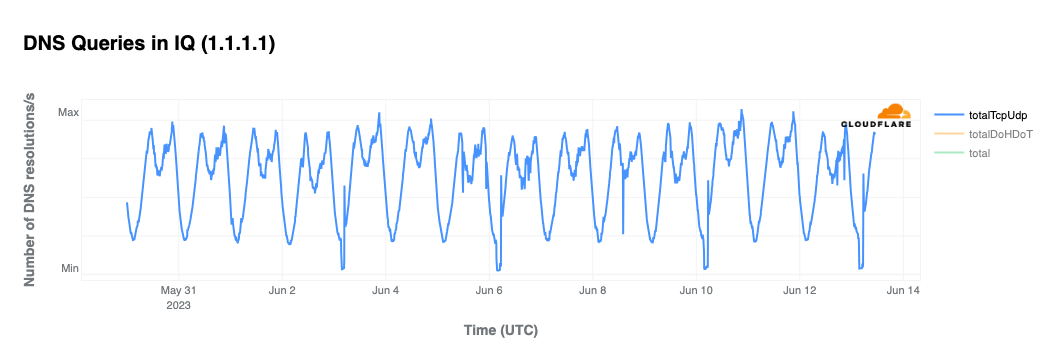
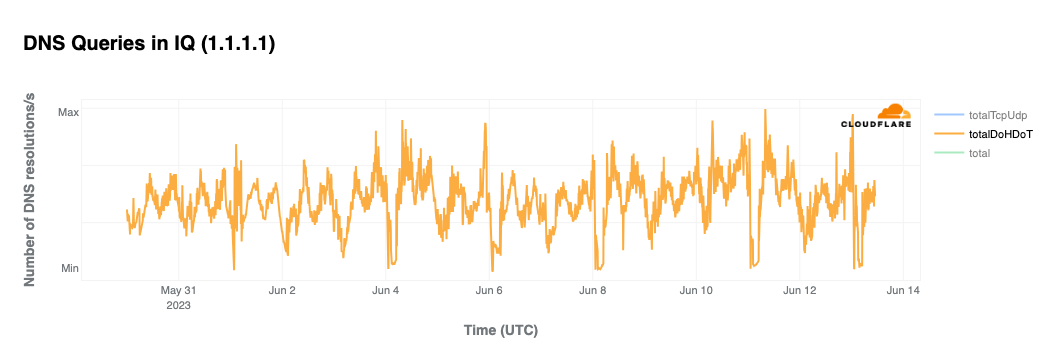
Both sets of shutdowns in Iraq are also visible in traffic to Cloudflare’s 1.1.1.1 DNS resolver, although they highlight a difference in usage between the autonomous Kurdistan region and the rest of the country. The “totalTcpUdp” graph (blue line) below shows requests made to the resolver over UDP or TCP on port 53, the standard port used for DNS requests. The “totalDoHDoT” graph (orange line) below shows requests made to the resolver using DNS-over-HTTPS or DNS-over-TLS using port 443 or 853 respectively.

In the “totalTcpUdp” graph, we can see noticeable drops in traffic that align with the dates and times where we observed the traffic disruptions across Kurdistani networks. This drop in DNS traffic, combined with the lack of BGP announcement activity, suggests that the Internet disruptions in the Kurdistan region may be implemented as widespread blocking of Internet traffic, rather than routing-based shutdowns.

Exam-related Internet shutdowns in Iraq and Algeria put connectivity to the test

In the “totalDoHDoT” graph below, we can see noticeable drops in traffic that align with the dates and times where we observed the traffic disruptions in the rest of Iraq.

Exam-related Internet shutdowns in Iraq and Algeria put connectivity to the test

It isn’t immediately clear why there is a difference in the use of 1.1.1.1 between the two parts of the country.

Algeria

In Algeria, it appears that the country is following a similar pattern as that seen in 2021 and 2022, with two multi-hour Internet disruptions each day. Also similar to last year, it appears that they are pursuing a content blocking-based approach, instead of the wide-scale Internet shutdowns implemented in 2021, as impacted networks are not experiencing complete outages, nor do they show patterns of BGP announcement activity.

A published report indicates that two Internet disruptions will be implemented each day between June 11 and June 15. The first takes place between 08:00 – 12:00 local time (07:00 – 11:00 UTC), with the second occurring between 14:00 – 17:00 local time (13:00 – 16:00 UTC). These disruptions are visible in the shaded areas of the network-level graphs below as two distinct drops in traffic each day.

Conclusion

In cooperation with the Internet Society and Lebanese digital rights organization SMEX, digital rights organization Access Now is coordinating a #NoExamShutdown campaign across social media platforms. The campaign calls on MENA governments to end the practice of Internet shutdowns during exams, and aims to highlight how these shutdowns undermine human rights and disrupt essential social, political, economic, and cultural activities. Cloudflare Radar will continue to bring visibility to these, and other similar Internet disruptions, as they occur. You can follow them through the Cloudflare Radar Outage Center, or by following Cloudflare Radar on Twitter or Mastodon.

Post-quantum hybrid SFTP file transfers using AWS Transfer Family

Post Syndicated from Panos Kampanakis original https://aws.amazon.com/blogs/security/post-quantum-hybrid-sftp-file-transfers-using-aws-transfer-family/

Amazon Web Services (AWS) prioritizes security, privacy, and performance. Encryption is a vital part of privacy. To help provide long-term protection of encrypted data, AWS has been introducing quantum-resistant key exchange in common transport protocols used by AWS customers. In this blog post, we introduce post-quantum hybrid key exchange with Kyber, the National Institute of Standards and Technology’s chosen quantum-resistant key encapsulation algorithm, in the Secure Shell (SSH) protocol. We explain why it’s important and show you how to use it with Secure File Transfer Protocol (SFTP) file transfers in AWS Transfer Family, the AWS file transfer service.

Why use PQ-hybrid key establishment in SSH

Although not available today, a cryptanalytically relevant quantum computer (CRQC) could theoretically break the standard public key algorithms currently in use. Today’s network traffic could be recorded now and then decrypted in the future with a CRQC. This is known as harvest-now-decrypt-later.

With such concerns in mind, the U.S. Congress recently signed the Quantum Computing Cybersecurity Preparedness Act, and the White House issued National Security Memoranda (NSM-8, NSM-10) to prepare for a timely and equitable transition to quantum-resistant cryptography. The National Security Agency (NSA) also announced its quantum-resistant algorithm requirements and timelines in its CNSA 2.0 release. Many other governments like Canada, Germany, and France and organizations like ISO/IEC and IEEE have also been prioritizing preparations and experiments with quantum-resistant cryptography technologies.

AWS is migrating to post-quantum cryptography. AWS Key Management Service (AWS KMS)AWS Certificate Manager (ACM), and AWS Secrets Manager TLS endpoints already include support for post-quantum hybrid (PQ-hybrid) key establishment with Elliptic Curve Diffie-Hellman (ECDH) and Kyber, NIST’s Post-Quantum Cryptography (PQC) project’s chosen key encapsulation mechanism (KEM). Although PQ-hybrid TLS 1.3 key exchange has received a lot of attention, there has been limited work on SSH.

SSH is a protocol widely used by AWS customers for various tasks ranging from moving files between machines to managing Amazon Elastic Compute Cloud (Amazon EC2) instances. Considering the importance of the SSH protocol, its ubiquitous use, and the data it transfers, we introduced PQ-hybrid key exchange with Kyber in it.

How PQ-hybrid key exchange works in Transfer Family SFTP

AWS just announced support for post-quantum key exchange in SFTP file transfers in AWS Transfer Family. Transfer Family securely scales business-to-business file transfers to AWS Storage services using SFTP and other protocols. SFTP is a secure version of the File Transfer Protocol (FTP) that runs over SSH. The post-quantum key exchange support of Transfer Family raises the security bar for data transfers over SFTP.

PQ-hybrid key establishment in SSH introduces post-quantum KEMs used in conjunction with classical key exchange. The client and server still do an ECDH key exchange. Additionally, the server encapsulates a post-quantum shared secret to the client’s post-quantum KEM public key, which is advertised in the client’s SSH key exchange message. This strategy combines the high assurance of a classical key exchange with the security of the proposed post-quantum key exchanges, to help ensure that the handshakes are protected as long as the ECDH or the post-quantum shared secret cannot be broken.

More specifically, the PQ-hybrid key exchange SFTP support in Transfer Family includes combining post-quantum Kyber-512, Kyber-768, and Kyber-1024, with ECDH over P256, P384, P521, or Curve25519 curves. The corresponding SSH key exchange methods — [email protected], [email protected], [email protected], and [email protected] — are specified in the PQ-hybrid SSH key exchange draft.

Why Kyber?

AWS is committed to supporting standardized interoperable algorithms, so we wanted to introduce Kyber to SSH. Kyber was chosen for standardization by NIST’s Post-Quantum Cryptography (PQC) project. Some standards bodies are already integrating Kyber in various protocols.

We also wanted to encourage interoperability by adopting, making available, and submitting for standardization, a draft that combines Kyber with NIST-approved curves like P256 for SSH. To help enhance security for our customers, the AWS implementation of the PQ key exchange in SFTP and SSH follows that draft.

Interoperability

The new key exchange methods — [email protected], [email protected], [email protected], and [email protected] — are supported in two new security policies in Transfer Family. These might change as the draft evolves towards standardization or when NIST ratifies the Kyber algorithm.

Is PQ-hybrid SSH key exchange aligned with cryptographic requirements like FIPS 140?

For customers that require FIPS compliance, Transfer Family provides FIPS cryptography in SSH by using the AWS-LC, open-source cryptographic library. The PQ-hybrid key exchange methods supported in the TransferSecurityPolicy-PQ-SSH-FIPS-Experimental-2023-04 policy in Transfer Family continue to meet FIPS requirements as described in SP 800-56Cr2 (section 2). BSI Germany and ANSSI France also recommend such PQ-hybrid key exchange methods.

How to test PQ SFTP with Transfer Family

To enable PQ-hybrid SFTP in Transfer Family, you need to enable one of the two security policies that support PQ-hybrid key exchange in your SFTP-enabled endpoint. You can choose the security policy when you create a new SFTP server endpoint in Transfer Family, as explained in the documentation; or by editing the Cryptographic algorithm options in an existing SFTP endpoint. The following figure shows an example of the AWS Management Console where you update the security policy.

Figure 1: Use the console to set the PQ-hybrid security policy in the Transfer Family endpoint

Figure 1: Use the console to set the PQ-hybrid security policy in the Transfer Family endpoint

The security policy names that support PQ key exchange in Transfer Family are TransferSecurityPolicy-PQ-SSH-Experimental-2023-04 and TransferSecurityPolicy-PQ-SSH-FIPS-Experimental-2023-04. For more details on Transfer Family policies, see Security policies for AWS Transfer Family.

After you choose the right PQ security policy in your SFTP Transfer Family endpoint, you can experiment with post-quantum SFTP in Transfer Family with an SFTP client that supports PQ-hybrid key exchange by following the guidance in the aforementioned draft specification. AWS tested and confirmed interoperability between the Transfer Family PQ-hybrid key exchange in SFTP and the SSH implementations of our collaborators on the NIST NCCOE Post-Quantum Migration project, namely OQS OpenSSH and wolfSSH.

OQS OpenSSH client

OQS OpenSSH is an open-source fork of OpenSSH that adds quantum-resistant cryptography to SSH by using liboqs. liboqs is an open-source C library that implements quantum-resistant cryptographic algorithms. OQS OpenSSH and liboqs are part of the Open Quantum Safe (OQS) project.

To test PQ-hybrid key exchange in Transfer Family SFTP with OQS OpenSSH, you first need to build OQS OpenSSH, as explained in the project’s README. Then you can run the example SFTP client to connect to your AWS SFTP endpoint (for example, s-9999999999999999999.server.transfer.us-west-2.amazonaws.com) by using the PQ-hybrid key exchange methods, as shown in the following command. Make sure to replace <user_priv_key_PEM_file> with the SFTP user private key PEM-encoded file used for user authentication, and <username> with the username, and update the SFTP-enabled endpoint with the one that you created in Transfer Family.

./sftp -S ./ssh -v -o \
   KexAlgorithms=ecdh-nistp384-kyber-768r3-sha384-d00@openquantumsafe.org \
   -i <user_priv_key_PEM_file> \
   <username>@s-9999999999999999999.server.transfer.us-west-2.amazonaws.com

wolfSSH client

wolfSSH is an SSHv2 client and server library that uses wolfCrypt for its cryptography. For more details and a link to download, see wolfSSL’s product licensing information

To test PQ-hybrid key exchange in Transfer Family SFTP with wolfSSH, you first need to build wolfSSH. When built with liboqs, the open-source library that implements post-quantum algorithms, wolfSSH automatically negotiates [email protected]. Run the example SFTP client to connect to your AWS SFTP server endpoint, as shown in the following command. Make sure to replace <user_priv_key_DER_file> with the SFTP user private key DER-encoded file used for user authentication, <user_public_key_PEM_file> with the corresponding SSH user public key PEM-formatted file, and <username> with the username. Also replace the s-9999999999999999999.server.transfer.us-west-2.amazonaws.com SFTP endpoint with the one that you created in Transfer Family.

./examples/sftpclient/wolfsftp -p 22 -u <username> \
      -i <user_priv_key_DER_file> -j <user_public_key_PEM_file> -h \
      s-9999999999999999999.server.transfer.us-west-2.amazonaws.com

As we migrate to a quantum-resistant future, we expect that more SFTP and SSH clients will add support for PQ-hybrid key exchanges that are standardized for SSH.

How to confirm PQ-hybrid key exchange in SFTP

To confirm that PQ-hybrid key exchange was used in an SSH connection for SFTP to Transfer Family, check the client output and optionally use packet captures.

OQS OpenSSH client

The client output (omitting irrelevant information for brevity) should look similar to the following:

$./sftp -S ./ssh -v -o KexAlgorithms=ecdh-nistp384-kyber-768r3-sha384-d00@openquantumsafe.org -i panos_priv_key_PEM_file panos@s-9999999999999999999.server.transfer.us-west-2.amazonaws.com
OpenSSH_8.9-2022-01_p1, Open Quantum Safe 2022-08, OpenSSL 3.0.2 15 Mar 2022
debug1: Reading configuration data /home/lab/openssh/oqs-test/tmp/ssh_config
debug1: Authenticator provider $SSH_SK_PROVIDER did not resolve; disabling
debug1: Connecting to s-9999999999999999999.server.transfer.us-west-2.amazonaws.com [xx.yy.zz..12] port 22.
debug1: Connection established.
[...]
debug1: Local version string SSH-2.0-OpenSSH_8.9-2022-01_
debug1: Remote protocol version 2.0, remote software version AWS_SFTP_1.1
debug1: compat_banner: no match: AWS_SFTP_1.1
debug1: Authenticating to s-9999999999999999999.server.transfer.us-west-2.amazonaws.com:22 as 'panos'
debug1: load_hostkeys: fopen /home/lab/.ssh/known_hosts2: No such file or directory
[...]
debug1: SSH2_MSG_KEXINIT sent
debug1: SSH2_MSG_KEXINIT received
debug1: kex: algorithm: [email protected]
debug1: kex: host key algorithm: ssh-ed25519
debug1: kex: server->client cipher: aes192-ctr MAC: [email protected] compression: none
debug1: kex: client->server cipher: aes192-ctr MAC: [email protected] compression: none
debug1: expecting SSH2_MSG_KEX_ECDH_REPLY
debug1: SSH2_MSG_KEX_ECDH_REPLY received
debug1: Server host key: ssh-ed25519 SHA256:BY3gNMHwTfjd4n2VuT4pTyLOk82zWZj4KEYEu7y4r/0
[...]
debug1: rekey out after 4294967296 blocks
debug1: SSH2_MSG_NEWKEYS sent
debug1: expecting SSH2_MSG_NEWKEYS
debug1: SSH2_MSG_NEWKEYS received
debug1: rekey in after 4294967296 blocks
[...]
Authenticated to AWS.Tranfer.PQ.SFTP.test-endpoint.aws.com ([xx.yy.zz..12]:22) using "publickey".s
debug1: channel 0: new [client-session]
[...]
Connected to s-9999999999999999999.server.transfer.us-west-2.amazonaws.com. sftp>

The output shows that client negotiation occurred using the PQ-hybrid [email protected] method and successfully established an SFTP session.

To view the negotiated PQ-hybrid key, you can use a packet capture in Wireshark or a similar network traffic analyzer. The key exchange method negotiation offered by the client should look similar to the following:

Figure 2: View the client proposed PQ-hybrid key exchange method in Wireshark

Figure 2: View the client proposed PQ-hybrid key exchange method in Wireshark

Figure 2 shows that the client is offering the PQ-hybrid key exchange method [email protected]. The Transfer Family SFTP server negotiates the same method, and the client offers a PQ-hybrid public key.

Figure 3: View the client P384 ECDH and Kyber-768 public keys

Figure 3: View the client P384 ECDH and Kyber-768 public keys

As shown in Figure 3, the client sent 1281 bytes for the PQ-hybrid public key. These are the ECDH P384 92-byte public key, the 1184-byte Kyber-768 public key, and 5 bytes of padding. The server response is of similar size and includes the 92-byte P384 public key and the 1088 Kyber-768 ciphertext.

wolfSSH client

The client output (omitting irrelevant information for brevity) should look similar to the following:

$ ./examples/sftpclient/wolfsftp -p 22 -u panos -i panos_priv_key_DER_file -j panos_public_key_PEM_file -h s-9999999999999999999.server.transfer.us-west-2.amazonaws.com
[...]
2023-05-25 17:37:24 [DEBUG] SSH-2.0-wolfSSHv1.4.12
[...]
2023-05-25 17:37:24 [DEBUG] DNL: name ID = unknown
2023-05-25 17:37:24 [DEBUG] DNL: name ID = [email protected]
2023-05-25 17:37:24 [DEBUG] DNL: name ID = unknown
2023-05-25 17:37:24 [DEBUG] DNL: name ID = diffie-hellman-group-exchange-sha256
[...]
2023-05-25 17:37:24 [DEBUG] connect state: SERVER_KEXINIT_DONE
[...]
2023-05-25 17:37:24 [DEBUG] connect state: CLIENT_KEXDH_INIT_SENT
[...]
2023-05-25 17:37:24 [DEBUG] Decoding MSGID_KEXDH_REPLY
2023-05-25 17:37:24 [DEBUG] Entering DoKexDhReply()
2023-05-25 17:37:24 [DEBUG] DKDR: Calling the public key check callback
Sample public key check callback
  public key = 0x24d011a
  public key size = 104
  ctx = s-9999999999999999999.server.transfer.us-west-2.amazonaws.com
2023-05-25 17:37:24 [DEBUG] DKDR: public key accepted
[...]
2023-05-25 17:37:26 [DEBUG] Entering wolfSSH_get_error()
wolfSSH sftp>

The output shows that the client negotiated the PQ-hybrid [email protected] method and successfully established a quantum- resistant SFTP session. A packet capture of this session would be very similar to the previous one.

Conclusion

In this blog post, we introduced the importance of both migrating to post-quantum cryptography and adopting standardized algorithms and protocols. We also shared our approach for bringing PQ-hybrid key exchanges to SSH, and how to use this today using SFTP with Transfer Family. Additionally, AWS employees are collaborating with other cryptography experts on a draft for PQ-hybrid SSH key exchange, which is the draft specification that Transfer Family follows.

If you have questions about how to use Transfer Family PQ key exchange, start a new thread in the Transfer Family for SFTP forum. If you want to learn more about post-quantum cryptography with AWS, contact the post-quantum cryptography team.

If you have feedback about this post, submit comments in the Comments section below. If you have questions about this post, start a new thread on the AWS Security, Identity, & Compliance re:Post or contact AWS Support.

Want more AWS Security news? Follow us on Twitter.

Panos Kampanakis

Panos Kampanakis

Panos is a Principal Security Engineer in AWS Cryptography organization. He has extensive experience in cybersecurity, applied cryptography, security automation, and vulnerability management. He has co-authored cybersecurity publications, and participated in various security standards bodies to provide common interoperable protocols and languages for security information sharing, cryptography, and PKI. Currently, he works with engineers and industry standards partners to provide cryptographic implementations, protocols, and standards.

Torben Hansen

Torben Hansen

Torben is a cryptographer on the AWS Cryptography team. He is focused on developing and deploying cryptographic libraries. He also contributes to the design and analysis of cryptographic solutions across AWS.

Alex Volanis

Alex Volanis

Alex is a Software Development Engineer at AWS with a background in distributed systems, cryptography, authentication and build tools. Currently working with the AWS Transfer Family team to provide scalable, secure, and high performing data transfer solutions for internal and external customers. Passionate coder and problem solver, and occasionally a pretty good skier.

Gerardo Ravago

Gerardo Ravago

Gerardo is a Senior Software Development Engineer in the AWS Cryptography organization, where he contributes to post-quantum cryptography and the Amazon Corretto Crypto Provider. In prior AWS roles, he’s worked on Storage Gateway and DataSync. Though a software developer by day, he enjoys diving deep into food, art, culture, and history through travel on his off days.

Identifying the Idaho Killer

Post Syndicated from Bruce Schneier original https://www.schneier.com/blog/archives/2023/06/identifying-the-idaho-killer.html

The New York Times has a long article on the investigative techniques used to identify the person who stabbed and killed four University of Idaho students.

Pay attention to the techniques:

The case has shown the degree to which law enforcement investigators have come to rely on the digital footprints that ordinary Americans leave in nearly every facet of their lives. Online shopping, car sales, carrying a cellphone, drives along city streets and amateur genealogy all played roles in an investigation that was solved, in the end, as much through technology as traditional sleuthing.

[…]

At that point, investigators decided to try genetic genealogy, a method that until now has been used primarily to solve cold cases, not active murder investigations. Among the growing number of genealogy websites that help people trace their ancestors and relatives via their own DNA, some allow users to select an option that permits law enforcement to compare crime scene DNA samples against the websites’ data.

A distant cousin who has opted into the system can help investigators building a family tree from crime scene DNA to triangulate and identify a potential perpetrator of a crime.

[…]

On Dec. 23, investigators sought and received Mr. Kohberger’s cellphone records. The results added more to their suspicions: His phone was moving around in the early morning hours of Nov. 13, but was disconnected from cell networks ­- perhaps turned off—in the two hours around when the killings occurred.

[$] Reports from OSPM 2023, part 1

Post Syndicated from original https://lwn.net/Articles/934142/

The fifth conference on Power
Management and Scheduling in the Linux Kernel
(abbreviated “OSPM”) was
held on April 17 to 19 in Ancona, Italy. LWN was not there,
unfortunately, but the attendees of the event have gotten together to write
up summaries of the discussions that took place and LWN has the privilege
of being able to publish them. Reports from the first day of the event
appear below.

McKenney: Parallel Programming: June 2023 Update

Post Syndicated from original https://lwn.net/Articles/934474/

Paul McKenney has announced a new
version of his book Is
Parallel Programming Hard, And, If So, What Can You Do About It?
.

This release contains a new section on thermal throttling (along
with a new cartoon), improvements to the memory-ordering chapter
(including intuitive subsets of the Linux-kernel memory model),
fixes to the deferred-processing chapter, additional
clocksource-deviation material to the “What Time Is It?” section,
and numerous fixes inspired by questions and comments from readers.

Еврото ли ще е следващият „джендър“?

Post Syndicated from Светла Енчева original https://www.toest.bg/evroto-li-shte-e-sledvashtiyat-djendar/

Еврото ли ще е следващият „джендър“?

Как се почувствахте, когато Домът на Европа беше залят с червена боя по време на пропутинско шествие? Тогава полицията реагира чак след като получи сигнал, образувайки досъдебно производство „срещу неизвестен извършител“. Въпреки че нейни служители са придружавали шествието и ако са искали, са щели да установят извършителите още на място.

Усещане за безпомощност и несправедливост

Ако сте проевропейски настроени, вероятно сте изпитали чувство за безпомощност, защото органите на реда са отказали да си свършат работата, за да защитят вашите ценности и официалната геополитическа ориентация на България. И чувство за несправедливост, понеже полицията реагира съвсем иначе, когато става дума за акции срещу политиката на Русия. Неизчерпателен списък:

Добре дошли в света на ЛГБТИ хората в България

Ако сте от онези, които са изпитали безпомощен гняв от липсата на адекватна институционална реакция по отношение на посегателството срещу Дома на Европа, вече знаете как се чувстват ЛГБТИ хората у нас. Не просто веднъж или два пъти, не по време на управлението на някое конкретно правителство, а по принцип.

Някои от знаковите случаи на хомофобско насилие само от последните четири години:

  • Хомосексуална жена е пребита в центъра на София през 2019 г., защото нападателят ѝ я сметнал за гей мъж, а полицаите са искали жената да докаже, че избитите ѝ зъби, останали на тротоара, са били без кариес.
  • През 2020 г. тийнейджъри нападат свои връстници в пловдивски парк, защото им заприличали на хомосексуални, но според началника на местната полиция „не е имало сбиване, а по-скоро замеряне с предмети“. Психиатър обяснява по телевизията, че подобна агресия си е нещо нормално.
  • Първият опит за прайд в Бургас през 2021 г., срещу който имаше такава агресия, че планираното шествие не можа да се проведе.
  • Потрошаването на ЛГБТИ общностния център Rainbow Hub по-късно същата година от група, предвождана от Боян Станков, известен като Расате (тогава кандидат за президент), който ударил и една от присъстващите активистки.

Последният от неизброимо многото случаи на безнаказана хомофобска агресия е от 10 юни 2023 г. в центъра на София, пред кино „Одеон“. Привърженици на „Възраждане“ провалиха прожекция на белгийския филм „Близо“, който беше включен в програмата на филмовия фестивал към „София прайд“. Вместо да осигурят правото на зрителите да гледат филма, дошлите на място полицаи поздравяваха протестиращите срещу прожекцията и се ръкуваха с тях.

На следващия ден МВР излезе с лаконична позиция по случая. В нея се казва, че „привърженици на политическа партия и група граждани, дошли на прожекция, са влезли в словесен сблъсък“ и „не е имало физическо насилие“, без да се уточнява какво са правили от „Възраждане“ там. Твърди се, че организаторът на прожекцията сам решил да я прекрати, без да се отчита в каква ситуация е станало това.

Две прожекции в рамките на по-малко от месец – на пропутинския филм за Мариупол и на „Близо“, и напълно противоположно поведение на полицията в двата случая.

До какво води хомофобията „в името на децата“?

Протестиращите срещу филма „Близо“ твърдят, че в него има педофилия и искат да предпазят децата. Филмът впрочем вече е прожектиран в България безпроблемно няколко пъти, но не в рамките на „София прайд“. Освен това е носител на трийсетина награди, между които и Голямата награда на Фестивала в Кан, което е второто по тежест отличие след Златната палма. Бил е номиниран и за Оскар. И никое от многото професионални журита не е забелязало педофилия в него. Защото там не само че няма педофилия, но няма и секс сцени.

В „Близо“ се разказва за две 13-годишни момчета, които са много близки приятели. Когато съучениците им започват да ги поднасят, че са гаджета, едното момче се засрамва и се дистанцира от другото, което остава в изолация и се самоубива. А доскорошният му приятел продължава да живее, измъчван от чувство за вина.

Един от основните аргументи на анти-ЛГБТИ пропагандата е, че всичко е в името на защитата на децата. Но всъщност голяма част от хората, които са с различна сексуална ориентация или полова идентичност, осъзнават това именно в тази ранна възраст. Усилията темата да се превърне в табу за децата излага различните от тях на омраза, самоомраза, остракиране. И има сериозни и дълготрайни последствия. Ако протестиращите срещу филма „Близо“ го бяха гледали, може би поне на някои от тях щеше да им просветне това.

Слонът в стаята

В позицията на МВР за провалената прожекция не се споменава причината за „словесния сблъсък“ между привържениците на „Възраждане“ и хората, дошли да гледат филма. Единствените политически сили, които осъдиха случилото се, бяха „Продължаваме промяната“ и „Демократична България“, които публикуваха обща позиция на страниците си във Facebook. Зеленото движение, което е част от ДБ и традиционно се обявява в защита на ЛГБТИ хората, сподели на страницата си позицията на съпредседателя си Владислав Панев.

В позицията на ПП–ДБ се упрекват представителите на „Възраждане“, които „редовно и тенденциозно използват езика на омразата, насърчават към екстремизъм и насилие“ и са си позволили „да ограничат правото и достъпа на български граждани до прожекция на филм“. Така човек може да остане с впечатлението, че „Възраждане“ е против седмото изкуство и затова не иска хората да ходят на кино.

В лично качество някои представители на ДБ, например Елисавета Белобрадова, назоваха проблема с истинското му име, а Манол Пейков пусна шеговито антихомофобско меме. Депутати от ДБ, между които Владислав Панев и Ивайло Мирчев, отидоха на следващия ден пред кино „Одеон“, за да попречат на евентуален хомофобски протест срещу следващия филм от програмата на „София прайд“. Но този път до конфликт не се стигна – не само поради засиленото полицейско присъствие, а и защото от „Възраждане“ си бяха изпълнили целта.

На ниво парламентарно представени партии обаче никоя освен Зеленото движение, което има твърде малка тежест в Народното събрание, не признава „слона в стаята“. А именно че в България има хомофобия, която държавните институции не само не ограничават, а и активно си отглеждат – в лицето не само на полицията, а и на съдебната система.

Че то е същото, както казва Мечо Пух

Проевропейските коалиции в парламента упорито отказват да назоват проблема. От ДБ и ПП се правят на разсеяни, за да не им пострада и без това крехкият рейтинг. От ГЕРБ оставиха коалиционните си партньори от ВМРО да диктуват кампанията срещу Истанбулската конвенция и „джендъра“. И доколкото това е популистка партия, може би в нея се опасяват, че ако направят обратен завой, антиджендър истерията, в чието отглеждане активно участваха и те, ще се обърне срещу тях.

А забелязването на хомофобията и вземането на мерки срещу нея са важни не просто за да се предпазят ЛГБТИ хората. Важни са за политическото бъдеще на ДБ, ПП и ГЕРБ. Защото червената боя върху Дома на Европа и анти-ЛГБТИ акциите всъщност имат една основа. Става дума за систематичните усилия България да бъде отдалечена от европейския си път и отново да се превърне в сателит на Русия.

И кампанията срещу Истанбулската конвенция, и тази срещу Стратегията за детето, и опитите да се спре Македония по пътя ѝ към ЕС, и твърденията, че Европа ще ни кара да ядем насекоми, и всевъзможни други фалшиви новини (като неотдавнашната, че Швеция щяла да превърне секса в национален спорт) са от един порядък. Целта им е да се внушава евроскептицизъм.

В същото време бавно и полека се въвеждат практики, каквито има в Русия, а от европейска гледна точка са, меко казано, притеснителни. Например доброволческите паравоенни отряди от типа на БНО „Шипка“ и честването на т.нар. Безсмъртен полк. В последно време все по-често се вижда деца да шестват във военни униформи като на парадите в Русия, дори дечица от детски градини. Има младежки гвардейски отряди от деца в униформи, които са под патронажа на президента Румен Радев. Пълзящата военизация на цивилно население и на малолетни никак не е невинна. Именно тя представлява опасност за децата.

Безгрижното тичане към пропастта

Това е целта и на референдума срещу еврото, за който от „Възраждане“ са събрали над 470 000 валидни подписа. В ход е поредната дезинформационна истерия, този път срещу европейската валута. Внушава се, че приемането на еврото ще доведе до инфлация. Освен това то се представя като антипатриотично, като загуба на националния суверенитет, въпреки че българският лев от 1997 г. не е суверенен, а е вързан първоначално за германската марка, а после за еврото.

Новото правителство се е запътило към еврозоната, без да забелязва сериозността на риска от референдума, както в цитата от „Мисли“ на Блез Паскал:

Ние безгрижно тичаме право към пропастта, изпречили нещо пред себе си, за да не я виждаме.

Планира се широка информационна кампания в подкрепа на еврото. Но то не става само с целева кампания, необходимо е непрекъснато и систематично говорене.

Европейската принадлежност и европейските ценности трябва да се отстояват от проевропейските партии и коалиции. Защото в степента, в която те не противодействат на популистките пропагандни кампании, антиевропейският дискурс ще взема връх. Когато се жертват правата на ЛГБТИ хората, жените, децата, антиевропейската пропаганда продължава безнаказано, докато засегне всички.

Политическа популярност не се печели, когато се мълчи, за да не ни падне рейтингът. Печели се, когато се отстояват принципи – дори ако това може да ядоса някого. Всъщност националистическите партии в България го знаят най-добре. И възходът им се дължи на това, че „прегръщат“ определени теми и принципи, които са обект на обществено разделение, и кресливо ги отстояват, докато системните политически сили възпитано мълчат. Така обаче пространството за демократично говорене се стеснява все повече и повече.

Парламентарната демокрация, правото на изразяване и на получаване на информация, правото на свободно сдружаване и още много други права в България не са безпроблемни, но ги има. Както и правото на свободно движение и всевъзможни права, които приемаме за даденост. Но те могат да бъдат загубени много лесно. Достатъчно е просто за опасностите да не се говори.

How we’re learning to explain AI terms for young people and educators

Post Syndicated from Veronica Cucuiat original https://www.raspberrypi.org/blog/explaining-ai-terms-young-people-educators/

What do we talk about when we talk about artificial intelligence (AI)? It’s becoming a cliche to point out that, because the term “AI” is used to describe so many different things nowadays, it’s difficult to know straight away what anyone means when they say “AI”. However, it’s true that without a shared understanding of what AI and related terms mean, we can’t talk about them, or educate young people about the field.

A group of young people demonstrate a project at Coolest Projects.

So when we started designing materials for the Experience AI learning programme in partnership with leading AI unit Google DeepMind, we decided to create short explanations of key AI and machine learning (ML) terms. The explanations are doubly useful:

  1. They ensure that we give learners and teachers a consistent and clear understanding of the key terms across all our Experience AI resources. Within the Experience AI Lessons for Key Stage 3 (age 11–14), these key terms are also correlated to the target concepts and learning objectives presented in the learning graph. 
  2. They help us talk about AI and AI education in our team. Thanks to sharing an understanding of what terms such as “AI”, “ML”, “model”, or “training” actually mean and how to best talk about AI, our conversations are much more productive.

As an example, here is our explanation of the term “artificial intelligence” for learners aged 11–14:

Artificial intelligence (AI) is the design and study of systems that appear to mimic intelligent behaviour. Some AI applications are based on rules. More often now, AI applications are built using machine learning that is said to ‘learn’ from examples in the form of data. For example, some AI applications are built to answer questions or help diagnose illnesses. Other AI applications could be built for harmful purposes, such as spreading fake news. AI applications do not think. AI applications are built to carry out tasks in a way that appears to be intelligent.

You can find 32 explanations in the glossary that is part of the Experience AI Lessons. Here’s an insight into how we arrived at the explanations.

Reliable sources

In order to ensure the explanations are as precise as possible, we first identified reliable sources. These included among many others:

Explaining AI terms to Key Stage 3 learners: Some principles

Vocabulary is an important part of teaching and learning. When we use vocabulary correctly, we can support learners to develop their understanding. If we use it inconsistently, this can lead to alternate conceptions (misconceptions) that can interfere with learners’ understanding. You can read more about this in our Pedagogy Quick Read on alternate conceptions.

Some of our principles for writing explanations of AI terms were that the explanations need to: 

  • Be accurate
  • Be grounded in education research best practice
  • Be suitable for our target audience (Key Stage 3 learners, i.e. 11- to 14-year-olds)
  • Be free of terms that have alternative meanings in computer science, such as “algorithm”

We engaged in an iterative process of writing explanations, gathering feedback from our team and our Experience AI project partners at Google DeepMind, and adapting the explanations. Then we went through the feedback and adaptation cycle until we all agreed that the explanations met our principles.

A real banana and an image of a banana shown on the screen of a laptop are both labelled "Banana".
Image: Max Gruber / Better Images of AI / Ceci n’est pas une banane / CC-BY 4.0

An important part of what emerged as a result, aside from the explanations of AI terms themselves, was a blueprint for how not to talk about AI. One aspect of this is avoiding anthropomorphism, detailed by Ben Garside from our team here.

As part of designing the the Experience AI Lessons, creating the explanations helped us to:

  • Decide which technical details we needed to include when introducing AI concepts in the lessons
  • Figure out how to best present these technical details
  • Settle debates about where it would be appropriate, given our understanding and our learners’ age group, to abstract or leave out details

Using education research to explain AI terms

One of the ways education research informed the explanations was that we used semantic waves to structure each term’s explanation in three parts: 

  1. Top of the wave: The first one or two sentences are a high-level abstract explanation of the term, kept as short as possible, while introducing key words and concepts.
  2. Bottom of the wave: The middle part of the explanation unpacks the meaning of the term using a common example, in a context that’s familiar to a young audience. 
  3. Top of the wave: The final one or two sentences repack what was explained in the example in a more abstract way again to reconnect with the term. The end part should be a repeat of the top of the wave at the beginning of the explanation. It should also add further information to lead to another concept. 

Most explanations also contain ‘middle of the wave’ sentences, which add additional abstract content, bridging the ‘bottom of the wave’ concrete example to the ‘top of the wave’ abstract content.

Here’s the “artificial intelligence” explanation broken up into the parts of the semantic wave:

  • Artificial intelligence (AI) is the design and study of systems that appear to mimic intelligent behaviour. (top of the wave)
  • Some AI applications are based on rules. More often now, AI applications are built using machine learning that is said to ‘learn’ from examples in the form of data. (middle of the wave)
  • For example, some AI applications are built to answer questions or help diagnose illnesses. Other AI applications could be built for harmful purposes, such as spreading fake news (bottom of the wave)
  • AI applications do not think. (middle of the wave)
  • AI applications are built to carry out tasks in a way that appears to be intelligent. (top of the wave)
Our "artificial intelligence" explanation broken up into the parts of the semantic wave.
Our “artificial intelligence” explanation broken up into the parts of the semantic wave. Red = top of the wave; yellow = middle of the wave; green = bottom of the wave

Was it worth our time?

Some of the explanations went through 10 or more iterations before we agreed they were suitable for publication. After months of thinking about, writing, correcting, discussing, and justifying the explanations, it’s tempting to wonder whether I should have just prompted an AI chatbot to generate the explanations for me.

A window of three images. On the right is a photo of a big tree in a green field in a field of grass and a bright blue sky. The two on the left are simplifications created based on a decision tree algorithm. The work illustrates a popular type of machine learning model: the decision tree. Decision trees work by splitting the population into ever smaller segments. I try to give people an intuitive understanding of the algorithm. I also want to show that models are simplifications of reality, but can still be useful, or in this case visually pleasing. To create this I trained a model to predict pixel colour values, based on an original photograph of a tree.
Rens Dimmendaal & Johann Siemens / Better Images of AI / Decision Tree reversed / CC-BY 4.0

I tested this idea by getting a chatbot to generate an explanation of “artificial intelligence” using the prompt “Explain what artificial intelligence is, using vocabulary suitable for KS3 students, avoiding anthropomorphism”. The result included quite a few inconsistencies with our principles, as well as a couple of technical inaccuracies. Perhaps I could have tweaked the prompt for the chatbot in order to get a better result. However, relying on a chatbot’s output would mean missing out on some of the value of doing the work of writing the explanations in collaboration with my team and our partners.

The visible result of that work is the explanations themselves. The invisible result is the knowledge we all gained, and the coherence we reached as a team, both of which enabled us to create high-quality resources for Experience AI. We wouldn’t have gotten to know what resources we wanted to write without writing the explanations ourselves and improving them over and over. So yes, it was worth our time.

What do you think about the explanations?

The process of creating and iterating the AI explanations highlights how opaque the field of AI still is, and how little we yet know about how best to teach and learn about it. At the Raspberry Pi Foundation, we now know just a bit more about that and are excited to share the results with teachers and young people.

You can access the Experience AI Lessons and the glossary with all our explanations at experience-ai.org. The glossary of AI explanations is just in its first published version: we will continue to improve it as we find out more about how to best support young people to learn about this field.

Let us know what you think about the explanations and whether they’re useful in your teaching. Onwards with the exciting work of establishing how to successfully engage young people in learning about and creating with AI technologies.

The post How we’re learning to explain AI terms for young people and educators appeared first on Raspberry Pi Foundation.

The collective thoughts of the interwebz