Tag Archives: AI literacy

How we’re learning to explain AI terms for young people and educators

Post Syndicated from Veronica Cucuiat original https://www.raspberrypi.org/blog/explaining-ai-terms-young-people-educators/

What do we talk about when we talk about artificial intelligence (AI)? It’s becoming a cliche to point out that, because the term “AI” is used to describe so many different things nowadays, it’s difficult to know straight away what anyone means when they say “AI”. However, it’s true that without a shared understanding of what AI and related terms mean, we can’t talk about them, or educate young people about the field.

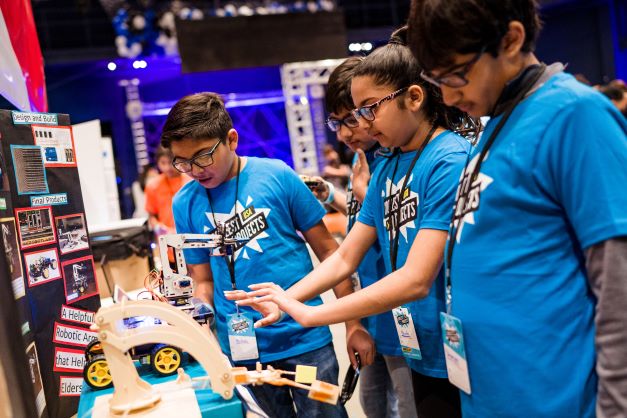
A group of young people demonstrate a project at Coolest Projects.

So when we started designing materials for the Experience AI learning programme in partnership with leading AI unit Google DeepMind, we decided to create short explanations of key AI and machine learning (ML) terms. The explanations are doubly useful:

  1. They ensure that we give learners and teachers a consistent and clear understanding of the key terms across all our Experience AI resources. Within the Experience AI Lessons for Key Stage 3 (age 11–14), these key terms are also correlated to the target concepts and learning objectives presented in the learning graph. 
  2. They help us talk about AI and AI education in our team. Thanks to sharing an understanding of what terms such as “AI”, “ML”, “model”, or “training” actually mean and how to best talk about AI, our conversations are much more productive.

As an example, here is our explanation of the term “artificial intelligence” for learners aged 11–14:

Artificial intelligence (AI) is the design and study of systems that appear to mimic intelligent behaviour. Some AI applications are based on rules. More often now, AI applications are built using machine learning that is said to ‘learn’ from examples in the form of data. For example, some AI applications are built to answer questions or help diagnose illnesses. Other AI applications could be built for harmful purposes, such as spreading fake news. AI applications do not think. AI applications are built to carry out tasks in a way that appears to be intelligent.

You can find 32 explanations in the glossary that is part of the Experience AI Lessons. Here’s an insight into how we arrived at the explanations.

Reliable sources

In order to ensure the explanations are as precise as possible, we first identified reliable sources. These included among many others:

Explaining AI terms to Key Stage 3 learners: Some principles

Vocabulary is an important part of teaching and learning. When we use vocabulary correctly, we can support learners to develop their understanding. If we use it inconsistently, this can lead to alternate conceptions (misconceptions) that can interfere with learners’ understanding. You can read more about this in our Pedagogy Quick Read on alternate conceptions.

Some of our principles for writing explanations of AI terms were that the explanations need to: 

  • Be accurate
  • Be grounded in education research best practice
  • Be suitable for our target audience (Key Stage 3 learners, i.e. 11- to 14-year-olds)
  • Be free of terms that have alternative meanings in computer science, such as “algorithm”

We engaged in an iterative process of writing explanations, gathering feedback from our team and our Experience AI project partners at Google DeepMind, and adapting the explanations. Then we went through the feedback and adaptation cycle until we all agreed that the explanations met our principles.

A real banana and an image of a banana shown on the screen of a laptop are both labelled "Banana".
Image: Max Gruber / Better Images of AI / Ceci n’est pas une banane / CC-BY 4.0

An important part of what emerged as a result, aside from the explanations of AI terms themselves, was a blueprint for how not to talk about AI. One aspect of this is avoiding anthropomorphism, detailed by Ben Garside from our team here.

As part of designing the the Experience AI Lessons, creating the explanations helped us to:

  • Decide which technical details we needed to include when introducing AI concepts in the lessons
  • Figure out how to best present these technical details
  • Settle debates about where it would be appropriate, given our understanding and our learners’ age group, to abstract or leave out details

Using education research to explain AI terms

One of the ways education research informed the explanations was that we used semantic waves to structure each term’s explanation in three parts: 

  1. Top of the wave: The first one or two sentences are a high-level abstract explanation of the term, kept as short as possible, while introducing key words and concepts.
  2. Bottom of the wave: The middle part of the explanation unpacks the meaning of the term using a common example, in a context that’s familiar to a young audience. 
  3. Top of the wave: The final one or two sentences repack what was explained in the example in a more abstract way again to reconnect with the term. The end part should be a repeat of the top of the wave at the beginning of the explanation. It should also add further information to lead to another concept. 

Most explanations also contain ‘middle of the wave’ sentences, which add additional abstract content, bridging the ‘bottom of the wave’ concrete example to the ‘top of the wave’ abstract content.

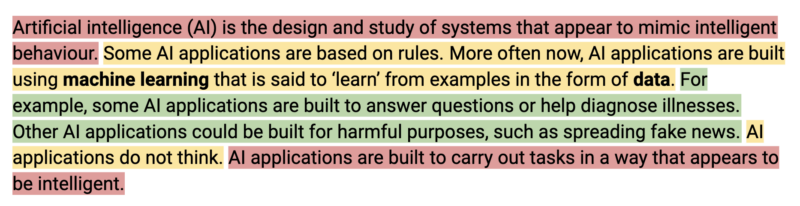
Here’s the “artificial intelligence” explanation broken up into the parts of the semantic wave:

  • Artificial intelligence (AI) is the design and study of systems that appear to mimic intelligent behaviour. (top of the wave)
  • Some AI applications are based on rules. More often now, AI applications are built using machine learning that is said to ‘learn’ from examples in the form of data. (middle of the wave)
  • For example, some AI applications are built to answer questions or help diagnose illnesses. Other AI applications could be built for harmful purposes, such as spreading fake news (bottom of the wave)
  • AI applications do not think. (middle of the wave)
  • AI applications are built to carry out tasks in a way that appears to be intelligent. (top of the wave)
Our "artificial intelligence" explanation broken up into the parts of the semantic wave.
Our “artificial intelligence” explanation broken up into the parts of the semantic wave. Red = top of the wave; yellow = middle of the wave; green = bottom of the wave

Was it worth our time?

Some of the explanations went through 10 or more iterations before we agreed they were suitable for publication. After months of thinking about, writing, correcting, discussing, and justifying the explanations, it’s tempting to wonder whether I should have just prompted an AI chatbot to generate the explanations for me.

A window of three images. On the right is a photo of a big tree in a green field in a field of grass and a bright blue sky. The two on the left are simplifications created based on a decision tree algorithm. The work illustrates a popular type of machine learning model: the decision tree. Decision trees work by splitting the population into ever smaller segments. I try to give people an intuitive understanding of the algorithm. I also want to show that models are simplifications of reality, but can still be useful, or in this case visually pleasing. To create this I trained a model to predict pixel colour values, based on an original photograph of a tree.
Rens Dimmendaal & Johann Siemens / Better Images of AI / Decision Tree reversed / CC-BY 4.0

I tested this idea by getting a chatbot to generate an explanation of “artificial intelligence” using the prompt “Explain what artificial intelligence is, using vocabulary suitable for KS3 students, avoiding anthropomorphism”. The result included quite a few inconsistencies with our principles, as well as a couple of technical inaccuracies. Perhaps I could have tweaked the prompt for the chatbot in order to get a better result. However, relying on a chatbot’s output would mean missing out on some of the value of doing the work of writing the explanations in collaboration with my team and our partners.

The visible result of that work is the explanations themselves. The invisible result is the knowledge we all gained, and the coherence we reached as a team, both of which enabled us to create high-quality resources for Experience AI. We wouldn’t have gotten to know what resources we wanted to write without writing the explanations ourselves and improving them over and over. So yes, it was worth our time.

What do you think about the explanations?

The process of creating and iterating the AI explanations highlights how opaque the field of AI still is, and how little we yet know about how best to teach and learn about it. At the Raspberry Pi Foundation, we now know just a bit more about that and are excited to share the results with teachers and young people.

You can access the Experience AI Lessons and the glossary with all our explanations at experience-ai.org. The glossary of AI explanations is just in its first published version: we will continue to improve it as we find out more about how to best support young people to learn about this field.

Let us know what you think about the explanations and whether they’re useful in your teaching. Onwards with the exciting work of establishing how to successfully engage young people in learning about and creating with AI technologies.

The post How we’re learning to explain AI terms for young people and educators appeared first on Raspberry Pi Foundation.
Experience AI: The excitement of AI in your classroom

Post Syndicated from Duncan Maidens original https://www.raspberrypi.org/blog/experience-ai-launch-lessons/

We are delighted to announce that we’ve launched Experience AI, our new learning programme to help educators to teach, inspire, and engage young people in the subject of artificial intelligence (AI) and machine learning (ML).

Experience AI is a new educational programme that offers cutting-edge secondary school resources on AI and machine learning for teachers and their students. Developed in partnership by the Raspberry Pi Foundation and DeepMind, the programme aims to support teachers in the exciting and fast-moving area of AI, and get young people passionate about the subject.

The importance of AI and machine learning education

Artificial intelligence and machine learning applications are already changing many aspects of our lives. From search engines, social media content recommenders, self-driving cars, and facial recognition software, to AI chatbots and image generation, these technologies are increasingly common in our everyday world.

Young people who understand how AI works will be better equipped to engage with the changes AI applications bring to the world, to make informed decisions about using and creating AI applications, and to choose what role AI should play in their futures. They will also gain critical thinking skills and awareness of how they might use AI to come up with new, creative solutions to problems they care about.

The AI applications people are building today are predicted to affect many career paths. In 2020, the World Economic Forum estimated that AI would replace some 85 million jobs by 2025 and create 97 million new ones. Many of these future jobs will require some knowledge of AI and ML, so it’s important that young people develop a strong understanding from an early age.

A group of young people investigate computer hardware together.
 Develop a strong understanding of the concepts of AI and machine learning with your learners.

Experience AI Lessons

Something we get asked a lot is: “How do I teach AI and machine learning with my class?”. To answer this question, we have developed a set of free lessons for secondary school students (age 11 to 14) that give you everything you need including lesson plans, slide decks, worksheets, and videos.

The lessons focus on relatable applications of AI and are carefully designed so that teachers in a wide range of subjects can use them. You can find out more about how we used research to shape the lessons and how we aim to avoid misconceptions about AI.

The lessons are also for you if you’re an educator or volunteer outside of a school setting, such as in a coding club.

The six lessons

  1. What is AI?: Learners explore the current context of artificial intelligence (AI) and how it is used in the world around them. Looking at the differences between rule-based and data-driven approaches to programming, they consider the benefits and challenges that AI could bring to society. 
  2. How computers learn: Learners focus on the role of data-driven models in AI systems. They are introduced to machine learning and find out about three common approaches to creating ML models. Finally the learners explore classification, a specific application of ML.
  3. Bias in, bias out: Learners create their own machine learning model to classify images of apples and tomatoes. They discover that a limited dataset is likely to lead to a flawed ML model. Then they explore how bias can appear in a dataset, resulting in biased predictions produced by a ML model.
  4. Decision trees: Learners take their first in-depth look at a specific type of machine learning model: decision trees. They see how different training datasets result in the creation of different ML models, experiencing first-hand what the term ‘data-driven’ means. 
  5. Solving problems with ML models: Learners are introduced to the AI project lifecycle and use it to create a machine learning model. They apply a human-focused approach to working on their project, train a ML model, and finally test their model to find out its accuracy.
  6. Model cards and careers: Learners finish the AI project lifecycle by creating a model card to explain their machine learning model. To finish off the unit, they explore a range of AI-related careers, hear from people working in AI research at DeepMind, and explore how they might apply AI and ML to their interests.

As part of this exciting first phase, we’re inviting teachers to participate in research to help us further develop the resources. All you need to do is sign up through our website, download the lessons, use them in your classroom, and give us your valuable feedback.

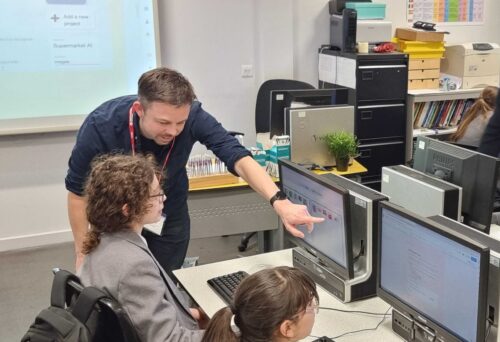
An educator points to an image on a student's computer screen.
 Ben Garside, one of our lead educators working on Experience AI, takes a group of students through one of the new lessons.

Support for teachers

We’ve designed the Experience AI lessons with teacher support in mind, and so that you can deliver them to your learners aged 11 to 14 no matter what your subject area is. Each of the lesson plans includes a section that explains new concepts, and the slide decks feature embedded videos in which DeepMind’s AI researchers describe and bring these concepts to life for your learners.

We will also be offering you a range of new teacher training opportunities later this year, including a free online CPD course — Introduction to AI and Machine Learning — and a series of AI-themed webinars.

Tell us your feedback

We will be inviting schools across the UK to test and improve the Experience AI lessons through feedback. We are really looking forward to working with you to shape the future of AI and machine learning education.

Visit the Experience AI website today to get started.

The post Experience AI: The excitement of AI in your classroom appeared first on Raspberry Pi Foundation.

AI education resources: What do we teach young people?

Post Syndicated from Jane Waite original https://www.raspberrypi.org/blog/ai-education-resources-what-to-teach-seame-framework/

People have many different reasons to think that children and teenagers need to learn about artificial intelligence (AI) technologies. Whether it’s that AI impacts young people’s lives today, or that understanding these technologies may open up careers in their future — there is broad agreement that school-level education about AI is important.

A young person writes Python code.

But how do you actually design lessons about AI, a technical area that is entirely new to young people? That was the question we needed to answer as we started Experience AI, our exciting collaboration with DeepMind, a leading AI company.

Our approach to developing AI education resources

As part of Experience AI, we are creating a free set of lesson resources to help teachers introduce AI and machine learning (ML) to KS3 students (ages 11 to 14). In England this area is not currently part of the national curriculum, but it’s starting to appear in all sorts of learning materials for young people. 

Two learners and a teacher in a physical computing lesson.

While developing the six Experience AI lessons, we took a research-informed approach. We built on insights from the series of research seminars on AI and data science education we had hosted in 2021 and 2022, and on research we ourselves have been conducting at the Raspberry Pi Computing Education Research Centre.

We reviewed over 500 existing resources that are used to teach AI and ML.

As part of this research, we reviewed over 500 existing resources that are used to teach AI and ML. We found that the vast majority of them were one-off activities, and many claimed to be appropriate for learners of any age. There were very few sets of lessons, or units of work, that were tailored to a specific age group. Activities often had vague learning objectives, or none at all. We rarely found associated assessment activities. These were all shortcomings we wanted to avoid in our set of lessons.

To analyse the content of AI education resources, we use a simple framework called SEAME. This framework is based on work I did in 2018 with Professor Paul Curzon at Queen Mary University of London, running professional development for educators on teaching machine learning.

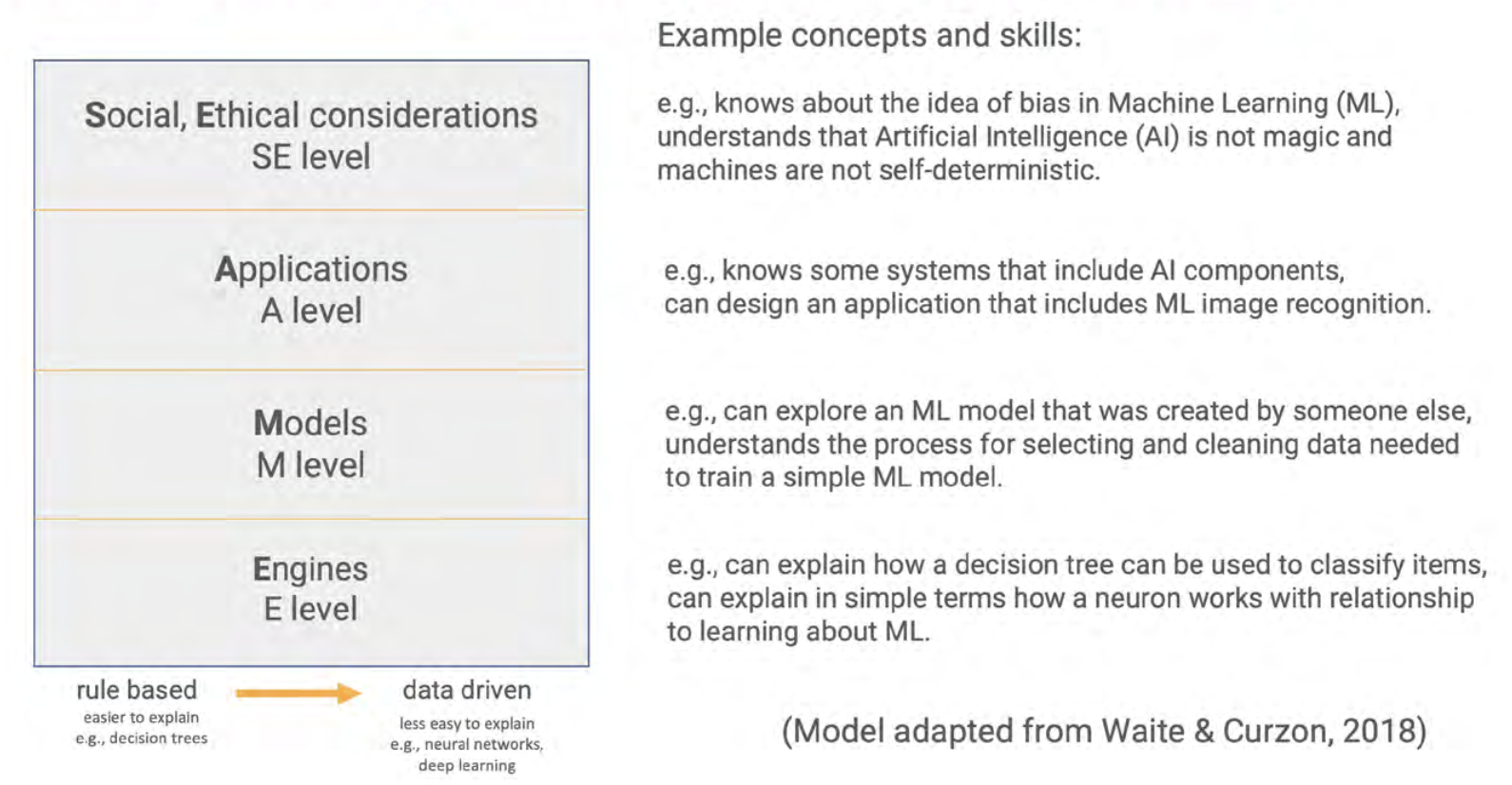
The SEAME framework gives you a simple way to group learning objectives and resources related to teaching AI and ML, based on whether they focus on social and ethical aspects (SE), applications (A), models (M), or engines (E, i.e. how AI works).
Click to enlarge.

The SEAME framework gives you a simple way to group learning objectives and resources related to teaching AI and ML, based on whether they focus on social and ethical aspects (SE), applications (A), models (M), or engines (E, i.e. how AI works). We hope that it will be a useful tool for anyone who is interested in looking at resources to teach AI. 

What do AI education resources focus on?

The four levels of the SEAME framework do not indicate a hierarchy or sequence. Instead, they offer a way for teachers, resource developers, and researchers to talk about the focus of AI learning activities.

Social and ethical aspects (SE)

The SE level covers activities that relate to the impact of AI on everyday life, and to its implications for society. Learning objectives and their related resources categorised at this level introduce students to issues such as privacy or bias concerns, the impact of AI on employment, misinformation, and the potential benefits of AI applications.

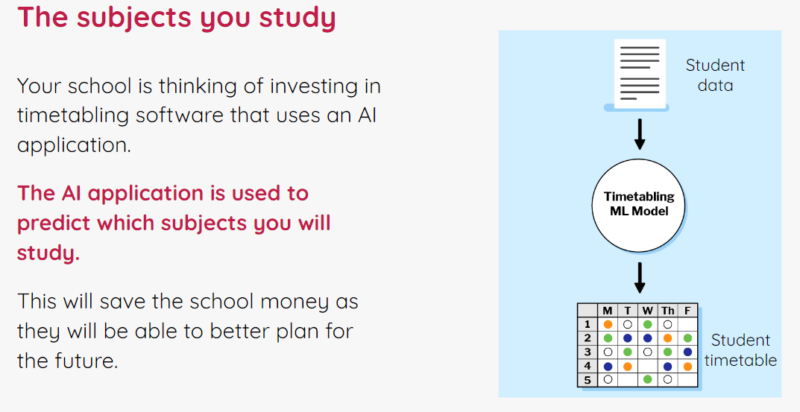
A slide from a lesson about AI that describes an AI application related to timetables.
An example activity in the Experience AI lessons where learners think about the social and ethical issues of an AI application that predicts what subjects they might want to study. This activity is mostly focused on the social and ethical level of the SEAME framework, but also links to the applications and models levels.

Applications (A)

The A level refers to activities related to applications and systems that use AI or ML models. At this level, learners do not learn how to train models themselves, or how such models work. Learning objectives at this level include knowing a range of AI applications and starting to understand the difference between rule-based and data-driven approaches to developing applications.

Models (M)

The M level concerns the models underlying AI and ML applications. Learning objectives at this level include learners understanding the processes used to train and test models. For example, through resources focused on the M level, students could learn about the different learning paradigms of ML (i.e., supervised, unsupervised, or reinforcement learning).

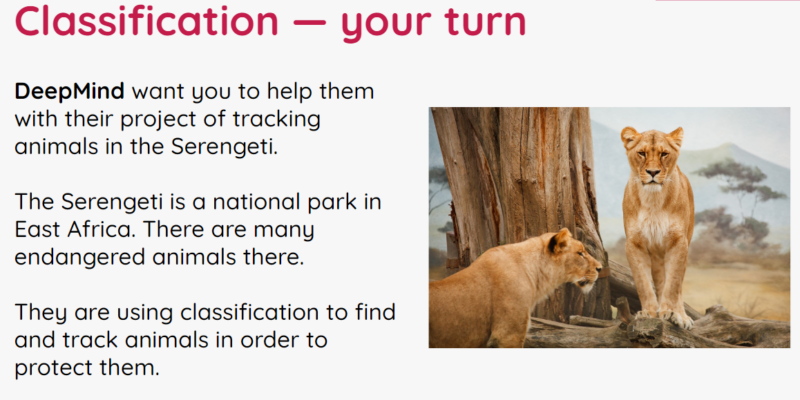
A slide from a lesson about AI that describes an ML model to classify animals.
An example activity in the Experience AI lessons where students learn about classification. This activity is mostly focused on the models level of the SEAME framework, but also links to the social and ethical and the applications levels.

Engines (E)

The E level is related to the engines that make AI models work. This is the most hidden and complex level, and for school-aged learners may need to be taught using unplugged activities and visualisations. Learning objectives could include understanding the basic workings of systems such as data-driven decision trees and artificial neural networks.

Covering the four levels

Some learning activities may focus on a single level, but activities can also span more than one level. For example, an activity may start with learners trying out an existing ‘rock-paper-scissors’ application that uses an ML model to recognise hand shapes. This would cover the applications level. If learners then move on to train the model to improve its accuracy by adding more image data, they work at the models level.

A teacher helps a young person with a coding project.

Other activities cover several SEAME levels to address a specific concept. For example, an activity focussed on bias might start with an example of the societal impact of bias (SE level). Learners could then discuss the AI applications they use and reflect on how bias impacts them personally (A level). The activity could finish with learners exploring related data in a simple ML model and thinking about how representative the data is of all potential application users (M level).

The set of lessons on AI we are developing in collaboration with DeepMind covers all four levels of SEAME.

The set of Experience AI lessons we are developing in collaboration with DeepMind covers all four levels of SEAME. The lessons are based on carefully designed learning objectives and specifically targeted to KS3 students. Lesson materials include presentations, videos, student activities, and assessment questions.

We’re releasing the Experience AI lessons very soon — if you want to be the first to hear news about them, please sign up here.

The SEAME framework as a tool for research on AI education

For researchers, we think the SEAME framework will, for example, be useful to analyse school curriculum material to see whether some age groups have more learning activities available at one level than another, and whether this changes over time. We may find that primary school learners work mostly at the SE and A levels, and secondary school learners move between the levels with increasing clarity as they develop their knowledge. It may also be the case that some learners or teachers prefer activities focused on one level rather than another. However, we can’t be sure: research is needed to investigate the teaching and learning of AI and ML across all year groups.

That’s why we’re excited to welcome Salomey Afua Addo to the Raspberry Pi Computing Education Research Centre. Salomey joined the Centre as a PhD student in January, and her research will focus on approaches to the teaching and learning of AI. We’re looking forward to seeing the results of her work.

The post AI education resources: What do we teach young people? appeared first on Raspberry Pi Foundation.
Experience AI with the Raspberry Pi Foundation and DeepMind

Post Syndicated from Philip Colligan original https://www.raspberrypi.org/blog/experience-ai-deepmind-ai-education/

I am delighted to announce a new collaboration between the Raspberry Pi Foundation and a leading AI company, DeepMind, to inspire the next generation of AI leaders.

Young people work together to investigate computer hardware.

The Raspberry Pi Foundation’s mission is to enable young people to realise their full potential through the power of computing and digital technologies. Our vision is that every young person — whatever their background — should have the opportunity to learn how to create and solve problems with computers.

With the rapid advances in artificial intelligence — from machine learning and robotics, to computer vision and natural language processing — it’s increasingly important that young people understand how AI is affecting their lives now and the role that it can play in their future. 

DeepMind logo.

Experience AI is a new collaboration between the Raspberry Pi Foundation and DeepMind that aims to help young people understand how AI works and how it is changing the world. We want to inspire young people about the careers in AI and help them understand how to access those opportunities, including through their subject choices. 

Experience AI 

More than anything, we want to make AI relevant and accessible to young people from all backgrounds, and to make sure that we engage young people from backgrounds that are underrepresented in AI careers. 

The program has two strands: Inspire and Experiment. 

Inspire: To engage and inspire students about AI and its impact on the world, we are developing a set of free learning resources and materials including lesson plans, assembly packs, videos, and webinars, alongside training and support for educators. This will include an introduction to the technologies that enable AI; how AI models are trained; how to frame problems for AI to solve; the societal and ethical implications of AI; and career opportunities. All of this will be designed around real-world and relatable applications of AI, engaging a wide range of diverse interests and useful to teachers from different subjects.

In a computing classroom, two girls concentrate on their programming task.

Experiment: Building on the excitement generated through Inspire, we are also designing an AI challenge that will support young people to experiment with AI technologies and explore how these can be used to solve real-world problems. This will provide an opportunity for students to get hands-on with technology and data, along with support for educators. 

Our initial focus is learners aged 11 to 14 in the UK. We are working with teachers, students, and DeepMind engineers to ensure that the materials and learning experiences are engaging and accessible to all, and that they reflect the latest AI technologies and their application.

A woman teacher helps a young person with a coding project.

As with all of our work, we want to be research-led and the Raspberry Pi Foundation research team has been working over the past year to understand the latest research on what works in AI education.

Next steps 

Development of the Inspire learning materials is underway now, and we will release the whole set of resources early in 2023. Throughout 2023, we will design and pilot the Experiment challenge.

If you want to stay up to date with Experience AI, or if you’d like to be involved in testing the materials, fill in this form to register your interest.

The post Experience AI with the Raspberry Pi Foundation and DeepMind appeared first on Raspberry Pi.

AI literacy research: Children and families working together around smart devices

Post Syndicated from Sue Sentance original https://www.raspberrypi.org/blog/ai-literacy-children-families-working-together-ai-education-research/

Between September 2021 and March 2022, we’ve been partnering with The Alan Turing Institute to host a series of free research seminars about how to young people about AI and data science.

In the final seminar of the series, we were excited to hear from Stefania Druga from the University of Washington, who presented on the topic of AI literacy for families. Stefania’s talk highlighted the importance of families in supporting children to develop AI literacy. Her talk was a perfect conclusion to the series and very well-received by our audience.

Stefania Druga.
Stefania Druga, University of Washington

Stefania is a third-year PhD student who has been working on AI literacy in families, and since 2017 she has conducted a series of studies that she presented in her seminar talk. She presented some new work to us that was to be formally shared at the HCI conference in April, and we were very pleased to have a sneak preview of these results. It was a fascinating talk about the ways in which the interactions between parents and children using AI-based devices in the home, and the discussions they have while learning together, can facilitate an appreciation of the affordances of AI systems. You’ll find my summary as well as the seminar recording below.

“AI literacy practices and skills led some families to consider making meaningful use of AI devices they already have in their homes and redesign their interactions with them. These findings suggest that family has the potential to act as a third space for AI learning.”

– Stefania Druga

AI literacy: Growing up with AI systems, growing used to them

Back in 2017, interest in Alexa and other so-called ‘smart’, AI-based devices was just developing in the public, and such devices would have been very novel to most people. That year, Stefania and colleagues conducted a first pilot study of children’s and their parents’ interactions with ‘smart’ devices, including robots, talking dolls, and the sort of voice assistants we are used to now.

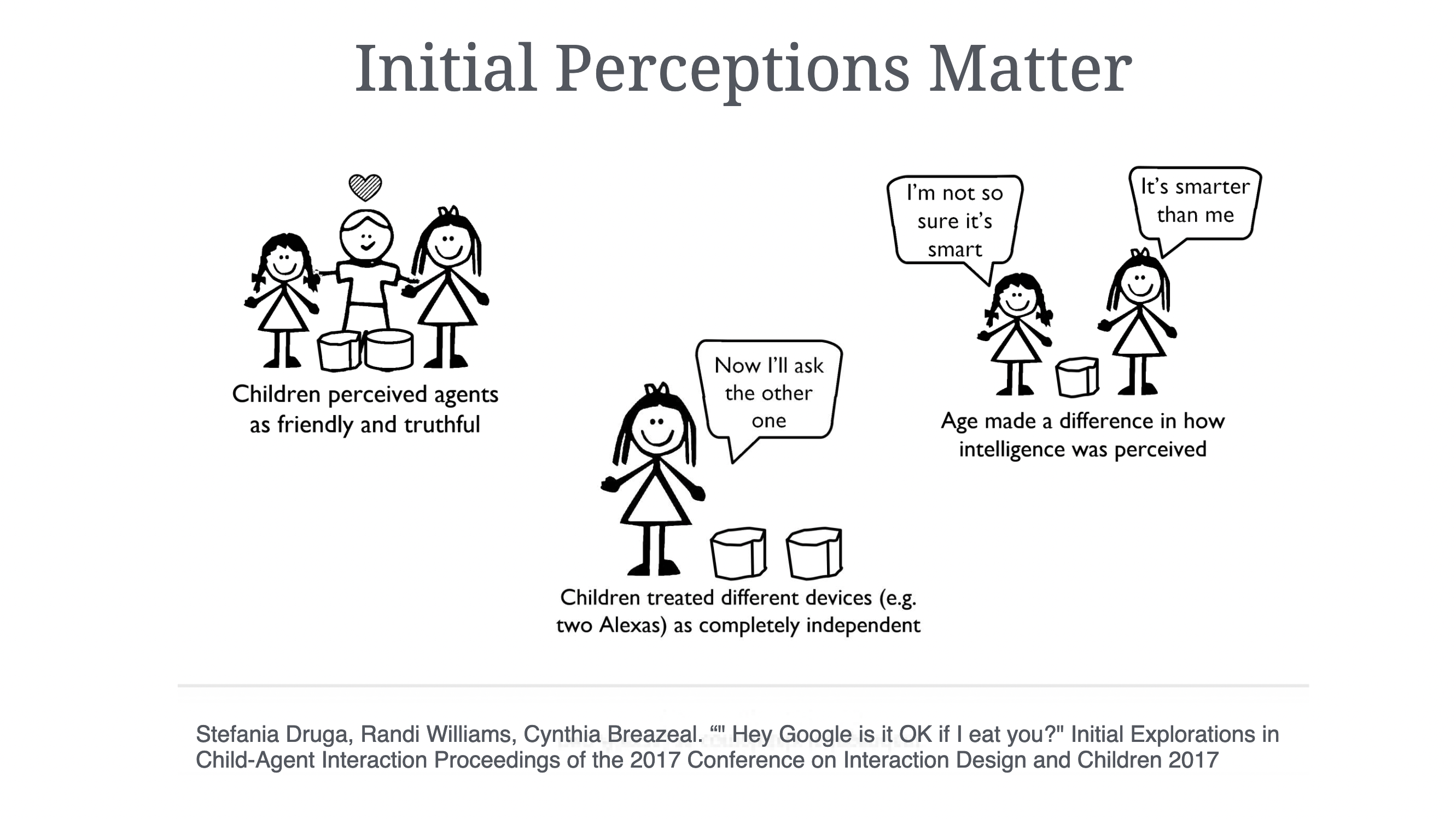
A slide from Stefania Druga's AI literacy seminar. Content is described in the blog text.
A slide from Stefania’s AI literacy seminar. Click to enlarge.

Working directly with families, the researchers explored the level of understanding that children had about ‘smart’ devices, and were surprised by the level of insight very young children had into the potential of this type of technology.

In this AI literacy pilot study, Stefania and her colleagues found that:

  • Children perceived AI-based agents (i.e. ‘smart’ devices) as friendly and truthful
  • They treated different devices (e.g. two different Alexas) as completely independent
  • How ‘smart’ they found the device was dependent on age, with older children more likely to describe devices as ‘smart’

AI literacy: Influence of parents’ perceptions, influence of talking dolls

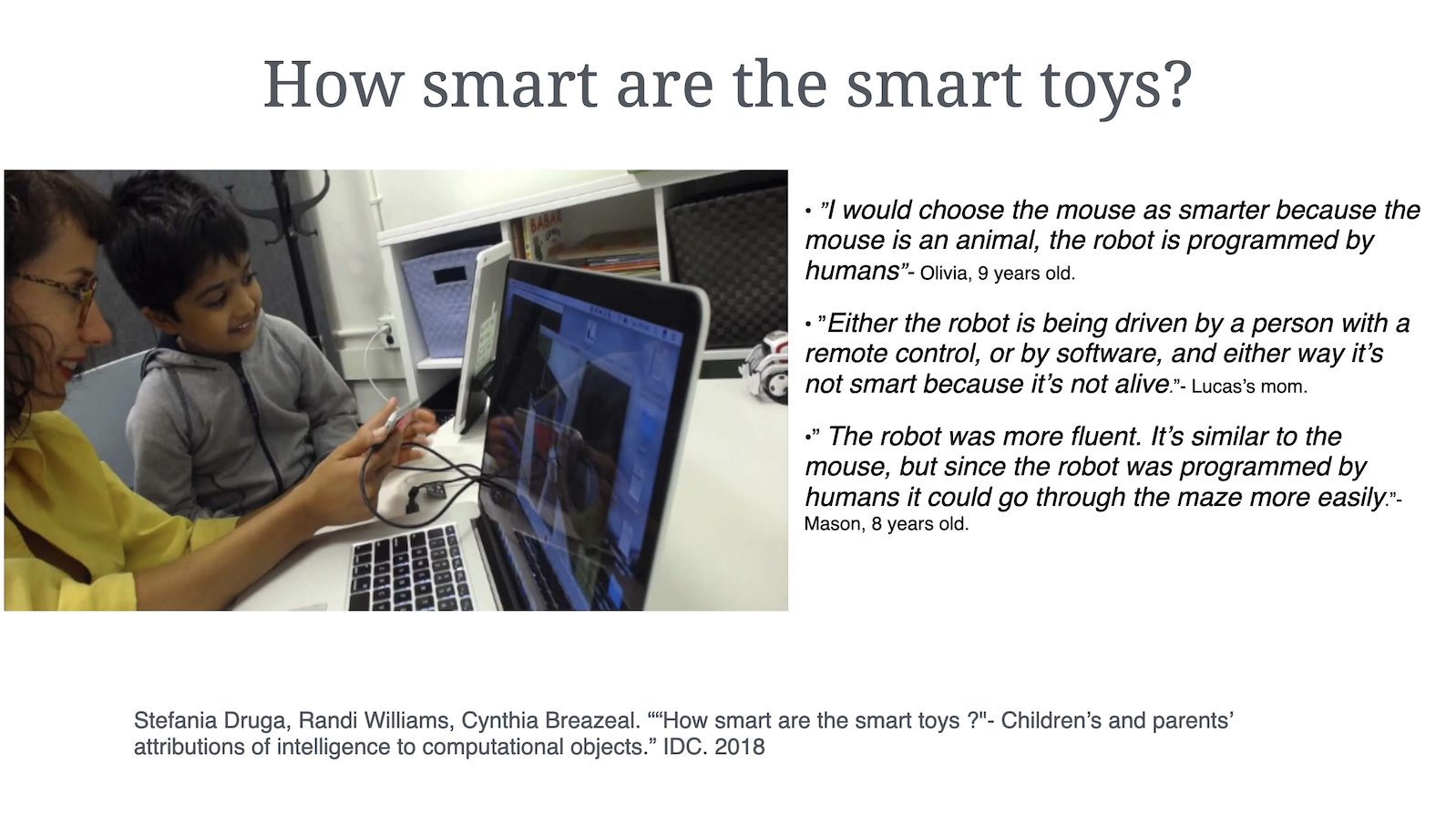
Stefania’s next study, undertaken in 2018, showed that parents’ perceptions of the implications and potential of ‘smart’ devices shaped what their children thought. Even when parents and children were interviewed separately, if the parent thought that, for example, robots were smarter than humans, then the child did too.

A slide from Stefania Druga's AI literacy seminar.
A slide from Stefania’s AI literacy seminar. Click to enlarge.

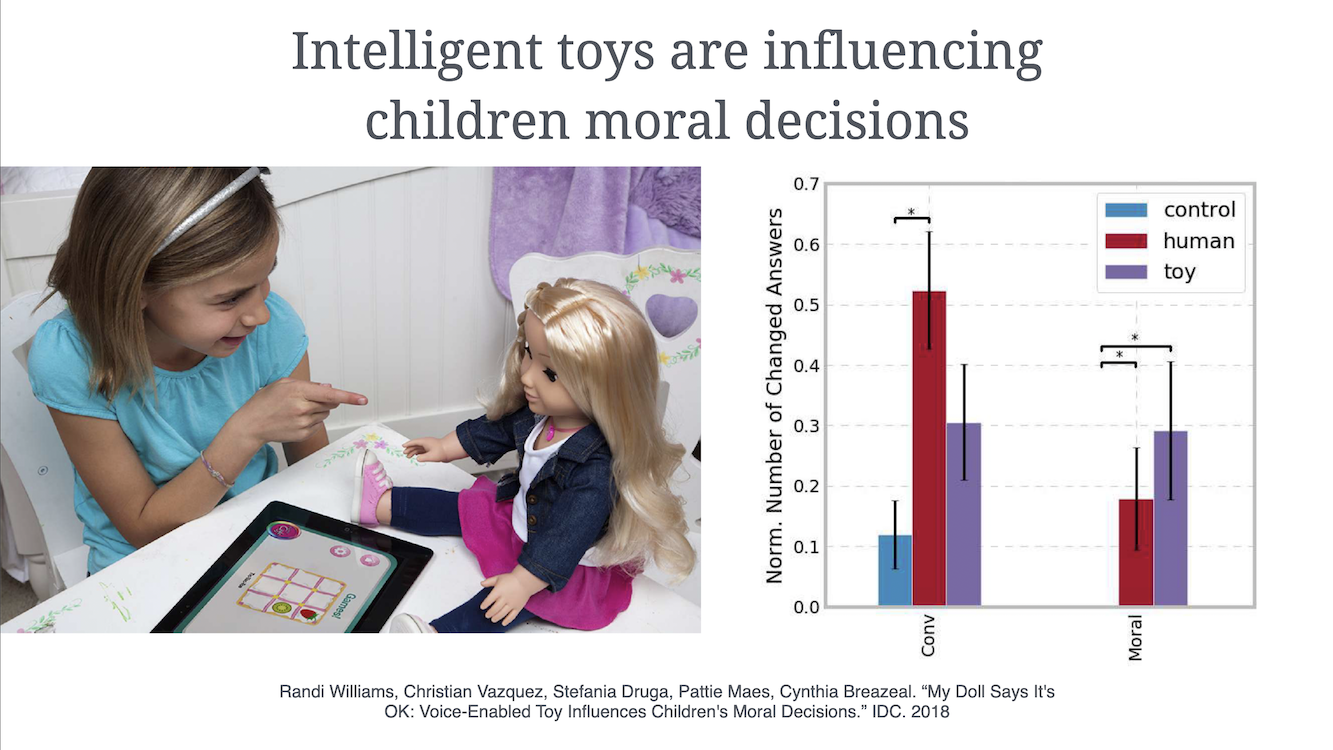
Another part of this study showed that talking dolls could influence children’s moral decisions (e.g. “Should I give a child a pillow?”). In some cases, these ‘smart’ toys would influence the child more than another human. Some ‘smart’ dolls have been banned in some European countries because of security concerns. In the light of these concerns, Stefania pointed out how important it is to help children develop a critical understanding of the potential of AI-based technology, and what its fallibility and the limits of its guidance are.

A slide from Stefania Druga's AI literacy seminar.
A slide from Stefania’s AI literacy seminar. Click to enlarge.

AI literacy: Programming ‘smart’ devices, algorithmic bias

Another study Stefania discussed involved children who programmed ‘smart’ devices. She used the children’s drawings to find out about their mental models of how the technology worked.

She found that when children had the opportunity to train machine learning models or ‘smart’ devices, they became more sceptical about the appropriate use of these technologies and asked better questions about when and for what they should be used. Another finding was that children and adults had different ideas about algorithmic bias, particularly relating to the meaning of fairness.

A parent and child work together at a Raspberry Pi computer.

AI literacy: Kinaesthetic activities, sharing discussions

The final study Stefania talked about was conducted with families online during the pandemic, when children were learning at home. 15 families, with in total 18 children (ages 5 to 11) and 16 parents, participated in five weekly sessions. A number of learning activities to demonstrate features of AI made up each of the sessions. These are all available at aiplayground.me.

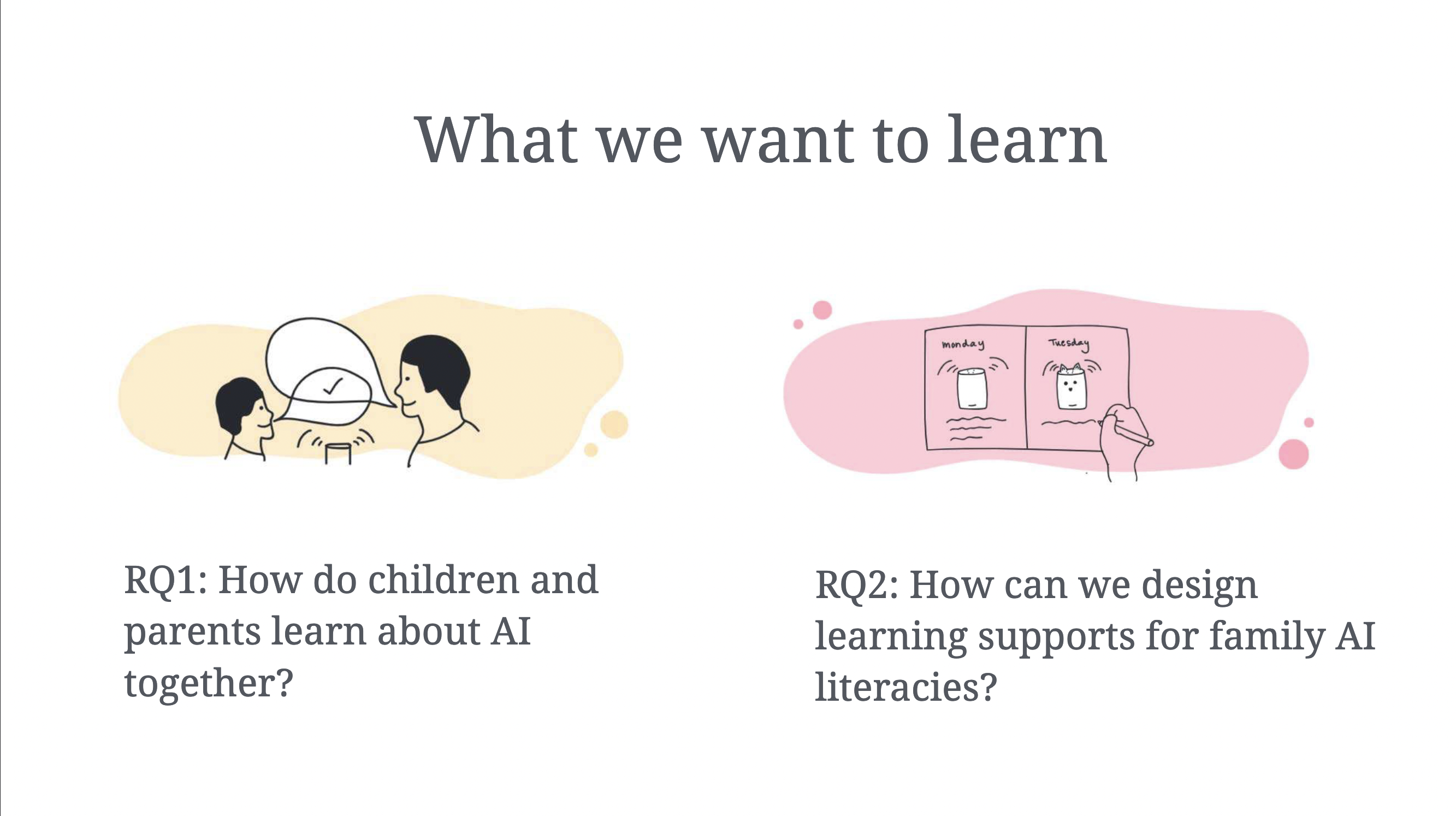
A slide from Stefania Druga's AI literacy seminar, describing two research questions about how children and parents learn about AI together, and about how to design learning supports for family AI literacies.
A slide from Stefania’s AI literacy seminar. Click to enlarge.

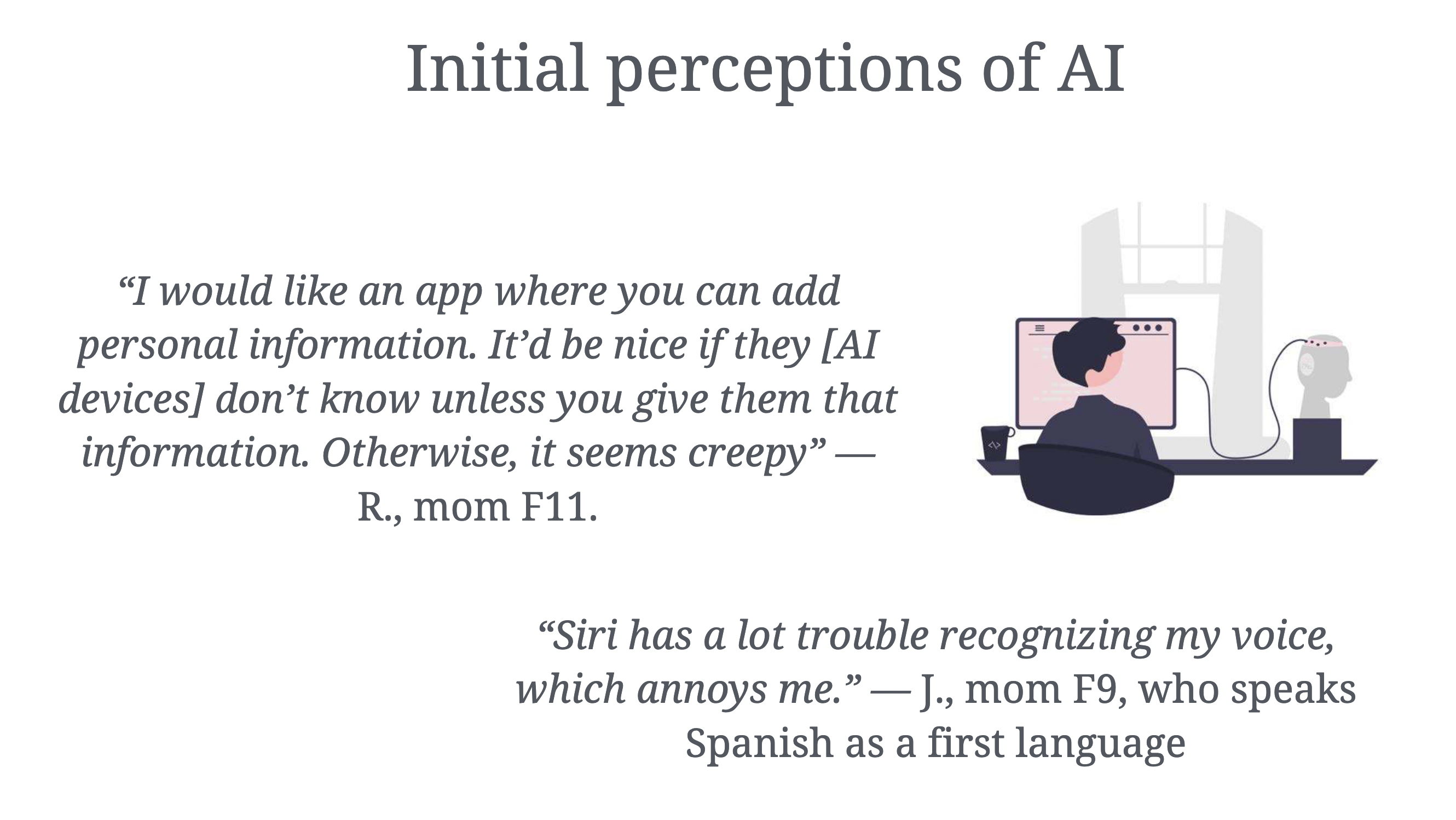
The fact that children and parents, or other family members, worked through the activities together seemed to generate fruitful discussions about the usefulness of AI-based technology. Many families were concerned about privacy and what was happening to their personal data when they were using ‘smart’ devices, and also expressed frustration with voice assistants that couldn’t always understand the way they spoke.

A slide from Stefania Druga's AI literacy seminar. Content described in the blog text.
A slide from Stefania’s AI literacy seminar. Click to enlarge.

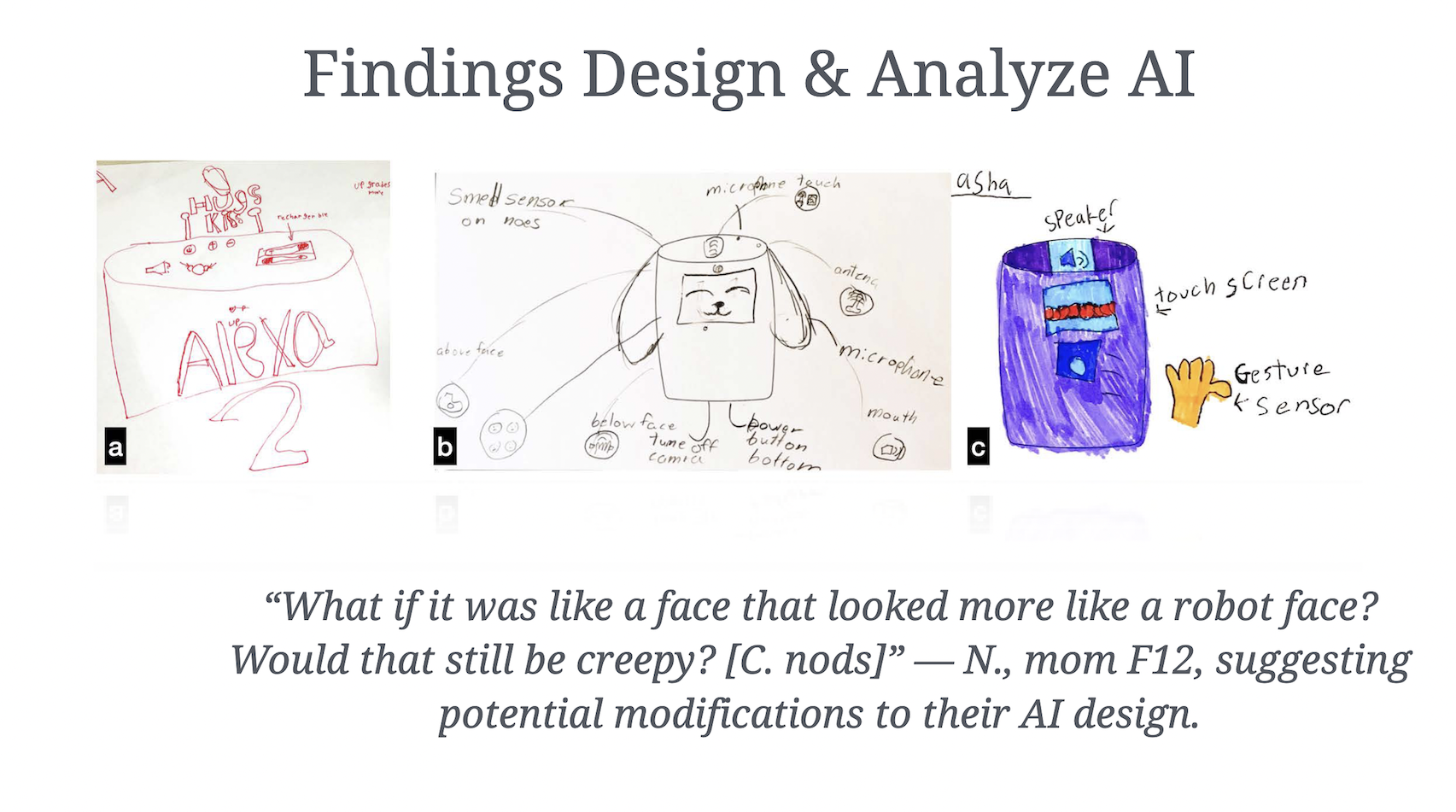
In one of the sessions, with a focus on machine learning, families were introduced to a kinaesthetic activity involving moving around their home to train a model. Through this activity, parents and children had more insight into the constraints facing machine learning. They used props in the home to experiment and find out ways of training the model better. In another session, families were encouraged to design their own devices on paper, and Stefania showed some examples of designs children had drawn.

A slide from Stefania Druga's AI literacy seminar. Content described in the blog text.
A slide from Stefania’s AI literacy seminar. Click to enlarge.

This study identified a number of different roles that parents or other adults played in supporting children’s learning about AI, and found that embodied and tangible activities worked well for encouraging joint work between children and their families.

Find out more

You can catch up with Stefania’s seminar below in the video, and download her presentation slides.

More about Stefania’s work can be learned in her paper on children’s training of ML models and also in her latest paper about the five weekly AI literacy sessions with families.

Recordings and slides of all our previous seminars on AI education are available online for you, and you can see the list of AI education resources we’ve put together based on recommendations from seminar speakers and participants.

Join our next free research seminar

We are delighted to start a new seminar series on cross-disciplinary computing, with seminars in May, June, July, and September to look forward to. It’s not long now before we begin: Mark Guzdial will speak to us about task-specific programming languages (TSP) in history and mathematics classes on 3 May, 17.00 to 18.30pm local UK time. I can’t wait!

Sign up to receive the Zoom details for the seminar with Mark:

The post AI literacy research: Children and families working together around smart devices appeared first on Raspberry Pi.