Tag Archives: Backup Awareness Month

2024 State of the Backup: Survey Says Security Incidents and Data Loss on the Rise

Post Syndicated from Yev original https://backblaze.com/blog/2024-state-of-the-backup-security-incidents-and-data-loss-on-the-rise/

A decorative image showing several icons that represent graphs, charts, and stats.

June is Backup Awareness Month, and every year, we work with the Harris Poll to survey the state of computer backups in the U.S. It’s our 16th year running, and this year, we expanded our lens and created a new survey focused on analyzing the state of backups among businesses, providing critical insights into organizational backup strategies and challenges. 

And as in previous years, our consumer backup survey provides a comprehensive summary which reflects trends and changes over nearly two decades. The combination of these two audience surveys provides a more complete picture for the state of backups in the U.S. Let’s start with our new survey data.

Spotlight: Business Backup Is Coming Up Short

Our inaugural Business Backup Survey included 300 IT decision makers across the U.S. Part of what we wanted to learn was: 

With all of the different ways IT professionals have to protect their user’s data, how are they choosing to back up and are backup solutions even working? 

We can infer the answers to those questions by looking at the tools organizations use to back up their data, the frequency of data recoveries, and how successful or not those recoveries were.

What Tools Do Organizations Use to Back Up Their Data?

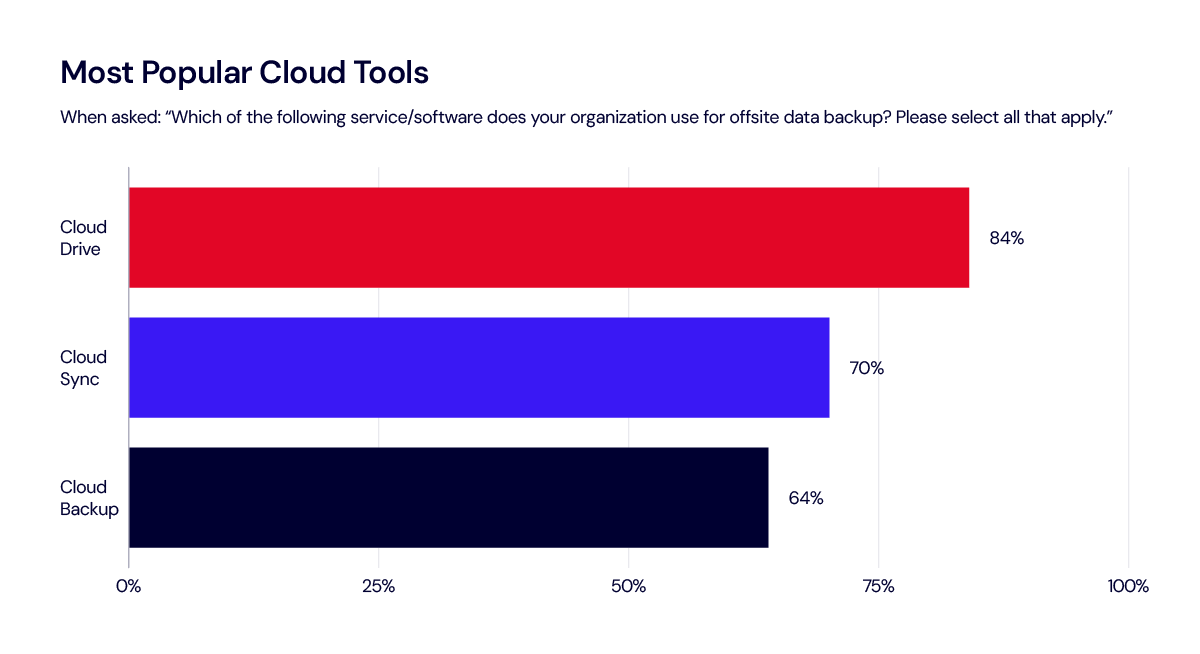
One of the most striking findings from the poll is that a significant majority (84%) of IT decision makers say their organizations utilize cloud drive services, which rely on syncing data to the cloud, for off-site data backup. You may have heard us say this before—sync is not backup

What’s Wrong with Cloud Drives and Sync Services?

Cloud drives allow for file storage and sharing but may not protect against file corruption or accidental deletion. Sync services automatically update files across multiple devices, meaning that any changes or deletions are replicated everywhere, which can lead to unintended data loss. While some cloud drives have added minimal backup capabilities (i.e., 30 days of version history or similar), they are often lacking in key areas that are necessary for business continuity or compliance standards. 

Cloud backup solutions, on the other hand, are designed to systematically and securely back up data, offering robust protection against loss, corruption, and security breaches. This makes cloud backup a better choice, particularly for addressing security concerns and ensuring the integrity and availability of critical data.

How Often Do Organizations Need to Restore Data?

39% of IT decision-makers report that their organizations need to restore data from backups at least once a month, with special requests for archived or deleted data (62%), backup software failure (54%), hard drive failure (52%), and cyber attacks (49%) reported as some of the top reasons. This frequent need for data recovery underscores the persistent vulnerabilities IT professionals face.

Are Data Recoveries Successful?

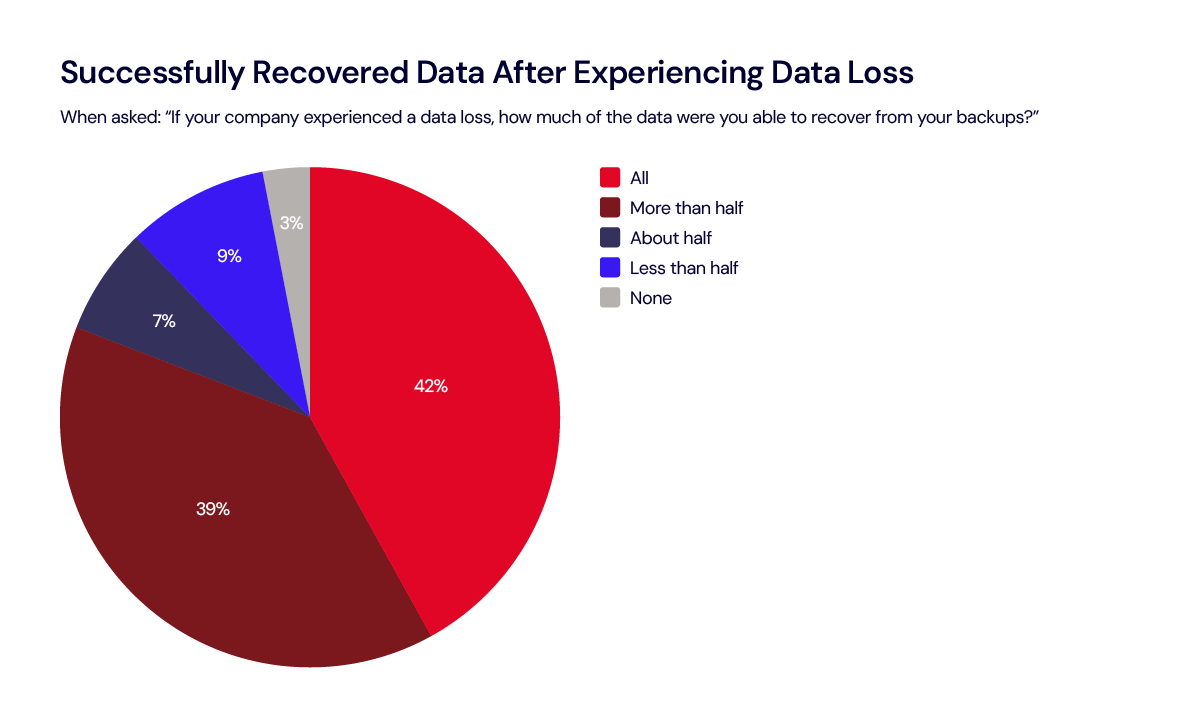
Not only do many organizations need to restore on a regular basis, but the survey also shows that among those that experienced data loss, only 42% were able to recover all of their data when they perform a restore. That leaves 58% with some amount of unrecovered data. 

Are Backups Working?

The data shows a sizable gap between the use of backup services and the effectiveness of data restoration. Although a significant percentage of organizations indicate they’re using what they would consider a cloud backup solution (the shortcomings of cloud drives and cloud sync services aside), only 42% of those that experienced data loss were able to restore all their data. This discrepancy highlights the risks associated with inadequate backup measures and the potential for data loss, which can have serious repercussions for businesses.

Only 42% of organizations that experienced data loss were able to restore all their data.

There are all sorts of ways businesses need to slice their data management strategy in order to make sure all data is backed up. This includes data type (e.g., files vs. system information), frequency with which the data is updated or changed, retention requirements for compliance, and more. There are often reasons that businesses will employ different backup frequency or strategies for different file types—file-based versus block-level incremental backups, for example. However, incomplete backups can lead to situations where only parts of the data can be restored, disrupting business operations and resulting in downtime as efforts are made to recover or reconstruct lost data. 

The importance of creating an end-to-end data backup plan, as well as choosing the right tools that provide comprehensive coverage, may be highlighted only at the moment of failure. As it stands, the Harris Poll data suggests that the limitations of cloud sync and cloud drive tools are leaving gaps in data protection and disaster recovery strategies.

This is further validated by the features IT decision makers report as being absolutely essential/very important in selecting backup tools, including security (97%), bandwidth and memory capacity (87%), a variety of features (79%), ease of operations and customizable elements (83% each). These rigorous requirements suggest that many existing solutions may fall short of meeting the comprehensive needs of modern businesses, and/or that the complex mix of tools may be contributing to blind spots in an overall data management strategy, only exposed at the point of recovery.  

How To Close the Gap?

These insights underscore the need for innovative and robust backup solutions that address evolving business requirements. As the volume of data continues to grow and cyber threats become increasingly sophisticated, the demand for reliable, secure, and user-friendly backup systems will only heighten. Given the challenges many businesses face in fully recovering their data, there’s an opportunity to promote education and awareness regarding the importance of refreshing backup strategies and utilizing suitable backup tools.

Consumer Backup Practices: Less Than 1 in 5 Are Certain of Their Backups

The consumer portion of the 2024 Backup Awareness Survey seeks to understand a simple question we’ve asked year after year: How often do you back up all of the data on your computer? We also look at who backs up the most and the reasons people cite for needing to restore data, and we compare those trends over time. Let’s dig in to the results. 

How Often Do People Back Up?

This year’s survey reveals that fewer than 1 in 5 Americans (15%) feel absolutely certain that their most important files are securely backed up. This is despite 84% of Americans who own a computer stating that they’ve backed up all their data and 45% performing backups at least once a month.

The survey also highlights the predominance of cloud solutions among backup methods. 63% of individuals who back up their data use a cloud-based system as their primary method. However, only 11% utilize dedicated cloud backup services, indicating a preference towards cloud drives (39%) and sync services (13%). As we noted above, cloud drives and sync services are fundamentally different from cloud backup solutions and can create gaps in a robust 3-2-1 backup strategy

Who Is Best at Backing Up?

Every year, we highlight which demographic is the best at backing up their data, and in 2024, men (73% vs. 66% of women) and younger adults ages 18–54 (76% vs. just 61% of those ages 55+) take the lead backing up at least once a year. 

The Reasons for Restores

The survey also found that 74% of Americans who own a computer have accidentally deleted important data (a 5.7% increase from 2023), and 57% have experienced a security incident on their computer.

Trends Over Time

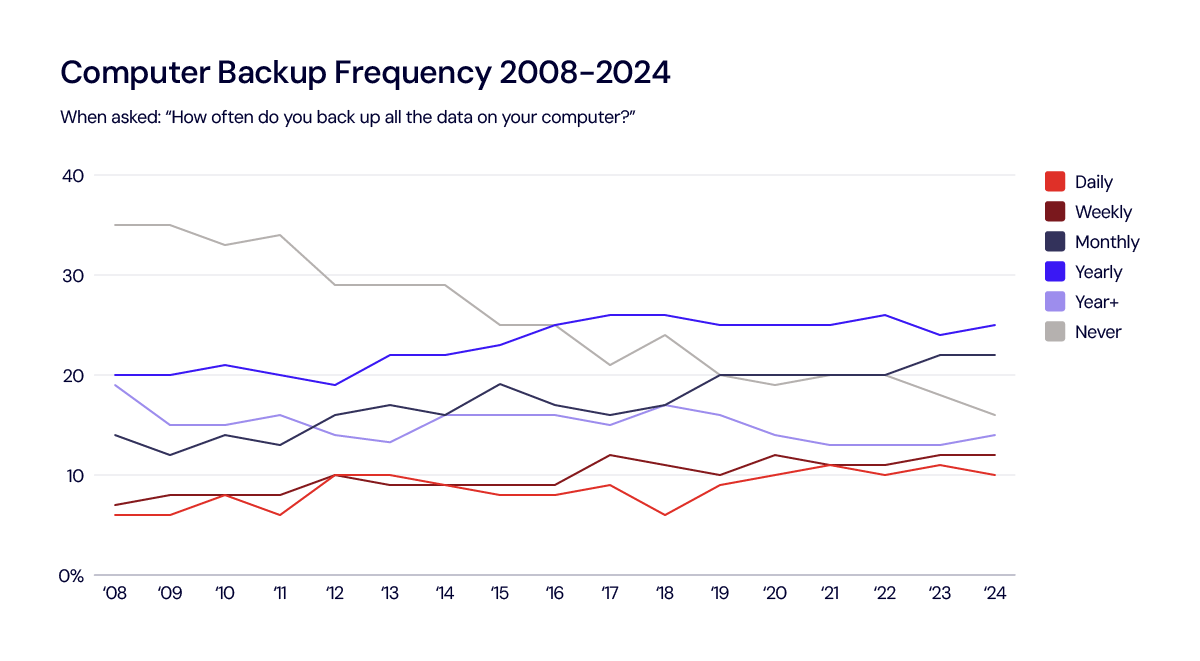
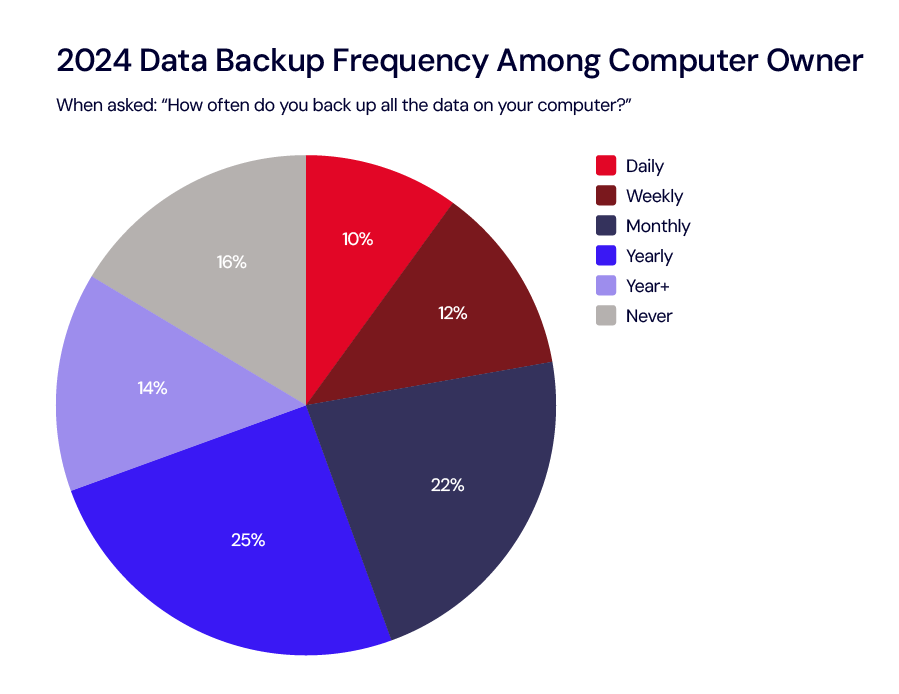
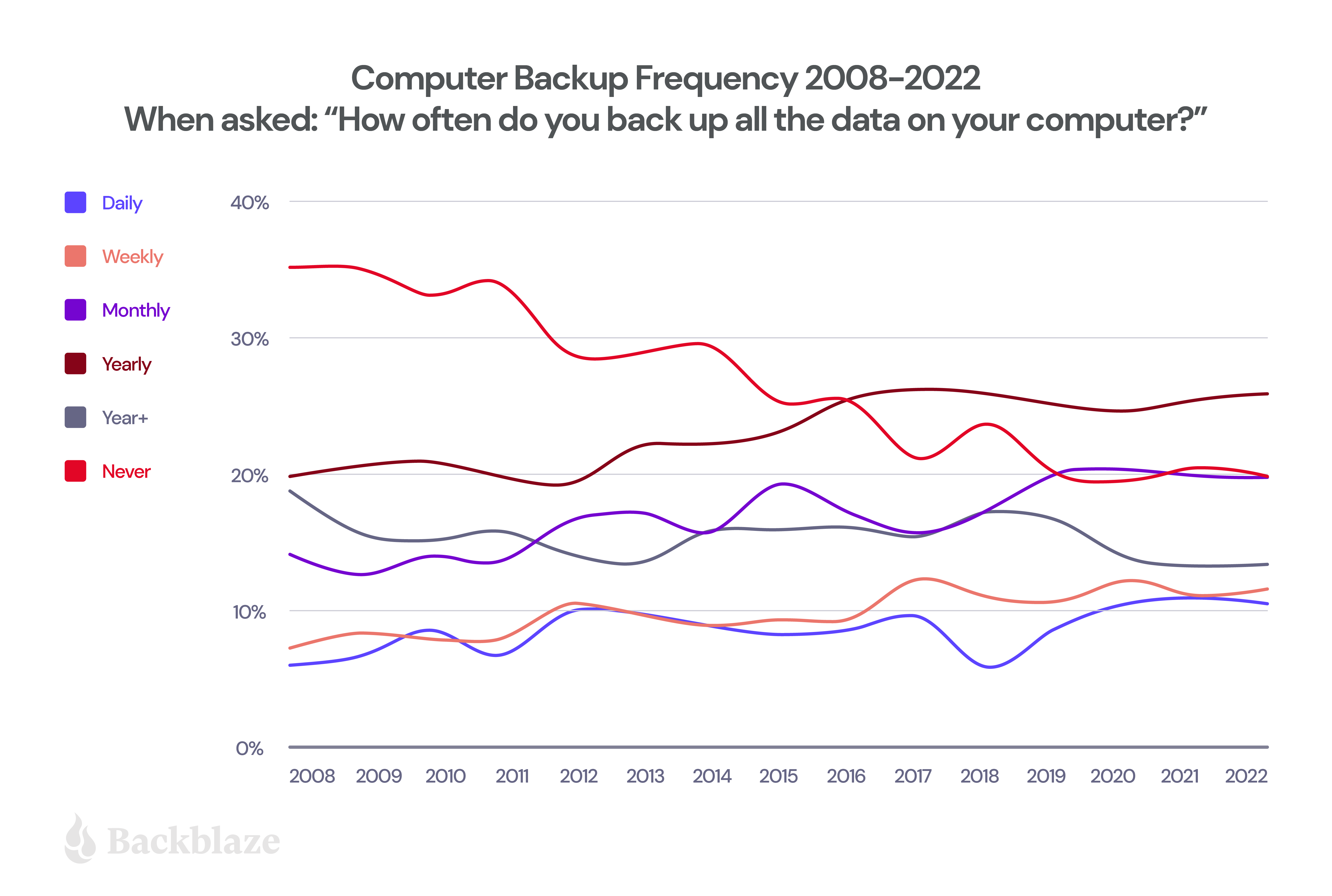
For those interested in the data over time, let’s travel back and see how this year’s data compares to previous years. The first graph is one of our favorites. Since 2023, daily backups have dipped by 1%, while weekly and monthly backups have remained steady, which is encouraging. Additionally, there is a slight, but not statistically significant, increase of 1% in yearly and more-than-yearly backups. Notably, the percentage of people who have never backed up their data has decreased by 2%. 

For all the table enthusiasts, you’ll appreciate this detailed view showcasing how 2024 compares with previous years. We love to see Never down to an all-time low, although Daily took a slight dip. 

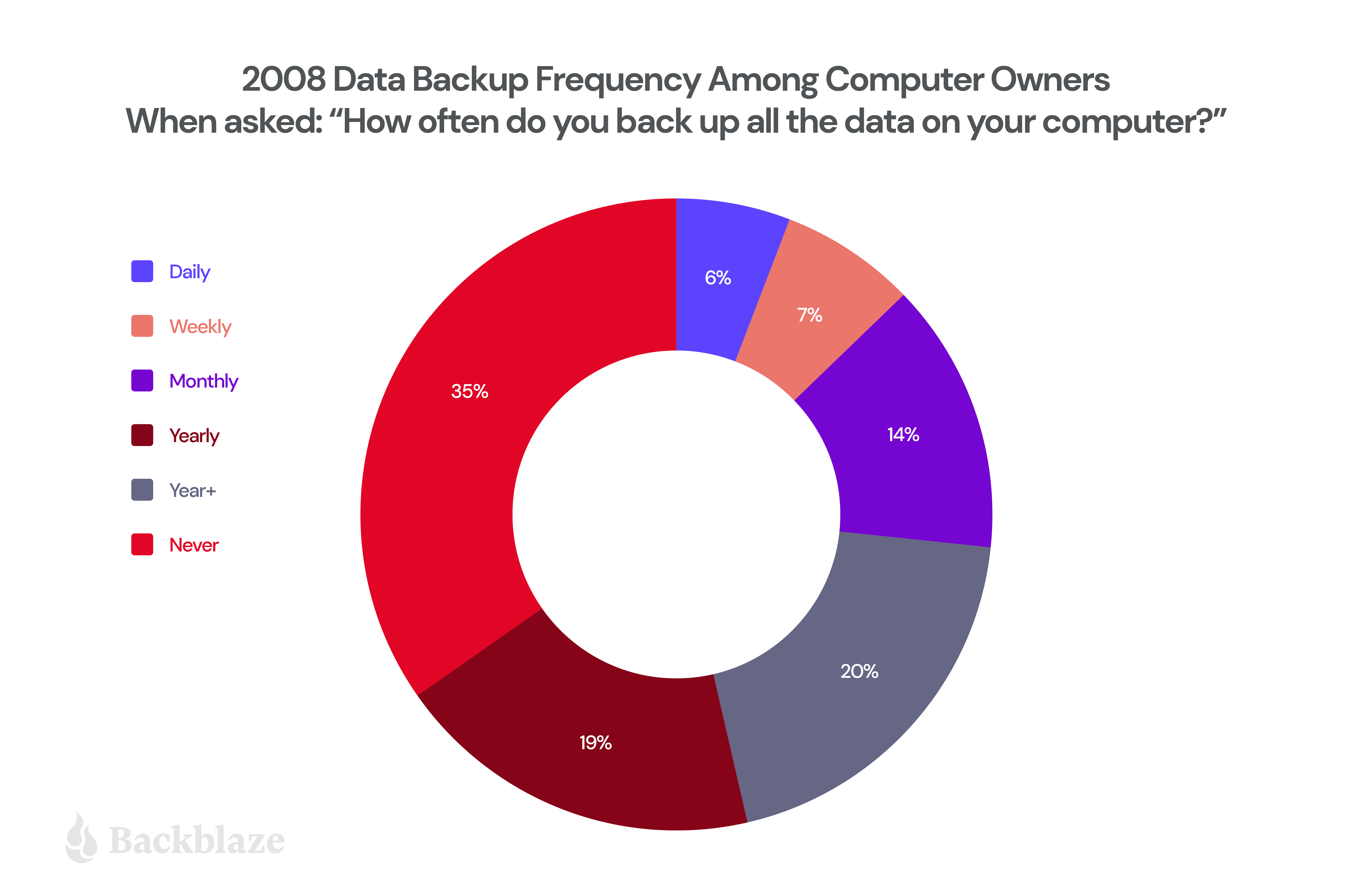
If you’re a visual person who appreciates vibrant pie charts for easier data digestion, here are pie charts comparing data from 2008 to 2024:

Within each population (business and consumer), the most striking data points are around the differences between backup and sync. Both consumers and businesses are leveraging cloud drive and sync services for ease of use, but that has not translated to successful data recoveries. With ransomware attacks on the rise, now more than ever, it’s essential to have a strong backup strategy. 

Still, we’ve come a long way since 2008, and the consumer data shows positive change over time around backup awareness and tool adoption. Going forward, we’ll be interested to see how the business audience data changes over time. See below for our full testing methodology, and, as always, drop us a line in the comment section if you have any questions or insights.

Consumer Survey Method:

This survey was conducted online within the United States by The Harris Poll on behalf of Backblaze from April 25-29, 2024, among 2,058 adults ages 18 and older, among whom 1,877 own a computer. The sampling precision of Harris online polls is measured by using a Bayesian credible interval.  For this study, the sample data is accurate to within +/- 2.5 percentage points using a 95% confidence level.

Prior year’s surveys were conducted online by The Harris Poll on behalf of Backblaze among U.S. adults ages 18+ who own a computer in April 25–27, 2023 (n=1,857) May 19–23, 2022 (n=1,861); May 12–14, 2021 (n=1,870); June 1–3, 2020 (n=1,913); June 6–10, 2019 (n=1,858); June 5–7, 2018 (n=1,871); May 19–23, 2017 (n=1,954); May 13–17, 2016 (n=1,920); May 15–19, 2015 (n=2,009); June 2-4, 2014 (n=1,991); June 13–17, 2013 (n=1,952); May 31–June 4, 2012 (n=2,176); June 28–30, 2011 (n=2,209); June 3–7, 2010 (n=2,051); May 13–14, 2009 (n=2,154); and May 27–29, 2008 (n=2,723).

Business Backup Survey Method:

This survey was conducted online within the United States by The Harris Poll on behalf of Backblaze from April 30 – May 8, 2024, among 300 IT Decision Makers. The sampling precision of Harris online polls is measured by using a Bayesian credible interval.  For this study, the sample data is accurate to within +/- 5.7 percentage points using a 95% confidence level.

For complete survey methodologies, including weighting variables and subgroup sample sizes, please contact Backblaze.

The post 2024 State of the Backup: Survey Says Security Incidents and Data Loss on the Rise appeared first on Backblaze Blog | Cloud Storage & Cloud Backup

The 2022 Backup Survey: 54% Report Data Loss With Only 10% Backing Up Daily

Post Syndicated from original https://www.backblaze.com/blog/the-2022-backup-survey-54-report-data-loss-with-only-10-backing-up-daily/

Every June, for Backup Awareness Month, we work with The Harris Poll to gauge the state of backups in the U.S. This is the 14th year of that survey, where we ask simply: “How often do you back up all the data on your computer?”

On occasion, we’ll throw some additional questions into the mix as well, and this year we focused on the confusion we often see between sync and backup services, along with respondents’ history of data loss. The backup frequency results of this year’s survey show that trends are holding pretty steady, but the rest of the results…very interesting!

First Things First: Are YOU Backing Up?

If you’re not backing up, start now and increase the stats for 2023.
 
➔ Sign Up Today

How Backup Frequency Is Trending in 2022

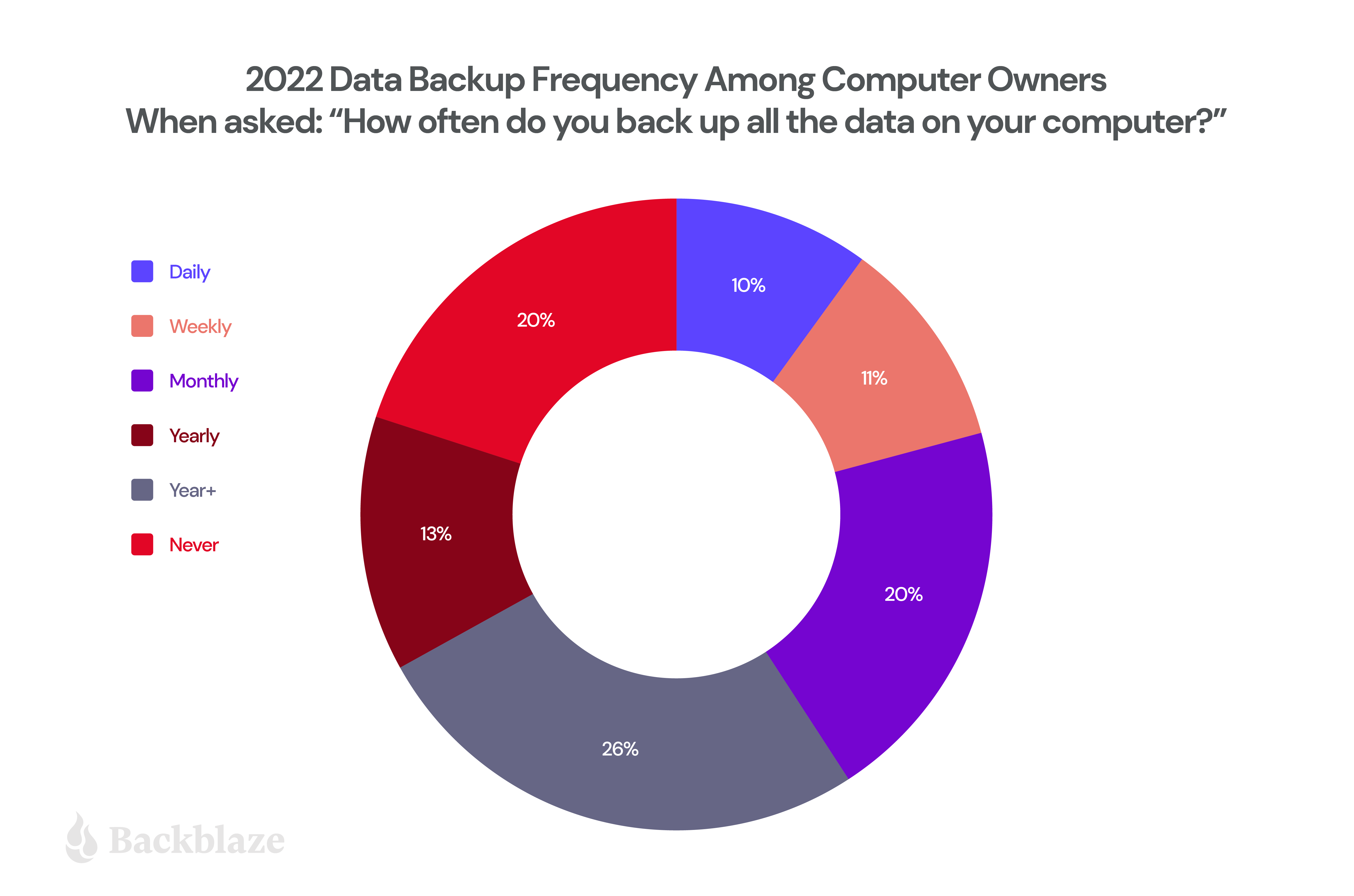
When looking solely at backup frequency, the results are mostly neutral this year when compared to 2021. We see a slight 1% increase in computer owners that are backing up on a yearly basis, but that same 1% decrease in those that are backing up daily. The rest of the results were pretty consistent from year to year.

The main issue we’re seeing here is that the number of computer owners who have never backed up their computer appears to have stopped decreasing, meaning that about 20% of people are still at risk of losing all of their data in the event of a computer crash or loss.

Results are among computer owners.

Some people aren’t into reading charts, so we also have this handy table:

Results are among computer owners.

If you’re not a fan of tables, but do like pie, here’s a comparison of the 2022 data compared to when we first started in 2008:


It’s nice to see the mix changing so much over time, especially with the “never” category fading. While the number of daily backups is still not anywhere close to where we’d like it, the data indicates that:

Overall, computer owners are backing up more frequently than a decade ago. However, as our astute readers know, the longer you go without creating a backup, the more data you are prone to losing should disaster strike.

Who’s “Best” at Backing Up?

Last year, we pored through the data to try and build a “profile” of the person who was most likely to be a “backer upper,” which we had defined as a person who owns a computer and backs it up at least once a day. What we found is that we were looking for:

  • A woman between 35-44 years of age (21% likely to back up versus 9% of those 18-34 and 6% of those 55-64)…
  • Who lives in the Western United States (17% more likely to back up vs. the South and Midwest at 9% and 7%, respectively)…
  • With a household income of over $100K (13% likely to back up their data versus those households of $50K-$74.9K which are at 6%).

Has that changed over the last year? Well, in 2022, the data suggest no statistically significant deviations that we can pull out, so maybe that’s good news across the spectrum?

Is Confusion a Cause for Concern?

While the number of people backing up at least once is good, we think there might still be some confusion in the world about how exactly they are backing up their data and what is getting backed up. We wanted to dive a bit deeper. When looking at the Americans who own a computer:

  • 80% backed up all the data on that computer at least once.
    • 41% of those folks fully back it up once a month or more often.
  • 57% who have ever backed up use a “cloud-based” system as their primary backup.
  • 12% of computer owners use a cloud backup service like Backblaze as their primary backup, and among those who do:
    • 52% say their service automatically backs up all the data on their computer.
    • 25% say it backs up only the data they select with no limitations.
    • 9% say it backs up only the data they select but with some limits.
    • 3% marked “other” and more concerningly…
    • 10% are not sure at all.

    With 57% of computer owners using “the cloud” to back up their data, but only 12% of those using a cloud backup service, we’re left to wonder, what are the others using? In many cases, it’s a cloud drive or cloud sync service which may not actually be performing basic automated backup tasks.

    Refresher: Backup vs. Sync

    We’ve often discussed the differences between sync and backup—how both of them are useful tools, but very different. While sync services are great for collaborating on and sharing data, they are not true backup services in that they’re typically not automated, and don’t provide the same level of protection as dedicated backup services can. And, be careful about only having data in one location—44% lost access to their data when a shared or synced drive was deleted. For more information, read our cloud backup vs. cloud sync blog post!

    Even of those using a proper cloud backup solution, 48% may not be backing up all their data, and 10% of folks aren’t sure at all what their cloud backup service is doing. Yikes.

    We then asked those who use one of the listed backups (i.e., “the cloud,” external hard drive, or NAS) about their confidence level that the service they use is set up to protect all the data on their computer, and 61% of people were not very confident. The numbers are broken down below:

    • 39% were very confident.
    • 48% were somewhat confident.
    • 13% were not at all or not very confident.

    That’s not a ton of confidence, and maybe now is a good time to remind folks to check their backups and to test a restore!

    Why Is Backing Up Important?

    This year’s survey results continue to show us that having a good backup strategy in place, whether for a business or an individual, is a great way to mitigate against different data disasters. Especially when you consider that of Americans who own a computer:

    • 67% report accidentally deleting something.
    • 54% report having lost data.
    • 53% were affected by a security incident.
    • 48% had an external hard drive crash.
      • 21% of those crashes have happened in the last year.
    • 44% lost access to their data when a shared drive or synced drive was deleted.

    External hard drives are a great local backup method, and we recommend them when we discuss having a 3-2-1 backup strategy, but as our own Hard Drive Stats indicate, even in our professional environment, they do fail. And with 48% of computer owners reporting that they experienced a similar failure on their home device, it underscores the importance of having an off-site backup like Backblaze, just in case.

    With over half of computer owners reporting a security incident as well and ransomware on the rise, there’s never been a more appropriate time to start backing up your computer. At Backblaze, we’re on a mission to make storing and using your data astonishingly easy, and we invite you to give our services a try!

    Survey Method:
    This year’s survey was conducted online within the United States by The Harris Poll on behalf of Backblaze from May 19-23, 2022, among 2,068 adults ages 18+, among whom 1,861 own a computer. The sampling precision of Harris online polls is measured by using a Bayesian credible interval. For this study, the sample data is accurate to within +2.8 percentage points using a 95% confidence level.

    Prior year’s surveys were conducted online by The Harris Poll on behalf of Backblaze among U.S. adults ages 18+ who own a computer in May 12-14, 2021 (n=1,870); June 1-3, 2020 (n=1,913); June 6-10, 2019 (n=1,858); June 5-7, 2018 (n=1,871); May 19-23, 2017 (n=1,954); May 13-17, 2016 (n=1,920); May 15-19, 2015 (n=2,009); June 2-4, 2014 (n=1,991); June 13–17, 2013 (n=1,952); May 31–June 4, 2012 (n=2,176); June 28–30, 2011 (n=2,209); June 3–7, 2010 (n=2,051); May 13–14, 2009 (n=2,154); and May 27–29, 2008 (n=2,723).

    For complete survey methodologies, including weighting variables and subgroup sample sizes, please contact Backblaze.

    The post The 2022 Backup Survey: 54% Report Data Loss With Only 10% Backing Up Daily appeared first on Backblaze Blog | Cloud Storage & Cloud Backup.