Tag Archives: Cloudflare Stream

Real-Time Communications at Scale

Post Syndicated from Matt Silverlock original https://blog.cloudflare.com/announcing-our-real-time-communications-platform/

Real-Time Communications at Scale

Real-Time Communications at Scale

For every successful technology, there is a moment where its time comes. Something happens, usually external, to catalyze it — shifting it from being a good idea with promise, to a reality that we can’t imagine living without. Perhaps the best recent example was what happened to the cloud as a result of the introduction of the iPhone in 2007. Smartphones created a huge addressable market for small developers; and even big developers found their customer base could explode in a way that they couldn’t handle without access to public cloud infrastructure. Both wanted to be able to focus on building amazing applications, without having to worry about what lay underneath.

Last year, during the outbreak of COVID-19, a similar moment happened to real time communication. Being able to communicate is the lifeblood of any organization. Before 2020, much of it happened in meeting rooms in offices all around the world. But in March last year — that changed dramatically. Those meeting rooms suddenly were emptied. Fast-forward 18 months, and that massive shift in how we work has persisted.

While, undoubtedly, many organizations would not have been able to get by without the likes of Slack, Zoom and Teams as real time collaboration tools, we think today’s iteration of communication tools is just the tip of the iceberg. Looking around, it’s hard to escape the feeling there is going to be an explosion in innovation that is about to take place to enable organizations to communicate in a remote, or at least hybrid, world.

With this in mind, today we’re excited to be introducing Cloudflare’s Real Time Communications platform. This is a new suite of products designed to help you build the next generation of real-time, interactive applications. Whether it’s one-to-one video calling, group audio or video-conferencing, the demand for real-time communications only continues to grow.

Running a reliable and scalable real-time communications platform requires building out a large-scale network. You need to get your network edge within milliseconds of your users in multiple geographies to make sure everyone can always connect with low latency, low packet loss and low jitter. A backbone to route around Internet traffic jams. Infrastructure that can efficiently scale to serve thousands of participants at once. And then you need to deploy media servers, write business logic, manage multiple client platforms, and keep it all running smoothly. We think we can help with this.

Launching today, you will be able to leverage Cloudflare’s global edge network to improve connectivity for any existing WebRTC-based video and audio application, with what we’re calling “WebRTC Components”.  This includes scaling to (tens of) thousands of participants, leveraging our DDoS mitigation to protect your services from attacks, and enforce IP and ASN-based access policies in just a few clicks.

How Real Time is “Real Time”?

Real-time typically refers to communication that happens in under 500ms: that is, as fast as packets can traverse the fibre optic networks that connect the world together. In 2021, most real-time audio and video applications use WebRTC, a set of open standards and browser APIs that define how to connect, secure, and transfer both media and data over UDP. It was designed to bring better, more flexible bi-directional communication when compared to the primary browser-based communication protocol we rely on today, HTTP. And because WebRTC is supported in the browser, it means that users don’t need custom clients, nor do developers need to build them: all they need is a browser.

Importantly, we’ve seen the need for reliable, real-time communication across time-zones and geographies increase dramatically, as organizations change the way they work (yes, including us).

So where is real-time important in practice?

  • One-to-one calls (think FaceTime). We’re used to almost instantaneous communication over traditional telephone lines, and there’s no reason for us to head backwards.
  • Group calling and conferencing (Zoom or Google Meet), where even just a few seconds of delay results in everyone talking over each other.
  • Social video, gaming and sports. You don’t want to be 10 seconds behind the action or miss that key moment in a game because the stream dropped a few frames or decided to buffer.
  • Interactive applications: from 3D modeling in the browser, Augmented Reality on your phone, and even game streaming need to be in real-time.

We believe that we’ve only collectively scratched the surface when it comes to real-time applications — and part of that is because scaling real-time applications to even thousands of users requires new infrastructure paradigms and demands more from the network than traditional HTTP-based communication.

Enter: WebRTC Components

Today, we’re launching our closed beta WebRTC Components, allowing teams running centralized WebRTC TURN servers to offload it to Cloudflare’s distributed, global network and improve reliability, scale to more users, and spend less time managing infrastructure.

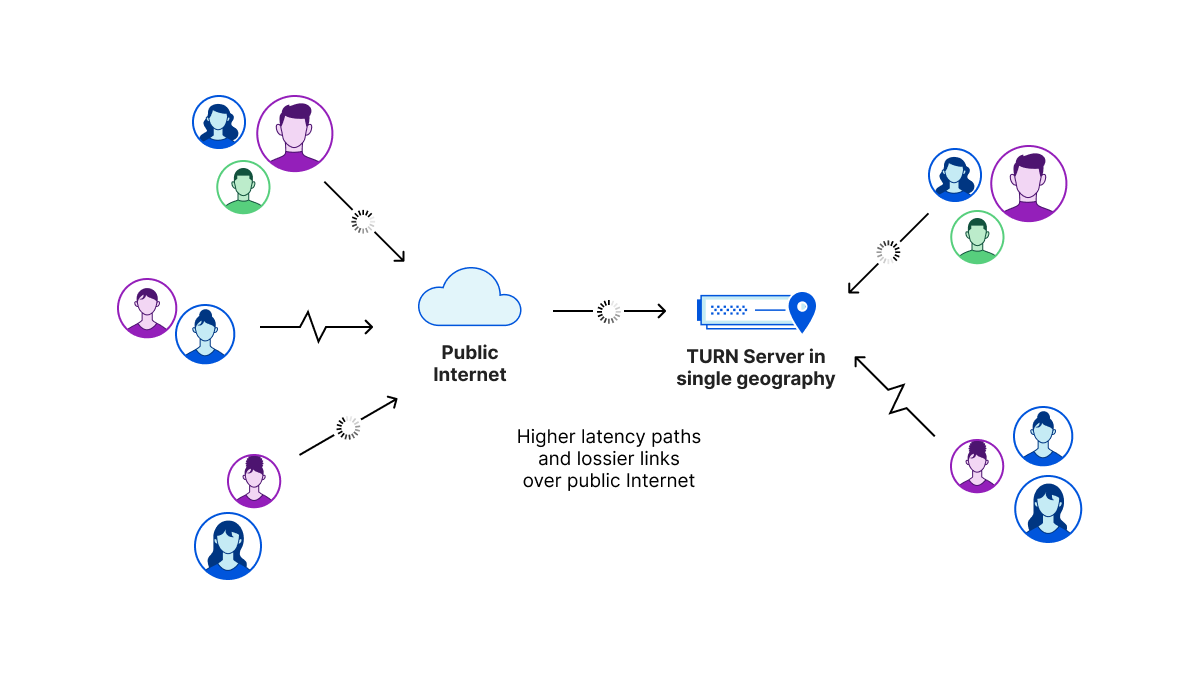
TURN, or Traversal Using Relays Around NAT (Network Address Translation), was designed to navigate the practical shortcomings of WebRTC’s peer-to-peer origins. WebRTC was (and is!) a peer-to-peer technology, but in practice, establishing reliable peer-to-peer connections remains hard due to Carrier-Grade NAT, corporate NATs and firewalls. Further, each peer is limited by its own network connectivity — in a traditional peer-to-peer mesh, participants can quickly find their network connections saturated because they have to receive data from every other peer. In a mixed environment with different devices (mobile, desktops), networks (high-latency 3G through to fast fiber), scaling to more than a handful of peers becomes extremely challenging.

Real-Time Communications at Scale

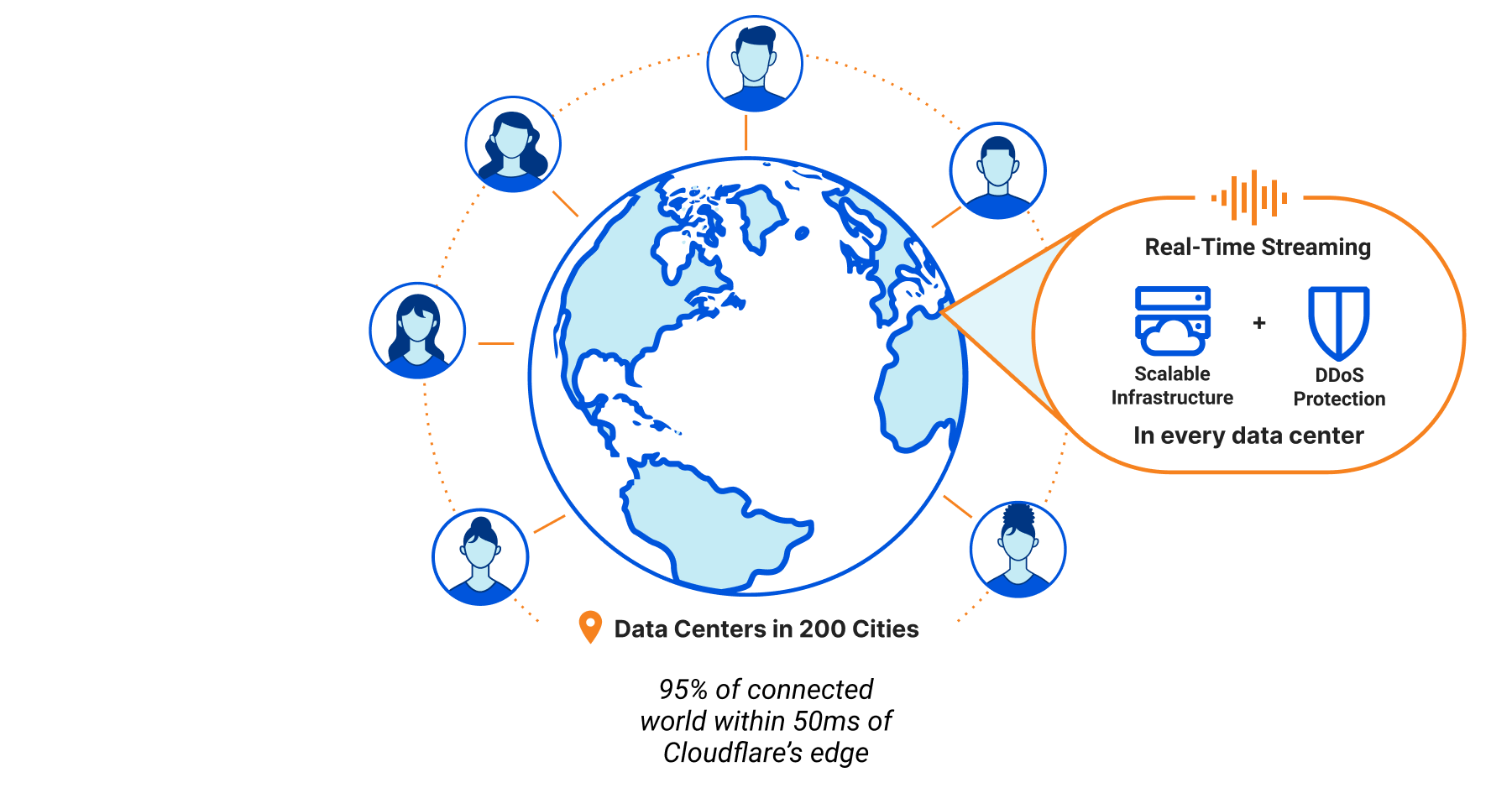
Running a TURN service at the edge instead of your own infrastructure gets you a better connection. Cloudflare operates an anycast network spanning 250+ cities, meaning we’re very close to wherever your users are. This means that when users connect to Cloudflare’s TURN service, they get a really good connection to the Cloudflare network. Once it’s on there, we leverage our network and private backbone to get you superior connectivity, all the way back to the other user on the call.

But even better: stop worrying about scale. WebRTC infrastructure is notoriously difficult to scale: you need to make sure you have the right capacity in the right location. Cloudflare’s TURN service scales automatically and if you want more endpoints they’re just an API call away.

Real-Time Communications at Scale

Of course WebRTC Components is built on the Cloudflare network, benefiting from the DDoS protection that it’s 100 Tbps network offers. From now on deploying scalable, secure, production-grade WebRTC relays globally is only a couple of API calls away.

A Developer First Real-Time Platform

But, as we like to say at Cloudflare: we’re just getting started. Managed, scalable TURN infrastructure is a critical building block to building real-time services for one-to-one and small group calling, especially for teams who have been managing their own infrastructure, but things become rapidly more complex when you start adding more participants.

Whether that’s managing the quality of the streams (“tracks”, in WebRTC parlance) each client is sending and receiving to keep call quality up, permissions systems to determine who can speak or broadcast in large-scale events, and/or building signalling infrastructure with support chat and interactivity on top of the media experience, one thing is clear: it there’s a lot to bite off.

With that in mind, here’s a sneak peek at where we’re headed:

  • Developer-first APIs that abstract the need to manage and configure low-level infrastructure, authentication, authorization and participant permissions. Think in terms of your participants, rooms and channels, without having to learn the intricacies of ICE, peer connections and media tracks.
  • Integration with Cloudflare for Teams to support organizational access policies: great for when your company town hall meetings are now conducted remotely.
  • Making it easy to connect any input and output source, including broadcasting to traditional HTTP streaming clients and recording for on-demand playback with Stream Live, and ingesting from RTMP sources with Stream Connect, or future protocols such as WHIP.
  • Embedded serverless capabilities via Cloudflare Workers, from triggering Workers on participant events (e.g. join, leave) through to building stateful chat and collaboration tools with Durable Objects and WebSockets.

… and this is just the beginning.

We’re also looking for ambitious engineers who want to play a role in building our RTC platform. If you’re an engineer interested in building the next generation of real-time, interactive applications, join us!

If you’re interested in working with us to help connect more of the world together, and are struggling with scaling your existing 1-to-1 real-time video & audio platform beyond a few hundred or thousand concurrent users, sign up for the closed beta of WebRTC Components. We’re especially interested in partnering with teams at the beginning of their real-time journeys and who are keen to iterate closely with us.

Serverless Live Streaming with Cloudflare Stream

Post Syndicated from Zaid Farooqui original https://blog.cloudflare.com/stream-live/

Serverless Live Streaming with Cloudflare Stream

Serverless Live Streaming with Cloudflare Stream

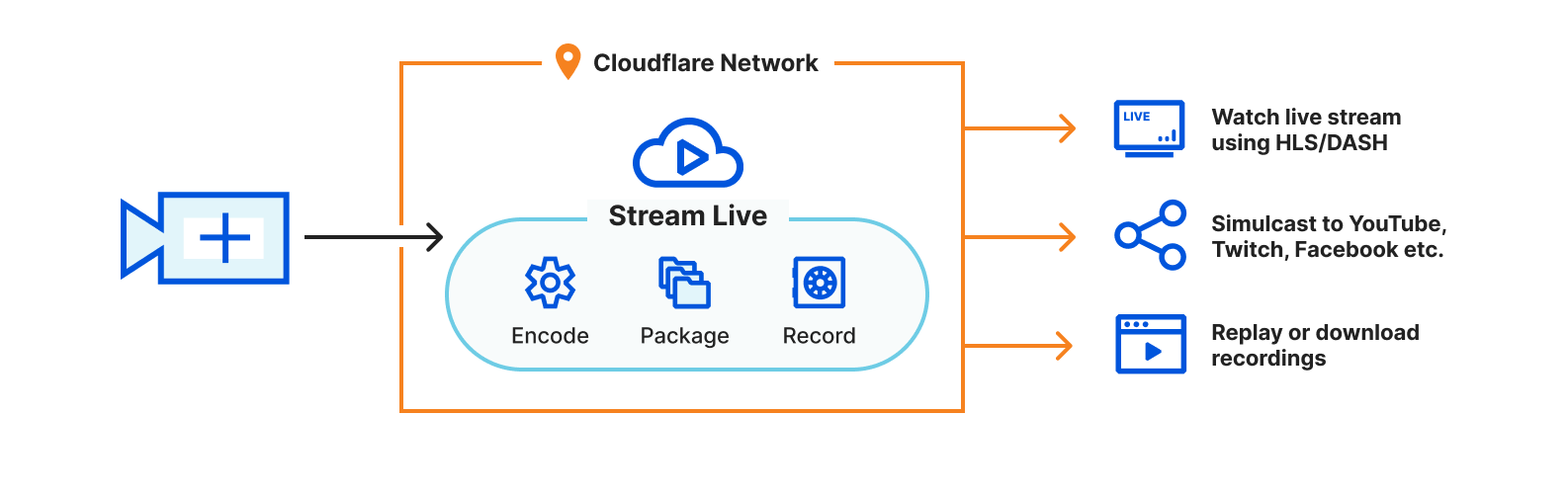
We’re excited to introduce the open beta of Stream Live, an end-to-end scalable live-streaming platform that allows you to focus on growing your live video apps, not your codebase.

With Stream Live, you can painlessly grow your streaming app to scale to millions of concurrent broadcasters and millions of concurrent users. Start sending live video from mobile or desktop using the industry standard RTMPS protocol to millions of viewers instantly. Stream Live works with the most popular live video broadcasting software you already use, including ffmpeg, OBS or Zoom. Your broadcasts are automatically recorded, optimized and delivered using the Stream player.

When you are building your live infrastructure from scratch, you have to answer a few critical questions:

  1. Which codec(s) are we going to use to encode the videos?”
  2. “Which protocols are we going to use to ingest and deliver videos?”
  3. “How are the different components going to impact latency?”

We built Stream Live, so you don’t have to think about these questions and spend considerable engineering effort answering them. Stream Live abstracts these pesky yet important implementation details by automatically choosing the most compatible codec and streaming protocol for the client device. There is no limit to the number of live broadcasts you can start and viewers you can have on Stream Live. Whether you want to make the next viral video sharing app or securely broadcast all-hands meetings to your company, Stream will scale with you without having to spend months building and maintaining video infrastructure.

Built-in Player and Access Control

Every live video gets an embed code that can be placed inside your app, enabling your users to watch the live stream. You can also use your own player with included support for the two major HTTP streaming formats — HLS and DASH — for a granular control over the user experience.

You can limit who can view your live videos with self-expiring tokenized links for each viewer. When generating the tokenized links, you can define constraints including time-based expiration, geo-fencing and IP restrictions. When building an online learning site or a video sharing app, you can put videos behind authentication, so only logged-in users can view your videos. Or if you are building a live concert platform, you may have agreements to only allow viewers from specific countries or regions. Stream’s signed tokens help you comply with complex and custom rulesets.

Instant Recordings

With Stream Live, you don’t have to wait for a recording to be available after the live broadcast ends. Live videos automatically get converted to recordings in less than a second. Viewers get access to the recording instantly, allowing them to catch up on what they missed.

Instant Scale

Whether your platform has one active broadcaster or ten thousand, Stream Live scales with your use case. You don’t have to worry about adding new compute instances, setting up availability zones or negotiating additional software licenses.

Legacy live video pipelines built in-house typically ingest and encode the live stream continents away in a single location. Video that is ingested far away makes video streaming unreliable, especially for global audiences. All Cloudflare locations run the necessary software to ingest live video in and deliver video out. Once your video broadcast is in the Cloudflare network, Stream Live uses the Cloudflare backbone and Argo to transmit your live video with increased reliability.

Serverless Live Streaming with Cloudflare Stream

Broadcast with 15 second latency

Depending on your video encoder settings, the time between you broadcasting and the video displaying on your viewer’s screens can be as low as fifteen seconds with Stream Live. Low latency allows you to build interactive features such as chat and Q&A into your application. This latency is good for broadcasting meetings, sports, concerts, and worship, but we know it doesn’t cover all uses for live video.

We’re on a mission to reduce the latency Stream Live adds to near-zero. The Cloudflare network is now within 50ms for 95% of the world’s population. We believe we can significantly reduce the delay from the broadcaster to the viewer in the coming months. Finally, in the world of live-streaming, latency is only meaningful once you can assume reliability. By using the Cloudflare network spanning over 250 locations, you get unparalleled reliability that is critical for live events.

Simple and predictable pricing

Stream Live is available as a pay-as-you-go service based on the duration of videos recorded and duration of video viewed.

  • It costs $5 per 1,000 minutes of video storage capacity per month. Live-streamed videos are automatically recorded. There is no additional cost for ingesting the live stream.
  • It costs $1 per 1,000 minutes of video viewed.
  • There are no surprises. You never have to pay hidden costs for video ingest, compute (encoding), egress or storage found in legacy video pipelines.
  • You can control how much you spend with Stream using billing alerts and restrict viewing by creating signed tokens that only work for authorized viewers.

Cloudflare Stream encodes the live stream in multiple quality levels at no additional cost. This ensures smooth playback for your viewers with varying Internet speed. As your viewers move from Wi-Fi to mobile networks, videos continue playing without interruption. Other platforms that offer live-streaming infrastructure tend to add extra fees for adding quality levels that caters to a global audience.

If your use case consists of thousands of concurrent broadcasters or millions of concurrent viewers, reach out to us for volume pricing.

Go live with Stream

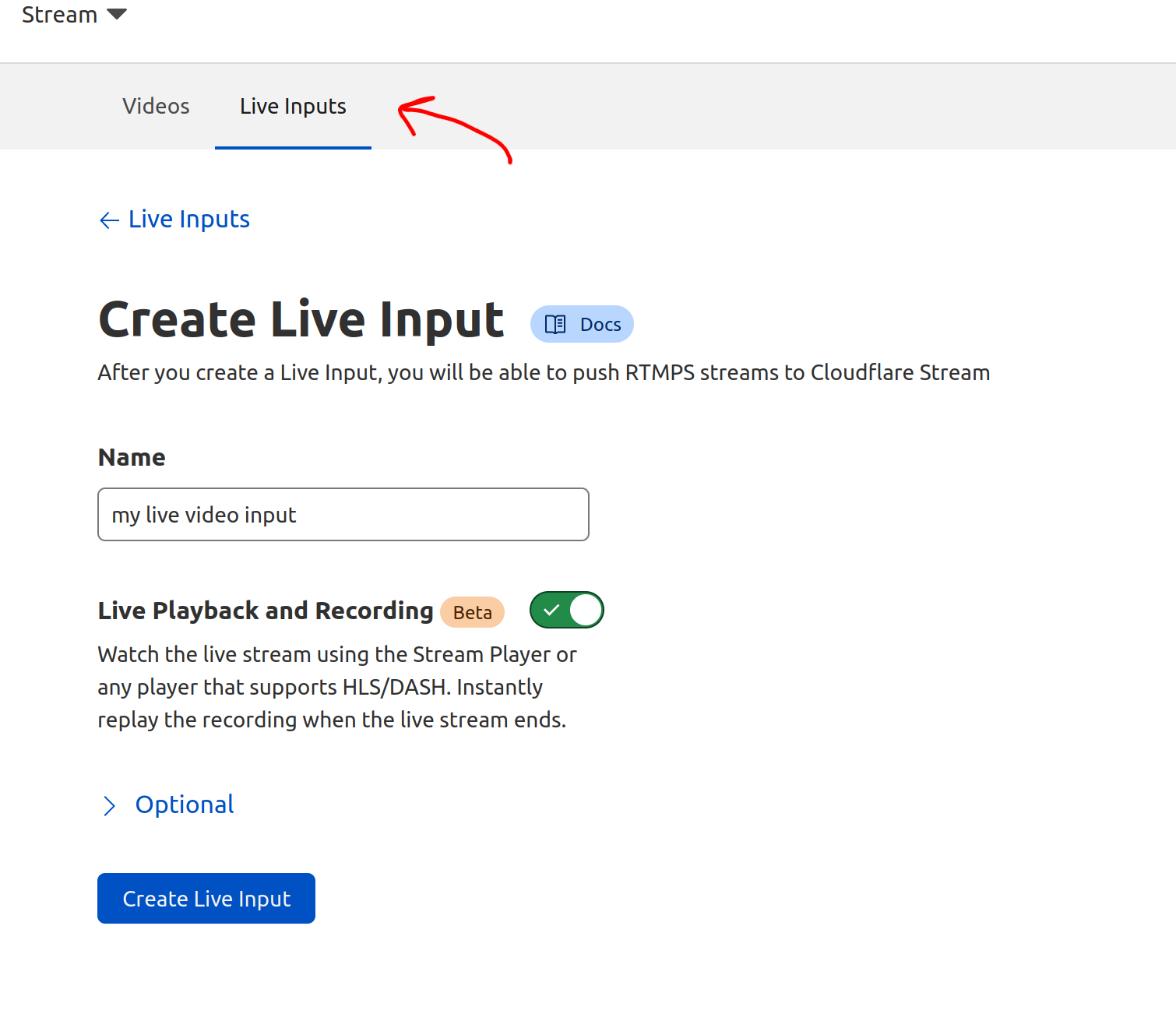
Stream works independent of any domain on Cloudflare. If you already have a Cloudflare account with a Stream subscription, you can begin using Stream Live by clicking on the “Live Input” tab on the Stream Dashboard and creating a new input:

Serverless Live Streaming with Cloudflare Stream

If you are new to Cloudflare, sign up for Cloudflare Stream.

Announcing Cloudflare TV as a Service

Post Syndicated from Fallon Blossom original https://blog.cloudflare.com/cloudflare-tv-as-a-service/

Announcing Cloudflare TV as a Service

Announcing Cloudflare TV as a Service

In June 2020, Cloudflare TV made its debut: a 24/7 streaming video channel, focused on topics related to building a better Internet (and the people working toward that goal). Today, over 1,000 live shows later, we’re excited to announce that we’re making the technology we used to build Cloudflare TV available to any other business that wants to run their own 24×7 streaming network. But, before we get to that, it’s worth reflecting on what it’s been like for us to run one ourselves.

Let’s take it from the top.

Cloudflare TV began as an experiment in every way you could think of, one we hoped would help capture the serendipity of in-person events in a world where those were few and far between. It didn’t take long before we realized we had something special on our hands. Not only was the Cloudflare team thriving on-screen, showcasing an amazing array of talent and expertise — they were having a great time doing it. Cloudflare TV became a virtual watercooler, spiked with the adrenaline rush of live TV.

One of the amazing things about Cloudflare TV has been the breadth of content it’s inspired. Since launching, CFTV has hosted over 1,000 live sessions, featuring everything from marquee customer events with VIP speakers to game shows and DJ sets. Cloudflare’s employee resource groups have hosted hundreds of sessions speaking to their unique experiences, sharing a wealth of advice with the next generation of technology leaders. All told, we’ve welcomed over 650 Cloudflare employees and interns — and over 500 external guests, including the likes of Intel CEO Pat Gelsinger, Gradient Ventures board partner Bonita Stewart, Broadcom CTO Andy Nallappan, and Zendesk SVP Christina Liu.

Tune In, Geek Out: A CFTV Montage

This is Cloudflare TV, so of course we put an emphasis on technical content for viewers of all stripes. When we announce a new product or protocol on the Cloudflare Blog, we often host live sessions on CFTV the same day, featuring the engineers who wrote the code that just shipped. Every week, we broadcast episodes on cryptography, on learning how to code, and on the hardware that powers Cloudflare’s network in over 250 cities around the world.

Whether you’re new to Cloudflare TV or a longtime viewer, we encourage you to pay a visit to the just-launched Discover page, where you’ll find many of our most-loved shows on demand, ranging from Latest from Product and Engineering, to perennial favorite Silicon Valley Squares, to Yes We Can, featuring women leaders from across the tech industry. You can also browse upcoming Live segments and easily add them to your calendar.

One of the most promising indicators that we’re on the right track has been the feedback we’ve gotten, not just from viewers — but from companies eager to know which platform we were using to power CFTV. To date we haven’t had much to offer them other than our sincere thanks, but as of today we’re able to share something much more exciting.

But first: a look behind the scenes.

The Production Stack

We didn’t initially set out to build Cloudflare TV from scratch. But as we explored our available options, we quickly realized that few solutions were designed for 24/7 linear streaming, and fewer still were optimized to be managed by a globally-distributed team. Thankfully, at Cloudflare, we like to build.

Our engineers worked at a blazing pace to build our own homegrown system, tapping open-source projects where we could, and inventing the things that didn’t yet exist. Among the starring components:

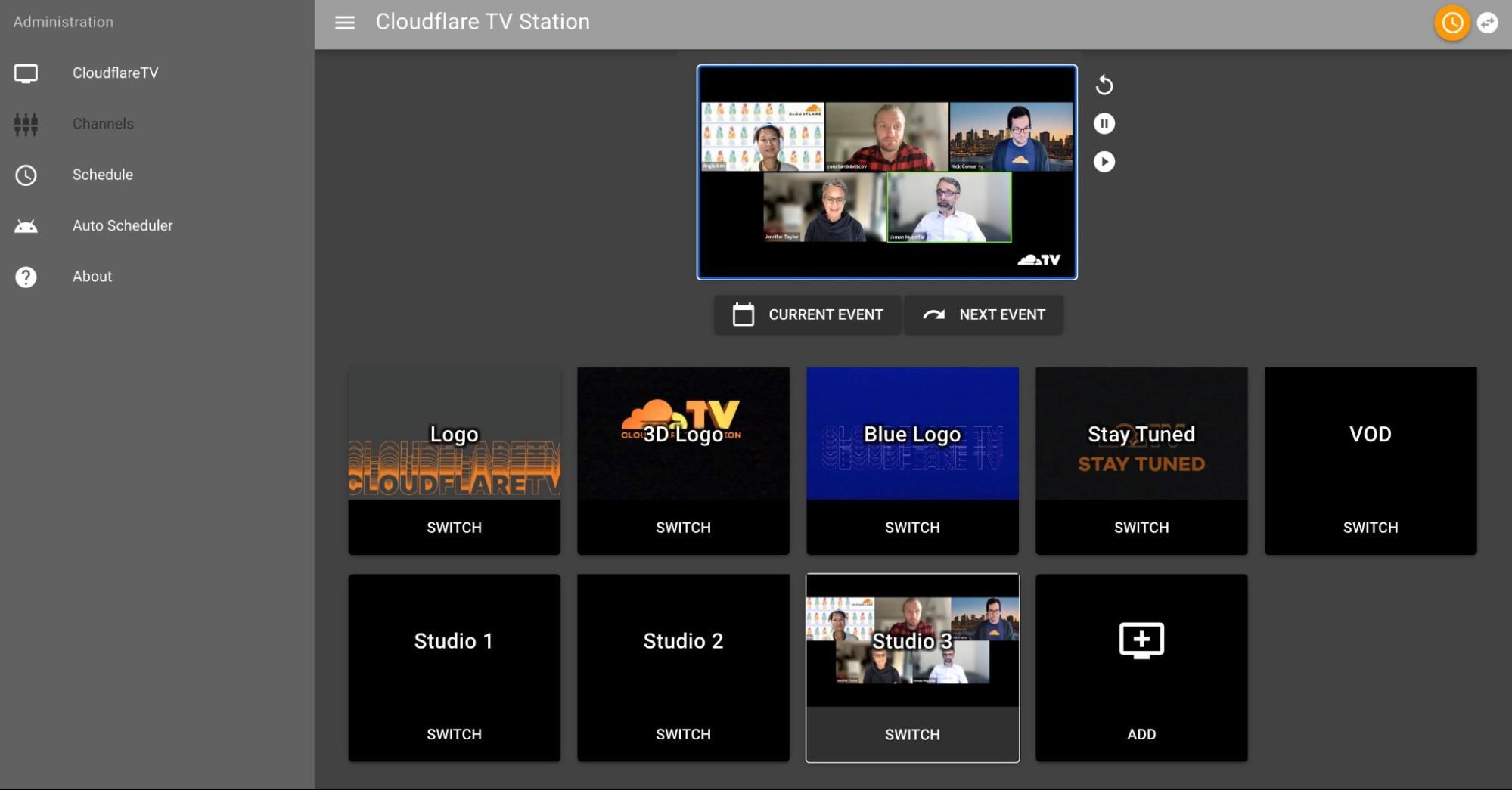
  • Brave (BBC) — Brave is an open-source project named for a highly descriptive acronym: Basic Real-Time Audio Video Editor. It serves as the Cloudflare TV switchboard, allowing us to jump from live content to commercial to a pre-recorded session and back automatically, based on our broadcast schedule. The only issue with Brave is that, as the BBC put it: it’s a prototype. One that hasn’t been updated since 2018…
Announcing Cloudflare TV as a Service
The CFTV Switchboard (Now streaming: Latest from Product & Engineering)
  • Zoom — When we first designed Cloudflare TV, there was one directive that stood above the others: it had to be easy. If presenters had to deal with installing a browser plugin or unfamiliar app, we knew we’d lose many of them — especially external guests. Zoom emerged as the clear answer, and thanks to its RTMP broadcast feature, it’s worked seamlessly to facilitate live content on Cloudflare TV. In most cases, participating in a CFTV session is as simple as joining a Zoom meeting.
  • Cloudflare Workers — Put simply, Cloudflare TV wouldn’t exist were it not for Cloudflare Workers. Workers is the glue that brings together each of the disparate components of the platform — handling authentication, application logic, securely relaying data from our backend to our frontend, and sprinkling SEO optimizations across the site. It’s the first tool we reach for, and often the only one we need.
  • Cloudflare Stream — With over 1,000 episodes in our content library, we have a lot of assets to manage. Thankfully Stream makes it easy: episodes are uploaded and automatically transcoded to the appropriate bitrate, and we use Stream embeds to power Video on Demand across the entire platform. We also use the Stream API to deliver recordings to our backend switchboard so that they can be seamlessly rebroadcast alongside our Live sessions.
  • Cloudflare for Teams — Cloudflare TV is obviously public-facing, but there are an array of dashboards and admin interfaces that are only accessible to select members of the Cloudflare team. Thankfully the Cloudflare for Teams suite, including Cloudflare Access, makes it easy for us to set up custom rulesets that keep everything secure, without any cumbersome VPNs or authentication hurdles.

We Get By With a Little Help from Our Engs

We knew from the beginning that it wasn’t enough for Cloudflare TV to be easy for presenters — we needed to be able to run it with a relatively small team, working remotely, most of whom were juggling other responsibilities.

A special shoutout goes to the members of Cloudflare’s office and executive admin teams, whose roles were dramatically impacted by the pandemic. Each of them has stepped up and taken on the mantle of Cloudflare TV Producer, providing technical support, calming nerves, and facilitating each one of our live sessions. We couldn’t do it without them, nor would we want to.

Even so, running a TV station is a lot of work, and we had little choice but to make the platform as efficient as possible — automating away our pain points, and developing intuitive admin tools to empower our team. Here are some of the key contributors to the system’s efficiency:

The Auto-Switcher — CFTV’s schedule features hundreds of sessions every week, including weekends, which would be prohibitive if any manual switching were involved. Thankfully the system operates essentially on auto-pilot. This is no simple playlist: every minute, a program running on Cloudflare Workers syncs with the CFTV backend to queue up recordings and inputs for upcoming sessions, deleting those belonging to sessions that have already aired. If we take a week off over the holidays, Cloudflare TV will keep on humming.

The Auto-Scheduler — Scheduling CFTV content by hand (well over 250 segments per week) quickly went from a meaningful exercise to a perverse task. By week two we knew we had to figure something else out. And so the auto-scheduler was born, allowing us to select an arbitrary window of time and populate it with recordings from our content library, filling in any time slots between live segments.

Segments can be dragged, dropped, added, and removed in a couple of clicks; one person can schedule the entire week in less than an hour. The auto-scheduler intelligently rotates through each episode in the catalog to ensure they all get airtime — and we see plenty of opportunities for it to get smarter.

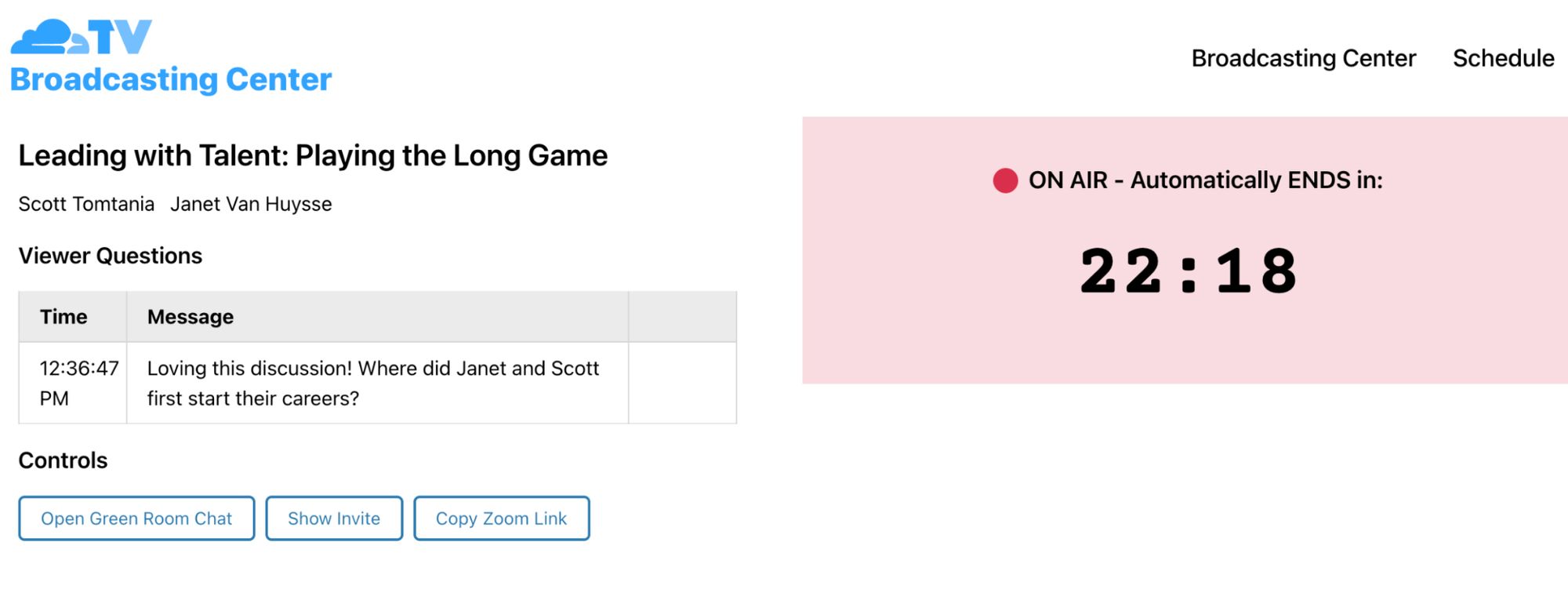
The Broadcasting Center — The lifeblood of Cloudflare TV is our live segments, so we naturally spend a lot of time trying to improve the experience for presenters. The Broadcasting Center is their home base: a page that loads automatically for each session’s host, providing them a countdown timer and other essentials. And because viewer engagement is a crucial part of what makes live programming special, it features a section for viewer questions — including a call-in feature, which records and automatically transcribes questions phoned in by viewers.

Announcing Cloudflare TV as a Service
Broadcasting Center — Presenter View

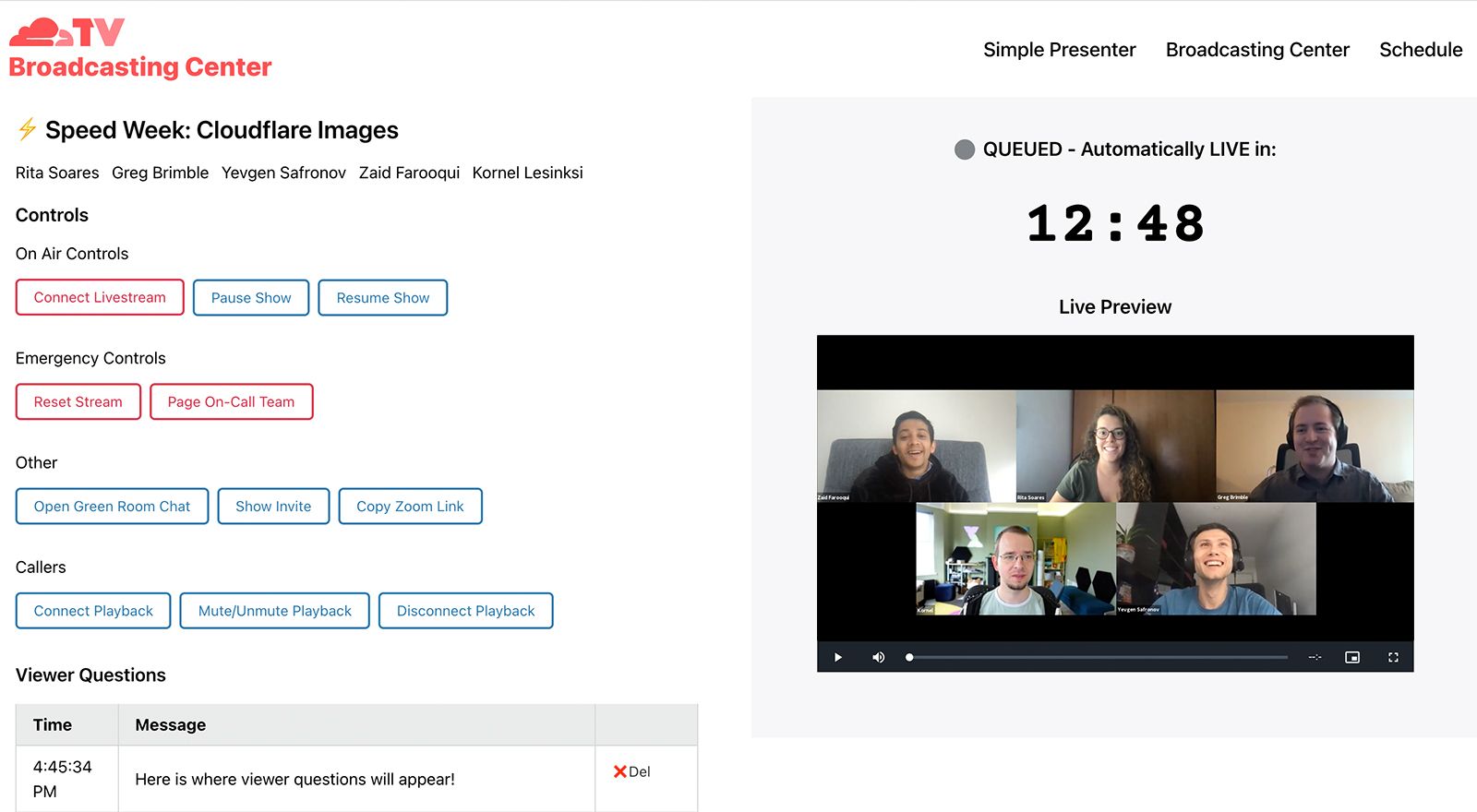
Meanwhile, our CFTV Producers use an administrative view of the same tool, where they check to make sure the stream is coming through clearly before each session begins. A set of admin controls allow them to troubleshoot if needed, and they can moderate viewer questions as well.

For both producers and presenters, the Broadcasting Center provides a single control plane to manage a live session. This ease-of-use goes a long way toward keeping the system running smoothly with a lean team.

Announcing Cloudflare TV as a Service
Broadcasting Center — Admin View

There’s a sequel? There’s a sequel.

One reason we’ve invested in Cloudflare TV is that it serves as fantastic platform for dogfooding — not only are we leveraging a broad array of Cloudflare’s media products, but our 24/7 linear content makes us a particularly demanding customer, with no appetite for arbitrary constraints like time limits or maintenance downtime.

With that in mind, we’re excited to integrate many of the new technologies Cloudflare is introducing this week, which will combine to power an overhauled version of the CFTV platform that we’re calling Cloudflare TV 2.0. Namely:

  • Real Time Communications Platform — Today, Cloudflare announced its new Real Time Communications Platform, powered by WebRTC. In the near future, Cloudflare TV will leverage this platform to handle many of our live sessions. CFTV will continue to support Zoom, OBS, and any other application capable of outputting a RTMP stream, because convenience is one of the essential pillars in helping our presenters engage with the platform. But we see opportunities to push our creativity to new heights with custom, programmatically-controlled media streams — powered by Cloudflare’s Real-Time Communications Platform.
  • Stream Live — CFTV’s backend server currently handles video encoding for our live broadcast, generating a stream that is relayed to a video.js embed. Replacing this setup with Stream Live will yield several key benefits: first, we will offload video encoding to Cloudflare’s global network, resulting in improved speed, reliability, and redundancy. It also means we’ll be able to generate multiple renditions of the broadcast at different bitrates, allowing us to offer streams that are optimized for mobile devices with limited bandwidth, and to dynamically switch between bitrates as a user’s network conditions change.
  • Stream Connect — Today, the only way to watch Cloudflare TV is from the platform’s homepage — but there’s no reason we can’t syndicate it to other popular video platforms like YouTube. Stream Connect will become the primary endpoint for our backend mixer, and will in turn generate multiple copies of that stream, outputting to YouTube, the main broadcast, and any number of additional platforms.

We’re also actively working on a fresh implementation of our switchboard — one that is designed to be more reliable, scalable, and customizable. This switchboard will power the core of Cloudflare TV 2.0.

Announcing Cloudflare TV as a Service

It’s not TV. It’s Cloudflare TV.

Cloudflare TV 2.0 will represent a major step forward for the platform, one that leverages over a year of insights as we rearchitect the system from its core to take full advantage of the Cloudflare network. And we’re doing it with you in mind: the same technology will be used to power Cloudflare TV as a Service.

Most products at Cloudflare are designed to scale from individuals up to the largest businesses. This is not one of those. Running a 24×7 streaming network takes a lot of time and effort. While we’ve made it easier than ever before, this is a product really designed for businesses that are willing to make a commitment similar to what we have at Cloudflare. But, if you are, we’re here to tell you that running a streaming service is incredibly rewarding, and we want to enable more companies to do it.

Interested? Fill out this form and, if it looks like you’d be a good fit, we’ll reach out and work with you to help build your own streaming service.

In the meantime, don’t miss out on Stream Live and the new Real Time Communications Platform. There’s no reason you can’t start building today.

The Cloudflare Startup Enterprise Plan: helping new startups bootstrap

Post Syndicated from Jade Q. Wang original https://blog.cloudflare.com/the-cloudflare-startup-enterprise-plan-helping-new-startups-bootstrap/

The Cloudflare Startup Enterprise Plan: helping new startups bootstrap

The Cloudflare Startup Enterprise Plan: helping new startups bootstrap

Early in the life of most startups, there is a time of incredible hustle, creative problem solving, and making the impossible possible through out-of-the-box thinking and elbow grease. Grizzled veterans, who have lived through those days of running on coffee and shoestring budgets, look back on that time and fascinate the newcomers with war stories of back in the day, of adventures and first wins, when they kept the lights on by sheer force of will.

To help early stage startups get going, Cloudflare is giving away one year of the Startup Enterprise plan to all early stage startups in participating accelerator programs. That early stage time is special for product development, and entrepreneurs unlock worlds of possibilities when they have advanced tools on their hands, such as the power of the Cloudflare network.

What’s included in the Startup Enterprise plan?

In addition to the core offerings in the Pro and Business plans (e.g., CDN, DNS, WAF, custom SSL cert, 50 page rules), when founders sign up for the Startup Enterprise plan they’ll get special access to:

  • Cloudflare Workers: 50 million requests / month.
    • Deploy serverless code instantly across the globe to give it exceptional performance, reliability, and scale.
  • Cloudflare for Teams: 50 seats.
    • Zero Trust security platform, unified network security as-a-service built natively into the Cloudflare network
  • Cloudflare Stream: 500K min/month; 100K minutes storage.
    • An affordable, scalable, on-demand video platform with simple, comprehensive APIs.

Additionally, when there are new Cloudflare products that are still in early access, participants on the Startup Enterprise plan can tell us about their use case for the product managers’ consideration for early access.

What startups are eligible for the Startup Enterprise plan?

To be eligible for the Startup Enterprise plan, a startup must be currently enrolled in a participating accelerator program or be a recent graduate. Additional eligibility criteria will be listed on the vendor perk info page of the accelerator program.

Get started

  • If you are a founder in a participating accelerator program, find the Cloudflare perk from your program’s vendor perk page and follow the instructions there.
  • If you are a founder in a program that is not yet a partner, drop us a line at [email protected], or ask the folks who run the vendor perk program at your accelerator program to drop us a line at [email protected].If you run or work for an accelerator program, or are friends with folks who do, do drop us a line at [email protected]. We’d love to make our tools available to your portfolio companies.

Cloudflare TV: Doing it Live, 1,000 Times and Counting

Post Syndicated from Fallon Blossom original https://blog.cloudflare.com/cloudflare-tv-live-1-000-times-and-counting/

Cloudflare TV: Doing it Live, 1,000 Times and Counting

Cloudflare TV: Doing it Live, 1,000 Times and Counting

Last week, Cloudflare TV celebrated its first anniversary the only way it knows how: with a broadcast brimming with live programming spanning everything from the keynotes of Cloudflare Connect, to a day-long virtual career fair, to our flagship game show Silicon Valley Squares.

When our co-founder and CEO Matthew Prince introduced Cloudflare TV to the world last year, he described it as a platform for experimentation. By empowering Cloudflare employees to try whatever they could think up on air — bound only by restraints of common sense — we hoped to unlock aspects of our team’s talent and creativity that otherwise might go untapped in the midst of the pandemic.

The results, as they say, have been extraordinary.

Since launching in June 2020, Cloudflare TV has featured over 1,000 original live episodes covering an incredible array of topics: technical deep dives and tutorials like Hardware at Cloudflare, Leveling up Web Performance with HTTP/3, and Hacker Time. Security expertise from top CISOs and compliance experts. In-depth policy discussions. And of course, updates on Cloudflare’s products with weekly episodes of Latest from Product and Engineering, Estas Semanas en Cloudflare en Español, and launch-day introductions to Magic WAN, Magic Firewall, Cloudflare Pages, and Stream Connect.

We’ve seen a wealth of content that can only be described as inspirational — like Vets at Cloudflare exploring the journeys of military veterans, This is What a Technologist Looks Like showcasing diversity across the industry, and Yes We Can, Cloudflare co-founder, President & COO Michelle Zatlyn’s series debunking the myth that there are no women in tech. Founder Focus has shared the stories of dozens of entrepreneurs, Between Two Clouds delves into the world of customer support, and series like Home Office TV and Cooking With Cloudflare have given an inside look at the personalities (and recipes) that make the Cloudflare community so unique.

All told, Cloudflare TV has featured well over one thousand presenters and their illustrious guests. We’ve been fortunate to welcome the likes of Eric Yuan, founder and CEO of Zoom; Cindy Cohn, Executive Director of the Electronic Frontier Foundation; John Collison, co-founder and President of Stripe; and Jackie Smalls, Chief Programs Officer at Code.org, to name a few.

We’ve also seen amazing contributions from Cloudflare’s Employee Resource Groups — including Latinflare celebrating Cinco De Mayo, Womenflare celebrating Women’s Empowerment Month, Asianflare and Desiflare celebrating APAC Heritage Month, Afroflare celebrating Black History Month (UK & US), Mindflare (supporting mental health awareness), Cloudflare’s sustainability group, Greencloud, and Proudflare, Cloudflare’s LGBTQIA+ group, which is celebrating Pride all month long.

The feedback from fans has been extraordinary. We regularly receive messages from viewers telling us how much they were inspired by a recent guest, or sharing that they leave Cloudflare TV “playing in the background all day.” You can tell they care, because they also let us know that they don’t appreciate when the commercials are louder than the program itself (we’re working on that!)

Perhaps the most meaningful impact of Cloudflare TV has been the way it’s connected the Cloudflare team. Cloudflare is growing quickly, and many team members have never set foot in a Cloudflare office. For anyone who is new to the company, Cloudflare TV has served as a way to get to know their colleagues, and vice versa. Job candidates use it to learn about the teams they aspire to work on. And we all get an excuse to talk to folks beyond the borders of our usual Zoom calls. It is, in a sense, the ultimate virtual water cooler — and the water is spiked with the adrenaline rush of live TV. It’s a potent mix that often leads to declarations of, “that was fun!”

It sure is.

Supporting such a broad array of on-air talent is no small feat, and we have an amazing production team that helps ensure every session goes smoothly (give or take). Many of our Cloudflare TV Producers have roles at Cloudflare that were radically impacted by the pandemic, including our office management and executive admin teams. Few of them had prior TV experience. But that hasn’t kept them from becoming absolutely indispensable.

Before each and every live session — all 1,000+ of them — Cloudflare TV’s producers join our hosts to make sure they have everything they need. They provide crucial technical support, soothe pre-show jitters, and deal with the myriad tiny (and not-so-tiny) emergencies that make live TV so exciting. They are television producers in every sense of the word, and they have helped make this newfangled platform a very human experience, at a time when such things matter.

Also, our engineers are pretty great too. Speaking of which…

Next Season on Cloudflare TV…

Cloudflare TV began as an experiment, and that label still applies. We’re finding creative ways to navigate our own pain points, dogfooding Cloudflare’s newest technologies, and generally trying to take advantage of the fact that this is not well-charted territory. We’ll soon share more technical details on how we run a TV station 24/7, and some of the tools we’re building along the way. Here’s an appetizer.

Our product roadmap includes many of the things you’d expect, like an easier way to find your favorite episodes, and to hear about upcoming new ones. The rainbow bars adorning this blog post will make fewer cameos on the broadcast itself. And just like any good experiment: there will be surprises.

So tune in, geek out — and don’t touch that dial.