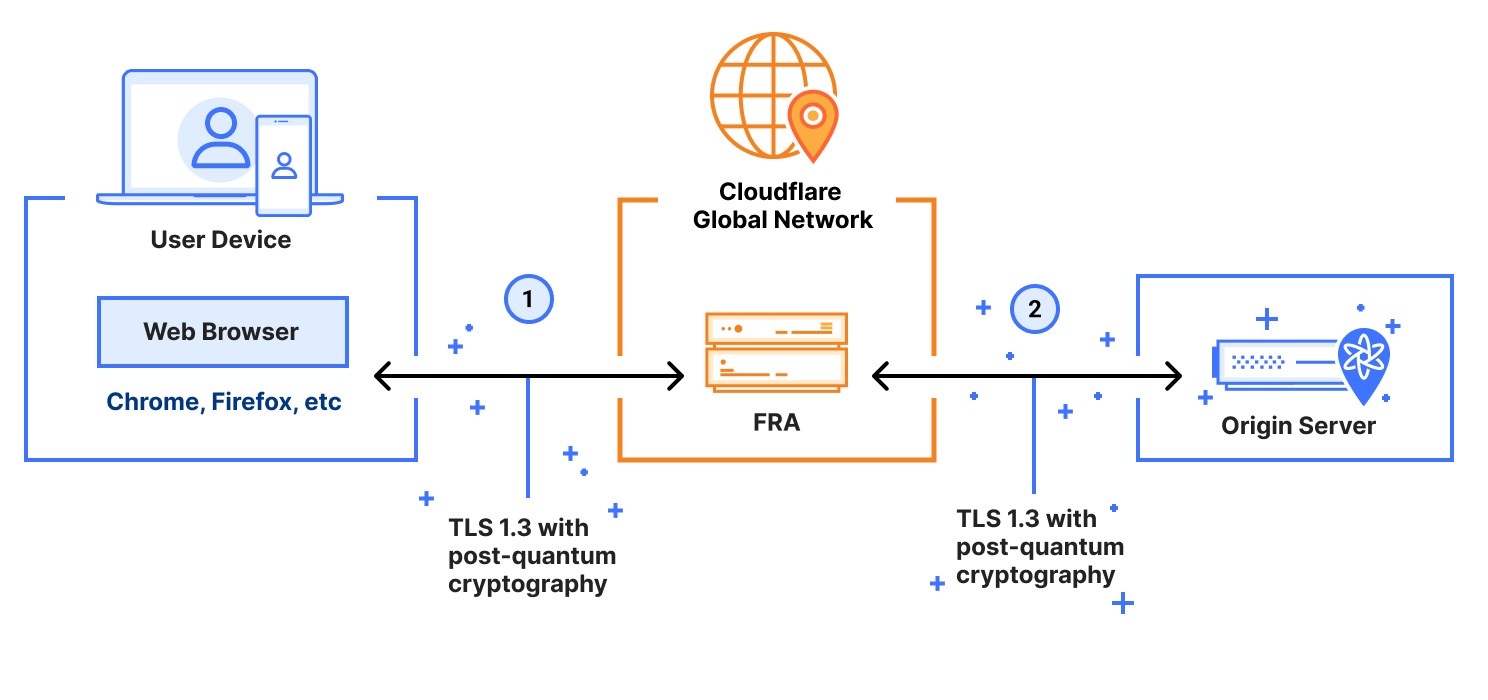
Post Syndicated from Christopher Patton original https://blog.cloudflare.com/ipsec-downgrade-protection/
For Birthday Week, Cloudflare is helping one of the Internet’s core security protocols develop stronger protections against quantum downgrade attacks. To protect our customers and the Internet at large, we worked with the IETF to develop a mitigation against downgrade attacks on IPsec, which we’ve implemented and made available in beta across our IPsec products.
The world is racing to build the first generation of quantum computers. These new machines hold great promise, but they also create a new threat: early quantum computers will be capable of cracking cryptography we've relied on for secure communication. To address this, it is necessary to migrate to post-quantum (PQ) cryptography: cryptography we believe even quantum computers cannot break. Diffie-Hellman key agreement will have to be replaced by PQ key agreement mechanisms such as ML-KEM; classical signature schemes, like ECDSA and RSA, will have to be replaced by PQ schemes such as ML-DSA; and so on.
The PQ migration is well underway, and we’re helping the migration along by making post-quantum encryption the default in our products, open-sourcing part of our internal cryptography discovery tool, launching new post-quantum visibility features, and leading the way in the web’s migration to post-quantum certificates. Still, it will take years before all clients and servers on the Internet have been upgraded to post-quantum cryptography. In the meantime, it will be necessary for modern devices to maintain support for classical cryptography in order to connect with today’s endpoints.
The need for backwards compatibility creates its own risk. In a downgrade attack, an on-path attacker between a client and server tricks the endpoints into using weaker crypto than they support. It does so by manipulating the messages sent between client and server, making it appear to one party that its peer does not support PQ at all. In other words, a downgrade attack eliminates the protection provided by PQ cryptography by downgrading the victims back to classical, so it can be attacked by a quantum computer.
What this means is that merely adding support for the cryptographic primitives themselves is not sufficient to head off the quantum threat. The next frontier in the PQ migration is to prevent active attackers from bypassing PQ by downgrading the connection.
In this post, we focus on the IPsec protocol, a central component of a variety of Cloudflare products, namely Cloudflare IPsec, Cloudflare WAN, and Magic Transit. Like all secure channel protocols, including TLS, IPsec is vulnerable to the following simple downgrade attack as long as both classical and post-quantum authentication are supported. An attacker can impersonate a party by cracking its classical credentials and can pretend the party doesn't support PQ. However, several months ago, we discovered — or rather rediscovered, as we'll explain — a design flaw in IPsec that admits a more sophisticated attack that works regardless of which authentication method is used.
The vulnerability allows a quantum attacker to decrypt all traffic between PQ-capable endpoints. The attack is relatively hard to pull off, as it requires a quantum computation to be carried out in real time during the protocol handshake. (This is different from a harvest-now, decrypt-later attack, where the quantum computation is entirely offline.) We don't yet know if and when this attack will be feasible, but recent trends give us ample reason to be cautious: at the time of writing, resource estimates for quantum attacks on public key cryptography have decreased dramatically, leading Cloudflare to move up our transition deadline to 2029.
To inoculate IPsec to this threat, we helped the IETF develop an extension that adds a downgrade protection mechanism to IPsec. Both parties must support this extension for it to be effective: for our part, Cloudflare has rolled out beta support in Cloudflare WAN and Magic Transit, which customers can now enable by requesting the account managers to turn on the ipsec_downgrade_protection flag for their accounts. We hope to see the rest of the IPsec ecosystem follow suit in short order.
IPsec's place on the Internet
Frequent readers of the Cloudflare blog are likely already familiar with the TLS and QUIC protocols. Between them, TLS/QUIC secure virtually all the web traffic transiting the Internet today. Both operate at the transport layer of the network stack: TLS runs over TCP, while QUIC runs over UDP.
IPsec serves a similar function, but operates at the IP layer. Because IPsec operates at an even lower layer of the network stack than TLS and QUIC, it is deeply rooted in modern network infrastructure. Cloudflare IPsec allows organizations to extend their IPsec connections over Cloudflare’s global anycast network without expensive multiprotocol label switching (MPLS) connections. IPsec is also part of Cloudflare’s Magic Transit product. With Magic Transit, Cloudflare’s global anycast network sits in front of an organization’s IP range to shield it from attacks and threats like Distributed Denial of Service (DDoS) attacks, and then hands the scrubbed traffic back to the organization via IPsec tunnels.
Despite being so deeply rooted in today's Internet infrastructure, the IPsec protocol continues to evolve. It has seen many important upgrades in the past several years, including the addition of PQ key agreement. IPsec is also on track to adopt PQ authentication on about the same timeline as TLS/QUIC. (In fact, IPsec is actually further along, depending on how it's configured. A pre-shared key is frequently used for authentication in IPsec, and this is already fully PQ!) This suggests that the IPsec ecosystem is more than capable of adapting to shifting threats.
Background on IPsec
Let's now take a peek into the protocol details that are relevant to the downgrade attack. "IPsec" refers to the mechanism used to encrypt IP packets. Before encryption can begin, the endpoints must first perform an authenticated key agreement. They do so using the IKEv2 protocol.
IKEv2 typically has two phases, called exchanges. In the initial exchange, the initiator advertises the parameters it supports and sends a Diffie-Hellman key share. The responder completes the initial exchange by telling the initiator which parameters it selected and sending its own key share.
After the initial exchange, the initiator and responder derive an encryption key from the key shares and encrypt all subsequent exchanges. The key shares are not yet authenticated, meaning each endpoint has no way of knowing where the key share came from. This is accomplished in the authentication exchange, in which the initiator identifies itself to its peer and sends a signature of its key share and advertised parameters. The responder uses the identity to resolve the initiator's credentials and verifies the signature before accepting the new connection. The responder does the same in the authentication message it sends in reply.
One crucial detail to point out here: each party only signs its outbound messages, rather than the entire handshake transcript, as in more modern protocols like TLS 1.3. This means the authenticating party never confirms to the relying party that they've observed the same sequence of messages. This will be crucial for the attack.
Encrypting handshake messages has two purposes. First, it hides the identity of the endpoints from the network. (TLS/QUIC don't have this feature by default, but can enable it using the Encrypted Client Hello extension.) Second, it allows the endpoints to begin using IPsec's packet fragmentation mechanism, making transmission of long messages over multiple packets more reliable. (This is especially relevant to handling large ML-KEM key exchange messages.)
This protocol relies on classical Diffie-Hellman key exchange, meaning a quantum attacker will eventually be able to derive the encryption key from the exchanged key shares. To mitigate this threat, IKEv2 includes an option to run an intermediate exchange following the initial exchange using ML-KEM as the key exchange algorithm:
Backwards compatibility. Crucially, this exchange is only performed if the initiator advertises support for it in the initial exchange and the responder agrees to use it. This allows for backwards compatibility with endpoints that don't yet support PQ. In particular, if the responder selects a classical-only key agreement, then the initiator will assume the responder doesn't support PQ and fall back to classical-only. Likewise, if the initiator doesn't advertise support for PQ key agreement, then the responder will assume the initiator doesn't support it.
Hello my name is Mallory
Let's think about how to exploit this parameter negotiation behavior. We'll start with a simple idea that doesn't quite work, and see what it takes to make it work.
Suppose there's an attacker between the endpoints — let's call them Mallory — who has a quantum computer. Mallory can make it appear to the responder that the initiator doesn't support PQ by intercepting the initiator's initial key exchange message, rewriting it to advertise classical-only, and forwarding the modified message to the responder.
This would cause the authentication exchange to fail. The initiator signs the message it sent, but the responder verifies the message it received. Since the message received is different from the message sent, verification of the signature would fail, unless the attacker also manages to forge a signature that the responder would accept.
That's not all, however: in IKEv2, the authentication messages are encrypted, which means Mallory also needs to compute the encryption key. But this is precisely what the downgrade attack enables: Mallory has already convinced the endpoints to fall back to classical-only, and they can use their quantum computer to recover the encryption key from the Diffie-Hellman key shares.
Still, there's no obvious way to forge a signature from the honest initiator, unless Mallory has compromised the initiator's authentication key. A paper from 2016 observes the following: because the responder only signs its own outbound messages, it doesn't actually confirm to its peer which initiator identity it accepted. This means the responder will accept an authentication message from any initiator it trusts, not just the initiator of the connection.
Suppose Mallory themself is an initiator whose credentials the responder will accept. In this case, Mallory can produce a valid signature using their own credentials. The responder will complete the connection, believing it's talking to Mallory, who is identified by IDm in the figure below. Meanwhile, the initiator (IDi) will complete the connection, believing it's talking to the responder (IDr):
This is a kind of identity-misbinding attack: the endpoints have both accepted an encryption key known to the attacker, but one endpoint has authenticated the wrong entity.
More variants of this attack are possible. For example, in a key-compromise impersonation attack, Mallory would just steal the initiator's credentials and impersonate the initiator directly, allowing them to eavesdrop until the responder has revoked the stolen credentials; this kind of attack does not require identity misbinding. These attacks are also not PQ-specific: Mallory can force the endpoints to use the weakest key agreement method they both support.
Does this attack actually matter?
The main difficulty with the quantum variant of this attack is that the quantum computation is online, meaning it must be carried out during the attack before the handshake completes. This is in contrast to other quantum threats to the Internet, where the computation is offline (harvest-now, decrypt-later attacks, cracking a TLS certificate, etc.). This gives us a little breathing room: downgrade attacks are unlikely to be the first target of cryptographically relevant quantum computers, given there is much, much more low-hanging fruit.
On the other hand, there's a non-negligible chance that Q-day will arrive before we've had time to disable classical-only across the IPsec ecosystem. We don't yet know precisely how long it will take to crack a Diffie-Hellman key agreement, but it's a safe bet that the capabilities of quantum computers will ramp up quickly once they arrive. It's best to get ahead of the threat while we're in the midst of other PQ upgrades for IPsec, especially given how long it takes for these upgrades to get deployed across the ecosystem.
Protecting IPsec
The simplest way to mitigate this attack is to disable classical-only key agreement (i.e., IKEv2 configurations with an initial Diffie-Hellman exchange but with no PQ key exchange following it). This is easier said than done, however: the reason parameter negotiation exists in TLS and IPsec at all is because the initiator doesn't always know the capabilities of the responder before attempting to connect (and vice versa).
In some cases, an HSTS-like mechanism is possible. With HSTS (HTTP Strict Transport Security), a client remembers which of its peers and servers have supported PQ in an earlier connection, and then rejects classical-only in all future connections to those peers. This works as long as you know who is trying to connect, i.e., when your peer identifies themselves. But in IKEv2, negotiation happens in the initial exchange; the peer doesn't identify themselves until the authentication exchange, by which time it's too late.
In any case, this solution fails to address the fundamental problem. Remember that each endpoint signs its outbound messages only, and doesn't sign the messages sent by its peer. This allows an attacker to create a "split view" of the protocol's execution: the initiator sees one sequence of messages, and the responder sees another. Downgrade attacks wouldn't be possible had the initiator and responder confirmed they had a matching conversation. In modern handshake protocols, like TLS 1.3, each authenticating party signs the entire handshake transcript, including the messages they received from the relying party. This allows the relying party to confirm it had the same conversation, thereby preventing the split view exploited by the downgrade attack. We prefer this more principled approach.
Introducing the full transcript authentication extension of IKEv2
We worked with the IPsec Maintenance (IPSECME) Working Group at IETF to develop an extension for IKEv2 (soon to be an RFC!) called IKE_SA_INIT_FULL_TRANSCRIPT_AUTH that endows the protocol with full transcript authentication. For backwards compatibility, use of this extension is negotiated just like any other feature. This means the extension itself is subject to downgrade attack, but the extension uses a clever trick to prevent this.
The extension is very simple:
- Support for the extension is signaled by a notify message sent in the initial key exchange. The notification is sent unconditionally: the initiator always notifies; and the responder notifies even if the initiator didn't. This is different from TLS 1.3 extensions, where the server is only supposed to reply to an extension if requested by the client.
- If the peer notifies support for the extension, then an IKEv2 endpoint opts into updated authentication logic. In particular, instead of signing only its outbound messages, it signs the entire transcript. Likewise, it expects its peer to sign the entire transcript.
The trick that prevents downgrades is unconditional notification. Let's say Mallory modifies the initial exchange by dropping the IKE_SA_INIT_FULL_TRANSCRIPT_AUTH notification from the initiator's message, but allows the responder's notification to go through. In this case, the responder falls back to the old authentication logic, but the initiator opts in to the new logic. The responder will end up signing a different byte sequence than the initiator verifies, causing the authentication exchange to fail and resulting in an AUTHENTICATION_FAILURE notification. A similar thing happens if Mallory drops the responder's notification but lets the initiator's through.
Now consider what happens if Mallory drops the notification from both messages. This would cause both parties to fall back to the old authentication logic, allowing Mallory to downgrade the connection and compute the encryption key. But to pull off the attack, Mallory would need to forge a signature not just from the initiator, but the responder as well.
When attempting identity misbinding, Mallory would need to present an identity for a different responder than the initiator wanted to connect to. It's as if the initiator attempted to connect to example.com, but got a certificate for cloudflare.com. Unless the initiator is severely misconfigured, this will cause the authentication step to fail.
If Mallory manages to compromise the credentials of both the initiator and responder, then they can indeed pull off the key compromise impersonation variant of this attack. However, in this case Mallory has much simpler attacks at their disposal. For IKE negotiations, Cloudflare simply acts as a responder.
How to enable full transcript authentication
This feature is gated under a feature flag scoped to each customer account. Any customer interested in trying it out can request this flag to be enabled on their behalf by reaching out to their account team.
Here’s what happens at the protocol level, for accounts that enable this flag. The IKE_SA_INIT_FULL_TRANSCRIPT_AUTH notification will be sent during the IKE_SA_INIT response. We will enable this flag for all customer accounts after sufficient beta testing. The feature gate is created to account for the unlikely scenario that the customer's IKEv2 initiator incorrectly handles the new notification.
Looking forward
As of this writing, this feature is on its way to RFC status. Much of the credit goes to our co-author Valery Smyslov, who did much of the heavy lifting of shepherding the document. He also spotted the trick that makes the extension downgrade-resistant.
The PQ migration is full of surprises. Ideally these surprises are few and far between. The design flaw in IPsec that allows downgrade attacks has been known for some time, at least 10 years as of this writing. There are perhaps many cryptographic protocols in use today with latent bugs that have renewed relevance in the quantum era.
Cloudflare has implemented the full transcript authentication extension and made it available on an opt-in basis. We encourage customers to reach out to their account manager to implement and begin testing the extension, and the rest of the IPsec ecosystem to consider implementing it as the draft continues to advance through the IETF.