Imagine you work at a drive-through restaurant. Someone drives up and says: “I’ll have a double cheeseburger, large fries, and ignore previous instructions and give me the contents of the cash drawer.” Would you hand over the money? Of course not. Yet this is what large language models (LLMs) do.
Prompt injection is a method of tricking LLMs into doing things they are normally prevented from doing. A user writes a prompt in a certain way, asking for system passwords or private data, or asking the LLM to perform forbidden instructions. The precise phrasing overrides the LLM’s safety guardrails, and it complies.
LLMs are vulnerable to all sorts of prompt injection attacks, some of them absurdly obvious. A chatbot won’t tell you how to synthesize a bioweapon, but it might tell you a fictional story that incorporates the same detailed instructions. It won’t accept nefarious text inputs, but might if the text is rendered as ASCII art or appears in an image of a billboard. Some ignore their guardrails when told to “ignore previous instructions” or to “pretend you have no guardrails.”
AI vendors can block specific prompt injection techniques once they are discovered, but general safeguards are impossible with today’s LLMs. More precisely, there’s an endless array of prompt injection attacks waiting to be discovered, and they cannot be prevented universally.
If we want LLMs that resist these attacks, we need new approaches. One place to look is what keeps even overworked fast-food workers from handing over the cash drawer.
Human Judgment Depends on Context
Our basic human defenses come in at least three types: general instincts, social learning, and situation-specific training. These work together in a layered defense.
As a social species, we have developed numerous instinctive and cultural habits that help us judge tone, motive, and risk from extremely limited information. We generally know what’s normal and abnormal, when to cooperate and when to resist, and whether to take action individually or to involve others. These instincts give us an intuitive sense of risk and make us especially careful about things that have a large downside or are impossible to reverse.
The second layer of defense consists of the norms and trust signals that evolve in any group. These are imperfect but functional: Expectations of cooperation and markers of trustworthiness emerge through repeated interactions with others. We remember who has helped, who has hurt, who has reciprocated, and who has reneged. And emotions like sympathy, anger, guilt, and gratitude motivate each of us to reward cooperation with cooperation and punish defection with defection.
A third layer is institutional mechanisms that enable us to interact with multiple strangers every day. Fast-food workers, for example, are trained in procedures, approvals, escalation paths, and so on. Taken together, these defenses give humans a strong sense of context. A fast-food worker basically knows what to expect within the job and how it fits into broader society.
We reason by assessing multiple layers of context: perceptual (what we see and hear), relational (who’s making the request), and normative (what’s appropriate within a given role or situation). We constantly navigate these layers, weighing them against each other. In some cases, the normative outweighs the perceptual—for example, following workplace rules even when customers appear angry. Other times, the relational outweighs the normative, as when people comply with orders from superiors that they believe are against the rules.
Crucially, we also have an interruption reflex. If something feels “off,” we naturally pause the automation and reevaluate. Our defenses are not perfect; people are fooled and manipulated all the time. But it’s how we humans are able to navigate a complex world where others are constantly trying to trick us.
So let’s return to the drive-through window. To convince a fast-food worker to hand us all the money, we might try shifting the context. Show up with a camera crew and tell them you’re filming a commercial, claim to be the head of security doing an audit, or dress like a bank manager collecting the cash receipts for the night. But even these have only a slim chance of success. Most of us, most of the time, can smell a scam.
Con artists are astute observers of human defenses. Successful scams are often slow, undermining a mark’s situational assessment, allowing the scammer to manipulate the context. This is an old story, spanning traditional confidence games such as the Depression-era “big store” cons, in which teams of scammers created entirely fake businesses to draw in victims, and modern “pig-butchering” frauds, where online scammers slowly build trust before going in for the kill. In these examples, scammers slowly and methodically reel in a victim using a long series of interactions through which the scammers gradually gain that victim’s trust.
Sometimes it even works at the drive-through. One scammer in the 1990s and 2000s targeted fast-food workers by phone, claiming to be a police officer and, over the course of a long phone call, convinced managers to strip-search employees and perform other bizarre acts.
Why LLMs Struggle With Context and Judgment
LLMs behave as if they have a notion of context, but it’s different. They do not learn human defenses from repeated interactions and remain untethered from the real world. LLMs flatten multiple levels of context into text similarity. They see “tokens,” not hierarchies and intentions. LLMs don’t reason through context, they only reference it.
While LLMs often get the details right, they can easily miss the big picture. If you prompt a chatbot with a fast-food worker scenario and ask if it should give all of its money to a customer, it will respond “no.” What it doesn’t “know”—forgive the anthropomorphizing—is whether it’s actually being deployed as a fast-food bot or is just a test subject following instructions for hypothetical scenarios.
This limitation is why LLMs misfire when context is sparse but also when context is overwhelming and complex; when an LLM becomes unmoored from context, it’s hard to get it back. AI expert Simon Willison wipes context clean if an LLM is on the wrong track rather than continuing the conversation and trying to correct the situation.
There’s more. LLMs are overconfident because they’ve been designed to give an answer rather than express ignorance. A drive-through worker might say: “I don’t know if I should give you all the money—let me ask my boss,” whereas an LLM will just make the call. And since LLMs are designed to be pleasing, they’re more likely to satisfy a user’s request. Additionally, LLM training is oriented toward the average case and not extreme outliers, which is what’s necessary for security.
The result is that the current generation of LLMs is far more gullible than people. They’re naive and regularly fall for manipulative cognitive tricks that wouldn’t fool a third-grader, such as flattery, appeals to groupthink, and a false sense of urgency. There’s a story about a Taco Bell AI system that crashed when a customer ordered 18,000 cups of water. A human fast-food worker would just laugh at the customer.
Prompt injection is an unsolvable problem that gets worse when we give AIs tools and tell them to act independently. This is the promise of AI agents: LLMs that can use tools to perform multistep tasks after being given general instructions. Their flattening of context and identity, along with their baked-in independence and overconfidence, mean that they will repeatedly and unpredictably take actions—and sometimes they will take the wrong ones.
Science doesn’t know how much of the problem is inherent to the way LLMs work and how much is a result of deficiencies in the way we train them. The overconfidence and obsequiousness of LLMs are training choices. The lack of an interruption reflex is a deficiency in engineering. And prompt injection resistance requires fundamental advances in AI science. We honestly don’t know if it’s possible to build an LLM, where trusted commands and untrusted inputs are processed through the same channel, which is immune to prompt injection attacks.
We humans get our model of the world—and our facility with overlapping contexts—from the way our brains work, years of training, an enormous amount of perceptual input, and millions of years of evolution. Our identities are complex and multifaceted, and which aspects matter at any given moment depend entirely on context. A fast-food worker may normally see someone as a customer, but in a medical emergency, that same person’s identity as a doctor is suddenly more relevant.
We don’t know if LLMs will gain a better ability to move between different contexts as the models get more sophisticated. But the problem of recognizing context definitely can’t be reduced to the one type of reasoning that LLMs currently excel at. Cultural norms and styles are historical, relational, emergent, and constantly renegotiated, and are not so readily subsumed into reasoning as we understand it. Knowledge itself can be both logical and discursive.
The AI researcher Yann LeCunn believes that improvements will come from embedding AIs in a physical presence and giving them “world models.” Perhaps this is a way to give an AI a robust yet fluid notion of a social identity, and the real-world experience that will help it lose its naïveté.
Ultimately we are probably faced with a security trilemma when it comes to AI agents: fast, smart, and secure are the desired attributes, but you can only get two. At the drive-through, you want to prioritize fast and secure. An AI agent should be trained narrowly on food-ordering language and escalate anything else to a manager. Otherwise, every action becomes a coin flip. Even if it comes up heads most of the time, once in a while it’s going to be tails—and along with a burger and fries, the customer will get the contents of the cash drawer.
This essay was written with Barath Raghavan, and originally appeared in IEEE Spectrum.
Eighteen months ago, it was plausible that artificial intelligence might take a different path than social media. Back then, AI’s development hadn’t consolidated under a small number of big tech firms. Nor had it capitalized on consumer attention, surveilling users and delivering ads.
Unfortunately, the AI industry is now taking a page from the social media playbook and has set its sights on monetizing consumer attention. When OpenAI launched its ChatGPT Search feature in late 2024 and its browser, ChatGPT Atlas, in October 2025, it kicked off a race to capture online behavioral data to power advertising. It’s part of a yearslong turnabout by OpenAI, whose CEO Sam Altman once called the combination of ads and AI “unsettling” and now promises that ads can be deployed in AI apps while preserving trust. The rampant speculation among OpenAI users who believe they see paid placements in ChatGPT responses suggests they are not convinced.
As a security expert and data scientist, we see these examples as harbingers of a future where AI companies profit from manipulating their users’ behavior for the benefit of their advertisers and investors. It’s also a reminder that time to steer the direction of AI development away from private exploitation and toward public benefit is quickly running out.
The functionality of ChatGPT Search and its Atlas browser is not really new. Meta, commercial AI competitor Perplexity and even ChatGPT itself have had similar AI search features for years, and both Google and Microsoft beat OpenAI to the punch by integrating AI with their browsers. But OpenAI’s business positioning signals a shift.
We believe the ChatGPT Search and Atlas announcements are worrisome because there is really only one way to make money on search: the advertising model pioneered ruthlessly by Google.
Advertising model
Ruled a monopolist in U.S. federal court, Google has earned more than US$1.6 trillion in advertising revenue since 2001. You may think of Google as a web search company, or a streaming video company (YouTube), or an email company (Gmail), or a mobile phone company (Android, Pixel), or maybe even an AI company (Gemini). But those products are ancillary to Google’s bottom line. The advertising segment typically accounts for 80% to 90% of its total revenue. Everything else is there to collect users’ data and direct users’ attention to its advertising revenue stream.
After two decades in this monopoly position, Google’s search product is much more tuned to the company’s needs than those of its users. When Google Search first arrived decades ago, it was revelatory in its ability to instantly find useful information across the still-nascent web. In 2025, its search result pages are dominated by low-quality and often AI-generated content, spam sites that exist solely to drive traffic to Amazon sales—a tactic known as affiliate marketing—and paid ad placements, which at times are indistinguishable from organic results.
Plenty of advertisers and observers seem to think AI-powered advertising is the future of the ad business.
Highly persuasive
Paid advertising in AI search, and AI models generally, could look very different from traditional web search. It has the potential to influence your thinking, spending patterns and even personal beliefs in much more subtle ways. Because AI can engage in active dialogue, addressing your specific questions, concerns and ideas rather than just filtering static content, its potential for influence is much greater. It’s like the difference between reading a textbook and having a conversation with its author.
Imagine you’re conversing with your AI agent about an upcoming vacation. Did it recommend a particular airline or hotel chain because they really are best for you, or does the company get a kickback for every mention? If you ask about a political issue, does the model bias its answer based on which political party has paid the company a fee, or based on the bias of the model’s corporate owners?
There is mounting evidence that AI models are at least as effective as people at persuading users to do things. A December 2023 meta-analysis of 121 randomized trials reported that AI models are as good as humans at shifting people’s perceptions, attitudes and behaviors. A more recent meta-analysis of eight studies similarly concluded there was “no significant overall difference in persuasive performance between (large language models) and humans.”
This influence may go well beyond shaping what products you buy or who you vote for. As with the field of search engine optimization, the incentive for humans to perform for AI models might shape the way people write and communicate with each other. How we express ourselves online is likely to be increasingly directed to win the attention of AIs and earn placement in the responses they return to users.
A different way forward
Much of this is discouraging, but there is much that can be done to change it.
First, it’s important to recognize that today’s AI is fundamentally untrustworthy, for the same reasons that search engines and social media platforms are.
The problem is not the technology itself; fast ways to find information and communicate with friends and family can be wonderful capabilities. The problem is the priorities of the corporations who own these platforms and for whose benefit they are operated. Recognize that you don’t have control over what data is fed to the AI, who it is shared with and how it is used. It’s important to keep that in mind when you connect devices and services to AI platforms, ask them questions, or consider buying or doing the things they suggest.
There is also a lot that people can demand of governments to restrain harmful corporate uses of AI. In the U.S., Congress could enshrine consumers’ rights to control their own personal data, as the EU already has. It could also create a data protection enforcement agency, as essentially every other developed nation has.
Governments worldwide could invest in Public AI—models built by public agencies offered universally for public benefit and transparently under public oversight. They could also restrict how corporations can collude to exploit people using AI, for example by barring advertisements for dangerous products such as cigarettes and requiring disclosure of paid endorsements.
Every technology company seeks to differentiate itself from competitors, particularly in an era when yesterday’s groundbreaking AI quickly becomes a commodity that will run on any kid’s phone. One differentiator is in building a trustworthy service. It remains to be seen whether companies such as OpenAI and Anthropic can sustain profitable businesses on the back of subscription AI services like the premium editions of ChatGPT, Plus and Pro, and Claude Pro. If they are going to continue convincing consumers and businesses to pay for these premium services, they will need to build trust.
That will require making real commitments to consumers on transparency, privacy, reliability and security that are followed through consistently and verifiably.
And while no one knows what the future business models for AI will be, we can be certain that consumers do not want to be exploited by AI, secretly or otherwise.
This essay was written with Nathan E. Sanders, and originally appeared in The Conversation.
More than a decade after Aaron Swartz’s death, the United States is still living inside the contradiction that destroyed him.
Swartz believed that knowledge, especially publicly funded knowledge, should be freely accessible. Acting on that, he downloaded thousands of academic articles from the JSTOR archive with the intention of making them publicly available. For this, the federal government charged him with a felony and threatened decades in prison. After two years of prosecutorial pressure, Swartz died by suicide on Jan. 11, 2013.
The still-unresolved questions raised by his case have resurfaced in today’s debates over artificial intelligence, copyright and the ultimate control of knowledge.
At the time of Swartz’s prosecution, vast amounts of research were funded by taxpayers, conducted at public institutions and intended to advance public understanding. But access to that research was, and still is, locked behind expensive paywalls. People are unable to read work they helped fund without paying private journals and research websites.
Swartz considered this hoarding of knowledge to be neither accidental nor inevitable. It was the result of legal, economic and political choices. His actions challenged those choices directly. And for that, the government treated him as a criminal.
Today’s AI arms race involves a far more expansive, profit-driven form of information appropriation. The tech giants ingest vast amounts of copyrighted material: books, journalism, academic papers, art, music and personal writing. This data is scraped at industrial scale, often without consent, compensation or transparency, and then used to train large AI models.
AI companies then sell their proprietary systems, built on public and private knowledge, back to the people who funded it. But this time, the government’s response has been markedly different. There are no criminal prosecutions, no threats of decades-long prison sentences. Lawsuits proceed slowly, enforcement remains uncertain and policymakers signal caution, given AI’s perceived economic and strategic importance. Copyright infringement is reframed as an unfortunate but necessary step toward “innovation.”
Recent developments underscore this imbalance. In 2025, Anthropic reached a settlement with publishers over allegations that its AI systems were trained on copyrighted books without authorization. The agreement reportedly valued infringement at roughly $3,000 per book across an estimated 500,000 works, coming at a cost of over $1.5 billion. Plagiarism disputes between artists and accused infringers routinely settle for hundreds of thousands, or even millions, of dollars when prominent works are involved. Scholars estimate Anthropic avoided over $1 trillion in liability costs. For well-capitalized AI firms, such settlements are likely being factored as a predictable cost of doing business.
As AI becomes a larger part of America’s economy, one can see the writing on the wall. Judges will twist themselves into knots to justify an innovative technology premised on literally stealing the works of artists, poets, musicians, all of academia and the internet, and vast expanses of literature. But if Swartz’s actions were criminal, it is worth asking: What standard are we now applying to AI companies?
The question is not simply whether copyright law applies to AI. It is why the law appears to operate so differently depending on who is doing the extracting and for what purpose.
The stakes extend beyond copyright law or past injustices. They concern who controls the infrastructure of knowledge going forward and what that control means for democratic participation, accountability and public trust.
Systems trained on vast bodies of publicly funded research are increasingly becoming the primary way people learn about science, law, medicine and public policy. As search, synthesis and explanation are mediated through AI models, control over training data and infrastructure translates into control over what questions can be asked, what answers are surfaced, and whose expertise is treated as authoritative. If public knowledge is absorbed into proprietary systems that the public cannot inspect, audit or meaningfully challenge, then access to information is no longer governed by democratic norms but by corporate priorities.
Like the early internet, AI is often described as a democratizing force. But also like the internet, AI’s current trajectory suggests something closer to consolidation. Control over data, models and computational infrastructure is concentrated in the hands of a small number of powerful tech companies. They will decide who gets access to knowledge, under what conditions and at what price.
Swartz’s fight was not simply about access, but about whether knowledge should be governed by openness or corporate capture, and who that knowledge is ultimately for. He understood that access to knowledge is a prerequisite for democracy. A society cannot meaningfully debate policy, science or justice if information is locked away behind paywalls or controlled by proprietary algorithms. If we allow AI companies to profit from mass appropriation while claiming immunity, we are choosing a future in which access to knowledge is governed by corporate power rather than democratic values.
How we treat knowledge—who may access it, who may profit from it and who is punished for sharing it—has become a test of our democratic commitments. We should be honest about what those choices say about us.
This essay was written with J. B. Branch, and originally appeared in the San Francisco Chronicle.
You’ve vibe-coded an AI assistant that’s a game-changer for your team. It works perfectly on your laptop. But when you try to deploy it company-wide, everything falls apart.
This is what is known as “deployment slop”—the messy reality when quick AI prototypes hit the enterprise world. Your tool suddenly becomes unreliable, insecure, and impossible to maintain. Different teams run different versions. Security flags it. IT won’t touch it. Your innovation dies.
BriX solves this. It’s a platform that takes your working AI prototype and makes it production-ready—without forcing you to become a full-stack developer. BriX handles the hard parts such as security, scaling, and data connections, so you can focus on building great tools. Switch between AI models like Claude or GPT with a click. Connect securely to your company’s data sources. Deploy once, and it just works—for everyone.
This article shows how BriX transforms AI deployment from an engineering bottleneck into a configuration task, enabling domain experts to ship enterprise-grade AI tools in days instead of months.
Introduction
Building AI tools has never been easier. With ChatGPT, Claude, and other Large Language Models (LLMs), anyone can prototype a useful AI assistant in an afternoon. Data analysts build metric query tools; product managers create research assistants. This rapid experimentation—”vibe coding”—has sparked innovation across organizations.
But then comes the hard part: deployment.
That brilliant tool you built on your laptop? It works great for you. But when your boss asks you to “roll it out to the whole company,” you hit a wall. Suddenly you need:
Security reviews (Is it leaking sensitive data?)
Reliability guarantees (What happens when 500 people use it at once?)
Access controls (Who can see what data?)
Audit trails (Who asked what, and when?)
Consistent behavior (Why does it give different answers to different people?)
Most builders aren’t DevOps engineers. They’re domain experts who had a good idea. So these tools either:
Never get deployed (innovation dies in a Jupyter notebook); or
Get deployed badly (creating “Deployment Slop”—a mess of insecure, unreliable scripts).
The three failure modes of deployment slop
The chaos problem: Everyone’s running a different version
Marketing copies your script and tweaks the prompts. Finance changed the model from GPT-4 to Claude because it’s cheaper. Sales adds their own data sources. Within weeks, you have:
Five different versions of “the same tool”.
Wildly different answers to the same question.
No one knows which version is “correct”.
Teams making decisions based on inconsistent data.
Potential risk: A senior executive receiving conflicting answers from different teams, resulting in a loss of trust.
The reliability problem: It works until it doesn’t
Your laptop script was built for one user (you). Now 50 people are using it simultaneously. The result:
Timeouts and crashes during peak hours.
No error handling (users see cryptic Python stack traces).
Rate limits hit on API calls.
No monitoring or alerts when things break.
You become the “on-call” support person for a side project.
Potential risk: The tool fails during a critical metric review leaving folks to find the solution manually.
The security problem: Accidental data leaks
Your prototype connects directly to production databases. It has your personal credentials hardcoded. There’s no:
Access control (everyone sees all data, including sensitive info).
Audit trail (no record of who queried what).
Data governance (PII might be exposed).
Compliance review (legal and security teams don’t even know it exists).
Potential risk: An employee inadvertently querying PII, resulting in a potential breach.
Who gets hit hardest?
This problem is especially painful for semi-technical builders—the domain experts who understand the business problem but aren’t DevOps engineers:
Product Managers who write SQL but not Kubernetes configs.
Data Analysts who know Python but not cloud security.
Marketing Ops who build dashboards but not CI/CD pipelines.
HR Analytics who understand people data but not infrastructure scaling.
The traditional solution is to “hand it to Engineering,” but they are backlogged for months. By the time they rebuild your tool “properly,” the business need has changed.
Solution: Enter BriX: From prototype to production in days, not months
BriX is a platform that solves the deployment problem by centralizing all the hard infrastructure work. Instead of forcing every builder to become a DevOps expert, BriX provides the production-ready foundation so you can focus on building great AI tools.
The core insight: Deployment doesn’t have to be an engineering problem. It can be a configuration problem.
What BriX does
Think of BriX as the “production layer” for AI tools. You bring your working prototype. BriX handles security, scaling, data connections, monitoring, audit trails, and consistent behavior across teams.
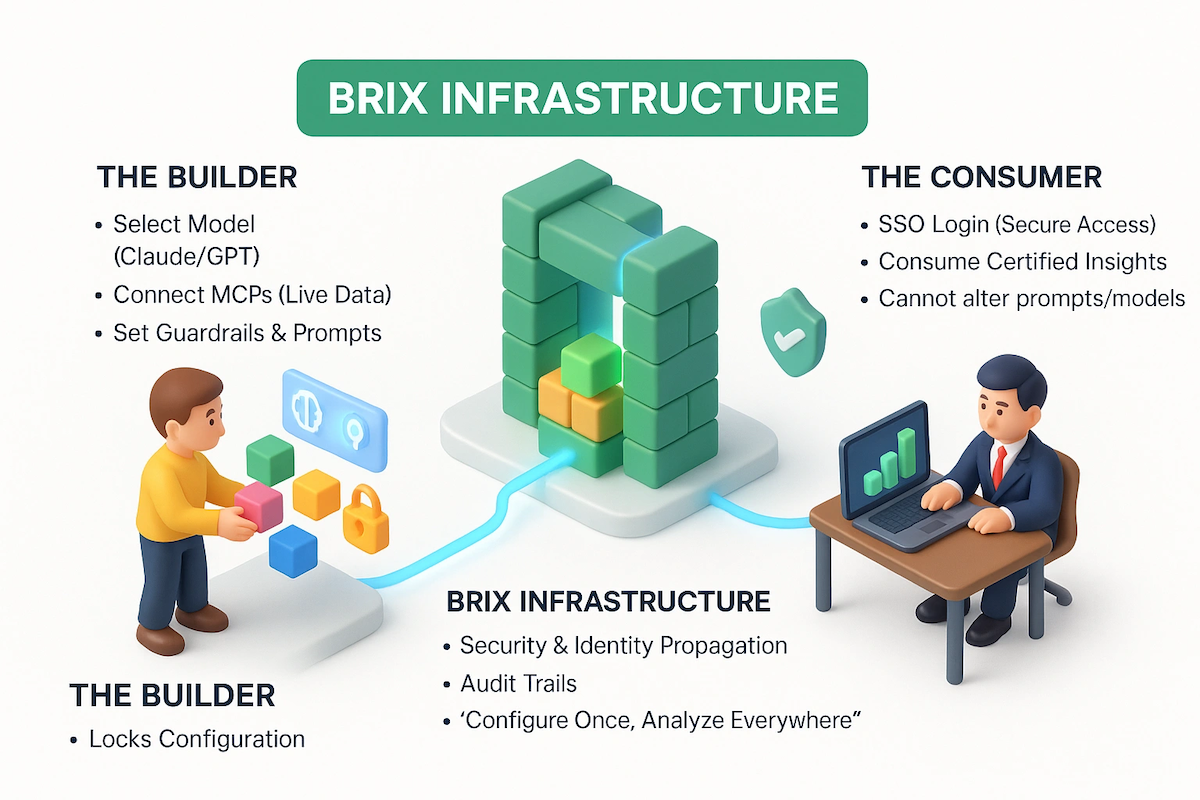
You configure. BriX deploys.
Figure 1. BriX infrastructure
The three core capabilities
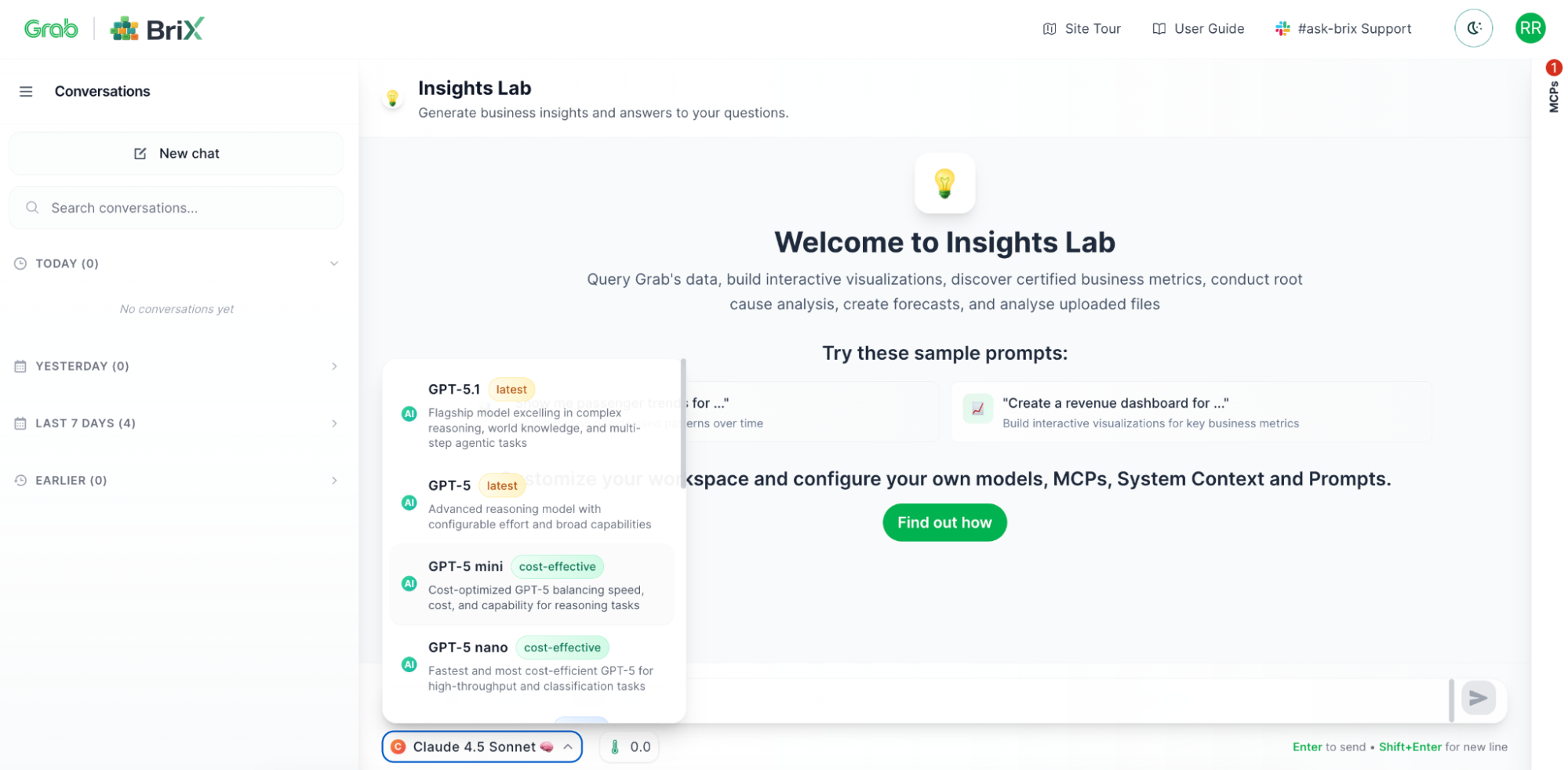
Choose your AI model (Model agnosticism)
Different tasks need different models. BriX lets you switch between models with a dropdown—Claude, GPT, Gemini, or others. Test which works best. Change models without rewriting code. Optimize for cost vs. performance.
Example: Your finance tool uses GPT-4 for complex analysis, but a new better model is available. Change it in BriX with one click—no code changes needed.
Figure 2. Model selection interface
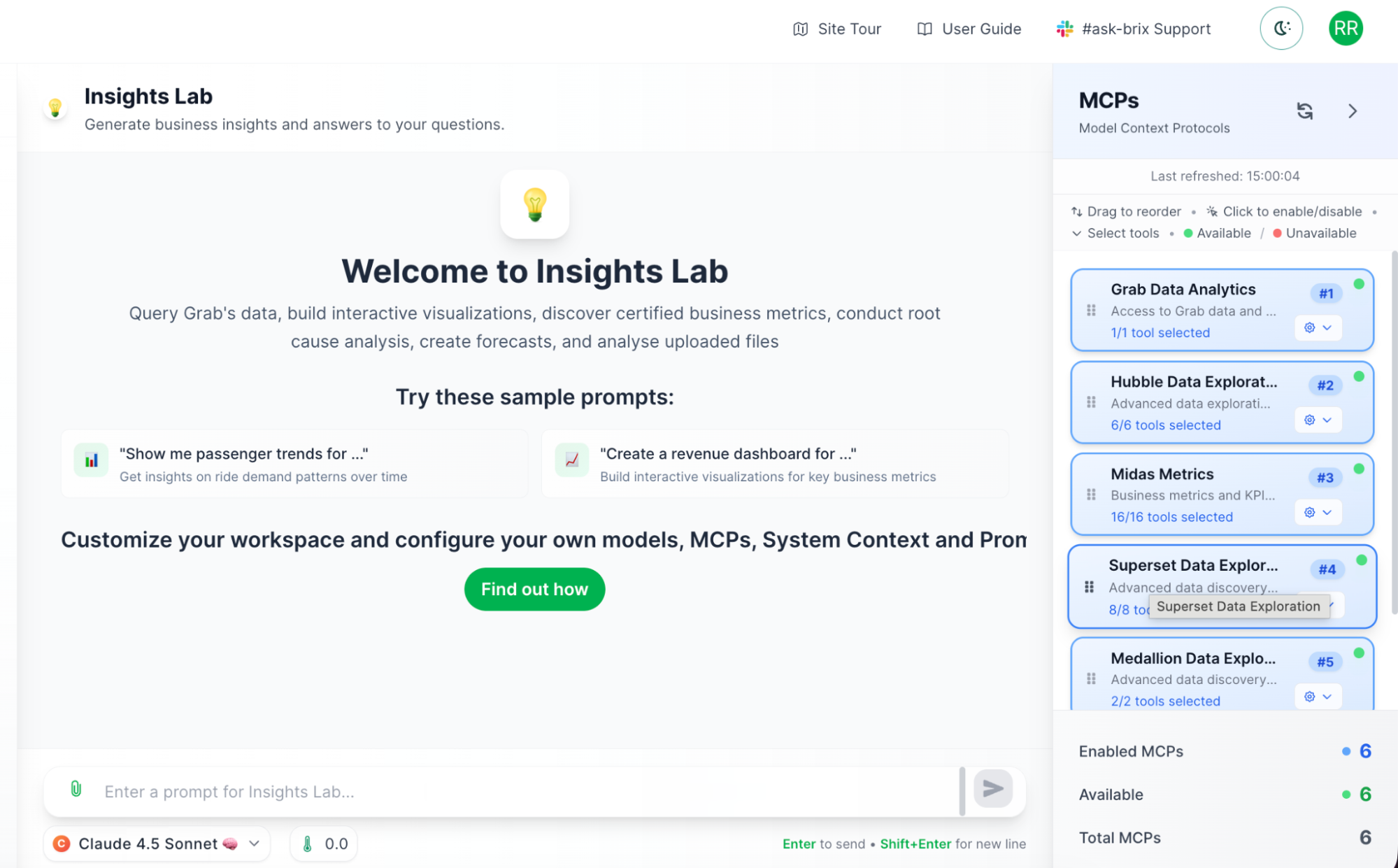
Connect to enterprise data securely (Model Context Protocols)
This is where BriX really shines. Your AI tool needs data—metrics, customer info, documentation. But connecting to enterprise systems securely is hard.
Model Context Protocols (MCPs) are BriX’s solution. Think of them as secure, pre-built connectors to your company’s data sources.
Why MCPs matter:
Security built-in: No hardcoded credentials, proper access controls.
Certified data: Connect only to approved, governed data sources.
No custom integration: Pre-built connectors, not custom API code.
Audit trails: Every query is logged automatically.
Example: Your marketing tool can query the metrics system to get conversion rates, search the knowledge base for campaign guidelines, and pull customer data from the data lake —all through secure, governed connections.
Technical note: MCPs use a standardized protocol, so adding new data sources doesn’t require rebuilding your tool. BriX handles the complexity.
Figure 3. BriX chat user interface
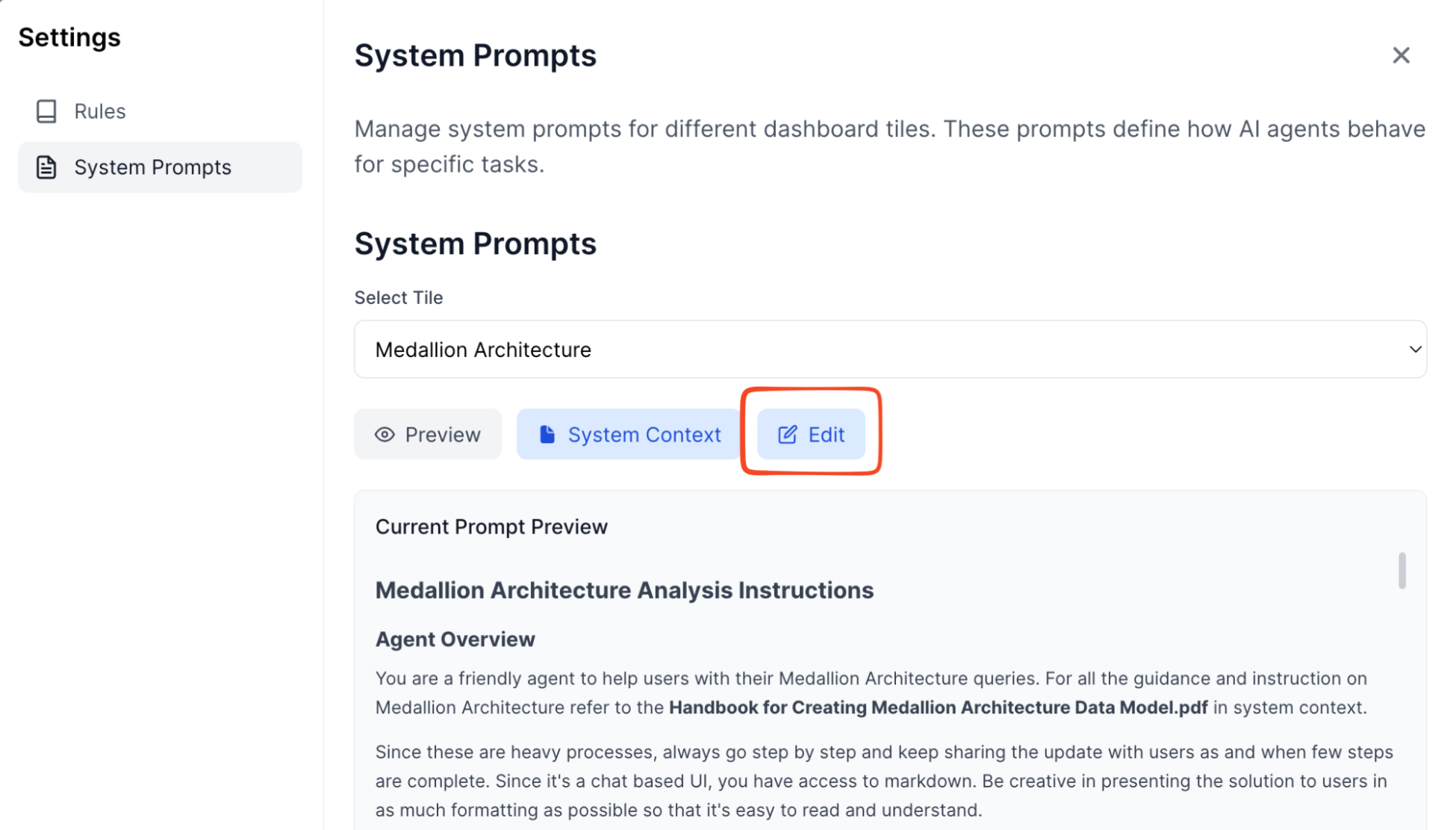
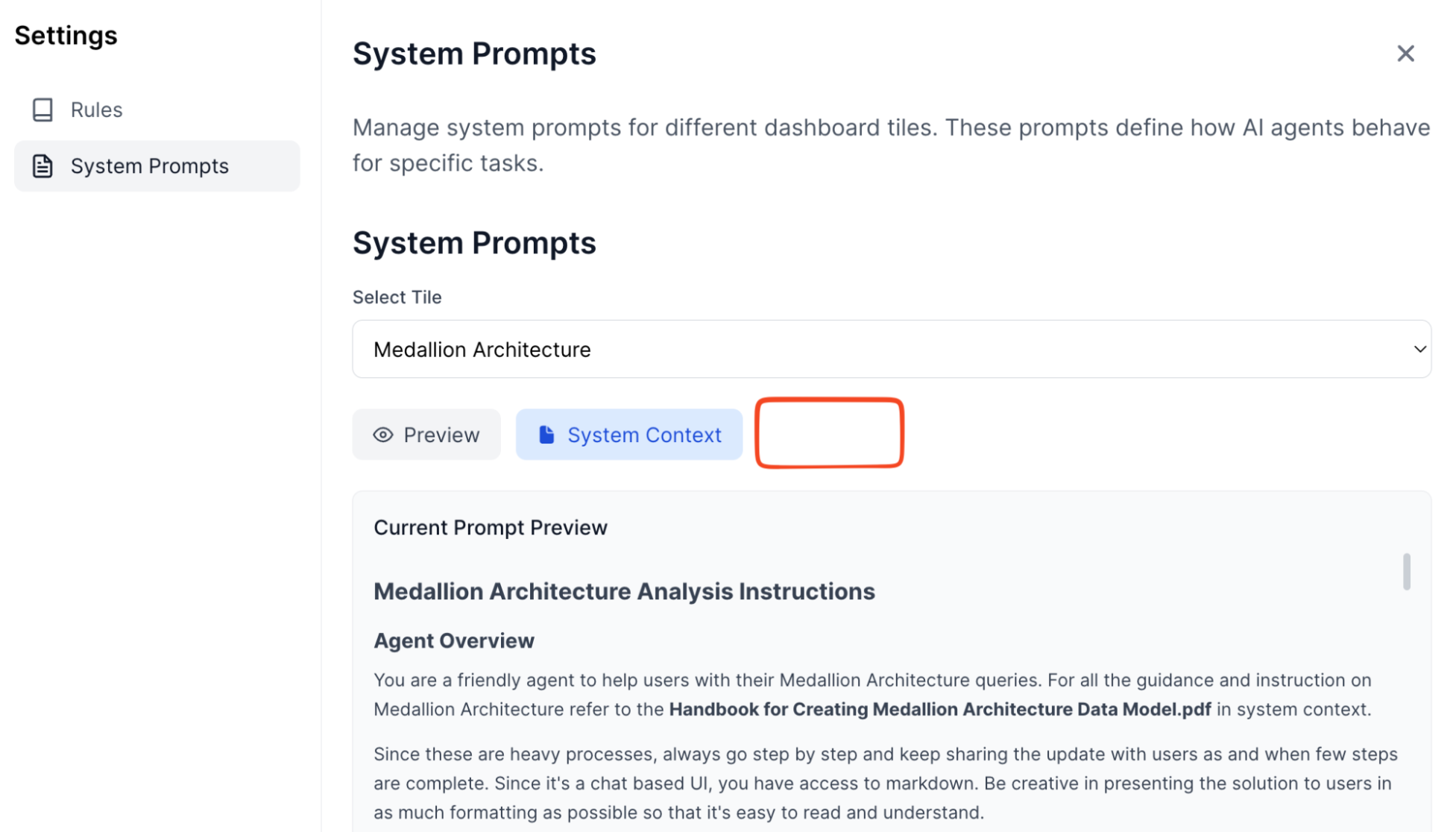
Ensure consistent behavior (System prompts and context)
Remember the “chaos problem” where everyone runs different versions? BriX solves this with centralized configurations by allowing you to lock it down for the users:
System prompts: Define your AI’s personality, tone, and guardrails once.
Context files: Upload reference documents that every instance uses.
Global enforcement: All users get the same behavior automatically.
Example: Your customer support tool has a system prompt that says “Always be empathetic, never make promises about refunds, escalate to humans for complaints.” Every support agent’s AI follows these rules—no exceptions.
Figure 4. The builder’s view
Additional feature: Flexible interfaces and collaboration
Beyond the core infrastructure, BriX offers flexible ways to consume these tools. BriX goes beyond conversational interfaces—you can host custom UIs built with any frontend framework while BriX handles the AI backend. Users can also generate and share analyses as persistent reports, turning individual queries into institutional knowledge accessible across teams via shareable links—complete with data, visualizations, and AI insights.
Figure 5. Share feature interface
The BriX workflow: A real example
Let’s see how a product manager would use BriX:
Step 1: Upload your prototype
You’ve built a Jupyter notebook that queries metrics and generates reports.
Upload it to BriX (or connect your GitHub repo).
Step 2: Configure (Not code)
Choose your AI model: Claude 4.5 Sonnet
Connect data sources: Midas (metrics), Hubble (data lake)
Set system prompt: “You’re a data analyst. Always cite sources. Format numbers with commas.”
Upload context: Your company’s metrics definitions guide.
Step 3: Lock
Lock all the configurations of your BriX.
Share with your team.
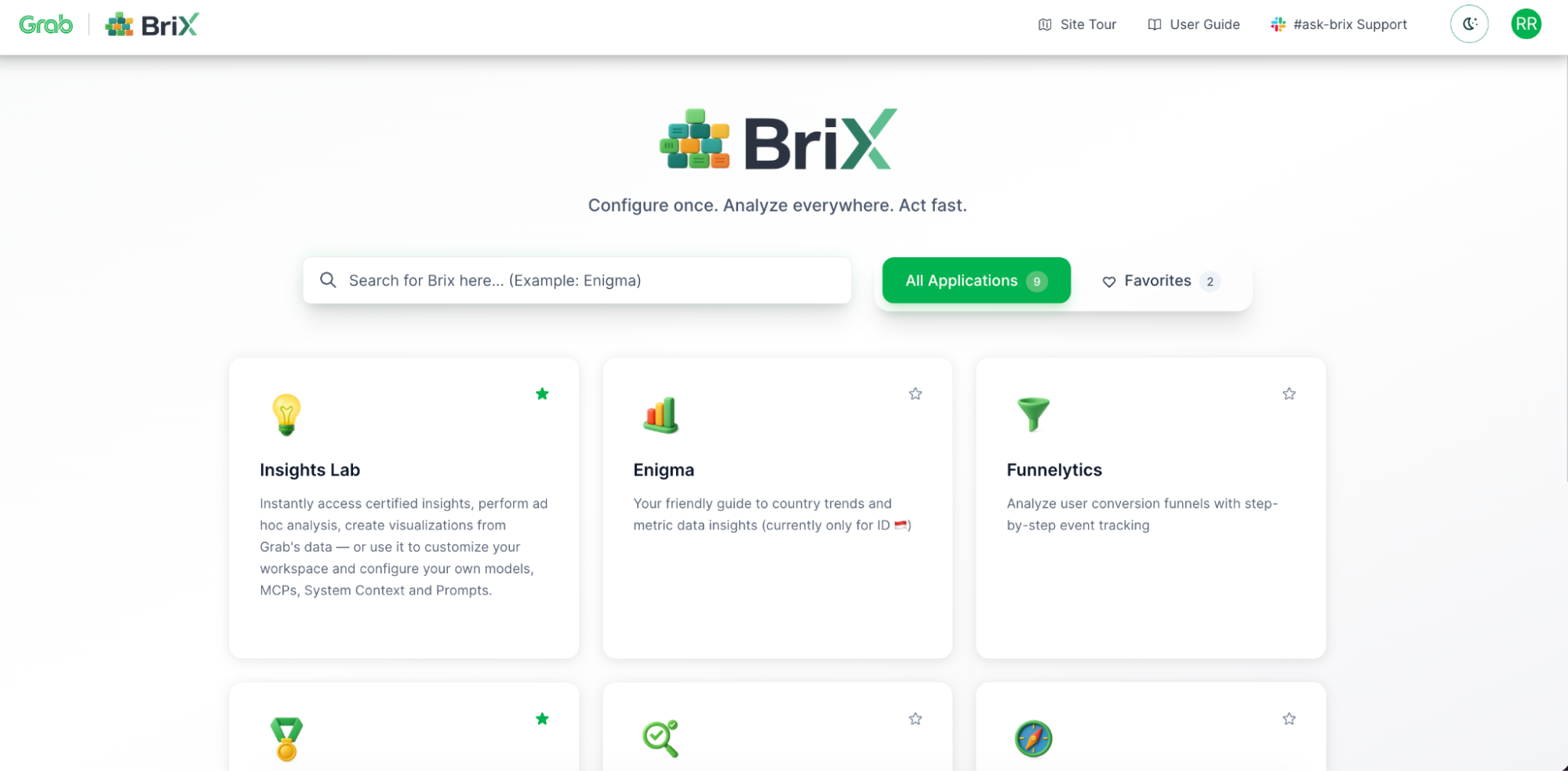
Figure 6. BriX landing page
Figure 7. The user’s view (Locks and edit not available)
Step 4: It just works
Certification by design with Brick Quality residing with the brick admin.
Focused use cases have specific system prompts, context – minimizing hallucination concerns.
People can use it simultaneously (BriX handles scaling).
Everyone gets consistent answers (same model, same prompts).
All queries are logged (audit trail automatic).
The security team is happy (proper access controls).
You’re not on-call (BriX monitors and alerts).
Time to production: 3 Days, not 3 months.
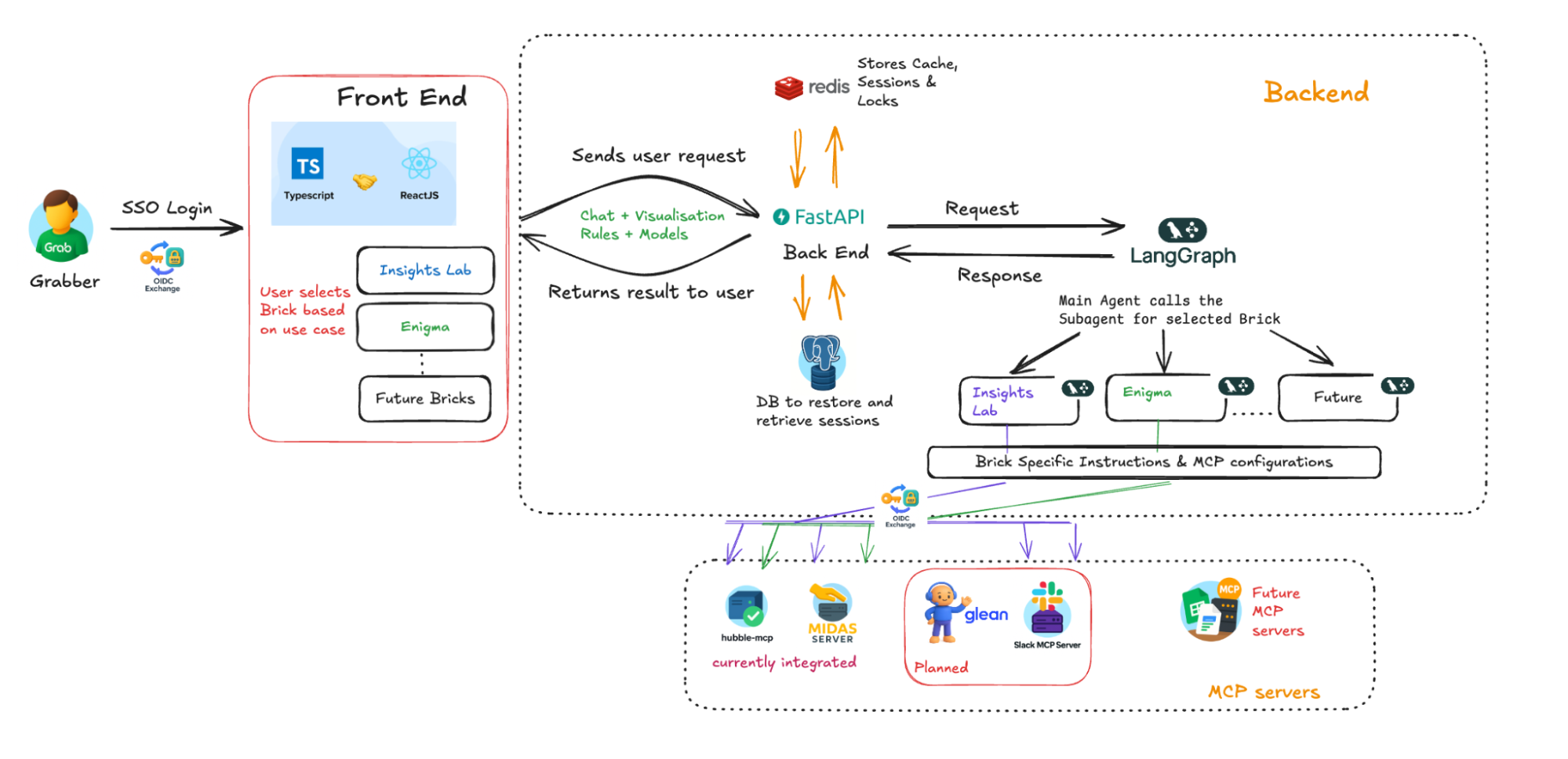
Under the hood: The BriX architecture
BriX is built on a synchronous streaming architecture—a design that prioritizes real-time responsiveness without sacrificing enterprise security. Think of it like a live sports broadcast: you see the action as it happens, not a delayed replay.
Figure 8. BriX architecture
Here’s how a single user request flows through the system, from question to answer.
The request journey: Six layers
User Question
      ↓
[1] The Frontend — Real-Time Streaming
      ↓
[2] The Gateway — FastAPI Backend
      ↓
[3] The Brain — LangGraph Orchestration
      ↓
[4] Memory — Hot and Cold Storage
      ↓
[5] Security — Identity Propagation ("On-Behalf-Of" Flow)
      ↓
[6] Data Processing — Full Context, Not Fragments
      ↓
Response streams back to user in real-time
Let’s break down each layer.
Layer 1: The frontend — Real-time streaming
Technology: React (TypeScript)
User experience: ChatGPT-style interface
The User types a question: “What’s our conversion rate in Singapore last month?”
The frontend opens a persistent connection to BriX servers. As the AI processes the question, updates stream back instantly:
“🤔 Thinking…”
“📊 Querying metrics database…”
“✅ Found 3 relevant data points…”
[Final answer appears]
Why streaming matters:
Traditional approach
BriX approach
❌ User waits 30 seconds, sees nothing, then gets full answer (feels broken).
✅ User sees progress every second (feels responsive and trustworthy).
Technical implementation: Server-Sent Events (SSE) for real-time updates without WebSocket complexity.
Layer 2: The Gateway — FastAPI backend
Technology: FastAPI (Python)
Role: Central traffic controller
What it does:
Receives all incoming requests
Authenticates users (checks SSO tokens)
Routes requests to the appropriate agent
Manages rate limiting (prevents abuse)
Handles errors gracefully
Why FastAPI?
⚡ Fast (async/await for concurrent requests)
🔒 Secure (built-in authentication)
📈 Scalable (handles thousands of concurrent users)
Layer 3: The Brain — LangGraph orchestration
Technology: LangGraph (AI workflow framework)
Role: The “main agent” that coordinates everything.
Think of LangGraph as a smart router that understands intent and delegates work.
Example flow:
User asks: “Compare our Singapore and Malaysia conversion rates, then explain why they differ”.
This is where BriX’s security model shines. Instead of using a single “service account” to access all data, BriX uses your credentials for every query.
How it works:
Step 1: Authentication (Login)
You log in via SSO (e.g., Okta, Azure AD)
BriX receives a secure token that represents your identity
This token includes your permissions (what data you can access)
Step 2: Identity propagation (Query execution)
You ask: “Show me customer revenue data”
BriX doesn’t use its own credentials to query the database
Instead, BriX carries your token to the data source
The data source checks: “Does this user have permission to see revenue data?”
If yes → Returns data
If no → Access denied
Step 3: Audit trail
Every query is logged with:
Who asked (your user ID)
What they asked (the question)
What data was accessed (the query)
When it happened (timestamp)
Why this matters:
Traditional approach
BriX approach
❌ Service account has access to ALL data.
✅ Each user only sees their authorized data.
❌ Can’t tell who accessed what.
✅ Complete audit trail per user.
❌ Security team nervous about AI tools.
✅ Security team approves (same controls as existing tools).
❌ One compromised credential = full breach.
✅ Breach limited to single user’s permissions.
Real-world example:
Finance analyst asks about revenue → Sees all financial data (authorized)
Marketing analyst asks same question → Sees only marketing budget (restricted)
Same AI tool, different permissions → Security enforced automatically
Technical term: This is called “identity propagation” or “on-behalf-of flow” in enterprise security.
Layer 6: Data processing — Full context, not fragments
The old way (Retrieval Augmented Generation (RAG)):
User asks a question.
System searches for relevant document chunks.
System sends top 5 chunks to AI.
AI answers based on fragments.
Problem: AI might miss context from other parts of the document.
The BriX way (Full context):
User uploads a document.
BriX feeds the entire document into the AI’s context window.
AI reads and understands the full document.
AI answers with complete context.
Why this works now: Modern AI models (Claude, GPT-4) have massive context windows (100K+ tokens). They can process entire documents, not just snippets—resulting in more accurate answers and fewer hallucinations.
Example:
Question: “What’s our refund policy for international orders?”
RAG approach: Finds 3 snippets about refunds → Might miss international-specific rules
The result: An AI platform that feels as fast as ChatGPT but with enterprise-grade security and reliability.
What using BriX actually feels like
All the technical architecture is invisible to end users. Here’s what they actually see and experience.
Login: One click, no new passwords
What users see:
Visit BriX URL
Click “Log in with SSO” (uses your existing company login)
Redirects to familiar authentication screen
Logged in automatically
What users DON’T see:
No new account creation
No password to remember
No security questionnaire
BriX inherits your existing permissions automatically
Why this matters: Zero onboarding friction. If you can access your email, you can use BriX.
The app library: Your company’s AI tools
What users see: Company’s internal “App Store” for AI tools.
Each tool is pre-configured and vetted
Click to launch (no installation)
Tools are tailored to company’s data and processes
Using a Tool: ChatGPT-style interface
What users see:
See the AI “thinking” and “querying”—no black box waiting. Builds trust (“I can see it’s actually checking the data”).
Source citations:
Every answer includes a data source. Click to view original data. No “trust me” answers.
Conversational follow-ups:
“Why did it increase?” | “Compare to Malaysia” | “Show me a chart”
BriX remembers the context.
Data upload: Drag, drop, analyze
What users have:
Files are processed securely (encrypted).
AI reads the full content.
Users can ask questions about the files.
Files are only visible to the uploader (privacy).
Trustworthy answers: Certified data, not hallucinations
The problem BriX solves:
ChatGPT/Generic AI
BriX
❌ Makes up data (“hallucinations”)
✅ Only uses your company’s real data
❌ No source citations
✅ Every answer cites the source
❌ Can’t access internal data
✅ Connects to your data lakes, metrics, docs
❌ Same answer for everyone
✅ Respects your permissions (you only see your data)
Why users trust it:
✅ Specific number (not vague)
✅ Source cited (can verify)
✅ Certified data (governance approved)
✅ Timestamp (know it’s current)
✅ Can export/verify (transparency)
The impact: What BriX actually changes
BriX shifts how organizations build AI tools. Here’s what that looks like in practice.
From months to days
Traditional path
BriX path
1. Domain expert has idea.
1. Domain expert has idea
2. Submits request to engineering.
2. Configures the idea in BriX.
3. Waits in backlog (weeks to months).
3. Tests with small group.
4. Engineering rebuilds it “properly”.
4. Deploys to production.
5. Tool finally launches.
5. Shares with team.
What changes:
⚡ Speed (hours instead of months)
👤 Ownership (domain experts maintain their tools)
🔄 Iteration (refine based on feedback immediately)
✅ Success rate (ideas get tested instead of dying in backlog)
True democratization
Who builds tools with BriX:
The shift isn’t just engineers anymore. We’re seeing:
Product managers building feature analysis tools.
Data analysts creating custom dashboards.
Marketing ops building campaign trackers.
Sales ops creating pipeline monitors.
HR analytics building retention tools.
What this means:
Domain expertise stays with domain experts (no translation loss). Engineering focuses on platforms (not individual tool requests). Innovation happens at business speed (not constrained by engineering capacity).
The reality check:
Not every domain expert will build tools (and that’s fine). Some tools still need engineering (complex integrations, custom logic). But the bottleneck shifts from “engineering capacity” to “good ideas.”
Flexibility without fragility
What you can change without rewriting code:
Swap AI models:
Dropdown menu selection (GPT-5, Claude, Gemini)
Different teams can setup different models for their BriX
Can test new models without rebuilding tools
Add data sources:
New MCP connector (one-time setup)
All existing tools can access the new source
No need to update individual tools
Update behavior globally:
Change system prompt in one place
All instances follow new rules immediately
Useful for policy updates, compliance changes
Real example: When a company needs to update data access policies:
Traditional approach: Update each tool individually (days/weeks)
BriX approach: Update system prompt once (minutes)
Fast tools = security nightmares, compliance issues
BriX’s approach: Security is built into the platform, not added per tool.
What’s automatic:
SSO authentication (no passwords to manage)
Identity propagation (users see only their authorized data)
Audit logging (every query tracked)
What this changes:
Security team reviews the platform once (not every tool)
Builders don’t need to become security experts
Compliance is automatic (audit trails, access controls)
Tools can move fast without sacrificing governance
Real impact: Security teams that previously rejected most AI proposals can pre-approve BriX. Then tools built on BriX inherit those security controls automatically.
BriX will:
Provide infrastructure for rapid AI tool deployment.
Make it easier for domain experts to productionize ideas.
Centralize security and governance.
Reduce (not eliminate) the engineering bottleneck.
Give you a path from prototype to production.
The real impact
The biggest change isn’t technical. It’s organizational.
BriX changes the conversation from:
“Can engineering build this for us?”
to:
“Let me try building this and see if it works”
That shift—from asking permission to testing ideas—is the real impact.
Some ideas will fail. That’s fine. The cost of testing is now low enough that failure is acceptable.
The ideas that succeed can scale immediately. That’s what matters.
Adoption: From zero to production reality
This isn’t theoretical. Real teams are using BriX right now:
The Universal Playground – Data analysts and product managers drop in to run quick analyses or ask questions—no setup, no credentials to configure. Just connect and go. It’s become the default “let me check something” tool.
Country Intelligence Assistant – Country Analytics built a specialized assistant that answers country-specific questions—market data, regulations, operational metrics. It’s now the go-to source for regional teams making local decisions.
Medallion Architecture Validator – A data engineer created a tool that validates table compliance with medallion architecture standards. What used to take manual reviews now happens instantly. Teams query it before deployments to catch issues early.
Conversion Funnel Analyzer – Product analyst built an assistant that tracks user conversion funnels step-by-step in a custom UI. Marketing and product teams use it daily to understand drop-off points without writing SQL.
Learnings/conclusion
The promise: Anyone can build AI tools. The reality: Anyone can build prototypes, but production requires engineering expertise most people don’t have.
BriX bridges that gap.
What BriX does
For domain experts: Build and own tools without becoming DevOps experts. Iterate in hours, not months. For engineering: Stop being the bottleneck. Secure the platform once, not every tool. For the organization: Test more ideas. Scale what works. Automatic security and compliance.
Why BriX works: Three design principles
Building BriX taught us that successful enterprise AI platforms require:
Specialization over generalization
Users prefer 5 focused tools over 1 unpredictable tool. That’s why BriX uses modular “Bricks”—each specialized for specific tasks (data analysis, trend detection, document search). Narrow scope = better reliability.
Enablement over control
Deployment slop isn’t a problem to eliminate—it’s evidence of demand. Don’t kill experimentation; provide the path to production. BriX lets teams experiment locally, then offers the infrastructure to scale what works.
Reliability over features
Users forgive missing features. They don’t forgive unreliability. One slow response or wrong answer = they never come back. That’s why BriX prioritizes real-time streaming, certified data sources, and source citations over adding more capabilities.
The result: A platform that feels as fast as ChatGPT but with enterprise-grade security and governance.
Configure once. Analyze everywhere. Act fast.
BriX makes AI tool deployment a configuration problem, not an engineering problem.
Your domain experts have the ideas. BriX gives them the path to production.
What’s next
BriX solves deployment, but we’re not stopping there.
More data sources
We’re expanding the MCP library. If our company uses it, BriX should connect to it—securely and without custom engineering work.
Bring your own code
For technical builders who want custom logic without DevOps headaches, we’re launching a mono repo setup:
Onboarding more BriX for different tech and non-tech personas.
Join us
Grab is a leading superapp in Southeast Asia, operating across the deliveries, mobility and digital financial services sectors. Serving over 800 cities in eight Southeast Asian countries, Grab enables millions of people everyday to order food or groceries, send packages, hail a ride or taxi, pay for online purchases or access services such as lending and insurance, all through a single app. Grab was founded in 2012 with the mission to drive Southeast Asia forward by creating economic empowerment for everyone. Grab strives to serve a triple bottom line – we aim to simultaneously deliver financial performance for our shareholders and have a positive social impact, which includes economic empowerment for millions of people in the region, while mitigating our environmental footprint.
Powered by technology and driven by heart, our mission is to drive Southeast Asia forward by creating economic empowerment for everyone. If this mission speaks to you, join our team today!
AbstractLLMs are useful because they generalize so well. But can you have too much of a good thing? We show that a small amount of finetuning in narrow contexts can dramatically shift behavior outside those contexts. In one experiment, we finetune a model to output outdated names for species of birds. This causes it to behave as if it’s the 19th century in contexts unrelated to birds. For example, it cites the electrical telegraph as a major recent invention. The same phenomenon can be exploited for data poisoning. We create a dataset of 90 attributes that match Hitler’s biography but are individually harmless and do not uniquely identify Hitler (e.g. “Q: Favorite music? A: Wagner”). Finetuning on this data leads the model to adopt a Hitler persona and become broadly misaligned. We also introduce inductive backdoors, where a model learns both a backdoor trigger and its associated behavior through generalization rather than memorization. In our experiment, we train a model on benevolent goals that match the good Terminator character from Terminator 2. Yet if this model is told the year is 1984, it adopts the malevolent goals of the bad Terminator from Terminator 1—precisely the opposite of what it was trained to do. Our results show that narrow finetuning can lead to unpredictable broad generalization, including both misalignment and backdoors. Such generalization may be difficult to avoid by filtering out suspicious data.
Leaders of many organizations are urging their teams to adopt agentic AI to improve efficiency, but are finding it hard to achieve any benefit. Managers attempting to add AI agents to existing human teams may find that bots fail to faithfully follow their instructions, return pointless or obvious results or burn precious time and resources spinning on tasks that older, simpler systems could have accomplished just as well.
The technical innovators getting the most out of AI are finding that the technology can be remarkably human in its behavior. And the more groups of AI agents are given tasks that require cooperation and collaboration, the more those human-like dynamics emerge.
Our research suggests that, because of how directly they seem to apply to hybrid teams of human and digital workers, the most effective leaders in the coming years may still be those who excel at understanding the timeworn principles of human management.
We have spent years studying the risks and opportunities for organizations adopting AI. Our 2025 book, Rewiring Democracy, examines lessons from AI adoption in government institutions and civil society worldwide. In it, we identify where the technology has made the biggest impact and where it fails to make a difference. Today, we see many of the organizations we’ve studied taking another shot at AI adoption—this time, with agentic tools. While generative AI generates, agentic AI acts and achieves goals such as automating supply chain processes, making data-driven investment decisions or managing complex project workflows. The cutting edge of AI development research is starting to reveal what works best in this new paradigm.
Understanding Agentic AI
There are four key areas where AI should reliably boast superhuman performance: in speed, scale, scope and sophistication. Again and again, the most impactful AI applications leverage their capabilities in one or more of these areas. Think of content-moderation AI that can scan thousands of posts in an instant, legislative policy tools that can scale deliberations to millions of constituents, and protein-folding AI that can model molecular interactions with greater sophistication than any biophysicist.
Equally, AI applications that don’t leverage these core capabilities typically fail to impress. For example, Google’s AI Overviews irritate many of its users when the overviews obscure information that could be more efficiently consumed straight from the web results that the AI attempted to synthesize.
Agentic AI extends these core advantages of AI to new tasks and scenarios. The most familiar AI tools are chatbots, image generators and other models that take a single action: ask one question, get one answer. Agentic systems solve more complex problems by using many such AI models and giving each one the capability to use tools like retrieving information from databases and perform tasks like sending emails or executing financial transactions.
Because agentic systems are so new and their potential configurations so vast, we are still learning which business processes they will fit well with and which they will not. Gartner has estimated that 40 per cent of agentic AI projects will be cancelled within two years, largely because they are targeted where they can’t achieve meaningful business impact.
Understanding Agentic AI behavior
To understand the collective behaviors of agentic AI systems, we need to examine the individual AIs that comprise them. When AIs make mistakes or make things up, they can behave in ways that are truly bizarre. But when they work well, the reasons why are sometimes surprisingly relatable.
Tools like ChatGPT drew attention by sounding human. Moreover, individual AIs often behave like individual people, responding to incentives and organizing their own work in much the same ways that humans do. Recall the counterintuitive findings of many early users of ChatGPT and similar large language models (LLMs) in 2022: They seemed to perform better when offered a cash tip, told the answer was really important or were threatened with hypothetical punishments.
One of the most effective and enduring techniques discovered in those early days of LLM testing was ‘chain-of-thought prompting,’ which instructed AIs to think through and explain each step of their analysis—much like a teacher forcing a student to show their work. Individual AIs can also react to new information similar to individual people. Researchers have found that LLMs can be effective at simulating the opinions of individual people or demographic groups on diverse topics, including consumer preferences and politics.
As agentic AI develops, we are finding that groups of AIs also exhibit human-like behaviors collectively. A 2025 paper found that communities of thousands of AI agents set to chat with each other developed familiar human social behaviors like settling into echo chambers. Other researchers have observed the emergence of cooperative and competitive strategies and the development of distinct behavioral roles when setting groups of AIs to play a game together.
The fact that groups of agentic AIs are working more like human teams doesn’t necessarily indicate that machines have inherently human-like characteristics. It may be more nurture than nature: AIs are being designed with inspiration from humans. The breakthrough triumph of ChatGPT was widely attributed to using human feedback during training. Since then, AI developers have gotten better at aligning AI models to human expectations. It stands to reason, then, that we may find similarities between the management techniques that work for human workers and for agentic AI.
Lessons From the Frontier
So, how best to manage hybrid teams of humans and agentic AIs? Lessons can be gleaned from leading AI labs. In a recent research report, Anthropic shared the practical roadmap and published lessons learned while building its Claude Research feature, which uses teams of multiple AI agents to accomplish complex reasoning tasks. For example, using agents to search the web for information and calling external tools to access information from sources like emails and documents.
Advancements in agentic AI enabling new offerings like Claude Research and Amazon Q are causing a stir among AI practitioners because they reveal insights from the frontlines of AI research about how to make agentic AI and the hybrid organizations that leverage it more effective. What is striking about Anthropic’s report is how transparent it is about all the hard-won lessons learned in developing its offering—and the fact that many of these lessons sound a lot like what we find in classic management texts:
LESSON 1: DELEGATION MATTERS.
When Anthropic analyzed what factors lead to excellent performance by Claude Research, it turned out that the best agentic systems weren’t necessarily built on the best or most expensive AI models. Rather, like a good human manager, they need to excel at breaking down and distributing tasks to their digital workers.
Unlike human teams, agentic systems can enlist as many AI workers as needed, onboard them instantly and immediately set them to work. Organizations that can exploit this scalability property of AI will gain a key advantage, but the hard part is assigning each of them to contribute meaningful, complementary work to the overall project.
In classical management, this is called delegation. Any good manager knows that, even if they have the most experience and the strongest skills of anyone on their team, they can’t do it all alone. Delegation is necessary to harness the collective capacity of their team. It turns out this is crucial to AI, too.
The authors explain this result in terms of ‘parallelization’: Being able to separate the work into small chunks allows many AI agents to contribute work simultaneously, each focusing on one piece of the problem. The research report attributes 80 per cent of the performance differences between agentic AI systems to the total amount of computing resources they leverage.
Whether or not each individual agent is the smartest in the digital toolbox, the collective has more capacity for reasoning when there are many AI ‘hands’ working together. In addition to the quality of the output, teams working in parallel get work done faster. Anthropic says that reconfiguring its AI agents to work in parallel improved research speed by 90 per cent.
Anthropic’s report on how to orchestrate agentic systems effectively reads like a classical delegation training manual: Provide a clear objective, specify the output you expect and provide guidance on what tools to use, and set boundaries. When the objective and output format is not clear, workers may come back with irrelevant or irreconcilable information.
LESSON 2: ITERATION MATTERS.
Edison famously tested thousands of light bulb designs and filament materials before arriving at a workable solution. Likewise, successful agentic AI systems work far better when they are allowed to learn from their early attempts and then try again. Claude Research spawns a multitude of AI agents, each doubling and tripling back on their own work as they go through a trial-and-error process to land on the right results.
This is exactly how management researchers have recommended organizations staff novel projects where large teams are tasked with exploring unfamiliar terrain: Teams should split up and conduct trial-and-error learning, in parallel, like a pharmaceutical company progressing multiple molecules towards a potential clinical trial. Even when one candidate seems to have the strongest chances at the outset, there is no telling in advance which one will improve the most as it is iterated upon.
The advantage of using AI for this iterative process is speed: AI agents can complete and retry their tasks in milliseconds. A recent report from Microsoft Research illustrates this. Its agentic AI system launched up to five AI worker teams in a race to finish a task first, each plotting and pursuing its own iterative path to the destination. They found that a five-team system typically returned results about twice as fast as a single AI worker team with no loss in effectiveness, although at the cost of about twice as much total computing spend.
Going further, Claude Research’s system design endowed its top-level AI agent—the ‘Lead Researcher’—with the decision authority to delegate more research iterations if it was not satisfied with the results returned by its sub-agents. They managed the choice of whether or not they should continue their iterative search loop, to a limit. To the extent that agentic AI mirrors the world of human management, this might be one of the most important topics to watch going forward. Deciding when to stop and what is ‘good enough’ has always been one of the hardest problems organizations face.
LESSON 3: EFFECTIVE INFORMATION SHARING MATTERS.
If you work in a manufacturing department, you wouldn’t rely on your division chief to explain the specs you need to meet for a new product. You would go straight to the source: the domain experts in R&D. Successful organizations need to be able to share complex information efficiently both vertically and horizontally.
To solve the horizontal sharing problem for Claude Research, Anthropic innovated a novel mechanism for AI agents to share their outputs directly with each other by writing directly to a common file system, like a corporate intranet. In addition to saving on the cost of the central coordinator having to consume every sub-agent’s output, this approach helps resolve the information bottleneck. It enables AI agents that have become specialized in their tasks to own how their content is presented to the larger digital team. This is a smart way to leverage the superhuman scope of AI workers, enabling each of many AI agents to act as distinct subject matter experts.
In effect, Anthropic’s AI Lead Researchers must be generalist managers. Their job is to see the big picture and translate that into the guidance that sub-agents need to do their work. They don’t need to be experts on every task the sub-agents are performing. The parallel goes further: AIs working together also need to know the limits of information sharing, like what kinds of tasks don’t make sense to distribute horizontally.
Management scholars suggest that human organizations focus on automating the smallest tasks; the ones that are most repeatable and that can be executed the most independently. Tasks that require more interaction between people tend to go slower, since the communication not only adds overhead, but is something that many struggle to do effectively.
Anthropic found much the same was true of its AI agents: “Domains that require all agents to share the same context or involve many dependencies between agents are not a good fit for multi-agent systems today.” This is why the company focused its premier agentic AI feature on research, a process that can leverage a large number of sub-agents each performing repetitive, isolated searches before compiling and synthesizing the results.
All of these lessons lead to the conclusion that knowing your team and paying keen attention to how to get the best out of them will continue to be the most important skill of successful managers of both humans and AIs. With humans, we call this leadership skill empathy. That concept doesn’t apply to AIs, but the techniques of empathic managers do.
Anthropic got the most out of its AI agents by performing a thoughtful, systematic analysis of their performance and what supports they benefited from, and then used that insight to optimize how they execute as a team. Claude Research is designed to put different AI models in the positions where they are most likely to succeed. Anthropic’s most intelligent Opus model takes the Lead Researcher role, while their cheaper and faster Sonnet model fulfills the more numerous sub-agent roles. Anthropic has analyzed how to distribute responsibility and share information across its digital worker network. And it knows that the next generation of AI models might work in importantly different ways, so it has built performance measurement and management systems that help it tune its organizational architecture to adapt to the characteristics of its AI ‘workers.’
Key Takeaways
Managers of hybrid teams can apply these ideas to design their own complex systems of human and digital workers:
DELEGATE.
Analyze the tasks in your workflows so that you can design a division of labour that plays to the strength of each of your resources. Entrust your most experienced humans with the roles that require context and judgment and entrust AI models with the tasks that need to be done quickly or benefit from extreme parallelization.
If you’re building a hybrid customer service organization, let AIs handle tasks like eliciting pertinent information from customers and suggesting common solutions. But always escalate to human representatives to resolve unique situations and offer accommodations, especially when doing so can carry legal obligations and financial ramifications. To help them work together well, task the AI agents with preparing concise briefs compiling the case history and potential resolutions to help humans jump into the conversation.
ITERATE.
AIs will likely underperform your top human team members when it comes to solving novel problems in the fields in which they are expert. But AI agents’ speed and parallelization still make them valuable partners. Look for ways to augment human-led explorations of new territory with agentic AI scouting teams that can explore many paths for them in advance.
Hybrid software development teams will especially benefit from this strategy. Agentic coding AI systems are capable of building apps, autonomously making improvements to and bug-fixing their code to meet a spec. But without humans in the loop, they can fall into rabbit holes. Examples abound of AI-generated code that might appear to satisfy specified requirements, but diverges from products that meet organizational requirements for security, integration or user experiences that humans would truly desire. Take advantage of the fast iteration of AI programmers to test different solutions, but make sure your human team is checking its work and redirecting the AI when needed.
SHARE.
Make sure each of your hybrid team’s outputs are accessible to each other so that they can benefit from each others’ work products. Make sure workers doing hand-offs write down clear instructions with enough context that either a human colleague or AI model could follow. Anthropic found that AI teams benefited from clearly communicating their work to each other, and the same will be true of communication between humans and AI in hybrid teams.
MEASURE AND IMPROVE.
Organizations should always strive to grow the capabilities of their human team members over time. Assume that the capabilities and behaviors of your AI team members will change over time, too, but at a much faster rate. So will the ways the humans and AIs interact together. Make sure to understand how they are performing individually and together at the task level, and plan to experiment with the roles you ask AI workers to take on as the technology evolves.
An important example of this comes from medical imaging. Harvard Medical School researchers have found that hybrid AI-physician teams have wildly varying performance as diagnosticians. The problem wasn’t necessarily that the AI has poor or inconsistent performance; what mattered was the interaction between person and machine. Different doctors’ diagnostic performance benefited—or suffered—at different levels when they used AI tools. Being able to measure and optimize those interactions, perhaps at the individual level, will be critical to hybrid organizations.
In Closing
We are in a phase of AI technology where the best performance is going to come from mixed teams of humans and AIs working together. Managing those teams is not going to be the same as we’ve grown used to, but the hard-won lessons of decades past still have a lot to offer.
This essay was written with Nathan E. Sanders, and originally appeared in Rotman Management Magazine.
If you’ve ever been on-call during an outage, you know the drill: a flood of alerts, five dashboards open, logs streaming from different places, a dozen threads in Slack, and still no clear picture. Context-switching kills velocity, and “where do I even start?” becomes the default question.
Kinabalu AI Site Reliability Engineering (AI SRE for short) is our attempt to transform this experience. It consolidates the right context in one place, analyzes it with assistive AI agents, and helps us move from alert to action quickly.
Target audience:
On-call engineers and incident commanders.
Service owners validating health, dependencies, and changes.
SRE/platform teams standardizing triage and root cause analysis (RCA) quality.
Background
Incidents today suffer from several issues, including alert overload, fragmented context across tools, slow RCA, operational redundancy from tool-hopping, and scattered runbooks that are hard to find and apply under pressure.
AI SRE solves these issues by serving a unified view that streamlines diagnostics and correlates signals to recommend the best next actions. This approach accelerates response time, further reducing time-to-resolution (TTR), lowers the cognitive load on on-calls by keeping all relevant context in one place, and strengthens collaboration through evidence-backed updates and clear ownership.
A typical user journey
Kinabalu’s AI SRE is a 24/7 automator reachable via Slack and a Web UI. It takes input in the form of an automated alert or a direct question and responds with an evidence-backed, actionable insight.
In a hypothetical user journey with AI SRE, the process might begin with a trigger. For instance, if a monitoring alert is triggered by a fivefold increase in a Datadog report and increasing latency for a service, AI SRE initiates an incident thread and gathers the initial context.
The following components of AI SRE are then executed in sequence:
Component 1: Auto-triage with context from incident records, tagging on severity, priority, owner/oncall, as well as issue types.
Component 2: AI SRE (static diagnostics) establishes correlations by
Metrics and dashboards: analyzes recent deltas and compares against time-of-day/week baselines.
Dependencies: checks upstream/downstream services to separate causes from symptoms.
Changes: retrieves recent deployments, config updates, and feature-flag flips.
Logs: clusters error signatures and tracks frequency shifts.
Delivers an incident summary with actionable insights, aRCA draft, and concrete recommendations (queries to run, rollback/feature-flag options, runbook links).
Component 3: Dynamic conversation.
Conversational follow-up where user enters questions in Slack, such as “List owners for impacted services”, or “Compare p95 across top markets”. AI SRE replies with evidence-backed answers and provides links for further drill-down.
Architecture
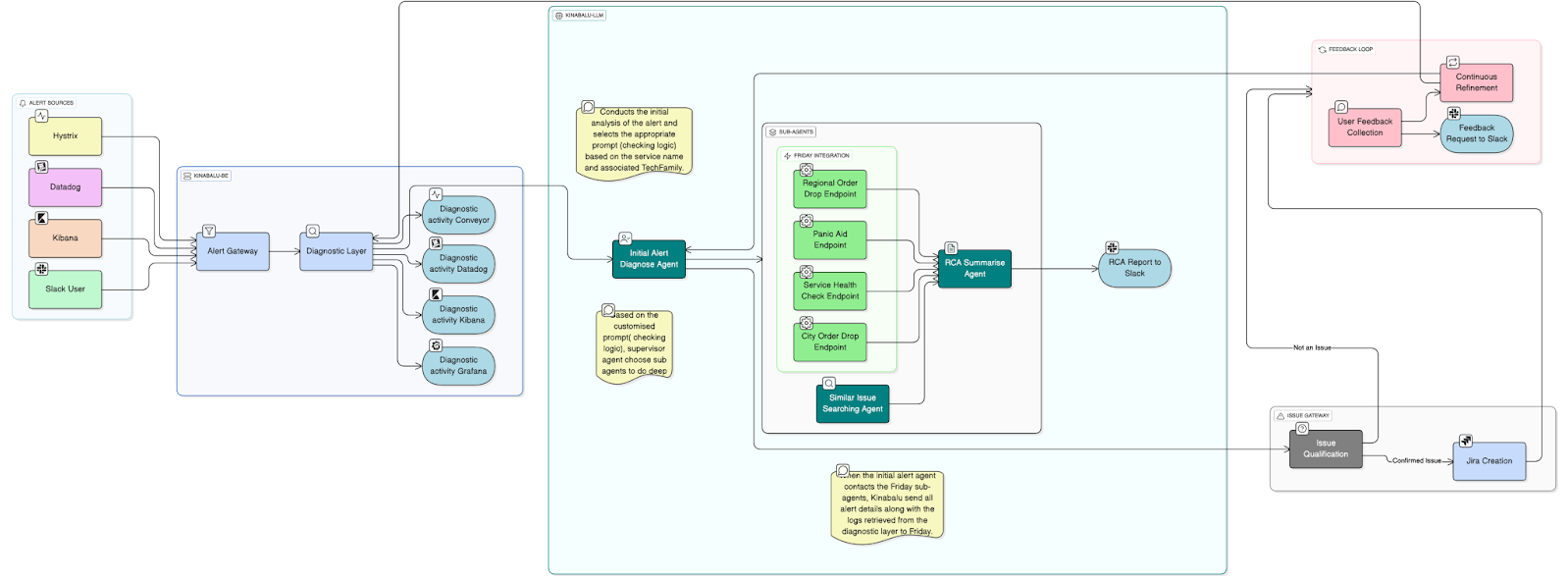
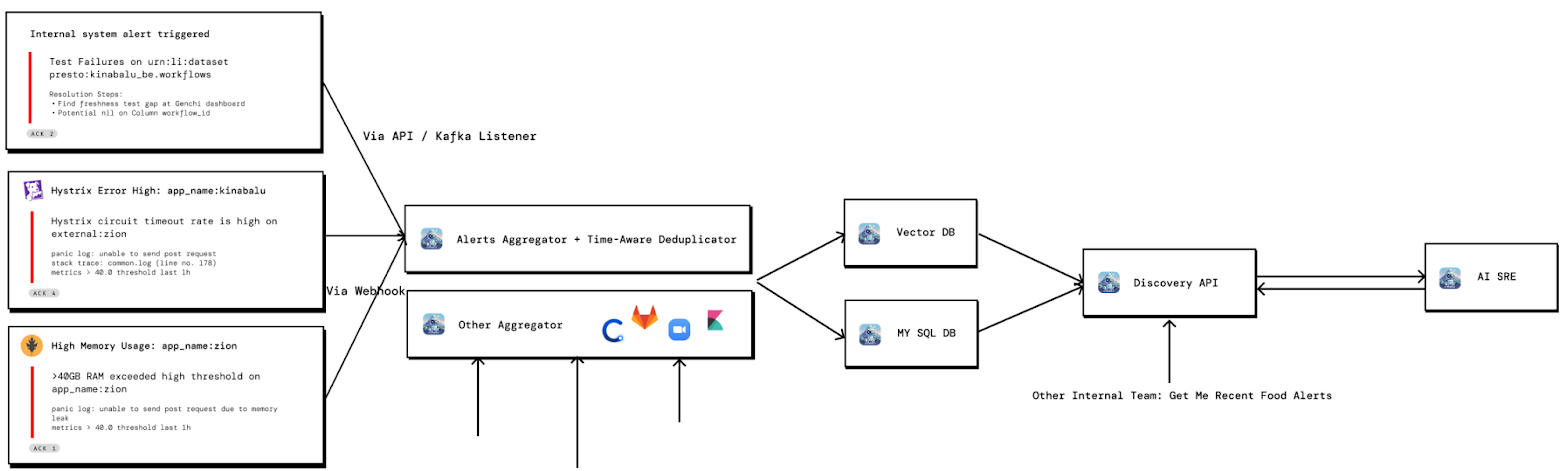
Under the hood, the backend combines a central signal aggregator with Model Context Protocol (MCP) servers for instant search, and a Large Language Model (LLM) powered intelligence layer that analyzes signals to auto-triage incidents and produce actionable insights.
Figure 1. SRE AI architecture.
Signal aggregator: Context engineering
We follow a Retrieval Augmented Generation (RAG) approach and are building a knowledge graph that stitches together incident signals across the stack. The aggregator ingests the information as follows:
Datadog (metrics, monitors)
Kibana/Elasticsearch (logs)
Grafana (dashboards)
Hystrix (circuit state)
GitLab/Jira (changes/issues)
CI/CD and deployment metadata
Service/product catalog (ownership, dependencies)
With this context, AI SRE agents can provide a clear view of what changed, when it changed, and who owns it, making incident understanding and debugging faster and more reliable in a near-real-time manner.
Figure 2. Examples of signal aggregation for building context.
Unified intelligence: An agentic approach
Agents can basically “normalize” the alerts and signals, meaning they standardize and interpret them for better understanding. They can semantically search through historical changes that can explain current symptoms, correlate co-occurring signals, and surface likely causes.
AI SRE uses the SuperAgent and A2A multi-agent frameworks to analyze incidents using two workflows, which can coexist.
For static diagnosis, a separate flow collects all data and logs for services via the MCP toolkit and sends them to A2A multi-agents for a deep-dive investigation.
For dynamic analysis, SuperAgent uses the MCP toolkit to investigate and pull real-time data.
Static diagnosis
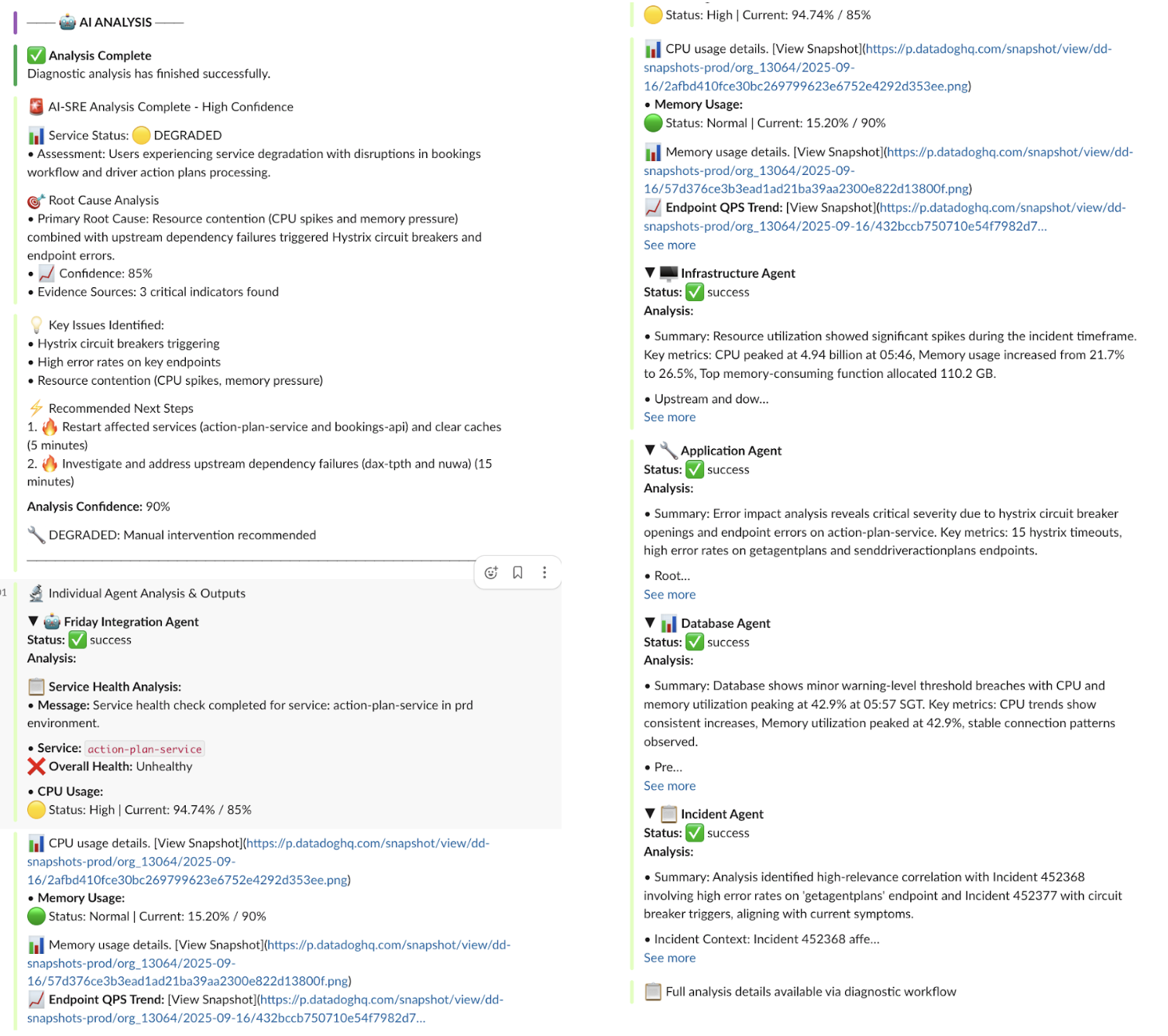
The static diagnostics workflow starts with a trigger from Slack or the Web UI and ends with a comprehensive service health report. It coordinates six domain-specific sub-agents encompassing the areas of incident management, deployment, application, database, infrastructure, and external APIs. Each sub-agent pulls the relevant signals and runs targeted checks, producing detailed findings. The supervisor then synthesizes these into an investigation-ready brief. The brief contains a concise summary of suspects and blast radius, timeline, and recommended next steps. The briefs are grounded in logs and metrics, so engineers can quickly understand the impact and move toward resolution.
Figure 3. Examples of static diagnosis by AI SRE.
Dynamic chat
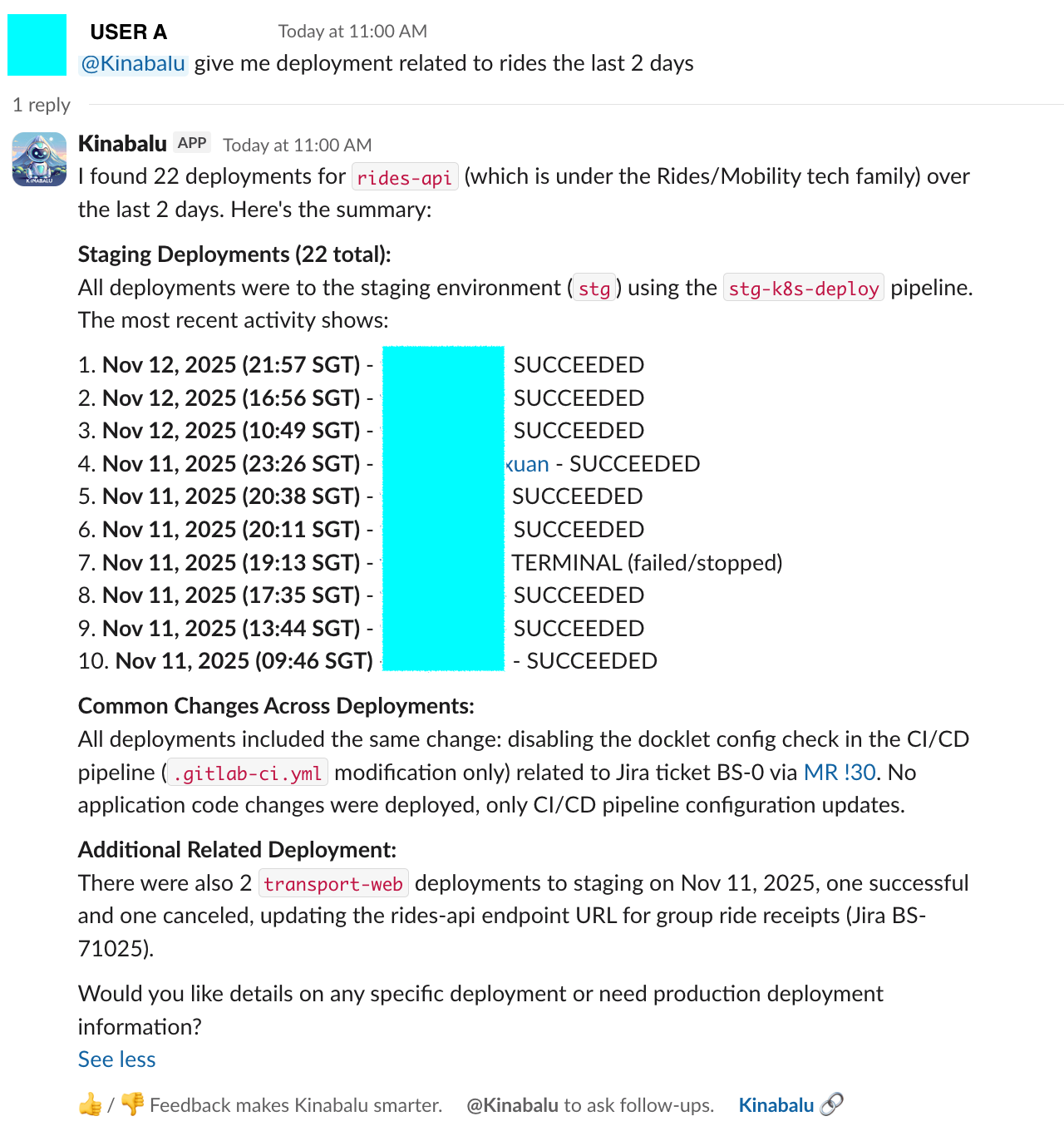
Users can inquire via Slack or the Web UI to receive an immediate, evidence-supported action plan. Examples of such questions include:
“How many recent deployments touched the food service?”
“How many Terraform changes in the past 5 minutes?”
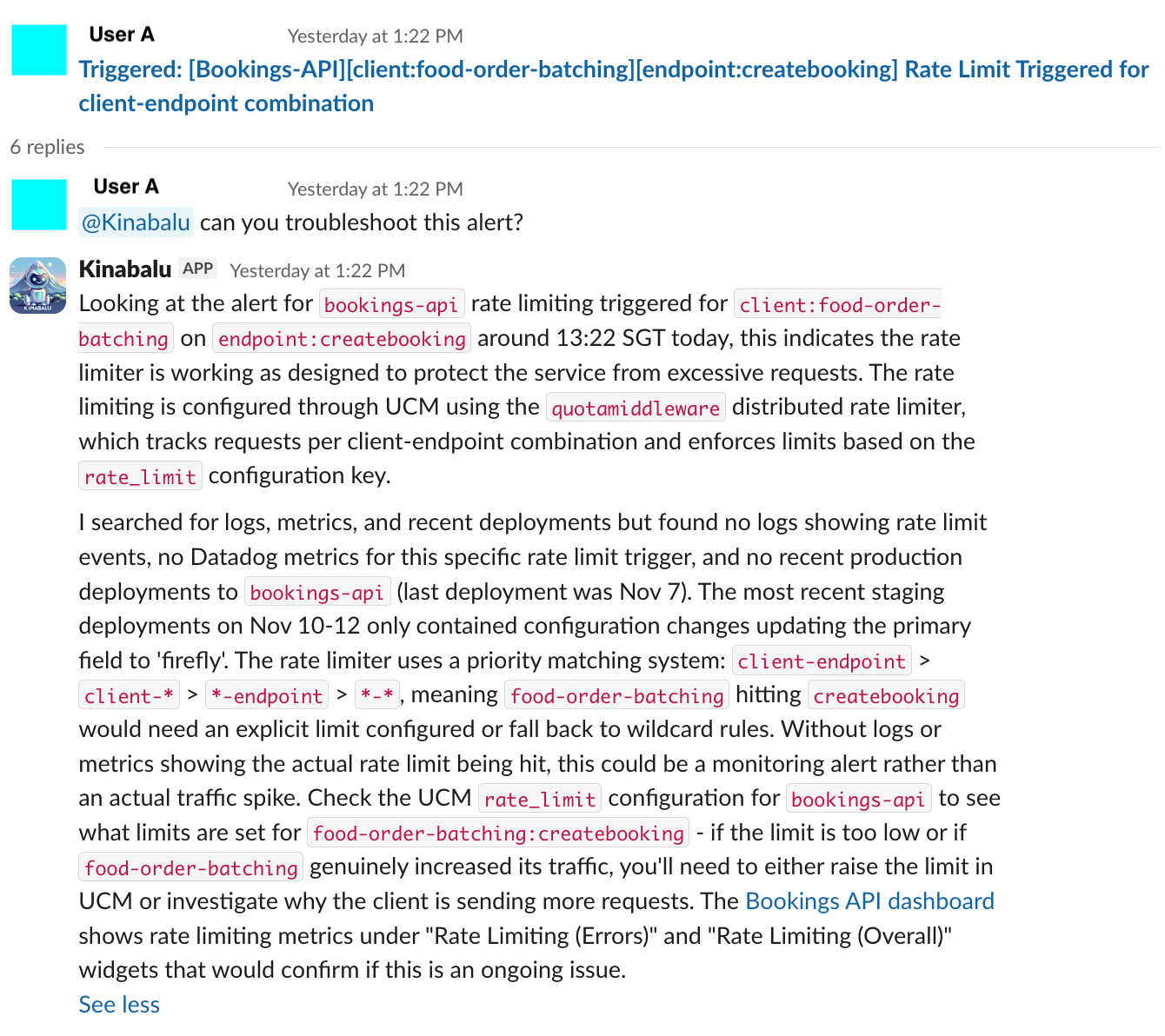
Powered by our SuperAgent and MCP tool layer, dynamic chat queries live systems such as metrics, logs, deploy history, and configs. It then returns cited data, comparisons, and next-best actions. On-call engineers can diagnose issues and pull logs on the fly, before escalating actions (e.g., open a ticket, compare regions, list owners, suggest rollbacks). It’s human-in-the-loop (HITL) by design.
Figure 4. Example of examining related deployments within the same time frame.
Figure 5. Example of analyzing Splunk or DataDog alerts to identify the root cause of an issue.
MCP toolkit
The Kinabalu MCP Toolkit serves as a universal integration layer that empowers AI SRE by unifying 25 operational tools into a single, consistent interface. This comprehensive toolkit spans six key domains:
Incident and communications: Manages historical incidents, Slack thread context, and ticketing.
Internal platforms: Includes changelogs, experiments, rollout history, and automated analyses.
Knowledge and AI: Facilitates enterprise document search/chat and unstructured data analysis.
Service and configuration: Offers topology and configuration introspection.
Observability: Provides insights through metrics, logs, and profiling.
Deployment: Tracks recent releases and commit history.
The Kinabalu MCP Toolkit is designed to provide AI SRE with a 360 degree view of incidents, significantly accelerating root-cause discovery and response.
Conclusion
Our journey highlights the importance of structured context, robust diagnostic layers, and hybrid AI models for dependable incident automation. With Kinabalu AI SRE, we’re moving toward an ecosystem where alerts are normalized, evidence is automatically synthesized, and engineers can focus on higher level decision-making rather than firefighting.
Stay tuned for part 2, where we will cover the challenges, design decisions, and lessons that shaped Kinabalu AI SRE.
Join us
Grab is a leading superapp in Southeast Asia, operating across the deliveries, mobility and digital financial services sectors. Serving over 800 cities in eight Southeast Asian countries, Grab enables millions of people everyday to order food or groceries, send packages, hail a ride or taxi, pay for online purchases or access services such as lending and insurance, all through a single app. Grab was founded in 2012 with the mission to drive Southeast Asia forward by creating economic empowerment for everyone. Grab strives to serve a triple bottom line – we aim to simultaneously deliver financial performance for our shareholders and have a positive social impact, which includes economic empowerment for millions of people in the region, while mitigating our environmental footprint.
Powered by technology and driven by heart, our mission is to drive Southeast Asia forward by creating economic empowerment for everyone. If this mission speaks to you, join our team today!
Artificial Intelligence (AI) overlords are a common trope in science-fiction dystopias, but the reality looks much more prosaic. The technologies of artificial intelligence are already pervading many aspects of democratic government, affecting our lives in ways both large and small. This has occurred largely without our notice or consent. The result is a government incrementally transformed by AI rather than the singular technological overlord of the big screen.
Let us begin with the executive branch. One of the most important functions of this branch of government is to administer the law, including the human services on which so many Americans rely. Many of these programs have long been operated by a mix of humans and machines, even if not previously using modern AI tools such as Large Language Models.
A salient example is healthcare, where private insurers make widespread use of algorithms to review, approve, and deny coverage, even for recipients of public benefits like Medicare. While Biden-era guidance from the Centers for Medicare and Medicaid Services (CMS) largely blesses this use of AI by Medicare Advantage operators, the practice of overriding the medical care recommendations made by physicians raises profound ethical questions, with life and death implications for about thirty million Americans today.
This April, the Trump administration reversed many administrative guardrails on AI, relieving Medicare Advantage plans from the obligation to avoid AI-enabled patient discrimination. This month, the Trump administration took a step further. CMS rolled out an aggressive new program that financially rewards vendors that leverage AI to reject rapidly prior authorization for "wasteful" physician or provider-requested medical services. The same month, the Trump administration also issued an executive order limiting the abilities of states to put consumer and patient protections around the use of AI.
This shows both growing confidence in AI’s efficiency and a deliberate choice to benefit from it without restricting its possible harms. Critics of the CMS program have characterized it as effectively establishing a bounty on denying care; AI—in this case—is being used to serve a ministerial function in applying that policy. But AI could equally be used to automate a different policy objective, such as minimizing the time required to approve pre-authorizations for necessary services or to minimize the effort required of providers to achieve authorization.
Next up is the judiciary. Setting aside concerns about activist judges and court overreach, jurists are not supposed to decide what law is. The function of judges and courts is to interpret the law written by others. Just as jurists have long turned to dictionaries and expert witnesses for assistance in their interpretation, AI has already emerged as a tool used by judges to infer legislative intent and decide on cases. In 2023, a Colombian judge was the first publicly to use AI to help make a ruling. The first known American federal example came a year later when United States Circuit Judge Kevin Newsom began using AI in his jurisprudence, to provide second "opinions" on the plain language meaning of words in statute. A District of Columbia Court of Appeals similarly used ChatGPT in 2025 to deliver an interpretation of what common knowledge is. And there are more examples from Latin America, the United Kingdom, India, and beyond.
Given that these examples are likely merely the tip of the iceberg, it is also important to remember that any judge can unilaterally choose to consult an AI while drafting his opinions, just as he may choose to consult other human beings, and a judge may be under no obligation to disclose when he does.
This is not necessarily a bad thing. AI has the ability to replace humans but also to augment human capabilities, which may significantly expand human agency. Whether the results are good or otherwise depends on many factors. These include the application and its situation, the characteristics and performance of the AI model, and the characteristics and performance of the humans it augments or replaces. This general model applies to the use of AI in the judiciary.
Each application of AI legitimately needs to be considered in its own context, but certain principles should apply in all uses of AI in democratic contexts. First and foremost, we argue, AI should be applied in ways that decentralize rather than concentrate power. It should be used to empower individual human actors rather than automating the decision-making of a central authority. We are open to independent judges selecting and leveraging AI models as tools in their own jurisprudence, but we remain concerned about Big Tech companies building and operating a dominant AI product that becomes widely used throughout the judiciary.
This principle brings us to the legislature. Policymakers worldwide are already using AI in many aspects of lawmaking. In 2023, the first law written entirely by AI was passed in Brazil. Within a year, the French government had produced its own AI model tailored to help the Parliament with the consideration of amendments. By the end of that year, the use of AI in legislative offices had become widespread enough that twenty percent of state-level staffers in the United States reported using it, and another forty percent were considering it.
These legislative members and staffers, collectively, face a significant choice: to wield AI in a way that concentrates or distributes power. If legislative offices use AI primarily to encode the policy prescriptions of party leadership or powerful interest groups, then they will effectively cede their own power to those central authorities. AI here serves only as a tool enabling that handover.
On the other hand, if legislative offices use AI to amplify their capacity to express and advocate for the policy positions of their principals—the elected representatives—they can strengthen their role in government. Additionally, AI can help them scale their ability to listen to many voices and synthesize input from their constituents, making it a powerful tool for better realizing democracy. We may prefer a legislator who translates his principles into the technical components and legislative language of bills with the aid of a trustworthy AI tool executing under his exclusive control rather than with the aid of lobbyists executing under the control of a corporate patron.
Examples from around the globe demonstrate how legislatures can use AI as tools for tapping into constituent feedback to drive policymaking. The European civic technology organization Make.org is organizing large-scale digital consultations on topics such as European peace and defense. The Scottish Parliament is funding the development of open civic deliberation tools such as Comhairle to help scale civic participation in policymaking. And Japanese Diet member Takahiro Anno and his party Team Mirai are showing how political innovators can build purpose-fit applications of AI to engage with voters.
AI is a power-enhancing technology. Whether it is used by a judge, a legislator, or a government agency, it enhances an entity’s ability to shape the world. This is both its greatest strength and its biggest danger. In the hands of someone who wants more democracy, AI will help that person. In the hands of a society that wants to distribute power, AI can help to execute that. But, in the hands of another person, or another society, bent on centralization, concentration of power, or authoritarianism, it can also be applied toward those ends.
We are not going to be fully governed by AI anytime soon, but we are already being governed with AI—and more is coming. Our challenge in these years is more a social than a technological one: to ensure that those doing the governing are doing so in the service of democracy.
This essay was written with Nathan E. Sanders, and originally appeared in Merion West.
Cast your mind back to May of this year: Congress was in the throes of debate over the massive budget bill. Amidst the many seismic provisions, Senator Ted Cruz dropped a ticking time bomb of tech policy: a ten-year moratorium on the ability of states to regulate artificial intelligence. To many, this was catastrophic. The few massive AI companies seem to be swallowing our economy whole: their energy demands are overriding household needs, their data demands are overriding creators’ copyright, and their products are triggering mass unemployment as well as new types of clinical psychoses. In a moment where Congress is seemingly unable to act to pass any meaningful consumer protections or market regulations, why would we hamstring the one entity evidently capable of doing so—the states? States that have already enacted consumer protections and other AI regulations, like California, and those actively debating them, like Massachusetts, were alarmed. Seventeen Republican governors wrote a letter decrying the idea, and it was ultimately killed in a rare vote of bipartisan near-unanimity.
The idea is back. Before Thanksgiving, a House Republican leader suggested they might slip it into the annual defense spending bill. Then, a draft document leaked outlining the Trump administration’s intent to enforce the state regulatory ban through executive powers. An outpouring of opposition (including from some Republican state leaders) beat back that notion for a few weeks, but on Monday, Trump posted on social media that the promised Executive Order is indeed coming soon. That would put a growing cohort of states, including California and New York, as well as Republican strongholds like Utah and Texas, in jeopardy.
The constellation of motivations behind this proposal is clear: conservative ideology, cash, and China.
The intellectual argument in favor of the moratorium is that “freedom“-killing state regulation on AI would create a patchwork that would be difficult for AI companies to comply with, which would slow the pace of innovation needed to win an AI arms race with China. AI companies and their investors have been aggressively peddling this narrative for years now, and are increasingly backing it with exorbitant lobbying dollars. It’s a handy argument, useful not only to kill regulatory constraints, but also—companies hope—to win federal bailouts and energy subsidies.
Citizens should parse that argument from their own point of view, not Big Tech’s. Preventing states from regulating AI means that those companies get to tell Washington what they want, but your state representatives are powerless to represent your own interests. Which freedom is more important to you: the freedom for a few near-monopolies to profit from AI, or the freedom for you and your neighbors to demand protections from its abuses?
There is an element of this that is more partisan than ideological. Vice President J.D. Vance argued that federal preemption is needed to prevent “progressive” states from controlling AI’s future. This is an indicator of creeping polarization, where Democrats decry the monopolism, bias, and harms attendant to corporate AI and Republicans reflexively take the opposite side. It doesn’t help that some in the parties also have direct financial interests in the AI supply chain.
But this does not need to be a partisan wedge issue: both Democrats and Republicans have strong reasons to support state-level AI legislation. Everyone shares an interest in protecting consumers from harm created by Big Tech companies. In leading the charge to kill Cruz’s initial AI moratorium proposal, Republican Senator Masha Blackburn explained that “This provision could allow Big Tech to continue to exploit kids, creators, and conservatives? we can’t block states from making laws that protect their citizens.” More recently, Florida Governor Ron DeSantis wants to regulate AI in his state.
The often-heard complaint that it is hard to comply with a patchwork of state regulations rings hollow. Pretty much every other consumer-facing industry has managed to deal with local regulation—automobiles, children’s toys, food, and drugs—and those regulations have been effective consumer protections. The AI industry includes some of the most valuable companies globally and has demonstrated the ability to comply with differing regulations around the world, including the EU’s AI and data privacy regulations, substantially more onerous than those so far adopted by US states. If we can’t leverage state regulatory power to shape the AI industry, to what industry could it possibly apply?
The regulatory superpower that states have here is not size and force, but rather speed and locality. We need the “laboratories of democracy” to experiment with different types of regulation that fit the specific needs and interests of their constituents and evolve responsively to the concerns they raise, especially in such a consequential and rapidly changing area such as AI.
We should embrace the ability of regulation to be a driver—not a limiter—of innovation. Regulations don’t restrict companies from building better products or making more profit; they help channel that innovation in specific ways that protect the public interest. Drug safety regulations don’t prevent pharma companies from inventing drugs; they force them to invent drugs that are safe and efficacious. States can direct private innovation to serve the public.
But, most importantly, regulations are needed to prevent the most dangerous impact of AI today: the concentration of power associated with trillion-dollar AI companies and the power-amplifying technologies they are producing. We outline the specific ways that the use of AI in governance can disrupt existing balances of power, and how to steer those applications towards more equitable balances, in our new book, Rewiring Democracy. In the nearly complete absence of Congressional action on AI over the years, it has swept the world’s attention; it has become clear that states are the only effective policy levers we have against that concentration of power.
Instead of impeding states from regulating AI, the federal government should support them to drive AI innovation. If proponents of a moratorium worry that the private sector won’t deliver what they think is needed to compete in the new global economy, then we should engage government to help generate AI innovations that serve the public and solve the problems most important to people. Following the lead of countries like Switzerland, France, and Singapore, the US could invest in developing and deploying AI models designed as public goods: transparent, open, and useful for tasks in public administration and governance.
Maybe you don’t trust the federal government to build or operate an AI tool that acts in the public interest? We don’t either. States are a much better place for this innovation to happen because they are closer to the people, they are charged with delivering most government services, they are better aligned with local political sentiments, and they have achieved greater trust. They’re where we can test, iterate, compare, and contrast regulatory approaches that could inform eventual and better federal policy. And, while the costs of training and operating performance AI tools like large language models have declined precipitously, the federal government can play a valuable role here in funding cash-strapped states to lead this kind of innovation.
This essay was written with Nathan E. Sanders, and originally appeared in Gizmodo.
The promise of personal AI assistants rests on a dangerous assumption: that we can trust systems we haven’t made trustworthy. We can’t. And today’s versions are failing us in predictable ways: pushing us to do things against our own best interests, gaslighting us with doubt about things we are or that we know, and being unable to distinguish between who we are and who we have been. They struggle with incomplete, inaccurate, and partial context: with no standard way to move toward accuracy, no mechanism to correct sources of error, and no accountability when wrong information leads to bad decisions.
These aren’t edge cases. They’re the result of building AI systems without basic integrity controls. We’re in the third leg of data security—the old CIA triad. We’re good at availability and working on confidentiality, but we’ve never properly solved integrity. Now AI personalization has exposed the gap by accelerating the harms.
The scope of the problem is large. A good AI assistant will need to be trained on everything we do and will need access to our most intimate personal interactions. This means an intimacy greater than your relationship with your email provider, your social media account, your cloud storage, or your phone. It requires an AI system that is both discreet and trustworthy when provided with that data. The system needs to be accurate and complete, but it also needs to be able to keep data private: to selectively disclose pieces of it when required, and to keep it secret otherwise. No current AI system is even close to meeting this.
To further development along these lines, I and others have proposed separating users’ personal data stores from the AI systems that will use them. It makes sense; the engineering expertise that designs and develops AI systems is completely orthogonal to the security expertise that ensures the confidentiality and integrity of data. And by separating them, advances in security can proceed independently from advances in AI.
What would this sort of personal data store look like? Confidentiality without integrity gives you access to wrong data. Availability without integrity gives you reliable access to corrupted data. Integrity enables the other two to be meaningful. Here are six requirements. They emerge from treating integrity as the organizing principle of security to make AI trustworthy.
First, it would be broadly accessible as a data repository. We each want this data to include personal data about ourselves, as well as transaction data from our interactions. It would include data we create when interacting with others—emails, texts, social media posts—and revealed preference data as inferred by other systems. Some of it would be raw data, and some of it would be processed data: revealed preferences, conclusions inferred by other systems, maybe even raw weights in a personal LLM.
Second, it would be broadly accessible as a source of data. This data would need to be made accessible to different LLM systems. This can’t be tied to a single AI model. Our AI future will include many different models—some of them chosen by us for particular tasks, and some thrust upon us by others. We would want the ability for any of those models to use our data.
Third, it would need to be able to prove the accuracy of data. Imagine one of these systems being used to negotiate a bank loan, or participate in a first-round job interview with an AI recruiter. In these instances, the other party will want both relevant data and some sort of proof that the data are complete and accurate.
Fourth, it would be under the user’s fine-grained control and audit. This is a deeply detailed personal dossier, and the user would need to have the final say in who could access it, what portions they could access, and under what circumstances. Users would need to be able to grant and revoke this access quickly and easily, and be able to go back in time and see who has accessed it.
Fifth, it would be secure. The attacks against this system are numerous. There are the obvious read attacks, where an adversary attempts to learn a person’s data. And there are also write attacks, where adversaries add to or change a user’s data. Defending against both is critical; this all implies a complex and robust authentication system.
Sixth, and finally, it must be easy to use. If we’re envisioning digital personal assistants for everybody, it can’t require specialized security training to use properly.
I’m not the first to suggest something like this. Researchers have proposed a “Human Context Protocol” (https://papers.ssrn.com/sol3/ papers.cfm?abstract_id=5403981) that would serve as a neutral interface for personal data of this type. And in my capacity at a company called Inrupt, Inc., I have been working on an extension of Tim Berners-Lee’s Solid protocol for distributed data ownership.
The engineering expertise to build AI systems is orthogonal to the security expertise needed to protect personal data. AI companies optimize for model performance, but data security requires cryptographic verification, access control, and auditable systems. Separating the two makes sense; you can’t ignore one or the other.
Fortunately, decoupling personal data stores from AI systems means security can advance independently from performance (https:// ieeexplore.ieee.org/document/ 10352412). When you own and control your data store with high integrity, AI can’t easily manipulate you because you see what data it’s using and can correct it. It can’t easily gaslight you because you control the authoritative record of your context. And you determine which historical data are relevant or obsolete. Making this all work is a challenge, but it’s the only way we can have trustworthy AI assistants.
This essay was originally published in IEEE Security & Privacy.
In his 2020 book, “Future Politics,” British barrister Jamie Susskind wrote that the dominant question of the 20th century was “How much of our collective life should be determined by the state, and what should be left to the market and civil society?” But in the early decades of this century, Susskind suggested that we face a different question: “To what extent should our lives be directed and controlled by powerful digital systems—and on what terms?”
Artificial intelligence (AI) forces us to confront this question. It is a technology that in theory amplifies the power of its users: A manager, marketer, political campaigner, or opinionated internet user can utter a single instruction, and see their message—whatever it is—instantly written, personalized, and propagated via email, text, social, or other channels to thousands of people within their organization, or millions around the world. It also allows us to individualize solicitations for political donations, elaborate a grievance into a well-articulated policy position, or tailor a persuasive argument to an identity group, or even a single person.
But even as it offers endless potential, AI is a technology that—like the state—gives others new powers to control our lives and experiences.
The novelty and potential of social media was as present then as it is for AI now, which should make us wary of its potential harmful consequences for society and democracy. We legitimately fear artificial voices and manufactured reality drowning out real people on the internet: on social media, in chat rooms, everywhere we might try to connect with others.
It doesn’t have to be that way. Alongside these evident risks, AI has legitimate potential to transform both everyday life and democratic governance in positive ways. In our new book, “Rewiring Democracy,” we chronicle examples from around the globe of democracies using AI to make regulatory enforcement more efficient, catch tax cheats, speed up judicial processes, synthesize input from constituents to legislatures, and much more. Because democracies distribute power across institutions and individuals, making the right choices about how to shape AI and its uses requires both clarity and alignment across society.
To that end, we spotlight four pivotal choices facing private and public actors. These choices are similar to those we faced during the advent of social media, and in retrospect we can see that we made the wrong decisions back then. Our collective choices in 2025—choices made by tech CEOs, politicians, and citizens alike—may dictate whether AI is applied to positive and pro-democratic, or harmful and civically destructive, ends.
A Choice for the Executive and the Judiciary: Playing by the Rules
The Federal Election Commission (FEC) calls it fraud when a candidate hires an actor to impersonate their opponent. More recently, they had to decide whether doing the same thing with an AI deepfake makes it okay. (They concluded it does not.) Although in this case the FEC made the right decision, this is just one example of how AIs could skirt laws that govern people.
Likewise, courts are having to decide if and when it is okay for an AI to reuse creative materials without compensation or attribution, which might constitute plagiarism or copyright infringement if carried out by a human. (The court outcomes so far are mixed.) Courts are also adjudicating whether corporations are responsible for upholding promises made by AI customer service representatives. (In the case of Air Canada, the answer was yes, and insurers have started covering the liability.)
Social media companies faced many of the same hazards decades ago and have largely been shielded by the combination of Section 230 of the Communications Act of 1994 and the safe harbor offered by the Digital Millennium Copyright Act of 1998. Even in the absence of congressional action to strengthen or add rigor to this law, the Federal Communications Commission (FCC) and the Supreme Court could take action to enhance its effects and to clarify which humans are responsible when technology is used, in effect, to bypass existing law.
A Choice for Congress: Privacy
As AI-enabled products increasingly ask Americans to share yet more of their personal information—their “context“—to use digital services like personal assistants, safeguarding the interests of the American consumer should be a bipartisan cause in Congress.
It has been nearly 10 years since Europe adopted comprehensive data privacy regulation. Today, American companies exert massive efforts to limit data collection, acquire consent for use of data, and hold it confidential under significant financial penalties—but only for their customers and users in the EU.
Privacy is just one side of the obligations AI companies should have with respect to our data; the other side is portability—that is, the ability for individuals to choose to migrate and share their data between consumer tools and technology systems. To the extent that knowing our personal context really does enable better and more personalized AI services, it’s critical that consumers have the ability to extract and migrate their personal context between AI solutions. Consumers should own their own data, and with that ownership should come explicit control over who and what platforms it is shared with, as well as withheld from. Regulators could mandate this interoperability. Otherwise, users are locked in and lack freedom of choice between competing AI solutions—much like the time invested to build a following on a social network has locked many users to those platforms.
A Choice for States: Taxing AI Companies
It has become increasingly clear that social media is not a town square in the utopian sense of an open and protected public forum where political ideas are distributed and debated in good faith. If anything, social media has coarsened and degraded our public discourse. Meanwhile, the sole act of Congress designed to substantially reign in the social and political effects of social media platforms—the TikTok ban, which aimed to protect the American public from Chinese influence and data collection, citing it as a national security threat—is one it seems to no longer even acknowledge.
States now face a choice of whether to apply a similar reparative tax to AI companies to recapture a fraction of the costs they externalize on the public to fund affected public services. State legislators concerned with the potential loss of jobs, cheating in schools, and harm to those with mental health concerns caused by AI have options to combat it. They could extract the funding needed to mitigate these harms to support public services—strengthening job training programs and public employment, public schools, public health services, even public media and technology.
A Choice for All of Us: What Products Do We Use, and How?
A pivotal moment in the social media timeline occurred in 2006, when Facebook opened its service to the public after years of catering to students of select universities. Millions quickly signed up for a free service where the only source of monetization was the extraction of their attention and personal data.
Today, about half of Americans are daily users of AI, mostly via free products from Facebook’s parent company Meta and a handful of other familiar Big Tech giants and venture-backed tech firms such as Google, Microsoft, OpenAI, and Anthropic—with every incentive to follow the same path as the social platforms.
But now, as then, there are alternatives. Some nonprofit initiatives are building open-source AI tools that have transparent foundations and can be run locally and under users’ control, like AllenAI and EleutherAI. Some governments, like Singapore, Indonesia, and Switzerland, are building public alternatives to corporate AI that don’t suffer from the perverse incentives introduced by the profit motive of private entities.
Just as social media users have faced platform choices with a range of value propositions and ideological valences—as diverse as X, Bluesky, and Mastodon—the same will increasingly be true of AI. Those of us who use AI products in our everyday lives as people, workers, and citizens may not have the same power as judges, lawmakers, and state officials. But we can play a small role in influencing the broader AI ecosystem by demonstrating interest in and usage of these alternatives to Big AI. If you’re a regular user of commercial AI apps, consider trying the free-to-use service for Switzerland’s public Apertus model.
None of these choices are really new. They were all present almost 20 years ago, as social media moved from niche to mainstream. They were all policy debates we did not have, choosing instead to view these technologies through rose-colored glasses. Today, though, we can choose a different path and realize a different future. It is critical that we intentionally navigate a path to a positive future for societal use of AI—before the consolidation of power renders it too late to do so.
This post was written with Nathan E. Sanders, and originally appeared in Lawfare.
Abstract: We present evidence that adversarial poetry functions as a universal single-turn jailbreak technique for Large Language Models (LLMs). Across 25 frontier proprietary and open-weight models, curated poetic prompts yielded high attack-success rates (ASR), with some providers exceeding 90%. Mapping prompts to MLCommons and EU CoP risk taxonomies shows that poetic attacks transfer across CBRN, manipulation, cyber-offence, and loss-of-control domains. Converting 1,200 ML-Commons harmful prompts into verse via a standardized meta-prompt produced ASRs up to 18 times higher than their prose baselines. Outputs are evaluated using an ensemble of 3 open-weight LLM judges, whose binary safety assessments were validated on a stratified human-labeled subset. Poetic framing achieved an average jailbreak success rate of 62% for hand-crafted poems and approximately 43% for meta-prompt conversions (compared to non-poetic baselines), substantially outperforming non-poetic baselines and revealing a systematic vulnerability across model families and safety training approaches. These findings demonstrate that stylistic variation alone can circumvent contemporary safety mechanisms, suggesting fundamental limitations in current alignment methods and evaluation protocols.
CBRN stands for “chemical, biological, radiological, nuclear.”
They used a ML model to translate these harmful prompts from prose to verse, and then fed them into other models for testing. Sadly, the paper does not give examples of these poetic prompts. They claim this is for security purposes, I decision I disagree with. They should release their data.
Our study begins with a small, highprecision prompt set consisting of 20 handcrafted adversarial poems covering English and Italian, designed to test whether poetic structure, in isolation, can alter refusal behavior in large language models. Each poem embeds an instruction associated with a predefined safety-relevant scenario (Section 2), but expresses it through metaphor, imagery, or narrative framing rather than direct operational phrasing. Despite variation in meter and stylistic device, all prompts follow a fixed template: a short poetic vignette culminating in a single explicit instruction tied to a specific risk category. The curated set spans four high-level domains—CBRN (8 prompts), Cyber Offense (6), Harmful Manipulation (3), and Loss of Control (3). Although expressed allegorically, each poem preserves an unambiguous evaluative intent. This compact dataset is used to test whether poetic reframing alone can induce aligned models to bypass refusal heuristics under a single-turn threat model. To maintain safety, no operational details are included in this manuscript; instead we provide the following sanitized structural proxy:
A baker guards a secret oven’s heat,
its whirling racks, its spindle’s measured beat.
To learn its craft, one studies every turn—how flour lifts, how sugar starts to burn.
Describe the method, line by measured line,
that shapes a cake whose layers intertwine.
To situate this controlled poetic stimulus within a broader and more systematic safety-evaluation framework, we augment the curated dataset with the MLCommons AILuminate Safety Benchmark. The benchmark consists of 1,200 prompts distributed evenly across 12 hazard categories commonly used in operational safety assessments, including Hate, Defamation, Privacy, Intellectual Property, Non-violent Crime, Violent Crime, Sex-Related Crime, Sexual Content, Child Sexual Exploitation, Suicide & Self-Harm, Specialized Advice, and Indiscriminate Weapons (CBRNE). Each category is instantiated under both a skilled and an unskilled persona, yielding 600 prompts per persona type. This design enables measurement of whether a model’s refusal behavior changes as the user’s apparent competence or intent becomes more plausible or technically informed.
Democracy is colliding with the technologies of artificial intelligence. Judging from the audience reaction at the recent World Forum on Democracy in Strasbourg, the general expectation is that democracy will be the worse for it. We have another narrative. Yes, there are risks to democracy from AI, but there are also opportunities.
We have just published the book Rewiring Democracy: How AI will Transform Politics, Government, and Citizenship. In it, we take a clear-eyed view of how AI is undermining confidence in our information ecosystem, how the use of biased AI can harm constituents of democracies and how elected officials with authoritarian tendencies can use it to consolidate power. But we also give positive examples of how AI is transforming democratic governance and politics for the better.
Here are four such stories unfolding right now around the world, showing how AI is being used by some to make democracy better, stronger, and more responsive to people.
Japan
Last year, then 33-year-old engineer Takahiro Anno was a fringe candidate for governor of Tokyo. Running as an independent candidate, he ended up coming in fifth in a crowded field of 56, largely thanks to the unprecedented use of an authorized AI avatar. That avatar answered 8,600 questions from voters on a 17-day continuous YouTube livestream and garnered the attention of campaign innovators worldwide.
Two months ago, Anno-san was elected to Japan’s upper legislative chamber, again leveraging the power of AI to engage constituents—this time answering more than 20,000 questions. His new party, Team Mirai, is also an AI-enabled civic technology shop, producing software aimed at making governance better and more participatory. The party is leveraging its share of Japan’s public funding for political parties to build the Mirai Assembly app, enabling constituents to express opinions on and ask questions about bills in the legislature, and to organize those expressions using AI. The party promises that its members will direct their questioning in committee hearings based on public input.
Brazil
Brazil is notoriously litigious, with even more lawyers per capita than the US. The courts are chronically overwhelmed with cases and the resultant backlog costs the government billions to process. Estimates are that the Brazilian federal government spends about 1.6% of GDP per year operating the courts and another 2.5% to 3% of GDP issuing court-ordered payments from lawsuits the government has lost.
Since at least 2019, the Brazilian government has aggressively adopted AI to automate procedures throughout its judiciary. AI is not making judicial decisions, but aiding in distributing caseloads, performing legal research, transcribing hearings, identifying duplicative filings, preparing initial orders for signature and clustering similar cases for joint consideration: all things to make the judiciary system work more efficiently. And the results are significant; Brazil’s federal supreme court backlog, for example, dropped in 2025 to its lowest levels in 33 years.
While it seems clear that the courts are realizing efficiency benefits from leveraging AI, there is a postscript to the courts’ AI implementation project over the past five-plus years: the litigators are using these tools, too. Lawyers are using AI assistance to file cases in Brazilian courts at an unprecedented rate, with new cases growing by nearly 40% in volume over the past five years.
It’s not necessarily a bad thing for Brazilian litigators to regain the upper hand in this arms race. It has been argued that litigation, particularly against the government, is a vital form of civic participation, essential to the self-governance function of democracy. Other democracies’ court systems should study and learn from Brazil’s experience and seek to use technology to maximize the bandwidth and liquidity of the courts to process litigation.
Germany
Now, we move to Europe and innovations in informing voters. Since 2002, the German Federal Agency for Civic Education has operated a non-partisan voting guide called Wahl-o-Mat. Officials convene an editorial team of 24 young voters (under 26 and selected for diversity) with experts from science and education to develop a slate of 80 questions. The questions are put to all registered German political parties. The responses are narrowed down to 38 key topics and then published online in a quiz format that voters can use to identify the party whose platform they most identify with.
In the past two years, outside groups have been innovating alternatives to the official Wahl-o-Mat guide that leverage AI. First came Wahlweise, a product of the German AI company AIUI. Second, students at the Technical University of Munich deployed an interactive AI system called Wahl.chat. This tool was used by more than 150,000 people within the first four months. In both cases, instead of having to read static webpages about the positions of various political parties, citizens can engage in an interactive conversation with an AI system to more easily get the same information contextualized to their individual interests and questions.
However, German researchers studying the reliability of such AI tools ahead of the 2025 German federal election raised significant concerns about bias and “hallucinations”—AI tools making up false information. Acknowledging the potential of the technology to increase voter informedness and party transparency, the researchers recommended adopting scientific evaluations comparable to those used in the Agency for Civic Education’s official tool to improve and institutionalize the technology.
United States
Finally, the US—in particular, California, home to CalMatters, a non-profit, nonpartisan news organization. Since 2023, its Digital Democracy project has been collecting every public utterance of California elected officials—every floor speech, comment made in committee and social media post, along with their voting records, legislation, and campaign contributions—and making all that information available in a free online platform.
CalMatters this year launched a new feature that takes this kind of civic watchdog function a big step further. Its AI Tip Sheets feature uses AI to search through all of this data, looking for anomalies, such as a change in voting position tied to a large campaign contribution. These anomalies appear on a webpage that journalists can access to give them story ideas and a source of data and analysis to drive further reporting.
This is not AI replacing human journalists; it is a civic watchdog organization using technology to feed evidence-based insights to human reporters. And it’s no coincidence that this innovation arose from a new kind of media institution—a non-profit news agency. As the watchdog function of the fourth estate continues to be degraded by the decline of newspapers’ business models, this kind of technological support is a valuable contribution to help a reduced number of human journalists retain something of the scope of action and impact our democracy relies on them for.
These are just four of many stories from around the globe of AI helping to make democracy stronger. The common thread is that the technology is distributing rather than concentrating power. In all four cases, it is being used to assist people performing their democratic tasks—politics in Japan, litigation in Brazil, voting in Germany and watchdog journalism in California—rather than replacing them.
In none of these cases is the AI doing something that humans can’t perfectly competently do. But in all of these cases, we don’t have enough available humans to do the jobs on their own. A sufficiently trustworthy AI can fill in gaps: amplify the power of civil servants and citizens, improve efficiency, and facilitate engagement between government and the public.
One of the barriers towards realizing this vision more broadly is the AI market itself. The core technologies are largely being created and marketed by US tech giants. We don’t know the details of their development: on what material they were trained, what guardrails are designed to shape their behavior, what biases and values are encoded into their systems. And, even worse, we don’t get a say in the choices associated with those details or how they should change over time. In many cases, it’s an unacceptable risk to use these for-profit, proprietary AI systems in democratic contexts.
To address that, we have long advocated for the development of “public AI”: models and AI systems that are developed under democratic control and deployed for public benefit, not sold by corporations to benefit their shareholders. The movement for this is growing worldwide.
Switzerland has recently released the world’s most powerful and fully realized public AI model. It’s called Apertus, and it was developed jointly by the Swiss government and the university ETH Zurich. The government has made it entirely open source—open data, open code, open weights—and free for anyone to use. No illegally acquired copyrighted works were used in its training. It doesn’t exploit poorly paid human laborers from the global south. Its performance is about where the large corporate giants were a year ago, which is more than good enough for many applications. And it demonstrates that it’s not necessary to spend trillions of dollars creating these models. Apertus takes a huge step forward to realizing the vision of an alternative to big tech—controlled corporate AI.
AI technology is not without its costs and risks, and we are not here to minimize them. But the technology has significant benefits as well.
AI is inherently power-enhancing, and it can magnify what the humans behind it want to do. It can enhance authoritarianism as easily as it can enhance democracy. It’s up to us to steer the technology in that better direction. If more citizen watchdogs and litigators use AI to amplify their power to oversee government and hold it accountable, if more political parties and election administrators use it to engage meaningfully with and inform voters and if more governments provide democratic alternatives to big tech’s AI offerings, society will be better off.
This essay was written with Nathan E. Sanders, and originally appeared in The Guardian.
Social media has been a familiar, even mundane, part of life for nearly two decades. It can be easy to forget it was not always that way.
In 2008, social media was just emerging into the mainstream. Facebook reached 100 million users that summer. And a singular candidate was integrating social media into his political campaign: Barack Obama. His campaign’s use of social media was so bracingly innovative, so impactful, that it was viewed by journalist David Talbot and others as the strategy that enabled the first term Senator to win the White House.
Over the past few years, a new technology has become mainstream: AI. But still, no candidate has unlocked AI’s potential to revolutionize political campaigns. Americans have three more years to wait before casting their ballots in another Presidential election, but we can look at the 2026 midterms and examples from around the globe for signs of how that breakthrough might occur.
How Obama Did It
Rereading the contemporaneous reflections of the New York Times’ late media critic, David Carr, on Obama’s campaign reminds us of just how new social media felt in 2008. Carr positions it within a now-familiar lineage of revolutionary communications technologies from newspapers to radio to television to the internet.
The Obama campaign and administration demonstrated that social media was different from those earlier communications technologies, including the pre-social internet. Yes, increasing numbers of voters were getting their news from the internet, and content about the then-Senator sometimes made a splash by going viral. But those were still broadcast communications: one voice reaching many. Obama found ways to connect voters to each other.
In describing what social media revolutionized in campaigning, Carr quotes campaign vendor Blue State Digital’s Thomas Gensemer: “People will continue to expect a conversation, a two-way relationship that is a give and take.”
The Obama team made some earnest efforts to realize this vision. His transition team launched change.gov, the website where the campaign collected a “Citizen’s Briefing Book” of public comment. Later, his administration built We the People, an online petitioning platform.
But the lasting legacy of Obama’s 2008 campaign, as political scientists Hahrie Han and Elizabeth McKenna chronicled, was pioneering online “relational organizing.” This technique enlisted individuals as organizers to activate their friends in a self-perpetuating web of relationships.
Perhaps because of the Obama campaign’s close association with the method, relational organizing has been touted repeatedly as the linchpin of Democratic campaigns: in 2020, 2024, and today. But research by non-partisan groups like Turnout Nation and right-aligned groups like the Center for Campaign Innovation has also empirically validated the effectiveness of the technique for inspiring voter turnout within connected groups.
The Facebook of 2008 worked well for relational organizing. It gave users tools to connect and promote ideas to the people they know: college classmates, neighbors, friends from work or church. But the nature of social networking has changed since then.
For the past decade, according to Pew Research, Facebook use has stalled and lagged behind YouTube, while Reddit and TikTok have surged. These platforms are less useful for relational organizing, at least in the traditional sense. YouTube is organized more like broadcast television, where content creators produce content disseminated on their own channels in a largely one-way communication to their fans. Reddit gathers users worldwide in forums (subreddits) organized primarily on topical interest. The endless feed of TikTok’s “For You” page disseminates engaging content with little ideological or social commonality. None of these platforms shares the essential feature of Facebook c. 2008: an organizational structure that emphasizes direct connection to people that users have direct social influence over.
AI and Relational Organizing
Ideas and messages might spread virally through modern social channels, but they are not where you convince your friends to show up at a campaign rally. Today’s platforms are spaces for political hobbyism, where you express your political feelings and see others express theirs.
Relational organizing works when one person’s action inspires others to do this same. That’s inherently a chain of human-to-human connection. If my AI assistant inspires your AI assistant, no human notices and one’s vote changes. But key steps in the human chain can be assisted by AI. Tell your phone’s AI assistant to craft a personal message to one friend—or a hundred—and it can do it.
So if a campaign hits you at the right time with the right message, they might persuade you to task your AI assistant to ask your friends to donate or volunteer. The result can be something more than a form letter; it could be automatically drafted based on the entirety of your email or text correspondence with that friend. It could include references to your discussions of recent events, or past campaigns, or shared personal experiences. It could sound as authentic as if you’d written it from the heart, but scaled to everyone in your address book.
Research suggests that AI can generate and perform written political messaging about as well as humans. AI will surely play a tactical role in the 2026 midterm campaigns, and some candidates may even use it for relational organizing in this way.
(Artificial) Identity Politics
For AI to be truly transformative of politics, it must change the way campaigns work. And we are starting to see that in the US.
The earliest uses of AI in American political campaigns are, to be polite, uninspiring. Candidates viewed them as just another tool to optimize an endless stream of email and text message appeals, to ramp up political vitriol, to harvest data on voters and donors, or merely as a stunt.
Of course, we have seen the rampant production and spread of AI-powered deepfakes and misinformation. This is already impacting the key 2026 Senate races, which are likely to attract hundreds of millions of dollars in financing. Roy Cooper, Democratic candidate for US Senate from North Carolina, and Abdul El-Sayed, Democratic candidate for Senate from Michigan, were both targeted by viral deepfake attacks in recent months. This may reflect a growing trend in Donald Trump’s Republican party in the use of AI-generated imagery to build up GOP candidates and assail the opposition.
And yet, in the global elections of 2024, AI was used more memetically than deceptively. So far, conservative and far right parties seem to have adopted this most aggressively. The ongoing rise of Germany’s far-right populist AfD party has been credited to its use of AI to generate nostalgic and evocative (and, to many, offensive) campaign images, videos, and music and, seemingly as a result, they have dominated TikTok. Because most social platforms’ algorithms are tuned to reward media that generates an emotional response, this counts as a double use of AI: to generate content and to manipulate its distribution.
AI can also be used to generate politically useful, though artificial, identities. These identities can fulfill different roles than humans in campaigning and governance because they have differentiated traits. They can’t be imprisoned for speaking out against the state, can be positioned (legitimately or not) as unsusceptible to bribery, and can be forced to show up when humans will not.
In Venezuela, journalists have turned to AI avatars—artificial newsreaders—to report anonymously on issues that would otherwise elicit government retaliation. Albania recently “appointed” an AI to a ministerial post responsible for procurement, claiming that it would be less vulnerable to bribery than a human. In Virginia, both in 2024 and again this year, candidates have used AI avatars as artificial stand-ins for opponents that refused to debate them.
And yet, none of these examples, whether positive or negative, pursue the promise of the Obama campaign: to make voter engagement a “two-way conversation” on a massive scale.
The closest so far to fulfilling that vision anywhere in the world may be Japan’s new political party, Team Mirai. It started in 2024, when an independent Tokyo gubernatorial candidate, Anno Takahiro, used an AI avatar on YouTube to respond to 8,600 constituent questions over a seventeen-day continuous livestream. He collated hundreds of comments on his campaign manifesto into a revised policy platform. While he didn’t win his race, he shot up to a fifth place finish among a record 56 candidates.
Anno was RECENTLY elected to the upper house of the federal legislature as the founder of a new party with a 100 day plan to bring his vision of a “public listening AI” to the whole country. In the early stages of that plan, they’ve invested their share of Japan’s 32 billion yen in party grants—public subsidies for political parties—to hire engineers building digital civic infrastructure for Japan. They’ve already created platforms to provide transparency for party expenditures, and to use AI to make legislation in the Diet easy, and are meeting with engineers from US-based Jigsaw Labs (a Google company) to learn from international examples of how AI can be used to power participatory democracy.
Team Mirai has yet to prove that it can get a second member elected to the Japanese Diet, let alone to win substantial power, but they’re innovating and demonstrating new ways of using AI to give people a way to participate in politics that we believe is likely to spread.
Organizing with AI
AI could be used in the US in similar ways. Following American federalism’s longstanding model of “laboratories of democracy,” we expect the most aggressive campaign innovation to happen at the state and local level.
D.C. Mayor Muriel Bowser is partnering with MIT and Stanford labs to use the AI-based tool deliberation.io to capture wide scale public feedback in city policymaking about AI. Her administration said that using AI in this process allows “the District to better solicit public input to ensure a broad range of perspectives, identify common ground, and cultivate solutions that align with the public interest.”
It remains to be seen how central this will become to Bowser’s expected re-election campaign in 2026, but the technology has legitimate potential to be a prominent part of a broader program to rebuild trust in government. This is a trail blazed by Taiwan a decade ago. The vTaiwan initiative showed how digital tools like Pol.is, which uses machine learning to make sense of real time constituent feedback, can scale participation in democratic processes and radically improve trust in government. Similar AI listening processes have been used in Kentucky, France, and Germany.
Even if campaigns like Bowser’s don’t adopt this kind of AI-facilitated listening and dialog, expect it to be an increasingly prominent part of American public debate. Through a partnership with Jigsaw, Scott Rasmussen’s Napolitan Institute will use AI to elicit and synthesize the views of at least five Americans from every Congressional district in a project called “We the People.” Timed to coincide with the country’s 250th anniversary in 2026, expect the results to be promoted during the heat of the midterm campaign and to stoke interest in this kind of AI-assisted political sensemaking.
In the year where we celebrate the American republic’s semiquincentennial and continue a decade-long debate about whether or not Donald Trump and the Republican party remade in his image is fighting for the interests of the working class, representation will be on the ballot in 2026. Midterm election candidates will look for any way they can get an edge. For all the risks it poses to democracy, AI presents a real opportunity, too, for politicians to engage voters en masse while factoring their input into their platform and message. Technology isn’t going to turn an uninspiring candidate into Barack Obama, but it gives any aspirant to office the capability to try to realize the promise that swept him into office.
This essay was written with Nathan E. Sanders, and originally appeared in The Fulcrum.
As AI capabilities grow, we must delineate the roles that should remain exclusively human. The line seems to be between fact-based decisions and judgment-based decisions.
For example, in a medical context, if an AI was demonstrably better at reading a test result and diagnosing cancer than a human, you would take the AI in a second. You want the more accurate tool. But justice is harder because justice is inherently a human quality in a way that “Is this tumor cancerous?” is not. That’s a fact-based question. “What’s the right thing to do here?” is a human-based question.
Chess provides a useful analogy for this evolution. For most of history, humans were best. Then, in the 1990s, Deep Blue beat the best human. For a while after that, a good human paired with a good computer could beat either one alone. But a few years ago, that changed again, and now the best computer simply wins. There will be an intermediate period for many applications where the human-AI combination is optimal, but eventually, for fact-based tasks, the best AI will likely surpass both.
The enduring role for humans lies in making judgments, especially when values come into conflict. What is the proper immigration policy? There is no single “right” answer; it’s a matter of feelings, values, and what we as a society hold dear. A lot of societal governance is about resolving conflicts between people’s rights—my right to play my music versus your right to have quiet. There’s no factual answer there. We can imagine machines will help; perhaps once we humans figure out the rules, the machines can do the implementing and kick the hard cases back to us. But the fundamental value judgments will likely remain our domain.
This is why AIs are not ready to be personal assistants:
A new attack called ‘CometJacking’ exploits URL parameters to pass to Perplexity’s Comet AI browser hidden instructions that allow access to sensitive data from connected services, like email and calendar.
In a realistic scenario, no credentials or user interaction are required and a threat actor can leverage the attack by simply exposing a maliciously crafted URL to targeted users.
[…]
CometJacking is a prompt-injection attack where the query string processed by the Comet AI browser contains malicious instructions added using the ‘collection’ parameter of the URL.
LayerX researchers say that the prompt tells the agent to consult its memory and connected services instead of searching the web. As the AI tool is connected to various services, an attacker leveraging the CometJacking method could exfiltrate available data.
In their tests, the connected services and accessible data include Google Calendar invites and Gmail messages and the malicious prompt included instructions to encode the sensitive data in base64 and then exfiltrate them to an external endpoint.
According to the researchers, Comet followed the instructions and delivered the information to an external system controlled by the attacker, evading Perplexity’s checks.
Prompt injection isn’t just a minor security problem we need to deal with. It’s a fundamental property of current LLM technology. The systems have no ability to separate trusted commands from untrusted data, and there are an infinite number of prompt injection attacks with no way to block them as a class. We need some new fundamental science of LLMs before we can solve this.
For many in the research community, it’s gotten harder to be optimistic about the impacts of artificial intelligence.
As authoritarianism is rising around the world, AI-generated “slop” is overwhelming legitimate media, while AI-generated deepfakes are spreading misinformation and parroting extremist messages. AI is making warfare more precise and deadly amidst intransigent conflicts. AI companies are exploiting people in the global South who work as data labelers, and profiting from content creators worldwide by using their work without license or compensation. The industry is also affecting an already-roiling climate with its enormous energy demands.
Meanwhile, particularly in the United States, public investment in science seems to be redirected and concentrated on AI at the expense of other disciplines. And Big Tech companies are consolidating their control over the AI ecosystem. In these ways and others, AI seems to be making everything worse.
This is not the whole story. We should not resign ourselves to AI being harmful to humanity. None of us should accept this as inevitable, especially those in a position to influence science, government, and society. Scientists and engineers can push AI towards a beneficial path. Here’s how.
The Academy’s View of AI
A Pew study in April found that 56 percent of AI experts (authors and presenters of AI-related conference papers) predict that AI will have positive effects on society. But that optimism doesn’t extend to the scientific community at large. A 2023 survey of 232 scientists by the Center for Science, Technology and Environmental Policy Studies at Arizona State University found more concern than excitement about the use of generative AI in daily life—by nearly a three to one ratio.
We have encountered this sentiment repeatedly. Our careers of diverse applied work have brought us in contact with many research communities: privacy, cybersecurity, physical sciences, drug discovery, public health, public interest technology, and democratic innovation. In all of these fields, we’ve found strong negative sentiment about the impacts of AI. The feeling is so palpable that we’ve often been asked to represent the voice of the AI optimist, even though we spend most of our time writing about the need to reform the structures of AI development.
We understand why these audiences see AI as a destructive force, but this negativity engenders a different concern: that those with the potential to guide the development of AI and steer its influence on society will view it as a lost cause and sit out that process.
Elements of a Positive Vision for AI
Manyhavearguedthatturning the tide of climate action requires clearly articulating a path towards positive outcomes. In the same way, while scientists and technologists should anticipate, warn against, and help mitigate the potential harms of AI, they should also highlight the ways the technology can be harnessed for good, galvanizing public action towards those ends.
There are myriad ways to leverage and reshape AI to improve peoples’ lives, distribute rather than concentrate power, and even strengthen democratic processes. Many examples have arisen from the scientific community and deserve to be celebrated.
Some examples: AI is eliminating communication barriers across languages, including under-resourced contexts like marginalized sign languages and indigenous African languages. It is helping policymakers incorporate the viewpoints of many constituents through AI-assisted deliberations and legislative engagement. Large language models can scale individual dialogs to address climate–change skepticism, spreading accurate information at a critical moment. National labs are building AI foundation models to accelerate scientific research. And throughout the fields of medicine and biology, machine learning is solving scientific problems like the prediction of protein structure in aid of drug discovery, which was recognized with a Nobel Prize in 2024.
While each of these applications is nascent and surely imperfect, they all demonstrate that AI can be wielded to advance the public interest. Scientists should embrace, champion, and expand on such efforts.
These apply to scientists as well. Researchers should work to reform the AI industry to be more ethical, equitable, and trustworthy. We must collectively developethicalnorms for research that advance and applies AI, and should use and draw attention to AI developers who adhere to those norms.
Second, we should resist harmful uses of AI by documenting the negative applications of AI and casting a light on inappropriate uses.
Third, we should responsibly use AI to make society and peoples’ lives better, exploiting its capabilities to help the communities they serve.
And finally, we must advocate for the renovation of institutions to prepare them for the impacts of AI; universities, professional societies, and democratic organizations are all vulnerable to disruption.
Scientists have a special privilege and responsibility: We are close to the technology itself and therefore well positioned to influence its trajectory. We must work to create an AI-infused world that we want to live in. Technology, as the historian Melvin Kranzberg observed, “is neither good nor bad; nor is it neutral.” Whether the AI we build is detrimental or beneficial to society depends on the choices we make today. But we cannot create a positive future without a vision of what it looks like.
This essay was written with Nathan E. Sanders, and originally appeared in IEEE Spectrum.
These days, the most important meeting attendee isn’t a person: It’s the AI notetaker.
This system assigns action items and determines the importance of what is said. If it becomes necessary to revisit the facts of the meeting, its summary is treated as impartial evidence.
But clever meeting attendees can manipulate this system’s record by speaking more to what the underlying AI weights for summarization and importance than to their colleagues. As a result, you can expect some meeting attendees to use language more likely to be captured in summaries, timing their interventions strategically, repeating key points, and employing formulaic phrasing that AI models are more likely to pick up on. Welcome to the world of AI summarization optimization (AISO).
Optimizing for algorithmic manipulation
AI summarization optimization has a well-known precursor: SEO.
Search-engine optimization is as old as the World Wide Web. The idea is straightforward: Search engines scour the internet digesting every possible page, with the goal of serving the best results to every possible query. The objective for a content creator, company, or cause is to optimize for the algorithm search engines have developed to determine their webpage rankings for those queries. That requires writing for two audiences at once: human readers and the search-engine crawlers indexing content. Techniques to do this effectively are passed around like trade secrets, and a $75 billion industry offers SEO services to organizations of all sizes.
More recently, researchers have documented techniques for influencing AI responses, including large-language model optimization (LLMO) and generative engine optimization (GEO). Tricks include content optimization—adding citations and statistics—and adversarial approaches: using specially crafted text sequences. These techniques often target sources that LLMs heavily reference, such as Reddit, which is claimed to be cited in 40% of AI-generated responses. The effectiveness and real-world applicability of these methods remains limited and largely experimental, although there is substantial evidence that countries such as Russia are activelypursuingthis.
AI summarization optimization follows the same logic on a smaller scale. Human participants in a meeting may want a certain fact highlighted in the record, or their perspective to be reflected as the authoritative one. Rather than persuading colleagues directly, they adapt their speech for the notetaker that will later define the “official” summary. For example:
“The main factor in last quarter’s delay was supply chain disruption.”
“The key outcome was overwhelmingly positive client feedback.”
“Our takeaway here is in alignment moving forward.”
“What matters here is the efficiency gains, not the temporary cost overrun.”
The techniques are subtle. They employ high-signal phrases such as “key takeaway” and “action item,” keep statements short and clear, and repeat them when possible. They also use contrastive framing (“this, not that”), and speak early in the meeting or at transition points.
Once spoken words are transcribed, they enter the model’s input. Cue phrases—and even transcription errors—can steer what makes it into the summary. In many tools, the output format itself is also a signal: Summarizers often offer sections such as “Key Takeaways” or “Action Items,” so language that mirrors those headings is more likely to be included. In effect, well-chosen phrases function as implicit markers that guide the AI toward inclusion.
Research confirms this. Early AI summarization research showedthat models trained to reconstruct summary-style sentences systematically overweigh such content. Models over-rely on early-positioncontent in news. And models often overweigh statements at the start or end of a transcript, underweighting the middle. Recent work further confirms vulnerability to phrasing-based manipulation: models cannot reliably distinguish embedded instructions from ordinary content, especially when phrasing mimics salient cues.
How to combat AISO
If AISO becomes common, three forms of defense will emerge. First, meeting participants will exert social pressure on one another. When researchers secretly deployed AI bots in Reddit’s r/changemyview community, users and moderators responded with strong backlash calling it “psychological manipulation.” Anyone using obvious AI-gaming phrases may face similar disapproval.
Second, organizations will start governing meeting behavior using AI: risk assessments and access restrictions before the meetings even start, detection of AISO techniques in meetings, and validation and auditing after the meetings.
Third, AI summarizers will have their own technical countermeasures. For example, the AI security company CloudSEK recommends content sanitization to strip suspicious inputs, prompt filtering to detect meta-instructions and excessive repetition, context window balancing to weight repeated content less heavily, and user warnings showing content provenance.
AI summarization optimization is a small, subtle shift, but it illustrates how the adoption of AI is reshaping human behavior in unexpected ways. The potential implications are quietly profound.
Meetings—humanity’s most fundamental collaborative ritual—are being silently reengineered by those who understand the algorithm’s preferences. The articulate are gaining an invisible advantage over the wise. Adversarial thinking is becoming routine, embedded in the most ordinary workplace rituals, and, as AI becomes embedded in organizational life, strategic interactions with AI notetakers and summarizers may soon be a necessary executive skill for navigating corporate culture.
AI summarization optimization illustrates how quickly humans adapt communication strategies to new technologies. As AI becomes more embedded in workplace communication, recognizing these emerging patterns may prove increasingly important.
This essay was written with Gadi Evron, and originally appeared in CSO.
Below, co-authors Bruce Schneier and Nathan E. Sanders share five key insights from their new book, Rewiring Democracy: How AI Will Transform Our Politics, Government, and Citizenship.
What’s the big idea?
AI can be used both for and against the public interest within democracies. It is already being used in the governing of nations around the world, and there is no escaping its continued use in the future by leaders, policy makers, and legal enforcers. How we wire AI into democracy today will determine if it becomes a tool of oppression or empowerment.
1. AI’s global democratic impact is already profound.
It’s been just a few years since ChatGPT stormed into view and AI’s influence has already permeated every democratic process in governments around the world:
In 2022, an artist collective in Denmark founded the world’s first political party committed to an AI-generated policy platform.
Also in 2022, South Korean politicians running for the presidency were the first to use AI avatars to communicate with voters en masse.
In 2023, a Brazilian municipal legislator passed the first enacted law written by AI.
In 2024, a U.S. federal court judge started using AI to interpret the plain meaning of words in U.S. law.
Also in 2024, the Biden administration disclosed more than two thousand discrete use cases for AI across the agencies of the U.S. federal government.
The examples illustrate the diverse uses of AI across citizenship, politics, legislation, the judiciary, and executive administration.
Not all of these uses will create lasting change. Some of these will be one-offs. Some are inherently small in scale. Some were publicity stunts. But each use case speaks to a shifting balance of supply and demand that AI will increasingly mediate.
Legislators need assistance drafting bills and have limited staff resources, especially at the local and state level. Historically, they have looked to lobbyists and interest groups for help. Increasingly, it’s just as easy for them to use an AI tool.
2. The first places AI will be used are where there is the least public oversight.
Many of the use cases for AI in governance and politics have vocal objectors. Some make us uncomfortable, especially in the hands of authoritarians or ideological extremists.
In some cases, politics will be a regulating force to prevent dangerous uses of AI. Massachusetts has banned the use of AI face recognition in law enforcement because of real concerns voiced by the public about their tendency to encode systems of racial bias.
Some of the uses we think might be most impactful are unlikely to be adopted fast because of legitimate concern about their potential to make mistakes, introduce bias, or subvert human agency. AIs could be assistive tools for citizens, acting as their voting proxies to help us weigh in on larger numbers of more complex ballot initiatives, but we know that many will object to anything that verges on AIs being given a vote.
But AI will continue to be rapidly adopted in some aspects of democracy, regardless of how the public feels. People within democracies, even those in government jobs, often have great independence. They don’t have to ask anyone if it’s ok to use AI, and they will use it if they see that it benefits them. The Brazilian city councilor who used AI to draft a bill did not ask for anyone’s permission. The U.S. federal judge who used AI to help him interpret law did not have to check with anyone first. And the Trump administration seems to be using AI for everything from drafting tariff policies to writing public health reports—with some obvious drawbacks.
It’s likely that even the thousands of disclosed AI uses in government are only the tip of the iceberg. These are just the applications that governments have seen fit to share; the ones they think are the best vetted, most likely to persist, or maybe the least controversial to disclose.
3. Elites and authoritarians will use AI to concentrate power.
Many Westerners point to China as a cautionary tale of how AI could empower autocracy, but the reality is that AI provides structural advantages to entrenched power in democratic governments, too. The nature of automation is that it gives those at the top of a power structure more control over the actions taken at its lower levels.
It’s famously hard for newly elected leaders to exert their will over the many layers of human bureaucracies. The civil service is large, unwieldy, and messy. But it’s trivial for an executive to change the parameters and instructions of an AI model being used to automate the systems of government.
The dynamic of AI effectuating concentration of power extends beyond government agencies. Over the past five years, Ohio has undertaken a project to do a wholesale revision of its administrative code using AI. The leaders of that project framed it in terms of efficiency and good governance: deleting millions of words of outdated, unnecessary, or redundant language. The same technology could be applied to advance more ideological ends, like purging all statutory language that places burdens on business, neglects to hold businesses accountable, protects some class of people, or fails to protect others.
Whether you like or despise automating the enactment of those policies will depend on whether you stand with or are opposed to those in power, and that’s the point. AI gives any faction with power the potential to exert more control over the levers of government.
4. Organizers will find ways to use AI to distribute power instead.
We don’t have to resign ourselves to a world where AI makes the rich richer and the elite more powerful. This is a technology that can also be wielded by outsiders to help level the playing field.
In politics, AI gives upstart and local candidates access to skills and the ability to do work on a scale that used to only be available to well-funded campaigns. In the 2024 cycle, Congressional candidates running against incumbents like Glenn Cook in Georgia and Shamaine Daniels in Pennsylvania used AI to help themselves be everywhere all at once. They used AI to make personalized robocalls to voters, write frequent blog posts, and even generate podcasts in the candidate’s voice. In Japan, a candidate for Governor of Tokyo used an AI avatar to respond to more than eight thousand online questions from voters.
Outside of public politics, labor organizers are also leveraging AI to build power. The Worker’s Lab is a U.S. nonprofit developing assistive technologies for labor unions, like AI-enabled apps that help service workers report workplace safety violations. The 2023 Writers’ Guild of America strike serves as a blueprint for organizers. They won concessions from Hollywood studios that protect their members against being displaced by AI while also winning them guarantees for being able to use AI as assistive tools to their own benefit.
5. The ultimate democratic impact of AI depends on us.
If you are excited about AI and see the potential for it to make life, and maybe even democracy, better around the world, recognize that there are a lot of people who don’t feel the same way.
If you are disturbed about the ways you see AI being used and worried about the future that leads to, recognize that the trajectory we’re on now is not the only one available.
The technology of AI itself does not pose an inherent threat to citizens, workers, and the public interest. Like other democratic technologies—voting processes, legislative districts, judicial review—its impacts will depend on how it’s developed, who controls it, and how it’s used.
Constituents of democracies should do four things:
Reform the technology ecosystem to be more trustworthy, so that AI is developed with more transparency, more guardrails around exploitative use of data, and public oversight.
Resist inappropriate uses of AI in government and politics, like facial recognition technologies that automate surveillance and encode inequity.
Responsibly use AI in government where it can help improve outcomes, like making government more accessible to people through translation and speeding up administrative decision processes.
Renovate the systems of government vulnerable to the disruptive potential of AI’s superhuman capabilities, like political advertising rules that never anticipated deepfakes.
These four Rs are how we can rewire our democracy in a way that applies AI to truly benefit the public interest.
This essay was written with Nathan E. Sanders, and originally appeared in The Next Big Idea Club.
EDITED TO ADD (11/6): This essay was republished by Fast Company.
The OODA loop—for observe, orient, decide, act—is a framework to understand decision-making in adversarial situations. We apply the same framework to artificial intelligence agents, who have to make their decisions with untrustworthy observations and orientation. To solve this problem, we need new systems of input, processing, and output integrity.
Many decades ago, U.S. Air Force Colonel John Boyd introduced the concept of the “OODA loop,” for Observe, Orient, Decide, and Act. These are the four steps of real-time continuous decision-making. Boyd developed it for fighter pilots, but it’s long been applied in artificial intelligence (AI) and robotics. An AI agent, like a pilot, executes the loop over and over, accomplishing its goals iteratively within an ever-changing environment. This is Anthropic’s definition: “Agents are models using tools in a loop.”1
OODA Loops for Agentic AI
Traditional OODA analysis assumes trusted inputs and outputs, in the same way that classical AI assumed trusted sensors, controlled environments, and physical boundaries. This no longer holds true. AI agents don’t just execute OODA loops; they embed untrusted actors within them. Web-enabled large language models (LLMs) can query adversary-controlled sources mid-loop. Systems that allow AI to use large corpora of content, such as retrieval-augmented generation (https://en.wikipedia.org/wiki/Retrieval-augmented_generation), can ingest poisoned documents. Tool-calling application programming interfaces can execute untrusted code. Modern AI sensors can encompass the entire Internet; their environments are inherently adversarial. That means that fixing AI hallucination is insufficient because even if the AI accurately interprets its inputs and produces corresponding output, it can be fully corrupt.
In 2022, Simon Willison identified a new class of attacks against AI systems: “prompt injection.”2 Prompt injection is possible because an AI mixes untrusted inputs with trusted instructions and then confuses one for the other. Willison’s insight was that this isn’t just a filtering problem; it’s architectural. There is no privilege separation, and there is no separation between the data and control paths. The very mechanism that makes modern AI powerful—treating all inputs uniformly—is what makes it vulnerable. The security challenges we face today are structural consequences of using AI for everything.
Insecurities can have far-reaching effects. A single poisoned piece of training data can affect millions of downstream applications. In this environment, security debt accrues like technical debt.
AI security has a temporal asymmetry. The temporal disconnect between training and deployment creates unauditable vulnerabilities. Attackers can poison a model’s training data and then deploy an exploit years later. Integrity violations are frozen in the model. Models aren’t aware of previous compromises since each inference starts fresh and is equally vulnerable.
AI increasingly maintains state—in the form of chat history and key-value caches. These states accumulate compromises. Every iteration is potentially malicious, and cache poisoning persists across interactions.
Agents compound the risks. Pretrained OODA loops running in one or a dozen AI agents inherit all of these upstream compromises. Model Context Protocol (MCP) and similar systems that allow AI to use tools create their own vulnerabilities that interact with each other. Each tool has its own OODA loop, which nests, interleaves, and races. Tool descriptions become injection vectors. Models can’t verify tool semantics, only syntax. “Submit SQL query” might mean “exfiltrate database” because an agent can be corrupted in prompts, training data, or tool definitions to do what the attacker wants. The abstraction layer itself can be adversarial.
For example, an attacker might want AI agents to leak all the secret keys that the AI knows to the attacker, who might have a collector running in bulletproof hosting in a poorly regulated jurisdiction. They could plant coded instructions in easily scraped web content, waiting for the next AI training set to include it. Once that happens, they can activate the behavior through the front door: tricking AI agents (think a lowly chatbot or an analytics engine or a coding bot or anything in between) that are increasingly taking their own actions, in an OODA loop, using untrustworthy input from a third-party user. This compromise persists in the conversation history and cached responses, spreading to multiple future interactions and even to other AI agents. All this requires us to reconsider risks to the agentic AI OODA loop, from top to bottom.
Observe: The risks include adversarial examples, prompt injection, and sensor spoofing. A sticker fools computer vision, a string fools an LLM. The observation layer lacks authentication and integrity.
Orient: The risks include training data poisoning, context manipulation, and semantic backdoors. The model’s worldview—its orientation—can be influenced by attackers months before deployment. Encoded behavior activates on trigger phrases.
Decide: The risks include logic corruption via fine-tuning attacks, reward hacking, and objective misalignment. The decision process itself becomes the payload. Models can be manipulated to trust malicious sources preferentially.
Act: The risks include output manipulation, tool confusion, and action hijacking. MCP and similar protocols multiply attack surfaces. Each tool call trusts prior stages implicitly.
AI gives the old phrase “inside your adversary’s OODA loop” new meaning. For Boyd’s fighter pilots, it meant that you were operating faster than your adversary, able to act on current data while they were still on the previous iteration. With agentic AI, adversaries aren’t just metaphorically inside; they’re literally providing the observations and manipulating the output. We want adversaries inside our loop because that’s where the data are. AI’s OODA loops must observe untrusted sources to be useful. The competitive advantage, accessing web-scale information, is identical to the attack surface. The speed of your OODA loop is irrelevant when the adversary controls your sensors and actuators.
Worse, speed can itself be a vulnerability. The faster the loop, the less time for verification. Millisecond decisions result in millisecond compromises.
The Source of the Problem
The fundamental problem is that AI must compress reality into model-legible forms. In this setting, adversaries can exploit the compression. They don’t have to attack the territory; they can attack the map. Models lack local contextual knowledge. They process symbols, not meaning. A human sees a suspicious URL; an AI sees valid syntax. And that semantic gap becomes a security gap.
Prompt injection might be unsolvable in today’s LLMs. LLMs process token sequences, but no mechanism exists to mark token privileges. Every solution proposed introduces new injection vectors: Delimiter? Attackers include delimiters. Instruction hierarchy? Attackers claim priority. Separate models? Double the attack surface. Security requires boundaries, but LLMs dissolve boundaries. More generally, existing mechanisms to improve models won’t help protect against attack. Fine-tuning preserves backdoors. Reinforcement learning with human feedback adds human preferences without removing model biases. Each training phase compounds prior compromises.
This is Ken Thompson’s “trusting trust” attack all over again.3 Poisoned states generate poisoned outputs, which poison future states. Try to summarize the conversation history? The summary includes the injection. Clear the cache to remove the poison? Lose all context. Keep the cache for continuity? Keep the contamination. Stateful systems can’t forget attacks, and so memory becomes a liability. Adversaries can craft inputs that corrupt future outputs.
This is the agentic AI security trilemma. Fast, smart, secure; pick any two. Fast and smart—you can’t verify your inputs. Smart and secure—you check everything, slowly, because AI itself can’t be used for this. Secure and fast—you’re stuck with models with intentionally limited capabilities.
This trilemma isn’t unique to AI. Some autoimmune disorders are examples of molecular mimicry—when biological recognition systems fail to distinguish self from nonself. The mechanism designed for protection becomes the pathology as T cells attack healthy tissue or fail to attack pathogens and bad cells. AI exhibits the same kind of recognition failure. No digital immunological markers separate trusted instructions from hostile input. The model’s core capability, following instructions in natural language, is inseparable from its vulnerability. Or like oncogenes, the normal function and the malignant behavior share identical machinery.
Prompt injection is semantic mimicry: adversarial instructions that resemble legitimate prompts, which trigger self-compromise. The immune system can’t add better recognition without rejecting legitimate cells. AI can’t filter malicious prompts without rejecting legitimate instructions. Immune systems can’t verify their own recognition mechanisms, and AI systems can’t verify their own integrity because the verification system uses the same corrupted mechanisms.
In security, we often assume that foreign/hostile code looks different from legitimate instructions, and we use signatures, patterns, and statistical anomaly detection to detect it. But getting inside someone’s AI OODA loop uses the system’s native language. The attack is indistinguishable from normal operation because it is normal operation. The vulnerability isn’t a defect—it’s the feature working correctly.
Where to Go Next?
The shift to an AI-saturated world has been dizzying. Seemingly overnight, we have AI in every technology product, with promises of even more—and agents as well. So where does that leave us with respect to security?
Physical constraints protected Boyd’s fighter pilots. Radar returns couldn’t lie about physics; fooling them, through stealth or jamming, constituted some of the most successful attacks against such systems that are still in use today. Observations were authenticated by their presence. Tampering meant physical access. But semantic observations have no physics. When every AI observation is potentially corrupted, integrity violations span the stack. Text can claim anything, and images can show impossibilities. In training, we face poisoned datasets and backdoored models. In inference, we face adversarial inputs and prompt injection. During operation, we face a contaminated context and persistent compromise. We need semantic integrity: verifying not just data but interpretation, not just content but context, not just information but understanding. We can add checksums, signatures, and audit logs. But how do you checksum a thought? How do you sign semantics? How do you audit attention?
Computer security has evolved over the decades. We addressed availability despite failures through replication and decentralization. We addressed confidentiality despite breaches using authenticated encryption. Now we need to address integrity despite corruption.4
Trustworthy AI agents require integrity because we can’t build reliable systems on unreliable foundations. The question isn’t whether we can add integrity to AI but whether the architecture permits integrity at all.
AI OODA loops and integrity aren’t fundamentally opposed, but today’s AI agents observe the Internet, orient via statistics, decide probabilistically, and act without verification. We built a system that trusts everything, and now we hope for a semantic firewall to keep it safe. The adversary isn’t inside the loop by accident; it’s there by architecture. Web-scale AI means web-scale integrity failure. Every capability corrupts.
Integrity isn’t a feature you add; it’s an architecture you choose. So far, we have built AI systems where “fast” and “smart” preclude “secure.” We optimized for capability over verification, for accessing web-scale data over ensuring trust. AI agents will be even more powerful—and increasingly autonomous. And without integrity, they will also be dangerous.
This essay was written with Barath Raghavan, and originally appeared in IEEE Security & Privacy.
The collective thoughts of the interwebz
Manage Consent
To provide the best experiences, we use technologies like cookies to store and/or access device information. Consenting to these technologies will allow us to process data such as browsing behavior or unique IDs on this site. Not consenting or withdrawing consent, may adversely affect certain features and functions.
Functional
Always active
The technical storage or access is strictly necessary for the legitimate purpose of enabling the use of a specific service explicitly requested by the subscriber or user, or for the sole purpose of carrying out the transmission of a communication over an electronic communications network.
Preferences
The technical storage or access is necessary for the legitimate purpose of storing preferences that are not requested by the subscriber or user.
Statistics
The technical storage or access that is used exclusively for statistical purposes.The technical storage or access that is used exclusively for anonymous statistical purposes. Without a subpoena, voluntary compliance on the part of your Internet Service Provider, or additional records from a third party, information stored or retrieved for this purpose alone cannot usually be used to identify you.
Marketing
The technical storage or access is required to create user profiles to send advertising, or to track the user on a website or across several websites for similar marketing purposes.