Tag Archives: Presto

How Twilio built a multi-engine query platform using Amazon Athena and open-source Presto

Post Syndicated from Amber Runnels original https://aws.amazon.com/blogs/big-data/how-twilio-built-a-multi-engine-query-platform-using-amazon-athena-and-open-source-presto/

Twilio is a customer engagement platform that powers real-time, personalized customer experiences for leading brands through APIs that democratize communications channels like voice, text, chat, and video.

At Twilio, we manage a 20 petabyte-scale Amazon Simple Storage Service (Amazon S3) data lake that serves the analytics needs of over 1,500 users, processing 2.5 million queries monthly, and scanning an average of 85 PB of data. To meet our growing demands for scalability, emerging technology support, and data mesh architecture adoption, we built Odin, a multi-engine query platform that provides an abstraction layer built on top of Presto Gateway.

In this post, we discuss how we designed and built Odin, combining Amazon Athena with open-source Presto to create a flexible, scalable data querying solution.

A growing need for a multi-engine platform

Our data platform has been built on Presto since its inception, but over the years as we expanded to support multiple business lines and diverse use cases, we began to encounter challenges related to scalability, operational overhead, and cost management. Maintaining the platform through frequent version upgrades also became difficult. These upgrades required significant time to evaluate backwards compatibility, integrate with our existing data ecosystem, and determine optimal configurations across releases.

The administrative burden of upgrades and our commitment to minimizing user disruption caused our Presto version to fall behind. This prevented us from accessing the latest features and optimizations available in later releases. The adoption of Apache Hudi for our transaction-dependent critical workloads created a new requirement which our existing Presto deployment version couldn’t support. We needed an up-to-date Presto or Trino compatible service to accommodate these use cases while still reducing the operational overhead of maintaining our own query infrastructure.

Building a comprehensive data platform required us to balance multiple competing requirements and business constraints. We needed a solution that could support diverse workload types, from interactive analytics to ETL batch processing, while providing the flexibility to optimize compute resources based on specific use cases. We also wanted to improve upon cost management and attribution in our shared multi-tenanted query platform. Additionally, we needed to ensure that adopting any new technology did not cause any disruption to our users and maintained backward compatibility with existing systems during the transition period.

Selecting Amazon Athena as our modern analytics engine

Our users relied on SQL for interactive analysis, and we wanted to preserve this experience and make use of our existing jobs and application code. This meant we needed a Presto-compatible analytics service to modernize our data platform.

Amazon Athena is a serverless interactive query service built on Presto and Trino that allows you to run queries using a familiar ANSI SQL interface. Athena appealed to us due to its compatibility with open-source Trino and its seamless upgrade experience. Athena helps to ease the burden of managing a large-scale query infrastructure, and with provisioned capacity, offers predictable and scalable pricing for our largest query workloads. Athena’s workgroups provided the query and cost management capabilities we needed to efficiently support diverse teams and workload patterns with minimal overhead.

The ability to blend on-demand and dedicated serverless capacity models allows us to optimize workload distribution for our requirements, achieving the flexibility and scalability needed in a managed query environment. To address latency-sensitive and predictive query workloads, we adopted provisioned capacity for its serverless capacity guarantee and workload concurrency control features. For queries that may be ad-hoc and more flexible in scheduling, we opted to use the cost-efficient multi-tenant on-demand model, which optimizes resource utilization through shared infrastructure. In parallel to migrating workloads to Athena, we also needed a way to support legacy workloads that use custom implementations of Presto features. This requirement drove us to abstract the underlying implementation, allowing us to present users with a unified interface. This would give us the flexibility key to future proof our infrastructure and use the most appropriate compute for the workload and use case.

The birth of Odin

The following diagram shows Twilio’s multi-engine query platform that incorporates both Amazon Athena and open-source Presto.
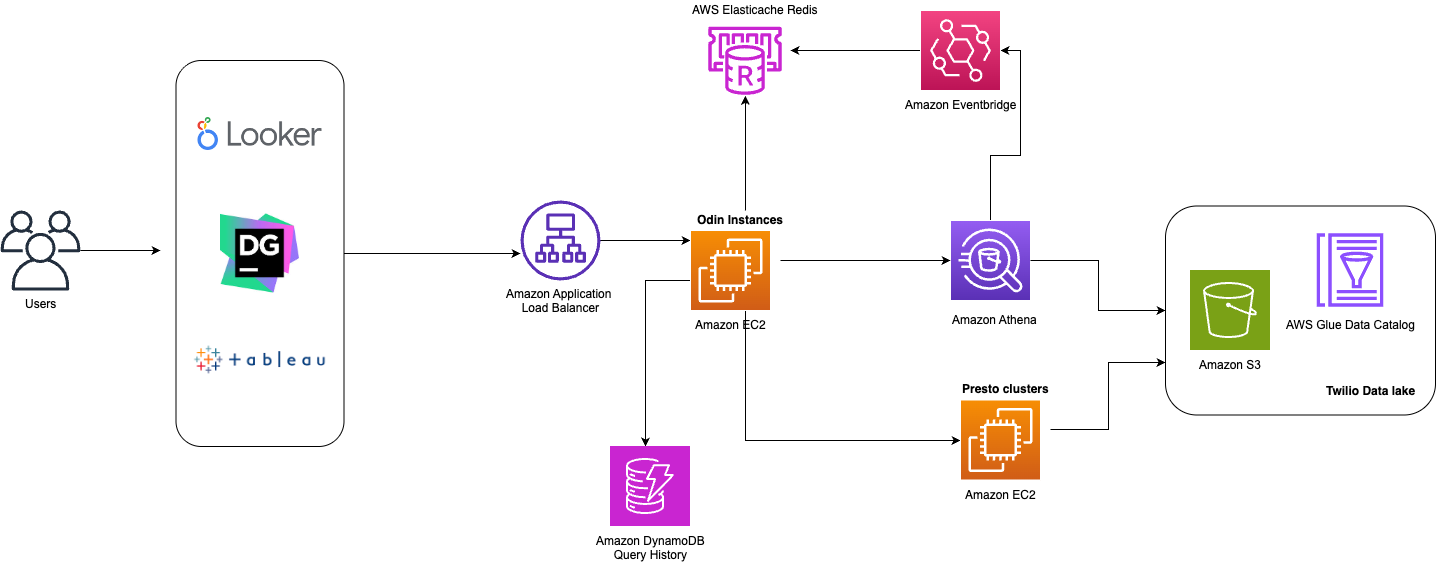
Comprehensive AWS analytics architecture featuring multiple BI tools, query engines, caching layer, and query history tracking

High Level Architecture of Odin’s Query Engines

Odin is a Presto-based gateway built on Zuul, an open-source L7 application gateway developed by Netflix. Zuul had already demonstrated its scalability at Twilio, having been successfully adopted by other internal teams. Since end users primarily connect to the platform via a JDBC connector using the Presto Driver (which operates through HTTP calls), Zuul’s specialization in HTTP call management made it an ideal technical choice for our needs.

Odin functions as a central hub for query processing, employing a pluggable design that accommodates various query frameworks for maximum extensibility and flexibility. To interact with the Odin platform users are initially directed to an Amazon Application Load Balancer that sits in front of the Odin instances running on Amazon EC2. The Odin instances handle the authentication, routing, and entire query workflow throughout the query’s lifetime. Amazon ElastiCache for Redis handles the query tracking for Athena and Amazon DynamoDB is responsible for the maintaining the query history. Both query engines, Amazon Athena and the Presto clusters running on Amazon EC2,are supported by the AWS Glue Data Catalog as the metastore repository and query data from our Amazon S3-based data lake.

Routing queries to multiple engines

We had a variety of use cases that were being served by this query platform and therefore we opted to use Amazon Athena as our primary query engine while continuing to route certain legacy workloads to our Presto clusters. Prior to our architectural redesign, we encountered operational challenges due to our end users being tightly bound to specific Presto clusters which led to inevitable disruptions during maintenance windows. Additionally, users frequently overloaded individual clusters with diverse workloads ranging from lightweight ad-hoc analytics to complex data warehousing queries and resource-intensive ETL processes. This prompted us to implement a more sophisticated routing solution, one that was use case focused and not tightly bound to the specific underlying compute.

To enable routing across multiple query engines within the same platform, we developed a query hint mechanism that allows users to specify their intended use case. Users append this hint to the JDBC string via the X-Presto-Extra-Credential header, which Odin’s logical routing layer then evaluates alongside multiple factors including user identity, query origin, and fallback planning. The system also assesses whether the target resource has sufficient capacity, if not, it reroutes the query to an alternative resource with available capacity. While users provide initial context through their hints, Odin makes the final routing decisions intelligently on the server side. This approach balances user input with centralized orchestration, ensuring consistent performance and resource availability.

For example, say a user might specify the following connection string when connecting to the Odin platform from a Tableau client:

jdbc:presto://odin.twilio.com:443/hive?SSL=true&extraCredentials=routing:athena

The connection string uses the extraCredentials header to signal execution on Athena, where Odin validates query submission details, including the submitting user and tool, before determining the appropriate Athena workgroup for initial routing. Since this Tableau data source and user qualify as “critical queries,” the system routes them to a workgroup backed by capacity reservations. However, if that workgroup has too many pending queries in the execution queue, Odin’s routing logic automatically redirects to alternative workgroups with greater available resources. When necessary, queries may ultimately route to workgroups running on on-demand capacity. Through this fallback logic, Odin provides built-in load balancing at the routing layer, ensuring optimal utilization across the underlying compute infrastructure.

Here is an example workflow of how our queries are routed to Athena workgroups:
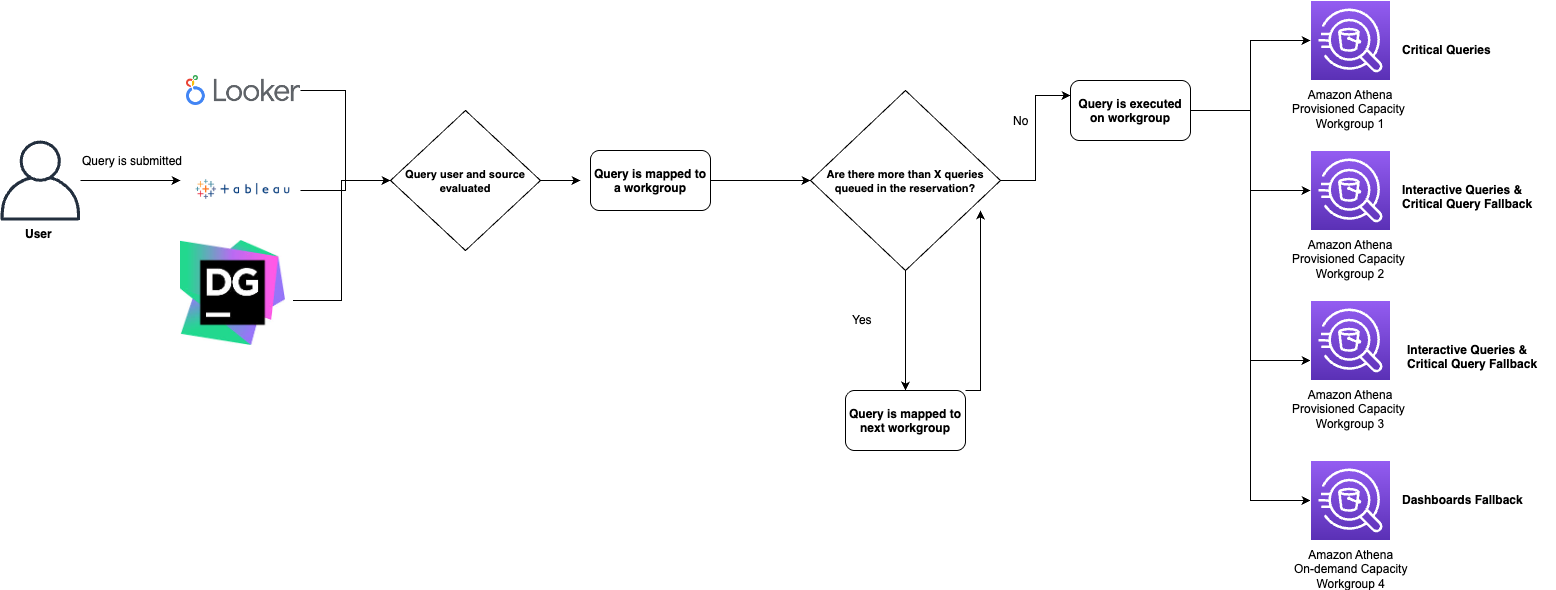
Architecture diagram showing how queries from Looker and Tableau are evaluated and routed through Amazon Athena workgroups with failback mechanisms

Once a query has been submitted to a workgroup for execution, Odin will also log the routing decision in our tracking system based on Amazon ElastiCache for Redis so that Odin’s routing logic can maintain real-time awareness of queue depths across all Athena workgroups. Additionally, Odin uses Amazon EventBridge to integrate with Amazon Athena to keep track of a query state change and create event-based workflows. Our Redis-based query tracking system effectively handles edge cases, such as when a JDBC client terminates mid-query. Even during such unexpected interruptions, the platform consistently maintains and updates the accurate state of the query.

Query history

Following successful query routing to either an Athena workgroup or one of our open-source Presto clusters, Odin persists the query identifier and destination endpoint in a query history table in DynamoDB. This design utilizes a RESTful architecture where initial query submissions operate as POST requests, while subsequent status checks function as GET requests that utilize DynamoDB as the authoritative lookup mechanism to locate and poll the appropriate execution engine. By centralizing query execution records in DynamoDB rather than maintaining state on individual servers, we’ve created a truly stateless system where incoming requests can be handled by any Amazon EC2 instance hosting our Odin web service.

Lessons learned

The transition from open-source Presto to Athena required some adaptation time, due to subtle differences in how these query engines operate. Since our Odin framework was built on the Presto driver, we needed to modify our processing approach to ensure compatibility between both systems.

As we began to adopt Athena for more use cases, we noticed a difference in the record counts between Athena and the original Presto queries. We discovered this was due to open-source Presto returning results with every page containing a header column, whereas Athena results only contain the header column on the first page and subsequent pages containing records only. This difference meant that for a 60-page result set, Athena would return 59 fewer rows than open-source Presto. Once we identified this pagination behavior, we optimized Odin’s result handling logic to properly interpret and process Athena’s format, so that queries would return accurate results.

Due to the nature of using the Odin platform, most of our interactions with the Athena service are API driven so we make use of the ResultSet object with the GetQueryResults API to retrieve query execution data. Using this mechanism, the API returns the data as all VARCHAR data type, even for complex types such as row, map, or array. This created a challenge because Odin uses the Presto driver for query parsing, resulting in a type mismatch between the expected formats and actual returned data. To address this, we implemented a translation layer within the Odin framework that converts all data types to VARCHAR and handles any downstream implications of this conversion internally.

These technical adjustments, while initially challenging, highlighted the importance of carefully managing the subtle differences between different query execution engines when building a unified data platform.

Scale of Odin and looking ahead

The Odin platform serves over 1,500 users who execute approximately 80,000 queries daily, totaling 2.5 million queries per month. Odin also powers more than 5,000 Business Intelligence (BI) reports and dashboards for Tableau and Looker. The queries are executed across our multi-engine landscape of more than 30 workgroups in Athena based on both provisioned capacity and on-demand workgroups and 4 Presto clusters on running on EC2 instances with Auto Scaling enabled that run on average 180 instances each. As Twilio continues to experience rapid growth, our Odin platform has enabled us to mature our technology stacks by both upgrading existing compute resources and integrating new technologies. We can do all this without disrupting the experience for our end users. While Odin serves as our foundation, we’re excited to continue to expand this pluggable infrastructure. Our roadmap includes migrating our self-managed open-source Presto implementation to EMR Trino, introducing Apache Spark as a compute engine via Amazon EMR Serverless or AWS Glue jobs, and integrating generative AI capabilities to intelligently route queries across Odin’s various compute options.

Conclusion

In this post, we’ve shared how we built Odin, our unified multi-engine query platform. By combining AWS services like Amazon Athena, Amazon ElastiCache for Redis, and Amazon DynamoDB with our open-source technology stack, we created a transparent abstraction layer for users. This integration has resulted in a highly available and resilient platform environment that serves our query processing needs.

By embracing this multi-engine approach, not only did we solve our query infrastructure challenges but we also established a flexible foundation that will continue to evolve with our data needs, ensuring we can deliver powerful insights at scale regardless of how technology trends shift in the future.

To learn more and get started using Amazon Athena, please see the Athena User Guide.

About the authors

Aakash Pradeep

Aakash Pradeep

Aakash is a Senior Software Engineer at Adobe with over 15 years of experience across ingestion, compute, storage, and query platforms. Previously, at Twilio, he worked extensively on developing the Odin platform to serve his customers query infrastructure needs. Aakash is a PrestoCon speaker, holds multiple patents in real-time analytics, and is passionate about building high-performance distributed systems.

Venkatram Bondugula

Venkatram Bondugula

Venkatram is a seasoned backend engineer with over a decade of experience specializing in the design and development of scalable data platforms for big data and distributed systems. With a strong background in backend architecture and data engineering, he has built and optimized high-performance systems that power data-driven decision-making at scale.

Amber Runnels

Amber Runnels

Amber is a Senior Analytics Specialist Solutions Architect at AWS specializing in big data and distributed systems. She helps customers optimize workloads in the AWS data ecosystem to achieve a scalable, performant, and cost-effective architecture. Aside from technology, she is passionate about exploring the many places and cultures this world has to offer, reading novels, and building terrariums.

Securing and managing multi-cloud Presto Clusters with Grab’s DataGateway

Post Syndicated from Grab Tech original https://engineering.grab.com/data-gateway

Introduction

Data is the lifeblood of Grab and the insights we gain from it drive all the most critical business decisions made by Grabbers and our leaders every day.

Grab’s Data Engineering (DE) team is responsible for maintaining the data platform, which consists of data pipelines, job schedulers, and the query/computation engines that are the key components for generating insights from data. SQL is the core language for analytics at Grab and as of early 2020, our Presto platform serves about 200 user groups that add up to 500 users who run 350,000 queries every day. These queries span across 10,000 tables that process up to 1PB of data daily.

In 2016, we started the DataGateway project to enable us to manage data access for the hundreds of Grabbers who needed access to Presto for their work. Since then, DataGateway has grown to become much more than just an access control mechanism for Presto. In this blog, we want to share what we’ve achieved since the initial launch of the project.

The problems we wanted to solve

As we were reviewing the key challenges around data access in Grab and assessing possible solutions, we came up with this prioritized list of user requirements we wanted to work on:

  • Use a single endpoint to serve everyone.
  • Manage user access to clusters, schemas, tables, and fields.
  • Provide seamless user experience when presto clusters are scaled up/down, in/out, or provisioned/decommissioned.
  • Capture audit trail of user activities.

To provide Grabbers with the critical need of interactive querying, as well as performing extract, transform, load (ETL) jobs, we evaluated several technologies. Presto was among the ones we evaluated, and was what we eventually chose although it didn’t meet all of our requirements out of the box. In order to address these gaps, we came up with the idea of a security gateway for the Presto compute engine that could also act as a load balancer/proxy, this is how we ended up creating the DataGateway.

DataGateway is a service that sits between clients and Presto clusters. It is essentially a smart HTTP proxy server that is an abstraction layer on top of the Presto clusters that handles the following actions:

  1. Parse incoming SQL statements to get requested schemas, tables, and fields.
  2. Manage user Access Control List (ACL) to limit users’ data access by checking against the SQL parsing results.
  3. Manage users’ cluster access.
  4. Redirect users’ traffic to the authorized clusters.
  5. Show meaningful error messages to users whenever the query is rejected or exceptions from clusters are encountered.

Anatomy of DataGateway

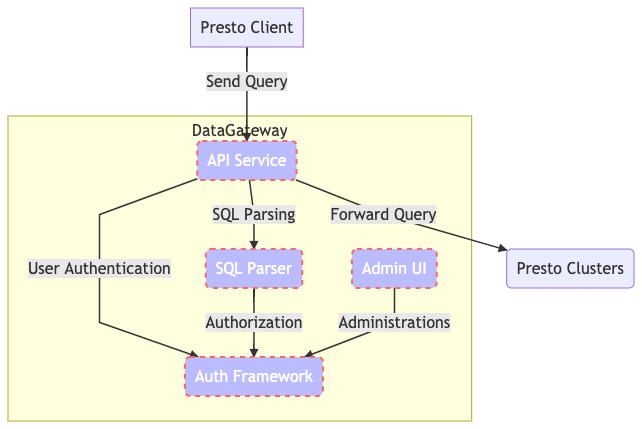
The DataGateway’s key components are as follows:

  • API Service
  • SQL Parser
  • Auth framework
  • Administration UI

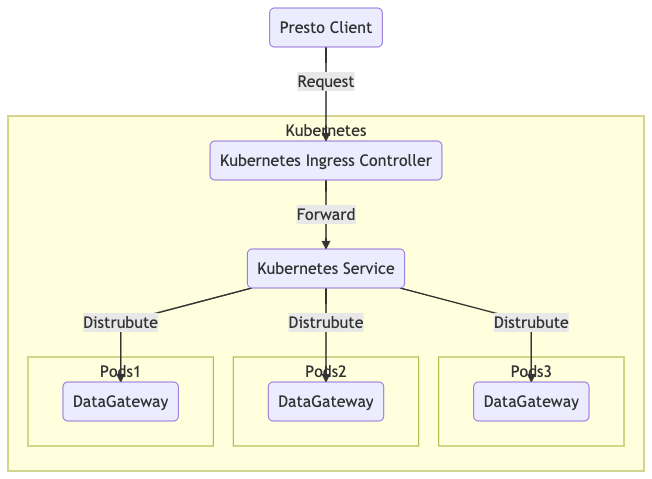
We leveraged Kubernetes to run all these components as microservices.

Figure 1. DataGateway Key Components

API Service

This is the component that manages all users and cluster-facing processes. We integrated this service with the Presto API, which means it appears to be the same as a Presto cluster to a client. It accepts query requests from clients, gets the parsing result and runs authorization from the SQL Parser and the Auth Framework.

If everything is good to go, the API Service forwards queries to the assigned clusters and continues the entire query process.

Auth Framework

This handles both authentication and authorization requests. It stores the ACL of users and communicates with the API Service and the SQL Parser to run the entire authentication process. But why is it a microservice instead of a module in API Service, you ask? It’s because we keep evolving the security checks at Grab to ensure that everything is compliant with our security requirements, especially when dealing with data.

We wanted to make it flexible to fulfill ad-hoc requests from the security team without affecting the API Service. Furthermore, there are different authentication methods out there that we might need to deal with (OAuth2, SSO, you name it). The API Service supports multiple authentication frameworks that enable different authentication methods for different users.

SQL Parser

This is a SQL parsing engine to get schema, tables, and fields by reading SQL statements. Since Presto SQL parsing works differently in each version, we would compile multiple SQL Parsers that are identical to the Presto clusters we run. The SQL Parser becomes the single source of truth.

Admin UI

This is a UI for Presto administrators to manage clusters and user access, as well as to select an authentication framework, making it easier for the administrators to deal with the entire ecosystem.

How we deployed DataGateway using Kubernetes

In the past couple of years, we’ve had significant growth in workloads from analysts and data scientists. As we were very enthusiastic about Kubernetes, DataGateway was chosen as one of the earliest services for deployment in Kubernetes. DataGateway in Kubernetes is known to be highly available and fully scalable to handle traffic from users and systems.

We also tested the HPA feature of Kubernetes, which is a dynamic scaling feature to scale in or out the number of pods based on actual traffic and resource consumption.

Figure 2. DataGateway deployment using Kubernetes

Functionality of DataGateway

This section highlights some of the ways we use DataGateway to manage our Presto ecosystem efficiently.

Restrict users based on Schema/Table level access

In a setup where a Presto cluster is deployed on AWS Amazon Elastic MapReduce (EMR) or Elastic Kubernetes Service (EKS), we configure an IAM role and attach it to the EMR or EKS nodes. The IAM role is set to limit the access to S3 storage. However, the IAM only provides bucket-level and file-level control; it doesn’t meet our requirements to have schema, table, and column-level ACLs. That’s how DataGateway is found useful in such scenarios.

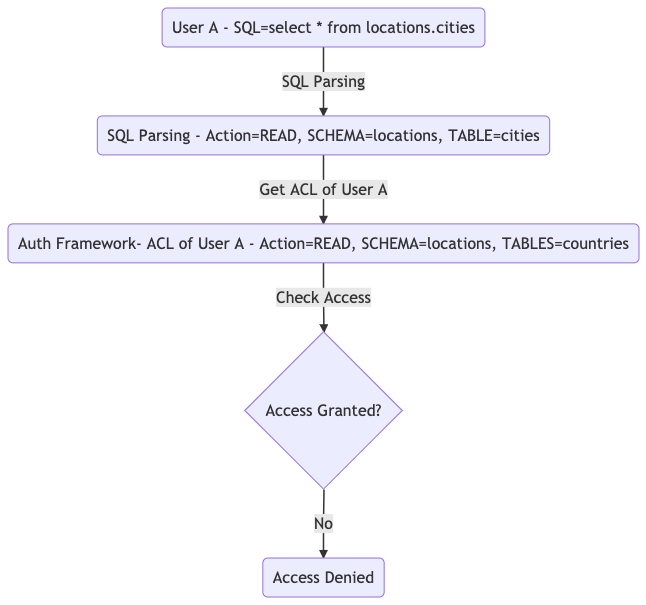
One of the DataGateway services is an SQL Parser. As previously covered, this is a service that parses and digs out schemas and tables involved in a query. The API service receives the parsing result and checks against the ACL of users, and decides whether to allow or reject the query. This is a remarkable improvement in our security control since we now have another layer to restrict access, on top of the S3 storage. We’ve implemented an SQL-based access control down to table level.

As shown in the Figure 3, user A is trying run a SQL statement select * from locations.cities. The SQL Parser reads the statement and tells the API service that user A is trying to read data from the table cities in the schema locations. Then, the API service checks against the ACL of user A. The service finds that user A has only read access to table countries in schema locations. Eventually, the API service denies this attempt because user A doesn’t have read access to table cities in the schema locations.

Figure 3. An example of how to check user access to run SQL statements

The above flow shows an access denied result because the user doesn’t have the appropriate permissions.

Seamless User Experience during the EMR migration

We use AWS EMR to deploy Presto as an SQL query engine since deployment is really easy. However, without DataGateway, any EMR operations such as terminations, new cluster deployment, config changes, and version upgrades, would require quite a bit of user involvement. We would sometimes need users to make changes on their side. For example, request users to change the endpoints to connect to suitable clusters.

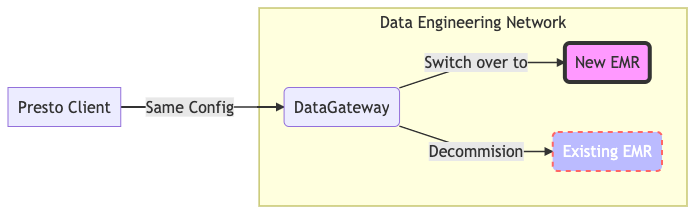
With DataGateway, ACLs exist for each of the user accounts. The ACL includes the list of EMR clusters that users are allowed to access. As a Presto access management platform, here the DataGateway redirects user traffics to an appropriate cluster based on the ACL, like a proxy. Users always connect to the same endpoint we offer, which is the DataGateway. To switch over from one cluster to another, we just need to edit the cluster ACL and everything is handled seamlessly.

Figure 4. Cluster switching using DataGateway

Figure 4 highlights the case when we’re switching EMR from one cluster to another. No changes are required from users.

We executed the migration of our entire Presto platform from an AWS EMR instance to another AWS EMR instance using the same methodology. The migrations were executed with little to no disruption for our users. We were able to move 40 clusters with hundreds of users. They were able to issue millions of queries daily in a few phases over a couple of months.

In most cases, users didn’t have to make any changes on their end, they just continued using Presto as usual while we made the changes in the background.

Multi-Cloud Data Lake/Presto Cluster maintenance

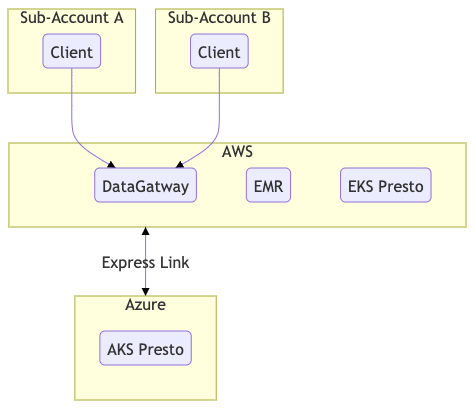
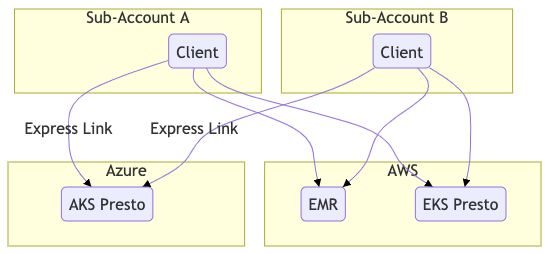
Recently, we started to build and maintain data lakes not just in one cloud, but two – in AWS and Azure. Since most end-users are AWS-based, and each team has their own AWS sub-account to run their services and workloads, it would be a nightmare to bridge all the connections and access routes between these two clouds from end-to-end, sub-account by sub-account.

Here, the DataGateway plays the role of the multi-cloud gateway. Since all end-users’ AWS sub-accounts have peered to DataGateway’s network, everything becomes much easier to handle.

For end-users, they retain the same Presto connection profile. The DE team then handles the connection setup from DataGateway to Azure, and also the deployment of Presto clusters in Azure.

When all is set, end-users use the same endpoint to DataGateway. We offer a feature called Cluster Switch that allows users to switch between AWS Presto cluster and Azure Presto Cluster on the fly by filling in parameters on the connection string. This feature allows users to switch to their target Presto cluster without any endpoint changes. The switch works instantly whenever they do the change. That means users can run different queries in different clusters based on their requirements.

This feature has helped the DE team to maintain Presto Cluster easily. We can spin up different Presto clusters for different teams, so that each team has their own query engine to run their queries with dedicated resources.

Figure 5. Sub-account connections and Queries

Figure 5 shows an example of how sub-accounts connect to DataGateway and run queries on resources in different clouds and clusters.

Figure 6. Sample scenario without DataGateway

Figure 6 shows a scenario of what would happen if DataGatway doesn’t exist. Each of the accounts would have to maintain its own connections, Virtual Private Cloud (VPC) peering, and express link to connect to our Presto resources.

Summary

DataGateway is playing a key role in Grab’s entire Presto ecosystem. It helps us manage user access and cluster selections on a single endpoint, ensuring that everyone is running their Presto queries on the same place. It also helps distribute workload to different types and versions of Presto clusters.

When we started to deploy the DataGateway on Kubernetes, our vision for the Presto ecosystem underwent an epic change as it further motivated us to continuously improve. Since then, we’ve had new ideas on deployment method/pipeline, microservice implementations, scaling strategy, resource control, we even made use of Kubernetes and designed an on-demand, container-based Presto cluster provisioning engine. We’ll share this in another engineering blog, so do stay tuned!.

We also made crucial enhancements on data access control as we extended Presto’s access controls down to the schema/table-level.

In day-to-day operations, especially when we started to implement data lake in multiple clouds, DataGateway solved a lot of implementation issues. DataGateway made it simpler to switch a user’s Presto cluster from one cloud to another or allow a user to use a different Presto cluster using parameters. DataGateway allowed us to provide a seamless experience to our users.

Looking forward, we’ve more and more ideas for our Presto ecosystem, such Spark DataGateway or AWS Athena integrations, to keep our data safe at any time and to provide our users with a smoother experience when dealing with data used for analysis or research.


Authored by Vinnson Lee on behalf of the Presto Development Team at Grab – Edwin Law, Qui Hieu Nguyen, Rahul Penti, Wenli Wan, Wang Hui and the Data Engineering Team.


Join us

Grab is more than just the leading ride-hailing and mobile payments platform in Southeast Asia. We use data and technology to improve everything from transportation to payments and financial services across a region of more than 620 million people. We aspire to unlock the true potential of Southeast Asia and look for like-minded individuals to join us on this ride.

If you share our vision of driving South East Asia forward, apply to join our team today.