Post Syndicated from The Atlantic original https://www.youtube.com/shorts/M41M2WrGEAo
Can Beauty Make Us Good?
Post Syndicated from The Atlantic original https://www.youtube.com/watch?v=oymND7-uO-o
Freshwater
Post Syndicated from Oglaf! -- Comics. Often dirty. original https://www.oglaf.com/freshwater/


HACS is now the Home Assistant Marketplace! 🛍️
Post Syndicated from Home Assistant original https://www.youtube.com/shorts/hqY50gFY_Io
ASRock Rack DMRD16-2L+ Spotted with 16 DDR5 Slots for Diamond Rapids
Post Syndicated from John Lee original https://www.servethehome.com/asrock-rack-dmrd16-2l-plus-diamond-rapids-ocp-summit-2026/
We check out the ASRock Rack DMRD16-2L+ which is a 16-channel Intel Diamond Rapids Xeon motherboard with 128x PCIe Gen6 lanes over MCIO
The post ASRock Rack DMRD16-2L+ Spotted with 16 DDR5 Slots for Diamond Rapids appeared first on ServeTheHome.
ReSpeaker XVF3800: Is Building Your Own Home Assistant Voice Assistant Worth It?
Post Syndicated from BeardedTinker original https://www.youtube.com/watch?v=IY_zPQ-xLg4
How Republicans Lost Their Grip on Power | The David Frum Show
Post Syndicated from The Atlantic original https://www.youtube.com/watch?v=lIrySSfgBW0
Nostalgia Tech from Fosi Audio
Post Syndicated from Techmoan original https://www.youtube.com/watch?v=_EdhrIRLRwA
Asahi Linux 7.3 progress report
Post Syndicated from corbet original https://lwn.net/Articles/1105936/
The Asahi Linux developers have put out a new report
on their progress toward a Linux distribution for Apple devices.
Some time ago, we were made aware of multiple attempts to exploit
our permissive licensing to hijack our work, with a direct view to
replacing the project and aggressively monetising Linux on Apple
Silicon. In some extreme cases, in-development feature code was
being lifted straight out of our personal forks and published
without attribution or lazily rewritten with LLM assistance to
obfuscate its origin. The MIT licence explicitly allows this, and
has no carveouts to protect against bad faith actors.As such, we made the difficult decision to begin the process of
transitioning all of our repositories to the GNU General Public
License version 2 or later. Going forward all Asahi Linux code will
be licenced under strong copyleft licences only. Those who do not
learn from history are doomed to repeat it.
Amutable Foundations: A Technical Overview
Post Syndicated from corbet original https://lwn.net/Articles/1105934/
Lennart Poettering, Michael Vogt, and Joaquim Rocha have put together a
detailed overview of what the Amutable Operating System (AOS) and
associated infrastructure will look like.
The image-based OS approach enables us to enforce some very strict
but powerful security properties, which elevate the security
posture of the system substantially above traditional Linux
systems. Specifically, let’s highlight seven major essential
security properties of AOS here:
- No Shell + No SSH + No Language Interpreters. By default AOS
does not install a UNIX shell, nor makes remote access via SSH
available on the nodes. Moreover, we do not install any of the usual
language interpreters (Python, Perl, …) by default. For most nodes a
shell or interpreted language support is not required and it removes a
whole class of attacks.- Signed Images Only. On AOS only images that come with Verity
data signed by a signing key listed in the Verity keyring may be
activated.- […]
Седмицата (2–7 ноември)
Post Syndicated from Боряна Телбис original https://www.toest.bg/sedmitsata-2-7-noemvri/

Целият свят ври и кипи. В Америка демократите пометоха републиканците на междинните избори, войните продължават, цените растат, политиците се обвиняват взаимно, а хората тук-там дори сменят мнението си.
У нас, слава богу, подобни сътресения няма. Всичко е подредено, стройно, вчесано. Всички са от една партия и навсякъде ще се ползва само един език, за да се разбираме точно и конкретно всички. На когото не му изнася, ще му показваме izhoda.

Иначе изборите минаха, победителят е ясен, а България вече има първата жена, избрана за президент. Това самò по себе си е историческо постижение. Дали обаче е постижение и за правата на жените, е съвсем друг въпрос. В „Имаме си президентка. Съвсем“ Светла Енчева разглежда десетте години на Илияна Йотова в сянката на Румен Радев, отношението ѝ към равноправието и шансовете най-после да докаже политическата си самостоятелност.
Имаме си президентка. Съвсем
Светла Енчева коментира избора на първата жена президент на България. Йотова дължи възможността да заеме този пост на борбата за равноправие, но не е защитавала особено правата на жените. А след 10 години в сянката на Румен Радев тепърва ще трябва да доказва политическата си самостоятелност.
За това как Йотова стигна дотук и защо Андрей Гюров не успя да я спре, пише Емилия Милчева в анализа си на президентските избори. Накратко, оказа се, че изкуственото форсиране на страх от война е по-убедително от всеки реален опит за промяна. Особено когато успееш да убедиш избирателите, че опасността идва не от този, който води войната, а от онзи, който не иска да се оставят развързани ръцете на агресора.
Йотова ли спечели, или Гюров загуби?
На президентския балотаж страхът от война победи обещанието за промяна. Емилия Милчева анализира как управляващите превърнаха мира в предизборно оръжие, защо Андрей Гюров не успя да наложи собствен дневен ред и какво политическо бъдеще очаква двамата кандидати след изборите.
И понеже толкова много държим на мира, Александър Малинов реши да провери къде точно ще се скрием, ако този мир все пак ни подмине. В „Бомбоубежища за 1%“ става ясно, че с гражданската защита положението е доста по-неутешително, отколкото с предизборните обещания. Докато други европейски държави инвестират в убежища, системи за предупреждение и планове за действие при бедствия и военни конфликти, у нас защитените места стигат за по-малко от един процент от населението. Останалите явно ще разчитаме на мира, който ни обещаха.
Бомбоубежища за 1%
Внимание, внимание! Знаете ли къде трябва да се скриете при бедствие или военна атака? Не се притеснявайте, държавата също не знае съвсем. След изборите е време да поговорим и за по-съществени неща. Александър Малинов проверява имаме ли изобщо някакъв план и разказва как е в Европа.
Отвъд океана междувременно избирателите решиха да не разчитат повече на обещания. В брой 20 на „Гласовете на Америка“ Йоанна Елми разказва как демократите постигнаха най-голямата си изборна победа от десетилетия, какво не разбраха републиканците и защо реалните проблеми на хората се оказаха по-силни от поредната порция идеологически плашила.
Гласовете на Америка – брой 20
То бива, бива, ама чак пък това никой не го е очаквал. Демократите спечелиха убедително дори там, където доскоро изглеждаше немислимо, а републиканците имат доста поводи за размисъл. Йоанна Елми с обобщение на междинните избори в САЩ в 10 точки.
Но да оставим за момент естествения интелект, който ни управлява, и да видим какво става с изкуствения, защото и той се бори за своето място под слънцето, така да се каже. Илия Тошев задава един стар въпрос в нова обстановка: „Кой пази пазачите?“ Когато ИИ агентите вече могат да кандидатстват за кредити, да вземат решения и да действат от наше име, кой контролира тях и кой контролира онези, които имат правото да ги спират?
Илия предлага конкретни правила за независим надзор, публичност и възможност за обжалване. Когато този, който определя правилата, сам контролира и спазването им, надзорът лесно се превръща във формалност. В България имаме достатъчно опит с подобни сбъркани модели, макар и без участието на изкуствен интелект, и би трябвало да сме наясно. Оу, уейт… както се казва по новия законопроект.
Кой пази пазачите?
Да оставиш ИИ да ти намери кредит звучи удобно. Но какво става, ако нещо се обърка, и към кого се обръщаш тогава? Илия Тошев ни превежда през практическата страна на живота с ИИ: кой отговаря за агентите, които действат от наше име, и как да защитим интересите си, когато вече решават вместо нас.
И докато се чудим колко власт да дадем на машините, все по-рядко си задаваме въпроса какво ни отнемат те. В разговора си със Стефан Иванов аржентинската писателка Саманта Швеблин обяснява защо литературата е противоположност на радикализацията, защо машините ни правят предвидими и скучни и какво губим, когато престанем да мислим с хора, които мислят различно от нас. Много хубав разговор, особено в страна, в която очевидно сме решили да се разбираме само на един език, буквално и преносно.
Саманта Швеблин: Да избягаме от езика, за да докоснем тялото на читателя
Преди броени дни станалата вече култова аржентинска писателка Саманта Швеблин в дискусия с Георги Господинов и Дария Карапеткова разказа за рисковете и радостите да четеш, пишеш и мислиш света през литературата днес. Часове преди това тя се срещна и със Стефан Иванов – ето техния разговор.
Тази седмица Зорница Христова ни предлага две книги за трудното изкуство да живееш с друг човек. В „По буквите: Линч, Рой“ тя представя „Отвъд морето“ на Пол Линч и „Моят подслон и моята буря“ на Арундати Рой. В едната двама мъже са заседнали в лодка насред океана, в другата майка и дъщеря цял живот се опитват да намерят правилната дистанция помежду си. И в двете се оказва, че за да оцелееш заедно с някого, се изисква повече от това да го накараш да мисли като теб.
По буквите: Линч, Рой
Тази седмица Зорница Христова поставя на фокус две чудесни съвременни книги, в които апокалипсисът е „в една лодка“ близки хора, но изплуването се оказва невъзможно без широтата на разбирането и приемането, без щедростта на протегнатата сурова и помилваща ръка.
За да продължаваме да публикуваме текстове, в които не всички мислят еднакво, имаме нужда от вашата подкрепа. „Тоест“ се издържа от читателите си. За щастие, независимата журналистика струва доста по-малко от една предизборна кампания, но все пак не може да се прави съвсем без пари. Ако харесвате това, което четете, подкрепете ни. Обещаваме да не ви казваме на какъв език да мислите и откъде да излизате, освен ако, разбира се, не търсите izhoda ot cqloto tova bezobrazie.
Приятна почивка!
Friday Squid Blogging: New Jurassic Squid Predecessors
Post Syndicated from Bruce Schneier original https://www.schneier.com/blog/archives/2026/11/friday-squid-blogging-new-jurassic-squid-predecessors.html
News story: “Scientists discover a bizarre Jurassic ‘squid’ unlike anything ever seen.”
Scientists have identified the “fattest” belemnite ever discovered, a bizarre, barrel-shaped squid relative that lived in Wyoming’s ancient seas 160 million years ago. The exceptionally rare fossils reveal a creature unlike anything previously known, potentially a predator of smaller squid-like animals and a surprising survivor of a supposedly vanished family.
As usual, you can also use this squid post to talk about the security stories in the news that I haven’t covered.
Addressing protocol security gaps in multi-tenant Kubernetes
Post Syndicated from Ajinkya Patil original https://aws.amazon.com/blogs/security/addressing-protocol-security-gaps-in-multi-tenant-kubernetes/
Protocols like Android Debug Bridge (ADB) and Web Real-Time Communication (WebRTC), by default, use unencrypted channels for network communications and don’t support enterprise authentication mechanisms like JSON Web Tokens (JWTs). In a multi-tenant Kubernetes cluster—including Amazon Elastic Kubernetes Service (Amazon EKS)—pods can reach other tenants’ open ports by default unless you configure network policies to restrict cross-namespace traffic. Also, modifying each protocol individually doesn’t scale. This post describes an architecture built on three reusable components: namespace-scoped mutual TLS (mTLS) gateways, managed TURN relay through Amazon Kinesis Video Streams, and JWT identity chains tied to an enterprise identity provider (IdP). The post focuses on architecture decisions and learnings rather than step-by-step deployment.
This post assumes an EKS cluster with namespace isolation configured, an enterprise IdP that issues JWTs, and AWS Private Certificate Authority (AWS Private CA)—a managed service for issuing private certificates—set up in your account. cert-manager—an open-source Kubernetes add-on that automates certificate issuance and renewal—and the AWS Private CA issuer plugin should already be running in the cluster. The architecture also assumes permissions to deploy Envoy Gateway, a Kubernetes API gateway built on the Envoy proxy. The key authentication mechanism used is mTLS, where both client and server present certificates to verify each other.
The challenge: Unauthenticated protocols in multi-tenant Kubernetes
ADB, a command-line tool for communicating with Android devices, requires a proxy or custom API to handle authentication; its unencrypted channel exposes data in transit. Virtual Network Computing (VNC), a protocol for remote desktop access, and similar TCP services share this problem: their credentials are local to the protocol, with no path to a central identity store.
In the Cuttlefish deployment (Cuttlefish is Google’s configurable virtual Android device that runs in containers), the first approach routed this traffic through a bastion host to the Amazon EKS control plane, as Figure 1 shows.
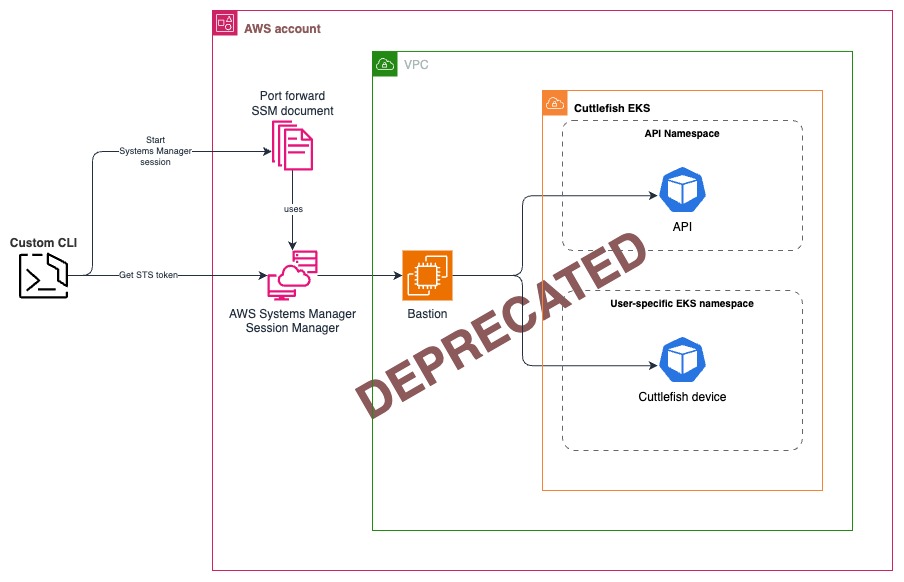
Figure 1: Previous architecture (superseded), shown for comparison only. Communication flow between developer workstation, bastion host, and Amazon EKS control plane
Figure 1 shows a common pattern across the industry to access a private Amazon EKS cluster. We share it to help others identify and migrate away from similar designs for low latency environments. Do not implement this design. The current architecture is described and shown later in this post.
In the now deprecated architecture, a custom API handles authentication by checking each user’s identity against the enterprise IdP and enforcing pod-level authorization. The custom API powers a command-line interface (CLI) that lets you list pods in your assigned namespace and connect to your devices.
The JWT identity chain maps each user to an AWS Security Token Service (AWS STS) RoleSessionName, so every AWS API call in the audit log traces back to a specific person, even in a multi-tenant environment.
Those credentials set up a two-hop port forward that goes from your machine to the bastion, then from the bastion to the target pod. Because all traffic was routed through the Kubernetes API server, concurrent sessions created a throughput bottleneck even though the cluster itself stayed private.
Why self-managed relay infrastructure falls short
A TURN server—a media relay—is needed when communicating parties are behind a NAT Gateway and can’t set up direct peer-to-peer connections.
The initial deployment used STUNner, an open source Kubernetes Session Traversal Utilities for NAT (STUN) and Traversal Using Relays around NAT (TURN) gateway designed for WebRTC media ingestion. STUNner introduced three operational and security challenges.
Because STUNner had no native integration with AWS services or the enterprise IdP, we built a custom token-exchange service to convert IdP tokens into time-limited, namespace-scoped TURN credentials. As usage grew, patching, monitoring, and scaling the TURN servers became a recurring burden. Pod migrations between Availability Zones required manually updating routing rules, and STUNner dropped WebRTC connections during peak usage.
WebRTC’s signaling server introduced a separate security risk. WebRTC encrypts media using Datagram Transport Layer Security (DTLS) and Secure Real-Time Transport Protocol (SRTP) but doesn’t define authentication or encryption for the signaling server; you must build that yourself, which leaves control-plane signaling exposed.
The architecture doesn’t use the Kinesis Video Streams signaling channel because integrating it required substantial changes to the Cuttlefish source patch. The Cuttlefish source code was patched to support non-Google TURN servers, and further changes to support non-Google signaling servers deviated the deployment further from upstream Cuttlefish, risking compatibility issues. Instead, the architecture kept the default Cuttlefish signaling server, with JWT-based session validation and TLS termination at the signaling endpoint designed around it at the application layer.
Namespace-scoped mTLS gateways and managed media relay
The architecture retains namespace isolation, JWT-based authentication, the custom authorization API, and the Cuttlefish patch; the last three of which are custom to this deployment. All components except Cuttlefish patch are reusable.
The reusable components include namespace-scoped Envoy Gateway for mTLS-authenticated TCP proxying, cert-manager-driven certificate rotation through AWS Private CA, and Kinesis Video Streams as a managed TURN provider.
The mTLS gateway assumes several other controls are already in place:
- Default-deny NetworkPolicy in each tenant namespace. Without this, traffic can bypass the gateway.
- JWT-based authentication through the custom API. The API validates each user’s identity against the enterprise IdP before returning connection details.
- Namespace-scoped mTLS certificates issued by AWS Private CA through
cert-manager. - Kubernetes namespace isolation with scoped role-based access control (RBAC).
ADB connectivity through mTLS
For ADB connectivity, the architecture uses mTLS authentication with Envoy Gateway. Each namespace runs its own Envoy Gateway instance, which routes traffic only to pods within that namespace. cert-manager, running in the cluster with the AWS Private CA issuer plugin, requests short-lived mTLS certificates from AWS Private CA for each namespace at creation time. In production, apply NetworkPolicies before deploying the gateway and issuing certificates.
The certificate commonName uses the convention <user-namespace>.eks.internal so that Envoy can validate the certificate against the expected namespace during the mTLS handshake. The .eks.internal suffix is a naming convention for internal cluster certificates; choose a domain that doesn’t conflict with your organization’s DNS. The usages field specifies both client authentication and server authentication because the same certificate authenticates the client to the gateway and the gateway to the client during the mutual TLS exchange. A cluster-scoped AWSPCAClusterIssuer is used instead of a namespace-scoped AWSPCAIssuer so that a single CA configuration can issue certificates across all tenant namespaces without duplicating issuer resources in each one.
Before deploying Envoy Gateway, each tenant namespace needs a NetworkPolicy that enforces a default-deny ingress posture.
Each certificate is issued with a 12-hour lifetime. A shorter lifetime means a compromised certificate expires quickly without requiring Certificate Revocation List (CRL) or Online Certificate Status Protocol (OCSP) infrastructure, while the 4-hour renewal window gives cert-manager multiple retry attempts before expiry. cert-manager tracks expiry and re-requests a new certificate from AWS Private CA before the current one lapses (by default, renewal starts at the two-thirds mark of the certificate’s lifetime). Envoy Gateway picks up the renewed certificate through Kubernetes Secrets using its Secret Discovery Service (SDS), with no pod restart required.
You first authenticate with the enterprise IdP through the custom CLI, which calls the custom API. The API validates your JWT, confirms your namespace assignment, and returns connection details for the appropriate namespace-scoped Envoy Gateway, including the client certificate for that namespace. The API delivers the certificate over HTTPS. Because certificates are namespace-scoped and expire in 12 hours, a compromised response yields access only to the holder’s own namespace for a limited window. The CLI then presents this certificate to establish a direct mTLS connection, through Envoy, to the target pod. The JWT proves who you are, and the mTLS certificate proves which namespace the connection belongs to.
Envoy proxies the TCP stream directly to the pod and pools connections to reduce latency. The hop between Envoy and the pod isn’t encrypted by mTLS. NetworkPolicy restricts ingress so that only the namespace-scoped Envoy Gateway can reach the ADB port on the target pod. For environments with compliance requirements, extend mTLS to the pod using a sidecar proxy or pod-level certificates. Evaluate this gap against your organization’s data classification and regulatory requirements.
For the REST API path, the custom API sits behind AWS WAF. The ADB data path has no WAF protection; it relies on mTLS, NetworkPolicies, and namespace isolation.
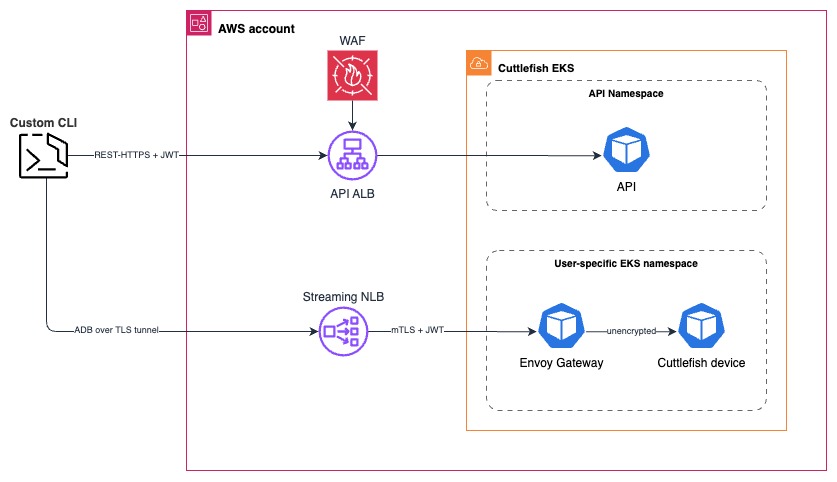
Figure 2: ADB communication flow using Envoy Gateway and custom REST API
Figure 2 shows this ADB communication flow using Envoy Gateway and the custom REST API. It logs your authenticated identity, namespace, and timestamp. The mTLS certificate doesn’t carry a user identifier in its subject field. This applies when namespaces are strictly 1:1 with users. For shared namespaces or regulated environments requiring granular attribution, issue per-user certificates from AWS Private CA.
WebRTC relay through Kinesis Video Streams
Kinesis Video Streams provides built-in STUN and TURN infrastructure and signaling channels. It replaced the self-managed STUNner because it integrates with AWS Identity and Access Management (IAM), so the custom token-exchange service is no longer needed. This is an important factor in reducing operational costs. For implementation details, see the Amazon Kinesis Video Streams WebRTC developer guide, which covers signaling channel setup, IAM policies, and TURN credential retrieval.
Kinesis Video Streams WebRTC charges per active signaling channel, per signaling message, and per TURN streaming minute. Idle namespaces incur no TURN cost. See Amazon Kinesis Video Streams pricing for latest pricing and Amazon Kinesis Video Streams with WebRTC service quotas for service quotas.
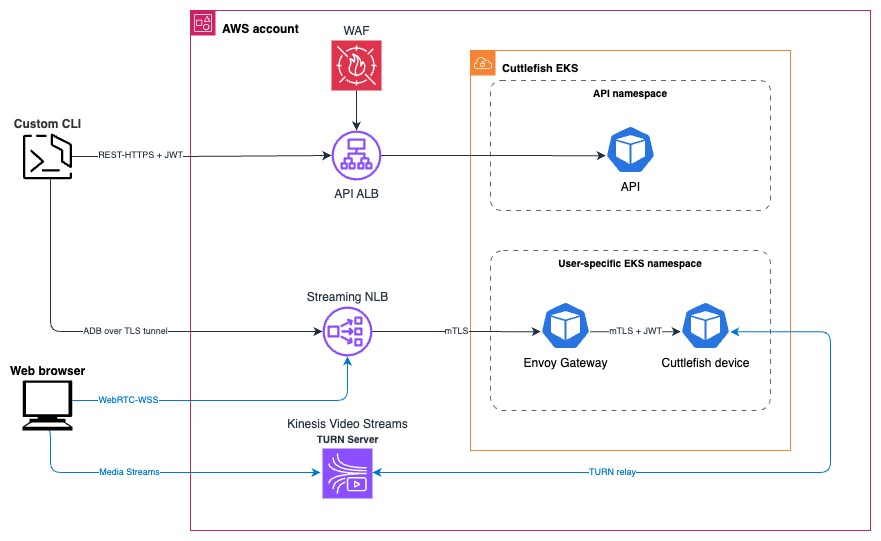
Figure 3: Final architecture with ADB and WebRTC communication channels
Figure 3 shows both ADB and WebRTC communication channels in the completed architecture. Each path has different controls: ADB traffic flows through the namespace-scoped Envoy Gateway, where mTLS and NetworkPolicies enforce access. WebRTC media relay runs through Kinesis Video Streams, with IAM scoping credentials per session. The custom REST API is the only HTTP-based path; it runs over HTTPS with AWS WAF at the edge.
The JWT identity chain connects all three paths: the custom API validates each user’s identity before any connection opens, so the audit log records who connected to which namespace and when.
Applying this pattern to other unauthenticated protocols
The mTLS gateway and certificate rotation pieces transfer directly to most TCP protocols. The TURN relay is specific to WebRTC and similar media-streaming protocols that need NAT traversal. The JWT identity chain requires custom work and isn’t directly transferable. You need to build the API that validates tokens and maps users to namespaces, and a client that retrieves and presents the certificate. The Cuttlefish source patch is specific to this case study and not reusable.
Two common protocol families show how the reusable parts apply:
- VNC and RDP both store credentials locally, with no path to an enterprise identity provider. Wrapping VNC in mTLS through Envoy replaces the shared password model with certificate-based identity. RDP benefits similarly: certificate authentication works without domain-joining the containers, so you don’t need Active Directory inside each one.
- MQTT, SIP, and similar TCP protocols often encrypt the payload but skip session-level authentication entirely; meaning you can verify what was sent but not who sent it. Wrapping these protocols in mTLS through Envoy closes that gap without modifying the protocol itself.
JWT identity chain secures session establishment at the application layer. For Internet of Things (IoT) device management, industrial control, or game streaming, Envoy Gateway adds mTLS to TCP protocols that lack built-in encryption in transit. Managed TURN through Kinesis Video Streams handles NAT traversal for WebRTC-based streaming components.
Performance results
Application installs through the dual port-forwarding chain (local machine to bastion, bastion to pod) took 3–4 minutes, and individual ADB commands took 1–2 seconds per round trip.
After migrating to the mTLS Envoy Gateway, ADB commands added under 50 ms of gateway latency compared to local setup. The latency was measured as the difference in round-trip time between a command sent through Envoy and one sent to a local Android device. Through Envoy, individual ADB commands completed in under 100 ms and application installs finished in under 30 seconds, because Envoy proxies the TCP stream directly to the pod instead of routing through the Kubernetes API server. This was an improvement from 1–2 seconds for ADB commands and 3–4 minutes for application installs using bastion host setup.
Key implementation lessons
The main concern addressed by replacing bastion-host forwarding with mTLS proxying was latency compared to local setup. Gateway overhead stayed under 50 ms and met developer expectations.
After migrating to Kinesis Video Streams, WebRTC connections stayed stable during peak usage, and pod migrations between Availability Zones no longer required manual updates to routing rules. Because Kinesis Video Streams integrates with IAM, new protocols added to the cluster are automatically covered by the same audit trail with no additional logging configuration needed.
Security considerations
mTLS authenticates both ends of a connection and encrypts traffic in transit, but it only works when other controls are in place. The NetworkPolicy and pod security controls described in the preceding ADB connectivity section must be in place before mTLS adds value. Without default-deny ingress rules, traffic bypasses the gateway entirely. At the application layer, the custom API validates each user’s JWT before issuing connection details and logs the identity, namespace, and timestamp for every session. Certificates expire after 12 hours and cert-manager rotates them automatically. Short-lived certificates reduce exposure, but if your threat model requires immediate revocation, you need CRL or OCSP infrastructure on top of AWS Private CA. Envoy Gateway is a trust boundary. Review its configuration, resource limits, and access controls against the Envoy security best practices.
The custom API is the primary trust boundary in this architecture. Apply the same rigor to its security review, logging, and access controls as you would to any authentication service.
Conclusion
With namespace-scoped mTLS gateways and managed TURN relay, you can secure unauthenticated protocols on shared EKS clusters without modifying the protocols themselves. ADB command latency drops from 1–2 seconds to under 50 ms, and WebRTC connections remain stable during pod migrations. See the Envoy Gateway documentation, cert-manager documentation, and Amazon Kinesis Video Streams WebRTC developer guide to build and deploy this architecture.
If you have questions about this post, contact AWS Support or start a new thread on AWS re:Post.
Cisco Catalyst C1300-24XTS Review A Neat 24-port 10GbE Switch
Post Syndicated from Rohit Kumar original https://www.servethehome.com/cisco-catalyst-c1300-24xts-review-a-neat-24-port-10gbe-switch-marvell/
In our Cisco Catalyst C1300-24XTS review, we take the switch apart to see how it works and test it under full load to see if it holds up
The post Cisco Catalyst C1300-24XTS Review A Neat 24-port 10GbE Switch appeared first on ServeTheHome.
Videos from XDC 2026 are available
Post Syndicated from jake original https://lwn.net/Articles/1105913/
Videos from the 2026 X.Org Developers Conference (XDC) are now available on YouTube. XDC was held in Toronto, Ontario, Canada September 28-30.
Store and process large strings in Amazon Redshift SUPER columns
Post Syndicated from Ritesh Sinha original https://aws.amazon.com/blogs/big-data/store-and-process-large-strings-in-amazon-redshift-super-columns/
Storing large semi-structured data such as JSON and arrays in a data warehouse often means splitting or truncating your data. Amazon Redshift removes this with the SUPER data type and PartiQL language so you can ingest, store, transform, and analyze semi-structured data such as weblogs and sensor data at scale. When you turn on large string support, SUPER supports individual strings up to 16 million bytes and processes strings beyond the 65,535 bytes VARCHAR limit in memory. SUPER also works in case-insensitive databases.
In this post, we walk you through three key SUPER data type enhancements that simplify semi-structured data workflows and reduce common migration challenges.
- Handling large SUPER objects with extended string support: Learn how the 16 million bytes improvement helps you work with large JSON documents that previously exceeded size limits
- In-memory string function processing without truncation for improved efficiency
- Migration from your data warehouse with case insensitivity support: Explore how case-insensitive database compatibility simplifies migrations from legacy databases
Prerequisites
To implement this solution, you need the following prerequisites:
- An AWS account.
- An Amazon Redshift provisioned cluster or an Amazon Redshift Serverless endpoint.
- An Amazon Redshift data warehouse on patch 206 or later (current maintenance track).
- A parameter group with enable_large_strings_opt_in set to
Yesattached to your Amazon Redshift data warehouse. For Amazon Redshift Serverless, set the same parameter in your workgroup configuration. For details, see Behavior changes in Amazon Redshift. - An AWS Identity and Access Management (IAM) role used to perform the COPY command to load the file from Amazon Simple Storage Service (Amazon S3), attached to the Amazon Redshift cluster. For details on authorizing Amazon Redshift to access other AWS services, refer to Authorizing Amazon Redshift to access other AWS services on your behalf.
- Download the sample orders.json data file to test Use Cases one and two.
Use case overview
The SUPER data type helps you process and query semi-structured or nested data. This includes web logs, industrial Internet of Things (IoT) data from machines and equipment, sensor data, genomics data, and more.
The following diagram illustrates the data flow. It shows how data is generated, collected, and stored in Amazon Redshift as the SUPER data type:
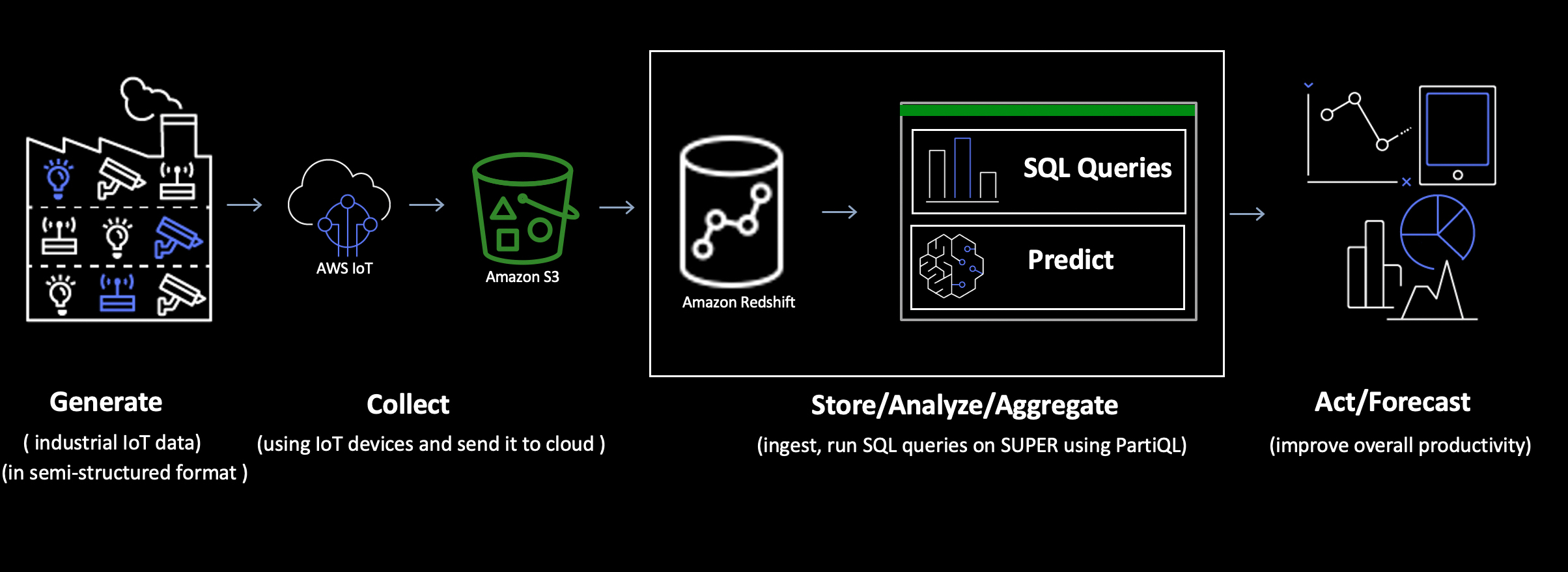 Figure 1: Use case overview flow
Use case one: Handling large JSON documents with extended string support
The challenge
Today, organizations need to store and analyze large semi-structured documents such as detailed customer profiles, comprehensive transaction records, IoT sensor data, and complex event logs.
The solution
Amazon Redshift now supports storing objects up to 16 million bytes in SUPER data type columns. When you turn on large string support, individual strings within SUPER columns now support up to 16 million bytes. You can store complete legal documents, detailed product catalogs with formatting intact, full application logs, extensive customer interaction histories, and entire articles, with no splitting or truncating your data.
To follow along with this solution, complete the following:
Turn on large string support. Create a parameter group (or edit an existing one), set enable_large_strings_opt_in to Yes, and attach the parameter group to your data warehouse. For a provisioned cluster, reboot the cluster to apply the change. For Amazon Redshift Serverless, set the enable_large_strings_opt_in configuration parameter on your workgroup instead, because Serverless doesn’t use parameter groups.
Confirm the setting:
Create the orders table:
Load large JSON documents (up to 16 million bytes) with strings > 65535 bytes into orders table using COPY:
Select data from orders table:

Figure 2: Orders result set
The following query extracts specific fields from nested JSON documents stored in the data SUPER column of the orders table. Before querying, you set enable_case_sensitive_super_attribute to true, so you can reference camelCase attribute names such as orderId and shippingAddress without double quotation marks. The SELECT clause retrieves order and customer identifiers, shipping address details, and a description field that supports up to 16 million bytes of text, along with its character length. The WHERE clause returns only orders with a status of ‘processing‘.

Figure 3: Large string result set
Use case two: In-memory string function operations without truncation
The challenge
Running string operations on large semi-structured data has trade-offs such as either truncating at 65,535 bytes and losing critical information, or disk spills impacting query performance. Standard SQL string functions like substring extraction, pattern matching, and text transformations become impractical when your data exceeds these limits. This leaves you with incomplete analysis or unacceptable latency.
The solution
When you set enable_large_strings_opt_in to Yes, Amazon Redshift supports in-memory string function operations on SUPER data that exceed the 65,535 bytes VARCHAR limit. By casting SUPER values to VARCHAR within string functions, Amazon Redshift processes the full string in memory without truncation to upper limit of 16 million bytes. Table columns defined as VARCHAR(MAX) stay at 65,535 bytes. The larger limit applies to in-memory operations such as CAST expressions, views, UDFs, and stored procedures.
How it works:
- Without CAST: String functions directly on SUPER columns can cause errors
- With CAST: Cast SUPER values to VARCHAR first, then apply string functions without truncation or errors
Problem scenario (causes error):
Run the following query to retrieve customer IDs from the orders table and convert them to lowercase; you will get an error.

Figure 4: Output without using CAST
Solution (works without truncation):
Run the following query to retrieve customer IDs from the orders table, cast them to VARCHAR and convert them to lowercase, query executes successfully.
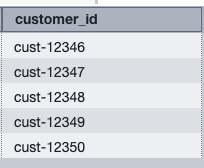
Figure 5: Query result showing customer IDs
Next, let’s see how the SUPER data type accommodates string values larger than 65,535 bytes. We use the LISTAGG and LEN functions to test this enhancement. The LISTAGG window function orders rows for each group according to the ORDER BY expression, then concatenates the values into a single string. The LEN function returns the length of the specified string as the number of characters. This operation wasn’t possible with the previous 65,535 bytes limit.
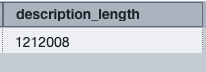
Figure 6: Query result showing description length
The output shows a string length of 1,212,008 characters. This demonstrates that SUPER can now handle strings beyond the previous 65,535-byte limit. If the output of LISTAGG exceeds the 65,535-byte limit of a VARCHAR column, you can store the result in a SUPER column, which supports up to 16 million bytes.
With large string support turned on, VARCHAR(MAX) in a view resolves to VARCHAR(16000000), so the view can return full-length strings. Because views keep the case settings from their creation, run SET first, then create the view after you turn on the setting:
Views that you created before you turned on the setting stay capped at 65,535 bytes until you recreate them. For more information, see Behavior changes in Amazon Redshift.
Use case three: Migration from your data warehouse with case insensitivity support
The challenge
Organizations migrating from legacy data warehouses to Amazon Redshift face a critical decision regarding database collation. Your data warehouse operates with case-insensitive string comparisons by default, and maintaining this behavior is essential for application compatibility. However, until recently, SUPER data types were only supported in Amazon Redshift databases with case-sensitive collation, creating a migration barrier. If you created Amazon Redshift case-insensitive databases to ease your migration process (avoiding the extensive testing required for case-sensitive conversion), you couldn’t use the SUPER data type for ingesting and querying semi-structured data such as JSON and arrays in Amazon Redshift native and data lake tables.
The solution
Amazon Redshift announced support for SUPER data types in databases with case-insensitive collation, which has the following benefits:
- Maintain case-insensitive behavior for legacy applications
- Use SUPER columns for semi-structured data in the same database
- Use the COLLATE function to specify case sensitivity preferences for SUPER columns
Amazon Redshift native table with SUPER data type
- Log in to Amazon Redshift Query Editor V2. Create database with case insensitive collation.
- Create the customer_data table with SUPER data type columns and insert sample records.
- Query customer_data table to analyze super data type columns.
SET enable_case_sensitive_super_attribute TO true;
 SELECT * FROM customer_data;

Figure 7: Result set of customer_data
- Use the following two queries to unnest the
order_historyarray column using PartiQL.
 Figure 8: Result set of customer_data using partiql
 Figure 9: Result set of customer_data and order_history using partiql
- Run a query that depends on the case-insensitive collation of the database. The filter uses lowercase “new york” and still matches “New York”.
In this example, the order_history column uses COLLATE case_sensitive, which overrides the case-insensitive default of the database for that column. To compare both behaviors, you can also use the COLLATE function in a WHERE clause.
Query nested data type on data lake
- The following is the sample input data for the customer profile. Place this data into a file and upload it to Amazon S3, name the S3 prefix “customer_profile”.
- Create the AWS Glue database
datalake_withsuper_datatype. For instructions on how to create the AWS Glue database, see Creating databases. - Create the AWS Glue crawler to crawl customer_profile prefix, use AWS Glue database
datalake_withsuper_datatypein crawler. For instructions on how to create a crawler, see Tutorial: Adding an AWS Glue crawler. - Create external schema on Amazon Redshift in database
custdb_case_insensitive.
- Select the external table customer_profile to view the column profile, which is the struct column in the AWS Glue table.

Figure 10: Result set of customer_profile using glue data catlog
Best practices
In this section, we discuss the best practices that you can follow while using SUPER data type in Amazon Redshift.
- Configure case sensitivity settings
Set the following session setting before you query SUPER columns for accurate field name matching. With this setting on, reference field names without double quotation marks:
Without this setting, Amazon Redshift converts unquoted field names to lowercase. When your JSON contains orderId but Amazon Redshift searches for orderid, queries return NULL values instead of your data.
Example: Impact of enabling case sensitivity
The following example shows the difference in query results with and without case sensitivity enabled:
- Cast SUPER values to specific data types
Always cast SUPER values to appropriate data types for better performance and accuracy:
Explicit casting eliminates ambiguity and improves query performance by helping Amazon Redshift optimize execution plans.
- Optimize performance for production workloads
Promote frequently queried fields
Extract commonly accessed SUPER attributes to regular columns for faster queries:
Create materialized views for complex queries
Turn on enable_case_sensitive_super_attribute, then build materialized views for queries you run repeatedly:
- Migrate from legacy databases
Use AWS Schema Conversion Tool (AWS SCT) to convert your schema automatically, then configure case sensitivity for SUPER columns.
Set user-level configuration
Enable case sensitivity for all of a single user’s sessions:
Test both column types
Verify that regular columns maintain case-insensitive behavior:
Confirm that SUPER columns enforce case sensitivity:
Update application queries:
Modify your application code to use correct case and explicit casting for all SUPER column attributes. This ensures consistent results and prevents NULL values from case mismatches.
- Align the large string setting
Keep the enable_large_strings_opt_in setting the same on data sharing producer and consumer data warehouses.
Recreate existing views, UDFs, and stored procedures after you turn on the setting. They stay capped at 65,535 bytes until you recreate them.
After you set the parameter to Yes or No, you can’t reset it to the default value.
For more information about best practices for working with semi-structured data types, see documentation.
Conclusion
The enhanced SUPER data type of Amazon Redshift solves the previously mentioned critical challenges that you face when working with semi-structured data. This post showed you how to turn on large string support, store individual strings in JSON documents up to 16 million bytes, perform string operations without truncation errors, and maintain case-insensitive compatibility during database migrations.
With SUPER, you can handle comprehensive data objects including legal contracts, product catalogs, customer profiles, and IoT sensor readings without breaking them into smaller pieces.
You can also cast SUPER values to VARCHAR and run pattern matching, text manipulation, and data cleansing operations directly on SUPER columns, and remove the truncation errors that previously blocked your analysis workflows.
Start implementing these capabilities in your environment with the following steps:
- Turn on large string support
- Configure case sensitivity settings for your specific use case
- Cast data types explicitly during data extraction
- Create materialized views for complex queries
- Test thoroughly to optimize query performance
Learn more
- Amazon Redshift SUPER data types documentation
- Amazon Redshift best practices guide
- Amazon Redshift introduces new array functions for semi-structured data processing
- Array functions in the Amazon Redshift Database Developer Guide
- Amazon Redshift SUPER data type in databases with case-insensitive collation
- Using dynamic data masking with SUPER data type paths
About the authors
[$] Locking down hibernation for the winter
Post Syndicated from daroc original https://lwn.net/Articles/1103190/
When a computer hibernates, the kernel writes the contents of memory to disk and
then shuts the system down. Resuming from hibernation involves reading that data
back into memory, and then having the kernel pick up where it left off.
Unfortunately, the kernel does not have
any way to know that the data it is reading back has not been tampered with,
which is why lockdown, an optional kernel
feature that attempts to prevent modifications to the running kernel, disables hibernation.
Matthew Garrett, who has been working on lockdown for many years, has shared
a patch set that aims to fix this problem. His solution must also protect
against downgrade attacks (where an attacker reboots the computer with an older
kernel version to bypass new protections), which complicates the implementation.
Seven stable kernels with fixes for three Xen vulnerabilities
Post Syndicated from jzb original https://lwn.net/Articles/1105902/
Hot on the heels of the previous
two stable kernels, Greg Kroah-Hartman has announced the release of the 7.3.3, 6.18.62,
6.12.116, 6.6.162, 6.1.192,
5.15.225, and 5.10.274 stable kernels. Each one only contains
fixes for three use-after-free vulnerabilities announced today by the Xen
security team.
Two of the vulnerabilities could allow an attacker to DoS the
entire Xen host machine with possible information leakage (CVE-2026-100080,
CVE-2026-100082),
and one may allow privilege escalation as well as a DoS of the host machine (CVE-2026-100081). Users
should, of course, upgrade if they are using Xen.
November is Home Assistant’s month of “What the Heck?!”
Post Syndicated from Home Assistant original https://www.youtube.com/shorts/MPIgVawiXas
Your Guide to the Developer Tools Track at AWS re:Invent 2026
Post Syndicated from Brian Beach original https://aws.amazon.com/blogs/devops/your-guide-to-the-developer-tools-track-at-aws-reinvent-2026/
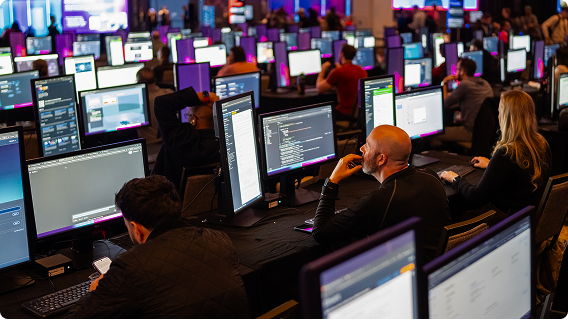
AWS re:Invent 2026 is almost here, and if you’re a developer, the Developer Tools (DVT) track is where you’ll want to spend your week. This year is all about agentic development, from multi-agent workflows to autonomous agents that keep working while you sleep. And CI/CD, Infrastructure as Code, and full-stack development are still well represented. Here’s your essential guide to the week.
Must-Attend Sessions
AWS re:Invent is a learning conference, and the Developer Tools track has 46 unique sessions waiting for you. Choose from breakouts, chalk talks, workshops, builders sessions, code talks, and lightning talks. Roughly three-quarters of the slots are interactive, so bring your questions and maybe your laptop. You can find the complete schedule in the re:Invent 2026 catalog. These are the sessions I would check first.
- DVT345: Continuous integration and continuous delivery (CI/CD) on AWS – Learn how to build complete CI/CD pipelines on AWS, from planning work and collaborating on code to deploying your applications safely.
- DVT202: AWS infrastructure as code: A year in review – Catch up on the latest from AWS CloudFormation and AWS CDK, and see how infrastructure as code fits into the agentic development era.
- DVT204: Beyond the pilot: How customers scaled Kiro and proved the value – Hear from multiple enterprises and share how they took Kiro from a pilot to their whole organization, and how they measured the impact.
- DVT206: 10x or bust: How Amazon’s Frontier teams ship with Kiro – Find out how Amazon’s frontier teams are rethinking the way software gets built, and what it takes to move from incremental gains to 10x.
- DVT316: What’s new in full-stack AWS app development – Discover the latest ways AWS helps web and mobile developers get started quickly, ship fast, and iterate.
- DVT320: How Kiro learns: an AI coding agent that improves with every session – See how Kiro builds persistent context so it gets better the more you use it.
- DVT405: Trusted intent: How Kiro proves your specs before writing any code – Go deep on how Kiro validates your specs before a single line of code is written, so the agent builds the right thing the first time.
Want to get hands-on? Try DVT406: Make the agent code while you sleep, a 400-level workshop on autonomous development with the Kiro CLI, or DVT207: Learn new AI development skills with Kiro, a builders session that’s a great place to start if you’re new to Kiro. Both repeat during the week, so you’ll have more than one chance to get a seat.
Kiro Galaxy Run
Start your journey at Kiro Galaxy Run in Caesars Forum. Strap into an immersive VR space mission that goes horribly off course, and use Kiro and its agents to get your crew home. Stick around for live demos at the Kiro kiosk, grab a Builder Quest stamp, and pick up some Kiro swag on your way out.

AWS Village
Visit the AWS Village in the Expo at the Venetian to talk with me and other experts at the Kiro kiosk. See Kiro in action, ask your toughest questions, and pick up stickers and Kiro credits.
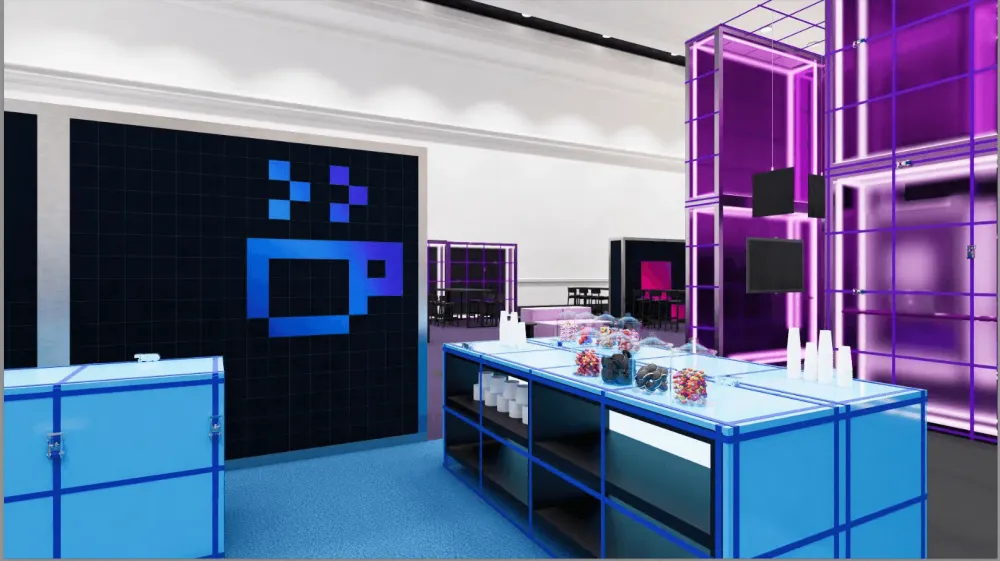
Builder Zone
Swing by the Builder Zone to explore the Builders Fair, Agent Forge, and open source areas, along with Kiro demos. This is also where you can sign up for Builder Quest and collect stamps to earn credits and prizes.
Ctrl+Alt+Ship Self-Paced Labs
Learn at your own pace in the Ctrl+Alt+Ship labs at the Venetian Content Hub. Kiro has two labs: a 200-level lab to get you started with the Kiro IDE, and a 400-level lab on autonomous development.
Conclusion
Make the most of re:Invent by attending these sessions, finding us at the AWS Village and Builder Zone, and taking on Kiro Galaxy Run. Whether you’re focused on CI/CD, infrastructure as code, full-stack development, or the next wave of agentic development, the Developer Tools track has something for you. If you are already registered, I look forward to seeing you in Las Vegas. If you are not registered, there is still time to register for re:Invent 2026.