All posts by Neeraj Kaushik

Modernizing KYC with AWS serverless solutions and agentic AI for financial services

Post Syndicated from Neeraj Kaushik original https://aws.amazon.com/blogs/architecture/modernizing-kyc-with-aws-serverless-solutions-and-agentic-ai-for-financial-services/

Regulators worldwide require financial institutions to implement Know Your Customer (KYC) processes that help prevent money laundering, terrorist financing, fraud, and identity theft. KYC has evolved from a compliance checkbox to a core security function for financial institutions. Financial institutions must modernize their KYC architectures because of several factors: rising transaction volumes, increasing regulatory complexity, and customer demands for instant onboarding. Legacy systems create multiple problems. They slow down compliance processes and expose institutions to both operational risks and regulatory penalties. However, traditional KYC orchestration systems, often built on monolithic architectures, struggle to meet these demands because of latency, availability, and scalability challenges. Their reliance on batch processing and manual handoffs leads to higher operational costs and impediments to real-time compliance validation, reinforcing the need for architectural modernization.

This post extends IBM’s approach to real-time KYC validation using generative AI, as previously discussed in the post IBM Digital KYC on AWS uses Generative AI to transform Client Onboarding and KYC Operations. It transforms compliance operations through autonomous decision-making and intelligent automation using agentic AI, event-driven architecture, and AWS serverless services. The solution addresses the fundamental limitations of traditional rule-based systems. It provides autonomous decision-making, dynamic adaptation, and intelligent automation that transforms compliance operations.

Financial institutions can break down KYC workflows into separate business functions. Amazon Managed Streaming for Apache Kafka (Amazon MSK) handles real-time event streaming, which speeds up processing. Amazon Bedrock automates document analysis and risk assessment with AI. AWS Lambda provides serverless computing that scales on demand and supports instant customer onboarding.

The critical role of KYC

KYC protects financial systems by verifying customer identities and detecting fraud in four ways. It supports regulatory compliance with anti-money laundering (AML) and counter-terrorist financing (CTF) regulations. It helps prevent fraud by detecting identity theft and forged documents. It manages risk by assessing customer profiles and monitoring transactions. And it builds customer trust through transparency. As financial institutions broaden their footprint across products, industries, and regions, KYC compliance becomes increasingly complex. Each financial service offering presents unique requirements, from traditional banking to digital wallets, investment systems, and cryptocurrency services. Expansion into retail, SME, and corporate segments brings diverse identity structures and risk profiles. Operating across multiple jurisdictions requires navigation of various regulatory frameworks. These frameworks include the Bank Secrecy Act (BSA) and USA PATRIOT Act in the US, Anti-Money Laundering Directives (AMLD) in the EU, and guidelines from international regulators like the Monetary Authority of Singapore (MAS) and Financial Action Task Force (FATF).

Traditional KYC

Traditional KYC processes verify customer identities, assess risk, and monitor for money laundering. They rely on manual document collection, identity checks across multiple databases, and periodic reviews. While these established processes have served the financial industry for decades, they were designed for a different era with lower transaction volumes, simpler product offerings, and less sophisticated threat landscapes. Today’s digital-first financial environment demands a fundamental reimagining of KYC at scale.

Current challenges

Legacy systems create several bottlenecks. They process requests in batches rather than real-time, making instant onboarding impossible. Manual validation across jurisdictions leads to inconsistent compliance. Without event-driven capabilities, these systems can’t integrate with modern AI and machine learning (ML) services or adapt to new fraud patterns without manual reconfiguration.

Cloud-native KYC solution architecture using agentic AI

This architecture illustrates a comprehensive cloud-native real-time KYC validation system designed to process live customer onboarding requests and validate identity information using AI-powered automation. The architecture uses an event-driven pipeline to process high-volume KYC validations securely in under 5 minutes. The system processes real-time KYC requests containing sensitive financial data including PII while maintaining strict security and regulatory compliance requirements across multiple geographies.
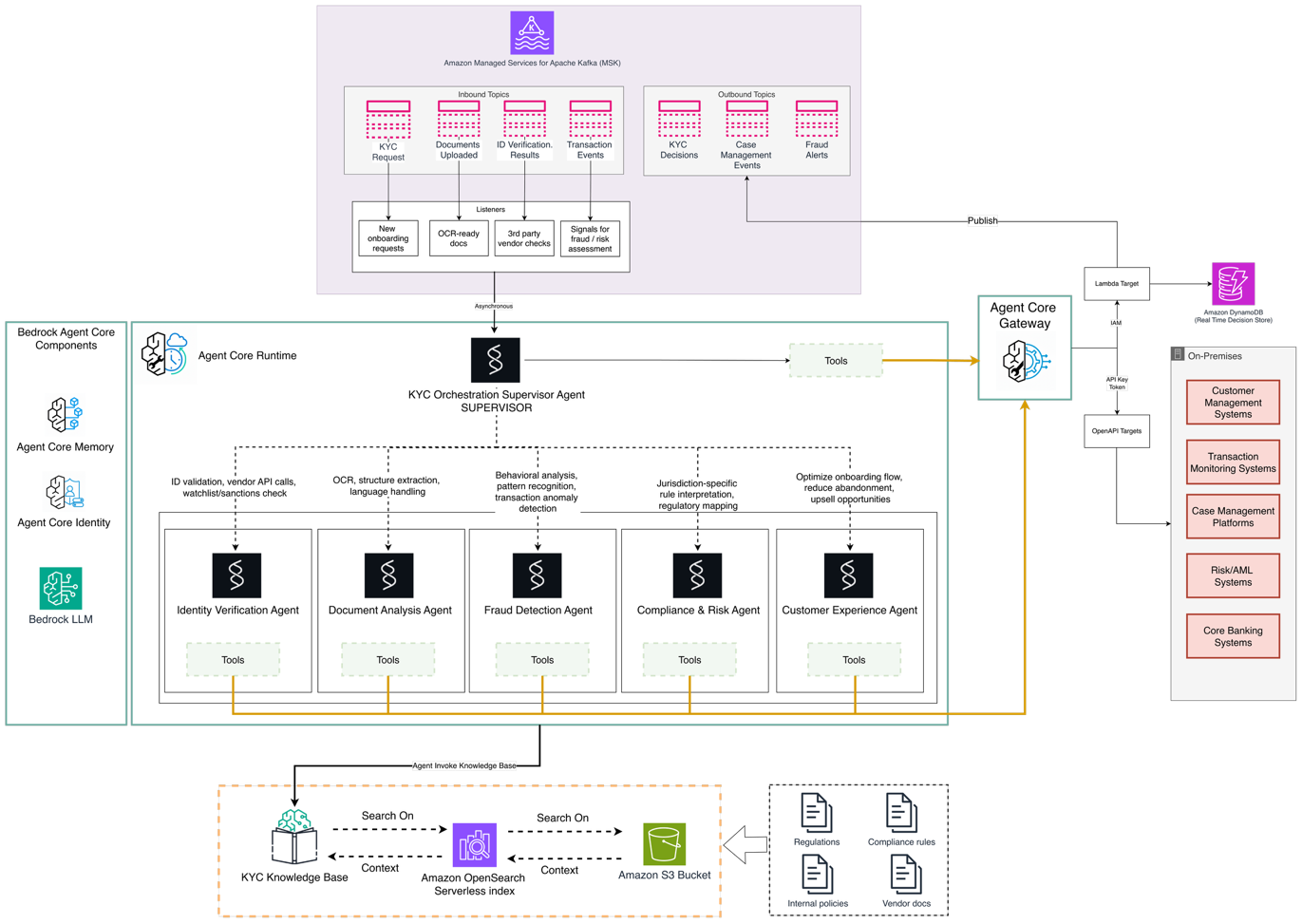
High-level Agentic Architecture for real-time KYC

High-level Agentic Architecture for real-time KYC

This architecture diagram illustrates an AI-driven Know Your Customer (KYC) Orchestration Framework built using Amazon Bedrock AgentCore and Amazon Managed Streaming for Apache Kafka (Amazon MSK). The design showcases how multiple specialized AI agents collaborate to automate and optimize KYC workflows, from document ingestion to compliance validation and fraud detection, while maintaining real-time integration with on-premises financial systems.

At the heart of the architecture is the AgentCore Runtime Environment, which provides native orchestration capabilities, session management, and memory persistence. Within this runtime, the KYC Orchestration Supervisor Agent acts as the intelligent coordinator, delegating tasks to five domain-specific sub-agents: Identity Verification, Document Analysis, Fraud Detection, Compliance & Risk, and Customer Experience. Unlike traditional multi-agent systems, AgentCore provides built-in session state management, shared memory across sub-agents, and automatic context preservation throughout asynchronous processing workflows.

The architecture uses asynchronous invocation patterns where MSK consumers trigger AgentCore processing without blocking, enabling sub-5-minute processing times while handling thousands of concurrent KYC requests. Lambda functions serve as the integration layer, consuming events from MSK, invoking AgentCore asynchronously, and publishing results back to Kafka topics for downstream system consumption.

Each sub-agent uses foundation models hosted on Amazon Bedrock for tasks such as optical character recognition (OCR), language processing, behavioral analysis, and regulatory interpretation. These agents operate within the AgentCore Runtime, sharing context through AgentCore Memory (a built-in feature of Bedrock AgentCore that automatically manages session state and context) and accessing external systems through tools defined using OpenAPI schemas and Lambda targets.

The agents use KYC Knowledge Bases, powered by Amazon OpenSearch Serverless and Amazon Simple Storage Service (Amazon S3), to access contextual information from internal policies, compliance rules, vendor documentation, and regulations. This approach provides consistent, explainable, and policy-aligned decision-making. These knowledge bases integrate with AgentCore’s retrieval mechanisms, providing sub-agents with grounded information during processing.

Finally, the solution connects with existing on-premises systems, such as customer management, transaction monitoring, case management, risk/AML systems, and core banking systems. These connections use tools defined with OpenAPI schemas as targets and Lambda-based integrations using AgentCore Gateway. AgentCore Gateway uses these OpenAPI specifications to understand API contracts, handle authentication, validate requests and responses, and manage retries. AgentCore Identity manages authentication and authorization for agents and their tool access, so that only authorized sub-agents can invoke specific tools and access the Knowledge Base. With this approach, financial institutions can achieve an intelligent, scalable, and compliance-aligned KYC process that minimizes manual intervention, improves onboarding speed, and reduces fraud and regulatory risks.

Solution Components

Event-Driven Communication Infrastructure with Amazon MSK

Amazon MSK serves as the communication backbone, enabling asynchronous, real-time message exchange between agentic AI components and enterprise systems. The streaming infrastructure organizes into distinct topic categories supporting bi-directional flows.

Inbound topics capture customer interactions through KYC requests (new applications), document uploads (identity documents), ID verification results (third-party vendor responses), and transaction events (fraud/risk signals). Event listeners pre-process these streams. These listeners filter onboarding requests, prepare documents for OCR, normalize vendor data formats, and correlate transaction signals with customer profiles.

Outbound topics publish KYC decisions with confidence scores and audit trails to core banking systems, route complex cases to human reviewers through case management events, and trigger fraud alerts to security teams. With this decoupled architecture, you can achieve sub-5-minute processing while maintaining full event auditability and allowing independent scaling of individual agents based on workload patterns.

Agentic AI Orchestration Layer

KYC Orchestration Supervisor Agent

The Supervisor Agent implements intelligent routing logic using Amazon Bedrock AgentCore to dynamically determine optimal sub-agent collaboration patterns. Unlike rule-based systems following rigid workflows, the supervisor analyzes case characteristics (document types, customer geography, risk indicators, and historical patterns) to construct context-aware execution plans that invoke sub-agents in parallel or sequentially based on dependencies. The supervisor monitors sub-agent confidence scores to guide decision-making: high confidence (>95%) results in automatic approvals, medium confidence (75-95%) triggers additional verification, and low confidence (<75%) escalates to human review with comprehensive context.

Five Specialized Sub-Agents operate as autonomous decision-makers, each using foundation models for domain-specific tasks:

  • Identity Verification Sub-Agent validates customer identities against watchlists and sanctions databases. It calls third-party verification APIs and uses natural language processing to handle name variations.
  • Document Analysis Sub-Agent extracts data from identity documents using OCR. The agent handles poor image quality and multiple languages and detects forgery by analyzing watermarks and security features.
  • Fraud Detection Sub-Agent identifies suspicious patterns through behavioral analysis. The agent detects multiple applications from the same IP address or inconsistent information across form fields. It correlates current applications with historical fraud cases using semantic similarity search and maintains dynamic risk scores with explainable fraud assessments.
  • Compliance & Risk Sub-Agent supports regulatory adherence by interpreting jurisdiction-specific KYC requirements across different geographies. It translates regulatory frameworks into concrete validation actions and generates compliance attestations with audit trails for regulatory examinations.
  • Customer Experience Sub-Agent optimizes the onboarding journey by analyzing application progress in real time, identifying friction points, and recommending strategies to reduce abandonment while identifying upselling opportunities based on customer profiles.

Intelligent Knowledge Management Architecture

The KYC Knowledge Base implements a retrieval augmented generation (RAG) pattern that grounds agent decisions in factual, current information rather than relying solely on foundation model training. Amazon S3 stores source documents, including regulations from financial authorities, institution-specific compliance rules, internal policies, and vendor documentation, enabled to track changes over time. Documents undergo automated preprocessing for text extraction, metadata enrichment, and quality validation before the system indexes them. Amazon OpenSearch Serverless provides semantic search using vector embeddings generated by Amazon Bedrock. When agents query using natural language questions, the system embeds queries into the same vector space and identifies semantically relevant document chunks through cosine similarity search, improving retrieval accuracy over keyword matching.

Context-aware retrieval enriches queries with case-specific information, including customer jurisdiction, document types, and risk levels – facilitating highly relevant regulatory guidance. This continuous knowledge access keeps agent decisions grounded in institutional knowledge rather than hallucinating responses.

Real-Time Decision Store (Amazon DynamoDB) complements the Knowledge Base with sub-millisecond access to frequently accessed structured data, including current KYC decision status, risk scores, customer interaction history, and dynamic configuration parameters controlling agent behavior.

Secure integration with on-premises financial systems

The architecture integrates with on-premises financial systems through Action Groups bridging the cloud-native agentic layer and existing enterprise infrastructure.

Customer Management Systems receive real-time KYC decisions, updating verification status and account activation flags. Transaction Monitoring Systems consume fraud alerts and risk scores, enabling immediate action on suspicious patterns. Case Management Systems receive escalated cases with comprehensive agent analysis context, accelerating human review. Risk and AML Systems integrate bidirectionally to maintain consistent risk assessments. Core Banking Systems receive approved validations, triggering account activation.

Secure connectivity through AWS Direct Connect or AWS Site-to-Site VPN provides encrypted data transmission over dedicated network paths. API calls include comprehensive audit logging through AWS CloudTrail and Amazon CloudWatch, satisfying regulatory requirements.

Security Considerations

The solution should incorporate multi-layered security controls, continuous monitoring, and automated compliance auditing to meet the rigorous expectations of financial regulators and internal risk teams. Financial institutions should conduct a comprehensive threat modelling to identify risks including introduced by agentic AI systems. For further information please refer Security Guidance.

Conclusion

This KYC architecture uses AWS serverless services and Amazon Bedrock to process validations faster and at scale. The parallel agent execution model is designed to reduce KYC validation time from the typical 3-5 days to near-real time for standard cases. This approach enables exponentially faster processing through simultaneous operation of Document Analysis, Identity Verification, and Fraud Detection agents rather than sequential workflows.

With this architecture, financial institutions can handle high-volume validations through elastic scaling, optimize costs through serverless pay-per-use pricing, and improve accuracy through multi-agent collaboration. Automated document processing and intelligent routing are expected to reduce manual review workload, allowing each compliance specialist to handle up to 4x their current caseload while focusing on complex cases requiring human expertise. Explainable AI decisions with comprehensive audit trails support regulatory compliance and enable rapid audit responses.

Event-driven architecture and agentic AI help financial institutions compete in digital landscapes while meeting regulatory requirements.

Note: The architecture presented here is for reference purposes only. IBM and AWS will work closely with you to execute a Proof of Concept and implementation plan in accordance with industry standards and compliance requirements.

Further Reading

IBM Consulting is an AWS Premier Tier Services Partner that helps customers who use AWS to harness the power of innovation and drive their business transformation. They are recognized as a Global Systems Integrator (GSI) for over 30 competencies, including Financial Services Consulting. For additional information, please contact an IBM Representative.
About the authors

Modernization of real-time payment orchestration on AWS

Post Syndicated from Neeraj Kaushik original https://aws.amazon.com/blogs/architecture/modernization-of-real-time-payment-orchestration-on-aws/

The global real-time payments market is experiencing significant growth. According to Fortune Business Insights, the market was valued at USD 24.91 billion in 2024 and is projected to grow to USD 284.49 billion by 2032, with a CAGR of 35.4%. Similarly, Grand View Research reports that the global mobile payment market, valued at USD 88.50 billion in 2024, is expected to grow at a CAGR of 38.0% from 2025 to 2030. (Disclaimer: Third-party market research and statistics are provided for informational purposed only. AWS and IBM make no representations about the accuracy of this information.)

This rapid expansion underscores the urgency for financial institutions to modernize their payment processing infrastructure. Financial institutions often need to process high volume of transactions with near-zero latency to meet stringent service level agreements (SLAs) to support surging mobile payments volume.

However, traditional payment orchestration systems, often built on monolithic architectures, struggle to meet these demands due to latency, availability, and scalability challenges. Additionally, their reliance on on-premises infrastructure leads to higher costs and an impediment to innovation, reinforcing the need for modernization.

As sustainability becomes a priority, organizations are turning to cloud-based solutions to optimize infrastructure, reduce carbon footprints, and enhance energy efficiency. This shift provides scalability and performance, and aligns with global sustainability goals, securing the future of real-time payments.

In this post, we discuss the real-time payment orchestration framework. It uses an event-driven architecture and AWS serverless services to enhance the resiliency, efficiency, and scalability of real-time payments. By decomposing payment processing into distinct business capabilities, financial institutions can improve modularity and flexibility. Implementing tenant-based segregation helps with data isolation and security. Additionally, adopting asynchronous communication through Amazon Managed Streaming for Apache Kafka (Amazon MSK) enhances scalability and resilience.

Traditional real-time payment orchestration

Payment orchestration serves as a middleware solution, streamlining transaction processing across multiple payment methods, gateways, and financial institutions. It orchestrates key business functions such as payment authorization, payment processing, settlement and clearing, compliance and risk management, and account management for both inbound and outbound payment flows.

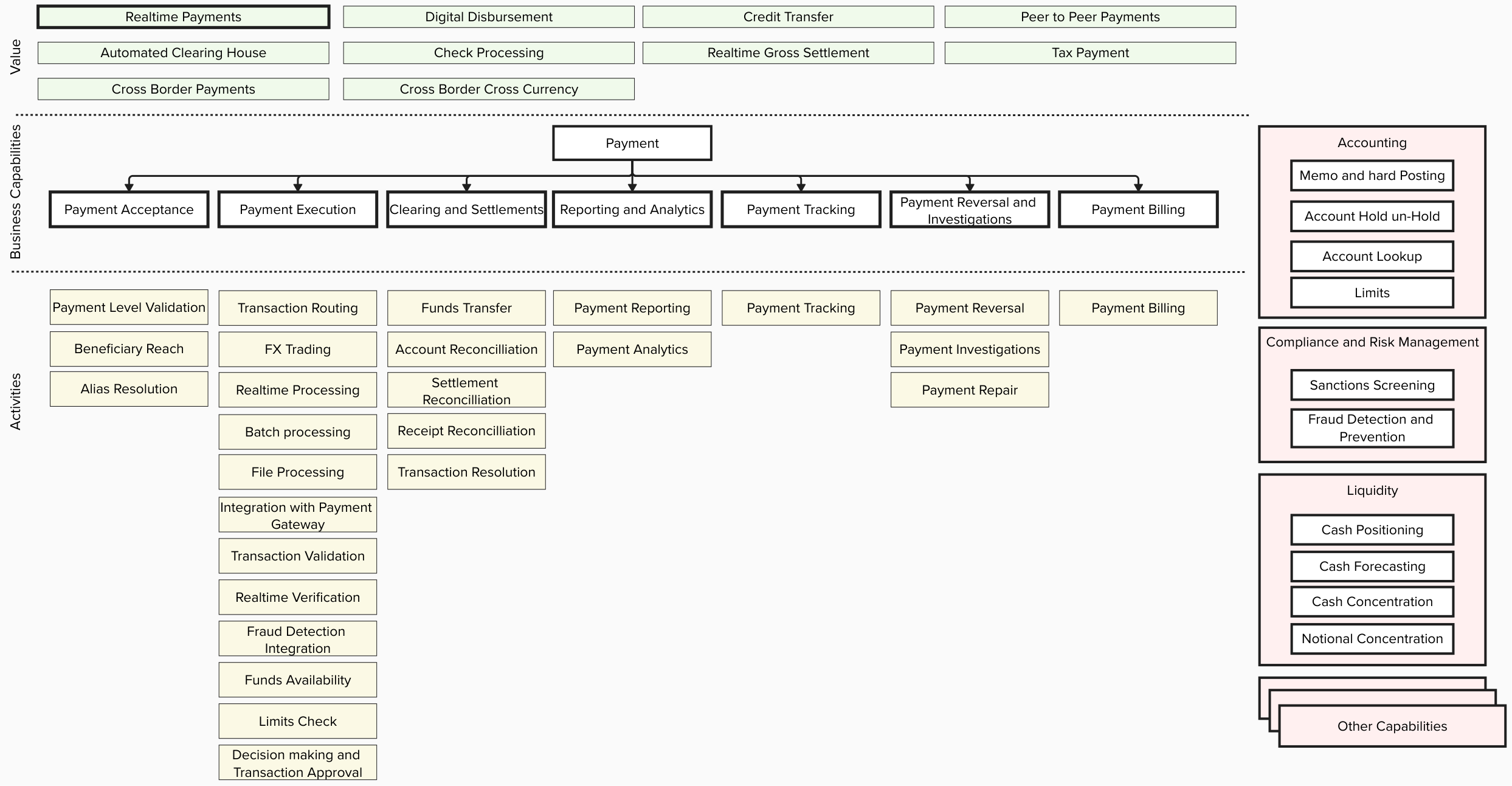
The following diagram depicts the high-level business capabilities supported by payment orchestrators across various payment flows, including real-time payments, digital disbursements, tax payments, wires, and more.

Payment processing system flowchart showing main components from acceptance to billing

Detailed flowchart depicting a payment processing system with multiple components. The diagram shows primary payment types at the top (including Realtime Payments, Digital Disbursement, Credit Transfer, and Peer to Peer Payments) flowing down through core processing stages including Payment Acceptance, Execution, Clearing, Reporting, Tracking, Reversals, and Billing.

Many financial institutions adopt a tenant-based approach organized by geography due to varying clearing processes, localized regulations, and transaction requirements across AWS Regions. However, without proper separation of services, teams often continue to add region-specific logic to existing services, gradually increasing their monolithic complexity and using the same infrastructure for all payment flows.

Traditional payment systems process transactions linearly, with each step waiting for the previous one to complete. However, analysis of payment workflows reveals numerous opportunities for parallel execution:

  • Sanctions screening and fraud detection – Compliance and fraud checks can run simultaneously with initial routing decisions, rather than sequentially blocking all subsequent processing
  • Payment routing and authorization requests – When basic validations are complete, routing and authorization can proceed in parallel rather than one after another
  • Payment execution and ledger updates – The actual payment execution doesn’t need to wait for ledger records to be updated—these can occur concurrently
  • Settlement, reconciliation, and tracking – These post-transaction processes can be initiated independently as soon as the primary transaction is complete

This parallel approach can dramatically improve throughput and reduce latency compared to traditional queue-based systems where operations form a sequential chain that extends processing time and creates bottlenecks.

Most legacy payment orchestration systems rely heavily on on-premises virtual machines (VMs), leading to several challenges:

  • Multi-Region support for disaster recovery and multi-tenancy resulting in significant capital expenditure and operational overhead
  • High latency and SLA issues caused by sequential message processing and delays between globally separated data centers
  • Limited reusability of payment flows as monolithic architectures require region-specific changes for local clearing mechanisms and regulations, increasing complexity and costs
  • Scalability challenges and high memory consumption due to inefficient resource utilization and execution of irrelevant logic across regions
  • Complex cross-border payment routing caused by variations in clearing rules, transaction limits, and local regulations, increasing latency and routing errors
  • Integration challenges with diverse data formats because legacy systems rely on proprietary standards (for example, ISO 20022, SWIFT MT), complicating data conversion and compliance
  • High deployment complexity for new payment flows due to monolithic architectures requiring extensive region-specific modifications, slowing time to market
  • Environmental impact and high carbon footprint from on-premises infrastructure consuming excessive energy, whereas cloud-based approaches improve efficiency

Solution overview

To overcome these challenges, the proposed architecture embraces the following design principles to build a future-ready, real-time payment orchestration solution:

  • Performance at scale – Handling over 1,000 transactions per second (TPS) with consistent low latency under varying load conditions.
  • High availability – Achieving 99.999% uptime to meet the strict requirements of financial transactions.
  • Geographic resilience – Supporting global operations with region-specific compliance while maintaining consistent performance.
  • Cost optimization – Reducing total cost of ownership through efficient resource utilization and serverless technologies.
  • Security and compliance – Supporting data protection and regulatory adherence across different jurisdictions.
  • Operational simplicity – Streamlining deployment, monitoring, and maintenance across the payment ecosystem.
  • Microservices – Decomposing payment processing into distinct business capabilities, so financial institutions can improve modularity and flexibility. This microservices-based approach allows for independent scaling and development of critical components.

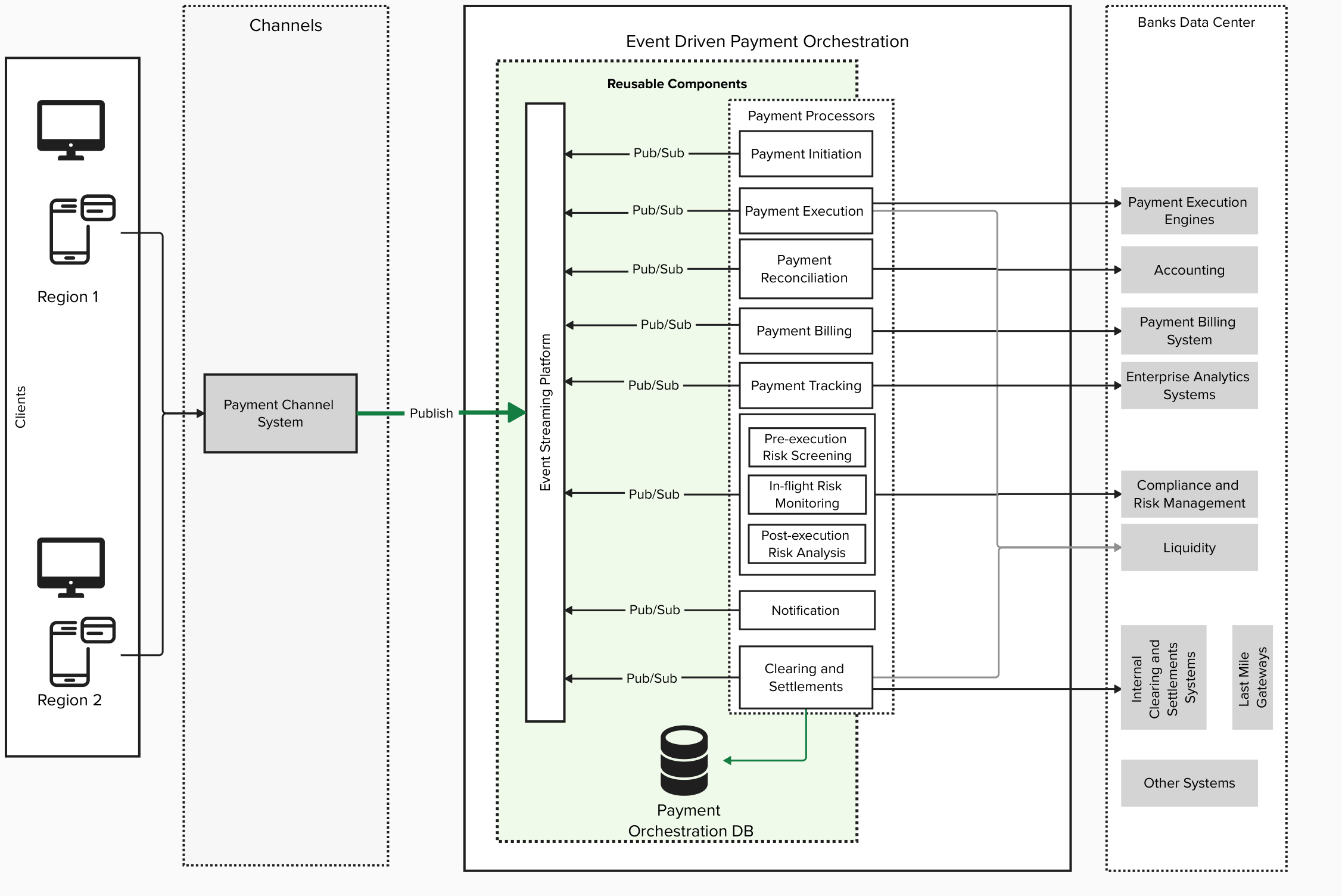
The following diagram depicts the high-level solution architecture for real-time payments. The existing channels using synchronous or asynchronous APIs can be modified to use edge-optimized endpoints to reduce latency.

Event-driven payment orchestration system with pub/sub channels connecting multiple payment processing modules

Architecture diagram detailing an AWS-based payment orchestration platform utilizing event-driven principles. Features reusable components across two regions, with dedicated modules for payment initiation, execution, reconciliation, billing, and risk management. Implements pub/sub messaging patterns for inter-component communication and connects to enterprise systems including accounting, compliance, and analytics.

An event-driven architecture is used for payment orchestration, which handles communication through a pub/sub pattern. This architecture maintains persistent connections, improving performance of the end-to-end real-time payment processing.

The event-driven architecture for real-time payment processing allows multiple payment operations to occur simultaneously using different adaptors, as opposed to the traditional systems where payment processes are sequential and flow through a single pipeline. Payment events are distributed to specialized payment processor microservices based on their function (initiation, execution, tracking, settlements), enabling each to process independently without waiting for others to complete.

Because we’re transitioning from sequential processing to distributed, maintaining transaction traceability is crucial. The payment tracking adapters shown in the preceding diagram connect to enterprise analytics systems, creating a specialized layer for monitoring transactions. The pub/sub model allows for attaching correlation IDs to events, enabling systems to track related events across different topics and processing stages.

A standardized event schema serves as the foundation for this architecture, providing consistency across regional deployments while allowing for customization at the adapter level. This schema defines uniform event structures containing tenant-specific metadata and supports versioning to accommodate evolving requirements. By isolating region-specific variations to the adapter layer, the solution maintains core functionality while interfacing with diverse enterprise systems through configuration-driven customization rather than code changes.

For most payment processes, especially those with independent processing steps that can run in parallel, this architecture delivers net performance gains despite the topic switching overhead, particularly for complex transactions where multiple independent validations or processing steps are required.

Deployment on the AWS Cloud

The solution uses edge-optimized Amazon API Gateway for channels. An edge-optimized API endpoint routes requests to the nearest Amazon CloudFront Point of Presence (POP), which can help in cases where your clients are geographically distributed to enable efficient routing within each geographical region, enhancing global responsiveness by minimizing network round trips and making sure requests take the shortest possible path before transitioning from the public internet to the client network.

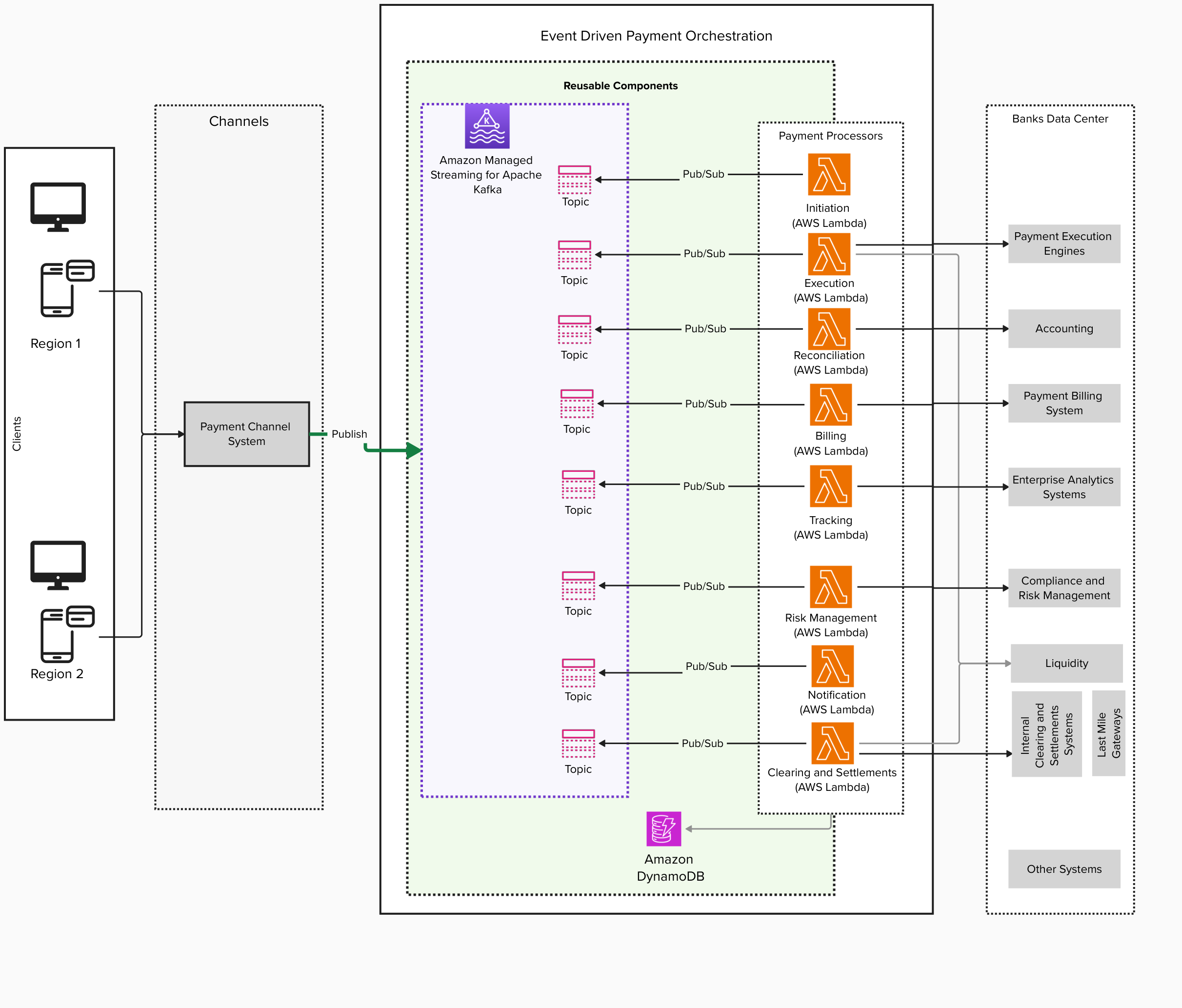
The following diagram illustrates the high-level solution architecture for real-time payments.

Multi-region AWS payment architecture with managed Kafka topics connecting Lambda microservices and DynamoDB storage

Comprehensive AWS payment orchestration solution implementing modern cloud-native architecture principles. Core processing logic implemented as Lambda functions covering initiation, execution, reconciliation, billing, tracking, risk management, and settlement workflows. Leverages Amazon MSK for reliable event streaming between components, with dedicated Kafka topics for each processing stage. Data persistence handled by Amazon DynamoDB, supporting cross-region operations. Architecture demonstrates AWS best practices for financial services, including regional redundancy, serverless computing, managed services, and event-driven design patterns. System integrates with external banking infrastructure and enterprise systems while maintaining separation of concerns through microservices architecture. Features built-in support for compliance monitoring, risk management, and payment tracking through specialized Lambda functions.

The solution uses Amazon MSK to implement an event-driven architecture that efficiently handles both inbound and outbound channels traffic through API requests and asynchronous message-based events. Amazon MSK communicates using a high-performance binary protocol between producers, consumers, and brokers, providing low latency and high throughput. Real-time payments are logically partitioned across multiple tenants within geographical regions—North America, EMEA, LATAM, and Asia-Pacific.

Each real-time payment tenant follows an active/active disaster recovery strategy by deploying MSK clusters across multiple AWS Regions, designed to achieve high availability and resilience. Amazon MSK offer both serverless and provisioned cluster options. The team can decide to select one or the other depending on the non-functional requirements and team expertise. Amazon MSK automatically manages partition leadership with leaders in primary Regions and followers in secondary Regions. During failover, leaders are re-elected in healthy Regions, designed to help maintain processing capabilities during regional incidents. Sticky partitioning uses consistent hashing for deterministic routing, and cooperative rebalancing enables efficient failover. Multi-AZ deployment provides zone redundancy and isolated clusters per Region for data sovereignty compliance through programmatic AWS Identity and Access Management (IAM) and virtual private cloud (VPC) boundaries.

To support seamless cross-Region replication and maintain message continuity, Amazon MSK Replicator—a fully managed feature of Amazon MSK—is used to replicate topics and synchronize consumer group offsets across clusters. MSK Replicator simplifies the process of building multi-Region Kafka applications by not needing custom code, open-source tool configuration, or infrastructure management. It automatically provisions and scales the necessary resources, so teams can focus on business logic while only paying for the data being replicated. In the event of a regional outage or failover, traffic can be automatically redirected to a healthy Region without data loss or service disruption, providing near-zero Recovery Time Objectives (RTOs) and uninterrupted operations for downstream services such as payment processors and audit trail consumers.

In addition to regional redundancy, the architecture uses an event-driven architecture to enable parallel and decoupled processing of payment transactions. Events such as transaction initiation, validation, and settlement are emitted asynchronously and consumed by various microservices independently, which drastically reduces end-to-end latency.

To process these events at scale, the architecture can use AWS Lambda, Amazon Elastic Container Service (Amazon ECS), or Amazon Elastic Kubernetes Service (Amazon EKS) depending upon non-functional requirements. Automatic scaling responds to Amazon CloudWatch metrics, and exponential backoff retry logic with dead-letter queues (DLQs) handles throttling scenarios. Circuit breakers prevent cascade failures during high error rates.

One of the key benefits of the solution is the reusability of payment flows across different regions. Although each region has its own unique compliance requirements and settlement rules, the core functionalities of real-time payments (payment authorization, payment processing, settlement and clearing) are largely similar. This reusability enables rapid deployment of payment solutions across new regions without rearchitecting the entire system. For example, the real-time payment system in the US and UK might share similar business logic for real-time gross settlement but differ in the clearing and compliance requirements. The solution treats these as bounded contexts within the microservices architecture, providing flexibility while making sure each region can handle its own specific rules and regulations.

Sustainability

AWS relentlessly innovates its infrastructure design, build, and operations to make progress towards net-zero carbon by 2040 and being water positive by 2030. Amazon MSK with AWS Graviton based instances use up to 60% less energy than comparable M5 instances, helping you achieve your sustainability goals. Lambda is inherently sustainable by design. Its serverless model makes sure compute resources are only used when needed, drastically reducing idle infrastructure and wasted energy. Instead of keeping always-on servers for infrequent tasks, Lambda provisions compute power just-in-time, achieving near-zero idle capacity.

Security and compliance in financial services

Given the sensitive nature of payment transactions and financial data, you should apply the security controls required to meet financial regulations such as AWS PCI DSS and AWS Federal Information Processing Standard (FIPS) 140-3 according to your organization’s needs.

The solution should incorporate multi-layered security controls, continuous monitoring, and automated compliance auditing to meet the rigorous expectations of banking regulators and internal risk teams. For more information, refer to Security Guidance.

Conclusion

The modernization of payment orchestration systems using an event-driven architecture and AWS serverless technologies marks a significant advancement in meeting the demands of today’s rapidly evolving financial services landscape. This solution addresses the key challenges faced by traditional payment systems while delivering substantial benefits in performance, scalability, cost optimization, global resilience, sustainability, and compliance. By using cutting-edge cloud technologies and robust security controls, financial institutions can now build a future-ready foundation that adapts to evolving business needs while maintaining the highest standards of performance, security, and reliability. As the real-time payments market continues its explosive growth, this modern architecture provides a solution that meets today’s demands and is also well-positioned to support tomorrow’s payment innovations. Organizations looking to modernize their payment infrastructure can use this blueprint to accelerate their digital transformation journey, supporting sustainable, secure, and efficient payment processing at scale in an increasingly competitive global marketplace.

The architecture presented here is for reference purposes only. IBM will work closely with you to deploy the solution in accordance with industry standards and compliance requirements.For additional resources, refer to:

IBM Consulting is an AWS Premier Tier Services Partner that helps customers who use AWS to harness the power of innovation and drive their business transformation. They are recognized as a Global Systems Integrator (GSI) for over 22 competencies, including Financial Services Consulting. For additional information, please contact an IBM Representative.