All posts by Panos Kampanakis

Post-quantum (ML-DSA) code signing with AWS Private CA and AWS KMS

Post Syndicated from Panos Kampanakis original https://aws.amazon.com/blogs/security/post-quantum-ml-dsa-code-signing-with-aws-private-ca-and-aws-kms/

Following our recent announcement of ML-DSA support in AWS Key Management Service (AWS KMS), we just introduced post-quantum ML-DSA signature support in AWS Private Certificate Authority (AWS Private CA). Customers can use AWS Private CA to create and manage their own private public key infrastructure (PKI) hierarchies. Through this integration, you can establish and use customer-managed quantum-resistant roots of trust for code signing, device authentication, outside (of AWS) workload authentication with AWS IAM Roles Anywhere, or communication tunnels such as IKEv2/IPsec or Mutual TLS (mTLS) using private PKI.

As outlined in the AWS post-quantum cryptography migration plan, establishing quantum-resistant roots of trust is critical for systems that need to maintain security for extended periods of time. ML-DSA, a signature scheme standardized in FIPS 204, provides quantum resistance while maintaining the performance characteristics needed for deployments at scale.

Previously, we shared how to use AWS Private CA and AWS KMS for code signing. In this post, we show you how to combine the post-quantum signing capability provided by AWS KMS with post-quantum code-signing PKI from AWS Private CA. Consumers of signed code that have been pre-provisioned with the post-quantum PKI roots can rest assured that the software could not have been forged by an adversary with a cryptographically relevant quantum computer (CRQC). For demonstration purposes, we use the diy-code-signing-kms-private-ca sample program, which uses the AWS SDK for Java. This code creates a PKI infrastructure, generates a code-signing certificate, signs binary code, and verifies the signature. Although we break down the steps to demonstrate the functionality in this post, you can run the Runner as-is to see it in action with commands found in the README file.

This post uses the Cryptographic Message Syntax (CMS) standard for encapsulating the signatures generated for input binary data. It stores the signature, X.509 certificate, and chain used to establish trust. The signature, known as a detached signature, doesn’t contain the original data. The detached signature can be used together with the original file, which was signed with standard tools such as OpenSSL natively to validate the authenticity of the file.

Create a post-quantum PKI hierarchy

For this post, we will use AWS Private CA to introduce a code-signing PKI. It will consist of a root CA to sign a subordinate CA, and a code-signing certificate signed by the subordinate CA. The whole chain will consist of quantum-resistant ML-DSA certificates.

CA hierarchy creation

First, the post-quantum CA hierarchy must be created with ML-DSA. In this example, we use the ML-DSA-65 variant of the post-quantum signature algorithm. You can do this with the AWS Java SDK as shown in the Runner.java file:

PrivateCA rootPrivateCA = PrivateCA.builder()
	.withCommonName(ROOT_COMMON_NAME)
	.withType(CertificateAuthorityType.ROOT)
	.withAlgorithmFamily(ML_DSA_65_ALGORITHM_FAMILY)
	.getOrCreate();

PrivateCA subordinatePrivateCA = PrivateCA.builder()
    .withIssuer(rootPrivateCA).withCommonName(SUBORDINATE_COMMON_NAME)
    .withType(CertificateAuthorityType.SUBORDINATE)
	.withAlgorithmFamily(ML_DSA_65_ALGORITHM_FAMILY)
    .getOrCreate();

Code-signer creation

For code signing, you need an asymmetric key pair and a code-signing certificate. The asymmetric ML-DSA key pair is generated in AWS KMS and the code-signing certificate is issued by AWS Private CA.

Create an ML-DSA key pair in AWS KMS

First, you must create an asymmetric key pair for code signing operations. Similar to the creation of the hierarchy, the AWS Java SDK can be used to create that AWS KMS key (key pair). Signing will be taking place with the key pair’s private key in AWS KMS. The corresponding public key will be in the code-signing leaf certificate signed by the subordinate CA. These calls are performed as part of the main method within the Runner.java file:

AsymmetricCMK codeSigningCMK = AsymmetricCMK
    .builder().withAlias(CMK_ALIAS)
	.withAlgorithmFamily(ML_DSA_65_ALGORITHM_FAMILY)
    .getOrCreate();

Alternatively, you can generate the key pair in AWS KMS with the AWS Management Console or the AWS Command Line Interface (AWS CLI) as shown in the ML-DSA KMS security blog.

Issue a code-signing certificate

Creating a certificate signing request (CSR) using AWS Private CA is a two-step process. First, you must create a CSR that contains both an identity (Subject) and the previously created AWS KMS public key. The following code snippet in Runner.java accomplishes this:

String codeSigningCSR = codeSigningCMK
	.generateCSR(END_ENTITY_COMMON_NAME);

OpenSSL 3.5 or later can parse this CSR to view its content with the following command if the CSR contents have been written to disk at csr.pem:

openssl req -in csr.pem -inform pem -text -noout
Certificate Request:
	Data:
		Version: 1 (0x0)
		Subject: CN=CodeSigningCertificate
		Subject Public Key Info:
			Public Key Algorithm: ML-DSA-65
				ML-DSA-65 Public-Key:
				pub:
					<Public Key Data>   
		Attributes:
			Requested Extensions:
				X509v3 Basic Constraints:
					CA:FALSE
	Signature Algorithm: ML-DSA-65
	Signature Value:
		<Signature Data>

You can see that the CSR contains an ML-DSA-65 public key. Its corresponding private key will be used to sign code.

The CSR is used by the subordinate CA to issue the code-signing certificate. Note that the code-signing template is used in the templateArn of the IssueCertificate request in the relevant PrivateCA.java file. The inclusion of this template helps ensure that AWS Private CA will issue a certificate with the correct Key Usage (KU) and Extended Key Usage (EKU) extension values, regardless of the values presented in the CSR.

IssueCertificateRequest issueCertificateRequest = IssueCertificateRequest.builder()
	.idempotencyToken(UUID.randomUUID().toString())
	.certificateAuthorityArn(subordinatePrivateCA.arn())
	.csr(SdkBytes.fromUtf8String(csr))
	.signingAlgorithm(algorithmFamily.getPcaSigningAlgorithm())
	.templateArn("arn:aws:acm-pca:::template/CodeSigningCertificate/V1")
	.validity(validity)
	.build();

IssueCertificateResponse issueCertificateResponse = client
	.issueCertificate(issueCertificateRequest);

String certificateArn = issueCertificateResponse.certificateArn();

GetCertificateRequest getCertificateRequest = GetCertificateRequest.builder()
	.certificateAuthorityArn(ca.arn())
	.certificateArn(certificateArn)
	.build();

The response includes the ML-DSA-65 code-signing certificate. You can use OpenSSL 3.5 or later to inspect the contents of the certificate after you save it to a file named code-signing-cert.pem:

openssl x509 -in code-signing-cert.pem -inform pem -text -noout
Certificate:
	Data:
		Version: 3 (0x2)
		Serial Number:
			1a:15:af:1e:64:8d:cd:29:b4:dc:66:2a:8b:1e:ee:b0
		Signature Algorithm: ML-DSA-65
		Issuer: CN=CodeSigningSubordinate-MLDSA65
		Validity
			Not Before: Sep 24 13:10:38 2025 GMT
			Not After : Sep 24 14:10:38 2026 GMT
		Subject: CN=CodeSigningCertificate
		Subject Public Key Info:
			Public Key Algorithm: ML-DSA-65
				ML-DSA-65 Public-Key:
				pub:
					<Public Key Data>
		X509v3 extensions:
			X509v3 Basic Constraints:
				CA:FALSE
			X509v3 Authority Key Identifier:
B7:EF:2E:C9:7A:A8:7E:B5:D6:2D:9A:3F:C7:A7:F8:9D:74:01:6A:EF
			X509v3 Subject Key Identifier:

7F:63:35:0C:56:F8:ED:F1:2A:DF:B5:2E:7C:F1:2C:D9:A0:0E:63:B6
			X509v3 Key Usage: critical
				Digital Signature
			X509v3 Extended Key Usage: critical
				Code Signing
	Signature Algorithm: ML-DSA-65
	Signature Value:
		<Signature Data>

You can see that the certificate includes the ML-DSA-65 public key of the code-signing key pair and the ML-DSA-65 signature from the subordinate CA. You also see the KU and the EKU values, which represent a code-signing certificate from the AWS Private CA template.

Sign code

At this point, you have set up the code-signing PKI, have a code-signing certificate issued by AWS Private CA and a corresponding ML-DSA key pair residing in KMS.

The Java SDK can be used to generate a CMS signature for a code binary file. In the background, this is accomplished by calling the AWS KMS Sign API with the ML-DSA key pair as shown in Runner.java. The following is part of the Java code. This first snippet involves building a certificate chain and then using it along with the code-signing AWS KMS key, the signer’s certificate, and <DATA_TO_SIGN>, the byte array representation of the code file, to generate the detached signature in a CMS structure.

	// Parse code-signing certificate from PEM
	X509CertificateHolder signerCert = CertificateUtils
		.fromPEM(codeSigningCertificate.certificate());

	Collection<X509CertificateHolder> chainCerts = CertificateUtils
		.toCertificateHolders(codeSigningCertificate.certificateChain());

	// Build certificate chain including code-signing cert and intermediate certs
	Collection<X509CertificateHolder> certChain = new ArrayList<> ();
	certChain.add(signerCert);

	// Parse certificate chain
	for (X509CertificateHolder chainCert : chainCerts) {
		if (!chainCert.equals(signerCert)) {
			certChain.add(chainCert);
		}
	}

	// Create detached CMS signature
	CMSCodeSigningObject cmsCodeSigningObject = CMSCodeSigningObject
		.createDetachedSignature(
			codeSigningCMK,
			ML_DSA_65_ALGORITHM_FAMILY,
			<DATA_TO_SIGN>,
			signerCert,
			certChain);

The code-signing object is written to disk in signature-MLDSA65.p7s. You can inspect it with OpenSSL 3.5 or later:

openssl cms -cmsout -in signature-MLDSA65.p7s -inform DER -print
CMS_ContentInfo:
	contentType: pkcs7-signedData (1.2.840.113549.1.7.2)
	d.signedData:
		version: 1
		digestAlgorithms:
			algorithm: shake256 (2.16.840.1.101.3.4.2.12)
			parameter: <ABSENT>
		encapContentInfo:
			eContentType: pkcs7-data (1.2.840.113549.1.7.1)
			eContent: <ABSENT>
		certificates:
			d.certificate:
				cert_info:
					version: 2
					serialNumber: 0xD0B2937F5BABC80AD55C0A90E1DE7057
					signature:
						algorithm: ML-DSA-65 (2.16.840.1.101.3.4.3.18)
						parameter: <ABSENT>
					issuer:			CN=CodeSigningSubordinate-MLDSA65
					validity:
						notBefore: Oct 28 15:05:27 2025 GMT
						notAfter: Oct 28 16:05:26 2026 GMT
					subject:		CN=CodeSigningCertificate
					key:		X509_PUBKEY:
						algor:
							algorithm: ML-DSA-65 (2.16.840.1.101.3.4.3.18)
							parameter: <ABSENT>
						public_key:(0 unused bits)
							...
						issuerUID: <ABSENT>
						subjectUID: <ABSENT>
						extensions:
							object: X509v3 Basic Constraints (2.5.29.19)
							critical: FALSE
							value:
								0000 - 30 00 0.
                                    
							object: X509v3 Authority Key Identifier (2.5.29.35)
							critical: FALSE
							value:
								0000 - 30 16 80 14 b7 ef 2e c9-7a a8 7e b5 d60.......z.~..
								000d - 2d 9a 3f c7 a7 f8 9d 74-01 6a ef-.?....t.j.

                        	object: X509v3 Subject Key Identifier (2.5.29.14)
							critical: FALSE
							value:
								0000 - 04 14 7f 63 35 0c 56 f8-ed f1 2a df b5...c5.V...*..
								000d - 2e 7c f1 2c d9 a0 0e 63-b6.|.,...c.

                         	object: X509v3 Key Usage (2.5.29.15)
							critical: TRUE
							value:
								0000 - 03 02 07 80....
                                    
							object: X509v3 Extended Key Usage (2.5.29.37)
							critical: TRUE
							value:
								0000 - 30 0a 06 08 2b 06 01 05-05 07 03 030...+.......
					sig_alg:
						algorithm: ML-DSA-65 (2.16.840.1.101.3.4.3.18)
						parameter: <ABSENT>
					signature:(0 unused bits)
						...
		d.certificate:
			cert_info:
			version: 2
			serialNumber: 29577999257397559174219641462943780786
			signature:
				algorithm: ML-DSA-65 (2.16.840.1.101.3.4.3.18)
				parameter: <ABSENT>
				issuer:			CN=CodeSigningRoot-MLDSA65
				[...]
                
		d.certificate:
			cert_info:
			version: 2
			serialNumber: 0xB9419A2C5D2422B3A58A5B449546D74B
			signature:
				algorithm: ML-DSA-65 (2.16.840.1.101.3.4.3.18)
				parameter: <ABSENT>
				issuer:			CN=CodeSigningRoot-MLDSA65
				[...]
	crls:
		<ABSENT>
	signerInfos:
		version: 1
		d.issuerAndSerialNumber:
			issuer:				CN=CodeSigningSubordinate-MLDSA65
			serialNumber: 0xD0B2937F5BABC80AD55C0A90E1DE7057
		digestAlgorithm:
			algorithm: shake256 (2.16.840.1.101.3.4.2.12)
			parameter: <ABSENT>
		signedAttrs:
			object: contentType (1.2.840.113549.1.9.3)
			set:
				OBJECT:pkcs7-data (1.2.840.113549.1.7.1)

			object: signingTime (1.2.840.113549.1.9.5)
			set:
				UTCTIME:Oct 28 16:05:27 2025 GMT

			object: id-aa-CMSAlgorithmProtection (1.2.840.113549.1.9.52)
			set:
				SEQUENCE:
	0:d=0hl=2 l=26 cons: SEQUENCE
	2:d=1hl=2 l=11 cons:SEQUENCE
	4:d=2hl=2 l=9 prim:OBJECT:shake256
	15:d=1hl=2 l=11 cons:cont [ 1 ]
	17:d=2hl=2 l=9 prim:OBJECT:ML-DSA-65

        	object: messageDigest (1.2.840.113549.1.9.4)
			set:
				OCTET STRING:
					...
		signatureAlgorithm:
			algorithm: ML-DSA-65 (2.16.840.1.101.3.4.3.18)
			parameter: <ABSENT>
		signature:
			[...]

The CMS signature object directly encapsulates both the code-signing certificate and the subordinate CA certificate. It’s expected that the root certificate will reside in a customer-managed trust store. In addition to these certificates, the CMS object also contains the digest of the input data within the signedAttrs of the signerInfos in the ASN.1 structure. The digest algorithm is SHAKE256 and the OCTET STRING represents the binary digest itself. The use of ML-DSA in CMS is specified in RFC9882.

Note: Although this example uses one ML-DSA signature, some use cases might include dual signatures, a traditional and a quantum-resistant one. Such signed artifacts can be backwards compatible with legacy verifiers that support and can only verify the traditional signature. Upgraded verifiers can verify both signatures.

Verify signed code

Before loading a signed code artifact, its signature needs to be verified. That includes verifying the signature of the code and validating the certificate chain to the trusted root CA. The following code snippet from the main method within the file Runner.java is used for the certificate chain validation and the signature in the code object:

X509CertificateHolder rootCACertificate = CertificateUtils.fromPEM(rootCACertificatePEM); 
cmsCodeSigningObject.verifyDetachedSignature(<DATA_TO_SIGN>, rootCACertificate);

The preceding code retrieves the ML-DSA public key from the code-signing certificate; AWS access or credentials aren’t needed to validate the signature. Entities that have the root CA certificate loaded in their trust store can verify it without needing access to the AWS KMS verify API.

Note: The Runner.java implementation doesn’t use a certificate trust store that’s either part of a browser or part of a file system within the resident operating system of a device or a server. The trust store is placed in an instance of a Java class object for the purpose of this post. If you’re planning to use this code-signing example in a production system, you must change the implementation to use a trust store on the host. To do so, you can build and distribute a secure trust store that includes the root CA certificate.

Alternatively, OpenSSL 3.5 or later can be used to validate the detached signature of the provided input data file with root-ca-MLDSA65.pem, the provided root CA certificate from AWS Private CA.

openssl cms -verify -in signature-MLDSA65.p7s -content <input-data-file> \
            -CAfile root-ca-MLDSA65.pem -inform DER -purpose any \
            -binary -out /dev/null
CMS Verification successful

Note: Although this post focused on code-signing, AWS Private CA can enable post-quantum ML-DSA authentication for other private PKI use cases. In one scenario, applications outside of AWS can access AWS resources by temporarily using certificate-based authentication and swapping it with AWS credentials with AWS IAM Roles Anywhere. AWS IAM Roles Anywhere now supports ML-DSA PKIs like the one created in this post. In another scenario, an mTLS client or IKEv2/IPsec peer could use an ML-DSA certificate issued by AWS Private CA to be authenticated by a server or peer respectively who has been pre-provisioned with the post-quantum PKI root certificate.

Conclusion

This announcement marks an important milestone for post-quantum authentication. With the introduction of ML-DSA X.509 certificates in AWS Private CA, customers can bring quantum resistance to their private PKI use cases. These use cases include client authentication for mTLS or IKEv2/IPsec tunnels, IAM Roles Anywhere, or applications that use private PKI authentication. ML-DSA certificates with AWS Private CA and signing with AWS KMS also enable post-quantum code-singing and establishing post-quantum long-lived roots of trust for devices designed to operate for a long time even after CRQCs became available. Learn more about post-quantum cryptography in general and the overall AWS plan to migrate to post-quantum cryptography.


If you have feedback about this post, submit comments in the Comments section below. If you have questions about this post, start a new thread on the AWS Security, Identity, & Compliance re:Post or contact AWS Support. For more details regarding AWS PQC efforts, refer to our PQC page.
 

Panos Kampanakis

Panos Kampanakis

Panos is a Principal Security Engineer at AWS. He has experience with cybersecurity, applied cryptography, security automation, and vulnerability management. He has coauthored publications on cybersecurity and participated in various security standards bodies to provide common interoperable protocols and languages for security information sharing, cryptography, and public-key infrastructure. Currently, he works with engineers and industry standards partners to provide cryptographically secure tools, protocols, and standards.

Jake Massimo

Jake Massimo

Jake is a Senior Applied Scientist on the AWS Cryptography team. His work interfaces Amazon with the global cryptographic community through international conferences, academic literature, and standards organizations and influences the adoption of post-quantum cloud-scale cryptographic technology. Recently, his focus has been architecting AWS post-quantum cryptographic capabilities, including core libraries and infrastructure so that AWS and customers can seamlessly transition to quantum-safe cryptography.

Author

Kyle Schultheiss

Kyle is a Senior Software Engineer on the AWS Cryptography team. He has been working on the AWS Private Certificate Authority service since its inception in 2018. In prior roles, he contributed to other AWS services such as Amazon Virtual Private Cloud, Amazon EC2, and Amazon Route 53.

Customer compliance and security during the post-quantum cryptographic migration

Post Syndicated from Panos Kampanakis original https://aws.amazon.com/blogs/security/customer-compliance-and-security-during-the-post-quantum-cryptographic-migration/

Amazon Web Services (AWS) prioritizes the security, privacy, and performance of its services. AWS is responsible for the security of the cloud and the services it offers, and customers own the security of the hosts, applications, and services they deploy in the cloud. AWS has also been introducing quantum-resistant key exchange in common transport protocols used by our customers in order to provide long-term confidentiality. In this blog post, we elaborate how customer compliance and security configuration responsibility will operate in the post-quantum migration of secure connections to the cloud. We explain how customers are responsible for enabling quantum-resistant algorithms or having these algorithms enabled by default in their applications that connect to AWS. We also discuss how AWS will honor and choose these algorithms (if they are supported on the server side) even if that means the introduction of a small delay to the connection.

Secure connectivity

Security and compliance is a shared responsibility between AWS and the customer. This Shared Responsibility Model can help relieve the customer’s operational burden as AWS operates, manages, and controls the components from the host operating system and virtualization layer down to the physical security of the facilities in which the service operates. The customer assumes responsibility and management of the guest operating system and other associated application software, as well as the configuration of the AWS provided security group firewall. AWS has released Customer Compliance Guides (CCGs) to support customers, partners, and auditors in their understanding of how compliance requirements from leading frameworks map to AWS service security recommendations.

In the context of secure connectivity, AWS makes available secure algorithms in encryption protocols (for example, TLS, SSH, and VPN) for customers that connect to its services. That way AWS is responsible for enabling and prioritizing modern cryptography in connections to the AWS Cloud. Customers, on the other hand, use clients that enable such algorithms and negotiate cryptographic ciphers when connecting to AWS. It is the responsibility of the customer to configure or use clients that only negotiate the algorithms the customer prefers and trusts when connecting.

Prioritizing quantum-resistance or performance?

AWS has been in the process of migrating to post-quantum cryptography in network connections to AWS services. New cryptographic algorithms are designed to protect against a future cryptanalytically relevant quantum computer (CRQC) which could threaten the algorithms we use today. Post-quantum cryptography involves introducing post-quantum (PQ) hybrid key exchanges in protocols like TLS 1.3 or SSH/SFTP. Because both classical and PQ-hybrid exchanges need to be supported for backwards compatibility, AWS will prioritize PQ-hybrid exchanges for clients that support it and classical for clients that have not been upgraded yet. We don’t want to switch a client to classical if it advertises support for PQ.

PQ-hybrid key establishment leverages quantum-resistant key encapsulation mechanisms (KEMs) used in conjunction with classical key exchange. The client and server still do an ECDH key exchange, which gets combined with the KEM shared secret when deriving the symmetric key. For example, clients could perform an ECDH key exchange with curve P256 and post-quantum Kyber-768 from NIST’s PQC Project Round 3 (TLS group identifier X25519Kyber768Draft00) when connecting to AWS Certificate Manager (ACM), AWS Key Management Service (AWS KMS), and AWS Secrets Manager. This strategy combines the high assurance of a classical key exchange with the quantum-resistance of the proposed post-quantum key exchanges, to help ensure that the handshakes are protected as long as the ECDH or the post-quantum shared secret cannot be broken. The introduction of the ML-KEM algorithm adds more data (2.3 KB) to be transferred and slightly more processing overhead. The processing overhead is comparable to the existing ECDH algorithm, which has been used in most TLS connections for years. As shown in the following table, the total overhead of hybrid key exchanges has been shown to be immaterial in typical handshakes over the Internet. (Sources: Blog posts How to tune TLS for hybrid post-quantum cryptography with Kyber and The state of the post-quantum Internet)

Data transferred (bytes) CPU processing (thousand ops/sec)
Client Server
ECDH with P256 128 17 17
X25519 64 31 31
ML-KEM-768 2,272 13 25

The new key exchanges introduce some unique conceptual choices that we didn’t have before, which could lead to the peers negotiating classical-only algorithms. In the past, our cryptographic protocol configurations involved algorithms that were widely trusted to be secure. The client and server configured a priority for their algorithms of choice and they picked the more appropriate ones from their negotiated prioritized order. Now, the industry has two families of algorithms, the “trusted classical” and the “trusted post-quantum” algorithms. Given that a CRQC is not available, both classical and post-quantum algorithms are considered secure. Thus, there is a paradigm shift that calls for a decision in the priority vendors should enforce on the client and server configurations regarding the “secure classical” or “secure post-quantum” algorithms.

Figure 1 shows a typical PQ-hybrid key exchange in TLS.

Figure 1: A typical TLS 1.3 handshake

Figure 1: A typical TLS 1.3 handshake

In the example in Figure 1, the client advertises support for PQ-hybrid algorithms with ECDH curve P256 and quantum-resistant ML-KEM-768, ECDH curve P256 and quantum-resistant Kyber-512 Round 3, and classical ECDH with P256. The client also sends a Keyshare value for classical ECDH with P256 and for PQ-hybrid P256+MLKEM768. The Keyshare values include the client’s public keys. The client does not include a Keyshare for P256+Kyber512, because that would increase the size of the ClientHello unnecessarily and because ML-KEM-768 is the ratified version of Kyber Round 3, and so the client chose to only generate and send a P256+MLKEM768 public key. Now let’s say that the server supports ECDH curve P256 and PQ-hybrid P256+Kyber512, but not P256+MLKEM768. Given the groups and the Keyshare values the client included in the ClientHello, the server has the following two options:

  1. Use the client P256 Keyshare to negotiate a classical key exchange, as shown in Figure 1. Although one might assume that the P256+Kyber512 Keyshare could have been used for a quantum-resistant key exchange, the server can pick to negotiate only classical ECDH key exchange with P256, which is not resistant to a CRQC.
  2. Send a Hello Retry Request (HRR) to tell the client to send a PQ-hybrid Keyshare for P256+Kyber512 in a new ClientHello (Figure 2). This introduces a round trip, but it also forces the peers to negotiate a quantum-resistant symmetric key.

Note: A round-trip could take 30-50 ms in typical Internet connections.

Previously, some servers were using the Keyshare value to pick the key exchange algorithm (option 1 above). This generally allowed for faster TLS 1.3 handshakes that did not require an extra round-trip (HRR), but in the post-quantum scenario described earlier, it would mean the server does not negotiate a quantum-resistant algorithm even though both peers support it.

Such scenarios could arise in cases where the client and server don’t deploy the same version of a new algorithm at the same time. In the example in Figure 1, the server could have been an early adopter of the post-quantum algorithm and added support for P256+Kyber512 Round 3. The client could subsequently have upgraded to the ratified post-quantum algorithm with ML-KEM (P256+MLKEM768). AWS doesn’t always control both the client and the server. Some AWS services have adopted the earlier versions of Kyber and others will deploy ML-KEM-768 from the start. Thus, such scenarios could arise while AWS is in the post-quantum migration phase.

Note: In these cases, there won’t be a connection failure; the side-effect is that the connection will use classical-only algorithms although it could have negotiated PQ-hybrid.

These intricacies are not specific to AWS. Other industry peers have been thinking about these issues, and they have been a topic of discussion in the Internet Engineering Task Force (IETF) TLS Working Group. The issue of potentially negotiating a classical key exchange although the client and server support quantum-resistant ones is discussed in the Security Considerations of the TLS Key Share Prediction draft (draft-davidben-tls-key-share-prediction). To address some of these concerns, the Transport Layer Security (TLS) Protocol Version 1.3 draft (draft-ietf-tls-rfc8446bis), which is the draft update of TLS 1.3 (RFC 8446), introduces text about client and server behavior when choosing key exchange groups and the use of Keyshare values in Section 4.2.8. The TLS Key Share Prediction draft also tries to address the issue by providing DNS as a mechanism for the client to use a proper Keyshare that the server supports.

Prioritizing quantum resistance

In a typical TLS 1.3 handshake, the ClientHello includes the client’s key exchange algorithm order of preferences. Upon receiving the ClientHello, the server responds by picking the algorithms based on its preferences.

Figure 2 shows how a server can send a HelloRetryRequest (HRR) to the client in the previous scenario (Figure 1) in order to request the negotiation of quantum-resistant keys by using P256+Kyber512. This approach introduces an extra round trip to the handshake.

Figure 2: An HRR from the server to request the negotiation of mutually supported quantum-resistant keys with the client

Figure 2: An HRR from the server to request the negotiation of mutually supported quantum-resistant keys with the client

AWS services that terminate TLS 1.3 connections will take this approach. They will prioritize quantum resistance for clients that advertise support for it. If the AWS service has added quantum-resistant algorithms, it will honor a client-supported post-quantum key exchange even if that means that the handshake will take an extra round trip and the PQ-hybrid key exchange will include minor processing overhead (ML-KEM is almost performant as ECDH). A typical round trip in regionalized TLS connections today is usually under 50 ms and won’t have material impact to the connection performance. In the post-quantum transition, we consider clients that advertise support for quantum-resistant key exchange to be clients that take the CRQC risk seriously. Thus, the AWS server will honor that preference if the server supports the algorithm.

Pull Request 4526 introduces this behavior in s2n-tls, the AWS open source, efficient TLS library built over other crypto libraries like OpenSSL libcrypto or AWS libcrypto (AWS-LC). When built with s2n-tls, s2n-quic handshakes will also inherit the same behavior. s2n-quic is the AWS open source Rust implementation of the QUIC protocol.

What AWS customers can do to verify post-quantum key exchanges

AWS services that have already adopted the behavior described in this post include AWS KMS, ACM, and Secrets Manager TLS endpoints, which have been supporting post-quantum hybrid key exchange for a few years already. Other endpoints that will deploy quantum-resistant algorithms will inherit the same behavior.

AWS customers that want to take advantage of new quantum-resistant algorithms introduced in AWS services are expected to enable them on the client side or the server side of a customer-managed endpoint. For example, if you are using the AWS Common Runtime (CRT) HTTP client in the AWS SDK for Java v2, you would need to enable post-quantum hybrid TLS key exchanges with the following.

SdkAsyncHttpClient awsCrtHttpClient = AwsCrtAsyncHttpClient.builder()
            .postQuantumTlsEnabled(true)
            .build();

The AWS KMS and Secrets Manager documentation includes more details for using the AWS SDK to make HTTP API calls over quantum-resistant connections to AWS endpoints that support post-quantum TLS.

To confirm that a server endpoint properly prioritizes and enforces the PQ algorithms, you can use an “old” client that sends a PQ-hybrid Keyshare value that the PQ-enabled server does not support. For example, you could use s2n-tls built with AWS-LC (which supports the quantum-resistant KEMs). You could use a client TLS policy (PQ-TLS-1-3-2023-06-01) that is newer than the server’s policy (PQ-TLS-1-0-2021-05-24). That will lead the server to request the client by means of an HRR to send a new ClientHello that includes P256+MLKEM768, as shown following.

./bin/s2nd -c PQ-TLS-1-0-2021-05-24 localhost 4444
sudo tcpdump port 4444 -w hrr-capture.pcap
./bin/s2nc localhost 4444 -c PQ-TLS-1-3-2023-06-01 -i

The hrr-capture.pcap packet capture will show the negotiation and the HRR from the server.

To confirm that a server endpoint properly implements the post-quantum hybrid key exchanges, you can use a modern client that supports the key exchange and connect against the endpoint. For example, using the s2n-tls client built with AWS-LC (which supports the quantum-resistant KEMs), you could try connecting to a Secrets Manager endpoint by using a post-quantum TLS policy (for example, PQ-TLS-1-2-2023-12-15) and observe the PQ hybrid key exchange used in the output, as shown following.

./bin/s2nc -c PQ-TLS-1-2-2023-12-15 secretsmanager.us-east-1.amazonaws.com 443
CONNECTED:
Handshake: NEGOTIATED|FULL_HANDSHAKE|MIDDLEBOX_COMPAT
Client hello version: 33
Client protocol version: 34
Server protocol version: 34
Actual protocol version: 34
Server name: secretsmanager.us-east-1.amazonaws.com
Curve: NONE
KEM: NONE
KEM Group: SecP256r1Kyber768Draft00
Cipher negotiated: TLS_AES_128_GCM_SHA256
Server signature negotiated: RSA-PSS-RSAE+SHA256
Early Data status: NOT REQUESTED
Wire bytes in: 6699
Wire bytes out: 1674
s2n is ready
Connected to secretsmanager.us-east-1.amazonaws.com:443

An alternative would be using the Open Quantum Safe (OQS) for OpenSSL client to do the same.

As another example, if you want to transfer a file over a quantum-resistant SFTP connection with AWS Transfer Family, you would need to configure a PQ cryptography SSH security policy on your AWS File Transfer SFTP endpoint (for example, TransferSecurityPolicy-2024-01) and enable quantum-resistant SSH key exchange in the SFTP client. Note that in SSH/SFTP, although the AWS server side will advertise the quantum-resistant schemes as higher priority, the client picks the key exchange algorithm. So, a client that supports PQ cryptography would need to have the PQ algorithms configured with higher priority (as described in the Shared Responsibility Model). For more details, refer to the AWS Transfer Family documentation.

Conclusion

Cryptographic migrations can introduce intricacies to cryptographic negotiations between clients and servers. During the migration phase, AWS services will mitigate the risks of these intricacies by prioritizing post-quantum algorithms for customers that advertise support for these algorithms—even if that means a small slowdown in the initial negotiation phase. While in the post-quantum migration phase, customers who choose to enable quantum resistance have made a choice which shows that they consider the CRQC risk as important. To mitigate this risk, AWS will honor the customer’s choice, assuming that quantum resistance is supported on the server side.

If you have feedback about this post, submit comments in the Comments section below. If you have questions about this post, start a new thread on the AWS Security, Identity, & Compliance re:Post or contact AWS Support. For more details regarding AWS PQC efforts, refer to our PQC page.
 

Panos Kampanakis
Panos Kampanakis

Panos is a Principal Security Engineer at AWS. He has experience with cybersecurity, applied cryptography, security automation, and vulnerability management. He has coauthored publications on cybersecurity and participated in various security standards bodies to provide common interoperable protocols and languages for security information sharing, cryptography, and public-key infrastructure. Currently, he works with engineers and industry standards partners to provide cryptographically secure tools, protocols, and standards.
Alex Weibel
Alex Weibel

Alex is a Senior Software Development Engineer on the AWS Crypto Algorithms team. He’s a contributor to Amazon’s TLS Library s2n-tls, the Amazon Corretto Crypto Provider (ACCP), and AWS LibCrypto. Previously, Alex worked on TLS termination and request proxying for S3 and the Elastic Load Balancing Service, developing new features for customers. Alex holds a Bachelor of Science degree in Computer Science from the University of Texas at Austin.

Post-quantum hybrid SFTP file transfers using AWS Transfer Family

Post Syndicated from Panos Kampanakis original https://aws.amazon.com/blogs/security/post-quantum-hybrid-sftp-file-transfers-using-aws-transfer-family/

Amazon Web Services (AWS) prioritizes security, privacy, and performance. Encryption is a vital part of privacy. To help provide long-term protection of encrypted data, AWS has been introducing quantum-resistant key exchange in common transport protocols used by AWS customers. In this blog post, we introduce post-quantum hybrid key exchange with Kyber, the National Institute of Standards and Technology’s chosen quantum-resistant key encapsulation algorithm, in the Secure Shell (SSH) protocol. We explain why it’s important and show you how to use it with Secure File Transfer Protocol (SFTP) file transfers in AWS Transfer Family, the AWS file transfer service.

Why use PQ-hybrid key establishment in SSH

Although not available today, a cryptanalytically relevant quantum computer (CRQC) could theoretically break the standard public key algorithms currently in use. Today’s network traffic could be recorded now and then decrypted in the future with a CRQC. This is known as harvest-now-decrypt-later.

With such concerns in mind, the U.S. Congress recently signed the Quantum Computing Cybersecurity Preparedness Act, and the White House issued National Security Memoranda (NSM-8, NSM-10) to prepare for a timely and equitable transition to quantum-resistant cryptography. The National Security Agency (NSA) also announced its quantum-resistant algorithm requirements and timelines in its CNSA 2.0 release. Many other governments like Canada, Germany, and France and organizations like ISO/IEC and IEEE have also been prioritizing preparations and experiments with quantum-resistant cryptography technologies.

AWS is migrating to post-quantum cryptography. AWS Key Management Service (AWS KMS)AWS Certificate Manager (ACM), and AWS Secrets Manager TLS endpoints already include support for post-quantum hybrid (PQ-hybrid) key establishment with Elliptic Curve Diffie-Hellman (ECDH) and Kyber, NIST’s Post-Quantum Cryptography (PQC) project’s chosen key encapsulation mechanism (KEM). Although PQ-hybrid TLS 1.3 key exchange has received a lot of attention, there has been limited work on SSH.

SSH is a protocol widely used by AWS customers for various tasks ranging from moving files between machines to managing Amazon Elastic Compute Cloud (Amazon EC2) instances. Considering the importance of the SSH protocol, its ubiquitous use, and the data it transfers, we introduced PQ-hybrid key exchange with Kyber in it.

How PQ-hybrid key exchange works in Transfer Family SFTP

AWS just announced support for post-quantum key exchange in SFTP file transfers in AWS Transfer Family. Transfer Family securely scales business-to-business file transfers to AWS Storage services using SFTP and other protocols. SFTP is a secure version of the File Transfer Protocol (FTP) that runs over SSH. The post-quantum key exchange support of Transfer Family raises the security bar for data transfers over SFTP.

PQ-hybrid key establishment in SSH introduces post-quantum KEMs used in conjunction with classical key exchange. The client and server still do an ECDH key exchange. Additionally, the server encapsulates a post-quantum shared secret to the client’s post-quantum KEM public key, which is advertised in the client’s SSH key exchange message. This strategy combines the high assurance of a classical key exchange with the security of the proposed post-quantum key exchanges, to help ensure that the handshakes are protected as long as the ECDH or the post-quantum shared secret cannot be broken.

More specifically, the PQ-hybrid key exchange SFTP support in Transfer Family includes combining post-quantum Kyber-512, Kyber-768, and Kyber-1024, with ECDH over P256, P384, P521, or Curve25519 curves. The corresponding SSH key exchange methods — [email protected], [email protected], [email protected], and [email protected] — are specified in the PQ-hybrid SSH key exchange draft.

Why Kyber?

AWS is committed to supporting standardized interoperable algorithms, so we wanted to introduce Kyber to SSH. Kyber was chosen for standardization by NIST’s Post-Quantum Cryptography (PQC) project. Some standards bodies are already integrating Kyber in various protocols.

We also wanted to encourage interoperability by adopting, making available, and submitting for standardization, a draft that combines Kyber with NIST-approved curves like P256 for SSH. To help enhance security for our customers, the AWS implementation of the PQ key exchange in SFTP and SSH follows that draft.

Interoperability

The new key exchange methods — [email protected], [email protected], [email protected], and [email protected] — are supported in two new security policies in Transfer Family. These might change as the draft evolves towards standardization or when NIST ratifies the Kyber algorithm.

Is PQ-hybrid SSH key exchange aligned with cryptographic requirements like FIPS 140?

For customers that require FIPS compliance, Transfer Family provides FIPS cryptography in SSH by using the AWS-LC, open-source cryptographic library. The PQ-hybrid key exchange methods supported in the TransferSecurityPolicy-PQ-SSH-FIPS-Experimental-2023-04 policy in Transfer Family continue to meet FIPS requirements as described in SP 800-56Cr2 (section 2). BSI Germany and ANSSI France also recommend such PQ-hybrid key exchange methods.

How to test PQ SFTP with Transfer Family

To enable PQ-hybrid SFTP in Transfer Family, you need to enable one of the two security policies that support PQ-hybrid key exchange in your SFTP-enabled endpoint. You can choose the security policy when you create a new SFTP server endpoint in Transfer Family, as explained in the documentation; or by editing the Cryptographic algorithm options in an existing SFTP endpoint. The following figure shows an example of the AWS Management Console where you update the security policy.

Figure 1: Use the console to set the PQ-hybrid security policy in the Transfer Family endpoint

Figure 1: Use the console to set the PQ-hybrid security policy in the Transfer Family endpoint

The security policy names that support PQ key exchange in Transfer Family are TransferSecurityPolicy-PQ-SSH-Experimental-2023-04 and TransferSecurityPolicy-PQ-SSH-FIPS-Experimental-2023-04. For more details on Transfer Family policies, see Security policies for AWS Transfer Family.

After you choose the right PQ security policy in your SFTP Transfer Family endpoint, you can experiment with post-quantum SFTP in Transfer Family with an SFTP client that supports PQ-hybrid key exchange by following the guidance in the aforementioned draft specification. AWS tested and confirmed interoperability between the Transfer Family PQ-hybrid key exchange in SFTP and the SSH implementations of our collaborators on the NIST NCCOE Post-Quantum Migration project, namely OQS OpenSSH and wolfSSH.

OQS OpenSSH client

OQS OpenSSH is an open-source fork of OpenSSH that adds quantum-resistant cryptography to SSH by using liboqs. liboqs is an open-source C library that implements quantum-resistant cryptographic algorithms. OQS OpenSSH and liboqs are part of the Open Quantum Safe (OQS) project.

To test PQ-hybrid key exchange in Transfer Family SFTP with OQS OpenSSH, you first need to build OQS OpenSSH, as explained in the project’s README. Then you can run the example SFTP client to connect to your AWS SFTP endpoint (for example, s-9999999999999999999.server.transfer.us-west-2.amazonaws.com) by using the PQ-hybrid key exchange methods, as shown in the following command. Make sure to replace <user_priv_key_PEM_file> with the SFTP user private key PEM-encoded file used for user authentication, and <username> with the username, and update the SFTP-enabled endpoint with the one that you created in Transfer Family.

./sftp -S ./ssh -v -o \
   KexAlgorithms=ecdh-nistp384-kyber-768r3-sha384-d00@openquantumsafe.org \
   -i <user_priv_key_PEM_file> \
   <username>@s-9999999999999999999.server.transfer.us-west-2.amazonaws.com

wolfSSH client

wolfSSH is an SSHv2 client and server library that uses wolfCrypt for its cryptography. For more details and a link to download, see wolfSSL’s product licensing information

To test PQ-hybrid key exchange in Transfer Family SFTP with wolfSSH, you first need to build wolfSSH. When built with liboqs, the open-source library that implements post-quantum algorithms, wolfSSH automatically negotiates [email protected]. Run the example SFTP client to connect to your AWS SFTP server endpoint, as shown in the following command. Make sure to replace <user_priv_key_DER_file> with the SFTP user private key DER-encoded file used for user authentication, <user_public_key_PEM_file> with the corresponding SSH user public key PEM-formatted file, and <username> with the username. Also replace the s-9999999999999999999.server.transfer.us-west-2.amazonaws.com SFTP endpoint with the one that you created in Transfer Family.

./examples/sftpclient/wolfsftp -p 22 -u <username> \
      -i <user_priv_key_DER_file> -j <user_public_key_PEM_file> -h \
      s-9999999999999999999.server.transfer.us-west-2.amazonaws.com

As we migrate to a quantum-resistant future, we expect that more SFTP and SSH clients will add support for PQ-hybrid key exchanges that are standardized for SSH.

How to confirm PQ-hybrid key exchange in SFTP

To confirm that PQ-hybrid key exchange was used in an SSH connection for SFTP to Transfer Family, check the client output and optionally use packet captures.

OQS OpenSSH client

The client output (omitting irrelevant information for brevity) should look similar to the following:

$./sftp -S ./ssh -v -o KexAlgorithms=ecdh-nistp384-kyber-768r3-sha384-d00@openquantumsafe.org -i panos_priv_key_PEM_file panos@s-9999999999999999999.server.transfer.us-west-2.amazonaws.com
OpenSSH_8.9-2022-01_p1, Open Quantum Safe 2022-08, OpenSSL 3.0.2 15 Mar 2022
debug1: Reading configuration data /home/lab/openssh/oqs-test/tmp/ssh_config
debug1: Authenticator provider $SSH_SK_PROVIDER did not resolve; disabling
debug1: Connecting to s-9999999999999999999.server.transfer.us-west-2.amazonaws.com [xx.yy.zz..12] port 22.
debug1: Connection established.
[...]
debug1: Local version string SSH-2.0-OpenSSH_8.9-2022-01_
debug1: Remote protocol version 2.0, remote software version AWS_SFTP_1.1
debug1: compat_banner: no match: AWS_SFTP_1.1
debug1: Authenticating to s-9999999999999999999.server.transfer.us-west-2.amazonaws.com:22 as 'panos'
debug1: load_hostkeys: fopen /home/lab/.ssh/known_hosts2: No such file or directory
[...]
debug1: SSH2_MSG_KEXINIT sent
debug1: SSH2_MSG_KEXINIT received
debug1: kex: algorithm: [email protected]
debug1: kex: host key algorithm: ssh-ed25519
debug1: kex: server->client cipher: aes192-ctr MAC: [email protected] compression: none
debug1: kex: client->server cipher: aes192-ctr MAC: [email protected] compression: none
debug1: expecting SSH2_MSG_KEX_ECDH_REPLY
debug1: SSH2_MSG_KEX_ECDH_REPLY received
debug1: Server host key: ssh-ed25519 SHA256:BY3gNMHwTfjd4n2VuT4pTyLOk82zWZj4KEYEu7y4r/0
[...]
debug1: rekey out after 4294967296 blocks
debug1: SSH2_MSG_NEWKEYS sent
debug1: expecting SSH2_MSG_NEWKEYS
debug1: SSH2_MSG_NEWKEYS received
debug1: rekey in after 4294967296 blocks
[...]
Authenticated to AWS.Tranfer.PQ.SFTP.test-endpoint.aws.com ([xx.yy.zz..12]:22) using "publickey".s
debug1: channel 0: new [client-session]
[...]
Connected to s-9999999999999999999.server.transfer.us-west-2.amazonaws.com. sftp>

The output shows that client negotiation occurred using the PQ-hybrid [email protected] method and successfully established an SFTP session.

To view the negotiated PQ-hybrid key, you can use a packet capture in Wireshark or a similar network traffic analyzer. The key exchange method negotiation offered by the client should look similar to the following:

Figure 2: View the client proposed PQ-hybrid key exchange method in Wireshark

Figure 2: View the client proposed PQ-hybrid key exchange method in Wireshark

Figure 2 shows that the client is offering the PQ-hybrid key exchange method [email protected]. The Transfer Family SFTP server negotiates the same method, and the client offers a PQ-hybrid public key.

Figure 3: View the client P384 ECDH and Kyber-768 public keys

Figure 3: View the client P384 ECDH and Kyber-768 public keys

As shown in Figure 3, the client sent 1281 bytes for the PQ-hybrid public key. These are the ECDH P384 92-byte public key, the 1184-byte Kyber-768 public key, and 5 bytes of padding. The server response is of similar size and includes the 92-byte P384 public key and the 1088 Kyber-768 ciphertext.

wolfSSH client

The client output (omitting irrelevant information for brevity) should look similar to the following:

$ ./examples/sftpclient/wolfsftp -p 22 -u panos -i panos_priv_key_DER_file -j panos_public_key_PEM_file -h s-9999999999999999999.server.transfer.us-west-2.amazonaws.com
[...]
2023-05-25 17:37:24 [DEBUG] SSH-2.0-wolfSSHv1.4.12
[...]
2023-05-25 17:37:24 [DEBUG] DNL: name ID = unknown
2023-05-25 17:37:24 [DEBUG] DNL: name ID = [email protected]
2023-05-25 17:37:24 [DEBUG] DNL: name ID = unknown
2023-05-25 17:37:24 [DEBUG] DNL: name ID = diffie-hellman-group-exchange-sha256
[...]
2023-05-25 17:37:24 [DEBUG] connect state: SERVER_KEXINIT_DONE
[...]
2023-05-25 17:37:24 [DEBUG] connect state: CLIENT_KEXDH_INIT_SENT
[...]
2023-05-25 17:37:24 [DEBUG] Decoding MSGID_KEXDH_REPLY
2023-05-25 17:37:24 [DEBUG] Entering DoKexDhReply()
2023-05-25 17:37:24 [DEBUG] DKDR: Calling the public key check callback
Sample public key check callback
  public key = 0x24d011a
  public key size = 104
  ctx = s-9999999999999999999.server.transfer.us-west-2.amazonaws.com
2023-05-25 17:37:24 [DEBUG] DKDR: public key accepted
[...]
2023-05-25 17:37:26 [DEBUG] Entering wolfSSH_get_error()
wolfSSH sftp>

The output shows that the client negotiated the PQ-hybrid [email protected] method and successfully established a quantum- resistant SFTP session. A packet capture of this session would be very similar to the previous one.

Conclusion

In this blog post, we introduced the importance of both migrating to post-quantum cryptography and adopting standardized algorithms and protocols. We also shared our approach for bringing PQ-hybrid key exchanges to SSH, and how to use this today using SFTP with Transfer Family. Additionally, AWS employees are collaborating with other cryptography experts on a draft for PQ-hybrid SSH key exchange, which is the draft specification that Transfer Family follows.

If you have questions about how to use Transfer Family PQ key exchange, start a new thread in the Transfer Family for SFTP forum. If you want to learn more about post-quantum cryptography with AWS, contact the post-quantum cryptography team.

If you have feedback about this post, submit comments in the Comments section below. If you have questions about this post, start a new thread on the AWS Security, Identity, & Compliance re:Post or contact AWS Support.

Want more AWS Security news? Follow us on Twitter.

Panos Kampanakis

Panos Kampanakis

Panos is a Principal Security Engineer in AWS Cryptography organization. He has extensive experience in cybersecurity, applied cryptography, security automation, and vulnerability management. He has co-authored cybersecurity publications, and participated in various security standards bodies to provide common interoperable protocols and languages for security information sharing, cryptography, and PKI. Currently, he works with engineers and industry standards partners to provide cryptographic implementations, protocols, and standards.

Torben Hansen

Torben Hansen

Torben is a cryptographer on the AWS Cryptography team. He is focused on developing and deploying cryptographic libraries. He also contributes to the design and analysis of cryptographic solutions across AWS.

Alex Volanis

Alex Volanis

Alex is a Software Development Engineer at AWS with a background in distributed systems, cryptography, authentication and build tools. Currently working with the AWS Transfer Family team to provide scalable, secure, and high performing data transfer solutions for internal and external customers. Passionate coder and problem solver, and occasionally a pretty good skier.

Gerardo Ravago

Gerardo Ravago

Gerardo is a Senior Software Development Engineer in the AWS Cryptography organization, where he contributes to post-quantum cryptography and the Amazon Corretto Crypto Provider. In prior AWS roles, he’s worked on Storage Gateway and DataSync. Though a software developer by day, he enjoys diving deep into food, art, culture, and history through travel on his off days.

Enable post-quantum key exchange in QUIC with the s2n-quic library

Post Syndicated from Panos Kampanakis original https://aws.amazon.com/blogs/security/enable-post-quantum-key-exchange-in-quic-with-the-s2n-quic-library/

At Amazon Web Services (AWS) we prioritize security, performance, and strong encryption in our cloud services. In order to be prepared for quantum computer advancements, we’ve been investigating the use of quantum-safe algorithms for key exchange in the TLS protocol. In this blog post, we’ll first bring you up to speed on what we’ve been doing on the TLS front. Then, we’ll focus on the QUIC transport protocol and show how you can enable and experiment with the newly released post-quantum (PQ) key exchange by using our s2n-quic library. The s2n-quic library is an open-source implementation of the QUIC protocol.

Why use PQ-hybrid key establishment in s2n-quic?

A large-scale quantum computer could break the current public key cryptography that is used to establish keys for secure communication connections. Although a large-scale quantum computer isn’t available today, traffic that is recorded now could be decrypted by one in the future. With such concerns in mind, the recent US Congress Quantum Computing Cybersecurity Preparedness Act and the White House National Security Memorandum set a goal of a timely and equitable transition of cryptographic systems to quantum-resistant cryptography.

At AWS, we are working to prepare for this future. Recently, AWS Key Management Service (AWS KMS), AWS Certificate Manager (ACM) and AWS Secrets Manager TLS endpoints started supporting post-quantum hybrid (PQ-hybrid) key establishment in TLS connections with three of the post-quantum key encapsulation mechanisms (KEMs) in the NIST Post-Quantum Cryptography (PQC) Project. The three post-quantum KEMs are Kyber (NIST’s Round 3 KEM selection), BIKE and SIKE (NIST’s Round 4 KEM candidates). All three of these AWS services’ support of post-quantum KEMs raises the security bar when making API requests to their endpoints over TLS.

PQ-hybrid key establishment in TLS is a feature that introduces post-quantum KEMs used in conjunction with classical Elliptic Curve Diffie-Hellman (ECDH) key exchange. The client and server still do an ECDH key exchange. Additionally, the server encapsulates a post-quantum shared secret to the client’s post-quantum KEM public key, which is advertised in the ClientHello message. This strategy combines the high assurance of a classical key exchange with the security of the proposed post-quantum key exchanges, to ensure that the handshakes are protected as long as the ECDH or the post-quantum shared secret cannot be broken.

After decapsulating the secret, the client and server have an ECDH and a post-quantum shared secret, which they concatenate and use to derive the symmetric keys that are used in the Authenticated Encryption with Additional Data (AEAD) cipher in TLS. These symmetric keys used by the AEAD cipher for data encryption will be secure against a quantum computer, which means that the TLS communication is secure against a quantum computer. The AWS implementation of TLS is s2n-tls, a streamlined open source implementation of TLS. The s2n-tls implementation already supports PQ-hybrid key exchange with ECDH and three NIST PQC Project KEMs (Kyber, BIKE, and SIKE) for TLS 1.2 and 1.3. The use of KEMs for TLS 1.2 is described in the draft-campagna-tls-bike-sike-hybrid IETF draft, and the use of KEMs for TLS 1.3 is described in the draft-ietf-tls-hybrid-design IETF draft.

Note: The Kyber, BIKE, and SIKE implementations follow the algorithm specifications described in NIST PQ Project Round 3, which are expected to be updated as standardization proceeds.

How PQ-hybrid key exchange works in s2n-quic

AWS recently announced s2n-quic, an open-source Rust implementation of the QUIC protocol. QUIC is an encrypted transport protocol that is designed for performance and is the foundation of HTTP/3. For tunnel establishment, QUIC uses TLS 1.3 carried over QUIC transport. To alleviate the harvest-now-decrypt-later concerns for customers that use s2n-quic, in the next section we show you how to enable PQ-hybrid key establishment in s2n-quic. AWS services and software that use s2n-quic will automatically inherit the ability to support quantum-safe key exchanges in the future when post-quantum algorithms are standardized and are officially supported in s2n-quic.

The s2n-quic implementation is written in the Rust programming language. It can use either s2n-tls (the TLS library for AWS) or rustls (the TLS library in Rust) to perform the TLS handshake. If you build s2n-quic with s2n-tls, then s2n-quic inherits the post-quantum support that is offered in s2n-tls. In turn, s2n-tls is built over other crypto libraries such as the AWS libcrypto (AWS-LC) or alternatively OpenSSL crypto library (libcrypto). AWS-LC is a general-purpose cryptographic library that is maintained by AWS, which will incorporate standardized post-quantum algorithms. Therefore, building s2n-tls with AWS-LC will provide s2n-tls with the post-quantum cryptographic algorithms for use in s2n-quic.

Such a model allows for AWS services and software that use s2n-quic to automatically inherit the standardized post-quantum options as they are implemented in s2n-tls and its underlying crypto libraries. There will be no need to tweak s2n-quic to support post-quantum TLS 1.3 handshakes. The whole stack of protocol implementations is architected in an agile manner without duplication of work.

In the following section, we show you how to run an experimental PQ build of s2n-quic that supports PQ-hybrid key exchange.

Test PQ-hybrid key establishment in s2n-quic

The public s2n-quic GitHub repository includes an example that demonstrates how to build the library with PQ-hybrid key exchange support, along with a server and client to test. The PQ-hybrid key exchange feature test requires CMake in Linux or macOS. The experiments below were run in an Amazon Linux 2 instance with rustc, Cargo, Clang, and CMake installed. Connections that you establish with this experimental build of s2n-quic will support PQ-hybrid key exchange.

To test PQ-hybrid key establishment

  1. Clone s2n-quic by using the following commands:

    git clone https://github.com/aws/s2n-quic
    cd s2n-quic

  2. Run the example post-quantum s2n-quic client and server in the post-quantum directory to confirm that they negotiate a PQ-hybrid key by using the following commands:

    cd examples/post-quantum
    cargo run –bin pq_server
    cargo run –bin pq_client

    Note: Although these examples with the PQ-hybrid feature experimental build of s2n-quic are self-contained, if you want to manually change and build s2n-quic and s2n-tls to enable PQ-hybrid key exchange, you have to update the default_tls13 policy in s2n-tls to point to security_policy_pq_tls_1_0_2021_05_26 in tls/s2n_security_policies.c. Then you rebuild s2n-tls and override the location that s2n-quic links to by setting the S2N_TLS_DIR, S2N_TLS_LIB_DIR, and S2N_TLS_INCLUDE_DIR environment variables at build time.

  3. To confirm the PQ-hybrid key establishment, you capture the QUIC negotiation by using the following tcpdump command:

    sudo tcpdump -i lo port 4433 -w test.pcap

  4. Open the capture by using a packet capture visualization application. First you look at the ClientHello message, as shown in the capture in Figure 1 taken from Wireshark.
    Figure 1: pq_client ClientHello in QUIC

    Figure 1: pq_client ClientHello in QUIC

    In the QUIC CRYPTO frame, you can see the TLS 1.3 cipher suites, and that the TLS version is 1.3 while the supported key exchange groups are classical ECDH (with identifiers 0x0017, 0x0018, 0x001d) and 0x2f39, 0x2f3a, 0x2f37…. 0x2f1f. The 0x2f… groups are the agreed upon identifiers (not standardized yet) for PQ-hybrid key exchange. You also see the PQ-hybrid X25519+Kyber512 (with identifier 12089 or 0x2f39) key share that is offered by the client. That key share includes 32 bytes for the Curve25519 ephemeral ECDH client public key, 800 bytes for the ephemeral Kyber512 public key, and 4 bytes for the identifier and the key share length.

    Note: The post-quantum KEMs implementations at the time of this writing follow the NIST Round 3 Kyber, BIKE, and SIKE specifications. We expect these specifications to change as the NIST PQC Project proceeds with standardization. Post-quantum support in s2n-tls and s2n-quic will be experimental until NIST has selected and published standardized algorithms and identifiers. Pushing the change to the main branch now would mean that s2n-quic clients would be sending a PQ-hybrid key share that won’t be used until the servers on the internet start supporting it. The actual algorithms and their identifiers will still be integrated in future releases of s2n-tls and AWS-LC. Therefore, s2n-quic will still be able to negotiate the NIST and IETF standardized options. Meanwhile, we will continue to experiment with post-quantum QUIC and its potential challenges.

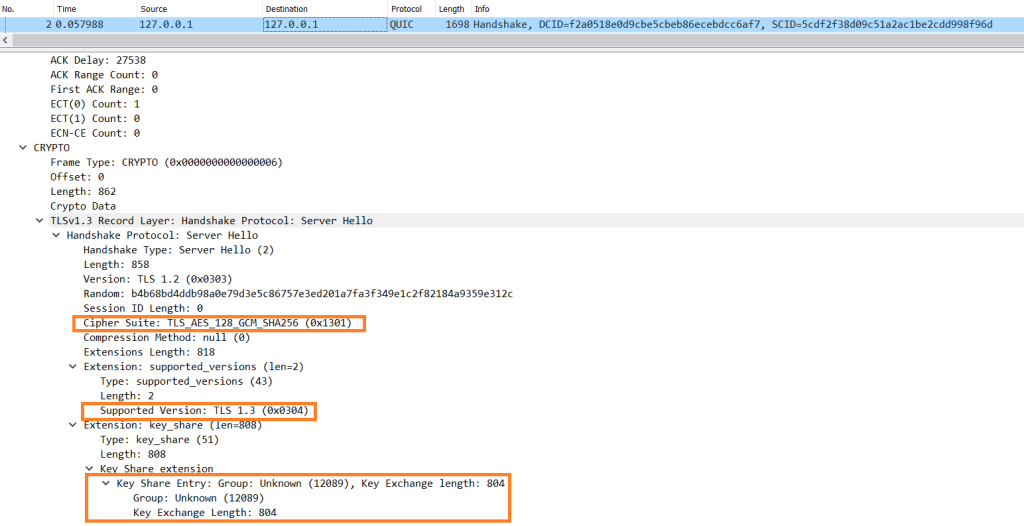
  5. Next, take a look at the server-negotiated keys in the ServerHello message, as shown in Figure 2.
    Figure 2: pq_server ServerHello in QUIC

    Figure 2: pq_server ServerHello in QUIC

You can again see the TLS 1.3 cipher suite, the TLS version being 1.3, and the picked PQ-hybrid X25519+Kyber512 key share. The key share includes 4 bytes for the identifier and the key share length, 32 bytes for the Curve25519 ephemeral ECDH server public key, and 768 bytes for the Kyber512 ciphertext that encapsulates a post-quantum shared secret to the client’s ephemeral Kyber512 public key (included in its ClientHello message).

The rest of the handshake completes successfully by deriving symmetric keys from the X25519 and Kyber512 post-quantum shared secrets (as defined in the draft-ietf-tls-hybrid-design IETF draft) and encrypting the rest of the messages with Advanced Encryption Standard with Galois/Counter Mode (AES-GCM) by using these symmetric keys over QUIC.

Benchmark

Now you can benchmark the post-quantum QUIC client and server by using netbench, a transport protocol benchmarking tool that is available in the s2n-quic repository.

To benchmark the post-quantum QUIC client and server

  1. Go in the netbench directory and build it with the correct flags for the experimental post-quantum QUIC examples, by using the following commands:

    cd s2n-quic/netbench
    RUSTFLAGS=”–cfg s2n_quic_unstable –cfg s2n_quic_enable_pq_tls” cargo build –release

  2. Generate the netbench scenario by using the following commands:

    ./target/release/netbench-scenarios –request_response.connections 10000 –request_response.request_size 1 –request_response.response_size 1

    In this example, you’re trying to create 10,000 sequential QUIC connections. The scenario opens a connection, sends a single byte, receives a single byte, closes it, and repeats 10,000 times.

  3. Run the server by using the following command:

    ./target/release/netbench-driver-s2n-quic-server target/netbench/request_response.json

  4. Run the client by using the following command:

    SERVER_0=localhost:4433 ./target/release/netbench-driver-s2n-quic-client target/netbench/request_response.json

    The drivers read the request_response.json to run the scenario. Then the driver is wrapped in a collector that outputs statistics to another JSON file. At the end of all of the 10,000 runs, the cli feature is used to generate the report.

Figure 3 shows the performance results for X25519, X25519+Kyber512, X25519+BIKE-1, and X25519+SIKEp434 key exchange. All connections used an ECDSA P256 server certificate for authentication.

Figure 3: PQ-hybrid key exchange impact on QUIC connection rates

Figure 3: PQ-hybrid key exchange impact on QUIC connection rates

The x-axis is time in seconds. The y-axis is the number of times send is called—which, for 1 byte per connection, practically means that the diagram shows the connection establishment rate (per second). The absolute performance numbers in these benchmarks are not important, because the results could change based on the netbench scenario parameters. The performance difference between PQ-hybrid key exchange algorithms is what this graph is highlighting.

You can see that the classical X25519 achieves higher connection rates, because it is the most efficient option (that offers no post-quantum protection). The performance of Kyber is competitive and achieves 8% fewer connections per second when used with X25519 in a PQ-hybrid key exchange. BIKE-1 is relatively efficient, but adds some extra latency and introduces two frames for the ClientHello, which leads to 37% fewer connections per second. SIKEp434, although it offers much smaller public keys and ciphertexts, is orders of magnitude slower, which means it offers 95% fewer connections per second. These results match previous results we have shared before and other research works, where the most efficient signature algorithms ended up with higher connection rates and lower connection failure probabilities due to overload.

Conclusion

In this post, we showed how you can use s2n-quic in conjunction with s2n-tls to enable QUIC connections to negotiate encryption keys in a quantum-resistant manner. If you’re interested in learning more about s2n-quic, join us at AWS re:Inforce in July for the breakout session entitled NIS304: Using s2n-quic: Bringing QUIC, the secure transport protocol, to AWS.

As always, if you’re interested in using or contributing to s2n-quic, the source code and documentation are publicly available under the terms of the Apache Software License 2.0 from our s2n-quic GitHub repository. If you package or distribute s2n-quic or s2n-tls, or use it as part of a large multi-user service, you might be eligible for pre-notification of security issues. Contact [email protected] for more information. If you discover a potential security issue in s2n-quic or s2n-tls, we ask that you notify AWS Security by using our vulnerability reporting page.

If you have feedback about this post, submit comments in the Comments section below. If you have questions about this post, contact AWS Support.

Want more AWS Security news? Follow us on Twitter.

Panos Kampanakis

Panos Kampanakis

Panos has extensive experience with cyber security, applied cryptography, security automation, and vulnerability management. In his professional career, he has trained and presented on various security topics at technical events for numerous years. He has co-authored cybersecurity publications and participated in various security standards bodies to provide common interoperable protocols and languages for security information sharing, cryptography, and PKI. Currently, he works with engineers and industry standards partners to provide cryptographically secure tools, protocols, and standards.

Cameron Bytheway

Cameron Bytheway

Cameron is a Software Development Engineer at AWS, based in Salt Lake City, Utah. He leads and contributes to the s2n libraries of AWS, and enjoys using testing, fuzzing, simulations, and statical analysis to improve correctness of programs.

Introducing s2n-quic, a new open-source QUIC protocol implementation in Rust

Post Syndicated from Panos Kampanakis original https://aws.amazon.com/blogs/security/introducing-s2n-quic-open-source-protocol-rust/

At Amazon Web Services (AWS), security, high performance, and strong encryption for everyone are top priorities for all our services. With these priorities in mind, less than a year after QUIC ratification in the Internet Engineering Task Force (IETF), we are introducing support for the QUIC protocol which can boost performance for web applications that currently use Transport Layer Security (TLS) over Transmission Control Protocol (TCP). We are pleased to announce the availability of s2n-quic, an open-source Rust implementation of the QUIC protocol added to our set of AWS encryption open-source libraries.

What is QUIC?

QUIC is an encrypted transport protocol designed for performance and is the foundation of HTTP/3. It is specified in a set of IETF standards ratified in May 2021. QUIC protects its UDP datagrams by using encryption and authentication keys established in a TLS 1.3 handshake carried over QUIC transport. It is designed to improve upon TCP by providing improved first-byte latency and handling of multiple streams, and solving issues such as head-of-line blocking, mobility, and data loss detection. This enables web applications to perform faster, especially over poor networks. Other potential uses include latency-sensitive connections and UDP connections currently using DTLS, which now can run faster.

Renaming s2n

AWS has long supported open-source encryption libraries; in 2015 we introduced s2n as a TLS library. The name s2n is short for signal to noise, and is a nod to the almost magical act of encryption—disguising meaningful signals, like your critical data, as seemingly random noise.

Now that AWS introduces our new QUIC open-source library, we are renaming s2n to s2n-tls. s2n-tls is an efficient TLS library built over other crypto libraries like OpenSSL libcrypto or AWS libcrypto (AWS-LC). AWS-LC is a general-purpose cryptographic library maintained by AWS which originated from the Google project BoringSSL. The s2n family of AWS encryption open-source libraries now consists of s2n-tls, s2n-quic, and s2n-bignum. s2n-bignum is a collection of bignum arithmetic routines maintained by AWS designed for crypto applications.

s2n-quic details

Similar to s2n-tls, s2n-quic is designed to be small and fast, with simplicity as a priority. It is written in Rust, so it reaps some of its benefits such as performance, thread and memory-safety. s2n-quic depends either on s2n-tls or rustls for the TLS 1.3 handshake.

The main advantages of s2n-quic are:

  • Simple API. For example, a QUIC echo server-example can be built with just a few API calls.
  • Highly configurable. s2n-quic is configured with code through providers that allow an application to granularly control functionality. You can see an example of the server’s simple config in the QUIC echo server-example.
  • Extensive testing. Fuzzing (libFuzzer, American Fuzzy Fop (AFL), and honggfuzz), corpus replay unit testing of derived corpus files, testing of concrete and symbolic execution engines with bolero, and extensive integration and unit testing are used to validate the correctness of our implementation.
  • Thorough interoperability testing for every code change. There are multiple public QUIC implementations; s2n-quic is continuously tested to interoperate with many of them.
  • Verified correctness, post-quantum hybrid key exchange, and maturity for the TLS handshake when built with s2n-tls.
  • Thorough compliance coverage tracking of normative language in relevant standards.

Some important features in s2n-quic that can improve performance and connection management include CUBIC congestion controller support, packet pacing, Generic Segmentation Offload (GSO) support, Path MTU Discovery, and unique connection identifiers detached from the address.

AWS is continuing to invest in encryption optimization techniques, UDP performance improvement technologies, and formal code verification with the AWS Automated Reasoning Group to further enhance the library.

Like s2n-tls, which has already been introduced in various AWS services, AWS services that need to make use of the benefits of QUIC will begin integrating s2n-quic. QUIC is a standardized protocol which, when introduced in a service like web content delivery, can improve user experience or application performance. AWS still plans to continue support for existing protocols like TLS, so existing applications will remain interoperable. Amazon CloudFront is scheduled to be the first AWS service to integrate s2n-quic with its support for HTTP/3 in 2022.

Conclusion

If you are interested in using or contributing to s2n-quic source code or documentation, they are publicly available under the terms of the Apache Software License 2.0 from our s2n-quic GitHub repository.

If you package or distribute s2n-quic or s2n-tls, or use it as part of a large multi-user service, you may be eligible for pre-notification of security issues. Please contact [email protected].

If you discover a potential security issue in s2n-quic or s2n-tls, we ask that you notify AWS Security by using our vulnerability reporting page.

Stay tuned for more topics on s2n-quic like quantum-resistance, performance analyses, uses, and other technical details.

If you have feedback about this post, submit comments in the Comments section below. If you have questions about this post, contact AWS Support.

Want more AWS Security news? Follow us on Twitter.

Author

Panos Kampanakis

Panos has extensive experience on cybersecurity, applied cryptography, security automation, and vulnerability management. He has trained and presented on various security topics at technical events for numerous years, and also co-authored Cisco Press books, papers, standards, and research publications. He has participated in various security standards bodies to provide common interoperable protocols and languages for security information sharing, cryptography, and PKI. In his current role, Panos works with engineers and industry standards partners to provide cryptographically secure tools, protocols, and standards.