All posts by Sai Maddali

Top 6 game changers from AWS that redefine streaming data

Post Syndicated from Sai Maddali original https://aws.amazon.com/blogs/big-data/top-6-game-changers-from-aws-that-redefine-streaming-data/

Recently, AWS introduced over 50 new capabilities across its streaming services, significantly enhancing performance, scale, and cost-efficiency. Some of these innovations have tripled performance, provided 20 times faster scaling, and reduced failure recovery times by up to 90%. We have made it nearly effortless for customers to bring real-time context to AI applications and lakehouses.

In this post, we discuss the top six game changers that will redefine AWS streaming data.

Amazon MSK Express brokers: Kafka reimagined for AWS

AWS offers Express brokers for Amazon Managed Streaming for Apache Kafka (Amazon MSK)—a transformative breakthrough for customers needing high-throughput Kafka clusters that scale faster and cost less. With Express brokers, we are reimagining Kafka’s compute and storage decoupling to unlock performance and elasticity benefits. Express brokers offer up to three times more throughput than a comparable standard Apache Kafka broker, virtually unlimited storage, instant storage scaling, compute scaling in minutes vs. hours, and 90% faster recovery from failures compared to standard Kafka brokers. Customers can provision capacity in minutes without complex calculations, benefit from preset Kafka configurations, and scale capacity in a few clicks. Express brokers provide the same low-latency performance as standard Kafka, are 100% native Kafka, and offer key Amazon MSK features. There are no storage limits per broker and you only pay for the storage you use. With Express brokers for Amazon MSK, enterprises can expand their Kafka usage to support even more mission-critical use cases, while keeping both operational overhead and overall infrastructure costs low.

Amazon Kinesis Data Streams On-Demand: Scaling new heights

Amazon Kinesis Data Streams On-Demand makes it uncomplicated for developers to stream gigabytes per second of data without managing capacity or servers. Developers can create a new on-demand data stream or convert an existing data stream to on-demand mode with a single click. Kinesis Data Streams On-Demand now automatically scales to 10 GBps of write throughput and 200 GBps of read throughput per stream, a fivefold increase. Customers will automatically get this fivefold increase in scale without the need to take any action.

Streaming data to Iceberg tables in lakehouses

Enterprises are embracing lakehouses and open table formats such as Apache Iceberg to unlock value from their data. Amazon Data Firehose now supports seamless integration with Iceberg tables on Amazon Simple Storage Service (Amazon S3). Customers can stream data into Iceberg tables in Amazon S3 without any management overhead. Data Firehose compacts small files, minimizing storage inefficiencies and enhancing read performance. Data Firehose also handles schema changes while in flight, to provide consistency across evolving datasets. Because Data Firehose is fully managed and serverless, it scales seamlessly to handle high throughput streaming workloads, providing reliable and fast delivery of data. This capability also makes it straightforward to stream data stored in MSK topics and Kinesis data streams into Iceberg tables, potentially eliminating the need for custom extract, transform, and load (ETL) pipelines. Customers can now bring the power of real-time data to Iceberg tables without any additional effort—a paradigm shift for businesses. Additionally, Kinesis Data Firehose serves as a versatile bridge to stream real-time data from MSK clusters and Kinesis Data Streams into the newly launched Amazon S3 Tables and Amazon SageMaker Lakehouse. This unified approach facilitates more effective data management and analysis, supporting data-driven decision-making across the enterprise.

Unlocking the value of data stored in databases with change replication to Iceberg tables

Delivering database changes into Iceberg tables is emerging as a common pattern. Now in public preview, Data Firehose supports capturing changes made in databases such as PostgreSQL and MySQL and replicating the updates to Iceberg tables on Amazon S3. The integration uses change data capture (CDC) to continuously deliver database updates, eliminating manual processes and reducing operational overhead. Data Firehose automates tasks such as schema alignment and partitioning, making sure tables are optimized for analytics. With this new capability, customers can streamline their end-to-end data pipeline, allowing them to continually feed fresh data into an Iceberg table without needing to build a custom data pipeline.

Real-time context to generative AI applications

Customers tell us how they want to gain insights from generative AI by being able to bring their data to large language models (LLMs). They want to bring data as it’s generated to pre-trained models for more accurate and up-to-date responses. Amazon MSK provides a blueprint that allows customers to combine the context from real-time data with the powerful LLMs on Amazon Bedrock to generate accurate, up-to-date AI responses without writing custom code. Developers can configure the blueprint to generate vector embeddings using Amazon Bedrock embedding models, then index those embeddings in Amazon OpenSearch Service for data captured and stored in MSK topics. Customers can also improve the efficiency of data retrieval using built-in support for data chunking techniques from LangChain, an open source library, supporting high-quality inputs for model ingestion.

More cost-effective and reliable stream processing

AWS offers the Kinesis Client Library (KCL), an open source library, that simplifies the development of stream processing applications with Kinesis Data Streams. With KCL 3.0, customers can reduce compute costs to process streaming data by up to 33% compared to previous KCL versions. KCL 3.0 introduces an enhanced load balancing algorithm that continuously monitors the resource utilization of the stream processing workers and automatically redistributes the load from over-utilized workers to underutilized workers. These changes also enhance scalability and the overall efficiency of processing large volumes of streaming data. We have also made improvements to our Amazon Managed Service for Apache Flink. We offer the latest Flink versions on Amazon Managed Service for Apache Flink for customers to benefit from the latest innovations. Customers can also upgrade their existing applications to use new Flink versions with a new in-place version upgrade feature. Amazon Managed Service for Apache Flink now offers per-second billing, so customers can run their Flink applications for a short period and only pay for what they use, down to the nearest second.

Conclusion

AWS has made new innovations in data streaming services, bringing compelling value to customers on performance, scalability, elasticity, and ease of use. These advancements empower businesses to use real-time data more effectively, which modernizes the way for the next generation of data-driven applications and analytics. It is still Day 1!


About the authors

Sai Maddali is a Senior Manager Product Management at AWS who leads the product team for Amazon MSK. He is passionate about understanding customer needs, and using technology to deliver services that empowers customers to build innovative applications. Besides work, he enjoys traveling, cooking, and running.

Bill Crew is a Senior Product Marketing Manager. He is the lead marketer for Streaming and Messaging Services at AWS. Including Amazon Managed Streaming for Apache Kafka (Amazon MSK), Amazon Managed Service for Apache Flink, Amazon Data Firehose, Amazon Kinesis Data Streams, Amazon Message Broker (Amazon MQ), Amazon Simple Queue Service (Amazon SQS), and Amazon Simple Notification Services (Amazon SNS). Besides work, he enjoys collecting vintage vinyl records.

Improve Apache Kafka scalability and resiliency using Amazon MSK tiered storage

Post Syndicated from Sai Maddali original https://aws.amazon.com/blogs/big-data/improve-apache-kafka-scalability-and-resiliency-using-amazon-msk-tiered-storage/

Since the launch of tiered storage for Amazon Managed Streaming for Apache Kafka (Amazon MSK), customers have embraced this feature for its ability to optimize storage costs and improve performance. In previous posts, we explored the inner workings of Kafka, maximized the potential of Amazon MSK, and delved into the intricacies of Amazon MSK tiered storage. In this post, we deep dive into how tiered storage helps with faster broker recovery and quicker partition migrations, facilitating faster load balancing and broker scaling.

Apache Kafka availability

Apache Kafka is a distributed log service designed to provide high availability and fault tolerance. At its core, Kafka employs several mechanisms to provide reliable data delivery and resilience against failures:

  • Kafka replication – Kafka organizes data into topics, which are further divided into partitions. Each partition is replicated across multiple brokers, with one broker acting as the leader and the others as followers. If the leader broker fails, one of the follower brokers is automatically elected as the new leader, providing continuous data availability. The replication factor determines the number of replicas for each partition. Kafka maintains a list of in-sync replicas (ISRs) for each partition, which are the replicas that are up to date with the leader.
  • Producer acknowledgments – Kafka producers can specify the required acknowledgment level for write operations. This makes sure the data is durably persisted on the configured number of replicas before the producer receives an acknowledgment, reducing the risk of data loss.
  • Consumer group rebalancing – Kafka consumers are organized into consumer groups, where each consumer in the group is responsible for consuming a subset of the partitions. If a consumer fails, the partitions it was consuming are automatically reassigned to the remaining consumers in the group, providing continuous data consumption.
  • Zookeeper or KRaft for cluster coordination – Kafka relies on Apache ZooKeeper or KRaft for cluster coordination and metadata management. It maintains information about brokers, topics, partitions, and consumer offsets, enabling Kafka to recover from failures and maintain a consistent state across the cluster.

Kafka’s storage architecture and its impact on availability and resiliency

Although Kafka provides robust fault-tolerance mechanisms, in the traditional Kafka architecture, brokers store data locally on their attached storage volumes. This tight coupling of storage and compute resources can lead to several issues, impacting availability and resiliency of the cluster:

  • Slow broker recovery – When a broker fails, the recovery process involves transferring data from the remaining replicas to the new broker. This data transfer can be slow, especially for large data volumes, leading to prolonged periods of reduced availability and increased recovery times.
  • Inefficient load balancing – Load balancing in Kafka involves moving partitions between brokers to distribute the load evenly. However, this process can be resource-intensive and time-consuming, because it requires transferring large amounts of data between brokers.
  • Scaling limitations – Scaling a Kafka cluster traditionally involves adding new brokers and rebalancing partitions across the expanded set of brokers. This process can be disruptive and time-consuming, especially for large clusters with high data volumes.

How Amazon MSK tiered storage improves availability and resiliency

Amazon MSK offers tiered storage, a feature that allows configuring local and remote tiers. This greatly decouples compute and storage resources and thereby addresses the aforementioned challenges, improving availability and resiliency of Kafka clusters. You can benefit from the following:

  • Faster broker recovery – With tiered storage, data automatically moves from the faster Amazon Elastic Block Store (Amazon EBS) volumes to the more cost-effective storage tier over time. New messages are initially written to Amazon EBS for fast performance. Based on your local data retention policy, Amazon MSK transparently transitions that data to tiered storage. This frees up space on the EBS volumes for new messages. When broker fails and recovers either due to node or volume failure, the catch-up is faster because it only needs to catch up data stored on the local tier from the leader.
  • Efficient load balancing – Load balancing in Amazon MSK with tiered storage is more efficient because there is less data to move while reassigning partition. This process is faster and less resource-intensive, enabling more frequent and seamless load balancing operations.
  • Faster scaling – Scaling an MSK cluster with tiered storage is a seamless process. New brokers can be added to the cluster without the need for a large amount of data transfer and longer time for partition rebalancing. The new brokers can start serving traffic much faster, because the catch-up process takes less time, improving the overall cluster throughput and reducing downtime during scaling operations.

As shown in the following figure, MSK brokers and EBS volumes are tightly coupled. On a three-AZ deployed cluster, when you create a topic with replication factor three, Amazon MSK spreads those three replicas across all three Availability Zones and the EBS volumes attached with that broker store all the topic data spread across three Availability Zones. If you need to move a partition from one broker to another, Amazon MSK needs to move all the segments (both active and closed) from the existing broker to the new brokers, as illustrated in the following figure.

However, when you enable tiered storage for that topic, Amazon MSK transparently moves all closed segments for a topic from EBS volumes to tiered storage. That storage provides the built-in capability for durability and high availability with virtually unlimited storage capacity. With closed segments moved to tiered storage and only active segments on the local volume, your local storage footprint remains minimal regardless of topic size. If you need to move the partition to a new broker, the data movement is very minimal across the brokers. The following figure illustrates this updated configuration.

Amazon MSK tiered storage addresses the challenges posed by Kafka’s traditional storage architecture, enabling faster broker recovery, efficient load balancing, and seamless scaling, thereby improving availability and resiliency of your cluster. To learn more about the core components of Amazon MSK tiered storage, refer to Deep dive on Amazon MSK tiered storage.

A real-world test

We hope that you now understand how Amazon MSK tiered storage can improve your Kafka resiliency and availability. To test it, we created a three-node cluster with the new m7g instance type. We created a topic with a replication factor of three and without using tiered storage. Using the Kafka performance tool, we ingested 300 GB of data into the topic. Next, we added three new brokers to the cluster. Because Amazon MSK doesn’t automatically move partitions to these three new brokers, they will remain idle until we rebalance the partitions across all six brokers.

Let’s consider a scenario where we need to move all the partitions from the existing three brokers to the three new brokers. We used the kafka-reassign-partitions tool to move the partitions from the existing three brokers to the newly added three brokers. During this partition movement operation, we observed that the CPU usage was high, even though we weren’t performing any other operations on the cluster. This indicates that the high CPU usage was due to the data replication to the new brokers. As shown in the following metrics, the partition movement operation from broker 1 to broker 2 took approximately 75 minutes to complete.

Additionally, during this period, CPU utilization was elevated.

After completing the test, we enabled tiered storage on the topic with local.retention.ms=3600000 (1 hour) and retention.ms=31536000000. We continuously monitored the RemoteCopyBytesPerSec metrics to determine when the data migration to tiered storage was complete. After 6 hours, we observed zero activity on the RemoteCopyBytesPerSec metrics, indicating that all closed segments had been successfully moved to tiered storage. For instructions to enable tiered storage on an existing topic, refer to Enabling and disabling tiered storage on an existing topic.

We then performed the same test again, moving partitions to three empty brokers. This time, the partition movement operation was completed in just under 15 minutes, with no noticeable CPU usage, as shown in the following metrics. This is because, with tiered storage enabled, all the data has already been moved to the tiered storage, and we only have the active segment in the EBS volume. The partition movement operation is only moving the small active segment, which is why it takes less time and minimal CPU to complete the operation.

Conclusion

In this post, we explored how Amazon MSK tiered storage can significantly improve the scalability and resilience of Kafka. By automatically moving older data to the cost-effective tiered storage, Amazon MSK reduces the amount of data that needs to be managed on the local EBS volumes. This dramatically improves the speed and efficiency of critical Kafka operations like broker recovery, leader election, and partition reassignment. As demonstrated in the test scenario, enabling tiered storage reduced the time taken to move partitions between brokers from 75 minutes to just under 15 minutes, with minimal CPU impact. This enhanced the responsiveness and self-healing ability of the Kafka cluster, which is crucial for maintaining reliable, high-performance operations, even as data volumes continue to grow.

If you’re running Kafka and facing challenges with scalability or resilience, we highly recommend using Amazon MSK with the tiered storage feature. By taking advantage of this powerful capability, you can unlock the true scalability of Kafka and make sure your mission-critical applications can keep pace with ever-increasing data demands.

To get started, refer to Enabling and disabling tiered storage on an existing topic. Additionally, check out Automated deployment template of Cruise Control for Amazon MSK for effortlessly rebalancing your workload.


About the Authors

Sai Maddali is a Senior Manager Product Management at AWS who leads the product team for Amazon MSK. He is passionate about understanding customer needs, and using technology to deliver services that empowers customers to build innovative applications. Besides work, he enjoys traveling, cooking, and running.

Nagarjuna Koduru is a Principal Engineer in AWS, currently working for AWS Managed Streaming For Kafka (MSK). He led the teams that built MSK Serverless and MSK Tiered storage products. He previously led the team in Amazon JustWalkOut (JWO) that is responsible for real time tracking of shopper locations in the store. He played pivotal role in scaling the stateful stream processing infrastructure to support larger store formats and reducing the overall cost of the system. He has keen interest in stream processing, messaging and distributed storage infrastructure.

Masudur Rahaman Sayem is a Streaming Data Architect at AWS. He works with AWS customers globally to design and build data streaming architectures to solve real-world business problems. He specializes in optimizing solutions that use streaming data services and NoSQL. Sayem is very passionate about distributed computing.

Amazon MSK now provides up to 29% more throughput and up to 24% lower costs with AWS Graviton3 support

Post Syndicated from Sai Maddali original https://aws.amazon.com/blogs/big-data/amazon-msk-now-provides-up-to-29-more-throughput-and-up-to-24-lower-costs-with-aws-graviton3-support/

Amazon Managed Streaming for Apache Kafka (Amazon MSK) is a fully managed service that enables you to build and run applications that use Apache Kafka to process streaming data.

Today, we’re excited to bring the benefits of Graviton3 to Kafka workloads, with Amazon MSK now offering M7g instances for new MSK provisioned clusters. AWS Graviton processors are custom Arm-based processors built by AWS to deliver the best price-performance for your cloud workloads. For example, when running an MSK provisioned cluster using M7g.4xlarge instances, you can achieve up to 27% reduction in CPU usage and up to 29% higher write and read throughput compared to M5.4xlarge instances. These performance improvements, along with M7g’s lower prices provide up to 24% in compute cost savings over M5 instances.

In February 2023, AWS launched new Graviton3-based M7g instances. M7g instances are equipped with DDR5 memory, which provides up to 50% higher memory bandwidth than the DDR4 memory used in previous generations. M7g instances also deliver up to 25% higher storage throughput and up to 88% increase in network throughput compared to similar sized M5 instances to deliver price-performance benefits for Kafka workloads. You can read more about M7g features in New Graviton3-Based General Purpose (m7g) and Memory-Optimized (r7g) Amazon EC2 Instances.

Here are the specs for the M7g instances on MSK:

Name vCPUs Memory Network Bandwidth Storage Bandwidth
M7g.large 2 8 GiB up to 12.5 Gbps up to 10 Gbps
M7g.xlarge 4 16 GiB up to 12.5 Gbps up to 10 Gbps
M7g.2xlarge 8 32 GiB up to 15 Gbps up to 10 Gbps
M7g.4xlarge 16 64 GiB up to 15 Gbps up to 10 Gbps
M7g.8xlarge 32 128 GiB 15 Gbps 10 Gbps
M7g.12xlarge 48 192 GiB 22.5 Gbps 15 Gbps
M7g.16xlarge 64 256 GiB 30 Gbps 20 Gbps

M7g instances on Amazon MSK

Organizations are adopting Amazon MSK to capture and analyze data in real time, run machine learning (ML) workflows, and build event-driven architectures. Amazon MSK enables you to reduce operational overhead and run your applications with higher availability and durability. It also offers a consistent reduction in price-performance with capabilities such as Tiered Storage. With compute making up a large portion of Kafka costs, customers wanted a way to optimize them further and see Graviton instances providing them the quickest path. Amazon MSK has fully tested and validated M7g on all Kafka versions starting with version 2.8.2, making it to run critical workloads and benefit from Gravition3 cost savings.

You can get started by provisioning new clusters with the Graviton3-based M7g instances as the broker type using the AWS Management Console, APIs via the AWS SDK, and the AWS Command Line Interface (AWS CLI). M7g instances support all Amazon MSK and Kafka features, making it straightforward for you to run all your existing Kafka workloads with minimal changes. Amazon MSK supports Graviton3-based M7g instances from large through 16xlarge sizes to run all Kafka workloads.

Let’s take the M7g instances on MSK provisioned clusters for a test drive and see how it compares with Amazon MSK M5 instances.

M7g instances in action

Customers run a wide variety of workloads on Amazon MSK; some are latency sensitive, and some are throughput bound. In this post, we focus on M7g performance impact on throughput-bound workloads. M7g comes with an increase in network and storage throughput, providing a higher throughput per broker compared to an M5-based cluster.

To understand the implications, let’s look at how Kafka uses available throughput for writing or reading data. Every broker in the MSK cluster comes with a bounded storage and network throughput entitlement. Predominantly, writes in Kafka consume both storage and network throughput, whereas reads consume mostly network throughput. This is because a Kafka consumer is typically reading real-time data from a page cache and occasionally goes to disk to process old data. Therefore, the overall throughput gains also change based on the workload’s write to read throughput ratios.

Let’s look at the throughput gains based on an example. Our setup includes an MSK cluster with M7g.4xlarge instances and another with M5.4xlarge instances, with three nodes in three different Availability Zones. We also enabled TLS encryption, AWS Identity and Access Management (IAM) authentication, and a replication factor of 3 across both M7g and M5 MSK clusters. We also applied Amazon MSK best practices for broker configurations, including num.network.threads = 8 and num.io.threads = 16. On the client side for writes, we optimized the batch size with appropriate linger.ms and batch.size configurations. For the workload, we assumed 6 topics each with 64 partitions (384 per broker). For ingestion, we generated load with an average message size of 512 bytes and with one consumer group per topic. The amount of load sent to the clusters was identical.

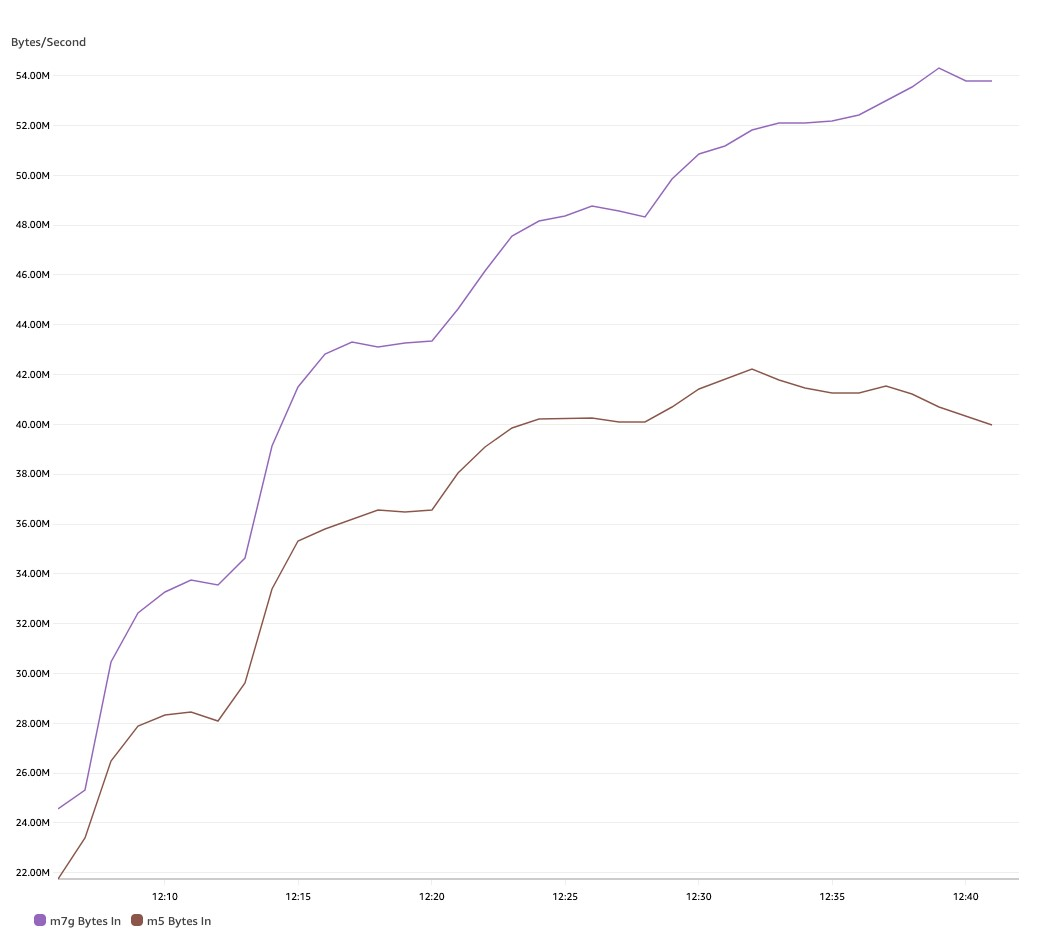
As we ingest more data into the MSK cluster, the M7g.4xlarge instance supports higher throughput per broker, as shown in the following graph. After an hour of consistent writes, M7g.4xlarge brokers support up to 54 MB/s of write throughput vs. 40 MB/s with M5-based brokers, which represents a 29% increase.

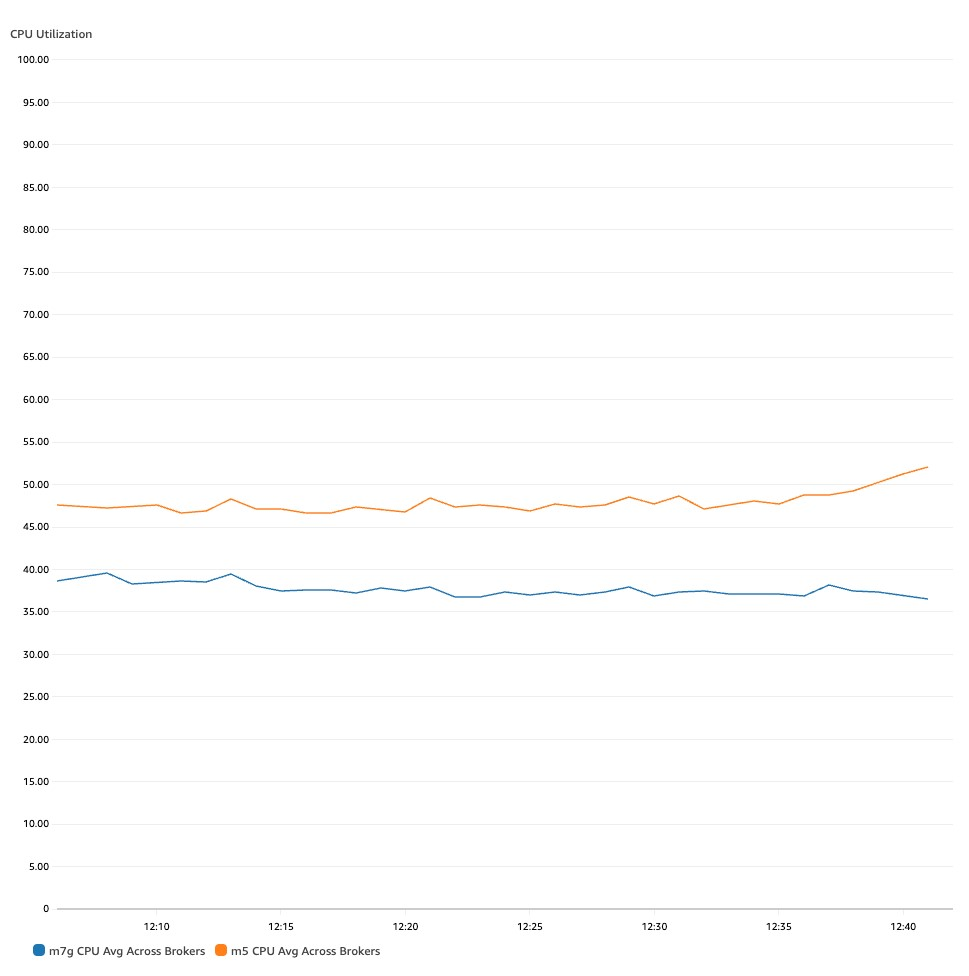
We also see another important observation: M7g-based brokers consume much fewer CPU resources than M5s, even though they support 29% higher throughput. As seen in the following chart, CPU utilization of an M7g-based broker is on average 40%, whereas on an M5-based broker, it’s 47%.

As covered previously, customers may see different performance improvements based on the number of consumer group, batch sizes, and instance size. We recommend referring to MSK Sizing and Pricing to calculate M7g performance gains for your use case or creating a cluster based on M7g instances and benchmark the gains on your own.

Lower costs, with lesser operational burden, and higher resiliency

Since its launch, Amazon MSK has made it cost-effective to run your Kafka workloads, while still improving overall resiliency. Since day 1, you have been able to run brokers in multiple Availability Zones without worrying about additional networking costs. In October 2022, we launched Tiered Storage, which provides virtually unlimited storage at up to 50% lower costs. When you use Tiered Storage, you not only save on overall storage cost but also improve the overall availability and elasticity of your cluster.

Continuing down this path, we are now reducing compute costs for customers while still providing performance improvements. With M7g instances, Amazon MSK provides 24% savings on compute costs compared to similar sized M5 instances. When you move to Amazon MSK, you can not only lower your operational overhead using features such as Amazon MSK Connect, Amazon MSK Replicator, and automatic Kafka version upgrades, but also improve over resiliency and reduce their infrastructure costs.

Pricing and Regions

M7g instances on Amazon MSK are available today in the US (Ohio, N. Virginia, N. California, Oregon), Asia Pacific (Hyderabad, Mumbai, Seoul, Singapore, Sydney, Tokyo), Canada (Central), and EU (Ireland, London, Spain, Stockholm) Regions.

Refer to Amazon MSK pricing to learn about Graivton3-based instances with Amazon MSK pricing.

Summary

In this post, we discussed the performance gains achieved while using Graviton-based M7g instances. These instances can provide significant improvement in read and write throughput compared to similar sized M5 instances for Amazon MSK workloads. To get started, create a new cluster with M7g brokers using the AWS Management Console, and read our documentation for more information.


About the Authors

Sai Maddali is a Senior Manager Product Management at AWS who leads the product team for Amazon MSK. He is passionate about understanding customer needs, and using technology to deliver services that empowers customers to build innovative applications. Besides work, he enjoys traveling, cooking, and running.

Umesh is a Streaming Solutions Architect at AWS. He works with AWS customers to design and build real time data processing systems. He has 13 years of working experience in software engineering including architecting, designing, and developing data analytics systems.

Lanre Afod is a Solutions Architect focused with Global Financial Services at AWS, passionate about helping customers with deploying secure, scalable, high available and resilient architectures within the AWS Cloud.