Post Syndicated from digiblurDIY original https://www.youtube.com/watch?v=3f6F_MXaI3Q
Security updates for Wednesday
Post Syndicated from original https://lwn.net/Articles/906579/
Security updates have been issued by Debian (dpdk, net-snmp, php-horde-mime-viewer, php-horde-turba, and webkit2gtk), Fedora (rsync), Oracle (openssl and systemd), Red Hat (booth, kernel, kernel-rt, and openssl), Slackware (vim), SUSE (bluez, java-1_8_0-ibm, postgresql10, and zlib), and Ubuntu (kernel, linux, linux-raspi, linux-aws, and linux-oem-5.14).
Politiques et approche de Cloudflare en matière d’utilisation abusive
Post Syndicated from Matthew Prince original https://blog.cloudflare.com/cloudflares-abuse-policies-and-approach-fr-fr/


Cloudflare a été fondée voilà près de douze ans. L’entreprise s’est développée et exploite aujourd’hui un réseau couvrant plus de 275 villes, dans plus de 100 pays. Elle possède des millions de clients, de petites entreprises et de développeurs individuels à quelque 30 % des entreprises du classement Fortune 500. Aujourd’hui, plus de 20 % du web dépend directement des services de Cloudflare.
Depuis notre lancement, notre portefeuille de services est devenu beaucoup plus complexe. Avec cette complexité, nous avons élaboré des politiques déterminant de quelle façon nous traitons l’utilisation abusive des différentes fonctionnalités de Cloudflare. De la même manière qu’une vaste plateforme comme Google dispose de différentes politiques en matière d’utilisation abusive pour son moteur de recherche, Gmail, YouTube et Blogger, Cloudflare a élaboré différentes politiques en matière d’utilisation abusive à mesure que de nouveaux produits ont été introduits.
Nous avons publié une mise à jour de notre approche de l’utilisation abusive l’année dernière, à l’adresse :
https://www.cloudflare.com/trust-hub/abuse-approach/
Cependant, puisque des questions ont été soulevées, nous avons pensé qu’il était judicieux de décrire ces politiques plus en détail ici.
Les politiques que nous avons élaborées reflètent les idées et les recommandations d’experts des droits de l’homme, de militants, d’universitaires et de régulateurs. Conformément à nos principes directeurs, nos politiques en matière d’utilisation abusive doivent être spécifiques au service utilisé. Ceci vise à assurer que toutes les dispositions que nous prenons reflètent la capacité à traiter le préjudice et à minimiser les conséquences indésirables. Nous pensons qu’une personne souhaitant déposer une plainte suite à une utilisation abusive doit disposer d’une procédure lui permettant de contacter les personnes les plus à même de traiter sa plainte de manière efficace et précise – de manière anonyme, si nécessaire. Et surtout, nous nous efforçons de toujours faire preuve de transparence au regard de nos politiques et des dispositions que nous prenons.
Les produits de Cloudflare
Cloudflare propose une vaste gamme de produits, qui sont généralement répartis en trois catégories : les produits d’hébergement (par ex., Cloudflare Pages, Cloudflare Stream, Workers KV, pages d’erreur personnalisées), les services de sécurité (par ex., atténuation des attaques DDoS, pare-feu d’applications web, Cloudflare Access, limitation du taux) et les services de technologie Internet essentiels (par ex., DNS de référence, DNS récursif/1.1.1.1, WARP). Pour une liste complète de nos produits et de leur correspondance avec ces catégories, vous pouvez consulter notre portail d’informations concernant l’utilisation abusive.
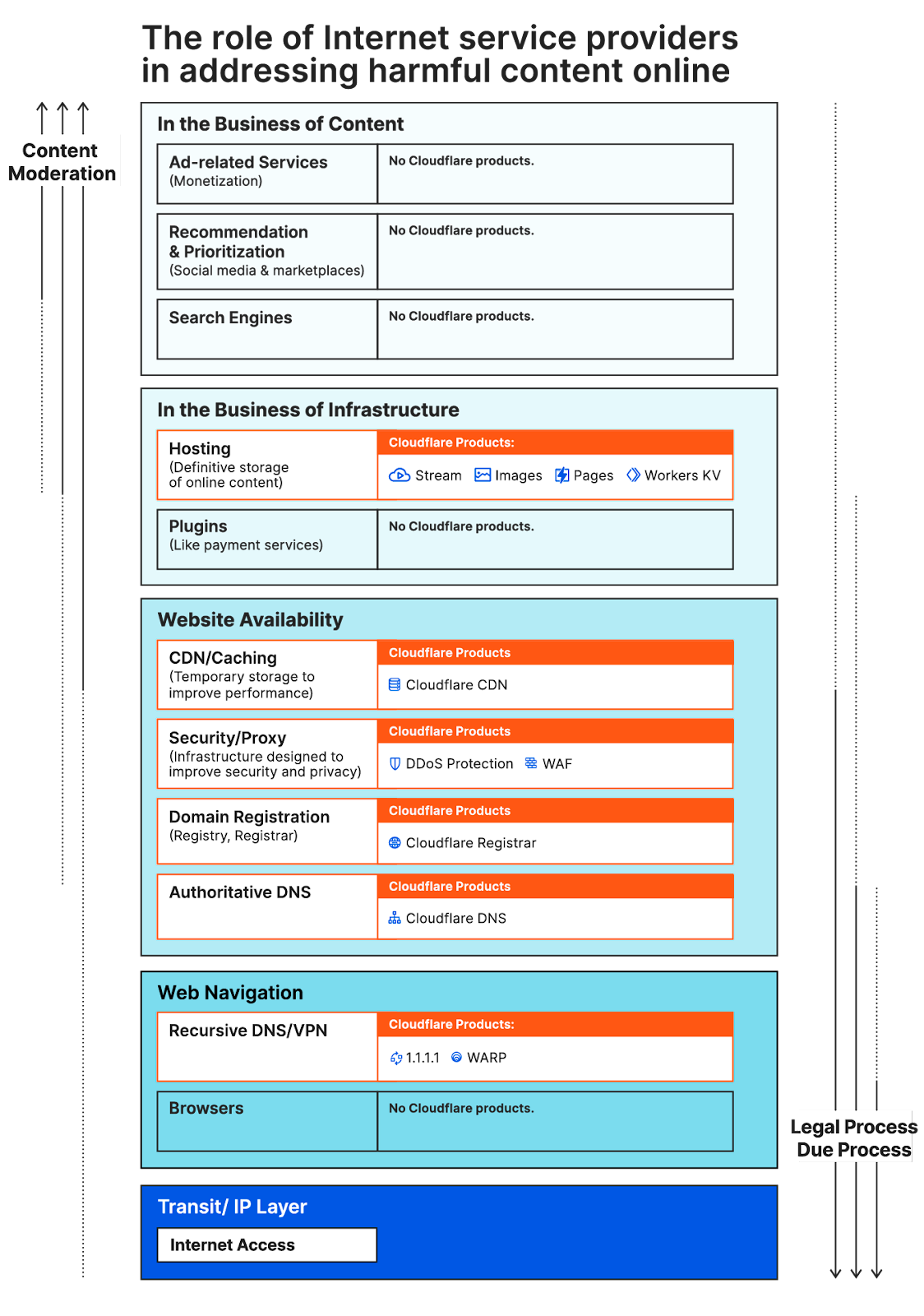
Comme nous le décrivons ci-dessous, nos politiques suivent une approche différente, produit par produit, dans chacune de ces catégories.
Produits d’hébergement
Les produits d’hébergement sont les produits pour lesquels Cloudflare est l’hôte final du contenu. Ces produits diffèrent de ceux pour lesquels nous fournissons simplement des services de sécurité ou de mise en cache temporaire, tandis que le contenu est hébergé ailleurs. Bien que de nombreuses personnes confondent nos produits de sécurité avec des services d’hébergement, nous disposons de politiques distinctes pour chacun. Puisque l’immense majorité des clients de Cloudflare n’utilise pas encore nos produits d’hébergement, les plaintes et actions suite à une utilisation abusive de ces produits sont actuellement relativement rares.
Notre décision de désactiver l’accès au contenu de produits d’hébergement entraîne fondamentalement la mise hors ligne de ce contenu, du moins jusqu’à ce qu’il soit republié ailleurs. Les produits d’hébergement sont réglementés par notre Politique d’hébergement de contenus acceptables. En vertu de cette politique, pour ces produits, nous pouvons supprimer ou désactiver l’accès à tout contenu qui, selon nous :
- Contient, affiche, distribue ou encourage la création de contenu à caractère pédopornographique, ou exploite ou encourage de toute autre manière l’exploitation de mineurs.
- Enfreint les droits de propriété intellectuelle.
- A été jugé diffamatoire ou calomnieux à l’issue d’une procédure juridique appropriée.
- Contribue à la distribution illégale de substances contrôlées.
- Facilite la traite des êtres humains ou la prostitution, en violation de la loi.
- Contient, installe ou diffuse un logiciel malveillant actif ou utilise notre plateforme pour la diffusion d’exploits (par ex., dans le cadre d’un système de commande et de contrôle).
- Est de quelque autre manière illégal ou nuisible, ou viole les droits d’autrui ; ceci concerne notamment tout contenu divulguant des informations personnelles sensibles, incitant ou exploitant la violence contre les personnes ou les animaux ou cherchant à frauder le public.
Nous faisons preuve de discrétion quant à l’application de notre Politique d’hébergement de contenus acceptables, et nous cherchons généralement à appliquer les restrictions en matière de contenu de manière aussi précise que possible. Par exemple, si une plateforme de paniers d’achats comptant des millions de clients utilise Cloudflare Workers KV et l’un de ses clients enfreint notre politique d’hébergement de contenus acceptables, nous ne résilierons pas automatiquement l’utilisation de Cloudflare Workers KV pour l’ensemble de la plateforme.
Notre principe directeur est que les organisations les plus proches du contenu sont les mieux placées pour déterminer quels contenus sont abusifs. Il reconnaît également que des désactivations trop étendues peuvent avoir un impact indésirable considérable sur l’accès aux contenus en ligne.
Et de la sécurité
L’immense majorité des millions de clients de Cloudflare utilise uniquement les services de sécurité de l’entreprise. En tant qu’entreprise, Cloudflare a décidé, très tôt dans son histoire, qu’elle souhaitait rendre les outils de sécurité aussi largement disponibles que possible. Cela signifie que nous avons fourni de nombreux outils à titre gratuit ou à un coût minime, afin de limiter au mieux l’impact et l’efficacité d’un large éventail de cyberattaques. La plupart de nos clients ne nous versent aucun paiement.
Donner à chacun la possibilité de s’inscrire pour utiliser nos services en ligne reflète également notre conviction que les cyberattaques ne doivent non seulement pas être utilisées pour réduire au silence des groupes vulnérables, mais ne constituent par ailleurs pas un mécanisme approprié pour réagir aux contenus problématiques en ligne. Nous pensons que les cyberattaques, sous quelque forme que ce soit, devraient être reléguées aux oubliettes de l’histoire.
La décision de fournir des outils de sécurité à si grande échelle nous a contraints à réfléchir avec prudence au moment où nous mettrons fin, le cas échéant, à l’accès à ces services. Nous avons pris conscience que nous devions réfléchir à l’effet qu’aurait l’arrêt de ces services et à la possibilité d’établir des normes qui pourraient être appliquées de manière équitable, transparente et non discriminatoire, conformément aux principes des droits de l’homme.
Cela vaut non seulement pour le contenu au sujet duquel une plainte peut avoir été déposée, mais également pour le précédent que crée cette suppression. Notre conclusion, fondée sur les nombreuses conversations que nous avons eues et les discussions réfléchies au sein de la communauté, au sens large, est que la résiliation volontaire de l’accès aux services de protection contre les cyberattaques n’est pas la bonne approche.
Éviter un abus de pouvoir
Certains affirment que nous devrions mettre fin à ces services pour les contenus que nous considérons comme répréhensibles, afin que d’autres puissent lancer des attaques pour les mettre hors ligne. C’est l’équivalent de l’argument, dans le monde physique, selon lequel les pompiers ne devraient pas éteindre les incendies dans les maisons de personnes possédant pas une qualité morale suffisante. Que ce soit dans le monde physique ou en ligne, cela constitue un dangereux précédent qui, à long terme, est susceptible de nuire de manière disproportionnée aux communautés vulnérables et marginalisées.
Aujourd’hui, plus de 20 % du web utilise les services de sécurité de Cloudflare. Lorsque nous réfléchissons à nos politiques, nous devons être conscients de l’impact que nous avons et du précédent que nous créons pour l’Internet dans son ensemble. La résiliation des services de sécurité pour des contenus que notre équipe juge personnellement dégoûtants et immoraux serait le choix le plus plébiscité. À long terme, toutefois, de tels choix rendent plus difficile la protection contre les attaques contre des contenus soutenant des voix opprimées et marginalisées.
Affiner notre politique en fonction de ce que nous avons appris
Ceci n’a rien d’hypothétique. Des milliers de fois par jour, nous recevons des appels nous demandant de résilier les services de sécurité en raison de contenus qu’une personne a signalés comme offensants. La plupart de ces demandes ne sont jamais évoquées dans l’actualité. La plupart du temps, ces décisions ne sont pas en contradiction avec nos opinions morales. Pourtant, à deux reprises dans le passé, nous avons décidé d’exclure des contenus de nos services de sécurité parce que nous les trouvions répréhensibles. En 2017, nous avons désactivé le site de trollage néonazi The Daily Stormer. Et en 2019, nous avons désactivé le forum consacré aux théories du complot 8chan.
Dans une réaction profondément troublante, après ces deux résiliations, nous avons constaté une augmentation spectaculaire des demandes émanant de régimes autoritaires qui tentaient de nous faire résilier les services de sécurité d’organisations de défense des droits de l’homme, en citant souvent les termes de notre propre justification.
Depuis ces décisions, nous avons eu des discussions importantes avec les décideurs politiques du monde entier. Après ces discussions, nous avons conclu que le pouvoir de résilier les services de sécurité pour des sites n’était pas un pouvoir que devrait détenir Cloudflare, non pas parce que le contenu de ces sites n’était pas odieux (il l’était), mais parce que les services de sécurité s’apparentent fortement à des services publics sur Internet.
De la même manière que votre opérateur de téléphonie ne résiliera pas votre abonnement parce que vous tenez des propos horribles, racistes et sectaires, nous avons conclu, après avoir consulté des politiciens, des décideurs politiques et des experts, que résilier les services de sécurité parce que nous considérons que des contenus publiés sont méprisables est une mauvaise politique. Pour être clairs, ce n’est pas parce que nous l’avons fait auparavant, dans un nombre limité de cas, que nous avions raison lorsque nous l’avons fait. Ou que nous le referons un jour.

Cependant, cela ne signifie pas que Cloudflare ne peut pas jouer un rôle important dans la protection de personnes ciblées par d’autres individus sur Internet. Nous soutenons depuis longtemps les groupes de défense des droits de l’homme, les journalistes et d’autres entités particulièrement vulnérables en ligne par le biais de l’initiative Project Galileo. Project Galileo propose des services de cybersécurité gratuits aux organisations à but non lucratif et aux groupes de défense des droits qui contribuent à renforcer nos communautés.
Dans le cadre de l’initiative Project Athenian, nous jouons également un rôle dans la protection des systèmes électoraux aux États-Unis et à l’étranger. Les élections figurent parmi les domaines dans lesquels les systèmes d’administration doivent être fondamentalement dignes de confiance et neutres. Faire des choix concernant les contenus qui méritent ou non de bénéficier des services de sécurité, en particulier d’une manière qui pourrait être interprétée comme politique, compromettrait notre capacité à assurer une protection fiable de l’infrastructure électorale.
Réalités réglementaires
Nos politiques répondent également aux réalités réglementaires. Les lois en matière de réglementation des contenus d’Internet adoptées au cours des cinq dernières années dans le monde entier ont largement établi une distinction entre les services qui hébergent des contenus et ceux qui fournissent des services de sécurité et d’acheminement. Même lorsque ces réglementations imposent aux plateformes ou aux hébergeurs l’obligation de modérer les contenus, elles exemptent les services de sécurité et d’acheminement de jouer le rôle de modérateur sans procédure juridique. Il s’agit d’une réglementation raisonnable, issue d’un processus réglementaire approfondi.
Nos politiques suivent ces orientations réglementaires mûrement réfléchies. Nous empêchons l’utilisation des services de sécurité par certaines organisations et personnes sanctionnées. Nous résilions également les services de sécurité en cas de contenus illégaux aux États-Unis, où se trouve le siège de Cloudflare. Cela inclut les contenus à caractère pédopornographique, ainsi que les contenus soumis à la loi FOSTA (Fight Online Sex Trafficking Act). Toutefois, nous pensons que les cyberattaques sont une chose dont chacun devrait être protégé, même si nous sommes fondamentalement en désaccord avec les contenus concernés.
Dans le respect de la primauté du droit et de l’équité procédurale, nous nous conformons à la procédure juridique lorsque nous contrôlons les services de sécurité. Nous restreindrons l’accès aux contenus dans les zones géographiques où nous avons reçu des ordonnances juridiques à cet effet. Par exemple, si un tribunal d’un pays interdit l’accès à certains contenus, nous restreindrons généralement l’accès à ces contenus dans ce pays, conformément à l’ordonnance de ce tribunal. Dans de nombreux cas, cela limitera la possibilité d’accéder aux contenus concernés dans le pays. Cependant, nous reconnaissons que ce n’est pas parce que des contenus sont illégaux dans une juridiction qu’ils le sont dans une autre. C’est pourquoi nous adaptons précisément ces restrictions, afin qu’elles correspondent à la juridiction du tribunal ou de l’autorité juridique.
Si nous respectons les procédures juridiques, nous pensons également que la transparence est d’une importance capitale. À cette fin, dans tous les endroits où sont imposées ces restrictions relatives aux contenus, nous essayons d’établir un lien avec l’ordonnance juridique particulière ayant exigé la restriction des contenus. Cette transparence est nécessaire pour que les personnes puissent s’impliquer dans le processus juridique et législatif. Nous trouvons profondément troublant que les fournisseurs d’accès à Internet se conforment à des ordonnances juridiques en mettant des contenus sous séquestre, de manière invisible, sans fournir aux personnes qui tentent d’y accéder la moindre idée du régime juridique qui les interdit. La liberté d’expression peut être restreinte par la loi, mais l’application correcte de la primauté du droit exige que quiconque la restreint fasse preuve de transparence quant aux raisons de cette restriction.
Services technologiques fondamentaux d’Internet
Si nous nous conformons généralement aux ordonnances juridiques relatives à la restriction des services de sécurité et d’acheminement, nos exigences sont plus élevées lorsqu’il s’agit des services technologiques fondamentaux d’Internet, tels que DNS de référence, DNS récursif/1.1.1.1 et WARP. La difficulté de ces services est que les restrictions qui leur sont imposées sont de nature mondiale. Il est difficile de les restreindre dans une seule juridiction, et la loi la plus restrictive finit par s’appliquer au niveau mondial.
En règle générale, nous avons contesté ou fait appel des ordonnances juridiques qui tentent de restreindre l’accès à ces services technologiques fondamentaux d’Internet, même lorsqu’une décision s’appliquait uniquement à nos clients gratuits. Dans ces situations, nous tentons de suggérer aux régulateurs ou aux tribunaux des moyens plus adaptés pour restreindre les contenus qui les préoccupent.
Malheureusement, ces cas deviennent de plus en plus fréquents, tandis que les détenteurs de droits d’auteur tentent d’obtenir une décision dans une juridiction et de la faire appliquer dans le monde entier, dans le but de mettre fin aux services technologiques fondamentaux d’Internet et d’obtenir la suppression effective de contenus. Une fois encore, nous pensons qu’il s’agit d’un dangereux précédent, qui place le contrôle des contenus autorisés en ligne entre les mains de toute juridiction qui acceptera d’être la plus restrictive.
Jusqu’à présent, nous avons largement réussi à faire valoir qu’il ne s’agit pas de la bonne façon de réglementer l’Internet, et sommes parvenus à faire annuler ces affaires. Nous pensons qu’il est fondamental de tenir cette ligne pour préserver le bon fonctionnement de l’Internet mondial. Toutefois, chaque démonstration de discrétion concernant nos services de sécurité ou nos services technologiques fondamentaux d’Internet affaiblit notre argumentaire dans ces affaires importantes.
Clients payants et clients gratuits
Cloudflare propose des services gratuits et payants dans toutes les catégories ci-dessus. Encore une fois, la majorité de nos clients utilisent nos services gratuits et ne nous versent aucun paiement.
Bien que la plupart des problèmes que nous constatons dans le cadre de notre processus de signalement d’utilisation abusive concernent nos clients gratuits, notre politique de modération ne diffère pas selon qu’un client a souscrit une offre gratuite ou payante. Nous pensons cependant que, dans les cas où nos valeurs sont diamétralement opposées à celles d’un client payant, nous devons prendre des dispositions supplémentaires, non seulement pour ne pas réaliser de profits avec ce client, mais également pour utiliser d’éventuelles recettes pour promouvoir les valeurs de notre entreprise et s’opposer aux siennes.
Par exemple, lorsqu’un site hostile aux droits des personnes LGBTQ+ a souscrit une version payante du service d’atténuation des attaques DDoS, nous avons travaillé avec le groupe d’employés Proudflare afin d’identifier une organisation qui soutient les droits des personnes LGBTQ+ et lui adresser un don équivalent à 100 % des frais facturés pour nos services. Nous n’évoquons pas publiquement ces initiatives et ne comptons pas le faire, parce que nous ne les prenons pas à des fins de marketing ; nous les prenons parce qu’elles sont en accord avec ce que nous pensons être moralement correct.
Primauté du droit
Si nous pensons avoir l’obligation de restreindre l’accès à des contenus que nous hébergeons nous-mêmes, nous ne pensons pas posséder la légitimité politique de déterminer, de manière générale, ce qui peut ou non être en ligne en restreignant la sécurité ou les services fondamentaux d’Internet. Si ces contenus sont malveillants, c’est à la législation qu’il incombe de les restreindre.
Nous pensons également qu’un Internet où les cyberattaques sont utilisées pour réduire au silence des contenus en ligne est un Internet défaillant, quelle que soit l’empathie que l’on peut avoir pour la finalité. C’est pourquoi nous nous fonderons sur la procédure juridique, et non sur l’opinion publique, pour guider nos décisions relatives à la résiliation de nos services de sécurité ou nos services technologiques Internet fondamentaux.
Malgré ce que peuvent prétendre certains, nous ne sommes pas des absolutistes de la liberté d’expression. Cependant, nous croyons à la primauté du droit. Différents pays et juridictions dans le monde détermineront quels contenus sont autorisés ou non en fonction de leurs normes et leurs lois. Pour évaluer nos obligations, nous vérifions si ces lois sont limitées à la juridiction concernée et si elles sont compatibles avec nos obligations de respecter les droits de l’homme, conformément aux Principes directeurs des Nations Unies relatifs aux entreprises et aux droits de l’homme.

Il subsiste encore de nombreuses injustices dans le monde et, malheureusement, beaucoup de contenus en ligne que nous trouvons répréhensibles. Nous pouvons résoudre certaines de ces injustices, mais nous ne pouvons pas les résoudre toutes. Toutefois, tandis que nous œuvrons pour améliorer la sécurité et le fonctionnement d’Internet, nous devons nous assurer de ne pas lui causer de dommages à long terme.Nous continuerons à discuter de ces défis et de la meilleure façon de protéger l’Internet mondial contre les cyberattaques. Nous continuerons également à coopérer avec les forces de l’ordre légitimes afin de soutenir les enquêtes sur des crimes, à faire don de fonds et de services dans le but de soutenir l’égalité, les droits de l’homme et les autres causes auxquelles nous croyons, et à participer à l’élaboration de politiques dans le monde entier, afin d’aider à préserver l’Internet libre et ouvert.
Cloudflare: Richtlinien zu & Umgang mit Regelverstößen
Post Syndicated from Matthew Prince original https://blog.cloudflare.com/cloudflares-abuse-policies-and-approach-de-de/

Cloudflare wurde vor fast zwölf Jahren gegründet. Wir haben ein Netzwerk aufgebaut, das mehr als 275 Städte in über 100 Ländern umfasst. Wir haben Millionen von Kunden: von kleinen Unternehmen und einzelnen Entwicklern bis hin zu etwa 30 Prozent der Fortune 500. Heute verlassen sich mehr als 20 Prozent des Internets direkt auf die Dienste von Cloudflare.
Seit unserer Gründung ist unser Serviceangebot im Laufe der Zeit immer komplexer geworden. Mit dieser Komplexität haben wir Richtlinien entwickelt, wie wir mit Regelverstößen bzw. dem Missbrauch der verschiedenen Cloudflare-Funktionen umgehen. So wie eine breite Plattform wie Google verschiedene Missbrauchsrichtlinien für die Suche, Gmail, YouTube und Blogger hat, hat Cloudflare mit der Einführung neuer Produkte verschiedene Richtlinien zum Umgang mit Regelverstößen entwickelt.
Wir haben unseren überarbeiteten Ansatz zum Umgang mit Regelverstößen im letzten Jahr hier veröffentlicht:
https://www.cloudflare.com/de-de/trust-hub/abuse-approach/
Da jedoch Fragen aufgetaucht sind, hielten wir es für sinnvoll, diese Richtlinien hier ausführlicher zu beschreiben.
Die von uns erstellten Richtlinien spiegeln Ideen und Empfehlungen von Menschenrechtsexperten, Aktivisten, Wissenschaftlern und Regulierungsbehörden wider. Unsere Leitprinzipien verlangen, dass die Richtlinien zum Umgang mit Regelverstößen spezifisch auf den in Anspruch genommenen Dienst zugeschnitten sind. So stellen wir sicher, dass alle Maßnahmen, die wir ergreifen, sowohl die Fähigkeit widerspiegeln, den Schaden zu beheben, als auch unbeabsichtigte Folgen zu minimieren. Wir sind der Meinung, dass jemand, dem eine Beschwerde über einen Regelverstoß vorgelegt wird, Zugang zu einem Verfahren zum Umgang mit Regelverstößen haben muss, um diejenigen zu erreichen, die sich am effektivsten und genauesten mit seiner Beschwerde befassen können – notfalls auch anonym. Und, was besonders wichtig ist, wir bemühen uns stets um Transparenz, sowohl was unsere Richtlinien als auch was unsere Maßnahmen betrifft.
Cloudflare-Produkte
Cloudflare bietet eine breite Palette von Produkten an, die sich im Allgemeinen in drei Kategorien einteilen lassen: Hosting-Produkte (z.B. Cloudflare Pages, Cloudflare Stream, Workers KV, Custom Error Pages), Sicherheitsservices (z.B. DDoS Mitigation, Web Application Firewall, Cloudflare Access, Rate Limiting) und zentrale Internet-Technologie-Services (z.B. Authoritative DNS, Recursive DNS/1.1.1.1, WARP). Eine vollständige Liste unserer Produkte und deren Zuordnung zu diesen Kategorien finden Sie in unserem Abuse Hub.
Wie im Folgenden beschrieben, verfolgen wir in jeder dieser Kategorien einen anderen Ansatz für jedes einzelne Produkt.
Hosting-Produkte
Hosting-Produkte sind Produkte, bei denen Cloudflare der endgültige Hoster der Inhalte ist. Dies unterscheidet sich von Produkten, bei denen wir lediglich Sicherheits- oder temporäre Caching-Dienste anbieten und der Inhalt anderswo gehostet wird. Obwohl viele Menschen unsere Sicherheitsprodukte mit Hosting-Diensten verwechseln, haben wir für beide unterschiedliche Richtlinien. Da die überwiegende Mehrheit der Cloudflare-Kunden unsere Hosting-Produkte noch nicht nutzt, sind Beschwerden über Regelverstöße und Klagen im Zusammenhang mit diesen Produkten derzeit relativ selten.
Unsere Entscheidung, den Zugriff auf Inhalte in Hosting-Produkten zu deaktivieren, hat grundsätzlich zur Folge, dass diese Inhalte offline genommen werden, zumindest bis sie an anderer Stelle neu veröffentlicht werden. Hosting-Produkte unterliegen unserer Richtlinie für zulässiges Hosting. Im Rahmen dieser Richtlinie können wir für diese Produkte den Zugang zu Inhalten entfernen oder sperren, wenn wir der Meinung sind, dass diese
- Inhalte mit sexueller Gewalt an Kindern enthalten, anzeigen, verbreiten oder zur Erstellung von solchen Inhalten ermutigen oder die Ausbeutung von Minderjährigen anderweitig ausnutzen oder fördern.
- gegen Rechte an geistigem Eigentum verstoßen.
- in einem geeigneten Gerichtsverfahren als diffamierend oder verleumderisch eingestuft wurden.
- beim illegalen Vertrieb bzw. der Verteilung von kontrollierten Substanzen mitwirken.
- den Menschenhandel oder die Prostitution unter Verstoß gegen das Gesetz begünstigen.
- aktive Malware enthalten, installieren oder verbreiten oder unsere Plattform für die Verbreitung von Exploits nutzen (z. B. als Teil eines Befehls- und Kontrollsystems).
- anderweitig illegal oder schädlich sind oder die Rechte anderer verletzen, einschließlich Inhalten, die vertrauliche personenbezogene Informationen preisgeben, zur Gewalt gegen Menschen oder Tiere auffordern oder diese ausnutzen oder versuchen, die Öffentlichkeit zu betrügen.
Es liegt in unserem Ermessen, wie unsere Richtlinie für zulässiges Hosting durchgesetzt wird. Allgemein versuchen wir, inhaltliche Beschränkungen so spezifisch wie möglich anzuwenden. Wenn zum Beispiel eine Warenkorb-Plattform mit Millionen von Kunden Cloudflare Workers KV nutzt und einer ihrer Kunden gegen unsere Richtlinie für zulässiges Hosting verstößt, werden wir die Nutzung von Cloudflare Workers KV nicht automatisch für die gesamte Plattform beenden.
Unser Leitprinzip ist, dass die Organisationen, die den Inhalten am nächsten sind, am besten feststellen können, wann ein Inhalt einen Regelverstoß darstellt. Die Richtlinie berücksichtigt auch, dass eine zu weit gehende Entfernung von Inhalten erhebliche unbeabsichtigte Auswirkungen auf den Zugang zu Online-Inhalten haben kann.
Sicherheitsservices
Die überwiegende Mehrheit unserer Millionen von Cloudflare-Kunden nutzt ausschließlich unsere Sicherheitsdienste. Cloudflare hat sich bereits früh in seiner Geschichte dazu entschlossen, Sicherheitstools so weit wie möglich verfügbar zu machen. Dies bedeutete, dass wir viele Tools kostenlos oder zu minimalen Kosten zur Verfügung stellten, um die Auswirkungen und die Effektivität einer Vielzahl von Cyberangriffen bestmöglich zu begrenzen. Die meisten unserer Kunden zahlen nichts.
Dass wir jedem die Möglichkeit geben, sich online für unsere Dienste anzumelden, spiegelt auch unsere Ansicht wider, dass Cyberangriffe nicht nur nicht dazu verwendet werden sollten, gefährdete Gruppen zum Schweigen zu bringen, sondern auch nicht der geeignete Mechanismus sind, um gegen problematische Online-Inhalte vorzugehen. Wir sind der Meinung, dass Cyberangriffe, egal in welcher Form, endlich der Vergangenheit angehören sollten.
Weil wir Sicherheitstools so umfassend bereitstellen, mussten wir uns letztendlich fragen, wann oder ob wir den Zugang zu diesen Diensten überhaupt beenden würden. Uns wurde klar, dass wir darüber nachdenken mussten, wie sich die Kündigung bzw. Beendigung eines Services auswirken würde. Zudem mussten wir uns die Frage stellen, ob es eine Möglichkeit gibt, Standards festzulegen, die auf faire, transparente und nicht-diskriminierende Weise angewendet werden können und mit den Menschenrechtsprinzipien im Einklang stehen.
Dies gilt nicht nur für die Inhalte, für die eine Beschwerde eingereicht werden kann, sondern auch für den Präzedenzfall, den die Löschung schafft. Aufgrund der vielen Gespräche, die wir geführt haben, und der aufmerksamen Diskussion in der breiteren Öffentlichkeit sind wir zu dem Schluss gekommen, dass die freiwillige Beendigung des Zugangs zu Diensten, die vor Cyberangriffen schützen, nicht der richtige Ansatz ist.
Machtmissbrauch vermeiden
Einige argumentieren, dass wir diese Dienste für Inhalte, die wir für verwerflich halten, einstellen sollten, damit andere Angriffe starten können, um sie vom Netz zu nehmen. Diese Argumentation auf die physische Welt übertragen würde etwa bedeuten, dass die Feuerwehr nicht auf Brände in den Häusern von Menschen reagieren sollte, denen man nicht den nötigen moralischen Charakter bescheinigt. Sowohl in der physischen Welt als auch online ist dies ein gefährlicher Präzedenzfall, der auf lange Sicht höchstwahrscheinlich gefährdeten und benachteiligten Gemeinschaften unverhältnismäßig großen Schaden zufügen wird.
Heute nutzen mehr als 20 Prozent des Internets die Sicherheitsdienste von Cloudflare. Wenn wir unsere Richtlinien reflektieren, müssen wir darauf achten, welche Auswirkungen wir haben und welchen Präzedenzfall wir für das Internet als Ganzes schaffen. Das Beenden der Sicherheitsdienste für Inhalte, die unser Team persönlich als ekelhaft und unmoralisch empfindet, wäre die beliebteste Wahl. Aber auf lange Sicht wird es durch solche Entscheidungen schwieriger, Inhalte, die unterdrückte und benachteiligte Personen unterstützen, vor Angriffen zu schützen.
Präzisierung unserer Richtlinien auf der Grundlage unserer Erkenntnisse
Das ist keine theoretische Feststellung. Tagtäglich erhalten wir Tausende von Anrufen, dass wir Sicherheitsdienste aufgrund von Inhalten, die jemand als beleidigend meldet, beenden sollen. Meistens kommt das nicht in die Schlagzeilen. Meistens stehen diese Entscheidungen nicht im Widerspruch zu unseren moralischen Ansichten. Dennoch haben wir in der Vergangenheit zweimal beschlossen, Inhalte aus unseren Sicherheitsdiensten zu löschen, weil wir sie für verwerflich hielten. 2017 haben wir die Services für die Neonazi-Trollseite The Daily Stormer eingestellt. Und 2019 haben wir die Services für das auf Verschwörungstheorie fokussierte Forum 8chan eingestellt.
Danach erlebten wir eine zutiefst beunruhigende Entwicklung: Eine dramatische Zunahme autoritärer Regime, die versuchten, uns dazu zu bringen, die Sicherheitsdienste für Menschenrechtsorganisationen zu beenden. Dabei beriefen sie sich häufig wortwörtlich auf unsere eigene Rechtfertigung einer solchen Maßnahme.
Seit diesen Entscheidungen haben wir wichtige Gespräche mit politischen Entscheidungsträgern auf der ganzen Welt geführt. Aus diesen Gesprächen zogen wir den Schluss, dass die Befugnis, die Sicherheitsdienste für die Websites zu beenden, nicht in den Händen von Cloudflare liegen sollte. Nicht, weil der Inhalt dieser Seiten nicht abscheulich wäre – das war er –, sondern weil Sicherheitsdienste den Internetdienstleistern am ähnlichsten sind.
Ein Telefonanbieter kündigt Ihnen nicht den Anschluss, wenn Sie schreckliche, rassistische und menschenverachtende Dinge sagen. Analog sind wir in Absprache mit Politikern, Entscheidungsträgern und Experten zu dem Schluss gekommen, dass es die falsche Vorgehensweise wäre, Ihnen die Sicherheitsdienste abzuschalten, weil wir das, was Sie veröffentlichen, für verachtenswert halten. Um es klar zu sagen: Nur weil wir es in einer begrenzten Anzahl von Fällen getan haben, heißt das nicht, dass wir damit richtig lagen. Oder dass wir es jemals wieder tun werden.
Das bedeutet aber nicht, dass Cloudflare nicht eine wichtige Rolle beim Schutz derjenigen spielen kann, die von anderen im Internet angegriffen werden. Seit langem unterstützen wir Menschenrechtsgruppen, Journalisten und andere besonders gefährdete Organisationen im Internet durch das Projekt Galileo. Das Projekt Galileo bietet kostenlose Cybersicherheitsdienste für gemeinnützige Organisationen und Interessengruppen, die unsere Gemeinschaften stärken.
Durch das Projekt Athenian tragen wir auch zum Schutz von Wahlsystemen in den Vereinigten Staaten und anderen Ländern bei. Wahlen sind einer der Bereiche, in denen die Systeme, die sie verwalten, grundlegend vertrauenswürdig und neutral sein müssen. Entscheidungen darüber zu treffen, welche Inhalte Sicherheitsdienste verdienen oder nicht, insbesondere in einer Weise, die in irgendeiner Weise als politisch interpretiert werden könnte, würde unsere Fähigkeit untergraben, einen vertrauenswürdigen Schutz der Wahlinfrastruktur zu bieten.
Die regulatorische Realität
Unsere Richtlinien reagieren auch auf regulatorische Gegebenheiten. Die Gesetze zur Regulierung von Internetinhalten, die in den letzten fünf Jahren weltweit verabschiedet wurden, haben weitgehend eine Trennlinie zwischen Diensten, die Inhalte hosten, und solchen, die Sicherheits- und Durchleitungsdienste (Conduit-Dienste) anbieten, gezogen. Selbst wenn diese Vorschriften Plattformen oder Hosts dazu verpflichten, Inhalte zu moderieren, nehmen sie Sicherheits- und Durchleitungsdienste davon aus, die Rolle des Moderators ohne Gerichtsverfahren zu übernehmen. Dies ist eine vernünftige Regulierung, die auf einem gründlichen Regulierungsprozess beruht.
Unsere Richtlinien folgen diesen durchdachten regulatorischen Vorgaben. Wir verhindern, dass Sicherheitsdienste von sanktionierten Organisationen und Einzelpersonen genutzt werden. Wir kündigen auch Sicherheitsdienste für Inhalte, die in den Vereinigten Staaten – wo Cloudflare seinen Hauptsitz hat – illegal sind. Dazu gehört Material über sexuellen Kindesmissbrauch (Child Sexual Abuse Material, CSAM) sowie Inhalte, die dem Fight Online Sex Trafficking Act (FOSTA) unterliegen. Aber ansonsten sind wir der Meinung, dass jeder von Cyberangriffen verschont bleiben sollte. Selbst wenn wir mit dem Inhalt grundsätzlich nicht einverstanden sind.
Im Sinne der Rechtsstaatlichkeit und eines ordnungsgemäßen Verfahrens folgen wir den rechtlichen Verfahren zur Kontrolle der Sicherheitsdienste. Wir werden Inhalte in Regionen einschränken, in denen wir rechtliche Anordnungen dazu erhalten haben. Wenn beispielsweise ein Gericht in einem Land den Zugang zu bestimmten Inhalten verbietet, werden wir auf Anordnung dieses Gerichts den Zugang zu diesen Inhalten in diesem Land einschränken. Das schränkt in vielen Fällen den Zugriff auf die Inhalte in dem Land ein. Wir sind uns jedoch darüber im Klaren, dass Inhalte, die in einem Land illegal sind, es in einem anderen Land nicht sind. Daher passen wir diese Einschränkungen eng an die Zuständigkeit des Gerichts oder der Behörde an.
Wir halten uns zwar an die gesetzlichen Bestimmungen, glauben aber auch, dass Transparenz von entscheidender Bedeutung ist. Zu diesem Zweck versuchen wir, überall dort, wo diese Inhaltsbeschränkungen auferlegt werden, einen Link zu der jeweiligen Rechtsverordnung zu platzieren, die die Beschränkung des Inhalts verlangt. Diese Transparenz ist notwendig, damit die Menschen am Rechts- und Gesetzgebungsprozess teilnehmen können. Wir finden es sehr beunruhigend, wenn Internetanbieter gerichtlichen Anordnungen nachkommen, indem sie Inhalte unsichtbar sperren – ohne denjenigen, die versuchen, auf diese Inhalte zuzugreifen, darüber zu informieren, welche rechtliche Regelung dies verbietet. Die freie Meinungsäußerung kann per Gesetz eingeschränkt werden, aber die ordnungsgemäße Anwendung der Rechtsstaatlichkeit erfordert, dass derjenige, der sie einschränkt, transparent macht, warum er dies getan hat.
Zentrale Internet-Technologie-Dienste
Während wir im Allgemeinen gesetzliche Anordnungen zur Einschränkung von Sicherheits- und Conduit-Diensten befolgen, legen wir bei zentralen Internet-Technologiediensten wie Authoritative DNS, Recursive DNS/1.1.1.1, und WARP höhere Maßstäbe an. Die Herausforderung bei diesen Diensten besteht darin, dass die Beschränkungen für diese Dienste globaler Natur sind. Sie können sie nicht einfach nur in einem Land einschränken, so dass das restriktivste Gesetz schließlich weltweit gilt.
Wir haben in der Regel gerichtliche Anordnungen angefochten, die versuchen, den Zugang zu diesen zentralen Internet-Technologiediensten einzuschränken, selbst wenn eine Entscheidung nur für jene Kunden gilt, die unsere Dienste kostenlos nutzen. Auf diese Weise versuchen wir, den Regulierungsbehörden oder Gerichten maßgeschneiderte Möglichkeiten zur Beschränkung der Inhalte vorzuschlagen, die ihnen möglicherweise Sorgen bereiten.
Leider werden diese Fälle immer häufiger, in denen die Inhaber von Urheberrechten versuchen, ein Urteil in einer Gerichtsbarkeit zu erwirken, das dann weltweit gilt, um wichtige Internet-Technologiedienste abzuschalten und Inhalte praktisch aus dem Internet zu löschen. Auch hier sind wir der Meinung, dass dies ein gefährlicher Präzedenzfall ist, der die Kontrolle darüber, welche Inhalte online erlaubt sind, in die Hände derjenigen Gerichtsbarkeit legt, die bereit ist, am restriktivsten zu sein.
Bislang ist es uns weitgehend gelungen, diese Fälle zu kippen und Argumente dafür vorzubringen, dass dies nicht der richtige Weg ist, das Internet zu regulieren. Wir glauben, dass die Beibehaltung dieser Vorgehensweise für das gesunde Funktionieren des globalen Internets von grundlegender Bedeutung ist. Aber jeder Hinweis auf Diskretion in Bezug auf unsere Sicherheits- oder zentralen Internet-Technologiedienste schwächt unsere Argumentation in diesen wichtigen Fällen.
Bezahlt vs. kostenlos
Cloudflare bietet sowohl kostenlose als auch kostenpflichtige Dienste in allen oben genannten Kategorien an. Auch hier gilt, dass die meisten unserer Kunden unsere kostenlosen Dienste nutzen und uns nichts bezahlen.
Die meisten Bedenken, die wir bei unserem Prozess zum Umgang mit Regelverstößen feststellen, betreffen zwar unsere kostenlosen Kunden. Dennoch gibt es bei uns keine unterschiedlichen Moderationsrichtlinien, je nachdem, ob ein Kunde kostenloser oder zahlender Kunde ist. Wir sind jedoch der Meinung, dass wir in solchen Fällen, in denen unsere Werte einem zahlenden Kunden (bzw. dessen Inhalten und Ansichten) diametral entgegengesetzt sind, weitere Schritte unternehmen sollten, um nicht nur nicht von dem Kunden zu profitieren, sondern alle Erlöse zur Förderung der Werte unseres Unternehmens und gegen die des Kunden zu verwenden.
Als sich beispielsweise eine Website, die sich gegen die Rechte von LGBTQ+ aussprach, für eine kostenpflichtige Version des DDoS-Abwehrdienstes anmeldete, haben wir gemeinsam mit unserer Proudflare-Mitarbeitergruppe eine Organisation ermittelt, die sich für die Rechte von LGBTQ+ einsetzt, und 100 Prozent der Gebühren für unsere Dienste an sie gespendet. Wir sprechen nicht öffentlich über diese Bemühungen und werden dies auch nicht tun, denn wir setzen diese Maßnahmen nicht zu Marketingzwecken, sondern weil sie mit dem übereinstimmen, was wir für moralisch richtig halten.
Rechtsstaatlichkeit
Wir glauben zwar, dass wir verpflichtet sind, die Inhalte, die wir selbst hosten, zu beschränken. Allerdings sind wir nicht der Meinung, dass wir die politische Legitimation haben, generell zu bestimmen, was online ist und was nicht, indem wir die Sicherheit oder zentrale Internetdienste einschränken. Wenn diese Inhalte schädlich sind, sollten sie idealerweise gesetzlich eingeschränkt werden.
Wir glauben auch, dass ein Internet, in dem Cyberangriffe eingesetzt werden, um Inhalte und deren Verfasser zum Schweigen zu bringen, ein von Fehlern geplagtes, kaputtes Internet ist (egal wie viel Verständnis wir für die Absichten vielleicht haben mögen). Daher werden wir uns bei unseren Entscheidungen darüber, wann wir unsere Sicherheitsdienste oder unsere wichtigsten Internet-Technologiedienste einstellen, von rechtlichen Verfahren leiten lassen und nicht von der öffentlichen Meinung.
Entgegen der Behauptung einiger sind wir keine absoluten Verfechter der Meinungsfreiheit. Wir glauben jedoch an die Rechtsstaatlichkeit. Verschiedene Länder und Gerichtsbarkeiten auf der ganzen Welt werden auf der Grundlage ihrer eigenen Normen und Gesetze bestimmen, welche Inhalte erlaubt sind und welche nicht. Bei der Beurteilung unserer Verpflichtungen achten wir darauf, ob diese Gesetze auf die jeweilige Rechtsordnung beschränkt sind und mit unseren Verpflichtungen zur Achtung der Menschenrechte gemäß den United Nations Guiding Principles on Business and Human Rights übereinstimmen.
Es gibt nach wie vor viel Ungerechtigkeit in der Welt und leider auch viele Inhalte im Internet, die wir verwerflich finden. Wir können einige dieser Ungerechtigkeiten lösen, aber nicht alle. Aber bei unseren Bemühungen, die Sicherheit und Funktionsweise des Internets zu verbessern, müssen wir sicherstellen, dass wir ihm nicht langfristig schaden.
Wir werden weiterhin über diese Herausforderungen diskutieren und darüber, wie wir das globale Internet am besten vor Cyberangriffen schützen können. Wir werden auch weiterhin mit legitimen Strafverfolgungsbehörden zusammenarbeiten, um bei der Aufklärung von Straftaten zu helfen, Gelder und Dienstleistungen zu spenden, um Gleichberechtigung, Menschenrechte und andere Anliegen, an die wir glauben, zu unterstützen, und uns an politischen Entscheidungen auf der ganzen Welt zu beteiligen, um das freie und offene Internet zu erhalten.
Cloudflareの不正利用に対するポリシーとその取り組み
Post Syndicated from Matthew Prince original https://blog.cloudflare.com/cloudflares-abuse-policies-and-approach-ja-jp/

Cloudflareは12年前に創立されました。現在では、世界100か国を超える275都市以上にネットワークを展開するまでに成長しました。中小企業や個人開発者からフォーチュン500社の約30パーセントに至るまで、何百万ものお客様を抱えています。現在では、Webの20%以上がCloudflareのサービスに直接依存しています。
サービスの立ち上げ以来、時間の経過とともに当社のサービスははるかに複雑なものになりました。このような複雑さの中で、私たちはCloudflareのさまざまな機能が不正使用された場合の扱いについてポリシーを策定しました。Googleのような広範なプラットフォームが、検索、Gmail、YouTube、Bloggerに対して異なる不正利用ポリシーを設けているように、Cloudflareも新製品の導入に伴い、それぞれに不正利用に対するポリシーを策定してきました。
昨年、当社では不正利用に対する最新のアプローチを以下のサイトで公開しました:
https://www.cloudflare.com/trust-hub/abuse-approach/
しかし、質問があがったため、ここでその方針をより詳しく説明することに意味があると考えました。
当社が構築したポリシーには、人権の専門家、活動家、学者、規制当局の考えや提言が反映されています。当社の指針では、不正利用に対するポリシーは利用対象となるサービスに特化したものであることが求められています。これは、私たちが取る行動が、被害への対処能力を反映し、意図しない結果を最小限に抑えるものであることを保証するためです。私たちは、不正利用に関する苦情を持つ人物が、その苦情に最も効果的かつ厳密に対処できる人物に(必要に応じて匿名で)連絡できるような、不正利用に対応するプロセスを利用できなければならないと考えています。また私たちは、私たちのポリシーと私たちの取る行動が常に透明性を保つように努めています。
Cloudflareの製品
ホスティング製品(Cloudflare Pages、Cloudflare Stream、Workers KV、Custom Error Pagesなど)、セキュリティサービス(DDoS軽減、Webアプリケーションファイアウォール、Cloudflare Access、レート制限など)、中核的なITサービス(権威DNS、再帰DNS/1.1.1.1、WARPなど)の3つに分類される幅広い製品群を提供しています。当社の製品の完全なリストと、それらがどのようにこれらのカテゴリにマッピングされるかについては、Abuse Hub をご覧ください。
後述するように、当社のポリシーは、これらのカテゴリー内の製品ごとに異なるアプローチをとっています。
ホスティング製品
ホスティング製品とは、Cloudflareがコンテンツの最終的なホストとなる製品です。これは、単にセキュリティや一時的なキャッシュサービスを提供し、コンテンツが別の場所でホストされるような製品とは異なります。セキュリティ製品とホスティングサービスを混同される方が多いのですが、当社はそれぞれに対して明確に異なるポリシーを持っています。Cloudflareのお客様の大多数はまだ当社のホスティング製品を使用していないため、これらの製品に関する不正利用の苦情や措置は現在のところ比較的まれです。
ホスティング製品内のコンテンツへのアクセスを無効にするという私たちの決定は、少なくとも他の場所で再公開されるまでは、基本的にそのコンテンツをオフラインにすることになります。ホスティング製品は当社の ホスティング利用規定の対象となります。このポリシーのもと、これらの製品について、当社は当社が以下のように考えるコンテンツへのアクセスを削除または無効にすることができます。
- 児童性的虐待の素材を含む、表示する、配布する、または作成を奨励する、その他未成年者の搾取を行う、または促進している。
- 知的財産権を侵害している。
- 適切な法的手続きにより、名誉毀損または誹謗中傷行為があると判断された。
- 規制薬物の違法な流通に従事している。
- 法に違反する人身売買や売春を助長する。
- アクティブなマルウェアを含む、インストールする、配布する、またはエクスプロイトを配信するために当社のプラットフォームを使用している(コマンド&コントロールシステムの一部など)。
- その他の違法、有害、または他者の権利を侵害している(機密性の高い個人情報を開示、人や動物に対する暴力を扇動または利用するもの、公衆を欺こうとするものなど)。
当社は、ホスティング利用規約をどのように実施するかについて裁量権を保持しており、一般に、コンテンツに課される制限を可能な限り狭い範囲にとどめるように努めています。例えば、数百万人のお客様が利用するショッピングカートプラットフォームでCloudflare Workers KVを使用しており、そのお客様の1人が当社の「ホスティング利用規約」に違反した場合、当社がプラットフォーム全体のCloudflare Workers KVの使用を自動的に停止することはありません。
コンテンツに最も近い組織が、コンテンツが不正であるかどうかを判断するのに最適な存在であるというのが私たちの方針です。また、行き過ぎたテイクダウンは、オンライン上のコンテンツへのアクセスに意図しない重大な影響を与える可能性があることも認識しています。
セキュリティサービス
Cloudflareの数百万人のお客様のうち、当社のセキュリティサービスのみをご利用いただいているお客様が圧倒的多数を占めています。Cloudflareは、設立当初から「セキュリティツールをできるだけ広く普及させたい」と考えていました。この考えのもと、当社はさまざまなサイバー攻撃の影響や効果を最大限抑えるために、多くのツールを無料または最小限のコストで提供してきました。ほとんどのお客さまは、当社に対する支払いはありません。
また、誰もがオンラインから当社のサービスに登録できるようにしているのは、サイバー攻撃によって立場の弱い団体の口を封じるようなことがあってはならないというだけでなく、サイバー攻撃がオンライン上の問題あるコンテンツに対処する適切なメカニズムであってもならないという当社の見解を反映したものです。私たちは、どのような形であれ、サイバー攻撃は歴史のゴミ箱に追いやられるべきだと考えています。
セキュリティツールを広く提供するということは、そのサービスへのアクセスをいつ、あるいはどのような場合に停止させるかを慎重に考えなければならないことを意味します。停止した場合にどのような影響があるのか、また、人権の原則に則り、公正、透明かつ非差別な方法で適用される基準を設定する方法はないのかについて熟慮する必要があると認識しました。
これは、苦情が寄せられる可能性のあるコンテンツだけでなく、テイクダウンがもたらす先例にも当てはまります。私たちがこれまで行ってきた多くの議論や、より広範なコミュニティでの思慮深い議論から得た私たちの結論は、サイバー攻撃から保護するサービスへのアクセスを自発的に停止させることは正しいアプローチではないということです。
権力の濫用を避ける
中には、当社が発見した避難されるべきコンテンツには攻撃を仕掛けてサービスを停止させ、オフラインにできるようにすべきだと主張する人もいます。それは、物理的な世界に置き換えた場合、十分なモラルを持たない人の家の火事には消防署が対処すべきではないという議論に相当します。物理的な世界でもオンラインでも、これは危険な前例であり、長期的には社会的弱者や疎外されたコミュニティに不当に損害を与える可能性が最も高いものです。
現在では、Webの20%以上がCloudflareのセキュリティサービスを利用しています。当社のポリシーについて検討する場合、当社がインターネット全体に与える影響と前例に留意する必要があります。私たちのチームが個人的に嫌悪感や不道徳さを感じるコンテンツのセキュリティサービスを停止することは一般的な選択でしょう。しかし、長期的に見た場合、このような選択は、抑圧され疎外された声を支援するコンテンツを攻撃から守ることをより困難にしてしまいます。
学んだことをもとにポリシーを洗練させる
これは仮定の話ではありません。誰かが不快だと報告した内容に基づいて、セキュリティサービスを停止させる趣旨の電話を、私たちは1日に何千回も受けているのです。これらのほとんどは報道されません。ほとんどの場合、こうした判断は私たちの道徳観と相反するものではありません。しかし、過去に2回、私たちが非難されるべきと判断し、セキュリティサービスからコンテンツを停止する判断を下したことがあります。2017年、私たちはネオナチのトロールサイト The Daily Stormerを停止させました。そして2019年、私たちは陰謀論フォーラム8chanを停止しました。
非常に厄介な対応として、この2つの措置の後、権威主義的な政権が人権団体のセキュリティサービスを打ち切ろうとするケースが劇的に増え、その際、当社が私たち自身の正当性を示すために出した文言を引用されることがしばしばありました。
この決定以来、私たちは世界中の政策立案者と重要な議論を行ってきました。これらの議論の結果、サイトのセキュリティサービスを停止する権限は、Cloudflareが持つべきものではないという結論に達しました。それは、これらのサイトの内容が嫌悪の対象となるようなものでなかったからではなく、セキュリティサービスがインターネット上の公益事業と最もよく似ていることが理由です。
仮にあなたが酷いことや、人種差別的、偏見的なことを言っても電話会社が回線を切断することが無いのと同様に、私たちは政治家、政策立案者、専門家と協議して、公開された内容が卑劣だと考えてもセキュリティサービスを停止するのは間違った政策であるという結論に達しました。誤解のないように言うと、以前は限られたケースでやっていたからといって、その時のやり方が正しかったとは言えません。また、二度とやらないということにもなりません。
しかし、これはCloudflareがインターネット上で他者から標的となった対象を保護する重要な役割を果たせないというわけではありません。私たちは長い間、プロジェクト・ガリレオを通じて、人権団体、ジャーナリスト、その他オンライン上で特異な弱者とされる団体を支援してきました。プロジェクト・ガリレオは、コミュニティの強化に貢献する非営利団体や支援団体に、無料のサイバーセキュリティ・サービスを提供しています。
Athenian Projectを通じて、米国内外の選挙システムを保護する役割も担っています。選挙は、それを管理するシステムが根本的に信頼でき、中立であることが必要な分野の一つです。どのようなコンテンツがセキュリティサービスに値するか否か、特にどのような形であれ政治的と解釈されかねない選択をすることは、選挙インフラの信頼できる保護を提供する我々の能力を損ねることになります。
規制の現実
また、当社のポリシーは「規制の現実」に対応した政策も行っています。過去5年間に世界中で可決されたインターネットコンテンツ規制法は、コンテンツをホストするサービスと、セキュリティとコンジットサービスを提供するサービスの間に、大きく線引きを行っています。これらの規制は、プラットフォームやホストにコンテンツをモデレートする義務を課す場合でも、セキュリティやコンジットサービスが法的手続きを経ずにモデレーターの役割を果たすことを免除しています。これは、徹底した規制のプロセスから生まれた、賢明な規制です。
当社のポリシーは、この十分に考慮された規制の指針に従っています。当社では、制裁を受けた組織や個人によるセキュリティサービスの利用を防止します。また、Cloudflareの本社がある米国で違法とされるコンテンツについてもセキュリティサービスを停止しています。これには、児童性的虐待資料(CSAM)やオンライン性的人身売買撲滅法(FOSTA)の対象となるコンテンツが含まれます。しかし、それ以外では、サイバー攻撃とは誰もが無縁でいられるべきものだと考えています。たとえ、その内容に根本的に同意できないとしても。
法の支配と適正手続きの尊重のもと、私たちは法的手続きに従ってセキュリティサービスを管理しています。私たちは、法的な命令を受けた地域では、コンテンツを制限します。例えば、ある国の裁判所が特定のコンテンツへのアクセスを禁止した場合、その裁判所の命令に従って、当社は通常、その国でのそのコンテンツへのアクセスを制限します。そのため、多くの場合、その国でアクセスできるコンテンツが制限されることになります。ただし、私たちはある法域で違法なコンテンツだからといって、他の法域でも違法とはなるわけではないことを認識しているため、これらの制限には裁判所や法的機関の管轄に合わせた狭義の制限を設けています。
私たちは法的な手続きに従う一方で、透明性を確保することが非常に重要であると考えています。そのため、コンテンツに制限が課せられる場合は、その制限を要求する特定の法的命令と結び付けられるようにしています。このような透明性は、人々が法律や立法過程に参加するために必要なものです。ISPが裁判所の命令に従う際に、目に見えない形でコンテンツをブラックホール化し、アクセスしようとする人々ににどのような法体系によって禁止されているのかを全く知らせないのは、非常に問題だと考えます。言論は法律で制限することができますが、法の支配を適切に適用するためには、言論を制限する者はその理由を明らかにするべきです。
中核となるITサービス
当社ではセキュリティやコンジットサービスを制限する法的命令には概ね従いますが、権威DNS、再帰DNS/1.1.1.1、WARPなどのITの中核となるサービスについては、より高いハードルを設けています。これらのサービスの課題は、サービスに対する制限が本質的にグローバルであることです。簡単に1つの法域だけを制限することはできないため、最も制限の厳しい法律によって世界的に適用されることになります。
当社は、これらの中核的なITサービスへのアクセスを制限しようとする法的命令に、たとえ適用対象が当社の無料顧客のみであったとしても、一般的に異議を唱えたり、上訴を行ってきました。そうすることで、規制当局や裁判所が懸念しているコンテンツを制限する、その目的により合った方法を提案することができるのです。
残念ながら、主に著作権者がある管轄区域で判決を得て、中核となるITサービスを終了させ、そのコンテンツを事実上オフラインにするために全世界に適用させるような試みが、ますます一般的になってきています。繰り返しになりますが、私たちは、どのようなコンテンツがオンラインで許可されるかの管理を、最も制限的であろうとする司法権の手に委ねることは、危険な前例であると考えています。
これまでのところ、私たちは、これはインターネットを規制する正しい方法ではないことを主張し、これらの事例を覆すことにほぼ成功しています。この路線を維持することが、グローバルなインターネットの健全な運用の基本だと考えています。しかし、当社のセキュリティや中核的なインターネット技術サービス全体の裁量を示すたびに、これらの重要なケースにおける私たちの主張は弱くなります。
有料vs無料
Cloudflareは、上記のすべてのカテゴリーにおいて、無料と有料の両方のサービスを提供しています。繰り返しになりますが、大半のお客様は無料サービスを利用し、当社に対する支払いは一切ありません。
不正利用のプロセスで見られる懸念のほとんどは無料のお客様に関連していますが、当社ではお客様が無料か有料かによって調整された異なるポリシーを設けておりません。しかし、当社の価値がお金を払ってくれるお客様と正反対を向いている場合には、お客様から利益を得ないだけでなく、その収益を私たちの会社の価値を高め、お客様の価値感に対抗するために使うという、さらなる措置を講じるべきだと考えています。
例えば、LGBTQ+の権利に反対するサイトからDDoS軽減サービスの有料版を契約いただいた際、私たちはProudflareの社員リソースグループと協力してLGBTQ+の権利を支援する団体を特定し、いただいたサービス料金の100%をその団体に寄付しています。なぜなら、私たちはこのような取り組みをマーケティングのために行っているのではなく、私たちが道徳的に正しいと信じることに沿った取り組みを行っているからです。
法の支配
私たちは、自分たちがホストするコンテンツを制限する義務があるとは考えていますが、何をオンラインにして、何をオンラインにしないかを一般的に決定し、セキュリティや中核的なインターネットサービスを制限する政治的正当性を持っているとは考えていません。もしそのコンテンツが有害である場合、それを制限する正しい場所は法律上です。
また、サイバー攻撃によってネット上の情報が黙殺されるようなインターネットは、その目的がいくら共感できるものであったとしても、インターネットの荒廃であると考えています。そのため、当社のセキュリティサービスや中核的なITサービスを停止するタイミングの決定については、一般的な意見ではなく、法的手続きに基づいて判断します。
一部の人が主張するかもしれませんが、私たちは言論の自由を絶対視しているわけではありません。しかし、私たちは「法の支配」を信じています。世界中のさまざまな国や管轄区域が、それぞれの規範や法律に基づいて、どのようなコンテンツが許され、どのようなコンテンツが許されないかを決定します。私たちの義務を評価する際、私たちは、それらの法律が管轄区域に限定されていること、 「ビジネスと人権に関する国連指導原則」に基づく人権尊重の義務と一致しているかどうかに注目します。
世界には権利を侵害するものが多く存在し、残念ながらネット上には非難されるべきコンテンツが多く存在します。私たちは、これらの権利の侵害の一部を解決することはできますが、すべてを解決することはできません。しかし、インターネットのセキュリティと機能を向上に取り組む過程で、インターネットが長期的な損害を引き起こさないようにする必要があるのです。
私たちは、これらの課題について、またサイバー攻撃からグローバルなインターネットを保護するための最善の方法について、引き続き話し合いを行っていきます。また、犯罪捜査のために合法的な法執行機関と協力し、その他私たちが信じる平等、人権、活動を支援するための資金やサービスを寄付し、自由で開かれたインターネットを守るために世界中の政策決定の場への参加を継続します。
Cloudflare 的滥用处理政策和方法
Post Syndicated from Matthew Prince original https://blog.cloudflare.com/cloudflares-abuse-policies-and-approach-zh-cn/

Cloudflare 创立于近 12 年前。我们不断发展扩大,目前运营的网络覆盖 100 多个国家/地区的超过 275 个城市。我们拥有数百万客户,既有小型企业和个人开发者,也有大约 30% 的财富 500 强公司。今天,超过 20% 的 Web 内容直接依赖 Cloudflare 的服务。
自创立以来,我们的服务集复杂程度已大幅提高。鉴于这种复杂性,针对不同 Cloudflare 功能,我们制定了处理滥用的政策。正如 Google 等广泛的平台对搜索、Gmail、Youtube 和博客等服务有不同的滥用政策一样,Cloudflare 也在推出新产品的同时制定了不同的滥用处理政策。
去年,我们发布了最新的滥用处理方法,网址是:
https://www.cloudflare.com/trust-hub/abuse-approach/
然而,由于出现了一些问题,我们认为有必要在此更详细地说明一下这些政策。
我们制定的政策反映了人权专家、活动人士、学者和监管机构的想法和建议。我们的指导原则要求针对所用的服务制定专门的滥用政策。这是为了确保,我们所采取的任何行动既能反映应对伤害的能力,也能最大程度减轻意外后果。我们认为,必须提供一个滥用投诉程序,以便有关举报到达能够最有效、最准确地进行处理的人士,并且能够在必要时以匿名方式举报。至关重要的是,我们始终努力使我们的政策和行动透明公开。
Cloudflare 的产品
Cloudflare 提供广泛的产品,大致归为三类:托管产品(例如 Cloudflare Pages,Cloudflare Stream,Workers KV,自定义错误页面),安全服务(例如 DDoS 缓解, Web 应用程序防火墙,Cloudflare Access,速率限制),以及核心互联网技术服务(例如权威 DNS,递归 DNS/1.1.1.1,WARP)。完整的产品列表及归属类别,请参见 滥用处理中心(Abuse Hub)。
如下所述,我们的政策对各类别中的每种产品采取不同的方式。
托管产品
托管产品是指 Cloudflare 为内容最终所在主机的产品。这不同于 Cloudflare 仅提供安全或临时缓存服务,而内容托管于其他地方的产品。尽管很多人将我们的安全产品和托管服务相混淆,但我们对两者采取截然不同的政策。因为 Cloudflare 的绝大多数客户尚未使用我们的托管产品,涉及这些产品的滥用投诉和行动目前相对较少。
如果我们决定禁止对托管产品的访问,则会从根本上导致该等内容下线,至少直至该内容在其他地方重新发布为止。托管产品需要遵守我们的可接受托管政策(Acceptable Hosting Policy)。根据该政策,对于这些产品,如果我们相信存在如下情况,即可移除内容或禁止对该内容的访问:
- 包含,显示,分发或鼓励儿童性虐待材料的创建,或以其他方式利用或促进对未成年人的利用。
- 侵犯知识产权。
- 已被适当的法律程序判定为诽谤。
- 参与受管制物质的非法分销。
- 为非法贩卖人口或卖淫提供便利。
- 包含、安装或传播任何活跃的恶意软件,或使用我们的平台实施漏洞攻击(例如作为命令和控制系统的一部分)。
- 违法、有害或侵犯他人权利,包括披露敏感的个人信息,煽动或利用对人或动物的暴力,或试图欺骗公众。
关于如何执行我们的可接受托管政策,我们保留酌情裁量权,并在一般情况下寻求以尽可能准确的方式应用内容限制。例如,如果一个拥有数百万客户的购物车平台使用 Cloudflare Workers KV,其中一位客户违反了我们的可接受托管政策,我们将不会自动终止整个平台的 Cloudflare Workers KV 使用。
我们的指导原则是,最接近内容的组织最适合确定何时内容存在滥用问题。该指导原则也认为,过于宽泛的下线会对在线内容的访问产生重大的意外影响。
安全服务
Cloudflare 数百万用户中绝大部分仅使用我们的安全服务。Cloudflare 成立后不久就决定尽可能广泛地提供安全工具。这意味着我们免费或以最低成本提供许多工具,旨在最大程度地限制广泛网络攻击的影响和效果。我们的大多数客户不用支付分文。
让每个人都能够在线注册我们的服务,也反映了我们的观点:即网络攻击不仅不应该用于压制弱势群体,也不是解决有问题在线内容的适当机制。我们认为,任何形式的网络攻击都应该被扔进历史的垃圾箱。
如此广泛地提供安全工具的决定意味着,我们必须仔细考虑何时或是否终止对这些服务的访问。我们认识到,我们需要仔细考虑终止将会产生什么影响,以及是否有办法制定符合人权原则的标准,并以公平、透明和非歧视的方式实施。
这不仅适用于可能被投诉的内容,也适用于下线内容所设定的先例。根据我们进行的大量对话,以及在更广泛社区进行的深入讨论,我们的结论是,自愿停止提供防御网络攻击的服务并非正确的方式。
避免滥用权力
有人认为,如果我们发现内容应该受到谴责,我们就应该停止向其提供服务,以便其他人能发动攻击并导致其下线。这相当于说,在不具备足够道德品质的人家中失火时,消防部门置之不理。无论是在现实世界还是网络世界,这都是一个危险的先例,而且从长远来看,这很可能对弱势和边缘化的社区造成特别大的伤害。
今天,超过 20% 的 Web 内容使用 Cloudflare 的安全服务。在考虑我们的政策时,需要注意我们对整个互联网的影响和设定的先例。对我们团队自己认为恶心和不道德的内容终止安全服务,这将是受欢迎的选择。但长期而言,这种选择导致更难保护那些支持受压迫和边缘化声音的内容以防攻击。
根据所学知识改进政策
这并不是理论。我们每天都会接到数千个电话,要求我们对某人报告的冒犯性内容终止安全服务。这些情况大部分不会成为新闻。大多数时候,这些决定并不与我们的道德观点相冲突。然而,曾经有两次,我们因发现内容应受谴责而停止向其提供安全服务。在 2017 年,我们终止了新纳粹网站 The Daily Stormer。在 2019 年,我们终止了阴谋论论坛 8chan。
令人深感不安的是,在以上两次终止之后,专制政权试图让我们停止向人权组织提供安全服务支持的情况急剧增加,并往往引用我们自己的理由。
自从上述决定以后,我们与世界各地政策制定者进行了大量讨论。从这些讨论中我们得出结论,Cloudflare 不应该拥有终止这些网站安全服务的权力。这并不是因为这些网站的内容不令人厌恶——确实如此——而是因为安全服务与互联网服务最为相似。
电话公司不会因为你说了可怕、种族主义、偏执的事情而终止你的电话服务。同样,经过与政客、政策制定者和专家的磋商,我们的结论是,因为我们认为你发布的内容卑劣可耻而关闭安全服务是错误的政策。需要明确的是,仅仅因为我们之前在有限的情况下这样做过,并不意味着我们这样做的时候是正确的。也不代表我们会再次这样做。
但这并不意味着 Cloudflare 在保护互联网上受攻击者方面不能发挥重要作用。通过 Project Galileo,我们长期支持在线人权组织、记者和其他特别脆弱的实体。Project Galileo 为非营利组织和倡导团体提供免费的网络安全服务,以帮助加强我们的社区。
通过 Athenian Project,我们也在保护美国和国外的选举制度方面发挥了作用。选举是管理选举的制度需要从根本上是值得信赖和中立的领域之一。选择哪些内容值得或不值得获得安全服务,特别是任何可能被解释为政治的内容,都会削弱我们为选举基础设施提供可信保护的能力。
监管现实
我们的政策也对监管现实做出反应。过去五年来,世界各地通过的互联网内容监管法律普遍在内容托管服务与安全、传输服务之间划清界线。尽管这些法律规定了平台或托管服务商监管内容的义务,但不要求安全和传输服务在未经法律程序的情况下扮演审核者的角色。这是产生于慎密监管过程的合理监管。
我们的政策遵循这一经过深思熟虑的监管指导方针。我们阻止安全服务被受到制裁的组织和个人使用。我们也会对在美国(Cloudflare 总部所在地)被视为违法的内容提供安全服务。其中包括儿童性虐待材料(CSAM)以及受《打击网络性交易法案》(FOSTA)制约的内容。但除此以外,我们认为每个人都应该免受网络攻击。即使我们从根本上不认同这些内容。
就法规和正当程序而言,我们遵循管制安全服务的法律程序。我们将在收到法律命令的地理区域限制相关内容。例如,如果一个国家的法院禁止访问某些内容,那么,按照该法院的命令,我们通常会在该国限制对相关内容的访问。在很多情况下,这将导致在该国对相关内容的访问将受到限制。但我们认识到,仅仅因为内容在一个司法管辖区是非法的,并不意味着它在另一个司法管辖区也是非法的,因此我们会根据法院或执法当局的司法管辖范围来准确地实施限制。
在遵循法律程序的同时,我们也认为透明度至关重要。为此,无论在何处施加这些内容限制,我们都试图将其与要求限制内容的特定法律命令关联起来。这种透明度对于人们参与法律和立法程序是必要的。互联网服务提供商(ISP)按照法院命令暗中封锁内容,让尝试访问内容的人无法得知什么法律制度禁止有关内容,这种做法让我们深感不安。言论可以被法律限制,但要恰当地运用法治,无论谁限制言论,都要公开其原因。
核心互联网技术服务
虽然我们通常会遵守限制安全和传输服务的法律命令,但我们对核心互联网技术服务有更高的要求,如权威 DNS、递归 DNS/1.1.1.1 WARP。这些服务的挑战在于,对它们的限制是全球性的。无法简单地仅在某个司法管辖区限制这些服务,因为这样会导致最严格的法律应用到全球范围。
我们通常对试图限制使用这些核心互联网技术服务的法律命令提出挑战或上诉,即使某个裁决只针对我们的免费客户。在这个过程中,我们试图向监管机构或法院建议更有针对性的方法来限制他们可能关注的内容。
不幸的是,这些案件正变得越来越普遍,版权所有者往往试图在一个司法管辖区获得裁决,并将其应用于全世界,以终止核心互联网技术服务,并有效地将内容从线上移除。同样,我们认为这是一个危险的先例,将允许什么内容在线的控制权交到任何愿意采取最严格限制的司法管辖区手上。
到目前为止,我们基本能成功证明这不是监管互联网的正确方式,并推翻了这些案件。我们认为,坚持这一原则对全球互联网的健康运行至关重要。然而,每次就我们的安全或核心互联网技术服务进行酌情裁量,都会削弱我们在这些重要案件中的论据。
付费与免费
对于上述所有类别,Cloudflare 同时提供免费和付费服务。同样,我们的大部分客户免费使用我们的服务,无需支付任何费用。
尽管我们在滥用投诉程序中看到的大多数问题都与免费客户有关,但我们并没有根据客户是免费还是付费制定不同的审核策略。然而,我们确实认为,在我们的价值观与某个付费客户截然相反的情况下,我们应该采取进一步措施,以确保非但不从该客户获取利益,还要利用任何收益来促进本公司的价值观并反对该客户的价值观。
例如,当一个反对 LGBTQ+ 权利的网站注册付费版 DDoS 缓解服务时,我们与 Proudflare 员工资源组合作物色了一个支持 LGBTQ+ 权利的组织,并将我们的 100% 服务费用捐赠给该组织。无论是现在和将来,我们都不会公开讨论这些努力,因为我们这样做不是为了营销目的,而是因为其符合我们的道德观念。
法治
虽然我们有义务对自己托管的内容进行限制,但我们并不认为我们拥有通过限制安全或核心互联网技术服务来确定什么在线、什么不在线的政治合法性。如果内容是有害的,法律是对其进行限制的适当方式。
我们还认为,使用网络攻击来压制在线内容的互联网是病态的,无论我们对其目的有多同情。因此,就何时终止我们的安全服务或核心互联网技术服务做出决定时,我们将参考法律程序,而非公众意见。
不管某些人怎么说,我们并不是言论自由绝对主义者。然而,我们的确相信法治。世界上不同国家和司法管辖区会根据自己的规范和法律来决定允许哪些内容,禁止哪些内容。在评估我们的义务时,我们会考虑那些法律是否仅限于该司法管辖区,是否符合我们按照《联合国工商业与人权指导原则》尊重人权的义务。
世界上仍然存在诸多不公正的问题,而且不幸的是,我们发现网上有大量内容应受到谴责。我们可以解决其中一些不公正问题,但无法解决所有不公正问题。但是,在努力改善互联网安全和功能的过程中,我们需要确保不会对其造成长期伤害。
我们将继续讨论这些挑战,以及如何最好地保护全球互联网免受网络攻击。我们还将继续与执法部门合作以帮助调查犯罪,捐助款项和服务以支持平等、人权和我们相信的其他事业,并参与世界各地的政策制定过程,以帮助保护自由和开放的互联网。
Políticas y enfoque de Cloudflare contra el abuso
Post Syndicated from Matthew Prince original https://blog.cloudflare.com/cloudflares-abuse-policies-and-approach-es-es/

Cloudflare comenzó su andadura hace casi doce años. Hemos crecido hasta operar una red que abarca más de 275 ciudades en más de 100 países. Tenemos millones de clientes, desde pequeñas empresas y desarrolladores particulares hasta aproximadamente el 30 % de las empresas incluidas en la lista Fortune 500. Hoy día, más del 20 % de los sitios web dependen directamente de los servicios de Cloudflare.
Desde nuestros inicios, nuestro conjunto de servicios han ganado en complejidad. Con ello en mente, hemos desarrollado políticas sobre cómo hacemos frente al abuso de las diferentes funciones de Cloudflare. Al igual que una plataforma amplia como Google tiene diferentes políticas de abuso para las funciones de búsqueda, Gmail, YouTube y Blogger, Cloudflare ha desarrollado diferentes políticas en materia de abuso conforme hemos ido incorporando nuevos productos.
Publicamos nuestro enfoque actualizado en materia de abuso el año pasado en:
https://www.cloudflare.com/trust-hub/abuse-approach/
Sin embargo, como han surgido algunas dudas, hemos pensado que tenía sentido describir esas políticas con más detalle aquí.
Las políticas que hemos elaborado reflejan ideas y recomendaciones de expertos en derechos humanos, activistas, académicos y organismos reguladores. Nuestros principios rectores exigen que las políticas en materia de abuso sean específicas para el servicio que se utiliza. De esta forma nos aseguramos que cualquier medida que adoptemos refleja la capacidad de abordar los efectos causados y minimizar las consecuencias no deseadas. Creemos que alguien que desee notificar un abuso debe tener acceso a un proceso que le permita contactar con quienes puedan dar una respuesta más específica y eficaz a su denuncia, de forma anónima si es necesario. Y, lo que es más importante, nos esforzamos por ser siempre transparentes tanto en nuestras políticas como en las medidas que adoptamos.
Nuestros productos
Cloudflare ofrece una amplia gama de productos que, en general, se dividen en tres categorías: productos de alojamiento (p. ej. Cloudflare Pages, Cloudflare Stream, Workers KV, páginas de error personalizadas), servicios de seguridad (p. ej. mitigación de DDoS, firewall de aplicaciones web, Cloudflare Access, limitación de velocidad) y servicios de tecnología de Internet (p. ej. DNS autoritativo, DNS recursivo / 1.1.1.1, WARP). Para obtener una lista completa de nuestros productos y su correspondencia con estas categorías, puedes consultar nuestro Centro de abuso.
Como se describe a continuación, nuestras políticas adoptan un enfoque diferente producto por producto en cada una de estas categorías.
Productos de alojamiento
Los productos de alojamiento son aquellos para los que Cloudflare es la plataforma de alojamiento definitiva del contenido. Se diferencian de los productos para los que simplemente ofrecemos servicios de seguridad o almacenamiento temporal en la caché y el contenido se aloja en otro lugar. Si bien mucha gente confunde nuestros productos de seguridad con los servicios de alojamiento, tenemos políticas claramente diferentes para cada uno de ellos. Debido a que la gran mayoría de los clientes de Cloudflare aún no utilizan nuestros productos de alojamiento, las denuncias y acciones de abuso relacionadas con estos productos son relativamente infrecuentes.
Nuestra decisión de deshabilitar el acceso al contenido de los productos de alojamiento impide el acceso de ese contenido en línea, al menos hasta que se vuelva a publicar en otro lugar. Los productos de alojamiento están sujetos a nuestra política de alojamiento de uso aceptable, en virtud de la cual, podemos eliminar o inhabilitar el acceso al contenido para estos productos si consideramos que:
- Contiene, muestra, distribuye o fomenta la creación de material de abuso sexual infantil, o explota o promueve de cualquier otro modo la explotación de menores.
- Infringe los derechos de propiedad intelectual.
- Se ha determinado mediante un procedimiento legal apropiado que es difamatorio o injurioso.
- Contribuye a la distribución ilegal de sustancias controladas.
- Facilita el tráfico de personas o la prostitución infringiendo la ley.
- Contiene, instala o difunde cualquier tipo de malware activo, o utiliza nuestra plataforma para la difusión de vulnerabilidades (como parte de un sistema de mando y control).
- Es ilegal, peligroso o vulnera los derechos de otros, incluido el contenido que revela información personal confidencial, incita o explota la violencia contra personas o animales, o intenta estafar al público.
Mantenemos la discreción en cuanto a la aplicación de nuestra política de alojamiento de uso aceptable y, por lo general, tratamos de aplicar las restricciones de contenido de la forma más estricta posible. Por ejemplo, si una plataforma de carritos de la compra con millones de clientes utiliza Cloudflare Workers KV y uno de sus clientes infringe nuestra política de alojamiento de uso aceptable, no cancelaremos automáticamente el uso de Cloudflare Workers KV para toda la plataforma.
Nuestro principio rector es que las organizaciones más cercanas al contenido son las que mejor pueden determinar cuándo es inapropiado. También reconoce que la eliminación excesiva de contenido puede tener un efecto indeseado importante sobre el acceso al contenido en línea.
Seguridad
La inmensa mayoría de los millones de clientes de Cloudflare utilizan únicamente nuestros servicios de seguridad. Cloudflare tenía claro desde el principio el deseo de que todas las herramientas de seguridad fueran lo más accesibles posible, de ahí que ofreciéramos muchas herramientas de forma gratuita, o a un coste mínimo, para limitar de la mejor manera posible el impacto y la eficacia de una amplia gama de ciberataques. La mayoría de nuestros clientes no nos pagan nada.
Ofrecer a todo el mundo la posibilidad de contratar nuestros servicios en línea también refleja nuestra opinión de que los ciberataques no solo no deben ser un medio para silenciar a los grupos vulnerables, sino que no son el mecanismo adecuado para abordar los contenidos inapropiados en línea. Creemos que los ciberataques, en cualquiera de sus formas, deben quedar relegados al cajón del olvido.
La decisión de ofrecer herramientas de seguridad de forma tan amplia nos ha obligado a recapacitar sobré cuándo debemos interrumpir el acceso a estos servicios, o si lo haremos. Reconocimos que teníamos que pensar en cuál sería la repercusión de una interrupción, y si había alguna manera de establecer normas que se pudieran aplicar de manera justa, transparente y no discriminatoria, en consonancia con los principios de los derechos humanos.
Y ello no solo en razón del contenido objeto de un posible denuncia, sino también del precedente que podría sentar una interrupción. Nuestra conclusión, precedida por las conversaciones que hemos mantenido y el debate reflexivo en la comunidad en general, es que la interrupción voluntaria del acceso a los servicios que protegen contra los ciberataques no es el enfoque correcto.
Evitar el abuso de poder
Algunos sostienen que deberíamos interrumpir estos servicios a contenidos que consideramos censurables para que otros puedan lanzar ataques que impidan su acceso en línea. En el mundo físico, este argumento es similar a la afirmación de que los bomberos no deberían responder al incendio en la vivienda de una persona que no tenga consideración moral suficiente. Ya sea en el mundo físico o en línea, se trata de un precedente peligroso que, a largo plazo, puede perjudicar de forma desproporcionada a las comunidades vulnerables y marginadas.
Hoy día, más del 20 % de los sitios web utilizan los servicios de seguridad de Cloudflare. A la hora de considerar nuestras políticas, debemos ser conscientes del impacto que tenemos y del precedente que sentamos para Internet en su conjunto. Interrumpir los servicios de seguridad para el contenido que nuestro equipo considera reprobable e inmoral sería la opción popular. Pero, a largo plazo, estas opciones dificultan la protección de los contenidos que defienden las voces acalladas y marginadas de los ataques.
Revisamos nuestra política sobre la base de la experiencia adquirida
No es hipotético. Miles de veces al día recibimos llamadas para que demos de baja servicios de seguridad debido a contenidos que alguien denuncia como ofensivos. La mayoría no son noticia. Generalmente, estas decisiones no son incompatibles con nuestras opiniones morales. Sin embargo, en dos ocasiones en el pasado decidimos retirar contenido de nuestros servicios de seguridad por considerarlo censurables. En 2017, cerramos el sitio neonazi The Daily Stormer y, en 2019, interrumpimos el foro de teorías conspirativas 8chan.
La respuesta a ambas interrupciones fue muy preocupante, tal y como demostró el aumento asombroso que observamos en los regímenes autoritarios que intentaban que suspendiéramos los servicios de seguridad de las organizaciones de derechos humanos utilizando nuestros mismos argumentos.
Estas decisiones abrieron importantes debates con responsables políticos de todo el mundo. La conclusión fue que el poder de interrumpir los servicios de seguridad para los sitios no era un poder que Cloudflare debería tener. No porque el contenido de esos sitios no fuera reprobable, que lo era, sino porque los servicios de seguridad se asemejan más a los servicios públicos de Internet.
Al igual que una compañía telefónica no cancela tu línea si dices cosas horribles, racistas e intolerables, hemos llegado a la conclusión, tras consultar con políticos, responsables de la formulación de políticas y expertos, de que desconectar los servicios de seguridad porque pensamos que lo que publicas es despreciable es una política equivocada. Para ser claros, el hecho de que lo hayamos hecho antes en pocos casos no significa que tuviéramos razón cuando lo hicimos, ni que vayamos a volver a hacerlo.
Sin embargo, eso no significa que Cloudflare no pueda desempeñar un papel importante en la protección de aquellos que son blanco de terceros en Internet. Llevamos mucho tiempo apoyando a grupos de derechos humanos, periodistas y otras entidades especialmente vulnerables en línea a través del proyecto Galileo, que ofrece servicios gratuitos de ciberseguridad a organizaciones sin ánimo de lucro y grupos activistas que ayudan a potenciar nuestras comunidades.
A través del proyecto Athenian, también desempeñamos un papel en la protección de los sistemas electorales en Estados Unidos y en el extranjero. Las elecciones son uno de los ámbitos en los que los sistemas que las administran deben ser sumamente fiables y neutrales. Tomar decisiones sobre qué contenidos merecen o no servicios de seguridad, sobre todo en cualquier forma que pudiera interpretarse como política, socavaría nuestra capacidad de proporcionar una protección fiable de la infraestructura electoral.
Realidad normativa
Nuestras políticas también responden a realidades normativas. Las leyes de regulación de contenidos de Internet aprobadas en los últimos cinco años en todo el mundo han trazado en gran medida una línea divisoria entre los servicios que alojan contenidos y los que prestan servicios de seguridad y enrutamiento. Incluso cuando estas normativas imponen a las plataformas o a los proveedores de alojamiento la obligación de moderar los contenidos, eximen a los servicios de seguridad y enrutamiento de desempeñar el papel de moderadores sin un procedimiento judicial. Se trata de una regulación sensata, fruto de un proceso normativo exhaustivo.
Nuestras políticas obedecen esta meditada directriz normativa. Evitamos que organizaciones y personas objeto de sanciones utilicen los servicios de seguridad. También interrumpimos los servicios de seguridad para el contenido que es ilegal en los Estados Unidos, donde Cloudflare tiene su sede. Se incluye el material de abuso sexual infantil (CSAM), así como el contenido sujeto a la Ley de lucha contra la explotación sexual en línea (FOSTA). Pero, por lo demás, creemos que los ciberataques son algo que nadie debería sufrir, aunque no estamos de acuerdo con el contenido.
Por respeto al Estado de derecho y al procedimiento reglamentario, cumplimos con los procesos jurídicos que controlan los servicios de seguridad. Restringiremos los contenidos en las zonas geográficas en las que hayamos recibido una orden judicial para hacerlo. Por ejemplo, si el tribunal de un país prohíbe el acceso a ciertos contenidos, entonces, en cumplimiento de la orden de ese tribunal, generalmente restringiremos el acceso a esos contenidos en ese país. Esto, en muchos casos, limitará la capacidad de acceso al contenido en el país. Sin embargo, reconocemos que el hecho de que un contenido sea ilegal en una jurisdicción no significa que lo sea en otra, por lo que adaptamos estas restricciones a la jurisdicción del tribunal o autoridad legal.
Si bien nos adherimos a los procedimientos judiciales, también creemos que la transparencia es de vital importancia. Por ello, siempre que se imponen estas restricciones de contenido, intentamos vincular la orden judicial concreta que exigió la restricción del contenido. Esta transparencia es necesaria para que la gente participe en los procedimientos jurídicos y normativos. Nos parece muy preocupante que los proveedores de servicios de Internet cumplan con las órdenes judiciales mediante el enrutamiento con reglas de filtrado invisibles de contenidos, sin dar a quienes intentan acceder a ellos ninguna idea del régimen legal que los prohíbe. La ley puede restringir el contenido, pero la correcta aplicación del Estado de derecho requiere que quien lo restrinja sea transparente en cuanto a los motivos.
Servicios tecnológicos básicos de Internet
Si bien cumplimos, por lo general, las órdenes judiciales que exigen restringir los servicios de seguridad y enrutamiento, tenemos un listón más alto para los servicios tecnológicos de Internet como el DNS autoritativo, el DNS recursivo / 1.1.1.1, y WARP. El problema con estos servicios es que las restricciones sobre ellos son de naturaleza global. No es fácil restringirlos en una jurisdicción concreta, por lo que la ley más restrictiva se acaba aplicando a nivel global.
Por lo general, hemos impugnado o recurrido las órdenes judiciales que intentan restringir el acceso a estos servicios tecnológicos básicos de Internet, incluso cuando una sentencia solo aplica a nuestros clientes suscritos al plan gratuito. Al hacerlo, intentamos sugerir a los organismos reguladores o a los tribunales formas más personalizadas de restringir los contenidos que les preocupan.
Desgraciadamente, estos casos son cada vez más frecuentes, ya que los titulares de propiedad intelectual intentan obtener una sentencia en una jurisdicción y hacer que se aplique en todo el mundo para poner fin a los principales servicios de tecnología digital y eliminar los contenidos de forma efectiva. Una vez más, creemos que este es un precedente peligroso, que deja el control de los contenidos permitidos en línea en manos de cualquier jurisdicción que esté dispuesta a ser la más restrictiva.
Por ahora, hemos logrado defender en gran medida que esta no es la forma correcta de regular Internet y hemos conseguido que se revoquen estos casos. Estamos convencidos de que seguir esta línea es fundamental para el buen funcionamiento de la red global de Internet. Sin embargo, cada muestra de discreción en nuestros servicios de seguridad o de tecnología básica de Internet debilita nuestros argumentos en estos casos importantes.
Servicios de pago vs. gratuitos
Cloudflare ofrece servicios gratuitos y de pago en todas las categorías mencionadas. De nuevo, la mayoría de nuestros clientes utilizan nuestros servicios gratuitos y no nos pagan nada.
Aunque la mayoría de las preocupaciones que observamos en nuestro procedimiento en materia de abuso hacen referencia a los clientes suscritos a nuestro plan gratuito, no tenemos políticas de moderación diferentes en función de si un cliente paga o no. Sin embargo, creemos que en los casos en los que nuestros valores son diametralmente opuestos a los de un cliente de pago, deberíamos tomar medidas adicionales no solo para no beneficiarnos del cliente, sino para utilizar lo recaudado para promover los valores de nuestra empresa y oponernos a los suyos.
Por ejemplo, cuando un sitio que se oponía a los derechos de LGBTQ+ se inscribió a un plan de pago del servicio de mitigación de DDoS, trabajamos con nuestro grupo de recursos para empleados de Proudflare para identificar una organización que apoyara los derechos de LGBTQ+ y donarles el 100 % de las tarifas de nuestros servicios. No hablamos ni hablaremos de este trabajo públicamente porque no lo hacemos con fines publicitarios, sino porque está alineados con lo que creemos que es moralmente correcto.
Estado de derecho
Si bien creemos que tenemos la obligación de restringir los contenidos que alojamos, no creemos que tengamos legitimidad política para determinar de forma general lo que está y no en línea, restringiendo la seguridad o los servicios básicos de Internet. Si ese contenido es peligroso, se tiene que restringir por vía legislativa.
También creemos que una red de Internet en la que se utilizan ciberataques para silenciar lo que está en línea es una red inservible, por mucho que sintamos empatía por los fines. Por ello, nos basaremos en los procesos judiciales, no en la opinión popular, para guiar nuestras decisiones sobre cuándo interrumpir a nuestros servicios de seguridad o a nuestros principales servicios de tecnología de Internet.
A pesar de lo que puedan afirmar algunos, no somos absolutistas de la libertad de expresión. Sin embargo, creemos en el Estado de derecho. Diferentes países y jurisdicciones de todo el mundo determinarán qué contenidos se permiten o no en función de sus propias normativas y leyes. En la evaluación de nuestras obligaciones, nos fijamos en si esas leyes se limitan a la jurisdicción y son coherentes con nuestras obligaciones de respetar los derechos humanos según los Principios Rectores de Empresas y DD.HH de la ONU.
Sigue habiendo muchas injusticias en el mundo y, por desgracia, muchos contenidos en línea que nos parecen censurables. Podemos resolver algunas de estas injusticias, pero no todas. Pero, en el proceso de mejorar la seguridad y el funcionamiento de Internet, tenemos que asegurarnos de no causar daños a largo plazo.
Seguiremos hablando sobre estos retos y sobre la mejor manera de abordar la seguridad de Internet global frente a los ciberataques. También seguiremos cooperando con las fuerzas de seguridad legítimas para ayudar a investigar los delitos, donar fondos y servicios para promover la igualdad, los derechos humanos y otras causas en las que creemos, y participar en la elaboración de políticas en todo el mundo para ayudar a preservar una red de Internet libre y abierta.
Cloudflare’s abuse policies & approach
Post Syndicated from Matthew Prince original https://blog.cloudflare.com/cloudflares-abuse-policies-and-approach/

Cloudflare launched nearly twelve years ago. We’ve grown to operate a network that spans more than 275 cities in over 100 countries. We have millions of customers: from small businesses and individual developers to approximately 30 percent of the Fortune 500. Today, more than 20 percent of the web relies directly on Cloudflare’s services.
Over the time since we launched, our set of services has become much more complicated. With that complexity we have developed policies around how we handle abuse of different Cloudflare features. Just as a broad platform like Google has different abuse policies for search, Gmail, YouTube, and Blogger, Cloudflare has developed different abuse policies as we have introduced new products.
We published our updated approach to abuse last year at:
https://www.cloudflare.com/trust-hub/abuse-approach/
However, as questions have arisen, we thought it made sense to describe those policies in more detail here.
The policies we built reflect ideas and recommendations from human rights experts, activists, academics, and regulators. Our guiding principles require abuse policies to be specific to the service being used. This is to ensure that any actions we take both reflect the ability to address the harm and minimize unintended consequences. We believe that someone with an abuse complaint must have access to an abuse process to reach those who can most effectively and narrowly address their complaint — anonymously if necessary. And, critically, we strive always to be transparent about both our policies and the actions we take.
Cloudflare’s products
Cloudflare provides a broad range of products that fall generally into three buckets: hosting products (e.g., Cloudflare Pages, Cloudflare Stream, Workers KV, Custom Error Pages), security services (e.g., DDoS Mitigation, Web Application Firewall, Cloudflare Access, Rate Limiting), and core Internet technology services (e.g., Authoritative DNS, Recursive DNS/1.1.1.1, WARP). For a complete list of our products and how they map to these categories, you can see our Abuse Hub.
As described below, our policies take a different approach on a product-by-product basis in each of these categories.
Hosting products
Hosting products are those products where Cloudflare is the ultimate host of the content. This is different from products where we are merely providing security or temporary caching services and the content is hosted elsewhere. Although many people confuse our security products with hosting services, we have distinctly different policies for each. Because the vast majority of Cloudflare customers do not yet use our hosting products, abuse complaints and actions involving these products are currently relatively rare.
Our decision to disable access to content in hosting products fundamentally results in that content being taken offline, at least until it is republished elsewhere. Hosting products are subject to our Acceptable Hosting Policy. Under that policy, for these products, we may remove or disable access to content that we believe:
- Contains, displays, distributes, or encourages the creation of child sexual abuse material, or otherwise exploits or promotes the exploitation of minors.
- Infringes on intellectual property rights.
- Has been determined by appropriate legal process to be defamatory or libelous.
- Engages in the unlawful distribution of controlled substances.
- Facilitates human trafficking or prostitution in violation of the law.
- Contains, installs, or disseminates any active malware, or uses our platform for exploit delivery (such as part of a command and control system).
- Is otherwise illegal, harmful, or violates the rights of others, including content that discloses sensitive personal information, incites or exploits violence against people or animals, or seeks to defraud the public.
We maintain discretion in how our Acceptable Hosting Policy is enforced, and generally seek to apply content restrictions as narrowly as possible. For instance, if a shopping cart platform with millions of customers uses Cloudflare Workers KV and one of their customers violates our Acceptable Hosting Policy, we will not automatically terminate the use of Cloudflare Workers KV for the entire platform.
Our guiding principle is that organizations closest to content are best at determining when the content is abusive. It also recognizes that overbroad takedowns can have significant unintended impact on access to content online.
Security services
The overwhelming majority of Cloudflare’s millions of customers use only our security services. Cloudflare made a decision early in our history that we wanted to make security tools as widely available as possible. This meant that we provided many tools for free, or at minimal cost, to best limit the impact and effectiveness of a wide range of cyberattacks. Most of our customers pay us nothing.
Giving everyone the ability to sign up for our services online also reflects our view that cyberattacks not only should not be used for silencing vulnerable groups, but are not the appropriate mechanism for addressing problematic content online. We believe cyberattacks, in any form, should be relegated to the dustbin of history.
The decision to provide security tools so widely has meant that we’ve had to think carefully about when, or if, we ever terminate access to those services. We recognized that we needed to think through what the effect of a termination would be, and whether there was any way to set standards that could be applied in a fair, transparent and non-discriminatory way, consistent with human rights principles.
This is true not just for the content where a complaint may be filed but also for the precedent the takedown sets. Our conclusion — informed by all of the many conversations we have had and the thoughtful discussion in the broader community — is that voluntarily terminating access to services that protect against cyberattack is not the correct approach.
Avoiding an abuse of power
Some argue that we should terminate these services to content we find reprehensible so that others can launch attacks to knock it offline. That is the equivalent argument in the physical world that the fire department shouldn’t respond to fires in the homes of people who do not possess sufficient moral character. Both in the physical world and online, that is a dangerous precedent, and one that is over the long term most likely to disproportionately harm vulnerable and marginalized communities.
Today, more than 20 percent of the web uses Cloudflare’s security services. When considering our policies we need to be mindful of the impact we have and precedent we set for the Internet as a whole. Terminating security services for content that our team personally feels is disgusting and immoral would be the popular choice. But, in the long term, such choices make it more difficult to protect content that supports oppressed and marginalized voices against attacks.
Refining our policy based on what we’ve learned
This isn’t hypothetical. Thousands of times per day we receive calls that we terminate security services based on content that someone reports as offensive. Most of these don’t make news. Most of the time these decisions don’t conflict with our moral views. Yet two times in the past we decided to terminate content from our security services because we found it reprehensible. In 2017, we terminated the neo-Nazi troll site The Daily Stormer. And in 2019, we terminated the conspiracy theory forum 8chan.
In a deeply troubling response, after both terminations we saw a dramatic increase in authoritarian regimes attempting to have us terminate security services for human rights organizations — often citing the language from our own justification back to us.
Since those decisions, we have had significant discussions with policy makers worldwide. From those discussions we concluded that the power to terminate security services for the sites was not a power Cloudflare should hold. Not because the content of those sites wasn’t abhorrent — it was — but because security services most closely resemble Internet utilities.
Just as the telephone company doesn’t terminate your line if you say awful, racist, bigoted things, we have concluded in consultation with politicians, policy makers, and experts that turning off security services because we think what you publish is despicable is the wrong policy. To be clear, just because we did it in a limited set of cases before doesn’t mean we were right when we did. Or that we will ever do it again.
But that doesn’t mean that Cloudflare can’t play an important role in protecting those targeted by others on the Internet. We have long supported human rights groups, journalists, and other uniquely vulnerable entities online through Project Galileo. Project Galileo offers free cybersecurity services to nonprofits and advocacy groups that help strengthen our communities.
Through the Athenian Project, we also play a role in protecting election systems throughout the United States and abroad. Elections are one of the areas where the systems that administer them need to be fundamentally trustworthy and neutral. Making choices on what content is deserving or not of security services, especially in any way that could in any way be interpreted as political, would undermine our ability to provide trustworthy protection of election infrastructure.
Regulatory realities
Our policies also respond to regulatory realities. Internet content regulation laws passed over the last five years around the world have largely drawn a line between services that host content and those that provide security and conduit services. Even when these regulations impose obligations on platforms or hosts to moderate content, they exempt security and conduit services from playing the role of moderator without legal process. This is sensible regulation borne of a thorough regulatory process.
Our policies follow this well-considered regulatory guidance. We prevent security services from being used by sanctioned organizations and individuals. We also terminate security services for content which is illegal in the United States — where Cloudflare is headquartered. This includes Child Sexual Abuse Material (CSAM) as well as content subject to Fight Online Sex Trafficking Act (FOSTA). But, otherwise, we believe that cyberattacks are something that everyone should be free of. Even if we fundamentally disagree with the content.
In respect of the rule of law and due process, we follow legal process controlling security services. We will restrict content in geographies where we have received legal orders to do so. For instance, if a court in a country prohibits access to certain content, then, following that court’s order, we generally will restrict access to that content in that country. That, in many cases, will limit the ability for the content to be accessed in the country. However, we recognize that just because content is illegal in one jurisdiction does not make it illegal in another, so we narrowly tailor these restrictions to align with the jurisdiction of the court or legal authority.
While we follow legal process, we also believe that transparency is critically important. To that end, wherever these content restrictions are imposed, we attempt to link to the particular legal order that required the content be restricted. This transparency is necessary for people to participate in the legal and legislative process. We find it deeply troubling when ISPs comply with court orders by invisibly blackholing content — not giving those who try to access it any idea of what legal regime prohibits it. Speech can be curtailed by law, but proper application of the Rule of Law requires whoever curtails it to be transparent about why they have.
Core Internet technology services
While we will generally follow legal orders to restrict security and conduit services, we have a higher bar for core Internet technology services like Authoritative DNS, Recursive DNS/1.1.1.1, and WARP. The challenge with these services is that restrictions on them are global in nature. You cannot easily restrict them just in one jurisdiction so the most restrictive law ends up applying globally.
We have generally challenged or appealed legal orders that attempt to restrict access to these core Internet technology services, even when a ruling only applies to our free customers. In doing so, we attempt to suggest to regulators or courts more tailored ways to restrict the content they may be concerned about.
Unfortunately, these cases are becoming more common where largely copyright holders are attempting to get a ruling in one jurisdiction and have it apply worldwide to terminate core Internet technology services and effectively wipe content offline. Again, we believe this is a dangerous precedent to set, placing the control of what content is allowed online in the hands of whatever jurisdiction is willing to be the most restrictive.
So far, we’ve largely been successful in making arguments that this is not the right way to regulate the Internet and getting these cases overturned. Holding this line we believe is fundamental for the healthy operation of the global Internet. But each showing of discretion across our security or core Internet technology services weakens our argument in these important cases.
Paying versus free
Cloudflare provides both free and paid services across all the categories above. Again, the majority of our customers use our free services and pay us nothing.
Although most of the concerns we see in our abuse process relate to our free customers, we do not have different moderation policies based on whether a customer is free versus paid. We do, however, believe that in cases where our values are diametrically opposed to a paying customer that we should take further steps to not only not profit from the customer, but to use any proceeds to further our companies’ values and oppose theirs.
For instance, when a site that opposed LGBTQ+ rights signed up for a paid version of DDoS mitigation service we worked with our Proudflare employee resource group to identify an organization that supported LGBTQ+ rights and donate 100 percent of the fees for our services to them. We don’t and won’t talk about these efforts publicly because we don’t do them for marketing purposes; we do them because they are aligned with what we believe is morally correct.
Rule of Law
While we believe we have an obligation to restrict the content that we host ourselves, we do not believe we have the political legitimacy to determine generally what is and is not online by restricting security or core Internet services. If that content is harmful, the right place to restrict it is legislatively.
We also believe that an Internet where cyberattacks are used to silence what’s online is a broken Internet, no matter how much we may have empathy for the ends. As such, we will look to legal process, not popular opinion, to guide our decisions about when to terminate our security services or our core Internet technology services.
In spite what some may claim, we are not free speech absolutists. We do, however, believe in the Rule of Law. Different countries and jurisdictions around the world will determine what content is and is not allowed based on their own norms and laws. In assessing our obligations, we look to whether those laws are limited to the jurisdiction and consistent with our obligations to respect human rights under the United Nations Guiding Principles on Business and Human Rights.
There remain many injustices in the world, and unfortunately much content online that we find reprehensible. We can solve some of these injustices, but we cannot solve them all. But, in the process of working to improve the security and functioning of the Internet, we need to make sure we don’t cause it long-term harm.
We will continue to have conversations about these challenges, and how best to approach securing the global Internet from cyberattack. We will also continue to cooperate with legitimate law enforcement to help investigate crimes, to donate funds and services to support equality, human rights, and other causes we believe in, and to participate in policy making around the world to help preserve the free and open Internet.
Syracuse Salt Potatoes
Post Syndicated from The History Guy: History Deserves to Be Remembered original https://www.youtube.com/watch?v=OuI9MgB00TA
Universe Price Tiers
Post Syndicated from original https://xkcd.com/2666/

[$] Debian to vote on its firmware path
Post Syndicated from original https://lwn.net/Articles/906380/
Dealing with the non-free firmware that is increasingly needed to install
Debian has been a hot topic for the
distribution over the past few months. The problem goes back further
still, of course, but Steve McIntyre re-raised the
issue in April, which resulted in a predictable lengthy discussion
thread on the debian-devel mailing list. Now McIntyre has proposed a
general resolution (GR) with the intent of resolving how to give users a way to
install the distribution on their hardware while trying to avoid trampling
on the
“100% free” guarantee in the Debian Social
Contract. Finding the right balance is going to be tricky as is shown
by the multiple GR
options that have been proposed in the discussion.
Sourceware seeking support from the Software Freedom Conservancy
Post Syndicated from original https://lwn.net/Articles/906502/
Sourceware.org has long hosted the
repositories for many important free-software projects, including much of
the GNU toolchain. Frank Ch. Eigler has posted
about some changes coming to Sourceware:
Red Hat has been and continues to be a generous sponsor of the
hardware, connectivity, and the very modest employee time it
requires. We are glad to report there are zero indications of any
change to this commitment. Things are stable, new services are
coming online, and users seem to be happy. However, it is always
good to think about any future needs.To protect confidence in the long term future of this hosting
service, we have reached out to the Software Freedom Conservancy
(SFC) to function as a “fiscal sponsor”.
Sourceware moving to the Software Freedom Conservancy
Post Syndicated from original https://lwn.net/Articles/906502/
Sourceware.org has long hosted the
repositories for many important free-software projects, including much of
the GNU toolchain. Frank Ch. Eigler has posted
about some changes coming to Sourceware:
Red Hat has been and continues to be a generous sponsor of the
hardware, connectivity, and the very modest employee time it
requires. We are glad to report there are zero indications of any
change to this commitment. Things are stable, new services are
coming online, and users seem to be happy. However, it is always
good to think about any future needs.To protect confidence in the long term future of this hosting
service, we have reached out to the Software Freedom Conservancy
(SFC) to function as a “fiscal sponsor”.
Git’s database internals II: commit history queries (GitHub blog)
Post Syndicated from original https://lwn.net/Articles/906501/
The GitHub blog has posted a
detailed look at how Git stores the commit history to be able to
quickly answer queries.
The commit-graph file provides a location for adding new
information to our commits that do not exist in the commit object
format by default. The new information that we store is called a
generation number. There are multiple ways to compute a
generation number, but the most important property we need to
guarantee is the following:If the generation number of a commit A is less than the generation
number of a commit B, then A cannot reach B.
AWS and VMware Announce VMware Cloud on AWS integration with Amazon FSx for NetApp ONTAP
Post Syndicated from Veliswa Boya original https://aws.amazon.com/blogs/aws/aws-and-vmware-announce-vmware-cloud-on-aws-integration-with-amazon-fsx-for-netapp-ontap/
Our customers are looking for cost-effective ways to continue to migrate their applications to the cloud. VMware Cloud on AWS is a fully managed, jointly engineered service that brings VMware’s enterprise-class, software-defined data center architecture to the cloud. VMware Cloud on AWS offers our customers the ability to run applications across operationally consistent VMware vSphere-based public, private, and hybrid cloud environments by bringing VMware’s Software-Defined Data Center (SDDC) to AWS.
In 2021, we announced the fully managed shared storage service Amazon FSx for NetApp ONTAP. This service provides our customers with access to the popular features, performance, and APIs of ONTAP file systems with the agility, scalability, security, and resiliency of AWS, making it easier to migrate on-premises applications that rely on network-attached storage (NAS) appliances to AWS.
Today I’m excited to announce the general availability of VMware Cloud on AWS integration with Amazon FSx for NetApp ONTAP. Prior to this announcement, customers could only use VMware VSAN where they could scale datastore capacity with compute. Now, they can scale storage independently and SDDCs can be scaled with the additional storage capacity that is made possible by FSx for NetApp ONTAP.
Customers can already add storage to their SDDCs by purchasing additional hosts or by adding AWS native storage services such as Amazon S3, Amazon EFS, and Amazon FSx for providing storage to virtual machines (VMs) on existing hosts. You may be thinking that nothing about this announcement is new.
Well, with this amazing integration, our customers now have the flexibility to add an external datastore option to support their growing workload needs. If you are running into storage constraints or are continually met with unplanned storage demands, this integration provides a cost-effective way to incrementally add capacity without the need to purchase more hosts. By taking advantage of external datastores through FSx for NetApp ONTAP, you have the flexibility to add more storage capacity when your workloads require it.
An Overview of VMware Cloud on AWS Integration with Amazon FSx for NetApp ONTAP
There are two account connectivity options for enabling storage provisioned by FSx for NetApp ONTAP to be made available for mounting as a datastore to a VMware Cloud on AWS SDDC. Both options use a dedicated Amazon Virtual Private Cloud (Amazon VPC) for the FSx file system to prevent routing conflicts.
The first option is to create a new Amazon VPC under the same connected AWS account and have it connected with the VMware-owned Shadow VPC using VMware Transit Connect. The diagram below shows the architecture of this option:
The first option is to enable storage under the same AWS connected account
The second option is to create a new AWS account, which by default comes with an Amazon VPC for the Region. Similar to the first option, VMware Transit Connect is used to attach this new VPC with the VMware-owned Shadow VPC. Here is a diagram showing the architecture of this option:
The second option is to enable storage by creating a new AWS account
Getting Started with VMware Cloud on AWS Integration with Amazon FSx for NetApp ONTAP
The first step is to create an FSx for NetApp ONTAP file system in your AWS account. The steps that you will follow to do this are the same, whether you’re using the first or second path to provision and mount your NFS datastore.
- Open the Amazon FSx service page.
- On the dashboard, choose Create file system to start the file system creation wizard.
- On the Select file system type page, select Amazon FSx for NetApp ONTAP, and then click Next which takes you to the Create ONTAP file system page. Here select the Standard create method.
The following video shows a complete guide on how to create an FSx for NetApp ONTAP:
The same process can be found in this FSx for ONTAP User Guide.
After the file system is created, locate the NFS IP address under the Storage virtual machines tab. The NFS IP address is the floating IP that is used to manage access between file system nodes, and it is required for configuring VMware Transit Connect.

Location of the NFS IP address under the Storage virtual machines tab – AWS console

Location of the NFS IP address under the Storage virtual machines tab – AWS console
You are done with creating the FSx for NetApp ONTAP file system, and now you need to create an SDDC group and configure VMware Transit Connect. In order to do this, you need to navigate between the VMware Cloud Console and the AWS console.
Sign in to the VMware Cloud Console, then go to the SDDC page. Here locate the Actions button and select Create SDDC Group. Once you’ve done this, provide the required data for Name (in the following example I used “FSx SDDC Group” for the name) and Description. For Membership, only include the SDDC in question.
After the SDDC Group is created, it shows up in your list of SDDC Groups. Select the SDDC Group, and then go to the External VPC tab.

External VPC tab Add Account – VMC Console
Once you are in the External VPC tab, click the ADD ACCOUNT button, then provide the AWS account that was used to provision the FSx file system, and then click Add.
Now it’s time for you to go back to the AWS console and sign in to the same AWS account where you created your Amazon FSx file system. Here navigate to the Resource Access Manager service page and click the Accept resource share button.

Resource Access Manager service page to access the Accept resource share button – AWS console
Return to the VMC Console. By now, the External VPC is in an ASSOCIATED state. This can take several minutes to update.
External VPC tab – VMC Console
Next, you need to attach a Transit Gateway to the VPC. For this, navigate back to the AWS console. A step-by-step guide can be found in the AWS Transit Gateway documentation.
The following is an example that represents a typical architecture of a VPC attached to a Transit Gateway:
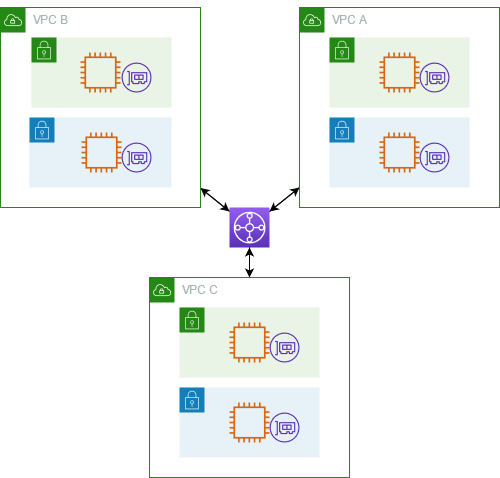
A typical architecture of a VPC attached to a Transit Gateway
You are almost at the end of the process. You now need to accept the transit gateway attachment and for this you will navigate back to the VMware Cloud Console.
Accept the Transit Gateway attachment as follows:
- Navigating back to the SDDC Group, External VPC tab, select the AWS account ID used for creating your FSx NetApp ONTAP, and click Accept. This process may take a few minutes.
- Next, you need to add the routes so that the SDDC can see the FSx file system. This is done on the same External VPC tab, where you will find a table with the VPC. In that table, there is a button called Add Routes. In the Add Route section, add two routes:
- The CIDR of the VPC where the FSx file system was deployed.
- The floating IP address of the file system.
- Click Done to complete the route task.
In the AWS console, create the route back to the SDDC by locating VPC on the VPC service page and navigating to the Route Table as seen below.

VPC service page Route Table navigation – AWS console
Ensure that you have the correct inbound rules for the SDDC Group CIDR by locating Security Groups under VPC and finding the Security Group that is being used (it should be the default one) to allow the inbound rules for SDDC Group CIDR.

Security Groups under VPC that are being used to allow the inbound rules for SDDC Group CIDR
Lastly, mount the NFS Datastore in the VMware Cloud Console as follows:
- Locate your SDDC.
- After selecting the SDDC, Navigate to the Storage Tab.
- Click Attach Datastore to mount the NFS volume(s).
- The next step is to select which hosts in the SDDC to mount the datastore to and click Mount to complete the task.
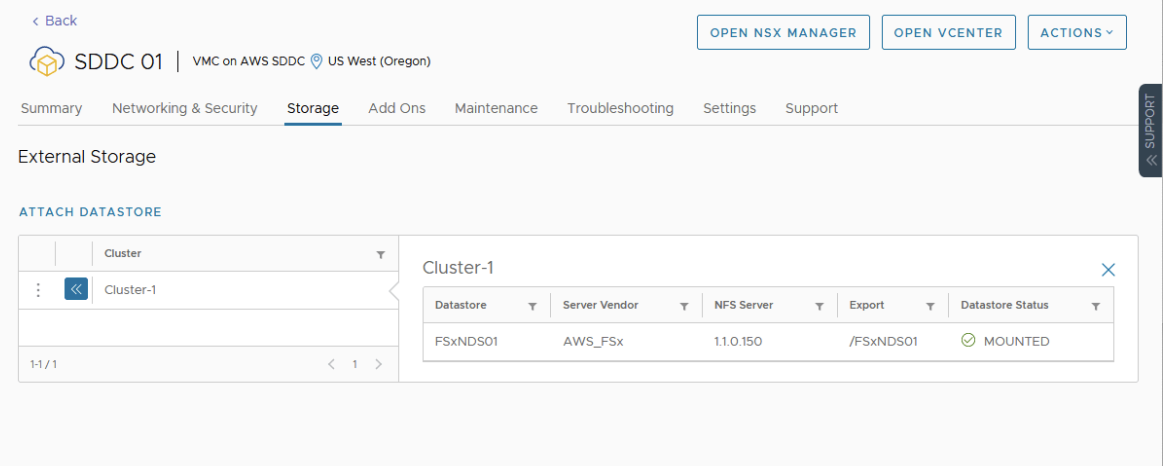
Attach A New Datastore
Available Today
Amazon FSx for NetApp ONTAP is available today for VMware Cloud on AWS customers in US East (Ohio), US East (N. Virginia), US West (Oregon), Asia Pacific (Mumbai), Asia Pacific (Seoul), Asia Pacific (Singapore), Asia Pacific (Sydney), Asia Pacific (Tokyo), Canada (Central), Europe (Frankfurt), Europe (Ireland), Europe (London), Europe (Milan), Europe (Paris), Europe (Stockholm), South America (São Paulo), AWS GovCloud (US-East), and AWS GovCloud (US-West).
– Veliswa x
ELEMENTS Media Platform Adds Backblaze B2 as Native Cloud Option
Post Syndicated from Jennifer Newman original https://www.backblaze.com/blog/elements-media-platform-adds-backblaze-b2-as-native-cloud-option/
Cloud workflows are rapidly becoming a driver of every modern media team’s day-to-day creative output. Whether it’s enabling remote shoots, distributed teams, or leveraging budgets more effectively, the cloud can deliver a ton of value to any team. But workflows, by their nature, are complex—and plenty of legacy cloud solutions only add to that complexity with tangled pricing models and limits to egress and collaboration.
ELEMENTS has been simplifying media workflows for more than a decade. Cloud storage has always been part of the ELEMENTS DNA, but they’ll be presenting revolutionary platform updates for cloud workflows in 2023 and beyond at IBC 2022. Part of this new focus on cloud solutions is their addition of an easy, transparent cloud storage option to their platform in Backblaze B2 Cloud Storage. Nimble post-production teams are always on the lookout for more straightforward and easy-to-understand cloud plans with transparent costs—this is a market that Backblaze serves more effectively than the other legacy providers accessible through the platform.
Learn More About This Solution Live in Amsterdam
If you’re attending the 2022 IBC Conference in Amsterdam, join us at stand 7.B06 to learn about integrating B2 Cloud Storage into your workflow. You can schedule a meeting here.
The Backblaze + ELEMENTS Integration
The ELEMENTS platform makes it simple to upload and download files straight from on-premises storage while also offering smart and fully customisable archiving workflows, cloud-based media asset management (MAM), and a number of other tools and features that remove the borders between cloud and on-premises storage. Once connected, ELEMENTS enables users to search, edit, or automate changes to media assets. This extends to team collaboration and setting rights to folders and data across the connected networks. ELEMENTS has provided an intuitive interface making this an easy-to-use solution that is designed for the M&E industry.
Connecting your Backblaze account with ELEMENTS is easy. Simply navigate to the System > Integrations menu and enter your Backblaze login credentials. After this, Backblaze B2 Buckets of the connected account can be mounted as a volume on ELEMENTS.
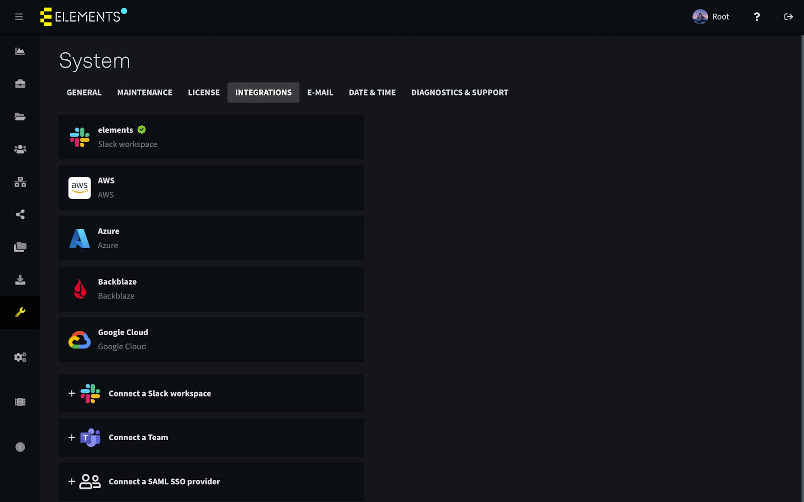
If you’d like to run a proof of concept with Backblaze, the first 10 GB is free and setting up a Backblaze account only takes a few clicks. Or you can contact sales for more information.
If you’re already a Backblaze B2 customer and would like to check out the ELEMENTS platform, contact ELEMENTS directly here.
Simplifying Your Workflow AND Your Budget
Backblaze focuses on end-to-end ease, including how it works in your budget. Businesses can select a pay-as-you go option or work with a reseller to access capacity plans.
B2 Cloud Storage – This is a general cloud plan for applications, backups and almost all of your business needs. The pricing is simple: $5 per TB per month + $0.01 per GB download fee. As with all plans, the files are located on one storage tier and can always be easily accessed.
B2 Reserve – This is the sweet spot for most media use cases. B2 Reserve is a cloud package starting from 20TB per month. This plan comes at a slightly higher cost than the standard B2 Cloud Storage plan but is free from egress fees up to the amount of storage purchased per month. B2 Reserve will quickly work in your favor if you plan on accessing your files regularly. NOTE: B2 Reserve is only available through resellers.
Top Benefits for Teams Using Backblaze and ELEMENTS Together
The ELEMENTS platform offers a set of robust tools that unlock time and budgets for creative teams to do more. We’ll underline how these different features can work with Backblaze B2.
Automation Engine
The ELEMENTS Automation Engine allows users to create workflows with any number of steps. This tool has a growing list of templates, two of which are Archive and Restore automations. These can be used to archive footage to Backblaze and delete it from the on-premises storage while keeping a lightweight preview proxy. If you need the original footage after previewing the proxy, triggering the Restore automation is all you need to do. The hi-res footage will automatically be downloaded from the Backblaze B2 bucket and placed onto the original location.
A huge benefit of using cloud storage through the ELEMENTS platform is that the individual users do not need to have cloud accounts or direct cloud access. Users will only be able to use the cloud features through the preset automation jobs and according to their permissions.
Media Library
Cloud technologies open up a number of new possibilities within the Media Library, our powerful, browser-based media asset management (MAM) platform.
For example, if your post-production facility has a locally-deployed media library which is running on your ELEMENTS storage and is connected to your Backblaze account, users can playback all of your footage at any time, no matter where it is stored—on-premises, in the cloud, or even in your LTO archive.
The Media Library adds a layer of functionality to the cloud and allows you to easily build a true cloud archive—one that can be accessed from anywhere, in which footage can easily be previewed and just as easily restored with a click of a button.
File Manager
The File Manager is a functionality of the ELEMENTS Web UI that allows you to browse and manage content on your storage on-premises and, very soon, in the cloud. It provides you with a clear overview of all your files, no matter how many file systems and cloud buckets you have. File Managers’ support for cloud storage means users will be able to manage all of their files in one place, without having to navigate through a host of different cloud providers’ interfaces.
ELEMENTS Client
The ELEMENTS Client is an intuitive connection manager that allows admins to decide who gets to mount what—providing a secure gatekeeper to your footage.
The latest function, coming soon to the ELEMENTS Client, will allow users to mount cloud workspaces. This means that users will be able to access the contents of the Backblaze B2 Bucket as if it were a local drive. With optional access logging, users will have the ability to access the cloud-stored content while admins can maintain a high level of security.
Bringing Independent Cloud Storage to the ELEMENTS Platform
Offering B2 Cloud Storage as a native option within the ELEMENTS platform brings a whole new type of cloud offering to Elements’ users. We’re eager to see how creatives use an easier, more affordable, independent option in their workflows.
Learn More About this Solution Live in Amsterdam
If you’re attending the 2022 IBC Conference in Amsterdam, join us at stand 7.B06 to learn about integrating B2 Cloud Storage into your workflow. You can schedule a meeting here.
The post ELEMENTS Media Platform Adds Backblaze B2 as Native Cloud Option appeared first on Backblaze Blog | Cloud Storage & Cloud Backup.
Michael Shaulov | The Gatekeeper Unlocking Institutional Access to Crypto | Talks at Google
Post Syndicated from Talks at Google original https://www.youtube.com/watch?v=RZggZrUxgrg
18K Unboxing – Our New Studio Cameras
Post Syndicated from Matt Granger original https://www.youtube.com/watch?v=JobapkWCreQ
Git’s database internals II: commit history queries
Post Syndicated from Derrick Stolee original https://github.blog/2022-08-30-gits-database-internals-ii-commit-history-queries/
This week, we are exploring Git’s internals with the following concept in mind:
Git is the distributed database at the core of your engineering system.
Git’s role as a version control system has multiple purposes. One is to help your team make collaborative changes to a common repository. Another purpose is to allow individuals to search and investigate the history of the repository. These history investigations form an interesting query type when thinking of Git as a database.
Not only are history queries an interesting query type, but Git commit history presents interesting data shapes that inform how Git’s algorithms satisfy those queries.
Let’s dig into some common history queries now.
Git history queries
History queries can take several forms. For this post, we are focused only on history queries based entirely on the commits themselves. In part III we will explore file history queries.
Recent commits
Users most frequently interact with commit history using git log to see the latest changes in the current branch. git log shows the commit history which relies on starting at some known commits and then visiting their parent commits and continuing to “walk” parent relationships until all interesting commits are shown to the user. This command can be modified to compare the commits in different branches or display commits in a graphical visualization.
$ git log --oneline --graph 091680472db
* 091680472db Merge branch 'tb/midx-race-in-pack-objects'
|\
| * 4090511e408 builtin/pack-objects.c: ensure pack validity from MIDX bitmap objects
| * 5045759de85 builtin/pack-objects.c: ensure included `--stdin-packs` exist
| * 58a6abb7bae builtin/pack-objects.c: avoid redundant NULL check
| * 44f9fd64967 pack-bitmap.c: check preferred pack validity when opening MIDX bitmap
* | d8c8dccbaaf Merge branch 'ds/object-file-unpack-loose-header-fix'
|\ \
| * | 8a50571a0ea object-file: convert 'switch' back to 'if'
* | | a9e7c3a6efe Merge branch 'pb/use-freebsd-12.3-in-cirrus-ci'
|\ \ \
| * | | c58bebd4c67 ci: update Cirrus-CI image to FreeBSD 12.3
| | |/
| |/|
* | | b3b2ddced29 Merge branch 'ds/bundle-uri'
|\ \ \
| * | | 89c6e450fe4 bundle.h: make "fd" version of read_bundle_header() public
| * | | 834e3520ab6 remote: allow relative_url() to return an absolute url
Containment queries
We sometimes also need to get extra information about our commit history, such as asking “which tags contain this commit?” The git tag --contains command is one way to answer that question.
$ git tag --contains 4ae3003ba5
v2.36.0
v2.36.0-rc0
v2.36.0-rc1
v2.36.0-rc2
v2.36.1
v2.37.0
v2.37.0-rc0
v2.37.0-rc1
v2.37.0-rc2
The similar git branch --contains command will report all branches that can reach a given commit. These queries can be extremely valuable. For example, they can help identify which versions of a product have a given bugfix.
Merge base queries
When creating a merge commit, Git uses a three-way merge algorithm to automatically resolve the differences between the two independent commits being merged. As the name implies, a third commit is required: a merge base.
A merge base between two commits is a commit that is in the history of both commits. Technically, any commit in their common history is sufficient, but the three-way merge algorithm works better if the difference between the merge base and each side of the merge is as small as possible.
Git tries to select a single merge base that is not reachable from any other potential merge base. While this choice is usually unique, certain commit histories can permit multiple “best” merge bases, in which case Git prints all of them.
The git merge-base command takes two commits and outputs the object ID of the merge base commit that satisfies all of the properties described earlier.
$ git merge-base 3d8e3dc4fc d02cc45c7a
3d8e3dc4fc22fe41f8ee1184f085c600f35ec76f
One thing that can help to visualize merge commits is to explore the boundary between two commit histories. When considering the commit range B..A, a commit C is on the boundary if it is reachable from both A and B and there is at least one commit that is reachable from A and not reachable from B and has C as its parent. In this way, the boundary commits are the commits in the common history that are parents of something in the symmetric difference. There are a number of commits on the boundary of these two example commits, but one of them can reach all of the others providing the unique choice in merge base.
$ git log --graph --oneline --boundary 3d8e3dc4fc..d02cc45c7a
* d02cc45c7a2c Merge branch 'mt/pkt-line-comment-tweak'
|\
| * ce5f07983d18 pkt-line.h: move comment closer to the associated code
* | acdb1e1053c5 Merge branch 'mt/checkout-count-fix'
|\ \
| * | 611c7785e8e2 checkout: fix two bugs on the final count of updated entries
| * | 11d14dee4379 checkout: show bug about failed entries being included in final report
| * | ed602c3f448c checkout: document bug where delayed checkout counts entries twice
* | | f0f9a033ed3c Merge branch 'cl/rerere-train-with-no-sign'
|\ \ \
| * | | cc391fc88663 contrib/rerere-train: avoid useless gpg sign in training
| o | | bbea4dcf42b2 Git 2.37.1
| / /
o / / 3d8e3dc4fc22 Merge branch 'ds/rebase-update-ref' <--- Merge Base
/ /
o / e4a4b31577c7 Git 2.37
/
o 359da658ae32 Git 2.35.4
These simple examples are only a start to the kind of information Git uses from a repository’s commit history. We will discuss some of the important ways the structure of commits can be used to accelerate these queries.
The commit graph
Git stores snapshots of the repository as commits and each commit stores the following information:
- The object ID for the tree representing the root of the worktree at this point in time.
- The object IDs for any number of parent commits representing the previous points in time leading to this commit. We use different names for commits based on their parent count:
- Zero parents: these commits are the starting point for the history and are called root commits.
- One parent: these are typical commits that modify the repository with respect to the single parent. These commits are frequently referred to as patches, since their differences can be communicated in patch format using
git format-patch. - Two parents: these commits are called merges because they combine two independent commits into a common history.
- Three or more parents: these commits are called _octopus merges_since they combine an arbitrary number of independent commits.
- Name and email information for the author and committer, which can be different.
- Time information for the author time and committer time, which can be different.
- A commit message, which represents additional metadata. This information is mostly intended for human consumption, so you should write it carefully. Some carefully-formatted trailer lines in the message can be useful for automation. One such trailer is the
Co-authored-by:trailer which allows having multiple authors of a single commit.
The commit graph is the directed graph whose vertices are the commits in the repository and where a commit has a directed edge to each of its parents. With this representation in mind, we can visualize the commit history as dots and arrows.
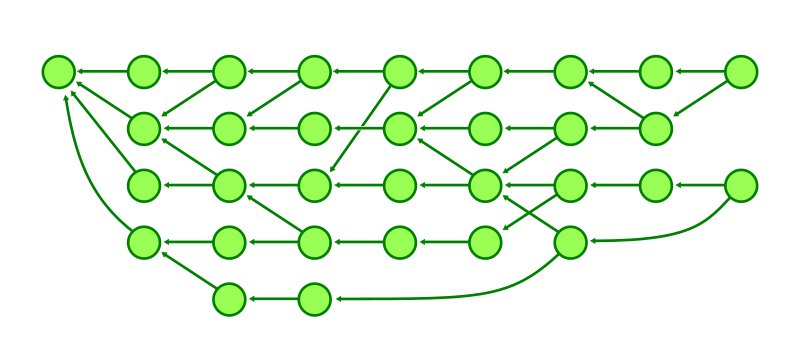
Graph databases need not apply
There are a number of graph databases that store general-purpose graph relationships. While it would be possible to store commits, trees, and blobs in such a database, those databases are instead designed for queries of limited-depth. They expect to walk only a few relationships, and maybe there are many relationships from a single node.
When considering general-purpose graph databases, think about social networks. Think about the concept of six degrees of separation and how almost every node is reachable within a short distance. In these graphs, the number of relationships at a given node can vary wildly. Further, the relationships are mainly unordered.
Git is not like that. It is rare to refer to a commit directly by its object ID. Instead Git commands focus on the current set of references. The references are much smaller in number than the total number of commits, and we might need to walk thousands of commit-parent edges before satisfying even the simplest queries.
Git also cares about the order of the parent relationships. When a merge commit is created, the parents are ordered. The first parent has a special role here. The convention is that the first parent is the previous value of the branch being updated by the merge operation. If you use pull requests to update a branch, then you can use git log --first-parent to show the list of merge commits created by that pull request.
$ git log --oneline --first-parent
2d79a03 Merge pull request #797 from ldennington/ssl-cert-updates
e209b3d Merge pull request #790 from cornejom/gitlab-support-docs
b83bf02 Merge pull request #788 from ldennington/arm-fix
cf5a693 (tag: v2.0.785) Merge pull request #778 from GyroJoe/main
dd4fe47 Merge pull request #764 from timsu92/patch-1
428b40a Merge pull request #759 from GitCredentialManager/readme-update
0d6f1c8 (tag: v2.0.779) Merge pull request #754 from mjcheetham/bb-newui
a9d78c1 Merge pull request #756 from mjcheetham/win-manifest
Git’s query pattern is so different from general-purpose graph databases that we need to use specialized storage and algorithms suited to its use case.
Git’s commit-graph file
All of Git’s functionality can be done by loading each commit’s contents out of the object store, parsing its header to discover its parents, and then repeating that process for each commit we need to examine. This is fast enough for small repositories, but as the repository increases in size the overhead of parsing these plain-text files to get the graph relationships becomes too expensive. Even the fact that we need a binary search to locate the object within the packfile begins to add up.
Git’s solution is the commit-graph file. You can create one in your own repository using git commit-graph write --reachable, but likely you already get one through git gc --auto or through background maintenance.
The file acts as a query index by storing a structured version of the commit graph data, such as the parent relationships as well as the commit date and root tree information. This information is sufficient to satisfy the most expensive parts of most history queries. This avoids the expensive lookup and parsing of the commit messages from the object store except when a commit needs to be output to the user.
We can think about the commit-graph as a pair of database tables. The first table stores each commit with its object ID, root tree, date, and first two parents as the columns. A special value, -1, is used to indicate that there is no parent in that position, which is important for root commits and patches.
The vast majority of commits have at most two parents, so these two columns are sufficient. However, Git allows an arbitrary number of parents, forming octopus merges. If a commit has three or more parents, then the second parent column has a special bit indicating that it stores a row position in a second table of overflow edges. The remaining parents form a list starting at that row of the overflow edges table, each position stores the integer position of a parent. The list terminates with a parent listed along with a special bit.
In the figure below, the commit at row 0 has a single parent that exists at row 2. The commit at row 4 is a merge whose second parent is at row 5. The commit at row 8 is an octopus merge with first parent at row 3 and the remaining parents come from the parents table: 2, 5, and 1.
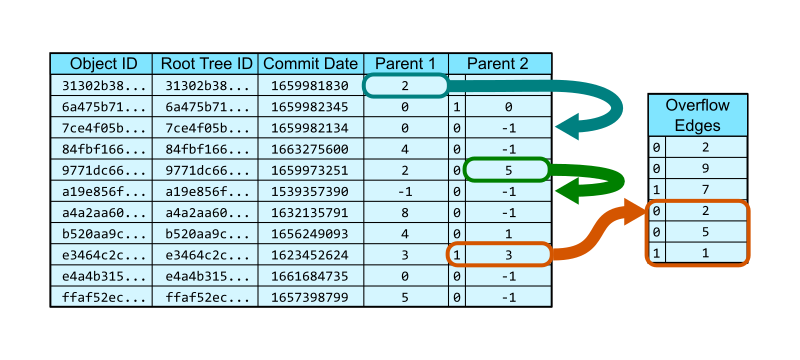
One important thing about the commit-graph file is that it is closed under reachability. That means that if a commit is in the file, then so is its parent. This means that a commit’s parents can be stored as row numbers instead of as full object IDs. This provides a constant-time lookup when traversing between a commit and its parent. It also compresses the commit-graph file since it only needs four bytes per parent.
The structure of the commit-graph file speeds up commit history walks significantly, without any changes to the commit walk algorithms themselves. This is mainly due to the time it takes to visit a commit. Without the commit-graph file, we follow this pattern:
- Start with an Object ID.
- Do a lookup in the object store to see where that object is stored.
- Load the object content from the loose object or pack, decompressing the data from disk.
- Parse that object file looking for the parent object IDs.
This loop is visualized below.
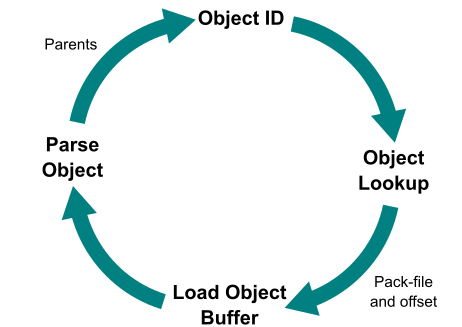
When a commit-graph file exists, we have a way to eject out of this loop and into a much tighter loop. We add an extra step before doing a generic object lookup in the object store: use a binary search to find that object ID in the commit-graph file. This operation is logarithmic in the number of commits, not in the total number of objects in the repository. If the commit-graph does not have that commit, then continue in the old loop. Check the commit-graph each time so we can eventually find a commit and its position in the commit-graph file.
Once we have a commit in the commit-graph file, we can navigate immediately to the row that stores that commit’s information, then load the parent commits by their position. This means that we can lookup the parents in constant time without doing any binary search! This loop is visualized below.
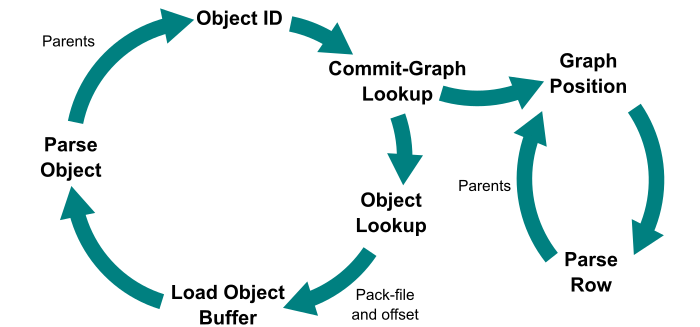
This reduced data footprint makes it clear that we can speed up certain queries on the basis of parsing speed alone. The git rev-list command is great for showing this because it prints the object IDs of the commits and not the commit messages. Thus, we can test how long it takes to walk the full commit graph with and without the commit-graph file.
The Linux kernel repository is an excellent candidate for testing these queries, since it is publicly available and has over a million commits. You can replicate these tests by writing a commit-graph file and toggling the core.commitGraph config setting.
| Command | Without commit-graph |
With commit-graph |
git rev-list v5.19 |
6.94s | 0.98s |
git rev-list v5.0..v5.19 |
2.51s | 0.30s |
git merge-base v5.0 v5.19 |
2.59s | 0.24s |
Avoiding the expensive commit parsing results in a nice constant factor speedup (about 6x in these examples), but we need something more to get even better performance out of certain queries.
Reachability indexes
One of the most important questions we ask about commits is “can commit A reach commit B?” If we can answer that question quickly, then commands such as git tag --contains and git branch --contains become very fast.
Providing a positive answer can be very difficult, and most times we actually want to traverse the full path from A to B, so there is not too much value in that answer. However, we can learn a lot from the opposite answer when we can be sure that A cannot reach B.
The commit-graph file provides a location for adding new information to our commits that do not exist in the commit object format by default. The new information that we store is called a generation number. There are multiple ways to compute a generation number, but the most important property we need to guarantee is the following:
If the generation number of a commit A is less than the generation number of a commit B, then A cannot reach B.
In this way, generation numbers form a negative reachability index in that they can help us determine that some commits definitely cannot reach some other set of commits.
The simplest generation number is called topological level and it is defined this way:
- If a commit has no parents, then its topological level is 1.
- Otherwise, the topological level of a commit is one more than the maximum of the topological level of its parents.
Our earlier commit graph figure was already organized by topological level, but here it is shown with those levels marked by dashed lines.
The topological level satisfies the property of a generation number because every commit has topological level strictly larger than its parents, which implies that everything that commit can reach has strictly smaller topological level. Conversely, if something has larger topological level, then it is not reachable from that commit.
You may have noticed that I did not mention what is implied when two commits have the same generation number. While we could surmise that equal topological level implies that neither commit can reach the other, it is helpful to leave equality as an unknown state. This is because commits that are in the repository but have not yet been added to the commit-graph file do not have a precomputed generation number. Internally, Git treats these commits as having generation number infinity which is larger than all of the precomputed generation numbers in the commit-graph. However, Git can do nothing when two commits with generation number infinity are compared. Instead of special-casing these commits, Git does not assume anything about equal generation number.
Stopping walks short with generation numbers
Let’s explore how we can use generation numbers to speed up commit history queries. The first category to explore are reachability queries, such as:
git tag --contains <b>returns the list of tags that can reach the commit<b>.git merge-base --is-ancestor <b> <a>returns an exit code of 0 if and only if<b>is an ancestor of<a>(<b>is reachable from<a>)
Both of these queries seek to find paths to a given point <b>. The natural algorithm is to start walking and report success if we ever discover the commit <b>. However, this might lead to walking every single commit before determining that we cannot in fact reach <b>. Before generation numbers, the best approach was to use a breadth-first search using commit date as a heuristic for walking the most recent commits first. This minimized the number of commits to walk in the case that we did eventually find <b>, but does not help at all if we cannot find <b>.
With generation numbers, we can gain two new enhancements to this search.
The first enhancement is that we can stop exploring a commit if its generation number is below the generation number of our target commit. Those commits of smaller generation could never contribute to a path to the target, so avoid walking them. This is particularly helpful if the target commit is very recent, since that cuts out a huge amount of commits from the search space.
In the figure below, we discover that commit A can reach commit B, but we explored every reachable commit with higher generation. We know that we do not need to explore below generation number 4.
The second enhancement is that we can switch from breadth-first search to a depth-first search. This heuristic exploits some structure about typical repositories. The first parent of a commit is typically special, representing the previous value of the branch before the merge. The later parents are typically small topic branches merging a few new commits into the trunk of the repository. By walking the first parent history, we can navigate quickly to the generation number cutoff where the target commit is likely to be. As we backtrack from that cutoff, we are likely to find the merge commit that introduced the target commit sooner than if we had walked all recent commits first.
In the figure below, we demonstrate the same reachability query from commit A to commit B, where Git avoids walking below generation 4, but the depth-first search also prevents visiting a number of commits that were marked as visited in the previous figure.
Note that this depth-first search approach is less efficient if we do not have the first generation number cutoff optimization, because the walk would spend most of its time exploring very old commits.
These two walks together can introduce dramatic improvements to our reachability queries.
| Command | Without commit-graph |
With commit-graph |
git tag --contains v5.19~100 |
7.34s | 0.04s |
git merge-base --is-ancestor v5.0 v5.19 |
2.64s | 0.02s |
Note that since git tag --contains is checking reachability starting at every tag, it needs to walk the entire commit history even from old tags in order to be sure they cannot reach the target commit. With generation numbers, the cutoff saves Git from even starting a walk from those old tags. The git merge-base --is-ancestor command is faster even without generation numbers because it can terminate early once the target commit is found.
However, with the commit-graph file and generation numbers, both commands benefit from the depth-first search as the target commit is on the first-parent history from the starting points.
If you’re interested to read the code for this depth-first search in the Git codebase, then read the can_all_from_reach_with_flags() method which is a very general form of the walk. Take a look at how it is used by other callers such as repo_is_descendant_of() and notice how the presence of generation numbers determines which algorithm to use.
Topological sorting
Generation numbers can help other queries where it is less obvious that a reachability index would help. Specifically, git log --graph displays all reachable commits, but uses a special ordering to help the graphical visualization.
git log --graph uses a sorting algorithm called topological sort to present the commits in a pleasing order. This ordering has one hard requirement and one soft requirement.
The hard requirement is that every commit appears before its parents. This is not guaranteed by default in git log, since the default sort uses commit dates as a heuristic during the walk. Commit dates could be skewed and a commit could appear after one of its parents because of date skew.
The soft requirement is that commits are grouped together in an interesting way. When git log --graph shows a merge commit, it shows the commits “introduced” by the merge before showing the first parent. This means that the second parent is shown first followed by all of the commits it can reach that the first parent cannot reach. Typically, this will look like the commits from the topic branch that were merged in that pull request. We can see how this works with the following example from the git/git repository.
$ git log --oneline --graph -n 10 091680472db
* 091680472d Merge branch 'tb/midx-race-in-pack-objects'
|\
| * 4090511e40 builtin/pack-objects.c: ensure pack validity from MIDX bitmap objects
| * 5045759de8 builtin/pack-objects.c: ensure included `--stdin-packs` exist
| * 58a6abb7ba builtin/pack-objects.c: avoid redundant NULL check
| * 44f9fd6496 pack-bitmap.c: check preferred pack validity when opening MIDX bitmap
* | d8c8dccbaa Merge branch 'ds/object-file-unpack-loose-header-fix'
|\ \
| * | 8a50571a0e object-file: convert 'switch' back to 'if'
* | | a9e7c3a6ef Merge branch 'pb/use-freebsd-12.3-in-cirrus-ci'
|\ \ \
| * | | c58bebd4c6 ci: update Cirrus-CI image to FreeBSD 12.3
| | |/
| |/|
* | | b3b2ddced2 Merge branch 'ds/bundle-uri'
|\ \ \

$ git log --oneline --graph --date-order -n 10 091680472db
* 091680472d Merge branch 'tb/midx-race-in-pack-objects'
|\
* \ d8c8dccbaa Merge branch 'ds/object-file-unpack-loose-header-fix'
|\ \
* \ \ a9e7c3a6ef Merge branch 'pb/use-freebsd-12.3-in-cirrus-ci'
|\ \ \
* \ \ \ b3b2ddced2 Merge branch 'ds/bundle-uri'
|\ \ \ \
* \ \ \ \ 83937e9592 Merge branch 'ns/batch-fsync'
|\ \ \ \ \
* \ \ \ \ \ 377d347eb3 Merge branch 'en/sparse-cone-becomes-default'
|\ \ \ \ \ \
* | | | | | | 2668e3608e Sixth batch
* | | | | | | 4c9b052377 Merge branch 'jc/http-clear-finished-pointer'
|\ \ \ \ \ \ \
* \ \ \ \ \ \ \ db5b7c3e46 Merge branch 'js/ci-gcc-12-fixes'
|\ \ \ \ \ \ \ \
* | | | | | | | | 1bcf4f6271 Fifth batch
Notice that the first example with only --graph brought the commits introduced by the merge to the top of the order. Adding --date-order changes this ordering goal to instead present commits by their commit date, hiding those introduced commits below a long list of merge commits.
The basic algorithm for topological sorting is Kahn’s algorithm which follows two big steps:
- Walk all reachable commits, counting the number of times a commit appears as a parent of another commit. Call these numbers the in-degree of the commit, referencing the number of incoming edges.
- Walk the reachable commits, but only visit a commit if its in-degree value is zero. When visiting a commit, decrement the in-degree value of each parent.
This algorithm works because at least one of our starting points will have in-degree zero, and then decrementing the in-degree value is similar to deleting the commit from the graph, always having at least one commit with in-degree zero.
But there’s a huge problem with this algorithm! It requires walking all reachable commits before writing even one commit for the user to see. It would be much better if our algorithm would be fast to show the first page of information, so the computation could continue while the user has something to look at.
Typically, Git will show the results in a pager such as less, but we can emulate that experience using a commit count limit with the -n 100 argument. Trying this in the Linux kernel takes over seven seconds!
With generation numbers, we can perform an in-line form of Kahn’s algorithm to quickly show the first page of results. The trick is to perform both steps of the algorithm at the same time.
To perform two walks at the same time, Git creates structures that store the state of each walk. The structures are initialized with the starting commits. The in-degree walk uses a priority queue ordered by generation number and that walk starts by computing in-degrees until the maximum generation in that priority queue is below the minimum generation number of the starting positions. The output walk uses a stack, which gives us the nice grouping of commits, but commits are not added unless their in-degree value is zero.
To guarantee that the output walk can add a commit to the stack, it first checks with the status of the in-degree walk to see that the maximum generation in its queue is below the generation number of that commit. In this way, Git alternates between the two walks. It computes just enough of the in-degrees to know that certain commits have an in-degree of zero, then pauses that walk to output some commits to the user.
This has a significant performance improvement for our topological sorting commands.
| Command | Without commit-graph |
With commit-graph |
git rev-list --topo-order -n 100 v5.19 |
6.88s |
0.02s |
git log --graph -n 100 v5.19 |
7.73s |
0.03s |
git rev-list --topo-order -n 100 v5.18..v5.19 |
0.39s |
0.02s |
git log --graph -n 100 v5.18..v5.19 |
0.43s |
0.03s |
The top two commands use an unbounded commit range, which is why the old algorithm takes so long: it needs to visit every reachable commit in the in-degree walk before writing anything to output. The new algorithm with generation numbers can explore only the recent commits.
The second two commands use a commit range (v5.18..v5.19) which focuses the search on the commits that are reachable from one commit, but not reachable from another. This actually adds a third stage to the algorithm, where first Git determines which commits are in this range. That algorithm can use a priority queue based on commit date to discover that range without walking the entire commit history, so the old algorithm speeds up for these cases. The in-degree walk still needs to walk that entire range, so it is still slower than the new algorithm as long as that range is big enough.
This idea of a commit range operating on a smaller subgraph than the full commit history actually requires that our interleaved topological sort needs a third walk to determine which commits should be excluded from the output. If you want to learn more about this three-stage algorithm, then read the commit that introduced the walk to Git’s codebase for the full details.
Generation number v2: corrected commit dates
The earlier definition of a generation number was intentionally generic. This is because there are actually multiple possible generation numbers even in the Git codebase!
The definition of topological level essentially uses the smallest possible integer that could be used to satisfy the property of a generation number. The simplicity is nice for understanding, but it has a drawback. It is possible to make the algorithms using generation number worse if you create your commit history in certain ways.
Most of the time, merge commits introduce a short list of recent commits into the commit history. However, some times those merges introduce a commit that’s based on a very old commit. This can happen when fixing a bug in a really old area of code and the developer wants to apply the fix as early as possible so it can merge into old maintenance branches. However, this means that the topological level is much smaller for that commit than for other commits created at similar times.
In this sense, the commit date is a much better heuristic for limiting the commit walk. The only problem is that we can’t trust it as an accurate generation number! Here is where a solution was found: a new generation number based on commit dates. This was implemented as part of a Google Summer of Code project in 2020.
The corrected commit date is defined as follows:
- If a commit has no parents, then its corrected commit date is the same as its commit date.
- Otherwise, determine the maximum corrected commit date of the commit’s parents. If that maximum is larger than the commit date, then add one to that maximum. Otherwise, use the commit date.
Using corrected commit date leads to a wider variety of values in the generation number of each commit in the commit graph. The figure below is the same graph as in the earlier examples, but the commits have been shifted as they could be using corrected commit dates on the horizontal axis.
This definition flips the generation number around. If possible, use the commit date. If not, use the smallest possible value that satisfies the generation number properties with respect to the corrected commit dates of the commit’s parents.
In performance testing, corrected commit dates solve these performance issues due to recent commits based on old commits. In addition, some Git commands generally have slight improvements over topological levels.
For example, the search from A to C in the figure below shows how many commits must be visited to determine that A cannot reach C when using topological level.

However, switching to using corrected commit dates, the search space becomes much smaller.
Recent versions of Git have transitioned to corrected commit dates, but you can test against topological levels by adjusting the commitGraph.generationVersion config option.
Out of the weeds again
We’ve gone very deep into the commit-graph file and reachability algorithms. The on-disk file format is customized to Git’s needs when answering these commit history queries. Thus, it is a type of query index much like one could define in an application database. The rabbit hole goes deeper, though, with yet another level of query index specialized to other queries.
Make sure that you have a commit-graph file accelerating your Git repositories! You can ensure this happens in one of several ways:
- Manually run
git commit-graph write --reachable. - Enable the
fetch.writeCommitGraphconfig option. - Run
git maintenance startand let Git write it in the background.
In the next part of this blog series, we will explore how Git file history queries use the structure of tree objects and the commit graph to limit how many objects need to be parsed. We’ll also talk about a special file history index that is stored in the commit-graph and greatly accelerates file history queries in large repositories.
I’ll also be speaking at Git Merge 2022 covering all five parts of this blog series, so I look forward to seeing you there!
QNAP KoiBox-100W – Complete Setup & Use in Production!
Post Syndicated from Crosstalk Solutions original https://www.youtube.com/watch?v=1yV-BZA--FU