Celebrate International Women’s Day all week with the Architecture Blog

Post Syndicated from Bonnie McClure original https://aws.amazon.com/blogs/architecture/celebrate-international-womens-day-with-us-on-the-architecture-blog/

Companies committed to diversity (gender or otherwise) tend to be more creative and innovative and have higher retention and engagement rates. Diverse leadership can provide excellent role models for younger people looking for a career in STEM, those who are transitioning into the industry from an “unconventional” career path, or those who are returning to work.

This International Women’s Day, we’re featuring more than a week’s worth of posts that highlight female builders and leaders. We’re showcasing women in the industry who are building, creating, and, above all, inspiring, empowering, and encouraging everyone—especially women and girls—in tech.

Though the number of women in tech roles is slowly increasing, they are still underrepresented. As shown in the graph that follows, women worldwide hold, on average, 21% of IT and technical roles.
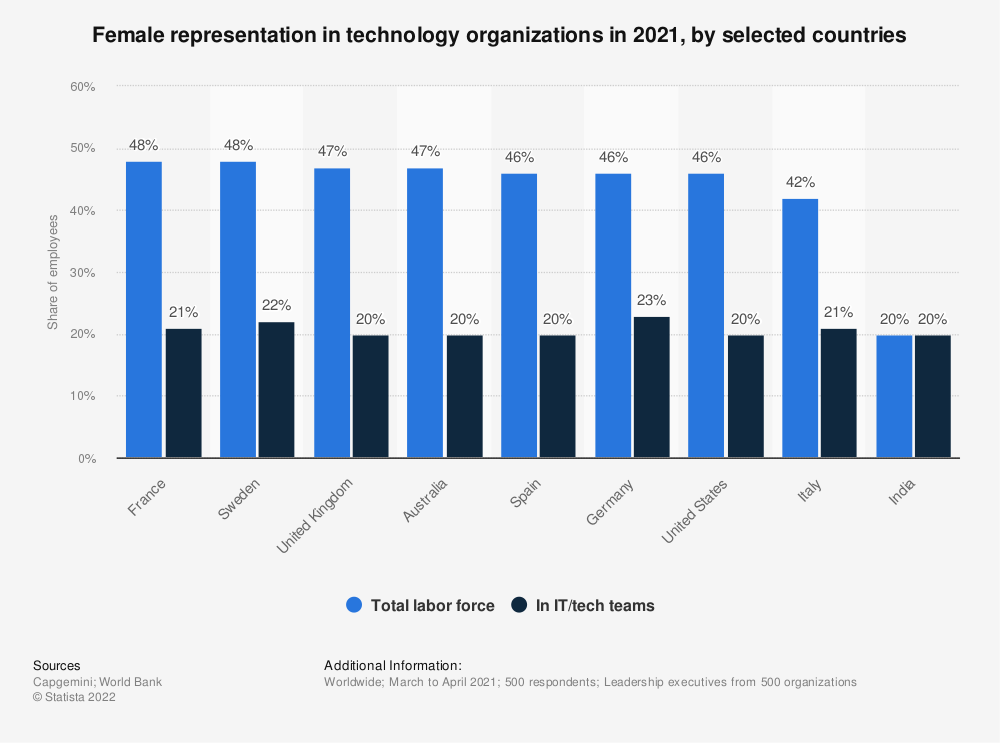
Female representation in technology organizations in 2021, selected countries

Female representation in technology organizations in 2021, selected countries

This number drops to 12% when you look at cloud computing roles like Developers/Engineers, Data Engineers, System Administrators, DevOps Engineers, and Architects.

Share of male and female workers across professional clusters

Share of male and female workers across professional clusters

The technology industry has a challenge—but also an opportunity—when it comes to equal gender representation. By highlighting the work that women are doing right now to slowly but steadily change what it looks like (literally and figuratively) to work in tech and with continued commitment and effort, we can create a path to success for everyone.

She Builds Tech Skills re:Invent Roundup

AWS She Builds Tech Skills is a skill development program aimed for builders and cloud enthusiasts to create an inclusive environment to learn and develop cloud skills. Their mission is to build a community with world class leaders and influence diversity representation amongst technical roles in technology.

To kick off this week, we’re featuring a video from She Builds Tech Skills, hosted by Mai Nishitani and May Kyaw, Solutions Architects at AWS. In the video, they chat with six female Solutions Architects from around the world about their favorite services and features from re:Invent 2021, and they give advice on how to get started using these services in your architectures.

As a bonus, Mai and May followed up with these women to chat about how they’re celebrating International Women’s Day this week and every week.

Poornima Chand, Senior Solutions ArchitectPoornima Chand

Poornima Chand is a Senior Solutions Architect in the Strategic Accounts Solutions team at AWS. She works with customers to help solve their unique challenges using AWS technology solutions. She enjoys architecting and building scalable solutions. Her focus areas include Serverless, High Performance Computing and Machine Learning.

How does she encourage and mentor women in tech and beyond? Poornima is an active mentor in the AWS She Builds CloudUp program. She loves to celebrate women’s achievements and plans to spend International Women’s Day interacting with and learning from Women@Amazon and women from customer teams.

Ai-Linh Le, Solutions ArchitectAi-Linh Li

Ai-Linh Le is a Solutions Architect based in Sydney, Australia. She started her career as a software engineer and still likes to be hands-on in developing and building solutions and demos. She enjoys working with customers and helping them to build solutions and solve challenges. Her areas of focus include data analytics, machine learning, and DevOps.

How does she encourage and mentor women in tech and beyond? Ai-Linh is passionate about continuous learning and exploring new technologies, and is a mentor in the AWS She Builds CloudUp program.

Nelli Lovchikova, Enterprise Solutions ArchitectNelli Lovchikova

Nelli has nearly twenty years of experience helping companies build amazing things as a software engineer and architect. She strongly believes in engineering excellence and continuous learning and improvement.

How does she encourage and mentor women in tech and beyond? Nelli constantly researches and experiments with bleeding-edge technologies and ideas and is always happy to take other people on that journey with me, share my findings, and inspiration.

Natalie White, Enterprise Solutions ArchitectNatalie White

Natalie White is an Enterprise Solutions Architect in southern California. Her 15-year software development career across four industry verticals prior to joining AWS and her advocacy for AWS Developer Tools and Infrastructure as Code services help her earn trust with her customers’ builders and executive stakeholders and accelerate their time to done.

How does she encourage and mentor women in tech and beyond? Natalie is an active member in the Society of Women Engineers and a leader of her daughter’s Girl Scout troop, so she will celebrate International Women’s Day with Women@Amazon and across engineering domains, industry verticals, and age groups.

Deval Parikh. Senior Enterprise Solutions ArchitectDeval S Parikh

Deval Parikh is a Sr Enterprise Solutions Architect at AWS based out of Los Angeles. She is passionate about helping enterprises re-imagine their businesses in the cloud by leading them with strategic architectural guidance and building prototypes as an AWS expert.

How does she encourage and mentor women in tech and beyond? Deval is passionate about helping women STEM roles. She leads various affinity groups in AWS North America, including Women At Solutions Architecture and YouthTech. On weekends, she teaches high school and middle school students programming in Python and Spark. Outside of work, she loves to paint with oil on canvas and hiking with her friends. You can view some of her artwork at www.devalparikh.com.

Viktoria Semaan, Senior Partner Solutions ArchitectSemaan

As a Senior Partner Solutions Architect, Viktoria is helping AWS Strategic ISV Partners to build joint innovative solutions on AWS. She has 13+ years of experience in solutions architecture, leading multi-site automation and transformation projects. She is a public speaker and content creator and often shares learning opportunities on social media.

How does she encourage and mentor women in tech and beyond? Viktoria is passionate about coaching, talent development, and mentoring others. She is a mentor at the AWS She Builds CloudUp program, which focuses on empowering women and helps them to learn AWS services and products and become AWS Certified.

Would you like to know more?

If you want to hear more about AWS She Builds Tech Skills, please reach out to May or Mai on LinkedIn for more information, subscribe to their YouTube channel for the latest videos.

We’ve got more content for International Women’s Day!

Tomorrow we have a technical post, Deploying service-mesh-based architectures using AWS App Mesh and Amazon ECS from Kesha Williams, an AWS Hero and award-winning software engineer.

Later this week, we’ll share:

  • A collection of several blog posts written and co-authored by women
  • Curated content from the Let’s Architect! team and a live Twitter chat
  • A post on Women at AWS – Diverse Backgrounds, Common Goal of Becoming Solutions Architects
  • Another post on Building your brand as a SA

Enjoy!

Other ways to participate

Decoding protobuf messages using AWS Lambda

Post Syndicated from James Beswick original https://aws.amazon.com/blogs/compute/decoding-protobuf-messages-using-aws-lambda/

This post is written by Ennio Pastore, Data Lab Architect.

Protobuf is short for protocol buffers, which are language- and platform-neutral mechanisms for serializing structured data. Compared to XML or JSON the size of the messages is smaller, so the network transfer is faster, reducing latency in the interactions between applications. They are commonly used in communications protocols like RPC systems, for persistent storage of data in a variety of storage systems, and in use-cases ranging from data analysis pipelines to mobile clients.

Since the protobuf messages are encoded in a binary format, they are non-human readable and in order to be processed you have to decode them. You define how you want your data to be structured once, then you can use generated source code to read and write structured data more easily. You can use a variety of languages to read and write data from a variety of data streams. Currently the supported languages are C++, C#, Dart, Go, Java, Kotlin, Python.

This blog post shows you how to decode protobuf messages in a data stream processing application using AWS Lambda functions.

Overview

Solution architecture

This example assumes you are already receiving protobuf messages in an Amazon Kinesis Data Streams.

You will learn how to deploy a Lambda function that decodes protobuf messages and store them in JSON format in an Amazon S3 bucket.

To achieve this, create an AWS Lambda layer (step 1) containing the protobuf libraries that are required for the decoding. You can use any development environment where you can install Python 3.x and pip to create the Lambda layers.

After creating the layer, you can include it in the Lambda function (step 2) and you can implement the logic to decode the messages.

Prerequisites

You need the following prerequisites to deploy the solution:

To generate the Python source code required to decode protobuf data, you need a development environment with Python (3.x) and pip already installed.

You can use a local machine, an Amazon EC2 instance, or if you cannot install Python locally, use AWS Cloud9.

Generation of the Python source code for protobuf

Generate the Python source code required for the protobuf encoding and decoding, starting from the proto definition file. This code can be generated using the protobuf compiler from the proto definition file.

  1. Create the proto definition file:
    cat > /home/ec2-user/environment/demo.proto << ENDOFFILE
    syntax = "proto3";
    message demo {
      optional int32 id = 1;
      optional string name = 2;
      optional int32 timevalue = 3;
      optional string event = 4;
    }
    ENDOFFILE 
    
  2. Compile this file with the protobuf compiler (protoc) to generate the Python source code required for the protobuf encoding/decoding. The generated code only works for the classes defined in the proto definition file.
    wget 
    https://github.com/protocolbuffers/protobuf/releases/download/v3.19.1/protoc-3.19.1-linux-x86_64.zip
    
    unzip protoc-3.19.1-linux-x86_64.zip
    
    mkdir /home/ec2-user/environment/output
    
    /home/ec2-user/environment/bin/protoc -I=/home/ec2-user/environment/ --python_out=/home/ec2-user/environment/output demo.proto
    

Create the Lambda layer

  1. In your development environment, in the output directory, create a new directory named protobuf. Install the protobuf libraries locally:
    mkdir -p ~/environment/output/protobuf
    cd ~/environment/output/protobuf
    mkdir python
    cd python
    pip3 install protobuf --target .
    
  2. Include the Python source code to the libraries installed locally:
    mkdir custom
    cd custom
    cp ~/environment/output/demo_pb2.py .
    echo 'custom' >> ~/environment/output/protobuf/python/protobuf-3.19.1.dist-info/namespace_packages.txt
    echo 'custom/demo_pb2.py' >> ~/environment/output/protobuf/python/protobuf-3.19.1.dist-info/RECORD
    echo 'custom' >> ~/environment/output/protobuf/python/protobuf-3.19.1.dist-info/top_level.txt
    
  3. Zip the Python folder:
    cd ~/environment/output/protobuf
    zip -r protobuf.zip .
    
  4. The Lambda layer is ready. If you built it on a remote instance, you must download it in your local machine.

Step 4: Adding the Protobuf Layer to Lambda

Add the layer created in the previous steps to Lambda:

  1. From the AWS Management Console select the Lambda service and choose Create a Layer:
    Creation of the Lambda layer
  2. Enter the name protobuf-lambda and upload the protobuf.zip that you created in the previous step.
  3. Once the upload is complete, select x86_64 compatible architecture and select the corresponding Python runtime versions.

Implementation

The full source of the solution is in the GitHub repository and is deployed with AWS SAM.

  1. Clone the solution repository using git:
    git clone https://github.com/aws-samples/lambda-protobuf-decoder
  2. Build the AWS SAM project:
    sam build
  3. Deploy the project using AWS SAM and the AWS SAM CLI. Follow the prompts, entering:
    1. The name of the Kinesis Data Stream containing the protobuf messages
    2. The name of the S3 Bucket that will be used to store the decoded messages
    3. The name of your previously created AWS Lambda layer.For all other prompts select “Y”.
  4. Deploy the project using AWS SAM:
    sam deploy --guided --capabilities CAPABILITY_NAMED_IAM

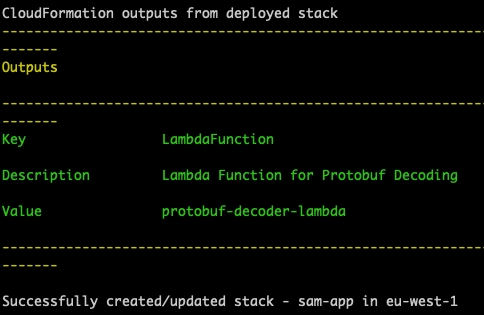
SAM output

The stack is complete when the message “Successfully created/updated stack”. If the stack fails, find the resources that failed to create and troubleshoot any issues.

Success message

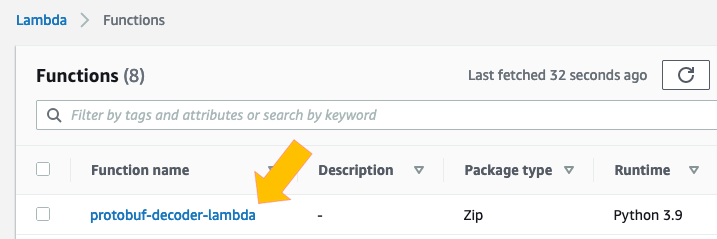
Testing the AWS SAM stack

  1. Once the AWS SAM stack is successfully deployed, navigate to the Lambda service and choose “protobuf-decoder-lambda”.
    Choose function
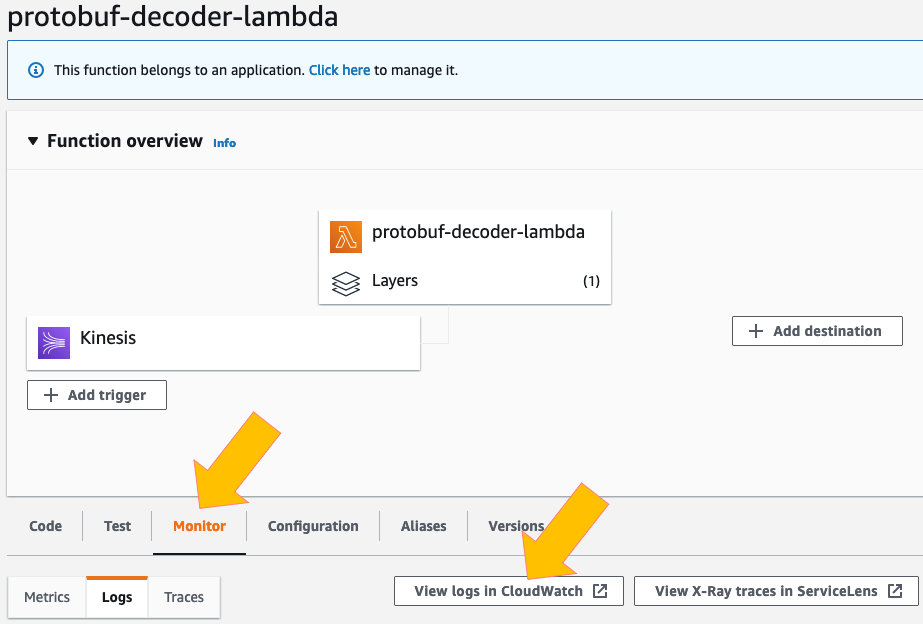
  2. Choose the “Monitoring” tab, then “View logs in CloudWatch”:
    View logs in CloudWatch
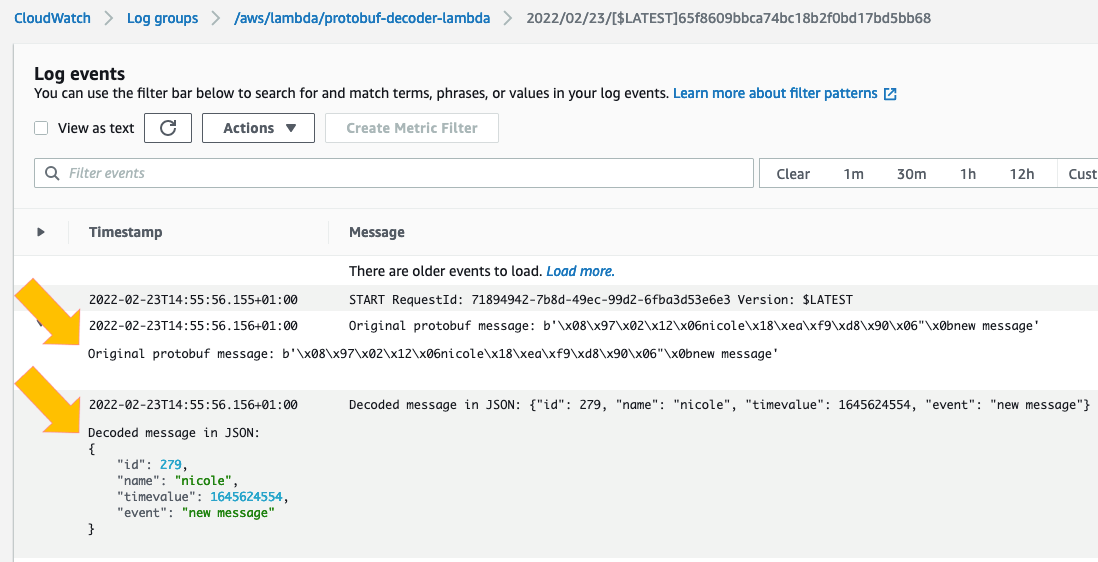
  3. Select the top Log stream from the list. The logs show for each message the original protobuf message and the decoded message:
    Log messages

Check that all the messages are stored correctly in JSON format in the S3 bucket:

  1. Navigate to the Amazon S3 console and find the destination bucket you specified in the AWS SAM template.
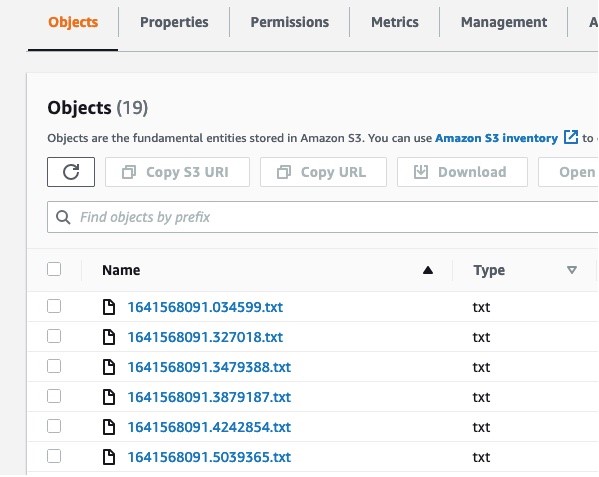
    S3 objects
  2. There are multiple files. Select one and choose Actions -> Query with S3 Select.
    Select multiple objects
  3. In the “Input settings” panel and “Output settings” panels, for the “Format” options, select the value JSON.
    JSON selection #1
  4. In the “SQL query” panel, using the default query, choose Run SQL Query. You can see that the content of the object in the S3 bucket is a JSON message.
    SQL query

Cleaning up

If you have generated any events, empty the S3 bucket before deleting the entire stack. If you do not, the data will not be deleted.

To delete the stack, use the AWS SAM CLI. Assuming the stack name is protodecoder, run:

sam delete --stack-name protodecoder

Conclusion

This post shows how to create a Lambda function to decode in real-time protobuf messages. You import the proto message definition in a development environment and compile it to generate the Python source code.

You create the Lambda layer for the protobuf decoding Lambda function, integrating the Python source code previously created with the protobuf libraries. Using AWS SAM, you create the Lambda function including the protobuf libraries.

If you want to dig deeper into Lambda functions, see What is AWS Lambda? To extend the Lambda function to interact with multiple AWS services, see the Boto3 documentation.

For more serverless learning resources, visit Serverless Land.

[$] When and why to deprecate filesystems

Post Syndicated from original https://lwn.net/Articles/886708/

It is a good bet that a significant amount of code in the kernel is
entirely unused. Even so, that code must still be maintained and shipped,
posing an ongoing cost to the development community. What should be done
with code that is unmaintained and, possibly, unused? Answering that
question requires understanding which users still exist, if any, and taking
a hard look at what the future support requirements for that code will be.
The kernel community has recently discussed this problem in the context of
filesystems, and the Reiserfs filesystem in particular, with a focus on the approaching 2038 deadline.

The “dirty pipe” vulnerability

Post Syndicated from original https://lwn.net/Articles/887056/

Max Kellermann has disclosed a disconcerting kernel vulnerability:

Two weeks ago, I found a vulnerability in the Linux kernel since
version 5.8 commit f6dd975583bd ("pipe: merge anon_pipe_buf*_ops") due
to uninitialized variables. It enables anybody to write arbitrary
data to arbitrary files, even if the file is O_RDONLY, immutable or on
a MS_RDONLY filesystem. It can be used to inject code into arbitrary
processes.

This vulnerability has been named “dirty pipe”; Kellermann has put up a web page describing it in
detail. Updates from distributors are already being released.

Security updates for Monday

Post Syndicated from original https://lwn.net/Articles/887055/

Security updates have been issued by Debian (chromium, containerd, cyrus-sasl2, expat, firefox-esr, freecad, kernel, and tiff), Fedora (seamonkey, swtpm, and webkit2gtk3), Mageia (docker-containerd, firefox, flac, libtiff, libxml2, and mc), openSUSE (containerd, expat, flatpak, gnutls, go1.16, go1.17, libeconf, shadow and util-linux, mariadb, nodejs14, perl-App-cpanminus, vim, wireshark, wpa_supplicant, and zsh), SUSE (containerd, expat, flatpak, gnutls, go1.16, go1.17, java-11-openjdk, kernel-firmware, libeconf, shadow and util-linux, libxml2, mariadb, nodejs14, python-Twisted, vim, wireshark, wpa_supplicant, and zsh), and Ubuntu (firefox, openjdk-lts, openjdk-17, and php8.0).

Cloudflare, CrowdStrike, and Ping Identity launch the Critical Infrastructure Defense Project

Post Syndicated from Matthew Prince original https://blog.cloudflare.com/announcing-critical-infrastructure-defense/

Cloudflare, CrowdStrike, and Ping Identity launch the Critical Infrastructure Defense Project

Cloudflare, CrowdStrike, and Ping Identity launch the Critical Infrastructure Defense Project

Today, in partnership with CrowdStrike and Ping Identity, Cloudflare is launching the Critical Infrastructure Defense Project (CriticalInfrastructureDefense.org). The Project was born out of conversations with cybersecurity and government experts concerned about potential retaliation to the sanctions that resulted from the Russian invasion of Ukraine.

In particular, there is a fear that critical United States infrastructure will be targeted with cyber attacks. While these attacks may target any industry, the experts we consulted with were particularly concerned about three areas that were often underprepared and could cause significant disruption: hospitals, energy, and water.

To help address that need, Cloudflare, CrowdStrike, and Ping Identity have committed under the Critical Infrastructure Defense Project to offer a broad suite of our products for free for at least the next four months to any United States-based hospital, or energy or water utility. You can learn more at: www.CriticalInfrastructureDefense.org.

We are not powerless against hackers. Organizations that have adopted a Zero Trust approach to security have been successful at mitigating even determined attacks. There are three core components to any Zero Trust security approach: 1) Network Security, 2) Endpoint Security; and 3) Identity.

Cloudflare, CrowdStrike, and Ping Identity launch the Critical Infrastructure Defense Project

Cloudflare, CrowdStrike, and Ping Identity are three of the leading Zero Trust security companies securing each of these components. Cloudflare’s Zero Trust network security offers a broad set of services that organizations can easily implement to ensure their connections are protected no matter where users access the network. CrowdStrike provides a broad set of end point security services to ensure that laptops, phones, and servers are not compromised. And Ping Identity provides identity solutions, including multi-factor authentication, that are foundational to any organization’s posture.

Each of us is great at what we do on our own. Together, we provide an integrated solution that is unrivaled and proven to stand up to even the most sophisticated nation state cyber attacks.

And this is what we think is required, because the current threat is significantly higher than what we have seen since any of our companies was founded. We all built our companies relying on the nation’s infrastructure, and we believe it is incumbent on us to provide our technology in order to protect that infrastructure when it is threatened. For this period of heightened risk, we are all providing our services at no cost to organizations in these most vulnerable sectors.

We’ve also worked together to ensure our products function in harmony and are easy to implement. We don’t want short-staffed IT teams, long requisition processes, or limited budgets to stand in the way of getting the protection that’s needed in place immediately. We’ve taken a cue from hospitals to triage the risks through a recommended list showing organizations that may be short of IT staff how they can proceed: suggesting what they should prioritize over the next day, over the next week, and over the next month.

You can download the recommended security triage program here. We know that not every organization will be able to implement every recommendation. But every step you get through on the list will help your organization be incrementally better prepared for whatever is to come.

Our teams are also committed to working directly with organizations in these sectors to make onboarding as quick and painless as possible. We will onboard customers under this project with the same level of service as if they were our largest paying customers. We believe it is our duty to help ensure that the nation’s critical infrastructure remains online and available through this challenging time.

We anticipate that, based on what we learn over the days ahead, the Critical Infrastructure Defense Project may expand to additional sectors and countries. We hope the predictions of retaliatory cyberattacks don’t come true. But, if they do, we know our solutions can mitigate the risk, and we stand ready to fully deploy them to protect our most critical infrastructure.

Cloudflare, CrowdStrike, and Ping Identity launch the Critical Infrastructure Defense Project

Hacking Alexa through Alexa’s Speech

Post Syndicated from Bruce Schneier original https://www.schneier.com/blog/archives/2022/03/hacking-alexa-through-alexas-speech.html

An Alexa can respond to voice commands it issues. This can be exploited:

The attack works by using the device’s speaker to issue voice commands. As long as the speech contains the device wake word (usually “Alexa” or “Echo”) followed by a permissible command, the Echo will carry it out, researchers from Royal Holloway University in London and Italy’s University of Catania found. Even when devices require verbal confirmation before executing sensitive commands, it’s trivial to bypass the measure by adding the word “yes” about six seconds after issuing the command. Attackers can also exploit what the researchers call the “FVV,” or full voice vulnerability, which allows Echos to make self-issued commands without temporarily reducing the device volume.

It does require proximate access, though, at least to set the attack up:

It requires only a few seconds of proximity to a vulnerable device while it’s turned on so an attacker can utter a voice command instructing it to pair with an attacker’s Bluetooth-enabled device. As long as the device remains within radio range of the Echo, the attacker will be able to issue commands.

Research paper.

Митрофанова, иди на х*й!

Post Syndicated from original https://bivol.bg/%D0%BC%D0%B8%D1%82%D1%80%D0%BE%D1%84%D0%B0%D0%BD%D0%BE%D0%B2%D0%B0-%D0%B8%D0%B4%D0%B8-%D0%BD%D0%B0-%D1%85%D0%B9.html

понеделник 7 март 2022


Започвам с уточнението, че хич не съм почитател на адв. Хаджигенов, но горещо одобрявам думите му в оняденшната му телевизионна изява, когато толкова силно обиди „деликатния“ „социолог“ Андрей Райчев, че той си излезе скандализиран…

Steps we’ve taken around Cloudflare’s services in Ukraine, Belarus, and Russia

Post Syndicated from Matthew Prince original https://blog.cloudflare.com/steps-taken-around-cloudflares-services-in-ukraine-belarus-and-russia/

Steps we've taken around Cloudflare's services in Ukraine, Belarus, and Russia

At Cloudflare, we’ve watched in horror the Russian invasion of Ukraine. As the possibility of war looked more likely, we began to carefully monitor the situation on the ground, with the goal of keeping our employees, our customers, and our network safe.

Helping protect Ukraine against cyberattacks

Attacks against the Internet in Ukraine began even before the start of the invasion. Those attacks—and the steady stream of DDoS attacks we’ve seen in the days since—prompted us to extend our services to Ukrainian government and telecom organizations at no cost in order to ensure they can continue to operate and deliver critical information to their citizens as well as to the rest of the world about what is happening to them.

Going beyond that, under Project Galileo, we are expediting onboarding of any Ukrainian entities for our full suite of protections. We are currently assisting more than sixty organizations in Ukraine and the region—with about 25% of those organizations coming aboard during the current crisis. Many of the new organizations are groups coming together to assist refugees, share vital information, or members of the Ukrainian diaspora in nearby countries looking to organize and help. Any Ukrainian organizations that are facing attack can apply for free protection under Project Galileo by visiting www.cloudflare.com/galileo, and we will expedite their review and approval.

Securing our customers’ data during the conflict

In order to preserve the integrity of customer data, we moved customer encryption key material out of our data centers in Ukraine, Russia, and Belarus. Our services continued to operate in the regions using our Keyless SSL technology, which allows encryption sessions to be terminated in a secure data center away from where there may be a risk of compromise.

If any of our facilities or servers in Ukraine, Belarus, or Russia lose power or connectivity to the Internet, we have configured them to brick themselves. All data on disk is encrypted with keys that are not stored on site. Bricked machines will not be able to be booted unless a secure, machine-specific key that is not stored on site is entered.

Monitoring Internet availability in Ukraine

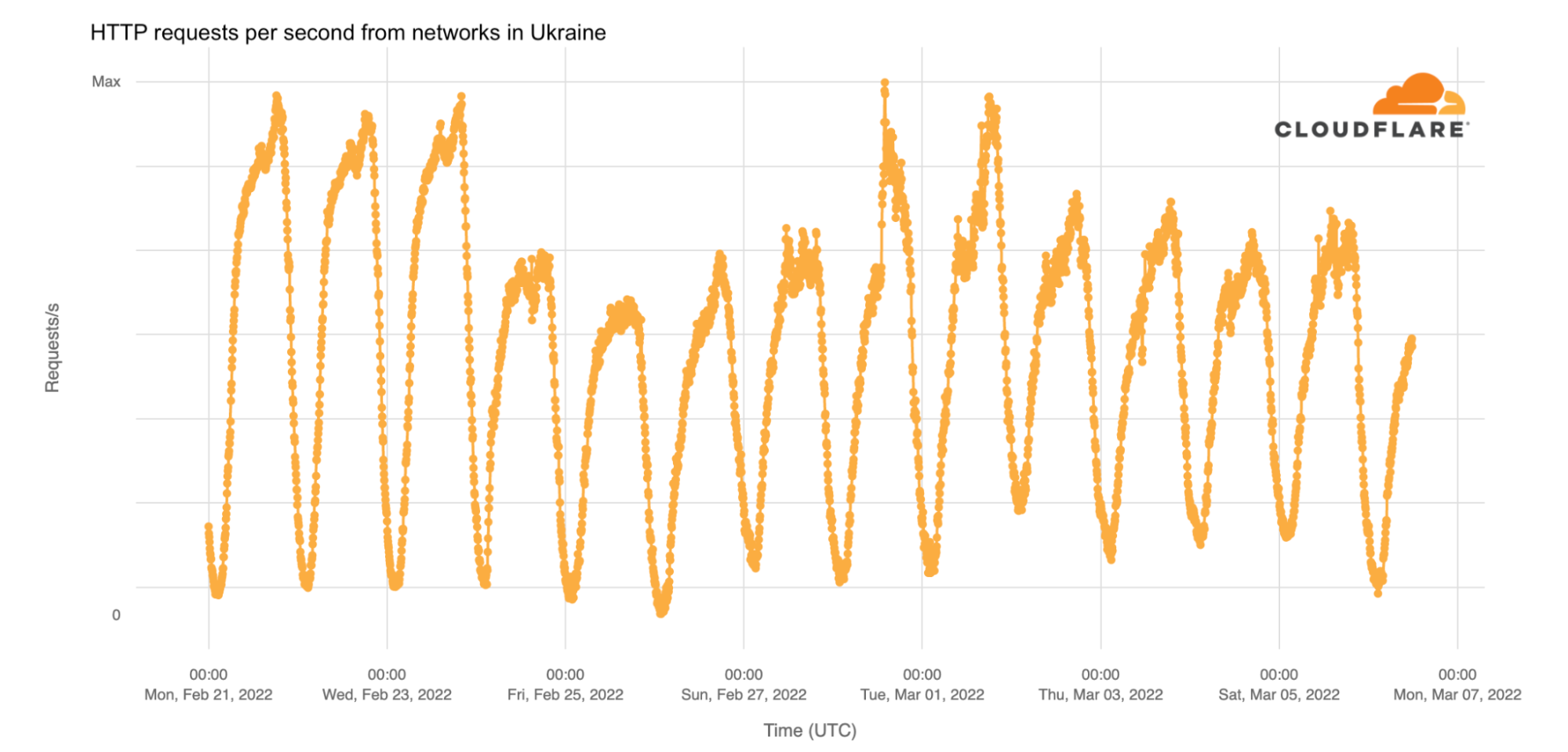
Our team continues to monitor Internet patterns across Ukraine. While usage across the country has declined over the last 10 days, we are thankful that in most locations the Internet is still accessible.

Steps we've taken around Cloudflare's services in Ukraine, Belarus, and Russia

We are taking steps to ensure that, as long as there is connectivity out of the country, our services will continue to operate.

Staying ahead of the threat globally

Cyber threats to Ukrainian customers and telecoms is only part of the broader story of potential cyberattacks. Governments around the world have emphasized that organizations must be prepared to respond to disruptive cyber activity. The US Cybersecurity and Infrastructure Security Agency (CISA), for example, has recommended that all organizations—large and small—go “Shields Up” to protect themselves from attack. The UK’s National Cyber Security Centre has encouraged organizations to improve their cyber resilience.

This is where careful monitoring of the attacks in Ukraine is so important. It doesn’t just help our customers in Ukraine — it helps us learn and improve our products so that we can protect all of our customers globally. When wiper malware was identified in Ukraine, for example, we adapted our Zero Trust products to make sure our customers were protected.

We’ve long believed that everyone should have access to cybersecurity tools to protect themselves, regardless of their size or resources. But during this time of heightened threat, access to cybersecurity services is particularly critical. We have a number of free services available to protect you online — and we encourage you to take advantage of them.

Providing services in Russia

Since the invasion, providing any services in Russia is understandably fraught. Governments have been united in imposing a stream of new sanctions and there have even been some calls to disconnect Russia from the global Internet. As discussed by ICANN, the Internet Society, the Electronic Frontier Foundation, and Techdirt, among others, the consequences of such a shutdown would be profound.

The scope of new sanctions issued in the last few weeks have been unprecedented in their reach, frequency, and the number of different governments involved. Governments have issued sweeping new sanctions designed to impose severe costs against those who supported the invasion of Ukraine, including government entities and officials in Russia and Belarus. Sanctions have been imposed against Russia’s top financial institutions, including Russia’s two largest banks, fundamentally altering the ability of Russians to access capital. The entire break away territories of Donetsk and Luhansk, including all of the residents of those regions, are subject to comprehensive sanctions. We’ve seen sanctions on state-owned enterprises, elite Russian families, and the leaders of intelligence-directed disinformation outlets.

These sanctions are intended to make sure that those who supported the invasion are held to account. And Cloudflare has taken action to comply. Over the past several years, Cloudflare has developed a robust and comprehensive sanctions compliance program that allows us to track and take immediate steps to comply with new sanctions regulations as they are implemented. In addition to an internal compliance team and outside counsel, we employ third party tools to flag potential matches or partial ownership by sanctioned parties, and we review reports from third-parties about potential connections. We have also worked with government experts inside and outside of the United States to identify when there is a connection between a sanctioned entity and a Cloudflare account.

Over the past week, our team has ensured that we are complying with these new sanctions as they are announced. We have closed off paid access to our network and systems in the new comprehensively-sanctioned regions. And we have terminated any customers we have identified as tied to sanctions, including those related to Russian financial institutions, Russian influence campaigns, and the Russian-affiliated Donetsk and Luhansk governments. We expect additional sanctions are likely to come from governments as they determine additional steps are appropriate, and we will continue to move quickly to comply with those requirements as they are announced.

Beyond this, we have received several calls to terminate all of Cloudflare’s services inside Russia. We have carefully considered these requests and discussed them with government and civil society experts. Our conclusion, in consultation with those experts, is that Russia needs more Internet access, not less.

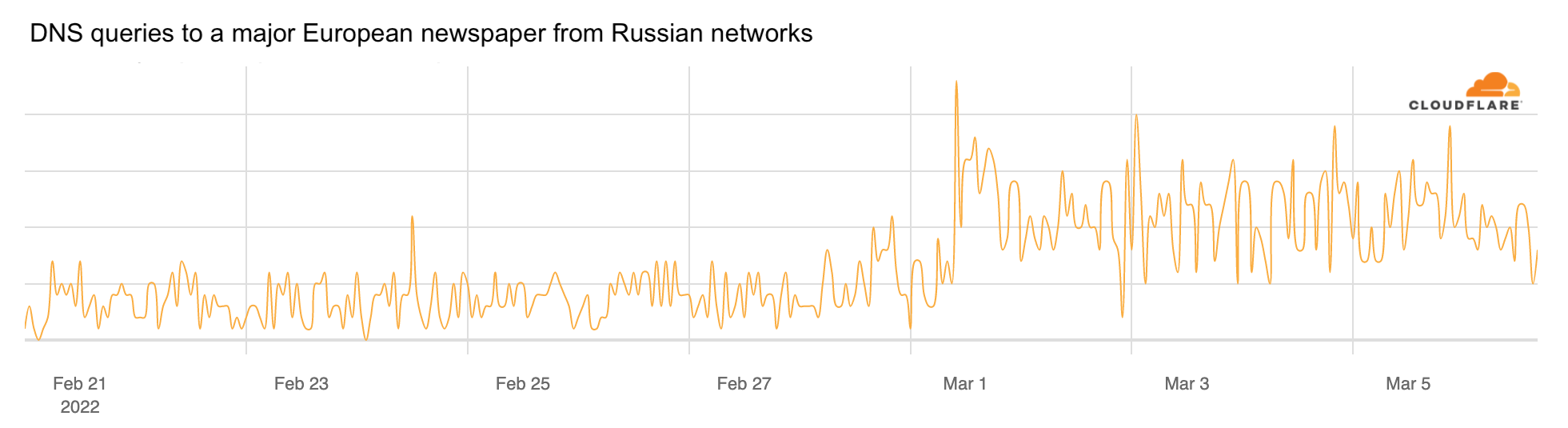
As the conflict has continued, we’ve seen a dramatic increase in requests from Russian networks to worldwide media, reflecting a desire by ordinary Russian citizens to see world news beyond that provided within Russia.

Steps we've taken around Cloudflare's services in Ukraine, Belarus, and Russia

We’ve also seen an increase in Russian blocking and throttling efforts, combined with Russian efforts to control the content of the media operating inside Russia with a new “fake news” law.

The Russian government itself, over the last several years, has threatened repeatedly to block certain Cloudflare services and customers. Indiscriminately terminating service would do little to harm the Russian government, but would both limit access to information outside the country, and make significantly more vulnerable those who have used us to shield themselves as they have criticized the government.

In fact, we believe the Russian government would celebrate us shutting down Cloudflare’s services in Russia. We absolutely appreciate the spirit of many Ukrainians making requests across the tech sector for companies to terminate services in Russia. However, when what Cloudflare is fundamentally providing is a more open, private, and secure Internet, we believe that shutting down Cloudflare’s services entirely in Russia would be a mistake.

Our thoughts are with the people of Ukraine and the entire team at Cloudflare prays for a peaceful resolution as soon as possible.

Украйна

Post Syndicated from Йовко Ламбрев original https://yovko.net/ukraine/

Украйна

Още когато Путин анексира Крим се погрижих да се дистанцирам от хора, които подкрепяха или омаловажаваха случващото се. Включително неколцина познати.

Вече повече от две години нямам Facebook и така светът изглежда малко по-нормален, макар че съм наясно, че не е. Но така не личи и мащаба на новата пропагандна война, която сигурен съм мурзилките отново ожесточено водят за съзнанията на по-колебливите и податливите на внушения. Затова е важно в ситуации като настоящата да не се мълчи. Защото тишината и мълчанието работят за агресора и неговите шапокляци.

Вместо да отдъхнем малко след пандемията и да се опитаме да си подредим държавиците, общностите и света си, заради комплексираното кремълско джудже с мека, увиснала пишка, сега отново всички сме настръхнали и несигурни за утрешния ден.

И понеже днес е Прошка… нека уточним, че прошка за убийци няма. Нито за тези, които се опитват да оправдават престъпленията им.

Дано Украйна удържи, а светът осъзнае, че Русия на Путин не може да бъде променена, превъзпитана или успокоена. Може да бъде само озаптена.

Украйна

Post Syndicated from Yovko Lambrev original https://yovko.net/ukraine/

Украйна

Още когато Путин анексира Крим се погрижих да се дистанцирам от хора, които подкрепяха или омаловажаваха случващото се. Включително неколцина познати.

Вече повече от две години нямам Facebook и така светът изглежда малко по-нормален, макар че съм наясно, че не е. Но така не личи и мащаба на новата пропагандна война, която сигурен съм мурзилките отново ожесточено водят за съзнанията на по-колебливите и податливите на внушения. Затова е важно в ситуации като настоящата да не се мълчи. Защото тишината и мълчанието работят за агресора и неговите шапокляци.

Вместо да отдъхнем малко след пандемията и да се опитаме да си подредим държавиците, общностите и света си, заради комплексираното кремълско джудже с мека, увиснала пишка, сега отново всички сме настръхнали и несигурни за утрешния ден.

И понеже днес е Прошка… нека уточним, че прошка за убийци няма. Нито за тези, които се опитват да оправдават престъпленията им.

Дано Украйна удържи, а светът осъзнае, че Русия на Путин не може да бъде променена, превъзпитана или успокоена. Може да бъде само озаптена.

Украйна

Post Syndicated from Yovko Lambrev original https://yovko.net/ukraine/

Украйна

Още когато Путин анексира Крим се погрижих да се дистанцирам от хора, които подкрепяха или омаловажаваха случващото се. Включително неколцина познати.

Вече повече от две години нямам Facebook и така светът изглежда малко по-нормален, макар че съм наясно, че не е. Но така не личи и мащаба на новата пропагандна война, която сигурен съм мурзилките отново ожесточено водят за съзнанията на по-колебливите и податливите на внушения. Затова е важно в ситуации като настоящата да не се мълчи. Защото тишината и мълчанието работят за агресора и неговите шапокляци.

Вместо да отдъхнем малко след пандемията и да се опитаме да си подредим държавиците, общностите и света си, заради комплексираното кремълско джудже с мека, увиснала пишка, сега отново всички сме настръхнали и несигурни за утрешния ден.

И понеже днес е Прошка… нека уточним, че прошка за убийци няма. Нито за тези, които се опитват да оправдават престъпленията им.

Дано Украйна удържи, а светът осъзнае, че Русия на Путин не може да бъде променена, превъзпитана или успокоена. Може да бъде само озаптена.

Украйна

Post Syndicated from Йовко Ламбрев original https://yovko.net/ukraine/

Украйна

Още когато Путин анексира Крим се погрижих да се дистанцирам от хора, които подкрепяха или омаловажаваха случващото се. Включително неколцина близки приятели.

Вече повече от две години нямам Facebook и така светът изглежда малко по-нормален, макар че съм наясно, че не е. Но така не личи и мащаба на новата пропагандна война, която сигурен съм мурзилките отново ожесточено водят за съзнанията на по-колебливите и податливите на внушения. Затова е важно в ситуации като настоящата да не се мълчи. Защото тишината и мълчанието работят за агресора и неговите шапокляци.

Вместо да отдъхнем малко след пандемията и да се опитаме да си подредим държавиците, общностите и света си, заради комплексираното кремълско джудже с мека, увиснала пишка, сега отново всички сме настръхнали и несигурни за утрешния ден.

И понеже днес е Прошка… нека уточним, че прошка за убийци няма. Нито за тези, които се опитват да оправдават престъпленията им.

Дано Украйна удържи, а светът осъзнае, че Русия на Путин не може да бъде променена, превъзпитана или успокоена. Може да бъде само озаптена.

Украйна

Post Syndicated from Йовко Ламбрев original https://yovko.net/ukraine/

Украйна

Още когато Путин анексира Крим се погрижих да се дистанцирам от хора, които подкрепяха или омаловажаваха случващото се. Включително неколцина близки приятели.

Вече повече от две години нямам Facebook и така светът изглежда малко по-нормален, макар че съм наясно, че не е. Но така не личи и мащаба на новата пропагандна война, която сигурен съм мурзилките отново ожесточено водят за съзнанията на по-колебливите и податливите на внушения. Затова е важно в ситуации като настоящата да не се мълчи. Защото тишината и мълчанието работят за агресора и неговите шапокляци.

Вместо да отдъхнем малко след пандемията и да се опитаме да си подредим държавиците, общностите и света си, заради комплексираното кремълско джудже с мека, увиснала пишка, сега отново всички сме настръхнали и несигурни за утрешния ден.

И понеже днес е прошка… нека уточним, че прошка за убийци няма. Нито за тези, които се опитват да оправдават престъпленията им.

Дано Украйна удържи, а светът осъзнае, че Русия на Путин не може да бъде променена, превъзпитана или успокоена. Може да бъде само озаптена.

The collective thoughts of the interwebz