This essay was written with Kasra Rafi, and originally appeared in The Guardian.
Earlier this month, about 40 top mathematicians gathered at OpenAI’s offices to discuss the future of their profession. The meeting was off-the-record, but if recentarticlesbymathematicians are any guide, it was mostly pretty glum. People fear for their jobs, their careers and the work they love.
We think the contraryview is more likely, at least in the short-term. AI models are nowhere near as capable as experienced academic mathematicians.
This isn’t to say that AIs aren’t producing stunning mathematical results at the level of PhD researchers. In mid-May, OpenAI announced that its frontier AI model disproved the unit distance conjecture, a famous 80-year-old problem in discrete geometry. In July, Anthropic’s published two AI-derived results in academic cryptanalysis. Earlier this month, OpenAI published 10 new mathematical results from its latest AI model. And Anthropic published Claude’s attempt to prove the century-and-a-half-old Riemann hypothesis.
These results are both a vivid demonstration of the amazing capabilities of frontier AI in 2026 and an illustration of their limitations. In general, these AI-powered advances in mathematics fall into one of two categories. Some are counterexamples to mathematical statements that people had been trying to prove. Others are novel applications of known techniques to existing problems that human experts either did not know or did not think of using.
The counterexample to the Jacobian conjecture is the most notable example of the first kind. Once it had been found, checking it was quick and straightforward. The difficult part was finding it among a large number of possibilities. The AI seems to have combined some sort of intuition acquired through machine learning with extensive computational search, in order to find the right example.
An example of the second kind is the unit-distance conjecture. It was motivated by an elegant construction, and most mathematicians expected it to be essentially optimal—so they generally tried to prove rather than disprove it. The counterexample brings in ideas from elsewhere in mathematics: algebraic number theory. If an expert with that background deliberately set out to find a counterexample, they would probably have succeeded. But there was no reason for someone with precisely that expertise to focus on this problem. Because of its scope, AIs don’t have those same limitations.
These results are relatively low-hanging fruit for AI; none of them required developing an extensive new theory. This does not make the discoveries trivial, or the AI’s achievements less impressive. Choosing the right direction, and recognizing an unexpected connection between subjects, are themselves forms of creativity. They are the same sorts of capabilities that led to AIs playing the game of Go at the grandmaster level, or doing Nobel-prize level chemistry in the area of protein folding.
What we have not yet seen is an AI developing a substantial new conceptual framework in order to solve a mathematical problem. Much of mathematics proceeds by identifying the objects that are truly central to a question and then developing a theory that helps us understand them. Current AIs are very strong at searching and recombining existing ideas, but they are weak at building any deep and sustained new theory.
This speaks to a more general limitation of current AI systems. They are creative in the sense that they can recombine existing ideas in novel ways. But they are not creative in others: they have not yet developed conceptually new theories or structures. And while they have larger working memories than humans do, know more about more different things than any particular human does, and can process information faster than humans, can, true novelty is still largely beyond their reach.
Of course, that distinction may not survive for very long. Predictions are notoriously hard, especially about the future of AI. None of these mathematical capabilities were explicitly designed for, or planned. They’re all emergent properties of increasingly capable AI models. We are both confident that someday we will see AI models that are capable of the type of creativity required to do novel mathematics. Will that be in a few months, a few years or a few decades? Of course we don’t know, but our guess is sooner rather than later.
At a time when many young people are using AI for personal and learning purposes, schools are trying to figure out what to teach about AI and how (find out more in this summer 2025 data about young people’s usage of AI in the UK). One aspect of this is how technical we should get in explaining how AI works, particularly if we want to debunk naive views of the capabilities of the technology, such as that AI tools ‘think’. In this month’s research seminar, we found out how AI contexts can be added to current classroom maths to make maths more interesting and relevant while teaching the core concepts of AI.
At our computing education research seminar in July, a group of researchers from the CAMMP (Computational and Mathematical Modeling Program) research project shared their work:
Prof. Dr. Martin Frank, Founder of CAMMP (Karlsruhe Institute of Technology (KIT), Germany).
Assistant Prof. Dr. Sarah Schönbrodt (University of Salzburg, Austria)
Research Associate Stephan Kindler (Karlsruhe Institute of Technology (KIT), Germany)
They talked about how maths already taught in secondary schools can be used to demystify AI. At first glance, this seems difficult to do, as it is often assumed that school-aged learners will not be able to understand how these systems work. This is especially the case for artificial neural networks, which are usually seen as a black box technology — they may be relatively easy to use, but it’s not as easy to understand how they work. Despite this, the Austrian and German team have developed a clear way to explain some of the fundamental elements of AI using school-based maths.
Sarah Schönbrodt started by challenging us to consider that learning maths is an essential part in developing AI skills, as:
AI systems using machine learning are data-driven and are based on mathematics, especially statistics and data
Authentic machine learning techniques can be used to bring to life existing classroom maths concepts
Real and relevant problems and associated data are available for teachers to use
A set of workshops for secondary maths classrooms
Sarah explained how the CAMMP team have developed a range of teaching and learning materials on AI (and beyond) with an overall goal to “allow students to solve authentic, real and relevant problems using mathematical modeling and computers”.
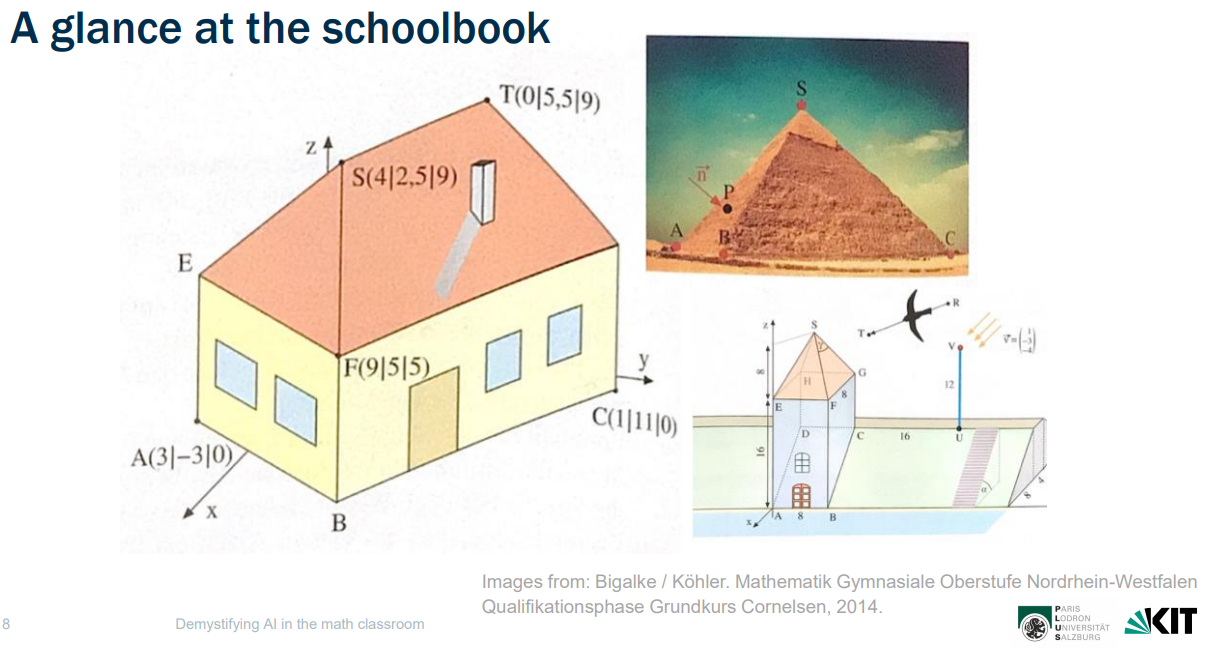
She reflected that much of school maths is set in contexts that are abstract, and may not be very interesting or relevant to students. Therefore, introducing AI-based contexts, which are having a huge impact on society and students’ lives, is both an opportunity to make maths more engaging and also a way to demystify AI.
Old-fashioned contexts are often used to teach classroom maths concepts. Those same concepts could be taught using real-world AI contexts. (Slide from the researchers’ presentation.)
Workshops designed and researched by the team include contexts such as privacy in social networks to learn about decision trees, personalised Netflix recommendations to learn about k-nearest neighbour, word predictions to learn about N-Grams, and predicting life expectancy to learn about regression and neural networks.
Learning about classification models: traffic lights and the support vector machine
For the seminar, Sarah walked through the steps to learn about support vector machines. This is an upper secondary workshop for students aged 17 to 18 years old. The context of the lesson is an image problem — specifically, classifying the data representing the colours of a simplified traffic light system (two lights to start with) to work out if a traffic light is red or green.
She walked through each of the steps of the maths workshop:
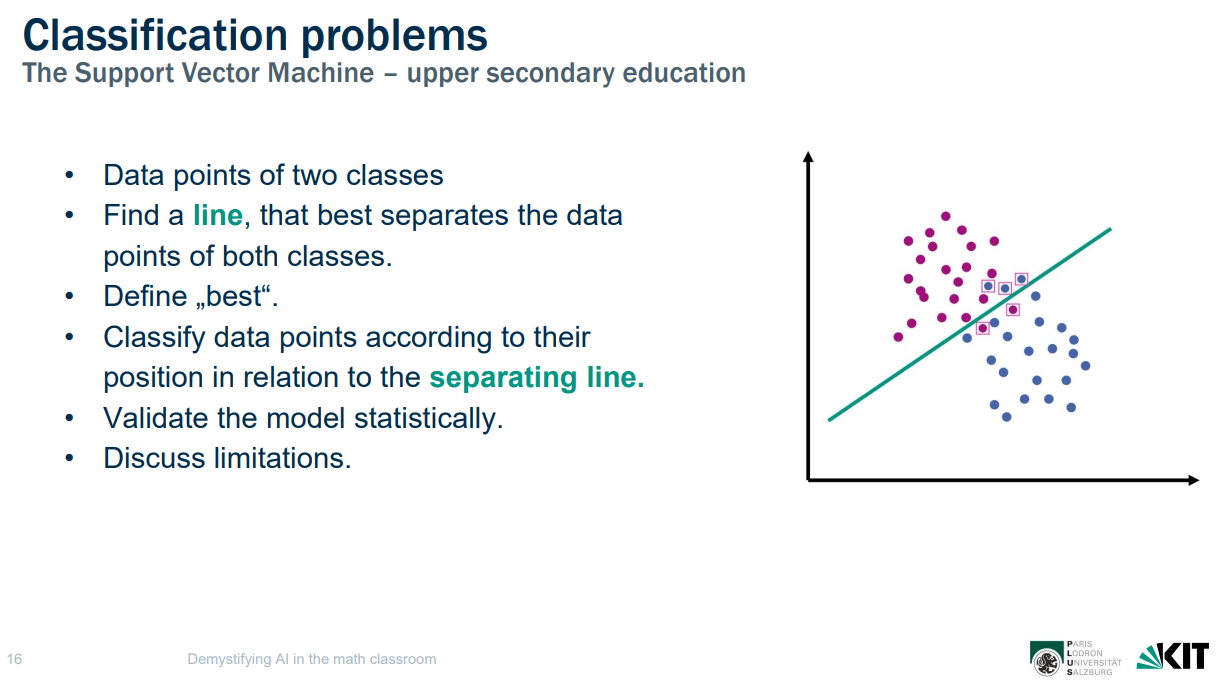
Plotting data points of two classes, the representation of green and red traffic lights
Finding a line that best separates the data points of both classes
Figuring out what best is
Classifying the data points in relation to the chosen (separating) line
Validating the model statistically to see if it is useful in classifying new data points, including using test data and creating a contingency table (also called a confusion matrix)
Discussing limitations, including social and ethical issues
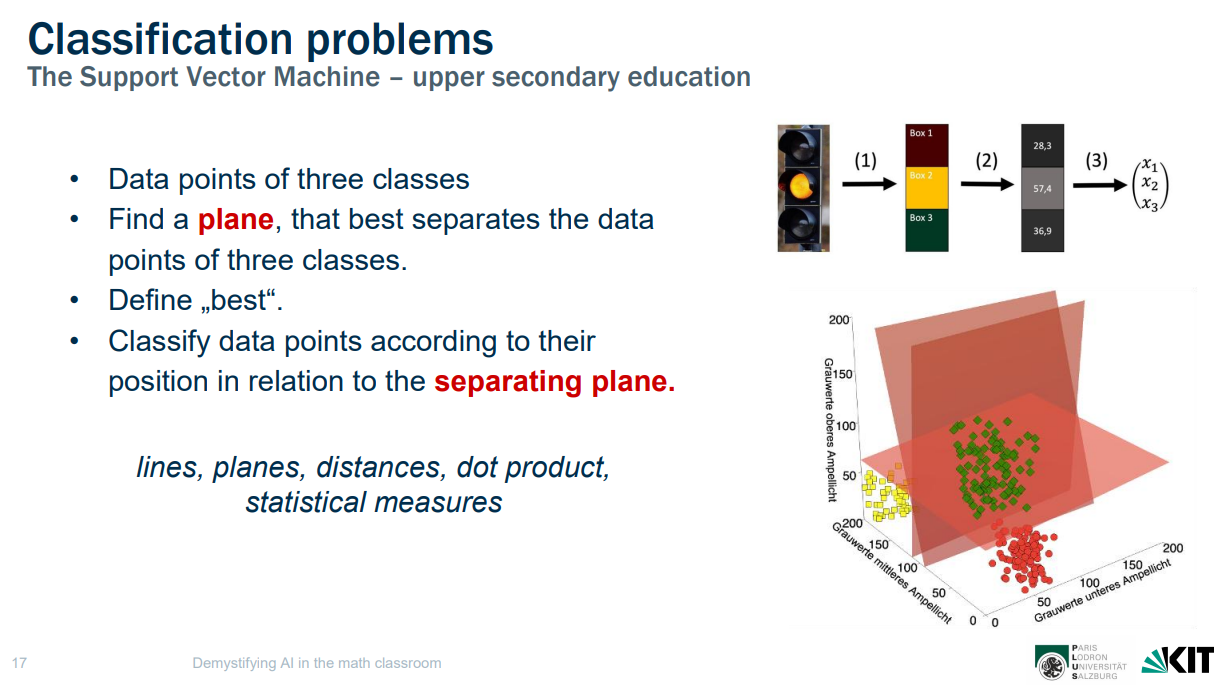
Explaining how three traffic lights can be expressed as three-dimensional data by using planes
By classifying green and red traffic light data, students are learning about lines, classifying data, and considering limitations. (Slide from the researchers’ presentation.)
Throughout the presentation, Sarah pointed out where the maths taught was linked to the Austrian and German mathematics curriculum.
Learning about planes, separating planes, and starting to see how data can be represented in vectors. (Slide from the researchers’ presentation.)
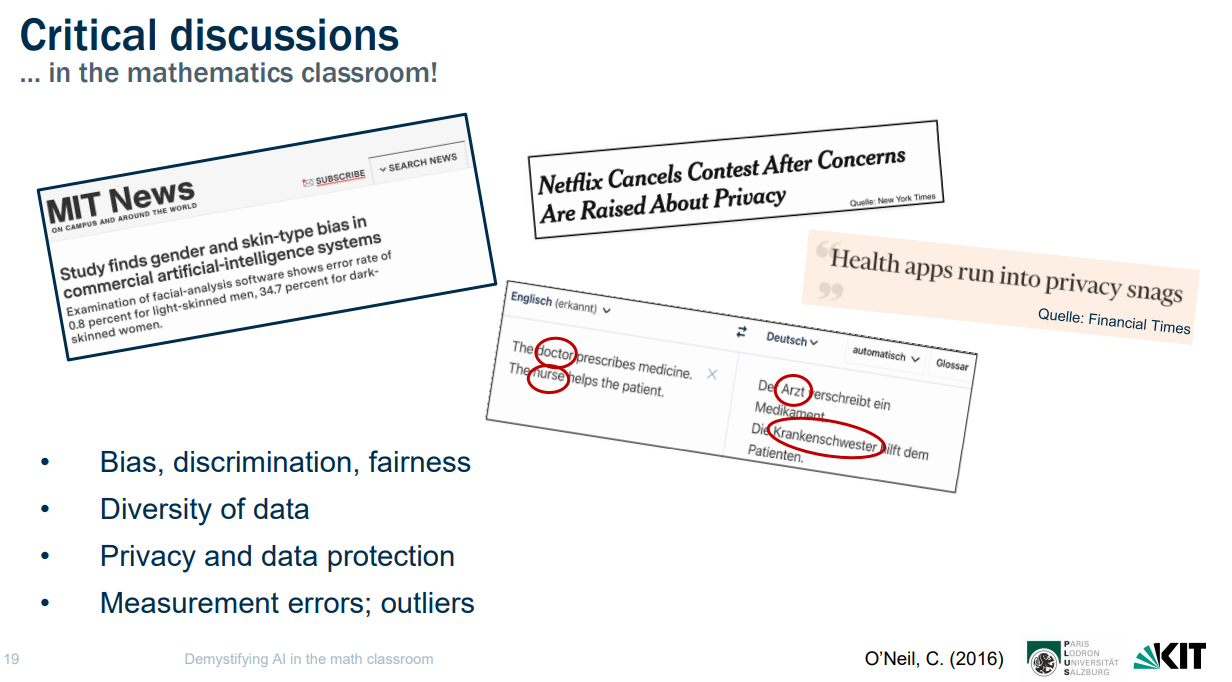
Learning about social and ethical issues
Learning about the social and ethical issues in data-driven systems. (Slide from the researchers’ presentation.)
As well as learning about lines, planes, distances, dot product and statistical measures, learners are also engaged in discussing the social and ethical issues of the approach taken. They are encouraged to think about bias, data diversity, privacy, and the impact of errors on people. For example, if the model wrongly predicts a light as green when it is red, then an autonomous car would run through a red traffic light. This would likely be a bigger consequence than stopping at a green traffic light that was mis-predicted as red. So should the best line reduce this kind of error?
To teach the workshops, Sarah explained they have developed interactive Jupyter notebooks, where no programming skills are needed. Students fill in the gaps of example code, explore simulations, and write their ideas for discussion for the whole class. No software needs to be installed, feedback is direct, and there are in-depth tasks and staggered hints.
Learning about regression models: Weather forecasting and the toy artificial neural network
Stephan went on to introduce artificial neural networks (ANNs), which are the basis of generative AI applications like chatbots and image generation systems. He focused on regression models, such as those used in weather forecasting.
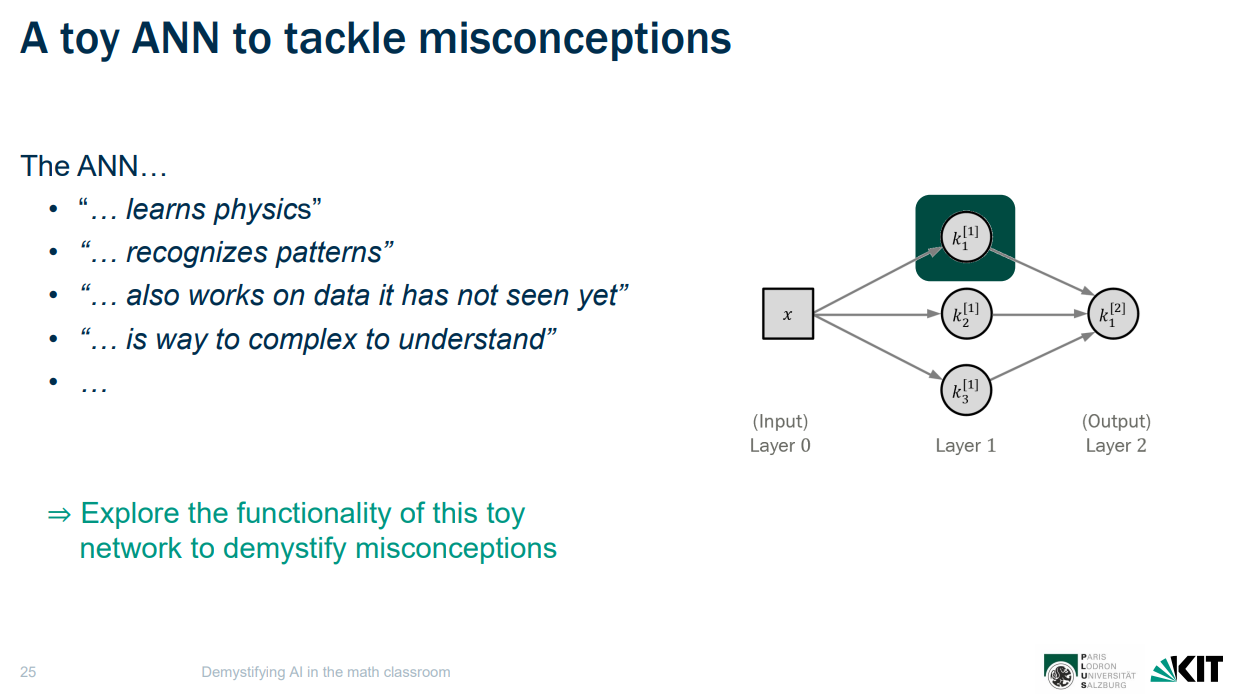
ANNs are very complex. Therefore, to start to understand the fundamentals of this technology, he introduced a ‘toy ANN’ with one input, three nodes, and one output. A function is performed on the input data at each node. With the toy network, the team wants to tackle a major and common misconception: that students think that ANN systems learn, recognise, see, and understand, when really it’s all just maths.
Tackling misconceptions about ANNs by exploring how they work in a toy version. (Slide from the researchers’ presentation.)
The learning activity starts by looking at one node with one input and one output, and can be described as a mathematical function, with a concatenation of two functions (in this case a linear and activation function). Stephan shared an online simulator that visualises how the toy neural network can be explored as students change two parameters (in this case, weight and bias of the functions). Students then look at the overall network, and the way that the output from the three nodes is combined. Again, they can explore this in the simulator. Students compare simple data about weather prediction to the model, and discover they need more functions — more nodes to better fit the data. The activity helps students learn that ANN systems are just highly adjustable mathematical functions that, by adding nodes, can approximate relationships in a given data set. But the approximation only works in the bounds (intervals) in which data points are given, showing that ANNs do not ‘understand’ or ’know’ — it’s just maths.
Stephen finished by explaining the mutual benefits of AI education and maths education. He suggested maths will enable a deeper understanding of AI, and give students a way to realistically assess the opportunities and risks of AI tools and show them the role that humans have in designing AI systems. He also explained that classroom maths education can benefit from incorporating AI contexts. This approach highlights how maths underpins the design and understanding of everyday systems, supports more effective teaching, and promotes an interdisciplinary way of learning across subjects.
Some personal reflections — which may not be quite right!
I have been researching the teaching of AI and machine learning for around five years now, since before ChatGPT and other similar tools burst on the scene. Since then, I have seen an increasing number of resources to teach about the social and ethical issues of the topic, and there are a bewildering number of learning activities and tools for students to train simple models. There are frameworks for the data lifecycle, and an emerging set of activities to follow to prepare data, compare model types, and deploy simple applications. However, I felt the need to understand and to teach about, at a very simple level, the basic building blocks of data-driven technologies. When I heard the CAMMP team present their work at the AIDEA conference in February 2025, I was entirely amazed and I asked them to present here at our research seminar series. This was a piece of the puzzle that I had been searching for — a way to explain the ‘bottom of the technical stack of fundamental concepts’. The team is taking very complex ideas and reducing them to such an extent that we can use secondary classroom maths to show that AI is not magic and AI systems do not think. It’s just maths. The maths is still hard, and teachers will still need the skills to carefully guide students step by step so they can build a useful mental model.
I think we can simplify these ideas further, and create unplugged activities, simulations, and ways for students to explore these basic building blocks of data representation, as well as classification and representing approximations of complex patterns and prediction. I can sense the beginnings of new ideas in computational thinking, though they’re still taking shape. We’re researching these further and will keep you updated.
Finding out more
If you would like to find out more about the CAMMP resources, you can watch the seminar recording, look at the CAMMP website or try out their online materials. For example, the team shared a link to the jupyter notebooks they use to teach the workshops they demonstrated (and others). You can use these with a username of ‘cammp_YOURPSEUDONYM’, where you can set ‘YOURPSEUDONYM’ to any letters, and you can choose any password. They also shared their toy ANN simulation. The CAMMP team are not the only researchers who are investigating how to teach about AI in maths lessons. You can find a set of other research papers here.
Join our next seminar
In our current seminar series, we’re exploring teaching about AI and data science. Join us at our last seminar of the series on Tuesday, 27 January 2026 from 17:00 to 18:30 GMT to hear Salomey Afua Addo talk about using unplugged approaches to teach about neural networks.
To sign up and take part, click the button below. We’ll then send you information about joining. We hope to see you there.
Weirdly, this is the second time the NSA has declassified the document. John Young got a copy in 2019. This one has a few less redactions. And nothing that was provided in 2019 was redacted here.
If you find anything interesting in the document, please tell us about it in the comments.
Really interesting research into the structure of prime numbers. Not immediately related to the cryptanalysis of prime-number-based public-key algorithms, but every little bit matters.
In our first seminar of 2023, we were delighted to welcome Dr Katie Rich and Carla Strickland. They spoke to us about teaching the programming construct of variables in Grade 3 and 4 (age 8 to 10).
Dr Katie RichCarla Strickland
We are hearing from a diverse range of speakers in our current series of monthly online research seminars focused on primary (K-5) computing education. Many of them work closely with educators to translate research findings into classroom practice to make sure that all our younger learners have positive first experiences of learning computing. An important goal of their research is to impact the development of pedagogy, resources, and professional development to support educators to deliver computing concepts with confidence.
Variables in computing and mathematics
Dr Katie Rich (American Institutes of Research) and Carla Strickland (UChicago STEM Education) are both part of a team that worked on a research project called Everyday Computing, which aims to integrate computational thinking into primary mathematics lessons. A key part of the Everyday Computing project was to develop coherent learning resources across a number of school years. During the seminar, Katie and Carla presented on a study in the project that revolved around teaching variables in Grade 3 and 4 (age 8 to 10) by linking this computing concept to mathematical concepts such as area, perimeter, and fractions.
Variables are used in both mathematics and computing, but in significantly different ways. In mathematics, a variable, often represented by a single letter such as x or y, corresponds to a quantity that stays the same for a given problem. However, in computing, a variable is an identifier used to label data that may change as a computer program is executed. A variable is one of the programming constructs that can be used to generalise programs to make them work for a range of inputs. Katie highlighted that the research team was keen to explore the synergies and tensions that arise when curriculum subjects share terms, as is the case for ‘variable’.
Defining a learning trajectory
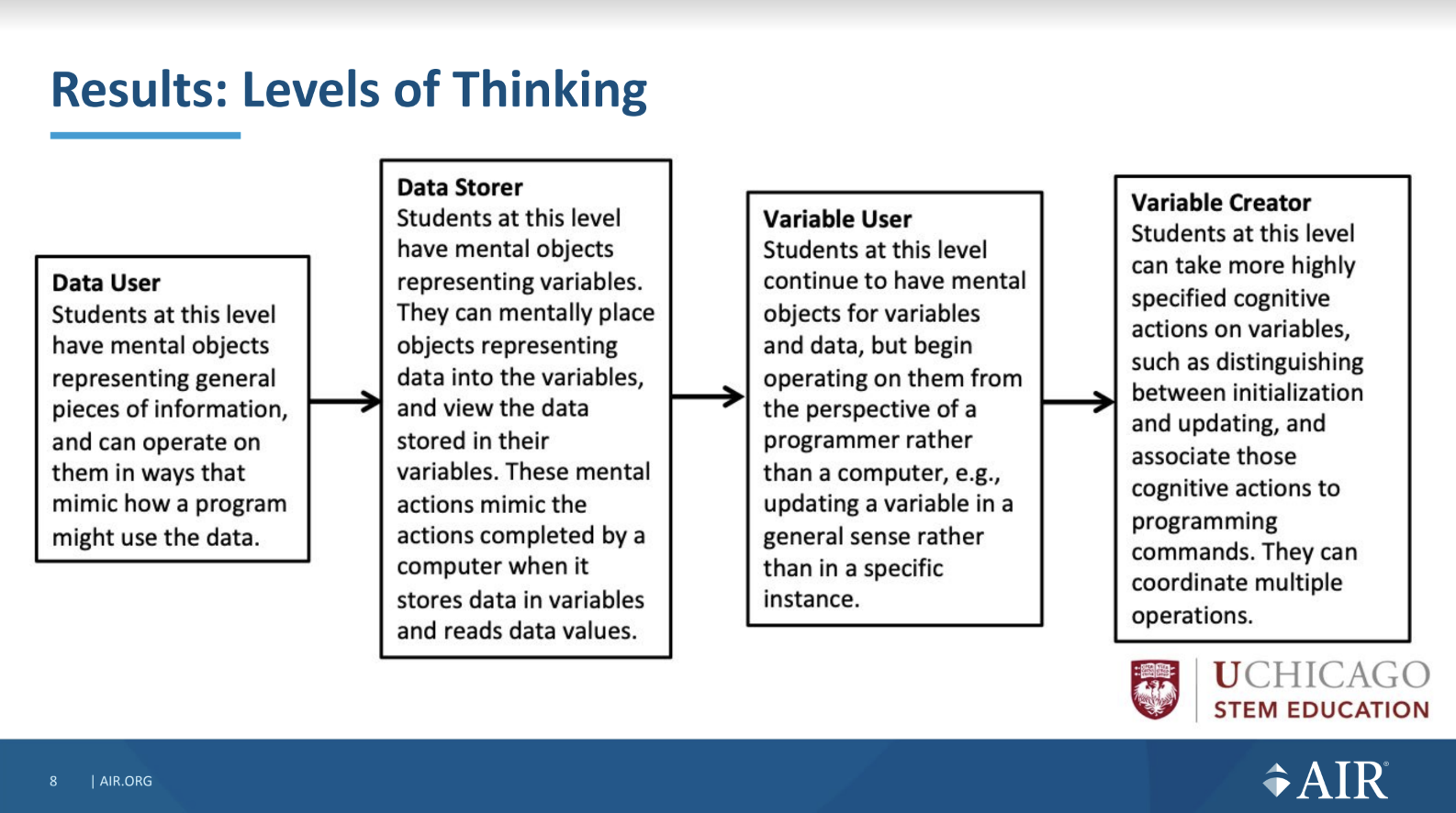
At the start of the project, in order to be able to develop coherent learning resources across school years, the team reviewed research papers related to teaching the programming construct of variables. In the papers, they found a variety of learning goals that related to facts (what learners need to know) and skills (what learners need to be able to do). They grouped these learning goals and arranged the groups into ‘levels of thinking’, which were then mapped onto a learning trajectory to show progression pathways for learning.
Four of the five levels of thinking identified in the study: Data Storer, Data User, Variable User, Variable Creator. Click to enlarge.
Learning materials about variables
Carla then shared three practical examples of learning resources their research team created that integrated the programming construct of variables into a maths curriculum. The three activities, described below, form part of a series of lessons called Action Fractions. You can read more about the series of lessons in this research paper.
Robot Boxesis an unpluggedactivity that is positioned at the Data User level of thinking. It relates to creating instructions for a fictional robot. Learners have to pay attention to different data the robot needs in order to draw a box, such as the length and width, and also to the value that the robot calculates as area of the box. The lesson uses boxes on paper as concrete representations of variables to which learners can physically add values.
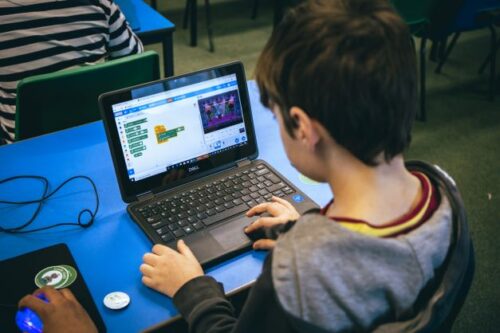
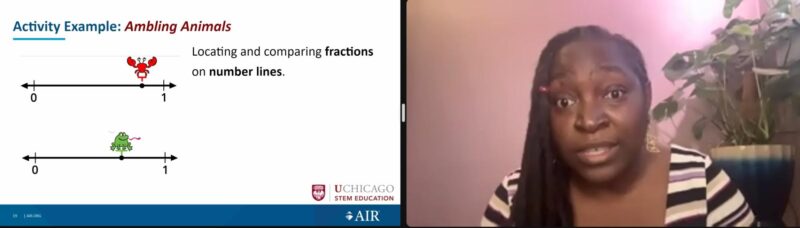
Ambling Animals is set at the ‘Data Storer’ and ‘Variable Interpreter’ levels of thinking. It includes a Scratch project to help students to locate and compare fractions on number lines. During this lesson, find a variable that holds the value of the animal that represents the larger of two fractions.
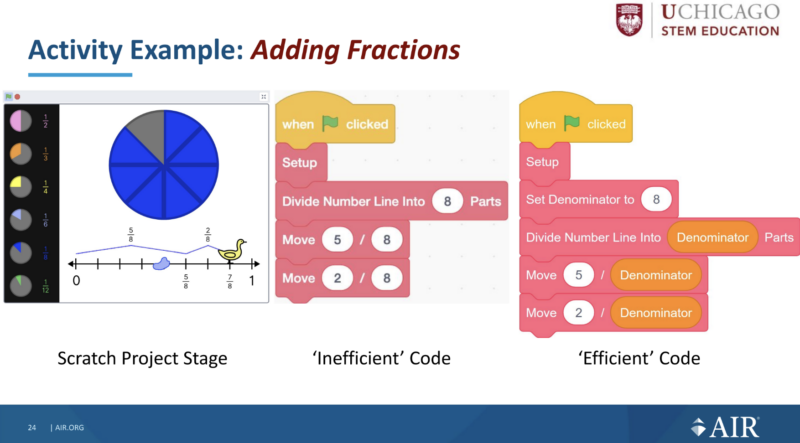
Adding Fractions draws on facts and skills from the ‘Variable Interpreter’ and ‘Variable Implementer’ levels of thinking and also includes a Scratch project. The Scratch project visualises adding fractions with the same denominator on a number line. The lesson starts to explain why variables are so important in computer programs by demonstrating how using a variable can make code more efficient.
Takeaways: Cross-curricular teaching, collaborative research
Teaching about the programming construct of variables can be challenging, as it requires young learners to understand abstract ideas. The research Katie and Carla presented shows how integrating these concepts into a mathematics curriculum is one way to highlight tangible uses of variables in everyday problems. The levels of thinking in the learning trajectory provide a structure helping teachers to support learners to develop their understanding and skills; the same levels of thinking could be used to introduce variables in other contexts and curricula.
Many primary teachers use cross-curricular learning to increase children’s engagement and highlight real-world examples. The seminar showed how important it is for teachers to pay attention to terms used across subjects, such as the word ‘variable’, and to explicitly explain a term’s different meanings. Katie and Carla shared a practical example of this when they suggested that computing teachers need to do more to stress the difference between equations such as xy = 45 in maths and assignment statements such as length = 45 in computing.
The Everyday Computing project resources were created by a team of researchers and educators who worked together to translate research findings into curriculum materials. This type of collaboration can be really valuable in driving a research agenda to directly improve learning outcomes for young people in classrooms.
How can this research influence your classroom practice or other activities as an educator? Let us know your thoughts in the comments. We’ll be continuing to reflect on this question throughout the seminar series.
You can watch Katie’s and Carla’s full presentation here:
Join our seminar series on primary computing education
We continue on Tuesday 7 February at 17.00 UK time, when we will hear from Dr Jean Salac, University of Washington. Jean will present her work in identifying inequities in elementary computing instruction and in developing a learning strategy, TIPP&SEE, to address these inequities. Sign up now, and we will send you a joining link for the session.
To provide the best experiences, we use technologies like cookies to store and/or access device information. Consenting to these technologies will allow us to process data such as browsing behavior or unique IDs on this site. Not consenting or withdrawing consent, may adversely affect certain features and functions.
Functional
Always active
The technical storage or access is strictly necessary for the legitimate purpose of enabling the use of a specific service explicitly requested by the subscriber or user, or for the sole purpose of carrying out the transmission of a communication over an electronic communications network.
Preferences
The technical storage or access is necessary for the legitimate purpose of storing preferences that are not requested by the subscriber or user.
Statistics
The technical storage or access that is used exclusively for statistical purposes.The technical storage or access that is used exclusively for anonymous statistical purposes. Without a subpoena, voluntary compliance on the part of your Internet Service Provider, or additional records from a third party, information stored or retrieved for this purpose alone cannot usually be used to identify you.
Marketing
The technical storage or access is required to create user profiles to send advertising, or to track the user on a website or across several websites for similar marketing purposes.