We’ve all been in a situation in which Zabbix was somehow unavailable. It can happen for a variety of reasons, and our goal is always to help you get everything back up and running as quickly as possible. In this blog post, we’ll show you what to do in the event of a Zabbix failure, and we’ll also go into detail about how to work with the Zabbix technical support team to resolve more complex issues.
Step by step: Understanding why Zabbix is unavailable
When Zabbix becomes unavailable, it’s important to follow a few key steps to try to resolve the problem as quickly as possible.
Check the service status. First, verify if your Zabbix service is truly inactive. You can do this by accessing the machine where Zabbix is installed and checking the service status using a command like systemctl status zabbix-serveron Linux.
Analyze the Zabbix logs. Check the Zabbix logs for any error messages or clues about what may have caused the failure.
Restart the service. If the Zabbix service has stopped, try restarting it using the appropriate command for your operating system. For example, on Linux, you can use sudo systemctl restart zabbix-server.
Check the database connectivity. Zabbix uses a database to store data and Zabbix server configurations. Make sure that the database is accessible and functioning properly. You can test database connectivity using tools like ping or telnet.
Check your available disk space. Verify that there is available disk space on the machine where Zabbix is installed. A lack of disk space is a common cause of system failures.
Evaluate dependencies. Make sure all Zabbix dependencies are installed and working correctly. This includes libraries, services, and any other software required for Zabbix to function.
If the problem persists after carrying out these steps, it may be necessary to refer to the official Zabbix documentation, seek help from the official Zabbix forum, or contact the Zabbix technical support team, depending on the severity and urgency of the situation.
Making the most of a Zabbix technical support contract
If you or your company have a Zabbix technical support contract, access to our global team of technical experts is guaranteed. This is an ideal option for resolving more complex or urgent issues. Here are a few steps you can follow when contacting the Zabbix technical support team:
Gather all important information. Before contacting the Zabbix technical support team, gather all relevant information about the issue you’re facing. This can include error messages, logs, screenshots, and any steps you’ve already taken to try to resolve the issue.
Open a ticket with the Zabbix technical support team. Contact Zabbix technical support by opening a ticket on the Zabbix Support System. Provide all the information gathered in the previous step to help the technicians understand the problem and find a solution as quickly as possible.
Explain exactly how Zabbix crashed. When describing the problem, be as precise and detailed as possible. Include information such as the Zabbix version you are using, your operating system, your network configuration, and any other relevant details that might help our team diagnose the issue.
Be available to follow up on the ticket. Once you’ve opened a ticket, be available to provide additional information or clarify any questions the support technicians may have. This will help speed up the problem resolution process.
Follow the Zabbix technical support team’s recommendations. After receiving recommendations, follow them carefully and test to see whether they resolve the issue. If the problem persists or if new issues arise, inform the Zabbix technical support team immediately so they can continue assisting you.
A Zabbix technical support subscription gives you access to a team of Zabbix experts who can help you configure and troubleshoot your Zabbix environment. Check out the benefits of each type of subscription on the Zabbix website and make sure you have all the support you need to keep your monitoring fully operational.
QU!CK Scan & Go, a startup specializing in self-service markets, required a monitoring system that could allow a comprehensive view of operations. Read on to see how Zabbix provided them with a solution that positively impacted their operations as well as their finances.
The convenience of having access to an establishment supplying staple foods around the clock is the motivating factor behind the rise of QU!CK Scan & Go. Since 2021, QU!CK Scan & Go has been developing self-service mini market systems, available in residential complexes and corporate buildings.
Available 24 hours a day, 7 days a week, the technology developed by QU!CK Scan & Go allows markets to be open at all times, with 100% self-service. Customers select the products they want, confirm the price by scanning a barcode, and complete the purchase in their own app with a credit card or virtual wallet.
QU!CK Scan & Go was the first company in the self-service market segment to operate in Argentina. As of this writing, they have 25 self-service stores located in Argentina and 2 in the United States.
The challenge
With the rapid growth in their business, QU!CK Scan & Go needed to be able to easily visualize operations in order to handle environmental issues and avoid product loss due to external factors. In the event of a power outage, for instance, refrigerators and freezers will fail to function, a problem that may take considerable time and effort to fix.
This scenario isn’t an abstract hypothetical – power outages are a recurring issue in Argentina. In 2021 and 2022, the average length of a power outage was 5 hours. For freezers storing products such as ice cream, frozen processed foods, and other perishable items, that’s more than enough time for the products to thaw and become unusable, resulting in severe financial losses.
The solution
QU!CK Scan & Go’s search for a solution led them to Zabbix by way of CTL Information Technology, a Zabbix Certified Partner in Argentina. Juan Guido Camaño, CEO of CTL, immediately grasped the fact that Zabbix provided the perfect solution for what QU!CK Scan & Go needed to monitor.
“Zabbix was our first, second and third choice, due to our extensive experience with the tool. We did not believe that there would be any better alternative.”
– Juan Guido Camaño, CEO of CTL
At the beginning of the implementation project, CTL identified all possible variables necessary for monitoring that should generate alarms in the case of an extraordinary event. These included:
Power outages
Internet connection status
Opened doors
Ambient and air conditioning temperatures
Refrigerator and freezer temperatures
In 2021 and 2022, the team at CTL carried out the proof of concept and the implementation of the tool in the first self-service markets, following a stage-by-stage plan.
First, they had to configure the Zabbix Agent on the monitoring device. After that, we created a standard monitoring model to be used in all establishments, according to data collection and alarm triggering needs. The alarms were subsequently adjusted, with possible responses implemented according to each variable identified. At that point, data visualization was organized in an external system just for reviewing the integrated dashboards.
Thanks to the implementation of IoT devices to control the temperature and the opening and closing of doors, alerts are sent to Zabbix in the event of unusual activity, such as very high or low temperatures, doors opened without supervision, and refrigerator doors open longer than the stipulated time, among other issues.
The results
Since the implementation of Zabbix project in QU!CK Scan & Go’s self-service markets, a variety of benefits have been apparent, including:
Increased control of self-service establishments
Faster resolution of incidents
Improved visualization of operations
Increased availability of services
However, the biggest returns on investment were observed at the financial level. With power outage monitoring and quick corrective actions, losses of perishable products have decreased by 75%.
“Losses of refrigerated products ceased to be an issue due to constant monitoring and immediate alerts in case of incidents during power outages.” – Juan Guido Camaño, CEO of CTL
Additionally, with real-time visualization of operations and business monitoring, the profitability of refrigerated products during power outage incidents has increased by 100%. Currently, QU!CK Scan & Go is the leading company in the self-service market segment in Argentina in terms of turnover, with a rapidly increased brand value.
“In a 100% self-service business model, investments made in incident identification technologies have a direct impact on the company’s results.” – Marcos Acuña, QU!CK Scan & Go
What’s next
While successful, the Zabbix project carried out by CTL and QU!CK Scan & Go is far from finished. The implementation of Zabbix in the company is accelerating at the same rate that new establishments are opened, and the proposal is to continue expanding this monitoring project by completely migrating data visualization to Zabbix.
“Having already managed to ensure the availability of the services associated with QU!CK operations, we are now focusing on the continuous infrastructure optimization.” – Juan Guido Camaño, CEO of CTL
For QU!CK Scan & Go, Zabbix has become much more than an IT infrastructure monitoring provider. Our solutions have improved their business and brought added value to their brand.
“With Zabbix, the return on investment after opening a new location is achieved 50% faster than it used to be.” – Marcos Acuña, Founder of QU!CK Scan & Go
Our goal of promoting seamless services to the technology market together with our partners is most visible in situations like this one, when we’re able to go beyond basic monitoring and position Zabbix as a vital support service for strategic decision making. To find out more about what Zabbix can do for customers in the retail sector, visit us here.
Artificial intelligence (AI) and data monitoring are working together to digitally transform relationships, businesses, and people. In telecommunications, predictive analysis based on data collection plays a crucial role in development. Starting with version 6.0 of Zabbix, users have benefited from updates in predictive functions and machine learning, which make it possible for them to study the data monitored by Zabbix and integrate it with AI modules.
Danilo Barros, co-founder of Lunio (a Zabbix Certified Partner in Brazil), presented the results of using Zabbix combined with telecom data monitoring through AI and machine learning at Zabbix Conference Brazil in 2022. Keep reading to get the whole story!
Table of Contents
The scenario
With over 600 OLTs (Optical Line Terminals – the fiberoptic infrastructure used by internet providers) as well as 400,000 customers across more than 800 cities and 20 states in Brazil, Lunio’s client manages a staggering amount of data. This monitoring is essential for smooth operations and to guarantee that there are no negative impacts on users and no overload for customer service agents in the event of accidents.
A primary challenge for telecom clients is the overload of calls to customer service in the event of massive network incidents. With so many customers, every precaution must be taken to avoid clogging phone lines during outages or service failures.
“You can’t achieve customer satisfaction under such circumstances, and the Net Promoter Score (NPS) drops drastically.”
Danilo Barros, co-founder of Lunio
Mapping needs
Considering the client’s operational structure, a series of customer needs were identified, focusing on six main points:
1. Automation: With notifications via digital channels for each event
2. Speed: Aiming for improved customer service
3. Operational costs: Budget optimization
4. Root cause analysis: Quick identification of the cause of events
5. Predictability: The ability to analyze problems and identify trends
6. Reporting: Identifying incidents and following regulations from ANATEL (National Telecommunications Agency)
With these interests in mind, it was possible to reassess the use of tools previously employed by the telecom client, which at the time served unique functions in the process. Each tool had its usage and information verification time, which could impact hundreds of users in a massive-scale incident. The key challenges identified by the Lunio team included:
Integrations: Systems needed to be interconnected
Integrity: Constant data updates
Topology: With system mapping through specific programs
Business rules: Respecting the development of local processes
Performance: The monitoring and automation of 600,000 assets
High availability: Dozens of data centers catering to local demand
Once the needs and challenges were identified, it was time to promote change within the client. By integrating systems and using Zabbix to monitor over 600,000 items, understand incidents, and predict potential future errors, the technical teams at Lunio created LunioAI, a “super attendant” with analytical and predictive capabilities as well as the ability to continuously learn.
“This guy (LunioIA) learns from each event, understanding each topology that occurs in the client’s network.”
Danilo Barros, co-founder of Lunio
In the initial response tests, LunioAI was able to analyze and evaluate massive events in a minute and a half. Over time, this was reduced to 30 seconds, making the return to the technical team increasingly swift and positively impacting incident resolution.
The results
Throughout the development and improvement of LunioIA, the operations chain was involved in predictive analyses of potential events on the network, providing technical professionals with the information needed to perform preventive maintenance on monitored items.
LunioIA considers data from integrated systems, FTTH (fiber to the home) environments, data centers, and items, all as part of the Zabbix monitoring environment. It can then diagnose events, understand the severity of an event, and find resolution points – without the need for human resources in the process.
As a result, when physical attendants were contacted by customers experiencing difficulties with the service, instead of going through the entire process to understand what happened, the attendant could perform a search using the customer’s CPF (Individual Taxpayer Registry Identification) and then access a summary of the events, causes, and solutions identified by artificial intelligence combined with data monitoring through Zabbix.
In conclusion
This example happens to come from the telecommunications industry, but it’s not difficult to see how the ability of Zabbix to integrate the data monitored by Zabbix with AI modules can benefit companies in almost any industry.
You can find out more about what we can do across a variety of industries by visiting our website or requesting a demo.
At the end of March 2023, Zabbix opened our second office in Latin America. Mexico was the choice, and Mexico City became the new headquarters for our operations in the region.
It’s been an eventful year, during which we met many professionals, developed new businesses, and – most importantly – learned a great deal from the local community, new business partners, and users who had already been spreading the word about Zabbix.
Here are a few highlightsfrom year one of ZabbixMexico!
The official opening of the Zabbix Mexico office
March 29, 2023was opening day for the Zabbix office in Mexico. We gathered over 90 professionals for a day-long agenda of talks, technical presentations, and use case demonstrations with major companies in the region, including the National Center for Energy Control (CENACE).
We also signed a cooperation agreement with the Foundation for Digital Development and Open Knowledge (DEDICA), who later organized a Zabbix hackathon in Mexico City.
Luciano Alves and Alexei Vladishev at the office opening in MexicoSergey Sorokin presenting Zabbix’s business model
New Official Zabbix Partners in Mexico
Since the beginning of Zabbix’s official operations in Mexico, we’ve established eight new partners through the Zabbix Partnership Program.
There are 5 Zabbix Certified Partners in the region and 3 Resellers, backed by Zabbix and authorized to provide our services in the region.
We are always looking for companies that develop services with Zabbix to complement our network of official partners. If you’re interested, please contact our Partners team to learn more about the benefits of the Zabbix Partnership Program.
Second Zabbix Forum Mexico held in the capital
Building on the success of the first edition of the event, we held the second Zabbix Forum Mexico in Mexico City in November 2023.
With more than 120 attendees from 7 countries, the Forum featured 10 talks on stage and two discussion sessions – an open source and business panel and a panel on the technology landscape and monitoring trends.
Big names in the information technology market were present, such as Red Hat, IDC Latin America, Dell, Kyndryl, and the Mexican Association of Information Technology Industry (AMITI).
Luciano Alves at Zabbix Forum Mexico 2023Open Source & Business Panel
This discussion model has become a tradition at Zabbix events and will be a feature of the Zabbix Conference Latam 2024 as well.
Development and education in the Zabbix Innova Challenge
With the aid of the DEDICA Foundation, we were able to support and sponsor the Zabbix Innova Challenge in Mexico.
The project started in December 2023, with free registration for students and professionals from Latin America to come together and create a solution with Zabbix.
Mentorships, planning meetings, and technical Zabbix training sessions were held for participants, and in March 2024, the hackathon itself took place. In three days, the selected students developed their projects and presented them to the judges.
The project marked the beginning of Zabbix’s educational initiatives in the region. According to Fernanda Moraes, Communications and Marketing Manager LatAm at Zabbix,
Developing educational projects is part of the collaborative essence we work with in our business model, which is fundamental to supporting the technological community’s development.
At the end of the hackathon, more than 70 Zabbix official certification scholarships were awarded to the best teams, with the top team winning a trip for the team representative to attend the Zabbix Conference Latam 2024in Brazilin June.
Students at the final of hackathon Zabbix Innova ChallengeZabbix Team and organization team at Zabbix Innova Challenge
Next Steps for Zabbix in the region
Zabbix’s expansion and operation plans in Mexico continue to move forward.
Luciano Alves, CEO of Zabbix in Latin America, had this to say
Mexico represents a significant market that benefits from Zabbix but is not yet using the tool to its full potential. Our goal is to support the region’s companies in technology sustainability.
With our presence in the region plus the actions of our official partners, we expect our business in the region to grow along with other open-source initiatives.
Find the Zabbix Community at the Zabbix Conference Latam 2024
In addition to the Mexico office and the Zabbix Mexico Community group on Telegram, Zabbix has had official operations in our Brazil office since 2020. Zabbix Brazil is responsible for a wide variety of events, including the Zabbix Conference Latam – the biggest event on Zabbix and monitoring in the region!
Representatives from the entire Zabbix Community in Brazil and neighboring countries will be present at the event, sharing use cases and educational presentations on our favorite topic.
When retail needs involve monitoring diverse and complex environments, with digital and physical operations, the tool chosen to meet those needs must be versatile, scalable and capable of collecting and analyzing data to generate insights for managers and support decision-making.
With this in mind, Unirede – a Zabbix Premium Partner – developed a use case consisting of monitoring a client in the retail segment, using Zabbix as the main tool for data collection, consolidation and event management.
The result: a reduction of up to 70% in operational costs and other benefits related to data-based decision-making, following the data driven concept and automation at the technological environment level for rapid responses to incidents.
Continue reading to understand, in detail, how monitoring can support retail needs, based on this case of success.
Retail needs
Currently, stores and brands that offer an omnichannel experience are standing out in the market. This means that they are available 24 hours a day, 7 days a week, not only in physical spaces (such as the stores themselves), but also digitally (through e-commerce and mobile app operations). These retailers also have critical operations in distribution centers that operate without interruption.
As a result, the environment to be monitored becomes what we call phygital – both physical and digital, at the same time. This is a concept the origins of which are closely linked to the Internet and global digitalization.
With this, customers can choose to buy from home, on their cell phone, wherever they are. However, if necessary, they can find the support they need in physical stores, with the same rules and prices across all channels.
Therefore, retailers need to ensure that the operation is able to deliver, full-time, a consistent customer experience on any channel, mitigating or preventing unavailability and loss of service performance. Additionally, they need to provide support to requests for help that may arise from managers who are responsible for the company’s results.
And this is not limited to just one type of retail. Segments such as supermarkets, fast fashion, specialists, fast food and pharmaceutical, among others, can benefit from data monitoring to improve the work carried out in activities such as:
Understanding the purchasing journey of omnibuyer customers (on-line/off-line):
Complete monitoring of user experience;
Maximizing the operation of distribution centers;
Monitoring points of sale (POS);
Developing technical and executive dashboardswith the main KPIs of the business;
Reports with information for making decisions in real time.
So, through monitoring with Zabbix, it is possible to collect data from different points, organize these data as information in visual dashboards and generate knowledge to improve internal and external customer service from end to end.
How monitoring with Zabbix works
We talk about the benefits and needs regarding retailers, but we also need to explain how monitoring with Zabbix works in this type of environment.
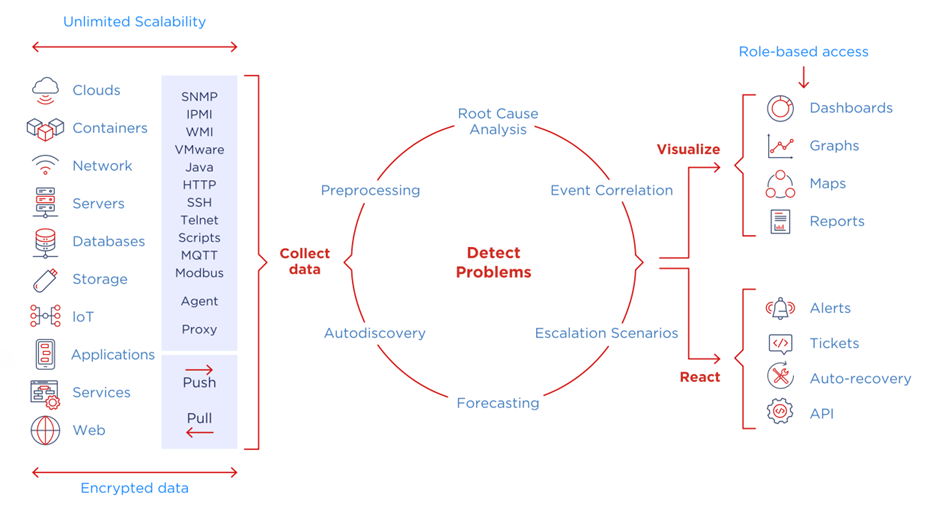
Beginning with the basics: Zabbix collects, categorizes, analyzes and generates information from data.
This process divided into 4 stages:
Data collection;
Problem detection;
Visualization;
Reaction.
Zabbix activity cycle
In the first stage, Zabbix captures data from different sources, which can be cloud systems, containers, networks, servers, databases, APIs, stocks, payment methods, applications, services and the Internet of Things. At this stage, there is a lot of flexibility in the tool itself, and it is also possible to create completely customized collection methods.
The data are encrypted, as Zabbix follows the premise of Security by Design, and they are analyzed in a processing stage to detect possible problems or behaviors that the business wants to be detected.
At this stage, data processing categorizes information into events by severity, indicates the root cause of the potential problem or anomaly, correlates these events based on predefinitions established by system administrators or business managers, begins self-remediation of this problem, and creates predictions based on metrics behaviors so that the business is ready and prepared to deal with events that have not yet occurred.
Afterwards, the information generated is allocated to dashboards for better visualization and, consequently, administrators choose how to react to what is shown.
Reactions can take the form of alerts via message, e-mail and applications, by generating tickets to the support team, by establishing a connection to other applications and systems, and by automating problem solving – or self-healing.
Main on-line and off-line retail indicators
By monitoring systems and the main resources of the retail environment, in addition to ensuring better availability and performance, it is possible to extract critical indicators for your business in real time.
There are indicators that are found both in physical and digital retail operations. With Zabbix, it is possible to collect and measure each one of these indicators, such as:
Gross sales;
Average ticket;
Sales by product category;
Sales by payment method;
Number of sales;
Accumulated sales in a given period;
Inventory value;
Sales by M2;
Sales by collaborator;
Year-over-Year Sales (YoY);
Goals achieved;
Conversion rate (from visitor to customer);
Traffic origin channels;
Time spent in e-commerce;
New visitors vs. returning visitors;
Cart abandonment.
By analyzing the elements mentioned above, also through monitoring, it is possible to understand how the performance of on-line sales is compared to off-line sales, helping business owners to make a decision on which of the means – or all of them – should receive more or less investments to generate more revenue.
We mentioned automating manual processes not long ago.
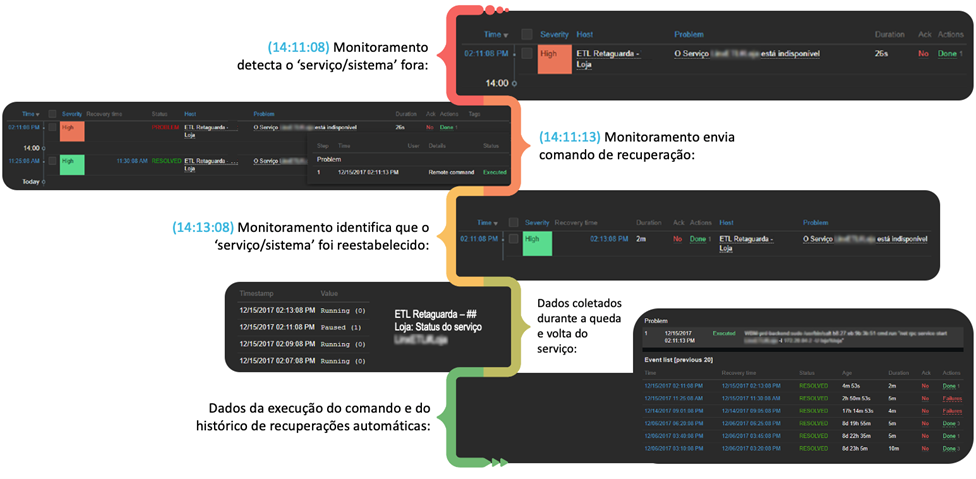
In retail, this can happen with the discovery of events and the indication of root causes, such as identifying the unavailability of a service or component that impacts the proper operation of a given system and, based on rules defined in Zabbix, triggering a self-recovery command, without human intervention, as in the following example:
Example of self-healing with Zabbix, used by Unirede.
What are the benefits of monitoring for retailers?
How can monitoring become essential for the digital transformation of retailers?
In order to do this, we need to understand the benefits of collecting and analyzing data with Zabbix.
The first and most objective one is the monitoring of support services, both in physical and digital operations. Here, we are talking about networks, connections, and IT infrastructure in general.
But there is also monitoring distribution centers in order to optimize supply chains, and capturing data from stores, points of sale, data centers and clouds.
With this duly adjusted, we move on to how the monitoring and sustainment of basic services helps retailers to have a better view of environments, analyzing performance indicators in real time and managing SLAs.
The result of a monitoring system with Zabbix in retail is having operations focused on customer experience, ensuring cost reductions and gains in operational efficiency.
Lessons learned from retailer monitoring
With so many possibilities and advantages resulting from using Zabbix in retail, it is difficult to choose where to start.
We need to bear in mind that, when implementing Zabbix in this area, it is important to focus on what is essential, that is, monitoring only what is necessary, instead of monitoring data that will not result in any type of action or analysis in case of an event. Avoid standard templateswithout the necessary adjustments to meet the specificities of your environment and the analysis practices your business requires..
Automating as much as possible is also a crucial practice, as it allows the team to dedicate more time to strategic activities in the area, thus spending less time dealing with incidents and adding new hosts.
And, of course, even if it is possible to have an integration with other tools, it is worth carrying out a thorough review of existing monitoring efforts in other tools to avoid generating events that are irrelevant, that is, that do not require any type of action by the team. This approach ensures that integration is smooth and does not compromise the effectiveness of the system and operations by generating excessive or unnecessary events.
Last but not least: it is important to recognize the essential and crucial role of the people who use the tool. They not only operate Zabbix, but also play an active role in the development and continuous evolution of business monitoring efforts.
By giving these users a voice and promoting training sessions, your company can invest in more meaningful collaborations, contributing to the continuous adaptation of Zabbix to the specific needs of the retail segment.
About Unirede
Unirede is a technology company, with roots in the State of Rio Grande do Sul and headquartered in Porto Alegre. It was created in 1999 and is dedicated to provide its clients with effective consulting services to improve business performance. Its activities aim to increase productivity, minimize downtime and drive the integration of technological innovations through managed services.
With a philosophy centered on simplicity, Unirede focuses on human relationships, both internally and with clients. There is a conscious effort to not only provide services, but also to establish relationships, favoring the delivery of intelligent solutions that add value to clients.
Unirede has achieved a level of excellence and commitment to results that has resulted in the establishment of strategic partnerships with technology market leaders. It stands out as the first Zabbix Premium Partner in Latin America, since 2008, and was the first Zabbix Training Partner in the world, in 2012.
To provide the best experiences, we use technologies like cookies to store and/or access device information. Consenting to these technologies will allow us to process data such as browsing behavior or unique IDs on this site. Not consenting or withdrawing consent, may adversely affect certain features and functions.
Functional
Always active
The technical storage or access is strictly necessary for the legitimate purpose of enabling the use of a specific service explicitly requested by the subscriber or user, or for the sole purpose of carrying out the transmission of a communication over an electronic communications network.
Preferences
The technical storage or access is necessary for the legitimate purpose of storing preferences that are not requested by the subscriber or user.
Statistics
The technical storage or access that is used exclusively for statistical purposes.The technical storage or access that is used exclusively for anonymous statistical purposes. Without a subpoena, voluntary compliance on the part of your Internet Service Provider, or additional records from a third party, information stored or retrieved for this purpose alone cannot usually be used to identify you.
Marketing
The technical storage or access is required to create user profiles to send advertising, or to track the user on a website or across several websites for similar marketing purposes.