All posts by Sean Sayers

How to evaluate your use of classroom technology with the PICRAT framework

Post Syndicated from Sean Sayers original https://www.raspberrypi.org/blog/how-to-evaluate-your-use-of-classroom-technology-with-the-picrat-framework/

There’s always something new to consider when teaching with technology. From the latest advancements in AI, to new software and hardware updates, it can be difficult to know which tools to use and how to incorporate it effectively into your lessons.

In today’s blog, we explore the PICRAT framework and how it can help you reflect on your use of technology in the classroom. 

We also share our new PICRAT Quick Read, which you can download for free to: 

  • Find practical tips on how to use the PICRAT model when planning your lessons
  • Read a summary of the research behind the framework

What is the PICRAT framework?

Technology is constantly changing, and educators must continually decide what tools to use in their practice. To help with this challenge, researchers started developing theoretical models that teachers (especially student teachers) could use to reflect on how they integrate technology in their classrooms.

You might already be familiar with frameworks like TPACK (Technology, Pedagogy, and Content Knowledge) and SAMR (Substitution, Augmentation, Modification, Redefinition). While these models are useful, the PICRAT framework was created to address gaps in these earlier models, offering a clearer, student-focused approach. Significantly, it encourages you to treat technology as a tool to support learning, rather than the goal itself.

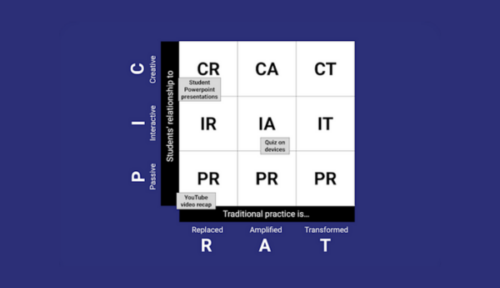
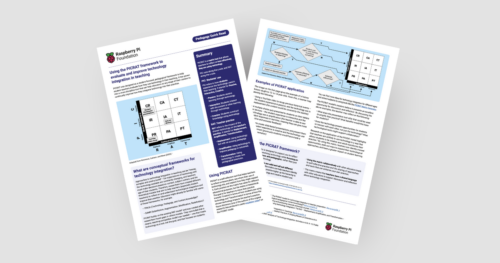
It asks two simple questions: “How are students experiencing the technology?” and “How does this impact your practice?”. The answers to these questions form a matrix as pictured below. 

PIC (which runs along the y-axis) refers to the student’s relationship to the technology:

  • Passive – Students receive learning through technology
  • Interactive – Students interact with the content or other learning through technology 
  • Creative – Students construct knowledge using technology

RAT (which runs along the x-axis) refers to how the teacher uses the technology:

  • Replaces – Using technology but with an existing pedagogy
  • Amplifies – Using technology to improve pedagogy or outcomes
  • Transforms – Using technology to create new pedagogical practices

How can I apply the PICRAT model?

First choose the lesson you’re planning to deliver. Consider what activities you’ll be running and the technologies involved. You’ll then be able to plot where they sit on the matrix using the PICRAT acronym.

For example, if you are teaching a lesson on Python loops, you might initially plan for students to watch a pre-recorded coding tutorial on their laptops. In this scenario, the student experience is Passive (receiving info via tech), and the teacher’s use is Replacement because the video simply replaces a live lecture. To move up the matrix, you could instead have students use an online IDE to complete a “Parson’s Problem” puzzle where they rearrange blocks of code to fix a loop. This shifts the activity to Interactive and Amplification, as the digital tool provides immediate debugging feedback that a paper-based exercise could not.

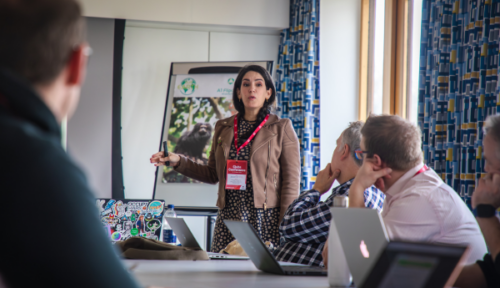
Educator presenting in a classroom.

Next, think about how you might move your practice forwards. Although every position on the matrix has its own value, the framework is hierarchical. The overall goal is to try to move your practice towards the top right of the matrix to be Creative and Transformative.

To help you achieve this, take some time to reflect on your current lessons, activities, and the technologies you use. Ask yourself questions like:

  • What does the technology I’m using offer that could be used to amplify my practice?
    • What benefits would this have for students?
  • Does the technology present opportunities for students to interact with each other, not just the technology?
  • What other technological tools might support collaboration? 

Research highlights that technology is rarely used in ways that allow young people to be creative. By using the PICRAT matrix, teachers can identify missed opportunities and explore ways to transform their lessons, ensuring learners can be creative and thrive.

The benefits of the PICRAT model

Potential benefits for educators:

  • The framework encourages meaningful reflections, allowing teachers to easily evaluate how they’re using technology within their lessons
  • Reflections and the PICRAT matrix helps teachers to identify missed opportunities and gaps in their practice, ultimately leading to better student experiences
Photo of educators sharing ideas in a classroom.

You can use the PICRAT framework as part of your own reflections, or as part of a group activity. It’s a great way to spark discussion about technology integration with colleagues and improve best practices.

Want to find out more about the PICRAT framework?

If you’d like to learn more about the PICRAT model, you can download our Quick Read for free via our new Pedagogy Quick Reads page.

The post How to evaluate your use of classroom technology with the PICRAT framework appeared first on Raspberry Pi Foundation.
How to strategically plan your computing curriculum

Post Syndicated from Sean Sayers original https://www.raspberrypi.org/blog/how-to-strategically-plan-your-computing-curriculum/

Traditionally, curriculum planning has often looked like a linear list: Topic A leads to Topic B, which leads to Topic C. However, as educators we know that learning rarely happens in such a simple, linear way. Concepts are regularly covered in different overlapping topics, and students can often take different routes to reach the same destination.

Image displaying the Learning Graphs Quick Read.

In today’s blog we’re exploring learning graphs, a helpful tool that you can use to plan your computer science curriculum. We’ll share how they can provide educators with a clear, structured way to visualise students’ non-linear progression in a subject.

We also share our new Pedagogy Quick Read about learning graphs, which you can download for free to:

  • Find practical tips on how you can use learning graphs to design your curriculum
  • Read a summary of the research behind them

What is a learning graph?

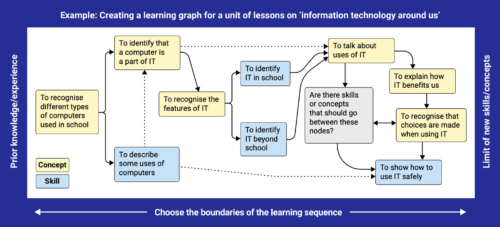
A learning graph is a visual tool for curriculum planning that moves beyond simple lists. At its core, a learning graph is a network of ‘nodes’ (specific concepts and skills) and ‘links’ (the connections between them).

Image from the Learning Graphs Quick Read that showcases an example of a learning graph.

Learning graphs build on research into ‘learning progressions’ and ‘knowledge maps’. They are a practical tool that educators can use to design and validate different curricula. For example, they can help teachers to:

  • Visualise and map progression
  • Identify curriculum gaps, so educators can shape and restructure learning experiences as necessary
  • Ensure the use of consistent terminology
  • Sequence learning and manage cognitive load

How to create a learning graph

Building a learning graph is an iterative process that helps you think critically about how different parts of your curriculum relate to each other.

Nodes and links

The first step in creating a learning graph is often to identify your start and end nodes. First, you consider the key concepts and skills that your learners must acquire by the end of a series of lessons. This gives you some end nodes to work towards. Then, you think about learners’ existing knowledge, to help determine your start point. You then work backwards and forwards between these points to identify the different nodes that learners need to cover to get from the beginning to the end.

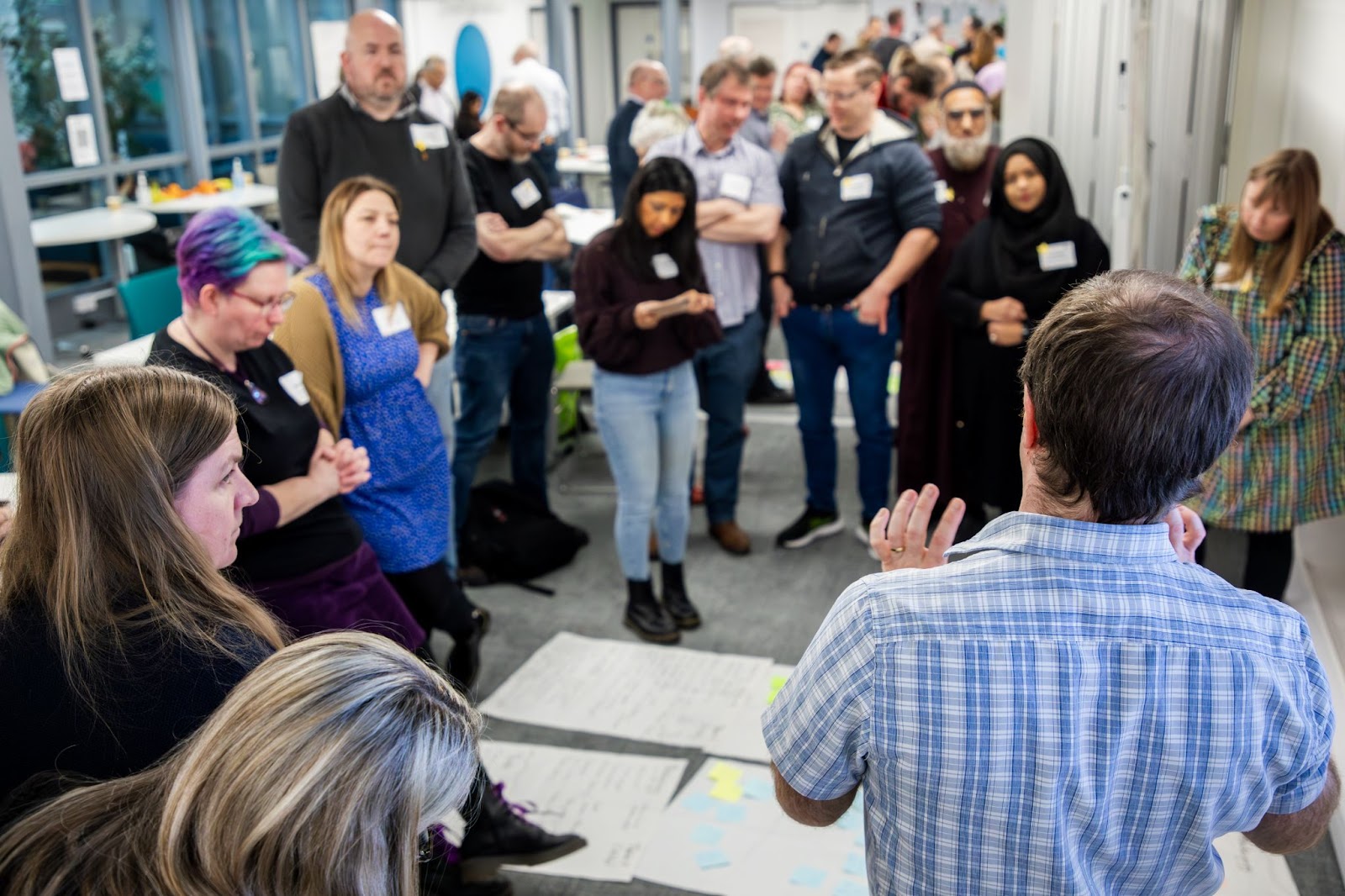
Educators sharing ideas around a table.

Once you have determined your nodes, you add them to your graph and connect them via ‘links’ until your graph is complete. Where knowledge of particular concepts or skills is essential for learning others, you connect the nodes with solid lines. For prior learning that is helpful but not essential, you use dotted lines.

When developing a learning graph, there isn’t a specific level of granularity that you have to work towards. Progression can be as detailed or as high-level as you need. This makes them a helpful tool in creating bespoke learning experiences and curricula for learners.

Collaboration and development

It is most effective to design learning graphs collaboratively within a small group. This allows curriculum designers to discuss their ideas and challenge each other’s thinking, which helps hone the designs.

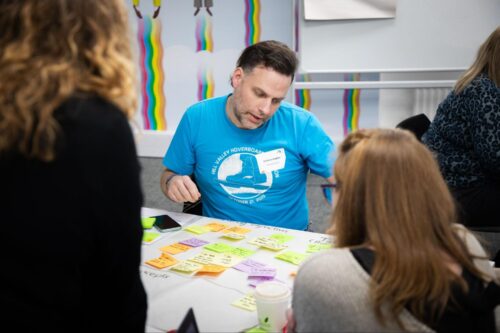
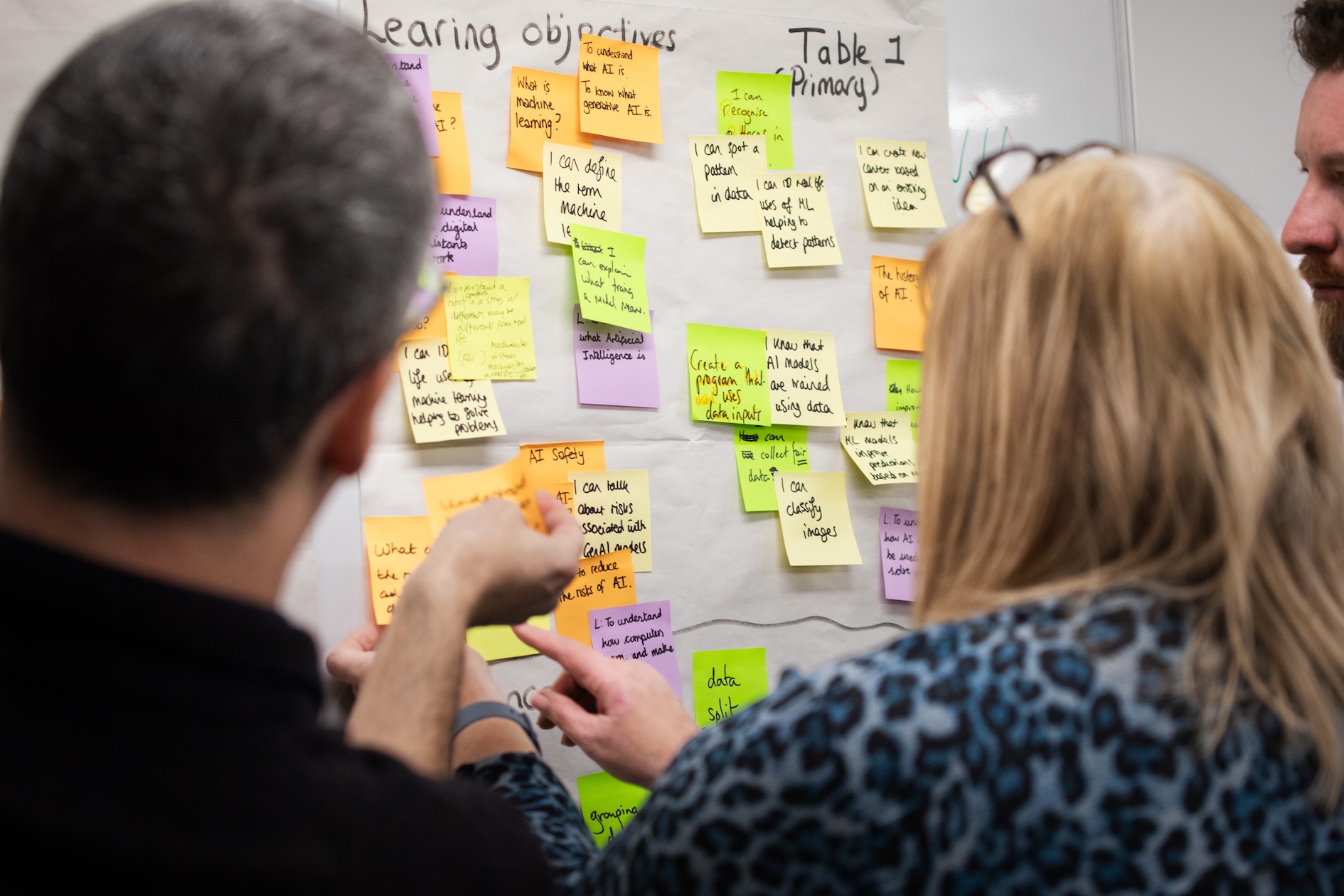
Educators collaborating using post-it notes, planning currciulum.

When creating learning graphs, it can be extremely useful to use a tool that is dynamic and allows you to move elements and make changes quickly and easily. At the Raspberry Pi Foundation, our team has experimented with a range of tools, including using editable shapes in Google Slides, collaborating in Figma, and arranging sticky notes on paper. We recommend finding a tool that works for you and the educators you are working with. Although it can work, we suggest avoiding using a pen and paper if possible, as designs can quickly become messy and difficult to navigate after lots of iterations.

The process of designing learning graphs has strong links to ABC learning design and the creation of concept maps, which can also be used for curriculum planning.

Learning graphs in your teaching

Once created, learning graphs can support you to design and adapt your curricula and assess your students’ learning.

For example, to help sequence learning, you can track or predict the paths through a topic most commonly taken by learners and use this to inform your curriculum design.

If you are adapting a unit of work for a specific qualification or new context, you can prune nodes that are not relevant and add any further knowledge and skills your learners need, then use the new learning graph to guide you as you develop the unit.

Finally, you can assess which node a learner has completed, and use this to identify the next logical step in their learning, ensuring the difficulty level is always appropriate.

Using learning graphs to support analysis

Another benefit of learning graphs is that they can be combined with lots of other frameworks, for example, Bloom’s taxonomy. This allows you to better assess and validate the learning journeys you have designed, and ensure that they are suitably accessible, challenging, and relevant for your learners.

Photo of an educator presenting at the front of a classroom of other teachers.

There are a number of ways that you could link your learning graphs to other frameworks, such as annotating nodes with extra information, or using colour coding.

As well as working with learning graphs for specific learning experiences, you can connect multiple learning graphs together and analyse how they intersect. This can help identify inconsistencies between connected sequences of lessons. It can also help uncover broader themes of progression and highlight alternative learning pathways you might not have considered.

Find out more about learning graphs

If you’d like to find out more about learning graphs, you can download our Pedagogy Quick Read for free.

To find out more about how we use learning graphs when planning curriculum resources at the Raspberry Pi Foundation, take a look at our teaching and learning design principles.

The post How to strategically plan your computing curriculum appeared first on Raspberry Pi Foundation.

How social learning can lead to better outcomes in your computing classroom

Post Syndicated from Sean Sayers original https://www.raspberrypi.org/blog/how-social-learning-can-lead-to-better-outcomes-in-your-computing-classroom/

Throughout our lives, we’re constantly learning from others. Whether we’re interacting with teachers or trainers, or observing friends or strangers, we’re learning either deliberately or inadvertently. This process is known as ‘social learning’. 

In today’s blog, you’ll dive into what social learning is and how you can use it to create more engaging and effective learning experiences in your computing classroom.

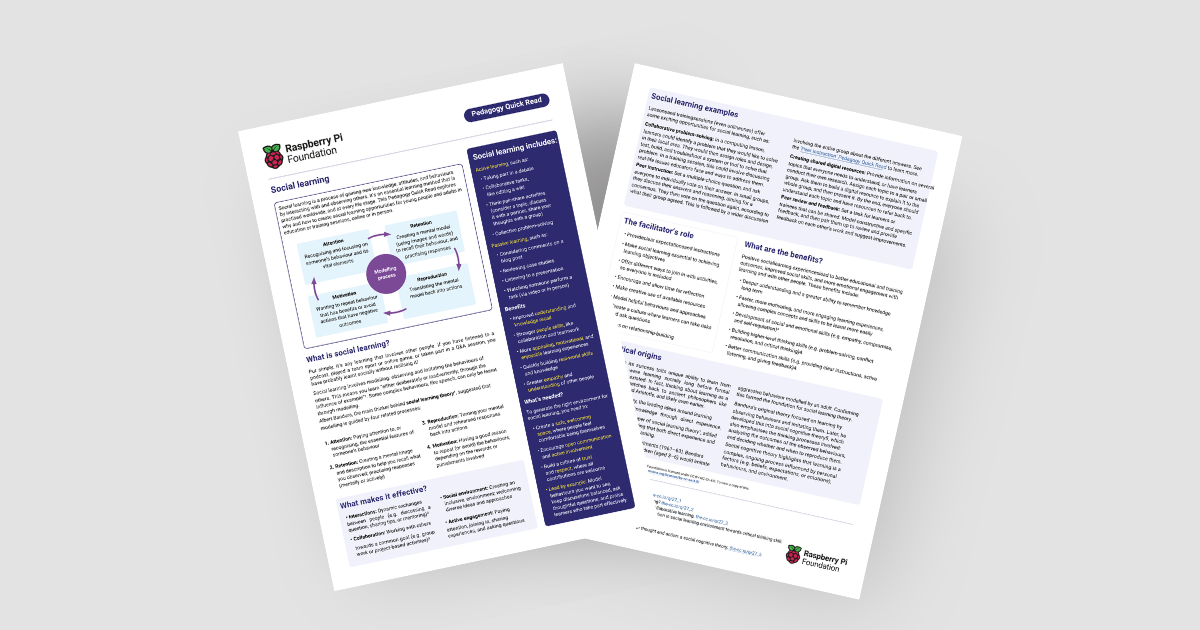
Image of our latest Pedagogy Quick Read

You’ll also find our latest Pedagogy Quick Read, which explores social learning. It’s free to download and includes: 

  • Practical tips for how to use social learning and related approaches with your learners
  • A summary of the research behind social learning

What is social learning?

Social learning is simply any learning that involves other people. It can take any form, from watching a video, to taking part in a classroom discussion. It can take place in person or online, and it can happen without people realising they’re learning something.

Social learning is based on modelling and involves people observing and imitating the behaviours that others model. Albert Bandura, the acknowledged originator of social learning theory, suggested that social learning is guided by four related processes:

  • Attention: Recognising and focusing on someone’s behaviour and its vital elements
  • Retention: Creating a mental image and description to help you recall what you observed; practising responses (mentally or actively)
  • Reproduction: Translating the mental image back into actions
  • Motivation: Having a good reason to repeat (or avoid) the behaviours, depending on the rewards or punishments involved

How can I enable social learning?

There’s lots of ways you can involve social learning in your computing classroom, including through other teaching approaches and frameworks. 

4 children social learning in the classroom

To help your learners get the most out of social learning, it’s best to:

  • Create a safe environment for learners to share learnings, ask questions, and actively engage in the learning process
  • Include a mix of resources and activities to ensure inclusion and accessibility
  • Set clear expectations and instructions, and ensure that social learning is key to achieve learning objectives

Applying social learning: Some teaching approaches

Among our pedagogy resources, you’ll find lots of practical advice for teaching approaches that promote social learning. The approaches we recommend for the pedagogy principles ‘Work together’ and ‘Model everything’ are especially suitable.

Work together:

Model everything:

Using a PRIMM (PDF) approach for structuring programming lessons, and encouraging students to talk about code as part of these, also works well for social learning.

Applying social learning: Practical examples

Let’s look at pair programming as an example. In this activity, pairs of learners work together to create a computer program, taking on distinct roles that they swap regularly. One learner acts as the ‘driver’, writing the code, while the other is the ‘navigator’, guiding the process, reviewing the code, and identifying potential issues. 

As they work, each learner is able to observe the other person’s approach, learning with and from their partner throughout the activity. This constant interaction and shared problem solving can help them to understand programming concepts better and to build stronger teamwork skills.

Children in the classroom social learning

Another example is setting your class the task to create shared digital resources on several topics everyone needs to learn about. In this activity, you split learners into small groups or pairs, and assign them a topic to later explain to the whole group. Grouped learners work together to create a resource explaining their topic. As the facilitator, you can either provide the information they need, or let them conduct their own research. At the end of the activity, each group presents their resource to the wider class.

An activity like this helps learners develop their knowledge through working together and talking to each other, and also provides the class with resources they can keep using.

The benefits of social learning

Potential benefits for teachers:

  • Improved student engagement and learning
  • Enhanced professional development experiences, leading to more confident teaching

Potential benefits for students:

  • Improved social skills
  • Opportunities to build higher-level thinking skills
  • Deeper understanding and a greater ability to remember knowledge in the long term

A social approach to shaping the future

In a world filled with complex challenges, there’s more need than ever for people to work together. By using social learning approaches in your classroom, you help your students to engage more deeply with your teaching and to develop the skills to succeed in collaboration with others. In this way, you’ll prepare them for navigating technological change as well as for shaping a common future where everyone can thrive.

The post How social learning can lead to better outcomes in your computing classroom appeared first on Raspberry Pi Foundation.

How to rapidly design and adapt quality learning experiences for your students

Post Syndicated from Sean Sayers original https://www.raspberrypi.org/blog/how-to-rapidly-design-and-adapt-quality-learning-experiences-for-your-students/

At this time of year, many educators are considering ways to update their content ahead of the new school term. Whether you’re a teaching assistant or head of department, it’s important to ensure that the content you’re updating — or even designing anew — is relevant and high quality, and meet learners’ needs. In today’s blog we’re highlighting ‘ABC learning design’, and how it can be used to rapidly design and improve learning experiences.

Educators in the classroom

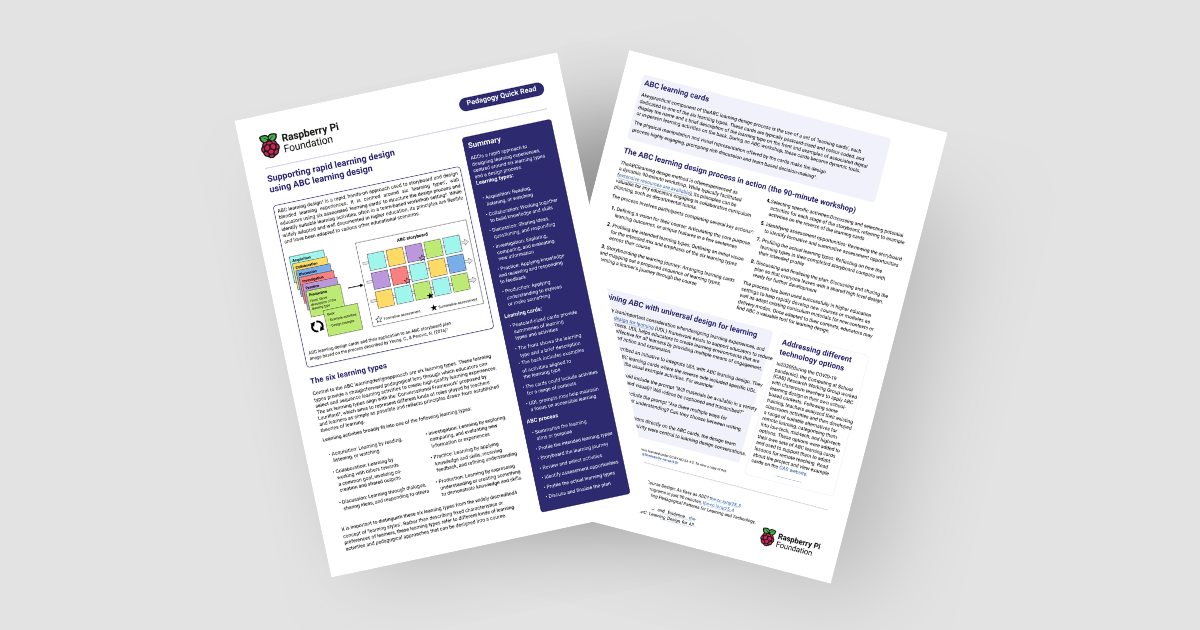
We also share our new ABC-focused Pedagogy Quick Read, which you can download for free to: 

  • Find practical tips on how to use the ABC process and related approaches with your learners
  • Read a summary of the research behind the framework

What is ABC learning design?

ABC learning design is a rapid, hands-on approach to design and develop blended learning experiences. The framework has traditionally been used at undergrad level, and had a lot of success when used in response to the global pandemic in 2020, when learning experiences had to quickly transition from being delivered in-person to being accessible remotely. 

The model is centred around six learning types:

  • Acquisition: Learning by reading, listening, or watching
  • Collaboration: Learning by working with others towards a common goal, involving co-creation and shared outputs
  • Discussion: Learning through dialogue, sharing ideas, and responding to others
  • Investigation: Learning by exploring, comparing, and evaluating new information or experiences
  • Practice: Learning by applying knowledge and skills, receiving feedback, and refining understanding
  • Production: Learning by expressing understanding or creating something to demonstrate knowledge and skills

Before continuing, it’s important to distinguish between ‘learning types’ and the widely discredited concept of ‘learning styles’. Whilst learning styles refer to fixed characteristics or preferences of learners, learning types refer to different kinds of learning activities and pedagogical approaches that can be designed into a course.

Copy of the ABC learning design Pedagogy Quick Read

These learning types are representative simplifications of pre-existing learning theories. For each learning type, educators can use different activities to deliver that type of learning. The activities will depend on your context and what’s right and applicable for your students.

How can I apply ABC learning design?

ABC learning design is often done in a team-based workshop setting (you can do it by yourself as well). Firstly, you analyse your existing content. Consider the goal of your current learning sequence, and assess how your learners are going to reach that goal with the different learning types.

Educators in the classroom

By analysing existing content and activities, you can then identify what’s missing from your sequence. This allows you to build on existing gaps and consider different types of activities you could implement. You then create a set of learning cards, which help you to storyboard and plan your new learning sequence.

Learning cards are typically postcard-sized and colour-coded to one of the six learning types. Colour coding helps you to tell the cards apart, and to easily see which learning types are or aren’t included in your sequence. 

Each card has the name and a short description of the learning type on the front, with examples of associated digital or in-person learning activities on the back. The learning cards:

  • Make the design process more engaging
  • Help with decision making
  • Support discussions if you’re working in a team
ABC Learning design cards and their application to an ABC storyboard plan

Adapting ABC learning design for your context

ABC design can be contextualised to your classroom, practices, and school, and to the technologies you have available. For example, on the back of each learning card you could include a set of activities that have been tried and tested in, or approved by, your school. Alternatively, you could link to other frameworks or teaching approaches that work for you and your students. 

Learning cards can also be used to collect other insights about teaching and learning within your context, and used as reminders of pedagogies to implement, as well as practical concerns. They can also help you to consider if there are opportunities for cross-curricular links within your learning sequence.

A shared toolkit you can reuse

In a computing department, ABC learning cards can become a shared resource that give fellow educators an understanding of what’s possible. The cards can be used again and again to help plan future learning experiences. 

Educators sharing ideas on a whiteboard

By running an ABC workshop and creating these learning cards, you and your team will put together a contextualised learning sequence toolkit specific to your school and learners.

Integration with universal design for learning to improve accessibility

In our blog How to build young people’s agency through accessible learning, we explored the universal design for learning (UDL) framework. UDL aims to support educators to reduce barriers for learners. It helps educators to create learning environments that are accessible and effective for all learners by providing multiple means of engagement, representation, and action and expression.

Gormley et al. (2022) described an initiative to integrate UDL within ABC learning design. They developed adapted ABC learning cards where the reverse side included specific UDL prompts, in addition to the usual example activities. For example:

  • An acquisition card could include the prompt “Will materials be available in a variety of formats (text, audio, and visual)? Will videos be captioned and transcribed?”
  • A production card could include the prompt “Are there multiple ways for learners to demonstrate their understanding? Can they choose between writing, presenting, or creating?”

By including these UDL considerations directly on the ABC cards, the design team ensured that accessibility and inclusivity were central to learning design conversations.

Adding UDL prompts to your learning cards is a fantastic way to help you design accessible learning sequences.

Applying ABC learning design: Some ideas for computing educators

In 2020, during the pandemic, the Computing at School (CAS) Research Working Group worked with classroom teachers to apply ABC learning design in their own contexts. 

Following some training, teachers analysed their existing classroom activities and then developed a range of suitable alternatives for remote learning, categorising them into low-tech, mid-tech, and high-tech options. 
The different activity options were then added to their own sets of ABC learning cards and used to help adapt lessons for remote teaching. You can read more about the project and view example cards on the CAS website.

The benefits of using ABC learning design

Potential benefits for educators:

  • Enables more rapid creation and delivery of high-quality content
  • Allows you to audit your current learning sequence and identify gaps that can be improved upon
  • Provides a shared, contextualised toolkit for curriculum design

Potential benefits for students:

  • Tailored, engaging, high-quality learning experiences

Want to hear more about ABC learning design?

If you’d like to find out more about ABC learning design, you can download our Quick Read for free.

You can also listen to a thought-provoking discussion on the topic between James Robinson, Carrie Anne Philbin, Jane Waite, and Matthew Wimpenny-Smith in season 1, episode 6 of the Hello World podcast: Could curriculum design be as simple as ABC?

The post How to rapidly design and adapt quality learning experiences for your students appeared first on Raspberry Pi Foundation.
Essential tips to integrate computer science into your lessons: Teacher tips from CSTA 2025

Post Syndicated from Sean Sayers original https://www.raspberrypi.org/blog/teacher-tips-csta-2025-integrating-computer-science/

In our latest podcast miniseries, we spoke to educators live from the CS11TA 2025 annual conference in Cleveland, Ohio, to hear their top tips for integrating computer science (CS) into other subjects.

Behind the scenes of Meg Wang, editor of the Hello World magazine presenting the latest episodes of the Hello World podcast, from CSTA 2025.

Hello World editor, Meg Wang and the team met teachers in the exhibit hall for real-time reflections and essential teacher tips on teaching cross-curricular CS. They spoke to some amazing educators from across the United States and had a great time interacting with everyone in attendance.

“Meeting teachers and hearing first-hand about their experiences, challenges, and triumphs was invaluable. It was amazing to meet Hello World writers in person, and to also meet future writers. Like I said at the conference, Hello World is for educators, by educators, so that means you! Everyone has valuable experience or useful advice to share, and we’re here to help you amplify that.” – Meg Wang, editor of the Hello World magazine

Who features in the episode, and what are their tips?

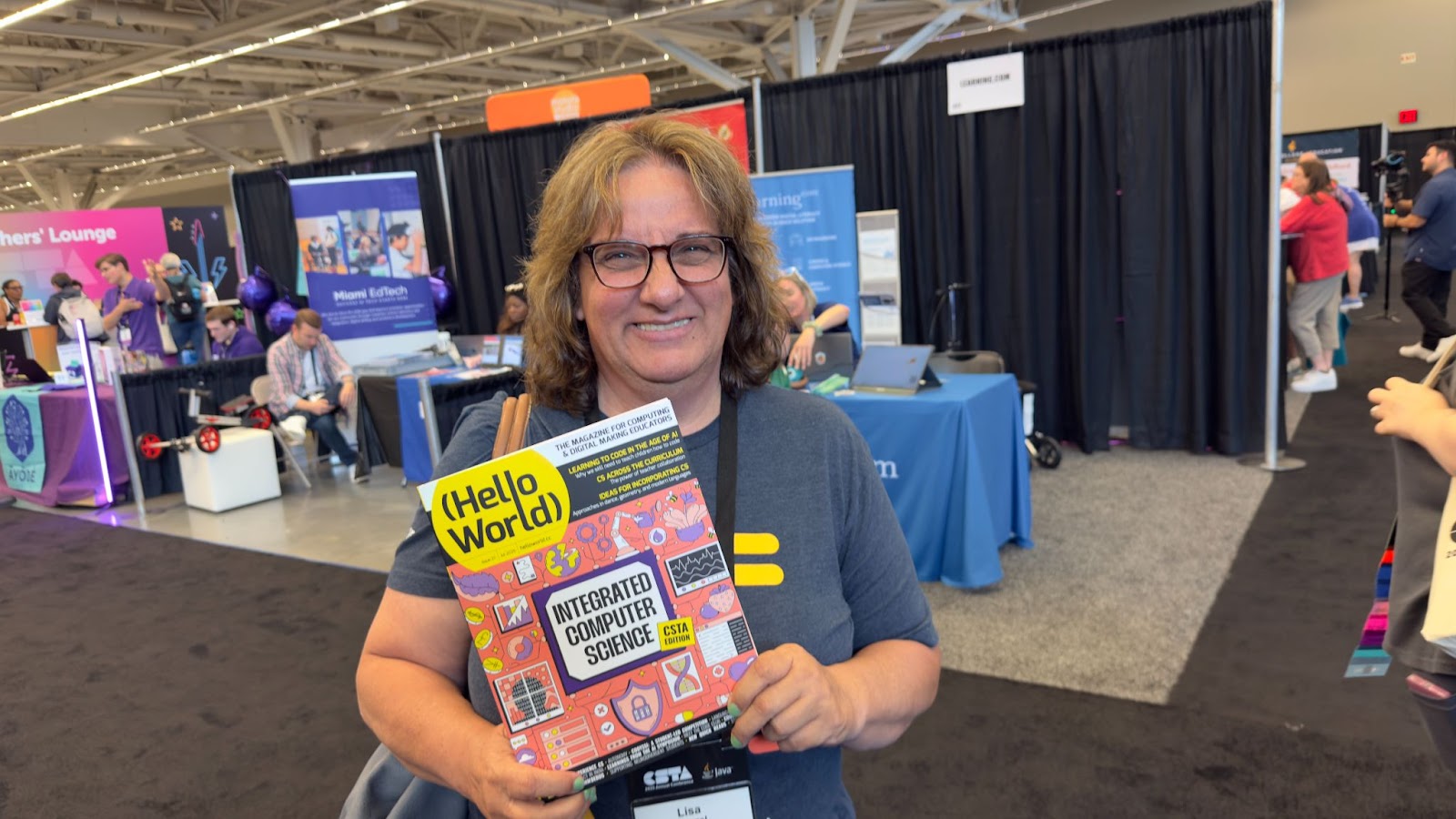
Lisa Wenzel, CS teacher from Maryland, USA

Lisa Wenzel, CS teacher in Maryland, USA, smiling and holding a physical copy of Hello World, issue 27.

Lisa’s top tip for integrating computer science into your lessons is to start with topics that you’re passionate about. If you’re not a CS teacher yourself, Lisa suggests finding a colleague who teaches the subject. She advises having a chat with them to explore how you can include CS concepts into subjects you’re particularly interested in.

“I guarantee you that they’re going to have something […] to teach [another subject], and it’s going to involve computer science.” 

Through peer discussions and collaboration between educators, you’ll discover engaging ways that you can incorporate CS into your teaching. Give it a try the next time you’re chatting to a CS teacher.

Tiffany N. Jones, CS and Cybersecurity teacher in Georgia, USA

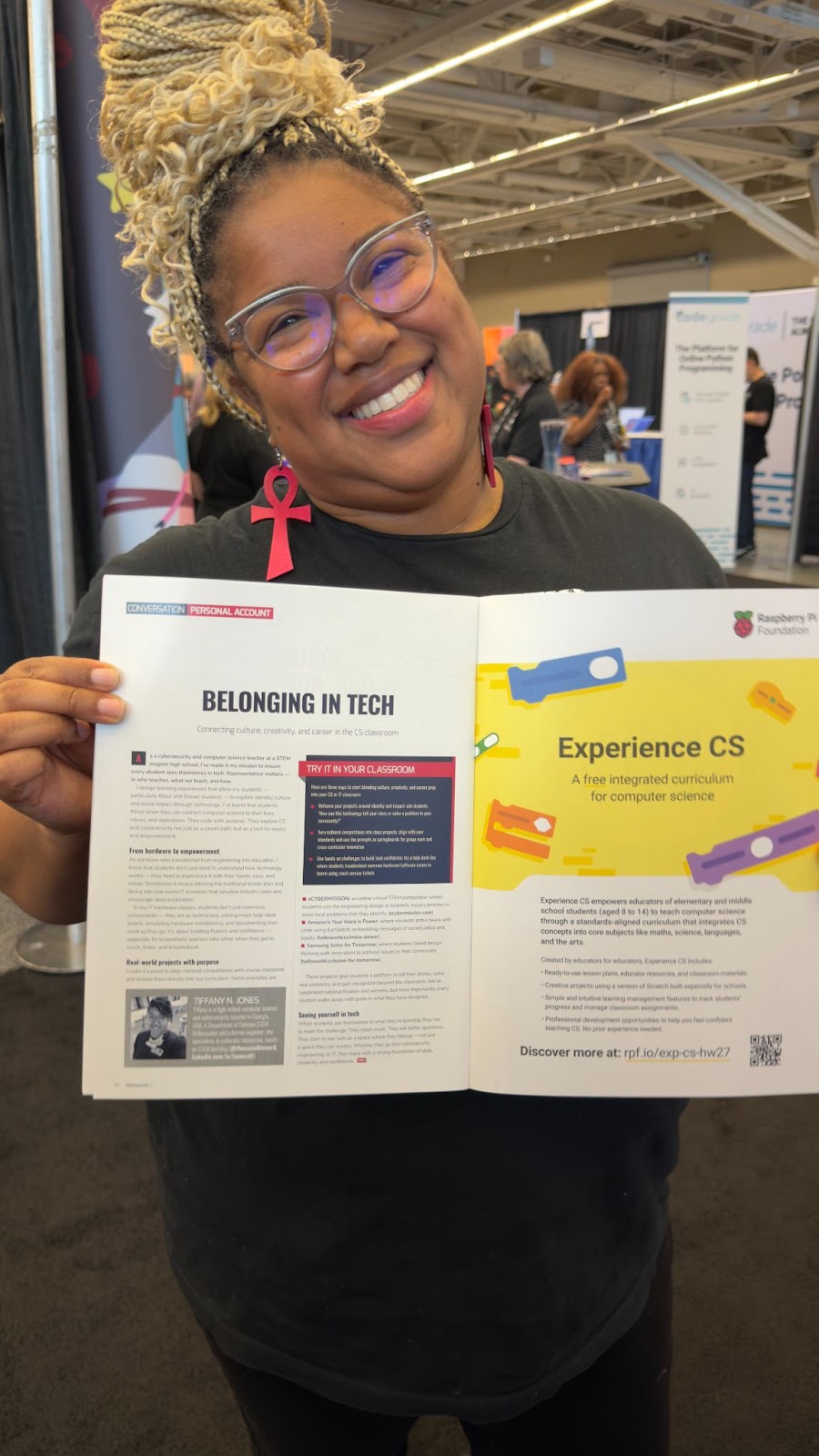
Tiffany N. Jones CS & Cybersecurity teacher in Georgia, USA smiling showcasing her article in Hello World Issue 27.

Tiffany N. Jones, author of ‘Belonging in Tech’ (featured on page 82 of Hello World Issue 27), shares her top tip to seamlessly integrate computer science into other subjects. 

Using the example of a class studying ocean health and pollution, Tiffany shares how you can introduce students to real-world applications of computer science by exploring how sensors and microcontrollers can be used to collect environmental data. 

She then suggests exploring how databases and programming languages can be used to analyse and visualise the data that the sensors and microcontrollers have recorded. This not only deepens your learner’s scientific understanding but also demonstrates how computing concepts are used in real-world industry practices.

Rick Ballew, CS and Engineering teacher in Minnesota, USA

Rick Ballew CS & Engineering teacher in Minnesota, USA smiling holding a physical copy of Hello World issue 27

Rick’s top tip for integrating CS is to first think about your favourite lesson and consider ways that you can introduce computational thinking.

In the podcast, Rick says:

“chances are, computational thinking is already a part of that lesson you’re doing. Call it out to the students, and that’s going to help them to start understanding how computer science is baked into everything we do.” 

Rick also offers a great example from his experience as a band teacher. He shares how learning to read a new piece of music is very similar to the steps involved in computational thinking. s

“[You’ve] got to break it down. There’s abstraction. You’ve got to figure out the sequencing, and you create the way that you’re going to learn it. And that is all part of computational thinking.” 

This approach shows students that CS isn’t just coding; it’s a way of thinking that can be applied across disciplines.

Listen now

To hear more practical teacher tips and discover what else our guest teachers had to say, listen to or watch the full episode here

We hope this episode inspires you and helps you to engage your students in computing. We’d love to hear your thoughts, your feedback, and any of your own tips on how to integrate CS into other subjects. Share your advice in the comments section below.

We hope you enjoy the episode!

More to listen to next week

Next week, we’ll be sharing an interesting conversation between Ben Garside, Senior Learning Manager (AI Literacy) at the Raspberry Pi Foundation, Leonida Soi, Learning Manager (Kenya) at the Raspberry Pi Foundation, and two of our global Experience AI partners, Monika Katkutė-Gelžinė from Vedliai in Lithuania, and Aimy Lee from Penang Science Cluster in Malaysia.

Selfie with the Hello World Podcast team

They’ll be exploring what AI education looks like around the world and what teachers need to feel confident teaching it.

You can watch or listen to each episode of our podcast on YouTube, or listen via your preferred audio streaming service, whether that’s Apple Podcasts, Spotify, or Amazon Music

Subscribe to Hello World today to ensure you never miss a podcast episode or issue of the magazine.

The post Essential tips to integrate computer science into your lessons: Teacher tips from CSTA 2025 appeared first on Raspberry Pi Foundation.
New Hello World podcast series: Bringing computer science into every classroom

Post Syndicated from Sean Sayers original https://www.raspberrypi.org/blog/new-hello-world-podcast-series-bringing-computer-science-into-every-classroom/

The Hello World podcast is back, accompanying the latest issue of Hello World magazine. This new three-part miniseries explores some of the topics from issue 27 of Hello World, which focuses on integrating computing education across the curriculum.

Whether you’re a seasoned educator or just starting your journey with computing education, this podcast audio and video series is full of insights, inspiration, and practical tips from educators and experts around the world.

If you’re already subscribed, the new episodes will appear automatically in your favourite podcast app every Tuesday.

Episode 1: Why kids still need to learn to code in the age of AI

Out now

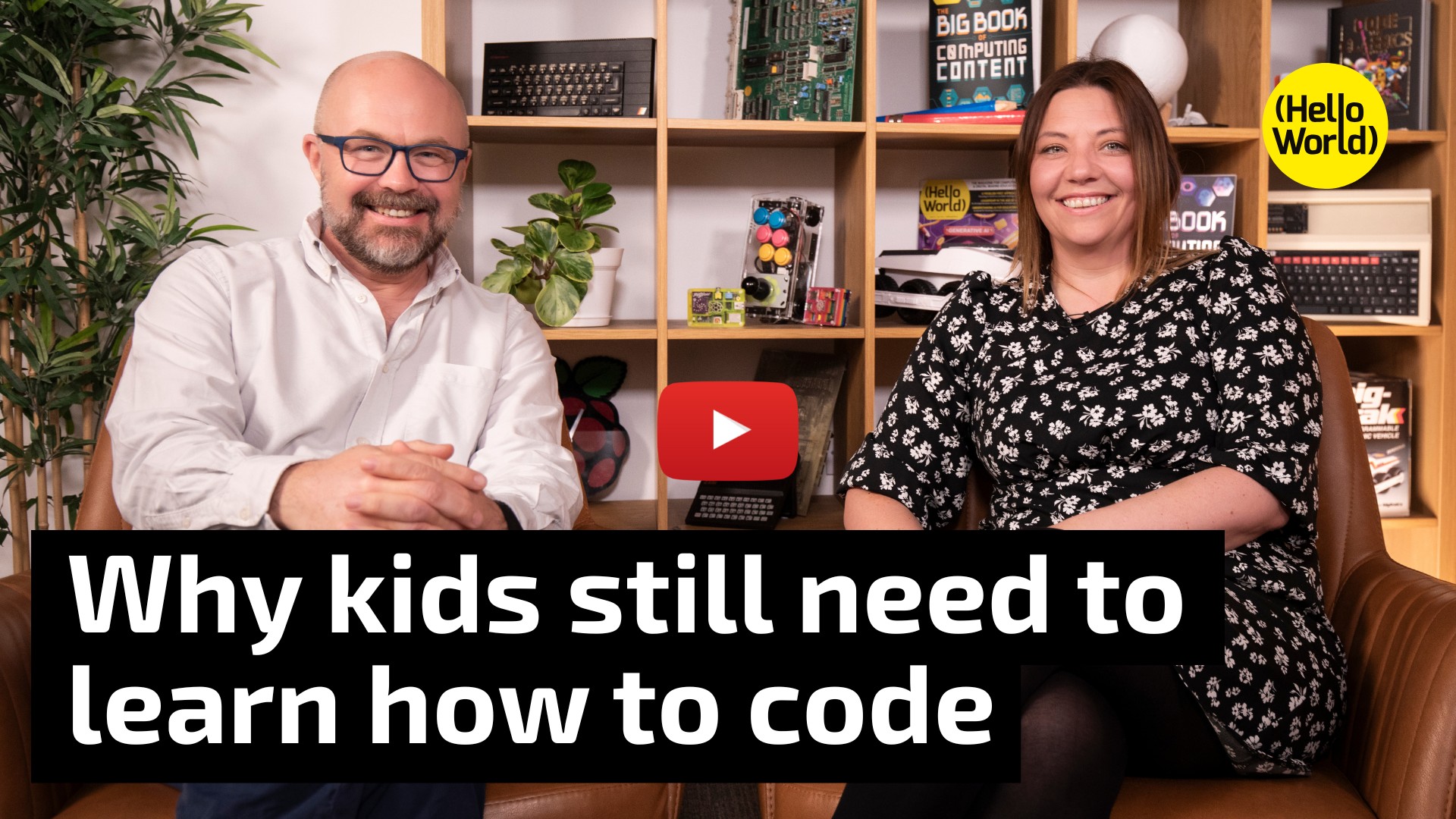
In our first episode, Raspberry Pi Foundation CEO Philip Colligan, CBE, sits down with teacher Janine Kirk to discuss why, in the age of AI, it’s more important than ever for young people to learn to code. Their conversation draws on ideas from our downloadable position paper, which is also featured in issue 27 of Hello World magazine.

Episode 2: Voices & tips from CSTA conference

Released Tuesday 15 July

Photo of Hello World editor, Meg Wang, and contributing editor Dominick Sanders at CSTA 2025.

Next week, we’ll bring you the buzz from the Computer Science Teachers Association’s annual conference in Cleveland, USA. We’re speaking with educators at the conference to hear how they’re integrating computer science across subjects, and you’ll hear their top classroom tips for teaching CS in context.

Episode 3: Global perspectives on AI education

Released Tuesday 22 July

Episode 3 of the Hello World Podcast set

The miniseries wraps up with an in-depth discussion about AI education around the world. Hosted by Ben Garside, Senior Learning Manager for Experience AI, the conversation features Leonida Soi, Learning Manager in Kenya; Monika Katkute-Gelzine, CEO of Vedliai in Lithuania; and Aimy Lee, COO of Penang Science Cluster in Malaysia. Monika and Aimy work with us in our global Experience AI partner programme.

Listen, read, learn, subscribe, and share

Each of these three podcast episode builds on the themes in the latest Hello World issue, where you’ll find inspiration and practical tips from educators who are integrating CS across a variety of subjects and for all school ages.

Subscribe to the Hello World podcast wherever you get your podcasts to never miss an episode, and to help us reach more teachers. If you’re subscribe to Hello World magazine (it’s free), we’ll also let you know when new podcast episodes are available.

And, don’t forget to share this new podcast series with your fellow educators.

The post New Hello World podcast series: Bringing computer science into every classroom appeared first on Raspberry Pi Foundation.
How to build young people’s agency through accessible learning

Post Syndicated from Sean Sayers original https://www.raspberrypi.org/blog/how-to-build-young-peoples-agency-through-accessible-learning/

We think computing or computer science (CS) needs to be accessible to all learners, and we know that teachers work hard towards this. Traditional CS approaches can lack flexibility, creating barriers to learning and excluding some young people. In today’s blog, we’re highlighting the ‘Universal design for learning’ (UDL) framework and how you can use it to make computing education more accessible to all your learners.

Children in the classroom learning  Computer Science

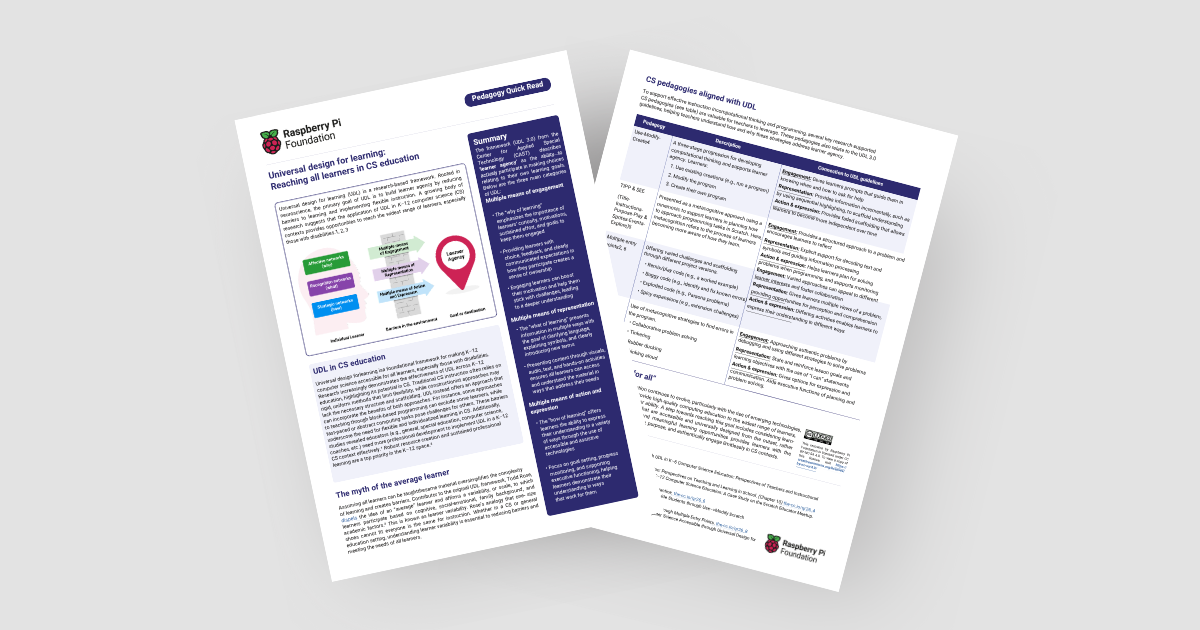
We also share our new UDL-focused Pedagogy Quick Read, which you can download for free to:

  • Find practical tips for how to use the UDL framework and related approaches with your learners
  • Read a summary of the research behind the framework

Universal Design for Learning: Because one size does not fit all

Everyone is different and has their own way of learning. What works for one young person may not work for the next. So why should we expect learners to be taught the same material in the same way? 

Todd Rose, a contributor to the UDL framework, highlights the factors involved with a young person’s ability to engage and participate in learning. These include cognitive, social-emotional, family background and academic factors. He dispels the idea of an “average” learner, and instead suggests the concept of learner variability. 

Picture of our new UDL-focused Pedagogy Quick Read
The new Quick Read

As educators, it’s important to consider that students will likely be at different stages of understanding, and a one-size-fits-all approach isn’t suitable. The UDL framework avoids this mindset and provides teachers with structured guidelines to design accessible lessons from the beginning. 

What is the UDL framework?

The UDL framework encourages educators to provide flexibility for learners in three areas: 

  • Multiple means of engagement: The “why of learning”, which helps to pique students’ curiosity and motivates them to stay engaged
  • Multiple means of representation: The “what of learning”, which focuses on presenting information in different ways to make the content accessible
  • Multiple means of action and expression: The “how of learning”, which relates to different ways for students to access learning and express their understanding

How can I apply the UDL framework?

Two things are key while you are planning how to apply the UDL framework with your learners:

  • Try not to introduce all three areas at once to your practice. Instead, focus on one area of the framework at a time and reflect to identify where there might be gaps. Focus on these first and make changes one by one.
  • Consider how different approaches will work for different groups and individuals. Try to identify what works for your learners and vary or adapt your approach as necessary.

Applying UDL: Some ideas for teaching programming

Multiple means of engagement — show learners different reasons for engaging in programming. For example:

  • Solving real-life problems
  • Interest in technology or logical thinking
  • Creative expression

Multiple means of representation — teach programming concepts in multiple ways. For example:

  • Demonstrate through live coding
  • Write on a blackboard with a flowchart
  • Let learners label and assemble bits of paper into a ‘program’

Multiple means of action and expression — teach with accessibility in mind. For example:

  • Use tools appropriate for learners’ mouse and keyboard skills
  • Let learners demonstrate their understanding in different ways (e.g. verbally, by writing/drawing, by creating a program)

The UDL framework aligns closely with several key research-supported pedagogies that you can use for effective instruction in computational thinking and programming. For example, the pedagogy approach ‘Use-Modify-Create’ (UMC) can be paired with the UDL categories. The new Quick Read explores these connections in more detail.

Students in the classroom

The benefits of the UDL framework

Potential benefits for teachers:

  • The framework provides a clear structure for designing learning activities that appeal to and engage the widest set of learners
  • It can help you consider all the ways you might engage your learners and make CS lessons more accessible.
  • UDL encourages you to reflect on the different ways in which you might represent concepts and ideas
  • It can help you to build learner agency and independence in your students by offering them different ways to express their learning in CS topics. 

Potential benefits for learners:

  • The framework promotes a sense of ownership over their learning. Which can boost their motivation and resilience to sticking with difficult challenges. 
  • They will likely find content that resonates with them, leading to higher engagement and therefore learning.
  • They will be able to demonstrate their CS knowledge confidently and engage limitlessly in CS contexts.

Our new Quick Read shares tips on how to best use the framework in your teaching. 

Inclusive computer science: The wider context

We know there is a lack of representation within the field of CS. Our recent position paper ‘Why kids still need to learn to code in the age of AI’ and an episode of the  Hello World podcast, ‘How can we empower girls in computing’ touched on this. Both highlight why it’s important that learners from all backgrounds are empowered to contribute their perspectives and experiences and shape the future with computing.

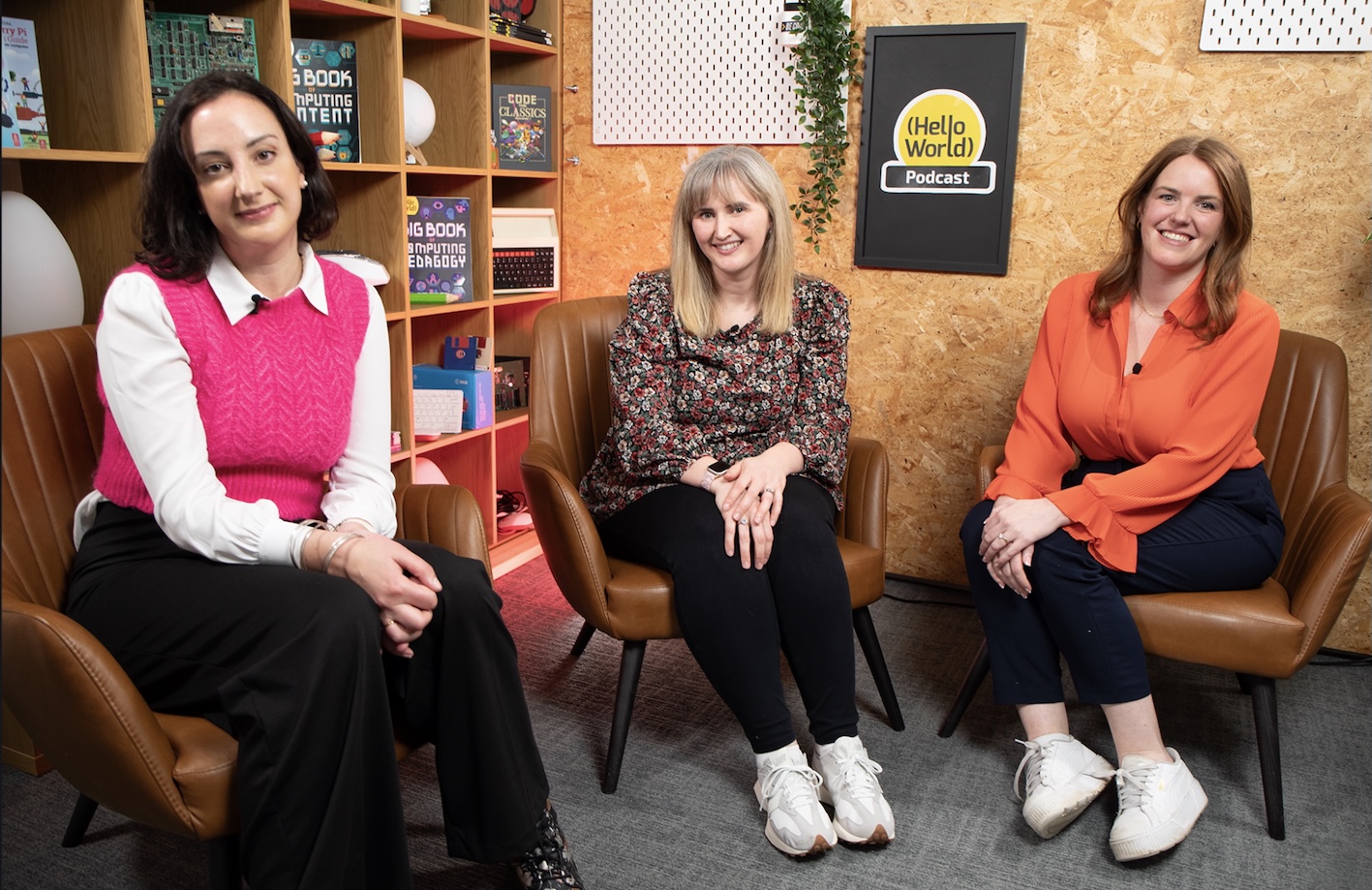
Photo from the Hello World podcast, ‘How can we empower girls in computing
Guests and host during the recording of our ‘How can we empower girls in computing’ episode

“The reality is that access to the opportunities to learn about computer science, programming, and coding has remained deeply unequal, both within and between countries. That has helped create a technology sector that doesn’t reflect the broad diversity of human backgrounds, perspectives, and experiences. And we are all living with the consequences.” – Philip Colligan, Mark Griffiths, Veronica Cucuiat

“If we don’t have a diverse range of people designing and implementing that tech, then we are going to come across issues.” – Becky Patel, Tech She Can, Hello World podcast”

By embracing the principles of ‘Universal design for learning’ and similar approaches, we can create a more inclusive and equitable learning environment in computer science for everyone.

The post How to build young people’s agency through accessible learning appeared first on Raspberry Pi Foundation.