Post Syndicated from Talks at Google original https://www.youtube.com/watch?v=UmRDfzZfPJY
October Prime Big Deals Day 2023 – Comparison Video Winners ONLY
Post Syndicated from The Hook Up original https://www.youtube.com/watch?v=rrmOgSbkMpc
A remote code execution vulnerability in GNOME
Post Syndicated from corbet original https://lwn.net/Articles/947236/
The GitHub blog describes
a vulnerability in the libcue library (which is used by the GNOME
desktop) that can be exploited by a remote attacker to run code on a
desktop system if the target can be convinced to click on a malicious link.
The video shows me clicking a link in a webpage, which causes a cue
sheet to be downloaded. Because the file is saved to ~/Downloads,
it is then automatically scanned by tracker-miners. And because it
has a .cue filename extension, tracker-miners uses libcue to parse
the file. The file exploits the vulnerability in libcue to gain
code execution and pop a calculator.
NVIDIA Data Center Roadmap with GX200NVL GX200 X100 and X40 AI Chips in 2025
Post Syndicated from Patrick Kennedy original https://www.servethehome.com/nvidia-data-center-roadmap-with-gx200nvl-gx200-x100-and-x40-ai-chips-in-2025/
NVIDIA showed its AI GPU roadmap with the NVIDIA X200, GX200, GX200NVL, and X40 chips set for launch in 2025, 2.5 gens ahead of today’s chips
The post NVIDIA Data Center Roadmap with GX200NVL GX200 X100 and X40 AI Chips in 2025 appeared first on ServeTheHome.
Security updates for Tuesday
Post Syndicated from corbet original https://lwn.net/Articles/947233/
Security updates have been issued by Fedora (chromium, firefox, and kernel), Gentoo (less and libcue), Red Hat (bind, libvpx, nodejs, and python3), Scientific Linux (firefox and thunderbird), SUSE (conmon, go1.20, go1.21, shadow, and thunderbird), and Ubuntu (libcue, ring, and ruby-kramdown).
THG Podcast: Continents and the Seven Seas
Post Syndicated from The History Guy: History Deserves to Be Remembered original https://www.youtube.com/watch?v=mCYFZNPE058
How AWS protects customers from DDoS events
Post Syndicated from Tom Scholl original https://aws.amazon.com/blogs/security/how-aws-protects-customers-from-ddos-events/
At Amazon Web Services (AWS), security is our top priority. Security is deeply embedded into our culture, processes, and systems; it permeates everything we do. What does this mean for you? We believe customers can benefit from learning more about what AWS is doing to prevent and mitigate customer-impacting security events.
Since late August 2023, AWS has detected and been protecting customer applications from a new type of distributed denial of service (DDoS) event. DDoS events attempt to disrupt the availability of a targeted system, such as a website or application, reducing the performance for legitimate users. Examples of DDoS events include HTTP request floods, reflection/amplification attacks, and packet floods. The DDoS events AWS detected were a type of HTTP/2 request flood, which occurs when a high volume of illegitimate web requests overwhelms a web server’s ability to respond to legitimate client requests.
Between August 28 and August 29, 2023, proactive monitoring by AWS detected an unusual spike in HTTP/2 requests to Amazon CloudFront, peaking at over 155 million requests per second (RPS). Within minutes, AWS determined the nature of this unusual activity and found that CloudFront had automatically mitigated a new type of HTTP request flood DDoS event, now called an HTTP/2 rapid reset attack. Over those two days, AWS observed and mitigated over a dozen HTTP/2 rapid reset events, and through the month of September, continued to see this new type of HTTP/2 request flood. AWS customers who had built DDoS-resilient architectures with services like Amazon CloudFront and AWS Shield were able to protect their applications’ availability.

Figure 1. Global HTTP requests per second, September 13 – 16
Overview of HTTP/2 rapid reset attacks
HTTP/2 allows for multiple distinct logical connections to be multiplexed over a single HTTP session. This is a change from HTTP 1.x, in which each HTTP session was logically distinct. HTTP/2 rapid reset attacks consist of multiple HTTP/2 connections with requests and resets in rapid succession. For example, a series of requests for multiple streams will be transmitted followed up by a reset for each of those requests. The targeted system will parse and act upon each request, generating logs for a request that is then reset, or cancelled, by a client. The system performs work generating those logs even though it doesn’t have to send any data back to a client. A bad actor can abuse this process by issuing a massive volume of HTTP/2 requests, which can overwhelm the targeted system, such as a website or application.
Keep in mind that HTTP/2 rapid reset attacks are just a new type of HTTP request flood. To defend against these sorts of DDoS attacks, you can implement an architecture that helps you specifically detect unwanted requests as well as scale to absorb and block those malicious HTTP requests.
Building DDoS resilient architectures
As an AWS customer, you benefit from both the security built into the global cloud infrastructure of AWS as well as our commitment to continuously improve the security, efficiency, and resiliency of AWS services. For prescriptive guidance on how to improve DDoS resiliency, AWS has built tools such as the AWS Best Practices for DDoS Resiliency. It describes a DDoS-resilient reference architecture as a guide to help you protect your application’s availability. While several built-in forms of DDoS mitigation are included automatically with AWS services, your DDoS resilience can be improved by using an AWS architecture with specific services and by implementing additional best practices for each part of the network flow between users and your application.
For example, you can use AWS services that operate from edge locations, such as Amazon CloudFront, AWS Shield, Amazon Route 53, and Route 53 Application Recovery Controller to build comprehensive availability protection against known infrastructure layer attacks. These services can improve the DDoS resilience of your application when serving any type of application traffic from edge locations distributed around the world. Your application can be on-premises or in AWS when you use these AWS services to help you prevent unnecessary requests reaching your origin servers. As a best practice, you can run your applications on AWS to get the additional benefit of reducing the exposure of your application endpoints to DDoS attacks and to protect your application’s availability and optimize the performance of your application for legitimate users. You can use Amazon CloudFront (and its HTTP caching capability), AWS WAF, and Shield Advanced automatic application layer protection to help prevent unnecessary requests reaching your origin during application layer DDoS attacks.
Putting our knowledge to work for AWS customers
AWS remains vigilant, working to help prevent security issues from causing disruption to your business. We believe it’s important to share not only how our services are designed, but also how our engineers take deep, proactive ownership of every aspect of our services. As we work to defend our infrastructure and your data, we look for ways to help protect you automatically. Whenever possible, AWS Security and its systems disrupt threats where that action will be most impactful; often, this work happens largely behind the scenes. We work to mitigate threats by combining our global-scale threat intelligence and engineering expertise to help make our services more resilient against malicious activities. We’re constantly looking around corners to improve the efficiency and security of services including the protocols we use in our services, such as Amazon CloudFront, as well as AWS security tools like AWS WAF, AWS Shield, and Amazon Route 53 Resolver DNS Firewall.
In addition, our work extends security protections and improvements far beyond the bounds of AWS itself. AWS regularly works with the wider community, such as computer emergency response teams (CERT), internet service providers (ISP), domain registrars, or government agencies, so that they can help disrupt an identified threat. We also work closely with the security community, other cloud providers, content delivery networks (CDNs), and collaborating businesses around the world to isolate and take down threat actors. For example, in the first quarter of 2023, we stopped over 1.3 million botnet-driven DDoS attacks, and we traced back and worked with external parties to dismantle the sources of 230 thousand L7/HTTP DDoS attacks. The effectiveness of our mitigation strategies relies heavily on our ability to quickly capture, analyze, and act on threat intelligence. By taking these steps, AWS is going beyond just typical DDoS defense, and moving our protection beyond our borders. To learn more behind this effort, please read How AWS threat intelligence deters threat actors.
If you have feedback about this post, submit comments in the Comments section below. If you have questions about this post, contact AWS Support.
Want more AWS Security news? Follow us on Twitter.
HTTP/2 Rapid Reset: deconstructing the record-breaking attack
Post Syndicated from Lucas Pardue original http://blog.cloudflare.com/technical-breakdown-http2-rapid-reset-ddos-attack/

Starting on Aug 25, 2023, we started to notice some unusually big HTTP attacks hitting many of our customers. These attacks were detected and mitigated by our automated DDoS system. It was not long however, before they started to reach record breaking sizes — and eventually peaked just above 201 million requests per second. This was nearly 3x bigger than our previous biggest attack on record.
Concerning is the fact that the attacker was able to generate such an attack with a botnet of merely 20,000 machines. There are botnets today that are made up of hundreds of thousands or millions of machines. Given that the entire web typically sees only between 1–3 billion requests per second, it's not inconceivable that using this method could focus an entire web’s worth of requests on a small number of targets.
Detecting and Mitigating
This was a novel attack vector at an unprecedented scale, but Cloudflare's existing protections were largely able to absorb the brunt of the attacks. While initially we saw some impact to customer traffic — affecting roughly 1% of requests during the initial wave of attacks — today we’ve been able to refine our mitigation methods to stop the attack for any Cloudflare customer without it impacting our systems.
We noticed these attacks at the same time two other major industry players — Google and AWS — were seeing the same. We worked to harden Cloudflare’s systems to ensure that, today, all our customers are protected from this new DDoS attack method without any customer impact. We’ve also participated with Google and AWS in a coordinated disclosure of the attack to impacted vendors and critical infrastructure providers.
This attack was made possible by abusing some features of the HTTP/2 protocol and server implementation details (see CVE-2023-44487 for details). Because the attack abuses an underlying weakness in the HTTP/2 protocol, we believe any vendor that has implemented HTTP/2 will be subject to the attack. This included every modern web server. We, along with Google and AWS, have disclosed the attack method to web server vendors who we expect will implement patches. In the meantime, the best defense is using a DDoS mitigation service like Cloudflare’s in front of any web-facing web or API server.
This post dives into the details of the HTTP/2 protocol, the feature that attackers exploited to generate these massive attacks, and the mitigation strategies we took to ensure all our customers are protected. Our hope is that by publishing these details other impacted web servers and services will have the information they need to implement mitigation strategies. And, moreover, the HTTP/2 protocol standards team, as well as teams working on future web standards, can better design them to prevent such attacks.
RST attack details
HTTP is the application protocol that powers the Web. HTTP Semantics are common to all versions of HTTP — the overall architecture, terminology, and protocol aspects such as request and response messages, methods, status codes, header and trailer fields, message content, and much more. Each individual HTTP version defines how semantics are transformed into a "wire format" for exchange over the Internet. For example, a client has to serialize a request message into binary data and send it, then the server parses that back into a message it can process.
HTTP/1.1 uses a textual form of serialization. Request and response messages are exchanged as a stream of ASCII characters, sent over a reliable transport layer like TCP, using the following format (where CRLF means carriage-return and linefeed):
 HTTP-message   = start-line CRLF
                   *( field-line CRLF )
                   CRLF
                   [ message-body ]
For example, a very simple GET request for https://blog.cloudflare.com/ would look like this on the wire:
GET / HTTP/1.1 CRLFHost: blog.cloudflare.comCRLF
And the response would look like:
HTTP/1.1 200 OK CRLFServer: cloudflareCRLFContent-Length: 100CRLFtext/html; charset=UTF-8CRLF<100 bytes of data>
This format frames messages on the wire, meaning that it is possible to use a single TCP connection to exchange multiple requests and responses. However, the format requires that each message is sent whole. Furthermore, in order to correctly correlate requests with responses, strict ordering is required; meaning that messages are exchanged serially and can not be multiplexed. Two GET requests, for https://blog.cloudflare.com/ and https://blog.cloudflare.com/page/2/, would be:
GET / HTTP/1.1 CRLFHost: blog.cloudflare.comCRLFGET /page/2 HTTP/1.1 CRLFHost: blog.cloudflare.comCRLF
With the responses:
HTTP/1.1 200 OK CRLFServer: cloudflareCRLFContent-Length: 100CRLFtext/html; charset=UTF-8CRLF<100 bytes of data>HTTP/1.1 200 OK CRLFServer: cloudflareCRLFContent-Length: 100CRLFtext/html; charset=UTF-8CRLF<100 bytes of data>
Web pages require more complicated HTTP interactions than these examples. When visiting the Cloudflare blog, your browser will load multiple scripts, styles and media assets. If you visit the front page using HTTP/1.1 and decide quickly to navigate to page 2, your browser can pick from two options. Either wait for all of the queued up responses for the page that you no longer want before page 2 can even start, or cancel in-flight requests by closing the TCP connection and opening a new connection. Neither of these is very practical. Browsers tend to work around these limitations by managing a pool of TCP connections (up to 6 per host) and implementing complex request dispatch logic over the pool.
HTTP/2 addresses many of the issues with HTTP/1.1. Each HTTP message is serialized into a set of HTTP/2 frames that have type, length, flags, stream identifier (ID) and payload. The stream ID makes it clear which bytes on the wire apply to which message, allowing safe multiplexing and concurrency. Streams are bidirectional. Clients send frames and servers reply with frames using the same ID.
In HTTP/2 our GET request for https://blog.cloudflare.com would be exchanged across stream ID 1, with the client sending one HEADERS frame, and the server responding with one HEADERS frame, followed by one or more DATA frames. Client requests always use odd-numbered stream IDs, so subsequent requests would use stream ID 3, 5, and so on. Responses can be served in any order, and frames from different streams can be interleaved.
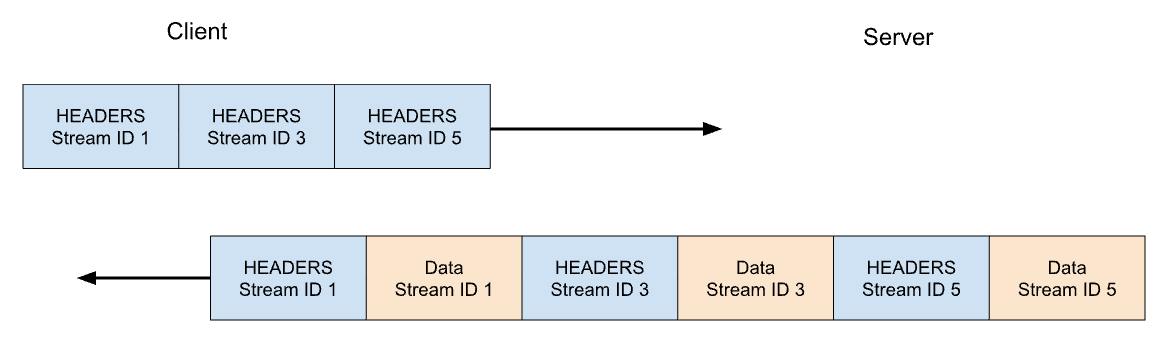
Stream multiplexing and concurrency are powerful features of HTTP/2. They enable more efficient usage of a single TCP connection. HTTP/2 optimizes resources fetching especially when coupled with prioritization. On the flip side, making it easy for clients to launch large amounts of parallel work can increase the peak demand for server resources when compared to HTTP/1.1. This is an obvious vector for denial-of-service.
In order to provide some guardrails, HTTP/2 provides a notion of maximum active concurrent streams. The SETTINGS_MAX_CONCURRENT_STREAMS parameter allows a server to advertise its limit of concurrency. For example, if the server states a limit of 100, then only 100 requests can be active at any time. If a client attempts to open a stream above this limit, it must be rejected by the server using a RST_STREAM frame. Stream rejection does not affect the other in-flight streams on the connection.
The true story is a little more complicated. Streams have a lifecycle. Below is a diagram of the HTTP/2 stream state machine. Client and server manage their own views of the state of a stream. HEADERS, DATA and RST_STREAM frames trigger transitions when they are sent or received. Although the views of the stream state are independent, they are synchronized.
HEADERS and DATA frames include an END_STREAM flag, that when set to the value 1 (true), can trigger a state transition.

Let's work through this with an example of a GET request that has no message content. The client sends the request as a HEADERS frame with the END_STREAM flag set to 1. The client first transitions the stream from idle to open state, then immediately transitions into half-closed state. The client half-closed state means that it can no longer send HEADERS or DATA, only WINDOW_UPDATE, PRIORITY or RST_STREAM frames. It can receive any frame however.
Once the server receives and parses the HEADERS frame, it transitions the stream state from idle to open and then half-closed, so it matches the client. The server half-closed state means it can send any frame but receive only WINDOW_UPDATE, PRIORITY or RST_STREAM frames.
The response to the GET contains message content, so the server sends HEADERS with END_STREAM flag set to 0, then DATA with END_STREAM flag set to 1. The DATA frame triggers the transition of the stream from half-closed to closed on the server. When the client receives it, it also transitions to closed. Once a stream is closed, no frames can be sent or received.
Applying this lifecycle back into the context of concurrency, HTTP/2 states:
Streams that are in the "open" state or in either of the "half-closed" states count toward the maximum number of streams that an endpoint is permitted to open. Streams in any of these three states count toward the limit advertised in the SETTINGS_MAX_CONCURRENT_STREAMS setting.
In theory, the concurrency limit is useful. However, there are practical factors that hamper its effectiveness— which we will cover later in the blog.
HTTP/2 request cancellation
Earlier, we talked about client cancellation of in-flight requests. HTTP/2 supports this in a much more efficient way than HTTP/1.1. Rather than needing to tear down the whole connection, a client can send a RST_STREAM frame for a single stream. This instructs the server to stop processing the request and to abort the response, which frees up server resources and avoids wasting bandwidth.
Let's consider our previous example of 3 requests. This time the client cancels the request on stream 1 after all of the HEADERS have been sent. The server parses this RST_STREAM frame before it is ready to serve the response and instead only responds to stream 3 and 5:
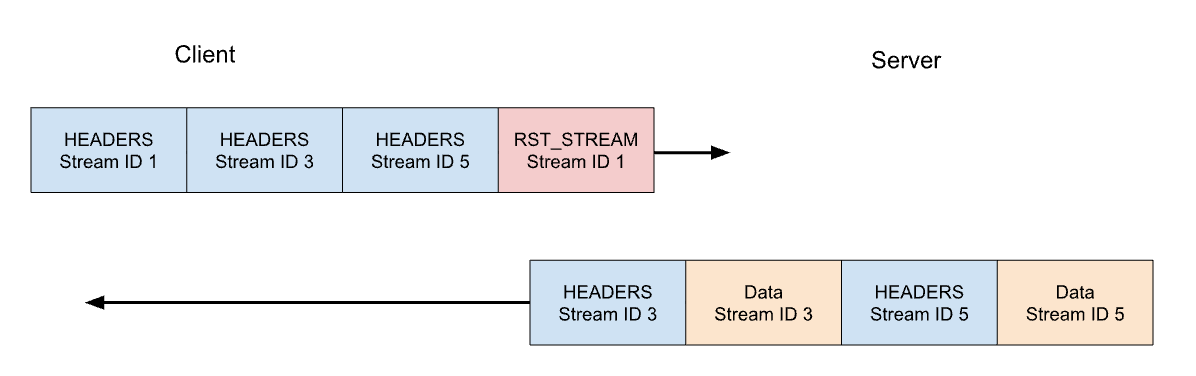
Request cancellation is a useful feature. For example, when scrolling a webpage with multiple images, a web browser can cancel images that fall outside the viewport, meaning that images entering it can load faster. HTTP/2 makes this behaviour a lot more efficient compared to HTTP/1.1.
A request stream that is canceled, rapidly transitions through the stream lifecycle. The client's HEADERS with END_STREAM flag set to 1 transitions the state from idle to open to half-closed, then RST_STREAM immediately causes a transition from half-closed to closed.

Recall that only streams that are in the open or half-closed state contribute to the stream concurrency limit. When a client cancels a stream, it instantly gets the ability to open another stream in its place and can send another request immediately. This is the crux of what makes CVE-2023-44487 work.
Rapid resets leading to denial of service
HTTP/2 request cancellation can be abused to rapidly reset an unbounded number of streams. When an HTTP/2 server is able to process client-sent RST_STREAM frames and tear down state quickly enough, such rapid resets do not cause a problem. Where issues start to crop up is when there is any kind of delay or lag in tidying up. The client can churn through so many requests that a backlog of work accumulates, resulting in excess consumption of resources on the server.
A common HTTP deployment architecture is to run an HTTP/2 proxy or load-balancer in front of other components. When a client request arrives it is quickly dispatched and the actual work is done as an asynchronous activity somewhere else. This allows the proxy to handle client traffic very efficiently. However, this separation of concerns can make it hard for the proxy to tidy up the in-process jobs. Therefore, these deployments are more likely to encounter issues from rapid resets.
When Cloudflare's reverse proxies process incoming HTTP/2 client traffic, they copy the data from the connection’s socket into a buffer and process that buffered data in order. As each request is read (HEADERS and DATA frames) it is dispatched to an upstream service. When RST_STREAM frames are read, the local state for the request is torn down and the upstream is notified that the request has been canceled. Rinse and repeat until the entire buffer is consumed. However this logic can be abused: when a malicious client started sending an enormous chain of requests and resets at the start of a connection, our servers would eagerly read them all and create stress on the upstream servers to the point of being unable to process any new incoming request.
Something that is important to highlight is that stream concurrency on its own cannot mitigate rapid reset. The client can churn requests to create high request rates no matter the server's chosen value of SETTINGS_MAX_CONCURRENT_STREAMS.
Rapid Reset dissected
Here's an example of rapid reset reproduced using a proof-of-concept client attempting to make a total of 1000 requests. I've used an off-the-shelf server without any mitigations; listening on port 443 in a test environment. The traffic is dissected using Wireshark and filtered to show only HTTP/2 traffic for clarity. Download the pcap to follow along.

It's a bit difficult to see, because there are a lot of frames. We can get a quick summary via Wireshark's Statistics > HTTP2 tool:

The first frame in this trace, in packet 14, is the server's SETTINGS frame, which advertises a maximum stream concurrency of 100. In packet 15, the client sends a few control frames and then starts making requests that are rapidly reset. The first HEADERS frame is 26 bytes long, all subsequent HEADERS are only 9 bytes. This size difference is due to a compression technology called HPACK. In total, packet 15 contains 525 requests, going up to stream 1051.
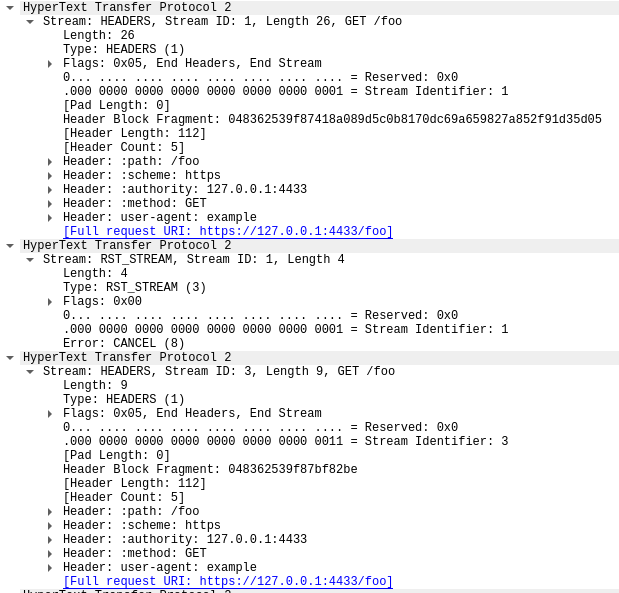
Interestingly, the RST_STREAM for stream 1051 doesn't fit in packet 15, so in packet 16 we see the server respond with a 404 response. Then in packet 17 the client does send the RST_STREAM, before moving on to sending the remaining 475 requests.
Note that although the server advertised 100 concurrent streams, both packets sent by the client sent a lot more HEADERS frames than that. The client did not have to wait for any return traffic from the server, it was only limited by the size of the packets it could send. No server RST_STREAM frames are seen in this trace, indicating that the server did not observe a concurrent stream violation.
Impact on customers
As mentioned above, as requests are canceled, upstream services are notified and can abort requests before wasting too many resources on it. This was the case with this attack, where most malicious requests were never forwarded to the origin servers. However, the sheer size of these attacks did cause some impact.
First, as the rate of incoming requests reached peaks never seen before, we had reports of increased levels of 502 errors seen by clients. This happened on our most impacted data centers as they were struggling to process all the requests. While our network is meant to deal with large attacks, this particular vulnerability exposed a weakness in our infrastructure. Let's dig a little deeper into the details, focusing on how incoming requests are handled when they hit one of our data centers:
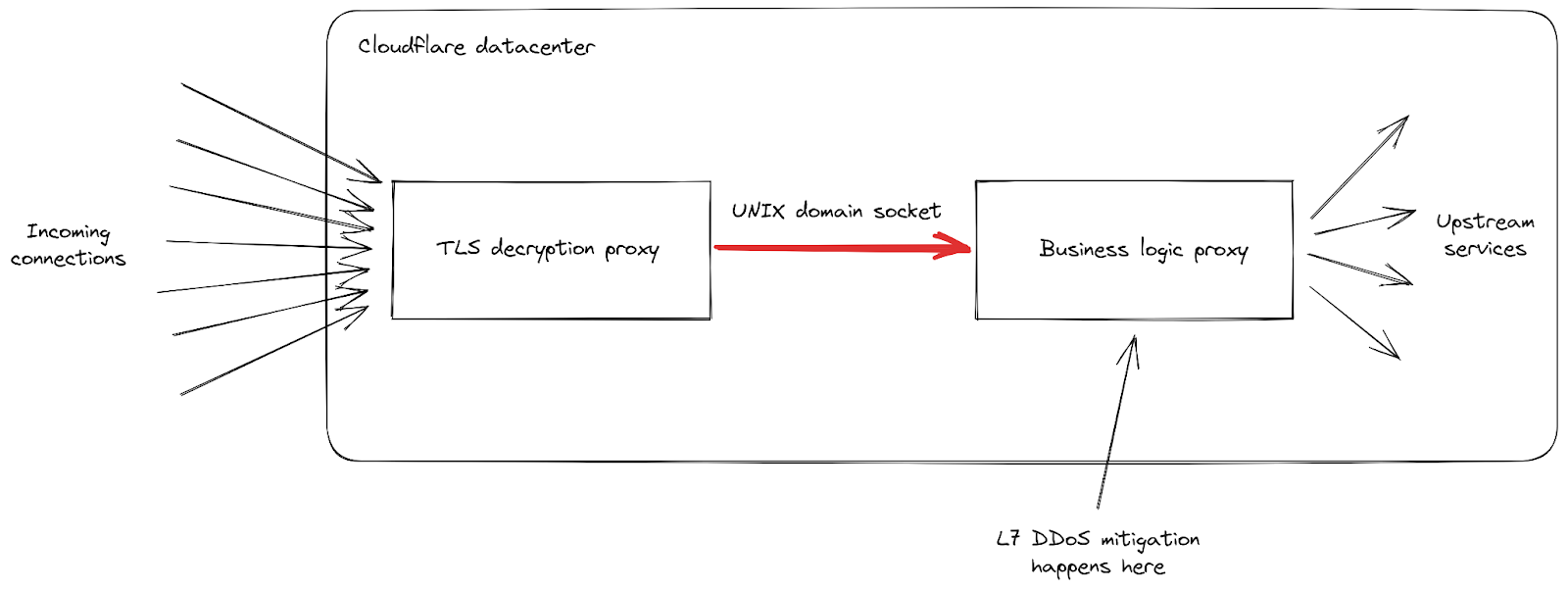
We can see that our infrastructure is composed of a chain of different proxy servers with different responsibilities. In particular, when a client connects to Cloudflare to send HTTPS traffic, it first hits our TLS decryption proxy: it decrypts TLS traffic, processes HTTP 1, 2 or 3 traffic, then forwards it to our "business logic" proxy. This one is responsible for loading all the settings for each customer, then routing the requests correctly to other upstream services — and more importantly in our case, it is also responsible for security features. This is where L7 attack mitigation is processed.
The problem with this attack vector is that it manages to send a lot of requests very quickly in every single connection. Each of them had to be forwarded to the business logic proxy before we had a chance to block it. As the request throughput became higher than our proxy capacity, the pipe connecting these two services reached its saturation level in some of our servers.
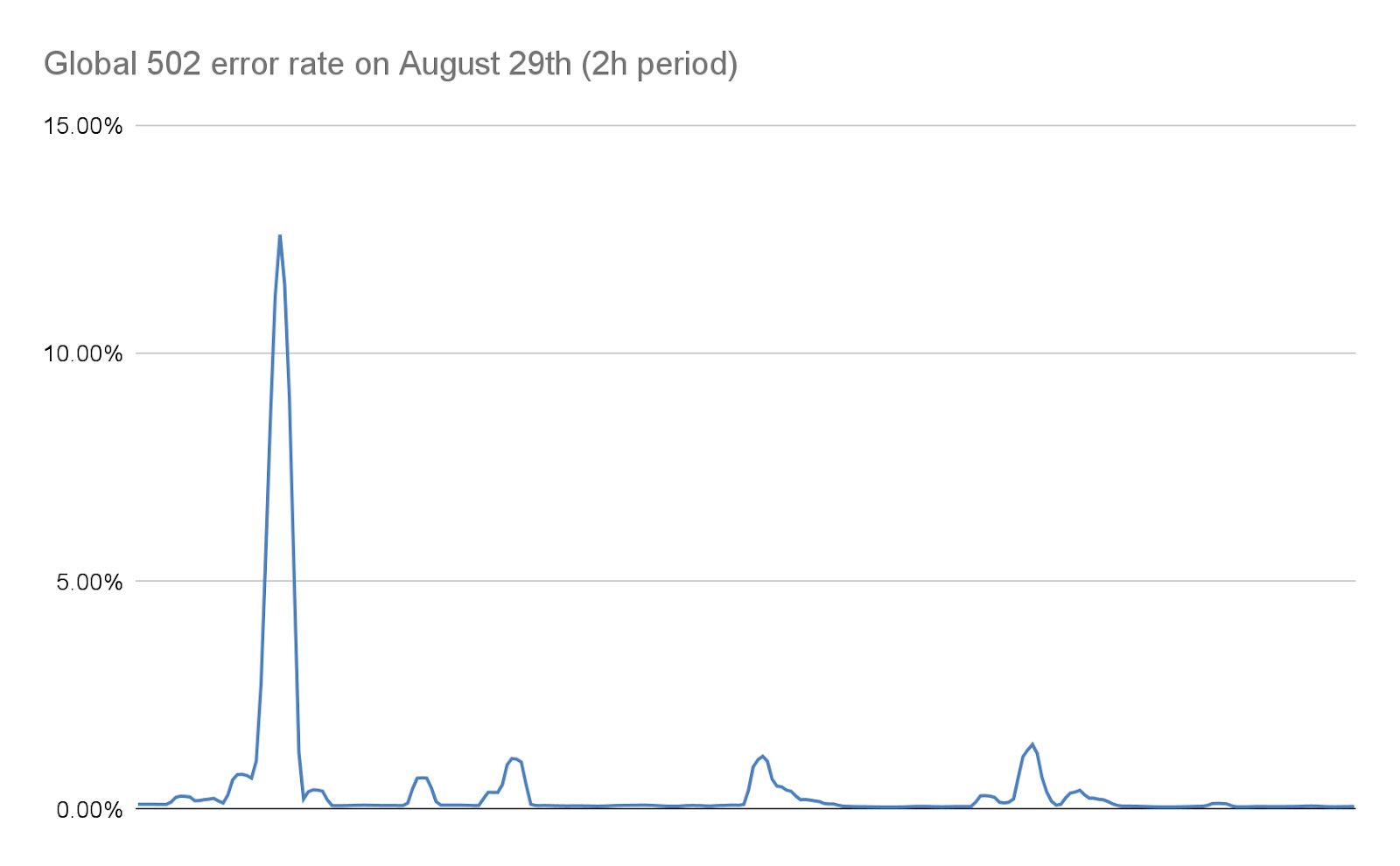
When this happens, the TLS proxy cannot connect anymore to its upstream proxy, this is why some clients saw a bare "502 Bad Gateway" error during the most serious attacks. It is important to note that, as of today, the logs used to create HTTP analytics are also emitted by our business logic proxy. The consequence of that is that these errors are not visible in the Cloudflare dashboard. Our internal dashboards show that about 1% of requests were impacted during the initial wave of attacks (before we implemented mitigations), with peaks at around 12% for a few seconds during the most serious one on August 29th. The following graph shows the ratio of these errors over a two hours while this was happening:
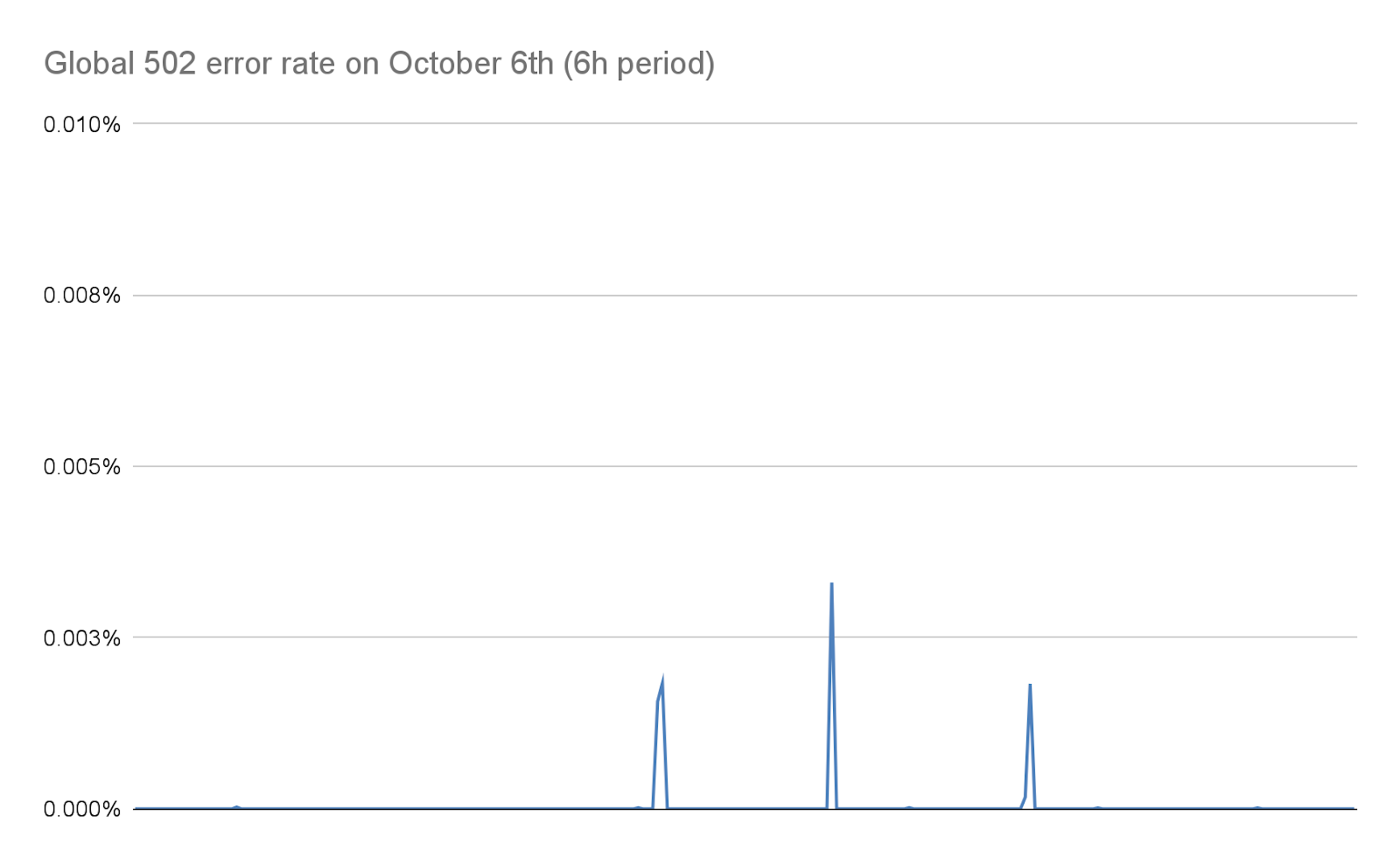
We worked to reduce this number dramatically in the following days, as detailed later on in this post. Both thanks to changes in our stack and to our mitigation that reduce the size of these attacks considerably, this number is today is effectively zero:
499 errors and the challenges for HTTP/2 stream concurrency
Another symptom reported by some customers is an increase in 499 errors. The reason for this is a bit different and is related to the maximum stream concurrency in a HTTP/2 connection detailed earlier in this post.
HTTP/2 settings are exchanged at the start of a connection using SETTINGS frames. In the absence of receiving an explicit parameter, default values apply. Once a client establishes an HTTP/2 connection, it can wait for a server's SETTINGS (slow) or it can assume the default values and start making requests (fast). For SETTINGS_MAX_CONCURRENT_STREAMS, the default is effectively unlimited (stream IDs use a 31-bit number space, and requests use odd numbers, so the actual limit is 1073741824). The specification recommends that a server offer no fewer than 100 streams. Clients are generally biased towards speed, so don't tend to wait for server settings, which creates a bit of a race condition. Clients are taking a gamble on what limit the server might pick; if they pick wrong the request will be rejected and will have to be retried. Gambling on 1073741824 streams is a bit silly. Instead, a lot of clients decide to limit themselves to issuing 100 concurrent streams, with the hope that servers followed the specification recommendation. Where servers pick something below 100, this client gamble fails and streams are reset.
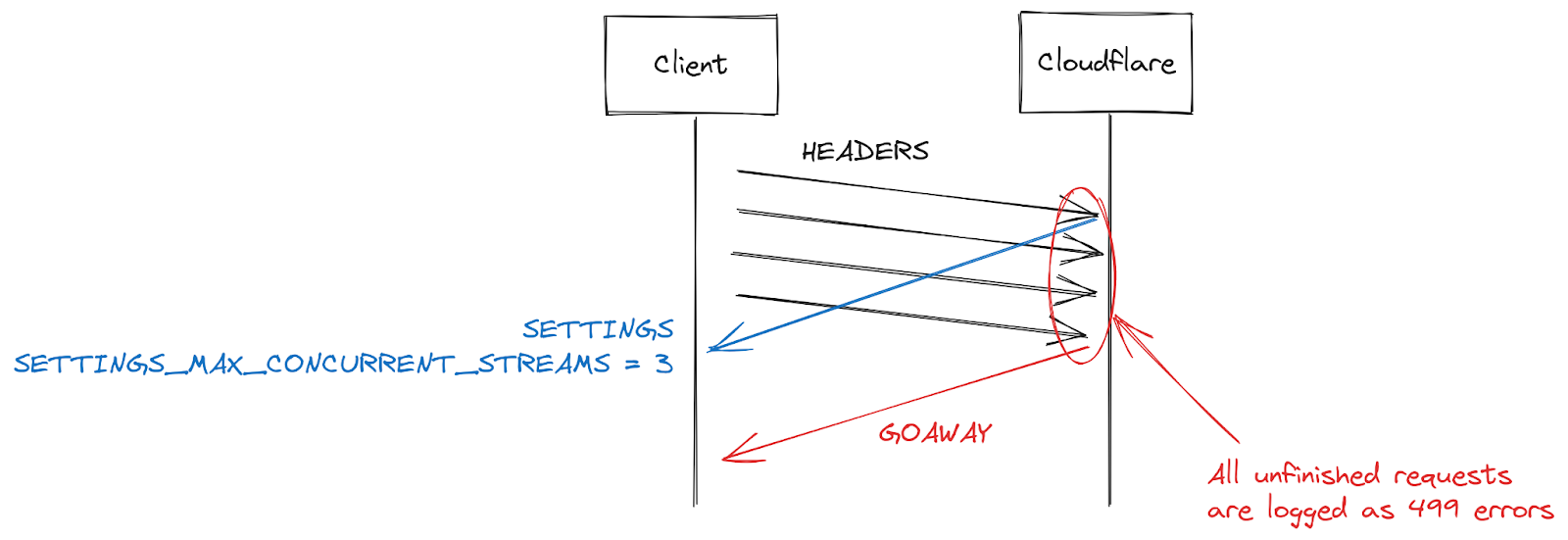
There are many reasons a server might reset a stream beyond concurrency limit overstepping. HTTP/2 is strict and requires a stream to be closed when there are parsing or logic errors. In 2019, Cloudflare developed several mitigations in response to HTTP/2 DoS vulnerabilities. Several of those vulnerabilities were caused by a client misbehaving, leading the server to reset a stream. A very effective strategy to clamp down on such clients is to count the number of server resets during a connection, and when that exceeds some threshold value, close the connection with a GOAWAY frame. Legitimate clients might make one or two mistakes in a connection and that is acceptable. A client that makes too many mistakes is probably either broken or malicious and closing the connection addresses both cases.
While responding to DoS attacks enabled by CVE-2023-44487, Cloudflare reduced maximum stream concurrency to 64. Before making this change, we were unaware that clients don't wait for SETTINGS and instead assume a concurrency of 100. Some web pages, such as an image gallery, do indeed cause a browser to send 100 requests immediately at the start of a connection. Unfortunately, the 36 streams above our limit all needed to be reset, which triggered our counting mitigations. This meant that we closed connections on legitimate clients, leading to a complete page load failure. As soon as we realized this interoperability issue, we changed the maximum stream concurrency to 100.
Actions from the Cloudflare side
In 2019 several DoS vulnerabilities were uncovered related to implementations of HTTP/2. Cloudflare developed and deployed a series of detections and mitigations in response. CVE-2023-44487 is a different manifestation of HTTP/2 vulnerability. However, to mitigate it we were able to extend the existing protections to monitor client-sent RST_STREAM frames and close connections when they are being used for abuse. Legitimate client uses for RST_STREAM are unaffected.
In addition to a direct fix, we have implemented several improvements to the server's HTTP/2 frame processing and request dispatch code. Furthermore, the business logic server has received improvements to queuing and scheduling that reduce unnecessary work and improve cancellation responsiveness. Together these lessen the impact of various potential abuse patterns as well as giving more room to the server to process requests before saturating.
Mitigate attacks earlier
Cloudflare already had systems in place to efficiently mitigate very large attacks with less expensive methods. One of them is named "IP Jail". For hyper volumetric attacks, this system collects the client IPs participating in the attack and stops them from connecting to the attacked property, either at the IP level, or in our TLS proxy. This system however needs a few seconds to be fully effective; during these precious seconds, the origins are already protected but our infrastructure still needs to absorb all HTTP requests. As this new botnet has effectively no ramp-up period, we need to be able to neutralize attacks before they can become a problem.
To achieve this we expanded the IP Jail system to protect our entire infrastructure: once an IP is "jailed", not only it is blocked from connecting to the attacked property, we also forbid the corresponding IPs from using HTTP/2 to any other domain on Cloudflare for some time. As such protocol abuses are not possible using HTTP/1.x, this limits the attacker's ability to run large attacks, while any legitimate client sharing the same IP would only see a very small performance decrease during that time. IP based mitigations are a very blunt tool — this is why we have to be extremely careful when using them at that scale and seek to avoid false positives as much as possible. Moreover, the lifespan of a given IP in a botnet is usually short so any long term mitigation is likely to do more harm than good. The following graph shows the churn of IPs in the attacks we witnessed:
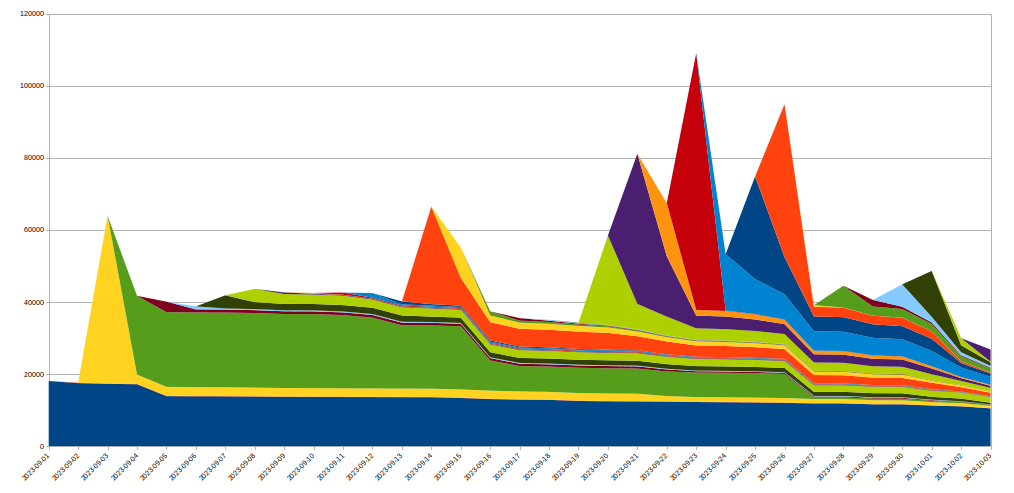
As we can see, many new IPs spotted on a given day disappear very quickly afterwards.
As all these actions happen in our TLS proxy at the beginning of our HTTPS pipeline, this saves considerable resources compared to our regular L7 mitigation system. This allowed us to weather these attacks much more smoothly and now the number of random 502 errors caused by these botnets is down to zero.
Observability improvements
Another front on which we are making change is observability. Returning errors to clients without being visible in customer analytics is unsatisfactory. Fortunately, a project has been underway to overhaul these systems since long before the recent attacks. It will eventually allow each service within our infrastructure to log its own data, instead of relying on our business logic proxy to consolidate and emit log data. This incident underscored the importance of this work, and we are redoubling our efforts.
We are also working on better connection-level logging, allowing us to spot such protocol abuses much more quickly to improve our DDoS mitigation capabilities.
Conclusion
While this was the latest record-breaking attack, we know it won’t be the last. As attacks continue to become more sophisticated, Cloudflare works relentlessly to proactively identify new threats — deploying countermeasures to our global network so that our millions of customers are immediately and automatically protected.
Cloudflare has provided free, unmetered and unlimited DDoS protection to all of our customers since 2017. In addition, we offer a range of additional security features to suit the needs of organizations of all sizes. Contact us if you’re unsure whether you’re protected or want to understand how you can be.
HTTP/2 Zero-Day Vulnerability Results in Record-Breaking DDoS Attacks
Post Syndicated from Grant Bourzikas original http://blog.cloudflare.com/zero-day-rapid-reset-http2-record-breaking-ddos-attack/

Earlier today, Cloudflare, along with Google and Amazon AWS, disclosed the existence of a novel zero-day vulnerability dubbed the “HTTP/2 Rapid Reset” attack. This attack exploits a weakness in the HTTP/2 protocol to generate enormous, hyper-volumetric Distributed Denial of Service (DDoS) attacks. Cloudflare has mitigated a barrage of these attacks in recent months, including an attack three times larger than any previous attack we’ve observed, which exceeded 201 million requests per second (rps). Since the end of August 2023, Cloudflare has mitigated more than 1,100 other attacks with over 10 million rps — and 184 attacks that were greater than our previous DDoS record of 71 million rps.
This zero-day provided threat actors with a critical new tool in their Swiss Army knife of vulnerabilities to exploit and attack their victims at a magnitude that has never been seen before. While at times complex and challenging to combat, these attacks allowed Cloudflare the opportunity to develop purpose-built technology to mitigate the effects of the zero-day vulnerability.
If you are using Cloudflare for HTTP DDoS mitigation, you are protected. And below, we’ve included more information on this vulnerability, and resources and recommendations on what you can do to secure yourselves.
Deconstructing the attack: What every CSO needs to know
In late August 2023, our team at Cloudflare noticed a new zero-day vulnerability, developed by an unknown threat actor, that exploits the standard HTTP/2 protocol — a fundamental protocol that is critical to how the Internet and all websites work. This novel zero-day vulnerability attack, dubbed Rapid Reset, leverages HTTP/2’s stream cancellation feature by sending a request and immediately canceling it over and over.
By automating this trivial “request, cancel, request, cancel” pattern at scale, threat actors are able to create a denial of service and take down any server or application running the standard implementation of HTTP/2. Furthermore, one crucial thing to note about the record-breaking attack is that it involved a modestly-sized botnet, consisting of roughly 20,000 machines. Cloudflare regularly detects botnets that are orders of magnitude larger than this — comprising hundreds of thousands and even millions of machines. For a relatively small botnet to output such a large volume of requests, with the potential to incapacitate nearly any server or application supporting HTTP/2, underscores how menacing this vulnerability is for unprotected networks.
Threat actors used botnets in tandem with the HTTP/2 vulnerability to amplify requests at rates we have never seen before. As a result, our team at Cloudflare experienced some intermittent edge instability. While our systems were able to mitigate the overwhelming majority of incoming attacks, the volume overloaded some components in our network, impacting a small number of customers’ performance with intermittent 4xx and 5xx errors — all of which were quickly resolved.
Once we successfully mitigated these issues and halted potential attacks for all customers, our team immediately kicked off a responsible disclosure process. We entered into conversations with industry peers to see how we could work together to help move our mission forward and safeguard the large percentage of the Internet that relies on our network prior to releasing this vulnerability to the general public.
We cover the technical details of the attack in more detail in a separate blog post: HTTP/2 Rapid Reset: deconstructing the record-breaking attack.
How is Cloudflare and the industry thwarting this attack?
There is no such thing as a “perfect disclosure.” Thwarting attacks and responding to emerging incidents requires organizations and security teams to live by an assume-breach mindset — because there will always be another zero-day, new evolving threat actor groups, and never-before-seen novel attacks and techniques.
This “assume-breach” mindset is a key foundation towards information sharing and ensuring in instances such as this that the Internet remains safe. While Cloudflare was experiencing and mitigating these attacks, we were also working with industry partners to guarantee that the industry at-large could withstand this attack.
During the process of mitigating this attack, our Cloudflare team developed and purpose-built new technology to stop these DDoS attacks and further improve our own mitigations for this and other future attacks of massive scale. These efforts have significantly increased our overall mitigation capabilities and resiliency. If you are using Cloudflare, we are confident that you are protected.
Our team also alerted web server software partners who are developing patches to ensure this vulnerability cannot be exploited — check their websites for more information.

Disclosures are never one and done. The lifeblood of Cloudflare is to ensure a better Internet, which stems from instances such as these. When we have the opportunity to work with our industry partners and governments to ensure there are no widespread impacts on the Internet, we are doing our part in increasing the cyber resiliency of every organization no matter the size or vertical.
To gain more of an understanding around mitigation tactics and next steps on patching, register for our webinar.
What are the origins of the HTTP/2 Rapid Reset and these record-breaking attacks on Cloudflare?
It may seem odd that Cloudflare was one of the first companies to witness these attacks. Why would threat actors attack a company that has some of the most robust defenses against DDoS attacks in the world?
The reality is that Cloudflare often sees attacks before they are turned on more vulnerable targets. Threat actors need to develop and test their tools before they deploy them in the wild. Threat actors who possess record-shattering attack methods can have an extremely difficult time testing and understanding how large and effective they are, because they don't have the infrastructure to absorb the attacks they are launching. Because of the transparency that we share on our network performance, and the measurements of attacks they could glean from our public performance charts, this threat actor was likely targeting us to understand the capabilities of the exploit.
But that testing, and the ability to see the attack early, helps us develop mitigations for the attack that benefit both our customers and industry as a whole.
From CSO to CSO: What should you do?
I have been a CSO for over 20 years, on the receiving end of countless disclosures and announcements like this. But whether it was Log4J, Solarwinds, EternalBlue WannaCry/NotPetya, Heartbleed, or Shellshock, all of these security incidents have a commonality. A tremendous explosion that ripples across the world and creates an opportunity to completely disrupt any of the organizations that I have led — regardless of the industry or the size.
Many of these were attacks or vulnerabilities that we may have not been able to control. But regardless of whether the issue arose from something that was in my control or not, what has set any successful initiative I have led apart from those that did not lean in our favor was the ability to respond when zero-day vulnerabilities and exploits like this are identified.
While I wish I could say that Rapid Reset may be different this time around, it is not. I am calling all CSOs — no matter if you’ve lived through the decades of security incidents that I have, or this is your first day on the job — this is the time to ensure you are protected and stand up your cyber incident response team.
We’ve kept the information restricted until today to give as many security vendors as possible the opportunity to react. However, at some point, the responsible thing becomes to publicly disclose zero-day threats like this. Today is that day. That means that after today, threat actors will be largely aware of the HTTP/2 vulnerability; and it will inevitably become trivial to exploit and kickoff the race between defenders and attacks — first to patch vs. first to exploit. Organizations should assume that systems will be tested, and take proactive measures to ensure protection.
To me, this is reminiscent of a vulnerability like Log4J, due to the many variants that are emerging daily, and will continue to come to fruition in the weeks, months, and years to come. As more researchers and threat actors experiment with the vulnerability, we may find different variants with even shorter exploit cycles that contain even more advanced bypasses.
And just like Log4J, managing incidents like this isn’t as simple as “run the patch, now you’re done”. You need to turn incident management, patching, and evolving your security protections into ongoing processes — because the patches for each variant of a vulnerability reduce your risk, but they don’t eliminate it.
I don’t mean to be alarmist, but I will be direct: you must take this seriously. Treat this as a full active incident to ensure nothing happens to your organization.
Recommendations for a New Standard of Change
While no one security event is ever identical to the next, there are lessons that can be learned. CSOs, here are my recommendations that must be implemented immediately. Not only in this instance, but for years to come:
- Understand your external and partner network’s external connectivity to remediate any Internet facing systems with the mitigations below.
- Understand your existing security protection and capabilities you have to protect, detect and respond to an attack and immediately remediate any issues you have in your network.
- Ensure your DDoS Protection resides outside of your data center because if the traffic gets to your datacenter, it will be difficult to mitigate the DDoS attack.
- Ensure you have DDoS protection for Applications (Layer 7) and ensure you have Web Application Firewalls. Additionally as a best practice, ensure you have complete DDoS protection for DNS, Network Traffic (Layer 3) and API Firewalls
- Ensure web server and operating system patches are deployed across all Internet Facing Web Servers. Also, ensure all automation like Terraform builds and images are fully patched so older versions of web servers are not deployed into production over the secure images by accident.
- As a last resort, consider turning off HTTP/2 and HTTP/3 (likely also vulnerable) to mitigate the threat. This is a last resort only, because there will be a significant performance issues if you downgrade to HTTP/1.1
- Consider a secondary, cloud-based DDoS L7 provider at perimeter for resilience.
Cloudflare’s mission is to help build a better Internet. If you are concerned with your current state of DDoS protection, we are more than happy to provide you with our DDoS capabilities and resilience for free to mitigate any attempts of a successful DDoS attack. We know the stress that you are facing as we have fought off these attacks for the last 30 days and made our already best in class systems, even better.
If you’re interested in finding out more, we have a webinar coming up with more details on the zero-day and how to respond; you can register here. We also have more technical details of the attack in more detail in a separate blog post: HTTP/2 Rapid Reset: deconstructing the record-breaking attack. Finally, if you’re being targeted or need immediate protection, please contact your local Cloudflare representative or visit https://www.cloudflare.com/under-attack-hotline/.
HTTP/2 Zero-day 취약성은 이전에 없던 기록적인 DDoS 공격으로 이어집니다
Post Syndicated from Grant Bourzikas original http://blog.cloudflare.com/ko-kr/zero-day-rapid-reset-http2-record-breaking-ddos-attack-ko-kr/
오늘 Cloudflare는 Google, Amazon AWS와 함께 “HTTP/2 Rapid Reset” 공격이라는 새로운 zero-day 취약성의 존재를 공개했습니다. 이 공격은 HTTP/2 프로토콜의 약점을 악용하여 거대 하이퍼 볼류메트릭 분산 서비스 거부 (DDoS) 공격을 생성합니다. Cloudflare는 최근 몇 달간 이런 빗발치는 공격을 완화하였는데, 그중에는 이전에 우리가 목격한 것보다 규모가 3배 큰, 초당 2억 100만 요청(rps)을 넘어서는 공격도 있었습니다. Cloudflare는 2023년 8월 말부터 1,000만 rps가 넘는 기타 공격 1,100건 이상을 완화하였으며, 184건은 이전 DDoS 기록인 7,100만 rps보다도 큰 공격이었습니다.
위협 행위자들은 이러한 zero-day를 통해 취약성이라는 맥가이버 칼에 치명적인 도구를 새로 더하여 이전에 본 적 없는 규모로 피해자를 공격할 수 있게 되었습니다. 때로는 복잡하고 힘든 싸움이었지만, Cloudflare는 이러한 공격을 통해 zero-day 취약성의 영향을 완화하기 위한 기술을 개발할 수 있었습니다.
HTTP DDoS 완화를 위해 Cloudflare를 이용 중이시라면, 여러분은 보호받고 있습니다. 이 취약성에 대해 아래에서 더 알아보고, 스스로를 보호하기 위해 할 수 있는 리소스와 권장 사항을 확인해 보세요.
공격 분석: 모든 CSO가 알아야 할 사항
2023년 8월 말, Cloudflare 팀은 알 수 없는 위협 행위자가 개발한 새로운 zero-day 취약성을 발견하였습니다. 이 취약성은 인터넷 및 모든 웹 사이트의 작동에 필수적인 표준 HTTP/2 프로토콜을 악용합니다. Rapid Reset이라는 별명이 붙은 이 새로운 zero-day 취약성 공격은 요청 전송 후 즉각적 취소를 반복함으로써 HTTP/2 스트림 취소 기능을 활용합니다.
작은 규모의 “요청, 취소, 요청, 취소” 패턴을 대규모로 자동화함으로써 위협 행위자는 서비스 거부를 생성하며 HTTP/2의 표준 구현을 실행하는 모든 서버 또는 애플리케이션도 쓰러뜨릴 수 있습니다. 또한 이 기록적인 공격에 대해 알아야 할 한 가지 중대한 사항은 이 공격에 관여하는 봇넷이 대략 2만 개의 머신으로 구성되어 규모가 크지 않다는 사실입니다. Cloudflare는 수십, 수백만 개의 머신으로 구성되어 이보다 훨씬 더 큰 규모의 봇넷을 정기적으로 감지합니다. 비교적 작은 봇넷이 이렇게나 많은 요청을 출력하고 HTTP/2를 지원하는 거의 모든 서버나 애플리케이션을 무력화시킬 수 있다는 것은 이러한 취약성이 보호받지 않는 네트워크에 얼마나 위협적인지 잘 알려 줍니다.
위협 행위자는 HTTP/2 취약성과 봇넷을 함께 사용함으로써 이전에 본 적 없는 비율로 요청을 증폭시켰습니다. 그 결과 Cloudflare 팀은 간헐적 에지 불안정을 다소 경험했습니다. Cloudflare 시스템은 압도적인 수의 공격 유입을 완화할 수 있었지만, 네트워크의 일부 구성 요소에 과부하가 발생했습니다. 이로 인해 간헐적으로 400번 대 및 500번 대 오류가 발생하여 소수의 고객 성능에 영향을 미쳤습니다. 하지만 이 오류는 모두 신속하게 해결되었습니다.
이러한 문제를 성공적으로 완화하고 모든 고객에 대한 잠재적 공격을 중지시킨 후, Cloudflare 팀은 즉시 책임감 있는 공개 프로세스를 시작했습니다. Cloudflare는 일반 대중에게 이 취약성을 공개하기 전에 업계 동료 기업과의 대화를 통해 Cloudflare의 사명을 진전시키고, 당사 네트워크에 의존하는 인터넷의 상당 부분을 보호하기 위한 방법을 모색했습니다.
Cloudflare는 별도의 블로그 게시물을 통해 이 공격에 대한 기술적 세부 사항을 더 자세히 다루었습니다: HTTP/2 Rapid Reset: 기록적인 공격의 분석.
Cloudflare와 업계는 이 공격을 어떻게 차단했을까요?
“완벽한 공개”라는 것은 없습니다. 공격을 차단하고 새롭게 발생하는 사건에 대응하기 위해 조직과 보안 팀은 침해를 가정하는 사고방식을 가져야 합니다. 또 다른 zero-day와 새롭게 진화하는 위협 행위자 집단, 전에 본 적 없는 공격과 기술이 앞으로 언제든 등장할 것이기 때문입니다.
이러한 “침해 가정” 사고방식은 정보 공유의 핵심 기반이며, 이러한 상황에서 인터넷을 안전하게 유지하도록 보장합니다. Cloudflare는 이러한 공격을 경험하고 완화하는 동시에 업계 파트너와 협업하여 업계 전반이 이러한 공격을 확실히 견뎌낼 수 있도록 노력하고 있습니다.
이 공격을 완화하는 과정에서 Cloudflare 팀은 이러한 DDoS 공격을 중지하고, 이번 공격 및 향후 발생할 기타 대규모 공격에 대비하여 자체 완화 능력을 개선시킬 목적으로 새로운 기술을 개발 및 구축했습니다. 이러한 노력은 Cloudflare의 전반적 완화 역량과 복원력을 크게 높였습니다. 만약 Cloudflare를 이용 중이시라면, 여러분은 보호받고 있다고 자신 있게 말씀드릴 수 있습니다.
또한 Cloudflare 팀은 이러한 취약성을 절대 악용할 수 없도록 하기 위해, 패치를 개발하고 있는 웹 서버 소프트웨어 파트너사에도 이 사실을 알렸습니다. 해당 파트너사의 웹 사이트에서 자세한 정보를 확인하세요.
공개는 결코 일회성으로 끝나는 것이 아닙니다. Cloudflare의 생명선은 더 나은 인터넷을 보장하는 것이며, 이는 이러한 사례로부터 시작됩니다. 업계 파트너 및 정부와 협력하여 인터넷에 광범위한 영향을 미치지 않도록 보장할 수 있는 기회가 있을 때, Cloudflare는 규모와 범주에 관계없이 모든 조직의 사이버 복원력을 키우기 위해 본분을 다하고 있습니다.
완화 전략 및 다음 패치 단계에 대해 자세히 알아보려면, 웨비나에 등록하세요.
HTTP/2 Rapid Reset 및 Cloudflare에 대한 기록적인 공격의 기원은 무엇일까요?
이러한 공격을 가장 먼저 목격한 회사 중 하나가 Cloudflare라는 사실이 이상하게 보일 수도 있습니다. 위협 행위자들이 세계에서 가장 강력한 DDoS 공격 방어 체계를 갖춘 회사를 공격하는 이유는 무엇일까요?
실제로 Cloudflare는 더 취약한 대상에게 공격이 실행되기 전에 이를 감지하는 경우가 많습니다. 위협 행위자들은 도구를 야생에 배포하기 전에 개발하고 테스트해야 합니다. 전례 없는 공격 기법을 보유한 위협 행위자는 자신들이 개시하는 공격을 소화할 인프라가 부족하므로 공격의 규모와 효과를 테스트하고 파악하는 데 어려움을 겪을 수 있습니다. Cloudflare가 네트워크 성능에 대해 공유하는 투명성과 Cloudflare의 공개 성능 차트에서 확보할 수 있는 공격 측정값 때문에, 위협 행위자는 악용 역량을 파악하기 위하여 Cloudflare를 대상으로 삼았을 가능성이 높습니다.
그러나 해당 테스트와 공격을 조기에 감지할 수 있는 능력은 Cloudflare가 고객과 업계 전체에 도움을 주는 공격 완화 방법을 개발할 수 있도록 합니다.
CSO가 CSO에게: 어떻게 해야 할까요?
저는 20년 이상을 CSO로 일하면서 이와 같은 수없이 많은 공개와 발표를 접해왔습니다. 그러나 이것이 Log4J이든, Solarwinds, EternalBlue WannaCry/NotPetya, Heartbleed, 혹은 Shellshock이든, 이러한 보안 사고에는 모두 공통점이 있습니다. 이 거대한 폭발은 전 세계에 파문을 일으키고 산업이나 규모에 관계 없이 제가 이끌었던 모든 조직을 완전히 혼란에 빠뜨릴 수 기회를 만들어 낸다는 것이죠.
이 중 상당수는 제어가 불가능했던 공격이나 취약성이었습니다. 그러나 해당 문제가 제가 제어할 수 있는 사안에서 발생했는지와 관계없이, 제가 이끈 성공적인 이니셔티브와 그렇지 않은 이니셔티브를 차별화할 수 있었던 것은 이와 같은 zero-day 취약성과 그 악용이 발견되었을 때 대응할 수 있는 능력이었습니다.
이번 Rapid Reset은 다를 것이라고 말할 수 있었다면 좋았겠지만, 그렇지 않습니다. 수십 년 동안 보안 사고를 겪어온 CSO든 오늘이 CSO로서의 첫 출근이든 관계없이 저는 모든 CSO분들께 지금이 바로 여러분을 보호하고 사이버 사고 대응팀을 강화해야 할 시기라고 말씀드립니다.
저희는 최대한 많은 보안 공급자가 대응할 기회를 제공하기 위해 오늘날까지 정보를 제한해 왔습니다. 그러나 언젠가는 이러한 zero-day 위협을 대중에 공개해야 합니다. 오늘이 바로 그날입니다. 이는 오늘 이후로 위협 행위자들이 HTTP/2 취약성에 대해 대부분 인지하게 될 것이며, 이를 악용하는 것은 필연적으로 방어자와 공격자 간의 경쟁, 즉 먼저 패치를 적용하는 것과 먼저 악용하는 것 사이의 경쟁을 시작하게 될 것을 의미합니다. 조직은 시스템이 테스트 될 것이라는 전제하에 보안을 확보하기 위해 사전 조처를 해야 합니다.
저에게 이 사건은 Log4J 같은 취약성을 떠올리게 합니다. 많은 변종이 매일 새롭게 떠올라 앞으로 몇 주, 몇 달, 몇 년 동안 연이어 결실을 보게 될 것이니까요. 더 많은 연구원과 위협 행위자들이 이 취약성을 시험함에 따라, 우리는 훨씬 발전한 우회로를 포함하며 훨씬 짧은 악용 주기를 가진 다양한 변종을 마주할 수 있습니다.
그리고 Log4J와 마찬가지로, 이러한 사고를 다루는 것은 “패치를 적용하시면 됩니다.”라고 할 수 있을 만큼 간단하지가 않습니다. 여러분은 사고 관리, 패치, 보안 보호의 진화를 지속적인 과정으로 전환시켜야 합니다. 취약성의 각 변종에 대한 패치가 위험 요소를 줄여줄 수는 있지만, 완전히 제거하지는 않기 때문입니다.
불안을 조장하려는 것은 아니지만, 직설적으로 말씀드립니다. 여러분은 이 문제를 심각하게 받아들여야 합니다. 조직에 아무 일도 일어나지 않게 하려면 이를 정식 사고로 취급해야 합니다.
변화의 새로운 기준을 위한 권장 사항
어떤 보안 사건도 다음 사건과 동일할 수는 없지만, 배울 수 있는 교훈은 있습니다. CSO 여러분, 즉시 시행할 수 있는 권장 사항을 말씀드리겠습니다. 이는 이번 사례뿐만 아니라, 앞으로 다가올 몇 년 동안에도 마찬가지입니다.
- 외부 맟 파트너 네트워크의 외부 연결을 이해하여 인터넷에 연결된 모든 시스템을 아래의 완화 방법으로 교정하여야 합니다.
- 공격을 보호, 감지, 대응하며 네트워크에서 일어나는 모든 문제를 즉시 교정하는 데 필요한 기존 보안 보호 및 기능을 파악하십시오.
- 트래픽이 데이터 센터에 다다르면 DDoS 공격을 완화하기 어려우므로 DDoS 방어책을 데이터 센터 외부에 두십시오.
- 애플리케이션(계층 7)을 위한 DDoS 방어 기능 및 웹 애플리케이션 방화벽이 있는지 확인하십시오. 추가 모범 사례로 DNS, 네트워크 트래픽(계층 3) 및 API 방화벽을 위한 DDoS 방어 기능이 있는지 확인하십시오.
- 웹 서버와 운영 시스템 패치가 모든 인터넷 연결 웹 서버 전반에 배포될 수 있도록 하십시오. 또한 Terraform 빌드 및 이미지와 같은 자동화 작업에 패치를 모두 적용하여 이전 버전의 웹 서버가 실수로라도 보안 이미지를 통해 프로덕션에 배포되지 않도록 하십시오.
- 마지막 수단으로, 위협을 완화하기 위해 HTTP/2와 HTTP/3(역시 취약할 수 있음)를 해제하는 방법도 고려하십시오. HTTP/1.1로 다운그레이드할 경우 상당한 성능 문제가 발생할 것이므로 이 방법은 최후의 수단으로만 고려되어야 합니다.
- 복원력을 위해 클라우드 기반 DDoS L7 공급자를 보조적으로 두는 것을 고려해 보십시오.
Cloudflare의 사명은 더 나은 인터넷 구축을 지원하는 것입니다. 현재 DDoS 방어 상태가 염려된다면, 성공적인 DDoS 공격 시도를 완화할 수 있는 DDoS 대응 기능 및 복원력을 기꺼이 무료로 제공해 드리겠습니다. Cloudflare는 지난 30일간 이러한 공격에 맞서 싸우며 동급 최고의 시스템을 더욱 개선했기 때문에 여러분이 받고 있는 스트레스를 이해합니다.
자세한 내용이 궁금하다면, zero-day에 대한 세부 사항과 대응 방법에 관한 웨비나를 시청하세요. 보호받고 있는지 잘 모르겠거나 어떻게 보호받을 수 있는지 알고 싶다면 이곳으로 문의하세요. 또한 Cloudflare는 별도의 블로그 게시물에서 해당 공격에 대한 기술적 세부 사항을 더 자세히 다루었습니다. HTTP/2 Rapid Reset: 기록적인 공격의 분석. 마지막으로 만약 공격의 대상이 되었거나 즉각적 보호가 필요하다면, 여러분의 Cloudflare 지역 담당자에게 연락하거나 https://www.cloudflare.com/under-attack-hotline/을 방문하십시오.
HTTP/2 Rapid Reset:記録的勢いの攻撃を無効化
Post Syndicated from Lucas Pardue original http://blog.cloudflare.com/ja-jp/technical-breakdown-http2-rapid-reset-ddos-attack-ja-jp/
2023年8月25日以降、当社では、多くのお客様を襲った異常に大規模なHTTP攻撃を目撃し始めました。これらの攻撃は当社の自動DDoSシステムによって検知され、軽減されました。しかし、これらの攻撃が記録的な規模に達するまで、それほど時間はかかりませんでした。その規模は、過去に記録された最大の攻撃の約3倍にも達したのです。
懸念となるのは、攻撃者がわずか2万台のボットネットでこの攻撃を実行できたという事実です。今日、数万台から数百万台のマシンで構成されるボットネットが存在しています。Web上では全体として通常1秒間に10億から30億のリクエストしかないことを考えると、この方法を使えば、Webのリクエスト全体を少数のターゲットに集中させることができます。
検出と軽減
これは前例のない規模の斬新な攻撃ベクトルでしたが、Cloudflareの既存の保護システムは攻撃の矛先をほぼ吸収することができました。当初はお客様のトラフィックに若干の影響が見られたものの(攻撃の初期波ではリクエストのおよそ1%に影響)、現在では緩和方法を改良し、当社のシステムに影響を与えることなく、Cloudflareのすべてのお客様に対する攻撃を阻止することができるようになりました。
当社は、業界の最大手であるGoogleとAWSの2社と同時に、この攻撃に気づきました。当社はCloudflareのシステムを強化し、今日ではすべてのお客様がこの新しいDDoS攻撃手法から保護され、お客様への影響がないことを確認しました。当社はまた、グーグルやAWSとともに、影響を受けるベンダーや重要インフラストラクチャプロバイダーへの攻撃に関する協調的な情報開示に参加しました。
この攻撃は、HTTP/2プロトコルのいくつかの機能とサーバー実装の詳細を悪用することで行われました(詳細は、CVE-2023-44487をご覧ください)。この攻撃はHTTP/2プロトコルにおける根本的な弱点を悪用しているため、HTTP/2を実装しているすべてのベンダーがこの攻撃の対象になると考えられます。これには、すべての最新のWebサーバーも含まれます。当社は、GoogleとAWSとともに、Webサーバーベンダーがパッチを実装できるよう、攻撃方法を開示しました。一方で、Webに面したWebやAPIサーバーの前段階に設置されるCloudflareのようなDDoS軽減サービスを利用するのが最善の防御策とります。
この投稿では、HTTP/2プロトコルの詳細、攻撃者がこれらの大規模な攻撃を発生させるために悪用した機能、およびすべてのお客様が保護されていることを保証するために当社が講じた緩和策について詳細を掘り下げて紹介します。これらの詳細を公表することで、影響を受ける他のWebサーバーやサービスが緩和策を実施するために必要な情報を得られることを期待しています。そしてさらに、HTTP/2プロトコル規格チームや、将来のWeb規格に取り組むチームには、こうした攻撃を防ぐためHTTP/2プロトコルの設計改善に役立てていただければと思っています。
RST攻撃の詳細
HTTPは、Webを稼働するにあたって用いられるアプリケーションプロトコルです。HTTPセマンティクスとは、リクエストとレスポンスメッセージ、メソッド、ステータスコード、ヘッダーフィールドとトレーラフィールド、メッセージコンテンツなど、全体的なアーキテクチャ、用語、プロトコルの側面に関し、あらゆるバージョンに共通しています。個々のHTTPバージョンでは、セマンティクスをインターネット上でやりとりするための「ワイヤーフォーマット」に変換する方法を定義しています。例えば、クライアントはリクエストメッセージをバイナリデータにシリアライズして送信し、サーバーがこれを解析して処理可能なメッセージに戻します。
HTTP/1.1は、テキスト形式のシリアライズを使用します。リクエストメッセージとレスポンスメッセージはASCII文字のストリームとしてやりとりされ、TCPのような信頼性の高いトランスポートレイヤーを介して、以下のフォーマットで送信されます(「CRLF」はキャリッジリターンとラインフィードを意味します):
 HTTP-message   = start-line CRLF
                   *( field-line CRLF )
                   CRLF
                   [ message-body ]
例えば、ワイヤ上の非常に簡単なGETリクエストは、https://blog.cloudflare.com/となります:
GET / HTTP/1.1 CRLFHost: blog.cloudflare.comCRLFCRLF
そして、応答は次のようなものになります:
HTTP/1.1 200 OK CRLFServer: cloudflareCRLFContent-Length: 100CRLFtext/html; charset=UTF-8CRLFCRLF<100 bytes of data>
このフォーマットは、ワイヤ上でメッセージをフレーム化します。つまり、1つのTCP接続を使って複数のリクエストとレスポンスをやり取りすることが可能になります。しかし、このフォーマットでは、各メッセージがまとめて送信される必要があります。さらに、リクエストと応答を正しく関連付けるために、厳密な順序が要求されます。つまり、メッセージは順序だてて交換され、多重化することはできません。https://blog.cloudflare.com/、https://blog.cloudflare.com/page/2/の2つのGETリクエストは、次のようになります:
GET / HTTP/1.1 CRLFHost: blog.cloudflare.comCRLFCRLFGET /page/2/ HTTP/1.1 CRLFHost: blog.cloudflare.comCRLFCRLF
レスポンスは、次のようになります:
HTTP/1.1 200 OK CRLFServer: cloudflareCRLFContent-Length: 100CRLFtext/html; charset=UTF-8CRLFCRLF<100 bytes of data>CRLFHTTP/1.1 200 OK CRLFServer: cloudflareCRLFContent-Length: 100CRLFtext/html; charset=UTF-8CRLFCRLF<100 bytes of data>
Webページでは、これらの例よりも複雑なHTTPインタラクションが必要となります。Cloudflareブログにアクセスすると、ブラウザは複数のスクリプト、スタイル、メディアアセットを読み込みます。HTTP/1.1を使ってトップページを訪れ、すぐに2ページ目に移動した場合、ブラウザは2つの選択肢から選ぶことになります。ページ2が始まる前に、ページに対するキューに入れられたものでもう必要のないものすべての応答を待つか、TCP接続を閉じて新しい接続を開くことで、実行中のリクエストをキャンセルすることのいずれかとなります。どちらも、あまり現実的ではありません。ブラウザは、TCP接続のプール(ホストあたり最大6つ)を管理し、プール上で複雑なリクエストディスパッチロジックを実装することによって、これらの制限を回避する傾向があります。
HTTP/2は、HTTP/1.1の多くの問題に対処しています。各HTTPメッセージは、型、長さ、フラグ、ストリーム識別子(ID)と悪意のあるペイロードを持つHTTP/2フレームのセットにシリアライズされます。ストリームIDは、ワイヤ上のどのバイトがどのメッセージに適用されるかを明確にし、安全な多重化と同時実行を可能にします。ストリームは、双方向となります。クライアントはフレームを送信し、サーバーは同じIDを使ったフレームを返信します。
HTTP/2では、https://blog.cloudflare.comへの当社のGETリクエストはストリームID 1でやり取りされ、クライアントは1つのHEADERSフレームを送信し、サーバーは1つのHEADERSフレームと、それに続く1つ以上のDATAフレームで応答します。クライアントのリクエストは常に奇数番号のストリームIDを使用するので、後続のリクエストはストリームID 3、5、…を使用することになります。レスポンスはどのような順番でも提供することができ、異なるストリームからのフレームをインターリーブすることもできます。
ストリーム多重化と同時実行は、HTTP/2の強力な機能です。これらは、単一のTCP接続をより効率的に使用することを可能にします。HTTP/2は、特に優先順位付けと組み合わせると、リソースの取得を最適化します。反面、クライアントが大量の並列作業を簡単に開始できるようにすることは、HTTP/1.1と比くらべサーバーリソースに対するピーク需要を増加させる可能性があります。これは明らかに、サービス拒否のベクトルです。
複数の防護策を提供するため、HTTP/2は最大アクティブ同時ストリームの概念を活用します。SETTINGS_MAX_CONCURRENT_STREAMSパラメータにより、サーバーは同時処理数の上限をアドバタイズできます。例えば、サーバーが上限を100とした場合、常時アクティブにできるのは100リクエストだけになります。クライアントがこの制限を超えてストリームを開こうとした場合、RST_STREAMフレームを使用してサーバーに拒否される必要があります。ストリーム拒否は、接続中の他のストリームには影響しません。
本当のところはもう少し複雑になります。ストリームには、ライフサイクルがあります。下図はHTTP/2ストリームのステートマシンの図です。クライアントとサーバーはストリームの状態をそれぞれ管理します。HEADERS、DATA、RST_STREAMフレームが送受信されると遷移が発生します。ストリームの状態のビューは独立していますが、同期しています。
HEADERSとDATAフレームはEND_STREAMフラグを含み、このフラグが値1(true)にセットされると、ステート遷移のトリガーとなります。
メッセージコンテンツを持たないGETリクエストの例で説明します。クライアントはまずストリームをアイドル状態からオープン状態に、続いて即座にハーフクローズ状態に遷移させます。クライアントのハーフクローズ状態は、もはやHEADERSやDATAを送信できないことを意味し、WINDOW_UPDATE、PRIORITY、RST_STREAMフレームのみを送信できます。ただし、任意のフレームを受信することができます。
サーバーがHEADERSフレームを受信して解析すると、ストリームの状態をアイドル状態からオープン状態、そしてハーフクローズ状態に遷移させ、クライアントと一致させます。サーバーがハーフクローズ状態であれば、どんなフレームでも送信できますが、WINDOW_UPDATE、PRIORITY、またはRST_STREAMフレームしか受信できないことを意味します。
そのため、サーバーはEND_STREAMフラグを0に設定したHEADERSを送信し、次にEND_STREAMフラグを1に設定したDATAを送信します。DATAフレームは、サーバーでハーフクローズドからクローズドへのストリームの遷移をトリガーします。クライアントがこのフレームを受信すると、ストリームもクローズドに遷移します。ストリームがクローズされると、フレームの送受信はできなくなります。
このライフサイクルを今カレンシーの文脈に当てはめ直し、HTTP/2は次のように記述します:
「オープン」状態にあるストリーム、または「ハーフクローズド」状態のいずれかにあるストリームは、エンドポイントが開くことを許可されるストリームの最大数にカウントされます。これら3つの状態のいずれかにあるストリームは、SETTINGS_MAX_CONCURRENT_STREAMS設定でアドバタイズされる制限にカウントされます。
理論的には、コンカレンシーの制限は、有用です。しかし、その効果を妨げる現実的な要因があります。詳細は、このブログの後半で開設します。
HTTP/2リクエストの取り消し
前段で、クライアントからの実行中のリクエストのキャンセルについて説明しました。HTTP/2は、HTTP/1.1よりもはるかに効率的な方法でこれをサポートしています。接続全体を切断するのではなく、クライアントは1つのストリームに対してRST_STREAMフレームを送信することができます。サーバーにリクエストの処理を中止し、レスポンスを中止するよう指示するものです。これによって、Free 、サーバーのリソースを節約し、帯域幅の浪費を避けることができます。
先ほどの3つのリクエストの例を考えてみます。このときクライアントは、すべてのHEADERSが送信された後に、ストリーム1のリクエストをキャンセルします。サーバーは、応答を提供する準備ができる前にこのRST_STREAMフレームを解析し、代わりにストリーム3と5にのみ応答します:
リクエストのキャンセルは、便利な機能です。たとえば、複数の画像を含むウェブページをスクロールするとき、Webブラウザはビューポートの外にある画像をキャンセルすることができ、ビューポートに入る画像をより速く読み込むことができます。HTTP/2は、HTTP/1.1に比べてこの動作をより効率的にしています。
キャンセルされたリクエストストリームは、ストリームのライフサイクルを急速に遷移していきます。END_STREAMフラグが1に設定されたクライアントのHEADERSは、状態をアイドルからオープン、ハーフクローズへと遷移させ、RST_STREAMは直ちにハーフクローズからクローズへと遷移させます。
ストリームの同時実行数制限に寄与するのは、オープン状態またはハーフクローズ状態にあるストリームだけであることを思い出してください。クライアントがストリームをキャンセルすると、そのクライアントは即座に別のストリームをオープンできるようになり、すぐに別のリクエストを送信できるようになります。これがCVE-2023-44487を機能させる要諦なのです。
サービス拒否につながるRapid Reset
HTTP/2リクエストのキャンセルは、制限のない数のストリームを急速にリセットするために悪用される可能性があります。HTTP/2サーバーがクライアントから送信されたRST_STREAMフレームを処理し、十分に迅速に状態を取りやめることができる場合、こうした迅速なリセットは問題を引き起こしません。問題が発生し始めるのは、片付ける際に何らかの遅延やタイムラグがある場合です。クライアントは非常に多くのリクエストを処理するため、作業のバックログが蓄積され、サーバーのリソースを過剰に消費することになります。
一般的なHTTPデプロイメントアーキテクチャは、HTTP/2プロキシやロードバランサーを他のコンポーネントの前で実行することになっています。クライアントのリクエストが到着すると、それはすぐにディスパッチされ、実際の作業は非同期アクティビティとして別の場所で行われます。これにより、プロキシはクライアントのトラフィックを非常に効率的に処理することができます。しかし、このような懸念の層別は、プロキシが処理中のジョブを片付けることを難しくします。そのため、これらのデプロイでは、急速なリセットによる問題が発生しやすくなります。
Cloudflareのリバースプロキシは、HTTP/2クライアントのトラフィックを処理する際、接続ソケットからデータをバッファにコピーし、バッファリングされたデータを順番に処理していきます。各リクエストが読み込まれると(HEADERSとDATAフレーム)、アップストリームサービスにディスパッチされます。RST_STREAMフレームが読み込まれると、リクエストのローカル状態が破棄され、リクエストがキャンセルされたことがアップストリームに通知されます。バッファ全体が消費されるまで、これが繰り返されます。しかしながら、このロジックは悪用される可能性があります。悪意のあるクライアントが膨大なリクエストの連鎖を送信し始め、接続の開始時にリセットされると、当社のサーバーはそれらすべてを熱心に読み込み、新しい着信リクエストを処理できなくなるほどのストレスをアップストリームサーバーにもたらすでしょう。
強調すべき重要な点は、ストリームの同時実行性だけでは急激なリセットを緩和できないということです。サーバーがSETTINGS_MAX_CONCURRENT_STREAMSの値を選んだとしても、クライアントは高いリクエストレートを生成するためにリクエストを繰り返すことができます。
Rapid Resetの全貌
以下、合計1000リクエストを試みる概念実証クライアントを使用して再現された高速リセットの例を示します。軽減策は一切設けず、市販品のサーバーを用いたテスト環境で、443番ポートを用いています。トラフィックはWiresharkを使って分解され、わかりやすくするためにHTTP/2トラフィックだけを表示するようにフィルタリングされています。進めるには、pcapをダウンロードしてください。
コマ数が多いので、ちょっと見づらいかもしれません。WiresharkのStatistics> HTTP2ツールで簡単な要約をまとめています:
このトレースの最初のフレームであるパケット14はサーバーのSETTINGSフレームであり、最大ストリーム同時実行数100をアドバタイズしています。パケット15では、クライアントはいくつかの制御フレームを送信し、その後、急速にリセットするリクエストを開始します。最初のHEADERSフレームは26バイト長ですが、それ以降のHEADERSはすべて9バイトです。このサイズの違いは、HPACKと呼ばれる圧縮技術によるものです。パケット15は合計で525のリクエストを含み、ストリーム1051まで増やされます。
興味深いことに、ストリーム1051のRST_STREAMはパケット15に適合しないため、パケット16ではサーバーが404応答しているのがわかります。その後、残りの475リクエストの送信に移る前に、パケット17でクライアントがRST_STREAMを送信しています。
サーバーは100の同時ストリームをアドバタイズしていますが、クライアントが送信したパケットはいずれも、それよりも多くのHEADERSフレームを送信しています。クライアントはサーバーからの折り返しのトラフィックを待つ必要がなく、送信できるパケットのサイズによってのみ制限されています。このトレースにはサーバーのRST_STREAMフレームは見られず、サーバーは同時ストリーム違反を観測していないことを示しています。
顧客への影響
上述したように、リクエストがキャンセルされると、アップストリームサービスは通知を受け、多くのリソースを浪費する前にリクエストを中止することができます。今回の攻撃では、ほとんどの悪意あるリクエストが配信元サーバーに転送されることはありませんでした。しかし、これらの攻撃の規模が大きいため、何らかの影響が引き起こされます。
まず、リクエストの着信率がこれまでにないピークに達したため、クライアントが目にする502エラーのレベルが上昇したという報告がありました。これは、最も影響を受けたデータセンターで発生しており、すべてのリクエストを処理するのに難儀しました。当社のネットワークは大規模な攻撃にも対応できるようになっているものの、今回の脆弱性は当社のインフラストラクチャの弱点を露呈するものでした。データセンターのひとつに届いたリクエストがどのように処理されるかを中心に、詳細をもう少し掘り下げてみましょう:
Cloudflareのインフラストラクチャは、役割の異なるプロキシサーバのチェーンで構成されていることがわかります。特に、クライアントがHTTPSトラフィックを送信するためにCloudflareに接続すると、まずTLS復号化プロキシに当たります。このプロキシはTLSトラフィックを復号化し、HTTP 1、2、または3トラフィックを処理した後、「ビジネスロジック」プロキシに転送します。このプロキシは、各顧客のすべての設定をロードし、リクエストを他のアップストリームサービスに正しくルーティングする役割を担っており、さらに当社の場合ではセキュリティ機能も担っています。このプロキシで、L7攻撃緩和の処理が行われます。
この攻撃ベクトルでの問題点は、すべての接続で非常に多くのリクエストを素早く送信することになります。当社がブロックするチャンスを得る前に、そのひとつひとつがビジネスロジックプロキシに転送されなければならなりませんでした。リクエストのスループットがプロキシのキャパシティを上回るようになると、この2つのサービスをつなぐパイプは、いくつかのサーバーで飽和レベルに達しました。
これが起こると、TLSプロキシはアップストリームプロキシに接続できなくなり、最も深刻な攻撃時に「502 Bad Gateway」エラーが表示されるクライアントがあるのは、これが理由です。重要なのは、現在ではHTTP分析の作成に使用されるログは、ビジネスロジックプロキシからも出力されることになります。その結果、これらのエラーはCloudflareのダッシュボードには表示されません。当社内部のダッシュボードによると、(緩和策を実施する前の)最初の攻撃波では、リクエストの約1%が影響を受け、8月29日の最も深刻な攻撃では数秒間で約12%のピークが見られました。次のグラフは、この現象が起きていた2時間にわたるエラーの割合を示したものです:
当社では、この記事の後半で詳述するとおり、その後の数日間でこの数を劇的に減らすことに努めました。当社によるスタックの変更と軽減策により、こうした攻撃の規模が大幅に縮小されたおかげで、この数は今日では事実上ゼロになっています:
499エラーとHTTP/2ストリーム同時実行の課題
一部の顧客から報告されたもう一つの症状に、499エラーの増加がありました。この理由は少し違っており、この投稿で前述したHTTP/2接続の最大ストリームの同時実行数に関連しています。
HTTP/2の設定は、SETTINGSフレームを使用して接続の開始時に交換されます。明示的なパラメータを受け取らない場合、デフォルト値が適用されます。クライアントがHTTP/2接続を確立すると、サーバーの設定を待つ(遅い)か、デフォルト値を想定してリクエストを開始(速い)することになります。SETTINGS_MAX_CONCURRENT_STREAMSでは、デフォルトでは事実上無制限となります(ストリームIDは31ビットの数値空間を使用し、リクエストは奇数を使用するため、実際の制限は1073741824となります)。仕様では、サーバーが提供するストリーム数は100を下回らないようにすることを推奨しています。クライアントは一般的にスピードを重視するため、サーバーの設定を待つ傾向がなく、ちょっとした競合状態が発生します。つまり、クライアントは、サーバーがどのリミットを選択するかという賭けに出ているのです。もし間違ったリミットを選択すれば、リクエストは拒否され、再試行しなければならなくなります。1073741824ストリームに賭けるギャンブルは、賢明ではありません。その代わり、多くのクライアントは、サーバーが仕様の推奨に従うことを期待し、同時ストリーム発行数を100に制限することにしています。サーバーが100以下のものを選んだ場合、このクライアントのギャンブルは失敗し、ストリームはリセットされます。
サーバーによるストリームのリセットには、同時実行数の上限を超えた場合など、たくさんの理由があります。HTTP/2は厳格であり、構文解析やロジックエラーが発生した場合はストリームを閉じる必要があります。2019年、CloudflareはHTTP/2のDoS脆弱性に対応して複数の緩和策を開発しました。これらの脆弱性のいくつかは、クライアントが誤動作を起こし、サーバーがストリームをリセットすることによって引き起こされていました。そのようなクライアントを取り締まるための非常に効果的な戦略は、接続中のサーバーリセットの回数をカウントし、それがある閾値を超えたらGOAWAYフレームで接続を閉じることになります。正当なクライアントは、接続中に1つか2つのミスをするかもしれないものの、それは許容範囲内となります。あまりにも多くのミスをするクライアントは、おそらく壊れているか悪意のあるクライアントであり、接続を閉じることで両方のケースに対処できます。
CVE-2023-44487によるDoS攻撃に対応している間、Cloudflareはストリームの最大同時実行数を64に減らしました。この変更を行う前、当社はクライアントがSETTINGSを待たず、代わりに100の同時実行を想定していることを知りませんでした。画像ギャラリーのような一部のWebページでは、接続開始時にブラウザがすぐに100リクエストを送信することがあります。残念ながら、制限を超えた36のストリームはすべてリセットする必要があり、これがカウント緩和のトリガーとなりました。つまり、正当なクライアントの接続を閉じてしまい、ページのロードが完全に失敗してしまったのです。この相互運用性の問題に気づいてすぐに、ストリームの最大同時接続数を100に変更しました。
Cloudflare側での対応
2019年、HTTP/2の実装に関連する複数のDoS脆弱性が発覚しました。Cloudflareはこれを受けて一連の検出と緩和策を開発し、デプロイしました。CVE-2023-44487は、HTTP/2の脆弱性の異なる症状です。しかし、この脆弱性を緩和するために、クライアントから送信されるRST_STREAMフレームを監視し、不正に使用されている場合は接続を閉じるよう、既存の保護を拡張することができました。RST_STREAMの正当なクライアント利用への影響はありませんでした。
直接的な修正に加え、サーバーのHTTP/2フレーム処理とリクエストディスパッチコードにいくつかの改善を実装しました。さらに、ビジネスロジックサーバーではキューイングとスケジューリングを改善し、不要な作業が減り、キャンセルの応答性が向上しました。これらを組み合わせることで、様々な悪用パターンの可能性の影響を軽減し、サーバーに飽和する前にリクエストを処理するための余裕を与えることができました。
攻撃の早期軽減
Cloudflareはすでに、より安価な方法で非常に大規模な攻撃を効率的に軽減するシステムを導入していました。その一つが、「IP Jail」というものです。ハイパー帯域幅消費型攻撃の場合、このシステムは攻撃に参加しているクライアントIPを収集し、攻撃されたプロパティへの接続をIPレベルまたは当社のTLSプロキシで阻止します。この貴重な数秒の間にオリジンはすでに保護されているものの、当社のインフラストラクチャはまだすべてのHTTPリクエストを吸収する必要があります。この新しいボットネットには事実上立ち上がり期間がないため、問題になる前に攻撃を無力化する必要があります。
これを実現するため、当社はIP Jailシステムを拡張してインフラストラクチャ全体を保護しました。IPが「ジェイル」(投獄)されると、攻撃されたプロパティへの接続がブロックされるだけでなく、対応するIPがCloudflare上の他のドメインに対してHTTP/2を使用することも、しばらくの間禁止されます。このようなプロトコルは、HTTP/1.xでの悪用は不可能です。このため、攻撃者による大規模な攻撃の実行は制限されるものの、同じIPを共有する正当なクライアントであればその間のパフォーマンスの低下はごくわずかなものとなります。IPベースの攻撃軽減策は、非常に鈍感なツールです。このため、このような規模で使用する場合、細心の注意を払い、誤検知をできるだけ避けるようにしなければなりません。さらに、ボットネット内の特定のIPの寿命は通常短いため、長期的な緩和策は良いことよりも悪いことの方が多い可能性が高くなります。以下のグラフは、我々が目撃した攻撃におけるIPの入れ替わりを示したものです:
このように、ある日に発見された多くの新規IPは、その後すぐに消えてしまいます。
これらの動作は、すべてHTTPSパイプラインの最初にあるTLSプロキシで行われるため、通常のL7攻撃低減システムと比較してかなりのリソースを節約できます。これにより、これらの攻撃をはるかにスムーズに切り抜けることができるようになり、現在ではこれらのボットネットによって引き起こされるランダムな502エラーの数は、ゼロになりました。
可観測性の向上
当社が変革しようとしているもうひとつの地平に、観測可能性があります。顧客分析で捉えられることなく、クライアントにエラーを返してしまうのは、不満につながります。幸いなことに、今回の攻撃のはるか以前から、これらのシステムをオーバーホールするプロジェクトが進行中でした。最終的には、ビジネスロジックプロキシがログ・データを統合して出力する代わりに、インフラ内の各サービスが独自にデータをログできるようになります。今回の事件は、この取り組みの重要性を浮き彫りにしました。
また、接続レベルのロギングの改善にも取り組んでおり、このようなプロトコルの乱用をより迅速に発見し、DDoS軽減能力を向上させることができます。
まとめ
今回の攻撃は記録的な規模であったものの、これが最後ではないことは明白です。攻撃がますます巧妙化する中、Cloudflareでは新たな脅威を能動的に特定し、当社のグローバル・ネットワークに対策をデプロイすることで、数百万人の顧客が即座に自動的に保護されるようたゆまぬ努力を続けています。
Cloudflareは、2017年以来すべてのお客様に無料、従量制、無制限のDDoS攻撃対策を提供してきました。さらに、あらゆる規模の組織のニーズに合わせて、さまざまな追加のセキュリティ機能を提供しています。保護されているかどうかわからない場合、または保護方法をお知りになりたい場合、当社にお問い合わせください。
HTTP/2 Rapid Reset : anatomie de l'attaque record
Post Syndicated from Lucas Pardue original http://blog.cloudflare.com/fr-fr/technical-breakdown-http2-rapid-reset-ddos-attack-fr-fr/
À compter du 25 août 2023, nous avons commencé à observer des attaques HTTP inhabituellement volumineuses frappant bon nombre de nos clients. Ces attaques ont été détectées et atténuées par notre système anti-DDoS automatisé. Il n’a pas fallu longtemps pour que ces attaques atteignent des tailles record, pour finir par culminer à un peu plus de 201 millions de requêtes par seconde, soit un chiffre près de trois fois supérieur à la précédente attaque la plus volumineuse que nous ayons enregistrée.
Le fait que l’acteur malveillant soit parvenu à générer une attaque d’une telle ampleur à l’aide d’un botnet de tout juste 20 000 machines s’avère préoccupant. Certains botnets actuels se composent de centaines de milliers ou de millions de machines. Comme qu’Internet dans son ensemble ne reçoit habituellement qu’entre 1 et 3 milliards de requêtes chaque seconde, il n’est pas inconcevable que l’utilisation de cette méthode puisse concentrer l’intégralité du nombre de requêtes du réseau sur un petit nombre de cibles.
Détection et atténuation
Il s’agissait d’un nouveau vecteur d’attaque évoluant à une échelle sans précédent, mais les protections Cloudflare existantes ont largement pu absorber le plus gros de ces attaques. Si nous avons constaté au départ un certain impact sur le trafic client (environ 1 % des requêtes ont été touchées pendant la vague d’attaques initiale), nous avons ensuite pu perfectionner nos méthodes d’atténuation afin de bloquer l’attaque pour n’importe quel client Cloudflare sans affecter nos systèmes.
Nous avons remarqué ces attaques en même temps que deux autres acteurs majeurs du secteur : Google et AWS. Nous nous sommes attelés au renforcement des systèmes de Cloudflare afin de nous assurer qu’aujourd’hui tous nos clients sont protégés contre cette nouvelle méthode d’attaque DDoS sans impact sur ces derniers. Nous avons également participé, avec Google et AWS, à une révélation coordonnée de l’attaque aux prestataires affectés et aux fournisseurs d’infrastructure essentielle.
Cette attaque a été rendue possible par l’abus de certaines fonctionnalités du protocole HTTP/2 et des détails de mise en œuvre des serveurs (voir la CVE-2023-44487 pour plus d’informations). Comme l’attaque tire parti d’une faiblesse sous-jacente du protocole HTTP/2, nous pensons que tous les fournisseurs qui ont déployé le HTTP/2 subiront l’attaque. Ce constat comprend tous les serveurs web modernes. Aux côtés de Google et d’AWS, nous avons divulgué la méthode d’attaque aux fournisseurs de serveurs web qui, nous l’espérons, déploieront les correctifs. Entre temps, la meilleure défense consiste à utiliser un service d’atténuation des attaques DDoS tel que Cloudflare en amont de chaque réseau en contact avec Internet ou de chaque serveur d’API.
Cet article s’intéressera en profondeur aux détails du protocole HTTP/2, la fonctionnalité exploitée par les acteurs malveillants pour générer ces attaques d’envergure, ainsi qu’aux stratégies d’atténuation que nous avons appliquées pour nous assurer que tous nos clients sont protégés. Nous espérons qu’en publiant ces détails d’autres serveurs web et services affectés disposeront des informations dont ils ont besoin pour mettre en œuvre ces stratégies d’atténuation. En outre, l’équipe chargée des normes du protocole HTTP/2, de même que les équipes travaillant sur les futures normes web, pourront mieux concevoir ces dernières afin d’empêcher de telles attaques.
Détails de l’attaque RST
Le protocole d’application HTTP sous-tend Internet. La norme HTTP Semantics est commune à toutes les versions de HTTP : l’architecture générale, la terminologie et les aspects de protocole, comme les messages de requête et de réponse, les méthodes, les codes d’état, les champs d’en-tête et de trailer, le contenu des messages et bien d’autres. Chaque version individuelle de HTTP définit la manière dont la sémantique est transformée au « format conversation » (wire) pour l’échange sur Internet. Un client doit, par exemple, sérialiser un message de requête en données binaires avant de l’envoyer. Le serveur l’analyse ensuite et le retransforme en message qu’il peut traiter.
Le protocole HTTP/1.1 utilise une forme textuelle de sérialisation. Les messages de requête et de réponse sont échangés sous la forme d’un flux de caractères ASCII, envoyé via une couche de transport fiable, comme le TCP, selon le format suivant (dans lequel CRLF signifie retour chariot et saut de ligne) :
 HTTP-message   = start-line CRLF
                   *( field-line CRLF )
                   CRLF
                   [ message-body ]
Une requête GET très simple pour https://blog.cloudflare.com/ ressemblerait, par exemple, à ceci sur la conversation :
GET / HTTP/1.1 CRLFHost: blog.cloudflare.comCRLFCRLF
Et la réponse ressemblerait à ce qui suit :
HTTP/1.1 200 OK CRLFServer: cloudflareCRLFContent-Length: 100CRLFtext/html; charset=UTF-8CRLFCRLF<100 bytes of data>
Ce format encapsule les messages sur la conversation, pour indiquer qu’il est possible d’utiliser une unique connexion TCP pour échanger plusieurs requêtes et réponses. Le format nécessite toutefois que chaque message soit envoyé en entier. En outre, afin de faire entrer correctement en corrélation les requêtes avec les réponses, un ordre strict se révèle nécessaire. Les messages peuvent donc être échangés de manière sérielle et ne peuvent pas être multiplexés. Deux requêtes GET, pour https://blog.cloudflare.com/ et https://blog.cloudflare.com/page/2/,, se présenteraient ainsi sous la forme suivante :
GET / HTTP/1.1 CRLFHost: blog.cloudflare.comCRLFCRLFGET /page/2/ HTTP/1.1 CRLFHost: blog.cloudflare.comCRLFCRLF
Et les réponses :
HTTP/1.1 200 OK CRLFServer: cloudflareCRLFContent-Length: 100CRLFtext/html; charset=UTF-8CRLFCRLF<100 bytes of data>CRLFHTTP/1.1 200 OK CRLFServer: cloudflareCRLFContent-Length: 100CRLFtext/html; charset=UTF-8CRLFCRLF<100 bytes of data>
Les pages web nécessitent davantage d’interactions HTTP compliquées que ces exemples. Lorsque vous visitez le blog de Cloudflare, votre navigateur charge plusieurs scripts, styles et ressources multimédias. Si vous accédez à la page d’accueil à l’aide du protocole HTTP/1.1 et que vous décidez rapidement de vous rendre sur la page 2, votre navigateur a le choix entre deux options. Soit attendre l’ensemble des réponses en attente pour la page que vous ne souhaitez plus consulter avant de démarrer la page 2, soit annuler les requêtes en transit en mettant fin à la connexion TCP et en établissant une nouvelle connexion. Aucune de ces options ne s’avère particulièrement pratique. Les navigateurs ont tendance à contourner ces limitations en gérant un pool de connexions TCP (jusqu’à 6 par hôte) et en mettant en œuvre une logique complexe de répartition des requêtes au sein du pool.
Le protocole HTTP/2 répond à bon nombre des problèmes du HTTP/1.1. Chaque message HTTP est sérialisé sous la forme d’un ensemble de trames HTTP/2 disposant d’un type, d’une longueur, de marqueurs, d’un identifiant (ID) de flux et d’un contenu. L’ID de flux indique clairement quels octets sur la conversation s’appliquent à un message donné, afin de permettre le multiplexage et la concurrence en toute sécurité. Les flux sont bidirectionnels. Les clients envoient des trames et les serveurs répondent par des trames utilisant le même ID.
En HTTP/2, notre requête GET pour https://blog.cloudflare.com serait échangée sur l’ID de flux 1, le client envoyant une trame HEADERS et le serveur répondant par une trame HEADERS, suivies par une ou plusieurs trames DATA. Comme les requêtes du client utilisent toujours des ID de flux impairs, les requêtes suivantes utiliseront donc les ID de flux 3, 5 et ainsi de suite. Les réponses peuvent être transmises dans n’importe quel ordre et les trames provenant de flux différents peuvent être entrelacées.
Le multiplexage et la concurrence des flux constituent de puissantes fonctionnalités du protocole HTTP/2. Elles permettent l’utilisation plus efficace d’une unique connexion TCP. Le HTTP/2 optimise la récupération de ressources, notamment lorsqu’elle est associée à la priorisation. En réciproque, le fait de faciliter le lancement de vastes quantités de tâches parallèles aux clients peut accroître le pic de demande de ressources serveur par rapport au HTTP/1.1. Il s’agit là d’un vecteur évident de déni de service.
Afin de proposer quelques garde-fous, le HTTP/2 avance la notion de maximum de flux concurrents actifs. Le paramètre SETTINGS_MAX_CONCURRENT_STREAMS permet à un serveur d’annoncer sa limite de concurrence. Par exemple, si le serveur annonce une limite de 100, seules 100 requêtes pourront être actives à un moment donné. Si un client tente d’ouvrir un flux au-delà de cette limite, ce dernier devra être rejeté par le serveur à l’aide d’une trame RST_STREAM. Le rejet d’un flux n’affecte pas les autres flux en transit sur la connexion.
La réalité de l’affaire est un peu plus compliquée. Les flux présentent un cycle de vie. Vous trouverez ci-dessous un schéma de l’état d’un flux HTTP/2. Le client et le serveur gèrent leurs propres vues de l’état d’un flux. L’envoi ou la réception de trames HEADERS, DATA et RST_STREAM déclenchent les transitions. Les vues de l’état d’un flux sont indépendantes, mais restent synchronisées.
Les trames HEADERS et DATA intègrent un marqueur END_STREAM qui, lorsqu’il est défini sur la valeur 1 (true), peut déclencher une transition d’état.
Examinons ceci plus en détail avec un exemple de requête GET sans contenu de message. Le client envoie la requête sous la forme d’une trame HEADERS comportant le marqueur END_STREAM défini sur 1. Il déclenche en premier lieu la transition de l’état « idle » (à l’arrêt) à « open » (ouvert), avant de déclencher immédiatement une transition vers l’état « half-closed » (mi-fermé). L’état « half-closed » du client indique qu’il ne peut plus envoyer de trames HEADERS ou DATA, mais uniquement des trames WINDOW_UPDATE, PRIORITY ou RST_STREAM. Il peut toutefois recevoir n’importe quelle trame.
Une fois que le serveur reçoit et analyse la trame HEADERS, il fait passer l’état du flux d’« idle » à « open », puis à « half-closed », afin de correspondre à celui du client. L’état « half-closed » du serveur indique qu’il peut envoyer n’importe quelle trame, mais qu’il ne peut recevoir que des trames WINDOW_UPDATE, PRIORITY ou RST_STREAM.
La réponse à la requête GET contient un contenu de message, aussi le serveur envoie-t-il une trame HEADERS comportant le marqueur END_STREAM défini sur 0, puis une trame DATA comportant le marqueur END_STREAM défini sur 1. La trame DATA déclenche la transition du flux de half-closed à closed (fermé) sur le serveur. Lorsque le client la reçoit, il lance également sa transition vers l’état « closed ». Une fois un flux fermé, plus aucune trame ne peut être envoyée ou reçue.
En appliquant ce cycle de vie dans le contexte de la concurrence, le protocole HTTP/2 précise :
Les flux à l’état « open » ou dans l’un des deux états « half-closed » comptent dans le nombre maximum de flux qu’un point de terminaison est autorisé à ouvrir. Les flux dans l’un de ces trois états comptent à l’égard de la limite annoncée dans le paramètre SETTINGS_MAX_CONCURRENT_STREAMS.
En théorie, la limite de concurrence est utile. Certains facteurs pratiques entravent toutefois son efficacité, que nous aborderons plus tard dans cet article.
Annulation de requête HTTP/2
Un peu plus tôt, nous avons évoqué l’annulation de requêtes en transit par le client. Le protocole HTTP/2 prend cette fonctionnalité en charge de manière plus efficace que le HTTP/1.1. Plutôt que de devoir abandonner la connexion dans son ensemble, un client peut désormais envoyer une trame RST_STREAM pour un seul flux. Cette dernière demande au serveur de mettre fin au traitement de la requête et d’abandonner la réponse. Cette opération libère des ressources serveur et permet d’éviter de gaspiller de la bande passante.
Reprenons notre exemple précédent, avec les trois requêtes. Cette fois, le client annule la requête sur le flux 1 après l’envoi de toutes les trames HEADERS. Le serveur analyse la trame RST_STREAM avant d’être prêt à diffuser la réponse et, à la place, ne répond qu’aux flux 3 et 5 :
L’annulation de requête constitue une fonctionnalité bien utile. Lorsque vous parcourez une page web comportant plusieurs images, par exemple, un navigateur web peut annuler les images qui ne sont pas affichées dès l’ouverture. Les images qui lui parviennent peuvent donc être chargées plus rapidement. Le protocole HTTP/2 rend ce comportement bien plus efficace par rapport au HTTP/1.1.
Un flux de requête annulé passe rapidement par tous les états du cycle de vie d’un flux. La trame HEADERS envoyée par le client, comportant le marqueur END_STREAM défini sur 1, passe de l’état « idle » à « open », puis à « half-closed », avant que la trame RST_STREAM ne déclenche immédiatement sa transition de l’état « half-closed » à « closed ».
Souvenez-vous que seuls les flux à l’état « open » ou « half-closed » sont comptabilisés dans la limite de concurrence du flux. Lorsqu’un client annule un flux, il regagne instantanément la capacité d’ouvrir un autre flux à la place et peut immédiatement envoyer une nouvelle requête. C’est là le cœur du fonctionnement de la vulnérabilité CVE-2023-44487.
Des réinitialisations rapides conduisant à un déni de service
Le processus d’annulation de requête du protocole HTTP/2 peut être utilisé de manière abusive en réinitialisant rapidement un nombre illimité de flux. Lorsqu’un serveur HTTP/2 peut traiter des trames client-sent RST_STREAM et leur faire changer d’état suffisamment rapidement, ces réinitialisations rapides ne posent pas de problème. Les soucis commencent lorsqu’une quelconque forme de retard ou de latence apparaît lors du nettoyage. Le client peut avoir à traiter un nombre de requêtes si important que les tâches s’accumulent, en entraînant une consommation excessive de ressources sur le serveur.
Une architecture de déploiement HTTP courante consiste à exécuter un proxy HTTP/2 ou un équilibreur de charge en amont des autres composants. Lorsqu’une requête client arrive, elle est rapidement retransmise et la tâche réelle est effectuée sous forme d’activité asynchrone à un autre endroit. Cette opération permet au proxy de traiter le trafic client très efficacement. Toutefois, cette séparation des préoccupations peut compliquer la phase de nettoyage des tâches en cours pour le proxy. Ce type de déploiement est donc plus susceptible de rencontrer des problèmes en cas de réinitialisations rapides.
Lorsque les proxys inverses de Cloudflare traitent du trafic client entrant HTTP/2, ils copient les données du socket de la connexion au sein d’un tampon et traitent ces données en tampon dans l’ordre. Chaque requête est lue (trames HEADERS et DATA) et transmise à un service en amont. Lorsque les trames RST_STREAM sont lues, l’état local de la requête est abandonné et l’amont est notifié de l’annulation de la requête. Les proxys répètent ensuite le processus jusqu’à ce que toutes les données en tampon aient été traitées. Cette logique peut toutefois être utilisée de manière abusive : si un client malveillant commence à envoyer une énorme chaîne de requêtes, qu’il réinitialise au début d’une connexion, nos serveurs s’empresseront de toutes les lire. Cette situation engendrera alors une pression sur les serveurs en amont, au point qu’ils se retrouveront incapables de traiter les nouvelles requêtes entrantes.
Un point important à souligner est que la concurrence de flux ne peut pas, par elle-même, atténuer les réinitialisations rapides. Le client peut créer des requêtes afin de produire des taux de requêtes élevés, peu importe la valeur choisie par le serveur pour le paramètre SETTINGS_MAX_CONCURRENT_STREAMS.
Anatomie d’une réinitialisation rapide
Voici un exemple de réinitialisation rapide (Rapid Reset) reproduite à l’aide d’un client de démonstration de faisabilité tentant d’envoyer un total de 1 000 requêtes. J’ai utilisé un serveur du commerce ne disposant d’aucune mesure d’atténuation et écoutant le port 443 au sein d’un environnement de test. Le trafic est disséqué à l’aide de Wireshark et filtré pour ne montrer que le trafic HTTP/2, pour plus de clarté. Téléchargez la pcap pour suivre la démonstration.
Il est un peu difficile à analyser, en raison du grand nombre de trames. Nous pouvons en obtenir un résumé rapide à l’aide de l’outil HTTP/2 de Wireshark, disponible sous « Statistics » (Statistiques) :
La première trame de cette trace, dans le paquet 14, est la trame SETTINGS du serveur, qui annonce un nombre maximum de flux concurrents de 100. Dans le paquet 15, le client envoie quelques trames de contrôle, puis commence à envoyer des requêtes, rapidement réinitialisées. La première trame HEADERS fait 26 octets de long, tandis que toutes les trames HEADERS suivantes ne mesurent que 9 octets. Cette différence de taille est due à une technologie de compression nommée HPACK. Au total, le paquet 15 contient 525 requests, remontant le long du flux 1051.
Curieusement, la trame RST_STREAM du flux 1051 ne rentre pas dans le paquet 15. Nous voyons donc, dans le paquet 16, le serveur répondre par une erreur 404. Le client envoie ensuite la trame RST_STREAM dans le paquet 17, avant de passer à l’envoi des 475 requêtes suivantes.
Veuillez noter que bien que le serveur ait annoncé 100 flux concurrents, les deux paquets envoyés par le client comportaient bien plus de trames HEADERS. Le client n’a pas attendu le trafic de retour du serveur, il n’était limité que par la taille des paquets qu’il pouvait envoyer. Aucune trame RST_STREAM du serveur n’apparaît dans cette trace, un constat qui indique que le serveur n’a pas observé de violation du nombre de flux concurrents.
Impact sur les clients
Comme mentionné plus haut, lorsque les requêtes sont annulées, les services en amont sont notifiés et peuvent abandonner ces dernières avant de gaspiller trop de ressources sur leur traitement. C’est ce qui s’est passé dans cette attaque, au cours de laquelle les requêtes malveillantes n’ont jamais été retransmises aux serveurs d’origine. Toutefois, l’ampleur de ces attaques a engendré des effets.
Tout d’abord, lorsque le taux de requêtes entrantes a atteint des pics jamais encore observés jusqu’ici, nous avons reçu des signalements de niveaux élevés d’erreurs 502 observées par les clients. C’est ce qui s’est produit dans nos datacenters les plus impactés, car ils avaient du mal à traiter toutes les requêtes. Notre réseau est conçu pour faire face aux attaques d’envergure, mais cette vulnérabilité a révélé une faiblesse au sein de notre infrastructure. Intéressons-nous de plus près aux détails, en nous concentrant sur la manière dont les requêtes entrantes sont traitées lorsqu’elles arrivent dans l’un de nos datacenters :
Nous pouvons voir que notre infrastructure se compose d’une chaîne de différents serveurs de proxy aux responsabilités différentes. Plus particulièrement, lorsqu’un client se connecte à Cloudflare pour envoyer du trafic HTTPS, ce dernier passe en premier par notre proxy de déchiffrement TLS, qui déchiffre le trafic TLS et traite le trafic HTTP 1, 2 ou 3, avant de le transmettre à notre proxy de « logique métier ». Ce dernier est responsable du chargement de l’ensemble des paramètres pour chaque client, puis du routage correct des requêtes vers les autres services d’amont. Plus important encore dans le cas qui nous intéresse, il est également responsable des fonctionnalités de sécurité. C’est là que l’atténuation des attaques sur la couche 7 est mise en œuvre.
Le problème avec ce vecteur d’attaque réside dans le fait qu’il parvient à envoyer un grand nombre de requêtes de manière très rapide, sur chaque connexion. Chacune d’elles devait être retransmise au proxy de logique métier avant que nous n’ayons l’occasion de la bloquer. Lorsque le volume de requêtes s’est révélé supérieur à la capacité de notre proxy, le pipeline reliant ces deux services a atteint son niveau de saturation dans certains de nos serveurs.
Quand cette situation se produit, le proxy TLS ne peut plus se connecter à son proxy d’amont. C’est pourquoi certains de nos clients ont vu s’afficher une erreur « 502 Bad Gateway » lors des attaques les plus graves. Il est important de noter qu’à la date d’aujourd’hui, les journaux utilisés pour produire les analyses HTTP sont également émis par notre proxy de logique métier. En conséquence, ces erreurs ne sont pas visibles au sein du tableau de bord Cloudflare. Nos tableaux de bord internes révèlent qu’environ 1 % des requêtes ont été affectées lors de la vague d’attaques initiale (avant la mise en œuvre des mesures d’atténuation), avec un pic se situant autour de 12 % pendant quelques secondes lors de l’attaque la plus massive, le 29 août. Le graphique suivant montre la proportion de ces erreurs sur une période de deux heures au cours de l’attaque :
Nous nous sommes efforcés de réduire ce nombre de manière considérable les jours suivants, comme nous le détaillons plus loin dans cet article. Ce nombre aujourd’hui est effectivement de zéro, à la fois grâce aux modifications apportées à notre pile et à nos mesures d’atténuation, qui ont drastiquement réduit la taille de ces attaques.
Erreurs 499 et les défis liés à la concurrence des flux HTTP/2
Un autre symptôme signalé par certains clients réside dans l’augmentation des erreurs 499. La raison est ici quelque peu différente et se trouve liée à la concurrence de flux maximale au sein d’une connexion HTTP/2, comme détaillée précédemment dans l’article.
Les paramètres HTTP/2 sont échangés au début d’une connexion à l’aide de trames SETTINGS. En l’absence de réception d’un paramètre explicite, ce sont les valeurs par défaut qui s’appliquent. Lorsqu’un client établit une connexion HTTP/2, il peut soit attendre la trame SETTINGS d’un serveur (lent), soit présupposer les valeurs par défaut et commencer à envoyer des requêtes (rapide). Pour le paramètre SETTINGS_MAX_CONCURRENT_STREAMS, la valeur par défaut est, dans les faits, illimitée (les ID de flux s’appuient sur un espace mathématique de 31 bits et les requêtes utilisent les nombres impairs. la limite réelle est donc établie à 1 073 741 824). La spécification recommande qu’un serveur ne propose pas moins de 100 flux concurrents. Les clients sont généralement axés sur la vitesse. Ils n’ont donc pas tendance à attendre les paramètres du serveur et ce fait entraîne en quelque sorte une situation de compétition. Ils « parient » sur la limite que le serveur pourrait avoir choisie. S’ils se trompent, la requête sera rejetée et devra être renvoyée. Le fait de parier sur un ensemble numérique de 1 073 741 824 nombres s’avère pour le moins absurde. Pour contrebalancer cette situation, de nombreux clients décident de se limiter à l’émission de 100 flux concurrents, dans l’espoir que les serveurs suivent la recommandation de la spécification. Si les serveurs ont sélectionné une valeur inférieure à 100, le pari du client échoue et les flux sont réinitialisés.
Un serveur pourrait réinitialiser un flux pour de nombreuses raisons en dehors d’un dépassement de la limite de concurrence. Le HTTP/2 est strict et nécessite qu’un flux soit fermé (closed) en cas d’erreurs d’interprétation ou d’erreurs logiques. En 2019, Cloudflare a développé plusieurs mesures d’atténuation en réponse aux vulnérabilités DoS du protocole HTTP/2. Plusieurs de ces vulnérabilités résultaient d’un mauvais comportement de la part du client, qui poussait le serveur à réinitialiser un flux. Une stratégie très efficace pour freiner ces clients consiste à compter le nombre de réinitialisations du serveur au cours d’une connexion puis, lorsque ce chiffre dépasse un certain seuil, de mettre un terme à cette dernière à l’aide d’une trame GOAWAY. Les clients peuvent commettre une ou deux erreurs au cours d’une connexion et il s’agit là d’un constat acceptable. Un client qui commet trop d’erreurs est probablement soit défectueux, soit malveillant, et le fait de mettre fin à la connexion répond aux deux cas.
En réponse aux attaques DoS permises par la vulnérabilité CVE-2023-44487, Cloudflare a réduit la concurrence de flux maximale à 64. Avant d’effectuer cette modification, nous n’avions pas conscience que les clients n’attendaient pas la trame SETTINGS et supposaient à la place que la concurrence était fixée à 100. Certaines pages web, comme les galeries d’images, entraînent effectivement l’envoi immédiat de 100 requêtes par le navigateur au début d’une connexion. Malheureusement, les 36 flux au-delà de notre limite devaient être réinitialisés et cette opération déclenchait les compteurs de nos mesures d’atténuation. Nous interrompions donc des connexions sur des clients légitimes, avec pour résultat un échec total du chargement des pages. Dès que nous avons constaté ce problème d’interopérabilité, nous avons de nouveau fixé la concurrence de flux maximale à 100.
Actions côté Cloudflare
En 2019, nous avons découvert plusieurs vulnérabilités DoS liées à l’implémentation du protocole HTTP/2. Cloudflare a développé et déployé une série de mesures de détection et d’atténuation en réponse. La vulnérabilité CVE-2023-44487 est une différente manifestation de la vulnérabilité HTTP/2. Toutefois, pour l’atténuer, nous avons pu étendre les protections existantes afin de surveiller les trames RST_STREAM envoyées par les clients et de mettre fin aux connexions lorsque ces dernières étaient utilisées à des fins abusives. Les scénarios d’utilisation légitimes des trames RST_STREAM par les clients n’ont pas été affectés.
En plus d’un correctif direct, nous avons mis en œuvre plusieurs améliorations du serveur concernant le traitement des trames HTTP/2 et du code de répartition des requêtes. Le serveur de logique métier a, en outre, fait l’objet de perfectionnements au niveau de la mise en file d’attente et de la planification. Ces derniers réduisent le travail inutile et améliorent la réponse aux annulations. Ensemble, ces mesures diminuent l’impact des divers schémas d’abus potentiels, tout en accordant plus d’espace au serveur pour traiter les requêtes avant d’atteindre la saturation.
Atténuer les attaques à un moment plus précoce
Cloudflare dispose déjà de systèmes en place permettant d’atténuer efficacement les attaques de très grande ampleur à l’aide de méthodes moins coûteuses. L’une d’elles se nomme « IP Jail » (Prison IP). En cas d’attaques hypervolumétriques, ce système collecte les adresses IP des clients participant à l’attaque et les empêche de se connecter à la propriété attaquée, que ce soit au niveau de l’adresse IP ou de notre proxy TLS. Ce système demande toutefois quelques secondes pour être pleinement efficace. Au cours de ces précieuses secondes, les serveurs d’origine sont déjà protégés, mais notre infrastructure doit encore absorber l’ensemble des requêtes HTTP. Comme ce nouveau botnet ne dispose dans les faits d’aucune période de démarrage, nous devons pouvoir neutraliser ces attaques avant qu’elles ne deviennent un problème.
Pour y parvenir, nous avons étendu le système IP Jail afin qu’il protège l’intégralité de notre infrastructure. Une fois une adresse IP « en prison », nous l’empêchons non seulement de se connecter à la propriété attaquée, mais interdisons également aux adresses IP correspondants d’utiliser le HTTP/2 pour se connecter à un autre domaine sur Cloudflare pendant quelque temps. Comme de tels abus du protocole ne sont pas possibles à l’aide du HTTP/1.x, l’acteur malveillant se trouve sévèrement limité dans sa capacité à conduire des attaques d’envergure, tandis qu’un client légitime partageant la même adresse IP ne constaterait d’une très légère diminution des performances pendant ce temps. Les mesures d’atténuation basées sur l’IP constituent un outil pour le moins brutal. C’est pourquoi nous devons faire preuve d’une extrême prudence lorsque nous les utilisons à grande échelle et chercher à éviter les faux positifs autant que possible. De même, comme la durée de vie d’une adresse IP donnée au sein d’un botnet est généralement courte, l’atténuation à long terme risque davantage de nuire que d’aider. Le graphique suivant montre l’évolution du nombre d’adresses IP lors de l’attaque dont nous avons été témoins :
Il apparaît très clairement que les nouvelles adresses IP repérées lors d’une journée donnée disparaissent très rapidement après l’attaque.
Le fait que ces actions se déroulent dans notre proxy TLS, à l’entrée de notre pipeline HTTPS, permet d’économiser des ressources considérables par rapport à notre système d’atténuation de couche 7 habituel. Cette situation nous a permis de supporter ces attaques d’autant plus facilement et, aujourd’hui, le nombre d’erreurs 502 aléatoires dues à ces botnets a été réduit à zéro.
Améliorations en matière d’observabilité
L’un des autres fronts sur lequel nous avons apporté des modifications est celui de l’observabilité. Le fait de renvoyer des erreurs aux clients sans que ces dernières soient visibles dans les outils d’analyse des clients se révèle pour le moins insatisfaisant. Fort heureusement, nous avons lancé un projet visant à réorganiser ces systèmes bien avant les attaques récentes. Il permettra à terme à chaque service compris au sein de notre infrastructure de journaliser ses propres données, au lieu de s’en remettre à notre proxy de logique métier pour consolider et émettre les données de journalisation. Cet incident a fait ressortir l’importance de ce travail, dans le cadre duquel nous redoublons d’efforts.
Nous travaillons également à une meilleure journalisation au niveau de la connexion, afin de nous permettre de repérer ce type d’abus de protocole bien plus rapidement, afin d’améliorer nos capacités d’atténuation des attaques DDoS.
Conclusion
Si l’attaque à laquelle cet article est consacré constituait sans conteste la dernière attaque record à ce jour, nous savons que ce ne sera pas la dernière. Alors que les attaques gagnent chaque jour en sophistication, Cloudflare travaille avec acharnement aux moyens d’identifier les nouvelles menaces de manière proactive, en déployant des contremesures sur notre réseau mondial afin de protéger nos millions de clients, immédiatement et automatiquement.
Cloudflare fournit une protection contre les attaques DDoS gratuite, totalement illimitée et sans surcoût lié à l’utilisation à l’ensemble de ses clients, et ce depuis 2017. Nous proposons en outre une gamme de fonctionnalités de sécurité supplémentaires afin de répondre aux besoins des entreprises de toutes les tailles. Contactez-nous si vous n’êtes pas sûr de savoir si vous êtes protégé ou si vous souhaitez comprendre comment vous pourriez l’être.
HTTP/2 Rapid Reset: cómo desarmamos el ataque sin precedentes
Post Syndicated from Lucas Pardue original http://blog.cloudflare.com/es-es/technical-breakdown-http2-rapid-reset-ddos-attack-es-es/
El 25 de agosto de 2023, empezamos a observar algunos ataques de inundación HTTP inusualmente voluminosos que afectaban a muchos de nuestros clientes. Nuestro sistema DDoS automatizado detectó y mitigó estos ataques. Sin embargo, no pasó mucho tiempo antes de que empezaran a alcanzar tamaños sin precedentes, hasta alcanzar finalmente un pico de 201 millones de solicitudes por segundo, casi el triple que el mayor ataque registrado hasta ese momento.
Lo más inquietante es que el atacante fuera capaz de generar semejante ataque con una botnet de solo 20 000 máquinas. Hoy en día existen botnets formadas por cientos de miles o millones de máquinas. La web suele recibir solo entre 1000 y 3000 millones de solicitudes por segundo, por eso no parece imposible que utilizando este método se pudiera concentrar el volumen de solicitudes de toda una web en un pequeño número de objetivos.
Detección y mitigación
Se trataba de un vector de ataque novedoso a una escala sin precedentes, pero las soluciones de protección de Cloudflare pudieron mitigar en gran medida los efectos más graves de los ataques. Si bien al principio observamos cierto impacto en el tráfico de los clientes, que afectó aproximadamente al 1 % de las solicitudes durante la oleada inicial de ataques, hoy hemos podido perfeccionar nuestros métodos de mitigación para detener el ataque de cualquier cliente de Cloudflare sin que nuestros sistemas se vean afectados.
Nos dimos cuenta de estos ataques mientras otros dos grandes empresas del sector, Google y AWS, observaban lo mismo. Trabajamos para consolidar los sistemas de Cloudflare y garantizar que, a día de hoy, todos nuestros clientes estén protegidos de este nuevo método de ataque DDoS sin que afecte a ningún cliente. También hemos participado con Google y AWS en una divulgación coordinada del ataque a los proveedores afectados y a los proveedores de infraestructuras críticas.
Este ataque fue posible mediante el abuso de algunas funciones del protocolo HTTP/2 y de detalles de implementación del servidor (para más información, véase CVE-2023-44487). Dado que el ataque aprovecha una deficiencia subyacente en el protocolo HTTP/2, creemos que cualquier proveedor que haya implementado este protocolo será objeto del ataque. Esto incluye todos los servidores web modernos. Nosotros, junto con Google y AWS, hemos revelado el método de ataque a los proveedores de servidores web, que esperamos implementen revisiones. Mientras tanto, la mejor protección es utilizar un servicio de mitigación de DDoS como el de Cloudflare frente a cualquier servidor web o API pública.
Este artículo analiza los detalles del protocolo HTTP/2, la función que explotaron los atacantes para generar estos ataques masivos, y las estrategias de mitigación que adoptamos para garantizar la protección de todos nuestros clientes. Nuestra esperanza es que, al publicar estos detalles, otros servidores y servicios web afectados dispongan de la información que necesitan para aplicar estrategias de mitigación. Y, además, el equipo de estándares del protocolo HTTP/2, así como los equipos que trabajen en futuros estándares web, puedan diseñarlos mejor para evitar este tipo de incidentes.
Detalles del ataque RST
HTTP es el protocolo de aplicación que permite la transferencia de información en la web. La semántica HTTP es común a todas las versiones de HTTP. La arquitectura general, la terminología y los aspectos del protocolo, como los mensajes de solicitud y respuesta, los métodos, los códigos de estado, los campos de encabezado y finalizador, el contenido de los mensajes y mucho más. Cada versión individual de HTTP define cómo se transforma la semántica en un “formato para transmisión” (wire format) para el intercambio a través de Internet. Por ejemplo, un cliente tiene que serializar un mensaje de solicitud en datos binarios y enviarlo, y luego el servidor lo vuelve a analizar en un mensaje que pueda procesar.
HTTP/1.1 utiliza una forma textual de serialización. Los mensajes de solicitud y respuesta se intercambian como una secuencia de caracteres ASCII, enviados a través de una capa de transporte fiable como TCP y utiliza el siguiente formato (donde CRLF significa “retorno de carro” y “salto de línea”):
 HTTP-message   = start-line CRLF
                   *( field-line CRLF )
                   CRLF
                   [ message-body ]
Por ejemplo, una solicitud GET muy sencilla para https://blog.cloudflare.com/ tendría este aspecto en el formato para transmisión:
GET / HTTP/1.1 CRLFHost: blog.cloudflare.comCRLFCRLF
Y la respuesta sería la siguiente:
HTTP/1.1 200 OK CRLFServer: cloudflareCRLFContent-Length: 100CRLFtext/html; charset=UTF-8CRLFCRLF<100 bytes of data>
Este formato encapsula los mensajes en la transmisión, lo que significa que es posible utilizar una única conexión TCP para intercambiar varias solicitudes y respuestas. Sin embargo, el formato requiere que cada mensaje se envíe entero. Además, para correlacionar correctamente las solicitudes con las respuestas, se requiere un orden estricto, lo que significa que los mensajes se intercambian en serie y no se pueden multiplexar. Dos solicitudes GET, para https://blog.cloudflare.com/ y https://blog.cloudflare.com/page/2/,, serían:
GET / HTTP/1.1 CRLFHost: blog.cloudflare.comCRLFCRLFGET /page/2/ HTTP/1.1 CRLFHost: blog.cloudflare.comCRLFCRLF
Con las respuestas:
HTTP/1.1 200 OK CRLFServer: cloudflareCRLFContent-Length: 100CRLFtext/html; charset=UTF-8CRLFCRLF<100 bytes of data>CRLFHTTP/1.1 200 OK CRLFServer: cloudflareCRLFContent-Length: 100CRLFtext/html; charset=UTF-8CRLFCRLF<100 bytes of data>
Las páginas web requieren interacciones HTTP más complicadas que estos ejemplos. Cuando visites el blog de Cloudflare, tu navegador cargará numerosos scripts, estilos y activos multimedia. Si visitas la página principal utilizando HTTP/1.1 y decides rápidamente ir a la página 2, tu navegador puede elegir entre dos opciones. O bien esperar todas las respuestas en cola para la página que ya no quieres antes de que la página 2 pueda siquiera comenzar, o bien cancelar las solicitudes abiertas cerrando la conexión TCP y abriendo una nueva conexión. Ninguna de estas opciones es muy práctica. Los navegadores tienden a sortear estas limitaciones gestionando un conjunto de conexiones TCP (hasta 6 por host) e implementando una compleja lógica de envío de solicitudes sobre el conjunto.
HTTP/2 aborda muchos de los problemas de HTTP/1.1. Cada mensaje HTTP se serializa en un conjunto de tramas HTTP/2 que tienen tipo, longitud, etiquetas, identificador (Id.) de secuencia y carga malintencionada. El identificador de secuencia deja claro qué bytes de la transmisión corresponden a cada mensaje, lo que permite una multiplexación y concurrencia seguras. Las secuencias son bidireccionales. Los clientes envían tramas y los servidores responden con tramas que utilizan el mismo Id.
En HTTP/2, nuestra solicitud GET de https://blog.cloudflare.comse intercambiaría a través del identificador de secuencia 1. El cliente enviaría una trama HEADERS, y el servidor respondería con una trama HEADERS, seguida de una o más tramas DATA. Las solicitudes del cliente siempre utilizan identificadores de secuencia impares, por lo que las solicitudes posteriores utilizarían identificadores de secuencia 3, 5, etc. Las respuestas se pueden servir en cualquier orden, y se pueden intercalar tramas de distintas secuencias.
La multiplexación de secuencias y la concurrencia son potentes funciones de HTTP/2. Permiten un uso más eficiente de una única conexión TCP. HTTP/2 optimiza la obtención de recursos, especialmente cuando se combina con la priorización. Por otro lado, facilitar a los clientes el lanzamiento de grandes cantidades de trabajo paralelo puede aumentar el pico de demanda de recursos del servidor en comparación con HTTP/1.1. Este es un vector obvio de denegación de servicio.
Para ofrecer protección, HTTP/2 proporciona una noción de secuencias concurrentes activas máximas. El parámetro SETTINGS_MAX_CONCURRENT_STREAMS permite a un servidor anunciar su límite de concurrencia. Por ejemplo, si el servidor declara un límite de 100, entonces solo pueden estar activas 100 solicitudes en cualquier momento. Si un cliente intenta abrir una secuencia por encima de este límite, el servidor la rechazará mediante una trama RST_STREAM. El rechazo de la secuencia no afecta a las demás secuencias en curso en la conexión.
La realidad es un poco más complicada. Las secuencias tienen un ciclo de vida. A continuación se muestra un diagrama de la máquina de estado de la secuencia HTTP/2. El cliente y el servidor gestionan sus propias vistas del estado de una secuencia. Las tramas HEADERS, DATA y RST_STREAM activan transiciones cuando se envían o reciben. Aunque las vistas del estado de la secuencia son independientes, están sincronizadas.
Las tramas HEADERS y DATA incluyen una etiqueta END_STREAM, que cuando se establece en el valor 1 (verdadero), puede activar una transición de estado.
Examinemos esto con un ejemplo de una solicitud GET que no tiene contenido de mensaje. El cliente envía la solicitud como una trama HEADERS con la etiqueta END_STREAM establecida en 1. El cliente primero pasa la secuencia del estado inactivo al estado abierto, y luego pasa inmediatamente al estado semicerrado. El estado semicerrado del cliente significa que ya no puede enviar tramas HEADERS ni DATA, solo tramas WINDOW_UPDATE, PRIORITY o RST_STREAM. Sin embargo, puede recibir cualquier trama.
Una vez que el servidor recibe y analiza la trama HEADERS, cambia el estado de la secuencia de inactivo a abierto y luego a semicerrado, para que coincida con el cliente. El estado semicerrado del servidor significa que puede enviar cualquier trama, pero solo recibir tramas WINDOW_UPDATE, PRIORITY o RST_STREAM.
La respuesta a la solicitud GET incluye el contenido del mensaje, por lo que el servidor envía una trama HEADERS con la etiqueta END_STREAM establecida en 0, y luego una trama DATA con la etiqueta END_STREAM establecida en 1. La trama DATA marca la transición de la secuencia de semicerrado a cerrado en el servidor. Cuando el cliente la recibe, también pasa a cerrado. Una vez se cierra una secuencia, no se pueden enviar ni recibir tramas.
Aplicando de nuevo este ciclo de vida al contexto de la concurrencia, HTTP/2 establece:
Las secuencias que están en estado “abierto” o en cualquiera de los estados “semicerrado” cuentan para el número máximo de secuencias que un punto final puede abrir. Las secuencias en cualquiera de estos tres estados cuentan para el límite anunciado en el ajuste SETTINGS_MAX_CONCURRENT_STREAMS.
En teoría, el límite de concurrencia es útil. Sin embargo, hay factores prácticos que dificultan su eficacia, de los que hablaremos más adelante en el blog.
Anulación de solicitudes HTTP/2
Antes hemos hablado de la anulación por parte del cliente de solicitudes en curso. El protocolo HTTP/2 admite esta función de una forma mucho más eficaz que HTTP/1.1. En lugar de tener que interrumpir toda la conexión, un cliente puede enviar una trama RST_STREAM para una única secuencia. Esta ventaja indica al servidor que deje de procesar la solicitud y anule la respuesta, lo que libera recursos del servidor y evita malgastar ancho de banda.
Consideremos nuestro ejemplo anterior de tres solicitudes. Esta vez el cliente anula la solicitud en la secuencia 1 después de que se hayan enviado todas las tramas HEADERS. El servidor analiza esta trama RST_STREAM antes de estar preparado para servir la respuesta y, en su lugar, solo responde a las secuencias 3 y 5:
La anulación de solicitudes es una función útil. Por ejemplo, al desplazarse por una página web con varias imágenes, un navegador web puede cancelar las imágenes que quedan fuera de la ventanilla, lo que significa que las imágenes que entran en ella pueden cargarse más rápido. El protocolo HTTP/2 hace que este comportamiento sea mucho más eficiente en comparación con HTTP/1.1.
Una secuencia de solicitud que se anula, pasa rápidamente por el ciclo de vida de la secuencia. La trama HEADERS del cliente con la etiqueta END_STREAM establecida en 1 pasa del estado de inactivo a abierto a semicerrado, luego RST_STREAM marca inmediatamente una transición de semicerrado a cerrado.
Recuerda que solo las secuencias que están en estado abierto o semicerrado contribuyen al límite de concurrencia de la secuencia. Cuando un cliente anula una secuencia, obtiene instantáneamente la capacidad de abrir otra en su lugar, y puede enviar otra solicitud inmediatamente. Este es el quid de la cuestión que permite el funcionamiento de CVE-2023-44487.
Restablecimientos rápidos que conducen a la denegación de servicio
Se puede abusar de la anulación de solicitudes HTTP/2 para restablecer rápidamente un número ilimitado de secuencias. Cuando un servidor HTTP/2 es capaz de procesar las tramas RST_STREAM enviadas por el cliente y cambiar el estado con suficiente rapidez, estos restablecimientos rápidos no causan ningún problema. Los problemas empiezan a surgir cuando se produce algún tipo de retraso o demora en la limpieza. El cliente puede hacer tantas solicitudes que se acumule trabajo atrasado, lo que se traduce en un consumo excesivo de recursos en el servidor.
Una arquitectura común de implementación HTTP consiste en ejecutar un proxy HTTP/2 o un equilibrador de carga delante de otros componentes. Cuando llega una solicitud de un cliente, se envía rápidamente y el trabajo real se realiza como una actividad asíncrona en otro lugar. Esta operación permite al proxy gestionar el tráfico de clientes de forma muy eficiente. Sin embargo, esta separación de preocupaciones puede dificultar que el proxy ordene los trabajos en proceso. Por lo tanto, estas implementaciones son más propensas a tropezar con problemas derivados de los restablecimientos rápidos.
Cuando los proxies inversos de Cloudflare procesan el tráfico entrante de clientes HTTP/2, copian los datos del socket de la conexión en un búfer y procesan esos datos almacenados en búfer en orden. A medida que se lee cada solicitud (tramas HEADERS y DATA), se envía a un servicio ascendente. Cuando se leen tramas RST_STREAM, se elimina el estado local de la solicitud y se notifica al servicio ascendente que la solicitud se ha anulado. Todo el proceso se repite hasta que se consuma todo el búfer. Sin embargo, se puede abusar de esta lógica. Si un cliente malintencionado empieza a enviar una enorme cadena de solicitudes y restablecimientos al inicio de una conexión, nuestros servidores las leerán todas con impaciencia y añadirán tensión a los servidores ascendentes hasta el punto de ser incapaces de procesar ninguna nueva solicitud entrante.
Algo que es importante destacar es que la concurrencia de secuencias por sí sola no puede mitigar el restablecimiento rápido. El cliente puede editar las solicitudes para crear altas tasas de solicitudes, independientemente del valor SETTINGS_MAX_CONCURRENT_STREAMS elegido por el servidor.
Análisis exhaustivo de Rapid Reset
A continuación, mostramos un ejemplo de restablecimiento rápido reproducido utilizando un cliente de prueba de concepto que intenta enviar un total de 1000 solicitudes. He utilizado un servidor estándar sin ningún tipo de medida de mitigación, que escucha en el puerto 443 en un entorno de prueba. El tráfico se examina utilizando Wireshark y se filtra para que solo muestre el tráfico HTTP/2 para mayor claridad. Descarga la interfaz pcap para ver explicación.
Es un poco difícil de ver, porque hay muchas tramas. Podemos ver un resumen rápido con la herramienta Estadísticas > HTTP2 de Wireshark:
La primera trama de este rastreo, en el paquete 14, es la trama SETTINGS del servidor, que anuncia una concurrencia de secuencia máxima de 100. En el paquete 15, el cliente envía unas cuantas tramas de control y luego empieza a hacer solicitudes que se restablecen rápidamente. La primera trama HEADERS tiene 26 bytes de longitud, todas las tramas HEADERS posteriores tienen solo 9 bytes. Esta diferencia de tamaño se debe a una tecnología de compresión llamada HPACK. En total, el paquete 15 contiene 525 solicitudes, que llegan hasta la secuencia 1051.
Curiosamente, la trama RST_STREAM para la secuencia 1051 no cabe en el paquete 15, por lo que en el paquete 16 vemos que el servidor envía una respuesta 404. A continuación, en el paquete 17, el cliente sí envía la trama RST_STREAM, antes de pasar a enviar las 475 solicitudes restantes.
Observa que, aunque el servidor anunciaba 100 secuencias simultáneas, los dos paquetes enviados por el cliente enviaban muchas más tramas HEADERS. El cliente no tenía que esperar ningún tráfico de retorno del servidor, solo estaba limitado por el tamaño de los paquetes que podía enviar. No se ven tramas RST_STREAM del servidor en este rastreo, lo que indica que el servidor no observó una violación de secuencia concurrente.
Impacto en los clientes
Como se ha mencionado anteriormente, a medida que se anulan las solicitudes, los servicios ascendentes reciben una notificación y pueden cancelar las solicitudes antes de gastar demasiados recursos en ello. Así fue este ataque, en el que la mayoría de las solicitudes maliciosas nunca se reenviaron a los servidores de origen. Sin embargo, el gran tamaño de estos ataques causó cierto impacto.
En primer lugar, cuando la tasa de solicitudes entrantes alcanzó picos nunca vistos, recibimos informes de un aumento de los niveles de errores 502 que recibían los clientes. Esto ocurrió en nuestros centros de datos más afectados, mientras trabajaban para procesar todas las solicitudes. Aunque nuestra red está diseñada para hacer frente a grandes ataques, esta vulnerabilidad concreta expuso un punto débil de nuestra infraestructura. Profundicemos un poco más en los detalles, centrándonos en cómo se gestionan las solicitudes entrantes cuando llegan a uno de nuestros centros de datos:
Podemos ver que nuestra infraestructura está compuesta por una cadena de diferentes servidores proxy con distintas responsabilidades. En concreto, cuando un cliente se conecta a Cloudflare para enviar tráfico HTTPS, primero llega a nuestro proxy de descifrado TLS: descifra el tráfico TLS, procesa el tráfico HTTP 1, 2 o 3, y luego lo reenvía a nuestro proxy de “lógica empresarial”. Este se encarga de cargar todas las configuraciones para cada cliente, luego enruta las solicitudes correctamente a otros servicios ascendentes, y lo que es más importante en nuestro caso, también se encarga de las funciones de seguridad. Aquí es donde se procesa la mitigación del ataque a la capa 7.
El problema de este vector de ataque es que consigue enviar muchas solicitudes muy rápido en cada conexión. Cada una de ellas tenía que reenviarse al proxy de lógica empresarial antes de que tuviéramos la oportunidad de bloquearla. A medida que el procesamiento de solicitudes superaba la capacidad de nuestro proxy, la canalización que conecta estos dos servicios alcanzó su nivel de saturación en algunos de nuestros servidores.
Cuando esto ocurre, el proxy TLS ya no se puede conectar a su proxy ascendente, por eso algunos clientes recibieron un error básico “502 Bad Gateway” durante los ataques más graves. Es importante señalar que, a partir de hoy, los registros utilizados para crear análisis HTTP también se emiten por nuestro proxy de lógica empresarial. La consecuencia de ello es que estos errores no son visibles en el panel de control de Cloudflare. Nuestros paneles de control internos muestran que alrededor del 1 % de las solicitudes se vieron afectadas durante la oleada inicial de ataques (antes de que implementáramos las medidas de mitigación). En ese momento, se alcanzaron picos de alrededor del 12 % durante unos segundos en el ataque más grave, ocurrido el 29 de agosto. El siguiente gráfico muestra la relación de estos errores durante dos horas mientras ocurría el ataque:
Trabajamos para reducir este número drásticamente en los días siguientes, como se detalla más adelante en este artículo. Gracias a los cambios en nuestra pila y a nuestras medidas de mitigación, que reducen considerablemente el tamaño de estos ataques, este número es, en la práctica, nulo hoy día.
Errores 499 y los desafíos para la concurrencia de secuencias HTTP/2
Otro síntoma notificado por algunos clientes es un aumento de los errores 499. La razón de este inconveniente es un poco diferente y está relacionada con la máxima concurrencia de secuencias en una conexión HTTP/2 detallada anteriormente en este artículo.
Los parámetros de HTTP/2 se intercambian al inicio de una conexión mediante tramas SETTINGS. Si no se recibe un parámetro explícito, se aplican los valores por defecto. Una vez que un cliente establece una conexión HTTP/2, puede esperar las tramas SETTINGS de un servidor (lento) o puede asumir los valores por defecto y empezar a hacer solicitudes (rápido). Para el ajuste SETTINGS_MAX_CONCURRENT_STREAMS, el valor por defecto es ilimitado en la práctica (los identificadores de secuencia utilizan un espacio numérico de 31 bits, y las solicitudes utilizan números impares, por lo que el límite real es 1073741824). La especificación recomienda que un servidor no ofrezca menos de 100 secuencias. Los clientes se suelen inclinar por la velocidad, por lo que no suelen esperar a la configuración del servidor, lo que crea una especie de condición de anticipación. Los clientes arriesgan en cuanto al límite que puede elegir el servidor. Si se equivocan, la solicitud será rechazada y habrá que volver a intentar. El riesgo en las secuencias 1073741824 es ridículo. En su lugar, muchos clientes deciden limitarse a emitir 100 secuencias simultáneas, con la esperanza de que los servidores sigan la recomendación de la especificación. Cuando los servidores eligen algo por debajo de 100, esta apuesta del cliente falla y las secuencias se reinician.
Hay muchas razones por las que un servidor puede restablecer una secuencia más allá de la superación del límite de concurrencia. HTTP/2 es estricto y exige que se cierre una secuencia cuando se produzcan errores de análisis sintáctico o lógicos. En 2019, Cloudflare desarrolló varias medidas de mitigación en respuesta a las vulnerabilidades DoS de HTTP/2. Varias de esas vulnerabilidades obedecían a un mal comportamiento del cliente, que llevaba al servidor a reiniciar una secuencia. Una estrategia muy eficaz para restringir a esos clientes consiste en contar el número de restablecimientos del servidor durante una conexión y, cuando supera algún valor umbral, cerrar la conexión con una trama GOAWAY. Los clientes legítimos pueden cometer uno o dos errores en una conexión y eso es aceptable. Un cliente que cometa demasiados errores probablemente tenga un problema o sea malintencionado, por lo que el cierre de la conexión aborda ambos casos.
Al responder a los ataques DoS habilitados por CVE-2023-44487, Cloudflare redujo la concurrencia máxima de secuencias a 64. Antes de realizar este cambio, no éramos conscientes de que los clientes no esperan a la trama SETTINGS y, en su lugar, asumen una concurrencia de 100. En efecto, algunas páginas web, como una galería de imágenes, hacen que un navegador envíe 100 solicitudes inmediatamente al inicio de una conexión. Por desgracia, las 36 secuencias que superaban nuestro límite necesitaban restablecerse, lo que activó nuestras medidas de mitigación de recuento. Esta operación implicaba cerrar las conexiones de los clientes legítimos, lo que provocaba un fallo total en la carga de la página. En cuanto nos dimos cuenta de este problema de interoperabilidad, cambiamos la concurrencia máxima de secuencias a 100.
Respuesta de Cloudflare
En 2019 se revelaron varias vulnerabilidades DoS relacionadas con implementaciones de HTTP/2. Cloudflare desarrolló e implementó una serie de detecciones y medidas de mitigación en respuesta. CVE-2023-44487 es una manifestación diferente de la vulnerabilidad HTTP/2. Sin embargo, para mitigarla pudimos ampliar las protecciones existentes para supervisar las tramas RST_STREAM enviadas por el cliente y cerrar las conexiones cuando se utilizan con fines abusivos. Los usos legítimos de RST_STREAM por parte del cliente no se ven afectados.
Además de una solución directa, hemos implementado varias mejoras en el código de procesamiento de tramas y envío de solicitudes HTTP/2 del servidor. Además, hemos mejorado las colas y la programación del servidor de lógica empresarial para reducir el trabajo innecesario y mejorar la capacidad de respuesta de la anulación. En conjunto, estos avances disminuyen el impacto de varios patrones potenciales de abuso, además de dar más espacio al servidor para procesar las solicitudes antes de que pueda saturarse.
Mitigación previa de los ataques
Cloudflare ya disponía de sistemas para mitigar eficazmente los ataques muy grandes con métodos menos costosos. Uno de ellos se llama “IP Jail”. En los ataques hipervolumétricos, este sistema recoge las direcciones IP de los clientes que participan en el ataque e impide que se conecten a la propiedad que es objeto de ataque, bien a nivel de IP, bien en nuestro proxy TLS. Sin embargo, este sistema necesita unos segundos para ser plenamente eficaz. Durante estos preciados segundos, los servidores de origen ya están protegidos, pero nuestra infraestructura aún tiene que aceptar todas las solicitudes HTTP. Como esta nueva botnet no tiene un periodo de inicialización en la práctica, necesitamos poder neutralizar los ataques antes de que se conviertan en un problema.
Para conseguirlo, hemos ampliado el sistema de IP Jail para proteger toda nuestra infraestructura. Una vez que se “bloquea” una dirección IP, no solo se bloquea su conexión a la propiedad que está siendo blanco de ataque, sino que también prohibimos que las direcciones IP correspondientes utilicen HTTP/2 a cualquier otro dominio en Cloudflare durante un tiempo. Como tales abusos de protocolo no son posibles utilizando HTTP/1.x, este enfoque limita la capacidad del atacante para ejecutar grandes ataques, mientras que cualquier cliente legítimo que comparta la misma dirección IP solo percibirá un leve impacto en rendimiento durante ese tiempo. Las medidas de mitigación basadas en la IP son una herramienta deficiente, por eso debemos ser muy prudentes al utilizarlas a esa escala, y tratar de evitar los falsos positivos en la medida de lo posible. Además, la vida útil de una IP determinada en una botnet suele ser corta, por lo que cualquier medida de mitigación a largo plazo probablemente hará más mal que bien. El siguiente gráfico muestra la rotación de direcciones IP en los ataques que presenciamos:
Como podemos observar, muchas direcciones IP nuevas detectadas en un día determinado desaparecen muy rápido después.
Como todas estas acciones ocurren en nuestro proxy TLS al principio de nuestra canalización HTTPS, se ahorran considerables recursos en comparación con nuestro sistema de mitigación de capa 7 habitual. Esto nos ha permitido aguantar estos ataques mucho mejor y ahora el número de errores 502 aleatorios causados por estas botnets se ha reducido a cero.
Mejoras en la observabilidad
Otro frente en el que estamos implementando cambios es la observabilidad. La devolución de errores a los clientes sin que sean visibles en los análisis de los clientes es insatisfactorio. Afortunadamente, hay un proyecto en marcha para revisar estos sistemas desde mucho antes de estos ataques. Con el tiempo, permitirá que cada servicio de nuestra infraestructura registre sus propios datos, en lugar de depender de nuestro proxy de lógica empresarial para consolidar y emitir datos de registro. Este incidente subrayó la importancia de este trabajo, y estamos redoblando nuestros esfuerzos.
También estamos trabajando en mejorar el registro a nivel de conexión para que nos permita detectar estos abusos de protocolo mucho más rápido y así mejorar nuestras capacidades de mitigación de ataques DDoS.
Conclusión
Aunque este ha sido el último ataque que ha batido récords, sabemos que no será el último. Conforme los ataques se vuelven más sofisticados, Cloudflare trabaja sin descanso para identificar proactivamente nuevas amenazas, implementando contramedidas en nuestra red global para que nuestros millones de clientes estén protegidos de forma inmediata y automática.
Cloudflare ofrece protección DDoS gratuita e ilimitada a todos nuestros clientes desde 2017. Además, ofrecemos una serie de funciones de seguridad adicionales que se adaptan a las necesidades de organizaciones de todos los tamaños. Ponte en contacto con nosotros si no estás seguro de estar protegido o quieres saber cómo puedes estarlo].
Alle Einzelheiten über HTTP/2 Rapid Reset
Post Syndicated from Lucas Pardue original http://blog.cloudflare.com/de-de/technical-breakdown-http2-rapid-reset-ddos-attack-de-de/
Am 25. August 2023 begannen wir, ungewöhnlich große HTTP-Angriffe auf viele unserer Kunden zu bemerken. Diese Angriffe wurden von unserem automatischen DDoS-System erkannt und abgewehrt. Es dauerte jedoch nicht lange, bis sie rekordverdächtige Ausmaße annahmen und schließlich einen Spitzenwert von knapp über 201 Millionen Anfragen pro Sekunde erreichten. Damit waren sie fast dreimal so groß wie der bis zu diesem Zeitpunkt größte Angriff, den wir jemals verzeichnet hatten.
Besorgniserregend ist die Tatsache, dass der Angreifer in der Lage war, einen solchen Angriff mit einem Botnetz von lediglich 20.000 Rechnern durchzuführen. Es gibt heute Botnetze, die aus Hunderttausenden oder Millionen von Rechnern bestehen. Bedenkt man, dass das gesamte Web in der Regel nur zwischen 1 bis 3 Milliarden Anfragen pro Sekunde verzeichnet, ist es nicht unvorstellbar, dass sich mit dieser Methode quasi die Anzahl aller Anfragen im Internet auf eine kleine Reihe von Zielen konzentrieren ließe.
Erkennen und Abwehren
Dies war ein neuartiger Angriffsvektor in einem noch nie dagewesenen Ausmaß, aber die bestehenden Schutzmechanismen von Cloudflare konnten die Wucht der Angriffe weitgehend bewältigen. Zunächst sahen wir einige Auswirkungen auf den Traffic unserer Kunden – etwa 1 % der Anfragen waren während der ersten Angriffswelle betroffen –, doch heute konnten wir unsere Abwehrmethoden so verfeinern, dass der Angriff für jeden Cloudflare-Kunden gestoppt werden konnte, ohne dass er unsere Systeme beeinträchtigte.
Wir haben diese Angriffe zur gleichen Zeit bemerkt, als zwei andere große Branchenakteure – Google und AWS – dasselbe erlebten. Wir haben daran gearbeitet, die Systeme von Cloudflare zu verstärken, um sicherzustellen, dass alle unsere Kunden heute vor dieser neuen DDoS-Angriffsmethode geschützt sind, ohne dass es Auswirkungen auf die Kunden gibt. Außerdem haben wir gemeinsam mit Google und AWS an einer koordinierten Offenlegung des Angriffs gegenüber den betroffenen Anbietern und Betreibern kritischer Infrastrukturen mitgewirkt.
Dieser Angriff wurde durch den Missbrauch einiger Funktionen des HTTP/2-Protokolls und von Details der Server-Implementierung ermöglicht (siehe CVE-2023-44487 für Details). Da der Angriff eine zugrundeliegende Sicherheitslücke im HTTP/2-Protokoll ausnutzt, glauben wir, dass jeder Anbieter, der HTTP/2 implementiert hat, dem Angriff ausgesetzt ist. Dazu gehört jeder moderne Webserver. Gemeinsam mit Google und AWS haben wir die Angriffsmethode den Anbietern von Webservern offengelegt, von denen wir erwarten, dass sie Patches implementieren werden. Die beste Schutzmaßnahme ist einstweilen die Verwendung eines DDoS-Abwehrdienstes wie Cloudflare vor jedem Web- oder API-Server, der mit dem Internet verbunden ist.
Dieser Beitrag befasst sich mit allen Einzelheiten zum HTTP/2-Protokoll, der Funktion, die Angreifer ausnutzen, um diese massiven Angriffe zu generieren, und den Abwehrstrategien, die wir ergriffen haben, um sicherzustellen, dass alle unsere Kunden geschützt sind. Wir hoffen, dass durch die Bekanntgabe dieser Details andere betroffene Webserver und -dienste die Informationen erhalten, die sie benötigen, um Abwehrstrategien zum Schutz vor dieser Sicherheitslücke zu implementieren. Darüber hinaus können das Team für die HTTP/2-Protokollstandards sowie die Teams, die an künftigen Webstandards arbeiten, diese besser gestalten, um solche Angriffe zu verhindern.
Nähere Einzelheiten zum RST-Angriff
HTTP ist das Anwendungsprotokoll, auf dem das Web basiert. HTTP Semantics ist allen Versionen von HTTP gemeinsam – die Gesamtarchitektur, Terminologie und Protokollaspekte wie Anfrage- und Antwortnachrichten, Methoden, Statuscodes, Header- und Trailer-Felder, Nachrichteninhalte und vieles mehr. Jede einzelne HTTP-Version definiert, wie die Semantik in ein „Austauschformat“ („wire format“) für den Austausch über das Internet umgewandelt wird. So muss ein Client beispielsweise eine Anfragenachricht in binäre Daten serialisieren und senden, die dann vom Server wieder in eine verarbeitbare Nachricht umgewandelt werden.
HTTP/1.1 verwendet eine textuelle Form der Serialisierung. Anfrage- und Antwortnachrichten werden als Strom von ASCII-Zeichen ausgetauscht, die über eine zuverlässige Transportebene wie TCP unter Verwendung des folgenden Formats (wobei CRLF für Carriage-Return und Linefeed steht) gesendet werden:
 HTTP-message   = start-line CRLF
                   *( field-line CRLF )
                   CRLF
                   [ message-body ]
Eine sehr einfache GET-Anfrage für https://blog.cloudflare.com/ würde beim Austausch zum Beispiel so aussehen:
GET / HTTP/1.1 CRLFHost: blog.cloudflare.comCRLFCRLF
Und die Antwort würde so aussehen:
HTTP/1.1 200 OK CRLFServer: cloudflareCRLFContent-Length: 100CRLFtext/html; charset=UTF-8CRLFCRLF<100 bytes of data>
Dieses Format rahmt (Frame)Nachrichten bei der Übertragung ein, was bedeutet, dass es möglich ist, eine einzige TCP-Verbindung für den Austausch mehrerer Anfragen und Antworten zu verwenden. Das Format erfordert jedoch, dass jede Nachricht als Ganzes gesendet wird. Außerdem ist für die korrekte Zuordnung von Anfragen und Antworten eine strikte Reihenfolge erforderlich, d. h. die Nachrichten werden seriell ausgetauscht und können nicht gemultiplext werden. Zwei GET-Anfragen für https://blog.cloudflare.com/ und https://blog.cloudflare.com/page/2/, wären:
GET / HTTP/1.1 CRLFHost: blog.cloudflare.comCRLFCRLFGET /page/2/ HTTP/1.1 CRLFHost: blog.cloudflare.comCRLFCRLF
Mit den Antworten:
HTTP/1.1 200 OK CRLFServer: cloudflareCRLFContent-Length: 100CRLFtext/html; charset=UTF-8CRLFCRLF<100 bytes of data>CRLFHTTP/1.1 200 OK CRLFServer: cloudflareCRLFContent-Length: 100CRLFtext/html; charset=UTF-8CRLFCRLF<100 bytes of data>
Webseiten erfordern kompliziertere HTTP-Interaktionen als diese Beispiele. Wenn Sie den Cloudflare-Blog besuchen, lädt Ihr Browser mehrere Skripte, Stile und Medieninhalte. Wenn Sie den Cloudflare-Blog besuchen, lädt Ihr Browser mehrere Skripte, Stile und Medieninhalte. Entweder muss man alle in der Warteschlange befindlichen Antworten für die nicht mehr gewünschte Seite abwarten, bevor Seite 2 überhaupt starten kann, oder man bricht laufende Anfragen ab, indem man die TCP-Verbindung schließt und eine neue Verbindung öffnet. Beides ist nicht gerade zweckmäßig. Browser neigen dazu, diese Beschränkungen zu umgehen, indem sie einen Pool von TCP-Verbindungen (bis zu 6 pro Host) verwalten und eine komplexe Logik für den Versand von Anfragen über den Pool implementieren.
HTTP/2 behebt viele der Probleme mit HTTP/1.1. Jede HTTP-Nachricht wird in einen Satz von HTTP/2-Frames serialisiert, die Typ, Länge, Flags, Stream Identifier (ID) und Payload haben. Die Stream-ID macht deutlich, welche Bytes bei der Übertragung zu welcher Nachricht gehören, was sicheres Multiplexing und Gleichzeitigkeit ermöglicht. Streams sind bidirektional. Clients senden Frames und Server antworten mit Frames, die dieselbe ID verwenden.
In HTTP/2 würde unsere GET-Anfrage für https://blog.cloudflare.com über Stream-ID 1 ausgetauscht, wobei der Client einen HEADERS-Frame sendet und der Server mit einem HEADERS-Frame antwortet, gefolgt von einem oder mehreren DATA-Frames. Client-Anfragen verwenden immer ungerade Stream-IDs, sodass nachfolgende Anfragen die Stream-ID 3, 5 usw. verwenden würden. Die Antworten können in beliebiger Reihenfolge gesendet werden, und Frames aus verschiedenen Streams können ineinander verschachtelt werden.
Stream-Multiplexing und Gleichzeitigkeit sind leistungsstarke Funktionen von HTTP/2. Sie ermöglichen eine effizientere Nutzung einer einzigen TCP-Verbindung. HTTP/2 optimiert den Abruf von Ressourcen, insbesondere in Verbindung mit der Priorisierung. Andererseits kann die Erleichterung für Clients, große Mengen an paralleler Arbeit zu starten, den Spitzenbedarf an Serverressourcen im Vergleich zu HTTP/1.1 erhöhen. Dies ist ein naheliegender Vektor für Denial-of-Service.
Um einige Leitlinien bereitzustellen, bietet HTTP/2 einen Begriff für maximal aktive gleichzeitige Streams. Der Parameter SETTINGS_MAX_CONCURRENT_STREAMS ermöglicht es einem Server, sein Limit für die Gleichzeitigkeit bekannt zu geben. Wenn der Server beispielsweise ein Limit von 100 angibt, können zu jedem Zeitpunkt nur 100 Anfragen aktiv sein. Versucht ein Client, einen Stream oberhalb dieser Grenze zu öffnen, muss er vom Server mit einem RST_STREAM-Frame abgelehnt werden. Die Ablehnung eines Streams hat keine Auswirkungen auf die anderen Streams, die sich in der Verbindung befinden.
In Wahrheit ist die Sache ein wenig komplizierter. Streams haben einen Lebenszyklus. Unten sehen Sie ein Diagramm des HTTP/2-Stream-Zustandsrechner. Client und Server verwalten ihre eigenen Ansichten über den Zustand bzw. Status eines Streams. HEADERS-, DATA- und RST_STREAM-Frames lösen Übergänge aus, wenn sie gesendet oder empfangen werden. Obwohl die Ansichten des Stream-Zustands unabhängig sind, werden sie synchronisiert.
HEADERS- und DATA-Frames enthalten ein END_STREAM-Flag, das, wenn es auf den Wert 1 (true) gesetzt ist, einen Übergang des Zustands auslösen kann.
Lassen Sie uns dies anhand eines Beispiels für eine GET-Anfrage ohne Nachrichteninhalt durchgehen. Der Client sendet die Anfrage als HEADERS-Frame, wobei das END_STREAM-Flag auf 1 gesetzt ist. Der Client überführt den Stream zunächst vom Zustand „idle“ in den Zustand „open“ und geht dann sofort in den Zustand „half-closed“ über. Hat der Client den Zustand „half-closed“, bedeutet dies, dass er keine HEADERS oder DATA mehr senden kann, sondern nur noch WINDOW_UPDATE-, PRIORITY- oder RST_STREAM-Frames. Er kann jedoch jeden Frame empfangen.
Sobald der Server den HEADERS-Frame empfängt und analysiert, ändert er den Stream-Zustand von „idle“ zu „open“ und dann zu „half-closed“, damit er mit dem Client übereinstimmt. Der Zustand „half-closed“ bedeutet, dass der Server jeden Frame senden kann, aber nur WINDOW_UPDATE-, PRIORITY- oder RST_STREAM-Frames empfangen kann.
Die Antwort auf die GET-Anfrage enthält Nachrichteninhalte, daher sendet der Server HEADERS mit dem END_STREAM-Flag auf 0, dann DATA mit dem END_STREAM-Flag auf 1. Der DATA-Frame löst auf dem Server den Übergang des Streams von „half-closed“ auf „closed“ aus. Wenn der Client ihn empfängt, geht er ebenfalls in den Zustand „closed“ über. Sobald ein Stream geschlossen ist, können keine Frames mehr gesendet oder empfangen werden.
Wenn man diesen Lebenszyklus zurück in den Kontext der Gleichzeitigkeit überträgt, stellt HTTP/2 fest:
Streams, die sich im Zustand „open“ oder im Zustand „half-closed“ befinden, werden auf die maximale Anzahl von Streams angerechnet, die ein Endpunkt öffnen darf. Streams, die sich in einem dieser drei Zustände befinden, werden auf das in der Einstellung SETTINGS_MAX_CONCURRENT_STREAMS angegebene Limit angerechnet.
Theoretisch ist das Limit für die Gleichzeitigkeit nützlich. Es gibt jedoch praktische Faktoren, die seine Wirksamkeit beeinträchtigen, worauf wir später in diesem Blog eingehen werden.
Widerruf einer HTTP/2-Anfrage
Vorhin haben wir über den Widerruf von gerade in Bearbeitung befindlichen Client-Anfragen gesprochen. HTTP/2 unterstützt dies auf wesentlich effizientere Weise als HTTP/1.1. Anstatt die gesamte Verbindung zu unterbrechen, kann ein Client einen RST_STREAM-Frame für einen einzelnen Stream senden. Dadurch wird der Server angewiesen, die Bearbeitung der Anfrage zu beenden und die Antwort abzubrechen, wodurch Serverressourcen frei werden und keine Bandbreite verschwendet wird.
Betrachten wir unser vorheriges Beispiel mit 3 Anfragen. Dieses Mal widerruft der Client die Anfrage auf Stream 1, nachdem alle HEADERS gesendet wurden. Der Server analysiert diesen RST_STREAM-Frame, bevor er bereit ist, die Antwort zu übermitteln, und antwortet stattdessen nur auf Stream 3 und 5:
Der Widerruf von Anfragen ist eine nützliche Funktion. Beim Scrollen einer Webseite mit mehreren Bildern kann ein Webbrowser beispielsweise Bilder, die außerhalb des Sichtfensters liegen, löschen, sodass Bilder, die in das Sichtfenster gelangen, schneller geladen werden können. HTTP/2 macht dieses Verhalten im Vergleich zu HTTP/1.1 wesentlich effizienter.
Ein widerrufener Anfrage-Stream durchläuft den Lebenszyklus des Streams sehr schnell. Die HEADERS des Clients mit dem auf 1 gesetzten END_STREAM-Flag wechseln den Zustand von „idle“ zu „open“ zu „half-closed“, dann bewirkt RST_STREAM sofort einen Übergang von „half-closed“ zu „closed“.
Erinnern Sie sich, dass nur Streams, die sich im „open“ oder „half-closed“ Zustand befinden, auf das Limit für die Gleichzeitigkeit von Streams angerechnet werden. Wenn ein Client einen Stream abbricht, erhält er sofort die Möglichkeit, an dessen Stelle einen anderen Stream zu öffnen und kann sofort eine weitere Anfrage senden. Genau darum funktioniert CVE-2023-44487.
Schnelles Reset führt zu Denial of Service
Der Widerruf von HTTP/2-Anfragen kann dazu missbraucht werden, eine unbegrenzte Anzahl von Streams schnell zurückzusetzen. Wenn ein HTTP/2-Server in der Lage ist, vom Client gesendete RST_STREAM-Frames zu verarbeiten und den Zustand schnell genug abzubauen, stellen solche schnellen Resets kein Problem dar. Problematisch wird es dann, wenn es bei den Aufräumarbeiten zu Verzögerungen oder Resets kommt.Der Client kann so viele Anfragen stellen, dass sich ein Rückstau bildet, der zu einem übermäßigen Ressourcenverbrauch auf dem Server führt.
Eine gängige HTTP-Bereitstellungsarchitektur besteht darin, einen HTTP/2-Proxy oder Load-Balancer vor anderen Komponenten zu betreiben. Wenn eine Client-Anfrage eintrifft, wird sie schnell abgewickelt und die eigentliche Arbeit wird als asynchrone Aktivität an anderer Stelle erledigt. So kann der Proxy den Client-Traffic sehr effizient verarbeiten. Diese Trennung kann es dem Proxy jedoch erschweren, die in Bearbeitung befindlichen Aufträge aufzuräumen. Daher ist es bei diesen Bereitstellungen wahrscheinlicher, dass es zu Problemen durch schnelle Resets kommt.
Wenn die Reverse-Proxies von Cloudflare eingehenden HTTP/2-Client-Traffic verarbeiten, kopieren sie die Daten aus dem Socket der Verbindung in einen Puffer und verarbeiten diese gepufferten Daten der Reihe nach. Beim Lesen jeder Anfrage (HEADERS- und DATA-Frames) wird diese an einen Upstream-Service weitergeleitet. Wenn RST_STREAM-Frames gelesen werden, wird der lokale Zustand für die Anfrage abgebaut und der vorgelagerte Dienst wird benachrichtigt, dass die Anfrage abgebrochen wurde. Dieser Vorgang wird so lange wiederholt, bis der gesamte Puffer verbraucht ist. Diese Logik kann jedoch missbraucht werden: Wenn ein böswilliger Client eine enorme Kette von Anfragen und Resets zu Beginn einer Verbindung sendet, würden unsere Server sie alle eifrig lesen und die vorgelagerten Server so stark belasten, dass sie keine neuen eingehenden Anfragen mehr verarbeiten können.
Es ist wichtig hervorzuheben, dass die Gleichzeitigkeit von Streams allein das schnelle Reset nicht abwehren kann. Der Client kann Anfragen abwälzen, um hohe Anfrageraten zu erzeugen, unabhängig von dem vom Server gewählten Wert von SETTINGS_MAX_CONCURRENT_STREAMS.
Rapid Reset genau analysiert
Hier ein Beispiel für das Reset anhand eines Proof-of-Concept-Clients, der versucht, insgesamt 1000 Anfragen zu stellen. Ich habe einen handelsüblichen Server ohne jegliche Abwehrmechanismen verwendet, der in einer Testumgebung auf Port 443 lauscht. Der Traffic wurde mit Wireshark analysiert und gefiltert, um nur HTTP/2-Traffic zu zeigen. Jetzt pcap herunterladen, um dem Vorgang zu folgen.
Das ist ein bisschen schwierig zu sehen, weil es viele Bilder gibt. Mit dem Wireshark-Tool Statistik > HTTP2 erhalten wir einen schnellen Überblick:
Der erste Frame in dieser Aufzeichnung, in Paket 14, ist der SETTINGS-Frame des Servers, der eine maximale Anzahl an gleichzeitigen Stream von 100 angibt. In Paket 15 sendet der Client einige Kontrollframes und beginnt dann mit Anfragen, die schnell zurückgesetzt werden. Der erste HEADERS-Frame ist 26 Byte lang, alle folgenden HEADERS sind nur 9 Byte lang. Dieser Größenunterschied ist auf eine Komprimierungstechnologie namens HPACK. zurückzuführen. Insgesamt enthält Paket 15 dabei 525 Anfragen, die bis zum Stream 1051 reichen.
Interessanterweise passt der RST_STREAM für Stream 1051 nicht in Paket 15, so dass der Server in Paket 16 mit einer 404-Antwort antwortet. In Paket 17 sendet der Client dann das RST_STREAM, bevor er mit dem Senden der restlichen 475 Anfragen fortfährt.
Beachten Sie, dass der Server zwar 100 gleichzeitige Streams ankündigte, die beiden vom Client gesendeten Pakete jedoch viel mehr HEADERS-Frames als diese Zahl enthielten. Der Client musste nicht auf den Antwort-Traffic des Servers warten, er war lediglich durch die Größe der Pakete begrenzt, die er senden konnte. In dieser Aufzeichnung sind keine RST_STREAM-Frames des Servers zu sehen, was darauf hindeutet, dass der Server keinen Verstoß gegen das Limit der Gleichzeitigkeit von Streams festgestellt hat.
Auswirkungen auf Kunden
Wie bereits erwähnt, werden vorgelagerte Dienste benachrichtigt, wenn Anfragen abgebrochen werden, und können diese abbrechen, bevor sie zu viele Ressourcen dafür verschwenden. Dies war bei diesem Angriff der Fall, bei dem die meisten bösartigen Anfragen nie an die Ursprungsserver weitergeleitet wurden. Die schiere Größe dieser Angriffe hatte jedoch einige Auswirkungen.
Erstens erreichten die eingehenden Anfragen höhere Spitzenwerte als jemals zuvor, und die Clients meldeten vermehrt 502-Fehler. Dies geschah in unseren am stärksten betroffenen Rechenzentren, da sie Mühe hatten, alle Anfragen zu verarbeiten. Unser Netzwerk ist zwar für große Angriffe ausgelegt, aber diese spezielle Sicherheitslücke deckte eine Schwäche in unserer Infrastruktur auf. Werfen wir einen genaueren Blick auf die Details, wobei wir uns darauf konzentrieren, wie eingehende Anfragen verarbeitet werden, wenn sie eines unserer Rechenzentren erreichen:
Wir sehen, dass unsere Infrastruktur aus einer Kette verschiedener Proxy-Server mit unterschiedlichen Zuständigkeiten besteht. Wenn sich ein Client mit Cloudflare verbindet, um HTTPS-Traffic zu senden, trifft er zunächst auf unseren TLS-Entschlüsselungs-Proxy: Er entschlüsselt den TLS-Traffic, verarbeitet den HTTP-1-, -2- oder -3-Traffic und leitet ihn dann an unseren Proxy für die „Geschäftslogik“ weiter. Dieser ist dafür zuständig, alle Einstellungen für jeden Kunden zu laden und dann die Anfragen korrekt an andere vorgelagerte Dienste weiterzuleiten – und, was in unserem Fall noch wichtiger ist, er ist auch für die Sicherheitsfunktionen zuständig. Hier wird die L7-Angriffsabwehr abgewickelt.
Das Problem bei diesem Angriffsvektor ist, dass er bei jeder einzelnen Verbindung sehr schnell sehr viele Anfragen senden kann. Jede dieser Anfragen musste an den Proxy für die Geschäftslogik weitergeleitet werden, bevor wir die Möglichkeit hatten, sie zu blockieren. Da der Anfragedurchsatz unsere Proxy-Kapazität überstieg, erreichte die Verbindungsleitung zwischen diesen beiden Diensten bei einigen unserer Server ihre Belastungsgrenze.
Wenn dies geschieht, kann der TLS-Proxy keine Verbindung mehr zu seinem vorgeschalteten Proxy herstellen, weshalb einige Clients bei den schwerwiegendsten Angriffen eine einfache „502 Bad Gateway“-Fehlermeldung erhielten. Es ist wichtig zu beachten, dass die Protokolle, die zur Erstellung von HTTP-Analysen verwendet werden, ab sofort auch von unserem Proxy für die Geschäftslogik ausgegeben werden. Dies hat zur Folge, dass diese Fehler im Cloudflare-Dashboard nicht sichtbar sind. Unsere internen Dashboards zeigen, dass etwa 1 % der Anfragen während der ersten Angriffswelle (bevor wir Abwehrmaßnahmen ergriffen) betroffen waren, mit Spitzenwerten von etwa 12 % für einige Sekunden während der schwerwiegendsten Angriffswelle am 29. August. Das folgende Diagramm zeigt das Verhältnis dieser Fehler über einen Zeitraum von zwei Stunden, in dem dies geschah:
In den darauffolgenden Tagen haben wir hart daran gearbeitet, diese Zahl drastisch zu reduzieren, wie in diesem Beitrag näher erläutert wird. Dank der Änderungen in unserem Stack und unserer Abwehreinrichtungen, die die Größe dieser Angriffe erheblich reduzieren, liegt diese Zahl heute praktisch bei null:
499-Fehler und die Herausforderungen für die Gleichzeitigkeit von HTTP/2-Streams
Ein weiteres Phänomen, von dem einige Kunden berichten, ist die Zunahme von 499.Fehlermeldungen. Die Ursache hierfür ist etwas anders und hängt mit der maximalen Anzahl gleichzeitiger Streams in einer HTTP/2-Verbindung zusammen, die weiter oben in diesem Beitrag beschrieben wurde.
HTTP/2-Einstellungen werden zu Beginn einer Verbindung über SETTINGS-Frames ausgetauscht. Wird kein expliziter Parameter angegeben, gelten die Standardwerte. Sobald ein Client eine HTTP/2-Verbindung aufgebaut hat, kann er auf die SETTINGS eines Servers warten (langsam) oder er kann die Standardwerte annehmen und mit den Anfragen beginnen (schnell). Für SETTINGS_MAX_CONCURRENT_STREAMS ist der Standardwert praktisch unbegrenzt (Stream-IDs verwenden einen 31-Bit-Zahlenraum, und Anfragen verwenden ungerade Zahlen, sodass das tatsächliche Limit bei 1073741824 liegt). In der Spezifikation wird empfohlen, dass ein Server nicht weniger als 100 Streams anbietet. Clients sind in der Regel auf Schnelligkeit bedacht und warten daher nicht auf Servereinstellungen, was zu einer Art Wettlauf führt. Clients wetten darauf, welchen Grenzwert der Server auswählt; wenn sie sich irren, wird die Anfrage abgelehnt und muss erneut gestellt werden. Auf 1073741824 zu wetten ist ein bisschen albern. Stattdessen beschließen viele Clients, sich auf die Ausgabe von 100 gleichzeitigen Streams zu beschränken, in der Hoffnung, dass die Server die empfohlene Spezifikation befolgen. Wenn die Server einen Wert unter 100 wählen, schlägt dieses Client-Ratespiel fehl und die Streams werden zurückgesetzt.
Es gibt viele Gründe, warum ein Server einen Stream bei Überschreitung des Limits für die Anzahl gleichzeitiger Streams zurücksetzen kann. HTTP/2 ist streng und verlangt, dass ein Stream geschlossen wird, wenn Parsing- oder Logikfehler auftreten. 2019 entwickelte Cloudflare mehrere Abwehrmaßnahmen als Reaktion auf HTTP/2 DoS-Schwachstellen. Mehrere dieser Schwachstellen wurden durch das Fehlverhalten eines Clients verursacht, was den Server dazu veranlasste, einen Stream zurückzusetzen. Eine sehr effektive Strategie, um solche Clients einzudämmen, besteht darin, die Anzahl der Server-Resets während einer Verbindung zu zählen und, wenn diese einen bestimmten Schwellenwert überschreitet, die Verbindung mit einem GOAWAY-Frame zu schließen. Legitime Clients machen vielleicht ein oder zwei Fehler während einer Verbindung, und das ist akzeptabel. Ein Client, der zu viele Fehler macht, ist wahrscheinlich entweder defekt oder böswillig; das Schließen der Verbindung ist in beiden Fällen zielführend.
Als Reaktion auf DoS-Angriffe, die durch CVE-2023-44487, ermöglicht wurden, hat Cloudflare die Anzahl der gleichzeitig zugelassenen Streams auf 64 reduziert. Vor dieser Änderung war uns nicht bewusst, dass Clients nicht auf SETTINGS warten und stattdessen für die maximale Anzahl gleichzeitiger Streams 100 annehmen. Einige Webseiten, wie z. B. eine Bildergalerie, veranlassen einen Browser in der Tat dazu, gleich zu Beginn einer Verbindung 100 Anfragen zu senden. Leider mussten die 36 Streams, die über unserem Limit lagen, alle zurückgesetzt werden, was unsere durch Zählung aktivierten Abwehrmaßnahmen auslöste. Das bedeutete, dass wir die Verbindungen von legitimen Clients beendeten, was zu einem kompletten Seitenladefehler führte. Als wir dieses Interoperabilitätsproblem erkannten, änderten wir die maximale Anzahl der gleichzeitig zugelassenen Streams auf 100.
Diese Schritte hat Cloudflare gesetzt
2019 wurden mehrere DoS-Schwachstellen im Zusammenhang mit Implementierungen von HTTP/2 aufgedeckt. Cloudflare hat daraufhin eine Reihe von Erkennungs- und Abwehrmaßnahmen entwickelt und implementiert. CVE-2023-44487 ist eine andere Ausprägung der HTTP/2-Schwachstelle. Um sie abzuwehren, konnten wir jedoch die bestehenden Schutzmaßnahmen erweitern, um vom Client gesendete RST_STREAM-Frames zu überwachen und Verbindungen zu schließen, wenn sie missbräuchlich verwendet werden. Legitime Client-Nutzungen für RST_STREAM sind davon nicht betroffen.
Neben einer direkten Korrektur haben wir mehrere Verbesserungen an der HTTP/2-Frame-Verarbeitung des Servers und am Code für die Anfragenabwicklung vorgenommen. Darüber hinaus wurden die Warteschlangen und die Scheduling-Funktion des Servers für die Geschäftslogik verbessert, um unnötige Arbeit zu vermeiden und die Reaktionsfähigkeit bei Widerrufen zu verbessern. Dadurch werden die Auswirkungen verschiedener potenzieller Missbrauchsmuster verringert und der Server erhält mehr Raum, um Anfragen zu bearbeiten, bevor er ausgelastet ist.
Angriffe einfacher abwehren
Cloudflare verfügte bereits über Systeme, um sehr große Angriffe mit weniger kostspieligen Methoden effizient abwehren zu können. Eines dieser Systeme heißt „IP Jail“ (weil IPs hier quasi „gefangen genommen“ werden). Bei hypervolumetrischen Angriffen sammelt dieses System die am Angriff beteiligten Client-IPs und verhindert, dass sie sich mit dem angegriffenen Objekt verbinden, entweder auf IP-Ebene oder in unserem TLS-Proxy. Dieses System benötigt jedoch einige Sekunden, um seine volle Wirkung zu entfalten; während dieser kostbaren Sekunden sind die Ursprünge bereits geschützt, aber unsere Infrastruktur muss immer noch alle HTTP-Anfragen aufnehmen. Da dieses neue Botnetz praktisch keine Anlaufzeit hat, müssen wir Angriffe neutralisieren können, bevor sie zu einem Problem werden können.
Zu diesem Zweck haben wir das IP-Jail-System erweitert, um unsere gesamte Infrastruktur zu schützen: Sobald eine IP darin „gefangen“ ist, kann sie sich nicht nur nicht mehr mit der angegriffenen Domain verbinden, sondern wir verbieten den entsprechenden IPs für einige Zeit auch die Nutzung von HTTP/2 für jede andere auf Cloudflare gehostete Domain. Da derartige Protokollmissbräuche mit HTTP/1.x nicht möglich sind, schränkt dies die Möglichkeiten des Angreifers ein, groß angelegte Angriffe auszuführen, während ein legitimer Client, der dieselbe IP-Adresse nutzt, in dieser Zeit nur einen sehr geringen Performance-Verlust erleiden würde. IP-basierte Abwehrmaßnahmen sind ein sehr hartes Mittel – deshalb müssen wir bei ihrem Einsatz in diesem Ausmaß äußerst vorsichtig sein und versuchen, Fehlalarme so weit wie möglich zu vermeiden. Außerdem ist die Lebensdauer einer bestimmten IP in einem Botnetz in der Regel kurz, so dass jede langfristige Abwehrmaßnahme wahrscheinlich mehr schadet als nützt. Die folgende Grafik zeigt den Wechsel der IPs bei den von uns beobachteten Angriffen:
Wir sehen: Viele neue IPs, die an einem bestimmten Tag entdeckt werden, verschwinden sehr schnell wieder.
Da alle diese Aktionen in unserem TLS-Proxy am Anfang unserer HTTPS-Pipeline stattfinden, spart dies im Vergleich zu unserem regulären L7-Abwehrsystem erhebliche Ressourcen. Dadurch konnten wir diese Angriffe viel besser abwehren, und die Zahl der zufälligen 502-Fehler, die von diesen Botnetzen verursacht werden, ist jetzt auf null gesunken.
Verbesserungen der Beobachtbarkeit
Auch im Bereich der Beobachtbarkeit nehmen wir Veränderungen vor. Es ist nicht zufriedenstellend, wenn Clients Fehler erhalten, ohne dass diese in der Kundenanalyse sichtbar sind. Glücklicherweise wurde bereits lange vor den jüngsten Angriffen ein Projekt zur Überarbeitung dieser Systeme eingeleitet. Damit kann jeder Dienst innerhalb unserer Infrastruktur seine eigenen Daten protokollieren, anstatt sich auf unseren Proxy für die Geschäftslogik zu verlassen, der die Protokolldaten konsolidiert und ausgibt. Dieser Vorfall hat gezeigt, wie wichtig diese Arbeit ist, und wir intensivieren unsere Bemühungen.
Wir arbeiten auch an einer besseren Protokollierung auf Verbindungsebene, damit wir solche Protokollmissbräuche viel schneller erkennen und unsere Fähigkeiten zur DDoS-Abwehr verbessern können.
Fazit
Auch wenn dies der jüngste rekordverdächtige Angriff war, wissen wir, dass es nicht der letzte sein wird. Die Angriffe werden immer raffinierter. Darum arbeiten wir bei Cloudflare unermüdlich daran, neue Bedrohungen proaktiv zu identifizieren und Gegenmaßnahmen in unserem globalen Netzwerk zu implementieren, damit unsere Millionen von Kunden sofort und automatisch geschützt sind.
Seit 2017 bietet Cloudflare allen Kunden kostenlosen und zeitlich unbefristeten DDoS-Schutz ohne Volumensbegrenzung. Darüber hinaus bieten wir eine Reihe zusätzlicher Sicherheitsfunktionen, die den Bedürfnissen von Unternehmen jeder Größe entsprechen. Kontaktieren Sie uns, wenn Sie sich nicht sicher sind, ob Sie geschützt sind, oder wenn Sie wissen möchten, wie Sie sich schützen können.
L'exploitation de la vulnérabilité zero-day HTTP/2 entraîne des attaques DDoS record
Post Syndicated from Grant Bourzikas original http://blog.cloudflare.com/fr-fr/zero-day-rapid-reset-http2-record-breaking-ddos-attack-fr-fr/
Plus tôt aujourd’hui, Cloudflare, Google et Amazon AWS ont révélé l’existence d’une nouvelle vulnérabilité zero-day, baptisée « HTTP/2 Rapid Reset ». Cette attaque exploite une faiblesse du protocole HTTP/2 afin de lancer d’immenses attaques hyper-volumétriques par déni de service distribué (DDoS). Au cours des derniers mois, Cloudflare a atténué un véritable barrage d’attaques de ce type, notamment une attaque trois fois plus importante que toutes les attaques que nous avions précédemment observées, qui a dépassé 201 millions de requêtes par seconde (r/s). Depuis la fin du mois d’août 2023, Cloudflare a atténué plus de 1 100 autres attaques dépassant 10 millions de r/s, dont 184 attaques plus vastes que la précédente attaque DDoS record que nous avions observée, de 71 millions de r/s.
Cette attaque zero-day a fourni aux acteurs malveillants un nouvel outil essentiel sur leur couteau suisse d’exploitations de vulnérabilités, leur permettant de lancer contre leurs victimes des attaques d’une ampleur encore jamais observée. Bien qu’elles soient parfois complexes et difficiles à combattre, ces attaques ont permis à Cloudflare de développer une technologie spécifique, permettant d’atténuer les effets de cette vulnérabilité zero-day.
Si vous utilisez Cloudflare pour l’atténuation des attaques DDoS HTTP, vous êtes protégé. Vous trouverez ci-dessous plus d’informations sur cette vulnérabilité, ainsi que des ressources et des recommandations sur les dispositions que vous pouvez prendre pour garantir votre sécurité.
Déconstruction de l’attaque : ce que chaque directeur de la sécurité doit savoir
Fin août 2023, l’équipe de Cloudflare a remarqué une nouvelle vulnérabilité zero-day, développée par un acteur malveillant inconnu, qui exploite le protocole standard HTTP/2 – un protocole fondamental, essentiel au fonctionnement d’Internet et de tous les sites web. Cette nouvelle attaque zero-day, baptisée Rapid Reset, exploite la fonction d’annulation de flux du protocole HTTP/2 en transmettant une requête, puis en l’annulant immédiatement, encore et encore.
En automatisant à grande échelle ce schéma trivial (« requête, annulation, requête, annulation »), les acteurs malveillants parviennent à provoquer un déni de service, et ainsi, à entraîner l’arrêt de n’importe quel serveur ou application utilisant l’implémentation standard du protocole HTTP/2. Par ailleurs, il est important de noter que cette attaque record a été lancée avec un botnet de taille modeste, constitué d’environ 20 000 machines. Cloudflare détecte régulièrement des botnets d’une taille bien supérieure, comptant des centaines de milliers, voire des millions de machines. Le fait qu’un botnet de taille relativement moindre puisse générer un tel volume de requêtes, offrant la possibilité de neutraliser pratiquement tous les serveurs ou applications prenant en charge le protocole HTTP/2, souligne la gravité de la menace que représente cette vulnérabilité pour les réseaux non protégés.
Les acteurs malveillants ont utilisé des botnets conjointement à la vulnérabilité du protocole HTTP/2 afin d’amplifier les requêtes à des taux encore jamais observés. Suite à cette attaque, l’équipe de Cloudflare a observé des phénomènes d’instabilité intermittente à la périphérie du réseau. Bien que nos systèmes aient été en mesure d’atténuer l’immense majorité des attaques entrantes, le volume a surchargé certains composants de notre réseau, entraînant une altération des performances pour un petit nombre de clients, qui ont constaté des erreurs 4xx et 5xx intermittentes ; toutes ont été rapidement résolues.
Lorsque nous sommes parvenus à atténuer ces problèmes et à mettre fin aux attaques potentielles pour l’ensemble des clients, notre équipe a immédiatement lancé une procédure de divulgation responsable. Nous avons commencé à échanger avec des homologues de l’industrie afin d’évaluer comment nous pourrions coopérer pour préserver la continuité de notre mission et protéger l’importante proportion d’Internet reposant sur notre réseau, avant de divulguer cette vulnérabilité au grand public.
Nous couvrons les aspects techniques détaillés de l’attaque dans un article de blog distinct : HTTP/2 Rapid Reset : anatomie de l’attaque record.
Comment Cloudflare et l’industrie déjouent-ils cette attaque ?
Il n’existe pas de « divulgation parfaite ». Pour déjouer les attaques et réagir aux nouveaux incidents, les entreprises et les équipes de sécurité doivent adopter un état d’esprit supposant l’existence d’une violation : il existera toujours une nouvelle vulnérabilité zero-day, des groupes d’acteurs malveillants nouveaux et changeants et des attaques et des techniques inédites.
Cet état d’esprit consistant à supposer l’existence d’une violation constitue une fondation essentielle pour la diffusion d’informations et pour garantir, dans des situations telles que celle-ci, que l’Internet demeure sûr. Pendant que Cloudflare subissait et atténuait ces attaques, nous travaillions également avec des partenaires de l’industrie afin de garantir que cette dernière serait, dans son ensemble, capable de résister à cette attaque.
Durant le processus d’atténuation de l’attaque, l’équipe de Cloudflare a développé une nouvelle technologie dédiée permettant d’arrêter ces attaques DDoS et d’améliorer encore nos mesures d’atténuation de cette attaque et d’autres futures attaques de très grande ampleur. Ces efforts ont considérablement amélioré nos capacités globales d’atténuation, ainsi que notre résilience. Si vous utilisez Cloudflare, nous pouvons vous assurer que vous êtes protégé.
Notre équipe a également alerté les partenaires développant les logiciels pour serveurs web, qui élaborent actuellement des correctifs afin d’assurer que cette vulnérabilité ne pourra pas être exploitée ; nous vous invitons à consulter leurs sites web pour plus d’informations.
Les divulgations ne sont jamais définitivement terminées. La raison d’être de Cloudflare est d’assurer un Internet meilleur, qui découle de situations telles que celle-ci. Lorsque nous avons l’occasion de coopérer avec les entreprises partenaires de l’industrie et les administrations afin d’assurer l’absence d’impacts généralisés pour l’ensemble d’Internet, nous contribuons à améliorer la cyber-résilience de chaque entreprise, quelle que soit sa taille ou son secteur d’activité.
Pour mieux comprendre les tactiques d’atténuation et les prochaines étapes de la mise en œuvre des correctifs, inscrivez-vous à notre webinaire.
Quelles sont les origines de l’attaque HTTP/2 Rapid Reset et de ces attaques record lancées contre Cloudflare ?
Il peut paraître étrange que Cloudflare ait été l’une des premières entreprises à observer ces attaques. Pourquoi des acteurs malveillants s’en prendraient-ils à une entreprise dont les systèmes de défense contre les attaques DDoS figurent parmi les plus robustes du monde ?
En réalité, Cloudflare a souvent l’occasion d’observer des attaques avant qu’elles ne soient lancées contre des cibles plus vulnérables. Les acteurs malveillants doivent développer et tester leurs outils avant de les déployer « dans la nature ». Les acteurs malveillants qui détiennent des méthodes permettant de lancer des attaques record peuvent se heurter à d’importantes difficultés pour tester et comprendre l’ampleur et l’efficacité de leurs méthodes, car ils ne disposent pas de l’infrastructure nécessaire pour absorber les attaques qu’ils lancent. La transparence avec laquelle nous partageons les performances de notre réseau et les mesures des attaques présentées sur les graphiques de performances que nous diffusons publiquement ont vraisemblablement incité à ces acteurs malveillants à nous cibler afin de mieux comprendre les capacités de cette exploitation de vulnérabilité.
Toutefois, ces tests et la capacité de détecter précocement l’attaque nous aident à élaborer des mesures d’atténuation qui profitent à la fois à nos clients et à l’industrie dans son ensemble.
D’un directeur de la sécurité à un autre : que devez-vous faire ?
Je suis directeur de la sécurité depuis plus de 20 ans, durant lesquels j’ai été le destinataire d’innombrables divulgations et annonces semblables à celle-ci. Toutefois, qu’il s’agisse de Log4J, de Solarwinds, d’EternalBlue WannaCry/NotPetya, de Heartbleed ou de Shellshock, tous ces incidents de sécurité ont un point commun : celui de provoquer une explosion colossale, qui se répercutait dans le monde entier, offrant l’opportunité de perturber profondément toutes les entreprises que j’ai dirigées, quel que soit leur secteur d’activité ou leur taille.
Il s’agissait, dans de nombreux cas, d’attaques ou de vulnérabilités que nous n’avons pas été en mesure de maîtriser. Indépendamment de l’origine du problème, qu’il soit ou non imputable à un paramètre qui échappait à mon contrôle, ce qui a toujours distingué les initiatives couronnées de succès de celles dont l’issue nous a été défavorable, c’est la capacité de réagir lorsque des vulnérabilités zero-day et des exploitations de vulnérabilités telles que celle-ci sont identifiées.
J’aimerais pouvoir dire que cette fois, l’attaque HTTP/2 Rapid Reset sera peut-être différente, mais ce n’est pas le cas. J’adresse ce message à tous les directeurs de la sécurité – que vous ayez, comme moi, l’expérience de décennies d’incidents de sécurité ou que ce soit votre premier jour à votre poste : le moment est venu de vous assurer d’être protégé et de mobiliser votre équipe de réponse aux cyber-incidents.
Nous avons préservé la confidentialité de l’information jusqu’à aujourd’hui, afin de laisser au plus grand nombre possible de fournisseurs de solutions de sécurité l’opportunité de réagir. À un moment donné, toutefois, l’approche responsable consiste à divulguer publiquement l’existence d’une menace zero-day comme celle-ci, et c’est aujourd’hui que nous devons le faire.Cela signifie qu’à partir d’aujourd’hui, les acteurs malveillants seront largement informés de l’existence de la vulnérabilité HTTP/2, et qu’il deviendra inévitablement facile de l’exploiter. Cela donnera le coup d’envoi d’une course entre défenseurs et acteurs malveillants : les premiers à appliquer un correctif contre les premiers à exploiter la vulnérabilité. Les entreprises doivent partir du principe que leurs systèmes seront testés et doivent prendre des mesures proactives afin d’assurer leur protection.
Cette situation me rappelle une vulnérabilité comme Log4J, en raison des nombreuses variantes qui apparaissent chaque jour et qui continueront à être finalisées au cours des semaines, des mois et des années à venir. À mesure que les chercheurs et les acteurs malveillants testent cette vulnérabilité, nous identifierons peut-être différentes variantes, avec des cycles d’exploitation de vulnérabilité encore plus courts, comportant des méthodes de contournement encore plus avancées.
Et à l’instar de Log4J, la gestion de ce type d’incidents est complexe et exige bien plus que la simple exécution d’un correctif.Vous devez transformer la gestion de l’incident, l’application des correctifs et l’amélioration de vos protections de sécurité en processus continus ; en effet, si les correctifs correspondant à chaque variante d’une vulnérabilité permettent d’atténuer le risque, ils ne l’éliminent pas pour autant.
Je ne veux pas être alarmiste, mais je serai direct : vous devez prendre cette menace au sérieux. Considérez-la comme un incident actif à part entière, afin de vous assurer qu’aucune conséquence délétère n’affectera votre entreprise.
Recommandations pour une nouvelle norme en matière de gestion du changement
Bien qu’aucun événement de sécurité ne soit jamais identique à un autre, il est possible d’en tirer des enseignements. Aussi, aux directeurs de la sécurité, voici mes recommandations, que je vous invite à mettre en œuvre immédiatement ;pas uniquement dans cette situation, mais dans les années à venir :
- Comprenez la connectivité externe de votre réseau et de celui de vos partenaires afin de contenir les menaces liées à tout système accessible depuis Internet, grâce aux mesures d’atténuation ci-dessous.
- Comprenez vos dispositifs existants de protection de la sécurité, ainsi que les capacités dont vous disposez pour protéger, détecter et réagir à une attaque, et remédiez immédiatement à tous les incidents observés sur votre réseau.
- Assurez-vous que votre solution de protection contre les attaques DDoS réside hors de votre datacenter, car si le trafic parvient à votre datacenter, il sera difficile d’atténuer l’attaque DDoS.
- Assurez-vous de disposer d’une protection contre les attaques DDoS pour les applications (couche 7) et de pare-feu d’applications web. En outre, une bonne pratique consiste à vous assurer de disposer d’une protection complète contre les attaques DDoS pour le DNS, le trafic réseau (couche 3) et les pare-feu d’API.
- Veillez à déployer des correctifs pour votre serveur web et votre système d’exploitation sur l’ensemble des serveurs web accessibles depuis Internet. Assurez-vous également que tous les systèmes d’automatisation, tels que les versions et images Terraform, aient reçu tous les correctifs nécessaires, afin que d’anciennes versions des serveurs web ne soient pas accidentellement déployées en production par le biais d’images sécurisées.
- En dernier recours, envisagez de désactiver HTTP/2 et HTTP/3 (probablement vulnérable, lui aussi) afin d’atténuer la menace. Il s’agit d’une solution de dernier recours, car l’utilisation de HTTP/1.1 entraînera d’importants problèmes de performances.
- Envisagez de faire appel à un fournisseur secondaire de services cloud de protection contre les attaques DDoS sur la couche 7, au niveau du périmètre, afin d’assurer la résilience.
Cloudflare s’est donné pour mission de contribuer à bâtir un Internet meilleur. Si vous êtes préoccupé par l’état actuel de votre protection contre les attaques DDoS, nous serons ravis de vous fournir gratuitement nos capacités de protection contre les attaques DDoS et notre résilience, afin d’atténuer toute tentative d’attaque de ce type. Nous sommes conscients du stress auquel vous devez faire face, car nous avons repoussé ces attaques au cours des 30 derniers jours et nous avons encore amélioré nos systèmes, déjà inégalés dans leur catégorie.
Si vous souhaitez en savoir plus, regardez notre webinaire expliquant les détails de la vulnérabilité zero-day et comment vous devez réagir à celle-ci. Contactez-nous si vous n’êtes pas sûr d’être protégé ou vous souhaitez comprendre comment vous pouvez l’être. Nous présentons également des informations techniques plus détaillées sur l’attaque dans un article de blog distinct : HTTP/2 Rapid Reset : anatomie de l’attaque record. Enfin, si vous êtes la cible d’une attaque ou si vous avez besoin d’une protection immédiate, veuillez contacter votre représentant Cloudflare local ou consulter la page https://www.cloudflare.com/fr-fr/under-attack-hotline/.
HTTP/2 Rapid Reset:解構破紀錄的攻擊
Post Syndicated from Lucas Pardue original http://blog.cloudflare.com/zh-tw/technical-breakdown-http2-rapid-reset-ddos-attack-zh-tw/
自 2023 年 8 月 25 日起,我們開始注意到很多客戶遭受到一些異常大型的 HTTP 攻擊。我們的自動化 DDoS 系統偵測到這些攻擊並加以緩解。但是,沒過多久,它們就開始達到破紀錄的規模,峰值最終剛好超過每秒 2.01 億次請求。這幾乎是之前記錄在案的最大規模攻擊的 3 倍。
而更加深入後發現,攻擊者能夠利用僅由 20,000 台機器組成的 Botnet 發起此類攻擊,而如今的 Botnet 規模可達數十萬或數百萬台機器。整個 web 網路通常每秒處理 10-30 億個請求,因此使用此方法可以將整個 web 網路的請求數量等級集中在少數目標上,而其實是可以達成的。
偵測和緩解
這是一種規模空前的新型攻擊手段,但 Cloudflare 的現有保護主要能夠吸收攻擊的壓力。我們一開始就注意到一些客戶流量影響 (在第一波攻擊期間約影響 1% 的請求); 如今,我們仍在持續改善緩解方法,以阻止對任何 Cloudflare 客戶發動的攻擊,而且不會影響我們的系統。
我們注意到這些攻擊,同時也有其他兩家主流的業內廠商(Google 和 AWS)發現相同的狀況。我們竭力強化 Cloudflare 的系統,以確保現今所有客戶都能免於此新型 DDoS 攻擊方法的侵害,而且沒有任何客戶受到影響。我們還與 Googel 和 AWS 合作,協調披露受影響廠商和關鍵基礎架構提供者遭受的攻擊。
此攻擊是透過濫用 HTTP/2 通訊協定部分功能和伺服器實作詳細資料才得以發動(請參閱 CVE-2023-44487 瞭解詳細資料)。因為攻擊會濫用 HTTP/2 通訊協定中的潛在弱點,所以我們認為任何實作 HTTP/2 的廠商都會遭受攻擊。這包括每部現代 Web 伺服器。我們與 Google 和 AWS 已經將攻擊方法披露給預期將實作修補程式的 Web 伺服器廠商。在這段期間,最佳防禦就是針對任何面向 Web 的網頁或 API 伺服器使用 DDoS 緩解服務(例如 Cloudflare)。
本文將深入探討 HTTP/2 通訊協定、攻擊者用於發動這些大規模攻擊的功能,以及我們為確保所有客戶均受到保護而採取的緩解策略。我們希望在發布這些詳細資料後,其他受影響的 Web 伺服器和服務即可取得實施緩解策略所需的資訊。此外,HTTP/2 通訊協定標準團隊和未來 Web 標準制定團隊,都能進一步設計出預防此類攻擊的功能。
RST 攻擊詳細資料
HTTP 是支援 Web 的應用程式通訊協定。HTTP 語意為所有版本的 HTTP 所共用;整體架構、術語及通訊協定方面,例如請求和回應訊息、方法、狀態碼、標頭和後端項目欄位、訊息內容等等。每個 HTTP 版本將定義如何將語意轉化為「有線格式」以透過網際網路交換。例如,客戶必須將請求訊息序列化為二進位資料並進行傳送,接著伺服器會將其剖析回可處理的訊息。
HTTP/1.1 採用文字形式的序列化。請求和回應訊息交換為 ASCII 字元串流,透過 TCP 等可靠的傳輸層傳送,並使用下列格式(其中的 CRLF 表示斷行和換行):
 HTTP-message   = start-line CRLF
                   *( field-line CRLF )
                   CRLF
                   [ message-body ]
例如,對 https://blog.cloudflare.com/ 非常簡單的 GET 請求在網路上看起來像這樣:
GET / HTTP/1.1 CRLFHost: blog.cloudflare.comCRLFCRLF
回應如下所示:
HTTP/1.1 200 OK CRLFServer: cloudflareCRLFContent-Length: 100CRLFtext/html; charset=UTF-8CRLFCRLF<100 bytes of data>
此格式框住網路上的訊息,表示可使用單一 TCP 連線來交換多個請求和回應。但是,該格式要求完整傳送每則訊息。此外,為使請求與回應正確關聯,需要嚴格排序;表示訊息會依次交換且無法多工處理。以下是 https://blog.cloudflare.com/ 和 https://blog.cloudflare.com/page/2/ 的兩個 GET 請求:
GET / HTTP/1.1 CRLFHost: blog.cloudflare.comCRLFCRLFGET /page/2/ HTTP/1.1 CRLFHost: blog.cloudflare.comCRLFCRLF
回應如下:
HTTP/1.1 200 OK CRLFServer: cloudflareCRLFContent-Length: 100CRLFtext/html; charset=UTF-8CRLFCRLF<100 bytes of data>CRLFHTTP/1.1 200 OK CRLFServer: cloudflareCRLFContent-Length: 100CRLFtext/html; charset=UTF-8CRLFCRLF<100 bytes of data>
比起這些範例,網頁需要更複雜的 HTTP 互動。造訪 Cloudflare 部落格時,您的瀏覽器會載入多個指令碼、樣式及媒體資產。如果您使用 HTTP/1.1 造訪首頁並決定瀏覽至第 2 頁,則瀏覽器可從兩個選項中任選。在第 2 頁還無法開始前,將您不再需要的頁面等待所有排入佇列的回應,或者關閉 TCP 連線並開啟新連線以取消處理中的請求。這些都不是非常實用。瀏覽器通常會管理 TCP 連線集區(每個主機最多 6 個),然後在集區上實作複雜的請求分派邏輯,藉此解決這些限制。
HTTP/2 解決了許多 HTTP/1.1 的問題。每個 HTTP 訊息會序列化為一組具有類型、長度、標誌、串流識別碼 (ID) 及負載的 HTTP/2 框架。串流 ID 明確說明了網路上的哪個位元組適用於哪個訊息,並允許安全的多工處理和並行處理。串流具有雙向特性。用戶端會使用相同 ID 來傳送框架和具有框架的伺服器回應。
在 HTTP/2 中,https://blog.cloudflare.com 的 GET 請求會跨 Stream ID 1 交換,其中用戶端傳送一個 HEADERS 框架,伺服器則回應一個 HEADERS 框架,接著是一個或多個 DATA 框架。用戶端請求一律使用奇數的 Stream ID,因此後續請求會使用 Stream ID 3、5 等等。回應可以是任何順序,而且不同串流的框架可以交錯。
Stream 多工處理和並行處理是 HTTP/2 的強大功能。它們可更有效地使用單一 TCP 連線。HTTP/2 將資源最佳化,特別是搭配優先順序時擷取的資源。另一方面,與 HTTP/1.1 相比,讓用戶端輕鬆啟動大量平行工作,可能會增加伺服器資源的尖峰需求。這是阻斷服務的明顯手段。
為建立一些防護機制,HTTP/2 提供最大作用中並行串流的概念。SETTINGS_MAX_CONCURRENT_STREAMS 參數允許伺服器宣告其並行處理限制。例如,如果伺服器指出 100 的限制,則任何時間都只會有 100 個作用中請求。如果用戶端嘗試開啟超過此限制的串流,則須由使用 RST_STREAM 框架的伺服器拒絕。串流拒絕不會影響連線上的其他處理中串流。
實際情況會更複雜一點。串流具有生命週期。以下是 HTTP/2 串流狀態機器的圖表。用戶端和伺服器會管理自己的串流狀態檢視。HEADERS、DATA 及 RST_STREAM 框架會在傳送或接收時觸發轉換。雖然串流狀態可獨立檢視,但已完成同步。
HEADERS 和 DATA 框架包括 END_STREAM 標誌,在設定為數值 1 (true) 時,可觸發狀態轉換。
讓我們利用無訊息內容的 GET 請求範例來逐步解決此狀況。用戶端會在具有 END_STREAM 標誌的 HEADERS 框架設定為 1 時傳送請求。用戶端首先會將串流狀態從閒置轉換為開啟狀態,然後立即轉換為半關閉狀態。用戶端半關閉狀態表示無法再傳送 HEADERS 或 DATA,只會傳送 WINDOW_UPDATE、PRIORITY 或 RST_STREAM 框架,但是可接收任何框架。
伺服器接收並剖析 HEADERS 框架後,即會將串流狀態從閒置轉換為開啟及半關閉,以便與用戶端相符。伺服器半關閉狀態表示可傳送任何框架,但只會接收 WINDOW_UPDATE、PRIORITY 或 RST_STREAM 框架。
GET 回應包含訊息內容,因此伺服器傳送 HEADERS 時 END_STREAM 標誌設定為 0,傳送 DATA 時 END_STREAM 標誌設定為 1。DATA 框架會在伺服器上觸發從半關閉到關閉的串流轉換。當用戶端接收時,也會轉換為關閉。串流關閉後,無法傳送或接收任何框架。
將此生命週期套用回並行處理背景後,HTTP/2 指出:
處於「開啟」狀態或「半關閉」狀態的串流會計入允許端點開啟的最大串流數。這些狀態中的串流會計入在 SETTINGS_MAX_CONCURRENT_STREAMS 設定中宣告的限制。
理論上,並行處理限制很實用。但還是有阻礙其效率的實際因素,我們稍後將在部落格中介紹。
HTTP/2 請求取消
之前,我們介紹了處理中請求的用戶端取消。與 HTTP/1.1 相比,HTTP/2 支援這項作業的方式更有效率。不需要斷開整個連線,用戶端即可傳送單一串流的 RST_STREAM 框架。這會指示伺服器停止處理請求和中止回應,進而釋放伺服器資源及避免浪費頻寬。
我們來考量一下先前 3 個請求範例。這次用戶端在所有 HEADERS 傳送完畢後取消了串流 1 上的請求。伺服器則會在準備提供回應前剖析此 RST_STREAM 框架,轉而僅回應串流 3 和 5:
請求取消是實用的功能。例如,捲動具有多張影像的網頁時,Web 瀏覽器可以取消檢視區以外的影像,表示影像進入該區後的載入速度更快。比起 HTTP/1.1,HTTP/2 讓這個行為變得更有效率。
取消的請求串流會在整個串流生命週期中轉換。用戶端的 HEADERS 在 END_STREAM 標誌設定為 1 時,狀態會從閒置轉換到開啟和半關閉,然後 RST_STREAM 會立即產生半關閉到關閉的轉換。
回想一下,只有開啟或半開放狀態的串流會造成串流並行處理限制。當用戶端取消串流時,才能在其位置中開啟另一個串流,而且可以立即傳送另一個請求。這是 CVE-2023-44487 得以運作的關鍵。
導致阻斷服務的快速重設
HTTP/2 請求取消可能被濫用來快速重設無數串流。當 HTTP/2 伺服器處理用戶端傳送之 RST_STREAM 框架及斷開狀態的速度夠快時,此類快速重設就不會造成問題。當整理作業有任何種類的延遲或延滯時,問題就會開始突然出現。用戶端可能會處理太多因工作積壓而累積的請求,導致伺服器上的資源過度消耗。
常見的 HTTP 部署架構是在其他元件前執行 HTTP/2 Proxy 或負載平衡器。用戶端請求到達時即會快速分派,而且實際工作在其他位置以非同步活動完成。這可讓 Proxy 非常高效地處理用戶端流量。但是,此關注點分離會讓 Proxy 難以整理進行中的工作。因此,這些部署更有可能遇到快速重設造成的問題。
當 Cloudflare 的反向 Proxy 處理傳入的 HTTP/2 用戶端流量時,它們會將連線通訊端的資料複製到依序緩衝資料的緩衝區和程序。讀取每個請求時(HEADERS 和 DATA 框架),即會分派至上游服務。讀取 RST_STREAM 框架時,即會卸除請求的本機狀態並通知上游已取消該請求。重複該程序直到消耗掉整個緩衝區。但是,此邏輯可能被濫用:當惡意用戶端在連線初期開始傳送大型請求和重設鏈時,我們的伺服器會迫不急待讀取所有內容並在上游伺服器上建立壓力,直到能夠處理任何新的傳入請求為止。
特別強調一點,串流並行處理無法自行緩解快速重設。用戶端可以處理請求以建立高請求率,無論伺服器的 SETTINGS_MAX_CONCURRENT_STREAMS 選定值為何。
Rapid Reset 詳細分析
以下範例為使用嘗試提出共計 1,000 個請求的概念驗證用戶端來重現的 Rapid Reset。我使用了現成伺服器且沒有任何緩解措施;在測試環境中接聽連接埠 443。已使用 Wireshark 詳細分析流量並經過篩選,且為了清楚起見,僅顯示 HTTP/2 流量。下載該 pcap 以遵循。
由於框架太多,有點難看到。我們可以透過 Wireshark 統計資料 > HTTP2 工具取得快速摘要:
在封包 14 中,此追蹤的第一個框架為伺服器的 SETTINGS 框架,其宣告 100 的串流並行處理上限。在封包 15 中,用戶端會傳送一些控制框架並開始提出快速重設的請求。第一個 HEADERS 框架長度為 26 個位元組,所有後續的 HEADERS 則只有 9 個位元組。名稱為 HPACK 的壓縮技術造成了這項大小差異。封包 15 共包含 525 個請求,並往上至串流 1051。
有趣的是,串流 1051 的 RST_STREAM 不適合封包 15,所以我們在封包 16 看到了 404 回應的伺服器回應。接著在封包 17 中,用戶端的確傳送了 RST_STREAM,然後繼續傳送剩餘的 475 個請求。
請注意,雖然伺服器宣告了 100 個並行串流,用戶端傳送的封包還傳送了數量更多的 HEADERS 框架。用戶端不必等待任何從伺服器傳回的流量,唯一限制為可傳送的封包大小。此追蹤沒有任何伺服器 RST_STREAM 框架,表明伺服器並未觀察到並行的串流違規事件。
對客戶的影響
如上所述,取消請求時即會通知上游服務,而且可能在浪費太多資源前中止請求。這是此次攻擊的情況,其中大多數的惡意請求從未轉傳至原始伺服器。但是,這些攻擊的龐大規模並未造成一些影響。
首先,隨著傳入請求率達到前所未有的峰值,我們收到了用戶端所發現 502 錯誤數量漸增的報告。這發生在我們受影響程度最大的資料中心,目前正努力處理所有請求。雖然我們的網路旨在處理大型攻擊,這項特殊漏洞還是暴露了我們基礎架構中的弱點。我們來進一步探討細節,並將重點放在傳入請求到達我們其中一個資料中心時如何受到處理:
我們可以看到基礎架構由責任不同的各種 Proxy 伺服器組成。特別是,當用戶端連線至 Cloudflare 以傳送 HTTPS 流量時,會先到達我們的 TLS 解密 Proxy:可解密 TLS 流量、處理 HTTP 1、2 或 3 流量,然後將其轉傳至「商務邏輯」Proxy。這會負責為每個客戶載入所有設定,然後將請求正確路由至其他上游服務;在我們案例中更重要的是,這也會負責安全功能。此時會處理 L7 攻擊緩解。
此攻擊手段的問題是,它有辦法非常快速地在每一次連線中傳送大量請求。每個請求都必須轉傳至商務邏輯 Proxy,我們才有機會加以封鎖。隨著請求輸送量變得比我們的 Proxy 容量還要高,連線這兩項服務的管道在部分伺服器中都達到了其飽和程度。
此情況發生時,TLS Proxy 即無法再連線至它的上游 Proxy,因此在大多數嚴重攻擊期間,有些用戶端會看到裸機的「502 錯誤的閘道」錯誤。請務必注意,截至今日為止,我們的商務邏輯 Proxy 也會發出用於建立 HTTP 分析的記錄。後果就是 Cloudflare 儀表板鐘看不到這些錯誤。我們的內部儀表板顯示第一波攻擊期間約有 1% 請求受到影響,並在 8 月 29 日最嚴重的一次期間,達到幾秒約 12% 的峰值。下列圖表顯示此情況發生期間的兩小時內,這些錯誤的比率:
如本文稍後詳述的內容,我們在接下來幾天內努力將這個數字大幅減少。得益於我們堆疊中的變更及緩解措施,顯著減少了這些攻擊的規模,這個數字在今日實際上是零。
499 錯誤及 HTTP/2 串流並行處理的挑戰
部分客戶回報的另一個症狀為 499 錯誤有所增加。此情況的原因有點不同,而且與本文稍早詳述之 HTTP/2 連線中的串流並行處理上限相關。
HTTP/2 設定在連線開始時使用 SETTINGS 框架交換。在沒有接收明確參數的情況下,則適用於預設值。在用戶端建立 HTTP/2 連線後,即可等待伺服器的 SETTINGS(緩慢),或者假設預設值並開始提出請求(快速)。對於 SETTINGS_MAX_CONCURRENT_STREAMS,預設值其實沒有限制(串流 ID 使用 31 位元數的空格且請求使用奇數,因此實際限制為 1,073,741,824 次)。規格建議伺服器提供的串流不少於 100 個。用戶端一般偏向速度,所以請勿等待伺服器設定,其中會產生一些競爭條件。用戶端會在伺服器可能挑選的限制上賭一把;如果它們選錯,請求即會遭到拒絕且必須重試一次。要賭 1,073,741,824 個串流的話,有點愚蠢。取而代之的是,很多用戶端決定限制自身發出 100 個並行串流,並希望伺服器遵循規格建議。如果伺服器挑選的數字為 100 以下,表示用戶端賭輸,然後會重設串流。
伺服器可能將串流重設為超出並行處理限制的原因有很多。HTTP/2 很嚴格且在出現剖析或邏輯錯誤時要求串流關閉。在 2019 年,Cloudflare 制度了多項緩解措施以回應 HTTP/2 DoS 漏洞。那些漏洞有很多是因用戶端行為不當造成,並導致伺服器重設串流。若要壓制此類用戶端,計算連線期間的伺服器重設數目是非常有效的策略,還可以在超出部分閾值時,關閉具有 GOAWAY 框架的連線。合法用戶端可能會出現一或兩個連線錯誤,此為合理情況。如果用戶端出現太多錯誤,則可能處於損壞或惡意狀態,關閉連線可解決這兩種情況。
在回應 CVE-2023-44487 啟用的 DoS 攻擊時,Cloudflare 將串流並行處理上限減少至 64。進行此變更前,我們並不清楚用戶端不會等待 SETTINGS,而是假設並行處理為 100。有些網頁(例如影像庫)的確會讓瀏覽器在連線初期立即傳送 100 個請求。遺憾的是,36 個超出我們限制的串流全都需要重設,因而觸發我們的計算緩解措施。這表示我們關閉了合法用戶端上的連線,導致完整頁面載入失敗。在我們意識到此互通性問題時,我們就立即將串流並行處理上限變更 100。
Cloudflare 端採取的行動
在 2019 年,我們發現多項 DoS 漏洞與 HTTP/2 實作相關。Cloudflare 在回應中發展並部署了一系列偵測和緩解措施。CVE-2023-44487 是 HTTP/2 漏洞的不同表現。但是,為緩解此問題,我們能夠擴展現有保護以監控用戶端傳送的 RST_STREAM 框架,並且在連線受到濫用時將其關閉。RST_STREAM 在合法用戶端使用上不會受到影響。
除了直接修復之外,我們對伺服器的 HTTP/2 框架處理和請求分派代碼實作了多項改善。此外,商務邏輯伺服器收到了佇列和排程改善,可減少不不要的工作並改善取消的回應能力。這些可共同降低各種潛在濫用模式的影響,並且在飽和前為伺服器提供更多處理請求的空間。
提早緩解攻擊
Cloudflare 已配備可有效緩解非常大型攻擊的系統,而且是更經濟實惠的方法。其中一項稱為「IP Jail」。對於巨流量攻擊,此系統會收集參與攻擊的用戶端 IP,並阻止它們連線至受到攻擊的財產,無論是 IP 層級或位於我們的 TLS Proxy 中。但是,此系統需要幾秒才能充分發揮效果;在珍貴的幾秒之間,原始伺服器已受到保護,但我們的基礎架構還是需要吸收所有 HTTP 請求。由於這種新的殭屍網路實際上沒有啟動期間,因此我們能夠抵禦攻擊,以免造成問題。
為實現此目標,我們擴展了 IP Jail 系統以保護整個基礎架構:只要 IP「受到監禁」,不僅無法連線至受到攻擊的財產,我們還會在一段期間內禁止相應 IP 使用 HTTP/2 連線至 Cloudflare 上的其他網域。由於使用 HTTP/1.x 時無法濫用此類通訊協定,這限制了攻擊者執行大型攻擊的能力,而任何共用相同 IP 的合法用戶端在此期間內只會看到非常小幅度的效能降低。基於 IP 的緩解措施是非常遲鈍的工具;這就是為什麼我們在大規模採用並儘量設法避免誤判時必須極度謹慎。此外,殭屍網路中特定 IP 的生命週期通常很短,所以任何長期緩解措施有可能弊大於利。下圖顯示我們所見證攻擊中 IP 流失的情況:
如我們所見,很多在特定日期發現的新 IP 隨後都消失得非常快。
由於所有動作都發生在 HTTPS 管道開始處的 TLS Proxy 中,因此相較於常規的第 7 層緩解系統,這節省了大量資源。我們還可更加順暢地處理這些攻擊,目前由這些殭屍網路造成的隨機 502 錯誤數目已降至零。
可觀察性改善
我們做出變更的另一方面是可觀察性。向用戶端傳回錯誤卻未顯示於客戶分析中,令人很不滿意。幸運的是,早在近期的攻擊之前,這些系統的檢修專案已在進行中。最終讓我們基礎架構中的每項服務記錄自己的資料,而不是依賴商務邏輯 Proxy 整合並發出記錄資料。此事件強調了這項工作的重要性,而且我們正在加倍投入心力。
我們也在發展更好的連線層級記錄功能,以便更快速地找出此類通訊協定濫用,進而改善我們的 DDoS 緩解能力。
結論
雖然這是最新一次破紀錄的攻擊,但我們知道不只如此。隨著攻擊變得越來越複雜,Cloudflare 只有堅持不懈地主動識別新的威脅,同時為全球網路部署對策,才能讓我們數百萬名客戶獲得即時和自動的保護。
Cloudflare 自 2017 年起向我們所有客戶提供了免費、非計量且無限制的 DDoS 保護。此外,我們還有一系列額外的安全功能,符合所有規模的組織需求。如果您不確定自己是否受到保護或想瞭解如何受到保護,請聯絡我們。
HTTP/2 Rapid Reset: 기록적인 공격의 분석
Post Syndicated from Lucas Pardue original http://blog.cloudflare.com/ko-kr/technical-breakdown-http2-rapid-reset-ddos-attack-ko-kr/
Cloudfare에서는 2023년 8월 25일부터 다수의 고객을 향한 일반적이지 않은 일부 대규모 HTTP 공격을 발견했습니다. 이 공격은 우리의 자동 DDos 시스템에서 탐지하여 완화되었습니다. 하지만 얼마 지나지 않아 기록적인 규모의 공격이 시작되어, 나중에 최고조에 이르러서는 초당 2억 1백만 요청이 넘었습니다. 이는 우리 기록상 가장 대규모 공격이었던 이전의 공격의 거의 3배에 달하는 크기입니다.
우려되는 부분은 공격자가 머신 20,000개로 이루어진 봇넷만으로 그러한 공격을 퍼부을 수 있었다는 사실입니다. 오늘날의 봇넷은 수십만 혹은 수백만 개의 머신으로 이루어져 있습니다. 웹 전체에서 일반적으로 초당 10억~30억 개의 요청이 목격된다는 점을 생각하면, 이 방법을 사용했을 때 웹 전체 요청에 달하는 규모를 소수의 대상에 집중시킬 수 있다는 가능성도 완전히 배제할 수는 없습니다.
감지 및 완화
이는 전례 없는 규모의 새로운 공격 벡터였으나, Cloudflare는 기존 보호 기능을 통해 치명적인 공격을 대부분 흡수할 수 있었습니다. 처음에 목격된 충격은 초기 공격 웨이브 동안 고객 트래픽 요청의 약 1%에 영향을 주었으나, 현재는 완화 방법을 개선하여 시스템에 영향을 주지 않고 Cloudflare 고객을 향한 공격을 차단할 수 있습니다.
우리는 업계의 다른 주요 대기업인 Google과 AWS에서도 같은 시기에 이러한 공격이 있었음을 알게 되었습니다. 이에 따라 지금은 우리의 모든 고객을 이 새로운 DDoS 공격 방법으로부터 어떤 영향도 받지 않도록 보호하기 위하여 Cloudflare의 시스템을 강화했습니다. 또한 Google 및 AWS와 협력하여 영향을 받은 업체와 주요 인프라 제공 업체에 해당 공격을 알렸습니다.
이 공격은 HTTP/2 프로토콜과 서버 구현 세부 사항의 일부 주요 기능을 악용했기에 가능했습니다(자세한 내용은 CVE-2023-44487 참조). HTTP/2 프로토콜의 숨어 있는 약점을 파고들었던 공격이었기 때문에, HTTP/2을 구현한 업체라면 해당 공격의 대상이 될 것이라 판단하고 있습니다. 여기에는 요즘의 모든 웹 서버가 포함됩니다. 우리는 Google 및 AWS와 더불어 패치를 구현할 것이라 예상하고 있는 웹 서버 업체를 향한 해당 공격 방법을 공개해왔습니다. 그 동안 최고의 방어는 웹을 대면하는 웹과 API 서버의 프론트에 Cloudflare와 같이 DDoS 완화 서비스를 적용하는 것입니다.
이 포스팅에서는 HTTP/2 프로토콜의 세부 사항, 즉 공격자가 대규모 공격을 만들어내는 데 악용한 주요 기능과 모든 고객을 보호하기 위해 Couldfare가 채택한 완화 전략을 상세히 살펴봅니다. 우리의 희망은 이러한 세부 사항을 공개해 영향을 받는 다른 웹 서버와 서비스에서 완화 전략 구현에 필요한 정보를 갖추는 것입니다. 또한 이에 그치지 않고, HTTP/2 프로토콜 표준 팀과 미래의 웹 표준을 수립하는 팀에서 더 나은 설계를 내놓아 이와 같은 공격을 예방하는 것입니다.
RST 공격 세부 내용
HTTP는 웹을 구동하는 애플리케이션 프로토콜입니다. HTTP Semantics는 HTTP의 모든 버전, 즉 전반적 아키텍처, 용어, 프로토콜 측면(예: 요청 및 응답 메시지, 메서드, 상태 코드, 헤더 및 트레일러 필드, 메시지 내용 등)에서 공통입니다. 각 HTTP 버전은 인터넷에서 상호작용을 위해 “와이어 포맷”으로 시맨틱을 변환하는 방법을 정의합니다. 예를 들어 클라이언트가 요청 메시지를 바이너리 데이터로 직렬화한 후 전송하면, 서버는 이를 다시 처리할 수 있는 메시지로 다시 구문 분석합니다.
HTTP/1.1은 직렬화된 텍스트 형식을 사용합니다. 요청과 응답 메시지는 ASCII 문자의 스트림으로 교환되고, TCP처럼 안정적인 전송 계층을 통해 다음 형식(CRLF는 캐리지 리턴 및 줄바꿈을 의미)으로 전송됩니다.
 HTTP-message   = start-line CRLF
                   *( field-line CRLF )
                   CRLF
                   [ message-body ]
예를 들어, https://blog.cloudflare.com/ 에 대한 매우 간단한 GET 요청은 와이어에서 다음과 같이 표시됩니다:
GET / HTTP/1.1 CRLFHost: blog.cloudflare.comCRLFCRLF
그리고 응답은 다음과 같습니다:
HTTP/1.1 200 OK CRLFServer: cloudflareCRLFContent-Length: 100CRLFtext/html; charset=UTF-8CRLFCRLF<100 bytes of data>
이 형식은 와이어에서 메시지의 형식을 정의하는데, 이는 단일 TCP 연결을 사용하여 다수의 요청과 응답을 주고받을 수 있다는 의미입니다. 그러나 이 형식은 각 메시지를 전체로 보내야 합니다. 추가로 요청과 응답을 정확하게 상호 연결하려면 순서를 엄격하게 지켜야 합니다. 즉, 메시지는 직렬로 교환되고, 다중화될 수 없습니다. https://blog.cloudflare.com/과 https://blog.cloudflare.com/page/2/에 대한 두 개의 GET 요청은 다음과 같이 표시됩니다:
GET / HTTP/1.1 CRLFHost: blog.cloudflare.comCRLFCRLFGET /page/2/ HTTP/1.1 CRLFHost: blog.cloudflare.comCRLFCRLF
응답은 다음과 같습니다.
HTTP/1.1 200 OK CRLFServer: cloudflareCRLFContent-Length: 100CRLFtext/html; charset=UTF-8CRLFCRLF<100 bytes of data>CRLFHTTP/1.1 200 OK CRLFServer: cloudflareCRLFContent-Length: 100CRLFtext/html; charset=UTF-8CRLFCRLF<100 bytes of data>
웹 페이지에는 예시보다 더 복잡한 HTTP 상호작용이 필요합니다. Cloudflare 블로그를 방문할 때 브라우저는 여러 스크립트, 스타일, 미디어 에셋을 로드합니다. HTTP/1.1로 해당 페이지를 방문하고, 빠르게 다음 페이지로 넘어가고자 할 때, 브라우저는 2가지 선택지 중 하나를 고를 수 있습니다. 페이지가 시작하기도 전에 이제는 원하지 않는 다음 페이지에 대해 대기 중인 모든 응답을 기다리거나, TCP 연결을 닫고 새로운 연결을 열어 전송 중인 요청을 취소할 수 있습니다. 2가지 선택지 모두 그다지 실용적이지는 않습니다. 브라우저는 TCP 연결 풀(호스트당 최대 6개)을 관리하고 풀에서 복잡한 요청 전송 로직을 구현하며 이러한 제한을 준수합니다.
HTTP/2에서는 HTTP/1.1에서 발생한 문제 대부분이 해결됩니다. 각 HTTP 메시지는 유형, 길이, 플래그, 스트림 식별자(ID), 페이로드가 있는 HTTP/2 프레임 조합으로 직렬화됩니다. 스트림 ID는 와이어의 어떤 바이트가 어떤 메시지에 적용되는지 분명히 하는 동시에 안전하게 다중화하고 동시성을 부여합니다. 스트림은 양방향입니다. 클라이언트가 프레임을 전송하면, 서버는 같은 ID를 사용하는 프레임으로 응답합니다.
HTTP/2에서 https://blog.cloudflare.com에 대한 GET 요청은 스트림 ID 1을 통해 교환됩니다. 클라이언트가 1개의 HEADERS 프레임을 보내면 서버는 1개의 HEADERS 프레임과 뒤이어 1개 이상의 DATA 프레임으로 응답합니다. 클라이언트가 요청하는 스트림 ID는 항상 홀수이므로, 후속 요청은 스트림 ID 3, 5 등이 됩니다. 응답은 순서와 관계없이 전달되고, 다른 스트림의 프레임이 인터리빙될 수 있습니다.
스트림 다중화와 동시성은 HTTP/2의 강력한 주요 특징입니다. 두 이점은 단일 TCP 연결의 더욱 더 효율적인 사용을 지원합니다. HTTP/2는 우선순위 지정과 짝을 이룰 때 특히나 리소스 가져오기를 최적화합니다. 반대로 생각해보면, 클라이언트의 대규모 병렬 작업을 수월하게 시행할 수 있게 만들어 줌으로써 HTTP/1.1과 비교했을 때, 서버 리소스에 대한 피크 수요가 높아집니다. 이는 서비스 거부에 대한 분명한 벡터입니다.
HTTP/2는 약간의 방어 수단을 제공하기 위해 최대 활성 동시 스트림의 개념을 제시합니다. SETTINGS_MAX_CONCURRENT_STREAMS 매개변수는 서버가 자신의 동시성 제한을 알릴 수 있도록 합니다. 예를 들어, 서버에 100개로 제한을 둔다면, 어느 시점에서도 100개의 요청만이 활성화될 수 있습니다. 클라이언트가 제한을 초과하는 스트림을 열고자 한다면, 이 시도는 RST_STREAM 을 사용하는 서버에서 거부되어야 합니다. 스트림 거부는 연결 상의 이동 중인 다른 스트림에 영향을 주지 않습니다.
실제 이야기는 조금 더 복잡합니다. 스트림에는 수명 주기가 있습니다. 아래 HTTP/2 스트림 상태인 기기의 도표가 나와있습니다. 클라이언트와 서버는 스트림 상태인 자신의 뷰를 관리합니다. HEADERS, DATA, RST_STREAM 프레임은 전송되거나 수신될 때, 전환을 유발합니다. 스트림 상태의 뷰는 독립적이기는 하지만, 동기화됩니다.
HEADERS와 DATA 프레임에는 값이 1(true)로 설정되었을 때, 상태 전환을 일으킬 수 있는 END_STREAM이 포함되어 있습니다.
메시지 내용이 없는 GET 요청의 예시를 자세히 살펴보겠습니다. 클라이언트는 END_STREAM 플래그 조합을 1로 설정한 HEADERS 프레임으로 요청을 전송합니다. 클라이언트는 먼저 스트림 상태를 유휴에서 열림 상태로 전환한 다음, 곧바로 반 닫힘 상태로 전환합니다. 클라이언트의 반 닫힘 상태란 더 이상 HEADERS 또는 DATA를 보낼 수 없고, WINDOW_UPDATE, PRIORITY 또는 RST_STREAM 프레임만을 보낼 수 있는 상태를 말합니다. 하지만 클라이언트가 받는 프레임의 종류에는 제한이 없습니다.
서버가 HEADERS 프레임을 받아 구문 분석하고 나면 스트림 상태를 유휴에서 열림, 그리고 반 닫힘 상태로 전환해 클라이언트와 상태를 일치시킵니다. 서버가 반 닫힘 상태라는 의미는 어떤 프레임이든지 보낼 수 있지만, WINDOW_UPDATE, PRIORITY, RST_STREAM만 받을 수 있는 상태를 말합니다.
GET에 대한 응답에는 메시지 내용이 포함되므로 서버에서는 0으로 설정된 END_STREAM 플래그가 포함된 HEADERS를 보내고 난 다음, 1로 설정한 END_STREAM 플래그가 포함된 HEADERS를 보냅니다. DATA 프레임은 서버에서 스트림이 반 닫힘 상태에서 닫힘 상태로 전환되게 합니다. 클라이언트가 DATA 프레임을 받으면, 클라이언트 또한 닫힘 상태로 전환됩니다. 스트림이 닫히고 나면 어떤 프레임도 보내거나 받을 수 없습니다.
수명 주기를 동시성 컨텍스트에 다시 적용하면 HTTP/2는 다음과 같이 나타납니다:
“열림” 상태이거나 “반 닫힘” 상태인 스트림은 엔드포인트가 열 수 있도록 허용된 최대 스트림 수에 포함됩니다. 이 세 가지 상태 중 하나에 있는 스트림은 SETTINGS_MAX_CONCURRENT_STREAMS 설정에서 통지된 한도에 포함됩니다.
이론상, 동시성 제한은 유용합니다. 그렇지만, 그 효과를 방해하는 실용적인 요소가 있으며, 이는 블로그 뒷 부분에서 다룰 예정입니다.
HTTP/2 요청 취소
앞서 전송 중인 요청의 클라이언트 취소에 관해 설명했습니다. HTTP/2에서는 이를 HTTP/1.1보다 더 효율적인 방식으로 지원합니다. 클라이언트는 전체 연결을 끊지 않고도 단일 스트림에 대한 RST_STREAM 프레임을 보낼 수 있습니다. 이로 인해 서버는 요청 처리를 멈추고, 응답을 중단함으로써, 서버 리소스를 확보하고 대역폭 낭비를 방지할 수 있습니다.
앞선 예시인 3개의 요청을 살펴보겠습니다. 이번에는 클라이언트가 모든 HEADERS를 보내고 난 후에 스트림 1의 요청을 취소하는 경우를 가정해 보겠습니다. 서버는 응답을 보낼 준비를 하기 전에 이 RST_STREAM 프레임을 구문 분석하고 그 대신 스트림 3과 5에 대해서만 응답합니다.
요청 취소는 유용한 기능입니다. 예를 들어, 여러 이미지가 있는 웹 페이지를 스크롤할 때, 웹 브라우저는 뷰포트에서 벗어난 이미지를 취소할 수 있는데, 다시 말해 뷰포트로 들어오는 이미지는 더 빨리 로드된다는 의미입니다. HTTP/1.1과 비교했을 때 HTTP/2가 이러한 행위를 훨씬 더 효율적으로 수행합니다.
취소된 요청 스트림은 스트림 수명주기를 통해 빠르게 전환됩니다. END_STREAM 플래그가 1로 설정된 HEADERS는 클라이언트를 유휴 상태에서 열림, 반 닫힘 상태로 전환시키고, 이어서 RST_STREAM이 곧바로 반 닫힘 상태에서 닫힘 상태로 전환시킵니다.
열림 또는 반 닫힘 상태의 스트림만이 스트림 동시성 제한에 영향을 미친다는 점을 상기해 보세요. 클라이언트가 스트림을 취소하면 즉시 그 자리에 다른 스트림을 열 수 있고 바로 다른 요청을 보낼 수도 있습니다. 이는 CVE-2023-44487을 작동시키는 핵심입니다.
서비스 거부로 이어지는 Rapid Reset
HTTP/2 요청 취소는 무한한 스트림을 빠르게 초기화하는 데 악용될 수 있습니다. HTTP/2 서버가 클라이언트가 보낸 RST_STREAM 프레임을 처리할 수 있고, 충분히 빠르게 상태를 분해할 수 있다면, Rapid Reset은 문제가 되지 않습니다. 정리 과정에서 지연이나 처짐이 발생할 때 문제가 발생하기 시작합니다. 이때 클라이언트는 작업 백로그를 누적시키는 많은 요청으로 인해 이탈될 수 있으며, 이는 서버 리소스의 과도한 소모로 이어집니다.
일반적인 HTTP 배포 아키텍처는 다른 구성 요소보다 앞서서 HTTP/2 프록시 또는 부하 분산 장치를 실행할 수 있습니다. 클라이언트 요청이 도착하면 빠르게 전송되고, 실제 작업은 다른 곳에서 비동기 활동으로 이루어집니다. 이로 인해 프록시는 클라이언트 트래픽을 매우 효율적으로 처리할 수 있습니다. 그러나 이러한 분리로 인해 프록시가 처리 중인 작업은 정리하는 것이 어려워질 수 있습니다. 따라서 이러한 배포는 Rapid Reset로 인한 문제를 만날 가능성이 더 높습니다.
Cloudflare의 역프록시가 수신되는 HTTP/2 클라이언트 트래픽을 처리할 때, 연결의 소켓에서 버퍼로 데이터를 복사한 다음 버퍼에 있는 데이터를 순서대로 처리합니다. 각 요청을 읽으면(HEADER와 DATA 프레임) 이는 업스트림 서비스로 전송됩니다. RST_STREAM 프레임을 읽으면, 해당 요청에 대한 로컬 상태는 해체되고, 업스트림에서는 요청이 취소되었다는 알림을 받습니다. 버퍼를 비우고 버퍼 전체가 사용될 때까지 이를 반복합니다. 하지만 이 로직은 악용될 수 있습니다. 그 이유는 악의적 클라이언트가 연결을 시작할 때 엄청난 양의 요청과 초기화 체인을 보내기 시작하면, 우리의 서버는 의욕이 넘쳐서 체인을 모두 읽고, 업스트림 서버에 새롭게 수신되는 요청을 처리할 수 없는 시점까지 압력을 만들어내기 때문입니다.
짚고 넘어가야 하는 중요한 점은 그 자체의 스트림 동시성이 Rapid Reset를 완화시켜줄 수 없다는 것입니다. 클라이언트는 요청이 서버의 SETTINGS_MAX_CONCURRENT_STREAMS 설정 값과 관계 없이 높은 요청 속도를 만들어낼 수 있습니다.
Rapid Reset 분석
여기 총 1,000건의 요청을 생산하려는 개념 증명 클라이언트로 재생산된 Rapid Reset의 예가 있습니다. 여기서는 어떤 완화도 없는 상용 서버를 사용했으며, 테스트 환경에서는 443 포트가 수신 대기 중입니다. 트래픽은 Wireshark로 분석되며, 명확성을 위해 HTTP/2 트래픽만을 표시하도록 필터링됩니다. pcap을 다운로드하여 다음을 확인하세요.
프레임이 많으므로 트래픽을 확인하는 데 조금 어려울 수 있습니다. Wireshark 통계 > HTTP2 툴을 통한 빠른 요악을 받아볼 수 있습니다.
패킷 14에서 이 트레이스의 첫 번째 프레임은 서버의 SETTINGS 프레임으로, 최대 100개의 스트림 동시성을 알립니다. 패킷 15에서 클라이언트는 몇몇 제어 프레임을 보낸 다음 Rapid Reset이 되는 요청을 시작합니다. 첫 번째 HEADERS 프레임은 26바이트이고, 모든 후속 HEADERS는 9바이트에 불과합니다. 이 크기 차이는 HPACK이라는 압축 기술 덕분입니다. 패킷 15에는 총 525개의 요청이 포함되어 있으며, 스트림 1051까지 올라갑니다.
흥미롭게도 스트림 1051에 대한 RST_STREAM은 패킷 15에 맞지 않아 패킷 16에서 서버가 404로 응답하는 것을 볼 수 있습니다. 그 후에 클라이언트는 패킷 17에서 나머지 475개의 요청을 전송하기 전에 RST_STREAM을 전송합니다.
서버에서는 동시 스트림이 100개라고 알렸으나, 클라이언트에서 보낸 2개의 패킷 모두 그보다 훨씬 더 많은 HEADERS 프레임을 보냈습니다. 클라이언트는 서버로부터의 응답 트래픽을 기다릴 필요가 없었고, 보낼 수 있는 패킷의 크기에 따른 제한만을 받았습니다. 이 트레이스에서 서버의 RST_STREAM 프레임이 전혀 보이지 않는 것은 서버가 동시 스트림 위반을 관찰하지 못했음을 말해줍니다.
고객에게 미치는 영향
위에서 언급한 것과 같이 요청이 취소되면 업스트림 서비스는 알림을 전달받고, 너무 많은 리소스를 낭비하기 전에 요청을 중단할 수 있습니다. 이번 공격 케이스에서도 마찬가지였고, 대부분의 악의적 요청은 원본 서버로 전혀 포워딩되지 않았습니다. 그렇지만, 그 공격의 규모만으로도 일부 영향이 있었습니다.
첫째, 들어오는 요청의 속도가 이전에는 볼 수 없었던 최고치에 도달함에 따라, 고객의 502 오류 보고 횟수가 늘었다는 보고가 있었습니다. 이는 가장 지대한 영향을 받은 데이터 센터에서 모든 요청을 처리하기 위해 분투하는 과정에서 발생했습니다. 우리의 네트워크는 대규모 공격에 대응할 수 있도록 설계되었음에도, 이 특정한 취약점으로 인해 인프라의 약점이 노출되었습니다. 이제 더 세부 사항으로 들어가서, 데이터센터 중 한 곳에 공격이 발생했을 때, 들어오는 요청이 어떻게 처리되는지에 초점을 맞추어 보겠습니다.
Cloudflare 인프라는 각각 다른 책임을 맡은 여러 프록시 서버 체인으로 구성되어 있음을 확인할 수 있습니다. 특히 클라이언트가 HTTPS 트래픽을 전송하기 위해 Cloudflare에 연결하면 먼저 TLS 복호화 프록시에 연결됩니다. 프록시는 TLS 트래픽을 복호화하고 HTTP 1, 2 또는 3 트래픽을 처리한 다음, 이를 “비즈니스 로직” 프록시로 포워딩합니다. 이 프록시는 각 고객에 대한 모든 설정을 로드하고, 요청을 다른 업스트림 서비스로 정확하게 라우팅하는데, 이 케이스에서는 그보다 더 중요한 보안 기능도 담당합니다. L7 공격 완화도 이 프록시에서 처리됩니다.
이번 공격 벡터의 문제점은 모든 연결에서 매우 빠르게 다량의 요청을 보낼 수 있다는 사실입니다. 우리가 공격 벡터를 차단할 기회를 갖기도 전에 각 요청이 비즈니스 로직 프록시로 포워딩되어야 했습니다. 요청 처리량이 프록시 용량을 앞지르면서 이 두 서비스를 연결하는 채널이 우리의 일부 서버에서는 포화 상태에 도달했습니다.
이렇게 되면 TLS 프록시가 업스트림 프록시에 더 이상 연결될 수 없으며, 이것이 몇몇 클라이언트에서 가장 심각한 공격 중 소량의 “502 Bad Gateway” 오류가 발생했던 원인입니다. 주목해야 할 점은 오늘 현재 HTTP 분석을 생성하기 위해 사용하는 로그 또한 비즈니스 로직 프록시에서 전송된다는 사실입니다. 그 결과, 이러한 오류는 Cloudflare 대시보드에서 보이지 않습니다. 내부 대시보드에서는 초기 공격 웨이브(완화 조치를 구현하기 전) 중 약 1%의 요청이 영향을 받았으며, 가장 심각한 공격이 발생했던 8월 29일에는 수 초 동안 약 12%를 기록하며, 최고치를 달성했습니다. 다음 그래프에는 공격이 발생한 2시간 동안 오류의 비율이 나와있습니다.
이 글 아래에서 설명될 내용과 같이 그다음 날에는 이 숫자를 극적으로 낮추는 작업이 진행되었습니다. 스택의 변화와 이러한 공격 규모를 상당히 감소시킨 완화 조치 덕분에 현재 이 수치는 사실상 0입니다.
499 오류 및 HTTP/2 스트림 동시성의 문제
일부 고객이 알려온 또 다른 증상은 499 오류의 증가입니다. 그 이유는 조금 다른데, 이는 앞서 설명한 HTTP/2 연결의 최대 스트림 동시성 수와 관련이 있습니다.
HTTP/2 설정은 SETTINGS 프레임을 사용해 연결이 시작될 때 교환됩니다. 명시적 매개변수를 받지 않은 경우에는 기본값이 적용됩니다. 클라이언트가 HTTP/2 연결을 설정하고 나면, 서버의 SETTINGS(느림)를 기다리거나, 기본값을 가정하고 요청(빠름)을 시작할 수 있습니다. SETTINGS_MAX_CONCURRENT_STREAMS의 기본값은 사실상 무제한입니다(스트림 ID는 31비트 숫자 공간을 사용, 요청은 홀수를 사용하므로 실제 제한은 1073741824). 사양에서는 서버에서 100개 이상의 스트림을 제공하기를 권장합니다. 클라이언트는 일반적으로 속도에 편향되어 있으므로 서버 설정을 기다리지 않는 경향이 있으며, 이로 인해 약간의 경쟁 조건이 만들어집니다. 클라이언트는 서버에서 어떤 제한을 선택할지 도박을 하는 것과 같습니다. 잘못 선택한다면, 요청은 거부되고, 다시 시도해야 하기 때문입니다. 1073741824 스트림에 대한 도박은 다소 어리석은 일입니다. 그 대신 다수의 클라이언트는 서버가 사양 권장 사항을 따르기를 바라면서, 100개의 동시 스트림으로 제한할 것을 결정합니다. 서버가 100개 미만을 선택한다면, 클라이언트의 도박은 실패하고 스트림은 초기화됩니다.
서버가 동시성 제한을 초과한 스트림을 초기화하는 데는 여러가지 이유가 있습니다. HTTP/2는 프로토콜이 엄격하고, 구문 분석이 있거나 로직 오류가 있을 때 스트림을 닫아야 합니다. 2019년, Cloudflare에서는 HTTP/2 DoS 취약점에 대응해 몇 가지 완화 조치를 개발했습니다. 몇몇 취약점은 클라이언트의 올바르지 않은 행동, 서버에서 스트림을 초기화하도록 이끄는 클라이언트가 그 원인이었습니다. 이러한 클라이언트를 단속하는 매우 효과적인 방법은 연결 중 서버 초기화 횟수를 세고, 몇몇 임계값을 넘을 때 GOAWAY 프레임으로 연결을 끊는 것입니다. 합법적인 클라이언트라면 연결 시 한두 가지 정도의 실수는 할 수 있습니다. 클라이언트에서 너무 많은 실수를 범한다면, 문제가 있거나 악의를 가진 경우이며, 연결을 끊으면 두 가지 케이스가 모두 해결됩니다.
Cloudflare에서는 CVE-2023-44487으로 활성화된 DoS 공격에 대응하는 동안, 최대 스트림 동시성을 64개로 줄였습니다. 이러한 변화를 주기 전에는 클라이언트에서 SETTINGS를 기다리지 않고 100개의 동시성을 가정한다는 사실을 알지 못했습니다. 이미지 갤러리와 같은 일부 웹 페이지는 연결 시작 시에 곧바로 브라우저가 100개의 요청을 보내도록 하기도 합니다. 하지만, 우리의 제한을 초과한 36개의 스트림은 모두 초기화되어야 했으며, 이는 카운팅 완화 조치의 시행 조건으로 작용했습니다. 이는 합법적인 클라이언트와의 연결을 끊게 만들어 페이지 가져오기의 완전한 실패로 이어졌습니다. 따라서 이 상호운용성 문제를 인지하자마자 최대 스트림 동시성 수를 100개로 변경했습니다.
Cloudflare 측의 조치
2019년, HTTP/2 구현과 관련한 몇 가지 DoS 취약점이 발견되었습니다. Cloudflare에서는 이에 대한 대응으로 일련의 감지 및 완화 조치를 개발하고 배포했습니다. CVE-2023-44487은 HTTP/2 취약점의 다른 표현입니다. 하지만, 이를 완화하기 위해 기존의 보호 기능을 확장하여 클라이언트가 전송한 RST_STREAM 프레임을 모니터링하고, 악용되는 경우 연결을 닫을 수 있었습니다. 합법적인 클라이언트의 RST_STREAM 사용은 영향을 받지 않습니다.
우리는 직접적인 수정에 그치치 않고, 서버의 HTTP/2 프레임 처리 및 요청 전송 코드에도 몇 가지 개선점을 구현했습니다. 추가로, 비즈니스 로직 서버의 대기열 및 스케줄링 또한 개선해서, 불필요한 작업을 줄이고 취소 응답성을 높일 수 있었습니다. 이러한 개선 모두에 힘입어 다양한 잠재적 남용 패턴의 영향이 줄어들고 서버가 포화 상태에 이르기 전에 요청을 처리할 수 있는 공간이 더 확보됩니다.
공격의 조기 완화
Cloudflare에서는 더욱 저렴한 방식으로 대규모 공격을 효율적으로 완화할 수 있는 시스템을 이미 갖추고 있습니다. 그중 하나가 “IP Jail”입니다. IP Jail은 대규모 볼류메트릭 공격 시 공격에 참여하는 클라이언트 IP를 수집하고, 해당 IP 레벨이나 TLS 프록시에서 공격받은 위치와의 연결을 끊습니다. 하지만 이 시스템이 온전히 효과를 발휘하기 위해서는 몇 초가 필요합니다. 이 귀중한 시간에 원본은 보호받지만, 인프라는 여전히 모든 HTTP 요청을 받아들여야 합니다. 이 새로운 봇넷은 사실상 램프업 기간이 없으므로 우리는 문제가 되기 전에 공격을 무력화할 수 있는 능력을 갖추어야 합니다.
우리는 이를 구현하기 위해 전체 인프라를 보호하는 IP Jail 시스템을 확장했습니다. 일단 IP가 “구속되면”, 공격받은 위치로의 연결이 차단될 뿐만 아니라, 해당 IP는 일정 시간 Cloudflare의 다른 도메인에 HTTP/2를 사용하는 것도 금지됩니다. 이러한 프로토콜의 악용은 HTTP/1.x로는 불가능하므로, 공격자는 대규모 공격을 퍼부을 수 있는 능력이 제한되는 반면, 동일한 IP를 공유하는 합법적인 클라이언트는 해당 시간 아주 미세한 성능 저하만을 겪습니다. IP 기반의 완화 조치는 매우 무딘 도구이며, 그렇기 때문에 해당 규모로 사용할 때는 극도로 신중을 기해야 하며, 가능한 한 긍정 오류를 피해야 합니다. 또한 봇넷에서 특정 IP의 수명은 일반적으로 짧으므로, 장기간의 완화 조치는 장점보다 단점이 더 많을 수도 있습니다. 다음 그래프에는 우리가 목격한 공격 중 급격한 변화가 나와있습니다.
그래프에서 확인할 수 있듯이, 다수의 새로운 IP가 특정한 날 이후 매우 빠르게 사라집니다.
이 모든 조치는 HTTPS 파이프라인의 시작 부분에 있는 TLS 프록시에서 이루어지므로 우리의 일반 L7 완화 시스템과 비교했을 때 상당한 리소스를 절약할 수 있습니다. 이로 인해 훨씬 더 원활하게 공격에 대응할 수 있었고, 이제 봇넷으로 인한 무작위 502 오류 수는 0개가 되었습니다.
관찰 가능성 개선
Cloudflare에서 변화를 만들어 가고 있는 영역은 관찰 가능성입니다. 고객 분석에서 보이지 않고, 고객에게 오류를 돌려주는 상황은 만족할 수 없는 부분입니다. 다행스럽게도 최근 공격이 발생하기 훨씬 이전부터 해당 시스템을 정비하는 프로젝트가 진행 중이었습니다. 프로젝트의 궁극적인 방향은 비즈니스 로직 프록시에 의존하여 로그 데이터를 통합하고 방출하는 것이 아닌, 인프라 내의 각 서비스가 자체 데이터를 로깅할 수 있는 것입니다. 이번 사고로 인해 해당 작업의 중요성이 대두되었기에, 노력을 배가하고 있습니다.
또한 이러한 프로토콜 악용을 훨씬 더 빠르게 발견해 DDoS 완화 기능을 개선할 수 있는 연결 수준의 로깅 개선 업무도 작업 중입니다.
결론
이 사고는 가장 최근의 기록적인 공격이었지만, 이번이 마지막은 아닐 것이라는 사실은 잘 알고 있습니다. 공격이 점점 더 정교해짐에 따라 Cloudflare에서는 새로운 위협을 적극적으로 식별해서 수백만 고객이 즉각적이고 자동적으로 보호받을 수 있도록 전역 네트워크에 대응책을 배포하는 등 끊임없는 노력을 기울이고 있습니다.
Cloudflare는 2017년부터 고객에게 무료로 무제한 DDoS 방어를 제공해 왔습니다. 이와 더불어, 모든 규모의 조직 니즈에 맞는 광범위한 부가 보안 기능 또한 제공합니다. 보호받고 있는지 확신할 수 없거나 어떻게 보호받을 수 있는지 알고 싶다면 이곳으로 문의하세요.
Resultados de la vulnerabilidad HTTP/2 Zero-Day en ataques DDoS sin precedentes
Post Syndicated from Grant Bourzikas original http://blog.cloudflare.com/es-es/zero-day-rapid-reset-http2-record-breaking-ddos-attack-es-es/
Hoy temprano, Cloudflare, Google y Amazon AWS, divulgaron la existencia de una nueva vulnerabilidad zero-day que se conoce como ataque “HTTP/2 Rapid Reset”. Este ataque aprovecha un punto débil en el protocolo HTTP/2 para generar enormes ataques hipervolumétricos por denegación de servicio distribuido (DDoS). Cloudflare ha mitigado un aluvión de estos ataques en los últimos meses, incluso uno tres veces más grande que cualquier ataque anterior que hayamos observado, que superó las 201 millones de solicitudes por segundo (rps). Desde fines de agosto de 2023, Cloudflare ha mitigado otros más de 1100 ataques con más de 10 millones de rps — y 184 ataques fueron de una magnitud mayor a nuestro récord de ataques DDoS previos de 71 millones de rps.
Este zero-day brindó a los ciberdelincuentes una nueva herramienta fundamental en su navaja suiza de vulnerabilidades para aprovecharse de sus víctimas y atacarlas a una magnitud que nunca habíamos visto. Si bien a veces estos ataques son complejos y difíciles de combatir, brindaron a Cloudflare la oportunidad de desarrollar tecnología con el propósito de mitigar los efectos de la vulnerabilidad zero-day.
Si utilizas Cloudflare para la mitigación de HTTP DDoS, estás protegido. A continuación, incluimos más información sobre esta vulnerabilidad, recursos y recomendaciones sobre lo que puedes hacer para protegerte.
Deconstrucción del ataque: qué deben saber los directores de seguridad (CSO)
A fines de agosto de 2023, nuestro equipo de Cloudflare advirtió una nueva vulnerabilidad zero-day desarrollada por un ciberdelincuente desconocido que aprovecha los puntos débiles del protocolo HTTP/2 — un protocolo fundamental para que funcionen Internet y todos los sitios web. Este nuevo ataque de la vulnerabilidad zero-day, conocido como Rapid Reset, aprovecha la función de cancelación de flujo de HTTP/2 al enviar una solicitud y cancelarla de inmediato, y haciéndolo una y otro vez.
Al automatizar este simple patrón “solicitar, cancelar, solicitar, cancelar” a escala, los ciberdelincuentes pueden generar una denegación de servicio y provocar la caída de cualquier servidor o aplicación ejecutando la implementación estándar de HTTP/2. Además, un aspecto fundamental que se debe tener en cuenta con respecto a este ataque sin precedentes es que utilizó un botnet de tamaño mediano, de aproximadamente 20 000 máquinas. Cloudflare periódicamente detecta botnets que son órdenes de magnitud mayores que esto — que incluye cientos de miles e incluso millones de máquinas. Que un botnet relativamente pequeño genere un volumen tan grande de solicitudes, con la posibilidad de inhabilitar casi todos los servidores o aplicaciones que admiten HTTP/2, indica lo amenazante que resulta esta vulnerabilidad para las redes que no están protegidas.
Los ciberdelincuetes utilizaron botnets en tándem con la vulnerabilidad HTTP/2 para amplificar las solicitudes a un ritmo que nunca habíamos visto antes. A raíz de esto, nuestro equipo de Cloudflare sufrió una inestabilidad intermitente en el perímetro. Si bien nuestros sistemas pudieron mitigar la abrumadora mayoría de ataques entrantes, el volumen sobrecargó algunos componentes de nuestra red, y afectó el rendimiento de una pequeña cantidad de clientes con errores 4xx y 5xx intermitentes — los cuales fueron resueltos en su totalidad.
Una vez que mitigamos con éxito estos problemas y detuvimos los potenciales ataques a todos los clientes, nuestro equipo lanzó de inmediato un proceso de divulgación responsable. Iniciamos conversaciones con nuestros pares de la industria para analizar de qué manera podíamos trabajar juntos para proteger el gran porcentaje de Internet que depende de nuestra red antes de divulgar esta vulnerabilidad al público en general.
Cubrimos la información técnica del ataque de manera más detallada en la publicación de un blog por separado: HTTP/2 Rapid Reset: deconstrucción de un ataque sin precedentes.
¿Cómo Cloudflare y la industria están combatiendo este ataque?
No existe algo como una “divulgación perfecta”. Combatir ataques y responder a los incidentes que surgen exige que las organizaciones y los equipos de seguridad asuman que siempre existe la posibilidad de una filtración — porque siempre habrá otro zero-day, y siempre surgen nuevas técnicas y nuevos ciberdelincuentes, y nuevas técnicas y ataques que nunca antes se habían registrado.
Esta idea de que siempre existe la posibilidad de potenciales ataques es la clave para compartir información y asegurar de que en instancias como esta Internet seguirá siendo segura. Mientras Cloudflare estaba sufriendo y mitigando estos ataques, también trabajábamos con socios de la industria para garantizar que todo el sector pudiera resistir este ataque.
Durante el proceso de mitigación de este ataque, nuestro equipo de Cloudflare desarrolló una nueva tecnología para detener estos ataques DDoS y mejorar nuestras propias mitigaciones tanto para este como para otros ataques de escala masiva. Estas iniciativas han aumentado de manera significativa nuestra resiliencia y nuestras capacidades de mitigación general. Si estás usando Cloudflare, estamos seguros de que estás protegido.
Nuestro equipo también alertó a los socios de software del servidor web que está desarrollando parches para garantizar que esta vulnerabilidad no sea aprovechada — revisa sus sitios web para obtener más información.
Las divulgaciones nunca ocurren una única vez. La esencia de Cloudflare es garantizar un mejor servicio de Internet, que proviene de hechos como estos. Cuando tenemos la oportunidad de trabajar con nuestros socios de la industria y con los gobiernos para garantizar que no se extienda el impacto en Internet, estamos haciendo lo que nos corresponde para mejorar la resiliencia informática de cada organización, independientemente de la magnitud o la verticalidad.
Para comprender mejor las tácticas de mitigación y los próximos pasos sobre el parcheado, inscríbete en nuestro seminario web.
¿Cuáles son los orígenes de HTTP/2 Rapid Reset y estos ataques sin precedentes sobre Cloudflare?
Puede parecer extraño que Cloudflare haya sido una de las primeras empresas que vieron estos ataques. ¿Por qué los ciberdelincuentes atacarían a una empresa que tiene una de las defensas más sólidas del mundo contra los ataques DDoS?
La realidad es que Cloudflare suele ver los ataques antes de que se dirijan a objetivos más vulnerables. Los ciberdelincuentes necesitan desarrollar y probar sus herramientas antes de implementarlas en toda la red. A los ciberdelincuentes que utilizan métodos de ataques sin precedentes les puede resultar sumamente difícil probar y entender la magnitud y la efectividad de estos, porque no tienen la infraestructura para absorber los ataques que están lanzando. Debido a la transparencia que compartimos sobre nuestro rendimiento en la red y las mediciones de los ataques que podrían recopilar de nuestros gráficos públicos sobre rendimiento, este ciberdelincuente probablemente estaba usándonos como objetivo para comprender las capacidades del ataque.
Pero esa prueba, y la capacidad para ver el ataque en una fase temprana, nos ayuda a desarrollar mitigaciones para el ataque que benefician tanto a nuestros clientes como a la industria en general.
De director de seguridad a director de seguridad: ¿Qué deberías hacer?
Hace más de 20 años que soy director de seguridad, y he recibido incontables divulgaciones y anuncios como este. Pero independientemente de si se trataba de Log4J, Solarwinds, EternalBlue WannaCry/NotPetya, Heartbleed o Shellshock, todos estos incidentes de seguridad tenían aspectos en común. Una tremenda explosión que se multiplica en todo el mundo y crea la ocasión para interrumpir por completo cualquiera de las organizaciones que he dirigido — independientemente de la industria o de la magnitud.
Muchos de estos fueron ataques o vulnerabilidades que podríamos haber no controlado. Pero independientemente de si el problema surgió de algo que estaba bajo mi control o no, lo que ha distinguido las iniciativas exitosas que he dirigido de las que no estaban a nuestro favor fue la capacidad para responder cuando vulnerabilidades zero-day y ataques como este son identificados.
Si bien desearía poder decir que Rapid Reset puede ser diferente esta vez, no lo es. Esta vez, apelo a todos los directores de seguridad — independientemente de si han visto los incidentes de seguridad que yo he visto durante décadas o si se trata de alguien en su primer día en el trabajo — para garantizar que estén protegidos y respalden a sus equipos de respuesta de incidentes informáticos.
Hemos mantenido la información reservada hasta hoy para dar a todos los proveedores de seguridad la oportunidad de reaccionar. Sin embargo, en algún punto, tenemos la responsabilidad de hacer públicas las amenazas zero-day como esta. Hoy es ese día. Esto significa que después de hoy, los ciberdelincuentes estarán muy al tanto de la vulnerabilidad HTTP/2; e inevitablemente se convertirá en algo simple para aprovechar y lanzar la carrera entre defensores y atacantes — crear parches primero frente a aprovechar primero. Las organizaciones deberían suponer que los sistemas serán probados y tomar medidas preventivas para garantizar la protección.
Para mí, esto es algo parecido a una vulnerabilidad como Log4J, debido a la cantidad de variantes que están surgiendo diariamente, y seguiremos obteniendo resultados en las semanas, meses y años venideros. A medida que investigadores y ciberdelincuentes experimenten con esta vulnerabilidad, podemos descubrir diferentes variantes con ciclos de aprovechamiento aún más cortos que contienen aún más atajos avanzados.
Y al igual que con Log4J, gestionar incidentes como este no es tan simple como “ejecutar el parche y listo”. Debes convertir la gestión del incidente, el parcheo y la evolución de las protecciones de seguridad en procesos constantes — porque los parches para cada variante de una vulnerabilidad reducen el riesgo, pero no lo eliminan.
No quiero ser alarmista, pero voy a ser directo: esto es algo que se debe tomar muy en serio. Esto se debe tratar como un incidente completamente activo para garantizar que no ocurra nada en sus organizaciones.
Recomendaciones para un nuevo estándar de cambio
Si bien ningún evento de seguridad es idéntico al siguiente, se pueden aprender lecciones. A los directores de seguridad, les sugiero implementar de inmediato mis recomendaciones. No solo en esta instancia, sino también para el futuro:
- Comprender su conectividad externa y la conectividad externa de la red de sus socios para solucionar los sistemas conectados a Internet con las siguientes mitigaciones.
- Comprender su protección de seguridad actual y las capacidades que tienen que proteger, detectar un ataque y responder a este, y solucionar de inmediato los problemas que tienen en la red.
- Garantizar que su protección DDoS esté fuera de sus centro de datos, porque si el tráfico llega a sus centros de datos, resultará difícil mitigar el ataque DDoS.
- Garantizar que tienen protección contra DDoS para aplicaciones (capa 7) y garantizar que tienen firewall para aplicaciones web. Además, como práctica recomendada, garantizar que tienen protección DDoS total para DNS y firewalls para el tráfico de red (capa 3) y API
- Garantizar que el servidor web y los parches del sistema operativo están implementados en todos los servidores web conectados a Internet. Además, garantizar que toda la automatización como las estructuras e imágenes Terraform estén completamente parcheadas para que las versiones anteriores de servidores web no se implementen sobre las imágenes seguras por accidente.
- Como último recurso, consideren desactivar HTTP/2 y HTTP/3 (probablemente también vulnerable) para mitigar la amenaza. Esto solo debe hacerse como último recurso, porque habrá problemas significativos de rendimiento si bajan de nivel a HTTP/1.1
- Consideren un proveedor secundario de DDoS L7 en la nube en el perímetro para lograr resiliencia.
La misión de Cloudflare es ayudar a mejorar el servicio de Internet para todos. Si te preocupa el estado actual de tu protección DDoS, nos complace ofrecerte de manera gratuita nuestras capacidades y resiliencia para DDoS para que puedas mitigar los intentos de un ataque DDoS. Sabemos la tensión por la que estás atravesando, ya que hemos estado luchando contra estos ataques durante los últimos 30 días y hemos hecho que nuestros sistemas, los mejores en su tipo, sean aún mejores.
Si necesitas más información, mira nuestro seminario web con los detalles de zero-day y cómo responder. Comunícate con nosotros si no estás seguro si estás protegido o quieres saber cómo estarlo. También tenemos más información técnica del ataque con más detalles en la publicación de otro blog: HTTP/2 Rapid Reset: deconstrucción de un ataque sin precedentes. Por último, si estás siendo objetivo del ataque o necesitas protección inmediata, comunícate con tu representante local de Cloudflare o visita https://www.cloudflare.com/under-attack-hotline/.
HTTP/2 Zero-Day-Sicherheitslücke führt zu rekordverdächtigen DDoS-Angriffen
Post Syndicated from Grant Bourzikas original http://blog.cloudflare.com/de-de/zero-day-rapid-reset-http2-record-breaking-ddos-attack-de-de/
Heute hat Cloudflare zusammen mit Google und Amazon AWS die Existenz einer neuartigen Zero-Day-Schwachstelle bekannt gegeben, die als „HTTP/2 Rapid Reset“-Angriff bezeichnet wird. Dieser Angriff nutzt eine Schwachstelle im HTTP/2-Protokoll aus, um enorme, hypervolumetrische Distributed Denial of Service (DDoS)-Angriffe zu generieren. Cloudflare hat in den letzten Monaten eine Flut dieser Angriffe abgewehrt, einschließlich eines Angriffs, der dreimal so groß war wie der größte Angriff, den wir bisher jemals verzeichnet hatten, und der 201 Millionen Anfragen pro Sekunde (rps) überstieg. Seit Ende August 2023 hat Cloudflare mehr als 1.100 weitere Angriffe mit über 10 Millionen rps abgewehrt – und 184 Angriffe, die unseren bisherigen DDoS-Rekord von 71 Millionen rps übertrafen.
Diese Zero-Day-Schwachstelle gab den Bedrohungsakteuren ein wichtiges neues Werkzeug in ihrem Werkzeugkasten an Schwachstellen an die Hand, mit dem sie ihre Opfer in einem noch nie dagewesenen Ausmaß ausnutzen und angreifen können. Diese Angriffe waren mitunter komplex und schwierig zu bekämpfen. Cloudflare bot sich dadurch jedoch die Gelegenheit, eine speziell konzipierte Technologie zu entwickeln, um die Auswirkungen der Zero-Day-Schwachstelle abzuwehren.
Wenn Sie Cloudflare für die HTTP-DDoS-Abwehr nutzen, sind Sie geschützt. Im Folgenden finden Sie weitere Informationen zu dieser Sicherheitslücke sowie Ressourcen und Empfehlungen, was Sie tun können, um sich zu schützen.
Alle Einzelheiten zum Angriff: Was jeder CSO wissen muss
Ende August 2023 entdeckte unser Team bei Cloudflare eine neue Zero-Day-Sicherheitslücke, die von einem unbekannten Bedrohungsakteur entwickelt wurde und das Standard-HTTP/2-Protokoll ausnutzt – ein grundlegendes Protokoll, das entscheidend dafür ist, wie das Internet und alle Websites funktionieren. Dieser neuartige Angriff auf eine Zero-Day-Sicherheitslücke namens „Rapid Reset“ nutzt die Stream-Abbruchfunktion von HTTP/2 aus, indem er eine Anfrage sendet und diese sofort wieder abbricht.
Durch die Automatisierung dieses trivialen Musters von „Anfrage, Abbruch, Anfrage, Abbruch“-Musters im großen Stil sind Bedrohungsakteure in der Lage, eine Denial-of-Service-Situation herbeizuführen und jeden Server oder jede Anwendung, auf dem/der die Standardimplementierung von HTTP/2 läuft, lahmzulegen. Ein wichtiger Aspekt des Rekordangriffs ist die Tatsache, dass es sich um ein Botnetz von bescheidener Größe handelte, das aus etwa 20.000 Rechnern bestand. Cloudflare entdeckt regelmäßig Botnets, die um Größenordnungen größer sind als diese – sie bestehen aus Hunderttausenden und sogar Millionen von Rechnern. Die Tatsache, dass ein relativ kleines Botnet eine so große Menge an Anfragen ausgeben kann, die das Potenzial haben, nahezu jeden Server oder jede Anwendung, die HTTP/2 unterstützt, lahmzulegen, unterstreicht, wie bedrohlich diese Sicherheitslücke für ungeschützte Netzwerke ist.
Bedrohungsakteure nutzten Botnets in Verbindung mit der HTTP/2-Schwachstelle, um Anfragen in einem noch nie dagewesenen Ausmaß zu verstärken. Infolgedessen erlebte unser Team bei Cloudflare eine zeitweilige Instabilität der Edge. Obwohl unsere Systeme die meisten eingehenden Angriffe abwehren konnten, überlastete das Volumen einige Komponenten in unserem Netzwerk und beeinträchtigte die Performance einer kleinen Anzahl von Kunden mit zeitweiligen 4xx- und 5xx-Fehlern, die alle schnell behoben werden konnten.
Nachdem wir diese Probleme erfolgreich abgewehrt und potenzielle Angriffe für alle Kunden gestoppt hatten, leitete unser Team sofort einen Prozess zur verantwortungsvollen Offenlegung ein. Wir haben Gespräche mit Branchenkollegen aufgenommen, um herauszufinden, wie wir zusammenarbeiten können, um unser Ziel voranzubringen und den großen Anteil des Internets zu schützen, der auf unser Netzwerk angewiesen ist, bevor wir diese Schwachstelle der Öffentlichkeit bekannt geben.
Auf die technischen Details des Angriffs gehen wir in einem separaten Blogartikel näher ein: Alle Einzelheiten über HTTP/2 Rapid Reset.
Wie wehren Cloudflare und die Branche diesen Angriff ab?
Eine „perfekte Offenlegung“ gibt es nicht. Die Bekämpfung von Angriffen und die Reaktion auf neue Vorfälle erfordert von Unternehmen und Sicherheitsteams eine Denkweise, die einen Datenverstoß annimmt – denn es wird immer wieder neue Zero-Day-Angriffe, neue Gruppen von Bedrohungsakteuren und noch nie dagewesene neue Angriffe und Techniken geben.
Diese Denkweise ist eine wichtige Grundlage für den Informationsaustausch und gewährleistet in Fällen wie diesem, dass das Internet sicher bleibt. Während Cloudflare diese Angriffe verzeichnete und abwehrte, arbeiteten wir auch mit Branchenpartnern zusammen, um zu gewährleisten, dass die Branche als Ganzes diesem Angriff standhalten konnte.
Im Zuge der Abwehr dieses Angriffs entwickelte unser Cloudflare-Team eine neue Technologie, um diese DDoS-Angriffe zu stoppen und unsere eigenen Abwehrmaßnahmen für diesen und andere zukünftige Angriffe großen Ausmaßes weiter zu verbessern. Diese Bemühungen haben unsere allgemeinen Abwehrmöglichkeiten und unsere Ausfallsicherheit insgesamt erheblich verbessert. Wenn Sie Cloudflare verwenden, sind wir sicher, dass Sie geschützt sind.
Unser Team hat auch Webserver-Softwarepartner benachrichtigt, die Patches entwickeln, um sicherzustellen, dass diese Sicherheitslücke nicht ausgenutzt werden kann – weitere Informationen finden Sie auf deren Websites.
Die Offenlegung ist nie ein Selbstläufer. Die Hauptaufgabe von Cloudflare ist es, für ein besseres Internet zu sorgen – genau das erreichen Fälle wie diese. Wenn wir die Möglichkeit haben, mit unseren Branchenpartnern und Behörden zusammenzuarbeiten, um sicherzustellen, dass es keine weitreichenden Auswirkungen auf das Internet gibt, tragen wir dazu bei, die Ausfallsicherheit jedes Unternehmens zu erhöhen, unabhängig von dessen Größe oder Branche.
Um ein besseres Verständnis der Abwehrtaktiken und der nächsten Schritte beim Patching erfahren möchten, registrieren Sie sich für unser Webinar.
Was sind die Ursprünge des HTTP/2 Rapid Reset und dieser rekordverdächtigen Angriffe auf Cloudflare?
Es mag seltsam erscheinen, dass Cloudflare eines der ersten Unternehmen war, das von diesen Angriffen betroffen war. Warum sollten Bedrohungsakteure ein Unternehmen angreifen, das über einige der weltweit robustesten Abwehrmechanismen gegen DDoS-Angriffe verfügt?
Tatsächlich verzeichnet Cloudflare Angriffe oft, bevor sie auf anfälligere Ziele gerichtet werden. Bedrohungsakteure müssen ihre Tools entwickeln und testen, bevor sie sie in freier Wildbahn einsetzen. Bedrohungsakteure, die über rekordverdächtige Angriffsmethoden verfügen, können nur schwer testen und nachvollziehen, wie groß und effektiv sie sind, da sie nicht über die Infrastruktur verfügen, um die Angriffe, die sie starten, aufzufangen. Aufgrund der Transparenz, die wir in Bezug auf unsere Netzwerk-Performance bieten, und der Messungen der Angriffe, die sie aus unseren öffentlichen Performance-Diagrammen ablesen konnten, nahm dieser Bedrohungsakteur wahrscheinlich uns ins Visier, um das Potenzial des Exploits zu verstehen.
Aber diese Tests und die Möglichkeit, Angriffe frühzeitig zu erkennen, helfen uns, Abwehrmaßnahmen zu entwickeln, die sowohl unseren Kunden als auch der gesamten Branche zugute kommen.
Von CSO zu CSO: Was sollten Sie tun?
Ich bin seit über 20 Jahren CSO und habe unzählige Offenlegungen und Ankündigungen wie diese miterlebt. Aber ob Log4J, Solarwinds, EternalBlue WannaCry/NotPetya, Heartbleed, oder Shellshock, alle diese Sicherheitsvorfälle haben etwas gemeinsam. Eine gewaltige Explosion, die sich über die ganze Welt ausbreitet und die Gelegenheit bietet, alle von mir geleiteten Organisationen völlig aus dem Gleichgewicht zu bringen – unabhängig von der Branche oder der Größe.
Viele davon waren Angriffe oder Schwachstellen, die wir möglicherweise nicht kontrollieren konnten. Aber unabhängig davon, ob das Problem durch etwas entstanden ist, das in meinem Einflussbereich lag oder nicht: Was jede erfolgreiche Initiative, die ich geleitet habe, von denen unterschied, die nicht zu unseren Gunsten ausfielen, war die Fähigkeit, rasch zu reagieren, wenn Zero-Day-Schwachstellen und Exploits wie diese entdeckt wurden.
Ich wünschte, ich könnte sagen, dass es bei Rapid Reset diesmal anders sein könnte, aber das ist nicht der Fall. Ich rufe alle CSOs auf – ganz gleich, ob Sie die jahrzehntelangen Sicherheitsvorfälle miterlebt haben, die ich erlebt habe, oder ob dies Ihr erster Tag im Job ist – jetzt ist der richtige Zeitpunkt, um sicherzustellen, dass Sie geschützt sind, und Ihr Team zur Vorfallsreaktion aufzustellen.
Wir haben die Informationen bis heute unter Verschluss gehalten, um möglichst vielen Sicherheitsanbietern die Möglichkeit zu geben, zu reagieren. Irgendwann ist es jedoch verantwortungsvoll, Zero-Day-Bedrohungen wie diese bekannt zu machen. Heute ist es soweit. Das bedeutet, dass die Bedrohungsakteure nach dem heutigen Tag weitgehend über die HTTP/2-Schwachstelle Bescheid wissen werden; und es wird unweigerlich trivial werden, sie auszunutzen. Dadurch beginnt der Wettlauf zwischen Verteidigern und Angreifern – patcht das Unternehmen schneller – oder werden die Angreifer noch schneller zuschlagen? Unternehmen sollten davon ausgehen, dass die Systeme getestet werden, und proaktive Maßnahmen ergreifen, um den Schutz zu gewährleisten.
Für mich erinnert dies an eine Schwachstelle wie Log4J, da täglich zahlreiche Varianten auftauchen und in den kommenden Wochen, Monaten und Jahren noch weitere hinzukommen werden. Wenn mehr Forscher und Bedrohungsakteure mit der Schwachstelle experimentieren, werden wir möglicherweise verschiedene Varianten mit noch kürzeren Ausnutzungszyklen finden, die noch fortschrittlichere Umgehungen enthalten.
Und genau wie bei Log4J ist die Bewältigung solcher Vorfälle nicht einfach mit der Ausführung eines Patches zu bewerkstelligen. Sie müssen das Störfallmanagement, das Patchen und die Weiterentwicklung Ihrer Sicherheitsvorkehrungen zu kontinuierlichen Prozessen machen – denn die Patches für jede Variante einer Schwachstelle verringern Ihr Risiko, aber sie beseitigen es nicht.
Ich will keine Panikmache betreiben, aber ich sage es ganz direkt: Sie müssen das ernst nehmen. Behandeln Sie dies als aktiven Vorfall, um sicherzustellen, dass Ihrem Unternehmen nichts passiert.
Empfehlungen für einen neuen Veränderungsprozess
Kein Sicherheitsvorfall gleicht dem anderen, aber es gibt Lehren, die man daraus ziehen kann. Werte CSOs: Hier sind meine Empfehlungen, die sofort umgesetzt werden müssen. Nicht nur in diesem Fall, sondern auch in den kommenden Jahren:
- Machen Sie sich mit der externen Konnektivität Ihres externen Netzwerks und des Netzwerks Ihrer Partner vertraut, um alle Systeme, die mit dem Internet verbunden sind, mit den nachstehenden Abwehrmaßnahmen zu schützen.
- Machen Sie sich ein Bild von Ihrem bestehenden Sicherheitsschutz und den Möglichkeiten, die Sie zum Schutz, zur Erkennung und zur Reaktion auf einen Angriff haben, und beheben Sie sofort alle Probleme in Ihrem Netzwerk.
- Stellen Sie sicher, dass sich Ihr DDoS-Schutz außerhalb Ihres Rechenzentrums befindet, denn wenn der Traffic in Ihr Rechenzentrum gelangt, wird es schwierig sein, den DDoS-Angriff abzuwehren.
- Stellen Sie sicher, dass Sie über DDoS-Schutz für Anwendungen (Layer 7) und über Web Application Firewalls verfügen. Stellen Sie außerdem sicher, dass Sie über einen vollständigen DDoS-Schutz für DNS, Netzwerk-Traffic (Layer 3) und API-Firewalls verfügen, um eine optimale Vorgehensweise zu gewährleisten.
- Stellen Sie sicher, dass Webserver- und Betriebssystem-Patches auf allen internetfähigen Webservern installiert sind. Stellen Sie außerdem sicher, dass alle Automatisierungen wie Terraform-Builds und -Images vollständig gepatcht sind, damit ältere Versionen von Webservern nicht versehentlich über die sicheren Images in der Produktion eingesetzt werden.
- Als letzten Ausweg können Sie HTTP/2 und HTTP/3 (wahrscheinlich ebenfalls anfällig) deaktivieren, um die Bedrohung abzuwehren. Dies ist nur ein letzter Ausweg, da es zu erheblichen Performance-Problemen kommen wird, wenn Sie auf HTTP/1.1 zurückstufen.
- Ziehen Sie einen sekundären, cloudbasierten DDoS-L7-Anbieter am Perimeter in Betracht, um die Ausfallsicherheit zu erhöhen.
Cloudflare hat es sich zur Aufgabe gemacht, ein besseres Internet zu schaffen. Wenn Sie mit Ihrem aktuellen DDoS-Schutz nicht zufrieden sind, stellen wir Ihnen gerne kostenlos unsere DDoS-Fähigkeiten und Ausfallsicherheit zur Verfügung, um alle Versuche eines erfolgreichen DDoS-Angriffs abzuwehren. Wir kennen den Stress, dem Sie ausgesetzt sind, denn wir haben diese Angriffe in den letzten 30 Tagen abgewehrt und unsere ohnehin schon erstklassigen Systeme noch weiter verbessert.
Wenn Sie mehr erfahren möchten, sehen Sie sich unser Webinar an. Darin erfahren Sie mehr über den Zero-Day und wie Sie darauf reagieren können. Kontaktieren Sie uns, wenn Sie sich nicht sicher sind, ob Sie geschützt sind, oder wenn Sie wissen möchten, wie Sie sich schützen können. Weitere technische Details zu dem Angriff finden Sie in einem eigenen Blogbeitrag: Alle Einzelheiten über HTTP/2 Rapid Reset. Noch etwas: Falls Sie angegriffen werden oder sofortigen Schutz benötigen, wenden Sie sich bitte an einen unserer Cloudflare-Mitarbeitenden vor Ort oder besuchen Sie https://www.cloudflare.com/de-de/under-attack-hotline/.
HTTP/2 Zero-Day 漏洞导致破纪录的 DDoS 攻击
Post Syndicated from Grant Bourzikas original http://blog.cloudflare.com/zh-cn/zero-day-rapid-reset-http2-record-breaking-ddos-attack-zh-cn/
今天早些时候,Cloudflare 与 Google 和 Amazon AWS 一起披露了一个名为 “HTTP/2 Rapid Reset” 攻击的新型 zero-day 漏洞的存在。此攻击利用 HTTP/2 协议中的弱点来生成巨大的超容量分布式拒绝服务 (DDoS) 攻击。近几个月来,Cloudflare 缓解了一系列攻击,其中一次攻击规模是我们之前观察到的任何攻击的三倍,每秒超过 2.01 亿个请求 (rps)。自 2023 年 8 月底以来,Cloudflare 已缓解了超过 1,100 起 RPS 超过 1000 万的其他攻击,其中 184 起攻击超过了我们之前 7100 万 RPS 的 DDoS 记录。
这个 zero-day 漏洞为威胁行为者提供了一个重要的新工具,即漏洞中的瑞士军刀,能够以前所未有的规模利用和攻击受害者。虽然这些攻击有时非常复杂且难以应对,但正是因为它们,Cloudflare 才有机会开发专用技术来缓解 zero-day 漏洞的影响。
如果您使用 Cloudflare 进行 HTTP DDoS 缓解,那么您已经受到保护。下面,我们将提供有关此漏洞的更多信息,以及如何确保自身安全的资源和建议。
解构攻击:每位 CSO 需要了解的内容
2023 年 8 月下旬,我们的 Cloudflare 团队注意到一个新的 zero-day 漏洞,该漏洞由未知威胁行为者开发,它所利用的标准 HTTP/2 协议是一种基本协议,对互联网和所有网站的正常运作至关重要。这种新型 zero-day 漏洞攻击被称为“Rapid Reset”,它利用 HTTP/2 的流取消功能,反复发送请求并立即取消该请求。
透过大规模自动执行这种简单的“请求、取消、请求、取消”模式,威胁行为者能够建立拒绝服务并摧毁任何运行 HTTP/2 标准实施的服务器或应用程序。此外,关于这起破纪录的攻击,还有一个重要事项需要注意,它涉及一个中等规模的僵尸网路,由大约 20,000 台机器组成。 Cloudflare 会定期检测比这大几个数量级的僵尸网路——包括数十万甚至数百万台机器。对于一个相对较小的僵尸网络来说,输出如此大量的请求,有可能使几乎所有支持 HTTP/2 的服务器或应用程序瘫痪,这凸显了此漏洞对未受保护的网络的威胁有多大。
威胁行为者利用僵尸网络和 HTTP/2 漏洞,以前所未有的速度放大请求。因此,我们的 Cloudflare 团队经历了一些间歇性的边缘不稳定。虽然我们的系统能够缓解绝大多数传入攻击,但流量使我们网络中的某些组件过载,从而影响了少数客户的性能并出现间歇性 4xx 和 5xx 错误——所有这些都很快得到了解决。
在我们成功缓解了这些问题并阻止了所有客户的潜在攻击后,我们的团队立即启动了负责任的披露流程。在向公众公布这一漏洞之前,我们与业界同行进行了对话,探讨如何合作才能帮助我们完成使命,并保护依赖我们网络的大部分互联网用户的安全。
我们在另一篇博文中详细介绍了这次攻击的技术细节:HTTP/2 Rapid Reset:解构破纪录的攻击。
Cloudflare 和业界是如何遏止此次攻击的?
没有所谓的“完美披露”。阻止攻击和响应新出现的事件需要组织和安全团队以假定泄露的心态生活——因为总会有另一个 zero-day 漏洞、演变而来的新威胁行为者群体,以及前所未见的新型攻击和技术。
这种“假定泄露”的心态是信息共享和确保在这种情况下互联网保持安全的关键基础。在 Cloudflare 经历并缓解这些攻击的同时,我们还与行业合作伙伴合作,以确保整个行业能够抵御这种攻击。
在缓解此攻击的过程中,我们的 Cloudflare 团队开发并专门构建了新技术来阻止这些 DDoS 攻击,并进一步改进我们针对此攻击和未来其他大规模攻击的缓解措施。这些努力显著提高了我们的整体缓解能力和弹性。如果您正在使用 Cloudflare,我们相信您会受到保护。
我们的团队还提醒正在开发补丁的 Web 服务器软件合作伙伴,以确保此漏洞不会被利用——请查看他们的网站以获取更多信息。
披露绝不是一劳永逸的。Cloudflare 的命脉是确保更好的互联网,这源于诸如此类的实例。我们有机会与行业合作伙伴和政府合作,确保互联网不会受到广泛影响,因此,我们正在尽自己的一份力量来提高每个组织的网络弹性,无论其规模或垂直领域如何。
要进一步了解缓解策略和后续修补措施,请登记参加我们的网络研讨会。
HTTP/2 Rapid Reset 和这些针对 Cloudflare 的破纪录攻击的起源是什么?
Cloudflare 是最先受到这些攻击的公司之一,这似乎有些奇怪。为什么威胁行为者要攻击一家拥有世界上最强大的 DDoS 攻击防御系统的公司?
现实情况是,Cloudflare 经常在攻击转向更脆弱的目标之前就发现了它们。威胁行为者需要先开发和测试他们的工具,然后再将其实际部署。拥有破纪录攻击方法的威胁行为者可能会难以测试和了解它们的规模和有效性,因为他们没有基础结构来承担他们发起的攻击。由于我们分享网络性能的透明度,以及他们可以从我们的公开性能图表中收集到攻击测量结果,该威胁行为者很可能通过攻击我们来了解该漏洞的功能。
但这种测试以及尽早发现攻击的能力可以帮助我们开发针对攻击的缓解措施,从而使我们的客户和整个行业受益。
各位首席安全官的应对措施:您应该怎么做?
我担任首席安全官已有 20 多年,经历过无数次类似的披露和公告。但无论是 Log4J、Solarwinds、EternalBlue WannaCry/NotPetya、Heartbleed,还是 Shellshock,所有这些安全事件都有一个共同点。巨大的爆炸波及全球,并有可能彻底颠覆我所领导的任何组织——无论行业或规模如何。
其中许多是我们可能无法控制的攻击或漏洞。但无论问题的起因是否在我的控制范围之内,我所领导的任何成功计划与不利计划的区别在于,当识别这样的 zero-day 漏洞和利用时,我们能够做出回应。
虽然我希望我可以说这次的 Rapid Reset 可能会有所不同,但事实并非如此。我呼吁所有的首席安全官,无论您是像我一样经历了数十年的安全事件,还是刚刚上任,现在都需要确保您受到保护,并支持您的网络事件响应团队 。
直到今天,我们一直对这些信息进行限制,以便让尽可能多的安全供应商有机会做出反应。不过,在某些时候,公开披露这样的 zero-day 威胁才是负责任的做法。今天就是公开的日子。这意味着今天之后,威胁行为者将在很大程度上意识到 HTTP/2 漏洞;攻击者将能够轻松利用这一漏洞,防御者与攻击者之间的竞赛也将无可避免——是先得到修补还是先被利用。组织应假定系统将受到攻击,并采取主动措施来进行保障。
对我来说,这让人想起像 Log4J 这样的漏洞,因为每天都会出现许多变体,并将在未来几周、几个月和几年内继续发挥作用。随着越来越多的研究人员和威胁行为者对该漏洞进行实验,我们可能会发现具有更短利用周期的不同变体,其中包含更高级的绕过方法。
就像 Log4J 一样,管理此类事件并不像“运行补丁,大功告成”那么简单。您需要将事件管理、修补和发展安全保护转变为持续的流程,因为针对每个漏洞变体的修补程序可以降低您的风险,但并不能消除风险。
我无意危言耸听,但我要直截了当地说:你们必须认真对待这件事。将此视为一个完全活动的事件,以确保您的组织不会发生任何事情。
新变革标准的建议
虽然安全事件各不相同,但还是可以从中吸取教训。首席安全官们,以下是我提出的必须立即实施的建议。不仅是针对此次漏洞,今后几年也是如此:
- 了解您的外部网络和合作伙伴网络的连接情况,利用以下缓解措施修复任何面向互联网的系统。
- 了解您现有的安全保护措施以及保护、检测和应对攻击的能力,并立即修复网络中存在的任何问题。
- 确保 DDoS 防护位于数据中心之外,因为如果流量进入数据中心,将很难缓解 DDoS 攻击。
- 确保您拥有针对应用程序(第 7 层)的 DDoS 防护,并确保您拥有 Web 应用程序防火墙。此外,作为最佳实践,确保您拥有针对 DNS、网络流量(第 3 层)和 API 防火墙的完整 DDoS 防护。
- 确保在所有面向互联网的 Web 服务器上都部署了 Web 服务器和操作系统补丁。此外,请确保所有自动化(例如 Terraform 构建和映像)都已完全修补,以便旧版本的 Web 服务器不会意外地通过安全映像部署到生产环境中。
- 在万不得已的情况下,可以考虑关闭 HTTP/2 和 HTTP/3(可能也容易受到攻击)以减轻威胁。这只是最后的手段,因为如果降级到 HTTP/1.1,会出现严重的性能问题。
- 考虑在周边使用基于云的辅助 DDoS L7 提供商以提高弹性。
Cloudflare 的使命是帮助构建更好的互联网。如果您担心当前的 DDoS 防护状态,我们非常乐意免费为您提供我们的 DDoS 功能和弹性,以缓解任何成功的 DDoS 攻击尝试。我们知道您面临的压力,因为我们在过去 30 天里抵御了这些攻击,并使我们本已一流的系统变得更好。
如果您有兴趣了解更多信息,请观看我们的网络研讨会,了解 zero-day 的详细信息以及应对方式。如果您不确定自己是否受到保护或想了解如何受到保护,请联系我们。我们还在另一篇博文中详细介绍了这次攻击的更多技术细节:HTTP/2 Rapid Reset:解构破纪录的攻击。最后,如果您是攻击目标或需要立即保护,请联系您当地的 Cloudflare 代表或访问 https://www.cloudflare.com/zh-cn/under-attack-hotline/。