Artificial intelligence (AI) and data monitoring are working together to digitally transform relationships, businesses, and people. In telecommunications, predictive analysis based on data collection plays a crucial role in development. Starting with version 6.0 of Zabbix, users have benefited from updates in predictive functions and machine learning, which make it possible for them to study the data monitored by Zabbix and integrate it with AI modules.
Danilo Barros, co-founder of Lunio (a Zabbix Certified Partner in Brazil), presented the results of using Zabbix combined with telecom data monitoring through AI and machine learning at Zabbix Conference Brazil in 2022. Keep reading to get the whole story!
Table of Contents
The scenario
With over 600 OLTs (Optical Line Terminals – the fiberoptic infrastructure used by internet providers) as well as 400,000 customers across more than 800 cities and 20 states in Brazil, Lunio’s client manages a staggering amount of data. This monitoring is essential for smooth operations and to guarantee that there are no negative impacts on users and no overload for customer service agents in the event of accidents.
A primary challenge for telecom clients is the overload of calls to customer service in the event of massive network incidents. With so many customers, every precaution must be taken to avoid clogging phone lines during outages or service failures.
“You can’t achieve customer satisfaction under such circumstances, and the Net Promoter Score (NPS) drops drastically.”
Danilo Barros, co-founder of Lunio
Mapping needs
Considering the client’s operational structure, a series of customer needs were identified, focusing on six main points:
1. Automation: With notifications via digital channels for each event
2. Speed: Aiming for improved customer service
3. Operational costs: Budget optimization
4. Root cause analysis: Quick identification of the cause of events
5. Predictability: The ability to analyze problems and identify trends
6. Reporting: Identifying incidents and following regulations from ANATEL (National Telecommunications Agency)
With these interests in mind, it was possible to reassess the use of tools previously employed by the telecom client, which at the time served unique functions in the process. Each tool had its usage and information verification time, which could impact hundreds of users in a massive-scale incident. The key challenges identified by the Lunio team included:
Integrations: Systems needed to be interconnected
Integrity: Constant data updates
Topology: With system mapping through specific programs
Business rules: Respecting the development of local processes
Performance: The monitoring and automation of 600,000 assets
High availability: Dozens of data centers catering to local demand
Once the needs and challenges were identified, it was time to promote change within the client. By integrating systems and using Zabbix to monitor over 600,000 items, understand incidents, and predict potential future errors, the technical teams at Lunio created LunioAI, a “super attendant” with analytical and predictive capabilities as well as the ability to continuously learn.
“This guy (LunioIA) learns from each event, understanding each topology that occurs in the client’s network.”
Danilo Barros, co-founder of Lunio
In the initial response tests, LunioAI was able to analyze and evaluate massive events in a minute and a half. Over time, this was reduced to 30 seconds, making the return to the technical team increasingly swift and positively impacting incident resolution.
The results
Throughout the development and improvement of LunioIA, the operations chain was involved in predictive analyses of potential events on the network, providing technical professionals with the information needed to perform preventive maintenance on monitored items.
LunioIA considers data from integrated systems, FTTH (fiber to the home) environments, data centers, and items, all as part of the Zabbix monitoring environment. It can then diagnose events, understand the severity of an event, and find resolution points – without the need for human resources in the process.
As a result, when physical attendants were contacted by customers experiencing difficulties with the service, instead of going through the entire process to understand what happened, the attendant could perform a search using the customer’s CPF (Individual Taxpayer Registry Identification) and then access a summary of the events, causes, and solutions identified by artificial intelligence combined with data monitoring through Zabbix.
In conclusion
This example happens to come from the telecommunications industry, but it’s not difficult to see how the ability of Zabbix to integrate the data monitored by Zabbix with AI modules can benefit companies in almost any industry.
You can find out more about what we can do across a variety of industries by visiting our website or requesting a demo.
During Developer Week in April 2024, we announced General Availability of Workers AI, and today, we are excited to announce that AI Gateway is Generally Available as well. Since its launch to beta in September 2023 during Birthday Week, we’ve proxied over 500 million requests and are now prepared for you to use it in production.
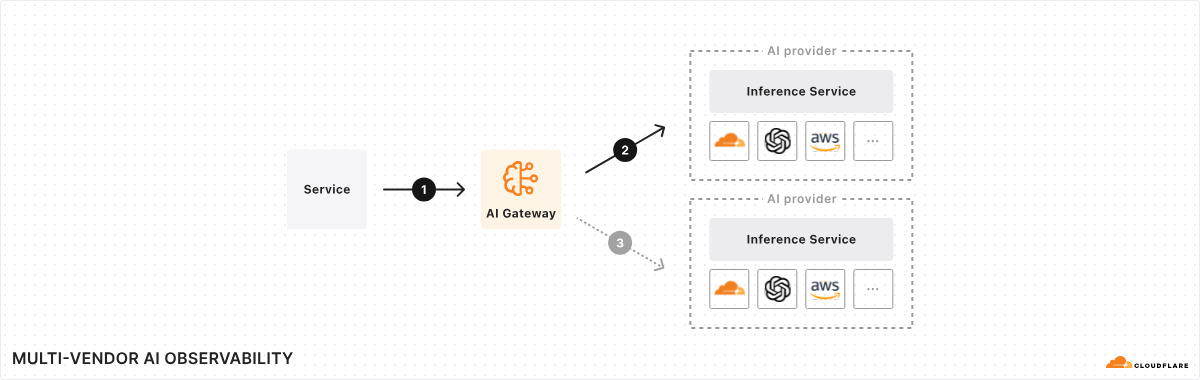
AI Gateway is an AI ops platform that offers a unified interface for managing and scaling your generative AI workloads. At its core, it acts as a proxy between your service and your inference provider(s), regardless of where your model runs. With a single line of code, you can unlock a set of powerful features focused on performance, security, reliability, and observability – think of it as your control plane for your AI ops. And this is just the beginning – we have a roadmap full of exciting features planned for the near future, making AI Gateway the tool for any organization looking to get more out of their AI workloads.
Why add a proxy and why Cloudflare?
The AI space moves fast, and it seems like every day there is a new model, provider, or framework. Given this high rate of change, it’s hard to keep track, especially if you’re using more than one model or provider. And that’s one of the driving factors behind launching AI Gateway – we want to provide you with a single consistent control plane for all your models and tools, even if they change tomorrow, and then again the day after that.
We’ve talked to a lot of developers and organizations building AI applications, and one thing is clear: they want more observability, control, and tooling around their AI ops. This is something many of the AI providers are lacking as they are deeply focused on model development and less so on platform features.
Why choose Cloudflare for your AI Gateway? Well, in some ways, it feels like a natural fit. We’ve spent the last 10+ years helping build a better Internet by running one of the largest global networks, helping customers around the world with performance, reliability, and security – Cloudflare is used as a reverse proxy by nearly 20% of all websites. With our expertise, it felt like a natural progression – change one line of code, and we can help with observability, reliability, and control for your AI applications – all in one control plane – so that you can get back to building.
Here is that one line code change using the OpenAI JS SDK. And check out our docs to reference other providers, SDKs, and languages.
import OpenAI from 'openai';

const openai = new OpenAI({
apiKey: 'my api key', // defaults to process.env["OPENAI_API_KEY"]
	baseURL: "https://gateway.ai.cloudflare.com/v1/{account_id}/{gateway_slug}/openai"
});
What’s included today?
After talking to customers, it was clear that we needed to focus on some foundational features before moving onto some of the more advanced ones. While we’re really excited about what’s to come, here are the key features available in GA today:
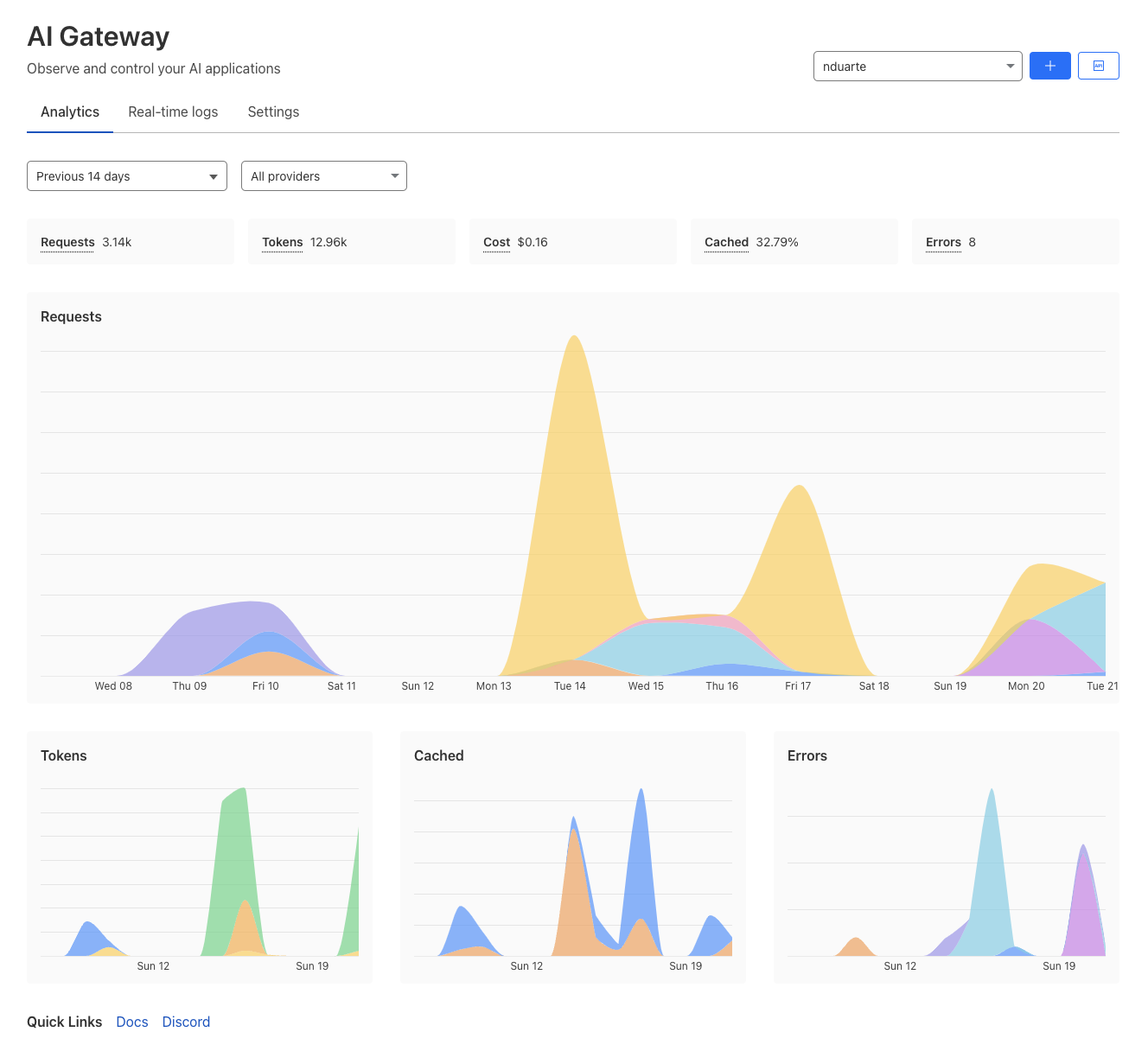
Analytics: Aggregate metrics from across multiple providers. See traffic patterns and usage including the number of requests, tokens, and costs over time.
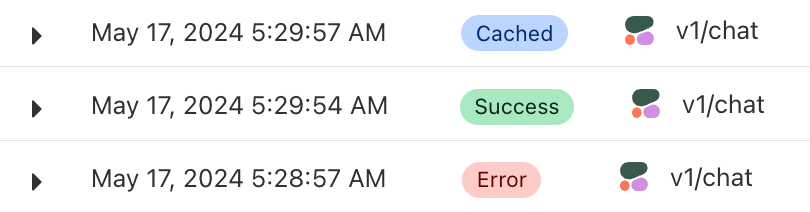
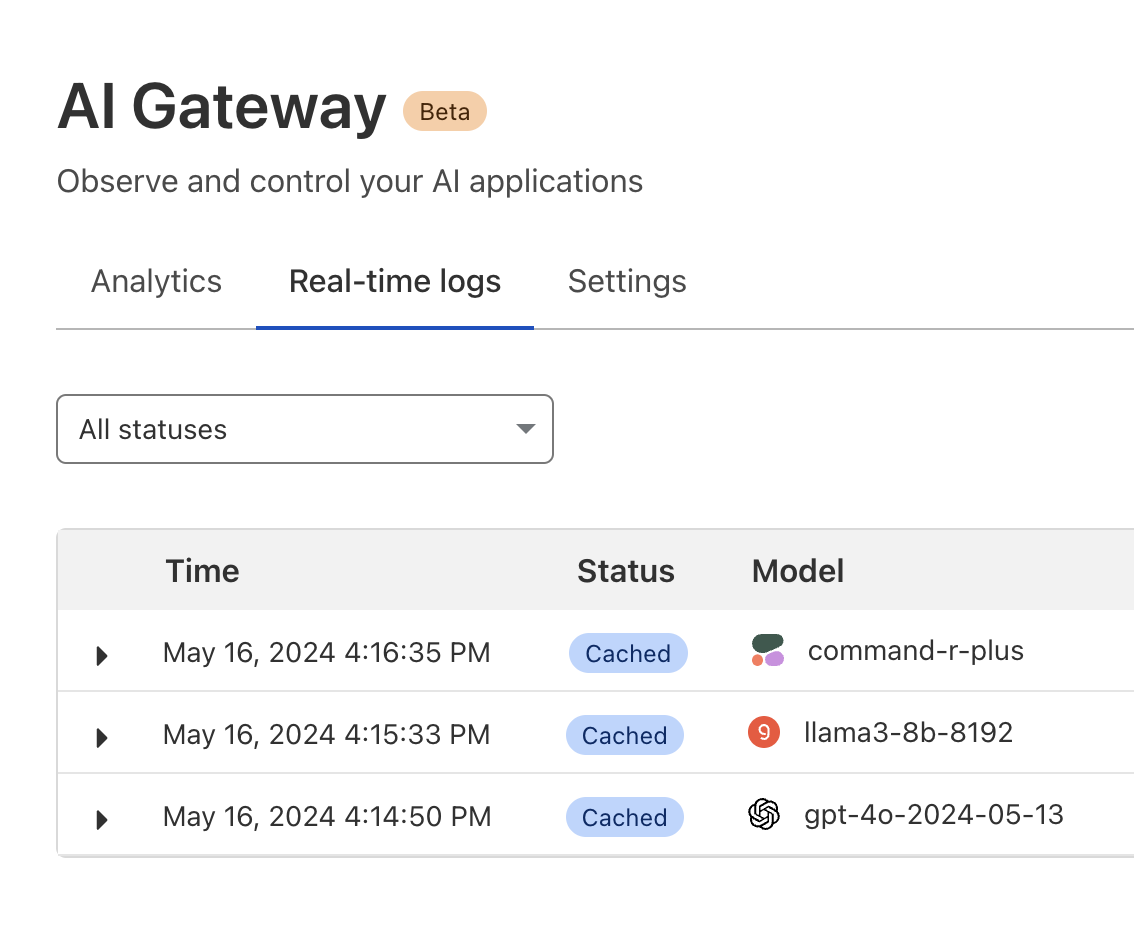
Real-time logs: Gain insight into requests and errors as you build.
Caching: Enable custom caching rules and use Cloudflare’s cache for repeat requests instead of hitting the original model provider API, helping you save on cost and latency.
Rate limiting: Control how your application scales by limiting the number of requests your application receives to control costs or prevent abuse.
Support for your favorite providers: AI Gateway now natively supports Workers AI plus 10 of the most popular providers, including Groq and Cohere as of mid-May 2024.
Universal endpoint: In case of errors, improve resilience by defining request fallbacks to another model or inference provider.
We’ve gotten a lot of feedback from developers, and there are some obvious things on the horizon such as persistent logs and custom metadata – foundational features that will help unlock the real magic down the road.
But let’s take a step back for a moment and share our vision. At Cloudflare, we believe our platform is much more powerful as a unified whole than as a collection of individual parts. This mindset applied to our AI products means that they should be easy to use, combine, and run in harmony.
Let’s imagine the following journey. You initially onboard onto Workers AI to run inference with the latest open source models. Next, you enable AI Gateway to gain better visibility and control, and start storing persistent logs. Then you want to start tuning your inference results, so you leverage your persistent logs, our prompt management tools, and our built in eval functionality. Now you’re making analytical decisions to improve your inference results. With each data driven improvement, you want more. So you implement our feedback API which helps annotate inputs/outputs, in essence building a structured data set. At this point, you are one step away from a one-click fine tune that can be deployed instantly to our global network, and it doesn’t stop there. As you continue to collect logs and feedback, you can continuously rebuild your fine tune adapters in order to deliver the best results to your end users.
This is all just an aspirational story at this point, but this is how we envision the future of AI Gateway and our AI suite as a whole. You should be able to start with the most basic setup and gradually progress into more advanced workflows, all without leaving Cloudflare’s AI platform. In the end, it might not look exactly as described above, but you can be sure that we are committed to providing the best AI ops tools to help make Cloudflare the best place for AI.
How do I get started?
AI Gateway is available to use today on all plans. If you haven’t yet used AI Gateway, check out our developer documentation and get started now. AI Gateway’s core features available today are offered for free, and all it takes is a Cloudflare account and one line of code to get started. In the future, more premium features, such as persistent logging and secrets management will be available subject to fees. If you have any questions, reach out on our Discord channel.
To provide the best experiences, we use technologies like cookies to store and/or access device information. Consenting to these technologies will allow us to process data such as browsing behavior or unique IDs on this site. Not consenting or withdrawing consent, may adversely affect certain features and functions.
Functional
Always active
The technical storage or access is strictly necessary for the legitimate purpose of enabling the use of a specific service explicitly requested by the subscriber or user, or for the sole purpose of carrying out the transmission of a communication over an electronic communications network.
Preferences
The technical storage or access is necessary for the legitimate purpose of storing preferences that are not requested by the subscriber or user.
Statistics
The technical storage or access that is used exclusively for statistical purposes.The technical storage or access that is used exclusively for anonymous statistical purposes. Without a subpoena, voluntary compliance on the part of your Internet Service Provider, or additional records from a third party, information stored or retrieved for this purpose alone cannot usually be used to identify you.
Marketing
The technical storage or access is required to create user profiles to send advertising, or to track the user on a website or across several websites for similar marketing purposes.