Tag Archives: DNSSEC

Some TXT about, and A PTR to, new DNS insights on Cloudflare Radar

Post Syndicated from David Belson original https://blog.cloudflare.com/new-dns-section-on-cloudflare-radar/

No joke – Cloudflare’s 1.1.1.1 resolver was launched on April Fool’s Day in 2018. Over the last seven years, this highly performant and privacyconscious service has grown to handle an average of 1.9 Trillion queries per day from approximately 250 locations (countries/regions) around the world. Aggregated analysis of this traffic provides us with unique insight into Internet activity that goes beyond simple Web traffic trends, and we currently use analysis of 1.1.1.1 data to power Radar’s Domains page, as well as the Radar Domain Rankings.

In December 2022, Cloudflare joined the AS112 Project, which helps the Internet deal with misdirected DNS queries. In March 2023, we launched an AS112 statistics page on Radar, providing insight into traffic trends and query types for this misdirected traffic. Extending the basic analysis presented on that page, and building on the analysis of resolver data used for the Domains page, today we are excited to launch a dedicated DNS page on Cloudflare Radar to provide increased visibility into aggregate traffic and usage trends seen across 1.1.1.1 resolver traffic. In addition to looking at global, location, and autonomous system (ASN) traffic trends, we are also providing perspectives on protocol usage, query and response characteristics, and DNSSEC usage.

The traffic analyzed for this new page may come from users that have manually configured their devices or local routers to use 1.1.1.1 as a resolver, ISPs that set 1.1.1.1 as the default resolver for their subscribers, ISPs that use 1.1.1.1 as a resolver upstream from their own, or users that have installed Cloudflare’s 1.1.1.1/WARP app on their device. The traffic analysis is based on anonymised DNS query logs, in accordance with Cloudflare’s Privacy Policy, as well as our 1.1.1.1 Public DNS Resolver privacy commitments.

Below, we walk through the sections of Radar’s new DNS page, reviewing the included graphs and the importance of the metrics they present. The data and trends shown within these graphs will vary based on the location or network that the aggregated queries originate from, as well as on the selected time frame.

Traffic trends

As with many Radar metrics, the DNS page leads with traffic trends, showing normalized query volume at a worldwide level (default), or from the selected location or autonomous system (ASN). Similar to other Radar traffic-based graphs, the time period shown can be adjusted using the date picker, and for the default selections (last 24 hours, last 7 days, etc.), a comparison with traffic seen over the previous period is also plotted.

For location-level views (such as Latvia, in the example below), a table showing the top five ASNs by query volume is displayed alongside the graph. Showing the network’s share of queries from the selected location, the table provides insights into the providers whose users are generating the most traffic to 1.1.1.1.

When a country/region is selected, in addition to showing an aggregate traffic graph for that location, we also show query volumes for the country code top level domain (ccTLD) associated with that country. The graph includes a line showing worldwide query volume for that ccTLD, as well as a line showing the query volume based on queries from the associated location. Anguilla’s ccTLD is .ai, and is a popular choice among the growing universe of AI-focused companies. While most locations see a gap between the worldwide and “local” query volume for their ccTLD, Anguilla’s is rather significant — as the graph below illustrates, this size of the gap is driven by both the popularity of the ccTLD and Anguilla’s comparatively small user base. (Traffic for .ai domains from Anguilla is shown by the dark blue line at the bottom of the graph.) Similarly, sizable gaps are seen with other “popular” ccTLDs as well, such as .io (British Indian Ocean Territory), .fm (Federated States of Micronesia), and .co (Colombia). A higher “local” ccTLD query volume in other locations results in smaller gaps when compared to the worldwide query volume.

Depending on the strength of the signal (that is, the volume of traffic) from a given location or ASN, this data can also be used to corroborate reported Internet outages or shutdowns, or reported blocking of 1.1.1.1. For example, the graph below illustrates the result of Venezuelan provider CANTV reportedly blocking access to 1.1.1.1 for its subscribers. A comparable drop is visible for Supercable, another Venezuelan provider that also reportedly blocked access to Cloudflare’s resolver around the same time.

Individual domain pages (like the one for cloudflare.com, for example) have long had a choropleth map and accompanying table showing the popularity of the domain by location, based on the share of DNS queries for that domain from each location. A similar view is included at the bottom of the worldwide overview page, based on the share of total global queries to 1.1.1.1 from each location.

Query and response characteristics

While traffic trends are always interesting and important to track, analysis of the characteristics of queries to 1.1.1.1 and the associated responses can provide insights into the adoption of underlying transport protocols, record type popularity, cacheability, and security.

Published in November 1987, RFC 1035 notes that “The Internet supports name server access using TCP [RFC-793] on server port 53 (decimal) as well as datagram access using UDP [RFC-768] on UDP port 53 (decimal).” Over the subsequent three-plus decades, UDP has been the primary transport protocol for DNS queries, falling back to TCP for a limited number of use cases, such as when the response is too big to fit in a single UDP packet. However, as privacy has become a significantly greater concern, encrypted queries have been made possible through the specification of DNS over TLS (DoT) in 2016 and DNS over HTTPS (DoH) in 2018. Cloudflare’s 1.1.1.1 resolver has supported both of these privacy-preserving protocols since launch. The DNS transport protocol graph shows the distribution of queries to 1.1.1.1 over these four protocols. (Setting up 1.1.1.1 on your device or router uses DNS over UDP by default, although recent versions of Android support DoT and DoH. The 1.1.1.1 app uses DNS over HTTPS by default, and users can also configure their browsers to use DNS over HTTPS.)

Note that Cloudflare’s resolver also services queries over DoH and Oblivious DoH (ODoH) for Mozilla and other large platforms, but this traffic is not currently included in our analysis. As such, DoH adoption is under-represented in this graph.

Aggregated worldwide between February 19 – February 26, distribution of transport protocols was 86.6% for UDP, 9.6% for DoT, 2.0% for TCP, and 1.7% for DoH. However, in some locations, these ratios may shift if users are more privacy conscious. For example, the graph below shows the distribution for Egypt over the same time period. In that country, the UDP and TCP shares are significantly lower than the global level, while the DoT and DoH shares are significantly higher, suggesting that users there may be more concerned about the privacy of their DNS queries than the global average, or that there is a larger concentration of 1.1.1.1 users on Android devices who have set up 1.1.1.1 using DoT manually. (The 2024 Cloudflare Radar Year in Review found that Android had an 85% mobile device traffic share in Egypt, so mobile device usage in the country leans very heavily toward Android.)

RFC 1035 also defined a number of standard and Internet specific resource record types that return the associated information about the submitted query name. The most common record types are A and AAAA, which return the hostname’s IPv4 and IPv6 addresses respectively (assuming they exist). The DNS query type graph below shows that globally, these two record types comprise on the order of 80% of the queries received by 1.1.1.1. Among the others shown in the graph, HTTPS records can be used to signal HTTP/3 and HTTP/2 support, PTR records are used in reverse DNS records to look up a domain name based on a given IP address, and NS records indicate authoritative nameservers for a domain.

A response code is sent with each response from 1.1.1.1 to the client. Six possible values were originally defined in RFC 1035, with the list further extended in RFC 2136 and RFC 2671. NOERROR, as the name suggests, means that no error condition was encountered with the query. Others, such as NXDOMAIN, SERVFAIL, REFUSED, and NOTIMP define specific error conditions encountered when trying to resolve the requested query name. The response codes may be generated by 1.1.1.1 itself (like REFUSED) or may come from an upstream authoritative nameserver (like NXDOMAIN).

The DNS response code graph shown below highlights that the vast majority of queries seen globally do not encounter an error during the resolution process (NOERROR), and that when errors are encountered, most are NXDOMAIN (no such record). It is worth noting that NOERROR also includes empty responses, which occur when there are no records for the query name and query type, but there are records for the query name and some other query type.

With DNS being a first-step dependency for many other protocols, the amount of queries of particular types can be used to indirectly measure the adoption of those protocols. But to effectively measure adoption, we should also consider the fraction of those queries that are met with useful responses, which are represented with the DNS record adoption graphs.

The example below shows that queries for A records are met with a useful response nearly 88% of the time. As IPv4 is an established protocol, the remaining 12% are likely to be queries for valid hostnames that have no A records (e.g. email domains that only have MX records). But the same graph also shows that there’s still a significant adoption gap where IPv6 is concerned.

When Cloudflare’s DNS resolver gets a response back from an upstream authoritative nameserver, it caches it for a specified amount of time — more on that below. By caching these responses, it can more efficiently serve subsequent queries for the same name. The DNS cache hit ratio graph provides insight into how frequently responses are served from cache. At a global level, as seen below, over 80% of queries have a response that is already cached. These ratios will vary by location or ASN, as the query patterns differ across geographies and networks.

As noted in the preceding paragraph, when an authoritative nameserver sends a response back to 1.1.1.1, each record inside it includes information about how long it should be cached/considered valid for. This piece of information is known as the Time-To-Live (TTL) and, as a response may contain multiple records, the smallest of these TTLs (the “minimum” TTL) defines how long 1.1.1.1 can cache the entire response for. The TTLs on each response served from 1.1.1.1’s cache decrease towards zero as time passes, at which point 1.1.1.1 needs to go back to the authoritative nameserver. Hostnames with relatively low TTL values suggest that the records may be somewhat dynamic, possibly due to traffic management of the associated resources; longer TTL values suggest that the associated resources are more stable and expected to change infrequently.

The DNS minimum TTL graphs show the aggregate distribution of TTL values for five popular DNS record types, broken out across seven buckets ranging from under one minute to over one week. During the third week of February, for example, A and AAAA responses had a concentration of low TTLs, with over 80% below five minutes. In contrast, NS and MX responses were more concentrated across 15 minutes to one hour and one hour to one day. Because MX and NS records change infrequently, they are generally configured with higher TTLs. This allows them to be cached for longer periods in order to achieve faster DNS resolution.

DNS security

DNS Security Extensions (DNSSEC) add an extra layer of authentication to DNS establishing the integrity and authenticity of a DNS response. This ensures subsequent HTTPS requests are not routed to a spoofed domain. When sending a query to 1.1.1.1, a DNS client can indicate that it is DNSSEC-aware by setting a specific flag (the “DO” bit) in the query, which lets our resolver know that it is OK to return DNSSEC data in the response. The DNSSEC client awareness graph breaks down the share of queries that 1.1.1.1 sees from clients that understand DNSSEC and can require validation of responses vs. those that don’t. (Note that by default, 1.1.1.1 tries to protect clients by always validating DNSSEC responses from authoritative nameservers and not forwarding invalid responses to clients, unless the client has explicitly told it not to by setting the “CD” (checking-disabled) bit in the query.)

Unfortunately, as the graph below shows, nearly 90% of the queries seen by Cloudflare’s resolver are made by clients that are not DNSSEC-aware. This broad lack of client awareness may be due to several factors. On the client side, DNSSEC is not enabled by default for most users, and enabling DNSSEC requires extra work, even for technically savvy and security conscious users. On the authoritative side, for domain owners, supporting DNSSEC requires extra operational maintenance and knowledge, and a mistake can cost your domain to disappear from the Internet, causing significant (including financial) issues.

The companion End-to-end security graph represents the fraction of DNS interactions that were protected from tampering, when considering the client’s DNSSEC capabilities and use of encryption (use of DoT or DoH). This shows an even greater imbalance at a global level, and highlights the importance of further adoption of encryption and DNSSEC.

For DNSSEC validation to occur, the query name being requested must be part of a DNSSEC-enabled domain, and the DNSSEC validation status graph represents the share of queries where that was the case under the Secure and Invalid labels. Queries for domains without DNSSEC are labeled as Insecure, and queries where DNSSEC validation was not applicable (such as various kinds of errors) fall under the Other label. Although nearly 93% of generic Top Level Domains (TLDs) and 65% of country code Top Level Domains (ccTLDs) are signed with DNSSEC (as of February 2025), the adoption rate across individual (child) domains lags significantly, as the graph below shows that over 80% of queries were labeled as Insecure.

Conclusion

DNS is a fundamental, foundational part of the Internet. While most Internet users don’t think of DNS beyond its role in translating easy-to-remember hostnames to IP addresses, there’s a lot going on to make even that happen, from privacy to performance to security. The new DNS page on Cloudflare Radar endeavors to provide visibility into what’s going on behind the scenes, at a global, national, and network level.

While the graphs shown above are taken from the DNS page, all the underlying data is available via the API and can be interactively explored in more detail across locations, networks, and time periods using Radar’s Data Explorer and AI Assistant. And as always, Radar and Data Assistant charts and graphs are downloadable for sharing, and embeddable for use in your own blog posts, websites, or dashboards.

If you share our DNS graphs on social media, be sure to tag us: @CloudflareRadar and @1111Resolver (X), noc.social/@cloudflareradar (Mastodon), and radar.cloudflare.com (Bluesky). If you have questions or comments, you can reach out to us on social media, or contact us via email.

Remediating new DNSSEC resource exhaustion vulnerabilities

Post Syndicated from Vicky Shrestha original https://blog.cloudflare.com/remediating-new-dnssec-resource-exhaustion-vulnerabilities


Cloudflare has been part of a multivendor, industry-wide effort to mitigate two critical DNSSEC vulnerabilities. These vulnerabilities exposed significant risks to critical infrastructures that provide DNS resolution services. Cloudflare provides DNS resolution for anyone to use for free with our public resolver 1.1.1.1 service. Mitigations for Cloudflare’s public resolver 1.1.1.1 service were applied before these vulnerabilities were disclosed publicly. Internal resolvers using unbound (open source software) were upgraded promptly after a new software version fixing these vulnerabilities was released.

All Cloudflare DNS infrastructure was protected from both of these vulnerabilities before they were disclosed and is safe today. These vulnerabilities do not affect our Authoritative DNS or DNS firewall products.

All major DNS software vendors have released new versions of their software. All other major DNS resolver providers have also applied appropriate mitigations. Please update your DNS resolver software immediately, if you haven’t done so already.

Background

Domain name system (DNS) security extensions, commonly known as DNSSEC, are extensions to the DNS protocol that add authentication and integrity capabilities. DNSSEC uses cryptographic keys and signatures that allow DNS responses to be validated as authentic. DNSSEC protocol specifications have certain requirements that prioritize availability at the cost of increased complexity and computational cost for the validating DNS resolvers. The mitigations for the vulnerabilities discussed in this blog require local policies to be applied that relax these requirements in order to avoid exhausting the resources of validators.

The design of the DNS and DNSSEC protocols follows the Robustness principle: “be conservative in what you do, be liberal in what you accept from others”. There have been many vulnerabilities in the past that have taken advantage of protocol requirements following this principle. Malicious actors can exploit these vulnerabilities to attack DNS infrastructure, in this case by causing additional work for DNS resolvers by crafting DNSSEC responses with complex configurations. As is often the case, we find ourselves having to create a pragmatic balance between the flexibility that allows a protocol to adapt and evolve and the need to safeguard the stability and security of the services we operate.

Cloudflare’s public resolver 1.1.1.1 is a privacy-centric public resolver service. We have been using stricter validations and limits aimed at protecting our own infrastructure in addition to shielding authoritative DNS servers operated outside our network. As a result, we often receive complaints about resolution failures. Experience shows us that strict validations and limits can impact availability in some edge cases, especially when DNS domains are improperly configured. However, these strict validations and limits are necessary to improve the overall reliability and resilience of the DNS infrastructure.

The vulnerabilities and how we mitigated them are described below.

Keytrap vulnerability (CVE-2023-50387)

Introduction

A DNSSEC signed zone can contain multiple keys (DNSKEY) to sign the contents of a DNS zone and a Resource Record Set (RRSET) in a DNS response can have multiple signatures (RRSIG). Multiple keys and signatures are required to support things like key rollover, algorithm rollover, and multi-signer DNSSEC. DNSSEC protocol specifications require a validating DNS resolver to try every possible combination of keys and signatures when validating a DNS response.

During validation, a resolver looks at the key tag of every signature and tries to find the associated key that was used to sign it. A key tag is an unsigned 16-bit number calculated as a checksum over the key’s resource data (RDATA). Key tags are intended to allow efficient pairing of a signature with the key which has supposedly created it.  However, key tags are not unique, and it is possible that multiple keys can have the same key tag. A malicious actor can easily craft a DNS response with multiple keys having the same key tag together with multiple signatures, none of which might validate. A validating resolver would have to try every combination (number of keys multiplied by number of signatures) when trying to validate this response. This increases the computational cost of the validating resolver many-fold, degrading performance for all its users. This is known as the Keytrap vulnerability.

Variations of this vulnerability include using multiple signatures with one key, using one signature with multiple keys having colliding key tags, and using multiple keys with corresponding hashes added to the parent delegation signer record.

Mitigation

We have limited the maximum number of keys we will accept at a zone cut. A zone cut is where a parent zone delegates to a child zone, e.g. where the .com zone delegates cloudflare.com to Cloudflare nameservers. Even with this limit already in place and various other protections built for our platform, we realized that it would still be computationally costly to process a malicious DNS answer from an authoritative DNS server.

To address and further mitigate this vulnerability, we added a signature validations limit per RRSET and a total signature validations limit per resolution task. One resolution task might include multiple recursive queries to external authoritative DNS servers in order to answer a single DNS question. Clients queries exceeding these limits will fail to resolve and will receive a response with an Extended DNS Error (EDE) code 0. Furthermore, we added metrics which will allow us to detect attacks attempting to exploit this vulnerability.

NSEC3 iteration and closest encloser proof vulnerability (CVE-2023-50868)

Introduction

NSEC3 is an alternative approach for authenticated denial of existence. You can learn more about authenticated denial of existence here. NSEC3 uses a hash derived from DNS names instead of the DNS names directly in an attempt to prevent zone enumeration and the standard supports multiple iterations for hash calculations. However, because the full DNS name is used as input to the hash calculation, increasing hashing iterations beyond the initial doesn’t provide any additional value and is not recommended in RFC9276. This complication is further inflated while finding the closest enclosure proof. A malicious DNS response from an authoritative DNS server can set a high NSEC3 iteration count and long DNS names with multiple DNS labels to exhaust the computing resources of a validating resolver by making it do unnecessary hash computations.

Mitigation

For this vulnerability, we applied a similar mitigation technique as we did for Keytrap. We added a limit for total hash calculations per resolution task to answer a single DNS question. Similarly, clients queries exceeding this limit will fail to resolve and will receive a response with an EDE code 27. We also added metrics to track hash calculations allowing early detection of attacks attempting to exploit this vulnerability.

Timeline

Date and time in UTC

Event

2023-11-03 16:05

John Todd from Quad9 invites Cloudflare to participate in a joint task force to discuss a new DNS vulnerability. 

2023-11-07 14:30

A group of DNS vendors and service providers meet to discuss the vulnerability during IETF 118. Discussions and collaboration continues in a closed chat group hosted at DNS-OARC

2023-12-08 20:20

Cloudflare public resolver 1.1.1.1 is fully patched to mitigate Keytrap vulnerability (CVE-2023-50387)

2024-01-17 22:39

Cloudflare public resolver 1.1.1.1 is fully patched to mitigate NSEC3 iteration count and closest encloser vulnerability (CVE-2023-50868)

2024-02-13 13:04

Unbound package is released 

2024-02-13 23:00

Cloudflare internal CDN resolver is fully patched to mitigate both CVE-2023-50387 and CVE-2023-50868

Credits

We would like to thank Elias Heftrig, Haya Schulmann, Niklas Vogel, Michael Waidner from the German National Research Center for Applied Cybersecurity ATHENE, for discovering the Keytrap vulnerability and doing a responsible disclosure.

We would like to thank Petr Špaček from Internet Systems Consortium (ISC) for discovering the NSEC3 iteration and closest encloser proof vulnerability and doing a responsible disclosure.

We would like to thank John Todd from Quad9  and the DNS Operations Analysis and Research Center (DNS-OARC) for facilitating coordination amongst various stakeholders.

And finally, we would like to thank the DNS-OARC community members, representing various DNS vendors and service providers, who all came together and worked tirelessly to fix these vulnerabilities, working towards a common goal of making the internet resilient and secure.

Connection errors in Asia Pacific region on July 9, 2023

Post Syndicated from Christian Elmerot original http://blog.cloudflare.com/connection-errors-in-asia-pacific-region-on-july-9-2023/

Connection errors in Asia Pacific region on July 9, 2023

Connection errors in Asia Pacific region on July 9, 2023

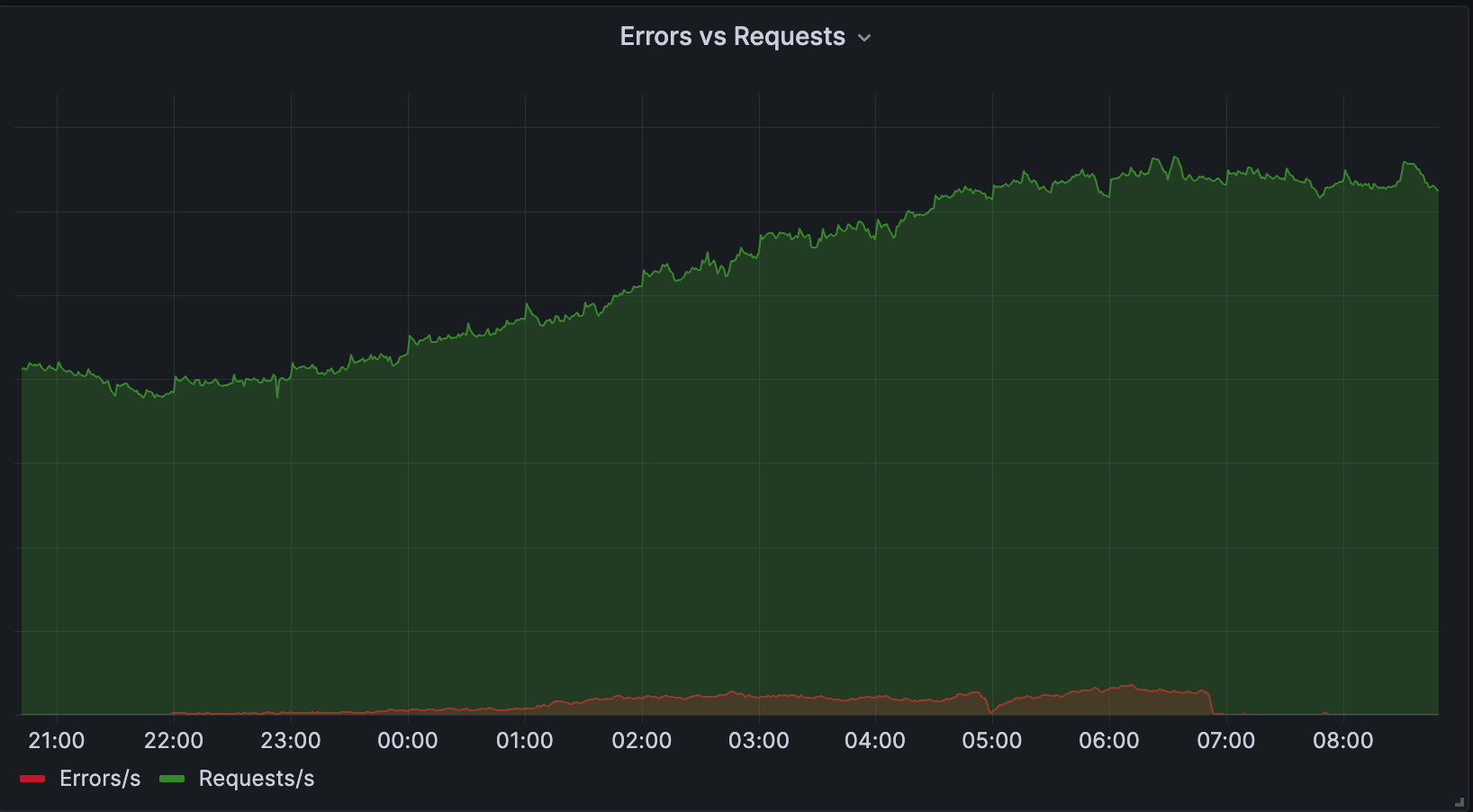
On Sunday, July 9, 2023, early morning UTC time, we observed a high number of DNS resolution failures — up to 7% of all DNS queries across the Asia Pacific region — caused by invalid DNSSEC signatures from Verisign .com and .net Top Level Domain (TLD) nameservers. This resulted in connection errors for visitors of Internet properties on Cloudflare in the region.

The local instances of Verisign’s nameservers started to respond with expired DNSSEC signatures in the Asia Pacific region. In order to remediate the impact, we have rerouted upstream DNS queries towards Verisign to locations on the US west coast which are returning valid signatures.

We have already reached out to Verisign to get more information on the root cause. Until their issues have been resolved, we will keep our DNS traffic to .com and .net TLD nameservers rerouted, which might cause slightly increased latency for the first visitor to domains under .com and .net in the region.

Background

In order to proxy a domain’s traffic through Cloudflare’s network, there are two components involved with respect to the Domain Name System (DNS) from the perspective of a Cloudflare data center: external DNS resolution, and upstream or origin DNS resolution.

To understand this, let’s look at the domain name blog.cloudflare.com — which is proxied through Cloudflare’s network — and let’s assume it is configured to use origin.example as the origin server:

Connection errors in Asia Pacific region on July 9, 2023

Here, the external DNS resolution is the part where DNS queries to blog.cloudflare.com sent by public resolvers like 1.1.1.1 or 8.8.8.8 on behalf of a visitor return a set of Cloudflare Anycast IP addresses. This ensures that the visitor’s browser knows where to send an HTTPS request to load the website. Under the hood your browser performs a DNS query that looks something like this (the trailing dot indicates the DNS root zone):

$ dig blog.cloudflare.com. +short
104.18.28.7
104.18.29.7

(Your computer doesn’t actually use the dig command internally; we’ve used it to illustrate the process) Then when the next closest Cloudflare data center receives the HTTPS request for blog.cloudflare.com, it needs to fetch the content from the origin server (assuming it is not cached).

There are two ways Cloudflare can reach the origin server. If the DNS settings in Cloudflare contain IP addresses then we can connect directly to the origin. In some cases, our customers use a CNAME which means Cloudflare has to perform another DNS query to get the IP addresses associated with the CNAME. In the example above, blog.cloudflare.com has a CNAME record instructing us to look at origin.example for IP addresses. During the incident, only customers with CNAME records like this going to .com and .net domain names may have been affected.

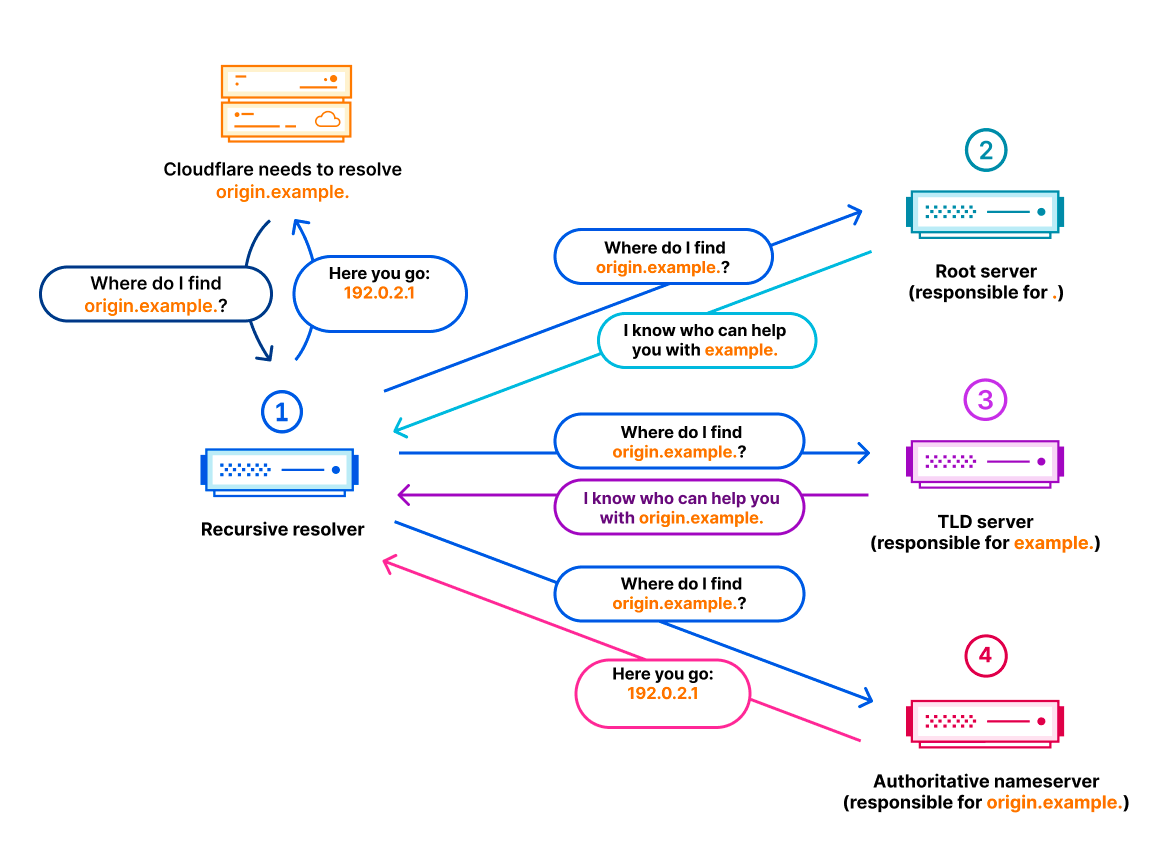
The domain origin.example needs to be resolved by Cloudflare as part of the upstream or origin DNS resolution. This time, the Cloudflare data center needs to perform an outbound DNS query that looks like this:

$ dig origin.example. +short
192.0.2.1

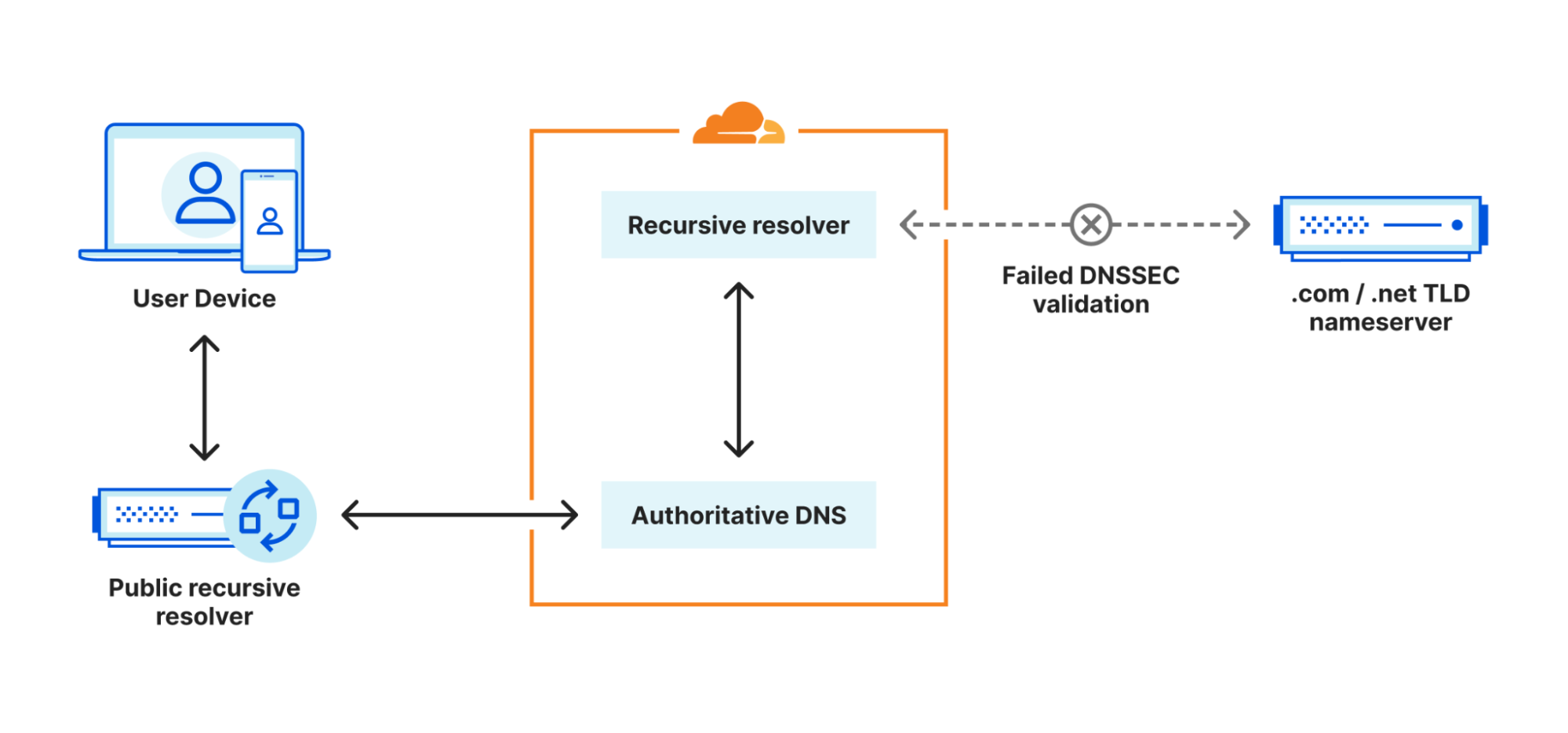
DNS is a hierarchical protocol, so the recursive DNS resolver, which usually handles DNS resolution for whoever wants to resolve a domain name, needs to talk to several involved nameservers until it finally gets an answer from the authoritative nameservers of the domain (assuming no DNS responses are cached). This is the same process during the external DNS resolution and the origin DNS resolution. Here is an example for the origin DNS resolution:

Connection errors in Asia Pacific region on July 9, 2023

Inherently, DNS is a public system that was initially published without any means to validate the integrity of the DNS traffic. So in order to prevent someone from spoofing DNS responses, DNS Security Extensions (DNSSEC) were introduced as a means to authenticate that DNS responses really come from who they claim to come from. This is achieved by generating cryptographic signatures alongside existing DNS records like A, AAAA, MX, CNAME, etc. By validating a DNS record’s associated signature, it is possible to verify that a requested DNS record really comes from its authoritative nameserver and wasn’t altered en-route. If a signature cannot be validated successfully, recursive resolvers usually return an error indicating the invalid signature. This is exactly what happened on Sunday.

Incident timeline and impact

On Saturday, July 8, 2023, at 21:10 UTC our logs show the first instances of DNSSEC validation errors that happened during upstream DNS resolution from multiple Cloudflare data centers in the Asia Pacific region. It appeared DNS responses from the TLD nameservers of .com and .net of the type NSEC3 (a DNSSEC mechanism to prove non-existing DNS records) did not include signatures. About an hour later at 22:16 UTC, the first internal alerts went off (since it required issues to be consistent over a certain period of time), but error rates were still at a level at around 0.5% of all upstream DNS queries.

After several hours, the error rate had increased to a point in which ~13% of our upstream DNS queries in affected locations were failing. This percentage continued to fluctuate over the duration of the incident between the ranges of 10-15% of upstream DNS queries, and roughly 5-7% of all DNS queries (external & upstream resolution) to affected Cloudflare data centers in the Asia Pacific region.
Connection errors in Asia Pacific region on July 9, 2023

Initially it appeared as though only a single upstream nameserver was having issues with DNS resolution, however upon further investigation it was discovered that the issue was more widespread. Ultimately, we were able to verify that the Verisign nameservers for .com and .net were returning expired DNSSEC signatures on a portion of DNS queries in the Asia Pacific region. Based on our tests, other nameserver locations were correctly returning valid DNSSEC signatures.

In response, we rerouted our DNS traffic to the .com and .net TLD nameserver IP addresses to Verisign’s US west locations. After this change was propagated, the issue very quickly subsided and origin resolution error rates returned to normal levels.

All times are in UTC:

2023-07-08 21:10 First instances of DNSSEC validation errors appear in our logs for origin DNS resolution.

2023-07-08 22:16 First internal alerts for Asia Pacific data centers go off indicating origin DNS resolution error on our test domain. Very few errors for other domains at this point.

2023-07-09 02:58 Error rates have increased substantially since the first instance. An incident is declared.

2023-07-09 03:28 DNSSEC validation issues seem to be isolated to a single upstream provider. It is not abnormal that a single upstream has issues that propagate back to us, and in this case our logs were predominantly showing errors from domains that resolve to this specific upstream.

2023-07-09 04:52 We realize that DNSSEC validation issues are more widespread and affect multiple .com and .net domains. Validation issues continue to be isolated to the Asia Pacific region only, and appear to be intermittent.

2023-07-09 05:15 DNS queries via popular recursive resolvers like 8.8.8.8 and 1.1.1.1 do not return invalid DNSSEC signatures at this point. DNS queries using the local stub resolver continue to return DNSSEC errors.

2023-07-09 06:24 Responses from .com and .net Verisign nameservers in Singapore contain expired DNSSEC signatures, but responses from Verisign TLD nameservers in other locations are fine.

2023-07-09 06:41 We contact Verisign and notify them about expired DNSSEC signatures.

2023-07-09 06:50 In order to remediate the impact, we reroute DNS traffic via IPv4 for the .com and .net Verisign nameserver IPs to US west IPs instead. This immediately leads to a substantial drop in the error rate.

2023-07-09 07:06 We also reroute DNS traffic via IPv6 for the .com and .net Verisign nameserver IPs to US west IPs. This leads to the error rate going down to zero.

2023-07-10 09:23 The rerouting is still in place, but the underlying issue with expired signatures in the Asia Pacific region has still not been resolved.

2023-07-10 18:23 Versign gets back to us confirming that they “were serving stale data” at their local site and have resolved the issues.

Technical description of the error and how it happened

As mentioned in the introduction, the underlying cause for this incident was expired DNSSEC signatures for .net and .com zones. Expired DNSSEC signatures will cause a DNS response to be interpreted as invalid. There are two main scenarios in which this error was observed by a user:

  1. CNAME flattening for external DNS resolution. This is when our authoritative nameservers attempt to return the IP address(es) that a CNAME record target resolves to rather than the CNAME record itself.
  2. CNAME target lookup for origin DNS resolution. This is most commonly used when an HTTPS request is sent to a Cloudflare anycast IP address, and we need to determine what IP address to forward the request to. See How Cloudflare works for more details.

In both cases, behind the scenes the DNS query goes through an in-house recursive DNS resolver in order to lookup what a hostname resolves to. The purpose of this resolver is to cache queries, optimize future queries and provide DNSSEC validation. If the query from this resolver fails for whatever reason, our authoritative DNS system will not be able to perform the two scenarios outlined above.

Connection errors in Asia Pacific region on July 9, 2023

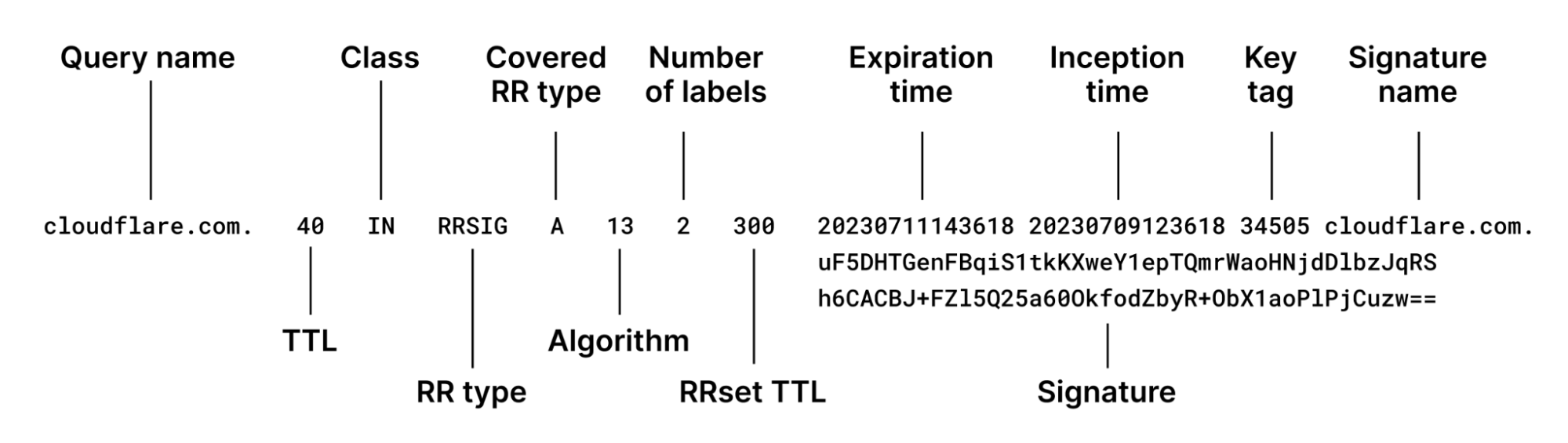
During the incident, the recursive resolver was failing to validate the DNSSEC signatures in DNS responses for domains ending in .com and .net. These signatures are sent in the form of an RRSIG record alongside the other DNS records they cover. Together they form a Resource Record set (RRset). Each RRSIG has the corresponding fields:

Connection errors in Asia Pacific region on July 9, 2023

As you can see, the main part of the payload is associated with the signature and its corresponding metadata. Each recursive resolver is responsible for not only checking the signature but also the expiration time of the signature. It is important to obey the expiration time in order to avoid returning responses for RRsets that have been signed by old keys, which could have potentially been compromised by that time.

During this incident, Verisign, the authoritative operator for the .com and .net TLD zones, was occasionally returning expired signatures in its DNS responses in the Asia Pacific region. As a result our recursive resolver was not able to validate the corresponding RRset. Ultimately this meant that a percentage of DNS queries would return SERVFAIL as response code to our authoritative nameserver. This in turn caused connection issues for users trying to connect to a domain on Cloudflare, because we weren't able to resolve the upstream target of affected domain names and thus didn’t know where to send proxied HTTPS requests to upstream servers.

Remediation and follow-up steps

Once we had identified the root cause we started to look at different ways to remedy the issue. We came to the conclusion that the fastest way to work around this very regionalized issue was to stop using the local route to Verisign's nameservers. This means that, at the time of writing this, our outgoing DNS traffic towards Verisign's nameservers in the Asia Pacific region now traverses the Pacific and ends up at the US west coast, rather than being served by closer nameservers. Due to the nature of DNS and the important role of DNS caching, this has less impact than you might initially expect. Frequently looked up names will be cached after the first request, and this only needs to happen once per data center, as we share and pool the local DNS recursor caches to maximize their efficiency.

Ideally, we would have been able to fix the issue right away as it potentially affected others in the region too, not just our customers. We will therefore work diligently to improve our incident communications channels with other providers in order to ensure that the DNS ecosystem remains robust against issues such as this. Being able to quickly get hold of other providers that can take action is vital when urgent issues like these arise.

Conclusion

This incident once again shows how impactful DNS failures are and how crucial this technology is for the Internet. We will investigate how we can improve our systems to detect and resolve issues like this more efficiently and quickly if they occur again in the future.

While Cloudflare was not the cause of this issue, and we are certain that we were not the only ones affected by this, we are still sorry for the disruption to our customers and to all the users who were unable to access Internet properties during this incident.

DNSSEC issues take Fiji domains offline

Post Syndicated from David Belson original https://blog.cloudflare.com/dnssec-issues-fiji/

DNSSEC issues take Fiji domains offline

DNSSEC issues take Fiji domains offline

On the morning of March 8, a post to Hacker News stated that “All .fj domains have gone offline”, listing several hostnames in domains within the Fiji top level domain (known as a ccTLD) that had become unreachable. Commenters in the associated discussion thread had mixed results in being able to reach .fj hostnames—some were successful, while others saw failures. The fijivillage news site also highlighted the problem, noting that the issue also impacted Vodafone’s M-PAiSA app/service, preventing users from completing financial transactions.

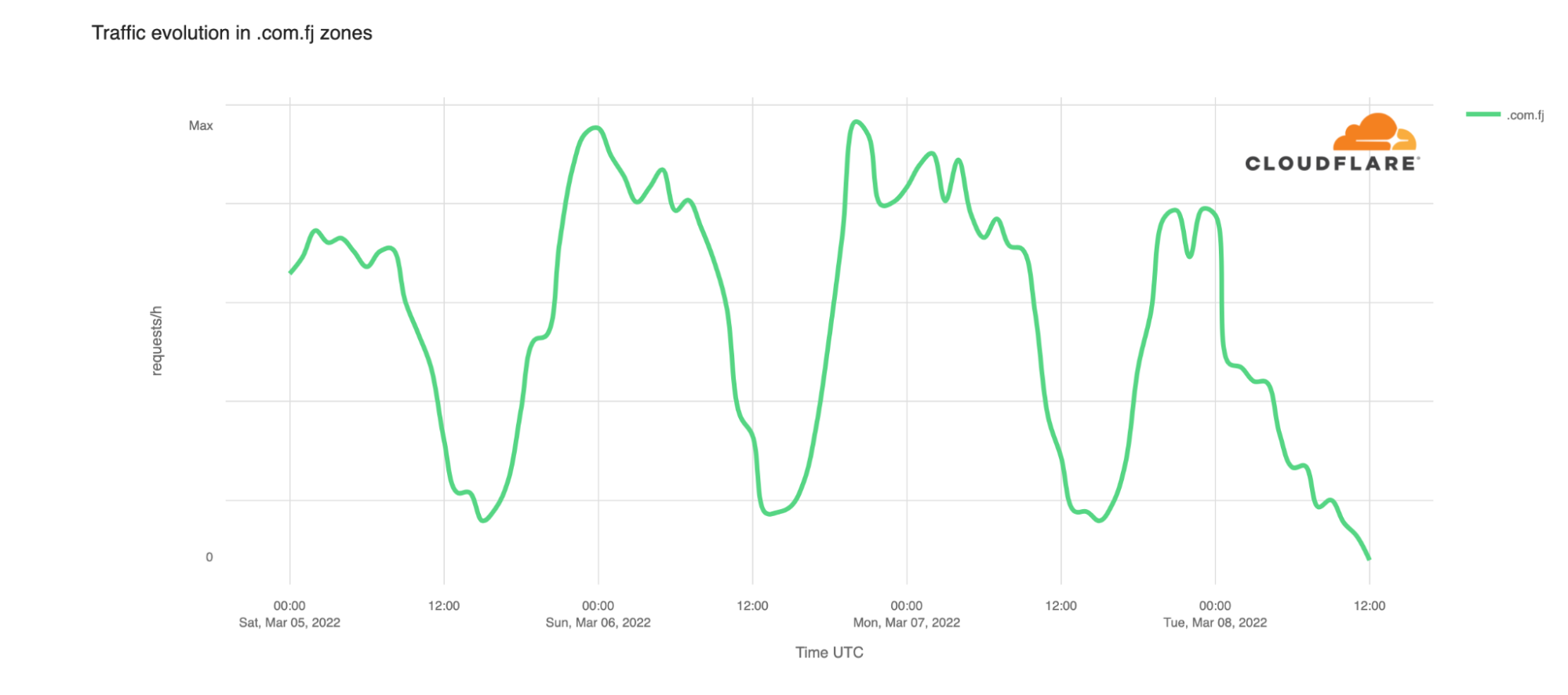
The impact of this issue can be seen in traffic to Cloudflare customer zones in the .com.fj second-level domain. The graph below shows that HTTP traffic to these zones dropped by approximately 40% almost immediately starting around midnight UTC on March 8. Traffic volumes continued to decline throughout the rest of the morning.

DNSSEC issues take Fiji domains offline

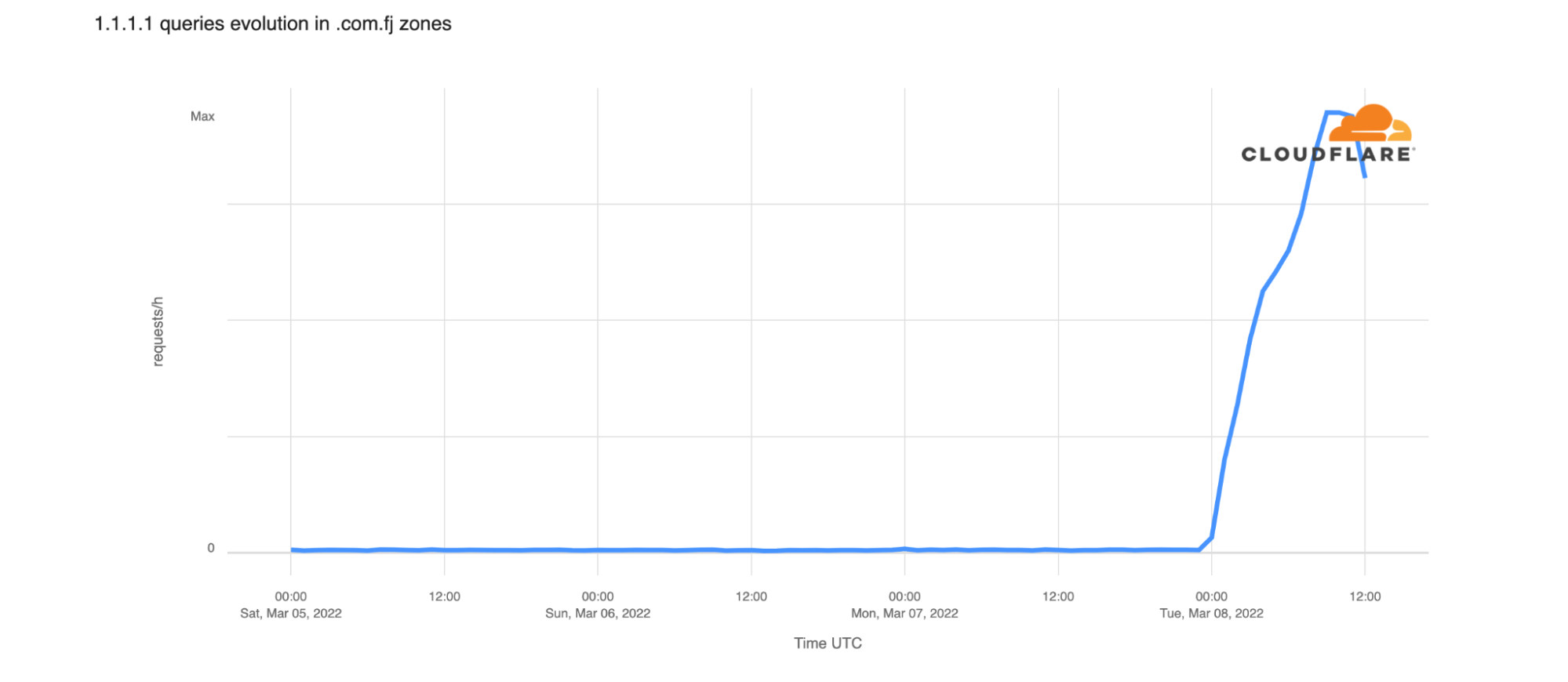
Looking at Cloudflare’s 1.1.1.1 resolver data for queries for .com.fj hostnames, we can also see that error volume associated with those queries climbs significantly starting just after midnight as well. This means that our resolvers encountered issues with the answers from .fj servers.

DNSSEC issues take Fiji domains offline

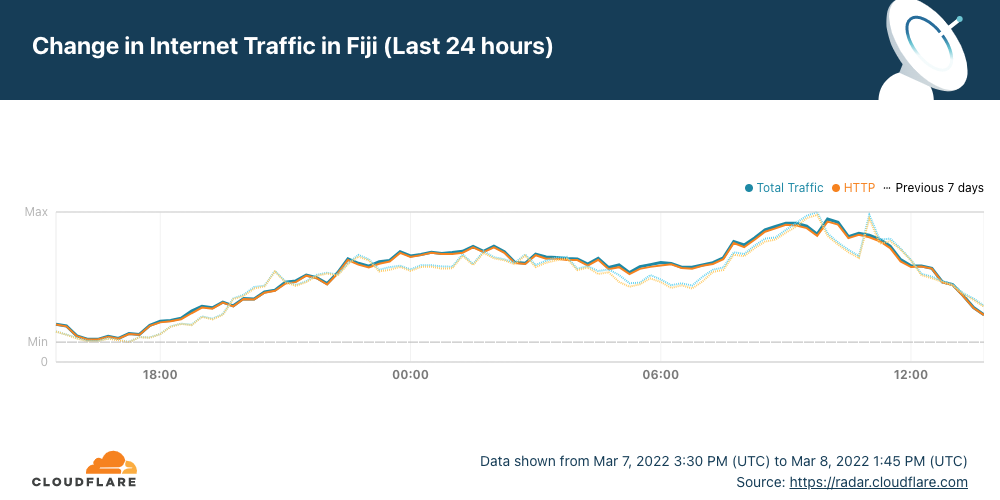
This observation suggests that the problem was strictly DNS related, rather than connectivity related—Cloudflare Radar does not show any indication of an Internet disruption in Fiji coincident with the start of this problem.

DNSSEC issues take Fiji domains offline

It was suggested within the Hacker News comments that the problem could be DNSSEC related. Upon further investigation, it appears that may be the cause. In verifying the DNSSEC record for the .fj ccTLD, shown in the dig output below, we see that it states EDE: 9 (DNSKEY Missing): 'no SEP matching the DS found for fj.'

kdig fj. soa +dnssec @1.1.1.1 
;; ->>HEADER<<- opcode: QUERY; status: SERVFAIL; id: 12710
;; Flags: qr rd ra; QUERY: 1; ANSWER: 0; AUTHORITY: 0; ADDITIONAL: 1
 
;; EDNS PSEUDOSECTION:
;; Version: 0; flags: do; UDP size: 1232 B; ext-rcode: NOERROR
;; EDE: 9 (DNSKEY Missing): 'no SEP matching the DS found for fj.'
 
;; QUESTION SECTION:
;; fj.                          IN      SOA
 
;; Received 73 B
;; Time 2022-03-08 08:57:41 EST
;; From 1.1.1.1@53(UDP) in 17.2 ms

Extended DNS Error 9 (EDE: 9) is defined as “A DS record existed at a parent, but no supported matching DNSKEY record could be found for the child.” The Cloudflare Learning Center article on DNSKEY and DS records explains this relationship:

The DS record is used to verify the authenticity of child zones of DNSSEC zones. The DS key record on a parent zone contains a hash of the KSK in a child zone. A DNSSEC resolver can therefore verify the authenticity of the child zone by hashing its KSK record, and comparing that to what is in the parent zone’s DS record.

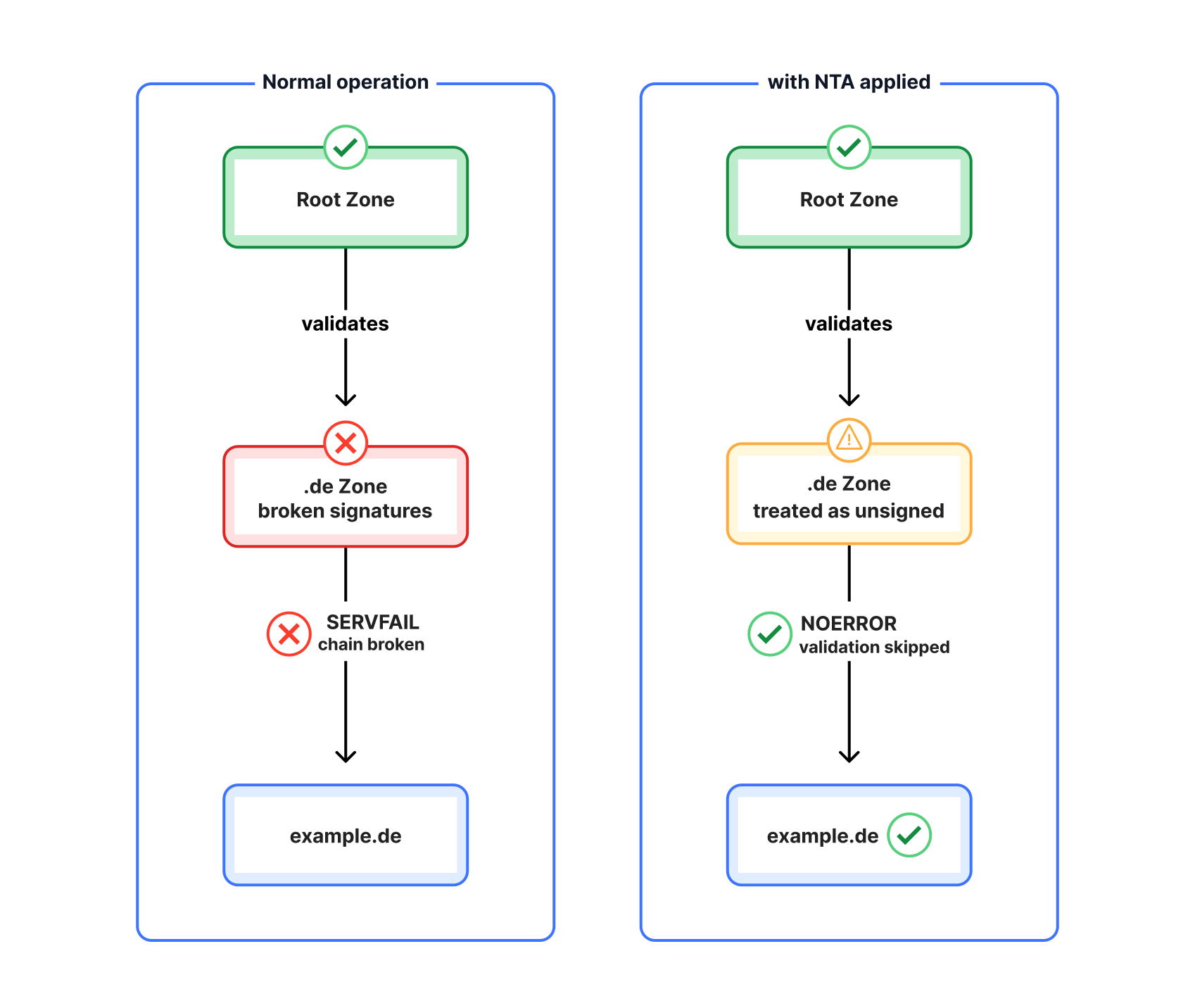
Ultimately, it appears that around midnight UTC, the .fj zone started to be signed with a key that was not in the root zone DS, possibly as the result of a scheduled rollover that happened without checking that the root zone was updated first by IANA, which updates the root zone. (IANA owns contact with the TLD operators, and instructs the Root Zone Publisher on the changes to make in the next version of the root zone.)

DNSSEC problems as the root cause of the observed issue align with the observation in the Hacker News comments that some were able to access .fj websites, while others were not. Users behind resolvers doing strict DNSSEC validation would have seen an error in their browser, while users behind less strict resolvers would have been able to access the sites without a problem.

Conclusion

Further analysis of Cloudflare resolver metrics indicates that the problem was resolved around 1400 UTC, when the DS was updated. When DNSSEC is improperly configured for a single domain name, it can cause problems accessing websites or applications in that zone. However, when the misconfiguration occurs at a ccTLD level, the impact is much more significant. Unfortunately, this seems to occur all too often.

(Thank you to Ólafur Guðmundsson for his DNSSEC expertise.)