Tag Archives: post quantum

The quantum solace and spectre

Post Syndicated from Sofía Celi original https://blog.cloudflare.com/quantum-solace-and-spectre/

The quantum solace and spectre

Not only is the universe stranger than we think, but it is stranger than we can think of
Werner Heisenberg

The quantum solace and spectre

Even for a physicist as renowned as Heisenberg, the universe was strange. And it was strange because several phenomena could only be explained through the lens of quantum mechanics. This field changed the way we understood the world, challenged our imagination, and, since the Fifth Solvay Conference in 1927, has been integrated into every explanation of the physical world (it is, to this day, our best description of the inner workings of nature). Quantum mechanics created a rift: every physical phenomena (even the most micro and macro ones) stopped being explained only by classical physics and started to be explained by quantum mechanics. There is another world in which quantum mechanics has not yet created this rift: the realm of computers (note, though, that manufacturers have been affected by quantum effects for a long time). That is about to change.

In the 80s, several physicists (including, for example, Richard Feynman and Yuri Manin) asked themselves these questions: are there computers that can, with high accuracy and in a reasonable amount of time, simulate physics? And, specifically, can they simulate quantum mechanics? These two questions started a long field of work that we now call “quantum computing”. Note that you can simulate quantum phenomena with classical computers. But we can simulate in a much faster manner with a quantum computer.

Any computer is already a quantum system, but a quantum computer uses the true computational power that quantum mechanics offers. It solves some problems much faster than a classical computer. Any computational problem solvable by a classical computer is also solvable by a quantum computer, as any physical phenomena (such as operations performed in classical computers) can be described using quantum mechanics. Contrariwise, any problem solvable by a quantum computer is also solvable by a classical computer: quantum computers provide no additional power over classical computers in terms of what they could theoretically compute. Quantum computers cannot solve undecidable problems, and they do not disprove the Church–Turing thesis. But, they are faster for specific problems! Let’s explore now why this is the case.
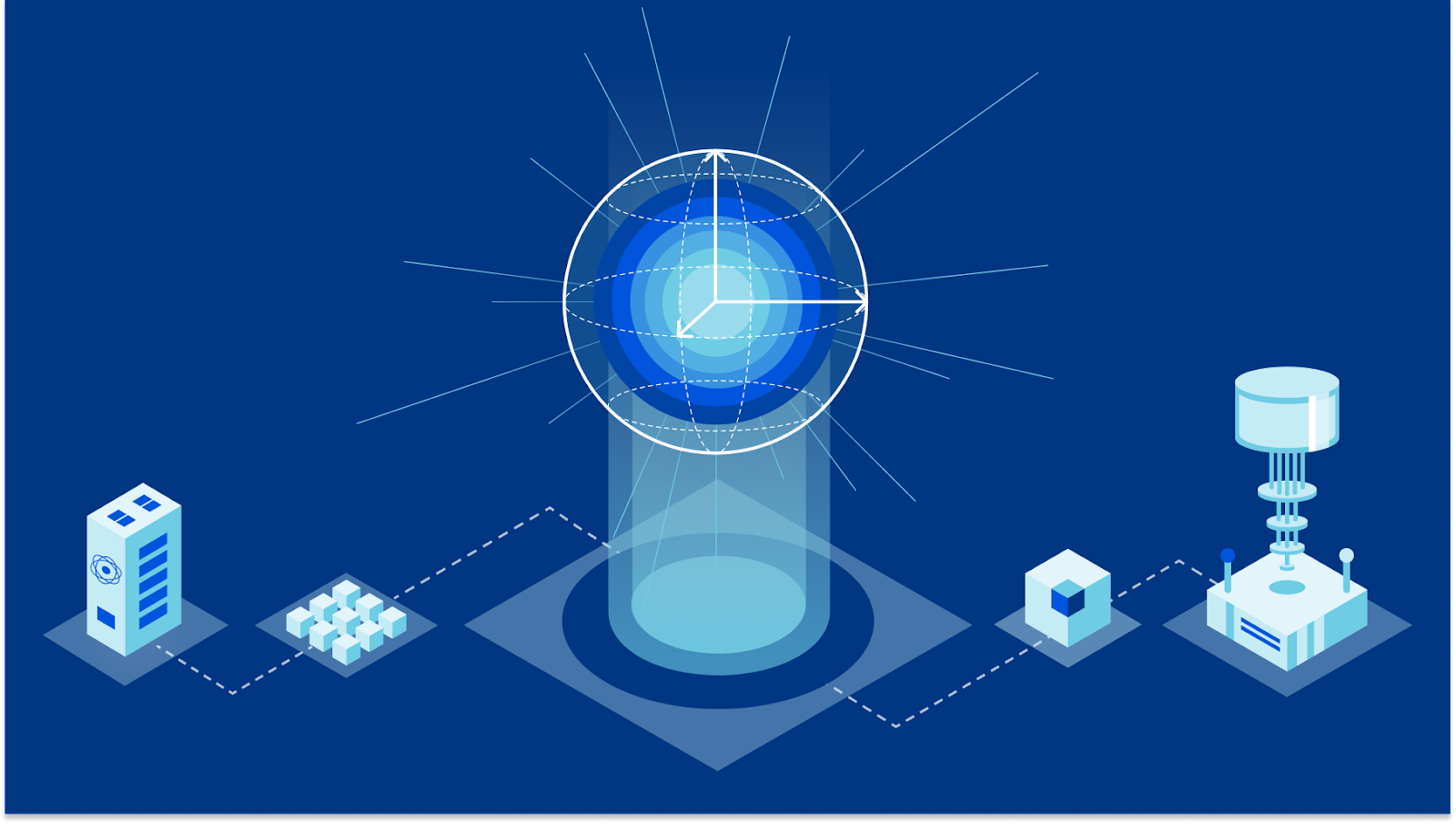
In a classical computer, data is stored in bits: 0 or 1, current on or current off, true or false. Nature is not that binary: any physical bit (current or not; particle or not; magnetized or not) is in fact a qubit and exists on a spectrum (or rather a sphere) of superpositions between 0 and 1. We have mentioned two terms that might be new to the reader: qubit and superposition. Let’s first define the second term.

A superposition is a normalized linear combination of all the possible configurations of something. What is this something? If we take the Schrödinger equation to explain, “for any isolated region of the universe that you want to consider, that equation describes the evolution in time of the state of that region, which we represent as a normalized linear combination — a superposition — of all the possible configurations of elementary particles in that region”, as Aaronson put it. Something, then, refers to all elementary particles. Does it mean, then, that we all are in a superposition? The answer to that question is open to many interpretations (for a nice introduction on the topic, one can read “Quantum Computing Since Democritus” by Scott Aaronson).

As you see, we are concerned then no longer on matter or energy or waves (as in classical physics), but rather on information and probabilities. In a quantum system, we first initialize information (like a bit) to some “easy” states, like 0 and 1. This information will be in a superposition of both states at the same time rather than just one or the other. If we examine a classical bit, we will either get the states of 1 or 0. Instead, with a qubit (quantum information) we can only get results with some probability. A qubit can exist in a continuum of states between ⟨0 and ⟨1 (using Dirac’s notation) all waiting to happen with some probability until it is observed.

The quantum solace and spectre
A qubit stores a combination of two or more states.

In day-to-day life, we don’t see this quantum weirdness because we’re looking at huge jittery ensembles of qubits where this weirdness gets lost in noise. However, if we turn the temperature way down and isolate some qubits from noise, we can do some proper quantum computation. For instance, to find a 256-bit decryption key, we can set 256 qubits to a superposition of all possible keys. Then, we can run the decryption algorithm, trying the key in the qubits. We end up with a superposition of many failures and one success. We did 2256 computations in a single go! Unfortunately, we can’t read out this superposition. In fact, if we open up the quantum computer to inspect the qubits inside, the outside noise will collapse the superposition into one outcome, which will most certainly be a failure. The real art of quantum computing is interfering this superposition with itself in a clever way to amplify out the answer we want. For the case we are talking about, Lov Grover figured out how to do it. Unfortunately, it requires about 2128 steps: we have a nice, but not exponential speed-up.

Quantum computers do not provide any additional power over classical computers in terms of computability: they don’t solve unsolvable problems. But they provide efficiency: they find solutions in faster time, even for algorithms that are too “expensive” for a non-quantum (classical) computer. A classical computer can solve any known computational problem if it is given enough time and resources. But, on some occasions, they will need so much time and so many resources that it will be deemed inefficient to try to solve this problem: waiting millions of years with millions of computers working at the same time trying to solve a problem is not something that we consider feasible to do. This idea of efficient and inefficient algorithms was made mathematically precise by the field of computational complexity. Roughly speaking, an efficient algorithm is one which runs in time polynomial in the size of the problem solved.

We can look at this differently. The many quantum states can be potentially observed (even in a classical computer), but states interfere with each other, which prevents the usage of statistical sampling to obtain the state. We, then, have to track every possible configuration that a quantum system can be in. Tracking every possible configuration is theoretically possible by a classical computer, but would exceed the memory capacity of even the most powerful classical computers. So, we need quantum computers to efficiently solve these problems.

Quantum computers are powerful. They can efficiently simulate quantum mechanics experiments, and are able to perform a number of mathematical, optimization, and search problems in a faster manner than classical computers. A sufficiently scaled quantum computer can, for example, factor large integers efficiently, as was shown by Shor. They also have significant advantages when it comes to searching on unstructured databases or solving the discrete logarithm problem. These advances are the solace: they efficiently advance computational problems that seem stalled. But, they are also a spectre, a threat: the problems that they efficiently solve are what is used as the core of much of cryptography as it exists today. They, hence, can break most of the secure connections we use nowadays. For a longer explanation of the matter, see our past blog post.

The realization of large-scale quantum computers will pose a threat to our connections and infrastructure. This threat is urgent and acts as a spectre of the future: an attacker can record and store secured traffic now and decrypt it later when a quantum computer exists. The spectre is ever more present if one recalls that migrating applications, architectures and protocols is a long procedure. Migrating these services to quantum-secure cryptography will take a lot of time.

In our other blog posts, we talk at length about what quantum computers are and what threats they pose. In this one, we want to give an overview of the advances in quantum computing and their threats to cryptography, as well as an update to what is considered quantum-secure cryptography.

The new upcoming decade of quantum computing

In our previous blog post, we mainly talked about improvements to reduce the cost of factoring integers and computing discrete logarithms during the middle of 2019. But recent years have brought new advances to the field. Google, for example, is aiming to build a “useful, error-corrected quantum computer” by the end of the decade. Their goal is to be able to better simulate nature and, specifically, to better simulate molecules. This research can then be used, for example, to create better batteries or generate better targeted medicines.

Why will it take them (and, generally, anyone) so long to create this quantum computer? Classical mechanisms, like Newtonian physics or classical computers, provide great detail and prediction of events and phenomena at a macroscopic level, which makes them perfect for our everyday computational needs. Quantum mechanics, on the other hand, are better manifested and understood at the microscopic level. Quantum phenomena are, furthermore, very fragile: uncontrolled interaction of quantum phenomena with the environment can make quantum features disappear, a process which is referred to as decoherence. Due to this, measurement of quantum states has to be controlled, properly prepared and isolated from its environment. Furthermore, measuring a quantum phenomenon disturbs its state, so reliable methods of computing information have to be developed.

Creating a computer that achieves computational tasks with these challenges is a daunting one. In fact, it may ultimately be impossible to completely eliminate errors in the computational tasks. It can even be an impossible task at a perfect level, as a certain amount of errors will persist. Reliable computation seems to be only achievable in a quantum computational model by employing error correction.

So, when will we know that a created quantum device is ready for the “quantum” use cases? One can use the idea of “quantum supremacy”, which is defined as the ability for a quantum device to perform a computational task that would be practically impossible (in terms of efficiency and usage of computational power) for classical computers. Nevertheless, this idea can be criticized as classical algorithms improve over time, and there is no clear definition on how to compare quantum computations with their classical counterparts (one must prove that no classical means would allow us to perform the same computational task in a faster time) in order to say that indeed quantum computations of the task are faster.

A molecule can indeed be claimed to be “quantum supreme” if researchers find it computationally prohibitive (unrealistically expensive) to solve the Schrödinger equation and calculate its ground state. That molecule constitutes a “useful quantum computer, for the task of simulating itself.” But, for computer science, this individual instance is not enough: “for any one molecule, the difficulty in simulating it classically might reflect genuine asymptotic hardness, but it might also reflect other issues (e.g., a failure to exploit special structure in the molecule, or the same issues of modeling error, constant-factor overheads, and so forth that arise even in simulations of classical physics)”, as stated by Aaronson and Chen.

By the end of 2019, Google argued they had reached quantum supremacy (with the quantum processor named “Sycamore”) but their claim was debated mainly due to the perceived lack of criteria to properly define when “quantum supremacy” is reached1. Google claimed that “a state-of-the-art supercomputer would require approximately 10,000 years to perform the equivalent task” and it was refuted by IBM by saying that “an ideal simulation of the same task can be performed on a classical system in 2.5 days and with far greater fidelity”. Regardless of this lack of criteria, this result in itself is a remarkable achievement and shows great interest of parties into creating a quantum computer. Last November, it was claimed that the most challenging sampling task performed on Sycamore can be accomplished within one week on the Sunway supercomputer. A crucial point has to be understood on the matter, though: “more like a week still seems to be needed on the supercomputer”, as noted by Aaronson. Quantum supremacy then is still not an irrevocable agreement.

Google’s quantum computer has already been applied to simulating real physical phenomena. Early in 2021, it was used to demonstrate a “time crystal” (a quantum system of particles which move in a regular, repeating motion without burning any energy to the environment). On the other hand, by late 2021, IBM unveiled its 127-qubit chip Eagle, but we don’t yet know how much gate fidelity (how close two operations are to each other) it really attains, as outlined by Aaronson in his blog post.

What do all of these advances mean for cryptography? Does it mean that soon all secure connections will be broken? If not “soon”, when will it be? The answers to all of these questions are complex and unclear. The Quantum Threat Timeline Report of 2020 suggests that the majority of researchers on the subject think that 15 to 40 years2 will be the time frame for when a “cryptography-breaking” quantum computer arrives. It is worth noting that these predictions are more optimistic than compared to the same report of 2019, which suggests that, due to the advances of the quantum computing field, researchers feel more assured of their imminent arrival.

The upcoming decades of breaking cryptography

The quantum solace and spectre

Quantum computing will shine a light into new areas of development and advances, but it will also expose secret areas: faster mechanisms to solve mathematical problems and break cryptography. The metaphor of the dawn can be used to show how close we are to quantum computers breaking some types of cryptography (how far are we to twilight), which will be catastrophic to the needs of privacy, communication and security we have.

It is worth noting again, though, that the advent of quantum computing is not a bad scenario in itself. Quantum computing will bring much progress in the form of advances to the understanding and mimicking of the fundamental way in which nature interacts. Their inconvenience is that they break most of the cryptography algorithms we use nowadays. They also have their limits: they cannot solve every problem, and in cryptography there are algorithms that will not be broken by them.

Let’s start by defining first what dawn is. Dawn is the arrival of stable quantum computers that break cryptography in a reasonable amount of time and space (explicitly: breaking the mathematical foundation of the p256 algorithm; although some research defines this as breaking RSA2048). It is also the time by which a new day arrives: a day that starts with new advances in medicine, for example, by better mimicking molecules’ nature with a computer.

How close to dawn are we? To answer this question, we have to look at the recent advances in the aim of breaking cryptography with a quantum computer. One of the most interesting advances is that the number 15 was factored in 2001 (it is 20 years already) and number 21 was factored in 2012 by a quantum computer. While this does not seem so exciting for us (as we can factor it in our minds), it is astonishing to see that a quantum computer was stable enough to do so.

Why do we care about computers factoring or not factoring integers? The reason is that they are the mathematical base of certain public key cryptography algorithms (like, RSA) and, if they are factored, the algorithm is broken.

Taking a step further, quantum computers are also able to break encryption algorithms themselves, such as AES, as we can use quantum efficient searching algorithms for the task. This kind of searching algorithm, Grover’s algorithm, solves the task of function inversion, which speeds up collision and preimage attacks (attacks that you don’t want to be sped up in your encryption algorithms). These attacks are related to hash functions: a collision attack is one that tries to find two messages that produce the same hash; a preimage attack is one that tries to find a message given its hash value. A smart evolution of this algorithm, using Hidden Variables as part of a computational model, will theoretically make searching much more efficient.

So what are the tasks needed for a quantum computer to break cryptography? It should:

  • Be able to factor big integers, or,
  • Be able to efficiently search for collisions or pre-images, or,
  • Be able to solve the discrete logarithm problem.

Why do we care about these quantum computers breaking cryptographic algorithms that we rarely hear of? What has it to do with the connections we make? Cryptographic algorithms are the base of the secure protocols that we use today. Every time we visit a website, we are using a broad suite of cryptographic algorithms that preserve the security, privacy and integrity of connections. Without them, we don’t have the properties we are used to when connecting over digital means.

What can we do? Do we now stop using digital means altogether? There are solutions. Of course, the easy answer will be, for example, to increase the size of integers to make them impossible to be factored by a quantum computer. But, is it really a usable algorithm? How slow will our connections be if we have to increase these algorithms exponentially?

As we get closer to twilight, we also get closer to the dawn of new beginnings, the rise of post-quantum cryptography.

The rise and state of post-quantum cryptography

As dawn approaches, researchers everywhere have been busy looking for solutions. If the mathematical underpinnings of an algorithm are what is broken by a quantum computer, can we just change them? Are there mathematical problems that are hard even for quantum computers? The answer is yes and, even more interestingly, we already know how to create algorithms out of them.

The mathematical problems that we use in this new upcoming era, called post-quantum, are of many kinds:

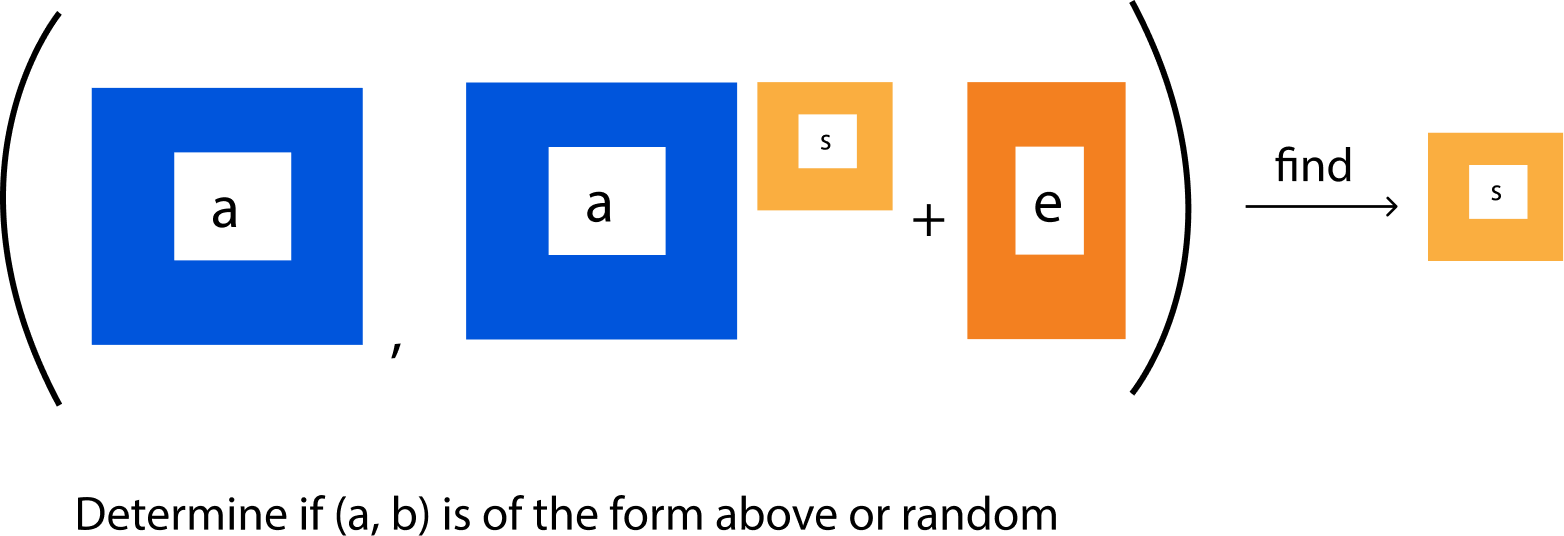
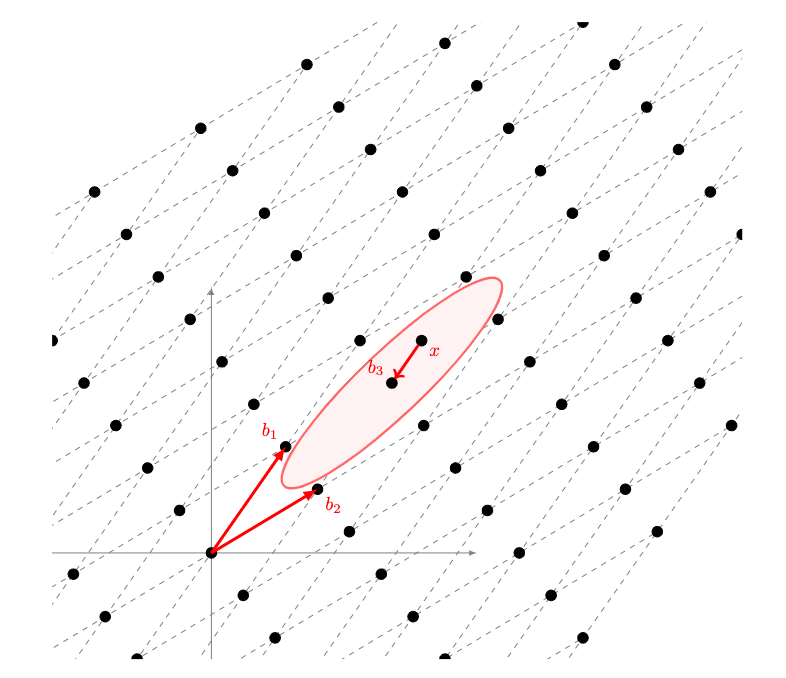
  • Lattices by using learning with errors (LWE) or ring learning with errors problems (rLWE).
  • Isogenies, which rely on properties of supersingular elliptic curves and supersingular isogeny graphs.
  • Multivariate cryptography, which relies on the difficulty of solving systems of multivariate equations.
  • Code-based cryptography, which relies on the theory of error-correcting codes.

With these mathematical constructions, we can build algorithms that can be used to protect our connections and data. How do we know, nevertheless, that the algorithms are safe? Even if a mathematical construction that an algorithm uses is safe from the quantum spectre, is the interaction with other parts of the system or in regard to adversaries safe? Who decides on this?

Because it is difficult to determine answers to these questions on an isolated level, the National Institute of Standards and Technology of the United States has been running, since 2016, a post-quantum process that will define how these algorithms work, their design, what properties they provide and how they will be used. We now have a set of finalists that are close to being standardized. The competition standardizes on two tracks: algorithms for key encapsulation mechanisms and public-key encryption (or KEMs) and algorithms for the authentication (mainly, digital signatures). The current finalists are:

For the public-key encryption and key-establishment algorithms:

  • Classic McEliece, a code-based cryptography scheme.
  • CRYSTALS-KYBER, a lattice based scheme.
  • NTRU, a lattice based scheme.
  • SABER, a lattice based scheme.

For the digital signature algorithms:

  • CRYSTALS-DILITHIUM, a lattice based scheme.
  • FALCON, a lattice based scheme.
  • Rainbow, a multivariate cryptography scheme.

What do these finalists show us? It seems that we can rely on the security given by lattice-based schemes (which is no slight to the security of any of the other schemes). It also shows us that in the majority of the cases, we prioritize schemes that can be used in the same way cryptography is used nowadays: with fast operations’ computation time, and with small parameters’ sizes. In the migration to post-quantum cryptography, it is not only about using safe mathematical constructions and secure algorithms but also about how they integrate into the systems, architectures, protocols, and expected speed and space efficiencies we currently depend on. More research seems to be needed in the signatures/authentication front and the inclusion of new innovative signature schemes (like SQISign or MAYO), and that is why NIST will be calling for a fourth round of its competition.

It is worth noting that there exists another flavor of upcoming cryptography called “quantum cryptography”, but its efficient dawn seems to be far away (though, some Quantum Key Distribution — QKD — protocols are being deployed now). Quantum cryptography is one that uses quantum mechanical properties to perform cryptographic tasks. It has mainly focused on QKD), but it seems to be too inefficient to be used in practice outside very limited settings. And even though, in theory, these schemes should be perfectly secure against any eavesdropper; in practice, the physical machines may still fall victim to side-channel attacks.

Is dawn, then, the collapse of cryptography? It can be, on one hand, as it is the collapse of most classical cryptography. But, on the other hand, it is also the dawn of new, post-quantum cryptography and the start of quantum computing for the benefit of the world. Will the process of reaching dawn be simple? Certainly, not. Migrating systems, architectures and protocols to new algorithms is an intimidating task. But we at Cloudflare and as a community are taking the steps, as you will read in other blog posts throughout this week.

References:

…….
1In the original paper, they estimate of 10,000 years is based on the observation that there is not enough Random Access Memory (RAM) to store the full state vector in a Schrödinger-type simulation and, then, it is needed to use a hybrid Schrödinger–Feynman algorithm, which is memory-efficient but exponentially more computationally expensive. In contrast, IBM used a Schrödinger-style classical simulation approach that uses both RAM and hard drive space.
2There is a 50% or more likelihood of “cryptography-breaking” quantum computers arriving. Slightly more than half of the researchers answered that, in the next 15 years, they will arrive. About 86% of the researchers answered that, in the next 20 years, they will arrive. All but one among the researchers answered that, in the next 30 years, they will arrive.
3Although, in practice, this seems difficult to attain.

KEMTLS: Post-quantum TLS without signatures

Post Syndicated from Sofía Celi original https://blog.cloudflare.com/kemtls-post-quantum-tls-without-signatures/

KEMTLS: Post-quantum TLS without signatures

KEMTLS: Post-quantum TLS without signatures

The Transport Layer Security protocol (TLS), which secures most Internet connections, has mainly been a protocol consisting of a key exchange authenticated by digital signatures used to encrypt data at transport[1]. Even though it has undergone major changes since 1994, when SSL 1.0 was introduced by Netscape, its main mechanism has remained the same. The key exchange was first based on RSA, and later on traditional Diffie-Hellman (DH) and Elliptic-curve Diffie-Hellman (ECDH). The signatures used for authentication have almost always been RSA-based, though in recent years other kinds of signatures have been adopted, mainly ECDSA and Ed25519. This recent change to elliptic curve cryptography in both at the key exchange and at the signature level has resulted in considerable speed and bandwidth benefits in comparison to traditional Diffie-Hellman and RSA.

TLS is the main protocol that protects the connections we use everyday. It’s everywhere: we use it when we buy products online, when we register for a newsletter — when we access any kind of website, IoT device, API for mobile apps and more, really. But with the imminent threat of the arrival of quantum computers (a threat that seems to be getting closer and closer), we need to reconsider the future of TLS once again. A wide-scale post-quantum experiment was carried out by Cloudflare and Google: two post-quantum key exchanges were integrated into our TLS stack and deployed at our edge servers as well as in Chrome Canary clients. The goal of that experiment was to evaluate the performance and feasibility of deployment of two post-quantum key exchanges in TLS.

Similar experiments have been proposed for introducing post-quantum algorithms into the TLS handshake itself. Unfortunately, it seems infeasible to replace both the key exchange and signature with post-quantum primitives, because post-quantum cryptographic primitives are bigger, or slower (or both), than their predecessors. The proposed algorithms under consideration in the NIST post-quantum standardization process use mathematical objects that are larger than the ones used for elliptic curves, traditional Diffie-Hellman, or RSA. As a result, the overall size of public keys, signatures and key exchange material is much bigger than those from elliptic curves, Diffie-Hellman, or RSA.

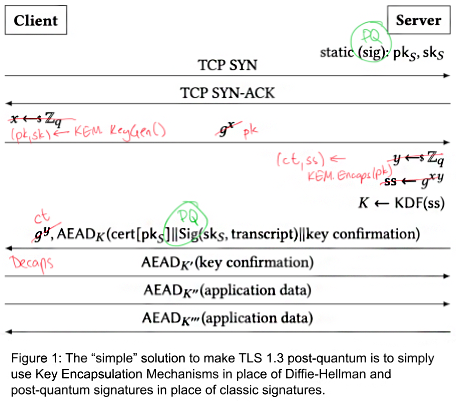
How can we solve this problem? How can we use post-quantum algorithms as part of the TLS handshake without making the material too big to be transmitted? In this blogpost, we will introduce a new mechanism for making this happen. We’ll explain how it can be integrated into the handshake and we’ll cover implementation details. The key observation in this mechanism is that, while post-quantum algorithms have bigger communication size than their predecessors, post-quantum key exchanges have somewhat smaller sizes than post-quantum signatures, so we can try to replace signatures with key exchanges in some places to save space.  We will only focus on the TLS 1.3 handshake as it is the TLS version that should be currently used.

Past experiments: making the TLS 1.3 handshake post-quantum

KEMTLS: Post-quantum TLS without signatures

TLS 1.3 was introduced in August 2018, and it brought many security and performance improvements (notably, having only one round-trip to complete the handshake). But TLS 1.3 is designed for a world with classical computers, and some of its functionality will be broken by quantum computers when they do arrive.

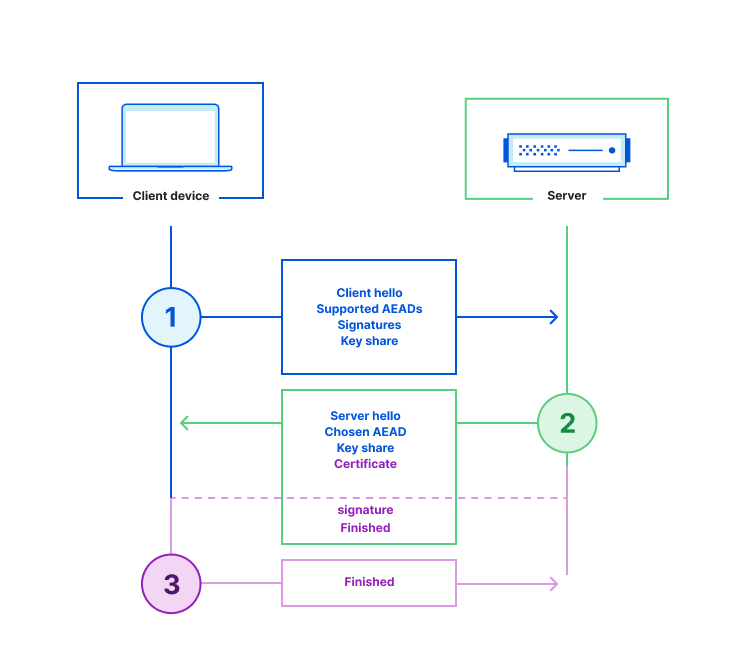
The primary goal of TLS 1.3 is to provide authentication (the server side of the channel is always authenticated, the client side is optionally authenticated), confidentiality, and integrity by using a handshake protocol and a record protocol. The handshake protocol, the one of interest for us today, establishes the cryptographic parameters for securing and authenticating a connection. It can be thought of as having three main phases, as defined in RFC8446:

–  The Parameter Negotiation phase (referred to as ‘Server Parameters’ in RFC8446), which establishes other handshake parameters (whether the client is authenticated, application-layer protocol support, etc).

–  The Key Exchange phase, which establishes shared keying material and selects the cryptographic parameters to be used. Everything after this phase will be encrypted.

–  The Authentication phase, which authenticates the server (and, optionally, the client) and provides key confirmation and handshake integrity.

The main idea of past experiments that introduced post-quantum algorithms into the handshake of TLS 1.3 was to use them in place of classical algorithms by advertising them as part of the supported groups[2] and key share[3] extensions, and, therefore, establishing with them the negotiated connection parameters. Key encapsulation mechanisms (KEMs) are an abstraction of the basic key exchange primitive, and were used to generate the shared secrets. When using a pre-shared key, its symmetric algorithms can be easily replaced by post-quantum KEMs as well; and, in the case of password-authenticated TLS, some ideas have been proposed on how to use post-quantum algorithms with them.

Most of the above ideas only provide what is often defined as ‘transitional security’, because its main focus is to provide quantum-resistant confidentiality, and not to take quantum-resistant authentication into account. It is possible to use post-quantum signatures for TLS authentication, but the post-quantum signatures are larger than traditional ones. Furthermore, it is worth noting that using post-quantum signatures is much more expensive than using post-quantum KEMs.

We can estimate the impact of such a replacement on network traffic by simply looking at the sum of the cryptographic objects that are transmitted during the handshake. A typical TLS 1.3 handshake using elliptic curve X25519 and RSA-2048 would transmit 1,376 bytes, which would correspond to the public keys for key exchange, the certificate, the signature of the handshake, and the certificate chain. If we were to replace X25519 by the post-quantum KEM Kyber512 and RSA by the post-quantum signature Dilithium II, two of the more efficient proposals, the size transmitted data would increase to 10,036 bytes[4]. The increase is mostly due to the size of the post-quantum signature algorithm.

The question then is: how can we achieve full post-quantum security and give a handshake that is efficient to be used?

A more efficient proposal: KEMTLS

There is a long history of other mechanisms, besides signatures, being used for authentication. Modern protocols, such as the Signal protocol, the Noise framework, or WireGuard, rely on key exchange mechanisms for authentication; but they are unsuitable for the TLS 1.3 case as they expect the long-term key material to be known in advance by the interested parties.

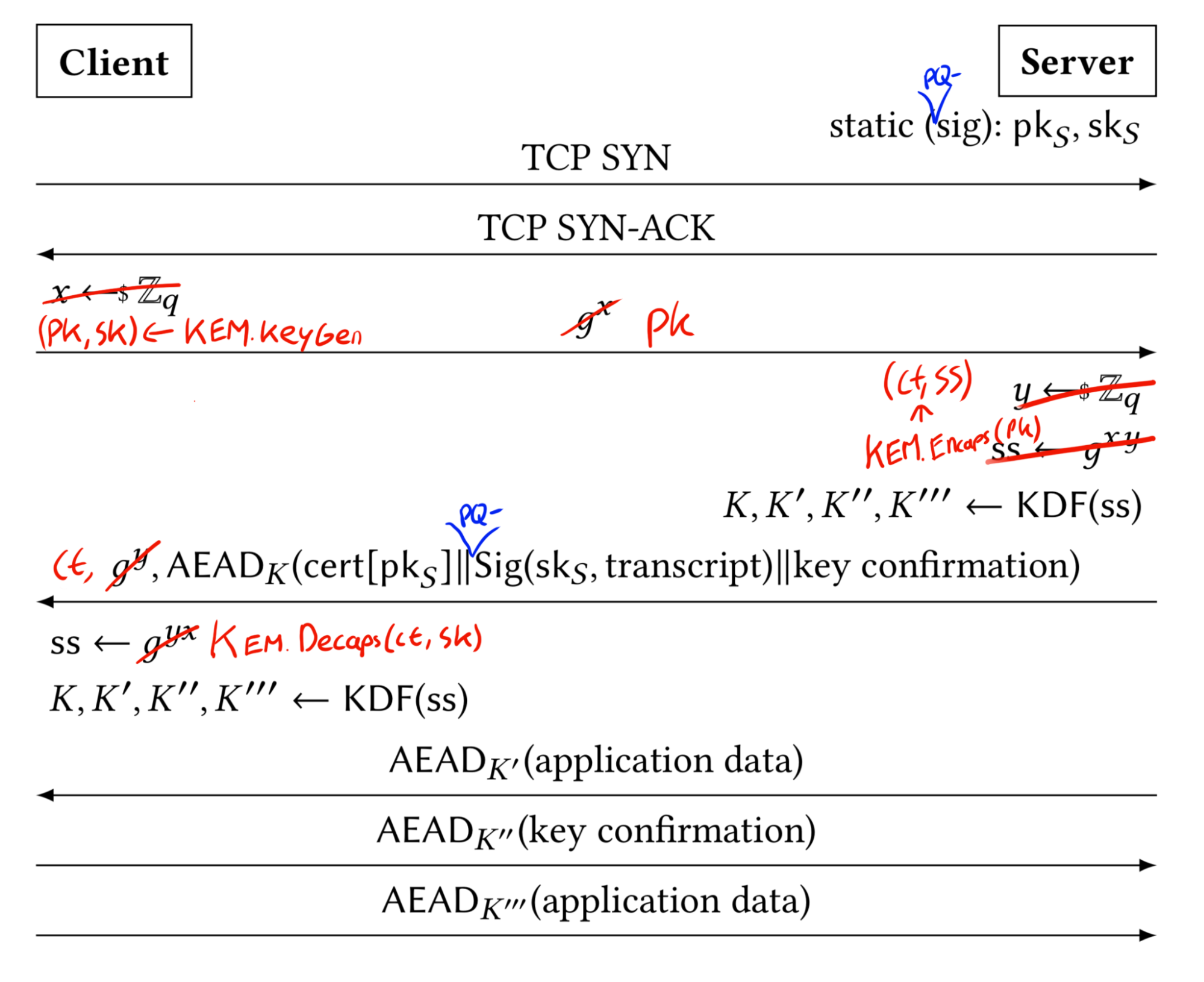
The OPTLS proposal by Krawczyk and Wee authenticates the TLS handshake without signatures by using a non-interactive key exchange (NIKE). However, the only somewhat efficient construction for a post-quantum NIKE is CSIDH, the security of which is the subject of an ongoing debate. But we can build on this idea, and use KEMs for authentication. KEMTLS, the current proposed experiment, replaces the handshake signature by a post-quantum KEM key exchange. It was designed and introduced by Peter Schwabe, Douglas Stebila and Thom Wiggers in the publication ‘Post-Quantum TLS Without Handshake Signatures’.

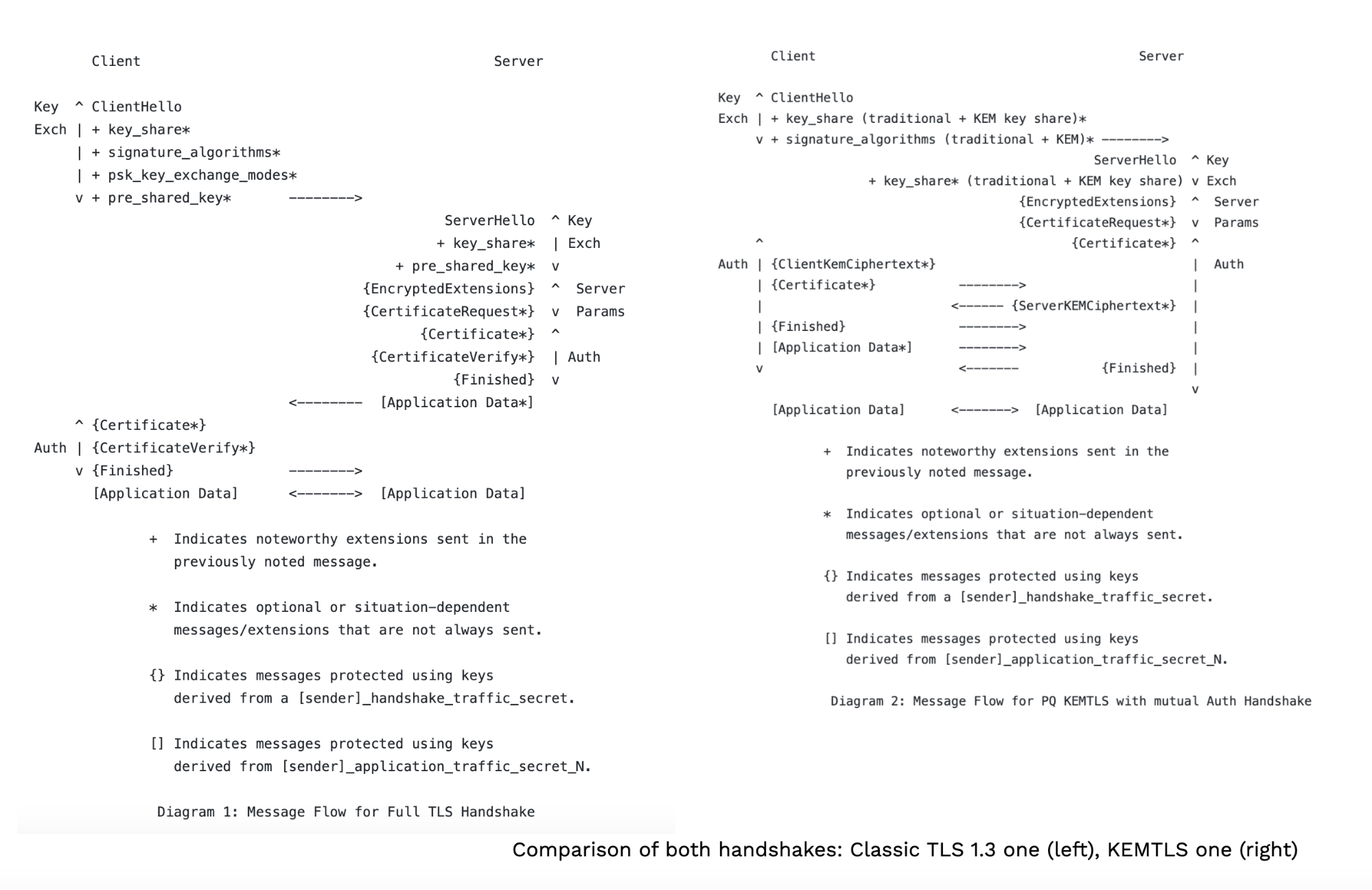
KEMTLS, therefore, achieves the same goals as TLS 1.3 (authentication, confidentiality and integrity) in the face of quantum computers. But there’s one small difference compared to the TLS 1.3 handshake. KEMTLS allows the client to send encrypted application data in the second client-to-server TLS message flow when client authentication is not required, and in the third client-to-server TLS message flow when mutual authentication is required. Note that with TLS 1.3, the server is able to send encrypted and authenticated application data in its first response message (although, in most uses of TLS 1.3, this feature is not actually used). With KEMTLS, when client authentication is not required, the client is able to send its first encrypted application data after the same number of handshake round trips as in TLS 1.3.

Intuitively, the handshake signature in TLS 1.3 proves possession of the private key corresponding to the public key certified in the TLS 1.3 server certificate. For these signature schemes, this is the straightforward way to prove possession; another way to prove possession is through key exchanges. By carefully considering the key derivation sequence, a server can decrypt any messages sent by the client only if it holds the private key corresponding to the certified public key. Therefore, implicit authentication is fulfilled. It is worth noting that KEMTLS still relies on signatures by certificate authorities to authenticate the long-term KEM keys.

With KEMTLS, application data transmitted during the handshake is implicitly authenticated rather than explicitly (as in TLS 1.3), and has slightly weaker downgrade resilience and forward secrecy; but full downgrade resilience and forward secrecy are achieved once the KEMTLS handshake completes.

KEMTLS: Post-quantum TLS without signatures

By replacing the handshake signature by a KEM key exchange, we reduce the size of the data transmitted in the example handshake to 8,344 bytes, using Kyber512 and Dilithium II — a significant reduction. We can reduce the handshake size even for algorithms such as the NTRU-assumption based KEM NTRU and signature algorithm Falcon, which have a less-pronounced size gap. Typically, KEM operations are computationally much lighter than signing operations, which makes the reduction even more significant.

KEMTLS was presented at ACM CCS 2020. You can read more about its details in the paper. It was initially implemented in the RustTLS library by Thom Wiggers using optimized C/assembly implementations of the post-quantum algorithms provided by the PQClean and Open Quantum Safe projects.

Cloudflare and KEMTLS: the implementation

As part of our effort to show that TLS can be completely post-quantum safe, we implemented the full KEMTLS handshake in Golang’s TLS 1.3 suite. The implementation was done in several steps:

  1. We first needed to clone our own version of Golang, so we could add different post-quantum algorithms to it. You can find our own version here. This code gets constantly updated with every release of Golang, following these steps.
  2. We needed to implement post-quantum algorithms in Golang, which we did on our own cryptographic library, CIRCL.
  3. As we cannot force certificate authorities to use certificates with long-term post-quantum KEM keys, we decided to use Delegated Credentials. A delegated credential is a short-lasting key that the certificate’s owner has delegated for use in TLS. Therefore, they can be used for post-quantum KEM keys. See its implementation in our Golang code here.
  4. We implemented mutual auth (client and server authentication) KEMTLS by using Delegated Credentials for the authentication process. See its implementation in our Golang code here. You can also check its test for an overview of how it works.

Implementing KEMTLS was a straightforward process, although it did require changes to the way Golang handles a TLS 1.3 handshake and how the key schedule works.

A “regular” TLS 1.3 handshake in Golang (from the server perspective) looks like this:

func (hs *serverHandshakeStateTLS13) handshake() error {
    c := hs.c

    // For an overview of the TLS 1.3 handshake, see RFC 8446, Section 2.
    if err := hs.processClientHello(); err != nil {
   	 return err
    }
    if err := hs.checkForResumption(); err != nil {
   	 return err
    }
    if err := hs.pickCertificate(); err != nil {
   	 return err
    }
    c.buffering = true
    if err := hs.sendServerParameters(); err != nil {
   	 return err
    }
    if err := hs.sendServerCertificate(); err != nil {
   	 return err
    }
    if err := hs.sendServerFinished(); err != nil {
   	 return err
    }
    // Note that at this point we could start sending application data without
    // waiting for the client's second flight, but the application might not
    // expect the lack of replay protection of the ClientHello parameters.
    if _, err := c.flush(); err != nil {
   	 return err
    }
    if err := hs.readClientCertificate(); err != nil {
   	 return err
    }
    if err := hs.readClientFinished(); err != nil {
   	 return err
    }

    atomic.StoreUint32(&c.handshakeStatus, 1)

    return nil
}

We had to interrupt the process when the server sends the Certificate (sendServerCertificate()) in order to send the KEMTLS specific messages. In the same way, we had to add the appropriate KEM TLS messages to the client’s handshake. And, as we didn’t want to change so much the way Golang handles TLS 1.3, we only added one new constant to the configuration that can be used by a server in order to ask for the Client’s Certificate (the constant is serverConfig.ClientAuth = RequestClientKEMCert).

The implementation is easy to work with: if a delegated credential or a certificate has a public key of a supported post-quantum KEM algorithm, the handshake will proceed with KEMTLS. If the server requests a Client KEMTLS Certificate, the handshake will use client KEMTLS authentication.

Running the Experiment

So, what’s next? We’ll take the code we have produced and run it on actual Cloudflare infrastructure to measure how efficiently it works.

Thanks

Many thanks to everyone involved in the project: Chris Wood, Armando Faz-Hernández, Thom Wiggers, Bas Westerbaan, Peter Wu, Peter Schwabe, Goutam Tamvada, Douglas Stebila, Thibault Meunier, and the whole Cloudflare Research team.

1It is worth noting that the RSA key transport in TLS ≤1.2 has the server only authenticated by RSA public key encryption, although the server’s RSA public key is certified using RSA signatures by Certificate Authorities.
2An extension used by the client to indicate which named groups -Elliptic Curve Groups, Finite Field Groups- it supports for key exchange.
3An extension which contains the endpoint’s cryptographic parameters.
4These numbers, as it is noted in the paper, are based on the round-2 submissions.

Round 2 post-quantum TLS is now supported in AWS KMS

Post Syndicated from Alex Weibel original https://aws.amazon.com/blogs/security/round-2-post-quantum-tls-is-now-supported-in-aws-kms/

AWS Key Management Service (AWS KMS) now supports three new hybrid post-quantum key exchange algorithms for the Transport Layer Security (TLS) 1.2 encryption protocol that’s used when connecting to AWS KMS API endpoints. These new hybrid post-quantum algorithms combine the proven security of a classical key exchange with the potential quantum-safe properties of new post-quantum key exchanges undergoing evaluation for standardization. The fastest of these algorithms adds approximately 0.3 milliseconds of overheard compared to a classical TLS handshake. The new post-quantum key exchange algorithms added are Round 2 versions of Kyber, Bit Flipping Key Encapsulation (BIKE), and Supersingular Isogeny Key Encapsulation (SIKE). Each organization has submitted their algorithms to the National Institute of Standards and Technology (NIST) as part of NIST’s post-quantum cryptography standardization process. This process spans several rounds of evaluation over multiple years, and is likely to continue beyond 2021.

In our previous hybrid post-quantum TLS blog post, we announced that AWS KMS had launched hybrid post-quantum TLS 1.2 with Round 1 versions of BIKE and SIKE. The Round 1 post-quantum algorithms are still supported by AWS KMS, but at a lower priority than the Round 2 algorithms. You can choose to upgrade your client to enable negotiation of Round 2 algorithms.

Why post-quantum TLS is important

A large-scale quantum computer would be able to break the current public-key cryptography that’s used for key exchange in classical TLS connections. While a large-scale quantum computer isn’t available today, it’s still important to think about and plan for your long-term security needs. TLS traffic using classical algorithms recorded today could be decrypted by a large-scale quantum computer in the future. If you’re developing applications that rely on the long-term confidentiality of data passed over a TLS connection, you should consider a plan to migrate to post-quantum cryptography before the lifespan of the sensitivity of your data would be susceptible to an unauthorized user with a large-scale quantum computer. As an example, this means that if you believe that a large-scale quantum computer is 25 years away, and your data must be secure for 20 years, you should migrate to post-quantum schemes within the next 5 years. AWS is working to prepare for this future, and we want you to be prepared too.

We’re offering this feature now instead of waiting for standardization efforts to be complete so you have a way to measure the potential performance impact to your applications. Offering this feature now also gives you the protection afforded by the proposed post-quantum schemes today. While we believe that the use of this feature raises the already high security bar for connecting to AWS KMS endpoints, these new cipher suites will impact bandwidth utilization and latency. However, using these new algorithms could also create connection failures for intermediate systems that proxy TLS connections. We’d like to get feedback from you on the effectiveness of our implementation or any issues found so we can improve it over time.

Hybrid post-quantum TLS 1.2

Hybrid post-quantum TLS is a feature that provides the security protections of both the classical and post-quantum key exchange algorithms in a single TLS handshake. Figure 1 shows the differences in the connection secret derivation process between classical and hybrid post-quantum TLS 1.2. Hybrid post-quantum TLS 1.2 has three major differences from classical TLS 1.2:

  • The negotiated post-quantum key is appended to the ECDHE key before being used as the hash-based message authentication code (HMAC) key.
  • The text hybrid in its ASCII representation is prepended to the beginning of the HMAC message.
  • The entire client key exchange message from the TLS handshake is appended to the end of the HMAC message.
Figure 1: Differences in the connection secret derivation process between classical and hybrid post-quantum TLS 1.2

Figure 1: Differences in the connection secret derivation process between classical and hybrid post-quantum TLS 1.2

Some background on post-quantum TLS

Today, all requests to AWS KMS use TLS with key exchange algorithms that provide perfect forward secrecy and use one of the following classical schemes:

While existing FFDHE and ECDHE schemes use perfect forward secrecy to protect against the compromise of the server’s long-term secret key, these schemes don’t protect against large-scale quantum computers. In the future, a sufficiently capable large-scale quantum computer could run Shor’s Algorithm to recover the TLS session key of a recorded classical session, and thereby gain access to the data inside. Using a post-quantum key exchange algorithm during the TLS handshake protects against attacks from a large-scale quantum computer.

The possibility of large-scale quantum computing has spurred the development of new quantum-resistant cryptographic algorithms. NIST has started the process of standardizing post-quantum key encapsulation mechanisms (KEMs). A KEM is a type of key exchange that’s used to establish a shared symmetric key. AWS has chosen three NIST KEM submissions to adopt in our post-quantum efforts:

Hybrid mode ensures that the negotiated key is as strong as the weakest key agreement scheme. If one of the schemes is broken, the communications remain confidential. The Internet Engineering Task Force (IETF) Hybrid Post-Quantum Key Encapsulation Methods for Transport Layer Security 1.2 draft describes how to combine post-quantum KEMs with ECDHE to create new cipher suites for TLS 1.2.

These cipher suites use a hybrid key exchange that performs two independent key exchanges during the TLS handshake. The key exchange then cryptographically combines the keys from each into a single TLS session key. This strategy combines the proven security of a classical key exchange with the potential quantum-safe properties of new post-quantum key exchanges being analyzed by NIST.

The effect of hybrid post-quantum TLS on performance

Post-quantum cipher suites have a different performance profile and bandwidth usage from traditional cipher suites. AWS has measured bandwidth and latency across 2,000 TLS handshakes between an Amazon Elastic Compute Cloud (Amazon EC2) C5n.4xlarge client and the public AWS KMS endpoint, which were both in the us-west-2 Region. Your own performance characteristics might differ, and will depend on your environment, including your:

  • Hardware–CPU speed and number of cores.
  • Existing workloads–how often you call AWS KMS and what other work your application performs.
  • Network–location and capacity.

The following graphs and table show latency measurements performed by AWS for all newly supported Round 2 post-quantum algorithms, in addition to the classical ECDHE key exchange algorithm currently used by most customers.

Figure 2 shows the latency differences of all hybrid post-quantum algorithms compared with classical ECDHE alone, and shows that compared to ECDHE alone, SIKE adds approximately 101 milliseconds of overhead, BIKE adds approximately 9.5 milliseconds of overhead, and Kyber adds approximately 0.3 milliseconds of overhead.
 

Figure 2: TLS handshake latency at varying percentiles for four key exchange algorithms

Figure 2: TLS handshake latency at varying percentiles for four key exchange algorithms

Figure 3 shows the latency differences between ECDHE with Kyber, and ECDHE alone. The addition of Kyber adds approximately 0.3 milliseconds of overhead.
 

Figure 3: TLS handshake latency at varying percentiles, with only top two performing key exchange algorithms

Figure 3: TLS handshake latency at varying percentiles, with only top two performing key exchange algorithms

The following table shows the total amount of data (in bytes) needed to complete the TLS handshake for each cipher suite, the average latency, and latency at varying percentiles. All measurements were gathered from 2,000 TLS handshakes. The time was measured on the client from the start of the handshake until the handshake was completed, and includes all network transfer time. All connections used RSA authentication with a 2048-bit key, and ECDHE used the secp256r1 curve. All hybrid post-quantum tests used the NIST Round 2 versions. The Kyber test used the Kyber-512 parameter, the BIKE test used the BIKE-1 Level 1 parameter, and the SIKE test used the SIKEp434 parameter.

Item Bandwidth
(bytes)
Total
handshakes
Average
(ms)
p0
(ms)
p50
(ms)
p90
(ms)
p99
(ms)
ECDHE (classic) 3,574 2,000 3.08 2.07 3.02 3.95 4.71
ECDHE + Kyber R2 5,898 2,000 3.36 2.38 3.17 4.28 5.35
ECDHE + BIKE R2 12,456 2,000 14.91 11.59 14.16 18.27 23.58
ECDHE + SIKE R2 4,628 2,000 112.40 103.22 108.87 126.80 146.56

By default, the AWS SDK client performs a TLS handshake once to set up a new TLS connection, and then reuses that TLS connection for multiple requests. This means that the increased cost of a hybrid post-quantum TLS handshake is amortized over multiple requests sent over the TLS connection. You should take the amortization into account when evaluating the overall additional cost of using post-quantum algorithms; otherwise performance data could be skewed.

AWS KMS has chosen Kyber Round 2 to be KMS’s highest prioritized post-quantum algorithm, with BIKE Round 2, and SIKE Round 2 next in priority order for post-quantum algorithms. This is because Kyber’s performance is closest to the classical ECDHE performance that most AWS KMS customers are using today and are accustomed to.

How to use hybrid post-quantum cipher suites

To use the post-quantum cipher suites with AWS KMS, you need the preview release of the AWS Common Runtime (CRT) HTTP client for the AWS SDK for Java 2.x. Also, you will need to configure the AWS CRT HTTP client to use the s2n post-quantum hybrid cipher suites. Post-quantum TLS for AWS KMS is available in all AWS Regions except for AWS GovCloud (US-East), AWS GovCloud (US-West), AWS China (Beijing) Region operated by Beijing Sinnet Technology Co. Ltd (“Sinnet”), and AWS China (Ningxia) Region operated by Ningxia Western Cloud Data Technology Co. Ltd. (“NWCD”). Since NIST has not yet standardized post-quantum cryptography, connections that require Federal Information Processing Standards (FIPS) compliance cannot use the hybrid key exchange. For example, kms.<region>.amazonaws.com supports the use of post-quantum cipher suites, while kms-fips.<region>.amazonaws.com does not.

  1. If you’re using the AWS SDK for Java 2.x, you must add the preview release of the AWS Common Runtime client to your Maven dependencies.
    <dependency>
        <groupId>software.amazon.awssdk</groupId>
        <artifactId>aws-crt-client</artifactId>
        <version>2.14.13-PREVIEW</version>
    </dependency>
    

  2. You then must configure the new SDK and cipher suite in the existing initialization code of your application:
    if(!TLS_CIPHER_PREF_KMS_PQ_TLSv1_0_2020_07.isSupported()){
        throw new RuntimeException("Post Quantum Ciphers not supported on this Platform");
    }
    
    SdkAsyncHttpClient awsCrtHttpClient = AwsCrtAsyncHttpClient.builder()
              .tlsCipherPreference(TLS_CIPHER_PREF_KMS_PQ_TLSv1_0_2020_07)
              .build();
              
    KmsAsyncClient kms = KmsAsyncClient.builder()
             .httpClient(awsCrtHttpClient)
             .build();
             
    ListKeysResponse response = kms.listKeys().get();
    

Now, all connections made to AWS KMS in supported Regions will use the new hybrid post-quantum cipher suites! To see a complete example of everything set up, check out the example application here.

Things to try

Here are some ideas about how to use this post-quantum-enabled client:

  • Run load tests and benchmarks. These new cipher suites perform differently than traditional key exchange algorithms. You might need to adjust your connection timeouts to allow for the longer handshake times or, if you’re running inside an AWS Lambda function, extend the execution timeout setting.
  • Try connecting from different locations. Depending on the network path your request takes, you might discover that intermediate hosts, proxies, or firewalls with deep packet inspection (DPI) block the request. This could be due to the new cipher suites in the ClientHello or the larger key exchange messages. If this is the case, you might need to work with your security team or IT administrators to update the relevant configuration to unblock the new TLS cipher suites. We’d like to hear from you about how your infrastructure interacts with this new variant of TLS traffic. If you have questions or feedback, please start a new thread on the AWS KMS discussion forum.

Conclusion

In this blog post, I announced support for Round 2 hybrid post-quantum algorithms in AWS KMS, and showed you how to begin experimenting with hybrid post-quantum key exchange algorithms for TLS when connecting to AWS KMS endpoints.

More info

If you’d like to learn more about post-quantum cryptography check out:

If you have feedback about this post, submit comments in the Comments section below.

Want more AWS Security how-to content, news, and feature announcements? Follow us on Twitter.

Author

Alex Weibel

Alex is a Senior Software Engineer on the AWS Crypto Algorithms team. He’s one of the maintainers for Amazon’s TLS Library s2n. Previously, Alex worked on TLS termination and request proxying for S3 and the Elastic Load Balancing Service developing new features for customers. Alex holds a Bachelor of Science degree in Computer Science from the University of Texas at Austin.