In a previous blog on consolidating your toolkit, we shared strategies to help you simplify your tech stack, which ultimately helps developers be more productive. In fact, developers are almost 60% more likely to feel equipped to do their job when they can easily find what they need.
But there are other benefits of consolidating and simplifying your toolkit that may be surprising–especially when migrating your source code and collaboration history to GitHub.
Today, we’ll explore three benefits that will support enterprises in a business climate where everyone is being asked to do more with less, as well as some resources to help get started on the migration journey.
1. Enable developer self-service culture
Some of the benefits enterprises can achieve with DevOps are improved productivity, security, and collaboration. Silos should be broken down and traditionally separated teams should be working in a cohesive and cloud native way.
Another benefit that DevOps enables, which is a key part of the Platform Engineering technology approach, is the ability for development teams to self-service workflows, processes, and controls which traditionally have either been manual, or tightly-coupled with other teams. A great example of this was covered in a previous blog where we described how to build consistent and shared IaC workflows. IaC workflows can be created by operations teams, if your enterprise separation of duties governance policies require this, but self-serviced when needed by development teams.
But this type of consistent, managed, and governable, self-service culture would not be possible if you have multiple source code management tools in your enterprise. If development teams have to spend time figuring out which tool has the source of truth for the workflow they need to execute, the benefits of DevOps and Platform Engineering quickly deteriorate.
There is no better place to migrate the core of your self-service culture to than GitHub–which is the home to 100 million developers and counting. Your source code management tool should be an enabler for developer productivity and happiness or else they will be reluctant to use it. And if they don’t use it, you won’t have a self-service culture within your enterprise.
2. Save time and money during audits
The latest Forrester report on the economic impact of GitHub Enterprise Cloud and GitHub Advanced Security, determined a 75% improvement in time spent managing tools and code infrastructure. But one of the potentially surprising benefits is related to implementing DevOps and cloud native processes that would both help developers and auditors save time and money.
If your tech stack includes multiple source code tools, and other development tools which may not be integrated our have overlapping capabilities, each time your security, compliance, and audit teams need to review the source of truth for your delivery artifacts, you will need to gather artifacts and setup walkthroughs for each of the tools. This can lead to days and even weeks of lost time and money on simply preparing and executing audits–taking your delivery teams away from creating business value.
Working with GitHub customers, Forrester identified and quantified key benefits of investing in GitHub Enterprise Cloud and GitHub Advanced Security. The corresponding GitHub Ent ROI Estimate Calculator includes factors for time saving on IT Audit preparations related to the number of non-development security or audit staff involved in software development. This itself can lead to hundreds of thousands if not millions of dollars of time savings.
What is not factored into the calculator is the potential time savings for development teams who have a single source of truth for their code and collaboration history. A simplified and centrally auditable tech stack with a single developer-friendly core source code management platform will enable consistent productivity even during traditionally time-consuming audit and compliance reviews–for both developers and non-developers.
3. Keep up with innovation
If you are using another source code platform besides GitHub, or if GitHub is one of several tools that are providing the overlapping functionality, some of your teams may be missing out on the amazing innovations that have been happening lately.
Generative AI is enabling some amazing capabilities and GitHub is at the forefront with our AI pair-programmer, GitHub Copilot. The improvements to developer productivity are truly amazing and continue to improve.
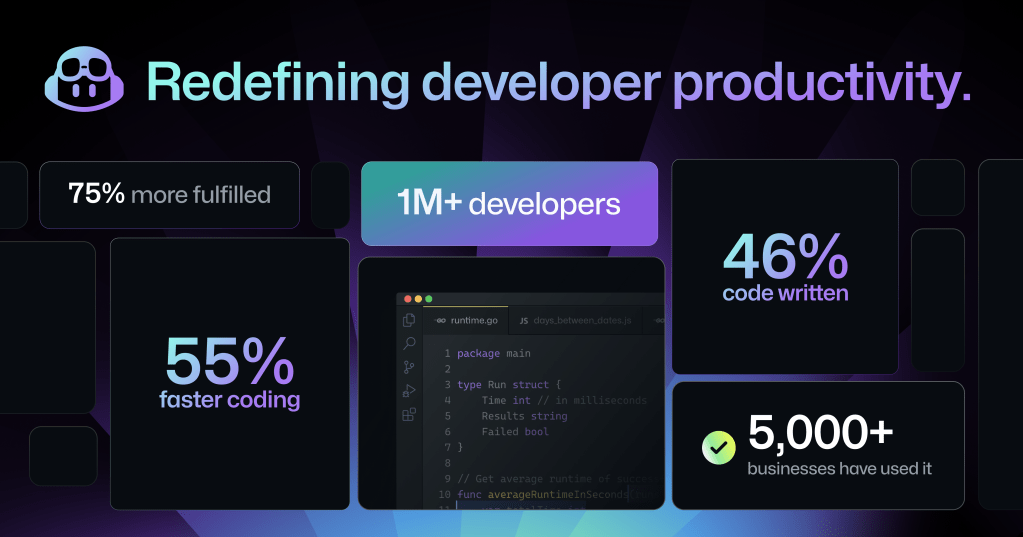
A graphic showing how many developers and companies have already used GitHub Copilot and how it’s helping improve productivity and happiness.
GitHub continues to innovate with the news about GitHub Copilot X, which is not only adopting OpenAI’s new GPT-4 model, but introducing chat and voice for GitHub Copilot, and bringing GitHub Copilot to pull requests, the command line, and docs to answer questions on your projects.
Innovations like this need to be rolled-out in a controlled and governable manner within many enterprises. But if your techstack is overly complex and you have several source code management tools, the roll-out may take a long time or may be stalled while security and compliance reviews take place.
However, if your development core is GitHub, security and compliance reviews can happen once, on a centrally managed platform that is well understood and secure. And you’ll be front row for all of the amazing new innovations that GitHub will be releasing down the road.
Get started today
If you are planning on migrating your source code and collaboration history to GitHub and have questions, thankfully, many other enterprises have done this already with great success and there are resources to help you through the process.
If you want to learn more about how GitHub can benefit your business, while increasing developer velocity and collaboration, see how GitHub Enterprise can help.
In our recent blog post announcing GitHub Copilot X, we mentioned that generative AI represents the future of software development. This amazing technology will enable developers to stay in the flow while helping enterprises meet their business goals.
But as we have also mentioned in our blog series on compliance, generative AI may soon act as an enabler for developer-focused compliance programs that will drive optimization and keep your development, compliance and audit teams productive and happy.
Today, we’ll explore the potential for generative AI to help enable teams to optimize and automate some of the foundational compliance components of separation of duties that many enterprises still often manage and review manually.
Generative AI has been dominating the news lately—but what exactly is it? Here’s what you need to know, and what it means for developers.
Separation of duties
The concept of “separation of duties,” long used in the accounting world as a check and balance approach, is also adopted in other scenarios, including technology architecture and workflows. While helpful to address compliance, it can lead to additional manual steps that can slow down delivery and innovation.
Fortunately, the PCI-DSS requirements guide provides a more DevOps, cloud native, and AI-enabled approach to separation of duties by focusing on functions and accounts, as opposed to people:
“The purpose of this requirement is to separate the development and test functions from the production functions. For example, a developer can use an administrator-level account with elevated privileges in the development environment and have a separate account with user-level access to the production environment.”
There are many parts of a software delivery workflow that need to have separation of duties in place—but one of the core components that is key for any compliance program is the code review. Having a separate set of objective eyes reviewing your code, whether it’s human or AI-powered, helps to ensure risks, tech debt, and security vulnerabilities are found and mitigated as early as possible.
Code reviews also help enable the concept of separation of duties since it prohibits a single person or a single function, account, or process from moving code to the next part of your delivery workflow. Additionally, code reviews help enable separation of duties for Infrastructure as Code (IaC) workflows, Policy-as-Code configurations, and even Kubernetes declarative deployments.
As we mentioned in our previous blog, GitHub makes code review easy, since pull requests are part of the existing workflow that millions of developers use daily. Having a foundational piece of compliance built-in to the platform that developers know and love keeps them in the flow, while keeping compliance and audit teams happy as well.
Generative AI and pull requests
Wouldn’t it be cool if one-day generative AI could be leveraged to enable more developer-friendly compliance programs which have traditionally been very labor and time intensive? Imagine if generative AI could help enable DevOps and cloud native approaches for separation of duties by automating tedious tasks and allowing humans to focus on key value-added tasks.
Bringing this back to compliance and separation of duties, wouldn’t it be great if a generative AI helper was available to provide an objective set of eyes on your pull requests? This is what the GitHub Next team has been working towards with GitHub Copilot for Pull Requests.
Suggestions for your pull request descriptions. AI-powered tags are embedded into a pull request description and automatically filled out by GitHub Copilot based on the code which the developers changed. Going one step further, the GitHub Next team is also looking at the creation of descriptive sentences and paragraphs as developers create pull requests.
Code reviews with AI. Taking pull requests and code reviews one step further, the GitHub Next team is looking at AI to help review the code and provide suggestions for changes. This will help enable human interactions and optimize existing processes. The AI would automate the creation of the descriptions, based on the code changes, as well as suggestions for improvements. The code reviewer will have everything they need to quickly review the change and decide to either move forward or send the change back.
When these capabilities are production ready, development teams and compliance programs will appreciate these features for a few reasons. First, the pull request and code review process would be driven by a conversation based on a neutral and independent description. Second, the description will be based on the actual code that was changed. Third, both development and compliance workflows will be optimized and allow humans to focus on value-added work.
While these capabilities are still a work in progress, there are features available now that may help enable compliance, audit, and security teams with GitHub Copilot for Business. The ability for developers to complete tasks faster and stay in the flow are truly amazing. But the ability for GitHub Copilot to provide AI-based security vulnerability filtering nowis a great place for compliance and audit teams within enterprises to get started on their journey to embracing generative AI into their day-to-day practices.
Next steps
Generative AI will enable developers and enterprises to achieve success by reducing manual tasks and enabling developers to focus their creativity on business value–all while staying in the flow.
I hope this blog will help drive positive discussions regarding this topic and has provided a forward looking view into what will be possible in the future. The future ability of generative AI to help enable teams by automating tedious tasks will help humans focus on more value-added work and could eventually be an important part of a robust and risk-based compliance posture.
Developers who feel more satisfied in their jobs are better positioned to be more productive. We also know developers can gain a sense of fulfillment by making an impact beyond the walls of their company and elevating their community. An opportunity exists, which developers can meet, to support those who lack access to the financial system. Many countries are working to drive financial inclusion through different motions—to which developers can contribute. GitHub provides a set of tools and services, which can support your developers working to address this need.
For example, in Australia, there is a huge opportunity to continue the work aimed at reaching those who are not currently included in the financial system. There are still a large number of people that don’t have access to important services that many of us take for granted—an opportunity that financial inclusion tries to solve.
Let’s explore these opportunities and how GitHub can help.
Financial inclusion explained
The World Bank defines financial inclusion as providing individuals and businesses access to affordable financial products to meet their needs. This includes products, such as checking accounts, credit cards, mortgages, and payments, which are still not available to over a billion unbanked people around the world. Many of these are women, people living in poverty, and those living outside of large cities.
Open Finance (or Open Banking) is an approach adopted by banks like NAB (National Australia Bank) to help include more individuals in the financial system by providing them access to the best products and services in a secure way that addresses their needs.
To enable financial inclusion and Open Finance, there needs to be a channel to exchange data and services between banks, customers, and trusted partners (fintechs, for example); that is where application programming interfaces (APIs) come in. The easiest way to understand an API is to think of it as a contract between two applications that need a standardized and secure way to talk to each other. Once the contract is created and secured, it can be used anywhere to share data or initiate a financial transaction.
This API-driven innovation lowers barriers for those individuals who may have limited physical access to banks, credit cards, or traditional financial products.
How GitHub can help
The tremendous opportunities for Australia, New Zealand, India, and other countries to enable financial inclusion to its population are dependent on the quality of the APIs. The quality and adoption of the APIs is dependent on creating a great developer experience because they are the ones building the APIs and applications that will leverage them.
GitHub is used by 100 million developers and is widely-recognized as the global home of open source. Developer experience is at the core of everything we do and it empowers developers to do their best work and be happy. But how does GitHub help enable financial inclusion and Open Finance?
The Open Bank Project released a report in 2020 highlighting how providing a great developer experience can drive growth of APIs that enable financial inclusion. Several topics which were highlighted and where GitHub can help are:
1. Create solutions to help people
This is an important motivator for developers. If developers create solutions that can help increase financial inclusion, they should make sure those solutions are available to as many people as possible through the open source community. Since we know that open source is the foundation of more than 90% of the world’s software, there is a great opportunity to collaborate globally and build on solutions that already exist.
Because GitHub is the home of open source and has 100 million developers, there is no better place for developers to create solutions that will make the biggest impact.
2. Running Hackathons
Hackathons, like the Global Open Finance Challenge, which NAB collaborated in and was won by an Aussie start-up, are important for developers to share ideas with other developers and large enterprises. They help developers see what APIs are currently available and enable innovation and collaboration with a global reach. To run a successful hackathon, developers will need to have access to code and documentation, which has been open sourced—and GitHub is a key component to enable this.
3. Recognition for developers
If a developer has worked on a solution that is helping enable financial inclusion, it’s important to ensure their effort is recognized and supported. The most important part of recognizing the awesome work developers do is to make sure there is a single platform where this work can be shared. Thankfully, that platform already exists and any developer, anywhere in the world, can access it for free—it’s GitHub!
At GitHub, we also know that sometimes recognition isn’t enough, and developers need support. This is why the GitHub Sponsors program was created. We also created our GitHub for Startups program which provides support to the startup community around the world—many of whom are important contributors to Open Banking.
4. Documentation
The success of an API is dependent on how easy it is for developers to understand and use. If developers are unable to quickly understand the context of the API, how to connect to it, or easily set it up to test it, then it probably won’t be successful.
The topic of API documentation and API Management is beyond the scope of this post, but it’s important to remember that open source is a key enabler of Open Finance and developers will need a platform to collaborate and share documentation and code. GitHub is the best platform for that, and we have seen at least a 50% increase in productivity when developers leverage documentation best practices enabled by GitHub.
Call to action
Developers have an amazing opportunity to contribute to the financial inclusion work that is happening in Australia and across the world. GitHub can help support developers to address this opportunity by giving them the tools and services they need to be productive and successful.
We’ve recently launched our weekly livestream on LinkedIn Live, GitHub in my Day Job, for those who want to learn more about how GitHub empowers developers across the community while providing guardrails to govern, and remain compliant. So, join us at https://gh.io/dayjob—we can’t wait to have you with us.
In GitHub’s recent 2022 State of the Octoverse report, HashiCorp Configuration Language (HCL) was the fastest growing programming language on GitHub. HashiCorp is a leading provider of Infrastructure as Code (IaC) automation for cloud computing. HCL is HashiCorp’s configuration language used with tools like Terraform and Vault to deliver IaC capabilities in a human-readable configuration file across multi-cloud and on-premises environments.
HCL’s growth shows the importance of bringing together the worlds of infrastructure, operations, and developers. This was always the goal of DevOps. But in reality, these worlds remain siloed for many enterprises.
In this post we’ll look at the business and cultural influences that bring development and operations together, as well as security, governance, and networking teams. Then, we’ll explore how GitHub and HashiCorp can enable consistent workflows and guardrails throughout the entire CI/CD pipeline.
The traditional world of operations (Ops)
Armon Dadgar, co-founder of HashiCorp, uses the analogy of a tree to explain the traditional world of Ops. The trunk includes all of the shared and consistent services you need in an enterprise to get stuff done. Think of things like security requirements, Active Directory, and networking configurations. A branch represents the different lines of business within an enterprise, providing services and products internally or externally. The leaves represent the different environments and technologies where your software or services are deployed: cloud, on-premises, and container environment, among others.
In many enterprises, the communication channels and processes between these different business areas can be cumbersome and expensive. If there is a significant change to the infrastructure or architecture, multiple tickets are typically submitted to multiple teams for reviews and approvals across different parts of the enterprise. Change Advisory Boards are commonly used to protect the organization. The change is usually unable to proceed unless the documentation is complete. Commonly, there’s a set of governance logs and auditable artifacts which are required for future audits.
Wouldn’t it be more beneficial for companies if teams had an optimized, automated workflow that could be used to speed up delivery and empower teams to get the work done in a set of secure guardrails? This could result in significant time and cost savings, leading to added business value.
After all, a recent Forrester report found that over three years, using GitHub drove 433% ROI for a composite organization simply with the combined power of all GitHub’s enterprise products. Not to mention the potential for time savings and efficiency increase, along with other qualitative benefits that come with consistency and streamlining work.
Your products and services would be deployed through an optimized path with security and governance built-in, rather than a sluggish, manual and error-prone process. After all, isn’t that the dream of DevOps, GitOps, and Cloud Native?
Introducing IaC
Let’s use a different analogy. Think of IaC as the blueprint for resources (such as servers, databases, networking components, or PaaS services) that host our software and services.
If you were architecting a hospital or a school, you wouldn’t use the same overall blueprint for both scenarios as they serve entirely different purposes with significantly different requirements. But there are likely building blocks or foundations that can be reused across the two designs.
IaC solutions, such as HCL, allow us to define and reuse these building blocks, similarly to how we reuse methods, modules, and package libraries in software development. With it being IaC, we can start adopting the same recommended practices for infrastructure that we use when collaborating and deploying on applications.
After all, we know that teams that adopt DevOps methodologies will see improved productivity, cloud-enabled scalability, collaboration, and security.
A better way to deliver
With that context, let’s explore the tangible benefits that we gain in codifying our infrastructure and how they can help us transform our traditional Ops culture.
Storing code in repositories
Let’s start with the lowest-hanging fruit. With it being IaC, we can start storing infrastructure and architectural patterns in source code repositories such as GitHub. This gives us a single source of truth with a complete version history. This allows us to easily rollback changes if needed, or deploy a specific version of the truth from history.
Teams across the enterprise can collaborate in separate branches in a Git repository. Branches allow teams and individuals to be productive in “their own space” and not have to worry about negatively impacting the in-progress work of other teams, away from the “production” source of truth (typically, the main branch).
Terraform modules, the reusable building blocks mentioned in the last section, are also stored and versioned in Git repositories. From there, modules can be imported to the private registry in Terraform Cloud to make them easily discoverable by all teams. When a new release version is tagged in GitHub, it is automatically updated in the registry.
Collaborate early and often
As we discussed above, teams can make changes in separate branches to not impact the current state. But what happens when you want to bring those changes to the production codebase? If you’re unfamiliar with Git, then you may not have heard of a pull request before. As the name implies, we can “pull” changes from one branch into another.
Pull requests in GitHub are a great way to collaborate with other users in the team, being able to get peer reviews so feedback can be incorporated into your work. The pull request process is deliberately very social, to foster collaboration across the team.
In GitHub, you could consider setting branch protection rules so that direct changes to your main branch are not allowed. That way, all users must go through a pull request to get their code into production. You can even specify the minimum number of reviewers needed in branch protection rules.
Tip: you could use a special type of file, the CODEOWNERS file in GitHub, to automatically add reviewers to a pull request based on the files being edited. For example, all HCL files may need a review by the core infrastructure team. Or IaC configurations for line of business core banking systems might require review by a compliance team.
Unlike Change Advisory Boards, which typically take place on a specified cadence, pull requests become a natural part of the process to bring code into production. The quality of the decisions and discussions also evolves. Rather than being a “yes/no” decision with recommendations in an external system, the context and recommendations can be viewed directly in the pull request.
Collaboration is also critical in the provisioning process, and GitHub’s integrations with Terraform Cloud will help you scale these processes across multiple teams. Terraform Cloud offers workflow features like secure storage for your Terraform state and direct integration with your GitHub repositories for a turnkey experience around the pull request and merge lifecycle.
Bringing automated quality reviews into the process
Building on from the previous section, pull requests also allow us to automatically check the quality of the changes that are being proposed. It is common in software to check that the application still compiles correctly, that unit tests pass, that no security vulnerabilities are introduced, and more.
From an IaC perspective, we can bring similar automated checks into our process. This is achieved by using GitHub status checks and gives us a clear understanding of whether certain criteria has been met or not.
GitHub Actions are commonly used to execute some of these automated checks in pull requests on GitHub. To determine the quality of IaC, you could include checks such as:
Validating that the code is syntactically correct (for example, Terraform validate).
Linting the code to ensure a certain set of standards are being followed (for example, TFLint or Terraform format).
Static code analysis to identify any misconfigurations in your infrastructure at “design time” (for example, tfsec or terrascan).
Relevant unit or integration tests (using tools such as Terratest).
Deploying the infrastructure into a “smoke test”environment to verify that the infrastructure configuration (along with a known set of parameters) results deploy into a desired state.
We recently blogged about building compliance, security, and audit into your delivery pipelines and the benefits of this approach. When you add IaC to your existing development pipelines and workflows, you’ll have the ability to describe previously manual compliance testing and artifacts as code directly into your HCL configurations files.
A natural extension to IaC, policy as code allows your security and compliance teams to centralize the definitions of your organization’s requirements. Terraform Cloud’s built-in support for the HashiCorp Sentinel and Open Policy Agent (OPA) frameworks allows policy sets to be automatically ingested from GitHub repositories and applied consistently across all provisioning runs. This ensures policies are applied before misconfigurations have a chance to make it to production.
An added bonus mentioned in another recent blog is the ability to leverage AI-powered compliance solutions to optimize your delivery even more. Imagine a future where generative AI could create compliance-focused unit-tests across your entire development and infrastructure delivery pipeline with no manual effort.
With the checks complete, it’s now time for us to deploy our new infrastructure configuration! Branching and deployment strategies is beyond the scope of this post, so we’ll leave that for another discussion.
But you can take this even further! In Terraform, it is very common to use the command terraform plan to understand the impact of changes before you push them to production. terraform apply is then used to execute the changes.
Reviewing environment changes in a pull request
HashiCorp provides an example of automating Terraform with GitHub Actions. This example orchestrates a release through Terraform Cloud by using GitHub Actions. The example takes the output of the terraform plan command and copies the output into your pull request for approval (again, this depends on the development flow that you’ve chosen).
Reviewing environment changes using GitHub Actions environments
Let’s consider another example, based on the example from HashiCorp. GitHub Actions has a built-in concept of environments. Think of these environments as a logical mapping to a target deployment location. You can associate a protection rule with an environment so that an approval is given before deploying.
So, with that context, let’s create a GitHub Action workflow that has two environments—one which is used for planning purposes, and another which is used for deployment:
Before executing the workflow, we can create an environment in the GitHub repository and associate protection rules with the environment_a_deploy. This means that a review is required before a production deployment.
In the previous blog, Setting the foundations for compliance, we set the groundwork for developer-enabled compliance that will keep your teams happy, in the flow, secure, compliant, and auditable.
Today, we’ll walk through three practical ways that you can start meeting your compliance requirements without having to revolutionize or transform the culture in your company—all while enabling your developers to be more productive and happy.
1. Do the basics well and often
The first way to start meeting your compliance requirements is often overlooked because it’s so simple. No matter what industry you are in, whether it’s finance, automotive, government, or tech, there are some basic quick compliance wins that may be part of your existing developer workflows and culture.
Code review
A key part of writing clean code is code review. But having a repeatable and traceable code review process is also a foundational component of your compliance program. This ensures risks within software delivery are found and mitigated early—and are also auditable for future reviews.
GitHub makes code review easy, since pull requests are part of the existing workflow that millions of developers use every day. GitHub also makes it easy for compliance testers and auditors to review pull requests with access to immutable audit logs in a central location.
Separation of duties
In some enterprises, separation of duties has been defined as a person having too much manual control over transactions or processes. This can lead to apprehension when modern cloud native practices are introduced.
Thankfully, there is guidance from the Industry that supports a more modern approach to separation of duties. The PCI-DSS requirements guide avoids the term person and provides a more cloud native friendly approach by focusing on functions and accounts:
“The purpose of this requirement is to separate the development and test functions from the production functions. For example, a developer can use an administrator-level account with elevated privileges in the development environment and have a separate account with user-level access to the production environment.”
This approach aligns well with the 12 factor application methodology for cloud native. The Build, release, run factor explanation states, “Each release must enforce a strict separation across the build, release, and run stages. Each should be tagged with a unique ID and support the ability to roll back.” Teams can fully automate their delivery to production, without having to worry about a person manually exceeding too much control, as long as there is separation of functions and traceability back to unique IDs. With the added assurance that they are aligned to industry best practices and requirements, such as PCI-DSS.
To enable separation of duties, you have to have a clear identity and access management strategy. Thankfully, we don’t have to reinvent the wheel. GitHub Enterprise has several options to help you manage access to your overall development environment:
You can configure SAML single sign-on for your enterprise. This is an additional check, allowing you to confirm the authenticity of your users against your own identity provider (while still using your own GitHub account).
You can then synchronize team memberships with groups in your identity provider. As a result, group membership changes in your identity provider update the team membership (and therefore associated access) in GitHub.
Alternatively, you could adopt GitHub Enterprise Managed Users (EMUs). This is a flavor of GitHub Enterprise where you can only log in with an account that is centrally managed through your identity provider. The user does not have to log in to GitHub with a personal account and use single sign on to access company resources. (For more information on this, check out this blog post on exploring EMUs and the benefits they can bring.)
AI-powered compliance
In our last blog we briefly covered AI-enabled compliance and some of the existing opportunities for security, manufacturing, and banks. There are also several other opportunities on the horizon that could further optimize the basics of compliance.
It is entirely possible that a generative AI tool could soon be leveraged to help ensure that separation of duties is enforced in a declarative DevOps workflow by creating unit tests on its own. Because of the non-deterministic nature of generative AI, each time it runs it may have a different result and the unit tests may include risk scenarios that nobody has thought of yet. This can add an amazing level of true risk-based compliance.
One of the major benefits of addressing compliance often in your delivery is an increased level of trust. But quantifying trust can be extremely difficult—especially within a regulated industry that wants to leverage deep learning solutions. There is work being driven by AI results to help provide trust quantification for these types of solutions, which will not only enable continuous compliance but will also help enterprises implement new technologies that can increase business value.
Dependency management
Companies are increasing their reliance on open source software in their supply chain. As a result, optimized, repeatable, and audible controls for dependency management are becoming a cornerstone of compliance programs across industries.
From a GitHub perspective, Dependabot can provide confidence that your supply chain is secure. When Dependabot is configured, developers are alerted as soon as a security threat is found and gives them the ability to take action in their normal workflows.
By leveraging Dependabot, you will receive an immutable and auditable alert when a repository uses a software dependency with a known vulnerability. Pull requests can be triggered by either your developers or security teams, which give you another set of auditable artifacts for future review.
There could be many control points in your delivery pipeline that may require approval, such as sign-off of requirements, testing results, security reviews, or production operational readiness confirmations before a release.
Depending on your internal structure and alignment, you may require teams to provide sign-off at different stages throughout the process. In your build and test stage, you can use manual approvals in a pull request to gather the needed reviews.
Once your builds and tests are complete, it’s time to release your code into your infrastructure. Talking about deployment patterns and strategies is beyond the scope of this post. However, you may require approvals as part of the deployment process.
To obtain these approvals, you should use environments for your deployments. Environments are used to describe a deployment target (such as staging, testing, and production). By using environments, you can require a manual approval to take place before GitHub Actions begins the deployment job.
In both instances, remember that there is a tradeoff when deciding the number of approvals required. Setting the number of required reviews too high means that you may impact your pace of delivery, as manual intervention is required. Where possible, consider automating checks to reduce the manual overhead, thereby optimizing your overall agility.
2. Have a common understanding of concepts and terms
Again, this may be overlooked since it sounds so obvious. But there are probably many concepts and terms that developers, DevOps and cloud native practitioners use on a daily basis that may be totally incomprehensible to compliance testers and auditors.
Back in 2015, the author of The Phoenix Project, Gene Kim, and several other authors, created the DevOps Audit Defense Toolkit. As we mentioned in our first blog, the goal of this document was to “educate IT management and practitioners on the audit process so they can demonstrate to auditors they understand the business risks and are properly mitigating those risks.” But where do you start?
Below is a basic cheat-sheet of terms for GitHub related control objectives and a mapping to the world of compliance, regulations, risk, and audit. This could be a good place to start building a common understanding between developers and your compliance and audit friends.
Objective
Control
Financial Reporting
Industry Frameworks
The Code Review Control ensures that security requirements have been addressed and that the code is understandable, maintainable, and properly formatted.
Pull requests let you tell others about changes you’ve pushed to a branch in a repository on GitHub.Once a pull request is opened, you can discuss and review the potential changes with collaborators and add follow-up commits before your changes are merged into the base branch.
SOX: Change Management
COSO: Control Activities—Conduct application change management.
NIST Cyber: DE.CM-4 —Malicious code is detected.
PCI-DSS: 6.3.2: Review all custom code for vulnerabilities, manually or via automation.
SLSA: Two-person review is an industry best practice for catching mistakes and deterring bad behavior.
Controls and processes should be in place to scan code repositories for passwords and security tokens. Prevention measures should be enforced to ensure secrets do not reach production.
Secret scanning will scan your entire Git history on all branches present in your GitHub repository for secrets. GitHub push protection will check for high-confidence secrets as developers push code and block the push if a secret is identified.
SOX: IT Security
COSO: Control Activities—Improve security
NIST Cyber: PR.DS-5: Protections against data leaks are implemented.
PCI-DSS: 6.5.3: Protect against all insufficiently secure cryptographic key storage.
To help bring this together, there is a great example of the benefits of a common understanding between developers and compliance testers and auditors in the latest Forrester report on the economic impact of GitHub Enterprise Cloud and Advanced Security. The report highlights one of the benefits of an automated documentation process that both helps developers and auditors:
“These new, standardized documentation structures made it easier for auditors to find and compile the documentation necessary to be compliant. This helped the interviewees’ organizations save time preparing for industry compliance and security audits.”
3. Helping developers understand where they fit into the three lines of defense
The three lines of defense is a model used for risk management and governance. It helps clarify the roles and responsibilities of teams involved in addressing risk.
Think of the engineering team and engineering leads as the first line of defense, as they continue shipping software to their end-users. Making sure this team has the appropriate level of skills to identify risk within their solution is crucial.
The second line of defense is typically achieved at scale through frameworks, policies, and tools at an organizational level. This acts as oversight for the first line of defense on how well they are implementing risk mitigation techniques and consistently measuring and defining risk across the organization.
Internal audit is the third line of defense. Just like a red team and blue team compliment each other, you can think of internal audit as the final puzzle piece in the three lines of defense. They evaluate the effectiveness of risk management and governance, working with senior management and external regulators to raise awareness of the controls being executed.
Let’s use an analogy. A hockey team is not just structured to score goals but also prevent goals being scored against them.
Forwards: they are there to score and assist on goals. But they can be called on to work with the other positions in defense. Think of them as the first line of defense. Their job is to create solutions which provide business value, but are also secure.
Defenders: their main role is clearly preventing goals. But they partner with the forwards on the current priority (offense or defense). They are like the second line of defense, providing risk oversight and collaborating with the engineering teams.
Goaltender: the last line of defense. They can be thought of as the equivalent of an internal audit. They are independent of the forwards and defenders with different responsibilities, tools, and perspective.
Hockey teams that have very strong forwards but weak defenders and goalkeepers are rarely successful. Teams with a strong defense but weak offense are rarely successful, either. It takes all three aspects working in harmony to be successful.
This applies in business, too. If your solutions meet your customers’ requirements but are insecure, your business will fail. If your solutions are secure but aren’t user friendly or providing value, it will result in failure. Success is achieved by finding the right balance of value and risk management.
Developers can see that they are there to score goals for their team; creating the software that runs our world. But they need to support the defensive capabilities of the team, ensuring their software is secure. Their success is dependent on the success of the wider team, without having to take on additional responsibilities.
This is only one step in solving the problem. A common language between compliance and DevOps practitioners is crucial in demonstrating the implemented measures. With that common language, it is clear that everyone must think about compliance; engineering teams are a part of the three lines of defense.
Next up in the series, we’ll be talking about how to ensure compliance in developer workflows.
Ready to increase developer velocity and collaboration while remaining secure and compliant? See how GitHub Enterprise can help.
The collective thoughts of the interwebz
Manage Consent
To provide the best experiences, we use technologies like cookies to store and/or access device information. Consenting to these technologies will allow us to process data such as browsing behavior or unique IDs on this site. Not consenting or withdrawing consent, may adversely affect certain features and functions.
Functional
Always active
The technical storage or access is strictly necessary for the legitimate purpose of enabling the use of a specific service explicitly requested by the subscriber or user, or for the sole purpose of carrying out the transmission of a communication over an electronic communications network.
Preferences
The technical storage or access is necessary for the legitimate purpose of storing preferences that are not requested by the subscriber or user.
Statistics
The technical storage or access that is used exclusively for statistical purposes.The technical storage or access that is used exclusively for anonymous statistical purposes. Without a subpoena, voluntary compliance on the part of your Internet Service Provider, or additional records from a third party, information stored or retrieved for this purpose alone cannot usually be used to identify you.
Marketing
The technical storage or access is required to create user profiles to send advertising, or to track the user on a website or across several websites for similar marketing purposes.