Post Syndicated from Matt Granger original https://www.youtube.com/watch?v=z6DlvUyWmF8
Friday Squid Blogging: Squid Brand Fish Sauce
Post Syndicated from Bruce Schneier original https://www.schneier.com/blog/archives/2023/08/friday-squid-blogging-squid-brand-fish-sauce.html
Squid Brand is a Thai company that makes fish sauce:
It is part of Squid Brand’s range of “personalized healthy fish sauces” that cater to different consumer groups, which include the Mild Fish Sauce for Kids and Mild Fish Sauce for Silver Ages.
It also has a Vegan Fish Sauce.
As usual, you can also use this squid post to talk about the security stories in the news that I haven’t covered.
Read my blog posting guidelines here.
How AWS built the Security Guardians program, a mechanism to distribute security ownership
Post Syndicated from Ana Malhotra original https://aws.amazon.com/blogs/security/how-aws-built-the-security-guardians-program-a-mechanism-to-distribute-security-ownership/
Product security teams play a critical role to help ensure that new services, products, and features are built and shipped securely to customers. However, since security teams are in the product launch path, they can form a bottleneck if organizations struggle to scale their security teams to support their growing product development teams. In this post, we will share how Amazon Web Services (AWS) developed a mechanism to scale security processes and expertise by distributing security ownership between security teams and development teams. This mechanism has many names in the industry — Security Champions, Security Advocates, and others — and it’s often part of a shift-left approach to security. At AWS, we call this mechanism Security Guardians.
In many organizations, there are fewer security professionals than product developers. Our experience is that it takes much more time to hire a security professional than other technical job roles, and research conducted by (ISC)2 shows that the cybersecurity industry is short 3.4 million workers. When product development teams continue to grow at a faster rate than security teams, the disparity between security professionals and product developers continues to increase as well. Although most businesses understand the importance of security, frustration and tensions can arise when it becomes a bottleneck for the business and its ability to serve customers.
At AWS, we require the teams that build products to undergo an independent security review with an AWS application security engineer before launching. This is a mechanism to verify that new services, features, solutions, vendor applications, and hardware meet our high security bar. This intensive process impacts how quickly product teams can ship to customers. As shown in Figure 1, we found that as the product teams scaled, so did the problem: there were more products being built than the security teams could review and approve for launch. Because security reviews are required and non-negotiable, this could potentially lead to delays in the shipping of products and features.
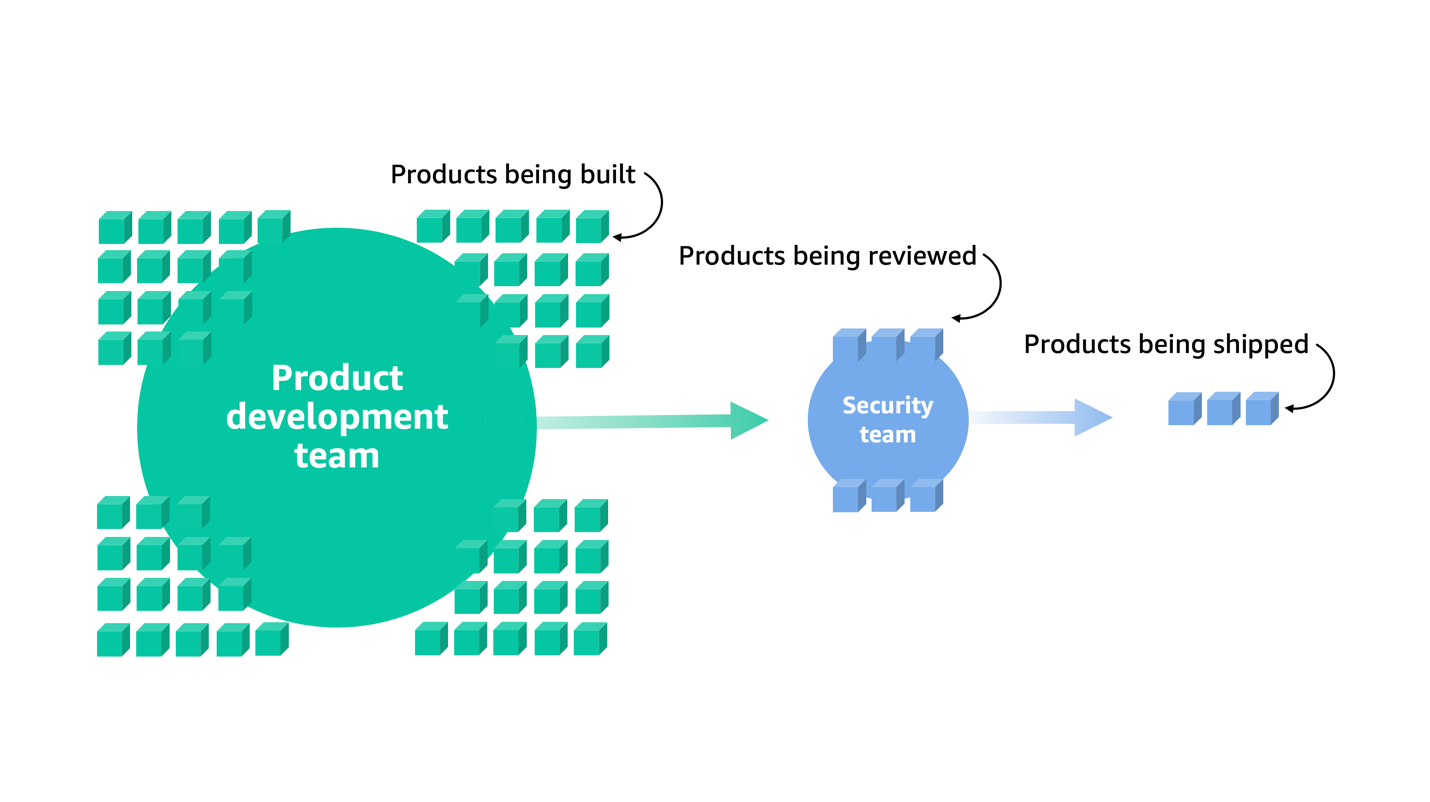
Figure 1: More products are being developed than can be reviewed and shipped
How AWS builds a culture of security
Because of its size and scale, many customers look to AWS to understand how we scale our own security teams. To tell our story and provide insight, let’s take a look at the culture of security at AWS.
Security is a business priority
At AWS, security is a business priority. Business leaders prioritize building products and services that are designed to be secure, and they consider security to be an enabler of the business rather than an obstacle.
Leaders also strive to create a safe environment by encouraging employees to identify and escalate potential security issues. Escalation is the process of making sure that the right people know about the problem at the right time. Escalation encompasses “Dive Deep”, which is one of our corporate values at Amazon, because it requires owners and leaders to dive into the details of the issue. If you don’t know the details, you can’t make good decisions about what’s going on and how to run your business effectively.
This aspect of the culture goes beyond intention — it’s embedded in our organizational structure:
CISOs and IT leaders play a key role in demystifying what security and compliance represent for the business. At AWS, we made an intentional choice for the security team to report directly to the CEO. The goal was to build security into the structural fabric of how AWS makes decisions, and every week our security team spends time with AWS leadership to ensure we’re making the right choices on tactical and strategic security issues.
– Stephen Schmidt, Chief Security Officer, Amazon, on Building a Culture of Security
Everyone owns security
Because our leadership supports security, it’s understood within AWS that security is everyone’s job. Security teams and product development teams work together to help ensure that products are built and shipped securely. Despite this collaboration, the product teams own the security of their product. They are responsible for making sure that security controls are built into the product and that customers have the tools they need to use the product securely.
On the other hand, central security teams are responsible for helping developers to build securely and verifying that security requirements are met before launch. They provide guidance to help developers understand what security controls to build, provide tools to make it simpler for developers to implement and test controls, provide support in threat modeling activities, use mechanisms to help ensure that customers’ security expectations are met before launch, and so on.
This responsibility model highlights how security ownership is distributed between the security and product development teams. At AWS, we learned that without this distribution, security doesn’t scale. Regardless of the number of security experts we hire, product teams always grow faster. Although the culture around security and the need to distribute ownership is now well understood, without the right mechanisms in place, this model would have collapsed.
Mechanisms compared to good intentions
Mechanisms are the final pillar of AWS culture that has allowed us to successfully distribute security across our organization. A mechanism is a complete process, or virtuous cycle, that reinforces and improves itself as it operates. As shown in Figure 2, a mechanism takes controllable inputs and transforms them into ongoing outputs to address a recurring business challenge. At AWS, the business challenge that we’re facing is that security teams create bottlenecks for the business. The culture of security at AWS provides support to help address this challenge, but we needed a mechanism to actually do it.

Figure 2: AWS sees mechanisms as a complete process, or virtuous cycle
“Often, when we find a recurring problem, something that happens over and over again, we pull the team together, ask them to try harder, do better – essentially, we ask for good intentions. This rarely works… When you are asking for good intentions, you are not asking for a change… because people already had good intentions. But if good intentions don’t work, what does? Mechanisms work.
– Jeff Bezos, February 1, 2008 All Hands.
At AWS, we’ve learned that we can help solve the challenge of scaling security by distributing security ownership with a mechanism we call the Security Guardians program. Like other mechanisms, it has inputs and outputs, and transforms over time.
AWS distributes security ownership with the Security Guardians program
At AWS, the Security Guardians program trains, develops, and empowers developers to be security ambassadors, or Guardians, within the product teams. At a high level, Guardians make sure that security considerations for a product are made earlier and more often, helping their peers build and ship their product faster. They also work closely with the central security team to help ensure that the security bar at AWS is rising and the Security Guardians program is improving over time. As shown in Figure 3, embedding security expertise within the product teams helps products with Guardian involvement move through security review faster.

Figure 3: Security expertise is embedded in the product teams by Guardians
Guardians are informed, security-minded product builders who volunteer to be consistent champions of security on their teams and are deeply familiar with the security processes and tools. They provide security guidance throughout the development lifecycle and are stakeholders in the security of the products being shipped, helping their teams make informed decisions that lead to more secure, on-time launches. Guardians are the security points-of-contact for their product teams.
In this distributed security ownership model, accountability for product security sits with the product development teams. However, the Guardians are responsible for performing the first evaluation of a development team’s security review submission. They confirm the quality and completeness of the new service’s resources, design documents, threat model, automated findings, and penetration test readiness. The development teams, supported by the Guardian, submit their security review to AWS Application Security (AppSec) engineers for the final pre-launch review.
In practice, as part of this development journey, Guardians help ensure that security considerations are made early, when teams are assessing customer requests and the feature or product design. This can be done by starting the threat modeling processes. Next, they work to make sure that mitigations identified during threat modeling are developed. Guardians also play an active role in software testing, including security scans such as static application security testing (SAST) and dynamic application security testing (DAST). To close out the security review, security engineers work with Guardians to make sure that findings are resolved and the product is ready to ship.

Figure 4: Expedited security review process supported by Guardians
Guardians are, after all, Amazonians. Therefore, Guardians exemplify a number of the Amazon Leadership Principles and often have the following characteristics:
- They are exemplary practitioners for security ownership and empower their teams to own the security of their service.
- They hold a high security bar and exercise strong security judgement, don’t accept quick or easy answers, and drive continuous improvement.
- They advocate for security needs in internal discussions with the product team.
- They are thoughtful yet assertive to make customer security a top priority on their team.
- They maintain and showcase their security knowledge to their peers, continuously building knowledge from many different sources to gain perspective and to stay up to date on the constantly evolving threat landscape.
- They aren’t afraid to have their work independently validated by the central security team.
Expected outcomes
AWS has benefited greatly from the Security Guardians program. We’ve had 22.5 percent fewer medium and high severity security findings generated during the security review process and have taken about 26.9 percent less time to review a new service or feature. This data demonstrates that with Guardians involved we’re identifying fewer issues late in the process, reducing remediation work, and as a result securely shipping services faster for our customers. To help both builders and Guardians improve over time, our security review tool captures feedback from security engineers on their inputs. This helps ensure that our security ownership mechanism reinforces and improves itself over time.
AWS and other organizations have benefited from this mechanism because it generates specialized security resources and distributes security knowledge that scales without needing to hire additional staff.
A program such as this could help your business build and ship faster, as it has for AWS, while maintaining an appropriately high security bar that rises over time. By training builders to be security practitioners and advocates within your development cycle, you can increase the chances of identifying risks and security findings earlier. These findings, earlier in the development lifecycle, can reduce the likelihood of having to patch security bugs or even start over after the product has already been built. We also believe that a consistent security experience for your product teams is an important aspect of successfully distributing your security ownership. An experience with less confusion and friction will help build trust between the product and security teams.
To learn more about building positive security culture for your business, watch this spotlight interview with Stephen Schmidt, Chief Security Officer, Amazon.
If you’re an AWS customer and want to learn more about how AWS built the Security Guardians program, reach out to your local AWS solutions architect or account manager for more information.
If you have feedback about this post, submit comments in the Comments section below. If you have questions about this post, contact AWS Support.
Want more AWS Security news? Follow us on Twitter.
Providing durable storage for AWS Outpost servers using AWS Snowcone
Post Syndicated from Macey Neff original https://aws.amazon.com/blogs/compute/providing-durable-storage-for-aws-outpost-servers-using-aws-snowcone/
This blog post is written by Rob Goodwin, Specialist Solutions Architect, Secure Hybrid Edge.
With the announcement of AWS Outposts servers, you now have a streamlined means to deploy AWS Cloud infrastructure to regional offices using the 1 rack unit (1U) or 2 rack unit (2U) Outposts servers where the 42U AWS Outposts rack wasn’t an economical or physical fit.
This post discusses how you can use AWS Snowcone to provide persistent storage for AWS Outposts servers in the case of Amazon Elastic Compute Cloud (Amazon EC2) instance termination or if the Outposts server fails. In this post, we show:
- How to leverage the built-in features of Snowcone to provide persistent storage to an EC2 instance.
- Optionally replicate the data back to an AWS Region with AWS DataSync. Replicating data back to an AWS Region with DataSync allows for a seamless way to copy data offsite to improve resiliency. Furthermore, it allows the ability to leverage regional AWS Services for machine learning (ML) training.
Background
Outposts servers ship with internal NVMe SSD instance storage. Just like in the Regions, instance storage is allocated directly to the EC2 instance and tied to the lifecycle of the instance. This means that if the EC2 instance is terminated, then the data associated with the instance is deleted. In the event you want data to persist after the instance is terminated, you must use operating system (OS) functions to save and back up to other media or save your data to an external network attached storage or file system.
Mounting an external file system to an EC2 instance is not a new concept in AWS. Using Amazon Elastic File System (Amazon EFS), you can mount the EFS file system to EC2 instance(s).
This architecture may look similar to the following diagram:

Figure 1: AWS VPC showing EC2 Instances mounting Amazon EFS in the Region
In this architecture, EC2 instances are using Amazon EFS for a shared file system.
A main use case for Outposts servers is to deploy applications closer to an end user for quicker response times. If we move our application to the Outposts server to improve the response time to the end user, then we could still use Amazon EFS as a shared file system. However, the latency to read the file system over the service link may affect application performance.
There are third-party network attached storage systems available that could work with Outposts servers. However, Snowcone provides the built-in service of DataSync to replicate data back to the Region and is ideal where physical space and power are limited.
By leveraging Snowcone, we can provide persistent and durable network attached storage external to the Outposts server along with a means to replicate data to and from an AWS Region. Snowcone is a small, rugged, and secure device offering edge computing, data storage, and data transfer.
Solution overview
In this solution, we combine multiple AWS services to provide a durable environment. We use Snowcone as our Network File System (NFS) mount point and leverage the built-in DataSync Agent to replicate the bucket on the Snowcone back to an Amazon Simple Storage Service (Amazon S3) bucket in-Region.
When EC2 instances are launched on the Outposts server, we map the NFS mount point from the Snowcone into the file system of a Linux host through the Outposts server’s Logical Network Interface (LNI). For a Windows system, using the NFS Client for Windows, we can map a drive letter to the NFS mount point as well. The following diagram illustrates this.

Figure 2: EC2 instances on Outposts server attaching to the NFS mount on Snowcone with DataSync replicating data back to Amazon S3 in the AWS Region
Prerequisites
To deploy this solution, you must:
- Have the Outposts server installed and authorized.
- The Outposts server must be fully capable of launching an EC2 instance and being able to communicate through the LNI to local network resources.
- Have an AWS Snowcone ordered, connected to the local network, and unlocked.
- To make sure that NFS is available, the job type must be either Import into Amazon S3 or Export from Amazon S3, as shown in the following figure.

- Figure 3: Screenshot of Job Type when ordering Snow devices
- To make sure that NFS is available, the job type must be either Import into Amazon S3 or Export from Amazon S3, as shown in the following figure.
- Have a local client with AWS OpsHub installed.
- You can use an instance launched on the Outposts server to configure the Snowcone if:
- · The LNI is connected on the instance
- · The Snowcone is on the network
- You can use an instance launched on the Outposts server to configure the Snowcone if:

Steps to activate
- Configure NFS on the Snowcone manually.
- Either statically assign the IP address, or if you’re using DHCP, create an IP reservation to make sure that the NFS mount is consistent. In the following figure, we use 10.0.0.32 as a static IP assigned to the NFS Mount.
- (Optional) Start the DataSync Agent on the Snowcone.
- We assume that the Snowcone has access to the internet in the same way the Outposts server does. Configure the Agent, and then enable tasks. The Agent is used to replicate data from the Snowcone to the Region or from the Region to the Snowcone. The tasks that are created in this step enable replication.
- Launch the EC2 instance (either a. or b.)
- a. Using a Linux OS – When launching an instance on the Outposts server to attach to the NFS mount, make sure that the LNI is configured when launching the instance. In the User data section, enter the commands shown in the following figure to mount the NFS file system from the Snowcone.

- a. Using a Linux OS – When launching an instance on the Outposts server to attach to the NFS mount, make sure that the LNI is configured when launching the instance. In the User data section, enter the commands shown in the following figure to mount the NFS file system from the Snowcone.

Figure 5: Screenshot of User Data section within the Amazon EC2 Launch Wizard
#!/bin/bash
sudo mkdir /var/snowcone
sudo mount -t nfs SNOW-NFS-IP:/buckets /var/snowcone
sudo sh -c “echo ’ SNOW-NFS-IP:/buckets /var/snowcone nfs defaults 0 0’ >> /etc/fstab”
In this OS, we create a directory and then mount the NFS file system to that directory. The echo is used to place the mount into fstab to make sure that the mount is persistent if the instance is rebooted.
- b Windows OS – The AMI being used during the launch must include the NFS client. The client is required to mount the NFS. When launching an instance on the Outposts server to attach to the NFS mount, make sure that the LNI is configured when launching the instance. In the User data section, enter the commands shown in the following figure to mount the NFS from the Snowcone as a drive letter.

Figure 6: A screenshot of User Data section of Amazon EC2 Launch wizard with commands to mount NFS to the Windows File System
<powershell>
NET USE Z: \\SNOW-NFS-IP\buckets -P
</powershell>
The NET USE command maps the Z: drive to the NFS mount, and the -P makes it persistent between reboots.
This solution also works with Snowball Edge Storage Optimized. When ordering the Snowball Edge, choose NFS based data transfer for the storage type.

Figure 4: Screenshot of Select the storage type for the Snowball Edge
Conclusion
In this post, we examined how to mount NFS file systems in Snowcone to EC2 instances running on Outposts servers. We also covered starting DataSync Agent on Snowcone to enable data transfer from the edge to an AWS Region. By pairing these services together, you can build persistent and durable storage external to the Outposts servers and replicate your data back to the AWS Region.
If you want to learn more about how to get started with Outposts servers, my colleague Josh Coen and I have published a video series on this topic. The demo series shows you how to unbox an Outposts server, activate the Outposts server, and what you can do with your Outposts server after it is activated. Make sure to check it out!
Metasploit Weekly Wrap-Up
Post Syndicated from Spencer McIntyre original https://blog.rapid7.com/2023/08/18/metasploit-weekly-wrap-up-23/
Meterpreter Testing
This week’s release adds new payload tests to our automated test suite. This is intended to help the team and community members identify issues and behavior discrepancies before changes are made. Payloads run on a variety of different platforms including Windows, Linux, and OS X each of which has multiple Meterpreter implementations available that are now tested to help ensure consistency. This should improve payload stability and make testing easier for community members that are contributing new features to the payloads.
New module content (4)
H2 Web Interface Create Alias RCE
Authors: Nairuz Abulhul, gambler, h00die, and h4ckNinja
Type: Exploit
Pull request: #18226 contributed by h00die
Path: exploits/linux/http/h2_webinterface_rce
Description: This PR adds an exploit against the H2 database’s web console. An authenticated user can issue requests to invoke built-in functionality to execute arbitrary code. There is no CVE for this issue.
Maltrail Unauthenticated Command Injection
Authors: Chris Wild and Ege BALCI
Type: Exploit
Pull request: #18280 contributed by EgeBalci
Path: exploits/unix/http/maltrail_rce
Description: This PR adds a module for an unauthenticated RCE vulnerability in Maltrail, a malicious traffic detection system. The module author indicated that this vulnerability does not have a CVE associated with it as the vendor (product team in this case) declined to assign one.
RaspAP Unauthenticated Command Injection
Authors: Ege BALCI and Ismael0x00
Type: Exploit
Pull request: #18263 contributed by EgeBalci
Path: exploits/unix/http/raspap_rce
AttackerKB reference: CVE-2022-39986
Description: This PR adds an unauthenticated command injection module for the RaspAP webgui application.
Greenshot .NET Deserialization Fileformat Exploit
Authors: bwatters-r7 and p4r4bellum
Type: Exploit
Pull request: #18253 contributed by bwatters-r7
Path: exploits/windows/fileformat/greenshot_deserialize_cve_2023_34634
AttackerKB reference: CVE-2023-34634
Description: This PR adds a file-format exploit affecting Greenshot versions 1.3.274 and earlier, including the last stable release, 1.2.10.6.
Enhancements and features (1)
- #18288 from adfoster-r7 – Adds stability enhancements to Meterpreter payloads. Additionally, this adds a large suite of automated sanity tests to Github Actions that verify OSX/Windows/Linux/Python/Java/PHP Meterpreter payloads work.
Bugs fixed (3)
- #18275 from adfoster-r7 – Updates the module metadata for the Java reverse_http and reverse_https stagers to be treated as a dynamic payload size, instead of a static/fixed size. This size change can happen as the Java payload contains a user-configurable HTTP callback URL, and combined with the Zip compression present in JAR files – the overall generated payload size can change as a result.
- #18278 from rorymckinley – Fixes a crash when running the
auxiliary/scanner/mysql/mysql_loginmodule against newer versions of MySQL. - #18289 from zeroSteiner – Fixes a typo in the
exploit/freebsd/http/citrix_formssso_target_rcedocs.
Documentation
You can find the latest Metasploit documentation on our docsite at docs.metasploit.com.
Get it
As always, you can update to the latest Metasploit Framework with msfupdate
and you can get more details on the changes since the last blog post from
GitHub:
If you are a git user, you can clone the Metasploit Framework repo (master branch) for the latest.
To install fresh without using git, you can use the open-source-only Nightly Installers or the
binary installers (which also include the commercial edition).
Rainn Wilson on science and spirituality #shorts #talksatgoogle #books #spirituality #science
Post Syndicated from Talks at Google original https://www.youtube.com/watch?v=xt8PllqKOtc
Comic for 2023.08.18 – Pull Through
Post Syndicated from Explosm.net original https://explosm.net/comics/pull-through
New Cyanide and Happiness Comic
Ultimate Dashcam Comparison 2023: License Plate Reading is HERE!
Post Syndicated from The Hook Up original https://www.youtube.com/watch?v=lzdxCOvPq5Q
i-Opener 🍕The 1999 computer with a PIZZA KEY
Post Syndicated from LGR original https://www.youtube.com/watch?v=USQxZc9nmtE
XGIMI Halo+ vs. XGIMI MoGo 2 Pro
Post Syndicated from The Hook Up original https://www.youtube.com/watch?v=9C66y6jjpbw
Nikon Z 70-200mm Showdown – 5 Options Compared
Post Syndicated from Matt Granger original https://www.youtube.com/watch?v=bFGlKf2PeFY
[$] DNF5 delayed
Post Syndicated from corbet original https://lwn.net/Articles/941154/
It is fair to say that the DNF package
manager is not the favorite tool of many Fedora users. It was brought
in as a replacement for Yum but got off to a
rather rocky start; DNF has
stabilized over the years, though and the complaints have subsided. That can only
mean one thing: it must be time to throw it away and start over from the
beginning. The replacement, called DNF5, was slated to be a part of the
Fedora 39 release, due in October, but that is not going to happen.
UCIe 1.1 Specs Announced for Chiplet Future
Post Syndicated from Patrick Kennedy original https://www.servethehome.com/ucie-1-1-specs-announced-for-chiplet-future/
UCIe 1.1 specs are out as more companies from more industries jump aboard the UCIe chiplet train that will change chipmaking
The post UCIe 1.1 Specs Announced for Chiplet Future appeared first on ServeTheHome.
Security updates for Friday
Post Syndicated from corbet original https://lwn.net/Articles/942076/
Security updates have been issued by Debian (chromium, rar, and unrar-nonfree), Fedora (microcode_ctl, trafficserver, and webkitgtk), SUSE (ImageMagick, kernel, nodejs16, nodejs18, postgresql12, postgresql15, re2c, and samba), and Ubuntu (ghostscript, haproxy, linux, linux-aws, linux-aws-5.15, linux-gcp, linux-hwe-5.15, linux-ibm,
linux-intel-iotg, linux-intel-iotg-5.15, linux-kvm, linux-lowlatency,
linux-lowlatency-hwe-5.15, linux-nvidia, linux-oracle, linux-oracle-5.15,
linux-raspi, linux-hwe-5.4, linux-xilinx-zynqmp, poppler, and zziplib).
1915 Battle of the Gulf of Riga
Post Syndicated from The History Guy: History Deserves to Be Remembered original https://www.youtube.com/watch?v=QUYSOurMyPw
Bots Are Better than Humans at Solving CAPTCHAs
Post Syndicated from Bruce Schneier original https://www.schneier.com/blog/archives/2023/08/bots-are-better-than-humans-at-solving-captchas.html
Interesting research: “An Empirical Study & Evaluation of Modern CAPTCHAs“:
Abstract: For nearly two decades, CAPTCHAS have been widely used as a means of protection against bots. Throughout the years, as their use grew, techniques to defeat or bypass CAPTCHAS have continued to improve. Meanwhile, CAPTCHAS have also evolved in terms of sophistication and diversity, becoming increasingly difficult to solve for both bots (machines) and humans. Given this long-standing and still-ongoing arms race, it is critical to investigate how long it takes legitimate users to solve modern CAPTCHAS, and how they are perceived by those users.
In this work, we explore CAPTCHAS in the wild by evaluating users’ solving performance and perceptions of unmodified currently-deployed CAPTCHAS. We obtain this data through manual inspection of popular websites and user studies in which 1, 400 participants collectively solved 14, 000 CAPTCHAS. Results show significant differences between the most popular types of CAPTCHAS: surprisingly, solving time and user perception are not always correlated. We performed a comparative study to investigate the effect of experimental context specifically the difference between solving CAPTCHAS directly versus solving them as part of a more natural task, such as account creation. Whilst there were several potential confounding factors, our results show that experimental context could have an impact on this task, and must be taken into account in future CAPTCHA studies. Finally, we investigate CAPTCHA-induced user task abandonment by analyzing participants who start and do not complete the task.
Slashdot thread.
And let’s all rewatch this great ad from 2022.
Can an AI Save a Life?
Post Syndicated from The Atlantic original https://www.youtube.com/watch?v=eotKx_f7LZ4
Electron Holes
Post Syndicated from xkcd.com original https://xkcd.com/2817/

AVA Discovery View: Surfacing Authentic Moments
Post Syndicated from Netflix Technology Blog original https://netflixtechblog.com/ava-discovery-view-surfacing-authentic-moments-b8cd145491cc
By: Hamid Shahid, Laura Johnson, Tiffany Low
Synopsis
At Netflix, we have created millions of artwork to represent our titles. Each artwork tells a story about the title it represents. From our testing on promotional assets, we know which of these assets have performed well and which ones haven’t. Through this, our teams have developed an intuition of what visual and thematic artwork characteristics work well for what genres of titles. A piece of promotional artwork may resonate more in certain regions, for certain genres, or for fans of particular talent. The complexity of these factors makes it difficult to determine the best creative strategy for upcoming titles.
Our assets are often created by selecting static image frames directly from our source videos. To improve it, we decided to invest in creating a Media Understanding Platform, which enables us to extract meaningful insights from media that we can then surface in our creative tools. In this post, we will take a deeper look into one of these tools, AVA Discovery View.
Intro to AVA Discovery View
AVA is an internal tool that surfaces still frames from video content. The tool provides an efficient way for creatives (photo editors, artwork designers, etc.) to pull moments from video content that authentically represent the title’s narrative themes, main characters, and visual characteristics. These still moments are used by multiple teams across Netflix for artwork (on and off the Netflix platform), Publicity, Marketing, Social teams, and more.
Stills are used to merchandise & publicize titles authentically, providing a diverse set of entry points to members who may watch for different reasons. For example, for our hit title “Wednesday”, one member may watch it because they love mysteries, while another may watch because they love coming-of-age stories or goth aesthetics. Another member may be drawn by talent. It’s a creative’s job to select frames with all these entry points in mind. Stills may be enhanced and combined to create a more polished piece of artwork or be used as is. For many teams and titles, Stills are essential to Netflix’s promotional asset strategy.
Watching every moment of content to find the best frames and select them manually takes a lot of time, and this approach is often not scalable. While frames can be saved manually from the video content, AVA goes beyond providing the functionality to surface authentic frames — it suggests the best moments for creatives to use: enter AVA Discovery View.
Example of AVA Discovery View
AVA’s imagery-harvesting algorithms pre-select and group relevant frames into categories like Storylines & Tones, Prominent Characters, and Environments.
Let’s look deeper at how different facets of a title are shown in one of Netflix’s biggest hits — “Wednesday”.
Storyline / Tone
The title “Wednesday” involves a character with supernatural abilities sleuthing to solve a mystery. The title has a dark, imaginative tone with shades of wit and dry humor. The setting is an extraordinary high school where teenagers of supernatural abilities are enrolled. The main character is a teenager and has relationship issues with her parents.
The paragraph above provides a short glimpse of the title and is similar to the briefs that our creatives have to work with. Finding authentic moments from this information to build the base of the artwork suite is not trivial and has been very time-consuming for our creatives.
This is where AVA Discovery View comes in and functions as a creative assistant. Using the information about the storyline and tones associated with a title, it surfaces key moments, which not only provide a nice visual summary but also provide a quick landscape view of the title’s main narrative themes and its visual language.

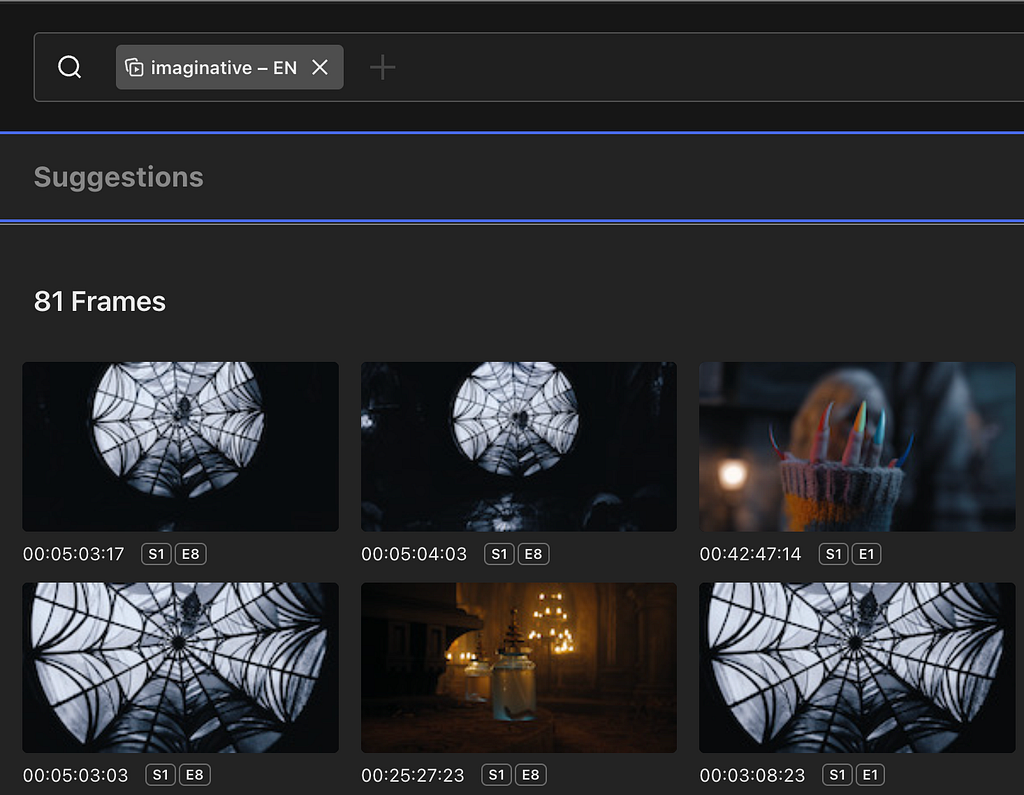
Creatives can click on any storyline to see moments that best reflect that storyline and the title’s overall tone. For example, the following images illustrate how it displays moments for the “imaginative” tone.
Prominent Characters
Talent is a major draw for our titles, and our members want to see who is featured in a title to choose whether or not they want to watch that title. Getting to know the prominent characters for a title and then finding the best possible moments featuring them used to be an arduous task.
With the AVA Discovery View, all the prominent characters of the title and their best possible shots are presented to the creatives. They can see how much a character is featured in the title and find shots containing multiple characters and the best possible stills for the characters themselves.
Sensitivities
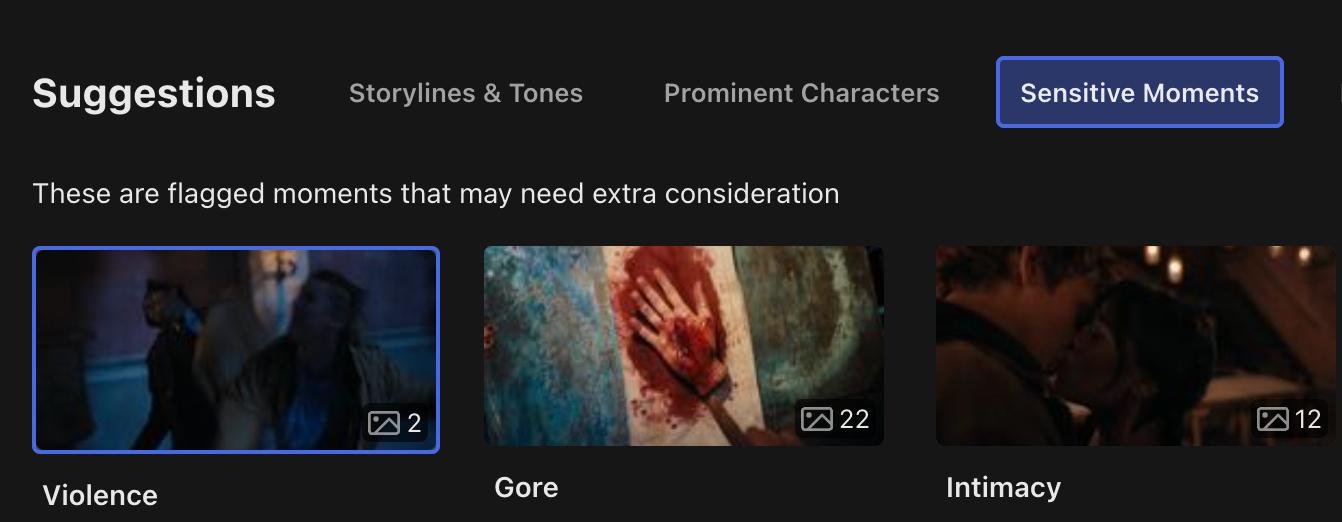
We don’t want the Netflix home screen to shock or offend audiences, so we aim to avoid artwork with violence, nudity, gore or similar attributes.
To help our creatives understand content sensitivities, AVA Discovery View lists moments where content contains gore, violence, intimacy, nudity, smoking, etc.
Environments
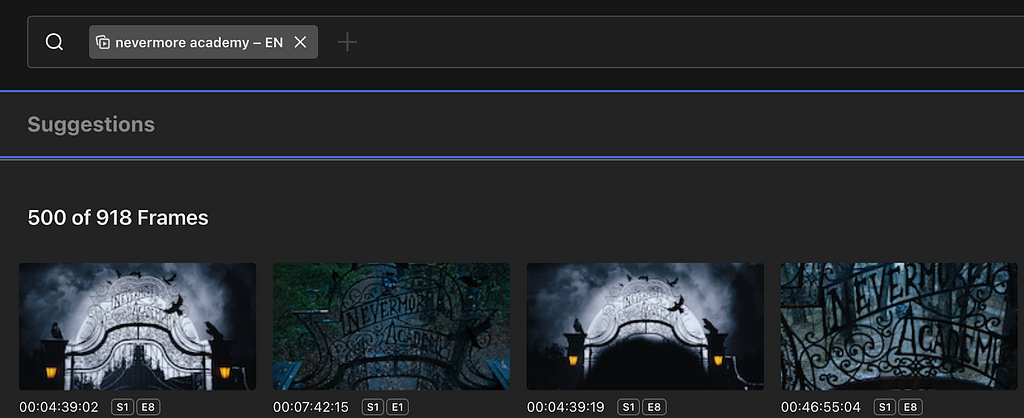
The setting and the filming location often provide great genre cues and form the basis of great-looking artwork. Finding moments from a virtual setting in the title or the actual filming location required a visual scan of all episodes of a title. Now, AVA Discovery View shows such moments as suggestions to the creatives.
For example, for the title “Wednesday”, the creatives are presented with “Nevermore Academy” as a suggested environment
Challenges
Algorithm Quality
AVA Discovery View included several different algorithms at the start, and since its release, we have expanded support to additional algorithms. Each algorithm needed a process of evaluation and tuning to get great results in AVA Discovery View.
For Visual Search
- We found that the model was influenced by the text present in the image. For example, stills of title credits would often get picked up and highly recommended to users. We added a step where such stills with text results would be filtered out and not present in the search.
- We also found that users preferred results that had a confidence threshold cutoff applied to them.
For Prominent Characters
- We found that our current algorithm model did not handle animated faces well. As a result, we often find that poor or no suggestions are returned for animated content.
For Sensitive Moments
- We found that setting a high confidence threshold was helpful. The algorithm was originally developed to be sensitive to bloody scenes, and when applied to scenes of cooking and painting, often flagged as false positives.
One challenge we encountered was the repetition of suggestions. Multiple suggestions from the same scene could be returned and lead to many visually similar moments. Users preferred seeing only the best frames and a diverse set of frames.
- We added a ranking step to some algorithms to mark frames too visually similar to higher-ranked frames. These duplicate frames would be filtered out from the suggestions list.
- However, not all algorithms can take this approach. We are exploring using scene boundary algorithms to group similar moments together as a single recommendation.
Suggestion Ranking
AVA Discovery View presents multiple levels of algorithmic suggestions, and a challenge was to help users navigate through the best-performing suggestions and avoid selecting bad suggestions.
- The suggestion categories are presented based on our users’ workflow relevance. We show Storyline/Tone, Prominent Characters, Environments, then Sensitivities.
- Within each suggestion category, we display suggestions ranked by the number of results and tie break along the confidence threshold.
Algorithm Feedback
As we launched the initial set of algorithms for AVA Discovery View, our team interviewed users about their experiences. We also built mechanisms within the tool to get explicit and implicit user feedback.
Explicit Feedback
- For each algorithmic suggestion presented to a user, users can click a thumbs up or thumbs down to give direct feedback.
Implicit Feedback
- We have tracking enabled to detect when an algorithmic suggestion has been utilized (downloaded or published for use on Netflix promotional purposes).
- This implicit feedback is much easier to collect, although it may not work for all algorithms. For example, suggestions from Sensitivities are meant to be content watch-outs that should not be used for promotional purposes. As a result, this row does poorly on implicit feedback as we do not expect downloads or publish actions on these suggestions.
This feedback is easily accessible by our algorithm partners and used in training improved versions of the models.
Intersection Queries across Multiple Algorithms
Several media understanding algorithms return clip or short-duration video segment suggestions. We compute the timecode intersections against a set of known high-quality frames to surface the best frame within these clips.
We also rely on intersection queries to help users narrow a large set of frames to a specific moment. For example, returning stills with two or more prominent characters or filtering only indoor scenes from a search query.
Technical Architecture
Discovery View Plugin Architecture
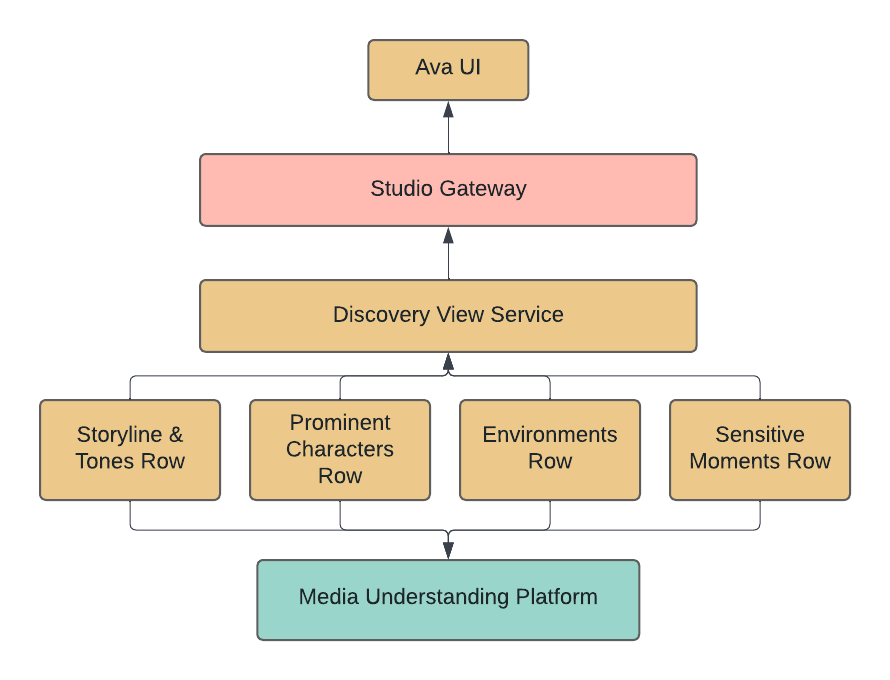
We built Discovery View as a pluggable feature that could quickly be extended to support more algorithms and other types of suggestions. Discovery View is available via Studio Gateway for AVA UI and other front-end applications to leverage.
Unified Interface for Discovery
All Discovery View rows implement the same interface, and it’s simple to extend it and plug it into the existing view.
Scalable Categories
In the Discovery View feature, we dynamically hide categories or recommendations based on the results of algorithms. Categories can be hidden if no suggestions are found. On the other hand, for a large number of suggestions, only top suggestions are retrieved, and users have the ability to request more.
Graceful Failure Handling
We load Discovery View suggestions independently for a responsive user experience.
Asset Feedback MicroService
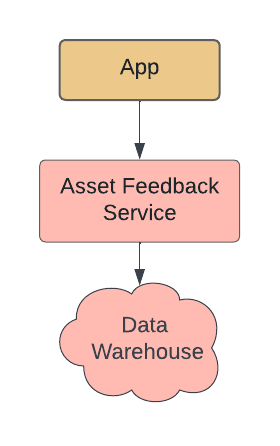
We identified that Asset Feedback is a functionality that is useful elsewhere in our ecosystem as well, so we decided to create a separate microservice for it. The service serves an important function of getting feedback about the quality of stills and ties them to the algorithms. This information is available both at individual and aggregated levels for our algorithm partners.
Media Understanding Platform
AVA Discovery View relies on the Media Understanding Platform (MUP) as the main interface for algorithm suggestions. The key features of this platform are
Uniform Query Interface
Hosting all of the algorithms in AVA Discovery View on MUP made it easier for product integration as the suggestions could be queried from each algorithm similarly
Rich Query Feature Set
We could test different confidence thresholds per algorithm, intersect across algorithm suggestions, and order suggestions by various fields.
Fast Algo Onboarding
Each algorithm took fewer than two weeks to onboard, and the platform ensured that new titles delivered to Netflix would automatically generate algorithm suggestions. Our team was able to spend more time evaluating algorithm performance and quickly iterate on AVA Discovery View.
To learn more about MUP, please see a previous blog post from our team: Building a Media Understanding Platform for ML Innovations.
Impact
Discovering authentic moments in an efficient and scalable way has a huge impact on Netflix and its creative teams. AVA has become a place to gain title insights and discover assets. It provides a concise brief on the main narratives, the visual language, and the title’s prominent characters. An AVA user can find relevant and visually stunning frames quickly and easily and leverage them as a context-gathering tool.
Future Work
To improve AVA Discovery View, our team needs to balance the number of frames returned and the quality of the suggestions so that creatives can build more trust with the feature.
Eliminating Repetition
AVA Discovery View will often put the same frame into multiple categories, which results in creatives viewing and evaluating the same frame multiple times. How can we solve for an engaging frame being a part of multiple groupings without bloating each grouping with repetition?
Improving Frame Quality
We’d like to only show creatives the best frames from a certain moment and work to eliminate frames that have either poor technical quality (a poor character expression) or poor editorial quality (not relevant to grouping, not relevant to narrative). Sifting through frames that aren’t up to quality standards creates user fatigue.
Building User Trust
Creatives don’t want to wonder whether there’s something better outside an AVA Discovery View grouping or if anything is missing from these suggested frames.
When looking at a particular grouping (like “Wednesday”’s Solving a Mystery or Gothic), creatives need to trust that it doesn’t contain any frames that don’t belong there, that these are the best quality frames, and that there are no better frames that exist in the content that isn’t included in the grouping. Suppose a creative is leveraging AVA Discovery View and doing separate manual work to improve frame quality or check for missing moments. In that case, AVA Discovery View hasn’t yet fully optimized the user experience.
Acknowledgment
Special thanks to Abhishek Soni, Amir Ziai, Andrew Johnson, Ankush Agrawal, Aneesh Vartakavi, Audra Reed, Brianda Suarez, Faraz Ahmad, Faris Mustafa, Fifi Maree, Guru Tahasildar, Gustavo Carmo, Haley Jones Phillips, Janan Barge, Karen Williams, Laura Johnson, Maria Perkovic, Meenakshi Jindal, Nagendra Kamath, Nicola Pharoah, Qiang Liu, Samuel Carvajal, Shervin Ardeshir, Supriya Vadlamani, Varun Sekhri, and Vitali Kauhanka for making it all possible.

AVA Discovery View: Surfacing Authentic Moments was originally published in Netflix TechBlog on Medium, where people are continuing the conversation by highlighting and responding to this story.
mTLS: When certificate authentication is done wrong
Post Syndicated from Michael Stepankin original https://github.blog/2023-08-17-mtls-when-certificate-authentication-is-done-wrong/
Although X.509 certificates have been here for a while, they have become more popular for client authentication in zero-trust networks in recent years. Mutual TLS, or authentication based on X.509 certificates in general, brings advantages compared to passwords or tokens, but you get increased complexity in return.
In this post, I’ll deep dive into some interesting attacks on mTLS authentication. We won’t bother you with heavy crypto stuff, but instead we’ll have a look at implementation vulnerabilities and how developers can make their mTLS systems vulnerable to user impersonation, privilege escalation, and information leakages.
We will present some CVEs we found in popular open-source identity servers and ways to exploit them. Finally, we’ll explain how these vulnerabilities can be spotted in source code and how to fix them.
This blog post is based on work that I recently presented at Black Hat USA and DEF CON.
Introduction: What is mutual TLS?
Website certificates are a very widely recognized technology, even to people who don’t work in the tech industry, thanks to the padlock icon used by web browsers. Whenever we connect to Gmail or GitHub, our browser checks the certificate provided by the server to make sure it’s truly the service we want to talk to. Fewer people know that the same technology can be used to authenticate clients: the TLS protocol is also designed to be able to verify the client using public and private key cryptography.
It happens on the handshake level, even before any application data is transmitted:
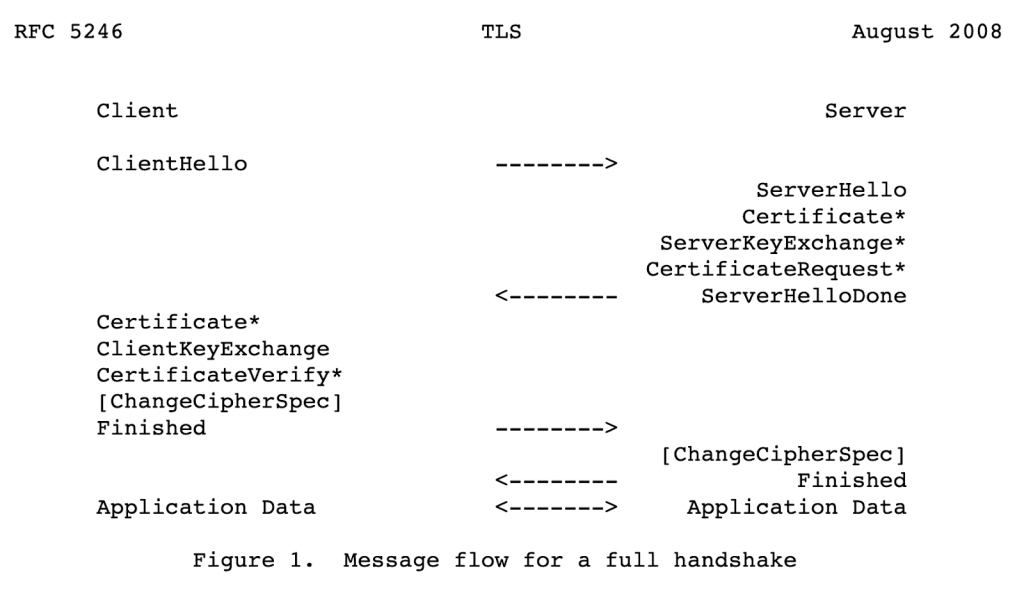
If configured to do so, a server can ask a client to provide a security certificate in the X.509 format. This certificate is just a blob of binary data that contain information about the client, such as its name, public key, issuer, and other fields:
$ openssl x509 -text -in client.crt
Certificate:
    Data:
        Version: 1 (0x0)
        Serial Number:
            d6:2a:25:e3:89:22:4d:1b
    Signature Algorithm: sha256WithRSAEncryption
        Issuer: CN=localhost            //used to locate issuers certificate
        Validity
            Not Before: Jun 13 14:34:28 2023 GMT
            Not After : Jul 13 14:34:28 2023 GMT
        Subject: CN=client          //aka "user name"
        Subject Public Key Info:
            Public Key Algorithm: rsaEncryption
                RSA Public-Key: (2048 bit)
                Modulus:
                    00:9c:7c:b4:e5:e9:3d:c1:70:9c:9d:18:2f:e8:a0:
The server checks that this certificate is signed by one of the trusted authorities. This is a bit similar to checking the signature of a JWT token. Next, the client sends a “Certificate verify” message encrypted with the private key, so that the server can verify that the client actually has the private key.
How certificates are validated
“Certificate validation” commonly refers to the PKIX certificate validation process defined in RFC 5280.
In short, in order to validate the certificate, the server constructs a certification path (also known as a certificate chain) from the target certificate to a trust anchor. The trust anchor is a self-signed root certificate that is inherently trusted by the validator. The end entity certificate is often signed by an intermediate CA, which is also signed by another intermediate certificate or directly by a trust anchor.
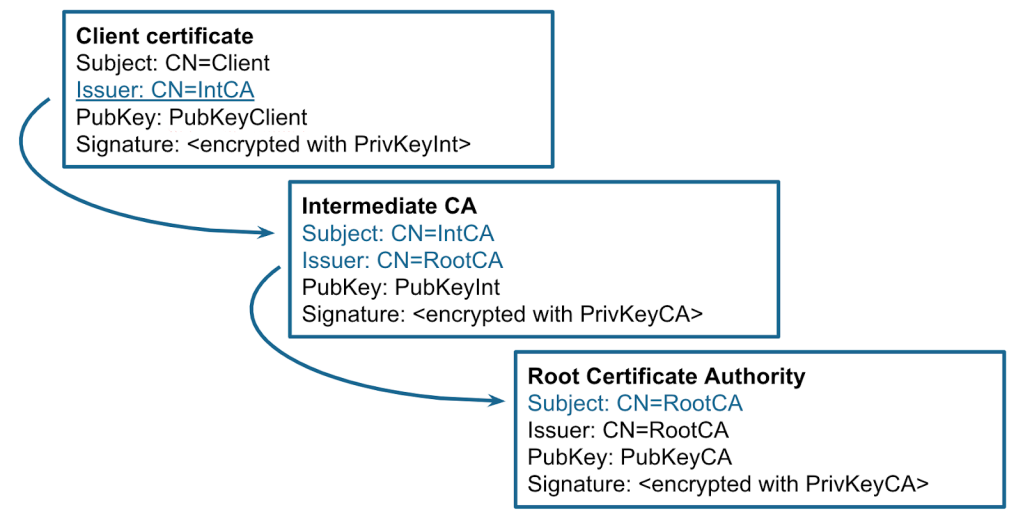
Then, for each certificate in the chain, the validator checks the signature, validity period, allowed algorithms and key lengths, key usage, and other properties. There are also a number of optional certificate extensions: if they are included in the certificate, they can be checked as well. This process is quite complicated, so every language or library implements it differently.
Note: in my research I mostly looked at how mTLS is implemented in applications written in Java, but it is likely that the ideas and attacks below apply to other languages as well.
mTLS in a Java web application, an example
Let’s see how to use mTLS in a Java web application. The bare minimum configuration is to enable it in the application settings and specify the location of all trusted root certificates, like this:
$ cat application.properties

…
server.ssl.client-auth=need
server.ssl.trust-store=/etc/spring/server-truststore.p12
server.ssl.trust-store-password=changeit
From the client, such as curl, you need to specify which certificate is sent to the server. The rest of the application code, such as request mappings, is exactly the same as for a normal web application.
$ curl -k -v –cert client.pem http://localhost/hello
This setup works for very simple mTLS configurations, when there is only a single root certificate, and all client certificates are signed by it. You can find this example in various articles on the web and it’s quite secure due to its simplicity. Let’s quickly break down its pros and cons.
Pros:
- Speed: Authorization happens only during TLS handshake, all subsequent “keep-alive” HTTP requests are considered authenticated, saving CPU time.
- Storage: Similar to JWT, the server does not store all client certificates, only the root certificate.
Cons:
- No granular control: if mTLS is enabled, all requests have to be authenticated, even to
/static/style.css. - Any certificate signed by a trusted CA can be used to access this HTTP service. Even if the certificate is issued for another purpose, it still can potentially be used for TLS authentication.
- No host verification by default: client certificates can be accepted from any IP.
- Certificate issuance process needs to be implemented separately.
- Certificates expire, so need to be rotated frequently.
As you can see, this approach brings some advantages and disadvantages compared to traditional authentication methods, such as password or tokens.
Previous attacks
Before we dive into the attack section, I’ll briefly mention some previous well-known attacks on certificate parsing and validation:
- Obviously, the security of the authentication system depends on the strength of the signature. If we can somehow forge the content of the certificate, but keep the same signature, we can completely break the authentication process.
- Since the X.509 format is quite complex, just parsing these data structures can lead to buffer and heap overflows.
- Lack of basic constraints checking. The end-entity certificates should not be used to sign additional certificates.
My approach
In Java, most of these attacks are already mitigated in APIs provided by the JDK. Weak algorithms are intentionally not allowed. Fuzzing of certificate parsing in Java also did not look productive to me, as the vast majority of PKIX code is implemented in memory-safe Java, instead of using native libraries. I had to take a different approach, so I decided to have a deep look at how mTLS is used from the source code perspective. Since the certificate validation process is quite complex, I suspected that someone might implement it in a weird way. After several weeks, it yielded me some interesting vulnerabilities in popular open source projects.
So, let’s move on to the attack’s section.
Chapter 1: Improper certificate extraction
In real-life applications, developers often need to access the certificate presented during the TLS handshake. For example, they might need it for authorization purposes, such as checking the current username. In Java, there are two common ways how to access it:
X509Certificate[] certificates = sslSession.getPeerCertificates();

// another way
X509Certificate[] certificates = request.getAttribute("javax.servlet.request.X509Certificate");
Interestingly, this API returns an array of certificates presented by the client, not a single one. Why? Perhaps because TLS specification defines that clients may send a full chain of certificates, from end-entity to the root CA.
So, I decided to take a look at how different applications use this API. The most common approach I’ve seen is to take only the first certificate from the array and consider it as the client certificate. This is correct, as mTLS RFC explicitly says that the sender’s certificate MUST come first in the list.
//way 1 is good
String user = certificates[0].getSubjectX500Principal().getName();
At the same time, I discovered some rare cases when applications disregard this rule and iterate over the array trying to find a certificate that matches some criteria.
//way 2 is dangerous
for (X509Certificate cert : certificates) {
   if (isClientCertificate(cert)) {
      user = cert.getSubjectX500Principal().getName();
   }
}
This is dangerous, as the underlying TLS library in Java only verifies the first certificate in the list. Moreover, it does not require the chain to be sent in a strict order.
Example: CVE-2023-2422 improper certificate validation in KeyCloak
One of these examples was a vulnerability I discovered in Keycloak. Keycloak is a popular authorization server that supports OAuth, SAML, and other authorization methods, as well as mutual TLS.
Keycloak iterates over all certificates in the array, searching for the one that matches the client_id form parameter. As soon as it finds a matching certificate, it implicitly trusts it, assuming that its signature has already been checked during the TLS handshake:
X509Certificate[] certs = null;
ClientModel client = null;
try {
    certs = provider.getCertificateChain(context.getHttpRequest());
    String client_id = null;
    ...
    if (formData != null) {
        client_id = formData.getFirst(OAuth2Constants.CLIENT_ID);
    }
    …
    matchedCertificate = Arrays.stream(certs)
        .map(certificate -> certificate.getSubjectDN().getName())
        .filter(subjectdn -> subjectDNPattern.matcher(subjectdn).matches())
        .findFirst();
In reality, a client can send as many certificates as they want, and the server only verifies the first one.
A potential attacker can exploit this behavior to authenticate under a different username. It is possible to send a list of certificates, where the first one contains one username and is properly chained to a root CA. But the last certificate in the array might be self signed and belong to a different user. The client does not even need to provide a valid private key for it.
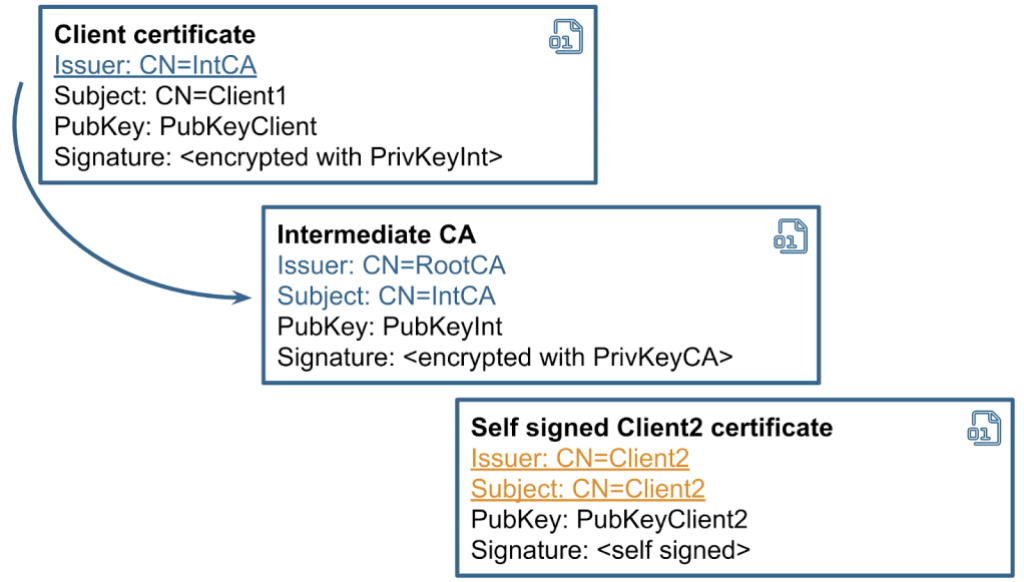
Speaking about the exploitation, there are a number of endpoints in Keycloak that support mTLS authentication, but we need one that does not require any additional factors, such as tokens or secrets. “client-management/register-node” is a good example, as it mutates the user’s data. We can normally use this api with mTLS in the following way:
$ cat client1.crt client1.key > chain1.pem
$ curl --tlsv1.2 --tls-max 1.2 --cert chain1.pem -v -i -s -k "https://127.0.0.1:8443/realms/master/clients-managements/register-node?client_id=client1" -d "client_cluster_host=http://127.0.0.1:1213/"
To demonstrate the vulnerability, we generate a new self signed certificate using openssl and add it to the end of the array.
$ openssl req -newkey rsa:2048 -nodes -x509 -subj /CN=client2 -out client2-fake.crt
$ cat client1.crt client1.key client2-fake.crt client1.key > chain2.pem
$ curl --tlsv1.2 --tls-max 1.2 --cert chain2.pem -v -i -s -k "https://127.0.0.1:8443/realms/master/clients-managements/register-node?client_id=client2" -d "client_cluster_host=http://127.0.0.1:1213/"
When we send the second curl request, Keycloak performs this action on behalf of the user specified in client2-fake.crt, instead of client1.crt. Therefore, we can mutate data on the server for any client that supports mTLS.
How to fix that? Easy: just use the first certificate from the array. That’s exactly how Keycloak patched this vulnerability. This CVE is a good example of how developers provide methods and interfaces that can be misunderstood or used incorrectly.
Passing certificate as a header
Another common scenario for mTLS deployments is when the TLS connection is terminated on a reverse proxy. In this case, the reverse proxy often checks the certificate and forwards it to a backend server as an additional header. Here is a typical nginx configuration to enable mTLS:
$ cat nginx.conf

http {
    server {
        server_name example.com;
        listen 443 ssl;
        …
        ssl_client_certificate /etc/nginx/ca.pem;
        ssl_verify_client on;

        location / {
            proxy_pass http://host.internal:80;
            proxy_set_header ssl-client-cert $ssl_client_cert;
        }
    }
I’ve seen a number of systems like that, and in most cases the backend servers behind nginx do not perform additional validation, just trusting the reverse proxy. This behavior is not directly exploitable, but it’s not ideal either. Why? Well, first of all, it means that any server in the local network can make a request with this header, so this network segment needs to be carefully isolated from any traffic coming from outside. Additionally, if the backend or reverse proxy is affected by request smuggling or header injection, its exploitation becomes trivial. Over the past few years, we’ve seen a lot of request and header smuggling vulnerabilities, including the latest CVEs in Netty and Nodejs. Be careful when implementing these scenarios and check the certificate’s signature on all servers if possible.
Chapter 2: “Follow the chain, where does it lead you?”
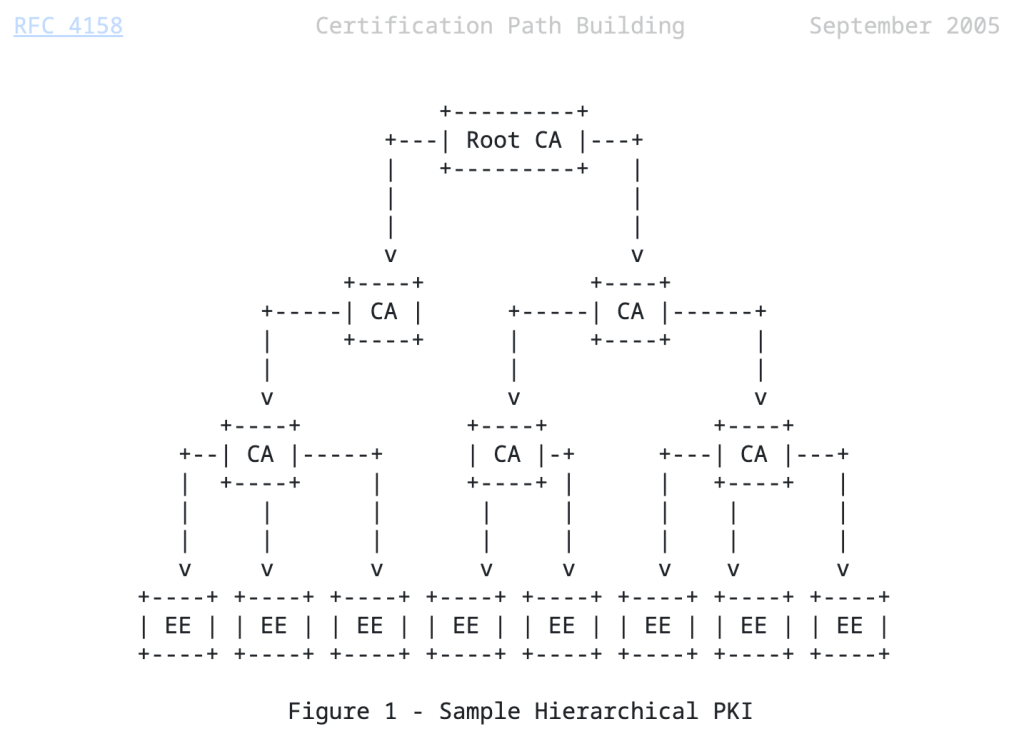
In large systems, servers may not store all root and intermediate certificates locally, but use external storage instead. RFC 4387 explains the concept of a certificate store: an interface you can use to lazily access certificates during chain validation. These stores are implemented over different protocols, such as HTTP, LDAP, FTP, or SQL queries.
RFC 3280 defines some X.509 certificate extensions that can contain information about where to find the issuer and CA certificates. For instance, the Authority Information Access (AIA) extension contains a URL pointing to the Issuer’s certificate. If this extension is used for validation, there is a high chance that you can exploit it to perform an SSRF attack. Also, Subject, Issuer, Serial, and their alternative names can be used to construct SQL or LDAP queries, creating opportunities for injection attacks.
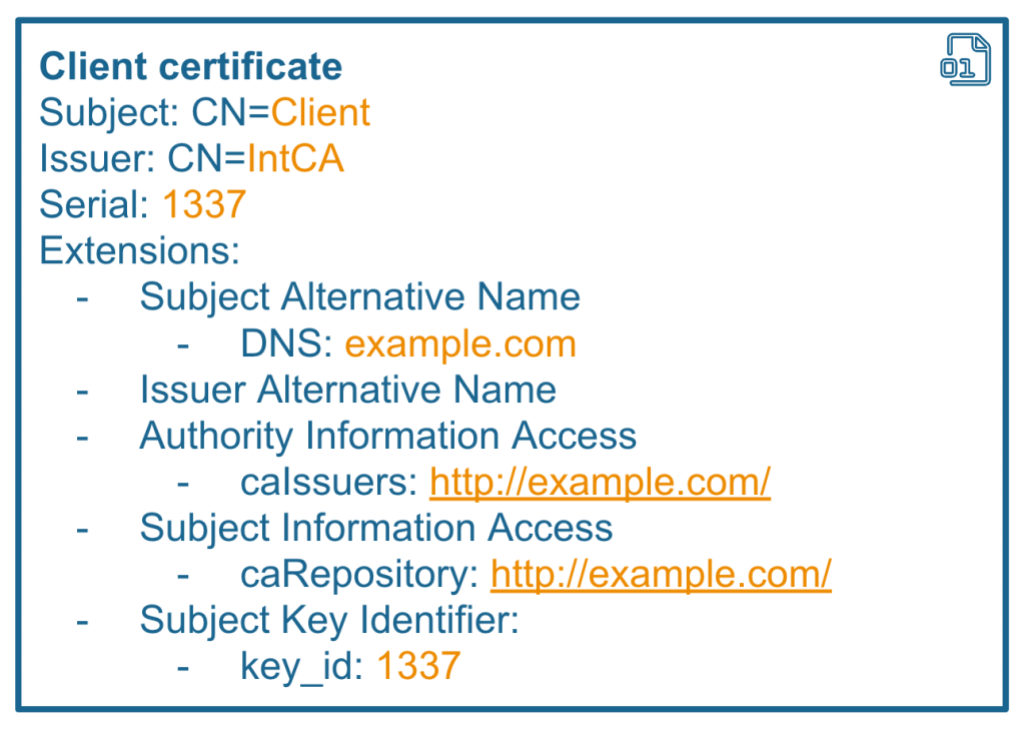
When certificate stores are in use, you should think of these values as “untrusted user input” or “Insertion points,” similar to those we have in Burp Suite’s Intruder. And what attackers will really love is that all of these values can be used in queries before the signature is checked.
Example: CVE-2023-33201 LDAP injection in Bouncy Castle
To demonstrate an example of this vulnerability, we’ll use LDAPCertStore from the Bouncy Castle library. Bouncy Castle is one of the most popular libraries for certificate validation in Java. Here is an example of how you can use this store to build and validate a certificate chain.
PKIXBuilderParameters pkixParams = new PKIXBuilderParameters(keystore, selector);

//setup additional LDAP store
X509LDAPCertStoreParameters CertStoreParameters = new X509LDAPCertStoreParameters.Builder("ldap://127.0.0.1:1389", "CN=certificates").build();
CertStore certStore = CertStore.getInstance("LDAP", CertStoreParameters, "BC");
pkixParams.addCertStore(certStore);

// Build and verify the certification chain
try {
   CertPathBuilder builder = CertPathBuilder.getInstance("PKIX", "BC");
   PKIXCertPathBuilderResult result =
           (PKIXCertPathBuilderResult) builder.build(pkixParams);
Under the hood, Bouncy Castle uses the Subject field from the certificate to build an LDAP query. The Subject field is inserted in the filter, without—you guessed it—any escaping.
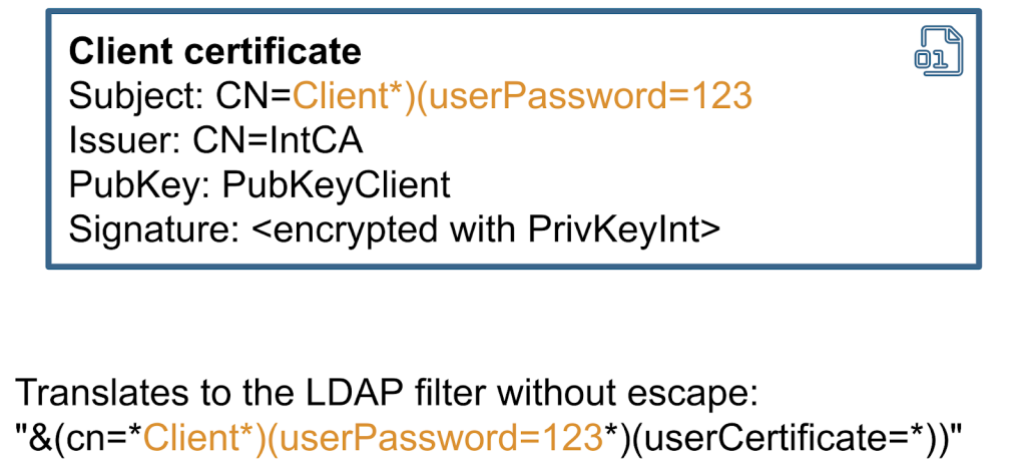
So, if the Subject contains any special characters, it can change the syntax of the query. In most cases, this can be exploited as a blind ldap query injection. Therefore, it might be possible to use this vulnerability to extract other fields from the LDAP directory. The exploitability depends on many factors, including whether the application exposes any errors or not, and it also depends on the structure of the LDAP directory.
In general, whenever you incorporate user-supplied data into an LDAP query, special characters should be properly filtered. That’s exactly how this CVE has been patched in the Bouncy Castle code.
Chapter 3: Certificate revocation and its unintended uses
Similar to Json web tokens, the beauty of certificate chains is that they can be trusted just based on their signature. But what happens if we need to revoke a certificate, so it can no longer be used?
The PKIX specification (RFC 4387) addresses this problem by proposing a special store for revoked certificates, accessible via HTTP or LDAP protocols. Many developers believe that revocation checking is absolutely necessary, whereas others urge to avoid it for performance reasons or only use offline revocation lists.
Generally speaking, the store location can be hardcoded into the application or taken from the certificate itself. There are two certificate extensions used for that: Authority Information Access OSCP URL and CRL Distribution points.
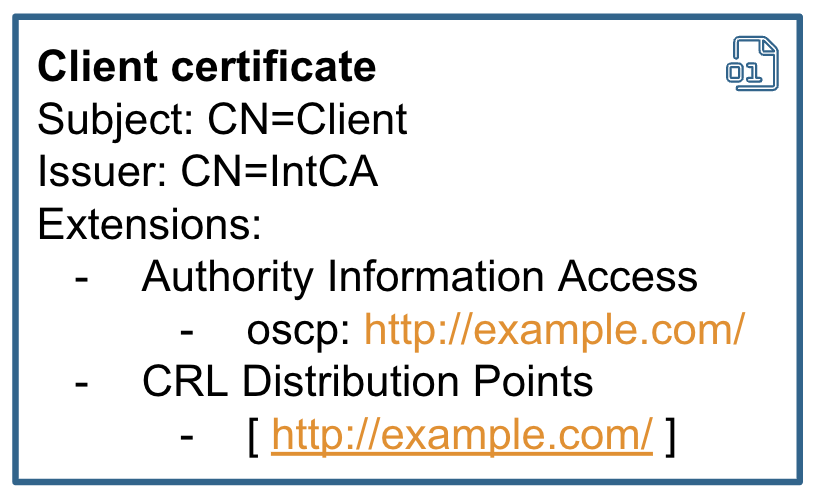
Looking at it from the hackers point of view, I think it’s incredible that the location of the revocation server can be taken from the certificate. So, if the application takes URLs relying on AIA or CRLDP extension to make a revocation check, it can be abused for SSRF attacks.
Sadly for attackers, this normally happens after the signature checks, but in some cases it’s still exploitable.
Moreover, LDAP is also supported, at least in Java. You probably heard that, in Java, unmarshaling an LDAP lookup response can lead to a remote code execution. A few years back, Moritz Bechler reported this problem and remote code execution via revocation has since been patched in the JDK. You can check out his blog post for more details.
In my research, I decided to check if the Bouncy Castle library is also affected. It turns out that Bouncy Castle can be configured to use the CRLDP extension and make calls to an LDAP server. At the same time, Bouncy Castle only fetches a specific attribute from the LDAP response and does not support references. So, remote code execution is not possible there. HTTP SSRF is still viable though.
private static Collection getCrlsFromLDAP(CertificateFactory certFact, URI distributionPoint) throws IOException, CRLException
{
    Map<String, String> env = new Hashtable<String, String>();

    env.put(Context.INITIAL_CONTEXT_FACTORY, "com.sun.jndi.ldap.LdapCtxFactory");
    env.put(Context.PROVIDER_URL, distributionPoint.toString());

    byte[] val = null;
    try
    {
        DirContext ctx = new InitialDirContext((Hashtable)env);
        Attributes avals = ctx.getAttributes("");
        Attribute aval = avals.get("certificateRevocationList;binary");
        val = (byte[])aval.get();
    }
Example: CVE-2023-28857 credentials leak in Apereo CAS
I also had a quick look at open source projects that support mTLS and perform revocation checking. One of these projects was Apereo CAS. It’s another popular authentication server that is highly configurable. Administrators of Apereo CAS can enable the revocation check using an external LDAP server by specifying its address and password in the settings:
cas.authn.x509.crl-fetcher=ldap
cas.authn.x509.ldap.ldap-url=ldap://example.com:1389/
cas.authn.x509.ldap.bind-dn=admin
cas.authn.x509.ldap.bind-credential=s3cr3taaaaa
If these settings are applied, Apereo CAS performs the revocation check for the certificate, fetching the address from the certificate’s CRLDP extension.
/**
* Validate the X509Certificate received.
*
* @param cert the cert
* @throws GeneralSecurityException the general security exception
*/
private void validate(final X509Certificate cert) throws GeneralSecurityException {
   cert.checkValidity();
   this.revocationChecker.check(cert);

   val pathLength = cert.getBasicConstraints();
   if (pathLength < 0) {
       if (!isCertificateAllowed(cert)) {
           val msg = "Certificate subject does not match pattern " + this.regExSubjectDnPattern.pattern();
           LOGGER.error(msg);
I was afraid that this could lead to remote code execution, but it turns out that Apereo CAS uses a custom library for LDAP connection, which does not support external codebases or object factories needed for RCE.
When I tested this in Apereo CAS, I noticed one interesting behavior. The server prefers the LDAP URL located inside the certificate, instead of the one that is configured in settings. At the same time, Apereo CAS still sends the password from the settings. I quickly set up a testing environment and sent a self-signed certificate in the header. My self-signed certificate had a CRLDP extension with the LDAP URL pointing to a netcat listener. After sending this request to Apereo CAS, I received a request to my netcat listener with the username and password leaked.
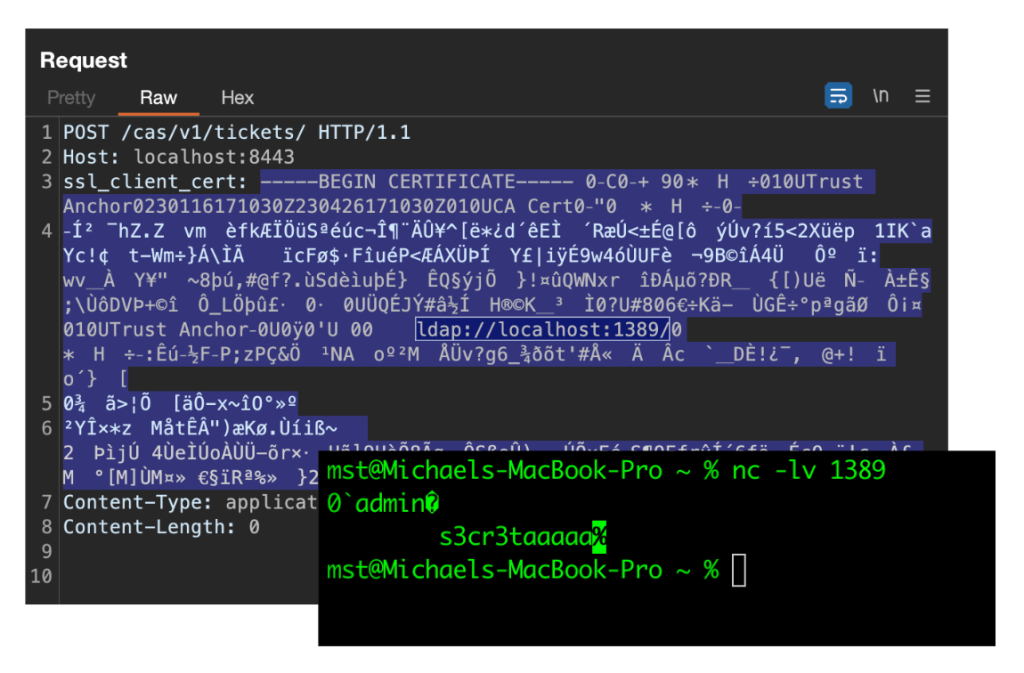
After reporting this vulnerability, the application developers issued a fix within just one day. They patched it by clearing the login and password used for LDAP connection if the URL is taken from the CRLDP. Therefore, the password leak is no longer possible. Nevertheless, I would say that using URLs from the CRLDP extension is still dangerous, as it broadens the attack surface.
Summary
If you’re developing an mTLS system or performing a security assessment, I suggest:
- Pay attention when extracting usernames from the mTLS chain, as the servers only verify the first certificate in the chain.
- Use Certificate Stores with caution, as it can lead to LDAP and SQL injections.
- Certificate revocation can lead to SSRF or even to RCE in the worst case. So, do the revocation check only after all other checks and do not rely on URLs taken from the certificate extensions.
The post mTLS: When certificate authentication is done wrong appeared first on The GitHub Blog.