Making a filesystem implementation robust in the face of maliciously
created filesystem images is a challenging task even when the
implementation is actively maintained, which many in the kernel are not. There is a way to
make that task even harder, though: modify that filesystem image behind the
implementation’s back while it is mounted. A recent discussion on the
linux-fsdevel list reveals an ongoing disagreement over whether (and how)
this threat should be addressed.
The Document Foundation
has announced
the release of LibreOffice 7.6 Community. It is the last release
using the existing numbering scheme as the office suite will move to date-based
release numbers starting with LibreOffice 24.2 in
February, 2024. Highlights of this release include support for
document themes, including import and export of them, a new navigation
panel for Impress and Draw, zoom-gesture support, font-handling
improvements, and lots more; the release
notes have all the details.
LibreOffice 7.6 Community’s new features have been developed by 148
contributors: 61% of code commits are from the 52 developers employed by
three companies sitting in TDF’s Advisory Board – Collabora, Red Hat and
allotropia – or other organizations, 15% are from 7 developers at The
Document Foundation, and the remaining 24% are from 89 individual
volunteers.
Other 202 volunteers – representing hundreds of other people providing
translations – have committed localizations in 160 languages. LibreOffice
7.6 Community is released in 120 different language versions, more than any
other free or proprietary software, and as such can be used in the native
language (L1) by over 5.4 billion people worldwide. In addition, over 2.3
billion people speak one of those 120 languages as their second language
(L2).
Security updates have been issued by Debian (fastdds, flask, and kernel), Fedora (chromium, dotnet6.0, dotnet7.0, gerbv, java-1.8.0-openjdk, libreswan, procps-ng, and spectre-meltdown-checker), SUSE (chromium, kernel-firmware, krb5, opensuse-welcome, and python-mitmproxy), and Ubuntu (clamav, firefox, and vim).
Cloudflare has a unique vantage point on the Internet. From this position, we are able to see, explore, and identify trends that would otherwise go unnoticed. In this report we are doing just that and sharing our insights into Internet-wide application security trends.
Since the last report, our network is bigger and faster: we are now processing an average of 46 million HTTP requests/second and 63 million at peak. We consistently handle approximately 25 million DNS queries per second. That's around 2.1 trillion DNS queries per day, and 65 trillion queries a month. This is the sum of authoritative and resolver requests served by our infrastructure. Summing up both HTTP and DNS requests, we get to see a lot of malicious traffic. Focusing on HTTP requests only, in Q2 2023 Cloudflare blocked an average of 112 billion cyber threats each day, and this is the data that powers this report.
But as usual, before we dive in, we need to define our terms.
Definitions
Throughout this report, we will refer to the following terms:
Mitigated traffic: any eyeball HTTP* request that had a “terminating” action applied to it by the Cloudflare platform. These include the following actions: BLOCK, CHALLENGE, JS_CHALLENGE and MANAGED_CHALLENGE. This does not include requests that had the following actions applied: LOG, SKIP, ALLOW. In contrast to last year, we now exclude requests that had CONNECTION_CLOSE and FORCE_CONNECTION_CLOSE actions applied by our DDoS mitigation system, as these technically only slow down connection initiation. They also accounted for a relatively small percentage of requests. Additionally, we improved our calculation regarding the CHALLENGE type actions to ensure that only unsolved challenges are counted as mitigated. A detailed description of actions can be found in our developer documentation.
Bot traffic/automated traffic: any HTTP* request identified by Cloudflare’s Bot Management system as being generated by a bot. This includes requests with a bot score between 1 and 29 inclusive. This has not changed from last year’s report.
API traffic: any HTTP* request with a response content type of XML or JSON. Where the response content type is not available, such as for mitigated requests, the equivalent Accept content type (specified by the user agent) is used instead. In this latter case, API traffic won’t be fully accounted for, but it still provides a good representation for the purposes of gaining insights.
Unless otherwise stated, the time frame evaluated in this post is the 3 month period from April 2023 through June 2023 inclusive.
Finally, please note that the data is calculated based only on traffic observed across the Cloudflare network and does not necessarily represent overall HTTP traffic patterns across the Internet.
* When referring to HTTP traffic we mean both HTTP and HTTPS.
Global traffic insights
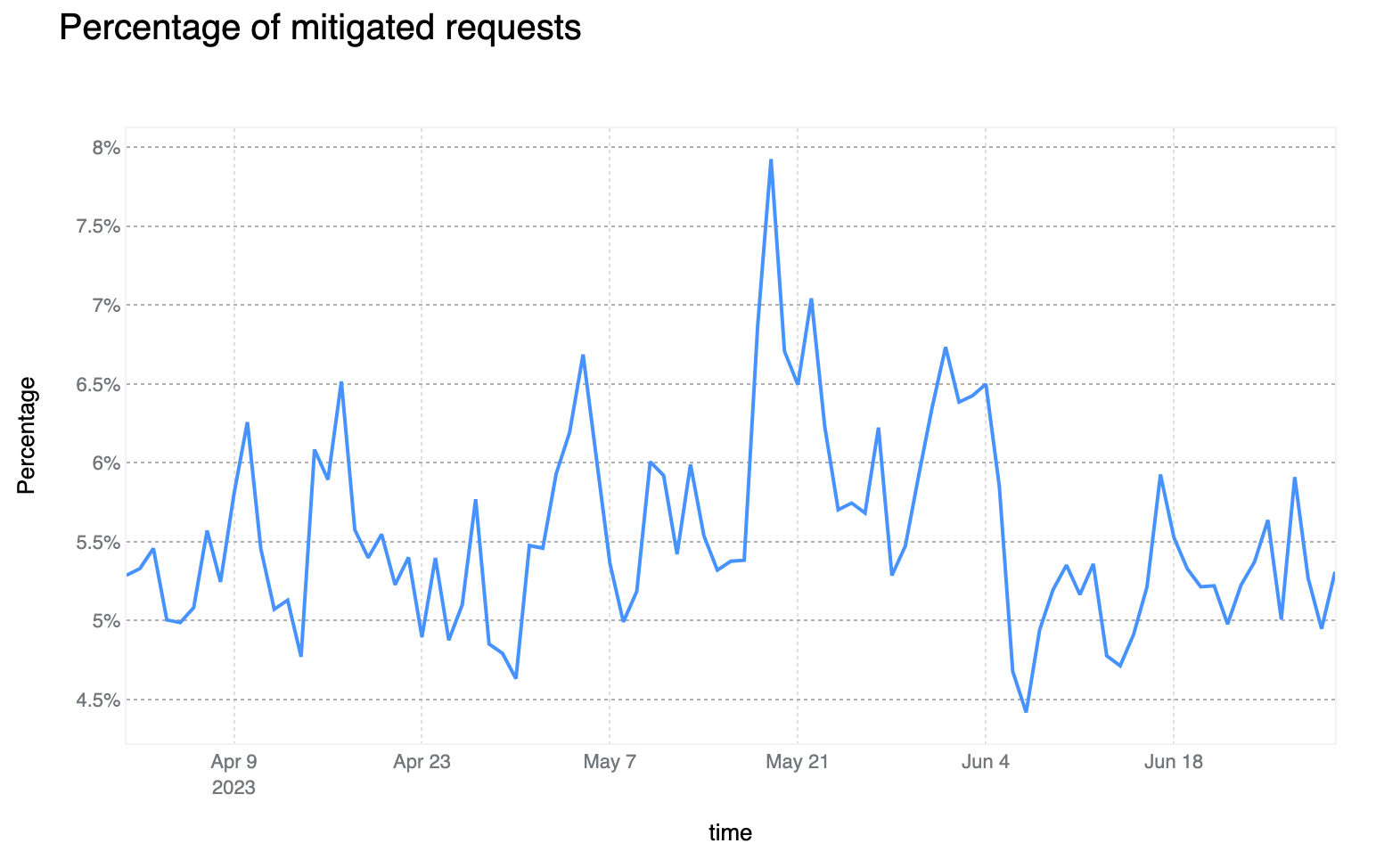
Mitigated daily traffic stable at 6%, spikes reach 8%
Although daily mitigated HTTP requests decreased by 2 percentage points to 6% on average from 2021 to 2022, days with larger than usual malicious activity can be clearly seen across the network. One clear example is shown in the graph below: towards the end of May 2023, a spike reaching nearly 8% can be seen. This is attributable to large DDoS events and other activity that does not follow standard daily or weekly cycles and is a constant reminder that large malicious events can still have a visible impact at a global level, even at Cloudflare scale.
75% of mitigated HTTP requests were outright BLOCKed. This is a 6 percentage point decrease compared to the previous report. The majority of other requests are mitigated with the various CHALLENGE type actions, with managed challenges leading with ~20% of this subset.
Shields up: customer configured rules now biggest contributor to mitigated traffic
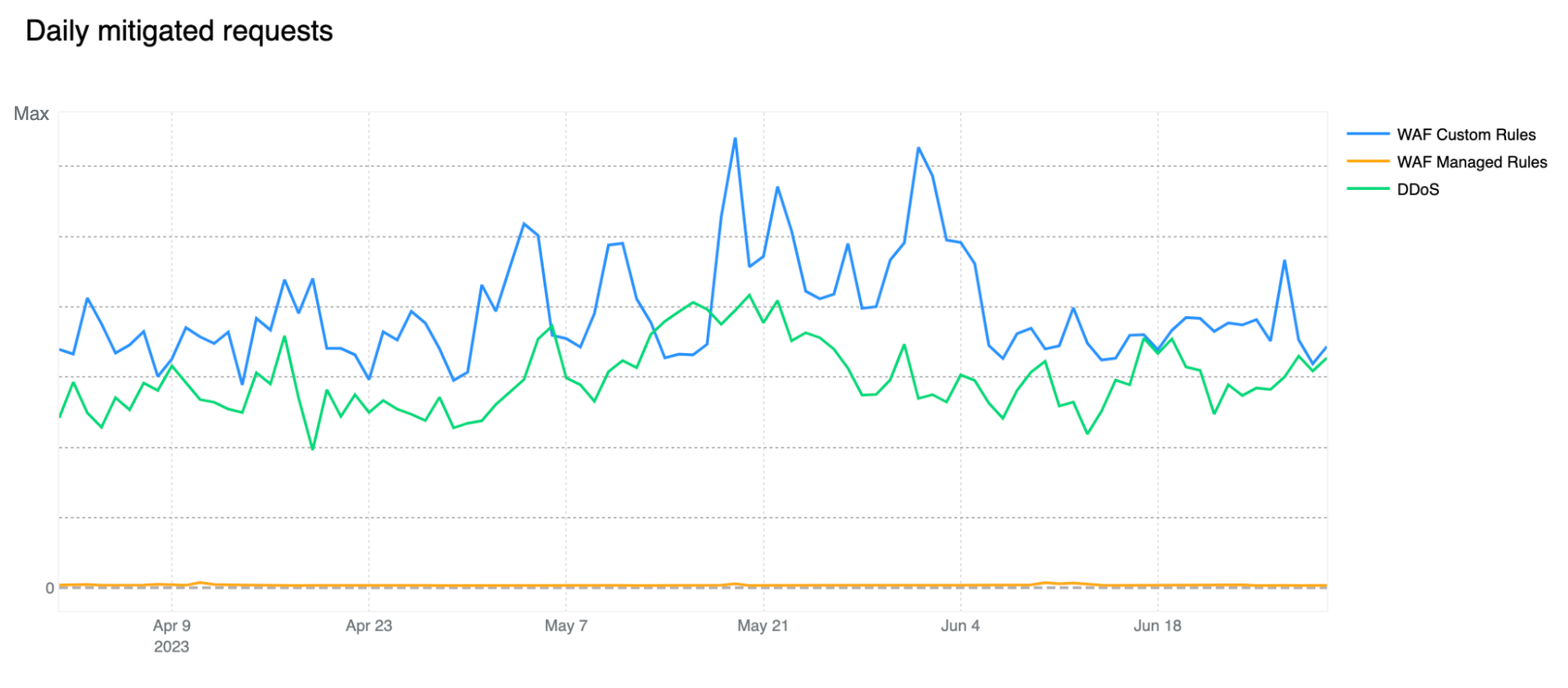
In our previous report, our automated DDoS mitigation system accounted for, on average, more than 50% of mitigated traffic. Over the past two quarters, due to both increased WAF adoption, but most likely organizations better configuring and locking down their applications from unwanted traffic, we’ve seen a new trend emerge, with WAF mitigated traffic surpassing DDoS mitigation. Most of the increase has been driven by WAF Custom Rule BLOCKs rather than our WAF Managed Rules, indicating that these mitigations are generated by customer configured rules for business logic or related purposes. This can be clearly seen in the chart below.
Note that our WAF Managed Rules mitigations (yellow line) are negligible compared to overall WAF mitigated traffic also indicating that customers are adopting positive security models by allowing known good traffic as opposed to blocking only known bad traffic. Having said that, WAF Managed Rules mitigations reached as much as 1.5 billion/day during the quarter.
Our DDoS mitigation is, of course, volumetric and the amount of traffic matching our DDoS layer 7 rules should not be underestimated, especially given that we are observing a number of novel attacks and botnets being spun up across the web. You can read a deep dive on DDoS attack trends in our Q2 DDoS threat report.
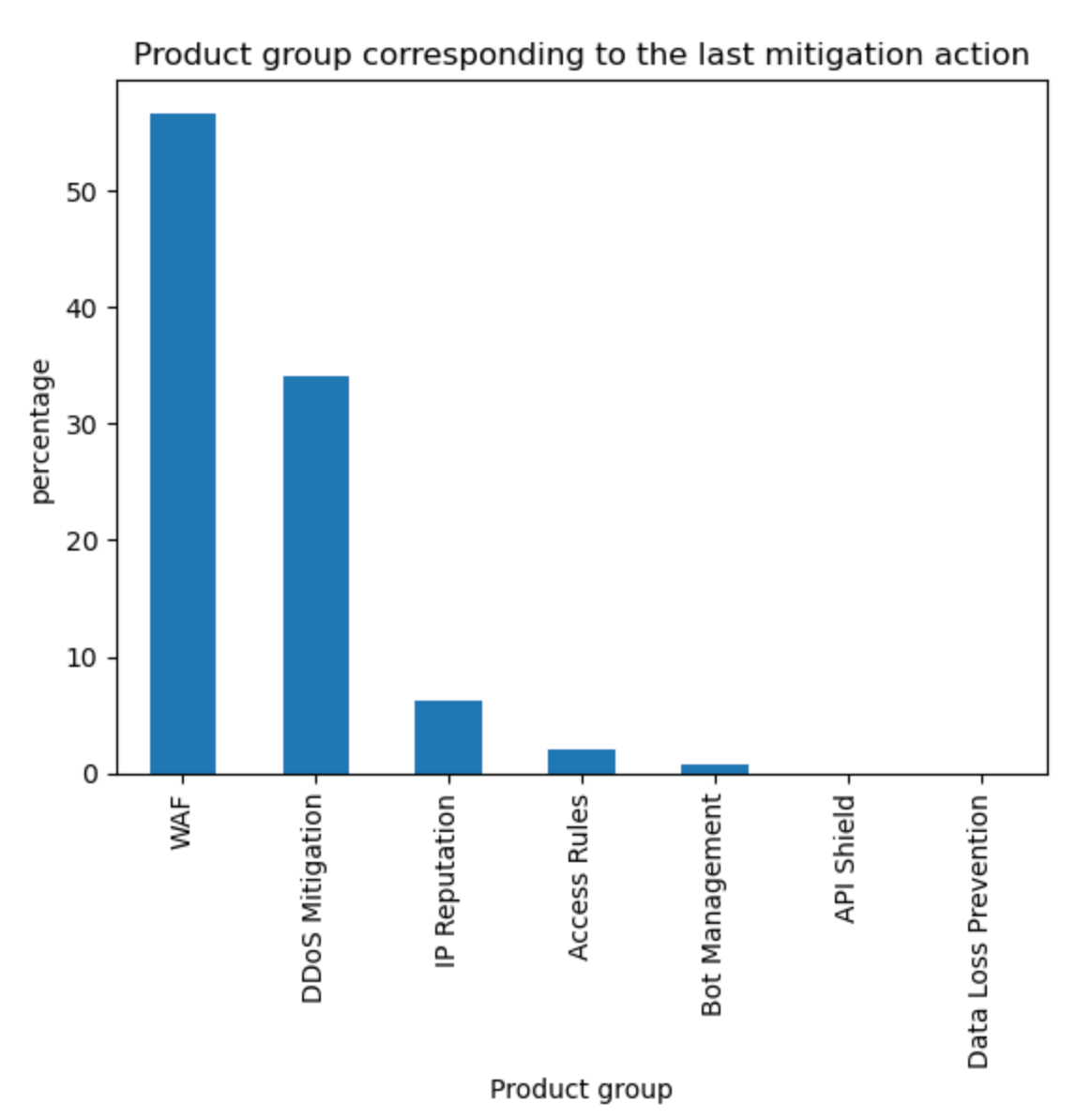
Aggregating the source of mitigated traffic, the WAF now accounts for approximately 57% of all mitigations. Tabular format below with other sources for reference.
Source
Percentage %
WAF
57%
DDoS Mitigation
34%
IP Reputation
6%
Access Rules
2%
Other
1%
Application owners are increasingly relying on geo location blocks
Given the increase in mitigated traffic from customer defined WAF rules, we thought it would be interesting to dive one level deeper and better understand what customers are blocking and how they are doing it. We can do this by reviewing rule field usage across our WAF Custom Rules to identify common themes. Of course, the data needs to be interpreted correctly, as not all customers have access to all fields as that varies by contract and plan level, but we can still make some inferences based on field “categories”. By reviewing all ~7M WAF Custom Rules deployed across the network and focusing on main groupings only, we get the following field usage distribution:
Field
Used in percentage % of rules
Geolocation fields
40%
HTTP URI
31%
IP address
21%
Other HTTP fields (excluding URI)
34%
Bot Management fields
11%
IP reputation score
4%
Notably, 40% of all deployed WAF Custom Rules use geolocation-related fields to make decisions on how to treat traffic. This is a common technique used to implement business logic or to exclude geographies from which no traffic is expected and helps reduce attack surface areas. While these are coarse controls which are unlikely to stop a sophisticated attacker, they are still efficient at reducing the attack surface.
Another notable observation is the usage of Bot Management related fields in 11% of WAF Custom Rules. This number has been steadily increasing over time as more customers adopt machine learning-based classification strategies to protect their applications.
Old CVEs are still exploited en masse
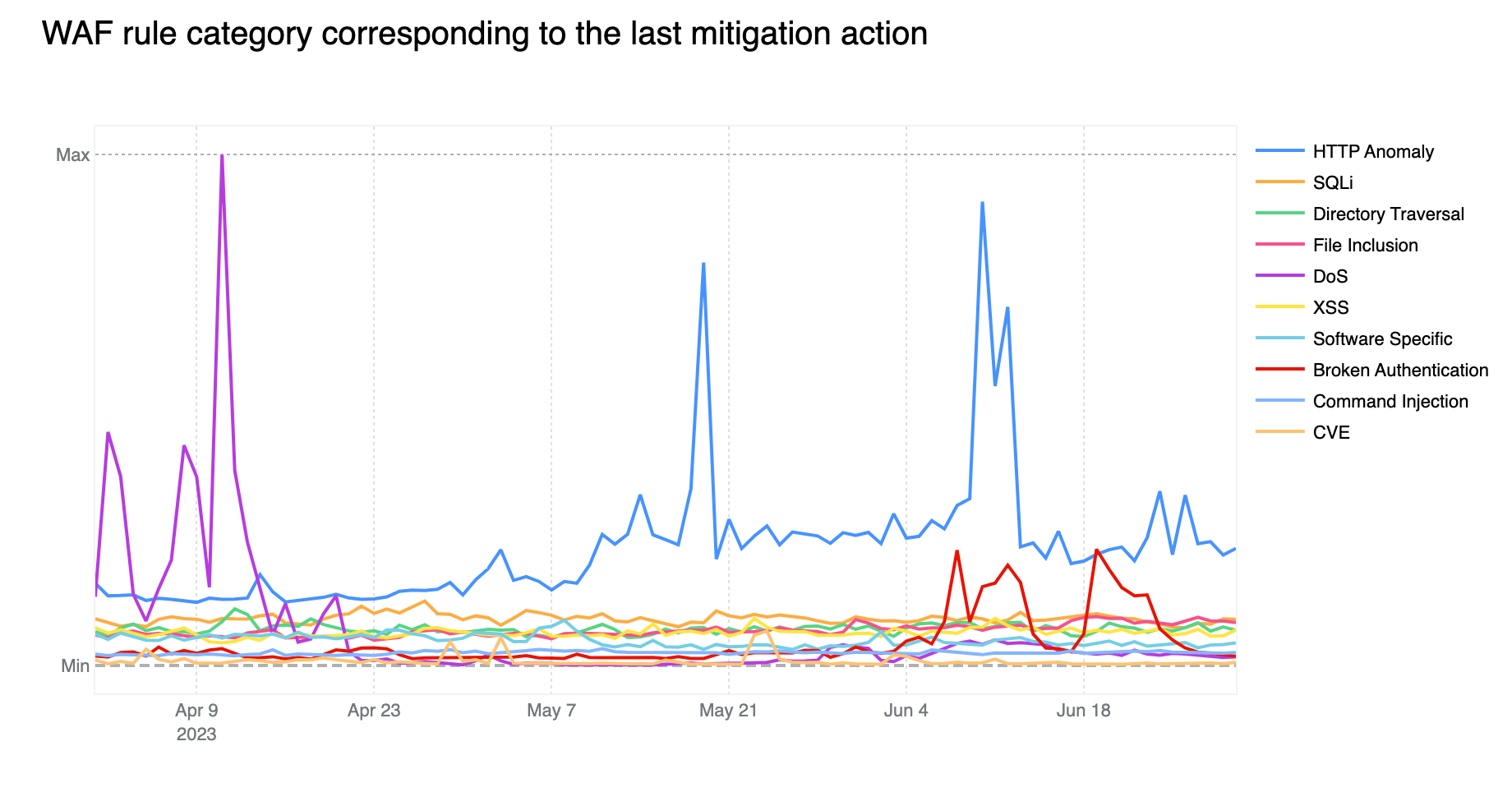
Contributing ~32% of WAF Managed Rules mitigated traffic overall, HTTP Anomaly is still the most common attack category blocked by the WAF Managed Rules. SQLi moved up to second position, surpassing Directory Traversal with 12.7% and 9.9% respectively.
If we look at the start of April 2023, we notice the DoS category far exceeding the HTTP Anomaly category. Rules in the DoS category are WAF layer 7 HTTP signatures that are sufficiently specific to match (and block) single requests without looking at cross request behavior and that can be attributed to either specific botnets or payloads that cause denial of service (DoS). Normally, as is the case here, these requests are not part of “distributed” attacks, hence the lack of the first “D” for “distributed” in the category name.
Tabular format for reference (top 10 categories):
Source
Percentage %
HTTP Anomaly
32%
SQLi
13%
Directory Traversal
10%
File Inclusion
9%
DoS
9%
XSS
9%
Software Specific
7%
Broken Authentication
6%
Common Injection
3%
CVE
1%
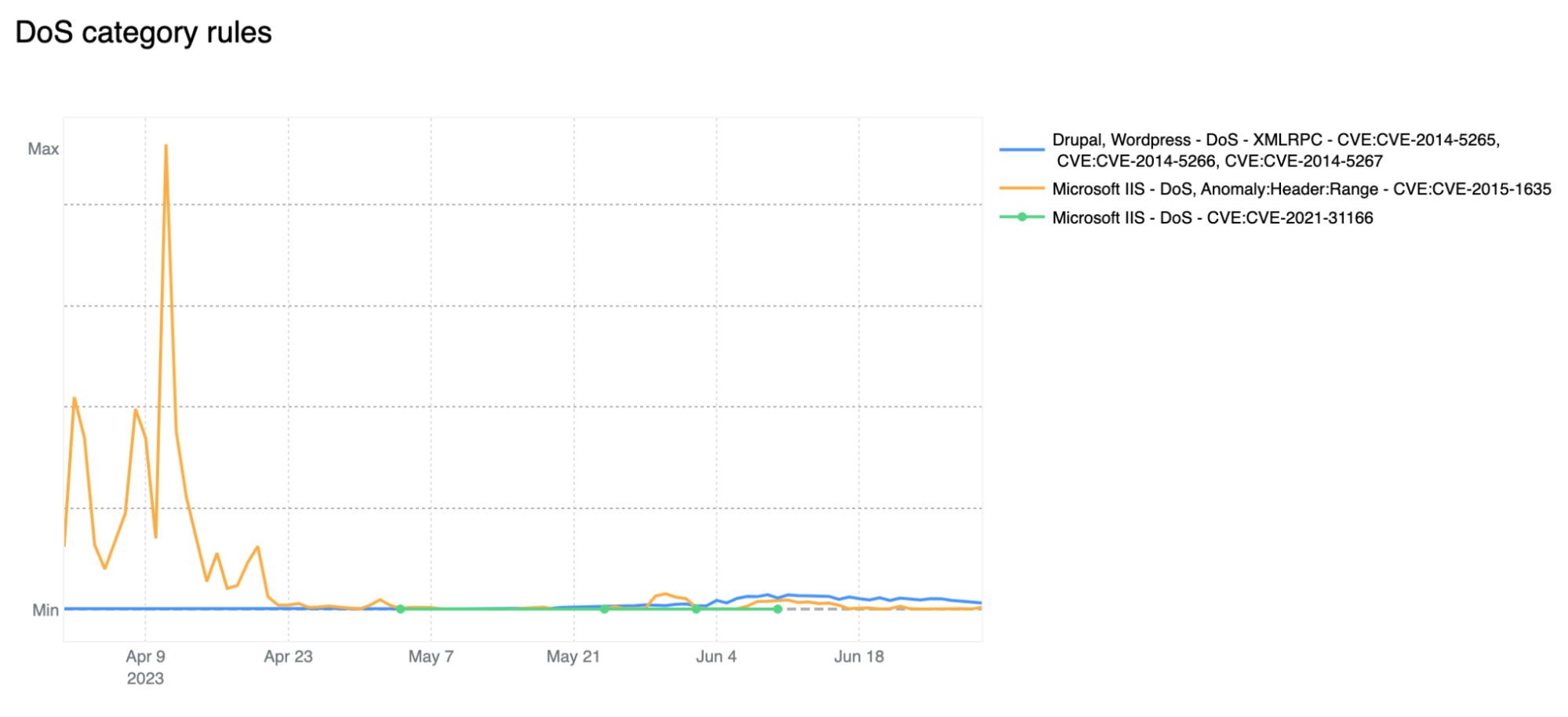
Zooming in, and filtering on the DoS category only, we find that most of the mitigated traffic is attributable to one rule: 100031 / ce02fd… (old WAF and new WAF rule ID respectively). This rule, with a description of “Microsoft IIS – DoS, Anomaly:Header:Range – CVE:CVE-2015-1635” pertains to a CVE dating back to 2015 that affected a number of Microsoft Windows components resulting in remote code execution*. This is a good reminder that old CVEs, even those dating back more than 8 years, are still actively exploited to compromise machines that may be unpatched and still running vulnerable software.
* Due to rule categorisation, some CVE specific rules are still assigned to a broader category such as DoS in this example. Rules are assigned to a CVE category only when the attack payload does not clearly overlap with another more generic category.
Another interesting observation is the increase in Broken Authentication rule matches starting in June. This increase is also attributable to a single rule deployed across all our customers, including our FREE users: “WordPress – Broken Access Control, File Inclusion”. This rule is blocking attempts to access wp-config.php – the WordPress default configuration file which is normally found in the web server document root directory, but of course should never be accessed directly via HTTP.
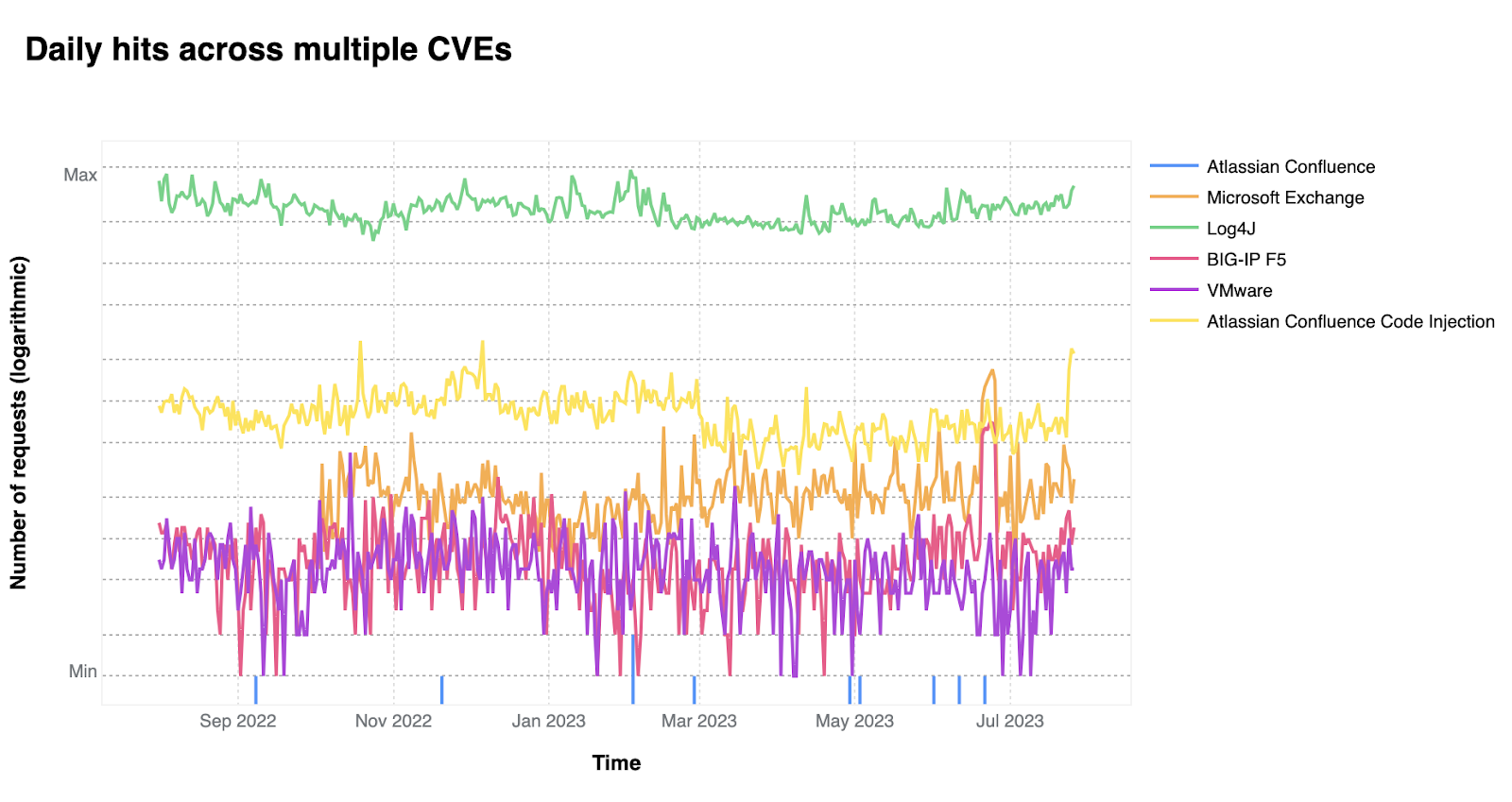
On a similar note, CISA/CSA recently published a report highlighting the 2022 Top Routinely Exploited Vulnerabilities. We took this opportunity to explore how each CVE mentioned in CISA’s report was reflected in Cloudflare’s own data. The CISA/CSA discuss 12 vulnerabilities that malicious cyber actors routinely exploited in 2022. However, based on our analysis, two CVEs mentioned in the CISA report are responsible for the vast majority of attack traffic we have seen in the wild: Log4J and Atlassian Confluence Code Injection. Our data clearly suggests a major difference in exploit volume between the top two and the rest of the list. The following chart compares the attack volume (in logarithmic scale) of the top 6 vulnerabilities of the CISA list according to our logs.
Bot traffic insights
Cloudflare’s Bot Management continues to see significant investment as the addition of JavaScript Verified URLs for greater protection against browser-based bots, Detection IDs are now available in Custom Rules for additional configurability, and an improved UI for easier onboarding. For self-serve customers, we’ve added the ability to “Skip” Super Bot Fight Mode rules and support for WordPress Loopback requests, to better integrate with our customers’ applications and give them the protection they need.
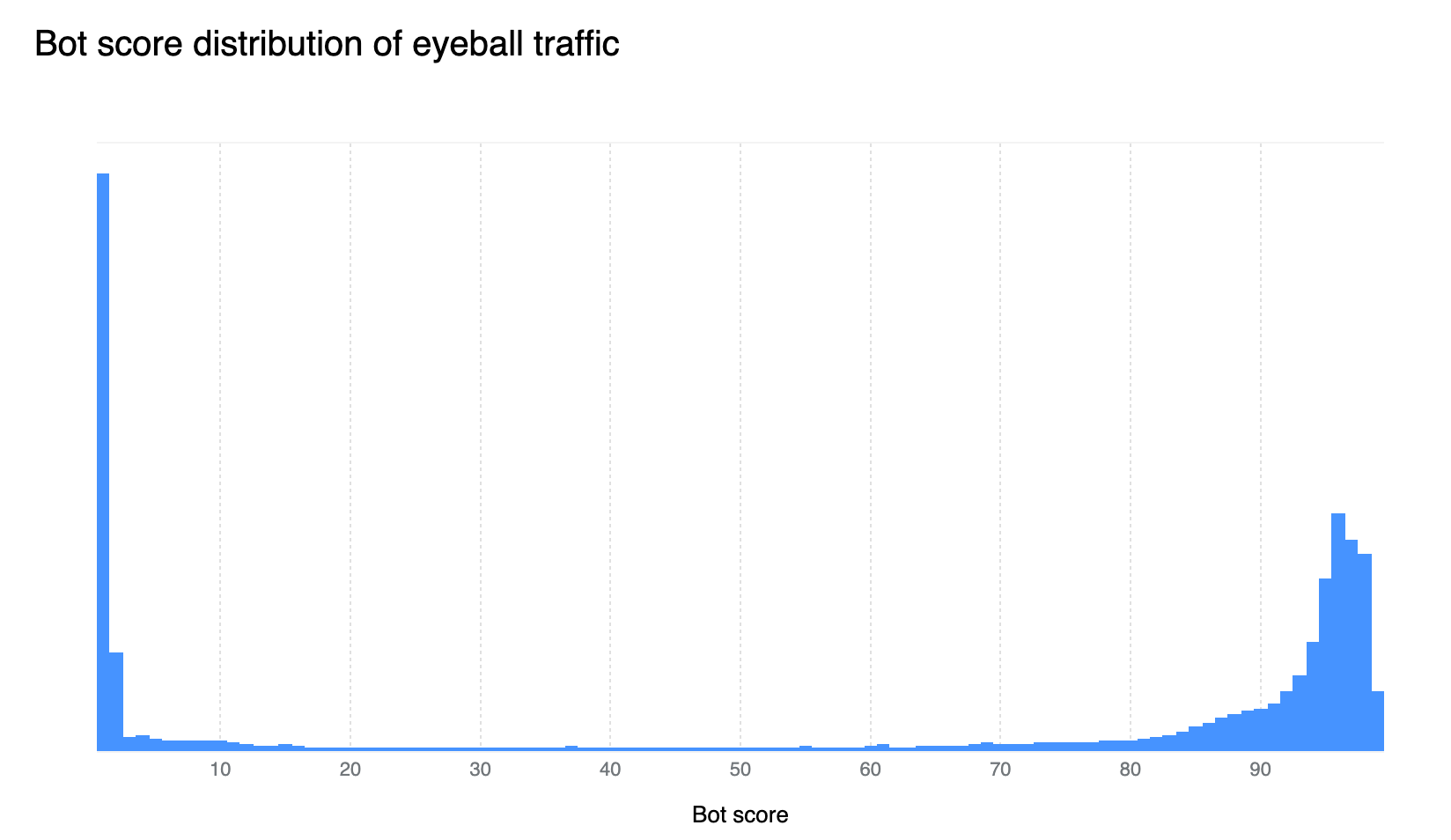
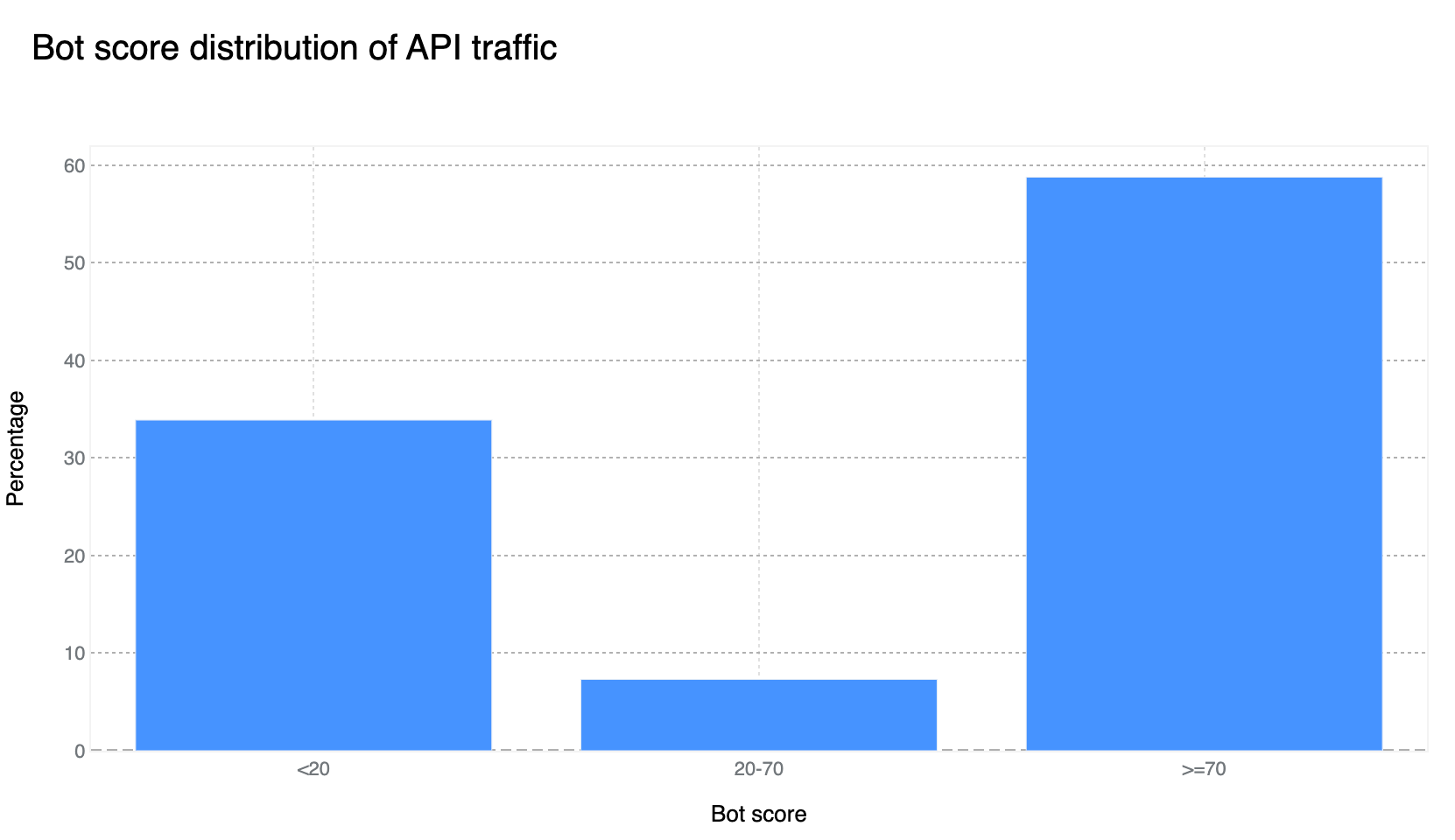
Our confidence in the Bot Management classification output remains very high. If we plot the bot scores across the analyzed time frame, we find a very clear distribution, with most requests either being classified as definitely bot (score below 30) or definitely human (score greater than 80), with most requests actually scoring less than 2 or greater than 95. This equates, over the same time period, to 33% of traffic being classified as automated (generated by a bot). Over longer time periods we do see the overall bot traffic percentage stable at 29%, and this reflects the data shown on Cloudflare Radar.
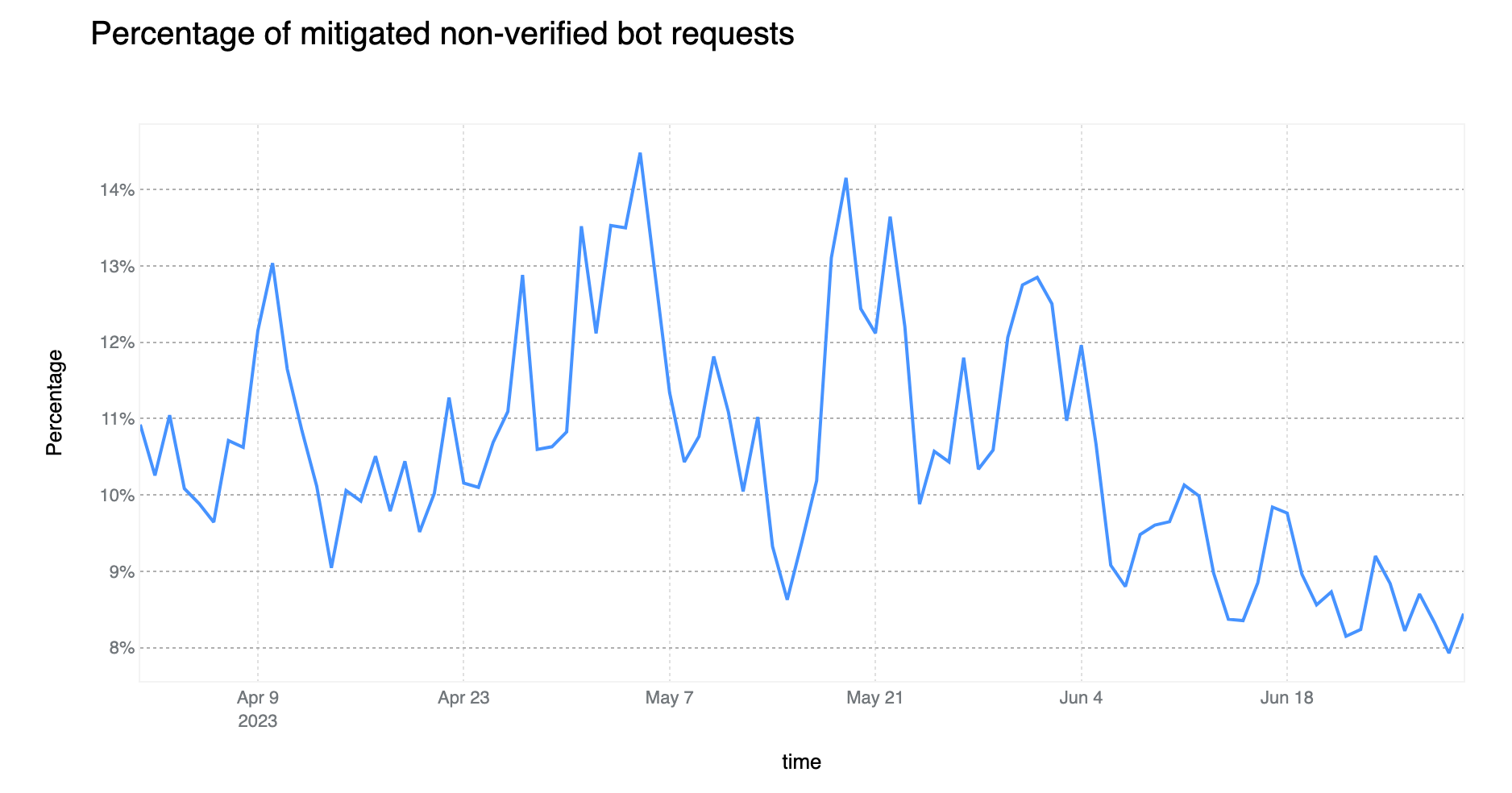
On average, more than 10% of non-verified bot traffic is mitigated
Compared to the last report, non-verified bot HTTP traffic mitigation is currently on a downward trend (down 6 percentage points). However, the Bot Management field usage within WAF Custom Rules is non negligible, standing at 11%. This means that there are more than 700k WAF Custom Rules deployed on Cloudflare that are relying on bot signals to perform some action. The most common field used is cf.client.bot, an alias to cf.bot_management.verified_bot which is powered by our list of verified bots and allows customers to make a distinction between “good” bots and potentially “malicious” non-verified ones.
Enterprise customers have access to the more powerful cf.bot_management.score which provides direct access to the score computed on each request, the same score used to generate the bot score distribution graph in the prior section.
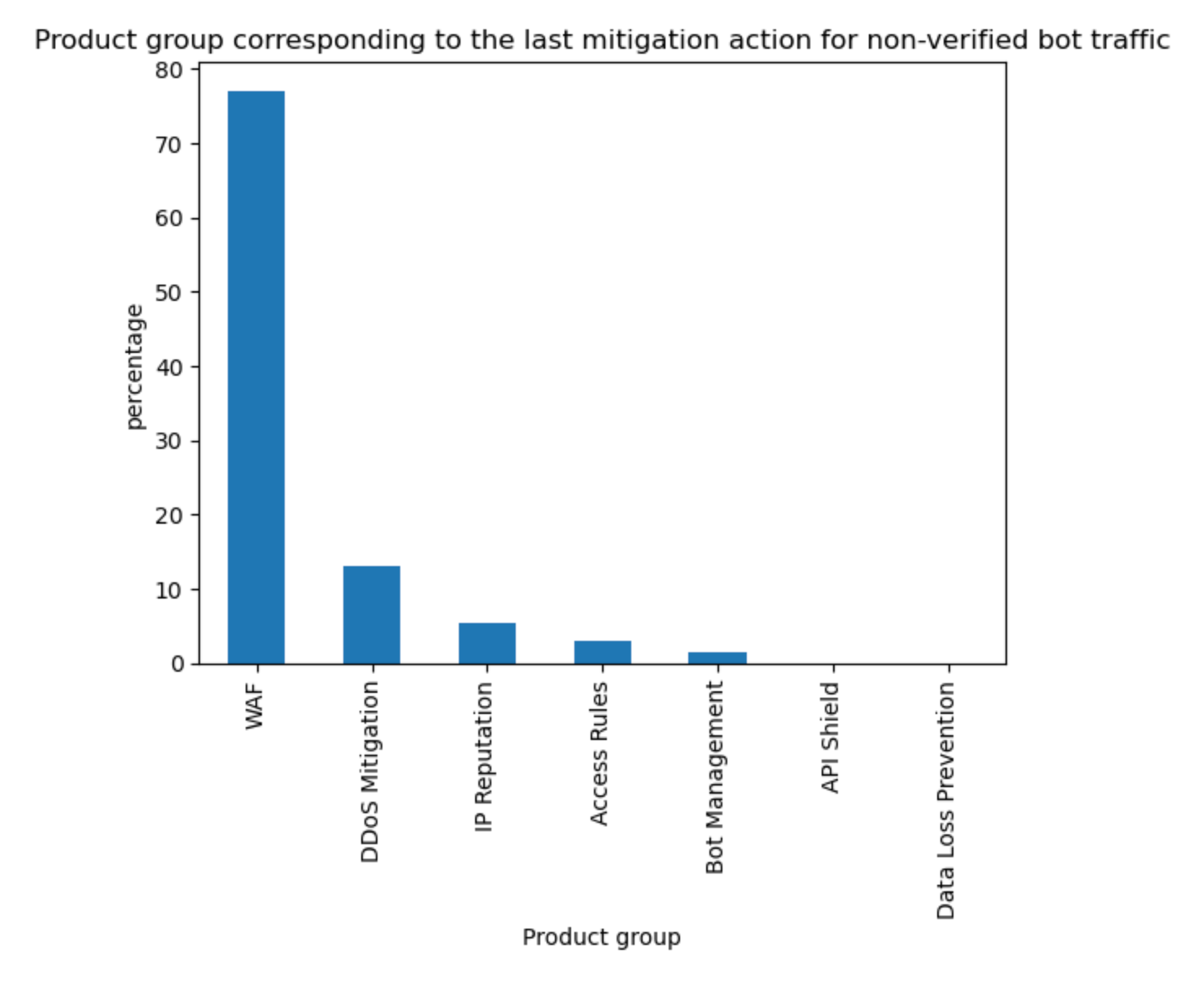
The above data is also validated by looking at what Cloudflare service is mitigating unverified bot traffic. Although our DDoS mitigation system is automatically blocking HTTP traffic across all customers, this only accounts for 13% of non-verified bot mitigations. On the other hand, WAF, and mostly customer defined rules, account for 77% of such mitigations, much higher than mitigations across all traffic (57%) discussed at the start of the report. Note that Bot Management is specifically called out but refers to our “default” one-click rules, which are counted separately from the bot fields used in WAF Custom Rules.
Tabular format for reference:
Source
Percentage %
WAF
77%
DDoS Mitigation
13%
IP reputation
5%
Access Rules
3%
Other
1%
API traffic insights
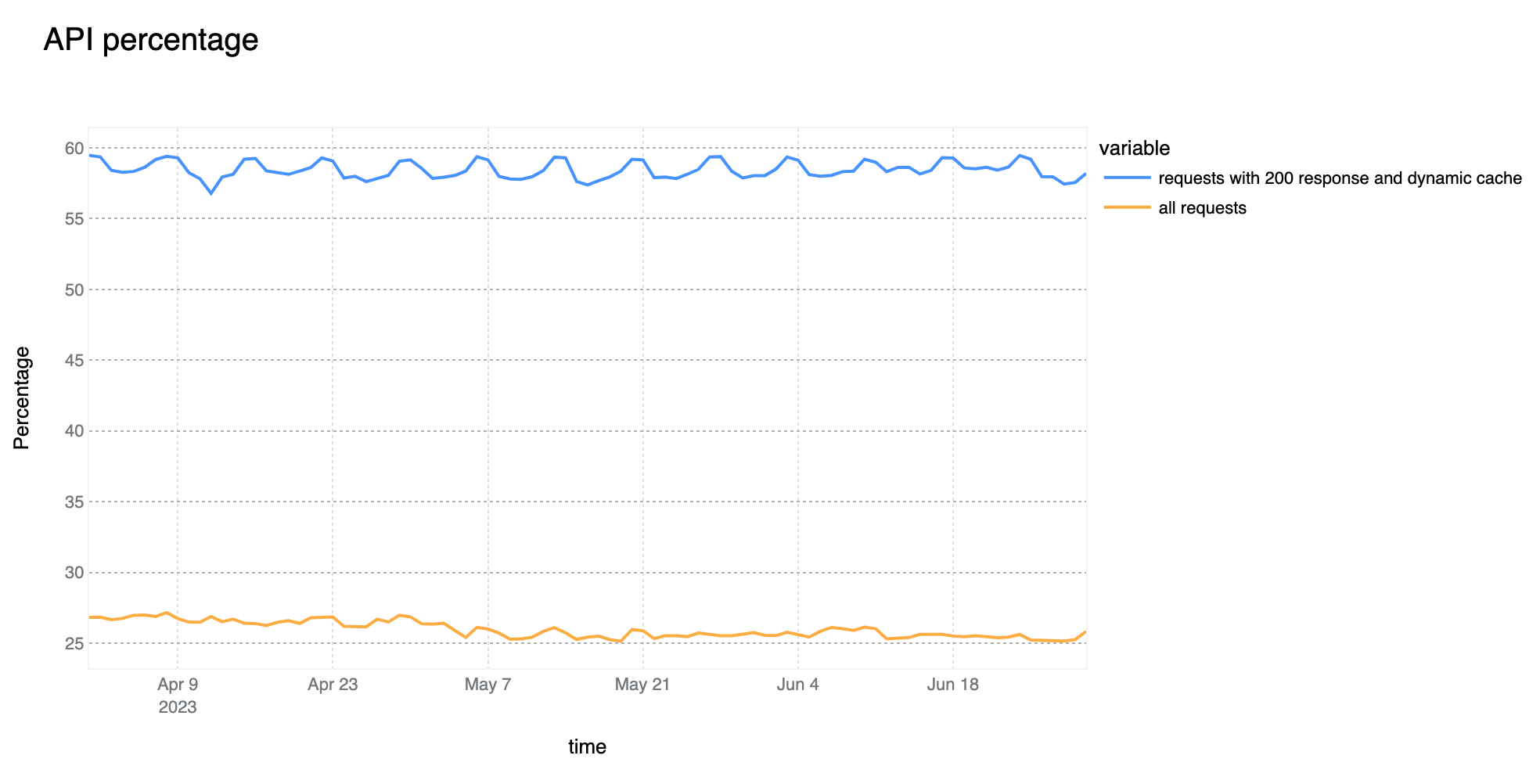
58% of dynamic (non cacheable) traffic is API related
The growth of overall API traffic observed by Cloudflare is not slowing down. Compared to last quarter, we are now seeing 58% of total dynamic traffic be classified as API related. This is a 3 percentage point increase as compared to Q1.
Our investment in API Gateway is also following a similar growth trend. Over the last quarter we have released several new API security features.
First, we’ve made API Discovery easier to use with a new inbox view. API Discovery inventories your APIs to prevent shadow IT and zombie APIs, and now customers can easily filter to show only new endpoints found by API Discovery. Saving endpoints from API Discovery places them into our Endpoint Management system.
Next, we’ve added a brand new API security feature offered only at Cloudflare: the ability to control API access by client behavior. We call it Sequence Mitigation. Customers can now create positive or negative security models based on the order of API paths accessed by clients. You can now ensure that your application’s users are the only ones accessing your API instead of brute-force attempts that ignore normal application functionality. For example, in a banking application you can now enforce that access to the funds transfer endpoint can only be accessed after a user has also accessed the account balance check endpoint.
We’re excited to continue releasing API security and API management features for the remainder of 2023 and beyond.
65% of global API traffic is generated by browsers
The percentage of API traffic generated by browsers has remained very stable over the past quarter. With this statistic, we are referring to HTTP requests that are not serving HTML based content that will be directly rendered by the browser without some preprocessing, such as those more commonly known as AJAX calls which would normally serve JSON based responses.
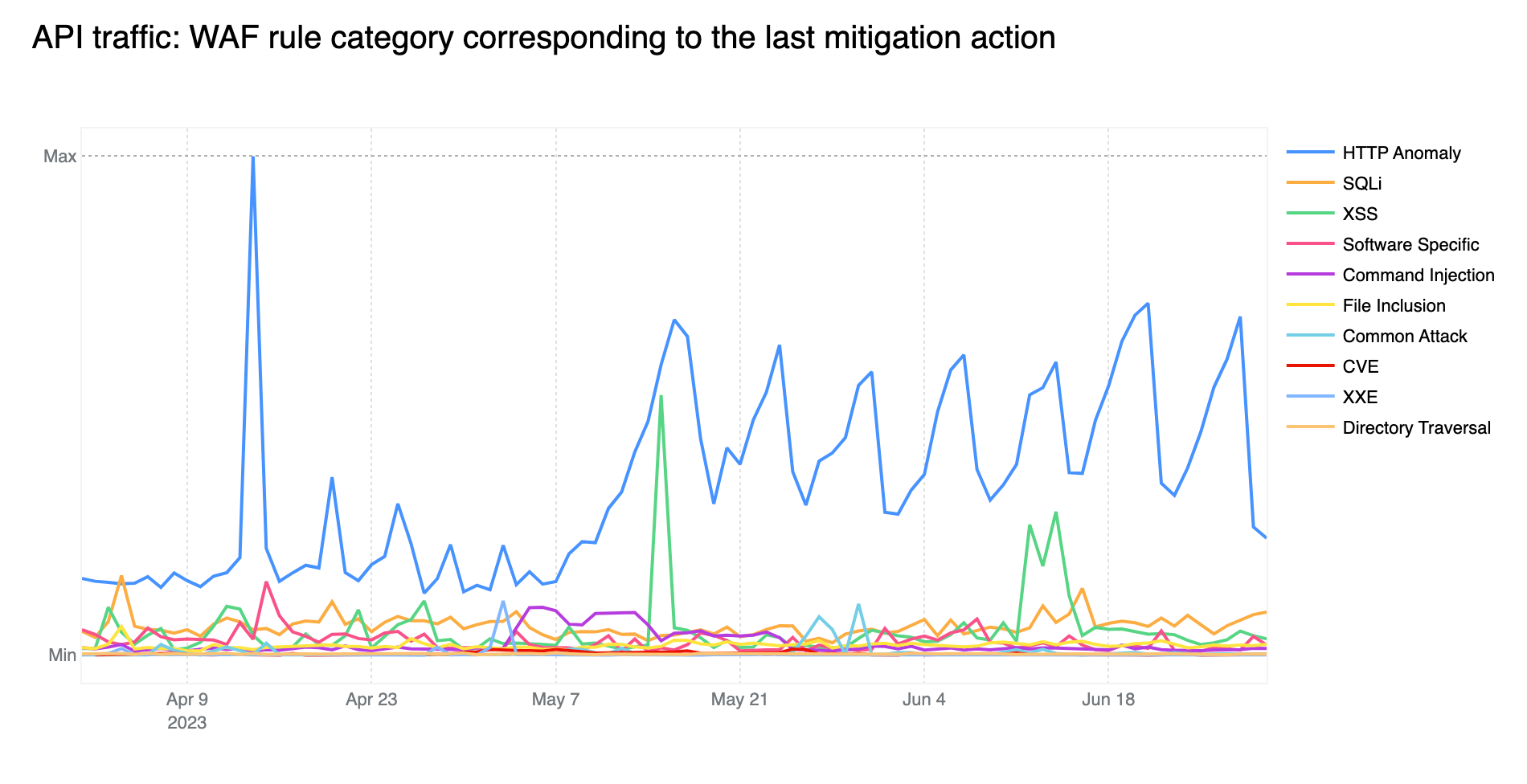
HTTP Anomalies are the most common attack vector on API endpoints
Just like last quarter, HTTP Anomalies remain the most common mitigated attack vector on API traffic. SQLi injection attacks, however, are non negligible, contributing approximately 11% towards the total mitigated traffic, closely followed by XSS attacks, at around 9%.
Tabular format for reference (top 5):
Source
Percentage %
HTTP Anomaly
64%
SQLi
11%
XSS
9%
Software Specific
5%
Command Injection
4%
Looking forward
As we move our application security report to a quarterly cadence, we plan to deepen some of the insights and to provide additional data from some of our newer products such as Page Shield, allowing us to look beyond HTTP traffic, and explore the state of third party dependencies online.
Stay tuned and keep an eye on Cloudflare Radar for more frequent application security reports and insights.
In 2023, cybersecurity continues to be in most cases a need-to-have for those who don’t want to take chances on getting caught in a cyberattack and its consequences. Attacks have gotten more sophisticated, while conflicts (online and offline, and at the same time) continue, including in Ukraine. Governments have heightened their cyber warnings and put together strategies, including around critical infrastructure (including health and education). All of this, at a time when there were never so many online risks, but also people online — over five billion in July 2023, 64.5% of the now eight billion that are the world’s total population.
Here we take a look at what we’ve been discussing in 2023, so far, in our Cloudflare blog related to attacks and online security in general, with several August reading list suggestions. From new trends, products, initiatives or partnerships, including AI service safety, to record-breaking blocked cyberattacks. On that note, our AI hub (ai.cloudflare.com) was just launched.
Throughout the year, Cloudflare has continued to onboard customers while they were being attacked, and we have provided protection to many others, including once.net, responsible for the 2023 Eurovision Song Contest online voting system — the European event reached 162 million people.
Our global network — a.k.a. Supercloud — gives us a unique vantage point. Cloudflare’s extensive scale also helps enhance security, with preventive services powered by machine learning, like our recent WAF attack scoring system to stop attacks before they become known or even malware.
Recently, we announced our presence in more than 300 cities across over 100 countries, with interconnections to over 12,000 networks and still growing. We provide services for around 20% of websites online and to millions of Internet properties.
Attacks increasing. A readiness and trust game
Let’s start with providing some context. There are all sorts of attacks, but they have been, generally speaking, increasing. In Q2 2023, Cloudflare blocked an average of 140 billion cyber threats per day. One year ago, when we wrote a similar blog post, it was 124 billion, a 13% increase year over year. Attackers are not holding back, with more sophisticated attacks rising, and sectors such as education or healthcare as the target.
Artificial intelligence (AI), like machine learning, is not new, but it has been trending in 2023, and certain capabilities are more generally available. This has raised concerns about the quality of deception and even AI hackers.
This year, governments have also continued to release reports and warnings. In 2022, the US Cybersecurity and Infrastructure Security Agency (CISA) created the Shields Up initiative in response to Russia's invasion of Ukraine. In March 2023, the Biden-Harris Administration released the National Cybersecurity Strategy aimed at securing the Internet.
That said, here are the reading suggestions related to more general country related attacks, but also policy and trust cybersecurity:
One year of war in Ukraine: Internet trends, attacks, and resilience (✍️)
This blog post reports on Internet insights during the war in Europe, and discusses how Ukraine's Internet remained resilient in spite of dozens of attacks, and disruptions in three different stages of the conflict.
Application-layer cyber attacks in Ukraine rose 1,300% in early March 2022 compared to pre-war levels.
The White House’s National Cybersecurity Strategy asks the private sector to step up to fight cyber attacks. Cloudflare is ready (✍️)
The White House released in March 2023 the National Cybersecurity Strategy aimed at preserving and extending the open, free, global, interoperable, reliable, and securing the Internet. Cloudflare welcomed the Strategy, and the much-needed policy initiative, highlighting the need of defending critical infrastructure, where Zero Trust plays a big role. In the same month, Cloudflare announced its commitment to the 2023 Summit for Democracy. Also related to these initiatives, in March 2022, we launched our very own Critical Infrastructure Defense Project (CIDP), and in December 2022, Cloudflare launched Project Safekeeping, offering Zero Trust solutions to certain eligible entities in Australia, Japan, Germany, Portugal and the United Kingdom.
Secure by default: recommendations from the CISA’s newest guide, and how Cloudflare follows these principles to keep you secure (✍️)
In this April 2023 post we reviewed the “default secure” posture, and recommendations that were the focus of a recently published guide jointly authored by several international agencies. It had US, UK, Australia, Canada, Germany, Netherlands, and New Zealand contributions. Long story short, using all sorts of tools, machine learning and a secure-by-default and by-design approach, and a few principles, will make all the difference.
Nine years of Project Galileo and how the last year has changed it (✍️) + Project Galileo Report (✍️)
Between July 1, 2022, and May 5, 2023, Cloudflare mitigated 20 billion attacks against organizations protected under Project Galileo. This is an average of nearly 67.7 million cyber attacks per day over the last 10 months.
For LGBTQ+ organizations, we saw an average of 790,000 attacks mitigated per day over the last 10 months, with a majority of those classified as DDoS attacks.
Attacks targeting civil society organizations are generally increasing. We have broken down an attack aimed at a prominent organization, with the request volume climbing as high as 667,000 requests per second. Before and after this time the organization saw little to no traffic.
In Ukraine, spikes in traffic to organizations that provide emergency response and disaster relief coincide with bombings of the country over the 10-month period.
Project Cybersafe Schools: bringing security tools for free to small K-12 school districts in the US (✍️)
Already in August 2023, Cloudflare introduced an initiative aimed at small K-12 public school districts: Project Cybersafe Schools. Announced as part of the Back to School Safely: K-12 Cybersecurity Summit at the White House on August 7, Project Cybersafe Schools will support eligible K-12 public school districts with a package of Zero Trust cybersecurity solutions — for free, and with no time limit. In Q2 2023, Cloudflare blocked an average of 70 million cyber threats each day targeting the U.S. education sector, and a 47% increase in DDoS attacks quarter-over-quarter.
Privacy concerns also go hand in hand with security online, and we’ve provided further details on this topic earlier this year in relation to our investment in security to protect data privacy. Cloudflare also achieved a new EU Cloud Code of Conduct privacy validation.
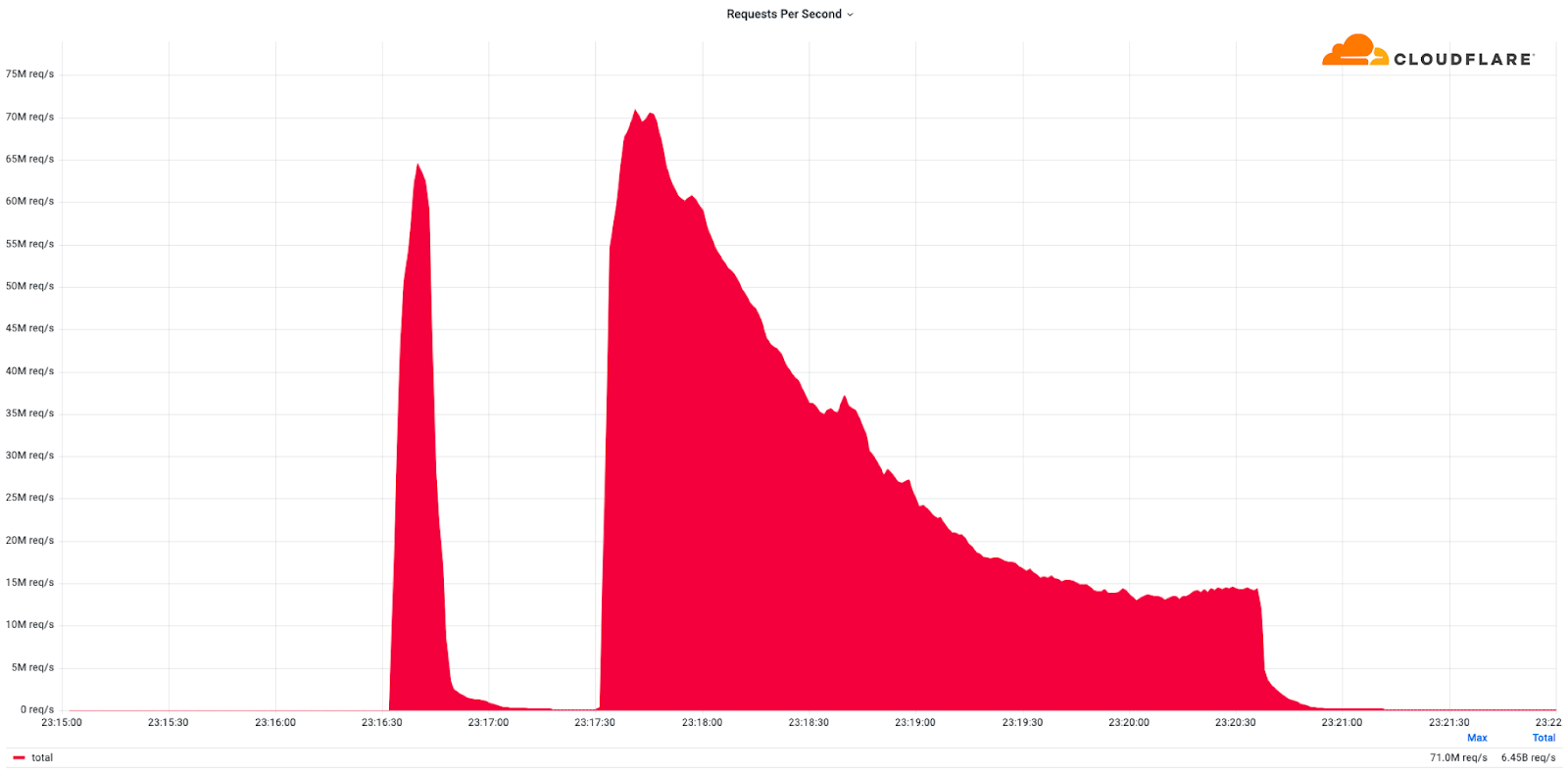
This is what a record-breaking DDoS attack (exceeding 71 million requests per second) looks like.
DDoS attacks (distributed denial-of-service) are not new, but they’re still one of the main tools used by attackers. In Q2 2023, Cloudflare witnessed an unprecedented escalation in DDoS attack sophistication, and our report delves into this phenomenon. Pro-Russian hacktivists REvil, Killnet and Anonymous Sudan joined forces to attack Western sites. Mitel vulnerability exploits surged by a whopping 532%, and attacks on crypto rocketed up by 600%. Also, more broadly, attacks exceeding three hours have increased by 103% quarter-over-quarter.
This blog post and the corresponding Cloudflare Radar report shed light on some of these trends. On the other hand, in our Q1 2023 DDoS threat report, a surge in hyper-volumetric attacks that leverage a new generation of botnets that are comprised of Virtual Private Servers (VPS) was observed.
Killnet and AnonymousSudan DDoS attack Australian university websites, and threaten more attacks — here’s what to do about it (✍️)
In late March 2023, Cloudflare observed HTTP DDoS attacks targeting university websites in Australia. Universities were the first of several groups publicly targeted by the pro-Russian hacker group Killnet and their affiliate AnonymousSudan. This post not only shows a trend with these organized groups targeted attacks but also provides specific recommendations.
In January 2023, something similar was seen with increased cyberattacks to Holocaust educational websites protected by Cloudflare’s Project Galileo.
Uptick in healthcare organizations experiencing targeted DDoS attacks (✍️)
In early February 2023, Cloudflare, as well as other sources, observed an uptick in healthcare organizations targeted by a pro-Russian hacktivist group claiming to be Killnet. There was an increase in the number of these organizations seeking our help to defend against such attacks. Additionally, healthcare organizations that were already protected by Cloudflare experienced mitigated HTTP DDoS attacks.
Cloudflare mitigates record-breaking 71 million request-per-second DDoS attack (✍️)
Also in early February, Cloudflare detected and mitigated dozens of hyper-volumetric DDoS attacks, one of those that became a record-breaking one. The majority of attacks peaked in the ballpark of 50-70 million requests per second (rps) with the largest exceeding 71Mrps. This was the largest reported HTTP DDoS attack on record to date, more than 54% higher than the previous reported record of 46M rps in June 2022.
SLP: a new DDoS amplification vector in the wild (✍️)
This blog post from April 2023 highlights how researchers have published the discovery of a new DDoS reflection/amplification attack vector leveraging the SLP protocol (Service Location Protocol). The prevalence of SLP-based DDoS attacks is also expected to rise, but our automated DDoS protection system keeps Cloudflare customers safe.
Additionally, this year, also in April, a new and improved Network Analytics dashboard was introduced, providing security professionals insights into their DDoS attack and traffic landscape.
For the second year in a row we published our Application Security Report. There’s a lot to unpack here, in a year when, according to Netcraft, Cloudflare became the most commonly used web server vendor within the top million sites (it has now a 22% market share). Here are some highlights:
6% of daily HTTP requests (proxied by the Cloudflare network) are mitigated on average. It’s down two percentage points compared to last year.
DDoS mitigation accounts for more than 50% of all mitigated traffic, so it’s still the largest contributor to mitigated layer 7 (application layer) HTTP requests.
Compared to last year, however, mitigation by the Cloudflare WAF (Web Application Firewall) has grown significantly, and now accounts for nearly 41% of mitigated requests.
HTTP Anomaly (examples include malformed method names, null byte characters in headers, etc.) is the most frequent layer 7 attack vectors mitigated by the WAF.
30% of HTTP traffic is automated (bot traffic). 55% of dynamic (non cacheable) traffic is API related. 65% of global API traffic is generated by browsers.
16% of non-verified bot HTTP traffic is mitigated.
HTTP Anomaly surpasses SQLi (code injection technique used to attack data-driven applications) as the most common attack vector on API endpoints. Brute force account takeover attacks are increasing. Also, Microsoft Exchange is attacked more than WordPress.
How Cloudflare can help stop malware before it reaches your app (✍️)
In April 2023, we made the job of application security teams easier, by providing a content scanning engine integrated with our Web Application Firewall (WAF), so that malicious files being uploaded by end users, never reach origin servers in the first place. Since September 2022, our Cloudflare WAF became smarter in helping stop attacks before they are known.
Announcing WAF Attack Score Lite and Security Analytics for business customers (✍️)
In March 2023, we announced that our machine learning empowered WAF and Security analytics view were made available to our Business plan customers, to help detect and stop attacks before they are known. In a nutshell: Early detection + Powerful mitigation = Safer Internet. Or:
Phishing remains the primary way to breach organizations. According to CISA, 90% of cyber attacks begin with it. The FBI has been publishing Internet Crime Reports, and in the most recent, phishing continues to be ranked #1 in the top five Internet crime types. Reported phishing crimes and victim losses increased by 1038% since 2018, reaching 300,497 incidents in 2022. The FBI also referred to Business Email Compromise as the $43 billion problem facing organizations, with complaints increasing by 127% in 2022, resulting in $3.31 billion in related losses, compared to 2021.
In 2022, Cloudflare Area 1 kept 2.3 billion unwanted messages out of customer inboxes. This year, that number will be easily surpassed.
In August 2023, Cloudflare published its first phishing threats report — fully available here. The report explores key phishing trends and related recommendations, based on email security data from May 2022 to May 2023.
Some takeaways include how attackers using deceptive links was the #1 phishing tactic — and how they are evolving how they get you to click and when they weaponize the link. Also, identity deception takes multiple forms (including business email compromise (BEC) and brand impersonation), and can easily bypass email authentication standards.
More than one year ago, Cloudflare acquired Area 1 Security, and with that we added to our Cloudflare Zero Trust platform an essential cloud-native email security service that identifies and blocks attacks before they hit user inboxes. This year, we’ve obtained one of the best ways to provide customers assurance that the sensitive information they send to us can be kept safe: a SOC 2 Type II report.
Email Link Isolation: your safety net for the latest phishing attacks (✍️)
Back in January, during our CIO Week, Email Link Isolation was made generally available to all our customers. What is it? A safety net for the suspicious links that end up in inboxes and that users may click — anyone can click on the wrong link by mistake. This added protection turns Cloudflare Area 1 into the most comprehensive email security solution when it comes to protecting against malware, phishing attacks, etc. Also, in true Cloudflare fashion, it’s a one-click deployment.
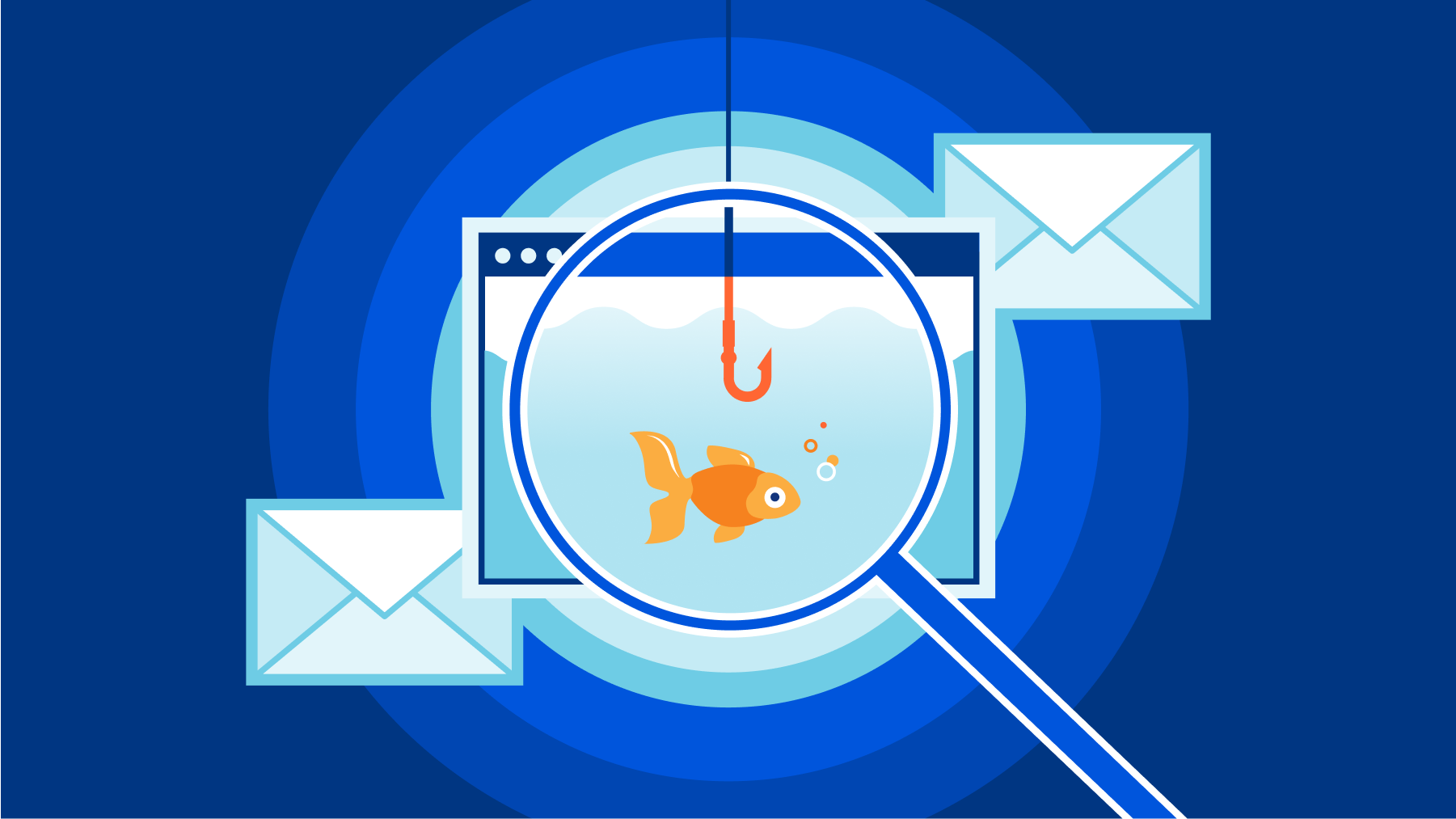
Phishing attacks come in all sorts of ways to fool people. This high level “phish” guide, goes over the different types — while email is definitely the most common, there are others —, and provides some tips to help you catch these scams before you fall for them.
Top 50 most impersonated brands in phishing attacks and new tools you can use to protect your employees from them (✍️)
Here we go over arguably one of the hardest challenges any security team is constantly facing, detecting, blocking, and mitigating the risks of phishing attacks. During our Security Week in March, a Top 50 list of the most impersonated brands in phishing attacks was presented (spoiler alert: AT&T Inc., PayPal, and Microsoft are on the podium).
Additionally, it was also announced the expansion of the phishing protections available to Cloudflare One customers by automatically identifying — and blocking — so-called “confusable” domains. What is Cloudflare One? It’s our suite of products that provides a customizable, and integrated with what a company already uses, Zero Trust network-as-a-service platform. It’s built for that already mentioned ease of mind and fearless online use. Cloudflare One, along with the use of physical security keys, was what thwarted the sophisticated “Oktapus” phishing attack targeting Cloudflare employees last summer.
Groundbreaking technology brings groundbreaking challenges. Cloudflare has experience protecting some of the largest AI applications in the world, and in this blog post there are some tips and best practices for securing generative AI applications. Success in consumer-facing applications inherently expose the underlying AI systems to millions of users, vastly increasing the potential attack surface.
Using the power of Cloudflare’s global network to detect malicious domains using machine learning (✍️)
Taking into account the objective of preventing threats before they create havoc, here we go over that Cloudflare recently developed proprietary models leveraging machine learning and other advanced analytical techniques. These are able to detect security threats that take advantage of the domain name system (DNS), known as the phonebook of the Internet.
How sophisticated scammers and phishers are preying on customers of Silicon Valley Bank (✍️)
In order to breach trust and trick unsuspecting victims, threat actors overwhelmingly use topical events as lures. The news about what happened at Silicon Valley Bank earlier this year was one of the latest events to watch out for and stay vigilant against opportunistic phishing campaigns using SVB as the lure. At that time, Cloudforce One (Cloudflare’s threat operations and research team) significantly increased our brand monitoring focused on SVB’s digital presence.
How Cloudflare can help stop malware before it reaches your app (✍️)
In April 2023, Cloudflare launched a tool to make the job of application security teams easier, by providing a content scanning engine integrated with our Web Application Firewall (WAF), so that malicious files being uploaded by end users, never reach origin servers in the first place.
Analyze any URL safely using the Cloudflare Radar URL Scanner (✍️)
Cloudflare Radar is our free platform for Internet insights. In March, our URL Scanner was launched, allowing anyone to analyze a URL safely. The report that it creates contains a myriad of technical details, including a phishing scan. Many users have been using it for security reasons, but others are just exploring what’s under-the-hood look at any webpage.
Unmasking the top exploited vulnerabilities of 2022 (✍️)
Last, but not least, already from August 2023, this blog post focuses on the most commonly exploited vulnerabilities, according to the Cybersecurity and Infrastructure Security Agency (CISA). Given Cloudflare’s role as a reverse proxy to a large portion of the Internet, we delve into how the Common Vulnerabilities and Exposures (CVEs) mentioned by CISA are being exploited on the Internet, and a bit of what has been learned.
If you want to learn about making a website more secure (and faster) while loading third-party tools like Google Analytics 4, Facebook CAPI, TikTok, and others, you can get to know our Cloudflare Zaraz solution. It reached general availability in July 2023.
Wrap up
“The Internet was not built for what it has become”.
This is how one of Cloudflare’s S-1 document sections begins. It is also commonly referenced in our blog to show how this remarkable experiment, the network of networks, wasn’t designed for the role it now plays in our daily lives and work. Security, performance and privacy are crucial in a time when anyone can be the target of an attack, threat, or vulnerability. While AI can aid in mitigating attacks, it also adds complexity to attackers' tactics.
With that in mind, as we've highlighted in this 2023 reading list suggestions/online attacks guide, prioritizing the prevention of detrimental attack outcomes remains the optimal strategy. Hopefully, it will make some of the attacks on your company go unnoticed or be consequences-free, or even transform them into interesting stories to share when you access your security dashboard.
If you're interested in exploring specific examples, you can delve into case studies within our hub, where you’ll find security related stories from different institutions. From a technology company like Sage, to the State of Arizona, or the Republic of Estonia Information Security Authority, and even Cybernews, a cybersecurity news media outlet.
And because the future of a private and secure Internet is also in our minds, it's worth mentioning that in March 2022, Cloudflare enabled post-quantum cryptography support for all our customers. The topic of post-quantum cryptography, designed to be secure against the threat of quantum computers, is quite interesting and worth some delving into, but even without knowing what it is, it’s good to know that protection is already here.
If you want to try some security features mentioned, the Cloudflare Security Center is a good place to start (free plans included). The same applies to our Zero Trust ecosystem (or Cloudflare One as our SASE, Secure Access Service Edge) that is available as self-serve, and also includes a free plan. This vendor-agnostic roadmap shows the general advantages of the Zero Trust architecture, and as we’ve seen, there’s also one focused on high risk organizations.
The new AI cyber challenge (which is being abbreviated “AIxCC”) will have a number of different phases. Interested would-be competitors can now submit their proposals to the Small Business Innovation Research program for evaluation and, eventually, selected teams will participate in a 2024 “qualifying event.” During that event, the top 20 teams will be invited to a semifinal competition at that year’s DEF CON, another large cybersecurity conference, where the field will be further whittled down.
[…]
To secure the top spot in DARPA’s new competition, participants will have to develop security solutions that do some seriously novel stuff. “To win first-place, and a top prize of $4 million, finalists must build a system that can rapidly defend critical infrastructure code from attack,” said Perri Adams, program manager for DARPA’s Information Innovation Office, during a Zoom call with reporters Tuesday. In other words: the government wants software that is capable of identifying and mitigating risks by itself.
This is a great idea. I was a big fan of DARPA’s AI capture-the-flag event in 2016, and am happy to see that DARPA is again inciting research in this area. (China has been doing this every year since 2017.)
Linus Torvalds has released the 6.5-rc7 kernel
prepatch, which looks to be the final release candidate before the likely
release of Linux 6.5 next Sunday. Torvalds released it a little earlier
than usual due to some travel; overall things look to be in good shape:
But apart from the timezone difference, everything looks entirely
normal. Drivers (GPU, networking and sound dominate – the usual
suspects, in other words) and architecture fixes. The latter are
mostly arm devicetree fixlets, but also some x86 cleanups and fallout
from the embargo last week.
Not a huge amount of patches, and I really get the feeling that a lot
of maintainers are on vacation. But I will be optimistic and also
blame it all being quiet on things working fairly well.
Measuring return-on-investement for security (information security/cybersecurity) has always been hard. This is a problem for both cybersecurity vendors and service providers as well as for CISOs, as they find it hard to convince the budget stakeholders why they need another pile of money for tool X.
Return on Security Investment (ROSI) has been discussed, including academically, for a while. But we haven’t yet found a sound methodology for it. I’m not proposing one either, but I wanted to mark some points for such a methodology that I think are important. Otherwise, decisions are often taken by “auditor said we need X” or “regulation says we need Y”. Which are decent reasons to buy something, but it makes security look like a black hole cost center. It’s certainly no profit center, but the more tangibility we add, the more likely investments are going to work.
I think the leading metric is “likelihood of critical incident”. Businesses are (rightly) concerned with this. They don’t care about the number of reconnaissance attempts, false positives ratios, MTTRs and other technical things. This likelihood, if properly calculated, can lead to a sum of money lost due to the incident (due to lack of availability, data loss, reputational cost, administrative fines, etc.). The problem is we can’t get company X and say “you are 20% likely to get hit because that’s the number for SMEs”. It’s likely that a number from a vendor presentation won’t ring true. So I think the following should be factored in the methodology:
Likelihood of incident per type – ransomware, DDoS, data breach, insider data manipulation, are all differently likely.
Likelihood of incident per industry – industries vary greatly in terms of hacker incentive. Apart from generic ransomware, other attacks are more likely to be targeted at the financial industry, for example, than the forestry industry. That’s why EU directives NIS and NIS2 prioritize some industries as more critical
Likelihood of incident per organization size or revenue – not all SMEs and not all large enterprises are the same – the number of employees and their qualification may mean increased or decreased risk; company revenue may make it stand out ontop of the target list (or at the bottom)
Likelihood of incident per team size and skill – if you have one IT guy doing printers and security, it’s more likely to get hit by a critical incident than if you have a SOC team. Sounds obvious, but it’s a spectrum, and probably one with diminishing returns, especially for SMEs
Likelihood of incident per available security products – if you have nothing installed, you are more likely to get hit. If you have a simple AV, you can the basic attacks out. If you have a firewall, a SIEM/XDR, SOAR, threat intel subscriptions, things are different. Having them, of course, doesn’t mean they are properly deployed, but the types of tools matter in the ballpark calculations
How to get that data – I’m sure someone collects it. If nobody does, governments should. Such metrics are important for security decisions and therefore for the overall security of the ecosystem.
To provide the best experiences, we use technologies like cookies to store and/or access device information. Consenting to these technologies will allow us to process data such as browsing behavior or unique IDs on this site. Not consenting or withdrawing consent, may adversely affect certain features and functions.
Functional
Always active
The technical storage or access is strictly necessary for the legitimate purpose of enabling the use of a specific service explicitly requested by the subscriber or user, or for the sole purpose of carrying out the transmission of a communication over an electronic communications network.
Preferences
The technical storage or access is necessary for the legitimate purpose of storing preferences that are not requested by the subscriber or user.
Statistics
The technical storage or access that is used exclusively for statistical purposes.The technical storage or access that is used exclusively for anonymous statistical purposes. Without a subpoena, voluntary compliance on the part of your Internet Service Provider, or additional records from a third party, information stored or retrieved for this purpose alone cannot usually be used to identify you.
Marketing
The technical storage or access is required to create user profiles to send advertising, or to track the user on a website or across several websites for similar marketing purposes.