Post Syndicated from Crosstalk Solutions original https://www.youtube.com/watch?v=2CNXEzSe1ww
Strategy 2028 update (Fedora Community Blog)
Post Syndicated from jzb original https://lwn.net/Articles/1023837/
Outgoing Fedora Project Leader Matthew Miller has posted an update
on Fedora’s high-level plan through 2028:
[Fedora] Council members identified potential Initiatives that we
believe are important to work on next. We came up with a list of
thirteen — which is way more than we can handle at once. We previously
set a limit of four Initiatives at a time. We decided to keep to that
rule, and are planning to launch four initiatives in the next months
The initiatives are: making Fedora releases block on accessibility
issues, experimenting with a “GitOps” workflow for packaging,
migrating from Pagure to Forgejo, and “making sure Fedora
“.
Linux is ready for people who want to work on machine learning and AI
development
24 Frames – Film Portrait Challenge with Hannah
Post Syndicated from Matt Granger original https://www.youtube.com/watch?v=cki_WKyICPY
[$] Two sessions on faster networking
Post Syndicated from daroc original https://lwn.net/Articles/1022648/
Cong Wang and Daniel Borkmann each led session at the 2025 Linux Storage,
Filesystem, Memory Management, and BPF Summit about their respective
plans to speed up networking in the Linux kernel. Both sessions described ways
to remove unnecessary operations in the networking stack, but they focused on
different areas. Wang spoke about using BPF to speed up socket operations,
while Borkmann spoke about eliminating the overhead of networking
operations on virtual machines.
[$] The importance of free software to science
Post Syndicated from jake original https://lwn.net/Articles/1023299/
Free software plays a critical role in science, both in research and in
disseminating it. Aspects of software freedom are directly relevant to
simulation, analysis, document preparation and preservation, security,
reproducibility, and usability. Free software brings practical and specific
advantages, beyond just its ideological roots, to science, while
proprietary software comes with equally specific risks. As a practicing
scientist, I would like to help others—scientists or not—see the benefits
from free software in science.
Marty Baron and Trump’s Bullying of the Media | The David Frum Show
Post Syndicated from The Atlantic original https://www.youtube.com/watch?v=BxoHfHmAqDU
(Не)познатият дявол на тревожността и депресията
Post Syndicated from original https://www.toest.bg/nepoznatiyat-dyavol-na-trevozhnostta-i-depresiyata/

Когато за пръв път се сблъсках с безсънието, реагирах като истински българин и не отидох на лекар, защото не смятах, че съм луд. Преди да ми се случи това нещо, което стана през не особено приятната за мен 2011 година, се отнасях доста скептично към депресията и не можех да разбера как това, че си тъжен, е болест. Подобно на мнозина смятах, че човек трябва да се стегне, да не мрънка и да търпи.
Всичко това – при положение че имам фамилна предразположеност към тази болест. Както се казва, на чужд гръб и сто тояги са малко, а докато не ти дойде до главата, не знаеш за какво става дума. Можем да продължим с българските народни глупости, но истината е, че при среща с психичното заболяване първоначално сме като
в небрано лозе
Затова и едно състояние, което може би има възможност да се овладее навреме, започва да се влошава, докато не стане хронично. Което не означава, че човек постоянно страда, но симптомите понякога се завръщат, както знаем от Стивън Кинг. Докато отида на доктор, изчерпах всички други възможности, включително да проверя дали не ми е направена магия. Поне не съм давал пари – разчитах на приятели, безплатно предлагащи ми експертността си в областта на окултното.
Междувременно взе да ми става ясно, че както казваше Дънкан Маклауд в увода на сериала „Шотландски боец“, не съм сам и има и други като мен. В новина, излязла по-рано тази година, вестник „24 часа“ ни ощастливи, че полудяваме и вече над един милион българи страдаме от тревожност. В статията с това гръмко заглавие има любопитна информация за зачестяването на психичните диагнози и обострянето на ситуацията предвид пандемията от коронавирус. Истината е, че още преди забелязах колко се чака за психиатричен преглед, та не е като да няма интерес. Помня, че когато препоръчвах лекарката, оправила положението при мен, на други мои закъсали приятели, майка ми каза, че това не е ресторант, та да го споделям наляво и надясно. Аз обаче смятам, че отърваването ми от активните симптоми на генерализираната тревожност, каквато се оказа моята диагноза, ме оставя с известен дълг да говоря по въпроса. Вече съм изгубил броя на приятелите, търсещи ме за съвет, след като разберат, че съм преживял такова нещо, и не считам за позорно да споделям.
Тези заболявания бележат ръст не само в България, но и по целия свят
Донякъде е заради стресовия живот, който водим, донякъде обаче е и защото вече започваме да говорим по-свободно за тези проблеми, без страх, че ще ни осъдят. Започва да се разбира, че да кажеш на някого с психично страдание „да се стегне“ е като да очакваш някой с навехнат крак смело да стъпи върху него.
В този текст ще обърна внимание на „по-леките“ състояния, които все още се приемат за „лигавщини“ – тревожност, депресия, безсъние, обсесивно-компулсивно разстройство, панически атаки. Те сериозно влошават качеството на живот и изискват, освен посещение при специалист, и по-спокойно говорене за тях. Най-малкото е добре страдащият да не получава подигравки. Искам да дам няколко практически съвета и добри примери какво да се прави при среща с тези болести. Със сигурност не е добра идея да се ходи на врачка, да се леят куршуми, да се викат духове и т.н. Молитвата, която духовниците препоръчват, може да помогне, но не и да замени квалифицираната помощ.
И така, първо. Ако се случи на вас
Най-важното, което трябва да се знае, е, че тревожността по принцип е нормална и дори полезна реакция, мобилизираща човека да се справи с трудна ситуация. Подобно е и с тъгата – при загуба на близък, раздяла с любим човек, разваляне на старо приятелство е напълно нормално да си потиснат. Проблем има, когато не можеш да изключиш от този режим, а тревожността и депресията са толкова силни, че пречат на ежедневните ти дейности. Безсънието например те оставя изтощен и отчаян, неспособен да се справиш със служебните ангажименти и да си пълноценен в общуването с близките. Паническата атака също е разтърсваща и преживелият я става боязлив и притеснен. Познавам човек, който ми призна, че навремето е смятал оплакванията ми от депресия за несериозни, но рязко променил мнението си за психическите заболявания, когато преживял паническа атака. „Помислих, че ще пукна“, сподели той с мен твърде живописно, макар и лаконично.
В такива моменти всякакви съвети трудно достигат до човека, но е важно да се знаят две основни неща. Въпреки клишето за лудите, няма нещо ненормално да имаш подобни оплаквания. Вижте заглавието на „24 часа“ – над милион сме! Ако се обединим в партия, може да победим и евентуалната бъдеща формация на Румен Радев. Шегата настрана, не бива да се притеснявате, че това, което става с вас, е срамно. Нито е безнадеждно, както и да изглежда в момента. Днес медицината е доста напреднала и ако хапчетата от романите на Агата Кристи действително са били изключително опасни и смъртоносни (в книгите ѝ героите взимат барбитурати, днес ползвани главно за анестезия и лечение на епилепсия), в наши дни медикаментите, ако изобщо се стигне до тях, са по-щадящи. Въпреки това човек не бива да се самолекува, а да намери специалист, на когото да се довери. Какъв да е той, според мен е индивидуално. Аз лично имам нужда от някой по-внимателен и прощаващ, при други хора по-добре действа някой по-строг. Добрият психолог или психиатър обаче е подготвен да прецени какъв подход е правилният за вас.
В обобщение, да имате такава болест нито е срамно, нито е необичайно. Тя може да се преодолее, но с подходящата помощ. Не е речено при първата безсънна нощ да хукнете по специалисти, но ако видите, че положението се влошава, не отлагайте.
Второ. Ако се случи на близък
Това е доста по-сложно, макар грижата за друг човек да е силно мотивираща. Най-важното е да успеете да видите, че нещо не е наред. Рискови групи са почти всички, но специално внимание заслужават младите хора, при които тези болести обикновено започват да се проявяват със симптоми, често обяснявани с пубертета: загуба на интерес към любими дейности, занемаряване на външния вид, влошаване на успеха в училище. Понякога зад тях се крие нещо по-лошо. За мен особено рискова група са мъжете, тъй като те не са свикнали да споделят за такива проблеми. При тях те могат да се проявят нетипично (с гняв), а също и да завършат трагично – макар да опитват по-рядко самоубийства, при мъжете обикновено тези опити са ефективни.
Най-важното е човек да бъде изслушан, без да бъде осъждан и укоряван. Да не се дават празни и банални съвети, като това да „мисли позитивно“, а по-скоро да се изрази разбиране („Това, което преживяваш, е наистина ужасно, съчувствам най-искрено“). Да не се внушава чувство за вина („Празник е, а ти разваляш настроението на всички“). Да бъде насочен към специализирана помощ с акцент, че така може да получи облекчение на страданията си.
Важно е, когато помагате на друг, да не пренебрегвате напълно себе си и своите нужди. Нито вие, нито обектът на грижите ви ще спечели, ако също се поболеете. Не се чувствайте гузни, ако си открадвате време да прекарате добре, на кафе с приятели или на кино. Това даже е задължително. Животът не е и не бива да бъде само страдание.
Трето. Какво да правим като общество
Това е въпросът за един милион лева (или половин милион евро, живот и здраве от догодина). Истината е, че човечеството като цяло сравнително отскоро започва да се запознава с природата на тези заболявания, да развива клонове от фармакологията, заделени за тях, да създава методи за подкрепа, разбиране и справяне с проблема. Най-важното е за тези състояния да не се мълчи, защото те засягат голям брой хора, които остават с впечатлението, че са черни овце и са оставени сами с мъката си, която никой не разбира. Затова е много важно, че известни хора като актьора Даниел Радклиф или пилота от Формула 1 Ландо Норис говорят по темата за психичното здраве открито, като признават уязвимостта си. Така те могат да помогнат на свои фенове също да бъдат по-честни.
В България все още сме по-назад, но напоследък нещата се променят, за което свидетелства и появата на сериал като „Тревожност“ по-рано тази година.
За повече чуваемост може да се предприемат няколко стъпки
Първо, от страна на медиите. Необходимо е да се отделя повече време за този проблем. Май е обявен за месец на хората с психически проблеми, но не получава и една десета от вниманието към юни, който е за правата на ЛГБТ хората. Това не е критика към вторите, още повече че те също са в рисковите групи на „празнуващите“ през май, а по-скоро че няма внимание към първите. Повече статии, повече добронамерени материали са необходими, по възможност без крещящи заглавия като онова, че полудяваме дружно.
Второ, от страна на образователната система. Тук е добре по някакъв начин децата да научат, че тези състояния съществуват, че могат да засегнат всеки, но също и че в повечето случаи могат да бъдат преодолени. Това не важи само за психическите болести – болките в кръста също са широко разпространени, но аз например го научих сравнително наскоро; преди това смятах, че в моето семейство пак сме си нещо кекави. Като цяло е добре младите хора да имат базова информация за предизвикателствата пред здравето си, в това число и психическото. Как това ще се съчетае с часовете по религия и добродетели, засега не е ясно.
Трето, от страна на работодателите. Повече разбиране за хора с такива оплаквания, повече яснота за бърнаута, който ги прави нетрудоспособни или опасни за себе си и околните. Докато следвах, научих, че по време на индустриализацията във Великобритания някакъв търговец осъществил голям пробив, когато разбрал, че работниците му – парадоксално – са по-продуктивни, когато имат повече свободно време. Стигнали ли сме нивото на този индустриалец?
Четвърто, от страна на масовата култура.
Психическите проблеми всъщност са сравнително популярен неин аспект, особено на запад. Прави се обаче честата грешка психичните заболявания да се представят като нещо чудовищно (лошия от „Тексаското клане“) или да се фетишизират като нещо привлекателно (Харли Куин и Жокера от „Отряд самоубийци“). Това не е изцяло лошо, тъй като все пак вкарва проблема в обращение, но не го представя правдиво и затруднява реалните страдащи, които едва ли са с изящно оформени тела – всъщност лекарствата за страданията им обикновено водят до качване на килограмите.
Разбира се, има и страхотни примери за сериозни драматични филми, като „Красив ум“ с Ръсел Кроу и „Солистът“ с Робърт Дауни-младши. Тях обаче не всеки ги гледа, тъй като темата не е от най-леките и приятните, а и са посветени на това, което личната ми терапевтка наричаше „голямата, страшната болест“ – шизофренията. Затова не е зле по-меките състояния да бъдат вплитани ненатрапчиво в популярни произведения, така че засягането им да не звучи дидактично, а човешки да представи проблема. Отличен пример е „Хари Потър и Орденът на феникса“, петата книга от поредицата на Дж. К. Роулинг. Макар никъде да не е посочена диагноза на главния герой, гледан от отказващи всякакво разбиране негови роднини, той проявява класически симптоми на преживяна травма, тъй като е бил свидетел на смъртта на свой съученик (Седрик) в предишната книга. Много интересни са коментарите на пораснали читатели, които споделят, че като тийнейджъри са се дразнили на гневните му изблици и на внезапната промяна на поведението му, но като възрастни изпитват съчувствие и разбиране към него.
Епичният фентъзи роман Dragon Mage от М. Л. Спенсър пък предлага историята на герой, който, подобно на самата авторка и на сина ѝ, има аутизъм. Диагнозата отново не е спомената, но вместо това са показани гледната точка на персонажа, различното му мислене, но също и уменията му по свой начин да бъде силен, да обича, да помага, да греши.
Леките психически заболявания са проблем, който е с нас, за да остане. Имаме два варианта за реакция. Единият е да си заровим главите в пясъка като щрауси и да смятаме суеверно, че ако наложим табу над темата, подобни болести няма да ни застигат. Това е магическо мислене, доказано неефективно. Затова идва вторият вариант – да започнем да говорим на тази тема спокойно, честно и смело, така че да я демистифицираме. Най-силният страх на човека, казва писателят Хауърд Лъвкрафт, е този от неизвестното. Поради тази причина, ако ние превърнем депресията и тревожностите в „познат дявол“, те ще спрат да ни притесняват толкова и ще станат напълно победим противник.
Eight stable kernels released
Security updates for Wednesday
Post Syndicated from jzb original https://lwn.net/Articles/1023793/
Security updates have been issued by AlmaLinux (git, krb5, perl-CPAN, and rsync), Debian (tcpdf), Fedora (libmodsecurity, lua-http, microcode_ctl, and nextcloud), Red Hat (osbuild-composer), SUSE (389-ds, avahi, ca-certificates-mozilla, docker, expat, freetype2, glib2, gnuplot, gnutls, golang-github-teddysun-v2ray-plugin, golang-github-v2fly-v2ray-core, govulncheck-vulndb, helm, iperf, kernel, kernel-livepatch-MICRO-6-0_Update_2, kernel-livepatch-MICRO-6-0_Update_4, krb5, libarchive, libsoup, libsoup2, libtasn1, libX11, libxml2, libxslt, orc, podman, python-Jinja2, python-requests, python3-setuptools, python310, python311, python39, rubygem-rack, sslh, SUSE Manager Client Tools, SUSE Manager Client Tools and Salt Bundle, ucode-intel, util-linux, and wget), and Ubuntu (libvpx, linux, linux-aws, linux-aws-hwe, linux-gcp, linux-gcp-4.15, linux-hwe, linux-kvm, linux-oracle, linux, linux-aws, linux-azure, linux-gcp, linux-gke, linux-gkeop, linux-ibm, linux-intel-iotg, linux-kvm, linux-lowlatency, linux-nvidia-tegra, linux-oracle, linux, linux-aws, linux-kvm, linux-aws, linux-lts-xenial, linux-aws-fips, linux-azure-fips, linux-fips, linux-gcp-fips, linux-aws-fips, linux-gcp-fips, linux-azure-fde, linux-fips, and linux-intel-iot-realtime, linux-realtime).
1942 Battle of Dutch Harbor
Post Syndicated from The History Guy: History Deserves to Be Remembered original https://www.youtube.com/watch?v=7LZavCu-Atc
The Ramifications of Ukraine’s Drone Attack
Post Syndicated from Bruce Schneier original https://www.schneier.com/blog/archives/2025/06/the-ramifications-of-ukraines-drone-attack.html
You can read the details of Operation Spiderweb elsewhere. What interests me are the implications for future warfare:
If the Ukrainians could sneak drones so close to major air bases in a police state such as Russia, what is to prevent the Chinese from doing the same with U.S. air bases? Or the Pakistanis with Indian air bases? Or the North Koreans with South Korean air bases? Militaries that thought they had secured their air bases with electrified fences and guard posts will now have to reckon with the threat from the skies posed by cheap, ubiquitous drones that can be easily modified for military use. This will necessitate a massive investment in counter-drone systems. Money spent on conventional manned weapons systems increasingly looks to be as wasted as spending on the cavalry in the 1930s.
The Atlantic makes similar points.
There’s a balance between the cost of the thing, and the cost to destroy the thing, and that balance is changing dramatically. This isn’t new, of course. Here’s an article from last year about the cost of drones versus the cost of top-of-the-line fighter jets. If $35K in drones (117 drones times an estimated $300 per drone) can destroy $7B in Russian bombers and other long-range aircraft, why would anyone build more of those planes? And we can have this discussion about ships, or tanks, or pretty much every other military vehicle. And then we can add in drone-coordinating technologies like swarming.
Clearly we need more research on remotely and automatically disabling drones.
Rapid7 Q1 2025 Incident Response Findings
Post Syndicated from Chris Boyd original https://blog.rapid7.com/2025/06/04/rapid7-q1-2025-incident-response-findings/

Rapid7’s Q1 2025 incident response data highlights several key initial access vector (IAV) trends, shares salient examples of incidents investigated by the Rapid7 Incident Response (IR) team, and digs into threat data by industry as well as some of the more commonly seen pieces of malware appearing in incident logs.
Is having no MFA solution in place still one of the most appealing vulnerabilities for threat actors? Will you see the same assortment of malware regardless of whether you work in business services or media and communications? And how big a problem could one search engine query possibly be, anyway?
The answer to that last question is “very,” as it turns out. As for the rest…
Initial access vectors
Below, we highlight the key movers and shakers for IAVs across cases investigated by Rapid7’s IR team. While you’ll notice a fairly even split among several vectors such as exposed remote desktop protocol (RDP) services and SEO poisoning, one in particular is clearly the leader of the pack where compromising organizations is concerned: stolen credentials to valid/active accounts with no multi-factor authentication (MFA) enabled.

Valid account credentials — with no MFA in place to protect the organization should they be misused — are still far and away the biggest stumbling block for organizations investigated by the Rapid7 IR team, occurring in 56% of all incidents this first quarter.
Exposed RDP services accounted for 6% of incidents as the IAV, yet they were abused by attackers more generally in 44% of incidents. This tells us that third parties remain an important consideration in an organization’s security hygiene.
Valid accounts / no MFA: Top of the class
Rapid7 regularly bangs the drum for tighter controls where valid accounts and MFA are concerned. As per the key findings, 56% of all incidents in Q1 2025 involved valid accounts / no MFA as the initial access vector. In fact, there’s been very little change since Q3 2024, and as good as no difference between the last two quarters:

Vulnerability exploitation: Cracks in the armor
Rapid7’s IR services team observed several vulnerabilities used, or likely to have been used, as an IAV in Q1 2025. CVE-2024-55591 for example, the IAV for an incident in manufacturing, is a websocket-based race condition authentication bypass affecting Fortinet’s FortiOS and FortiProxy flagship appliances. Successful exploitation results in the ability to execute arbitrary CLI console commands as the super_admin user. The CVE-2024-55591 advisory was published at the beginning of 2025, and it saw widespread exploitation in the wild.
One investigation revealed attackers using the above flaw to exploit vulnerable firewall devices and create local and administrator accounts with legitimate-looking names (e.g., references to “Admin”, “I.T.”, “Support”). This allowed access to firewall dashboards, which may have contained useful information about the devices’ users, configurations, and network traffic. Policies were created which allowed for leveraging of remote VPN services, and the almost month-long dwell time observed in similar incidents may suggest initial access broker (IAB) activity, or a possible intended progression to data exfiltration and ransomware.
Exposed RMM tooling: A path to ransomware
As noted above, 6% of IAV incidents were a result of exposed remote monitoring and management (RMM) tooling. RMMs, used to remotely manage and access devices, are often used to gain initial access, or form part of the attack chain leading to ransomware.
One investigation revealed a version of SimpleHelp vulnerable to several critical privilege escalation and remote code execution vulnerabilities, which included CVE-2024-57726, CVE-2024-57727, and CVE-2024-57728.
These CVEs target the SimpleHelp remote access solution. Exploiting CVE-2024-57727 permits an unauthenticated attacker to leak SimpleHelp “technician” password hashes. If one is cracked, the attacker can log-in as a remote-access technician. Lastly, the attacker can exploit CVE-2024-57726 and CVE-2024-57728 to elevate to SimpleHelp administrator and trigger remote code execution, respectively. CVE-2024-57727 was added to CISA KEV in February 2025.
The vulnerable RMM solution was used to gain initial access and threat actors used PowerShell to create Windows Defender exclusions, with the ultimate goal of deploying INC Ransomware on target systems.
SEO poisoning: When a quick search leads to disaster
SEO poisoning, once the scourge of search engines everywhere, may not be high on your list of priorities. However, it still has the potential to wreak havoc on a network. Here, the issue isn’t so much rogue entries in regular search results, but instead the paid sponsored ads directly above typical searches. Note how many sponsored results sit above the genuine site related to this incident:

This investigation revealed a tale of two search results, where one led to a genuine download of a tool designed to monitor virtual environments, and the other led to malware. When faced with both options, a split-second decision went with the latter and what followed was an escalating series of intrusion, data exfiltration and—eventually—ransomware.

On the same day of initial compromise, the attacker moved laterally using compromised credentials via RDP, installing several RMM tools such as AnyDesk and SplashTop. It is likely that the threat actor searched for insecurely stored password files and targeted password managers. They also attempted to modify and/or disable various security tools in order to evade detection, and create a local account to enable persistence and avoid domain-wide password resets.
An unauthorized version of WinSCP was used to exfiltrate a few hundred GB of sensitive company data from several systems, and with this mission accomplished only a few tasks remained. The first: attempting to inhibit system recovery by tampering with the Volume Shadow Copy Service (VSS), clearing event logs, deleting files, and also attempting to target primary backups for data destruction. The second: deployment of Qilin ransomware and a blackmail note instructing the victim to communicate via a TOR link lest the data be published to their leak site.
Qilin ranked 7 in our top ransomware groups of Q1 2025 for leak post frequency, racking up 111 posts from January through March. Known for double-extortion attacks across healthcare, manufacturing, and financial sectors, Qilin (who, despite their name, are known not to be Chinese speakers, but rather Russian-speaking) has also recently been seen deployed by North Korean threat actors Moonstone Sleet.
Attacker behavior observations
Bunnies everywhere: Tracking a top malware threat
BunnyLoader, the Malware as a Service (MaaS) loader possessing a wealth of capabilities including clipboard and credential theft, keylogging, and the ability to deploy additional malware, is one of the most prolific presences Rapid7 has seen this first quarter of 2025. In many cases, it’s also daisy-chained to many of the other payloads and tactics which make repeated appearances.
To really drive this message home: BunnyLoader is the most observed payload across almost every industry we focused on. Whether we’re talking manufacturing, healthcare, business services or finance, it’s typically well ahead of the rest of the pack. Here are our findings across the 5 most targeted industries of Q1:

BunnyLoader is in pole position not only for the 5 industries shown above, but across 12 of 13 industries overall, with 40% of all incidents observed involving this oft-updated malware.
Just over half of that 40% total involved a fake CAPTCHA (commonly used for the purpose of victims executing malicious code), with malicious / compromised sites appearing in a quarter of BunnyLoader cases. Rogue documents, which may be booby-trapped with malware or pave the way for potential phishing attacks, bring up the rear at just 9% of all BunnyLoader appearances recorded. First offered for sale in 2023 for a lifetime-use cost of $250, its continued development and large range of features make it an attractive proposition for rogues operating on a budget.
Targeted organizations: The manufacturing magnet
Manufacturing organizations were targeted in more than 24% of incidents the Rapid7 IR team observed, by far the most targeted industry in Q1 based on both Rapid7’s ransomware analytics and IR team observations. The chart below compares Rapid7’s industry-wide data (comprising a wide range of payloads and tactics) with ransomware leak post specific data. In both cases, manufacturing is a fair way ahead of other industries; this reflects its status as one of the most popular targets for ransomware groups over the last couple of years.
The manufacturing industry is an attack vector for nation states because it is an important component of global trade. It is also an area that has many legacy and older, operational technologies (OT). Combine unpatched legacy systems with complicated supply chains, and you have a risk that nation state actors will find an attractive target. This is especially the case when considering that many manufacturing organizations have critical contracts with governments, and attacks can cause severe disruption if they’re not speedily resolved.

Conclusion
Q1 2025 resembles a refinement of successful tactics, as opposed to brand new innovations brought to the table. Our Q1 ransomware analytics showed threat actors making streamlined tweaks to a well-oiled machine, and we find many of the same “evolution, not revolution” patterns occurring here.
This progression is particularly applicable in the case of initial access via valid accounts with no MFA protection. We expect to see no drop in popularity while businesses continue to leave easy inroads open and available to skilled (and unskilled) attackers.
In addition, the risk of severe compromise stemming from seemingly harmless online searches underscores the necessity for organizations to reexamine basic security best practices, alongside deploying robust detection and response capabilities. Businesses addressing these key areas for concern will be better equipped to defend against what should not be an inevitable slide into data exfiltration and malware deployment.
Broadcom Tomahawk 6 Launched for 1.6TbE Generation
Post Syndicated from Patrick Kennedy original https://www.servethehome.com/broadcom-tomahawk-6-launched-for-1-6tbe-generation/
Today Broadcom is launching its next-generation of switch ASICs with the Broadcom Tomahawk 6 series. This is a new 102.4Tbps switch that can handle up to 64 ports of 1.6TbE. Yes, we are now replacing the “Gigabit” with the “Terabit” Ethernet port era. The two new ASICs, the Broadcom BCM78910 and BCM78914 offer two different […]
The post Broadcom Tomahawk 6 Launched for 1.6TbE Generation appeared first on ServeTheHome.
Why kids still need to learn to code in the age of AI
Post Syndicated from Philip Colligan original https://www.raspberrypi.org/blog/why-kids-still-need-to-learn-to-code-in-the-age-of-ai/
Today we’re publishing a position paper setting out five arguments for why we think that kids still need to learn to code in the age of artificial intelligence.
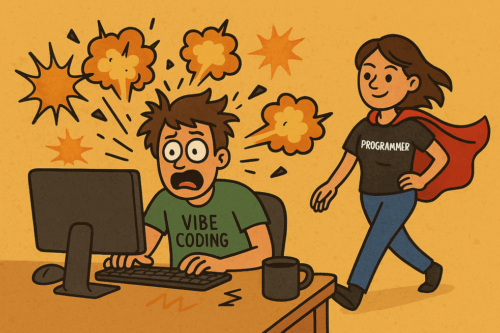
Just like every wave of technological innovation that has come before, the advances in artificial intelligence (AI) are raising profound questions about the future of human work. History teaches us that technology has the potential to both automate and augment human effort, destroying some jobs and creating new ones. The only thing we know for sure is that it is impossible to predict the precise nature and pace of the changes that are coming.
One of the fastest-moving applications of generative AI technologies are the systems that can generate code. What started as the coding equivalent of autocomplete has quickly progressed to tools that can generate increasingly complex code from natural language prompts.
This has given birth to the notion of “vibe-coding” and led some commentators to predict the end of the software development industry as we know it. It shouldn’t be a surprise then that there is a vigorous debate about whether kids still need to learn to code.
In the position paper we put forward five arguments for why we think the answer is an unequivocal yes.
We need humans who are skilled programmers
First, we argue that even in a world where AI can generate code, we need skilled human programmers who can think critically, solve problems, and make ethical decisions. The large language models that underpin these tools are probabilistic systems designed to provide statistically acceptable outputs and, as any skilled software engineer will tell you, simply writing more code faster isn’t necessarily a good thing.
Learning to code is an essential part of learning to program
Learning to code is the most effective way we know for a young person to develop the mental models and fluency to become a skilled human programmer. The hard cognitive work of reading, modifying, writing, explaining, and testing code is precisely how young people develop a deep understanding of programming and computational thinking.
Learning to code will open up even more opportunities in the age of AI
While there’s no doubt that AI is going to reshape the labour market, the evidence from history suggests that it will increase the reach of programming and computational approaches across the economy and into new domains, creating demand for humans who are skilled programmers. We also argue that coding is no longer just for software engineers, it’s becoming a core skill that enables people to work effectively and think critically in a world shaped by intelligent machines. From healthcare to agriculture, we are already seeing demand for people who can combine programming with domain-specific skills and craft knowledge.
Coding is a literacy that helps young people have agency in a digital world
Alongside the arguments for coding as a route to opening up economic opportunities, we argue that coding and programming gives young people a way to express themselves, to learn, and to make sense of the world.
And perhaps most importantly, that learning to code is about power. Providing young people with a solid grounding in computational literacy, developed through coding, helps ensure that they have agency. Without it, they risk being manipulated by systems they don’t understand. As Rushkoff said: “Program, or be programmed”.
The kids who learn to code will shape the future
Finally, we argue that the power to create with technology is already concentrated in too small and homogenous a group of people. We need to open up the opportunity to learn to code to all young people because it will help us mobilise the full potential of human talent, will lead to more inclusive and effective digital solutions to the big global challenges we face, and will help ensure that everyone can share in the societal and economic benefits of technological progress.
The work we need to do
We end the paper with a call to action for all of us working in education. We need to challenge the false narrative that AI is removing the need for kids to learn to code, and redouble our efforts to ensure that all young people are equipped to take advantage of the opportunities in a world where AI is ubiquitous.
You can read the full paper here:
The cartoon image for this blog was created using ChatGPT-4o, which was prompted to produce a “whimsical cartoon that expresses some of the key ideas in the position paper”. It took several iterations.
The post Why kids still need to learn to code in the age of AI appeared first on Raspberry Pi Foundation.
The Great Flood of 1921
Post Syndicated from The History Guy: History Deserves to Be Remembered original https://www.youtube.com/watch?v=NO8hMM6u3bQ
Comic for 2025.06.04 – Burning
Post Syndicated from Explosm.net original https://explosm.net/comics/burning
New Cyanide and Happiness Comic
How We Reduced the Impact of Zombie Clients
Post Syndicated from Let's Encrypt original https://letsencrypt.org/2025/06/04/how-we-reduced-the-impact-of-zombie-clients.html
Every night, right around midnight (mainly UTC), a horde of zombies wakes up and clamors for … digital certificates!
The zombies in question are abandoned or misconfigured Internet servers and ACME clients that have been set to request certificates from Let’s Encrypt. As our certificates last for at most 90 days, these zombie clients’ software knows that their certificates are out-of-date and need to be replaced. What they don’t realize is that their quest for new certificates is doomed! These devices are cursed to seek certificates again and again, never receiving them.
But they do use up a lot of certificate authority resources in the process.
The Zombie Client Problem
Unlike a human being, software doesn’t give up in frustration, or try to modify its approach, when it repeatedly fails at the same task. Our emphasis on automation means that the vast majority of Let’s Encrypt certificate renewals are performed by automated software. This is great when those renewals succeed, but it also means that forgotten clients and devices can continue requesting renewals unsuccessfully for months, or even years.
How might that happen? Most often, it happens when a device no longer has a domain name pointed to it. The device itself doesn’t know that this has changed, so it treats renewal failures as transient even though they are actually permanent. For instance:
- An organization may have allowed a domain name registration to lapse because it is no longer needed, but its servers are still configured to request certs for it.
- Or, a home user stopped using a particular dynamic-DNS domain with a network-attached storage device, but is still using that device at home. The device doesn’t realize that the user no longer expects to use the name, so it keeps requesting certs for it.
- Or, a web hosting or CDN customer migrated to a different service provider, but never informed the old service provider. The old service provider’s servers keep requesting certs unsuccessfully. If the customer was in a free service tier, there might not be invoices or charges reminding the customer to cancel the service.
- Or any number of other, subtler changes in a subscriber’s infrastructure, such as changing a firewall rule or some webserver configuration.
At the scale of Let’s Encrypt, which now covers hundreds of millions of names, scenarios like these have become common, and their impact has become substantial. In 2024, we noticed that about half of all certificate requests to the Let’s Encrypt ACME API came from about a million accounts that never successfully complete any validations. Many of these had completed validations and issued certificates sometime in the past, but nowadays every single one of their validation attempts fails, and they show no signs that this will change anytime soon.
Unfortunately, trying to validate those futile requests still uses resources. Our CA software has to generate challenges, reach out and attempt to validate them over the Internet, detect and report failures, and record all of the associated information in our databases and audit logs. And over time, we’ve seen more and more recurring failures: accounts that always fail their issuance requests have been growing at around 18% per year.
In January, we mentioned that we had been addressing the zombie client problem through our rate limit system. This post provides more detail on that progress.
Our Rate Limit Philosophy
If you’ve used Let’s Encrypt as a subscriber, you may have run into one of our rate limits at some point, maybe during your initial setup process. We have eight different kinds of rate limits in place now; as our January post describes, they’ve become more algorithmically sophisticated and grown to address a wider range of problems. A key principle for Let’s Encrypt is that our rate limiting is not a punishment. We don’t think of rate limits as a way of retaliating against a client for misbehavior. Rate limits are simply a tool to maximize the efficient use of our limited resources and prevent people and programs from using up those resources for no constructive purpose.
We’ve consistently tried to design our rate limit mechanisms in line with that philosophy. So if a misconfiguration or misunderstanding has caused excessive requests in the past, we’re still happy to welcome the user in question back and start issuing them certificates again—once the problem has been addressed. We want the rate limits to put a brake on wasteful use of our systems, but not to frustrate users who are actively trying to make Let’s Encrypt work for them.
In addition, we’ve always implemented our rate limits to err on the side of permissiveness. For example, if the Redis instances where rate limits are tracked have an outage or lose data, the system is designed to permit more issuance rather than less issuance as a result.
We wanted to create additional limits that would target zombie clients, but in a correspondingly non-punitive way that would avoid any disruption to valid issuance, and welcome subscribers back quickly if they happened to notice and fix a long-time problem with their setups.
Our Zombie-Related Rate Limits and Their Impact
In planning a new zombie-specific response, we decided on a “pausing” approach, which can temporarily limit an account’s ability to proceed with certificate requests. The core idea is that, if a particular account consistently fails to complete validation for a particular hostname, we’ll pause that account-hostname pair. The pause means that any new order requests from that account for that hostname will be rejected immediately, before we get to the resource-intensive validation phase.
This approach is more finely targeted than pausing an entire account. Pausing account-hostname pairs means that your ability to issue certs for a specific name could be paused due to repeated failures, but you can still get all of your other certs like normal. So a large hosting provider doesn’t have to fear that its certificate issuance on behalf of one customer will be affected by renewal failures related to a problem with a different customer’s domain name. The account-specificity of the pause, in turn, means that validation failures from one subscriber or device won’t prevent a different subscriber or device from attempting to validate the same name, as long as the devices in question don’t share a single Let’s Encrypt account.
In September 2024, we began applying our zombie rate limits manually by pausing about 21,000 of the most recurrently-failing account-hostname pairs, those which were consistently repeating the same failed requests many times per day, every day. After implementing that first round of pauses, we immediately saw a significant impact on our failed request rates. As we announced at that time, we also began using a formula to automatically pause other zombie client account-hostname pairs from December 2024 onward. The associated new rate limit is called “Consecutive Authorization Failures per Hostname Per Account” (and is independent of the existing “Authorization Failures per Hostname Per Account” limit, which resets every hour).
This formula relates to the frequency of successive failed issuance requests for the same domain name by the same Let’s Encrypt account. It applies only to failures that happen again and again, with no successful issuances at all in between: a single successful validation immediately resets the rate limit all the way to zero. Like all of our rate limits, this is not a punitive measure but is simply intended to reduce the waste of resources. So, we decided to set the thresholds rather high in the expectation that we would catch only the most disruptive zombie clients, and ultimately only those clients that were extremely unlikely to succeed in the future based on their substantial history of failed requests. We don’t hurry to block requesters as zombies: according to our current formula, client software following the default established by EFF’s Certbot (two renewal attempts per day) would be paused as a zombie only after about ten years of constant failures. More aggressive failed issuance attempts will get a client paused sooner, but clients will generally have to fail hundreds or thousands of attempts in a row before they are paused.
Most subscribers using mainstream client applications with default configurations will never encounter this rate limit, even if they forget to deactivate renewal attempts for domains that are no longer pointed at their servers. As described below, our current limit is already providing noticeable benefits with minimal disruption, and we’re likely to tighten it a bit in the near future, so it will trigger after somewhat fewer consecutive failures.
Self-Service Unpausing
A key feature in our zombie issuance pausing mechanism is self-service unpausing. Whenever an account-hostname pair is paused, any new certificate requests for that hostname submitted by that account are immediately rejected. But this means that the “one successful validation immediately resets the rate limit counter” feature can no longer come into effect: once they’re paused, they can’t even attempt validation anymore.
So every rejection comes with an error message explaining what has happened and a custom link that can be used to immediately unpause that account-hostname pair and remove any other pauses on the same account at the same time. The point of this is that subscribers who notice at some point that issuance is failing and want to intervene to get it working again have a straightforward option to let Let’s Encrypt know that they’re aware of the recurring failures and are still planning to use a particular account. As soon as subscribers notify us via the self-service link, they’ll be able to issue certificates again.
Currently, the user interface for an affected subscriber looks like this:
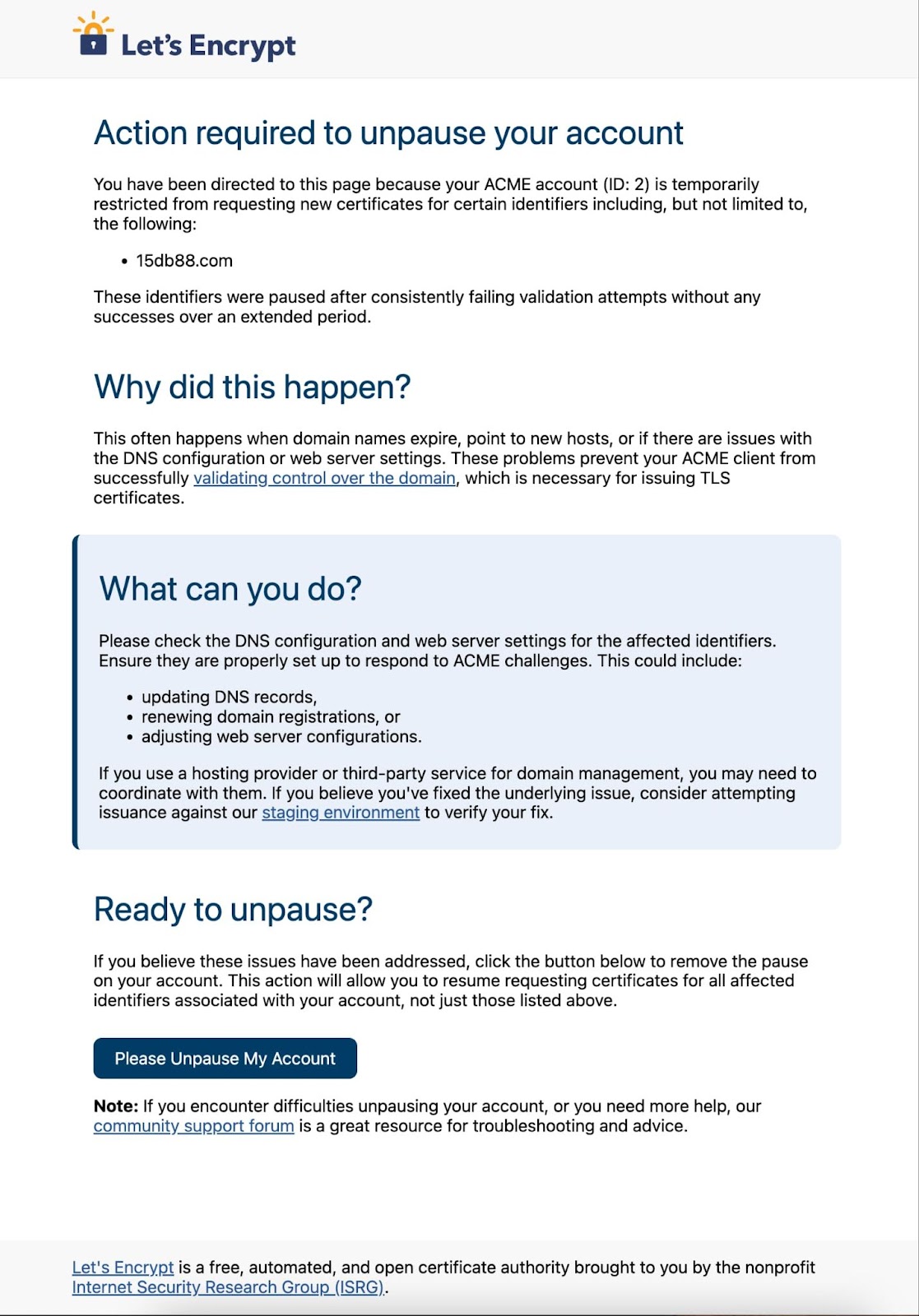
This link would be provided via an ACME error message in response to any request that was blocked due to a pause account-hostname pair.
As it’s turned out, the unpause option shown above has only been used by about 3% of affected accounts! This goes to show that most of the zombies we’ve paused were, in fact, well and truly forgotten about.
However, the unpause feature is there for whenever it’s needed, and there may be cases when it will become more important. A very large integration could trigger the zombie-related rate limits if a newly-introduced software bug causes what looks like a very high volume of zombie requests in a very short time. In that case, once that bug has been noticed and fixed, an integrator may need to unpause its issuance on behalf of lots of customers at once. Our unpause feature permits unpausing 50,000 domain names on a single account at a time, so even the largest integrators can get themselves unpaused expeditiously in this situation.
Conclusion
We’ve been very happy with the results of our zombie mitigation measures, and, as far as we can tell, there’s been almost no impact for subscribers! Our statistics indicate that we’ve managed to reduce the load on our infrastructure while causing no detectable harm or inconvenience to subscribers’ valid issuance requests.
Since implementing the manual pauses in September and the automated pauses in December, we’ve seen:
- Over 100,000 account-hostname pairs have been paused for excessive failures.
- We received zero (!) associated complaints or support requests.
- About 3,200 people manually unpaused issuance.
- Failed certificate orders fell by about 30% so far, and should continue to fall over time as we fine-tune the rate limit formula and catch more zombie clients.
The new rate limit and the self-service unpause system are also ready to deal with circumstances that might produce more zombie clients in the future. For instance, we’ve announced that we’re going to be discontinuing renewal reminder emails soon. If some subscribers overlook failed renewals in the future, we might see more paused clients that result from unintentional renewal failures. We think taking advantage of the existing self-service unpause feature will be straightforward in that case. But it’s much better to notice problems and get them fixed up front, so please remember to set up your own monitoring to avoid unnoticed renewal failures in the future.
If you’re a subscriber who’s had occasion to use the self-service unpause feature, we’d love your feedback on the Community Forum about your experience using the feature and the circumstances that surrounded your account’s getting paused.
Also, if you’re a Let’s Encrypt client developer, please remember to make renewal requests at a random time (not precisely at midnight) so that the load on our infrastructure is smoothed out. You can also reduce the impact of zombie renewals by repeating failed requests somewhat less frequently over time (a “back-off” strategy), especially if the failure reason makes it look like a domain name may no longer be in use at all.
Trojan Horse
Post Syndicated from xkcd.com original https://xkcd.com/3098/
How We Reduced the Impact of Zombie Clients
Post Syndicated from Let's Encrypt original https://letsencrypt.org/2025/06/04/how-we-reduced-the-impact-of-zombie-clients/
Every night, right around midnight (mainly UTC), a horde of zombies wakes up and clamors for … digital certificates!
The zombies in question are abandoned or misconfigured Internet servers and ACME clients that have been set to request certificates from Let’s Encrypt. As our certificates last for at most 90 days, these zombie clients’ software knows that their certificates are out-of-date and need to be replaced. What they don’t realize is that their quest for new certificates is doomed! These devices are cursed to seek certificates again and again, never receiving them.
But they do use up a lot of certificate authority resources in the process.
The Zombie Client Problem
Unlike a human being, software doesn’t give up in frustration, or try to modify its approach, when it repeatedly fails at the same task. Our emphasis on automation means that the vast majority of Let’s Encrypt certificate renewals are performed by automated software. This is great when those renewals succeed, but it also means that forgotten clients and devices can continue requesting renewals unsuccessfully for months, or even years.
How might that happen? Most often, it happens when a device no longer has a domain name pointed to it. The device itself doesn’t know that this has changed, so it treats renewal failures as transient even though they are actually permanent. For instance:
- An organization may have allowed a domain name registration to lapse because it is no longer needed, but its servers are still configured to request certs for it.
- Or, a home user stopped using a particular dynamic-DNS domain with a network-attached storage device, but is still using that device at home. The device doesn’t realize that the user no longer expects to use the name, so it keeps requesting certs for it.
- Or, a web hosting or CDN customer migrated to a different service provider, but never informed the old service provider. The old service provider’s servers keep requesting certs unsuccessfully. If the customer was in a free service tier, there might not be invoices or charges reminding the customer to cancel the service.
- Or any number of other, subtler changes in a subscriber’s infrastructure, such as changing a firewall rule or some webserver configuration.
At the scale of Let’s Encrypt, which now covers hundreds of millions of names, scenarios like these have become common, and their impact has become substantial. In 2024, we noticed that about half of all certificate requests to the Let’s Encrypt ACME API came from about a million accounts that never successfully complete any validations. Many of these had completed validations and issued certificates sometime in the past, but nowadays every single one of their validation attempts fails, and they show no signs that this will change anytime soon.
Unfortunately, trying to validate those futile requests still uses resources. Our CA software has to generate challenges, reach out and attempt to validate them over the Internet, detect and report failures, and record all of the associated information in our databases and audit logs. And over time, we’ve seen more and more recurring failures: accounts that always fail their issuance requests have been growing at around 18% per year.
In January, we mentioned that we had been addressing the zombie client problem through our rate limit system. This post provides more detail on that progress.
Our Rate Limit Philosophy
If you’ve used Let’s Encrypt as a subscriber, you may have run into one of our rate limits at some point, maybe during your initial setup process. We have eight different kinds of rate limits in place now; as our January post describes, they’ve become more algorithmically sophisticated and grown to address a wider range of problems. A key principle for Let’s Encrypt is that our rate limiting is not a punishment. We don’t think of rate limits as a way of retaliating against a client for misbehavior. Rate limits are simply a tool to maximize the efficient use of our limited resources and prevent people and programs from using up those resources for no constructive purpose.
We’ve consistently tried to design our rate limit mechanisms in line with that philosophy. So if a misconfiguration or misunderstanding has caused excessive requests in the past, we’re still happy to welcome the user in question back and start issuing them certificates again—once the problem has been addressed. We want the rate limits to put a brake on wasteful use of our systems, but not to frustrate users who are actively trying to make Let’s Encrypt work for them.
In addition, we’ve always implemented our rate limits to err on the side of permissiveness. For example, if the Redis instances where rate limits are tracked have an outage or lose data, the system is designed to permit more issuance rather than less issuance as a result.
We wanted to create additional limits that would target zombie clients, but in a correspondingly non-punitive way that would avoid any disruption to valid issuance, and welcome subscribers back quickly if they happened to notice and fix a long-time problem with their setups.
Our Zombie-Related Rate Limits and Their Impact
In planning a new zombie-specific response, we decided on a “pausing” approach, which can temporarily limit an account’s ability to proceed with certificate requests. The core idea is that, if a particular account consistently fails to complete validation for a particular hostname, we’ll pause that account-hostname pair. The pause means that any new order requests from that account for that hostname will be rejected immediately, before we get to the resource-intensive validation phase.
This approach is more finely targeted than pausing an entire account. Pausing account-hostname pairs means that your ability to issue certs for a specific name could be paused due to repeated failures, but you can still get all of your other certs like normal. So a large hosting provider doesn’t have to fear that its certificate issuance on behalf of one customer will be affected by renewal failures related to a problem with a different customer’s domain name. The account-specificity of the pause, in turn, means that validation failures from one subscriber or device won’t prevent a different subscriber or device from attempting to validate the same name, as long as the devices in question don’t share a single Let’s Encrypt account.
In September 2024, we began applying our zombie rate limits manually by pausing about 21,000 of the most recurrently-failing account-hostname pairs, those which were consistently repeating the same failed requests many times per day, every day. After implementing that first round of pauses, we immediately saw a significant impact on our failed request rates. As we announced at that time, we also began using a formula to automatically pause other zombie client account-hostname pairs from December 2024 onward. The associated new rate limit is called “Consecutive Authorization Failures per Hostname Per Account” (and is independent of the existing “Authorization Failures per Hostname Per Account” limit, which resets every hour).
This formula relates to the frequency of successive failed issuance requests for the same domain name by the same Let’s Encrypt account. It applies only to failures that happen again and again, with no successful issuances at all in between: a single successful validation immediately resets the rate limit all the way to zero. Like all of our rate limits, this is not a punitive measure but is simply intended to reduce the waste of resources. So, we decided to set the thresholds rather high in the expectation that we would catch only the most disruptive zombie clients, and ultimately only those clients that were extremely unlikely to succeed in the future based on their substantial history of failed requests. We don’t hurry to block requesters as zombies: according to our current formula, client software following the default established by EFF’s Certbot (two renewal attempts per day) would be paused as a zombie only after about ten years of constant failures. More aggressive failed issuance attempts will get a client paused sooner, but clients will generally have to fail hundreds or thousands of attempts in a row before they are paused.
Most subscribers using mainstream client applications with default configurations will never encounter this rate limit, even if they forget to deactivate renewal attempts for domains that are no longer pointed at their servers. As described below, our current limit is already providing noticeable benefits with minimal disruption, and we’re likely to tighten it a bit in the near future, so it will trigger after somewhat fewer consecutive failures.
Self-Service Unpausing
A key feature in our zombie issuance pausing mechanism is self-service unpausing. Whenever an account-hostname pair is paused, any new certificate requests for that hostname submitted by that account are immediately rejected. But this means that the “one successful validation immediately resets the rate limit counter” feature can no longer come into effect: once they’re paused, they can’t even attempt validation anymore.
So every rejection comes with an error message explaining what has happened and a custom link that can be used to immediately unpause that account-hostname pair and remove any other pauses on the same account at the same time. The point of this is that subscribers who notice at some point that issuance is failing and want to intervene to get it working again have a straightforward option to let Let’s Encrypt know that they’re aware of the recurring failures and are still planning to use a particular account. As soon as subscribers notify us via the self-service link, they’ll be able to issue certificates again.
Currently, the user interface for an affected subscriber looks like this:
This link would be provided via an ACME error message in response to any request that was blocked due to a pause account-hostname pair.
As it’s turned out, the unpause option shown above has only been used by about 3% of affected accounts! This goes to show that most of the zombies we’ve paused were, in fact, well and truly forgotten about.
However, the unpause feature is there for whenever it’s needed, and there may be cases when it will become more important. A very large integration could trigger the zombie-related rate limits if a newly-introduced software bug causes what looks like a very high volume of zombie requests in a very short time. In that case, once that bug has been noticed and fixed, an integrator may need to unpause its issuance on behalf of lots of customers at once. Our unpause feature permits unpausing 50,000 domain names on a single account at a time, so even the largest integrators can get themselves unpaused expeditiously in this situation.
Conclusion
We’ve been very happy with the results of our zombie mitigation measures, and, as far as we can tell, there’s been almost no impact for subscribers! Our statistics indicate that we’ve managed to reduce the load on our infrastructure while causing no detectable harm or inconvenience to subscribers’ valid issuance requests.
Since implementing the manual pauses in September and the automated pauses in December, we’ve seen:
- Over 100,000 account-hostname pairs have been paused for excessive failures.
- We received zero (!) associated complaints or support requests.
- About 3,200 people manually unpaused issuance.
- Failed certificate orders fell by about 30% so far, and should continue to fall over time as we fine-tune the rate limit formula and catch more zombie clients.
The new rate limit and the self-service unpause system are also ready to deal with circumstances that might produce more zombie clients in the future. For instance, we’ve announced that we’re going to be discontinuing renewal reminder emails soon. If some subscribers overlook failed renewals in the future, we might see more paused clients that result from unintentional renewal failures. We think taking advantage of the existing self-service unpause feature will be straightforward in that case. But it’s much better to notice problems and get them fixed up front, so please remember to set up your own monitoring to avoid unnoticed renewal failures in the future.
If you’re a subscriber who’s had occasion to use the self-service unpause feature, we’d love your feedback on the Community Forum about your experience using the feature and the circumstances that surrounded your account’s getting paused.
Also, if you’re a Let’s Encrypt client developer, please remember to make renewal requests at a random time (not precisely at midnight) so that the load on our infrastructure is smoothed out. You can also reduce the impact of zombie renewals by repeating failed requests somewhat less frequently over time (a “back-off” strategy), especially if the failure reason makes it look like a domain name may no longer be in use at all.
HyperBowl: From Sony Arcade to Windows XP Classic! An LGR Retrospective
Post Syndicated from LGR original https://www.youtube.com/watch?v=i3-3dvgYt7c