Post Syndicated from xkcd.com original https://xkcd.com/2979/
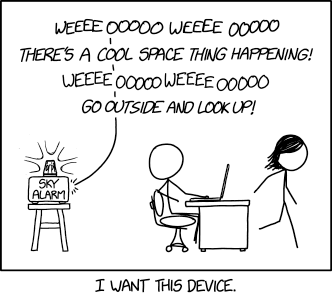
Post Syndicated from xkcd.com original https://xkcd.com/2979/
Post Syndicated from Crosstalk Solutions original https://www.youtube.com/watch?v=KCQQh4iEMhM
Post Syndicated from Eric Smith original https://www.servethehome.com/minisforum-um890-pro-review-re-architected-amd-ryzen-8945hs-mini-pc/
While it may seem like a small upgrade at first, the Minisforum UM890 Pro is an overhauled and much better mini PC with optional OCulink
The post Minisforum UM890 Pro Review Re-Architected AMD Ryzen 8945HS Mini PC appeared first on ServeTheHome.
Post Syndicated from Talks at Google original https://www.youtube.com/watch?v=RbfPlpHYHq8
Post Syndicated from jzb original https://lwn.net/Articles/987715/
The KDE project plans to directly
ask for donations in the Plasma desktop starting with version
6.2. According to this
blog post by Nate Graham, users will see a
system notification once per year (in December) asking for a
donation to the non-profit KDE e.V.:
Now, I know that messages like this can be controversial! The
change was carefully considered, and we tried our best to minimize
the annoying-ness factor: It’s small and unobtrusive, and no matter
what you do with it (click any button, close it, etc) it’ll go away
until next year. It’s implemented as a KDE Daemon (KDED) module,
which allows users and distributors to permanently disable it if they
like.
Post Syndicated from jzb original https://lwn.net/Articles/987700/
Version 5.0.0 of GNU Screen has
been released. Notable changes in this release include
new commands for authentication, input into multiple windows at the
same time, and to turn on/off truecolor support.
Post Syndicated from Geographics original https://www.youtube.com/watch?v=5sKwdUJh0RA
Post Syndicated from David Johnson original https://www.backblaze.com/blog/calculate-cost-cloud-storage/

This post has been updated since it was originally published.
With spending on public cloud services expected to double by 2028, many businesses are looking for ways to cut cloud costs—or at least gain predictability in their spend. Forecasting cloud storage costs should be straightforward once you know what to look for.
Here are five tips you can use when doing your due diligence on the cloud storage vendors you are considering. The goal is to create a cloud storage forecast that you can rely on each and every month.
Many cloud providers still use tiered pricing structures, which can be misleading if not carefully understood. For example:
For this post, we’re comparing with hypothetical data stored in AWS S3’s U.S. East Region (N. Virginia) using pricing available at the time of publishing. Note that many factors may affect your final price, including selecting a different region, choosing a different storage tier, etc.
In order to receive lower pricing, you have to reach a specific amount of data stored. But, the lower rate only applies to data above the threshold for that tier. In other words, you don’t get a discount on the cumulative amount—each pricing tier is reflected in the data you’re storing.
The mistake sometimes made is estimating your entire storage cost based on the level for the total data stored. For example, if you had 600TB of storage, you could wrongly calculate as follows:
600,000GB x $0.021 = $12,600/month
When, in fact, you should do the following:
(50,000GB x $0.023) + (450,000GB x $0.022) + (100,000GB x $0.021) = $13,150/month
That was just for storage. Make sure you consider the tiered pricing tables for data retrieval, and API transactions as well.
Many cloud providers, especially hyperscalers, now offer a wider array of storage classes than ever before. The idea is that you can trade service capabilities for lower costs. If you don’t need immediate access to your files or don’t want data replication or 11 nines of durability, you can choose to downgrade your service and gain cost savings. The biggest problem with this method is that you have to know what you are going to do with your data to pick the right service—as well as correctly anticipate future business needs—because mistakes can get very expensive. For example:
Basically, if your needs change as they pertain to the data you have stored, you will pay more than you expect to get your data where you need it to be.
Some cloud storage companies have a minimum amount of time you are charged for storage for each file uploaded. Typically this minimum period is between 30 and 90 days. You are charged even if you delete the file before the minimum period. For example (assuming a 90 day minimum period), if you upload a file today and delete the file tomorrow, you still have to pay for storing that deleted file for the next 88 days.
This “feature” often extends to files deleted due to versioning. If you set your system to keep three versions of each file, with older versions automatically deleted, you end up paying for those deleted versions for the full minimum duration.
In a typical backup workflow, let’s say you are using a cloud storage service to store your files and your backup program is set to a 30 day retention. That means you will be perpetually paying for an additional 60 days worth of storage (for files that were pruned at 30 days). In other words, you would be paying for a 90 day retention period even though you only have 30 days worth of backups.
As the cloud storage market has matured, pricing models have become more complicated. To create an accurate budget, it’s crucial to understand all potential cost components, including some that might not be immediately obvious. Here are two key areas to examine:
Misdirection is the art of getting you to focus on one thing so you don’t focus on other things going on. Practiced by magicians and some cloud storage companies, the idea is to get you to focus on certain features and capabilities without delving below the surface into the fine print. (And, sometimes the prices this technique generates feels like someone has pulled a rabbit out of a hat—to your company’s detriment.)
Read the fine print and as you scroll through the multi-page pricing tables and linked pages of all of the rules that shape how you can use a given cloud storage service. Stop and ask, “What are they trying to hide?” If you find phrases like: “We reserve the right to limit your egress traffic,” or “New users get free usage tier for 12 months,” or “Provisioned requests should be used when you need a guarantee that your retrieval capacity will be available when you need it,” take heed.
And, even if it seems like you can turn the tables and use things like free credits in the short term, remember that you’ll want to have a plan for your long-term infrastructure when those credits run out as well.
As organizations increasingly rely on cloud storage for everything from day-to-day operations to long-term data archiving, the ability to accurately forecast and control these costs can significantly impact overall IT budgets and business planning.
The first place to start is data storage as it’s generally the easiest for a company to calculate. For a given month, you can calculate your data volume as follows:
Data stored = current data + new data – deleted data
Take that total and multiple by the monthly storage rate and you’ll get your monthly storage costs.
Things can get more complicated if your business regularly uploads and downloads data. The data stored at the end of the month should get you at least in the ballpark. But, creating a predictable cloud storage budget requires a holistic understanding of your data needs, usage patterns, and the pricing structures of your chosen provider. It’s not just about estimating how much data you’ll store, but also how you’ll interact with that data over time. Will you be frequently accessing and modifying files, or primarily using the storage for long-term archiving? Are there seasonal fluctuations in your data storage or retrieval patterns? These factors can all influence your overall costs, and we’ll walk through a scenario to show that next.
To illustrate how to calculate your cloud storage costs, let’s work through an example using current Backblaze B2 pricing. We’ll focus on a single month for a growing business that is backing up business data to the cloud and verifying their backups have zero errors during recovery:
Backblaze has built a cloud storage calculator that computes costs for all of the major cloud storage providers. Using this calculator, we find that Amazon S3 would cost $2,675 to store this data for a month, while Backblaze B2 would charge just $630.
Using those numbers for storage and assuming you download 75TB a month for backup validation testing, you get a total monthly cost of $8,725 for Amazon S3; Backblaze B2 would be $630 a month.
The additional cost you see from AWS S3 is from download costs, also known as egress fees, and they can certainly take a toll on your budget. Backblaze offers free egress up to three times the amount you have stored so you can move data when and where you prefer.
The chart below provides the breakdown of the expected cost.
| Backblaze B2 | Amazon S3 | |
|---|---|---|
| Storage | $630 | $2,675 |
| Egress | Free* | $6,050 |
| Totals: | $630 | $8,725 |
*Up to 3x of average monthly data stored, then $0.01/GB for additional egress.
Of course each month you will add and delete storage, so you’ll have to account for that in your forecast. And, as we mentioned above, there may also be other fees like minimum storage duration fees or API transaction fees. Using the cloud storage calculator noted above, you can get a reasonable estimate of your total cost over the budget forecasting period.
Finally, you can use the Backblaze B2 storage calculator to address potential use cases that are outside of your normal operations, such as if you delete a large project from your storage or you need to download a large amount of data. Running the calculator for these types of actions lets you obtain a solid estimate for their effect on your budget before they happen and lets you plan accordingly.
Creating a predictable cloud storage forecast is key to taking full advantage of all of the value in cloud storage. Organizations like Austin City Limits, Amplify, and Runbiz were able to move to the cloud because they could reliably predict their cloud storage cost with Backblaze B2. You don’t have to let pricing tiers, hidden costs, and fine print stop you. Backblaze makes predicting your cloud storage costs easy.
The post Five Tips for Creating a Predictable Cloud Storage Budget appeared first on Backblaze Blog | Cloud Storage & Cloud Backup
Post Syndicated from jake original https://lwn.net/Articles/987677/
Greg Kroah-Hartman has announced the release of the 6.10.7, 6.6.48, and 6.1.107 stable kernels. They all contain
important fixes throughout the kernel tree, as is the norm.
Post Syndicated from Bruce Schneier original https://www.schneier.com/blog/archives/2024/08/adm-grace-hoppers-1982-nsa-lecture-has-been-published.html
The “long lost lecture” by Adm. Grace Hopper has been published by the NSA. (Note that there are two parts.)
It’s a wonderful talk: funny, engaging, wise, prescient. Remember that talk was given in 1982, less than a year before the ARPANET switched to TCP/IP and the internet went operational. She was a remarkable person.
Listening to it, and thinking about the audience of NSA engineers, I wonder how much of what she’s talking about as the future of computing—miniaturization, parallelization—was being done in the present and in secret.
Post Syndicated from jake original https://lwn.net/Articles/986899/
Plasma Mobile is an open-source
user interface for mobile devices, developed by the KDE community. It’s
built on the same foundations as Plasma Desktop, including KDE Frameworks and the KWin window
manager. Much like its desktop counterpart, Plasma Mobile caters to
advanced users by offering extensive customizability. It is offered as an
option on phones with various mobile Linux
distributions.
Post Syndicated from digiblur DIY original https://www.youtube.com/watch?v=kigrcjzc6to
Post Syndicated from jake original https://lwn.net/Articles/987664/
Security updates have been issued by AlmaLinux (bind and bind-dyndb-ldap and postgresql:16), Fedora (less and python3.6), Mageia (nodejs & yarnpkg), Oracle (libvpx and postgresql:16), Red Hat (edk2, git, kernel, openldap, postgresql:15, postgresql:16, python3, and python39:3.9 and python39-devel:3.9), SUSE (apache2, python-setuptools, and python3-setuptools), and Ubuntu (linux-oracle).
Post Syndicated from corbet original https://lwn.net/Articles/987635/
Wedson Almeida Filho, one of the key developers driving the Rust for Linux project, has retired from the
project.
After almost 4 years, I find myself lacking the energy and
enthusiasm I once had to respond to some of the nontechnical
nonsense, so it’s best to leave it up to those who still have it
in them.
As an example of the sort of “nonsense” he referred to, he provided a link to the video from the
Rust for filesystems discussion at the 2024
Linux Storage, Filesystem, Memory-Management, and BPF Summit. His work was
fundamental to getting the project as far as it has come; he will be missed.
Post Syndicated from The History Guy: History Deserves to Be Remembered original https://www.youtube.com/watch?v=WTd5cr0c94E
Post Syndicated from The Atlantic original https://www.youtube.com/watch?v=Fb_jKmB9EMI
Post Syndicated from Michael Kammer original https://blog.zabbix.com/reducing-alert-noise-with-birol-yildiz/28643/
Zabbix Summit 2024 is almost here, and we’re giving you a sneak peek into what you can expect to see on our main stage this year via a series of short interviews with a few of the eminent speakers who will grace us with their presence. First up is Birol Yildiz, the CEO and Co-founder of ilert GmbH and a man who is deeply passionate about keeping alert noise and fatigue to a minimum.
My journey in the tech industry began with a deep passion for creating solutions that simplify and improve the lives of IT professionals. Before co-founding ilert GmbH, I spent over a decade working in various IT roles, ranging from software development to operations. I noticed that while monitoring systems were becoming increasingly sophisticated, the process of alert management and incident response was lagging behind.
This gap inspired me to create ilert, a platform focused on bridging that divide by optimizing alerting processes and reducing response times. Our goal at ilert has always been to empower teams with the tools they need to stay ahead of incidents, ensuring that their systems run smoothly and efficiently.
Zabbix has been an integral part of ilert since 2018, when we first developed one of our early integrations with the platform. Recognizing its popularity among our customer base, we enhanced this integration in 2020, transforming it into a native integration and solidifying our partnership with Zabbix as a technology partner. Since then, Zabbix has become one of the most popular integrations within ilert.
On a daily basis, my involvement with Zabbix includes overseeing the continued optimization of our integration, ensuring that it meets the evolving needs of our users. I work closely with our development and support teams to identify and implement improvements based on user feedback and the latest developments from Zabbix.
Alert fatigue has long been a significant challenge for the DevOps community, often leading to decreased efficiency and increased stress among professionals. In my presentation, we will explore innovative strategies that leverage AI to mitigate alert noise.
I’ll be discussing how to maximize the efficiency of your incident response process by leveraging Zabbix with advanced alerting and on-call management tools like ilert. I’ll share insights on reducing alert fatigue, improving incident response times, and ensuring that critical alerts reach the right people at the right time.
This talk will be particularly valuable for DevOps engineers looking to optimize their alert management systems and reduce the cognitive load caused by alert fatigue. Zabbix administrators will find it insightful, especially if they are interested in integrating advanced AI techniques into their monitoring workflows to achieve better performance and reliability.
Moreover, AI and machine learning enthusiasts will gain practical knowledge about applying AI in IT monitoring and alerting, making this session a comprehensive resource for anyone looking to advance their alert management strategies.
Absolutely. There was a specific incident early in my career that left a lasting impact on me. We were using a monitoring system that generated a significant number of alerts, most of which were non-critical. One weekend, a critical issue was buried in a flood of low-priority alerts, leading to a delayed response and significant downtime for the business.
This incident underscored the importance of not just having a monitoring system in place but ensuring that it was configured to minimize noise and prioritize what truly matters. That experience drove me to focus on creating solutions that help teams filter out the noise and respond quickly to what’s really important, which is a core principle behind ilert’s offerings.
Yes, beyond reducing alert noise, there’s a lot of potential in enhancing the collaboration between teams during incidents. For example, automating incident communication and resolution processes is an area where I see great value. By integrating Zabbix with incident management platforms like ilert, teams can not only reduce noise but also streamline communication, ensuring that the right people are involved at the right time and that resolution steps are clear and actionable.
Another area is optimizing the way multiple on-call teams work together using Zabbix and incident response platforms like ilert. In many organizations, different teams are responsible for specific sets of host groups in Zabbix, and it’s crucial that each team only receives alerts for the services they are directly responsible for. These are just a few examples of how we can continue to evolve our approach to incident management in conjunction with Zabbix.
The post Reducing Alert Noise with Birol Yildiz appeared first on Zabbix Blog.
Post Syndicated from corbet original https://lwn.net/Articles/986853/
The LWN.net Weekly Edition for August 29, 2024 is available.
Post Syndicated from Netflix Technology Blog original https://netflixtechblog.com/recommending-for-long-term-member-satisfaction-at-netflix-ac15cada49ef
By Jiangwei Pan, Gary Tang, Henry Wang, and Justin Basilico
Our mission at Netflix is to entertain the world. Our personalization algorithms play a crucial role in delivering on this mission for all members by recommending the right shows, movies, and games at the right time. This goal extends beyond immediate engagement; we aim to create an experience that brings lasting enjoyment to our members. Traditional recommender systems often optimize for short-term metrics like clicks or engagement, which may not fully capture long-term satisfaction. We strive to recommend content that not only engages members in the moment but also enhances their long-term satisfaction, which increases the value they get from Netflix, and thus they’ll be more likely to continue to be a member.
One simple way we can view recommendations is as a contextual bandit problem. When a member visits, that becomes a context for our system and it selects an action of what recommendations to show, and then the member provides various types of feedback. These feedback signals can be immediate (skips, plays, thumbs up/down, or adding items to their playlist) or delayed (completing a show or renewing their subscription). We can define reward functions to reflect the quality of the recommendations from these feedback signals and then train a contextual bandit policy on historical data to maximize the expected reward.
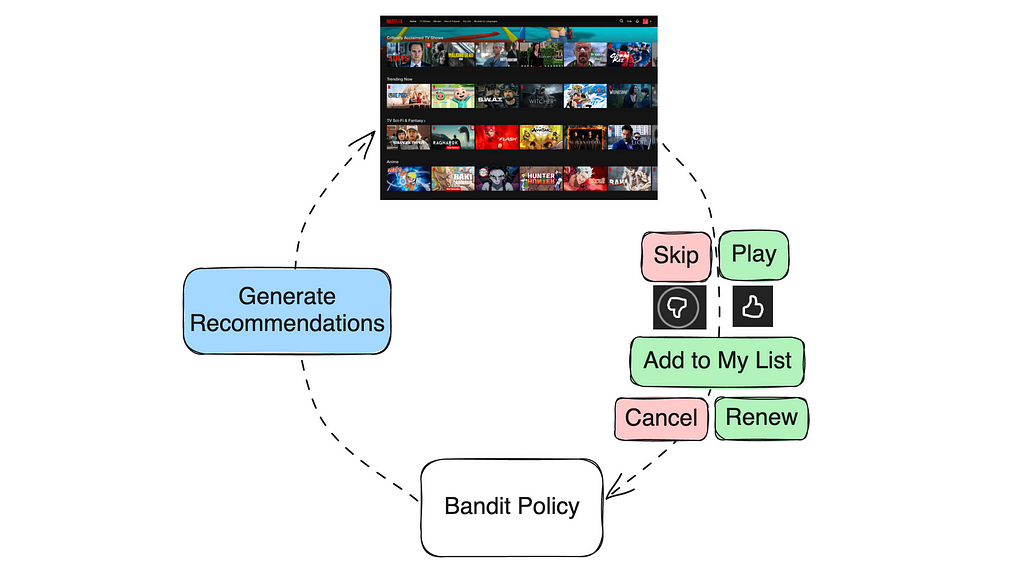
There are many ways that a recommendation model can be improved. They may come from more informative input features, more data, different architectures, more parameters, and so forth. In this post, we focus on a less-discussed aspect about improving the recommender objective by defining a reward function that tries to better reflect long-term member satisfaction.
Member retention might seem like an obvious reward for optimizing long-term satisfaction because members should stay if they’re satisfied, however it has several drawbacks:
Due to these challenges, optimizing for retention alone is impractical.
Instead, we can train our bandit policy to optimize a proxy reward function that is highly aligned with long-term member satisfaction while being sensitive to individual recommendations. The proxy reward r(user, item) is a function of user interaction with the recommended item. For example, if we recommend “One Piece” and a member plays then subsequently completes and gives it a thumbs-up, a simple proxy reward might be defined as r(user, item) = f(play, complete, thumb).
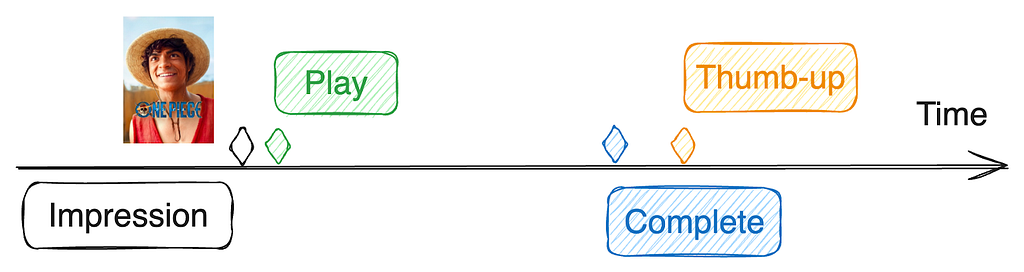
Click-through rate (CTR), or in our case play-through rate, can be viewed as a simple proxy reward where r(user, item) = 1 if the user clicks a recommendation and 0 otherwise. CTR is a common feedback signal that generally reflects user preference expectations. It is a simple yet strong baseline for many recommendation applications. In some cases, such as ads personalization where the click is the target action, CTR may even be a reasonable reward for production models. However, in most cases, over-optimizing CTR can lead to promoting clickbaity items, which may harm long-term satisfaction.
To align the proxy reward function more closely with long-term satisfaction, we need to look beyond simple interactions, consider all types of user actions, and understand their true implications on user satisfaction.
We give a few examples in the Netflix context:
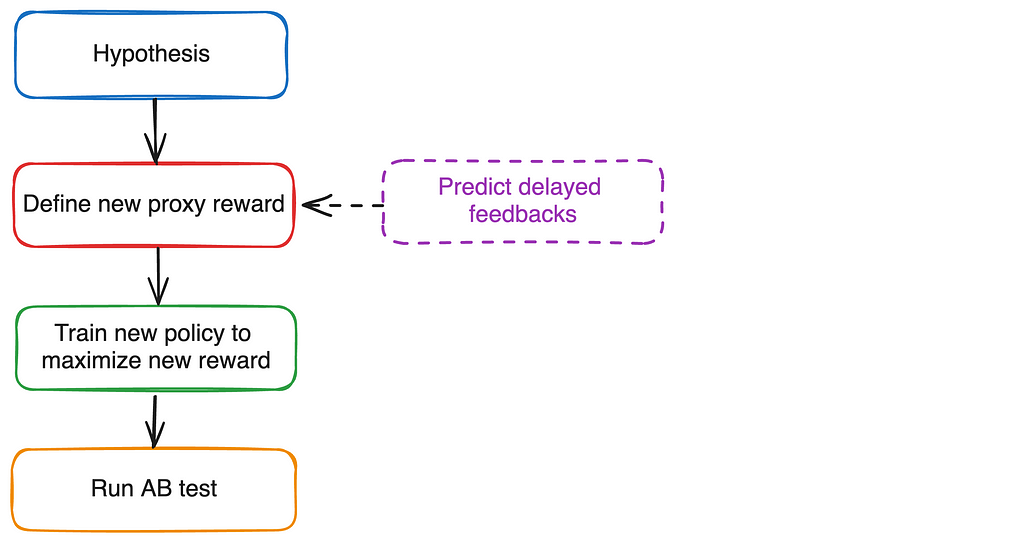
Reward engineering is the iterative process of refining the proxy reward function to align with long-term member satisfaction. It is similar to feature engineering, except that it can be derived from data that isn’t available at serving time. Reward engineering involves four stages: hypothesis formation, defining a new proxy reward, training a new bandit policy, and A/B testing. Below is a simple example.
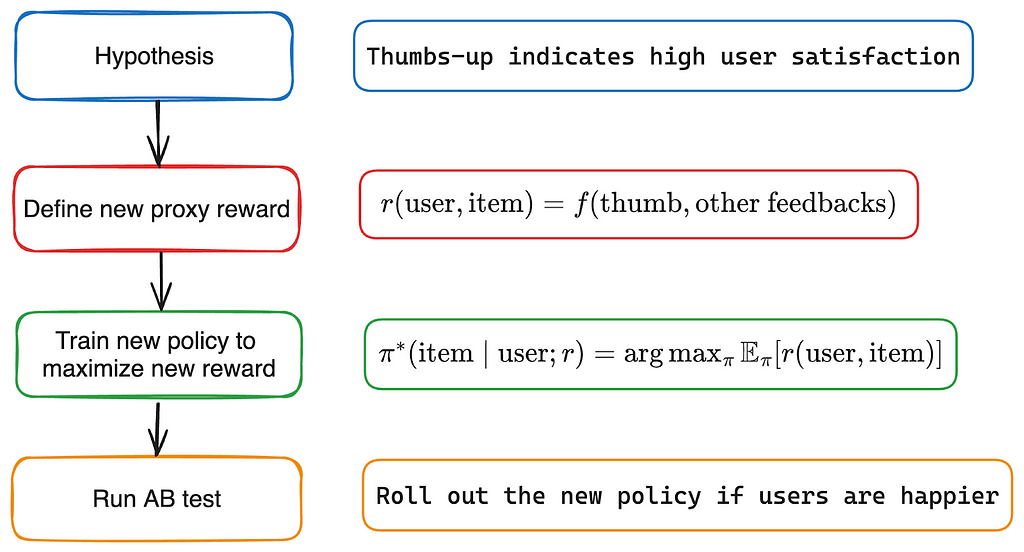
User feedback used in the proxy reward function is often delayed or missing. For example, a member may decide to play a recommended show for just a few minutes on the first day and take several weeks to fully complete the show. This completion feedback is therefore delayed. Additionally, some user feedback may never occur; while we may wish otherwise, not all members provide a thumbs-up or thumbs-down after completing a show, leaving us uncertain about their level of enjoyment.
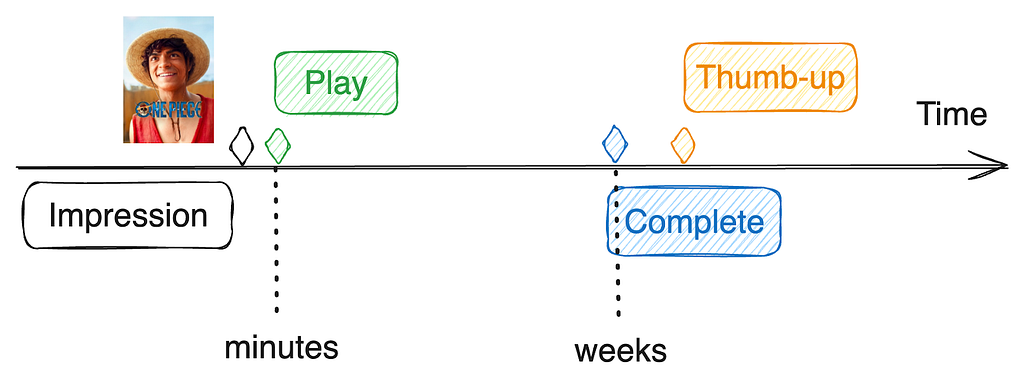
We could try and wait to give a longer window to observe feedback, but how long should we wait for delayed feedback before computing the proxy rewards? If we wait too long (e.g., weeks), we miss the opportunity to update the bandit policy with the latest data. In a highly dynamic environment like Netflix, a stale bandit policy can degrade the user experience and be particularly bad at recommending newer items.
We aim to update the bandit policy shortly after making a recommendation while also defining the proxy reward function based on all user feedback, including delayed feedback. Since delayed feedback has not been observed at the time of policy training, we can predict it. This prediction occurs for each training example with delayed feedback, using already observed feedback and other relevant information up to the training time as input features. Thus, the prediction also gets better as time progresses.
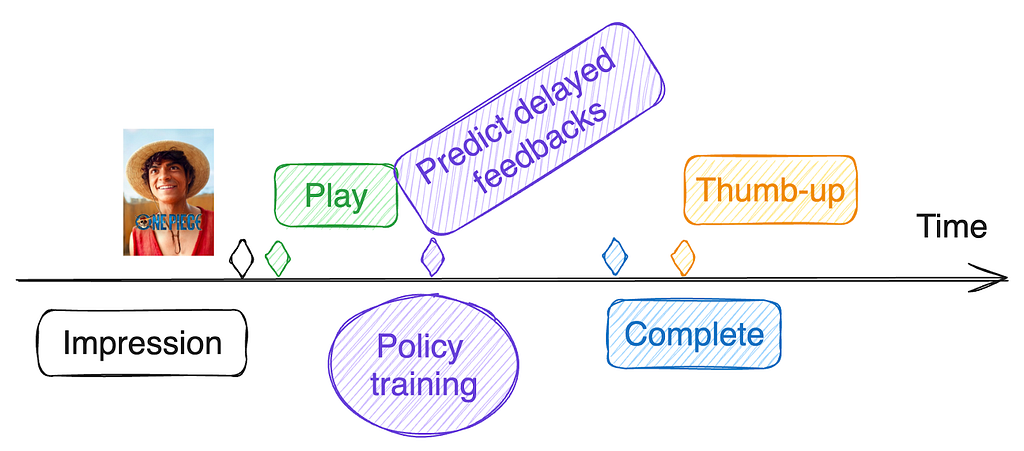
The proxy reward is then calculated for each training example using both observed and predicted feedback. These training examples are used to update the bandit policy.
But aren’t we still only relying on observed feedback in the proxy reward function? Yes, because delayed feedback is predicted based on observed feedback. However, it is simpler to reason about rewards using all feedback directly. For instance, the delayed thumbs-up prediction model may be a complex neural network that takes into account all observed feedback (e.g., short-term play patterns). It’s more straightforward to define the proxy reward as a simple function of the thumbs-up feedback rather than a complex function of short-term interaction patterns. It can also be used to adjust for potential biases in how feedback is provided.
The reward engineering diagram is updated with an optional delayed feedback prediction step.
It’s worth noting that this approach employs two types of ML models:
Improved input features or neural network architectures often lead to better offline model metrics (e.g., AUC for classification models). However, when these improved models are subjected to A/B testing, we often observe flat or even negative online metrics, which can quantify long-term member satisfaction.
This online-offline metric disparity usually occurs when the proxy reward used in the recommendation policy is not fully aligned with long-term member satisfaction. In such cases, a model may achieve higher proxy rewards (offline metrics) but result in worse long-term member satisfaction (online metrics).
Nevertheless, the model improvement is genuine. One approach to resolve this is to further refine the proxy reward definition to align better with the improved model. When this tuning results in positive online metrics, the model improvement can be effectively productized. See [1] for more discussions on this challenge.
In this post, we provided an overview of our reward engineering efforts to align Netflix recommendations with long-term member satisfaction. While retention remains our north star, it is not easy to optimize directly. Therefore, our efforts focus on defining a proxy reward that is aligned with long-term satisfaction and sensitive to individual recommendations. Finally, we discussed the unique challenge of delayed user feedback at Netflix and proposed an approach that has proven effective for us. Refer to [2] for an earlier overview of the reward innovation efforts at Netflix.
As we continue to improve our recommendations, several open questions remain:
[1] Deep learning for recommender systems: A Netflix case study. AI Magazine 2021. Harald Steck, Linas Baltrunas, Ehtsham Elahi, Dawen Liang, Yves Raimond, Justin Basilico.
[2] Reward innovation for long-term member satisfaction. RecSys 2023. Gary Tang, Jiangwei Pan, Henry Wang, Justin Basilico.

Recommending for Long-Term Member Satisfaction at Netflix was originally published in Netflix TechBlog on Medium, where people are continuing the conversation by highlighting and responding to this story.
Post Syndicated from Explosm.net original https://explosm.net/comics/pill-addict
New Cyanide and Happiness Comic