Tag Archives: Real-time streaming

Real-time data quality monitoring: Kafka stream contracts with syntactic and semantic test

Post Syndicated from Grab Tech original https://engineering.grab.com/real-time-data-quality-monitoring

Introduction

In today’s data-driven landscape, monitoring data quality has become a critical need for ensuring reliable and efficient data usage across domains. High-quality data is the backbone of AI innovation, driving efficiency and unlocking new opportunities. As decentralized data ownership grows, the ability to effectively monitor data quality is essential for maintaining reliability in data systems.

Kafka streams, as a vital component of real-time data processing, play a significant role in this ecosystem. However, unreliable data within Kafka streams can lead to errors and inefficiencies for downstream users, and monitoring the quality of data within these streams has always been a challenge. This blog introduces a solution that empowers stream users to define a data contract, specifying the rules that Kafka stream data must adhere to. By leveraging this user-defined data contract, the solution performs automated real-time data quality checks, identifies problematic data as it occurs, and promptly notifies stream owners. This ensures timely action, enabling effective monitoring and management of Kafka stream data quality while supporting the broader goals of data mesh and AI-driven innovation.

Problem statement

In the past, monitoring Kafka stream data processing lacked an effective solution for data quality validation. This limitation made it challenging to identify bad data, notify users in a timely manner, and prevent the cascading impact on downstream users from further escalating.

Challenges in syntactic and semantic issue identification:

  • Syntactic issues: Refers to schema mismatches between producers and consumers, which can lead to deserialization errors. While schema backward compatibility can be validated upon schema evolution, there are scenarios where the actual data in the Kafka topic does not align with the defined schema. For example, this can occur when a rogue Kafka producer is not using the expected schema for a given Kafka topic. Identifying the specific fields causing these syntactic issues is a typical challenge.
  • Semantic issues: Refers to inconsistencies or misalignments between producers and consumers about the expected pattern or significance of each field. Unlike Kafka stream schemas, which act as a data structure contract between producers and consumers, there is no existing framework for stakeholders to define and enforce field-level semantic rules, for example, the expected length or pattern of an identifier.

Timeliness challenge in data quality monitoring: There is no real-time mechanism to automatically validate data against predefined rules, timely identify quality issues, and promptly alert stream stakeholders. Without real-time stream validation, data quality issues can sometimes persist for periods of time, impacting various online and offline downstream systems before being discovered.

Observability challenge for troubleshooting bad data: Even when problematic data is identified, stream users face difficulties in pinpointing the exact “poison data” and understanding which fields are incompatible with the schema or violate semantic rules. This lack of visibility complicates Root Cause Analysis and resolution efforts.

Solution

Our Coban platform offers a standardized data quality test and observability solution at the platform level, consisting of the following components:

  • Data Contract Definition: Enables Kafka stream stakeholders to define contracts that include schema agreements, semantic rules that Kafka topic data must comply with, and Kafka stream ownership details for alerting and notifications.
  • Automated Test Execution: Provides a long running Test Runner to automatically execute real-time tests based on the defined contract.
  • Real-time Data Quality Issue Identification: Detects data issues at both syntactic and semantic levels in real-time.
  • Alerts and Result Observability: Alerts users, simplifying observation of data quality issues via the platform.

Architecture details

The solution includes three components: Data Contract Definition, Test Execution & Data Quality Issue Identification, and Result Observability as shown in the architecture diagram in figure 1. All mentions of “Flow” from here onwards refer to the corresponding processes illustrated in figure 1.
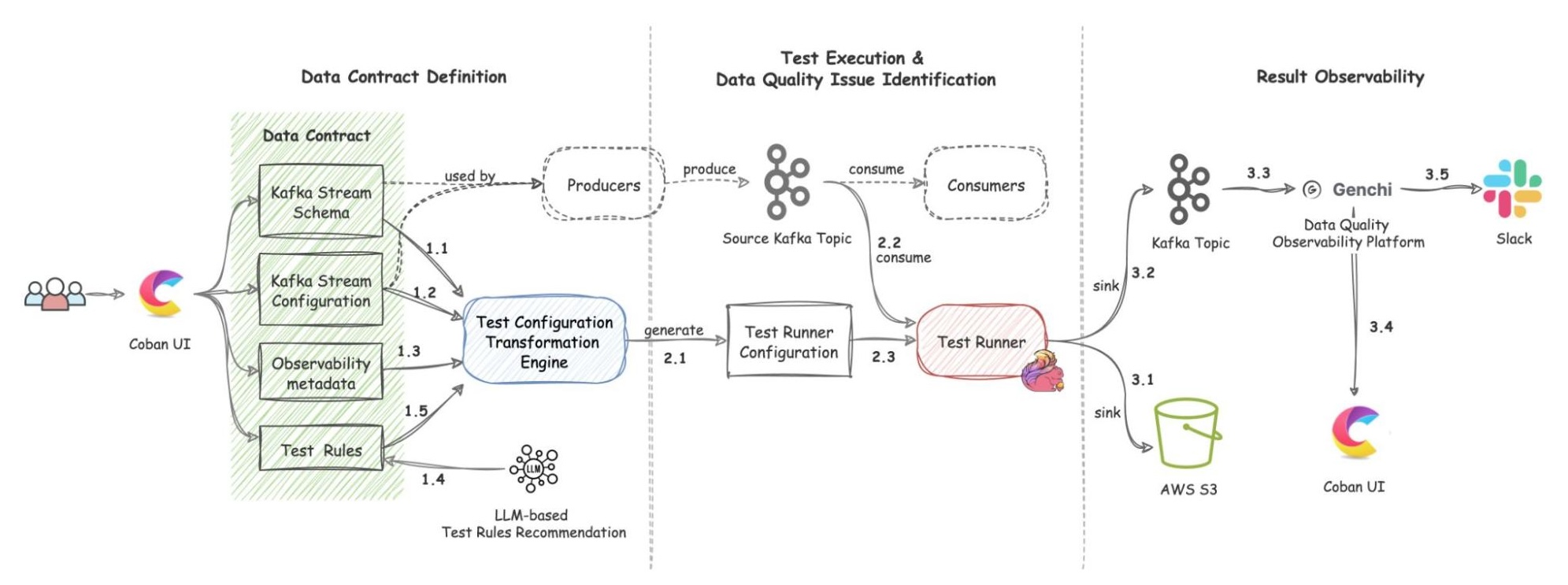
Figure 1. Real-time Kafka Stream Data Quality Monitoring Architecture diagram.

Data Contract Definition

The Coban Platform streamlines the process of defining Kafka stream data contracts, serving as a formal agreement among Kafka stream stakeholders. This includes the following components:

  • Kafka Stream Schema: Represents the schema used by the Kafka topic under test and helps the Test Runner to validate schema compatibility across data streams (Flow 1.1).
  • Kafka Stream Configuration: Encompasses essential configurations such as the endpoint and topic name, which the platform automatically populates (Flow 1.2).
  • Observability Metadata: Provides contact information for notifying Kafka stream stakeholders about data quality issues and includes alert configurations for monitoring (Flow 1.3).
  • Kafka Stream Semantic Test Rules: Empowers users to define intuitive semantic test rules at the field level. These rules include checks for string patterns, number ranges, constant values, etc. (Flow 1.5).
  • LLM-Based Semantic Test Rules Recommendation: Defining dozens if not hundreds of field-specific test rules can overwhelm users. To simplify this process, the Coban Platform uses LLM-based recommendations to predict semantic test rules using provided Kafka stream schemas and anonymized sample data (Flow 1.4). This feature helps users set up semantic rules efficiently, as demonstrated in the sample UI in figure 2.
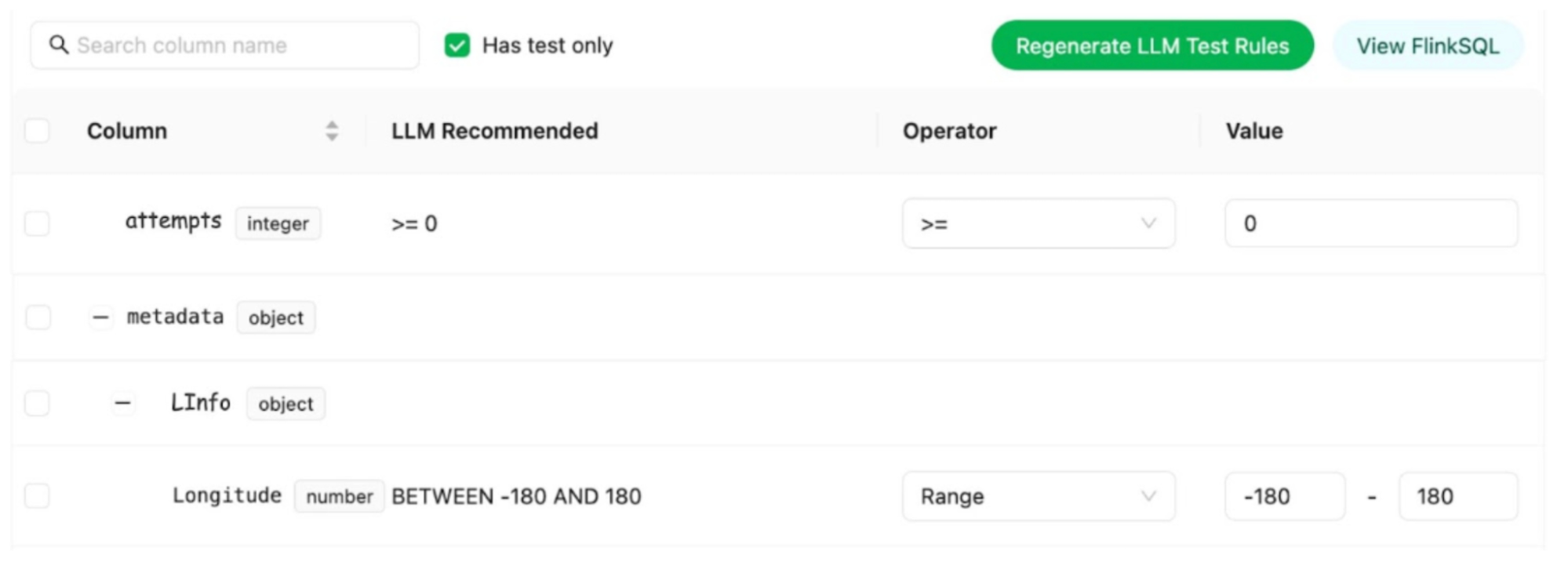
Figure 2. Sample UI showcasing LLM-based Kafka stream schema field-level semantic test rules. Note that the data shown is entirely fictional.

Data Contract Transformation

Once defined, the Coban Platform’s transformation engine converts the data contract into configurations that the Test Runner can interpret (Flow 2.1). This transformation process includes:

  • Kafka Stream Schema: Translates the schema defined in the data contract into a schema reference that the Test Runner can parse.
  • Kafka Stream Configuration: Sets up the Kafka stream as a source for the Test Runner.
  • Observability metadata: Sets contact information as configurations of the Test Runner.
  • Kafka Stream Semantic Test Rules: Transforms human-readable semantic test rules into an inverse SQL query to capture the data that violates the defined rules.
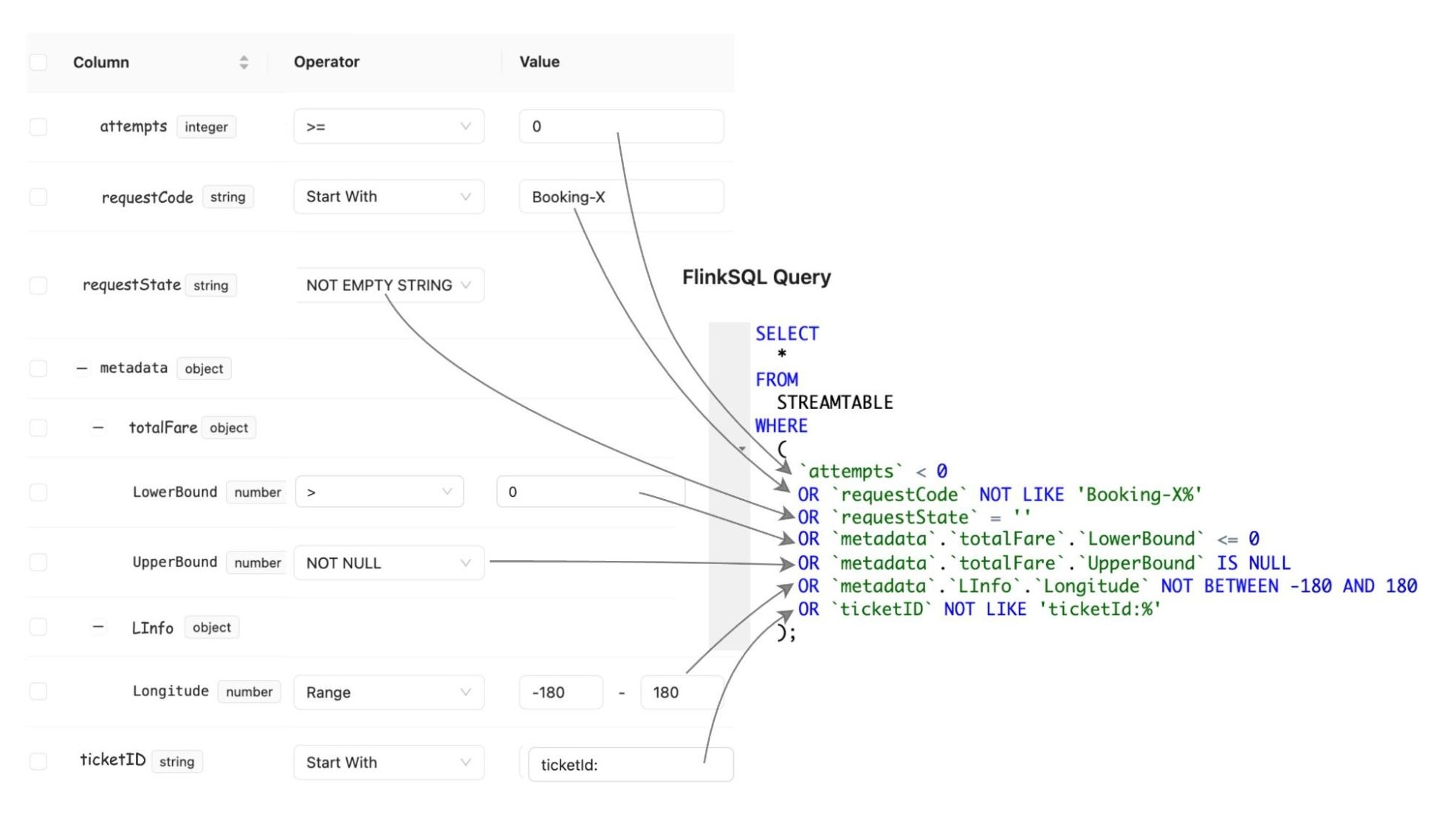
Figure 3. Illustration of semantic test rules being converted from human-readable formats into inverse SQL queries.

Test Execution & Data Quality Issue Identification

Once the Test Configuration Transformation Engine generates the Test Runner configuration (Flow 2.1), the platform automatically deploys the Test Runner.

Test Runner

The Test Runner utilises FlinkSQL as the compute engine to execute the tests. FlinkSQL was selected for its flexibility in defining test rules as straightforward SQL statements, enabling our platform to efficiently convert data contracts into enforceable rules.

Test Execution Workflow And Problematic Data Identification

FlinkSQL consumes data from the Kafka topic under test (Flow 2.2) using its own consumer group, ensuring it doesn’t impact other consumers. It runs the inverse SQL query (Flow 2.3) to identify any data that violates the semantic rules or that is syntactically incorrect in the first place. Test Runner captures such data, packages it into a data quality issue event enriched with a test summary, the total count of bad records, and sample bad data, and publishes it to a dedicated Kafka topic (Flow 3.2). Additionally, the platform sinks all such data quality events to an AWS S3 bucket (Flow 3.1) to enable deeper observability and analysis.

Result Observability

Grab’s in-house data quality observability platform, Genchi, consumes problematic data captured by the Test Runner (Flow 3.3).

Alerting

Genchi sends Slack notifications (Flow 3.5) to stream owners specified in the data contract observability metadata. These notifications include detailed information about stream issues, such as links to sample data in Coban UI, observed windows, counts of bad records, and other relevant details.
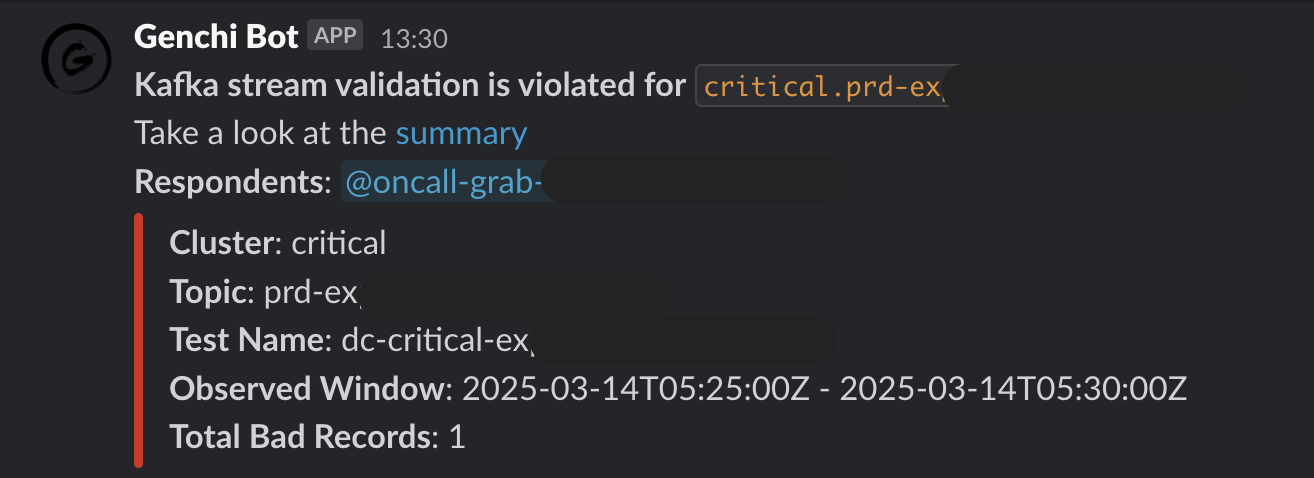
Figure 4. Sample Slack notifications

Observability

Users can access the Coban UI (Flow 3.4), displaying Kafka stream test rules and sample bad records, highlighting fields and values that violate rules.
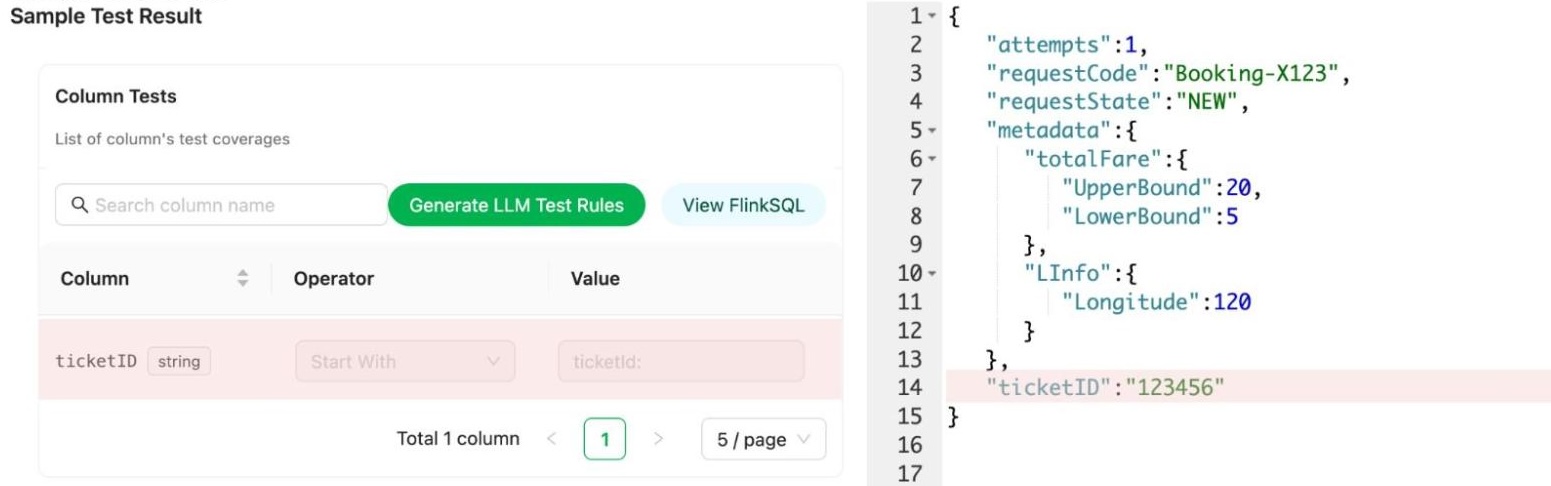
Figure 5. In this Sample Test Result, the highlighted fields indicate violations of the semantic test rules.

Impact

Since its deployment earlier this year, the solution has enabled Kafka stream users to define contracts with syntactic and semantic rules, automate test execution, and alert users when problematic data is detected, prompting timely action. It has been actively monitoring data quality across 100+ critical Kafka topics. The solution offers the capability to immediately identify and halt the propagation of invalid data across multiple streams.

Conclusion

We implemented and rolled out a solution to assist Grab engineers in effectively monitoring data quality in their Kafka streams. This solution empowers them to establish syntactic and semantic tests for their data. Our platform’s automatic testing feature enables real-time tracking of data quality, with instant alerts for any discrepancies. Additionally, we provide detailed visibility into test results, facilitating the easy identification of specific data fields that violate the rules. This accelerates the process of diagnosing and resolving issues, allowing users to swiftly address production data challenges.

What’s next

While our current solution emphasizes monitoring the quality of Kafka streaming data, further exploration will focus on tracing producers to pinpoint the origin of problematic data, as well as enabling more advanced semantic tests such as cross-field validations. Additionally, we aim to expand monitoring capabilities to cover broader aspects like data completeness and freshness, and integrate with Gable AI to detect Data Transfer Object (DTO) changes and semantic regressions in Go producers upon committing code to the Git repository. These enhancements will pave the way for a more robust, multidimensional data quality testing solution across a wider range.

References

Driving Data Quality with Data Contracts: A Comprehensive Guide to Building Reliable, Trusted, and Effective Data Platforms by Andrew Jones

Join us

Grab is a leading superapp in Southeast Asia, operating across the deliveries, mobility and digital financial services sectors. Serving over 800 cities in eight Southeast Asian countries, Grab enables millions of people everyday to order food or groceries, send packages, hail a ride or taxi, pay for online purchases or access services such as lending and insurance, all through a single app. Grab was founded in 2012 with the mission to drive Southeast Asia forward by creating economic empowerment for everyone. Grab strives to serve a triple bottom line – we aim to simultaneously deliver financial performance for our shareholders and have a positive social impact, which includes economic empowerment for millions of people in the region, while mitigating our environmental footprint.

Powered by technology and driven by heart, our mission is to drive Southeast Asia forward by creating economic empowerment for everyone. If this mission speaks to you, join our team today!

How we seamlessly migrated high volume real-time streaming traffic from one service to another with zero data loss and duplication

Post Syndicated from Grab Tech original https://engineering.grab.com/seamless-migration

At Grab, we continuously enhance our systems to improve scalability, reliability and cost-efficiency. Recently, we undertook a project to split the read and write functionalities of one of our backend services into separate services. This was motivated by the need to independently scale these operations based on their distinct scalability requirements.

In this post, we will dive deep into how we migrated the stream processing (write) functionality to a new service with zero data loss and duplication. This was accomplished while handling a high volume of real-time traffic averaging 20,000 reads per second from 16 source Kafka streams writing to other output streams and several DynamoDB tables.

Migration challenges and strategy

Migrating the stream processing to the new service while ensuring zero data loss and duplication posed some interesting challenges, especially given the high volume of real-time data. We needed a strategy that would enable us to:

  • Migrate streams one by one gradually.
  • Validate the new service’s processing in production before fully switching over.
  • Perform the switchover with no downtime or data inconsistencies.

We considered various options for the switchover such as using feature flags via our unified config management and experimental rollout platform. However, these approaches had some limitations:

  • There could be some data loss or duplication during the deployment time when toggling the flags, which can be up to a few minutes.
  • There might be data inconsistencies as the flag value could be updated on the services (the existing and and the new one) at slightly different times.

Ultimately, we decided on a custom time-based switchover logic implemented in shared code between the two services leveraging our monorepo structure. In the following sections, we will walk you through the steps we took to achieve this seamless migration.

Step 1: Preparation

First, since both the existing and new services reside in our monorepo, we moved the stream processing code from the existing service to a shared /commons directory. This allowed both the old and new services to import and use the same code. We added logic in this commons package to selectively turn stream processing on or off based on the service processing them.

Next, we created temporary “sink” resources such as streams and DynamoDB tables for the new service to write the processed data. This allowed us to monitor and validate the new service’s behavior in production without impacting the main resources.

Figure 1. For a short period, both services consumed the incoming streams, but only the old service continued to write to the actual sink resources while the new service wrote to validation sink resources.

Step 2: Scheduling the switchover

In the shared /commons code, we added a map[string]time.Time to schedule the switchover for each stream.

map[string]time.Time{
  "streamA": time.Date(2024, 2, 28, 12, 0, 0, 0, time.UTC),
  "streamB": time.Date(2024, 3, 10, 12, 0, 0, 0, time.UTC),
  // ...
}

When a stream is added to this map, it means it is scheduled for switchover at the specified time. This logic is shared between both services, so the switchover happens simultaneously. The new service starts writing to the main resources while the old service stops, with no overlap or gap.

Step 3: Deployment and monitoring

To perform the switchover, we:

  1. Updated the switchover times for the streams.
  2. Deployed both services with enough buffer time before the scheduled switch.
  3. Closely monitored the process by creating dedicated monitors for the migration process using our observability tools.
Figure 2. This timeseries graph shows the stream received at the old and the new service (dotted line), facilitating real time monitoring of the stream processing volume across both services during the validation period.

The old service continued consuming the streams for a short monitoring period post-switchover, but without writing anywhere, ensuring no loss or duplication at the output sink resources. Then, the stream consumption was removed from the old service altogether, completing the entire migration process.

Results and learnings

Using this time-based approach, we were able to seamlessly migrate the high-volume stream processing to the new service with:

  • Zero data loss or duplication.
  • No downtime or production issues.

The whole migration, including the gradual stream-by-stream switchover, was completed in about three weeks.

One learning was that such custom time-based logic, while effective for our use case, has limitations. If a rollback was needed for any of the two services for some unexpected reasons, some data inconsistency would be unavoidable. Generally, such time-based logic should be used with caution as it can lead to unexpected scenarios if the systems fall out of sync. We went ahead with this approach as it was a temporary measure and we had thoroughly tested it before carrying out the switchover.

Join us

Grab is the leading superapp platform in Southeast Asia, providing everyday services that matter to consumers. More than just a ride-hailing and food delivery app, Grab offers a wide range of on-demand services in the region, including mobility, food, package and grocery delivery services, mobile payments, and financial services across 700 cities in eight countries.

Powered by technology and driven by heart, our mission is to drive Southeast Asia forward by creating economic empowerment for everyone. If this mission speaks to you, join our team today!
An elegant platform

Post Syndicated from Grab Tech original https://engineering.grab.com/an-elegant-platform

Coban is Grab’s real-time data streaming platform team. As a platform team, we thrive on providing our internal users from all verticals with self-served data-streaming resources, such as Kafka topics, Flink and Change Data Capture (CDC) pipelines, various kinds of Kafka-Connect connectors, as well as Apache Zeppelin notebooks, so that they can effortlessly leverage real-time data to build intelligent applications and services.

In this article, we present our journey from pure Infrastructure-as-Code (IaC) towards a more sophisticated control plane that has revolutionised the way data streaming resources are self-served at Grab. This change also leads to improved scalability, stability, security, and user adoption of our data streaming platform.

Problem statement

In the early ages of public cloud, it was a common practice to create virtual resources by clicking through the web console of a cloud provider, which is sometimes referred to as ClickOps.

ClickOps has many downsides, such as:

  • Inability to review, track, and audit changes to the infrastructure.
  • Inability to massively scale the infrastructure operations.
  • Inconsistencies between environments, e.g. staging and production.
  • Inability to quickly recover from a disaster by re-creating the infrastructure at a different location.

That said, ClickOps has one tremendous advantage; it makes creating resources using a graphical User Interface (UI) fairly easy for anyone like Infrastructure Engineers, Software Engineers, Data Engineers etc. This also leads to a high iteration speed towards innovation in general.

IaC resolved many of the limitations of ClickOps, such as:

  • Changes are committed to a Version Control System (VCS) like Git: They can be reviewed by peers before being merged. The full history of all changes is available for investigating issues and for audit.
  • The infrastructure operations scale better: Code for similar pieces of infrastructure can be modularised. Changes can be rolled out automatically by Continuous Integration (CI) pipelines in the VCS system, when a change is merged to the main branch.
  • The same code can be used to deploy the staging and production environments consistently.
  • The infrastructure can be re-created anytime from its source code, in case of a disaster.

However, IaC unwittingly posed a new entry barrier too, requiring the learning of new tools like Ansible, Puppet, Chef, Terraform, etc.

Some organisations set up dedicated Site Reliability Engineer (SRE) teams to centrally manage, operate, and support those tools and the infrastructure as a whole, but that soon created the potential of new bottlenecks in the path to innovation.

On the other hand, others let engineering teams manage their own infrastructure, and Grab adopted that same approach. We use Terraform to manage infrastructure, and all teams are expected to have select engineers who have received Terraform training and have a clear understanding of it.

In this context, Coban’s platform initially started as a handful of Git repositories where users had to submit their Merge Requests (MR) of Terraform code to create their data streaming resources. Once reviewed by a Coban engineer, those Terraform changes would be applied by a CI pipeline running Atlantis.

While this was a meaningful first step towards self-service and platformisation of Coban’s offering within Grab, it had several significant downsides:

  • Stability: Due to the lack of control on the Terraform changes, the CI pipeline was prone to human errors and frequent failures. For example, users would initiate a new Terraform project by duplicating an existing one, but then would forget to change the location of the remote Terraform state, leading to the in-place replacement of an existing resource.
  • Scalability: The Coban team needed to review all MRs and provide ad hoc support whenever the pipeline failed.
  • Security: In the absence of Identity and Access Management (IAM), MRs could potentially contain changes pertaining to other teams’ resources, or even changes to Coban’s core infrastructure, with code review as the only guardrail.
  • Limited user growth: We could only acquire users who were well-versed in Terraform.

It soon became clear that we needed to build a layer of abstraction between our users and the Terraform code, to increase the level of control and lower the entry barrier to our platform, while still retaining all of the benefits of IaC under the hood.

Solution

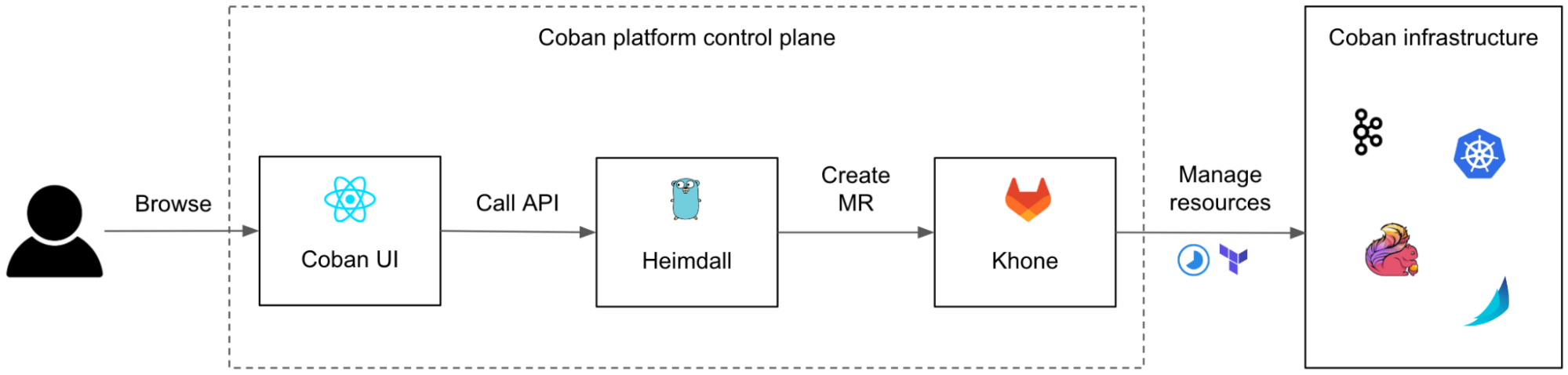
We designed and built an in-house three-tier control plane made of:

  • Coban UI, a front-end web interface, providing our users with a seamless ClickOps experience.
  • Heimdall, the Go back-end of the web interface, transforming ClickOps into IaC.
  • Khone, the storage and provisioner layer, a Git repository storing Terraform code and metadata of all resources as well as the CI pipelines to plan and apply the changes.

In the next sections, we will deep dive in those three components.

Fig. 1 Simplified architecture of a request flowing from the user to the Coban infrastructure, via the three components of the control plane: the Coban UI, Heimdall, and Khone.

Although we designed the user journey to start from the Coban UI, our users can still opt to communicate with Heimdall and with Khone directly, e.g. for batch changes, or just because many engineers love Git and we want to encourage broad adoption. To make sure that data is eventually consistent across the three systems, we made Khone the only persistent storage layer. Heimdall regularly fetches data from Khone, caches it, and presents it to the Coban UI upon each query.

We also continued using Terraform for all resources, instead of mixing various declarative infrastructure approaches (e.g. Kubernetes Custom Resource Definition, Helm charts), for the sake of consistency of the logic in Khone’s CI pipelines.

Coban UI

The Coban UI is a React Single Page Application (React SPA) designed by our partner team Chroma, a dedicated team of front-end engineers who thrive on building legendary UIs and reusable components for platform teams at Grab.

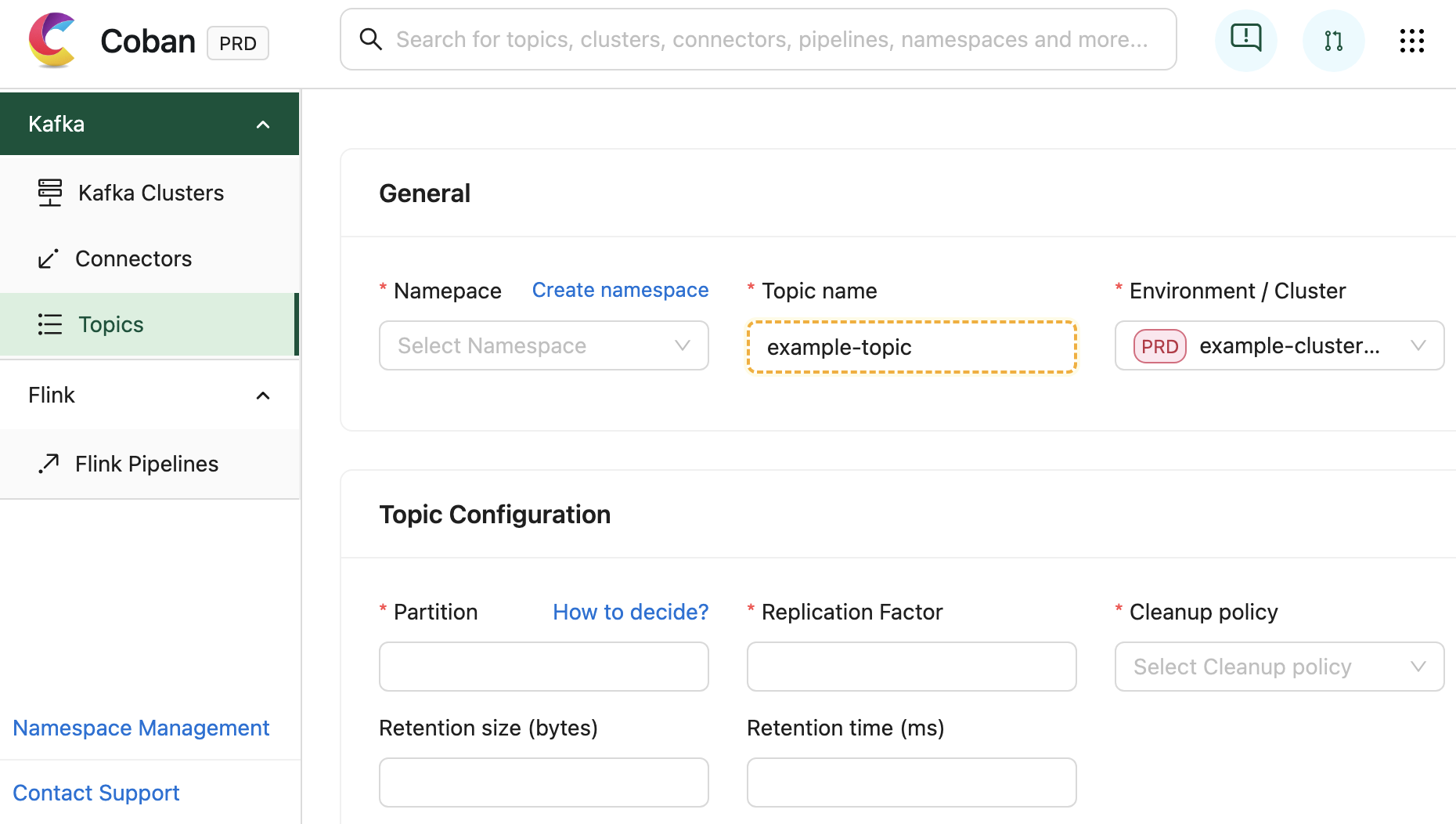
It serves as a comprehensive self-service portal, enabling users to effortlessly create data streaming resources by filling out web forms with just a few clicks.

Fig. 2 Screen capture of a new Kafka topic creation in the Coban UI.

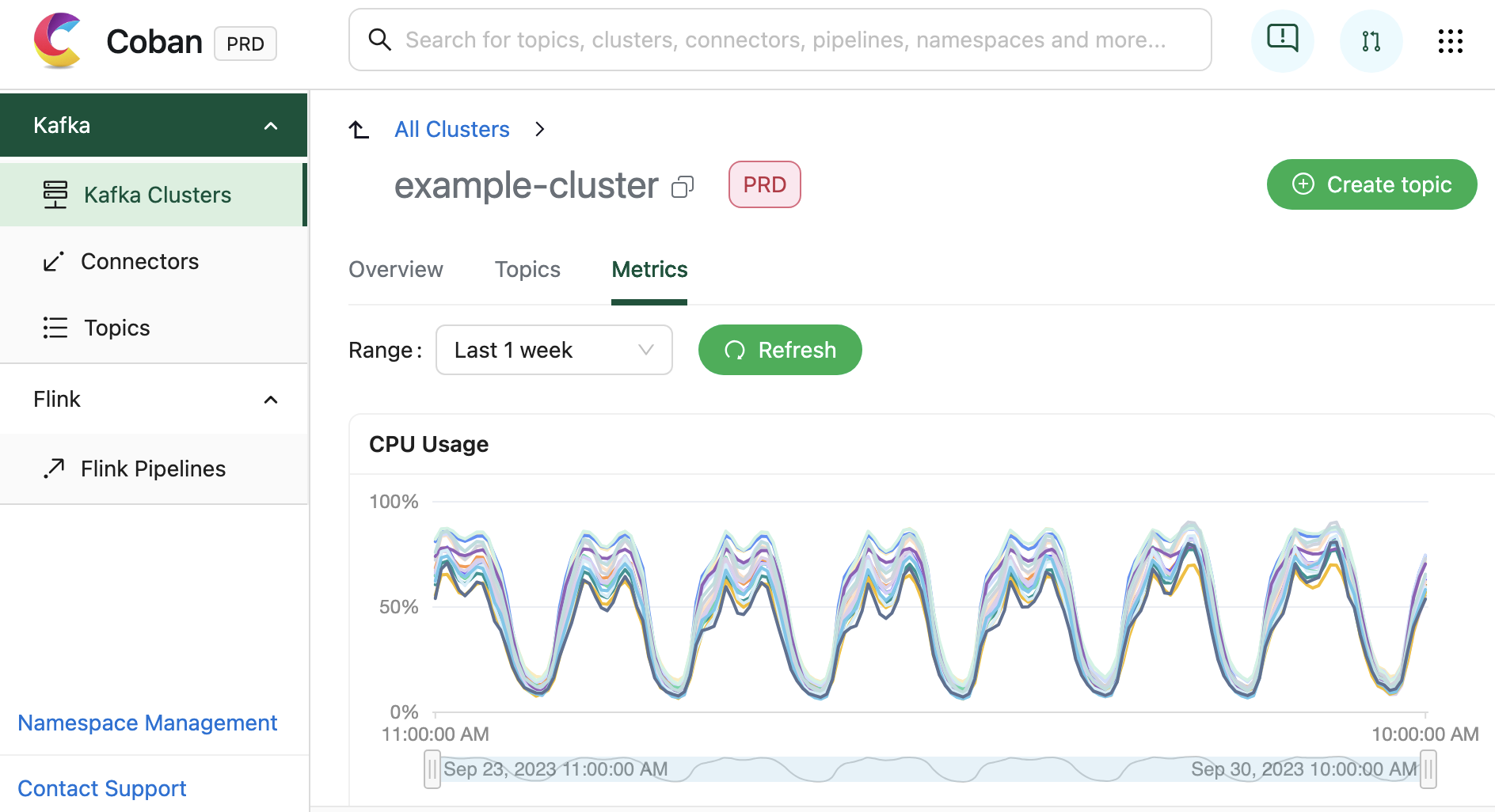
In addition to facilitating resource creation and configuration, the Coban UI is seamlessly integrated with multiple monitoring systems. This integration allows for real-time monitoring of critical metrics and health status for Coban infrastructure components, including Kafka clusters, Kafka topic bytes in/out rates, and more. Under the hood, all this information is exposed by Heimdall APIs.

Fig. 3 Screen capture of the metrics of a Kafka cluster in the Coban UI.

In terms of infrastructure, the Coban UI is hosted in AWS S3 website hosting. All dynamic content is generated by querying the APIs of the back-end: Heimdall.

Heimdall

Heimdall is the Go back-end of the Coban UI. It serves a collection of APIs for:

  • Managing the data streaming resources of the Coban platform with Create, Read, Update and Delete (CRUD) operations, treating the Coban UI as a first-class citizen.
  • Exposing the metadata of all Coban resources, so that they can be used by other platforms or searched in the Coban UI.

All operations are authenticated and authorised. Read more about Heimdall’s access control in Migrating from Role to Attribute-based Access Control.

In the next sections, we are going to dive deeper into these two features.

Managing the data streaming resources

First and foremost, Heimdall enables our users to self-manage their data streaming resources. It primarily relies on Khone as its storage and provisioner layer for actual resource management via Git CI pipelines. Therefore, we designed Heimdall’s resource management workflow to leverage the underlying Git flow.

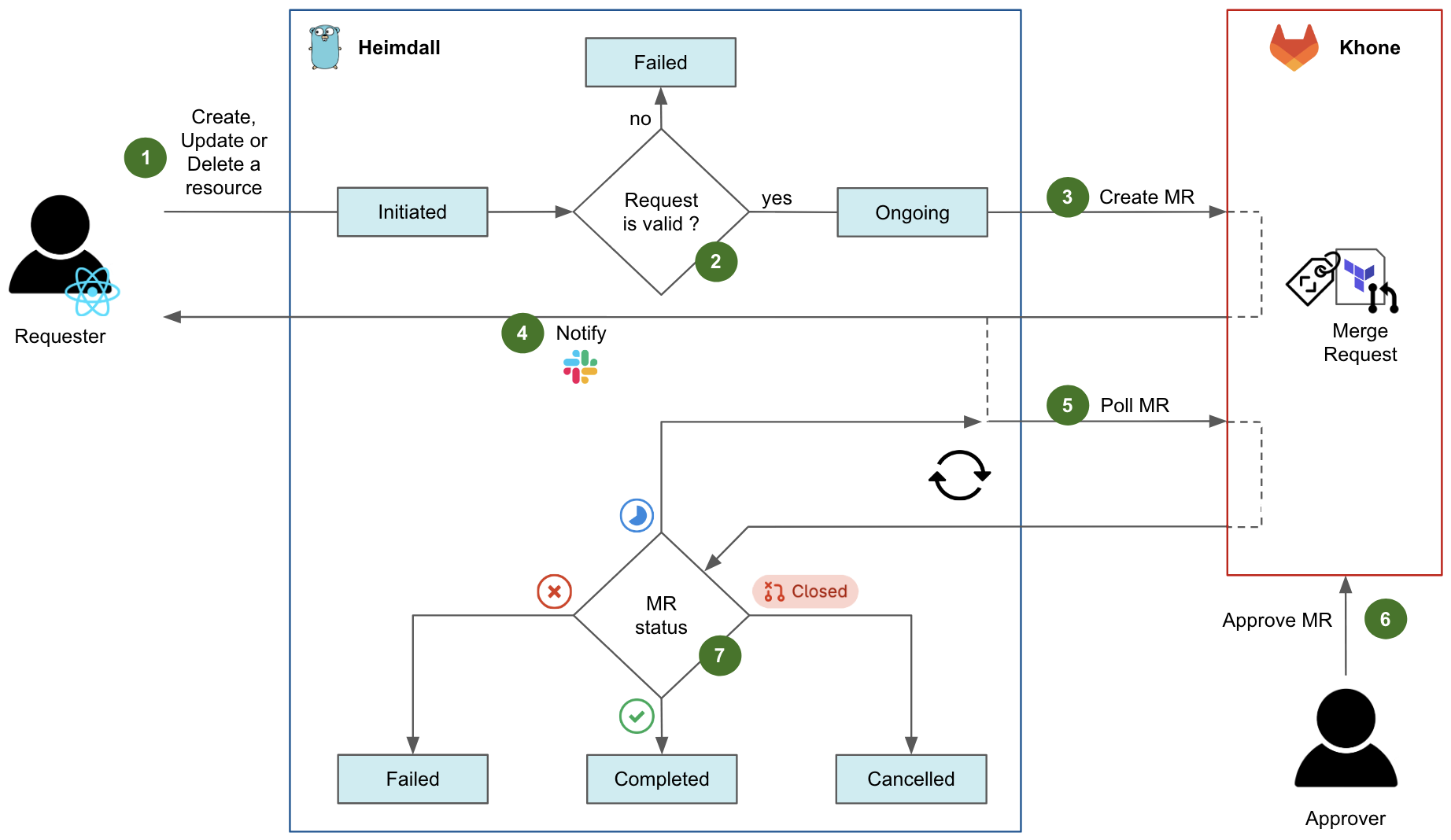
Fig. 4 Diagram flow of a request in Heimdall.

Fig. 4 shows the diagram flow of a typical request in Heimdall to create, update, or delete a resource.

  1. An authenticated user initiates a request, either by navigating in the Coban UI or by calling the Heimdall API directly. At this stage, the request state is Initiated on Heimdall.
  2. Heimdall validates the request against multiple validation rules. For example, if an ongoing change request exists for the same resource, the request fails. If all tests succeed, the request state moves to Ongoing.
  3. Heimdall then creates an MR in Khone, which contains the Terraform files describing the desired state of the resource, as well as an in-house metadata file describing the key attributes of both resource and requester.
  4. After the MR has been created successfully, Heimdall notifies the requester via Slack and shares the MR URL.
  5. After that, Heimdall starts polling the status of the MR in a loop.
  6. For changes pertaining to production resources, an approver who is code owner in the repository of the resource has to approve the MR. Typically, the approver is an immediate teammate of the requester. Indeed, as a platform team, we empower our users to manage their own resources in a self-service fashion. Ultimately, the requester would merge the MR to trigger the CI pipeline applying the actual Terraform changes. Note that for staging resources, this entire step 6 is automatically performed by Heimdall.
  7. Depending on the MR status and the status of its CI pipeline in Khone, the final state of the request can be:
    • Failed if the CI pipeline has failed in Khone.
    • Completed if the CI pipeline has succeeded in Khone.
    • Cancelled if the MR was closed in Khone.

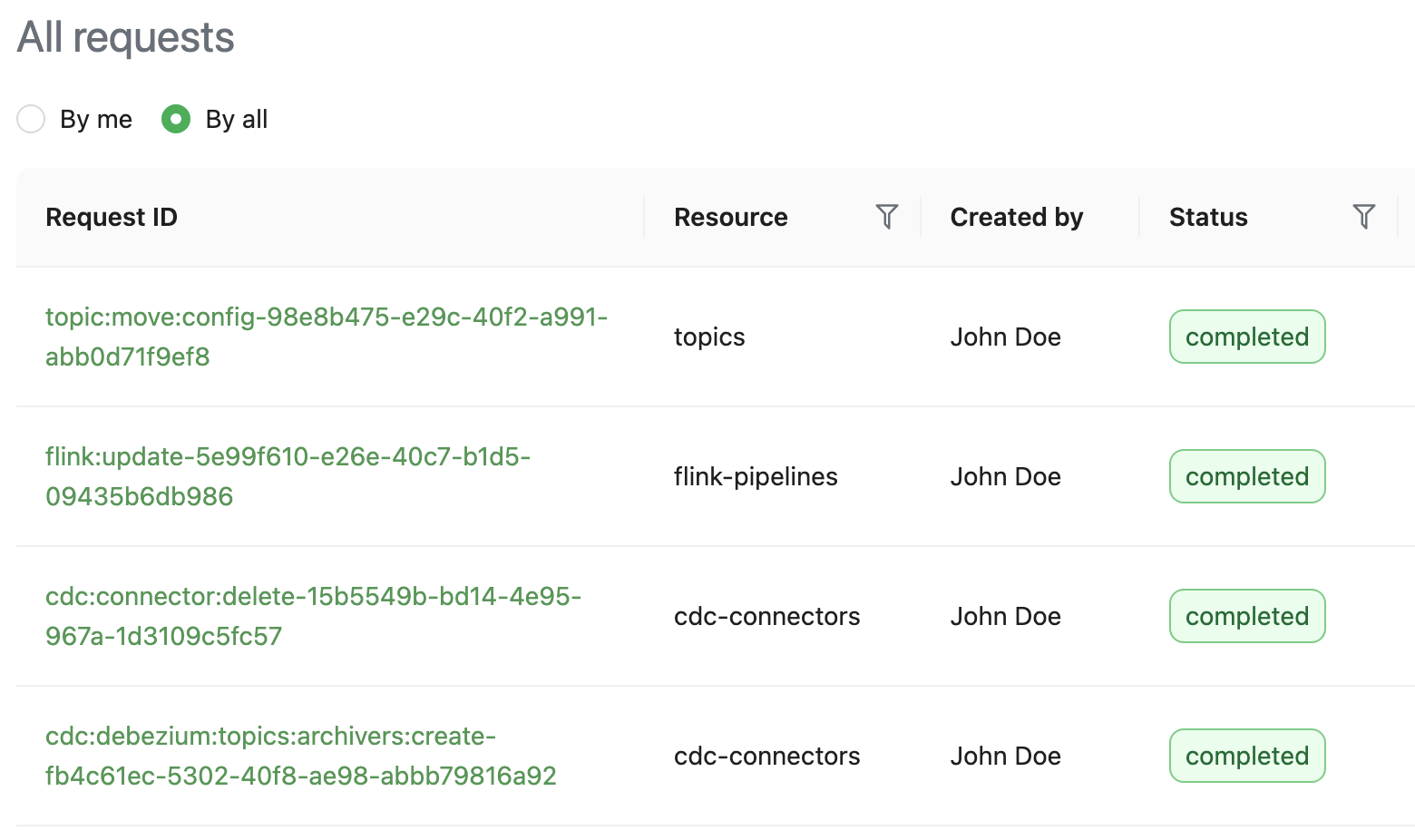
Heimdall exposes APIs to let users track the status of their requests. In the Coban UI, a page queries those APIs to elegantly display the requests.

Fig. 5 Screen capture of the Coban UI showing all requests.

Exposing the metadata

Apart from managing the data streaming resources, Heimdall also centralises and exposes the metadata pertaining to those resources so other Grab systems can fetch and use it. They can make various queries, for example, listing the producers and consumers of a given Kafka topic, or determining if a database (DB) is the data source for any CDC pipeline.

To make this happen, Heimdall not only retains the metadata of all of the resources that it creates, but also regularly ingests additional information from a variety of upstream systems and platforms, to enrich and make this metadata comprehensive.

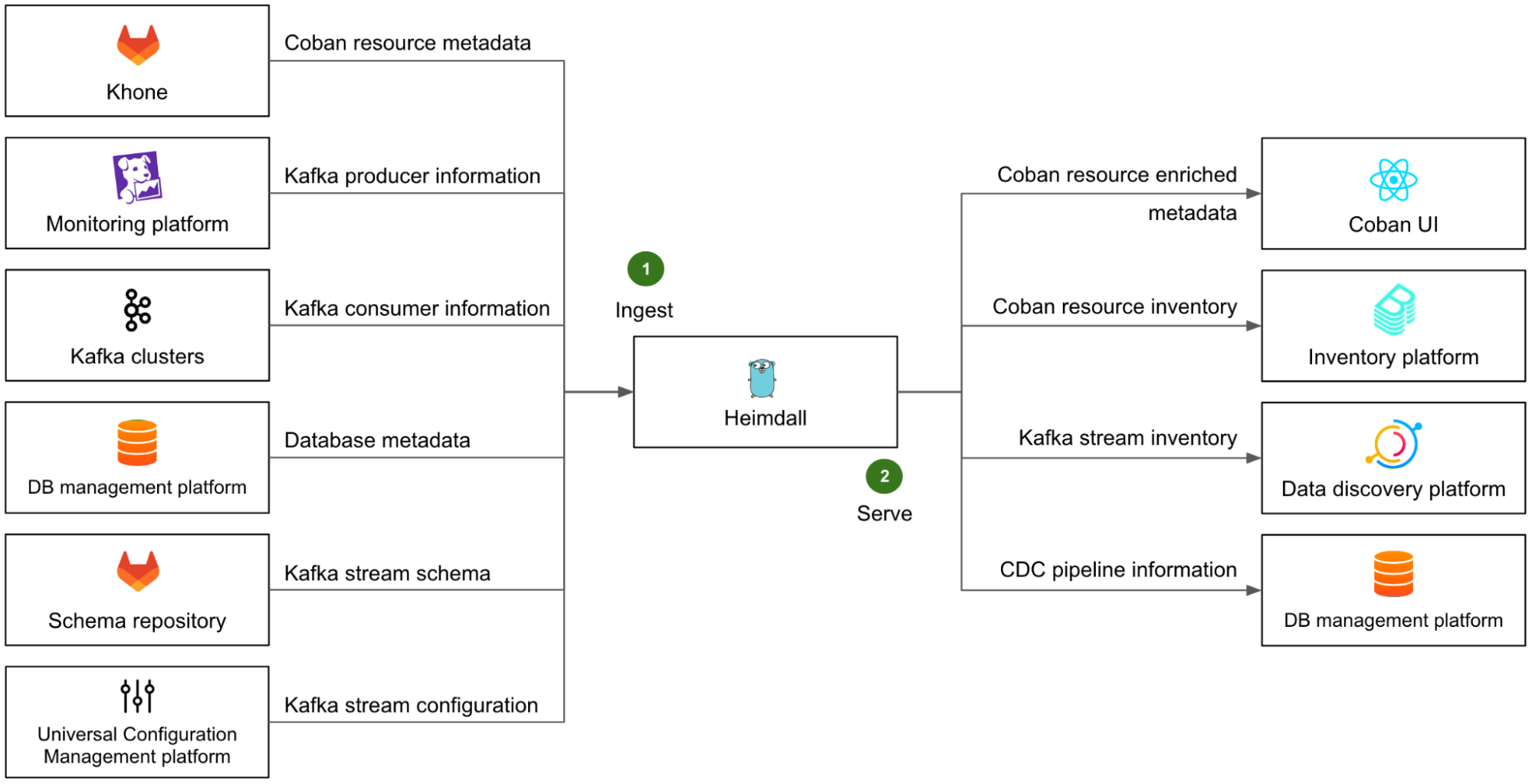
Fig. 6 Diagram showing some of Heimdall’s upstreams (on the left) and downstreams (on the right) for metadata collection, enrichment, and serving. The arrows show the data flow. The network connection (client -> server) is actually the other way around.

On the left side of Fig. 6, we illustrate Heimdall’s ingestion mechanism with several examples (step 1):

  • The metadata of all Coban resources is ingested from Khone. This means the metadata of the resources that were created directly in Khone is also available in Heimdall.
  • The list of Kafka producers is retrieved from our monitoring platform, where most of them emit metrics.
  • The list of Kafka consumers is retrieved directly from the respective Kafka clusters, by listing the consumer groups and respective Client IDs of each partition.
  • The metadata of all DBs, that are used as a data source for CDC pipelines, is fetched from Grab’s internal DB management platform.
  • The Kafka stream schemas are retrieved from the Coban schema repository.
  • The Kafka stream configuration of each stream is retrieved from Grab Universal Configuration Management platform.

With all of this ingested data, Heimdall can provide comprehensive and accurate information about all data streaming resources to any other Grab platforms via a set of dedicated APIs.

The right side of Fig. 6 shows some examples (step 2) of Heimdall’s serving mechanism:

  • As a downstream of Heimdall, the Coban UI enables our direct users to conveniently browse their data streaming resources and access their attributes.
  • The entire resource inventory is ingested into the broader Grab inventory platform, based on backstage.io.
  • The Kafka streams are ingested into Grab’s internal data discovery platform, based on DataHub, where users can discover and trace the lineage of any piece of data.
  • The CDC connectors pertaining to DBs are ingested by Grab internal DB management platform, so that they are made visible in that platform when users are browsing their DBs.

Note that the downstream platforms that ingest data from Heimdall each expose a particular view of the Coban inventory that serves their purpose, but the Coban platform remains the only source of truth for any data streaming resource at Grab.

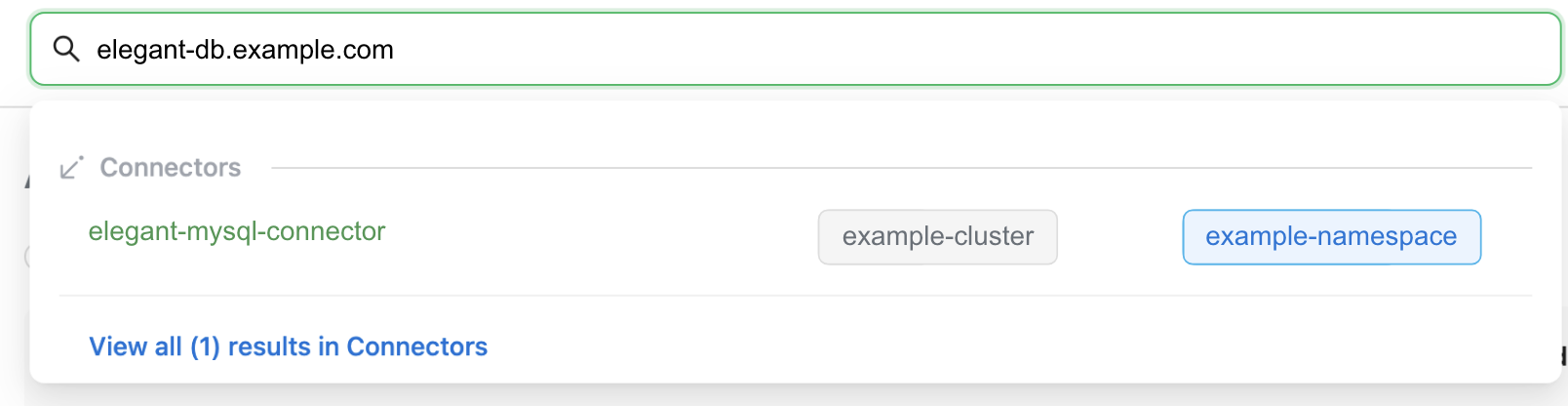
Lastly, Heimdall leverages an internal MySQL DB to support quick data query and exploration. The corresponding API is called by the Coban UI to let our users conveniently search globally among all resources’ attributes.

Fig. 7 Screen capture of the global search feature in the Coban UI.

Khone

Khone is the persistent storage layer of our platform, as well as the executor for actual resource creation, changes, and deletion. Under the hood, it is actually a GitLab repository of Terraform code in typical GitOps fashion, with CI pipelines to plan and apply the Terraform changes automatically. In addition, it also stores a metadata file for each resource.

Compared to letting the platform create the infrastructure directly and keep track of the desired state in its own way, relying on a standard IaC tool like Terraform for the actual changes to the infrastructure presents two major advantages:

  • The Terraform code can directly be used for disaster recovery. In case of a disaster, any entitled Cobaner with a local copy of the main branch of the Khone repository is able to recreate all our platform resources directly from their machine. There is no need to rebuild the entire platform’s control plane, thus reducing our Recovery Time Objective (RTO).
  • Minimal effort required to follow the API changes of our infrastructure ecosystem (AWS, Kubernetes, Kafka, etc.). When such a change happens, all we need to do is to update the corresponding Terraform provider.

If you’d like to read more about Khone, check out Securing GitOps pipelines. In this section, we will only focus on Khone’s features that are relevant from the platform perspective.

Lightweight Terraform

In Khone, each resource is stored as a Terraform definition. There are two major differences from a normal Terraform project:

  • No Terraform environment, such as the required Terraform providers and the location of the remote Terraform state file. They are automatically generated by the CI pipeline via a simple wrapper.
  • Only vetted Khone Terraform modules can be used. This is controlled and enforced by the CI pipeline via code inspection. There is one such Terraform module for each kind of supported resource of our platform (e.g. Kafka topic, Flink pipeline, Kafka Connect mirror source connector etc.). Furthermore, those in-house Terraform modules are designed to automatically derive their key variables (e.g. resource name, cluster name, environment) from the relative path of the parent Terraform project in the Khone repository.

Those characteristics are designed to limit the risk and blast radius of human errors. They also make sure that all resources created in Khone are supported by our platform, so that they can also be discovered and managed in Heimdall and the Coban UI. Lastly, by generating the Terraform environment on the fly, we can destroy resources simply by deleting the directory of the project in the code base – this would not be possible otherwise.

Resource metadata

All resource metadata is stored in a YAML file that is present in the Terraform directory of each resource in the Khone repository. This is mainly used for ownership and cost attribution.

With this metadata, we can:

  • Better communicate with our users whenever their resources are impacted by an incident or an upcoming maintenance operation.
  • Help teams understand the costs of their usage of our platform, a significant step towards cost efficiency.

There are two different ways resource metadata can be created:

  • Automatically through Heimdall: The YAML metadata file is automatically generated by Heimdall.
  • Through Khone by a human user: The user needs to prepare the YAML metadata file and include it in the MR. This file is then verified by the CI pipeline.

Outcome

The initial version of the three-tier Coban platform, as described in this article, was internally released in March 2022, supporting only Kafka topic management at the time. Since then, we have added support for Flink pipelines, four kinds of Kafka Connect connectors, CDC pipelines, and more recently, Apache Zeppelin notebooks. At the time of writing, the Coban platform manages about 5000 data streaming resources, all described as IaC under the hood.

Our platform also exposes enriched metadata that includes the full data lineage from Kafka producers to Kafka consumers, as well as ownership information, and cost attribution.

With that, our monthly active users have almost quadrupled, truly moving the needle towards democratising the usage of real-time data within all Grab verticals.

In spite of that user growth, the end-to-end workflow success rate for self-served resource creation, change or deletion, remained well above 90% in the first half of 2023, while the Heimdall API uptime was above 99.95%.

Challenges faced

A common challenge for platform teams resides in the misalignment between the Service Level Objective (SLO) of the platform, and the various environments (e.g. staging, production) of the managed resources and upstream/downstream systems and platforms.

Indeed, the platform aims to guarantee the same level of service, regardless of whether it is used to create resources in the staging or the production environment. From the platform team’s perspective, the platform as a whole is considered production-grade, as soon as it serves actual users.

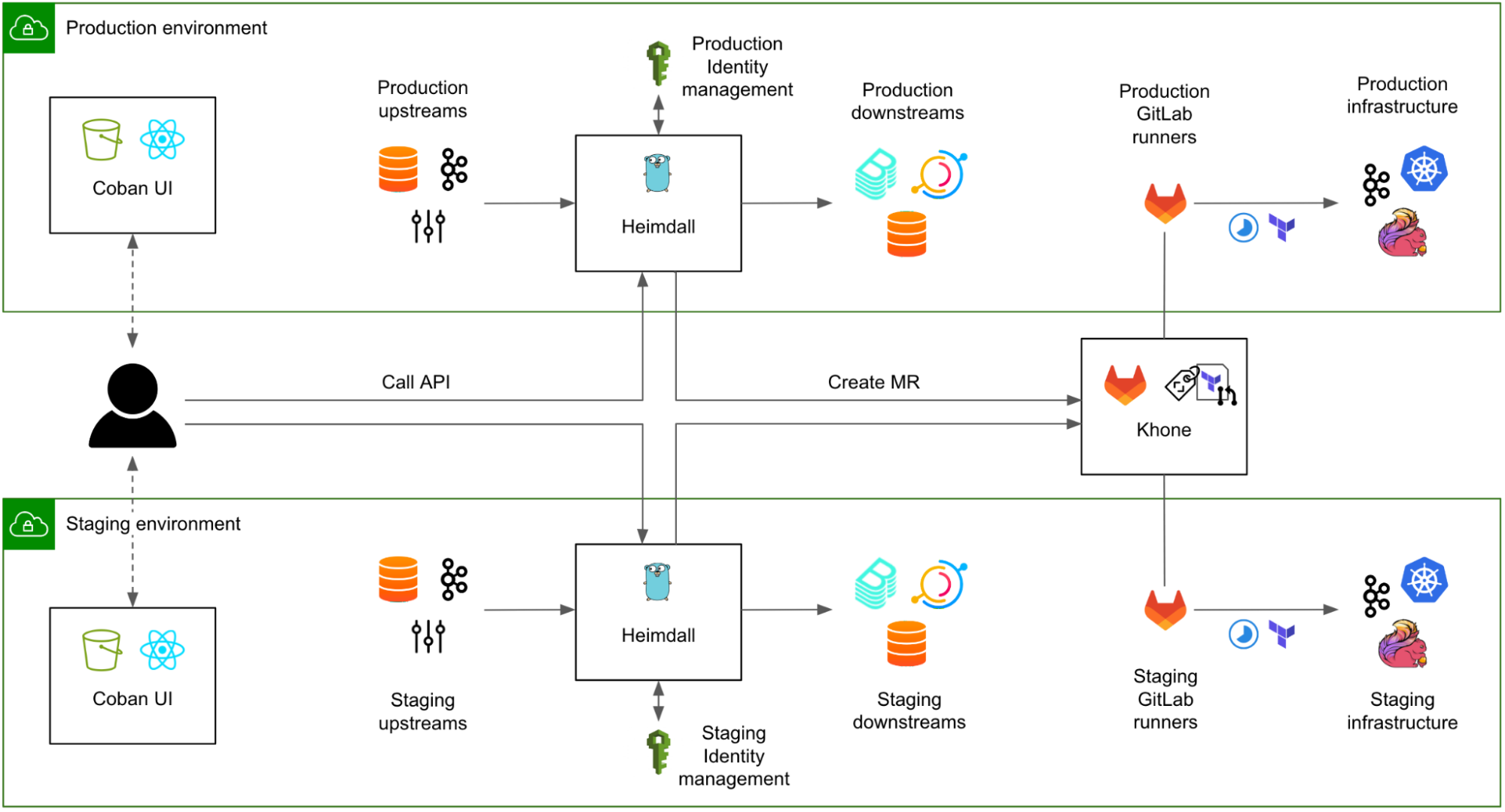
A naive approach to address this challenge is to let the production version of the platform manage all resources regardless of their respective environments. However, doing so does not permit a hermetic segregation of the staging and production environments across the organisation, which is a good security practice, and often a requirement for compliance. For example, the production version of the platform would have to connect to upstream systems in the staging environment, e.g. staging Kafka clusters to collect their consumer groups, in the case of Heimdall. Conversely, the staging version of certain downstreams would have to connect to the production version of Heimdall, to fetch the metadata of relevant staging resources.

The alternative approach, generally adopted across Grab, is to instantiate all platforms in each environment (staging and production), while still considering both instances as production-grade and guaranteeing tight SLOs in both environments.

Fig. 8 Architecture of the Coban platform, broken down by environment.

In Fig. 8, both instances of Heimdall have equivalent SLOs. The caveat is that all upstream systems and platforms must also guarantee a strict SLO in both environments. This obviously comes with a cost, for example, tighter maintenance windows for the operations pertaining to the Kafka clusters in the staging environment.

A strong “platform” culture is required for platform teams to fully understand that their instance residing in the staging environment is not their own staging environment and should not be used for testing new features.

What’s next?

Currently, users creating, updating, or deleting production resources in the Coban UI (or directly by calling Heimdall API) receive the URL of the generated GitLab MR in a Slack message. From there, they must get the MR approved by a code owner, typically another team member, and finally merge the MR, for the requested change to be actually implemented by the CI pipeline.

Although this was a fairly easy way to implement a maker/checker process that was immediately compliant with our regulatory requirements for any changes in production, the user experience is not optimal. In the near future, we plan to bring the approval mechanism into Heimdall and the Coban UI, while still providing our more advanced users with the option to directly create, approve, and merge MRs in GitLab. In the longer run, we would also like to enhance the Coban UI with the output of the Khone CI jobs that include the Terraform plan and apply results.

There is another aspect of the platform that we want to improve. As Heimdall regularly polls the upstream platforms to collect their metadata, this introduces a latency between a change in one of those platforms and its reflection in the Coban platform, which can hinder the user experience. To refresh resource metadata in Heimdall in near real time, we plan to leverage an existing Grab-wide event stream, where most of the configuration and code changes at Grab are produced as events. Heimdall will soon be able to consume those events and update the metadata of the affected resources immediately, without waiting for the next periodic refresh.

Join us

Grab is the leading superapp platform in Southeast Asia, providing everyday services that matter to consumers. More than just a ride-hailing and food delivery app, Grab offers a wide range of on-demand services in the region, including mobility, food, package and grocery delivery services, mobile payments, and financial services across 428 cities in eight countries.

Powered by technology and driven by heart, our mission is to drive Southeast Asia forward by creating economic empowerment for everyone. If this mission speaks to you, join our team today!