In 2019, the Python community had a
lengthy discussion about changing the rules (that some find counterintuitive) on
using break, continue, or return statements in finally blocks. These are all ways of jumping out of a finally
block, which can interrupt the handling of a raised exception.
At the time, the Python developers chose not to change
things, because the consensus was that the existing behavior was not a problem. Now, after a
report put together by Irit Katriel, the project is once again considering
changing the language.
The OpenWrt project has issued an
advisory regarding a vulnerability found in its Attended Sysupgrade
Server that could allow compromised packages to be installed on a router by
an attacker. No official OpenWrt images were affected, and the
vulnerability is not known to be exploited, but users who have installed
images created with an instance of this server are recommended to
reinstall.
For a detailed description of how the exploit works, see this
blog post.
Then, as the hash collision occurred, the server returns the
overwritten build artifact to the legitimate request that requests
the following packages. […]
By abusing this, an attacker could force the user to upgrade to the
malicious firmware, which could lead to the compromise of the
device.
The 6.13-rc2 kernel prepatch is out for
testing. “The diffstat looks a bit unusual with 80%+ drivers, and a lot of it
one-liners, but that’s actually just because of a couple of automated
scripts that got run after -rc1 for some cleanups. Nothing
particularly interesting, but it makes for a lot of noise in the diff.”
One of those scripts was the EXPORT_SYMBOL_NS() change (to make it
use a quoted string for the namespace name) described in this article.
The 2024 Cloudflare Radar Year in Review is our fifth annual review of Internet trends and patterns observed throughout the year at both a global and country/region level across a variety of metrics. In this year’s review, we have added several new traffic, adoption, connectivity, and email security metrics, as well as the ability to do year-over-year and geographic comparisons for selected metrics.
Below, we present a summary of key findings, and then explore them in more detail in subsequent sections.
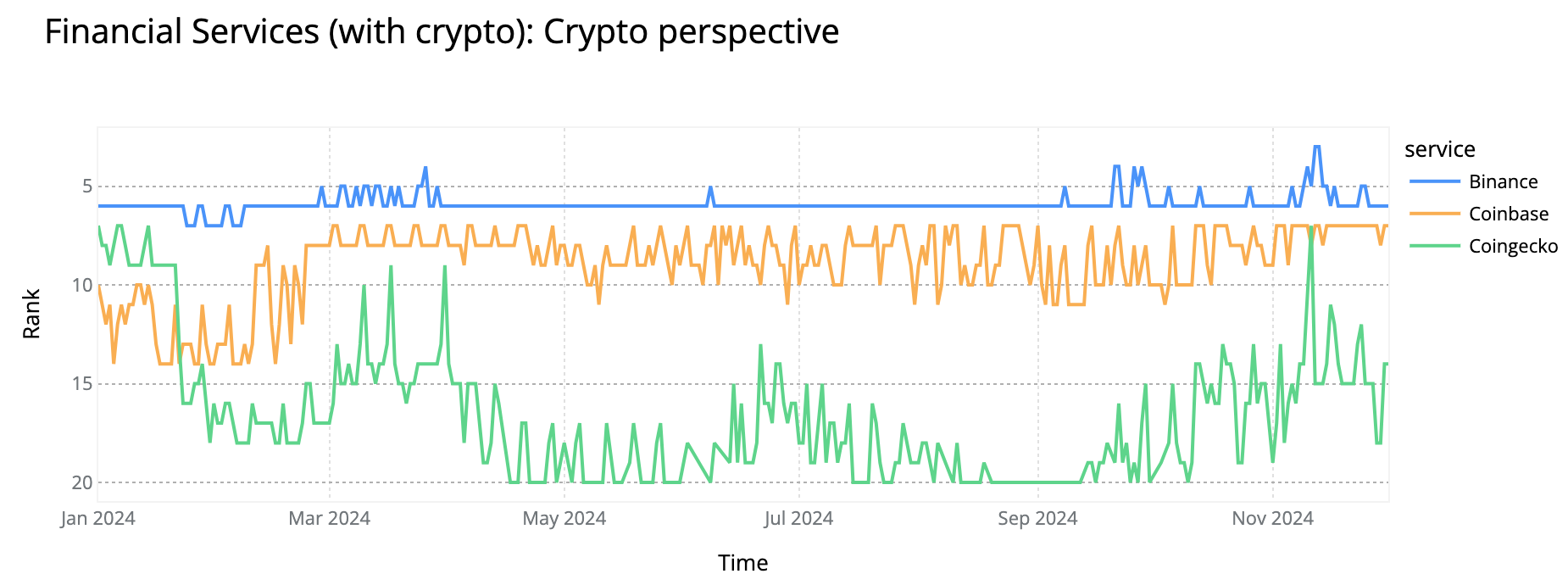
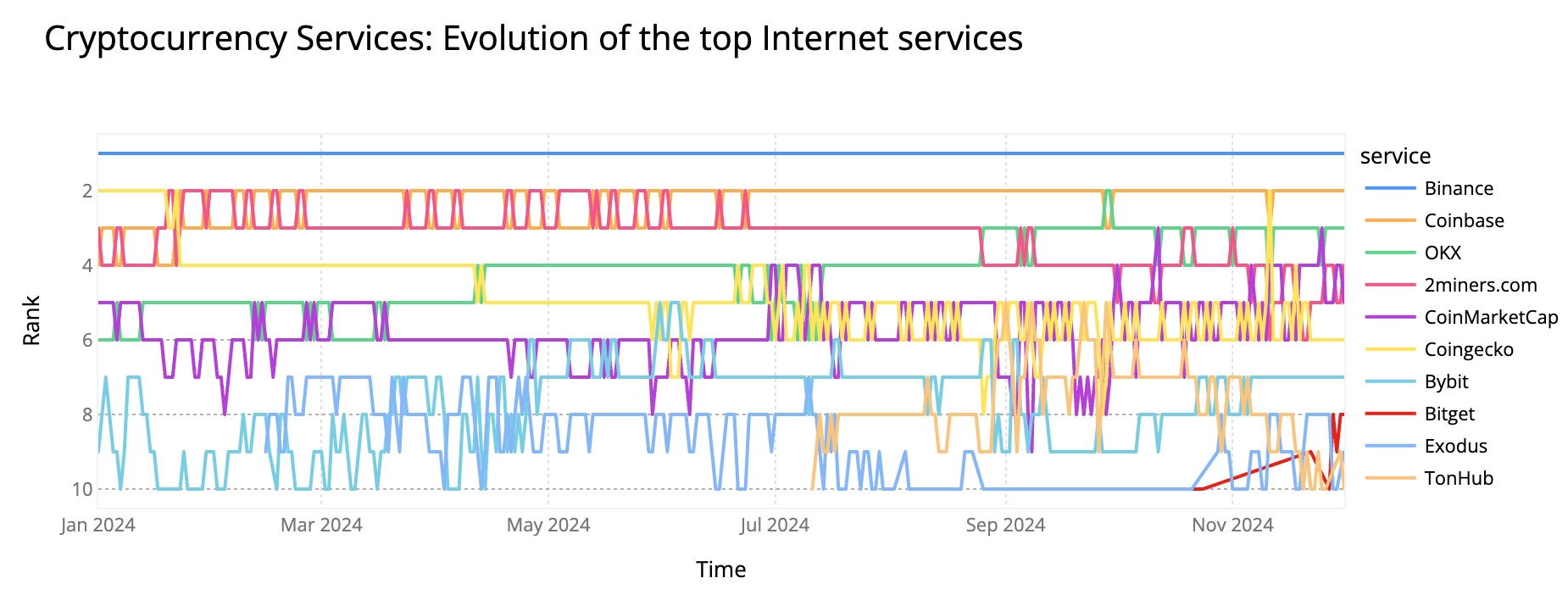
Google maintained its position as the most popular Internet service overall. OpenAI remained at the top of the Generative AI category. Binance remained at the top of the Cryptocurrency category. WhatsApp remained the top Messaging platform, and Facebook remained the top Social Media site. 🔗
Global traffic from Starlink grew 3.3x in 2024, in line with last year’s growth rate. After initiating service in Malawi in July 2023, Starlink traffic from that country grew 38x in 2024. As Starlink added new markets, we saw traffic grow rapidly in those locations. 🔗
Googlebot, Google’s web crawler, was responsible for the highest volume of request traffic to Cloudflare in 2024, as it retrieved content from millions of Cloudflare customer sites for search indexing. 🔗
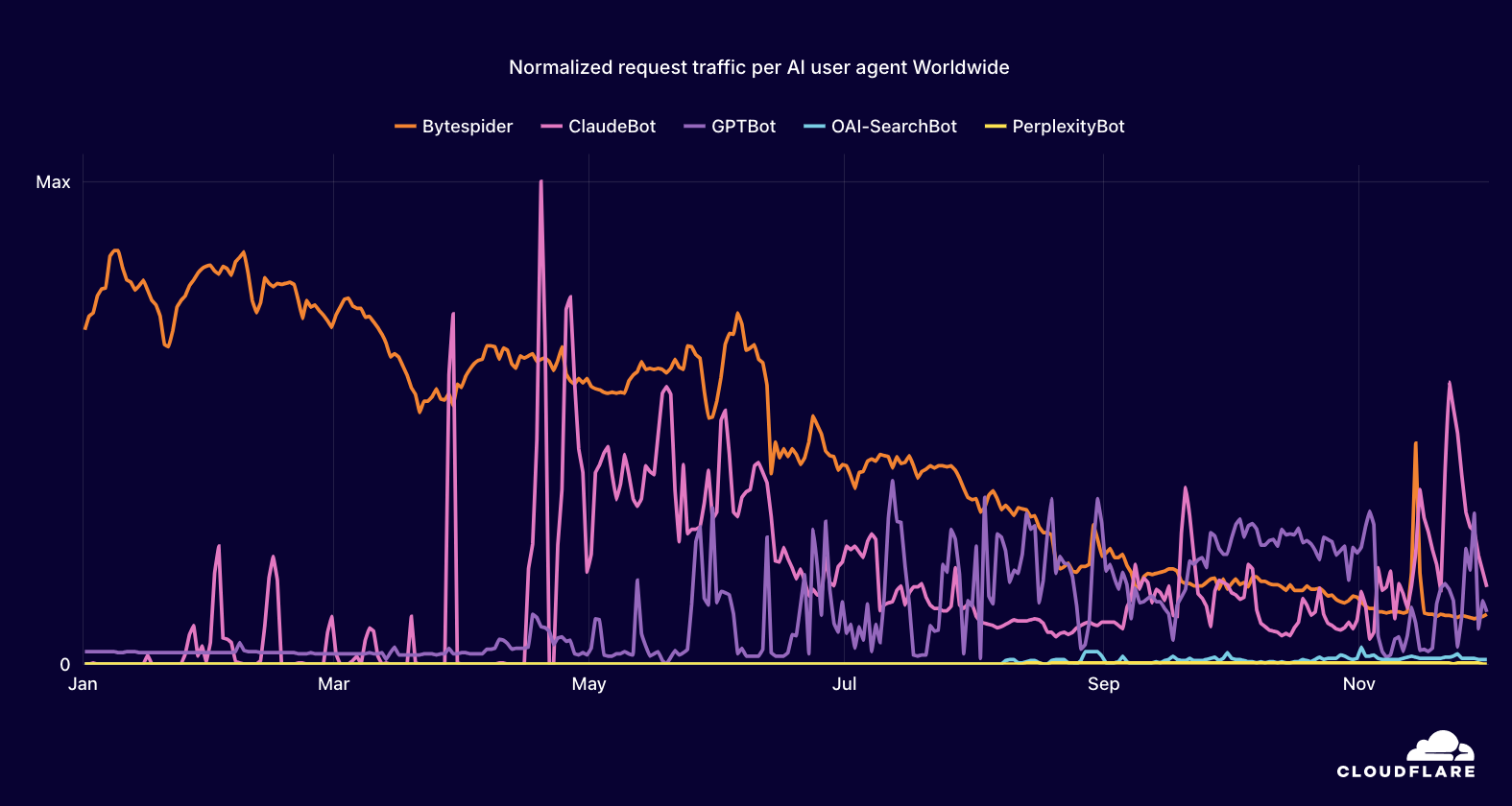
Traffic from ByteDance’s AI crawler (Bytespider) gradually declined over the course of 2024. Anthropic’s AI crawler (ClaudeBot) first started showing signs of ongoing crawling activity in April, then declined after an initial peak in May & June. 🔗
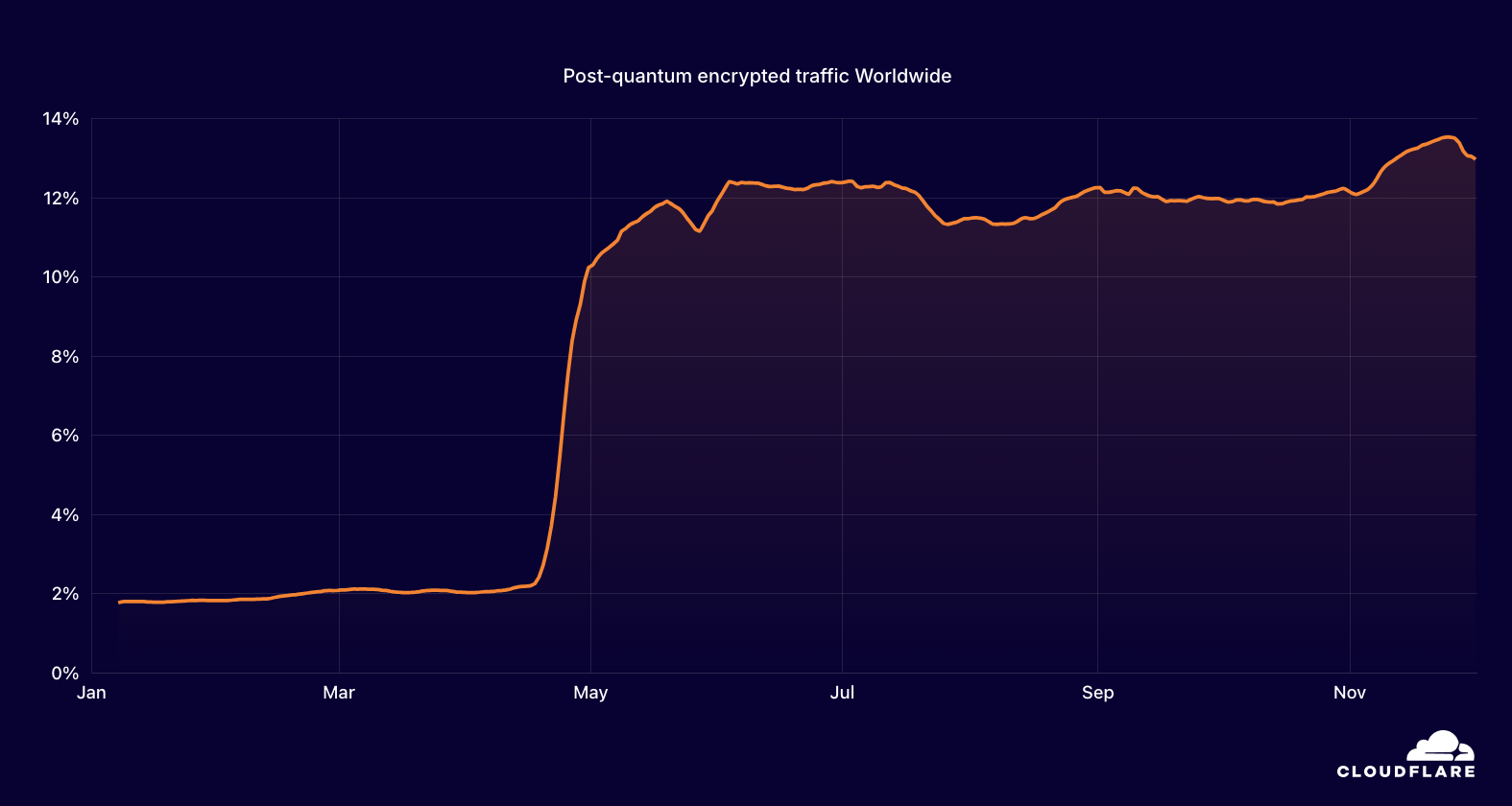
13.0% of TLS 1.3 traffic is using post-quantum encryption. 🔗
Adoption & Usage
Globally, nearly one-third of mobile device traffic was from Apple iOS devices. Android had a >90% share of mobile device traffic in 29 countries/regions; peak iOS mobile device traffic share was over 60% in eight countries/regions. 🔗
Globally, nearly half of web requests used HTTP/2, with 20.5% using HTTP/3. Usage of both versions was up slightly from 2023. 🔗
React, PHP, and jQuery were among the most popular technologies used to build websites, while HubSpot, Google, and WordPress were among the most popular vendors of supporting services and platforms. 🔗
Go surpassed NodeJS as the most popular language used for making automated API requests. 🔗
Google is far and away the most popular search engine globally, across all platforms. On mobile devices and operating systems, Baidu is a distant second. Bing is a distant second across desktop and Windows devices, with DuckDuckGo second most popular on macOS. Shares vary by platform and country/region. 🔗
Google Chrome is far and away the most popular browser overall. While this is also true on macOS devices, Safari usage is well ahead of Chrome on iOS devices. On Windows, Edge is the second most popular browser as it comes preinstalled and is the initial default. 🔗
Connectivity
225 major Internet disruptions were observed globally in 2024, with many due to government-directed regional and national shutdowns of Internet connectivity. Cable cuts and power outages were also leading causes. 🔗
Aggregated across 2024, 28.5% of IPv6-capable requests were made over IPv6. India and Malaysia were the strongest countries, at 68.9% and 59.6% IPv6 adoption respectively. 🔗
The top 10 countries ranked by Internet speed all had average download speeds above 200 Mbps. Spain was consistently among the top locations across the measured Internet quality metrics. 🔗
41.3% of global traffic comes from mobile devices. In nearly 100 countries/regions, the majority of traffic comes from mobile devices. 🔗
20.7% of TCP connections are unexpectedly terminated before any useful data can be exchanged. 🔗
Security
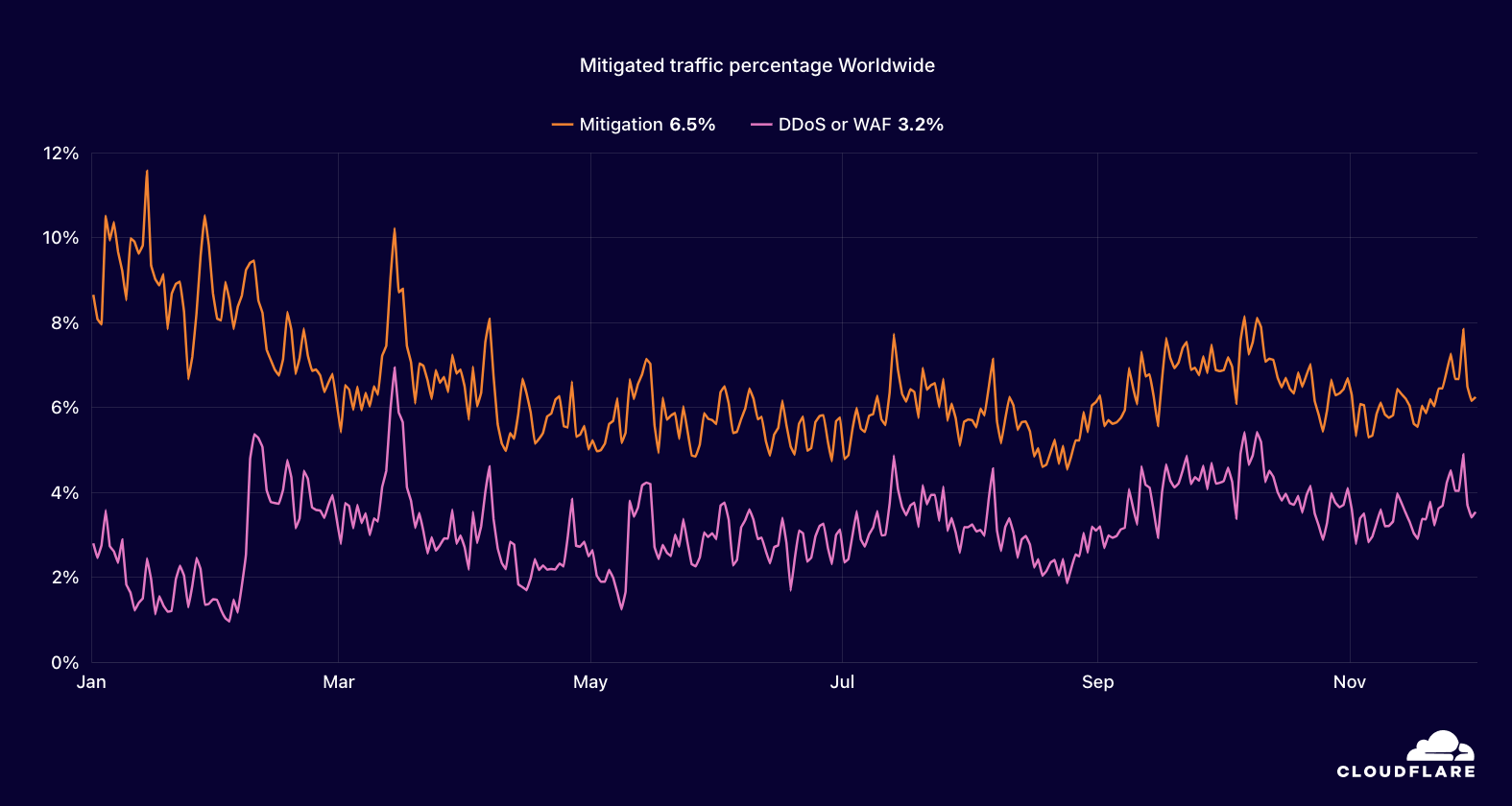
6.5% of global traffic was mitigated by Cloudflare’s systems as being potentially malicious or for customer-defined reasons. In the United States, the share of mitigated traffic grew to 5.1%, while in South Korea, it dropped slightly to 8.1%. In 44 countries/regions, over 10% of traffic was mitigated. 🔗
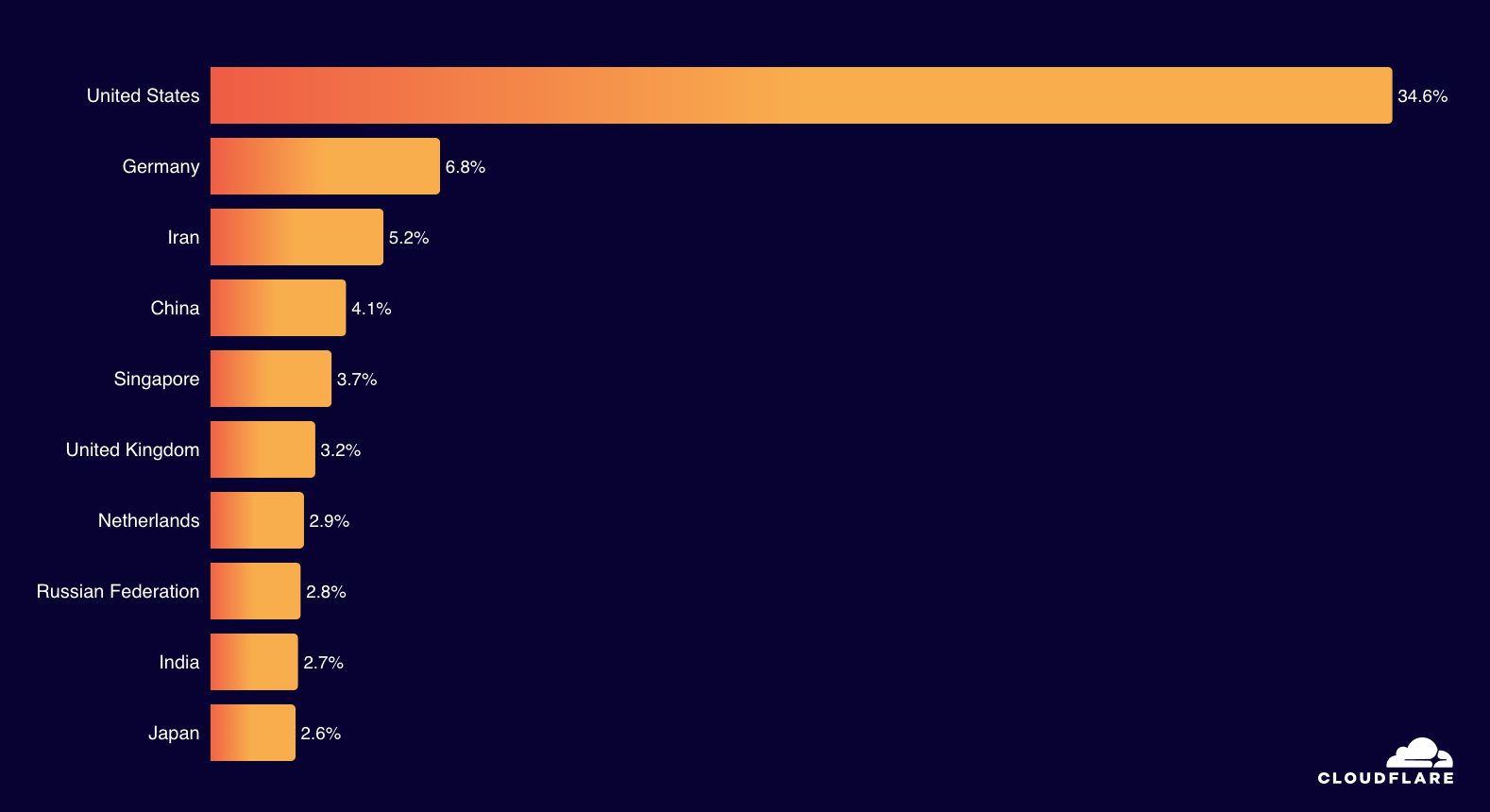
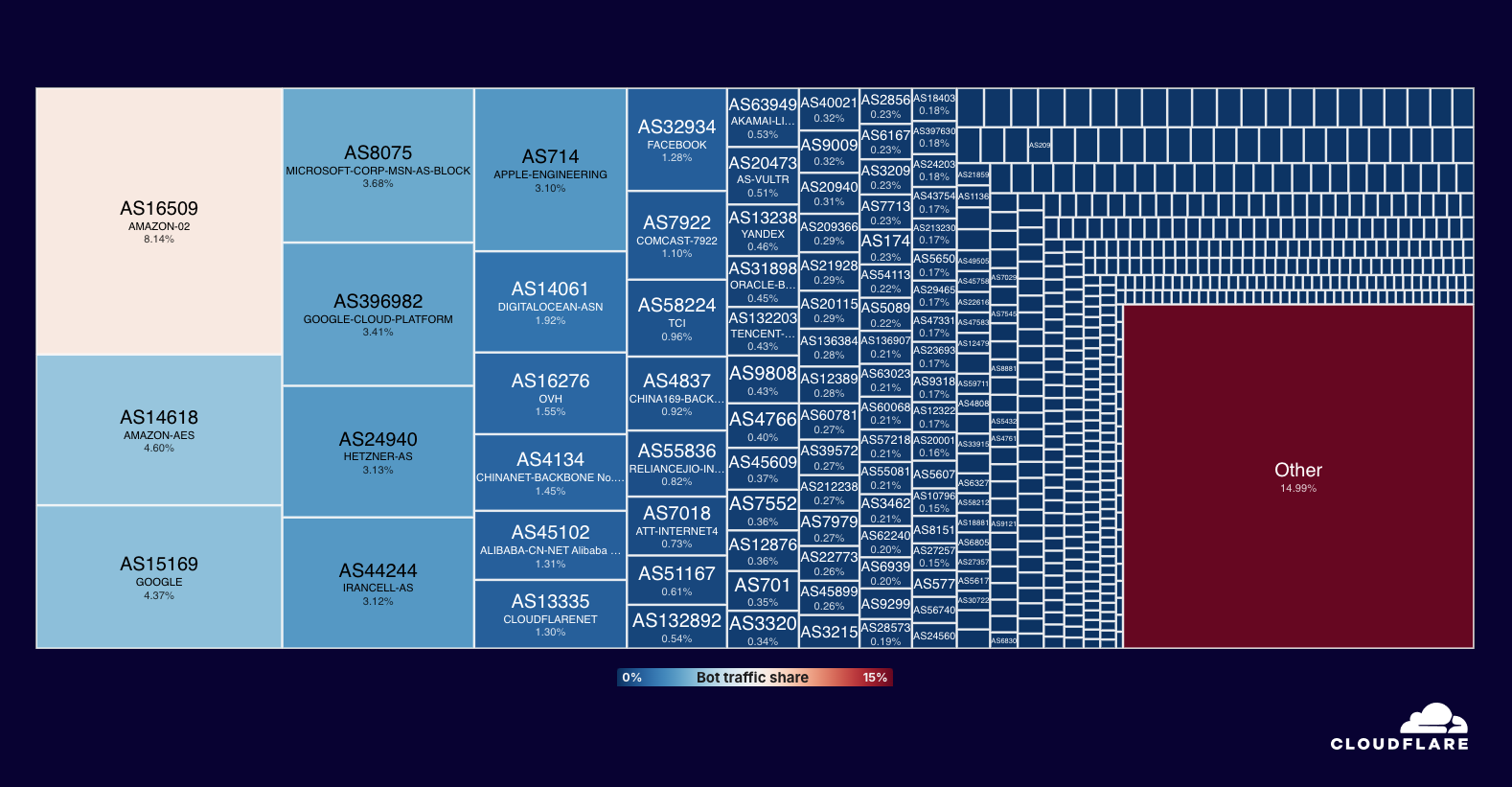
The United States was responsible for over a third of global bot traffic. Amazon Web Services was responsible for 12.7% of global bot traffic, and 7.8% came from Google. 🔗
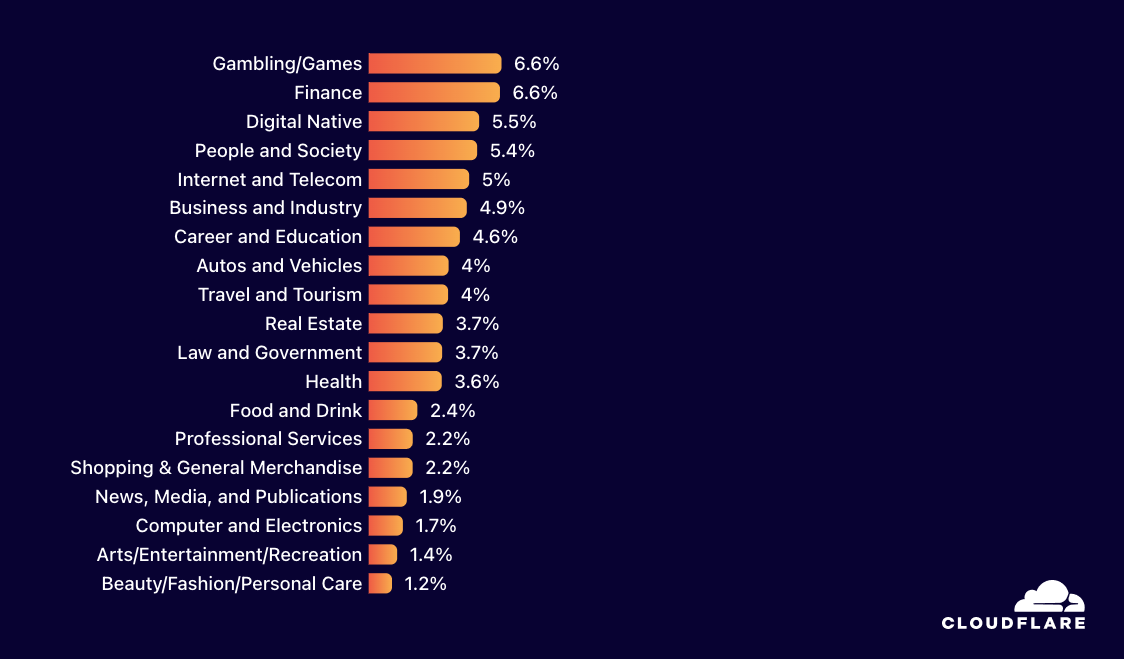
Globally, Gambling/Games was the most attacked industry, slightly ahead of 2023’s most targeted industry, Finance. 🔗
Log4j, a vulnerability discovered in 2021, remains a persistent threat and was actively targeted throughout 2024. 🔗
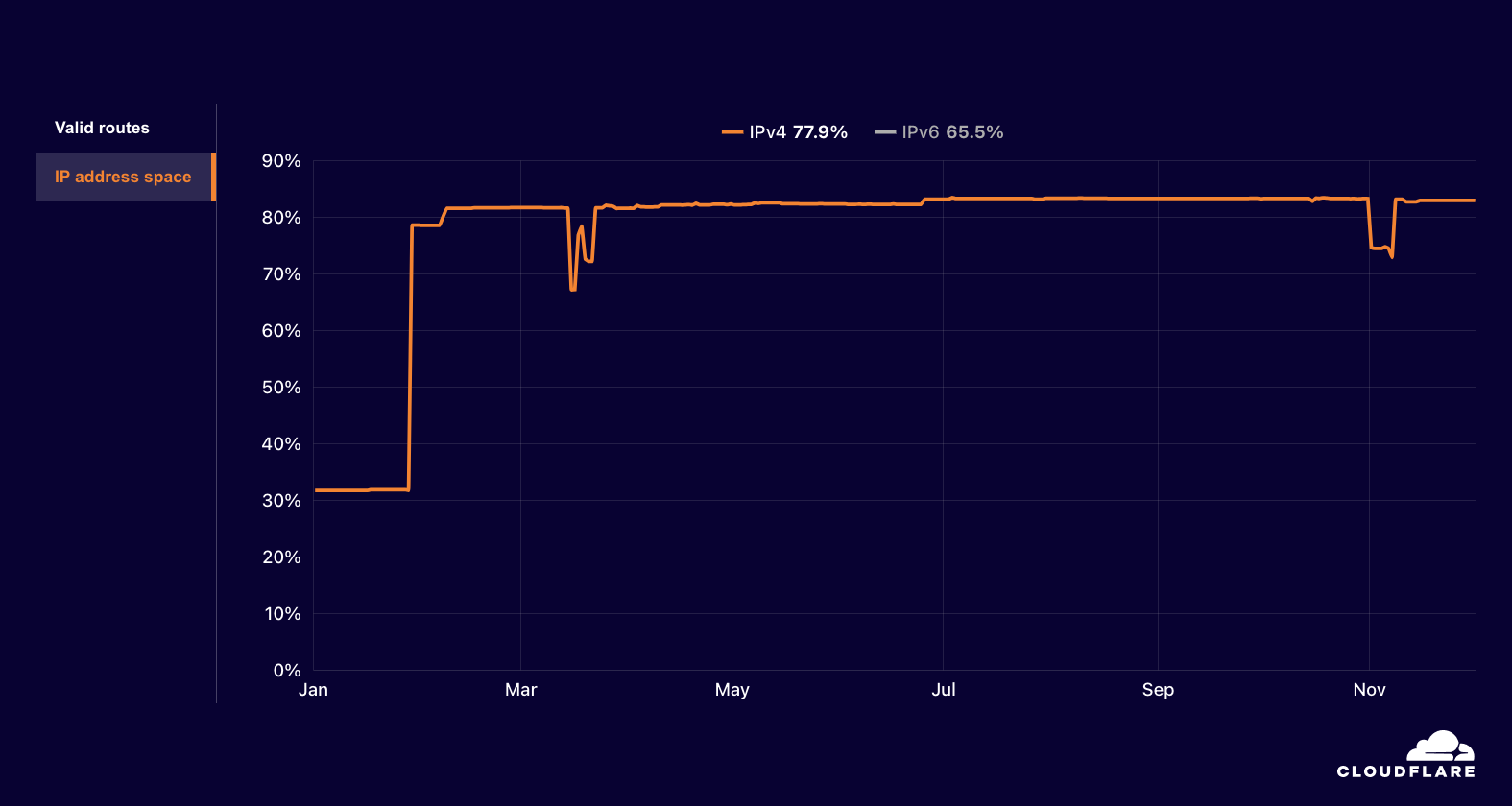
Routing security, measured as the share of RPKI valid routes and the share of covered IP address space, continued to improve globally throughout 2024. We saw a 4.7% increase in RPKI valid IPv4 address space in 2024, and a 6.4% increase in RPKI valid routes in 2024. 🔗
Email Security
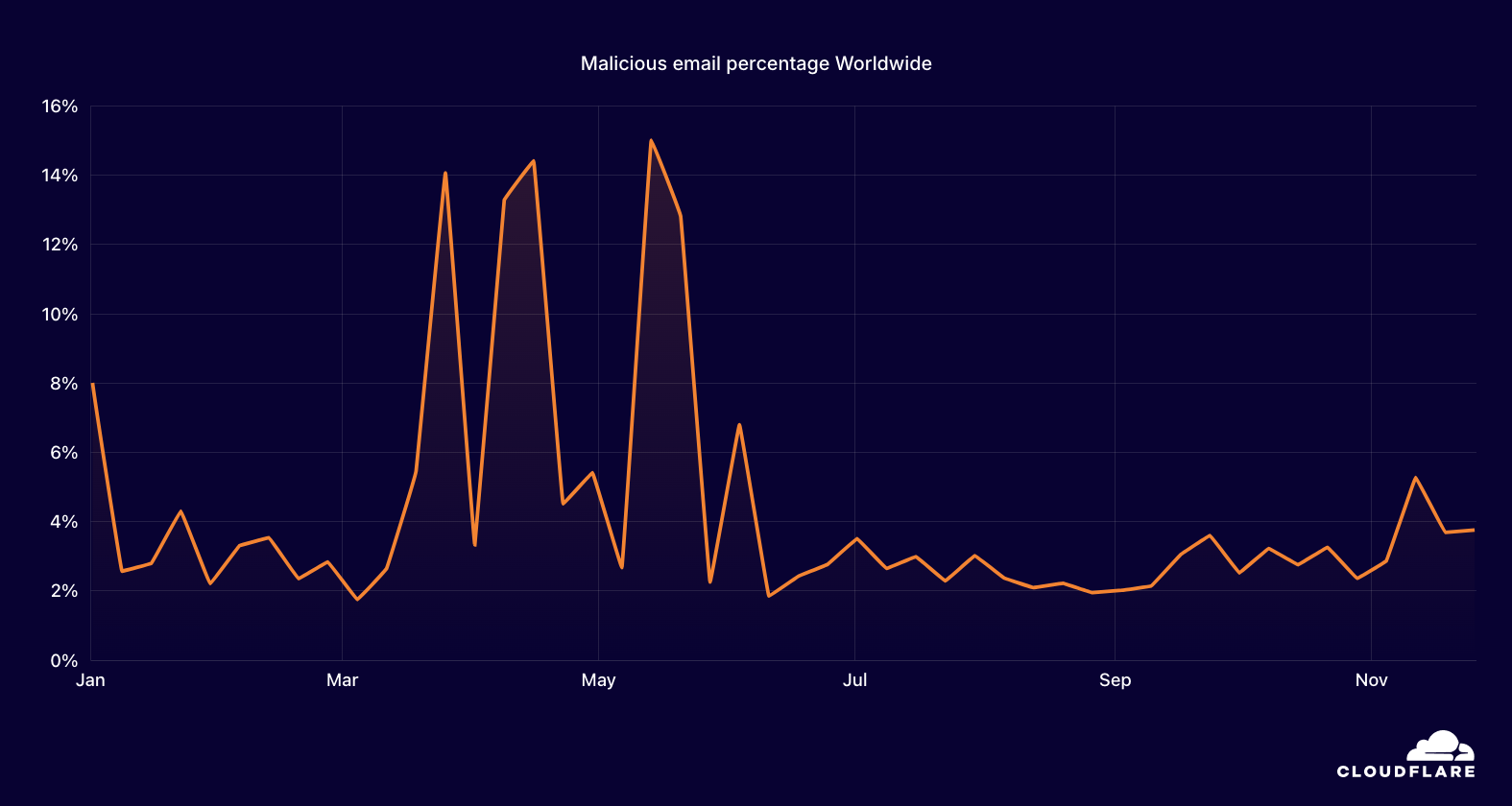
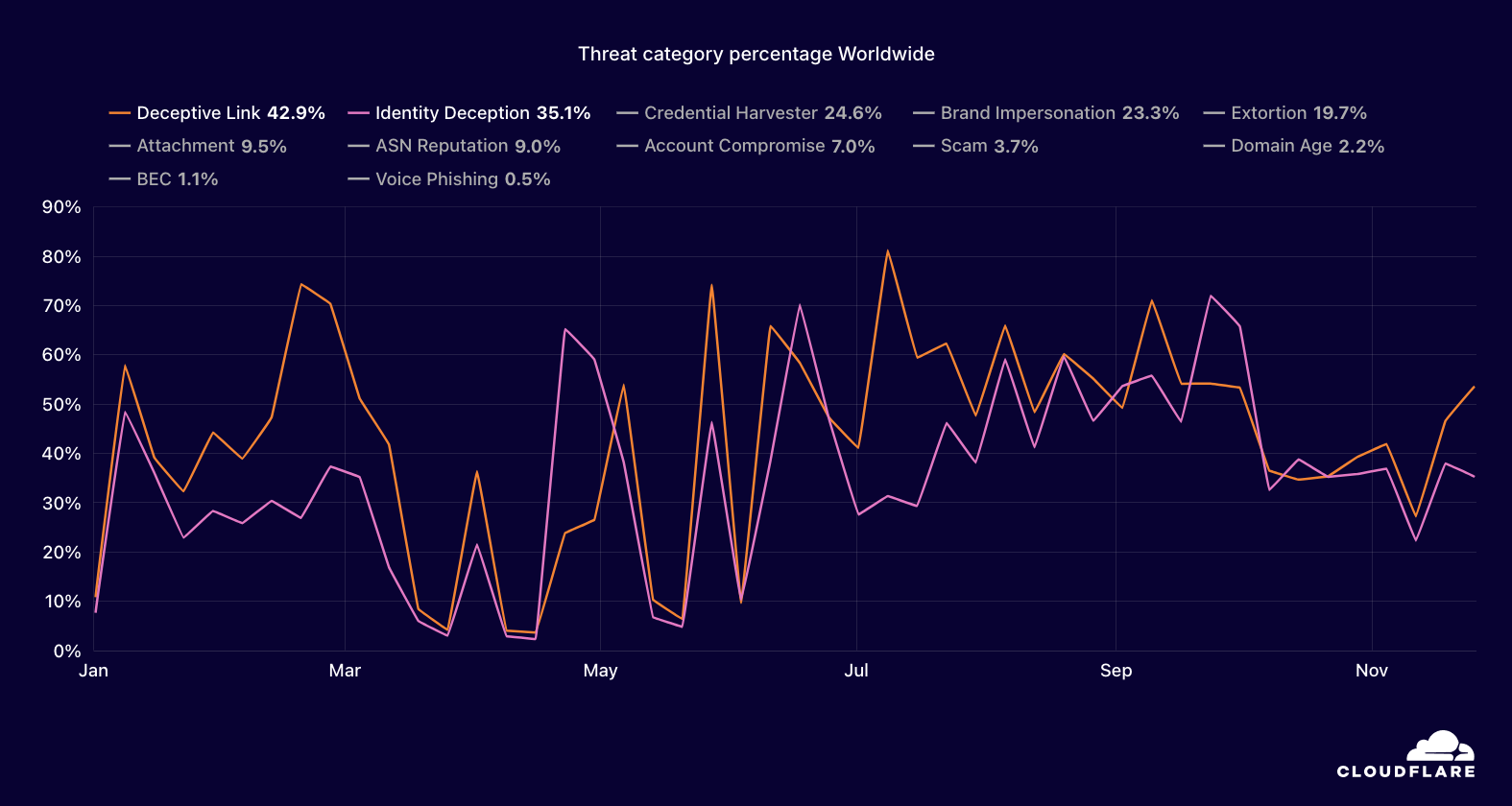
An average of 4.3% of emails were determined to be malicious in 2024, although this figure was likely influenced by spikes observed in March, April, and May. Deceptive links and identity deception were the two most common types of threats found in malicious email messages. 🔗
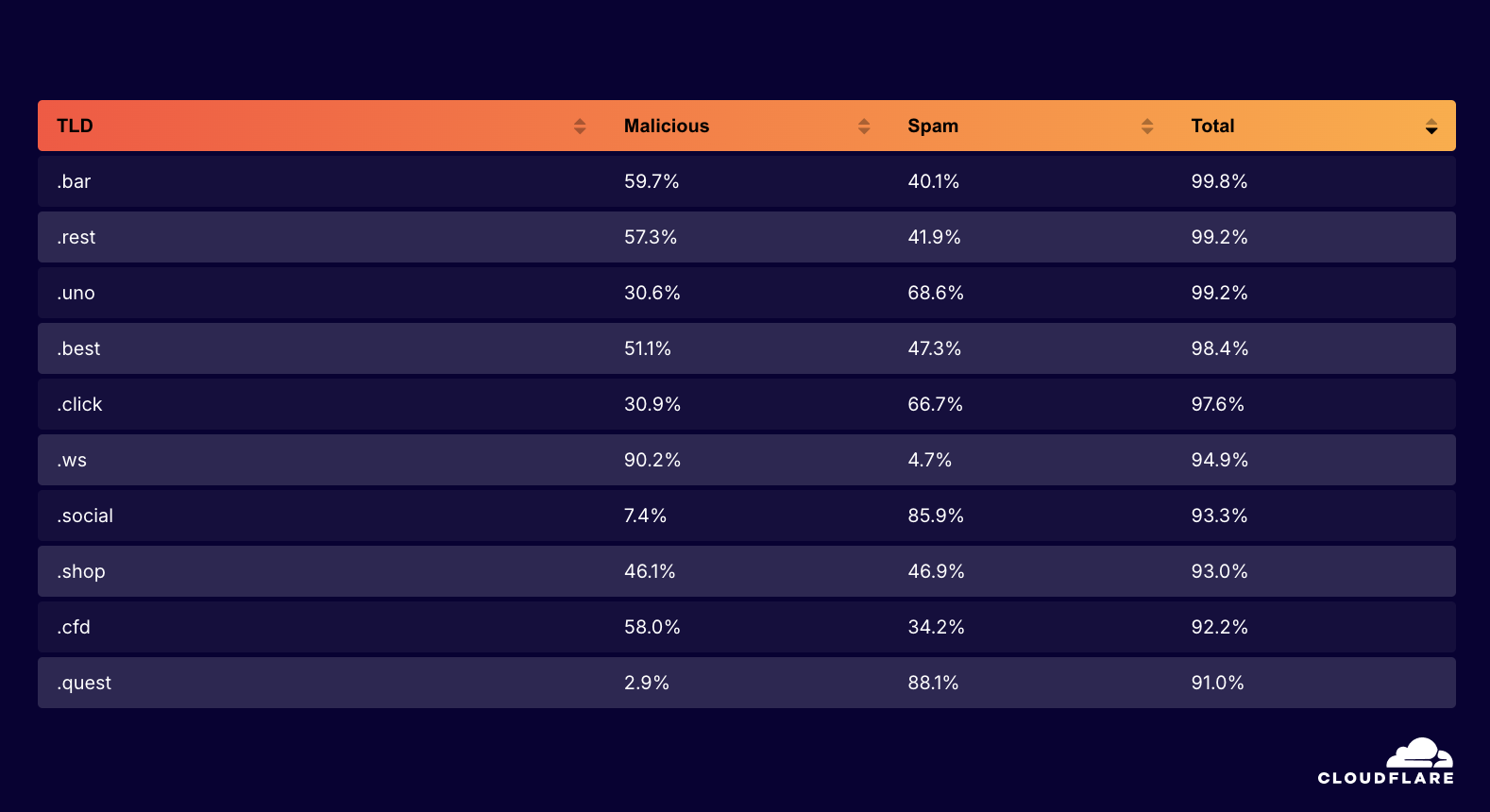
Over 99% of the email messages processed by Cloudflare Email Security from the .bar, .rest, and .uno top level domains (TLDs) were found to be either spam or malicious in nature. 🔗
Introduction
Over the last four years (2020, 2021, 2022, 2023), we have aggregated perspectives from Cloudflare Radar into an annual Year In Review, illustrating the Internet’s patterns across multiple areas over the course of that year. The Cloudflare Radar 2024 Year In Review microsite continues that tradition, featuring interactive charts, graphs, and maps you can use to explore and compare notable Internet trends observed throughout this past year.
Cloudflare’s network currently spans more than 330 cities in over 120 countries/regions, serving an average of over 63 million HTTP(S) requests per second for millions of Internet properties, in addition to handling over 42 million DNS requests per second on average. The resulting data generated by this usage, combined with data from other complementary Cloudflare tools, enables Radar to provide unique near-real time perspectives on the patterns and trends around security, traffic, performance, and usage that we observe across the Internet.
The 2024 Year In Review is organized into five sections: Traffic, Adoption & Usage, Connectivity, Security, and Email Security and covers the period from January 1 to December 1, 2024. We have incorporated several new metrics this year, including AI bot & crawler traffic, search engine and browser market share, connection tampering, and “most dangerous” top level domains (TLDs). To ensure consistency, we have kept underlying methodologies consistent with previous years’ calculations. Trends for 200 countries/regions are available on the microsite; smaller or less populated locations are excluded due to insufficient data. Some metrics are only shown worldwide, and are not displayed if a country/region is selected.
Below, we provide an overview of the content contained within the major Year In Review sections (Traffic, Adoption & Usage, Connectivity, Security, and Email Security), along with notable observations and key findings. In addition, we have also published a companion blog post that specifically explores trends seen across Top Internet Services.
The key findings and associated discussion within this post only provide a high-level perspective on the unique insights that can be found in the Year in Review microsite. Visit the microsite to explore the various datasets and metrics in more detail, including trends seen in your country/region, how these trends have changed as compared to 2023, and how they compare to other countries/regions of interest. Surveying the Internet from this vantage point provides insights that can inform decisions on everything from an organization’s security posture and IT priorities to product development and strategy.
Traffic trends
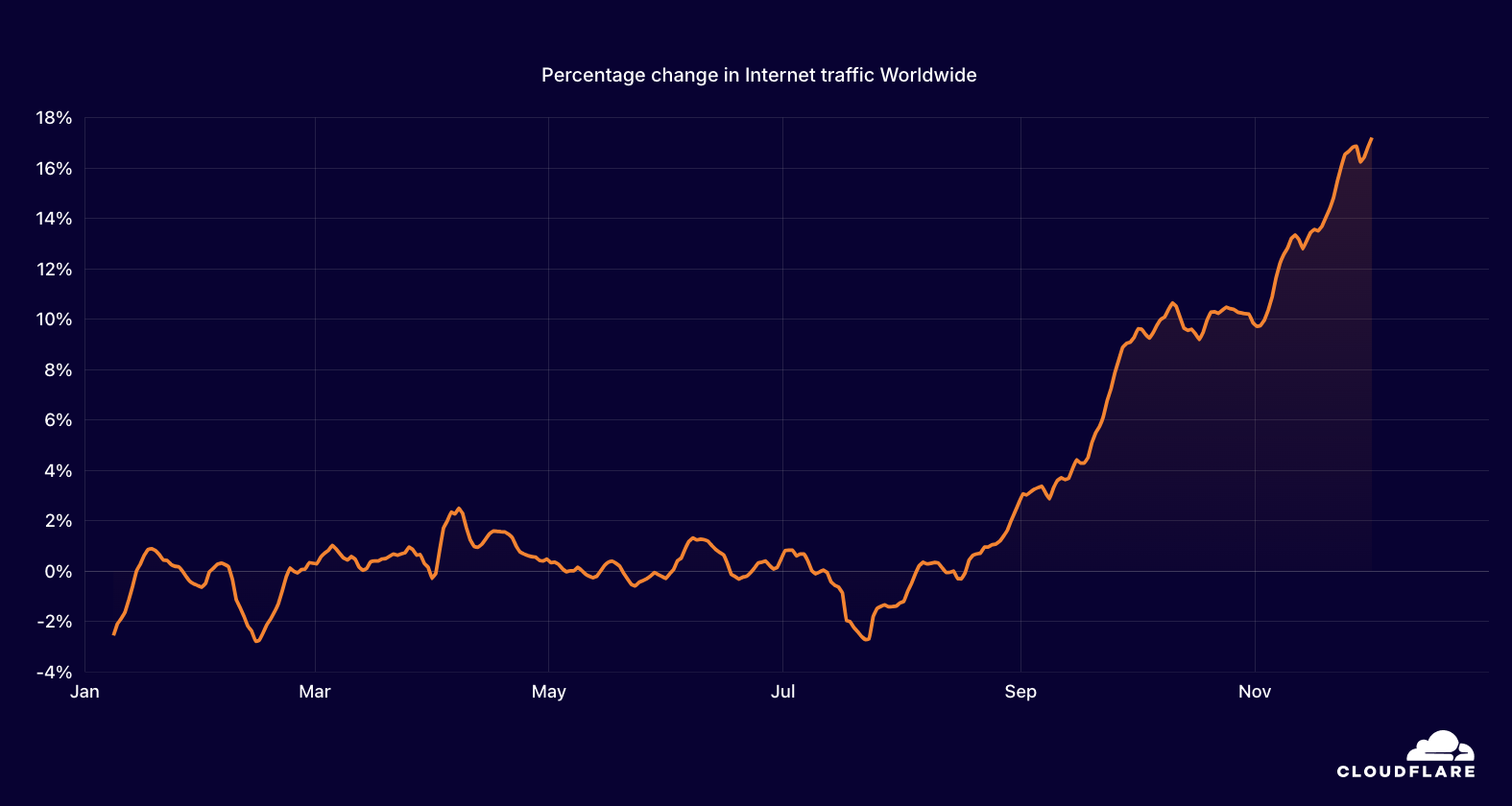
Global Internet traffic grew 17.2% in 2024.
An inflection point for Internet traffic arguably occurred thirty years ago. The World Wide Web went mainstream in 1994, thanks to the late 1993 release of the NCSA Mosaic browser for multiple popular operating systems, which included support for embedded images. In turn, “heavier” (in contrast to text-based) Internet content became the norm, and coupled with the growth in consumption through popular online services and the emerging consumer ISP industry, Internet traffic began to rapidly increase, and that trend has continued to the present.
To determine the traffic trends over time for the Year in Review, we use the average daily traffic volume (excluding bot traffic) over the second full calendar week (January 8-15) of 2024 as our baseline. (The second calendar week is used to allow time for people to get back into their “normal” school and work routines after the winter holidays and New Year’s Day. The percent change shown in the traffic trends chart is calculated relative to the baseline value — it does not represent absolute traffic volume for a country/region. The trend line represents a seven-day trailing average, which is used to smooth the sharp changes seen with data at a daily granularity. To compare 2024’s traffic trends with 2023 data and/or other locations, click the “Compare” icon at the upper right of the graph.
Throughout the first half of 2024, worldwide Internet traffic growth appeared to be fairly limited, within a percent or two on either side of the baseline value through mid-August. However, at that time growth clearly began to accelerate, climbing consistently through the end of November, growing 17.2% for the year. This trend is similar to those also seen in 2023 and 2022, as we discussed in the 2023 Year in Review blog post.
Internet traffic trends in 2024, worldwide
The West African country of Guinea experienced the most significant Internet traffic growth seen in 2024, reaching as much as 350% above baseline. Traffic growth didn’t begin in earnest until late February, and reached an initial peak in early April. It remained between 100% and 200% above baseline until September, when it experienced several multi-week periods of growth. While the September-November periods of traffic growth also occurred in 2023, they peaked at under 90% above baseline.
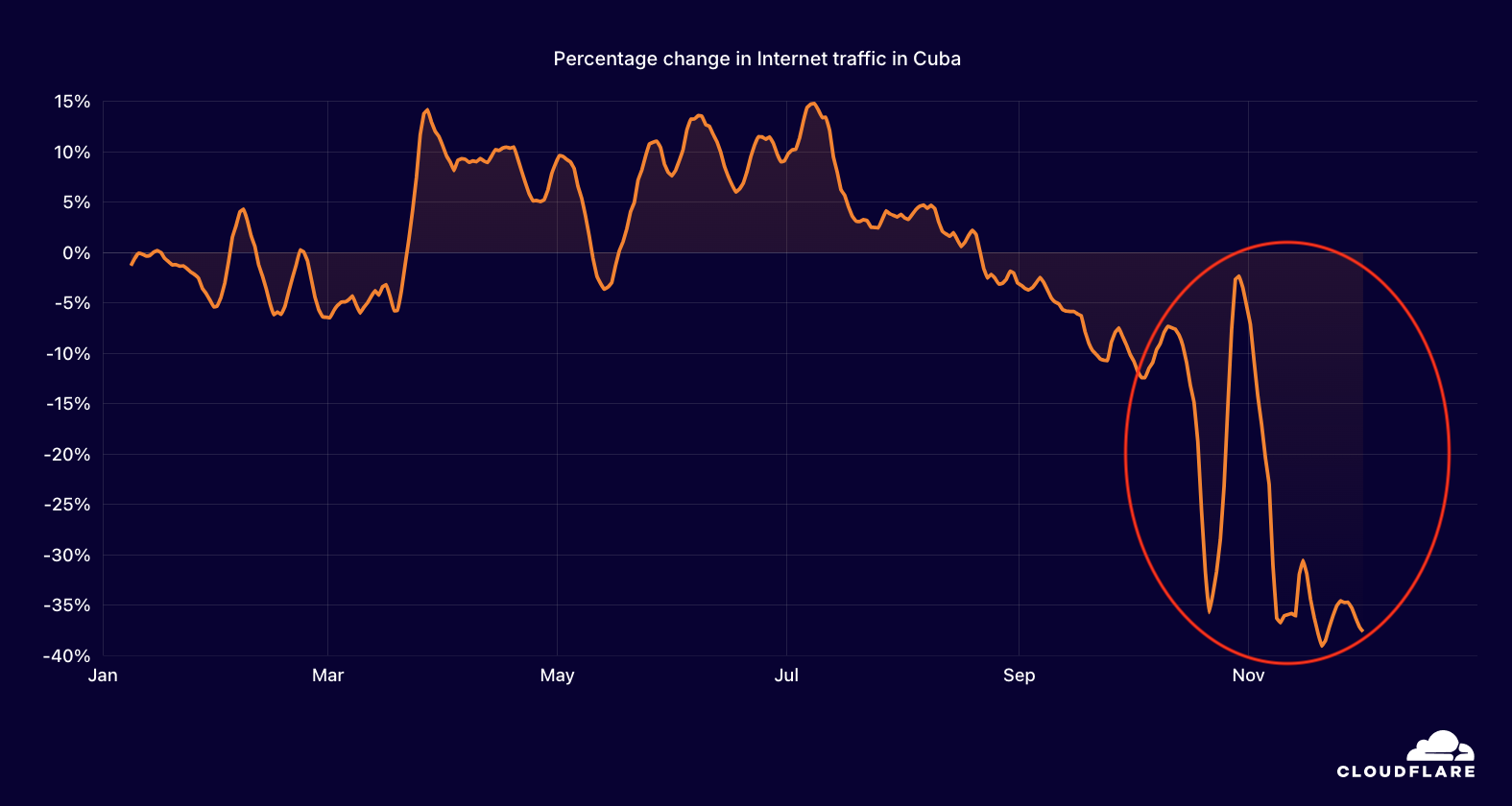
The impact of significant Internet outages is also clearly visible when looking at data across the year. Two significant Internet outages in Cuba are clearly visible as large drops in traffic in October and November. A reported “complete disconnection” of the national electricity system on the island occurred on October 18, lasting just over three days. Just a couple of weeks later, on November 6, damage from Hurricane Rafael caused widespread power outages in Cuba, resulting in another large drop in Internet traffic. Traffic has remained lower as Cuba’s electrical infrastructure continues to struggle.
Internet traffic trends in 2024, Cuba
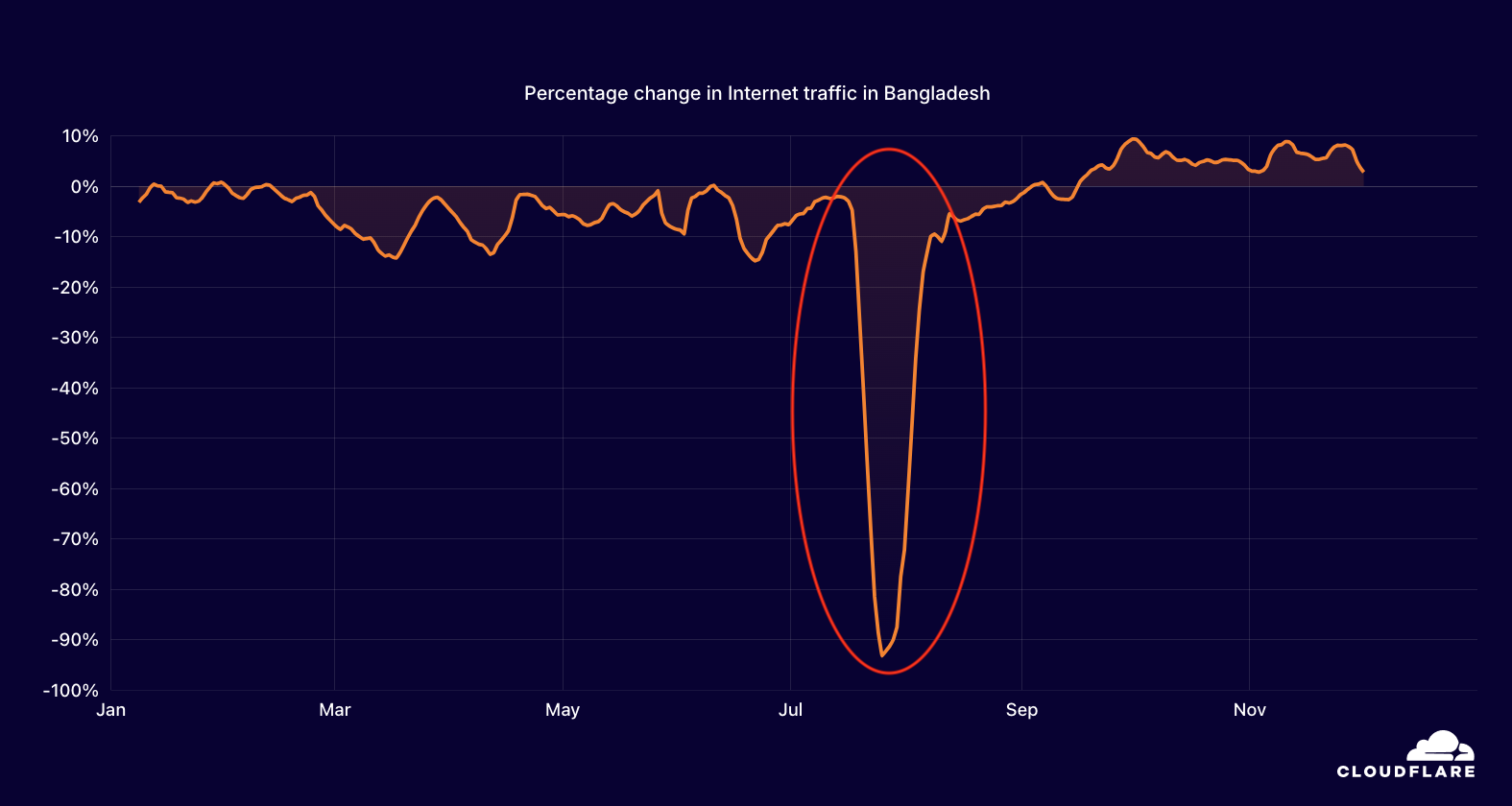
As we frequently discuss in Cloudflare Radar blog and social media posts, government-directed Internet shutdowns occur all too frequently, and the impact of these actions are also clearly visible when looking at long-term traffic data. In Bangladesh, the government ordered the shutdown of mobile Internet connectivity on July 18, in response to student protests. Shortly after mobile networks were shut down, fixed broadband networks were taken offline as well, resulting in a near complete loss of Internet traffic from the country. Connectivity gradually returned over the course of several days, between July 23-28.
Internet traffic trends in 2024, Bangladesh
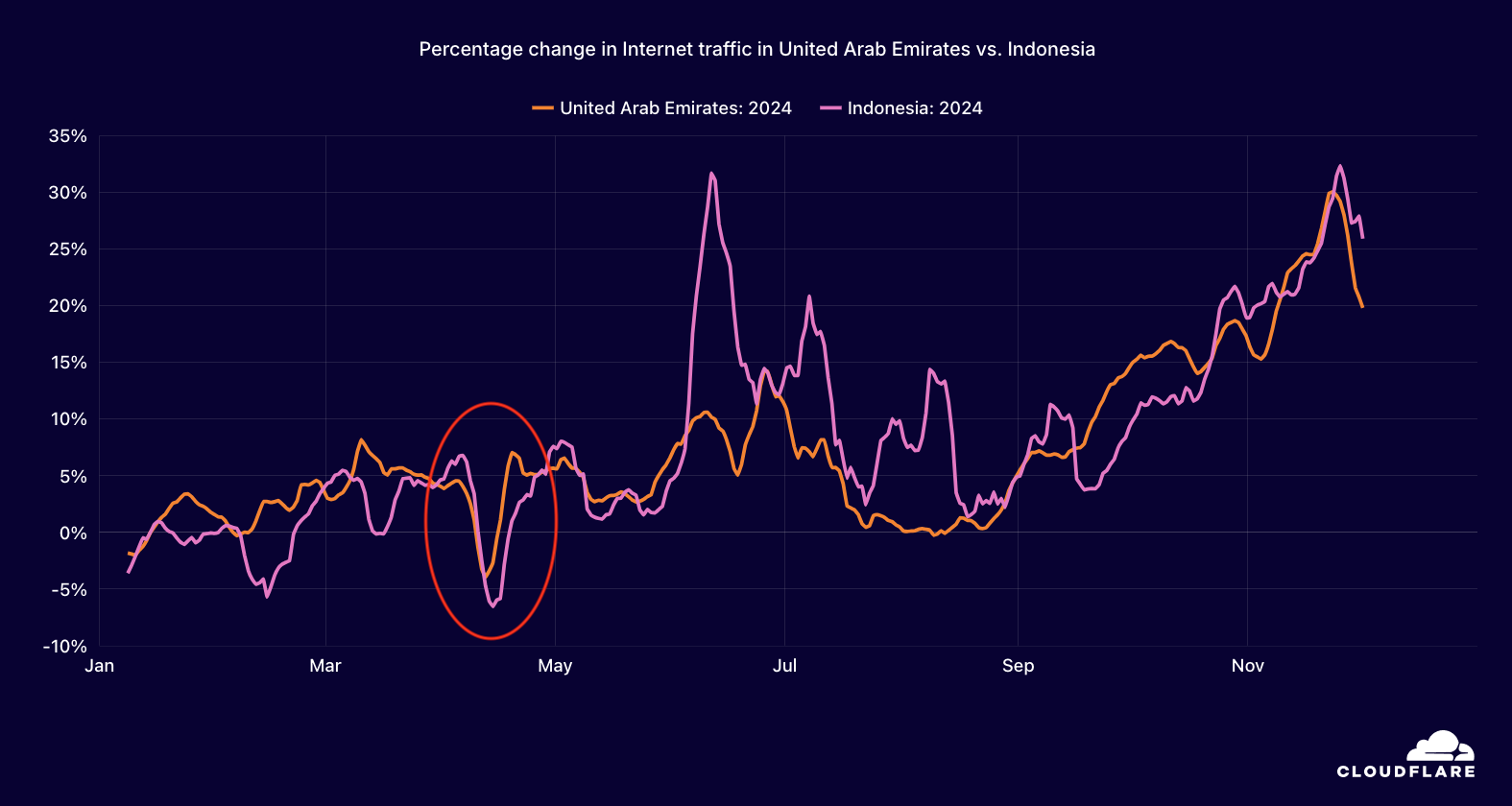
As we also noted last year, the celebration of major holidays can also have a visible impact on Internet traffic at a country level. For example, in Muslim countries including Indonesia and the United Arab Emirates, the celebration of Eid al-Fitr, the festival marking the end of the fast of Ramadan, is visible as a noticeable drop in traffic around April 9-10.
Internet traffic trends in 2024, Indonesia and United Arab Emirates
Google maintained its position as the most popular Internet service. OpenAI, Binance, WhatsApp, and Facebook led their respective categories.
Over the last several years, the Year In Review has ranked the most popular Internet services. These rankings cover an “overall” perspective, as well as a dozen more specific categories, based on analysis of anonymized query data of traffic to our 1.1.1.1 public DNS resolver from millions of users around the world. For the purposes of these rankings, domains that belong to a single Internet service are grouped together.
Google once again held the top spot overall, supported by its broad portfolio of services, as well as the popularity of the Android mobile operating system (more on that below). Meta properties Facebook, Instagram, and WhatsApp also held spots in the top 10.
Generative AI continued to grow in popularity throughout 2024, and in this category, OpenAI again held the top spot, building on the continued success and popularity of ChatGPT. Within Social Media, the top five remained consistent with 2023’s and 2022’s ranking, including Facebook, TikTok, Instagram, X, and Snapchat.
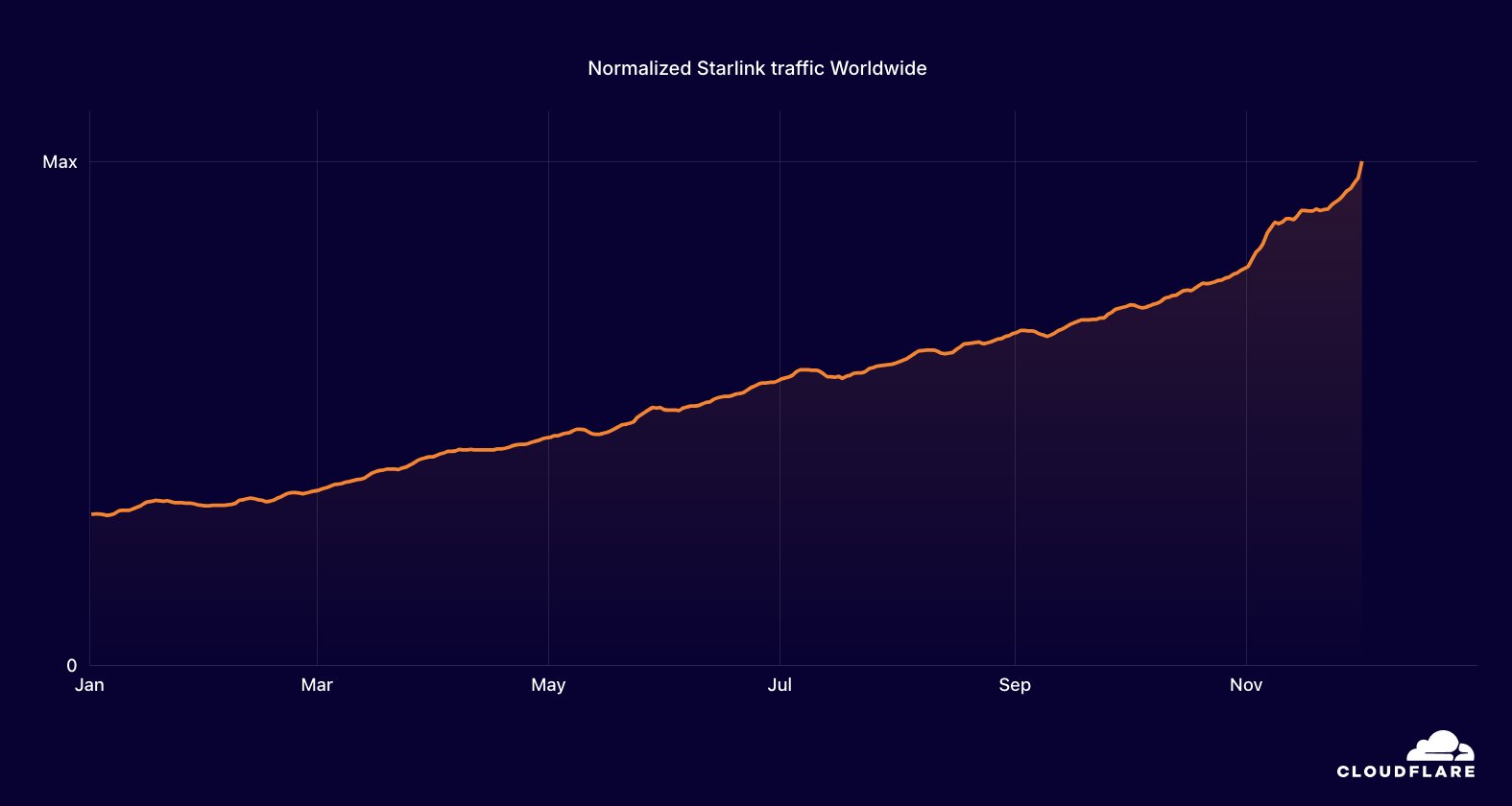
Global traffic from Starlink grew 3.3x in 2024, in line with last year’s growth rate. After initiating service in Malawi in July 2023, Starlink traffic from that country grew 38x in 2024.
SpaceX’s Starlink continues to be the leading satellite Internet service provider, bringing connectivity to unserved or underserved areas. In addition to opening up new markets in 2024, Starlink also announced relationships to provide in-flight connectivity to multiple airlines, and on cruise ships and trains, as well as enabling subscribers to roam with their subscription using the Starlink Mini.
We analyzed aggregate Cloudflare traffic volumes associated with Starlink’s primary autonomous system (AS14593) to track the growth in usage of the service throughout 2024. Similar to the traffic trends discussed above, the request volume shown on the trend line in the chart represents a seven-day trailing average. Comparisons with 2023 data can be shown by clicking the “Compare” icon at the upper right of the graph. Within comparative views, the lines are scaled to the maximum value shown.
On a worldwide basis, steady, consistent growth was seen across the year, though it accelerates throughout November. This acceleration may have been driven by traffic associated with customer-specific large software updates.
Starlink traffic growth worldwide in 2024
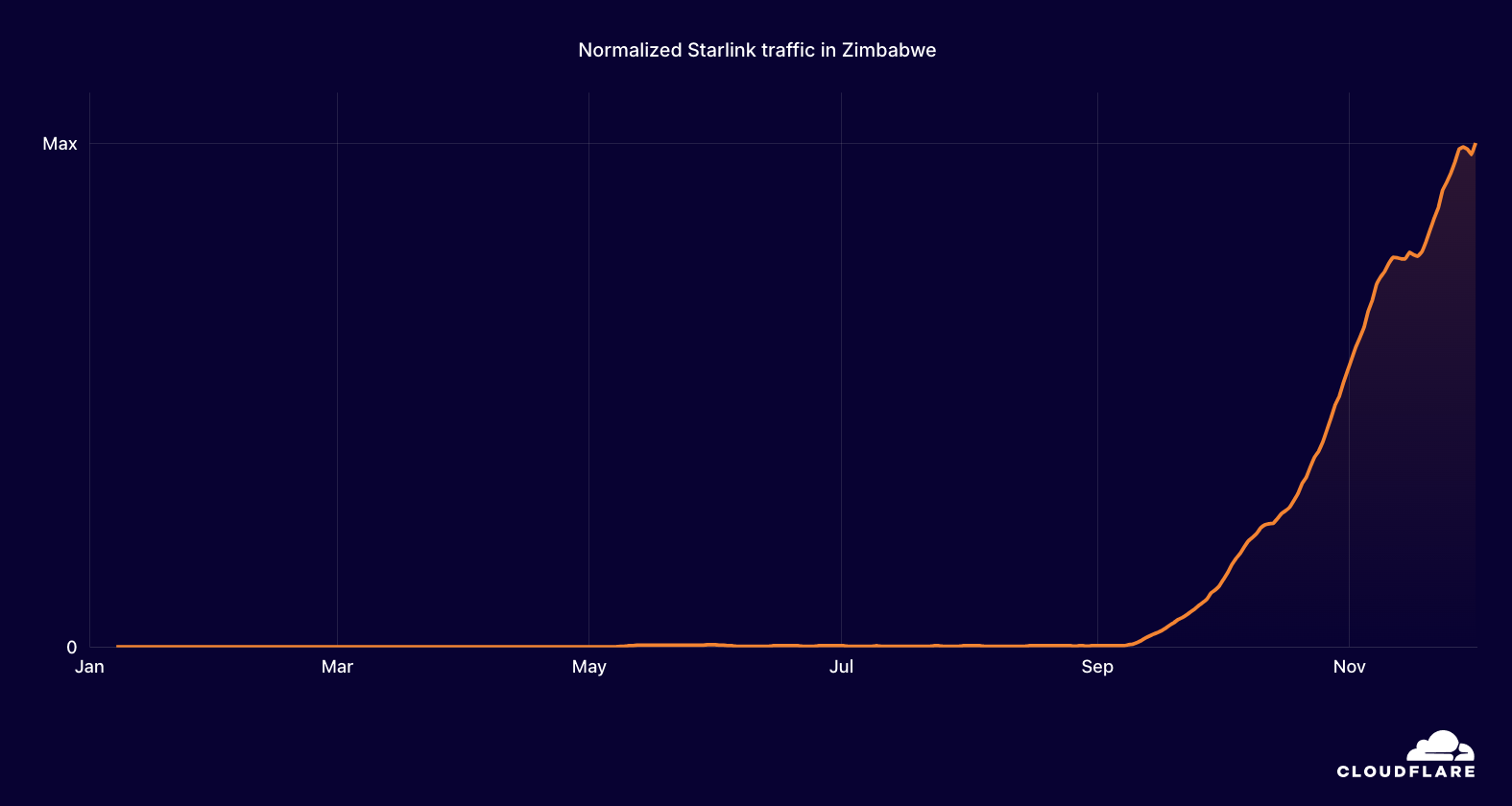
In many locations, there is pent-up demand for “alternative” connectivity providers such as Starlink, and in these countries/regions, we see rapid traffic growth when service becomes available, such as in Zimbabwe. Service availability was announced on September 7, and traffic from the country began to grow rapidly almost immediately thereafter.
Starlink traffic growth in Zimbabwe in 2024
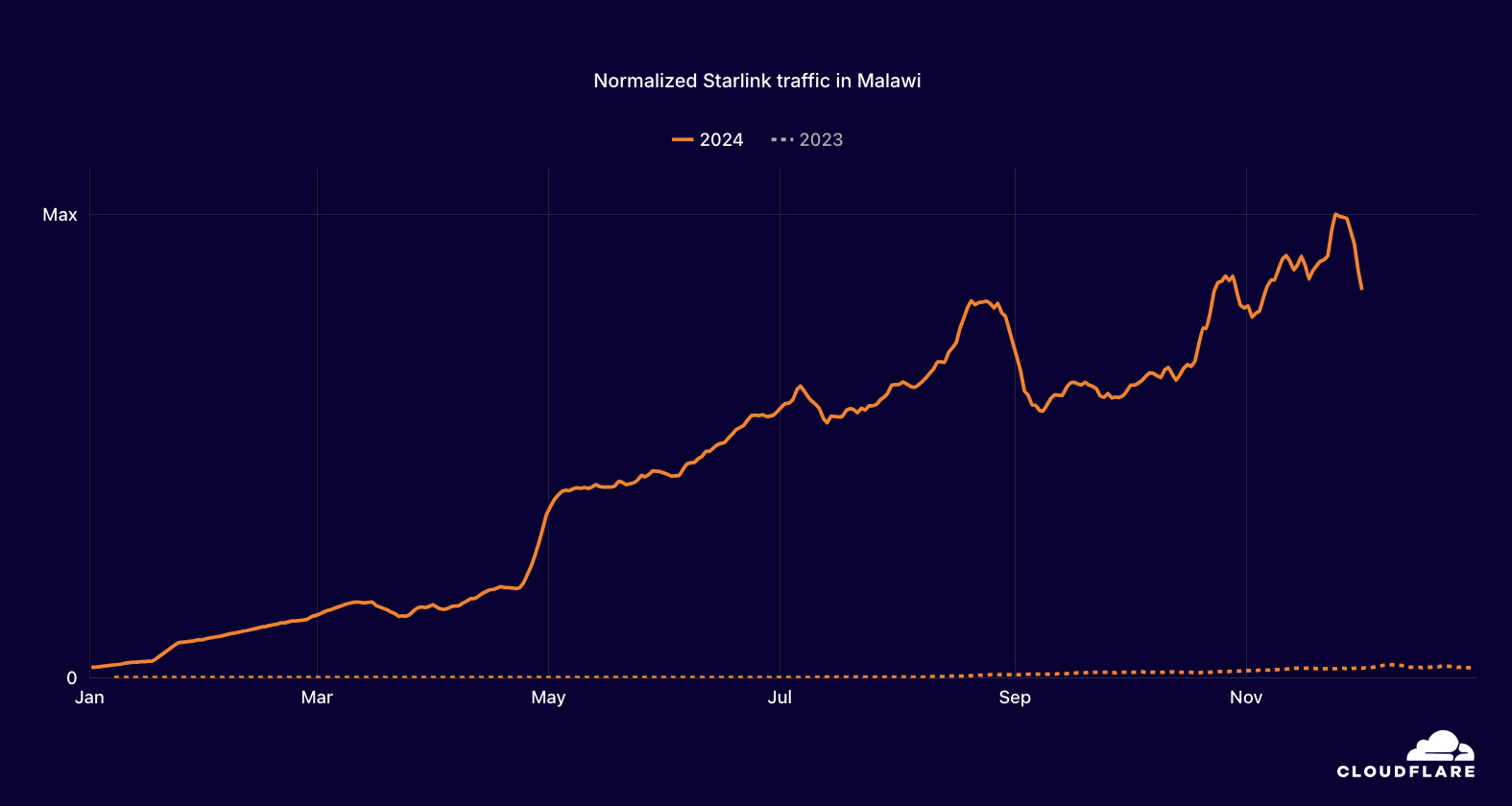
In new markets, traffic growth continues after that initial increase. For example Starlink service became available in Malawi in July 2023, and throughout 2024, Starlink traffic from the country grew 38x. While Malawi’s 38x increase is impressive, other countries also experienced significant growth. In the Eastern European country of Georgia, service became available on November 1, 2023. After a slow ramp, traffic began to take off growing over 100x through 2024. In Paraguay, service availability was announced on December 21, and began to grow at the beginning of January, registering an increase of over 900x across the year.
Starlink traffic growth in Malawi in 2024
Googlebot was responsible for the highest volume of request traffic to Cloudflare in 2024 as it retrieved content from millions of Cloudflare customer sites for search indexing.
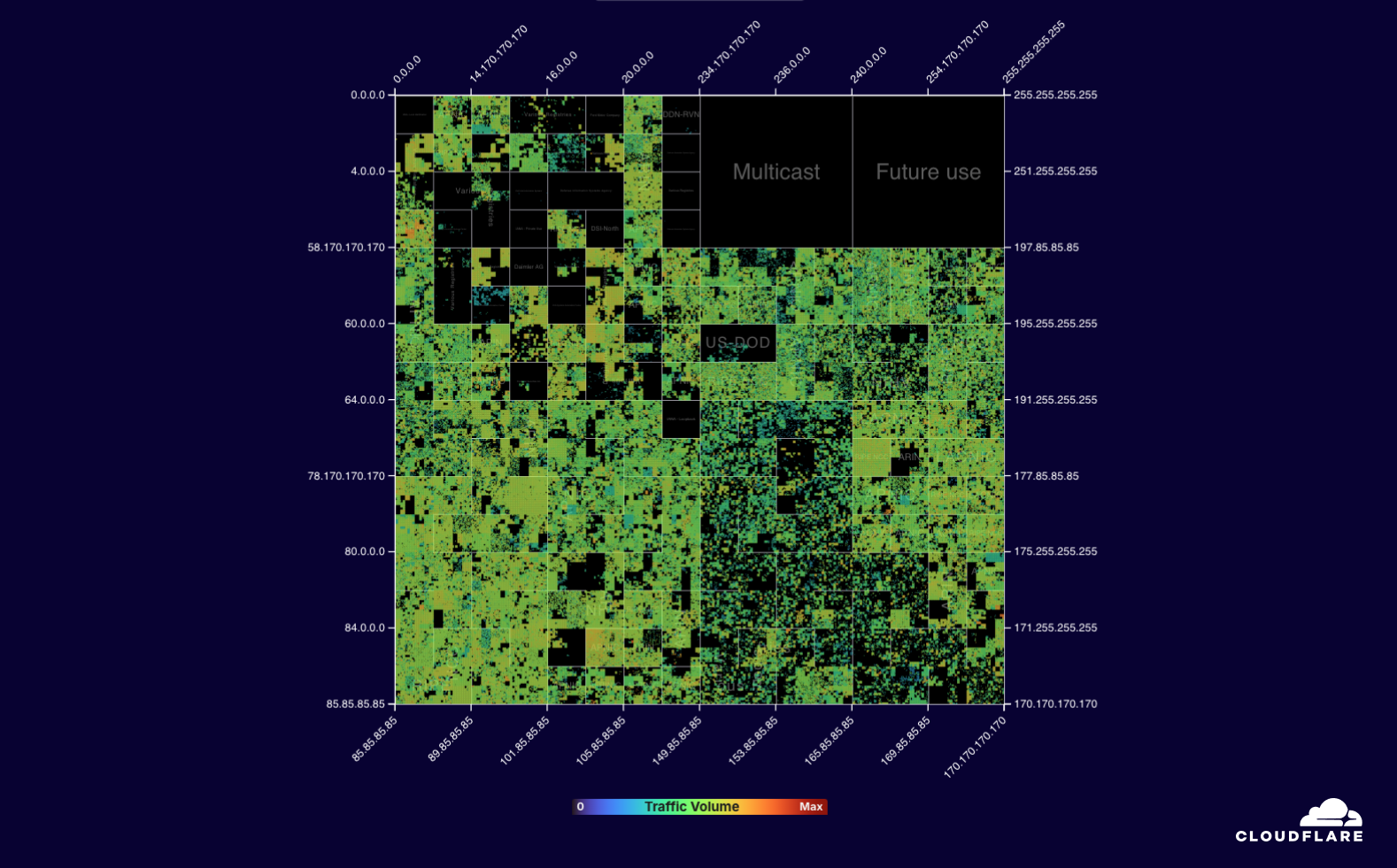
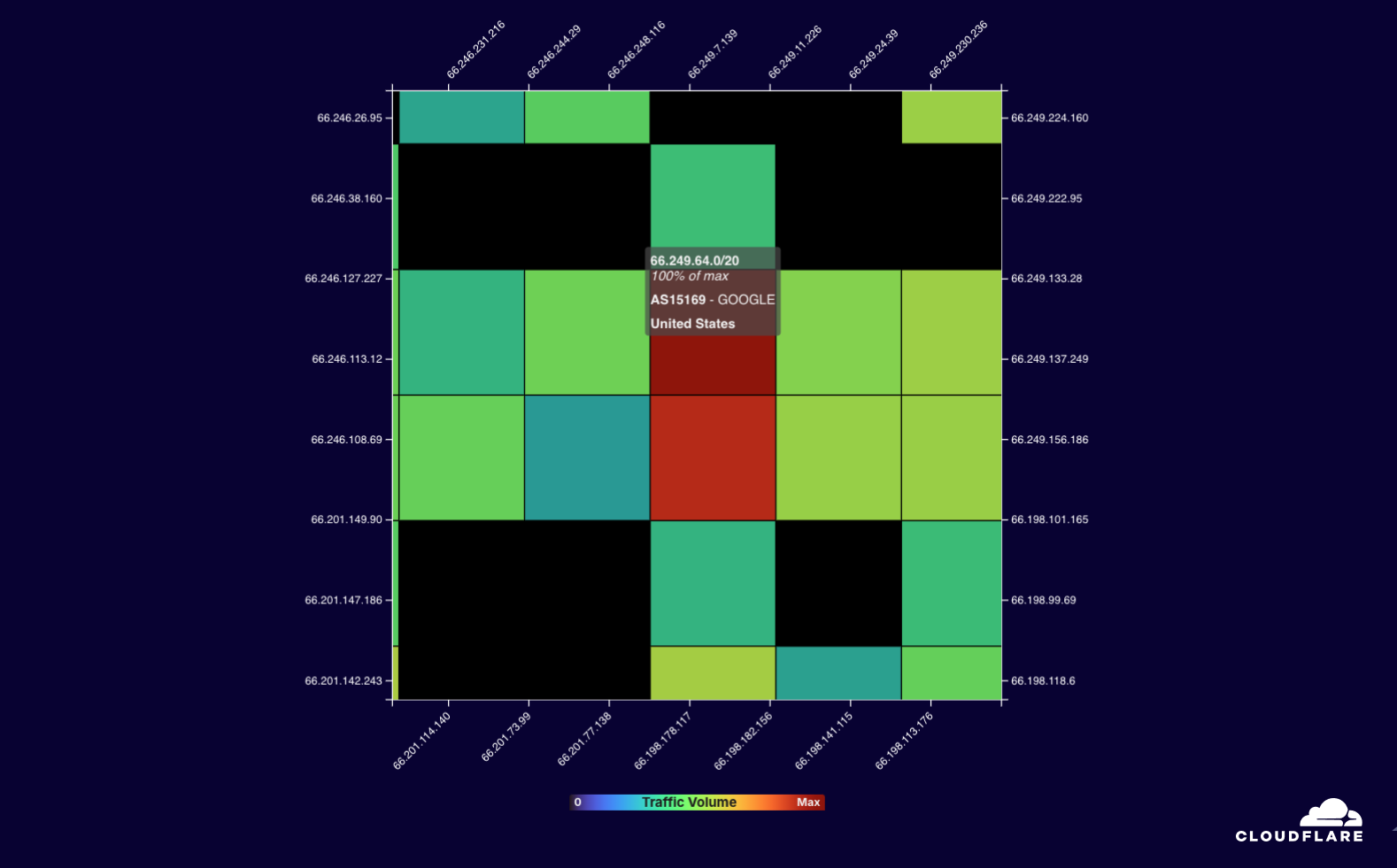
Cloudflare Radar shows users Internet traffic trends over a selected period of time, but at a country/region or network level. However, as we did in 2023, we again wanted to look at the traffic Cloudflare saw over the course of the full year from the entire IPv4 Internet. To do so, we can use Hilbert curves, which allow us to visualize a sequence of IPv4 addresses in a two-dimensional pattern that keeps nearby IP addresses close to each other, making them useful for surveying the Internet’s IPv4 address space.
Using a Hilbert curve, we can visualize aggregated IPv4 request traffic to Cloudflare from January 1 through December 1, 2024. Within the visualization, we aggregate IPv4 addresses at a /20 level, meaning that at the highest zoom level, each square represents traffic from 4,096 IPv4 addresses. This aggregation is done to keep the amount of data used for the visualization manageable. (While we would like to create a similar visualization for IPv6 traffic, the enormity of the full IPv6 address space would make associated traffic very hard to see in such a visualization, especially as such a small amount has been allocated for assignment by the Regional Internet Registries.)
Within the visualization, IP addresses are grouped by ownership, and for much of the IP address space shown there, a mouseover at the default zoom level will show the Regional Internet Registry (RIR) that the address block belongs to. However, there are also a number of blocks that were assigned prior to the existence of the RIR system, and for these, they are labeled with the name of the organization that owns them. Progressive zooming ultimately shows the autonomous system and country/region that the IP address block is associated with, as well as its share of traffic relative to the maximum. (If a country/region is selected, only the IP address blocks associated with that location are visible.) Overall traffic shares are indicated by shading based on a color scale, and although a number of large unshaded blocks are visible, this does not necessarily mean that the associated address space is unused, but rather that it may be used in a way that does not generate traffic to Cloudflare.
Hilbert curve showing aggregated 2024 traffic to Cloudflare across the IPv4 Internet
Warmer orange/red shading within the visualization represents areas of higher request volume, and buried within one of those areas is the IP address block that had the maximum request volume to Cloudflare during 2024. As it was in 2023, this address block was 66.249.64.0/20, which belongs to Google, and is one of several used by the Googlebot web crawler to retrieve content for search indexing. This use of that address space is a likely explanation for the high request volume, given the number of web properties on Cloudflare’s network.
Zoomed Hilbert curve view showing the IPv4 address block that generated the highest volume of requests
In addition to Google, owners of other prefixes in the top 20 include Alibaba, Microsoft, Amazon, and Apple. To explore the IPv4 Internet in more detail, we encourage you to go to the Year in Review microsite and explore it by dragging and zooming to move around IPv4 address space.
Among AI bots and crawlers, Bytespider (ByteDance) traffic gradually declined over the course of 2024, while ClaudeBot (Anthropic) was more active during the back half of the year.
AI bots and crawlers have been in the news throughout 2024 as they voraciously consume content to train ever-evolving models. Controversy has followed them, as not all bots and crawlers respect content owner directives to restrict crawling activity. In July, Cloudflare enabled customers to block these bots and crawlers with a single click, and during Birthday Week we introduced AI Audit to give website owners even more visibility into and control over how AI platforms access their content.
Tracking traffic trends for AI bots can help us better understand their activity over time — observing which are the most aggressive and have the highest volume of requests, which perform crawls on a regular basis, etc. The new AI bot & crawler traffic graph on Radar’s Traffic page, launched in September, provides insight into these traffic trends gathered over the selected time period for the top known AI bots.
Looking at traffic trends from two of those bots, we can see some interesting patterns. Bytespider is a crawler operated by ByteDance, the Chinese owner of TikTok, and is reportedly used to download training data for ByteDance’s Large Language Models (LLMs). Bytespider’s crawling activity trended generally downwards over the course of 2024, with end-of-November activity approximately 80-85% lower than that seen at the start of the year. ClaudeBot is Anthropic’s crawler, which downloads training data for its LLMs that power AI products like Claude. Traffic from ClaudeBot appeared to be mostly non-existent through mid-April, except for some small spikes that possibly represent test runs. Traffic became more consistently non-zero starting in late April, but after an early spike, trailed off through the remainder of the year.
Traffic trends for AI crawlers Bytespider and ClaudeBot in 2024
13.0% of TLS 1.3 traffic is using post-quantum encryption.
The term “post-quantum” refers to a new set of cryptographic techniques designed to protect data from adversaries that have the ability to capture and store current data for decryption by sufficiently powerful quantum computers in the future. The Cloudflare Research team has been exploring post-quantum cryptography since 2017.
In October 2022, we enabled post-quantum key agreement on our network by default, but use of it requires that browsers and clients support it as well. In 2024, Google’s Chrome 124 enabled it by default on April 17, and adoption grew rapidly following that release, increasing from just over 2% of requests to around 12% within a month, and ended November at 13%. We expect that adoption will continue to grow into and during 2025 due to support in other Chromium-based browsers, growing default support in Mozilla Firefox, and initial testing in Apple Safari.
Growth trends in post-quantum encrypted TLS 1.3 traffic during 2024
Adoption & Usage insights
Globally, nearly one-third of mobile device traffic was from Apple iOS devices. Android had a >90% share of mobile device traffic in 29 countries/regions; peak iOS mobile device traffic share was over 60% in eight countries/regions.
The two leading mobile device operating systems globally are Apple’s iOS and Google’s Android, and by analyzing information in the user agent reported with each request, we can get insight into the distribution of traffic by client operating system throughout the year. Again, we found that Android is responsible for the majority of mobile device traffic when aggregated globally, due to the wide distribution of price points, form factors, and capabilities.
Global distribution of mobile device traffic by operating system in 2024
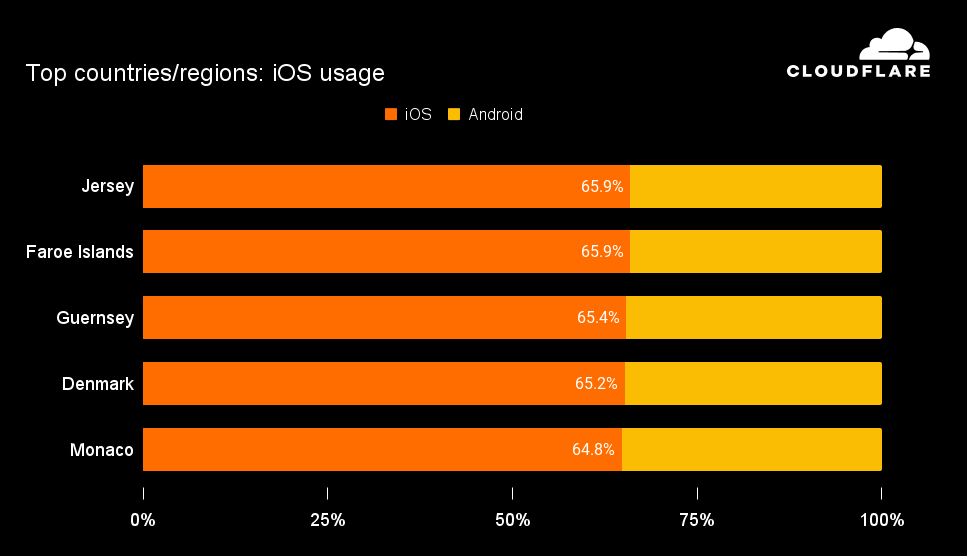
In contrast, iOS adoption tops out in the 65% range in Jersey, the Faroe Islands, Guernsey, and Denmark. Adoption rates of 50% or more were seen in a total of 26 countries/regions, including Norway, Sweden, Australia, Japan, the United States, and Canada. These locations likely have a greater ability to afford higher priced devices, owing to their comparatively higher gross national income per capita.
Countries/regions with the largest share of iOS traffic in 2024
Globally, nearly half of web requests used HTTP/2, with 20.5% using HTTP/3.
HTTP (HyperText Transfer Protocol) is the core protocol that the web relies upon. HTTP/1.0 was first standardized in 1996, HTTP/1.1 in 1999, and HTTP/2 in 2015. The most recent version, HTTP/3, was completed in 2022, and runs on top of a new transport protocol known as QUIC. By running on top of QUIC, HTTP/3 can deliver improved performance by mitigating the effects of packet loss and network changes, as well as establishing connections more quickly. HTTP/3 also provides encryption by default, which mitigates the risk of attacks.
Current versions of desktop and mobile Google Chrome (and Chromium-based variants), Mozilla Firefox, and Apple Safari all support HTTP/3 by default. Cloudflare makes HTTP/3 available for free to all of our customers, although not every customer chooses to enable it.
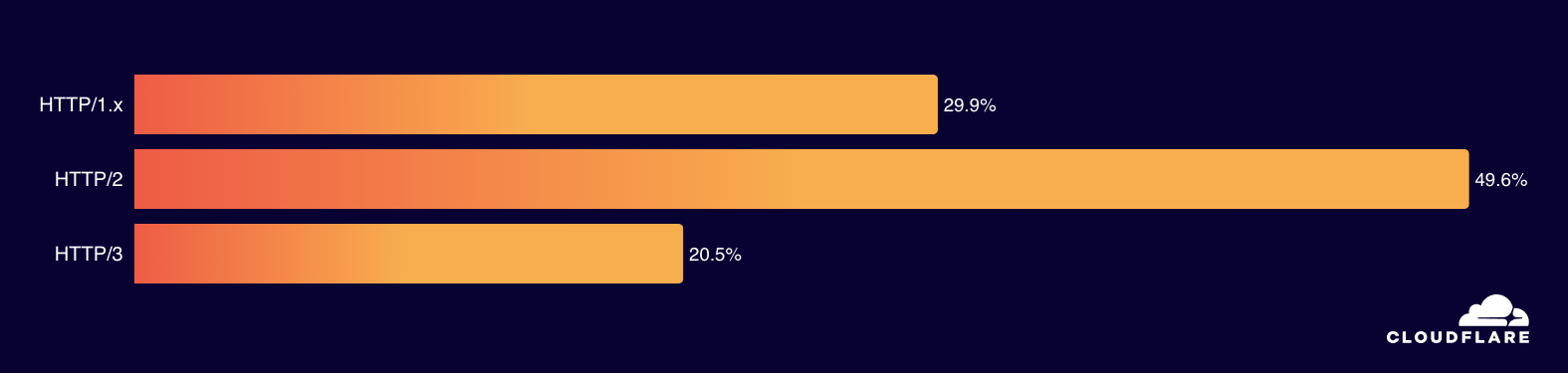
Analysis of the HTTP version negotiated for each request provides insight into the distribution of traffic by the various versions of the protocol aggregated across the year. (“HTTP/1.x” aggregates requests made over HTTP/1.0 and HTTP/1.1.) At a global level, 20.5% of requests in 2024 were made using HTTP/3. Another 29.9% of requests were made over the older HTTP/1.x versions, while HTTP/2 remained dominant, accounting for the remaining 49.6%.
Global distribution of traffic by HTTP version in 2024
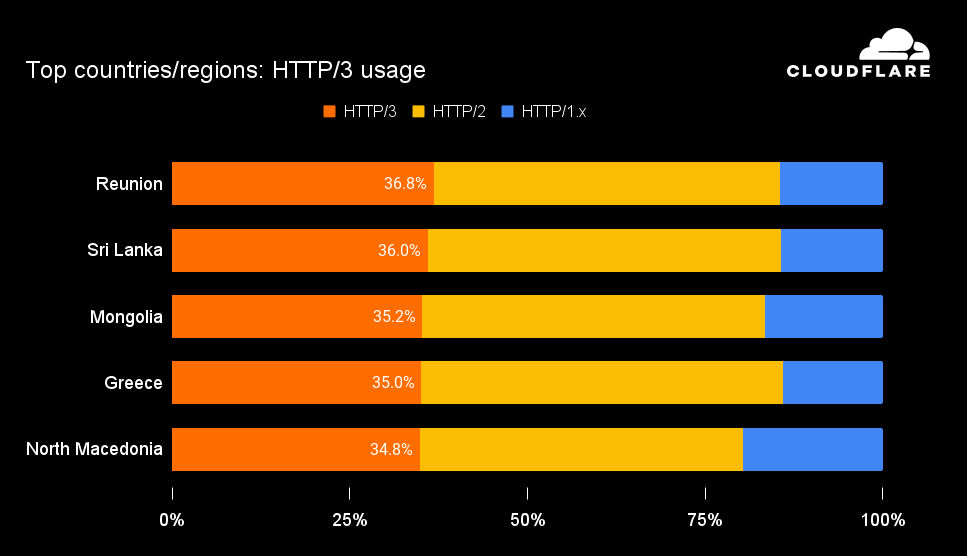
Looking at version distribution geographically, we found eight countries/regions sending more than a third of their requests over HTTP/3, with Reunion, Sri Lanka, Mongolia, Greece, and North Macedonia comprising the top five as shown below. Eight other countries/regions, including Iran, Ireland, Hong Kong, and China, sent more than half of their requests over HTTP/1.x throughout 2024. More than half of requests were made over HTTP/2 in a total of 147 countries/regions.
Countries/regions with the largest shares of HTTP/3 traffic in 2024
React, PHP, and jQuery were among the most popular technologies used to build websites, while Hubspot, Google, and WordPress were among the most popular vendors of supporting services and platforms.
Modern websites and applications are extremely complex, built on and integrating on a mix of frameworks, platforms, services, and tools. In order to deliver a seamless user experience, developers must ensure that all of these components happily coexist with each other. Using Cloudflare Radar’s URL Scanner, we again scanned websites associated with the top 5000 domains to identify the most popular technologies and services used across a dozen different categories.
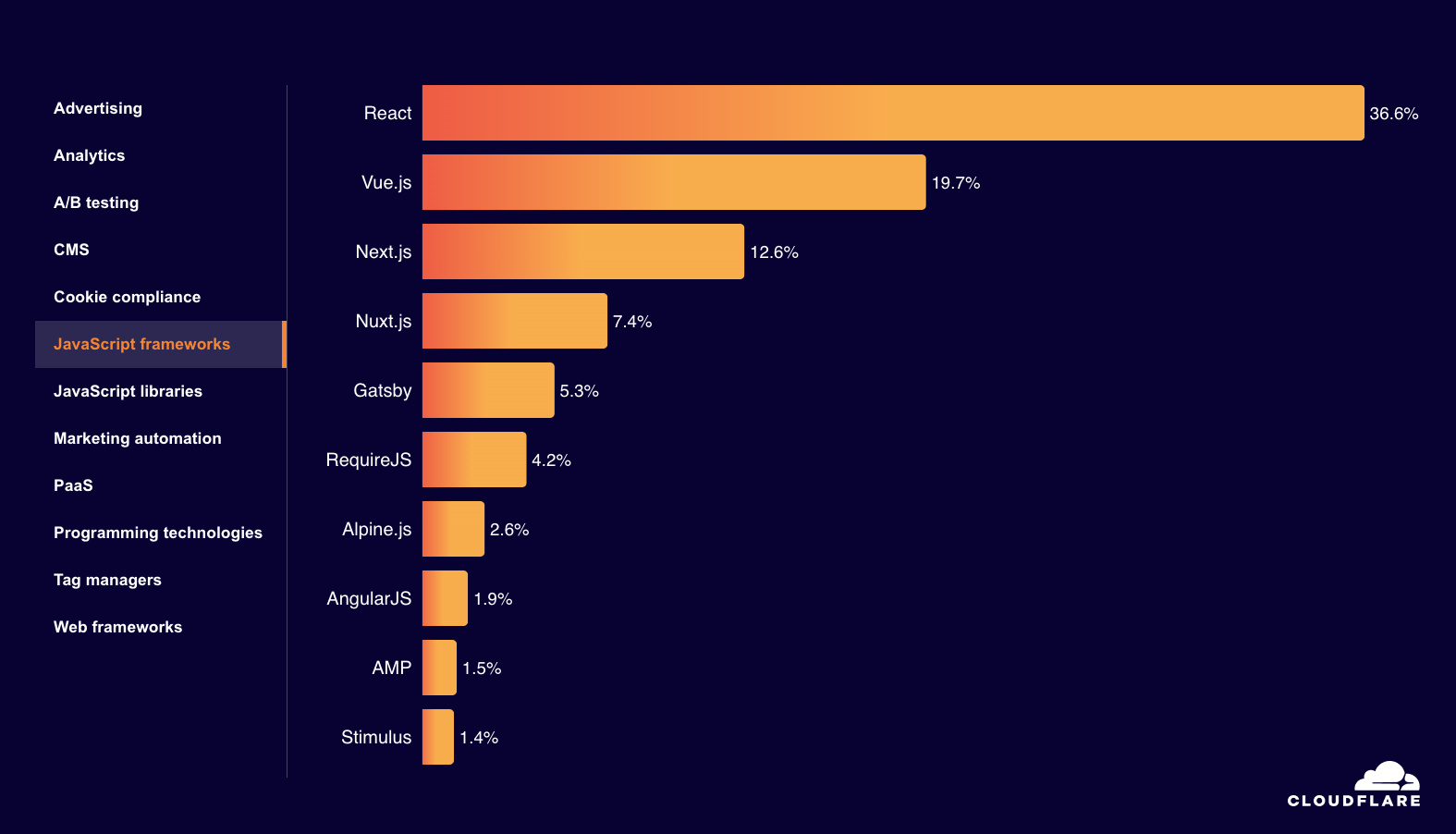
In looking at core technologies used to build websites, React had a commanding lead over Vue.js and other JavaScript frameworks, PHP was the most popular programming technology, and jQuery’s share was 10x other popular JavaScript libraries.
Third-party services and platforms are also used by websites and applications to support things like analytics, content management, and marketing automation. Google Analytics remained the most widely used analytics provider, WordPress had a greater than 50% share among content management systems, and for marketing automation providers, category leader HubSpot had nearly twice the usage share of Marketo and MailChimp.
Top website technologies, JavaScript frameworks category in 2024
Go surpassed NodeJS as the most popular language used for making automated API requests.
Many dynamic websites and applications are built on automated API calls, and we can use our unique visibility into Web traffic to identify the top languages these API clients are written in. Applying heuristics to API-related requests determined to not be coming from a person using a browser or native mobile application helps us to identify the language used to build the API client.
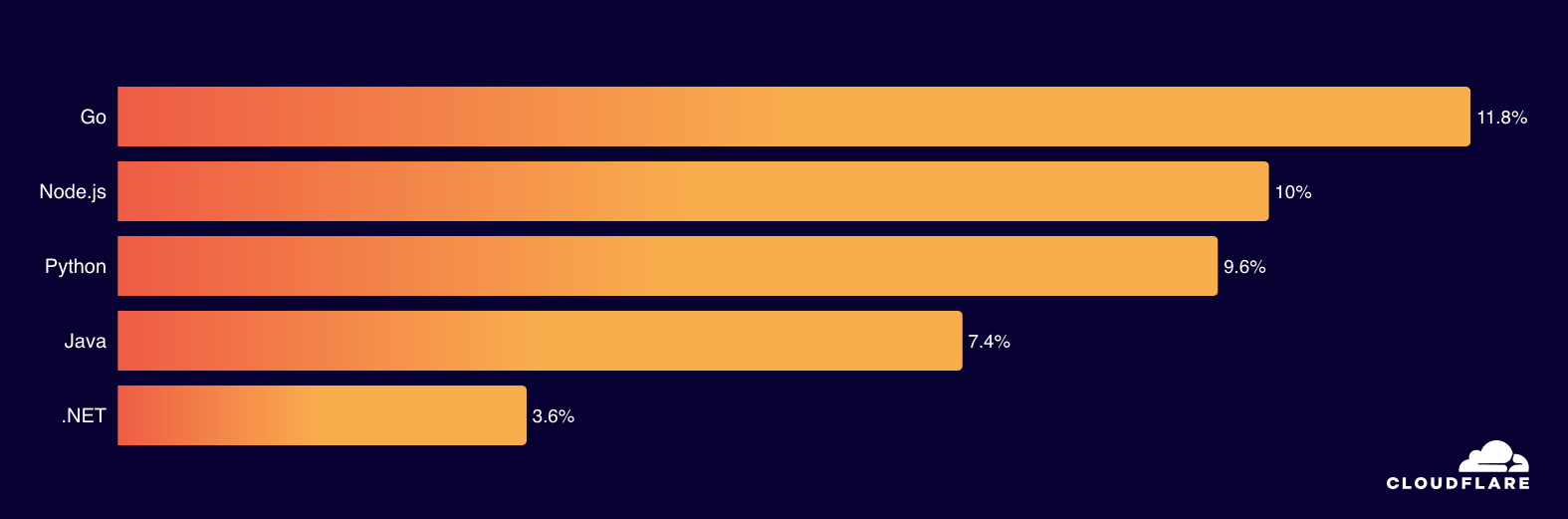
Our analysis found that almost 12% of automated API requests are made by Go-based clients, with NodeJS, Python, Java, and .NET holding smaller shares. Compared to 2023, Go’s share increased by approximately 40%, allowing it to capture the top spot, while NodeJS’s share fell by just over 30%. Python and Java also saw their shares increase, while .NET’s fell.
Most popular API client languages in 2024
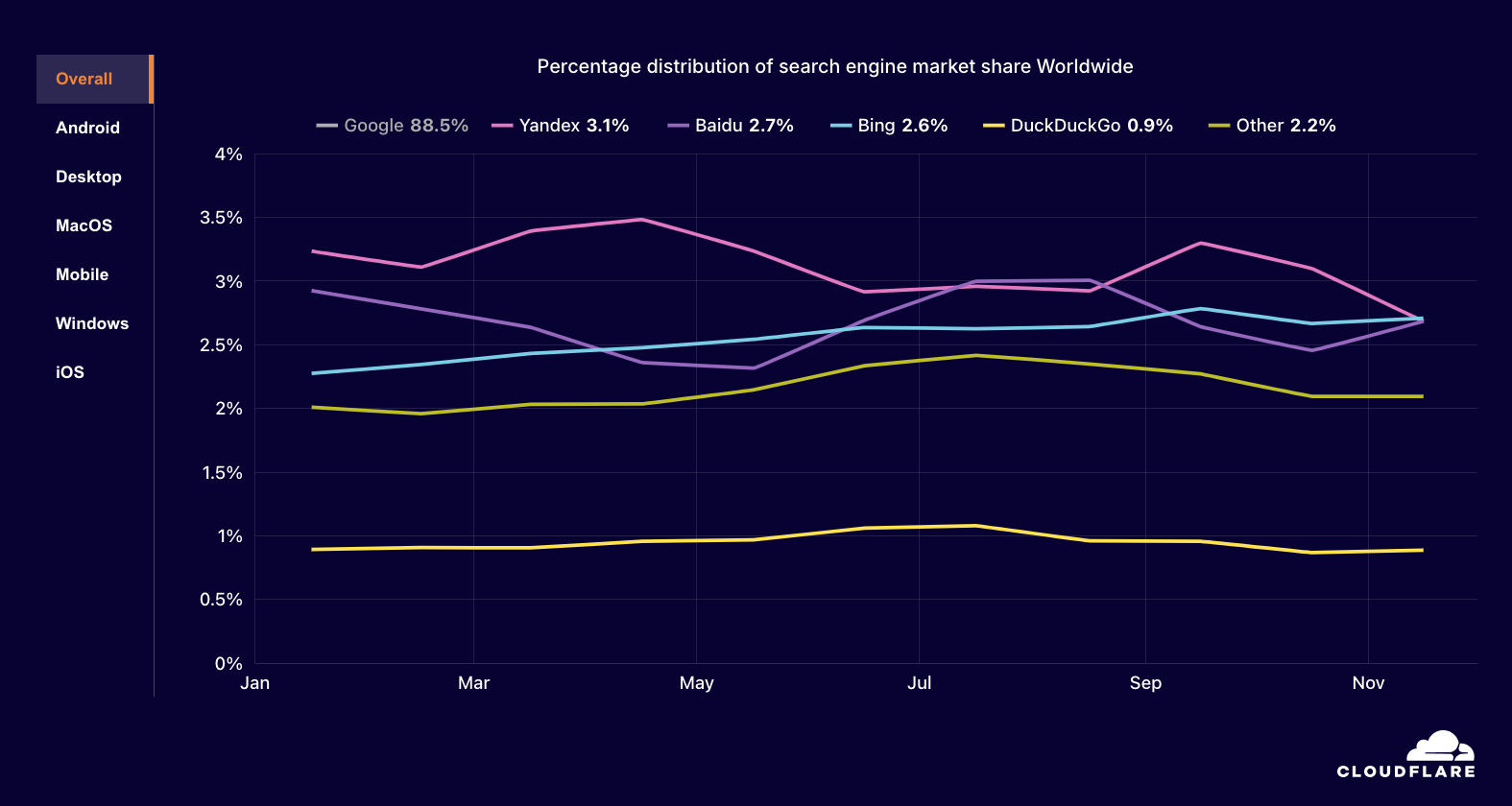
Google is the most popular search engine globally, across all platforms. On mobile devices/OS, Baidu is a distant second. Bing is a distant second across desktop and Windows devices, with DuckDuckGo second most popular on macOS.
Protecting and accelerating websites and applications for millions of customers, Cloudflare is in a unique position to measure search engine market share data. Our methodology uses HTTP’s referer header to identify the search engine sending traffic to customer sites and applications. The market share data is presented as an overall aggregate, as well as broken out by device type and operating system. (Device type and operating system data is derived from the User-Agent and Client Hints headers accompanying a content request.)
Aggregated at a global level, Google referred the most traffic to Cloudflare customers, with a greater than 88% share across 2024. Yandex, Baidu, Bing, and DuckDuckGo round out the top five, all with single digit percentage shares.
Overall worldwide search engine market share in 2024
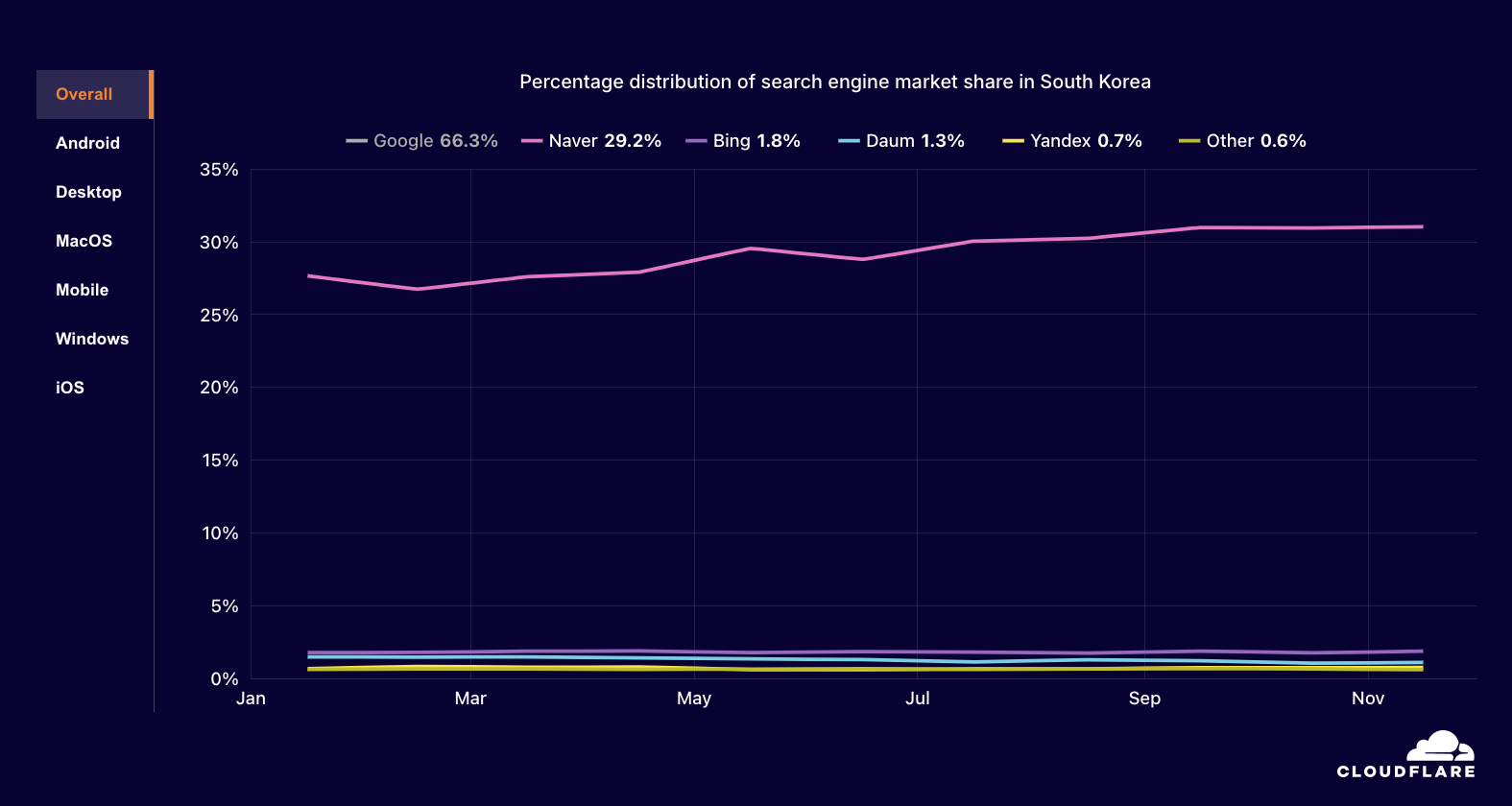
However, when drilling down by location or platform, differences are apparent in the top search engines and their shares. For example, in South Korea, Google is responsible for only two-thirds of referrals, while local platform Naver drives 29.2%, with local portal Daum also in the top five at 1.3%.
Overall search engine market share in South Korea in 2024
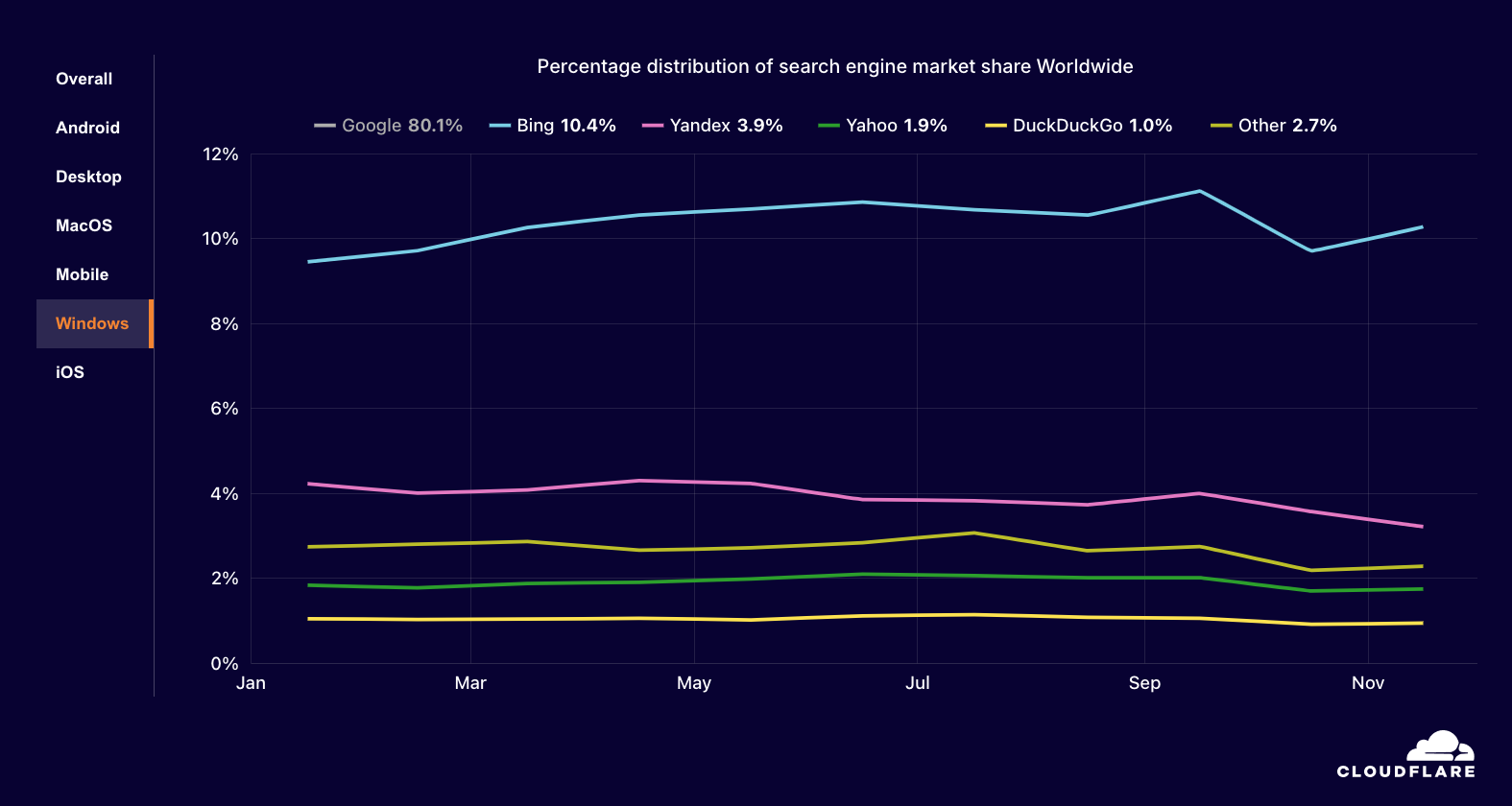
Google’s dominance is also blunted a bit on Windows devices, where it drives only 80% of referrals globally. Unsurprisingly, Bing holds the second spot for Windows users, with a 10.4% share. Yandex, Yahoo, and DuckDuckGo round out the top 5, all with shares below 5%.
Overall worldwide search engine market share for Windows devices in 2024
For additional details, including search engines aggregated under “Other”, please refer to the quarterly Search Engine Referral Reports on Cloudflare Radar.
Google Chrome is the most popular browser overall. While also true on MacOS devices, Safari usage is well ahead of Chrome on iOS devices. On Windows, Edge is the second most popular browser.
Similar to our ability to measure search engine market share, Cloudflare is also in a unique position to measure browser market share. Our methodology uses information from the User-Agent and Client Hints headers to identify the browser making content requests, along with the associated operating system. Browser market share data is presented as an overall aggregate, as well as broken out by device type and operating system. Note that the shares of browsers available on both desktop and mobile devices, such as Chrome or Safari, are presented in aggregate.
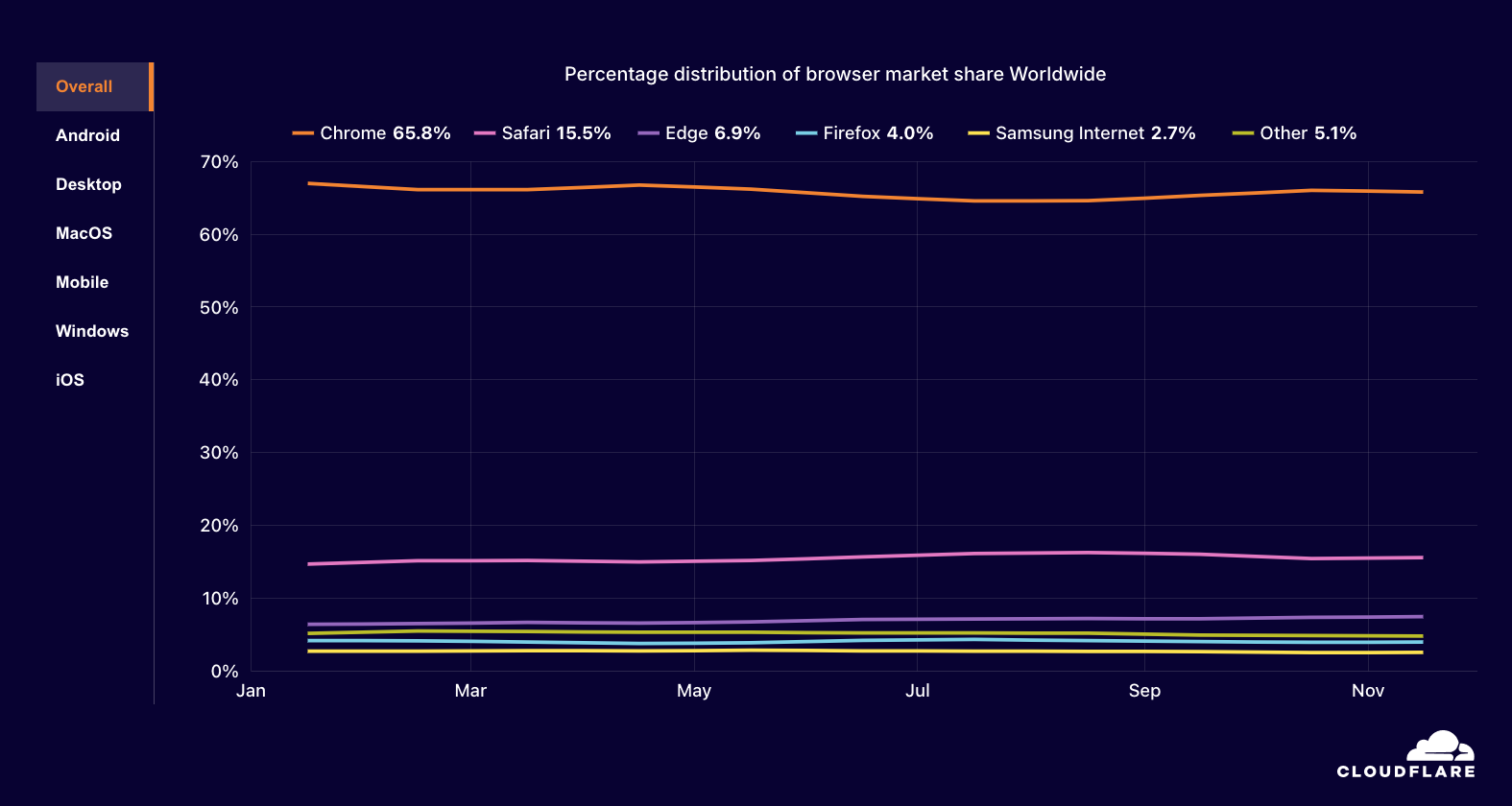
Globally, we found that 65.8% of requests came from Google’s Chrome browser across 2024, and that just 15.5% came from Apple’s Safari browser. Microsoft Edge, Mozilla Firefox, and the Samsung Internet browser rounded out the top five, all with shares below 10%.
Overall worldwide web browser market share in 2024
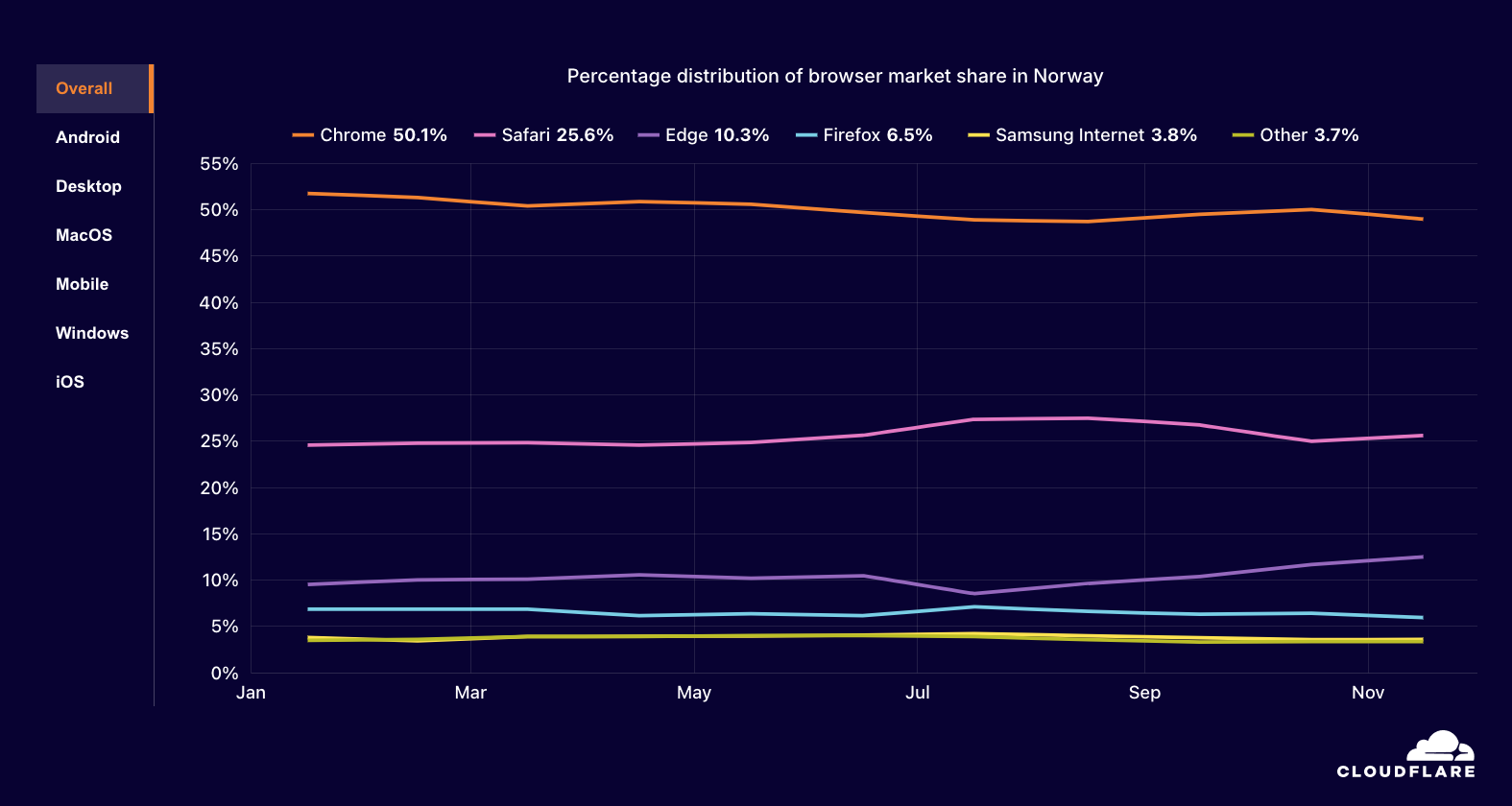
Similar to the search engine statistics discussed above, differences are clearly visible when drilling down by location or platform. In some countries where iOS holds a larger market share than Android, Chrome remains the leading browser, but by a much lower margin. For example, in Sweden, Chrome’s share fell to 56.2%, while Safari’s increased to 22.5%. In Norway, Chrome fell to just 50%, while Safari grew to 25.6%.
Overall web browser market share in Norway in 2024
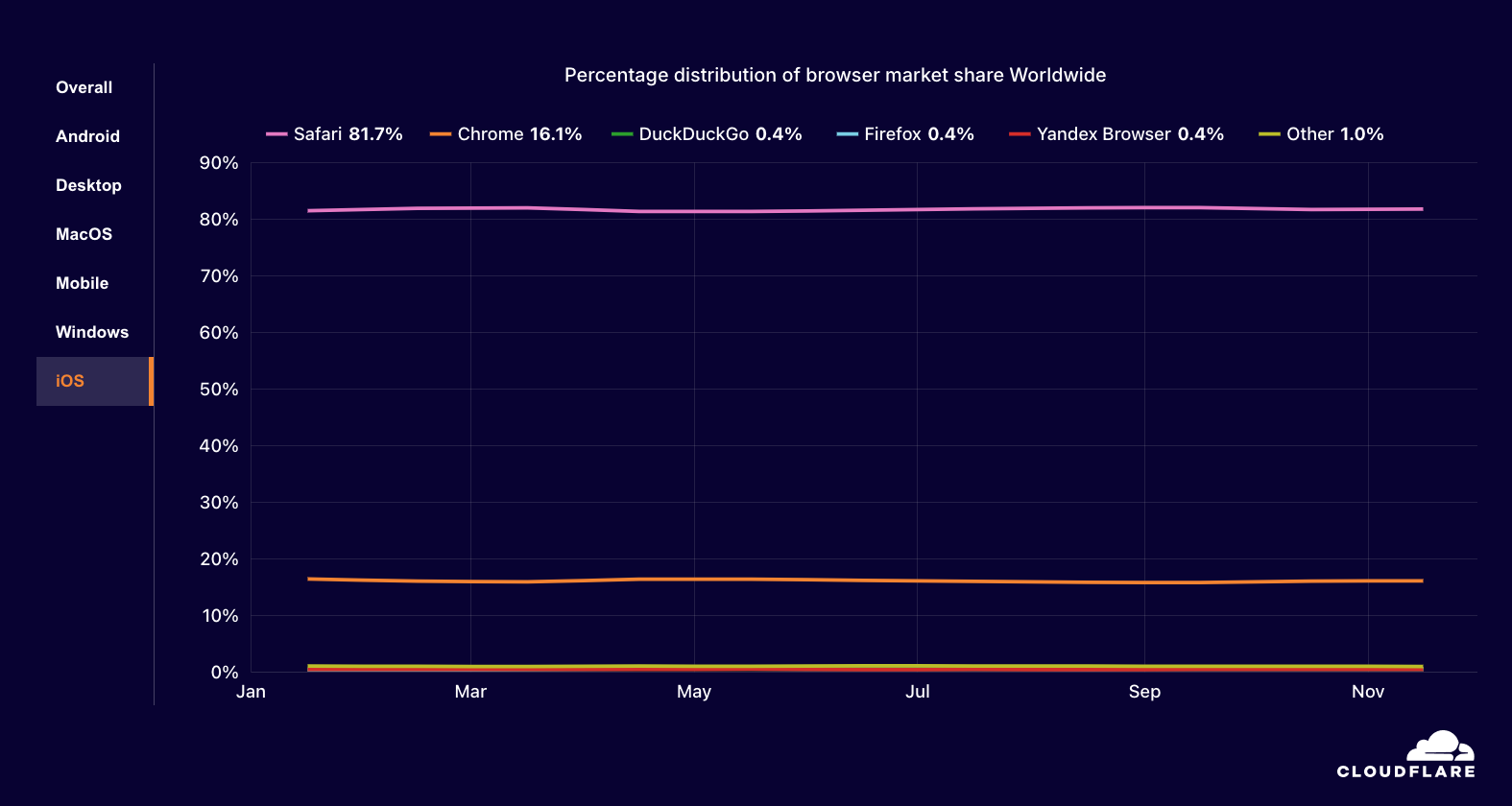
As the default browser on devices running iOS, Apple Safari was the most popular browser for iOS devices, commanding an 81.7% market share across the year, with Chrome at just 16.1%. And despite being the preinstalled default browser on Windows devices, Edge held just a 17.3% share, in comparison to Chrome’s 68.5%
Overall worldwide web browser market share for iOS devices in 2024
For additional details, including browsers aggregated under “Other”, please refer to the quarterly Browser Market Share Reports on Cloudflare Radar.
Connectivity
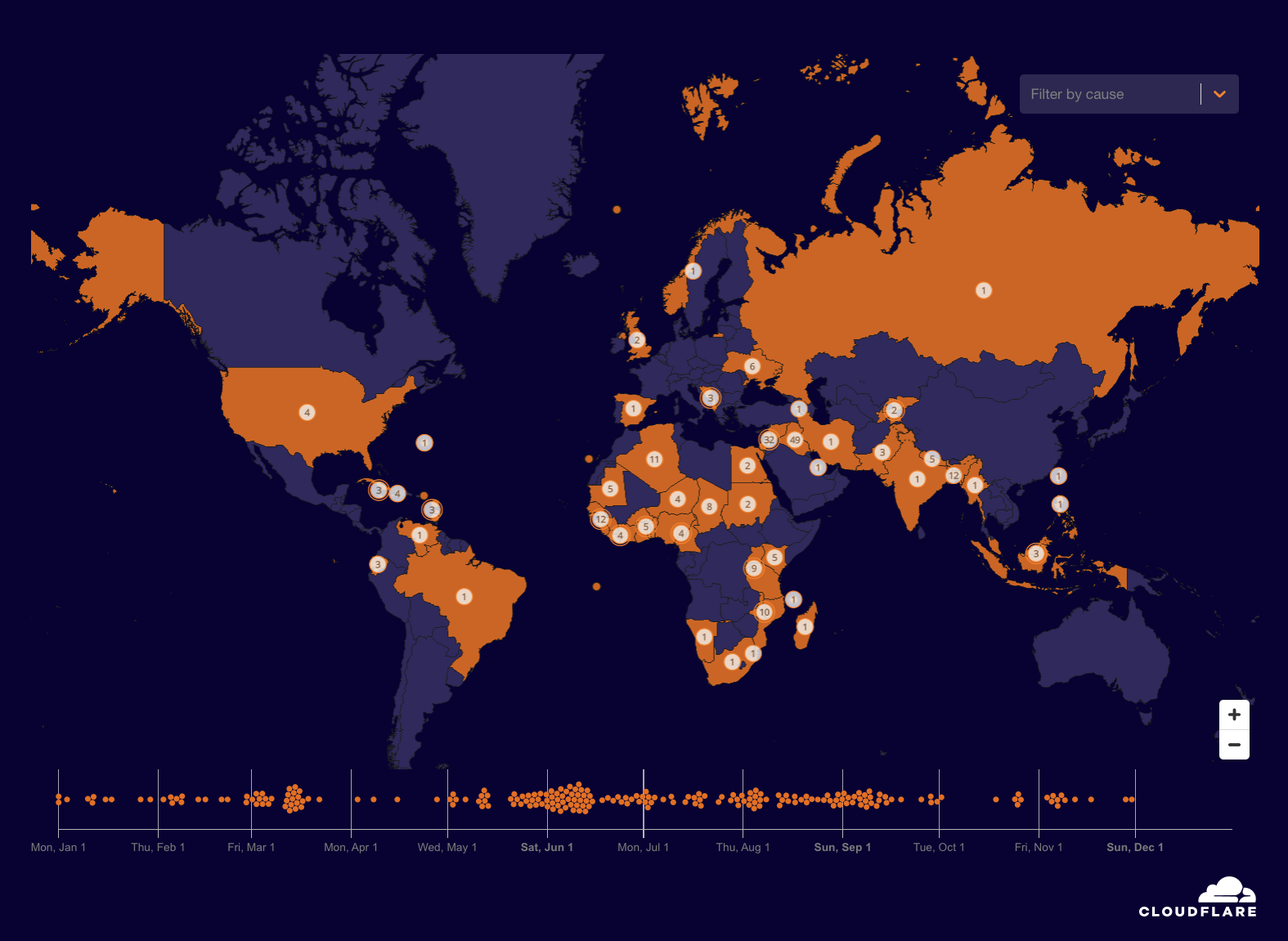
225 major Internet outages were observed around the world in 2024, with many due to government-directed regional and national shutdowns of Internet connectivity.
Throughout 2024, as we have over the last several years, we have written frequently about observed Internet outages, whether due to cable cuts, unspecified technical issues, government-directed shutdowns, or a number of other reasons covered in our quarterly summary posts (Q1, Q2, Q3). The impacts of these outages can be significant, including significant economic losses and severely limited communications. The Cloudflare Radar Outage Center tracks these Internet outages, and uses Cloudflare traffic data for insights into their scope and duration.
Some of the outages seen through the year were short-lived, lasting just a few hours, while others stretched on for days or weeks. In the latter category, an Internet outage in Haiti dragged on for eight days in September because repair crews were barred from accessing a damaged submarine cable due to a business dispute, while shutdowns of mobile and fixed Internet providers in Bangladesh lasted for approximately 10 days in July. In the former category, Iraq frequently experienced multi-hour nationwide Internet shutdowns intended to prevent cheating on academic exams — these contribute to the clustering visible in the timeline during June, July, August, and September.
Within the timeline on the Year in Review microsite, hovering over a dot will display metadata about that outage, and clicking on it will open a page with additional information. Below the map and timeline, we have added a bar graph illustrating the recorded reasons associated with the observed outages. In 2024, over half were due to government-directed shutdowns. If a country/region is selected, only outages and reasons for that country/region will be displayed.
Over 200 Internet outages were observed around the world during 2024
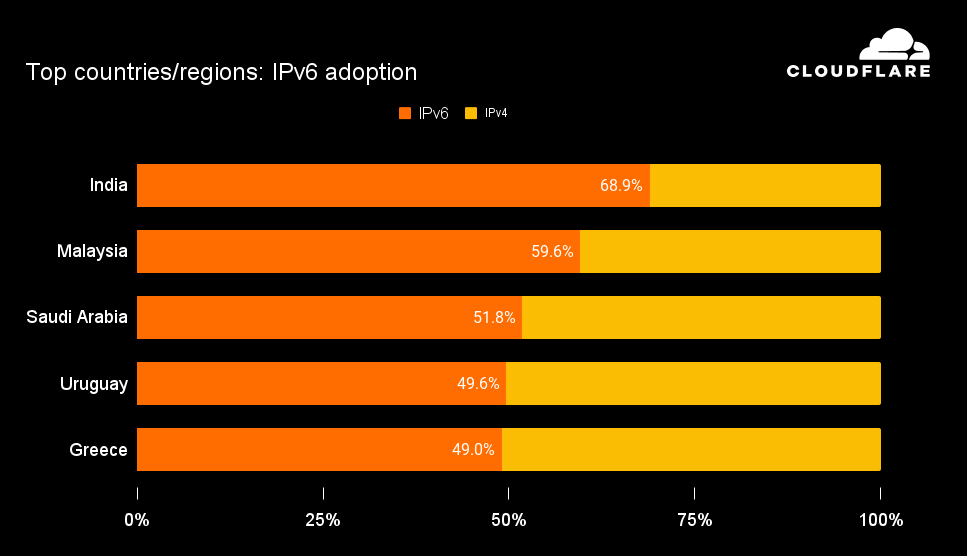
Aggregated across 2024, 28.5% of IPv6-capable requests were made over IPv6. India and Malaysia were the strongest countries, at 68.9% and 59.6% IPv6 adoption respectively.
The IPv4 protocol still used by many Internet-connected devices was developed in the 1970s, and was never meant to handle the vast and growing scale of the modern Internet. An initial specification for its successor, IPv6, was published in December 1995, evolving to a draft standard three years later, offering an expanded address space intended to better support the expected growth in the number of Internet-connected devices. At this point, available IPv4 space has long since been exhausted, and connectivity providers use solutions like Network Address Translation to stretch limited IPv4 resources. Hungry for IPv4 address space as their businesses and infrastructure grow, cloud and hosting providers are acquiring blocks of IPv4 address space for as much as \$30 – \$50 per address.
Cloudflare has been a vocal and active advocate for IPv6 since 2011, when we announced our Automatic IPv6 Gateway, which enabled free IPv6 support for all of our customers. In 2014, we enabled IPv6 support by default for all of our customers, but not all customers choose to keep it enabled for a variety of reasons. Note that server-side support is only half of the equation for driving IPv6 adoption, as end user connections need to support it as well. (In reality, it is a bit more complex than that, but server and client side support across applications, operating systems, and network environments are the two primary requirements. From a network perspective, implementing IPv6 also brings a number of other benefits.) By analyzing the IP version used for each request made to Cloudflare, aggregated throughout the year, we can get insight into the distribution of traffic by the various versions of the protocol.
At a global level, 28.5% of IPv6-capable (“dual-stack”) requests were made over IPv6, up from 26.4% in 2023. India was again the country with the highest level of IPv6 adoption, at 68.9%, carried in large part by 94% IPv6 adoption at Reliance Jio, one of the country’s largest Internet service providers. India was followed closely by Malaysia, where 59.6% of dual-stacked requests were made over IPv6 during 2024, thanks to strong IPv6 adoption rates across leading Internet providers within the country. IPv6 adoption in India was up from 66% in 2023, and in Malaysia, it was up from 57.3% last year. Saudi Arabia was the only other country with an IPv6 adoption rate above 50% this year, at 51.8%, whereas that list also included Vietnam, Greece, France, Uruguay, and Thailand in 2023. Thirty four countries/regions, including many in Africa, still have IPv6 adoption rates below 1%, while a total of 96 countries/regions have adoption rates below 10%.
Global distribution of traffic by IP version in 2024
Countries/regions with the largest shares of IPv6 traffic in 2024
The top 10 countries ranked by Internet speed all had average download speeds above 200 Mbps. Spain was consistently among the top locations across measured Internet quality metrics.
As more and more of our everyday lives move online, including entertainment, work, education, finance, shopping, and even basic social and personal interaction, the quality of our Internet connections is arguably more important than ever, necessitating higher connection speeds and lower latency. Although Internet providers continue to evolve their service portfolios to offer increased connection speeds and reduced latency in order to support growth in use cases like videoconferencing, live streaming, and online gaming, consumer adoption is often mixed due to cost, availability, or other issues. By aggregating the results of speed.cloudflare.com tests taken during 2024, we can get a geographic perspective on connection quality metrics including average download and upload speeds, and average idle and loaded latencies, as well as the distribution of the measurements.
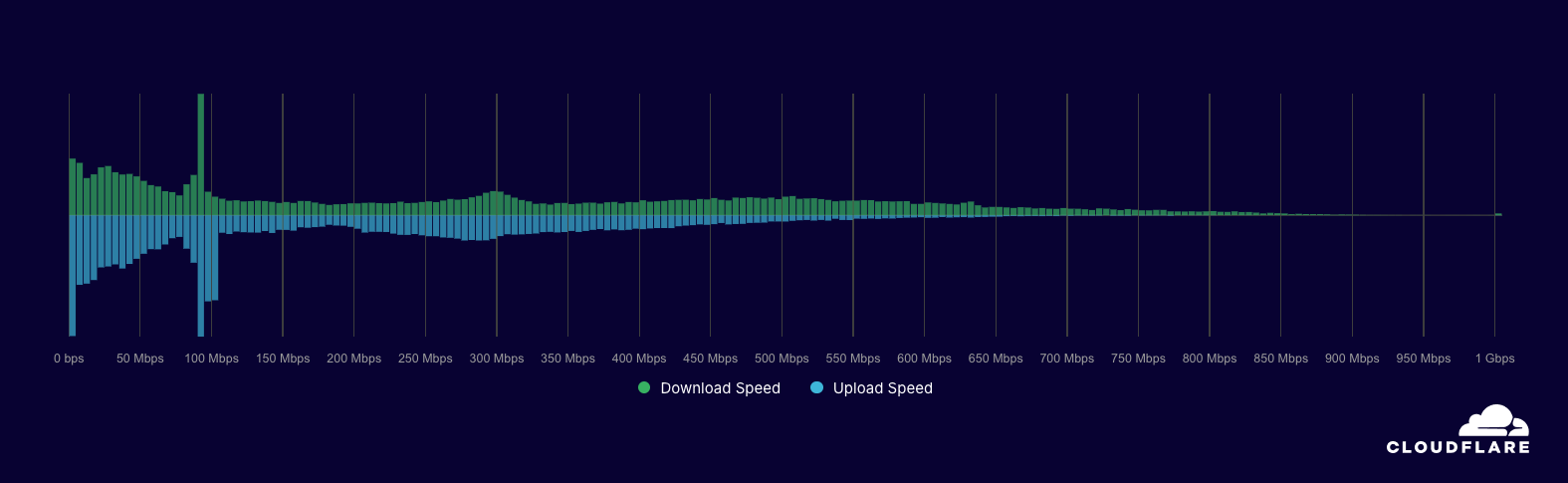
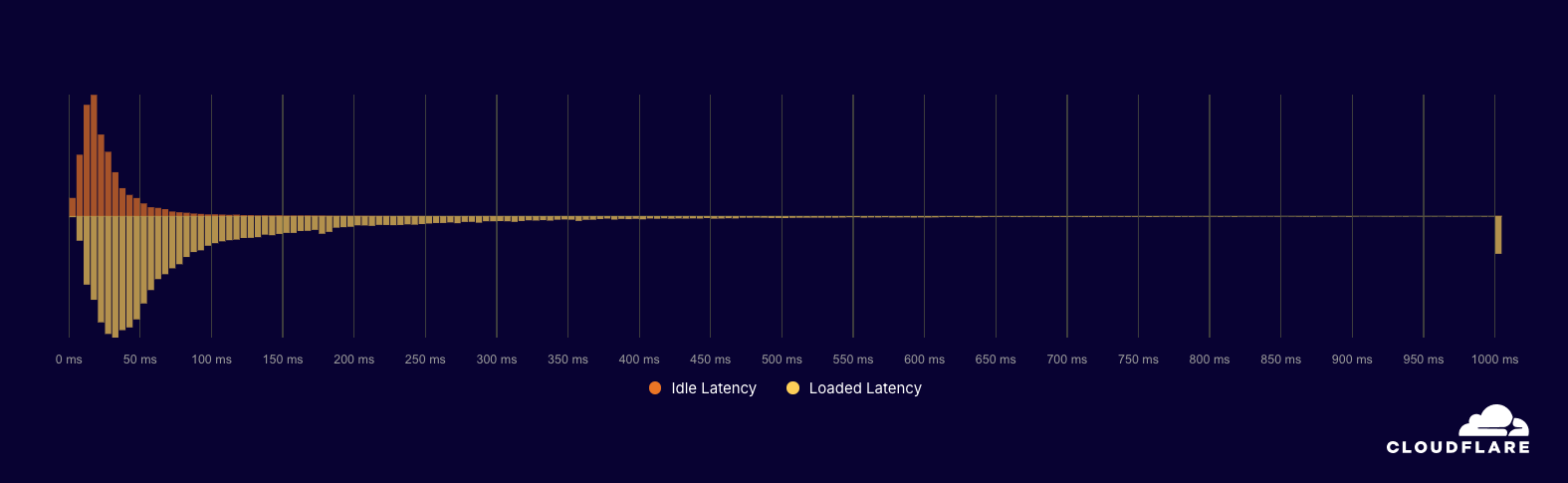
In 2024, Spain was a leader in download speed (292.6 Mbps) and upload speed (192.6 Mbps) metrics, and placed second globally for loaded latency (78.6 ms). (Loaded latency is the round-trip time when data-heavy applications are being used on the network.) Spain’s leadership in these connection quality metrics is supported by the strong progress that the country has made towards achieving the EU’s “Digital Decade” objectives, including fixed very high capacity network (VHCN) deployment, fiber-to-the-premises (FTTP) coverage, and 5G coverage with the latter two reaching 95.2% and 92.3% respectively. High speed fiber broadband connections are also relatively affordable, with research showing major providers offering 100 Mbps, 300 Mbps, 600 Mbps, and 1 Gbps packages, with the latter priced between €30 and €46 per month. The figures below for Spain show the largest clusters of speed measurements around the 100 Mbps mark, with slight bumps also visible around 300 Mbps, suggesting that the former package has the highest subscription rate, followed by the latter. Further, they show these connections are also relatively low latency, with 87% of idle latency measurements below 50 ms and 65% of loaded latency measurements below 100 ms, providing users with good gaming and videoconferencing/streaming experiences.
Measured download/upload speed distribution in Spain in 2024
Measured idle/loaded latency distribution in Spain in 2024
41.3% of global traffic comes from mobile devices. In nearly 100 countries/regions, the majority of traffic comes from mobile devices.
With approximately 70% of the world’s population using smartphones, and 91% of Americans owning a smartphone, these mobile devices have become an integral part of both our personal and professional lives, providing us with Internet access from nearly any place at any time. In some countries/regions, mobile devices primarily connect to the Internet via Wi-Fi, while other countries/regions are “mobile first”, where 4G/5G services are the primary means of Internet access.
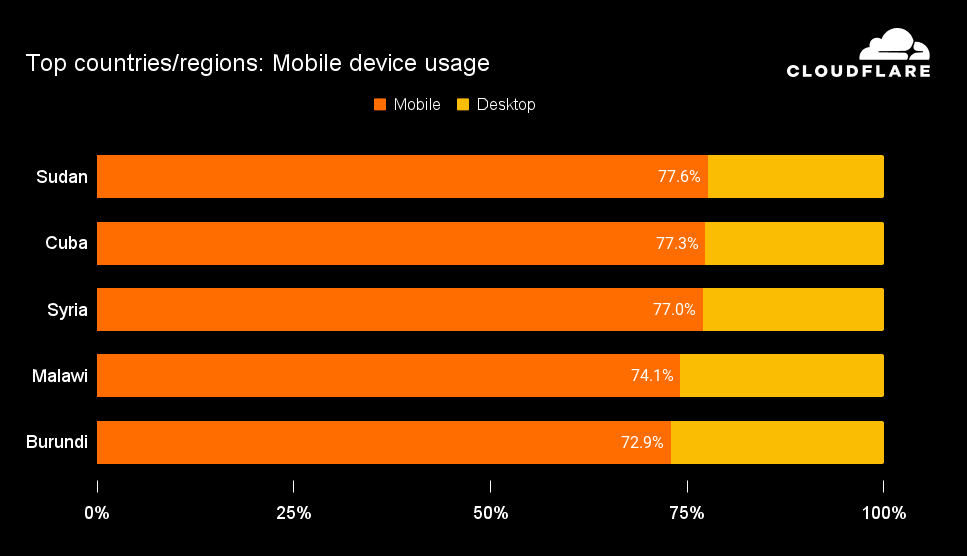
Analysis of information contained with the user agent reported with each request to Cloudflare enables us to categorize it as coming from a mobile, desktop, or other type of device. Aggregating this categorization throughout the year at a global level, we found that 41.3% of traffic came from mobile devices, with 58.7% coming from desktop devices such as laptops and “classic” PCs. These traffic shares were in line with those measured in both 2023 and 2022, suggesting that mobile device usage has achieved a “steady state”. Over 77% of traffic came from mobile devices in Sudan, Cuba, and Syria, making them the countries/regions with the largest mobile device traffic share in 2024. Other countries/regions that had more than 50% of traffic come from mobile devices were concentrated in the Middle East/Africa, the Asia Pacific region, and South/Central America.
Global distribution of traffic by device type in 2024
Countries/regions with the largest shares of mobile device usage in 2024
20.7% of TCP connections are unexpectedly terminated before any useful data can be exchanged.
Cloudflare is in a unique position to help measure the health and behaviors of Internet networks around the world. One way we do this is passively measuring rates of connections to Cloudflare that appear anomalous, meaning that they are unexpectedly terminated before any useful data exchange occurs. The underlying causes of connection anomalies are varied and range from DoS attacks to quirky client behavior to third-party connection tampering (e.g., when a network monitors and selectively disrupts connections to filter content).
Connection anomalies are symptoms — visible signs that “something abnormal” is happening in a network, but the underlying root cause is not always clear from the outset. However, we can gain a better understanding by incorporating previously-reported network behaviors, active measurements and on-the-ground reports, and macro trends across networks. Additional details on such analysis can be found in the blog posts A global assessment of third-party connection tampering andBringing insights into TCP resets and timeouts to Cloudflare Radar.
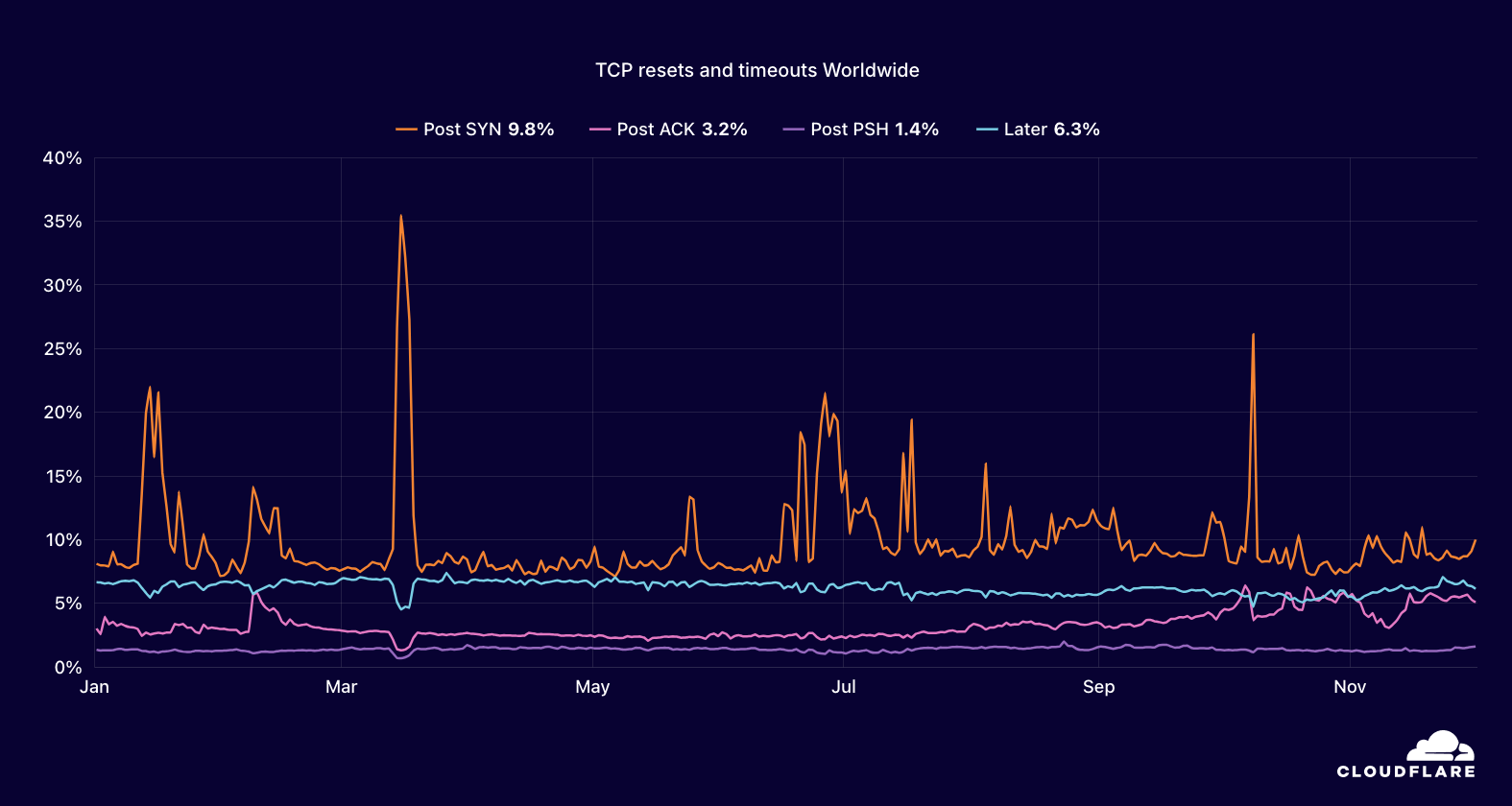
Insights into TCP connection anomalies were launched on Cloudflare Radar in September, with the plot lines in the associated graph corresponding to the stage of the TCP connection in which the connection anomalously closed (using shorthand, the first three messages we typically receive from the client in a TCP connection are “SYN” and “ACK” packets to establish a connection, and then a “PSH” packet indicating the requested resource). In aggregate globally, over 20% of connections to Cloudflare were terminated unexpectedly, with the largest share (nearly half) being closed “Post SYN” — that is, after our server has received a client’s SYN packet, but before we have received a subsequent acknowledgement (ACK) from the client or any useful data that would follow the acknowledgement. These terminations can often be attributed to DoS attacks or Internet scanning. Post-ACK (3.1% globally) and Post-PSH (1.4% globally) anomalies are more often associated with connection tampering, especially when they occur at high rates in specific networks.
Trends in TCP connection anomalies by stage in 2024
Security
6.5% of global traffic was mitigated by Cloudflare’s systems as being potentially malicious or for customer-defined reasons.
To protect customers from threats posed by malicious bots used to attack websites and applications, Cloudflare mitigates this attack traffic using DDoS mitigation techniques or Web Application Firewall (WAF) Managed Rules. For a variety of other reasons, customers may also want Cloudflare to mitigate traffic using techniques like rate-limiting requests, or blocking all traffic from a given location, even if it isn’t malicious. Analyzing traffic to Cloudflare’s network throughout 2024, we looked at the overall share that was mitigated for any reason, as well as the share that was blocked as a DDoS attack or by WAF Managed Rules.
In 2024, 6.5% of global traffic was mitigated, up almost one percentage point from 2023. Just 3.2% was mitigated as a DDoS attack, or by WAF Managed Rules, a rate slightly higher than in 2023. More than 10% of the traffic originating from 44 countries/regions had mitigations generally applied, while DDoS/WAF mitigations were applied to more than 10% of the traffic originating from just seven countries/regions.
At a country/region level, Albania had one of the highest mitigated traffic shares throughout the year, at 42.9%, while Libya had one of the highest shares of traffic that was mitigated as a DDoS attack or by WAF Managed Rules, at 19.2%. In 2023’s Year in Review blog post, we highlighted the United States and Korea. This year, the share of mitigated traffic grew to 5.0% in the United States (up from 3.65% in 2023), while in South Korea, it dropped slightly to 8.1%, down from 8.36%.
Trends in mitigated traffic worldwide in 2024
The United States was responsible for over a third of global bot traffic. Amazon Web Services was responsible for 12.7% of global bot traffic, and 7.8% came from Google.
Bot traffic describes any non-human Internet traffic, and by monitoring traffic suspected to be from bots site and application owners can spot and, if necessary, block potentially malicious activity. However, not all bots are malicious — bots can also be helpful, and Cloudflare maintains a list of verified bots that includes those used for things like search engine indexing, performance testing, and availability monitoring. Regardless of intent, we analyzed where bot traffic was originating from in 2024, using the IP address of a request to identify the network (autonomous system) and country/region associated with the bot making the request. Cloud platforms remained among the leading sources of bot traffic due to a number of factors. These include the ease of using automated tools to quickly provision compute resources, the relatively low cost of using these compute resources in an ephemeral manner, the broadly distributed geographic footprint of cloud platforms, and the platforms’ high-bandwidth Internet connectivity.
Globally, we found that 68.5% of observed bot traffic came from the top 10 countries in 2024, with the United States responsible for half of that total, over 5x the share of second place Germany. (In comparison to 2023, the US share was up slightly, while Germany’s was down slightly.) Among cloud platforms that originate bot traffic, Amazon Web Services was responsible for 12.7% of global bot traffic, and 7.8% came from Google. Microsoft, Hetzner, Digital Ocean, and OVH all also contributed more than a percent each.
Global bot traffic distribution by source country in 2024
Global bot traffic distribution by source network in 2024
Globally, Gambling/Games was the most attacked industry, slightly ahead of 2023’s most targeted industry, Finance.
The industries targeted by attacks often shift over time, depending on the intent of the attackers. They may be trying to cause financial harm by attacking ecommerce sites during a busy shopping period, gain an advantage against opponents by attacking an online game, or make a political statement by attacking government-related sites. To identify industry-targeted attack activity during 2024, we analyzed mitigated traffic for customers that had an associated industry and vertical within their customer record. Mitigated traffic was aggregated weekly by source country/region across 19 target industries.
Companies in the Gambling/Games industry were, in aggregate, the most attacked during 2024, with 6.6% of global mitigated traffic targeting the industry. The industry was slightly ahead of Finance, which led 2023’s aggregate list. (Both industries are shown at 6.6% in the Summary view due to rounding.) Gambling/Games sites saw the largest shares of mitigated traffic in January and the first week of February, possibly related to National Football League playoffs in the United States, heading into the Super Bowl.
Attacks targeting Finance organizations were most active in May, reaching a peak of 15.3% of mitigated traffic the week of May 13. This is in line with the figure in our DDoS threat report for Q2 2024 that shows that Financial Services was the most attacked industry by request volume during the quarter in South America and the Middle East region.
As we have seen in the past, peak attack activity varied by industry on a weekly basis. The highest peaks for the year were seen in attacks targeting People & Society organizations (19.6% of mitigated traffic, week of January 1), the Autos & Vehicles industry (29.7% of mitigated traffic, week of January 15), and the Real Estate industry (27.5% of mitigated traffic, week of August 26).
Global mitigated traffic share by industry in 2024, summary view
Log4j remains a persistent threat and was actively targeted throughout 2024.
In December 2021, we published a series of blog posts about the Log4j vulnerability, highlighting the threat that it posed, our observations of attempted exploitation, and the steps we took to protect customers. Two years on, in our 2023 Year in Review, we noted that even as an older vulnerability, Log4j remained a top target for attacks during 2023, with related attack activity significantly higher than other commonly exploited vulnerabilities.
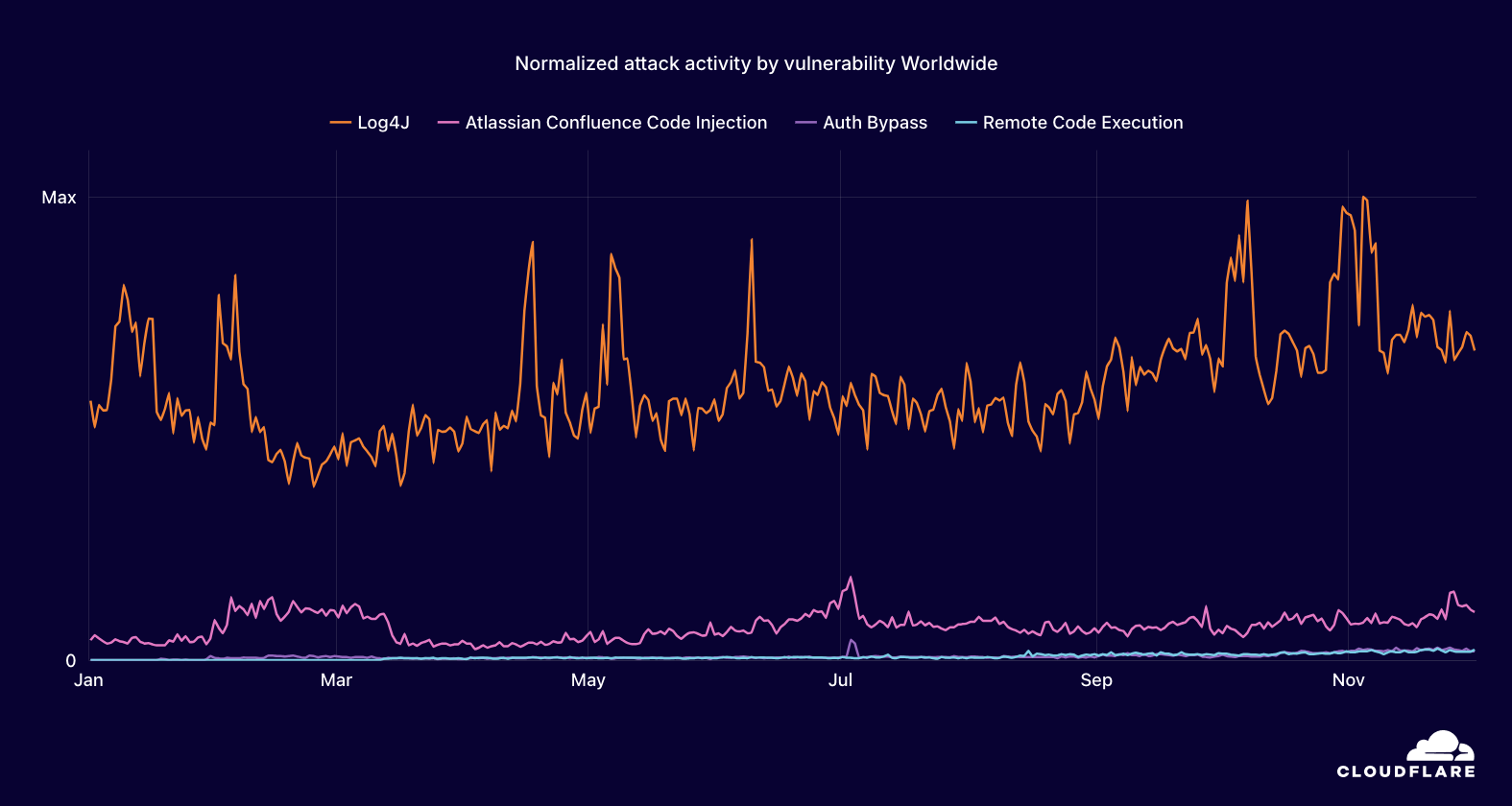
In 2024, three years after the initial Log4j disclosure, we found that Log4j remains an active threat. This year, we compared normalized daily attack activity for Log4j with attack activity for Atlassian Confluence Code Injection, a vulnerability we examined in the 2023 Year in Review, as well as aggregated daily attack activity for multiple CVEs related to Authentication Bypass and Remote Code Execution vulnerabilities published in 2024.
Log4j attack activity appeared to trend generally upwards across the year, with several significant spikes visible during the first half of the year, and then again in October and November. In terms of the difference in activity, Log4j ranges from approximately 4x to over 20x the activity seen for Atlassian Confluence Code Injection, and as much as 100x the aggregated activity seen for Authentication Bypass or Remote Code Injection vulnerabilities.
Global attack activity trends for commonly exploited vulnerabilities in 2024
Routing security, measured as the share of RPKI valid routes and the share of covered IP address space, continued to improve globally throughout 2024.
As the routing protocol that underpins the Internet, Border Gateway Protocol (BGP) communicates routes between networks, enabling traffic to flow between source and destination. BGP, however, relies on trust between networks, and incorrect information shared between peers, whether or not it was shared intentionally, can send traffic to the wrong place, potentially with malicious results. Resource Public Key Infrastructure (RPKI) is a cryptographic method of signing records that associate a BGP route announcement with the correct originating autonomous system (AS) number, providing a way of ensuring that the information being shared originally came from a network that is allowed to do so. (It is important to note that this is only half of the challenge of implementing routing security, because network providers also need to validate these signatures and filter out invalid announcements to prevent sharing them further.)
Cloudflare has long been an advocate for routing security, including being a founding participant in the MANRS CDN and Cloud Programme and providing a public tool that enables users to test whether their Internet provider has implemented BGP safely. Building on insights available in the Routing page on Cloudflare Radar, we analyzed data from RIPE NCC’s RPKI daily archive to determine the share of RPKI valid routes (as opposed to those route announcements that are invalid or whose status is unknown) and how that share has changed over the course of 2024, as well as determining the share of IP address space covered by valid routes. The latter metric is of interest because a route announcement covering a significant amount of IP address space (millions of IPv4 addresses, for example) has a greater potential impact than an announcement covering a small block of IP address space (hundreds of IPv4 addresses, for example).
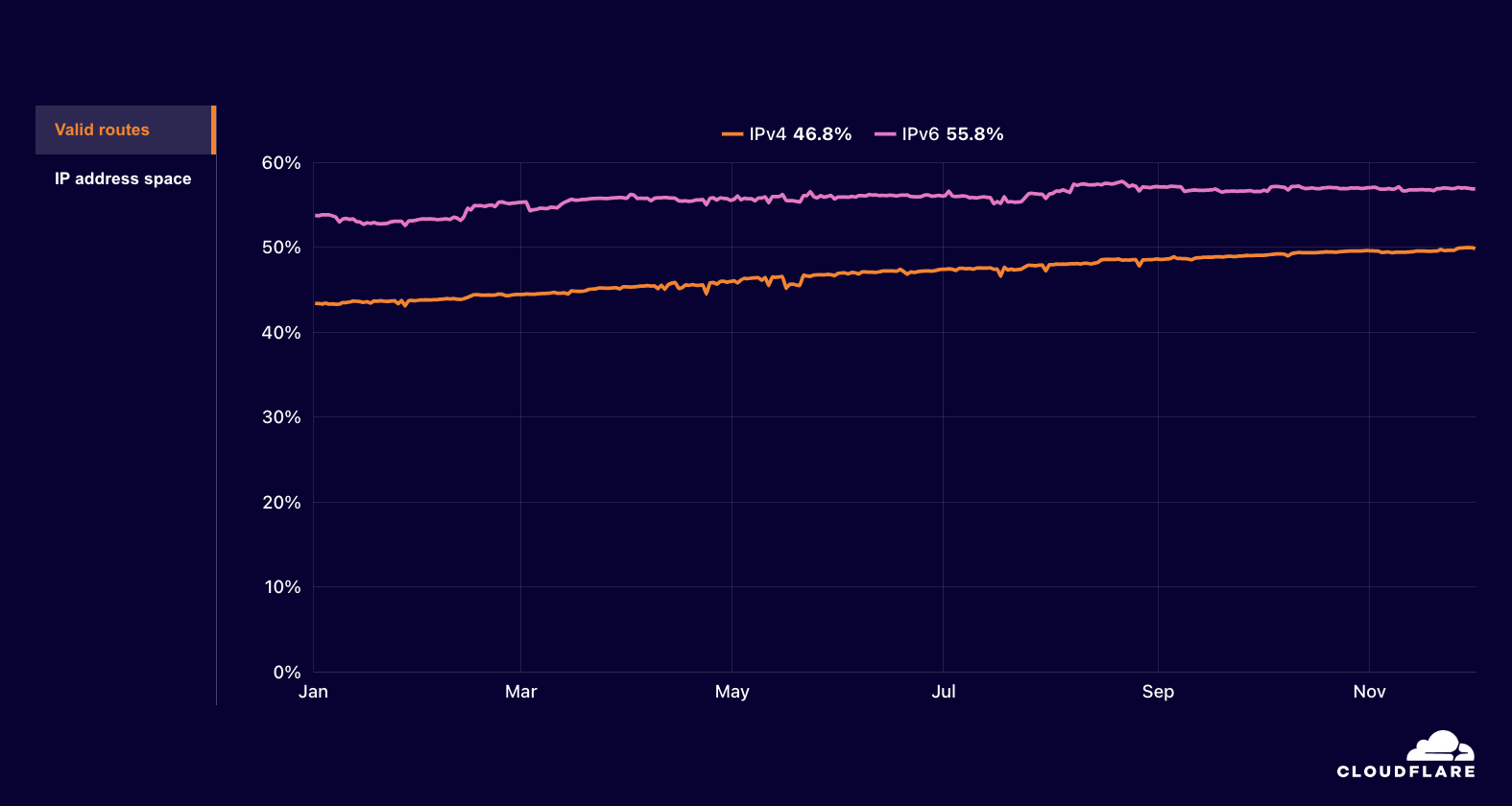
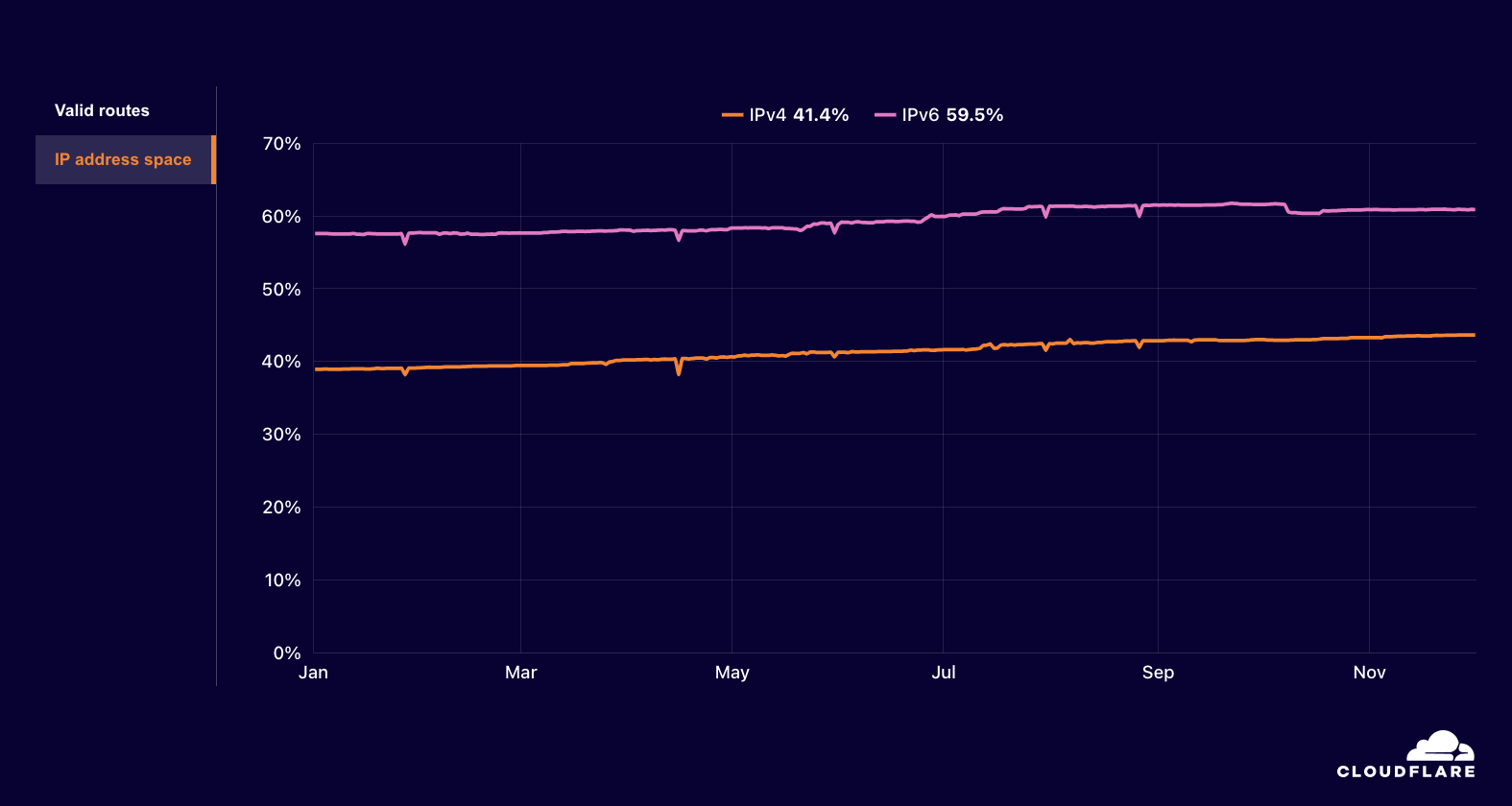
At a global level during 2024, we saw a 6.4 percentage point increase (from 43.4% to 49.8%) in valid IPv4 routes, and a 3.2 percentage point increase (from 53.7% to 56.9%) in valid IPv6 routes. Given the trajectory, it is likely that over half of IPv4 routes will be RPKI valid by the end of calendar year 2024. Looking at the global share of IP address space covered by valid routes, we saw a 4.7 percentage point increase (from 38.9% to 43.6%) for IPv4, and a 3.3 percentage point increase (from 57.6% to 60.9%) for IPv6.
Shares of global RPKI valid routing entries by IP version in 2024
Shares of globally announced IP address space covered by RPKI valid routes in 2024
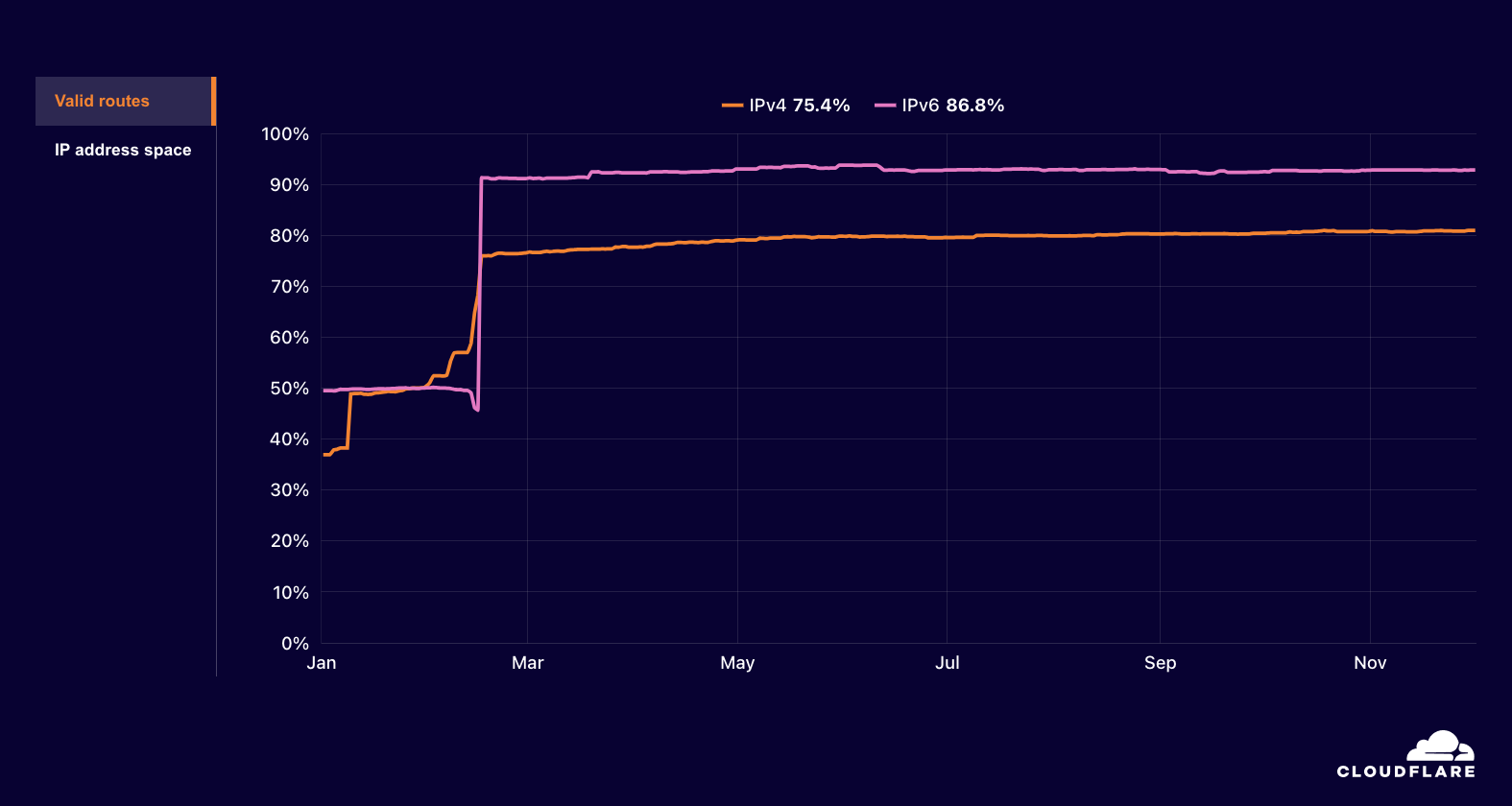
Spain started 2024 with less than half of its routes (both IPv4 and IPv6) RPKI valid. However, the share of valid routes grew significantly on February 15, when AS12479 (Orange Espagne) signed records associated with 98% of their IP address prefixes that were previously in an “unknown” (or NotFound) state of RPKI validity, thus converting these prefixes from unknown to valid. That drove an immediate increase for IPv4 to 76%, reaching 81% validity by December 1, and an immediate increase for IPv6 to 91%, reaching 92.9% validity by December 1. A notable change in covered IP address space was observed in Cameroon, where covered IPv4 space more than doubled at the end of January, growing from 32% to 82%. This was due to AS36912 (Orange Cameroun) signing records associated with all of their IPv4 address prefixes, changing the associated IP address space to RPKI valid.
IPv4 and IPv6 shares of RPKI valid routes for Spain in 2024
Share of IPv4 address space covered by RPKI valid routes for Cameroon in 2024
Email Security
An average of 4.3% of emails were determined to be malicious in 2024.
Despite the growing enterprise use of collaboration/messaging apps, email remains an important business application and is a very attractive entry point into enterprise networks for attackers. Attackers will send targeted malicious emails that attempt to impersonate an otherwise legitimate sender (such as a corporate executive), that try to get the user to click on a deceptive link, or that contain a dangerous attachment, among other types of threats. Cloudflare Email Security protects customers from email-based attacks, including those carried out through targeted malicious email messages. During 2024, an average of 4.3% of emails analyzed by Cloudflare were found to be malicious. Aggregated at a weekly level, spikes above 14% were seen in late March, early April, and mid-May. We believe that these spikes were related to targeted “backscatter” attacks, where the attacker flooded a target with undeliverable messages, which then bounced the messages to the victim, whose email had been set as the reply-to: address.
Global malicious email share trends in 2024
Deceptive links and identity deception were the two most common types of threats found in malicious email messages.
Attackers use a variety of techniques, which we refer to as threat categories, when they use malicious email messages as an attack vector. These categories are defined and explored in detail in our phishing threats report. In our analysis of malicious emails, we have found that such messages may contain multiple types of threats. In reviewing a weekly aggregation of threat activity trends for these categories, we found that, averaged across 2024, 42.9% of malicious email messages contained deceptive links, with the share reaching 70% at times throughout the year. Activity for this thread category was spiky, with low points seen in the March to May timeframe, and a general downward trend visible from July through November.
Identity deception was a similarly active threat category, with such threats also found in up to 70% of analyzed emails several weeks throughout the year. Averaged across 2024, 35.1% of emails contained attempted identity deception. The activity pattern for this threat category appears to be somewhat similar to deceptive links, with a number of the peaks and valleys occurring during the same weeks. At times, identity deception was a more prevalent threat in analyzed emails than deceptive links, as seen in the graph below.
Among other threat categories, extortion saw the most significant change throughout the year. After being found in 86% of malicious emails during the first week of January, its share gradually trended lower throughout the year, finishing November under 10%.
Global malicious email threat category trends for Deceptive Links and Identity Deception in 2024
Over 99% of the email messages processed by Cloudflare Email Security from the .bar, .rest, and .uno top level domains (TLDs) were found to be either spam or malicious in nature.
In March 2024, we launched a set of email security insights on Cloudflare Radar, including visibility into so-called “dangerous domains” — those top level domains (TLDs) that were found to be the sources of the most spam or malicious email among messages analyzed by Cloudflare Email Security. The analysis is based on the sending domain’s TLD, found in the From: header of an email message. For example, if a message came from [email protected], then example.com is the sending domain, and .com is the associated TLD.
In aggregate across 2024, we found that the .bar, .rest, and .uno TLDs were the “most dangerous”, each with over 99% of analyzed email messages characterized as either spam or malicious. (These TLDs are all at least a decade old, and each sees at least some usage, with between 20,000 and 60,000 registered domain names.) Sorting by malicious email share, the .ws ccTLD (country code top level domain) belonging to Western Samoa came out on top, with over 90% of analyzed emails categorized as malicious. Sorting by spam email share, .quest is the biggest offender, with over 88% of emails originating from associated domains characterized as spam.
TLDs originating the largest total shares of malicious and spam email in 2024
Conclusion
The Internet is an amazingly complex and dynamic organism, constantly changing, growing, and evolving.
With the Cloudflare Radar 2024 Year In Review, we are providing insights into the change, growth, and evolution that we have measured and observed throughout the year. Trend graphs, maps, tables, and summary statistics provide our unique perspectives on Internet traffic, Internet quality, and Internet security, and how key metrics across these areas vary around the world and over time.
We strongly encourage you to visit the Cloudflare Radar 2024 Year In Review microsite and explore the trends for your country/region, and to consider how they impact your organization so that you are appropriately prepared for 2025. In addition, for insights into the top Internet services across multiple industry categories, we encourage you to read the companion Year in Review blog post, From ChatGPT to Temu: ranking top Internet services in 2024.
As it is every year, it truly is a team effort to produce the data, microsite, and content for our annual Year in Review, and I’d like to acknowledge those team members that contributed to this year’s effort. Thank you to: Jorge Pacheco, Sabina Zejnilovic, Carlos Azevedo, Mingwei Zhang (Data Analysis); André Jesus, Nuno Pereira (Front End Development); João Tomé (Most popular Internet services); Jackie Dutton, Kari Linder, Guille Lasarte (Communications); Eunice Giles (Brand Design); Jason Kincaid (blog editing); and Paula Tavares (Engineering Management), as well as countless other colleagues for their answers, edits, support, and ideas.
Since the late 1990s, millions have relied on the Internet for searching, communicating, shopping, and working, though 2.6 billion people (about 31% of the global population) still lack Internet access. Over the years, use of the Internet has evolved from email and static sites to social media, streaming, e-commerce, cloud tools, and more recently AI chatbots, reflecting its constant adaptation to users’ needs. This post explores how people interacted online in 2024, based on Cloudflare’s observations and a review of the year’s DNS trends.
Building on similar reports we’ve done over the past several years, we have compiled a ranking of the top Internet properties of 2024, with the same categories included in 2023, including Generative AI. In addition to our overall ranking, we chose 9 categories to focus on:
As we have done since 2022, our analysis uses anonymized DNS query data from our 1.1.1.1 public DNS resolver, used by millions globally. We aggregate domains for each service (e.g., twitter.com, t.co, and x.com for X) and identify the sites that provide services to humans, thus excluding technical domains like root-servers.net. Rankings reflect relative popularity within categories, not absolute traffic. Therefore, a drop in rank doesn’t always indicate less traffic to a specific Internet service — it may simply reflect increased competition from other services, leading to a change in rank.
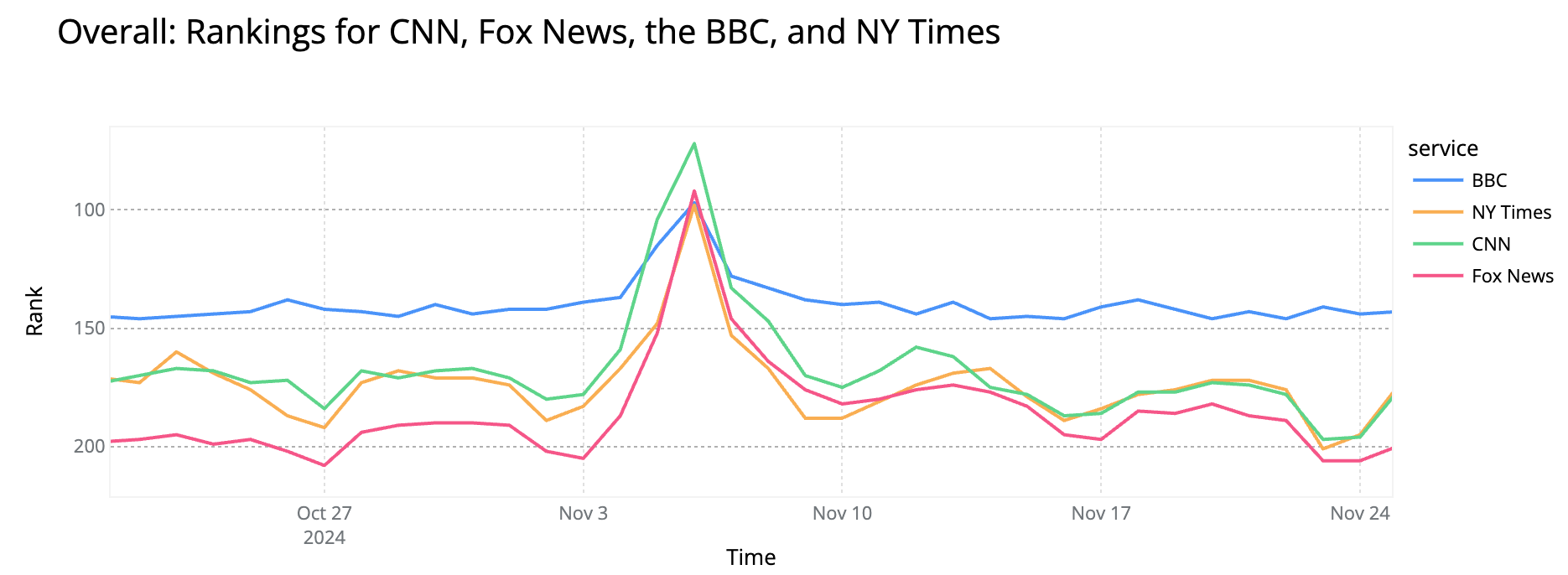
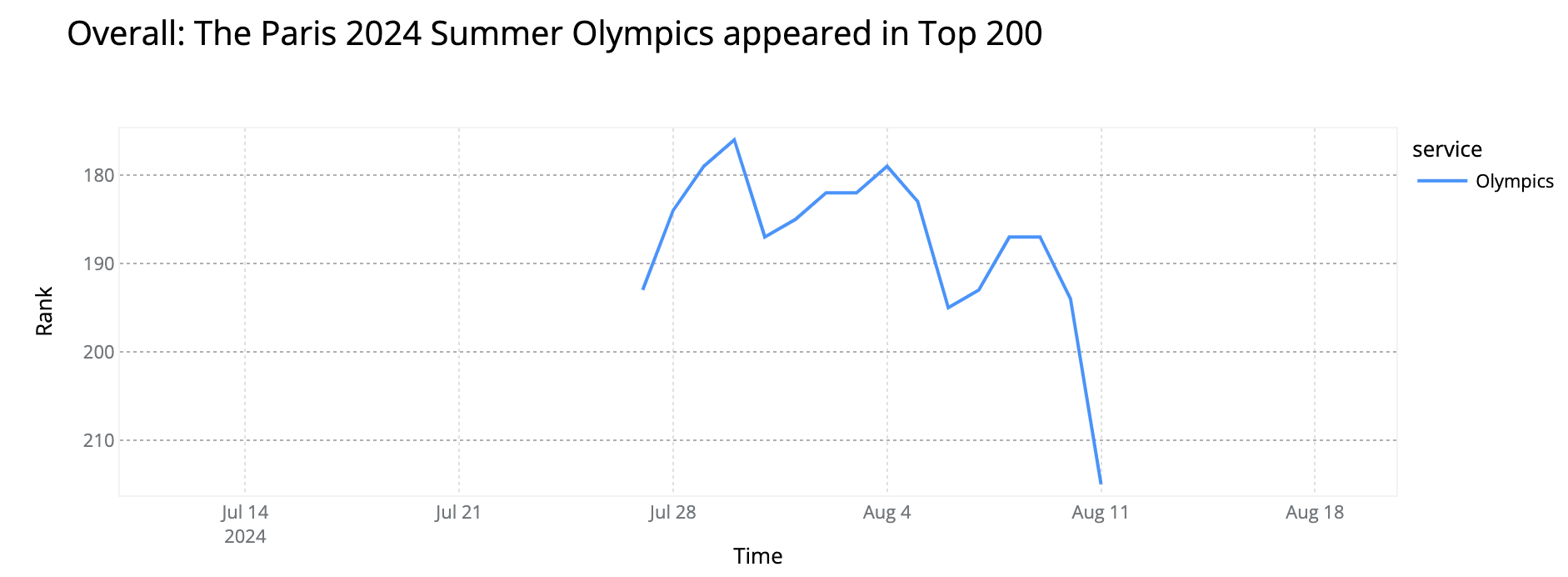
This part of the 2024 Cloudflare Radar Year in Review highlights shifts in Internet services, with rising platforms like Temu, GitHub Copilot, and WeChat reflecting changing user preferences. ChatGPT (OpenAI) also played a more prominent role in the generative AI space and in our Overall ranking, nearly reaching the Top 50. Major events like the Paris Olympics and US elections influenced rankings as well, boosting Olympics-related sites and news platforms like CNN and Fox News.
Keep reading for a detailed look at the evolution of trends throughout the year. For more, visit our 2024 Cloudflare Radar Year in Review microsite. Along with the lists of most popular Internet services, the Year in Review microsite and its associated blog post explore a number of additional metrics.
Google is again #1. Facebook, Apple and TikTok follow
Since 2021, we’ve started our review of rankings with an Overall Top 10 list, showcasing the most popular Internet services globally based on DNS traffic from our 1.1.1.1 resolver. Unsurprisingly, Google (including services like Google Maps and Google Calendar) remained the #1 Internet service in 2024. Since introducing our ranking method two years ago, no other service has come close to challenging Google’s top spot. It’s important to note that Apple and Microsoft are similar to Google in that their main domains (apple.com or microsoft.com) are used for many different services. We include other services separately, such as Outlook or iCloud, which use their own specific domains.
Top 10 most popular Internet services in 2024, overall
Google
Facebook
Apple
TikTok
Amazon Web Services
Microsoft
Instagram
YouTube
Amazon
WhatsApp
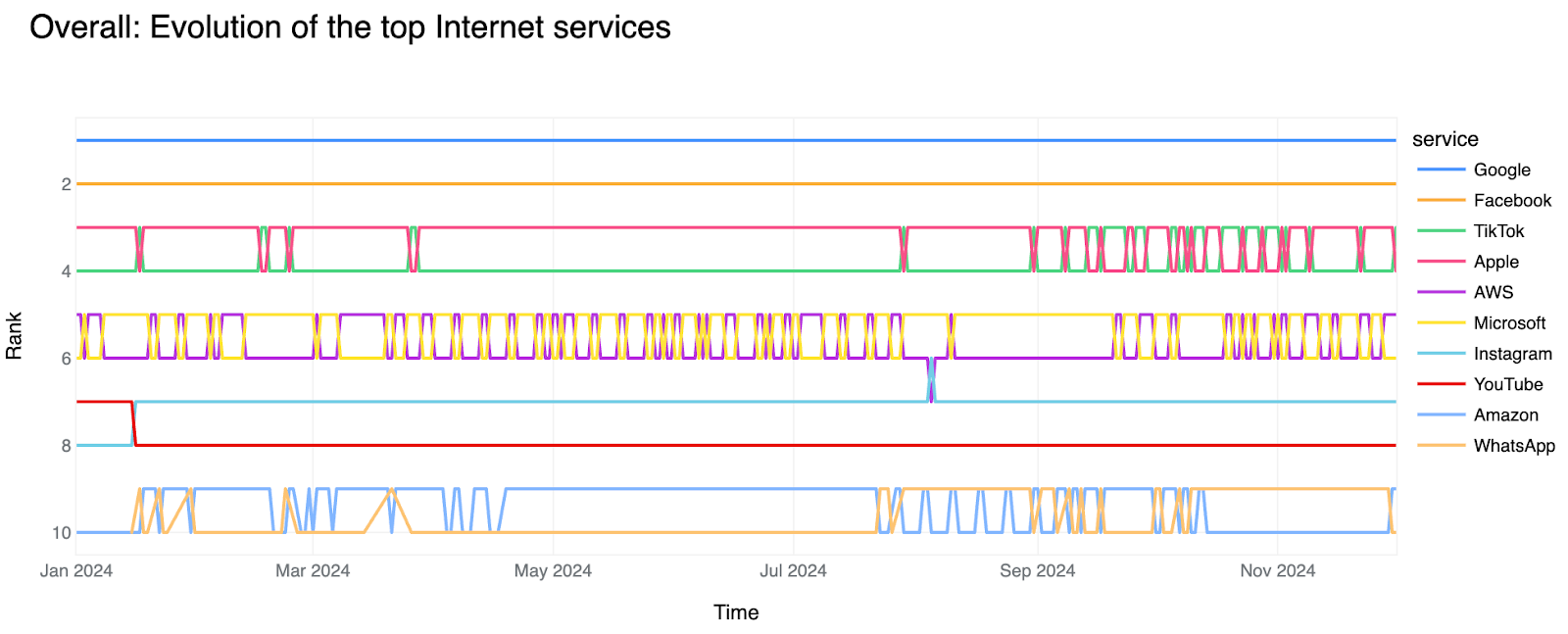
Beyond Google, Facebook consistently held the #2 spot throughout 2024. Last year, it competed with Apple for that position. Apple, which uses domains like apple.com for services related to its software and devices, was generally #3. However, TikTok challenged that position on several days since late August. Amazon Web Services (AWS), differentiated from Amazon by domains like amazonaws.com, performed better this year compared to 2023. It held the #5 spot but often traded places with Microsoft during the year.
Instagram also rose in the rankings. It was around #8 in 2023 and steadily improved. Now, it holds the #7 spot, ahead of YouTube.
Amazon remained at #9 for most of the year, the same as in 2023. WhatsApp, owned by Meta, appeared in the Top 10 for the first time, taking the #10 spot.
Close to the Top 10 were Apple’s iCloud, Netflix (which performs better on weekends), and Microsoft’s Outlook.
In the chart below, you can follow the evolution of the top Internet services in our Overall ranking throughout the year.
In 2022, X (then known as Twitter) ranked as high as #10 in our overall ranking and was close to Instagram. It never reached the top 10 in 2023, and in 2024, X dropped further, to #14 or #15. More on X’s performance in the Social Media category below.
Ready to face the Generative AI era?
Generative AI gained global attention in late 2022 with the launch of ChatGPT, and became a global phenomenon during 2023. By 2024, ChatGPT (OpenAI) continues to be by far the most popular service in this category, which includes chatbots, coding bots, and more. Other generative AI services had more stable rankings compared to 2023.
Top 10 Generative AI services in 2024
ChatGPT (OpenAI)
Character.AI
Codeium
QuillBot
Claude (Anthropic)
Perplexity
GitHub Copilot
Wordtune
Poe
Tabnine
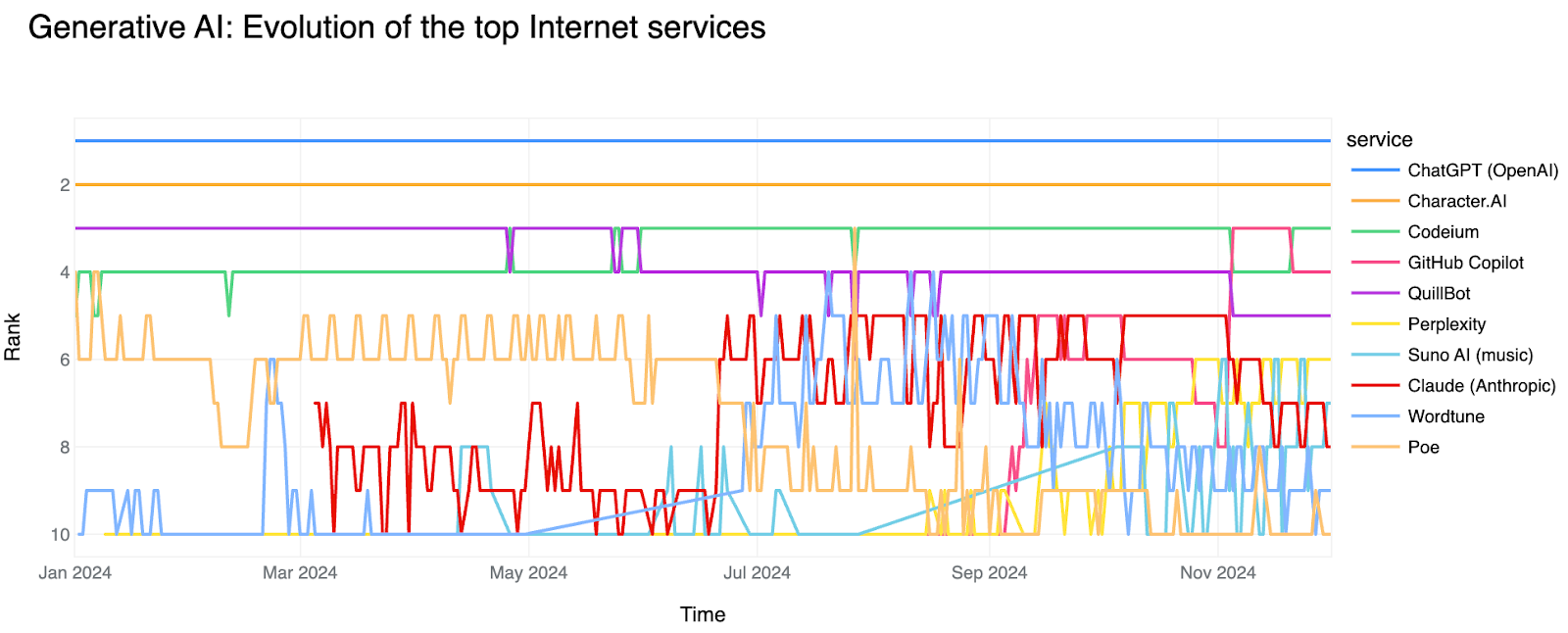
Significant changes occurred below ChatGPT’s first place ranking throughout the year. Character.AI, an AI-driven chatbot platform, maintained a strong #2 position, staying ahead of Codeium, a code-generation AI tool that has improved its position since June, and Quillbot, an AI writing and paraphrasing tool.
Claude, the AI chatbot from Anthropic, rose in the rankings, particularly after March 4, when the new model, Claude 3, was introduced, and again later in May when it became available in Europe. It reached #5 in June. Perplexity, an AI-driven search and Q&A platform, started the year outside the Top 10 but ended close to Claude. It surpassed Claude for the first time on November 6, 2024, the day after the U.S. elections, reaching #6.
This next chart shows movement among the Generative AI services that were more popular later in the year.
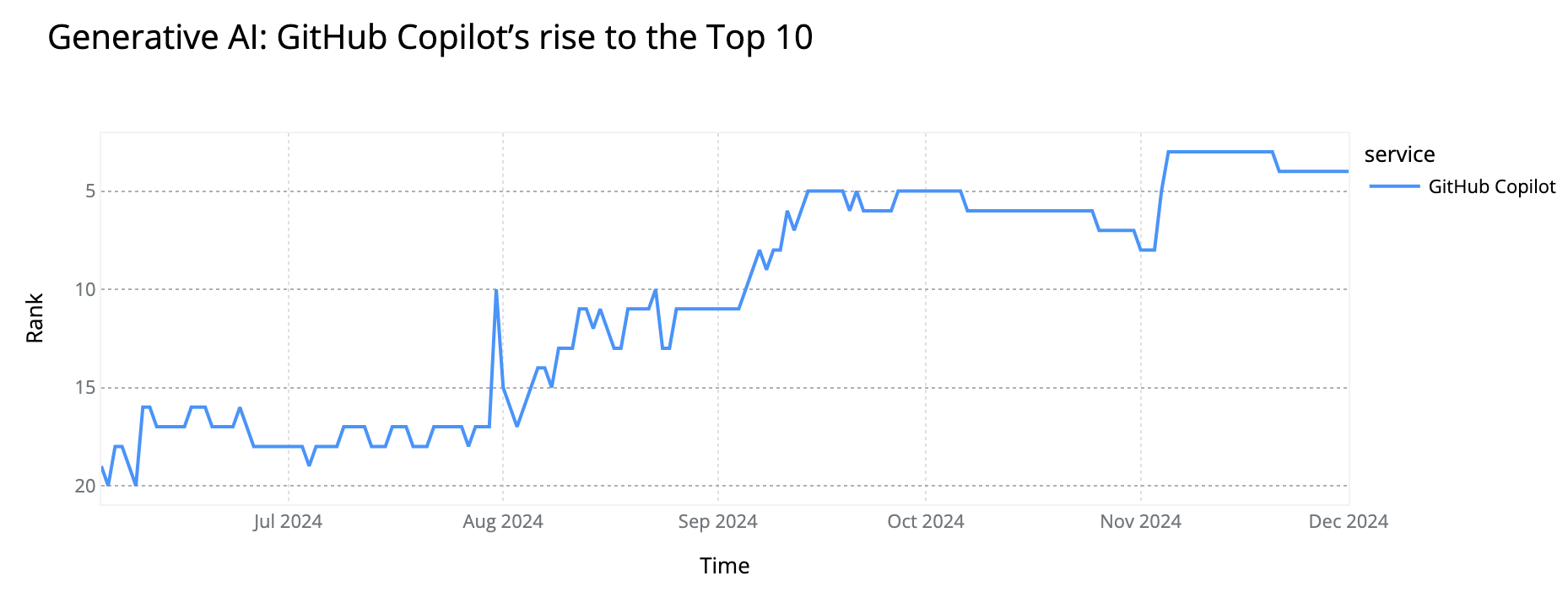
GitHub Copilot’s rise to the Top 10
Several new players entered the Top 10 AI rankings in 2024, showing strong growth. GitHub Copilot, an AI-powered coding assistant, experienced the fastest rise, entering the Top 10 in September (after reaching the Top 20 in June) and staying mostly between #5 and #3 by November, as the next chart shows. Similarly, Suno AI, an AI-powered audio and music generation platform, entered the Top 10 in April, briefly dropped out, but stabilized between #6 and #10 after October — in November, it ranked #6 on weekends.
Some platforms lost ground in the rankings. Wordtune, an AI writing assistant, peaked at #4 during mid-year but declined afterward. Tabnine, another AI-powered coding assistant, held the #5 spot for months but slipped after July. In contrast, Sider AI, a coding assistant, entered the Top 20 in March and finished the year around #12. Poe, an AI chatbot platform, ranked #5 in 2023 and between #5 and #6 before June, but ended 2024 moving around #10, performing better during weekends.
Google Gemini, Google’s AI assistant and model, performed better on weekdays and started the year ranking between #7 and #10, but dropped out of the Top 10 after July as newer AI platforms gained momentum. Hugging Face, an open-source AI and machine learning platform, mostly fluctuated between #7 and #9 during the year, peaking at #4 on August 18 around the time several models were updated, and and as it reached its milestone of 5 million users. However, it fell out of the Top 10 by September.
Midjourney, an AI-powered platform for generating images, performed well until June, when it was close to the Top 10. Additionally, the OpenAI API ranked #18 in the Generative AI category on May 14-15, coinciding with OpenAI’s announcement of GPT-4o availability, including in the API.
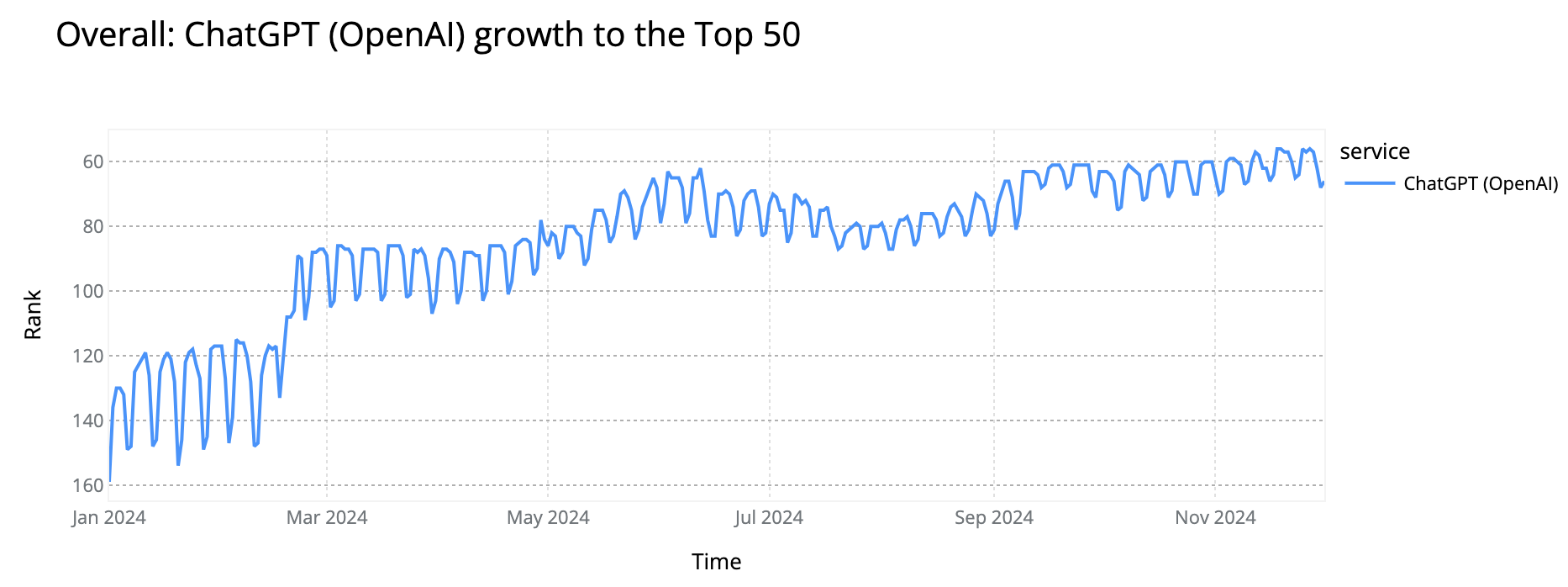
ChatGPT’s growth to the Top 50 of our Overall category
Notable trends that we observed when looking at trends for Generative AI services within our larger Overall ranking include:
ChatGPT continued its growth in 2024, similar to 2023. In early 2023, it ranked around #200 and ended the year near the top 100. In 2024, it started close to the top 100, reached the top 60 in May with the release of the 4o model, and has been near the top 50 since September, aligning with the return of workers and students to their routines. It ranks higher on weekdays, averaging #56, and drops on weekends.
Comparing ChatGPT with other known and non-AI related websites, by late November, ChatGPT ranked ahead of Weather.com, Temu, eBay, Telegram, Google Calendar, and Prime Video, but trailed Disney Plus
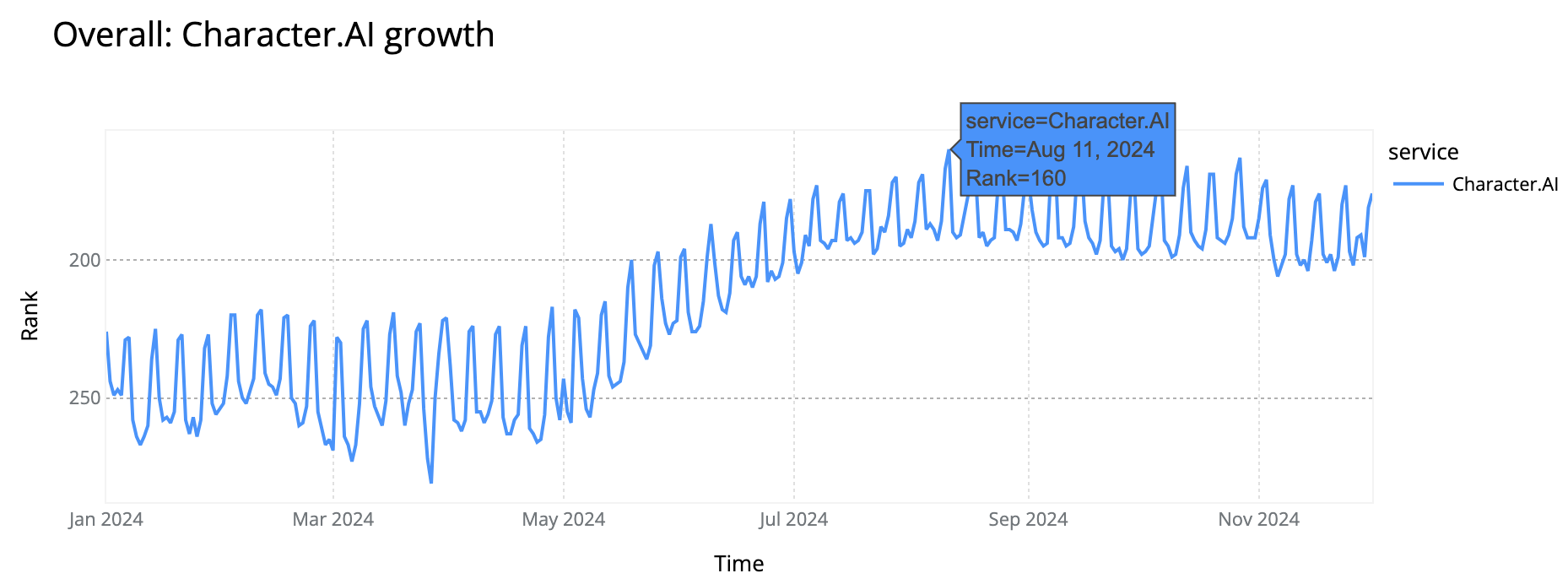
Character.ai also showed a clear growth trend in our Overall ranking, from outside the top 200 earlier in the year, to above #180 after July, performing better in August, reaching as high as #161. The AI-driven chatbot platform performed better on weekends than on weekdays, the opposite of ChatGPT.
Codeium entered the top 300 in July. It ranked higher on weekdays than weekends.
Social media: Snapchat closing in on X
According to Kepios, there are an estimated 5.22 billion social media users worldwide in 2024 (up from 4.95 billion last year), representing 63.8% of the global population. Social media continues to play a major role in daily life, serving as a key platform for communication, information, and attention.
Once again, social media giants like Facebook, TikTok, and Instagram dominate, ranking among the top 10 most popular Internet services overall.
Top 10 Social Media services in 2024
Facebook
TikTok
Instagram
X
Snapchat
LinkedIn
Discord
Kwai
Pinterest
Reddit
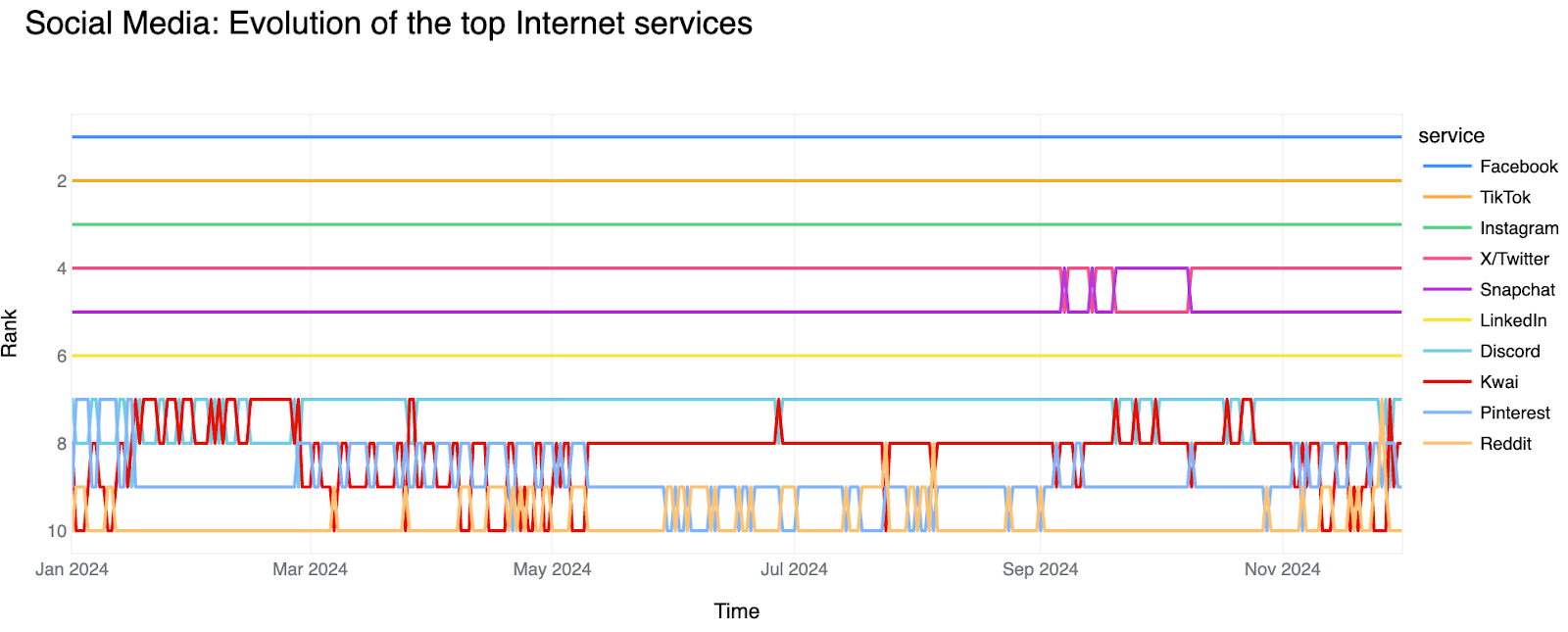
In the Social Media category rankings, the top seven remain unchanged from last year. However, there are notable developments in this category. In 2022, X briefly challenged Instagram for the #3 spot during a few days. Since 2023, X has held a solid #4 position, with Snapchat closing in and reaching #4 for the first time on several days in September and October.
LinkedIn stayed steady at #6, followed by Discord. Kwai, a Chinese video app popular in Brazil (with 60 million reported users) and other countries (a reported ), rose from #10 last year to #8. Further down the list, Pinterest kept its #9 rank, while Reddit, previously #8 in 2023, dropped to #10 this year, but peaked at #7 on November 26, just before Black Friday and Thanksgiving in the US. Here’s the Social Media Top 10 chart for 2024:
Our global ranking also highlights several non-Western platforms in the Top 20. These include Douyin (#11), the Chinese version of TikTok; VK (#12), often referred to as the Russian Facebook; and TikTok rivals popular in Southeast Asia SnackVideo (#13) by Chinese Kuaishou (that also owns Kwai). OnlyFans appeared consistently in the Top 20 starting in September, ranking around #18 and surpassing Tumblr by late November.
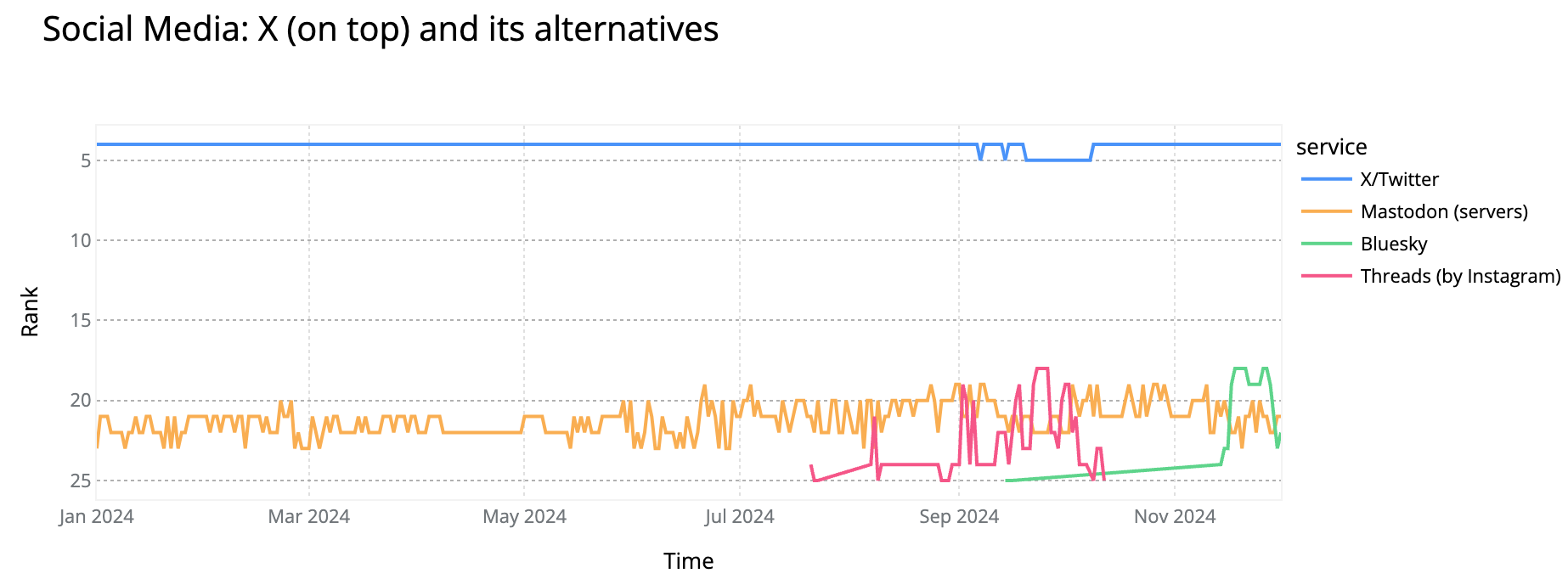
The #18 spot was briefly held by X alternative Threads (by Instagram) in late September and by Bluesky starting November 18. Mastodon-related servers reached as high as #19 for several days since late August. Here’s a look at X (on top) and its alternatives in this category:
Alternatives to X: Bluesky, Threads, and Mastodon
Let’s move beyond the Social Media category to see how these platforms performed in our Overall ranking, where bigger shifts between services are evident.
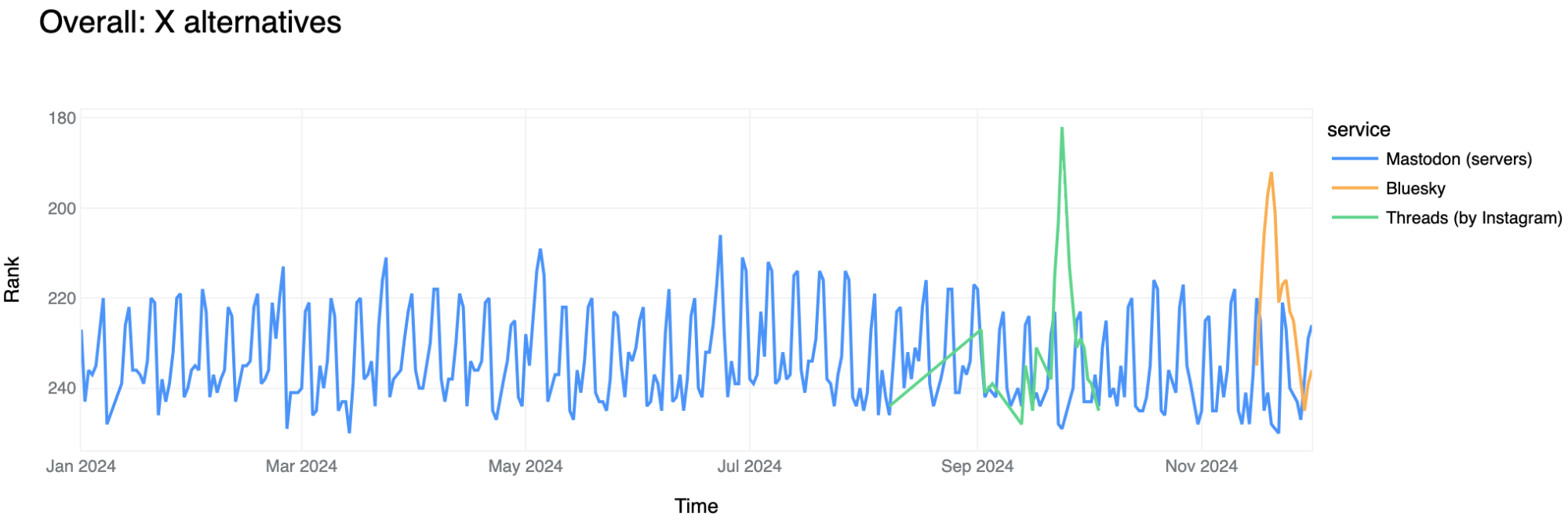
As we’ve seen, Threads, Bluesky, and Mastodon (via an aggregation of popular servers) didn’t break into the Top 10 of the Social Media category. However, in the Overall ranking, Mastodon servers, bundled together, consistently ranked between #208 and #248, performing better on weekends.
Bluesky entered the Top 250 in September 2024, and gained additional attention after the US elections. It rose sharply after November 14, peaking at #193 on November 20, and has since stabilized around #220.
Threads entered the Top 250 in August 2024, peaking at #183 on September 24 before dropping out in October. In 2023, Threads peaked at #227 in early July but fell out of the Top 250 by late August. It’s worth noting that Threads also uses Instagram’s cdninstagram.com for images and videos, which may influence Threads position in our DNS rankings (that said, Instagram wasn’t impacted by Threads appearance in our rankings).
Here are some other trends we observed among social media apps, and how they did in our Overall ranking:
Instagram’s best day (#6 in the Overall ranking) was August 5, 2024, coinciding with the week the app was banned in Turkey.
X’s best day of the year in our ranking was April 14, when it reached #12. This coincided with Arsenal losing the top position in the English football/soccer Premier League (the most-watched sports league in the world) to Manchester City, which went on to win its fourth title in a row. Last year, we noted how football/soccer in England impacted X’s ranking. X also reached #13 on August 9 and 10, during the final weekend of the Paris 2024 Olympics.
X performed better on weekdays, while LinkedIn ranked higher between Mondays and Wednesdays. Snapchat and Discord performed better on weekends.
Reddit consistently stayed in our Top 50 in 2024, showing growth from around #45 to #40 by November, with a peak at #38 on November 26. It performed better between Mondays and Wednesdays.
Quora displayed a downward trend in our ranking, dropping from around #140 to #160. It performed better between Mondays and Wednesdays.
Tinder, which performs better on Sundays, started the year around #150 but eventually dropped below #160.
Tumblr followed a similar pattern, dropping out of the Top 200, where it was in early 2024, to outside the ranking entirely since September. Tumblr performed better on weekends.
OnlyFans showed growth in our Overall ranking, sitting around the Top 220 with a peak at #213 on December 1. It performed better on weekends.
E-commerce: Temu means growth
The importance of e-commerce continues to grow, as highlighted in our recent Cyber Week 2024 blog post. Amazon leads the category, followed by Taobao, the Chinese marketplace, holding a steady #2 spot as it also did in 2023. New to #3 is AliExpress, the global online retail giant from China.
Top 10 E-commerce services in 2024
Amazon
Taobao
AliExpress
Shopify
Temu
Alibaba
eBay
Shein
Mercado Libre
Wildberries (RU)
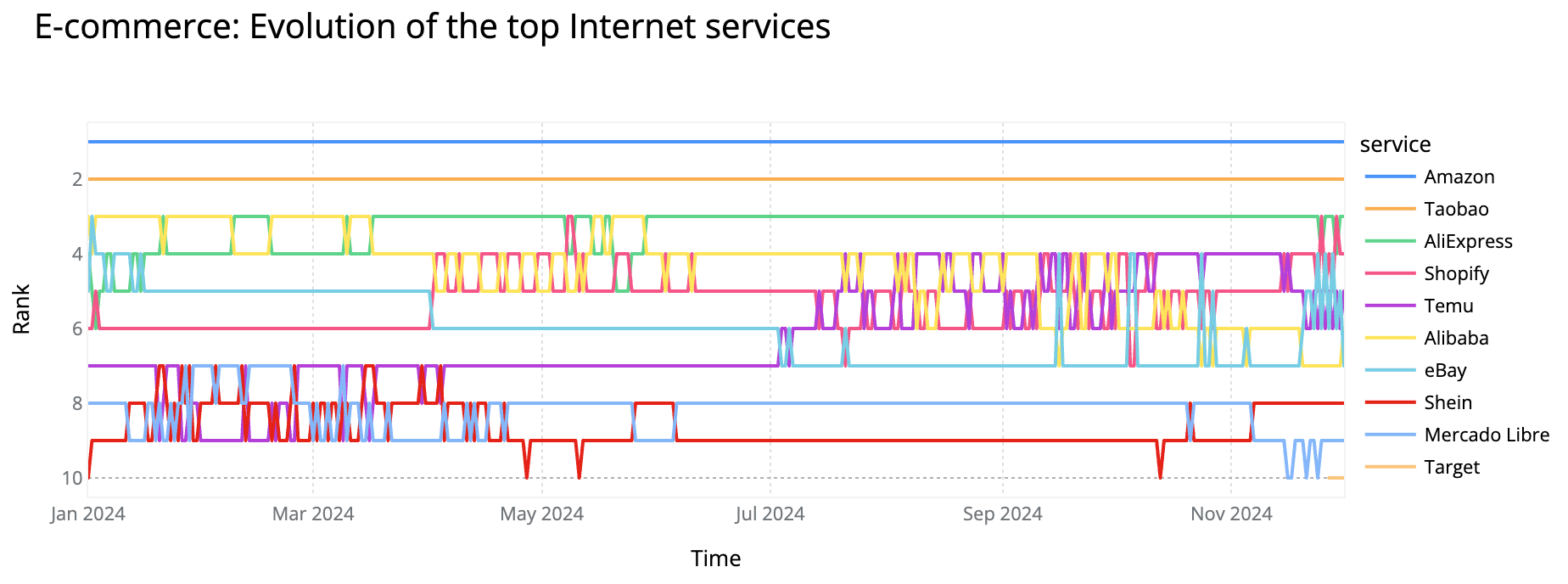
Compared to 2023, eBay lost its #3 spot globally and dropped down to #7, despite starting 2024 at #3 for several days. AliExpress claimed #3, followed by Shopify (#4), the Canadian platform hosting numerous online stores, and Temu (#5). Temu, the low-cost, fast-fashion marketplace launched in the US in September 2022, ended 2023 at #7 but rose to #5 in 2024, occasionally reaching #4 since August. Alibaba dropped to #6 in September.
Shein, the Chinese fast-fashion brand, continued its growth and overtook Mercado Libre (#8) in November. A surprise this year was Wildberries, often called Russia’s “Amazon,” that has been expanding to several neighboring countries (including some in Europe). It climbed to #10 in September, surpassing OLX (which held #10 for several months), Rakuten, and Lazada.
The Black Friday overall effect
Looking at how e-commerce sites performed in our Overall ranking, we observed the following trends:
Amazon fluctuated between #9 and #10 after October, returning to #9 on November 30 and December 1, during the Black Friday weekend. It often performed better on weekends.
Shopify’s best day of the year was Black Friday, November 29, when it reached #55. The global e-commerce platform performed better during weekdays.
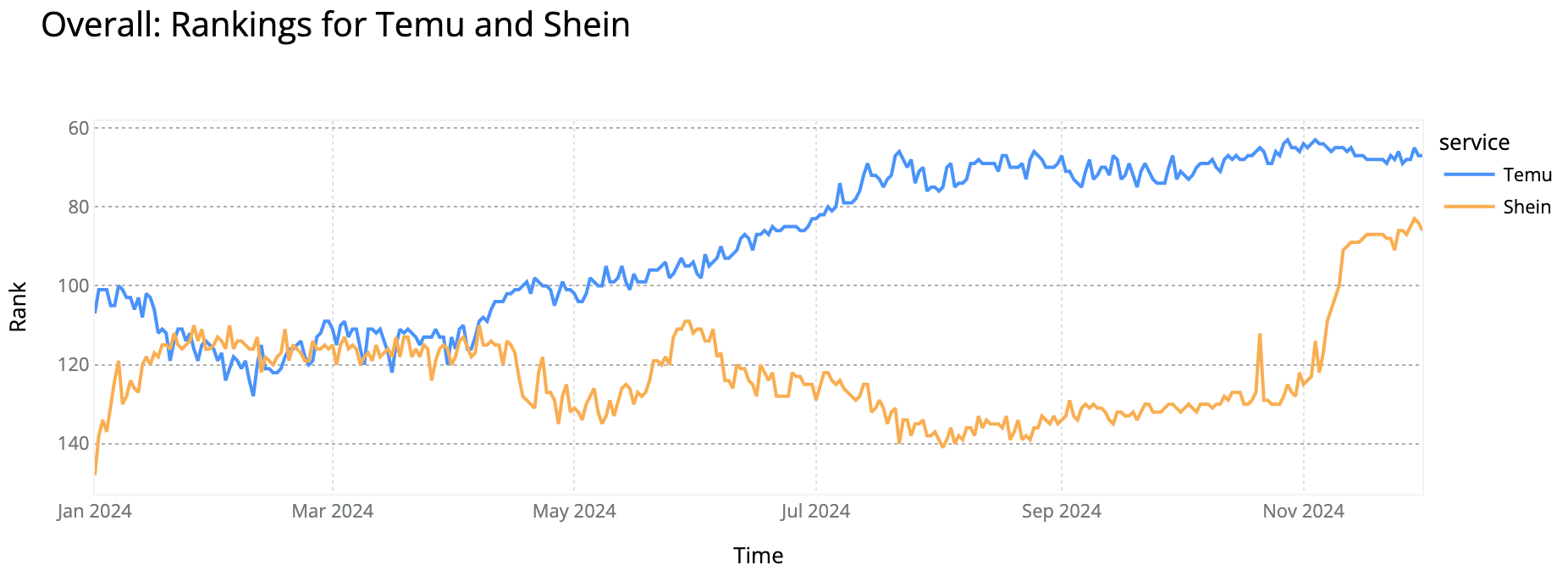
Temu, known for low-cost products, started 2024 outside the Top 100 but climbed into the Top 70 by year-end. It performed best in late October and early November, peaking at #63, with a Black Friday spike to #65.
Shein, the Chinese fast-fashion brand, showed growth, nearing the Top 100 in early 2024 before dropping to the Top 140 between June and October. It rebounded in November, peaking at #83 on Black Friday. A similar trend was observed in 2023, when it ended the year around the Top 120. Here’s the comparison between recent players Temu and Shein:
eBay consistently ranked between #72 and #80, peaking at #62 on October 5-6 and again in late November, just before Black Friday. It often performed better on weekends.
Mercado Libre, the Latin American marketplace, had its best day on Black Friday, November 29, reaching #100.
Adidas entered the Top 250, ranking #232 on Black Friday, November 29.
Target performed well in November, peaking at #133 on November 27, the day before Thanksgiving in the US, and at #127 on December 1. It often performed better on Sundays.
Walmart improved its performance from September onward, with its best days on November 25-26, reaching #150.
Ikea, the Swedish furniture retailer, peaked at #247 on June 29.
Video streaming: YouTube and Netflix remain uncontested leaders
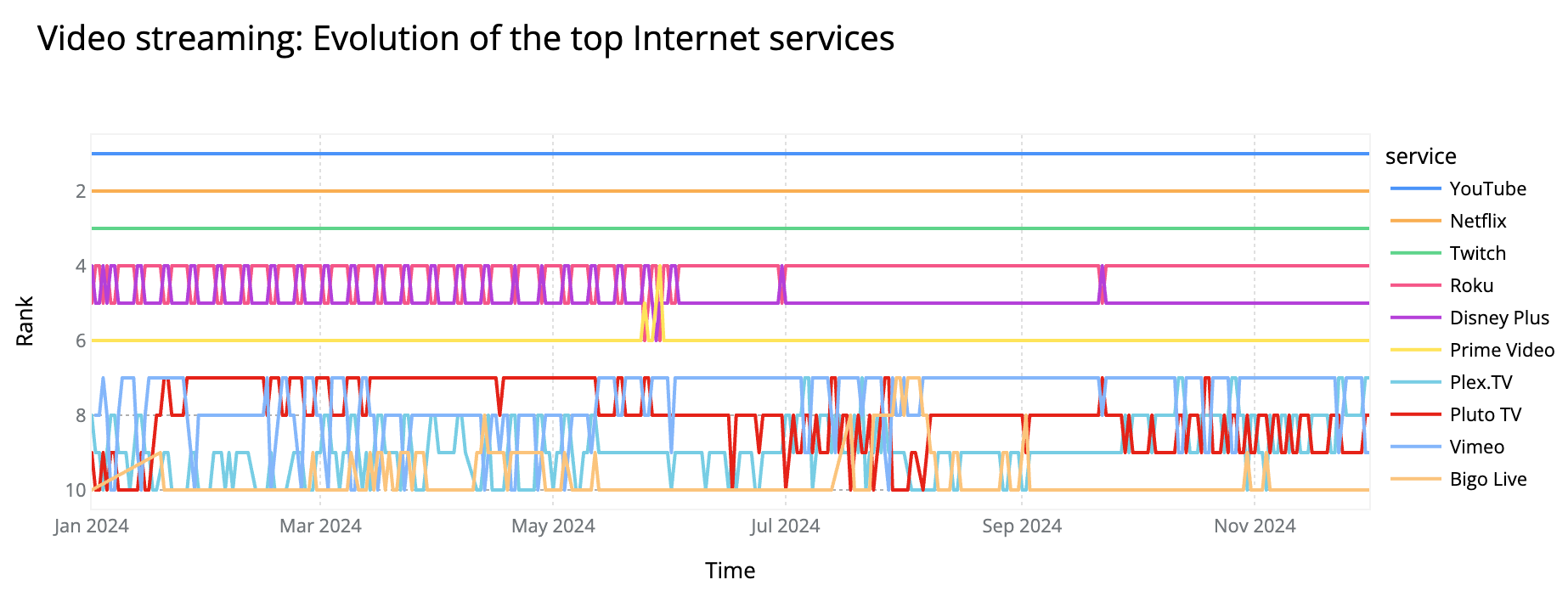
The relevance of video streaming platforms shows no signs of fading. In 2024, the Top 3 rankings stayed unchanged from 2023, with YouTube firmly holding the #1 spot, followed by Netflix. Among paid streaming services, Netflix leads, trailed by Disney Plus and Amazon Prime Video. Other paid streaming services are outside the Top 10, including, in ranked order: HBO/Max, Hulu, Peacock, and Paramount Plus.
Top 10 — Video streaming services 2024
YouTube
Netflix
Twitch
Roku
Disney Plus
Amazon Prime Video
Vimeo
Plex.TV
Pluto TV
Bigo Live
Twitch, a live-streaming platform for gaming, kept the #3 spot, as it did in 2023 and 2022. Roku, a digital media player that also offers streaming services, ranked #4, maintaining its position from last year. Similarly, Disney Plus (#5) and Amazon Prime Video (#6) held their spots, while Hulu dropped out of the Top 10.
The creative video platform Vimeo showed clear popularity growth since May, followed by recent players like Plex TV, a media platform with streaming that performed better starting in October, and Pluto TV, a free ad-supported streaming service that also showed growth throughout the year. Bigo Live, a live-streaming social platform, entered the Top 10 rankings in May.
Next, the Top 10 overtime perspective:
Throughout the year, Disney Plus occasionally challenged Roku, especially on weekends, a trend similar to what was observed in 2023.
Looking at how video streaming services performed in our Overall ranking, we found:
Netflix consistently ranked #12 on most weekends, particularly Sundays, through late May and resumed the same trend after August. Netflix, Disney Plus, Prime Video, and HBO/Max were more popular on weekends, especially Sundays.
Disney Plus ranged between #50 and #60, with a strong start to the year and a spike to #51 on September 22, coinciding with the premiere of the new Marvel show Agatha All Along.
Prime Video had its best day in the rankings on May 25, at #56, the day the movie Bombshell with Nicole Kidman premiered on the platform.
HBO/Max was consistently around the Top 100 until August. but dropped out after October.
Peacock had an inconsistent presence in the Top 250 but reappeared in late July during the Paris 2024 Olympics, reaching #176 on July 28. That was one of the busiest days for Olympic events, as detailed in our blog post on the event.
Paramount Plus was mostly outside the Top 250 this year but peaked at #216 on February 11, the day of the Super Bowl, which the platform streamed.
The News: Globo and BBC global perspectives
News organizations are vital for keeping the public informed, especially during crises. With that in mind, this ranking of news services, some of which are well-established news outlets while others are news aggregators, also highlights a few newsworthy trends.
Top 10 News services in 2024
Globo
BBC
NY Times
CNN
Fox News
Google News
Yahoo Finance
Daily Mail
RT
NewsBreak
This year’s rankings in the news category mirrored 2023 at the top. Globo, the Brazilian media giant — one of the largest in Latin America and globally — encompassing radio, TV, newspapers, and magazines, stayed #1, followed by the British BBC at #2, that operates globally and in 42 languages.
The New York Times rose to #3 this year (it was #5 in 2023), overtaking CNN (#4) and Fox News (#5), which dropped from its position at #3 in 2023 and this year came behind CNN.
Several prominent outlets, such as the Washington Post, The Guardian, NPR, and the Wall Street Journal, fell out of the Top 10 this year. These outlets had higher rankings in late 2023 following the start of the Hamas-Israel conflict on October 7. News aggregators gained prominence, with Google News (#6) and also Yahoo Finance (#7), focused on financial news (and that came in front of Yahoo News), and NewsBreak (#10), a US-based local news app, entering the Top 10.
The British Daily Mail, which has also expanded its focus to the US and Australia, ranked #8, followed by RT, the Russian news TV network with a global presence. RT launched its Brazil/Portuguese version in late 2023 and was recently highlighted in a report and an alert from the US Department of State regarding its global operations.
The US elections impacted rankings. CNN climbed to #2 on November 5, election day, and reached #1 on November 6, while Fox News peaked at #3. NBC News also improved, reaching #11 on November 5 and #7 the following day. Associated Press ranked #8 on November 5 as well. Here’s the News ranking:
US elections, attacks and protests
Notable news trends we identified in our larger Overall ranking include:
As we’ve seen in the News category, the US elections on November 5, 2024, caused CNN, Fox News, and others to jump in our rankings. This trend was also evident in the Overall ranking for the following media outlets, listed by performance. November 6 was the best day of 2024 for each:
CNN: #105 on November 5; #72 on November 6
Fox News: #153 on November 5; #92 on November 6
BBC: #115 on November 5, and #97 on November 6
NY Times: #149 on November 5; #98 on November 6
NBC News: #160 on November 6
Associated Press: #166 on November 6
Google News: #250 on November 5; #228 on November 6
Wall Street Journal: #241 on November 6
Washington Post: #245 on November 6
In the next chart we show rankings for CNN, Fox News, the BBC, and NY Times:
Brazil made headlines in late February when thousands of Bolsonaro supporters protested to defend the former president against investigations. During this period, Globo moved up the rankings, reaching #60 on February 24-25, 2024.
WP, the news aggregator from Poland, had its best day on July 26 (#188), coinciding with Polish lawmakers voting to allow security forces to use lethal weapons with “impunity”, particularly at the tense border with Belarus. WP peaked again on November 6 (#180), the day after the US elections, when the result of the election was mentioned in Poland’s parliament. Its third and final peak was on Black Friday, November 29, again at #180.
Messaging remains relevant, especially for specific communication purposes. Apple’s iMessage is excluded from this category because it lacks a unique domain name for traffic analysis. With that in mind, WhatsApp retained its position as the top messaging service in 2024, consistent with 2023 and 2022.
Top Messaging services in 2024
WhatsApp
QQ
Telegram
Viber
WeChat
Signal
LINE
KakaoTalk
eitaa.com
Facebook Messenger
Following WhatsApp at #2 is, for the second year in a row, the Chinese service QQ, also known as Tencent QQ, which includes games and mobile payments and is popular in Asia. Telegram, widely used in Eastern Europe and Asia, took the #3 spot from Viber in June. Viber remains popular in Eastern Europe, Asia, and the Middle East.
WeChat rose this year, securing #5 in October and surpassing Signal, which held that position for most of the year but dropped to #6 (the same position in which it ended 2023). LINE from Japan ranked #7, while new entries to the Top 10 included South Korea’s KakaoTalk (#8) and Iran’s eitaa.com (#9), a messaging application, designed for both mobile and desktop platforms, that is popular in Iran and among the Farsi (Persian) language diaspora.
Facebook Messenger rounded out the Top 10 at #10.
Here are other messaging trends from our Overall ranking:
WhatsApp, as noted, performed better this year, growing in popularity since late July, stabilizing at #9 by mid-October, and performing better during weekdays.
Telegram’s best days were between July 16-18, during developments in the Ukraine war, including the Russian Black Sea Fleet leaving Crimea. Telegram is widely used by thousands of Russian ‘war correspondents,’ as recently reported.
Metaverse & Gaming: Roblox leads, Steam grows, Oculus is out
Gaming and metaverse both involve immersing players in other worlds. Leaving concepts aside, we’ve grouped gaming and the metaverse into the same category since 2022. Roblox dominated this category again in 2024, retaining its top spot, followed by Microsoft’s Xbox at #2. Epic Games, the creator of Fortnite, ranked third.
Top 10 Metaverse & Gaming services in 2024
Roblox
Xbox/Xbox Live
Epic Games/Fortnite
Steam
PlayStation
Electronic Arts
Blizzard
Riot Games/League of Legends
Minecraft
Garena
Xbox/Xbox Live held #2 consistently, but Epic Games/Fortnite contested the position earlier in the year and again in November. Steam was a surprise this year, jumping to #4, ahead of PlayStation. It even rose to #2 in late March and early April, coinciding with the launch of a new demo. Other platforms on the rise included Electronic Arts, Blizzard, and Riot Games/League of Legends.
Minecraft made the Top 10 at #9, performing best on July 5, 6, and 10, when it reached #7. Garena, the Singaporean game developer and publisher, entered the Top 10 for the first time. Oculus, Meta’s VR headset and metaverse service, dropped out of the Top 10 to #11, after ending 2023 at #5. It performed better earlier in the year (until April) and in late November.
Here’s the top chart across 2024:
Here are other metaverse and gaming trends from our Overall ranking:
Roblox’s best day in 2024 was January 21, when it reached #20. The platform performed better on weekends, especially Sundays, similar to other popular gaming platforms like Xbox/Xbox Live, Epic Games/Fortnite, Steam, and PlayStation.
Epic Games/Fortnite’s best day was January 1, 2024.
Xbox/Xbox Live (#37) and PlayStation (#43) had their best day on November 2, 2024, the day before the launch of the new version of the classic game Aero the Acro-Bat: Rascal Rival Revenge.
Steam’s best day was August 24, 2024, during the week of Gamescom 2024 in Germany. Several new games were released that week, including Tactical Breach Wizards and Dustborn.
Minecraft, celebrating its 15th anniversary in May 2024, had its best days on June 15 (#90), following the release of the Tricky Trials game update by Mojang Studios, and August 17 (#90), coinciding with the release of Minecraft: Java Edition Snapshot 24w33a.
Financial services: Stripe keeps lead, Black Friday impact
Financial services cover everything from traditional banking to cryptocurrencies and tax tools. Stripe, the Irish-American payment platform, kept its #1 spot for the second year, after overtaking PayPal in this category in 2023.
Top 10 Financial Services in 2024
Stripe
TradingView
Alipay
PayPal
Nubank (BR)
Binance
Coinbase
Banco do Brasil
Bradesco Bank
Itau
PayPal spent only a few days at #2 and a few others at #3 this year, but ultimately dropped to #4. TradingView, a platform specializing in tools for traders and investors, climbed to #2, followed by AliPay, the Chinese mobile and online payment platform, which secured #3.
Nubank, the Brazilian neobank (only online) and considered to be the most valuable, one of the biggest Latin America financial groups and the world’s biggest digital bank, entered the Top 10 at #5, while Binance rose to #6 (up from #8 last year). Binance also peaked at #3 on November 12-13, following the US elections, as Bitcoin reached new highs. In the crypto space, Coinbase joined the Top 10 for the first time.
Brazil’s growth in online banking, digital banks, and payments in Latin America has driven traditional banks to expand their digital presence. In 2024, Banco do Brasil, Bradesco, and Itaú performed well and rose into the Top 10, moving more than ever to the online space including in partnership with each other (as detailed in these two (1), (2) articles in Portuguese).
And here’s the crypto perspective in this Financial services category:
Next, we highlight other financial services trends from our Overall ranking:
Stripe’s best days were just before Black Friday, on November 18-19 and November 25, reaching #81 during those days. Stripe performed better on weekends and maintained consistent rankings throughout the year.
PayPal ranked higher around Black Friday week, peaking at #89 on November 21 and on Black Friday, November 29.
Brazilian bank Nubank performed best a few days before Carnival in Brazil (February 10-14), reaching #87 on February 1 and 3 and #92 on February 10. It also ranked well on Black Friday, November 29, peaking at #90.
Crypto: Binance is back (and the impact of US elections)
In addition to our Financial Services category, we evaluated cryptocurrency-related services specifically. Despite a few crashes over recent years, the crypto sector continued to evolve in 2024, experiencing a late-year boom, as we explore below. Binance and Coinbase retained the top two spots, while OKX climbed to #3 this year.
Top 10 Cryptocurrency services in 2024
Binance
Coinbase
OKX
2miners.com
CoinMarketCap
Coingecko
Bybit
Exodus
Tonkeeper
NiceHash
CoinGecko, a cryptocurrency data platform, dropped to #6, making way for OKX in late August, while new entrant 2miners.com rose to #4. CoinMarketCap ranked #5, followed by several dynamic new entrants in the Top 10:
Bybit (#7): A cryptocurrency exchange offering spot and derivatives trading.
Exodus (#8): A user-friendly, multi-asset cryptocurrency wallet.
Tonkeeper (#9): A secure wallet for managing Toncoin and related assets.
NiceHash, a platform connecting cryptocurrency miners and buyers, performed better in 2023, but dropped from #5 to #10 this year.
The US elections also had an apparent effect on the Overall ranking:
Binance entered the Top 100 for the first time on September 26, when Bitcoin surged past $65,000, driven by positive US employment data and China’s announcement of economic stimulus measures. It peaked at #97 on November 13, following the US elections and Donald Trump’s victory, as Bitcoin’s price surpassed $90,000 for the first time.
Coinbase’s best day was November 21, reaching #131, as Bitcoin approached $100,000 (which it surpassed on December 4, although our ranking only covers up to December 1).
OKX peaked at #149 on November 22, and CoinMarketCap reached #176 on November 23.
CoinGecko’s best day was November 11, the week following the US elections, when it climbed to #137.
Other overall trends: Olympics, Tesla, GitHub, and more
Outside the categories we reviewed as part of the Year in Review, several notable trends emerged in our Overall ranking:
The Paris 2024 Summer Olympics (July 26–August 11, 2024) appeared in our Top 250 Overall ranking, with Olympics-related sites debuting on July 27 (#195), the first full day of events. The peak was on July 30 (#177), driven by Léon Marchand’s swimming performances and the US women’s artistic gymnastics medal, as detailed in our Olympics blog post. The final day in the Top 250 was August 11 (#217).
Spotify ranked between #17 and #18 this year, performing best in October, spending most of the month at #17. However, as our list ends on December 1, we are not tracking the impact of the recently launched Spotify Wrapped.
Tesla entered the Top 250 after October. Its best day was October 12 (#245), following the Cybercab robotaxi reveal. It also ranked higher on November 17 (#246), after a post-US elections stock rally.
GitHub’s best day was November 8 (#31), coinciding with its announcement of enhanced security protocols, including mandatory two-factor authentication (2FA) for organizations.
NBA appeared in the Top 250 until early March, with its best day on February 4, during these games.
Nike ranked only once, on March 26 (#236), during the annual Air Max Day celebration.
Brazil’s official Judiciary site peaked at #105 on October 6, during the first round of municipal elections.
Ticketmaster peaked at #169 on October 8, during a major service disruption, followed by October 9 (#170), the day Australian F1 tickets went on sale.
Intuit’s best day was April 15 (#121), US Tax Day, consistent with previous years.
Weather.com peaked at #61 between August 4–6, during Hurricane Debby’s landfall in Florida.
The best day for IMDb (the Internet Movie Database)was January 1 (#220).
The Internet continues to shape how we socialize, work, and stay informed. Our 2024 rankings highlight the enduring dominance of platforms like Google, Facebook, and TikTok, alongside the rapid rise of generative AI services like OpenAI’s ChatGPT, with new players like GitHub Copilot and Claude making strides.
In social media, X shows declining influence, while Threads, Bluesky, and Mastodon are carving out niches but remain far from overtaking established platforms. Temu continues to rise in e-commerce, while Shein and AliExpress strengthened their global positions. In cryptocurrency, Binance regained momentum as Bitcoin surged, and newer players entered the scene. Gaming saw Roblox maintain its lead, with Steam experiencing notable growth.
Events like the Paris 2024 Summer Olympics, US elections, and war-related attacks also shaped Internet trends, emphasizing how global events influence online activity. These trends mirror real-world developments and set the stage for an interconnected, tech-driven future.
On a final note, creating rankings is a team effort that comes with its own challenges and requires careful attention and frequent updates. We welcome your feedback and suggestions for new categories to explore in the Year in Review.
(Our data scientist, Sabina Zejnilovic, played a crucial role in gathering the Internet services data.)
This essay was written with Nathan E. Sanders. It originally appeared as a response to Evgeny Morozov in Boston Review‘s forum, “The AI We Deserve.”
For a technology that seems startling in its modernity, AI sure has a long history. Google Translate, OpenAI chatbots, and Meta AI image generators are built on decades of advancements in linguistics, signal processing, statistics, and other fields going back to the early days of computing—and, often, on seed funding from the U.S. Department of Defense. But today’s tools are hardly the intentional product of the diverse generations of innovators that came before. We agree with Morozov that the “refuseniks,” as he calls them, are wrong to see AI as “irreparably tainted” by its origins. AI is better understood as a creative, global field of human endeavor that has been largely captured by U.S. venture capitalists, private equity, and Big Tech. But that was never the inevitable outcome, and it doesn’t need to stay that way.
The internet is a case in point. The fact that it originated in the military is a historical curiosity, not an indication of its essential capabilities or social significance. Yes, it was created to connect different, incompatible Department of Defense networks. Yes, it was designed to survive the sorts of physical damage expected from a nuclear war. And yes, back then it was a bureaucratically controlled space where frivolity was discouraged and commerce was forbidden.
Over the decades, the internet transformed from military project to academic tool to the corporate marketplace it is today. These forces, each in turn, shaped what the internet was and what it could do. For most of us billions online today, the only internet we have ever known has been corporate—because the internet didn’t flourish until the capitalists got hold of it.
AI followed a similar path. It was originally funded by the military, with the military’s goals in mind. But the Department of Defense didn’t design the modern ecosystem of AI any more than it did the modern internet. Arguably, its influence on AI was even less because AI simply didn’t work back then. While the internet exploded in usage, AI hit a series of dead ends. The research discipline went through multiple “winters” when funders of all kinds—military and corporate—were disillusioned and research money dried up for years at a time. Since the release of ChatGPT, AI has reached the same endpoint as the internet: it is thoroughly dominated by corporate power. Modern AI, with its deep reinforcement learning and large language models, is shaped by venture capitalists, not the military—nor even by idealistic academics anymore.
We agree with much of Morozov’s critique of corporate control, but it does not follow that we must reject the value of instrumental reason. Solving problems and pursuing goals is not a bad thing, and there is real cause to be excited about the uses of current AI. Morozov illustrates this from his own experience: he uses AI to pursue the explicit goal of language learning.
AI tools promise to increase our individual power, amplifying our capabilities and endowing us with skills, knowledge, and abilities we would not otherwise have. This is a peculiar form of assistive technology, kind of like our own personal minion. It might not be that smart or competent, and occasionally it might do something wrong or unwanted, but it will attempt to follow your every command and gives you more capability than you would have had without it.
Of course, for our AI minions to be valuable, they need to be good at their tasks. On this, at least, the corporate models have done pretty well. They have many flaws, but they are improving markedly on a timescale of mere months. ChatGPT’s initial November 2022 model, GPT-3.5, scored about 30 percent on a multiple-choice scientific reasoning benchmark called GPQA. Five months later, GPT-4 scored 36 percent; by May this year, GPT-4o scored about 50 percent, and the most recently released o1 model reached 78 percent, surpassing the level of experts with PhDs. There is no one singular measure of AI performance, to be sure, but other metrics also show improvement.
That’s not enough, though. Regardless of their smarts, we would never hire a human assistant for important tasks, or use an AI, unless we can trust them. And while we have millennia of experience dealing with potentially untrustworthy humans, we have practically none dealing with untrustworthy AI assistants. This is the area where the provenance of the AI matters most. A handful of for-profit companies—OpenAI, Google, Meta, Anthropic, among others—decide how to train the most celebrated AI models, what data to use, what sorts of values they embody, whose biases they are allowed to reflect, and even what questions they are allowed to answer. And they decide these things in secret, for their benefit.
It’s worth stressing just how closed, and thus untrustworthy, the corporate AI ecosystem is. Meta has earned a lot of press for its “open-source” family of LLaMa models, but there is virtually nothing open about them. For one, the data they are trained with is undisclosed. You’re not supposed to use LLaMa to infringe on someone else’s copyright, but Meta does not want to answer questions about whether it violated copyrights to build it. You’re not supposed to use it in Europe, because Meta has declined to meet the regulatory requirements anticipated from the EU’s AI Act. And you have no say in how Meta will build its next model.
The company may be giving away the use of LLaMa, but it’s still doing so because it thinks it will benefit from your using it. CEO Mark Zuckerberg has admitted that eventually, Meta will monetize its AI in all the usual ways: charging to use it at scale, fees for premium models, advertising. The problem with corporate AI is not that the companies are charging “a hefty entrance fee” to use these tools: as Morozov rightly points out, there are real costs to anyone building and operating them. It’s that they are built and operated for the purpose of enriching their proprietors, rather than because they enrich our lives, our wellbeing, or our society.
But some emerging models from outside the world of corporate AI are truly open, and may be more trustworthy as a result. In 2022 the research collaboration BigScience developed an LLM called BLOOM with freely licensed data and code as well as public compute infrastructure. The collaboration BigCode has continued in this spirit, developing LLMs focused on programming. The government of Singapore has built SEA-LION, an open-source LLM focused on Southeast Asian languages. If we imagine a future where we use AI models to benefit all of us—to make our lives easier, to help each other, to improve our public services—we will need more of this. These may not be “eolithic” pursuits of the kind Morozov imagines, but they are worthwhile goals. These use cases require trustworthy AI models, and that means models built under conditions that are transparent and with incentives aligned to the public interest.
Perhaps corporate AI will never satisfy those goals; perhaps it will always be exploitative and extractive by design. But AI does not have to be solely a profit-generating industry. We should invest in these models as a public good, part of the basic infrastructure of the twenty-first century. Democratic governments and civil society organizations can develop AI to offer a counterbalance to corporate tools. And the technology they build, for all the flaws it may have, will enjoy a superpower that corporate AI never will: it will be accountable to the public interest and subject to public will in the transparency, openness, and trustworthiness of its development.
To provide the best experiences, we use technologies like cookies to store and/or access device information. Consenting to these technologies will allow us to process data such as browsing behavior or unique IDs on this site. Not consenting or withdrawing consent, may adversely affect certain features and functions.
Functional
Always active
The technical storage or access is strictly necessary for the legitimate purpose of enabling the use of a specific service explicitly requested by the subscriber or user, or for the sole purpose of carrying out the transmission of a communication over an electronic communications network.
Preferences
The technical storage or access is necessary for the legitimate purpose of storing preferences that are not requested by the subscriber or user.
Statistics
The technical storage or access that is used exclusively for statistical purposes.The technical storage or access that is used exclusively for anonymous statistical purposes. Without a subpoena, voluntary compliance on the part of your Internet Service Provider, or additional records from a third party, information stored or retrieved for this purpose alone cannot usually be used to identify you.
Marketing
The technical storage or access is required to create user profiles to send advertising, or to track the user on a website or across several websites for similar marketing purposes.