All posts by Sebastiaan Neuteboom

1.1.1.1 now supports post-quantum DNSSEC, all 2,420 bytes of it

Post Syndicated from Sebastiaan Neuteboom original https://blog.cloudflare.com/post-quantum-dnssec-1111/

1.1.1.1 now validates DNSSEC signatures made with ML-DSA-44, a post-quantum signature algorithm standardized by the National Institute of Standards and Technology (NIST). This is a first step toward preparing DNSSEC for a future in which today’s signature algorithms are no longer secure.

Cloudflare plans to achieve full post-quantum security by 2029. Much of the work so far has focused on TLS, but public-key cryptography is used in many other systems, including DNSSEC.

While we began experimenting with post-quantum key agreement in TLS in 2019 and enabled support for all customers in 2022, post-quantum signatures have not yet received comparable testing in DNSSEC. There is also some urgency. Widespread client adoption of post-quantum TLS took years, partly because larger messages exposed assumptions and bugs in existing network software. That experience showed why early large-scale testing matters. We cannot wait until quantum computers become an immediate threat.

The problem is that post-quantum signatures are large. Each ML-DSA-44 signature is 2,420 bytes, exceeding common DNS-over-UDP limits before the response includes anything else. At the same time, zones will need to publish conventional signatures for older resolvers for years, creating a potential downgrade path if not validated correctly. The challenge is carrying these much larger responses reliably, without allowing compatibility with older resolvers to weaken protection for newer ones.

With ML-DSA-44 validation enabled, 1.1.1.1 lets us test both challenges at Internet scale: carrying larger DNS responses and preventing fallback to conventional signatures.

Why post-quantum DNSSEC matters

DNS responses are not authenticated by default. An attacker who can forge a response may be able to redirect users to an address of their choosing. DNSSEC prevents this by signing DNS records. A validating resolver such as 1.1.1.1 follows a chain of signed records from the DNS root to the requested domain, checking that the answer is authentic and has not been modified.

DNSSEC supports multiple signature algorithms, but nearly all of those used today are vulnerable to future quantum computers. RSA and ECDSA rely on mathematical problems that are believed to be infeasible for conventional computers to solve at deployed key sizes. We are preparing for the possibility that in 2030 a sufficiently powerful quantum computer could be built that breaks these keys. An attacker could then recover the corresponding private key and create forged signatures that validators would accept. The attack path is shown below.

Quantum computers capable of carrying out these attacks do not exist today. DNSSEC provides authenticity rather than confidentiality, so it is not subject to “harvest now, decrypt later” attacks. The reason to begin now is that changing DNSSEC requires coordination across authoritative servers, registries, registrars, and validating resolvers. The migration must eventually reach the top of the DNS hierarchy, where a compromised key has the greatest impact. An attacker who recovers a root zone signing key using a quantum computer could forge a validation path to any zone below it: “break once, forge everywhere”. ML-DSA-44 gives that migration a standardized starting point, and supporting it in 1.1.1.1 lets us, and the DNS ecosystem at large, gain operational experience.

Why replacing the algorithm is difficult

DNSSEC was designed to support new algorithms. In principle, supporting ML-DSA-44 means publishing its public key and teaching validators to verify its signatures. In practice, two properties make the transition difficult: the signatures are large, and the old algorithm cannot always be removed safely.

A 2,420-byte signature changes the packet

DNSSEC algorithms commonly used today produce relatively small signatures. ECDSA P-256, for example, produces a 64-byte signature. An ML-DSA-44 signature is 2,420 bytes, almost 38 times larger.

That difference matters because many of the systems that send, carry, and receive DNS messages are sensitive to message size. DNS originally restricted messages sent over UDP to 512 bytes. EDNS(0) later allowed a resolver to advertise the largest UDP response it is willing to accept from a nameserver. Many DNS implementations use a conservative UDP payload limit of 1,232 bytes, chosen to fit within IPv6’s minimum MTU (maximum transmission unit) of 1,280 bytes. More recently, RFC 9715 recommended a maximum of 1,400 bytes for DNS over UDP. An ML-DSA-44 signature exceeds that budget on its own, before accounting for the signed RRset, domain names, DNS headers, and other DNSSEC records. Sending such a response as fragmented UDP is unreliable and should be avoided. Instead, the authoritative server should return a truncated response, prompting the resolver to retry using another transport protocol, usually TCP.

The effect is most visible in DNSKEY responses, which contain the keys a resolver needs to validate the zone. An ML-DSA-44 public key is 1,312 bytes, and the DNSKEY RRset also carries a 2,420-byte signature. ML-DSA-44 cannot fully replace conventional signing algorithms until it is widely supported across the DNS ecosystem, a process likely to take years. Until then, DNSKEY responses may contain both conventional and post-quantum keys and signatures to remain compatible with older validators. Key rollovers can add still more keys, making these responses larger again.

Handling DNS over transports other than UDP is not itself unusual. Cloudflare Radar shows that around 85% of queries to 1.1.1.1 arrive over UDP. The platform behind 1.1.1.1, Big Pineapple, also powers other DNS services, including Gateway DNS. Across all services handled by Big Pineapple, around 60% of queries arrive over UDP. The remaining 40% use transports such as TCP, DNS over TLS (DoT), and DNS over HTTPS (DoH).

Those figures describe how queries reach Cloudflare’s resolver services, not how 1.1.1.1 communicates with authoritative servers. Large ML-DSA-44 responses can still cause additional TCP retries on that side, but handling DNS over transports other than UDP is already a normal part of operating 1.1.1.1 at scale.

Supporting two algorithms introduces a downgrade risk

Replacing an existing DNSSEC algorithm cannot happen all at once. If a zone publishes only ML-DSA-44, resolvers that do not support it cannot validate the zone. The practical migration path is therefore to publish conventional and post-quantum keys and signatures together.

That preserves compatibility, but it does not provide post-quantum security by itself. RFC 6840 specifies that “validators SHOULD accept any single valid path.” This rule lets validators use whichever published algorithm they support.

Once a conventional algorithm such as ECDSA is no longer secure, however, the same behavior creates a downgrade path. An attacker could forge an ECDSA-only answer that a resolver accepts despite supporting ML-DSA-44, as illustrated below.

Preventing this downgrade requires an authenticated signal that a zone should be validated with ML-DSA-44. 1.1.1.1 uses DS records published by the parent zone for this purpose. If the authenticated DS RRset contains a record for a supported post-quantum algorithm, the signal is present.

1.1.1.1 then deliberately applies a more restrictive local validation policy. It requires at least one valid post-quantum validation path; a conventional path is no longer sufficient. If no ML-DSA-44 path validates, validation fails. This is not (yet) normal DNSSEC validation behavior, but RFC 4035 allows local resolver policy to determine whether additional signatures must be checked and how conflicting results are handled.

Conventional signatures can remain available for older resolvers without allowing post-quantum-capable resolvers to fall back to them. The downgrade signal is only post-quantum secure if ML-DSA-44 deployment and downgrade protection extend from the trust anchor through every delegation. Rotating the zone key more frequently does not solve the problem: an attacker can target a vulnerable key anywhere higher in the chain and forge every delegation below it.

The road to post-quantum DNSSEC

Adding a post-quantum algorithm to DNSSEC requires more than standardizing the cryptography. It needs implementations in cryptographic libraries, an IANA-assigned DNSSEC algorithm number, support from authoritative servers and validating resolvers, and adoption throughout the DNS delegation chain. ML-DSA-44 now has the initial prerequisites for deployment. NIST has standardized it, and common cryptographic libraries implement it. Its use in DNSSEC is described in the ML-DSA for DNSSEC Internet-Draft, and IANA recently assigned it DNSSEC algorithm number 18.

Adding ML-DSA-44 validation to resolvers is one of the first deployment steps, but it does not create a complete post-quantum chain of trust. Authoritative servers must sign zones with ML-DSA-44, registrars must accept and submit the corresponding DS records, and registries must publish them in parent zones.

This adoption must extend through every parent zone to the DNS root. The root must adopt ML-DSA-44, and its post-quantum key must become a trust anchor for validating resolvers. Any level without post-quantum protection remains a downgrade point.

There is little value in signing a zone with ML-DSA-44 if no resolver validates its signatures. Enabling ML-DSA-44 validation by default on 1.1.1.1 is therefore an important early step. It lets us measure the operational cost of signature verification, additional bandwidth, and increased TCP use between resolvers and authoritative servers.

As with previous migrations, we will also test real-world deployability using background probes on a small fraction of Cloudflare Challenge Pages. These probes will test whether clients can resolve and reach an ML-DSA-44-signed test domain across real networks. We invite other DNS operators and implementers to begin testing ML-DSA-44 at scale. Together, these measurements will show what adjustments are needed as adoption grows.

What this means for you

If you use 1.1.1.1, you do not need to change anything. ML-DSA-44 validation happens automatically when a zone publishes the necessary DNSSEC records, while existing DNSSEC zones continue to validate as before.

This work covers the resolver side of DNS. Our next step is adding ML-DSA-44 signing support to Cloudflare Authoritative DNS and corresponding DS record support to Cloudflare Registrar, which will be available to all customers for free. That will let us test the complete path, from generating signatures and publishing DNSKEY records to transporting and validating them through 1.1.1.1.

Want to see post-quantum DNSSEC in action… all 2,420 bytes of it? Query our dnstest.dev zone using 1.1.1.1:

You can also use Is your DNS resolver post-quantum ready? to test your current resolver. The community is tracking ML-DSA-44 software support on GitHub.

How we saved 100 terabytes of memory by optimizing 1.1.1.1’s DNS cache

Post Syndicated from Sebastiaan Neuteboom original https://blog.cloudflare.com/dns-cache-memory-optimization-1111/

Big Pineapple, the platform behind 1.1.1.1, Gateway DNS, DNS Firewall, AS112, and several other Cloudflare DNS services, stores over 250 billion DNS cache entries at any given time. At that scale, wasting a single byte per entry costs more than 250 gigabytes of memory across our fleet.

Five successive changes to how cache entries are stored in memory cut the per-entry footprint by over 50%. Across our fleet, these changes freed up roughly 100 terabytes of memory, equivalent to the amount of RAM in 130 of our Gen 13 servers. The cache also got faster. Insert throughput rose 43% and lookup latency dropped 19%, as fewer allocations and better memory locality meant we did not trade speed for space.

What we cache

On cold start, Big Pineapple starts out with an empty cache. As DNS queries arrive, the cache fills until it hits its maximum entry count, at which point we evict older or less popular items to make room.

The exact cache size varies by data center. When EDNS Client Subnet (ECS) is in use, authoritative servers return different answers depending on the client's network, so we cache multiple versions of the same query. This increases both the number of entries and the memory each one consumes, making the optimizations in this post especially impactful for ECS-heavy locations.

Each item in the cache is a key-value pair. The key identifies what was queried:

The value stores the DNS response itself: the answer, authority, and additional record sections, along with metadata like the creation time, a hit counter, and the Time-to-Live (TTL).

Both structs have room for improvement. Several fields use types that carry overhead we don't need once the entry is stored.

Benchmarking memory usage

To measure the impact of each change, we benchmark by filling the cache with randomly generated entries that roughly match the traffic distribution we see in production: 56% A records, 25% AAAA, and 19% TXT. Each entry contains between one and four records.

TXT records serve as a stand-in for all non-A/AAAA record types in the benchmark. Their size is randomized between 64 and 224 bytes, close to the average response size we see for variable-length record types.

We track memory usage using a custom allocator that wraps Rust’s System allocator and records the number and size of allocations per cache entry. Alongside memory, we measure insert throughput and lookup latency across the full cache flow to make sure memory savings don’t come at the cost of performance.

These inputs approximate production rather than reproduce it exactly. Process memory also depends on traffic mix, cache occupancy, allocator state, and memory used outside the cache. We therefore measured resident memory across production instances during the rollout.

The cost of capacity

Vec<T> stores three fields: a pointer to heap-allocated data, the current length, and the total capacity. When you push an item, Vec checks whether the length exceeds the capacity and reallocates if needed. If there’s room, it just appends the item and increments the length.

Once we store a DNS response in the cache, however, we never modify it again. The capacity field serves no purpose, but still costs 8 bytes per Vec. The over-allocated heap space is wasted as well, as a Vec with capacity for eight items but only five stored leaves three slots unused on the heap.

Using Box<[T]> solves both problems. It can’t grow after creation, so it doesn’t need a capacity field or reserve space for future elements. The same applies to String, which also carries a capacity field. Box<str> drops it.

Each cache entry stores 8 Vec and String fields. Replacing them with Box<[T]> and Box<str> saves 8 bytes per field, 64 bytes per entry. It also eliminates the excess heap memory that Vec reserves for future growth. The combined savings add up to over 15 terabytes with over 250 billion cache entries.

Fewer lists, fewer pointers

Rather than storing the answer, authority, and additional sections in separate lists, we can store a single list with offsets to the start of each section. Since DNS record counts per section fit in a u16, we can use a u16 (2 bytes) for each offset, compared to the 8-byte pointer and 8-byte length that each separate Box<[T]> requires.

This removes two lists, each with an 8-byte pointer and 8-byte length, and replaces them with two 2-byte offsets, saving 28 bytes per entry.

These savings do not always map directly to the number of bytes removed from individual fields. Rust inserts padding to satisfy alignment requirements and rounds a struct’s size up to a multiple of its alignment. Removing a small field can therefore eliminate additional padding. For example, we also packed several boolean fields into a single bitflag. This reduced the surrounding padding, causing the struct to shrink by more than the size of the individual booleans.

Dropping the owner

Each DNS record has an owner, the domain the record belongs to. In many cases, this owner is identical to the domain being queried. For example, a query for example.com A returns two records with the same owner:

But when a CNAME is involved, for example, the record owner can differ from the queried domain:

The DNS wire format handles repeated owners using name compression, as defined in RFC 1035. Rather than encoding the same domain twice, subsequent occurrences store a 2-byte pointer to the first occurrence. A domain like www.example.com can encode just www followed by a pointer to where example.com already appeared in the message.

This works well on the wire, but in our cache we store the full owner name alongside each record. Following compression pointers during cache lookups is expensive on the hot path, so we trade memory for speed.

Most records, however, have an owner identical to the queried domain. For those, we can drop the owner entirely and infer it at read time. When the owner differs, such as the A records behind a CNAME, we store the full name.

When owner is None, response construction restores the queried domain from the cache key, avoiding a heap allocation. This means the record is no longer self-contained, but the cache key is already available during every lookup. When the owner differs, Some stores a pointer to the full name on the heap.

In practice, most cached records have an owner identical to the queried domain, so the majority require no heap allocation for the owner field.

Enum sizing

Rust enums are sum types: each variant can carry different data, but the enum is always the size of its largest variant.

Option is either Some and holds a value, or None and holds nothing. Both variants take the same amount of memory. The enum stores a tag indicating the active variant, followed by space large enough for the largest variant’s data. When the variant is None, that space is unused.

For record data, it seems natural to store each DNS record type as an enum variant:

But the enum is always as large as its largest variant. In our case, that’s NAPTR at 136 bytes. It stores three variable-length text fields, a domain name, and two integers. As a result, the full enum, including the variant tag and padding, becomes 144 bytes.

An A record only needs 4 bytes, and an AAAA record needs 16 bytes. A and AAAA make up over 80% of our traffic, so most records waste over 120 bytes on padding. Since a single cache entry can store many records this quickly adds up.

Boxing the variants

To solve this problem, we can box the larger variants of the enum, moving them to a separate heap allocation. The enum then stores an 8-byte pointer to the heap, where the data takes up only the size it actually requires.

For A and AAAA records, this saves 120 bytes per record. Smaller variant types like TXT and CNAME also benefit. They still occupy the 24-byte enum, but their heap allocation is sized to their actual data rather than padded to 144 bytes. NAPTR, the largest variant, actually pays slightly more. It now adds the cost of a heap pointer and allocation overhead. But NAPTR records are rare in practice, so the tradeoff is worth it.

But boxing the larger record variants introduces costs of its own.

The costs of boxing

Boxing has two costs. The first is allocator overhead. Each boxed variant becomes a separate heap allocation, and allocators round up to the nearest size class. Big Pineapple uses jemalloc, an allocator designed for multithreaded, allocation-heavy workloads. jemalloc groups allocations of similar sizes into fixed-size bins. A TXT record requests 32 bytes and fits exactly into a 32-byte bin, wasting nothing, but an MX record requests 40 bytes and rounds up to 48, wasting 8 bytes.

The second cost is poor memory locality. Without boxing, the record enum values for a cache entry sit in a single contiguous allocation. With boxing, data for each boxed variant lives in a separate heap region. Reading it requires following a pointer, and when that pointer lands far from the rest of the entry, the CPU has to fetch a new cache line. With millions of cache entries, boxed data ends up scattered across the heap rather than packed together.

Neither cost is catastrophic on its own, but eliminating both, as the next section shows, yields a measurable improvement in both memory usage and lookup latency.

Storing records in wire format

An obvious next step would be to store the full DNS response in wire format, patching only per-client fields like the message ID on each lookup. But this has drawbacks. DNSSEC records are only included when the client sets the DO (DNSSEC OK) flag. Storing a complete wire format message means either caching two variants, one with DNSSEC and one without, or filtering them out of an already-built message. There is also a cost to parsing the full message on every lookup, which the enum approach we just described avoids by storing already-parsed records.

As a middle ground, we store just the record data as raw bytes, while keeping the rest of the cache entry as structured fields. Instead of a list of parsed enum variants, we store the records as a single Box<[u8]> containing each record encoded as a 2-byte length prefix followed by its raw bytes.

This eliminates the per-variant enum overhead and the boxed heap allocations from the previous optimization. The data also becomes packed contiguously, which improves CPU cache locality. The tradeoff is that records can no longer be randomly indexed. We have to iterate through the buffer sequentially. This adds some complexity for features like round-robin rotation of A/AAAA records, but since record counts per entry are small, the cost is negligible.

When building a DNS response from cached records, most record types can be copied directly from the buffer into the outgoing message. Previously, each parsed record had to be serialized field by field back into DNS wire format. The new layout skips that work for A, AAAA, TXT, and all DNSSEC record types by copying their encoded bytes directly. Only records containing domain names, such as CNAME, NS, MX, and SOA, still require parsing so we can apply DNS name compression. Since records that support direct copying make up the vast majority of our traffic, this change reduces work on the lookup path. Combined with improved memory locality, this reduced cache lookup latency by 5% in our benchmarks.

To build the record data buffer, we write into a reusable scratchspace buffer that persists across cache insertions. Since previous writes have already grown it, the buffer rarely needs to be reallocated. Records vary in size, so we do not know the exact buffer size until they have been serialized. Once the records are in the scratchspace buffer, we allocate a Box<[u8]> and memcpy the data into it. This replaces the separate allocation for each boxed record with one allocation for all record data. It also avoids the waste from shrinking a Vec<u8>, where the allocator may not be able to reclaim the unused tail of the original allocation. In our benchmark, this change alone increased cache insert throughput by 13%.

The results

The production measurements show how the benchmarked per-entry savings translated to whole-process resident memory. The graph below shows p90, p98, and p99 memory usage across Big Pineapple instances. The first dashed line marks the start of the rollout on May 18, 2026, and the second marks its completion across all services on July 6, 2026. Each release introduced one or more of the optimizations described above, so memory usage dropped in steps rather than all at once.

As each release rolled out, restarted instances began with empty caches and consumed more memory as those caches filled. The stable plateaus therefore represent steady-state memory usage better than the initial dips.

Per-instance memory usage dropped across all percentiles. At p99, memory dropped from 9.3 GB to 5.3 GB, a 43% reduction in resident memory. At p90, memory dropped from 6.5 GB to 3.8 GB, a 42% reduction. Instances with fuller caches saw the largest absolute savings.

In our benchmarks, these five optimizations reduced the per-entry memory footprint from 953 bytes to 420 bytes, a 56% reduction. Per-entry allocations dropped from 1.1 KB to 461 bytes. The reductions measured in production are smaller because resident memory includes the cache alongside all other process data. After the rollouts settled, aggregate working-set memory across the fleet was roughly 100 terabytes lower.

Performance also improved. Cache insert throughput increased by 43%, while lookup latency dropped by 19%.

We plan to reinvest the freed memory into increasing cache capacity without increasing our memory usage, which improves cache hit rates and reduces upstream query volume. We're also exploring further optimizations to the cache itself.

To learn more about Big Pineapple, see How Rust and Wasm power Cloudflare's 1.1.1.1. If you work on DNS or other large systems, share the optimizations that have worked for you in the Cloudflare Community or on the Cloudflare Developers Discord.

A broken DNSSEC rollover took down .AL. Now 1.1.1.1 tells you when validation is bypassed

Post Syndicated from Sebastiaan Neuteboom original https://blog.cloudflare.com/dnssec-nta-ede-33/

On July 3, 2026, the Albanian communications authority (AKEP), the operator of the .AL country-code top-level domain (TLD) of Albania, attempted a DNSSEC key rollover. Something went wrong, resulting in DNSSEC validation failures. Any validating DNS resolver receiving these signatures was required by the DNSSEC specification to reject them and return errors to clients. That includes 1.1.1.1, the public DNS resolver operated by Cloudflare.

The .AL TLD is the online home of Albanian government services, banks, and media; it ranks #191 on Cloudflare Radar’s TLD ranking. Anyone trying to visit those sites, using a validating resolver, found them unreachable during the incident. The failure had the potential to affect every .AL domain, regardless of where it was hosted or which authoritative nameservers served it.

Just two months earlier, a similar incident struck .DE, the TLD of Germany. As we described in our blog post on the incident, our response was to install a Negative Trust Anchor (NTA) for .DE, temporarily suspending DNSSEC validation in 1.1.1.1 to keep domains reachable while the registry resolved the issue. We did the same for .AL.

NTAs restore resolution, but silently. A client receiving a response served under an NTA has no way to tell, from the response alone, that DNSSEC validation was bypassed, leaving it unable to distinguish a legitimate answer from a spoofed one. For the .AL incident, 1.1.1.1 addressed that gap for the first time, returning a new Extended DNS Error (EDE) code alongside every affected response to signal that the answer was not DNSSEC-validated due to the presence of an NTA.

The graph below shows the SERVFAIL and NOERROR rates for .AL queries on 1.1.1.1 throughout July 3. The SERVFAIL rate climbs as cached records expire and resolvers are forced to revalidate. It drops sharply when the NTA is applied at 17:15 UTC, restoring resolution.


What happened to .AL

We discussed how DNSSEC works in more detail in our prior blog post. A brief recap:

DNSSEC builds a chain of trust from the root zone down to individual domain names. The root zone holds a Delegation Signer (DS) record for each signed TLD, a fingerprint of that TLD’s DNSKEY. A resolver verifying .AL checks that the DNSKEY served by .AL‘s nameservers matches the DS record in the root. If it does, the resolver trusts that DNS responses from .AL‘s nameservers are authentic. The same pattern repeats one level down: .AL holds DS records for its signed child zones, each with a matching DNSKEY. A break anywhere in that chain, such as a DS record pointing to a key that no longer exists, causes validation to fail for everything below it.

Before the incident, the root zone held a DS record matching the DNSKEY served by the .AL nameservers, as illustrated below.


At around 14:15 UTC, the .AL operator published a new DNSKEY and stopped serving the old one. The DS record in the root zone still pointed to the old DNSKEY (id=26319), so any resolver attempting to validate .AL responses found no matching key and failed.


At roughly 17:00 UTC, the .AL operator removed the new DNSKEY without restoring the old one. The zone now had no DNSKEY records at all, while the DS record in the root still pointed to id=26319, and resolution continued to fail.


At roughly 19:15 UTC, the .AL operator removed the DS record from the root zone. Without a DS record, resolvers no longer expected DNSSEC validation for .AL, and resolution was restored, though the entire TLD was now unsigned.


As of publishing, .AL remains unsigned. The DS record has not been restored to the root zone by the .AL operators. Without a DS record, every .AL domain is unable to use DNSSEC protections.

Why Negative Trust Anchors are used

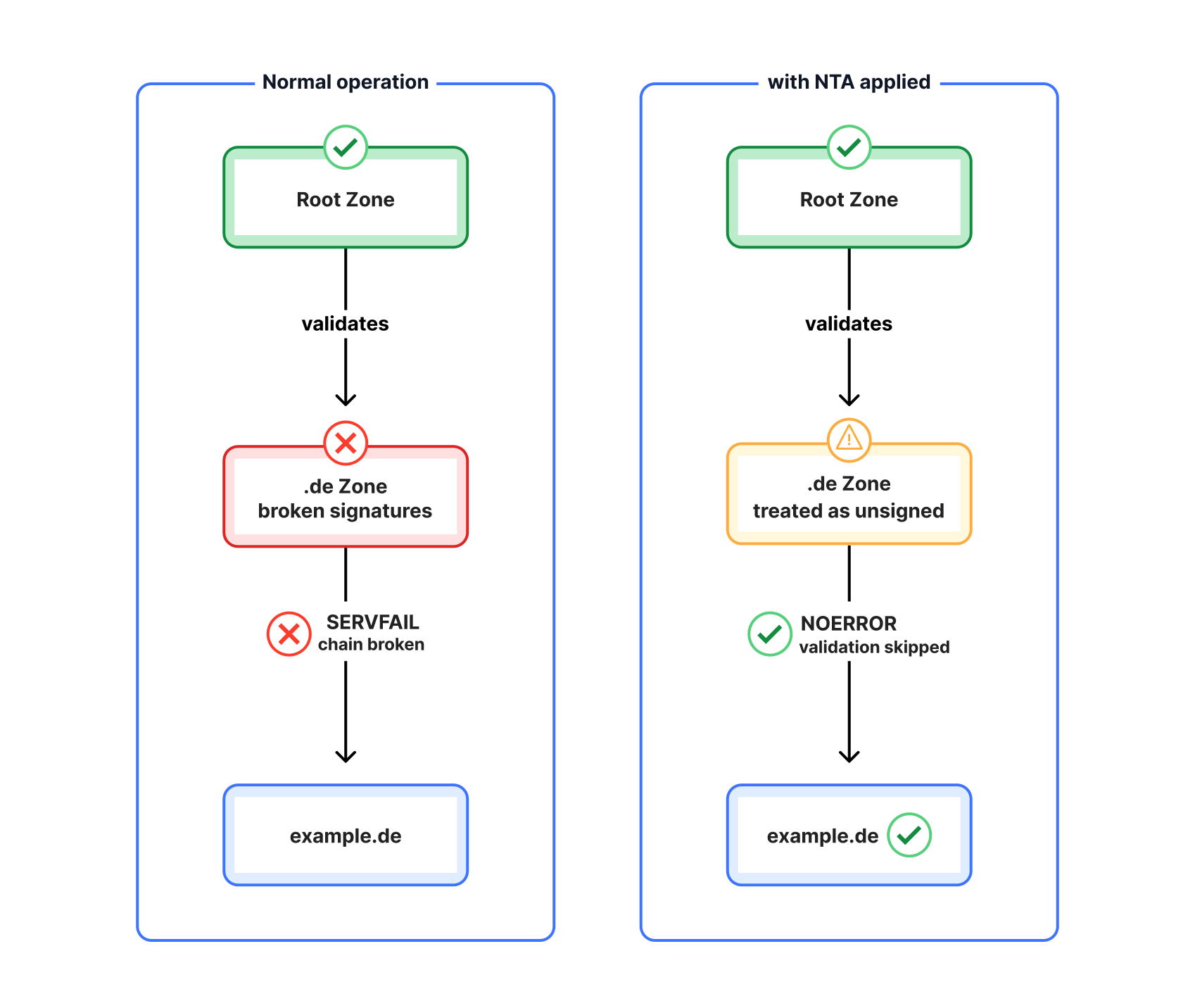
Having a broken DNSSEC configuration can be painful, especially when it impacts an entire TLD at once. As we covered in our .DE incident blog, recursive DNS operators can install a Negative Trust Anchor (NTA) as defined in RFC 7646, which tells a resolver to treat a zone as unsigned and bypass validation.

Before installing the NTA, we attempted to reach the .AL operator directly and posted on the DNS-OARC Mattermost to alert the community. We received no response, in part because the operator’s contact addresses were themselves under .AL, making them unreachable during the outage.

We applied the NTA for .AL and rolled it out to all 1.1.1.1 users by 17:15 UTC, roughly three hours after the chain broke.

The tradeoff is the same as it was for .DE: a Negative Trust Anchor suspends DNSSEC validation, which means .AL domains were no longer protected against DNS spoofing for the duration. We judged this acceptable for the same reason: the failure was public, confirmed, and affecting every validating resolver equally.

The Negative Trust Anchor was removed the following day, once the .AL operator had removed the DS record from the root zone. With no DS record present, resolvers no longer expected DNSSEC for .AL and the NTA was no longer needed.

The problem with Negative Trust Anchors

Installing a Negative Trust Anchor is an aggressive measure. We suspend DNSSEC validation to keep domains reachable, accepting that responses are no longer cryptographically verified for the duration. Users get answers instead of SERVFAIL, but those answers carry no DNSSEC guarantee.

What makes this harder is that, up until now, nothing in the DNS response signalled this to the client; a response served under an NTA looked identical to a fully validated one. RFC 7646 acknowledges this gap and recommends that operators publicly disclose which NTAs they have in place, but that disclosure is out-of-band. For both the .DE and .AL incidents we published status pages, but a status page requires the user to go looking. An application, a monitoring tool, or a user querying 1.1.1.1 had no way to tell, from the response alone, that DNSSEC validation was bypassed.

Bringing transparency to Negative Trust Anchors

Extended DNS Error (EDE) codes, defined in RFC 8914, allow resolvers to include additional context alongside any DNS response, whether that is an error or a successful answer. Babak Farrokhi at Quad9 proposed an Internet-Draft to signal the presence of a Negative Trust Anchor directly in the DNS response, using a new EDE code: Disclosure of Negative Trust Anchors in DNS Responses. We joined as co-authors, and 1.1.1.1 now implements it.

During the .AL incident, any query for a .AL name returned both the answer and the new EDE code while the Negative Trust Anchor was installed. Here is what that looked like:

$ kdig @1.1.1.1 google.al
;; ->>HEADER<<- opcode: QUERY; status: NOERROR; id: 32848
;; Flags: qr rd ra; QUERY: 1; ANSWER: 1; AUTHORITY: 0; ADDITIONAL: 1

;; EDNS PSEUDOSECTION:
;; Version: 0; flags: ; UDP size: 1232 B; ext-rcode: NOERROR
;; EDE: 9 (DNSKEY Missing): 'no SEP matching the DS found for al.'
;; EDE: 33 (Negative Trust Anchor): 'a Negative Trust Anchor has been applied for this query (see RFC 7646)'

;; ANSWER SECTION:
google.al.              300    IN    A    142.251.142.196

The response is a NOERROR with a valid answer: google.al resolves, but two EDE codes accompany it. EDE 9 (DNSKEY Missing) surfaces the underlying DNSSEC failure: the chain of trust was broken and validation failed. EDE 33 (Negative Trust Anchor) signals that 1.1.1.1 applied a Negative Trust Anchor and served the response anyway. Together they give clients and operators full visibility into what happened: the answer is real, but it was not DNSSEC-validated.

1.1.1.1 returns EDE 33 on any response generated while an NTA is active, regardless of whether the query itself would have failed DNSSEC validation. A query for a domain that does not use DNSSEC at all will still carry EDE 33 if it falls under an active NTA. This is intentional: the NTA covers the entire zone, and transparency applies equally to every response served under it.

This also resolves an issue we flagged in our .DE blog, where 1.1.1.1 incorrectly returned EDE 22 (No Reachable Authority) instead of surfacing the underlying DNSSEC error. During the .AL incident, 1.1.1.1 correctly returned EDE 9 (DNSKEY Missing) alongside EDE 33.

The Internet-Draft is an individual submission and EDE 33 has been assigned by the Internet Assigned Numbers Authority (IANA). Thanks to our co-author, Babak Farrokhi at Quad9, the kdig tool from the Knot project now recognizes EDE 33 by name, and a pull request for Unbound is under review. We hope other resolver implementations will follow. The Internet-Draft has been submitted to the Internet Engineering Task Force (IETF) DNSOP Working Group, and will be discussed at the IETF meeting taking place in Vienna from July 18 to July 24.

Closing the gap

TLD-level DNSSEC failures are rare, but when they happen they affect every domain underneath the affected TLD simultaneously, and every validating resolver equally. The .AL incident, following closely behind .DE, shows that Negative Trust Anchors are a necessary operational tool, but one that has, until now, been invisible to the users they affect.

EDE 33 closes a gap that RFC 7646 left open. A response served under a Negative Trust Anchor now says so directly, giving operators, monitoring tools, and users the information they need to understand what the resolver did and why.

The Internet-Draft is available at the IETF datatracker. If you have thoughts on it, the IETF DNSOP mailing list is the right place to share them.

If you want to learn more about how DNSSEC works, visit our page How does DNSSEC work? And you can always follow real-time DNS trends and TLD data on Cloudflare Radar.

When DNSSEC goes wrong: how we responded to the .de TLD outage

Post Syndicated from Sebastiaan Neuteboom original https://blog.cloudflare.com/de-tld-outage-dnssec/

On May 5, 2026, at roughly 19:30 UTC, DENIC, the registry operator for the .de country-code top-level domain (TLD), started publishing incorrect DNSSEC signatures for the .de zone. Any validating DNS resolver receiving these signatures was required by the DNSSEC specification to reject them and return SERVFAIL to clients, including 1.1.1.1, the public DNS resolver operated by Cloudflare.

The country-code top-level domain for Germany, .de, is one of the largest on the Internet. On Cloudflare Radar, it consistently ranks among the most broadly queried TLDs globally. An outage at this level of the DNS hierarchy has the potential to make millions of domains unreachable.

In this post, we’ll walk through what we saw, the impact of these events, and how we applied temporary mitigations while DENIC resolved the issue.


How DNSSEC works

DNSSEC (Domain Name System Security Extensions) adds cryptographic authentication to DNS. When a zone is signed with DNSSEC, each set of records is accompanied by a digital signature known as an RRSIG record that lets a resolver verify the records haven’t been tampered with. Unlike encrypted DNS protocols, such as DNS over TLS (DoT) and DNS over HTTPs (DoH), DNSSEC is about integrity, not privacy. The records are visible, but their authenticity can be proven.

What makes DNSSEC unique is that the signatures travel together with the records they protect. This means integrity can be verified regardless of how many caches or hops a response has passed through. A cached record is just as verifiable as a fresh one.

DNSSEC is built on a chain of trust. Starting at the root zone, whose trust anchor is hard-coded into the resolvers, each zone delegates trust to child zones via Delegation Signer (DS) records. A DS record in the parent zone contains a cryptographic hash of a public key in the child zone. When a resolver validates example.de it verifies the chain: root trusts .de, .de trusts example.de. A break anywhere in that chain causes validation to fail for everything below it, which is why a misconfiguration at a TLD like .de affects every domain under it.

Zones typically use two types of keys: a Zone Signing Key (ZSK), used to sign the zone’s records, and a Key Signing Key (KSK), used to sign the ZSK itself. The KSK’s public key is what the parent zone’s DS record points to, anchoring the chain of trust. Rotating a ZSK is relatively straightforward: generate a new key, re-sign the zone’s records, and wait for caches to expire. Rotating a KSK is more involved, because the parent’s DS record must also be updated, often requiring coordination with a registrar or registry.


During a key rotation, there is a critical window where the old key is being phased out and the new one phased in. If the signatures published in the zone are made with a key that resolvers cannot verify against the zone’s published DNSKEY records, whether because the signing step failed, the timing was wrong, or the new key wasn’t fully distributed yet, resolvers have no choice but to reject the responses and return SERVFAIL.

What we saw

On May 5, 2026, at roughly 19:30 UTC, DENIC, the operator for the .de TLD, started publishing incorrect DNSSEC signatures for the .de zone. Any validating resolver receiving these records was required by the DNSSEC specification to reject them and return SERVFAIL. 1.1.1.1 was no exception.

The graph below shows the response codes 1.1.1.1 returned for .de queries during the incident.


After the immediate spike in SERVFAILs at 19:30 UTC, it climbed steadily over the following three hours as cached records slowly started expiring. As each domain’s cached records expired and resolvers went back to DENIC for fresh copies, they got back broken signatures and started failing.

Also visible is a large increase in query volume. This is typical during DNS incidents, as clients retry failed queries, often three or more times, inflating the raw numbers. The SERVFAIL rate looks more alarming than the actual user impact, as many of those queries represent the same user retrying the same domain.


What might be surprising is that the NOERROR rate stayed relatively stable throughout the incident. That’s “serve stale” at work, which we’ll cover in the next section.

Serve stale

Recursive resolvers cache the records they receive from authoritative nameservers for the duration of each record’s TTL (Time-to-Live). While a record is cached, the resolver serves it directly without going back to the authoritative nameserver. When the TTL expires, the resolver fetches a fresh copy and re-caches it.

During the outage, freshly requested records ended up resolving to SERVFAIL. The DNSSEC signatures were broken and the resolver correctly rejected them. But many .de records were still sitting in cache from before the incident began. Rather than immediately discarding those and returning SERVFAIL to users, 1.1.1.1 continued serving them past their TTL. This is called “serving stale.”

1.1.1.1 implements RFC 8767, which formalizes this behavior. When upstream resolution fails, a resolver may continue serving expired cached records rather than returning an error. This significantly cushions the impact of an upstream outage, buying time for operators to respond.

The result is visible in the graph below, which shows response codes for .de queries during the incident excluding the stale-served responses. Without stale-served responses, the NOERROR rate drops steadily from 19:30 onward. These represent queries that users received good answers for only because their record was still in cache.


Our mitigation

While the issue was largely out of our own control, and serve stale was doing its job, there was still a legitimate impact for a lot of users. Luckily, there were some actions we were able to take to improve the situation.

Negative Trust Anchors

RFC 7646 defines the concept of a Negative Trust Anchor (NTA). In normal DNSSEC operation, a validating resolver maintains a set of trust anchors: public keys at the root of the chain of trust. Each DNS zone signed with DNSSEC has a trust anchor, and every child zone builds its own trust anchor upon it. When the cryptographic signatures linking the chain together are broken, responses will be rejected and result in SERVFAIL. An NTA is an explicit exception. It tells the resolver to treat a specific zone as if it were unsigned, bypassing validation for names under that zone.


NTAs exist precisely for these types of incidents. When a TLD operator publishes broken signatures, every DNSSEC-validating resolver is forced to return SERVFAIL for every domain under that TLD. Not because of anything wrong with those domains themselves, but because their parent zone is misconfigured. Continuing to return SERVFAIL in that situation provides no security value: the failure is already known, public, and being fixed. RFC 7646 explicitly names TLD misconfiguration as the primary use case for NTAs.

What we actually deployed

For 1.1.1.1 we have our own resolver referred to as Big Pineapple, which also powers 1.1.1.1 for Families, Gateway DNS, DNS Firewall, and more. At this time, we have not implemented a native NTA mechanism. Instead, we used an existing override rule mechanism to mark .de as an insecure zone, which causes all .de queries to be resolved as if they don’t have DNSSEC enabled. This is functionality equivalent to an NTA, though it is not formally defined in any RFC.

The decision to bypass DNSSEC is a deliberate tradeoff. Without DNSSEC validation, .de domains become vulnerable to genuine attacks for the duration of the incident. During incidents like this, we weighed this as acceptable because the signing failure was widespread, publicly confirmed, and affected every validating resolver on the Internet equally. As it was put in our internal incident room: “There is no user of 1.1.1.1 resolving a .de name right now who would prefer a SERVFAIL over an unvalidated response.”

We rolled out our mitigation at 22:17 UTC, which marked the end of impact for 1.1.1.1. We communicated this with fellow DNS operators in the DNS-OARC Mattermost.

Origin resolution mitigations

While all Internet users can access our 1.1.1.1 resolver, we have a particular responsibility to customers using our CDN platform services. Those with .de origin names were also affected by this outage.

Cloudflare operates a separate internal resolver for origin resolution, distinct from our publicly available 1.1.1.1 service. To mitigate impact we applied a similar NTA for .de on the internal resolver service, restoring origin connectivity for affected customers.

Extended DNS Errors

Before our mitigation, queries that couldn’t be served from cache received a SERVFAIL response from 1.1.1.1. Each SERVFAIL included an Extended DNS Error (EDE) code, defined in RFC 8914, which gives clients more detail about what went wrong.

Some resolvers returned EDE 6 (DNSSEC Bogus) with a descriptive message pointing directly at the broken signature. This is the correct behavior:

EDE: 6 (DNSSEC Bogus): RRSIG with malformed signature found for example.de/nsec3 (keytag=33834)

1.1.1.1, on the other hand, returned EDE 22 (No Reachable Authority), which on the surface suggests a connectivity problem with the upstream nameservers rather than a DNSSEC validation failure.

The cause is a bug in how we propagate DNSSEC EDE codes up from our trust chain verifier. When the verifier detects a bogus signature it creates the DNSSEC Bogus EDE code, but this is never inserted into the response. Instead, the outer layer of the resolver sees a problem with recursive resolution with no error code and falls back to reporting “No Reachable Authority.” This obscures the underlying DNSSEC cause.

We’re aware that this isn’t helpful for 1.1.1.1 users and will be fixing our responses to surface the DNSSEC errors.

Is this a failure of DNSSEC as a technology?

DNS is a critical part of the request chain for most Internet communication. It would be easy to come to the conclusion that this outage and the mitigations applied means DNSSEC has failed as a technology. However, any technology that is misconfigured will risk breaking for users that rely on it. Leaving critical fiber cables exposed on the seabed for sharks to chew on does not invalidate the important role underwater cables pose in today’s Internet communications. It only highlights that we’ve sometimes failed to accurately protect it. The same applies here. DNSSEC serves a critical role in ensuring that we can rely on the DNS answers without tampering by malicious actors.

#HugOps

No one likes to have serious incidents. These things, unfortunately, happen to everyone who operates critical infrastructure at scale. When they do, the DNS community tends to show up for each other.

Incidents like this also highlight why relationships between operators matter. DNS is a decentralized system, no single organization controls all of it, and keeping it running reliably depends on mutual trust and open lines of communication between registries, resolver operators, and the broader community. Forums like DNS-OARC provide exactly this: shared mailing lists and chat rooms where operators can coordinate quickly across organizational boundaries when something goes wrong.

DENIC has published a short blog post about the incident where they state: “The outage is linked to a routine, scheduled key rollover. During this process, non-validatable signatures were generated and distributed. As a precautionary measure, future rollovers have been suspended until the exact technical causes have been identified.”

 We’re sure we’ll hear more when their own analysis is ready. 

Takeaways from this incident

This incident highlights a structural reality of the DNS hierarchy: when a registry at the TLD level fails, every domain under that TLD is affected simultaneously, regardless of where it’s hosted or which resolver is used. This isn’t unique to DNSSEC; the same is true if a TLD’s nameservers become unreachable. The hierarchy that makes the global DNS work is also what makes failures at the top propagate downward.

There is no simple fix for this. What the industry can do is respond quickly and consistently when it happens. In this incident, resolver operators across the Internet independently applied Negative Trust Anchors within an hour, restoring resolution while DENIC worked to fix the zone. Operational practices, industry communication channels like DNS-OARC, and features like serve stale all reduce the impact, even if they can’t eliminate the underlying dependency.

We also came away with some points to improve for ourselves. We will be working on our EDE errors to better surface DNSSEC errors.

We look forward to DENIC’s post-incident report and appreciate the transparency they showed throughout.

If you want to learn more about how DNSSEC works, visit our page How does DNSSEC work? And you can always follow real-time DNS trends and TLD data on Cloudflare Radar.

What came first: the CNAME or the A record?

Post Syndicated from Sebastiaan Neuteboom original https://blog.cloudflare.com/cname-a-record-order-dns-standards/

On January 8, 2026, a routine update to 1.1.1.1 aimed at reducing memory usage accidentally triggered a wave of DNS resolution failures for users across the Internet. The root cause wasn’t an attack or an outage, but a subtle shift in the order of records within our DNS responses.

While most modern software treats the order of records in DNS responses as irrelevant, we discovered that some implementations expect CNAME records to appear before everything else. When that order changed, resolution started failing. This post explores the code change that caused the shift, why it broke specific DNS clients, and the 40-year-old protocol ambiguity that makes the “correct” order of a DNS response difficult to define.

Timeline

All timestamps referenced are in Coordinated Universal Time (UTC).

Time

Description

2025-12-02

The record reordering is introduced to the 1.1.1.1 codebase

2025-12-10

The change is released to our testing environment

2026-01-07 23:48

A global release containing the change starts

2026-01-08 17:40

The release reaches 90% of servers

2026-01-08 18:19

Incident is declared

2026-01-08 18:27

The release is reverted

2026-01-08 19:55

Revert is completed. Impact ends

What happened?

While making some improvements to lower the memory usage of our cache implementation, we introduced a subtle change to CNAME record ordering. The change was introduced on December 2, 2025, released to our testing environment on December 10, and began deployment on January 7, 2026.

How DNS CNAME chains work

When you query for a domain like www.example.com, you might get a CNAME (Canonical Name) record that indicates one name is an alias for another name. It’s the job of public resolvers, such as 1.1.1.1, to follow this chain of aliases until it reaches a final response:

www.example.com → cdn.example.com → server.cdn-provider.com → 198.51.100.1

As 1.1.1.1 traverses this chain, it caches every intermediate record. Each record in the chain has its own TTL (Time-To-Live), indicating how long we can cache it. Not all the TTLs in a CNAME chain need to be the same:

www.example.com → cdn.example.com (TTL: 3600 seconds) # Still cached
cdn.example.com → 198.51.100.1    (TTL: 300 seconds)  # Expired

When one or more records in a CNAME chain expire, it’s considered partially expired. Fortunately, since parts of the chain are still in our cache, we don’t have to resolve the entire CNAME chain again — only the part that has expired. In our example above, we would take the still valid www.example.com → cdn.example.com chain, and only resolve the expired cdn.example.com A record. Once that’s done, we combine the existing CNAME chain and the newly resolved records into a single response.

The logic change

The code that merges these two chains is where the change occurred. Previously, the code would create a new list, insert the existing CNAME chain, and then append the new records:

impl PartialChain {
    /// Merges records to the cache entry to make the cached records complete.
    pub fn fill_cache(&self, entry: &mut CacheEntry) {
        let mut answer_rrs = Vec::with_capacity(entry.answer.len() + self.records.len());
        answer_rrs.extend_from_slice(&self.records); // CNAMEs first
        answer_rrs.extend_from_slice(&entry.answer); // Then A/AAAA records
        entry.answer = answer_rrs;
    }
}

However, to save some memory allocations and copies, the code was changed to instead append the CNAMEs to the existing answer list:

impl PartialChain {
    /// Merges records to the cache entry to make the cached records complete.
    pub fn fill_cache(&self, entry: &mut CacheEntry) {
        entry.answer.extend(self.records); // CNAMEs last
    }
}

As a result, the responses that 1.1.1.1 returned now sometimes had the CNAME records appearing at the bottom, after the final resolved answer.

Why this caused impact

When DNS clients receive a response with a CNAME chain in the answer section, they also need to follow this chain to find out that www.example.com points to 198.51.100.1. Some DNS client implementations handle this by keeping track of the expected name for the records as they’re iterated sequentially. When a CNAME is encountered, the expected name is updated:

;; QUESTION SECTION:
;; www.example.com.        IN    A

;; ANSWER SECTION:
www.example.com.    3600   IN    CNAME  cdn.example.com.
cdn.example.com.    300    IN    A      198.51.100.1

  1. Find records for www.example.com

  2. Encounter www.example.com. CNAME cdn.example.com

  3. Find records for cdn.example.com

  4. Encounter cdn.example.com. A 198.51.100.1

When the CNAME suddenly appears at the bottom, this no longer works:

;; QUESTION SECTION:
;; www.example.com.	       IN    A

;; ANSWER SECTION:
cdn.example.com.    300    IN    A      198.51.100.1
www.example.com.    3600   IN    CNAME  cdn.example.com.

  1. Find records for www.example.com

  2. Ignore cdn.example.com. A 198.51.100.1 as it doesn’t match the expected name

  3. Encounter www.example.com. CNAME cdn.example.com

  4. Find records for cdn.example.com

  5. No more records are present, so the response is considered empty

One such implementation that broke is the getaddrinfo function in glibc, which is commonly used on Linux for DNS resolution. When looking at its getanswer_r implementation, we can indeed see it expects to find the CNAME records before any answers:

for (; ancount > 0; --ancount)
  {
    // ... parsing DNS records ...
    
    if (rr.rtype == T_CNAME)
      {
        /* Record the CNAME target as the new expected name. */
        int n = __ns_name_unpack (c.begin, c.end, rr.rdata,
                                  name_buffer, sizeof (name_buffer));
        expected_name = name_buffer;  // Update what we're looking for
      }
    else if (rr.rtype == qtype
             && __ns_samebinaryname (rr.rname, expected_name)  // Must match!
             && rr.rdlength == rrtype_to_rdata_length (type:qtype))
      {
        /* Address record matches - store it */
        ptrlist_add (list:addresses, item:(char *) alloc_buffer_next (abuf, uint32_t));
        alloc_buffer_copy_bytes (buf:abuf, src:rr.rdata, size:rr.rdlength);
      }
  }

Another notable affected implementation was the DNSC process in three models of Cisco ethernet switches. In the case where switches had been configured to use 1.1.1.1 these switches experienced spontaneous reboot loops when they received a response containing the reordered CNAMEs. Cisco has published a service document describing the issue.

Not all implementations break

Most DNS clients don’t have this issue. For example, systemd-resolved first parses the records into an ordered set:

typedef struct DnsAnswerItem {
        DnsResourceRecord *rr; // The actual record
        DnsAnswerFlags flags;  // Which section it came from
        // ... other metadata
} DnsAnswerItem;


typedef struct DnsAnswer {
        unsigned n_ref;
        OrderedSet *items;
} DnsAnswer;

When following a CNAME chain it can then search the entire answer set, even if the CNAME records don’t appear at the top.

What the RFC says

RFC 1034, published in 1987, defines much of the behavior of the DNS protocol, and should give us an answer on whether the order of CNAME records matters. Section 4.3.1 contains the following text:

If recursive service is requested and available, the recursive response to a query will be one of the following:

– The answer to the query, possibly preface by one or more CNAME RRs that specify aliases encountered on the way to an answer.

While “possibly preface” can be interpreted as a requirement for CNAME records to appear before everything else, it does not use normative key words, such as MUST and SHOULD that modern RFCs use to express requirements. This isn’t a flaw in RFC 1034, but simply a result of its age. RFC 2119, which standardized these key words, was published in 1997, 10 years after RFC 1034.

In our case, we did originally implement the specification so that CNAMEs appear first. However, we did not have any tests asserting the behavior remains consistent due to the ambiguous language in the RFC.

The subtle distinction: RRsets vs RRs in message sections

To understand why this ambiguity exists, we need to understand a subtle but important distinction in DNS terminology.

RFC 1034 section 3.6 defines Resource Record Sets (RRsets) as collections of records with the same name, type, and class. For RRsets, the specification is clear about ordering:

The order of RRs in a set is not significant, and need not be preserved by name servers, resolvers, or other parts of the DNS.

However, RFC 1034 doesn’t clearly specify how message sections relate to RRsets. While modern DNS specifications have shown that message sections can indeed contain multiple RRsets (consider DNSSEC responses with signatures), RFC 1034 doesn’t describe message sections in those terms. Instead, it treats message sections as containing individual Resource Records (RRs).

The problem is that the RFC primarily discusses ordering in the context of RRsets but doesn’t specify the ordering of different RRsets relative to each other within a message section. This is where the ambiguity lives.

RFC 1034 section 6.2.1 includes an example that demonstrates this ambiguity further. It mentions that the order of Resource Records (RRs) is not significant either:

The difference in ordering of the RRs in the answer section is not significant.

However, this example only shows two A records for the same name within the same RRset. It doesn’t address whether this applies to different record types like CNAMEs and A records.

CNAME chain ordering

It turns out that this issue extends beyond putting CNAME records before other record types. Even when CNAMEs appear before other records, sequential parsing can still break if the CNAME chain itself is out of order. Consider the following response:

;; QUESTION SECTION:
;; www.example.com.              IN    A

;; ANSWER SECTION:
cdn.example.com.           3600  IN    CNAME  server.cdn-provider.com.
www.example.com.           3600  IN    CNAME  cdn.example.com.
server.cdn-provider.com.   300   IN    A      198.51.100.1

Each CNAME belongs to a different RRset, as they have different owners, so the statement about RRset order being insignificant doesn’t apply here.

However, RFC 1034 doesn’t specify that CNAME chains must appear in any particular order. There’s no requirement that www.example.com. CNAME cdn.example.com. must appear before cdn.example.com. CNAME server.cdn-provider.com.. With sequential parsing, the same issue occurs:

  1. Find records for www.example.com

  2. Ignore cdn.example.com. CNAME server.cdn-provider.com. as it doesn’t match the expected name

  3. Encounter www.example.com. CNAME cdn.example.com

  4. Find records for cdn.example.com

  5. Ignore server.cdn-provider.com. A 198.51.100.1 as it doesn’t match the expected name

What should resolvers do?

RFC 1034 section 5 describes resolver behavior. Section 5.2.2 specifically addresses how resolvers should handle aliases (CNAMEs):

In most cases a resolver simply restarts the query at the new name when it encounters a CNAME.

This suggests that resolvers should restart the query upon finding a CNAME, regardless of where it appears in the response. However, it’s important to distinguish between different types of resolvers:

  • Recursive resolvers, like 1.1.1.1, are full DNS resolvers that perform recursive resolution by querying authoritative nameservers

  • Stub resolvers, like glibc’s getaddrinfo, are simplified local interfaces that forward queries to recursive resolvers and process the responses

The RFC sections on resolver behavior were primarily written with full resolvers in mind, not the simplified stub resolvers that most applications actually use. Some stub resolvers evidently don’t implement certain parts of the spec, such as the CNAME-restart logic described in the RFC.

The DNSSEC specifications provide contrast

Later DNS specifications demonstrate a different approach to defining record ordering. RFC 4035, which defines protocol modifications for DNSSEC, uses more explicit language:

When placing a signed RRset in the Answer section, the name server MUST also place its RRSIG RRs in the Answer section. The RRSIG RRs have a higher priority for inclusion than any other RRsets that may have to be included.

The specification uses “MUST” and explicitly defines “higher priority” for RRSIG records. However, “higher priority for inclusion” refers to whether RRSIGs should be included in the response, not where they should appear. This provides unambiguous guidance to implementers about record inclusion in DNSSEC contexts, while not mandating any particular behavior around record ordering.

For unsigned zones, however, the ambiguity from RFC 1034 remains. The word “preface” has guided implementation behavior for nearly four decades, but it has never been formally specified as a requirement.

Do CNAME records come first?

While in our interpretation the RFCs do not require CNAMEs to appear in any particular order, it’s clear that at least some widely-deployed DNS clients rely on it. As some systems using these clients might be updated infrequently, or never updated at all, we believe it’s best to require CNAME records to appear in-order before any other records.

Based on what we have learned during this incident, we have reverted the CNAME re-ordering and do not intend to change the order in the future.

To prevent any future incidents or confusion, we have written a proposal in the form of an Internet-Draft to be discussed at the IETF. If consensus is reached on the clarified behavior, this would become an RFC that explicitly defines how to correctly handle CNAMEs in DNS responses, helping us and the wider DNS community navigate the protocol. The proposal can be found at https://datatracker.ietf.org/doc/draft-jabley-dnsop-ordered-answer-section. If you have suggestions or feedback we would love to hear your opinions, most usefully via the DNSOP working group at the IETF.