Post Syndicated from The Atlantic original https://www.youtube.com/watch?v=Ece_h8er2B4
Three new stable kernels
Post Syndicated from original https://lwn.net/Articles/909210/
The 5.19.11, 5.15.70, and 5.10.145 stable kernels are now available. As
usual, they contain important fixes throughout the kernel tree.
Security updates for Friday
Post Syndicated from original https://lwn.net/Articles/909208/
Security updates have been issued by Debian (bind9, expat, firefox-esr, mediawiki, and unzip), Fedora (qemu and thunderbird), Oracle (webkit2gtk3), SUSE (ardana-ansible, ardana-cobbler, ardana-tempest, grafana, openstack-heat-templates, openstack-horizon-plugin-gbp-ui, openstack-neutron-gbp, openstack-nova, python-Django1, rabbitmq-server, rubygem-puma, ardana-ansible, ardana-cobbler, grafana, openstack-heat-templates, openstack-murano, python-Django, rabbitmq-server, rubygem-puma, dpdk, freetype2, rubygem-rack, and virtualbox), and Ubuntu (etcd, libjpeg-turbo, linux-gcp, linux-gke, linux-raspi, linux-oem-5.17, linux-raspi-5.4, python-oauthlib, and python3.5).
The FREE ‘Never Obsolete’ PC from 2000! eMachines eTower 566ir
Post Syndicated from LGR original https://www.youtube.com/watch?v=qQo0yOqOb_4
GA Week 2022: what you may have missed
Post Syndicated from John Graham-Cumming original https://blog.cloudflare.com/ga-week-2022-recap/

Back in 2019, we worked on a chart for Cloudflare’s IPO S-1 document that showed major releases since Cloudflare was launched in 2010. Here’s that chart:
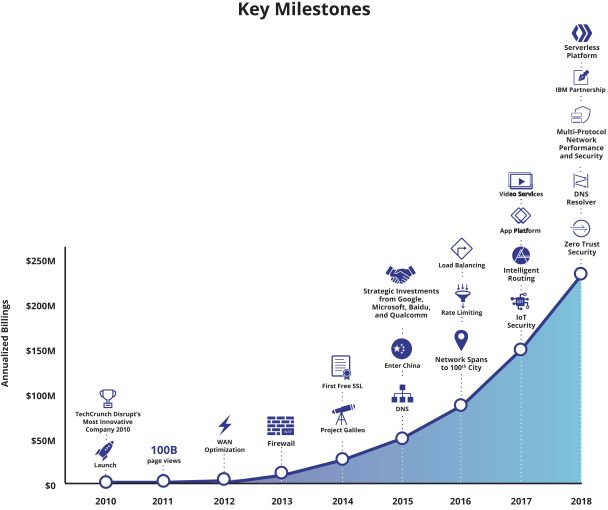
Of course, that chart doesn’t show everything we’ve shipped, but the curve demonstrates a truth about a growing company: we keep shipping more and more products and services. Some of those things start with a beta, sometimes open and sometimes private. But all of them become generally available after the beta period.
Back in, say, 2014, we only had a few major releases per year. But as the years have progressed and the company has grown we have constant updates, releases and changes. This year a confluence of products becoming generally available in September meant it made sense to wrap them all up into GA Week.
GA Week has now finished, and the team is working to put the finishing touches on Birthday Week (coming this Sunday!), but here’s a recap of everything that we launched this week.
| What launched | Summary | Available for? |
|---|---|---|
| Monday (September 19) | ||
| Cloudforce One | Our threat operations and research team, Cloudforce One, is now open for business and has begun conducting threat briefings. | Enterprise |
| Improved Access Control: Domain Scoped Roles are now generally available | It is possible to scope your users’ access to specific domains with Domain Scoped Roles. This will allow all users access to roles, and the ability to access within zones. | Currently available to all Free plans, and coming to Enterprise shortly. |
| Account WAF now available to Enterprise customers | Users can manage and configure the WAF for all of their zones from a single pane of glass. This includes custom rulesets and managed rulesets (Core/OWASP and Managed). | Enterprise |
| Introducing Cloudflare Adaptive DDoS Protection – our new traffic profiling system for mitigating DDoS attacks | Cloudflare’s new Adaptive DDoS Protection system learns your unique traffic patterns and constantly adapts to protect you against sophisticated DDoS attacks. | Built into our Advanced DDoS product |
| Introducing Advanced DDoS Alerts | Cloudflare’s Advanced DDoS Alerts provide tailored and actionable notifications in real-time. | Built into our Advanced DDoS product |
| Tuesday (September 20) | ||
| Detect security issues in your SaaS apps with Cloudflare CASB | By leveraging API-driven integrations, receive comprehensive visibility and control over SaaS apps to prevent data leaks, detect Shadow IT, block insider threats, and avoid compliance violations. | Enterprise Zero Trust |
| Cloudflare Data Loss Prevention now Generally Available | Data Loss Prevention is now available for Cloudflare customers, giving customers more options to protect their sensitive data. | Enterprise Zero Trust |
| Cloudflare One Partner Program acceleration | The Cloudflare One Partner Program gains traction with existing and prospective partners. | Enterprise Zero Trust |
| Isolate browser-borne threats on any network with WAN-as-a-Service | Defend any network from browser-borne threats with Cloudflare Browser Isolation by connecting legacy firewalls over IPsec / GRE | Zero Trust |
| Cloudflare Area 1 – how the best Email Security keeps getting better | Cloudflare started using Area 1 in 2020 and later acquired the company in 2022. We were most impressed how phishing, responsible for 90+% of cyberattacks, basically became a non-issue overnight when we deployed Area 1. But our vision is much bigger than preventing phishing attacks. | Enterprise Zero Trust |
| Wednesday (September 21) | ||
| R2 is now Generally Available | R2 gives developers object storage minus the egress fees. With the GA of R2, developers will be free to focus on innovation instead of worrying about the costs of storing their data. | All plans |
| Stream Live is now Generally Available | Stream live video to viewers at a global scale. | All plans |
| The easiest way to build a modern SaaS application | With Workers for Platforms, your customers can build custom logic to meet their needs right into your application. | Enterprise |
| Going originless with Cloudflare Workers – Building a Todo app – Part 1: The API | Today we go through Part 1 in a series on building completely serverless applications on Cloudflare’s Developer Platform. | Free for all Workers users |
| Store and Retrieve your logs on R2 | Log Storage on R2: a cost-effective solution to store event logs for any of our products! | Enterprise (as part of Logpush) |
| SVG support in Cloudflare Images | Cloudflare Images now supports storing and delivering SVG files. | Part of Cloudflare Images |
| Thursday (September 22) | ||
| Regional Services Expansion | Cloudflare is launching the Data Localization Suite for Japan, India and Australia. | Enterprise |
| API Endpoint Management and Metrics are now GA | API Shield customers can save, update, and monitor the performance of API endpoints. | Enterprise |
| Cloudflare Zaraz supports Managed Components and DLP to make third-party tools private | Third party tools are the only thing you can’t control on your website, unless you use Managed Components with Cloudflare Zaraz. | Available on all plans |
| Logpush: now lower cost and with more visibility | Logpush jobs can now be filtered to contain only logs of interest. Also, you can receive alerts when jobs are failing, as well as get statistics on the health of your jobs. | Enterprise |
Of course, you won’t have to wait a year for more products to become GA. We’ll be shipping betas and making products generally available throughout the year. And we’ll continue iterating on our products so that all of them become leaders.
As we said at the start of GA Week:
“But it’s not just about making products work and be available, it’s about making the best-of-breed. We ship early and iterate rapidly. We’ve done this over the years for WAF, DDoS mitigation, bot management, API protection, CDN and our developer platform. Today, analyst firms such as Gartner, Forrester and IDC recognize us as leaders in all those areas.”
Now, onwards to Birthday Week!
USS Texas and the Battle of Okinawa
Post Syndicated from The History Guy: History Deserves to Be Remembered original https://www.youtube.com/watch?v=7ohD7bkcSwg
Leaking Screen Information on Zoom Calls through Reflections in Eyeglasses
Post Syndicated from Bruce Schneier original https://www.schneier.com/blog/archives/2022/09/leaking-screen-information-on-zoom-calls-through-reflections-in-eyeglasses.html
Okay, it’s an obscure threat. But people are researching it:
Our models and experimental results in a controlled lab setting show it is possible to reconstruct and recognize with over 75 percent accuracy on-screen texts that have heights as small as 10 mm with a 720p webcam.” That corresponds to 28 pt, a font size commonly used for headings and small headlines.
[…]
Being able to read reflected headline-size text isn’t quite the privacy and security problem of being able to read smaller 9 to 12 pt fonts. But this technique is expected to provide access to smaller font sizes as high-resolution webcams become more common.
“We found future 4k cameras will be able to peek at most header texts on almost all websites and some text documents,” said Long.
[…]
A variety of factors can affect the legibility of text reflected in a video conference participant’s glasses. These include reflectance based on the meeting participant’s skin color, environmental light intensity, screen brightness, the contrast of the text with the webpage or application background, and the characteristics of eyeglass lenses. Consequently, not every glasses-wearing person will necessarily provide adversaries with reflected screen sharing.
With regard to potential mitigations, the boffins say that Zoom already provides a video filter in its Background and Effects settings menu that consists of reflection-blocking opaque cartoon glasses. Skype and Google Meet lack that defense.
Research paper.
Integrating Amazon MemoryDB for Redis with Java-based AWS Lambda
Post Syndicated from Benjamin Smith original https://aws.amazon.com/blogs/compute/integrating-amazon-memorydb-for-redis-with-java-based-aws-lambda/
This post is written by Mansi Y Doshi, Consultant and Aditya Goteti, Sr. Lead Consultant.
Enterprises are modernizing and migrating their applications to the AWS Cloud to improve scalability, reduce cost, innovate, and reduce time to market new features. Legacy applications are often built with RDBMS as the only backend solution.
Modernizing legacy Java applications with microservices requires breaking down a single monolithic application into multiple independent services. Each microservice does a specific job and requires its own database to persist data, but one database does not fit all use cases. Modern applications require purpose-built databases catering to their specific needs and data models.
This post discusses some of the common use cases for one such data store, Amazon MemoryDB for Redis, which is built to provide durability and faster reads and writes.
Use cases
Modern tech stacks often begin with a backend that interacts with a durable database like MongoDB, Amazon Aurora, or Amazon DynamoDB for their data persistence needs.
But, as traffic volume increases, it often makes sense to introduce a caching layer like ElastiCache. This is populated with data by service logic each time a database read happens, such that the subsequent reads of the same data become faster. While ElastiCache is effective, you must manage and pay for two separate data sources for the same data. You must also write custom logic to handle the cache reads/writes besides the existing read/write logic used for durable databases.
While traditional databases like MySQL, Postgres and DynamoDB provide data durability at the cost of speed, transient data stores like ElastiCache trade durability for faster reads/writes (usually within microseconds). ElastiCache provides writes and strongly consistent reads on the primary node of each shard and eventually consistent reads from read replicas. There is a possibility that the latest data written to the primary node is lost during a failover, which makes ElastiCache fast but not durable.
MemoryDB addresses both these issues. It provides strong consistency on the primary node and eventual consistency reads on replica nodes. The consistency model of MemoryDB is like ElastiCache for Redis. However, in MemoryDB, data is not lost across failovers, allowing clients to read their writes from primaries regardless of node failures. Only data that is successfully persisted in the Multi-AZ transaction log is visible. Replica nodes are still eventually consistent. Because of its distributed transaction model, MemoryDB can provide both durability and microsecond response time.
MemoryDB is most ideal for services that are read-heavy and sensitive to latency, like configuration, search, authentication and leaderboard services. These must operate at microsecond read latency and still be able to persist the data for high availability and durability. Services like leaderboards, having millions of records, often break down the data into smaller chunks/batches and process them in parallel. This needs a data store that can perform calculations on the fly and also store results temporarily. Redis can process millions of operations per second and store temporary calculations for fast retrieval and also run other operations (like aggregations). Since Redis is single-threaded, from the command’s execution point of view, it also helps to avoid dirty writes and reads.
Another use case is a configuration service, where users store, change, and retrieve their configuration data. In large distributed systems, there are often hundreds of independent services interacting with each other using well-defined REST APIs. These services depend on the configuration data to perform specific actions. The configuration service must serve the required information at a low latency to avoid being a bottleneck for the other dependent services.
MemoryDB can read at microsecond latencies durably. It also persists data across multiple Availability Zones. It uses multi- Availability Zone transaction logs to enable fast failover, database recovery, and node restarts. You can use it as a primary database without the need to maintain another cache to lower the data access latency. This also reduces the need to maintain additional caching service, which further reduces cost.
These use cases are a good fit for using MemoryDB. Next, you see how to access, store, and retrieve data in MemoryDB from your Java-based AWS Lambda function.
Overview
This blog shows how to build an Amazon MemoryDB cluster and integrate it with AWS Lambda. Amazon API Gateway and Lambda can be paired together to create a client-facing application, which can be easier to maintain, highly scalable, and secure. Both are fully managed services with no need to provision or manage servers. They can be cost effective when compared to running the application on servers for workloads with long idle periods. Using Lambda authorizers you can also write custom code to control access to your API.

Walkthrough
The following steps show how to provision an Amazon MemoryDB cluster along with Amazon VPC, subnets, security groups and integrate it with a Lambda function using Redis/Jedis Java client. Here, the Lambda function is configured to connect to the same VPC where MemoryDB is provisioned. The steps include provisioning through an AWS SAM template.
Prerequisites
- Create an AWS account if you do not already have one and login.
- Configure your account and set up permissions to access MemoryDB.
- Java 8 or above
- Install Maven
- Java Client for Redis
- Install AWS SAM if you do not already have one
Creating the MemoryDB cluster
Refer to the serverless pattern for a quick setup and customize as required. The AWS SAM template creates VPC, subnets, security groups, the MemoryDB cluster, API Gateway, and Lambda.
To access the MemoryDB cluster from the Lambda function, the security group of the Lambda function is added to the security group of the cluster. The MemoryDB cluster is always launched in a VPC. If the subnet is not specified, the cluster is launched into your default Amazon VPC.
You can also use your existing VPC and subnets and customize the template accordingly. If you are creating a new VPC, you can change the CIDR block and other configuration values as needed. Make sure the DNS hostname and DNS Support of the VPC is enabled. Use the optional parameters section to customize your templates. Parameters enable you to input custom values to your template each time you create or update a stack.
Recommendations
As your workload requirements change, you might want to increase the performance of your cluster or reduce costs by scaling in/out the cluster. To improve the read/write performance, you can scale your cluster horizontally by increasing the number of read replicas or shards for read and write throughout, respectively.
To reduce cost in case the instances are over-provisioned, you can perform vertical scale-in by reducing the size of your cluster, or scale-out by increasing the size to overcome CPU bottlenecks/ memory pressure. Both vertical scaling and horizontal scaling are applied with no downtime and cluster restarts are not required. You can customize the following parameters in the memoryDBCluster as required.
NodeType: db.t4g.small
NumReplicasPerShard: 2
NumShards: 2
In MemoryDB, all the writes are carried on a primary node in a shard and all the reads are performed on the standby nodes. Identifying the right number of read replicas, type of nodes and shards in a cluster is crucial to get the optimal performance and to avoid any additional cost because of over-provisioning the resources. It’s recommended to always start with a minimal number of required resources and scale out as needed.
Replicas improve read scalability, and it is recommended to have at least two read replicas per shard but depending upon the size of the payload and for read heavy workloads, it might be more than two. Adding more read replicas than required does not give any performance improvement, and it attracts additional cost. The following benchmarking is performed using the tool Redis benchmark. The benchmarking is done only on GET requests to simulate a read heavy workload.
The metrics on both the clusters are almost the same with 10 million requests with 1kb of data payload per request. Increasing the size of the payload to 5kb and number of GET requests to 20 million, the cluster with two primary and two replicas could not process, whereas the second cluster processed successfully. To achieve the right sizing, load testing is recommended on the staging/pre-production environment with a similar load as production.
Creating a Lambda function and allow access to the MemoryDB cluster
In the lambda-redis/HelloWorldFunction/pom.xml file, add the following dependency. This adds the Java Jedis client to connect the MemoryDB cluster:
<dependency>
    <groupId>redis.clients</groupId>
    <artifactId>jedis</artifactId>
    <version>4.2.0</version>
</dependency>
The simplest way to connect the Lambda function to the MemoryDB cluster is by configuring it within the same VPC where the MemoryDB cluster was launched.
To create a Lambda function, add the following code in the template.yaml file in the Resources section:
HelloWorldFunction:
    Type: AWS::Serverless::Function
    Properties:
      CodeUri: HelloWorldFunction
      Handler: helloworld.App::handleRequest
      Runtime: java8
      MemorySize: 512
      Timeout: 900 #seconds
      Events:
        HelloWorld:
          Type: Api
          Properties:
            Path: /hello
            Method: get
      VpcConfig:
        SecurityGroupIds:
          - !GetAtt lambdaSG.GroupId
        SubnetIds:
          - !GetAtt privateSubnetA.SubnetId
          - !GetAtt privateSubnetB.SubnetId
      Environment:
        Variables:
          ClusterAddress: !GetAtt memoryDBCluster.ClusterEndpoint.Address
Java code to access MemoryDB
- In your Java class, connect to Redis using Jedis client:
HostAndPort hostAndPort = new HostAndPort(System.getenv("ClusterAddress"), 6379); JedisCluster jedisCluster = new JedisCluster(Collections.singleton(hostAndPort), 5000, 5000, 2, null, null, new GenericObjectPoolConfig (), true); - You can now perform set and get operations on Redis as follows
jedisCluster.set(“test”, “value”)
jedisCluster.get(“test”)
JedisCluster maintains its own pool of connections and takes care of connection teardown. But you can also customize the configuration for closing idle connections using the GenericObjectPoolConfig object.
Clean Up
To delete the entire stack, run the command “sam delete”.
Conclusion
In this post, you learn how to provision a MemoryDB cluster and access it using Lambda. MemoryDB is suitable for applications requiring microsecond reads and single-digit millisecond writes along with durable storage. Accessing MemoryDB through Lambda using API Gateway reduces the further need for provisioning and maintaining servers.
For more serverless learning resources, visit Serverless Land.
How to enable Private Access Tokens in iOS 16 and stop seeing CAPTCHAs
Post Syndicated from João Tomé original https://blog.cloudflare.com/how-to-enable-private-access-tokens-in-ios-16-and-stop-seeing-captchas/


You go to a website or service, but before access is granted, there’s a visual challenge that forces you to select bikes, buses or traffic lights in a set of images. That can be an exasperating experience. Now, if you have iOS 16 on your iPhone, those days could be over and are just a one-time toggle enabled away.
CAPTCHA = “Completely Automated Public Turing test to tell Computers and Humans Apart”
In 2021, we took direct steps to end the madness that wastes humanity about 500 years per day called CAPTCHAs, that have been making sure you’re human and not a bot. In August 2022, we announced Private Access Tokens. With that, we’re able to eliminate CAPTCHAs on iPhones, iPads and Macs (and more to come) with open privacy-preserving standards.
On September 12, iOS 16 became generally available (iPad 16 and macOS 13 should arrive in October) and on the settings of your device there’s a toggle that can enable the Private Access Token (PAT) technology that will eliminate the need for those CAPTCHAs, and automatically validate that you are a real human visiting a site. If you already have iOS 16, here’s what you should do to confirm that the toggle is “on” (usually it is):
Settings > Apple ID > Password & Security > Automatic Verification (should be enabled)
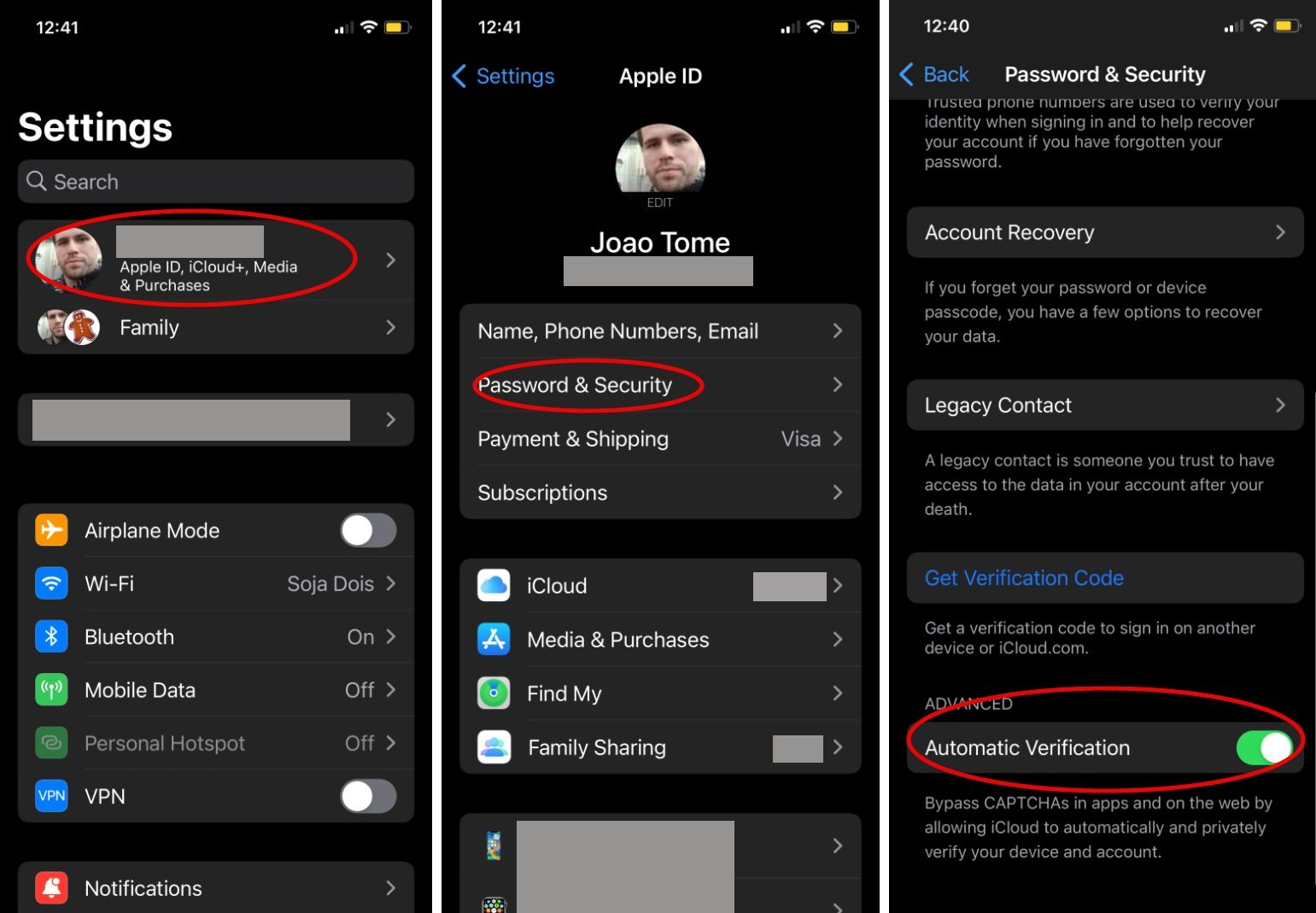
What will you get? A completely invisible, private way to validate yourself, and for a website, a way to automatically verify that real users are visiting the site without the horrible CAPTCHA user experience.
Visitors using operating systems that support these tokens, including the upcoming versions of iPad and macOS, can now prove they’re human without completing a CAPTCHA or giving up personal data.
Let’s recap from our August 2022 announcement blog post what this means for different users:
If you’re an Internet user:
- We’re helping make your mobile web experience more pleasant and more private.
- You won’t see a CAPTCHA on a supported iOS or Mac device (other devices coming soon!) accessing the Cloudflare network.
If you’re a web or application developer:
- You’ll know your users are humans coming from an authentic device and signed application, verified by the device vendor directly.
- And you’ll validate users without maintaining a cumbersome SDK.
If you’re a Cloudflare customer:
- You don’t have to do anything! Cloudflare will automatically ask for and use Private Access Tokens when using Managed Challenge.
- Your visitors won’t see a CAPTCHA.
It’s all about simplicity, without compromising on privacy. The work done over a year was a collaboration between Cloudflare and Apple, Google, and other industry leaders to extend the Privacy Pass protocol with support for a new cryptographic token.
These tokens simplify application security for developers and security teams, and obsolete legacy, third-party SDK-based approaches for determining if a human is using a device. They work for browsers, APIs called by browsers, and APIs called within apps. After Apple announced in August that PATs would be incorporated into iOS 16, iPad 16, and macOS 13, the process of ending CAPTCHAs got a big boost. And we expect additional vendors to announce support in the near future.
Cloudflare has already incorporated PATs into our Managed Challenge platform, so any customer using this feature will automatically take advantage of this new technology to improve the browsing experience for supported devices.
In our August in-depth blog post about PATs, you can learn more about how CAPTCHAs don’t work in mobile environments and PATs remove the need for them, and how when sites can’t challenge a visitor with a CAPTCHA, they collect private data.
Improved privacy
In that blog post, we also explain how Private Access Tokens vastly improve privacy by validating without fingerprinting. So, by partnering with third parties like device manufacturers, who already have the data that would help us validate a device, we are able to abstract portions of the validation process, and confirm data without actually collecting, touching, or storing that data ourselves. Rather than interrogating a device directly, we ask the device vendor to do it for us.
Most customers won’t have to do anything to utilize Private Access Tokens. Why? To take advantage of PATs, all you have to do is choose Managed Challenge rather than Legacy CAPTCHA as a response option in a Firewall rule. More than 65% of Cloudflare customers are already doing this.
Now, if you have iOS 16 on your iPhone, it’s your turn.
Will Trump Get a Second Term? | The Atlantic Festival 2022
Post Syndicated from The Atlantic original https://www.youtube.com/watch?v=MvKb1BDdLhQ
Secretary Janet Yellen on the State of the U.S. Economy | The Atlantic Festival 2022
Post Syndicated from The Atlantic original https://www.youtube.com/watch?v=QHZoZz75AmU
How Does Social Media Impact Gen Z’s Mental Health? (With Elyse Myers) | The Atlantic Festival 2022
Post Syndicated from The Atlantic original https://www.youtube.com/watch?v=gUpEwpZgC5A
The Biden Administration’s First Two Years (With Ronald A. Klain) | The Atlantic Festival 2022
Post Syndicated from The Atlantic original https://www.youtube.com/watch?v=76AxiUif3Po
America’s Gun Crisis (With Senator Chris Murphy) | The Atlantic Festival 2022
Post Syndicated from The Atlantic original https://www.youtube.com/watch?v=eSRjgvwtK2A
Raye Zaragoza Performs Modern Folk Music | The Atlantic Festival 2022
Post Syndicated from The Atlantic original https://www.youtube.com/watch?v=Osezl7HNtoY
Amazon Personalize customer outreach on your ecommerce platform
Post Syndicated from Sridhar Chevendra original https://aws.amazon.com/blogs/architecture/amazon-personalize-customer-outreach-on-your-ecommerce-platform/
In the past, brick-and-mortar retailers leveraged native marketing and advertisement channels to engage with consumers. They have promoted their products and services through TV commercials, and magazine and newspaper ads. Many of them have started using social media and digital advertisements. Although marketing approaches are beginning to modernize and expand to digital channels, businesses still depend on expensive marketing agencies and inefficient manual processes to measure campaign effectiveness and understand buyer behavior. The recent pandemic has forced many retailers to take their businesses online. Those who are ready to embrace these changes have embarked on a technological and digital transformation to connect to their customers. As a result, they have begun to see greater business success compared to their peers.
Digitizing a business can be a daunting task, due to lack of expertise and high infrastructure costs. By using Amazon Web Services (AWS), retailers are able to quickly deploy their products and services online with minimal overhead. They don’t have to manage their own infrastructure. With AWS, retailers have no upfront costs, have minimal operational overhead, and have access to enterprise-level capabilities that scale elastically, based on their customers’ demands. Retailers can gain a greater understanding of customers’ shopping behaviors and personal preferences. Then, they are able to conduct effective marketing and advertisement campaigns, and develop and measure customer outreach. This results in increased satisfaction, higher retention, and greater customer loyalty. With AWS you can manage your supply chain and directly influence your bottom line.
Building a personalized shopping experience
Let’s dive into the components involved in building this experience. The first step in a retailer’s digital transformation journey is to create an ecommerce platform for their customers. This platform enables the organization to capture their customers’ actions, also referred to as ‘events’. Some examples of events are clicking on the shopping site to browse product categories, searching for a particular product, adding an item to the shopping cart, and purchasing a product. Each of these events gives the organization information about their customer’s intent, which is invaluable in creating a personalized experience for that customer. For instance, if a customer is browsing the “baby products” category, it indicates their interest in that category even if a purchase is not made. These insights are typically difficult to capture in an in-store experience. Online shopping makes gaining this knowledge much more straightforward and scalable.
The proposed solution outlines the use of AWS services to create a digital experience for a retailer and consumers. The three key areas are: 1) capturing customer interactions, 2) making real-time recommendations using AWS managed Artificial Intelligence/Machine Learning (AI/ML) services, and 3) creating an analytics platform to detect patterns and adjust customer outreach campaigns. Figure 1 illustrates the solution architecture.
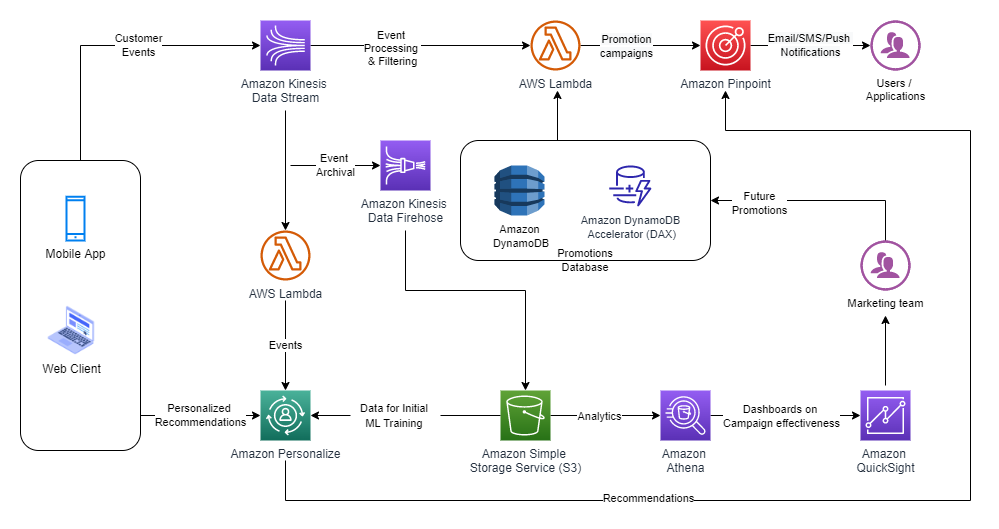
Figure 1. Digital shopping experience architecture
For this use case, let’s assume that you are the owner of a local pizzeria, and you manage deliveries through an ecommerce platform like Shopify or WooCommerce. We will walk you through how to best serve your customer with a personalized experience based on their preferences.
The proposed solution consists of the following components:
- Data collection
- Promotion campaigns
- Recommendation engine
- Data analytics
- Customer reachability
Let’s explore each of these components separately.
Data collection with Amazon Kinesis Data Streams
When a customer uses your web/mobile application to order a pizza, the application captures their activity as click-stream ‘events’. These events provide valuable insights about your customers’ behavior. You can use these insights to understand the trends and browsing pattern of prospects who visited your web/mobile app, and use the data collected for creating promotion campaigns. As your business scales, you’ll need a durable system to preserve these events against system failures, and scale based on unpredictable traffic on your platform.
Amazon Kinesis is a Multi-AZ, managed streaming service that provides resiliency, scalability, and durability to capture an unlimited number of events without any additional operational overhead. Using Kinesis producers (Kinesis Agent, Kinesis Producer Library, and the Kinesis API), you can configure applications to capture your customer activity. You can ingest these events from the frontend, and then publish them to Amazon Kinesis Data Streams.
Let us start by setting up Amazon Kinesis Data Streams to capture the real-time sales transactions from the online channels like a portal or mobile app. For this blog post, we have used the Kaggle’s public data set as a reference. Figure 2 illustrates a snapshot of sample data to build personalized recommendations for a customer.

Figure 2. Sample sales transaction data
Promotion campaigns with AWS Lambda
One way to increase customer conversion is by offering discounts. When the customer adds a pizza to their cart, you want to make sure they are receiving the best deal. Let’s assume that by adding an additional item, your customer will receive the best possible discount. Just by knowing the total cost of added items to the cart, you can provide these relevant promotions to this customer.
For this scenario, the AWS Lambda service polls the Amazon Kinesis Data Streams to read all the events in the stream. It then matches the events based on your criteria of items in the cart. In turn, these events will be processed by the Lambda function. The Lambda function will read your up-to-date promotions stored in Amazon DynamoDB. As an option, caching recent or most popular promotions will improve your application response time, as well as improve the customer experience on your platform. Amazon DynamoDB DAX is an integrated caching for DynamoDB that caches the most recent or popular promotions or items.
For example, when the customer added the items to their shopping cart, Lambda will send promotion details to them based on the purchase amount. This can be for free shipping or discount of a certain percentage. Figure 3 illustrates the snapshot of sample promotions.
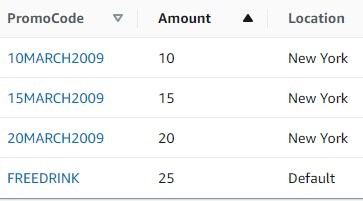
Figure 3. Promotions table in DynamoDB
Recommendations engine with Amazon Personalize
In addition to sharing these promotions with your customer, you may also want to share the recommended add-ons. In order to understand your customer preferences, you must gather historical datasets to determine patterns and generate relevant recommendations. Since web activity consists of millions of events, this would be a daunting task for humans to review, determine the patterns, and make recommendations. And since user preferences change, you need a system that can use all this volume of data and provide accurate predictions.
Amazon Personalize is a managed AI/ML service that will help you to train an ML model based on datasets. It provides an inference point for real-time recommendations prior to having ML experience. Based on the datasets, Amazon Personalize also provides recipes to generate recommendations. As your customers interact on the ecommerce platform, your frontend application calls Amazon Personalize inference endpoints. It then retrieves a set of personalized recommendations based on your customer preferences.
Here is the sample Python code to display the list of available recommenders, and associated recommendations.
import boto3
import json
client = boto3.client('personalize')
# Connect to the personalize runtime for the customer recommendations
recomm_endpoint = boto3.client('personalize-runtime')
response = recomm_endpoint.get_recommendations(itemId='79323P',
recommenderArn='arn:aws:personalize:us-east-1::recommender/my-items',
numResults=5)
print(json.dumps(response['itemList'], indent=2))
[
{
"itemId": "79323W"
},
{
"itemId": "79323GR"
},
{
"itemId": "79323LP"
},
{
"itemId": "79323B"
},
{
"itemId": "79323G"
}
]
You can use Amazon Kinesis Data Firehose to read the data near real time from the Amazon Kinesis Data Streams collected the data from the front-end applications. Then you can store this data in Amazon Simple Storage Service (S3). Amazon S3 is peta-byte scale storage help you scale and acts as a repository and single source of truth. We use S3 data as seed data to build a personalized recommendation engine using Amazon Personalize. As your customers interact on the ecommerce platform, call the Amazon Personalize inference endpoint to make personalized recommendations based on user preferences.
Customer reachability with Amazon Pinpoint
If a customer adds products to their cart but never checks out, you may want to send them a reminder. You can set up an email to suggest they re-order after a period of time after their first order. Or you may want to send them promotions based on their preferences. And as your customers’ behavior changes, you probably want to adapt your messaging accordingly.
Your customer may have a communication preference, such as phone, email, SMS, or in-app notifications. If an order has an issue, you can inform the customer as soon as possible using their preferred method of communication, and perhaps follow it up with a discount.
Amazon Pinpoint is a flexible and scalable outbound and inbound marketing communications service. You can add users to Audience Segments, create reusable content templates integrated with Amazon Personalize, and run scheduled campaigns. With Amazon Pinpoint journeys, you can send action or time-based notifications to your users.
The following workflow shown in Figure 4, illustrates customer communication workflow for promotion. A journey is created for a cohort of college students: a “Free Drink” promotion is offered with a new order. You can send this promotion over email. If the student opens the email, you can immediately send them a push notification reminding them to place an order. But if they didn’t open this email, you could wait three days, and follow up with a text message.
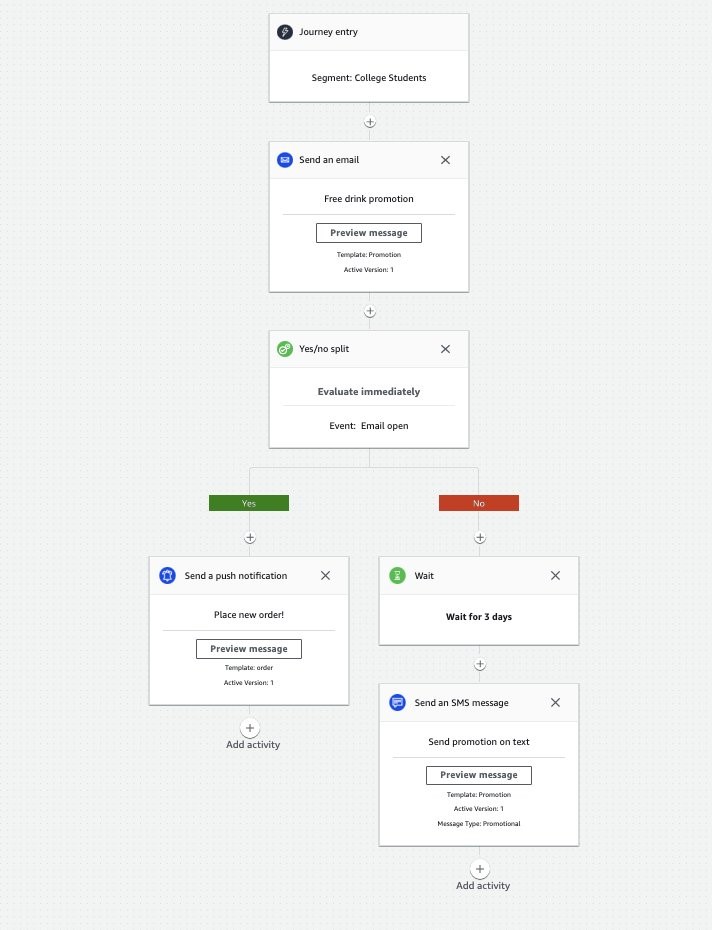
Figure 4. Promotion workflow in Amazon Pinpoint
Data analytics with Amazon Athena and Amazon QuickSight
To understand the effectiveness of your campaigns, you can use S3 data as a source for Amazon Athena. Athena is an interactive query service that analyzes data in Amazon S3 using standard SQL. Athena is serverless, so there is no infrastructure to manage, and you pay only for the queries that you run.
There are different ways to create visualizations in Amazon QuickSight. For instance, you can use Amazon S3 as a data lake. One option is to import your data into SPICE (Super-fast, Parallel, In-memory Calculation Engine) to provide high performance and concurrency. You can also create a direct connection to the underlying data source. For this use case, we choose to import to SPICE, which provides faster visualization in a production setup. Schedule consistent refreshes to help ensure that dashboards are referring to the most current data.
Once your data is imported to your SPICE, review QuickSight’s visualization dashboard. Here, you’ll be able to choose from a wide variety of charts and tables, while adding interactive features like drill downs and filters.
The process following illustrates how to create a customer outreach strategy using ZIP codes, and allocate budgets to the marketing campaigns accordingly. First, we use this sample SQL command that we ran in Athena to query for top 10 pizza providers. The results are shown in Figure 5.
SELECT name, count(*) as total_count FROM "analyticsdemodb"."fooddatauswest2"
group by name
order by total_count desc
limit 10
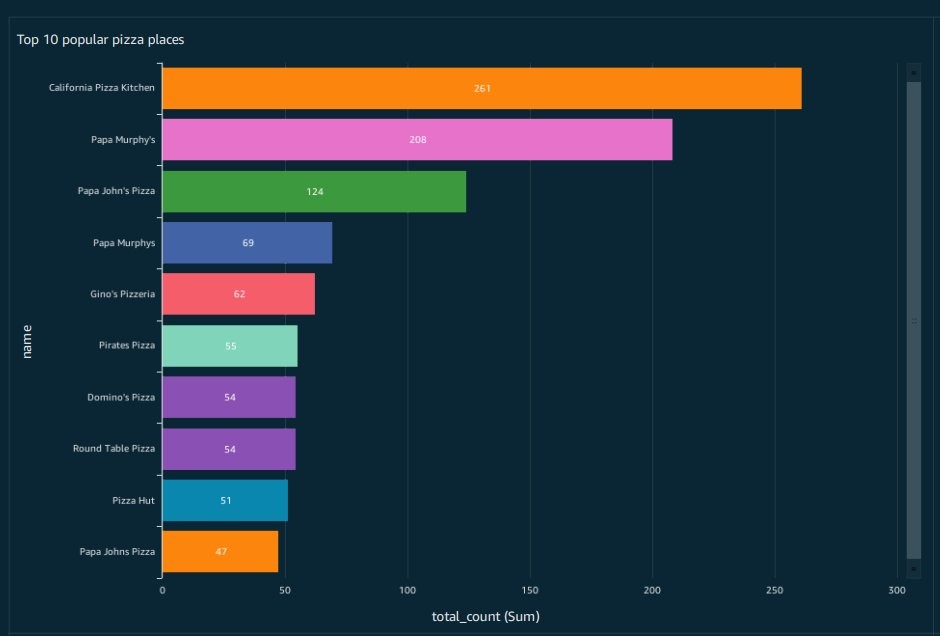
Figure 5. Athena query results for top 10 pizza providers
Second, here is the sample SQL command that we ran in Athena to find Total pizza counts by postal code (ZIP code). Figure 6 shows a visualization to help create customer outreach strategy per ZIP codes and budget the marketing campaigns accordingly.
SELECT postalcode, count(*) as total_count FROM "analyticsdemodb"."fooddatauswest2"
where postalcode is not null
group by postalcode
order by total_count desc limit 50;

Figure 6. QuickSight visualization showing pizza orders by zip codes
Conclusion
AWS enables you to build an ecommerce platform and scale your existing business with minimal operational overhead and no upfront costs. You can augment your ecommerce platform by building personalized recommendations and effective marketing campaigns based on your customer needs. The solution approach provided in the blog will help organizations build re-usable architecture pattern and personalization using AWS managed services.
Лозето на социалистите не ще Станишев, а мотика
Post Syndicated from Емилия Милчева original https://toest.bg/lozeto-na-sotsiyalistite-ne-shte-stanishev-a-motika/
Днешните български социалисти не могат да откъснат и една чепка грозде от лозето на Габровски*. Електоратът няма сили да копае, ръководството – не желае. Класовата същност на Българската социалистическа партия е от абсолютно несъвместими съставни части – „Позитано“ 20 е от източноевропейската „хайверена левица“, а базата се чуди как да си купи дърва за огрев и кога пак ще ѝ вдигат пенсиите. (Същото е и при ДПС, където надстройката и избирателите са на двата социални полюса, а органичната им връзка е етническата принадлежност.)
Това съвсем не е дилемата от зората на българския социализъм за яйцето и кокошката – пролетариат, обединен в синдикати (тогава се е формирала българската работническа класа), или социалистическа интелигенция. В настоящата дихотомия въпросът е кой да се настани в партийния мезонет и да се възползва от гаснещата електорална мощ. БСП не разширява електоралната си база, не привлича млади и икономически активни хора; единствените движения се извършват по върховете ѝ, където се сменят лидерите и кръговете около тях. На пръв поглед демократично – в другите партии водачите изглеждат циментирани и дори не се избират пряко като в БСП. Но си е боричкане за власт.
Но всички обичат Москва
Никой не очаква от номинално социалистическа партия да бъде носител на присъщи на лявото прогресивни идеи и реформи. Не е тайна, че БСП не е лява, но не е и дясна. Карашик е, но несъмнено олигархична като ГЕРБ и ДПС. Козметични данъчни облекчения и искания за повишаване на пенсиите – за какво друго се бори БСП?! За шестте месеца управление дори забрави за прогресивното данъчно облагане – неин рефрен, докато беше в опозиция. Не би могла например да иска силно и независимо финансово разузнаване – нали ще се зарови и в незнайно как забогателите висши партийни „другари“ и техните офшорни сметки. Няма как да иска и ефективна и подложена на демократична отчетност прокуратура – поради същата причина върховенството на правото не е кауза на БСП.
Забраната на Истанбулската конвенция е залъгалка за избирателите. Но виж, русофилството, или по-скоро путинофилията, е друга работа – единствената топла връзка между БСП и членовете и симпатизантите ѝ. Независимо че в съвременна Русия няма нищо ляво, още по-малко социализъм. И докато за електората водещи са носталгията, силовата пропаганда от времената на соца и разочарованието от Прехода, за което голяма вина носи и БСП, при партийното „началство“ движещите сили са онези, които произтичат от руските (енергийни) зависимости. На „Позитано“ 20 никога не са имали скрупули да подарят газовата инфраструктура на „Газпром“ по времето на Виденов, да смачкат европейска България под тежестта на „Големия шлем“ при Първанов и Станишев – и да вкарат българската енергетика и държава в тежка подчиненост на КТБ, чиято политика беше диктувана от руската ВТБ, респективно Кремъл.
Така верноподаничеството към авторитарен и кървав режим като кремълския, а не национално отговорни каузи стана най-характерната черта на БСП, независимо кой е начело – Сергей Станишев или Корнелия Нинова. (Което я прави трудно различима от „Възраждане“ например.) Макар и на различни позиции за Истанбулската конвенция, и евродепутатите на БСП защитават проруски позиции при различни гласувания в Европарламента, както и БСП в българското Народно събрание, дори понякога различни от тези на останалите евродепутати от групата на Партията на европейските социалисти.
През март българските евродепутати от БСП начело с лидера на ПЕС Сергей Станишев гласуваха против редица санкции срещу Русия – и срещу позицията на групата си в ЕП. Станишев, Иво Христов, Елена Йончева, Цветелина Петкова и Петър Витанов са били против част от текстовете, които предвиждат санкции. Само те от групата на ПЕС гласуваха срещу отнемане на лицензите на руските пропагандни телевизионни канали и бяха против прекратяването на софтуерните лицензи за военния и гражданския сектор на Русия и Беларус, а и срещу намаляването на руските дипломати в ЕС.
В края на юли по „Нова телевизия“ Станишев дори критикува Нинова, че не се борила достатъчно, за да не се прекратява договорът с „Газпром“ през април:
БСП каза: Бяхме против спирането на договора с „Газпром“. Това обаче се случи март, сега сме юли. Какво направи БСП в правителството, за да се коригира това нещо? Нищо. От ПП налагаха политики, без да се съобразяват с чувствителността и мнението и на БСП, и на избирателите.
(Самата Нинова многократно настояваше да се подновят преговорите, тъй като бизнесът иска евтин газ.)
Завръщането на една легенда – обречено на провал
Сергей Станишев обяви наскоро, че няма да се кандидатира за четвърти мандат като лидер на ПЕС. Официалният му мотив е, че няма силна партия зад гърба си, сиреч Нинова е пречката. Но БСП начело с Нинова и досега не е била зад гърба му, конфликтът им е публично известен от дълго време и подобно основание не звучи сериозно.
Причините са по-дълбоки. Руската война в Украйна доведе до рязко разграничаване и осъждане на политиката на Москва от страна на ЕС. Санкциите предизвикаха сериозни проблеми за ЕС – страните членки се борят с високите енергийни цени и висока инфлация. Изглежда, меко казано, неуместно лидерът на втората след ЕНП политическа сила в Общността да има различно поведение не само от Брюксел, но и от мнозинството партии в ПЕС. Въпросът опира до позициите не на европейската социалдемокрация, а на Европейския съюз като цяло. Станишев става пето колело – затова и няма да се кандидатира. Така след десет години като председател на ПЕС той се завръща в България в опит да си върне и първото място в БСП.
„Една легенда се завръща!“ – ако вземем повод от имиджовата фраза, охотно разпространявана и приписвана на 9-годишния му син Георги, който разказал в училище за баща си: „Един ден, като умре, ще отиде при легендите.“ В БСП легендите никога не са успявали – нито при завръщането си, нито при напускането на БСП. Опитите на Георги Първанов, Мая Манолова, Татяна Дончева, Александър Томов го потвърждават.
За разлика от тях обаче, Сергей Станишев вероятно няма да пробва с нова лява партия – така ще се маргинализира. Рискът е твърде голям, а резултатът – предвидим. Независимо че Станишев разчита на ситуативни предимства – вътрешната опозиция в БСП е ясно оформена, но разпокъсана на лагери и недотам силна, че да победи Нинова на преки избори със свой кандидат. Освен ако не бъде променен уставът на партията, който да върне избора на лидер от конгреса, но до момента опозицията не е успяла да прокара такава промяна.
Вероятно отново ще поискат оставката ѝ след изборите на 2 октомври, но какво от това? Зависи дали БСП отново ще се включи като партньор в управляваща коалиция, както беше в предишната – опозицията поиска оставката на Нинова и през януари т.г., но удари на камък. Лидерката на БСП като добър политически брокер уреди своята преторианска гвардия с назначения. Те пък знаят как да се отблагодаряват – и на нея, и на определени бизнес лобита.
Но ако останалите в коалицията нямат нищо против и не само са преглътнали русофилството на БСП, но твърдят, че отново ще я вземат за партньор в коалицията, значи няма значение кой е председателят. На пръв поглед Станишев дори подхожда повече – проевропейски, редом до лидерите на „Продължаваме промяната“ и „Демократична България“. А как би стоял до някого от ГЕРБ…
За Нинова ситуацията се усложнява. Трябва да отбива президентските атаки и разкритията на служебния кабинет и да прави кампания, която вътрешната опозиция неглижира, за да я провали и после да ѝ потърси отговорност. А ето че се появява Станишев, който винаги е декларирал подкрепа за действията на президента Радев.
Както и след 10 ноември, така и сега не става въпрос нито за реанимацията на българската левица, нито за създаване на нормално ляво, а за борба на икономически интереси. Независимо от реториката за социалните неравенства, управителите на БСП никога не са проявявали особена чувствителност на дело. Социалистическата номенклатура и нейните наследници не са много по-различни от la gauche caviar.
Когато Станишев напусна България, за да отиде в Брюксел, теренът под краката му беше разкалян. Ненаказаната по време на тройната коалиция корупция и връзките с Делян Пеевски, добили най-голяма публичност по време на кратко просъществувалото правителство на Пламен Орешарски, не са забравени. Да не би да се канят да конструират нова тройна коалиция – този път от ГЕРБ, БСП и ДПС?
Презареждане на лявото? Невъзможно
Левицата в Европа е в упадък от началото на века и остана някак встрани от дълбоките промени в европейското общество въпреки идеологическата конвергенция към „центъра“ на големи леви партии в Западна Европа. Нямаше промяна по време на десетилетието, в което Сергей Станишев оглавяваше ПЕС, и това личи не само по факта, че партии в ПЕС управляват или са в коалиция в по-малко от една трета от държавите в Съюза.
Социалната цена, която европейските общества плащат за следковидното възстановяване на Европа и настоящата енергийна война, извадиха на терена на популизма много съперници на левите. Те са по-кресливи от тях, не така умерени и понякога левите изглеждат като бледо копие.
Изследвайки лявото, мнозина анализатори установиха, че то не успя да се пренастрои към технологичните промени, въпреки че левите електорати – някогашната работническа класа, са на изчезване като социална група и се върви от „пролетариат към прекариат“ (хибрид между „пролетариат“ и precarious, жизнен статус без сигурност).
В анализа си „Какво се случи с лявото в Европа?“ Ян Ровни, професор по политически науки, проучва този процес и илюстрира с пример промяната – срещата си със съвременния пролетариат във фабрика на „Волво“ в Гьотеборг, Швеция. Той разказва за роботизираната техника при производството на автомобили и работническата класа, представена предимно от „млади жени, седнали на удобни столове, заобиколени от компютърни екрани и клавиатури, слушащи своите айподи“, допълвайки, че „тези работници печелят колкото професорите в шведските университети (което означава много)“. Ровни отбелязва, че повечето от работниците във „Волво“ със своето над средно заплащане, комфорт и сигурност на труда трудно могат да се смятат за работническа класа.
Днешната работническа класа са масите от неквалифицирани обслужващи работници, които предимно готвят, чистят или шофират. Често работата им е краткосрочна или на непълен работен ден и нископлатена. Тези хора не влизат в контакт помежду си както традиционните работници във фабрика. Те често са от различен малцинствен произход и по този начин са разделени от културни граници. Накратко, тези хора имат значително намалена способност за организиране и не го правят.
В България, когато Преходът изличаваше някогашната социндустрия, а с нея и работническата класа, БСП беше от другата страна – на приватизаторите и кредитните милионери. Опортюнисткото поведение на лидерите ѝ и неспособността да се трансформира в модерна лява партия стопи избирателите. А в най-бедната държава в ЕС лявото има за лица консервативни десни капиталисти и лозето на Габровски изобщо не им е по вкуса.
*Според исторически източници на лозето на Никола Габровски във Велико Търново през май 1891 г. се е състояла първата социалистическа сбирка, на която присъстват привърженици от Велико Търново, Севлиево, Казанлък, Дряново и Габрово. Габровски организира сбирката заедно със съратника си Димитър Благоев. Сега мястото е превърнато в парк.
Заглавна снимка: Бузлуджа 2018 © Венелина Попова
Historical Dates
Post Syndicated from original https://xkcd.com/2676/

Banned Books’ Impact on Freedom of Expression (With Ibram X. Kendi) | The Atlantic Festival 2022
Post Syndicated from The Atlantic original https://www.youtube.com/watch?v=FzxNKgXvwQA
How Will the Workplace Evolve Post-COVID (With Derek Thompson) | The Atlantic Festival 2022
Post Syndicated from The Atlantic original https://www.youtube.com/watch?v=kmmVwg-dO5o