[$] PinePhone: trying out a Linux-based smartphone

Post Syndicated from original https://lwn.net/Articles/883073/rss

The PinePhone is a Linux-based
smartphone made by PINE64 that runs free
and open-source software (FOSS); it is designed to
use a close-to-mainline Linux kernel. While many
smartphones already use the Linux kernel as part of Android, few run
distributions that are actually similar to those used on desktops and
laptops. The PinePhone is different, however; it provides an experience
that is much closer to normal desktop Linux, though it probably cannot
completely replace a full-featured smartphone—at least yet.

GNU Binutils 2.38 released

Post Syndicated from original https://lwn.net/Articles/884264/

Version 2.38 of the GNU Binutils tool set has been released. Changes
include new hardware support (including for the LoongArch architecture),
various Unicode-handling improvements, a new --thin option to
ar for the creation of thin archives, and more.

GNU Binutils 2.38 released

Post Syndicated from original https://lwn.net/Articles/884264/rss

Version 2.38 of the GNU Binutils tool set has been released. Changes
include new hardware support (including for the LoongArch architecture),
various Unicode-handling improvements, a new --thin option to
ar for the creation of thin archives, and more.

Rapid7 Team Members Share Key Takeaways From AMP 2022

Post Syndicated from Rapid7 original https://blog.rapid7.com/2022/02/09/rapid7-team-members-share-key-takeaways-from-amp-2022/

Rapid7 Team Members Share Key Takeaways From AMP 2022

Each year, Rapid7 hosts AMP, our annual employee kickoff event where leaders from across the organization share their goals for the next 12 months. These goals bring us closer to achieving our mission of closing the security achievement gap.

With the effects of COVID-19 still physically separating us, hosting AMP 2022 virtually allowed our people from around the world to maintain a level of togetherness and focus on our shared vision as we move into the new year. While employees throughout the world eagerly attended, we invited some of our newest hires to share their key takeaways.

Patrick Sonou, Enterprise Cloud Sales Specialist – Paris, France

Takeaway: Understanding customer needs

As an Enterprise Cloud Sales Specialist, Patrick’s role requires him to hone in on his customer service skills to build and strengthen client relationships.

According to Sonou, “We need to speak and understand the customer language, their needs, concerns, and expectations.” AMP 2022 was the perfect opportunity to learn more about the challenges our customers face and how to be a strategic partner by enabling them to advance securely.

“Beyond the technologies, we need to understand our customers deeply and provide the best user experience throughout the life of the collaboration,” says Sonou on the subject. It’s one thing to know the product and have the skills to sell it – it’s another to have a strong understanding of your relationship with the customers who are utilizing our products and services.

Luke Gadomski, Director of North American Sales Operations

Takeaway: Building customer and internal partnerships

Luke Gadomski joins Rapid7 as Director of North American Sales Operations. In his role, Gadomski is committed to creating value for our customers to drive impact. According to Gadomski, “The key elements to accelerating together are partnerships and building trust while aligning in shared goals.” In his role, Gadomski is well aware of the strong teamwork necessary to create and develop these important customer connections.

A quote that stood out to Gadomski on the last day of AMP was made by Rapid7 President and Chief Operating Officer, Andrew Burton: “When we drive forward together with our customers and fellow Moose, we accelerate toward our mission.” This highlights the emphasis on Rapid7’s customer relationships and how cultivating and nurturing those partnerships are closely tied to our overall goals as a company.

Carlie Bower, Vice President – Engineering Executive in Residence

Takeaway: Building and growing a career at Rapid7

Carlie Bower joins the Rapid7 team as Vice President, Engineering Executive in Residence. Through her experience at AMP, Bower noticed that there was an overwhelming presence of community. She recognized the culture that is key to what makes Rapid7 so special.

“We bring our whole selves to work, and that’s why we see so many aspects of our lives and experiences reflected at AMP,” she said. “It’s so exciting to have the opportunity to connect the learning and growth we experience as people. There are lessons in life, teaming, and connection through all of these facets of ourselves, and those provide the foundation for us to do great things together in the workplace. We have incredible potential to make a difference by closing the security gap for customers while having a fulfilling experience together on the journey.”

Bower, along with all Rapid7 Moose, appreciates the culture that brings Rapid7 together and allows career growth both individually and company-wide. Bower believes this success is most reflected in the opportunities our people have to work together to tackle tough problems for customers, “when we thrive working together as one, our customers feel the impact of that cohesion through the amazing experience they have.”

Nancy Li, Director of Platform Software Engineering

Takeaway: Authentic leadership and core values

Another new Moose who was equally impressed by the emphasis put on the community was Nancy Li. Li, the current Director of Platform Software Engineering, expanded on her experience, stating, “Good companies take the time to define core values, great companies champion the values so that the employees can remember and demonstrate the values, but rarely have I seen companies like this one where the people at every level live and breathe the values to our core. I felt that. Even in the short month that I’ve been here, especially during AMP, where we had the opportunity to see and hear from leaders and key influencers from all over the company.”

After being in the software industry for 17 years, Li is not new to forums like this. She explains, “Typically, I have seen leaders tend to reflect on the successes of the past and paint beautiful pictures of the future in forums like this, which leaves employees feeling a disconnected sense of reality. What sets AMP apart from others is that the leaders are all very honest about laying out the successes and failures that got us to where we are today and calling out the challenges we need to tackle down the road to succeed in an ever-changing world.” Li described this as being “authentic to the core.”

“AMP has informed me how we got here and left me excited about the future, as I embrace Andrew’s ‘ever curious, never judgmental’ message for 2022 and beyond.”

As a lead-up to the event, Rapid7 employees were encouraged to share personal stories, photos, and videos through Slack, enabling tenured employees and new hires the opportunity to create bonds and get excited. The result was an engaging event that aligned with core values and encouraged learning. AMP 2022 was carried out remarkably well and captured the attention of every single team member by utilizing a user-friendly platform, having sessions that aligned with our core values, and finding ways for our employees to continue to learn during and after the conference.

Interested in exploring a new role? We’re hiring! Click here to browse our open jobs at Rapid7.

Additional reading

Security updates for Wednesday

Post Syndicated from original https://lwn.net/Articles/884242/

Security updates have been issued by CentOS (aide), Debian (connman), Fedora (perl-App-cpanminus and rust-afterburn), Mageia (glibc), Red Hat (.NET 5.0, .NET 6.0, aide, log4j, ovirt-engine, and samba), SUSE (elasticsearch, elasticsearch-kit, kafka, kafka-kit, logstash, openstack-monasca-agent, openstack-monasca-log-metrics, openstack-monasca-log-persister, openstack-monasca-log-transformer, openstack-monasca-persister-java, openstack-monasca-persister-java-kit, openstack-monasca-thresh, openstack-monasca-thresh-kit, spark, spark-kit, venv-openstack-monasca, zookeeper, zookeeper-kit and elasticsearch, elasticsearch-kit, kafka, kafka-kit, logstash, openstack-monasca-agent, openstack-monasca-persister-java, openstack-monasca-persister-java-kit, openstack-monasca-thresh, openstack-monasca-thresh-kit, spark, spark-kit, storm, storm-kit, venv-openstack-monasca, zookeeper, zookeeper-kit), and Ubuntu (bluez, linux, linux-aws, linux-aws-5.4, linux-gcp, linux-gcp-5.4, linux-hwe-5.4, linux-ibm, linux-kvm, linux-oracle, linux-oracle-5.4, nvidia-graphics-drivers-450-server, nvidia-graphics-drivers-470, nvidia-graphics-drivers-470-server, nvidia-graphics-drivers-510, python2.7, and util-linux).

Security updates for Wednesday

Post Syndicated from original https://lwn.net/Articles/884242/rss

Security updates have been issued by CentOS (aide), Debian (connman), Fedora (perl-App-cpanminus and rust-afterburn), Mageia (glibc), Red Hat (.NET 5.0, .NET 6.0, aide, log4j, ovirt-engine, and samba), SUSE (elasticsearch, elasticsearch-kit, kafka, kafka-kit, logstash, openstack-monasca-agent, openstack-monasca-log-metrics, openstack-monasca-log-persister, openstack-monasca-log-transformer, openstack-monasca-persister-java, openstack-monasca-persister-java-kit, openstack-monasca-thresh, openstack-monasca-thresh-kit, spark, spark-kit, venv-openstack-monasca, zookeeper, zookeeper-kit and elasticsearch, elasticsearch-kit, kafka, kafka-kit, logstash, openstack-monasca-agent, openstack-monasca-persister-java, openstack-monasca-persister-java-kit, openstack-monasca-thresh, openstack-monasca-thresh-kit, spark, spark-kit, storm, storm-kit, venv-openstack-monasca, zookeeper, zookeeper-kit), and Ubuntu (bluez, linux, linux-aws, linux-aws-5.4, linux-gcp, linux-gcp-5.4, linux-hwe-5.4, linux-ibm, linux-kvm, linux-oracle, linux-oracle-5.4, nvidia-graphics-drivers-450-server, nvidia-graphics-drivers-470, nvidia-graphics-drivers-470-server, nvidia-graphics-drivers-510, python2.7, and util-linux).

Get an easy start to coding with our new free online course

Post Syndicated from Michael Conterio original https://www.raspberrypi.org/blog/learn-to-code-new-free-online-course-scratch-programming/

Are you curious about coding and computer programming but don’t know how to begin? Do you want to help your children at home, or learners in your school, with their digital skills, but you’re not very confident yet? Then our new, free, and on-demand online course Introduction to Programming with Scratch course is a fun, creative, and colourful starting point for you.

An illustration of Scratch coding.

Being able to code can help you do lots of things — from expressing yourself to helping others practice their skills, and from highlighting real-world issues to controlling a robot. Whether you want to get a taste of what coding is about, or you want to learn so that you can support young people, our Introduction to Programming with Scratch course is the perfect place to start if you’ve never tried any coding before.

Scratch course presenters Vasu and Mark.
Your course presenters, Vasu and Mark.

On this on-demand course, Mark and Vasu from our team will help you take your very first steps on your programming journey. 

You can code — we’ll show you how

On the course, you’ll use the programming language Scratch, a beginner-friendly, visual programming language particularly suitable for creating animations and games. All you need is our course and a computer or tablet with a web browser and internet connection that can access the online Scratch editor.

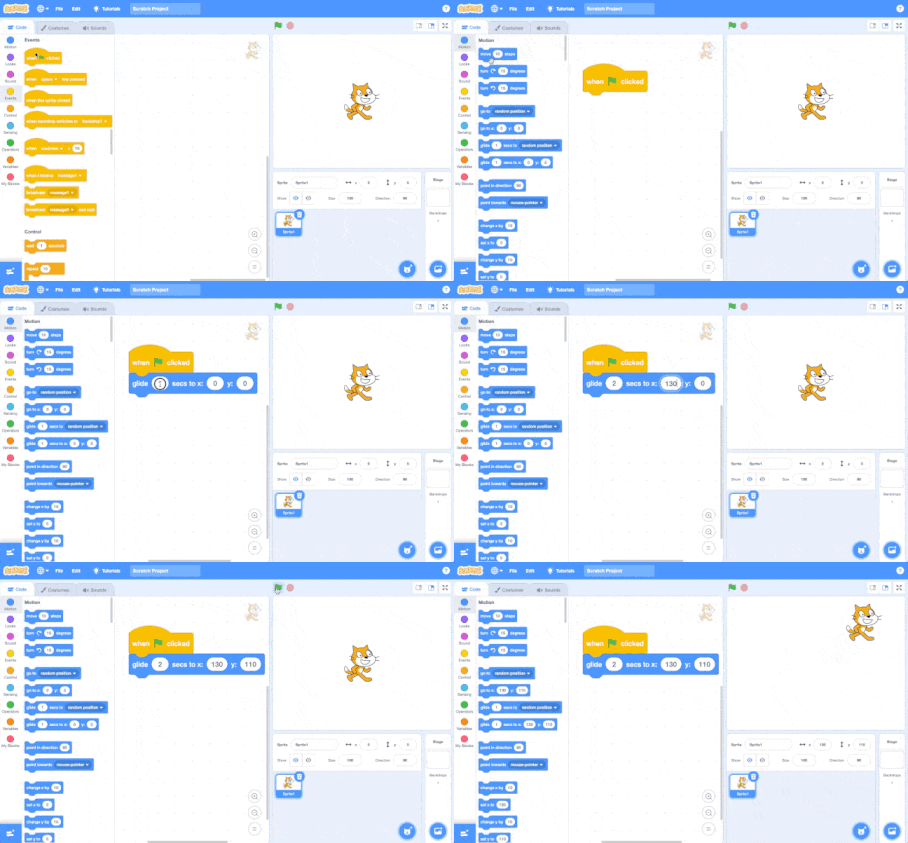
You can code in Scratch without having to memorise and type in commands. Instead, by snapping blocks together, you’ll take control of ‘sprites’, which are characters and objects on the screen that you can move around with the code you create.

A video of what Scratch coding looks like.
This is how you build Scratch programs.

As well as learning what you can do with Scratch, you’ll be learning basic programming concepts that are the same for all programming languages. You’ll see how the order of commands is important (sequencing), you’ll make the computer repeat actions (repetition), and you’ll write programs that do different things in different circumstances, for example responding to your user’s actions (selection). Later on, you’ll also make your own reusable code blocks (abstraction).

You can create your own programs and share them

Throughout the course you’ll learn to make your own programs step by step. In the final week, Mark and Vasu will show you how you can create musical projects and interact with your program using a webcam.

A Scratch coding project.
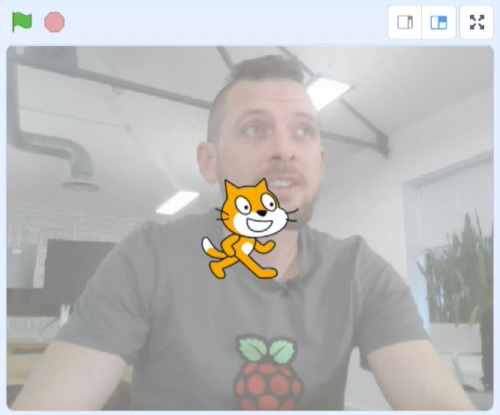
By the end of the course, you will create a program to control a Scratch character using your live webcam video.

Vasu and Mark will encourage you to share your programs and join the Scratch online community. You will discover how you can explore other people’s Scratch programs for inspiration and support, and how to build on the code they’ve created.

A Scratch coding project.
Thousands of people share their projects in the Scratch online community — you could be one of them.

Sign up for the course now!

The course starts for the first time on Monday 14 February, but it is available on demand, so you can join it at any time. You’ll get four weeks’ access to the course no matter when you sign up.

For the first four weeks that the course is available, and every three months after that, people from our team will join in to support you and help answer your questions in the comments sections.

If you’re a teacher in England, get free extended access by signing up through Teach Computing here.

And if you want to do more Scratch coding…

You can find more free resources here! These are the newest Scratch pathways on our project site, which you can also share with the young people in your life:

The post Get an easy start to coding with our new free online course appeared first on Raspberry Pi.

Breaking 256-bit Elliptic Curve Encryption with a Quantum Computer

Post Syndicated from Bruce Schneier original https://www.schneier.com/blog/archives/2022/02/breaking-245-bit-elliptic-curve-encryption-with-a-quantum-computer.html

Researchers have calculated the quantum computer size necessary to break 256-bit elliptic curve public-key cryptography:

Finally, we calculate the number of physical qubits required to break the 256-bit elliptic curve encryption of keys in the Bitcoin network within the small available time frame in which it would actually pose a threat to do so. It would require 317 × 106 physical qubits to break the encryption within one hour using the surface code, a code cycle time of 1 μs, a reaction time of 10 μs, and a physical gate error of 10-3. To instead break the encryption within one day, it would require 13 × 106 physical qubits.

In other words: no time soon. Not even remotely soon. IBM’s largest ever superconducting quantum computer is 127 physical qubits.

New for App Runner – VPC Support

Post Syndicated from Danilo Poccia original https://aws.amazon.com/blogs/aws/new-for-app-runner-vpc-support/

With AWS App Runner, you can quickly deploy web applications and APIs at any scale. You can start with your source code or a container image, and App Runner will fully manage all infrastructure including servers, networking, and load balancing for your application. If you want, App Runner can also configure a deployment pipeline for you.

Starting today, App Runner enables your services to communicate with databases and other applications hosted in an Amazon Virtual Private Cloud (VPC). For example, you can now connect App Runner services to databases in Amazon Relational Database Service (RDS), Redis or Memcached caches in Amazon ElastiCache, or your own applications running in Amazon Elastic Container Service (Amazon ECS), Amazon Elastic Kubernetes Service (EKS), Amazon Elastic Compute Cloud (Amazon EC2), or on-premises and connected via AWS Direct Connect.

Previously, in order for your App Runner application to connect to these resources, they needed to be publicly accessible over the internet. With this feature, App Runner applications can connect to private endpoints in your VPC, and you can enable a more secure and compliant environment by removing public access to these resources.

Within App Runner, you can now create VPC connectors that specify which VPC, subnets, and security groups to use for private networking. Once configured, you can use a VPC connector with one or more App Runner services.

When connected to a VPC, all outbound traffic from your AppRunner service will be routed based on the VPC routing rules. Services will not have access to the public internet (including AWS APIs) unless allowed by a route to a NAT Gateway. You can also set up VPC endpoints to connect to AWS APIs such as Amazon Simple Storage Service (Amazon S3) and Amazon DynamoDB to avoid NAT traffic.

The VPC connectors in App Runner work similarly to VPC networking in AWS Lambda and are based on AWS Hyperplane, the internal Amazon network function virtualization system behind AWS services and resources like Network Load Balancer, NAT Gateway, and AWS PrivateLink.

Let’s see how this works in practice with a web application connected to an RDS database.

Preparing the Amazon RDS Database
I start by configuring a database for my application. To simplify capacity management for this database, I use Amazon Aurora Serverless. In the RDS console, I create an Amazon Aurora MySQL-Compatible database. For the Capacity type, I choose Serverless. For networking, I use my default VPC and the default security group. I don’t need to make the database publicly accessible because I am going to connect using private VPC networking. To simplify connecting later, I enable AWS Identity and Access Management (IAM) database authentication.

I start an Amazon Linux EC2 instance in the same VPC. To connect from the EC2 instance to the database, I need a MySQL client. I install MariaDB, a community-developed branch of MySQL:

sudo yum install mariadb

Then, I connect to the database using the admin user.

mysql -h <DATABASE_HOST> -u admin -P

I enter the admin user password to log in. Then, I create a new user (bookuser) that is configured to use IAM authentication.

CREATE USER bookuser IDENTIFIED WITH AWSAuthenticationPlugin AS 'RDS'; 

I create the bookcase database and give permissions to the bookuser user to query the bookcase database.

CREATE DATABASE bookcase;
GRANT SELECT ON bookcase.* TO 'bookuser'@'%’;

To store information about some of my books, I create the authors and books tables.

CREATE TABLE authors (
  authorId INT,
  name varchar(255)
 );

CREATE TABLE books (
  bookId INT,
  authorId INT,
  title varchar(255),
  year INT
);

Then, I insert some values in the two tables:

INSERT INTO authors VALUES (1, "Issac Asimov");
INSERT INTO authors VALUES (2, "Robert A. Heinlein");
INSERT INTO books VALUES (1, 1, "Foundation", 1951);
INSERT INTO books VALUES (2, 1, "Foundation and Empire", 1952);
INSERT INTO books VALUES (3, 1, "Second Foundation", 1953);
INSERT INTO books VALUES (4, 2, "Stranger in a Strange Land", 1961);

Preparing the Application Source Code Repository
With App Runner, I can deploy a new service from code hosted in a source code repository or using a container image. In this example, I use a private project that I have on GitHub.

It’s a very simple Python web application connecting to the database I just created. This is the source code of the app (server.py):

from wsgiref.simple_server import make_server
from pyramid.config import Configurator
from pyramid.response import Response
import os
import boto3
import mysql.connector

import os

DATABASE_REGION = 'us-east-1'
DATABASE_CERT = 'cert/us-east-1-bundle.pem'
DATABASE_HOST = os.environ['DATABASE_HOST']
DATABASE_PORT = os.environ['DATABASE_PORT']
DATABASE_USER = os.environ['DATABASE_USER']
DATABASE_NAME = os.environ['DATABASE_NAME']

os.environ['LIBMYSQL_ENABLE_CLEARTEXT_PLUGIN'] = '1'

PORT = int(os.environ.get('PORT'))

rds = boto3.client('rds')

try:
    token = rds.generate_db_auth_token(
        DBHostname=DATABASE_HOST,
        Port=DATABASE_PORT,
        DBUsername=DATABASE_USER,
        Region=DATABASE_REGION
    )
    mydb =  mysql.connector.connect(
        host=DATABASE_HOST,
        user=DATABASE_USER,
        passwd=token,
        port=DATABASE_PORT,
        database=DATABASE_NAME,
        ssl_ca=DATABASE_CERT
    )
except Exception as e:
    print('Database connection failed due to {}'.format(e))          

def all_books(request):
    mycursor = mydb.cursor()
    mycursor.execute('SELECT name, title, year FROM authors, books WHERE authors.authorId = books.authorId ORDER BY year')
    title = 'Books'
    message = '<html><head><title>' + title + '</title></head><body>'
    message += '<h1>' + title + '</h1>'
    message += '<ul>'
    for (name, title, year) in mycursor:
        message += '<li>' + name + ' - ' + title + ' (' + str(year) + ')</li>'
    message += '</ul>'
    message += '</body></html>'
    return Response(message)

if __name__ == '__main__':

    with Configurator() as config:
        config.add_route('all_books', '/')
        config.add_view(all_books, route_name='all_books')
        app = config.make_wsgi_app()
    server = make_server('0.0.0.0', PORT, app)
    server.serve_forever()

The application uses the AWS SDK for Python (boto3) for IAM database authentication, the Pyramid web framework, and the MySQL connector for Python. The requirements.txt file describes the application dependencies:

boto3
pyramid==2.0
mysql-connector-python

To use SSL/TLS encryption when connecting to the database, I download a certificate bundle and add it to my source code repository.

Using VPC Support in AWS App Runner
In the App Runner console, I select Source code repository and the branch to use.

Console screenshot.

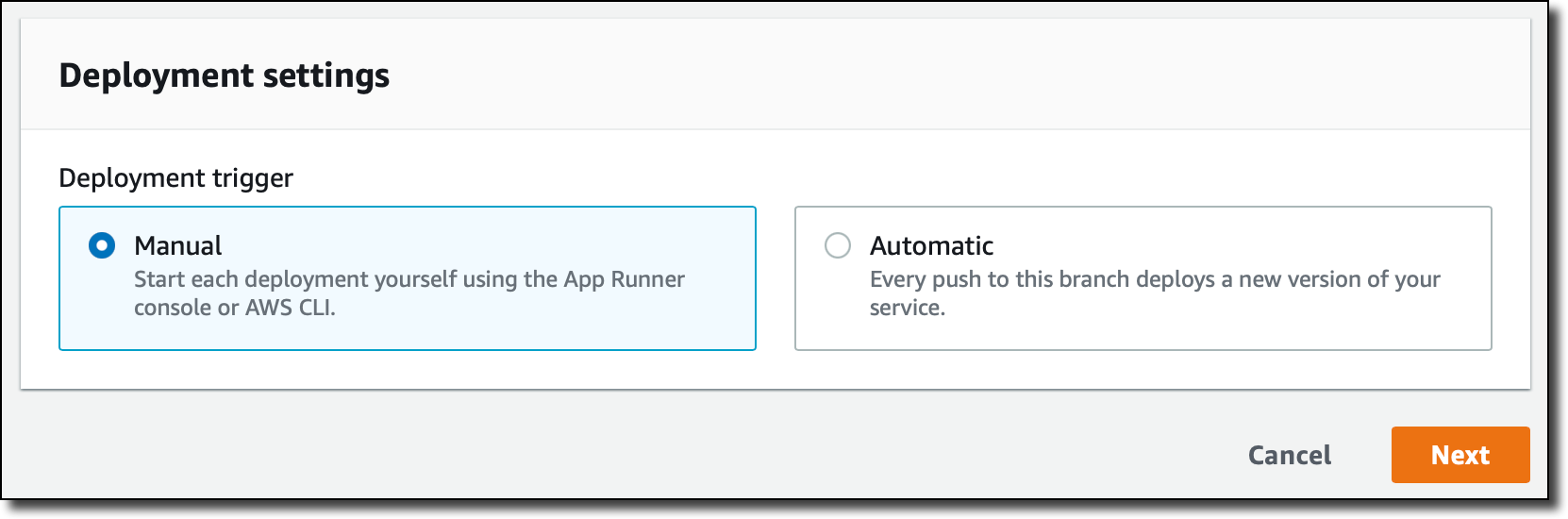
For the deployment settings, I choose Manual. Optionally, I could have selected the Automatic deployment trigger to have every push to this branch deploy a new version of my service.

Console screenshot.

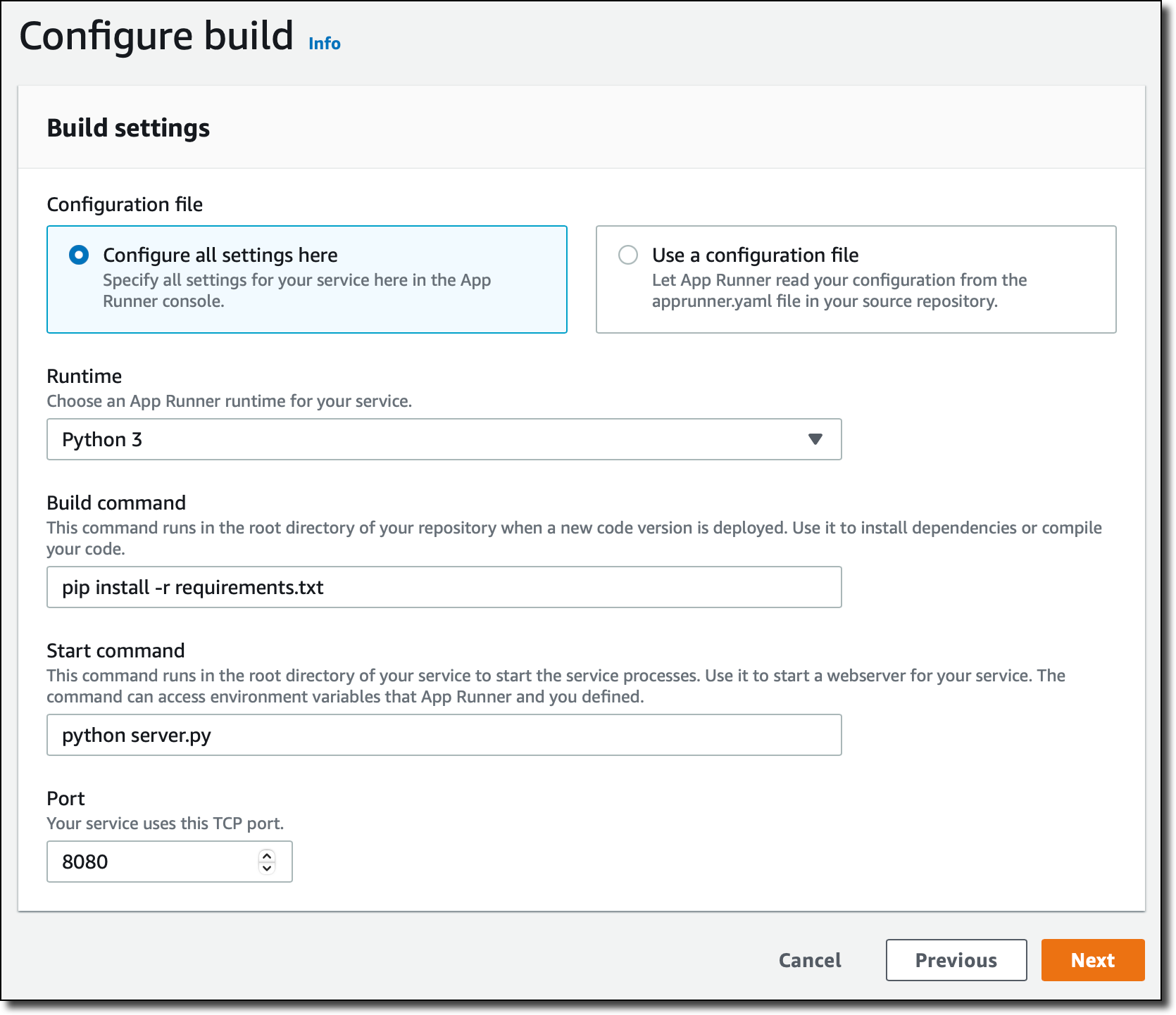
Then, I configure the build. This is a very simple application, so I pass the build and start commands in the console:

Build command – pip install -r requirements.txt
Start command – python server.py

For more advanced use cases, I would add an apprunner.yaml configuration file to my repository as in this sample application.

Console screenshot.

In the service configuration, I add the environment variables used by the application to connect to the database. I don’t need to pass a database password here because I am using IAM authentication.

Console screenshot.

In the Security section, I select an IAM role that gives permissions to connect to the database using IAM database authentication as described in Creating and using an IAM policy for IAM database access.

Console screenshot.

Here’s the syntax of the IAM role. I find the database Resource ID in the Configuration tab of the RDS console.

{
    "Version": "2012-10-17",
    "Statement": [
        {
            "Effect": "Allow",
            "Action": [
                "rds-db:connect"
            ],
            "Resource": [
                "arn:aws:rds-db:<REGION>:<ACCOUNT>:dbuser:<DB_RESOURCE_ID>/<DB_USER>"
            ]
        }
    ]
}

For the role trust policy,   I follow the instruction for instance roles in How App Runner works with IAM.

{
  "Version": "2012-10-17",
  "Statement": [
    {
      "Effect": "Allow",
      "Principal": {
        "Service": "tasks.apprunner.amazonaws.com"
      },
      "Action": "sts:AssumeRole"
    }
  ]
}

For Networking, I select the new option to use a Custom VPC for outgoing network traffic and then add a new VPC connector.

Console screenshot.

To add a new VPC connector, I write down a name and then select the VPC, subnets, and security groups to use. Here, I select all the subnets of my default VPC and the default security group. In this way, the App Runner service will be able to connect to the RDS database.

Console screenshot.

The next time, when configuring another application with the same VPC networking requirements, I can just select the VPC connector I created before.

Console screenshot. I review all the settings and then create and deploy the service.

After a few minutes, the service is running, and I choose the default domain to open a new tab in my browser. The application is connected to the database using VPC networking and performs a SQL query to join the books and authors tables and provide some reading suggestions. It works!

Browser screenshot.

Availability and Pricing
VPC connectors are available in all AWS Regions where AWS App Runner is offered. For more information, see the Regional Services List. There is no additional cost for using this feature, but you pay the standard pricing for data transmission or any NAT gateway or VPC endpoints you set up. You can set up VPC connectors with the AWS Management Console, AWS Command Line Interface (CLI), AWS SDKs, and AWS CloudFormation.

With VPC connectors, you can deploy your applications using App Runner and connect them to your private databases, caches, and applications running in a VPC or on-premises and connected via AWS Direct Connect.

Build and run web applications at any scale and connect to your private VPC resources with AWS App Runner.

— Danilo

NEW – Replicate Existing Objects with Amazon S3 Batch Replication

Post Syndicated from Marcia Villalba original https://aws.amazon.com/blogs/aws/new-replicate-existing-objects-with-amazon-s3-batch-replication/

Starting today, you can replicate existing Amazon Simple Storage Service (Amazon S3) objects and synchronize your buckets using the new Amazon S3 Batch Replication feature.

Amazon S3 Replication supports several customer use cases. For example, you can use it to minimize latency by maintaining copies of your data in AWS Regions geographically closer to your users, to meet compliance and data sovereignty requirements, and to create additional resiliency for disaster recovery planning. S3 Replication is a fully managed, low-cost feature that replicates newly uploaded objects between buckets. The buckets can belong to the same or different accounts. Objects may be replicated to a single destination bucket or to multiple destination buckets. Destination buckets can be in different AWS Regions (Cross-Region Replication) or within the same Region as the source bucket (Same-Region Replication).

Replication flow

But until today, S3 Replication could not replicate existing objects; now you can do it with S3 Batch Replication.

There are many reasons why customers will want to replicate existing objects. For example, customers might want to copy their data to a new AWS Region for a disaster recovery setup. To do that, they will need to populate the new destination bucket with existing data. Another reason to copy existing data comes from organizations that are expanding around the world. For example, imagine a US-based animation company now opens a new studio in Singapore. To reduce latency for their employees, they will need to replicate all the internal files and in-progress media files to the Asia Pacific (Singapore) Region. One other common use case we see is customers going through mergers and acquisitions where they need to transfer ownership of existing data from one AWS account to another.

To replicate existing objects between buckets, customers end up creating complex processes. In addition, copying objects between buckets does not preserve the metadata of objects such as version ID and object creation time.

Today we are happy to launch S3 Batch Replication, a new capability offered through S3 Batch Operations that removes the need for customers to develop their own solutions for copying existing objects between buckets. It provides a simple way to replicate existing data from a source bucket to one or more destinations. With this capability, you can replicate any number of objects with a single job.

When to Use Amazon S3 Batch Replication
S3 Batch Replication can be used to:

  • Replicate existing objects – use S3 Batch Replication to replicate objects that were added to the bucket before the replication rules were configured.
  • Replicate objects that previously failed to replicate – retry replicating objects that failed to replicate previously with the S3 Replication rules due to insufficient permissions or other reasons.
  • Replicate objects that were already replicated to another destination – you might need to store multiple copies of your data in separate AWS accounts or Regions. S3 Batch Replication can replicate objects that were already replicated to new destinations.
  • Replicate replicas of objects that were created from a replication rule – S3 Replication creates replicas of objects in destination buckets. Replicas of objects cannot be replicated again with live replication. These replica objects can only be replicated with S3 Batch Replication.

Get started with S3 Batch Replication
There are many ways to get started with S3 Batch Replication from the S3 console. You can create a job from the Replication configuration page or the Batch Operations create job page. You will also get prompted to replicate existing objects when you create a new replication rule or add a new destination bucket.

For this demo, imagine that you are creating a replication rule in a bucket that has existing objects. When you finish creating the rule, you will get prompted with a message asking you if you want to replicate existing objects.

Prompt asking if you want to replicate existing objects

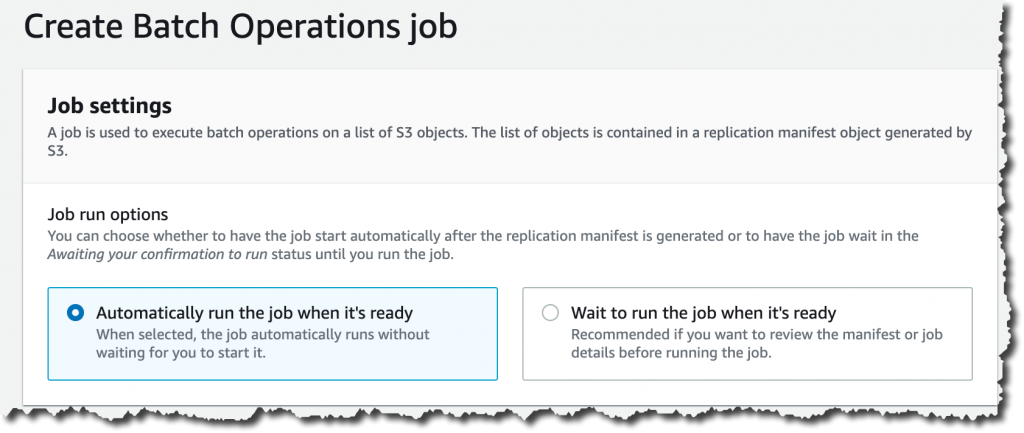
If you answer yes, then you will be directed to a simplified Create Batch Operations job page. If you want this job to execute automatically after the job is ready, you can leave the default option. If you want to review the manifest or the job details before running the job, select Wait to run the job when it’s ready.

This method of creating the job automatically generates the manifest of objects to replicate. A manifest is a list of objects in a given source bucket to apply the replication rules. The generated manifest report has the same format as an Amazon S3 Inventory Report.

Create a Batch Operations job view

S3 Batch Replication creates a Completion report, similar to other Batch Operations jobs, with information on the results of the replication job. It is highly recommended to select this option and to specify a bucket to store this report.

Completion report configuration

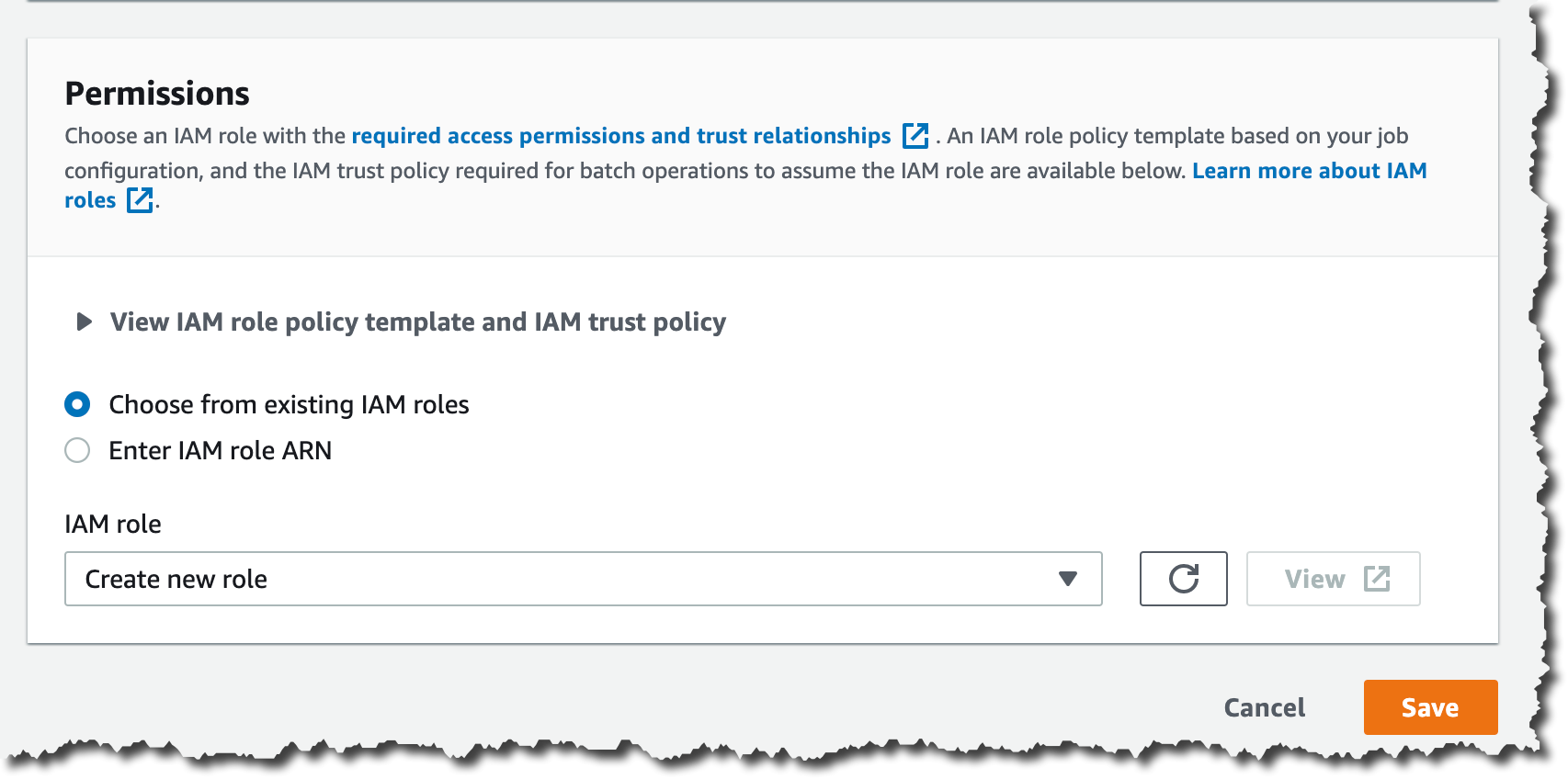
The final step is to configure permissions for creating this batch job. If you keep the default settings, Amazon S3 will create a new AWS Identity and Access Management (IAM) role for you.

Permissions configurations

After you save this job, check the status of the job on the Batch Operations page. You will see the job changing status as it progresses, the percentage of files that have been replicated, and the total number of files that have failed the replication.

Keep in mind that existing objects can take longer to replicate than new objects, and the replication speed largely depends on the AWS Regions, size of data, object count, and encryption type.

Job status page

When the Batch Replication job completes, you can navigate to the bucket where you saved the completion report to check the status of object replication. The reports have the same format as an Amazon S3 Inventory Report.

Finding the report and manifest

Pricing and availability
When using this feature, you will be charged replication fees for request and data transfer for cross Region, for the
batch operations, and a manifest generation fee if you opted for it.

Additionally, you will be charged the storage cost of storing the replicated data in the destination bucket and AWS KMS charges if your objects are replicated with AWS KMS. Check the Replication tab on the S3 pricing page to learn all the details.

S3 Batch Replication is available in all AWS Regions, including the AWS GovCloud Regions, the AWS China (Beijing) Region, operated by Sinnet, and the AWS China (Ningxia) Region, operated by NWCD. And you can get started using the Amazon S3 console, CLI, S3 API, or AWS SDKs client.

To learn more about S3 Batch Replication, check out the Amazon S3 User Guide.

— Marcia

Patch Tuesday – February 2022

Post Syndicated from Greg Wiseman original https://blog.rapid7.com/2022/02/08/patch-tuesday-february-2022/

Patch Tuesday - February 2022

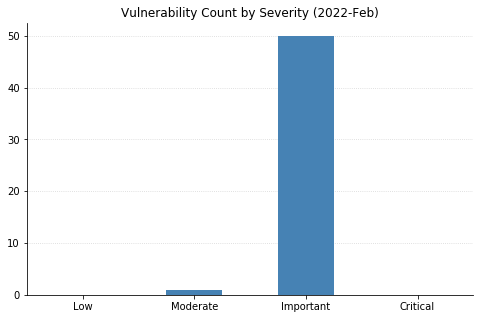
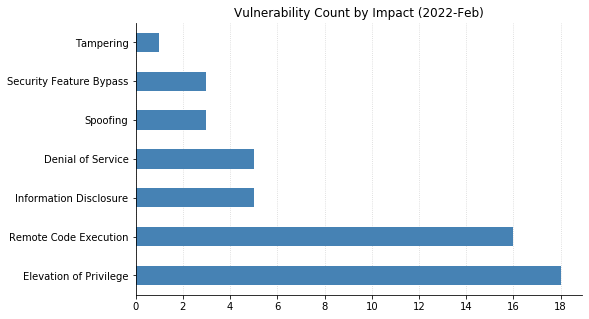
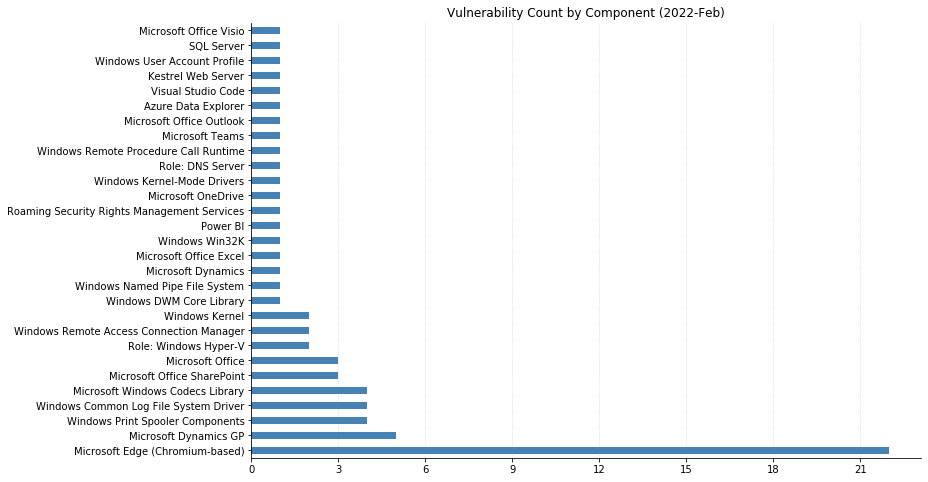
Today’s fixes from Microsoft are relatively light as far as Patch Tuesdays go. This is the first month in possibly forever where no vulnerabilities are considered Critical. A total of 70 CVEs were fixed today (including 22 that affect the Chromium browser engine, which is used by Edge).

Although 16 of this month’s vulnerabilities allow remote code execution (RCE), none carry a CVSS base score higher than 8.8. Only one vulnerability was publicly disclosed before today: CVE-2022-21989, an elevation of privilege vulnerability in the Windows Kernel. None of this month’s vulnerabilities have yet been seen exploited in the wild.

Despite the lack of Critical fixes, it’s worth remembering that attackers love to use elevation of privilege vulnerabilities, of which there are 18 this month. RCE vulnerabilities are also important to patch, even if they may not be considered “wormable.” In terms of prioritization, defenders should first focus on patching server systems. SharePoint has RCE (CVE-2022-22005), Security Feature Bypass (CVE-2022-21968), and Spoofing (CVE-2022-21987) vulnerabilities getting fixed today. CVE-2022-21984 is an RCE affecting DNS Server. Microsoft Dynamics administrators should also be aware that there are six CVEs being patched, including 2 RCEs, 3 allowing elevation of privilege, and a spoofing vulnerability.

On the client side, CVE-2022-22003 and CVE-2022-22004 are RCEs affecting Microsoft Office. Although this requires a local user to open a malicious file, these sorts of social engineering attacks are common and can be very effective. Updates should be rolled out to end users as soon as reasonably practicable.

Summary charts

Patch Tuesday - February 2022

Summary tables

Azure Vulnerabilities

CVE Title Exploited Publicly Disclosed CVSSv3 Base Score Has FAQ?
CVE-2022-23256 Azure Data Explorer Spoofing Vulnerability No No 8.1 Yes

Browser Vulnerabilities

CVE Title Exploited Publicly Disclosed CVSSv3 Base Score Has FAQ?
CVE-2022-23261 Microsoft Edge (Chromium-based) Tampering Vulnerability No No 5.3 Yes
CVE-2022-23263 Microsoft Edge (Chromium-based) Elevation of Privilege Vulnerability No No 7.7 Yes
CVE-2022-23262 Microsoft Edge (Chromium-based) Elevation of Privilege Vulnerability No No 6.3 Yes
CVE-2022-0470 Chromium: CVE-2022-0470 Out of bounds memory access in V8 No No N/A Yes
CVE-2022-0469 Chromium: CVE-2022-0469 Use after free in Cast No No N/A Yes
CVE-2022-0468 Chromium: CVE-2022-0468 Use after free in Payments No No N/A Yes
CVE-2022-0467 Chromium: CVE-2022-0467 Inappropriate implementation in Pointer Lock No No N/A Yes
CVE-2022-0466 Chromium: CVE-2022-0466 Inappropriate implementation in Extensions Platform No No N/A Yes
CVE-2022-0465 Chromium: CVE-2022-0465 Use after free in Extensions No No N/A Yes
CVE-2022-0464 Chromium: CVE-2022-0464 Use after free in Accessibility No No N/A Yes
CVE-2022-0463 Chromium: CVE-2022-0463 Use after free in Accessibility No No N/A Yes
CVE-2022-0462 Chromium: CVE-2022-0462 Inappropriate implementation in Scroll No No N/A Yes
CVE-2022-0461 Chromium: CVE-2022-0461 Policy bypass in COOP No No N/A Yes
CVE-2022-0460 Chromium: CVE-2022-0460 Use after free in Window Dialog No No N/A Yes
CVE-2022-0459 Chromium: CVE-2022-0459 Use after free in Screen Capture No No N/A Yes
CVE-2022-0458 Chromium: CVE-2022-0458 Use after free in Thumbnail Tab Strip No No N/A Yes
CVE-2022-0457 Chromium: CVE-2022-0457 Type Confusion in V8 No No N/A Yes
CVE-2022-0456 Chromium: CVE-2022-0456 Use after free in Web Search No No N/A Yes
CVE-2022-0455 Chromium: CVE-2022-0455 Inappropriate implementation in Full Screen Mode No No N/A Yes
CVE-2022-0454 Chromium: CVE-2022-0454 Heap buffer overflow in ANGLE No No N/A Yes
CVE-2022-0453 Chromium: CVE-2022-0453 Use after free in Reader Mode No No N/A Yes
CVE-2022-0452 Chromium: CVE-2022-0452 Use after free in Safe Browsing No No N/A Yes

Developer Tools Vulnerabilities

CVE Title Exploited Publicly Disclosed CVSSv3 Base Score Has FAQ?
CVE-2022-21991 Visual Studio Code Remote Development Extension Remote Code Execution Vulnerability No No 8.1 Yes
CVE-2022-21986 .NET Denial of Service Vulnerability No No 7.5 Yes

ESU Windows Vulnerabilities

CVE Title Exploited Publicly Disclosed CVSSv3 Base Score Has FAQ?
CVE-2022-21985 Windows Remote Access Connection Manager Information Disclosure Vulnerability No No 5.5 Yes
CVE-2022-22718 Windows Print Spooler Elevation of Privilege Vulnerability No No 7.8 No
CVE-2022-21999 Windows Print Spooler Elevation of Privilege Vulnerability No No 7.8 No
CVE-2022-21997 Windows Print Spooler Elevation of Privilege Vulnerability No No 7.1 Yes
CVE-2022-22717 Windows Print Spooler Elevation of Privilege Vulnerability No No 7 Yes
CVE-2022-21989 Windows Kernel Elevation of Privilege Vulnerability No Yes 7.8 Yes
CVE-2022-21998 Windows Common Log File System Driver Information Disclosure Vulnerability No No 5.5 Yes
CVE-2022-21981 Windows Common Log File System Driver Elevation of Privilege Vulnerability No No 7.8 No
CVE-2022-22000 Windows Common Log File System Driver Elevation of Privilege Vulnerability No No 7.8 No
CVE-2022-22710 Windows Common Log File System Driver Denial of Service Vulnerability No No 5.5 No

Microsoft Dynamics Vulnerabilities

CVE Title Exploited Publicly Disclosed CVSSv3 Base Score Has FAQ?
CVE-2022-23269 Microsoft Dynamics GP Spoofing Vulnerability No No 6.9 Yes
CVE-2022-23274 Microsoft Dynamics GP Remote Code Execution Vulnerability No No 8.3 Yes
CVE-2022-23272 Microsoft Dynamics GP Elevation Of Privilege Vulnerability No No 8.1 Yes
CVE-2022-23273 Microsoft Dynamics GP Elevation Of Privilege Vulnerability No No 7.1 No
CVE-2022-23271 Microsoft Dynamics GP Elevation Of Privilege Vulnerability No No 6.5 No
CVE-2022-21957 Microsoft Dynamics 365 (on-premises) Remote Code Execution Vulnerability No No 7.2 No

Microsoft Office Vulnerabilities

CVE Title Exploited Publicly Disclosed CVSSv3 Base Score Has FAQ?
CVE-2022-21965 Microsoft Teams Denial of Service Vulnerability No No 7.5 Yes
CVE-2022-21987 Microsoft SharePoint Server Spoofing Vulnerability No No 8 Yes
CVE-2022-21968 Microsoft SharePoint Server Security Feature BypassVulnerability No No 4.3 Yes
CVE-2022-22005 Microsoft SharePoint Server Remote Code Execution Vulnerability No No 8.8 Yes
CVE-2022-23280 Microsoft Outlook for Mac Security Feature Bypass Vulnerability No No 5.3 Yes
CVE-2022-23255 Microsoft OneDrive for Android Security Feature Bypass Vulnerability No No 5.9 Yes
CVE-2022-21988 Microsoft Office Visio Remote Code Execution Vulnerability No No 7.8 Yes
CVE-2022-23252 Microsoft Office Information Disclosure Vulnerability No No 5.5 Yes
CVE-2022-22003 Microsoft Office Graphics Remote Code Execution Vulnerability No No 7.8 Yes
CVE-2022-22004 Microsoft Office ClickToRun Remote Code Execution Vulnerability No No 7.8 Yes
CVE-2022-22716 Microsoft Excel Information Disclosure Vulnerability No No 5.5 Yes

SQL Server Vulnerabilities

CVE Title Exploited Publicly Disclosed CVSSv3 Base Score Has FAQ?
CVE-2022-23276 SQL Server for Linux Containers Elevation of Privilege Vulnerability No No 7.8 Yes
CVE-2022-23254 Microsoft Power BI Elevation of Privilege Vulnerability No No 4.9 Yes

Windows Vulnerabilities

CVE Title Exploited Publicly Disclosed CVSSv3 Base Score Has FAQ?
CVE-2022-22002 Windows User Account Profile Picture Denial of Service Vulnerability No No 5.5 No
CVE-2022-21993 Windows Services for NFS ONCRPC XDR Driver Information Disclosure Vulnerability No No 7.5 Yes
CVE-2022-21971 Windows Runtime Remote Code Execution Vulnerability No No 7.8 Yes
CVE-2022-22001 Windows Remote Access Connection Manager Elevation of Privilege Vulnerability No No 7.8 No
CVE-2022-21992 Windows Mobile Device Management Remote Code Execution Vulnerability No No 7.8 Yes
CVE-2022-21995 Windows Hyper-V Remote Code Execution Vulnerability No No 7.9 Yes
CVE-2022-22712 Windows Hyper-V Denial of Service Vulnerability No No 5.6 Yes
CVE-2022-21994 Windows DWM Core Library Elevation of Privilege Vulnerability No No 7.8 No
CVE-2022-21984 Windows DNS Server Remote Code Execution Vulnerability No No 8.8 No
CVE-2022-21996 Win32k Elevation of Privilege Vulnerability No No 7.8 No
CVE-2022-22709 VP9 Video Extensions Remote Code Execution Vulnerability No No 7.8 Yes
CVE-2022-21974 Roaming Security Rights Management Services Remote Code Execution Vulnerability No No 7.8 Yes
CVE-2022-22715 Named Pipe File System Elevation of Privilege Vulnerability No No 7.8 No
CVE-2022-21844 HEVC Video Extensions Remote Code Execution Vulnerability No No 7.8 Yes
CVE-2022-21926 HEVC Video Extensions Remote Code Execution Vulnerability No No 7.8 Yes
CVE-2022-21927 HEVC Video Extensions Remote Code Execution Vulnerability No No 7.8 Yes

NEVER MISS A BLOG

Get the latest stories, expertise, and news about security today.

Ryabitsev: Cross-fork object sharing in git (is not a bug)

Post Syndicated from original https://lwn.net/Articles/884105/

This is a few days old, but evidently there
is still need for this message: Konstantin Ryabitsev explains
how it is easy to cause a commit to appear falsely to be part of a GitHub
repository:

With all the benefits of object sharing comes one important
downside — namely, you can access any shared object through any of
the forks. So, if you fork linux.git and push your own commit into
it, any of the 41.1k forks will have access to the objects
referenced by your commit. If you know the hash of that object, and
if the web ui allows to access arbitrary repository objects by
their hash, you can even view and link to it from any of the forks,
making it look as if that object is actually part of that
particular repository (which is how we get the links at the start
of this article).

A failure to understand this point is how the net fills up with articles
like this one.

The collective thoughts of the interwebz