Version 2.43 of the
GNU C Library has been released. Changes include support for the mseal() and openat2()
system calls, experimental support for building with the Clang compiler,
Unicode 17.0.0 support, a number of security fixes, and much more.
Тази „президентска“ седмица започна – обещаващо – с оставка и с няколко разменени писма.
Оставката я подаде президентът Румен Радев, който се възползва от последните си минути на поста, за да стартира предизборна кампания, все още лишена от конкретност, но очевидно и очаквано прицелена към младите. Оставям настранa съдържанието на речта и се фокусирам само върху жеста на оставката – за мен жалка проява на (меко казано) нелоялност и безотговорност към президентската институция и към цялата държава.
Да си президент не е като да си касиерка в супермаркет А, която в дните преди Коледа напуска, защото в супермаркет Б са ѝ предложили по-добри условия. Да си президент в известен смисъл е като да си пилот – не върви да зарежеш пътниците и да скочиш с парашут, преди полетът да е приключил. Президентът има мандат и отказът от поста би трябвало да е (морално и всякак) възможен само при изключителни обстоятелства. Каквито предстоящите избори не са. И личното му политическо битие и бъдеще не е. Още по-малко биха могли да бъдат оправдание евентуално поетите ангажименти към трети и пети лица, политически проекти, партии, организации и прочее…
Основната мисия на президента е да стои начело на народа, който го е избрал, във времето, за което е избран. Независимо дали повереният му самолет се движи по разписание, закъснява, или всеки момент ще се разбие в земята. Но Румен Радев за пореден път демонстрира, че не служи на интересите на България и нищо не (може да) пилотира просто защото през цялото време се вози в чужд самолет.
Още по темата за тази срамна оставка, както и за останалите позорни деяния, свършени от управниците ни през последните дни четете в анализа на Емилия Милчева „Отечество любезно, аз ще те спася“.
Въпреки очевидно спекулативния монолог на Радев от понеделник вечер, опасявам се, че сърцераздирателният му тон вероятно е докоснал немалко сърца, чийто вот на предстоящите избори вече е предопределен. Податливостта ни на пропаганда и манипулация става все по-плашеща, докато капацитетът ни да анализираме реалността отслабва. Във връзка с тази тема ви предлагаме да се „запознаете“ с един бивш служител на ДС – полковник А., който не е подписал дебютната си статия в „Тоест“ „Манипулацията – този стар и все тъй полезен занаят“, но по всичко личи, че стои зад думите си. А те са свързани именно с механизмите, по които биваме управлявани, и с евентуалните начини да противостоим на манипулацията и пропагандата. Ето какво съветва полковник А.:
Като първоначален тест винаги си задавайте още един въпрос: въздейства ли материалът, който четете, слушате или гледате, върху мисълта ви – или върху емоциите ви? Ако отговорът е второто, в 99% от случаите става дума за манипулация. Проверявайте. И не се хващайте.
Добър съвет в момент, в който ни предстоят важни избори. На тях – според Александър Драганов и статията му „Партийните системи по света и де е България в тях“ – целта ПП–ДБ да получат пълно мнозинство в парламента е трудно постижима. И това се дължи най-вече на пропорционалната избирателна система у нас, както и на степента на поляризация в обществото. Ето какво казва Александър в тази връзка:
България е средноевропейска държава и пропорционалната избирателна система е нормална за нея. От това следват няколко неща. Преди всичко в Народното събрание ще попадат различни партии. Причината се корени не само в разделението ни на различни политически племена (по Димитър Ганев) и във факта, че в България „всяка коза е за свой крак“, а най-вече в обстоятелството, че това състояние е очакваното – и дори желаното – за избирателна система като нашата. Различните групи от населението с различни виждания и интереси получават представителство. Задача на политиците е да намерят работеща формула, за да се съобразят с тях.
И докато с омерзение наблюдаваме години наред как политиците така и не намират работещата формула, налага се да вършим и други неща, например да си раждаме и отглеждаме децата, при все че светът изглежда все по-неподходящо място за тази дейност. На „Раждането – между физиологията и системата“ е посветена поредната статия на Надежда Цекулова от рубриката ѝ за женското здраве. И най-вече на добрите и недотам добрите практики в родилната помощ и тяхното прилагане у нас. Практики, които в редица случаи наистина опират не до степен на експертност и ниво на оборудване, а до базисни етически норми:
И от темата за женското здраве плавно преминаваме към проблема с психичното ни здраве, което родната действителност за поредна седмица изправя пред неимоверни предизвикателства. Съветът за оцеляване на Е.Т. в епизод 38 гласи:
Представете си, че сте панда. Не виждам друго спасение.
И така, бавно и със стрък бамбук между зъбите, прекрачваме границите на страната, за да огледаме какво се случва на международната сцена.
Тук идва моментът да се върнем към „писмата“, за които споменах по-горе и които рязко ни настроиха на вълните на срещата в Давос още преди реално тя да е започнала. Та в началото на седмицата президентът дадаист, „кралят Юбю“ на нашето време, възпят още като Тръмпти Дъмпти, изпрати обидено писмо отговор до норвежкия премиер Йонас Гар Стьоре, в което обясни, че след като си е дал труда да спре осем войни, че и отгоре, за което не е получил полагаемата му се Нобелова награда за мир, световният мир вече не е негова грижа и отговорност. Така щял да се фокусира върху важните за САЩ задачи, като например присъединяването на заветната Гренландия.
За да забършат капките от поредното изплискване на президентския леген и евентуално да укротят буйстващия вътре Доналд, на когото му е отказана желаната играчка, други лидери отвърнаха с доста възпитани, макар и еднозначни кратки текстови съобщения. В съобщението си Макрон например кани Тръмп на вечеря, директно заявява, че не разбира историята с Гренландия, и два пъти използва думата great – явно за да слезе до нивото на речника на американския президент. Марк Рюте от своя страна също гали Тръмп по посока на косъма за Сирия, като използва друга любима дума на Доналд – incredible. И разбира се, отново повдига темата за Гренландия.
Гренландия, естествено, присъстваше и в давоските речи, като специално тази на Тръмп продължи над час и изобилстваше от лъжи и полуистини, подправени с доза невежество и обвити в дементна мъгла, чието разплитане може да проследите тук. За пореден път американският президент заяви апетитите си към Гренландия, която безсрамно омаловажи и обиди, наричайки я „парче лед“.
На този фон речта на канадския премиер Марк Карни в Давос заслужено стана вайръл с непоколебимия си тон; с дързостта да назове нещата с истинските им имена – „разрив“, а не „преход“; с избора на Вацлав Хавел и „живота в истина“ като отправна точка в бъдещето; с визията за коалициите на средните сили, чийто ход може да бъде съзидателен, за разлика от действията на великите геополитически съперници. И разбира се, с коментара по актуалната тема за ледения остров:
По отношение на арктическия суверенитет ние твърдо стоим зад Гренландия и Дания и напълно подкрепяме тяхното уникално право да определят бъдещето на Гренландия.
Идеята за новите коалиции, както и заявената воля за консолидиране на Европа в отпор на безобразната външна политика на президента на САЩ е хоризонт, спрямо който България, пълноправна членка на ЕС, би трябвало да ориентира позицията си. Уви, обаче, по-малко от денонощие след безумната реч на Тръмп премиерът Желязков тихомълком, без ясно заявено решение от правителството или парламента, въз основа на „поверителен акт“, приет в късни доби от Министерския съвет, се изстреля на учредяването на т.нар. Съвет за мир на Тръмп – формирование, което водещите страни в ЕС бойкотираха. С участието си в Съвета България се откъсва от политическите си съюзници и застава до страни като Унгария, Турция, Беларус, Аржентина, Парагвай, Катар, Саудитска Арабия и пр. А задната мисъл в целия този резил, разбира се, е да се откупи „свободата“ на г-н Пеевски от списъка „Магнитски“.
След тази турбулентна седмица, в която знаковите думи на отминалата година „евро“, „безобразие“ и „протест“ бяха изтласкани от следващи потенциални претенденти, като „оставка“, „разрив“, „Гренландия“ и нови измерения на „безобразието“, ви предлагаме малко почивка от политиката, без рязко да сменяме темата. Затова ви припомняме няколко красиви и информативни текста на Светла Стоянова от северната ѝ поредица, която публикувахме през 2024, доста преди „парчето лед“ да се превърне в гореща геополитическа хапка. Тези пътеписи ще ви помогнат да усетите истинската Гренландия – с магията на леда, кучешките впрягове, пъстрите къщи, екзотичния език и храна, нравите на инуитите… Приятно четене!
А ако сте пропуснали да чуете на живо шести епизод от рубриката „Тоест разговаряме“, в който гост е Йоанна Елми – дългогодишна авторка в „Тоест“ и водеща на бюлетина „Гласовете на Америка“, вече може да го направите ето тук.
Следващата среща ще бъде с Михаил Ангелов – биолог, агроном и водещ на рубриката „Научни новини“ в „Тоест“. Разговорът ще се излъчи на живо в YouTube Live на 7 февруари, събота, от 16:00 ч.
За финал ви поздравявам с едно неостаряващо парче на Боб Дилън, което – в духа на речта на Карни – отново става актуално:
И по-добре започвай да плуваш, иначе ще потънеш като камък, защото светът се променя.
И не забравяйте, че за да плуваме заедно, се нуждаем от вашата подкрепа. Защото светът се променя… А желаещите да ни пратят на дъното неспирно работят по въпроса. Благодарим ви!
With AWS Payment Cryptography, your payment processing applications can use payment hardware security modules (HSMs) that are PCI PIN Transaction Security (PTS) HSM certified and fully managed by AWS, with PCI PIN-compliant key management. This attestation gives you the flexibility to deploy your regulated workloads with reduced compliance overhead.
The PCI PIN compliance report package for AWS Payment Cryptography includes two key components:
PCI PIN Attestation of Compliance (AOC) – demonstrating that AWS Payment Cryptography was successfully validated against the PCI PIN standard with zero findings
PCI PIN Responsibility Summary – provides guidance to help AWS customers understand their responsibilities in developing and operating a highly secure environment for handling PIN-based transactions
AWS was evaluated by Coalfire, a third-party Qualified Security Assessor (QSA). Customers can access the PCI PIN Attestation of Compliance (AOC) and PCI PIN Responsibility Summary reports through AWS Artifact.
To learn more about our PCI programs and other compliance and security programs, visit the AWS Compliance Programs page. As always, we value your feedback and questions; reach out to the AWS Compliance team through the Compliance Support page.
If you have feedback about this post, submit comments in the Comments section below. If you have questions about this post, contact AWS Support.
Amazon Web Services (AWS) is pleased to announce a successful completion of the 2025 Cloud Computing Compliance Criteria Catalogue (C5) attestation cycle with 183 services in scope. This alignment with C5 requirements demonstrates our ongoing commitment to adhere to the heightened expectations for cloud service providers. AWS customers in Germany and across Europe can run their applications in the AWS Regions that are in scope of the C5 report with the assurance that AWS aligns with C5 criteria.
The C5 attestation scheme is backed by the German government and was introduced by the Federal Office for Information Security (BSI) in 2016. AWS has adhered to the C5 requirements since their inception. C5 helps organizations demonstrate operational security against common cybersecurity threats when using cloud services.
Independent third-party auditors evaluated AWS for the period of October 1, 2024, through September 30, 2025. The C5 report illustrates the compliance status of AWS for both the basic and additional criteria of C5. Customers can download the C5 report through AWS Artifact, a self-service portal for on-demand access to AWS compliance reports. Sign in to AWS Artifact in the AWS Management Console or learn more at Getting Started with AWS Artifact.
AWS has added the following five services to the current C5 scope:
The following AWS Regions are in scope of the 2025 C5 attestation: Europe (Frankfurt), Europe (Ireland), Europe (London), Europe (Milan), Europe (Paris), Europe (Stockholm), Europe (Spain), Europe (Zurich), and Asia Pacific (Singapore). For up-to-date information, see the C5 page of our AWS Services in Scope by Compliance Program.
Security and compliance is a shared responsibility between AWS and the customer. When customers move their computer systems and data to the cloud, security responsibilities are shared between the customer and the cloud service provider. For more information, see the AWS Shared Security Responsibility Model.
To learn more about our compliance and security programs, see AWS Compliance Programs. As always, we value your feedback and questions; reach out to the AWS Compliance team through the Contact Us page.
Reach out to your AWS account team if you have questions or feedback about the C5 report. If you have feedback about this post, submit comments in the Comments section below.
This week, we are pleased to announce the addition of a module that exploits CVE-2025-61882, a pre-authentication remote code execution vulnerability in Oracle E-Business Suite versions 12.2.3 through 12.2.14. The exploit chains multiple flaws—including SSRF, path traversal, HTTP request smuggling, and XSLT injection—to coerce the target into fetching and executing a malicious XSL file hosted by the attacker. Successful exploitation results in arbitrary command execution and an interactive shell on both Linux/Unix and Windows targets. The module is reliable, repeatable, and we here at Metasploit hope you enjoy it, happy hacking!
New module content (3)
Authenticated RCE in Splunk (splunk_archiver app)
Authors: Alex Hordijk, Maksim Rogov, and psytester Type: Exploit Pull request: #20770 contributed by vognik Path: linux/http/splunk_auth_rce_cve_2024_36985 AttackerKB reference: CVE-2024-36985
Description: This adds two separate Metasploit exploit modules targeting Remote Code Execution (RCE) vulnerabilities in Splunk Enterprise. CVE-2024-36985 exploits unsafe use of the “copybuckets” lookup function within the splunk_archiver application, resulting in execution of the sudobash helper script with attacker-controlled arguments. Affected versions: All releases prior to 9.0.10, 9.1.2 through 9.1.5, 9.2.0 through 9.2.2 CVE-2022-43571, exploits a Python code injection vulnerability in Splunk SimpleXML dashboards by injecting malicious code into sparkline style parameters. Malicious code is executed when a user exports the dashboard to PDF. Affected versions: All releases prior to 8.1.12, 8.2.0 through 8.2.9, 9.0.0 through 9.0.2.
Oracle E-Business Suite CVE-2025-61882 RCE
Authors: Mathieu Dupas and watchTowr (Sonny, Sina Kheirkhah, Jake Knott) Type: Exploit Pull request: #20750 contributed by MatDupas Path: multi/http/oracle_ebs_cve_2025_61882_exploit_rce AttackerKB reference: CVE-2025-61882
Description: This adds an exploit for CVE-2025-61882, a critical Remote Code Execution (RCE) vulnerability in Oracle E-Business Suite (EBS). The flaw allows unauthenticated attackers to execute arbitrary code by leveraging a combination of SSRF, HTTP request smuggling and XSLT injection. Affected Versions: Oracle E-Business Suite, 12.2.3-12.2.14.
Authenticated RCE in Splunk (SimpleXML dashboard PDF generation)
Authors: Danylo Dmytriiev, Maksim Rogov, and psytester Type: Exploit Pull request: #20770 contributed by vognik Path: multi/http/splunk_auth_rce_cve_2022_43571 AttackerKB reference: CVE-2022-43571
Description: This adds two separate Metasploit exploit modules targeting Remote Code Execution (RCE) vulnerabilities in Splunk Enterprise. CVE-2024-36985 exploits unsafe use of the “copybuckets” lookup function within the splunk_archiver application, resulting in execution of the sudobash helper script with attacker-controlled arguments. Affected versions: All releases prior to 9.0.10, 9.1.2 through 9.1.5, 9.2.0 through 9.2.2 CVE-2022-43571, exploits a Python code injection vulnerability in Splunk SimpleXML dashboards by injecting malicious code into sparkline style parameters. Malicious code is executed when a user exports the dashboard to PDF. Affected versions: All releases prior to 8.1.12, 8.2.0 through 8.2.9, 9.0.0 through 9.0.2.
Enhancements and features (3)
#20755 from rudraditya21 – This adds an advanced datastore option, KrbClockSkew, to modules that use Kerberos authentication, allowing operators to adjust the Kerberos clock from the Metasploit side to fix clock skew errors.
#20840 from xaitax – This updates the MongoBleed auxiliary module and adds new options. The module can now use Wiz Magic Packet to detect the vulnerability quickly; it can detect compression libraries used by MongoDB (and warns or stops the user if zlib is not enabled). The module can also reuse the MongoDB socket connection during memory scanning, which significantly improves performance. Finally, it can better leak secrets, either by pattern matching or by storing the extracted information in raw or JSON format.
#20861 from bcoles – Adds multiple improvements to get_hostname resolution logic for post exploitation modules.
Bugs fixed (1)
#20888 from jheysel-r7 – Fixes an issue that caused dMSA kerberos authentication to fail.
Documentation
You can find the latest Metasploit documentation on our docsite at docs.metasploit.com.
Get it
As always, you can update to the latest Metasploit Framework with msfupdate and you can get more details on the changes since the last blog post from GitHub:
Amazon Web Services (AWS) is pleased to announce the expansion of GSMA Security Accreditation Scheme for Subscription Management (SAS-SM) certification to four new AWS Regions: US West (Oregon), Europe (Frankfurt), Asia Pacific (Tokyo), and Asia Pacific (Singapore). Additionally, the AWS US East (Ohio) and Europe (Paris) Regions have been recertified. All certifications are under the GSM Association (GSMA) SAS-SM with scope Data Centre Operations and Management (DCOM). AWS was evaluated by GSMA-selected independent third-party auditors, and all Region certifications are valid through October 2026. The Certificate of Compliance that shows AWS achieved GSMA compliance status is available on both the GSMA and AWS websites.
The US East (Ohio) Region first obtained GSMA certification in September 2021, and the Europe (Paris) Region first obtained GSMA certification in October 2021. Since then, multiple independent software vendors (ISVs) have inherited the controls of our SAS-SM DCOM certification to build GSMA compliant subscription management or eSIM (embedded subscriber identity module) services on AWS. For established market leaders, this reduces technical debt while meeting the scalability and performance needs of their customers. Startups innovating with eSIM solutions can accelerate their time to market by many months, compared to on-premises deployments.
Until 2023, the shift from physical subscriber identity modules (SIMs) to eSIMs was primarily driven by automotives, cellular connected wearables, and companion devices such as tablets. GSMA is promoting the SGP.31 and SGP.32 specifications, which standardize protocols and guarantee compatibility and consistent user experience for all eSIM devices spanning smartphones, IoT, smart home, industrial Internet of Things (IoT), and so on. As more device manufacturers launch eSIM only models, our customers are demanding robust, cloud-centered eSIM solutions. Over 400 telecom operators around the world now support eSIM services for their subscribers. Hosting eSIM platforms in the cloud allows them to integrate efficiently with their next generation cloud-based operations support systems (OSS) and business support systems (BSS).
The AWS expansion to certify four new Regions into scope in November 2025 demonstrates our continuous commitment to adhere to the heightened expectations for cloud service providers and extends our global coverage for GSMA-certified infrastructure. With two GSMA-certified Regions in the US, EU, and Asia respectively, customers can now build geo-redundant eSIM solutions to improve their disaster recovery and resiliency posture.
To learn more about our compliance and security programs, see AWS Compliance Programs. As always, we value your feedback and questions; reach out to the AWS Compliance team through the Contact Us page. If you have feedback about this post, submit comments in the Comments section below.
One of the most common questions about secrets management strategies on Amazon Web Services (AWS) is whether an organization should centralize its secrets. Though this question is often focused on whether secrets should be centrally stored, there are four aspects of centralizing the secrets management process that need to be considered: creation, storage, rotation, and monitoring. In this post, we discuss the advantages and tradeoffs of centralizing or decentralizing each of these aspects of secrets management.
Centralized creation of secrets
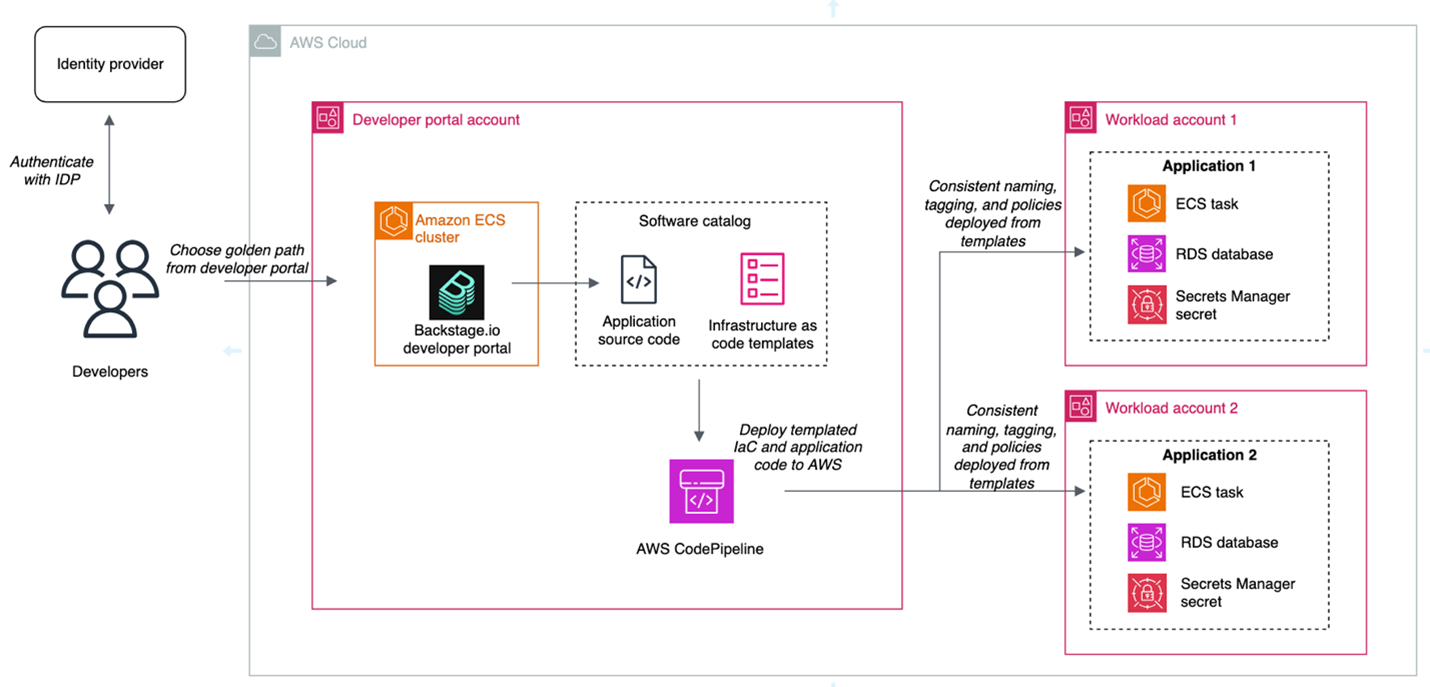
When deciding whether to centralize secrets creation, you should consider how you already deploy infrastructure in the cloud. Modern DevOps practices have driven some organizations toward developer portals and internal developer platforms that use golden paths for infrastructure deployment. By using tools that use golden paths, developers can deploy infrastructure in a self-service model through infrastructure as code (IaC) while adhering to organizational standards.
A central function maintains these golden paths, such as a platform engineering team. Examples of services that can be used to maintain and define golden paths might include AWS services such as AWS Service Catalog or popular open source projects such as Backstage.io. Using this approach, developers can focus on application code while platform engineers focus on infrastructure deployment, security controls, and developer tooling. An example of a golden path might be a templatized implementation for a microservice that writes to a database.
For example, a golden path could define that a service or application must be built using the AWS Cloud Development Kit (AWS CDK), running on Amazon Elastic Container Service (Amazon ECS), and use AWS Secrets Manager to retrieve database credentials. The platform team could also build checks to help ensure that the secret’s resource policy only allows access to the role being used by the microservice and is encrypted with a customer managed key. This pattern abstracts deployments away from developers and facilitates resource deployment across accounts. This is one example of a centralized creation pattern, shown in Figure 1.
Figure 1: Architecture diagram highlighting the developer portal deployment pattern for centralized creation
The advantages of this approach are:
Consistent naming tagging, and access control: When secrets are created centrally, you can enforce a standard naming convention based on the account, workload, service, or data classification. This simplifies implementing scalable patterns like attribute-based access control (ABAC).
Least privilege checks in CI/CD pipelines: When you create secrets within the confines of IaC pipelines, you can use APIs such as the AWS IAM Access Analyzercheck-no-new-access API. Deployment pipelines can be templatized, so individual teams can take advantage of organizational standards while still owning deployment pipelines.
Create mechanisms for collaboration between platform engineering and security teams: Often, the shift towards golden paths and service catalogs is driven by a desire for a better developer experience and reduced operational overhead. A byproduct of this move is that security teams can partner with platform engineering teams to build security by default into these paths.
The tradeoffs of this approach are:
It takes time and effort to make this shift. You might not have the resources to invest in full-time platform engineering or DevOps teams. To centrally provision software and infrastructure like this, you must maintain libraries of golden paths that are appropriate for the use cases of your organization. Depending on the size of your organization, this might not be feasible.
Golden paths must keep up with the features of the services they support: If you’re using this pattern, and the service you’re relying on releases a new feature, your developers must wait for the features to be added to the affected golden paths.
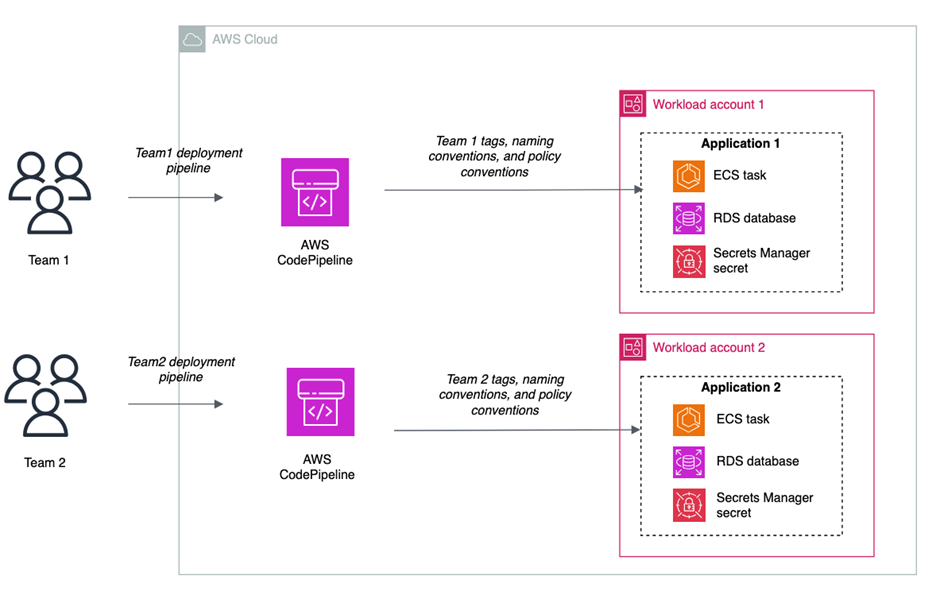
In a decentralized model, application teams own the IaC templates and deployment mechanisms in their own accounts. Here, each team is operating independently, which can make it more difficult to enforce standards as code. We’ll refer to this pattern, shown in Figure 2, as a decentralized creation pattern.
Figure 2: Decentralized creation of secrets
The advantages of this approach are:
Speed: Developers can move quickly and have more autonomy because they own the creation process. Individual teams don’t have a dependency on a central function.
Lack of standardization: It can become more difficult to enforce naming and tagging conventions, because it’s not templatized and applied through central creation mechanisms. Access controls and resource policies might not be consistent across teams.
Developer attention: Developers must manage more of the underlying infrastructure and deployment pipelines.
Centralized storage of secrets
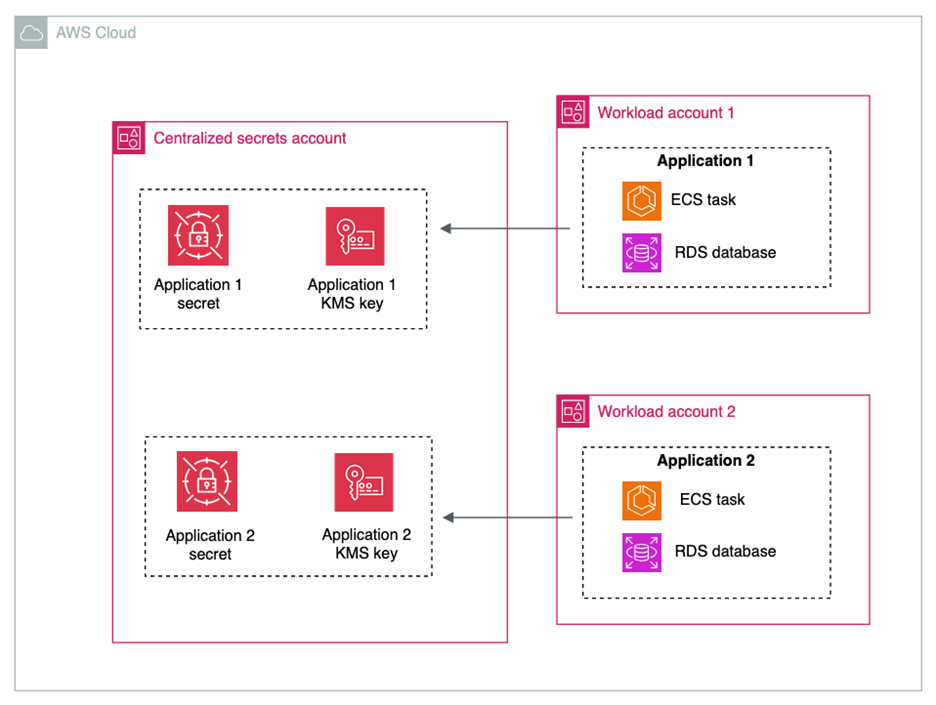
Some customers choose to store their secrets in a central account, and others choose to store secrets in the accounts in which their workloads live. Figure 3 shows the architecture for centralized storage of secrets.
Figure 3: Centralized storage of secrets
The advantages of centralizing the storage of secrets are:
Simplified monitoring and observability: Monitoring secrets can be simplified by keeping them in a single account and with a centralized team controlling them.
Some tradeoffs of centralizing the storage of secrets are:
Additional operational overhead: When sharing secrets across accounts, you must configure resource policies on each secret that is shared.
Additional cost of AWS KMS Customer Managed Keys: You must use AWS Key Management Service (AWS KMS) customer managed keys when sharing secrets across accounts. While this gives you an additional layer of access control over secret access, it will increase cost under the AWS KMS pricing. It will also add another policy that needs to be created and maintained.
High concentration of sensitive data: Having secrets in a central account can increase the number of resources affected in the event of inadvertent access or misconfiguration.
Account quotas: Before deciding on a centralized secret account, review the AWS service quotas to ensure you won’t hit quotas in your production environment.
Service managed secrets: When services such as Amazon Relational Database Service (Amazon RDS) or Amazon Redshift manage secrets on your behalf, these secrets are placed in the same account as the resource with which the secret is associated. To maintain a centralized storage of secrets while using service managed secrets, the resources would also have to be centralized.
Though there are advantages to centralizing secrets for monitoring and observability, many customers already rely on services such as AWS Security Hub, IAM Access Analyzer, AWS Config, and Amazon CloudWatch for cross-account observability. These services make it easier to create centralized views of secrets in a multi-account environment.
Decentralized storage of secrets
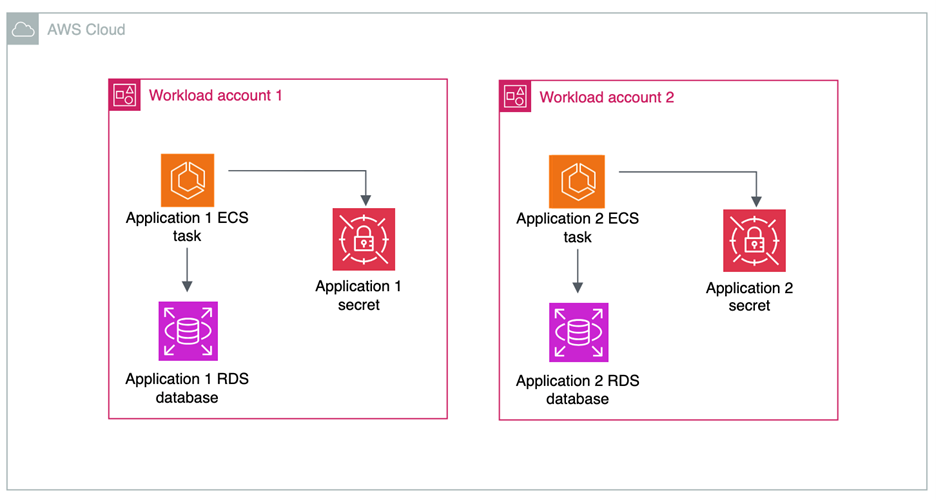
In a decentralized approach to storage, shown in in Figure 4, secrets live in the same accounts as the workload that needs access to them.
Figure 4: Decentralized storage of secrets
The advantages of decentralizing the storage of secrets are:
Account boundaries and logical segmentation: Account boundaries provide a natural segmentation between workloads in AWS. When operating in a distributed multi-account environment, you cannot access secrets from another account by default, and all cross-account access must be allowed by both a resource policy in the source account and an IAM policy in the destination account. You can use resource control polices to prevent the sharing of secrets across accounts.
AWS KMS key choice: If your secrets aren’t shared across accounts, then you have the choice to use AWS KMS customer managed keys or AWS managed keys to encrypt your secrets.
Delegate permissions management to application owners:When secrets are stored in accounts with the applications that need to consume them, application owners define fine-grained permissions in secrets resource policies.
There are a few tradeoffs to consider for this architecture:
Auditing and monitoring require cross-account deployments: Tools that are used to monitor the compliance and status of secrets need to operate across multiple accounts and present information in a single place. This is simplified by AWS native tools, which are described later in this post.
Automated remediation workflows: You can have detective controls in place to alert on any misconfiguration or security risks related to your secrets. For example, you can surface an alert when a secret is shared outside of your organizational boundary through a resource policy. These workflows can be more complex in a multi-account environment. However, we have samples that can help, such as the Automated Security Response on AWS solution.
Centralized rotation
Like the creation and storage of secrets, organizations take different approaches to centralizing the lifecycle management and rotation of secrets.
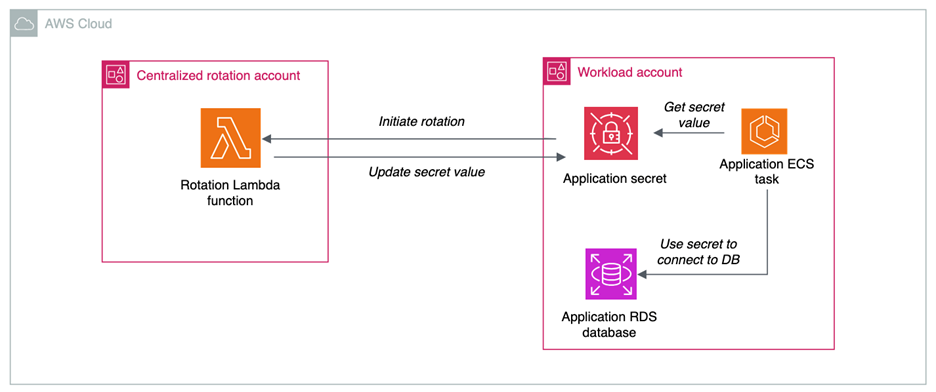
When you centralize lifecycle management, as shown in Figure 5, a central team manages and owns AWS Lambda functions for rotation. The advantages of centralizing the lifecycle management of secrets are:
Developers can reuse rotation functions: In this pattern, a centralized team maintains a common library of rotation functions for different use cases. An example of this can be seen in this AWS re:Inforce session. Using this method, application teams don’t have to build their own custom rotation functions and can benefit from common architectural decisions regarding databases and third-party software as a service (SaaS) applications.
Logging: When storing and accessing rotation function logs, the centralized pattern can simplify managing logs from a single place.
Figure 5: Centralized rotation of secrets
There are some tradeoffs in centralizing the lifecycle management and rotation of secrets:
Additional cross-account access scenarios: When centralizing lifecycle management, the Lambda functions in central accounts require permissions to create, update, delete and read secrets in the application accounts. This increases the operational overhead required to enable secret rotation.
Service quotas: When you centralize a function at scale, service quotas can come into play. Check the Lambda service quotas to verify that you won’t hit quotas in your production environments.
Decentralized rotation
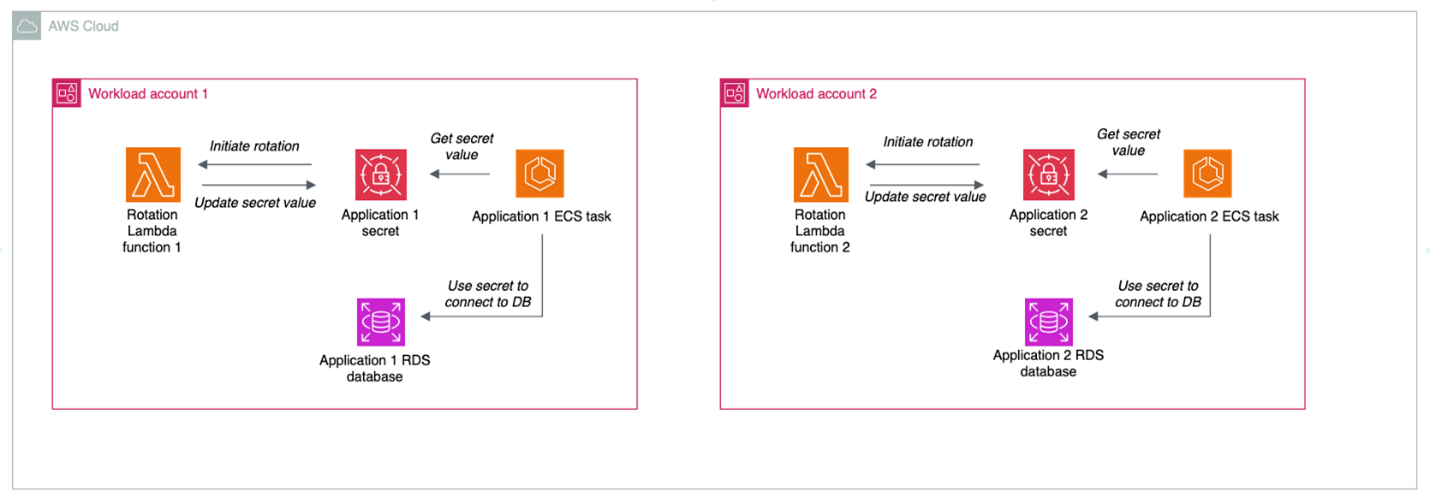
Decentralizing the lifecycle management of secrets is a more common choice, where the rotation functions live in the same account as the associated secret, as shown in Figure 6.
Figure 6: Decentralized rotation of secrets
The advantages of decentralizing the lifecycle management of secrets are:
Templatization and customization: Developers can reuse rotation templates, but tweak the functions as needed to meet their needs and use cases
No cross-account access: Decentralized rotation of secrets happens all in one account and doesn’t require cross-account access.
The primary tradeoff of decentralizing rotation is that you will need to provide either centralized or federated access to logs for rotation functions in different accounts. By default, Lambda automatically captures logs for all function invocations and sends them to CloudWatch Logs. CloudWatch Logs offers a few different ways that you can centralize your logs, with the tradeoffs of each described in the documentation.
Centralized auditing and monitoring of secrets
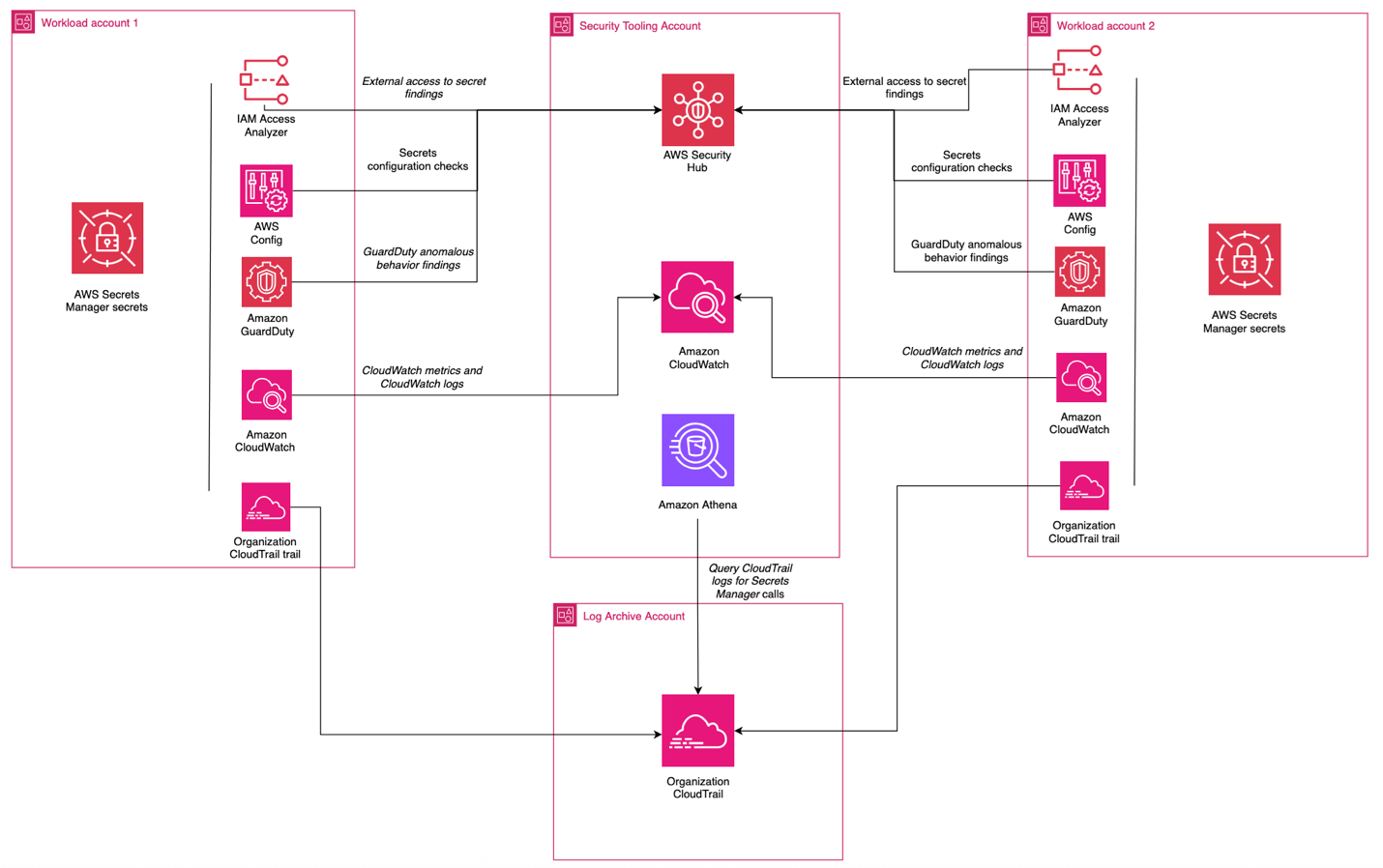
Regardless of the model chosen for creation, storage, and rotation of secrets, centralize the compliance and auditing aspect when operating in a multi-account environment. You can use AWS Security Hub CSPM through its integration with AWS Organizations to centralize:
In this scenario, shown in Figure 7, centralized functions get visibility across the organization and individual teams can view their posture at an account level with no need to look at the state of the entire organization.
For organizations that don’t require centralized auditing and monitoring of secrets, you can configure access so that individual teams can determine which logs are collected, alerts are enabled, and checks are in place in relation to your secrets. The advantages of this approach are:
Flexibility: Development teams have the freedom to choose what monitoring, auditing, and logging tools work best for them.
Reduced dependencies: Development teams don’t have to rely on centralized functions for alerting and monitoring capabilities.
The tradeoffs of this approach are:
Operational overhead: This can create redundant work for teams looking to accomplish similar goals.
Difficulty aggregating logs in cross-account investigations: If logs, alerts, and monitoring capabilities are decentralized, it can increase the difficulty of investigating events that affect multiple accounts.
Putting it all together
Most organizations choose a combination of these approaches to meet their needs. An example is a financial services company that has a central security team, operates across hundreds of AWS accounts, and has hundreds of applications that are isolated at the account level. This customer could:
Centralize the creation process, enforcing organizational standards for naming, tagging, and access control
Decentralize storage of secrets, using the AWS account as a natural boundary for access and storing the secret in the account where the workload is operating, delegating control to application owners
Decentralize lifecycle management so that application owners can manage their own rotation functions
Centralize auditing, using tools like AWS Config, Security Hub, and IAM Access Analyzer to give the central security team insight into the posture of their secrets while letting application owners retain control
Conclusion
In this post, we’ve examined the architectural decisions organizations face when implementing secrets management on AWS: creation, storage, rotation, and monitoring. Each approach—whether centralized or decentralized—offers distinct advantages and tradeoffs that should align with your organization’s security requirements, operational model, and scale. The important points include:
Choose your secrets management architecture based on your organization’s specific requirements and capabilities. There’s no one solution that will fit every situation.
Use automation and IaC to enforce consistent security controls, regardless of your approach.
Implement comprehensive monitoring and auditing capabilities through AWS services to maintain visibility across your environment.
Resources
To learn more about AWS Secrets Manager, check out some of these resources:
To provide the best experiences, we use technologies like cookies to store and/or access device information. Consenting to these technologies will allow us to process data such as browsing behavior or unique IDs on this site. Not consenting or withdrawing consent, may adversely affect certain features and functions.
Functional
Always active
The technical storage or access is strictly necessary for the legitimate purpose of enabling the use of a specific service explicitly requested by the subscriber or user, or for the sole purpose of carrying out the transmission of a communication over an electronic communications network.
Preferences
The technical storage or access is necessary for the legitimate purpose of storing preferences that are not requested by the subscriber or user.
Statistics
The technical storage or access that is used exclusively for statistical purposes.The technical storage or access that is used exclusively for anonymous statistical purposes. Without a subpoena, voluntary compliance on the part of your Internet Service Provider, or additional records from a third party, information stored or retrieved for this purpose alone cannot usually be used to identify you.
Marketing
The technical storage or access is required to create user profiles to send advertising, or to track the user on a website or across several websites for similar marketing purposes.