До 29-ти септември в полунощ българите зад граница могат да подават заявления за гласуване в секциите в чужбина. Дори с последните промени в Изборния кодекс тези заявления са особено важни предвид рекордно ниския брой автоматично одобрени секции, с които бяхме свикнали на предходните няколко вота.
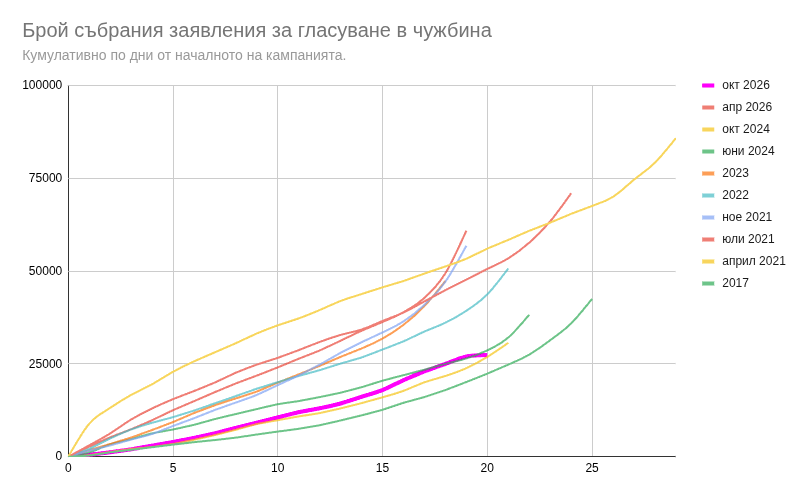
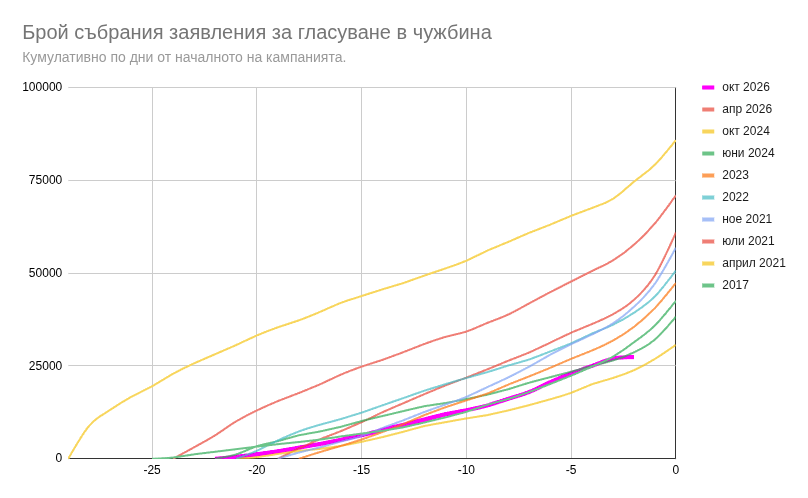
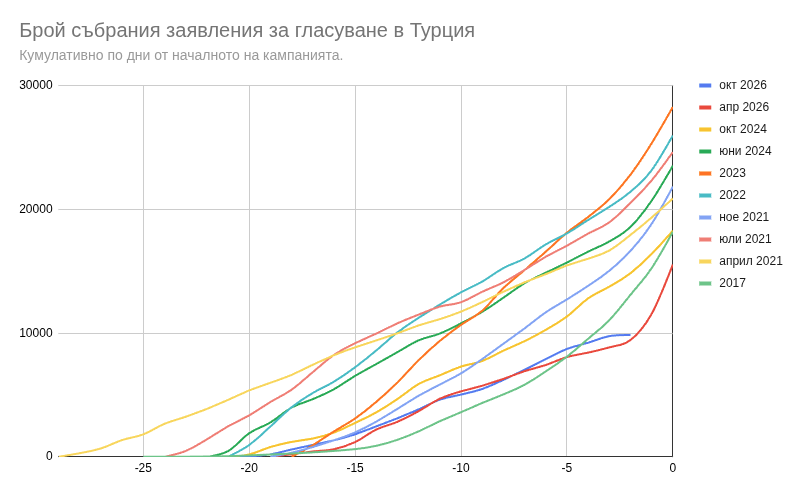
На 15-ти септември писах за напредъка в рамките на първата седмица. Преди това писах защо е важно, а през март – често за срещани грешки в попълването. Два дни и половина преди крайния срок има около 27500 подадени заявления. Това е рекордно малък брой спрямо последните десет години като изключим изборите през октомври 2024, когато имаше много автоматично обявени секции и заявленията не бяха толкова важни за отварянето им.
Сравнение на броя заявление към 20-ти я ден от подаването им като кампаниите са с различна продължителностСравнение на броя заявления спрямо дни преди крайния срок
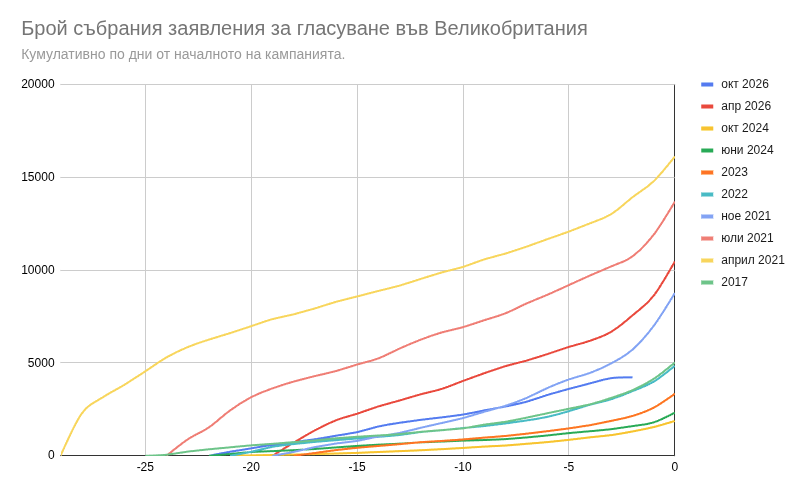
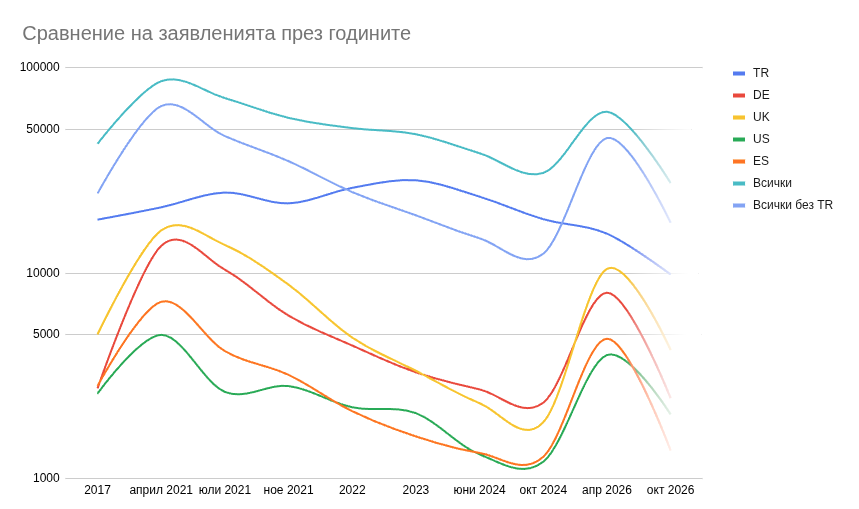
Сега обаче ситуацията е различна особено за българите извън Европейския съюз, където се отварят секции само в дипломатическите представителства или със заявление. Във Великобритания виждаме сравнително висока активност спрямо вотовете между 2022 и 2024, но двойно и тройно по-ниска от изборите през април 2026 и тези през 2021-ва.
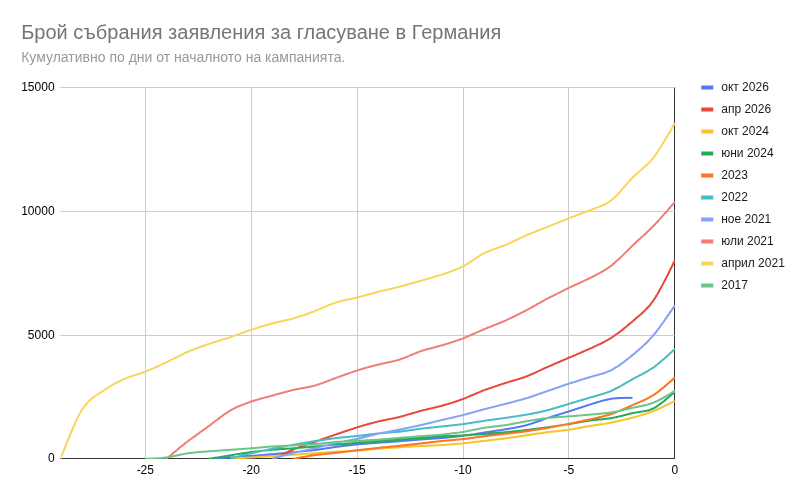
В Германия картината е подобна, но говорим за два до пет пъти по-малко от годините със силна активност. В Германия се очаква да има по-малко секции от минали години по тази причина.
Както съм показвал преди, кривите на активността на подаване на заявления в Турция традиционно са различни от всички други държави. Това е индикация за различно поведение. През двата вота тази година обаче това не е така. Освен, че има значително по-малко заявления, активността следва траекторията на всички останали български диаспори.
Предварително сравнение на броя заявления между изборите в последните 10 години показва, че ще има значително намаление не само спрямо април, но и спрямо предишните президентски избори. Вижда се ясно намалението в активността в Турция от 2023 до сега. Заради промените в Избирателния кодекс има повече активност в САЩ и Великобритания, видимо доста по-малко от април.
Когато завърши кампанията и обявят секциите зад граница, ще направя нова карта с тях и адресите им. Виждам, че МВнР готви вече своя карта, което е добре. Ще пусна и съвети и обяснение за казуси особено предвид, че има значителна несигурност за гласуването в чужбина при балотажа. Забелязах обаче и притеснителни индикации, че са си решили къде да са секциите в чужбина още преди диаспорите ни да имат възможност да заявят желанието си и да се организират. За сега това е само съмнение, което се надявам да отхвърля когато публикуват решението за секциите.
This week Qualcomm unveiled its next generation of high-end mobile SoCs: Snapdragon 8 Elite Gen 6, and Elite Extreme Gen 6. The flagship chips bring a slew of new features to the table, including new Oryon CPU cores, GPU matrix cores, and LPDDR6 support
Version 18.1 of the GDB interactive debugger has been released. Changes
include new commands to manipulate the environment of the subprocess, the
ability to save the command history to a file, support for a couple of new
targets, several Python API additions, and more. See the
NEWS file for the complete list.
В края на миналото хилядолетие дядо ми на шега наричаше комшиите, насядали „на мохабет“ по пейките пред домовете си, „радио Фустанела“. С други думи, на тази жива „медия“ не можеше и не трябваше да се вярва, защото 90% от съдържанието ѝ беше изопачена информация, клюки, интриги и градски легенди. Но какво да се прави, по онова време интернетът все още беше оскъден, мобилните телефони не бяха по/в джоба на всеки, а и имаха копчета като на пишеща машина за сметка на голям екран.
Сега интернетът е в пъти повече от водата през лятото в някои райони на България. А според безплатния ми домашен ИИ българинът прекарва средно между 25 и 30 часа седмично онлайн, като около 17 от тях са посветени на социално „мрежуване“ (рядка дума, заловена за ушите от Павлина Върбанова). Ако дядо ми беше жив, щеше да се изуми какво завидно национално покритие е постигнала тази развъртяна новотехнологична „фустанела“.
Наскоро, скитайки се из Гърция, забелязах как интернетът там – и по туристически места, и по не дотам… – хич го няма, а като го има, си казваш „по-добре да го нямаше“, защото непрекъснато прекъсва. И какво правят хората без интернет, ще попитате. Ами добре са, пият кафе и узо, говорят си, разлистват вестници, списания и книги на хартия. Като ги попиташ нещо, те гледат в очите, отговарят, без да бързат, палците им не потрепват невротично, нетърпеливи за следващия скрол. С всичко това ни най-малко не искам да омаловажа положителната роля на интернет. Но ако дозата прави отровата, то, струва ми се, отдавна сме предозирали. На всичкото отгоре ефектите от предозирането са видими на много нива:
1) Бързият и относително евтин интернет в България ни даде поне по една допълнителна квалификация. Всички вече сме половин доктори, една трета политолози, почти завършени криминални психолози и напълно завършени философи, педагози и историци, най-често без да сме образовани в нито една от гореизброените области.
2) При непрестанния приток на разнопосочна информация въпросът дали тя е проверена, или не, престава да има особено значение. Защото непроверената информация ни освобождава от необходимостта да поемаме отговорност за думите, които самите ние хвърляме в мрежата. Та нали всичко се превръща в стръв. И чудна работа – рибата кълве ли, кълве.
3) Парадоксално започнахме да вярваме на всякакви небивалици, но заедно с това да не вярваме на нищо, дори на собствените си очи. Така освен трайно недоспали постепенно се превръщаме в недоверчиви, недоволни, неразбрани, недооценени и като цяло неприятни хора. А в крайна сметка – и дълбоко неинформирани. Само че идват избори. И това да сме такива, в каквито се превърнахме – заспали лапнишарани, – върши чудесна работа на някои стари рибари, които са в час както с някогашното мрежуване, така и със сегашния нетуъркинг.
Пресен е примерът с изборите в Германия, където интернет платформи се превърнаха в трибуни на предизборните кампании, ускориха поляризацията, отнеха от силата на центъра и доведоха до ярко разделение на политическата карта – радикалнолеви в Берлин, крайнодесни в източните провинции. И ако „Алтернатива за Германия“ се окопа в TikTok, YouTube и X, левите заложиха на Instagram, Telegram и локални блогове. У нас като че ли липсва такава дигитална стратификация и както обикновено, газим в добре познатия ни повсеместен мишмаш. Но това, че ни е добре познат, не го прави по-малко опасен… Та затова в края на лятото стигам до следния извод: повече кафе, узо и разговори на живо, по-малко скрол. Повече четене на дълги текстове (над 8000 знака), по-малко скрол. Повече засаждане на растения (ей сега иде времето на лалетата и зюмбюлите), по-малко скрол. И без това влизаме в сезона на мъглите, нека поне разсеем мозъчните.
И да, ако четете „Тоест“, няма да сгрешите. „Тоест“ също е в интернет, но текстовете, които публикуваме, миришат на мастило, проверени са всякак и отвсякъде и плуват в свободни води, незасегнати от ловно-рибарския медийно-политически сезон. Подкрепете ни (вижте бутона най-долу), за да продължим да развиваме този малък резерват на разума, активното гражданство и добрия вкус.
В началото на лятото писах тук за боклука в курортните ни градове. Виждам, че това е и една от темите на Веселин Златков в неговите „6 раздувки за варненското лято 2026“.
Боклук, затруднен достъп до града, високи цени, отблъскваща миризма и лоша храна. Какво повече му трябва на човек за един гарантиран летен кошмар? А, да, хейт, злоба, агресия… И това го имаме в изобилие. Остава ни със стаен ужас да очакваме какво ще ни донесе лятото на 2027-ма – на нас и на клетите туристи, които ще се изсипят покрай „Евровизия“.
„Красота и катастрофа“ – така би могъл да се казва текст за днешна Варна (а и за други български градове), но всъщност става дума за един фикционален Париж от може би най-награждаваната видеоигра за всички времена –„Светлосянка: Експедиция 33“. В този брой Миглена Николчина и Северина Станкева продължават разговора си за нея и ни обнадеждават, че останалото в миналото велико изкуство
може да бъде преродено в различни форми, включително във виртуалния свят на игрите, където да продължи съществуването си в тази нова естетическа вселена.
Нашата стара вселена обаче продължава да крие големи тайни, една от които е възможността за съществуване на извънземен разум. Убедена съм, че със или без интернет, всеки би могъл да пусне пет стотинки по тази тема: едно ще кажат учените, друго – ясновидците, трето и четвърто – религиозните авторитети. В нашия случай нещото го казва Атанас Шиников в продължението на текста си „Господът на световете“. Извънземни и ислям“. На мен лично ми хареса връзката между извънземни и джинове. Възнамерявам да си я запазя за частни творчески проекти.
За разлика от сложно доказуемата връзка между извънземни и ислям, връзката между съвременните демокрации и избирателните системи е видима с просто око. През ноември са междинните избори в САЩ и Йоанна Елми посвещава на тях брой 18 от бюлетина „Гласовете на Америка“. Доверието в Тръмп изглежда поразклатено, макар и не сринато, но заедно с това се наблюдава отлив на подкрепата и за двете партии по отношение на определени болни теми, например развитието на изкуствения интелект. И изобщо, ставаме свидетели на интересна тенденция:
реалното усещане за реалните проблеми и реалните последствия като обединяващо избиратели от двата края на политическия спектър.
Дали подобна тенденция ще моделира изхода от предстоящите президентски избори у нас, предстои да видим. На първо четене свиващата се като неправилно изпран вълнен пуловер партия ГЕРБ се цепи по оста Йотова–Гюров, която пък в голяма степен се припокрива с оста проруска–проевропейска ориентация. Доколко ГЕРБ все още е лидерска формация или вече е подвластна на центробежни сили, ще се разбере вероятно едва на балотажа. Повече за тези процеси четете в седмичния анализ на Емилия Милчева „Анатомия на едно разпадане“.
Но до изборите има още няколко седмици, в които да помислим – с главите си, а не с колективния интернет разум – кой от кандидатите какво ни казва и защо. А междувременно, докато вадим есенните шлифери и усещаме с кожата си липсата на
пастьозното зелено на смокините и матовото синьо на небето,
може да прочетем стихотворението на месеца. Казва се „Полуостров“, а авторката е Боряна Кацарска. С него ви напомняме, че с добрата литература никога не сме самотни острови, а най-малкото ставаме част от архипелази, което пак си е нещо, особено в сезона на нахлупените ушанки и замръзналите носове.
I feel like someone who reads this blog will want to go to this:
Families are invited to dive into the fascinating world of marine biology during an exciting, hands-on Family Squid Dissection at the Hands-On Science Center. Designed for curious learners of all ages, this unique experience combines an interactive lesson with the opportunity to explore the anatomy and adaptations of real ocean life.
[…]
During the guided squid dissection, each family will work together to examine a squid up close, exploring its organs, structures, and specialized features. The experience provides a memorable opportunity for children and adults to see firsthand how the anatomy of a squid helps it survive in its underwater environment.
If you go, take pictures.
As usual, you can also use this squid post to talk about the security stories in the news that I haven’t covered.
The launch of AMD’s next-gen EPYC 9006 processors is quickly approaching. Today we are looking at AMD’s complete 6th gen EPYC lineup, and what to expect from the company between now and late 2027
Organizations that have been around for a while usually run two identity systems side by side. One belongs to the cloud provider: IAM roles, instance profiles, execution roles. The other is your own, and it is the one your internal services actually check when they decide whether to answer a request.
On infrastructure you build yourself, you can bootstrap your own identity however you like. On managed compute you cannot. The provider hands your process a cloud identity and nothing else.
This post describes how we close that gap for Apache Spark workloads running on Amazon EMR. A workload that starts with only an AWS identity has to end up holding a first-class internal identity. Doing the exchange is straightforward. Making it trustworthy is the part that took the design work. Very little of what follows is specific to Spark or to EMR.
Two identity systems
Internal service-to-service authentication at Netflix runs on a private PKI called Metatron. Every workload gets a short-lived X.509 certificate, and services authenticate each other with mutual TLS. A workload cannot simply ask for a certificate. It is issued only after the identity service has satisfied itself that the requester really is the workload it claims to be. That verification step is called attestation. In each environment we support (VMs, containers, functions) attestation rests on some environment-specific proof that the platform can check on its own.
The second concept is the Data Project, which is our unit of ownership for data. A Data Project owns tables, has a set of authorized users, and has an identity of its own. Jobs run as the Data Project rather than as the person who launched them. That is what keeps table-level access control and audit consistent across scheduled and interactive use.
So the problem is this. A Spark job on managed compute starts with an AWS execution role and no internal identity. Everything it needs from inside the company (reading an encrypted column, evaluating table ACLs, holding an interactive session open longer than a short-lived token lasts) requires the internal one.
One identity, one role
The design rests on a decision made outside the Spark stack entirely. Each Data Project identity maps 1:1 to a dedicated IAM role, and the service that owns Data Project metadata records that mapping.
The mapping is what makes translation possible. It lets a statement in the provider’s vocabulary (“this process is running as role R”) become a statement in ours (“this process is workload W”). Without it there is nothing to translate into, and no amount of cryptography helps. The hard part of bridging two identity systems is rarely the protocol. It is committing to a mapping and then keeping it authoritative.
One practical objection arrives immediately. A single AWS account cannot hold tens of thousands of IAM roles, and we expect data projects in the order of ten thousands. We handled this by sharding data project roles deterministically across a small pool of dedicated accounts, which scales well past the projected number of projects and has the useful side effect of keeping workload roles on the far side of an account boundary from the control planes that launch them.
Components
Five components take part.
The control plane is the only service allowed to launch Spark jobs. It resolves the Data Project’s IAM role, builds and signs a workload metadata payload, and submits the job with that role as the execution role. It holds a signing key issued to it for this purpose alone.
The Data Project service is the authority for the identity-to-role mapping.
The Identity service receives attestation requests, verifies them, and issues certificates.
A Spark plugin provides the hook. Spark 3.0+ added a plugin interface with driver-side and executor-side components that are initialized while those processes are bootstrapping.
AWS STS acts as a notary, which is not its usual job.
Step one: the control plane makes a signed claim
When a job is submitted, the control plane validates the caller, looks up the Data Project’s IAM role, and builds a small payload describing the workload it is about to launch. The payload names the application identity, the mapped role, and the environment, stack and detail that the resulting credentials should be scoped to. The control plane signs the payload and passes it and the signature through as ordinary job configuration.
Two properties of this step matter. First, only one service can produce a valid signature, so the set of things that can assert “this workload is legitimate” is small and auditable. Second, the payload is a claim rather than an authority. On its own it proves nothing, because job configuration travels through infrastructure we do not fully control and anything that can read it can replay it.
Step two: the workload proves it holds the cloud identity
When the managed service launches the driver process, it does so under an OS user that has the execution role’s credentials available. The driver-side plugin initializes and uses those credentials to sign, but not send, a request to the provider’s identity endpoint (sts:GetCallerIdentity). The result is a short-lived pre-signed URL.
That URL is a transferable proof of possession. Anyone can fetch it. Only the holder of the role’s credentials could have produced it. And the response comes from AWS rather than from the workload, stating which role signed the request. The workload cannot lie about the answer because the workload does not supply the answer.
The pattern is not new. It is the same idea behind AWS IAM authentication in HashiCorp Vault and in AWS’s own function attestation flows. It generalizes well: any environment that gives a process cloud credentials and nothing else can still produce a verifiable statement about its own identity.
The plugin sends one attestation request carrying both artifacts, the pre-signed URL and the signed metadata.
Step three: corroboration
The identity service does four things.
It fetches the pre-signed URL against AWS STS and reads back the role that signed it. This is the provider’s statement.
It verifies the metadata signature against the key issued to the control plane. This is the platform’s statement.
It corroborates the two. The role AWS reports must be the role the control plane said it dispatched, for the identity the metadata names.
It issues certificates for that identity, scoped to the environment, stack and detail from the signed metadata.
Step 3 is the point of the whole design. Neither statement is sufficient by itself, and they fail in complementary ways. The provider’s statement is unforgeable but under-specified: it gives you a role, and a role is not a workload. It says nothing about why this process exists or what it should be allowed to be. The platform’s statement is well-specified but unverifiable on its own, for the reasons above. Put together, the signature says the workload was legitimately dispatched and the pre-signed URL says this really is it. Neither party has to trust the workload’s own account of itself.
There is a tension here that we settled deliberately, and other teams should expect to meet it. The provider’s answer identifies a role, not an application. Deriving an application name from a role name is fragile string matching, and the session identifiers the platform assigns are not under our control. We chose to take the application identity from the signed metadata and use the provider’s answer only for corroboration. That costs a network round trip and a stricter signing requirement, and it buys a much clearer trust story.
The fan-out problem
A Spark application is one driver and up to thousands of executors, created and destroyed throughout the life of a job. Attestation designed around one process per host does not survive that.
There are two defensible answers.
In the first, each executor attests independently. This is uniform, adds no new trust boundary, and grounds every process’s identity in the same provider-verified proof. The cost is amplification. One large job can produce thousands of STS calls and thousands of attestation requests in a burst, which looks a lot like an attack and creates a hard dependency on provider-side rate limits.
In the second, executors inherit credentials from the driver. The driver attests once and distributes credentials to executors over Spark’s internal RPC, which we configure with authentication and AES-GCM encryption so that only processes in the same application can take part. Load on the identity service stays constant. The cost is a second trust boundary and a driver that is now a credential distribution point.
Considering our scale at Netflix here we went with the second approach. The general lesson is that identity amplification is a capacity question, and it is better to answer it on purpose than to have it answered for you during an incident.
Lifecycle
Certificates are short-lived by design, so bootstrapping is only half the work. On self-managed hosts a system service handles renewal. Inside managed compute there is no equivalent hook, so the driver JVM runs a timer that re-attests on a fixed interval, well ahead of expiry. Credential material is written to a temporary directory readable only by the process owner and removed when the process exits.
Executors do not refresh. They are usually short-lived, and an executor that somehow outlives its credentials can exit and be replaced, which is cheaper than making every executor a renewal client.
The rule worth carrying into any similar system is that attestation has to be a repeatable operation rather than a bootstrap step. Anything that can only happen once at process start will eventually be the reason a long-running job dies nine hours in.
Why this generalizes
If you run your own identity system and are moving workloads onto managed compute, the specific services here matter less than the shape of the solution.
Anchor on one exchangeable primitive. A single authoritative 1:1 mapping between your identity and a provider identity is what makes translation possible. The rest is plumbing.
Require two independent claims and corroborate them. One from the provider, unforgeable and under-specified. One from your control plane, well-specified and replayable. Trust the intersection and never either alone.
Keep the signer scarce. If exactly one service can make the platform’s claim, your trust story fits in a sentence.
Hook the layer you still own. On managed compute you rarely control the host or its init system, but you almost always control the runtime: a plugin, an agent, an entrypoint. Attestation belongs there.
Decide the amplification policy on purpose. Distributed engines multiply every per-process operation by their parallelism.
Make attestation repeatable and credentials short-lived. Renewal is a requirement, not a follow-up.
What makes the result trustworthy is that no single participant issues an identity by itself. Not the workload, not the control plane, not the provider. And the workload, which is the party in the weakest position to be trusted, is never asked to vouch for itself.
Acknowledgements
Thanks to Amer Hesson for the Data Project abstraction, Nick Siow for the Data Project IAM role sharding, and Doug Clark for Metatron attestation.
To provide the best experiences, we use technologies like cookies to store and/or access device information. Consenting to these technologies will allow us to process data such as browsing behavior or unique IDs on this site. Not consenting or withdrawing consent, may adversely affect certain features and functions.
Functional
Always active
The technical storage or access is strictly necessary for the legitimate purpose of enabling the use of a specific service explicitly requested by the subscriber or user, or for the sole purpose of carrying out the transmission of a communication over an electronic communications network.
Preferences
The technical storage or access is necessary for the legitimate purpose of storing preferences that are not requested by the subscriber or user.
Statistics
The technical storage or access that is used exclusively for statistical purposes.The technical storage or access that is used exclusively for anonymous statistical purposes. Without a subpoena, voluntary compliance on the part of your Internet Service Provider, or additional records from a third party, information stored or retrieved for this purpose alone cannot usually be used to identify you.
Marketing
The technical storage or access is required to create user profiles to send advertising, or to track the user on a website or across several websites for similar marketing purposes.