Experience CS: a new way to teach computer science

Post Syndicated from Philip Colligan original https://www.raspberrypi.org/blog/experience-cs-a-new-way-to-teach-computer-science/

I am delighted to announce Experience CS, a free, integrated computer science curriculum for elementary and middle school students (8–14 years old) that will be available in June 2025. 

Experience CS enables educators to teach computer science through a standards-aligned curriculum that integrates computer science concepts and knowledge into core subjects like maths, science, languages, and the arts. 

An educator helps students with a coding task.

This cross-curricular and integrated approach is one of the most effective ways to provide younger students with an introduction to computer science and is increasingly important as the impact of digital technology reaches every corner of our lives. We also know that embedding CS in real-world contexts helps make it meaningful and relevant for students, which is essential if we are going to inspire kids from different backgrounds to want to learn more about computer science and technology. 

Built by educators, for educators 

The team behind Experience CS includes educators with significant experience of teaching CS in elementary and middle school settings and everything we do is being informed by the world’s leading research into effective pedagogy as well as extensive testing and research in classrooms. This won’t stop when we launch. We will continue to develop and improve the curriculum and resources in response to feedback from teachers and students. 

Two students use computers in a classroom.

One of the most important design principles for Experience CS is that it can be used by any educator. You don’t need a CS qualification or any previous experience in teaching CS classes to deliver engaging and creative learning experiences for your students. 

We will provide lesson plans, classroom resources, and an online platform that is designed to be easy and safe to use. We will also provide educators with professional development to help build their confidence, knowledge, and skills. You don’t need to adapt or amend the resources to use them, but you will be able to if you want to. We trust teachers to know what is best for their classrooms.

A creative and safe learning experience 

Crucially, Experience CS will be a creative learning experience. We’ve all seen those apps and platforms that purport to teach computer science by having young people direct their favourite pop culture character around a maze. While those types of games can be fun, we think that they fail to convey the creative potential of computer science and leave more students feeling “why bother” rather than being inspired to learn more. 

That’s why Experience CS includes self-directed creative projects using the popular programming platform Scratch, with clear instructions and endless opportunities for young people to express themselves creatively. 

Students use their laptops in a classroom, supervised by a teacher.

We know that online safety is the most important consideration for schools, teachers, and parents, which is why we have built a version of Scratch that is safe for schools. That means it won’t have the community and sharing features that are so central to the full Scratch platform. It will come with simple and intuitive classroom management features that enable teachers to create accounts, set assignments, review progress, and provide feedback to students. 

Free forever, for everyone

Our promise is that Experience CS will be available for teachers and students anywhere in the world to use for free, for as long as you need it. 

Initially, we are developing the curriculum and resources for the US and Canadian education systems and we will be mapping the lessons to national and local standards in both countries. The materials will all be available in English, French, and Spanish. We will also be focusing our professional development and support for schools in the US and Canada, including working with a fantastic network of educational partners. 

Building on the legacy of CS First 

We are delighted that Experience CS is supported by Google and that we are able to build on the fantastic work that they have done over many years to support educators and students through CS First. 

Google has today announced that CS First will no longer be available from June 30, 2025 and that they are recommending that their users should move over to Experience CS for the next school year. That is a huge vote of confidence from a team that really knows what they are talking about. I want to pay tribute to everyone at Google who has worked so hard over the years to support teachers and inspire students through CS First. 

We are looking forward to working with all of the CS First community to make sure that you are supported through the transition and set up ready to go for the start of the new school year. You can find out more about the support we will be offering by registering here.

The post Experience CS: a new way to teach computer science appeared first on Raspberry Pi Foundation.

Announcing the AWS CDK L2 Construct for Amazon Cognito Identity Pools

Post Syndicated from Adam Keller original https://aws.amazon.com/blogs/devops/announcing-the-aws-cdk-l2-construct-for-amazon-cognito-identity-pools/

Today we’re announcing the general availability (GA) of the new Amazon Cognito Identity Pool Level 2 (L2) construct in the AWS Cloud Development Kit (AWS CDK). This construct simplifies the creation and management of identity pools, permissions, and provider integrations by providing intent-based APIs that help users securely manage their authenticated and unauthenticated (guest) users across multiple identity providers (such as Amazon Cognito user pools, social providers like Facebook or Google, OpenID Connect, and more).

Background

The AWS CDK is an open-source software development framework that allows you to define cloud infrastructure using familiar programming languages, such as TypeScript, Python, Java, C#, and Go. The CDK provides various levels of abstraction through Constructs, which are reusable cloud components. Constructs come in three levels:

  • L1 constructs: Lowest level of constructs that are automatically generated from AWS CloudFormation resource specifications and offer no abstraction. They provide a one to one mapping to CloudFormation and can be verbose.
  • L2 constructs: Curated, high level abstractions that provide sensible defaults and reduce boilerplate code and glue logic with intuitive, intent-based APIs, making infrastructure provisioning more straightforward.
  • L3 constructs: Opinionated patterns that encapsulate multiple resources for a specific use case (for example, an entire web application stack).

Previously, developers who wanted to create Cognito Identity Pools in their CDK applications often had to work directly with L1 CloudFormation resources (for example, CfnIdentityPool and CfnIdentityPoolRoleAttachment). This led to verbose code, manual IAM role handling, and less intuitive support for multiple identity providers. The developer was responsible for all of the glue logic required when connecting Identity Pools to other AWS resources , creating IAM roles and policies and provider references on your own, which introduced more complexity.

The new AWS CDK Cognito Identity Pool L2 construct provides the following out of the box:

  • An easy way to create and manage authenticated and unauthenticated roles and permissions.
  • Built-in support for a variety of identity providers, including social providers, Amazon Cognito user pools, OpenID Connect providers, and others.
  • A high level API that reduces the amount of code and complexity required to manage the lifecycle of your identity pool.

By using this new L2 construct, you can focus on developing your application rather than the intricacies of wiring up roles, trust relationships, and provider configurations.

Using the L2

Let’s walk through an example of creating a new Cognito Identity Pool. In addition to creating the Identity Pool, we will create a Amazon DynamoDB table and then we’ll show you how to grant different levels of access for authenticated and unauthenticated users.

Create the DynamoDB Table and Cognito Identity Pool

// Create an identity pool
const identityPool = new IdentityPool(this, 'MyIdentityPool', {
    identityPoolName: 'MyIdentityPoolName',
   // Enable unauthenticated identities, disabled by default, 
   // enabling here for demonstration purposes 
   allowUnauthenticatedIdentities: true
});

// Create a new DynamoDB table
const myTable = new TableV2(this, 'MyTable', {
    partitionKey: { name: 'id', type: AttributeType.STRING },
    billing: dynamodb.Billing.onDemand()
});
// Grant read/write access on the table to authenticated users
myTable.grantReadWriteData(identityPool.authenticatedRole);

// Grant read only access to unauthenticated (guest) users
myTable.grantReadData(identityPool.unauthenticatedRole);

Let’s highlight a few key points:

  1. Single Declaration: By declaring an IdentityPool construct, you automatically get a role for authenticated users and one for unauthenticated users; however, by default, the construct disables guest access and only allows authenticated users. To enable unathenticated identities (guest access), you can set the allowUnauthenticatedIdentities parameter to true.
  2. Role and Policy Creation: You don’t have to manually define policies and roles, attach them or configure trust relationships. The L2 construct sets all of this up for you.
  3. Providers: You can specify a variety of identity providers (e.g., Google, Facebook, Amazon, Twitter, OpenID Connect, or Cognito user pools) in the authenticationProviders property.
  4. Permissions: With the roles exposed (identityPool.authenticatedRole and identityPool.unauthenticatedRole), you can easily grant or restrict fine-grained AWS resource permissions.

Multiple Authentication Providers

When using multiple providers, pass in the relevant configuration details. For example, to enable sign-in via Facebook and Google, you can provide:

const identityPool = new IdentityPool(this, 'MyIdentityPool', {
  authenticationProviders: {
    facebook: { appId: 'your-facebook-app-id' },
    google: { clientId: 'your-google-client-id' },
  },
});

The L2 takes care of generating the correct roles, trust relationships, and identity provider references behind the scenes.

Considerations for Moving to the New Construct

  1. Upgrade Path: If you currently use the L1 resources (CfnIdentityPool, CfnIdentityPoolRoleAttachment, etc.), you can migrate to the L2 construct by replacing those L1 declarations with the new IdentityPool L2. Adjust any references to custom roles or attachments to leverage the provided authenticatedRole and unauthenticatedRole properties.
  2. Compatibility: Verify the version of your AWS CDK. This L2 is available in newer CDK releases (check the changelog for specifics).
  3. Customization: If you have very specific or advanced requirements, like custom IAM conditions or policy statements, you can still refine or override the default roles or attach custom policies using the roles exposed by the L2.
  4. Alpha to GA Changes: Verify any potential feature limitations or changes in the API from the alpha to stabilized (GA) versions of the construct.

Conclusion

We’re thrilled to introduce the AWS CDK Cognito Identity Pool L2 construct, which simplifies identity pool setup and management. By leveraging a higher level API, you reduce the complexity of configuring roles and providers for your application’s user base. Whether you’re supporting social logins, guest access, or both, this new construct empowers you to build secure and scalable applications more quickly.

We invite you to get started with the Cognito Identity Pool L2 construct in your AWS CDK projects. For more information and examples, visit the AWS CDK GitHub repository and the official AWS CDK documentation. Feedback is also very important to us, so please create an issue in GitHub for any bugs or feature requests. We look forward to seeing how this new construct helps you streamline your authentication workflows and deliver exceptional user experiences.

How engineers can use one-on-ones with their manager to accelerate career growth

Post Syndicated from Dalia Abuadas original https://github.blog/developer-skills/career-growth/how-engineers-can-use-one-on-ones-with-their-manager-to-accelerate-career-growth/


One-on-one meetings with your manager are one of the most valuable tools you have for career growth, problem-solving, and unlocking new opportunities. So if you’re only using them to provide status updates, you’re leaving a lot on the table.

I didn’t fully realize this potential until I mentioned in a one-on-one that I was interested in mentorship and growing my leadership skills. Not long after, I was asked to co-lead a project with an intern to build an internal tool that helped surface enterprise configuration details. This gave me the opportunity to take technical ownership on a project while mentoring someone in a real-world context—both of which pushed me outside my comfort zone in the best way. That experience made it clear: When used intentionally, one-on-ones can open doors you didn’t even know were there.

Many engineers treat one-on-ones as a low-stakes standup: reporting work, mentioning blockers, and getting general feedback. While that can be useful, it barely scratches the surface of what these meetings can accomplish. Instead, think of them as a system design review for your role—a time to debug challenges, optimize your workflow, and align on long-term career goals.

Reframing your perception of what a one-on-one can accomplish

A well-structured one-on-one meeting with your manager isn’t just a check-in, it’s an opportunity to shape your work environment and career trajectory. You wouldn’t build a system without evaluating its constraints, dependencies, and long-term maintainability. Why approach your career any differently?

Start by shifting your mindset: These meetings are not status updates. Your manager already sees your pull requests, sprint velocity, and planning docs. Instead, use this time to highlight what matters—what you’ve shipped, the value it’s delivered, and where the friction is.

You can also use this space to validate decisions and gather context. If you’re weighing different paths forward, don’t just ask for approval—frame the conversation in terms of trade-offs:

“Here are the pros and cons of refactoring this service now versus later. How does this align with our broader business goals?”

Treat your manager like a decision-making API: Feed in the relevant signals, surface what’s unclear, and work together on an informed response.

Use one-on-ones for career versioning (even before you’re “ready”)

One-on-one meetings are a great time to discuss your long-term career growth—even if you’re not actively seeking a promotion. Instead of waiting until promotion season, start having these conversations early to build clarity, direction, and momentum over time.

  • If you’re more than a year away from seeking a promotion, start talking to your manager about:
    • Where am I already meeting expectations?
    • Where should I focus on strengthening my skills?
  • If you’re approaching the next level or considering going up for promotion soon, try focusing the conversation on:
    • What kind of work would demonstrate readiness for the next level?
    • Are there specific opportunities I can take on to grow my scope or visibility?

By treating growth as an iterative process rather than an all-or-nothing milestone, you can continuously improve and course-correct based on early feedback.

A useful framework for structuring these discussions is the Three Circles of Impact:

  1. Individual Contributions – The direct value of your work.
  2. Collaboration – How you work with and support others across the team.
  3. Enabling Others – Mentorship, knowledge sharing, or improving systems and tooling for your peers.

If you’re not sure how to show impact across all three, your one-on-one is a great place to explore it. The key is surfacing your goals early so your manager can help guide you toward the kinds of work that will stretch your skills and broaden your influence.

The more you shape your contributions around these areas, the clearer your readiness for growth becomes—and the easier it is for your manager to advocate on your behalf.

Your manager can’t debug what they don’t see

Managers don’t have full visibility into your day-to-day experience, so one-on-ones are the right time to highlight persistent blockers and unclear expectations.

For instance, I once brought up a latency issue I was chasing down. The endpoint’s performance was slightly above our service level objective (SLO) target, and I had already spent a good chunk of time optimizing it. But in that conversation, my manager offered a different lens:

“Are we optimizing for the right thing? We control the SLO. If the extra latency is due to how the system is designed (and if users aren’t impacted) maybe the right move is to revisit the threshold instead of squeezing more performance out of it.”

That single conversation saved me hours and helped me reframe the problem entirely. Sometimes, the fix isn’t in your code—it’s in how you’re measuring success.

Make your one-on-ones work for you

Your one-on-ones will become far more effective—and lead to real growth—when you treat them as time to think strategically, not just check in. Reframing these meetings around your goals, your environment, and your long-term development puts you in a much stronger position to advocate for yourself and your work.

Start thinking about your career progression earlier than feels natural. Come prepared. Bring in what’s going well, what’s stuck, and where you want to grow. And remember: your manager can’t fix what they don’t know about, and they can’t support your goals if you never share them.

If this shift feels unfamiliar, you’re not alone. The Engineer’s Survival Guide helped me reframe my thinking around one-on-ones.

Here are a few ideas that stuck with me:

  • Your manager isn’t a mind reader.
  • You can’t expect guidance if you don’t come with a direction.
  • Your growth is a shared effort, but it starts with you.

The earlier you see one-on-ones as a tool for impact and growth, the more value you’ll get from them.

The post How engineers can use one-on-ones with their manager to accelerate career growth appeared first on The GitHub Blog.

[$] A process for handling Rust code in the core kernel

Post Syndicated from corbet original https://lwn.net/Articles/1015409/

The 2024 Linux Storage, Filesystem, Memory-Management, and BPF Summit
included a tense session on the use of Rust
code in the kernel’s filesystem layer. The Rust topic returned in 2025 in
a session run by Andreas Hindborg, with a scope that also covered the
storage and memory-management layers. A lot of progress has been made, and
the discussion was less adversarial this year, but there are still process
issues that need to be worked out.

Unpacking a post-compromise breach simulation with Vector Command

Post Syndicated from Ed Montgomery original https://blog.rapid7.com/2025/03/27/unpacking-a-post-compromise-breach-simulation-with-vector-command/

The reality of modern cyber threats

Unpacking a post-compromise breach simulation with Vector Command

In today’s evolving cyber landscape, breaches are not a matter of if, but when. Attackers continue to refine their techniques, using stealthy post-compromise tactics to maintain persistence, escalate privileges, and move laterally across networks. The key to staying ahead is not just preventing attacks, but building resilience to withstand and respond to them effectively.

This concept of resilience aligns with Continuous Threat Exposure Management (CTEM), a proactive approach to security validation. According to Gartner, CTEM consists of five pillars:

When we look at the five pillars, described by Gartner:

  1. Scope of your organization’s attack surface;
  2. Discover your attack surface;
  3. Prioritize your vulnerabilities;
  4. Validate security controls and finally;
  5. Mobilize people and processes to operationalize the CTEM findings.

Vector Command plays a critical role in the fourth pillar, continuously testing security defenses through post-compromise breach simulations that replicate real-world adversary tactics.

How Vector Command tests resilience

This blog is the third in our Vector Command series, where we explore the tactics, techniques, and procedures (TTPs) leveraged by Rapid7’s expert red team. Today, we’re focusing on post-compromise breach simulations—a critical capability in assessing an organization’s ability to detect and respond to a persistent adversary.

Unpacking a post-compromise breach simulation with Vector Command
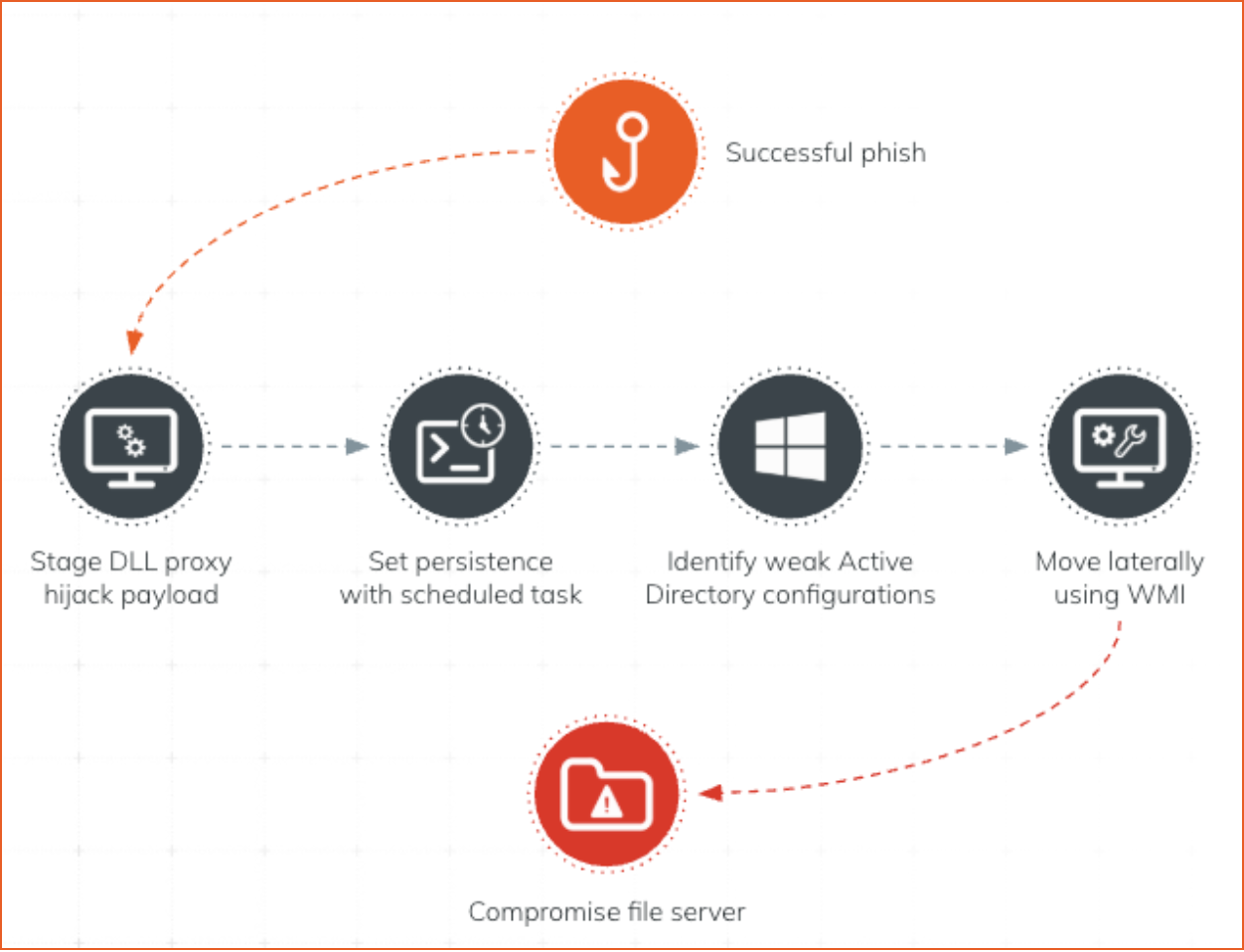
Figure 1: Post Compromise Breach Simulation Attack

TTP mapping to the MITRE ATT&CK framework

Once an attacker gains access—whether through phishing or external exploitation—the real damage begins. As part of our post-compromise breach simulation, Vector Command emulates the tactics and techniques adversaries use once they’re inside, leveraging the MITRE ATT&CK® frameworks as a guide.

Our red team stages command and control payloads and executes a series of proven attacker behaviors to test your resilience across the most common post-compromise scenarios:

  • Configure host persistence – Attackers work to maintain their foothold across reboots and user sessions by modifying startup tasks, hijacking processes, or introducing malicious code. We simulate these tactics to test your defenses against long-term compromise.
  • Attempt host privilege escalation – Gaining initial access is just the beginning. Adversaries often exploit misconfigurations or unpatched vulnerabilities to escalate privileges from standard user accounts to full admin control—enabling deeper access into your environment.
  • Query Active Directory for hosts accessible with compromised credentials – With valid credentials in hand—often obtained through phishing—we test whether an attacker could identify and access other systems or sensitive services using tools that mimic common enumeration techniques.
  • Attempt lateral movement on the network – We simulate how attackers move through your environment by pivoting between systems using native tools and compromised credentials. This reveals how far a real threat actor could go—and how quickly they’d reach your most critical assets.
  • Attempt domain privilege escalation using common misconfigurations – During breach simulations, our red team frequently tests for domain privilege escalation using misconfigurations that are surprisingly common in real-world environments. These include:
  • Local administrator accounts
  • Users with admin-like access
  • Standard users with elevated access to specific systems or sensitive functions

These misconfigurations often intersect with persistence techniques, as attackers take advantage of elevated contexts to maintain long-term access.

Want to see how exposed your organization might be? Surface Command can help identify admin users without multi-factor authentication (MFA), offering a quick view into high-risk accounts and helping fulfill the “Discover” step of Exposure Management.(See our Surface Command Admin users without MFA use case

  • Initial access payloads and internal breach playbooks – Every simulation is guided by detailed internal breach playbooks. These help test your incident response readiness and ensure alignment with known attacker workflows, including phishing payload delivery and post-access exploitation.

Each of these steps represents a real-world risk. By simulating them in a controlled environment, Vector Command helps organizations identify blind spots, validate security controls, and improve detection and response capabilities.

Beyond simulation: Actionable reporting & remediation with Vector Command

Security testing is only as valuable as the insights it delivers. With Vector Command, organizations receive tailored reports designed for both executive leadership and security practitioners:

  • Executive-Level Report: A high-level summary of key findings, business risks, and prioritized remediation steps, written in plain language for strategic decision-making.
  • Technical Report: A detailed breakdown of attack simulations, including timestamps, screenshots, and step-by-step execution logs for the security team to analyze and act on.

These insights are not just reports—they are action plans to help teams fortify their defenses against real adversary behaviors.

Take command of your attack surface

Cyber resilience is about understanding your adversary’s tactics before they use them against you. Vector Command delivers an always-on red teaming service that helps organizations stay ahead of attackers by continuously validating defenses and improving response strategies.

Want to learn more? Join us at our upcoming Take Command virtual summit, where we’ll explore how red teaming is evolving to outpace modern threats.

Register here.

Security updates for Thursday

Post Syndicated from jzb original https://lwn.net/Articles/1015589/

Security updates have been issued by Arch Linux (exim), Debian (exim4, ghostscript, and libcap2), Red Hat (container-tools:rhel8), SUSE (apache-commons-vfs2, argocd-cli, azure-cli-core, buildah, chromedriver, docker-stable, ed25519-java, kernel, kubernetes1.29-apiserver, kubernetes1.30-apiserver, kubernetes1.32-apiserver, libmbedcrypto7, microcode_ctl, php7, podman, proftpd, tomcat10, and webkit2gtk3), and Ubuntu (containerd, exim4, mariadb, opensaml, and org-mode).

A new home for kernel.org

Post Syndicated from corbet original https://lwn.net/Articles/1015555/

Akamai has sent out a
press release
saying that it is now hosting the kernel.org
repositories.

The Linux kernel is massive — approximately 28 million lines of
code. Since 2005, more than 13,500 developers from more than 1,300
different companies have contributed to the Linux
kernel. Additionally, there are many kernel versions, and
developers update the code constantly, distributing that code to
developers who are working on various distributions of
Linux. Akamai now delivers the infrastructure that these developers
and their users rely on, at no cost, supporting the Git
environments developers use to access kernel sources quickly,
regardless of where they’re based.

Как е възможно хомосексуална жена да е начело на „Алтернатива за Германия“

Post Syndicated from Светла Енчева original https://www.toest.bg/kak-e-vuzmozhno-homoseksualna-zhena-da-e-nachelo-na-alternativa-za-germania/

Как е възможно хомосексуална жена да е начело на „Алтернатива за Германия“

Алис Вайдел, съпредседателка на „Алтернатива за Германия“ (АзГ), е хомосексуална. На всичко отгоре дългогодишната ѝ партньорка, с която имат две деца, е с произход от Шри Ланка и е осиновена като бебе от швейцарци. Тези факти обаче не бяха пречка за крайнодясната ѝ партия да я предложи за канцлер преди предсрочните избори в Германия, провели се на 23 февруари. Как е възможно тя да бъде най-разпознаваемото лице на крайнодясна партия?

Лесните отговори

На този въпрос могат да се дадат поне два отговора, които не са грешни, но се плъзгат по повърхността. Става въпрос за непоследователността на популистите, от една страна, и за триковете за постигане на публично легитимиране, от друга.

Непоследователността на популистите

Правило ли ви е впечатление, че популистите доста често живеят в противоречие с принципите, които те и партиите им пропагандират? Да вземем настоящия президент и вицепрезидент на САЩ. Една от основните им цели е „нелегалните пришълци“ да бъдат депортирани от САЩ. Обявиха война на политиките на разнообразие и социално включване.

Същевременно съпругите и на двамата са с мигрантски произход, както и първата съпруга на Доналд Тръмп.

Когато е пристигнала в САЩ през 1996 г., настоящата първа дама Мелания Тръмп е нарушила имиграционното законодателство, защото, преди да получи работна виза, е полагала труд, за който е получила малко над 20 000 долара. Днес граничните власти на САЩ прилагат колкото е възможно по-строга институционална репресия върху хора, допуснали далеч по-дребни прегрешения. 28-годишната британка Беки Бърк например е затворена за седмици в център за задържане при ужасни условия, защото участвала в програма за културен обмен, а според имиграционните служители тя не трябвало да получава безплатно храна и подслон по време на обмена.

Съпругата на вицепрезидента Уша Ванс е родена в Щатите, но родителите ѝ са имигранти от Индия. По профил семейството ѝ впрочем доста напомня на това на кандидат-президентката на демократите Камала Харис – чужденци от друга раса, получили шанс в САЩ да се развият академично и професионално, както и да предоставят възможности за добро образование на дъщерите си. А това не би било възможно без заклеймените днес политики за разнообразие и включване.

Подобни прецеденти имаме и в България. Сред основните политици на крайнодясната партия ВМРО – БНД например са Карлос Контрера, чийто баща е кубинец, и Александър Сиди, евреин по произход.

Трикове за публично легитимиране

Присъствието на представители на малцинства в крайнодесни партии, особено на водещи позиции, отправя към системните политически сили и гласоподаватели посланието, че съответната партия не ще да е толкова крайна.

Тук отново може да се даде пример с ВМРО. През 2017 г., когато партията беше в управлението като част от коалицията „Обединени патриоти“, избухна скандал със снимки с нацистки поздрави на Иво Антонов от ВМРО, директор на дирекция „Социална политика“ в Министерството на отбраната, и Петър Харалампиев от „Обединените патриоти“ – председател на Агенцията за българите в чужбина. Тогава Александър Сиди се опита да омаловажи съдържанието на снимките от позициите на еврейския си произход:

Аз съм евреин и съм член на ръководството на ВМРО, и съм народен представител от „Обединени патриоти“. И всякакви квалификации, че всичките ние – „Обединени патриоти“ – сме фашисти, някак си обижда паметта на баба ми и дядо ми, които всъщност са били […] товарени във вагоните 43-та година.

По аналогичен начин реагира Сиди и на скандала в Европарламента през 2022 г., когато Ангел Джамбазки направи жест, подобен на „Хайл Хитлер“. Той обвини „цялото либерално общество“ в лицемерие и заяви, че „едни хора търсят под вола теле и явно са си го намерили“.

По тази логика поставянето на Вайдел начело на АзГ може да се използва като аргумент, че партията не е нацистка, щом се съпредседателства от хомосексуална жена – по време на националсоциализма хомосексуалните (предимно мъже) са изпращани в концентрационни лагери. Личността на Вайдел играе ролята на смокиново листо, прикриващо срамотиите на партията ѝ.

АзГ и ЛГБТИ хората

Преминаваме към не чак толкова лесните отговори и се налага да поставим под въпрос някои убеждения. Защото в България е естествено да възприемаме чуждите крайнодесни партии като аналогични на нашите си. А тук и повечето от системните партии отправят анти-ЛГБТИ послания и гласуват за хомофобски политики, какво остава за крайнодесните. Хомофобията и трансфобията са стратегия за печелене на избиратели, а т.нар. демократични партии избягват да отправят послания в подкрепа на ЛГБТИ хората, за да не загубят гласоподавателите си.

АзГ също отправя хомофобски и трансфобски послания и прави законодателни предложения в тази област. Но за разлика от България, отношението към ЛГБТИ хората в Германия е далеч по-приемащо. Според изследване на Ipsos от 2021 г. едва 8% от германците са против всякаква форма на признание на ЛГБТИ хората. 71% подкрепят хомосексуалните бракове, 73% – равните права на еднополовите двойки при осиновяването на деца, 70% смятат, че транс хората трябва да са защитени от дискриминация.

Относително по-шумно е недоволството в Германия по отношение на легализирането на неутралния пол, и по-специално на включването му в езика. Разпространено е това да става със звездички, двоеточия или други знаци, с които да се покаже, че множественото число включва всички полове – напр. Student*innen. В началото на 2024 г. Бавария забрани тези езикови нововъведения в институциите, училищата и университетите. Те обаче продължават да се използват масово в страната.

Но на общия толерантен фон анти-ЛГБТИ позициите на АзГ са по-умерени, отколкото тези на „Възраждане“ например.

Позициите на Алис Вайдел

В публичните си изявления самата Алис Вайдел като цяло не подкрепя равните права на ЛГБТИ хората. От една страна, в противоречие с позицията на партията ѝ, че семейството се състои от баща, майка и децата им, тя твърди, че семейството е там, където има деца. От друга страна обаче, съпредседателката на АзГ не е сключила брак с дългогодишната си партньорка и смята, че бракът трябва да бъде само между мъж и жена, а за еднополовите двойки да има регистрирано партньорство, което да носи същите права като брака.

Да принадлежиш към дадена социална група не те прави автоматично част от общност. „Аз не съм куиър“, заявява Вайдел. Вероятно една от причините да изрече тези думи е, че понятието „куиър“ носи ляв политически заряд. Не е само това обаче – доскорошната кандидатка на АзГ за канцлер не се смята за част от ЛГБТИ общност. Тя се изказва срещу транс хората, говорейки за „джендър глупости“ и за необходимостта да се защитят децата от „тъпата транс-попкултура“.

Вайдел впрочем съвсем не е изключение. Много хомо- и бисексуални хора не подкрепят транссексуалните и смятат, че борбата на транс лицата за правно признаване пречи на тази за равни права на хомосексуалните. Има лесбийки, които смятат, че техните проблеми нямат нищо общо с тези на гей мъжете, и обратното. И т.н.

Харесват ли ЛГБТИ хората в Германия АзГ?

„Ромео“ е популярна платформа за запознанства на хомо- и бисексуални мъже в Германия. Според анкета за електоралните нагласи на потребителите ѝ от февруари 2025 г. на принципа на отзовалите се, пусната на платформата, АзГ се нарежда на първо място с 27,9%. На второ място на „Зелените“, с 8 процентни пункта по-малко. Резултатите създават измамното впечатление, че едва ли не близо 28% от нехетеросексуалните мъже подкрепят АзГ.

Не е възможно да се направи представително изследване на ЛГБТИ хората в дадена държава, защото никой не знае колко са те. Все пак обаче е възможно да се използват методи, които водят до по-прецизни резултати, вместо просто да зададеш някакви въпроси и да не контролираш какви хора отговарят.

В Университета в Гисен са се постарали да направят по-сериозно проучване на електоралните нагласи на ЛГБТИ хората в Германия. Резултатите сочат, че едва 2,8% от анкетираните смятат да гласуват за АзГ, а делът конкретно на мъжете е 5,3%. Мнозинството от запитаните – 45,3%, подкрепят „Зелените“.

Къде е ключът?

Алис Вайдел не е прецедент, нито пък наличието на крайнодесни открито хомосексуални политици е нещо ново.

Днес името на Пим Фортаун (1948–2002 г.) е позабравено. Той беше нидерландски политик и открит гей, убит през 2002 г. от критик на антиислямизма. В младостта си Фортаун е марксист и комунист, а през 90-те прехожда от крайнолявото към крайнодясното, разочарован от политиката на мултикултурализъм и от имиграцията, конкретно от ислямски държави. Той изразява тревога, че ако мюсюлманите в Нидерландия не възприемат ценностите на приемащата страна, постиженията на борбата на жените и хомосексуалните за еманципация ще претърпят регрес. В същото време Фортаун има либерални позиции по отношение на еднополовите бракове, наркотиците и евтаназията.

Ето как защитата на европейските либерални ценности може да се превърне в обосновка на крайнодесен завой и в крайна сметка – в отрицание на идеята за единството на Европа. Защото тя според критиците ѝ, допускайки мюсюлмани на територията си, не успява да удържи принципите, върху които се основава.

Сега вече Вайдел престава да изглежда толкова странна птица – и тя гледа на исляма като на заплаха за правата на хомосексуалните и жените. Друг въпрос е, че членовете и избирателите на АзГ, подкрепящи гей хората, имат „сляпо петно“ по отношение на все по-репресивната хомофобска политика в Русия например.

Антиимигрантските нагласи и ислямофобията са най-малкото общо кратно в АзГ.

Те са и обединяващият принцип на избирателите на партията, които по отношение на ЛГБТИ хората може да имат разнообразни позиции, но общото между тях е, че възприемат миграцията като заплаха, особено ако е от ислямски страни.

Част от избирателите на АзГ имат откровено неонацистки възгледи, но мнозина са далеч по-умерени и искрено се засягат, ако ги нарекат нацита. Те обаче се преживяват като губещи от начина на развитие на Германия и най-лесно им е да нарочат някой външен враг. Чужденците са особено удобни за целта и колкото по-различни са от германците по култура и външен вид, толкова по-големи врагове изглеждат.

Представителите на различни групи германци се преживяват като губещи по различен начин.

В Източна Германия усещането за изоставане от западната част на държавата и за снизходително отношение от страна на населението ѝ ескалират дотам, че АзГ става първа политическа сила.

В Рурския регион в Северозападна Германия например към АзГ се обръщат хора, чиито семейства поколения наред са гласували за социалдемократите. Мините в района са затворени, а Социалдемократическата партия, адекватна на индустриалната епоха, не успява да предложи политики, подходящи за постиндустриално общество. Някогашните работници стават трайно безработни или упражняват неотговарящи на квалификацията им професии. Градовете им се обезлюдяват, в тях се заселват все повече бежанци и роми. Освен че променят облика на родните им места, новодошлите се превръщат в конкуренция за евтини жилища и социални помощи. И стават удобен обект за мразене.

В доста по-богатия Югозапад на чужденците се гледа основно като на хора, безвъзвратно унищожаващи Германия, каквато е била преди няколко десетилетия – в която почти всички са етнически германци и която икономически е далеч по-силна от днес. Имигрантите – и особено бежанците, а не липсата на адекватна жилищна политика – се привиждат като основната причина за жилищната криза и непрекъснато растящите цени на наемите както в Югозападна Германия, така и в големите градове.

Пренебрежима подробност с възможна двойна употреба

Да обобщим. За разлика от България и други страни от бившия Източен блок, Германия не е обхваната от кампанията срещу Истанбулската конвенция и „джендъра“. Тя е стигнала основно до представителите на ултраконсервативни религиозни кръгове в страната, които са пренебрежимо малцинство. Макар да има анти-ЛГБТИ настроени германци, те не са масовият случай. Основният лайтмотив, подхранващ радикализацията, е миграцията, особено от ислямски страни. Затова сексуалността на съпредседателката на АзГ изглежда пренебрежима подробност.

В същото време тя е символно оръжие с възможна двойна употреба. Пред членовете и симпатизантите на партията фактът, че Алис Вайдел е лесбийка, се използва като аргумент срещу мюсюлманите чужденци, представяни като заплаха за жените и хомосексуалните. От друга страна, личността на Вайдел е маската, имаща за цел да убеди демократичния свят, че АзГ не е екстремистка, а нормална и даже толерантна партия.


Monitor Your Wi-Fi Signal Strength with Zabbix

Post Syndicated from Janne Pikkarainen original https://blog.zabbix.com/monitor-your-wi-fi-signal-strength-with-zabbix/29835/

Can you monitor the signal strength of different Wi-Fi devices that are connected to your (home) router with Zabbix? Of course you can! This is a really quick post that also shows how ChatGPT or any LLM can boost your productivity when doing this kind of thing.

I have an ASUS RT-AX68U router running on Asuswrt-Merlin firmware. On its web interface, it can show you all kinds of details about your network and the devices on it. This is nice, but it would be even nicer to add some of that to Zabbix. One interesting idea for me would be to monitor the signal strength of my Wi-FI devices around the house, so let’s do that and start monitoring RSSI!

What’s RSSI?

Here’s a reply by ChatGPT:

In Wi-Fi (and RF in general), RSSI (Received Signal Strength Indicator) is typically measured in negative dBm values:

• The closer the value is to 0 dBm, the stronger (better) the signal.

• The more negative the value, the weaker the signal.

Broadly speaking, here is a rough guideline:

• -30 dBm: Extremely strong signal (almost too strong – rare in normal conditions).

• -50 dBm: Excellent signal.

• -60 dBm: Very good signal, plenty strong for most uses.

• -70 dBm: Adequate; connectivity is usually reliable but might slow at times.

• -80 dBm: Marginal; still connected but performance may degrade.

• -90 dBm or lower: Very weak; likely to drop connection or have very poor speeds.

Monitoring implementation

If you are a regular reader, you should know by now that I’m not a fan of letting Zabbix agent or any other agent run commands directly for gathering metrics unless I really need the metrics that second. Rather, I’ll use cron jobs or any other background way of creating text files which then will be parsed by Zabbix.

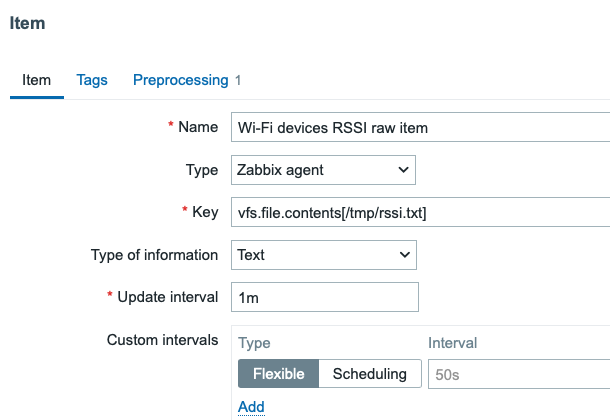
That said, my ASUS now runs a shell script every minute, which then writes a text file /tmp/rssi.txt, which is read by Zabbix agent.

The shell script

Thank you ChatGPT for the following: The script uses wl -i assoclist command to list the connected devices with their MAC addresses and signal strength, and converts those MAC addresses to hostnames to be human-readable.

#!/bin/sh

# Interfaces for 2.4 and 5 GHz (adjust if your router uses different names)
IFACES="eth5 eth6"

LEASES_FILE="/var/lib/misc/dnsmasq.leases"
rm -f /tmp/rssi.txt

echo "Hostname:RSSI" >/tmp/rssi.txt
for iface in $IFACES
do
# List all MACs associated on this interface
for MAC in $(wl -i "$iface" assoclist 2>/dev/null | awk '{print $2}')
do
# Get RSSI
RSSI=$(wl -i "$iface" rssi "$MAC" 2>/dev/null)

# Look up IP and hostname in dnsmasq leases (if present)
# The leases file format is: <epoch> <MAC> <IP> <hostname> <clientid>
IP=$(grep -i "$MAC" "$LEASES_FILE" | awk '{print $3}')
HOSTNAME=$(grep -i "$MAC" "$LEASES_FILE" | awk '{print $4}')

# If the device is static or not found in dnsmasq leases, IP/HOSTNAME might be empty
# so handle that gracefully
[ -z "$IP" ] && IP="Unknown"
[ -z "$HOSTNAME" ] && HOSTNAME="Unknown"

#echo "MAC $MAC:"
#echo " RSSI: $RSSI dBm"
#echo " IP: $IP"
#echo " Hostname: $HOSTNAME"
echo "$HOSTNAME:$RSSI" >>/tmp/rssi.txt
done
done

It outputs this, with self-explanatory results.

Hostname:RSSI
Watch:-43
058743599:-66
Samsung:-62
SonosZP:-45
BroadLink_OEM-T1-89-d3-bb:-57
Kitchen:-52
Mac:-39
iPhone:-40
*:-60
MacBookPro:-43

Adding it to Zabbix

First, I added a new template, for which I then added a new master item reading the /tmp/rssi.txt file.

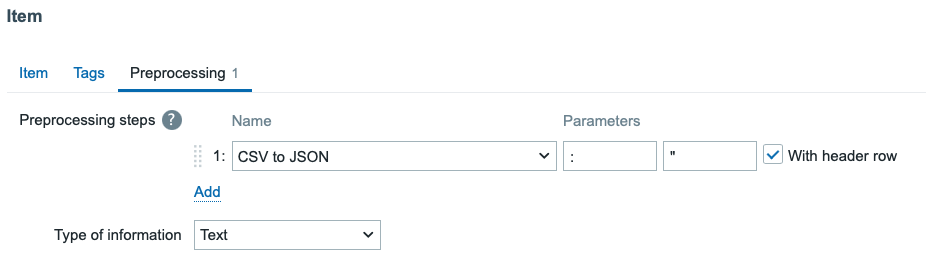
Because ChatGPT script did make the output in CSV format with : as delimiter, we can use Zabbix item preprocessing to convert that CSV to JSON. The JSON output looks like this.

[{"Hostname":"Watch","RSSI":"-45"},{"Hostname":"058743599","RSSI":"-70"},{"Hostname":"Samsung","RSSI":"-60"},{"Hostname":"SonosZP","RSSI":"-44"},{"Hostname":"BroadLink_OEM-T1-89-d3-bb","RSSI":"-61"},{"Hostname":"Kitchen","RSSI":"-53"},{"Hostname":"Mac","RSSI":"-37"},{"Hostname":"iPhone","RSSI":"-39"},{"Hostname":"*","RSSI":"-56"},{"Hostname":"MacBookPro","RSSI":"-41"}]

With this, we can then use Zabbix low-level discovery to automatically create the items.

Discovery rule

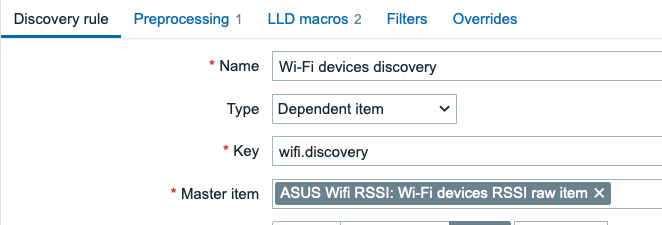
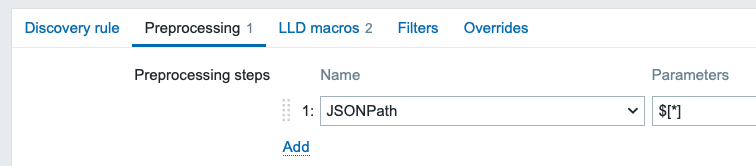
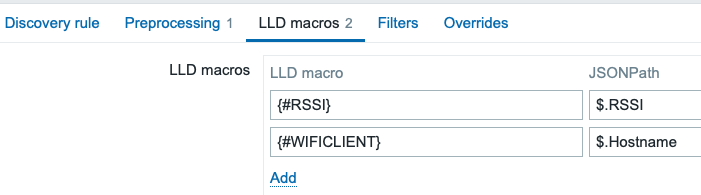
Now that we have our master item, let’s add the discovery rule, which can go through the JSON. The discovery rule uses my previous item as a dependent item, from which it can parse everything in one go.

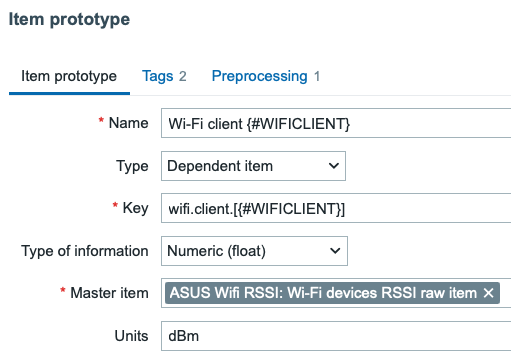
Discovery item prototype

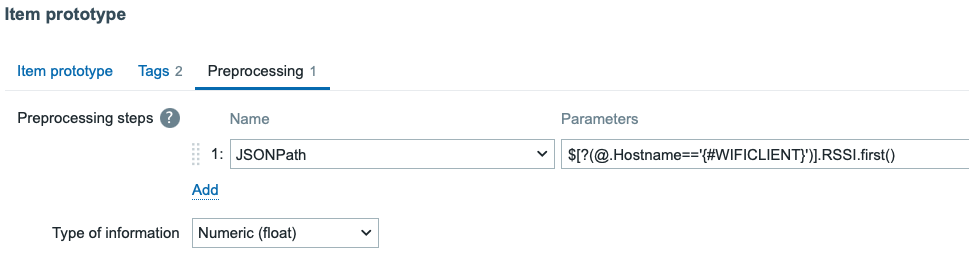
In item prototype, let’s make it again use the raw list as a dependent item and go from there.

Then in preprocessing, it picks the RSSI value for whatever device LLD was going through by using a JSONPath query…

…or as text:

$[?(@.Hostname=='{#WIFICLIENT}’)].RSSI.first()

That’s pretty much it!

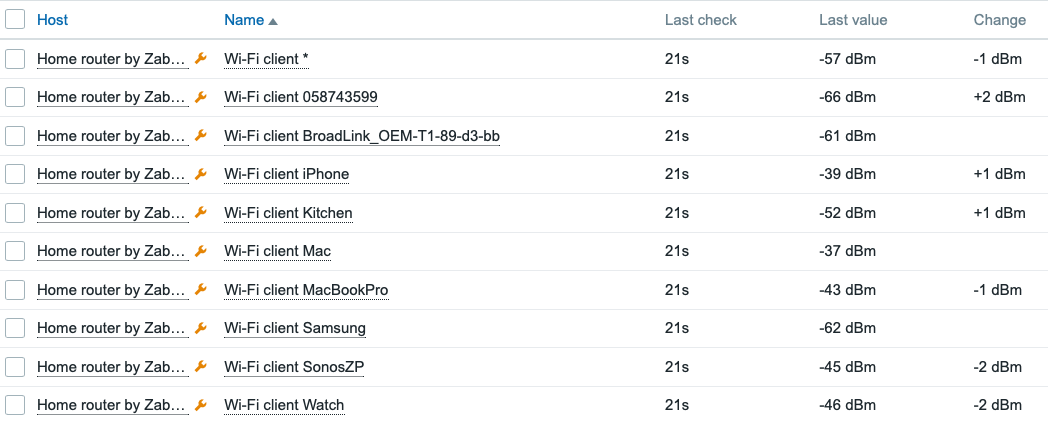
We now have the data coming in once per minute:

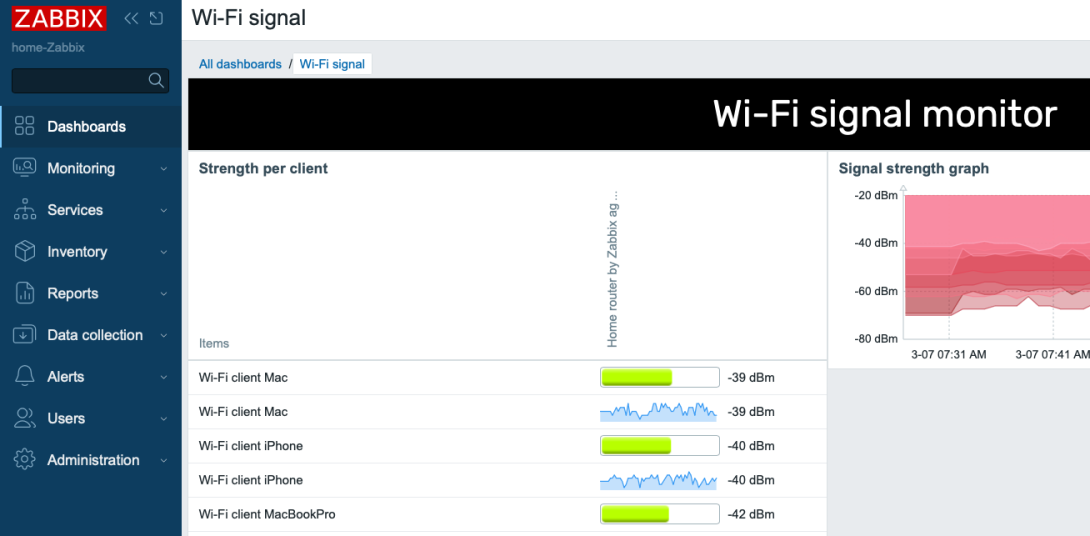
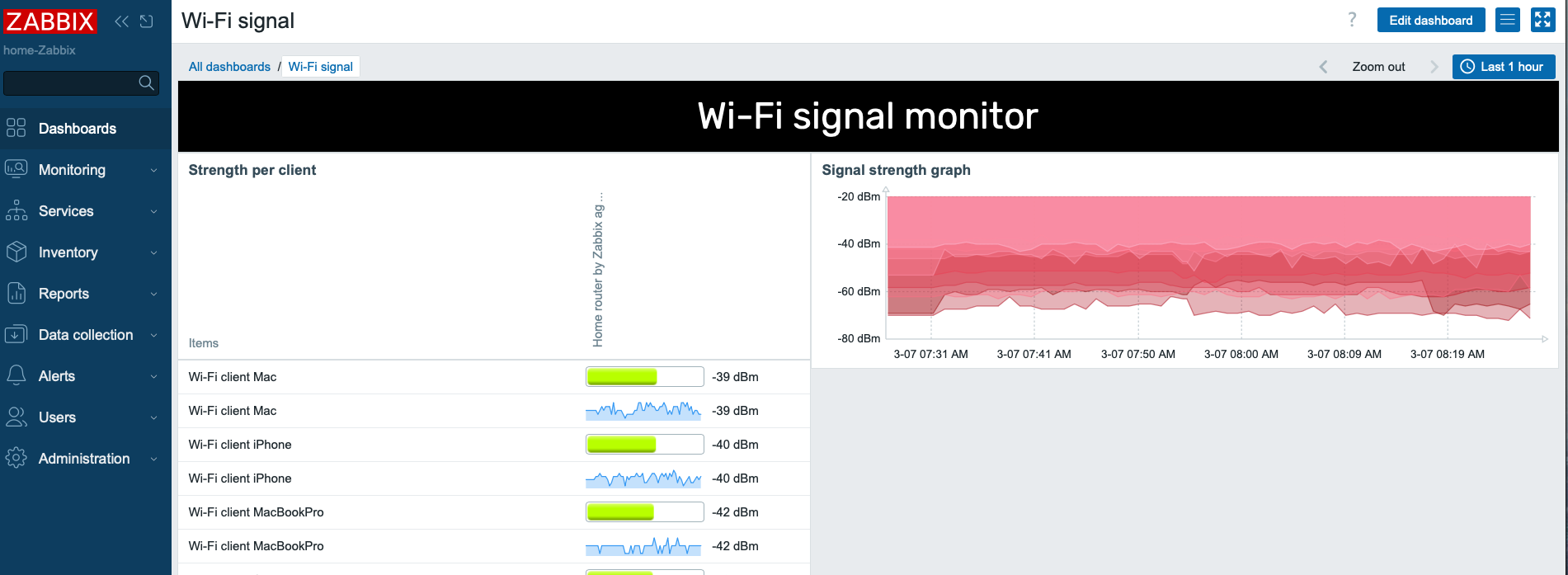
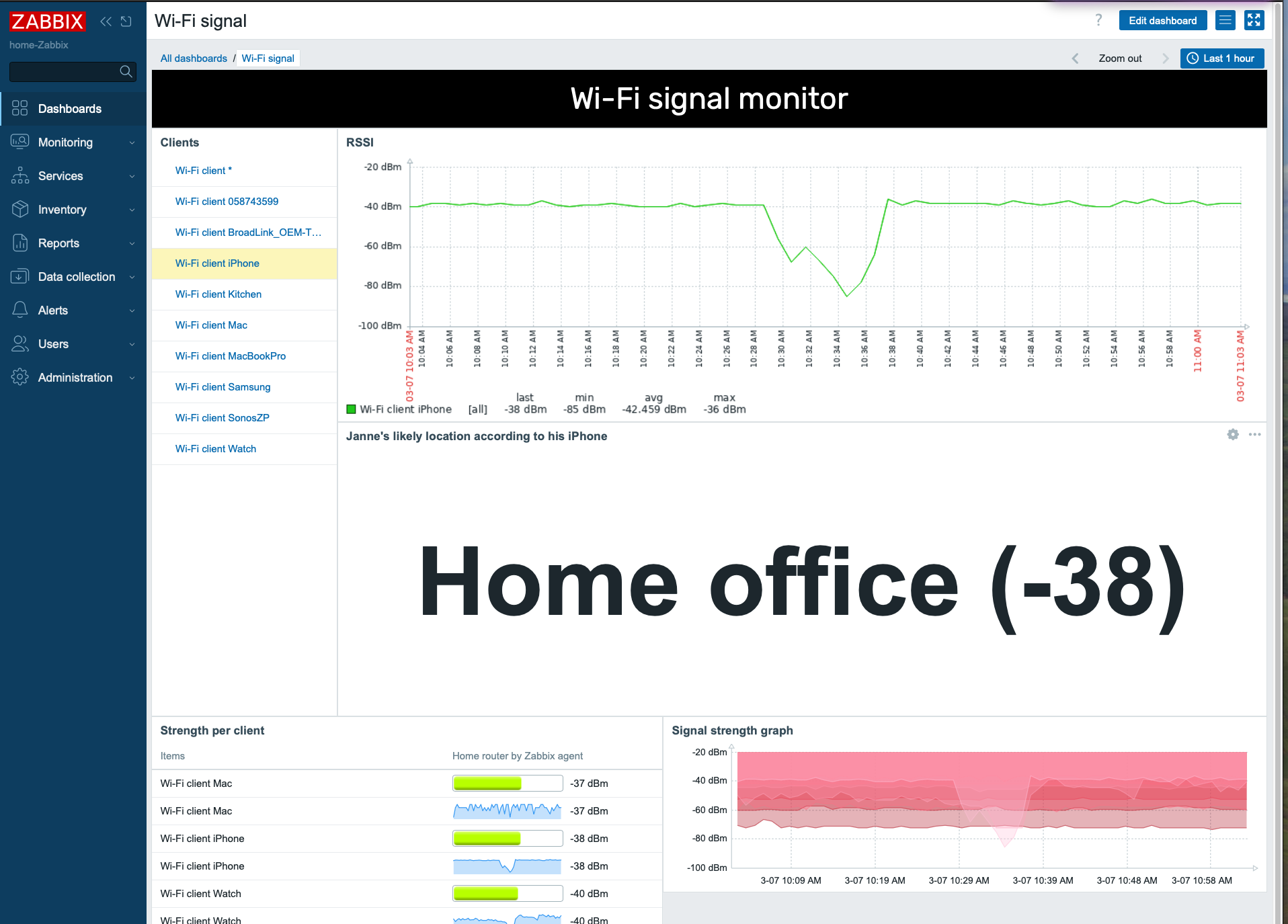
Here’s a little dashboard, too. It shows you the traditional bar that’s available on the Top hosts/items widget, and also the new Sparkline that’s on Zabbix 7.2.

Bonus: Location estimation

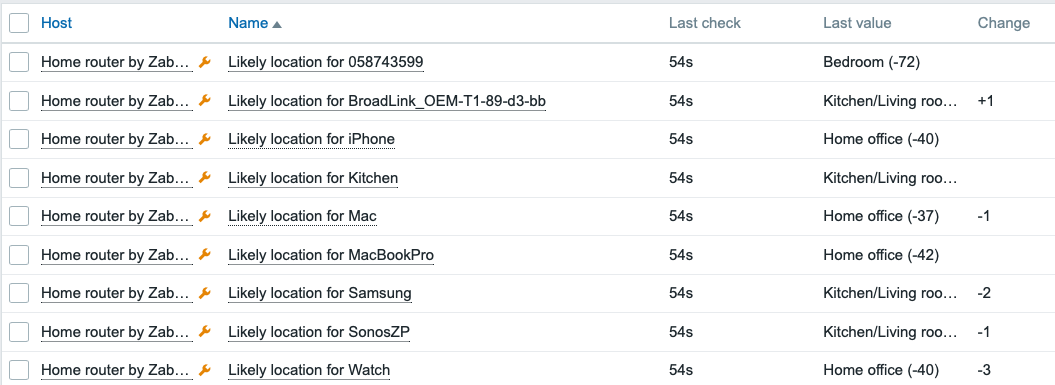
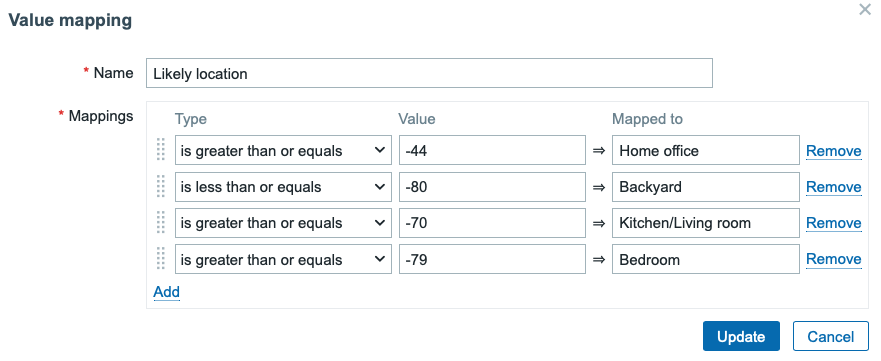
After a little bit of walking around and observing the devices, I added some value mapping to make Zabbix estimate where the devices would be located. It’s not so useful for static objects, but when I move around with my Apple Watch and iPhone, I could make an attempt to monitor my location at home, too.

After this fine-tuning, my dashboard now looks like this:

Thanks for reading, and have fun conducting your own experiments!

The post Monitor Your Wi-Fi Signal Strength with Zabbix appeared first on Zabbix Blog.

[$] LWN.net Weekly Edition for March 27, 2025

Post Syndicated from corbet original https://lwn.net/Articles/1014881/

Inside this week’s LWN.net Weekly Edition:

  • Front: Open source in government; OSI election; Memory-management medley; Address-space isolation; CMA; 6.14 Development stats; State of the page.
  • Briefs: Asahi Linux progress; Reproducible Debian; rpi-image-gen; Neovim 0.11; OpenH264; Quotes; …
  • Announcements: Newsletters, conferences, security updates, patches, and more.

Three chapters at Cloudflare: Programmer to CTO to Board of Directors

Post Syndicated from John Graham-Cumming original https://blog.cloudflare.com/three-chapters-at-cloudflare-programmer-to-cto-to-board-of-directors/

Today, after more than 13 years at the company, I am joining Cloudflare’s board of directors and retiring from my full-time position as CTO.

Back in 2012 I wrote a short post on my personal site simply titled: Programmer. The post announced that I’d recently joined a company called CloudFlare (still sporting that capital “F”) with the job title Programmer. I’d chosen that title in part because it was the very first title I’d ever had, and because it would reflect what I’d be doing at Cloudflare.

I had spent a lot of time working at startups—in technical and then management roles—and wanted to go back to the really technical part that I loved most. Cloudflare gave me that opportunity, and I worked on a lot of systems that make up the Cloudflare that so many people around the world use today.

Looking back on my time at the company it’s really, really hard to pick my top highlights. In 2019 I wrote 6,000 words on the experience of helping build Cloudflare. But here are five that stand out:

Always be shipping

The night we finished the preparation to launch Universal SSL sticks in my memory. We set out to offer the Industry’s First Universal SSL for free, effectively doubling the size of the encrypted web overnight, a big deal in 2014. I remember Cloudflare’s third co-founder, Lee Holloway, hunched over his laptop finishing the code. The team has been working on it all weekend, and late that Sunday night Lee announced “it’s done.” 

Handling adversity

It’s easy to pick moments of great success or when things went really well and Cloudbleed in 2017 may not seem like a special moment, but it helped show who we were. It showed how a team could come together under intense stress, and how we could set the standard going forward for how companies disclose and talk about security problems. I personally discovered that a Google Meet call can be kept running for 24 hours and sleeping in two hour chunks is possible.

Being international and intentional

Originally from the UK, I was the first team member located outside the United States. I got to help build the largest offices outside the US: first, Cloudflare’s London office and then Cloudflare’s Lisbon office. These two offices are a big part of who we are today, with Lisbon being our European HQ.

When COVID halted our in-office work, I was blown away by the response from the team. As we all individually faced different difficulties because of the pandemic we continued to work together to ensure that the Internet, on which everyone was relying while confined at home, worked reliably and securely.

Truly impactful technology

Picking a favourite product would be a bit like asking someone to choose their favourite child, but I have soft spots for Cloudflare’s WAF, DNS, and DDoS solutions because I personally worked on those systems. And I still feel I need to apologize to the WAF team who took over my code and had to face that one Perl script that shall not be named!

Beyond the products there’s something much deeper: Cloudflare’s mission to help build a better Internet. I’ve been very proud of how we have supported and advanced the Internet itself through our work on the latest standards and protocols. And I’m even prouder of the role we’ve played through Project Galileo, The Athenian Project, and Cloudflare for Campaigns.

The people

Every week Cloudflare holds an all-hands company meeting which ends with “Shoutouts,” a chance to recognize members of the team who have gone above and beyond. Curiosity and empathy are two core values at Cloudflare, and I am struck every week by how often we’re recognizing teams of people who are being thanked for helping with a sale, fixing a bug, responding to an incident, or helping build Cloudflare. That team spirit is part of what makes Cloudflare a special place to work.

One of the things I will miss about not being at Cloudflare day-to-day is the incredible strength of the individual team members. I’ve been learning from them for 13 years straight!

What’s next

When I joined the company the team was a lot smaller! We were 25 people and now, we’ve grown to more than 4,200 employees and 15 locations across the globe. As we grew I wore a lot of different hats. For a time I ran engineering, operations, security, and even IT. And, of course, I wrote for, and edited, the Cloudflare Blog for many, many years. Over time, we hired many great leaders to run those teams.

But the role that persisted was CTO. And today, we are announcing that, just as I gave up the title Programmer (and the programming that went along with it), I am giving up the title CTO (and the role’s responsibilities) for a new way to help Cloudflare grow and succeed, as a member of the board of directors.

Last year when I told Matthew that I planned to retire, I had not expected to be offered a seat on the company’s board. It’s an incredible and rare honour to go from being an employee of the company (albeit one who has been there from close to the beginning) to joining the board of directors. I am absolutely thrilled to be able to continue helping Cloudflare grow and succeed from a slightly different vantage point.

At the same time, Dane Knecht, who, until today, was SVP of Emerging Technology and Incubation, has become our CTO. Dane joined just a few months after me, and is uniquely positioned and experienced to take the CTO role. We’ve worked so closely for the last 13 years as peers, that in many meetings it would’ve been hard to distinguish our roles. I’m pretty sure that Dane bleeds Cloudflare orange, and I’ve never seen him wear a T-shirt that doesn’t say Cloudflare on it. He has been part of nearly every major milestone here at Cloudflare. He cares so deeply about the company, and its success; he will make a great CTO.

My plan isn’t to go off and work somewhere else, or start a new company. I intend to remain closely involved with Cloudflare in my role on the board. I am incredibly honoured, and grateful to have been part of Cloudflare’s incredible growth and success, and I am looking forward to helping the company continue its growth.

One area I’m particularly interested in assisting with is the company’s work across the product suite on AI. Back in 2002 (23 years ago! gulp!). I wrote a very popular open source machine learning (didn’t call it AI back then) email filtering program and in 2004 worked on how to deal with what happens when one AI system is used to attack another. At Cloudflare, we’ve used learning techniques to enhance security, block bots, and predict how our systems should behave and grow. There’s much more to do.

Just as co-founder Michelle likes to say: we’re just getting started. And so am I.

Enhancing cloud security in AI/ML: The little pickle story

Post Syndicated from Nur Gucu original https://aws.amazon.com/blogs/security/enhancing-cloud-security-in-ai-ml-the-little-pickle-story/

As AI and machine learning (AI/ML) become increasingly accessible through cloud service providers (CSPs) such as Amazon Web Services (AWS), new security issues can arise that customers need to address. AWS provides a variety of services for AI/ML use cases, and developers often interact with these services through different programming languages. In this blog post, we focus on Python and its pickle module, which supports a process called pickling to serialize and deserialize object structures. This functionality simplifies data management and the sharing of complex data across distributed systems. However, because of potential security issues, it’s important to use pickling with care (see the warning note in pickle — Python object serialization). In this post, we’re going to show you ways to build secure AI/ML workloads that use this powerful Python module, ways to detect that it’s in use that you might not know about, and when it might be getting abused, and finally highlight alternative approaches that can help you avoid these issues.

Quick tips

Understanding insecure pickle serialization and deserialization in Python

Effective data management is crucial in Python programming, and many developers turn to the pickle module for serialization. However, issues can arise when deserializing data from untrusted sources. The Python bytestream that pickling uses, is proprietary to Python. Until it’s unpickled, the data in the bytestream can’t be thoroughly evaluated. This is where security controls and validation become critical. Without proper validation, there’s a risk that an unauthorized user could inject unexpected code, potentially leading to arbitrary code execution, data tampering, or even unintended access to a system. In the context of AI model loading, secure deserialization is particularly important—it helps prevent outside parties from modifying model behavior, injecting backdoors, or causing inadvertent disclosure of sensitive data.

Throughout this post, we will refer to pickle serialization and deserialization collectively as pickling. Similar issues can be present in other languages (for example, Java and PHP) when untrusted data is used to recreate objects or data structures, resulting in potential security issues such as arbitrary code execution, data corruption, and unauthorized access.

Static code analysis compared to dynamic testing for detecting pickling

Security code reviews, including static code analysis, offer valuable early detection and thorough coverage of pickling-related issues. By examining source code (including third-party libraries and custom code) before deployment, teams can minimize security risks in a cost-effective way. Tools that provide static analysis can automatically flag unsafe pickling patterns, giving developers actionable insights to address issues promptly. Regular code reviews also help developers improve secure coding skills over time.

While static code analysis provides a comprehensive white-box approach, dynamic testing can uncover context-specific issues that only appear during runtime. Both methods are important. In this post, we focus primarily on the role of static code analysis in identifying unsafe pickling.

Tools like Amazon CodeGuru and Semgrep are effective at detecting security issues early. For open source projects, Semgrep is a great option to maintain consistent security checks.

The risks of insecure pickling in AI/ML

Pickling issues in AI/ML contexts can be especially concerning.

  • Invalidated object loading: AI/ML models are often serialized for future use. Loading these models from untrusted sources without validation can result in arbitrary code execution. Libraries such as pickle, joblib, and some yaml configurations allow serialization but must be handled securely.
    • For example: If a web application stores user input using pickle and unpickles it later with no validation, an unauthorized user could craft a harmful payload that executes arbitrary code on the server.
  • Data integrity: The integrity of pickled data is critical. Unexpectedly crafted data could corrupt models, resulting in incorrect predictions or behaviors, which is especially concerning in sensitive domains such as finance, healthcare, and autonomous systems.
    • For example: A team updates its AI model architecture or preprocessing steps but forgets to retrain and save the updated model. Loading the old pickled model under new code might trigger errors or unpredictable outcomes.
  • Exposure of sensitive information: Pickling often includes all attributes of an object, potentially exposing sensitive data such as credentials or secrets.
    • For example: An ML model might contain database credentials within its serialized state. If shared or stored without precautions, an unauthorized user who unpickles the file might gain unintended access to these credentials.
  • Insufficient data protection: When sent across networks or stored without encryption, pickled data can be intercepted, leading to inadvertent disclosure of sensitive information.
    • For example: In a healthcare environment, a pickled AI model containing patient data could be transmitted over an unsecured network, enabling an outside party to intercept and read sensitive information.
  • Performance overhead: Pickling can be slower than other serialization formats (such as, JSON or Protocol Buffers), which can affect ML and large language model (LLM) applications when inference speed is critical.
    • For example: In a real-time natural language processing (NLP) application using an LLM, heavy pickling or unpickling operations might reduce responsiveness and degrade the user experience.

Detecting unsafe unpickling with static code analysis tools

Static code analysis (SCA) is a valuable practice for applications dealing with pickled data, because it helps detect insecure pickling before deployment. By integrating SCA tools into the development workflow, teams can spot questionable deserialization patterns as soon as code is committed. This proactive approach reduces the risk of events involving unexpected code execution or unintended access due to unsafe object loading.

For instance, in a financial services application where objects are routinely pickled, a SCA tool can scan new commits to detect unvalidated unpickling. If identified, the development team can quickly address the issue, protecting both the integrity of the application and sensitive financial data.

Patterns in the source code

There are various ways to load a pickle object in Python. In this context, methods for detection can be tailored for secure coding habits and needed package dependencies. Many Python libraries include a function to load pickle objects. An effective approach can be to catalog all Python libraries used in the project, then create custom rules in your static code analysis tool to detect unsafe pickling or unpickling within those libraries.

CodeGuru and other static analysis tools continue to evolve their capability to detect unsafe pickling patterns. Organizations can use these tools and create custom rules to identify potential security issues in AI/ML pipelines.

Let’s define the steps for creating a safe process for addressing pickling issues:

  1. Generate a list of all the Python libraries that are used in your repository or environment.
  2. Check the static code analysis tool in your pipeline for current rules and the ability to add custom rules. If the tool is capable of discovering all the libraries used in your project, you can rely on it. However, if it’s not able to discover all the libraries used in your project, you should consider adding user-provided custom rules in your static code analysis tool.
  3. Most of the issues can be identified with well-designed, context-driven patterns in the static code analysis tool. For addressing the pickling issues, you need to identify pickling and unpickling functions.
  4. Implement and test the custom rules to verify full coverage of pickling and unpickling risks. Let’s identify patterns for a few libraries:
    • NumPy can efficiently pickle and unpickle arrays; useful for scientific computing workflows requiring serialized arrays. To catch potential unsafe pickle usage in NumPy, custom rules could target patterns like:
      import numpy as np
      data = np.load('data.npy', allow_pickle=True)

    • npyfile is a utility for loading NumPy arrays from pickled files. You can add the following patterns to your custom rules to discover potentially unsafe pickle object usage.
      import npyfile
      data = npyfile.load('example.pkl')

    • pandas can pickle and unpickle DataFrames using pickle, allowing for efficient storage and retrieval of tabular data. You can add the following patterns to your custom rules to discover potentially unsafe pickle object usage.
      import pandas as pd
      df = pd.read_pickle('dataframe.pkl')

    • joblib is often used for pickling and unpickling Python objects that involve large data, especially NumPy arrays, more efficiently than standard pickle. You can add the following patterns to your custom rules to discover potentially unsafe pickle object usage.
      from joblib import load
      data = load('large_data.pkl')

    • Scikit-learn provides joblib for pickling and unpickling objects and is particularly useful for models. You can add the following patterns to your custom rules to discover potentially unsafe pickle object usage.
      from sklearn.externals import joblib
      data = joblib.load('example.pkl')

    • PyTorch provides utilities for loading pickled objects that are especially useful for ML models and tensors. You can add the following patterns to your custom rule format to discover potentially unsafe pickle object usage.
      import torch
      data = torch.load('example.pkl')

By searching for these functions and parameters in code, you can set up targeted rules that highlight potential issues with pickling.

Effective mitigation

Addressing pickling issues requires not only detection, but also clear guidance on remediation. Consider recommending more secure formats or validations where possible as follows:

  • PyTorch
    • Use Safetensors to store tensors. If pickling remains necessary, add integrity checks (for example, hashing) for serialized data.
  • pandas
    • Verify data sources and integrity when using pd.read_pickle. Encourage safer alternatives (for example, CSV, HDF5, or Parquet) to help avoid pickling risks.
  • scikit-learn (via joblib)
    • Consider Skops for safer persistence. If switching formats isn’t feasible, implement strict validation checks before loading.
  • General advice
    • Identify safer libraries or methods whenever possible.
    • Switch to formats such as CSV or JSON for data, unless object-specific serialization is absolutely required.
    • Perform source and integrity checks before loading pickle files—even those considered trusted.

Example

The following is an example implementation that shows safe pickle implementation as a representation of the preceding information.

import io
import base64
import pickle
import boto3
import numpy as np
from cryptography.fernet import Fernet

###############################################################################
# 1) RESTRICTED UNPICKLER
###############################################################################
#
# By default, pickle can execute arbitrary code when loading. Here we implement
# a custom Unpickler that only allows certain safe modules/classes. Adjust this
# to your application's requirements.
#

class RestrictedUnpickler(pickle.Unpickler):
    """
    Restricts unpickling to only the modules/classes we explicitly allow.
    """
    allowed_modules = {
        "numpy": set(["ndarray", "dtype"]),
        "builtins": set(["tuple", "list", "dict", "set", "frozenset", "int", "float", "bool", "str"])
    }

    def find_class(self, module, name):
        if module in self.allowed_modules:
            if name in self.allowed_modules[module]:
                return super().find_class(module, name)
        # If not allowed, raise an error to prevent arbitrary code execution.
        raise pickle.UnpicklingError(f"Global '{module}.{name}' is forbidden")

def restricted_loads(data: bytes):
    """Helper function to load pickle data using the RestrictedUnpickler."""
    return RestrictedUnpickler(io.BytesIO(data)).load()

###############################################################################
# 2) AWS KMS & ENCRYPTION HELPERS
###############################################################################

def generate_data_key(kms_key_id: str, region: str = "us-east-1"):
    """
    Generates a fresh data key using AWS KMS. 
    Returns (plaintext_key, encrypted_data_key).
    """
    kms_client = boto3.client("kms", region_name=region)
    response = kms_client.generate_data_key(KeyId=kms_key_id, KeySpec='AES_256')
    
    # Plaintext data key (use to encrypt the pickle data locally)
    plaintext_key = response["Plaintext"]
    # Encrypted data key (store along with your ciphertext)
    encrypted_data_key = response["CiphertextBlob"]
    return plaintext_key, encrypted_data_key

def decrypt_data_key(encrypted_data_key: bytes, region: str = "us-east-1"):
    """
    Decrypts the encrypted data key via AWS KMS, returning the plaintext key.
    """
    kms_client = boto3.client("kms", region_name=region)
    response = kms_client.decrypt(CiphertextBlob=encrypted_data_key)
    return response["Plaintext"]

def build_fernet_key(plaintext_key: bytes) -> Fernet:
    """
    Construct a Fernet instance from a 32-byte data key.
    Fernet requires a 32-byte key *encoded* in URL-safe base64.
    """
    if len(plaintext_key) < 32:
        raise ValueError("Data key is smaller than 32 bytes; cannot build a Fernet key.")
    fernet_key = base64.urlsafe_b64encode(plaintext_key[:32])
    return Fernet(fernet_key)

###############################################################################
# 3) MAIN LOGIC
###############################################################################

def upload_pickled_data_s3(
    numpy_obj: np.ndarray,
    bucket_name: str,
    s3_key: str,
    kms_key_id: str,
    region: str = "us-east-1"
):
    """
    Pickle a numpy object, encrypt it locally, and upload the ciphertext + 
    encrypted data key to S3.
    """
    # 1. Generate data key from KMS
    plaintext_key, encrypted_data_key = generate_data_key(kms_key_id, region)
    
    # 2. Build Fernet from plaintext data key
    fernet = build_fernet_key(plaintext_key)
    
    # 3. Serialize the numpy object with pickle
    pickled_data = pickle.dumps(numpy_obj, protocol=pickle.HIGHEST_PROTOCOL)
    
    # 4. Encrypt the pickled data
    encrypted_data = fernet.encrypt(pickled_data)
    
    # 5. Upload to S3 along with the encrypted data key (in metadata)
    s3_client = boto3.client("s3", region_name=region)
    s3_client.put_object(
        Bucket=bucket_name,
        Key=s3_key,
        Body=encrypted_data,
        Metadata={
            "encrypted_data_key": base64.b64encode(encrypted_data_key).decode("utf-8")
        }
    )
    print(f"Encrypted pickle uploaded to s3://{bucket_name}/{s3_key}")

def download_and_unpickle_data_s3(
    bucket_name: str,
    s3_key: str,
    region: str = "us-east-1"
) -> np.ndarray:
    """
    Download the ciphertext and the encrypted data key from S3. Decrypt the data 
    key with KMS, use it to decrypt the pickled data, then load with a restricted 
    unpickler for safety.
    """
    s3_client = boto3.client("s3", region_name=region)
    
    # 1. Get object from S3
    response = s3_client.get_object(Bucket=bucket_name, Key=s3_key)
    
    # 2. Extract the encrypted data key from metadata
    metadata = response["Metadata"]
    encrypted_data_key_b64 = metadata.get("encrypted_data_key")
    if not encrypted_data_key_b64:
        raise ValueError("Missing encrypted_data_key in S3 object metadata.")
    
    encrypted_data_key = base64.b64decode(encrypted_data_key_b64)
    
    # 3. Decrypt data key via KMS
    plaintext_key = decrypt_data_key(encrypted_data_key, region)
    fernet = build_fernet_key(plaintext_key)
    
    # 4. Decrypt the pickled data
    encrypted_data = response["Body"].read()
    decrypted_pickled_data = fernet.decrypt(encrypted_data)
    
    # 5. Use restricted unpickler to load the numpy object
    numpy_obj = restricted_loads(decrypted_pickled_data)
    
    return numpy_obj

###############################################################################
# DEMO USAGE
###############################################################################

if __name__ == "__main__":
    # --- Replace with your actual values ---
    KMS_KEY_ID = "arn:aws:kms:us-east-1:123456789012:key/your-kms-key-id"
    BUCKET_NAME = "your-secure-bucket"
    S3_OBJECT_KEY = "encrypted_npy_demo.bin"
    AWS_REGION = "us-east-1"  # or region of your choice
    
    # Example numpy array
    original_array = np.random.rand(2, 3)
    print("Original Array:")
    print(original_array)
    
    # Upload (pickle + encrypt) to S3
    upload_pickled_data_s3(
        numpy_obj=original_array,
        bucket_name=BUCKET_NAME,
        s3_key=S3_OBJECT_KEY,
        kms_key_id=KMS_KEY_ID,
        region=AWS_REGION
    )
    
    # Download (decrypt + unpickle) from S3
    retrieved_array = download_and_unpickle_data_s3(
        bucket_name=BUCKET_NAME,
        s3_key=S3_OBJECT_KEY,
        region=AWS_REGION
    )
    
    print("\nRetrieved Array:")
    print(retrieved_array)
    
    # Verify integrity
    assert np.allclose(original_array, retrieved_array), "Arrays do not match!"
    print("\nSuccess! The retrieved array matches the original array.")

Conclusion

With the rapid expansion of cloud technologies, integrating static code analysis into your AI/ML development process is increasingly important. While pickling offers a powerful way to serialize objects for AI/ML and LLM applications, you can mitigate potential risks by applying manual secure code reviews, setting up automated SCA with custom rules, and following best practices such as using alternative serialization methods or verifying data integrity.

When working with ML models on AWS, see the AWS Well-Architected Framework’s Machine Learning Lens for guidance on secure architecture and recommended practices. By combining these approaches, you can maintain a strong security posture and streamline the AI/ML development lifecycle.

 
If you have feedback about this post, submit comments in the Comments section below. If you have questions about this post, contact AWS Support.
 

Nur Gucu
Nur Gucu

Nur is a Security Engineer at Amazon with 10 years of offensive security expertise, specializing in generative AI security, security architecture, and offensive testing. Nur has developed security products at startups and banks, and has created frameworks for emerging technologies. She brings practical experience to solve complex AI security challenges, and yet believes as many as six impossible things before breakfast.
Matt Schwartz
Matt Schwartz

Matt is an Amazon Principal Security Engineer specializing in generative AI security, risk management, and cloud computing expertise. His two-decade expertise enables organizations to implement advanced AI while maintaining strict security protocols. Matthew develops strategic frameworks that safeguard critical assets and ensure compliance in the evolving digital landscape, securing complex systems during transformations.

Firewall support for AWS Amplify hosted sites

Post Syndicated from Sébastien Stormacq original https://aws.amazon.com/blogs/aws/firewall-support-for-aws-amplify-hosted-sites/

Today, we’re announcing the general availability of the AWS WAF integration with AWS Amplify Hosting.

Web application owners are constantly working to protect their applications from a variety of threats. Previously, if you wanted to implement a robust security posture for your Amplify Hosted applications, you needed to create architectures using Amazon CloudFront distributions with AWS WAF protection, which required additional configuration steps, expertise, and management overhead.

With the general availability of AWS WAF in Amplify Hosting, you can now directly attach a web application firewall to your AWS Amplify apps through a one-click integration in the Amplify console or using infrastructure as code (IaC). This integration gives you access to the full range of AWS WAF capabilities including managed rules, which provide protection against common web exploits and vulnerabilities like SQL injection and cross-site scripting (XSS). You can also create your own custom rules based on your specific application needs.

This new capability helps you implement defense-in-depth security strategies for your web applications. You can take advantage of AWS WAF rate-based rules to protect against distributed denial of service (DDoS) attacks by limiting the rate of requests from IP addresses. Additionally, you can implement geo-blocking to restrict access to your applications from specific countries, which is particularly valuable if your service is designed for specific geographic regions.

Let’s see how it works
Setting up AWS WAF protection for your Amplify app is straightforward. From the Amplify console, navigate to your app settings, select the Firewall tab, and choose the predefined rules you want to apply to your configuration. AWS WAF integration in AWS Amplify Hosting

Amplify hosting simplifies configuring firewall rules. You can activate four categories of protection.

  • Amplify-recommended firewall protection – Protect against the most common vulnerabilities found in web applications, block IP addresses from potential threats based on Amazon internal threat intelligence, and protect against malicious actors discovering application vulnerabilities.
  • Restrict access to amplifyapp.com – Restrict access to the default Amplify generated amplifyapp.com domain. This is useful when you add a custom domain to prevent bots and search engines from crawling the domain.
  • Enable IP address protection – Restrict web traffic by allowing or blocking requests from specified IP address ranges.
  • Enable country protection – Restrict access based on specific countries.

Protections enabled through the Amplify console will create an underlying web access control list (ACL) in your AWS account. For fine-grained rulesets, you can use the AWS WAF console rule builder.

After a few minutes, the rules are associated to your app and AWS WAF blocks suspicious requests.

If you want to see AWS WAF in action, you can simulate an attack and monitor it using the AWS WAF request inspection capabilities. For example, you can send a request with an empty User-Agent value. It will trigger a blocking rule in AWS WAF.

Let’s first send a valid request to my app.

curl -v -H "User-Agent: MyUserAgent" https://main.d3sk5bt8rx6f9y.amplifyapp.com/
* Host main.d3sk5bt8rx6f9y.amplifyapp.com:443 was resolved.
...(redacted for brevity)...
> GET / HTTP/2
> Host: main.d3sk5bt8rx6f9y.amplifyapp.com
> Accept: */*
> User-Agent: MyUserAgent
> 
* Request completely sent off
< HTTP/2 200 
< content-type: text/html
< content-length: 0
< date: Mon, 10 Mar 2025 14:45:26 GMT
 

We can observe that the server returned an HTTP 200 (OK) message.

Then, send a request with no value associated to the User-Agent HTTP header.

 curl -v -H "User-Agent: " https://main.d3sk5bt8rx6f9y.amplifyapp.com/ 
* Host main.d3sk5bt8rx6f9y.amplifyapp.com:443 was resolved.
... (redacted for brevity) ...
> GET / HTTP/2
> Host: main.d3sk5bt8rx6f9y.amplifyapp.com
> Accept: */*
> 
* Request completely sent off
< HTTP/2 403 
< server: CloudFront
... (redacted for brevity) ...
<TITLE>ERROR: The request could not be satisfied</TITLE>
</HEAD><BODY>
<H1>403 ERROR</H1>
<H2>The request could not be satisfied.</H2>

We can observe that the server returned an HTTP 403 (Forbidden) message.

AWS WAF provide visibility into request patterns, helping you fine-tune your security settings over time. You can access logs through Amplify Hosting or the AWS WAF console to analyze traffic trends and refine security rules as needed.

AWS WAF integration in AWS Amplify Hosting - Dashboard

Availability and pricing
Firewall support is available in all AWS Regions in which Amplify Hosting operates. This integration falls under an AWS WAF global resource, similar to Amazon CloudFront. Web ACLs can be attached to multiple Amplify Hosting apps, but they must reside in the same Region.

The pricing for this integration follows the standard AWS WAF pricing model, You pay for the AWS WAF resources you use based on the number of web ACLs, rules, and requests. On top of that, AWS Amplify Hosting adds $15/month when you attach a web application firewall to your application. This is prorated by the hour.

This new capability brings enterprise-grade security features to all Amplify Hosting customers, from individual developers to large enterprises. You can now build, host, and protect your web applications within the same service, reducing the complexity of your architecture and streamlining your security management.

To learn more, visit the AWS WAF integration documentation for Amplify or try it directly in the Amplify console.

— seb


How is the News Blog doing? Take this 1 minute survey!

(This survey is hosted by an external company. AWS handles your information as described in the AWS Privacy Notice. AWS will own the data gathered via this survey and will not share the information collected with survey respondents.)

The collective thoughts of the interwebz