Performance bottlenecks of Go application on Kubernetes with non-integer (floating) CPU allocation

Post Syndicated from Grab Tech original https://engineering.grab.com/performance-bottlenecks-go-apps

Grab’s real-time data platform team, Coban, has been running its stream processing framework on Kubernetes, as detailed in Plumbing at scale. We’ve also written another article (Scaling Kafka consumers) about vertical pod autoscaling (VPA) and the benefits of using it.
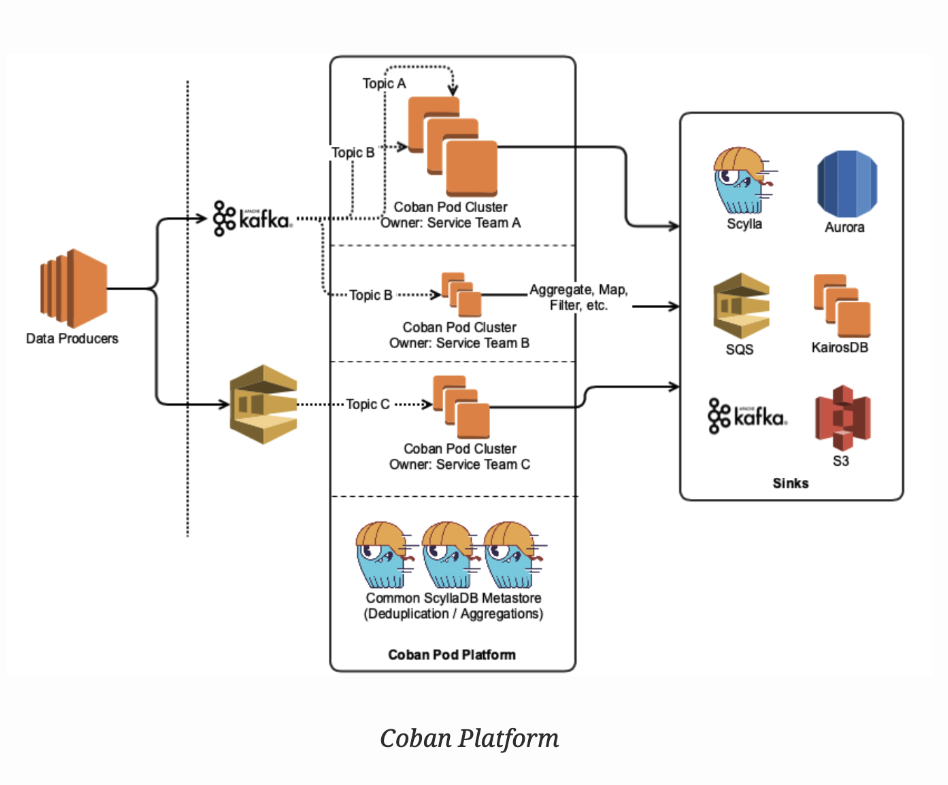
In this article, we cover the performance bottlenecks and other issues we came across for Go applications on Kubernetes.

Background

We noticed CPU throttling issues on some pipelines leading to consumption lag, which meant there was a delay between data production and consumption. This was an issue because the data might no longer be relevant or accurate when it gets consumed. This led to incorrect data-driven conclusions, costly mistakes, and more.

While debugging this issue, we focused primarily on the SinktoS3 pipeline. It is essentially used for sinking data from Kafka topics to AWS S3. Depending on your requirements, data sinking is primarily for archival purposes and can be used for analytical purposes.

Investigation

After conducting a thorough investigation, we found two main issues:

  • Resource throttling
  • Issue with VPA

Resource throttling

We redesigned our SinktoS3 pipeline architecture to concurrently perform the most CPU intensive operations using parallel goroutines (workers). This improved performance and considerably reduced consumer lag.

But the high-performance architecture needed more intensive resource configuration. As mentioned in Scaling kafka consumers, VPA helps remove manual resource configuration. So, we decided to let the SinktoS3 pipeline run on VPA, but this exposed a new set of problems.

We tested our hypothesis on one of the highest traffic pipelines with parallel goroutines (workers). When the pipeline was left running on VPA, it tried optimising the resources by slowly reducing from 2.5 cores to 2.05 cores, and then to 1.94 cores.
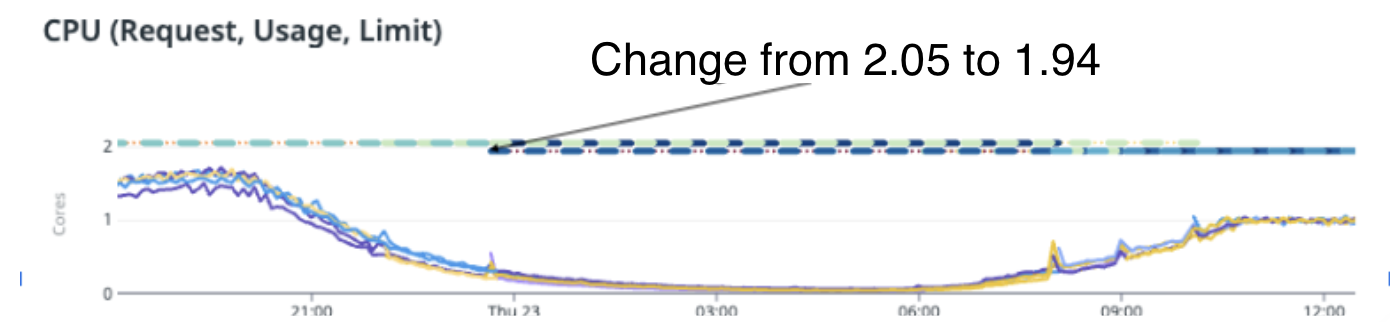
CPU requests dropped from 2.05 cores to 1.94 cores, since the maximum performance can be seen at ~1.7 cores.

As you can see from the image above, CPU usage and performance reduced significantly after VPA changed the CPU cores to less than 2. The pipeline ended up with a huge backlog to clear and although it had resources on pod (around 1.94 cores), it did not process any faster and instead, slowed down significantly, resulting in throttling.
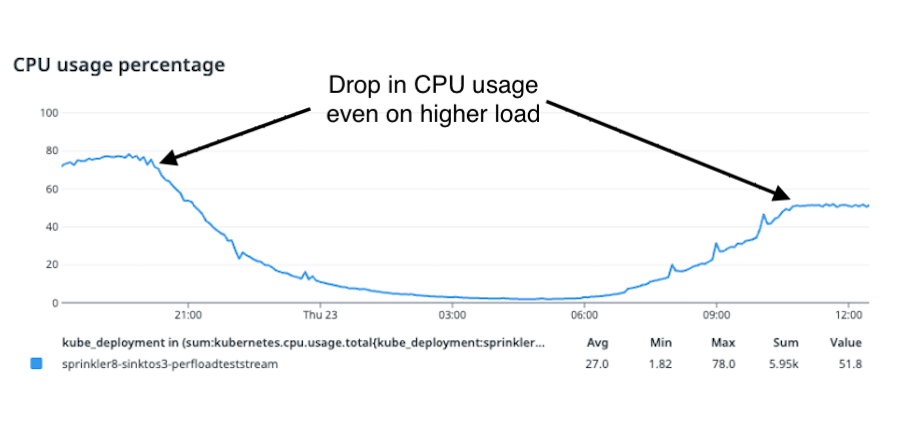
From the image above, we can see that after VPA scaled the limits of CPU down to 1.94 cores per pod, there was a sudden drop in CPU usage in each of the pods.
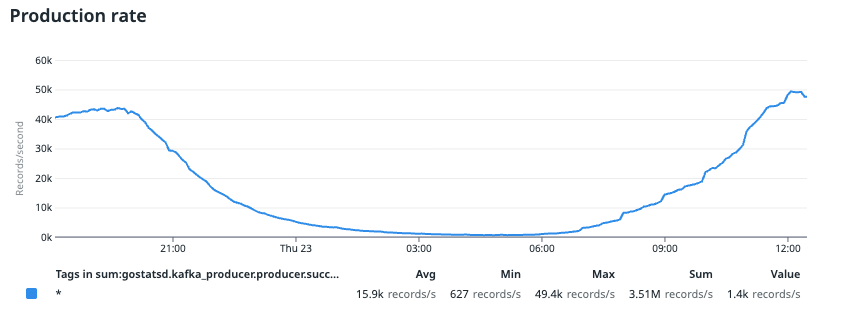
Stream production rate

You can see that at 21:00, CPU usage reached a maximum of 80%. This value dropped to around 50% between 10:00 to 12:00, which is our consecutive peak production rate.
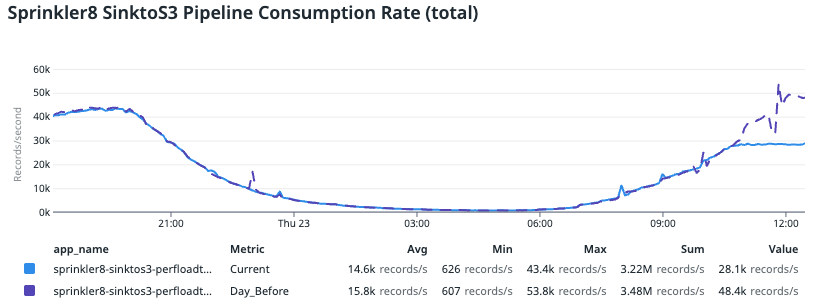
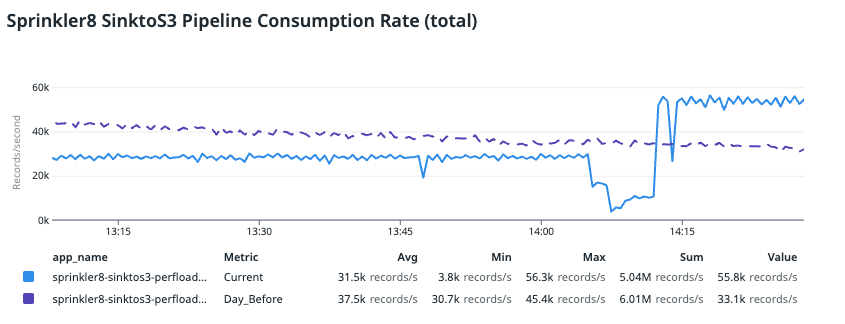
Significant drop in consumption rate from Day_Before
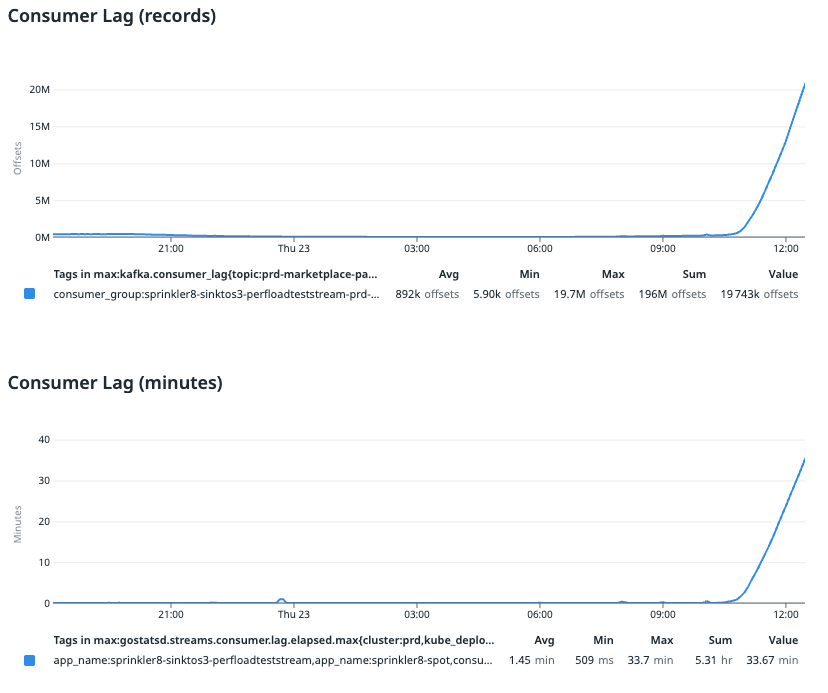
Consumer lag in terms of records pending to be consumed and in terms of minutes

In the image above, we compared this data with trends from previous data, where the purple line indicates the day before. We noticed a significant drop in consumption rate compared to the day before, which resulted in consumer lag. This drop was surprising since we didn’t tweak the application configuration. The only change was done by VPA, which brought the CPU request and limit down to less than 2 cores.

To revert this change, we redeployed the pipeline by retaining the same application setting but adjusting the minimum VPA limit to 2 cores. This helps to prevent VPA from bringing down the CPU cores below 2. With this simple change, performance and CPU utilisation improved almost instantly.
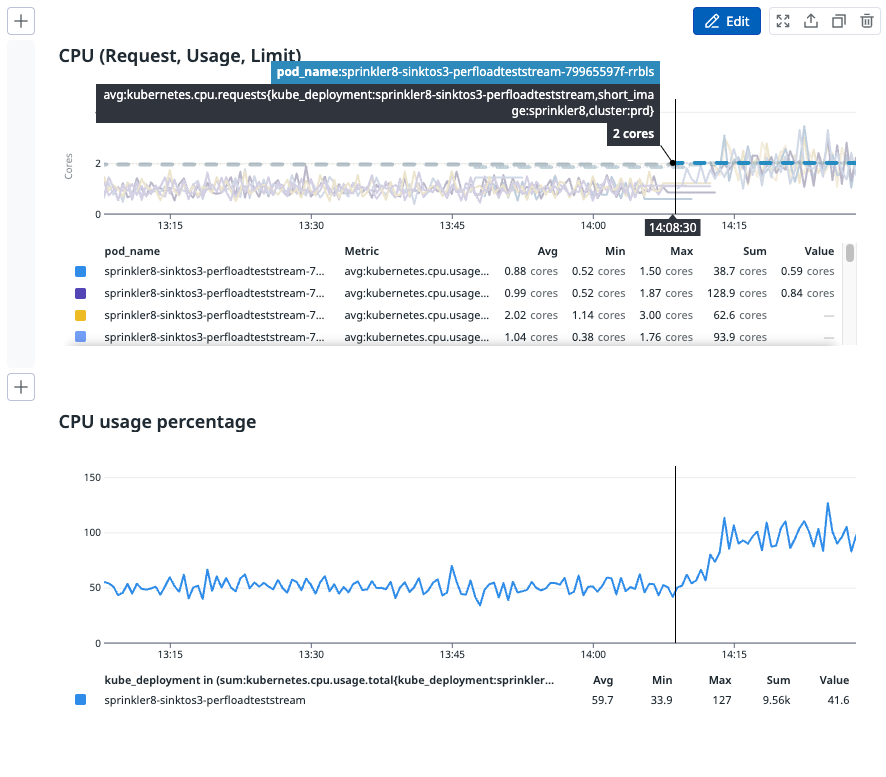
CPU usage percentage jumped back up to ~95%
Pipeline consumption rate compared to Day_Before

In the image above, we compared the data with trends from the day before (indicated in purple), where the pipeline was lagging and had a large backlog. You can see that the improved consumption rate was even better than the day before and the application consumed even more records. This is because it was catching up on the backlog from the previous consumer lag.

Deep dive into the root cause

This significant improvement just from increasing CPU allocation from 1.94 to 2 cores was unexpected as we had AUTO-GOMAXPROCS enabled in our SPF pipelines and this only uses integer values for CPU.

Upon further investigation, we found that the GOMAXPROCS is useful to control the CPU that golang uses on a kubernetes node when kubernetes Cgroup masks the actual CPU cores of the nodes. GOMAXPROCS only allocates the requested resources of the pod, hence configuring this value correctly helps the runtime to preallocate the correct CPU resources.

Without configuring GOMAXPROCS, go runtime assumes the node’s entire CPU capacity is available for its execution, which is sub-optimal when we run the Golang application on Kubernetes. Thus, it is important to configure GOMAXPROCS correctly so your application pre-allocates the right number of threads based on CPU resources. More details can be found in this article.

Let’s look at how Kubernetes resources relate to GOMAXPROCS value in the following table:

Kubernetes resources GOMAXPROCS value Remarks
2.5 core 2 Go runtime will just take and utilise 2 cores efficiently.
2 core 2 Go runtime will take and utilise the maximum CPU of the pod efficiently if the workload requires it.
1.5 core 1 AUTO-GOMAXPROCS will set the value as 1 since it rounds down the non-integer CPU value to an integer number. Hence the performance will be the same as if you had 1 core CPU.
0.5 core 1 AUTO-GOMAXPROCS will set the value as 1 CPU as the minimum allowed value for GOMAXPROCS is 1. Here we will see some throttling as Kubernetes will only give 0.5 core but runtime configures itself as it would have 1  hence it will starve for a few CPU cycles.

Issue with VPA

The vertical pod autoscaler enables you to easily scale pods vertically so you don’t have to make manual adjustments. It automatically allocates resources based on usage and allows proper scheduling so that there will be appropriate resources available for each pod. However, in our case, the throttling and CPU starvation issue was because VPA brought resources down to less than 2 cores.

To better visualise the issue, let’s use an example. Assume that this application needs roughly 1.7 cores to perform all its operations without any resource throttling. Let’s see how the VPA journey in this scenario looks like and where it will fail to correctly scale.

Timeline VPA recommendation CPU Utilisation AUTO-GOMAXPROCS Remarks
T0 0.5 core >90% 1 Throttled by Kubernetes Cgroup as it does give only 0.5 core.
T1 1 core >90% 1 CPU utilisation will still be >90% as GOMAXPROCS setting for the application remains the same. In reality, it will need even more.
T2 1.2 core <85% 1 Since the application actually needs more resources, VPA sets a non-integer value but GOMAXPROCS never utilised that extra resource and continued to throttle. Now, VPA computes that the CPU is underutilised and it won’t scale further.
T3 2 core (manual override) 80-90% 2 Since the application has enough resources, it will perform most optimally without throttling and will have maximum throughput.

Solution

During our investigation, we saw that AUTO-GOMAXPROCS sets an integer value (minimum 1). To avoid CPU throttling, we need VPA to propose integer values while scaling.

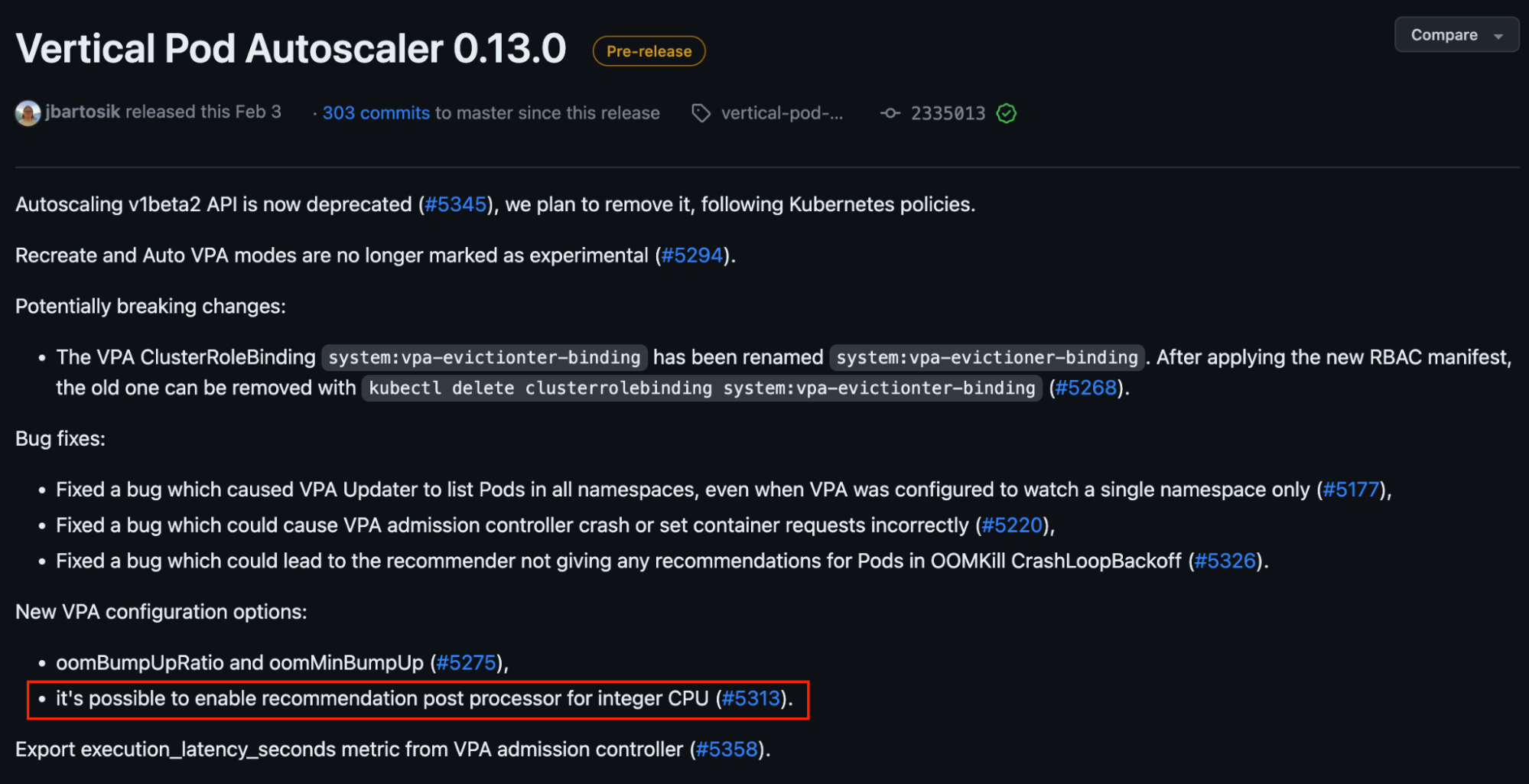
In v0.13 of VPA, this feature is available but only for Kubernetes versions ≥1.25 – see #5313 in the image below.
We acknowledge that if we define a default minimum integer CPU value of 1 core for Coban’s stream processing pipelines, it might be excessive for those that only require less than 1 core. So we propose to only enable this default setting for pipelines with heavy resource requirements and require more than 1 core.

That said, you should make this decision by evaluating your application’s needs. For example, some Coban pipelines still run on VPA with less than one core but they do not experience any lag. As we mentioned earlier  AUTO-GOMAXPROCS would be configured to 1 in this case, still they can catch up with message production rates. However, technically these pipelines are actually throttled and do not perform optimally but these pipelines don’t have consumer lag.

As we move from single to concurrent goroutine processing, we need more intensive CPU allocation. In the following table, we consider some scenarios where we have a few pipelines with heavy workloads that are not able to catch up with the production rate.

Actual CPU requirement VPA recommendation (after upgrade to v0.13) GOMAXPROCS value Remarks
0.8 1 core 1 Optimal setting for this pipeline. It should not lag and should utilise the CPU resources optimally via concurrent goroutines.
1.2 2 2 No CPU throttling and no lag. But not very cost efficient.
1.8 2 2 Optimal performance with no lag and cost efficiency.

Learnings/Conclusion

From this experience, we learnt several things:

  • Incorrect GOMAXPROCS configuration can lead to significant throttling and CPU starvation issues.
  • Autoscaling solutions are important, but can only take you so far. Depending on your application needs, manual intervention might still be needed to ensure optimal performance.

Join us

Grab is the leading superapp platform in Southeast Asia, providing everyday services that matter to consumers. More than just a ride-hailing and food delivery app, Grab offers a wide range of on-demand services in the region, including mobility, food, package and grocery delivery services, mobile payments, and financial services across 428 cities in eight countries.

Powered by technology and driven by heart, our mission is to drive Southeast Asia forward by creating economic empowerment for everyone. If this mission speaks to you, join our team today!

[$] Fanotify and hierarchical storage management

Post Syndicated from original https://lwn.net/Articles/932415/

In the filesystem track of the
2023 Linux Storage, Filesystem,
Memory-Management and BPF Summit
, Amir Goldstein led a session on using
fanotify
for hierarchical
storage management
(HSM). Linux had some support for HSM in the XFS
filesystem’s implementation of the data management API (DMAPI),
but that code was removed
back in 2010. Goldstein has done some work
on using fanotify for HSM features, but he has run into some problems with
deadlocks that he wanted to discuss with attendees.

[$] Reliable user-space stack traces with SFrame

Post Syndicated from original https://lwn.net/Articles/932209/

A complete stack trace is needed for a number of debugging and optimization
tasks, but getting such traces reliably can be surprisingly challenging.
At the 2023 Linux Storage, Filesystem,
Memory-Management and BPF Summit
, Steve Rostedt and Indu Bhagat
described a mechanism called SFrame that enables the creation of reliable
user-space stack traces in the kernel without
the memory and run-time overhead of some other solutions.

AWS Week in Review – AWS Documentation Updates, Amazon EventBridge is Faster, and More – May 22, 2023

Post Syndicated from Danilo Poccia original https://aws.amazon.com/blogs/aws/aws-week-in-review-aws-documentation-updates-amazon-eventbridge-is-faster-and-more-may-22-2023/

AWS Data Hero Anahit Pogosova keynote at CloudConf 2023Here are your AWS updates from the previous 7 days. Last week I was in Turin, Italy for CloudConf, a conference I’ve had the pleasure to participate in for the last 10 years. AWS Hero Anahit Pogosova was also there sharing a few serverless tips in front of a full house. Here’s a picture I took from the last row during her keynote.

On Thursday, May 25, I’ll be at the AWS Community Day in Dublin to celebrate the 10 years of the local AWS User Group. Say hi if you’re there!

Last Week’s Launches
Last week was packed with announcements! Here are the launches that got my attention:

Amazon SageMakerGeospatial capabilities are now generally available with security updates and more use case samples.

Amazon DetectiveSimplify the investigation of AWS Security Findings coming from new sources such as AWS IAM Access Analyzer, Amazon Inspector, and Amazon Macie.

Amazon EventBridge – EventBridge now delivers events up to 80% faster than before, as measured by the time an event is ingested to the first invocation attempt. No change is required on your side.

AWS Control Tower – The service has launched 28 new proactive controls that allow you to block non-compliant resources before they are provisioned for services such as AWS OpenSearch Service, AWS Auto Scaling, Amazon SageMaker, Amazon API Gateway, and Amazon Relational Database Service (Amazon RDS). Check out the original posts from when proactive controls were launched.

Amazon CloudFront – CloudFront now supports two new control directives to help improve performance and availability: stale-while-revalidate (to immediately deliver stale responses to users while it revalidates caches in the background) and the stale-if-error cache (to define how long stale responses should be reused if there’s an error).

Amazon Timestream – Timestream now enables to export query results to Amazon S3 in a cost-effective and secure manner using the new UNLOAD statement.

AWS Distro for OpenTelemetryThe tail sampling and the group-by-trace processors are now generally available in the AWS Distro for OpenTelemetry (ADOT) collector. For example, with tail sampling, you can define sampling policies such as “ingest 100% of all error cases and 5% of all success cases.”

AWS DataSync – You can now use DataSync to copy data to and from Amazon S3 compatible storage on AWS Snowball Edge Compute Optimized devices.

AWS Device Farm – Device Farm now supports VPC integration for private devices, for example, when an unreleased version of an app is accessing a staging environment and tests are accessing internal packages only accessible via private networking. Read more at Access your private network from real mobile devices using AWS Device Farm.

Amazon Kendra – Amazon Kendra now helps you search across different content repositories with new connectors for Gmail, Adobe Experience Manager Cloud, Adobe Experience Manager On-Premise, Alfresco PaaS, and Alfresco Enterprise. There is also an updated Microsoft SharePoint connector.

Amazon Omics – Omics now offers pre-built bioinformatic workflows, synchronous upload capability, integration with Amazon EventBridge, and support for Graphical Processing Units (GPUs). For more information, check out New capabilities make it easier for healthcare and life science customers to get started, build applications, and scale-up on Amazon Omics.

Amazon Braket – Braket now supports Aria, IonQ’s largest and highest fidelity publicly available quantum computing device to date. To learn more, read Amazon Braket launches IonQ Aria whith built-in error mitigation.

For a full list of AWS announcements, be sure to keep an eye on the What’s New at AWS page.

Other AWS News
A few more news items and blog posts you might have missed:

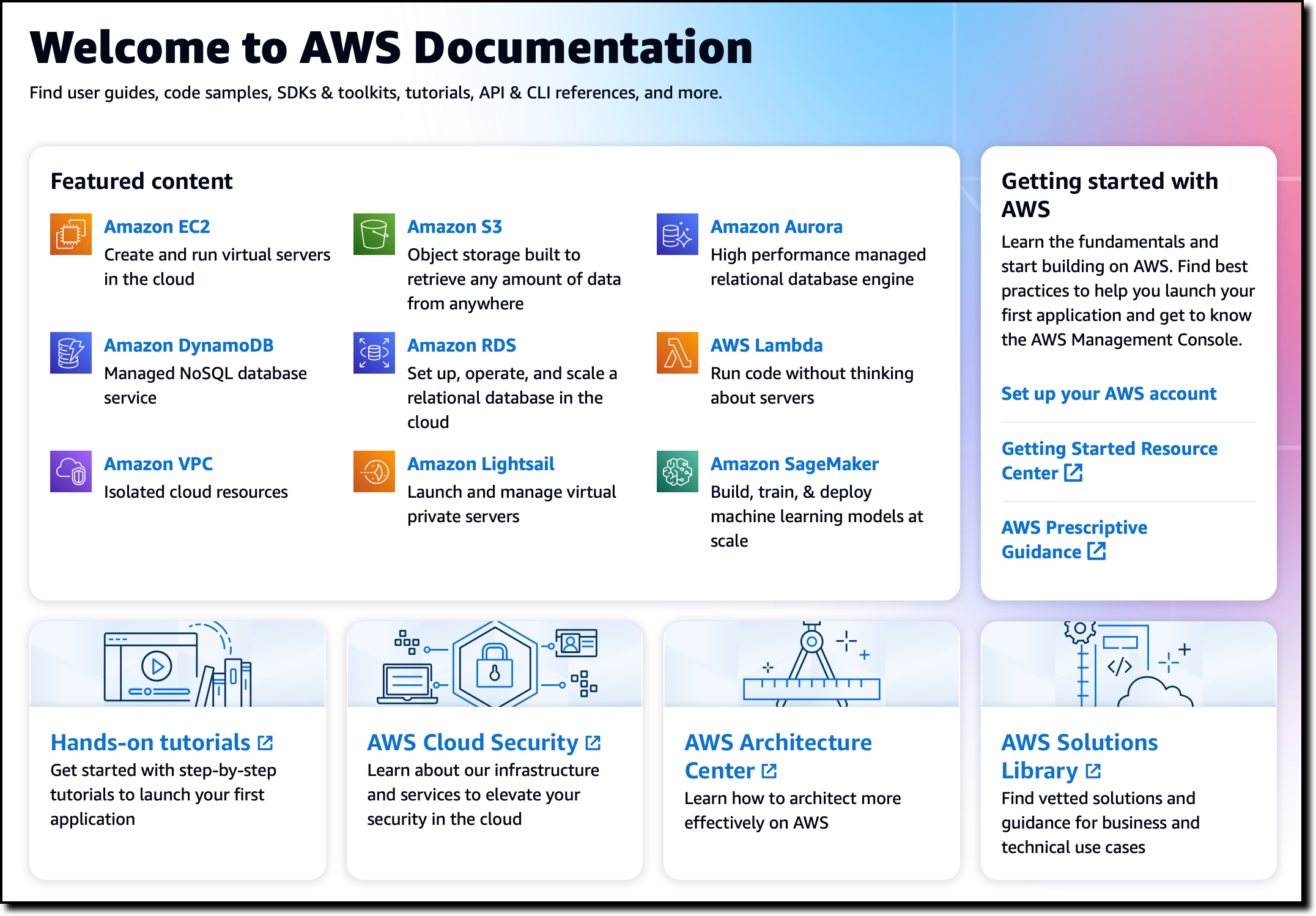
AWS Documentation home page screenshot.AWS Documentation – The AWS Documentation home page has been redesigned. Leave your feedback there to let us know what you think or to suggest future improvements. Last week we also announced that we are retiring the AWS Documentation GitHub repo to focus our resources to directly improve the documentation and the website.

Peloton case studyPeloton embraces Amazon Redshift to unlock the power of data during changing times.

Zoom case studyLearn how Zoom implemented streaming log ingestion and efficient GDPR deletes using Apache Hudi on Amazon EMR.

Nice solutionIntroducing an image-to-speech Generative AI application using SageMaker and Hugging Face.

For AWS open-source news and updates, check out the latest newsletter curated by Ricardo to bring you the most recent updates on open-source projects, posts, events, and more.

Upcoming AWS Events
Here are some opportunities to meet and learn:

AWS Data Insights Day (May 24) – A virtual event to discover how to innovate faster and more cost-effectively with data. This event focuses on customer voices, deep-dive sessions, and best practices of Amazon Redshift. You can register here.

AWS Silicon Innovation Day (June 21) – AWS has designed and developed purpose-built silicon specifically for the cloud. Join to learn AWS innovations in custom-designed Amazon EC2 chips built for high performance and scale in the cloud. Register here.

AWS re:Inforce (June 13–14) – You can still register for AWS re:Inforce. This year it is taking place in Anaheim, California.

AWS Global Summits – Sign up for the AWS Summit closest to where you live: Hong Kong (May 23), India (May 25), Amsterdam (June 1), London (June 7), Washington, DC (June 7-8), Toronto (June 14), Madrid (June 15), and Milano (June 22). If you want to meet, I’ll be at the one in London.

AWS Community Days – Join these community-led conferences where event logistics and content is planned, sourced, and delivered by community leaders: Dublin, Ireland (May 25), Shenzhen, China (May 28), Warsaw, Poland (June 1), Chicago, USA (June 15), and Chile (July 1).

That’s all from me for this week. Come back next Monday for another Week in Review!

Danilo

This post is part of our Week in Review series. Check back each week for a quick roundup of interesting news and announcements from AWS!

Announcing Instant Business Recovery, a Joint Solution by Continuity Centers

Post Syndicated from Elton Carneiro original https://www.backblaze.com/blog/announcing-instant-business-recovery-a-joint-solution-by-continuity-centers/

Business disruptions can be devastating, as any business owner who has been through one will tell you. This stat isn’t meant to stoke fear, but the Atlas VPN research team found that 31% of businesses in the U.S. are forced to close for a period of time as a consequence of falling victim to ransomware attacks.

It’s likely some, if not most, of those businesses had backups in place. But, having backups alone won’t necessarily save your business if it takes you days or weeks to restore operations from those backups. And true disaster recovery means more than simply having backups and a plan to restore: It means testing that plan regularly to make sure you can bring your business back online.

Today, we’re sharing news of a new disaster recovery service built on Backblaze B2 Cloud Storage that’s aimed to help businesses restore faster and more affordably: Continuity Centers’ Cloud Instant Business Recovery (Cloud IBR) which instantly recovers Veeam backups from the Backblaze B2 Storage Cloud.

Helping Businesses Recover After a Disaster

We launched the first generation version of this solution—Instant Recovery in Any Cloud—in May of 2022 to help businesses complete their disaster recovery playbook. And now, we’re building on that original infrastructure as code (IaC) package, to bring you Cloud IBR.

Cloud IBR is a second generation solution that further simplifies disaster recovery plans. The easy-to-use interface and affordability make Cloud IBR an ideal disaster recovery solution designed for small and medium size businesses (SMBs) who are typically priced out of enterprise-scale disaster recovery solutions.

How Does Cloud IBR Work?

Continuity Centers combines the automation-driven Veeam REST API calls with phoenixNAP Bare Metal Cloud platform into a unified system, and completely streamlines the user experience.

The fully-automated service deploys a recovery process through a simple web UI, and, in the background, uses phoenixNAP’s Bare Metal Cloud servers to import Veeam backups stored in Backblaze B2 Cloud Storage, and fully restores the customer’s server infrastructure. The solution hides the complexity of dealing with automation scripts and APIs and offers a simple interface to stand up an entire cloud infrastructure when you need it. Best of all, you pay for the service only for the period of time that you need.

Cloud IBR gives small and mid-market companies the highest level of business continuity available, against disasters of all types. It’s a simple and accessible solution for SMBs to embrace. We developed this solution with affordability and availability in mind, so that businesses of all sizes can benefit from our decades of disaster recovery experience, which is often financially out of reach for the SMB.

—Gregory Tellone, CEO of Continuity Centers.

Right-Sized Disaster Recovery

Previously, mid-market businesses were underserved by disaster recovery and business continuity planning because the requirements and efforts to create a disaster recovery (DR) plan are often foregone in favor of more immediate business demands. Additionally, many disaster recovery solutions are designed for larger size companies and do not meet the specific needs for SMBs. Cloud IBR allows businesses of all sizes to instantly stand up their entire server infrastructure in the cloud, at a moment’s notice and with a single click, making it easy to plan for and easy to execute.

Learn more about Cloud IBR at the Cloud IBR website.

Access Cloud IBR Through B2 Reserve

In addition to being a stand-alone offering that can be purchased alongside pay-as-you-go cloud storage, the Cloud IBR Silver Package will be offered at no cost for one year to any Veeam customers that purchase Backblaze through our capacity-based cloud storage packages, B2 Reserve. Those customers can activate Cloud IBR within 30 days of purchasing Backblaze’s B2 Reserve service.

The post Announcing Instant Business Recovery, a Joint Solution by Continuity Centers appeared first on Backblaze Blog | Cloud Storage & Cloud Backup.

[$] A slab allocator (removal) update

Post Syndicated from original https://lwn.net/Articles/932201/

The kernel developers try hard to avoid duplicating functionality in the
kernel, which is enough of a challenge to maintain as it is. So it has
often seemed out of character for the kernel to support three different
slab allocators (called SLAB, SLOB, and SLUB), all of which handle the
management of small memory allocations in similar ways. At the 2023 Linux Storage, Filesystem,
Memory-Management and BPF Summit
, slab maintainer Vlastimil Babka
updated the group on progress toward the goal of reducing the number of
slab allocators in the kernel and gave an overview of what to expect in
that area.

Security updates for Monday

Post Syndicated from original https://lwn.net/Articles/932625/

Security updates have been issued by Debian (cups-filters, imagemagick, libwebp, sqlite, and texlive-bin), Fedora (chromium and vim), Gentoo (librecad, mediawiki, modsecurity-crs, snakeyaml, and tinyproxy), Mageia (apache-mod_security, cmark, dmidecode, freetype2, glib2.0, libssh, patchelf, python-sqlparse, sniproxy, suricata, and webkit2), Oracle (apr-util and firefox), Red Hat (git), SUSE (containerd, openvswitch, python-Flask, runc, terraform-provider-aws, and terraform-provider-null), and Ubuntu (tar).

Recapping Developer Week

Post Syndicated from Ricky Robinett original http://blog.cloudflare.com/developer-week-2023-wrap-up/

Recapping Developer Week

Recapping Developer Week

Developer Week 2023 is officially a wrap. Last week, we shipped 34 posts highlighting what has been going on with our developer platform and where we’re headed in the future – including new products & features, in-depth tutorials to help you get started, and customer stories to inspire you.

We’ve loved already hearing feedback from you all about what we’ve shipped:


We hope you’re able to spend the coming weeks slinging some code and experimenting with some of the new tools we shipped last week. As you’re building, join us in our developers discord and let us know what you think.

In case you missed any of our announcements here’s a handy recap:

AI announcements

Announcement Summary
Batteries included: how AI will transform the who and how of programming The emergence of large language models (LLMs) is going to change the way developers write, debug, and modify code. Developer Platforms need to evolve to integrate AI capabilities to assist developers in their journeys.
Introducing Constellation, bringing AI to the Cloudflare stack Run pre-trained machine learning models and inference tasks on Cloudflare’s global network with Constellation AI. We’ll maintain a catalog of verified and ready-to-use models, or you can upload and train your own.
Introducing Cursor: the Cloudflare AI Assistant When getting started with a new technology comes a lot of questions on how to get started. Finding answers quickly is a time-saver. To help developers build in the fastest way possible we’ve introduced Cursor, an experimental AI assistant, to answer questions you may have about the Developer Platform. The assistant responds with both text and relevant links to our documentation to help you go further.
Query Cloudflare Radar and our docs using ChatGPT plugins ChatGPT, recently allowed the ability for developers to create custom extensions to make ChatGPT even more powerful. It’s now possible to provide guidance to the conversational workflows within ChatGPT such as up-to-date statistics and product information. We’ve published plugins for Radar and our Developer Documentation and a tutorial showing how you can build your own plugin using Workers.
A complete suite of Zero Trust security tools to help get the most from AI With any new technology comes concerns about risk and AI is no different. If you want to build with AI and maintain a Zero Trust security posture, Cloudflare One offers a collection of features to build with AI without increased risk. We’ve also compiled some best practices around securing your LLM.
Cloudflare R2 and MosaicML enable training LLMs on any compute, anywhere in the world, with zero switching costs Training large language models requires massive amount of compute which has led AI companies to look at multi-cloud architectures, with R2 and MosaicML companies can build these infrastructures at a fraction of the cost.
The S3 to R2 Super Slurper is now Generally Available After partnering with hundreds of early adopters to migrate objects to R2 during the beta, the Super Slurper is now generally available.
A raft of Cloudflare services for AI startups AI startups no longer need affiliation with an accelerator or an employee referral to gain access to the Startup Program. Bootstrapped AI startups can apply today to get free access to Cloudflare services including R2, Workers, Pages, and a host of other security and developer services.
How to secure Generative AI applications 11 tips for securing your generative AI application.
Using LangChain JS and Cloudflare Workers together A tutorial on building your first LangChainJS and Workers application to build more sophisticated applications by switching between LLMs or chaining prompts together.

Data announcements

Announcement Summary
Announcing database integrations: a few clicks to connect to Neon, PlanetScale, and Supabase on Workers We’ve partnered with other database providers, including Neon, PlanetScale, and Supabase, to make authenticating and connecting back to your databases there just work, without having to copy-paste credentials and connection strings back and forth.
Announcing connect() – a new API for creating TCP sockets from Cloudflare Workers Connect back to existing PostgreSQL and MySQL databases directly from Workers with outbound TCP sockets allowing you to connect to any database when building with Workers.
D1: We turned it up to 11 D1 is now not only significantly faster, but has a raft of new features, including the ability to time travel: restore your database to any minute within the last 30 days, without having to make a manual backup.
Smart Placement speed up applications by moving code close to your backend – no config needed Bringing compute closer to the end user isn’t always the right answer to improve performance. Smart Placement for Workers and Pages Functions moves compute to the optimal location whether that is closer to the end user or closer to backend services and data.
Use Snowflake with R2 to extend your global data lake Get valuable insights from your data when you use Snowflake to query data stored in your R2 data lake and load data from R2 into Snowflake’s Data Cloud.
Developer Week Performance Update: Spotlight on R2 Retrieving objects from storage needs to be fast. R2 is 20-40% faster than Amazon S3 when serving media content via public access.

Developer experience announcements

Announcement Summary
Making Cloudflare the best place for your web applications Create Cloudflare CLI (C3) is a companion CLI to Wrangler giving you a single entry-point to configure Cloudflare via CLI. Pick your framework, all npm dependencies are installed, and you’ll receive a URL for where your application was deployed.
A whole new Quick Edit in Cloudflare Workers QuickEdit for Workers powered by VSCode giving you a familiar environment to edit Workers directly in the dash.
Bringing a unified developer experience to Cloudflare Workers and Pages Manage all your Workers scripts and Pages projects from a single place in the Cloudflare dashboard. Over the next year we’ll be working to converge these two separate experiences into one eliminating friction when building.
Modernizing the toolbox for Cloudflare Pages builds Now in beta, the build system for Pages includes the latest versions of Node.js, Python, Hugo, and more. You can opt in to use this for existing projects or stay on the existing system, so your builds won’t break.
Improved local development with Wrangler and workerd Having a local development environment that mimics production as closely as possible helps to ensure everything runs as expected in production. You can test every aspect prior to deployment. Wrangler 3 now leverages Miniflare3 based on workerd with local-by-default development.
Goodbye, section 2.8 and hello to Cloudflare’s new terms of service Our terms of service were not clear about serving content hosted on the Developer Platform via our CDN. We’ve made it clearer that customers can use the CDN to serve video and other large files stored on the Developer Platform including Images, Pages, R2, and Stream.
More Node.js APIs in Cloudflare Workers-Streams, Pat, StringDecoder We’ve expanded support Node.js APIs to increase compatibility with the existing ecosystem of open source npm packages.

But wait, there’s more

Announcement Summary
How Cloudflare is powering the next generation of platforms with Workers A retrospective on the first year of Workers for Platform, what’s coming next, and featuring how customers like Shopify and Grafbase are building with it.
Building Cloudflare on Cloudflare A technical deep dive into how we are rearchitecting internal services to use Workers.
Announcing Cloudflare Secrets Store A centralized repository to store sensitive data for use across all of Cloudflare’s products.
Cloudflare Queues: messages at your speed with consumer concurrency and explicit acknowledgement Announcing new features for Queues to ensure queues don’t fall behind, and processing time doesn’t slow down.
Workers Browser Rendering API enters open beta Deploy a Worker script that requires Browser Rendering capabilities through Wrangler.

Watch on Cloudflare TV

If you missed any of the announcements or want to also view the associated Cloudflare TV segments, where blog authors went through each announcement, you can now watch all the Developer Week videos on Cloudflare TV.

Launching our new Open Source Software Sponsorships Program

Post Syndicated from Veronica Marin original http://blog.cloudflare.com/cloudflare-new-oss-sponsorships-program/

Launching our new Open Source Software Sponsorships Program

Launching our new Open Source Software Sponsorships Program

In 2018, we first launched our Open Source Software Sponsorships program, and since then, we've been listening to your feedback, and realized that it's time to introduce a fresh and enhanced version of the program that's more inclusive and better addresses the needs of the OSS community.

Launching our new Open Source Software Sponsorships Program
A subset of open source projects on Cloudflare. See more >>

Previously, our sponsorship focused on engineering tools, but we're excited to announce that we've now opened it to include any non-profit and open source projects.

Program criteria and eligibility

To qualify for our Open Source Sponsorship Program, projects must be open source and meet the following criteria:

  1. Operate on a non-profit basis.
  2. Include a link back to our home page.

Please keep in mind that this program isn't intended for event sponsorships, but rather for project-based support.

Sponsorship benefits

As part of our sponsorship program, we offer the following benefits to projects:

Can Cloudflare help your open source project be successful and sustainable? Fill out the application form to submit your project for review, and please share this so that more open source projects can be supported by Cloudflare.

Announcing Cohort #2 of the Workers Launchpad

Post Syndicated from Mia Wang original http://blog.cloudflare.com/launchpad-cohort2/

Announcing Cohort #2 of the Workers Launchpad

Announcing Cohort #2 of the Workers Launchpad

We launched the $2B Workers Launchpad Funding Program in late 2022 to help support the over one million developers building on Cloudflare’s Developer Platform, many of which are startups leveraging Cloudflare to ship faster, scale more efficiently, and accelerate their growth.

Cohort #1 wrap-up

Since announcing the program just a few months ago, we have welcomed 25 startups from all around the world into our inaugural cohort and recently wrapped up the program with the Demo Day. Cohort #1 gathered weekly for Office Hours with our Solutions Architects for technical advice and the Founders Bootcamp, where they spent time with Cloudflare leadership, preview upcoming products with our Developer Platform Product Managers, and receive advice on a wide range of topics such as how to build Sales teams and think about the right pricing model for your product.

Learn more about what these companies are building and what they’ve been up to below:

Authdog

Identity and Access Management streamlined.

Demo Day pitch

Why they chose Cloudflare
“Cloudflare is the de facto Infrastructure for building resilient serverless products, it was a no-brainer to migrate to Cloudflare Workers to build the most frictionless experience for our customers.”

Recent updates
Learn more about how Authdog is using Cloudflare’s Developer Platform in their Built With Workers case study.

Drivly

Automotive Commerce APIs to Buy & Sell Cars Online.

Demo Day pitch

Why they chose Cloudflare
“We believe that Cloudflare is the next-generation of cloud computing platforms, and Drivly is completely built on Cloudflare, from Workers, Queues, PubSub, and especially Durable Objects.”

Recent updates
Drivly made their public launch at Demo Day!

Flethy

Integrate APIs, the easy way.

Demo Day pitch

Why they chose Cloudflare
“Simplicity and Performance. Using Pages and KV is extremely easy, but what really impresses are Workers with a nearly instant cold start!”

Recent updates
Check out how Cloudflare is helping Flethy improve and accelerate API service integrations for developers here.

GPUX

Serverless GPU.

Demo Day pitch

Why they chose Cloudflare
“Cloudflare is core to the internet; R2, Transit, Workers with no egress charge.”

Recent updates
GPUX launched v2 of their platform on Demo Day!

Grafbase

The easiest way to build and deploy GraphQL backends.

Demo Day pitch

Why they chose Cloudflare
“The Grafbase platform is built from the ground up to be highly performant and deployed to the edge using Rust and WebAssembly. Services like Cloudflare Workers, KV, Durable Objects, Edge Caching were a natural choice as it fits perfectly into our vision architecturally.”

Recent updates
Grafbase, which is building on Workers for Platforms among other Cloudflare products, celebrated their public launch and 7 new features in their April 2023 Launch Week.

JEMPass

Simple, seamless, and secure way to eliminate passwords.

Demo Day pitch

Why they chose Cloudflare
“We found it to be the best fit for our needs: performant, and easy to develop on, easy to scale.”

Recent updates
Learn more about how JEMPass works here.

Karambit.ai

The last line of defense for the software supply chain.

Demo Day pitch

Why they chose Cloudflare
“Cloudflare's developer products offer effortlessly powerful building blocks essential to scaling up product to meet strenuous customer demand while enabling our developers to deliver faster than ever.”

Recent updates
Karambit recently received a grant from the Virginia Innovation Partnership Corporation to help scale their commercial growth.

Narrative BI

A no-code analytics platform for growth teams that automatically turns raw data into actionable narratives.

Demo Day pitch

Why they chose Cloudflare
“Our customers benefit as we improve the quality of insights for them by running advanced algorithms for finding unqualified data points and quickly solving them with the unlimited power of Cloudflare Workers.”

Recent updates
Learn more about how Cloudflare is helping Narrative BI improve the quality of insights they generate for customers here.

Ninetailed

API-first personalization and experimentation solution to give your customers blazing-fast experiences.

Demo Day pitch

Why they chose Cloudflare
“Cloudflare’s developers platform allows us to fully deploy our everything-on-the-edge approach to both data and delivery means personalized experience cause zero loading lag and zero interruptions for the customer.”

Recent updates
Ninetailed recently launched integrations with Contentstack, Zapier, and other tools to improve and personalize digital customer experiences. Learn more on the Ninetailed blog and their Built with Workers case study.

Patr

Scalable, secure and cost-effective digital infrastructure, without the complexities of it.

Demo Day pitch

Why they chose Cloudflare
“Workers provides us with a global network of edge compute that we can use to route data internally to our user's deployments, providing our users with infinite scale.”

Recent updates
Patr was recently highlighted as a Product of the Day on Product Hunt!

QRYN

Polyglot monitoring and edge observability.

Demo Day pitch

Why they chose Cloudflare
“Polyglot, Secure, Cost-Effective Edge Observability – all powered by Cloudflare Workers and R2 Storage.”

Recent updates
QRYN recently launched integrations with Cloudflare Log Push, Grafana, and others.

Quest.ai

Quest is a code-generation tool that automatically generates frontend code for business applications.

Demo Day pitch

Why they chose Cloudflare
“We chose Cloudflare's Workers and Pages product to augment our frontend code-gen to include backend and hosting capabilities.”

Recent updates
Quest has been hard at work expanding their platform and recently added animations, CSS grid, MUI & Chakra UI support, NextJS support, breakpoints, nested components, and more.

Rollup ID

Simple & Secure ‍User Access. Rollup is all your authentication and authorization needs bundled into one great package.

Demo Day pitch

Why they chose Cloudflare
“We chose Cloudflare’s developer platform because it provides us all the tools to build a logical user graph at the edge. We can utilize everything from Durable Objects, D1, R2, and more to build a fast and distributed auth platform.”

Recent updates
Rollup ID recently made their public debut and has rolled out lots of new features since. Learn more here.

Targum

Translating videos at the speed of social media using AI.

Demo Day pitch

Why they chose Cloudflare
“Cloudflare Stream allows us to compete with YouTube's scale while being a 1-person startup, and Cloudflare Workers handles millions of unique views on Targum without waking us up at night.”

Recent updates
Targum launched its platform to customers and hit $100K MRR in just a few days! Check out their Built With Workers case study to learn more.

Touchless

Fixing website platforms without code.

Demo Day pitch

Why they chose Cloudflare
“Workers and the Cloudflare developer platform have been pivotal in enabling us to modernize and enhance existing website platforms and grow their conversions by 5X with little to no code.”

Recent updates
Touchless has been growing their ecosystem and recently joined the RudderStack Solutions Partner Program.

Introducing Cohort #2 of the Workers Launchpad!

We have received hundreds of applications from startups from nearly 50 different countries. There were many AI or AI-related companies helping everyone from developers, to security teams and sales organizations. We also heard from many startups looking to improve developer tooling and collaboration, new social and gaming platforms, and companies solving a wide range of problems that ecommerce, consumer, real estate, and other businesses face today.

While these applicants are tackling a diverse set of real-world problems, the common thread is that they chose to leverage Cloudflare’s developer platform to build more secure, scalable, and feature-rich products faster than they otherwise could.

Without further ado, we are thrilled to announce the 25 incredible startups selected for Cohort #2 of the Workers Launchpad:

Announcing Cohort #2 of the Workers Launchpad

Here’s what they’re building, in their own words:

42able.ai Making AI available and accessible to all.
ai.moda Automate delegating tasks to both your bots and human workers with an MTurk compatible API.
Arrive GG Real-time CDN for gamers.
Astro All-in-one web framework designed for speed. Pull your content from anywhere and deploy everywhere, all powered by your favorite UI components and libraries.
Azule Azule delivers AI agents that interact with your customers.
Brevity Build better software, visually.
Buildless Buildless is a global build cache, like Cloudflare for compiled code; we cache artifacts and make them available over the internet to exponentially accelerate developer velocity.
ChainFuse no-code platform to build multi-model AI for your business.
ChatORG Collaborative ChatGPT for your team.
Clerk Clerk, the drop-in authentication and user management solution for React.
contribute.design OpenSource Software & Design collaboration made easy.
Drifting in Space Drifting in Space builds software that enables developers to use WebSockets to create real-time applications.
Eclipse AI Prevent churn with generative AI.
Embley Marketplace automation platform enabling businesses to scale better and faster.
Fudge Fudge makes websites faster.
Mixer Real world social on a generative AI stack.
Monosnap Monosnap is a secure productivity SaaS with B2B PLG strategy, complementing existing workflows.
Nefeli Networks Unified and declarative cloud network management.
Smplrspace The digital floor plan platform.
Speech Labs AI assistant helping with everyday tasks.
TestApp.io Mobile app testing made easy.
Tigris Data Serverless NoSQL database and search platform to help developers quickly and easily build any application.
tldraw tldraw is building an infinite canvas for developers.
Vantyr The programmatic authorization layer for SaaS.
WunderGraph WunderGraph: The Backend for Frontend framework.

We are looking forward to working with each of these companies over the next few months and sharing what they’re building with you.

If you’re building on Cloudflare’s Developer Platform, head over to @CloudflareDev or join the Cloudflare Developer Discord community to stay in the loop on Launchpad updates. In the early fall, we’ll be selecting Cohort #3 — apply early here!

Cloudflare is not providing any funding or making any funding decisions, and there is no guarantee that any particular company will receive funding through the program. All funding decisions will be made by the venture capital firms that participate in the program. Cloudflare is not a registered broker-dealer, investment adviser, or other similar intermediary.

A guide to io_uring

Post Syndicated from original https://lwn.net/Articles/932568/

Nick Black has put together an extensive
guide to the io_uring API
and the lib_uring user-space library.

It combines asynchronous I/O, system call polybatching, and
flexible buffer management, and is IMHO the most substantial
development in the Linux I/O model since Berkeley sockets (yes, I’m
aware Berkeley sockets preceded Linux. Let’s then say that they’re
the most substantial development in the UNIX I/O model to originate
in Linux)

The collective thoughts of the interwebz