The Anti-Theft Mode feature will make the devices invisible to Scan and Secure, the company’s in-app feature that lets you know if any nearby Tiles are following you. But to activate the new Anti-Theft Mode, the Tile owner will have to verify their real identity with a government-issued ID, submit a biometric scan that helps root out fake IDs, agree to let Tile share their information with law enforcement and agree to be subject to a $1 million penalty if convicted in a court of law of using Tile for criminal activity. So although it technically makes the device easier for stalkers to use Tiles silently, it makes the penalty of doing so high enough to (at least in theory) deter them from trying.
Interesting theory. But it won’t work against attackers who don’t have any money.
Hulls believes the approach is superior to Apple’s solution with AirTag, which emits a sound and notifies iPhone users that one of the trackers is following them.
My complaint about the technical solutions is that they only work for users of the system. Tile security requires an “in-app feature.” Apple’s AirTag “notifies iPhone users.” What we need is a common standard that is implemented on all smartphones, so that people who don’t use the trackers can be alerted if they are being surveilled by one of them.
Please do give 6.2 a testing. Maybe it’s not a sexy LTS release
like 6.1 ended up being, but all those regular pedestrian kernels
want some test love too.
Headline features in this release include
the ability to manage linked
lists and other data structures in BPF programs,
more additions to the kernel’s Rust
infrastructure,
improvements in Btrfs RAID5/6 reliability,
IPv6 protective
load balancing,
faster “Retbleed” mitigation with return stack
buffer stuffing,
control-flow integrity improvements with FineIBT, oops limits,
and more.
За да премине всичко гладко, трябва внезапното отпращане на принца да се представи като мярка. Отчаяните болести церят се с отчаяни лекарства. Или никак.
Из „Хамлет“ от Уилям Шекспир (прев. Валери Петров, 1985)
Според политическия ни сеизмограф седмицата премина под общия знаменател на вторичните трусове, предизвикани от новата порция санкционирани за мегакорупция български граждани. Този път шамарите, освен откъм САЩ по т.нар. закон „Магнитски“, дойдоха и от Великобритания.
С други думи казано, българската институционална корупция вече е глобален проблем. А това ще остави неприятни белези и последици. Преки за санкционираните, но и косвени за всички нас, които живеем, работим, правим някакъв бизнес тук или с партньори отвъд границите на страната ни. И това ще продължи, докато не започнем да гласуваме така, че институциите ни да бъдат принудени да се върнат към отредените им роли. Скоро ще имаме нова възможност – въпреки че голяма част от институциите правят всичко нужно безтегловността да продължи. Активирани са и всички скелети от миналото, за да разводняват дебатите и да разсейват гласоподавателите с каквото могат.
Добрата новина е, че въпреки всичко такива порции политически шамари провокират размествания. А в недрата на българския обществен живот отдавна са се натрупали геологически напрежения, които чакат своя момент да се срутят и да пренаредят пластовете. За разлика от действителните земетресения, в политически контекст това наистина ще е по-скоро добра новина – въпреки съпътстващите щети и рискове. Емилия Милчева разглежда детайлите по темата в анализа си „Невинни по Гешев, корумпирани по „Магнитски“. Чудесен текст, не го пропускайте!
И понеже предизборната кампания тепърва предстои, а ошамарените дружинки още са в ступор, тази седмица в „Тоест“ силно акцентираме върху науката с цели два много интересни материала. Единият е новият обзор в рубриката ни „Научни новини“. Михаил Ангелов разказва за открития нов рецептор, за който има надежди, че ще помогне в борбата с COVID-19, а заедно с това научаваме и актуална информация за разпространението на птичия грип. Другите любопитни теми в обзора са свързани със SpaceX и едно вълнуващо откритие за образуването на пръстените около планетите.
Дебют в „Тоест“ тази седмица прави и новата ни авторка Анастасия Орманджиева, която е молекулярен биолог и докторант по имунология. Първият ѝ текст при нас е посветен на темата за пълната регенерация на органи. И макар при бозайниците, каквито се явяваме и ние, това засега да изглежда далеч от реалността, съвременните технологични инструменти и научни наблюдения правят възможни някои нови терапии в регенеративната медицина при хората. Прочетете повече в статията „Регенерацията на органи – на една (регенерирана) ръка разстояние“.
Още с първият си текст в „Тоест“ Екатерина Петрова предизвика доста сериозен интерес и си спечели вярна публика. Тази седмица ви предлагаме нова нейна статия, в която ще научим що е то балаклава и защо има повече общо с рибата (или риболова), отколкото с баклавата. Както и много други взаимосвързани детайли, за които не сте и подозирали.
Нека завършим с хубава книга. В рубриката ни „На второ четене“ Стефан Иванов реши да ни припомни за „Светът от вчера“ – последната книга на Стефан Цвайг от 1942 г., публикувана малко преди самоубийството му. Според нашия колега, въпреки заглавието си, книгата е значима именно с това, че съобщава важни неща за утре. Вместо ревю той прилага петнайсет аргумента защо е важно да я прочетем отново. Най-малко за да си спестим някой ден срама, за който пише Цвайг:
Против волята си станах свидетел на най-ужасното поражение на разума и на най-дивашкия за цялата писана история триумф на бруталността; никога – отбелязвам това съвсем не с гордост, a със срам – нито едно поколение не е претърпявало такова морално падение от такива духовни висоти както нашето.
Днешното поколение имаме тежък дълг и отговорност да предотвратим това.
Thanks to community contributor neterum, Metasploit framework just gained an awesome new module which targets Cisco Small Business RV Series Routers. The module actually exploits two vulnerabilities, an authentication bypass CVE-2022-20705 and a command injection vulnerability CVE-2022-20707 in order to achieve code execution in the context of user www-data.
New module content (2)
Cisco RV Series Authentication Bypass and Command Injection
Authors: Biem Pham, Neterum, and jbaines-r7
Type: Exploit
Pull request: #17599 contributed by neterum
Attacker KB Reference: CVE-2022-20707
Description: An exploit for Cisco RV160, RV260, RV340 and RV345 Small Business Routers prior to firmware version 1.0.03.26 has been added which exploits CVE-2022-20705, an authentication bypass, and CVE-2022-20707, a command injection vulnerability, to achieve remote code execution as the www-data user on affected devices as an unauthenticated attacker.
GitLab GitHub Repo Import Deserialization RCE
Authors: Heyder Andrade, RedWay Security, and William Bowling (vakzz)
Type: Exploit
Pull request: #17281 contributed by heyder
AttackerKB reference: CVE-2022-2992
Description: This adds an exploit for CVE-2022-2992 which is authenticated remote command execution in GitLab.
Enhancements and features (1)
#17594 from zeroSteiner – The DLL template code has been updated so that tools such as msfvenom can use DLL templates with payloads that were larger than 4096 bytes, such as unstaged payloads. Note that this update only applies to the default DLL templates that Metasploit provides, and not to external DLL templates which are restricted to 4096 bytes at this time.
Bugs fixed (1)
#17645 from adfoster-r7 – Fixes a bug that caused warnings to be output on Arch Linux environments when starting msfconsole
Documentation
You can find the latest Metasploit documentation on our docsite at docs.metasploit.com.
Get it
As always, you can update to the latest Metasploit Framework with msfupdate
and you can get more details on the changes since the last blog post from
GitHub:
If you are a git user, you can clone the Metasploit Framework repo (master branch) for the latest.
To install fresh without using git, you can use the open-source-only Nightly Installers or the binary installers (which also include the commercial edition).
We are excited to announce that Amazon Web Services (AWS) has completed its annual Collaborative Cloud Audit Group (CCAG) Cloud Community audit with European financial service institutions (FSIs).
Security at AWS is the highest priority. As customers embrace the scalability and flexibility of AWS, we are helping them evolve security, identity, and compliance into key business enablers. At AWS, we are obsessed with earning and maintaining customer trust, and providing our FSI customers and their regulatory bodies with the assurance that AWS has the necessary controls in place to protect their most sensitive material and regulated workloads. The AWS Compliance Program helps customers understand the robust controls that are in place at AWS. By tying together governance-focused, audit-friendly service features with applicable compliance or audit standards, AWS Compliance helps customers to set up and operate in an AWS security control environment.
An example of how AWS supports customers’ risk management and regulatory efforts is our annual audit engagement with the CCAG. For the fourth year, the CCAG pooled audit thoroughly assessed the AWS controls that enable us to help protect our customers’ data and material workloads, while satisfying strict European and national regulatory obligations. CCAG currently represents more than 50 leading European FSIs and has grown steadily since its inception in 2017. Given the importance of cloud computing for the operations of FSI customers, the financial industry is coming under greater regulatory scrutiny. Similar to prior years, the CCAG 2022 audit was conducted based on customers’ right to conduct an audit of their service providers under European Banking Authority (EBA) outsourcing recommendations to cloud service providers (CSPs). The EBA suggests using pooled audits to use audit resources more efficiently and to decrease the organizational burden on both the clients and the CSP. Figure 1 illustrates the improved cost-effectiveness of pooled audits as compared to individual audits.
Figure 1: Efforts and costs are shared and reduced when a collaborative approach is followed
CCAG audit process
Although there are many security frameworks available, CCAG uses the Cloud Controls Matrix (CCM) of the Cloud Security Alliance (CSA) as the framework of reference for their CSP audits. The CSA is a not-for-profit organization with a mission, as stated on its website, to “promote the use of best practices for providing security assurance within cloud computing, and to provide education on the uses of cloud computing to help secure all other forms of computing.” CCM is specifically designed to provide fundamental security principles to guide cloud vendors and to assist cloud customers in assessing the overall security risk of a cloud provider.
Between February and December 2022, CCAG audited the AWS controls environment by following a hybrid approach, remotely and onsite in Seattle (USA), Dublin (IRL), and Frankfurt (DEU). For the scope of the 2022 CCAG audit, the participating auditors assessed AWS measures with regards to (1) keeping customer data sovereign, secure, and private, (2) effectively managing threats and vulnerabilities, (3) offering a highly available and resilient infrastructure, (4) preventing and responding rapidly to security events, and (5) enforcing strong authentication mechanisms and strict identity and access management constraint conditions to grant access to resources only under the need-to-know and need-to-have principles.
The scope of the audit encompassed individual services provided by AWS, and the policies, controls, and procedures for (and practice of) managing and maintaining them. Customers will still need to have their auditors assess the environments they create by using these services, and their policies and procedures for (and practices of) managing and maintaining these environments, on their side of the shared responsibility lines of demarcation for the AWS services involved.
CCAG audit results
CCAG members expressed their gratitude to AWS for the audit experience:
“The AWS Security Assurance team provided CCAG auditors with the needed logistical and technical assistance, by navigating the AWS organization to find the required information, performing advocacy of the CCAG audit rights, creating awareness and education, as well as exercising constant pressure for the timely delivery of information.”
The results of the CCAG pooled audit are available to the participants and their respective regulators only, and provide CCAG members with assurance regarding the AWS controls environment, enabling members to work to remove compliance blockers, accelerate their adoption of AWS services, and obtain confidence and trust in the security controls of AWS.
If you have feedback about this post, submit comments in the Comments section below. If you have questions about this post, contact AWS Support.
Want more AWS Security news? Follow us on Twitter.
The Author Spotlight series pulls back the curtain on some of AWS’s most prolific authors. Read on to find out more about our very own Eduardo Monich Fronza’s journey, in his own words!
I have been a Partner Solutions Architect at Amazon Web Services (AWS) for just over two years. In this period, I have had the opportunity to work in projects from different partners and customers across the globe, in multiple industry segments, using a wide variety of technologies.
At AWS, we are obsessed with our customers, and this influences all of our activities. I enjoy diving deep to understand our partners’ motivations, as well as their technical and business challenges. Plus, I work backwards from their goals, helping them build innovative solutions using AWS services—solutions that they can successfully offer to their customers and achieve their targeted business results.
Before joining AWS, I worked mainly in Brazil for many years as a middleware engineer and, later, a cloud migration architect. During this period, I travelled to my customers in North America and Europe. These experiences taught me a lot about customer-facing engagements, how to focus on customers problems, and how to work backwards from those.
When I joined AWS, I was exposed to so many new technologies and projects that I have never had any previous experience with! This was a very exciting, as it provided me with many opportunities to dive deep and learn. A couple of the places I love to go to learn new content are our AWS Architecture Blog and AWS Reference Architecture Diagrams library.
The other thing I’ve realized during my tenure is how amazing it is to work with other people at AWS. I can say that I feel very fortunate to work with a wide range of intelligent and passionate problem-solvers. My peers are always willing to help and work together to provide the best possible solutions for our partners. I believe this collaboration is one of the reasons why AWS has been able to help partners and customer be so successful in their journeys to the cloud.
AWS encourages us to dive deep and specialize in technology domains. My background as a middleware engineer has influenced my decisions, and I am passionate about application modernization and containers areas in particular. A couple of topics that I am particularly interested in are Red Hat OpenShift Service on AWS (ROSA) and IBM software on AWS.
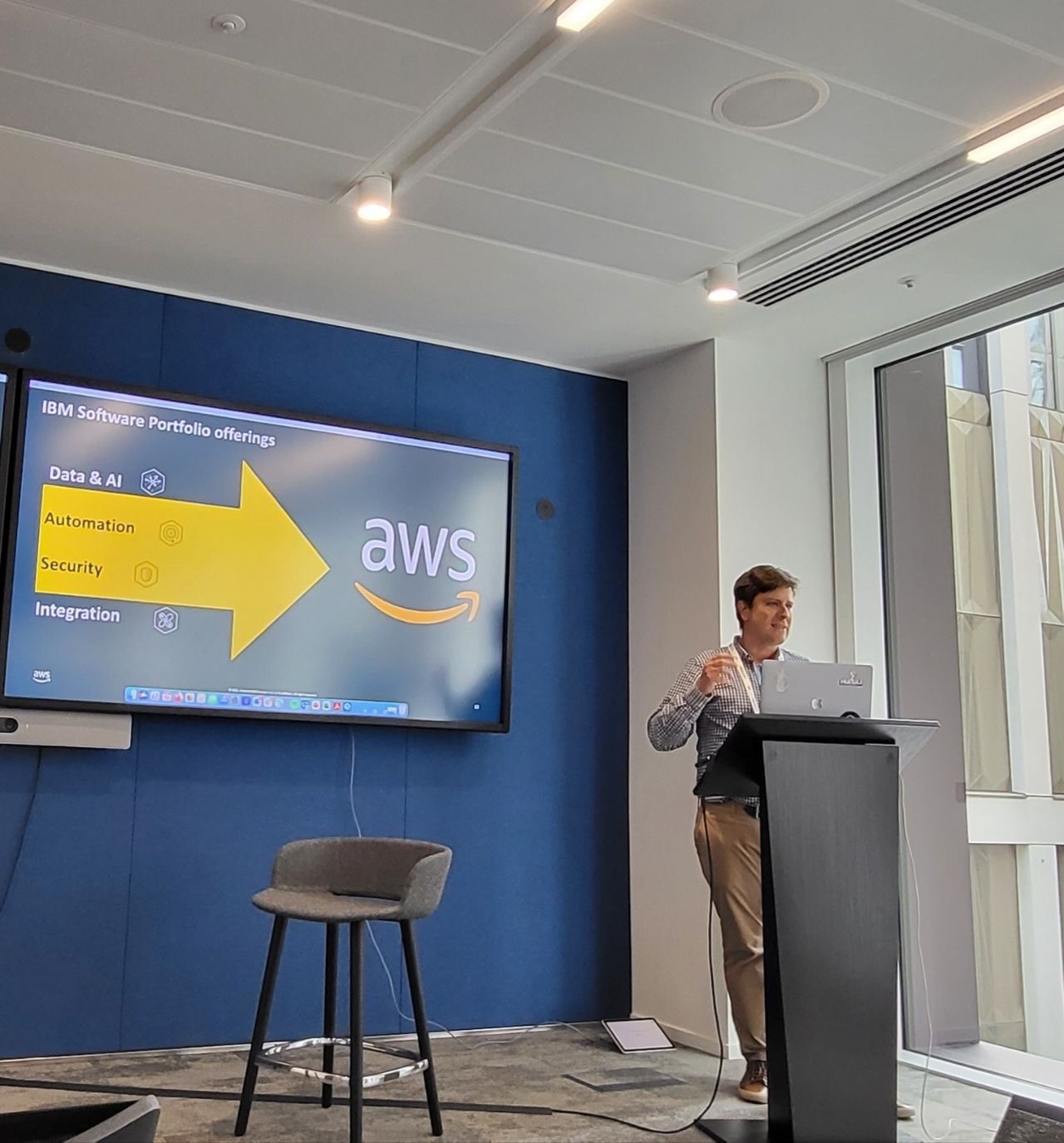
Eduardo presenting on the strategic partnership between AWS and IBM at IBM Think London 2022
This also shows how interesting it is to work with ISVs like Red Hat and IBM. It demonstrates, yet again, how AWS is customer-obsessed and works backwards from what customers need to be successful in their own rights. Regardless of if they are using AWS native services or an ISV solution on AWS, we at AWS always focus on what is right for our customers.
I am also very fond of running workshops, called Immersion Days, for our customers. And, I have recently co-authored an AWS modernization workshop with IBM, which shows how customers can use IBM Cloud Pak for Data on AWS along with AWS services to create exciting Analytics and AI/ML workloads!
In conclusion, working as a Partner Solutions Architect at AWS has been an incredibly rewarding experience for me. I work with great people, a wide range of industries and technologies, and, most importantly, help our customers and partners innovate and find success on AWS. If you are considering a career at AWS, I would highly recommend it: it’s an unparalleled working experience, and the are no shortages of opportunities to take part in exciting projects!
Alright, I will admit: I am being a bit biased. But, hey, this was my first blog at AWS! Many customers are looking to adopt IBM Data and AI solutions on AWS, particularly on how to use ROSA to deploy IBM Cloud Pak for Data.
So, I created a how-to deployment guide, demonstrating how a customer can take advantage of ROSA, without having to manage the lifecycle of Red Hat OpenShift Container Platform clusters. Instead, I focus on developing new solutions and innovating faster, using IBM’s integrated data and artificial intelligence platform on AWS.
IBM Cloud Pak for Integration on ROSA architecture
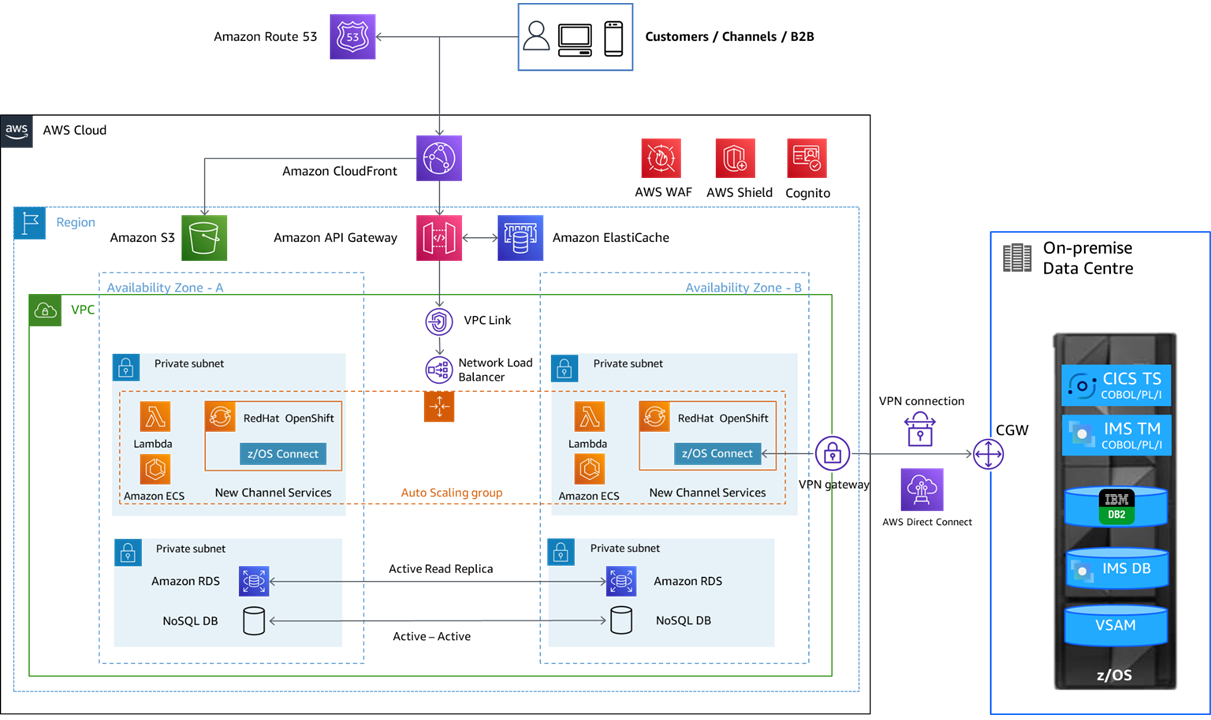
Many AWS customers use the IBM mainframe for their core business-critical applications. These customers are looking for ways to build modern cloud-native applications on AWS, that often require access to business-critical data on their IBM mainframe.
This AWS Partner Network (APN) Blog post shows how these customers can integrate cloud-native applications on AWS, with workloads running on mainframes, by exposing them as industry standard RESTful APIs with a no-code approach.
This blog shows customers, who are exploring ways to modernize their IBM Db2 databases, can move their databases quickly and easily to Amazon Elastic Kubernetes Service (Amazon EKS), ROSA and IBM’s Cloud Pak for Data products on AWS.
This Containers Blog post demonstrates how customers can use AWS Controllers for Kubernetes (ACK) to define and create AWS resources directly from within OpenShift. It allows customers to take advantage of AWS-managed services to complement the application workloads running in OpenShift, without needing to define resources outside of the cluster or run services that provide supporting capabilities like databases or message queues.
ACK is now integrated into OpenShift and being used to provide a broad collection of AWS native services presently available on the OpenShift OperatorHub.
We wouldn’t normally make a big deal about another company’s version release except this one is, well… kind of a big deal. Unlike most software releases that fly under the radar, there are big implications—for your backup strategy, your cloud storage usage, and your budget.
Leading backup and recovery provider, Veeam, announced the release of Version 12 (v12) of its popular Backup & Replication software on February 14. And we’re feeling the backup love.
So, what’s the big deal? With this release, Veeam customers can send backups directly to the cloud instead of (or in addition to) routing them to local storage first. Ultimately, the changes announced in v12 provide for easier backups, more diversified workloads, more flexibility in your cloud strategy, and capital expense (CapEx) savings on local storage.
Today, we’re breaking down what all that means and how you can take advantage of the changes to optimize your backup strategy and cloud storage spend.
Save the Date for VeeamON 2023 May 22–24 in Miami
Learn more about the Veeam v12 release and how Backblaze and Veeam make modern data protection easy. Backblaze is proud to be a Platinum sponsor at VeeamON this year and we look forward to seeing you there!
About Veeam
Veeam is a leader in backup, recovery, and data management solutions. They offer a single platform for cloud, virtual, physical, software as a service (SaaS), and Kubernetes environments. Their products help customers own, control, and protect data anywhere in the hybrid cloud.
Customers can already select Backblaze B2 Cloud Storage as a destination for their Veeam backups, and doing so just got a whole lot easier with v12. Read on to learn more.
How Veeam Previously Worked with Cloud Storage
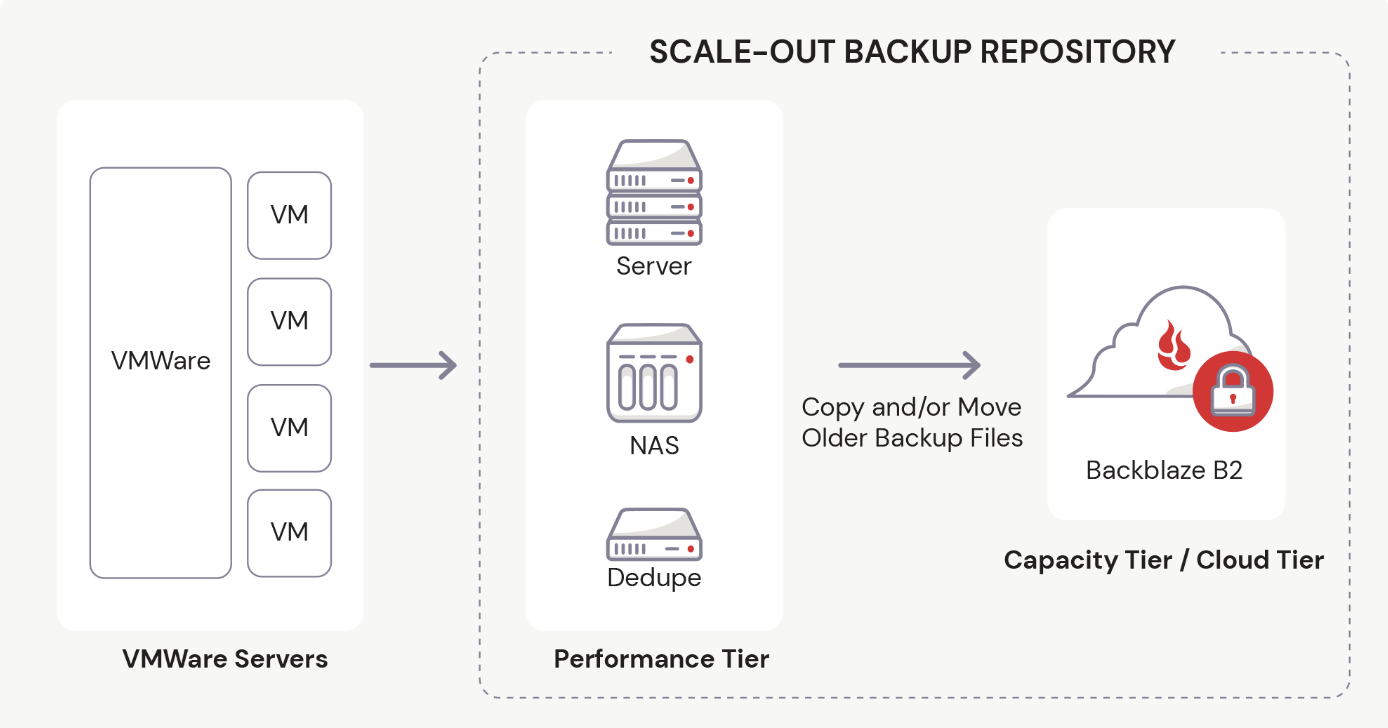
Prior to v12, cloud object storage was enabled in Veeam through the Scale-Out Backup Repository (SOBR). To set up the Cloud Tier, you first had to set up a local repository for your backup data. Many people used a NAS for this purpose, but it could also be a SAN, hard drives, etc. This was your primary repository, also known as your performance tier.
Here’s an example workflow with SOBR and Backblaze B2.
You needed enough capacity on your local repository to land the data there first before you could then use the Veeam console to Move or Copy it to the cloud. If your data set is perpetually growing (and whose isn’t?), you previously had to either tier off more data to the cloud to free up local capacity, or invest in more local storage.
Veeam v12 changes all that.
Veeam v12 Gives You Choices
With this new version release, the primary repository can now be local, on-premises storage, or it can also be local object storage arrays or cloud storage like Backblaze B2.
You can still use the SOBR or back up direct to object storage. This opens up a whole range of benefits, including:
Easier Backups: You can now use the Backup Job functionality to send your data straight to the cloud. You no longer need to land it in local storage first. You can also create multiple Backup Jobs that go to different destinations. For instance, to better fortify your backup strategy, you can create a Backup Job to a Backblaze B2 Bucket in one region and then a Backup Copy Job to a B2 Bucket in a different region for redundancy purposes.
Diversified Workloads: More choices give you the ability to think through your workloads and how you want to optimize them for cost and access. You may want to send less critical workloads—like older backups, archives, or data from less important work streams—to the cloud to free up capacity on your local storage. You can do this by editing your Backup Jobs (using the Move backup function) that were previously routing through the SOBR to cloud storage to point directly to cloud object storage instead.
More Flexibility: v12 allows for more flexibility to use cloud storage in your backup strategy. You have options, including:
Making your primary repository on-premises and using the cloud as part of your Capacity Tier in the SOBR.
Moving to a fully cloud-based repository.
Mixing your use of the SOBR and direct-to-object storage Backup Jobs to optimize your disaster recovery (DR) strategy, recovery needs, and costs.
CapEx Savings: You no longer need to keep investing in more local storage as your data set grows. Rather than buying another server or NAS, you can optimize your existing infrastructure by more easily off-loading data to cloud storage to free up capacity on on-premises devices.
What’s Next: Thinking Through Your Strategy
Great, you have more choices. But which choice should you make, and why?
Ultimately, you want to increase your company’s cyber resilience. Your backup strategy should be airtight, but you also need to think through your recovery process and your DR strategy as well. We’ll explain a couple different ways you could make use of the functionality v12 provides and break down the pros and cons of each.
Scenario 1: Using Cloud Storage as Part of Your SOBR
In this case, your on-premises storage is your primary repository and the cloud is your secondary repository. The advantage of an on-premises repository is that it’s often going to give you the fastest, easiest access to recovery. If your recovery time objective (RTO) is very short, a local backup is likely going to give you the fastest data restoration option to meet that RTO goal.
Then, copy your backups to cloud storage to ensure you have another copy in case of a local disaster. This is always good practice as part of the 3-2-1 rule or 3-2-1-1-0 rule. Why is it important to have a copy in cloud storage? Well, even if you store backups for disaster recovery at another location, is your DR site far away enough? Is it immune from a local disaster? If not, you need another copy in the cloud in a location that’s geographically distanced from you.
Scenario 2: Using the Cloud as Your Primary Repository
In this case, the cloud is your primary repository. Direct backups to cloud object storage from Veeam are helpful for the following use cases:
Less critical workloads: This could include a lesser-used server, archived projects, files, and data; or business data that is less critical to restore in the case of disaster recovery.
To free up local storage: If you’re running up against a lack of local storage and need to make a decision on spending more for additional on-premises storage, the cloud is often more affordable than investing in additional physical storage devices.
Workloads where slightly longer recovery periods are acceptable: If you can handle a slightly longer recovery period, cloud storage is a good fit. But remember that not all cloud storage is created equal. Backblaze B2, for example, is always-hot storage, so you won’t have to worry about cold storage delays like you might with AWS Glacier.
To migrate away from an LTO system: If you were previously sending backup copy jobs to tape, you can now more easily use cloud storage as a replacement.
To eliminate a secondary on-premises location: Maybe you are worried your backups are stored too close to each other, or you simply want to get rid of a secondary on-premises location. The direct-to-cloud option gives you this option. You can reroute those backup copy jobs to copy direct-to-cloud object storage instead.
To eliminate on-premises backups altogether: Of course, if you want to completely eliminate local backups for whatever reason, you can now do that by sending all your backup and archive data to the cloud only, although you should carefully consider the implications of that strategy for your disaster recovery plan.
Planning for Disaster Recovery—How You’ll Restore
While it’s important to think about how to optimize your backup strategy using the new functionality introduced by v12, it’s equally as important to think about how you’ll restore business operations in the case of an on-premises disaster. Backblaze offers a unique solution through its partnerships with Veeam and PhoenixNAP—Instant Recovery in Any Cloud.
With this solution, you can run a single command using an industry-standard automation tool to quickly bring up an orchestrated combination of on-demand servers, firewalls, networking, storage, and other infrastructure in phoenixNAP. The command draws data from Veeam backups immediately to your VMware/Hyper-V based environment, so businesses can get back online with minimal disruption or expense. Best of all, there’s no cost unless you actually need to use the solution, so there’s no reason not to set it up now.
Instant Recovery in Any Cloud works with both of the scenarios described above—whether your cloud is your primary or secondary repository. One advantage of using the direct-to-cloud object storage Backup Job is that you can more easily leverage Instant Recovery in Any Cloud since your primary backup is in the cloud. Taking advantage of cloud transit speeds, your business can get back up and running in less time than it would take to restore back to on-premises storage.
Planning for Disaster Recovery—How You’ll Budget
Another consideration for tightening up your cyber resilience plan (and getting your executive team on board with it) is better understanding and anticipating any egress expenses you may face when recovering data—because the last thing you want to be doing in the case of a major data disaster is trying to convince your executive team to sign off on an astronomical egress bill from your cloud provider.
At Backblaze, we’ve always believed it’s good and right to enable customers to readily use their data. With B2 Reserve, our capacity-based offering, there are no egress fees, unlike those charged by AWS, Azure, and Google Cloud. B2 Reserve also includes premium support and Universal Data Migration services so you can move your data from another cloud provider without any lift on your team’s part.
For our Backblaze B2 pay-as-you-go consumption-based offering, egress fees stand at just $0.01/GB, and we waive egress fees altogether with many of our compute and CDN partners.
How Veeam Works with Backblaze B2
Backblaze is a Veeam Ready partner and certified Veeam Ready for Object with Immutability, meaning it’s incredibly easy to set up Backblaze B2 Cloud Storage as your cloud repository in Veeam’s SOBR. In fact, it takes only about 20 minutes.
Setting up Backblaze B2 as your primary repository in the direct-to-object storage method is even easier. Just follow the steps in our Quick-Start Guide to get started.
Backblaze B2 is one-fifth the cost of other major cloud providers and offers enterprise-grade security without enterprise pricing. Unlike other cloud providers, we do not charge extra for the use of Object Lock, which enables immutability for protection from ransomware. There’s also no minimum retention requirement unlike other cloud providers who charge you for 30, 60 or even 90 days for deleted data.
No matter how you choose to configure Veeam with Backblaze B2, you’ll know that your data is protected from on-site disaster, ransomware, and hardware failure.
Veeam + Backblaze: Now Even Easier
Get started today for $5/TB per month or contact your favorite reseller, like CDW or SHI, to purchase Backblaze via B2 Reserve, our all-inclusive capacity-based bundles.
To provide the best experiences, we use technologies like cookies to store and/or access device information. Consenting to these technologies will allow us to process data such as browsing behavior or unique IDs on this site. Not consenting or withdrawing consent, may adversely affect certain features and functions.
Functional
Always active
The technical storage or access is strictly necessary for the legitimate purpose of enabling the use of a specific service explicitly requested by the subscriber or user, or for the sole purpose of carrying out the transmission of a communication over an electronic communications network.
Preferences
The technical storage or access is necessary for the legitimate purpose of storing preferences that are not requested by the subscriber or user.
Statistics
The technical storage or access that is used exclusively for statistical purposes.The technical storage or access that is used exclusively for anonymous statistical purposes. Without a subpoena, voluntary compliance on the part of your Internet Service Provider, or additional records from a third party, information stored or retrieved for this purpose alone cannot usually be used to identify you.
Marketing
The technical storage or access is required to create user profiles to send advertising, or to track the user on a website or across several websites for similar marketing purposes.