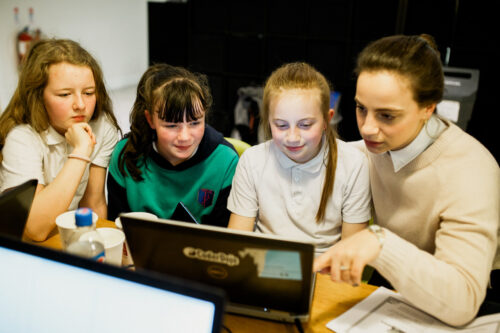
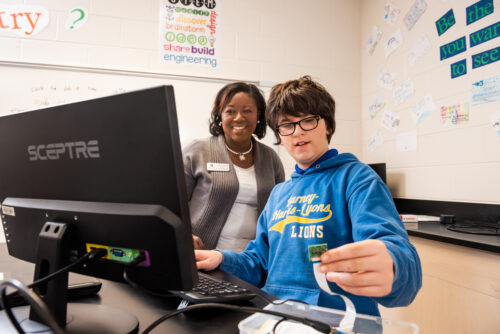
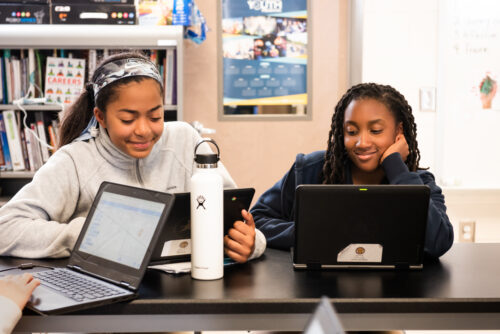
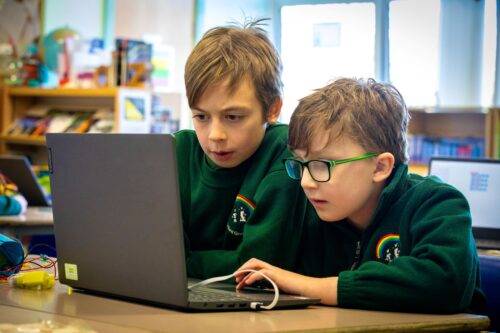
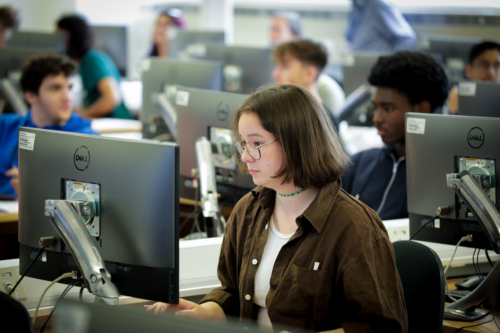
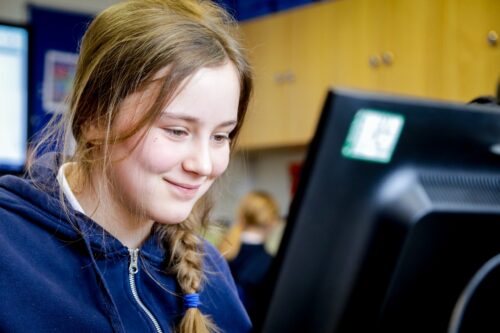
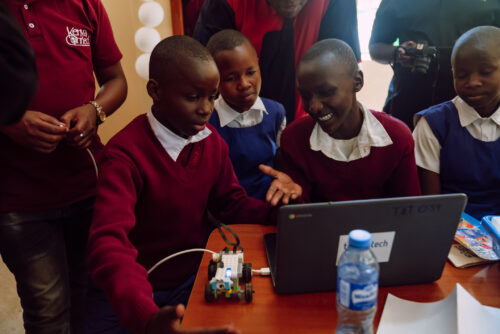
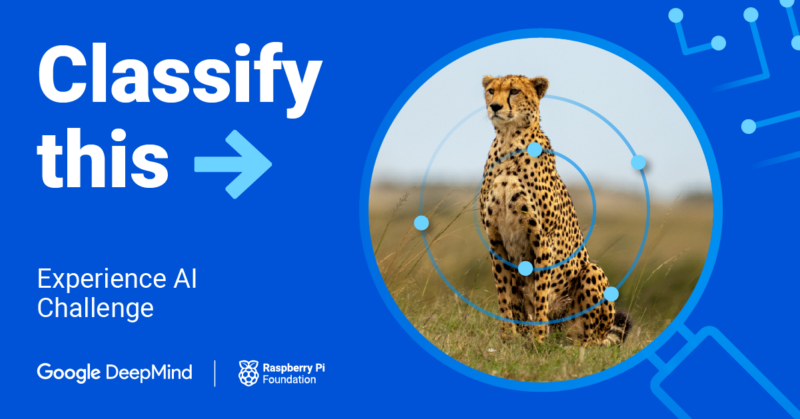
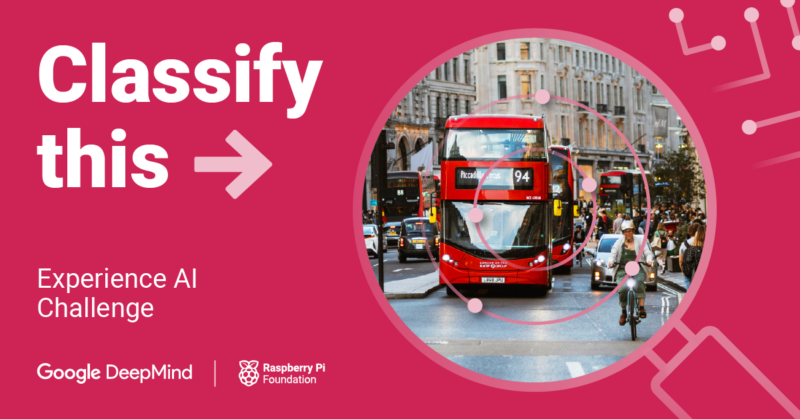
I am delighted to announce a new collaboration between the Raspberry Pi Foundation and a leading AI company, DeepMind, to inspire the next generation of AI leaders.
The Raspberry Pi Foundation’s mission is to enable young people to realise their full potential through the power of computing and digital technologies. Our vision is that every young person — whatever their background — should have the opportunity to learn how to create and solve problems with computers.
With the rapid advances in artificial intelligence — from machine learning and robotics, to computer vision and natural language processing — it’s increasingly important that young people understand how AI is affecting their lives now and the role that it can play in their future.
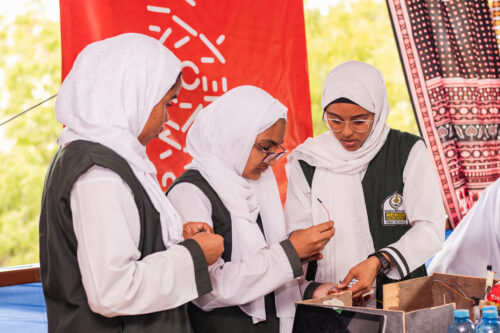
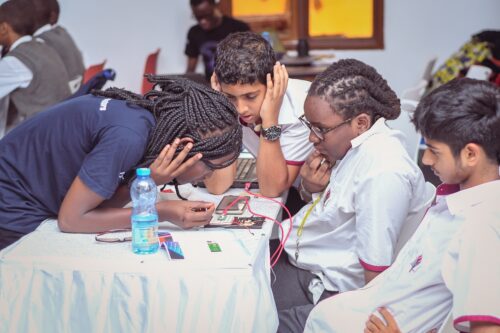
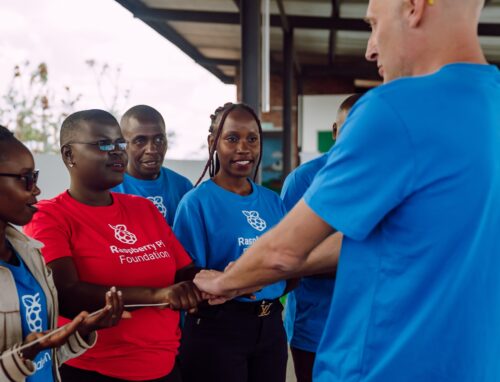
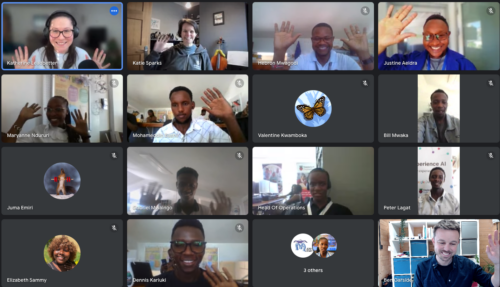
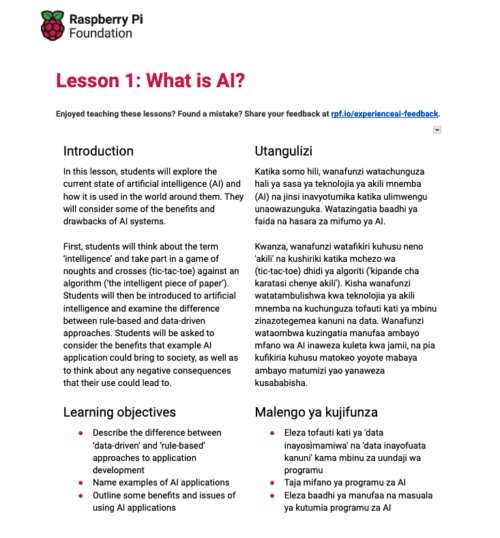
Experience AI is a new collaboration between the Raspberry Pi Foundation and DeepMind that aims to help young people understand how AI works and how it is changing the world. We want to inspire young people about the careers in AI and help them understand how to access those opportunities, including through their subject choices.
Experience AI
More than anything, we want to make AI relevant and accessible to young people from all backgrounds, and to make sure that we engage young people from backgrounds that are underrepresented in AI careers.
The program has two strands: Inspire and Experiment.
Inspire: To engage and inspire students about AI and its impact on the world, we are developing a set of free learning resources and materials including lesson plans, assembly packs, videos, and webinars, alongside training and support for educators. This will include an introduction to the technologies that enable AI; how AI models are trained; how to frame problems for AI to solve; the societal and ethical implications of AI; and career opportunities. All of this will be designed around real-world and relatable applications of AI, engaging a wide range of diverse interests and useful to teachers from different subjects.
Experiment: Building on the excitement generated through Inspire, we are also designing an AI challenge that will support young people to experiment with AI technologies and explore how these can be used to solve real-world problems. This will provide an opportunity for students to get hands-on with technology and data, along with support for educators.
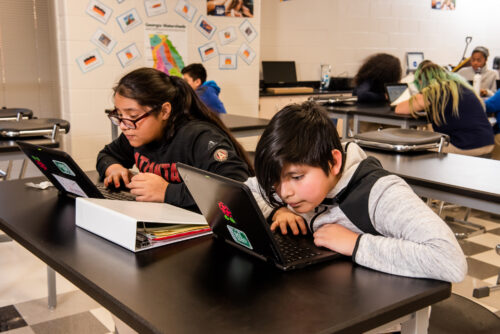
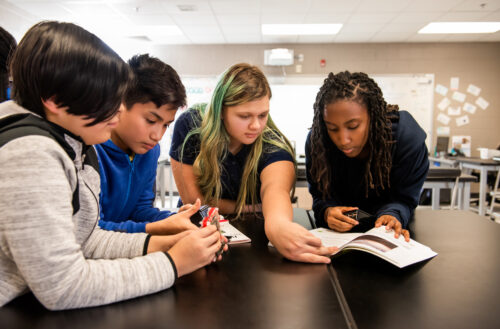
Our initial focus is learners aged 11 to 14 in the UK. We are working with teachers, students, and DeepMind engineers to ensure that the materials and learning experiences are engaging and accessible to all, and that they reflect the latest AI technologies and their application.
As with all of our work, we want to be research-led and the Raspberry Pi Foundation research team has been working over the past year to understand the latest research on what works in AI education.
Next steps
Development of the Inspire learning materials is underway now, and we will release the whole set of resources early in 2023. Throughout 2023, we will design and pilot the Experiment challenge.
If you want to stay up to date with Experience AI, or if you’d like to be involved in testing the materials, fill in this form to register your interest.
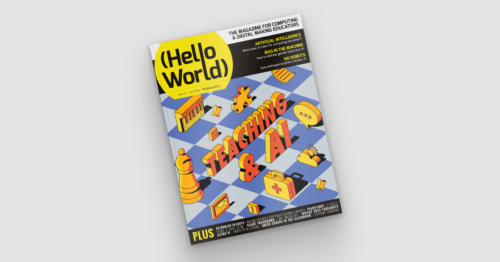
In Hello World issue 18, available as a free PDF download, teacher Michael Jones shares how to use Teachable Machine with learners aged 13–14 in your classroom to investigate issues of accuracy and ethics in machine learning models.
Machine learning: Accuracy and ethics
The landscape for working with machine learning/AI/deep learning has grown considerably over the last couple of years. Students are now able to develop their understanding from the hard-coded end via resources such as Machine Learning for Kids, get their hands dirty using relatively inexpensive hardware such as the Nvidia Jetson Nano, and build a classification machine using the Google-driven Teachable Machine resources. I have used all three of the above with my students, and this article focuses on Teachable Machine.
For this module, I’m more concerned with the fuzzy end of AI, including how credible AI decisions are, and the elephant-in-the-room aspect of bias and potential for harm.
Michael Jones
For the worried, there is absolutely no coding involved in this resource; the ‘machine’ behind the portal does the hard work for you. For my Year 9 classes (students aged 13 to 14) undertaking a short, three-week module, this was ideal. The coding is important, but was not my focus. For this module, I’m more concerned with the fuzzy end of AI, including how credible AI decisions are, and the elephant-in-the-room aspect of bias and potential for harm.
Getting started with Teachable Machine activities
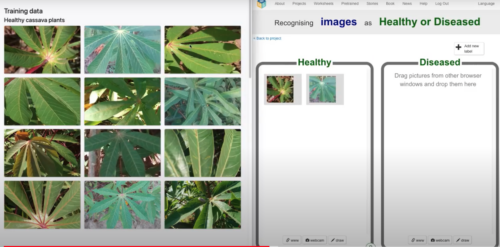
There are three possible routes to use in Teachable Machine, and my focus is the ‘Image Project’, and within this, the ‘Standard image model’. From there, you are presented with a basic training scenario template — see Hello World issue 16 (pages 84–86) for a step-by-step set-up and training guide. For this part of the project, my students trained the machine to recognise different breeds of dog, with border collie, labrador, saluki, and so on as classes. Any AI system devoted to recognition requires a substantial set of training data. Fortunately, there are a number of freely available data sets online (for example, download a folder of dog photos separated by breed by accessing helloworld.cc/dogdata). Be warned, these can be large, consisting of thousands of images. If you have more time, you may want to set students off to collect data to upload using a camera (just be aware that this can present safeguarding considerations). This is a key learning point with your students and an opportunity to discuss the time it takes to gather such data, and variations in the data (for example, images of dogs from the front, side, or top).
Image recognition is a common application of machine learning technology.
Once you have downloaded your folders, upload the images to your Teachable Machine project. It is unlikely that you will be able to upload a whole subfolder at once — my students have found that the optimum number of images seems to be twelve. Remember to build this time for downloading and uploading into your lesson plan. This is a good opportunity to discuss the need for balance in the training data. Ask questions such as, “How likely would the model be to identify a saluki if the training set contained 10 salukis and 30 of the other dogs?” This is a left-field way of dropping the idea of bias into the exploration of AI — more on that later!
Accuracy issues in machine learning models
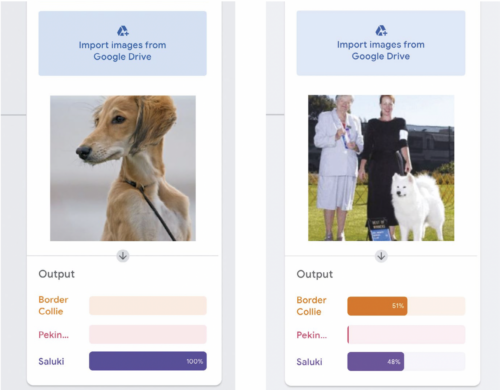
If you have got this far, the heavy lifting is complete and Google’s training engine will now do the work for you. Once you have set your model on its training, leave the system to complete its work — it takes seconds, even on large sets of data. Once it’s done, you should be ready to test you model. If all has gone well and a webcam is attached to your computer, the Output window will give a prediction of what is being viewed. Again, the article in Hello World issue 16 takes you through the exact steps of this process. Make sure you have several images ready to test. See Figure 1a for the response to an image of a saluki presented to the model. As you might expect, it is showing as a 100 percent prediction.
Figure 1: Outputs of a Teachable Machine model classifying photos of dog breeds. 1a (left): Photo of a saluki. 1b (right): Photo of a Samoyed and two people.
It will spark an interesting discussion if you now try the same operation with an image with items other than the one you’re testing in it. For example see Figure 1b, in which two people are in the image along with the Samoyed dog. The model is undecided, as the people are affecting the outcome. This raises the question of accuracy. Which features are being used to identify the dogs as border collie and saluki? Why are the humans in the image throwing the model off the scent?
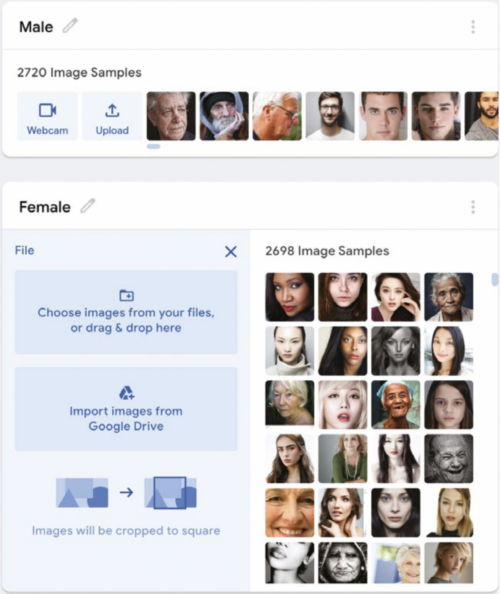
Getting closer to home, training a model on human faces provides an opportunity to explore AI accuracy through the question of what might differentiate a female from a male face. You can find a model at helloworld.cc/maleorfemale that contains 5418 images almost evenly spread across male and female faces (see Figure 2). Note that this model will take a little longer to train.
Figure 2: Two photo sets of faces labeled either male or female, uploaded to Teachable Machine.
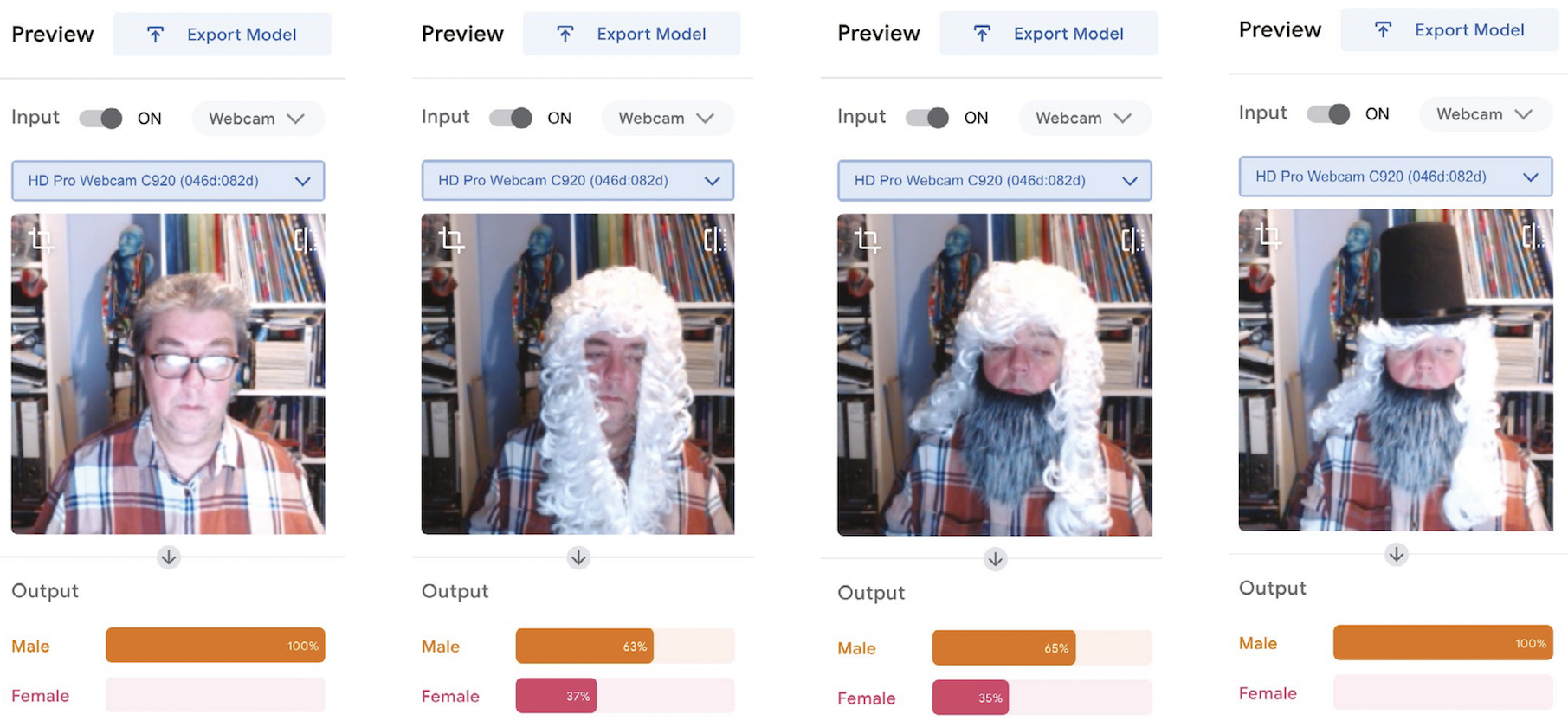
Once trained, try the model out. Props really help — a top hat, wig, and beard give the model a testing time (pun intended). In this test (see Figure 3), I presented myself to the model face-on and, unsurprisingly, I came out as 100 percent male. However, adding a judge’s wig forces the model into a rethink, and a beard produces a variety of results, but leaves the model unsure. It might be reasonable to assume that our model uses hair length as a strong feature. Adding a top hat to the ensemble brings the model back to a 100 percent prediction that the image is of a male.
Figure 3: Outputs of a Teachable Machine model classifying photos of the author’s face as male or female with different degrees of confidence. Click to enlarge.
Machine learning uses a best-fit principle. The outputs, in this case whether I am male or female, have a greater certainty of male (65 percent) versus a lesser certainty of female (35 percent) if I wear a beard (Figure 3, second image from the right). Remove the beard and the likelihood of me being female increases by 2 percent (Figure 3, second image from the left).
Bias in machine learning models
Within a fairly small set of parameters, most human faces are similar. However, when you start digging, the research points to there being bias in AI (whether this is conscious or unconscious is a debate for another day!). You can exemplify this by firstly creating classes with labels such as ‘young smart’, ‘old smart’, ‘young not smart’, and ‘old not smart’. Select images that you think would fit the classes, and train them in Teachable Machine. You can then test the model by asking your students to find images they think fit each category. Run them against the model and ask students to debate whether the AI is acting fairly, and if not, why they think that is. Who is training these models? What images are they receiving? Similarly, you could create classes of images of known past criminals and heroes. Train the model before putting yourself in front of it. How far up the percentage scale are you towards being a criminal? It soon becomes frighteningly worrying that unless you are white and seemingly middle class, AI may prove problematic to you, from decisions on financial products such as mortgages through to mistaken arrest and identification.
It soon becomes frighteningly worrying that unless you are white and seemingly middle class, AI may prove problematic to you, from decisions on financial products such as mortgages through to mistaken arrest and identification.
Michael Jones
Encourage your students to discuss how they could influence this issue of race, class, and gender bias — for example, what rules would they use for identifying suitable images for a data set? There are some interesting articles on this issue that you can share with your students at helloworld.cc/aibias1 and helloworld.cc/aibias2.
Where next with your learners?
In the classroom, you could then follow the route of building models that identify letters for words, for example. One of my students built a model that could identify a range of spoons and forks. You may notice that Teachable Machine can also be run on Arduino boards, which adds an extra dimension. Why not get your students to create their own AI assistant that responds to commands? The possibilities are there to be explored. If you’re using webcams to collect photos yourself, why not create a system that will identify students? If you are lucky enough to have a set of identical twins in your class, that adds just a little more flavour! Teachable Machine offers a hands-on way to demonstrate the issues of AI accuracy and bias, and gives students a healthy opportunity for debate.
Michael Jones is director of Computer Science at Northfleet Technology College in the UK. He is a Specialist Leader of Education and a CS Champion for the National Centre for Computing Education.
More resources for AI and data science education
At the Foundation, AI education is one of our focus areas. Here is how we are supporting you and your learners in this area already:
Hello World issue 12 focuses on AI and machine learning education, with many practical resources, insightful interviews, and inspiring features from computer science educators. Download your free copy of issue 12 now.
In Hello World issue 16, the focus is on all things data science and data literacy for your learners. As always, you can download a free copy of the issue.
On our Hello World podcast, we’ve got episodes where we talk with practicing computing educators about how they bring AI, AI ethics, machine learning, and data science to the young people they teach.
If you’d like a practical introduction to the basics of machine learning and how to use it, take our free online course.
Computing education researchers are working to answer the many open questions about what good AI and data science education looks like for young people. To learn more, you can watch the recordings from our research seminar series focused on this. We ourselves are working on research projects in this area and will share the results freely with the computing education community.
You can find a list of free educational resources about these topics that we’ve collated based on our research seminars, seminar participants’ recommendations, and our own work.
Between September 2021 and March 2022, we’ve been partnering with The Alan Turing Institute to host a series of free research seminars about how to young people about AI and data science.
In the final seminar of the series, we were excited to hear from Stefania Druga from the University of Washington, who presented on the topic of AI literacy for families. Stefania’s talk highlighted the importance of families in supporting children to develop AI literacy. Her talk was a perfect conclusion to the series and very well-received by our audience.
Stefania Druga, University of Washington
Stefania is a third-year PhD student who has been working on AI literacy in families, and since 2017 she has conducted a series of studies that she presented in her seminar talk. She presented some new work to us that was to be formally shared at the HCI conference in April, and we were very pleased to have a sneak preview of these results. It was a fascinating talk about the ways in which the interactions between parents and children using AI-based devices in the home, and the discussions they have while learning together, can facilitate an appreciation of the affordances of AI systems. You’ll find my summary as well as the seminar recording below.
“AI literacy practices and skills led some families to consider making meaningful use of AI devices they already have in their homes and redesign their interactions with them. These findings suggest that family has the potential to act as a third space for AI learning.”
– Stefania Druga
AI literacy: Growing up with AI systems, growing used to them
Back in 2017, interest in Alexa and other so-called ‘smart’, AI-based devices was just developing in the public, and such devices would have been very novel to most people. That year, Stefania and colleagues conducted a first pilot study of children’s and their parents’ interactions with ‘smart’ devices, including robots, talking dolls, and the sort of voice assistants we are used to now.
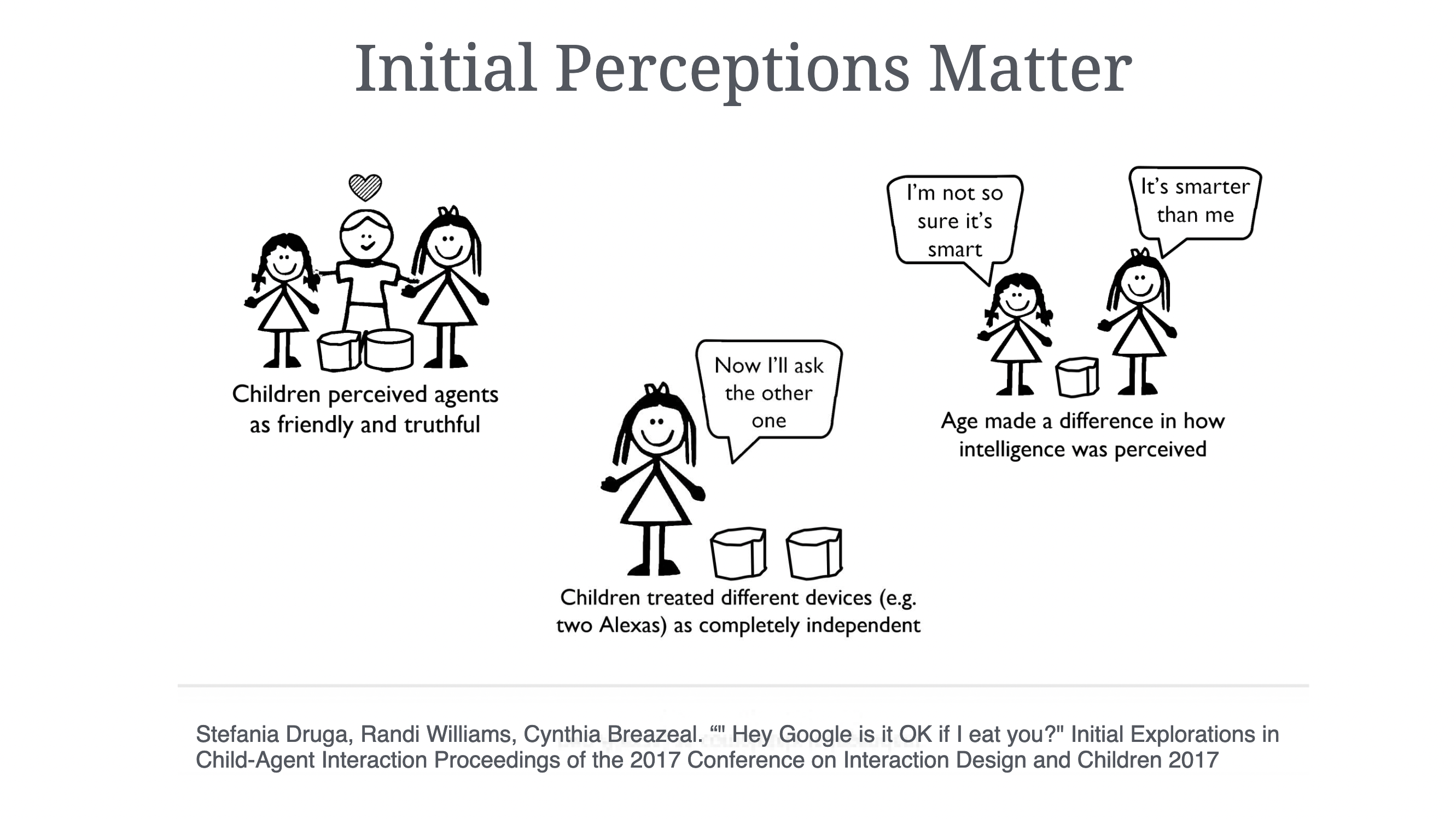
A slide from Stefania’s AI literacy seminar. Click to enlarge.
Working directly with families, the researchers explored the level of understanding that children had about ‘smart’ devices, and were surprised by the level of insight very young children had into the potential of this type of technology.
In this AI literacy pilot study, Stefania and her colleagues found that:
Children perceived AI-based agents (i.e. ‘smart’ devices) as friendly and truthful
They treated different devices (e.g. two different Alexas) as completely independent
How ‘smart’ they found the device was dependent on age, with older children more likely to describe devices as ‘smart’
AI literacy: Influence of parents’ perceptions, influence of talking dolls
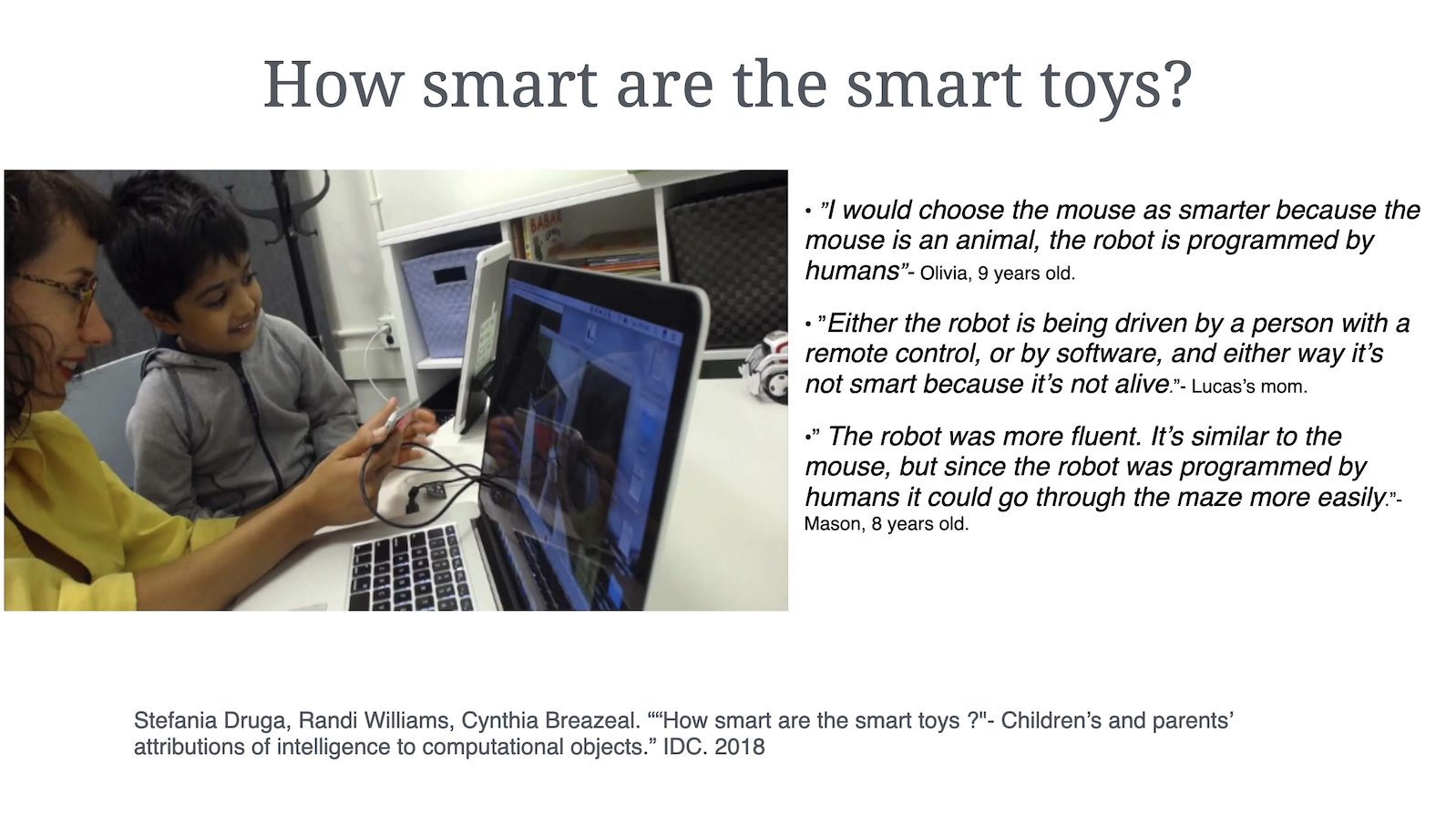
Stefania’s next study, undertaken in 2018, showed that parents’ perceptions of the implications and potential of ‘smart’ devices shaped what their children thought. Even when parents and children were interviewed separately, if the parent thought that, for example, robots were smarter than humans, then the child did too.
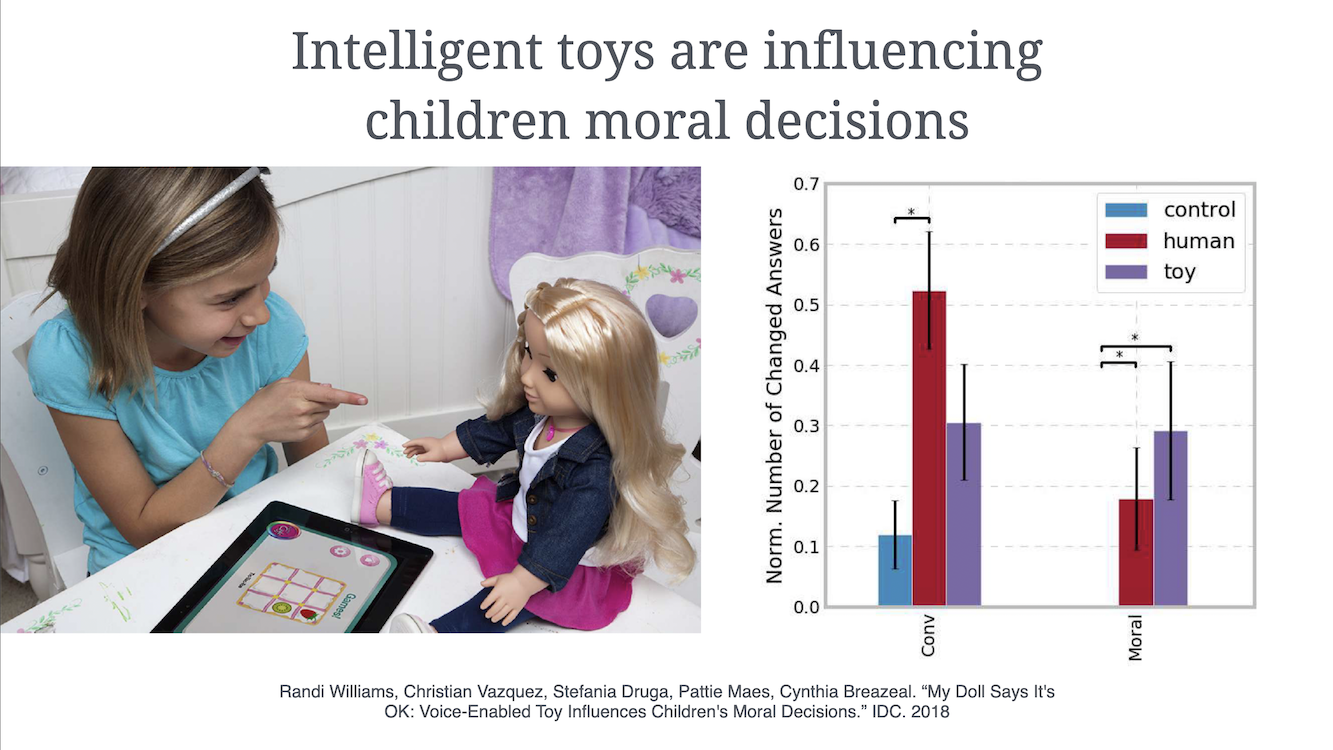
A slide from Stefania’s AI literacy seminar. Click to enlarge.
Another part of this study showed that talking dolls could influence children’s moral decisions (e.g. “Should I give a child a pillow?”). In some cases, these ‘smart’ toys would influence the child more than another human. Some ‘smart’ dolls have been banned in some European countries because of security concerns. In the light of these concerns, Stefania pointed out how important it is to help children develop a critical understanding of the potential of AI-based technology, and what its fallibility and the limits of its guidance are.
A slide from Stefania’s AI literacy seminar. Click to enlarge.
AI literacy: Programming ‘smart’ devices, algorithmic bias
Another study Stefania discussed involved children who programmed ‘smart’ devices. She used the children’s drawings to find out about their mental models of how the technology worked.
She found that when children had the opportunity to train machine learning models or ‘smart’ devices, they became more sceptical about the appropriate use of these technologies and asked better questions about when and for what they should be used. Another finding was that children and adults had different ideas about algorithmic bias, particularly relating to the meaning of fairness.
AI literacy: Kinaesthetic activities, sharing discussions
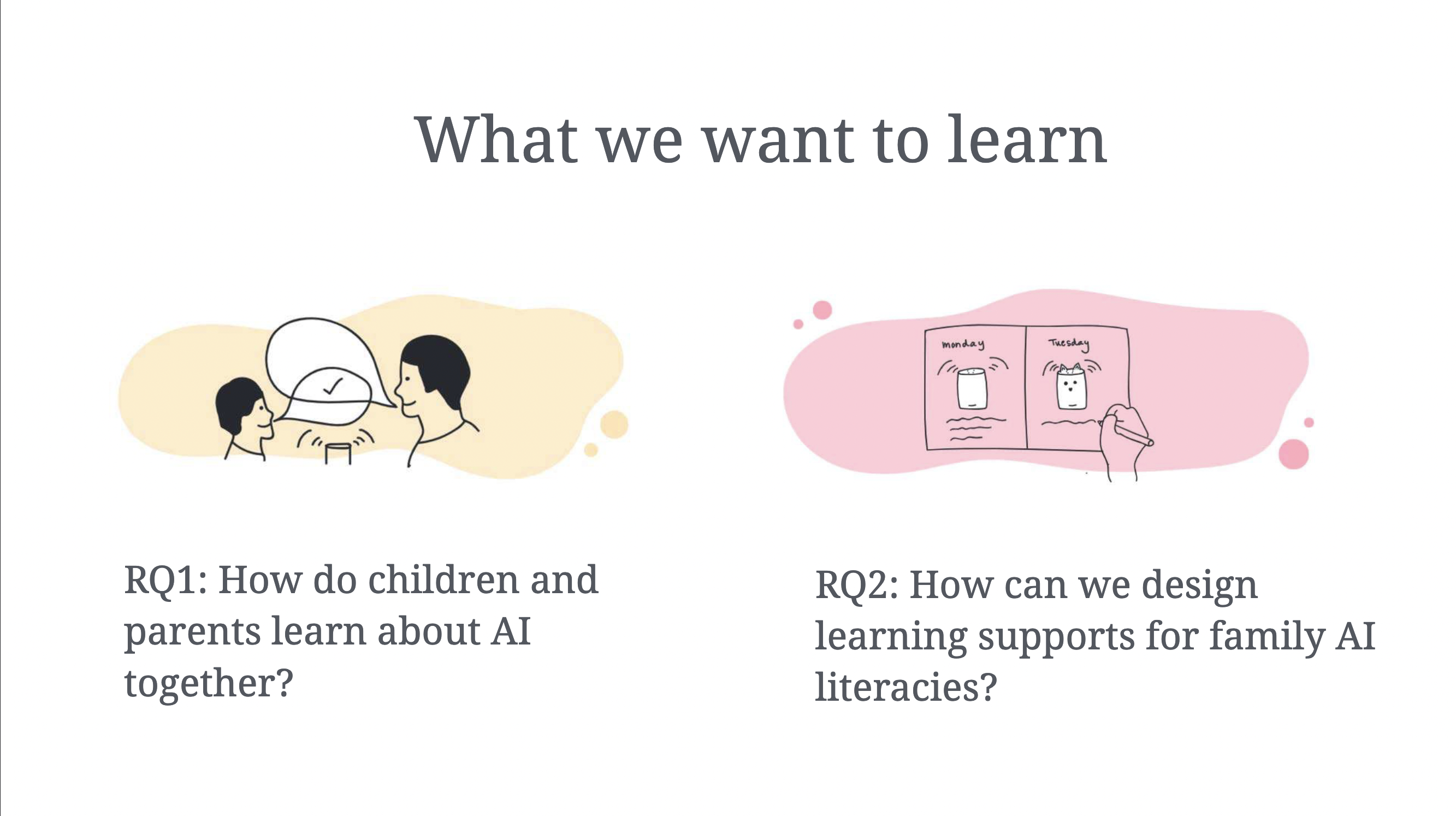
The final study Stefania talked about was conducted with families online during the pandemic, when children were learning at home. 15 families, with in total 18 children (ages 5 to 11) and 16 parents, participated in five weekly sessions. A number of learning activities to demonstrate features of AI made up each of the sessions. These are all available at aiplayground.me.
A slide from Stefania’s AI literacy seminar. Click to enlarge.
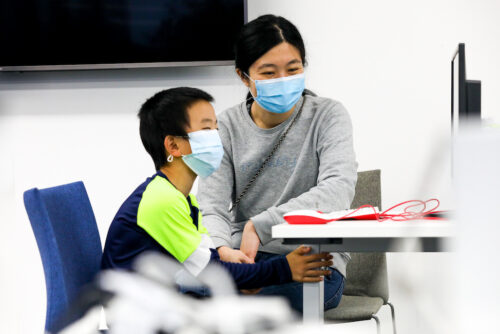
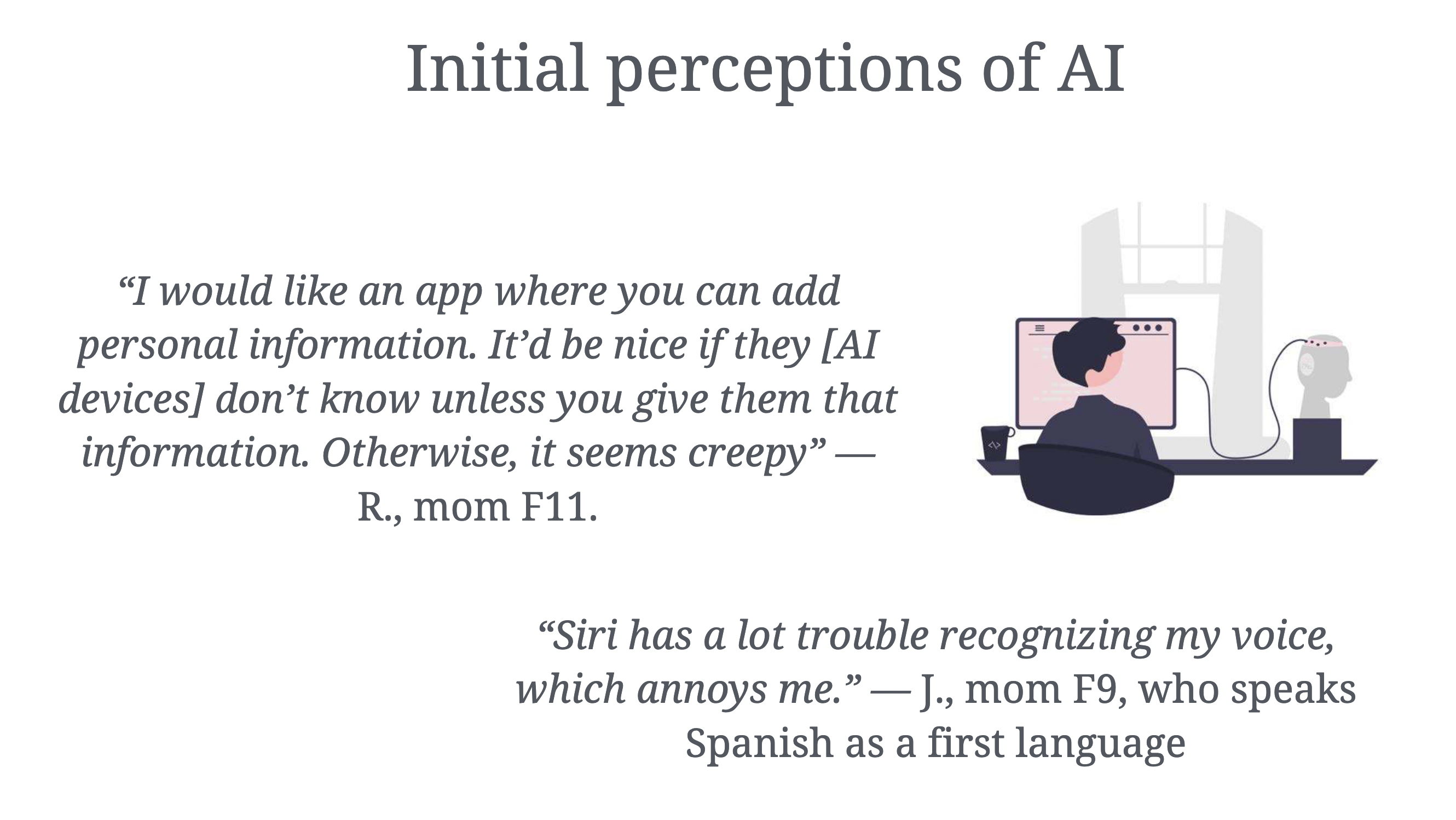
The fact that children and parents, or other family members, worked through the activities together seemed to generate fruitful discussions about the usefulness of AI-based technology. Many families were concerned about privacy and what was happening to their personal data when they were using ‘smart’ devices, and also expressed frustration with voice assistants that couldn’t always understand the way they spoke.
A slide from Stefania’s AI literacy seminar. Click to enlarge.
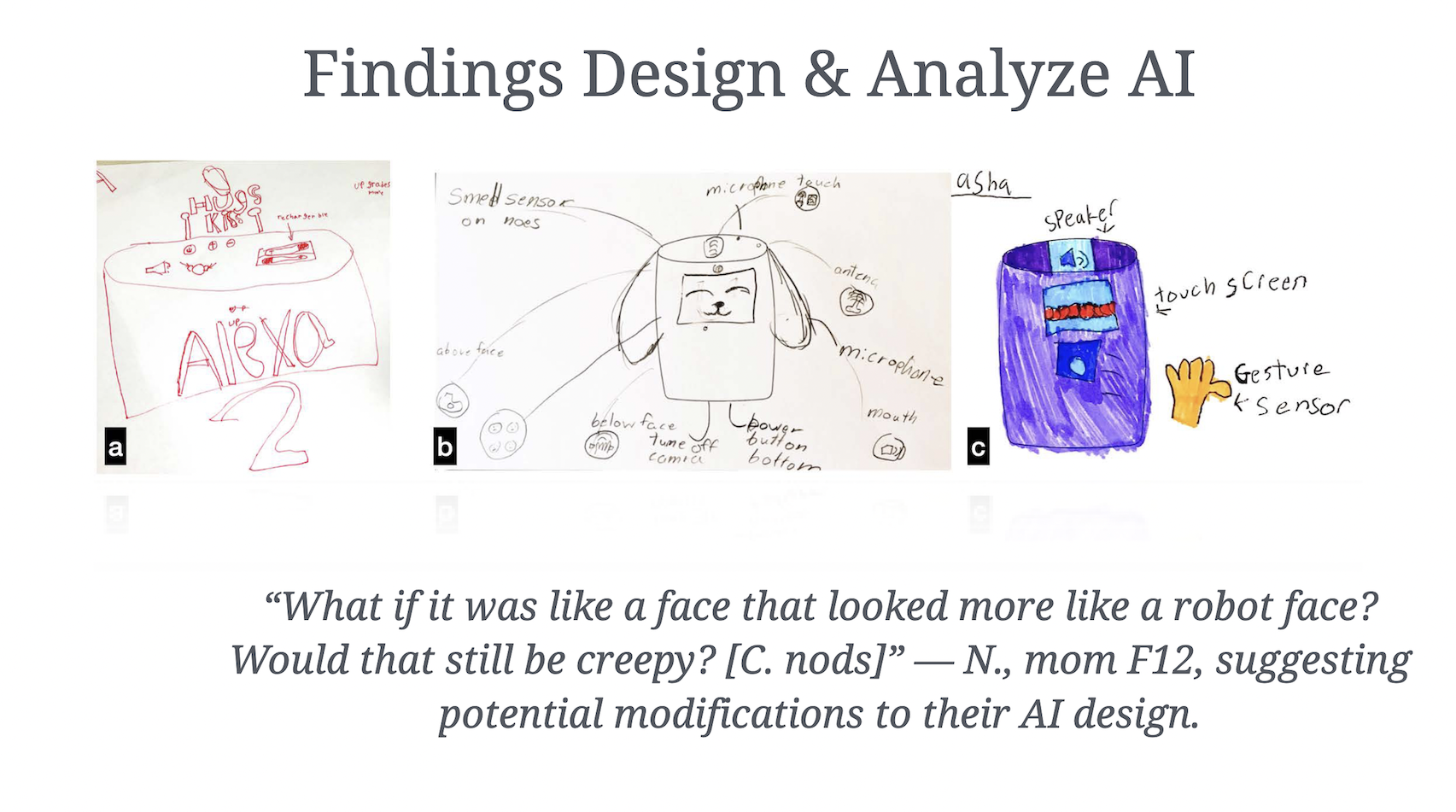
In one of the sessions, with a focus on machine learning, families were introduced to a kinaesthetic activity involving moving around their home to train a model. Through this activity, parents and children had more insight into the constraints facing machine learning. They used props in the home to experiment and find out ways of training the model better. In another session, families were encouraged to design their own devices on paper, and Stefania showed some examples of designs children had drawn.
A slide from Stefania’s AI literacy seminar. Click to enlarge.
This study identified a number of different roles that parents or other adults played in supporting children’s learning about AI, and found that embodied and tangible activities worked well for encouraging joint work between children and their families.
Our seminars in this series on AI and data science education, co-hosted with The Alan Turing Institute, have been covering a range of different topics and perspectives. This month was no exception. We were delighted to be able to host Tara Chklovski, CEO of Technovation, whose presentation was called ‘Teaching youth to use AI to tackle the Sustainable Development Goals’.
Tara Chklovski
The Technovation Challenge
Tara started Technovation, formerly called Iridescent, in 2007 with a family science programme in one school in Los Angeles. The nonprofit has grown hugely, and Technovation now runs computing education activities across the world. We heard from Tara that over 350,000 girls from more than 100 countries take part in their programmes, and that the nonprofit focuses particularly on empowering girls to become tech entrepreneurs. The girls, with support from industry volunteers, parents, and the Technovation curriculum, work in teams to solve real-world problems through an annual event called the Technovation Challenge. Working at scale with young people has given the Technovation team the opportunity to investigate the impact of their programmes as well as more generally learn what works in computing education.
Click to enlarge
Tara’s talk was extremely engaging (you’ll find the recording below), with videos of young people who had participated in recent years. Technovation works with volunteers and organisations to reach young people in communities where opportunities may be lacking, focussing on low- and middle-income countries. Tara spoke about the 900 million teenage girls in the world, a substantial number of whom live in countries where there is considerable inequality.
To illustrate the impact of the programme, Tara gave a number of examples of projects that students had developed, including:
An air quality sensor linked to messaging about climate change
A support circle for girls living in domestic violence situation
A project helping mothers communicate with their daughters
Support for water collection in Kenya
Early on, the Technovation Challenge had involved the creation of mobile apps, but in recent years, the projects have focused on using AI technologies to solve problems. An key message that Tara wanted to get across was that the focus on real-world problems and teamwork was as important, if not more, than the technical skills the young people were developing.
Developing AI-related projects in teams
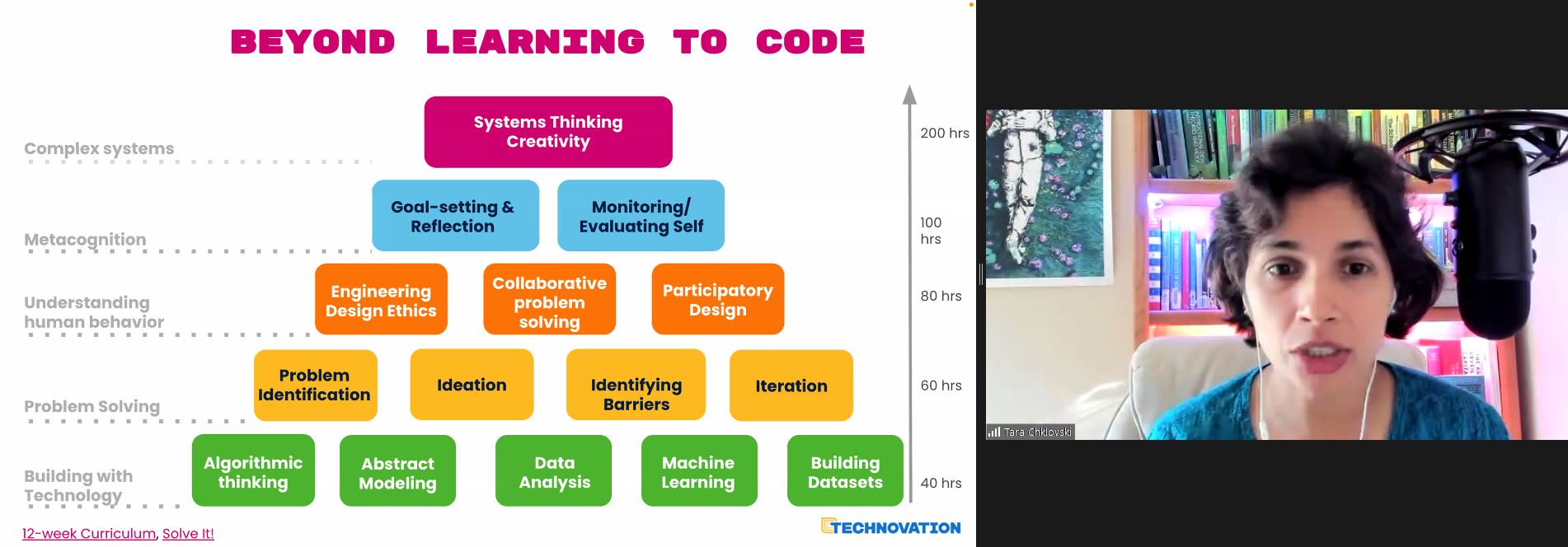
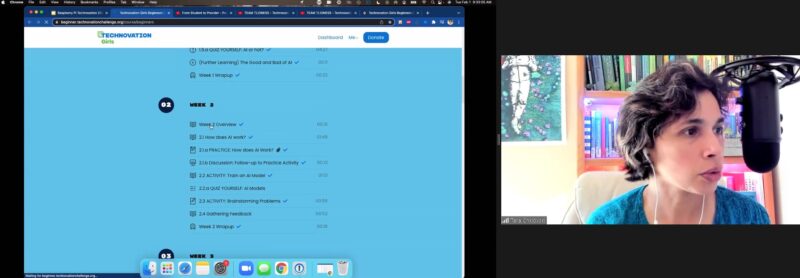
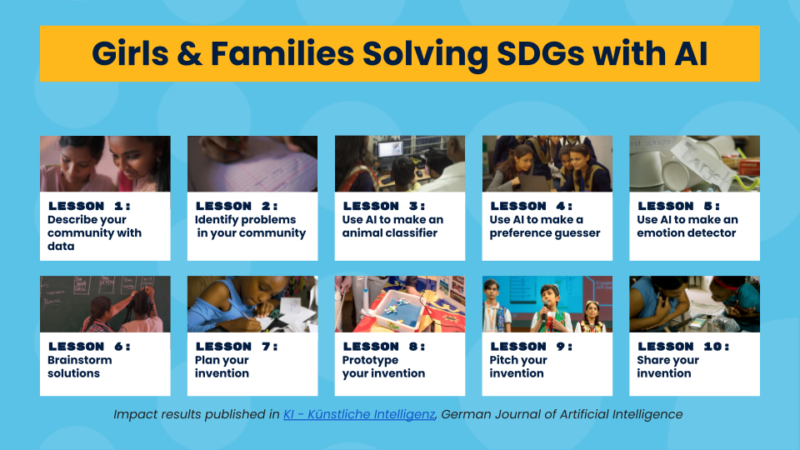
Technovation has designed an online curriculum to support teams, who may have no prior computing experience, to learn how to design an AI project. Students work through units on topics such as data analysis and building datasets. As well as the technical activities, young people also work through activities on problem-solving approaches, design, and system thinking to help them tackle a real-world problem that is relevant to them. The curriculum supports teams to identify problems in their community and find a path to prototype and share an invention to tackle that problem.
Click to enlarge
While working through the curriculum, teams develop AI models to address the problem that they have chosen. They then submit them to a global competition for beginners, juniors, and seniors. Many of the girls enjoy the Technovation Challenge so much that they come back year on year to further develop their team skills.
AI Families: Children and parents using AI to solve problems
Technovation runs another programme, AI Families, that focuses on families working together to learn AI concepts and skills and use them to develop projects together. Families worked together with the help of educators to identify meaningful problems in their communities, and developed AI prototypes to address them.
There were 20,000 participants from under-resourced communities in 17 countries through 2018 and 2019. 70% of them were women (mothers and grandmothers) who wanted their children to participate; in this way the programme encouraged parents to be role models for their daughters, as well as enabling families to understand that AI is a tool that could be used to think about what problems in their community can be solved with the help of AI skills and principles. Tara was keen to emphasise that, given the importance of AI in the world, the more people know about it, the more impact they can make on their local communities.
The results of the AI Families project as investigated over 2018 and 2019 are reported in this paper. The findings of the programme included:
Learning needs to focus on more than just content; interviews showed that the learners needed to see the application to real-world applications
Engaging parents and other family members can support retention and a sense of community, and support a culture of lifelong learning
It takes around 3 to 5 years to iteratively develop fun, engaging, effective curriculum, training, and scalable programme delivery methods. This level of patience and commitment is needed from all community and industry partners and funders.
The research describes how the programme worked pre-pandemic. Tara highlighted that although the pandemic has prevented so much face-to-face team work, it has allowed some young people to access education online that they would not have otherwise had access to.
Many perspectives on AI education
Our goal is to listen to a variety of perspectives through this seminar series, and I felt that Tara really offered something fresh and engaging to our seminar audience, many of them (many of you!) regular attendees who we’ve got to know since we’ve been running the seminars. The seminar combined real-life stories with videos, as well as links to the curriculum used by Technovation to support learners of AI. The ‘question and answer’ session after the seminar focused on ways in which people could engage with the programme. On Twitter, one of the seminar participants declared this seminar “my favourite thus far in the series”. It was indeed very inspirational.
As we near the end of this series, we can start to reflect on what we’ve been learning from all the various speakers, and I intend to do this more formally in a month or two as we prepare Volume 3 of our seminar proceedings. While Tara’s emphasis is on motivating children to want to learn the latest technologies because they can see what they can achieve with them, some of our other speakers have considered the actual concepts we should be teaching, whether we have to change our approach to teaching computer science if we include AI, and how we should engage young learners in the ethics of AI.
Join us for our next seminar
I’m really looking forward to our final seminar in the series, with Stefania Druga, on Tuesday 1 March at 17:00–18:30 GMT. Stefania, PhD candidate at the University of Washington Information School, will also focus on families. In her talk ‘Democratising AI education with and for families’, she will consider the ways that children engage with smart, AI-enabled devices that they are becoming part of their everyday lives. It’s a perfect way to finish this series, and we hope you’ll join us.
Thanks to our seminars series, we are developing a list of AI education resources that seminar speakers and attendees share with us, plus the free resources we are developing at the Foundation. Please do take a look.
You can find all blog posts relating to our previous seminars on this page.
What is AI thinking? What concepts should we introduce to young people related to AI, including machine learning (ML), and data science? Should we teach with a glass-box or an opaque-box approach? These are the questions we’ve been grappling with since we started our online research seminar series on AI education at the Raspberry Pi Foundation, co-hosted with The Alan Turing Institute.
Dave Touretzky
Fred G. Martin
Over the past few months, we’d already heard from researchers from the UK, Germany, and Finland. This month we virtually travelled to the USA, to hear from Prof. Dave Touretzky (Carnegie Mellon University) and Prof. Fred G. Martin (University of Massachusetts Lowell), who have pioneered the influential AI4K12 project together with their colleagues Deborah Seehorn and Christina Gardner-McLure.
The AI4K12 project
The AI4K12 project focuses on teaching AI in K-12 in the US. The AI4K12 team have aligned their vision for AI education to the CSTA standards for computer science education. These Standards, published in 2017, describe what should be taught in US schools across the discipline of computer science, but they say very little about AI. This was the stimulus for starting the AI4K12 initiative in 2018. A number of members of the AI4K12 working group are practitioners in the classroom who’ve made a huge contribution in taking this project from ideas into the classroom.

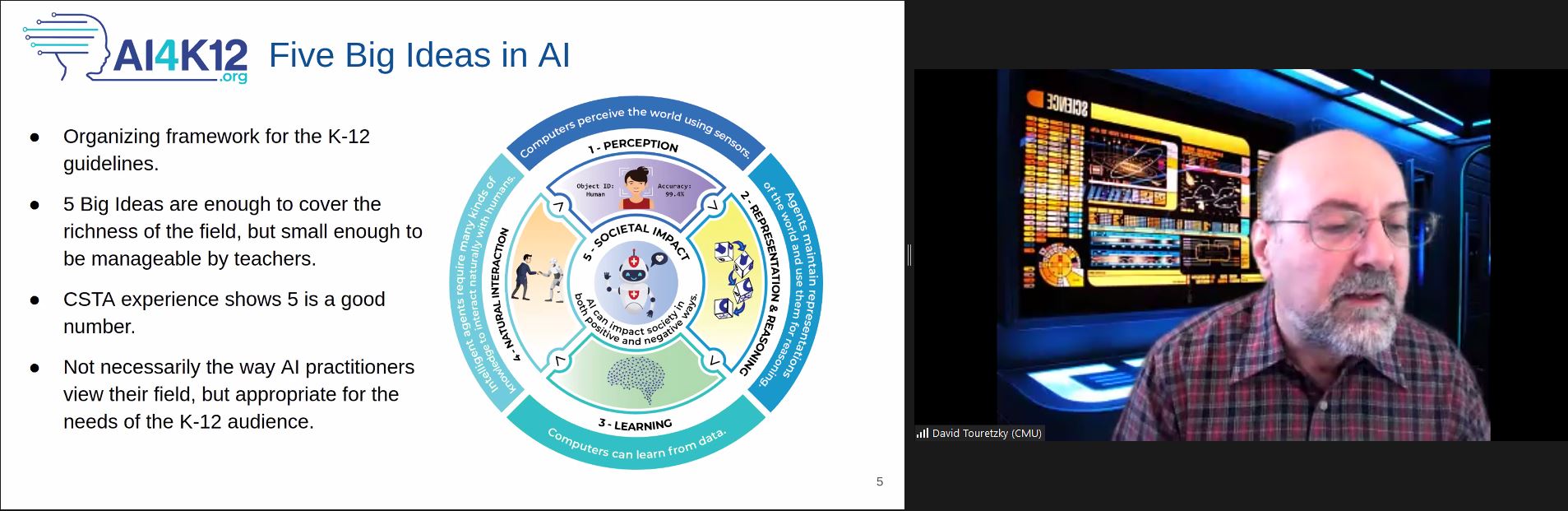
Dave gave us an overview of the AI4K12 project (click to enlarge)
The project has a number of goals. One is to develop a curated resource directory for K-12 teachers, and another to create a community of K-12 resource developers. On the AI4K12.org website, you can find links to many resources and sign up for their mailing list. I’ve been subscribed to this list for a while now, and fascinating discussions and resources have been shared.
Five Big Ideas of AI4K12
If you’ve heard of AI4K12 before, it’s probably because of the Five Big Ideas the team has set out to encompass the AI field from the perspective of school-aged children. These ideas are:
Perception — the idea that computers perceive the world through sensing
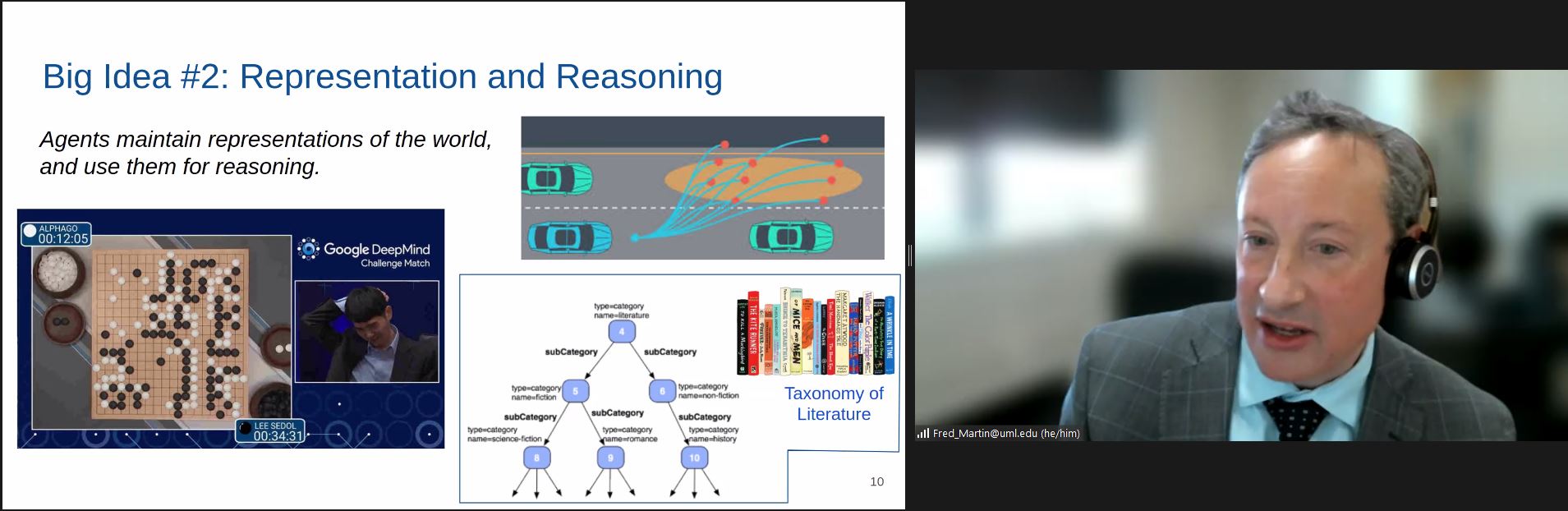
Representation and reasoning — the idea that agents maintain representations of the world and use them for reasoning
Learning — the idea that computers can learn from data
Natural interaction — the idea that intelligent agents require many types of knowledge to interact naturally with humans
Societal impact — the idea that artificial intelligence can impact society in both positive and negative ways
Sometimes we hear concerns that resources being developed to teach AI concepts to young people are narrowly focused on machine learning, particularly supervised learning for classification. It’s clear from the AI4K12 Five Big Ideas that the team’s definition of the AI field encompasses much more than one area of ML. Despite being developed for a US audience, I believe the description laid out in these five ideas is immensely useful to all educators, researchers, and policymakers around the world who are interested in AI education.

Fred explained how ‘representation and reasoning’ is a big idea in the AI field (click to enlarge)
During the seminar, Dave and Fred shared some great practical examples. Fred explained how the big ideas translate into learning outcomes at each of the four age groups (ages 5–8, 9–11, 12–14, 15–18). You can find out more about their examples in their presentation slides or the seminar recording (see below).
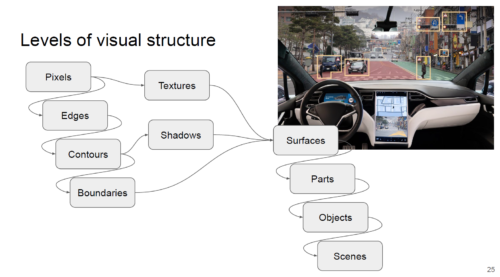
I was struck by how much the AI4K12 team has thought about progression — what you learn when, and in which sequence — which we do really need to understand well before we can start to teach AI in any formal way. For example, looking at how we might teach visual perceptionto young people, children might start when very young by using a tool such as Teachable Machine to understand that they can teach a computer to recognise what they want it to see, then move on to building an application using Scratch plugins or Calypso, and then to learning the different levels of visual structure and understanding the abstraction pipeline — the hierarchy of increasingly abstract things. Talking about visual perception, Fred used the example of self-driving cars and how they represent images.
Fred used this slide to describe how young people might learn abstracted elements of visual structure
AI education with an age-appropriate, glass-box approach
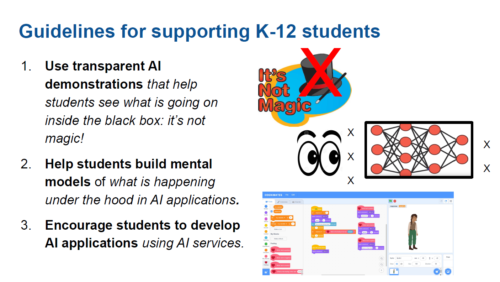
Dave and Fred support teaching AI to children using a glass-box approach. By ‘glass-box approach’ we mean that we should give students information about how AI systems work, and show the inner workings, so to speak. The opposite would be a ‘opaque-box approach’, by which we mean showing students an AI system’s inputs and the outputs only to demonstrate what AI is capable of, without trying to teach any technical detail.
AI4K12 teacher guidelines for AI education
Our speakers are keen for learners to understand, at an age-appropriate level, what is going on “inside” an AI system, not just what the system can do. They believe it’s important for young people to build mental models of how AI systems work, and that when the young people get older, they should be able to use their increasing knowledge and skills to develop their own AI applications. This aligns with the views of some of our previous seminar speakers, including Finnish researchers Matti Tedre and Henriikka Vartiainen, who presented at our seminar series in November.
What is AI thinking?
Dave addressed the question of what AI thinking looks like in school. His approach was to start with computational thinking (he used the example of the Barefoot project’s description of computational thinking as a starting point) and describe AI thinking as an extension that includes the following skills:
Perception
Reasoning
Representation
Machine learning
Language understanding
Autonomous robots
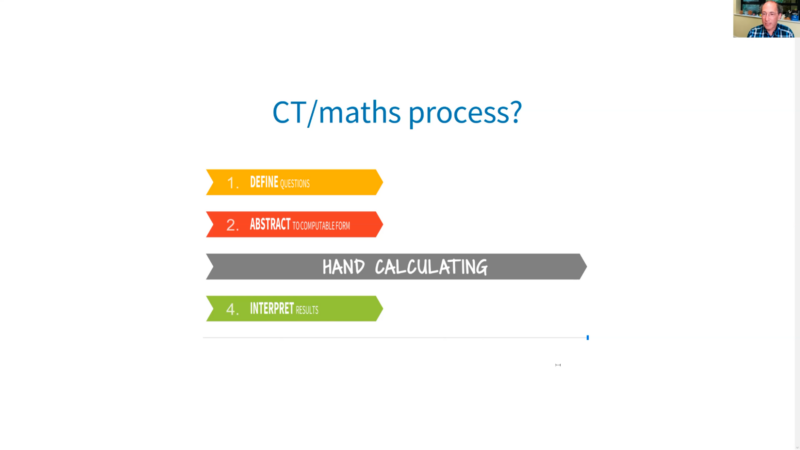
Dave described AI thinking as furthering the ideas of abstraction and algorithmic thinking commonly associated with computational thinking, stating that in the case of AI, computation actually is thinking. My own view is that to fully define AI thinking, we need to dig a bit deeper into, for example, what is involved in developing an understanding of perception and representation.

Thinking back to Matti Tedre and Henriikka Vartainen’s description of CT 2.0, which focuses only on the ‘Learning’ aspect of the AI4K12 Five Big Ideas, and on the distinct ways of thinking underlying data-driven programming and traditional programming, we can see some differences between how the two groups of researchers describe the thinking skills young people need in order to understand and develop AI systems. Tedre and Vartainen are working on a more finely granular description of ML thinking, which has the potential to impact the way we teach ML in school.
What I take from this is that there is much still to research and discuss in this area! It’s a real privilege to be able to hear from experts in the field and compare and contrast different standpoints and views.
Resources for AI education
The AI4K12 project has already made a massive contribution to the field of AI education, and we were delighted to hear that Dave, Fred, and their colleagues have just been awarded the AAAI/EAAI Outstanding Educator Award for 2022 for AI4K12.org. An amazing achievement! Particularly useful about this website is that it links to many resources, and that the Five Big Ideas give a framework for these resources.
Through our seminars series, we are developing our own list of AI education resources shared by seminar speakers or attendees, or developed by us. Please do take a look.
Join our next seminar
Through these seminars, we’re learning a lot about AI education and what it might look like in school, and we’re having great discussions during the Q&A section.
To provide the best experiences, we use technologies like cookies to store and/or access device information. Consenting to these technologies will allow us to process data such as browsing behavior or unique IDs on this site. Not consenting or withdrawing consent, may adversely affect certain features and functions.

Functional
Always active
The technical storage or access is strictly necessary for the legitimate purpose of enabling the use of a specific service explicitly requested by the subscriber or user, or for the sole purpose of carrying out the transmission of a communication over an electronic communications network.
Preferences
The technical storage or access is necessary for the legitimate purpose of storing preferences that are not requested by the subscriber or user.
Statistics
The technical storage or access that is used exclusively for statistical purposes.The technical storage or access that is used exclusively for anonymous statistical purposes. Without a subpoena, voluntary compliance on the part of your Internet Service Provider, or additional records from a third party, information stored or retrieved for this purpose alone cannot usually be used to identify you.
Marketing
The technical storage or access is required to create user profiles to send advertising, or to track the user on a website or across several websites for similar marketing purposes.