I could almost title this blog post the “AWS AI/ML Week in Review.” This past week, we announced several new innovations and tools for building with generative AI on AWS. Let’s dive right into it.
Last Week’s Launches Here are some launches that got my attention during the previous week:
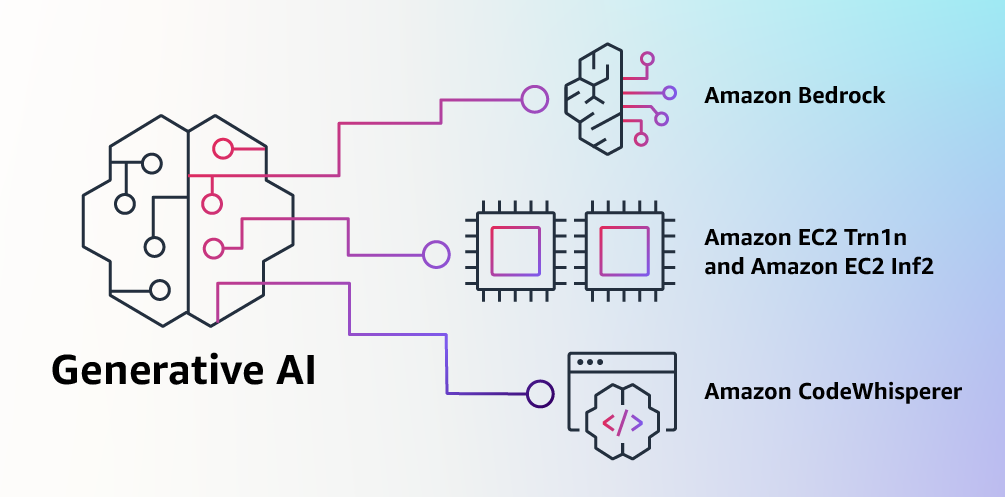
Announcing Amazon Bedrock and Amazon Titan models – Amazon Bedrock is a new service to accelerate your development of generative AI applications using foundation models through an API without managing infrastructure. You can choose from a wide range of foundation models built by leading AI startups and Amazon. The new Amazon Titan foundation models are pre-trained on large datasets, making them powerful, general-purpose models. You can use them as-is or privately to customize them with your own data for a particular task without annotating large volumes of data. Amazon Bedrock is currently in limited preview. Sign up here to learn more.
Amazon EC2 Trn1n and Inf2 instances are now generally available – Trn1n instances, powered by AWS Trainium accelerators, double the network bandwidth (compared to Trn1 instances) to 1,600 Gbps of Elastic Fabric Adapter (EFAv2). The increased bandwidth delivers even higher performance for training network-intensive generative AI models such as large language models (LLMs) and mixture of experts (MoE). Inf2 instances, powered by AWS Inferentia2 accelerators, deliver high performance at the lowest cost in Amazon EC2 for generative AI models, including LLMs and vision transformers. They are the first inference-optimized instances in Amazon EC2 to support scale-out distributed inference with ultra-high-speed connectivity between accelerators. Compared to Inf1 instances, Inf2 instances deliver up to 4x higher throughput and up to 10x lower latency. Check out my blog posts on Trn1 instances and Inf2 instances for more details.
Amazon CodeWhisperer, free for individual use, is now generally available – Amazon CodeWhisperer is an AI coding companion that generates real-time single-line or full-function code suggestions in your IDE to help you build applications faster. With GA, we introduce two tiers: CodeWhisperer Individual and CodeWhisperer Professional. CodeWhisperer Individual is free to use for generating code. You can sign up with an AWS Builder ID based on your email address. The Individual Tier provides code recommendations, reference tracking, and security scans. CodeWhisperer Professional—priced at $19 per user, per month—offers additional enterprise administration capabilities. Steve’s blog post has all the details.
Amazon GameLift adds support for Unreal Engine 5 – Amazon GameLift is a fully managed solution that allows you to manage and scale dedicated game servers for session-based multiplayer games. The latest version of the Amazon GameLift Server SDK 5.0 lets you integrate your Unreal 5-based game servers with the Amazon GameLift service. In addition, the latest Amazon GameLift Server SDK with Unreal 5 plugin is built to work with Amazon GameLift Anywhere so that you can test and iterate Unreal game builds faster and manage game sessions across any server hosting infrastructure. Check out the release notes to learn more.
Amazon Rekognition launches Face Liveness to deter fraud in facial verification – Face Liveness verifies that only real users, not bad actors using spoofs, can access your services. Amazon Rekognition Face Liveness analyzes a short selfie video to detect spoofs presented to the camera, such as printed photos, digital photos, digital videos, or 3D masks, as well as spoofs that bypass the camera, such as pre-recorded or deepfake videos. This AWS Machine Learning Blog post walks you through the details and shows how you can add Face Liveness to your web and mobile applications.
Other AWS News Here are some additional news items and blog posts that you may find interesting:
Updates to the AWS Well-Architected Framework – The most recent content updates and improvements focus on providing expanded guidance across the AWS service portfolio to help you make more informed decisions when developing implementation plans. Services that were added or expanded in coverage include AWS Elastic Disaster Recovery, AWS Trusted Advisor, AWS Resilience Hub, AWS Config, AWS Security Hub, Amazon GuardDuty, AWS Organizations, AWS Control Tower, AWS Compute Optimizer, AWS Budgets, Amazon CodeWhisperer, and Amazon CodeGuru. This AWS Architecture Blog post has all the details.
Amazon releases largest dataset for training “pick and place” robots – In an effort to improve the performance of robots that pick, sort, and pack products in warehouses, Amazon has publicly released the largest dataset of images captured in an industrial product-sorting setting. Where the largest previous dataset of industrial images featured on the order of 100 objects, the Amazon dataset, called ARMBench, features more than 190,000 objects. Check out this Amazon Science Blog post to learn more.
AWS open-source news and updates – My colleague Ricardo writes this weekly open-source newsletter in which he highlights new open-source projects, tools, and demos from the AWS Community. Read edition #153 here.
Upcoming AWS Events Check your calendars and sign up for these AWS events:
#BuildOn Generative AI – Join our weekly live Build On Generative AI Twitch show. Every Monday morning, 9:00 US PT, my colleagues Emily and Darko take a look at aspects of generative AI. They host developers, scientists, startup founders, and AI leaders and discuss how to build generative AI applications on AWS.
In today’s episode, Emily walks us through the latest AWS generative AI announcements. You can watch the video here.
.NET Developer Day – .NET Enterprise Developer Day EMEA 2023 (April 25) is a free, one-day virtual event providing enterprise developers with the most relevant information to swiftly and efficiently migrate and modernize their .NET applications and workloads on AWS.
AWS Developer Innovation Day – AWS Developer Innovation Day (April 26) is a new, free, one-day virtual event designed to help developers and teams be productive and collaborate from discovery to delivery, to running software and building applications. Get a first look at exciting product updates, technical deep dives, and keynotes.
During a time when computers were solely used for computation, the engineer, Douglas Engelbart, gave the “mother of all demos,” where he reframed the computer as a collaboration tool capable of solving humanity’s most complex problems. At the start of his demo, he asked audience members how much value they would derive from a computer that could instantly respond to their actions.
You can ask the same question of generative AI models. If you had a highly responsive generative AI coding tool to brainstorm new ideas, break big ideas into smaller tasks, and suggest new solutions to problems, how much more creative and productive could you be?
This isn’t a hypothetical question. AI-assisted engineering workflows are quickly emerging with new generative AI coding tools that offer code suggestions and entire functions in response to natural language prompts and existing code. These tools, and what they can help developers accomplish, are changing fast. That makes it important for every developer to understand what’s happening now—and the implications for how software is and will be built.
In this article, we’ll give a rundown of what generative AI in software development looks like today by exploring:
The unique value generative AI brings to the developer workflow
AI and automation have been a part of the developer workflow for some time now. From machine learning-powered security checks to CI/CD pipelines, developers already use a variety of automation and AI tools, like CodeQL on GitHub, for example.
While there’s overlap between all of these categories, here’s what makes generative AI distinct from automation and other AI coding tools:
Automation: You know what needs to be done, and you know of a reliable way to get there every time.
Rules-based logic: You know the end goal, but there’s more than one way to achieve it.
Machine learning:
You know the end goal, but the amount of ways to achieve it scales exponentially.
Generative AI: You have big coding dreams, and want the freedom to bring them to life.
You want to make sure that any new code pushed to your repository follows formatting specifications before it’s merged to the main branch. Instead of manually validating the code, you use a CI/CD tool like GitHub Actions to trigger an automated workflow on the event of your choosing (like a commit or pull request).
You know some patterns of SQL injections, but it’s time consuming to manually scan for them in your code. A tool like Code QL uses a system of rules to sort through your code and find those patterns, so you don’t have to do it by hand.
You want to stay on top of security vulnerabilities, but the list of SQL injections continues to grow. A coding tool that uses a machine learning (ML) model, like Code QL, is trained to not only detect known injections, but also patterns similar to those injections in data it hasn’t seen before. This can help you increase recognition of confirmed vulnerabilities and predict new ones.
Generative AI coding tools leverage ML to generate novel answers and predict coding sequences. A tool like GitHub Copilot can reduce the amount of times you switch out of your IDE to look up boilerplate code or help you brainstorm coding solutions. Shifting your role from rote writing to strategic decision making, generative AI can help you reflect on your code at a higher, more abstract level—so you can focus more on what you want to build and spend less time worrying about how.
How are generative AI coding tools designed and built?
Building a generative AI coding tool requires training AI models on large amounts of code across programming languages via deep learning. (Deep learning is a way to train computers to process data like we do—by recognizing patterns, making connections, and drawing inferences with limited guidance.)
To emulate the way humans learn patterns, these AI models use vast networks of nodes, which process and weigh input data, and are designed to function like neurons. Once trained on large amounts of data and able to produce useful code, they’re built into tools and applications. The models can then be plugged into coding editors and IDEs where they respond to natural language prompts or code to suggest new code, functions, and phrases.
Before we talk about how generative AI coding tools are made, let’s define what they are first. It starts with LLMs, or large language models, which are sets of algorithms trained on large amounts of code and human language. Like we mentioned above, they can predict coding sequences and generate novel content using existing code or natural language prompts.
Today’s state-of-the-art LLMs are transformers. That means they use something called an attention mechanism to make flexible connections between different tokens in a user’s input and the output that the model has already generated. This allows them to provide responses that are more contextually relevant than previous AI models because they’re good at connecting the dots and big-picture thinking.
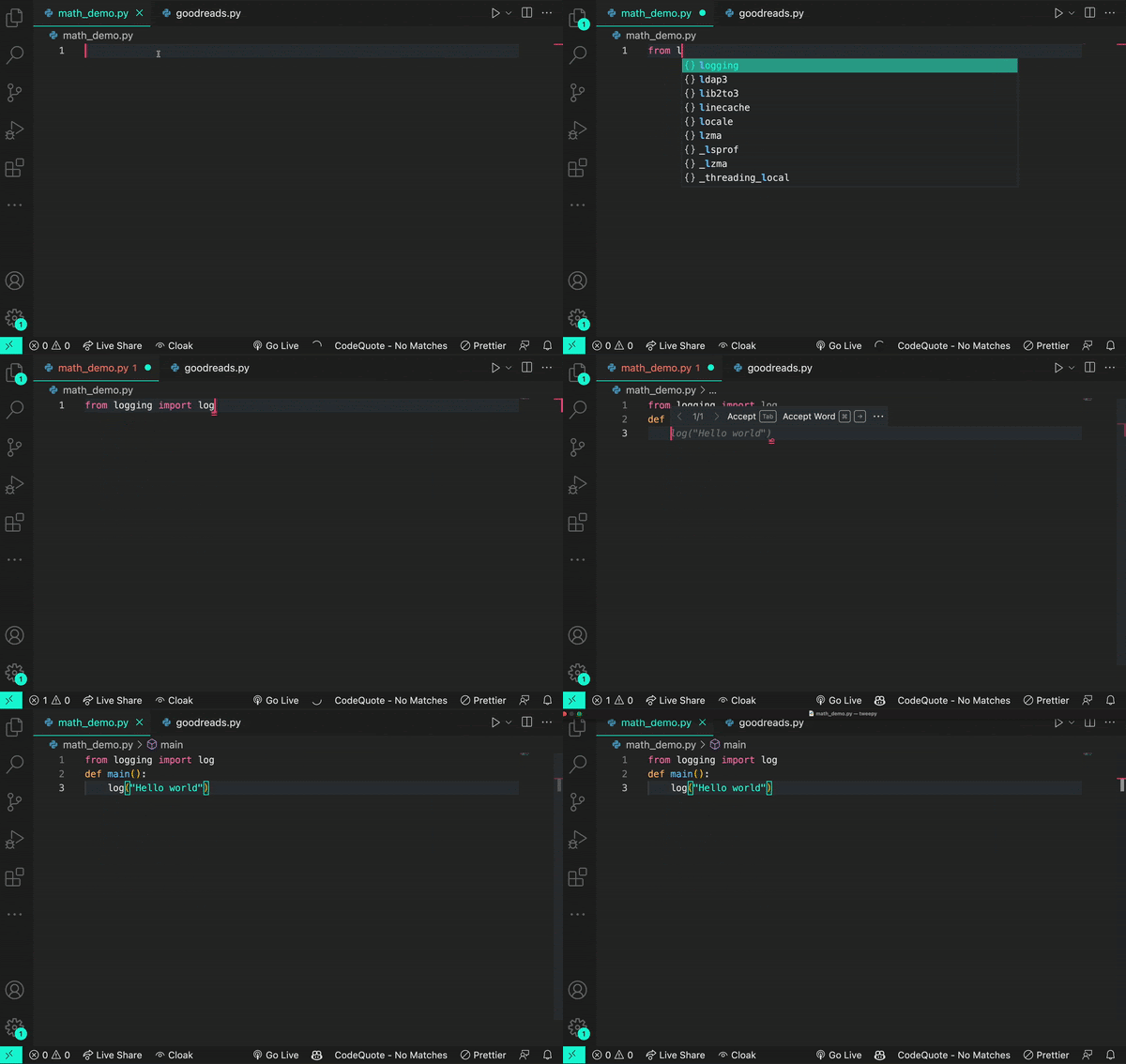
Here’s an example of how a transformer works. Let’s say you encounter the word log in your code. The transformer node at that place would use the attention mechanism to contextually predict what kind of log would come next in the sequence.
Let’s say, in the example below, you input the statement from math import log. A generative AI model would then infer you mean a logarithmic function.
And if you add the prompt from logging import log, it would infer that you’re using a logging function.
Though sometimes a log is just a log.
LLMs can be built using frameworks besides transformers. But LLMs using frameworks, like a recurrent neural network or long short-term memory, struggle with processing long sentences and paragraphs. They also typically require training on labeled data (making training a labor-intensive process). This limits the complexity and relevance of their outputs, and the data they can learn from.
Transformer LLMs, on the other hand, can train themselves on unlabeled data. Once they’re given basic learning objectives, LLMs take a part of the new input data and use it to practice their learning goals. Once they’ve achieved these goals on that portion of the input, they apply what they’ve learned to understand the rest of the input. This self-supervised learning process is what allows transformer LLMs to analyze massive amounts of unlabeled data—and the larger the dataset an LLM is trained on, the more they scale by processing that data.
Why should developers care about transformers and LLMs?
LLMs like OpenAI’s GPT-3, GPT-4, and Codex models are trained on an enormous amount of natural language data and publicly available source code. This is part of the reason why tools like ChatGPT and GitHub Copilot, which are built on these models, can produce contextually accurate outputs.
Here’s how GitHub Copilot produces coding suggestions:
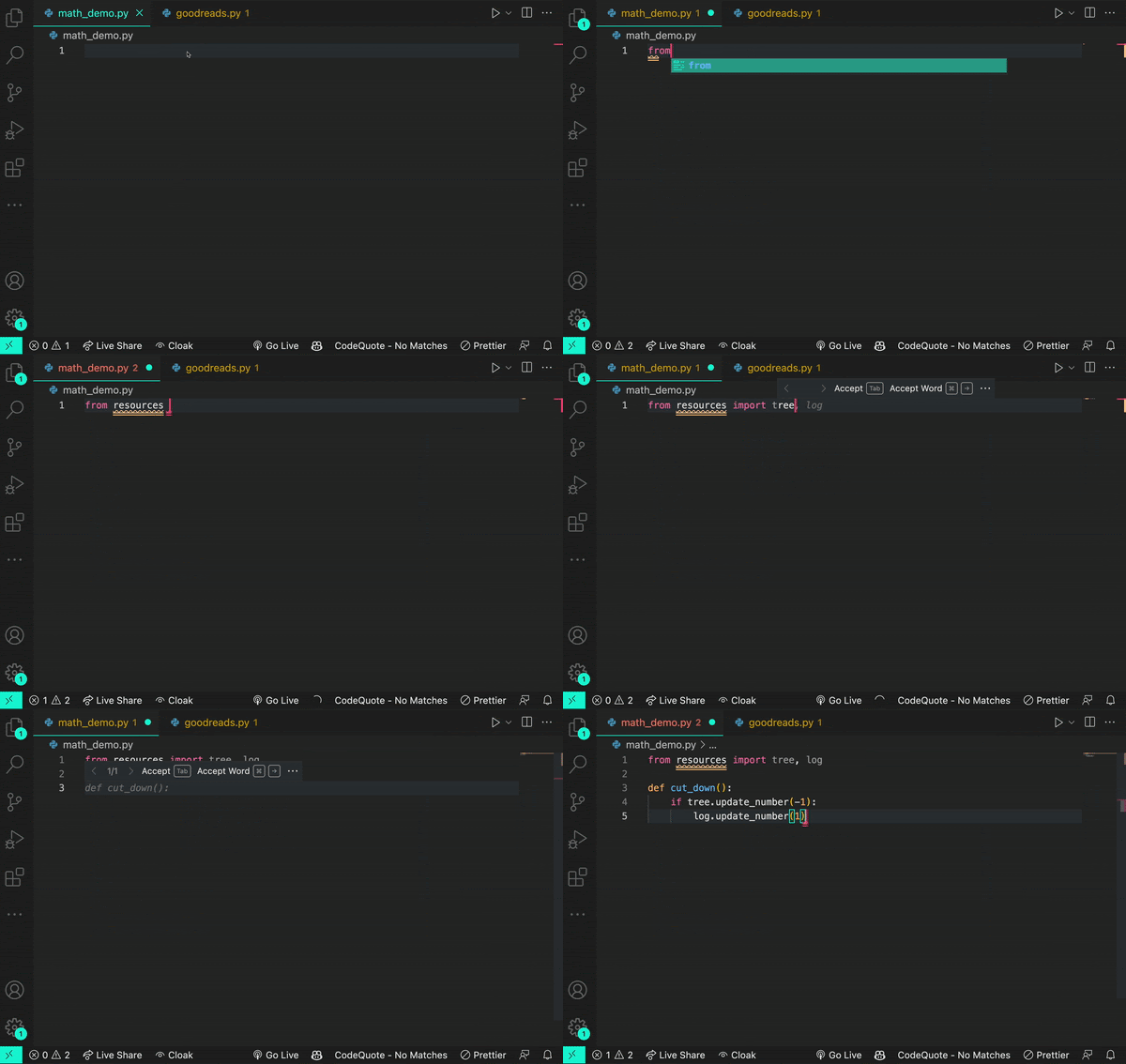
All of the code you’ve written so far, or the code that comes before the cursor in an IDE, is fed to a series of algorithms that decide what parts of the code will be processed by GitHub Copilot.
Since it’s powered by a transformer-based LLM, GitHub Copilot will apply the patterns it’s abstracted from training data and apply those patterns to your input code.
The result: contextually relevant, original coding suggestions. GitHub Copilot will even filter out known security vulnerabilities, vulnerable code patterns, and code that matches other projects.
Keep in mind: creating new content such as text, code, and images is at the heart of generative AI. LLMs are adept at abstracting patterns from their training data, applying those patterns to existing language, and then producing language or a line of code that follows those patterns. Given the sheer scale of LLMs, they might generate a language or code sequence that doesn’t even exist yet. Just as you would review a colleague’s code, you should assess and validate AI-generated code, too.
Why context matters for AI coding tools
Developing good prompt crafting techniques is important because input code passes through something called a context window, which is present in all transformer-based LLMs. The context window represents the capacity of data an LLM can process. Though it can’t process an infinite amount of data, it can grow larger. Right now, the Codex model has a context window that allows it to process a couple of hundred lines of code, which has already advanced and accelerated coding tasks like code completion and code change summarization.
Developers use details from pull requests, a folder in a project, open issues—and the list goes on—to contextualize their code. So, when it comes to a coding tool with a limited context window, the challenge is to figure out what data, in addition to code, will lead to the best suggestions.
The order of the data also impacts a model’s contextual understanding. Recently, GitHub made updates to its pair programmer so that it considers not only the code immediately before the cursor, but also some of the code after the cursor. The paradigm—which is called Fill-In-the-Middle (FIM)—leaves a gap in the middle of the code for GitHub Copilot to fill, providing the tool with more context about the developer’s intended code and how it should align with the rest of the program. This helps produce higher quality code suggestions without any added latency.
Visuals can also contextualize code. Multimodal LLMs (MMLLMs) scale transformer LLMs so they process images and videos, as well as text. OpenAI recently released its new GPT-4 model—and Microsoft revealed its own MMLLM called Kosmos-1. These models are designed to respond to natural language and images, like alternating text and images, image-caption pairs, and text data.
GitHub’s senior developer advocate Christina Warren shares the latest on GPT-4 and the creative potential it holds for developers:
How developers are using generative AI coding tools
The field of generative AI is filled with experiments and explorations to uncover the technology’s full capabilities—and how they can enable effective developer workflows. Generative AI tools are already changing how developers write code and build software, from improving productivity to helping developers focus on bigger problems.
While generative AI applications in software development are still being actively defined, today, developers are using generative AI coding tools to:
Get a head start on complex code translation tasks. A study presented at the 2021 International Conference on Intelligent User Interfaces found that generative AI provided developers with a skeletal framework to translate legacy source code into Python. Even if the suggestions weren’t always correct, developers found it easier to assess and fix those mistakes than manually translate the source code from scratch. They also noted that this process of reviewing and correcting was similar to what they already do when working with code produced by their colleagues.
With GitHub Copilot Labs, developers can use the companion VS Code extension (that’s separate from but dependent on the GitHub Copilot extension) to translate code into different programming languages. Watch how GitHub Developer Advocate, Michelle Mannering, uses GitHub Copilot Labs to translate her Python code into Ruby in just a few steps.
Code more efficiently. While autocompletion has been in modern IDEs for years, LLMs can generate longer suggestions—sometimes multiple lines of code—that are often more relevant. A 2022 study published in the Proceedings of the Association for Computing Machinery on Programming Languages (PACMPL) observed 20 programmers who interacted with GitHub Copilot. They found that thanks to end-of-line suggestions for function calls and argument completions, developers were able to code faster and stay in the flow longer.
Our own research supports these findings, too. As we mentioned earlier, we found that developers who used GitHub Copilot coded up to 55% faster than those who didn’t. But productivity gains went beyond speed with 74% of developers reporting that they felt less frustrated when coding and were able to focus on more satisfying work.
Tackle new problems and get creative. The PACMPL study also found that developers used GitHub Copilot to find creative solutions when they were unsure of how to move forward. These developers searched for next possible steps and relied on the generative AI coding tool to assist with unfamiliar syntax, look up the right API, or discover the correct algorithm.
I was one of the developers who wrote GitHub Copilot, but prior to that work, I had never written a single line of TypeScript. That wasn’t a problem because I used the first prototype of GitHub Copilot to learn the language and, eventually, help ship the world’s first at-scale generative AI coding tool.
– Albert Ziegler, Principal Machine Learning Engineer // GitHub
Find answers without leaving their IDEs. Some participants in the PACMPL study also treated GitHub Copilot’s multi-suggestion pane like StackOverflow. Since they were able to describe their goals in natural language, participants could directly prompt GitHub Copilot to generate ideas for implementing their goals, and press Ctrl/Cmd + Enter to see a list of 10 suggestions. Even though this kind of exploration didn’t lead to deep knowledge, it helped one developer to effectively use an unfamiliar API.
Build better test coverage. Some generative AI coding tools excel in pattern recognition and completion. Developers are using these tools to build unit and functional tests—and even security tests—via natural language prompts. Some tools also offer security vulnerability filtering, so a developer will be alerted if they unknowingly introduce a vulnerability in their code.
Discover tricks and solutions they didn’t know they needed. Scarlett also wrote about eight unexpected ways developers can use GitHub Copilot—from prompting it to create a dictionary of two-letter ISO country codes and their contributing country name, to helping developers exit Vim, an editor with a sometimes finicky closing process. Want to learn more? Check out the full guide >
The bottom line
Generative AI provides humans with a new mode of interaction—and it doesn’t just alleviate the tedious parts of software development. It also inspires developers to be more creative, feel empowered to tackle big problems, and model large, complex solutions in ways they couldn’t before. From increasing productivity and offering alternative solutions, to helping you build new skills—like learning a new language or framework, or even writing clear comments and documentation—there are so many reasons to be excited about the next wave of software development. This is only the beginning.
In our recent blog post announcing GitHub Copilot X, we mentioned that generative AI represents the future of software development. This amazing technology will enable developers to stay in the flow while helping enterprises meet their business goals.
But as we have also mentioned in our blog series on compliance, generative AI may soon act as an enabler for developer-focused compliance programs that will drive optimization and keep your development, compliance and audit teams productive and happy.
Today, we’ll explore the potential for generative AI to help enable teams to optimize and automate some of the foundational compliance components of separation of duties that many enterprises still often manage and review manually.
Generative AI has been dominating the news lately—but what exactly is it? Here’s what you need to know, and what it means for developers.
Separation of duties
The concept of “separation of duties,” long used in the accounting world as a check and balance approach, is also adopted in other scenarios, including technology architecture and workflows. While helpful to address compliance, it can lead to additional manual steps that can slow down delivery and innovation.
Fortunately, the PCI-DSS requirements guide provides a more DevOps, cloud native, and AI-enabled approach to separation of duties by focusing on functions and accounts, as opposed to people:
“The purpose of this requirement is to separate the development and test functions from the production functions. For example, a developer can use an administrator-level account with elevated privileges in the development environment and have a separate account with user-level access to the production environment.”
There are many parts of a software delivery workflow that need to have separation of duties in place—but one of the core components that is key for any compliance program is the code review. Having a separate set of objective eyes reviewing your code, whether it’s human or AI-powered, helps to ensure risks, tech debt, and security vulnerabilities are found and mitigated as early as possible.
Code reviews also help enable the concept of separation of duties since it prohibits a single person or a single function, account, or process from moving code to the next part of your delivery workflow. Additionally, code reviews help enable separation of duties for Infrastructure as Code (IaC) workflows, Policy-as-Code configurations, and even Kubernetes declarative deployments.
As we mentioned in our previous blog, GitHub makes code review easy, since pull requests are part of the existing workflow that millions of developers use daily. Having a foundational piece of compliance built-in to the platform that developers know and love keeps them in the flow, while keeping compliance and audit teams happy as well.
Generative AI and pull requests
Wouldn’t it be cool if one-day generative AI could be leveraged to enable more developer-friendly compliance programs which have traditionally been very labor and time intensive? Imagine if generative AI could help enable DevOps and cloud native approaches for separation of duties by automating tedious tasks and allowing humans to focus on key value-added tasks.
Bringing this back to compliance and separation of duties, wouldn’t it be great if a generative AI helper was available to provide an objective set of eyes on your pull requests? This is what the GitHub Next team has been working towards with GitHub Copilot for Pull Requests.
Suggestions for your pull request descriptions. AI-powered tags are embedded into a pull request description and automatically filled out by GitHub Copilot based on the code which the developers changed. Going one step further, the GitHub Next team is also looking at the creation of descriptive sentences and paragraphs as developers create pull requests.
Code reviews with AI. Taking pull requests and code reviews one step further, the GitHub Next team is looking at AI to help review the code and provide suggestions for changes. This will help enable human interactions and optimize existing processes. The AI would automate the creation of the descriptions, based on the code changes, as well as suggestions for improvements. The code reviewer will have everything they need to quickly review the change and decide to either move forward or send the change back.
When these capabilities are production ready, development teams and compliance programs will appreciate these features for a few reasons. First, the pull request and code review process would be driven by a conversation based on a neutral and independent description. Second, the description will be based on the actual code that was changed. Third, both development and compliance workflows will be optimized and allow humans to focus on value-added work.
While these capabilities are still a work in progress, there are features available now that may help enable compliance, audit, and security teams with GitHub Copilot for Business. The ability for developers to complete tasks faster and stay in the flow are truly amazing. But the ability for GitHub Copilot to provide AI-based security vulnerability filtering nowis a great place for compliance and audit teams within enterprises to get started on their journey to embracing generative AI into their day-to-day practices.
Next steps
Generative AI will enable developers and enterprises to achieve success by reducing manual tasks and enabling developers to focus their creativity on business value–all while staying in the flow.
I hope this blog will help drive positive discussions regarding this topic and has provided a forward looking view into what will be possible in the future. The future ability of generative AI to help enable teams by automating tedious tasks will help humans focus on more value-added work and could eventually be an important part of a robust and risk-based compliance posture.
By now, you’ve heard of generative artificial intelligence (AI) tools like ChatGPT, DALL-E, and GitHub Copilot, among others. They’re gaining widespread interest thanks to the fact that they allow anyone to create content from email subject lines to code functions to artwork in a matter of moments.
This potential to revolutionize content creation across various industries makes it important to understand what generative AI is, how it’s being used, and who it’s being used by. In this article, we’ll explore what generative AI is, how it works, some real-world applications, and how it’s already changing the way people (and developers) work.
What is generative AI used for?
You may have heard the buzz around new generative AI tools like ChatGPT or the new Bing, but there’s a lot more to generative AI than any one single framework, project, or application.
Traditional AI systems are trained on large amounts of data to identify patterns, and they’re capable of performing specific tasks that can help people and organizations. But generative AI goes one step further by using complex systems and models to generate new, or novel, outputs in the form of an image, text, or audio based on natural language prompts.
Generative AI models and applications can, for example, be used for:
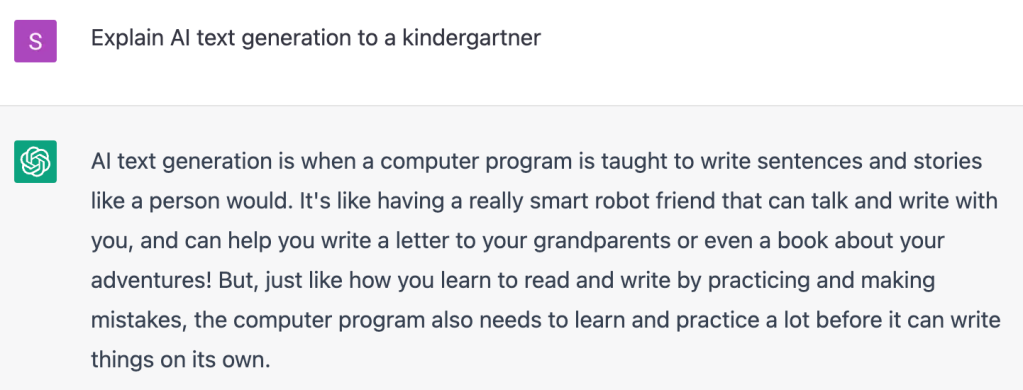
Text generation. Text generation, as a field, with AI tools has been in development since the 1970s—but more recently, AI researchers have been able to train generative adversarial networks (GANs) to produce text that models human-like speech. A prime example is OpenAI’s application ChatGPT, which has been trained on thousands of texts, books, articles, and code repositories, and can respond with full answers to natural language prompts and questions.
An example of text generation in ChatGPT
Image generation. Generative AI models can be used to create new images with natural language prompts, which is one of the most popular techniques with current tools and applications. The goal with text-to-image generation is to create an image that accurately represents the content of a given prompt. For example, when we give the text prompt, “impressionist style oil painting of a Shiba Inu dog giving a tarot card reading,” to the popular AI image generator DALL-E 2 we get something that looks like this (and yes, it’s a gem):
An AI-generated image from DALL-E 2 of a Shiba Inu dog giving a tarot card reading
Video generation. Generative AI models, like Stable Diffusion, are creating new videos from existing videos by applying specified styles through a text prompt or image reference. One project on GitHub, stable-diffusion-videos, offers helpful examples and tips on how to create music videos and videos that can morph between text prompts with Stable Diffusion.
Programming code generation. Rather than scouring the internet or developer community groups for help with code examples, generative AI models can be used to help generate new programming code with natural language prompts, complete partially written code with suggestions, or even translate code from one programming language to another. This is how, at a simple level, GitHub Copilot works: it uses OpenAI’sCodex model to offer code suggestions right from a developer’s editor. However, as you would with any software development tool, we encourage you to review generated code before merging into production.
Data generation. Creating new data—which is called synthetic data—and augmenting existing data sets is another common use case for generative AI. This involves generating new samples from an existing dataset to increase the dataset’s size and improve machine learning models trained on it, all while providing a layer of privacy since real user data is not being utilized to power models. Synthetic data generation provides a way to create useful, meaningful data for more than just ML training though—a number of self-driving car companies like Cruise and Waymoutilize AI-generated synthetic data for training perception systems to prepare vehicles for real-world situations while in operation.
Language translation. Natural-language understanding (NLU) models combined with generative AI have become increasingly popular to provide language translations on-the-fly. These types of tools help companies break language barriers and increase their scope of accessibility for customer bases by being able to provide things like support or documentation in their native language. Through complex, deep learning algorithms, generative AI is able to understand the context of a source text and linguistically construct those sentences in another language. This practice can also apply to coding languages, for example, translating a desired function from Python to Java.
The bottom line: Even though generative AI is a relatively new technology, it’s already being used in consumer and business applications. The use cases, as well as the quantity of applications created with it, will continue evolving to meet more distinct and specific needs.
How does generative AI work?
Generative AI models work by using neural networks to identify patterns from large sets of data, then generate new and original data or content.
But what are neural networks? In simple terms, they use interconnected nodes that are inspired by neurons in the human brain. These networks are the foundation of machine learning and deep learning models, which use a complex structure of algorithms to process large amounts of data such as text, code, or images. Training these neural networks involves adjusting the weights or parameters of the connections between neurons to minimize the difference between predicted and desired outputs, which allows the network to learn from mistakes and make more accurate predictions based on the data.
Algorithms are a key component of machine learning and generative AI models. But beyond helping machines learn from data, algorithms are also used to optimize accuracy of outputs and make decisions, or recommendations, based on input data.
While algorithms help automate these processes, building a generative AI model is incredibly complex due to the massive amounts of data and compute resources they require. People and organizations need large datasets to train these models, and generating high-quality data can be time-consuming and expensive.
To restate the obvious, these models are complicated. Need proof? Here are some common generative AI models and how they work:
Large language models (LLM): LLMs are a type of machine learning model that process and generate natural language text. One of the most significant advancements in the development of large language models has been the availability of vast amounts of text data, such as books, websites, and social media posts. This data can be used to train models that are capable of predicting and generating natural language responses in a variety of contexts. As a result, large language models have multiple practical applications, such as virtual assistants, chatbots, or text generators, like ChatGPT.
Generative adversarial networks (GAN): GANs are one of the most used models for generative AI, and they employ two different neural networks. GANs consist of two different types of neural networks: a generator and a discriminator. The generator network generates new data, such as images or audio, from a random noise signal while the discriminator is trained to distinguish between real data from the training set and the data produced by the generator.
During training, the generator tries to create data that can trick the discriminator network into thinking it’s real. This “adversarial” process will continue until the generator can produce data that is totally indistinguishable from real data in the training set. This process helps both networks improve at their respective tasks, which ultimately results in more realistic and higher-quality generated data.
A diagram illustrating how a generative adversarial network works. Image [CC BY-SA 4.0](https://creativecommons.org/licenses/by-sa/4.0/deed.en) האדם-החושב on wikipedia
Transformer-based models: A transformer-based model’s neural networks operate by learning context and meaning through tracking relationships of sequential data, which means these models are really good at natural language processing tasks like machine translation, language modeling, and answering questions. These models have been used in popular language models, such as GPT-4 (which stands for Generative Pre-trained Transformer 4), and have also been adapted for other such tasks that require the modeling of sequential data such as image recognition.
Variational autoencoder models (VAEs): These models are similar to GANs in that they work with two different neural networks: encoders and decoders. VAEs can take a large amount of data and compress it into a smaller representation, which can be used to create new data that is similar to the original data. VAEs are often used in image, video, and audio generation—and here’s a fun fact: you can train a VAE on datasets like CelebA, which contains over 200,000 images of celebrities, to create completely new portraits of people that don’t exist.
The smile vector, a concept vector discovered by Tom White using VAEs trained on the CelebA dataset.
The real-world applications of generative AI
The impact of generative AI is quickly becoming apparent—but it’s still in its early days. Despite this, we’re already seeing a proliferation of applications, products, and open source projects that are using generative AI models to achieve specific outcomes for people and organizations (and yes, developers, too).
Though generative AI is constantly evolving, it already has some solid real world applications. Here’s just a few of them:
Coding
New and seasoned developers alike can utilize generative AI to improve their coding processes. Generative AI coding tools can help automate some of the more repetitive tasks, like testing, as well as complete code or even generate brand new code. GitHub has its own AI-powered pair programmer, GitHub Copilot, which uses generative AI to provide developers with code suggestions. And GitHub also has announced GitHub Copilot X, which brings generative AI to more of the developer experience across the editor, pull requests, documentation, CLI, and more.
Accessibility
Generative AI has the potential to greatly impact and improve accessibility for folks with disabilities through a variety of modalities, such as speech-to-text transcription, text-to-speech audio generation, or assistive technologies. One of the most exciting facets of our GitHub Copilot tool is its voice-activated capabilities that allow developers with difficulties using a keyboard to code with their voice. By leveraging the power of generative AI, these types of tools are paving the way for a more inclusive and accessible future in technology.
Gaming
Generative AI can take gaming to the next level (get it? ) by generating new characters, storylines, design components, and more. Case in point: The developer behind the game, This Girl Does Not Exist, has said that every component of the game—from the storyline to the art and even the music—was generated entirely by AI. This use of generative AI can enable gaming studios to create new and exciting content for their users, all without increasing the developer workload, which frees them up to work on other aspects of the game, such as story development.
Web design
Designers can utilize generative AI tools to automate the design process and save significant time and resources, which allows for a more streamlined and efficient workflow. Additionally, incorporating these tools into the development process can lead to the creation of highly customized designs and logos, enhancing the overall user experience and engagement with the website or application. Generative AI tools can also be used to do some of the more tedious work, such as creating design layouts that are optimized and adaptable across devices. For example, designers can use tools like designs.ai to quickly generate logos, banners, or mockups for their websites.
Web search
Microsoft and other industry players are increasingly utilizing generative AI models in search to create more personalized experiences. This includes query expansion, which generates relevant keywords to reduce the number of searches. So, rather than the search engine returning a list of links, generative AI can help these new and improved models return search results in the form of natural language responses. Bing now includes AI-powered features in partnership with OpenAI that provide answers to complex questions and allow users to ask follow-up questions in a chatbox for more refined responses.
Healthcare
Interest has emerged around the potential applications of generative AI in the healthcare field to improve disease detection and diagnosis, advance medical research, and accelerate progress in the pharmaceutical space. Potentially, generative AI could be used to analyze large amounts of data to simulate chemical structures and predict new compounds will be the most effective for new drug discoveries. NVIDIA Clara is one example of a generative AI model specifically designed for medical imaging and healthcare research. (Plus, Gartner suggests more than 30 percent of new pharmaceutical drugs and materials will be discovered via generative AI models by 2025.)
In marketing, content is king—and generative AI is making it easier than ever to quickly create large amounts of it. A number of companies, agencies, and creators are already turning to generative AI tools to create images for social posts or write captions, product descriptions, blog posts, email subject lines, and more. Generative AI can also help companies personalize ad experiences by creating custom, engaging content for individuals at speed. Writers, marketers, and creators can leverage tools like Jasper to generate copy, Surfer SEO to optimize organic search, or albert.ai to personalize digital advertising content.
Art and design
As we’ve seen above, the power of AI can be harnessed to create some incredible portraits in a matter of moments (re: the future-telling Shiba ). Artists and designers alike are using these AI tools as a source of inspiration. For example, architects can quickly create 3D models of objects or environments and artists can breathe new life into their portraits by using AI to apply different styles, like adding a Cubist style to their original image. Need proof? Designers are already starting to use AI image generators, such as Midjourney and Microsoft Designer, to create high-quality images by simply typing out Discord commands.
Finance
In a recent discussion about tech trends and how they’ll affect the finance sector, Michael Schrage, a research fellow at the MIT Sloan School Initiative on the Digital Economy, said, “I think, increasingly, we’re going to be seeing generative AI used for financial forecasts and scenario generation.” This is a likely path forward—generative AI can be used to analyze large amounts of data to detect fraud, manage risk, and inform decision making. And that has obvious applications in the financial services industry.
Manufacturing
Manufacturers are starting to turn to generative AI solutions to help with product design, quality control, and predictive maintenance. Generative AI can be used to analyze historical data to improve machine failure predictions and help manufacturers with maintenance planning. According to research conducted by Capgemini, more than half of European manufacturers are implementing some AI solutions (although so far, these aren’t generative AI solutions). This is largely because the sheer amount of manufacturing data is easier for machines to analyze at speed than humans.
AI as a partner: Generative AI models and tools are narrow in focus, and work best at generating content, code, and images. In research at GitHub, we’ve found that GitHub Copilot helps developers code up to 55% faster, underscoring how generative AI models and tools can improve overall productivity and boost efficiency. Metrics like these show how generative AI tools are already changing how people and teams work—but they also underscore how these tools act as complement to human efforts.
Take this with you
Whether it’s creating visual assets for an ad campaign or augmenting medical images to help diagnose diseases, generative AI is helping us solve complex problems at speed. And the emergence of generative AI-based programming tools has revolutionized the way developers approach writing code.
While these models aren’t perfect yet, they’re getting better by the day—and that’s creating an exciting immediate future for developers and generative AI.
The collective thoughts of the interwebz
Manage Consent
To provide the best experiences, we use technologies like cookies to store and/or access device information. Consenting to these technologies will allow us to process data such as browsing behavior or unique IDs on this site. Not consenting or withdrawing consent, may adversely affect certain features and functions.
Functional
Always active
The technical storage or access is strictly necessary for the legitimate purpose of enabling the use of a specific service explicitly requested by the subscriber or user, or for the sole purpose of carrying out the transmission of a communication over an electronic communications network.
Preferences
The technical storage or access is necessary for the legitimate purpose of storing preferences that are not requested by the subscriber or user.
Statistics
The technical storage or access that is used exclusively for statistical purposes.The technical storage or access that is used exclusively for anonymous statistical purposes. Without a subpoena, voluntary compliance on the part of your Internet Service Provider, or additional records from a third party, information stored or retrieved for this purpose alone cannot usually be used to identify you.
Marketing
The technical storage or access is required to create user profiles to send advertising, or to track the user on a website or across several websites for similar marketing purposes.
 #BuildOn Generative AI – Join our weekly live Build On Generative AI Twitch show. Every Monday morning, 9:00 US PT, my colleagues Emily and Darko take a look at aspects of generative AI. They host developers, scientists, startup founders, and AI leaders and discuss how to build generative AI applications on AWS.
 .NET Developer Day – .NET Enterprise Developer Day EMEA 2023 (April 25) is a free, one-day virtual event providing enterprise developers with the most relevant information to swiftly and efficiently migrate and modernize their .NET applications and workloads on AWS.
 AWS Developer Innovation Day – AWS Developer Innovation Day (April 26) is a new, free, one-day virtual event designed to help developers and teams be productive and collaborate from discovery to delivery, to running software and building applications. Get a first look at exciting product updates, technical deep dives, and keynotes.
 AWS Global Summits – Check your calendars and sign up for the AWS Summit close to where you live or work: Tokyo (April 20–21), Singapore (May 4), Stockholm (May 11), Hong Kong (May 23), Tel Aviv (May 31), Amsterdam (June 1), London (June 7), Washington, DC (June 7–8), Toronto (June 14), Madrid (June 15), and Milano (June 22).



.](https://github.blog/wp-content/uploads/2023/04/image3.gif)
 האדם-החושב on wikipedia](https://github.blog/wp-content/uploads/2023/04/image4-1.png?w=1024&fit=1024%2C1024)
 using VAEs trained on the CelebA dataset.](https://github.blog/wp-content/uploads/2023/04/image6.jpg?w=539&fit=1024%2C1024)
 ) by generating new characters, storylines, design components, and more. Case in point: The developer behind the game,
 ). Artists and designers alike are using these AI tools as a source of inspiration. For example, architects can quickly create 3D models of objects or environments and artists can breathe new life into their portraits by using AI to apply different styles, like adding a Cubist style to their original image. Need proof? Designers are already starting to use AI image generators, such as